EP1172085A2 - Emulgatorfreie feindisperse Systeme vom Typ Wasser-in-Öl - Google Patents
Emulgatorfreie feindisperse Systeme vom Typ Wasser-in-Öl Download PDFInfo
- Publication number
- EP1172085A2 EP1172085A2 EP01115987A EP01115987A EP1172085A2 EP 1172085 A2 EP1172085 A2 EP 1172085A2 EP 01115987 A EP01115987 A EP 01115987A EP 01115987 A EP01115987 A EP 01115987A EP 1172085 A2 EP1172085 A2 EP 1172085A2
- Authority
- EP
- European Patent Office
- Prior art keywords
- preparations
- acid
- oil
- cosmetic
- derivatives
- Prior art date
- Legal status (The legal status is an assumption and is not a legal conclusion. Google has not performed a legal analysis and makes no representation as to the accuracy of the status listed.)
- Withdrawn
Links
- 0 *CN1C(C(C(C2)=O)=CC=C2O*)NC(c(ccc(O*)c2)c2O)NC1c(cc1)ccc1O* Chemical compound *CN1C(C(C(C2)=O)=CC=C2O*)NC(c(ccc(O*)c2)c2O)NC1c(cc1)ccc1O* 0.000 description 1
Classifications
-
- A—HUMAN NECESSITIES
- A61—MEDICAL OR VETERINARY SCIENCE; HYGIENE
- A61K—PREPARATIONS FOR MEDICAL, DENTAL OR TOILETRY PURPOSES
- A61K8/00—Cosmetics or similar toiletry preparations
- A61K8/02—Cosmetics or similar toiletry preparations characterised by special physical form
- A61K8/04—Dispersions; Emulsions
- A61K8/06—Emulsions
- A61K8/064—Water-in-oil emulsions, e.g. Water-in-silicone emulsions
-
- A—HUMAN NECESSITIES
- A61—MEDICAL OR VETERINARY SCIENCE; HYGIENE
- A61K—PREPARATIONS FOR MEDICAL, DENTAL OR TOILETRY PURPOSES
- A61K8/00—Cosmetics or similar toiletry preparations
- A61K8/18—Cosmetics or similar toiletry preparations characterised by the composition
- A61K8/30—Cosmetics or similar toiletry preparations characterised by the composition containing organic compounds
- A61K8/33—Cosmetics or similar toiletry preparations characterised by the composition containing organic compounds containing oxygen
- A61K8/35—Ketones, e.g. benzophenone
-
- A—HUMAN NECESSITIES
- A61—MEDICAL OR VETERINARY SCIENCE; HYGIENE
- A61K—PREPARATIONS FOR MEDICAL, DENTAL OR TOILETRY PURPOSES
- A61K8/00—Cosmetics or similar toiletry preparations
- A61K8/18—Cosmetics or similar toiletry preparations characterised by the composition
- A61K8/30—Cosmetics or similar toiletry preparations characterised by the composition containing organic compounds
- A61K8/49—Cosmetics or similar toiletry preparations characterised by the composition containing organic compounds containing heterocyclic compounds
- A61K8/494—Cosmetics or similar toiletry preparations characterised by the composition containing organic compounds containing heterocyclic compounds with more than one nitrogen as the only hetero atom
- A61K8/4946—Imidazoles or their condensed derivatives, e.g. benzimidazoles
-
- A—HUMAN NECESSITIES
- A61—MEDICAL OR VETERINARY SCIENCE; HYGIENE
- A61K—PREPARATIONS FOR MEDICAL, DENTAL OR TOILETRY PURPOSES
- A61K8/00—Cosmetics or similar toiletry preparations
- A61K8/18—Cosmetics or similar toiletry preparations characterised by the composition
- A61K8/30—Cosmetics or similar toiletry preparations characterised by the composition containing organic compounds
- A61K8/49—Cosmetics or similar toiletry preparations characterised by the composition containing organic compounds containing heterocyclic compounds
- A61K8/494—Cosmetics or similar toiletry preparations characterised by the composition containing organic compounds containing heterocyclic compounds with more than one nitrogen as the only hetero atom
- A61K8/4966—Triazines or their condensed derivatives
-
- A—HUMAN NECESSITIES
- A61—MEDICAL OR VETERINARY SCIENCE; HYGIENE
- A61K—PREPARATIONS FOR MEDICAL, DENTAL OR TOILETRY PURPOSES
- A61K8/00—Cosmetics or similar toiletry preparations
- A61K8/18—Cosmetics or similar toiletry preparations characterised by the composition
- A61K8/72—Cosmetics or similar toiletry preparations characterised by the composition containing organic macromolecular compounds
- A61K8/81—Cosmetics or similar toiletry preparations characterised by the composition containing organic macromolecular compounds obtained by reactions involving only carbon-to-carbon unsaturated bonds
- A61K8/817—Compositions of homopolymers or copolymers of compounds having one or more unsaturated aliphatic radicals, each having only one carbon-to-carbon double bond, and at least one being terminated by a single or double bond to nitrogen or by a heterocyclic ring containing nitrogen; Compositions or derivatives of such polymers, e.g. vinylimidazol, vinylcaprolactame, allylamines (Polyquaternium 6)
- A61K8/8182—Copolymers of vinyl-pyrrolidones. Compositions of derivatives of such polymers
-
- A—HUMAN NECESSITIES
- A61—MEDICAL OR VETERINARY SCIENCE; HYGIENE
- A61Q—SPECIFIC USE OF COSMETICS OR SIMILAR TOILETRY PREPARATIONS
- A61Q17/00—Barrier preparations; Preparations brought into direct contact with the skin for affording protection against external influences, e.g. sunlight, X-rays or other harmful rays, corrosive materials, bacteria or insect stings
- A61Q17/04—Topical preparations for affording protection against sunlight or other radiation; Topical sun tanning preparations
-
- A—HUMAN NECESSITIES
- A61—MEDICAL OR VETERINARY SCIENCE; HYGIENE
- A61Q—SPECIFIC USE OF COSMETICS OR SIMILAR TOILETRY PREPARATIONS
- A61Q19/00—Preparations for care of the skin
Definitions
- the present invention relates to emulsifier-free finely dispersed systems of the water-in-oil type, preferably as cosmetic or dermatological preparations.
- it relates to cosmetic and dermatological light protection formulations in Form of emulsifier-free water-in-oil emulsions.
- Emulsions are by far the most important product type in the area of skin care products emulsions are disperse two- or multi-phase systems, with cosmetic Emulsions from at least one fat phase (fats and mineral oils, fatty acid esters etc.) and at least one water phase (water, glycerin, glycols etc.), which are finely divided into one another with the aid of emulsifiers.
- the lipophilic phase A personal care emulsion usually contains a mixture of oils, fats and Waxes, the composition of which determines the product-determining properties such as Skin care and skin feel should significantly affect.
- O / W emulsion oil-in-water emulsion
- the basic character of an O / W emulsion is characterized by the water.
- W / O emulsion e.g. butter
- the reverse Principle whereby the basic character is determined by the oil.
- Emulsifiers In order to achieve the permanent dispersion of one liquid in another, at Emulsions in the traditional sense of adding a surfactant (Emulsifier) necessary.
- Emulsifiers have an amphiphilic molecular structure from a polar (hydrophilic) and a non-polar (lipophilic) part of the molecule, that are spatially separated from each other. They put the interfacial tension between the phases down by being placed at the interface between the two liquids are (they form interfacial films), causing the irreversible confluence the droplet is counteracted.
- To stabilize emulsions frequently used emulsifier mixtures.
- the conventional emulsifiers can be in accordance with their hydrophilic molecular part ionic (anionic, cationic and amphoteric) and nonionic.
- hydrophilic molecular part ionic anionic, cationic and amphoteric
- nonionic By varying the structure and size of the polar and non-polar Lipophilicity and hydrophilicity of emulsifiers can be varied within wide limits change.
- emulsifiers The correct choice of emulsifiers is decisive for the stability of an emulsion. The characteristics of all substances contained in the system must be taken into account. Looking at z. B. skin care emulsions, lead polar oil components and, for example UV filter to instabilities. In addition to the emulsifiers, there are also others Stabilizers used, for example, increase the viscosity of the emulsion and / or act as a protective colloid.
- Cosmetic preparations are mainly used for skin care.
- skin care In the cosmetic sense it is primarily that the natural function of the skin as a barrier against environmental influences (e.g. dirt, chemicals, microorganisms) and against strengthened the loss of the body's own substances (e.g. water, natural fats, electrolytes) or is restored.
- the aim of skin care is also to reduce the fat and fat caused by daily washing Compensate for skin water loss. This is especially important when the natural Regeneration capacity is not sufficient.
- skin care products are said to exist Protect environmental influences, especially from the sun and wind, and skin aging delay.
- the formation of the erythema depends on the wavelength.
- the erythema area of the UV-B is between 280 nm and 320 nm.
- UV-A rays About 90% of the ultraviolet radiation reaching the earth consists of UV-A rays with a wavelength between 320 nm and 400 nm.
- UV-B radiation varies greatly depending on numerous factors (e.g. time of year and time of day or latitude), the UV-A radiation remains independent of the time of year and day or geographic factors relatively constant day by day. Penetrates at the same time the majority of UV-A radiation enters the living epidermis, while approximately 70% of the UV-B rays are retained by the horny layer.
- UV-A radiation has only a negligible biological effect and accordingly the UV-B rays are responsible for most of the light damage to human skin are.
- numerous studies have shown that UV-A radiation in the With regard to the triggering of photodynamic, especially phototoxic reactions and chronic skin changes is far more dangerous than UV-B radiation. Also the damaging influence of UV-B radiation can be intensified by UV-A radiation become.
- the sunburn or the light erythema are the acute manifestations of Light.
- it is shown on particularly strongly exposed skin areas (Face, neck, hands) with increasing age due to the related high total dose caused by radiation (actinic) Change in skin.
- actinic or senile elastosis. Macroscopically, it manifests itself in a thickening and coarsening of the skin, wrinkling, loss of elasticity, appearance of yellowish shimmering deposits and irregular pigment accumulations.
- the epidermis becomes thin in places and shows warty growths, the dermis vertically their elasticity and tension, water retention capacity is reduced.
- malignancy Melanoma and actinic keratosis in the last stage.
- UV-A and UV-B range are preventive protection for both the UV-A and the UV-B range, for example, by applying light protection filter substances in the form of a cosmetic or dermatological formulation on the skin, crucial Importance.
- Cosmetic preparations should, in principle, be critical of UV-A rays absorb strongly, not only to protect sensitive skin when sunbathing, but also for general protection up to use in a normal one Skin cream because skin aging and risk of skin cancer are essential from this part of the UV light can be influenced.
- the benefit of a sunscreen preparation is to extend the time it takes Consumers can stay in the sun without getting damaged by light. there the filter effect should be especially for the UV-B range of individual sensitivity be adapted to the consumer and the intensity of solar radiation.
- Emulsions also play a decisive role in the field of sun protection formulations Role. Flowable emulsions are preferred because they are easier to apply leave as viscous creams. Most sunscreens are near the water or applied during sporting activities (sweating), which is why the water resistance such formulations are of particular importance. A waterproof Sunscreen not only protects the user after bathing, but also also keeps him from getting sunburnt while bathing.
- W / O formulations With the help of W / O formulations, high sun protection factors can be achieved at the same time very good water resistance. Especially for children and Baby products are therefore preferred W / O formulations because children due to the lower light swell (thickening of the horny layer) and the reduced self-protection are particularly susceptible to sunburns and often play for hours on or in the water. Furthermore, the risk of skin cancer is one Adults the higher the more sunburns he suffered as a child.
- a reduction in the amount of emulsifier required can, for. B. can be achieved when used that finely divided solid particles have an additional stabilizing effect to have an emulsion.
- the solid material accumulates the phase boundary oil / water in the form of a layer through which a confluence of the disperse phases is prevented.
- The are not essential chemical, but the surface properties of the solid particles.
- emulsions are also called Pickering emulsions.
- WO-publication WO-98/42301 e.g. B. describes emulsifier-free finely dispersed systems from Type water-in-oil, which is characterized by the addition of micronized, inorganic pigments the group of metal oxides are stabilized.
- Another object of the present invention was the state of the art in cosmetic or to enrich dermatological preparations in which on any Use of conventional emulsifiers can be dispensed with.
- the preparations are significantly less than 0.5% by weight of one or more emulsifiers.
- Very particularly preferred are preparations according to the invention which are completely free of emulsifiers in the conventional Are meaningful.
- compositions according to the invention are mixtures of oils or oil-soluble ones
- Substances and water or water-soluble components are represented by the addition of the film former according to the invention can be stabilized and neither an emulsifier must still contain stabilizing pigments in the conventional sense.
- the preparations according to the invention are extremely satisfactory in every respect Preparations that surprisingly show excellent cosmetic properties, do not leave a dry or dull impression on the skin and distinguish excellent skin tolerance.
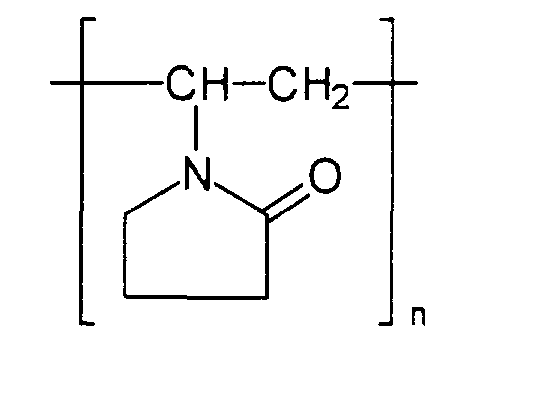
- the film former (s) from the group of polymers based on polyvinylpyrrolidone (PVP) selected.
- PVP polyvinylpyrrolidone
- Copolymers of polyvinylpyrrolidone for example the PVP hexadecene copolymer and the PVP eicosen copolymer, which are available under the trade names Antaron V216 and Antaron V220 from GAF Chemicals Cooperation, are particularly preferred.
- the total amount of one or more film formers from the group of the polymers based on polyvinylpyrrolidone in the finished cosmetic or dermatological Preparations are advantageously greater than 0.3% by weight, particularly advantageously from the Range selected from 0.5 to 10 wt .-%, preferably 1 to 5 wt .-%, based on the Total weight of the preparations.
- the oil phase of the preparations according to the invention is advantageously chosen from the Group of esters from saturated and / or unsaturated, branched and / or unbranched Alkane carboxylic acids with a chain length of 3 to 30 carbon atoms and saturated and / or unsaturated, branched and / or unbranched alcohols of a chain length from 3 to 30 carbon atoms, from the group of esters from aromatic carboxylic acids and saturated and / or unsaturated, branched and / or unbranched alcohols a chain length of 3 to 30 carbon atoms.
- ester oils can then be advantageous are selected from the group of isopropyl myristate, isopropyl palmitate, isopropyl stearate, Isopropyl oleate, n-butyl stearate, n-hexyl laurate, n-decyl oleate, isooctyl stearate, isononyl stearate, Isononyl isononanoate, 2-ethylhexyl palmitate, 2-ethylhexyl laurate, 2-hexyl decyl stearate, 2-octyldodecyl palmitate, oleyl oleate, olerlerucate, erucyl oleate, erucylerucate and synthetic, semi-synthetic and natural mixtures of such esters, e.g. B. Jojoba oil.
- the oil phase can advantageously be selected from the group of the branched ones and unbranched hydrocarbons and waxes, the silicone oils, the dialkyl ethers, the group of saturated or unsaturated, branched or unbranched alcohols, as well as the fatty acid triglycerides, especially the saturated and / or triglycerol esters unsaturated, branched and / or unbranched alkane carboxylic acids of a chain length from 8 to 24, in particular 12 to 18, carbon atoms.
- the fatty acid triglycerides can For example, advantageously selected from the group of synthetic, semi-synthetic and natural oils, e.g. B. olive oil, sunflower oil, soybean oil, peanut oil, Rapeseed oil, almond oil, palm oil, coconut oil, palm kernel oil and the like.
- any mixtures of such oil and wax components are also advantageous To use the sense of the present invention. It can also be advantageous if necessary be waxes, for example cetyl palmitate, as the sole lipid component of the oil phase use.
- the oil phase is advantageously selected from the group consisting of 2-ethylhexyl isostearate, octyldodecanol, isotridecyl isononanoate, isoeicosane, 2-ethylhexyl cocoate, C 12-15 alkyl benzoate, caprylic capric acid triglyceride, dicaprylyl ether.
- hydrocarbons paraffin oil, squalane and squalene are advantageous in the sense of the present invention.
- the oil phase can also advantageously contain cyclic or linear silicone oils have or consist entirely of such oils, although it is preferred in addition to the silicone oil or the silicone oils, an additional content of other oil phase components to use.
- Cyclomethicone (octamethylcyclotetrasiloxane) is advantageous as according to the invention using silicone oil. But other silicone oils are also beneficial in the sense to use the present invention, for example hexamethylcyclotrisiloxane, Polydimethylsiloxane, poly (methylphenylsiloxane).
- Mixtures of cyclomethicone and isotridecyl isononanoate are also particularly advantageous. from cyclomethicone and 2-ethylhexyl isostearate.
- the oil phase is also advantageously selected from the group of phospholipids.
- the phospholipids are phosphoric acid esters of acylated glycerols.
- the lecithins which are characterized by the general structure distinguish, where R and R "typically represent unbranched aliphatic radicals having 15 or 17 carbon atoms and up to 4 cis double bonds.
- the size of the oil phase is at least 20% by weight of the The total amount of the preparations according to the invention is.
- the W / O formulations according to the invention can be used as the basis for cosmetic or serve dermatological formulations. These can be composed as usual be and for example for the treatment and care of the skin, as a lip care product, as a demo product and as a make-up or make-up removal product in the decorative Serve cosmetics or as a sunscreen preparation.
- cosmetic and dermatological preparations in the usual for cosmetics Apply in sufficient quantities to the skin.
- Cosmetic or topical dermatological compositions can accordingly used in the sense of the present invention, depending on its structure, for example are used as skin protection cream, cleansing milk, sun protection lotion, nutrient cream, Day or night cream, etc. It may be possible and advantageous to use the inventive Compositions as the basis for pharmaceutical formulations to use.
- the cosmetic and dermatological preparations according to the invention can Contain cosmetic auxiliaries, as they are usually used in such preparations be, e.g. B. preservatives, bactericides, perfumes, substances for preventing foaming, dyes, pigments that have a coloring effect, thickeners, softening, moisturizing and / or moisturizing substances, Fats, oils, waxes or other usual components of a cosmetic or dermatological Formulation such as alcohols, polyols, polymers, foam stabilizers, electrolytes, organic solvents or silicone derivatives.
- cosmetic auxiliaries e.g. B. preservatives, bactericides, perfumes, substances for preventing foaming, dyes, pigments that have a coloring effect, thickeners, softening, moisturizing and / or moisturizing substances, Fats, oils, waxes or other usual components of a cosmetic or dermatological Formulation such as alcohols, polyols, polymers, foam stabilizers, electrolytes, organic solvents or silicone
- compositions according to the invention are very good vehicles for cosmetic or dermatological agents in the skin, advantageous active ingredients are antioxidants which protect the skin from oxidative stress can protect.
- the preparations advantageously contain one or more antioxidants.
- antioxidants As inexpensive, yet optional antioxidants to use all suitable or customary for cosmetic and / or dermatological applications Antioxidants are used. It is beneficial to have antioxidants to be used as the only class of active ingredient, for example when a cosmetic or dermatological Application is in the foreground, such as. B. combating the oxidative Stress on the skin.
- the antioxidants are particularly advantageously selected from the group consisting of amino acids (e.g. glycine, histidine, tyrosine, tryptophan) and their derivatives, imidazoles (e.g. urocanic acid) and their derivatives, peptides such as D, L-carnosine, D. -Carnosine, L-carnosine and their derivatives (e.g. anserine), carotenoids, carotenes (e.g. ⁇ -carotene, ⁇ -carotene, lycopene) and their derivatives, chlorogenic acid and its derivatives, lipoic acid and its derivatives (e.g. B.
- amino acids e.g. glycine, histidine, tyrosine, tryptophan
- imidazoles e.g. urocanic acid
- peptides such as D, L-carnosine, D. -Carnosine, L-carnosine and their derivatives (e.g.
- thiols e.g. thioredoxin, glutathione, cysteine, cystine, cystamine and their glycosyl, N-acetyl, methyl, ethyl, propyl, amyl, butyl, and lauryl, palmitoyl, oleyl, ⁇ -linoleyl, cholesteryl and glyceryl esters
- salts dilauryl thiodipropionate, distearyl thio dipropionate, thiodipropionic acid and their derivatives (esters, ethers, peptides, lipids, nucleotides, nucleosides and salts) and sulfoximine compounds (e.g.
- Buthioninsulfoximine, Homocysteinsulfoximin, But hioninsulfones, penta-, hexa-, heptathioninsulfoximine) in very low tolerable doses e.g. B. pmol to ⁇ mol / kg
- metal chelators e.g. ⁇ -hydroxy fatty acids, palmitic acid, phytic acid, lactoferrin
- ⁇ -hydroxy acids e.g. citric acid, lactic acid, malic acid
- humic acid bile acid, Bile extracts, bilirubin, biliverdin, EDTA, EGTA and their derivatives, unsaturated fatty acids and their derivatives (e.g.
- ⁇ -linolenic acid linoleic acid, oleic acid
- folic acid and their derivatives ubiquinone and ubiquinol and their derivatives
- vitamin C and derivatives e.g. Ascorbyl palmitate, Mg ascorbyl phosphate, ascorbyl acetate
- tocopherols and derivatives e.g.
- vitamin E acetate
- vitamin A and derivatives vitamin A palmitate
- stilbenes and their derivatives for example stilbene oxide, trans-stilbene oxide
- derivatives suitable according to the invention salts, esters, ethers, sugars, nucleotides, nucleosides, peptides and lipids
- the amount of the aforementioned antioxidants (one or more compounds) in the Preparations according to the invention are preferably 0.001 to 30% by weight, particularly preferably 0.05 to 20% by weight, in particular 0.1 to 10% by weight, based on the Total weight of the preparation.
- vitamin E and / or its derivatives are the antioxidant (s) advantageous, their respective concentrations in the range from 0.001 to 10% by weight, based on the total weight of the formulation.
- vitamin A or vitamin A derivatives or carotenes or their derivatives are advantageous, their respective concentrations from the Range from 0.001 to 10% by weight, based on the total weight of the formulation, to choose.
- the active ingredients can also be very effective are advantageously chosen from the group of lipophilic active ingredients, in particular from following group:
- vitamin F essential fatty acids
- Those cosmetic and dermatological preparations which are in the Form of a sunscreen. These preferably contain in addition to those according to the invention Active ingredient combinations additionally at least one UV-A filter substance and / or at least one UV-B filter substance. Such formulations can although not necessary, optionally one or more inorganic pigments included as UV filter substances.
- Inorganic pigments based on metal oxides and / or other metal compounds which are sparingly soluble or insoluble in water are preferred, in particular the oxides of titanium (TiO 2 ), zinc (ZnO), iron (e.g. Fe 2 O 3 ), zirconium (ZrO 2 ), silicon (SiO 2 ), manganese (e.g. MnO), aluminum (Al 2 O 3 ), cerium (e.g. Ce 2 O 3 ), mixed oxides of the corresponding metals and mixtures of such oxides.
- an additional content of stabilizing titanium dioxide and / or zinc oxide particles can of course be advantageous, but is within the meaning of the present invention unnecessary.
- UV protection substances as well as antioxidants and, if desired, Preservatives, an effective protection of the preparations themselves against spoilage represents.
- Preparations according to the invention advantageously contain substances which contain UV radiation absorb in the UV-A and / or UV-B range, with the total amount of filter substances z. B. 0.1 wt .-% to 30 wt .-%, preferably 0.5 to 20 wt .-%, in particular Is 1.0 to 15.0% by weight, based on the total weight of the preparations to provide cosmetic preparations that cover the hair or skin protect the entire range of ultraviolet radiation. You can also use it as a sunscreen serve for hair or skin.
- UV-A filter substances for the purposes of the present invention are dibenzoylmethane derivatives, especially the 4- (tert-butyl) -4'-methoxydibenzoylmethane (CAS no. 70356-09-1), which is available from Givaudan under the Parsol® 1789 brand and from Merck under the trade name Eusolex® 9020 is sold.
- dibenzoylmethane derivatives especially the 4- (tert-butyl) -4'-methoxydibenzoylmethane (CAS no. 70356-09-1), which is available from Givaudan under the Parsol® 1789 brand and from Merck under the trade name Eusolex® 9020 is sold.
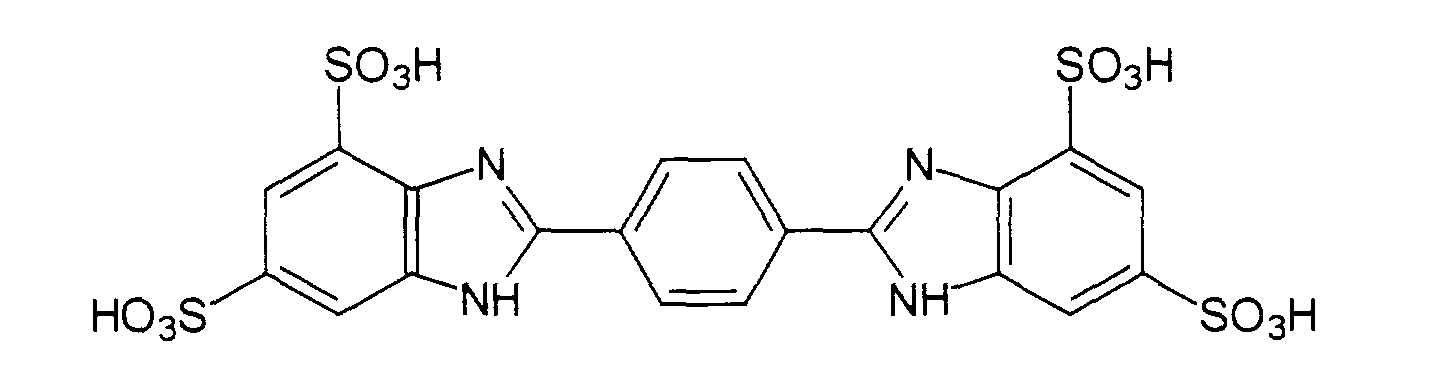
- UV-A filter substances are phenylene-1,4-bis (2-benzimidazyl) -3,3'-5,5'-tetrasulfonic acid: and their salts, especially the corresponding sodium, potassium or triethanolammonium salts, in particular the phenylene-1,4-bis (2-benzimidazyl) -3,3'-5,5'-tetrasulfonic acid bis-sodium salt: as well as the 1,4-di (2-oxo-10-sulfo-3-bornylidenemethyl) benzene and its salts (especially the corresponding 10-sulfato compounds, especially the corresponding sodium, potassium or triethanolammonium salt), the is also called benzene-1,4-di (2-oxo-3-bornylidenemethyl-10-sulfonic acid) and is characterized by the following structure:
- UV filter substances in the sense of the present invention are also so-called Broadband filter, i.e. Filter substances that contain both UV-A and UV-B radiation absorb.
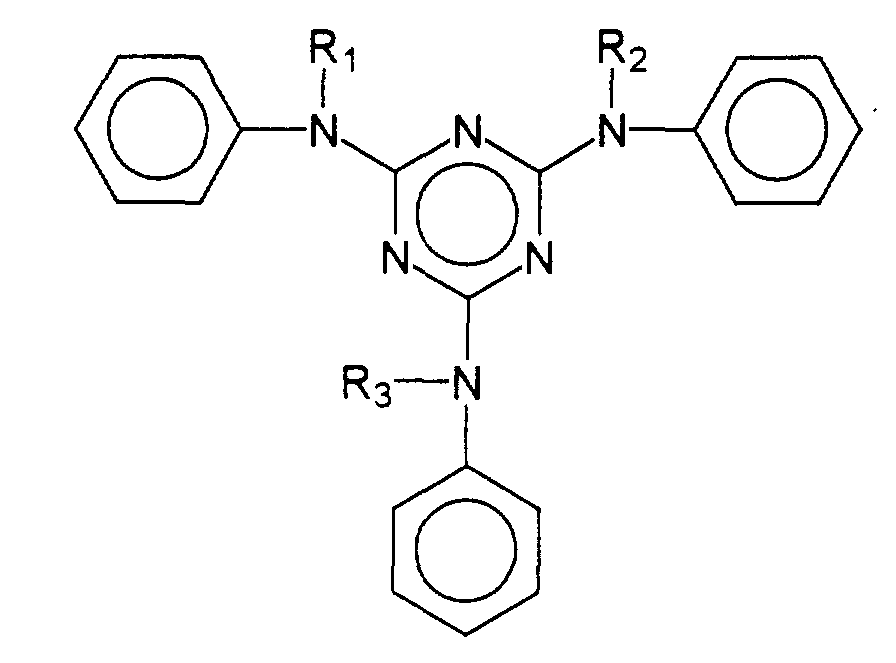
- Advantageous broadband filters or UV-B filter substances are, for example, bis-resorcinyltriazine derivatives with the following structure: where R 1 , R 2 and R 3 are independently selected from the group of branched and unbranched alkyl groups having 1 to 10 carbon atoms or a single hydrogen atom.
- 2,4-bis - ⁇ [4- (2-ethylhexyloxy) -2-hydroxy] phenyl ⁇ -6- (4-methoxyphenyl) -1,3,5-triazine (INCI: Aniso triazine ), which is available under the trade name Tinosorb® S from CIBA-Chemicals GmbH, and the 4,4 ', 4 "- (1,3,5-triazine-2,4,6-triyltriimino) -tris-benzoic acid tris ( 2-ethylhexyl ester), synonymous: 2,4,6-tris [anilino- (p-carbo-2'-ethyl-1'-hexyloxy)] - 1,3,5-triazine (INCI: octyl triazone), which is marketed by BASF Aktiengesellschaft under the trade name UVINUL® T 150.
- a particularly preferred UV filter substance in the sense of the present invention is also an asymmetrically substituted s-triazine, the chemical structure of which is represented by the formula is reproduced, which is also referred to below as dioctylbutylamidotriazon (INCI: dioctylbutamidotriazone) and is available under the trade name UVA-SORB HEB from Sigma 3V.
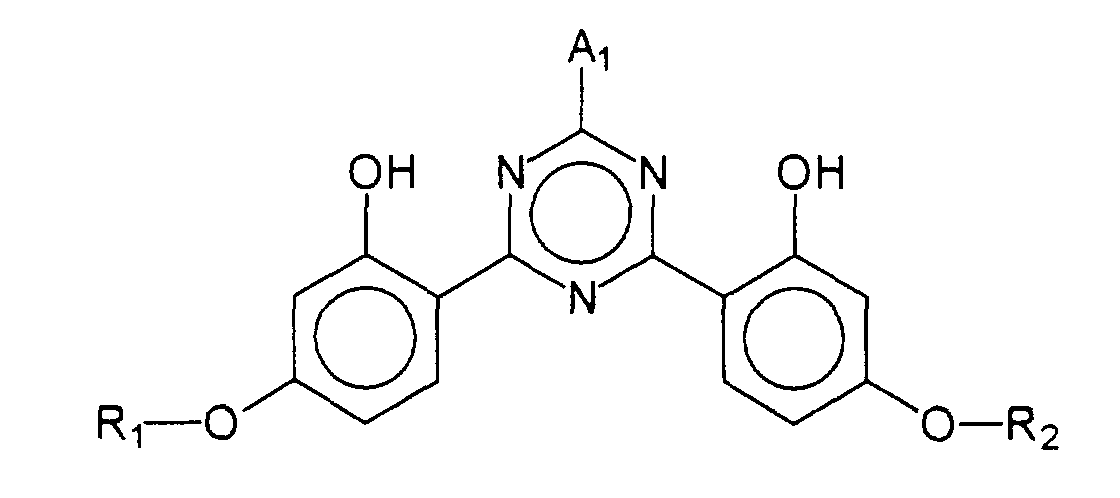
- European laid-open specification 775 698 also describes bis-resorcinyltriazine derivatives which are preferably to be used, the chemical structure of which is given by the generic formula is reproduced, wherein R 1 , R 2 and A 1 represent a wide variety of organic radicals.
- Also advantageous for the purposes of the present invention are 2,4-bis - ⁇ [4- (3-sulfonato) -2-hydroxypropyloxy) -2-hydroxy] phenyl ⁇ -6- (4-methoxyphenyl) -1, 3,5-triazine Sodium salt, the 2,4-bis - ⁇ [4- (3- (2-propyloxy) -2-hydroxypropyloxy) -2-hydroxy] phenyl ⁇ -6- (4-methoxyphenyl) -1,3,5-triazine .
- An advantageous broadband filter in the sense of the present invention is 2,2'-methylene-bis- (6- (2H-benzotriazol-2-yl) -4- (1,1,3,3-tetramethylbutyl) phenol), which through the chemical structural formula and is available under the trade name Tinosorb® M from CIBA-Chemicals GmbH.
- Another advantageous broadband filter for the purposes of the present invention is 2- (2H-benzotriazol-2-yl) -4-methyl-6- [2-methyl-3- [1,3,3,3-tetramethyl-1 - [( trimethylsilyl) oxy] disiloxanyl] propyl] phenol (CAS no .: 155633-54-8) with the INCI name Drometrizole Trisiloxane, which is characterized by the chemical structural formula is marked.
- a further light protection filter substance to be used advantageously according to the invention is ethylhexyl-2-cyano-3,3-diphenylacrylate (octocrylene), which is available from BASF under the name Uvinul® N 539 and is distinguished by the following structure:
- UV filters mentioned used in the sense of the present invention of course, should not be limiting.
- Preparations according to the invention can also advantageously be used as the basis for cosmetic Deodorants or antiperspirants are used, so that the present Invention in a special embodiment W / O formulations as Basis for cosmetic deodorants concerns.
- Cosmetic deodorants are used to eliminate body odor that arises when the odorless fresh sweat is broken down by microorganisms.
- the usual cosmetic deodorants are based on different active principles.
- astringents primarily aluminum salts like aluminum hydroxychloride (aluminum chloride) - reduces the formation of sweat become.
- the Bacterial flora on the skin can be reduced. Ideally, only the smell causing microorganisms can be effectively reduced. The sweat flow itself is not affected by this, ideally only the microbial decomposition of the Sweat temporarily stopped.
- the cosmetic deodorants according to the invention can be in the form of normal Containable water-containing cosmetic preparations.
- the amount of antiperspirant active or deodorant (one or more compounds) in the preparations is preferably 0.01 to 30 wt .-%, particularly preferably 0.1 to 20% by weight, in particular 1 to 10% by weight, based on the total weight the preparation.
- the pens according to the invention are also excellent vehicles for dermatological active ingredients. They are particularly suitable as carriers for substances active against acne.
- Acne is a skin disease with various forms and causes, characterized by non-inflammatory and inflammatory nodules, starting from blocked hair follicles (comedones), which can lead to pustules, abscesses and scars.
- the most common is acne vulgaris, which mainly occurs during puberty.
- the cause of acne vulgaris is the hornification and constipation of the hair follicle mouth, the sebum production dependent on the blood level of the male sex hormones and the production of free fatty acids and tissue-damaging enzymes by bacteria ( Propionibacterium acnes ).
- substances which are active against acne are active, for example, against Propionibacterium acnes (for example those described in DE-OS 42 29 707, DE-OS 43 05 069, DE-OS 43 07 976, DE- OS 43 37 711, DE-OS 43 29 379), but also other substances active against acne, for example all-trans-retinoic acid, 13-cis-retinoic acid and related substances) or anti-inflammatory agents, for example batyl alcohol ( ⁇ -octadecylglyceryl ether) , Selachyl alcohol ( ⁇ -9-octadecenylglyceryl ether), chimyl alcohol ( ⁇ -hexadecylglyceryl ether) and / or bisabolol as well as antibiotics and / or keratolytics.
- Propionibacterium acnes for example those described in DE-OS 42 29 707, DE-OS 43 05 069, DE-OS 43 07 976, DE- OS 43 37 711, DE-OS 43
- Keratolytics are substances that cause keratinized skin (such as warts, corns, calluses) and the like) soften so that it is easier to remove or so that it falls off or dissolves.
- All common acne active substances can be used to advantage, especially benzoyl peroxide, bituminosulfonates (ammonium, sodium and calcium salts of shale oil sulfonic acids), salicylic acid (2-hydroxybenzoic acid), miconazole (1- [2- (2,4- Dichlorobenzyloxy) -2- (2,4-dichlorophenyl) ethyl] imidazole) and derivatives, adapalene (6- [3- (1-adamantyl) -4-methoxyphenyl] -2-naphthoic acid), azelaic acid (nonandioic acid), mesulfen (2,7 - dimethylthianthrene, C 14 H 12 S 2 ) as well as aluminum oxide, zinc oxide and / or finely divided sulfur.
- the amount of anti-acne agent (one or more compounds) in the preparations is preferably 0.01 to 30% by weight, particularly preferably 0.1 to 20% by weight, in particular 1 to 10 wt .-%, based on the total weight of the preparation.
Landscapes
- Health & Medical Sciences (AREA)
- Life Sciences & Earth Sciences (AREA)
- Public Health (AREA)
- Veterinary Medicine (AREA)
- Animal Behavior & Ethology (AREA)
- General Health & Medical Sciences (AREA)
- Epidemiology (AREA)
- Birds (AREA)
- Dermatology (AREA)
- Chemical & Material Sciences (AREA)
- Emergency Medicine (AREA)
- Oil, Petroleum & Natural Gas (AREA)
- Dispersion Chemistry (AREA)
- Cosmetics (AREA)
- Medicinal Preparation (AREA)
Abstract
gegebenenfalls weitere kosmetische oder pharmazeutische Hilfs-, Zusatz- und/oder Wirkstoffe enthaltend.
Description
- 1. Grad: Erythem (Rötung, Wärmegefühl)
klingt nach 2 bis 3 Tagen wieder ab und verschwindet unter gleichzeitig zunehmender Pigmentierung, - 2. Grad: Blasenbildung
auf der Haut bilden sich Blasen mit Brennen und Jucken, die Oberhaut wird flächig abgestoßen - 3. Grad: Zellschädigung
es treten tiefgehende Zellschädigungen auf, der Körper reagiert mit Fieber, die Oberhaut wird großflächig abgestoßen.
kosmetische oder dermatologische Zubereitungen, die feindisperse Systeme vom Typ Wasser-in-ÖI darstellen, welche
gegebenenfalls weitere kosmetische oder pharmazeutische Hilfs-, Zusatz- und/oder Wirkstoffe enthalten.




- R
- einen verzweigten oder unverzweigten C1-C18-Alkylrest, einen C5-C12-Cycloalkylrest, gegebenenfalls substituiert mit einer oder mehreren C1-C4- Alkylgruppen, darstellt,
- X
- ein Sauerstoffatom oder eine NH-Gruppe darstellt,
- R1
- einen verzweigten oder unverzweigten C1-C18-Alkylrest, einen C5-C12-Cycloalkylrest,
gegebenenfalls substituiert mit einer oder mehreren C1-C4- Alkylgruppen,
oder ein Wasserstoffatom, ein Alkalimetallatom, eine Ammoniumgruppe oder eine
Gruppe der Formel
bedeutet, in welcher

- A
- einen verzweigten oder unverzweigten C1-C18-Alkylrest, einen C5-C12-Cycloalkyl- oder Arylrest darstellt, gegebenenfalls substituiert mit einer oder mehreren C1-C4- Alkylgruppen,
- R3
- ein Wasserstoffatom oder eine Methylgruppe darstellt,
- n
- eine Zahl von 1 bis 10 darstellt,
- R2
- einen verzweigten oder unverzweigten C1-C18-Alkylrest, einen C5-C12-Cycloalkylrest,
gegebenenfalls substituiert mit einer oder mehreren C1-C4- Alkylgruppen, darstellt,
wenn X die NH-Gruppe darstellt, und
einen verzweigten oder unverzweigten C1-C18-Alkylrest, einen C5-C12-Cycloalkylrest, gegebenenfalls substituiert mit einer oder mehreren C1-C4- Alkylgruppen, oder ein Wasserstoffatom, ein Alkalimetallatom, eine Ammoniumgruppe oder eine Gruppe der Formelbedeutet, in welcher
- A
- einen verzweigten oder unverzweigten C1-C18-Alkylrest, einen C5-C12-Cycloalkyl- oder Arylrest darstellt, gegebenenfalls substituiert mit einer oder mehreren C1-C4- Alkylgruppen,
- R3
- ein Wasserstoffatom oder eine Methylgruppe darstellt,
- n
- eine Zahl von 1 bis 10 darstellt,



- 3-Benzylidencampher-Derivate, vorzugsweise 3-(4-Methylbenzyliden)campher, 3-Benzylidencampher;
- 4-Aminobenzoesäure-Derivate, vorzugsweise 4-(Dimethylamino)-benzoesäure(2-ethylhexyl)ester, 4-(Dimethylamino)benzoesäureamylester;
- 2,4,6-Trianilino-(p-carbo-2'-ethyl-1'-hexyloxy)-1,3,5-triazin;
- Ester der Benzalmalonsäure, vorzugsweise 4-Methoxybenzalmalonsäuredi(2-ethylhexyl)ester;
- Ester der Zimtsäure, vorzugsweise 4-Methoxyzimtsäure(2-ethylhexyl)ester, 4-Methoxyzimtsäureisopentylester;
- Derivate des Benzophenons, vorzugsweise 2-Hydroxy-4-methoxybenzophenon, 2-Hydroxy-4-methoxy-4'-methylbenzophenon, 2,2'-Dihydroxy-4-methoxybenzophenon
- sowie an Polymere gebundene UV-Filter.
- Salze der 2-Phenylbenzimidazol-5-sulfonsäure, wie ihr Natrium-, Kalium- oder ihr Triethanolammonium-Salz, sowie die Sulfonsäure selbst;
- Sulfonsäure-Derivate des 3-Benzylidencamphers, wie z. B. 4-(2-Oxo-3-bornylidenmethyl)benzolsulfonsäure, 2-Methyl-5-(2-oxo-3-bornylidenmethyl)sulfonsäure und deren Salze.

| I | II | III | IV | V | VI | |
| Mineralöl | 5 | 5 | 7 | |||
| C12-15 Alkylbenzoat | 5 | 5 | 10 | 7 | ||
| Caprylic/Capric Triglycerid | 5 | 5 | 8 | 5 | 7 | |
| Butylenglycol Dicaprylat/Dicaprat | 5 | 5 | 8 | |||
| C18-36 Acid Triglycerid | 2,5 | 2 | 1,5 | 2 | 1 | |
| Phenyltrimethicon | 3 | 3 | 1 | 2 | 5 | |
| PVP Hexadecencopolymer | 2 | 1,5 | 2 | 2,5 | 2 | |
| PVP Eicosencopolymer | 2 | |||||
| Zinkoxid | 3 | |||||
| Titandioxid | 3 | 1 | ||||
| Octyltriazon | 2 | 2 | ||||
| Methylbenzylidencampher | 4 | |||||
| Ethylhexylmethoxycinnamat | 5 | 4 | 5 | |||
| Butylmethoxydibenzoylmethan | 2 | |||||
| Octocrylen | 5 | 5 | ||||
| Diethylhexylbutamidotriazon | 2 | |||||
| Vitamin E Acetat | 0,5 | 1 | 0,3 | 0,5 | ||
| Phenylbenzimidazolsulfonsäure | 1 | |||||
| Bisimidazylat | 2 | |||||
| NaOH 45% | 0,3 | 0,5 | ||||
| Glycerin | 10 | 5 | 5 | 3 | 5 | |
| MgSO4 | 1 | |||||
| Natriumlactat | 1 | 1 | ||||
| Konservierungsmittel | 0,5 | 0,5 | 0,5 | 0,5 | 0,5 | 0,5 |
| Wasser | ad 100 | ad 100 | ad 100 | ad 100 | ad 100 | ad 100 |
Claims (9)
- Kosmetische oder dermatologische Zubereitungen, die feindisperse Systeme vom Typ Wasser-in-ÖI darstellen, enthaltenda) eine Ölphase,b) eine Wasserphase,c) mindestens einen Filmbildner, gewählt aus der Gruppe der Polymere auf Basis von Polyvinylpyrrolidon undd) höchstens 0,5 Gew.-% eines oder mehrerer Emulgatoren (bezogen auf das Gesamtgewicht der Zubereitungen).
- Zubereitungen nach Anspruch 1, dadurch gekennzeichnet, daß sie emulgatorfrei sind.
- Zubereitungen nach einem der vorhergehenden Ansprüche, dadurch gekennzeichnet, daß weitere kosmetische oder pharmazeutische Hilfs-, Zusatz- und/oder Wirkstoffe enthalten sind.
- Zubereitungen nach einem der vorhergehenden Ansprüche, dadurch gekennzeichnet, daß der Gehalt an einem oder mehreren Polymeren auf Basis von Polyvinylpyrrolidon größer als 0,3 Gew.-% gewählt wird, bezogen auf das Gesamtgewicht der Zubereitungen.
- Zubereitungen nach einem der vorhergehenden Ansprüche, dadurch gekennzeichnet, daß der oder die Filmbildner aus der Gruppe der Copolymere des Polyvinylpyrrolidons gewählt werden.
- Zubereitungen nach einem der vorhergehenden Ansprüche, dadurch gekennzeichnet, daß als Filmbildner Polyvinylpyrrolidon Hexadecen Copolymer und/oder Polyvinylpyrrolidon Eicosen Copolymer gewählt werden.
- Zubereitung nach einem der vorhergehenden Ansprüche, dadurch gekennzeichnet, daß sie unsymmetrisch substituierte s-Triazinderivate, insbesondere 2,4-Bis-{[4-(2-Ethyl-hexyloxy)-2-hydroxy]-phenyl}-6-(4-methoxyphenyl)-1,3,5-triazin und/oder Dioctylbutylamidotriazon, enthält.
- Zubereitung nach einem der vorhergehenden Ansprüche, dadurch gekennzeichnet, daß sie sulfonierte UV-Filter enthält, welche gewählt werden aus der Gruppe Phenylen-1,4-bis-(2-benzimidazyl)-3,3'-5,5'-tetrasulfonsäure und seine Salze, Ben-zol1,4-di(2-oxo-3-bomylidenmethyl-10-sulfonsäure) und seine Salze, 2-Phenylbenzimidazol-5-sulfonsäure und seine Salze sowie Sulfonsäure-Derivate des 3-Benzylidencamphers und deren Salze.
- Zubereitungen nach einem der vorhergehenden Ansprüche, enthaltend einen oder mehrere Zusatz- oder Wirkstoffe, gewählt aus der Gruppe der Antioxidantien und/oder der Adstringentien und/oder der antimikrobiell wirksamen Stoffe und/oder der gegen Akne wirksamen Stoffe.
Applications Claiming Priority (2)
| Application Number | Priority Date | Filing Date | Title |
|---|---|---|---|
| DE2000134043 DE10034043A1 (de) | 2000-07-13 | 2000-07-13 | Emulgatorfreie feindisperse Systeme vom Typ Wasser-in-Öl |
| DE10034043 | 2000-07-13 |
Publications (2)
| Publication Number | Publication Date |
|---|---|
| EP1172085A2 true EP1172085A2 (de) | 2002-01-16 |
| EP1172085A3 EP1172085A3 (de) | 2003-12-03 |
Family
ID=7648782
Family Applications (1)
| Application Number | Title | Priority Date | Filing Date |
|---|---|---|---|
| EP01115987A Withdrawn EP1172085A3 (de) | 2000-07-13 | 2001-06-30 | Emulgatorfreie feindisperse Systeme vom Typ Wasser-in-Öl |
Country Status (2)
| Country | Link |
|---|---|
| EP (1) | EP1172085A3 (de) |
| DE (1) | DE10034043A1 (de) |
Family Cites Families (6)
| Publication number | Priority date | Publication date | Assignee | Title |
|---|---|---|---|---|
| FR2659011B1 (fr) * | 1990-03-01 | 1994-09-30 | Oreal | Composition resistante a l'eau pour le revetement des cils, et son procede de preparation. |
| FR2709060B1 (fr) * | 1993-08-20 | 1995-09-29 | Oreal | Composition cosmétique à base de microdispersion de cire comprenant un composé organofluoré lipophile. |
| DE19842669A1 (de) * | 1998-09-18 | 2000-03-23 | Beiersdorf Ag | Emulgatorfreie feindisperse Systeme vom Typ Öl-in-Wasser und Wasser-in-Öl |
| DE19842744B4 (de) * | 1998-09-18 | 2006-12-21 | Beiersdorf Ag | Emulgatorfreie feindisperse Systeme vom Typ Öl-in-Wasser und Wasser-in-Öl und deren Verwendung |
| DE19923671A1 (de) * | 1999-05-22 | 2000-11-23 | Beiersdorf Ag | Kosmetische oder dermatologische Lichtschutzzubereitungen mit einem Gehalt an Dioctylbutamidotriazon und einem oder mehreren Filmbildnern |
| DE19923672A1 (de) * | 1999-05-22 | 2000-11-23 | Beiersdorf Ag | Kosmetische oder dermatologische Lichtschutzzubereitungen mit einem Gehalt an Dioctylbutamidotriazon und einem oder mehreren Filmbildnern und einem oder mehreren Polymeren |
-
2000
- 2000-07-13 DE DE2000134043 patent/DE10034043A1/de not_active Withdrawn
-
2001
- 2001-06-30 EP EP01115987A patent/EP1172085A3/de not_active Withdrawn
Also Published As
| Publication number | Publication date |
|---|---|
| EP1172085A3 (de) | 2003-12-03 |
| DE10034043A1 (de) | 2002-01-24 |
Similar Documents
| Publication | Publication Date | Title |
|---|---|---|
| EP0821945B1 (de) | Schaumförmige Lichtzubereitungen mit einem Gehalt an wasserlöslichen Lichtschutzsubstanzen und grenzflächenaktiven Substanzen | |
| DE19933463A1 (de) | W/O-Emulsionen mit einem Gehalt an Ectoinen | |
| EP1127568A2 (de) | Kosmetische und dermatologische Lichtshutzformulierungen mit einem Gehalt an Benzotriazolderivaten und Alkylnapthalaten | |
| DE19615577A1 (de) | Verwendung von Salicin als antiirritativer Wirkstoff in kosmetischen und topischen dermatologischen Zubereitungen | |
| EP1077058A2 (de) | Emulgatorfreie feindisperse Systeme vom Typ Wasser-in-Öl | |
| EP0847750A2 (de) | Lichtschutzzubereitungen mit einem Gehalt an oberflächenaktiven Mono- bzw. Oligoglycerylverbindungen und wasserlöslichen UV-Filtersubstanzen und ggf. anorganischen Mikropigmenten | |
| EP1200039B1 (de) | Emulgatorfreie feindisperse systeme vom typ wasser-in-öl | |
| DE19602619C2 (de) | Stabile kosmetische und dermatologische Lichtschutzzubereitungen in Form von W/O-Emulsionen, enthaltend ein Triazinderivat, einen oder mehrere spezielle(n) W/O-Emulgator(en) und/oder weitere Komponenten | |
| EP1192937A2 (de) | Emulgatorarme feindisperse Systeme vom Typ Wasser-in-Öl mit einem Gehalt an Ethylcellulose | |
| EP1269978B1 (de) | Verwendung von Bis-Resorcinyltriazinderivaten in kosmetischen oder dermatologischen Zubereitungen | |
| DE10038713A1 (de) | Kosmetische und dermatologische Lichtschutzformulierungen mit einem Gehalt an unsymmetrisch substituierten Triazinderivaten und Dialkyladipaten | |
| DE19518845A1 (de) | Kosmetische oder dermatologische Zubereitungen mit einem Gehalt an Phytinsäure | |
| DE19826118C2 (de) | Wasserhaltige kosmetische oder pharmazeutische Stifte | |
| EP1013262A2 (de) | Kosmetische und dermatoligische O/W-Emulsionen mit einem Gehalt an Bornitrid | |
| EP0935959B1 (de) | Verwendung von Bienenwachs zur Verstärkung der UV-A-Schutzleistung kosmetischer oder dermatologischer Formulierungen | |
| EP0821944B1 (de) | Wasserfeste Lichtschutzzubereitungen mit einem Gehalt an anorganischen Mikropigmenten und wasserlöslichen UV-Filtersubstanzen | |
| EP0868904A2 (de) | Lichtschutzzubereitungen mit einem Gehalt an basischen Aminosäuren und wasserlöslichen UV-Filtersubtanzen | |
| EP2421502B1 (de) | Zusammensetzung enthaltend glycyrrhetinsäure zur reparatur bereits eingetretener schäden an der hauteigenen dna | |
| DE19929475A1 (de) | Kosmetische und dermatologische W/O-Emulsionen mit einem Gehalt an modifizierten Schichtsilikaten | |
| DE19518815A1 (de) | Kosmetische oder dermatologische Zubereitungen mit einem Gehalt an alpha-Hydroxyfettsäuren | |
| EP1074241A2 (de) | Ölfreie kosmetische oder dermatologische Zubereitungen mit einem Gehalt an unsymmetrisch substituierten Triazinderivaten und flüssigen UV-Filtersubstanzen | |
| DE19817295A1 (de) | Kosmetische oder dermatologische Zubereitungen mit einem Gehalt an unsymmetrisch substituiertenTriazinderivaten zum Erhalt des Urocaninsäurestatus der Haut | |
| EP0895775B1 (de) | Lichtschutzbereitungen mit einem Gehalt an anorganischen Pigmenten, welche oberflächlich mit UV-Filtersubstanzen beschichtet sind | |
| EP1013263A2 (de) | Kosmetische und dermatologische W/O-Emulsionen mit einem Gehalt an Bornitrid | |
| EP0850639A2 (de) | Wasserfeste Lichtschutzzubereitungen mit einem Gehalt an anorganischen Mikropigmenten und wasserlöslichen UV-Filtersubstanzen |
Legal Events
| Date | Code | Title | Description |
|---|---|---|---|
| PUAI | Public reference made under article 153(3) epc to a published international application that has entered the european phase |
Free format text: ORIGINAL CODE: 0009012 |
|
| AK | Designated contracting states |
Kind code of ref document: A2 Designated state(s): AT BE CH CY DE DK ES FI FR GB GR IE IT LI LU MC NL PT SE TR |
|
| AX | Request for extension of the european patent |
Free format text: AL;LT;LV;MK;RO;SI |
|
| PUAL | Search report despatched |
Free format text: ORIGINAL CODE: 0009013 |
|
| AK | Designated contracting states |
Kind code of ref document: A3 Designated state(s): AT BE CH CY DE DK ES FI FR GB GR IE IT LI LU MC NL PT SE TR |
|
| AX | Request for extension of the european patent |
Extension state: AL LT LV MK RO SI |
|
| 17P | Request for examination filed |
Effective date: 20040603 |
|
| AKX | Designation fees paid |
Designated state(s): AT BE CH CY DE DK ES FI FR GB GR IE IT LI LU MC NL PT SE TR |
|
| 17Q | First examination report despatched |
Effective date: 20040730 |
|
| STAA | Information on the status of an ep patent application or granted ep patent |
Free format text: STATUS: THE APPLICATION IS DEEMED TO BE WITHDRAWN |
|
| 18D | Application deemed to be withdrawn |
Effective date: 20050210 |