EP1170182A2 - Rotational-position sensing device and windshield wiper system having the same - Google Patents
Rotational-position sensing device and windshield wiper system having the same Download PDFInfo
- Publication number
- EP1170182A2 EP1170182A2 EP01115477A EP01115477A EP1170182A2 EP 1170182 A2 EP1170182 A2 EP 1170182A2 EP 01115477 A EP01115477 A EP 01115477A EP 01115477 A EP01115477 A EP 01115477A EP 1170182 A2 EP1170182 A2 EP 1170182A2
- Authority
- EP
- European Patent Office
- Prior art keywords
- follower
- rotational
- rotator
- engaging
- sensing device
- Prior art date
- Legal status (The legal status is an assumption and is not a legal conclusion. Google has not performed a legal analysis and makes no representation as to the accuracy of the status listed.)
- Granted
Links
- 239000002184 metal Substances 0.000 claims abstract description 31
- 230000002093 peripheral effect Effects 0.000 claims description 55
- 230000007246 mechanism Effects 0.000 claims description 39
- 238000005452 bending Methods 0.000 claims description 19
- 230000003014 reinforcing effect Effects 0.000 claims description 16
- 230000033001 locomotion Effects 0.000 claims description 10
- 230000000149 penetrating effect Effects 0.000 claims description 3
- 230000008901 benefit Effects 0.000 description 13
- 238000005299 abrasion Methods 0.000 description 6
- 230000009471 action Effects 0.000 description 6
- 244000145845 chattering Species 0.000 description 5
- 238000006243 chemical reaction Methods 0.000 description 4
- 230000009467 reduction Effects 0.000 description 4
- 230000005540 biological transmission Effects 0.000 description 3
- 230000006835 compression Effects 0.000 description 3
- 238000007906 compression Methods 0.000 description 3
- 239000000463 material Substances 0.000 description 3
- 230000004048 modification Effects 0.000 description 3
- 238000012986 modification Methods 0.000 description 3
- 230000000452 restraining effect Effects 0.000 description 3
- 230000008859 change Effects 0.000 description 2
- 238000004519 manufacturing process Methods 0.000 description 2
- 239000007769 metal material Substances 0.000 description 2
- 229920003002 synthetic resin Polymers 0.000 description 2
- 239000000057 synthetic resin Substances 0.000 description 2
- 230000015572 biosynthetic process Effects 0.000 description 1
- 239000003990 capacitor Substances 0.000 description 1
- 239000004020 conductor Substances 0.000 description 1
- 238000010586 diagram Methods 0.000 description 1
- 238000009429 electrical wiring Methods 0.000 description 1
- 230000008030 elimination Effects 0.000 description 1
- 238000003379 elimination reaction Methods 0.000 description 1
- 238000013021 overheating Methods 0.000 description 1
- 230000002265 prevention Effects 0.000 description 1
- 229920005989 resin Polymers 0.000 description 1
- 239000011347 resin Substances 0.000 description 1
- 238000004804 winding Methods 0.000 description 1
Images









Classifications
-
- B—PERFORMING OPERATIONS; TRANSPORTING
- B60—VEHICLES IN GENERAL
- B60S—SERVICING, CLEANING, REPAIRING, SUPPORTING, LIFTING, OR MANOEUVRING OF VEHICLES, NOT OTHERWISE PROVIDED FOR
- B60S1/00—Cleaning of vehicles
- B60S1/02—Cleaning windscreens, windows or optical devices
- B60S1/04—Wipers or the like, e.g. scrapers
- B60S1/06—Wipers or the like, e.g. scrapers characterised by the drive
- B60S1/08—Wipers or the like, e.g. scrapers characterised by the drive electrically driven
-
- B—PERFORMING OPERATIONS; TRANSPORTING
- B60—VEHICLES IN GENERAL
- B60S—SERVICING, CLEANING, REPAIRING, SUPPORTING, LIFTING, OR MANOEUVRING OF VEHICLES, NOT OTHERWISE PROVIDED FOR
- B60S1/00—Cleaning of vehicles
- B60S1/02—Cleaning windscreens, windows or optical devices
- B60S1/04—Wipers or the like, e.g. scrapers
- B60S1/06—Wipers or the like, e.g. scrapers characterised by the drive
- B60S1/16—Means for transmitting drive
- B60S1/166—Means for transmitting drive characterised by the combination of a motor-reduction unit and a mechanism for converting rotary into oscillatory movement
-
- H—ELECTRICITY
- H01—ELECTRIC ELEMENTS
- H01H—ELECTRIC SWITCHES; RELAYS; SELECTORS; EMERGENCY PROTECTIVE DEVICES
- H01H19/00—Switches operated by an operating part which is rotatable about a longitudinal axis thereof and which is acted upon directly by a solid body external to the switch, e.g. by a hand
- H01H19/54—Switches operated by an operating part which is rotatable about a longitudinal axis thereof and which is acted upon directly by a solid body external to the switch, e.g. by a hand the operating part having at least five or an unspecified number of operative positions
- H01H19/56—Angularly-movable actuating part carrying contacts, e.g. drum switch
- H01H19/58—Angularly-movable actuating part carrying contacts, e.g. drum switch having only axial contact pressure, e.g. disc switch, wafer switch
-
- H—ELECTRICITY
- H01—ELECTRIC ELEMENTS
- H01H—ELECTRIC SWITCHES; RELAYS; SELECTORS; EMERGENCY PROTECTIVE DEVICES
- H01H3/00—Mechanisms for operating contacts
- H01H3/32—Driving mechanisms, i.e. for transmitting driving force to the contacts
- H01H3/48—Driving mechanisms, i.e. for transmitting driving force to the contacts using lost-motion device
-
- Y—GENERAL TAGGING OF NEW TECHNOLOGICAL DEVELOPMENTS; GENERAL TAGGING OF CROSS-SECTIONAL TECHNOLOGIES SPANNING OVER SEVERAL SECTIONS OF THE IPC; TECHNICAL SUBJECTS COVERED BY FORMER USPC CROSS-REFERENCE ART COLLECTIONS [XRACs] AND DIGESTS
- Y10—TECHNICAL SUBJECTS COVERED BY FORMER USPC
- Y10S—TECHNICAL SUBJECTS COVERED BY FORMER USPC CROSS-REFERENCE ART COLLECTIONS [XRACs] AND DIGESTS
- Y10S318/00—Electricity: motive power systems
- Y10S318/02—Windshield wiper controls
Definitions
- the present invention relates to a rotational-position sensing device and a windshield wiper system.
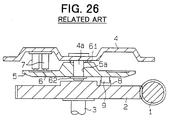
- FIG. 26 shows a rotational-position sensing device for a windshield wiper system disclosed in Japanese Unexamined Utility Model Publication No. 61-35068.
- a worm 1 and a wheel (acting as a rotator) 2 meshed with the worm 1 constitute a speed reducing gear mechanism.
- Rotation of an output shaft 3 secured to the wheel 2 is transmitted to a crank mechanism (not shown) acting as a reciprocating swing mechanism.
- the crank mechanism reciprocally swings wiper blades (not shown) along a windshield.
- a cover 4 that covers a gear case opposes the wheel 2.
- a follower 5 is rotatably supported by a spindle 4a that protrudes from the cover 4.
- a switching pattern 6 is arranged in an opposing surface of the follower 5 that opposes the cover 4.
- a plurality of contact terminals 7 are arranged in an opposing surface of the cover 4 that opposes the follower 5. The rotation of the wheel 2, which generates the swing motion of the wiper blades, is transmitted to the follower 5 through engagement between a protrusion 8 of the wheel 2 and a protrusion 9 of the follower 5, so that the follower 5 is integrally rotated with the wheel 2. As the follower 5 rotates, the contact terminals 7 engage and disengage with the switching pattern 6, so that a rotational position of the wheel 2 or a rotational position of the output shaft 3 is sensed or detected.
- the contact terminals 7 are urged against the switching pattern 6 because of their own resilient forces.
- the resilient forces of the contact terminals 7 are summed and are applied to the follower 5 to lever the follower 5 about the spindle 4a, the follower 5 tilts with respect to the spindle 4a.
- the follower 5 tilts the follower 5 cannot rotate freely, causing an increased rotational resistance of the follower 5.
- the increase in the rotational resistance of the follower 5 normally results in a decrease in a transmission efficiency of the power transmission system between a wiper drive motor and the follower 5.
- the tilt of the follower 5 may cause a contact failure between the contact terminals 7 and the switching pattern 6. Such a contact failure causes a reduction in a sensing accuracy of the rotational-position sensing device.
- a wave washer 61 is inserted around the spindle 4a to urge the follower 5 in an axial direction away from it, and a stationary engaging member 62, such as a C-ring, is fitted around the spindle 4a to hold the follower 5 in place around the spindle 4a.
- the wiper blades are controlled to be stopped at a predetermined stop position which is generally one swing end position of the wiper blades. More specifically, when a vehicle driver manually turns off a wiper switch, the following control operation is conducted. That is, the wiper drive motor drives the wiper blades to the predetermined stop position and then stops the wiper blades in the predetermined stop position.
- This type of automatic stop arrangement for automatically stops the wiper blades in the predetermined stop position is disclosed in Japanese Unexamined Utility Model Publication No. 61-35068. By way of example, it will be assumed that a relatively large amount of snow is present on the windshield. In the windshield wiper system having the automatic stop arrangement, the wiper blades wipe the snow toward the predetermined stop position.
- the wiper drive motor When the wiper blades reach the predetermined stop position, the wiper drive motor is turned off, so that the wiper blades lose its driving force. Since the snow has been packed by the wiper blades, the snow exerts a reaction force against the wiper blades to move the wiper blades backward out of the predetermined stop position, and the wiper drive motor is forced to rotate backward.
- the follower 5 is rotated backward due to the backward rotation of the wiper drive motor, a state of engagement and disengagement between the switching pattern 6 and the contact terminals 7 is changed to another state different from one that is seen while the wiper blades are held in the stop position. This change in the state of engagement and disengagement causes the wiper drive motor to drive the wiper blades toward the stop position. This results in chattering of the wiper system.
- the contact terminals 7 need to be secured to the cover 4 in manufacturing. Furthermore, the switching pattern 6 and the protrusion 9 need to be provided in the follower 5. Thus, a number of components to be assembled is increased. Because of this, parts management becomes more complicated, and a number of assembling steps is disadvantageously increased.
- the present invention addresses the above disadvantages.
- a rotational-position sensing device including a stationary body, a rotator and a follower.
- the stationary body includes a switching pattern.
- the rotator is rotatably supported by the stationary body.
- the rotator has a driving-side engaging means.
- the switching pattern is provided around a rotational axis of the rotator.
- the follower receives a rotational force to rotate about the rotational axis from the rotator through the driving-side engaging means.
- the follower includes a plurality of contact terminals.
- the rotational-position sensing device senses a rotational position of the rotator through engagement and disengagement of the contact terminals with the switching pattern based on rotation of the follower.
- the follower is made of an electrically conductive metal plate.
- the contact terminals are integrally formed in the electrically conductive metal plate.
- the follower further includes a driven-side engaging means that receives the rotational force from the rotator during rotation of the rotator in a forward rotational direction upon engagement with the driving-side engaging means in a forward rotational engaged position.
- the driven-side engaging means has a play. The play allows the driving-side engaging means to move away from the forward rotational engaged position without transmitting the rotational force to the follower when the rotator rotates in a backward rotational direction.
- a windshield wiper system having a wiper arm with a wiper blade connected thereto, a motor and a control device.
- the motor has a rotational-position sensing device for sensing a rotational position of the wiper blade, a gear housing and a speed reducing mechanism.
- the gear housing includes a receiving recess and a cover for covering the receiving recess.
- the speed reducing mechanism is received within the receiving recess.
- the speed reducing mechanism is connected to an output shaft for outputting a rotational force of the speed reducing mechanism.
- the control device includes a wiper switch and controls the motor based on an operation mode selected through the wiper switch.
- the wiper arm and the wiper blade are reciprocally swung by a rotational driving force of the motor.
- the rotational-position sensing device includes a rotator, a switching pattern and a follower.
- the rotator is rotatably supported by the gear housing.
- the rotator has a driving-side engaging means and rotates integrally with the output shaft.
- the switching pattern is formed in the cover around a rotational axis of the rotator.
- the switching pattern includes a first rotational position and a second rotational position.
- the first rotational position corresponds to a predetermined stop position of the wiper blade.
- the second rotational position indicates a rotational position of the wiper blade other than the first rotational position of the wiper blade.
- the follower is made of an electrically conductive metal plate.
- the follower includes a plurality of contact terminals and a driven-side engaging means.
- the contact terminals are integrally formed in the electrically conductive metal plate.
- the contact terminals engage and disengage with the switching pattern.
- the driven-side engaging means receives a rotational force to rotate about the rotational axis during rotation of the rotator in a forward rotational direction upon engagement with the driving-side engaging means in a forward rotational engaged position.
- the driven-side engaging means has a play. The play allows the driving-side engaging means to move away from the forward rotational engaged position without transmitting the rotational force to the follower when the rotator rotates in a backward rotational direction.
- a rotational-position sensing device including a stationary body, a rotator, a follower, a switching pattern and a plurality of contact terminals.
- the rotator is rotatably supported by the stationary body.
- the follower is rotatably supported by a support element provided on the stationary body.
- the support element is coaxial with the rotator.
- the follower is positioned between the stationary body and the rotator and receives a rotational force from the rotator.
- the switching pattern is formed in one of the stationary body and the follower.
- the contact terminals are formed in the other of the stationary body and the follower.
- a rotational position of the rotator is sensed through engagement and disengagement of the contact terminals with the switching pattern based on rotation of the follower.
- a signal indicative of the rotational position of the rotator is outputted from the rotational-position sensing device.
- the rotational-position sensing device further includes a space maintaining means and a cylindrical engaging portion.
- the space maintaining means is provided around the support element to maintain a predetermined space between the follower and an opposing surface of the stationary body that axially opposes the follower.
- the cylindrical engaging portion is provided at a center of the follower.
- the cylindrical engaging portion has a peripheral surface that slidably engages a peripheral surface of the support element.
- a windshield wiper system having a wiper, a reciprocating swing mechanism for reciprocally swinging the wiper, a motor and a speed reducing mechanism.
- the motor has a gear housing.
- the speed reducing mechanism is received in the gear housing to transmit rotation of a motor at a reduced speed.
- the rotation of the motor is transmitted to the wiper through the speed reducing mechanism and the reciprocating swing mechanism to reciprocally swing the wiper.
- the windshield wiper system further includes a rotational-position sensing device and a control device.
- the rotational-position sensing device includes a rotator, a follower, a switching pattern, a plurality of contact terminals and a space maintaining means.
- the rotator is rotatably supported by the gear housing.
- the rotator is integrally rotated with an output shaft that receives a rotational force from the speed reducing mechanism.
- the follower is rotatably supported by a support element provided in the gear housing.
- the support element is coaxial with the rotator.
- the follower is positioned between the gear housing and the rotator and receives a rotational force from the rotator.
- the follower has a cylindrical engaging portion provided at a center of the follower.
- the cylindrical engaging portion has a peripheral surface that slidably engages a peripheral surface of the support element.
- the switching pattern is formed in one of the gear housing and the follower.
- the contact terminals are formed in the other of the gear housing and the follower.
- the space maintaining means is provided around the support element to maintain a predetermined space between the follower and an opposing surface of the gear housing that axially opposes the follower.
- a rotational position of the rotator is sensed through engagement and disengagement of the contact terminals with the switching pattern based on rotation of the follower.
- a signal indicative of the rotational position of the rotator is outputted from the rotational-position sensing device.
- the control device includes a wiper switch that is switched between a stop position and an actuation position. The control device rotates the motor until the rotational-position sensing device senses a rotational position of the rotator that corresponds to a predetermined stop position of the wiper after the wiper switch is switched to the stop position to stop the windshield wiper system. The control device stops the motor when the rotational-position sensing device senses the rotational position of the rotator that corresponds to the predetermined stop position of the wiper.
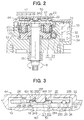
- FIGS. 1-5 A windshield wiper system according to a first embodiment of the present invention will be described with reference to FIGS. 1-5.
- a gear housing 12 is connected to a yoke housing 111 of a wiper drive motor 11.
- a first speed reducing gear mechanism 13 and a second speed reducing gear mechanism 17 are received within the gear housing 12.
- the first speed reducing gear mechanism 13 includes a worm 14 and a worm wheel 15.
- the worm 14 is connected to an armature 112 of the wiper drive motor 11.
- the worm wheel 15 is meshed with the worm 14.
- the worm 14 acts as an output shaft of the wiper drive motor 11.
- the worm wheel 15 is rotatably supported by an output shaft 16, which is, in turn, rotatably supported by the gear housing 12.
- the second speed reducing gear mechanism 17 is a planetary speed reducing gear mechanism including a sun gear 18, a carrier 19, a plurality (three in this embodiment, as shown in FIG. 1) of planet gears 20, an internal gear 21 and an output shaft 16.
- the sun gear 18 is coaxially secured to the worm wheel 15.
- the carrier 19 is secured to the output shaft 16 in opposed relationship with the sun gear 18.
- Each planet gear 20 is rotatably supported by a spindle (support element) 191 that protrudes from the carrier 19.
- the internal gear 21 is secured to an inner peripheral surface of a receiving recess 121 defined in the gear housing 12.
- the worm wheel 15 and the carrier 19 are received within the receiving recess 121.
- the planet gears 20 are meshed with both the sun gear 18 and internal gear 21.
- a rotational axis 161 of the output shaft 16 is also a rotational axis of the carrier 19.
- a rotational speed of the worm 14 is reduced in two steps through the first speed reducing gear mechanism 13 and the second speed reducing gear mechanism 17 before it is transmitted to the output shaft 16.
- the output shaft 16 and the carrier 19 rotate in a direction of an arrow R (this rotational direction is hereinafter referred to as a forward rotational direction R).
- the first speed reducing gear mechanism 13 and the second speed reducing gear mechanism 17 cooperatively constitute a speed reducing mechanism for transmitting the rotation of the worm 14 that acts as the output shaft of the wiper drive motor 11 at a reduced speed.
- a reciprocating swing mechanism of a crank type (not shown), such as one disclosed in Japanese Unexamined Utility Model Publication No. 61-35068, United States Patent No. 5,093,952 or the like which is incorporated by reference herein, is connected to the output shaft 16.
- Wiper arms (not shown) each having a wiper blade (not shown) are operably connected to the reciprocating swing mechanism.
- the wiper blades are reciprocally swung by the reciprocating swing mechanism that is, in turn, driven by the rotation of the output shaft 16.
- the wiper blades reciprocate once per rotation of the output shaft 16.
- the receiving recess 121 is covered with a cover 22 that constitutes a part of the gear housing (stationary body) 12.
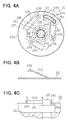
- a cylindrical spindle 249 and an annular position-limiting ridge (position-limiting protrusion) 50 protrude from an opposing surface 221 (FIG. 3) of the cover 22 that opposes the carrier 19.
- the annular position-limiting ridge 50 is formed to coaxially surround the spindle 249.
- a follower 23 is rotatably fitted around the spindle 249.
- a central axis of the spindle 249 coincides with the rotational axis 161 of the output shaft 16.
- the follower 23 is made of an electrically conductive metal plate.
- the follower 23 has a circular disk shape (best seen in FIG.
- the cylindrical engaging portion 232 includes a cylindrical engaging portion 232 that protrudes toward the cover 22 at a center of the follower 23.
- the cylindrical engaging portion 232 surrounds the spindle 249.
- the spindle 249 slidably engages an inner peripheral surface 237 of the cylindrical engaging portion 232.
- the follower 23 includes an annular reinforcing wall 233 that is bent to protrude from an outer peripheral edge of the follower 23 toward the cover 22.
- the reinforcing wall 233 increases a rigidity of the plate-like follower 23.
- a portion of the follower 23 located between the reinforcing wall 233 and the cylindrical engaging portion 232 is divided into an annular disk portion 235 and a contact portion 236 by an outer cylindrical portion 234.
- the contact portion 236 opposes a distal end surface 501 of the position-limiting ridge 50.
- the cylindrical engaging portion 232, the reinforcing wall 233 and the outer cylindrical portion 234 are bent by press work.
- a toothed washer 51 is fitted around an outer peripheral surface 491 of the spindle 249.
- the toothed washer 51 includes a tooth portion 511 and an annular flat portion 512.
- the tooth portion 511 is securely engaged into the outer peripheral surface 491.
- the annular flat portion 512 engages the contact portion 236 of the follower 23.
- the toothed washer 51 fitted around the spindle 249 urges the contact portion 236 of the follower 23 against the distal end surface 501 of the position-limiting ridge 50.
- a plurality (three in this embodiment) of lever-like contact terminals 231 are integrally formed in the follower 23.
- each contact terminal 231 is formed by cutting a corresponding portion of the follower 23 and then bending it toward the cover 22.
- a semi-spherical contact 238 is formed at a distal end of each contact terminal 231.
- an engaging hole 24 penetrates through the follower 23.
- the engaging hole 24 is an arcuate hole extending along a circle whose center coincides with the rotational axis 161 of the output shaft 16.
- an engaging protrusion 25 is securely connected to an opposing surface 192 of the carrier 19 that opposes the follower 23.
- a distal end of the engaging protrusion 25 that rotates integrally with the carrier 19 has a cylindrical shape and is received within the engaging hole 24.
- an engaging wall 241 is formed by burring a corresponding portion of the follower 23 in such a manner that the engaging wall 241 protrudes from a peripheral edge of the engaging hole 24.
- the rotation of the carrier 19 is transmitted to the follower 23 through the engagement between the engaging protrusion 25 and the circumferential end 242, so that the follower 23 is dragged to rotate about the spindle 249.
- the follower 23 rotates along with the carrier 19, the inner peripheral surface 237 of the cylindrical engaging portion 232 slides along the outer peripheral surface 491 of the spindle 249, and the contact portion 236 slides along the distal end surface 501 of the position-limiting ridge 50 and the flat portion 512 of the toothed washer 51.
- an electrically conductive switching pattern 26 is secured to the inner surface of the cover 22 around the spindle 249.
- the electrically conductive switching pattern 26 is provided for sensing rotational positions corresponding to a wiping position and a stop position of the wiper blades.
- a circuit unit 27 is received within a receiving portion 122 of the gear housing 12.
- the circuit unit 27 includes brush wiring terminals 28-30, external terminals 31-35, choke coils 36, 37, capacitors 38, 39 and a circuit breaker 40 that acts as an anti-burning means.
- the brush wiring terminal 28 acting as a common ground terminal is connected to the external terminal 31 through the circuit breaker 40.
- the brush wiring terminal 29 provided for a high speed operation is connected to the external terminal 32 through the choke coil 36.
- the brush wiring terminal 30 provided for a low speed operation is connected to the external terminal 33 through the choke coil 37.
- the circuit breaker 40 electrically disconnects the brush wiring terminal 28 from the external terminal 31 upon overheating of the choke coils 36, 37 or of the circuit breaker 40 itself.
- the brush wiring terminal 28 is electrically connected to a common ground brush 41, and the brush wiring terminal 29 is electrically connected to a high speed brush 42.
- the brush wiring terminal 30 is electrically connected to a low speed brush 43. In FIG. 1, only the brushes 41 and 42 are depicted among the brushes 41-43.
- the engagement and disengagement between the contact 238 of each contact terminal 231 and the switching pattern 26 cause electrical connection and electrical disconnection among the external terminals 31, 34 and 35.
- the carrier 19 provided with the engaging protrusion 25, the follower 23 provided with the engaging hole 24 and the contact terminals 231, the cover 22 provided with the switching pattern 26 constitute a rotational-position sensing device 44 for sensing or detecting a rotational position of the carrier 19 acting as a rotator.
- the switching pattern 26 includes first and second rotational positions of the carrier 19. The first rotational position corresponds to a predetermined stop position of the wiper blades (located within a predetermined range in a bottom section of a windshield). The second rotational position corresponds to a rotational position other than the first rotational position.
- the rotational-position sensing device 44 When the wiper blades are in the predetermined stop position, the rotational-position sensing device 44 electrically connects the external terminal 31 to the external terminal 34. That is, the first rotational position is a specific state where the rotational-position sensing device 44 electrically connects the external terminal 31 to the external terminal 34. When the wiper blades are out of the predetermined stop position, the rotational-position sensing device 44 electrically connects the external terminal 34 to the external terminal 35. That is, the second rotational position is another specific state where the rotational-position sensing device 44 electrically connects the external terminal 34 to the external terminal 35.
- a control device 45 is electrically connected to the external terminals 31-35.
- the control device 45 includes a wiper switch 46 and a battery 47.
- the external terminals 32-35 are electrically connected to the wiper switch 46.
- the external terminal 35 is also electrically connected to a cathode of the battery 47, and the external terminal 31 is electrically connected to a ground.
- the wiper switch 46 can be positioned in one of a stop position (stop mode) 461, a low speed operating position (low speed operation mode) 462 and a high speed operating position (high speed operation mode) 463.
- stop mode stop mode
- low speed operating position low speed operation mode
- high speed operation mode high speed operation mode
- the wiper switch 46 When the wiper switch 46 is positioned in the high speed operating position 463, the external terminal 32 is electrically connected to the battery 47 through the wiper switch 46. At this electrically connected state, the electric current is applied to the brush 42 through the brush wiring terminal 29, so that the armature 112 is rotated at a high speed. Thus, the wiper blades swing at the high speed.
- the rotational-position sensing device 44 senses the second rotational position and electrically connects the external terminal 34 to the external terminal 35. Then, the electric current is applied to the brush 43 through the rotational-position sensing device 44 and the wiper switch 46, so that the wiper drive motor 11 is operated at the low speed, and the wiper blades wipe the windshield at the low speed.
- the rotational-position sensing device 44 senses the first rotational position and electrically connects the external terminal 31 to the external terminal 34. That is, when the wiper switch 46 is in the stop position 461 while the external terminal 31 is electrically connected to the external terminal 34 through the rotational-position sensing device 44, there is provided a closed-loop circuit proceeding in the following order: the external terminal 31; the rotational-position sensing device 44; the external terminal 34; the wiper switch 46; the external terminal 33; the choke coil 37; the brush 43; windings of the armature 112; the brush 41; the circuit breaker 40 and the external terminal 31.
- an electrical braking force is applied to the armature 112, so that the rotation of the armature 112 is stopped.
- the wiper blades automatically stop in the predetermined stop position.
- the wiper switch 46, the battery 47, the circuit unit 27 and the rotational-position sensing device 44 constitute an automatic stop arrangement 48 for automatically stops the wiper blades in the predetermined stop position.
- the wiper blades wipe the snow toward the predetermined stop position.
- the wiper drive motor is turned off, so that the wiper blades lose its driving force. Since the snow has been packed by the wiper blades, the snow exerts a reaction force against the wiper blades to move the wiper blades backward out of the predetermined stop position, and the wiper drive motor 11 is forced to rotate backward.
- the external terminal 31 can be disconnected from the external terminal 34, and the external terminal 34 can be electrically connected to the external terminal 35.
- the electric current may be applied to the brush 43, so that wiper blades are urged toward the predetermined stop position by the wiper drive motor 11. This causes chattering of the wiper system.
- a play 244 is provided in the engaging hole 24, so that the engaging protrusion 25 can move within a range of play 244 within the engaging hole 24.
- the engaging protrusion 25 is engaged with the circumferential end 242 of the engaging hole 24, i.e., the follower 23 can be immediately rotated upon rotation of the carrier 19 in the forward rotational direction R without a pause. In this state, if the wiper drive motor 11 is forced to rotate backward, the engaging protrusion 25 is relatively moved from the one circumferential end 242 toward the other circumferential end 243 within the engaging hole 24.
- the rotational-position sensing device 44 acting as a part of the automatic stop arrangement 48 can prevent chattering of the windshield wiper system without changing the state of engagement and disengagement between the switching pattern 26 and each contact terminal 231.
- the first embodiment provides the following advantages.
- the annular position-limiting ridge 50 limits the position of the contact portion 236 of the follower 23 around the spindle 249 in such a manner that the contact portion 236 of the follower 23 is prevented from moving toward the opposing surface 221 of the cover 22 that axially opposes the follower 23.
- the toothed washer 51 limits the position of the contact portion 236 of the follower 23 around the spindle 249 in such a manner that the contact portion 236 of the follower 23 is prevented from moving toward the carrier 19.
- the position-limiting ridge 50 and the toothed washer 51 constitute a space maintaining means for maintaining a predetermined space between the follower 23 and the switching pattern 26 (or between the follower 23 and the opposing surface 221 of the cover 22).
- the cylindrical engaging portion 232 acts as an engaging means for engaging the follower 23 with the spindle 249 while allowing relative rotation therebetween.
- the position-limiting action of the position-limiting ridge 50 against the contact portion 236 of the follower 23 and the position-limiting action of the toothed washer 51 against the contact portion 236 of the follower 23 restrain the follower 23 from moving in the axial direction relative to the spindle 249 throughout the entire peripheral surface of the spindle 249. Movement of the follower 23 in a radial direction of the spindle 249 is restrained by the position-limiting action that is achieved through the engagement between the cylindrical engaging portion 232 and the spindle 249, more specifically the engagement between the cylindrical engaging portion 232 and the outer peripheral surface 491 of the spindle 249.
- the engagement between the cylindrical engaging portion 232 and the spindle 249 restrains tilt of the cylindrical engaging portion 232 relative to the spindle 249.
- the position-limiting action of the position-limiting ridge 50, the position-limiting action of the toothed washer 51 and the position-limiting action of the cylindrical engaging portion 232 cooperate together to effectively restrain the tilt of the follower 23.
- the toothed washer 51 is the only component to be fitted around the spindle 249.
- the number of the assembling steps and the number of the components to be assembled are reduced in accordance with the present embodiment.
- the sliding engagement between the inner peripheral surface 237 and the outer peripheral surface 491 is effective to restrain frictional abrasion of the slidingly engaged portions of the inner peripheral surface 237 and the outer peripheral surface 491.
- the cylindrical engaging portion 232 is the preferred engaging means for restraining the frictional abrasion.
- the annular position-limiting ridge 50 surrounds the spindle 249 in close proximity to the spindle 249, so that a frictional resistance between the distal end surface 501 of the position-limiting ridge 50 and the contact portion 236 is relatively small.
- the position-limiting ridge 50 is formed in the opposing surface 221 of the cover 22 in such a manner that the position-limiting ridge 50 restrains the tilt of the follower 23. This position-limiting ridge 50 can be conveniently and effectively used as the space maintaining means.
- the distal end surface 501 of the position-limiting ridge 50 substantially, uniformly engages with the contact portion 236 of the follower 23 around the spindle 249, so that the frictional resistance between the position-limiting ridge 50 and the follower 23 becomes substantially uniform throughout an entire rotational angle of the follower 23 around the spindle 249.
- the uniformity of the frictional resistance is effective to allow smooth rotation of the follower 23.
- the annular position-limiting ridge 50 is effective to unify the frictional resistance between the distal end surface 501 of the position-limiting ridge 50 and the follower 23 throughout the entire rotational angle of the follower 23.
- the toothed washer 51 urges the contact portion 236 of the follower 23 against the distal end surface 501 of the position-limiting ridge 50.
- the contact portion 236 is clamped between the flat portion 512 of the toothed washer 51 and the distal end surface 501 by an urging force exerted from the toothed washer 51.
- the follower 23, which is clamped between the flat portion 512 of the toothed washer 51 and the distal end surface 501, is restrained from movement in the axial direction of the spindle 249 around the spindle 249.
- the above structure in which the flat contact portion 236 is clamped between the flat distal end surface 501 and the flat portion 512 effectively restrains the tilt of the contact portion 236 or the tilt of the follower 23.
- the cylindrical engaging portion 232, the reinforcing wall 233, the outer cylindrical portion 234, the contact terminals 231 and the like of the follower 23 are easily manufactured from a circular electrically conductive metal disk by the press work.
- the follower 23 made of the metal material allows easy manufacturing of the cylindrical engaging portion 232, the reinforcing wall 233, the outer cylindrical portion 234, the contact terminals 231 and the like.
- the cylindrical engaging portion 232, the reinforcing wall 233 and the outer cylindrical portion 234 are effective to improve a rigidity of the follower 23.
- the automatic stop arrangement 48 includes the rotational-position sensing device 44 that is effective to restrain the tilt of the follower 23.
- the automatic stop arrangement 48 can be particularly, effectively used in the windshield wiper system that requires adequate stop of the wipers in the predetermined stop position.
- the rotational-position sensing device 44 of the present invention can be advantageously used in the windshield wiper system having the automatic stop arrangement including the rotational-position sensing device as a part of the automatic stop arrangement.
- the engaging hole 24 penetrating through the metal follower 23 is easily manufactured by the die-cutting.
- the high manufacturability of the engaging hole 24 contributes to a high manufacturability of the rotational-position sensing device 44.
- the engaging protrusion 25 is made of a resin material, it is important to restrain frictional abrasion of the engaging protrusion 25 that engages the engaging hole 24 of the metal follower 23.
- the engaging protrusion 25 engages the circumferential end 242 of the engaging wall 241 formed by burring.
- the engaging wall 241 is effective to increase the engaging surface area between the engaging protrusion 25 and the peripheral edge of the engaging hole 24.
- the engaging wall 241 formed by burring is effective to restrain the frictional abrasion of the engaging protrusion 25.
- the engaging hole 24 is an arcuate hole extending along a circle whose center coincides with the rotational axis 161 of the carrier 19.
- a radial width of the engaging hole 24 measured in a radial direction of the follower 23 only needs to be slightly larger than a diameter of the engaging protrusion 25 to allow the smooth relative movement of the engaging protrusion 25 within the engaging hole 24. That is, the radial width of the engaging hole 24 only needs to be slightly larger than a width of a path of the engaging protrusion 25 observed during the relative movement of the engaging protrusion 25. It is preferred that a size of the engaging hole 24 is kept as small as possible to establish a sufficient rigidity of the follower 23.
- the rotatable amount of the carrier 19 in the backward rotational direction without causing dragging of the follower 23 is kept as large as possible in order to prevent chattering of the windshield wiper system with greater security.
- the rotatable amount of carrier 19 in the backward rotational direction without causing the dragging of the follower 23 largely depends on the amount of the play 244.
- the arcuate engaging hole 24 is effective to increase the amount of the play 244 while minimizing the size of the engaging hole 24.
- each contact terminal 231 is convenient to integrally form the contact terminals 231 in the metal follower 23.
- the engaging protrusion 25 is received within the engaging hole 24 and engages the circumferential end 242 of the engaging hole 24.
- This arrangement in which the engaging protrusion 25 is received within the engaging hole 24 allows a reduction in a size of the rotational-position sensing device 44 in the axial direction of the rotational axis 161. This is due to the fact that a portion of a height of engaging hole 24 is located within a thickness of the follower 23.
- the automatic stop arrangement 48 that includes the rotational-position sensing device 44 can be particularly effectively used in the windshield wiper system that is prone to encounter the backward rotation of the wiper drive motor 11.
- the rotational-position sensing device 44 of the present invention can be advantageously used in the windshield wiper system having the automatic stop arrangement including the rotational-position sensing device as a part of the automatic stop arrangement.
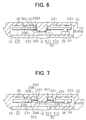
- FIG. 6 A second embodiment of the present invention will be described with reference to FIG. 6.
- the components similar to those of the first embodiment will be indicated by similar numerals in the following description.
- a protruding height of the spindle 249 and a protruding height of the position-limiting ridge 50 are increased from those of the first embodiment, and a length of a cylindrical engaging portion 232A of a follower 23A is increased from that of the first embodiment.
- a portion of the follower 23A arranged between the reinforcing wall 233 and the cylindrical engaging portion 232A is generally flat.
- a third embodiment of the present invention will be described with reference to FIG. 7.
- the components similar to those of the first embodiment will be indicated by similar numerals in the following description.
- a position-limiting ridge 50B surrounds the outer cylindrical portion 234, and a distal end surface 501 of the position-limiting ridge 50B slidably engages the annular disk portion 235.
- the flat portion 512 of the toothed washer 51 slidably engages the contact portion 236.
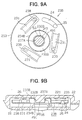
- FIGS. 8A and 8B A fourth embodiment of the present invention will be described with reference to FIGS. 8A and 8B.
- the components similar to those of the first embodiment will be indicated by similar numerals in the following description.
- a plurality of position-limiting protrusions 52 protrude from the opposing surface 221 of the cover 22.
- the position-limiting protrusions 52 are arranged in a circle around the spindle 249, and a distal end surface 601 of each position-limiting protrusion 52 slidably engages the contact portion 236.
- the position-limiting protrusions 52 provide functions that are similar to those described with reference to the position-limiting ridge 50 of the first embodiment.
- FIGS. 9A and 9B A fifth embodiment of the present invention will be described with reference to FIGS. 9A and 9B.
- the components similar to those of the first embodiment will be indicated by similar numerals in the following description.
- a cylindrical engaging portion 232B of a follower 23B protrudes toward the carrier 19.
- An inner peripheral surface 237A of the cylindrical engaging portion 232B slidably engages the outer peripheral surface 491 of the spindle 249.
- a contact portion 236B slidably engages the opposing surface 221 of the cover 22.
- a ring-shaped engaging element 53 is engaged around the outer peripheral surface 491 of the spindle 249, and the distal end surface of the cylindrical engaging portion 232B slidably engages the ring-shaped engaging element 53.
- the outer cylindrical portion 234B, the contact portion 236B and the engaging element 53 constitute the space maintaining means.
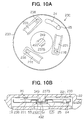
- FIGS. 10A and 10B A sixth embodiment of the present invention will be described with reference to FIGS. 10A and 10B.
- the components similar to those of the first embodiment will be indicated by similar numerals in the following description.
- a spindle supporting recess 54 is recessed toward the carrier 19, and the spindle 249 is fitted within the spindle supporting recess 54.
- a peripheral wall of the spindle supporting recess 54 constitutes a cylindrical engaging portion 232C that protrudes toward the carrier 19.
- a compression spring 55 is held between the follower 23C and the carrier 19. The compression spring 55 urges the follower 23C toward the cover 22.
- a bottom inner surface of the spindle supporting recess 54 slidably engages a distal end surface 492 of the spindle 249, and an inner peripheral surface 237B of the cylindrical engaging portion 232C slidably engages the outer peripheral surface 491 of the spindle 249.
- the spindle 249 and the compression spring 55 constitute the space maintaining means.
- a seventh embodiment of the present invention will be described with reference to FIG. 11.
- the components similar to those of the fifth embodiment will be indicated by similar numerals in the following description.
- a plurality of spindle constituting pieces 56 protrude from the opposing surface 221 of the cover 22.
- Spindle constituting pieces 56 are arranged in a circle to form a spindle for the follower 23B.
- a hook 561 is formed at a distal end of each spindle constituting piece 56.
- the spindle composed of the spindle constituting pieces 56 is inserted within the cylindrical engaging portion 232B while the spindle constituting pieces 56 are resiliently deformed.
- the inner peripheral surface 237A of the cylindrical engaging portion 232B of the follower 23B slidably engages the lateral surfaces of the spindle constituting pieces 56.
- a distal end of the cylindrical engaging portion 232B slidably engages the hooks 561.
- the hooks 561 constitute the space maintaining means.
- FIG. 12 An eighth embodiment of the present invention will be described with reference to FIG. 12. The components similar to those of the first embodiment will be indicated by similar numerals in the following description.
- a cylindrical engaging portion 232D of the follower 23 has an inner diameter larger than an outer diameter of the spindle 249.
- the cylindrical engaging portion 232D of the follower 23 is fitted to the annular position-limiting ridge 50 in such a manner that an outer peripheral surface 237c of the cylindrical engaging portion 232D slidably engages the inner peripheral surface 502 of the position-limiting ridge 50. That is, the position-limiting ridge 50 of the present embodiment constitutes the space maintaining means for maintaining a predetermined space between the follower 23 and the switching pattern 26 and also constitutes a support element for rotatably supporting the follower 23.
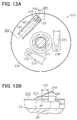
- FIGS. 13A and 13B A ninth embodiment of the present invention will be described with reference to FIGS. 13A and 13B.
- the components similar to those of the first embodiment will be indicated by similar numerals in the following description.
- a follower 23D of the present embodiment does not have the engaging hole 24 of the first embodiment.
- the engaging protrusion 25 is received in a residual hole 49 that is left after cutting and bending of the contact terminal 231.
- the engaging protrusion 25 engages one end 491 of the residual hole 49 upon rotation of the carrier 19 in the forward rotation R.
- a play 493 is provided in the residual hole 49, and the engaging protrusion 25 can move within a range of play 493 within the residual hole 49.
- An engaging wall 492 is formed by burring a corresponding portion of the follower 23D in such a manner that the engaging wall 492 protrudes along a peripheral edge of the residual hole 49 that acts as a driven-side engaging means.
- the residual hole 49 that is formed by cutting and bending of the contact terminal 231 can be conveniently and effectively used as an engaging recess for engaging with the engaging protrusion 25. Furthermore, the use of the residual hole 49 as the engaging recess allows elimination of a dedicated engaging hole for engaging with the engaging protrusion 25, so that a total size of the holes present in the follower 23D is reduced in comparison to that of the first embodiment. Thus, a strength of the follower 23D of the ninth embodiment is greater than that of the follower 23 of the first embodiment.
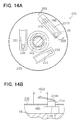
- FIGS. 14A and 14B A tenth embodiment of the present invention will be described with reference to FIGS. 14A and 14B. The components similar to those of the ninth embodiment will be indicated by similar numerals in the following description.
- a follower 23E of the present embodiment does not have the engaging hole 24 of the first embodiment.
- the engaging protrusion 25 is received in a residual hole 49B that is formed after cutting and bending of a contact terminal 231B.
- a play 493B is provided in the residual hole 49B that acts as the driven-side engaging means, and the engaging protrusion 25 can move within a range of play 493B within the residual hole 49B.
- a base 234 of the contact terminal 231B vertically protrudes, and the engaging protrusion 25 engages the base 234 of the contact terminal 231B upon the rotation of the carrier 19 in the forward rotational direction R.
- the base 234 provides functions similar to those of the engaging walls 241 and 492 formed by burring in the first and ninth embodiments, respectively.
- the step of forming the engaging wall by burring along the peripheral edge of the residual hole 49B can be eliminated.
- FIGS. 15A and 15B An eleventh embodiment of the present invention will be described with reference to FIGS. 15A and 15B. The components similar to those of the tenth embodiment will be indicated by similar numerals in the following description.
- a follower 23F of the present embodiment does not have the engaging hole 24 of the first embodiment.
- the engaging protrusion 25 is received in a residual hole 49C that is left after cutting and bending of a contact terminal 231C.
- a play 493C is provided within the residual hole 49c that acts as a driven-side engaging means, and the engaging protrusion 25 can move within a range of play 493C within the residual hole 49c.
- a base 234 of the contact terminal 231C vertically protrudes, and the engaging protrusion 25 engages the base 234 of the contact terminal 231C upon the rotation of the carrier 19 in the forward rotational direction R.
- the residual hole 49C is an arcuate hole extending along a circle whose center coincides with the rotational axis 161 of the carrier 19.
- a normal rotational direction of the carrier 19 can be used for either one of the forward rotational direction R and the backward rotation.
- FIG. 16 A twelfth embodiment of the present invention will be described with reference to FIG. 16. The components similar to those of the first embodiment will be indicated by similar numerals in the following description.
- a follower 23G of the present embodiment has an engaging recess 250 formed along a peripheral edge of the follower 23G.
- the engaging recess 250 extends along a circle whose center coincides with the rotational axis 161 of the output shaft 16.
- the engaging protrusion 25 is received within the engaging recess 250.
- a play 520 is provided in the engaging recess 250 that acts as a driven-side engaging means, and the engaging protrusion 25 can move within a range of play 520 within the engaging recess 250.
- the engaging recess 250 is integrally formed in the follower 23G by press work.
- a reinforcing wall 233 that engages the engaging protrusion 25 provides functions similar to those of the engaging walls 241 and 492 formed by burring in the first and ninth embodiments, respectively.
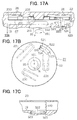
- FIGS. 17A-17C A thirteenth embodiment of the present invention will be described with reference to FIGS. 17A-17C.
- the components similar to those of the first embodiment will be indicated by similar numerals in the following description.
- an engaging protrusion 610 is integrally formed in the follower 23.
- the engaging protrusion 610 is formed by cutting a corresponding portion of the follower 23 and then bending it toward the carrier 19.
- An engaging recess 524 is formed in the opposing surface 192 of the carrier 19 that opposes the follower 23. A distal end of the engaging protrusion 610 is received within the engaging recess 524 that rotates integrally with the carrier 19.
- the engaging recess 524 is an arcuate groove extending along a circle whose center coincides with the rotational axis 161 of the output shaft 16.
- the distal end of the engaging protrusion 610 engages one circumferential end 521 of the engaging recess 524 to provide surface engagement therebetween.
- the rotation of the carrier 19 is transmitted to the follower 23 through the surface engagement between the engaging protrusion 610 and the circumferential end 521, so that the follower 23 is dragged to rotate about the spindle 249 synchronously with the rotation of the carrier 19.
- a play 522 is provided in the engaging recess 524, and the engaging protrusion 610 can relatively move within a range of play 522 within the engaging recess 524.
- the engaging protrusion 610 is engaged with the circumferential end 521 of the engaging recess 524, i.e., the follower 23 can be immediately rotated upon rotation of the carrier 19 in the forward rotational direction R without a pause.
- the wiper drive motor is forced to rotate backward, the engaging protrusion 610 is relatively moved from the one circumferential end 521 toward the other circumferential end 523 within the engaging recess 524.
- the engaging protrusion 610 that acts as the driven-side engaging means can be easily manufactured through the cutting and bending work. Furthermore, the engaging recess 524 that acts as the driving-side engaging means can be relatively easily manufactured.
- the high manufacturability of the engaging protrusion 610 and the engaging recess 524 contributes to the high manufacturability of the rotational-position sensing device.
- the use of the engaging protrusion 610 that is formed by cutting and bending the metal follower 23 allows a reduction in the number of components of the rotational-position sensing device in comparison to the one in which the engaging protrusion is provided as a separate member.
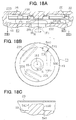
- FIGS. 18A-18C A fourteenth embodiment of the present invention will be described with reference to FIGS. 18A-18C.
- the components similar to those of the first embodiment will be indicated by similar numerals in the following description.
- an engaging protrusion 530 is integrally formed in the follower 23.
- the engaging protrusion 530 is formed by cutting a corresponding portion of the follower 23 and then bending it toward the carrier 19.
- An engaging protrusion 540 is integrally formed in the opposing surface 192 of the carrier 19 that opposes the follower 23.
- one circumferential end 541 of the engaging protrusion 540 engages one circumferential end of the engaging protrusion 530 to provide surface engagement therebetween (this position is referred to as a first position).
- the rotation of the carrier 19 is transmitted to the follower 23 through the surface engagement between the engaging protrusion 530 and the engaging protrusion 540, so that the follower 23 is dragged to rotate about the spindle 249 synchronously with the rotation of the carrier 19.
- the engaging protrusion 540 can move relative to the engaging protrusion 530 within a range of play 550.
- the engaging protrusion 530 is engaged with the one circumferential end 541 of the engaging protrusion 540, i.e., the follower 23 can be immediately rotated upon rotation of the carrier 19 in the forward rotational direction R without a pause. In this state, if the wiper drive motor is forced to rotate backward, the engaging protrusion 530 is spaced away from the engaging protrusion 540.
- the follower 23 will not be rotated backward by the backward rotation of the carrier 19 or of the wiper drive motor unless the engaging protrusion 540 moves all the way through the range of play 550 relative to the engaging protrusion 530 and engages the other circumferential end surface of the engaging protrusion 530 (this position is referred to as a second position).
- the engaging protrusion 530 that acts as the driven-side engaging means can be easily manufactured through the cutting and bending work, and the engaging protrusion 540 that acts as the driving-side engaging means can be relatively easily manufactured integrally with or separately from the carrier 19.
- the high manufacturability of the engaging protrusions 530 and 540 contributes to the high manufacturability of the rotational-position sensing device.
- the use of the engaging protrusion 530 that is formed by cutting and bending the metal follower 23 allows a reduction in the number of components of the rotational-position sensing device in comparison to the one in which the engaging protrusion is provided as a separate member.
- a sufficient amount of play 550 is provided, so that the arrangement of the fourteenth embodiment can be effectively used in a situation where the large backward rotation of the wiper drive motor is expected.
- FIGS. 19A and 19B A fifteenth embodiment of the present invention will be described with reference to FIGS. 19A and 19B.
- the components similar to those of the first embodiment will be indicated by similar numerals in the following description.
- a rivet shaped contact member 560 penetrates through and is secured to a distal end of a contact terminal 231D that is integrally formed in the follower 23 by cutting a corresponding portion of the follower 23 and then bending it.
- the contact member 560 is made of an electrically conductive material separately from the contact terminal 231D.
- the contact member 560 engages and disengages with the switching pattern 26.
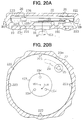
- FIGS. 20A and 20B A sixteenth embodiment of the present invention will be described with reference to FIGS. 20A and 20B. The components similar to those of the first embodiment will be indicated by similar numerals in the following description.
- the cover 22 is made of a synthetic resin material, and a circumferential wall surface 222 is formed in the inner surface of the cover 22.
- a central axis of the circumferential wall surface 222 coincides with the rotational axis 161 of the carrier 19.
- a plurality (three in this embodiment) of support projections 223 are formed integrally with the circumferential wall surface 222 to project toward the rotational axis 161.
- a distal end of the output shaft 16 that opposes the cover 22 is covered with a bump 193 that constitutes a part of the carrier 19.
- a plurality (four in this embodiment) of semi-spherical support bulges 194 are integrally formed in a protruding end surface of the bump 193.
- the circumferential wall surface 222 that slidably engages the reinforcing wall 233 of the follower 23H keeps the rotational axis of the follower 23H to substantially coincide with the rotational axis 161 of the carrier 19.
- Each support projection 223 possesses resiliency and resiliently engages the peripheral edge of the follower 23H to rotatably support the follower 23H while preventing the follower 23H from falling out of the cover 22.
- the circumferential wall surface 222 provides radial support for the follower 23H.
- the support projections 223 provide axial support for the follower 23H in the axial direction of the rotational axis 161.
- Each support bulge 194 makes a point contact with a central portion of the follower 23H to support a reaction force exerted from the contact terminals 231 that are urged against the cover 22.
- Each support bulge 194 also minimizes frictional abrasion between the bump 193 and the follower 23H.
- a seventeenth embodiment of the present invention will be described with reference to FIG. 21.
- the components similar to those of the first and sixteenth embodiments will be indicated by similar numerals in the following description.
- the follower 23 is rotatably fitted around the cylindrical spindle 249.
- the follower 23 is supported by the spindle 249 in such a manner that the rotational axis of the follower 23 coincides with the rotational axis 161 of the carrier 19.
- the spindle 249 provides radial support for the follower 23, and the support projections 223 provide functions similar to those of the support projections 223 of the sixteenth embodiment.
- FIGS. 22A and 22B An eighteenth embodiment of the present invention will be described with reference to FIGS. 22A and 22B. The components similar to those of the sixteenth embodiment will be indicated by similar numerals in the following description.
- the carrier 19 is made of a synthetic resin material, and an annular ridge 57 is integrally formed with the carrier 19 to protrude from a peripheral edge of the opposing surface of the carrier 19 toward the cover 22.
- a circumferential wall surface 571 is formed in an inner peripheral surface of the annular ridge 57.
- a central axis of the circumferential wall surface 571 coincides with the rotational axis 161 of the carrier 19.
- a plurality (four in this embodiment) of support projections 572 are formed integrally with the circumferential wall surface 571 to project toward the rotational axis 161.
- One end of the output shaft 16 that opposes the cover 22 is buried within the carrier 19.
- a semi-spherical support bulge 195 is integrally formed in the carrier 19 to protrude therefrom.
- An engaging protrusion 196 that engages the engaging hole 24 is integrally formed in the carrier 19.
- An annular reinforcing wall 235 is formed along a peripheral edge of a follower 23I by bending a corresponding portion of the follower 23I toward the carrier 19.
- An outer peripheral surface of the reinforcing wall 235 of the follower 23I engages the circumferential wall surface 571.
- the circumferential wall surface 571 that engages the reinforcing wall 235 of the follower 23I keeps the rotational axis of the follower 23I to substantially coincide with the rotational axis 161 of the carrier 19.
- Each support projection 572 possesses resiliency and resiliently engages the peripheral edge of the follower 23I to support the follower 23I while preventing the follower 23I from moving out of the carrier 19.
- the circumferential wall surface 571 provides radial support for the follower 23I.
- the support projections 572 provide axial support for the follower 23I in the axial direction of the rotational axis 161.
- the support bulge 195 supports a reaction force exerted from the contact terminals 231 that are urged against the cover 22. Frictional force is generated between the contact terminals 231 and the cover 22 by urging the contact terminals 231 against the cover 22. Thus, even if the carrier 19 is rotated backward, the follower 23I is held by the frictional force and does not rotate integrally with the carrier 19.
- FIGS. 23A-23C A nineteenth embodiment of the present invention will be described with reference to FIGS. 23A-23C.
- the components similar to those of the first embodiment will be indicated by similar numerals in the following description.
- one end of the output shaft 16 that opposes the cover 22 is covered with a bump 193 that constitutes a part of the carrier 19.
- a spindle 58 and an annular position-limiting ridge 59 are integrally formed in a protruding end surface of the bump 193 to protrude toward the cover 22.
- the annular position-limiting ridge 59 is formed to coaxially surround the spindle 58.
- a central axis of the spindle 58 coincides with the rotational axis 161 of the carrier 19.
- a follower 23J is rotatably fitted around the spindle 58.
- the follower 23J is supported by the spindle 58 in such a manner that the rotational axis of the follower 23J coincides with the rotational axis 161 of the carrier 19.
- the follower 23J is prevented from moving out of the spindle 58 by a detachment preventing ring 60.
- the follower 23J is clamped between the position-limiting ridge 59 and the detachment preventing ring 60.
- the detachment preventing ring 60 limits movement of the follower 23J toward the cover 22 around the spindle 58.
- the position-limiting ridge 59 limits movement of the follower 23J toward the carrier 19 around the spindle 58.
- the position-limiting ridge 59 and the detachment preventing ring 60 maintain a predetermined space between the follower 23J and the switching pattern 26 while supporting the follower 23J in a rotatable manner around the spindle 58.
- FIG. 23B shows a first rotational position 61 in the switching pattern 26 that is provided for sensing a rotational position of the carrier 19 corresponding to a position of the wiper blades.
- the first rotational position 61 is provided for indicating the rotational position of the carrier 19 that corresponds to the predetermined stop position of the wiper blades.
- the first rotational position 61 that is a part of the inner surface of the cover 22 has a stop projection 611.
- the stop projection 611 axially protrudes beyond an electrical wiring portion 261 of the switching pattern 26 that is electrically connected to the contact 238 of the contact terminal 231 upon contacting the contact 238 of the contact terminal 231.
- the stop projection 611 allows the contact 238 of the contact terminal 231 to pass over the stop projection 611 when the carrier 19 is rotated in the forward rotational direction, and the stop projection 611 restrains the contact 238 of the contact terminal 231 from passing over the stop projection 611 when the carrier 19 is rotated in the backward rotational direction (i.e., the contact terminal 231 shown in FIG. 23B can move continuously beyond the stop projection 611 in a right direction in FIG. 23B but is restrained from moving over the stop projection 611 in a left direction in FIG. 23B).
- the carrier 19 could be forced to rotate backward right after the contact 238 of the contact terminal 231 passes over the stop projection 611.
- the play 244 within the engaging hole 24 shown in FIG. 23C allows relative movement of the engaging protrusion 25 within the engaging hole 24 when the carrier 19 rotates backward. Since the follower 23J is clamped between the position-limiting ridge 59 and the detachment preventing ring 60, the follower 23J can be dragged to follow the backward rotation of the carrier 19. However, the stop projection 611 restrains the contact 238 of the contact terminal 231 from passing over the stop projection 611 when the carrier 19 rotates backward. When the carrier 19 rotates backward, the stop projection 611 reliably prevents the follower 23J to follow the backward rotation of the carrier 19 at the first rotational position (the predetermined stop position of the wiper blades).
- a spindle (249) and a position-limiting ridge (50) protrude from an inner surface (221) of a cover (22) to rotatably support a follower (23) made of an electrically conductive metal plate.
- a cylindrical engaging portion (232) of the follower (23) slidably engages the spindle (249).
- a toothed washer (51) is fitted around the spindle (249) to clamp a contact portion (236) of the follower (23) between the position-limiting ridge (50) and the toothed washer (51) in a rotatable manner.
- a switching pattern (26) is provided in the inner surface (221) of the cover (22).
- Contact terminals (231) that engage and disengage with the switching pattern (26) based on rotation of the follower (23) are integrally formed in the follower (23).
- An engaging hole (24) penetrates through the follower (23).
- An engaging protrusion (25) on a carrier (19) is received within the engaging hole (24).
- the follower (23) is rotated through engagement between the engaging protrusion (25) and the engaging hole (24) when the carrier (19) rotates in a forward rotational direction (R).
Landscapes
- Engineering & Computer Science (AREA)
- Mechanical Engineering (AREA)
- Control Of Direct Current Motors (AREA)
- Measurement Of Length, Angles, Or The Like Using Electric Or Magnetic Means (AREA)
Abstract
Description
- The present invention relates to a rotational-position sensing device and a windshield wiper system.
- FIG. 26 shows a rotational-position sensing device for a windshield wiper system disclosed in Japanese Unexamined Utility Model Publication No. 61-35068. A
worm 1 and a wheel (acting as a rotator) 2 meshed with theworm 1 constitute a speed reducing gear mechanism. Rotation of an output shaft 3 secured to thewheel 2 is transmitted to a crank mechanism (not shown) acting as a reciprocating swing mechanism. The crank mechanism reciprocally swings wiper blades (not shown) along a windshield. - A cover 4 that covers a gear case opposes the
wheel 2. A follower 5 is rotatably supported by aspindle 4a that protrudes from the cover 4. Aswitching pattern 6 is arranged in an opposing surface of the follower 5 that opposes the cover 4. A plurality of contact terminals 7 are arranged in an opposing surface of the cover 4 that opposes the follower 5. The rotation of thewheel 2, which generates the swing motion of the wiper blades, is transmitted to the follower 5 through engagement between a protrusion 8 of thewheel 2 and a protrusion 9 of the follower 5, so that the follower 5 is integrally rotated with thewheel 2. As the follower 5 rotates, the contact terminals 7 engage and disengage with theswitching pattern 6, so that a rotational position of thewheel 2 or a rotational position of the output shaft 3 is sensed or detected. - The contact terminals 7 are urged against the
switching pattern 6 because of their own resilient forces. When the resilient forces of the contact terminals 7 are summed and are applied to the follower 5 to lever the follower 5 about thespindle 4a, the follower 5 tilts with respect to thespindle 4a. When the follower 5 tilts, the follower 5 cannot rotate freely, causing an increased rotational resistance of the follower 5. The increase in the rotational resistance of the follower 5 normally results in a decrease in a transmission efficiency of the power transmission system between a wiper drive motor and the follower 5. Furthermore, the tilt of the follower 5 may cause a contact failure between the contact terminals 7 and theswitching pattern 6. Such a contact failure causes a reduction in a sensing accuracy of the rotational-position sensing device. - To restrain the tilt of the follower 5, a
wave washer 61 is inserted around thespindle 4a to urge the follower 5 in an axial direction away from it, and a stationaryengaging member 62, such as a C-ring, is fitted around thespindle 4a to hold the follower 5 in place around thespindle 4a. - However, when an excess force that overcomes the urging force of the
wave washer 61 is applied to the follower 5, the follower 5 is still tilted. Furthermore, both thewave washer 61 and the stationaryengaging member 62 are required in the above case, so that a number of assembling steps and a number of components to be assembled are disadvantageously increased. - Furthermore, the wiper blades are controlled to be stopped at a predetermined stop position which is generally one swing end position of the wiper blades. More specifically, when a vehicle driver manually turns off a wiper switch, the following control operation is conducted. That is, the wiper drive motor drives the wiper blades to the predetermined stop position and then stops the wiper blades in the predetermined stop position. This type of automatic stop arrangement for automatically stops the wiper blades in the predetermined stop position is disclosed in Japanese Unexamined Utility Model Publication No. 61-35068. By way of example, it will be assumed that a relatively large amount of snow is present on the windshield. In the windshield wiper system having the automatic stop arrangement, the wiper blades wipe the snow toward the predetermined stop position. When the wiper blades reach the predetermined stop position, the wiper drive motor is turned off, so that the wiper blades lose its driving force. Since the snow has been packed by the wiper blades, the snow exerts a reaction force against the wiper blades to move the wiper blades backward out of the predetermined stop position, and the wiper drive motor is forced to rotate backward. When the follower 5 is rotated backward due to the backward rotation of the wiper drive motor, a state of engagement and disengagement between the
switching pattern 6 and the contact terminals 7 is changed to another state different from one that is seen while the wiper blades are held in the stop position. This change in the state of engagement and disengagement causes the wiper drive motor to drive the wiper blades toward the stop position. This results in chattering of the wiper system. - In the previously proposed rotational-position sensing device shown in FIG. 26, when the backward rotation of the wiper drive motor or the backward rotation of the
wheel 2 occurs, the protrusions 8 and 9 are moved away from each other, so that the backward rotation of thewheel 2 is not transmitted to the follower 5. The prevention of the transmission of the backward rotation of thewheel 2 to the follower 5 prevents chattering of the wiper system. - However, the contact terminals 7 need to be secured to the cover 4 in manufacturing. Furthermore, the
switching pattern 6 and the protrusion 9 need to be provided in the follower 5. Thus, a number of components to be assembled is increased. Because of this, parts management becomes more complicated, and a number of assembling steps is disadvantageously increased. - The present invention addresses the above disadvantages. Thus, it is an objective of the present invention to provide a rotational-position sensing device that senses a rotational position of a rotator through engagement and disengagement of contact terminals with a switching pattern based on rotation of a follower and that can be manufactured with a reduced number of assembling steps and a reduced number of components to be assembled while effectively restraining tilt of the follower. It is another objective of the present invention to provide a windshield wiper system having such a rotational-position sensing device. It is a further objective of the present invention to provide a rotational-position sensing device that restrains a change in a state of engagement and disengagement between the switching pattern and the contact terminals when the rotator is forced to rotate in a backward rotational direction and that has a reduced number of components to be assembled while achieving an improved manufacturability of the rotational-position sensing device. It is a further objective of the present invention to provide a windshield wiper system having such a rotational-position sensing device.
- To achieve the objectives of the present invention, there is provided a rotational-position sensing device including a stationary body, a rotator and a follower. The stationary body includes a switching pattern. The rotator is rotatably supported by the stationary body. The rotator has a driving-side engaging means. The switching pattern is provided around a rotational axis of the rotator. The follower receives a rotational force to rotate about the rotational axis from the rotator through the driving-side engaging means. The follower includes a plurality of contact terminals. The rotational-position sensing device senses a rotational position of the rotator through engagement and disengagement of the contact terminals with the switching pattern based on rotation of the follower. The follower is made of an electrically conductive metal plate. The contact terminals are integrally formed in the electrically conductive metal plate. The follower further includes a driven-side engaging means that receives the rotational force from the rotator during rotation of the rotator in a forward rotational direction upon engagement with the driving-side engaging means in a forward rotational engaged position. The driven-side engaging means has a play. The play allows the driving-side engaging means to move away from the forward rotational engaged position without transmitting the rotational force to the follower when the rotator rotates in a backward rotational direction.
- To achieve the objectives of the present invention, there is also provided a windshield wiper system having a wiper arm with a wiper blade connected thereto, a motor and a control device. The motor has a rotational-position sensing device for sensing a rotational position of the wiper blade, a gear housing and a speed reducing mechanism. The gear housing includes a receiving recess and a cover for covering the receiving recess. The speed reducing mechanism is received within the receiving recess. The speed reducing mechanism is connected to an output shaft for outputting a rotational force of the speed reducing mechanism. The control device includes a wiper switch and controls the motor based on an operation mode selected through the wiper switch. The wiper arm and the wiper blade are reciprocally swung by a rotational driving force of the motor. The rotational-position sensing device includes a rotator, a switching pattern and a follower. The rotator is rotatably supported by the gear housing. The rotator has a driving-side engaging means and rotates integrally with the output shaft. The switching pattern is formed in the cover around a rotational axis of the rotator. The switching pattern includes a first rotational position and a second rotational position. The first rotational position corresponds to a predetermined stop position of the wiper blade. The second rotational position indicates a rotational position of the wiper blade other than the first rotational position of the wiper blade. The follower is made of an electrically conductive metal plate. The follower includes a plurality of contact terminals and a driven-side engaging means. The contact terminals are integrally formed in the electrically conductive metal plate. The contact terminals engage and disengage with the switching pattern. The driven-side engaging means receives a rotational force to rotate about the rotational axis during rotation of the rotator in a forward rotational direction upon engagement with the driving-side engaging means in a forward rotational engaged position. The driven-side engaging means has a play. The play allows the driving-side engaging means to move away from the forward rotational engaged position without transmitting the rotational force to the follower when the rotator rotates in a backward rotational direction.
- To achieve the objectives of the present invention, there is also provided a rotational-position sensing device including a stationary body, a rotator, a follower, a switching pattern and a plurality of contact terminals. The rotator is rotatably supported by the stationary body. The follower is rotatably supported by a support element provided on the stationary body. The support element is coaxial with the rotator. The follower is positioned between the stationary body and the rotator and receives a rotational force from the rotator. The switching pattern is formed in one of the stationary body and the follower. The contact terminals are formed in the other of the stationary body and the follower. A rotational position of the rotator is sensed through engagement and disengagement of the contact terminals with the switching pattern based on rotation of the follower. A signal indicative of the rotational position of the rotator is outputted from the rotational-position sensing device. The rotational-position sensing device further includes a space maintaining means and a cylindrical engaging portion. The space maintaining means is provided around the support element to maintain a predetermined space between the follower and an opposing surface of the stationary body that axially opposes the follower. The cylindrical engaging portion is provided at a center of the follower. The cylindrical engaging portion has a peripheral surface that slidably engages a peripheral surface of the support element.
- To achieve the objectives of the present invention, there is provided a windshield wiper system having a wiper, a reciprocating swing mechanism for reciprocally swinging the wiper, a motor and a speed reducing mechanism. The motor has a gear housing. The speed reducing mechanism is received in the gear housing to transmit rotation of a motor at a reduced speed. The rotation of the motor is transmitted to the wiper through the speed reducing mechanism and the reciprocating swing mechanism to reciprocally swing the wiper. The windshield wiper system further includes a rotational-position sensing device and a control device. The rotational-position sensing device includes a rotator, a follower, a switching pattern, a plurality of contact terminals and a space maintaining means. The rotator is rotatably supported by the gear housing. The rotator is integrally rotated with an output shaft that receives a rotational force from the speed reducing mechanism. The follower is rotatably supported by a support element provided in the gear housing. The support element is coaxial with the rotator. The follower is positioned between the gear housing and the rotator and receives a rotational force from the rotator. The follower has a cylindrical engaging portion provided at a center of the follower. The cylindrical engaging portion has a peripheral surface that slidably engages a peripheral surface of the support element. The switching pattern is formed in one of the gear housing and the follower. The contact terminals are formed in the other of the gear housing and the follower. The space maintaining means is provided around the support element to maintain a predetermined space between the follower and an opposing surface of the gear housing that axially opposes the follower. A rotational position of the rotator is sensed through engagement and disengagement of the contact terminals with the switching pattern based on rotation of the follower. A signal indicative of the rotational position of the rotator is outputted from the rotational-position sensing device. The control device includes a wiper switch that is switched between a stop position and an actuation position. The control device rotates the motor until the rotational-position sensing device senses a rotational position of the rotator that corresponds to a predetermined stop position of the wiper after the wiper switch is switched to the stop position to stop the windshield wiper system. The control device stops the motor when the rotational-position sensing device senses the rotational position of the rotator that corresponds to the predetermined stop position of the wiper.
- The invention, together with additional objectives, features and advantages thereof, will be best understood from the following description, the appended claims and the accompanying drawings in which:
- FIG. 1 is a partially cut away cross-sectional plan view of a wiper drive motor of a windshield wiper system according to a first embodiment of the present invention;
- FIG. 2 is a cross-sectional view taken along line II-II in FIG. 1;
- FIG. 3 is an enlarged partial cross-sectional view of the wiper drive motor according to the first embodiment, showing a rotational-position sensing device;
- FIG. 4A is a partial cross-sectional plan view of the rotational-position sensing device according to the first embodiment;
- FIG. 4B is an enlarged cross-sectional view taken along line IVB-IVB in FIG. 4A;
- FIG. 4C is an enlarged cross-sectional view taken along line IVC-IVC in FIG. 4A;
- FIG. 5 is a circuit diagram of an automatic stop arrangement of the windshield wiper system according to the first embodiment;
- FIG. 6 is a partial longitudinal cross-sectional view of a rotational-position sensing device according to a second embodiment of the present invention;
- FIG. 7 is a partial longitudinal cross-sectional view of a rotational-position sensing device according to a third embodiment of the present invention;
- FIG. 8A is a partial cross-sectional plan view of a rotational-position sensing device according to a fourth embodiment of the present invention;
- FIG. 8B is a partial longitudinal cross-sectional view of the rotational-position sensing device according to the fourth embodiment;
- FIG. 9A is a partial cross-sectional plan view of a rotational-position sensing device according to a fifth embodiment of the present invention;
- FIG. 9B is a partial longitudinal cross-sectional view of the rotational-position sensing device according to the fifth embodiment;
- FIG. 10A is a partial cross-sectional plan view of a rotational-position sensing device according to a sixth embodiment of the present invention;
- FIG. 10B is a partial longitudinal cross-sectional view of the rotational-position sensing device according to the sixth embodiment;
- FIG. 11 is a partial longitudinal cross-sectional view of a rotational-position sensing device according to a seventh embodiment of the present invention;
- FIG. 12 is a partial longitudinal cross-sectional view of a rotational-position sensing device according to an eighth embodiment;
- FIG. 13A is a partial cross-sectional plan view of a rotational-position sensing device according to a ninth embodiment of the present invention;
- FIG. 13B is an enlarged cross-sectional view taken along line XIIIB-XIIIB in FIG. 13A;
- FIG. 14A is a partial cross-sectional plan view of a rotational-position sensing device according to a tenth embodiment of the present invention;
- FIG. 14B is a cross-sectional view taken along line XIVB-XIVB in FIG. 14A;
- FIG. 15A is a partial cross-sectional plan view of a rotational-position sensing device according to an eleventh embodiment of the present invention;
- FIG. 15B is a cross-sectional view taken along line XVB-XVB in FIG. 15A;
- FIG. 16 is a partial cross-sectional plan view of a rotational-position sensing device according to a twelfth embodiment of the present invention;
- FIG. 17A is a partial longitudinal cross-sectional view of a rotational-position sensing device according to a thirteenth embodiment of the present invention;
- FIG. 17B is a cross-sectional view, on a reduced scale, taken along line XVIIB-XVIIB in FIG. 17A;
- FIG. 17C is an enlarged cross-sectional view taken along line XVIIC-XVIIC in FIG. 17A;
- FIG. 18A is a partial longitudinal cross-sectional view of a rotational-position sensing device according to a fourteenth embodiment of the present invention;
- FIG. 18B is a cross-sectional view, on a reduced scale, taken along line XVIIIB-XVIIIB in FIG. 18A;
- FIG. 18C is an enlarged cross-sectional view taken along line XVIIIC-XVIIIC in FIG. 18A;
- FIG. 19A is a partial cross-sectional plan view of a rotational-position sensing device according to a a fifteenth embodiment of the present invention;
- FIG. 19B is an enlarged cross-sectional view taken along line XIXB-XIXB in FIG. 19A;
- FIG. 20A is a partial longitudinal cross-sectional view of a rotational-position sensing device according to a sixteenth embodiment of the present invention;
- FIG. 20B is a cross-sectional view taken along line XXB-XXB in FIG. 20A;
- FIG. 21 is a partial longitudinal cross-sectional view of a rotational-position sensing device according to a seventeenth embodiment of the present invention;
- FIG. 22A is a partial longitudinal cross-sectional view of a rotational-position sensing device according to an eighteenth embodiment of the present invention;
- FIG. 22B is a cross-sectional view, on a reduced scale, taken along line XXIIB-XXIIB in FIG. 22A;
- FIG. 23A is a partial longitudinal cross-sectional view of a rotational-position sensing device according to a nineteenth embodiment of the present invention;
- FIG. 23B is an enlarged cross-sectional view taken along line XXIIIB-XXIIIB in FIG. 23A;
- FIG. 23C is an enlarged cross-sectional view taken along line XXIIIC-XXIIIC in FIG. 23A;
- FIG. 24 is a cross-sectional plan view showing a modification of the first embodiment;
- FIG. 25 is a cross-sectional view taken along line XXV-XXV in FIG. 24; and
- FIG. 26 is a partial longitudinal cross-sectional view of a previously proposed rotational-position sensing device for a windshield wiper system.
-
- Various embodiments of the present invention will be described with reference to the accompanying drawings.
- A windshield wiper system according to a first embodiment of the present invention will be described with reference to FIGS. 1-5.
- With reference to FIG. 1, a
gear housing 12 is connected to ayoke housing 111 of awiper drive motor 11. A first speed reducinggear mechanism 13 and a second speed reducinggear mechanism 17 are received within thegear housing 12. The first speed reducinggear mechanism 13 includes aworm 14 and aworm wheel 15. Theworm 14 is connected to anarmature 112 of thewiper drive motor 11. Theworm wheel 15 is meshed with theworm 14. Theworm 14 acts as an output shaft of thewiper drive motor 11. Theworm wheel 15 is rotatably supported by anoutput shaft 16, which is, in turn, rotatably supported by thegear housing 12. - With reference to FIG. 2, the second speed reducing
gear mechanism 17 is a planetary speed reducing gear mechanism including asun gear 18, acarrier 19, a plurality (three in this embodiment, as shown in FIG. 1) of planet gears 20, aninternal gear 21 and anoutput shaft 16. Thesun gear 18 is coaxially secured to theworm wheel 15. Thecarrier 19 is secured to theoutput shaft 16 in opposed relationship with thesun gear 18. Eachplanet gear 20 is rotatably supported by a spindle (support element) 191 that protrudes from thecarrier 19. Theinternal gear 21 is secured to an inner peripheral surface of a receivingrecess 121 defined in thegear housing 12. Theworm wheel 15 and thecarrier 19 are received within the receivingrecess 121. The planet gears 20 are meshed with both thesun gear 18 andinternal gear 21. As thesun gear 18 rotates integrally with theworm wheel 15, the planet gears 20 revolve about thesun gear 18, and thecarrier 19 rotates integrally with theoutput shaft 16. Arotational axis 161 of theoutput shaft 16 is also a rotational axis of thecarrier 19. A rotational speed of theworm 14 is reduced in two steps through the first speed reducinggear mechanism 13 and the second speed reducinggear mechanism 17 before it is transmitted to theoutput shaft 16. Theoutput shaft 16 and thecarrier 19 rotate in a direction of an arrow R (this rotational direction is hereinafter referred to as a forward rotational direction R). The first speed reducinggear mechanism 13 and the second speed reducinggear mechanism 17 cooperatively constitute a speed reducing mechanism for transmitting the rotation of theworm 14 that acts as the output shaft of thewiper drive motor 11 at a reduced speed. - A reciprocating swing mechanism of a crank type (not shown), such as one disclosed in Japanese Unexamined Utility Model Publication No. 61-35068, United States Patent No. 5,093,952 or the like which is incorporated by reference herein, is connected to the
output shaft 16. Wiper arms (not shown) each having a wiper blade (not shown) are operably connected to the reciprocating swing mechanism. The wiper blades are reciprocally swung by the reciprocating swing mechanism that is, in turn, driven by the rotation of theoutput shaft 16. The wiper blades reciprocate once per rotation of theoutput shaft 16. - With reference to FIG. 2, the receiving
recess 121 is covered with acover 22 that constitutes a part of the gear housing (stationary body) 12. Acylindrical spindle 249 and an annular position-limiting ridge (position-limiting protrusion) 50 protrude from an opposing surface 221 (FIG. 3) of thecover 22 that opposes thecarrier 19. The annular position-limitingridge 50 is formed to coaxially surround thespindle 249. Afollower 23 is rotatably fitted around thespindle 249. A central axis of thespindle 249 coincides with therotational axis 161 of theoutput shaft 16. Thefollower 23 is made of an electrically conductive metal plate. Thefollower 23 has a circular disk shape (best seen in FIG. 4A) and includes a cylindrical engagingportion 232 that protrudes toward thecover 22 at a center of thefollower 23. The cylindricalengaging portion 232 surrounds thespindle 249. Thespindle 249 slidably engages an innerperipheral surface 237 of the cylindrical engagingportion 232. - The
follower 23 includes an annular reinforcingwall 233 that is bent to protrude from an outer peripheral edge of thefollower 23 toward thecover 22. The reinforcingwall 233 increases a rigidity of the plate-like follower 23. A portion of thefollower 23 located between the reinforcingwall 233 and the cylindrical engagingportion 232 is divided into anannular disk portion 235 and acontact portion 236 by an outercylindrical portion 234. Thecontact portion 236 opposes adistal end surface 501 of the position-limitingridge 50. The cylindricalengaging portion 232, the reinforcingwall 233 and the outercylindrical portion 234 are bent by press work. - A
toothed washer 51 is fitted around an outerperipheral surface 491 of thespindle 249. Thetoothed washer 51 includes atooth portion 511 and an annularflat portion 512. Thetooth portion 511 is securely engaged into the outerperipheral surface 491. The annularflat portion 512 engages thecontact portion 236 of thefollower 23. Thetoothed washer 51 fitted around thespindle 249 urges thecontact portion 236 of thefollower 23 against thedistal end surface 501 of the position-limitingridge 50. - A plurality (three in this embodiment) of lever-
like contact terminals 231 are integrally formed in thefollower 23. With reference to FIG. 4B, eachcontact terminal 231 is formed by cutting a corresponding portion of thefollower 23 and then bending it toward thecover 22. Asemi-spherical contact 238 is formed at a distal end of eachcontact terminal 231. With reference to FIGS. 3 and 4A, an engaginghole 24 penetrates through thefollower 23. The engaginghole 24 is an arcuate hole extending along a circle whose center coincides with therotational axis 161 of theoutput shaft 16. - With reference to FIG. 3, an engaging
protrusion 25 is securely connected to an opposingsurface 192 of thecarrier 19 that opposes thefollower 23. A distal end of the engagingprotrusion 25 that rotates integrally with thecarrier 19 has a cylindrical shape and is received within the engaginghole 24. With reference to FIG. 4A, anengaging wall 241 is formed by burring a corresponding portion of thefollower 23 in such a manner that theengaging wall 241 protrudes from a peripheral edge of the engaginghole 24. When thecarrier 19 rotates in the forward rotational direction R upon actuation of thewiper drive motor 11, the distal end of the engagingprotrusion 25 engages onecircumferential end 242 of the engaginghole 24 in a forward rotational engaged position. The rotation of thecarrier 19 is transmitted to thefollower 23 through the engagement between the engagingprotrusion 25 and thecircumferential end 242, so that thefollower 23 is dragged to rotate about thespindle 249. When thefollower 23 rotates along with thecarrier 19, the innerperipheral surface 237 of the cylindrical engagingportion 232 slides along the outerperipheral surface 491 of thespindle 249, and thecontact portion 236 slides along thedistal end surface 501 of the position-limitingridge 50 and theflat portion 512 of thetoothed washer 51. - With reference to FIG. 3, an electrically
conductive switching pattern 26 is secured to the inner surface of thecover 22 around thespindle 249. The electricallyconductive switching pattern 26 is provided for sensing rotational positions corresponding to a wiping position and a stop position of the wiper blades. Eachcontact terminal 231 on thefollower 23, which rotates along with thecarrier 19, engages and disengages the switchingpattern 26. - With reference to FIG. 1, a
circuit unit 27 is received within a receivingportion 122 of thegear housing 12. With reference to FIG. 5, thecircuit unit 27 includes brush wiring terminals 28-30, external terminals 31-35, choke coils 36, 37,capacitors circuit breaker 40 that acts as an anti-burning means. Thebrush wiring terminal 28 acting as a common ground terminal is connected to theexternal terminal 31 through thecircuit breaker 40. Thebrush wiring terminal 29 provided for a high speed operation is connected to theexternal terminal 32 through thechoke coil 36. Thebrush wiring terminal 30 provided for a low speed operation is connected to theexternal terminal 33 through thechoke coil 37. Thecircuit breaker 40 electrically disconnects thebrush wiring terminal 28 from theexternal terminal 31 upon overheating of the choke coils 36, 37 or of thecircuit breaker 40 itself. - The
brush wiring terminal 28 is electrically connected to acommon ground brush 41, and thebrush wiring terminal 29 is electrically connected to ahigh speed brush 42. Thebrush wiring terminal 30 is electrically connected to alow speed brush 43. In FIG. 1, only thebrushes - The engagement and disengagement between the
contact 238 of eachcontact terminal 231 and theswitching pattern 26 cause electrical connection and electrical disconnection among theexternal terminals carrier 19 provided with the engagingprotrusion 25, thefollower 23 provided with the engaginghole 24 and thecontact terminals 231, thecover 22 provided with the switchingpattern 26 constitute a rotational-position sensing device 44 for sensing or detecting a rotational position of thecarrier 19 acting as a rotator. The switchingpattern 26 includes first and second rotational positions of thecarrier 19. The first rotational position corresponds to a predetermined stop position of the wiper blades (located within a predetermined range in a bottom section of a windshield). The second rotational position corresponds to a rotational position other than the first rotational position. When the wiper blades are in the predetermined stop position, the rotational-position sensing device 44 electrically connects theexternal terminal 31 to theexternal terminal 34. That is, the first rotational position is a specific state where the rotational-position sensing device 44 electrically connects theexternal terminal 31 to theexternal terminal 34. When the wiper blades are out of the predetermined stop position, the rotational-position sensing device 44 electrically connects theexternal terminal 34 to theexternal terminal 35. That is, the second rotational position is another specific state where the rotational-position sensing device 44 electrically connects theexternal terminal 34 to theexternal terminal 35. - With reference to FIG. 5, a
control device 45 is electrically connected to the external terminals 31-35. Thecontrol device 45 includes awiper switch 46 and abattery 47. The external terminals 32-35 are electrically connected to thewiper switch 46. Theexternal terminal 35 is also electrically connected to a cathode of thebattery 47, and theexternal terminal 31 is electrically connected to a ground. - The
wiper switch 46 can be positioned in one of a stop position (stop mode) 461, a low speed operating position (low speed operation mode) 462 and a high speed operating position (high speed operation mode) 463. When thewiper switch 46 is positioned in the lowspeed operating position 462, theexternal terminal 33 is electrically connected to thebattery 47 through thewiper switch 46. At this electrically connected state, an electric current is applied to thebrush 43 through thebrush wiring terminal 30, so that thearmature 112 is rotated at a low speed. Thus, the wiper blades swing at the low speed. - When the
wiper switch 46 is positioned in the high speed operating position 463, theexternal terminal 32 is electrically connected to thebattery 47 through thewiper switch 46. At this electrically connected state, the electric current is applied to thebrush 42 through thebrush wiring terminal 29, so that thearmature 112 is rotated at a high speed. Thus, the wiper blades swing at the high speed. - If the wiper blades are out of the predetermined stop position when the
wiper switch 46 is shifted from the low speed operating position (low speed actuation position) 462 or the high speed operating position (high speed actuation position) 463 to thestop position 461, the rotational-position sensing device 44 senses the second rotational position and electrically connects theexternal terminal 34 to theexternal terminal 35. Then, the electric current is applied to thebrush 43 through the rotational-position sensing device 44 and thewiper switch 46, so that thewiper drive motor 11 is operated at the low speed, and the wiper blades wipe the windshield at the low speed. When the wiper blades stop at the predetermined stop position, the rotational-position sensing device 44 senses the first rotational position and electrically connects theexternal terminal 31 to theexternal terminal 34. That is, when thewiper switch 46 is in thestop position 461 while theexternal terminal 31 is electrically connected to theexternal terminal 34 through the rotational-position sensing device 44, there is provided a closed-loop circuit proceeding in the following order: theexternal terminal 31; the rotational-position sensing device 44; theexternal terminal 34; thewiper switch 46; theexternal terminal 33; thechoke coil 37; thebrush 43; windings of thearmature 112; thebrush 41; thecircuit breaker 40 and theexternal terminal 31. Thus, an electrical braking force is applied to thearmature 112, so that the rotation of thearmature 112 is stopped. As a result, the wiper blades automatically stop in the predetermined stop position. - The
wiper switch 46, thebattery 47, thecircuit unit 27 and the rotational-position sensing device 44 constitute anautomatic stop arrangement 48 for automatically stops the wiper blades in the predetermined stop position. - For instance, it will be assumed that a relatively large amount of snow is present on the windshield. The wiper blades wipe the snow toward the predetermined stop position. When the wiper blades reach the predetermined stop position, the wiper drive motor is turned off, so that the wiper blades lose its driving force. Since the snow has been packed by the wiper blades, the snow exerts a reaction force against the wiper blades to move the wiper blades backward out of the predetermined stop position, and the
wiper drive motor 11 is forced to rotate backward. When such backward rotation of thewiper drive motor 11 occurs, and thefollower 23 is rotated backward, theexternal terminal 31 can be disconnected from theexternal terminal 34, and theexternal terminal 34 can be electrically connected to theexternal terminal 35. Thus, the electric current may be applied to thebrush 43, so that wiper blades are urged toward the predetermined stop position by thewiper drive motor 11. This causes chattering of the wiper system. - However, in the present embodiment, with reference to FIG. 4C, a
play 244 is provided in the engaginghole 24, so that the engagingprotrusion 25 can move within a range ofplay 244 within the engaginghole 24. By way of example, it will be assumed that the engagingprotrusion 25 is engaged with thecircumferential end 242 of the engaginghole 24, i.e., thefollower 23 can be immediately rotated upon rotation of thecarrier 19 in the forward rotational direction R without a pause. In this state, if thewiper drive motor 11 is forced to rotate backward, the engagingprotrusion 25 is relatively moved from the onecircumferential end 242 toward the othercircumferential end 243 within the engaginghole 24. Thus, when thewiper drive motor 11 is forced to rotate backward, thefollower 23 will not be rotated backward by the backward rotation of thecarrier 19 or of thewiper drive motor 11 unless the engagingprotrusion 25 moves all the way through the range ofplay 244 within the engaginghole 24. As a result, the rotational-position sensing device 44 acting as a part of theautomatic stop arrangement 48 can prevent chattering of the windshield wiper system without changing the state of engagement and disengagement between the switchingpattern 26 and eachcontact terminal 231. - The first embodiment provides the following advantages.
- (1-1) The annular position-limiting
ridge 50 limits the position of thecontact portion 236 of thefollower 23 around thespindle 249 in such a manner that thecontact portion 236 of thefollower 23 is prevented from moving toward the opposingsurface 221 of thecover 22 that axially opposes thefollower 23. Thetoothed washer 51 limits the position of thecontact portion 236 of thefollower 23 around thespindle 249 in such a manner that thecontact portion 236 of thefollower 23 is prevented from moving toward thecarrier 19. Thus, the position-limitingridge 50 and thetoothed washer 51 constitute a space maintaining means for maintaining a predetermined space between thefollower 23 and the switching pattern 26 (or between thefollower 23 and the opposingsurface 221 of the cover 22). The cylindricalengaging portion 232 acts as an engaging means for engaging thefollower 23 with thespindle 249 while allowing relative rotation therebetween. The position-limiting action of the position-limitingridge 50 against thecontact portion 236 of thefollower 23 and the position-limiting action of thetoothed washer 51 against thecontact portion 236 of thefollower 23 restrain thefollower 23 from moving in the axial direction relative to thespindle 249 throughout the entire peripheral surface of thespindle 249. Movement of thefollower 23 in a radial direction of thespindle 249 is restrained by the position-limiting action that is achieved through the engagement between the cylindrical engagingportion 232 and thespindle 249, more specifically the engagement between the cylindrical engagingportion 232 and the outerperipheral surface 491 of thespindle 249. Furthermore, the engagement between the cylindrical engagingportion 232 and thespindle 249 restrains tilt of the cylindrical engagingportion 232 relative to thespindle 249. The position-limiting action of the position-limitingridge 50, the position-limiting action of thetoothed washer 51 and the position-limiting action of the cylindrical engagingportion 232 cooperate together to effectively restrain the tilt of thefollower 23. - Besides the
follower 23, thetoothed washer 51 is the only component to be fitted around thespindle 249. Thus, in comparison to the rotational-position sensing device disclosed in Japanese Unexamined Utility Model Publication No. 61-35068, the number of the assembling steps and the number of the components to be assembled are reduced in accordance with the present embodiment. - (1-2) The inner
peripheral surface 237 of the cylindrical engagingportion 232 that limits the tilt of thefollower 23 slidably engages the outerperipheral surface 491 of thespindle 249. The sliding engagement between the innerperipheral surface 237 and the outerperipheral surface 491 is effective to restrain frictional abrasion of the slidingly engaged portions of the innerperipheral surface 237 and the outerperipheral surface 491. The cylindricalengaging portion 232 is the preferred engaging means for restraining the frictional abrasion. - (1-3) It is preferred that a frictional resistance between the
cover 22 acting as the stationary body and thefollower 23 is kept as small as possible. The annular position-limitingridge 50 surrounds thespindle 249 in close proximity to thespindle 249, so that a frictional resistance between thedistal end surface 501 of the position-limitingridge 50 and thecontact portion 236 is relatively small. The position-limitingridge 50 is formed in the opposingsurface 221 of thecover 22 in such a manner that the position-limitingridge 50 restrains the tilt of thefollower 23. This position-limitingridge 50 can be conveniently and effectively used as the space maintaining means. - (1-4) The
distal end surface 501 of the position-limitingridge 50 substantially, uniformly engages with thecontact portion 236 of thefollower 23 around thespindle 249, so that the frictional resistance between the position-limitingridge 50 and thefollower 23 becomes substantially uniform throughout an entire rotational angle of thefollower 23 around thespindle 249. The uniformity of the frictional resistance is effective to allow smooth rotation of thefollower 23. The annular position-limitingridge 50 is effective to unify the frictional resistance between thedistal end surface 501 of the position-limitingridge 50 and thefollower 23 throughout the entire rotational angle of thefollower 23. - (1-5) The
toothed washer 51 urges thecontact portion 236 of thefollower 23 against thedistal end surface 501 of the position-limitingridge 50. Thecontact portion 236 is clamped between theflat portion 512 of thetoothed washer 51 and thedistal end surface 501 by an urging force exerted from thetoothed washer 51. Thefollower 23, which is clamped between theflat portion 512 of thetoothed washer 51 and thedistal end surface 501, is restrained from movement in the axial direction of thespindle 249 around thespindle 249. The above structure in which theflat contact portion 236 is clamped between the flatdistal end surface 501 and theflat portion 512 effectively restrains the tilt of thecontact portion 236 or the tilt of thefollower 23. - (1-6) The
cylindrical engaging portion 232, the reinforcingwall 233, the outercylindrical portion 234, thecontact terminals 231 and the like of thefollower 23 are easily manufactured from a circular electrically conductive metal disk by the press work. Thefollower 23 made of the metal material allows easy manufacturing of the cylindrical engagingportion 232, the reinforcingwall 233, the outercylindrical portion 234, thecontact terminals 231 and the like. - (1-7) The
cylindrical engaging portion 232, the reinforcingwall 233 and the outercylindrical portion 234 are effective to improve a rigidity of thefollower 23. - (1-8) The
automatic stop arrangement 48 includes the rotational-position sensing device 44 that is effective to restrain the tilt of thefollower 23. Theautomatic stop arrangement 48 can be particularly, effectively used in the windshield wiper system that requires adequate stop of the wipers in the predetermined stop position. Thus, the rotational-position sensing device 44 of the present invention can be advantageously used in the windshield wiper system having the automatic stop arrangement including the rotational-position sensing device as a part of the automatic stop arrangement. - (1-9) The state of engagement and disengagement between the switching
pattern 26 and eachcontact terminal 231 is not changed by the backward rotation of thecarrier 19 as long as the engagingprotrusion 25 acting as a driving-side engaging means provided in thecarrier 19 is within the range ofplay 244 of the engaginghole 24. Eachcontact terminal 231 formed in themetal follower 23 having the engaginghole 24 is integrally formed in thefollower 23 by cutting and bending a corresponding portion of thefollower 23. The engaginghole 24 acting as a driven-side engaging means formed in themetal follower 23 is integrally formed in thefollower 23 by die-cutting. Thus, the number of components of the rotational-position sensing device 44 can be reduced in comparison to the previously proposed one. - (1-10) The engaging
hole 24 penetrating through themetal follower 23 is easily manufactured by the die-cutting. The high manufacturability of the engaginghole 24 contributes to a high manufacturability of the rotational-position sensing device 44. - (1-11) If the engaging
protrusion 25 is made of a resin material, it is important to restrain frictional abrasion of the engagingprotrusion 25 that engages the engaginghole 24 of themetal follower 23. The larger the engaging surface area between the engagingprotrusion 25 and the engaginghole 24, the smaller the frictional abrasion of the actually engaging area of the engagingprotrusion 25 that actually engages the peripheral edge of the engaginghole 24. The engagingprotrusion 25 engages thecircumferential end 242 of theengaging wall 241 formed by burring. Theengaging wall 241 is effective to increase the engaging surface area between the engagingprotrusion 25 and the peripheral edge of the engaginghole 24. Thus, the engagingwall 241 formed by burring is effective to restrain the frictional abrasion of the engagingprotrusion 25. Although burring of theengaging wall 241 is generally performed after the die-cutting of the engaginghole 24, the burring of theengaging wall 241 can be concurrently performed along with the die-cutting of the engaginghole 24. - (1-12) The engaging
hole 24 is an arcuate hole extending along a circle whose center coincides with therotational axis 161 of thecarrier 19. A radial width of the engaginghole 24 measured in a radial direction of thefollower 23 only needs to be slightly larger than a diameter of the engagingprotrusion 25 to allow the smooth relative movement of the engagingprotrusion 25 within the engaginghole 24. That is, the radial width of the engaginghole 24 only needs to be slightly larger than a width of a path of the engagingprotrusion 25 observed during the relative movement of the engagingprotrusion 25. It is preferred that a size of the engaginghole 24 is kept as small as possible to establish a sufficient rigidity of thefollower 23. It is also preferred that the rotatable amount of thecarrier 19 in the backward rotational direction without causing dragging of thefollower 23 is kept as large as possible in order to prevent chattering of the windshield wiper system with greater security. The rotatable amount ofcarrier 19 in the backward rotational direction without causing the dragging of thefollower 23 largely depends on the amount of theplay 244. The arcuateengaging hole 24 is effective to increase the amount of theplay 244 while minimizing the size of the engaginghole 24. - (1-13) The cutting and bending work of each
contact terminal 231 is convenient to integrally form thecontact terminals 231 in themetal follower 23. - (1-14) The engaging
protrusion 25 is received within the engaginghole 24 and engages thecircumferential end 242 of the engaginghole 24. This arrangement in which the engagingprotrusion 25 is received within the engaginghole 24 allows a reduction in a size of the rotational-position sensing device 44 in the axial direction of therotational axis 161. This is due to the fact that a portion of a height of engaginghole 24 is located within a thickness of thefollower 23. - (1-15) The
automatic stop arrangement 48 that includes the rotational-position sensing device 44 can be particularly effectively used in the windshield wiper system that is prone to encounter the backward rotation of thewiper drive motor 11. Thus, the rotational-position sensing device 44 of the present invention can be advantageously used in the windshield wiper system having the automatic stop arrangement including the rotational-position sensing device as a part of the automatic stop arrangement. - A second embodiment of the present invention will be described with reference to FIG. 6. The components similar to those of the first embodiment will be indicated by similar numerals in the following description.
- A protruding height of the
spindle 249 and a protruding height of the position-limitingridge 50 are increased from those of the first embodiment, and a length of a cylindrical engagingportion 232A of afollower 23A is increased from that of the first embodiment. A portion of thefollower 23A arranged between the reinforcingwall 233 and the cylindrical engagingportion 232A is generally flat. - In the second embodiment, advantages similar to those described in the above sections (1-1), (1-2), (1-4)-(1-6) and (1-8) of the first embodiment are achieved. The above arrangement in which the length of the cylindrical engaging
portion 232A is increased from that of the first embodiment further improves the advantage of the restraining the tilt of the cylindrical engagingportion 232A with respect to thespindle 249 in comparison to that of the first embodiment. - A third embodiment of the present invention will be described with reference to FIG. 7. The components similar to those of the first embodiment will be indicated by similar numerals in the following description.
- A position-limiting
ridge 50B surrounds the outercylindrical portion 234, and adistal end surface 501 of the position-limitingridge 50B slidably engages theannular disk portion 235. Theflat portion 512 of thetoothed washer 51 slidably engages thecontact portion 236. - In the third embodiment, advantages similar to those described in the above sections (1-1), (1-2), (1-4), (1-6)-(1-8) are achieved.
- A fourth embodiment of the present invention will be described with reference to FIGS. 8A and 8B. The components similar to those of the first embodiment will be indicated by similar numerals in the following description.
- A plurality of position-limiting
protrusions 52 protrude from the opposingsurface 221 of thecover 22. The position-limitingprotrusions 52 are arranged in a circle around thespindle 249, and adistal end surface 601 of each position-limitingprotrusion 52 slidably engages thecontact portion 236. The position-limitingprotrusions 52 provide functions that are similar to those described with reference to the position-limitingridge 50 of the first embodiment. - A fifth embodiment of the present invention will be described with reference to FIGS. 9A and 9B. The components similar to those of the first embodiment will be indicated by similar numerals in the following description.
- A cylindrical engaging
portion 232B of afollower 23B protrudes toward thecarrier 19. An innerperipheral surface 237A of the cylindrical engagingportion 232B slidably engages the outerperipheral surface 491 of thespindle 249. Acontact portion 236B slidably engages the opposingsurface 221 of thecover 22. A ring-shaped engagingelement 53 is engaged around the outerperipheral surface 491 of thespindle 249, and the distal end surface of the cylindrical engagingportion 232B slidably engages the ring-shaped engagingelement 53. The outercylindrical portion 234B, thecontact portion 236B and the engagingelement 53 constitute the space maintaining means. - In the fifth embodiment, advantages similar to those described in the above sections (1-1)-(1-3), (1-6)-(1-8) of the first embodiment are achieved.
- A sixth embodiment of the present invention will be described with reference to FIGS. 10A and 10B. The components similar to those of the first embodiment will be indicated by similar numerals in the following description.
- In a
follower 23C, aspindle supporting recess 54 is recessed toward thecarrier 19, and thespindle 249 is fitted within thespindle supporting recess 54. A peripheral wall of thespindle supporting recess 54 constitutes a cylindrical engagingportion 232C that protrudes toward thecarrier 19. Acompression spring 55 is held between thefollower 23C and thecarrier 19. Thecompression spring 55 urges thefollower 23C toward thecover 22. A bottom inner surface of thespindle supporting recess 54 slidably engages adistal end surface 492 of thespindle 249, and an innerperipheral surface 237B of the cylindrical engagingportion 232C slidably engages the outerperipheral surface 491 of thespindle 249. Thespindle 249 and thecompression spring 55 constitute the space maintaining means. - In the sixth embodiment, advantages similar to those described in the first embodiment are achieved.
- A seventh embodiment of the present invention will be described with reference to FIG. 11. The components similar to those of the fifth embodiment will be indicated by similar numerals in the following description.
- A plurality of spindle constituting pieces 56 protrude from the opposing
surface 221 of thecover 22. Spindle constituting pieces 56 are arranged in a circle to form a spindle for thefollower 23B. A hook 561 is formed at a distal end of each spindle constituting piece 56. The spindle composed of the spindle constituting pieces 56 is inserted within thecylindrical engaging portion 232B while the spindle constituting pieces 56 are resiliently deformed. The innerperipheral surface 237A of the cylindrical engagingportion 232B of thefollower 23B slidably engages the lateral surfaces of the spindle constituting pieces 56. A distal end of the cylindrical engagingportion 232B slidably engages the hooks 561. The hooks 561 constitute the space maintaining means. - In the seventh embodiment, advantages similar to those described in the fifth embodiment are achieved.
- An eighth embodiment of the present invention will be described with reference to FIG. 12. The components similar to those of the first embodiment will be indicated by similar numerals in the following description.
- A cylindrical engaging portion 232D of the
follower 23 has an inner diameter larger than an outer diameter of thespindle 249. The cylindrical engaging portion 232D of thefollower 23 is fitted to the annular position-limitingridge 50 in such a manner that an outer peripheral surface 237c of the cylindrical engaging portion 232D slidably engages the inner peripheral surface 502 of the position-limitingridge 50. That is, the position-limitingridge 50 of the present embodiment constitutes the space maintaining means for maintaining a predetermined space between thefollower 23 and theswitching pattern 26 and also constitutes a support element for rotatably supporting thefollower 23. - A ninth embodiment of the present invention will be described with reference to FIGS. 13A and 13B. The components similar to those of the first embodiment will be indicated by similar numerals in the following description.
- A
follower 23D of the present embodiment does not have the engaginghole 24 of the first embodiment. The engagingprotrusion 25 is received in aresidual hole 49 that is left after cutting and bending of thecontact terminal 231. The engagingprotrusion 25 engages oneend 491 of theresidual hole 49 upon rotation of thecarrier 19 in the forward rotation R. Aplay 493 is provided in theresidual hole 49, and the engagingprotrusion 25 can move within a range ofplay 493 within theresidual hole 49. Anengaging wall 492 is formed by burring a corresponding portion of thefollower 23D in such a manner that theengaging wall 492 protrudes along a peripheral edge of theresidual hole 49 that acts as a driven-side engaging means. - In the ninth embodiment, advantages similar to those described in the above sections (1-9), (1-11) and (1-13)-(1-15) of the first embodiment are achieved. The
residual hole 49 that is formed by cutting and bending of thecontact terminal 231 can be conveniently and effectively used as an engaging recess for engaging with the engagingprotrusion 25. Furthermore, the use of theresidual hole 49 as the engaging recess allows elimination of a dedicated engaging hole for engaging with the engagingprotrusion 25, so that a total size of the holes present in thefollower 23D is reduced in comparison to that of the first embodiment. Thus, a strength of thefollower 23D of the ninth embodiment is greater than that of thefollower 23 of the first embodiment. - A tenth embodiment of the present invention will be described with reference to FIGS. 14A and 14B. The components similar to those of the ninth embodiment will be indicated by similar numerals in the following description.
- A
follower 23E of the present embodiment does not have the engaginghole 24 of the first embodiment. The engagingprotrusion 25 is received in aresidual hole 49B that is formed after cutting and bending of acontact terminal 231B. Aplay 493B is provided in theresidual hole 49B that acts as the driven-side engaging means, and the engagingprotrusion 25 can move within a range ofplay 493B within theresidual hole 49B. Abase 234 of thecontact terminal 231B vertically protrudes, and the engagingprotrusion 25 engages thebase 234 of thecontact terminal 231B upon the rotation of thecarrier 19 in the forward rotational direction R. - In the tenth embodiment, advantages similar to those described in the above sections (1-9), (1-11) and (1-13)-(1-15) of the first embodiment and those of the ninth embodiment are achieved. The
base 234 provides functions similar to those of theengaging walls residual hole 49B can be eliminated. - An eleventh embodiment of the present invention will be described with reference to FIGS. 15A and 15B. The components similar to those of the tenth embodiment will be indicated by similar numerals in the following description.
- A
follower 23F of the present embodiment does not have the engaginghole 24 of the first embodiment. The engagingprotrusion 25 is received in aresidual hole 49C that is left after cutting and bending of acontact terminal 231C. Aplay 493C is provided within the residual hole 49c that acts as a driven-side engaging means, and the engagingprotrusion 25 can move within a range ofplay 493C within the residual hole 49c. Abase 234 of thecontact terminal 231C vertically protrudes, and the engagingprotrusion 25 engages thebase 234 of thecontact terminal 231C upon the rotation of thecarrier 19 in the forward rotational direction R. Theresidual hole 49C is an arcuate hole extending along a circle whose center coincides with therotational axis 161 of thecarrier 19. - In the eleventh embodiment, advantages similar to those described in the above sections (1-9), (1-11) and (1-13)-(1-15) of the first embodiment and those of the ninth embodiment are achieved. In the
follower 23F, a normal rotational direction of thecarrier 19 can be used for either one of the forward rotational direction R and the backward rotation. - A twelfth embodiment of the present invention will be described with reference to FIG. 16. The components similar to those of the first embodiment will be indicated by similar numerals in the following description.
- A
follower 23G of the present embodiment has anengaging recess 250 formed along a peripheral edge of thefollower 23G. The engagingrecess 250 extends along a circle whose center coincides with therotational axis 161 of theoutput shaft 16. The engagingprotrusion 25 is received within the engagingrecess 250. When thecarrier 19 rotates in the forward rotational direction R, the engagingprotrusion 25 engages oneend 510 of theengaging recess 250. Aplay 520 is provided in theengaging recess 250 that acts as a driven-side engaging means, and the engagingprotrusion 25 can move within a range ofplay 520 within the engagingrecess 250. The engagingrecess 250 is integrally formed in thefollower 23G by press work. A reinforcingwall 233 that engages the engagingprotrusion 25 provides functions similar to those of theengaging walls - In the twelfth embodiment, advantages similar to those described in the above sections (1-9), (1-11), (1-14) and (1-15) of the first embodiment are achieved.
- A thirteenth embodiment of the present invention will be described with reference to FIGS. 17A-17C. The components similar to those of the first embodiment will be indicated by similar numerals in the following description.
- With reference to FIG. 17A, an engaging
protrusion 610 is integrally formed in thefollower 23. The engagingprotrusion 610 is formed by cutting a corresponding portion of thefollower 23 and then bending it toward thecarrier 19. Anengaging recess 524 is formed in the opposingsurface 192 of thecarrier 19 that opposes thefollower 23. A distal end of the engagingprotrusion 610 is received within the engagingrecess 524 that rotates integrally with thecarrier 19. - With reference to FIG. 17B, the engaging
recess 524 is an arcuate groove extending along a circle whose center coincides with therotational axis 161 of theoutput shaft 16. When thecarrier 19 rotates in the forward rotational direction R upon actuation of the wiper drive motor (not shown), the distal end of the engagingprotrusion 610 engages onecircumferential end 521 of theengaging recess 524 to provide surface engagement therebetween. The rotation of thecarrier 19 is transmitted to thefollower 23 through the surface engagement between the engagingprotrusion 610 and thecircumferential end 521, so that thefollower 23 is dragged to rotate about thespindle 249 synchronously with the rotation of thecarrier 19. - With reference to FIG. 17C, a
play 522 is provided in theengaging recess 524, and the engagingprotrusion 610 can relatively move within a range ofplay 522 within the engagingrecess 524. By way of example, it will be assumed that the engagingprotrusion 610 is engaged with thecircumferential end 521 of theengaging recess 524, i.e., thefollower 23 can be immediately rotated upon rotation of thecarrier 19 in the forward rotational direction R without a pause. In this state, if the wiper drive motor is forced to rotate backward, the engagingprotrusion 610 is relatively moved from the onecircumferential end 521 toward the othercircumferential end 523 within the engagingrecess 524. Thus, when the wiper drive motor is forced to rotate backward, thefollower 23 will not be rotated backward by the backward rotation of thecarrier 19 or of the wiper drive motor unless the engagingprotrusion 610 moves all the way through the range ofplay 522 within the engagingrecess 524. - The engaging
protrusion 610 that acts as the driven-side engaging means can be easily manufactured through the cutting and bending work. Furthermore, the engagingrecess 524 that acts as the driving-side engaging means can be relatively easily manufactured. The high manufacturability of the engagingprotrusion 610 and theengaging recess 524 contributes to the high manufacturability of the rotational-position sensing device. The use of the engagingprotrusion 610 that is formed by cutting and bending themetal follower 23 allows a reduction in the number of components of the rotational-position sensing device in comparison to the one in which the engaging protrusion is provided as a separate member. - A fourteenth embodiment of the present invention will be described with reference to FIGS. 18A-18C. The components similar to those of the first embodiment will be indicated by similar numerals in the following description.
- With reference to FIG. 18A and 18C, an engaging
protrusion 530 is integrally formed in thefollower 23. The engagingprotrusion 530 is formed by cutting a corresponding portion of thefollower 23 and then bending it toward thecarrier 19. An engagingprotrusion 540 is integrally formed in the opposingsurface 192 of thecarrier 19 that opposes thefollower 23. - With reference to FIG. 18B, when the
carrier 19 rotates in the forward rotational direction R upon actuation of the wiper drive motor (not shown), onecircumferential end 541 of the engagingprotrusion 540 engages one circumferential end of the engagingprotrusion 530 to provide surface engagement therebetween (this position is referred to as a first position). The rotation of thecarrier 19 is transmitted to thefollower 23 through the surface engagement between the engagingprotrusion 530 and the engagingprotrusion 540, so that thefollower 23 is dragged to rotate about thespindle 249 synchronously with the rotation of thecarrier 19. The engagingprotrusion 540 can move relative to the engagingprotrusion 530 within a range ofplay 550. By way of example, it will be assumed that the engagingprotrusion 530 is engaged with the onecircumferential end 541 of the engagingprotrusion 540, i.e., thefollower 23 can be immediately rotated upon rotation of thecarrier 19 in the forward rotational direction R without a pause. In this state, if the wiper drive motor is forced to rotate backward, the engagingprotrusion 530 is spaced away from the engagingprotrusion 540. Thus, when the wiper drive motor is forced to rotate backward, thefollower 23 will not be rotated backward by the backward rotation of thecarrier 19 or of the wiper drive motor unless the engagingprotrusion 540 moves all the way through the range ofplay 550 relative to the engagingprotrusion 530 and engages the other circumferential end surface of the engaging protrusion 530 (this position is referred to as a second position). - The engaging
protrusion 530 that acts as the driven-side engaging means can be easily manufactured through the cutting and bending work, and the engagingprotrusion 540 that acts as the driving-side engaging means can be relatively easily manufactured integrally with or separately from thecarrier 19. The high manufacturability of the engagingprotrusions protrusion 530 that is formed by cutting and bending themetal follower 23 allows a reduction in the number of components of the rotational-position sensing device in comparison to the one in which the engaging protrusion is provided as a separate member. In the fourteenth embodiment, a sufficient amount ofplay 550 is provided, so that the arrangement of the fourteenth embodiment can be effectively used in a situation where the large backward rotation of the wiper drive motor is expected. - A fifteenth embodiment of the present invention will be described with reference to FIGS. 19A and 19B. The components similar to those of the first embodiment will be indicated by similar numerals in the following description.
- A rivet shaped
contact member 560 penetrates through and is secured to a distal end of a contact terminal 231D that is integrally formed in thefollower 23 by cutting a corresponding portion of thefollower 23 and then bending it. Thecontact member 560 is made of an electrically conductive material separately from the contact terminal 231D. Thecontact member 560 engages and disengages with the switchingpattern 26. By increasing a protruding length of thecontact member 560 that protrudes from the contact terminal 231D toward thecover 22, an allowed abrasive amount of thecontact member 560 can be increased. If the allowed abrasive amount of thecontact member 560 is increased, a life period of thecontact member 560 is accordingly increased. - A sixteenth embodiment of the present invention will be described with reference to FIGS. 20A and 20B. The components similar to those of the first embodiment will be indicated by similar numerals in the following description.
- The
cover 22 is made of a synthetic resin material, and acircumferential wall surface 222 is formed in the inner surface of thecover 22. A central axis of thecircumferential wall surface 222 coincides with therotational axis 161 of thecarrier 19. A plurality (three in this embodiment) ofsupport projections 223 are formed integrally with thecircumferential wall surface 222 to project toward therotational axis 161. A distal end of theoutput shaft 16 that opposes thecover 22 is covered with abump 193 that constitutes a part of thecarrier 19. A plurality (four in this embodiment) of semi-spherical support bulges 194 are integrally formed in a protruding end surface of thebump 193. - An outer peripheral surface of the reinforcing
wall 233 of thefollower 23H slidably engages thecircumferential wall surface 222. Thecircumferential wall surface 222 that slidably engages the reinforcingwall 233 of thefollower 23H keeps the rotational axis of thefollower 23H to substantially coincide with therotational axis 161 of thecarrier 19. Eachsupport projection 223 possesses resiliency and resiliently engages the peripheral edge of thefollower 23H to rotatably support thefollower 23H while preventing thefollower 23H from falling out of thecover 22. Thecircumferential wall surface 222 provides radial support for thefollower 23H. Thesupport projections 223 provide axial support for thefollower 23H in the axial direction of therotational axis 161. Eachsupport bulge 194 makes a point contact with a central portion of thefollower 23H to support a reaction force exerted from thecontact terminals 231 that are urged against thecover 22. Eachsupport bulge 194 also minimizes frictional abrasion between thebump 193 and thefollower 23H. - A seventeenth embodiment of the present invention will be described with reference to FIG. 21. The components similar to those of the first and sixteenth embodiments will be indicated by similar numerals in the following description.
- The
follower 23 is rotatably fitted around thecylindrical spindle 249. Thefollower 23 is supported by thespindle 249 in such a manner that the rotational axis of thefollower 23 coincides with therotational axis 161 of thecarrier 19. Similar to the first embodiment, thespindle 249 provides radial support for thefollower 23, and thesupport projections 223 provide functions similar to those of thesupport projections 223 of the sixteenth embodiment. - An eighteenth embodiment of the present invention will be described with reference to FIGS. 22A and 22B. The components similar to those of the sixteenth embodiment will be indicated by similar numerals in the following description.
- The
carrier 19 is made of a synthetic resin material, and anannular ridge 57 is integrally formed with thecarrier 19 to protrude from a peripheral edge of the opposing surface of thecarrier 19 toward thecover 22. Acircumferential wall surface 571 is formed in an inner peripheral surface of theannular ridge 57. A central axis of thecircumferential wall surface 571 coincides with therotational axis 161 of thecarrier 19. A plurality (four in this embodiment) ofsupport projections 572 are formed integrally with thecircumferential wall surface 571 to project toward therotational axis 161. One end of theoutput shaft 16 that opposes thecover 22 is buried within thecarrier 19. At a center of the opposingsurface 192 of thecarrier 19 that opposes thecover 22, asemi-spherical support bulge 195 is integrally formed in thecarrier 19 to protrude therefrom. An engagingprotrusion 196 that engages the engaginghole 24 is integrally formed in thecarrier 19. - An annular reinforcing
wall 235 is formed along a peripheral edge of a follower 23I by bending a corresponding portion of the follower 23I toward thecarrier 19. An outer peripheral surface of the reinforcingwall 235 of the follower 23I engages thecircumferential wall surface 571. Thecircumferential wall surface 571 that engages the reinforcingwall 235 of the follower 23I keeps the rotational axis of the follower 23I to substantially coincide with therotational axis 161 of thecarrier 19. Eachsupport projection 572 possesses resiliency and resiliently engages the peripheral edge of the follower 23I to support the follower 23I while preventing the follower 23I from moving out of thecarrier 19. Thecircumferential wall surface 571 provides radial support for the follower 23I. Thesupport projections 572 provide axial support for the follower 23I in the axial direction of therotational axis 161. Thesupport bulge 195 supports a reaction force exerted from thecontact terminals 231 that are urged against thecover 22. Frictional force is generated between thecontact terminals 231 and thecover 22 by urging thecontact terminals 231 against thecover 22. Thus, even if thecarrier 19 is rotated backward, the follower 23I is held by the frictional force and does not rotate integrally with thecarrier 19. - A nineteenth embodiment of the present invention will be described with reference to FIGS. 23A-23C. The components similar to those of the first embodiment will be indicated by similar numerals in the following description.
- With reference to FIG. 23A, one end of the
output shaft 16 that opposes thecover 22 is covered with abump 193 that constitutes a part of thecarrier 19. Aspindle 58 and an annular position-limitingridge 59 are integrally formed in a protruding end surface of thebump 193 to protrude toward thecover 22. The annular position-limitingridge 59 is formed to coaxially surround thespindle 58. A central axis of thespindle 58 coincides with therotational axis 161 of thecarrier 19. Afollower 23J is rotatably fitted around thespindle 58. Thefollower 23J is supported by thespindle 58 in such a manner that the rotational axis of thefollower 23J coincides with therotational axis 161 of thecarrier 19. Thefollower 23J is prevented from moving out of thespindle 58 by adetachment preventing ring 60. Thefollower 23J is clamped between the position-limitingridge 59 and thedetachment preventing ring 60. - The
detachment preventing ring 60 limits movement of thefollower 23J toward thecover 22 around thespindle 58. The position-limitingridge 59 limits movement of thefollower 23J toward thecarrier 19 around thespindle 58. The position-limitingridge 59 and thedetachment preventing ring 60 maintain a predetermined space between thefollower 23J and theswitching pattern 26 while supporting thefollower 23J in a rotatable manner around thespindle 58. - FIG. 23B shows a first
rotational position 61 in theswitching pattern 26 that is provided for sensing a rotational position of thecarrier 19 corresponding to a position of the wiper blades. The firstrotational position 61 is provided for indicating the rotational position of thecarrier 19 that corresponds to the predetermined stop position of the wiper blades. The firstrotational position 61 that is a part of the inner surface of thecover 22 has astop projection 611. Thestop projection 611 axially protrudes beyond anelectrical wiring portion 261 of theswitching pattern 26 that is electrically connected to thecontact 238 of thecontact terminal 231 upon contacting thecontact 238 of thecontact terminal 231. Thestop projection 611 allows thecontact 238 of thecontact terminal 231 to pass over thestop projection 611 when thecarrier 19 is rotated in the forward rotational direction, and thestop projection 611 restrains thecontact 238 of thecontact terminal 231 from passing over thestop projection 611 when thecarrier 19 is rotated in the backward rotational direction (i.e., thecontact terminal 231 shown in FIG. 23B can move continuously beyond thestop projection 611 in a right direction in FIG. 23B but is restrained from moving over thestop projection 611 in a left direction in FIG. 23B). - When a relatively large amount of snow is present on the windshield near the stop position of the wiper blades, the
carrier 19 could be forced to rotate backward right after thecontact 238 of thecontact terminal 231 passes over thestop projection 611. Theplay 244 within the engaginghole 24 shown in FIG. 23C allows relative movement of the engagingprotrusion 25 within the engaginghole 24 when thecarrier 19 rotates backward. Since thefollower 23J is clamped between the position-limitingridge 59 and thedetachment preventing ring 60, thefollower 23J can be dragged to follow the backward rotation of thecarrier 19. However, thestop projection 611 restrains thecontact 238 of thecontact terminal 231 from passing over thestop projection 611 when thecarrier 19 rotates backward. When thecarrier 19 rotates backward, thestop projection 611 reliably prevents thefollower 23J to follow the backward rotation of thecarrier 19 at the first rotational position (the predetermined stop position of the wiper blades). - In the present invention, the following modifications of the above-described embodiments are also possible.
- (1) In the first embodiment, a flat ring can be placed
between the position-limiting
ridge 50 of thecover 22 and thecontact portion 236 of thefollower 23. - (2) In the fifth embodiment, a flat ring can be placed
between the opposing
surface 221 of thecover 22 and thecontact portion 236B of thefollower 23B. - (3) The present invention can be applied to a windshield
wiper system that includes only the first speed reducing
gear mechanism 13 having theworm 14 and theworm wheel 15. One instance is shown in FIGS. 24 and 25. An arrangement is similar to that of the first embodiment shown in FIGS. 1 and 2 except that the second speed reducinggear mechanism 17 is eliminated. In this instance, theworm wheel 15 acts as the rotator, and the engagingprotrusion 25 is securely connected to theworm wheel 15. The operation of this instance is similar to that of the first embodiment. - (4) The engaging
protrusion 25 can be made of a metal material. In such a case, the formation of the engaging wall by burring in each one of the above described embodiments can be eliminated. - (5) The engaging
protrusion 25 can be integrally formed with thecarrier 19 if appropriate. -
- Additional advantages and modifications will readily occur to those skilled in the art. The invention in its broader terms is therefore, not limited to the specific details, representative apparatus, and illustrative examples shown and described.
- A spindle (249) and a position-limiting ridge (50) protrude from an inner surface (221) of a cover (22) to rotatably support a follower (23) made of an electrically conductive metal plate. A cylindrical engaging portion (232) of the follower (23) slidably engages the spindle (249). A toothed washer (51) is fitted around the spindle (249) to clamp a contact portion (236) of the follower (23) between the position-limiting ridge (50) and the toothed washer (51) in a rotatable manner. A switching pattern (26) is provided in the inner surface (221) of the cover (22). Contact terminals (231) that engage and disengage with the switching pattern (26) based on rotation of the follower (23) are integrally formed in the follower (23). An engaging hole (24) penetrates through the follower (23). An engaging protrusion (25) on a carrier (19) is received within the engaging hole (24). The follower (23) is rotated through engagement between the engaging protrusion (25) and the engaging hole (24) when the carrier (19) rotates in a forward rotational direction (R).
Claims (27)
- A rotational-position sensing device including a stationary body (12, 22), a rotator (19) and a follower (23, 23A-23J), said stationary body (22) including a switching pattern (26), said rotator (19) being rotatably supported by said stationary body (12), said rotator (19) having a driving-side engaging means (25, 196, 524, 540), said switching pattern (26) being provided around a rotational axis (161) of said rotator (19), said follower (23, 23A-23J) receiving a rotational force to rotate about said rotational axis (161) from said rotator (19) through said driving-side engaging means (25, 196, 524, 540), said follower (23, 23A-23J) including a plurality of contact terminals (231, 231B-231D), said rotational-position sensing device sensing a rotational position of said rotator (19) through engagement and disengagement of said contact terminals (231, 231B-231D) with said switching pattern (26) based on rotation of said follower (23, 23A-23J), said rotational-position sensing device being characterized in that:said follower (23, 23A-23J) is made of an electrically conductive metal plate, said contact terminals (231, 231B-231D) being integrally formed in said electrically conductive metal plate, said follower (23, 23A-23J) further including a driven-side engaging means (24, 49, 49B, 49C, 250, 530, 610) that receives said rotational force from said rotator (19) during rotation of said rotator (19) in a forward rotational direction upon engagement with said driving-side engaging means (25, 196, 524, 540) in a forward rotational engaged position; andsaid driven-side engaging means (24, 49, 49B, 49C, 250, 530, 610) has a play (244, 493, 493B, 493C, 520, 522, 550), said play (244, 493, 493B, 493C, 520, 522, 550) allowing said driving-side engaging means to move away from said forward rotational engaged position without transmitting said rotational force to said follower (23, 23A-23J) when said rotator (19) rotates in a backward rotational direction.
- A rotational-position sensing device according to claim 1, characterized in that:one of said driving-side engaging means (25, 524) and said driven-side engaging means (250, 610) is an engaging protrusion; andthe other of said driving-side engaging means (25, 524) and said driven-side engaging means (250, 610) is an engaging recess to which said engaging protrusion is engaged.
- A rotational-position sensing device according to claim 1, characterized in that both said driving-side engaging means (540) and said driven-side engaging means (530) are engaging protrusions.
- A rotational-position sensing device according to claim 1, characterized in that:said driven-side engaging means (24, 49, 49B, 49C) is an engaging hole penetrating through said follower (23, 23A-23F, 23H-23J); andsaid follower (23, 23A-23F, 23H-23J) has an engaging wall (241, 492, 234) along a peripheral edge of said engaging hole (24, 49, 49B, 49C), said engaging wall (241, 492, 234) being produced by burring said electrically conductive metal plate in such a manner that said engaging wall (241, 492, 234) protrudes from said peripheral edge of said engaging hole (24, 49, 49B, 49C).
- A rotational-position sensing device according to claim 1, characterized in that:said electrically conductive metal plate has resiliency;said contact terminals (231, 231B-231D) are manufactured by cutting and bending said electrically conductive metal plate; andsaid driven-side engaging means (49, 49B, 49C) is a residual hole that is left in said electrically conductive metal plate after one of said contact terminals (231, 231B, 231C) is manufactured by cutting and bending said electrically conductive metal plate.
- A rotational-position sensing device according to claim 1, characterized in that said driven-side engaging means (24, 49C) is an arcuate hole extending along a circle whose center coincides with said rotational axis (161) of said rotator (19).
- A rotational-position sensing device according to claim 1, characterized in that:said driven-side engaging means is an elongated hole (24, 49, 49B, 49C) having a space (244, 493, 493B, 493C) that allows movement of said driving-side engaging means (25, 196) away from said forward rotational engaged position through said space (244, 493, 493B, 493C) when said rotator (19) rotates in said backward rotational direction; andan amount of said play (244, 493, 493B, 493C) corresponds to a size of said space (244, 493, 493B, 493C) of said elongated hole (24, 49, 49B, 49C).
- A rotational-position sensing device according to claim 3, characterized in that an amount of said play (550) corresponds to a size of a rotational angular space (550) between a first position of said engaging protrusion (540) of said rotator (19) where said engaging protrusion (540) of said rotator (19) engages one circumferential end of said engaging protrusion (530) of said follower (23) to a second position of said engaging protrusion (540) of said rotator (19) where said engaging protrusion (540) of said rotator (19) engages the other circumferential end of said engaging protrusion (530) of said follower (23).
- A windshield wiper system having a wiper arm with a wiper blade connected thereto, a motor (11) and a control device (45), said motor (11) having a rotational-position sensing device (44) for sensing a rotational position of said wiper blade, a gear housing (12) and a speed reducing mechanism (13, 17), said gear housing (12) including a receiving recess (121) and a cover (22) for covering said receiving recess (121), said speed reducing mechanism (13, 17) being received within said receiving recess (121), said speed reducing mechanism (13, 17) being connected to an output shaft (16) for outputting a rotational force of said speed reducing mechanism (13, 17), said control device (45) including a wiper switch (46) and controlling said motor (11) based on an operation mode (461, 462, 463) selected through said wiper switch (46), said wiper arm and said wiper blade being reciprocally swung by a rotational driving force of said motor (11), said windshield wiper system being characterized in that said rotational-position sensing device (44) includes:a rotator (19) rotatably supported by said gear housing (12), said rotator (19) having a driving-side engaging means (25, 196, 524, 540) and rotating integrally with said output shaft (16);a switching pattern (26) formed in said cover (22) around a rotational axis (161) of said rotator (19), said switching pattern (26) including a first rotational position and a second rotational position, said first rotational position corresponding to a predetermined stop position of said wiper blade, said second rotational position indicating a rotational position of said wiper blade other than said first rotational position of said wiper blade; anda follower (23, 23A-23J) made of an electrically conductive metal plate, said follower (23, 23A-23J) including a plurality of contact terminals (231, 231B-231D) and a driven-side engaging means (24, 49, 49B, 49C, 250, 530, 610), said contact terminals (231, 231B-231D) being integrally formed in said electrically conductive metal plate, said contact terminals (231, 231B-231D) engaging and disengaging with said switching pattern (26), said driven-side engaging means (24, 49, 49B, 49C, 250, 530, 610) receiving a rotational force to rotate about said rotational axis (161) during rotation of said rotator (19) in a forward rotational direction upon engagement with said driving-side engaging means (25, 196, 524, 540) in a forward rotational engaged position, said driven-side engaging means (24, 49, 49B, 49C, 250, 530, 610) having a play (244, 493, 493B, 493C, 520, 522, 550), said play (244, 493, 493B, 493C, 520, 522, 550) allowing said driving-side engaging means (25, 196, 524, 540) to move away from said forward rotational engaged position without transmitting said rotational force to said follower (23, 23A-23J) when said rotator (19) rotates in a backward rotational direction.
- A windshield wiper system according to claim 9, characterized in that:said mode (461, 462, 463) includes a stop mode (461) for stopping said wiper blade at said predetermined stop position;said control device (45) rotates said motor (11) to move said wiper blade to said predetermined stop position if said rotational-position sensing device (44) senses said second rotational position when said stop mode (461) is selected through said wiper switch (46); andsaid control device (45) stops said motor (11) if said rotational-position sensing device (44) senses said first rotational position when said stop mode (461) is selected through said wiper switch (46).
- A windshield wiper system according to claim 9 or 10, characterized in that:said driven-side engaging means (24, 49, 49B, 49C) is an engaging hole penetrating through said follower (23, 23A-23F, 23H-23J); andsaid follower (23, 23A-23F, 23H-23J) has an engaging wall (241, 492, 234) along a peripheral edge of said engaging hole (24, 49, 49B, 49C), said engaging wall (241, 492, 234) being produced by burring said electrically conductive metal plate in such a manner that said engaging wall (241, 492, 234) protrudes from said peripheral edge of said engaging hole (24, 49, 49B, 49C).
- A windshield wiper system according to any one of claims 9 to 11, characterized in that:said electrically conductive metal plate has resiliency;said contact terminals (231, 231B-231D) are manufactured by cutting and bending said electrically conductive metal plate; andsaid driven-side engaging means (49, 49B, 49C) is a residual hole that is left in said electrically conductive metal plate after one of said contact terminals (231, 231B, 231C) is manufactured by cutting and bending said electrically conductive metal plate.
- A windshield wiper system according to any one of claims 9 to 12, characterized in that said driven-side engaging means (24, 49C) is an arcuate hole extending along a circle whose center coincides with said rotational axis (161) of said rotator (19).
- A windshield wiper system according to any one of claims 9 to 13, characterized in that:said driven-side engaging means is an elongated hole (24, 49, 49B, 49C) having a space (244, 493, 493B, 493C) that allows movement of said driving-side engaging means (25, 196) away from said forward rotational engaged position through said space (244, 493, 493B, 493C) when said rotator (19) rotates in said backward rotational direction; andan amount of said play (244, 493, 493B, 493C) corresponds to a size of said space (244, 493, 493B, 493C) of said elongated hole (24, 49, 49B, 49C).
- A rotational-position sensing device including a stationary body (12, 22), a rotator (19), a follower (23, 23A-23J), a switching pattern (26) and a plurality of contact terminals (231, 231B-231D), said rotator (19) being rotatably supported by said stationary body (12), said follower (23, 23A-23J) being rotatably supported by a support element (56, 249) provided on said stationary body (22), said support element (56, 249) being coaxial with said rotator (19), said follower (23, 23A-23J) being positioned between said stationary body (22) and said rotator (19) and receiving a rotational force from said rotator (19), said switching pattern (26) being formed in one of said stationary body (22) and said follower (23, 23A-23J), said contact terminals (231, 231B-231D) being formed in the other of said stationary body (22) and said follower (23, 23A-23J), a rotational position of said rotator (19) being sensed through engagement and disengagement of said contact terminals (231, 231B-231D) with said switching pattern (26) based on rotation of said follower (23, 23A-23J), a signal indicative of said rotational position of said rotator (19) being outputted from said rotational-position sensing device, said rotational-position sensing device being characterized by:a space maintaining means (50, 50B, 52) provided around said support element (56, 249) to maintain a predetermined space between said follower (23, 23A-23J) and an opposing surface (221) of said stationary body (22) that axially opposes said follower (23, 23A-23J); anda cylindrical engaging portion (232, 232A-232D) provided at a center of said follower (23, 23A-23J), said cylindrical engaging portion (232, 232A-232D) having a peripheral surface (237, 237A, 237B) that slidably engages a peripheral surface (491) of said support element (56, 249).
- A rotational-position sensing device according to claim 15, characterized in that said space maintaining means (50, 50B, 52) is a position-limiting protrusion that protrudes around said support element (249) from said opposing surface (221) of said stationary body (22) that opposes said follower (23, 23A-23J), said position-limiting protrusion (50, 50B, 52) having a distal end surface (501, 601) that slidably engages said follower (23).
- A rotational-position sensing device according to claim 16, characterized in that said position-limiting protrusion (50) is annular, a peripheral surface (502) of said position-limiting protrusion (50) slidably engaging said peripheral surface (237C) of said cylindrical engaging portion (232D) of said follower (23), said position-limiting protrusion (50) also acting as said support element for rotatably supporting said follower (23).
- A rotational-position sensing device according to claim 16 or 17, characterized in that said position-limiting protrusion (50, 50B) is an annular position-limiting ridge that surrounds said support element (249).
- A rotational-position sensing device according to any one of claims 16 to 18, characterized in that said space maintaining means (50, 50B, 52) further includes a toothed washer (51) having a tooth portion (511) and a flat portion (512), said tooth portion (511) being engaged with said stationary body (22), said flat portion (512) cooperating with said distal end surface (501, 601) of said position-limiting protrusion (50, 52) to clamp said follower (23) in a rotatable manner between said flat portion (512) and said distal end surface (501, 601) of said position-limiting protrusion (50, 52).
- A rotational-position sensing device according to claim 15, characterized in that said follower (23) includes a contact portion (236, 236B), an outer cylindrical portion (234, 234B) and an annular disk portion (235), said contact portion (236, 236B) being bent to extend radially outwardly from said cylindrical engaging portion (232, 232B) and being in surface contact with said stationary body (50, 22), said outer cylindrical portion (234, 234B) being bent to extend axially from said contact portion (236, 236B) and being coaxial with said cylindrical engaging portion (232, 232B), said annular disk portion (235) being bent to extend radially outwardly from said outer cylindrical portion (234, 234B), said annular disk portion (235) having one of said contact terminals (231) and said switching pattern (26), said space maintaining means (50, 50B, 51, 52) further including said contact portion (236, 236B), said outer cylindrical portion (234, 234B) and said annular disk portion (235) of said follower (23).
- A rotational-position sensing device according to any one of claims 15 to 20, characterized in that:said follower (23, 23A-23J) is disk shaped and is made of an electrically conductive metal plate; andsaid follower (23, 23A-23J) has an annular reinforcing wall (233) protruding from an outer peripheral edge of said follower (23, 23A-23J).
- A windshield wiper system having a wiper, a reciprocating swing mechanism for reciprocally swinging said wiper, a motor (11) and a speed reducing mechanism (13, 17), said motor (11) having a gear housing (12, 22), said speed reducing mechanism (13, 17) being received in said gear housing (12, 22) to transmit rotation of a motor (11) at a reduced speed, said rotation of said motor (11) being transmitted to said wiper through said speed reducing mechanism (13, 17) and said reciprocating swing mechanism to reciprocally swing said wiper, said windshield wiper system being characterized by:a rotational-position sensing device (44) including:a rotator (19) rotatably supported by said gear housing (12), said rotator (19) being integrally rotated with an output shaft (16) that receives a rotational force from said speed reducing mechanism (13, 17);a follower (23, 23A-23J) rotatably supported by a support element (56, 249) provided in said gear housing (22), said support element (56, 249) being coaxial with said rotator (19), said follower (23, 23A-23J) being positioned between said gear housing (22) and said rotator (19) and receiving a rotational force from said rotator (19), said follower (23, 23A-23J) having a cylindrical engaging portion (232, 232A-232D) provided at a center of said follower (23, 23A-23J), said cylindrical engaging portion (232, 232A-232D) having a peripheral surface (237, 237A, 237B) that slidably engages a peripheral surface (491) of said support element (56, 249);a switching pattern (26) formed in one of said gear housing (22) and said follower (23, 23A-23J);a plurality of contact terminals (231, 231B-231D) formed in the other of said gear housing (22) and said follower (23, 23A-23J); anda space maintaining means (50, 50B, 52) provided around said support element (56, 249) to maintain a predetermined space between said follower (23, 23A-23J) and an opposing surface (221) of said gear housing (22) that axially opposes said follower (23, 23A-23J), a rotational position of said rotator (19) being sensed through engagement and disengagement of said contact terminals (231, 231B-231D) with said switching pattern (26) based on rotation of said follower (23, 23A-23J), a signal indicative of said rotational position of said rotator (19) being outputted from said rotational-position sensing device (44); anda control device (45) including a wiper switch (46) that is switched between a stop position (461) and an actuation position (462, 463), wherein:said control device (45) rotates said motor (11) until said rotational-position sensing device (44) senses a rotational position of said rotator (19) that corresponds to a predetermined stop position of said wiper after said wiper switch (46) is switched to said stop position (461) to stop said windshield wiper system; andsaid control device (45) stops said motor (11) when said rotational-position sensing device (44) senses said rotational position of said rotator (19) that corresponds to said predetermined stop position of said wiper.
- A windshield wiper system according to claim 22, characterized in that said space maintaining means (50, 50B, 52) is a position-limiting protrusion that protrudes around said support element (249) from said opposing surface (221) of said stationary body (22) that opposes said follower (23, 23A-23J), said position-limiting protrusion (50, 50B, 52) having a distal end surface (501, 601) that slidably engages said follower (23).
- A windshield wiper system according to claim 23, characterized in that said position-limiting protrusion (50) is annular, a peripheral surface (502) of said position-limiting protrusion (50) slidably engaging said peripheral surface (237C) of said cylindrical engaging portion (232D) of said follower (23), said position-limiting protrusion (50) also acting as said support element for rotatably supporting said follower (23).
- A windshield wiper system according to claim 23 or 24, characterized in that said position-limiting protrusion (50, 50B) is an annular position-limiting ridge that surrounds said support element (249).
- A windshield wiper system according to claim 22, characterized in that said follower (23) further includes a contact portion (236, 236B), an outer cylindrical portion (234, 234B) and an annular disk portion (235), said contact portion (236, 236B) being bent to extend radially outwardly from said cylindrical engaging portion (232, 232B) and being in surface contact with said stationary body (50, 22), said outer cylindrical portion (234, 234B) being bent to extend axially from said contact portion (236, 236B) and being coaxial with said cylindrical engaging portion (232, 232B), said annular disk portion (235) being bent to extend radially outwardly from said outer cylindrical portion (234, 234B), said annular disk portion (235) having one of said contact terminals (231) and said switching pattern (26), said space maintaining means (50, 50B, 52) further including said contact portion (236, 236B), said outer cylindrical portion (234, 234B) and said annular disk portion (235) of said follower (23).
- A windshield wiper system according to any one of claims 22 to 26, characterized in that:said follower (23, 23A-23J) is disk shaped and is made of an electrically conductive metal plate; andsaid follower (23, 23A-23J) has an annular reinforcing wall (233) protruding from an outer peripheral edge of said follower (23, 23A-23J).
Applications Claiming Priority (8)
| Application Number | Priority Date | Filing Date | Title |
|---|---|---|---|
| JP2000202185 | 2000-07-04 | ||
| JP2000202186 | 2000-07-04 | ||
| JP2000202186 | 2000-07-04 | ||
| JP2000202185 | 2000-07-04 | ||
| JP2001071925 | 2001-03-14 | ||
| JP2001071925A JP2002079912A (en) | 2000-07-04 | 2001-03-14 | Rotational position detector and wiper device |
| JP2001135715 | 2001-05-07 | ||
| JP2001135715A JP2002081905A (en) | 2000-07-04 | 2001-05-07 | Rotational position detector and wiper device |
Publications (3)
| Publication Number | Publication Date |
|---|---|
| EP1170182A2 true EP1170182A2 (en) | 2002-01-09 |
| EP1170182A3 EP1170182A3 (en) | 2004-04-07 |
| EP1170182B1 EP1170182B1 (en) | 2006-06-21 |
Family
ID=27481416
Family Applications (1)
| Application Number | Title | Priority Date | Filing Date |
|---|---|---|---|
| EP01115477A Expired - Lifetime EP1170182B1 (en) | 2000-07-04 | 2001-06-27 | Rotational-position sensing device and windshield wiper system having the same |
Country Status (4)
| Country | Link |
|---|---|
| US (1) | US6366044B2 (en) |
| EP (1) | EP1170182B1 (en) |
| KR (1) | KR20020003514A (en) |
| DE (1) | DE60120839T2 (en) |
Cited By (2)
| Publication number | Priority date | Publication date | Assignee | Title |
|---|---|---|---|---|
| WO2003078221A1 (en) * | 2002-03-13 | 2003-09-25 | Robert Bosch Gmbh | Drive for a wiper system |
| WO2010031637A1 (en) * | 2008-09-22 | 2010-03-25 | Robert Bosch Gmbh | Windscreen wiper drive |
Families Citing this family (7)
| Publication number | Priority date | Publication date | Assignee | Title |
|---|---|---|---|---|
| US7392565B2 (en) * | 2002-05-15 | 2008-07-01 | Trico Products Corporation | Tandem windshield wiper system with bellcrank linkage |
| KR101066578B1 (en) * | 2005-04-04 | 2011-09-22 | 주식회사 포스코 | Automatic rotation switching device of rolling mill drive motor |
| JP4850606B2 (en) | 2006-07-27 | 2012-01-11 | アスモ株式会社 | Motor and wiper device |
| DE102009045328A1 (en) * | 2009-10-05 | 2011-04-07 | Robert Bosch Gmbh | Circuit arrangement for operating an electric motor |
| JP5901959B2 (en) * | 2011-12-20 | 2016-04-13 | アスモ株式会社 | Contact terminal manufacturing method |
| JP6411916B2 (en) * | 2015-02-26 | 2018-10-24 | ラピスセミコンダクタ株式会社 | Semiconductor device, wiper system, and moving body control method |
| US10613113B2 (en) * | 2016-06-27 | 2020-04-07 | Smc Corporation | Position detecting device |
Citations (2)
| Publication number | Priority date | Publication date | Assignee | Title |
|---|---|---|---|---|
| US5093952A (en) | 1988-03-15 | 1992-03-10 | Asmo Co., Ltd. | Wiper device for wiping a vehicle windshield |
| JPH06135068A (en) | 1992-10-30 | 1994-05-17 | Canon Inc | Image forming apparatus |
Family Cites Families (16)
| Publication number | Priority date | Publication date | Assignee | Title |
|---|---|---|---|---|
| CH116643A (en) * | 1925-12-24 | 1927-02-16 | Genevoise Instr Physique | Cam control mechanism. |
| US2398007A (en) * | 1944-06-19 | 1946-04-09 | Cutler Hammer Inc | Electric circuit controller |
| US3649990A (en) * | 1970-01-12 | 1972-03-21 | Shosaku Saito | Wiper device for the front windowpane of a motor-vehicle |
| US3719787A (en) * | 1971-06-01 | 1973-03-06 | J Tomecek | Turn signal apparatus with improved switch structure and printed circuit board |
| DE3565322D1 (en) * | 1984-06-29 | 1988-11-03 | Wild Heerbrugg Ag | Microscope with a binocular tube |
| JPS6135068U (en) | 1984-08-03 | 1986-03-04 | 自動車電機工業株式会社 | wiper device |
| DE3446761C2 (en) * | 1984-12-21 | 1986-10-30 | SWF Auto-Electric GmbH, 7120 Bietigheim-Bissingen | Windshield wiper systems, in particular for motor vehicles |
| US4673853A (en) * | 1985-01-18 | 1987-06-16 | Asmo Co., Ltd. | Concealed wiper system |
| DE3512941C2 (en) * | 1985-04-11 | 1994-09-01 | Teves Gmbh Alfred | Windscreen wiper system, in particular for motor vehicles |
| JPS61247542A (en) * | 1985-04-26 | 1986-11-04 | Nissan Motor Co Ltd | Windshield wiper device |
| JPH0411887Y2 (en) * | 1985-05-24 | 1992-03-24 | ||
| JPH0367754A (en) * | 1989-08-04 | 1991-03-22 | Asmo Co Ltd | Motor for driving wiper |
| EP0450085B1 (en) * | 1989-09-27 | 1997-10-22 | Kamitsu Seisakusho Ltd. | Turret type yarn winding device |
| JP2590581Y2 (en) * | 1992-05-11 | 1999-02-17 | 株式会社ミツバ | Wiper drive |
| DE19548824A1 (en) * | 1995-12-27 | 1997-07-03 | Teves Gmbh Alfred | Drive device for a windshield wiper |
| JPH09229666A (en) * | 1996-02-27 | 1997-09-05 | Asmo Co Ltd | Position sensing device for moving object |
-
2001
- 2001-06-19 US US09/883,351 patent/US6366044B2/en not_active Expired - Fee Related
- 2001-06-27 DE DE60120839T patent/DE60120839T2/en not_active Expired - Fee Related
- 2001-06-27 EP EP01115477A patent/EP1170182B1/en not_active Expired - Lifetime
- 2001-07-03 KR KR1020010039610A patent/KR20020003514A/en not_active Withdrawn
Patent Citations (2)
| Publication number | Priority date | Publication date | Assignee | Title |
|---|---|---|---|---|
| US5093952A (en) | 1988-03-15 | 1992-03-10 | Asmo Co., Ltd. | Wiper device for wiping a vehicle windshield |
| JPH06135068A (en) | 1992-10-30 | 1994-05-17 | Canon Inc | Image forming apparatus |
Cited By (3)
| Publication number | Priority date | Publication date | Assignee | Title |
|---|---|---|---|---|
| WO2003078221A1 (en) * | 2002-03-13 | 2003-09-25 | Robert Bosch Gmbh | Drive for a wiper system |
| WO2010031637A1 (en) * | 2008-09-22 | 2010-03-25 | Robert Bosch Gmbh | Windscreen wiper drive |
| CN102159429B (en) * | 2008-09-22 | 2013-12-11 | 罗伯特·博世有限公司 | Windscreen wiper drive |
Also Published As
| Publication number | Publication date |
|---|---|
| EP1170182B1 (en) | 2006-06-21 |
| US6366044B2 (en) | 2002-04-02 |
| DE60120839T2 (en) | 2007-06-21 |
| DE60120839D1 (en) | 2006-08-03 |
| EP1170182A3 (en) | 2004-04-07 |
| US20020003411A1 (en) | 2002-01-10 |
| KR20020003514A (en) | 2002-01-12 |
Similar Documents
| Publication | Publication Date | Title |
|---|---|---|
| EP1170182B1 (en) | Rotational-position sensing device and windshield wiper system having the same | |
| KR20070109819A (en) | Wiper motor and wiper device | |
| EP1661778A1 (en) | Motor apparatus | |
| US7568257B2 (en) | Clutch device, motor apparatus and wiper system | |
| US7886400B2 (en) | Motor and wiper apparatus having the same | |
| US6481550B2 (en) | Motor having clutch provided with stopper | |
| US7402926B2 (en) | Actuator device | |
| EP1396923B1 (en) | Geared motor | |
| US9231458B2 (en) | Rotation plate and motor | |
| US20030122435A1 (en) | Motor having motor main body and speed reducing unit | |
| US20050115339A1 (en) | Starter | |
| EP1139545A2 (en) | Geared motor having worm and worm wheel | |
| EP1914436B1 (en) | Braking mechanism | |
| US6351088B1 (en) | Non-reversing wiper park switch for wiper drive apparatus | |
| JPH0589121U (en) | Wiper drive | |
| KR101128012B1 (en) | Clutch device, motor apparatus and wiper system | |
| JP2002081905A (en) | Rotational position detector and wiper device | |
| JP6525394B2 (en) | Electric tool | |
| JP2002079912A (en) | Rotational position detector and wiper device | |
| JP3831187B2 (en) | Electric power steering device | |
| JP2004026036A (en) | Wiper device for vehicle | |
| KR101625690B1 (en) | Power transmission device for water pump | |
| JP2007288926A (en) | Motor device | |
| JP4898552B2 (en) | Rotating body device | |
| CN111313596B (en) | A driving mechanism for a motor-rotating brush holder |
Legal Events
| Date | Code | Title | Description |
|---|---|---|---|
| PUAI | Public reference made under article 153(3) epc to a published international application that has entered the european phase |
Free format text: ORIGINAL CODE: 0009012 |
|
| AK | Designated contracting states |
Kind code of ref document: A2 Designated state(s): AT BE CH CY DE DK ES FI FR GB GR IE IT LI LU MC NL PT SE TR |
|
| AX | Request for extension of the european patent |
Free format text: AL;LT;LV;MK;RO;SI |
|
| PUAL | Search report despatched |
Free format text: ORIGINAL CODE: 0009013 |
|
| AK | Designated contracting states |
Kind code of ref document: A3 Designated state(s): AT BE CH CY DE DK ES FI FR GB GR IE IT LI LU MC NL PT SE TR |
|
| AX | Request for extension of the european patent |
Extension state: AL LT LV MK RO SI |
|
| 17P | Request for examination filed |
Effective date: 20040504 |
|
| 17Q | First examination report despatched |
Effective date: 20040608 |
|
| AKX | Designation fees paid |
Designated state(s): DE FR IT |
|
| GRAP | Despatch of communication of intention to grant a patent |
Free format text: ORIGINAL CODE: EPIDOSNIGR1 |
|
| GRAS | Grant fee paid |
Free format text: ORIGINAL CODE: EPIDOSNIGR3 |
|
| GRAA | (expected) grant |
Free format text: ORIGINAL CODE: 0009210 |
|
| AK | Designated contracting states |
Kind code of ref document: B1 Designated state(s): DE FR IT |
|
| PGFP | Annual fee paid to national office [announced via postgrant information from national office to epo] |
Ref country code: IT Payment date: 20060630 Year of fee payment: 6 |
|
| PGFP | Annual fee paid to national office [announced via postgrant information from national office to epo] |
Ref country code: DE Payment date: 20060706 Year of fee payment: 6 |
|
| PGFP | Annual fee paid to national office [announced via postgrant information from national office to epo] |
Ref country code: FR Payment date: 20060719 Year of fee payment: 6 |
|
| REF | Corresponds to: |
Ref document number: 60120839 Country of ref document: DE Date of ref document: 20060803 Kind code of ref document: P |
|
| ET | Fr: translation filed | ||
| PLBE | No opposition filed within time limit |
Free format text: ORIGINAL CODE: 0009261 |
|
| STAA | Information on the status of an ep patent application or granted ep patent |
Free format text: STATUS: NO OPPOSITION FILED WITHIN TIME LIMIT |
|
| 26N | No opposition filed |
Effective date: 20070322 |
|
| REG | Reference to a national code |
Ref country code: FR Ref legal event code: ST Effective date: 20080229 |
|
| PG25 | Lapsed in a contracting state [announced via postgrant information from national office to epo] |
Ref country code: DE Free format text: LAPSE BECAUSE OF NON-PAYMENT OF DUE FEES Effective date: 20080101 |
|
| PG25 | Lapsed in a contracting state [announced via postgrant information from national office to epo] |
Ref country code: FR Free format text: LAPSE BECAUSE OF NON-PAYMENT OF DUE FEES Effective date: 20070702 |
|
| PG25 | Lapsed in a contracting state [announced via postgrant information from national office to epo] |
Ref country code: IT Free format text: LAPSE BECAUSE OF NON-PAYMENT OF DUE FEES Effective date: 20070627 |