EP1170075A1 - Powder green body forming method - Google Patents
Powder green body forming method Download PDFInfo
- Publication number
- EP1170075A1 EP1170075A1 EP00981701A EP00981701A EP1170075A1 EP 1170075 A1 EP1170075 A1 EP 1170075A1 EP 00981701 A EP00981701 A EP 00981701A EP 00981701 A EP00981701 A EP 00981701A EP 1170075 A1 EP1170075 A1 EP 1170075A1
- Authority
- EP
- European Patent Office
- Prior art keywords
- powder
- die
- pressure
- fatty acid
- compact
- Prior art date
- Legal status (The legal status is an assumption and is not a legal conclusion. Google has not performed a legal analysis and makes no representation as to the accuracy of the status listed.)
- Granted
Links
Images










Classifications
-
- B—PERFORMING OPERATIONS; TRANSPORTING
- B22—CASTING; POWDER METALLURGY
- B22F—WORKING METALLIC POWDER; MANUFACTURE OF ARTICLES FROM METALLIC POWDER; MAKING METALLIC POWDER; APPARATUS OR DEVICES SPECIALLY ADAPTED FOR METALLIC POWDER
- B22F3/00—Manufacture of workpieces or articles from metallic powder characterised by the manner of compacting or sintering; Apparatus specially adapted therefor ; Presses and furnaces
- B22F3/02—Compacting only
-
- B—PERFORMING OPERATIONS; TRANSPORTING
- B22—CASTING; POWDER METALLURGY
- B22F—WORKING METALLIC POWDER; MANUFACTURE OF ARTICLES FROM METALLIC POWDER; MAKING METALLIC POWDER; APPARATUS OR DEVICES SPECIALLY ADAPTED FOR METALLIC POWDER
- B22F3/00—Manufacture of workpieces or articles from metallic powder characterised by the manner of compacting or sintering; Apparatus specially adapted therefor ; Presses and furnaces
- B22F3/02—Compacting only
- B22F2003/026—Mold wall lubrication or article surface lubrication
-
- B—PERFORMING OPERATIONS; TRANSPORTING
- B22—CASTING; POWDER METALLURGY
- B22F—WORKING METALLIC POWDER; MANUFACTURE OF ARTICLES FROM METALLIC POWDER; MAKING METALLIC POWDER; APPARATUS OR DEVICES SPECIALLY ADAPTED FOR METALLIC POWDER
- B22F3/00—Manufacture of workpieces or articles from metallic powder characterised by the manner of compacting or sintering; Apparatus specially adapted therefor ; Presses and furnaces
- B22F3/12—Both compacting and sintering
- B22F3/14—Both compacting and sintering simultaneously
- B22F2003/145—Both compacting and sintering simultaneously by warm compacting, below debindering temperature
Definitions
- the present invention relates to a method of forming a powder compact. Particularly it relates to a method of forming a powder compact which can obtain a high density powder compact and at the same time can reduce pressure for ejecting a powder compact from a die.
- Powder metallurgy is the art of compacting powder to form a powder compact (hereinafter appropriately abbreviated as 'a compact') and sintering this compact to produce a sintered body.
- 'a compact' powder compact
- sintering this compact to produce a sintered body.
- it is necessary to obtain a high density compact in order to obtain a sintered body with a high dimensional accuracy and a high density.
- USP 4, 955,798 discloses a warm compaction process in which powder and a die are heated to about 150 °C or less.
- This patent also discloses compaction carried out by using, as a lubricant to be mixed in powder, a metal stearate lubricant such as zinc stearate and lithium stearate or a wax lubricant in order to reduce pressure of ejecting a compact from a die.
- Japanese Unexamined Patent Publication (KOKAI) Nos.H05-271,709, H11-140,505, H11-100,602 and so on disclose methods of producing raw material powder containing a warm compaction lubricant and compaction methods using raw material powder containing a warm compaction lubricant.
- Japanese Unexamined Patent Publication (KOKAI) No.H8-100,203 discloses a method of applying a lubricant electrostatically to a die.
- the present inventors have discovered as a result of study that when lithium stearate as a higher fatty acid lubricant is applied to an inner surface of a die, and iron powder heated to 150 °C is charged into the die heated to the same temperature and compacted, contrary to expectations, ejecting pressure in the case of compaction with a compacting pressure of 686MPa is smaller than that in the case of compaction with a compacting pressure of 588MPa.
- This discovery disproves an established theory that when powder is formed into a compact under a high pressure, high pressure is necessary to eject this compact.
- the present inventors have further studied and discovered that iron stearate adheres to a surface of a compact which has been produced by applying lithium stearate to an inner die surface and compacting iron powder with a compacting pressure of 981MPa.
- the present inventors have confirmed that when calcium stearate or zinc stearate is applied and iron powder is compacted by using a die and iron powder both heated to 105°C, a similar phenomenon is observed, that is, the compacting pressure above a certain value brings a decrease in pressure for ejecting a compact.
- the present inventors have studied on these phenomena and reached the following assumption: When a higher fatty acid lubricant such as lithium stearate is applied to an inner surface of a heated die, a thin lubricant coating exists on the inner surface of the die.
- a higher fatty acid lubricant such as lithium stearate
- a thin lubricant coating exists on the inner surface of the die.
- the present inventors have assumed that what is called 'mechanochemical reaction' is caused between the metal powder and the higher fatty acid lubricant, and owing to this mechanochemical reaction, the metal powder and the higher fatty acid lubricant are chemically bonded with each other to form a metallic soap coating, although the details of mechanism is not clarified yet.
- this metallic soap coating is very strongly bonded with metal powder and lubricating performance higher than that of the higher fatty acid lubricant adhering physically to the inner surface of the die is exhibited, and that this coating remarkably reduces friction force between the die and the compact.
- the present inventors have invented a method of forming a powder compact which is characterized by comprising the application step of applying a higher fatty acid lubricant to an inner surface of a heated die, and the compaction step of filling metal powder into the die and compacting the metal powder under such a pressure as to force the higher fatty acid lubricant to be chemically bonded with the metal powder and form a metallic soap coating.
- the higher fatty acid lubricant mentioned here includes both lubricants composed of higher fatty acid and lubricants composed of metal salts of higher fatty acid.
- the present inventors have also invented a method of forming a powder compact which is characterized by comprising the application step of applying a metal salt of higher fatty acid to an inner surface of a die heated to 100 °C or more and the compaction step of filling iron powder into the die and compacting the iron powder under not less than 600MPa.
- Figure 1 is schematic views showing how a higher fatty acid lubricant is applied to an inner die surface by using a spray gun.
- Figure 2 is schematic views showing how a higher fatty acid lubricant is applied to an inner die surface by using a spray gun.
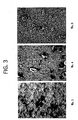
- Figure 3 is photographs showing that three kinds of lithium stearate having different particle diameters are applied and adhere to a die heated to 150 °C .
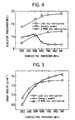
- Figure 4 is a graph showing the relationship between compacting pressure and ejecting pressure in Evaluation Test 1.
- Figure 5 is a graph showing the relationship between compacting pressure and green density in Evaluation Test 1.
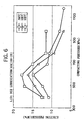
- Figure 6 is a graph showing the relationship between compacting pressure and ejecting pressure in Evaluation Test 2.
- Figure 7 is a graph showing the relationship between compacting pressure and green density in Evaluation Test 2.
- Figure 8 is a graph showing the relationship between compacting pressure and ejecting pressure in Evaluation Test 3.
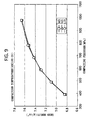
- Figure 9 is a graph showing the relationship between compacting pressure and green density in Evaluation Test 3.
- Figure 10 is a graph showing the relationship between compacting pressure and ejecting pressure in Evaluation Test 4.
- Figure 11 is a graph showing the relationship between compacting pressure and green density in Evaluation Test 4.
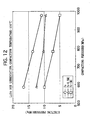
- Figure 12 is a graph showing the relationship between compacting pressure and ejecting pressure in Evaluation Test 5.
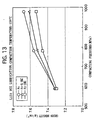
- Figure 13 is a graph showing the relationship between compacting pressure and green density in Evaluation Test 5.
- Figure 14 is a graph showing the relationship between compacting pressure and ejecting pressure in Evaluation Test 6.
- Figure 15 is a graph showing the relationship between compacting pressure and green density in Evaluation Test 6.
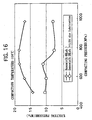
- Figure 16 is a graph showing the relationship between compacting pressure and ejecting pressure in Evaluation Test 7.
- Figure 17 is a graph showing the relationship between compacting pressure and ejecting pressure in Evaluation Test 8.
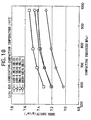
- Figure 18 is a graph showing the relationship between compacting pressure and green density in Evaluation Test 8.
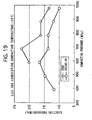
- Figure 19 is a graph showing the relationship between compacting pressure and ejecting pressure in Evaluation Test 9.
- Figure 20 is charts showing the results of TOF-SIMS.
- the forming method of the present invention comprises the application step of applying a higher fatty acid lubricant to an inner surface of a heated die, and the compaction step of filling metal powder into this die and compacting the metal powder under such a pressure as to force the higher fatty acid lubricant to be chemically bonded with the metal powder and form a metallic soap coating.
- the forming method of the present invention comprises the application step and the compaction step.
- the application step is a step of applying a higher fatty acid lubricant to an inner surface of a heated die.
- the higher fatty acid lubricant used here includes both lubricants composed of higher fatty acid and lubricants composed of metal salts of higher fatty acid.
- examples of the higher fatty acid lubricant used here include lithium stearate, calcium stearate, zinc stearate, barium stearate, lithium palmitate, lithium oleate, calcium palmitate and calcium oleate.
- the higher fatty acid lubricant is a metal salt of higher fatty acid.
- the metal salt of higher fatty acid is more easily chemically bonded with metal powder at a certain temperature and under a certain pressure, there forming a coating of a metal salt of higher fatty acid.
- this metal salt of higher fatty acid is a lithium salt, a calcium salt or a zinc salt of higher fatty acid.
- pressure for ejecting a compact which is formed by compacting metal powder can be small. That is, it is assumed that these materials are more easily chemically bonded with metal powder to form a coating of a metal salt of higher fatty acid easily. For example, these materials are chemically bonded with iron powder to form a coating of iron stearate and as a result the ejecting pressure can be small.
- the higher fatty acid lubricant is solid.
- the lubricant is liquid, there arises a problem that the lubricant is liable to flow downward and it is difficult to apply the lubricant uniformly to an inner die surface. There also arises a problem that metal powder becomes lumpy.
- the higher fatty acid lubricant is dispersed in water.
- a lubricant dispersed in water is applied to a die heated to 100°C or more, the water evaporates instantly and a uniform lubricant coating can be formed. Since the lubricant is dispersed in not an organic solvent but water, environmental problems can be avoided.
- particles of the higher fatty acid lubricant dispersed in water have the maximum diameter of less than 30 ⁇ m. When there are particles of 30 ⁇ m or more, the lubricant coating does not become uniform, and when dispersed in water, the particles of the higher fatty acid sediment easily and uniform lubricant application becomes difficult.
- the higher fatty acid lubricant having the maximum particle diameter of less than 30 ⁇ m and dispersed in water can be prepared as follows. First, a surfactant is mixed in water to be added to a higher fatty acid lubricant.
- a surfactant it is possible to employ such an alkyl phenol surfactant as polyoxyethylene nonylphenyl ether (EO) 6 and polyoxyethylene nonylphenyl ether (EO) 10 and such an anionic non-ionic surfactant as boric acid ester Emulbon T-80 and other known surfactants.
- EO polyoxyethylene nonylphenyl ether
- EO polyoxyethylene nonylphenyl ether
- anionic non-ionic surfactant as boric acid ester Emulbon T-80 and other known surfactants.
- lithium stearate when lithium stearate is used as a higher fatty acid lubricant, it is preferable to add simultaneously three kinds of surfactants, polyoxyethylene nonylphenyl ether (EO) 6, polyoxyethylene nonylphenyl ether (EO) 10 and boric acid ester Emulbon T-80.
- EO polyoxyethylene nonylphenyl ether
- EO polyoxyethylene nonylphenyl ether
- boric acid ester Emulbon T-80 boric acid ester Emulbon T-80.
- lithium stearate can be dispersed in water containing only polyoxyethylene nonylphenyl ether (EO) 6 or (EO) 10 but cannot be properly dispersed when the solution is further diluted as mentioned later. Therefore, it is preferable to add the three kinds of surfactants appropriately in combination.
- the total amount of surfactants added is preferably from 1.5 to 15 % by volume based on 100 % by volume of the total volume of the aqueous solution.
- the surfactants are added in a larger amount, lithium stearate can be dispersed in a larger amount.
- viscosity of the aqueous solution is increased and it becomes difficult to decrease the particle size of lithium stearate in the lubricant pulverization process mentioned later.
- antifoaming agent for example, silicon-based antifoaming agent
- the amount of antifoaming agent added is 0.1 to 1 % by volume based on 100 % by volume of the aqueous solution.
- higher fatty acid lubricant powder is added and dispersed in the aqueous solution thus containing the surfactant.
- lithium stearate powder when lithium stearate powder is dispersed in the aqueous solution, 10 to 30 g lithium stearate powder can be dispersed in 100cm 3 of the aqueous solution.
- this aqueous solution in which the higher fatty acid lubricant is dispersed is subjected to a ball-mill pulverization process by using a teflon-coated steel ball.
- the ball should have a diameter of 5 to 10 mm, because pulverization efficiency declines when the ball diameter is too small or too large.
- the volume of the ball is almost the same as that of the solution to be treated.
- pulverization efficiency is supposed to be the maximum.
- the capacity of a vessel to be used for the ball-mill pulverization process is preferably 1.5 to 2 times of the total volume of the solution to be treated and the ball.
- the pulverization efficiency is supposed to be the maximum.
- time for the pulverization process is approximately 50 to 100 hours.
- lithium stearate powder is pulverized into particles of less than 30 ⁇ m in maximum diameter and becomes dispersed and suspended in the solution.
- the higher fatty acid lubricant is applied to an inner surface of a die.
- a 10 to 20 times dilution of the aqueous solution treated by the ball-mill pulverization process is used for application.
- diluting the aqueous solution it is preferable to dilute the aqueous solution so as to contain 0.1 to 5 % by weight of the higher fatty acid lubricant based on 100 % by weight of the total weight of the diluted aqueous solution. It is more preferable to dilute the solution so as to contain 0.5 to 2% by weight of the lubricant. This dilution allows formation of a thin uniform lubricant coating.
- the aqueous solution thus diluted can be applied by being sprayed by a spray gun for coating.
- the amount of the aqueous solution to be applied can be adjusted appropriately in accordance with a die size while using a spray gun controlled to spray the solution at about 1 cm 3 /sec.
- the higher fatty acid lubricant is lithium stearate, for example, it is preferable to spray the solution so that 0.05 part by weight lithium stearate adheres to an inner die surface based on 100 parts by weight of a compact.
- a system for collecting excess lubricant in order to prevent the lubricant which has not adhered to the dies 40 from scattering upward.
- a constantly uniform lubricant coating 30 can be formed on an inner surface of the die 40 and seizure caused by defective lubricant coating can be prevented.
- damage on operational environment can also be prevented.
- the die used in this application step can be an ordinary die for forming a compact in the field of powder metallurgy. Since compaction is carried out with a high pressure, it is desirable to employ a die which is excellent in strength. It is also preferable that the inner surface of a die is subjected to TiN coating treatment or the like to decrease surface roughness. Only with this coating treatment, friction is reduced and the surface of a compact becomes smooth.
- the die used in this application step is heated.
- the higher fatty acid lubricant applied to the die and metal powder near the higher fatty acid lubricant are both heated, so the higher fatty acid lubricant and the metal powder become easily chemically bonded with each other under a certain pressure, thereby forming a metallic soap coating easily. Therefore, the ejecting pressure can be small.
- the die is heated to 100 °C or more, water in which the higher fatty acid lubricant is dispersed is instantly evaporated and a uniform lubricant coating can be formed on the inner die surface.
- Die heating can be carried out by ordinary methods. For instance, the die can be heated by an electric heater.
- the die is heated to 100 °C or more.
- the metal powder and the higher fatty acid lubricant become easily chemically bonded with each other under a certain pressure, thereby forming a metallic soap coating easily.
- the die temperature is less than the melting point of the higher fatty acid lubricant.
- the higher fatty acid lubricant is melted and is liable to flow downward on the die inner surface and as a result, a uniform lubricant coating cannot be formed.
- metal powder becomes lumpy.
- the temperature of the heated die is preferably below the melting point of lithium stearate, 220 °C .
- the compaction step is a step of filling metal powder into the heated die and compacting the metal powder under such a pressure as to force the higher fatty acid lubricant to be chemically bonded with the metal powder and form a metallic soap coating.
- Metal powder is filled into the die which has been applied with the higher fatty acid lubricant in the application step.
- the metal powder used herein can be not only such metal powder as iron powder but also intermetallic compound powder, metal-nonmetal compound powder, and mixed powder of different metal powders. It can also be mixed powder of metal powder and nonmetal powder.
- the iron powder mentioned herein includes not only what is called pure iron powder but also iron alloy powder composed principally of iron. Accordingly the metal powder used herein can be, for example, mixed powder of steel powder and graphite powder.
- metal powder is employable as metal powder and can be pelletized powder or coarse grain powder. That is to say, it is possible to employ general metal powder for powder metallurgy of not more than 200 ⁇ m in particle diameter and about 100 ⁇ m in average particle diameter.
- Additive powder (Gr (graphite), Cu) can be common powder of not more than 40 ⁇ m in particle diameter. It is to be noted that the metal powder can be mixed by a generally used mixer.
- the metal powder is heated, because pressure for ejecting a compact can be reduced. By heating also the metal powder, it is assumed that the metal powder becomes easily chemically bonded with the higher fatty acid lubricant and forms a metallic soap coating easily.
- the metal powder contains iron powder. It is supposed that this powder is chemically bonded with the higher fatty acid lubricant and forms a coating of an iron salt of the higher fatty acid. This iron salt coating is so strongly bonded with iron powder that the coating exhibits superior lubricating performance to that of the original lubricant physically adhering and remarkably reduces friction force between the die and a compact and accordingly reduces pressure for ejecting the compact.
- the metal powder is added with graphite powder.
- This contributes to a decrease in the ejecting pressure.
- the graphite powder in itself has a lubricating effect, so addition of graphite powder leads to a decrease in contact area between the iron powder and the die and a decrease in the ejecting pressure.
- the metal powder used herein contains a higher fatty acid lubricant.
- the metal powder can contain lithium stearate, calcium stearate and zinc stearate.
- the preferable range of the higher fatty acid lubricant added is not less than 0.1 % by weight and less than 0.6 % by weight based on 100 % by weight of the total weight of the metal powder.
- the metal powder is remarkably improved in flowability and density of the powder packed in the die can be increased. So this is advantageous in forming a high density compact.
- ultimate density of a compact formed under high pressure becomes smaller.
- Pressure for compacting the metal powder in the die is such a pressure as to force the higher fatty acid lubricant to be chemically bonded with the metal powder and form a metallic soap coating. It is supposed that by thus applying such a pressure as to form a metallic soap coating, a metallic soap coating is formed between the die and a compact formed by compaction. This coating has a very strong bond with the metal powder and exhibits superior lubricating performance to that of the lubricant coating physically adhering and remarkably reduces friction force between the die and the compact. Besides, since the compact is formed by warm compaction with a high compacting pressure, density of the compact can be sharply increased in comparison with that of a compact formed by compaction at room temperature.
- the die when iron powder is compacted by using a metal salt of higher fatty acid, e.g., lithium stearate as a higher fatty acid lubricant to be applied to an inner surface of a die, the die should be heated to 100°C or more and compaction should be carried out under a pressure of not less than 600MPa.
- a metal salt of higher fatty acid e.g., lithium stearate
- the die should be heated to 100°C or more and compaction should be carried out under a pressure of not less than 600MPa.
- compaction when compaction is carried out under a pressure of not less than 600MPa, iron powder and a metal salt of higher fatty acid are chemically bonded with each other and a coating of an iron salt of the higher fatty acid is formed between a green compact and the die, and as a result, pressure for ejecting the compact decreases.
- compaction since compaction is carried out under a high pressure of not less than 600MPa, a high density compact can be obtained
- compaction with a pressure of not less than 785 MPa is more preferable.
- the metal salt of higher fatty acid is a lithium salt, a calcium salt or a zinc salt of higher fatty acid, because pressure for ejecting a compact is reduced.
- a compact thus formed can be ejected by ordinary methods. Since a metallic soap coating is formed between the die and the compact, the compact can be ejected with smaller ejecting pressure than the conventional pressure. Besides, owing to compaction with a high compacting pressure, a high density compact can be obtained.
- the ejecting pressure can be not more than 3 % of the compacting pressure.
- the above iron powder includes such powder composed mainly of iron as pure iron and alloy steel, and mixed powder of pure iron or alloy steel with copper, graphite or the like.
- higher fatty acid lubricants were prepared and powder compacts were formed.
- powder compacts were formed as comparative examples.
- Powder compacts were formed by using the lubricants of Nos.1 to 4 prepared in the above (Preparation of Higher Fatty Acid Lubricant).
- the above lubricants of Nos.1 to 4 were sprayed to an inner surface of a die heated to 150 °C.
- the die used had an inner diameter of 17mm and was formed of cemented carbide. Its inner surface had been finished with TiN coating treatment and had a surface roughness of 0.4 Z according to ten points average roughness (Japanese Industrial Standards B0601).
- metal powder heated to 150 °C was filled into the above die and pressed under a compacting pressure of 785MPa to produce a compact.
- the same metal powder was used for all of Examples 1 to 4.
- This powder was prepared by adding graphite powder and lithium stearate powder as an inner lubricant to alloy steel powder KIP103V produced by Kawasaki Steel Corporation in Japan (hereinafter appropriately abbreviated as '103V') and rotating them for mixing for one hour.
- the amount of graphite powder added was 0.5 % by weight and the amount of lithium stearate powder added was 0.3 % by weight, based on 100 % by weight of the total weight of the metal powder.
- the composition of alloy steel powder KIP103V produced by Kawasaki Steel Corporation was Fe - 1 wt.% Cr - 0.3 wt.% Mo - 0.3 wt.% V.
- metal powder For comparison with the inner lubricant added to the metal powder, employed was metal powder added by 0.8 % by weight of lithium stearate powder instead of 0.3 % by weight of lithium stearate added as an inner lubricant.
- metal powder added by 0.8 % by weight of zinc stearate (ZnSt) powder instead of 0.3 % by weight of lithium stearate powder added as an inner lubricant was employed.
- Table 2 shows the ejecting pressure and the green density of Examples 1 to 4 and Comparative Examples 1 to 3.
- LUBRICANT COMPACTION TEMPERATURE EJECTING PRESSURE(MPa) GREEN DENSITY (g/cm 3 ) Ex.1 No.1 150 °C 8.0 7.37 Ex.2 No.2 150 °C 7.3 7.37 Ex.3 No.3 150 °C 7.5 7.37 Ex.4 No.4 150 °C 9.0 7.37 Comp.Ex.1 U-NONS 150°C 11.9 7.36 Comp.Ex.2 List room temp. 14.2 7.15 Comp.Ex.3 ZnSt room temp. 16.2 7.20
- Examples 1 to 4 had excellent compact surfaces.
- Comparative Example 1 had a dark-color compact surface.
- Comparative Example 3 had galling on a part of the compact and a poor compact surface.
- An evaluation test was carried out for evaluating the relationship between the compacting pressure and the ejecting pressure and the relationship between the compacting pressure and the green density.
- Metal powder was compacted under pressures of 393MPa, 490MPa, 588MPa, 686MPa, 785MPa, 883MPa and 981MPa, and the ejecting pressure and the green density were measured with respect to each compacting pressure.
- a die used was the same as those used in the above (Formation of Powder Compacts) of the [Preferred Embodiments]. All dies used in the following evaluation tests were the same as those used in the above (Formation of Powder Compacts) of the [Preferred Embodiments]. Namely, the die used had an inner diameter of 17mm and was formed of cemented carbide. Its inner surface had been finished with TiN coating treatment and had a surface roughness of 0.4 Z according to ten points average roughness (JIS B0601).
- lithium stearate (LiSt) of No.2 produced in the above (Preparation of Higher Fatty Acid Lubricants) of the [Preferred Embodiments]. It is to be noted that lithium stearate applied to the inner die surface in the following evaluation tests was this lithium stearate of No.2. Application of the lubricant to the inner die surface was carried out by spraying the lubricant to the die heated to compaction temperature. The same application was also carried out in the following evaluation tests.
- the metal powder heated to 150 °C was filled into the die heated to 150 °C.
- the die temperature and the temperature of metal powder to be charged are called 'compaction temperature'.
- the metal powder used was the same as that used in the above (Formation of Powder Compacts) of the [Preferred Embodiments]. Namely, it was metal powder prepared by adding graphite powder and lithium stearate powder as an inner lubricant to alloy steel powder KIP103V produced by Kawasaki Steel Corporation and rotating them for mixing for one hour. The amount of graphite powder added was 0.5 % by weight and the amount of lithium stearate powder added was 0.3 % by weight based on 100 % by weight of the total weight of the metal powder.
- metal powder employed as metal powder was warm compaction powder 'Densmix' which was produced by Hoganas Corporation and prepared by adding 0.8 % by weight of graphite (C) and 0.6 % by weight of a lubricant to Astaloy 85Mo based on 100 % by weight of the total weight of the metal powder. Since this metal powder contained a lubricant, no lubricant was applied to the inner die surface.
- warm compaction powder 'Densmix' which was produced by Hoganas Corporation and prepared by adding 0.8 % by weight of graphite (C) and 0.6 % by weight of a lubricant to Astaloy 85Mo based on 100 % by weight of the total weight of the metal powder. Since this metal powder contained a lubricant, no lubricant was applied to the inner die surface.
- Figure 4 shows the relationship between the compacting pressure and the ejecting pressure of three cases:
- LiSt die lubrication lithium stearate was applied to the inner die surface and the above metal powder was employed which was prepared by adding graphite powder and lithium stearate powder to the alloy steel powder KIP103V.
- U-NONS die lubrication U-NONS was applied to the inner die surface and the same metal powder was employed which was prepared by adding graphite powder and lithium stearate powder to the alloy steel powder KIP103V.
- Densmix powder no lubricant was applied to the inner die surface and Densmix was employed as metal powder.
- the ejecting pressure increased in accordance with an increase in the compacting pressure.
- U-NONS was applied to the die inner surface, the ejecting pressure increased in accordance with an increase in the compacting pressure, although the rate of increase in the ejecting pressure was smaller than that in the case of Densmix.
- Figure 5 shows the relationship between the compacting pressure and the green density of three cases.
- lithium stearate was applied to the inner die surface and the above metal powder was employed which was prepared by adding graphite powder and lithium stearate powder to the alloy steel powder KIP103V.
- U-NONS die lubrication U-NONS was applied to the inner die surface and the same metal powder was employed which was prepared by adding graphite powder and lithium stearate powder to the alloy steel powder KIP103V.
- Densmix powder no lubricant was applied to the die surface and Densmix was employed as metal powder. When lithium stearate was applied, density of compacts formed under the above pressures are shown.
- the green density was higher.
- the green densities in the cases where lithium stearate or U-NONS was applied to the inner die surface were almost the same and as high as not less than 7.4cm 3 .
- Densmix was employed as metal powder, the green density was smaller than 7.3 g/cm 3 .
- the metal powder was compacted under compacting pressures of 393MPa, 490MPa, 588MPa, 686MPa, 785MPa and 981MPa, and the ejecting pressure and the compact density were measured with respect to each compacting pressure. It is to be noted that at 150 °C another compact was formed under a compacting pressure of 1176MPa and the ejecting pressure and the green density were also measured about the compact.
- Figure 6 shows the relationship between the compacting pressure and the ejecting pressure at the respective temperatures. At each of the temperatures 105°C, 125°C and 150°C, the ejecting pressure was the maximum when compaction was carried out under 586MPa. When the compacting pressure was 686MPa or more, the ejecting pressure decreased contrarily.
- Figure 7 shows the relationship between the compacting pressure and the green density at the respective temperatures. At each of the temperatures 105 °C, 125 °C and 150 °C, as the compacting pressure was higher, the green density was higher.
- the calcium stearate and zinc stearate used were prepared by the same method as those of No.2 of (Preparation of Higher Fatty Acid Lubricants) of the above [Preferred Embodiments]. It is to be noted that calcium stearate and zinc stearate applied to the inner die surface in the following evaluation tests were similarly prepared.
- Metal powder used was pure iron powder ASC100-29 produced by Hoganas Corporation. No inner lubricant was used. Namely, this evaluation test was carried out by employing only pure iron powder as metal powder.
- the ejecting pressure and the green density were measured about compacts formed under compacting pressures of 393MPa, 490MPa, 588MPa, 686MPa, 785MPa and 981MPa.
- Figure 8 shows the relationship between the compacting pressure and the ejecting pressure when lithium stearate (LiSt), calcium stearate (CaSt) or zinc stearate (ZnSt) was employed.
- LiSt lithium stearate
- CaSt calcium stearate
- ZnSt zinc stearate
- Figure 9 shows the relationship between the compacting pressure and the green density when lithium stearate (LiSt), calcium stearate (CaSt) or zinc stearate (ZnSt) was employed.
- LiSt lithium stearate
- CaSt calcium stearate
- ZnSt zinc stearate
- Lithium stearate and calcium stearate employed were the same as those of Evaluation Test 3.
- Metal powder employed was the same as that of Evaluation Test 3, i.e., pure iron powder ASC100-29 produced by Hoganas Corporation. No inner lubricant was employed. Namely, this evaluation test was carried out by employing only pure iron powder as metal powder.
- Compaction was carried out under compacting pressures of 393MPa, 490MPa, 588MPa, 686MPa, 785MPa and 981MPa, and the ejecting pressure and the green density were measured with respect to each compacting pressure.
- Figure 10 shows the relationship between the compacting pressure and the ejecting pressure in the case where lithium stearate (LiSt) or calcium stearate (CaSt) was employed.
- LiSt lithium stearate
- CaSt calcium stearate
- the ejecting pressure was the maximum when the compacting pressure was 588MPa.
- the ejecting pressure was the maximum when the compacting pressure was 490MPa.
- the compacting pressure was 588MPa or more, the ejecting pressure decreased.
- Figure 11 shows the relationship between the compacting pressure and the green density in the case where lithium stearate or calcium stearate was employed. In either case, the relationships were almost the same: As the compacting pressure was higher, the green density was higher.
- the metal powder used in this evaluation test was all based on iron powder ASC100-29 produced by Hoganas Corporation and of three kinds: metal powder composed of only this iron powder, metal powder prepared by adding 0.5 % by weight of graphite (C) to this iron powder, and metal powder prepared by adding 1 % by weight of graphite (C) to this iron powder, based on 100 % by weight of the total weight of the metal powder.
- Compaction was carried out under compacting pressures of 588MPa, 785MPa and 981MPa, and the ejecting pressure and the compact density were measured with respect to each compacting pressure.
- Figure 12 shows the relationship between the compacting pressure and the ejecting pressure in the case where the metal powder used was iron powder alone (Fe), iron powder added by 0.5 % by weight of graphite (Fe-0.5%C) and iron powder added by 1 % by weight of graphite (Fe-1%C).
- the ejecting pressure decreased despite an increase in the compacting pressure.
- the ejecting pressure in the case of iron powder alone was higher than that in the case of iron powder added by graphite.
- graphite was added to iron powder, the ejecting pressure in the case of 0.5 % by weight addition was higher than that in the case of 1 % by weight addition.
- Figure 13 shows the relationship between the compacting pressure and the green density in the case where the metal powder was iron powder alone (Fe), iron powder added by 0.5 % by weight of graphite (Fe-0.5%C), and iron powder added by 1 % by weight of graphite (Fe-1%C).
- the green density in the case of iron powder alone was higher than that in the case of iron powder added by graphite.
- graphite was added, the green density in the case of 0.5 % by weight addition was higher than that in the case of 1 % by weight addition.
- Metal powder employed was prepared by using alloy steel powder KIP103V produced by Kawasaki Steel Corporation as iron powder and adding 0.5 % by weight of graphite (C) and 0.8 % by weight of inner lubricant to this iron powder (103V-0.5%C+0.8%Lub.) based on 100 % by weight of the total weight of the metal powder.
- the inner lubricant used was lithium stearate, zinc stearate or calcium stearate.
- compaction was carried out with compacting pressures of 393MPa, 490MPa, 588MPa, 686MPa, 785MPa and 981MPa and the ejecting pressure and the green density were respectively measured with respect to each compacting pressure.
- Figure 14 shows the relationship between the compacting pressure and the ejecting pressure in the case where lithium stearate (LiSt), zinc stearate (ZnSt) or calcium stearate (Cast) was employed as an inner lubricant.
- LiSt lithium stearate
- ZnSt zinc stearate
- Cast calcium stearate
- the ejecting pressure was higher.
- the ejecting pressure was the maximum when the compacting pressure was 686MPa and the ejecting pressure decreased when the compacting pressure was 785MPa, but the ejecting pressure increased again when the compacting pressure was 981MPa.
- Figure 15 shows the relationship between the compacting pressure and the green density in the case where lithium stearate (LiSt), zinc stearate (ZnSt) or calcium stearate (CaSt) was employed as an inner lubricant.
- LiSt lithium stearate
- ZnSt zinc stearate
- CaSt calcium stearate
- warm compaction powder Densmix When no lubricant was applied to the inner die surface, warm compaction powder Densmix was employed which was produced by Hoganas Corporation and prepared by adding 0.8 % by weight of graphite and 0.6 % by weight of lubricant to Astaloy 85Mo based on 100 % by weight of the total weight of the metal powder. When lithium stearate was applied to the die, warm compaction powder Densmix was employed which was produced by Hoganas Corporation and prepared by adding 0.8% by weight of graphite and 0.2 % by weight of lubricant to Astaloy85Mo based on 100 % by weight of the total weight of the metal powder. Compaction was carried out with compacting pressures of 490MPa, 588MPa, 686MPa, 785MPa, and 981MPa, and the ejecting pressure was measured with respect to each compacting pressure.
- Figure 16 shows the relationship between the compacting pressure and the ejecting pressure in the case where lithium stearate was applied as a lubricant to the inner die surface (Densmix (0.2%Lub.) + LiSt die lubrication) and in the case where no lubricant was applied to the inner die surface (Densmix (0.6%Lub.)).
- the ejecting pressure When lithium stearate was applied to the inner die surface, the ejecting pressure remarkably decreased when the compacting pressure was 785MPa, and the ejecting pressure was almost the same when the compacting pressure was 981MPa.
- the ejecting pressure in the case of applying no lubricant to the inner die surface was higher than that in the above case of applying the lubricant.
- the ejecting pressure was higher and when the compacting pressure was 981MPa, the ejecting pressure only slightly decreased.
- the low alloy steel powders were atomized powders KIP103V, 5MoS and 30CRV all produced by Kawasaki Steel Corporation.
- the composition of KIP103V was Fe-1 wt.% Cr-0.3wt.%Mo-0.3wt.% V.
- the composition of 5MoS was Fe-0.6wt.% Mo-0.2 wt.% Mn.
- the composition of 30CRV was Fe-3wt.%Cr-0.3wt.%Mo-0.3wt.% V.
- This KIP103V was added by 0.3% by weight of graphite powder and 0.3% by weight of lithium stearate powder based on 100 % by weight of the total weight of the metal powder, thereby preparing metal powder (103V-0.3%C+0.3%LiSt).
- this KIP103V was added by 0.5% by weight of graphite powder and 0.3 % by weight of lithium stearate powder based on 100% of the total weight of the metal powder, thereby preparing metal powder (103V-0.5%C+0.3%LiSt).
- 5MoS was added by 0.2 % by weight of graphite powder and 0.3 % by weight of lithium stearate powder based on 100 % of the total weight of the metal powder, thereby preparing metal powder (5MoS-0.2wt.%C +0.3wt.%LiSt).
- Figure 17 shows the relationship between the compacting pressure and the ejecting pressure in the case of using these four types of metal powders.
- Figure 18 shows the relationship between the compacting pressure and the green density in the case of using these four types of metal powders.
- the metal powders of the respective compositions exhibited almost the same tendency. That is to say, the ejecting pressure was the maximum when each metal powder was compacted under a compacting pressure of 588MPa, and as the compacting pressure was higher, the ejecting pressure decreased. As for density of compacts obtained, as the compacting pressure was higher, the green density was higher.
- KIP103V produced by Kawasaki Steel Corporation and ASC100-29 produced by Hoganas Corporation.
- KIP103V was an alloy steel prepared by adding 1 % by weight of Cr powder, 0.3 % by weight of Mo powder and 0.3 % by weight of V powder to iron powder based on 100 % by weight of the entire powder (Fe-1 wt.%Cr-0.3wt.%Mo-0.3wt.%V).
- ASC100-29 was pure iron (Fe).
- the compacting pressure was 588MPa, 686MPa, 785MPa, 883MPa and 981MPa, and the ejecting pressure was measured with respect to each compacting pressure.
- the compacting pressure was 393MPa, 490MPa, 588MPa, 686MPa, 785MPa, 883MPa and 981MPa, and the ejecting pressure was measured with respect to each compacting pressure.
- Figure 19 shows the relationship between the compacting pressure and the ejecting pressure in the case of using these two types of metal powders.
- the ejecting pressure in the case of using KIP103V was higher than that in the case of employing ASC100-29. That is to say, it is understood that the ejecting pressure in the case of employing pure iron ASC100-29 was smaller than that in the case of employing KIP103V or iron added by Cr, Mo, and V. It is assumed from this fact that as the iron content in metal powder is larger, the amount of iron which is in contact with the inner die surface is larger and iron stearate is more easily formed.
- the following analytic test was conducted for analyzing a phenomenon that in the case where lithium stearate is applied as a lubricant to an inner die surface and metal powder is compressed, the pressure for ejecting a compact decreases contrarily when the compacting pressure is high.
- a die employed was the same as those used in (Formation of a Powder Compact) in the above [Preferred Embodiments] and heated to 150 °C. Then lithium stearate of No.2 prepared in the above (Preparation of Higher Fatty Acid) was sprayed to an inner surface of this die.
- Metal powder employed was alloy steel powder KIP103V produced by Kawasaki Steel Corporation. This alloy steel powder was heated to 150 °C, charged into the die and compressed under two kinds of compacting pressures of 588MPa and 981MPa, thereby forming compacts.
- the coating thus chemically adhering has a stronger lubricating effect than the lubricant coating physically adhering, and exhibits excellent lubricating performance when compaction is carried out with a high pressure as in the present invention.
- the forming method of the present invention can produce a high density sintered body only by compacting and sintering once.
- the forming method of the present invention can reduce the pressure for ejecting a compact from a die. As a result, the surface of the compact becomes excellent and dimensional precision of the compact can be secured stably. Besides, since metal powder is compacted under a high pressure, a high density powder compact can be obtained.
- the forming method of the present invention can eject a compact from a die with a low ejecting pressure, die abrasion can be reduced remarkably. Besides, lifetime of the die is elongated sharply and die costs can be reduced.
- the lubricant in the case of employing a higher fatty acid lubricant dispersed in water, the lubricant can be uniformly applied to an inner surface of a die heated to a temperature which is at or below its melting point. Since no organic solvent is used, there is no fear of environmental contamination.
- metal powder flowability is improved and density of powder filled into a die can be increased.
- the ejecting pressure can be reduced and green density can be increased. Similar effects can be obtained in the case where a metal salt of higher fatty acid is a lithium salt, a calcium salt, or a zinc salt of higher fatty acid.
Landscapes
- Engineering & Computer Science (AREA)
- Manufacturing & Machinery (AREA)
- Mechanical Engineering (AREA)
- Lubricants (AREA)
- Powder Metallurgy (AREA)
- Silicates, Zeolites, And Molecular Sieves (AREA)
- Materials For Medical Uses (AREA)
Abstract
Description
| SURFACTANT AMOUNT | List AMOUNT /100cm3 | PULVERIZATION TIME | DILUTION RATE | ||
| No.1 | 15 vol.% | 25g | 100 | 20 | |
| No.2 | 3 vol.% | 12.5g | 100 | 10 | |
| No.3 | 1.5 vol.% | 12.5g | 100 | 10 | |
| No.4 | 15 vol.% | 25g | 50 | 20 | |
| No.5 | 15 | 25g | 5 | 20 |
| LUBRICANT | COMPACTION TEMPERATURE | EJECTING PRESSURE(MPa) | GREEN DENSITY (g/cm3) | |
| Ex.1 | No.1 | 150 °C | 8.0 | 7.37 |
| Ex.2 | No.2 | 150 °C | 7.3 | 7.37 |
| Ex.3 | No.3 | 150 °C | 7.5 | 7.37 |
| Ex.4 | No.4 | 150 °C | 9.0 | 7.37 |
| Comp.Ex.1 | U-NONS | 150°C | 11.9 | 7.36 |
| Comp.Ex.2 | List | room temp. | 14.2 | 7.15 |
| Comp.Ex.3 | ZnSt | room temp. | 16.2 | 7.20 |
Claims (22)
- A method of forming a powder compact, which is characterized by comprising:an application step of applying a higher fatty acid lubricant to an inner surface of a heated die; anda compaction step of filling metal powder into said die and compacting said metal powder under such a pressure that said higher fatty acid lubricant is chemically bonded with said metal powder to form a metallic soap coating.
- A method of forming a powder compact claimed in claim 1, wherein said higher fatty acid lubricant is a metal salt of higher fatty acid.
- A method of forming a powder compact claimed in claim 2, wherein said metal salt of higher fatty acid is a lithium salt, a calcium salt, or a zinc salt of higher fatty acid.
- A method of forming a powder compact claimed in claim 1, wherein said higher fatty acid lubricant is dispersed in water.
- A method of forming a powder compact claimed in claim 4, wherein said higher fatty acid lubricant is dispersed in water containing a surfactant.
- A method of forming a powder compact claimed in claim 5, wherein said higher fatty acid lubricant has the maximum particle diameter of less than 30 µm.
- A method of forming a powder compact claimed in claim 1, wherein said heated die has a temperature of 100 °C or more.
- A method of forming a powder compact claimed in claim 7, wherein said heated die has a temperature below the melting point of said higher fatty acid lubricant.
- A method of forming a powder compact claimed in claim 1, wherein said metal powder has been heated.
- A method of forming a powder compact claimed in claim 1, wherein said metal powder is metal powder containing iron powder.
- A method of forming a powder compact claimed in claim 1 or 10, wherein said metal powder contains said higher fatty acid lubricant.
- A method of forming a powder compact claimed in claim 11, wherein said metal powder contains not less than 0.1% by weight of said higher fatty acid lubricant.
- A method of forming a powder compact, which is characterized by comprising:an application step of applying a metal salt of higher fatty acid to an inner surface of a die heated to 100 °C or more; anda compaction step of charging iron powder into said die and compacting said iron powder under not less than 600 MPa.
- A method of forming a powder compact claimed in claim 13, wherein said metal salt of higher fatty acid is a lithium salt, a calcium salt or a zinc salt of higher fatty acid.
- A method of forming a powder compact claimed in claim 13, wherein said iron powder is compacted under not less than 785 MPa.
- A method of forming a powder compact, which is characterized by comprising:an application step of applying, to an inner surface of a die which has been heated to a predetermined die temperature of 100 °C or more, dispersion fluid in which a metal salt of higher fatty acid having a higher melting point than said die temperature is finely dispersed, so as to form a coating of said metal salt of said higher fatty acid;a compaction step of filling iron powder into said die and compacting said iron powder under a compacting pressure of not less than 600 MPa so as to obtain a compact having a metallic soap coating on a surface which is in contact with said die; andan ejecting step of ejecting and taking out said compact from said die.
- A method of forming a powder compact, which is characterized by comprising:an application step of applying, to an inner surface of a die which has been heated to a predetermined die temperature of 100 °C or more, dispersion fluid in which a metal salt of higher fatty acid having a higher melting point than said die temperature is finely dispersed, so as to form a coating of said metal salt of said higher fatty acid;a compaction step of filling iron powder into said die and compacting said iron powder under a compacting pressure of not less than 600MPa so as to obtain a compact having a metallic soap coating on a surface which is in contact with said die; andan ejecting step of ejecting and taking out said compact from said die under an ejecting pressure of not more than 3% of said compacting pressure of said compaction owing to lubricating characteristics of said metallic soap coating.
- A method of forming a powder compact claimed in claim 16, wherein said compacting pressure is not less than 686 MPa and said ejecting pressure is not more than 8 MPa.
- A method of forming a powder compact claimed in claim 16, wherein said compacting pressure is not less than 700 MPa and said ejecting pressure is not more than 15 MPa.
- A method of forming a powder compact claimed in claim 16, wherein said compacting pressure is not less than 700 MPa and said ejecting pressure is not more than 13 MPa.
- A method of forming a powder compact claimed in claim 16, wherein said compacting pressure is not less than 700 MPa and said ejecting pressure is not more than 10 MPa.
- A method of forming a powder compact claimed in claim 16, wherein said metal salt dispersed in said dispersion fluid has the maximum particle diameter of 30 µm or less.
Applications Claiming Priority (3)
| Application Number | Priority Date | Filing Date | Title |
|---|---|---|---|
| JP35466099 | 1999-12-14 | ||
| JP35466099 | 1999-12-14 | ||
| PCT/JP2000/008836 WO2001043900A1 (en) | 1999-12-14 | 2000-12-13 | Powder green body forming method |
Publications (3)
| Publication Number | Publication Date |
|---|---|
| EP1170075A1 true EP1170075A1 (en) | 2002-01-09 |
| EP1170075A4 EP1170075A4 (en) | 2004-05-12 |
| EP1170075B1 EP1170075B1 (en) | 2006-08-30 |
Family
ID=18439055
Family Applications (1)
| Application Number | Title | Priority Date | Filing Date |
|---|---|---|---|
| EP00981701A Expired - Lifetime EP1170075B1 (en) | 1999-12-14 | 2000-12-13 | Powder green body forming method |
Country Status (8)
| Country | Link |
|---|---|
| US (1) | US7083760B2 (en) |
| EP (1) | EP1170075B1 (en) |
| JP (1) | JP3309970B2 (en) |
| AT (1) | ATE337872T1 (en) |
| CA (1) | CA2363557C (en) |
| DE (1) | DE60030422T8 (en) |
| ES (1) | ES2270884T3 (en) |
| WO (1) | WO2001043900A1 (en) |
Cited By (6)
| Publication number | Priority date | Publication date | Assignee | Title |
|---|---|---|---|---|
| EP1640469A4 (en) * | 2003-06-27 | 2007-05-02 | Mitsubishi Materials Pmg Corp | Iron base sintered alloy exhibiting high surface densification and high surface hardness, and method for production thereof |
| RU2316412C2 (en) * | 2002-11-21 | 2008-02-10 | Мицубиси Материалс Пи Эм Джи Корпорейшн | Powdered articles molding method and unit for performing the same |
| RU2349418C2 (en) * | 2003-03-28 | 2009-03-20 | Мицубиси Материалс Пи Эм Джи Корпорейшн | Device, containing form for pressing powder, and method of moulding shaping made of powders |
| EP1596201A3 (en) * | 2004-05-12 | 2009-04-01 | Ntn Corporation | Magnetic encoder and wheel support bearing assembly utilizing the same |
| US8153053B2 (en) | 2002-11-21 | 2012-04-10 | Diamet Corporation | Method for forming compact from powder and sintered product |
| CN1946865B (en) * | 2004-04-23 | 2013-07-17 | 株式会社丰田中央研究所 | Iron-based sintered alloy, iron-based sintered alloy member and method for producing those |
Families Citing this family (22)
| Publication number | Priority date | Publication date | Assignee | Title |
|---|---|---|---|---|
| JP4060101B2 (en) * | 2002-03-20 | 2008-03-12 | 株式会社豊田中央研究所 | Insulating film, magnetic core powder and powder magnetic core, and methods for producing them |
| JP4216250B2 (en) * | 2002-05-10 | 2009-01-28 | 東京エレクトロン株式会社 | Substrate processing equipment |
| JP3945455B2 (en) * | 2002-07-17 | 2007-07-18 | 株式会社豊田中央研究所 | Powder molded body, powder molding method, sintered metal body and method for producing the same |
| JP2005154828A (en) * | 2003-11-25 | 2005-06-16 | Mitsubishi Materials Corp | Warm forming raw material powder and warm forming method |
| JP4582497B2 (en) * | 2004-02-27 | 2010-11-17 | 株式会社ダイヤメット | Molding method of powder compact |
| JP5535576B2 (en) * | 2008-11-10 | 2014-07-02 | 株式会社豊田中央研究所 | Iron-based sintered alloy, method for producing the same, and iron-based sintered alloy member |
| JP5071816B2 (en) * | 2009-02-20 | 2012-11-14 | 独立行政法人日本原子力研究開発機構 | Die wall lubrication method for pellet molding machine |
| JP5976284B2 (en) | 2010-07-23 | 2016-08-23 | 株式会社豊田中央研究所 | Method for producing dust core and method for producing powder for magnetic core |
| JP2012230948A (en) | 2011-04-25 | 2012-11-22 | Toyota Central R&D Labs Inc | Powder for magnetic core, dust core, and method of manufacturing the same |
| JP5778993B2 (en) * | 2011-05-26 | 2015-09-16 | 住友電気工業株式会社 | Molding method of green compact |
| JP5772731B2 (en) | 2012-06-08 | 2015-09-02 | 株式会社豊田中央研究所 | Aluminum alloy powder forming method and aluminum alloy member |
| BR112015003454A2 (en) * | 2012-08-14 | 2017-07-04 | Nanogestion Inc | Techniques for Using Lubricant Compound to Make Powdered Metal Parts |
| JP5942922B2 (en) * | 2013-05-08 | 2016-06-29 | 信越化学工業株式会社 | Manufacturing method of rare earth sintered magnet |
| JP5967010B2 (en) * | 2013-05-08 | 2016-08-10 | 信越化学工業株式会社 | Manufacturing method of rare earth sintered magnet |
| US10497500B2 (en) | 2014-09-08 | 2019-12-03 | Toyota Jidosha Kabuhiki Kaisha | Powder magnetic core, powder for magnetic cores, and methods of manufacturing them |
| JP6232359B2 (en) | 2014-09-08 | 2017-11-15 | 株式会社豊田中央研究所 | Powder magnetic core, powder for magnetic core, and production method thereof |
| JP6378156B2 (en) | 2015-10-14 | 2018-08-22 | トヨタ自動車株式会社 | Powder magnetic core, powder for powder magnetic core, and method for producing powder magnetic core |
| JP6556780B2 (en) | 2017-04-03 | 2019-08-07 | 株式会社豊田中央研究所 | Powder magnetic core, powder for magnetic core, and production method thereof |
| US11679437B2 (en) | 2017-10-17 | 2023-06-20 | Denso Corporation | Compressed powder magnetic core, powder for magnetic core, and production methods therefor |
| JP7644336B2 (en) | 2021-03-19 | 2025-03-12 | 愛知製鋼株式会社 | Powder for magnetic cores, its manufacturing method and powder magnetic cores |
| AT526261B1 (en) | 2022-07-05 | 2024-03-15 | Miba Sinter Austria Gmbh | Method for producing a component from a sinter powder |
| CN119381107A (en) * | 2024-12-30 | 2025-01-28 | 浙江天通电子信息材料研究院有限公司 | Nanocrystalline magnetic powder core and preparation method thereof |
Family Cites Families (26)
| Publication number | Priority date | Publication date | Assignee | Title |
|---|---|---|---|---|
| JPH079004B2 (en) * | 1985-11-08 | 1995-02-01 | 株式会社神戸製鋼所 | Sintering method for iron-based powder compacts |
| JPS62294102A (en) * | 1986-06-12 | 1987-12-21 | Komatsu Ltd | Metal powder materials for sintered materials |
| US4955798B1 (en) | 1988-10-28 | 1999-03-30 | Nuova Merisinter S P A | Process for pretreating metal powder in preparation for compacting operations |
| US5468401A (en) * | 1989-06-16 | 1995-11-21 | Chem-Trend, Incorporated | Carrier-free metalworking lubricant and method of making and using same |
| US5191098A (en) * | 1989-07-26 | 1993-03-02 | Henkel Corporation | Continuous process for preparation of aqueous dispersions of metal soaps |
| US5154881A (en) | 1992-02-14 | 1992-10-13 | Hoeganaes Corporation | Method of making a sintered metal component |
| EP0698435B1 (en) * | 1994-08-24 | 2000-04-19 | Quebec Metal Powders Ltd. | Powder metallurgy apparatus and process using electrostatic die wall lubrication |
| US5782954A (en) * | 1995-06-07 | 1998-07-21 | Hoeganaes Corporation | Iron-based metallurgical compositions containing flow agents and methods for using same |
| JPH09104902A (en) * | 1995-10-05 | 1997-04-22 | Shin Etsu Chem Co Ltd | Powder molding method |
| JPH1046202A (en) * | 1996-08-06 | 1998-02-17 | Nitto Kasei Kogyo Kk | Powder lubricant for powder metallurgy |
| CA2268649C (en) * | 1996-10-15 | 2002-10-01 | Zenith Sintered Products, Inc. | Surface densification of machine components made by powder metallurgy |
| US5767426A (en) * | 1997-03-14 | 1998-06-16 | Hoeganaes Corp. | Ferromagnetic powder compositions formulated with thermoplastic materials and fluoric resins and compacted articles made from the same |
| EP0913220B1 (en) * | 1997-03-19 | 2008-12-10 | JFE Steel Corporation | Iron base powder mixture for powder metallurgy excellent in fluidity and moldability |
| JP3509540B2 (en) | 1997-03-19 | 2004-03-22 | Jfeスチール株式会社 | Iron-based powder mixture for powder metallurgy excellent in fluidity and moldability, method for producing the same, and method for producing a compact |
| CA2286159C (en) * | 1997-04-09 | 2004-03-30 | Zenith Sintered Products, Inc. | Dry die wall lubrication |
| JP3445112B2 (en) | 1997-09-25 | 2003-09-08 | 日立粉末冶金株式会社 | Powder metallurgy in powder metallurgy, lubrication of molding dies and stamping dies |
| JP3462378B2 (en) | 1997-11-07 | 2003-11-05 | 日立粉末冶金株式会社 | Powder molding method in powder metallurgy |
| SE9704494D0 (en) * | 1997-12-02 | 1997-12-02 | Hoeganaes Ab | Lubricant for metallurgical powder compositions |
| JPH11193404A (en) * | 1997-12-26 | 1999-07-21 | Hitachi Powdered Metals Co Ltd | Lubricant for metal powder molding |
| JPH11271709A (en) | 1998-03-20 | 1999-10-08 | Toshiba Corp | Display device |
| JP2000199002A (en) | 1998-11-05 | 2000-07-18 | Kobe Steel Ltd | Compacting method of powder for powder metallurgical processing |
| CA2287783C (en) * | 1998-11-05 | 2005-09-20 | Kabushiki Kaisha Kobe Seiko Sho | Method for the compaction of powders for powder metallurgy |
| JP2000273502A (en) * | 1999-03-24 | 2000-10-03 | Nof Corp | Fatty acid metal salts for powder metallurgy |
| WO2001032337A1 (en) * | 1999-10-29 | 2001-05-10 | Kawasaki Steel Corporation | Lubricating agent for mold at elevated temperature, iron-based powder composition for elevated temperature compaction with lubricated mold and high density formed product from iron-based powder composition, and method for producing high density iron-based sintered compact |
| US6261514B1 (en) * | 2000-05-31 | 2001-07-17 | Höganäs Ab | Method of preparing sintered products having high tensile strength and high impact strength |
| US6395687B1 (en) * | 2000-05-31 | 2002-05-28 | Hoeganaes Corporation | Method of lubricating a die cavity and method of making metal-based components using an external lubricant |
-
2000
- 2000-12-13 ES ES00981701T patent/ES2270884T3/en not_active Expired - Lifetime
- 2000-12-13 CA CA002363557A patent/CA2363557C/en not_active Expired - Lifetime
- 2000-12-13 EP EP00981701A patent/EP1170075B1/en not_active Expired - Lifetime
- 2000-12-13 WO PCT/JP2000/008836 patent/WO2001043900A1/en not_active Ceased
- 2000-12-13 AT AT00981701T patent/ATE337872T1/en active
- 2000-12-13 JP JP2001545020A patent/JP3309970B2/en not_active Expired - Lifetime
- 2000-12-13 DE DE60030422T patent/DE60030422T8/en active Active
-
2001
- 2001-08-13 US US09/927,323 patent/US7083760B2/en not_active Expired - Lifetime
Cited By (8)
| Publication number | Priority date | Publication date | Assignee | Title |
|---|---|---|---|---|
| RU2316412C2 (en) * | 2002-11-21 | 2008-02-10 | Мицубиси Материалс Пи Эм Джи Корпорейшн | Powdered articles molding method and unit for performing the same |
| US8153053B2 (en) | 2002-11-21 | 2012-04-10 | Diamet Corporation | Method for forming compact from powder and sintered product |
| EP1563986B1 (en) * | 2002-11-21 | 2017-02-22 | Diamet Corporation | Method for forming compact from powder |
| RU2349418C2 (en) * | 2003-03-28 | 2009-03-20 | Мицубиси Материалс Пи Эм Джи Корпорейшн | Device, containing form for pressing powder, and method of moulding shaping made of powders |
| EP1640469A4 (en) * | 2003-06-27 | 2007-05-02 | Mitsubishi Materials Pmg Corp | Iron base sintered alloy exhibiting high surface densification and high surface hardness, and method for production thereof |
| CN1946865B (en) * | 2004-04-23 | 2013-07-17 | 株式会社丰田中央研究所 | Iron-based sintered alloy, iron-based sintered alloy member and method for producing those |
| US9017601B2 (en) | 2004-04-23 | 2015-04-28 | Kabushiki Kaisha Toyota Chuo Kenkyusho | Iron-based sintered alloy, iron-based sintered-alloy member and production process for them |
| EP1596201A3 (en) * | 2004-05-12 | 2009-04-01 | Ntn Corporation | Magnetic encoder and wheel support bearing assembly utilizing the same |
Also Published As
| Publication number | Publication date |
|---|---|
| CA2363557C (en) | 2006-07-11 |
| WO2001043900A1 (en) | 2001-06-21 |
| CA2363557A1 (en) | 2001-06-21 |
| EP1170075B1 (en) | 2006-08-30 |
| EP1170075A4 (en) | 2004-05-12 |
| DE60030422T2 (en) | 2007-01-11 |
| ATE337872T1 (en) | 2006-09-15 |
| DE60030422D1 (en) | 2006-10-12 |
| DE60030422T8 (en) | 2007-05-10 |
| US20020034453A1 (en) | 2002-03-21 |
| ES2270884T3 (en) | 2007-04-16 |
| JP3309970B2 (en) | 2002-07-29 |
| US7083760B2 (en) | 2006-08-01 |
Similar Documents
| Publication | Publication Date | Title |
|---|---|---|
| CA2363557C (en) | Method of forming a powder compact | |
| JPWO2001043900A1 (en) | Method for forming powder compact | |
| EP0673284B1 (en) | Method of making lubricated metallurgical powder composition | |
| EP1364731A2 (en) | Powder additive for iron-based powder mixture for powder metallurgy, and method for manufacturing the same | |
| US5682591A (en) | Powder metallurgy apparatus and process using electrostatic die wall lubrication | |
| KR100808333B1 (en) | Iron-based powder composition comprising a combination of binder-lubricants and preparation of the powder composition | |
| JP3383731B2 (en) | Powder metallurgy apparatus and method using electrostatic die wall lubrication | |
| KR101362294B1 (en) | Metallurgical powder composition | |
| JPH08245949A (en) | Dry friction material and manufacturing method thereof | |
| EP1737593A1 (en) | Method for making compacted products and iron-based powder comprising lubricant | |
| US6001150A (en) | Boric acid-containing lubricants for powered metals, and powered metal compositions containing said lubricants | |
| CN101346203B (en) | Metallurgical Powder Composition | |
| EP1758700A1 (en) | Lubricants for insulated soft magnetic iron-based powder compositions | |
| WO2019230259A1 (en) | Powder mixture for powder metallurgy and method for producing powder mixture for powder metallurgy | |
| JP4341879B2 (en) | Pressure molding method and pressure molded member | |
| EP0011981A1 (en) | Method of manufacturing powder compacts | |
| CA2277556C (en) | Lubricated aluminum powder agglomerates having improved flowability | |
| US7459032B2 (en) | Pressurizing forming process and pressurized-and-formed member | |
| EP4195464A1 (en) | Balance weight for electric compressor motor and manufacturing method therefor | |
| JP2024017984A (en) | Iron-based mixed powder for powder metallurgy, iron-based sintered bodies, and sintered machine parts | |
| JP2007296551A (en) | Powder molding method | |
| JP2005060619A (en) | Lubricant for metal plastic working | |
| JP2010031349A (en) | Iron-based powdery mixture for powder metallurgy | |
| US20090028742A1 (en) | Dry powder metal compositions and methods of making and using the same | |
| JPH0813073A (en) | Aluminum-based sliding member |
Legal Events
| Date | Code | Title | Description |
|---|---|---|---|
| PUAI | Public reference made under article 153(3) epc to a published international application that has entered the european phase |
Free format text: ORIGINAL CODE: 0009012 |
|
| 17P | Request for examination filed |
Effective date: 20010810 |
|
| AK | Designated contracting states |
Kind code of ref document: A1 Designated state(s): AT BE CH CY DE DK ES FI FR GB GR IE IT LI LU MC NL PT SE TR |
|
| RIC1 | Information provided on ipc code assigned before grant |
Ipc: 7B 22F 3/02 A Ipc: 7B 22F 1/00 B |
|
| A4 | Supplementary search report drawn up and despatched |
Effective date: 20040324 |
|
| RBV | Designated contracting states (corrected) |
Designated state(s): AT DE ES FR GB IT |
|
| 17Q | First examination report despatched |
Effective date: 20050308 |
|
| GRAP | Despatch of communication of intention to grant a patent |
Free format text: ORIGINAL CODE: EPIDOSNIGR1 |
|
| GRAS | Grant fee paid |
Free format text: ORIGINAL CODE: EPIDOSNIGR3 |
|
| GRAA | (expected) grant |
Free format text: ORIGINAL CODE: 0009210 |
|
| RAP1 | Party data changed (applicant data changed or rights of an application transferred) |
Owner name: TOYOTA JIDOSHA KABUSHIKI KAISHA Owner name: KABUSHIKI KAISHA TOYOTA CHUO KENKYUSHO |
|
| AK | Designated contracting states |
Kind code of ref document: B1 Designated state(s): AT DE ES FR GB IT |
|
| REG | Reference to a national code |
Ref country code: GB Ref legal event code: FG4D |
|
| REF | Corresponds to: |
Ref document number: 60030422 Country of ref document: DE Date of ref document: 20061012 Kind code of ref document: P |
|
| ET | Fr: translation filed | ||
| REG | Reference to a national code |
Ref country code: ES Ref legal event code: FG2A Ref document number: 2270884 Country of ref document: ES Kind code of ref document: T3 |
|
| PLBE | No opposition filed within time limit |
Free format text: ORIGINAL CODE: 0009261 |
|
| STAA | Information on the status of an ep patent application or granted ep patent |
Free format text: STATUS: NO OPPOSITION FILED WITHIN TIME LIMIT |
|
| 26N | No opposition filed |
Effective date: 20070531 |
|
| REG | Reference to a national code |
Ref country code: GB Ref legal event code: 746 Effective date: 20130923 |
|
| REG | Reference to a national code |
Ref country code: DE Ref legal event code: R084 Ref document number: 60030422 Country of ref document: DE |
|
| REG | Reference to a national code |
Ref country code: FR Ref legal event code: PLFP Year of fee payment: 16 |
|
| REG | Reference to a national code |
Ref country code: FR Ref legal event code: PLFP Year of fee payment: 17 |
|
| REG | Reference to a national code |
Ref country code: FR Ref legal event code: PLFP Year of fee payment: 18 |
|
| PGFP | Annual fee paid to national office [announced via postgrant information from national office to epo] |
Ref country code: DE Payment date: 20191203 Year of fee payment: 20 |
|
| PGFP | Annual fee paid to national office [announced via postgrant information from national office to epo] |
Ref country code: IT Payment date: 20191209 Year of fee payment: 20 Ref country code: FR Payment date: 20191115 Year of fee payment: 20 |
|
| PGFP | Annual fee paid to national office [announced via postgrant information from national office to epo] |
Ref country code: AT Payment date: 20191125 Year of fee payment: 20 |
|
| PGFP | Annual fee paid to national office [announced via postgrant information from national office to epo] |
Ref country code: GB Payment date: 20191213 Year of fee payment: 20 Ref country code: ES Payment date: 20200102 Year of fee payment: 20 |
|
| REG | Reference to a national code |
Ref country code: DE Ref legal event code: R071 Ref document number: 60030422 Country of ref document: DE |
|
| REG | Reference to a national code |
Ref country code: GB Ref legal event code: PE20 Expiry date: 20201212 |
|
| PG25 | Lapsed in a contracting state [announced via postgrant information from national office to epo] |
Ref country code: GB Free format text: LAPSE BECAUSE OF EXPIRATION OF PROTECTION Effective date: 20201212 |
|
| REG | Reference to a national code |
Ref country code: AT Ref legal event code: MK07 Ref document number: 337872 Country of ref document: AT Kind code of ref document: T Effective date: 20201213 |
|
| REG | Reference to a national code |
Ref country code: ES Ref legal event code: FD2A Effective date: 20211230 |
|
| PG25 | Lapsed in a contracting state [announced via postgrant information from national office to epo] |
Ref country code: ES Free format text: LAPSE BECAUSE OF EXPIRATION OF PROTECTION Effective date: 20201214 |