EP1168787A2 - Monitoring device and method for monitoring a telecommunication network - Google Patents
Monitoring device and method for monitoring a telecommunication network Download PDFInfo
- Publication number
- EP1168787A2 EP1168787A2 EP01112631A EP01112631A EP1168787A2 EP 1168787 A2 EP1168787 A2 EP 1168787A2 EP 01112631 A EP01112631 A EP 01112631A EP 01112631 A EP01112631 A EP 01112631A EP 1168787 A2 EP1168787 A2 EP 1168787A2
- Authority
- EP
- European Patent Office
- Prior art keywords
- telecommunication network
- monitoring
- pdd
- signaling information
- user
- Prior art date
- Legal status (The legal status is an assumption and is not a legal conclusion. Google has not performed a legal analysis and makes no representation as to the accuracy of the status listed.)
- Granted
Links
Images


Classifications
-
- H—ELECTRICITY
- H04—ELECTRIC COMMUNICATION TECHNIQUE
- H04M—TELEPHONIC COMMUNICATION
- H04M3/00—Automatic or semi-automatic exchanges
- H04M3/22—Arrangements for supervision, monitoring or testing
- H04M3/2227—Quality of service monitoring
Definitions
- the present invention relates to the monitoring of a telecommunication network, and more particularly to a monitoring device and method for determining post dial delay actually perceived by a user.
- the quality of service (QoS) provided by a telephone network depends upon a number of factors, among which major roles are played by availability, reliability and call clarity.
- the availability is related to the actual possibility of gaining access to a service once a request has been forwarded, and to the time it takes to complete such an operation.
- the reliability from a general point of view refers to the customer expectation of maintaining access to the service as long as needed without interruptions.
- the call clarity is mainly associated with the intelligibility of the information delivered by the network, i.e., the speech quality for telephone networks.
- Assessing QoS is a fundamental task for network operators to promptly highlight malfunctions and to detect possible anomalies in order to avoid customer dissatisfaction, and to verify Service Level Agreement (SLA) conformance.
- SLA Service Level Agreement
- In the evolving telecommunication scenario more and more often traditional local networks are remotely interconnected by means of long distance third party carriers. These carriers may offer cost effective solutions at a reasonably high QoS by exploiting emerging communication technologies.
- modern international networks have evolved from point-to-point networks interconnecting different countries to more complex networks with multiple routes between countries. As a consequence the choice of the best route is made on a comparative basis as a trade-off between QoS and costs.
- INMDs In-Service Nonintrusive Measurement Devices
- ASR Answer Seizure Ratio
- RCR Rejected Calls Ratio
- ICR Incomplete Calls Ratio
- PDD Post Dial Delay
- PDD is defined as the time interval between the end of user or terminal equipment dialing and the reception of an appropriate network message.
- Fig. 1 Traditional measurement systems provide estimates of PDD by observing the signaling messages within the data channel of the network, and a typical approach is illustrated in Fig. 1.
- a first estimate may be easily obtained by calculating the time interval between the seizure and the first network response in the backward direction, as shown in Fig. 2. In some circumstances such an estimate may be acceptable since it fixes a lower boundary, but only partial information is gained about the actual network behavior.
- Another estimate of PDD may be obtained by calculating the time interval between the seizure and the receipt of answer supervision. However as seen from Fig. 2 such an interval, even if it provides an upper boundary for PDD, is strictly dependent on the customer behavior and therefore is not suitable as an absolute measure.
- the present invention provides a monitor device and method for determining an absolute measure of telecommunication network performance.
- Signaling information on a data channel of the telecommunication network is monitored to detect the end of dialing, resetting a post dial delay (PDD) counter at that point.
- PDD post dial delay
- an associated voice channel of the telecommunication network is monitored until a useful signal is detected, such as a ringing tone.
- the PDD counter is stopped and the contents reflect the absolute PDD for the call.
- SLA Service Level Agreement
- Described below is a more effective measurement of PDD that has been developed and implemented in an INMD.
- the detection of the forward signaling messages is combined with the analysis of the in-band signal conveyed by the corresponding voice channel in the backward direction. From such an implementation the time interval between seizure and the first network response actually perceived by the user is assessed, as shown in Fig. 2. Also the measurement is not influenced by customer behavior, i.e., how long it takes the customer to respond at the other end from the user. Further the measurement is performed even if the call is not answered by the customer. Finally the performance of complex networks is managed either on a comparative or on an absolute basis.
- the INMD is adjoined to the telecommunication network under test as shown in Fig. 1 such that the data links and the corresponding voice channels are available.
- Fig. 3 as soon as a new call establishment is detected, the system starts and gets ready to analyze and interpret the associated signaling. In particular the system recognizes the instant when the end of dialing occurs by looking for the appropriate message (SEIZURE). When this occurs a PDD counter is reset and in-band signal analysis is activated. The in-band signal analysis uses a signal processing technique that is applied to the signal actually perceived by the user and conveyed by the voice channel. Once a signal is detected in the voice channel, the PDD counter is stopped and the measurement is complete. The contents of the PDD counter contain an absolute measure of PDD for the call independent of customer behavior.
- the implemented signal processing technique is insensible to any sort of noise that may be present in the network, whether it be wide-band or impulsive. Less than 100 ms are needed to detect the presence of a useful signal, as shown in Fig. 4.
- the useful signal may be a tone, such as a busy tone or ringing tone, or a speech signal such as is associated with a recorded message. As soon as the useful signal is detected, the analysis is suspended and the PDD determined.
- PDD is one of a certain number of parameters which defines the performance of a network.
- the performance of the network needs to be periodically assessed using suitable instrumentation and proper analysis techniques.
- thresholding is applied to a sample of PDD measurements by calculating the percentage of measurements above or below the threshold, such as 15 seconds. To generate an alarm such a percentage is compared with a tolerable maximum percentage, such as 20%.
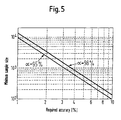
- the minimum sample size to be statistically significant may be easily calculated using the graph shown in Fig. 5 for confidence intervals of 95% and 98%.
- the present invention provides a monitoring device and method for determining telecommunication network performance using post dial delay as a user perceived measure by resetting a PDD counter when dialing is completed as determined by appropriate signaling messages from the data channel, and stopping the PDD counter when a useful signal is detected in the voice channel.
Landscapes
- Engineering & Computer Science (AREA)
- Quality & Reliability (AREA)
- Signal Processing (AREA)
- Monitoring And Testing Of Exchanges (AREA)
- Telephonic Communication Services (AREA)
Abstract
Description
- The present invention relates to the monitoring of a telecommunication network, and more particularly to a monitoring device and method for determining post dial delay actually perceived by a user.
- The quality of service (QoS) provided by a telephone network depends upon a number of factors, among which major roles are played by availability, reliability and call clarity. The availability is related to the actual possibility of gaining access to a service once a request has been forwarded, and to the time it takes to complete such an operation. The reliability from a general point of view refers to the customer expectation of maintaining access to the service as long as needed without interruptions. The call clarity is mainly associated with the intelligibility of the information delivered by the network, i.e., the speech quality for telephone networks.
- Assessing QoS is a fundamental task for network operators to promptly highlight malfunctions and to detect possible anomalies in order to avoid customer dissatisfaction, and to verify Service Level Agreement (SLA) conformance. In the evolving telecommunication scenario more and more often traditional local networks are remotely interconnected by means of long distance third party carriers. These carriers may offer cost effective solutions at a reasonably high QoS by exploiting emerging communication technologies. Moreover modern international networks have evolved from point-to-point networks interconnecting different countries to more complex networks with multiple routes between countries. As a consequence the choice of the best route is made on a comparative basis as a trade-off between QoS and costs.
- Network operators show therefore an increasing interest in dedicated instrumentation able to appropriately monitor network performance. In-Service Nonintrusive Measurement Devices (INMDs) are suitable for assessing QoS basically by monitoring the signaling associated with calls in progress. Amongst the parameters that an INMD may evaluate by monitoring the signaling, such as the Answer Seizure Ratio (ASR), the Rejected Calls Ratio (RCR) and the Incomplete Calls Ratio (ICR), the Post Dial Delay (PDD) covers a very important role where there is need for comparing different routes to the same destination or to assess the performance of the current route being used.
- PDD is defined as the time interval between the end of user or terminal equipment dialing and the reception of an appropriate network message. Such a delay, associated with connection establishment, impacts primarily on customer satisfaction since it is directly perceived by the user. Also it impacts on the costs incurred by the local operators when routing their traffic through long distance carriers since the calls are invoiced as soon as connection establishment is required.
- Traditional measurement systems provide estimates of PDD by observing the signaling messages within the data channel of the network, and a typical approach is illustrated in Fig. 1. A first estimate may be easily obtained by calculating the time interval between the seizure and the first network response in the backward direction, as shown in Fig. 2. In some circumstances such an estimate may be acceptable since it fixes a lower boundary, but only partial information is gained about the actual network behavior. Another estimate of PDD may be obtained by calculating the time interval between the seizure and the receipt of answer supervision. However as seen from Fig. 2 such an interval, even if it provides an upper boundary for PDD, is strictly dependent on the customer behavior and therefore is not suitable as an absolute measure.
- What is desired is a more effective measurement of PDD that is suitable as an absolute measure of telecommunication network performance.
- Accordingly the present invention provides a monitor device and method for determining an absolute measure of telecommunication network performance. Signaling information on a data channel of the telecommunication network is monitored to detect the end of dialing, resetting a post dial delay (PDD) counter at that point. Then an associated voice channel of the telecommunication network is monitored until a useful signal is detected, such as a ringing tone. At that time the PDD counter is stopped and the contents reflect the absolute PDD for the call. Statistical analysis of PDD over multiple samples provides a measure of telecommunication network performance for Service Level Agreement (SLA) conformance.
- The objects, advantages and other novel features of the present invention are apparent from the following detailed description when read in conjunction with the appended claims and attached drawing.
-
- Fig. 1 is a general block diagram view of a telecommunication network using an in-service nonintrusive measurement system.
- Fig. 2 is a time line diagram view of methods for determining PDD for a telecommunication network.
- Fig. 3 is a flow diagram view of a method of determining PDD according to the present invention.
- Fig. 4 is a time line diagram view of the method of Fig. 3 according to the present invention.
- Fig. 5 is a graphic diagram view for determining the number of samples required for statistical analysis of telecommunication network performance measurements.
- Described below is a more effective measurement of PDD that has been developed and implemented in an INMD. The detection of the forward signaling messages is combined with the analysis of the in-band signal conveyed by the corresponding voice channel in the backward direction. From such an implementation the time interval between seizure and the first network response actually perceived by the user is assessed, as shown in Fig. 2. Also the measurement is not influenced by customer behavior, i.e., how long it takes the customer to respond at the other end from the user. Further the measurement is performed even if the call is not answered by the customer. Finally the performance of complex networks is managed either on a comparative or on an absolute basis.
- The INMD is adjoined to the telecommunication network under test as shown in Fig. 1 such that the data links and the corresponding voice channels are available. Referring now to Fig. 3 as soon as a new call establishment is detected, the system starts and gets ready to analyze and interpret the associated signaling. In particular the system recognizes the instant when the end of dialing occurs by looking for the appropriate message (SEIZURE). When this occurs a PDD counter is reset and in-band signal analysis is activated. The in-band signal analysis uses a signal processing technique that is applied to the signal actually perceived by the user and conveyed by the voice channel. Once a signal is detected in the voice channel, the PDD counter is stopped and the measurement is complete. The contents of the PDD counter contain an absolute measure of PDD for the call independent of customer behavior.
- The implemented signal processing technique is insensible to any sort of noise that may be present in the network, whether it be wide-band or impulsive. Less than 100 ms are needed to detect the presence of a useful signal, as shown in Fig. 4. The useful signal may be a tone, such as a busy tone or ringing tone, or a speech signal such as is associated with a recorded message. As soon as the useful signal is detected, the analysis is suspended and the PDD determined.
- PDD is one of a certain number of parameters which defines the performance of a network. In order to verify SLA conformance, the performance of the network needs to be periodically assessed using suitable instrumentation and proper analysis techniques. To perform this statistical analysis, thresholding is applied to a sample of PDD measurements by calculating the percentage of measurements above or below the threshold, such as 15 seconds. To generate an alarm such a percentage is compared with a tolerable maximum percentage, such as 20%. The minimum sample size to be statistically significant may be easily calculated using the graph shown in Fig. 5 for confidence intervals of 95% and 98%.
- As an example, having defined:
- PDDth = threshold for PDD measurements = 15 seconds

- P = percentage of PDD measurements exceeding PDDth
- Pth = threshold for P = 20%
- A = required accuracy = 5%
- α = confidence interval = 95
from Fig. 5 - Nmin = minimum sample size = 380
- Then for a sample of Nmin PDD measurements an alarm is generated if:

- Thus the present invention provides a monitoring device and method for determining telecommunication network performance using post dial delay as a user perceived measure by resetting a PDD counter when dialing is completed as determined by appropriate signaling messages from the data channel, and stopping the PDD counter when a useful signal is detected in the voice channel.
Claims (3)
- A monitoring device comprising:means for monitoring signaling information on data links of a telecommunication network;means for monitoring user traffic on voice links of the telecommunication network; andmeans for deriving a measure for user perception quality of the telecommunication network from the signaling information and the user traffic.
- The monitoring device as recited in claim 1 wherein the user perception quality is defined by a time between circuit seizure as determined from the signaling information, especially when a last key has been pressed, and when the telecommunication network responds with a useful signal from the user traffic.
- A method of monitoring a telecommunication network comprising the steps of:monitoring signaling information on data links of a telecommunication network;monitoring user traffic on voice links of the telecommunication network; andderiving a measure for user perception quality of the telecommunication network from the signaling information and the user traffic.
Priority Applications (1)
| Application Number | Priority Date | Filing Date | Title |
|---|---|---|---|
| EP20010112631 EP1168787B1 (en) | 2000-06-23 | 2001-05-23 | Monitoring device and method for monitoring a telecommunication network |
Applications Claiming Priority (3)
| Application Number | Priority Date | Filing Date | Title |
|---|---|---|---|
| EP00113402 | 2000-06-23 | ||
| EP00113402 | 2000-06-23 | ||
| EP20010112631 EP1168787B1 (en) | 2000-06-23 | 2001-05-23 | Monitoring device and method for monitoring a telecommunication network |
Publications (3)
| Publication Number | Publication Date |
|---|---|
| EP1168787A2 true EP1168787A2 (en) | 2002-01-02 |
| EP1168787A3 EP1168787A3 (en) | 2002-04-24 |
| EP1168787B1 EP1168787B1 (en) | 2005-12-14 |
Family
ID=26071072
Family Applications (1)
| Application Number | Title | Priority Date | Filing Date |
|---|---|---|---|
| EP20010112631 Expired - Lifetime EP1168787B1 (en) | 2000-06-23 | 2001-05-23 | Monitoring device and method for monitoring a telecommunication network |
Country Status (1)
| Country | Link |
|---|---|
| EP (1) | EP1168787B1 (en) |
Family Cites Families (4)
| Publication number | Priority date | Publication date | Assignee | Title |
|---|---|---|---|---|
| US5448624A (en) * | 1990-08-22 | 1995-09-05 | Mci Communications Corporation | Telephone network performance monitoring method and system |
| GB9512422D0 (en) * | 1994-09-01 | 1995-08-23 | British Telecomm | Network management system for communications networks |
| US5555295A (en) * | 1995-05-16 | 1996-09-10 | At&T Corp. | Service and information management system for a telecommunications network |
| US5787164A (en) * | 1996-08-12 | 1998-07-28 | Ellipsys Technologies, Inc. | Switched network call progress protocol analyzer |
-
2001
- 2001-05-23 EP EP20010112631 patent/EP1168787B1/en not_active Expired - Lifetime
Also Published As
| Publication number | Publication date |
|---|---|
| EP1168787A3 (en) | 2002-04-24 |
| EP1168787B1 (en) | 2005-12-14 |
Similar Documents
| Publication | Publication Date | Title |
|---|---|---|
| US8689105B2 (en) | Real-time monitoring of perceived quality of packet voice transmission | |
| US7573825B2 (en) | Methods, apparatus and computer program products for testing a voice over Internet protocol communication system | |
| KR940001433B1 (en) | Electronic exchange testing method | |
| US7050549B2 (en) | Real time call trace capable of use with multiple elements | |
| CA2481203A1 (en) | Method and apparatus for measuring communication market statistics | |
| US7860461B1 (en) | Method for user-aided network performance and connection quality reporting | |
| US6584177B2 (en) | Monitoring device and method for monitoring a telecommunication network | |
| EP1699172B1 (en) | Method and apparatus for locating in-house wiring defects | |
| US20050287954A1 (en) | System and method for monitoring a communications network | |
| US6169724B1 (en) | Egress network service monitor | |
| EP1168787B1 (en) | Monitoring device and method for monitoring a telecommunication network | |
| HUP0100605A2 (en) | Passive telecommunication monitor system | |
| EP1156621A2 (en) | Network management with integrative fault location | |
| KR100676172B1 (en) | Asymmetric Digital Subscriber Line Test Method and Device | |
| US6577711B1 (en) | Methods for detecting defective communications lines | |
| US6628756B2 (en) | System and method for telephone number verification and identification | |
| US10198934B2 (en) | Facsimile aware alarm monitoring station and method | |
| CA3024447C (en) | System and method for communication provider and remote device connection analysis | |
| EP0926841A2 (en) | Method of and apparatus for testing a telecommunications link | |
| KR100461555B1 (en) | Method and Apparatus for monitoring Contents Service in Network | |
| KR100510182B1 (en) | Method Of Abstracting User Feeling Call Dissatisfaction In The Body And System In Mobile Communication System | |
| US20030040890A1 (en) | Method and monitoring system for monitoring at least one subscriber line | |
| JP4519061B2 (en) | Failure detection system, failure detection device, manager device, and center device | |
| KR20040048539A (en) | System for monitoring and analyzing call fail of mobile communication service and method for therefore | |
| EP0886423A1 (en) | Device and method for testing the reachability of at least one user of a telecommunication network |
Legal Events
| Date | Code | Title | Description |
|---|---|---|---|
| PUAI | Public reference made under article 153(3) epc to a published international application that has entered the european phase |
Free format text: ORIGINAL CODE: 0009012 |
|
| AK | Designated contracting states |
Kind code of ref document: A2 Designated state(s): DE FR GB IT Kind code of ref document: A2 Designated state(s): AT BE CH CY DE DK ES FI FR GB GR IE IT LI LU MC NL PT SE TR |
|
| AX | Request for extension of the european patent |
Free format text: AL;LT;LV;MK;RO;SI |
|
| PUAL | Search report despatched |
Free format text: ORIGINAL CODE: 0009013 |
|
| AK | Designated contracting states |
Kind code of ref document: A3 Designated state(s): AT BE CH CY DE DK ES FI FR GB GR IE IT LI LU MC NL PT SE TR |
|
| AX | Request for extension of the european patent |
Free format text: AL;LT;LV;MK;RO;SI |
|
| 17P | Request for examination filed |
Effective date: 20020906 |
|
| AKX | Designation fees paid |
Free format text: DE FR GB IT |
|
| RAP1 | Party data changed (applicant data changed or rights of an application transferred) |
Owner name: TEKTRONIX BERLIN GMBH & CO. KG |
|
| 17Q | First examination report despatched |
Effective date: 20030513 |
|
| GRAP | Despatch of communication of intention to grant a patent |
Free format text: ORIGINAL CODE: EPIDOSNIGR1 |
|
| GRAS | Grant fee paid |
Free format text: ORIGINAL CODE: EPIDOSNIGR3 |
|
| GRAA | (expected) grant |
Free format text: ORIGINAL CODE: 0009210 |
|
| AK | Designated contracting states |
Kind code of ref document: B1 Designated state(s): DE FR GB IT |
|
| REG | Reference to a national code |
Ref country code: GB Ref legal event code: FG4D |
|
| REF | Corresponds to: |
Ref document number: 60115769 Country of ref document: DE Date of ref document: 20060119 Kind code of ref document: P |
|
| ET | Fr: translation filed | ||
| PLBE | No opposition filed within time limit |
Free format text: ORIGINAL CODE: 0009261 |
|
| STAA | Information on the status of an ep patent application or granted ep patent |
Free format text: STATUS: NO OPPOSITION FILED WITHIN TIME LIMIT |
|
| 26N | No opposition filed |
Effective date: 20060915 |
|
| PGFP | Annual fee paid to national office [announced via postgrant information from national office to epo] |
Ref country code: DE Payment date: 20120523 Year of fee payment: 12 |
|
| PGFP | Annual fee paid to national office [announced via postgrant information from national office to epo] |
Ref country code: GB Payment date: 20120522 Year of fee payment: 12 Ref country code: FR Payment date: 20120601 Year of fee payment: 12 |
|
| PGFP | Annual fee paid to national office [announced via postgrant information from national office to epo] |
Ref country code: IT Payment date: 20120528 Year of fee payment: 12 |
|
| GBPC | Gb: european patent ceased through non-payment of renewal fee |
Effective date: 20130523 |
|
| PG25 | Lapsed in a contracting state [announced via postgrant information from national office to epo] |
Ref country code: DE Free format text: LAPSE BECAUSE OF NON-PAYMENT OF DUE FEES Effective date: 20131203 |
|
| REG | Reference to a national code |
Ref country code: DE Ref legal event code: R119 Ref document number: 60115769 Country of ref document: DE Effective date: 20131203 |
|
| PG25 | Lapsed in a contracting state [announced via postgrant information from national office to epo] |
Ref country code: IT Free format text: LAPSE BECAUSE OF NON-PAYMENT OF DUE FEES Effective date: 20130523 |
|
| REG | Reference to a national code |
Ref country code: FR Ref legal event code: ST Effective date: 20140131 |
|
| PG25 | Lapsed in a contracting state [announced via postgrant information from national office to epo] |
Ref country code: GB Free format text: LAPSE BECAUSE OF NON-PAYMENT OF DUE FEES Effective date: 20130523 |
|
| PG25 | Lapsed in a contracting state [announced via postgrant information from national office to epo] |
Ref country code: FR Free format text: LAPSE BECAUSE OF NON-PAYMENT OF DUE FEES Effective date: 20130531 |