EP1168775A2 - A communications device - Google Patents
A communications device Download PDFInfo
- Publication number
- EP1168775A2 EP1168775A2 EP01305078A EP01305078A EP1168775A2 EP 1168775 A2 EP1168775 A2 EP 1168775A2 EP 01305078 A EP01305078 A EP 01305078A EP 01305078 A EP01305078 A EP 01305078A EP 1168775 A2 EP1168775 A2 EP 1168775A2
- Authority
- EP
- European Patent Office
- Prior art keywords
- party
- identity
- signalling
- controller
- light emitters
- Prior art date
- Legal status (The legal status is an assumption and is not a legal conclusion. Google has not performed a legal analysis and makes no representation as to the accuracy of the status listed.)
- Withdrawn
Links
Images



Classifications
-
- H—ELECTRICITY
- H04—ELECTRIC COMMUNICATION TECHNIQUE
- H04M—TELEPHONIC COMMUNICATION
- H04M1/00—Substation equipment, e.g. for use by subscribers
- H04M1/02—Constructional features of telephone sets
- H04M1/0202—Portable telephone sets, e.g. cordless phones, mobile phones or bar type handsets
-
- H—ELECTRICITY
- H04—ELECTRIC COMMUNICATION TECHNIQUE
- H04M—TELEPHONIC COMMUNICATION
- H04M1/00—Substation equipment, e.g. for use by subscribers
- H04M1/02—Constructional features of telephone sets
- H04M1/22—Illumination; Arrangements for improving the visibility of characters on dials
-
- H—ELECTRICITY
- H04—ELECTRIC COMMUNICATION TECHNIQUE
- H04M—TELEPHONIC COMMUNICATION
- H04M1/00—Substation equipment, e.g. for use by subscribers
- H04M1/57—Arrangements for indicating or recording the number of the calling subscriber at the called subscriber's set
-
- H—ELECTRICITY
- H04—ELECTRIC COMMUNICATION TECHNIQUE
- H04M—TELEPHONIC COMMUNICATION
- H04M1/00—Substation equipment, e.g. for use by subscribers
- H04M1/72—Mobile telephones; Cordless telephones, i.e. devices for establishing wireless links to base stations without route selection
- H04M1/724—User interfaces specially adapted for cordless or mobile telephones
-
- H—ELECTRICITY
- H04—ELECTRIC COMMUNICATION TECHNIQUE
- H04M—TELEPHONIC COMMUNICATION
- H04M1/00—Substation equipment, e.g. for use by subscribers
- H04M1/26—Devices for calling a subscriber
- H04M1/27—Devices whereby a plurality of signals may be stored simultaneously
- H04M1/274—Devices whereby a plurality of signals may be stored simultaneously with provision for storing more than one subscriber number at a time, e.g. using toothed disc
- H04M1/2745—Devices whereby a plurality of signals may be stored simultaneously with provision for storing more than one subscriber number at a time, e.g. using toothed disc using static electronic memories, e.g. chips
-
- H—ELECTRICITY
- H04—ELECTRIC COMMUNICATION TECHNIQUE
- H04M—TELEPHONIC COMMUNICATION
- H04M19/00—Current supply arrangements for telephone systems
- H04M19/02—Current supply arrangements for telephone systems providing ringing current or supervisory tones, e.g. dialling tone or busy tone
- H04M19/04—Current supply arrangements for telephone systems providing ringing current or supervisory tones, e.g. dialling tone or busy tone the ringing-current being generated at the substations
- H04M19/047—Vibrating means for incoming calls
-
- H—ELECTRICITY
- H04—ELECTRIC COMMUNICATION TECHNIQUE
- H04M—TELEPHONIC COMMUNICATION
- H04M19/00—Current supply arrangements for telephone systems
- H04M19/02—Current supply arrangements for telephone systems providing ringing current or supervisory tones, e.g. dialling tone or busy tone
- H04M19/04—Current supply arrangements for telephone systems providing ringing current or supervisory tones, e.g. dialling tone or busy tone the ringing-current being generated at the substations
- H04M19/048—Arrangements providing optical indication of the incoming call, e.g. flasher circuits
Definitions
- the present invention relates to a communications device.
- Mobile telephone handsets which notify a user of an incoming call or message by ringing and indicating the identity of the caller on a liquid crystal display (LCD).
- LCD liquid crystal display
- the mobile telephone handset stores in memory or on a smart card contact names and telephone numbers, which the user can arrange into caller groups and assign distinctive ringing tones to each caller group.
- this is of little help if the user is unable to hear the ringing tone.
- the user may have turned off the ringer so as to prevent interruption during a meeting or a visit to the theatre.
- the user may be in a noisy environment, which prevents the user from distinguishing between different ringing tones.
- the user may be able to hear the ringing tone, the user may have difficulty remembering which ringing tone they assigned to each caller group.
- the user could identify the caller by looking at the LCD, however there may be circumstances when the user is unable to do this, for example if the user has poor eyesight or is driving a car.
- the present invention seeks to provide improved caller group identification.
- a communications device comprising a plurality of differently coloured light emitters and a controller to control operation of the light emitting means in dependence upon the identity of a party signalling the device.
- the device may further comprise a sound emitter and said controller may further control operation of the sound emitter in dependence upon the identity of the signalling party.
- the device may further comprise memory to store an identity of a party, which may be the identity of the signalling party.
- the identity may be stored as a network number and as a label.
- the identity of said party, including said signalling party, may be assigned to one of a plurality of party groups.
- the controller may be configured to operate the light emitters in dependence upon the said one of the plurality of party groups and may include family, very important person, friend and colleague classes.
- the assignment of each of the identities of the parties may be user-defined.
- the controller may cause one of said light emitters to be illuminated when said signalling party signals the device, for example to flash or to flash repetitively.
- a method of operating a communications device comprising providing a plurality of differently coloured light emitters and controlling operation of the light emitters in dependence upon the identity of a party signalling the device.
- a mobile telephone 1 comprises front and back covers 2a, 2b, a vibrating battery pack 3, mobile telephone circuitry 4, an LCD panel 5, microphone 6, ear-piece 7, keypad membrane 8, keypad 9, antenna 10, subscriber identification module (SIM) card 11 and SIM card reader 12.
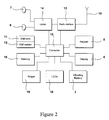
- the telephone circuitry 4 includes radio interface circuitry 13, codec circuitry 14, controller 15 and memory 16. Individual circuits and elements are of a type well known in the art, for example in the Nokia range of mobile telephones. It will be appreciated by those skilled in the art that the vibrating battery 3 may be replaced with a conventional non-vibrating battery and a dedicated vibrating unit.
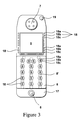
- a flexible substrate 17 carries the LCD panel 5, the microphone 6, the earpiece 7, the keypad membrane 8 having a plurality of keypad sensors 8', a plurality of sets of light emitting diodes (LEDs) 18 and a ringer 19.
- Each set of LEDs 18 comprises red, amber and green LEDs 18a, 18b, 18c.
- Three sets of LEDs 18 are arranged along each of the short edges of the LCD panel 5 and sixteen sets of LEDs 18 are arranged between the keypad sensors 8'.
- Peter configures the mobile telephone 1 by entering names and telephone numbers in an address book stored in memory on the SIM card 11.
- Peter accesses the address book from a main menu (step S1) and enters a name and telephone number, for example "Mum” and +44 20 8123 4567 respectively (step S2).
- Peter confirms that the entry is to be stored (step S3) and indicates that he wishes to make more entries (step S4).
- Peter may arrange some or all the entries into caller groups by selecting an entry in the address book and flagging the entry as a member of a caller group, which may include Friends, Very Important Persons (VIPs), Family, Colleagues and Others.
- Peter accesses the address book (step S5), scrolls through the address book until he finds "Mum” (step S6), indicates that he wishes "Mum” to belong to a caller group and selects caller group "Family” (step S7).
- Peter confirms this selection (step S8) and indicates that he wishes to make further caller group selections (step S9).
- Peter configures the ring of the mobile telephone 1 according to caller group by accessing a preference menu, selecting a caller group and choosing a caller group ringing tone or tune.
- Peter accesses a preference menu (step S10), from which he selects ringing tone menu (step S11).
- Peter selects the caller group "Family" (step S12) and chooses a tuneful minuet as a ringing tone (step S13). He confirms this selection and the ringing tone setting is stored in a preference table held in memory 16 (step S14). Peter indicates that he wishes to make further ringing tone selections (step S15).
- Peter configures the illumination of the mobile telephone 1 when a call is received according to caller group by accessing the preference menu, selecting a caller group and choosing a caller group colour scheme.
- Peter accesses the preference menu (step S16) from which he selects a call notification colour scheme menu (step S17). He selects the caller group "Family” (step S18) and picks continuous green illumination (step S19). He confirms this selection and the colour scheme setting is stored in the preference table held in memory 16 (step S20). Peter indicates that he wishes to make further colour scheme selections (step S21).
- Peter selects the caller group "Colleagues” and decides upon slow, steady amber pulses. Finally, he selects the caller group "VIP" and chooses irregular, rapidly flashing red pulses.
- Peter also configures the vibrating battery 3 to vibrate when any call is received. He accesses the preference menu (step S22), from which he chooses the vibration menu (step S23). Peter sets the battery 3 to vibrate when a call is received (step S24) and exits the menu (step S25).
- John calls Peter from work on the mobile telephone 1 (step S26).
- the identity of the caller is signalled to the mobile telephone 1 during establishment of the call in a manner well known in the art (step S27).
- the controller 15 looks-up John in the address book stored in the SIM card 11 (step S28) and identifies to which caller group John belongs (step S29). Having determined that John belongs to caller group "Colleagues", the controller 15 looks-up the corresponding entry in the preference table stored in memory 16 (step S30) and retrieves the user-defined ringing tone (step S31), colour scheme (step S32) and the vibration option (step S33).
- the controller 15 operates the ringer 19, which emits a bicycle bell ring (step S34).
- the controller 15 causes the vibrating battery 3 to vibrate (step S35).
- the controller 15 drives the amber LEDs 18b in each set of LEDs 18 (step S36). It will be appreciated that John's identity may also be displayed on the LCD 5. Ringing of the ringer 19, vibration of the battery 3 and pulsation of the amber LEDs 18b continues until Peter accepts the call (step S37), by pressing an answer button on the keypad 8 or if he rejects the call by pressing a finish key (step S37) or if John gives up trying to contact Peter (step S38).
- different numbers of diodes may be used in each set of LEDs, for example two, four, five or six.
- Different colour LEDs may be used instead of red, green or amber, including blue.
- LEDs in a set may be combined into a single, tuneable LED.
- Different combinations of alerting illumination may be used including pulses of different duration and separation and combination of more than one LED in a set.
- Illumination of the screen and the keypad may be different. Illumination of each set of LEDs may be sequenced, thus allowing patterns to be traced.
- the LEDs may be located on the front or back cover of the mobile telephone.
- the signal may indicate the receipt of a message rather than receipt of a call.
Landscapes
- Engineering & Computer Science (AREA)
- Signal Processing (AREA)
- Human Computer Interaction (AREA)
- Computer Networks & Wireless Communication (AREA)
- Mobile Radio Communication Systems (AREA)
- Telephone Function (AREA)
- Telephone Set Structure (AREA)
Abstract
Description
- The present invention relates to a communications device.
- Mobile telephone handsets are known, which notify a user of an incoming call or message by ringing and indicating the identity of the caller on a liquid crystal display (LCD).
- It is also known to personalise the ringing tone or tune in dependence upon the identity of the caller. The mobile telephone handset stores in memory or on a smart card contact names and telephone numbers, which the user can arrange into caller groups and assign distinctive ringing tones to each caller group. However, this is of little help if the user is unable to hear the ringing tone. On the one hand, the user may have turned off the ringer so as to prevent interruption during a meeting or a visit to the theatre. On the other hand, the user may be in a noisy environment, which prevents the user from distinguishing between different ringing tones. Alternatively, although the user may be able to hear the ringing tone, the user may have difficulty remembering which ringing tone they assigned to each caller group. Of course the user could identify the caller by looking at the LCD, however there may be circumstances when the user is unable to do this, for example if the user has poor eyesight or is driving a car.
- The present invention seeks to provide improved caller group identification.
- According to the present invention there is provided a communications device comprising a plurality of differently coloured light emitters and a controller to control operation of the light emitting means in dependence upon the identity of a party signalling the device.
- The device may further comprise a sound emitter and said controller may further control operation of the sound emitter in dependence upon the identity of the signalling party.
- The device may further comprise memory to store an identity of a party, which may be the identity of the signalling party. The identity may be stored as a network number and as a label. The identity of said party, including said signalling party, may be assigned to one of a plurality of party groups.
- The controller may be configured to operate the light emitters in dependence upon the said one of the plurality of party groups and may include family, very important person, friend and colleague classes. The assignment of each of the identities of the parties may be user-defined.
- The controller may cause one of said light emitters to be illuminated when said signalling party signals the device, for example to flash or to flash repetitively.
- According to the present invention there is also provided a method of operating a communications device, the method comprising providing a plurality of differently coloured light emitters and controlling operation of the light emitters in dependence upon the identity of a party signalling the device.
- An embodiment of the present invention will now be described, by way of example, with reference to accompanying drawings, in which:
- Figure 1 is an exploded view of a mobile telephone according to the invention;
- Figure 2 is a schematic diagram of the circuits of the mobile telephone;
- Figure 3 is a plan view of a flexible substrate forming part of the mobile telephone circuits;
- Figure 4 is a process flow diagram for making entries in an address book;
- Figure 5 is a process flow diagram for nominating members of a caller group;
- Figure 6 is a process flow diagram for selecting a ringing tone for a caller group;
- Figure 7 is a process flow diagram for selecting a LED colour scheme for a caller group;
- Figure 8 is a process flow diagram for selecting vibration call notification and
- Figure 9 is a process flow diagram for notifying a user of an incoming call.
- Referring to Figures 1 and 2, a mobile telephone 1 comprises front and back covers 2a, 2b, a vibrating
battery pack 3, mobile telephone circuitry 4, anLCD panel 5,microphone 6, ear-piece 7,keypad membrane 8,keypad 9,antenna 10, subscriber identification module (SIM)card 11 andSIM card reader 12. The telephone circuitry 4 includesradio interface circuitry 13,codec circuitry 14,controller 15 andmemory 16. Individual circuits and elements are of a type well known in the art, for example in the Nokia range of mobile telephones. It will be appreciated by those skilled in the art that the vibratingbattery 3 may be replaced with a conventional non-vibrating battery and a dedicated vibrating unit. - Referring to also to Figure 3, a
flexible substrate 17 carries theLCD panel 5, themicrophone 6, theearpiece 7, thekeypad membrane 8 having a plurality of keypad sensors 8', a plurality of sets of light emitting diodes (LEDs) 18 and aringer 19. Each set ofLEDs 18 comprises red, amber andgreen LEDs LEDs 18 are arranged along each of the short edges of theLCD panel 5 and sixteen sets ofLEDs 18 are arranged between the keypad sensors 8'. - Personalisation of the mobile telephone 1 by a user called Peter will now be described.
- Referring to Figure 4, Peter configures the mobile telephone 1 by entering names and telephone numbers in an address book stored in memory on the
SIM card 11. Peter accesses the address book from a main menu (step S1) and enters a name and telephone number, for example "Mum" and +44 20 8123 4567 respectively (step S2). Peter confirms that the entry is to be stored (step S3) and indicates that he wishes to make more entries (step S4). He makes further entries, one for a colleague from work, entered as "John", and Peter's bank manager, entered as "Bank Manager" having telephone numbers +44 20 7654 3210 and +44 20 8999 0000 respectively. - Referring to Figure 5, Peter may arrange some or all the entries into caller groups by selecting an entry in the address book and flagging the entry as a member of a caller group, which may include Friends, Very Important Persons (VIPs), Family, Colleagues and Others. Peter accesses the address book (step S5), scrolls through the address book until he finds "Mum" (step S6), indicates that he wishes "Mum" to belong to a caller group and selects caller group "Family" (step S7). Peter confirms this selection (step S8) and indicates that he wishes to make further caller group selections (step S9). Similarly, Peter finds the entry "John" and selects caller group "Colleagues". Likewise, he finds the entry "Bank Manager" and selects caller group "VIPs".
- Referring to Figure 6, Peter configures the ring of the mobile telephone 1 according to caller group by accessing a preference menu, selecting a caller group and choosing a caller group ringing tone or tune. Peter accesses a preference menu (step S10), from which he selects ringing tone menu (step S11). Peter selects the caller group "Family" (step S12) and chooses a tuneful minuet as a ringing tone (step S13). He confirms this selection and the ringing tone setting is stored in a preference table held in memory 16 (step S14). Peter indicates that he wishes to make further ringing tone selections (step S15). Similarly, he selects the caller group "Colleagues" and picks a bicycle bell ring as an alerting tone. In the same way, Peter selects the caller group "VIP" and chooses a high-pitched trill as a ring.
- Referring to Figure 7, Peter configures the illumination of the mobile telephone 1 when a call is received according to caller group by accessing the preference menu, selecting a caller group and choosing a caller group colour scheme. Peter accesses the preference menu (step S16) from which he selects a call notification colour scheme menu (step S17). He selects the caller group "Family" (step S18) and picks continuous green illumination (step S19). He confirms this selection and the colour scheme setting is stored in the preference table held in memory 16 (step S20). Peter indicates that he wishes to make further colour scheme selections (step S21). In a similar fashion, Peter selects the caller group "Colleagues" and decides upon slow, steady amber pulses. Finally, he selects the caller group "VIP" and chooses irregular, rapidly flashing red pulses.
- Referring to Figure 8, Peter also configures the vibrating
battery 3 to vibrate when any call is received. He accesses the preference menu (step S22), from which he chooses the vibration menu (step S23). Peter sets thebattery 3 to vibrate when a call is received (step S24) and exits the menu (step S25). - Operation of the mobile telephone 1 will now be described.
- John calls Peter from work on the mobile telephone 1 (step S26). The identity of the caller is signalled to the mobile telephone 1 during establishment of the call in a manner well known in the art (step S27). The
controller 15 looks-up John in the address book stored in the SIM card 11 (step S28) and identifies to which caller group John belongs (step S29). Having determined that John belongs to caller group "Colleagues", thecontroller 15 looks-up the corresponding entry in the preference table stored in memory 16 (step S30) and retrieves the user-defined ringing tone (step S31), colour scheme (step S32) and the vibration option (step S33). Thecontroller 15 operates theringer 19, which emits a bicycle bell ring (step S34). Thecontroller 15 causes the vibratingbattery 3 to vibrate (step S35). Thecontroller 15 drives theamber LEDs 18b in each set of LEDs 18 (step S36). It will be appreciated that John's identity may also be displayed on theLCD 5. Ringing of theringer 19, vibration of thebattery 3 and pulsation of theamber LEDs 18b continues until Peter accepts the call (step S37), by pressing an answer button on thekeypad 8 or if he rejects the call by pressing a finish key (step S37) or if John gives up trying to contact Peter (step S38). - If Peter is travelling home from work on a noisy train and he keeps the mobile telephone 1 in his jacket pocket, he may not be able to hear the telephone 1 ring. However, he will feel the
battery 3 vibrate indicating that a calling party is signalling. As Peter searches for the telephone 1, he will see that thekeypad 8 and theLCD panel 5 are flashing amber, informing him that someone from work is contacting him. - It will be appreciated that while the invention has been described in relation to mobile telephones, it can be used with any sort of portable electronic apparatus, for example, hand held computers and portable measuring equipment.
- It will be appreciated that many modifications may be made to the embodiment described above.
- For example, different numbers of diodes may be used in each set of LEDs, for example two, four, five or six. Different colour LEDs may be used instead of red, green or amber, including blue. LEDs in a set may be combined into a single, tuneable LED. Different combinations of alerting illumination may be used including pulses of different duration and separation and combination of more than one LED in a set.
- Illumination of the screen and the keypad may be different. Illumination of each set of LEDs may be sequenced, thus allowing patterns to be traced. The LEDs may be located on the front or back cover of the mobile telephone.
- Other light emitters may be used.
- The signal may indicate the receipt of a message rather than receipt of a call.
Claims (19)
- A communications device comprising:a plurality of differently coloured light emitters (18) anda controller (15) to control operation of the light emitters in dependence upon the identity of a party signalling the device.
- A device according to claim 1, wherein the device further comprises a sound emitter.
- A device according to claim 2, wherein said controller further controls operation of the sound emitter in dependence upon the identity of the signalling party.
- A device according to any preceding claim further comprising memory to store an identity of a party.
- A device according to claim 4, wherein the identity of said party is stored as a network number.
- A device according either claim 4 or 5, wherein the identity of said party is stored as a label.
- A device according to any one of claims 4 to 6, wherein the identity of said party is assigned to one of a plurality of party groups.
- A device according to claim 7, wherein the identity of the signalling party is stored in the memory.
- A device according to claim 8, wherein the identity of the signalling party is assigned to one of the plurality of party groups.
- A device according to claim 9, wherein the controller is configured to operate the light emitter in dependence upon the said one of the plurality of party groups.
- A device according to any one of claims 7 to 10, wherein the plurality of party groups includes a family class.
- A device according to any one of claims 7 to 11, wherein the plurality of party groups includes a very important person class.
- A device according to any one of claims 7 to 12, wherein the plurality of party groups includes a friend class.
- A device according to any one of claims 7 to 13, wherein the plurality of party groups includes a colleague class.
- A device according to any one of claims 7 to 14, wherein the assignment of each of the identities of the parties is user-defined.
- A device according to any preceding claim, wherein the controller causes one of said light emitters to be illuminated when said signalling party signals the device.
- A device according to claim 16, wherein the controller is configured to cause said one of said light emitters to flash.
- A device according to claim 16, wherein the controller is configured to cause said one of said light emitters to flash repetitively.
- A method of operating a communications device, the method comprising:providing a plurality of differently coloured light emitters andcontrolling operation of the light emitter in dependence upon the identity of a party signalling the device.
Applications Claiming Priority (2)
| Application Number | Priority Date | Filing Date | Title |
|---|---|---|---|
| GB0016156 | 2000-06-30 | ||
| GB0016156A GB2364464A (en) | 2000-06-30 | 2000-06-30 | Mobile phone activates different coloured lights depending on caller |
Publications (2)
| Publication Number | Publication Date |
|---|---|
| EP1168775A2 true EP1168775A2 (en) | 2002-01-02 |
| EP1168775A3 EP1168775A3 (en) | 2002-12-11 |
Family
ID=9894817
Family Applications (1)
| Application Number | Title | Priority Date | Filing Date |
|---|---|---|---|
| EP01305078A Withdrawn EP1168775A3 (en) | 2000-06-30 | 2001-06-11 | A communications device |
Country Status (4)
| Country | Link |
|---|---|
| US (1) | US20020019248A1 (en) |
| EP (1) | EP1168775A3 (en) |
| JP (1) | JP2002057748A (en) |
| GB (1) | GB2364464A (en) |
Cited By (8)
| Publication number | Priority date | Publication date | Assignee | Title |
|---|---|---|---|---|
| WO2003077505A3 (en) * | 2002-03-13 | 2004-01-22 | Nokia Corp | Mobile communication terminal with programmable lighting sequences |
| EP1394988A3 (en) * | 2002-08-27 | 2004-04-14 | Nec Corporation | System and method for informing whether a user is in wireless lan service |
| EP1615115A2 (en) | 2004-02-27 | 2006-01-11 | Microsoft Corporation | Method and system for using a color scheme to communicate information in a computer |
| WO2007072338A1 (en) * | 2005-12-20 | 2007-06-28 | Koninklijke Philips Electronics, N.V. | Lighting source providing spectral output beyond a user interface of a mobile device |
| WO2009109206A1 (en) * | 2008-03-04 | 2009-09-11 | Giorgio Armani S.P.A. | Mobile telephone device with incoming call category recognition |
| EP1576840A4 (en) * | 2002-12-23 | 2009-09-23 | Motorola Inc | Apparatus for displaying an illumination pattern and method thereof |
| EP1906632A3 (en) * | 2006-09-29 | 2012-10-24 | LG Electronics Inc. | Mobile phone with illuminated touch screen |
| EP2312809A4 (en) * | 2008-08-06 | 2014-12-03 | Nec Corp | Portable telephone having key backlight and information sending method using key backlight |
Families Citing this family (9)
| Publication number | Priority date | Publication date | Assignee | Title |
|---|---|---|---|---|
| FR2826826B1 (en) * | 2001-06-28 | 2003-09-26 | Cit Alcatel | SUBSCRIBER IDENTIFICATION MODULE AND ASSOCIATED TERMINAL |
| US6990361B2 (en) * | 2001-11-01 | 2006-01-24 | Lutche Michelle R | Light-emitting apparatus and portable communications device having same |
| KR100451189B1 (en) * | 2002-03-27 | 2004-10-02 | 엘지전자 주식회사 | Automatic setting method for terminal information using subscriber identity module |
| US20050272474A1 (en) * | 2004-06-03 | 2005-12-08 | Nokia Corporation | Controlling the appearance of a hand-portable electronic device |
| US20060046786A1 (en) * | 2004-09-02 | 2006-03-02 | Franco Montebovi | Mobile communication terminal and method |
| US7510537B2 (en) * | 2004-11-02 | 2009-03-31 | Ethan Frederic Imboden | Personal vibrator with replaceable motor having the appearance of a battery |
| US20080125095A1 (en) * | 2006-09-20 | 2008-05-29 | Sbc Knowledge Ventures, L.P. | Method of recognizing an event transpiring at a terminal device |
| US20080119170A1 (en) * | 2006-11-16 | 2008-05-22 | Franco Montebovi | Mobile Communication Terminal and Method |
| US8564249B2 (en) * | 2006-12-21 | 2013-10-22 | Nokia Corporation | Charging unit with two power source inputs |
Family Cites Families (8)
| Publication number | Priority date | Publication date | Assignee | Title |
|---|---|---|---|---|
| US4726059A (en) * | 1986-03-14 | 1988-02-16 | Karel Havel | Variable color display telephone |
| JP2874013B2 (en) * | 1991-05-14 | 1999-03-24 | キヤノン株式会社 | Telephone system equipment |
| EP0813787B1 (en) * | 1995-03-08 | 2001-11-21 | TELEFONAKTIEBOLAGET L M ERICSSON (publ) | A telephone set having calling party dependent ringing |
| US5946636A (en) * | 1996-10-02 | 1999-08-31 | Ericsson Inc. | Quick-recognition visual notification system for use in radiotelephones |
| JPH118691A (en) * | 1997-06-19 | 1999-01-12 | Sharp Corp | Answering machine |
| JP3463853B2 (en) * | 1997-10-31 | 2003-11-05 | 日本ビクター株式会社 | Telephone equipment |
| JPH11252278A (en) * | 1998-03-06 | 1999-09-17 | Funai Electric Co Ltd | Communication equipment |
| JP2000278368A (en) * | 1999-03-19 | 2000-10-06 | Nec Corp | Radio communication apparatus and display control method for the same |
-
2000
- 2000-06-30 GB GB0016156A patent/GB2364464A/en not_active Withdrawn
-
2001
- 2001-06-11 EP EP01305078A patent/EP1168775A3/en not_active Withdrawn
- 2001-06-22 US US09/887,127 patent/US20020019248A1/en not_active Abandoned
- 2001-06-27 JP JP2001194671A patent/JP2002057748A/en not_active Withdrawn
Cited By (11)
| Publication number | Priority date | Publication date | Assignee | Title |
|---|---|---|---|---|
| WO2003077505A3 (en) * | 2002-03-13 | 2004-01-22 | Nokia Corp | Mobile communication terminal with programmable lighting sequences |
| US7373120B2 (en) | 2002-03-13 | 2008-05-13 | Nokia Corporation | Mobile communication terminal |
| EP1394988A3 (en) * | 2002-08-27 | 2004-04-14 | Nec Corporation | System and method for informing whether a user is in wireless lan service |
| US7957353B2 (en) | 2002-08-27 | 2011-06-07 | Nec Corporation | System and method for informing that user is in or not in wireless LAN service |
| EP1576840A4 (en) * | 2002-12-23 | 2009-09-23 | Motorola Inc | Apparatus for displaying an illumination pattern and method thereof |
| EP1615115A2 (en) | 2004-02-27 | 2006-01-11 | Microsoft Corporation | Method and system for using a color scheme to communicate information in a computer |
| EP1615115A3 (en) * | 2004-02-27 | 2012-02-22 | Microsoft Corporation | Method and system for using a color scheme to communicate information in a computer |
| WO2007072338A1 (en) * | 2005-12-20 | 2007-06-28 | Koninklijke Philips Electronics, N.V. | Lighting source providing spectral output beyond a user interface of a mobile device |
| EP1906632A3 (en) * | 2006-09-29 | 2012-10-24 | LG Electronics Inc. | Mobile phone with illuminated touch screen |
| WO2009109206A1 (en) * | 2008-03-04 | 2009-09-11 | Giorgio Armani S.P.A. | Mobile telephone device with incoming call category recognition |
| EP2312809A4 (en) * | 2008-08-06 | 2014-12-03 | Nec Corp | Portable telephone having key backlight and information sending method using key backlight |
Also Published As
| Publication number | Publication date |
|---|---|
| EP1168775A3 (en) | 2002-12-11 |
| JP2002057748A (en) | 2002-02-22 |
| GB2364464A (en) | 2002-01-23 |
| GB0016156D0 (en) | 2000-08-23 |
| US20020019248A1 (en) | 2002-02-14 |
Similar Documents
| Publication | Publication Date | Title |
|---|---|---|
| US20020019248A1 (en) | Communications device | |
| US6411198B1 (en) | Portable terminal device | |
| US5946636A (en) | Quick-recognition visual notification system for use in radiotelephones | |
| US6690955B1 (en) | Communication device and method for producing a color illumination uniquely identifying a calling source | |
| FI114769B (en) | Procedure for processing the telephone numbers in mobile station and mobile station | |
| EP0624966B1 (en) | Telephone apparatus providing calling party identification | |
| US5604791A (en) | Single line telephone answering system with access security features | |
| US20040198455A1 (en) | Selective terminal illumination based upon a displayed entry | |
| JPH09191491A (en) | Cellular / PHS mobile phone device | |
| WO1999013628A1 (en) | Telephone apparatus | |
| US20040224685A1 (en) | Communication device with a simplified user interface | |
| GB2383716A (en) | Mobile phone keypad which produces visual pattern depending on nature of incoming call | |
| JP3377904B2 (en) | Telephone equipment | |
| KR20010010526A (en) | Apparatus And Method For Back Lighting In Mobile Telecommunication Terminal | |
| JP2002281556A (en) | Mobile communication terminal equipment | |
| KR100617794B1 (en) | Background Lighting Color Selection Method of Display Device in Portable Wireless Terminal | |
| JP2001308972A (en) | Portable telephone set and caller identification method | |
| KR100348629B1 (en) | Caller display method for mobile telecommunication terminal by priority | |
| US6519334B1 (en) | Method for processing incoming call in exchange system | |
| KR20040087566A (en) | Vibration mode setting method for mobile communication device | |
| KR20030076937A (en) | Portable phone having selective call termination output function and method for controlling the same | |
| GB2377125A (en) | User-configurable light display for a mobile telephone | |
| KR100302548B1 (en) | How to move ratings using a secret code in a keyphone system | |
| WO2001097491A1 (en) | Visual notification device for a portable phone | |
| KR20020030761A (en) | Caller group sorting indication method and display apparatus in telephone terminal that is offered caller identification |
Legal Events
| Date | Code | Title | Description |
|---|---|---|---|
| PUAI | Public reference made under article 153(3) epc to a published international application that has entered the european phase |
Free format text: ORIGINAL CODE: 0009012 |
|
| AK | Designated contracting states |
Kind code of ref document: A2 Designated state(s): AT BE CH CY DE DK ES FI FR GB GR IE IT LI LU MC NL PT SE TR |
|
| AX | Request for extension of the european patent |
Free format text: AL;LT;LV;MK;RO;SI |
|
| RAP1 | Party data changed (applicant data changed or rights of an application transferred) |
Owner name: NOKIA CORPORATION |
|
| PUAL | Search report despatched |
Free format text: ORIGINAL CODE: 0009013 |
|
| AK | Designated contracting states |
Kind code of ref document: A3 Designated state(s): AT BE CH CY DE DK ES FI FR GB GR IE IT LI LU MC NL PT SE TR |
|
| AX | Request for extension of the european patent |
Free format text: AL;LT;LV;MK;RO;SI |
|
| 17P | Request for examination filed |
Effective date: 20030611 |
|
| STAA | Information on the status of an ep patent application or granted ep patent |
Free format text: STATUS: THE APPLICATION HAS BEEN WITHDRAWN |
|
| AKX | Designation fees paid |
Designated state(s): NL SE |
|
| REG | Reference to a national code |
Ref country code: DE Ref legal event code: 8566 |
|
| 18W | Application withdrawn |
Effective date: 20030815 |