EP1168138A2 - System und Verfahren zur Erzeugung von Log-Dateien für gesicherte Transaktionen - Google Patents
System und Verfahren zur Erzeugung von Log-Dateien für gesicherte Transaktionen Download PDFInfo
- Publication number
- EP1168138A2 EP1168138A2 EP01114528A EP01114528A EP1168138A2 EP 1168138 A2 EP1168138 A2 EP 1168138A2 EP 01114528 A EP01114528 A EP 01114528A EP 01114528 A EP01114528 A EP 01114528A EP 1168138 A2 EP1168138 A2 EP 1168138A2
- Authority
- EP
- European Patent Office
- Prior art keywords
- data
- processor
- challenge
- logging
- transaction
- Prior art date
- Legal status (The legal status is an assumption and is not a legal conclusion. Google has not performed a legal analysis and makes no representation as to the accuracy of the status listed.)
- Withdrawn
Links
Images




Classifications
-
- G—PHYSICS
- G06—COMPUTING OR CALCULATING; COUNTING
- G06F—ELECTRIC DIGITAL DATA PROCESSING
- G06F21/00—Security arrangements for protecting computers, components thereof, programs or data against unauthorised activity
- G06F21/30—Authentication, i.e. establishing the identity or authorisation of security principals
- G06F21/31—User authentication
-
- G—PHYSICS
- G06—COMPUTING OR CALCULATING; COUNTING
- G06F—ELECTRIC DIGITAL DATA PROCESSING
- G06F2221/00—Indexing scheme relating to security arrangements for protecting computers, components thereof, programs or data against unauthorised activity
- G06F2221/21—Indexing scheme relating to G06F21/00 and subgroups addressing additional information or applications relating to security arrangements for protecting computers, components thereof, programs or data against unauthorised activity
- G06F2221/2101—Auditing as a secondary aspect
-
- G—PHYSICS
- G06—COMPUTING OR CALCULATING; COUNTING
- G06F—ELECTRIC DIGITAL DATA PROCESSING
- G06F2221/00—Indexing scheme relating to security arrangements for protecting computers, components thereof, programs or data against unauthorised activity
- G06F2221/21—Indexing scheme relating to G06F21/00 and subgroups addressing additional information or applications relating to security arrangements for protecting computers, components thereof, programs or data against unauthorised activity
- G06F2221/2103—Challenge-response
Definitions
- the present invention relates to computer security and more importantly to a method of producing log files for secured transactions.
- Computer security is fast becoming an important issue. With the proliferation of computers and computer networks into all aspects of business and daily life - financial, medical, education, government, and communications - the concern over secure information storage is growing.
- One common problem in computer security is electronic transaction verification. For example, if one were to transfer funds electronically, how is a secure record of the transaction that is later verifiable produced. Even more problematic is how to prevent unauthorised transactions form occurring.
- a man-in-the-middle attack is a security breach formed when a system or application disposes itself between two parties to a security communication.
- a man-in-the-middle may perform a listening breach of security wherein they merely listen to the data as it passes back and forth or may perform data replacement by imitating one of the parties, for example. Both of these attack types are problematic.
- System breaches are security breaches where access to a system is provided. For example, a user logging onto a secure system without actually having access privileges is a system breach. A more common form of system breach is typified by the computer virus.
- a small application or applet is somehow introduced into a secure system and executes thereon. The application or applet, once executing can access data or alter data as a local application and is thus subject to different security levels than remote applications. For example, a locally executing application may alter security data such as encryption keys, which will compromise security.
- one prior art method is to provide a token for performing cryptographic functions.
- the token does not accept programming code and, as such, cannot be tampered with.
- the token provides no access to keys stored therein to maintain security.
- the man-in-the-middle attack is still possible wherein data is intercepted before being provided to the token and modified.
- the method allows for a plurality guard systems to each log transactions as they are occurring before they are complete. As such, guards can detect possibly problematic transactions and further analyse them, pass them on for further analysis, or require human authorisation to proceed.
- each guard system includes non-volatile storage for logging challenge requests as they occur.
- each guard is a trusted computer system.
- the challenge data includes data relating to the transaction sufficient for analysis and challenge response determination.
- the response is indicative of the transaction data and an authorisation or non-authorisation of the transaction.
- a system for supporting logging of secure transactions comprising: a first processor for providing data; a second processor for receiving the provided data and for determining challenge data from the provided data, the challenge data different for different provided data, and for securing the received data when the a response to the challenge data authorising securing of the data is received; and a third processor for receiving the challenge data, for determining response data to the challenge data, and for transmitting the response data to the second processor.
- the third processor includes a storage medium for logging some of the challenge data to form a transaction log.
- the guard system includes a user interface for prompting a user thereof to respond to challenge data when indicators of illicit transaction purpose are detected.
- Man-in-the-middle attacks are effective against many systems because they are difficult to detect. Further, once detected it is often difficult to assess the extent of the damage. If a simple and elegant solution to logging transactions existed, it would help identify, prevent and assess damage relating to security attacks
- a simplified block diagram of a computer network is shown.
- a first computer 101 is in communication with a security token 102.
- the security token 102 is for performing cryptographic functions with cryptographic keys stored within the token.
- a basic cryptographic function will now be described with reference to the first computer 101 and the token 102.
- the data is provided from the first computer 101 to the token 102 along with an identifier indicative of a key for use in the encryption process.
- the data is encrypted within the token 102 and the encrypted data is returned to the first computer 101.
- the token 102 encrypts streaming data and, as such, data is received, processed and returned from the token 102 without requiring a substantial buffer in the token.
- the first computer 101 is in communication with a network 103.
- the network is typically a public network such as the Internet.
- trusted systems and other systems On the network are trusted systems and other systems.
- a trusted system is a system that is believed to be trustworthy and secure. For example, in Figure 1 a second office of company A is shown to have trusted computers 104a and 104b. Untrusted computers 105 and 106 are also on the network.
- the first computer 101 is in communication with the communication network 103 and a token 102.
- a processor in execution of an application 201.
- the application serves a function that requires some encryption functionality.
- the application may relate to clearing financial transactions electronically and therefore require some digital signing.
- the application 201 is shown to have triple DES 201, RSA 202, and DSA 203 functionality. Other encryption functionality may also be present.
- a computer may support fewer or different security functionality than that described.
- an application 201 has data requiring signature, the data is provided to the token 102 along with a key identifier and a function identifier.
- the data is processed to provide signed data.
- the signed data is then returned to the application 201 where it is stored as a record and/or transmitted to an appropriate destination to enable processing.
- the signing process is secure. Thus since the signing key is never transmitted form the token 102 and is used in a secure fashion within the token 102, it is not available to any users and as such is considered secure. Further, anything signed with that key is known to have been signed by the token 102 since that is an only repository of the key. Unfortunately, the application 201 on the first computer 101 is not equally secure. Referring to Fig. 3, a Trojan horse 301 - an application that is inserted on the first computer by an unauthorised individual - could intercept the data provided to the token and replace that data with different data. For example, a Trojan horse may intercept each fund transfer and replace the recipient account with another account number.
- the application 201 does not know of the Trojan horse 301 or of the modifications performed by the Trojan horse 301.
- the resulting processing of transactions results in much money deposited into the specified account instead of elsewhere. Further, it would be difficult to trace what monies were misappropriated since a computer such as the first computer likely receives transaction requests from many different locations and companies.
- the application 201 includes processes to detect an accuracy of the signed data and so forth, it can be preempted by a Trojan horse 301 and the data received by and sent from the first computer 101 can be intercepted and processed only through the Trojan horse 301.
- the Trojan horse is invisible to the application 201, which appears to merely have a low volume of transactions.
- the Trojan horse 301 may intercept one in ten transactions or only those transactions from particular parties.
- an electronic transaction is transmitted to the first computer 101 including data and a request for signature.
- the first computer 101 provides the data to a token 102 associated with the first computer 101.
- the token 102 determines a challenge from the data, the challenge being different for different data.
- a challenge may include the requestor, a monetary amount, and a time.
- the challenge is provided to the first computer 101 for transmission to other trusted computers 104a and 104b.
- Each trusted computer 104a, 104b provides a reply relating to the challenge.
- the first computer 101 provides the challenge results to the token 102 where they are analysed to determine that the signing process is likely authorised. When the process is authorised the data is signed within the token 102 and signed data is provided to the first computer 101.
- a challenge includes digest data in the form of: f (data, random_number, key_ID, usage) where f is a function, data is the data for signature, random_number is an apparently random or near random number, key_ID is a value relating to the indicated key, and usage is a value relating to the use of the security algorithm, the signed data or both.
- the challenge is transmitted to a guard computer.
- the reply is then a function of the challenge.
- the reply is unique to a specific guard computer. This is easily achieved by signing the reply.
- the invention is described with reference to using trusted computers as guard computers; this need not be the case and in some instances, untrusted computers are used as guards.
- at least some guards are implemented on trusted computers.
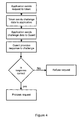
- FIG. 5 a flow diagram of a process for execution on a guard computer system including the steps of logging a transaction is shown.
- a guard receives a challenge. It decodes challenge data within the challenge and logs the transaction data. Typically, this data is sufficient for maintaining a log of all transactions. The data is then filtered to identify those transactions that are not problematic. For identified transactions, a challenge response is formed and transmitted to the challenging system - from which the challenge is received. When the transaction is problematic, it is analysed further. Typically, upon further analysis, a transaction is authorised and the challenge response is transmitted.
- the challenge is provided to an operator in the form of a person to verify the transaction manually.
- untypically large transactions or large numbers of transactions to a same account or a same account holder may be flagged and may require a person to verify that no fraud is occurring.
- these transactions are refused without human intervention by the guard system.
- no challenge reply is provided or a negative challenge reply is provided.
- a negative challenge reply is provided so the challenging system is assured of receiving responses from each guard system.
- a log helps to accurately identify transactions that have occurred so the Trojan horse is no longer invisible when it is done.
- the use of guards allows for enhanced security. This is achieved in two fashions. First, a number of systems must be breached in order to hide any unauthorised actions from activity logs. Secondly, the guard computers can be set to identify "unlikely" transactions and pass those on to either human operators or systems having better security resources for performing guarding functions. Alternatively, some guards may analyse the log data for some anomalies while others analyse the log for other anomalies. Thus security is increased.
- it is also possible to serially chain the guard process wherein a guard determines further guards for approving a transaction and responds with a challenge reply indicative of the further guards and so forth. Since challenge replies are signed by the guards, the replies cannot be falsified easily.
- the use of serial guards allows for each guard to perform a type of verification to analyse how many further or what type of further analysis is required.
- a simplified flow diagram of one serially implemented guard is shown.
- the guard receives a challenge.
- the transaction data is analysed to determine an amount category related to the transaction size, a transferor category relating to the originator of funds, a transferee category related to the destination of the funds, a transfer profile, and a miscellaneous category.
- For each category there is one or more further guards to which the challenge is to be sent.
- a transferee may be suspected of fraud so the transaction may go to a security guard wherein each transaction is verified by hand.
- the transferor may be suspected of money laundering and the challenge may also be directed toward a guard analysing transactions for laundering activities.
- the transaction is also analysed to determine any other loggable anomaly or known security breach such as a Trojan horse.
- the challenge is passed onto further guards.
- Each guard logs transactions and analyses them further to determine transaction authorisation. Alternatively, some guards merely log transactions.
- the challenge is sent to one or more guards at random.
- a man in the middle is unaware of the selected guard, it provides some reasonable level of security for many applications without the added communication overhead.
- the serial guard implementation provides a similar advantage at a cost of additional processing by intermediate guards.
- an application provides a request for securing of data to a token.
- the data relates to a transaction and the securing operation is provided in a secure fashion to the application.
- the token Before securing the data, the token transmits directly to a guard a challenge. Preferably, this is effected through device drivers on the system on which the application is executing.
- the token has a direct link to a network for outgoing challenges and to receive challenge replies. When a correct set of challenge replies is received, the data is secured and is returned to the application for processing.
- Fig. 7b the application requests signing of data provided to the token.
- the token provides a challenge to the application, which is then distributed to appropriate guards that reply directly to the token.
- the application is apprised of challenges and selected guards.
- Fig. 7c a system is shown wherein the application is disposed between the token and the guard.
- the data provided through the application is secured in a manner such that the application cannot tamper with the data.
- a man in the middle application is shown inserted between an application, a token and a guard.
- a security breach has occurred.
- Data requests from the application are intercepted and the requests are modified prior to being provided to the token.
- the destination account may be modified.
- the toke receives what appears to be a valid request and begins to process it. It determines a challenge.
- the challenge is provided to the man in the middle, which then provides it to the guards as necessary and so forth.
- the transaction is completed since proper challenge responses will be received unless the transaction is flagged by a guard.
- the application would, however, note that the transaction it requested has failed. Thus an alarm can be initiated.
- the man-in-the-middle can add new transactions on top of those of the application and thus process transactions undetected. That said, once detected, a complete log will exist within the guards to allow for reversal of fund transfers, damage assessment, legal prosecution, and so forth. As such, the present invention is highly advantageous.
Landscapes
- Engineering & Computer Science (AREA)
- Computer Security & Cryptography (AREA)
- Theoretical Computer Science (AREA)
- Computer Hardware Design (AREA)
- Software Systems (AREA)
- Physics & Mathematics (AREA)
- General Engineering & Computer Science (AREA)
- General Physics & Mathematics (AREA)
- Debugging And Monitoring (AREA)
- Information Retrieval, Db Structures And Fs Structures Therefor (AREA)
- Storage Device Security (AREA)
Applications Claiming Priority (2)
| Application Number | Priority Date | Filing Date | Title |
|---|---|---|---|
| US60822500A | 2000-06-30 | 2000-06-30 | |
| US608225 | 2000-06-30 |
Publications (2)
| Publication Number | Publication Date |
|---|---|
| EP1168138A2 true EP1168138A2 (de) | 2002-01-02 |
| EP1168138A3 EP1168138A3 (de) | 2004-02-04 |
Family
ID=24435580
Family Applications (1)
| Application Number | Title | Priority Date | Filing Date |
|---|---|---|---|
| EP01114528A Withdrawn EP1168138A3 (de) | 2000-06-30 | 2001-06-16 | System und Verfahren zur Erzeugung von Log-Dateien für gesicherte Transaktionen |
Country Status (1)
| Country | Link |
|---|---|
| EP (1) | EP1168138A3 (de) |
Cited By (3)
| Publication number | Priority date | Publication date | Assignee | Title |
|---|---|---|---|---|
| CN101339677B (zh) * | 2008-08-28 | 2010-06-23 | 北京飞天诚信科技有限公司 | 安全授权的方法和系统 |
| EP2209084A1 (de) * | 2009-01-13 | 2010-07-21 | Giesecke&Devrient | Manipulationssicherheit eines Endgeräts |
| US8321667B2 (en) | 2007-02-28 | 2012-11-27 | Microsoft Corporation | Security model for common multiplexed transactional logs |
Family Cites Families (4)
| Publication number | Priority date | Publication date | Assignee | Title |
|---|---|---|---|---|
| US4891503A (en) * | 1988-03-29 | 1990-01-02 | Gascard, Inc. | Distributed authorization system |
| GB2251098B (en) * | 1990-12-17 | 1994-10-05 | Allied Irish Banks P L C | Apparatus for processing data |
| US6039245A (en) * | 1996-06-10 | 2000-03-21 | Diebold, Incorporated | Financial transaction processing system and method |
| US5903721A (en) * | 1997-03-13 | 1999-05-11 | cha|Technologies Services, Inc. | Method and system for secure online transaction processing |
-
2001
- 2001-06-16 EP EP01114528A patent/EP1168138A3/de not_active Withdrawn
Cited By (3)
| Publication number | Priority date | Publication date | Assignee | Title |
|---|---|---|---|---|
| US8321667B2 (en) | 2007-02-28 | 2012-11-27 | Microsoft Corporation | Security model for common multiplexed transactional logs |
| CN101339677B (zh) * | 2008-08-28 | 2010-06-23 | 北京飞天诚信科技有限公司 | 安全授权的方法和系统 |
| EP2209084A1 (de) * | 2009-01-13 | 2010-07-21 | Giesecke&Devrient | Manipulationssicherheit eines Endgeräts |
Also Published As
| Publication number | Publication date |
|---|---|
| EP1168138A3 (de) | 2004-02-04 |
Similar Documents
| Publication | Publication Date | Title |
|---|---|---|
| US10666684B2 (en) | Security policies with probabilistic actions | |
| US6430688B1 (en) | Architecture for web-based on-line-off-line digital certificate authority | |
| CN112217835B (zh) | 报文数据的处理方法、装置、服务器和终端设备 | |
| CN109905360B (zh) | 数据验证方法及终端设备 | |
| KR19990044692A (ko) | 문서인증 시스템 및 방법 | |
| KR20040053103A (ko) | 데이터 관리 시스템 및 방법 | |
| CN113326327B (zh) | 一种基于区块链的凭证查询方法、系统及装置 | |
| CN106101092A (zh) | 一种信息评估处理方法及第一实体 | |
| Kshetri et al. | cryptoRAN: A review on cryptojacking and ransomware attacks wrt banking industry-threats, challenges, & problems | |
| Javed et al. | Blockchain-based logging to defeat malicious insiders: The case of remote health monitoring systems | |
| CN113627902A (zh) | 防止区块链入侵的方法和系统 | |
| Longley et al. | Information security: dictionary of concepts, standards and terms | |
| Kangwa | Prevention of personally identifiable information leakage in ecommerce using offline data minimization and online pseudonymisation. | |
| Cho et al. | Guaranteeing the integrity and reliability of distributed personal information access records | |
| EP1168138A2 (de) | System und Verfahren zur Erzeugung von Log-Dateien für gesicherte Transaktionen | |
| US20240289444A1 (en) | Systems and methods for preventing communications with malicious cryptography-based storage application addresses using consensus | |
| Chattopadhyay et al. | Mobile agent security against malicious hosts: A survey | |
| KR20130048532A (ko) | 차세대 금융 거래 시스템 | |
| JP2019161302A (ja) | 署名システム | |
| CN116010956A (zh) | 数据查询方法及相关产品 | |
| US7661111B2 (en) | Method for assuring event record integrity | |
| Cugnasco | Analysis of a multi-channel anti-fraud platform in banking | |
| CN120034395B (zh) | 支持kmip协议的全生命周期密钥管理服务方法及系统 | |
| KR101674314B1 (ko) | Captcha를 이용한 일회성 보안 문자 인증 방법 | |
| WO2007016869A2 (en) | Systems and methods of enhanced e-commerce,virus detection and antiphishing |
Legal Events
| Date | Code | Title | Description |
|---|---|---|---|
| PUAI | Public reference made under article 153(3) epc to a published international application that has entered the european phase |
Free format text: ORIGINAL CODE: 0009012 |
|
| AK | Designated contracting states |
Kind code of ref document: A2 Designated state(s): AT BE CH CY DE DK ES FI FR GB GR IE IT LI LU MC NL PT SE TR |
|
| AX | Request for extension of the european patent |
Free format text: AL;LT;LV;MK;RO;SI |
|
| PUAL | Search report despatched |
Free format text: ORIGINAL CODE: 0009013 |
|
| AK | Designated contracting states |
Kind code of ref document: A3 Designated state(s): AT BE CH CY DE DK ES FI FR GB GR IE IT LI LU MC NL PT SE TR |
|
| AX | Request for extension of the european patent |
Extension state: AL LT LV MK RO SI |
|
| RIC1 | Information provided on ipc code assigned before grant |
Ipc: 7G 06F 17/60 B Ipc: 7G 07F 19/00 B Ipc: 7G 06F 1/00 A |
|
| STAA | Information on the status of an ep patent application or granted ep patent |
Free format text: STATUS: THE APPLICATION IS DEEMED TO BE WITHDRAWN |
|
| 18D | Application deemed to be withdrawn |
Effective date: 20040102 |