EP1167833A2 - Powershift of a dog clutch type vehicle transmission - Google Patents
Powershift of a dog clutch type vehicle transmission Download PDFInfo
- Publication number
- EP1167833A2 EP1167833A2 EP01109304A EP01109304A EP1167833A2 EP 1167833 A2 EP1167833 A2 EP 1167833A2 EP 01109304 A EP01109304 A EP 01109304A EP 01109304 A EP01109304 A EP 01109304A EP 1167833 A2 EP1167833 A2 EP 1167833A2
- Authority
- EP
- European Patent Office
- Prior art keywords
- torque
- gear
- clutch
- output shaft
- gear shifting
- Prior art date
- Legal status (The legal status is an assumption and is not a legal conclusion. Google has not performed a legal analysis and makes no representation as to the accuracy of the status listed.)
- Granted
Links
Images






Classifications
-
- B—PERFORMING OPERATIONS; TRANSPORTING
- B60—VEHICLES IN GENERAL
- B60K—ARRANGEMENT OR MOUNTING OF PROPULSION UNITS OR OF TRANSMISSIONS IN VEHICLES; ARRANGEMENT OR MOUNTING OF PLURAL DIVERSE PRIME-MOVERS IN VEHICLES; AUXILIARY DRIVES FOR VEHICLES; INSTRUMENTATION OR DASHBOARDS FOR VEHICLES; ARRANGEMENTS IN CONNECTION WITH COOLING, AIR INTAKE, GAS EXHAUST OR FUEL SUPPLY OF PROPULSION UNITS IN VEHICLES
- B60K6/00—Arrangement or mounting of plural diverse prime-movers for mutual or common propulsion, e.g. hybrid propulsion systems comprising electric motors and internal combustion engines
- B60K6/20—Arrangement or mounting of plural diverse prime-movers for mutual or common propulsion, e.g. hybrid propulsion systems comprising electric motors and internal combustion engines the prime-movers consisting of electric motors and internal combustion engines, e.g. HEVs
- B60K6/42—Arrangement or mounting of plural diverse prime-movers for mutual or common propulsion, e.g. hybrid propulsion systems comprising electric motors and internal combustion engines the prime-movers consisting of electric motors and internal combustion engines, e.g. HEVs characterised by the architecture of the hybrid electric vehicle
- B60K6/48—Parallel type
-
- B—PERFORMING OPERATIONS; TRANSPORTING
- B60—VEHICLES IN GENERAL
- B60W—CONJOINT CONTROL OF VEHICLE SUB-UNITS OF DIFFERENT TYPE OR DIFFERENT FUNCTION; CONTROL SYSTEMS SPECIALLY ADAPTED FOR HYBRID VEHICLES; ROAD VEHICLE DRIVE CONTROL SYSTEMS FOR PURPOSES NOT RELATED TO THE CONTROL OF A PARTICULAR SUB-UNIT
- B60W10/00—Conjoint control of vehicle sub-units of different type or different function
- B60W10/02—Conjoint control of vehicle sub-units of different type or different function including control of driveline clutches
-
- B—PERFORMING OPERATIONS; TRANSPORTING
- B60—VEHICLES IN GENERAL
- B60W—CONJOINT CONTROL OF VEHICLE SUB-UNITS OF DIFFERENT TYPE OR DIFFERENT FUNCTION; CONTROL SYSTEMS SPECIALLY ADAPTED FOR HYBRID VEHICLES; ROAD VEHICLE DRIVE CONTROL SYSTEMS FOR PURPOSES NOT RELATED TO THE CONTROL OF A PARTICULAR SUB-UNIT
- B60W10/00—Conjoint control of vehicle sub-units of different type or different function
- B60W10/04—Conjoint control of vehicle sub-units of different type or different function including control of propulsion units
- B60W10/06—Conjoint control of vehicle sub-units of different type or different function including control of propulsion units including control of combustion engines
-
- B—PERFORMING OPERATIONS; TRANSPORTING
- B60—VEHICLES IN GENERAL
- B60W—CONJOINT CONTROL OF VEHICLE SUB-UNITS OF DIFFERENT TYPE OR DIFFERENT FUNCTION; CONTROL SYSTEMS SPECIALLY ADAPTED FOR HYBRID VEHICLES; ROAD VEHICLE DRIVE CONTROL SYSTEMS FOR PURPOSES NOT RELATED TO THE CONTROL OF A PARTICULAR SUB-UNIT
- B60W10/00—Conjoint control of vehicle sub-units of different type or different function
- B60W10/10—Conjoint control of vehicle sub-units of different type or different function including control of change-speed gearings
-
- B—PERFORMING OPERATIONS; TRANSPORTING
- B60—VEHICLES IN GENERAL
- B60W—CONJOINT CONTROL OF VEHICLE SUB-UNITS OF DIFFERENT TYPE OR DIFFERENT FUNCTION; CONTROL SYSTEMS SPECIALLY ADAPTED FOR HYBRID VEHICLES; ROAD VEHICLE DRIVE CONTROL SYSTEMS FOR PURPOSES NOT RELATED TO THE CONTROL OF A PARTICULAR SUB-UNIT
- B60W10/00—Conjoint control of vehicle sub-units of different type or different function
- B60W10/10—Conjoint control of vehicle sub-units of different type or different function including control of change-speed gearings
- B60W10/11—Stepped gearings
-
- B—PERFORMING OPERATIONS; TRANSPORTING
- B60—VEHICLES IN GENERAL
- B60W—CONJOINT CONTROL OF VEHICLE SUB-UNITS OF DIFFERENT TYPE OR DIFFERENT FUNCTION; CONTROL SYSTEMS SPECIALLY ADAPTED FOR HYBRID VEHICLES; ROAD VEHICLE DRIVE CONTROL SYSTEMS FOR PURPOSES NOT RELATED TO THE CONTROL OF A PARTICULAR SUB-UNIT
- B60W30/00—Purposes of road vehicle drive control systems not related to the control of a particular sub-unit, e.g. of systems using conjoint control of vehicle sub-units
- B60W30/18—Propelling the vehicle
- B60W30/19—Improvement of gear change, e.g. by synchronisation or smoothing gear shift
-
- F—MECHANICAL ENGINEERING; LIGHTING; HEATING; WEAPONS; BLASTING
- F16—ENGINEERING ELEMENTS AND UNITS; GENERAL MEASURES FOR PRODUCING AND MAINTAINING EFFECTIVE FUNCTIONING OF MACHINES OR INSTALLATIONS; THERMAL INSULATION IN GENERAL
- F16H—GEARING
- F16H3/00—Toothed gearings for conveying rotary motion with variable gear ratio or for reversing rotary motion
- F16H3/02—Toothed gearings for conveying rotary motion with variable gear ratio or for reversing rotary motion without gears having orbital motion
- F16H3/08—Toothed gearings for conveying rotary motion with variable gear ratio or for reversing rotary motion without gears having orbital motion exclusively or essentially with continuously meshing gears, that can be disengaged from their shafts
- F16H3/12—Toothed gearings for conveying rotary motion with variable gear ratio or for reversing rotary motion without gears having orbital motion exclusively or essentially with continuously meshing gears, that can be disengaged from their shafts with means for synchronisation not incorporated in the clutches
- F16H3/126—Toothed gearings for conveying rotary motion with variable gear ratio or for reversing rotary motion without gears having orbital motion exclusively or essentially with continuously meshing gears, that can be disengaged from their shafts with means for synchronisation not incorporated in the clutches using an electric drive
-
- F—MECHANICAL ENGINEERING; LIGHTING; HEATING; WEAPONS; BLASTING
- F16—ENGINEERING ELEMENTS AND UNITS; GENERAL MEASURES FOR PRODUCING AND MAINTAINING EFFECTIVE FUNCTIONING OF MACHINES OR INSTALLATIONS; THERMAL INSULATION IN GENERAL
- F16H—GEARING
- F16H61/00—Control functions within control units of change-speed- or reversing-gearings for conveying rotary motion ; Control of exclusively fluid gearing, friction gearing, gearings with endless flexible members or other particular types of gearing
- F16H61/04—Smoothing ratio shift
- F16H61/0403—Synchronisation before shifting
-
- F—MECHANICAL ENGINEERING; LIGHTING; HEATING; WEAPONS; BLASTING
- F16—ENGINEERING ELEMENTS AND UNITS; GENERAL MEASURES FOR PRODUCING AND MAINTAINING EFFECTIVE FUNCTIONING OF MACHINES OR INSTALLATIONS; THERMAL INSULATION IN GENERAL
- F16H—GEARING
- F16H61/00—Control functions within control units of change-speed- or reversing-gearings for conveying rotary motion ; Control of exclusively fluid gearing, friction gearing, gearings with endless flexible members or other particular types of gearing
- F16H61/04—Smoothing ratio shift
- F16H61/0437—Smoothing ratio shift by using electrical signals
-
- F—MECHANICAL ENGINEERING; LIGHTING; HEATING; WEAPONS; BLASTING
- F16—ENGINEERING ELEMENTS AND UNITS; GENERAL MEASURES FOR PRODUCING AND MAINTAINING EFFECTIVE FUNCTIONING OF MACHINES OR INSTALLATIONS; THERMAL INSULATION IN GENERAL
- F16H—GEARING
- F16H61/00—Control functions within control units of change-speed- or reversing-gearings for conveying rotary motion ; Control of exclusively fluid gearing, friction gearing, gearings with endless flexible members or other particular types of gearing
- F16H61/66—Control functions within control units of change-speed- or reversing-gearings for conveying rotary motion ; Control of exclusively fluid gearing, friction gearing, gearings with endless flexible members or other particular types of gearing specially adapted for continuously variable gearings
-
- F—MECHANICAL ENGINEERING; LIGHTING; HEATING; WEAPONS; BLASTING
- F16—ENGINEERING ELEMENTS AND UNITS; GENERAL MEASURES FOR PRODUCING AND MAINTAINING EFFECTIVE FUNCTIONING OF MACHINES OR INSTALLATIONS; THERMAL INSULATION IN GENERAL
- F16H—GEARING
- F16H61/00—Control functions within control units of change-speed- or reversing-gearings for conveying rotary motion ; Control of exclusively fluid gearing, friction gearing, gearings with endless flexible members or other particular types of gearing
- F16H61/68—Control functions within control units of change-speed- or reversing-gearings for conveying rotary motion ; Control of exclusively fluid gearing, friction gearing, gearings with endless flexible members or other particular types of gearing specially adapted for stepped gearings
- F16H61/684—Control functions within control units of change-speed- or reversing-gearings for conveying rotary motion ; Control of exclusively fluid gearing, friction gearing, gearings with endless flexible members or other particular types of gearing specially adapted for stepped gearings without interruption of drive
- F16H61/688—Control functions within control units of change-speed- or reversing-gearings for conveying rotary motion ; Control of exclusively fluid gearing, friction gearing, gearings with endless flexible members or other particular types of gearing specially adapted for stepped gearings without interruption of drive with two inputs, e.g. selection of one of two torque-flow paths by clutches
-
- F—MECHANICAL ENGINEERING; LIGHTING; HEATING; WEAPONS; BLASTING
- F16—ENGINEERING ELEMENTS AND UNITS; GENERAL MEASURES FOR PRODUCING AND MAINTAINING EFFECTIVE FUNCTIONING OF MACHINES OR INSTALLATIONS; THERMAL INSULATION IN GENERAL
- F16H—GEARING
- F16H63/00—Control outputs from the control unit to change-speed- or reversing-gearings for conveying rotary motion or to other devices than the final output mechanism
- F16H63/40—Control outputs from the control unit to change-speed- or reversing-gearings for conveying rotary motion or to other devices than the final output mechanism comprising signals other than signals for actuating the final output mechanisms
- F16H63/50—Signals to an engine or motor
- F16H63/502—Signals to an engine or motor for smoothing gear shifts
-
- B—PERFORMING OPERATIONS; TRANSPORTING
- B60—VEHICLES IN GENERAL
- B60W—CONJOINT CONTROL OF VEHICLE SUB-UNITS OF DIFFERENT TYPE OR DIFFERENT FUNCTION; CONTROL SYSTEMS SPECIALLY ADAPTED FOR HYBRID VEHICLES; ROAD VEHICLE DRIVE CONTROL SYSTEMS FOR PURPOSES NOT RELATED TO THE CONTROL OF A PARTICULAR SUB-UNIT
- B60W2520/00—Input parameters relating to overall vehicle dynamics
- B60W2520/10—Longitudinal speed
-
- B—PERFORMING OPERATIONS; TRANSPORTING
- B60—VEHICLES IN GENERAL
- B60W—CONJOINT CONTROL OF VEHICLE SUB-UNITS OF DIFFERENT TYPE OR DIFFERENT FUNCTION; CONTROL SYSTEMS SPECIALLY ADAPTED FOR HYBRID VEHICLES; ROAD VEHICLE DRIVE CONTROL SYSTEMS FOR PURPOSES NOT RELATED TO THE CONTROL OF A PARTICULAR SUB-UNIT
- B60W2710/00—Output or target parameters relating to a particular sub-units
- B60W2710/06—Combustion engines, Gas turbines
- B60W2710/0605—Throttle position
-
- B—PERFORMING OPERATIONS; TRANSPORTING
- B60—VEHICLES IN GENERAL
- B60W—CONJOINT CONTROL OF VEHICLE SUB-UNITS OF DIFFERENT TYPE OR DIFFERENT FUNCTION; CONTROL SYSTEMS SPECIALLY ADAPTED FOR HYBRID VEHICLES; ROAD VEHICLE DRIVE CONTROL SYSTEMS FOR PURPOSES NOT RELATED TO THE CONTROL OF A PARTICULAR SUB-UNIT
- B60W2710/00—Output or target parameters relating to a particular sub-units
- B60W2710/06—Combustion engines, Gas turbines
- B60W2710/0666—Engine torque
-
- F—MECHANICAL ENGINEERING; LIGHTING; HEATING; WEAPONS; BLASTING
- F16—ENGINEERING ELEMENTS AND UNITS; GENERAL MEASURES FOR PRODUCING AND MAINTAINING EFFECTIVE FUNCTIONING OF MACHINES OR INSTALLATIONS; THERMAL INSULATION IN GENERAL
- F16H—GEARING
- F16H61/00—Control functions within control units of change-speed- or reversing-gearings for conveying rotary motion ; Control of exclusively fluid gearing, friction gearing, gearings with endless flexible members or other particular types of gearing
- F16H61/04—Smoothing ratio shift
- F16H61/0403—Synchronisation before shifting
- F16H2061/0407—Synchronisation before shifting by control of clutch in parallel torque path
-
- F—MECHANICAL ENGINEERING; LIGHTING; HEATING; WEAPONS; BLASTING
- F16—ENGINEERING ELEMENTS AND UNITS; GENERAL MEASURES FOR PRODUCING AND MAINTAINING EFFECTIVE FUNCTIONING OF MACHINES OR INSTALLATIONS; THERMAL INSULATION IN GENERAL
- F16H—GEARING
- F16H61/00—Control functions within control units of change-speed- or reversing-gearings for conveying rotary motion ; Control of exclusively fluid gearing, friction gearing, gearings with endless flexible members or other particular types of gearing
- F16H61/04—Smoothing ratio shift
- F16H61/0403—Synchronisation before shifting
- F16H2061/0422—Synchronisation before shifting by an electric machine, e.g. by accelerating or braking the input shaft
-
- F—MECHANICAL ENGINEERING; LIGHTING; HEATING; WEAPONS; BLASTING
- F16—ENGINEERING ELEMENTS AND UNITS; GENERAL MEASURES FOR PRODUCING AND MAINTAINING EFFECTIVE FUNCTIONING OF MACHINES OR INSTALLATIONS; THERMAL INSULATION IN GENERAL
- F16H—GEARING
- F16H61/00—Control functions within control units of change-speed- or reversing-gearings for conveying rotary motion ; Control of exclusively fluid gearing, friction gearing, gearings with endless flexible members or other particular types of gearing
- F16H61/04—Smoothing ratio shift
- F16H2061/0425—Bridging torque interruption
- F16H2061/0429—Bridging torque interruption by torque supply with a clutch in parallel torque path
-
- F—MECHANICAL ENGINEERING; LIGHTING; HEATING; WEAPONS; BLASTING
- F16—ENGINEERING ELEMENTS AND UNITS; GENERAL MEASURES FOR PRODUCING AND MAINTAINING EFFECTIVE FUNCTIONING OF MACHINES OR INSTALLATIONS; THERMAL INSULATION IN GENERAL
- F16H—GEARING
- F16H61/00—Control functions within control units of change-speed- or reversing-gearings for conveying rotary motion ; Control of exclusively fluid gearing, friction gearing, gearings with endless flexible members or other particular types of gearing
- F16H61/04—Smoothing ratio shift
- F16H2061/0425—Bridging torque interruption
- F16H2061/0433—Bridging torque interruption by torque supply with an electric motor
-
- F—MECHANICAL ENGINEERING; LIGHTING; HEATING; WEAPONS; BLASTING
- F16—ENGINEERING ELEMENTS AND UNITS; GENERAL MEASURES FOR PRODUCING AND MAINTAINING EFFECTIVE FUNCTIONING OF MACHINES OR INSTALLATIONS; THERMAL INSULATION IN GENERAL
- F16H—GEARING
- F16H61/00—Control functions within control units of change-speed- or reversing-gearings for conveying rotary motion ; Control of exclusively fluid gearing, friction gearing, gearings with endless flexible members or other particular types of gearing
- F16H61/04—Smoothing ratio shift
- F16H2061/0444—Smoothing ratio shift during fast shifting over two gearsteps, e.g. jumping from fourth to second gear
-
- F—MECHANICAL ENGINEERING; LIGHTING; HEATING; WEAPONS; BLASTING
- F16—ENGINEERING ELEMENTS AND UNITS; GENERAL MEASURES FOR PRODUCING AND MAINTAINING EFFECTIVE FUNCTIONING OF MACHINES OR INSTALLATIONS; THERMAL INSULATION IN GENERAL
- F16H—GEARING
- F16H61/00—Control functions within control units of change-speed- or reversing-gearings for conveying rotary motion ; Control of exclusively fluid gearing, friction gearing, gearings with endless flexible members or other particular types of gearing
- F16H61/04—Smoothing ratio shift
- F16H2061/0444—Smoothing ratio shift during fast shifting over two gearsteps, e.g. jumping from fourth to second gear
- F16H2061/0448—Smoothing ratio shift during fast shifting over two gearsteps, e.g. jumping from fourth to second gear using a particular sequence of gear ratios or friction members
-
- F—MECHANICAL ENGINEERING; LIGHTING; HEATING; WEAPONS; BLASTING
- F16—ENGINEERING ELEMENTS AND UNITS; GENERAL MEASURES FOR PRODUCING AND MAINTAINING EFFECTIVE FUNCTIONING OF MACHINES OR INSTALLATIONS; THERMAL INSULATION IN GENERAL
- F16H—GEARING
- F16H2200/00—Transmissions for multiple ratios
- F16H2200/003—Transmissions for multiple ratios characterised by the number of forward speeds
- F16H2200/0043—Transmissions for multiple ratios characterised by the number of forward speeds the gear ratios comprising four forward speeds
-
- F—MECHANICAL ENGINEERING; LIGHTING; HEATING; WEAPONS; BLASTING
- F16—ENGINEERING ELEMENTS AND UNITS; GENERAL MEASURES FOR PRODUCING AND MAINTAINING EFFECTIVE FUNCTIONING OF MACHINES OR INSTALLATIONS; THERMAL INSULATION IN GENERAL
- F16H—GEARING
- F16H2306/00—Shifting
- F16H2306/14—Skipping gear shift
-
- F—MECHANICAL ENGINEERING; LIGHTING; HEATING; WEAPONS; BLASTING
- F16—ENGINEERING ELEMENTS AND UNITS; GENERAL MEASURES FOR PRODUCING AND MAINTAINING EFFECTIVE FUNCTIONING OF MACHINES OR INSTALLATIONS; THERMAL INSULATION IN GENERAL
- F16H—GEARING
- F16H2306/00—Shifting
- F16H2306/40—Shifting activities
- F16H2306/48—Synchronising of new gear
-
- F—MECHANICAL ENGINEERING; LIGHTING; HEATING; WEAPONS; BLASTING
- F16—ENGINEERING ELEMENTS AND UNITS; GENERAL MEASURES FOR PRODUCING AND MAINTAINING EFFECTIVE FUNCTIONING OF MACHINES OR INSTALLATIONS; THERMAL INSULATION IN GENERAL
- F16H—GEARING
- F16H3/00—Toothed gearings for conveying rotary motion with variable gear ratio or for reversing rotary motion
- F16H3/02—Toothed gearings for conveying rotary motion with variable gear ratio or for reversing rotary motion without gears having orbital motion
- F16H3/08—Toothed gearings for conveying rotary motion with variable gear ratio or for reversing rotary motion without gears having orbital motion exclusively or essentially with continuously meshing gears, that can be disengaged from their shafts
- F16H3/087—Toothed gearings for conveying rotary motion with variable gear ratio or for reversing rotary motion without gears having orbital motion exclusively or essentially with continuously meshing gears, that can be disengaged from their shafts characterised by the disposition of the gears
- F16H3/089—Toothed gearings for conveying rotary motion with variable gear ratio or for reversing rotary motion without gears having orbital motion exclusively or essentially with continuously meshing gears, that can be disengaged from their shafts characterised by the disposition of the gears all of the meshing gears being supported by a pair of parallel shafts, one being the input shaft and the other the output shaft, there being no countershaft involved
-
- F—MECHANICAL ENGINEERING; LIGHTING; HEATING; WEAPONS; BLASTING
- F16—ENGINEERING ELEMENTS AND UNITS; GENERAL MEASURES FOR PRODUCING AND MAINTAINING EFFECTIVE FUNCTIONING OF MACHINES OR INSTALLATIONS; THERMAL INSULATION IN GENERAL
- F16H—GEARING
- F16H59/00—Control inputs to control units of change-speed- or reversing-gearings for conveying rotary motion
- F16H59/36—Inputs being a function of speed
- F16H59/38—Inputs being a function of speed of gearing elements
- F16H59/42—Input shaft speed
-
- F—MECHANICAL ENGINEERING; LIGHTING; HEATING; WEAPONS; BLASTING
- F16—ENGINEERING ELEMENTS AND UNITS; GENERAL MEASURES FOR PRODUCING AND MAINTAINING EFFECTIVE FUNCTIONING OF MACHINES OR INSTALLATIONS; THERMAL INSULATION IN GENERAL
- F16H—GEARING
- F16H59/00—Control inputs to control units of change-speed- or reversing-gearings for conveying rotary motion
- F16H59/36—Inputs being a function of speed
- F16H59/44—Inputs being a function of speed dependent on machine speed, e.g. the vehicle speed
-
- Y—GENERAL TAGGING OF NEW TECHNOLOGICAL DEVELOPMENTS; GENERAL TAGGING OF CROSS-SECTIONAL TECHNOLOGIES SPANNING OVER SEVERAL SECTIONS OF THE IPC; TECHNICAL SUBJECTS COVERED BY FORMER USPC CROSS-REFERENCE ART COLLECTIONS [XRACs] AND DIGESTS
- Y02—TECHNOLOGIES OR APPLICATIONS FOR MITIGATION OR ADAPTATION AGAINST CLIMATE CHANGE
- Y02T—CLIMATE CHANGE MITIGATION TECHNOLOGIES RELATED TO TRANSPORTATION
- Y02T10/00—Road transport of goods or passengers
- Y02T10/60—Other road transportation technologies with climate change mitigation effect
- Y02T10/62—Hybrid vehicles
-
- Y—GENERAL TAGGING OF NEW TECHNOLOGICAL DEVELOPMENTS; GENERAL TAGGING OF CROSS-SECTIONAL TECHNOLOGIES SPANNING OVER SEVERAL SECTIONS OF THE IPC; TECHNICAL SUBJECTS COVERED BY FORMER USPC CROSS-REFERENCE ART COLLECTIONS [XRACs] AND DIGESTS
- Y10—TECHNICAL SUBJECTS COVERED BY FORMER USPC
- Y10S—TECHNICAL SUBJECTS COVERED BY FORMER USPC CROSS-REFERENCE ART COLLECTIONS [XRACs] AND DIGESTS
- Y10S903/00—Hybrid electric vehicles, HEVS
- Y10S903/902—Prime movers comprising electrical and internal combustion motors
- Y10S903/903—Prime movers comprising electrical and internal combustion motors having energy storing means, e.g. battery, capacitor
-
- Y—GENERAL TAGGING OF NEW TECHNOLOGICAL DEVELOPMENTS; GENERAL TAGGING OF CROSS-SECTIONAL TECHNOLOGIES SPANNING OVER SEVERAL SECTIONS OF THE IPC; TECHNICAL SUBJECTS COVERED BY FORMER USPC CROSS-REFERENCE ART COLLECTIONS [XRACs] AND DIGESTS
- Y10—TECHNICAL SUBJECTS COVERED BY FORMER USPC
- Y10S—TECHNICAL SUBJECTS COVERED BY FORMER USPC CROSS-REFERENCE ART COLLECTIONS [XRACs] AND DIGESTS
- Y10S903/00—Hybrid electric vehicles, HEVS
- Y10S903/902—Prime movers comprising electrical and internal combustion motors
- Y10S903/903—Prime movers comprising electrical and internal combustion motors having energy storing means, e.g. battery, capacitor
- Y10S903/904—Component specially adapted for hev
- Y10S903/915—Specific drive or transmission adapted for hev
- Y10S903/917—Specific drive or transmission adapted for hev with transmission for changing gear ratio
- Y10S903/919—Stepped shift
-
- Y—GENERAL TAGGING OF NEW TECHNOLOGICAL DEVELOPMENTS; GENERAL TAGGING OF CROSS-SECTIONAL TECHNOLOGIES SPANNING OVER SEVERAL SECTIONS OF THE IPC; TECHNICAL SUBJECTS COVERED BY FORMER USPC CROSS-REFERENCE ART COLLECTIONS [XRACs] AND DIGESTS
- Y10—TECHNICAL SUBJECTS COVERED BY FORMER USPC
- Y10S—TECHNICAL SUBJECTS COVERED BY FORMER USPC CROSS-REFERENCE ART COLLECTIONS [XRACs] AND DIGESTS
- Y10S903/00—Hybrid electric vehicles, HEVS
- Y10S903/902—Prime movers comprising electrical and internal combustion motors
- Y10S903/903—Prime movers comprising electrical and internal combustion motors having energy storing means, e.g. battery, capacitor
- Y10S903/945—Characterized by control of gearing, e.g. control of transmission ratio
-
- Y—GENERAL TAGGING OF NEW TECHNOLOGICAL DEVELOPMENTS; GENERAL TAGGING OF CROSS-SECTIONAL TECHNOLOGIES SPANNING OVER SEVERAL SECTIONS OF THE IPC; TECHNICAL SUBJECTS COVERED BY FORMER USPC CROSS-REFERENCE ART COLLECTIONS [XRACs] AND DIGESTS
- Y10—TECHNICAL SUBJECTS COVERED BY FORMER USPC
- Y10S—TECHNICAL SUBJECTS COVERED BY FORMER USPC CROSS-REFERENCE ART COLLECTIONS [XRACs] AND DIGESTS
- Y10S903/00—Hybrid electric vehicles, HEVS
- Y10S903/902—Prime movers comprising electrical and internal combustion motors
- Y10S903/903—Prime movers comprising electrical and internal combustion motors having energy storing means, e.g. battery, capacitor
- Y10S903/946—Characterized by control of driveline clutch
-
- Y—GENERAL TAGGING OF NEW TECHNOLOGICAL DEVELOPMENTS; GENERAL TAGGING OF CROSS-SECTIONAL TECHNOLOGIES SPANNING OVER SEVERAL SECTIONS OF THE IPC; TECHNICAL SUBJECTS COVERED BY FORMER USPC CROSS-REFERENCE ART COLLECTIONS [XRACs] AND DIGESTS
- Y10—TECHNICAL SUBJECTS COVERED BY FORMER USPC
- Y10T—TECHNICAL SUBJECTS COVERED BY FORMER US CLASSIFICATION
- Y10T74/00—Machine element or mechanism
- Y10T74/19—Gearing
- Y10T74/19219—Interchangeably locked
-
- Y—GENERAL TAGGING OF NEW TECHNOLOGICAL DEVELOPMENTS; GENERAL TAGGING OF CROSS-SECTIONAL TECHNOLOGIES SPANNING OVER SEVERAL SECTIONS OF THE IPC; TECHNICAL SUBJECTS COVERED BY FORMER USPC CROSS-REFERENCE ART COLLECTIONS [XRACs] AND DIGESTS
- Y10—TECHNICAL SUBJECTS COVERED BY FORMER USPC
- Y10T—TECHNICAL SUBJECTS COVERED BY FORMER US CLASSIFICATION
- Y10T74/00—Machine element or mechanism
- Y10T74/19—Gearing
- Y10T74/19219—Interchangeably locked
- Y10T74/19228—Multiple concentric clutch shafts
-
- Y—GENERAL TAGGING OF NEW TECHNOLOGICAL DEVELOPMENTS; GENERAL TAGGING OF CROSS-SECTIONAL TECHNOLOGIES SPANNING OVER SEVERAL SECTIONS OF THE IPC; TECHNICAL SUBJECTS COVERED BY FORMER USPC CROSS-REFERENCE ART COLLECTIONS [XRACs] AND DIGESTS
- Y10—TECHNICAL SUBJECTS COVERED BY FORMER USPC
- Y10T—TECHNICAL SUBJECTS COVERED BY FORMER US CLASSIFICATION
- Y10T74/00—Machine element or mechanism
- Y10T74/19—Gearing
- Y10T74/19219—Interchangeably locked
- Y10T74/19242—Combined gear and clutch
-
- Y—GENERAL TAGGING OF NEW TECHNOLOGICAL DEVELOPMENTS; GENERAL TAGGING OF CROSS-SECTIONAL TECHNOLOGIES SPANNING OVER SEVERAL SECTIONS OF THE IPC; TECHNICAL SUBJECTS COVERED BY FORMER USPC CROSS-REFERENCE ART COLLECTIONS [XRACs] AND DIGESTS
- Y10—TECHNICAL SUBJECTS COVERED BY FORMER USPC
- Y10T—TECHNICAL SUBJECTS COVERED BY FORMER US CLASSIFICATION
- Y10T74/00—Machine element or mechanism
- Y10T74/19—Gearing
- Y10T74/19219—Interchangeably locked
- Y10T74/19251—Control mechanism
-
- Y—GENERAL TAGGING OF NEW TECHNOLOGICAL DEVELOPMENTS; GENERAL TAGGING OF CROSS-SECTIONAL TECHNOLOGIES SPANNING OVER SEVERAL SECTIONS OF THE IPC; TECHNICAL SUBJECTS COVERED BY FORMER USPC CROSS-REFERENCE ART COLLECTIONS [XRACs] AND DIGESTS
- Y10—TECHNICAL SUBJECTS COVERED BY FORMER USPC
- Y10T—TECHNICAL SUBJECTS COVERED BY FORMER US CLASSIFICATION
- Y10T74/00—Machine element or mechanism
- Y10T74/19—Gearing
- Y10T74/19219—Interchangeably locked
- Y10T74/19251—Control mechanism
- Y10T74/19256—Automatic
- Y10T74/19274—Automatic torque responsive
Definitions
- the present invention relates to a control apparatus and a control method of a vehicle.
- this type of vehicle As a vehicle provided a gear type transmission mechanism, this type of vehicle has been conventionally known which utilizes a friction clutch as the smallest gear ratio of the gear type transmission, controls the input shaft speed of the transmission to be in synchronous to the output shaft speed by slipping this friction clutch when shifting the gear, and corrects the torque lowered in shifting the gear by means of the torque transmitted by the friction torque for the purpose of realizing smoother gear shifting.
- the representative one of this type of vehicle is disclosed in JP-A-61-45163.
- the mesh type clutch may be engaged by matching the revolution speeds.
- the adverse effect by a control error and a variety of an oil pressure brings about inertia torque caused by the deviation of the revolution speed (ratio) in engaging the mesh type clutch, which inertia torque may lead to a vibrating torque variation (shaft vibration). It is a further object of the present invention to alleviate the inertia torque and thereby suppressing the torque variation, for improving the performance in gear shifting of a vehicle.
- the present invention concerns with a control apparatus a vehicle which provides torque transmission devices between an input shaft and an output shaft of a gear type transmission, uses a friction clutch for the torque transmission device of at least one gear ratio position and a mesh type clutch for the torque transmission device of another gear ratio position, and control the friction clutch when shifting one gear ratio position to another position.
- This apparatus includes a lowered torque correcting unit for correcting the lowered output shaft torque in shifting the gear and a revolution speed control unit for controlling the input shaft speed on the basis of the corrected value of the lowered torque given by the lowered torque correcting unit.
- the apparatus of controlling a vehicle includes a torque adjusting unit for adjusting the input shaft torque when terminating the gear shifting on the basis of the corrected value of the lowered torque.
- the present invention concerns with a control method of a vehicle which is arranged to provide a torque transmission device between an input shaft and an output shaft of a gear type transmission, use a friction clutch for the torque transmission device of at least one gear ratio position and a mesh type clutch for the torque transmission device of another gear ratio position, and control the friction clutch in shifting one gear ratio position to another gear ratio position.
- This control method includes the steps of correcting the lowered output shaft torque in gear shifting and controlling the revolution speed of the input shaft on the corrected value of the lowered torque.
- the method of controlling a vehicle according to the invention is arranged to adjust the input shaft torque when terminating the gear shifting on the basis of the torque corrected value.
- the invention concerns with a control apparatus a vehicle which is constructed to separate a torque transmission system located between the input shaft and the output shaft of the gear type transmission into a first transmission system and a second transmission system, each of which is composed of a combination of mesh type clutches, use the friction clutches for the torque transmission systems located between an engine and the first transmission system and between the engine and the second transmission system, and control the friction clutches in shifting one gear ratio position to another.
- the control apparatus includes a lowered torque correcting unit for correcting the lowered output shaft torque in gear shifting and a revolution speed control unit for controlling the revolution speed of the input shaft on the basis of the corrected value of the lowered torque given by the lowered torque correcting unit.
- the apparatus of controlling a vehicle according to the invention includes a torque adjusting unit for adjusting the input shaft torque in terminating the gear shifting on the basis of the corrected value of the lowered torque.
- the present invention concerns with a control method of a vehicle in which a torque transmitting system located between an input shaft and an output shaft of a gear type transmission is separated into a first transmission system and a second transmission system, each of which is a combination of mesh type clutches, the torque transmitting systems located between an engine and the first transmission system and between the engine and the second transmission system are friction clutches, and the friction clutches are controlled when one gear stage is changed into another gear stage, the method including the step of correcting the lowered torque value of the output shaft in the gear shifting during the shifting, and the step of controlling a revolution speed of said input shaft on the basis of the corrected lowered torque correction.
- the method of controlling a vehicle according to the invention is arranged to adjust the input shaft torque when terminating the gear shifting on the basis of the torque corrected value.
- the invention concerns with a control apparatus a vehicle wherein devices for transmitting torque are located between an input shaft and an output shaft of a gear type transmission, the torque transmitting device of at least one gear stage is a friction clutch, said torque transmitting device of another gear stage is a mesh type clutch, and the friction clutch is controlled when one gear stage is changed into another gear stage, said apparatus including a unit for suppressing torque variation of said output shaft taking place when the mesh type clutch is engaged by means of at least one friction clutch provided in the gear type transmission in the case of the gear shifting.
- the present invention concerns with a control apparatus a vehicle which is constructed to provide a torque transmission device between an input shaft and an output shaft of a gear type transmission, use a friction clutch for the torque transmission device of at least one gear ratio position and a mesh type clutch for the torque transmission device of another gear ratio position, and control the friction clutch in shifting one gear ratio position to another.
- the control apparatus includes a torque variation suppressing unit for suppressing the torque variation of the output shaft generated in engaging the mesh type clutches through the effect of at least one friction clutch located in the gear type transmission.
- the present invention concerns with a control method of a vehicle which is constructed to locate a torque transmission device between an input shaft and an output shaft of a gear type transmission, use a friction clutch for the torque transmission device of at least one gear ratio position and a mesh type clutch for the torque transmission device of another gear ratio position, and control the friction clutch in shifting one gear ratio position to another.
- the control method includes the step of suppressing a torque variation of the output shaft generated in engaging the mesh type clutch in gear shifting by means of at least one dynamo-electric machine located in the gear type transmission.
- the present invention concerns with a control apparatus a vehicle which is constructed to locate a torque transmission device between an input shaft and an output shaft of a gear type transmission, use a friction clutch for at least one gear ratio position and a mesh type clutch for the torque transmission of another gear ratio position and control the friction clutch in shifting one gear ratio position to another.
- the control apparatus includes the step of suppressing the torque variation of the output shaft generated in engaging the mesh type clutch through the effect of at least one dynamo-electric machine located in the gear type transmission.
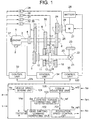
- Fig. 1 is a block diagram showing a vehicle system and a control apparatus thereof according to an embodiment of the present invention.
- An engine 1 provides an electronic control throttle 2 for adjusting engine torque and a revolution sensor 37 for measuring a revolution speed Ne of the engine 1 (also referred to as an engine speed Ne), through which the output torque can be controlled with high accuracy.
- a clutch 4 is located between an output shaft 3 of the engine 1 and an input shaft 8 of a gear type transmission 50 so that the output torque of the engine 1 may be transmitted to the input shaft 8 of the gear transmission.
- the clutch 4 is a dry type single plate one in which its pressure force is controlled by a hydraulic actuator 32. By adjusting the pressure force of the clutch 4, the power transmission from the output shaft 3 to the input shaft 8 of the engine is connected or disconnected.
- the input shaft 8 includes gears 5, 6, 7 fixed thereto.
- the gear 5 is used as a sensor for a revolution speed Nin of the input shaft 8.
- the movement of the teeth of this gear 5 is sensed by the sensor 36 so that the revolution speed Nin of the input shaft 8 may be sensed accordingly.
- the output shaft 26 of a motor 27 is connected to a gear 24 provided with a clutch 25 so that the gear 24 may constantly engaged with the gear 7.
- the clutch 25 is a dry type single plate one by which the output torque of the motor 27 may be transmitted to the gear 24.
- the pressure force of this clutch 25 is controlled by the hydraulic actuator 29 and the power transmission from the output shaft 26 to the input shaft 8 may be connected or disconnected by adjusting the pressure force of the clutch 25.
- the output shaft 20 of the gear type transmission 50 includes a gear 18 provided with a toothed wheel 14 and a synchronizer ring 16, a gear 11 provided with a toothed wheel 12 and a synchronizer ring 15, and a hub 17 and a sleeve (not shown) for directly connecting between the gears 18 and 11 and the output shaft 20.
- the gears 18 and 11 provide a stopper (not shown) for stopping the movement of the gear in the axial direction of the output shaft 20, respectively.
- the inside of the hub 17 is provided grooves (not shown) for mating with a plurality of grooves (not shown) of the output shaft 20. This hub 17 is engaged with the output shaft 20 so that the hub 17 allows the gear to be relatively moved in the axial direction of the output shaft 20 but restricts the gear to be moved in the rotating direction. Hence, the torque of the hub 17 is transmitted to the output shaft 20.
- the hub 17 is used as a sensor for sensing a revolution speed No of the output shaft 20.
- the revolution speed of the output shaft 20 can be sensed by sensing the revolution of the hub 17 through the use of the sensor 13.
- a torque transmitting device composed of the hub 17 and the sleeve, the toothed wheel 14, the synchronizer ring 16, the toothed wheel 12, and the synchronizer ring 15 takes a claw clutch mechanism, which is referred to as a mesh type clutch.
- the mechanism allows the energy from a power source like the engine 1 to be highly efficiently transmitted to wheels 23 through a differential unit 21 and an axle 22, for aiding in reducing fuel consumption.
- the output shaft 20 has a gear 9 provided with a clutch 10.
- the clutch 10 uses a multiplate wet friction one as the torque transmitting device so that the input shaft torque 8 may be transmitted to the output shaft 20.
- the pressure force of this clutch 10 is controlled by the hydraulic actuator 23 and the power transmission from the input shaft 8 to the output shaft 20 may be connected or disconnected by adjusting this pressure force.
- the gear ratio of the gear 5 to the gear 9 is adjusted to be smaller than the gear ratio of the gear 7 to the gear 18 or the gear ratio of the gear 6 to the gear 11.
- an electronic control throttle 2 provided in an intake pipe (not shown) is served to control an intake air flow so that a fuel amount matched to the intake air amount is injected from a fuel injection system (not shown).
- the throttle 2 is also served to determine an ignition timing on the basis of an air/fuel ratio determined by the air amount and the fuel amount and the engine speed Ne.
- the fuel injection system may be an intake port injection system in which fuel is injected to an intake port or a cylinder injection system in which fuel is directly injected to the inside of the cylinder. It is preferable for the fuel injection system to reduce the fuel consumption and select a better exhaust performance by considering a operation range (determined by the engine torque and the engine speed) for the engine.
- the control apparatus 100 is inputted with an accelerator pedal depress signal ⁇ , a shift lever position signal Ii, an engine speed signal Ne sensed by the sensor 37, an input shaft revolution speed signal Nin sensed by the sensor 36, and an output shaft revolution speed signal No. Then, this control apparatus 100 is served to compute the torque T3 of the engine 1 and then transmit the torque Te to a control device 34 through a LAN inside of a vehicle.
- the control device 34 is served to compute such a throttle valve opening angle, a fuel amount and an ignition timing as meeting the received engine torque Te and to control the actuators (for example, the electronic control throttle 2) based on these factors.
- control apparatus 100 is served to compute the torque and the speed of the motor 27 and then transmit them to the control device 35 through the LAN.
- the control device 35 is served to charge a battery 28 with an electric power fed by the motor 27 and to feed an electric power from the battery 28 for driving the motor 27.
- the control apparatus 100 may be implemented by a computer including a CPU to be operated according to a program, a memory for storing a control program and data, an I/O control unit, and a bus for mutually connecting them with one another. Whole or a part of the control apparatus 10 can also be implemented by a hardware circuit.
- the control apparatus 100 includes a vehicle speed sensing unit 101, a gear shifting command generating unit 102, a lowered torque correcting unit 103, a revolution speed control unit 104, and a torque adjusting unit 105.
- the gear shifting command generating unit 102 is served to determine a gear shifting command Ss on the basis of the inputted accelerator pedal depress amount ⁇ and the vehicle speed Vsp derived by the vehicle speed sensing unit 101.
- This gear shifting command Ss is selected from the values stored in a memory unit (not shown) included in the control apparatus 100, those values being derived as those for enhancing the efficiencies of the engine 1 and the motor 27 to a maximum by an experiment or simulation.
- control of this clutch 10 is executed by controlling the actuators 29 to 32 in response to an indication from the control apparatus 100 so that the control device 33 may control the gear type transmission 50.
- Fig. 2 is an explanatory view showing the first gear driving state provided in the case of accelerating the vehicle when it is run by the driving force of the engine 1.
- the dotted arrow of Fig. 2 indicates the transmission path of the torque.
- the clutch 4 is linked and the mesh type clutch (hub 17) is linked with the gear 18.
- the torque of the engine 1 is transmitted to the output shaft 20 through the clutch 4, the input shaft 8, the gear 7, and the gear 18.
- the clutch 10 is released.
- the gear ratio of the input shaft 8 to the output shaft 20 is made to be the second gear ratio, as shown in Fig. 4, the mesh type clutch (hub 17) is linked with the gear 11 and the gear 11 is linked with the output shaft 20. Upon completion of this link, the pressure force of the clutch 10 is released by controlling the actuator 31. Then, the gear shifting from the first to the second gear is completed. In this second gear driving state, the torque of the engine 1 is transmitted through the output shaft 3, the clutch 4, the input shaft 8, the gear 6, the gear 11, the hub 17 and the output shaft 20 of the engine 1 in this describing order.
- the state is neutralized by releasing the first gear state.
- the torque of the engine 1 is transmitted to the axle 22 through the clutch 10 and the gears 5 and 9.
- the lowered torque in the gear shifting can be corrected.
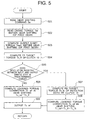
- Fig. 5 is a flowchart showing a control process in the lowered torque correcting unit 103.
- An operation is executed to read the gear shifting command Ss outputted from the gear shifting command generating unit 102.
- An operation is executed to read the torque Te1 of the engine 1 before the gear shifting (first gear) transmitted from the control device 34 through the LAN.
- An operation is executed to compute the torque Tout1 of the output shaft 20 before the gear shifting (first gear) on the basis of the torque Te1 of the engine before the gear shifting, read in the step 502.
- An operation is executed to compute an FF (Feed Forward) target torque Tc_ff of the clutch 10 on the basis of the torque Tout1 of the output shaft 20 computed in the step 503.
- a first gear ratio is R1
- a second gear ratio is R2
- the engine speed before gear shifting is Ne1
- the engine speed after gear shifting (second gear) is Ne2
- the engine speed Ne2 after gear shifting may be presumed as Ne2 Ne1 * (R2/R1).
- the engine torque after gear shifting and the output shaft torque Tout2 after gear shifting may be derived according to the presumed engine speed Ne2 and the throttle opening angle.
- the FF target torque Tc_ff of the clutch 10 can be derived according to this estimated Tout2.
- the FF target Tc_ff of the clutch 10 may be constantly derived on the basis of the sensed engine speed Ne and the engine torque Te in order to meet the predetermined gear shifting time according to various running statuses.
- the deviation between the target revolution speed ratio corresponding to the second gear ratio and the revolution speed ratio Rch of the I/O shaft is fed back so that it is used for computing the target torque Tc_fb of the revolution speed ratio FB (Feed Back) of the clutch 10.
- the target engine speed (the revolution speed of the input shaft) is computed according to the target revolution speed ratio and the engine speed Ne is fed back so that it is used for computing the target torque Tc_fb of the revolution speed ratio FB of the clutch 10.
- Tc_ref Tc_ff + Tc_fb.
- the lowered torque correction Tc_ref derived in the steps 506 and 508 is outputted as the target torque of the clutch 10.
- the outputted lowered torque correction Tc_ref is transmitted to the control device 33 through the LAN.
- the control device 33 is served to hydraulically drive the actuators 29 to 33 and adjust the pressure force of the clutch and correct the lowered torque in gear shifting by controlling the actuator 31 on the value of Tc_ref.
- the lowered torque correcting unit 103 is served to correct the lowered value of the output shaft 20 in gear shifting and thereby improve the gear shifting performance.
- Fig. 6 is a flowchart showing control processes in the revolution speed control unit 104 and the torque adjusting unit 105.
- An operation is executed to compute the target torque Te_ref1 of the engine 1 for achieving such an engine speed Ne as realizing the predetermined revolution speed ratio Rch of the I/O shaft on the basis of the lowered torque correction Tc_ref read in the step 602.
- An operation is executed to output the target torque Tc_ref1 of the engine 1 derived in the step 603.
- the control device 34 is served to control the electronic control throttle 2 so that the engine 1 may reach the target torque Te_ref1.
- revolution speed control unit 104 in order to achieve the target torque Te_ref1 of the engine 1, it is possible to control an air/fuel ratio of the engine 1 or an ignition timing.
- the revolution speed control unit 104 is served to control the revolution speed of the input shaft 8 in gear shifting so that the mesh type clutch may be coupled to the second gear. Further, it serves to suppress the inertia torque in the second gear link, thereby improving the gear shifting performance.
- Tc_ref Tc_ff + Tc_fb.
- An operation is executed to compute such target torque Te_ref2 of the engine 1 as reducing a deviation between the output shaft torque after gear shifting and the lowered torque correction Tc_ref as much as possible, based on the lowered torque correction Tc_ref read in the step 605.
- An operation is executed to output the target torque Te_ref2 of the engine 1 derived in the step 606.
- the target torque Te_ref2 of the engine 1 is transmitted to the control device 34 through the LAN.
- the control device 34 is served to control an electronic control throttle 2 so that the engine 1 may reach the target torque Te_ref2.
- the torque adjusting unit 105 may be served to control the fuel/air ratio of the engine and the ignition timing so that the engine 1 may reach the target torque Te_ref2.
- the torque adjusting unit 105 is served to control the input shaft torque 8 at the termination of the gear shifting so that a deviation between the lowered torque correction in gear shifting and the output shaft torque 20 after gear shifting may be reduced as much as possible. This makes it possible to lessen the torque abrupt change, thereby improving the gear shifting performance.
- Fig. 7 is a time chart showing a control state in gear shifting.
- A denotes a gear shifting command Ss.
- B denotes a shift lever position Ii corresponding to the mesh type clutch position.
- C denotes a revolution speed ratio Rch of the input shaft.
- D denotes a throttle opening angle ⁇ .
- E denotes a torque Tc of the clutch 10.
- F denotes a torque Tout of the output shaft 20.
- An axis of abscissa denotes a time.
- the mesh type clutch is released from the first gear side by controlling the actuator 30.
- the shift lever position Ii enters into the neutral state (in gear shifting), in which the actual gear shifting is started.
- the target torque Tc_ref of the clutch 10 is provided with a smooth characteristic.
- gear shifting it is necessary to swiftly and smoothly control the revolution speed ratio Rch of the input/output shafts to be a second gear ratio R2 during the gear shifting.
- the revolution speed ratio Rch of the I/O shafts it is preferable to suit the revolution speed ratio Rch of the I/O shafts to the second gear ratio Rc for increasing the engine speed Ne. This reason is as follows. Since the revolution speed No of the output shaft 20 is increased by the lowered torque correction given in gear shifting, if the mesh type clutch is to be engaged when the revolution speed of the input shaft 8 is likely to be increased, the torque interference in the engaged portion of the mesh type clutch is brought about so that the mesh type clutch is difficult to be engaged. Hence, it is preferable to engage the mesh type clutch as increasing the revolution speed of the input shaft 8 because the torque interference is reduced.
- the mesh type clutch may be coupled to the second gear
- the lowered torque correction in gear shifting is determined by the torque Tc of the clutch 10 and the output shaft torque 20 after the gear shifting is determined by the torque Te of the engine 1 and the second gear ratio R2.
- the clutch 10 is made slipping.
- the torque adjusting control in terminating the gear shifting can be executed independently of the control for correcting the lowered torque in gear shifting.
- the mesh type clutch is linked to the second gear and the actual gear shifting is completed. Then, the throttle opening angle ⁇ is gradually reduced to the opening angle before the gear shifting. At a point e, the gear shift control is terminated.
- an operation is executed to derive the lowered torque correction of the output shaft 20 in gear shifting, control the revolution speed of the input shaft 8 on the basis of the correction, and adjust the input shaft torque 8 at the termination of the gear shifting, thereby making it possible to suppress the torque variation of the output shaft 20.
- Fig. 8 is a block diagram showing the control apparatus according to this embodiment.
- the overall system arrangement of the vehicle is likewise to that shown in Fig. 1 and thus is not described herein.
- the same components in Fig. 8 as those of the embodiment shown in Fig. 1 have the same reference numbers.
- the control apparatus 800 includes a vehicle speed sensing unit 101, a gear shifting command generating unit 102, a lowered torque correcting unit 103, a revolution speed control unit 804, and a torque adjusting unit 805.
- the control apparatus may be realized by the same computer as that of the control apparatus 100.
- control process contents of the vehicle speed sensing unit 101 and the gear shifting command generating unit 102 are likewise to those of the embodiment shown in Fig. 1 and thus are not describe herein.
- the mesh type clutch (hub 17) is made released so that the gear 18 is released from the output shaft 20.
- the clutch 25 is kept in the engagement state by controlling the actuator 29.
- the torque of the motor 27 is transmitted in a path of the output shaft 26 of the motor 27, the clutch 25, the gear 24, the gear 7, the input shaft 8, the gear 5, the gear 9, the clutch 10, and the output shaft 20 in this describing order. This makes it possible for the motor 27 to control the revolution speed of the input shaft 8 and thus to adjust the torque.
- gear shifting by pressing the clutch 10 by controlling the actuator 31, the torque of the engine 1 is transmitted to the output shaft 20 through the gears 5 and 9.
- the pressure force of this clutch 10 allows the torque of the engine 1 to transmit as the driving torque of the vehicle to the axle 22. Since the gear ratio is changed into a small ratio by means of the gears 5 and 9, the load of the engine 1 is made larger so that the engine speed is made lower.
- the gear ratio of the output shaft 20 to the input shaft 8 comes closer to the second gear ratio (smaller) rather than the first gear ratio.
- the transmission path of the torque of the engine 1 is composed of the output shaft 3, the clutch 4, the gear 5, the gear 9, the clutch 10, and the output shaft 20.
- the gear ratio of the input shaft 8 to the output shaft 20 is made to be the second gear ratio
- the mesh type clutch is coupled to the gear 11 so that the gear 11 may be linked with the output shaft 20.
- the actuator 31 is controlled so that the pressure force of the clutch 10 is released and then the gear shifting is completed.
- Fig. 10 is a flowchart showing a control process to be executed by the revolution speed control unit 804 and the torque adjusting unit 805.
- step 1001 an operation is executed to determine whether or not the revolution speed ratio Rch of the I/O shafts derived on the basis of the engine speed Ne (the revolution speed Nin of the input shaft) and the revolution speed No of the output shaft stays in a predetermined range. If not, the process goes to a step 1002 in which the control process is executed by the revolution speed control unit 804, while if yes, the process goes to a step 1005 in which the process is executed by the torque adjusting unit 805.
- step 1003 an operation is executed to compute such a target torque Tm_ref1 of the motor 27 as meeting the engine speed Ne for realizing the predetermined revolution speed ratio Rch of the I/O shafts on the basis of the lowered torque correction Tc_ref read in the step 1002.
- step 1004 an operation is executed to output the target torque Tm_ref1 of the motor 27 derived in the step 1003.
- This target torque Tm_ref1 of the motor 27 is transmitted to the control device 35 through the LAN.
- the control device 35 is served to control the motor 27 and the battery 28 so that the motor 27 may reach the target torque Tm_ref1.
- the revolution speed control unit 804 is served to control the revolution speed of the input shaft 8 in gear shifting so that the mesh type clutch may be coupled to the second gear state. It further serves to suppress the inertia torque in the second gear engagement and thereby improve the gear shifting performance.
- step 1006 an operation is executed to compute such a target torque Tm_ref2 of the motor 27 as reducing a deviation between the output shaft torque after the gear shifting and the lowered toque correction Tc_ref, based on the lowered torque correction Tc_ref read in the step 1005.
- the target torque Tm_ref2 of the motor 27 derived in the step 1006 is outputted.
- This target torque Tm_ref2 of the motor 27 is transmitted to the control device 35 through the LAN.
- the control device 35 serves to control the motor 27 and the battery 28 so that the motor 27 may reach the target torque Tm_ref2.
- the torque adjusting unit 805 is served to control the input shaft torque 8 at the termination of the gear shifting and thereby reduce a deviation between the lowered torque correction in the gear shifting and the output shaft torque 20 after the gear shifting, thereby lessening the torque abrupt change and improving the gear shifting performance.
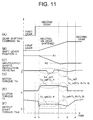
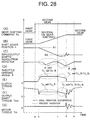
- Fig. 11 is a time chart showing the control state in the gear shifting.
- A denotes a gear shifting command Ss.
- B denotes a shift lever position Ii corresponding to the mesh type clutch position.
- C denotes a revolution speed ratio Rch of the I/O shafts.
- D denotes a torque Tm of the motor 27.
- E denotes a torque Tc of the clutch 10.
- F denotes a torque Tout of the output shaft 20.
- an axis of abscissa denotes a time.
- the actuator 30 serves to release the mesh type clutch to be uncoupled from the first gear side. Then, as indicated in (B), the shift lever position Ii enters into the neutral state (in gear shifting) in which the actual gear shifting is started.
- the torque transmitted through the clutch 10 is made to be the output shaft torque 20, for reducing the abnormal feeling a passenger in the vehicle feels, it is preferable to provide the target torque Tc_ref of the clutch 10 with a smooth characteristic. Further, in the gear shifting, it is necessary to swiftly and smoothly control the revolution speed ratio Rch of the I/O shafts to be the second gear ratio R2.
- the revolution speed No of the output shaft 20 is increased by the lowered torque correction to be corrected in the gear shifting, if engagement operation of the mesh type clutch is made as decreasing the revolution speed of the input shaft 8, the torque interference takes place in the engaged portion of the mesh type clutch, so that the engagement of the mesh type clutch is made difficult.
- the revolution speed ratio FB control of the clutch 10 the revolution speed ratio Rch of the I/O shafts is made to be Rch R2 on the increase and the mesh type clutch enters into the the state possible to couple to the second gear.
- the lowered torque correction in the gear shifting is determined by the torque Tc of the clutch 10.
- the output shaft torque 20 after the gear shifting is determined by the torque Te of the engine 1, the torque Tm of the motor 27 and the second gear ratio R2.
- the motor 27 and the battery 28 are controlled so that the target torque Tm_ref2 of the motor 27 may be achieved.
- the clutch 10 is in the slipping state.
- the torque adjusting control at the termination of the gear shifting can be executed independently of the control for correcting the lowered torque correction in the gear shifting.
- the mesh type clutch is coupled to the second gear and then the actual gear shift is completed.
- the torque Tm of the motor 27 is gradually returned to zero.
- the gear shifting control is terminated.
- an operation is executed to derive the lowered torque correction of the output shaft 20, control the revolution speed of the input shaft 8 on the basis of the lowered torque correction, and adjust the input shaft torque 8 at the termination of the gear shifting, thereby suppressing the torque variation of the output shaft 20 and thereby improving the gear shifting performance.
- the present invention is not limited to the system arrangement according to each of the foregoing embodiments. It may be the apparatus of controlling a vehicle without using the motor 27. Further, the clutches 4 and 10 may be any kind of friction clutch such as a dry type single plate clutch, a multiplate wet friction clutch and an electromagnetic clutch. The clutch 25 may be any kind of clutch such as a dry type single plate clutch, a multiplate wet clutch, an electromagnetic clutch, and a mesh type clutch.
- the invention is arranged to suppress the torque variation of the output shaft caused by the control for the revolution speed in the gear shifting and adjust the input shaft torque at the termination of the gear shifting, thereby reducing the torque abrupt change of the output shaft and improve the gear shifting performance of a vehicle.
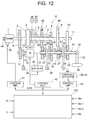
- Fig. 12 is a block diagram showing a vehicle system and its control apparatus according to another embodiment of the present invention.
- a clutch 5 is located between an output shaft 2 of the engine 1 and a first input shaft 6 of a gear type transmission 50 so that the torque of the engine 1 may be transmitted to the first input shaft 6.
- the clutch 5 may be a multiplate wet type one.
- the hydraulic actuator 37 may be used for controlling the pressure force of the clutch 5. By adjusting the pressure force of the clutch 5, the power transmission between the output shaft 2 of the engine 1 and the first input shaft 6 is disconnected.
- a clutch 4 is located between the output shaft 2 of the engine and a second input shaft 11 of the gear type transmission 50 so that the torque of the engine 1 may be transmitted to the second input shaft 11.
- the clutch 4 may be a multiplate wet type one.
- the hydraulic actuator 36 is used for controlling the pressure force. By adjusting the pressure force of the clutch 4, the power transmission from the output shaft 2 of the engine 1 to the second input shaft 11 is disconnected.
- the first input shaft 6 includes gears 7 and 8 fixed thereto.
- the second input shaft 11 includes gears 9 and 10 fixed thereto. Since the first input shaft 6 is hollow, the second input shaft 11 passes through this hollow portion so that the second input shaft 11 may be relatively moved in the rotating direction against the first input shaft 6.
- the output shaft 2 of the engine 1 includes a gear 3 fixed thereto.
- the output shaft 14 of the motor 15 is connected to a gear 12 provided with the clutch 13. This gear 12 is constantly engaged with the gear 3.
- the clutch 13 may be a dry type single plate one.
- the output torque of the motor 15 may be transmitted to the gear 12.
- the pressure force of this clutch 13 may be controlled by the hydraulic actuator 38. By adjusting the pressure force of the clutch 13, the power transmission from the output shaft 14 to the output shaft 2 of the engine 1 can be disconnected.
- the output shaft 31 of the gear type transmission 50 includes a gear 17 provided with a toothed wheel 23 and a synchronizer ring 24, a gear 18 provided with a toothed wheel 26 and a synchronizer ring 25, and a hub 21 and a sleeve (not shown) for directly connecting between the gears 17 and 18 and the output shaft 31.
- the gears 17 and 18 provide their stoppers (not shown) so that they are not allowed to be moved in the axial direction of the output shaft 31.
- the hub 21 includes a plurality of grooves (not shown) to be engaged with a plurality of grooves (not shown) of the output shaft 31. This hub 21 is hence allowed to be relatively moved in the axial direction of the output shaft 31 but is engaged with the output shaft 31 so that it serves to limit the movement in the rotating direction. Hence, the torque of the hub 21 can be transmitted to the output shaft 31.
- the torque transmitting device is composed of the hub 21 and the sleeve, the toothed wheel 23 and the synchronizer ring 24, and the toothed wheel 26 and the synchronizer ring 25.
- the claw clutch mechanism served as the torque transmitting device is referred to as a mesh type clutch.
- the mechanism makes it possible to highly efficiently transmit the energy from the power source such as the engine 1 to wheels 34 through a differential device 32 and an axle 33, thereby aiding in lowering fuel consumption.
- the output shaft 31 of the gear type transmission 50 includes a gear 17 provided with a toothed wheel 27 and a synchronizer ring 28, a gear 20 provided with a toothed wheel 30 and a synchronizer ring 29, and a hub 22 and sleeve (not shown) for directly coupling the gear 19 with the gear 20 and the output shaft 31.
- the gears 19 and 20 provide their stoppers (not shown) in order that those gears may not move in the axial direction of the output shaft 31.
- the hub 22 includes grooves (not shown) to be engaged with a plurality of grooves (not shown) of the output shaft 31 inside thereof. This hub 22 is engaged with the output shaft 31 so that it may be relatively moved in the axial direction of the output shaft 31 but limited to be moved in the rotating direction. Hence, the torque of the hub 22 is transmitted to the output shaft 31.
- the gear type transmission 50 is constructed so that a toothed wheel sequence composed of the gears 8 and 18 corresponds to the first gear, a toothed wheel sequence composed of the gears 10 and 20 corresponds to the second gear, a toothed wheel sequence composed of the gears 7 and 17 corresponds to the third gear, and a toothed wheel sequence composed of the gears 9 and 19 corresponds to the fourth gear.
- the intake air flow is controlled by the electronic control throttle 35 provided in an intake pipe (not shown) so that the fuel injection system (not shown) may inject the fuel corresponding to the intake air flow. Further, the ignition timing is determined on some signals indicating the air/fuel ratio, determined on the air amount and the fuel amount, and the engine speed Ne, and then the ignition system (not shown) is ignited.
- the fuel injection system may be an intake port injection system in which fuel is injected to the intake port or an in-cylinder injection system in which fuel is directly injected to the inside of the cylinder.
- the preferable system is a system that serves to compare the driving area requested by the engine (area determined by the engine torque and the engine speed) for lowering the fuel consumption and enhancing the exhaust performance.
- control apparatus 100 for controlling the engine 1, the actuators 36, 37, 38, 39, 40 and the motor 15.
- the control apparatus 100 is inputted with an accelerator pedal depress amount signal ⁇ , a shift lever position signal Ii, an engine speed signal Ne sensed by the sensor 44, a revolution speed signal Nin1 of the first input shaft sensed by the sensor 45, a revolution speed signal Nin2 of the second input shaft sensed by the sensor 46, and a revolution speed signal No of the output shaft sensed by the sensor 47. Then, this control apparatus 100 is served to compute the torque Te of the engine 1 and then transmit it to the control device 41 through the LAN served as a communication medium. The control device 41 is served to compute such a throttle valve opening angle, a fuel amount and an ignition timing as meeting the received engine torque Te, for controlling the corresponding actuator (for example, an electronic control throttle).
- control apparatus 100 is served to compute the torque and the revolution speed of the motor 15 and then transmit them to the control device 42 through the LAN, for controlling the motor.
- the control device 42 is served to charge the battery 16 with an electric power supplied from the motor 15 and then enable the battery 16 to supply an electric power for driving the motor 15.
- the control apparatus 100 includes a vehicle speed sensing unit 101, a gear shifting command generating unit 102, a lowered torque correcting unit 103, a revolution speed control unit 104, and a torque adjusting unit 105.
- the gear shifting command generating unit 102 is served to determine the gear shifting command Ss on the basis of the inputted accelerator pedal depress amount ⁇ 1 and the vehicle speed Vsp sensed by the vehicle speed sensing unit 101.
- This gear shifting command Ss is selected from the values for meeting a maximum efficiency of the engine 1 and the motor 15, which have been derived by an experiment or simulation and stored in the storage unit (not shown) located in the control apparatus 100.
- Fig. 14 is an explanatory view showing the first gear driving state in the case of accelerating a vehicle when it is run by the driving force of the engine 1, in which a dotted arrow indicates a transmission path of the torque.
- a clutch 5 is engaged and a hub 21 is linked with a gear 18.
- the torque of the engine 1 is transmitted to an output shaft 31 through an output shaft 2, a clutch 5, a first input shaft 6, a gear 8, a gear 18, and a hub 21.
- the clutch 4 is released, so that the hub 22 may be coupled with the gear 19.
- the gear shifting command generating unit 102 When the gear shifting command generating unit 102 outputs a gear shifting command Ss for executing the first to the third gear shifting, as shown in Fig. 15, the hub 21 is released so that the gear 18 may be released from the output shaft 31.
- the actuator 36 is controlled so that the clutch 4 is pressed onto the output shaft 2.
- This pressing engagement allows the output torque of the engine 1 to be transmitted from the output shaft 2 to the output shaft 31 through a clutch 4, a second input shaft 11, a gear 9, a gear 19, and a hub 22.
- the pressing force of the clutch 4 serves to transmit the torque of the engine 1 to the axle 33 for driving the vehicle
- the use of the gears 9 and 19 makes the gear ratio smaller, thereby making the load of the engine 1 and thereby the revolution speed lower. This results in making the gear ratio of the output shaft 31 to the first input shaft 6 closer to the third gear ratio (that is, smaller) rather than the first gear ratio.
- the gear ratio of the first input shaft 6 to the output shaft 31 is made to be the third gear ratio, as shown in Fig. 16, the hub 21 is coupled with the gear 17 so that the gear 17 may be coupled with the output shaft.
- the actuator 36 is controlled so that the pressure force of the clutch 4 may be released.
- the gear shifting from the first gear to the third gear is completed.
- the torque of the engine 1 is transmitted in a path composed of the output shaft 2, the clutch 5, the first input shaft 6, the gear 7, the gear 17, the hub 21, and the output shaft 31 in this describing order.
- the description will be oriented to the control process content to be executed by the lowered torque correcting unit 103.
- Fig. 17 is a flowchart showing a control process to be executed by the lowered torque correcting unit 103.
- step 1701 an operation is executed to read the gear shifting command Ss outputted from the gear shifting command generating unit 102.
- an operation is executed to read torque Te1 of the engine 1 before the gear shifting (the first gear) transmitted from the control device 41 through the LAN.
- an operation is executed to compute torque out1 of the output shaft 31 before the gear shifting (first gear) on the basis of the torque Te1 of the engine before the gear shifting, the torque having been read in the step 1702.
- step 1704 an operation is executed to compute the FF (Feed Forward) target torque Tc_ff of the clutch 4, based on the torque out1 of the output shaft 31 computed in the step 1703.
- the first gear ratio is R1
- the third gear ratio is R3
- the engine speed before the gear shifting is Ne1
- the engine speed after the gear shifting is Ne3
- the engine speed Ne3 after the gear shifting may be presumed as Ne3 ⁇ Ne1 * (R3 / R1).
- the engine torque after the gear shifting can be derived according to the presumed engine speed Ne3 and the throttle opening angle.
- the torque Tout3 of the output shaft after the gear shifting can be presumed.
- the FF target torque Tc_ff of the clutch 4 can be computed.
- step 1705 it is determined whether or not the revolution speed ratio Rch of the I/O shafts derived from the engine speed Ne (the revolution speed Nin1 of the first input shaft) and the revolution speed No of the output shaft stays in a predetermined range. If not, the process goes to a step 1706, while if yes, the process goes to a step 1707.
- step 1707 during the gear shifting, if the ratio Rch stays in the predetermined range, an operation is executed to feed back a deviation between a target revolution speed ratio corresponding to the third gear ratio and the revolution speed ratio Rch of the I/O shafts and then compute the target torque Tc_fb of the revolution speed ratio FB (Feed Back) of the clutch 4 based on the deviation.
- the target engine speed the revolution speed of the first input shaft
- Ne the engine speed Ne
- the lowered torque correction Tc_ref in the gear shifting derived in the steps 1706 and 1708 is outputted as the target torque of the clutch 4.
- the outputted lowered torque correction Tc_ref is transmitted to the control device 43 through the LAN.
- the control device 43 is served to hydraulically drive the actuators 36 to 40. It is served to adjust the pressure force of the clutch for correcting the lowered value of the torque in the gear shifting by controlling the actuator 36, based on the value of Tc_ref.
- the lowered torque correcting unit 103 is served to correct the lowered value of the output shaft torque 31 in the gear shifting and then improve the gear shifting performance.
- Fig. 18 is a flowchart showing a control process to be executed by the revolution speed control unit 104 and the torque adjusting unit 105.
- step 1801 it is determined whether or not the revolution speed ratio Rch of the I/O shafts derived on the engine speed Ne (the revolution speed Nin1 of the first input shaft) and the revolution speed No of the output shaft stays in the predetermined range. If not, the process goes to a step 1802 in which the control process is executed by the revolution speed control unit 104, while if yes, the process goes to a step 1805 in which the control process is executed by the torque adjusting unit 105.
- step 1803 an operation is executed to compute the target torque Tc_ref1 of the engine 1 that reaches such an engine speed Ne as realizing the predetermined revolution speed ratio Rch of the I/O shafts, based on the lowered torque correction Tc_ref read in the step 1802.
- step 1804 an operation is executed to output the target torque Te_ref1 of the engine 1 derived in the step 1803.
- the outputted target torque Te_ref1 is transmitted to the control device 41 through the LAN.
- the control device 41 is served to control the electronic control throttle 35 so that the engine 1 may reach the target torque Te_ref1.
- revolution speed control unit 104 in order to achieve the target torque Te_ref1 of the engine 1, it may be possible to control the air/fuel ratio of the engine 1 or control an ignition timing.
- step 1806 an operation is executed to compute such a target torque Te_ref2 of the engine 1 as reducing a deviation between the output shaft torque after the gear shifting and the lowered torque correction Tc_ref, based on the lowered torque correction Tc_ref read in the step 1805.
- step 1807 an operation is executed to output the target torque Te ref2 of the engine 1 derived in the step 1806.
- the outputted target torque Te_ref2 of the engine 1 is transmitted to the control device 41 through the LAN.
- the control device 41 is served to control the electronic control throttle 35 so that the engine 1 may reach the target torque Te_ref2.
- the torque adjusting unit 105 in order to achieve the target torque Te_ref2 of the engine 1, it may be possible to control an air/fuel ratio of the engine 1 or control an ignition timing.
- the torque adjusting unit 105 by controlling the torque of the first input shaft 6 at the termination of the gear shifting, it is possible to reduce a deviation between the lowered torque correction in the gear shifting and the output shaft torque 31 after the gear shifting, thereby reducing the torque abrupt change and improving the gear shifting performance.
- Fig. 19 is a time chart showing the control state in the gear shifting.
- (A) indicates a gear shifting command Ss.
- (B) indicates a shift lever position Ii corresponding to the mesh type clutch position.
- (C) indicates the revolution speed ratio Rch of the I/O shafts.
- (D) indicates a throttle opening angle ⁇ .
- (E) indicates a torque Tc of the clutch 4.
- (F) indicates a torque Tout of the output shaft 31.
- an axis of abscissa denotes a time.
- the gear shifting is started when the gear shifting command Ss to the third gear state is outputted at the point a when a vehicle is running in the first gear state.
- the torque Tc of the clutch 4 is gradually increased.
- the target torque Tc_ref of the clutch 4 is provided with a smooth characteristic. Further, during the gear shifting, it is necessary to swiftly and smoothly control the revolution speed ratio Rch of the I/O shafts to be the third gear ratio R3.
- the revolution speed No of the output shaft 31 is increased by the lowered torque correction corrected during the gear shifting, if the engagement of the mesh type clutch as decreasing the revolution speed of the first input shaft 6 is made difficult because the torque interference takes place in the engaged portion of the mesh type clutch.
- the engagement of the mesh type clutch as increasing the revolution speed of the first input shaft 6 suppresses the torque interference more.
- the lowered torque correction in the gear shifting is determined by the torque Tc of the clutch 4.
- the output shaft torque 31 after the gear shifting is determined by the torque Te of the engine 1 and the three gear ratio R3.
- the clutch 4 is made slipping.
- the torque Te of the engine 1 is greater than a predetermined value
- the lowered torque correction in the gear shifting is determined by the torque Tc of the clutch 4.
- the mesh type clutch is coupled with the third gear and the actual gear shifting is completed. Then, the throttle angle be ⁇ is gradually returned to the opening angle before the gear shifting. At the point e, the gear shifting control is terminated.
- Fig. 20 is a block diagram showing the control apparatus according to this embodiment.
- the overall system arrangement in the vehicle is likewise to that of the embodiment shown in Figs. 12 and 13 and thus is not described herein.
- the same components as those of the embodiment shown in Figs. 12 and 13 have the same reference numbers.
- the control apparatus 2000 includes a vehicle speed sensing unit 101, a gear shifting command generating unit 102, a lowered torque correcting unit 103, a revolution speed control unit 2004, and a torque adjusting unit 2005.
- the control apparatus 2000 can be realized by the same computer as the control apparatus 100.
- control process contents to be executed by the gear shifting sensing unit 101 and the gear shifting command generating unit 102 are likewise to those of the embodiment shown in Fig. 13 and thus are not described herein.
- the torque of the engine 1 is transmitted in a path composed of the output shaft 2 of the engine 1, the clutch 4, the gear 9, the gear 19, the hub 22, and the output shaft 31 in this describing order.
- the mesh type clutch hub 21
- the actuator 36 is controlled to release the pressure force of the clutch 4 and then complete the gear shifting.
- the mesh type clutch is released from the first gear and enters into the neutral state.
- the torque of the engine 1 and the motor 15 is transmitted to the axle 33 through the output shaft 31 by means of the clutch 4 and the gears 9 and 19. Hence, the lowered value of the torque in the gear shifting may be corrected.
- Fig. 22 is a flowchart showing a control process in the revolution speed control unit 2201 and the torque adjusting unit 2202.
- step 2201 it is determined whether or not the revolution speed ratio Rch of the I/O shafts derived on the engine speed Ne (the revolution speed Nin1 of the first input shaft) and the revolution speed No of the output shaft stays in the predetermined range. If not, the process goes to a step 2202 in which the control process is executed by the revolution speed control unit 2004, while if yes, the process goes to a step 2205 in which the process is executed by the torque adjusting unit 2005.
- an operation is executed to compute such a target torque Tm_ref1 of the motor 15 as achieving the engine speed Ne for realizing the predetermined revolution speed Rch of the I/O shafts, based on the lowered torque correction Tc_ref read in the step 2202.
- an operation is executed to output the target torque Tm_ref1 of the motor 15 derived in the step 2203.
- the target torque Tm_ref1 of the motor 15 is transmitted to the control device 42 through the LAN.
- the control device 42 is served to control the motor 15 and the battery 16 so that the motor 15 reaches the target torque Tm_ref1.
- this embodiment makes it possible to control the revolution speed of the first input shaft 6 in the gear shifting and couple the mesh type clutch to the third gear, thereby suppressing the inertia torque appearing in engagement of the mesh type clutch to the third gear and improving the gear shifting performance.
- step 2206 an operation is executed to compute the target torque Tm_ref2 of the motor 15 for reducing a deviation between the output shaft torque after the gear shifting and the lowered torque correction Tc_ref, based on the lowered torque correction Tc_ref read in the step 2205.
- step 2207 an operation is executed to output the target torque Tm_ref2 of the motor 15 derived in the step 2206.
- the target torque Tm_ref2 of the motor 15 is transmitted to the control device 42 through the LAN.
- the control device 42 serves to control the motor 15 and the battery 1 so that the motor 15 reaches the target toque Tm_ref2.
- the torque adjusting unit 2005 it is possible to control the torque of the first input shaft 6 at the termination of the gear shifting for reducing a deviation between the lowered torque correction in the gear shifting and the output shaft torque 31 after the gear shifting, thereby lessening the torque abrupt change and improving the gear shifting performance.
- Fig. 23 is a time chart showing the control state in the gear shifting, in which figure (A) indicates a gear shifting command Ss, (B) indicates a shift lever position Ii corresponding to the mesh type clutch position, (C) indicates the revolution speed ratio Rch of the I/O shafts, (D) indicates the torque Tm of the motor 15, (E) indicates the torque Tc of the clutch 4, (F) indicates the torque Tout of the output shaft 31, and an axis of abscissa denotes a time.
- the actuator 39 is controlled so that the mesh type clutch coupled to the first gear side may be released and as indicated in (B), the shift lever position Ii enters into the neutral position (gear shifting state) and then the actual gear shift is started.
- the torque transmitted through the clutch 4 is made to be the output shaft torque 31.
- the target torque Tc_ref of the clutch 4 is provided with a smooth characteristic.
- the revolution speed ratio Rch of the I/O shafts is necessary to swiftly and smoothly control the revolution speed ratio Rch of the I/O shafts to be the third gear ratio R3.
- the motor 15 and the battery 16 are controlled so that the target torque Tm_ref1 of the motor 15 outputted from the revolution speed control unit 2004 reaches the target torque Tm_ref1.
- This control makes it possible to adjust the engine speed Ne, thereby making the revolution speed ratio Rch of the I/O shafts closer to the third gear ratio R3.
- the revolution speed No of the output shaft 31 is increased by the lowered torque correction corrected during the gear shifting.
- the lowered torque correction in the gear shifting is determined by the torque Tc of the clutch 4.
- the output shaft torque 31 after the gear shifting is determined by the torque Te of the engine 1, the torque Tm of the motor 15 and the third gear ratio R3. Between the points c and d, therefore, the motor 15 and the battery 16 are controlled so that the motor 15 reaches the target torque Tm_ref2.
- the clutch 4 is in the slipping state. Hence, if a sum of the torque Te of the engine 1 and the torque Tm of the motor 15 is greater than a predetermined value, the lowered torque correction in the gear shifting is determined by the torque Tc of the clutch 4. It means that the torque adjusting control at the termination of the gear shifting can be executed independently of the lowered torque correcting control in the gear shifting.
- the mesh type clutch is coupled to the third gear, and the actual gear shifting is completed.
- the torque Tm of the motor 15 is gradually returned to zero, and at the point e, the control for the gear shifting is finished.
- this embodiment makes it possible to derive the lowered torque correction of the output shaft 31 in the gear shifting, control the revolution speed of the input shaft 6 based on this lowered torque correction, and adjust the torque of the first input shaft 6 at the termination of the gear shifting, thereby suppressing the torque variation of the output shaft 31 and the gear shifting performance.
- the present invention is not limited to the system arrangement according to the foregoing embodiments.
- the present invention may be applied to a control apparatus a vehicle without motor 15.
- the clutch 4 or 5 may be any kind of friction clutch such as a dry type single plate clutch, a multiplate wet friction clutch or an electromagnetic clutch.
- the clutch 13 may be any kind of clutch such as a dry type single plate clutch, a multiplate wet clutch, an electromagnetic clutch or a mesh type clutch.
- Fig. 24 is a block diagram showing a control apparatus according to this embodiment.
- the overall system arrangement of the vehicle is likewise to that of the embodiment shown in Fig. 1 and thus is not described herein.
- the same components of this embodiment as those of the embodiment shown in Fig. 1 have the same reference numbers in the following description.
- the control apparatus 2400 is inputted with an accelerator pedal depress amount signal ⁇ , a shift lever position signal Ii, an engine speed Ne sensed by a sensor 37, a revolution speed signal Nin of the input shaft sensed by a sensor 36, and a revolution speed signal No of the output shaft sensed by a sensor 13. Then, this control apparatus 2400 is served to compute the torque Te of the engine 1 and transmit it to the control device 34 through the LAN served as communicating means.
- the control device 34 serves to compute such a throttle valve opening angle, a fuel amount and an ignition timing as achieving the received engine torque Te and then to control the corresponding actuators (for example, the electronic control throttle 2).
- control apparatus 2400 serves to compute the torque and the revolution speed of the motor 27 and transmit them to the control device 35 through the LAN for controlling the motor thereon.
- the control device 35 serves to charge the battery with an electric power fed by the motor 27 and supply an electric power from the battery 28 for driving the motor 27.
- the control apparatus 2400 may be realized by the similar computer to that of the control apparatus 100.
- the vehicle speed sensing unit 101, the gear shifting command generating unit 102, the lowered torque correcting unit 103, the revolution speed control unit 104, and the torque adjusting unit 105 are likewise to those of the control apparatus 100 shown in Fig. 1 and thus are not described herein.
- Fig. 26 is a time chart showing a control state in the gear shifting, in which figure (A) indicates a gear shifting command Ss, (B) indicates a shift lever position Ii corresponding to the mesh type clutch position, (C) indicates a revolution speed ratio Rch of the I/O shafts, (D) indicates a throttle opening angle ⁇ , (E) indicates a torque Tc of the clutch 10, (F) indicates a torque Tout of the output shaft 20, (G) indicates a torque Tc_STA of the advancing clutch 4, and an axis of abscissa denotes a time.
- the operation method in the gear shifting is likewise to the method shown in Fig. 7 and thus is not described herein.
- the change of the engine speed Ne may be lowered when the mesh type clutch is engaged.
- This control for the clutch 4 is requested to be executed before the mesh type clutch is engaged in consideration of the response of the actuator 32 of the clutch 4.
- the control for the clutch 4 may be started from the point (a) as indicated in (G) of Fig. 26.
- Fig. 27 is a control block diagram showing the control apparatus 2400 in the case of using the motor 27.
- the vehicle speed sensing unit 101, the gear shifting command generating unit 102, the lowered torque correcting unit 103, the revolution speed control unit 104, and the torque adjusting unit 105 are likewise to those of the control apparatus 100 shown in Fig. 1 and thus are not described herein.
- the torque variation suppressing unit 2402 is served to output a torque command value Tm of the motor 27.
- the engaging of the clutch 4 with the clutch 5 makes it possible to directly couple the output shaft 26 of the motor 27 with the output shaft 3 of the engine 1, thereby smoothly controlling the engine speed Ne through the use of the motor 27.
- Fig. 28 is a time chart showing a control state in the gear shifting.
- (A) to (F) are the same as the charts shown in Fig. 26 and thus are not described herein.
- (G) indicates a torque Tm of the motor 27. As indicated in (G), by controlling the motor torque Tm, it is possible to lessen the change of the engine speed Ne. It is preferable to start the control for the motor 27 immediately before the axial vibration takes place in consideration of the adverse effect on the torque Tout of the output shaft 20.
- the foregoing control system makes it possible to lessen the change of the engine speed Ne and thus suppress the torque variation (axial vibration) as indicated in the dotted line of (F), thereby improving the gear shifting performance of a vehicle.
Landscapes
- Engineering & Computer Science (AREA)
- General Engineering & Computer Science (AREA)
- Mechanical Engineering (AREA)
- Chemical & Material Sciences (AREA)
- Combustion & Propulsion (AREA)
- Transportation (AREA)
- Automation & Control Theory (AREA)
- Control Of Transmission Device (AREA)
- Control Of Driving Devices And Active Controlling Of Vehicle (AREA)
- Hybrid Electric Vehicles (AREA)
- Control Of Vehicle Engines Or Engines For Specific Uses (AREA)
- Combined Controls Of Internal Combustion Engines (AREA)
- Hydraulic Clutches, Magnetic Clutches, Fluid Clutches, And Fluid Joints (AREA)
Abstract
Description
Claims (12)
- A control apparatus of a vehicle comprising:means (10; 12, 14, 15, 16, 17) for transmitting torque, located between an input shaft (8) and an output shaft (20) of a gear type transmission;said torque transmission means of at least one gear shifting stage being a friction clutch (10), said torque transmission means of another gear shifting stage being a mesh type clutch (12, 14, 15, 16, 17), and said friction clutch (10) being controlled when one gear stage is changed to another gear stage;means (103) for correcting a lowered value of said torque of said output shaft (20) in the gear shifting; andmeans (104) for controlling the input shaft speed on the basis of the lowered torque correction corrected by said lowered torque correcting means (103).
- A control apparatus of a vehicle as claimed in claim 1, further comprising means (105) for adjusting the input shaft torque at the termination of the gear shifting on the basis of said lowered torque correction.
- A control method of a vehicle, in which means (10; 12, 14, 15, 16, 17) for transmitting torque is located between an input shaft (8) and an output shaft (20) of a gear type transmission, said torque transmitting means of at least one gear stage is a friction clutch (10), said torque transmitting means of another gear stage is a mesh type clutch (12, 14, 15, 16, 17), and said friction clutch is controlled when one gear stage is changed into another gear stage, comprising the steps of:correcting the lowered torque value of said output shaft (20) in the gear shifting during said shifting; andcontrolling the input shaft speed on the basis of the lowered torque correction.
- A control method of a vehicle as claimed in claim 3, further comprising the step of adjusting the input shaft torque at the termination of the gear shifting on the basis of said torque correction.
- A control apparatus of a vehicle comprising:a torque transmitting system located between an input shaft (6, 11) and an output shaft (31) of a gear type transmission;said torque transmitting system being separated into a first transmission system and a second transmission system, each of which is a combination of mesh type clutches (21, 22), said torque transmitting systems located between an engine (1) and said first transmission system and between said engine (1) and said second transmission system being friction clutches (5, 4), and said friction clutches (5, 4) being controlled when one gear stage is changed into another gear stage;means (103) for correcting the lowered torque of said output shaft (31) in the gear shifting during said shifting; andmeans (104) for controlling the input shaft speed on the basis of the lowered torque correction corrected by said lowered torque correcting means (103).
- A control apparatus of a vehicle as claimed in claim 5, further comprising means (105) for adjusting the input shaft torque at the termination of the gear shifting on the basis of said lowered torque correction.
- A control method of a vehicle, in which a torque transmitting system located between an input (6, 11) shaft and an output shaft (31) of a gear type transmission is separated into a first transmission system and a second transmission system, each of which is a combination of mesh type clutches (21, 22), said torque transmitting systems located between an engine (1) and said first transmission system and between said engine (1) and said second transmission system are friction clutches (5, 4), and said friction clutches (5, 4) are controlled when one gear stage is changed into another gear stage, said method comprising the steps of:correcting the lowered torque value of said output shaft (31) in the gear shifting during said shifting; andcontrolling the input shaft speed on the basis of said corrected lowered torque correction.
- A control method of a vehicle as claimed in claim 7, further comprising the step of adjusting the input shaft torque at the termination of the gear shifting on the basis of said torque correction.
- A control apparatus of a vehicle wherein means (10; 12, 14, 15, 16, 17) for transmitting torque is located between an input shaft (8) and an output shaft (20) of a gear type transmission, said torque transmitting means of at least one gear stage is a friction clutch (10), said torque transmitting means of another gear stage is a mesh type clutch (12, 14, 15, 16, 17), and said friction clutch is controlled when one gear stage is changed into another gear stage, said apparatus comprising:
means (100) for suppressing torque variation of said output shaft taking place when said mesh type clutch is engaged by means of at least one friction clutch provided in said gear type transmission in the case of said gear shifting. - A control method of a vehicle, in which means (10; 12, 14, 15, 16, 17) for transmitting torque is located between an input shaft (8) and an output shaft (20) of a gear type transmission, said torque transmitting means of at least one gear stage is a friction clutch (10), said torque transmitting means of another gear stage is a mesh type clutch (12, 14, 15, 16, 17), and said friction clutch is controlled when one gear stage is changed into another gear stage, comprising the step of:
suppressing torque variation of said output shaft (20) taking place in engaging said mesh type clutch by means of at least one friction clutch provided in said gear type transmission in the case of said gear shifting. - A control apparatus of a vehicle, comprising:means (10; 12, 14, 15, 16, 17) for transmitting torque, located between an input shaft (8) and an output shaft (20) of a gear type transmission,said torque transmitting means of at least one gear stage being a friction clutch (10), said torque transmitting means of another gear stage being a mesh type clutch (12, 14, 15, 16, 17), and said friction clutch (10) being controlled when one gear stage is changed into another gear stage; andmeans (100) for suppressing torque variation of said output shaft taking place when said mesh type clutch is engaged by means of at least one motor provided in said gear type transmission in the case of said gear shifting.
- A control method of a vehicle, in which means (10; 12, 14, 15, 16, 17) for transmitting torque is located between an input shaft (8) and an output shaft (20) of a gear type transmission, said torque transmitting means of at least one gear stage is a friction clutch (10), said torque transmitting means of another gear stage is a mesh type clutch (12, 14, 15, 16, 17), and said friction clutch (10) is controlled when one gear stage is changed into another gear stage, comprising the step of:
suppressing torque variation of said output shaft taking place when said mesh type clutch (10) is engaged by means of at least one motor (M) provided in said gear type transmission in the case of said gear shifting.
Priority Applications (1)
| Application Number | Priority Date | Filing Date | Title |
|---|---|---|---|
| EP04022657A EP1498644A3 (en) | 2000-06-23 | 2001-04-11 | Control apparatus and control method for shifting a transmission of a vehicle with two inputs |
Applications Claiming Priority (2)
| Application Number | Priority Date | Filing Date | Title |
|---|---|---|---|
| JP2000194874 | 2000-06-23 | ||
| JP2000194874A JP3293613B2 (en) | 2000-06-23 | 2000-06-23 | Vehicle control device, vehicle control method, transmission |
Related Child Applications (1)
| Application Number | Title | Priority Date | Filing Date |
|---|---|---|---|
| EP04022657A Division EP1498644A3 (en) | 2000-06-23 | 2001-04-11 | Control apparatus and control method for shifting a transmission of a vehicle with two inputs |
Publications (3)
| Publication Number | Publication Date |
|---|---|
| EP1167833A2 true EP1167833A2 (en) | 2002-01-02 |
| EP1167833A3 EP1167833A3 (en) | 2002-08-14 |
| EP1167833B1 EP1167833B1 (en) | 2006-07-12 |
Family
ID=18693631
Family Applications (2)
| Application Number | Title | Priority Date | Filing Date |
|---|---|---|---|
| EP04022657A Withdrawn EP1498644A3 (en) | 2000-06-23 | 2001-04-11 | Control apparatus and control method for shifting a transmission of a vehicle with two inputs |
| EP01109304A Expired - Lifetime EP1167833B1 (en) | 2000-06-23 | 2001-04-11 | Powershift of a dog clutch type vehicle transmission |
Family Applications Before (1)
| Application Number | Title | Priority Date | Filing Date |
|---|---|---|---|
| EP04022657A Withdrawn EP1498644A3 (en) | 2000-06-23 | 2001-04-11 | Control apparatus and control method for shifting a transmission of a vehicle with two inputs |
Country Status (4)
| Country | Link |
|---|---|
| US (4) | US6502474B2 (en) |
| EP (2) | EP1498644A3 (en) |
| JP (1) | JP3293613B2 (en) |
| DE (1) | DE60121391T2 (en) |
Cited By (4)
| Publication number | Priority date | Publication date | Assignee | Title |
|---|---|---|---|---|
| FR2910101A1 (en) * | 2006-12-15 | 2008-06-20 | Peugeot Citroen Automobiles Sa | Gearbox e.g. automatically-controlled manual gearbox, speed ratio changing method for hybrid motor vehicle, involves controlling machine in turning back phase to produce additional torque on primary shaft which compensates own inertia |
| FR2914259A1 (en) * | 2007-03-26 | 2008-10-03 | Peugeot Citroen Automobiles Sa | Gear ratio changing or disengaging method for hybrid vehicle, involves controlling clutch such that heat engine transmits compensation torque to main shaft via clutch, when electric machine introduces parasite torque in degraded mode |
| DE102007001167B4 (en) * | 2006-01-13 | 2009-09-03 | Toyota Jidosha Kabushiki Kaisha, Toyota-shi | Control unit and method for a vehicle |
| CN104118421A (en) * | 2013-04-25 | 2014-10-29 | 上海汽车集团股份有限公司 | Multi-power-source coordinated control method used during gear shifting of hybrid electric vehicle |
Families Citing this family (49)
| Publication number | Priority date | Publication date | Assignee | Title |
|---|---|---|---|---|
| US6941830B2 (en) * | 2000-03-10 | 2005-09-13 | Hitachi, Ltd. | Automatic transmission, dynamo-electric machine, and car |
| JP3674561B2 (en) * | 2001-09-25 | 2005-07-20 | 日産自動車株式会社 | Shift control device for automatic clutch transmission |
| JP3946504B2 (en) * | 2001-11-29 | 2007-07-18 | 株式会社日立製作所 | Vehicle control method, vehicle control device, transmission, and transmission control device |
| JP3848175B2 (en) * | 2002-02-13 | 2006-11-22 | 日産ディーゼル工業株式会社 | Vehicle hybrid system |
| DE10250853A1 (en) * | 2002-10-25 | 2004-05-19 | Getrag Getriebe- Und Zahnradfabrik Hermann Hagenmeyer Gmbh & Cie Kg | Drive train for a motor vehicle and method for starting an internal combustion engine and method for generating electric current |
| US6832978B2 (en) * | 2003-02-21 | 2004-12-21 | Borgwarner, Inc. | Method of controlling a dual clutch transmission |
| US7044888B2 (en) * | 2004-03-31 | 2006-05-16 | General Motors Corporation | Method of controlling engagement of a starting clutch in an automatic transmission during vehicle launch |
| US7282011B2 (en) | 2004-04-28 | 2007-10-16 | Toyota Jidosha Kabushiki Kaisha | Control apparatus for controlling stepped automatic transmission of vehicle |
| DE102004022616A1 (en) * | 2004-05-07 | 2005-12-15 | Daimlerchrysler Ag | Device having a unit for actuating a motor vehicle transmission |
| US7480555B2 (en) * | 2004-12-16 | 2009-01-20 | Eaton Corporation | Method for controlling centrifugal clutch engagement using engine torque requests |
| DE102005004339B4 (en) * | 2005-01-25 | 2009-01-08 | Getrag Getriebe- Und Zahnradfabrik Hermann Hagenmeyer Gmbh & Cie Kg | Use of a step change gearbox and method for controlling such |
| DE102005004737A1 (en) * | 2005-02-02 | 2006-08-10 | Volkswagen Ag | Drive system for a motor vehicle with hybrid drive |
| US20060234829A1 (en) * | 2005-04-13 | 2006-10-19 | Ford Global Technologies, Llc | System and method for inertial torque reaction management |
| JP4238845B2 (en) | 2005-06-22 | 2009-03-18 | トヨタ自動車株式会社 | Control device for vehicle drive device |
| JP4299287B2 (en) * | 2005-10-07 | 2009-07-22 | トヨタ自動車株式会社 | VEHICLE, ITS CONTROL METHOD, AND VEHICLE DRIVE DEVICE |
| US7780562B2 (en) * | 2006-01-09 | 2010-08-24 | General Electric Company | Hybrid vehicle and method of assembling same |
| US7891450B2 (en) * | 2007-02-21 | 2011-02-22 | Ford Global Technologies, Llc | System and method of torque transmission using an electric energy conversion device |
| US8534399B2 (en) * | 2007-02-21 | 2013-09-17 | Ford Global Technologies, Llc | Hybrid propulsion system |
| FR2917041B1 (en) * | 2007-06-08 | 2009-11-20 | Peugeot Citroen Automobiles Sa | DEGRADE MODE DRIVING METHOD OF A ROBOTICATED GEARBOX OF PARALLEL HYBRID VEHICLE |
| US7713164B2 (en) * | 2007-06-26 | 2010-05-11 | Ford Global Technologies, Llc | Double step gear shifting in a hybrid electric vehicle |
| FR2922163B1 (en) * | 2007-10-10 | 2010-02-26 | Inst Francais Du Petrole | MOVING DRIVE SYSTEM WITH MULTIPLE TRANSMISSION PATHS FOR A HYBRID VEHICLE AND METHOD FOR TRAINING IN DISPLACEMENT OF SAID VEHICLE |
| WO2009056042A1 (en) * | 2007-10-22 | 2009-05-07 | Byd Company Limited | Hybrid power driving system and driving method thereof |
| US7908067B2 (en) | 2007-12-05 | 2011-03-15 | Ford Global Technologies, Llc | Hybrid electric vehicle braking downshift control |
| CN101946105B (en) | 2008-03-04 | 2013-07-17 | 博格华纳公司 | Dual clutch transmission having area controlled clutch cooling circuit |
| JP5186960B2 (en) * | 2008-03-14 | 2013-04-24 | トヨタ自動車株式会社 | Vehicle control device |
| WO2009128806A1 (en) | 2008-04-18 | 2009-10-22 | Borgwarner Inc. | Dual clutch transmission having simplified controls |
| DE102008001566A1 (en) * | 2008-05-06 | 2009-11-12 | Zf Friedrichshafen Ag | Method for operating a vehicle drive train |
| JP5187111B2 (en) * | 2008-10-06 | 2013-04-24 | トヨタ自動車株式会社 | Vehicle drive control device |
| WO2010077560A2 (en) * | 2008-12-09 | 2010-07-08 | Borgwarner Inc. | Automatic transmission for a hybrid vehicle |
| US8425376B2 (en) * | 2009-04-10 | 2013-04-23 | GM Global Technology Operations LLC | Multi-speed dual-clutch transmission for a hybrid vehicle |
| US9168825B2 (en) | 2009-05-15 | 2015-10-27 | Ford Global Technologies, Llc | Hybrid electric vehicle and method for controlling a powertrain therein |
| US9086170B2 (en) | 2009-06-29 | 2015-07-21 | Borgwarner Inc. | Hydraulic valve for use in a control module of an automatic transmission |
| FR2948073B1 (en) * | 2009-07-15 | 2011-10-28 | Inst Francais Du Petrole | SYSTEM FOR DRIVING TRAINING OF A HYBRID MOTOR VEHICLE AND METHOD FOR DRIVING SUCH A VEHICLE |
| KR20110024115A (en) * | 2009-09-01 | 2011-03-09 | 강명구 | Dual Mode Driven Continuous Variable Transmission |
| DE102010014193C5 (en) * | 2009-11-05 | 2023-03-23 | Schaeffler Technologies AG & Co. KG | Method for controlling a dual clutch transmission |
| US8826760B2 (en) | 2009-12-31 | 2014-09-09 | Borgwarner Inc. | Automatic transmission having high pressure actuation and low pressure lube hydraulic circuit |
| JP5440874B2 (en) * | 2010-09-30 | 2014-03-12 | アイシン・エィ・ダブリュ株式会社 | Control device |
| DE102011081005B4 (en) * | 2011-08-16 | 2022-12-22 | Zf Friedrichshafen Ag | Control device of a motor vehicle and method for operating a motor vehicle |
| JP5892245B2 (en) * | 2012-06-13 | 2016-03-23 | 日産自動車株式会社 | Vehicle driving force control device and driving force control method |
| US9574638B2 (en) * | 2014-09-23 | 2017-02-21 | Hyundai Motor Company | Transmission for vehicle |
| KR101637687B1 (en) * | 2014-09-29 | 2016-07-08 | 현대자동차주식회사 | Hybrid transmission for vehicle |
| KR101755818B1 (en) * | 2015-08-07 | 2017-07-20 | 현대자동차주식회사 | Transmission for electric vehicle |
| KR101755902B1 (en) * | 2015-11-27 | 2017-07-10 | 현대자동차주식회사 | Transmission control method for electric vehicle |
| CN107284436B (en) * | 2016-04-12 | 2019-12-10 | 上海汽车集团股份有限公司 | Gasoline-electric hybrid vehicle, hybrid power system and shift synchronization control method |
| DE102017203335A1 (en) * | 2017-03-01 | 2018-09-06 | Audi Ag | Drive device for a motor vehicle |
| KR102614147B1 (en) * | 2018-11-05 | 2023-12-14 | 현대자동차주식회사 | Powertrain for vehicle |
| KR102614154B1 (en) * | 2018-11-19 | 2023-12-14 | 현대자동차주식회사 | Powertrain for vehicle |
| DE102019202965A1 (en) * | 2019-03-05 | 2020-09-10 | Zf Friedrichshafen Ag | Hybrid transmission for a motor vehicle drive train |
| US20230243417A1 (en) * | 2020-07-30 | 2023-08-03 | Aisin Aw Co., Ltd. | Control device |
Family Cites Families (40)
| Publication number | Priority date | Publication date | Assignee | Title |
|---|---|---|---|---|
| DE1530994B2 (en) * | 1967-03-03 | 1974-07-25 | Robert Bosch Gmbh, 7000 Stuttgart | Spur gear transmission with four forward gears, especially for motor vehicles |
| EP0088486A3 (en) | 1982-02-05 | 1985-05-22 | Automotive Products Public Limited Company | Rotary transmission |
| JPS60172759A (en) | 1984-02-17 | 1985-09-06 | Toyota Motor Corp | Automatic transmission for vehicle |
| JPS6145163A (en) | 1984-08-10 | 1986-03-05 | Hitachi Ltd | automatic transmission system |
| US4860607A (en) | 1986-06-20 | 1989-08-29 | Toyota Jidosha Kabushiki Kaisha | Automatic transmission for automotive vehicle |
| ES2037934T3 (en) | 1988-10-31 | 1993-07-01 | Volkswagen Ag | PROCEDURE FOR CHANGING A GEAR FROM A STEPPED GEAR SHIFT. |
| DE4017961A1 (en) * | 1989-06-10 | 1990-12-13 | Zahnradfabrik Friedrichshafen | Vehicle double clutch gear change control system - has synchronisation on all gears controlled from output shaft during gear change |
| ES2057856T3 (en) | 1990-03-01 | 1994-10-16 | Volkswagen Ag | PROCEDURE FOR CHANGING A STEPPED GEAR SHIFT GEAR. |
| DE4031570C2 (en) * | 1990-10-05 | 1995-10-12 | Daimler Benz Ag | Arrangement for automatic switching by means of auxiliary pressure medium of a multi-way gear change transmission |
| DE4204401A1 (en) * | 1992-02-14 | 1993-08-19 | Bosch Gmbh Robert | DEVICE FOR CONTROLLING THE OUTPUT TORQUE OF AN AUTOMATIC MANUAL TRANSMISSION |
| JP3318945B2 (en) * | 1992-03-02 | 2002-08-26 | 株式会社日立製作所 | Vehicle control device, vehicle control system and vehicle control method |
| US5608626A (en) * | 1993-03-26 | 1997-03-04 | Hitachi, Ltd. | Drive shaft torque controlling apparatus for use in a vehicle having a power transmission mechanism and method therefor |
| US5407701A (en) | 1993-05-14 | 1995-04-18 | The Goodyear Tire & Rubber Company | Cords for pneumatic tires and process for making them |
| GB2297811A (en) * | 1995-02-07 | 1996-08-14 | New Holland Belguim Nv | Transmission control sytem moves synchroniser to neutral and engages clutch for a predetermined time |
| US5603242A (en) * | 1995-07-11 | 1997-02-18 | Caterpillar Inc. | Direct drive transmission apparatus and method for controlling shift |
| US5974905A (en) * | 1996-03-08 | 1999-11-02 | Ab Volvo | Motor vehicle gearbox |
| JPH09324663A (en) * | 1996-06-03 | 1997-12-16 | Toyota Motor Corp | Integrated control unit for engine and automatic transmission |
| DE19711820A1 (en) * | 1996-08-08 | 1998-09-24 | Volkswagen Ag | Method for shifting a double clutch transmission and double clutch transmission |
| US5732594A (en) * | 1996-10-31 | 1998-03-31 | Ford Global Technologies, Inc. | Manual transmission with throttle actuated downshift |
| JPH10184871A (en) * | 1996-12-25 | 1998-07-14 | Hitachi Ltd | Control device and control method for automatic transmission |
| JP3555367B2 (en) * | 1996-12-26 | 2004-08-18 | 株式会社日立製作所 | Control device and method for automatic transmission |
| GB9700960D0 (en) | 1997-01-17 | 1997-03-05 | Rover Group | Hybrid vehicle powertrain control |
| DE19859458B4 (en) * | 1997-12-23 | 2007-11-22 | Luk Gs Verwaltungs Kg | transmission |
| JP3570192B2 (en) * | 1998-01-13 | 2004-09-29 | トヨタ自動車株式会社 | Automatic transmission jump downshift control device |
| DE19802820C1 (en) | 1998-01-26 | 1999-12-16 | Getrag Getriebe Zahnrad | Motor vehicle step transmission |
| JP3336951B2 (en) * | 1998-04-28 | 2002-10-21 | 株式会社日立製作所 | Automotive power transmission |
| JP2000065199A (en) | 1998-08-12 | 2000-03-03 | Hitachi Ltd | Control device and control method for automatic transmission |
| JP2002526326A (en) * | 1998-10-02 | 2002-08-20 | ルーク ラメレン ウント クツプルングスバウ ベタイリグングス コマンディートゲゼルシャフト | Transmission having at least two shafts and an electric machine or automatic disc clutch |
| DE19850549A1 (en) * | 1998-11-03 | 2000-05-04 | Bosch Gmbh Robert | Gearbox for a motor vehicle, in particular dual clutch manual gearbox, and method for operating the gearbox |
| JP3823728B2 (en) | 1998-12-03 | 2006-09-20 | 株式会社日立製作所 | Automatic transmission system |
| JP3449277B2 (en) * | 1999-02-05 | 2003-09-22 | 株式会社日立製作所 | Hybrid vehicle and control device thereof |
| JP2000301959A (en) * | 1999-04-21 | 2000-10-31 | Hitachi Ltd | Automotive power transmission |
| US6592484B1 (en) * | 1999-08-09 | 2003-07-15 | Gregory A. Schultz | Transmission gearbox for parallel hybrid electric vehicles |
| JP3294230B2 (en) | 2000-02-22 | 2002-06-24 | 株式会社日立製作所 | Vehicle control device, vehicle control method, transmission |
| DE10165097B3 (en) * | 2000-07-18 | 2015-07-23 | Schaeffler Technologies AG & Co. KG | Double clutch |
| JP3787492B2 (en) * | 2000-11-29 | 2006-06-21 | 株式会社日立製作所 | Automatic transmission control device and method |
| US6490945B2 (en) * | 2001-01-10 | 2002-12-10 | New Venture Gear, Inc. | Twin clutch automated transmission with integrated transfer case |
| DE10209514B4 (en) * | 2001-03-30 | 2016-06-09 | Schaeffler Technologies AG & Co. KG | powertrain |
| US6575866B2 (en) * | 2001-04-09 | 2003-06-10 | New Venture Gear, Inc. | Hybrid drive system for motor vehicle with powershift transmission |
| JP4323132B2 (en) * | 2002-03-15 | 2009-09-02 | 株式会社日立製作所 | Automobile control method, automobile control device, transmission, transmission control device, and vehicle system |
-
2000
- 2000-06-23 JP JP2000194874A patent/JP3293613B2/en not_active Expired - Fee Related
-
2001
- 2001-02-26 US US09/792,031 patent/US6502474B2/en not_active Expired - Fee Related
- 2001-04-11 EP EP04022657A patent/EP1498644A3/en not_active Withdrawn
- 2001-04-11 EP EP01109304A patent/EP1167833B1/en not_active Expired - Lifetime
- 2001-04-11 DE DE60121391T patent/DE60121391T2/en not_active Expired - Fee Related
-
2002
- 2002-03-18 US US10/098,596 patent/US6536296B2/en not_active Expired - Fee Related
-
2003
- 2003-01-31 US US10/355,278 patent/US6890284B2/en not_active Expired - Fee Related
-
2004
- 2004-09-23 US US10/947,338 patent/US7086301B2/en not_active Expired - Fee Related
Cited By (6)
| Publication number | Priority date | Publication date | Assignee | Title |
|---|---|---|---|---|
| DE102007001167B4 (en) * | 2006-01-13 | 2009-09-03 | Toyota Jidosha Kabushiki Kaisha, Toyota-shi | Control unit and method for a vehicle |
| FR2910101A1 (en) * | 2006-12-15 | 2008-06-20 | Peugeot Citroen Automobiles Sa | Gearbox e.g. automatically-controlled manual gearbox, speed ratio changing method for hybrid motor vehicle, involves controlling machine in turning back phase to produce additional torque on primary shaft which compensates own inertia |
| WO2008090293A3 (en) * | 2006-12-15 | 2008-09-18 | Peugeot Citroen Automobiles Sa | Method for changing the gear ratio in a gearbox essentially for hybrid vehicles |
| FR2914259A1 (en) * | 2007-03-26 | 2008-10-03 | Peugeot Citroen Automobiles Sa | Gear ratio changing or disengaging method for hybrid vehicle, involves controlling clutch such that heat engine transmits compensation torque to main shaft via clutch, when electric machine introduces parasite torque in degraded mode |
| CN104118421A (en) * | 2013-04-25 | 2014-10-29 | 上海汽车集团股份有限公司 | Multi-power-source coordinated control method used during gear shifting of hybrid electric vehicle |
| WO2014173206A1 (en) * | 2013-04-25 | 2014-10-30 | 上海汽车集团股份有限公司 | Multi-power source coordinated control method in gear shifting process of hybrid automobile |
Also Published As
| Publication number | Publication date |
|---|---|
| US7086301B2 (en) | 2006-08-08 |
| US20020132700A1 (en) | 2002-09-19 |
| US6890284B2 (en) | 2005-05-10 |
| EP1167833B1 (en) | 2006-07-12 |
| US20020000132A1 (en) | 2002-01-03 |
| US20050044976A1 (en) | 2005-03-03 |
| JP2002005204A (en) | 2002-01-09 |
| EP1498644A2 (en) | 2005-01-19 |
| EP1167833A3 (en) | 2002-08-14 |
| US6536296B2 (en) | 2003-03-25 |
| US20030109358A1 (en) | 2003-06-12 |
| DE60121391T2 (en) | 2006-11-23 |
| DE60121391D1 (en) | 2006-08-24 |
| US6502474B2 (en) | 2003-01-07 |
| EP1498644A3 (en) | 2005-06-15 |
| JP3293613B2 (en) | 2002-06-17 |
Similar Documents
| Publication | Publication Date | Title |
|---|---|---|
| US6502474B2 (en) | Apparatus and method of controlling a vehicle | |
| JP3294230B2 (en) | Vehicle control device, vehicle control method, transmission | |
| CN101327730B (en) | Launch control of a hybrid electric vehicle | |
| US8043194B2 (en) | Vehicle creep control in a hybrid electric vehicle | |
| CN102770295B (en) | Control device | |
| US7678013B2 (en) | Launch control of a hybrid electric vehicle | |
| JP4135107B2 (en) | Hybrid vehicle drive device and control method thereof | |
| CN101332764A (en) | Launch Control for Hybrid Vehicles | |
| JP2004182101A (en) | Hybrid vehicle control device and control method | |
| US20240059273A1 (en) | Vehicle drive device | |
| JP2002021998A (en) | Automotive control device and control method thereof | |
| JP4416966B2 (en) | Vehicle control apparatus and vehicle control method | |
| JP2019143754A (en) | Control device of vehicle |
Legal Events
| Date | Code | Title | Description |
|---|---|---|---|
| PUAI | Public reference made under article 153(3) epc to a published international application that has entered the european phase |
Free format text: ORIGINAL CODE: 0009012 |
|
| AK | Designated contracting states |
Kind code of ref document: A2 Designated state(s): AT BE CH CY DE DK ES FI FR GB GR IE IT LI LU MC NL PT SE TR |
|
| AX | Request for extension of the european patent |
Free format text: AL;LT;LV;MK;RO;SI |
|
| PUAL | Search report despatched |
Free format text: ORIGINAL CODE: 0009013 |
|
| AK | Designated contracting states |
Kind code of ref document: A3 Designated state(s): AT BE CH CY DE DK ES FI FR GB GR IE IT LI LU MC NL PT SE TR |
|
| AX | Request for extension of the european patent |
Free format text: AL;LT;LV;MK;RO;SI |
|
| 17P | Request for examination filed |
Effective date: 20021210 |
|
| AKX | Designation fees paid |
Designated state(s): DE FR GB IT |
|
| 17Q | First examination report despatched |
Effective date: 20040517 |
|
| GRAP | Despatch of communication of intention to grant a patent |
Free format text: ORIGINAL CODE: EPIDOSNIGR1 |
|
| GRAS | Grant fee paid |
Free format text: ORIGINAL CODE: EPIDOSNIGR3 |
|
| RIN1 | Information on inventor provided before grant (corrected) |
Inventor name: OKADA, TAKASHI,H Inventor name: KAYANO, MITSUO,H Inventor name: SAKAMOTO, HIROSHI,H Inventor name: MINOWA, TOSHIMICHI,H Inventor name: OCHI, TATSUYA,H |
|
| RAP1 | Party data changed (applicant data changed or rights of an application transferred) |
Owner name: HITACHI, LTD. |
|
| GRAA | (expected) grant |
Free format text: ORIGINAL CODE: 0009210 |
|
| AK | Designated contracting states |
Kind code of ref document: B1 Designated state(s): DE FR GB IT |
|
| PG25 | Lapsed in a contracting state [announced via postgrant information from national office to epo] |
Ref country code: IT Free format text: LAPSE BECAUSE OF FAILURE TO SUBMIT A TRANSLATION OF THE DESCRIPTION OR TO PAY THE FEE WITHIN THE PRESCRIBED TIME-LIMIT;WARNING: LAPSES OF ITALIAN PATENTS WITH EFFECTIVE DATE BEFORE 2007 MAY HAVE OCCURRED AT ANY TIME BEFORE 2007. THE CORRECT EFFECTIVE DATE MAY BE DIFFERENT FROM THE ONE RECORDED. Effective date: 20060712 |
|
| REG | Reference to a national code |
Ref country code: GB Ref legal event code: FG4D |
|
| RIC1 | Information provided on ipc code assigned before grant |
Ipc: F16H 61/04 20060101AFI20060608BHEP |
|
| REF | Corresponds to: |
Ref document number: 60121391 Country of ref document: DE Date of ref document: 20060824 Kind code of ref document: P |
|
| ET | Fr: translation filed | ||
| PLBE | No opposition filed within time limit |
Free format text: ORIGINAL CODE: 0009261 |
|
| STAA | Information on the status of an ep patent application or granted ep patent |
Free format text: STATUS: NO OPPOSITION FILED WITHIN TIME LIMIT |
|
| 26N | No opposition filed |
Effective date: 20070413 |
|
| PGFP | Annual fee paid to national office [announced via postgrant information from national office to epo] |
Ref country code: GB Payment date: 20080328 Year of fee payment: 8 |
|
| PGFP | Annual fee paid to national office [announced via postgrant information from national office to epo] |
Ref country code: IT Payment date: 20080423 Year of fee payment: 8 |
|
| PGFP | Annual fee paid to national office [announced via postgrant information from national office to epo] |
Ref country code: FR Payment date: 20080319 Year of fee payment: 8 |
|
| PGFP | Annual fee paid to national office [announced via postgrant information from national office to epo] |
Ref country code: DE Payment date: 20090525 Year of fee payment: 9 |
|
| GBPC | Gb: european patent ceased through non-payment of renewal fee |
Effective date: 20090411 |
|
| REG | Reference to a national code |
Ref country code: FR Ref legal event code: ST Effective date: 20091231 |
|
| PG25 | Lapsed in a contracting state [announced via postgrant information from national office to epo] |
Ref country code: FR Free format text: LAPSE BECAUSE OF NON-PAYMENT OF DUE FEES Effective date: 20091222 Ref country code: GB Free format text: LAPSE BECAUSE OF NON-PAYMENT OF DUE FEES Effective date: 20090411 |
|
| PG25 | Lapsed in a contracting state [announced via postgrant information from national office to epo] |
Ref country code: DE Free format text: LAPSE BECAUSE OF NON-PAYMENT OF DUE FEES Effective date: 20101103 |
|
| PG25 | Lapsed in a contracting state [announced via postgrant information from national office to epo] |
Ref country code: IT Free format text: LAPSE BECAUSE OF NON-PAYMENT OF DUE FEES Effective date: 20090411 |