EP1167714A2 - Combustion chamber system having an improved valve arrangement - Google Patents
Combustion chamber system having an improved valve arrangement Download PDFInfo
- Publication number
- EP1167714A2 EP1167714A2 EP01203590A EP01203590A EP1167714A2 EP 1167714 A2 EP1167714 A2 EP 1167714A2 EP 01203590 A EP01203590 A EP 01203590A EP 01203590 A EP01203590 A EP 01203590A EP 1167714 A2 EP1167714 A2 EP 1167714A2
- Authority
- EP
- European Patent Office
- Prior art keywords
- valves
- combustion chamber
- intake
- cylinder
- exhaust valve
- Prior art date
- Legal status (The legal status is an assumption and is not a legal conclusion. Google has not performed a legal analysis and makes no representation as to the accuracy of the status listed.)
- Withdrawn
Links
- 238000002485 combustion reaction Methods 0.000 title claims abstract description 59
- 239000000446 fuel Substances 0.000 claims description 12
- 239000000203 mixture Substances 0.000 claims description 7
- 230000006835 compression Effects 0.000 abstract description 4
- 238000007906 compression Methods 0.000 abstract description 4
- TVMXDCGIABBOFY-UHFFFAOYSA-N octane Chemical compound CCCCCCCC TVMXDCGIABBOFY-UHFFFAOYSA-N 0.000 abstract description 2
- 239000007789 gas Substances 0.000 description 6
- 230000002093 peripheral effect Effects 0.000 description 3
- 238000004519 manufacturing process Methods 0.000 description 2
- 230000000694 effects Effects 0.000 description 1
- 239000000463 material Substances 0.000 description 1
- 230000002000 scavenging effect Effects 0.000 description 1
- 238000004513 sizing Methods 0.000 description 1
Images


Classifications
-
- F—MECHANICAL ENGINEERING; LIGHTING; HEATING; WEAPONS; BLASTING
- F02—COMBUSTION ENGINES; HOT-GAS OR COMBUSTION-PRODUCT ENGINE PLANTS
- F02F—CYLINDERS, PISTONS OR CASINGS, FOR COMBUSTION ENGINES; ARRANGEMENTS OF SEALINGS IN COMBUSTION ENGINES
- F02F1/00—Cylinders; Cylinder heads
- F02F1/24—Cylinder heads
- F02F1/42—Shape or arrangement of intake or exhaust channels in cylinder heads
- F02F1/4214—Shape or arrangement of intake or exhaust channels in cylinder heads specially adapted for four or more valves per cylinder
-
- F—MECHANICAL ENGINEERING; LIGHTING; HEATING; WEAPONS; BLASTING
- F01—MACHINES OR ENGINES IN GENERAL; ENGINE PLANTS IN GENERAL; STEAM ENGINES
- F01L—CYCLICALLY OPERATING VALVES FOR MACHINES OR ENGINES
- F01L1/00—Valve-gear or valve arrangements, e.g. lift-valve gear
- F01L1/26—Valve-gear or valve arrangements, e.g. lift-valve gear characterised by the provision of two or more valves operated simultaneously by same transmitting-gear; peculiar to machines or engines with more than two lift-valves per cylinder
-
- F—MECHANICAL ENGINEERING; LIGHTING; HEATING; WEAPONS; BLASTING
- F02—COMBUSTION ENGINES; HOT-GAS OR COMBUSTION-PRODUCT ENGINE PLANTS
- F02B—INTERNAL-COMBUSTION PISTON ENGINES; COMBUSTION ENGINES IN GENERAL
- F02B23/00—Other engines characterised by special shape or construction of combustion chambers to improve operation
- F02B23/08—Other engines characterised by special shape or construction of combustion chambers to improve operation with positive ignition
-
- F—MECHANICAL ENGINEERING; LIGHTING; HEATING; WEAPONS; BLASTING
- F02—COMBUSTION ENGINES; HOT-GAS OR COMBUSTION-PRODUCT ENGINE PLANTS
- F02F—CYLINDERS, PISTONS OR CASINGS, FOR COMBUSTION ENGINES; ARRANGEMENTS OF SEALINGS IN COMBUSTION ENGINES
- F02F1/00—Cylinders; Cylinder heads
- F02F1/24—Cylinder heads
- F02F1/242—Arrangement of spark plugs or injectors
-
- F—MECHANICAL ENGINEERING; LIGHTING; HEATING; WEAPONS; BLASTING
- F02—COMBUSTION ENGINES; HOT-GAS OR COMBUSTION-PRODUCT ENGINE PLANTS
- F02P—IGNITION, OTHER THAN COMPRESSION IGNITION, FOR INTERNAL-COMBUSTION ENGINES; TESTING OF IGNITION TIMING IN COMPRESSION-IGNITION ENGINES
- F02P15/00—Electric spark ignition having characteristics not provided for in, or of interest apart from, groups F02P1/00 - F02P13/00 and combined with layout of ignition circuits
- F02P15/02—Arrangements having two or more sparking plugs
-
- F—MECHANICAL ENGINEERING; LIGHTING; HEATING; WEAPONS; BLASTING
- F02—COMBUSTION ENGINES; HOT-GAS OR COMBUSTION-PRODUCT ENGINE PLANTS
- F02B—INTERNAL-COMBUSTION PISTON ENGINES; COMBUSTION ENGINES IN GENERAL
- F02B1/00—Engines characterised by fuel-air mixture compression
- F02B1/02—Engines characterised by fuel-air mixture compression with positive ignition
- F02B1/04—Engines characterised by fuel-air mixture compression with positive ignition with fuel-air mixture admission into cylinder
-
- F—MECHANICAL ENGINEERING; LIGHTING; HEATING; WEAPONS; BLASTING
- F02—COMBUSTION ENGINES; HOT-GAS OR COMBUSTION-PRODUCT ENGINE PLANTS
- F02B—INTERNAL-COMBUSTION PISTON ENGINES; COMBUSTION ENGINES IN GENERAL
- F02B23/00—Other engines characterised by special shape or construction of combustion chambers to improve operation
- F02B23/08—Other engines characterised by special shape or construction of combustion chambers to improve operation with positive ignition
- F02B2023/085—Other engines characterised by special shape or construction of combustion chambers to improve operation with positive ignition using several spark plugs per cylinder
-
- F—MECHANICAL ENGINEERING; LIGHTING; HEATING; WEAPONS; BLASTING
- F02—COMBUSTION ENGINES; HOT-GAS OR COMBUSTION-PRODUCT ENGINE PLANTS
- F02B—INTERNAL-COMBUSTION PISTON ENGINES; COMBUSTION ENGINES IN GENERAL
- F02B2275/00—Other engines, components or details, not provided for in other groups of this subclass
- F02B2275/40—Squish effect
-
- F—MECHANICAL ENGINEERING; LIGHTING; HEATING; WEAPONS; BLASTING
- F02—COMBUSTION ENGINES; HOT-GAS OR COMBUSTION-PRODUCT ENGINE PLANTS
- F02B—INTERNAL-COMBUSTION PISTON ENGINES; COMBUSTION ENGINES IN GENERAL
- F02B3/00—Engines characterised by air compression and subsequent fuel addition
- F02B3/06—Engines characterised by air compression and subsequent fuel addition with compression ignition
-
- F—MECHANICAL ENGINEERING; LIGHTING; HEATING; WEAPONS; BLASTING
- F02—COMBUSTION ENGINES; HOT-GAS OR COMBUSTION-PRODUCT ENGINE PLANTS
- F02F—CYLINDERS, PISTONS OR CASINGS, FOR COMBUSTION ENGINES; ARRANGEMENTS OF SEALINGS IN COMBUSTION ENGINES
- F02F1/00—Cylinders; Cylinder heads
- F02F1/24—Cylinder heads
- F02F2001/244—Arrangement of valve stems in cylinder heads
- F02F2001/245—Arrangement of valve stems in cylinder heads the valve stems being orientated at an angle with the cylinder axis
-
- Y—GENERAL TAGGING OF NEW TECHNOLOGICAL DEVELOPMENTS; GENERAL TAGGING OF CROSS-SECTIONAL TECHNOLOGIES SPANNING OVER SEVERAL SECTIONS OF THE IPC; TECHNICAL SUBJECTS COVERED BY FORMER USPC CROSS-REFERENCE ART COLLECTIONS [XRACs] AND DIGESTS
- Y02—TECHNOLOGIES OR APPLICATIONS FOR MITIGATION OR ADAPTATION AGAINST CLIMATE CHANGE
- Y02T—CLIMATE CHANGE MITIGATION TECHNOLOGIES RELATED TO TRANSPORTATION
- Y02T10/00—Road transport of goods or passengers
- Y02T10/10—Internal combustion engine [ICE] based vehicles
- Y02T10/12—Improving ICE efficiencies
Definitions
- This invention relates in general to improvements in internal combustion engines and, more specifically, to an improved cylinder head and piston arrangement with an improved valve and spark plug layout for use in those engines.
- a basically conventional cylinder head having a single intake valve and a single exhaust valve with a primary, conventional, combustion chamber is provided.
- a centrally located auxiliary chamber is located on the cylinder axis away from the cylinder in gas flow communication with the primary combustion chamber.
- the auxiliary chamber has a single intake valve and a spark plug. Combustion begins in the auxiliary chamber, spreads to the main combustion chamber where added fuel mixture is introduced. Again, this is a complex and cumbersome system that appears to have been found to be impractical.
- an object of this invention is to provide a simple, easily manufactured internal combustion engine combustion chamber system having increased operating efficiency. Another object is to provide such as system that provides both increased fuel efficiency and higher performance. A further object is to provide such a system with high thermal efficiency. Yet another object is to provide a system capable of operating at high compression ratios with a variety of different fuels.
- a three valve combustion chamber system for use with internal combustion engine containing a piston and a cylinder head forming a combustion chamber therebetween.
- the system comprises three valves in the cylinder head, spaced around the cylinder axis, two of the valves adapted to act as intake valves and the third as an exhaust valve.
- the two intake valves preferably have the same diameter and surface area, with the exhaust valve preferably having the same or slightly greater diameter.
- the ratio of total exhaust valve cross-sectional area/total intake valve cross-sectional area is ideally less than 65% and can be in the range of 50% to 65%.
- three peripheral spark plugs are substantially centrally located in the areas surrounded by adjacent valves and the edge of the combustion chamber.
- a central, fourth, spark plug may be located substantially on the cylinder axis, surrounded by the three valves.
- a second version has a single central spark plug located substantially on the cylinder axis, surrounded by the three valves. If desired, the system of this invention may be used in a diesel or other engine using an ignition system other than a spark plug.
- the cylinder head surface forming one side of the combustion chamber has hemispheric depressions containing each of the valves, with the piston having approximately flat areas corresponding to the approximately flat areas on the cylinder head located between adjacent valves and the edge of the combustion chamber.
- These opposed flat areas are configured so that as the flat piston and head areas closely approach each other during engine operation a very efficient "squish" area is created. This arrangement substantially improves combustion and fuel efficiency.
- the three valves may be located towards one side of the combustion chamber with the space between each intake valve and the exhaust valve being less than the distance between the two intake valves.
- the single central spark plug (or other ignition device) is positioned approximately on the cylinder axis.
- two equally spaced intake valves are positioned to one side of the combustion chamber, with a single exhaust valves to the other side and two spark plugs, each positioned outwardly of a line between the center of the exhaust valve and the center of an intake valve.
- the intake valves and spark plugs are symmetrically located on the sides of a line drawn through the center of the exhaust valve and equally spaced between the intake valves.
- Squish areas are located along the edges of the combustion chamber between each adjacent pair of valves.
- the squish areas between the exhaust valve and each intake valve has a substantially straight edge, approximately parallel to a line drawn between the centers of the exhaust valve and the intake valve.
- a cylinder head 10 having a recessed combustion chamber 12.
- Head 10 has a number of conventional bolt holes, vents and the like 11 for attachment of the head to the engine block (not shown) and other purposes.
- Two intake valves 14 open to allow entry of air or an air-fuel mixture into combustion chamber and closed during combustion.
- One exhaust valve 16 is closed during combustion and opens to allow egress of exhaust gases.
- the faces of valves 14 and 16 are circular and the three valves are substantially uniformly arranged around the cylinder and combustion chamber axis.
- the shafts may be canted to the cylinder centerline or vertical; that is, parallel to the cylinder centerline, as desired.
- Exhaust valve 16 ideally has a diameter equal to or slightly greater than that of an intake valve 14, preferably a diameter ratio of from about 1:1 to about 1:1.2.
- the ratio of total exhaust valve cross-sectional area/total intake valve cross-sectional area is ideally less than 65% and can be in the range of 50% to 65%.
- the utilization of the small exhaust port cross-sectional area and valves provides high exhaust gas velocity, on the order of 450 ft/sec. Intake gas velocity, depending on mass, volume and/or the presence of fuel would be in the 225 to 300 ft/sec range.
- This configuration yields excellent operating characteristics, including throttle response, exhaust gas scavenging, charge purity and octane variation tolerance. Improved thermal efficiency allows for significantly reduced heat transfer.
- one central spark plug 18 is shown located substantially on the cylinder centerline and may extend above the surface of the combustion chamber 12, in the preferred arrangement, as shown or may be recessed slightly below the surface, if desired.
- only a single central spark plug 18 may be used.
- FIG 4 shows the face of a piston 24 optimized for use with the combustion chamber 12 arrangement shown in Figures 1-3.
- a "squish" area is often desired between portions of the opposed faces of piston 24 and combustion chamber 12.
- the areas 22 are flat and slightly tapered away from piston toward the combustion chamber centerline and the corresponding areas 26 are similarly flat and slightly tapered so that those areas closely approach each other as piston 24 makes its closest approach to combustion chamber 12 during engine operation, squeezing the fuel/air mixture in those areas toward the center of combustion chamber 12.
- Areas 22 and 26 lie approximately perpendicular to the centerline of the combustion chamber and cylinder. This "squish" effect has been found to improve combustion efficiency.
- Recessed areas 28 are formed in the face of piston 24 around central pad 30 to provide the desired compression ratio in conjunction with the squish areas. Recessed areas 28 are sized to provide the desired compression ratio in conjunction with the squish areas.
- Figure 5 shows a plan view of another embodiment of the combustion chamber system.
- the combustion chamber 12 in cylinder head 10 has a generally similar configuration to that shown in Figure 1, but with a different valve arrangement.
- Intake valves 14 are positioned closer to exhaust valve 16 than to each other.
- the size relationship among the valves is the same as described above.
- Squish plates 22 of the sort described above are provided between adjacent valves, with the squish plate between the two intake valves 14 being larger in area than that between each intake valve 14 and the exhaust valve 16.
- the embodiment shown in Figure 5 is particularly useful in permitting an offset pushrod arrangement for operating the valves.
- three spark plugs 18 could be used, spaced around the periphery between each adjacent pair of valves, as shown in Figure 3.
- three spark plugs oriented as shown in Figure 3 plus a centrally located plug as seen in Figure 1 could be used together.
- Figure 6 shows a plan view of another embodiment of the combustion chamber system.
- the combustion chamber 12 in cylinder head 10 has a generally similar configuration to that shown in Figure 1, but with a different valve arrangement.
- Two intake valves 14 are positioned to one side of chamber 12, with exhaust valve 16 to the other side.
- Two spark plus 18 are located between exhaust valve 16 and each intake valve 14.
- Each spark plug 18 is positioned outwardly of a line drawn between the center of exhaust valve 16 and each intake valve 14.
- a line of symmetry can be drawn from the center of exhaust valve between and equally spaced from intake valves 14. The combustion on one side of that line of symmetry is a mirror image of the other side.
- squish areas 22 are provided between each adjacent pair of valves, with the edge of the squish areas between exhaust valve 16 and each intake valve 14 being a substantially straight line drawn approximately parallel to a line drawn through the centers of the exhaust valve 16 and an intake valve 14. While the arrangement shown with two spark plugs in Figure 6 is preferred, if desired three peripheral plugs as shown in Figure 3 and/or a central plug as shown in Figure 1 could be used.
Landscapes
- Engineering & Computer Science (AREA)
- Mechanical Engineering (AREA)
- General Engineering & Computer Science (AREA)
- Chemical & Material Sciences (AREA)
- Combustion & Propulsion (AREA)
- Combustion Methods Of Internal-Combustion Engines (AREA)
- Valve-Gear Or Valve Arrangements (AREA)
- Cylinder Crankcases Of Internal Combustion Engines (AREA)
- Ignition Installations For Internal Combustion Engines (AREA)
Abstract
An intake and exhaust system for use with international combustion engines that
uses two intake valves and one exhaust valve for each cylinder. The three valves
are preferably round and spaced around the cylinder centreline in the cylinder
head. The two intake valves may be spaced closer to the exhaust valve than to
each other. The two intake valves may, alternatively, be spaced closer to each
other than to the exhaust valve and two spark plugs may be provided, each lying
between an intake valve and the exhaust valve. For best results, the two intake
valves have substantially equal diameters, with the diameter of the exhaust valve
having a ratio to the diameter of an intake valve of from about 1:1 to 1:1:2. The
head has three substantially hemispheric depressions, each housing one of said
valves. Squish areas are preferably provided between each pair of adjacent valves
around the combustion chamber periphery. This invention provides a fast and
uniform lean-burn, permits use of a high compression ratio and lower octane,
unleaded gasoline and provides improved thermal efficiency.
Description
- This invention relates in general to improvements in internal combustion engines and, more specifically, to an improved cylinder head and piston arrangement with an improved valve and spark plug layout for use in those engines.
- A great many different intake and exhaust valve arrangements have been developed over the years for use in internal combustion engines, in particular for use in automobiles. Most such engines use one intake valve and one exhaust valve at each cylinder with a single spark plug. The prior art arrangements utilize exhaust area/intake area in the range of over 65%. A great deal of effort has gone into optimizing the sizing and placement of the valves, the shape of the combustion chamber and the like. Since there is a great need for improvements in automobile fuel efficiency while maintaining or improving performance, a wide variety of different valve and spark plug configurations and arrangements have been designed and tested. In some of these, multiple valves and spark plugs have been used.
- An arrangement of four valves per cylinder, two intake valves and two exhaust valves, has been disclosed, for example, by Akana in U.S. Patent No. 3,411,490. Today, a number of high performance automobiles use four valve systems, with one or more spark plugs. In these high performance automobiles, several spark plugs may be provided around the periphery of the combustion chamber with an additional spark plug centrally located. Manufacture and operation of these four valve, multiple spark plug engines is complex and expensive and requires complex computer control for efficient operation.
- Weslake in U.S. Patent 2,652,039 describes a complex cylinder head arrangement for an internal combustion engine having a wedge-shaped combustion chamber adjacent to the cylinder feeding into a cylinder chamber above the piston. The combustion chamber has an intake valve, an exhaust valve and a single spark plug. A second intake valve is provided in the cylinder chamber. A weak mixture of air and fuel enters the combustion chamber, combustion begins and a rich mixture enters through the cylinder chamber and adds to the original combusting mixture. This very complex system appears to have been unsuccessful and to never have been brought into production.
- Another three valve system is described by Von Segern et al in U.S. Patent 3,443,552. Here, a basically conventional cylinder head having a single intake valve and a single exhaust valve with a primary, conventional, combustion chamber is provided. In addition, a centrally located auxiliary chamber is located on the cylinder axis away from the cylinder in gas flow communication with the primary combustion chamber. The auxiliary chamber has a single intake valve and a spark plug. Combustion begins in the auxiliary chamber, spreads to the main combustion chamber where added fuel mixture is introduced. Again, this is a complex and cumbersome system that appears to have been found to be impractical.
- Thus, while a great number of different arrangements of multiple valves and/or multiple spark plugs have been designed, none have provided an optimum combination of structural simplicity, maximum fuel efficiency and highest performance. Thus, despite the crowded nature of the automobile engine fuel and air introduction and exhaust removal art, there remains a continuing need for improvements providing greater overall efficiency at lowest cost.
- It is, therefore, an object of this invention is to provide a simple, easily manufactured internal combustion engine combustion chamber system having increased operating efficiency. Another object is to provide such as system that provides both increased fuel efficiency and higher performance. A further object is to provide such a system with high thermal efficiency. Yet another object is to provide a system capable of operating at high compression ratios with a variety of different fuels.
- The above-noted objects, and others, are accomplished, basically, by a three valve combustion chamber system for use with internal combustion engine containing a piston and a cylinder head forming a combustion chamber therebetween. The system comprises three valves in the cylinder head, spaced around the cylinder axis, two of the valves adapted to act as intake valves and the third as an exhaust valve. The two intake valves preferably have the same diameter and surface area, with the exhaust valve preferably having the same or slightly greater diameter. The ratio of total exhaust valve cross-sectional area/total intake valve cross-sectional area is ideally less than 65% and can be in the range of 50% to 65%.
- In a first version, three peripheral spark plugs are substantially centrally located in the areas surrounded by adjacent valves and the edge of the combustion chamber. A central, fourth, spark plug may be located substantially on the cylinder axis, surrounded by the three valves. A second version has a single central spark plug located substantially on the cylinder axis, surrounded by the three valves. If desired, the system of this invention may be used in a diesel or other engine using an ignition system other than a spark plug.
- The cylinder head surface forming one side of the combustion chamber has hemispheric depressions containing each of the valves, with the piston having approximately flat areas corresponding to the approximately flat areas on the cylinder head located between adjacent valves and the edge of the combustion chamber. These opposed flat areas are configured so that as the flat piston and head areas closely approach each other during engine operation a very efficient "squish" area is created. This arrangement substantially improves combustion and fuel efficiency.
- In a preferred embodiment, the three valves may be located towards one side of the combustion chamber with the space between each intake valve and the exhaust valve being less than the distance between the two intake valves. The single central spark plug (or other ignition device) is positioned approximately on the cylinder axis.
- In another preferred embodiment, two equally spaced intake valves are positioned to one side of the combustion chamber, with a single exhaust valves to the other side and two spark plugs, each positioned outwardly of a line between the center of the exhaust valve and the center of an intake valve. The intake valves and spark plugs are symmetrically located on the sides of a line drawn through the center of the exhaust valve and equally spaced between the intake valves. Squish areas are located along the edges of the combustion chamber between each adjacent pair of valves. Optimally, the squish areas between the exhaust valve and each intake valve has a substantially straight edge, approximately parallel to a line drawn between the centers of the exhaust valve and the intake valve.
- Details of the invention, and of certain preferred embodiments thereof, will be further understood upon reference to the drawing, wherein:
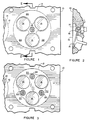
- Figure 1 is a plan view of the face of a cylinder head combustion chamber, showing a first embodiment of this invention;
- Figure 2 is a section view, taken substantially on
line 2--2 in Figure 1; - Figure 3 is a plan view similar to Figure 1 but showing a second embodiment of the invention;
- Figure 4 is a plan view of a piston face configuration useful with this invention; and
- Figure 5 is a plan view similar to Figure 1 but showing a third embodiment of the invention.
- Figure 6 is a plan view similar to Figure 1 but showing a fourth embodiment of the invention.
-
- Referring to Figures 1 and 2, there is seen a
cylinder head 10 having arecessed combustion chamber 12.Head 10 has a number of conventional bolt holes, vents and the like 11 for attachment of the head to the engine block (not shown) and other purposes. Twointake valves 14 open to allow entry of air or an air-fuel mixture into combustion chamber and closed during combustion. Oneexhaust valve 16 is closed during combustion and opens to allow egress of exhaust gases. Optimally, the faces ofvalves - The faces of
intake valves 14 preferably have the same area so that identical open areas are provided when the valves open and gas flow therethrough is uniform in pattern and volume for optimum efficiency.Exhaust valve 16 ideally has a diameter equal to or slightly greater than that of anintake valve 14, preferably a diameter ratio of from about 1:1 to about 1:1.2. The ratio of total exhaust valve cross-sectional area/total intake valve cross-sectional area is ideally less than 65% and can be in the range of 50% to 65%. - The utilization of the small exhaust port cross-sectional area and valves provides high exhaust gas velocity, on the order of 450 ft/sec. Intake gas velocity, depending on mass, volume and/or the presence of fuel would be in the 225 to 300 ft/sec range. This configuration yields excellent operating characteristics, including throttle response, exhaust gas scavenging, charge purity and octane variation tolerance. Improved thermal efficiency allows for significantly reduced heat transfer.
- In the embodiment of Figure 1, one
central spark plug 18. Acentral spark plug 18 is shown located substantially on the cylinder centerline and may extend above the surface of thecombustion chamber 12, in the preferred arrangement, as shown or may be recessed slightly below the surface, if desired. - In the alternative embodiment shown in Figure 3, three peripheral spark plugs 20 are used. While optimum efficiency may in some instances by the addition of a fourth spark plug centrally located in the Figure 3 embodiment, the embodiment of Figure 3 is less costly and in many cases provides more or at least sufficient efficiency.
- If desired, only a single
central spark plug 18 may be used. - Figure 4 shows the face of a piston 24 optimized for use with the
combustion chamber 12 arrangement shown in Figures 1-3. For optimum combustion a "squish" area is often desired between portions of the opposed faces of piston 24 andcombustion chamber 12. In that case, theareas 22 are flat and slightly tapered away from piston toward the combustion chamber centerline and the correspondingareas 26 are similarly flat and slightly tapered so that those areas closely approach each other as piston 24 makes its closest approach tocombustion chamber 12 during engine operation, squeezing the fuel/air mixture in those areas toward the center ofcombustion chamber 12.Areas areas 28 are formed in the face of piston 24 aroundcentral pad 30 to provide the desired compression ratio in conjunction with the squish areas. Recessedareas 28 are sized to provide the desired compression ratio in conjunction with the squish areas. - Figure 5 shows a plan view of another embodiment of the combustion chamber system. Here, the
combustion chamber 12 incylinder head 10 has a generally similar configuration to that shown in Figure 1, but with a different valve arrangement.Intake valves 14 are positioned closer toexhaust valve 16 than to each other. The size relationship among the valves is the same as described above.Squish plates 22 of the sort described above are provided between adjacent valves, with the squish plate between the twointake valves 14 being larger in area than that between eachintake valve 14 and theexhaust valve 16. The embodiment shown in Figure 5 is particularly useful in permitting an offset pushrod arrangement for operating the valves. If desired, threespark plugs 18 could be used, spaced around the periphery between each adjacent pair of valves, as shown in Figure 3. Or, three spark plugs oriented as shown in Figure 3 plus a centrally located plug as seen in Figure 1 could be used together. - Figure 6 shows a plan view of another embodiment of the combustion chamber system. Here, the
combustion chamber 12 incylinder head 10 has a generally similar configuration to that shown in Figure 1, but with a different valve arrangement. Twointake valves 14 are positioned to one side ofchamber 12, withexhaust valve 16 to the other side. Two spark plus 18 are located betweenexhaust valve 16 and eachintake valve 14. Eachspark plug 18 is positioned outwardly of a line drawn between the center ofexhaust valve 16 and eachintake valve 14. A line of symmetry can be drawn from the center of exhaust valve between and equally spaced fromintake valves 14. The combustion on one side of that line of symmetry is a mirror image of the other side. For optimum operation, squishareas 22 are provided between each adjacent pair of valves, with the edge of the squish areas betweenexhaust valve 16 and eachintake valve 14 being a substantially straight line drawn approximately parallel to a line drawn through the centers of theexhaust valve 16 and anintake valve 14. While the arrangement shown with two spark plugs in Figure 6 is preferred, if desired three peripheral plugs as shown in Figure 3 and/or a central plug as shown in Figure 1 could be used. - While certain preferred materials, dimensions and arrangements have been described in detail in conjunction with the above description of preferred embodiments, those can be varied, where suitable, with similar results. For example, in the embodiment shown in Figure 6, a single spark plug could be used at the center of the cylinder (as shown in Figure 5) instead of the two spark plugs shown. Other applications, variations and ramifications of this invention will occur to those skilled in the art upon reading this disclosure. Those are intended to be included within the scope of this invention, as defined in the appended claims.
Claims (10)
- A combustion chamber system for use with an internal combustion engine having at least one piston and a cooperating cylinder head forming a combustion chamber therebetween, which comprises:only three valves in the head at the combustion chamber, the valves being arranged around the axis of the cylinder and being housed in respective approximately hemispherical depressions;two of the valves having equal areas and adapted to act as intake valves;the third of the valves having an area equal to, or slightly greater than, the area of one of the intake valves, the third valve being adapted to act as an exhaust valve; each of the valves is circular and the ratio of diameters of the intake valves to the diameter of the exhaust valve being about 1:1 to 1:1.2; andignition means for igniting an air/fuel mixture in the combustion chamber, wherein squish areas are provided along the combustion chamber periphery between each pair of adjacent valves, the squish area between said intake valves having an area greater than the squish area between said exhaust valve and an adjacent intake valve.
- A system according to claim 1 wherein the head includes three part spherical depressions each housing one of the valves.
- A combustion chamber system for use with an internal combustion engine according to claim 1 or 2, wherein the valves are uniformly arranged around the axis of the cylinder.
- A combustion chamber system according to claim 1 or 2, wherein said two intake valves having a generally planar surface adjacent to said head forming one wall of the combustion chamber.
- A combustion chamber system according to claim 1 or 2 wherein said ignition means is located entirely within said head without extending below the plane of the piston generally planar surface at any point during engine operation.
- A system according to any one of claims 1 to 5 wherein said ignition means comprises a single spark plug located in said head approximately at the cylinder axis.
- A system according to any one of claims 1 to 5 wherein said ignition means comprises three spark plugs each approximately centrally located in one of the three spaces bounded by two adjacent valves and the cylinder edge.
- A system according to claim 7 further including a fourth spark plug located in the head substantially on the axis of the cylinder.
- A system according to any one of claims 1 to 5 wherein said piston surface includes at least one shallow recess adjacent to piston surface squish areas.
- A system according to any one of claims 1 to 5 wherein said piston surface includes a shallow recess adjacent to piston surface squish areas and opposite said valves.
Applications Claiming Priority (3)
| Application Number | Priority Date | Filing Date | Title |
|---|---|---|---|
| US08/246,788 US5501191A (en) | 1992-12-23 | 1994-05-19 | Combustion chamber system having an improved valve arrangement |
| US246788 | 1994-05-19 | ||
| EP95919902A EP0760058B1 (en) | 1994-05-19 | 1995-05-15 | Combustion chamber system having an improved valve arrangement |
Related Parent Applications (1)
| Application Number | Title | Priority Date | Filing Date |
|---|---|---|---|
| EP95919902A Division EP0760058B1 (en) | 1994-05-19 | 1995-05-15 | Combustion chamber system having an improved valve arrangement |
Publications (1)
| Publication Number | Publication Date |
|---|---|
| EP1167714A2 true EP1167714A2 (en) | 2002-01-02 |
Family
ID=22932208
Family Applications (2)
| Application Number | Title | Priority Date | Filing Date |
|---|---|---|---|
| EP01203590A Withdrawn EP1167714A2 (en) | 1994-05-19 | 1995-05-15 | Combustion chamber system having an improved valve arrangement |
| EP95919902A Expired - Lifetime EP0760058B1 (en) | 1994-05-19 | 1995-05-15 | Combustion chamber system having an improved valve arrangement |
Family Applications After (1)
| Application Number | Title | Priority Date | Filing Date |
|---|---|---|---|
| EP95919902A Expired - Lifetime EP0760058B1 (en) | 1994-05-19 | 1995-05-15 | Combustion chamber system having an improved valve arrangement |
Country Status (7)
| Country | Link |
|---|---|
| US (1) | US5501191A (en) |
| EP (2) | EP1167714A2 (en) |
| JP (1) | JPH10500750A (en) |
| AT (1) | ATE220761T1 (en) |
| CA (1) | CA2176809A1 (en) |
| DE (1) | DE69527425T2 (en) |
| WO (1) | WO1995032362A1 (en) |
Families Citing this family (5)
| Publication number | Priority date | Publication date | Assignee | Title |
|---|---|---|---|---|
| US5893348A (en) * | 1992-12-23 | 1999-04-13 | Feuling; James J. | Combustion chamber system having an improved valve arrangement |
| IT1293668B1 (en) * | 1997-08-01 | 1999-03-08 | Fiat Ricerche | INTERNAL COMBUSTION ENGINE WITH COMMANDED IGNITION WITH COMBUSTION CHAMBER EQUIPPED WITH THREE VALVES AND CENTRAL SPARK PLUG. |
| DE59806643D1 (en) | 1998-11-23 | 2003-01-23 | Ford Global Tech Inc | Otto engine with direct fuel injection |
| WO2002099259A1 (en) | 2001-06-06 | 2002-12-12 | Textron Lycoming | Improved cylinder assembly for an aircraft engine |
| US7284524B2 (en) | 2005-02-25 | 2007-10-23 | Lycoming Engines, A Division Of Avco Corporation | Cylinder head assemblies |
Family Cites Families (11)
| Publication number | Priority date | Publication date | Assignee | Title |
|---|---|---|---|---|
| US2111601A (en) * | 1934-11-05 | 1938-03-22 | Gen Motors Corp | Double ignition combustion chamber |
| US2338959A (en) * | 1939-04-18 | 1944-01-11 | Nallinger Fritz | Internal combustion engine |
| JPS5294911A (en) * | 1976-02-06 | 1977-08-10 | Nissan Motor Co Ltd | Two points firing engine |
| JPH0768904B2 (en) * | 1986-02-05 | 1995-07-26 | 株式会社豊田中央研究所 | High compression ratio spark ignition type lean internal combustion engine |
| AT404388B (en) * | 1986-02-20 | 1998-11-25 | Weichsler Hermann | INTERNAL COMBUSTION ENGINE |
| US4702804A (en) * | 1987-02-02 | 1987-10-27 | Pcb Sandpiper, Inc. | Methods for electrochemical reduction of halogenated organic compounds |
| US4809649A (en) * | 1987-11-23 | 1989-03-07 | Thomassen International B.V. | Four-stroke internal-combustion engine and procedure for operating such an engine |
| FR2650629B1 (en) * | 1989-08-02 | 1994-05-13 | Renault Regie Nale Usines | MULTI-CYLINDER ENGINE WITH FUEL INJECTION, COMPRISING THREE VALVES PER CYLINDER |
| DE4001819A1 (en) * | 1990-01-23 | 1991-07-25 | Bayerische Motoren Werke Ag | External ignition valve-controlled IC engine - raises conversion efficiency etc. by locating ignition plug between each pair of valves at edge of combustion chamber |
| JP3105235B2 (en) * | 1990-03-30 | 2000-10-30 | マツダ株式会社 | engine |
| US5313921A (en) * | 1992-12-23 | 1994-05-24 | Feuling James J | High efficiency combustion chamber system |
-
1994
- 1994-05-19 US US08/246,788 patent/US5501191A/en not_active Expired - Fee Related
-
1995
- 1995-05-15 DE DE69527425T patent/DE69527425T2/en not_active Expired - Fee Related
- 1995-05-15 EP EP01203590A patent/EP1167714A2/en not_active Withdrawn
- 1995-05-15 EP EP95919902A patent/EP0760058B1/en not_active Expired - Lifetime
- 1995-05-15 CA CA002176809A patent/CA2176809A1/en not_active Abandoned
- 1995-05-15 JP JP7530481A patent/JPH10500750A/en active Pending
- 1995-05-15 AT AT95919902T patent/ATE220761T1/en not_active IP Right Cessation
- 1995-05-15 WO PCT/US1995/006453 patent/WO1995032362A1/en not_active Ceased
Also Published As
| Publication number | Publication date |
|---|---|
| US5501191A (en) | 1996-03-26 |
| EP0760058A1 (en) | 1997-03-05 |
| EP0760058A4 (en) | 1998-06-03 |
| DE69527425T2 (en) | 2003-01-16 |
| WO1995032362A1 (en) | 1995-11-30 |
| DE69527425D1 (en) | 2002-08-22 |
| ATE220761T1 (en) | 2002-08-15 |
| CA2176809A1 (en) | 1995-11-30 |
| EP0760058B1 (en) | 2002-07-17 |
| JPH10500750A (en) | 1998-01-20 |
Similar Documents
| Publication | Publication Date | Title |
|---|---|---|
| US5893348A (en) | Combustion chamber system having an improved valve arrangement | |
| JP2597657B2 (en) | Combustion chamber of internal combustion engine | |
| Turkish | 3-valve stratified charge engines: Evolvement, analysis and progression | |
| US4452221A (en) | High squish dual swirl engine combustion chamber | |
| US5638787A (en) | Combustion chamber system having an improved valve arrangement | |
| US5501191A (en) | Combustion chamber system having an improved valve arrangement | |
| US4635591A (en) | Internal-combustion engines | |
| US4428336A (en) | Inlet valve assembly for internal combustion engines | |
| US5313921A (en) | High efficiency combustion chamber system | |
| US5445135A (en) | Two-valve combustion chamber system | |
| US4367707A (en) | Combustion chamber of an internal combustion engine | |
| GB1575138A (en) | Pre-combustion chamber internal combustion engines | |
| AU692538B2 (en) | Combustion chamber for internal combusion engine having mutiple valves | |
| US5471960A (en) | Cylinder for two-cycle internal combustion engine | |
| US4893596A (en) | Combustion chamber for spark ignited engine | |
| US4086899A (en) | Air fuel inlet device for internal combustion engines | |
| JPH036827Y2 (en) | ||
| JPS6314023Y2 (en) | ||
| US4142501A (en) | Internal combustion engine having improved cylinder head configuration | |
| JPS58206821A (en) | Reciprocating internal-combustion engine | |
| JPS6020565B2 (en) | engine cylinder head | |
| US4116176A (en) | Dual spark plug ignition internal combustion engine having improved cylinder head configuration | |
| JPH0122904Y2 (en) | ||
| JPH07127458A (en) | 4-cycle engine | |
| JPH0216033Y2 (en) |
Legal Events
| Date | Code | Title | Description |
|---|---|---|---|
| PUAI | Public reference made under article 153(3) epc to a published international application that has entered the european phase |
Free format text: ORIGINAL CODE: 0009012 |
|
| 17P | Request for examination filed |
Effective date: 20011011 |
|
| AC | Divisional application: reference to earlier application |
Ref document number: 760058 Country of ref document: EP |
|
| AK | Designated contracting states |
Kind code of ref document: A2 Designated state(s): AT BE CH DE DK ES FR GB GR IE IT LI LU MC NL PT SE |
|
| STAA | Information on the status of an ep patent application or granted ep patent |
Free format text: STATUS: THE APPLICATION IS DEEMED TO BE WITHDRAWN |
|
| 18D | Application deemed to be withdrawn |
Effective date: 20061201 |