EP1167589A1 - Biodegradable cellulose acetate constructions and tobacco filter - Google Patents
Biodegradable cellulose acetate constructions and tobacco filter Download PDFInfo
- Publication number
- EP1167589A1 EP1167589A1 EP00908007A EP00908007A EP1167589A1 EP 1167589 A1 EP1167589 A1 EP 1167589A1 EP 00908007 A EP00908007 A EP 00908007A EP 00908007 A EP00908007 A EP 00908007A EP 1167589 A1 EP1167589 A1 EP 1167589A1
- Authority
- EP
- European Patent Office
- Prior art keywords
- cellulose acetate
- tobacco filter
- promoting agent
- fiber
- biodegradation
- Prior art date
- Legal status (The legal status is an assumption and is not a legal conclusion. Google has not performed a legal analysis and makes no representation as to the accuracy of the status listed.)
- Granted
Links
Images
Classifications
-
- A—HUMAN NECESSITIES
- A24—TOBACCO; CIGARS; CIGARETTES; SIMULATED SMOKING DEVICES; SMOKERS' REQUISITES
- A24D—CIGARS; CIGARETTES; TOBACCO SMOKE FILTERS; MOUTHPIECES OF CIGARS OR CIGARETTES; MANUFACTURE OF TOBACCO SMOKE FILTERS OR MOUTHPIECES
- A24D3/00—Tobacco smoke filters, e.g. filter tips or filtering inserts; Filters specially adapted for simulated smoking devices; Mouthpieces of cigars or cigarettes
- A24D3/06—Use of materials for tobacco smoke filters
- A24D3/067—Use of materials for tobacco smoke filters characterised by functional properties
- A24D3/068—Biodegradable or disintegrable
-
- C—CHEMISTRY; METALLURGY
- C08—ORGANIC MACROMOLECULAR COMPOUNDS; THEIR PREPARATION OR CHEMICAL WORKING-UP; COMPOSITIONS BASED THEREON
- C08B—POLYSACCHARIDES; DERIVATIVES THEREOF
- C08B3/00—Preparation of cellulose esters of organic acids
- C08B3/06—Cellulose acetate, e.g. mono-acetate, di-acetate or tri-acetate
-
- A—HUMAN NECESSITIES
- A24—TOBACCO; CIGARS; CIGARETTES; SIMULATED SMOKING DEVICES; SMOKERS' REQUISITES
- A24D—CIGARS; CIGARETTES; TOBACCO SMOKE FILTERS; MOUTHPIECES OF CIGARS OR CIGARETTES; MANUFACTURE OF TOBACCO SMOKE FILTERS OR MOUTHPIECES
- A24D3/00—Tobacco smoke filters, e.g. filter tips or filtering inserts; Filters specially adapted for simulated smoking devices; Mouthpieces of cigars or cigarettes
- A24D3/06—Use of materials for tobacco smoke filters
- A24D3/08—Use of materials for tobacco smoke filters of organic materials as carrier or major constituent
- A24D3/10—Use of materials for tobacco smoke filters of organic materials as carrier or major constituent of cellulose or cellulose derivatives
-
- D—TEXTILES; PAPER
- D01—NATURAL OR MAN-MADE THREADS OR FIBRES; SPINNING
- D01F—CHEMICAL FEATURES IN THE MANUFACTURE OF ARTIFICIAL FILAMENTS, THREADS, FIBRES, BRISTLES OR RIBBONS; APPARATUS SPECIALLY ADAPTED FOR THE MANUFACTURE OF CARBON FILAMENTS
- D01F1/00—General methods for the manufacture of artificial filaments or the like
- D01F1/02—Addition of substances to the spinning solution or to the melt
- D01F1/10—Other agents for modifying properties
-
- D—TEXTILES; PAPER
- D01—NATURAL OR MAN-MADE THREADS OR FIBRES; SPINNING
- D01F—CHEMICAL FEATURES IN THE MANUFACTURE OF ARTIFICIAL FILAMENTS, THREADS, FIBRES, BRISTLES OR RIBBONS; APPARATUS SPECIALLY ADAPTED FOR THE MANUFACTURE OF CARBON FILAMENTS
- D01F2/00—Monocomponent artificial filaments or the like of cellulose or cellulose derivatives; Manufacture thereof
- D01F2/24—Monocomponent artificial filaments or the like of cellulose or cellulose derivatives; Manufacture thereof from cellulose derivatives
- D01F2/28—Monocomponent artificial filaments or the like of cellulose or cellulose derivatives; Manufacture thereof from cellulose derivatives from organic cellulose esters or ethers, e.g. cellulose acetate
-
- D—TEXTILES; PAPER
- D04—BRAIDING; LACE-MAKING; KNITTING; TRIMMINGS; NON-WOVEN FABRICS
- D04H—MAKING TEXTILE FABRICS, e.g. FROM FIBRES OR FILAMENTARY MATERIAL; FABRICS MADE BY SUCH PROCESSES OR APPARATUS, e.g. FELTS, NON-WOVEN FABRICS; COTTON-WOOL; WADDING ; NON-WOVEN FABRICS FROM STAPLE FIBRES, FILAMENTS OR YARNS, BONDED WITH AT LEAST ONE WEB-LIKE MATERIAL DURING THEIR CONSOLIDATION
- D04H1/00—Non-woven fabrics formed wholly or mainly of staple fibres or like relatively short fibres
- D04H1/40—Non-woven fabrics formed wholly or mainly of staple fibres or like relatively short fibres from fleeces or layers composed of fibres without existing or potential cohesive properties
- D04H1/42—Non-woven fabrics formed wholly or mainly of staple fibres or like relatively short fibres from fleeces or layers composed of fibres without existing or potential cohesive properties characterised by the use of certain kinds of fibres insofar as this use has no preponderant influence on the consolidation of the fleece
- D04H1/425—Cellulose series
- D04H1/4258—Regenerated cellulose series
-
- Y—GENERAL TAGGING OF NEW TECHNOLOGICAL DEVELOPMENTS; GENERAL TAGGING OF CROSS-SECTIONAL TECHNOLOGIES SPANNING OVER SEVERAL SECTIONS OF THE IPC; TECHNICAL SUBJECTS COVERED BY FORMER USPC CROSS-REFERENCE ART COLLECTIONS [XRACs] AND DIGESTS
- Y10—TECHNICAL SUBJECTS COVERED BY FORMER USPC
- Y10T—TECHNICAL SUBJECTS COVERED BY FORMER US CLASSIFICATION
- Y10T428/00—Stock material or miscellaneous articles
- Y10T428/29—Coated or structually defined flake, particle, cell, strand, strand portion, rod, filament, macroscopic fiber or mass thereof
- Y10T428/2913—Rod, strand, filament or fiber
-
- Y—GENERAL TAGGING OF NEW TECHNOLOGICAL DEVELOPMENTS; GENERAL TAGGING OF CROSS-SECTIONAL TECHNOLOGIES SPANNING OVER SEVERAL SECTIONS OF THE IPC; TECHNICAL SUBJECTS COVERED BY FORMER USPC CROSS-REFERENCE ART COLLECTIONS [XRACs] AND DIGESTS
- Y10—TECHNICAL SUBJECTS COVERED BY FORMER USPC
- Y10T—TECHNICAL SUBJECTS COVERED BY FORMER US CLASSIFICATION
- Y10T428/00—Stock material or miscellaneous articles
- Y10T428/29—Coated or structually defined flake, particle, cell, strand, strand portion, rod, filament, macroscopic fiber or mass thereof
- Y10T428/2913—Rod, strand, filament or fiber
- Y10T428/2933—Coated or with bond, impregnation or core
- Y10T428/2964—Artificial fiber or filament
- Y10T428/2967—Synthetic resin or polymer
Definitions
- the present invention relates to a cellulose acetate structure excellent in its biodegradability and to a tobacco filter.
- Cellulose acetate is widely used for various structures, e.g., filter raw material, fiber for preparation of a woven fabric for clothing, a film, and molded articles obtained by, for example, injection molding or extrusion molding.
- a typical example of the cellulose acetate structure is a fiber.
- Particularly, almost all the tobacco filter is formed of cellulose acetate fiber.
- Cellulose acetate fiber is manufactured nowadays as follows. First, flakes of raw material cellulose acetate are dissolved in a solvent such as acetone so as to prepare a spinning stock solution of cellulose acetate. The spinning stock solution thus prepared is spun into a fiber by a dry spinning method in which the spun fiber is discharged into a high temperature atmosphere, thereby obtaining the cellulose acetate fiber. It is also possible to employ a wet spinning method in place of the dry spinning method.
- the cellulose acetate fiber used as the tobacco filter raw material is set at an appropriate total degree of fineness so as to be finished as a fiber tow.
- the tobacco filter is manufactured by fibrillating the cellulose acetate fiber tow by a filter plug making apparatus, followed by adding a plasticizer to the fibrillated cellulose acetate fiber and forming the resultant mixture into a rod by using a filter wrapper paper sheet and subsequently cutting the rod into pieces each having a predetermined length.
- Cellulose acetate is an acetic acid ester of cellulose and is, essentially, biodegradable. In practice, however, the biodegradability of cellulose acetate is not necessarily high.
- the tobacco filter made of cellulose acetate fibers retains its shape even if the tobacco filter is kept buried in the soil for one or two years. A very long time is required for the tobacco filter to be completely biodegraded.
- the tobacco filter is incorporated in the tobacco article so as to be circulated to the consumer and, after smoking, is discarded as the tobacco butte. Also, the tobacco filter is discarded directly from the filter manufacturing factory as the residue of manufacture. These discarded tobacco filters are treated as rubbish and in some cases are buried in the ground for disposal. Also, it is possible that the tobacco butte is not collected as rubbish, and is left to stand under the natural environment. These situations apply to not only the tobacco filter but also the general cellulose acetate structure.
- the acetyl group of cellulose acetate is cut by the exoenzyme released from microorganisms, with the result that the DS of cellulose acetate is decreased. Then, the cellulose acetate with the decreased DS is easily subjected to enzyme decomposition by, for example, cellulase, widely present in the environment and is finally subjected to the microorganism metabolism so as to be decomposed into carbon dioxide and water.
- the rate-limiting step of the biodegradation rate is considered to reside in the first cutting of the acetyl group. Also, the biodegradation rate of the structure of not only the cellulose acetate but also the overall plastic material is said to be also dependent on the surface area of the structure.
- the biodegradation rate is increased with an increase in the contact area per unit weight with the microorganism environment.
- to increase the surface area of the plastic structure is to enhance the chance of contact with the decomposing bacteria.
- the chemical hydrolytic reaction of the acetyl group of cellulose acetate causes DS of the cellulose acetate to be lowered so as to generate acetic acid.
- the acetyl group released from cellulose acetate is liberated as acetic acid.
- the cellulose acetate structure is caused to generate a strong acetic acid odor under the influence of the liberated acetic acid.
- the acetic acid odor is not a desirable factor in the article. In the case of, for example, a tobacco filter, the generation of the acetic acid odor markedly impairs the taste of the tobacco.
- this prior art is intended to increase the chance of contact between cellulose acetate and the cellulose acetate decomposing bacteria, and does not essentially strengthen the functions of cellulose acetate and the cellulose acetate decomposing bacteria. Therefore, this prior art fails to produce the sufficient effect of promoting the biodegradation rate. Also, it is very difficult to mix these compounds in the cellulose acetate fiber in the present manufacturing process of the cellulose acetate fiber.
- Jpn. Pat. Appln. KOKAI Publication No. 8-70852 is a method of allowing a microorganism capable of deacetylating cellulose acetate and the deacetylating enzyme produced by the enzyme to be supported by cellulose acetate. These methods are considered to be effective for promoting the biodegradation rate of cellulose acetate.
- each of the additives used in these methods is costly, leading to a considerable increase in the cost of the cellulose acetate structure.
- Jpn. Pat. Appln. KOKAI Publication No. 8-140654 discloses the method of coating the surface of the cellulose fiber such as wood pulp with a cellulose ester such as cellulose acetate.
- the biodegradation rate of the entire tobacco filter is determined by the biodegradation rate of the material that can be easily biodegraded and, thus, the biodegradation rate of the cellulose acetate itself is not essentially increased.
- the present invention is basically intended to provide a means for essentially promoting the mutual function between cellulose acetate and the cellulose acetate decomposing bacteria so as to further improve the biodegradability of cellulose acetate under the natural environment.
- the present invention is intended to provide a cellulose acetate structure excellent in its biodegradability while suppressing the deterioration of the quality, particularly, suppressing the generation of the acetic acid odor, and a tobacco filter using the particular cellulose acetate structure.
- the present invention is also intended to provide a biodegradable cellulose acetate structure that can be manufactured without markedly changing the existing manufacturing method.
- the biodegradability of cellulose acetate can be markedly improved by adding a predetermined compound to cellulose acetate, particularly by adding the predetermined compound to a spinning stock solution and spinning a fiber by using the spinning stock solution when the cellulose acetate is prepared in the form of a fiber.
- a cellulose acetate structure at least a surface region of which comprises a biodegradable cellulose acetate composition
- a biodegradation promoting agent contained in cellulose acetate and comprising at least one compound selected from the group consisting of a salt of an oxygen acid of phosphorus, an ester of an oxygen acid of phosphorus or a salt thereof, carbonic acid and a salt thereof.
- the cellulose acetate prefferably has a DS value falling within a range of between 2.0 and 2.6.
- the biodegradation promoting agent should desirably have a solubility in water of room temperature of 2g/dm 3 or less.
- a biodegradation promoting agent can be selected from the group consisting of cellulose phosphate, starch phosphate, calcium secondary phosphate, calcium tertiary phosphate, and calcium phosphate hydroxide.
- biodegradation promoting agent is in the form of fine particles
- biodegradable cellulose acetate composition it is desirable for the biodegradable cellulose acetate composition to further contain a dispersant for dispersing the fine particles in the composition.
- biodegradable cellulose acetate composition it is desirable for the biodegradable cellulose acetate composition to further contain a photodegradation promoting agent.
- the cellulose acetate structure of the present invention may be in the form of fibers or in the form of an unwoven fabric formed of short fibers having a length of 1 to 100 mm.
- a tobacco filter comprising the cellulose acetate structure of the present invention in the form of fibers or a unwoven fabric.
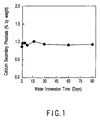
- FIG. 1 is a graph showing the result of elution into water of calcium secondary phosphate contained in the cellulose acetate.
- the present invention is directed to a cellulose acetate structure formed from a biodegradable cellulose acetate composition in which a predetermined biodegradation promoting agent is contained in the cellulose acetate and also directed to a tobacco filter.
- cellulose acetate can be used in the present invention regardless of the DS value of the cellulose acetate.
- cellulose diacetate having a DS value of 2.0 to 2.6 and cellulose triacetate having a DS value of 2.6 or more it is possible to use cellulose acetate having a DS value of 2.0 or less in which the cellulose acetate exhibits a good biodegradability.
- At least one compound selected from the group consisting of a salt of oxygen acid of phosphorus, an ester of oxygen acid of phosphorus or a salt thereof, and a carbonic acid or a salt thereof is used as the biodegradation promoting agent that is contained in the cellulose acetate.
- the oxygen acid which is also called an oxo acid, is an acid in which a hydrogen atom or atoms capable of dissociation as a proton is bonded to an oxygen atom or atoms, and includes the condensate thereof if appropriate.
- the oxygen acid of phosphorus includes, for example, orthophosphoric acid, hereinafter referred to simply as phosphoric acid in some cases, pyrophosphoric acid, metaphosphoric acid, and polyphosphoric acid, as well as phosphorous acid, and hypophosphorous acid.
- the ester of the oxygen acid of phosphorus is a compound in which at least one hydroxyl group of the oxygen acid is esterified, and includes PO(OR)(OH) 2 , PO(OR) 2 (OH) and PO(OR) 3 .
- the salt used in the present invention also includes hydrogen salt or a complex salt such as a phosphate hydroxide.
- the hydrate is also included in the biodegradation promoting agent.
- the number of bound water molecules is optional.
- the biodegradation promoting agent it is desirable for the biodegradation promoting agent to have a high safety factor and to be supplied in a large amount and at a reasonable cost.
- the fibrous cellulose acetate is manufactured in general by the spinning method in which the cellulose acetate solution (spinning stock solution) is discharged through the spinning nozzle.
- the biodegradation promoting agent used in the present invention it is desirable for the biodegradation promoting agent used in the present invention to be soluble in a solvent for dissolving cellulose acetate, e.g., acetone, methylene chloride/methanol mixed solvent.
- the biodegradation promoting agent is insoluble in the solvent
- the biodegradation promoting agent used in the present invention to have a solubility in water of room temperature (20°C) of 2 g/dm 3 or less. If the solubility in water is low as noted above, it is possible to suppress the elution of the biodegradation promoting agent from the cellulose acetate structure into water. It is particularly desirable to use cellulose phosphate, starch phosphate, calcium secondary phosphate, calcium tertiary phosphate, calcium phosphate hydroxide or a mixture thereof as such a biodegradation promoting agent.
- the biodegradation rate of cellulose acetate it is possible to design the biodegradation rate of cellulose acetate by controlling the addition amount of the biodegradation promoting agent.
- the addition amount of the biodegradation promoting agent depending on the biodegradation rate aimed at. For example, where it is desired to achieve rapid biodegradation, a large amount of the biodegradation promoting agent is added.
- the biodegradation promoting agent in an amount of 0.01 to 10% by weight, more desirably in an amount of 0.03 to 3% by weight, based on the amount of cellulose acetate.
- the state of dispersion of the biodegradation promoting agent greatly contributes to the effect of promoting the biodegradation rate. It has been found that, where the comparison is made with the same addition amount, the promoting effect is rendered more prominent in the case where the biodegradation promoting agent, etc. is present in a well dispersed state in the cellulose acetate fiber. It follows that it is more desirable to use a suitable dispersant together with the biodegradation promoting agent. It is possible to use, as such a dispersant, a carboxylic acid polymer.
- the particle diameter of the biodegradation promoting agent insoluble in the solvent of cellulose acetate greatly contributes to the promoting effect of the biodegradation rate. It has been found that, if a comparison is made with the same addition amount, the biodegradation promoting effect is rendered prominent with a decrease in the particle diameter. It has also been found that it is desirable for the biodegradation promoting agent insoluble in the solvent of cellulose acetate to have an average particle diameter not larger than 1.0 ⁇ m.
- the present inventors have found that, if a photodegradation promoting agent such as titanium oxide, used as a highly light-activated catalyst, is used together with the biodegradation promoting agent of the present invention, the promotion of the photodegradation and the promotion of the biodegradation rate caused by the biodegradation promoting agent of the present invention produce a synergetic effect so as to further promote the degradability of the cellulose acetate structure.
- the prominent breakage of the cellulose acetate structure achieved by the biodegradation promoting agent of the present invention allows the photodegradation promoting agent such as titanium oxide used as a highly light-activated catalyst to exhibit more easily the effect of promoting the photolytic degradation.
- the breakage of the cellulose acetate structure caused by the photodegradation promoting agent such as titanium oxide for the highly light-activated catalyst allows the biodegradation promoting agent of the present invention to exhibit more prominently the effect of promoting the biodegradation rate. In this fashion, the erasure of the cellulose acetate structure in the degradation process can be synergetically promoted.
- a tobacco filter formed of a cellulose acetate fiber containing both the biodegradation promoting agent of the present invention and the photodegradation promoting agent such as titanium oxide used as a highly light-activated catalyst produces a prominent effect.
- the upper portion of the tobacco filter which is readily exposed to light, is degraded mainly by photodegradation.
- the lower portion of the tobacco filter, which is readily exposed to microorganisms is biodegraded. It follows that it is possible to obtain the. effect that cannot be expected sufficiently in the case of independently using the biodegradation promoting agent or the photolytic degradation promoting agent, i.e., the effect that the structure of the tobacco filter can be disintegrated more promptly.
- titanium oxide acting as the photolytic degradation promoting agent is desirable for titanium oxide acting as the photolytic degradation promoting agent to be an anatase type titanium oxide having desirably a particle diameter not larger than 0.1 ⁇ m and to be added in an amount of, desirably 0.01 to 10% by weight, more desirably 0.01 to 3% by weight.
- the cellulose acetate composition of the present invention can be formed into various structures by the ordinary method, except that the composition is allowed to contain the biodegradation promoting agent of the present invention and other additives. Therefore, it is unnecessary to change the manufacturing method of the ordinary cellulose acetate structure.
- the cellulose acetate fiber used as the tobacco filter can be manufactured, for example, as follows.
- a solution (spinning stock solution) containing cellulose acetate and the additives specified in the present invention. It is possible to use methylene chloride or acetone as the solvent. It is also possible to use, as the solvent, a mixture of methylene chloride and methanol.
- concentration of cellulose acetate is generally 15 to 35% by weight and should desirably fall within a range of between 18% by weight and 30% by weight.
- the additives such as the biodegradation promoting agent are contained in the spinning stock solution in the amounts described above.
- the spinning stock solution can be prepared by mixing a solution prepared by dissolving or dispersing the additives such as the biodegradation promoting agent in a solvent for cellulose acetate with a solution prepared by dissolving cellulose acetate in a solvent for cellulose acetate or by directly adding the additives such as the biodegradation promoting agent to the solution of cellulose acetate.
- the cellulose acetate fiber can be obtained by supplying the cellulose acetate spinning stock solution containing the additives such as the biodegradation promoting agent of the present invention to a spinning nozzle apparatus for the spinning by a dry spinning method in which the cellulose acetate stock solution is discharged into a high temperature atmosphere.
- a dry spinning method in which the cellulose acetate stock solution is discharged into a high temperature atmosphere.
- the spinning it is possible to spin the uniformly dispersed spinning stock solution as it is into fibers as described above.
- a method of composite-spinning into a fiber side-by-side type or a sheath/core type which is performed by using both the cellulose acetate spinning stock solution containing the additives of the present invention and the cellulose acetate spinning stock solution that does not contain these additives such that at least the cellulose acetate containing the additives of the present invention appears on the fiber surface.
- preparing the spinning stock solution it is also possible use other additives together with the additives specified in the present invention as long as these other additives do not impair the characteristics specified in the present invention.
- the cellulose acetate fiber constituting the tobacco filter plug of the present invention contains the additives specified in the present invention in at least the surface region of the cellulose acetate fiber.
- the cellulose acetate fiber of the present invention thus obtained can be formed into the tobacco filter by the known method.
- the manufacturing method and the construction of the tobacco filter are not particularly limited.
- the tobacco filter can be manufactured, for example, as follows.
- the cellulose acetate fiber described above is formed into a tow, and the resultant tow is fibrillated by a tobacco filter plug making apparatus. Further, after a plasticizer, e.g., triacetyl glycerin, is added to the fibrillated cellulose acetate fiber, the fiber is formed into a rod, followed by cutting the fibrous rod into a desired length, thereby obtaining the filter plug.
- a plasticizer e.g., triacetyl glycerin
- the total degree of fineness of the fiber tow is set appropriately.
- the fibrous rod with the ordinary plug making apparatus by using an unwoven fabric prepared from short fibers, said short fibers being prepared by cutting the cellulose acetate fiber of the present invention into small pieces having a length of 1 to 100 mm.
- the tobacco filter prepared by bonding the cellulose acetate fiber tow with a plasticizer the cellulose acetate fibers are strongly bonded to each other by fusion bonding, with the result that the tobacco filter discarded in the natural environment tends to retain the rod shape stably over a long period of time.
- the rod shape of the tobacco filter is readily disintegrated by a large amount of water such as rain, sea water, river water or lake water, with the result that the discarded tobacco filter rod is developed into the form of a sheet on the ground.
- the contact area of the tobacco filter with the microorganism environment is increased so as to further increase the biodegradation rate of the tobacco filter.
- the degradability of the tobacco filter can be further improved together with promotion of the biodegradation rate of the cellulose acetate of the present invention.
- the unwoven fabric excellent in the water dispersion capability can be obtained by the method disclosed in, for example, Jpn. Pat. Appln. KOKAI Publication No. 9-9949.
- the method disclosed in this Japanese Patent document comprises the steps of forming a fibrillated fiber into a web, allowing the resultant web to be impregnated with a binder solution containing a binder consisting of 40 to 100% by weight of a partially saponified polyvinyl alcohol and 0 to 60% by weight of polyvinyl acetate, and drying the impregnated web.
- the tobacco filter is finished in general in the shape that the cellulose acetate fiber tow or the unwoven fabric of the cellulose acetate fiber, which is formed into a rod, is wrapped with a filter wrapper paper sheet.
- the cellulose acetate fiber of the present invention can be used singly for forming the tobacco filter.
- another constituent material includes, for example, a natural or semi-synthetic material such as pulp, linters, cotton, hemp, viscose rayon, copper ammonia rayon, liyocel, wool, or a biodegradable polymer produced by microorganisms such as polyhydroxy alkanoate; an ordinary synthetic material such as a polyolefin such as polypropylene, a polyester such as polyethylene terephthalate, or polyamide; biodegradable synthetic material such as polylactic acid, polycaprolactam, polybutylene succinate, or polyvinyl alcohol; and a photodegradable material.
- These materials can be used in the form of a fiber or a unwoven fabric. In this case, it is desirable to use a material excellent in biodegradability. It is also possible to use a foamed body of starch as a material excellent in biodegradability, though the foamed body of starch is not a fiber.
- the cellulose acetate fiber prefferably in the form of a staple or a filament. It is desirable for the cellulose acetate fiber constituting the tobacco filter of the present invention to be in the form of a fiber tow, and the total degree of fineness of the fiber tow can be made optional. For example, it is desirable to use a bundle-like fiber tow prepared by bundling 3,000 to 500,000 fibers each having a fineness of 0.5 to 15 deniers and having 10 to 50 crimps per 25 mm imparted thereto. Further, the cross sectional shape of each fiber is not particularly limited. For example, it is possible for each fiber to have a circular or rectangular cross sectional shape.
- the fiber in view of the filtering performance when used as a tobacco filter, it is desirable for the fiber to have a multi-leaf shaped cross section. Particularly, it is desirable for the fiber to have a Y-shaped cross section in view of the stability in the manufacturing process. It is also possible for the cellulose acetate fiber to be in the form of a fibril. It is desirable to use the cellulose acetate fiber in the form of a fibril together with the other constituent materials described previously or together with the cellulose acetate fiber of the present invention in the form of the ordinary fiber.
- the cellulose acetate fibers are strongly bonded to each other by fusion bonding, with the result that the tobacco filter discarded in the natural environment tends to retain the rod shape stably over a long period of time.
- the bonding points of the cellulose acetate fibers is readily dissociated by a large amount of water such as rain, sea water, river water or lake water, if the tobacco filter using the water soluble adhesive is discarded in the natural environment. As a result, the rod shape of the tobacco filter is readily disintegrated.
- the discarded tobacco filter rod is developed into the form of a sheet on the ground.
- the contact area of the tobacco filter with the microorganism environment is increased so as to further increase the biodegradation rate of the tobacco filter.
- the degradability of the tobacco filter can be further improved together with promotion of the biodegradation rate of the cellulose acetate of the present invention. It is possible to effectively use the water soluble adhesives disclosed in, for example, Jpn. Pat. Appln. KOKAI Publication No. 8-187073 and Jpn. Pat. Appln. KOKAI Publication No. 9-266783.
- the water soluble adhesives disclosed in these prior arts include various water soluble polymer materials including, for example, polyvinyl alcohol, polyvinyl pyrrolidone, polyvinyl ether, and vinyl-based water soluble polymer materials including, for example, copolymers between vinyl monomers such as vinyl acetate, vinyl pyrrolidone, vinyl alkyl ether, and styrene, and comonomers capable of copolymerization with the vinyl monomers, said comonomer having a carboxyl group, a sulfonic group or a salt thereof.
- water soluble polymer materials including, for example, polyvinyl alcohol, polyvinyl pyrrolidone, polyvinyl ether, and vinyl-based water soluble polymer materials including, for example, copolymers between vinyl monomers such as vinyl acetate, vinyl pyrrolidone, vinyl alkyl ether, and styrene, and comonomers capable of copolymerization with the vinyl
- the comonomers include, for example, ⁇ , ⁇ -ethylenically unsaturated carboxylic acid and anhydrides thereof such as acrylic acid, methacrylic acid, maleic anhydride, maleic acid, and crotonic acid, and ⁇ , ⁇ -ethylenically unsaturated sulfonic acid and anhydride thereof such as ethylene sulfonic acid.
- the water soluble adhesives disclosed in these prior arts further include water soluble acrylic polymer materials, polyalkylene oxide, water soluble polyester and water soluble polyamide.
- a filter wrapper paper sheet excellent in its water dispersion capability.
- a tobacco filter is discarded in the natural environment, the presence of the filter wrapper paper sheet arranged to cover the outer circumferential surface of the tobacco filter greatly impairs the contact efficiency between the cellulose acetate fiber and the microorganism environment.
- a filter wrapper paper sheet is formed of cellulose such as pulp, which is a material excellent in biodegradability. It follows that the filter wrapper paper sheet arranged to surround the outer circumferential surface of the tobacco filter is degraded relatively promptly, i.e., in about 1 to 6 months, in the natural environment.
- a tobacco filter wrapped with a wrapper paper sheet may retain its shape for more than a year.
- the filter wrapper paper sheet surrounding the outer circumferential surface of the tobacco filter can be easily dispersed and removed by a large amount of water such as rain, sea water, river water and lake water.
- the cellulose acetate fiber is developed directly on, for example, the ground surface so as to increase the contact area between the cellulose acetate fiber and the microorganism environment so as to promote the biodegradation rate. It follows that the degradation rate of the tobacco filter can be further promoted.
- the biodegradation rate of the cellulose acetate of the present invention can be promoted and, at the same, the degradability of the tobacco filter can be further promoted.
- the filter wrapper paper sheets excellent in the water dispersion capability are exemplified in, for example, Jpn. Pat. Appln. KOKAI Publication No. 9-47271 and Jpn. Pat. Appln.
- the filter wind up paper sheets disclosed in these prior arts consist of a base material exhibiting the water dispersion capability including a water soluble paper or a hydrolyzable paper. It is desirable to use a water soluble paper or a hydrolyzable paper prepared by using the fiber used for the paper making (water dispersible fiber) having a water dispersion capability imparted thereto by the known technology of weakening the contact strength or bonding strength among the fibers by weakening the beating. Specifically, it is desirable to use a water soluble paper or a hydrolyzable paper prepared by adding a fibrous carboxymethyl cellulose salt or a fibrous carboxyethyl cellulose salt to the water dispersible fiber noted above in the paper making step.
- the water dispersible fiber used in the present invention includes, for example, wood pulp fibers such as pulp of a coniferous tree, a broad-leaf tree, or a dissolved pulp and/or non-wood plant fibers such as kenaf pulp, hemp pulp, or linters.
- the cellulose acetate structure containing the additives specified in the present invention and the cellulose acetate fiber used as the raw material of the tobacco filter are featured as follows.
- the additives specified in the present invention can be added easily to the cellulose acetate structure without changing the conventional manufacturing process of the cellulose acetate structure.
- the cellulose acetate structure of the present invention can be obtained by adding, by means of fusion, the additives specified in the present invention to the cellulose acetate containing, for example, a plasticizer and capable of a heat forming. This is also the case with the cellulose acetate fiber used as the tobacco filter raw material.
- the additives specified in the present invention which are added to the cellulose acetate fiber, are soluble in the solvent dissolving the cellulose acetate, e.g., acetone or a methylene chloride/methanol mixed solvent, or insoluble in such a solvent, these additives are finely pulverized to the extent that the fiber properties are not disadvantageously affected in the spinning step. As a result, the manufacture of the cellulose acetate fiber is not rendered difficult.
- the conventional method can be employed as it is for manufacturing the cellulose acetate fiber of the present invention, except that the additives specified in the present invention are simply added to the spinning stock solution.
- the additives specified in the present invention which are added to the cellulose acetate structure and the cellulose acetate fiber, exhibit a sufficiently low acidity or a sufficiently low basicity in the manufacturing process of the cellulose acetate structure and the cellulose acetate fiber as well as in the stage of the final product. It follows that no chemical reaction is brought about between the additives and cellulose acetate, with the result that these additives are stably present in the cellulose acetate structure and in the cellulose acetate fiber.
- the cellulose acetate structure and the cellulose acetate fiber manufactured by the method of the present invention are free from deterioration of quality derived from the use of the particular additives and, thus, are fully comparable in quality with the ordinary cellulose acetate structure and the cellulose acetate fiber that do not contain the additives specified in the present invention.
- the additives specified in the present invention exhibit a prominent biodegradability because the additives of the discarded materials produce the effect of promoting the biodegradation rate.
- the additives specified in the present invention exhibit a predetermined solubility in water. Therefore, these additives are not easily released (not eluted into water) from the cellulose acetate structure and from the cellulose acetate fiber under the natural environment and, thus, are retained for a long time in the cellulose acetate structure and the cellulose acetate fiber. In other words, the additives specified in the present invention continue to exhibit the effect of promoting the biodegradability at any time and at any place under the natural environment.
- the cellulose acetate solution thus prepared was casted on a glass plate, followed by drying the cast solution so as to obtain a cellulose acetate film having a thickness of about 100 ⁇ m.
- the acetic acid odor level was evaluated in respect of the cellulose acetate film obtained in each of Examples 1 to 3 and Comparative Examples 1 and 2. Also, for measuring the acetic acid concentration, a circular film piece having a diameter of 5 cm was formed by punching the cellulose acetate film immediately after manufactured. The circular film piece thus prepared was put in an odor bag and left to stand in a constant temperature chamber set at 50°C, and the acetic acid concentration within the odor bag was measured one week later by a gas detection tube method. At the same time, the acetic acid odor level of the film was evaluated by an organoleptic examination method. Table 1 shows the results.
- the cellulose acetate composition containing the biodegradation promoting agent of the present invention is free from generation of an acetic acid odor (quality deterioration) derived from the use of the biodegradation promoting agent.
- the biodegradation promoting agent of the present invention does not carry out any chemical reaction with cellulose acetate during the manufacturing process of the cellulose acetate composition and in the stage of the product and, thus, are present stably in the cellulose acetate composition. It follows that the cellulose acetate composition of the present invention exhibits the quality substantially equal to that of the ordinary cellulose acetate composition that does not contain the additives.
- the various additives contained in the cellulose acetate composition of the present invention are not eluted into water.
- the experimental data support that the additives of the cellulose acetate composition are not easily eluted into water under the natural environment so as to be retained in the cellulose acetate composition for a long time.
- the biodegradation promoting agent of the present invention exhibits the effect of promoting the biodegradation rate of the additives at any time and at any place under the natural environment.
- Evaluated was the biodegradability of the cellulose acetate film obtained in each of Examples 1 to 3 and Comparative Examples 1 and 2.
- the evaluation test was conducted by burying a circular film piece having a diameter of 5 cm, which was obtained by punching the cellulose acetate film obtained in each of Examples 1 to 3 and Comparative Examples 1 and 2, in the wet soil and by measuring the weight reduction rate of the buried film piece 45 days later.
- the weight reduction rate was calculated on the basis of the film weight before the film piece was buried in the soil and the film weight after the film piece was buried in the soil. Table 3 shows the results.
- Table 3 supports that the biodegradation rate of the cellulose acetate was promoted in any of the Examples of the present invention.
- Cellulose acetate (DS: 2.5) was dissolved in acetone in a concentration of 28% by weight, followed by adding titanium oxide particles having a weight average particle diameter of 0.2 ⁇ m to the resultant solution in an amount of 0.5% by weight based on the amount of cellulose acetate, while stirring the system, so as to obtain a uniform dispersion. Then, calcium secondary phosphate having a weight average particle diameter of 0.46 ⁇ m was added to the resultant dispersion in an amount of 1% by weight based on the amount of cellulose acetate while stirring the dispersion until the added calcium secondary phosphate was dispersed uniformly so as to obtain a spinning stock solution.
- the spinning stock solution was filtered and, then, spun by a dry spinning method using a known filter bundle spinning apparatus so as to obtain cellulose acetate filaments.
- a predetermined amount of the cellulose acetate filaments was bundled and crimped so as to obtain a cellulose acetate fiber tow, each fiber having a Y-shaped cross section and a degree of fineness of 3 deniers.
- the total degree of fineness of the cellulose acetate fiber tow was 36,000 deniers.
- a tobacco filter was manufactured as follows by using the cellulose acetate fiber tow thus obtained. Specifically, the cellulose acetate fiber tow was fibrillated by using a known tobacco filter plug making apparatus, followed by adding 6.0% by weight of a plasticizer (triacetyl glycerin) to the cellulose acetate fiber tow and subsequently wrapping the fibrillated cellulose acetate tow with a filter wrapper paper so as to prepare a rod. Finally, the rod thus prepared was cut into small pieces each having a predetermined length, thereby obtaining the filter plug.
- a plasticizer triacetyl glycerin
- the cellulose acetate fiber tow and the tobacco filter thus obtained were observed. It has been found that the moldability of the cellulose acetate fiber tow and the tobacco filter was not affected by the addition of calcium secondary phosphate. Also, the cellulose acetate fibers were subjected to ashing so as to calculate the calcium secondary phosphate content of the cellulose acetate fiber by the quantitative analysis (weighing) and the qualitative analysis (element analysis) of the ash. Table 4 shows the results. (Additive content of cellulose acetate fiber) Charged amount in spinning stock solution Content in fiber 1.0% by weight based on cellulose acetate 0.86% by weight based on cellulose acetate
- Table 4 clearly supports that it is possible to allow the cellulose acetate fiber to contain a solid additive like the calcium secondary phosphate particles used in Example 4.
- Cellulose acetate (DS: 2.5) was dissolved in acetone in a concentration of 28% by weight, followed by adding titanium oxide particles having a weight average particle diameter of 0.2 ⁇ m to the resultant solution in an amount of 0.5% by weight based on the amount of cellulose acetate while stirring the system so as to obtain a uniform dispersion. Then, calcium secondary phosphate having a weight average particle diameter of 1.20 ⁇ m was added to the resultant dispersion in an amount of 1% by weight based on the amount of cellulose acetate while stirring the dispersion until the added calcium secondary phosphate was dispersed uniformly so as to obtain a spinning stock solution.
- a cellulose acetate fiber tow and a tobacco filter were prepared as in Example 4 by using the spinning stock solution thus obtained.
- the cellulose acetate fiber tow and the tobacco filter thus obtained were observed. It has been found that the moldability of the cellulose acetate fiber tow and the tobacco filter was not affected by the addition of calcium secondary phosphate.
- Cellulose acetate (DS: 2.5) was dissolved in acetone in a concentration of 28% by weight, followed by adding titanium oxide particles having a weight average particle diameter of 0.2 ⁇ m to the resultant solution in an amount of 0.5% by weight based on the amount of cellulose acetate while stirring the system so as to obtain a uniform dispersion, thereby obtaining a spinning stock solution.
- a cellulose acetate fiber tow and a tobacco filter were prepared as in Example 4 by using the spinning stock solution thus obtained.
- Cellulose acetate (DS: 2.5) was dissolved in acetone in a concentration of 28% by weight, followed by adding titanium oxide particles having a weight average particle diameter of 0.2 ⁇ m to the resultant solution in an amount of 0.5% by weight based on the amount of cellulose acetate, while stirring the system, so as to obtain a uniform dispersion.
- polyphosphoric acid was added to the resultant dispersion in an amount of 1% by weight based on the amount of cellulose acetate while stirring the dispersion until the added calcium secondary phosphate was dispersed uniformly so as to obtain a spinning stock solution.
- a cellulose acetate fiber tow and a tobacco filter were prepared as in Example 4 by using the spinning stock solution thus obtained.
- the acetic acid odor level was evaluated in respect of the tobacco filter obtained in each of Examples 4 and 5 and Comparative Examples 3 and 4. Also, for measuring the acetic acid concentration, the tobacco filter, immediately after being manufactured, which had a length of 25 mm, was put in an odor bag and left to stand in a constant temperature chamber set at 50°C, and the acetic acid concentration within the odor bag was measured two weeks later by a gas detection tube method. At the same time, the acetic acid odor level of the tobacco filter was evaluated by an organoleptic examination method. Table 5 shows the results. (Results of acetic acid odor evaluation of tobacco filter) Sample Acetic acid concentration (pmm) Acetic acid odor level Example 4 0.5 0 Example 5 0.3 0 Comparative Example 3 0.5 0 Comparative Example 4 11.0 1-2
- the cellulose acetate fiber of the present invention is free from generation of an acetic acid odor (quality deterioration) derived from the use of the additive (biodegradation promoting agent).
- the additive of the present invention does not chemically react with cellulose acetate during the manufacturing process of the cellulose acetate fiber or in the product stage and, thus, is stable. It follows that the cellulose acetate fiber of the present invention exhibits qualities substantially equal to that of the ordinary cellulose acetate fiber that does not contain the additive.
- Example 4 Evaluated was the elution into water of the additive from the cellulose acetate fiber by using the tobacco filter obtained in Example 4.
- the manufactured tobacco filter having a length of 25 mm and not wrapped with a wrapper paper was immersed in ion exchange water so as to measure the change of content of calcium secondary phosphate over time the cellulose acetate fiber forming the tobacco filter.
- the calcium secondary phosphate content was calculated as in Example 4.
- FIG. 1 is a graph showing the result.
- the graph of FIG. 1 clearly supports that calcium secondary phosphate contained in the cellulose acetate fiber does not elute into water.
- the experimental data implies that the additive is not easily liberated from the cellulose acetate fiber (does not elute into water) under the natural environment, so as to be retained in the cellulose acetate fiber for a long time. In other words, the additive produces the effect of promoting the biodegradation rate at any time and at any place under the natural environment.
- Evaluated was the biodegradability of the tobacco filter obtained in each of Examples 4 and 5 and Comparative Example 3.
- the evaluation test was conducted by burying the manufactured tobacco filter having a length of 25 mm and not wrapped with a wrapper paper in the wet soil and by measuring the weight reduction rate of the buried tobacco filter 47 days later.
- the weight reduction rate was calculated on the basis of the tobacco filter weight before the tobacco filter was buried in the soil and the tobacco filter weight after the tobacco filter was buried in the soil. Table 6 shows the results.
- Table 6 supports that the biodegradation rate of the tobacco filter was promoted in any of the Examples of the present invention. It is also seen that the biodegradation rate of the tobacco filter is dependent on the particle diameter of the additive. To be more specific, the biodegradation rate can be increased by making smaller the particle diameter of the additive.
- Cellulose acetate (DS: 2.5) was dissolved in acetone in a concentration of 28% by weight, followed by adding titanium oxide particles for a highly light-activated catalyst having a weight average particle diameter of 0.2 ⁇ m to the resultant solution in an amount of 1% by weight based on the amount of cellulose acetate while stirring the system so as to obtain a uniform dispersion. Then, calcium secondary phosphate particles having a weight average particle diameter of 1.20 ⁇ m were added to the resultant dispersion in an amount of 1% by weight based on the amount of cellulose acetate while stirring the dispersion until the added calcium secondary phosphate particles were dispersed uniformly so as to obtain a spinning stock solution.
- a cellulose acetate fiber tow and a tobacco filter were prepared as in Example 4 by using the spinning stock solution thus obtained.
- the cellulose acetate fiber tow and the tobacco filter thus obtained were observed. It has been found that the moldability of the cellulose acetate fiber tow and the tobacco filter was not affected by the addition of the titanium oxide particles for the highly light-activated catalyst.
- Cellulose acetate (DS: 2.5) was dissolved in acetone in a concentration of 28% by weight, followed by adding titanium oxide particles for a highly light-activated catalyst having a weight average particle diameter of 0.02 ⁇ m to the resultant solution in an amount of 1% by weight based on the amount of cellulose acetate while stirring the system so as to obtain a uniform dispersion, thereby obtaining a spinning stock solution.
- a cellulose acetate fiber tow and a tobacco filter were prepared as in Example 4 by using the spinning stock solution thus obtained.
- Evaluated was the overall degradability under the natural environment of the tobacco filter obtained in each of Examples 5, 6 and Comparative Examples 3 and 5.
- the evaluation covered a plurality of factors such as the biodegradability, the photolytic degradability, and the disintegration of the shape.
- the manufactured tobacco filter having a length of 25 mm and not wrapped with a wrapper paper was put on outdoor soil so as to measure the change in the outer appearance and the volume reduction rate of the tobacco filter 6 months later.
- the volume reduction rate was calculated on the basis of the tobacco filter volume before. Table 7 shows the results of the outer appearance and the volume reduction rate.
- the degradation rate of the tobacco filter was promoted in any of the Examples of the present invention. It is also seen that the degradation rate of the tobacco filter is drastically promoted by the use of the additive of the present invention together with titanium oxide for the highly light-activated catalyst.
- the present invention provides a cellulose acetate structure excellent in biodegradability and capable of suppressing the deterioration of quality, particularly, the generation of acetic acid odor, and a tobacco filter using the particular cellulose acetate structure of the present invention.
Landscapes
- Engineering & Computer Science (AREA)
- Chemical & Material Sciences (AREA)
- Chemical Kinetics & Catalysis (AREA)
- Textile Engineering (AREA)
- Materials Engineering (AREA)
- General Chemical & Material Sciences (AREA)
- Life Sciences & Earth Sciences (AREA)
- Manufacturing & Machinery (AREA)
- Biodiversity & Conservation Biology (AREA)
- Medicinal Chemistry (AREA)
- Health & Medical Sciences (AREA)
- Polymers & Plastics (AREA)
- Organic Chemistry (AREA)
- Biochemistry (AREA)
- Cigarettes, Filters, And Manufacturing Of Filters (AREA)
- Biological Depolymerization Polymers (AREA)
- Polysaccharides And Polysaccharide Derivatives (AREA)
- Compositions Of Macromolecular Compounds (AREA)
- Filtering Materials (AREA)
- Artificial Filaments (AREA)
- Nonwoven Fabrics (AREA)
Abstract
Description
Incidentally, for facilitating the preparation of the filter plug, the total degree of fineness of the fiber tow is set appropriately.
| (Results of acetic acid odor evaluation of various cellulose acetate films) | ||
| Sample | Acetic acid concentration (ppm) | Acetic acid odor level |
| Example 1 | 0.8 | 0 |
| Example 2 | 1.0 | 0 |
| Example 3 | 1.0 | 0 |
| Comparative Example 1 | 0.8 | 0 |
| Comparative Example 2 | 44.0 | 2 |
| (Results of Water Elution Evaluation of Additive from Cellulose Acetate Film) | |
| Sample | Water elution rate (%) of additive; |
| Example 1 | 2.0 |
| Example 2 | 16.1 |
| Example 3 | 4.3 |
| (Results of Evaluation of Biodegradability of Cellulose Acetate Film) | ||
| Sample | Weight reduction rate (%) | Observation of film outer appearance |
| Example 1 | 6.8 | many worm-eaten spots |
| Example 2 | 9.1 | many worm-eaten spots |
| Example 3 | 16.2 | brittle and reduction of piece size, many worm-eaten spots |
| Comparative Example 1 | 0.8 | no appreciable change |
| (Additive content of cellulose acetate fiber) | |
| Charged amount in spinning stock solution | Content in fiber |
| 1.0% by weight based on cellulose acetate | 0.86% by weight based on cellulose acetate |
| (Results of acetic acid odor evaluation of tobacco filter) | ||
| Sample | Acetic acid concentration (pmm) | Acetic acid odor level |
| Example 4 | 0.5 | 0 |
| Example 5 | 0.3 | 0 |
| Comparative Example 3 | 0.5 | 0 |
| Comparative Example 4 | 11.0 | 1-2 |
| (Results of Evaluation of Biodegradability of Tobacco Filter) | ||
| Sample | Weight reduction rate (%) | Observation of filter outer appearance |
| Example 4 | 42.1 | thinned to cause fibers to be scattered |
| Example 5 | 27.0 | thinned to cause fibers to be scattered |
| Comparative Example 3 | 2.3 | no appreciable change |
| (Results of Evaluation of Tobacco Filter Degradability) | ||
| Sample | Volume reduction rate (%) | Observation of sample outer appearance |
| Example 5 | 22.8 | degradation proceeded mainly from the surface in contact with soil |
| Example 6 | 39.9 | markedly thinned and overall degradation proceeded |
| Comparative Example 3 | 11.1 | no appreciable change |
| Comparative Example 3 | 20.8 | fibers in mainly filter upper surface portion were scattered |
Claims (12)
- A cellulose acetate structure, at least a surface region of which comprises a biodegradable cellulose acetate composition comprising a biodegradation promoting agent contained in cellulose acetate and comprising at least one compound selected from the group consisting of a salt of an oxygen acid of phosphorus, an ester of an oxygen acid of phosphorus or a salt thereof, carbonic acid and a salt thereof.
- The cellulose acetate structure according to claim 1, wherein said cellulose acetate has a DS value falling within a range of between 2.0 and 2.6.
- The cellulose acetate structure according to claim 1, wherein said biodegradation promoting agent has a solubility in water of room temperature of 2g/dm3 or less.
- The cellulose acetate structure according to claim 3, wherein said biodegradation promoting agent is selected from the group consisting of cellulose phosphate, starch phosphate, calcium secondary phosphate, calcium tertiary phosphate, and calcium phosphate hydroxide.
- The cellulose acetate structure according to claim 1, wherein said biodegradation promoting agent is contained in an amount of 0.01 to 10% by weight based on said cellulose acetate.
- The cellulose acetate structure according to claim 1, wherein said biodegradation promoting agent is in the form of fine particles, and said biodegradable cellulose acetate composition further contains a dispersant for dispersing said fine particles in said composition.
- The cellulose acetate structure according to claim 1, further comprising a phtodegradation promoting agent.
- The cellulose acetate structure according to claim 7, wherein said photodegradation promoting agent comprises titanium oxide.
- The cellulose acetate structure according to claim 1, wherein said cellulose acetate structure is in the form of fibers.
- The cellulose acetate structure according to claim 1, wherein said cellulose acetate structure in the form of a unwoven fabric formed of short fibers having a length of 1 to 100 mm.
- A tobacco filter comprising the cellulose acetate structure defined in claim 9.
- A tobacco filter comprising the cellulose acetate structure defined in claim 10.
Applications Claiming Priority (3)
| Application Number | Priority Date | Filing Date | Title |
|---|---|---|---|
| JP6523599 | 1999-03-11 | ||
| JP6523599 | 1999-03-11 | ||
| PCT/JP2000/001477 WO2000053832A1 (en) | 1999-03-11 | 2000-03-10 | Biodegradable cellulose acetate constructions and tobacco filter |
Publications (3)
| Publication Number | Publication Date |
|---|---|
| EP1167589A1 true EP1167589A1 (en) | 2002-01-02 |
| EP1167589A4 EP1167589A4 (en) | 2004-11-03 |
| EP1167589B1 EP1167589B1 (en) | 2007-08-29 |
Family
ID=13281063
Family Applications (1)
| Application Number | Title | Priority Date | Filing Date |
|---|---|---|---|
| EP00908007A Expired - Lifetime EP1167589B1 (en) | 1999-03-11 | 2000-03-10 | Biodegradable cellulose acetate constructions and tobacco filter |
Country Status (16)
| Country | Link |
|---|---|
| US (1) | US6739344B2 (en) |
| EP (1) | EP1167589B1 (en) |
| JP (1) | JP3583721B2 (en) |
| KR (1) | KR100460598B1 (en) |
| CN (1) | CN1195908C (en) |
| AT (1) | ATE371757T1 (en) |
| AU (1) | AU2941900A (en) |
| CA (1) | CA2365014C (en) |
| DE (1) | DE60036202T2 (en) |
| DK (1) | DK1167589T3 (en) |
| ES (1) | ES2291193T3 (en) |
| PT (1) | PT1167589E (en) |
| RU (1) | RU2219200C2 (en) |
| TR (1) | TR200102793T2 (en) |
| TW (1) | TWI274556B (en) |
| WO (1) | WO2000053832A1 (en) |
Cited By (14)
| Publication number | Priority date | Publication date | Assignee | Title |
|---|---|---|---|---|
| WO2009143338A3 (en) * | 2008-05-21 | 2010-01-21 | R.J. Reynolds Tobacco Company | Apparatus and associated method for forming a filter component of a smoking article and smoking articles made therefrom |
| WO2010098933A1 (en) * | 2009-02-25 | 2010-09-02 | R.J. Reynolds Tobacco Company | Cigarette filter comprising a degradable fiber |
| WO2011048397A1 (en) | 2009-10-23 | 2011-04-28 | Innovia Films Limited | Biodegradable cigarette filter tow and its process of manufacture |
| US8079369B2 (en) | 2008-05-21 | 2011-12-20 | R.J. Reynolds Tobacco Company | Method of forming a cigarette filter rod member |
| US20120000479A1 (en) * | 2010-06-30 | 2012-01-05 | Sebastian Andries D | Biodegradable cigarette filter |
| WO2012012053A1 (en) * | 2010-06-30 | 2012-01-26 | R.J. Reynolds Tobacco Company | Biodegradable cigarette filter |
| WO2013011301A1 (en) * | 2011-07-19 | 2013-01-24 | British American Tobacco (Investments) Limited | Cellulose acetate compositions |
| WO2013112497A1 (en) * | 2012-01-27 | 2013-08-01 | Celanese Acetate Llc | Substituted cellulose acetates and uses thereof |
| US8882647B2 (en) | 2005-09-23 | 2014-11-11 | R.J. Reynolds Tobacco Company | Equipment for insertion of objects into smoking articles |
| US9090045B2 (en) | 2012-09-24 | 2015-07-28 | Celanese Acetate Llc | Engineered wood produced with substituted cellulose ester adhesives and methods relating thereto |
| US9138967B2 (en) | 2012-09-24 | 2015-09-22 | Celanese Acetate Llc | Wood laminate articles comprising substituted cellulose ester adhesives and methods relating thereto |
| US10058121B2 (en) | 2010-06-30 | 2018-08-28 | R.J. Reynolds Tobacco Company | Biodegradable cigarette filter |
| CN109224633A (en) * | 2018-11-06 | 2019-01-18 | 江苏三元环保科技有限公司 | A kind of environment-friendly type filter bag of doping vario-property starch and preparation method thereof |
| EP4085770B1 (en) | 2020-12-22 | 2024-03-20 | Daicel Corporation | Tow band for smoking article, filter for smoking article, smoking article, and cartridge for smoking article |
Families Citing this family (51)
| Publication number | Priority date | Publication date | Assignee | Title |
|---|---|---|---|---|
| DE10121310A1 (en) * | 2001-05-02 | 2002-11-28 | Rhodia Acetow Gmbh | Filter tow |
| US20050042470A1 (en) * | 2003-08-22 | 2005-02-24 | Vogler John William | Cellulose ester based products and methods for making them |
| KR100588056B1 (en) * | 2004-10-07 | 2006-06-09 | 주식회사 케이티앤지 | Cigarette filter |
| KR20070010837A (en) * | 2005-07-20 | 2007-01-24 | 이영관 | Biodegradable Resin Composition |
| US7896011B2 (en) * | 2006-08-08 | 2011-03-01 | Philip Morris Usa, Inc. | Method of forming a filter component |
| JP4134250B1 (en) | 2007-07-03 | 2008-08-20 | 崎 隆 川 | Method for producing monosaccharides and ethanol using cellulosic substances |
| US9155335B2 (en) * | 2007-12-17 | 2015-10-13 | Celanese Acetate Llc | Degradable cigarette filter |
| US8375958B2 (en) * | 2008-05-21 | 2013-02-19 | R.J. Reynolds Tobacco Company | Cigarette filter comprising a carbonaceous fiber |
| DE102008051579A1 (en) * | 2008-10-14 | 2010-04-15 | Rhodia Acetow Gmbh | Biodegradable plastic and use thereof |
| US8434498B2 (en) * | 2009-08-11 | 2013-05-07 | R. J. Reynolds Tobacco Company | Degradable filter element |
| US8534294B2 (en) * | 2009-10-09 | 2013-09-17 | Philip Morris Usa Inc. | Method for manufacture of smoking article filter assembly including electrostatically charged fiber |
| US8397733B2 (en) * | 2010-01-15 | 2013-03-19 | Celanese Acetate Llc | Degradable cigarette filter: pill with multilayered coating |
| CN102134758B (en) * | 2010-01-27 | 2012-06-13 | 大亚科技股份有限公司 | Method for preparing tows for modified cigarettes |
| US8327856B2 (en) * | 2010-03-30 | 2012-12-11 | Celanese Acetate Llc | Environmentally degradable cigarette filter |
| TWI409300B (en) * | 2010-04-14 | 2013-09-21 | Univ Far East | Biomass wood and wood composite, product and manufacturing method thereof |
| US8720450B2 (en) | 2010-07-30 | 2014-05-13 | R.J. Reynolds Tobacco Company | Filter element comprising multifunctional fibrous smoke-altering material |
| US9282769B2 (en) | 2011-03-15 | 2016-03-15 | Altria Client Services Llc | Biodegradable cigar tip |
| US9149070B2 (en) * | 2011-07-14 | 2015-10-06 | R.J. Reynolds Tobacco Company | Segmented cigarette filter for selective smoke filtration |
| GB201116425D0 (en) * | 2011-09-23 | 2011-11-02 | British American Tobacco Co | Filter materials and uses thereof |
| US10064429B2 (en) | 2011-09-23 | 2018-09-04 | R.J. Reynolds Tobacco Company | Mixed fiber product for use in the manufacture of cigarette filter elements and related methods, systems, and apparatuses |
| NO2797450T3 (en) | 2011-12-30 | 2018-04-21 | ||
| EP2625975A1 (en) | 2012-02-13 | 2013-08-14 | Philip Morris Products S.A. | Aerosol-generating article having an aerosol-cooling element |
| JP6227554B2 (en) | 2011-12-30 | 2017-11-08 | フィリップ・モーリス・プロダクツ・ソシエテ・アノニム | Smoking article with front plug and aerosol-forming substrate and method thereof |
| AR089602A1 (en) * | 2011-12-30 | 2014-09-03 | Philip Morris Products Sa | AEROSOL GENERATOR ARTICLE FOR USE WITH AN AEROSOL GENERATOR DEVICE |
| US9167830B2 (en) | 2012-01-27 | 2015-10-27 | Celanese Acetate Llc | Substituted cellulose acetates and uses thereof |
| US20130192613A1 (en) * | 2012-01-27 | 2013-08-01 | Celanese Acetate Llc | Substituted Cellulose Acetates and Uses Thereof |
| US9023757B2 (en) * | 2012-01-27 | 2015-05-05 | Celanese Acetate Llc | Substituted cellulose acetates and uses thereof |
| US9212290B2 (en) | 2012-01-27 | 2015-12-15 | Celanese Acetate Llc | Substituted cellulose acetates and uses thereof |
| NZ703081A (en) | 2012-05-31 | 2016-05-27 | Philip Morris Products Sa | Flavoured rods for use in aerosol-generating articles |
| AR091509A1 (en) * | 2012-06-21 | 2015-02-11 | Philip Morris Products Sa | ARTICLE TO SMOKE TO BE USED WITH AN INTERNAL HEATING ELEMENT |
| US9179709B2 (en) | 2012-07-25 | 2015-11-10 | R. J. Reynolds Tobacco Company | Mixed fiber sliver for use in the manufacture of cigarette filter elements |
| US9119419B2 (en) | 2012-10-10 | 2015-09-01 | R.J. Reynolds Tobacco Company | Filter material for a filter element of a smoking article, and associated system and method |
| GB201400990D0 (en) * | 2014-01-21 | 2014-03-05 | British American Tobacco Co | Filter materials and filters made therefrom |
| EP3031847A1 (en) * | 2014-12-11 | 2016-06-15 | Solvay Acetow GmbH | Polymer composition comprising basic additive, process and articles comprising said polymer composition |
| CN108495958B (en) * | 2016-01-26 | 2021-06-11 | 富士胶片株式会社 | Nanofiber and nonwoven fabric |
| US10524500B2 (en) | 2016-06-10 | 2020-01-07 | R.J. Reynolds Tobacco Company | Staple fiber blend for use in the manufacture of cigarette filter elements |
| US20200002858A1 (en) * | 2017-02-28 | 2020-01-02 | Eastman Chemical Company | Cellulose acetate fibers in nonwoven fabrics |
| JP7149057B2 (en) | 2017-07-11 | 2022-10-06 | 株式会社ダイセル | Cellulose acetate tow band and method for producing cellulose acetate tow band |
| CN108378416B (en) * | 2018-03-05 | 2020-05-12 | 滁州卷烟材料厂 | Three-section plug-in type composite multi-position intercepting filter tip |
| JP7217099B2 (en) * | 2018-07-12 | 2023-02-02 | 株式会社ダイセル | Cellulose acetate fiber, cellulose acetate tow band, and method for producing cellulose acetate tow band |
| KR20200122043A (en) | 2019-04-17 | 2020-10-27 | 에콜그린텍(주) | Pla cigarette filter and method for the same |
| JP7583804B2 (en) * | 2019-12-03 | 2024-11-14 | フィリップ・モーリス・プロダクツ・ソシエテ・アノニム | Aerosol-generating article filters having novel filtering materials |
| CN112273715A (en) * | 2020-07-09 | 2021-01-29 | 南京捷纳思新材料有限公司 | Filter core material of cigarette filter tip and preparation method |
| WO2022027018A1 (en) * | 2020-07-29 | 2022-02-03 | Acetate International Llc | Catalyst introduction methods for accelerated deacetylation of cellulose esters |
| CN112704263A (en) * | 2020-11-29 | 2021-04-27 | 湖北中烟工业有限责任公司 | Cigarette filter tip capable of promoting degradation by using biological enzyme |
| JP7831815B2 (en) * | 2021-09-27 | 2026-03-17 | 学校法人同志社 | Organic-inorganic composites, methods for producing the same, and molded organic-inorganic composite products |
| EP4212189A1 (en) | 2022-01-17 | 2023-07-19 | V. Mane Fils | Volatile substance device, uses and methods relating to same |
| KR102921707B1 (en) * | 2022-07-22 | 2026-02-04 | 신동수 | Hemp cellulose acetate and method for producing same |
| KR102864708B1 (en) * | 2022-07-28 | 2025-09-29 | 주식회사 케이티앤지 | An eco-friendly filter with biodegradability |
| KR20240103718A (en) | 2022-12-27 | 2024-07-04 | 주식회사 케이티앤지 | Smoking article filter containing capsule comprising hydrolase, and smoking article including the same |
| KR102788497B1 (en) | 2023-09-19 | 2025-03-31 | (주) 에프엔지리서치 | Cigarette filter and method for manufacturing thereof |
Family Cites Families (14)
| Publication number | Priority date | Publication date | Assignee | Title |
|---|---|---|---|---|
| JPS63105655A (en) * | 1986-10-24 | 1988-05-10 | Ajinomoto Co Inc | Production of processed meat product |
| AT396862B (en) | 1991-10-22 | 1993-12-27 | Austria Tabakwerke Ag | METHOD FOR PRODUCING A CELLULOSE ACETATE CABLE AND CIGARETTE FILTER THEREOF |
| CA2135798A1 (en) * | 1992-05-27 | 1993-12-09 | Charles M. Buchanan | Environmentally non-persistant cellulose ester fibers |
| DE4236337C1 (en) * | 1992-10-28 | 1994-01-27 | Goldschmidt Ag Th | Use of polyacrylic acid esters as dispersants |
| TW256845B (en) * | 1992-11-13 | 1995-09-11 | Taisyal Kagaku Kogyo Kk | |
| JPH06199901A (en) | 1993-01-06 | 1994-07-19 | Teijin Ltd | Acetate composition |
| DE4302055C1 (en) * | 1993-01-26 | 1994-03-24 | Rhodia Ag Rhone Poulenc | Cellulose acetate filaments prepd. by spinning from an acetone soln. - are useful for the prodn. of cigarette filter tow |
| DE4322966C2 (en) * | 1993-07-09 | 1995-10-26 | Rhodia Ag Rhone Poulenc | Cellulose acetate molded structures and their use as filter tow and tobacco smoke filter element |
| TW241198B (en) * | 1993-09-06 | 1995-02-21 | Daicel Chem | A tobacco filter material and a method of producing the same |
| JPH0870852A (en) | 1994-09-06 | 1996-03-19 | Teijin Ltd | Microorganism having deacetylation ability of cellulose acetate and cellulose acetate molded article carrying the microorganism |
| JP3696951B2 (en) | 1994-09-22 | 2005-09-21 | ダイセル化学工業株式会社 | Cigarette smoke filter material and method for producing the same |
| JP3390278B2 (en) * | 1994-12-05 | 2003-03-24 | ダイセル化学工業株式会社 | Cellulose ester composition and molded article |
| EP0783841A4 (en) * | 1995-08-04 | 1998-08-26 | Mitsubishi Rayon Co | FILTER MATERIAL AND CIGARETTE FILTER MADE THEREWITH |
| JP2931810B1 (en) * | 1998-03-31 | 1999-08-09 | 日本たばこ産業株式会社 | Biodegradable cellulose acetate molded product and filter plug for tobacco |
-
2000
- 2000-03-10 WO PCT/JP2000/001477 patent/WO2000053832A1/en not_active Ceased
- 2000-03-10 RU RU2001127532/04A patent/RU2219200C2/en not_active IP Right Cessation
- 2000-03-10 DE DE60036202T patent/DE60036202T2/en not_active Expired - Lifetime
- 2000-03-10 JP JP2000603451A patent/JP3583721B2/en not_active Expired - Fee Related
- 2000-03-10 ES ES00908007T patent/ES2291193T3/en not_active Expired - Lifetime
- 2000-03-10 PT PT00908007T patent/PT1167589E/en unknown
- 2000-03-10 EP EP00908007A patent/EP1167589B1/en not_active Expired - Lifetime
- 2000-03-10 DK DK00908007T patent/DK1167589T3/en active
- 2000-03-10 CN CNB008048150A patent/CN1195908C/en not_active Expired - Fee Related
- 2000-03-10 AT AT00908007T patent/ATE371757T1/en active
- 2000-03-10 KR KR10-2001-7011062A patent/KR100460598B1/en not_active Expired - Fee Related
- 2000-03-10 TR TR2001/02793T patent/TR200102793T2/en unknown
- 2000-03-10 TW TW089104398A patent/TWI274556B/en not_active IP Right Cessation
- 2000-03-10 CA CA002365014A patent/CA2365014C/en not_active Expired - Fee Related
- 2000-03-10 AU AU29419/00A patent/AU2941900A/en not_active Abandoned
-
2001
- 2001-08-30 US US09/941,839 patent/US6739344B2/en not_active Expired - Fee Related
Cited By (22)
| Publication number | Priority date | Publication date | Assignee | Title |
|---|---|---|---|---|
| US8882647B2 (en) | 2005-09-23 | 2014-11-11 | R.J. Reynolds Tobacco Company | Equipment for insertion of objects into smoking articles |
| US11383477B2 (en) | 2005-09-23 | 2022-07-12 | R.J. Reynolds Tobacco Company | Equipment for insertion of objects into smoking articles |
| US10123562B2 (en) | 2005-09-23 | 2018-11-13 | R.J. Reynolds Tobacco Company | Equipment for insertion of objects into smoking articles |
| US9398777B2 (en) | 2005-09-23 | 2016-07-26 | R.J. Reynolds Tobacco Company | Equipment for insertion of objects into smoking articles |
| US9028385B2 (en) | 2005-09-23 | 2015-05-12 | R.J. Reynolds Tobacco Company | Equipment for insertion of objects into smoking articles |
| US8079369B2 (en) | 2008-05-21 | 2011-12-20 | R.J. Reynolds Tobacco Company | Method of forming a cigarette filter rod member |
| WO2009143338A3 (en) * | 2008-05-21 | 2010-01-21 | R.J. Reynolds Tobacco Company | Apparatus and associated method for forming a filter component of a smoking article and smoking articles made therefrom |
| US8496011B2 (en) | 2008-05-21 | 2013-07-30 | R.J. Reynolds Tobacco Company | Apparatus for forming a filter component of a smoking article |
| WO2010098933A1 (en) * | 2009-02-25 | 2010-09-02 | R.J. Reynolds Tobacco Company | Cigarette filter comprising a degradable fiber |
| WO2011048397A1 (en) | 2009-10-23 | 2011-04-28 | Innovia Films Limited | Biodegradable cigarette filter tow and its process of manufacture |
| WO2011048420A1 (en) * | 2009-10-23 | 2011-04-28 | Innovia Films Limited | Biodegradable fibre and its process of manufacture |
| US8833376B2 (en) | 2009-10-23 | 2014-09-16 | Innovia Films Limited | Biodegradable composites |
| US20120000479A1 (en) * | 2010-06-30 | 2012-01-05 | Sebastian Andries D | Biodegradable cigarette filter |
| US10058121B2 (en) | 2010-06-30 | 2018-08-28 | R.J. Reynolds Tobacco Company | Biodegradable cigarette filter |
| WO2012012053A1 (en) * | 2010-06-30 | 2012-01-26 | R.J. Reynolds Tobacco Company | Biodegradable cigarette filter |
| US8851084B2 (en) | 2011-07-19 | 2014-10-07 | British American Tobacco (Investments) Limited | Cellulose acetate compositions |
| WO2013011301A1 (en) * | 2011-07-19 | 2013-01-24 | British American Tobacco (Investments) Limited | Cellulose acetate compositions |
| WO2013112497A1 (en) * | 2012-01-27 | 2013-08-01 | Celanese Acetate Llc | Substituted cellulose acetates and uses thereof |
| US9090045B2 (en) | 2012-09-24 | 2015-07-28 | Celanese Acetate Llc | Engineered wood produced with substituted cellulose ester adhesives and methods relating thereto |
| US9138967B2 (en) | 2012-09-24 | 2015-09-22 | Celanese Acetate Llc | Wood laminate articles comprising substituted cellulose ester adhesives and methods relating thereto |
| CN109224633A (en) * | 2018-11-06 | 2019-01-18 | 江苏三元环保科技有限公司 | A kind of environment-friendly type filter bag of doping vario-property starch and preparation method thereof |
| EP4085770B1 (en) | 2020-12-22 | 2024-03-20 | Daicel Corporation | Tow band for smoking article, filter for smoking article, smoking article, and cartridge for smoking article |
Also Published As
| Publication number | Publication date |
|---|---|
| US6739344B2 (en) | 2004-05-25 |
| CA2365014A1 (en) | 2000-09-14 |
| TWI274556B (en) | 2007-03-01 |
| EP1167589B1 (en) | 2007-08-29 |
| CN1195908C (en) | 2005-04-06 |
| KR20010102450A (en) | 2001-11-15 |
| ES2291193T3 (en) | 2008-03-01 |
| PT1167589E (en) | 2007-11-16 |
| CA2365014C (en) | 2009-07-14 |
| DE60036202T2 (en) | 2008-05-21 |
| TR200102793T2 (en) | 2002-05-21 |
| US20020096300A1 (en) | 2002-07-25 |
| ATE371757T1 (en) | 2007-09-15 |
| DE60036202D1 (en) | 2007-10-11 |
| CN1343267A (en) | 2002-04-03 |
| RU2219200C2 (en) | 2003-12-20 |
| WO2000053832A1 (en) | 2000-09-14 |
| DK1167589T3 (en) | 2007-10-29 |
| EP1167589A4 (en) | 2004-11-03 |
| KR100460598B1 (en) | 2004-12-08 |
| AU2941900A (en) | 2000-09-28 |
| JP3583721B2 (en) | 2004-11-04 |
Similar Documents
| Publication | Publication Date | Title |
|---|---|---|
| CA2365014C (en) | Biodegradable cellulose acetate constructions and tobacco filter | |
| EP0987276B1 (en) | Molded article of biodegradable cellulose acetate and filter plug for article to be smoked | |
| JPWO2000053832A1 (en) | Biodegradable cellulose acetate structure and cigarette filter | |
| US5913311A (en) | Cigarette filter and filter material therefor | |
| JP7228622B2 (en) | Filter materials for filter elements of smoking articles, and related systems and methods | |
| US6344239B1 (en) | Method for producing a tobacco filter material | |
| CA2102927C (en) | Biodegradable cellulose ester composition and article | |
| EP0766929B1 (en) | Tobacco filters and production process thereof | |
| US5979460A (en) | Method of producing tobacco filters | |
| EP0711512A2 (en) | Tobacco smoke filter materials, fibrous cellulose esters, and production processes | |
| EP0642604A1 (en) | Environmentally non-persistant cellulose ester fibers | |
| NZ518131A (en) | High performance cigarette filter with mechanical disintegratability based on cellulose ester, in particular cellulose acetate, fibres or filaments | |
| JP2015523079A (en) | Degradable filter for smoking articles | |
| JP2813859B2 (en) | Filter tow and method for producing the same, and tobacco smoking filter element and method for producing the same | |
| JPH09276331A (en) | Absorbent material | |
| JP3696951B2 (en) | Cigarette smoke filter material and method for producing the same | |
| JPH09103281A (en) | Filter material and cigarette filter using the same | |
| JP3454584B2 (en) | Filter for tobacco smoke and method for producing the same |
Legal Events
| Date | Code | Title | Description |
|---|---|---|---|
| PUAI | Public reference made under article 153(3) epc to a published international application that has entered the european phase |
Free format text: ORIGINAL CODE: 0009012 |
|
| 17P | Request for examination filed |
Effective date: 20010903 |
|
| AK | Designated contracting states |
Kind code of ref document: A1 Designated state(s): AT BE CH CY DE DK ES FI FR GB GR IE IT LI LU MC NL PT SE |
|
| AX | Request for extension of the european patent |
Free format text: AL;LT;LV;MK;RO;SI |
|
| A4 | Supplementary search report drawn up and despatched |
Effective date: 20040920 |
|
| RIC1 | Information provided on ipc code assigned before grant |
Ipc: 7C 08L 1/10 B Ipc: 7A 24D 3/06 B Ipc: 7D 04H 1/42 B Ipc: 7A 24D 3/10 B Ipc: 7D 21F 1/04 B Ipc: 7C 08B 3/06 B Ipc: 7C 08J 9/00 B Ipc: 7D 01F 2/28 A |
|
| 17Q | First examination report despatched |
Effective date: 20060131 |
|
| GRAP | Despatch of communication of intention to grant a patent |
Free format text: ORIGINAL CODE: EPIDOSNIGR1 |
|
| GRAS | Grant fee paid |
Free format text: ORIGINAL CODE: EPIDOSNIGR3 |
|
| GRAA | (expected) grant |
Free format text: ORIGINAL CODE: 0009210 |
|
| AK | Designated contracting states |
Kind code of ref document: B1 Designated state(s): AT BE CH CY DE DK ES FI FR GB GR IE IT LI LU MC NL PT SE |
|
| REG | Reference to a national code |
Ref country code: GB Ref legal event code: FG4D |
|
| REG | Reference to a national code |
Ref country code: CH Ref legal event code: EP |
|
| REG | Reference to a national code |
Ref country code: IE Ref legal event code: FG4D |
|
| REF | Corresponds to: |
Ref document number: 60036202 Country of ref document: DE Date of ref document: 20071011 Kind code of ref document: P |
|
| REG | Reference to a national code |
Ref country code: GR Ref legal event code: EP Ref document number: 20070402672 Country of ref document: GR |
|
| REG | Reference to a national code |
Ref country code: DK Ref legal event code: T3 |
|
| REG | Reference to a national code |
Ref country code: PT Ref legal event code: SC4A Free format text: AVAILABILITY OF NATIONAL TRANSLATION Effective date: 20071105 |
|
| REG | Reference to a national code |
Ref country code: CH Ref legal event code: NV Representative=s name: NOVAGRAAF INTERNATIONAL SA |
|
| REG | Reference to a national code |
Ref country code: SE Ref legal event code: TRGR |
|
| ET | Fr: translation filed | ||
| PG25 | Lapsed in a contracting state [announced via postgrant information from national office to epo] |
Ref country code: FI Free format text: LAPSE BECAUSE OF FAILURE TO SUBMIT A TRANSLATION OF THE DESCRIPTION OR TO PAY THE FEE WITHIN THE PRESCRIBED TIME-LIMIT Effective date: 20070829 |
|
| REG | Reference to a national code |
Ref country code: ES Ref legal event code: FG2A Ref document number: 2291193 Country of ref document: ES Kind code of ref document: T3 |
|
| PLBE | No opposition filed within time limit |
Free format text: ORIGINAL CODE: 0009261 |
|
| STAA | Information on the status of an ep patent application or granted ep patent |
Free format text: STATUS: NO OPPOSITION FILED WITHIN TIME LIMIT |
|
| 26N | No opposition filed |
Effective date: 20080530 |
|
| PG25 | Lapsed in a contracting state [announced via postgrant information from national office to epo] |
Ref country code: MC Free format text: LAPSE BECAUSE OF NON-PAYMENT OF DUE FEES Effective date: 20080331 |
|
| PG25 | Lapsed in a contracting state [announced via postgrant information from national office to epo] |
Ref country code: IE Free format text: LAPSE BECAUSE OF NON-PAYMENT OF DUE FEES Effective date: 20080310 |
|
| PG25 | Lapsed in a contracting state [announced via postgrant information from national office to epo] |
Ref country code: CY Free format text: LAPSE BECAUSE OF FAILURE TO SUBMIT A TRANSLATION OF THE DESCRIPTION OR TO PAY THE FEE WITHIN THE PRESCRIBED TIME-LIMIT Effective date: 20070829 |
|
| REG | Reference to a national code |
Ref country code: CH Ref legal event code: PFA Owner name: JAPAN TOBACCO INC. Free format text: JAPAN TOBACCO INC.#2-1, TORANOMON 2-CHOME, MINATO-KU#TOKYO 105-8422 (JP) -TRANSFER TO- JAPAN TOBACCO INC.#2-1, TORANOMON 2-CHOME, MINATO-KU#TOKYO 105-8422 (JP) |
|
| PGFP | Annual fee paid to national office [announced via postgrant information from national office to epo] |
Ref country code: IT Payment date: 20120327 Year of fee payment: 13 |
|
| PGFP | Annual fee paid to national office [announced via postgrant information from national office to epo] |
Ref country code: SE Payment date: 20130322 Year of fee payment: 14 Ref country code: DK Payment date: 20130318 Year of fee payment: 14 Ref country code: LU Payment date: 20130321 Year of fee payment: 14 |
|
| PGFP | Annual fee paid to national office [announced via postgrant information from national office to epo] |
Ref country code: GR Payment date: 20130208 Year of fee payment: 14 Ref country code: NL Payment date: 20130211 Year of fee payment: 14 |
|
| PGFP | Annual fee paid to national office [announced via postgrant information from national office to epo] |
Ref country code: AT Payment date: 20130215 Year of fee payment: 14 Ref country code: PT Payment date: 20130206 Year of fee payment: 14 |
|
| PGFP | Annual fee paid to national office [announced via postgrant information from national office to epo] |
Ref country code: BE Payment date: 20130301 Year of fee payment: 14 |
|
| REG | Reference to a national code |
Ref country code: PT Ref legal event code: MM4A Free format text: LAPSE DUE TO NON-PAYMENT OF FEES Effective date: 20140910 |
|
| REG | Reference to a national code |
Ref country code: DK Ref legal event code: EBP Effective date: 20140331 |
|
| REG | Reference to a national code |
Ref country code: NL Ref legal event code: V1 Effective date: 20141001 |
|
| PG25 | Lapsed in a contracting state [announced via postgrant information from national office to epo] |
Ref country code: LU Free format text: LAPSE BECAUSE OF NON-PAYMENT OF DUE FEES Effective date: 20140310 |
|
| REG | Reference to a national code |
Ref country code: SE Ref legal event code: EUG |
|
| REG | Reference to a national code |
Ref country code: AT Ref legal event code: MM01 Ref document number: 371757 Country of ref document: AT Kind code of ref document: T Effective date: 20140310 |
|
| REG | Reference to a national code |
Ref country code: GR Ref legal event code: ML Ref document number: 20070402672 Country of ref document: GR Effective date: 20141002 |
|
| PG25 | Lapsed in a contracting state [announced via postgrant information from national office to epo] |
Ref country code: SE Free format text: LAPSE BECAUSE OF NON-PAYMENT OF DUE FEES Effective date: 20140311 |
|
| PG25 | Lapsed in a contracting state [announced via postgrant information from national office to epo] |
Ref country code: PT Free format text: LAPSE BECAUSE OF NON-PAYMENT OF DUE FEES Effective date: 20140910 |
|
| REG | Reference to a national code |
Ref country code: FR Ref legal event code: PLFP Year of fee payment: 16 |
|
| PG25 | Lapsed in a contracting state [announced via postgrant information from national office to epo] |
Ref country code: GR Free format text: LAPSE BECAUSE OF NON-PAYMENT OF DUE FEES Effective date: 20141002 |
|
| PG25 | Lapsed in a contracting state [announced via postgrant information from national office to epo] |
Ref country code: NL Free format text: LAPSE BECAUSE OF NON-PAYMENT OF DUE FEES Effective date: 20141001 Ref country code: AT Free format text: LAPSE BECAUSE OF NON-PAYMENT OF DUE FEES Effective date: 20140310 |
|
| PG25 | Lapsed in a contracting state [announced via postgrant information from national office to epo] |
Ref country code: IT Free format text: LAPSE BECAUSE OF NON-PAYMENT OF DUE FEES Effective date: 20140310 |
|
| PG25 | Lapsed in a contracting state [announced via postgrant information from national office to epo] |
Ref country code: DK Free format text: LAPSE BECAUSE OF NON-PAYMENT OF DUE FEES Effective date: 20140331 |
|
| PGFP | Annual fee paid to national office [announced via postgrant information from national office to epo] |
Ref country code: CH Payment date: 20150218 Year of fee payment: 16 Ref country code: ES Payment date: 20150302 Year of fee payment: 16 |
|
| PGFP | Annual fee paid to national office [announced via postgrant information from national office to epo] |
Ref country code: FR Payment date: 20150119 Year of fee payment: 16 Ref country code: GB Payment date: 20150304 Year of fee payment: 16 |
|
| PGFP | Annual fee paid to national office [announced via postgrant information from national office to epo] |
Ref country code: DE Payment date: 20150331 Year of fee payment: 16 |
|
| REG | Reference to a national code |
Ref country code: DE Ref legal event code: R119 Ref document number: 60036202 Country of ref document: DE |
|
| REG | Reference to a national code |
Ref country code: CH Ref legal event code: PL |
|
| GBPC | Gb: european patent ceased through non-payment of renewal fee |
Effective date: 20160310 |
|
| REG | Reference to a national code |
Ref country code: FR Ref legal event code: ST Effective date: 20161130 |
|
| PG25 | Lapsed in a contracting state [announced via postgrant information from national office to epo] |
Ref country code: DE Free format text: LAPSE BECAUSE OF NON-PAYMENT OF DUE FEES Effective date: 20161001 Ref country code: LI Free format text: LAPSE BECAUSE OF NON-PAYMENT OF DUE FEES Effective date: 20160331 Ref country code: FR Free format text: LAPSE BECAUSE OF NON-PAYMENT OF DUE FEES Effective date: 20160331 Ref country code: CH Free format text: LAPSE BECAUSE OF NON-PAYMENT OF DUE FEES Effective date: 20160331 Ref country code: GB Free format text: LAPSE BECAUSE OF NON-PAYMENT OF DUE FEES Effective date: 20160310 |
|
| REG | Reference to a national code |
Ref country code: ES Ref legal event code: FD2A Effective date: 20170428 |
|
| PG25 | Lapsed in a contracting state [announced via postgrant information from national office to epo] |
Ref country code: BE Free format text: LAPSE BECAUSE OF NON-PAYMENT OF DUE FEES Effective date: 20140331 |
|
| PG25 | Lapsed in a contracting state [announced via postgrant information from national office to epo] |
Ref country code: ES Free format text: LAPSE BECAUSE OF NON-PAYMENT OF DUE FEES Effective date: 20160311 |