EP1167333A2 - Process and manufacturing equipment for preparing acetals and ketals - Google Patents
Process and manufacturing equipment for preparing acetals and ketals Download PDFInfo
- Publication number
- EP1167333A2 EP1167333A2 EP01115062A EP01115062A EP1167333A2 EP 1167333 A2 EP1167333 A2 EP 1167333A2 EP 01115062 A EP01115062 A EP 01115062A EP 01115062 A EP01115062 A EP 01115062A EP 1167333 A2 EP1167333 A2 EP 1167333A2
- Authority
- EP
- European Patent Office
- Prior art keywords
- pervaporation
- reaction
- water
- ketals
- reaction product
- Prior art date
- Legal status (The legal status is an assumption and is not a legal conclusion. Google has not performed a legal analysis and makes no representation as to the accuracy of the status listed.)
- Withdrawn
Links
Images

Classifications
-
- B—PERFORMING OPERATIONS; TRANSPORTING
- B01—PHYSICAL OR CHEMICAL PROCESSES OR APPARATUS IN GENERAL
- B01D—SEPARATION
- B01D61/00—Processes of separation using semi-permeable membranes, e.g. dialysis, osmosis or ultrafiltration; Apparatus, accessories or auxiliary operations specially adapted therefor
- B01D61/36—Pervaporation; Membrane distillation; Liquid permeation
- B01D61/362—Pervaporation
- B01D61/3621—Pervaporation comprising multiple pervaporation steps
-
- C—CHEMISTRY; METALLURGY
- C07—ORGANIC CHEMISTRY
- C07C—ACYCLIC OR CARBOCYCLIC COMPOUNDS
- C07C41/00—Preparation of ethers; Preparation of compounds having groups, groups or groups
- C07C41/48—Preparation of compounds having groups
- C07C41/50—Preparation of compounds having groups by reactions producing groups
- C07C41/56—Preparation of compounds having groups by reactions producing groups by condensation of aldehydes, paraformaldehyde, or ketones
-
- C—CHEMISTRY; METALLURGY
- C07—ORGANIC CHEMISTRY
- C07C—ACYCLIC OR CARBOCYCLIC COMPOUNDS
- C07C41/00—Preparation of ethers; Preparation of compounds having groups, groups or groups
- C07C41/48—Preparation of compounds having groups
- C07C41/58—Separation; Purification; Stabilisation; Use of additives
Definitions
- the present invention is concerned with a novel process for preparing acetals and ketals.
- acetals and ketals can be prepared by reacting an aldehyde or ketone with an alcohol in the presence of an acidic catalyst.-However, the reaction is reversible and, at ambient temperature or above, the equilibrium of the reaction is shifted to the side of the starting materials, acetal or ketone, and alcohol.
- the invention provides a novel process for the continuous preparation of acetals and ketals in concentrated form and avoids energy-intensive destillation procedures of conventional manufacturing processes, which are often rendered difficult by the formation of azeotropes.
- the invention is concerned with a process for the preparation of acetals or ketals which comprises reacting an aldehyde or ketone with an alcohol in the presence of solid acid and removing water from the reaction product by pervaporation.
- the present invention is concerned with a process for recovering acetals or ketals from reaction mixtures obtained by reacting an aldehyde or ketone with an alcohol, particularly by reaction of a lower aliphatic aldehyde or ketone with a lower aliphatic alcohol or sugar alcohol, in the presence of an acid which process comprises subjecting the reaction mixture containing an acetal or ketal together with water and unreacted aldehyde or ketone and alcohol, to treatment with a base followed by pervaporation.
- ketal and “ketalisation” will be used to simultaneously denote acetals and acetalisation, respectively.
- the term “ketone” includes ketones and aldehydes.
- the term “lower” as used herein denotes compounds having 1 to 7 carbon atoms. Examples of lower aliphatic ketones are acetone and methyl ethyl ketone. Examples of lower aliphatic aldehydes are formaldehyde, acetaldehyde, propionic aldehyde, butyric aldehyde and isobutyric aldehyde. Examples of alcohols are methanol and ethanol. Sorbose is an example of a sugar alcohol.
- Pervaporation is a known method for separating liquids from mixtures thereof, e.g., for separating water from mixtures with organic liquids, such as alcohols, aldehydes or ketones, see, e.g., European Patent No. 0 096 339, and Chem.Eng.Technol. 19 (1996) 117-126.
- organic liquids such as alcohols, aldehydes or ketones
- pervaporation processes the different ability of liquids or gases to permeate polymer membranes is used to separate mixtures thereof.
- the process of this invention is carried out in a number of consecutive steps.
- a first step an alcohol is reacted with an aldehyde or ketone in the presence of a solid acid to obtain an equilibrium mixture comprising the reactants, the desired ketal, and water.
- the equilibrium mixture obtained is subjected to treatment with a solid base followed by pervaporation.
- the pervaporation retentate is subjected to treatment with a solid acid under conditions that favour ketalisation.
- the product from the third step treated with a solid base followed by pervaporation. The removal of water from the pervaporation retentate is repeated until the ketal is obtained in the desired purity which is determined by the requirements of the ultimate use of the ketal, i.e. by the requirements of the reactions wherein the ketal is processed further.
- the process of this invention is used to prepare 2,2-dimethoxy propane from acetone and methanol.
- the solid acid is suitably a strongly acidic polymer such as a polystyrene sulfonic acid, which may be macroporous or gel-type.
- Ion exchange resins conventionally used to catalyze ketalisation reactions can be used. Examples of such ion exchange resins are Dowex 50 (Dow Chemical), Amberlite IR 120, Amberlyst A 15 and A 36 (Rohm & Haas), Lewatit (Bayer).
- the reaction temperature is suitably from about -50° to about 10 °C, preferably from about -35° to about -40 °C.
- bases as used in the second reaction step are weakly basic ion exchange resins such as polystyrenes resins carrying quaternary ammonium groups, e.g. IRA 96 (Rohm & Haas).
- any membrane which is resistent to the reaction products and which are permeable for water may be used.
- hydrophilic membranes which may be polymer or ceramic membranes.
- Polymer membranes may be composite membranes comprising a support layer, e.g. on the basis of acrylnitril polymers, and a polyvinyl alcohol layer which provides the actual active separating layer.
- membranes useful in the process of this invention are membranes provided by Sulzer Chemtech GmbH, D-66540 Neunmün, Germany under the name PERVAP 1055, PERVAP 2000, PERVAP 2510 and PERVAP SMS; as well as membranes provided by CM-CELFA Membrantechnik AG, CH-6423 Seewen, Switzerland, under the name CMC-CE-02 and CM-CE-01.
- the pervaporation is suitably carried out at elevated temperatures, i.e., temperatures up to the boiling point of the reaction mixture on the retentate side of the membrane. In general, the pervaporation is carried out at about 60° to about 130 °C.
- the pressure in the pervaporation is not critical and is basically determined by the pressure required to sustain the mass flow. However elevated pressure, e.g., up to 4 Bar on the retentate side of the membrane can be used, subject to the mechanical resistance of the membrane, to increase the boiling point of the reaction mixture, thus allowing the pervaporation to proceed at higher temperature.
- the pressure on the permeate side of the membran is suitably about 1 to about 500 mBar.
- Figure 1 provides a mass flow scheme for obtaining substantially pure 2,2-dimethoxy propane from acetone and methanol, but which may find use for other ketals according to the invention.
- a mixture of aceton and methanol in a molar ratio of about 2 to about 6 moles, preferably about 4 moles of acetone to one mole of methanol is cooled and fed into reactor 1 which contains an acid ion exchange resin.
- Reactor 1 is cooled to an appropriate temperature favouring ketal formation, e.g., to a temperature of from about -35 to about -40 °C.
- the flow of the reaction mixture is regulated to allow the reaction mixture to achieve the state of the equilibrium.
- the mean residence time of the reaction mixture may vary between 1 and 10 minutes.
- reaction product exiting reactor 1 and containing the desired product, 2,2-dimethoxy propane, in admixture with water, aceton and methanol is then fed through vessel 2 which contains a basic ion exchange resin into a pervaporation unit 3 .
- a heat exchange device and a heater is provided between 2 and 3 (not shown in Fig. 1) to allow heat transfer from the aceton/methanol mixture to reaction product exiting 2 and to adjust the temperature required for the pervaporation (about 60 to 70 °C).
- the permeate from the pervaporation unit 3 consists of methanol, water, minor amounts of aceton and traces of ketal.
- Retentate from the pervaporation unit 3 containing ketal, aceton, methanol and water that was not fully removed in pervaporation unit 3 is cooled to a temperature of from about -35 to about -40 °C and fed into reactor 4 where it is allowed to achieve the state of equilibrium.
- the reaction mixture then proceeds via basic ion exchange resin bed 5 , suitably passing a heat exchange device as in the first reaction step, to pervaporation unit 6 .
- the process of adjusting the equilibrium of the retentate at low temperature and submitting the product again to pervaporation may be repeated as shown ( 7 , 8 , 9 ). While Fig. 1 shows three reaction steps it is to be understood that the process of this invention is not so limited.
- reaction steps may be appropriate.
- 3 or 4 reaction steps suffice to obtain a product of the desired purity as required for the further use of the product.
- the ketalisation reaction is carried out at low temperature whereas the pervaporation is carried out at elevated temperature. Therefore, in a further aspect of the invention, the heat obtained in cooling the reactants in the ketalisation reaction is used to heat up the equilibrium mixture containing the ketal prior to pervaporation.
- the reactors with acid ion exchange resin had a volume of a volume of ca. 0.7 L and were charged with 530 g of AMBERLYST A 15.
- the vessels with basic exchange resin had a volume of 0.17 L and were charged with 120 g of AMBERLITE IRA 96.
- the reactors and the connecting tubes were made of glass except the pervaporation unit and the tubes leading from the
- the temperature in the reactors charged with acid ion exchange resin was adjusted to maintain an exit temperature of-34°C to -36°C.
- the membrane surface was 0.1 m 2 ; the temperature was adjusted to 84 °C; the pressure at the side of the retentate (i.e., before the membrane) was 4 bar (abs.), the pressure at the side of the permeate (i.e., behind the membrane) was 30-38 mbar.
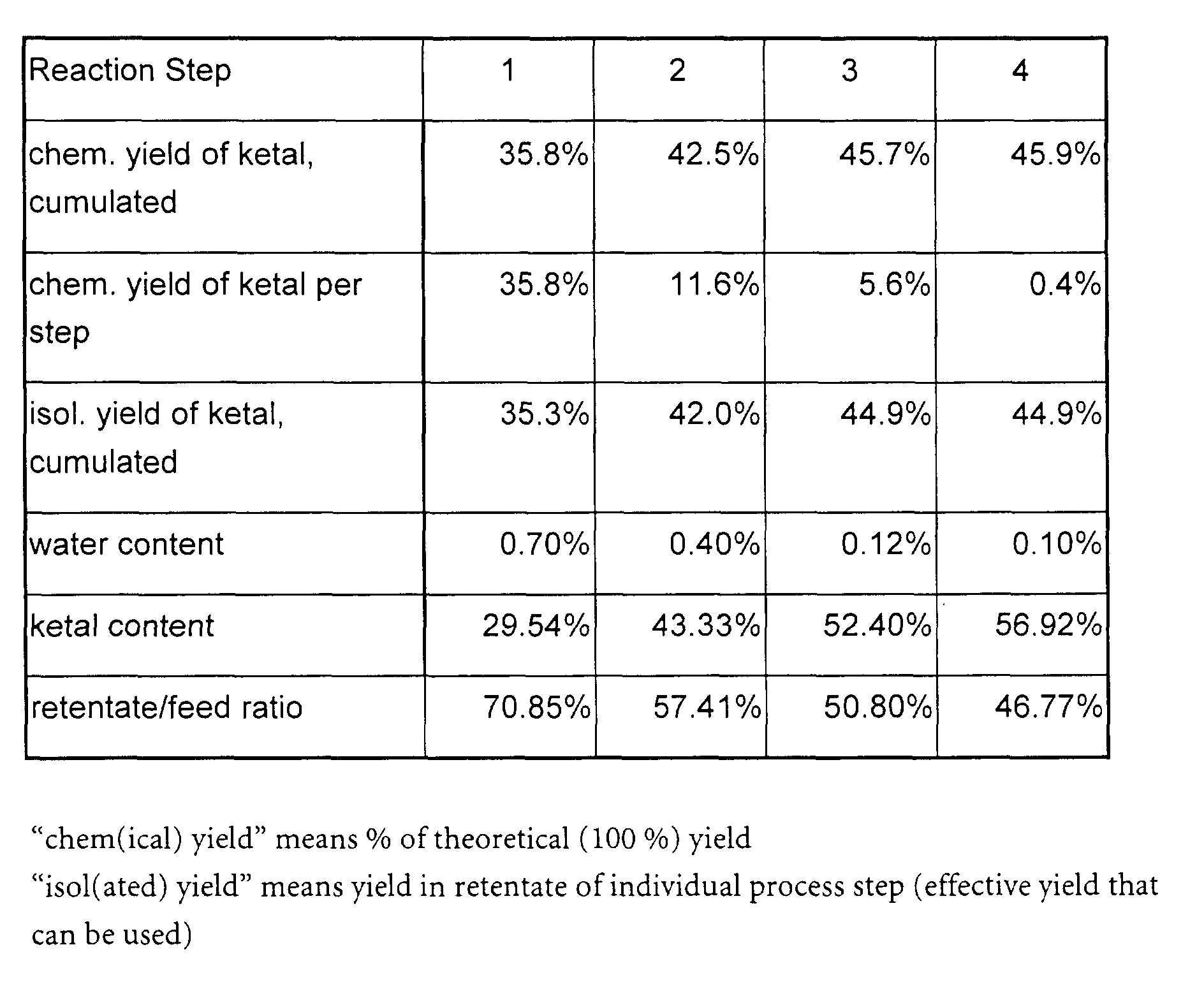
- Membranes of the type CMC-CE-02 (CM-Celfa) were used. The results obtained are given in the Table below: retentate/feed ratio means retentate obtained in individual process step based on mass flow fed into the first reactor
Landscapes
- Chemical & Material Sciences (AREA)
- Organic Chemistry (AREA)
- Engineering & Computer Science (AREA)
- Water Supply & Treatment (AREA)
- Chemical Kinetics & Catalysis (AREA)
- Organic Low-Molecular-Weight Compounds And Preparation Thereof (AREA)
- Separation Using Semi-Permeable Membranes (AREA)
Abstract
Description
Claims (15)
- Process for the preparation of acetals or ketals which comprises reacting an aldehyde or ketone with an alcohol in the presence of a solid acid, and removing water from the reaction product by pervaporation.
- Process for recovering acetals or ketals from reaction mixtures obtained by reacting aldehydes or ketones with alcohols in the presence of a solid acid which process comprises subjecting the reaction mixture containing an acetal or ketal together with water and unreacted aldehyde or ketone and alcohol to treatment with a solid base followed by pervaporation to remove water from the reaction product.
- A process as in claim 1or 2, wherein the pervaporation retentate is subjected again to treatment with an acid under conditions that favour acetalisation or ketalisation, followed by treatment with a base and removal of the water from the reaction product by pervaporation.
- A process as in claim 3 wherein the treatment of the pervaporation retentate is repeated until substantially pure acetal or ketal is obtained.
- A process as in any one of claims 1-4 wherein the solid acid is a strongly acidic polymer.
- A process as in claim 5 wherein the strongly acidic polymer is a polystyrene sulfonic acid.
- A process as in any one of claims 1-6 wherein the solid base is a weakly basic ion exchange resin.
- A process as in any one of claims 1-7 wherein a 2,2-di-lower alkyl propane is prepared from acetone and a lower alkanol.
- A process as in any one of claims 1-8 wherein 2,2-dimethoxy propane is prepared from acetone and methanol.
- A process as in any one of claims 1-9 wherein the pervaporation is carried out at a temperature of about 60°C to about 130°C.
- A process as in any one of claims 1-9 wherein the pressure on the retentate side of the membran is about 4 bar and the pressure on the permeate side of the membrane is about 1-500 mbar.
- A process as in claim 12 wherein heat produced in cooling the reaction mixture for the acetalisation or ketalisation reaction is used to heat the reaction product in the pervaporation unit.
- A manufacturing equipment for carrying out the process of any one of claims 1-12 substantially as shown in Fig. 1 which comprises a reactor (1) containing a solid acid; a vessel (2) containing a solid base; and pervaporation unit (3) having a membrane which is permeable for water.
- A manufacturing equipment as in claim 13 which comprises 3 consecutively arranged units each consisting of reactor (1), vessel (2) and pervaporation unit (3).
- The novel process and manufacturing equipment substantially as described hereinbefore, especially with reference to the Example and the Drawing.
Priority Applications (1)
| Application Number | Priority Date | Filing Date | Title |
|---|---|---|---|
| EP01115062A EP1167333A3 (en) | 2000-06-26 | 2001-06-21 | Process and manufacturing equipment for preparing acetals and ketals |
Applications Claiming Priority (3)
| Application Number | Priority Date | Filing Date | Title |
|---|---|---|---|
| EP00113463 | 2000-06-26 | ||
| EP00113463 | 2000-06-26 | ||
| EP01115062A EP1167333A3 (en) | 2000-06-26 | 2001-06-21 | Process and manufacturing equipment for preparing acetals and ketals |
Publications (2)
| Publication Number | Publication Date |
|---|---|
| EP1167333A2 true EP1167333A2 (en) | 2002-01-02 |
| EP1167333A3 EP1167333A3 (en) | 2002-07-31 |
Family
ID=26071075
Family Applications (1)
| Application Number | Title | Priority Date | Filing Date |
|---|---|---|---|
| EP01115062A Withdrawn EP1167333A3 (en) | 2000-06-26 | 2001-06-21 | Process and manufacturing equipment for preparing acetals and ketals |
Country Status (1)
| Country | Link |
|---|---|
| EP (1) | EP1167333A3 (en) |
Cited By (6)
| Publication number | Priority date | Publication date | Assignee | Title |
|---|---|---|---|---|
| EP1357102A1 (en) * | 2002-04-27 | 2003-10-29 | Degussa AG | Process for the preparation of acetals and ketals using multi-step pervaporation or vapour permeation |
| WO2006040065A1 (en) * | 2004-10-08 | 2006-04-20 | Ticona Gmbh | Method for producing and dehydrating cyclic formals |
| WO2011154925A1 (en) | 2010-06-11 | 2011-12-15 | Alma Mater Studiorum Universita Di Bologna | Production of aldehydes by oxidation in aqueous medium with selective recovery of the product by means of pervaporation |
| WO2013004631A1 (en) * | 2011-07-06 | 2013-01-10 | Dsm Ip Assets B.V. | Processes for preparing or recovering acetals or ketals by means of pervaporation |
| WO2013004626A1 (en) | 2011-07-06 | 2013-01-10 | Dsm Ip Assets B.V. | Process for preparing acetals and ketals |
| WO2024084466A1 (en) * | 2022-10-21 | 2024-04-25 | Aditya Birla Chemicals (Thailand) Limited | A process for preparing 2,2-dimethoxypropane |
Family Cites Families (3)
| Publication number | Priority date | Publication date | Assignee | Title |
|---|---|---|---|---|
| US5717081A (en) * | 1993-09-17 | 1998-02-10 | Unichema Chemie B.V. | Process for producing an alkylglycoside using a pervaporation membrane to remove reaction water |
| DE4431994A1 (en) * | 1994-09-08 | 1996-03-14 | Degussa | Process for the preparation of 1,1,3-trialkoxypropane |
| DE19811451C1 (en) * | 1998-03-17 | 1999-10-14 | Henkel Kgaa | Process for acetalization or ketalization |
-
2001
- 2001-06-21 EP EP01115062A patent/EP1167333A3/en not_active Withdrawn
Cited By (10)
| Publication number | Priority date | Publication date | Assignee | Title |
|---|---|---|---|---|
| EP1357102A1 (en) * | 2002-04-27 | 2003-10-29 | Degussa AG | Process for the preparation of acetals and ketals using multi-step pervaporation or vapour permeation |
| WO2006040065A1 (en) * | 2004-10-08 | 2006-04-20 | Ticona Gmbh | Method for producing and dehydrating cyclic formals |
| WO2011154925A1 (en) | 2010-06-11 | 2011-12-15 | Alma Mater Studiorum Universita Di Bologna | Production of aldehydes by oxidation in aqueous medium with selective recovery of the product by means of pervaporation |
| US9309177B2 (en) | 2011-06-07 | 2016-04-12 | Dsm Ip Assets B.V. | Process for preparing or recovering acetals or ketals by means of pervaporation |
| WO2013004631A1 (en) * | 2011-07-06 | 2013-01-10 | Dsm Ip Assets B.V. | Processes for preparing or recovering acetals or ketals by means of pervaporation |
| WO2013004626A1 (en) | 2011-07-06 | 2013-01-10 | Dsm Ip Assets B.V. | Process for preparing acetals and ketals |
| CN103649032A (en) * | 2011-07-06 | 2014-03-19 | 帝斯曼知识产权资产管理有限公司 | Process for the preparation or recovery of acetals or ketals by means of pervaporation |
| US9309178B2 (en) | 2011-07-06 | 2016-04-12 | Dsm Ip Assets B.V. | Process for preparing acetals and ketals |
| CN107673955A (en) * | 2011-07-06 | 2018-02-09 | 帝斯曼知识产权资产管理有限公司 | The method for preparing or reclaiming acetal or ketal by way of pervaporation |
| WO2024084466A1 (en) * | 2022-10-21 | 2024-04-25 | Aditya Birla Chemicals (Thailand) Limited | A process for preparing 2,2-dimethoxypropane |
Also Published As
| Publication number | Publication date |
|---|---|
| EP1167333A3 (en) | 2002-07-31 |
Similar Documents
| Publication | Publication Date | Title |
|---|---|---|
| US6528025B1 (en) | Process of manufacturing equipment for preparing acetals and ketals | |
| US9309177B2 (en) | Process for preparing or recovering acetals or ketals by means of pervaporation | |
| CN102428077B (en) | Process for preparing 2-substituted tetrahydropyranols | |
| AU726907B2 (en) | Esterification of fermentation-derived acids via pervaporation | |
| US20040024260A1 (en) | Process for preparing acetals and ketals with the aid of multistage pervaporation or vapor permeation | |
| US9309178B2 (en) | Process for preparing acetals and ketals | |
| EP2069274A1 (en) | Process for the preparation of alkylene glycol | |
| EP0210055A1 (en) | Esterification process | |
| KR100924181B1 (en) | Separation of a Diacetal of Glyoxal by Means of Counter-Current Liquid-Liquid Extraction | |
| US5177265A (en) | Process for the preparation of citral | |
| EP3039004B1 (en) | A process for preparation of unsaturated ketone | |
| Kiatkittipong et al. | A pervaporation membrane reactor for liquid phase synthesis of ethyl tert-butyl ether from tert-butyl alcohol and ethanol | |
| CN113164904A (en) | Membrane-based process for producing butanol from mixed butenes | |
| Datta et al. | Esterification of fermentation-derived acids via pervaporation | |
| JPS5846035A (en) | Preparation of hydroxycarboxylic acid derivative | |
| US20240417361A1 (en) | Process for producing a carboxylic acid or salt thereof by alkoxycarbonylation of diisobutene with preceding distillation and subsequent hydrolysis | |
| WO2017204155A1 (en) | Method for producing acetal compound | |
| HUT54964A (en) | Continuous process for producing ketales | |
| JP3166287B2 (en) | Acetal production method | |
| CN116802171A (en) | Method for producing (2-methoxyethyl) vinyl ether and method for purifying (2-methoxyethyl) vinyl ether | |
| JP2001527057A (en) | Process for producing alkylene glycol having low carbonyl compound content | |
| JPH05306249A (en) | Production of acetal | |
| JPWO2002044118A1 (en) | Acetal production method | |
| HU193228B (en) | A method for the catalytic production of 2- (dichloromethyl) -2-methyl-13-dioxolane homobene. |
Legal Events
| Date | Code | Title | Description |
|---|---|---|---|
| PUAI | Public reference made under article 153(3) epc to a published international application that has entered the european phase |
Free format text: ORIGINAL CODE: 0009012 |
|
| AK | Designated contracting states |
Kind code of ref document: A2 Designated state(s): AT BE CH CY DE DK ES FI FR GB GR IE IT LI LU MC NL PT SE TR |
|
| AX | Request for extension of the european patent |
Free format text: AL;LT;LV;MK;RO;SI |
|
| PUAL | Search report despatched |
Free format text: ORIGINAL CODE: 0009013 |
|
| AK | Designated contracting states |
Kind code of ref document: A3 Designated state(s): AT BE CH CY DE DK ES FI FR GB GR IE IT LI LU MC NL PT SE TR |
|
| AX | Request for extension of the european patent |
Free format text: AL;LT;LV;MK;RO;SI |
|
| 17P | Request for examination filed |
Effective date: 20030131 |
|
| AKX | Designation fees paid |
Designated state(s): AT BE CH CY DE DK ES FI FR GB GR IE IT LI LU MC NL PT SE TR |
|
| RIN1 | Information on inventor provided before grant (corrected) |
Inventor name: CLAVEY, THOMAS Inventor name: HERGUIJUELA, JUAN RAMON Inventor name: BOESCH, VOLKMAR |
|
| 17Q | First examination report despatched |
Effective date: 20030916 |
|
| RAP1 | Party data changed (applicant data changed or rights of an application transferred) |
Owner name: DSM IP ASSETS B.V. |
|
| 17Q | First examination report despatched |
Effective date: 20030916 |
|
| STAA | Information on the status of an ep patent application or granted ep patent |
Free format text: STATUS: THE APPLICATION HAS BEEN WITHDRAWN |
|
| 18W | Application withdrawn |
Effective date: 20081006 |