EP1167150A2 - A pressure intensifier - Google Patents
A pressure intensifier Download PDFInfo
- Publication number
- EP1167150A2 EP1167150A2 EP01305201A EP01305201A EP1167150A2 EP 1167150 A2 EP1167150 A2 EP 1167150A2 EP 01305201 A EP01305201 A EP 01305201A EP 01305201 A EP01305201 A EP 01305201A EP 1167150 A2 EP1167150 A2 EP 1167150A2
- Authority
- EP
- European Patent Office
- Prior art keywords
- pressure
- cavity
- movable means
- fluid
- intensifier
- Prior art date
- Legal status (The legal status is an assumption and is not a legal conclusion. Google has not performed a legal analysis and makes no representation as to the accuracy of the status listed.)
- Granted
Links
Images

Classifications
-
- B—PERFORMING OPERATIONS; TRANSPORTING
- B60—VEHICLES IN GENERAL
- B60T—VEHICLE BRAKE CONTROL SYSTEMS OR PARTS THEREOF; BRAKE CONTROL SYSTEMS OR PARTS THEREOF, IN GENERAL; ARRANGEMENT OF BRAKING ELEMENTS ON VEHICLES IN GENERAL; PORTABLE DEVICES FOR PREVENTING UNWANTED MOVEMENT OF VEHICLES; VEHICLE MODIFICATIONS TO FACILITATE COOLING OF BRAKES
- B60T13/00—Transmitting braking action from initiating means to ultimate brake actuator with power assistance or drive; Brake systems incorporating such transmitting means, e.g. air-pressure brake systems
- B60T13/10—Transmitting braking action from initiating means to ultimate brake actuator with power assistance or drive; Brake systems incorporating such transmitting means, e.g. air-pressure brake systems with fluid assistance, drive, or release
- B60T13/58—Combined or convertible systems
- B60T13/581—Combined or convertible systems both hydraulic and pneumatic
- B60T13/583—Combined or convertible systems both hydraulic and pneumatic using converters
Definitions
- the present invention relates to a pressure intensifier having movable means which communicate a force applied by the pressure of fluid in a first cavity of the intensifier to fluid in a second cavity of the intensifier, the component of the area of the movable means to which the pressure of the fluid in the first cavity is applied to urge the movable means to move towards the second cavity being substantially greater than the component of the area of the movable means which applies a force to the fluid in the second cavity, so that the pressure of fluid in the second cavity created as a result of the force applied to the movable means by the pressure of fluid in the first cavity is substantially greater than the latter pressure.
- Such a pressure intensifier is embodied in a standard hydraulic amplifier of pressure and is used in many applications today, for example in hydraulic brake systems of motor vehicles.
- the present invention seeks to provide a remedy.
- the present invention is directed to a pressure intensifier having the construction set out in the opening paragraph of the present specification, in which the pressure intensifier is provided with a clamp arranged to hold the movable means stationary whilst pressure is built up in the said first cavity, which clamp is releasable once such pressure has been built up, to avoid movement of the movable means whilst pressure is built up in the said first cavity.
- An advantage of such a construction is that there is no time delay in building up pressure through valves or other devices in reaching the full pressure in the said second cavity.
- a further advantage of such a construction is that it can be made from relatively inexpensive devices, such as an adapted commercial vehicle brake actuator coupled to an ordinary hand pump, for example, to develop a pressure which can be used to provide a clamping force.
- part of the movable means comprise a diaphragm, one side of which defines a boundary of the said first cavity. This enables a higher ratio to be achieved between the pressures in the said first and second cavities.
- the fluid in the first cavity may be air, so that the said first cavity may be connected to a supply of pressurised air.
- the pressure intensifier may comprise a vehicle brake actuator. This enables it to be made at relatively low expense, since a vehicle brake actuator is a readily available part, although it will be appreciated that modifications are required to give it a construction which embodies the present invention.
- the clamp may comprise a flexible sleeve. This achieves a high efficiency of clamping force for a given pressure applied to the sleeve.
- a source of hydraulic pressure may be connected to apply hydraulic pressure to the sleeve.
- the source of hydraulic pressure may comprise a hand/foot/air operated injector tester. This again provides the benefit of using relatively inexpensive readily available equipment to put a preferred embodiment of the invention into effect.
- the intensifier may further be provided with rate of displacement measurement means arranged to measure the rate of displacement of the movable means.
- the rate of displacement measurement means may comprise an induction coil and magnet, the coil or the magnet being connected to the movement means.
- the said second cavity may be openable into communication with a fuel injector test head, so that the pressure intensifier is adapted to enable tests to be carried out on a fuel injector.
- the present invention is also directed to fuel injector test equipment incorporating a pressure intensifier made in accordance with the present invention.
- a pressure intensifier in the form of a low inertia, low friction vehicle brake actuator 10 is shown modified in accordance with the present invention to enable high pressure fuel injectors to be tested.
- the actuator comprises a frame 12, at one end of which is mounted a diaphragm cylinder 14 across which extends a diaphragm 16, on an outer side of which is defined a first cavity 18.
- the cylinder 14 is provided with a port 20 on that side of the cylinder 16 to enable pressurised air to be passed into the said first cavity 18, and also to enable air to flow out from that cavity.
- the diaphragm 16 is in contact with a flange 21 at an outer end of a plunger rod 22.
- a piston 24 abutting but not connected to a plunger 26 which is received within a cylindrical hollow of a cylinder block 28 defining a second cavity 30 therewithin.
- the latter is connected to an inlet and outlet port 32.
- the effective diameter of the diaphragm 16 is approximately 150mm.
- the diameter of the plunger 26 is about 6mm and the cylindrical block 28 accommodates a travel for the plunger 26 of about 6mm.
- the pressure intensifier 10 therefore has an intensifying ratio of approximately 600:1.
- Any linear axial movement of the piston 24 is detectable by a magnet and inductor coil sensor 34, the magnet part of which is fixed to the piston 24 by a connector 36. This enables measurement of the rate of displacement of the piston 24.
- the voltage induced in the coil is proportional to the velocity of plunger movement, which in turn is directly proportional to the flow rate of fluid from the said second cavity 30.
- the plunger 26 can be moved its full distance of travel in approximately 0.0005 seconds, providing a flow rate of approximately 2.04 litres per minute.
- a metallic flexible sleeve 38 is sandwiched between the piston 24 and a guide 40 therefor, the interior of the guide 40 being provided with a port 42 to enable hydraulic pressure to be applied to the outside of the sleeve 38 and inhibit movement of the piston 24.
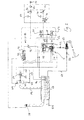
- the pressure intensifier shown in Figure 1 may be used in fuel injector testing equipment as shown in Figure 2.
- This shows the intensifier 10 connected to a hand operated injector tester constituting an hydraulic hand pump 50 which is selectively connectable either to a line 52 which connects the said second cavity 30 of the intensifier 10 to an injector 54 under test held in an injector head 56, or alternatively to the exterior of the sleeve 38 on the inside of the guide 40 via a line 53.
- These alternative connections are selective by means of a 4-port 2-position hand operated slide valve 57 which can be slid between two positions, the first one of which connects the said second cavity 30 to the injector 54, and the second one of which connects the pump 50 to the line 53.
- the line 53 is also connected to a reservoir 58 via a slideable open/shut hand operated lock release valve 60.
- a non-return valve 62 is connected between the pump 50 and the line 52 to inhibit the return of hydraulic fluid from the line 52 to the pump 50.
- a line 64 connects the reservoir 58 to the pump 50, and a non-return valve 66 in the line 64 prevents fluid in the line 64 returning from the pump 50 to the reservoir 58.
- a non-return valve 68 prevents fluid from the line 53 being able to pass back towards the valve 57.
- An air pressure source 70 is connected to said first cavity 18 of the pressure intensifier 10 via a pressure regulator 72, a pressure gauge 74, and an air pressure enable/release valve 76 connected in series in that order from the pressure source 70 to the intensifier 10.
- the pressure source 70 is also connected to an air outlet end 78 of the reservoir 58 via a water trap filter 80, a pressure regulator 82, a pressure gauge 84, and an air mover control valve 86 connected in series in that order from the air pressure source 70 to the air mover 78.
- a processor 90 has an LCD display 92.
- the processor 90 is connected to receive signals from a thermometer 96 in the reservoir 58, the rate of displacement transducer 34 and an injected-pressure sensor 98.
- a tool tray 100 is connected to receive test fluid from a spray collector 102 via a tool tray drain 104.
- a conduit 106 directs spray collected from the injector 54 and returns it to the reservoir 58.
- the air mover 78 and a reservoir drain 108 are connected to the reservoir 58.
- a light bulb 109 is positioned adjacent to the spray collector 102 to facilitate assessment of the spray pattern.
- valve 57 When the system shown in Figures 1 and 2 is in operation, the valve 57 is positioned to enable fluid from the hand pump 50 to be applied to the said second cavity 30, as well as to the injector 54 under test. This ensures that the piston 24 is in its fully retracted position as shown in Figure 1 and that the hydraulic fluid in the line 52 is under pressure. During this time, the hand pump 50 is operated to ensure such a pressure.
- the lock release valve 60 is in the open position to ensure that there is no clamping force exerted on the piston 24 by the sleeve 38. Also, the air pressure enable/release valve 76 is in a first position in which air can be vented from the said first cavity 18, again to enable the piston 24 to return to its start position as shown in Figure 1.
- valve 60 is closed to prevent fluid from line 53 passing to the reservoir 58.
- the valve 57 is then switched to its second position in which pressure is applied to the sleeve 38 by the hand pump 50 so as to urge the sleeve 38 against the piston 24 and lock it in position.
- valve 76 is now switched to open the pressure or air from the source 70 to the said first cavity 18, as a result of which pressure in that cavity is built-up. At this stage, however, the piston 24 cannot move because it is clamped in place by the sleeve 38.
- valve 57 is switched once more to put the second cavity into communication with the injector 54 under test.
- the last step in this cycle involves the switching of the lock release valve 60 so as to release the pressure holding the sleeve 38 against the piston 24.
- the piston is suddenly free to move under the force of pressure in the said first cavity 18 to very rapidly build up the pressure in the said second cavity 30 and thence to the injector under test 54.
- a signal from the processor 90 may be applied to the injector 54, in the event that the latter is electrically operated, via the line 110 to enable an injection of the test fluid through the injector 54.
- the rate of increase of injected pressure is sufficiently great, because of the action of the sleeve 38, that an injector 54 that is not operated electrically can be readily opened and tested.
- the peak pressure or pressures as measured by the pressure sensor 98 are displayed on the LCD display 92.
- a check is also made on the flow rate as determined by the processor 90 from the signal it receives from the rate of displacement transducer 34. The test fluid passes back through the conduit 106 to the reservoir 54.
- the foregoing cycle is repeated until sufficient data has been obtained, which may be stored in a memory (not shown) within the processor 90.
- the illustrated pressure intensifier is capable of providing high pressure fluid (in excess of 700 bar). For example, an air pressure of about 2.5 bar applied to the diaphragm 16 generates an injected pressure of about 1500 bar. A high flow rate of the order 2 litres per minute can be achieved.
- the fuel injector illustrated in Figure 2 may be a multi-stage diesel injector.
Landscapes
- Engineering & Computer Science (AREA)
- Transportation (AREA)
- Mechanical Engineering (AREA)
- Measuring Fluid Pressure (AREA)
- Valves And Accessory Devices For Braking Systems (AREA)
- Fuel-Injection Apparatus (AREA)
Abstract
Description
- The present invention relates to a pressure intensifier having movable means which communicate a force applied by the pressure of fluid in a first cavity of the intensifier to fluid in a second cavity of the intensifier, the component of the area of the movable means to which the pressure of the fluid in the first cavity is applied to urge the movable means to move towards the second cavity being substantially greater than the component of the area of the movable means which applies a force to the fluid in the second cavity, so that the pressure of fluid in the second cavity created as a result of the force applied to the movable means by the pressure of fluid in the first cavity is substantially greater than the latter pressure.
- Such a pressure intensifier is embodied in a standard hydraulic amplifier of pressure and is used in many applications today, for example in hydraulic brake systems of motor vehicles.
- However, even with such a relatively inexpensive pressure intensifier, it is difficult to use it in rather more specialised applications, such as in developing a required pressure sufficiently rapidly to test a high pressure fuel injector, as is currently used in motor vehicles. One of the problems encountered is in the time it takes to build up the pressure in the said first cavity, making it difficult to reach the required pressure quickly enough to testing the injector.
- The present invention seeks to provide a remedy.
- Accordingly, the present invention is directed to a pressure intensifier having the construction set out in the opening paragraph of the present specification, in which the pressure intensifier is provided with a clamp arranged to hold the movable means stationary whilst pressure is built up in the said first cavity, which clamp is releasable once such pressure has been built up, to avoid movement of the movable means whilst pressure is built up in the said first cavity.
- An advantage of such a construction is that there is no time delay in building up pressure through valves or other devices in reaching the full pressure in the said second cavity.
- A further advantage of such a construction is that it can be made from relatively inexpensive devices, such as an adapted commercial vehicle brake actuator coupled to an ordinary hand pump, for example, to develop a pressure which can be used to provide a clamping force.
- Advantageously, part of the movable means comprise a diaphragm, one side of which defines a boundary of the said first cavity. This enables a higher ratio to be achieved between the pressures in the said first and second cavities.
- The fluid in the first cavity may be air, so that the said first cavity may be connected to a supply of pressurised air.
- The pressure intensifier may comprise a vehicle brake actuator. This enables it to be made at relatively low expense, since a vehicle brake actuator is a readily available part, although it will be appreciated that modifications are required to give it a construction which embodies the present invention.
- The clamp may comprise a flexible sleeve. This achieves a high efficiency of clamping force for a given pressure applied to the sleeve.
- To this end, a source of hydraulic pressure may be connected to apply hydraulic pressure to the sleeve.
- The source of hydraulic pressure may comprise a hand/foot/air operated injector tester. This again provides the benefit of using relatively inexpensive readily available equipment to put a preferred embodiment of the invention into effect.
- The intensifier may further be provided with rate of displacement measurement means arranged to measure the rate of displacement of the movable means. The rate of displacement measurement means may comprise an induction coil and magnet, the coil or the magnet being connected to the movement means.
- The said second cavity may be openable into communication with a fuel injector test head, so that the pressure intensifier is adapted to enable tests to be carried out on a fuel injector.
- The present invention is also directed to fuel injector test equipment incorporating a pressure intensifier made in accordance with the present invention.
- An example of a pressure intensifier made in accordance with the present invention is illustrated in the accompanying drawings, in which:
- Figure 1
- is an axial sectional view through the example of intensifier; and
- Figure 2
- is a pneumatic/hydraulic circuit diagram of fuel injector test equipment incorporating the pressure intensifier shown in Figure 1.
- With reference to Figure 1, a pressure intensifier in the form of a low inertia, low friction
vehicle brake actuator 10 is shown modified in accordance with the present invention to enable high pressure fuel injectors to be tested. The actuator comprises aframe 12, at one end of which is mounted a diaphragm cylinder 14 across which extends adiaphragm 16, on an outer side of which is defined afirst cavity 18. The cylinder 14 is provided with a port 20 on that side of thecylinder 16 to enable pressurised air to be passed into the saidfirst cavity 18, and also to enable air to flow out from that cavity. Thediaphragm 16 is in contact with aflange 21 at an outer end of aplunger rod 22. The other end of thatrod 22 is received in apiston 24 abutting but not connected to aplunger 26 which is received within a cylindrical hollow of acylinder block 28 defining asecond cavity 30 therewithin. The latter is connected to an inlet andoutlet port 32. - The effective diameter of the
diaphragm 16 is approximately 150mm. The diameter of theplunger 26 is about 6mm and thecylindrical block 28 accommodates a travel for theplunger 26 of about 6mm. Thepressure intensifier 10 therefore has an intensifying ratio of approximately 600:1. - Any linear axial movement of the
piston 24 is detectable by a magnet andinductor coil sensor 34, the magnet part of which is fixed to thepiston 24 by aconnector 36. This enables measurement of the rate of displacement of thepiston 24. The voltage induced in the coil is proportional to the velocity of plunger movement, which in turn is directly proportional to the flow rate of fluid from the saidsecond cavity 30. - The
plunger 26 can be moved its full distance of travel in approximately 0.0005 seconds, providing a flow rate of approximately 2.04 litres per minute. - A metallic
flexible sleeve 38 is sandwiched between thepiston 24 and aguide 40 therefor, the interior of theguide 40 being provided with aport 42 to enable hydraulic pressure to be applied to the outside of thesleeve 38 and inhibit movement of thepiston 24. - The pressure intensifier shown in Figure 1 may be used in fuel injector testing equipment as shown in Figure 2. This shows the
intensifier 10 connected to a hand operated injector tester constituting an hydraulic hand pump 50 which is selectively connectable either to a line 52 which connects the saidsecond cavity 30 of theintensifier 10 to aninjector 54 under test held in aninjector head 56, or alternatively to the exterior of thesleeve 38 on the inside of theguide 40 via a line 53. These alternative connections are selective by means of a 4-port 2-position hand operated slide valve 57 which can be slid between two positions, the first one of which connects the saidsecond cavity 30 to theinjector 54, and the second one of which connects the pump 50 to the line 53. The line 53 is also connected to areservoir 58 via a slideable open/shut hand operatedlock release valve 60. - A
non-return valve 62 is connected between the pump 50 and the line 52 to inhibit the return of hydraulic fluid from the line 52 to the pump 50. - A
line 64 connects thereservoir 58 to the pump 50, and anon-return valve 66 in theline 64 prevents fluid in theline 64 returning from the pump 50 to thereservoir 58. - A
non-return valve 68 prevents fluid from the line 53 being able to pass back towards the valve 57. - An
air pressure source 70 is connected to saidfirst cavity 18 of thepressure intensifier 10 via a pressure regulator 72, apressure gauge 74, and an air pressure enable/release valve 76 connected in series in that order from thepressure source 70 to theintensifier 10. Thepressure source 70 is also connected to anair outlet end 78 of thereservoir 58 via awater trap filter 80, apressure regulator 82, apressure gauge 84, and an air mover control valve 86 connected in series in that order from theair pressure source 70 to theair mover 78. - A
processor 90 has anLCD display 92. Theprocessor 90 is connected to receive signals from athermometer 96 in thereservoir 58, the rate ofdisplacement transducer 34 and an injected-pressure sensor 98. - A
tool tray 100 is connected to receive test fluid from aspray collector 102 via atool tray drain 104. Aconduit 106 directs spray collected from theinjector 54 and returns it to thereservoir 58. Lastly, theair mover 78 and areservoir drain 108 are connected to thereservoir 58. - A
light bulb 109 is positioned adjacent to thespray collector 102 to facilitate assessment of the spray pattern. - When the system shown in Figures 1 and 2 is in operation, the valve 57 is positioned to enable fluid from the hand pump 50 to be applied to the said
second cavity 30, as well as to theinjector 54 under test. This ensures that thepiston 24 is in its fully retracted position as shown in Figure 1 and that the hydraulic fluid in the line 52 is under pressure. During this time, the hand pump 50 is operated to ensure such a pressure. - At this stage, the
lock release valve 60 is in the open position to ensure that there is no clamping force exerted on thepiston 24 by thesleeve 38. Also, the air pressure enable/release valve 76 is in a first position in which air can be vented from the saidfirst cavity 18, again to enable thepiston 24 to return to its start position as shown in Figure 1. - Once this has been achieved
valve 60 is closed to prevent fluid from line 53 passing to thereservoir 58. The valve 57 is then switched to its second position in which pressure is applied to thesleeve 38 by the hand pump 50 so as to urge thesleeve 38 against thepiston 24 and lock it in position. - The
valve 76 is now switched to open the pressure or air from thesource 70 to the saidfirst cavity 18, as a result of which pressure in that cavity is built-up. At this stage, however, thepiston 24 cannot move because it is clamped in place by thesleeve 38. - At the next stage, the valve 57 is switched once more to put the second cavity into communication with the
injector 54 under test. The last step in this cycle involves the switching of thelock release valve 60 so as to release the pressure holding thesleeve 38 against thepiston 24. The piston is suddenly free to move under the force of pressure in the saidfirst cavity 18 to very rapidly build up the pressure in the saidsecond cavity 30 and thence to the injector undertest 54. A signal from theprocessor 90 may be applied to theinjector 54, in the event that the latter is electrically operated, via theline 110 to enable an injection of the test fluid through theinjector 54. However, the rate of increase of injected pressure is sufficiently great, because of the action of thesleeve 38, that aninjector 54 that is not operated electrically can be readily opened and tested. The peak pressure or pressures as measured by thepressure sensor 98 are displayed on theLCD display 92. A check is also made on the flow rate as determined by theprocessor 90 from the signal it receives from the rate ofdisplacement transducer 34. The test fluid passes back through theconduit 106 to thereservoir 54. - The foregoing cycle is repeated until sufficient data has been obtained, which may be stored in a memory (not shown) within the
processor 90. - The illustrated pressure intensifier is capable of providing high pressure fluid (in excess of 700 bar). For example, an air pressure of about 2.5 bar applied to the
diaphragm 16 generates an injected pressure of about 1500 bar. A high flow rate of the order 2 litres per minute can be achieved. - Numerous variations and modifications to the illustrated apparatus may occur to the reader without taking the resulting construction outside the scope of the present invention. To give one example only, a suitably modified air bellows piston arrangement could be used for the intensifier instead of a vehicle brake actuator. The fuel injector illustrated in Figure 2 may be a multi-stage diesel injector.
Claims (11)
- A pressure intensifier (10) having movable means (16, 21, 22, 24) which communicate a force applied by the pressure of fluid in a first cavity (18) of the intensifier (10) to fluid in a second cavity (30) of the intensifier (10), the component of the area of the movable means (16, 21, 22, 24) to which the pressure of the fluid in the first cavity (18) is applied to urge the movable means (16, 21, 22, 24) to move towards the second cavity (30) being substantially greater than the component of the area of the movable means (16, 21, 22, 24) which applies a force to the fluid in the second cavity (30), so that the pressure of fluid in the second cavity (30) created as a result of the force applied to the movable means (16, 21, 22, 24) by the pressure of fluid in the first cavity (18) is substantially greater than the latter pressure, characterised in that the pressure intensifier (10) is provided with a clamp (38) arranged to hold the movable means (16, 21, 22, 24) stationary whilst pressure is built up in the said first cavity (18), which clamp (38) is releasable once such pressure has been built up, to avoid movement of the movable means (16, 21, 22, 24) whilst pressure is built up in the said first cavity (18).
- A pressure intensifier according to claim 1, characterised in that at least a part of the movable means (16) comprises a diaphragm (16), one side of which defines a boundary of the said first cavity (18).
- A pressure intensifier according to claim 1 or claim 2, characterised in that the fluid in the first cavity (18) is air, the said first cavity (18) being connected to a supply of pressurised air (70).
- A pressure intensifier according to any preceding claim, characterised in that it comprises a vehicle brake actuator (10).
- A pressure intensifier according to any preceding claim, characterised in that the clamp (38) comprises a flexible sleeve (38).
- A pressure intensifier according to claim 5, characterised in that a source (50) of hydraulic pressure is connected to apply hydraulic pressure to the sleeve (38).
- A pressure intensifier according to claim 6, characterised in that the source (50) of hydraulic pressure comprises a hand/foot/air operated injector tester (50).
- A pressure intensifier according to any preceding claim, characterised in that the intensifier (10) is provided with rate of displacement measurement means (34) arranged to measure the rate of displacement of the movable means (16, 21, 22, 24).
- A pressure intensifier according to claim 8, characterised in that the rate of displacement measurement means (34) comprises an induction coil and magnet, the coil or the magnet being connected to the movable means (24).
- A pressure intensifier according to any preceding claim, characterised in that the said second cavity (30) is openable into communication with a fuel injector test head (56), so that the pressure intensifier (10) is adapted to enable tests to be carried out on a fuel injector (54).
- Fuel injector test equipment incorporating a pressure intensifier as claimed in any preceding claim.
Applications Claiming Priority (2)
| Application Number | Priority Date | Filing Date | Title |
|---|---|---|---|
| GB0015305 | 2000-06-23 | ||
| GB0015305A GB0015305D0 (en) | 2000-06-23 | 2000-06-23 | Pressure intensifier |
Publications (3)
| Publication Number | Publication Date |
|---|---|
| EP1167150A2 true EP1167150A2 (en) | 2002-01-02 |
| EP1167150A3 EP1167150A3 (en) | 2003-01-22 |
| EP1167150B1 EP1167150B1 (en) | 2004-04-14 |
Family
ID=9894184
Family Applications (1)
| Application Number | Title | Priority Date | Filing Date |
|---|---|---|---|
| EP20010305201 Expired - Lifetime EP1167150B1 (en) | 2000-06-23 | 2001-06-14 | A pressure intensifier |
Country Status (4)
| Country | Link |
|---|---|
| EP (1) | EP1167150B1 (en) |
| DE (1) | DE60102744T2 (en) |
| ES (1) | ES2218339T3 (en) |
| GB (1) | GB0015305D0 (en) |
Family Cites Families (4)
| Publication number | Priority date | Publication date | Assignee | Title |
|---|---|---|---|---|
| DE1116945B (en) * | 1958-05-21 | 1961-11-09 | Goetaverken Ab | Device for testing injection nozzles of internal combustion engines |
| US4041778A (en) * | 1976-09-08 | 1977-08-16 | Fuji Shoten Co. Ltd. | Fuel injection valve testing apparatus |
| FR2762568B1 (en) * | 1997-04-28 | 1999-06-04 | Bosch Syst Freinage | PNEUMATIC SERVOMOTOR WITH STEERING CHAMBER |
| JP4550213B2 (en) * | 2000-03-24 | 2010-09-22 | パスカルエンジニアリング株式会社 | Hydraulic locking device |
-
2000
- 2000-06-23 GB GB0015305A patent/GB0015305D0/en not_active Ceased
-
2001
- 2001-06-14 EP EP20010305201 patent/EP1167150B1/en not_active Expired - Lifetime
- 2001-06-14 DE DE2001602744 patent/DE60102744T2/en not_active Expired - Fee Related
- 2001-06-14 ES ES01305201T patent/ES2218339T3/en not_active Expired - Lifetime
Non-Patent Citations (1)
| Title |
|---|
| None |
Also Published As
| Publication number | Publication date |
|---|---|
| EP1167150B1 (en) | 2004-04-14 |
| GB0015305D0 (en) | 2000-08-16 |
| DE60102744D1 (en) | 2004-05-19 |
| ES2218339T3 (en) | 2004-11-16 |
| DE60102744T2 (en) | 2005-03-31 |
| EP1167150A3 (en) | 2003-01-22 |
Similar Documents
| Publication | Publication Date | Title |
|---|---|---|
| DE10355250B4 (en) | Method for determining leaks of a pressure fluid in a pressure actuated machine using a mathematical equation relating pressure and flow volume and comparing actual values to a reference value | |
| JPH05508700A (en) | computer-controlled metering pump | |
| KR920018554A (en) | Method and device for setting pressure of pilot operated pressure relief valve | |
| BR9102243A (en) | PROCESS CONTROL VALVE, FLOW CONTROL VALVE SYSTEM, FLOW CONTROL VALVE DIAGNOSTIC TEST METHOD, VALVE TESTING EQUIPMENT, METHOD FOR CONTROLLING THE CONTROL VALVE OPERATION AND VALVE CONTROL EQUIPMENT | |
| ATE274163T1 (en) | DEVICE FOR TESTING THE OPERATION OF AN EMERGENCY VALVE | |
| EP0258399A1 (en) | Apparatus for measuring entrained gas phase content | |
| US4307604A (en) | Brake testing device | |
| CN106979190A (en) | The experimental provision and method of a kind of low-frictional force hydraulic cylinder performance detection | |
| CN111577684B (en) | Hydraulic valve performance test experimental system | |
| US4131010A (en) | Hydraulic test set | |
| EP1167150B1 (en) | A pressure intensifier | |
| CN101476577A (en) | Oil cylinder with position self-checking function | |
| JP4479125B2 (en) | Pressure-related unit inspection method and pressure-related unit inspection system | |
| JP2004053018A (en) | Control method for generating pressure using booster, especially control method for inspecting compressive strength of pipe | |
| JPH09507291A (en) | Pollutant measuring device | |
| RU2578743C1 (en) | Device for measurement of leakage of plunger pairs | |
| EP1321665A2 (en) | An engine injector tester | |
| CN114729652A (en) | Hydraulic drive device | |
| DE10116995A1 (en) | Hydraulic braking system for vehicle with hydraulic device and controller, has inductive displacement sensor mounted directly on controller | |
| JPH07318401A (en) | Method and device for testing expansion | |
| US6038929A (en) | Three-way valved apparatus and method for testing pressure in a fluid system | |
| JPH02285231A (en) | Engine oil injector | |
| WO2002050430A3 (en) | Device for measuring the injection amount in injection systems and method for production thereof | |
| GB1604709A (en) | Method of and apparatus for testing the fluid tightness of test pieces | |
| CN222837813U (en) | Valve detection device |
Legal Events
| Date | Code | Title | Description |
|---|---|---|---|
| PUAI | Public reference made under article 153(3) epc to a published international application that has entered the european phase |
Free format text: ORIGINAL CODE: 0009012 |
|
| AK | Designated contracting states |
Kind code of ref document: A2 Designated state(s): AT BE CH CY DE DK ES FI FR GB GR IE IT LI LU MC NL PT SE TR |
|
| AX | Request for extension of the european patent |
Free format text: AL;LT;LV;MK;RO;SI |
|
| PUAL | Search report despatched |
Free format text: ORIGINAL CODE: 0009013 |
|
| AK | Designated contracting states |
Kind code of ref document: A3 Designated state(s): AT BE CH CY DE DK ES FI FR GB GR IE IT LI LU MC NL PT SE TR |
|
| AX | Request for extension of the european patent |
Free format text: AL;LT;LV;MK;RO;SI |
|
| RIC1 | Information provided on ipc code assigned before grant |
Free format text: 7B 60T 13/58 A, 7F 02M 65/00 B, 7F 02M 57/00 B |
|
| 17P | Request for examination filed |
Effective date: 20030401 |
|
| GRAP | Despatch of communication of intention to grant a patent |
Free format text: ORIGINAL CODE: EPIDOSNIGR1 |
|
| AKX | Designation fees paid |
Designated state(s): DE ES FR GB IT |
|
| GRAS | Grant fee paid |
Free format text: ORIGINAL CODE: EPIDOSNIGR3 |
|
| GRAA | (expected) grant |
Free format text: ORIGINAL CODE: 0009210 |
|
| AK | Designated contracting states |
Kind code of ref document: B1 Designated state(s): DE ES FR GB IT |
|
| REG | Reference to a national code |
Ref country code: GB Ref legal event code: FG4D |
|
| REF | Corresponds to: |
Ref document number: 60102744 Country of ref document: DE Date of ref document: 20040519 Kind code of ref document: P |
|
| REG | Reference to a national code |
Ref country code: IE Ref legal event code: FG4D |
|
| REG | Reference to a national code |
Ref country code: ES Ref legal event code: FG2A Ref document number: 2218339 Country of ref document: ES Kind code of ref document: T3 |
|
| ET | Fr: translation filed | ||
| PLBE | No opposition filed within time limit |
Free format text: ORIGINAL CODE: 0009261 |
|
| STAA | Information on the status of an ep patent application or granted ep patent |
Free format text: STATUS: NO OPPOSITION FILED WITHIN TIME LIMIT |
|
| REG | Reference to a national code |
Ref country code: IE Ref legal event code: MM4A |
|
| 26N | No opposition filed |
Effective date: 20050117 |
|
| REG | Reference to a national code |
Ref country code: GB Ref legal event code: 732E |
|
| REG | Reference to a national code |
Ref country code: FR Ref legal event code: TP Ref country code: FR Ref legal event code: CD |
|
| PGFP | Annual fee paid to national office [announced via postgrant information from national office to epo] |
Ref country code: FR Payment date: 20060608 Year of fee payment: 6 Ref country code: DE Payment date: 20060608 Year of fee payment: 6 |
|
| PGFP | Annual fee paid to national office [announced via postgrant information from national office to epo] |
Ref country code: GB Payment date: 20060614 Year of fee payment: 6 |
|
| PGFP | Annual fee paid to national office [announced via postgrant information from national office to epo] |
Ref country code: IT Payment date: 20060630 Year of fee payment: 6 |
|
| PGFP | Annual fee paid to national office [announced via postgrant information from national office to epo] |
Ref country code: ES Payment date: 20060720 Year of fee payment: 6 |
|
| GBPC | Gb: european patent ceased through non-payment of renewal fee |
Effective date: 20070614 |
|
| REG | Reference to a national code |
Ref country code: FR Ref legal event code: ST Effective date: 20080229 |
|
| PG25 | Lapsed in a contracting state [announced via postgrant information from national office to epo] |
Ref country code: DE Free format text: LAPSE BECAUSE OF NON-PAYMENT OF DUE FEES Effective date: 20080101 |
|
| PG25 | Lapsed in a contracting state [announced via postgrant information from national office to epo] |
Ref country code: GB Free format text: LAPSE BECAUSE OF NON-PAYMENT OF DUE FEES Effective date: 20070614 |
|
| REG | Reference to a national code |
Ref country code: ES Ref legal event code: FD2A Effective date: 20070615 |
|
| PG25 | Lapsed in a contracting state [announced via postgrant information from national office to epo] |
Ref country code: FR Free format text: LAPSE BECAUSE OF NON-PAYMENT OF DUE FEES Effective date: 20070702 |
|
| PG25 | Lapsed in a contracting state [announced via postgrant information from national office to epo] |
Ref country code: ES Free format text: LAPSE BECAUSE OF NON-PAYMENT OF DUE FEES Effective date: 20070615 |
|
| PG25 | Lapsed in a contracting state [announced via postgrant information from national office to epo] |
Ref country code: IT Free format text: LAPSE BECAUSE OF NON-PAYMENT OF DUE FEES Effective date: 20070614 |