EP1166711A2 - Technique for diagnosing attention deficit disorder - Google Patents
Technique for diagnosing attention deficit disorder Download PDFInfo
- Publication number
- EP1166711A2 EP1166711A2 EP01202200A EP01202200A EP1166711A2 EP 1166711 A2 EP1166711 A2 EP 1166711A2 EP 01202200 A EP01202200 A EP 01202200A EP 01202200 A EP01202200 A EP 01202200A EP 1166711 A2 EP1166711 A2 EP 1166711A2
- Authority
- EP
- European Patent Office
- Prior art keywords
- add
- skin temperature
- data
- subject
- time interval
- Prior art date
- Legal status (The legal status is an assumption and is not a legal conclusion. Google has not performed a legal analysis and makes no representation as to the accuracy of the status listed.)
- Granted
Links
Images


Classifications
-
- A—HUMAN NECESSITIES
- A61—MEDICAL OR VETERINARY SCIENCE; HYGIENE
- A61B—DIAGNOSIS; SURGERY; IDENTIFICATION
- A61B5/00—Measuring for diagnostic purposes; Identification of persons
- A61B5/01—Measuring temperature of body parts ; Diagnostic temperature sensing, e.g. for malignant or inflamed tissue
-
- A—HUMAN NECESSITIES
- A61—MEDICAL OR VETERINARY SCIENCE; HYGIENE
- A61B—DIAGNOSIS; SURGERY; IDENTIFICATION
- A61B5/00—Measuring for diagnostic purposes; Identification of persons
- A61B5/16—Devices for psychotechnics; Testing reaction times ; Devices for evaluating the psychological state
- A61B5/168—Evaluating attention deficit, hyperactivity
-
- G—PHYSICS
- G16—INFORMATION AND COMMUNICATION TECHNOLOGY [ICT] SPECIALLY ADAPTED FOR SPECIFIC APPLICATION FIELDS
- G16H—HEALTHCARE INFORMATICS, i.e. INFORMATION AND COMMUNICATION TECHNOLOGY [ICT] SPECIALLY ADAPTED FOR THE HANDLING OR PROCESSING OF MEDICAL OR HEALTHCARE DATA
- G16H15/00—ICT specially adapted for medical reports, e.g. generation or transmission thereof
-
- A—HUMAN NECESSITIES
- A61—MEDICAL OR VETERINARY SCIENCE; HYGIENE
- A61B—DIAGNOSIS; SURGERY; IDENTIFICATION
- A61B3/00—Apparatus for testing the eyes; Instruments for examining the eyes
- A61B3/10—Objective types, i.e. instruments for examining the eyes independent of the patients' perceptions or reactions
- A61B3/113—Objective types, i.e. instruments for examining the eyes independent of the patients' perceptions or reactions for determining or recording eye movement
-
- A—HUMAN NECESSITIES
- A61—MEDICAL OR VETERINARY SCIENCE; HYGIENE
- A61B—DIAGNOSIS; SURGERY; IDENTIFICATION
- A61B5/00—Measuring for diagnostic purposes; Identification of persons
- A61B5/0002—Remote monitoring of patients using telemetry, e.g. transmission of vital signals via a communication network
-
- A—HUMAN NECESSITIES
- A61—MEDICAL OR VETERINARY SCIENCE; HYGIENE
- A61B—DIAGNOSIS; SURGERY; IDENTIFICATION
- A61B5/00—Measuring for diagnostic purposes; Identification of persons
- A61B5/72—Signal processing specially adapted for physiological signals or for diagnostic purposes
- A61B5/7235—Details of waveform analysis
- A61B5/7253—Details of waveform analysis characterised by using transforms
- A61B5/7257—Details of waveform analysis characterised by using transforms using Fourier transforms
-
- A—HUMAN NECESSITIES
- A61—MEDICAL OR VETERINARY SCIENCE; HYGIENE
- A61B—DIAGNOSIS; SURGERY; IDENTIFICATION
- A61B5/00—Measuring for diagnostic purposes; Identification of persons
- A61B5/72—Signal processing specially adapted for physiological signals or for diagnostic purposes
- A61B5/7235—Details of waveform analysis
- A61B5/7253—Details of waveform analysis characterised by using transforms
- A61B5/726—Details of waveform analysis characterised by using transforms using Wavelet transforms
Definitions
- This invention relates in general to a technique for diagnosing Attention Deficit Disorder (ADD) and more particularly to a technique for measuring an individual's peripheral temperature to determine values indicative of ADD.
- ADD Attention Deficit Disorder
- ADD (with and without hyperactivity) is the most common neurobehavioral disorder of childhood as well as among the most prevalent health conditions affecting school-aged children. Between 4% and 12% of school age children (several millions) are affected. $3 billion is spent annually on behalf of students with ADD. Moreover, in the general population, 9.2% of males and 2.9% of females are found to have behavior consistent with ADD. Upwards of 10 million adults may be affected.
- ADD is a difficult disorder to diagnose.
- the core symptoms of ADD in children include inattention, hyperactivity, and impulsivity.
- ADD children may experience significant functional problems, such as school difficulties, academic underachievement, poor relationships with family and peers, and low self-esteem.
- Adults with ADD often have a history of losing jobs, impulsive actions, substance abuse, and broken marriages.
- ADD often goes undiagnosed if not caught at an early age and affects many adults who may not be aware of the condition.
- ADD has many look-alike causes (family situations, motivations) and co-morbid conditions (depression, anxiety, learning disabilities).
- Diagnosis of ADD involves a process of elimination using written and verbal tests. However, there is no one objective, independent valid test for ADD. Various objective techniques have been proposed but have not yet attained acceptance. These include:
- a method of determining whether an individual has Attention Deficit Disorder comprising: sampling the peripheral skin temperature of a human subject during a predetermined time interval when the subject is in an inactive state to provide sampled peripheral skin temperature data and analyzing the sampled peripheral skin temperature data for a pre-selected parameter, to determine whether said pre-selected parameter has a value indicative of ADD.
- ADD Attention Deficit Disorder
- the invention has the following advantages.
- Fig. 1 is a diagrammatic view illustrating an embodiment of the present invention.
- Fig. 2 is a block diagram of a system incorporating the present invention.
- Fig. 3-5 are graphical views useful in explaining the present invention.
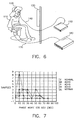
- Fig. 6 is a diagrammatic view of another embodiment of the present invention.
- Fig. 7 is a histogram of phase noise.
- a signature of ADD is hidden in fluctuation of the temperature of the skin as measured at the extremities such as at a fingertip.
- Biofeedback practitioners have long used measurement of hand temperature to help subjects manage their physiology by controlling blood flow to the extremities.
- a subject 10 is sitting on a chair 12 watching a screen 14.
- the subject is at rest in an inactive state.
- the temperature of a fingertip 16 of subject 10 is measured by a sensor 18.
- the temperature readings are supplied to module 20.
- module 20 includes temperature sampling circuit 22, data storage 24, data processor 26 and output 28 such as a display.
- the fingertip temperature is first recorded during an interval when the subject 10 has been asked to sit quietly for a period of about 10 minutes.
- the temperature data is sampled by 22 at a time interval ⁇ t creating a list of N temperature samples which are stored in storage 24.
- the N samples are divided into groups of m samples each group corresponding to a given time window of width ⁇ t ( ⁇ 32-64 sec) equally spaced in time ( ⁇ 50 sec) across the entire data collection time interval ⁇ t .
- the data from each window is then passed through a Fast Fourier Transform (FFT) algorithm in processor 26 producing 2 m-1 data points spaced equally in frequency space.
- FFT Fast Fourier Transform
- Figs. 3 and 4 respectively graphically illustrate the phase transform for a normal subject and a person diagnosed with ADD and a normal subject.
- the magnitude spectrum undergoes dramatic changes essentially changing from a hyperbolic curve to a flat response and simultaneously the phase exhibits a burst of noise we call phase noise.
- Fig. 7 shows histograms of the phase noise data taken from subjects with diagnosed ADD and normal subjects. We measure the phase noise during a time window ⁇ t .
- the data in Fig. 7 is a histogram of the standard deviation 6 of the phase noise during 10 of these windows spaced equally across the 10 minute duration of the experimental period.
- Subjects with a diagnosis of ADD generally show significantly more phase noise than the normal subjects as evidenced by the fact that there are many more samples at high values of the ⁇ we use as a phase noise metric than for the normal subjects.
- the raw data T i,k (t) is the temperature taken at a fingertip during the 10-minute baseline period, which preceded each session of the VIBE project.
- the sessions were taken over a period of weeks or months. Some subjects had as few as 2 sessions and some as many as 5 sessions. k is used to represent the session.
- the data for each session were divided into a series of windows prior to performing the Fourier Transform operation.
- the window width w was 64 seconds and there were 10 windows spaced at 50 second intervals (the windows overlap) across the 600 sec baseline spanning the range of 100 - 500 sec.
- the window number in a session is referred to with the letter j .
- F(f) the Fourier Transform
- the Magnitude and Phase of this transform are defined as given above.
- the range of magnitude variation during a window is given below where f max and f min are the frequencies where the Magnitude is the greatest and the least respectively (note the dc component at frequency zero is excluded).
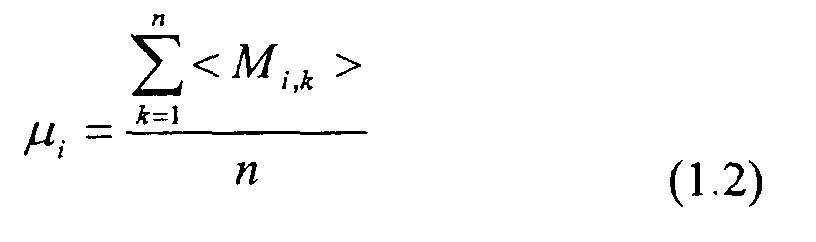
- the mean magnitude range for subject i during session k is found from equation 1.0. where m is the number of windows in the session.
- Fig. 5 is a chart comparing all the subject data in a data base. For each subject the curve shows the ensemble mean ⁇ i given from equation 1.2 and the 1 standard deviation limits given equations 1.4 and 1.5.
- Diagnosis is made from the chart by setting a threshold level for one of the parameters. Below that limit, the subject is diagnosed with ADD above the limit, the subject is called normal. In the chart the limit is set at a value of ⁇ i of 3.0. which yields one false negative (subject with >3.0 who says he has ADD) and two false positives (subjects who are less than 3.0 and do not report a diagnosis of ADD).
- Fig. 6 illustrates a schematic view of a subject and apparatus of another embodiment of the present invention. Shown is a subject 110, viewing a screen 120, wearing a set of earphones 130 connected via a wire 140 to a sound generating device 150. The subject's 110 skin temperature is monitored via a finger temperature sensor 160 connected via a wire 170 to a control and recording device 180. The earphone 130 maybe used to block out ambient noise or to produce a white noise intended to reduce or eliminate the audio stimulus from the environment during the test.
Landscapes
- Health & Medical Sciences (AREA)
- Life Sciences & Earth Sciences (AREA)
- Engineering & Computer Science (AREA)
- Public Health (AREA)
- General Health & Medical Sciences (AREA)
- Medical Informatics (AREA)
- Surgery (AREA)
- Developmental Disabilities (AREA)
- Physics & Mathematics (AREA)
- Biophysics (AREA)
- Pathology (AREA)
- Biomedical Technology (AREA)
- Heart & Thoracic Surgery (AREA)
- Molecular Biology (AREA)
- Veterinary Medicine (AREA)
- Animal Behavior & Ethology (AREA)
- Psychology (AREA)
- Social Psychology (AREA)
- Child & Adolescent Psychology (AREA)
- Educational Technology (AREA)
- Hospice & Palliative Care (AREA)
- Psychiatry (AREA)
- Epidemiology (AREA)
- Primary Health Care (AREA)
- Measuring And Recording Apparatus For Diagnosis (AREA)
- Measurement Of The Respiration, Hearing Ability, Form, And Blood Characteristics Of Living Organisms (AREA)
- Measuring Pulse, Heart Rate, Blood Pressure Or Blood Flow (AREA)
- Testing, Inspecting, Measuring Of Stereoscopic Televisions And Televisions (AREA)
- Measurement And Recording Of Electrical Phenomena And Electrical Characteristics Of The Living Body (AREA)
- Test And Diagnosis Of Digital Computers (AREA)
Abstract
Description
sampling the peripheral skin temperature of a human subject during a predetermined time interval when the subject is in an inactive state to provide sampled peripheral skin temperature data and analyzing the sampled peripheral skin temperature data for a pre-selected parameter, to determine whether said pre-selected parameter has a value indicative of ADD.



Claims (14)
- A method of determining whether an individual has Attention Deficit Disorder (ADD) comprising:sampling the peripheral skin temperature of a human subject during a predetermined time interval when the subject is in an inactive state to provide sampled peripheral skin temperature data; andanalyzing the sampled peripheral skin temperature data for a pre-selected parameter, to determine whether said pre-selected parameter has a value indicative of ADD.
- The method of claim 1 wherein the skin temperature of at least one extremity of a human subject is sampled.
- The method of claim 1 wherein the skin temperature of at least one finger of a human subject is sampled.
- The method of claim 1 wherein during said predetermined time interval when said subject is in an inactive state, the subject wears an earphone to block out ambient noise or to receive white noise to reduce or eliminate audio stimulus from the ambient environment during said time interval.
- The method of claim 1 wherein said data is processed with a fast fourier transform algorithm to produce frequency and phase data and said phase data is used to determine whether the subject has ADD.
- The method of claim 5 wherein said frequency and phase data is further processed to produce magnitude range data which is used to determine whether the subject has ADD.
- A system for determining whether an individual has ADD comprising:a device for sampling the peripheral skin temperature of a human subject during a predetermined time interval when the subject is in an inactive state to provide sampled peripheral skin temperature data; andan analyzer for analyzing the sampled peripheral skin temperature data for a pre-selected parameter to determine whether said pre-selected parameter has a value indicative of ADD.
- The system of claim 7 wherein said device includes a sensor for sensing the skin temperature of at least one extremity of a human subject.
- The system of claim 7 wherein said device includes a sensor for sensing the skin temperature of at least one finger of a human subject.
- The system of claim 7 including an earphone worn by the subject during said predetermined time interval to block out ambient noise or to receive white noise to reduce or eliminate audio stimulus from the ambient environment during said time interval.
- The system of claim 10 including a source of white noise coupled to said earphone to provide white noise during said predetermined time interval.
- The method of claim 1 wherein said sampling the peripheral skin temperature of a human subject, N temperature samples are taken during a time interval at Δ t and the N samples are divided into groups of m samples corresponding to a window of widths S t equally spaced in time across Δ t, and wherein in said analyzing the sampled peripheral skin temperature data, the m data from each window is processed with a fast fourier transform (FFT) producing 2m-1 data points spaced equally in frequency space.
- The method of claim 12 wherein in said analyzing process, the phase and magnitude are found for each window, the range of magnitude variation is found for each window, and the mean magnitude range and standard deviation for all of the windows in a session are found.
- A method of determining whether an individual has Attention Deficit Disorder (ADD) comprising;sampling a physiological parameter of a human subject during a predetermined time interval when the subject is in an inactive state to provide sampled physiological parameter data; andanalyzing the sampled physiological parameter data for a pre-selected parameter, to determine whether said pre-selected parameter has a value indicative of ADD.
Applications Claiming Priority (2)
| Application Number | Priority Date | Filing Date | Title |
|---|---|---|---|
| US597610 | 2000-06-20 | ||
| US09/597,610 US6394963B1 (en) | 2000-06-20 | 2000-06-20 | Technique for diagnosing attention deficit disorder |
Publications (3)
| Publication Number | Publication Date |
|---|---|
| EP1166711A2 true EP1166711A2 (en) | 2002-01-02 |
| EP1166711A3 EP1166711A3 (en) | 2003-11-19 |
| EP1166711B1 EP1166711B1 (en) | 2006-09-20 |
Family
ID=24392215
Family Applications (1)
| Application Number | Title | Priority Date | Filing Date |
|---|---|---|---|
| EP01202200A Expired - Lifetime EP1166711B1 (en) | 2000-06-20 | 2001-06-08 | Device for diagnosing attention deficit disorder |
Country Status (5)
| Country | Link |
|---|---|
| US (1) | US6394963B1 (en) |
| EP (1) | EP1166711B1 (en) |
| JP (1) | JP2002102178A (en) |
| AT (1) | ATE339913T1 (en) |
| DE (1) | DE60123172T2 (en) |
Cited By (2)
| Publication number | Priority date | Publication date | Assignee | Title |
|---|---|---|---|---|
| EP1199032A3 (en) * | 2000-10-19 | 2003-11-19 | Eastman Kodak Company | Homekit for determining attention deficit hyperactivity disorder |
| EP1336373A3 (en) * | 2002-02-14 | 2004-02-04 | Eastman Kodak Company | Technique for diagnosing attention deficit hyperactivity disorder using complimentary tests |
Families Citing this family (20)
| Publication number | Priority date | Publication date | Assignee | Title |
|---|---|---|---|---|
| US6652458B2 (en) | 2000-06-20 | 2003-11-25 | The Mclean Hospital Corporation | ADHD detection by eye saccades |
| US6520921B1 (en) * | 2000-06-20 | 2003-02-18 | Eastman Kodak Company | Method for determining attention deficit hyperactivity disorder (ADHD) medication dosage and for monitoring the effects of (ADHD) medication |
| US6652470B2 (en) * | 2000-06-20 | 2003-11-25 | Eastman Kodak Company | Using image modification and temperature biofeedback to diagnose and treat ADHD |
| US6681717B2 (en) * | 2000-12-15 | 2004-01-27 | Can Technologies, Inc. | Computer system for determining a customized animal feed |
| US6527730B2 (en) * | 2000-12-21 | 2003-03-04 | Eastman Kodak Company | Reducing noise in a technique for diagnosing attention deficit hyperactivity disorder |
| US6589171B2 (en) * | 2001-06-27 | 2003-07-08 | Eastman Kodak Company | Sensor glove for physiological parameter measurement |
| US6896655B2 (en) * | 2002-08-05 | 2005-05-24 | Eastman Kodak Company | System and method for conditioning the psychological state of a subject using an adaptive autostereoscopic display |
| US6805074B2 (en) | 2002-12-23 | 2004-10-19 | Cargill, Incorporated | System and method of customizing an animal feed based on heat increment |
| US20080189085A1 (en) * | 2004-07-29 | 2008-08-07 | Can Technologies, Inc. | System and method for optimizing animal production |
| US20060036419A1 (en) * | 2004-07-29 | 2006-02-16 | Can Technologies, Inc. | System and method for animal production optimization |
| DE102009060672A1 (en) | 2009-12-28 | 2011-06-30 | MediTECH Electronic GmbH, 30900 | Device for determining sensorimotor coordination of person during car driving, has measuring unit measuring displacement between output of stimulus signal and input of motor reaction and determining sensorimotor coordination of people |
| KR101549908B1 (en) * | 2014-07-02 | 2015-09-08 | 전우성 | White noise generating headset for stress relaxation with improving concentration and method for generating white noise using the same |
| WO2019060298A1 (en) | 2017-09-19 | 2019-03-28 | Neuroenhancement Lab, LLC | Method and apparatus for neuroenhancement |
| US11717686B2 (en) | 2017-12-04 | 2023-08-08 | Neuroenhancement Lab, LLC | Method and apparatus for neuroenhancement to facilitate learning and performance |
| US11318277B2 (en) | 2017-12-31 | 2022-05-03 | Neuroenhancement Lab, LLC | Method and apparatus for neuroenhancement to enhance emotional response |
| US12280219B2 (en) | 2017-12-31 | 2025-04-22 | NeuroLight, Inc. | Method and apparatus for neuroenhancement to enhance emotional response |
| US11364361B2 (en) | 2018-04-20 | 2022-06-21 | Neuroenhancement Lab, LLC | System and method for inducing sleep by transplanting mental states |
| CN113382683A (en) | 2018-09-14 | 2021-09-10 | 纽罗因恒思蒙特实验有限责任公司 | System and method for improving sleep |
| US11786694B2 (en) | 2019-05-24 | 2023-10-17 | NeuroLight, Inc. | Device, method, and app for facilitating sleep |
| CN117442192B (en) * | 2023-10-23 | 2024-04-19 | 中博信息技术研究院有限公司 | Head-mounted head movement data measurement method |
Family Cites Families (8)
| Publication number | Priority date | Publication date | Assignee | Title |
|---|---|---|---|---|
| US4902274A (en) * | 1988-10-11 | 1990-02-20 | Gleeson Iii William J | Multiple afferent sensory stimulation device |
| US5036858A (en) * | 1990-03-22 | 1991-08-06 | Carter John L | Method and apparatus for changing brain wave frequency |
| US5219322A (en) * | 1992-06-01 | 1993-06-15 | Weathers Lawrence R | Psychotherapy apparatus and method for treating undesirable emotional arousal of a patient |
| US5913310A (en) | 1994-05-23 | 1999-06-22 | Health Hero Network, Inc. | Method for diagnosis and treatment of psychological and emotional disorders using a microprocessor-based video game |
| US5377100A (en) | 1993-03-08 | 1994-12-27 | The United States Of America As Represented By The Administrator Of The National Aeronautics And Space Administration | Method of encouraging attention by correlating video game difficulty with attention level |
| US5947908A (en) * | 1995-07-14 | 1999-09-07 | Morris; Ritchi | Color reactivity device and method |
| US5771261A (en) * | 1995-09-13 | 1998-06-23 | Anbar; Michael | Telethermometric psychological evaluation by monitoring of changes in skin perfusion induced by the autonomic nervous system |
| US5995857A (en) * | 1996-07-01 | 1999-11-30 | Toomim; I. Hershel | Biofeedback of human central nervous system activity using radiation detection |
-
2000
- 2000-06-20 US US09/597,610 patent/US6394963B1/en not_active Expired - Lifetime
-
2001
- 2001-06-08 DE DE60123172T patent/DE60123172T2/en not_active Expired - Lifetime
- 2001-06-08 AT AT01202200T patent/ATE339913T1/en not_active IP Right Cessation
- 2001-06-08 EP EP01202200A patent/EP1166711B1/en not_active Expired - Lifetime
- 2001-06-18 JP JP2001183553A patent/JP2002102178A/en active Pending
Cited By (2)
| Publication number | Priority date | Publication date | Assignee | Title |
|---|---|---|---|---|
| EP1199032A3 (en) * | 2000-10-19 | 2003-11-19 | Eastman Kodak Company | Homekit for determining attention deficit hyperactivity disorder |
| EP1336373A3 (en) * | 2002-02-14 | 2004-02-04 | Eastman Kodak Company | Technique for diagnosing attention deficit hyperactivity disorder using complimentary tests |
Also Published As
| Publication number | Publication date |
|---|---|
| DE60123172D1 (en) | 2006-11-02 |
| JP2002102178A (en) | 2002-04-09 |
| DE60123172T2 (en) | 2007-09-20 |
| EP1166711B1 (en) | 2006-09-20 |
| US6394963B1 (en) | 2002-05-28 |
| EP1166711A3 (en) | 2003-11-19 |
| ATE339913T1 (en) | 2006-10-15 |
Similar Documents
| Publication | Publication Date | Title |
|---|---|---|
| US6394963B1 (en) | Technique for diagnosing attention deficit disorder | |
| US6565518B2 (en) | Technique for diagnosing attention deficit hyperactivity disorder | |
| US6520921B1 (en) | Method for determining attention deficit hyperactivity disorder (ADHD) medication dosage and for monitoring the effects of (ADHD) medication | |
| US6726624B2 (en) | Method and apparatus for determining attention deficit hyperactivity disorder (adhd) medication dosage and for monitoring the effects of adhd medication on people who have adhd using complementary tests | |
| Karthikeyan et al. | Detection of human stress using short-term ECG and HRV signals | |
| US6652458B2 (en) | ADHD detection by eye saccades | |
| CA2472156C (en) | System and method of assessment of neurological conditions using eeg bispectrum | |
| US20090156954A1 (en) | Method, Apparatus and Computer Program Product For Assessment of Attentional Impairments | |
| WO2005089431A2 (en) | Method, apparatus, and computer program product for stochastic psycho-physiological assessment of attentional impairments | |
| US6652470B2 (en) | Using image modification and temperature biofeedback to diagnose and treat ADHD | |
| US6527730B2 (en) | Reducing noise in a technique for diagnosing attention deficit hyperactivity disorder | |
| US6746409B2 (en) | Technique for diagnosing attention deficit hyperactivity disorder using complimentary tests | |
| US6482165B1 (en) | Homekit for determining attention deficit hyperactivity disorder | |
| JP7787669B2 (en) | Secretion amount estimation system and secretion amount estimation program |
Legal Events
| Date | Code | Title | Description |
|---|---|---|---|
| PUAI | Public reference made under article 153(3) epc to a published international application that has entered the european phase |
Free format text: ORIGINAL CODE: 0009012 |
|
| AK | Designated contracting states |
Kind code of ref document: A2 Designated state(s): AT BE CH CY DE DK ES FI FR GB GR IE IT LI LU MC NL PT SE TR |
|
| AX | Request for extension of the european patent |
Free format text: AL;LT;LV;MK;RO;SI |
|
| PUAL | Search report despatched |
Free format text: ORIGINAL CODE: 0009013 |
|
| AK | Designated contracting states |
Kind code of ref document: A3 Designated state(s): AT BE CH CY DE DK ES FI FR GB GR IE IT LI LU MC NL PT SE TR |
|
| AX | Request for extension of the european patent |
Extension state: AL LT LV MK RO SI |
|
| RIC1 | Information provided on ipc code assigned before grant |
Ipc: 7A 61B 5/16 B Ipc: 7A 61B 5/00 A Ipc: 7G 06F 19/00 B |
|
| RAP1 | Party data changed (applicant data changed or rights of an application transferred) |
Owner name: THE MCLEAN HOSPITAL CORPORATION |
|
| 17P | Request for examination filed |
Effective date: 20040518 |
|
| AKX | Designation fees paid |
Designated state(s): AT BE CH CY DE DK ES FI FR GB GR IE IT LI LU MC NL PT SE TR |
|
| 17Q | First examination report despatched |
Effective date: 20040706 |
|
| GRAP | Despatch of communication of intention to grant a patent |
Free format text: ORIGINAL CODE: EPIDOSNIGR1 |
|
| RTI1 | Title (correction) |
Free format text: DEVICE FOR DIAGNOSING ATTENTION DEFICIT DISORDER |
|
| GRAS | Grant fee paid |
Free format text: ORIGINAL CODE: EPIDOSNIGR3 |
|
| GRAA | (expected) grant |
Free format text: ORIGINAL CODE: 0009210 |
|
| AK | Designated contracting states |
Kind code of ref document: B1 Designated state(s): AT BE CH CY DE DK ES FI FR GB GR IE IT LI LU MC NL PT SE TR |
|
| PG25 | Lapsed in a contracting state [announced via postgrant information from national office to epo] |
Ref country code: IT Free format text: LAPSE BECAUSE OF FAILURE TO SUBMIT A TRANSLATION OF THE DESCRIPTION OR TO PAY THE FEE WITHIN THE PRESCRIBED TIME-LIMIT;WARNING: LAPSES OF ITALIAN PATENTS WITH EFFECTIVE DATE BEFORE 2007 MAY HAVE OCCURRED AT ANY TIME BEFORE 2007. THE CORRECT EFFECTIVE DATE MAY BE DIFFERENT FROM THE ONE RECORDED. Effective date: 20060920 Ref country code: NL Free format text: LAPSE BECAUSE OF FAILURE TO SUBMIT A TRANSLATION OF THE DESCRIPTION OR TO PAY THE FEE WITHIN THE PRESCRIBED TIME-LIMIT Effective date: 20060920 Ref country code: AT Free format text: LAPSE BECAUSE OF FAILURE TO SUBMIT A TRANSLATION OF THE DESCRIPTION OR TO PAY THE FEE WITHIN THE PRESCRIBED TIME-LIMIT Effective date: 20060920 Ref country code: BE Free format text: LAPSE BECAUSE OF FAILURE TO SUBMIT A TRANSLATION OF THE DESCRIPTION OR TO PAY THE FEE WITHIN THE PRESCRIBED TIME-LIMIT Effective date: 20060920 Ref country code: LI Free format text: LAPSE BECAUSE OF FAILURE TO SUBMIT A TRANSLATION OF THE DESCRIPTION OR TO PAY THE FEE WITHIN THE PRESCRIBED TIME-LIMIT Effective date: 20060920 Ref country code: CH Free format text: LAPSE BECAUSE OF FAILURE TO SUBMIT A TRANSLATION OF THE DESCRIPTION OR TO PAY THE FEE WITHIN THE PRESCRIBED TIME-LIMIT Effective date: 20060920 Ref country code: FI Free format text: LAPSE BECAUSE OF FAILURE TO SUBMIT A TRANSLATION OF THE DESCRIPTION OR TO PAY THE FEE WITHIN THE PRESCRIBED TIME-LIMIT Effective date: 20060920 |
|
| REG | Reference to a national code |
Ref country code: GB Ref legal event code: FG4D |
|
| REG | Reference to a national code |
Ref country code: CH Ref legal event code: EP |
|
| REG | Reference to a national code |
Ref country code: IE Ref legal event code: FG4D |
|
| REF | Corresponds to: |
Ref document number: 60123172 Country of ref document: DE Date of ref document: 20061102 Kind code of ref document: P |
|
| PG25 | Lapsed in a contracting state [announced via postgrant information from national office to epo] |
Ref country code: DK Free format text: LAPSE BECAUSE OF FAILURE TO SUBMIT A TRANSLATION OF THE DESCRIPTION OR TO PAY THE FEE WITHIN THE PRESCRIBED TIME-LIMIT Effective date: 20061220 Ref country code: SE Free format text: LAPSE BECAUSE OF FAILURE TO SUBMIT A TRANSLATION OF THE DESCRIPTION OR TO PAY THE FEE WITHIN THE PRESCRIBED TIME-LIMIT Effective date: 20061220 |
|
| PG25 | Lapsed in a contracting state [announced via postgrant information from national office to epo] |
Ref country code: ES Free format text: LAPSE BECAUSE OF FAILURE TO SUBMIT A TRANSLATION OF THE DESCRIPTION OR TO PAY THE FEE WITHIN THE PRESCRIBED TIME-LIMIT Effective date: 20061231 |
|
| NLV1 | Nl: lapsed or annulled due to failure to fulfill the requirements of art. 29p and 29m of the patents act | ||
| PG25 | Lapsed in a contracting state [announced via postgrant information from national office to epo] |
Ref country code: PT Free format text: LAPSE BECAUSE OF FAILURE TO SUBMIT A TRANSLATION OF THE DESCRIPTION OR TO PAY THE FEE WITHIN THE PRESCRIBED TIME-LIMIT Effective date: 20070312 |
|
| REG | Reference to a national code |
Ref country code: CH Ref legal event code: PL |
|
| ET | Fr: translation filed | ||
| PLBE | No opposition filed within time limit |
Free format text: ORIGINAL CODE: 0009261 |
|
| STAA | Information on the status of an ep patent application or granted ep patent |
Free format text: STATUS: NO OPPOSITION FILED WITHIN TIME LIMIT |
|
| 26N | No opposition filed |
Effective date: 20070621 |
|
| PG25 | Lapsed in a contracting state [announced via postgrant information from national office to epo] |
Ref country code: MC Free format text: LAPSE BECAUSE OF NON-PAYMENT OF DUE FEES Effective date: 20070630 |
|
| PG25 | Lapsed in a contracting state [announced via postgrant information from national office to epo] |
Ref country code: GR Free format text: LAPSE BECAUSE OF FAILURE TO SUBMIT A TRANSLATION OF THE DESCRIPTION OR TO PAY THE FEE WITHIN THE PRESCRIBED TIME-LIMIT Effective date: 20061221 |
|
| PG25 | Lapsed in a contracting state [announced via postgrant information from national office to epo] |
Ref country code: IE Free format text: LAPSE BECAUSE OF NON-PAYMENT OF DUE FEES Effective date: 20070608 |
|
| PG25 | Lapsed in a contracting state [announced via postgrant information from national office to epo] |
Ref country code: CY Free format text: LAPSE BECAUSE OF FAILURE TO SUBMIT A TRANSLATION OF THE DESCRIPTION OR TO PAY THE FEE WITHIN THE PRESCRIBED TIME-LIMIT Effective date: 20060920 Ref country code: LU Free format text: LAPSE BECAUSE OF NON-PAYMENT OF DUE FEES Effective date: 20070608 |
|
| PG25 | Lapsed in a contracting state [announced via postgrant information from national office to epo] |
Ref country code: TR Free format text: LAPSE BECAUSE OF FAILURE TO SUBMIT A TRANSLATION OF THE DESCRIPTION OR TO PAY THE FEE WITHIN THE PRESCRIBED TIME-LIMIT Effective date: 20060920 |
|
| REG | Reference to a national code |
Ref country code: FR Ref legal event code: PLFP Year of fee payment: 16 |
|
| REG | Reference to a national code |
Ref country code: FR Ref legal event code: PLFP Year of fee payment: 17 |
|
| REG | Reference to a national code |
Ref country code: FR Ref legal event code: PLFP Year of fee payment: 18 |
|
| PGFP | Annual fee paid to national office [announced via postgrant information from national office to epo] |
Ref country code: GB Payment date: 20200928 Year of fee payment: 20 Ref country code: DE Payment date: 20200929 Year of fee payment: 20 Ref country code: FR Payment date: 20200925 Year of fee payment: 20 |
|
| REG | Reference to a national code |
Ref country code: DE Ref legal event code: R071 Ref document number: 60123172 Country of ref document: DE |
|
| REG | Reference to a national code |
Ref country code: GB Ref legal event code: PE20 Expiry date: 20210607 |
|
| PG25 | Lapsed in a contracting state [announced via postgrant information from national office to epo] |
Ref country code: GB Free format text: LAPSE BECAUSE OF EXPIRATION OF PROTECTION Effective date: 20210607 |