EP1166646A1 - Method for storing or transporting erythritol solution - Google Patents
Method for storing or transporting erythritol solution Download PDFInfo
- Publication number
- EP1166646A1 EP1166646A1 EP00912970A EP00912970A EP1166646A1 EP 1166646 A1 EP1166646 A1 EP 1166646A1 EP 00912970 A EP00912970 A EP 00912970A EP 00912970 A EP00912970 A EP 00912970A EP 1166646 A1 EP1166646 A1 EP 1166646A1
- Authority
- EP
- European Patent Office
- Prior art keywords
- erythritol
- solution
- storage
- temperature
- transportation
- Prior art date
- Legal status (The legal status is an assumption and is not a legal conclusion. Google has not performed a legal analysis and makes no representation as to the accuracy of the status listed.)
- Granted
Links
Classifications
-
- A—HUMAN NECESSITIES
- A23—FOODS OR FOODSTUFFS; TREATMENT THEREOF, NOT COVERED BY OTHER CLASSES
- A23L—FOODS, FOODSTUFFS OR NON-ALCOHOLIC BEVERAGES, NOT OTHERWISE PROVIDED FOR; PREPARATION OR TREATMENT THEREOF
- A23L27/00—Spices; Flavouring agents or condiments; Artificial sweetening agents; Table salts; Dietetic salt substitutes; Preparation or treatment thereof
- A23L27/30—Artificial sweetening agents
-
- C—CHEMISTRY; METALLURGY
- C13—SUGAR INDUSTRY
- C13B—PRODUCTION OF SUCROSE; APPARATUS SPECIALLY ADAPTED THEREFOR
- C13B10/00—Production of sugar juices
- C13B10/006—Conservation of sugar juices
-
- A—HUMAN NECESSITIES
- A23—FOODS OR FOODSTUFFS; TREATMENT THEREOF, NOT COVERED BY OTHER CLASSES
- A23L—FOODS, FOODSTUFFS OR NON-ALCOHOLIC BEVERAGES, NOT OTHERWISE PROVIDED FOR; PREPARATION OR TREATMENT THEREOF
- A23L27/00—Spices; Flavouring agents or condiments; Artificial sweetening agents; Table salts; Dietetic salt substitutes; Preparation or treatment thereof
- A23L27/30—Artificial sweetening agents
- A23L27/33—Artificial sweetening agents containing sugars or derivatives
- A23L27/34—Sugar alcohols
-
- A—HUMAN NECESSITIES
- A23—FOODS OR FOODSTUFFS; TREATMENT THEREOF, NOT COVERED BY OTHER CLASSES
- A23L—FOODS, FOODSTUFFS OR NON-ALCOHOLIC BEVERAGES, NOT OTHERWISE PROVIDED FOR; PREPARATION OR TREATMENT THEREOF
- A23L29/00—Foods or foodstuffs containing additives; Preparation or treatment thereof
- A23L29/30—Foods or foodstuffs containing additives; Preparation or treatment thereof containing carbohydrate syrups; containing sugars; containing sugar alcohols, e.g. xylitol; containing starch hydrolysates, e.g. dextrin
- A23L29/37—Sugar alcohols
Definitions
- the present invention relates to a method for the storage or transportation of an erythritol solution. More particularly, the present invention relates to a method for the storage or transportation of erythritol as food not in the form of crystal powder but of a solution with preventing contamination and deposition of crystals.
- Erythritol is a sugar alcohol having 4 carbon atoms and is used widely in food industry as a sweetener having various characteristics such as a degree of sweetness of about 70% of that of sucrose, low energy property, and non-cariogenic property.
- the storage (preservation) and transportation (distribution) of erythritol is practiced in a state where usually 20 kg of dry crystal powder as a unit is filled in a paper bag.
- erythritol remarkably absorbs heat when it is dissolved, it is hard to dissolve, so that generally it is necessary to dissolve erythritol by stirring and heating with a considerable amount of dissolution energy (concretely with steam) with a use of a solution tank with a stirrer mounted. Furthermore, a considerable numbers of empty bags are treated as wastes.
- the present inventors have made various studies in pursuit of erythritol product that is free of the above-mentioned defects. As a result they have found out that various problems on the storage, transportation or the like as described above can be overcome by maintaining erythritol in the form of a solution under given conditions.
- the present invention is based on this finding.
- the present inventors have made a study on the method for supplying erythritol to consumers by converting erythritol to a solution in a stage of shipment and storing or transporting it in the form of solution with studying conditions where no microorganism grow and the product will not deteriorate by coloring with heat or the like, more specifically storage temperature and erythritol concentration.
- the present invention relates to a method for the storage or transportation of an erythritol solution comprising maintaining an erythritol solution under conditions of a solid content of 30% or more and a temperature of 50°C or more, preferably a solid content of 50 to 70% and a temperature of 50 to 75°C, and more preferably a solid content of 50 to 58% and a temperature of 55 to 65°C, such that no erythritol crystal precipitates.
- Erythritol is produced by fermentation of glucose as a raw material using a microorganism having an erythritol producing ability. Erythritol in the fermentation liquid is then subjected to a purification process, more specifically the steps of cell separation, chromatographic separation, ion exchange resin treatment, activated carbon treatment, crystallization, crystal separation, and drying to produce a product of a crystal powder.
- the erythritol solution of the present invention is produced by concentrating the liquid being subjected to an activated carbon treatment before crystallization to a predetermined concentration, that is, a solid content of 30% or more, desirably from 50 to 70%, and more desirably from 50 to 58%.
- the erythritol solution of the present invention may also be produced by adding water to the crystals after crystal separation to dissolve them to a predetermined concentration.
- the erythritol solution prepared so as to have a predetermined concentration is maintained at a temperature that does not cause crystal precipitation, can prevent the growth of microorganism and causes no deterioration of product due to coloring, i.e., about 50°C or more, usually from 50 to 75°C, preferably from 55 to 65°C.
- the present invention is a method for the storage or transportation of an erythritol solution comprising maintaining the erythritol solution at a concentration and a temperature within given ranges. Setting up such conditions enables long-term storage of an erythritol solution and transportation of erythritol to the destination in the form of a solution.
- the erythritol solution is poured in a tank, for example a tank trailer or a freight car, and is stored or transported to the destination by means of keeping warm if necessary so as to prevent the precipitation of crystal.
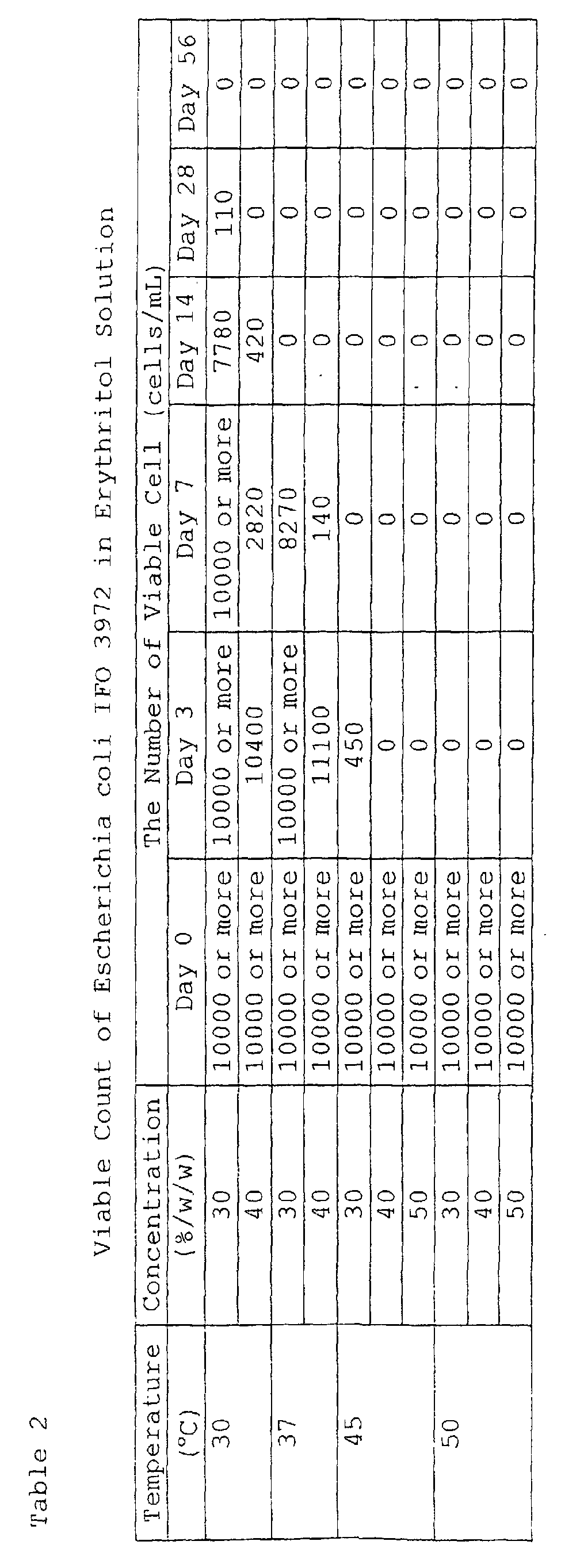
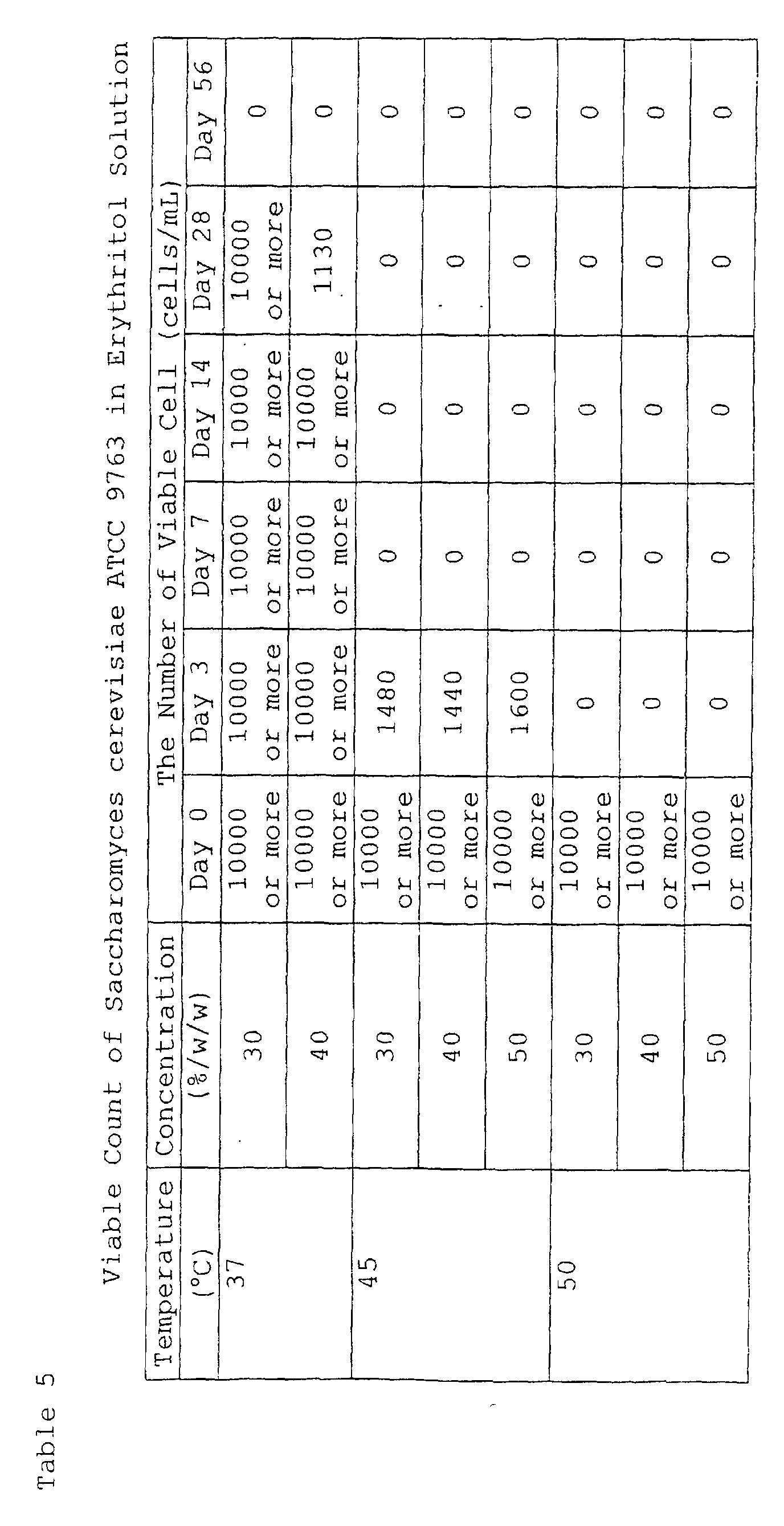
- Erythritol solutions of respective concentrations in the range of from 30 to 60% were prepared.
- Staphylococcus aureus IFO 13276 Bacillus subtilis IFO 3134
- Escherichia coli IFO 3972 as bacteria
- Aspergillus niger IFO 6342 Aspergillus flavus IFO 6343
- Penicillium funiculosum IFO 6345 as fungi, respectively, in a population (concentration) of 10,000 cells/mL or more.
- the solutions were stored at 30, 37, 45, 50, or 60°C, respectively, for 56 days and the number of viable cell was determined daily.
- the determination of the number of viable cell was performed by a method of coating 0.1 mL of appropriately diluted sample cultivation on an agar plate and cultivating and counting the number of viable cell (the number of colony) that grew after the cultivation. The results are shown in Tables 1 to 8.
- Erythritol solutions of respective concentrations in the range of from 30 to 70% were prepared.
- Bacillus stearothermophilus IFO 12550 as a heat resistant bacterium in a population (concentration) of 10,000 cells/mL or more.
- the solutions were stored at 50, 60 or 75°C, respectively, for 56 days and the number of viable cell was determined daily. The determination of the number of viable cell was performed by in the same manner as in Example 1. The results are shown in Table 9.
- the concentration is set to 50% or more and the temperature is maintained at from 50 to 75°C, preferably from 55 to 65°C.
- erythritol is converted into a high concentration solution as high as 30% or more in contrast to conventional crystal powder so that erythritol can be stored or transported while warming it.
- mass consumers can save the burden in opening bags and dissolution of erythritol, a large amount of dissolution energy and expenses for installation such as a dissolution tank with a stirrer, which have been conventional problems, and furthermore can solve the problem of environmental pollution accompanying the disposal treatment of empty bags.
Landscapes
- Life Sciences & Earth Sciences (AREA)
- Chemical & Material Sciences (AREA)
- Health & Medical Sciences (AREA)
- Food Science & Technology (AREA)
- Nutrition Science (AREA)
- Engineering & Computer Science (AREA)
- Polymers & Plastics (AREA)
- Proteomics, Peptides & Aminoacids (AREA)
- Molecular Biology (AREA)
- Biochemistry (AREA)
- Organic Chemistry (AREA)
- Organic Low-Molecular-Weight Compounds And Preparation Thereof (AREA)
- Preparation Of Compounds By Using Micro-Organisms (AREA)
Abstract
Description





| Relationship of Storage Temperature with Degree of Coloring, pH, and Purity (%) Storage Temperature: 75°C, Erythritol Concentration: 62% | |||
| Number of Days | Degree of Coloring | pH | Purity (%) |
| 0 | 0.025 | 5.7 | 99.9 |
| 10 | 0.027 | 5.2 | 99.9 |
| 30 | 0.033 | 4.8 | 99.9 |
| 60 | 0.065 | 3.9 | 99.9 |
| Relationship of Storage Temperature with Degree of Coloring, pH, and Purity (%) Storage Temperature: 65°C, Erythritol Concentration: 58% | |||
| Number of Days | Degree of Coloring | pH | Purity (%) |
| 0 | 0.029 | 5.7 | 100.0 |
| 10 | 0.030 | 5.5 | 99.9 |
| 30 | 0.029 | 5.2 | 100.0 |
| 60 | 0.036 | 4.7 | 99.9 |
| Relationship of Storage Temperature with Degree of Coloring, pH, and Purity (%) Storage Temperature: 60°C, Erythritol Concentration: 55% | |||
| Number of Days | Degree of Coloring | pH | Purity (%) |
| 0 | 0.021 | 5.7 | 99.9 |
| 10 | 0.021 | 5.4 | 99.9 |
| 30 | 0.023 | 5.5 | 99.9 |
| 60 | 0.028 | 5.0 | 99.9 |
| Relationship of Storage Temperature with Degree of Coloring, pH, and Purity (%) Storage Temperature: 55°C, Erythritol Concentration: 50% | |||
| Number of Days | Degree of Coloring | pH | Purity (%) |
| 0 | 0.028 | 5.7 | 99.9 |
| 10 | 0.028 | 5.6 | 99.9 |
| 30 | 0.026 | 5.4 | 100.0 |
| 60 | 0.027 | 5.1 | 100.0 |
Claims (4)
- A method for the storage or transportation of an erythritol solution, comprising maintaining an erythritol solution under conditions of a solid content of 30% or more and a temperature of 50°C or more such that no erythritol crystal precipitates.
- A method for the storage or transportation of an erythritol solution, comprising maintaining an erythritol solution under conditions of a solid content of 50 to 70% and a temperature of 50 to 75°C such that no erythritol crystal precipitates.
- A method for the storage or transportation of an erythritol solution, comprising maintaining an erythritol solution under conditions of a solid content of 50 to 58% and a temperature of 55 to 65°C.
- The method for transporting an erythritol solution according to any one of claims 1 to 3, wherein transportation is performed using a tank trailer.
Applications Claiming Priority (3)
| Application Number | Priority Date | Filing Date | Title |
|---|---|---|---|
| JP8818499 | 1999-03-30 | ||
| JP8818499 | 1999-03-30 | ||
| PCT/JP2000/002016 WO2000057723A1 (en) | 1999-03-30 | 2000-03-30 | Method for storing or transporting erythritol solution |
Publications (3)
| Publication Number | Publication Date |
|---|---|
| EP1166646A1 true EP1166646A1 (en) | 2002-01-02 |
| EP1166646A4 EP1166646A4 (en) | 2003-05-14 |
| EP1166646B1 EP1166646B1 (en) | 2007-01-03 |
Family
ID=13935830
Family Applications (1)
| Application Number | Title | Priority Date | Filing Date |
|---|---|---|---|
| EP00912970A Expired - Lifetime EP1166646B1 (en) | 1999-03-30 | 2000-03-30 | Method for storing or transporting erythritol solution |
Country Status (4)
| Country | Link |
|---|---|
| US (1) | US6489469B1 (en) |
| EP (1) | EP1166646B1 (en) |
| KR (1) | KR100552332B1 (en) |
| WO (1) | WO2000057723A1 (en) |
Families Citing this family (1)
| Publication number | Priority date | Publication date | Assignee | Title |
|---|---|---|---|---|
| DE102007008056A1 (en) * | 2007-02-15 | 2008-08-21 | Mabea International Transport Expressservice Thelen Gmbh | Process for the production of substitute sugar syrups |
Family Cites Families (7)
| Publication number | Priority date | Publication date | Assignee | Title |
|---|---|---|---|---|
| US4886677A (en) * | 1987-08-25 | 1989-12-12 | Mitsubishi Kasei Corporation | Surface-modified meso-erythritol composition |
| FR2654308B1 (en) | 1989-11-13 | 1993-11-26 | Roquette Freres | CONCENTRATED SWEETENER COMPOSITION FOR USE IN FOOD PRODUCTS. |
| EP0525659B1 (en) * | 1991-07-26 | 1997-04-02 | Mitsubishi Chemical Corporation | Process for preparing erythritol crystals |
| JP3084609B2 (en) | 1995-04-12 | 2000-09-04 | 株式会社林原生物化学研究所 | Trehalose-containing syrup |
| US5916881A (en) | 1996-10-07 | 1999-06-29 | Kabushiki Kaisha Hayashibara Seibutsu Kagaku Kenkyujo | High trehalose content syrup |
| JP3110005B2 (en) * | 1997-08-04 | 2000-11-20 | サラヤ株式会社 | Low calorie syrup |
| JP4151089B2 (en) * | 1997-10-07 | 2008-09-17 | 三菱化学株式会社 | Method for producing high purity erythritol crystals |
-
2000
- 2000-03-30 KR KR1020017012245A patent/KR100552332B1/en not_active Expired - Lifetime
- 2000-03-30 US US09/936,707 patent/US6489469B1/en not_active Expired - Lifetime
- 2000-03-30 EP EP00912970A patent/EP1166646B1/en not_active Expired - Lifetime
- 2000-03-30 WO PCT/JP2000/002016 patent/WO2000057723A1/en not_active Ceased
Also Published As
| Publication number | Publication date |
|---|---|
| KR20020003219A (en) | 2002-01-10 |
| US6489469B1 (en) | 2002-12-03 |
| WO2000057723A1 (en) | 2000-10-05 |
| EP1166646A4 (en) | 2003-05-14 |
| EP1166646B1 (en) | 2007-01-03 |
| KR100552332B1 (en) | 2006-02-20 |
Similar Documents
| Publication | Publication Date | Title |
|---|---|---|
| US4530846A (en) | Method for the production of selenium yeast | |
| Peebles et al. | Preparation of concentrated lactic streptococcus starters | |
| BR112012027549B1 (en) | BEER PRODUCTION METHOD | |
| US4463019A (en) | Stationary process for producing vinegar | |
| Gervais et al. | Water activity and water content: comparative effects on the growth of Penicillium roqueforti on solid substrate | |
| US6489469B1 (en) | Method for storing or transporting erythritol solution | |
| JP4058880B2 (en) | Method for storing erythritol solution | |
| Underkofler et al. | Alcoholic fermentation of Jerusalem artichokes | |
| Splittstoesser et al. | The storage life of refrigerated grape juice containing various levels of sulfur dioxide | |
| JP4743114B2 (en) | Fertilizer, plant vitality agent | |
| US4299853A (en) | Biological preservation of beer | |
| JP4271718B1 (en) | Method for stabilized production and supply of glucose syrup and glucose mixed syrup | |
| US6368623B1 (en) | Pulverulent corn-steep | |
| US20060041118A1 (en) | High- concentration liquid pullulan and method of circulating the same | |
| US20140248651A1 (en) | Nutrient medium | |
| CN108004165A (en) | The application of one plant of bacterium and its tunning in preventing that cigarette feed liquid is putrid and deteriorated | |
| CN120838167B (en) | Composite biological deodorant and preparation method thereof | |
| Zadravec et al. | Changes in butyric acid bacteria spore concentration during alfalfa silage aeration | |
| Raines-Casselman | Yeast propagation and maintenance: principles and practices | |
| JP2005289946A (en) | Method for storing and transporting xylitol solution | |
| RU1784641C (en) | Strain of bacterium lactobacillus plantarum having nitrareductase activity and used for siloing fodders | |
| KANTEREWICZ et al. | Preservation of concentrated cheese whey by combined factors | |
| Gatdula et al. | Storage Stability Test of Sweet Sorghum SPV 422 (Sorghum bicolor L. Moench) Syrup | |
| JP3762850B2 (en) | Method for storing and / or transporting L-aspartate | |
| EP1076052A2 (en) | L-Asparate solution and a storage and/or transportation method thereof |
Legal Events
| Date | Code | Title | Description |
|---|---|---|---|
| PUAI | Public reference made under article 153(3) epc to a published international application that has entered the european phase |
Free format text: ORIGINAL CODE: 0009012 |
|
| 17P | Request for examination filed |
Effective date: 20010926 |
|
| AK | Designated contracting states |
Kind code of ref document: A1 Designated state(s): AT BE CH CY DE DK ES FI FR GB GR IE IT LI LU MC NL PT SE |
|
| A4 | Supplementary search report drawn up and despatched |
Effective date: 20030331 |
|
| RIC1 | Information provided on ipc code assigned before grant |
Ipc: 7A 23L 1/09 A Ipc: 7A 23L 1/236 B |
|
| REG | Reference to a national code |
Ref country code: DE Ref legal event code: 8566 |
|
| RBV | Designated contracting states (corrected) |
Designated state(s): FR IT |
|
| RAP1 | Party data changed (applicant data changed or rights of an application transferred) |
Owner name: MITSUBISHI CHEMICAL CORPORATION |
|
| GRAP | Despatch of communication of intention to grant a patent |
Free format text: ORIGINAL CODE: EPIDOSNIGR1 |
|
| RAP1 | Party data changed (applicant data changed or rights of an application transferred) |
Owner name: MITSUBISHI CHEMICAL CORPORATION |
|
| GRAS | Grant fee paid |
Free format text: ORIGINAL CODE: EPIDOSNIGR3 |
|
| GRAA | (expected) grant |
Free format text: ORIGINAL CODE: 0009210 |
|
| AK | Designated contracting states |
Kind code of ref document: B1 Designated state(s): FR IT |
|
| ET | Fr: translation filed | ||
| PLBI | Opposition filed |
Free format text: ORIGINAL CODE: 0009260 |
|
| PLAX | Notice of opposition and request to file observation + time limit sent |
Free format text: ORIGINAL CODE: EPIDOSNOBS2 |
|
| 26 | Opposition filed |
Opponent name: CARGILL, INC. Effective date: 20071001 |
|
| PLAF | Information modified related to communication of a notice of opposition and request to file observations + time limit |
Free format text: ORIGINAL CODE: EPIDOSCOBS2 |
|
| PLBP | Opposition withdrawn |
Free format text: ORIGINAL CODE: 0009264 |
|
| PLBD | Termination of opposition procedure: decision despatched |
Free format text: ORIGINAL CODE: EPIDOSNOPC1 |
|
| PLBM | Termination of opposition procedure: date of legal effect published |
Free format text: ORIGINAL CODE: 0009276 |
|
| STAA | Information on the status of an ep patent application or granted ep patent |
Free format text: STATUS: OPPOSITION PROCEDURE CLOSED |
|
| 27C | Opposition proceedings terminated |
Effective date: 20080726 |
|
| REG | Reference to a national code |
Ref country code: FR Ref legal event code: PLFP Year of fee payment: 17 |
|
| REG | Reference to a national code |
Ref country code: FR Ref legal event code: PLFP Year of fee payment: 18 |
|
| REG | Reference to a national code |
Ref country code: FR Ref legal event code: PLFP Year of fee payment: 19 |
|
| REG | Reference to a national code |
Ref country code: FR Ref legal event code: CA Effective date: 20180515 Ref country code: FR Ref legal event code: CD Owner name: MITSUBISHI CHEMICAL CORPORATION, JP Effective date: 20180515 Ref country code: FR Ref legal event code: TP Owner name: MITSUBISHI CHEMICAL CORPORATION, JP Effective date: 20180515 |
|
| PGFP | Annual fee paid to national office [announced via postgrant information from national office to epo] |
Ref country code: IT Payment date: 20190326 Year of fee payment: 20 |
|
| PGFP | Annual fee paid to national office [announced via postgrant information from national office to epo] |
Ref country code: FR Payment date: 20190213 Year of fee payment: 20 |