EP1164158A1 - Extruded styrene resin foam and process for producing the same - Google Patents
Extruded styrene resin foam and process for producing the same Download PDFInfo
- Publication number
- EP1164158A1 EP1164158A1 EP00970087A EP00970087A EP1164158A1 EP 1164158 A1 EP1164158 A1 EP 1164158A1 EP 00970087 A EP00970087 A EP 00970087A EP 00970087 A EP00970087 A EP 00970087A EP 1164158 A1 EP1164158 A1 EP 1164158A1
- Authority
- EP
- European Patent Office
- Prior art keywords
- styrene resin
- foam
- weight
- group
- resin foam
- Prior art date
- Legal status (The legal status is an assumption and is not a legal conclusion. Google has not performed a legal analysis and makes no representation as to the accuracy of the status listed.)
- Withdrawn
Links
Classifications
-
- C—CHEMISTRY; METALLURGY
- C08—ORGANIC MACROMOLECULAR COMPOUNDS; THEIR PREPARATION OR CHEMICAL WORKING-UP; COMPOSITIONS BASED THEREON
- C08J—WORKING-UP; GENERAL PROCESSES OF COMPOUNDING; AFTER-TREATMENT NOT COVERED BY SUBCLASSES C08B, C08C, C08F, C08G or C08H
- C08J9/00—Working-up of macromolecular substances to porous or cellular articles or materials; After-treatment thereof
- C08J9/04—Working-up of macromolecular substances to porous or cellular articles or materials; After-treatment thereof using blowing gases generated by a previously added blowing agent
- C08J9/12—Working-up of macromolecular substances to porous or cellular articles or materials; After-treatment thereof using blowing gases generated by a previously added blowing agent by a physical blowing agent
- C08J9/14—Working-up of macromolecular substances to porous or cellular articles or materials; After-treatment thereof using blowing gases generated by a previously added blowing agent by a physical blowing agent organic
- C08J9/149—Mixtures of blowing agents covered by more than one of the groups C08J9/141 - C08J9/143
-
- C—CHEMISTRY; METALLURGY
- C08—ORGANIC MACROMOLECULAR COMPOUNDS; THEIR PREPARATION OR CHEMICAL WORKING-UP; COMPOSITIONS BASED THEREON
- C08J—WORKING-UP; GENERAL PROCESSES OF COMPOUNDING; AFTER-TREATMENT NOT COVERED BY SUBCLASSES C08B, C08C, C08F, C08G or C08H
- C08J9/00—Working-up of macromolecular substances to porous or cellular articles or materials; After-treatment thereof
- C08J9/0014—Use of organic additives
- C08J9/0019—Use of organic additives halogenated
-
- C—CHEMISTRY; METALLURGY
- C08—ORGANIC MACROMOLECULAR COMPOUNDS; THEIR PREPARATION OR CHEMICAL WORKING-UP; COMPOSITIONS BASED THEREON
- C08J—WORKING-UP; GENERAL PROCESSES OF COMPOUNDING; AFTER-TREATMENT NOT COVERED BY SUBCLASSES C08B, C08C, C08F, C08G or C08H
- C08J9/00—Working-up of macromolecular substances to porous or cellular articles or materials; After-treatment thereof
- C08J9/0014—Use of organic additives
- C08J9/0028—Use of organic additives containing nitrogen
-
- C—CHEMISTRY; METALLURGY
- C08—ORGANIC MACROMOLECULAR COMPOUNDS; THEIR PREPARATION OR CHEMICAL WORKING-UP; COMPOSITIONS BASED THEREON
- C08J—WORKING-UP; GENERAL PROCESSES OF COMPOUNDING; AFTER-TREATMENT NOT COVERED BY SUBCLASSES C08B, C08C, C08F, C08G or C08H
- C08J9/00—Working-up of macromolecular substances to porous or cellular articles or materials; After-treatment thereof
- C08J9/0014—Use of organic additives
- C08J9/0038—Use of organic additives containing phosphorus
-
- C—CHEMISTRY; METALLURGY
- C08—ORGANIC MACROMOLECULAR COMPOUNDS; THEIR PREPARATION OR CHEMICAL WORKING-UP; COMPOSITIONS BASED THEREON
- C08J—WORKING-UP; GENERAL PROCESSES OF COMPOUNDING; AFTER-TREATMENT NOT COVERED BY SUBCLASSES C08B, C08C, C08F, C08G or C08H
- C08J9/00—Working-up of macromolecular substances to porous or cellular articles or materials; After-treatment thereof
- C08J9/04—Working-up of macromolecular substances to porous or cellular articles or materials; After-treatment thereof using blowing gases generated by a previously added blowing agent
- C08J9/12—Working-up of macromolecular substances to porous or cellular articles or materials; After-treatment thereof using blowing gases generated by a previously added blowing agent by a physical blowing agent
- C08J9/14—Working-up of macromolecular substances to porous or cellular articles or materials; After-treatment thereof using blowing gases generated by a previously added blowing agent by a physical blowing agent organic
- C08J9/141—Hydrocarbons
-
- C—CHEMISTRY; METALLURGY
- C08—ORGANIC MACROMOLECULAR COMPOUNDS; THEIR PREPARATION OR CHEMICAL WORKING-UP; COMPOSITIONS BASED THEREON
- C08J—WORKING-UP; GENERAL PROCESSES OF COMPOUNDING; AFTER-TREATMENT NOT COVERED BY SUBCLASSES C08B, C08C, C08F, C08G or C08H
- C08J2201/00—Foams characterised by the foaming process
- C08J2201/02—Foams characterised by the foaming process characterised by mechanical pre- or post-treatments
- C08J2201/03—Extrusion of the foamable blend
-
- C—CHEMISTRY; METALLURGY
- C08—ORGANIC MACROMOLECULAR COMPOUNDS; THEIR PREPARATION OR CHEMICAL WORKING-UP; COMPOSITIONS BASED THEREON
- C08J—WORKING-UP; GENERAL PROCESSES OF COMPOUNDING; AFTER-TREATMENT NOT COVERED BY SUBCLASSES C08B, C08C, C08F, C08G or C08H
- C08J2203/00—Foams characterized by the expanding agent
- C08J2203/06—CO2, N2 or noble gases
-
- C—CHEMISTRY; METALLURGY
- C08—ORGANIC MACROMOLECULAR COMPOUNDS; THEIR PREPARATION OR CHEMICAL WORKING-UP; COMPOSITIONS BASED THEREON
- C08J—WORKING-UP; GENERAL PROCESSES OF COMPOUNDING; AFTER-TREATMENT NOT COVERED BY SUBCLASSES C08B, C08C, C08F, C08G or C08H
- C08J2203/00—Foams characterized by the expanding agent
- C08J2203/12—Organic compounds only containing carbon, hydrogen and oxygen atoms, e.g. ketone or alcohol
-
- C—CHEMISTRY; METALLURGY
- C08—ORGANIC MACROMOLECULAR COMPOUNDS; THEIR PREPARATION OR CHEMICAL WORKING-UP; COMPOSITIONS BASED THEREON
- C08J—WORKING-UP; GENERAL PROCESSES OF COMPOUNDING; AFTER-TREATMENT NOT COVERED BY SUBCLASSES C08B, C08C, C08F, C08G or C08H
- C08J2203/00—Foams characterized by the expanding agent
- C08J2203/14—Saturated hydrocarbons, e.g. butane; Unspecified hydrocarbons
-
- C—CHEMISTRY; METALLURGY
- C08—ORGANIC MACROMOLECULAR COMPOUNDS; THEIR PREPARATION OR CHEMICAL WORKING-UP; COMPOSITIONS BASED THEREON
- C08J—WORKING-UP; GENERAL PROCESSES OF COMPOUNDING; AFTER-TREATMENT NOT COVERED BY SUBCLASSES C08B, C08C, C08F, C08G or C08H
- C08J2325/00—Characterised by the use of homopolymers or copolymers of compounds having one or more unsaturated aliphatic radicals, each having only one carbon-to-carbon double bond, and at least one being terminated by an aromatic carbocyclic ring; Derivatives of such polymers
- C08J2325/02—Homopolymers or copolymers of hydrocarbons
- C08J2325/04—Homopolymers or copolymers of styrene
- C08J2325/06—Polystyrene
Definitions
- the present invention relates to an extruded styrene resin foam excellent in environmental compatibility, thermal insulating property and flame retardant property and a method for producing the same.
- a method for continuously producing a foam wherein a styrene resin is heated and melted by means of an extruder or the like, a blowing agent is added thereto, and the resultant mixture is cooled and extruded to a low pressure region is already known (for example, JP-B-31-5393 and JP-B-42-19195) and a method using a flon as a blowing agent is also known (for example, JP-B-41-672 and JP-B-57-7175).
- JP-A-10-237210 discloses an extruded styrene resin foam and a method for producing the foam by using propane, butane or a mixture thereof, or a mixture of these hydrocarbons with methyl chloride, ethyl chloride or a mixture thereof as a blowing agent.
- hexabromocyclododecane or tetrabromobisphenol A is added in an amount of 1 to 3 % by weight to a styrene resin and the amounts of blowing agents remaining in the resultant foam are adjusted to not more than 3.5 % by weight for propane and to not more than 2.0 % by weight for butane so as to meet the flame retardant property prescribed in JIS A 9511.
- JP-A-7-53761 discloses a method for producing a polystyrene foam with a relatively thin thickness and flame retardant property using a blowing agent such as propane, butane or a mixture thereof, and a shaped article thereof.
- a blowing agent such as propane, butane or a mixture thereof
- the flame retardant property is developed after a long storage period from 1 to 13 weeks and that haloalkylaryl phosphate, ammonium polyphosphate, hexabromocyclododecane, or magnesium hydroxide is used as a flame retardant.
- propane is preferable to remain 4 % by weight or more and butane is preferable to remain 2.5 % by weight or more, especially 3% by weight or more in the case of a foam density within a range of 20 to 35 kg/m 3 .
- compounds with relatively high flammability such as aliphatic hydrocarbons represented by propane, butane and the like are allowed to remain in large amounts, sometimes the flame retardant property prescribed in JIS A 9511 cannot be satisfied only by using 1 to 3 % by weight of hexabromocyclododecane or tetrabromobisphenol A as disclosed in the foregoing invention.
- a flame retardant it may be proposed to increase the amount of a flame retardant to be added in order to improve the flame retardant property.
- stable flame retardant property is not easy to obtain only by increasing the amount of a flame retardant.
- the styrene resin which is a base material of a foam, itself is made flame-retardant
- the hydrocarbons evaporated from the foam upon burning are easy to be ignited and hence the problem that suppression of burning tends to be difficult has still been left unsolved.
- increase in the amount of the flame retardant is likely to lead to deterioration of the formability of the foam and it tends to be difficult to obtain a form product with a satisfactory quality.
- the obtained foam is required to store for a relatively long period and increase of storage cost may be a matter.
- the invention does not disclose the necessary technique regarding the amount of a blowing agent to be injected to an extruder, the proper amount of a flame retardant to be used and the like, resulting in great difficulty in commercial practice.
- the desired flame retardant property can not be achieved in the case of using a blowing agent composed of 100 % by weight of butane or a mixture of butane/propane in 80/20 weight ratio.
- an object of the present invention is to provide a styrene resin foam having high-level thermal insulating property and at the same time high-level flame retardant property sufficient to meet the flame retardant property prescribed in JIS A 9511 using a blowing agent having a tendency to be highly combustible and to provide a method for producing the foam.
- the present inventors have intensively made investigation to solve the above described problems and consequently found that excellent flame retardant property can be achieved by using (A) a halogenated flame retardant and (B) one or more of compounds selected from the group consisting of phosphorus type flame retardants containing nitrogen atom in a molecule, tetrazole compounds, nitrogen-containing compounds having the following general formula 1, nitrogen-containing compounds having the following general formula 2, metal borates, and boron oxides for a styrene resin foam using a hydrocarbon as a blowing agent, in spite of use of a hydrocarbon as a blowing agent, and especially that ignition or combustion of the hydrocarbon evaporated from the foam on burning can be suppressed.
- both high-level flame retardant property and high-level thermal insulating property as prescribed in JIS A 9511 can be achieved.
- the effect of suppressing the combustion of the hydrocarbon can be further enhanced by using a phosphoric acid ester compound in combination with the foregoing components.
- the thermal insulating property can be further improved by forming a foam with a specified cell structure by using water as a blowing agent in combination and adding a water absorptive substance such as bentonite together.
- the present invention provides the following extruded styrene resin foams and their production methods.
- the styrene resin to be used for the present invention is not specifically limited and usable are styrene homopolymer produced only from styrene monomer, random, block or graft copolymers produced from styrene monomer and a monomer copolymerizable with styrene or its derivatives, modified polystyrene such as post-brominated polystyrene, rubber-reinforced polystyrene, and the like.
- Examples of the monomers copolymerizable with styrene are styrene derivatives such as methylstyrene, dimethylstyrene, ethylstyrene, diethylstyrene, isopropylstyrene, bromostyrene, dibromostyrene, tribromostyrene, chlorostyrene, dichlorostyrene and trichlorostyrene; vinyl compounds such as divinylbenzene; unsaturated compounds and their derivatives such as acrylic acid, methacrylic acid, methyl acrylate, methyl methacrylate, ethyl acrylate, ethyl methacrylate, butadiene and acrylonitrile; maleic anhydride, itaconic anhydride and the like. These compounds may be use alone or as a mixture of two or more of them.
- styrene resins styrene homopolymer is preferred from the viewpoint of processability.
- the present invention is characterized in that one or more of saturated hydrocarbons having 3 to 5 carbon atoms are used as a blowing agent and other blowing agents are used together if required.
- saturated hydrocarbons having 3 to 5 carbon atoms examples include propane, n-butane, isobutane, n-pentane, isopentane, neopentane and the like.
- Preferable saturated hydrocarbons having 3 to 5 carbon atoms are n-butane, isobutane, and a mixture of n-butane and isobutane from the viewpoints of foamability and thermal insulation property of a foam and especially preferable one is isobutane.
- blowing agents to be used for the present invention are not specifically limited.
- examples of other blowing agents are organic blowing agents including ethers such as dimethyl ether, diethyl ether, methyl ethyl ether, isopropyl ether, n-butyl ether, diisopropyl ether, furan, furfural, 2-methylfuran, tetrahydrofuran and tetrahydropyran; ketones such as dimethyl ketone, methyl ethyl ketone, diethyl ketone, methyl n-propyl ketone, methyl n-butyl ketone, methyl isobutyl ketone, methyl n-amyl ketone, methyl n-hexyl ketone, ethyl n-propyl ketone, and ethyl n-butyl ketone; alcohols such as methanol, ethanol, propyl alcohol, isopropyl alcohol
- blowing agents from the viewpoints of foamability and the formability of a foam are dimethyl ether, diethyl ether, methyl ethyl ether, methyl chloride, ethyl chloride, water, and carbon dioxide and above all, dimethyl ether, methyl chloride, and water are especially preferred.
- blowing agents provide an excellent plasticizing effect and an effect as a blowing assisting agent, resulting a decrease in the extrusion pressure, and enables stable production of a foam.
- a foam having a characteristic cell structure in which relatively small cells with a cell size of about 0.25 mm or smaller (hereinafter referred as to small cells) and relatively large cells with a cell size of about 0.3 to about 1 mm (hereinafter referred as to large cells) exist together in an islands-sea structure is obtained.
- the foam is provided with improved foamability, formability, productivity, and heat insulation performance.
- water may be used in combination with only a saturated hydrocarbon having 3 to 5 carbon atoms.
- water with a saturated hydrocarbon having 3 to 5 carbon atoms and other blowing agents other than water (for example, dimethyl ether) to provide blowing agents composed of three or more components since formability and productivity of a foam are further improved.
- a saturated hydrocarbon having 3 to 5 carbon atoms and other blowing agents other than water for example, dimethyl ether
- the amount of a blowing agent to be added or introduced to the styrene resin appropriately varies depending upon the set value of expansion ratio.
- the total amount of blowing agent (s) is preferably from 2 to 20 parts by weight based on 100 parts by weight of the styrene resin. If the amount of the blowing agent used is less than 2 parts by weight, the expansion ratio is low so that it sometimes tends to be difficult to sufficiently provide characteristic properties such as lightweight and heat insulation property as a resin foam. If the amount is more than 20 parts by weight, defects such as voids may be caused in the resultant foam due to the excess amount of the blowing agent.
- the amount of one or more of saturated hydrocarbons having 3 to 5 carbon atoms is preferably 10 % by weight or more, more preferably 20 % by weight or more, further preferably 25 % by weight or more and furthermore preferably 30 % by weight or more, based on 100 % by weight of the total amount of the blowing agents and, depending on the types of other blowing agents to be added in combination with the saturated hydrocarbon, the amount of the saturated hydrocarbon is most preferably 40 % by weight or more based on 100 % by weight of the total amount of the blowing agents. If the amount of the saturated hydrocarbon having 3 to 5 carbon atoms is lower than the above defined ranges, in some cases, the thermal insulation property of the obtained foam is deteriorated.
- the amount of a blowing agent other than the saturated hydrocarbon having 3 to 5 carbon atoms is preferably 90 % by weight or lower, more preferably 80 % by weight or lower, further preferably 75 % by weight or lower, and furthermore preferably 70 % by weight or lower, based on 100 % by weight of the total amount of the blowing agents and, depending on the types of the blowing agents, the amount of the blowing agent other than the saturated hydrocarbon is most preferably 60 % by weight or lower based on 100 % by weight of the total amount of the blowing agents.
- the amount of the blowing agent other than the hydrocarbon having 3 to 5 carbon atoms exceeds the foregoing ranges, the plasticizing effect is too high and the mixing state of the styrene resin and the blowing agents in an extruder is uneven and the pressure control in the extruder tends to become difficult.
- the amount of one or more of hydrocarbons having 3 to 5 carbon atoms is preferably 90 % by weight or lower, more preferably 80 % by weight or lower, furthermore preferably 75 % by weight or lower, and especially preferably 70 % by weight or lower, based on 100 % by weight of the total amount of the blowing agents.
- the amount of blowing agents other than hydrocarbons having 3 to 5 carbon atoms is preferably 10 % by weight or more, more preferably 20 % by weight or more, furthermore preferably 25 % by weight or more, especially preferably 30 % by weight or more, based on 100 % by weight of the total amount of the blowing agents.
- the amount to be added is preferably 10 to 90 % by weight, more preferably 10 to 80 % by weight, and furthermore preferably 10 to 70 % by weight, based on 100 % by weight of the total amount of the blowing agents in terms of processability or the like.
- the amount to be added is preferably 30 to 70 % by weight and more preferably 35 to 65 % by weight based on 100 % by weight of the total amount of the blowing agents in terms of processability or the like.
- the amount to be added is preferably 1 to 80 % by weight, more preferably 3 to 70 % by weight, and especially preferably 5 to 60 % by weight based on 100 % by weight of the total amount of the blowing agents in terms of processability and formation of the foregoing small cells and large cells.
- the amount of water and the amount of the blowing agent other than water are preferably 1 to 75 % by weight and 79 to 5 % by weight, more preferably 3 to 70 % by weight and 77 to 10 % by weight, especially preferably 5 to 65 % by weight and 75 to 5 % by weight, respectively, based on 100 % by weight of the total amount of the blowing agents in terms of processability and formation of the foregoing small cells and large cells.
- the amount to be added is preferably 3 to 70 % by weight, more preferably 5 to 60 % by weight based on 100 % by weight of the total amount of the blowing agent in terms of processability and cell size.
- the pressure when adding or introducing blowing agents is not particularly limited and it is sufficient for the pressure to be higher than the inner pressure of an extruder or the like.
- the amount of at least one of saturated hydrocarbons having 3 to 5 carbon atoms is preferably 100 to 10 % by weight, more preferably 100 to 20 % by weight, further more preferably 100 to 25 % by weight, and especially preferably 100 to 30 % by weight, based on the total amount of the remaining blowing agents, and the amount of other blowing agent is preferably 0 to 90 % by weight, more preferably 0 to 80 % by weight, further more preferably 0 to 75 % by weight, and especially preferably 0 to 70 % by weight, based on the total amount of the remaining blowing agents. If the amount of saturated hydrocarbons having 3 to 5 carbon atoms in the remaining blowing agents in the foam is less than the foregoing ranges, it tends to be difficult to obtain excellent thermal insulation performance.
- the amount of saturated hydrocarbons having 3 to 5 carbon atoms in the extruded styrene resin foam obtained varies depending on the types of the saturated hydrocarbons, the density of the foam and the like, the amount is preferably 2 to 10 parts by weight based on 100 parts by weight of the foam.
- the remaining amount is more preferably 3 to 9 parts by weight, especially preferably 4 to 8 parts by weight for propane, 2.5 to 9 parts by weight, especially preferably 3 to 8 parts by weight for n-butane or isobutane, and 3 to 9 parts by weight for n-pentane, isopentane, and neopentane, based on 100 parts by weight of the foam, in terms of the heat insulation performance and flame retardant performance.
- the amount is preferably 0 to 18 parts by weight, more preferably 0 to 10 parts by weight in order to provide a foam with excellent thermal insulation performance.
- flame retardant (B) selected from the group consisting of phosphorus type flame retardants containing nitrogen atom in a molecule, tetrazole compounds, nitrogen-containing compounds having the foregoing general formula 1, nitrogen-containing compounds having the foregoing general formula 2, metal borates, and boron oxides, and if necessary, there also coexists further a phosphorus acid ester compound.
- the extruded styrene resin foam of the present invention is characterized by being provided with high-level flame retardant property as prescribed in JIS A 9511 even if highly combustible hydrocarbons are used as blowing agents.
- the above mentioned phosphorus type flame retardants containing nitrogen atom in a molecule, tetrazole compounds, nitrogen-containing compounds having the general formula 1 or 2, metal borates, boron oxides and phosphorus acid ester compounds are known as flame retardants for resins.
- metal borates, boron oxides and phosphorus acid ester compounds are known as flame retardants for resins.
- any of halogenated flame retardants commonly used for thermoplastic resins may be used without any particular limitation.
- brominated flame retardants are bromides of aliphatic or alicyclic hydrocarbons such as hexabromocyclododecane; bromides of aromatic compounds such as hexabromobenzene, ethylene bis(pentabromodiphenyl), decabromodiphenylethane, decabromodiphenyl ether, octabromodiphenyl ether, 2,3-dibromopropyl pentabromophenyl ether and the like; brominated bisphenols and their derivatives such as tetrabromobisphenol A, tetrabromobisphenol A bis(2,3-dibromopropyl ether), tetrabromobisphenol A (2-bromoethyl ether), tetrabromobis
- chlorinated flame retardants examples are chlorinated paraffin, chloronaphthalene, perchloropentadecane, chloroaromatic compounds and chloroalicyclic compounds, and the like. These compounds are used alone or as a mixture of two or more of them.
- brominated flame retardants are preferable in terms of flame retardant property and especially, hexabromocyclododecane is preferred due to its compatibility with styrene resins and the like.
- the content of the halogenated flame retardant is appropriately adjusted depending upon the amount of the blowing agent to be added, the type and content of other flame retardant to be used in combination with the halogenated flame retardant, and the like so as to obtain flame retardant property as prescribed in JIS A 9511.
- the content of the halogenated flame retardant is preferably 0.1 to 10 parts by weight, more preferably 0.15 to 9 parts by weight, further preferably 1 to 9 parts by weight, especially preferably 2 to 8 parts by weight, and most preferably 3 to 7 parts by weight, based on 100 parts by weight of the styrene resin.
- the amount of the halogenated flame retardant is smaller than the foregoing ranges, it tends to be difficult to obtain the desired flame retardant property and on the other hand, if it is larger than the foregoing ranges, formability and the like when producing a foam are sometimes deteriorated.
- the content of one or more of the compounds to be used as the flame retardant (B), which compounds are selected from the group consisting of phosphorus type flame retardants containing nitrogen atom in a molecule, tetrazole compounds, nitrogen-containing compounds having the foregoing general formula 1, nitrogen-containing compounds having the foregoing general formula 2, metal borates, and boron oxides is appropriately adjusted depending upon the amount of the blowing agent to be added, the type and content of the halogenated flame retardant (A), and the like so as to obtain flame retardant property as prescribed in JIS A 9511.
- the content of the flame retardant (B) is preferably 0.1 to 10 parts by weight, more preferably 0.15 to 9 parts by weight, further preferably 0.2 to 9 parts by weight, especially preferably 1 to 9 parts by weight, and most preferably 1.5 to 8 parts by weight, based on 100 parts by weight of the styrene resin. If the amount of the flame retardant (B) is smaller than the foregoing ranges, it tends to be difficult to obtain the desired flame retardant property and on the other hand, if it is larger than the foregoing ranges, formability and the like when producing a foam are sometimes deteriorated.
- Examples of the phosphorus type flame retardants containing nitrogen atom in a molecule to be used as the flame retardant (B) are melamine phosphate, ammonium phosphate, ammonium phosphate amide, phosphoric acid amide, phosphazene, melamine polyphosphate, ammonium polyphosphate, ammonium polyphosphate amide, polyphosphoric acid amide, polyphosphazene, and the like. These compounds may be used alone or as a mixture of two or more of them.
- These phosphorus type flame retardants may preferably be used even with being treated by a surface coating with one or more of compounds selected from melamine monomer, melamine resin, modified melamine resin, guanamine resin, epoxy resin, phenol resin, urethane resin, urea resin, silicone resin, and the like.
- ammonium phosphate and/or ammonium polyphosphate and more preferable are surface-coated ammonium phosphate and/or surface-coated ammonium polyphosphate since high-level flame retardant as prescribed in JIS A 9511 can easily be achieved even if highly combustible hydrocarbons are used as blowing agents.
- the phosphorus type flame retardants containing nitrogen in a molecule preferable are compounds which do not inhibit the effect of forming both the aforesaid small cells and large cells in a foam in order to obtain high-level thermal insulation property and the like in the case of using water as other blowing agent, and examples of such compounds are phosphorus type flame retardants containing nitrogen in a molecule which are slightly soluble in water or have a solubility of 10 % by weight or lower in water in a temperature range near room temperature (about 10° to 30°C). If the solubility in water is higher, the effect of forming both small cells and large cells tends to be inhibited.
- the content of the phosphorus type flame retardant containing nitrogen in a molecule is appropriately adjusted depending upon the type and content of a halogenated flame retardant to be used or, in case of using a flame retardant other than the halogenated flame retardant in combination, the type and content of the flame retardant, and the type and amount of the blowing agent to be added.
- the content of the phosphorus type flame retardant is preferably 0.1 to 10 parts by weight, more preferably 0.15 to 6 parts by weight, and especially preferably 0.2 to 4 parts by weight, based on 100 parts by weight of the styrene resin.
- the amount of the phosphorus type flame retardant containing nitrogen in a molecule is smaller than the foregoing ranges, it tends to be difficult to obtain the desired flame retardant property and on the other hand, if the amount is larger than the foregoing ranges, a styrene resin foam extruded from die tends to be easy to be ruptured, resulting in difficult formation of a satisfactory form.
- one preferable embodiment is to use, as a blowing agent to be added when producing a foam, in combination, one or more of hydrocarbons having 3 to 5 carbon atoms in an amount of 70 to 30 % by weight, more preferably 60 to 40 % by weight, based on 100 % by weight of the total amount of the blowing agents, and one or more of ethers selected from the group consisting of dimethyl ether, diethyl ether and methyl ethyl ether in an amount of 30 to 70 % by weight, more preferably 40 to 60 % by weight, based on 100 % by weight of the total amount of the blowing agents.
- the ether is relatively quickly expelled from the resultant foam although it has high foaming capability, it tends to be easy to obtain a foam having a relatively great thickness of at least 15 mm with a high expansion ratio by properly combining the ether with a hydrocarbon which is hardly expelled and is effective to obtain the desired thermal insulation property. Furthermore, since the ether enhances the plasticization of a styrene resin, it also tends to be easy to stably produce a foam with lowering the extrusion pressure. Thus, the combination use is preferable.
- tetrazole compounds to be used as the flame retardant (B) in the present invention are, for instance, guanidine salts of tetrazoles such as tetrazole, bistetrazole and their derivatives; amine salts of tetrazoles such as piperazine salts of tetrazoles and ammonium salts of tetrazoles; and metal salts of tetrazoles such as sodium salts of tetrazoles and manganese salts of tetrazoles. These compounds may be used alone or as a mixture of two or more of them.
- tetrazole compounds having a thermal decomposition temperature of 250°C or higher are preferable since they are easy to provide the highest flame retarding effect in combination with the aforesaid halogenated flame retardant.
- tetrazole compounds are 5,5'-bistetrazole diguanidine salt, 5,5'-bistetrazole diammonium salt, 5,5'-bistetrazole diaminoguanidine salt, and 5,5'-bistetrazole piperazine salt and most preferable among them is 5,5'-bistetrazole diguanidine salt.
- the thermal decomposition temperature generally denotes the temperature at which the weight starts decreasing, measured by differential thermogravimetric analysis.
- preferable tetrazole compounds are compounds which do not inhibit the effect of forming both the aforesaid small cells and large cells in a foam in order to obtain high-level thermal insulation property and the like in the case of using water as other blowing agent, and examples of such compounds are tetrazole compounds which are slightly soluble in water or have a solubility of 10 % by weight or lower in water in a temperature range near room temperature (about 10° to 30°C). If the solubility in water is higher, the effect of forming both small cells and large cells tends to be inhibited. With respect to tetrazole compounds which have a high solubility in water or the tendency to inhibit the effect of forming both small cells and large cells, in some cases, these disadvantages can be solved by subjecting these compounds to the surface-coating treatment.
- the content of the tetrazole compound to be used in the present invention is appropriately adjusted depending upon the type and content of a halogenated flame retardant to be used or, in case of using a flame retardant other than the halogenated flame retardant in combination, the type and content of the flame retardant, and the type and amount of the blowing agent to be added.
- the content of the tetrazole compound is preferably 0.1 to 10 parts by weight, more preferably 0.15 to 6 parts by weight, and especially preferably 0.2 to 4 parts by weight, based on 100 parts by weight of the styrene resin.
- the amount of the tetrazole compound is smaller than the foregoing ranges, it tends to be difficult to obtain the desired flame retardant property and on the other hand, if the amount is larger than the foregoing ranges, a styrene resin foam extruded from die tends to be easy to be ruptured, resulting in difficult formation of a satisfactory foam. Also, the flame retardant property is scarcely improved if the tetrazole compound is added more.
- one preferable embodiment is to use, as a blowing agent to be added when producing a foam, in combination, one or more of hydrocarbons having 3 to 5 carbon atoms in an amount of 90 to 10 % by weight, more preferably 80 to 20 % by weight, based on 100 % by weight of the total amount of the blowing agents, and one or more of ethers selected from the group consisting of dimethyl ether, diethyl ether and methyl ethyl ether in an amount of 10 to 90 % by weight, preferably 20 to 80 % by weight, based on 100 % by weight of the total amount of the blowing agents.
- Nitrogen-containing compounds having the following general formula 1 or general formula 2 to be used as the flame retardant (B) in the present invention are compounds selected from cyanuric acid, isocyanuric acid, and their derivatives. These compounds may be used alone or as a mixture of two or more of them.
- R 1 , R 2 and R 3 are selected from hydrogen atom, an alkyl group having 1 to 8 carbon atoms, an organic group represented by the formula: -Y-X (wherein Y is an alkylene group having 1 to 6 carbon atoms, a phenylene group, or a cycloalkylene group, and X is an epoxy group, a carboxyl group, a hydroxyl group, an amino group, or a phenyl group), and a phenyl group, and may be different from each other.
- R 4 , R 5 and R 6 are selected from hydrogen atom, an alkyl group having 1 to 8 carbon atoms, an organic group represented by the formula: -Y-X (wherein Y is an alkylene group having 1 to 6 carbon atoms, a phenylene group, or a cycloalkylene group, and X is an epoxy group, a carboxyl group, a hydroxyl group, an amino group, or a phenyl group), and a phenyl group, and may be different from each other.
- nitrogen-containing compounds are cyanuric acid, methyl cyanurate, diethyl cyanurate, trimethyl cyanurate, triethyl cyanurate, isocyanuric acid, methyl isocyanurate, diethyl isocyanurate, trimethyl isocyanurate, triethyl isocyanurate, bis(2-carboxyethyl) isocyanurate, tris(2-carboxyethyl) isocyanurate, tris(2,3-epoxypropyl) isocyanurate, and the like.
- nitrogen-containing compounds compounds which are flame-resistant themselves and can be decomposed or melted at 270° to 400°C are preferable.
- nitrogen-containing compounds preferable are compounds which do not inhibit the effect of forming both the aforesaid small cells and large cells in a foam in order to obtain high-level thermal insulation property and the like in the case of using water as other blowing agent, and examples of such compounds are those which are slightly soluble in water or have a solubility of 10 % by weight or lower in water in a temperature range near room temperature (about 10° to 30°C). If the solubility in water is higher, the effect of forming both small cells and large cells tends to be inhibited.
- cyanuric acid R 1 , R 2 , and R 3 in the general formula 1 are hydrogen
- isocyanuric acid R 4 , R 5 , and R 6 in the general formula 1 are hydrogen
- bis(2-carboxyethyl) isocyanurate R 4 is hydrogen atom
- R 5 and R 6 are a group wherein Y is ethylene group and X is carboxyl group in the general formula 2).
- the content of the foregoing nitrogen-containing compound is appropriately adjusted depending upon the type and content of a halogenated flame retardant to be used or, in the case of using a flame retardant other than the halogenated flame retardant in combination, the type and content of the flame retardant, and the type and amount of a blowing agent to be added, so as to obtain flame retardant property as prescribed in JIS A 9511 and the effect of suppressing ignition and combustion of hydrocarbons evaporated on burning of a foam.
- the content of the nitrogen-containing compound is preferably 0.1 to 10 parts by weight, more preferably 1 to 9 parts by weight, furthermore preferably 1.5 to 8 parts by weight, and especially preferably 2 to 7 parts by weight based on 100 parts by weight of the styrene resin. If the content of the nitrogen-containing compound is lower than the foregoing ranges, it tends to be difficult to obtain the desired flame retardant property and on the other hand, if the content is more than the foregoing ranges, the formability of a foam and the like tend to be sometimes deteriorated.
- metal borates to be used as the flame retardant (B) in the present invention are zinc borate, barium borate, magnesium borate, calcium borate, aluminum borate, strontium borate, zirconium borate, tin borate, borax, and their hydrates, and the like.
- zinc borate and/or zinc borate hydrate is preferable since they are easy to provide the highest flame retarding effect in combination with the aforesaid halogenated flame retardant.
- preferable metal borates are compounds which do not inhibit the effect of forming both the aforesaid small cells and large cells in a foam in order to obtain high-level thermal insulation property and the like in the case of using water as other blowing agent, and examples of such compounds are those which are slightly soluble in water or have a solubility of 10 % by weight or lower in water in a temperature range near room temperature (about 10° to 30°C). If the solubility in water is higher, the effect of forming both small cells and large cells tends to be inhibited.
- a fatty acid metal salt in combination. That is, in the case of using the metal borate, if three types; a halogenated flame retardant, a metal borate and a fatty acid metal salt are mixed with a styrene resin and then the resultant mixture is heated and melted in an extruder or the like, it is presumed that some chemical reactions are promoted in the extruder although the details are not clear, and hence, the resultant extruded styrene resin foam is tinged with a gray tone color When the thermal conductivity of the foam is measured, the thermal conductivity is found to be lowered as compared with that in the case where the foregoing three types do not coexist and consequently the resultant foam is provided with excellent thermal insulation property.
- fatty acid metal salts preferably used in combination with the metal borate in the present invention those which are used commonly in this field can be used without any limitation. Examples thereof are barium stearate, calcium stearate, magnesium stearate, lead stearate and zinc stearate.
- An especially preferable fatty acid metal salt to be used in the present invention is barium stearate.
- the content of the metal borate is appropriately adjusted depending upon the type and content of a halogenated flame retardant to be used or, in the case of using a flame retardant other than the halogenated flame retardant in combination, the type and content of the flame retardant, and the type and amount of a blowing agent to be added, so as to obtain flame retardant property as prescribed in JIS A 9511 and the effect of suppressing ignition and combustion of hydrocarbons evaporated on burning of a foam.
- the content of the metal borate is preferably 0.1 to 10 parts by weight, more preferably 0.15 to 6 parts by weight, furthermore preferably 0.2 to 4 parts by weight, based on 100 parts by weight of the styrene resin.
- the content of the fatty acid metal salt is preferably 0.01 to 2 parts by weight, more preferably 0.05 to 1.5 parts by weight, and especially preferably 0.1 to 1.0 parts by weight, based on 100 parts by weight of the styrene resin. If the content of the metal borate is lower than the foregoing ranges, it tends to be difficult to obtain the desired flame retardant property and on the other hand, if the content is more than the foregoing ranges, the styrene resin foam extruded from die tends to be easy to be ruptured, resulting in difficult formation of a satisfactory foam.
- one preferable embodiment is to use, as a blowing agent to be added when producing a foam, in combination, one or more of hydrocarbons having 3 to 5 carbon atoms in an amount of 90 to 10 % by weight, more preferably 80 to 20 % by weight, furthermore preferably 70 to 30 % by weight, based on 100 % by weight of the total amount of the blowing agents, and one or more of ethers selected from the group consisting of dimethyl ether, diethyl ether and methyl ethyl ether in an amount of 10 to 90 % by weight, more preferably 20 to 80 % by weight, furthermore more preferably 30 to 70 % by weight, based on 100 % by weight of the total amount of the blowing agents.
- the boron oxides to be used as the flame retardant (B) in the present invention are, for example, diboron dioxide, diboron trioxide, tetraboron trioxide, tetraboron pentoxide. These boron oxides may contain boric acid, metaboric acid, orthoboric acid or the like to the extent within which the effect of the present invention is not deteriorated. An especially preferable one among the boron oxides is diboron trioxide from the viewpoint of flame retardant property.
- the particle diameter and composition of the boron oxides to be used are not particularly limited.
- boron oxides treated with a surface treatment agent are preferable.
- the use of boron oxides subjected to no surface treatment deteriorates the flame retardant property and makes it impossible to obtain high-level thermal insulation property.
- a boron oxide is reacted with water added and some of or entire boron oxide becomes boric acid to reduce its flame retarding action and that water added is absorbed by the boron oxide so that the water is inhibited from acting a roll as a blowing agent.
- the cell structure of the foam obtained in this case is not the above-mentioned cell structure composed of mainly cells with a cell size of 0.25 mm or smaller and cells with a cell size of 0.3 to 1 mm but that composed of cells with a uniform cell size.
- the flame retardant property of the resultant foam is not deteriorated and the resultant foam has a cell structure composed of mainly cells with a cell size of 0.25 mm or smaller and cells with a cell size of 0.3 to 1 mm wherein these cells are dispersed in an islands-sea structure through cell membranes and the ratio of the area occupied by the cells with a cell size of 0.25 mm or smaller to the area of a section of a foam is preferably 10 to 90 %, more preferably 20 to 90 %, especially preferably 25 to 80 %, and most preferably 30 to 70 %, so that excellent thermal insulation property can be retained.
- a boron oxide treated with a surface treating agent provides excellent flame retardant property for a long period of time. It is presumed that when a boron oxide subjected to no surface treatment is used, the flame retardant property is gradually deteriorated since the boron oxide gradually absorbs moisture in air to become boric acid and therefore, the use of a surface-treated boron oxide makes it possible to keep the boron oxide from contact with water to prevent conversion to boric acid, resulting in excellent flame retardant property for a long period of time.
- the surface treating agent for use in treating the boron oxides is not limited to substances commonly known as surface treating agents but any substances which can insulate boron oxides and water from mutual action can be used.
- thermosetting resins such as melamine resin, guanamine resin, urea resin, phenol resin, epoxy resin, silicone resin, imide resin, urethane resin, furan resin, acrylic resin and the like
- silane coupling agents such as vinyltrichlorosilane, ⁇ -glycidyloxypropyltrimethoxysilane, ⁇ -aminopropyltrimethoxysilane, ⁇ -mercaptopropyltrimethoxysilane, ⁇ -methacryloxypropyltrimethoxysilane, and the like
- titanium type surface treatment agents such as isopropyl triisostearoyl titanate, tetraalkoxytitanium, titanium acylate, diisopropoxybis(acetylacetonato) titanium and the like
- boron oxide can be surface-treated with an inorganic substance and, for example, a coating film of titanium oxide, silicon oxide or the like can be formed on a boron oxide.
- boron oxides can be surface-treated with these substances.
- the use of two or more types of organic and inorganic surface treating agents also falls within the scope of the present invention.
- a coating film formed by the surface treatment is preferably water-insoluble and water-repelling.
- a thermosetting resin as a surface treating agent, taking into consideration that it can stand shearing in an extrusion foaming step in the production of a foam and further that the surface treatment using it can easily be carried out.
- melamine resin and phenol resin are more preferable.
- the amount of the surface treating agents to be used for the surface treatment of boron oxides is not particularly limited. However, the amount is preferably 0.1 to 10 parts by weight based on 100 parts by weight of the boron oxide. If the amount of the surface treating agent is less than 0.1 part by weight, in some cases, the surface coating ratio is small, resulting in a poor surface treatment effect. If the amount of the surface treating agent is more than 10 parts by weight, the surface treatment effect is sufficient, but sometimes the effect of suppressing ignition of hydrocarbons and the flame retarding effect by the boron oxide are inhibited.
- the method for surface-treating boron oxides includes the following examples but it is not at all limited to these examples.
- thermosetting resin as the surface treating agent
- a coating film of a resin before curing is formed on the surface of a boron oxide by any of the foregoing methods (1) to (4) and thereafter, a heat curing of the coating film is carried out by heating with use of a common drying apparatus, a fluidized bed type drying apparatus or the like.
- a surface treatment can be carried out by the method (4)
- the covering ratio may be increased by repeating a surface treatment a plurality of times, for example, by carrying out a surface treatment and again carrying out using the same or different surface treating agent.
- the content of the boron oxide (in case of using a surface-treated boron oxide, the content means the content of only boron oxide excluding that of the surface treating agent) is appropriately adjusted depending upon the type and content of a halogenated flame retardant to be used or, in case of using a flame retardant other than the halogenated flame retardant in combination, the type and content of the flame retardant, and the type and amount of a blowing agent to be added, so as to obtain flame retardant property as prescribed in JIS A 9511 and the effect of suppressing ignition and combustion of hydrocarbons evaporated on burning of a foam.
- the content of the boron oxide is preferably 0.1 to 10 parts by weight, more preferably 1 to 9 parts by weight, furthermore preferably 1.5 to 8 parts by weight, based on 100 parts by weight of the styrene resin. If the content of the boron oxide is lower than the foregoing ranges, it tends to be difficult to obtain the desired flame retardant property and on the other hand, if the content is more than the foregoing ranges, the styrene resin foam extruded from die tends to become easy to be ruptured, resulting in difficult formation of a satisfactory form body.
- the flame retardant other than the boron oxide may also be surface-treated for the same purpose as that for the boron oxide.
- a blowing agent mixture comprising 35 to 65 % by weight, preferably 40 to 60 % by weight, of a blowing agent composed of methyl chloride, ethyl chloride or a mixture thereof, and 65 to 35 % by weight, preferably 60 to 40 % by weight, of a blowing agent composed of one or more of hydrocarbons having 3 to 5 carbon atoms, based on 100 % by weight of the total amount of the blowing agents, is preferable.
- the content of methyl chloride, ethyl chloride, or a mixture thereof is more than the forgoing ranges, it tends to take place that the cell size becomes large, the quantity of heat by radiation heat transfer is increased, and the thermal conductivity of the resultant foam is increased.
- the content is less than the foregoing ranges, it tends to takes place that the plasticization of the styrene resin is insufficient to deteriorate the production stability and that the density of the resultant foam is sufficiently small and coarse cells are formed, so that it is difficult to obtain a foam with an excellent quality.
- a phosphoric acid ester type compound (except nitrogen-containing phosphoric acid ester compound) is used in combination to further sufficiently suppress ignition and combustion of hydrocarbons evaporated upon burning of a foam using hydrocarbons with high combustibility.
- Typical examples of the phosphoric acid ester compounds to be used in the present invention are aliphatic type phosphoric acid esters such as trimethyl phosphate, triethyl phosphate, tributyl phosphate, tri(2-ethylhexyl) phosphate, tributoxyethyl phosphate, monoisodecyl phosphate, 2-acryloyloxyethyl acid phosphate, 2-methacryloyloxyethyl acid phosphate, and the like: and aromatic type phosphoric acid esters such as triphenyl phosphate, tricresyl phosphate, trixylenyl phosphate, tris(isopropylphenyl) phosphate, tris(phenylphenyl) phosphate, trinaphthyl phosphate, cresyl diphenyl phosphate, xylenyl diphenyl phosphate, diphenyl (2-ethylhexy
- examples include phosphoric acid esters having two or more of phosphoric acid ester groups represented by the following general formula 3: wherein R 8 is a residual group of resorcinol, hydroquinone, bisphenol A or the like; R 9 is phenyl group, tolyl group, xylyl group or the like; and n is an integer of 1 or more.
- the content of the phosphoric acid ester compounds is appropriately adjusted depending upon the amount of a blowing agent to be added so as to obtain flame retardant property and the effect of suppressing ignition and combustion of hydrocarbons evaporated on burning of a foam.
- the content is preferably 0.1 to 10 parts by weight, more preferably 0.3 to 9 parts by weight, and furthermore preferably 0.5 to 8 parts by weight, based on 100 parts by weight of the styrene resin. If the content of the phosphoric acid ester compound is less than the foregoing ranges, the synergistic effect tends to be difficult to be achieved and on the other hand, if the content is more than the foregoing ranges, the formability in producing a foam is sometimes deteriorated.
- phosphorus type flame retardants containing nitrogen atom in a molecule phosphorus type flame retardants containing nitrogen atom in a molecule, tetrazole compounds, nitrogen-containing compounds having the foregoing general formula 1, nitrogen-containing compounds having the foregoing general formula 2, metal borates, and boron oxides may be used alone or in combination of two or more of them.
- phosphorus acid ester type compounds can also be used in combination with the flame retardant (B).
- a halogenated flame retardant (A), and one or more of compounds (B) selected from the group consisting of phosphorus type flame retardants containing nitrogen atom in a molecule, tetrazole compounds, nitrogen-containing compounds having the general formula 1, nitrogen-containing compounds having the general formula 2, metal borates, and boron oxides, and further preferably a phosphoric acid ester type compound are used in an appropriate amount within the foregoing ranges.
- halogenated flame retardant A
- the use thereof in a small amount tends not necessarily to provide flame retardant property stably.
- the amount is increased, there is a tendency that a foam is torn off or broken immediately after being extruded out of die, resulting in failure of obtaining a satisfactory foam product.
- a saturated hydrocarbon used as blowing agent, there is a tendency that remaining blowing agents are released from a foam to atmospheric air upon burning of the foam and combusted and consequently combustion is spread owing to the surface melting of the foam by the combustion heat of the blowing agents.
- halogenated flame retardant (A) and a flame retardant (B) in combination exhibits excellent effects of inhibiting the combustion of the remaining blowing agents and significantly lessening or eliminating such tendency.
- flame retardants in appropriate amounts makes it possible to obtain a foam product having excellent flame retardant property with a stable molding processing.
- the amount of the flame retardant (B) used owing to combination use of the flame retardant (B) with a halogenated flame retardant (A), even addition in very small amounts as low as several parts by weight based on 100 parts by weight of a thermoplastic resin can attain the effects of the present invention, as compared with the case of using the flame retardant (B) alone wherein the amount of the flame retardant (B) is generally required to be 10 to 30 parts by weight or higher, based on 100 parts by weight of a thermoplastic resin, although it varies depending upon the type of the resin.
- the extruded styrene resin form can contain the following additives to the extent within which the effects of the present invention are not inhibited: inorganic compounds such as silica, talc, calcium silicate, wollastonite, kaolin, clay, mica, zinc oxide, titanium oxide, calcium carbonate and the like; processing assisting agents such as sodium stearate, magnesium stearate, barium stearate, liquid paraffin, olefin type wax, stearylamide type compounds and the like; phenol type antioxidants, phosphorus type stabilizers, light resistant stabilizers such as benzotriazoles, hindered amines, other flame retardants, antistatic agents, coloring agents such as pigments.
- inorganic compounds such as silica, talc, calcium silicate, wollastonite, kaolin, clay, mica, zinc oxide, titanium oxide, calcium carbonate and the like
- processing assisting agents such as sodium stearate, magnesium stearate, barium stearate, liquid par
- the function of forming the foregoing small cells and large cells in a foam can be further improved by adding a montmorillonite type mineral such as laponite, bentonite, montmorillonite and the like; water absorptive or water-swellable clay minerals such as swellable fluoro-mica; and the foregoing mineral substances modified with organic component; water absorptive polymers, dehydrated silica having silanol group such as AEROSIL produced by Nippon Aerosil Co., Ltd. (in the present invention, these substances are named generally as water absorptive substances). Consequently, the formability, the productivity and thermal insulation performance of the foam can be further improved.
- a montmorillonite type mineral such as laponite, bentonite, montmorillonite and the like
- water absorptive or water-swellable clay minerals such as swellable fluoro-mica
- mineral substances modified with organic component water absorptive polymers, dehydrated silica having si
- the water absorptive substances are employed since they are supposed to be possible to form a gel upon absorbing water, which is not compatible with a styrene resin, and to uniformly disperse water in a gel state into the styrene resin.
- the content of the water absorptive substance to be used in the present invention is appropriately adjusted depending upon the amount of water to be added and the like.
- the content is preferably 0.2 to 10 parts by weight, more preferably 0.3 to 8 parts by weight, and especially preferably 0.5 to 7 parts by weight, based on 100 parts by weight of styrene resin.
- the content of the water absorptive substance is less than the foregoing ranges, the amount of water absorbed by the water absorptive substance is deficient and therefore voids are sometimes formed due to poor dispersion of water in an extruder, resulting in a defective molded body and on the other hand, if the content is more than the foregoing ranges, poor dispersion of the water absorptive substance sometimes takes place in an extruder, resulting in uneven foaming and it leads to deterioration of and variations in thermal insulation property of a foam.
- montmorillonite type minerals are preferable and above all, bentonite is especially preferable.
- the montmorillonite type minerals are intended to include montmorillonite, and clay minerals such as bentonite which contains montmorillonite as a main component.
- the bentonite is intended to mean basic clay minerals containing montmorillonite as a main component and inclusion minerals such as quartz, ⁇ -cristobalite, opal, feldspar, mica and the like.
- bentonite contains silicon oxide as a main component and aluminum oxide which is a chemical component in the second largest amount.
- montmorillonite is said to be a clay mineral which is composed of thin silicate layers of about 1 nm thickness and in which the layer surface of the platy crystal particles is charged to be minus and electrically kept neutral through exchangeable cations, such as sodium or calcium, intervening between the layers and when montmorillonite is brought into contact with water, the exchangeable cations existing between the layers are hydrated to swell the space between the layers.
- exchangeable cations such as sodium or calcium
- montmorillonite type minerals to be used in the present invention is bentonite.
- bentonite are natural bentonite and refined bentonite.
- Organo-bentonite or the like is also usable.
- the montmorillonite type minerals in the present invention include products obtained by modifying montmorillonite, such as an anionic polymer-modified montmorillonite, a silane-treated montmorillonite, montmorillonite compounded with a highly polar organic solvent, and the like.
- Bentonite is available as Bentonite Hodaka, BENGEL, and the like from HOJUN KOGYO CO., LTD. Such bentonites can be used alone or as a mixture of two or more of them.
- the content of the montmorillonite type mineral such as bentonite to be used in the present invention is appropriately adjusted depending upon the amount of water to be added and the like.
- the content is preferably 0.2 to 10 parts by weight, more preferably 0.3 to 8 parts by weight, especially preferably 0.5 to 7 parts by weight, most preferably 1 to 5 parts by weight, based on 100 parts by weight of styrene resin. If the content of the montmorillonite type mineral is less than the foregoing ranges, the amount of water absorbed by the montmorillonite type mineral is insufficient as compared to the amount of water added under pressure and it tends to take place that voids are formed owing to poor dispersion of water in an extruder, resulting in a defective molded body.
- the mixing ratio of water/montmorillonite type mineral (or bentonite) by weight is preferably 0.02 to 20, more preferably 0.1 to 10, especially preferably 0.15 to 5, and ideally, a mixing ratio of 0.25 to 2 is most preferable.
- the average of the cell sizes in a styrene resin foam obtained according to the present invention is preferably 0.05 to 1 mm, more preferably 0.06 to 0.6 mm, and especially preferably 0.8 to 0.4 mm.
- the ratio of the area occupied by the small cells to the area of a section of the foam is preferably 10 to 90%, more preferably 20 to 90%, especially preferably 25 to 80%, and most preferably 30 to 70%.
- especially preferable ones among the flame retardants (B) are one or more of compounds selected from the group consisting of tetrazole compounds, nitrogen-containing compounds having the foregoing general formula 1, nitrogen-containing compounds having the foregoing general formula 2, and boron oxides surface-treated with a surface treating agent. More preferable ones are nitrogen-containing compounds having the foregoing general formula 1 and/or nitrogen-containing compounds having the foregoing general formula 2 and most preferable ones are nitrogen-containing compounds having the foregoing general formula 2. Furthermore, isocyanuric acid and/or bis(2-carboxyethyl) isocyanurate are preferable. These preferable flame retardants (B) are further preferably used together with a phosphoric acid ester type compound.
- one preferable embodiment is to use isocyanuric acid and/or bis(2-carboxyethyl) isocyanurate as the flame retardant (B) and a montmorillonite type Vietnamese, especially bentonite, as the water absorptive substance since the function of forming small cells and large cells is improved and hence a foam having improved thermal insulation property and excellent flame retardant property can be obtained.
- the most preferable embodiment is to use isocyanuric acid and/or bis(2-carboxyethyl) isocyanurate as the flame retardant (B) and further a phosphoric acid ester type compound in combination and a montmorillonite type mineral, especially bentonite, as the water absorptive substance since the function of forming small cells and large cells is further improved and hence a foam having further improved thermal insulation property and especially excellent flame retardant property can be obtained.
- a blowing agent comprising at least one of hydrocarbons having 3 to 5 carbon atoms in an amount of 99 to 20 % by weight, preferably 97 to 30 % by weight, more preferably 95 to 40 % by weight, and water in an amount of 1 to 80 % by weight, preferably 3 to 70 % by weight, more preferably 5 to 60 % by weight, based on 100 % by weight of the total amount of the blowing agents.
- a blowing agent comprising at least one of hydrocarbons of 3 to 5 carbons in amount of 99 to 20 % by weight, preferably 97 to 30 % by weight, more preferably 95 to 40 % by weight, water in an amount of 1 to 75 % by weight, preferably 3 to 70 % by weight, more preferably 5 to 65 % by weight, and other blowing agent other than water in an amount of 79 to 5 % by weight, preferably 77 to 10 % by weight, more preferably 75 to 15 % by weight, based on 100 % by weight of the total amount of the blowing agents.
- a blowing agent comprising at least one of hydrocarbons of 3 to 5 carbons in amount of 99 to 20 % by weight, preferably 97 to 30 % by weight, more preferably 95 to 40 % by weight, water in an amount of 1 to 75 % by weight, preferably 3 to 70 % by weight, more preferably 5 to 65 % by weight, and other blowing agent other than water in an amount of 79 to 5
- a hydrocarbon having 3 to 5 carbon atoms, other blowing agent, a halogenated flame retardant (A) and a flame retardant (B), and other additives are used in combination to make it possible to obtain an extruded styrene resin foam having both thermal insulation property and flame retardant property meeting thermal insulating board No. 3 of extruded polystyrene foam prescribed JIS A 9511 without using any flon as a blowing agent.
- extruded styrene resin foam having thermal insulation property and flame retardant property meeting thermal insulating board No. 3 of extruded polystyrene foam prescribed JIS A 9511 can be obtained by using preferably n-butane and/or isobutane, especially preferably isobutane among saturated hydrocarbons having 3 to 5 carbon atoms.
- dimethyl ether or water is preferably used as other blowing agent.
- the use of water as a blowing agent is especially preferable to make the foregoing small cells and large cells exist together and in this case, it is preferable to use a water absorptive substance, especially preferably a montmorillonite type mineral, most preferably bentonite.
- any compounds described in the present invention are preferably used as the flame retardant (A), especially preferable one is hexabromocyclododecane.
- flame retardant (B) further preferably usable are flame retardants (B) to be used preferably in case of using water as other blowing agent. Isocyanuric acid and/or bis(2-carboxyethyl) isocyanurate are especially preferable and use of them in combination with a phosphoric acid ester type compound is most preferable.
- the styrene resin foam of the present invention can be produced by supplying a styrene resin, a halogenated flame retardant (A), a flame retardant (B), and if necessary, a phosphoric acid ester type compound and other additives to a heating/melting means such as an extruder by a variety of methods such as (1) mixing a halogenated flame retardant (A), a flame retardant (B), and if necessary, a phosphoric acid ester type compound and other additives with a styrene resin and then heating and melting the mixture, (2) heating and melting a styrene resin and then adding a halogenated flame retardant (A), a flame retardant (B), and if necessary, a phosphoric acid ester type compound and other additives to the styrene resin and kneading the resultant, (3) previously preparing a molten composition by mixing a halogenated flame retardant (A), a flame retardant
- the heating temperature, the melting duration, and the melting means for heating and melting the styrene resin are not particularly limited. It is sufficient for the heating temperature to be a temperature not lower than the temperature at which the styrene resin is melted.
- the melting duration cannot be determined definitely since it varies depending upon the extrusion quantity per unit time, the melting means and the like, and the time required to uniformly disperse the blowing agent into the styrene resin is appropriately selected.
- the melting means is not particularly limited. Examples are a screw type extruder, and the like.
- the expansion ratio, the closed cell ratio, the average cell size, the amount of remaining blowing agent, the foam appearance, the thermal conductivity, combustibility and the foam thickness were determined according to the following methods.
- a longitudinal section (the section obtained by cutting the foam in the thickness direction along the direction vertical to the extrusion direction, hereinafter the same) of each extruded foam was photographed at X30 magnification with a scanning electron microscope (S-450, manufactured by Hitachi, Ltd.), and the obtained photograph was copied with a dry type copying machine.
- the obtained copy was subjected to a first treatment of filling parts to corresponding to cells with a black ink, and the image obtained by the first treatment was subjected to processing with an image processing apparatus (PIAS-II manufactured by PIAS Co., Ltd.) to determine the average cell size.
- a foam was analyzed using a gas chromatograph (GC-14A manufactured by Shimadzu Corporation) to determine the amount of remaining blowing agent (g) based on 100 g of the foam.
- GC-14A gas chromatograph manufactured by Shimadzu Corporation
- isobutane and DME were set to be objects to be analyzed.
- the appearance of a foam was evaluated according to the following evaluation criteria.
- the thermal conductivity of a foam was measured according to JIS A 9511 and the evaluation was carried out according to the following evaluation criteria. The measurement was carried out for foams 10 days after the production.
- n 10 (the number of the specimens was 10) according to JIS A 9511 and the combustibility was evaluated in terms of flame extinguishing time according to the following evaluation criteria. The measurement was carried out for foams 10 days after the production.
- Each foam was cut along the section at right angles to the extrusion direction and the thickness of the foam was measured with slide calipers and the average value was calculated. The value was obtained by counting as one fractions more than 0.5 inclusive and cutting away the rest and expressed by mm unit.
- the resin mixture supplied to the foregoing 65 mm diameter extruder was heated to 200°C to be melted, plasticized and kneaded, and then the resultant was cooled to 120°C in the 90 mm diameter extruder connected to the former and extruded to the atmospheric air through a die with a rectangular cross section of 2 mm in the thickness direction and 50 mm in the width direction attached to the tip of the 90 mm diameter extruder to obtain an extruded foam having a rectangular parallelepiped shape.
- blowing agents isobutane and dimethyl ether were introduced under pressure into the polystyrene resin so that the total amount of isobutane and dimethyl ether was 8 parts based on 100 parts of the polystyrene resin and the proportions of isobutane and dimethyl ether were 50 % by weight and 50 % by weight, respectively, based on 100 % by weight of the total of the blowing agents, through different lines, respectively, at the tip portion of the foregoing 65 mm diameter extruder (the end portion to which the 90 mm diameter extruder was connected at the end opposite to the die of the extruder).
- Table A The characteristic properties of the obtained foam are shown in Table A.
- Table A the amount of blowing agents introduced under pressure and the amount of the flame retardant were expressed in terms of the number of parts to 100 parts of the polystyrene resin (the same in Tables hereinafter).
- Extruded foams were obtained in the same conditions as in Example A1 except that the amount of ammonium polyphosphate was changed to those described in Table A.
- the characteristic properties of the obtained foams are shown in Table A.
- Extruded foams were obtained in the same conditions as in Example A1 except that the amounts of isobutane, dimethyl ether, hexabromocyclododecane, and ammonium polyphosphate were changed to those described in Table A.
- the characteristic properties of the obtained foams are shown in Table A.
- An extruded foam was obtained in the same conditions as in Example A1 except that no ammonium polyphosphate was added.
- the characteristic properties of the obtained foam are shown in Table A.
- An extruded foam was obtained in the same conditions as in Example A1 except that the amount of hexabromocyclododecane was changed and no ammonium polyphosphate was added.
- the characteristic properties of the obtained foam are shown in Table A.
- the foams of the present invention obtained by using isobutane as one of saturated hydrocarbons of 3 to 5 carbon atoms and dimethyl ether as other blowing agent and HBCD as a halogenated flame retardant (A) and ammonium polyphosphate as a flame retardant (B) were found excellent in the foam appearance, thermal conductivity, and flame retardant property.
- the expansion ratio, the closed cell ratio, the average cell size, the amount of remaining blowing agent, the foam appearance , the thermal conductivity and the combustibility were determined according to the following methods.
- a longitudinal section of each extruded foam was photographed at X30 magnification with a scanning electron microscope (S-450, manufactured by Hitachi, Ltd.), and the obtained photograph was copied with a dry type copying machine.
- the obtained copy was subjected to a first treatment of filling parts to corresponding to cells with a black ink, and the image obtained by the first treatment was subjected to processing with an image processing apparatus (PIAS-II manufactured by PIAS Co., Ltd.) to determine the average cell size.
- a foam was analyzed using a gas chromatograph (GC-14A manufactured by Shimadzu Corporation) to determine the amount of remaining blowing agent (g) based on 100 g of the foam.
- GC-14A gas chromatograph manufactured by Shimadzu Corporation
- isobutane and DME were set to be objects to be analyzed.
- the appearance of a foam was evaluated according to the following evaluation criteria.
- the thermal conductivity of a foam was measured using an apparatus for measuring thermal conductivity, HC-072 (manufactured by EKO Instruments trading Co., Ltd.) according to JIS A 9511 and the evaluation was carried out according to the following evaluation criteria. The measurement was carried out for foams 20 days after the production.
- n 10 according to JIS A 9511 and the combustibility was evaluated in terms of flame extinguishing time according to the following evaluation criteria. The measurement was carried out for foams 20 days after the production.
- the resin mixture supplied to the foregoing 65 mm diameter extruder was heated to 200°C to be melted, plasticized and kneaded, and then the resultant was cooled to 120°C in the 90 mm diameter extruder connected to the former and extruded to the atmospheric air through a die with a rectangular cross section of 2 mm in the thickness direction and 50 mm in the width direction attached to the tip of the 90 mm diameter extruder to obtain an extruded foam having a rectangular parallelepiped shape.
- isobutane and dimethyl ether were introduced under pressure into the polystyrene resin so that the total amount of isobutane and dimethyl ether was 8 parts based on 100 parts of the polystyrene resin and the proportions of isobutane and dimethyl ether were 50 % by weight and 50 % by weight, respectively, based on 100 % by weight of the total of the blowing agents, through different lines, respectively, at the tip portion of the foregoing 65 mm diameter extruder (the end portion to which the 90 mm diameter extruder was connected at the end opposite to the die of the extruder).
- the characteristic properties of the obtained foam having a thickness of 45 mm are shown in Table B.
- Extruded foams were obtained in the same conditions as in Example B1 except that the amounts of hexabromocyclododecane and 5,5'-bistetrazole diguanidine salt were changed to those described in Table B.
- the characteristic properties of the obtained foams are shown in Table B.
- the foams of the present invention obtained by using isobutane as one of saturated hydrocarbons having 3 to 5 carbon atoms and dimethyl ether as other blowing agent and HBCD as a halogenated flame retardant (A) and a tetrazole compound as a flame retardant (B) were found excellent all in the foam appearance, thermal conductivity and flame retardant propery.
- the foam density, the amount of remaining gas, the thermal conductivity, and the combustibility were determined according to the following methods.
- Foam density (g/cm 3 ) Weight of foam (g)/Volume of foam(cm 3 )
- a foam was analyzed using a gas chromatograph (GC-14A manufactured by Shimadzu Corporation) to determine the amount of remaining blowing agent (g) based on 100 g of the foam.
- GC-14A gas chromatograph manufactured by Shimadzu Corporation
- the thermal conductivity of a foam was measured according to JIS A 9511. The measurement was carried out for foams 30 days after the production.
- n 5 for foams 14 days after the production according to JIS A 9511 and the evaluation was carried out according to the following evaluation criteria.
- the small cell occupying area ratio (the area of cells with a cell size of 0.25 mm or smaller per the area of a section of a foam) was determined as follows.
- the cell with a cell size of 0.25 mm or smaller means that the diameter of a circle having the same area as the sectional area of the cell is 0.25 mm or smaller.
- the specific viscosity was determined by the following procedure.
- the resin mixture supplied to the foregoing 65 mm diameter extruder was heated to 200°C to be melted, plasticized and kneaded, and then the resultant was cooled to 120°C in the 90 mm diameter extruder connected to the former and extruded to the atmospheric air through a die with a rectangular cross section of 2 mm in the thickness direction and 50 mm in the width direction attached to the tip of the 90 mm diameter extruder to obtain an extruded foam having a rectangular parallelepiped shape.
- blowing agents 3 parts of isobutane and 3 parts of dimethyl ether based on 100 parts of the polystyrene resin (50 % of isobutane and 50 % of dimethyl ether based on 100 % of the blowing agents) were introduced under pressure into the polystyrene resin through different lines, respectively, at the tip portion of the foregoing 65 mm diameter extruder (the end portion to which the 90 mm diameter extruder was connected at the end opposite to the die of the extruder).
- the characteristic properties of the obtained foam are shown in Table C1.
- the foam was provided with flame retardant property significantly improved as compared with those obtained by Comparative Examples C1 to C2 described below.
- An extruded foam was obtained in the same conditions as in Example C1 except that 4 parts of isobutane and 2 parts of dimethyl ether based on 100 parts of the polystyrene resin (67% of isobutane and 33% of dimethyl ether based on 100 % of blowing agents) were introduced and the amount of isocyanuric acid was changed to 3 parts.
- the characteristic properties of the obtained foam are shown in Table C1.
- the foam was provided with both of high-level thermal insulation performance and flame retardant property as compared with those obtained by Example C1 or Comparative Examples C1 to C4.
- An extruded foam was obtained in the same conditions as in Example C1 except that 4.5 parts of isobutane and 1.5 parts of dimethyl ether based on 100 parts of the polystyrene resin (75% of isobutane and 25% of dimethyl ether based on 100% of blowing agents) were introduced and the amount of isocyanuric acid was changed to 4 parts.
- the characteristic properties of the obtained foam are shown in Table C1.
- the foam was provided with both of high-level thermal insulation performance and flame retardant property as compared with those obtained by Example C1 or Comparative Examples C1 to C4.
- Example C2 An extruded foam was obtained in the same conditions as in Example C2 except that tetrabromobisphenol A type epoxy oligomer (produced by SAKAMOTO YAKUHIN KOGYO CO., LTD., trade name: SR-T5000) was used in place of HBCD.
- the characteristic properties of the obtained foam are shown in Table C1.
- the foam was provided with both of thermal insulation performance and flame retardant property just as that of Example C2.
- Example C2 An extruded foam was obtained in the same conditions as in Example C2 except that decabromodiphenylethane (produced by Albemarle Asano Corp., trade name: SATEX-8010) was used in place of HBCD.
- decabromodiphenylethane produced by Albemarle Asano Corp., trade name: SATEX-8010
- SATEX-8010 The characteristic properties of the obtained foam are shown in Table C1.
- the foam was provided with both of thermal insulation performance and flame retardant property just as that of Example C2.
- An extruded foam was obtained in the same conditions as in Example C2 except that bis(2-caboxyethyl) isocyanurate (produced by SHIKOKU CORPORATION, melting point: 287° to 289°C, solubility: 0.3 g/100 g of water at 20°C) was used in place of isocyanuric acid.
- the characteristic properties of the obtained foam are shown in Table C1.
- the foam was provided with both of thermal insulation performance and flame retardant property just as that of Example C2.
- Example C3 An extruded foam was obtained in the same conditions as in Example C3 except that 1 part of triphenyl phosphate as a phosphoric acid ester compound (produced by Daihachi Chemical Industry Co., Ltd., trade name: TPP) was further added to 100 parts of the polystyrene resin.
- TPP triphenyl phosphate as a phosphoric acid ester compound
- Example C3 An extruded foam was obtained in the same conditions as in Example C3 except that 2 parts of resorcinol-dicresyl phosphate (produced by Asahi Denka Kogyo K.K., trade name: ADEKA Stab FP-500) as a phosphoric acid ester type compound was further added to 100 parts of the polystyrene resin.
- the characteristic properties of the obtained foam are shown in Table C1.
- the foam was provided with flame retardant property further improved as compared with that of Example C3.
- An extruded foam was obtained in the same conditions as in Example C2 except that 4 parts of isobutane (100 % of isobutane based on 100 % of the blowing agent) was added to 100 parts of the polystyrene resin and the amount of isocyanuric acid was changed to 3 parts.
- the characteristic properties of the obtained foam are shown in Table C1. Except that an increased foam density, the foam was provided with both of thermal insulation performance and flame retardant property.
- Example C2 An extruded foam was obtained in the same conditions as in Example C2 except that none of HBCD and isocyanuric acid were added.
- the characteristic properties of the obtained foam are shown in Table C1.
- the flame retardant property of the foam was deteriorated as compared with that of Example C2.
- Example C1 An extruded foam was obtained in the same conditions as in Example C1 except that isocyanuric acid was not added.
- the characteristic properties of the obtained foam are shown in Table C1.
- the flame retardant property of the foam was deteriorated as compared with that of Example C1.
- Example C2 An extruded foam was obtained in the same conditions as in Example C2 except that isocyanuric acid was not added.
- the characteristic properties of the obtained foam are shown in Table C1.
- the flame retardant property of the foam was deteriorated as compared with that of Example C2.
- Example C2 An extruded foam was obtained in the same conditions as in Example C2 except that HBCD was not added.
- the characteristic properties of the obtained foam are shown in Table C1.
- the flame retardant property of the foam was deteriorated as compared with that of Example C2.
- talc hexabromocyclododecane
- HBCD hexabromocyclododecane
- the resin mixture supplied to the foregoing 65 mm diameter extruder was heated to 200°C to be melted, plasticized and kneaded, and then the resultant was cooled to 120°C in the 90 mm diameter extruder connected to the former and extruded to the atmospheric air through a die with a rectangular cross section of 2 mm in the thickness direction and 50 mm in the width direction attached to the tip of the 90 mm diameter extruder to obtain an extruded foam having a rectangular parallelepiped shape.
- blowing agents 3 parts of isobutane and 5 parts of methyl chloride based on 100 parts of the polystyrene resin (37.5 % of isobutane and 62.5 % of methyl chloride based on 100 % of the blowing agents) were introduced under pressure into the polystyrene resin through different lines, respectively, at the tip portion of the foregoing 65 mm diameter extruder (the end portion to which the 90 diameter as connected at the end opposite to the die of the extruder).
- the characteristic properties of the obtained foam are shown in Table C2.
- the foam was provided with flame retardant property significantly improved as compared with those obtained by Comparative Examples C5 to C8 described below.
- An extruded foam was obtained in the same conditions as in Example C10 except that 4 parts of isobutane and 4 parts of methyl chloride based on 100 parts of the polystyrene resin (50 % of isobutane and 50% of methyl chloride based on 100 % of blowing agents) were introduced and the amount of isocyanuric acid was changed to 3 parts.
- the characteristic properties of the obtained foam are shown in Table C2.
- the foam was further improved in thermal insulation property as compared with that obtained by Example C10 and provided with both of thermal insulation property and flame retardant property as compared with those obtained by Example C10 or Comparative Examples C5 to C8.
- An extruded foam was obtained in the same conditions as in Example C10 except that 5 parts of isobutane and 3 parts of methyl chloride based on 100 parts of the polystyrene resin (62.5 % of isobutane and 37.5 % of methyl chloride based on 100% of blowing agents) were introduced and the amount of isocyanuric acid was changed to 4 parts.
- the characteristic properties of the obtained foam are shown in Table C2.
- the foam was further improved in thermal insulation property as compared with those obtained by Example C10 or Comparative Examples C5 to C8 and provided with both of thermal insulation property and flame retardant property.
- Example C11 An extruded foam was obtained in the same conditions as in Example C11 except that tetrabromobisphenol A type epoxy oligomer was used in place of HBCD.
- the characteristic properties of the obtained foam are shown in Table C2.
- the foam was provided with both of thermal insulation performance and flame retardant property just as that of Example C11.
- Example C11 An extruded foam was obtained in the same conditions as in Example C11 except that decabromodiphenylethane was used in place of HBCD.
- the characteristic properties of the obtained foam are shown in Table C2.
- the foam was provided with both of thermal insulation performance and flame retardant property just as that of Example C11.
- An extruded foam was obtained in the same conditions as in Example C11 except that bis(2-caboxyethyl) isocyanurate was used in place of isocyanuric acid.
- the characteristic properties of the obtained foam are shown in Table C2.
- the foam was provided with both of thermal insulation performance and flame retardant property just as that of Example C11.
- Example C12 An extruded foam was obtained in the same conditions as in Example C12 except that 1 part of triphenyl phosphate as a phosphoric acid ester compound was further added to 100 parts of the polystyrene resin.
- the characteristic properties of the obtained foam are shown in Table C2.
- the foam was provided with flame retardant property further improved as compared with that of Example C12.
- Example C11 An extruded foam was obtained in the same conditions as in Example C11 except that none of HBCD and isocyanuric acid were added.
- the characteristic properties of the obtained foam are shown in Table C2.
- the flame retardant property of the foam was deteriorated as compared with that of Example C11.
- Example C11 An extruded foam was obtained in the same conditions as in Example C11 except that isocyanuric acid was not added.
- the characteristic properties of the obtained foam are shown in Table C2.
- the flame retardant property of the foam was deteriorated as compared with that of Example C11.
- Example C10 An extruded foam was obtained in the same conditions as in Example C10 except that isocyanuric acid was not added.
- the characteristic properties of the obtained foam are shown in Table C2.
- the flame retardant property of the foam was deteriorated as compared with that of Example C10.
- Example C11 An extruded foam was obtained in the same conditions as in Example C11 except that HBCD was not added.
- the characteristic properties of the obtained foam are shown in Table C2.
- the flame retardant property of the foam was deteriorated as compared with that of Example C11.
- the resin mixture supplied to the foregoing 65 mm diameter extruder was heated to 200°C to be melted, plasticized and kneaded, and then the resultant was cooled to 120°C in the 90 mm diameter extruder connected to the former and extruded to the atmospheric air through a die with a rectangular cross section of 2 mm in the thickness direction and 50 mm in the width direction attached to the tip of the 90 mm diameter extruder to obtain an extruded foam having a rectangular parallelepiped shape.
- blowing agents 3 parts of isobutane, 3 parts of dimethyl ether and 1 part of water based on 100 parts of the polystyrene resin (43 % of isobutane, 43 % of dimethyl ether and 14 % of water based on 100 % of the blowing agents) were introduced under pressure into the polystyrene resin through different lines, respectively, at the tip portion of the foregoing 65 mm diameter extruder (the end portion to which the 90 mm diameter extruder was connected at the end opposite to the die of the extruder).
- An extruded foam was obtained in the same conditions as in Example C17 except that 4 parts of isobutane, 2 parts of dimethyl ether, and 1 part of water based on 100 parts of the polystyrene resin (57 % of isobutane, 29 % of dimethyl ether, and 14 % of water based on 100 % of the blowing agents) were introduced and the amount of isocyanuric acid was changed to 3 parts.
- small cells and large cells were formed to exit together and the small cell area ratio was 45 %.
- the characteristic properties of the obtained foam are shown in Table C3.
- the foam was provided with flame retardant property significantly improved as compared with those obtained by the following Comparative Examples C9 to C12.
- Example C2 or Example C17 the extruded styrene resin foam had both of thermal insulation property and flame retardant property meeting thermal insulating board No.3 of extruded polystyrene foam prescribed in JIS A 9511.
- An extruded foam was obtained in the same conditions as in Example C17 except that 4.5 parts of isobutane, 1.5 parts of dimethyl ether, and 1 part of water based on 100 parts of the polystyrene resin (64.3 % of isobutane, 21.4 % of dimethyl ether, and 14.3 % of water based on 100 % of the blowing agents) were introduced and the amount of isocyanuric acid was changed to 4 parts.
- the small cell area ratio was 40 %.
- the characteristic properties of the obtained foam are shown in Table C3.
- the foam was provided with thermal insulation property improved as compared with that of Example C18 and further excellent flame retardant property.
- extruded foam was obtained in the same conditions as in Example C18 except that tetrabromobisphenol A type epoxy oligomer was used in place of HBCD.
- the characteristic properties of the obtained foam are shown in Table C3.
- the obtained foam was provided with excellent thermal insulation property and flame retardant property just as those of Example C18. That is, the extruded styrene resin foam had both of thermal insulation property and flame retardant property meeting thermal insulating board No.3 of extruded polystyrene foam prescribed in JIS A 9511.
- Example C18 An extruded foam was obtained in the same conditions as in Example C18 except that decabromodiphenylethane was used in place of HBCD.
- the characteristic properties of the obtained foam are shown in Table C3.
- the obtained foam was provided with excellent thermal insulation property and flame retardant property just as those of Example C18. That is, the extruded styrene resin foam had both of thermal insulation property and flame retardant property meeting thermal insulating board No.3 of extruded polystyrene foam prescribed inJIS A 9511.
- An extruded foam was obtained in the same conditions as in Example C18 except that bis(2-carboxyethyl) isocyanurate was used in place of isocyanuric acid.
- the characteristic properties of the obtained foam are shown in Table C3.
- the obtained foam was provided with excellent thermal insulation property and flame retardant property just as those of Example C18. That is, the extruded styrene resin foam had both of thermal insulation property and flame retardant property meeting thermal insulating board No.3 of extruded polystyrene foam prescribed in JIS A 9511.
- An extruded foam was obtained in the same conditions as in Example C19 except that 1 part of triphenyl phosphate (produced by Daihachi Chemical Industry Co., Ltd., trade name: TPP) as a phosphoric acid ester compound was further added to 100 parts of the polystyrene resin.
- the characteristic properties of the obtained foam are shown in Table C3.
- the obtained foam was provided with flame retardant property further improved as compared with that of Example C19. That is, the extruded styrene resin foam had both of thermal insulation property and flame retardant property meeting thermal insulating board No.3 of extruded polystyrene foam prescribed in JIS A 9511.
- An extruded foam was obtained in the same conditions as in Example C18 except that 4 parts of isobutane and 1 part of water based on 100 parts of the polystyrene resin (80 % of isobutane and 20 % of water based on 100 % of the blowing agents) was introduced and the amount of isocyanuric acid was changed to 3 parts.
- the characteristic properties of the obtained foam are shown in Table C3. Except an increased foam density, the obtained foam was provided with both of excellent thermal insulation property and flame retardant property. That is, the extruded styrene resin foam had both of thermal insulation property and flame retardant property meeting thermal insulating board No.3 of extruded polystyrene foam prescribed in JIS A 9511.
- Example C18 An extruded foam was obtained in the same conditions as in Example C18 except that none of HBCD and isocyanuric acid were added.
- the characteristic properties of the obtained foam are shown in Table C3.
- the flame retardant property of the foam was deteriorated as compared with that of Example C18.
- Example C17 An extruded foam was obtained in the same conditions as in Example C17 except that isocyanuric acid was not added.
- the characteristic properties of the obtained foam are shown in Table C3.
- the flame retardant property of the foam was deteriorated as compared with that of Example C17.
- Example C18 An extruded foam was obtained in the same conditions as in Example C18 except that isocyanuric acid was not added.
- the characteristic properties of the obtained foam are shown in Table C3.
- the flame retardant property of the foam was deteriorated as compared with that of Example C18.
- Example C18 An extruded foam was obtained in the same conditions as in Example C18 except that HBCD was not added.
- the characteristic properties of the obtained foam are shown in Table C3.
- the flame retardant property of the foam was deteriorated as compared with that of Example C18.
- the expansion ratio, the closed cell ratio, the average cell size, the amount of remaining blowing agent, the foam appearance, the foam color, the thermal conductivity and the combustibility were determined according to the following methods.
- a longitudinal section of each extruded foam was photographed at X30 magnification with a scanning electron microscope (manufactured by Hitachi, Ltd., S-450), and the obtained photograph was copied with a dry type copying machine.
- the obtained copy was subjected to a first treatment of filling parts to corresponding to cells with a black ink, and the image obtained by the first treatment was subjected to processing with an image processing apparatus (manufactured by PIAS Co., Ltd., PIAS-II) to determine the average cell size.
- a foam was analyzed using a gas chromatograph (GC-9A manufactured by Shimadzu Corporation) to determine the amount of remaining blowing agent (g) based on 100 g of the foam.
- GC-9A gas chromatograph manufactured by Shimadzu Corporation
- isobutane and DME were set to be objects to be analyzed.
- the appearance of a foam was evaluated according to the following evaluation criteria.
- the color of a foam was evaluated by the naked eye.
- the thermal conductivity of a foam was measured according to JIS A 9511 and the evaluation was carried out according to the following evaluation criteria. The measurement was carried out for foams 20 days after the production.
- n 10 according to JIS A 9511 and the combustibility was evaluated in terms of flame extinguishing time according to the following evaluation criteria. The measurement was carried out for foams 20 days after the production.
- the resin mixture supplied to the foregoing extruder with an inner diameter of 65 mm was heated to 200°C to be melted, plasticized and kneaded, and then the resultant was cooled to 120°C in the 90 mm diameter extruder connected to the former and extruded to the atmospheric air through a die with a rectangular cross section of 2 mm in the thickness direction and 50 mm in the width direction attached to the tip of the 90 mm diameter extruder to obtain an extruded foam having a rectangular parallelepiped shape.
- isobutane and DME were introduced under pressure into the polystyrene resin so that the total amount of isobutane and DME was 8 parts based on 100 parts of the polystyrene resin and the proportions of isobutane and dimethyl ether were 50 % by weight and 50 % by weight, respectively, based on 100 % by weight of the total of the blowing agents, through different lines, respectively, at the tip portion of the foregoing 65 mm diameter extruder (the end portion to which the 90 mm diameter extruder was connected at the end opposite to the die of the extruder).
- the characteristic properties of the obtained foam are shown in Table D1.
- Extruded foams were obtained in the same conditions as in Example D1 except that the amount of zinc borate was changed to that described in Table D1. The characteristic properties of the obtained foams are shown in Table D1.
- Example D1 An extruded foam was obtained in the same conditions as in Example D1 except that no barium stearate was used.
- the characteristic properties of the obtained foam are shown in Table D1.
- the foams of the present invention obtained by using isobutane as one of saurated hydrocarbons having 3 to 5 carbon atoms, dimethyl ether as other blowing agent, HBCD as a halogenated flame retardant, zinc borate as a flame retardant B, and further barium stearate were found excellent all in the foam appearance, thermal conductivity, and flame retardant property.
- Example D1 the foam of the present invention obtained by using barium stearate was found excellent in the thermal conductivity as compared with that in case of using no barium stearate.
- a foam was analyzed using a gas chromatograph (GC-14A manufactured by Shimadzu Corporation) to determine the amount of remaining blowing agent based on 100 g of the foam.
- a gas chromatograph GC-14A manufactured by Shimadzu Corporation
- the thermal conductivity of a foam was measured according to JIS A 9511 and the evaluation was carried out according to the following evaluation criteria. The measurement was carried out for foams 14 days after the production.
- the resin mixture supplied to the foregoing 65 mm diameter extruder was heated to 200°C to be melted, plasticized and kneaded, and then the resultant was cooled to 120°C in the 90 mm diameter extruder connected to the former and extruded to the atmospheric air through a die with a rectangular cross section of 2 mm in the thickness direction and 50 mm in the width direction attached to the tip of the 90 mm diameter extruder to obtain an extruded foam having a rectangular parallelepiped shape.
- isobutane and dimethyl ether were introduced under pressure into the polystyrene resin so that the total amount of isobutane and dimethyl ether was 8 parts based on 100 parts of the polystyrene resin and the proportions of isobutane and dimethyl ether were 50 % by weight and 50 % by weight, respectively, based on 100 % by weight of the total of the blowing agents, through different lines, respectively, at the tip portion of the foregoing 65 mm diameter extruder (the end portion to which the 90 mm diameter extruder was connected at the end opposite to the die of the extruder).
- the characteristic properties of the obtained foam are shown in Table E1.
- Extruded foams were obtained in the same conditions as in Example E1 except that the amount of diboron trioxide and the amounts of the respective blowing agents were changed to those described in Table E1.
- the characteristic properties of the obtained foams are shown in Table E1.
- Example E1 An extruded foam was obtained in the same conditions as in Example E1 except that decabromodiphenylethane was used in place of HBCD.
- the characteristic properties of the obtained foam are shown in Table E1.
- Example E1 An extruded foam was obtained in the same conditions as in Example E1 except that no HBCD was added.
- the characteristic properties of the obtained foam are shown in Table E2.
- Comparative Example E1 E2 E3 Polystyrene Parts 100 100 100 Halogenated flame retardant HBCD Parts - 3 - Diboron trioxide Parts - - 2 Blowing agent Isobutane Parts 4 4 4 Dimethyl ether Parts 4 4 4 4 Expansion ratio Times 34 33 34 Closed cell ratio % 98 96 97 Amount of remaining blowing agent Isobutane g 3.8 3.7 3.8 Dimethyl ether g 0.2 0.2 0.2 Thermal conductivity ⁇ ⁇ ⁇ Combustibility ⁇ ⁇ ⁇ ⁇
- the foams of the present invention obtained by using isobutane as one of saturated hydrocarbons having 3 to 5 carbon atoms, dimethyl ether as other blowing agent, HBCD or the like as a halogenated flame retardant, and boron oxide as a flame retardant B were found excellent in the thermal conductivity and flame retardant property.
- the expansion ratio, the closed cell ratio, the amount of remaining blowing agent, the thermal conductivity, and the combustibility were determined according to the following methods.
- the thermal conductivity of a foam was measured according to JIS A 9511 and the evaluation was carried out according to the following evaluation criteria. The measurement was carried out for foams 14 days after the production.
- the resin mixture supplied to the foregoing 65 mm diameter extruder was heated to 200°C to be melted, plasticized and kneaded, and then the resultant was cooled to 120°C in the 90 mm diameter extruder connected to the former and extruded to the atmospheric air through a die with a rectangular cross section of 2 mm in the thickness direction and 50 mm in the width direction attached to the tip of the 90 mm diameter extruder to obtain an extruded foam having a rectangular parallelepiped shape.
- isobutane and methyl chloride were introduced under pressure into the polystyrene resin so that the total amount of isobutane and methyl chloride was 8 parts based on 100 parts of the polystyrene resin and the proportions of isobutane and methyl chloride were 50 % by weight and 50 % by weight, respectively, based on 100 % by weight of the total of the blowing agents, through different lines, respectively, at the tip portion of the foregoing 65 mm diameter extruder (the end portion to which the 90 mm diameter extruder was connected at the end opposite to the die of the extruder).
- the characteristic properties of the obtained foam are shown in Table F1.
- Extruded foams were obtained in the same conditions as in Example F1 except that the amount of diboron trioxide and the amounts of the respective blowing agents were changed to those described in Table F1.
- the characteristic properties of the obtained foams are shown in Table F.
- Example F1 An extruded foam was obtained in the same conditions as in Example F1 except that decabromodiphenylethane was used in place of HBCD.
- the characteristic properties of the obtained foam are shown in Table F.
- Example F1 An extruded foam was obtained in the same conditions as in Example F1 except that no HBCD was added.
- the characteristic properties of the obtained foam are shown in Table F.
- the foams of the present invention obtained by using isobutane as one of saturated hydrocarbons having 3 to 5 carbon atoms, methyl chloride as other blowing agent, HBCD or the like as a halogenated flame retardant, and boron oxide as a flame retardant B were found excellent in the thermal conductivity and flame retardant property.
- the expansion ratio As the characteristic properties of each foam obtained by Examples G1 to G9 and Comparative Examples G1, G2 described below, 1) the expansion ratio, 2) the closed cell ratio, 3) the amount of remaining blowing agent amount, 4) the thermal conductivity, 5) the combustibility, and 6) the small cell occupying area ratio [the surface area of cells with 0.25 mm or smaller cell size (herein, the cell with a cell size of 0.25 mm or smaller means that the diameter of a circle having the same area as the sectional area of the cell is 0.25 mm or smaller] were determined according to the following methods.
- a foam was analyzed using a gas chromatograph (GC-14A manufactured by Shimadzu Corporation) to determine the amount (g) of remaining blowing agent based on 100 g of the foam.
- GC-14A gas chromatograph manufactured by Shimadzu Corporation
- the thermal conductivity of a foam was measured according to JIS A 9511. The measurement was carried out for foams 14 days after the production.
- a Henshell mixer (Super Mixer SMG-20, manufactured by Kawada Manufacturing Co., Ltd.) was loaded with 3,000 g of diboron trioxide (produced by US Borax Co.,Boric Oxide), and while mixing with stirring 388 g of a melamine resin (Bansemin SM-960, produced by Harima Chemicals, Inc., grade with a non-volatile content of 61.9%) was added for 5 minutes and thereafter, mixing with stirring was further continued for 10 minutes. After mixing, the resultant was taken out and spread on a butt made of aluminum so that particles do not come into contact with each other as much as possible and then cured by heating at 150°C for 30 minutes to obtain diboron trioxide surface-treated with the melamine resin.
- the resin mixture supplied to the foregoing 65 mm diameter extruder was heated to 200°C to be melted, plasticized and kneaded, and then the resultant was cooled to 120°C in the 90 mm diameter extruder connected to the former and extruded to the atmospheric air through a die with a rectangular cross section of 2 mm in the thickness direction and 50 mm in the width direction attached to the tip of the 90 mm diameter extruder to obtain an extruded foam having a rectangular parallelepiped shape.
- blowing agents 4.5 parts of isobutane and 0.7 part of water based on 100 parts of the polystyrene resin were introduced under pressure into the resin through different lines, respectively, at the tip portion of the foregoing 65 mm diameter extruder (the end portion to which the 90 mm diameter extruder was connected at the end opposite to the die of the extruder).
- the characteristic properties of the obtained foam are shown in Table G1.
- An extruded foam was obtained in the same conditions as in Example G1 except that the amount of the diboron trioxide surface-treated with the melamine resin was changed to 5.0 parts.
- the characteristic properties of the obtained foam are shown in Table G1.
- a diboron trioxide surface-treated with phenol resin was produced in the same conditions as in Example G1 except that 255 g of phenol resin (Phenolite ST-611-LV, produced by Dainippon Ink and Chemicals, Inc., content of effective component: 70%) was used in place of the melamine resin, and in the production of the foam, an extruded foam was obtained in the same conditions as in Example G1 except that the diboron trioxide surface-treated with the phenol resin was used.
- the characteristic properties of the obtained foam are shown in Table G1.
- a Henshell mixer (Super Mixer SMG-20, manufactured by Kawada Manufacturing Co., Ltd.) was loaded with 3,000 g of diboron trioxide (Boric Oxide, produced by US Borax Co.), and while mixing with stirring 120 g of ⁇ -methacryloyloxypropyltrimethoxysilane (TSL8370, produced by Toshiba Silicone Co., Ltd.) was added for 5 minutes and thereafter, mixing with was further continued for 10 minutes to conduct a surface treatment of diboron trioxide.
- diboron trioxide Borax Co.
- TSL8370 ⁇ -methacryloyloxypropyltrimethoxysilane
- An extruded foam was obtained in the same conditions as in the foam production of Example G1 except that the diboron trioxide surface-treated with ⁇ -methacryloyloxypropyltrimethoxysilane was used in place of the diboron trioxide surface-treated with the melamine resin.
- the characteristic properties of the obtained foam are shown in Table G1.
- An extruded foam was obtained in the same conditions as in Example G1 except that 4.5 parts of isobutane, 1.5 parts of dimethyl ether and 0.7 part of water based on 100 parts of the polystyrene resin were used as the blowing agents.
- the characteristic properties of the obtained foam are shown in Table G1.
- Example G1 An extruded foam was obtained in the same conditions as in Example G1 except that decabromodiphenylethane was used in place of HBCD.
- the characteristic properties of the obtained foam are shown in Table G1.
- An extruded foam was obtained in the same conditions as in Example G1 except that diboron trioxide was used without surface treatment.
- the characteristic properties of the obtained foam are shown in Table G1.
- Example G1 An extruded foam was obtained in the same conditions as in Example G1 except that water as a blowing agent was not used.
- the characteristic properties of the obtained foam are shown in Table G1.
- Example G1 An extruded foam was obtained in the same conditions as in Example G1 except that HBCD was not added.
- the characteristic properties of the obtained foam are shown in Table G2.
- Comparative Example G1 G2 Polystyrene (parts) 100 100 Halogenated flame retardant HBCD (parts) 3 - Diboron trioxide (parts) - 2 (Melamine treatment) Talc (parts) 0.5 0.5 Barium stearate (parts) 0.25 0.25 Bentonite (parts) 1 1 Blowing agent Isobutane (parts) 4.5 4.5 Water (parts) 0.7 0.7 Expansion ratio (times) 27 29 Closed cell ratio (%) 95 96 Amount of remaining blowing agent Isobutane (g) 4.1 4.0 Thermal conductivity (W/mK) 0.028 0.028 Combustibility ⁇ ⁇ Small cell occupying area ratio (%) 40 38
- the foams of the present invention obtained by using isobutane as one of saturated hydrocarbons having 3 to 5 carbon atoms, water as other blowing agent (in Example G5, dimethyl ether was further used as other blowing agent), HBCD or the like as a halogenated flame retardant, and surface-treated boron oxide as a flame retardant B were found to be foams containing small cells and large cells together and excellent in the thermal conductivity and flame retardant property.
- an extruded styrene resin foam excellent in environmental compatibility and having excellent flame retardant property and thermal insulation property can be stably produced.
Landscapes
- Chemical & Material Sciences (AREA)
- Engineering & Computer Science (AREA)
- Materials Engineering (AREA)
- Health & Medical Sciences (AREA)
- Chemical Kinetics & Catalysis (AREA)
- Medicinal Chemistry (AREA)
- Polymers & Plastics (AREA)
- Organic Chemistry (AREA)
- Manufacture Of Porous Articles, And Recovery And Treatment Of Waste Products (AREA)
Abstract
An extruded foam obtained by subjecting a styrene resin to extrusion foaming and excellent in suitability for the
environment and in flame retardancy and heat-insulating properties. It is characterized by having been obtained with one or more
foaming agents comprising 100 to 10 wt.% at least one C3-5 saturated hydrocarbon and 0 to 90 wt.% other foaming agent based on
all the foaming agents and by containing (A) a halogenated flame retardant and (B) at least one compound selected from the group
consisting of phosphorus compound flame relardants having a nitrogen atom in the molecule, tetrazole compounds, cyanuric acid
and derivatives thereof, isocyanuric acid and derivatives thereof, metal borates, and boron oxide.
Description
The present invention relates to an extruded styrene resin
foam excellent in environmental compatibility, thermal insulating
property and flame retardant property and a method for producing the
same.
A method for continuously producing a foam wherein a
styrene resin is heated and melted by means of an extruder or the like, a
blowing agent is added thereto, and the resultant mixture is cooled and
extruded to a low pressure region is already known (for example, JP-B-31-5393
and JP-B-42-19195) and a method using a flon as a blowing
agent is also known (for example, JP-B-41-672 and JP-B-57-7175).
However, from the viewpoint of ozone layer protection, it has
been desired to replace flons with others if possible.
As an extruded styrene resin foam using a blowing agent
other than flons and a method for producing the foam, JP-A-10-237210
discloses an extruded styrene resin foam and a method for producing
the foam by using propane, butane or a mixture thereof, or a mixture of
these hydrocarbons with methyl chloride, ethyl chloride or a mixture
thereof as a blowing agent. Further, the same publication discloses
that hexabromocyclododecane or tetrabromobisphenol A is added in an
amount of 1 to 3 % by weight to a styrene resin and the amounts of
blowing agents remaining in the resultant foam are adjusted to not more
than 3.5 % by weight for propane and to not more than 2.0 % by weight
for butane so as to meet the flame retardant property prescribed in JIS A
9511.
Further, JP-A-7-53761 discloses a method for producing a
polystyrene foam with a relatively thin thickness and flame retardant
property using a blowing agent such as propane, butane or a mixture
thereof, and a shaped article thereof. The same publication also
discloses that the flame retardant property is developed after a long
storage period from 1 to 13 weeks and that haloalkylaryl phosphate,
ammonium polyphosphate, hexabromocyclododecane, or magnesium
hydroxide is used as a flame retardant.
However, in the case of the foam obtained according to the
invention disclosed in the above-mentioned JP-A-10-237210 wherein no
flon is used, in order to adjust the remaining gas amount of propane or
butane to the level as described above, there are problems such as that it
is required to limit the amount of propane or butane added in producing
a foam and that it is required to subject the obtained foam to a long time
storage until the blowing agent is decreased after the production of the
foam, which problems result in poor production stability in extrusion
foaming and poor productivity.
Further, with the amount of propane or butane in a foam
using no flon obtained by the foregoing invention, it is difficult to obtain
a foam having high-level thermal insulating property, for example, as
required for thermal insulating board No. 3 of extruded polystyrene foam
prescribed in JIS A 9511. According to the investigation carried out by
the present inventors, in order to obtain a foam having high-level
thermal insulating property, it is preferable to allow a saturated
hydrocarbon such as propane, butane or the like to remain in a larger
amount. For example, though depending upon the foam density, it is
supposed that propane is preferable to remain 4 % by weight or more
and butane is preferable to remain 2.5 % by weight or more, especially
3% by weight or more in the case of a foam density within a range of 20
to 35 kg/m3. However, in the case where compounds with relatively
high flammability such as aliphatic hydrocarbons represented by
propane, butane and the like are allowed to remain in large amounts,
sometimes the flame retardant property prescribed in JIS A 9511 cannot
be satisfied only by using 1 to 3 % by weight of hexabromocyclododecane
or tetrabromobisphenol A as disclosed in the foregoing invention. In
this case, it may be proposed to increase the amount of a flame retardant
to be added in order to improve the flame retardant property. However,
stable flame retardant property is not easy to obtain only by increasing
the amount of a flame retardant. Especially, although the styrene resin,
which is a base material of a foam, itself is made flame-retardant, the
hydrocarbons evaporated from the foam upon burning are easy to be
ignited and hence the problem that suppression of burning tends to be
difficult has still been left unsolved. Further, increase in the amount of
the flame retardant is likely to lead to deterioration of the formability of
the foam and it tends to be difficult to obtain a form product with a
satisfactory quality.
Also, in the case of the invention disclosed in the above
described JP-A-7-53761, the obtained foam is required to store for a
relatively long period and increase of storage cost may be a matter.
Further, the invention does not disclose the necessary technique
regarding the amount of a blowing agent to be injected to an extruder,
the proper amount of a flame retardant to be used and the like, resulting
in great difficulty in commercial practice. Moreover, in the working
examples of the invention, it is shown that the desired flame retardant
property can not be achieved in the case of using a blowing agent
composed of 100 % by weight of butane or a mixture of butane/propane
in 80/20 weight ratio.
As described above, it is extremely difficult to achieve both of
high-level thermal insulating property and high-level flame retardant
property in the system using saturated hydrocarbons as blowing agents.
In view of such a situation, an object of the present invention
is to provide a styrene resin foam having high-level thermal insulating
property and at the same time high-level flame retardant property
sufficient to meet the flame retardant property prescribed in JIS A 9511
using a blowing agent having a tendency to be highly combustible and to
provide a method for producing the foam.
The present inventors have intensively made investigation to
solve the above described problems and consequently found that
excellent flame retardant property can be achieved by using (A) a
halogenated flame retardant and (B) one or more of compounds selected
from the group consisting of phosphorus type flame retardants
containing nitrogen atom in a molecule, tetrazole compounds,
nitrogen-containing compounds having the following general formula 1,
nitrogen-containing compounds having the following general formula 2,
metal borates, and boron oxides for a styrene resin foam using a
hydrocarbon as a blowing agent, in spite of use of a hydrocarbon as a
blowing agent, and especially that ignition or combustion of the
hydrocarbon evaporated from the foam on burning can be suppressed.
More particularly, it has been found that both high-level flame retardant
property and high-level thermal insulating property as prescribed in JIS
A 9511 can be achieved. Moreover, it has been found that the effect of
suppressing the combustion of the hydrocarbon can be further
enhanced by using a phosphoric acid ester compound in combination
with the foregoing components. It has been also found that the thermal
insulating property can be further improved by forming a foam with a
specified cell structure by using water as a blowing agent in combination
and adding a water absorptive substance such as bentonite together.
That is, the present invention provides the following extruded
styrene resin foams and their production methods.


The styrene resin to be used for the present invention is not
specifically limited and usable are styrene homopolymer produced only
from styrene monomer, random, block or graft copolymers produced
from styrene monomer and a monomer copolymerizable with styrene or
its derivatives, modified polystyrene such as post-brominated
polystyrene, rubber-reinforced polystyrene, and the like.
Examples of the monomers copolymerizable with styrene are
styrene derivatives such as methylstyrene, dimethylstyrene,
ethylstyrene, diethylstyrene, isopropylstyrene, bromostyrene,
dibromostyrene, tribromostyrene, chlorostyrene, dichlorostyrene and
trichlorostyrene; vinyl compounds such as divinylbenzene; unsaturated
compounds and their derivatives such as acrylic acid, methacrylic acid,
methyl acrylate, methyl methacrylate, ethyl acrylate, ethyl methacrylate,
butadiene and acrylonitrile; maleic anhydride, itaconic anhydride and
the like. These compounds may be use alone or as a mixture of two or
more of them.
As the styrene resins, styrene homopolymer is preferred from
the viewpoint of processability.
The present invention is characterized in that one or more of
saturated hydrocarbons having 3 to 5 carbon atoms are used as a
blowing agent and other blowing agents are used together if required.
Examples of the saturated hydrocarbons having 3 to 5
carbon atoms are propane, n-butane, isobutane, n-pentane, isopentane,
neopentane and the like.
Preferable saturated hydrocarbons having 3 to 5 carbon
atoms are n-butane, isobutane, and a mixture of n-butane and
isobutane from the viewpoints of foamability and thermal insulation
property of a foam and especially preferable one is isobutane.
Other blowing agents to be used for the present invention are
not specifically limited. Examples of other blowing agents are organic
blowing agents including ethers such as dimethyl ether, diethyl ether,
methyl ethyl ether, isopropyl ether, n-butyl ether, diisopropyl ether,
furan, furfural, 2-methylfuran, tetrahydrofuran and tetrahydropyran;
ketones such as dimethyl ketone, methyl ethyl ketone, diethyl ketone,
methyl n-propyl ketone, methyl n-butyl ketone, methyl isobutyl ketone,
methyl n-amyl ketone, methyl n-hexyl ketone, ethyl n-propyl ketone,
and ethyl n-butyl ketone; alcohols such as methanol, ethanol, propyl
alcohol, isopropyl alcohol, butyl alcohol, isobutyl alcohol, and tert-butyl
alcohol; carboxylic acid esters such as methyl formate, ethyl formate,
propyl formate, butyl formate, amyl formate, methyl propionate, and
ethyl propionate; and alkyl halides such as methyl chloride and ethyl
chloride; inorganic blowing agents such as water and carbon dioxide;
and chemical blowing agents such as azo compounds. These blowing
agents may be used alone or as a mixture of two or more of them.
Preferable among other blowing agents from the viewpoints of
foamability and the formability of a foam are dimethyl ether, diethyl
ether, methyl ethyl ether, methyl chloride, ethyl chloride, water, and
carbon dioxide and above all, dimethyl ether, methyl chloride, and water
are especially preferred.
The use of other blowing agents provides an excellent
plasticizing effect and an effect as a blowing assisting agent, resulting a
decrease in the extrusion pressure, and enables stable production of a
foam.
Especially, when water is used as other blowing agent, a foam
having a characteristic cell structure in which relatively small cells with
a cell size of about 0.25 mm or smaller (hereinafter referred as to small
cells) and relatively large cells with a cell size of about 0.3 to about 1 mm
(hereinafter referred as to large cells) exist together in an islands-sea
structure is obtained. The foam is provided with improved foamability,
formability, productivity, and heat insulation performance. In case of
using water as other blowing agent, water may be used in combination
with only a saturated hydrocarbon having 3 to 5 carbon atoms.
However, it is more preferable to combine water with a saturated
hydrocarbon having 3 to 5 carbon atoms and other blowing agents other
than water (for example, dimethyl ether) to provide blowing agents
composed of three or more components since formability and
productivity of a foam are further improved.
In producing the extruded styrene resin foam of the present
invention, the amount of a blowing agent to be added or introduced to
the styrene resin appropriately varies depending upon the set value of
expansion ratio. In general, however, the total amount of blowing agent
(s) is preferably from 2 to 20 parts by weight based on 100 parts by
weight of the styrene resin. If the amount of the blowing agent used is
less than 2 parts by weight, the expansion ratio is low so that it
sometimes tends to be difficult to sufficiently provide characteristic
properties such as lightweight and heat insulation property as a resin
foam. If the amount is more than 20 parts by weight, defects such as
voids may be caused in the resultant foam due to the excess amount of
the blowing agent.
With respect to a blowing agent to be added, the amount of
one or more of saturated hydrocarbons having 3 to 5 carbon atoms is
preferably 10 % by weight or more, more preferably 20 % by weight or
more, further preferably 25 % by weight or more and furthermore
preferably 30 % by weight or more, based on 100 % by weight of the total
amount of the blowing agents and, depending on the types of other
blowing agents to be added in combination with the saturated
hydrocarbon, the amount of the saturated hydrocarbon is most
preferably 40 % by weight or more based on 100 % by weight of the total
amount of the blowing agents. If the amount of the saturated
hydrocarbon having 3 to 5 carbon atoms is lower than the above defined
ranges, in some cases, the thermal insulation property of the obtained
foam is deteriorated.
The amount of a blowing agent other than the saturated
hydrocarbon having 3 to 5 carbon atoms is preferably 90 % by weight or
lower, more preferably 80 % by weight or lower, further preferably 75 %
by weight or lower, and furthermore preferably 70 % by weight or lower,
based on 100 % by weight of the total amount of the blowing agents and,
depending on the types of the blowing agents, the amount of the blowing
agent other than the saturated hydrocarbon is most preferably 60 % by
weight or lower based on 100 % by weight of the total amount of the
blowing agents. If the amount of the blowing agent other than the
hydrocarbon having 3 to 5 carbon atoms exceeds the foregoing ranges,
the plasticizing effect is too high and the mixing state of the styrene resin
and the blowing agents in an extruder is uneven and the pressure
control in the extruder tends to become difficult.
From the viewpoint of stable production of a foam and
materialization of a foam having excellent quality such as appearance,
regarding the blowing agents to be added, the amount of one or more of
hydrocarbons having 3 to 5 carbon atoms is preferably 90 % by weight or
lower, more preferably 80 % by weight or lower, furthermore preferably
75 % by weight or lower, and especially preferably 70 % by weight or
lower, based on 100 % by weight of the total amount of the blowing
agents. The amount of blowing agents other than hydrocarbons having
3 to 5 carbon atoms is preferably 10 % by weight or more, more
preferably 20 % by weight or more, furthermore preferably 25 % by
weight or more, especially preferably 30 % by weight or more, based on
100 % by weight of the total amount of the blowing agents.
In the case of using at least one ether selected from the group
consisting of dimethyl ether, diethyl ether, and methyl ethyl ether as
other blowing agent, especially dimethyl ether, the amount to be added
is preferably 10 to 90 % by weight, more preferably 10 to 80 % by weight,
and furthermore preferably 10 to 70 % by weight, based on 100 % by
weight of the total amount of the blowing agents in terms of
processability or the like.
In the case of using at least one of methyl chloride and ethyl
chloride as other blowing agent, the amount to be added is preferably 30
to 70 % by weight and more preferably 35 to 65 % by weight based on
100 % by weight of the total amount of the blowing agents in terms of
processability or the like.
In the case of using water as other blowing agent, the amount
to be added is preferably 1 to 80 % by weight, more preferably 3 to 70 %
by weight, and especially preferably 5 to 60 % by weight based on 100 %
by weight of the total amount of the blowing agents in terms of
processability and formation of the foregoing small cells and large cells.
In the case of using water in combination with a blowing agent (such as
at least one ether selected from the group consisting of dimethyl ether,
diethyl ether, and methyl ethyl ether) other than water as other blowing
agent, the amount of water and the amount of the blowing agent other
than water are preferably 1 to 75 % by weight and 79 to 5 % by weight,
more preferably 3 to 70 % by weight and 77 to 10 % by weight, especially
preferably 5 to 65 % by weight and 75 to 5 % by weight, respectively,
based on 100 % by weight of the total amount of the blowing agents in
terms of processability and formation of the foregoing small cells and
large cells.
In the case of using carbon dioxide as other blowing agent,
the amount to be added is preferably 3 to 70 % by weight, more
preferably 5 to 60 % by weight based on 100 % by weight of the total
amount of the blowing agent in terms of processability and cell size.
The pressure when adding or introducing blowing agents is
not particularly limited and it is sufficient for the pressure to be higher
than the inner pressure of an extruder or the like.
With respect to the composition of the blowing agents in the
resultant extruded styrene resin foam, the amount of at least one of
saturated hydrocarbons having 3 to 5 carbon atoms is preferably 100 to
10 % by weight, more preferably 100 to 20 % by weight, further more
preferably 100 to 25 % by weight, and especially preferably 100 to 30 %
by weight, based on the total amount of the remaining blowing agents,
and the amount of other blowing agent is preferably 0 to 90 % by weight,
more preferably 0 to 80 % by weight, further more preferably 0 to 75 %
by weight, and especially preferably 0 to 70 % by weight, based on the
total amount of the remaining blowing agents. If the amount of
saturated hydrocarbons having 3 to 5 carbon atoms in the remaining
blowing agents in the foam is less than the foregoing ranges, it tends to
be difficult to obtain excellent thermal insulation performance.
Although the remaining content of saturated hydrocarbons
having 3 to 5 carbon atoms in the extruded styrene resin foam obtained
varies depending on the types of the saturated hydrocarbons, the
density of the foam and the like, the amount is preferably 2 to 10 parts
by weight based on 100 parts by weight of the foam. The remaining
amount is more preferably 3 to 9 parts by weight, especially preferably 4
to 8 parts by weight for propane, 2.5 to 9 parts by weight, especially
preferably 3 to 8 parts by weight for n-butane or isobutane, and 3 to 9
parts by weight for n-pentane, isopentane, and neopentane, based on
100 parts by weight of the foam, in terms of the heat insulation
performance and flame retardant performance. Although the
remaining content of blowing agents other than saturated hydrocarbons
having 3 to 5 carbon atoms varies depending upon the gas permeability
and the density of the foam and the like, the amount is preferably 0 to 18
parts by weight, more preferably 0 to 10 parts by weight in order to
provide a foam with excellent thermal insulation performance.
In the present invention, together with a halogenated flame
retardant (A), there coexists one or more of compounds (B) [hereinafter
referred as to flame retardant (B)] selected from the group consisting of
phosphorus type flame retardants containing nitrogen atom in a
molecule, tetrazole compounds, nitrogen-containing compounds having
the foregoing general formula 1, nitrogen-containing compounds having
the foregoing general formula 2, metal borates, and boron oxides, and if
necessary, there also coexists further a phosphorus acid ester
compound.
By virtue of this feature, the extruded styrene resin foam of
the present invention is characterized by being provided with high-level
flame retardant property as prescribed in JIS A 9511 even if highly
combustible hydrocarbons are used as blowing agents. The above
mentioned phosphorus type flame retardants containing nitrogen atom
in a molecule, tetrazole compounds, nitrogen-containing compounds
having the general formula 1 or 2, metal borates, boron oxides and
phosphorus acid ester compounds are known as flame retardants for
resins. However, it has not been known that, in the case of a foam
using highly combustible hydrocarbons as blowing agents, these
compounds suppress ignition or combustion of the hydrocarbons upon
burning of the foam.
As the halogenated flame retardants to be used for the
present invention, any of halogenated flame retardants commonly used
for thermoplastic resins may be used without any particular limitation.
Examples of brominated flame retardants are bromides of aliphatic or
alicyclic hydrocarbons such as hexabromocyclododecane; bromides of
aromatic compounds such as hexabromobenzene, ethylene
bis(pentabromodiphenyl), decabromodiphenylethane,
decabromodiphenyl ether, octabromodiphenyl ether, 2,3-dibromopropyl
pentabromophenyl ether and the like; brominated bisphenols and their
derivatives such as tetrabromobisphenol A, tetrabromobisphenol A
bis(2,3-dibromopropyl ether), tetrabromobisphenol A (2-bromoethyl
ether), tetrabromobisphenol A diglycidyl ether, an adduct of
tetrabromobisphenol A diglycidyl ether and tribromophenol; oligomers of
brominated bisphenol derivatives such as tetrabromobisphenol A
polycarbonate oligomer, and an epoxy oligomer of an adduct of
tetrabromobisphenol A glycidyl ether and bromobisphenol;
bromoaromatic compounds such as ethylene bistetrabromophthalimide,
and bis(2,4,6-tribromophenoxy)ethane; brominated acrylic resins;
ethylene bisdibromonorbornane dicarboxyimide, and the like. As the
chlorinated flame retardants, examples are chlorinated paraffin,
chloronaphthalene, perchloropentadecane, chloroaromatic compounds
and chloroalicyclic compounds, and the like. These compounds are
used alone or as a mixture of two or more of them.
Among the halogenated flame retardants, brominated flame
retardants are preferable in terms of flame retardant property and
especially, hexabromocyclododecane is preferred due to its compatibility
with styrene resins and the like.
The content of the halogenated flame retardant is
appropriately adjusted depending upon the amount of the blowing agent
to be added, the type and content of other flame retardant to be used in
combination with the halogenated flame retardant, and the like so as to
obtain flame retardant property as prescribed in JIS A 9511. Generally,
however, the content of the halogenated flame retardant is preferably 0.1
to 10 parts by weight, more preferably 0.15 to 9 parts by weight, further
preferably 1 to 9 parts by weight, especially preferably 2 to 8 parts by
weight, and most preferably 3 to 7 parts by weight, based on 100 parts
by weight of the styrene resin. If the amount of the halogenated flame
retardant is smaller than the foregoing ranges, it tends to be difficult to
obtain the desired flame retardant property and on the other hand, if it is
larger than the foregoing ranges, formability and the like when
producing a foam are sometimes deteriorated.
The content of one or more of the compounds to be used as
the flame retardant (B), which compounds are selected from the group
consisting of phosphorus type flame retardants containing nitrogen
atom in a molecule, tetrazole compounds, nitrogen-containing
compounds having the foregoing general formula 1, nitrogen-containing
compounds having the foregoing general formula 2, metal borates, and
boron oxides is appropriately adjusted depending upon the amount of
the blowing agent to be added, the type and content of the halogenated
flame retardant (A), and the like so as to obtain flame retardant property
as prescribed in JIS A 9511. Generally, however, the content of the
flame retardant (B) is preferably 0.1 to 10 parts by weight, more
preferably 0.15 to 9 parts by weight, further preferably 0.2 to 9 parts by
weight, especially preferably 1 to 9 parts by weight, and most preferably
1.5 to 8 parts by weight, based on 100 parts by weight of the styrene
resin. If the amount of the flame retardant (B) is smaller than the
foregoing ranges, it tends to be difficult to obtain the desired flame
retardant property and on the other hand, if it is larger than the
foregoing ranges, formability and the like when producing a foam are
sometimes deteriorated.
Examples of the phosphorus type flame retardants
containing nitrogen atom in a molecule to be used as the flame retardant
(B) are melamine phosphate, ammonium phosphate, ammonium
phosphate amide, phosphoric acid amide, phosphazene, melamine
polyphosphate, ammonium polyphosphate, ammonium polyphosphate
amide, polyphosphoric acid amide, polyphosphazene, and the like.
These compounds may be used alone or as a mixture of two or more of
them. These phosphorus type flame retardants may preferably be used
even with being treated by a surface coating with one or more of
compounds selected from melamine monomer, melamine resin, modified
melamine resin, guanamine resin, epoxy resin, phenol resin, urethane
resin, urea resin, silicone resin, and the like.
Among the phosphorus type flame retardants containing
nitrogen in a molecule, preferable are ammonium phosphate and/or
ammonium polyphosphate and more preferable are surface-coated
ammonium phosphate and/or surface-coated ammonium
polyphosphate since high-level flame retardant as prescribed in JIS A
9511 can easily be achieved even if highly combustible hydrocarbons are
used as blowing agents.
Further, as the phosphorus type flame retardants containing
nitrogen in a molecule, preferable are compounds which do not inhibit
the effect of forming both the aforesaid small cells and large cells in a
foam in order to obtain high-level thermal insulation property and the
like in the case of using water as other blowing agent, and examples of
such compounds are phosphorus type flame retardants containing
nitrogen in a molecule which are slightly soluble in water or have a
solubility of 10 % by weight or lower in water in a temperature range
near room temperature (about 10° to 30°C). If the solubility in water is
higher, the effect of forming both small cells and large cells tends to be
inhibited. With respect to phosphorus type flame retardants
containing nitrogen in a molecule which have high solubility in water or
the tendency to inhibit the effect of forming both small cells and large
cells, in some cases, these disadvantages can be solved by subjecting the
flame retardants to the surface-coating treatment as described before.
Consequently, in the case of using water as other blowing agent, it is
preferable to use surface-coated phosphorus type flame retardants
containing nitrogen in a molecule.
The content of the phosphorus type flame retardant
containing nitrogen in a molecule is appropriately adjusted depending
upon the type and content of a halogenated flame retardant to be used or,
in case of using a flame retardant other than the halogenated flame
retardant in combination, the type and content of the flame retardant,
and the type and amount of the blowing agent to be added. Generally,
however, the content of the phosphorus type flame retardant is
preferably 0.1 to 10 parts by weight, more preferably 0.15 to 6 parts by
weight, and especially preferably 0.2 to 4 parts by weight, based on 100
parts by weight of the styrene resin. If the amount of the phosphorus
type flame retardant containing nitrogen in a molecule is smaller than
the foregoing ranges, it tends to be difficult to obtain the desired flame
retardant property and on the other hand, if the amount is larger than
the foregoing ranges, a styrene resin foam extruded from die tends to be
easy to be ruptured, resulting in difficult formation of a satisfactory
form.
In case of using the phosphorus type flame retardant
containing nitrogen atom in a molecule as the flame retardant (B), one
preferable embodiment is to use, as a blowing agent to be added when
producing a foam, in combination, one or more of hydrocarbons having 3
to 5 carbon atoms in an amount of 70 to 30 % by weight, more preferably
60 to 40 % by weight, based on 100 % by weight of the total amount of
the blowing agents, and one or more of ethers selected from the group
consisting of dimethyl ether, diethyl ether and methyl ethyl ether in an
amount of 30 to 70 % by weight, more preferably 40 to 60 % by weight,
based on 100 % by weight of the total amount of the blowing agents. In
such a case, since the ether is relatively quickly expelled from the
resultant foam although it has high foaming capability, it tends to be
easy to obtain a foam having a relatively great thickness of at least 15
mm with a high expansion ratio by properly combining the ether with a
hydrocarbon which is hardly expelled and is effective to obtain the
desired thermal insulation property. Furthermore, since the ether
enhances the plasticization of a styrene resin, it also tends to be easy to
stably produce a foam with lowering the extrusion pressure. Thus, the
combination use is preferable.
Examples of the tetrazole compounds to be used as the flame
retardant (B) in the present invention are, for instance, guanidine salts
of tetrazoles such as tetrazole, bistetrazole and their derivatives; amine
salts of tetrazoles such as piperazine salts of tetrazoles and ammonium
salts of tetrazoles; and metal salts of tetrazoles such as sodium salts of
tetrazoles and manganese salts of tetrazoles. These compounds may be
used alone or as a mixture of two or more of them.
With respect to the tetrazole compounds to be used in the
present invention, tetrazole compounds having a thermal decomposition
temperature of 250°C or higher are preferable since they are easy to
provide the highest flame retarding effect in combination with the
aforesaid halogenated flame retardant. Examples of such tetrazole
compounds are 5,5'-bistetrazole diguanidine salt, 5,5'-bistetrazole
diammonium salt, 5,5'-bistetrazole diaminoguanidine salt, and 5,5'-bistetrazole
piperazine salt and most preferable among them is 5,5'-bistetrazole
diguanidine salt. When tetrazole compounds having a
thermal decomposition temperature of 250°C or higher is used, it is
made possible to avoid their thermal decomposition when producing a
styrene resin foam and to cause their thermal decomposition to
efficiently generate non-flammable gases when the styrene resin foam is
burned. Incidentally, the thermal decomposition temperature generally
denotes the temperature at which the weight starts decreasing,
measured by differential thermogravimetric analysis.
Further, preferable tetrazole compounds are compounds
which do not inhibit the effect of forming both the aforesaid small cells
and large cells in a foam in order to obtain high-level thermal insulation
property and the like in the case of using water as other blowing agent,
and examples of such compounds are tetrazole compounds which are
slightly soluble in water or have a solubility of 10 % by weight or lower in
water in a temperature range near room temperature (about 10° to 30°C).
If the solubility in water is higher, the effect of forming both small cells
and large cells tends to be inhibited. With respect to tetrazole
compounds which have a high solubility in water or the tendency to
inhibit the effect of forming both small cells and large cells, in some
cases, these disadvantages can be solved by subjecting these
compounds to the surface-coating treatment.
The content of the tetrazole compound to be used in the
present invention is appropriately adjusted depending upon the type
and content of a halogenated flame retardant to be used or, in case of
using a flame retardant other than the halogenated flame retardant in
combination, the type and content of the flame retardant, and the type
and amount of the blowing agent to be added. Generally, however, the
content of the tetrazole compound is preferably 0.1 to 10 parts by weight,
more preferably 0.15 to 6 parts by weight, and especially preferably 0.2
to 4 parts by weight, based on 100 parts by weight of the styrene resin.
If the amount of the tetrazole compound is smaller than the foregoing
ranges, it tends to be difficult to obtain the desired flame retardant
property and on the other hand, if the amount is larger than the
foregoing ranges, a styrene resin foam extruded from die tends to be easy
to be ruptured, resulting in difficult formation of a satisfactory foam.
Also, the flame retardant property is scarcely improved if the tetrazole
compound is added more.
In case of using the tetrazole compound as the flame
retardant (B), one preferable embodiment is to use, as a blowing agent to
be added when producing a foam, in combination, one or more of
hydrocarbons having 3 to 5 carbon atoms in an amount of 90 to 10 % by
weight, more preferably 80 to 20 % by weight, based on 100 % by weight
of the total amount of the blowing agents, and one or more of ethers
selected from the group consisting of dimethyl ether, diethyl ether and
methyl ethyl ether in an amount of 10 to 90 % by weight, preferably 20 to
80 % by weight, based on 100 % by weight of the total amount of the
blowing agents.
Nitrogen-containing compounds having the following general
formula 1 or general formula 2 to be used as the flame retardant (B) in
the present invention are compounds selected from cyanuric acid,
isocyanuric acid, and their derivatives. These compounds may be used
alone or as a mixture of two or more of them.
 wherein R1, R2 and R3 are selected from hydrogen atom, an alkyl group
having 1 to 8 carbon atoms, an organic group represented by the
formula: -Y-X (wherein Y is an alkylene group having 1 to 6 carbon
atoms, a phenylene group, or a cycloalkylene group, and X is an epoxy
group, a carboxyl group, a hydroxyl group, an amino group, or a phenyl
group), and a phenyl group, and may be different from each other.
wherein R1, R2 and R3 are selected from hydrogen atom, an alkyl group
having 1 to 8 carbon atoms, an organic group represented by the
formula: -Y-X (wherein Y is an alkylene group having 1 to 6 carbon
atoms, a phenylene group, or a cycloalkylene group, and X is an epoxy
group, a carboxyl group, a hydroxyl group, an amino group, or a phenyl
group), and a phenyl group, and may be different from each other.
 wherein R4, R5 and R6 are selected from hydrogen atom, an alkyl group
having 1 to 8 carbon atoms, an organic group represented by the
formula: -Y-X (wherein Y is an alkylene group having 1 to 6 carbon
atoms, a phenylene group, or a cycloalkylene group, and X is an epoxy
group, a carboxyl group, a hydroxyl group, an amino group, or a phenyl
group), and a phenyl group, and may be different from each other.
wherein R4, R5 and R6 are selected from hydrogen atom, an alkyl group
having 1 to 8 carbon atoms, an organic group represented by the
formula: -Y-X (wherein Y is an alkylene group having 1 to 6 carbon
atoms, a phenylene group, or a cycloalkylene group, and X is an epoxy
group, a carboxyl group, a hydroxyl group, an amino group, or a phenyl
group), and a phenyl group, and may be different from each other.
Typical examples of the nitrogen-containing compounds are
cyanuric acid, methyl cyanurate, diethyl cyanurate, trimethyl cyanurate,
triethyl cyanurate, isocyanuric acid, methyl isocyanurate, diethyl
isocyanurate, trimethyl isocyanurate, triethyl isocyanurate, bis(2-carboxyethyl)
isocyanurate, tris(2-carboxyethyl) isocyanurate, tris(2,3-epoxypropyl)
isocyanurate, and the like.
As the foregoing nitrogen-containing compounds,
compounds which are flame-resistant themselves and can be
decomposed or melted at 270° to 400°C are preferable.
Further, as the nitrogen-containing compounds, preferable
are compounds which do not inhibit the effect of forming both the
aforesaid small cells and large cells in a foam in order to obtain high-level
thermal insulation property and the like in the case of using water
as other blowing agent, and examples of such compounds are those
which are slightly soluble in water or have a solubility of 10 % by weight
or lower in water in a temperature range near room temperature (about
10° to 30°C). If the solubility in water is higher, the effect of forming
both small cells and large cells tends to be inhibited.
Especially preferable ones among the foregoing nitrogen-containing
compounds are cyanuric acid (R1, R2, and R3 in the general
formula 1 are hydrogen), isocyanuric acid (R4, R5, and R6 in the general
formula 1 are hydrogen), and bis(2-carboxyethyl) isocyanurate (R4 is
hydrogen atom, and R5 and R6 are a group wherein Y is ethylene group
and X is carboxyl group in the general formula 2).
The content of the foregoing nitrogen-containing compound
is appropriately adjusted depending upon the type and content of a
halogenated flame retardant to be used or, in the case of using a flame
retardant other than the halogenated flame retardant in combination,
the type and content of the flame retardant, and the type and amount of
a blowing agent to be added, so as to obtain flame retardant property as
prescribed in JIS A 9511 and the effect of suppressing ignition and
combustion of hydrocarbons evaporated on burning of a foam.
Generally, however, the content of the nitrogen-containing compound is
preferably 0.1 to 10 parts by weight, more preferably 1 to 9 parts by
weight, furthermore preferably 1.5 to 8 parts by weight, and especially
preferably 2 to 7 parts by weight based on 100 parts by weight of the
styrene resin. If the content of the nitrogen-containing compound is
lower than the foregoing ranges, it tends to be difficult to obtain the
desired flame retardant property and on the other hand, if the content is
more than the foregoing ranges, the formability of a foam and the like
tend to be sometimes deteriorated.
Examples of the metal borates to be used as the flame
retardant (B) in the present invention are zinc borate, barium borate,
magnesium borate, calcium borate, aluminum borate, strontium borate,
zirconium borate, tin borate, borax, and their hydrates, and the like.
Among the foregoing metal borates, zinc borate and/or zinc
borate hydrate is preferable since they are easy to provide the highest
flame retarding effect in combination with the aforesaid halogenated
flame retardant.
Further, preferable metal borates are compounds which do
not inhibit the effect of forming both the aforesaid small cells and large
cells in a foam in order to obtain high-level thermal insulation property
and the like in the case of using water as other blowing agent, and
examples of such compounds are those which are slightly soluble in
water or have a solubility of 10 % by weight or lower in water in a
temperature range near room temperature (about 10° to 30°C). If the
solubility in water is higher, the effect of forming both small cells and
large cells tends to be inhibited.
In the case of using the metal borate, it is preferable to
further use a fatty acid metal salt in combination. That is, in the case of
using the metal borate, if three types; a halogenated flame retardant, a
metal borate and a fatty acid metal salt are mixed with a styrene resin
and then the resultant mixture is heated and melted in an extruder or
the like, it is presumed that some chemical reactions are promoted in
the extruder although the details are not clear, and hence, the resultant
extruded styrene resin foam is tinged with a gray tone color When the
thermal conductivity of the foam is measured, the thermal conductivity
is found to be lowered as compared with that in the case where the
foregoing three types do not coexist and consequently the resultant foam
is provided with excellent thermal insulation property.
As the fatty acid metal salts preferably used in combination
with the metal borate in the present invention, those which are used
commonly in this field can be used without any limitation. Examples
thereof are barium stearate, calcium stearate, magnesium stearate, lead
stearate and zinc stearate. An especially preferable fatty acid metal salt
to be used in the present invention is barium stearate.
The content of the metal borate is appropriately adjusted
depending upon the type and content of a halogenated flame retardant
to be used or, in the case of using a flame retardant other than the
halogenated flame retardant in combination, the type and content of the
flame retardant, and the type and amount of a blowing agent to be added,
so as to obtain flame retardant property as prescribed in JIS A 9511 and
the effect of suppressing ignition and combustion of hydrocarbons
evaporated on burning of a foam. Generally, however, the content of
the metal borate is preferably 0.1 to 10 parts by weight, more preferably
0.15 to 6 parts by weight, furthermore preferably 0.2 to 4 parts by weight,
based on 100 parts by weight of the styrene resin. Further in case of
using the fatty acid metal salt in combination, the content of the fatty
acid metal salt is preferably 0.01 to 2 parts by weight, more preferably
0.05 to 1.5 parts by weight, and especially preferably 0.1 to 1.0 parts by
weight, based on 100 parts by weight of the styrene resin. If the content
of the metal borate is lower than the foregoing ranges, it tends to be
difficult to obtain the desired flame retardant property and on the other
hand, if the content is more than the foregoing ranges, the styrene resin
foam extruded from die tends to be easy to be ruptured, resulting in
difficult formation of a satisfactory foam.
In the case of using the metal borate as the flame retardant
(B), one preferable embodiment is to use, as a blowing agent to be added
when producing a foam, in combination, one or more of hydrocarbons
having 3 to 5 carbon atoms in an amount of 90 to 10 % by weight, more
preferably 80 to 20 % by weight, furthermore preferably 70 to 30 % by
weight, based on 100 % by weight of the total amount of the blowing
agents, and one or more of ethers selected from the group consisting of
dimethyl ether, diethyl ether and methyl ethyl ether in an amount of 10
to 90 % by weight, more preferably 20 to 80 % by weight, furthermore
more preferably 30 to 70 % by weight, based on 100 % by weight of the
total amount of the blowing agents.
The boron oxides to be used as the flame retardant (B) in the
present invention are, for example, diboron dioxide, diboron trioxide,
tetraboron trioxide, tetraboron pentoxide. These boron oxides may
contain boric acid, metaboric acid, orthoboric acid or the like to the
extent within which the effect of the present invention is not deteriorated.
An especially preferable one among the boron oxides is diboron trioxide
from the viewpoint of flame retardant property. The particle diameter
and composition of the boron oxides to be used are not particularly
limited.
Further, as the boron oxide to be used in case of using water
as other blowing agent, boron oxides treated with a surface treatment
agent are preferable. The use of boron oxides subjected to no surface
treatment deteriorates the flame retardant property and makes it
impossible to obtain high-level thermal insulation property. Although
the reason therefor is not clear, it is presumed that a boron oxide is
reacted with water added and some of or entire boron oxide becomes
boric acid to reduce its flame retarding action and that water added is
absorbed by the boron oxide so that the water is inhibited from acting a
roll as a blowing agent. Further, the cell structure of the foam obtained
in this case, many cases, is not the above-mentioned cell structure
composed of mainly cells with a cell size of 0.25 mm or smaller and cells
with a cell size of 0.3 to 1 mm but that composed of cells with a uniform
cell size. On the other hand, in case of using the surface-treated boron
oxide, even when water is added, the flame retardant property of the
resultant foam is not deteriorated and the resultant foam has a cell
structure composed of mainly cells with a cell size of 0.25 mm or smaller
and cells with a cell size of 0.3 to 1 mm wherein these cells are dispersed
in an islands-sea structure through cell membranes and the ratio of the
area occupied by the cells with a cell size of 0.25 mm or smaller to the
area of a section of a foam is preferably 10 to 90 %, more preferably 20 to
90 %, especially preferably 25 to 80 %, and most preferably 30 to 70 %,
so that excellent thermal insulation property can be retained.
Further, the use of a boron oxide treated with a surface
treating agent provides excellent flame retardant property for a long
period of time. It is presumed that when a boron oxide subjected to no
surface treatment is used, the flame retardant property is gradually
deteriorated since the boron oxide gradually absorbs moisture in air to
become boric acid and therefore, the use of a surface-treated boron oxide
makes it possible to keep the boron oxide from contact with water to
prevent conversion to boric acid, resulting in excellent flame retardant
property for a long period of time.
The surface treating agent for use in treating the boron oxides
is not limited to substances commonly known as surface treating agents
but any substances which can insulate boron oxides and water from
mutual action can be used. Examples are thermosetting resins such as
melamine resin, guanamine resin, urea resin, phenol resin, epoxy resin,
silicone resin, imide resin, urethane resin, furan resin, acrylic resin and
the like; silane coupling agents such as vinyltrichlorosilane, γ-glycidyloxypropyltrimethoxysilane,
γ-aminopropyltrimethoxysilane, γ-mercaptopropyltrimethoxysilane,
γ-methacryloxypropyltrimethoxysilane,
and the like; titanium type surface
treatment agents such as isopropyl triisostearoyl titanate,
tetraalkoxytitanium, titanium acylate, diisopropoxybis(acetylacetonato)
titanium and the like; aluminum type surface treating agents such as
(alkylacetoacetato)aluminum diisopropylate, aluminum
tris(acetylacetonate), and the like; and thermoplastic resins such as
fluorine-containing resin, amide resin, arylate resin, imide resin,
polyethylene resin, polypropylene resin, vinyl chloride resin,
polycarbonate resin, polystyrene resin, poly(ethylene terephthalate),
poly(methyl methacrylate), and the like. The use of two or more of these
surface treating agents in combination falls within the scope of the
present invention. Further, a boron oxide can be surface-treated with
an inorganic substance and, for example, a coating film of titanium
oxide, silicon oxide or the like can be formed on a boron oxide. Like that,
in the present invention, regardless of the organic substances or
inorganic substances, boron oxides can be surface-treated with these
substances. Incidentally, the use of two or more types of organic and
inorganic surface treating agents also falls within the scope of the
present invention.
Taking that the surface-treating agent is used for preventing
contact between the boron oxide and water into consideration, a coating
film formed by the surface treatment is preferably water-insoluble and
water-repelling. Moreover, it is preferable to use a thermosetting resin
as a surface treating agent, taking into consideration that it can stand
shearing in an extrusion foaming step in the production of a foam and
further that the surface treatment using it can easily be carried out.
Further, from the viewpoint of realizing flame retardant property and
high-level thermal insulation property, melamine resin and phenol resin
are more preferable.
The amount of the surface treating agents to be used for the
surface treatment of boron oxides is not particularly limited. However,
the amount is preferably 0.1 to 10 parts by weight based on 100 parts by
weight of the boron oxide. If the amount of the surface treating agent is
less than 0.1 part by weight, in some cases, the surface coating ratio is
small, resulting in a poor surface treatment effect. If the amount of the
surface treating agent is more than 10 parts by weight, the surface
treatment effect is sufficient, but sometimes the effect of suppressing
ignition of hydrocarbons and the flame retarding effect by the boron
oxide are inhibited.
The method for surface-treating boron oxides includes the
following examples but it is not at all limited to these examples.
In case of using a thermosetting resin as the surface treating
agent, preferably, a coating film of a resin before curing is formed on the
surface of a boron oxide by any of the foregoing methods (1) to (4) and
thereafter, a heat curing of the coating film is carried out by heating with
use of a common drying apparatus, a fluidized bed type drying
apparatus or the like. Alternatively, using powder resin after heat
curing, a surface treatment can be carried out by the method (4)
Incidentally, in the present invention, the covering ratio may
be increased by repeating a surface treatment a plurality of times, for
example, by carrying out a surface treatment and again carrying out
using the same or different surface treating agent.
The content of the boron oxide (in case of using a surface-treated
boron oxide, the content means the content of only boron oxide
excluding that of the surface treating agent) is appropriately adjusted
depending upon the type and content of a halogenated flame retardant
to be used or, in case of using a flame retardant other than the
halogenated flame retardant in combination, the type and content of the
flame retardant, and the type and amount of a blowing agent to be added,
so as to obtain flame retardant property as prescribed in JIS A 9511 and
the effect of suppressing ignition and combustion of hydrocarbons
evaporated on burning of a foam. Generally, however, the content of
the boron oxide is preferably 0.1 to 10 parts by weight, more preferably 1
to 9 parts by weight, furthermore preferably 1.5 to 8 parts by weight,
based on 100 parts by weight of the styrene resin. If the content of the
boron oxide is lower than the foregoing ranges, it tends to be difficult to
obtain the desired flame retardant property and on the other hand, if the
content is more than the foregoing ranges, the styrene resin foam
extruded from die tends to become easy to be ruptured, resulting in
difficult formation of a satisfactory form body.
In the case where a boron oxide and a flame retardant other
than the boron oxide are used in combination, the flame retardant other
than the boron oxide may also be surface-treated for the same purpose
as that for the boron oxide.
In case of using the boron oxide as other flame retardant and
methyl chloride and/or ethyl chloride as other blowing agent, as a
blowing agent to be added when producing a foam, a blowing agent
mixture comprising 35 to 65 % by weight, preferably 40 to 60 % by
weight, of a blowing agent composed of methyl chloride, ethyl chloride or
a mixture thereof, and 65 to 35 % by weight, preferably 60 to 40 % by
weight, of a blowing agent composed of one or more of hydrocarbons
having 3 to 5 carbon atoms, based on 100 % by weight of the total
amount of the blowing agents, is preferable. If the content of methyl
chloride, ethyl chloride, or a mixture thereof is more than the forgoing
ranges, it tends to take place that the cell size becomes large, the
quantity of heat by radiation heat transfer is increased, and the thermal
conductivity of the resultant foam is increased. On the other hand, if
the content is less than the foregoing ranges, it tends to takes place that
the plasticization of the styrene resin is insufficient to deteriorate the
production stability and that the density of the resultant foam is
sufficiently small and coarse cells are formed, so that it is difficult to
obtain a foam with an excellent quality.
In the present invention, in addition to the halogenated flame
retardant (A) and one or more of compounds (B) selected from the group
consisting of phosphorus type flame retardants containing nitrogen
atom in a molecule, tetrazole compounds, nitrogen-containing
compounds having the foregoing general formula 1, nitrogen-containing
compounds having the foregoing general formula 2, metal borates, and
boron oxides, a phosphoric acid ester type compound (except nitrogen-containing
phosphoric acid ester compound) is used in combination to
further sufficiently suppress ignition and combustion of hydrocarbons
evaporated upon burning of a foam using hydrocarbons with high
combustibility.
Typical examples of the phosphoric acid ester compounds to
be used in the present invention are aliphatic type phosphoric acid
esters such as trimethyl phosphate, triethyl phosphate, tributyl
phosphate, tri(2-ethylhexyl) phosphate, tributoxyethyl phosphate,
monoisodecyl phosphate, 2-acryloyloxyethyl acid phosphate, 2-methacryloyloxyethyl
acid phosphate, and the like: and aromatic type
phosphoric acid esters such as triphenyl phosphate, tricresyl phosphate,
trixylenyl phosphate, tris(isopropylphenyl) phosphate,
tris(phenylphenyl) phosphate, trinaphthyl phosphate, cresyl diphenyl
phosphate, xylenyl diphenyl phosphate, diphenyl (2-ethylhexyl)
phosphate, di(isopropylphenyl) phenyl phosphate, diphenyl (2-acryloyloxyethyl)
phosphate, diphenyl (2-methacryloyloxyethyl)
phosphate, and the like. Further, examples include phosphoric acid
esters having two or more of phosphoric acid ester groups represented
by the following general formula 3:
 wherein R8 is a residual group of resorcinol, hydroquinone, bisphenol A
or the like; R9 is phenyl group, tolyl group, xylyl group or the like; and n
is an integer of 1 or more.
wherein R8 is a residual group of resorcinol, hydroquinone, bisphenol A
or the like; R9 is phenyl group, tolyl group, xylyl group or the like; and n
is an integer of 1 or more.
The phosphoric acid esters represented by the general
formula 3 include aromatic type di(phosphoric acid ester)s (n = 1 in the
foregoing general formula 3) such as resorcinol-bis(dipheny lphosphate),
resorcinol-bis(dixylenyl phosphate), resorcinol-bis(dicresyl phosphate),
bisphenol A-bis(diphenyl phosphate), bisphenol A-bis(dixylenyl
phosphate), bisphenol A-bis(dicresyl phosphate), hydroquinone-bis(diphenyl
phosphate), hydroquinone-bis(dixylenyl phosphate),
hydroquinone-bis(dicresyl phosphate) and the like; aromatic type
poly(phosphoric acid ester)s (n is 2 or more in the foregoing general
formula 3) such as poly[resorcinol-(di-2,6-xylyl) phosphate],
poly(bisphenol A-cresyl phosphate), poly[hydroquinone-(2,6-xylyl)phosphate),
and the like.
The content of the phosphoric acid ester compounds is
appropriately adjusted depending upon the amount of a blowing agent to
be added so as to obtain flame retardant property and the effect of
suppressing ignition and combustion of hydrocarbons evaporated on
burning of a foam. The content is preferably 0.1 to 10 parts by weight,
more preferably 0.3 to 9 parts by weight, and furthermore preferably 0.5
to 8 parts by weight, based on 100 parts by weight of the styrene resin.
If the content of the phosphoric acid ester compound is less than the
foregoing ranges, the synergistic effect tends to be difficult to be achieved
and on the other hand, if the content is more than the foregoing ranges,
the formability in producing a foam is sometimes deteriorated.
In the present invention, as the flame retardant (B),
phosphorus type flame retardants containing nitrogen atom in a
molecule, tetrazole compounds, nitrogen-containing compounds having
the foregoing general formula 1, nitrogen-containing compounds having
the foregoing general formula 2, metal borates, and boron oxides may be
used alone or in combination of two or more of them. One or more of
phosphorus acid ester type compounds can also be used in combination
with the flame retardant (B).
In the present invention, a halogenated flame retardant (A),
and one or more of compounds (B) selected from the group consisting of
phosphorus type flame retardants containing nitrogen atom in a
molecule, tetrazole compounds, nitrogen-containing compounds having
the general formula 1, nitrogen-containing compounds having the
general formula 2, metal borates, and boron oxides, and further
preferably a phosphoric acid ester type compound are used in an
appropriate amount within the foregoing ranges. Although its
mechanism of contribution to the flame retardant property has not been
made clear, it is possibly attributed to the synergistic effects on
combustion inhibition that halogens capture radicals generated upon
burning of a styrene resin foam; that non-flammable gases generated by
decomposition, melting or the like of the flame retardants (B) decrease
the oxygen concentration in the periphery of the burning site; and that
the resultant non-flammable layer or intumescent char constitutes a
non-flammable layer or thermal insulation layer. Thus, the feature
tends to be made easy to obtain high-level flame retardant property.
That is, in case of using only a halogenated flame retardant
(A) as a flame retardant, the use thereof in a small amount tends not
necessarily to provide flame retardant property stably. Further, when
the amount is increased, there is a tendency that a foam is torn off or
broken immediately after being extruded out of die, resulting in failure of
obtaining a satisfactory foam product. Furthermore, particularly when
a saturated hydrocarbon is used as blowing agent, there is a tendency
that remaining blowing agents are released from a foam to atmospheric
air upon burning of the foam and combusted and consequently
combustion is spread owing to the surface melting of the foam by the
combustion heat of the blowing agents. However, use of a halogenated
flame retardant (A) and a flame retardant (B) in combination exhibits
excellent effects of inhibiting the combustion of the remaining blowing
agents and significantly lessening or eliminating such tendency. Thus,
the use of these flame retardants in appropriate amounts makes it
possible to obtain a foam product having excellent flame retardant
property with a stable molding processing.
Moreover, with respect to the amount of the flame retardant
(B) used, owing to combination use of the flame retardant (B) with a
halogenated flame retardant (A), even addition in very small amounts as
low as several parts by weight based on 100 parts by weight of a
thermoplastic resin can attain the effects of the present invention, as
compared with the case of using the flame retardant (B) alone wherein
the amount of the flame retardant (B) is generally required to be 10 to 30
parts by weight or higher, based on 100 parts by weight of a
thermoplastic resin, although it varies depending upon the type of the
resin.
In the present invention, if required, the extruded styrene
resin form can contain the following additives to the extent within which
the effects of the present invention are not inhibited: inorganic
compounds such as silica, talc, calcium silicate, wollastonite, kaolin,
clay, mica, zinc oxide, titanium oxide, calcium carbonate and the like;
processing assisting agents such as sodium stearate, magnesium
stearate, barium stearate, liquid paraffin, olefin type wax, stearylamide
type compounds and the like; phenol type antioxidants, phosphorus
type stabilizers, light resistant stabilizers such as benzotriazoles,
hindered amines, other flame retardants, antistatic agents, coloring
agents such as pigments.
In case of using water as other blowing agent, the function of
forming the foregoing small cells and large cells in a foam can be further
improved by adding a montmorillonite type mineral such as laponite,
bentonite, montmorillonite and the like; water absorptive or water-swellable
clay minerals such as swellable fluoro-mica; and the foregoing
mineral substances modified with organic component; water absorptive
polymers, dehydrated silica having silanol group such as AEROSIL
produced by Nippon Aerosil Co., Ltd. (in the present invention, these
substances are named generally as water absorptive substances).
Consequently, the formability, the productivity and thermal insulation
performance of the foam can be further improved.
The water absorptive substances are employed since they are
supposed to be possible to form a gel upon absorbing water, which is not
compatible with a styrene resin, and to uniformly disperse water in a gel
state into the styrene resin.
The content of the water absorptive substance to be used in
the present invention is appropriately adjusted depending upon the
amount of water to be added and the like. The content is preferably 0.2
to 10 parts by weight, more preferably 0.3 to 8 parts by weight, and
especially preferably 0.5 to 7 parts by weight, based on 100 parts by
weight of styrene resin. If the content of the water absorptive substance
is less than the foregoing ranges, the amount of water absorbed by the
water absorptive substance is deficient and therefore voids are
sometimes formed due to poor dispersion of water in an extruder,
resulting in a defective molded body and on the other hand, if the
content is more than the foregoing ranges, poor dispersion of the water
absorptive substance sometimes takes place in an extruder, resulting in
uneven foaming and it leads to deterioration of and variations in thermal
insulation property of a foam.
Among the foregoing water absorptive substances,
montmorillonite type minerals are preferable and above all, bentonite is
especially preferable.
In the present invention, the montmorillonite type minerals
are intended to include montmorillonite, and clay minerals such as
bentonite which contains montmorillonite as a main component. The
bentonite is intended to mean basic clay minerals containing
montmorillonite as a main component and inclusion minerals such as
quartz, α-cristobalite, opal, feldspar, mica and the like. In terms of
chemical components, bentonite contains silicon oxide as a main
component and aluminum oxide which is a chemical component in the
second largest amount. Incidentally, montmorillonite is said to be a
clay mineral which is composed of thin silicate layers of about 1 nm
thickness and in which the layer surface of the platy crystal particles is
charged to be minus and electrically kept neutral through exchangeable
cations, such as sodium or calcium, intervening between the layers and
when montmorillonite is brought into contact with water, the
exchangeable cations existing between the layers are hydrated to swell
the space between the layers.
Especially preferable as the montmorillonite type minerals to
be used in the present invention is bentonite. Representative
examples of bentonite are natural bentonite and refined bentonite.
Organo-bentonite or the like is also usable. The montmorillonite type
minerals in the present invention include products obtained by
modifying montmorillonite, such as an anionic polymer-modified
montmorillonite, a silane-treated montmorillonite, montmorillonite
compounded with a highly polar organic solvent, and the like.
Bentonite is available as Bentonite Hodaka, BENGEL, and
the like from HOJUN KOGYO CO., LTD. Such bentonites can be used
alone or as a mixture of two or more of them.
The content of the montmorillonite type mineral such as
bentonite to be used in the present invention is appropriately adjusted
depending upon the amount of water to be added and the like. The
content is preferably 0.2 to 10 parts by weight, more preferably 0.3 to 8
parts by weight, especially preferably 0.5 to 7 parts by weight, most
preferably 1 to 5 parts by weight, based on 100 parts by weight of
styrene resin. If the content of the montmorillonite type mineral is less
than the foregoing ranges, the amount of water absorbed by the
montmorillonite type mineral is insufficient as compared to the amount
of water added under pressure and it tends to take place that voids are
formed owing to poor dispersion of water in an extruder, resulting in a
defective molded body. On the other hand, if the content is more than
the foregoing ranges, the amount of the inorganic powder existing in
styrene resin becomes excessive so that the inorganic powder is difficult
to be uniformly dispersed into the styrene resin, and thus uneven
foaming tends to be caused. Further, it tends to be difficult to maintain
closed cell structure. Consequently, the deterioration of and variations
in thermal insulation property of the resultant foam tend to occur. The
mixing ratio of water/montmorillonite type mineral (or bentonite) by
weight is preferably 0.02 to 20, more preferably 0.1 to 10, especially
preferably 0.15 to 5, and ideally, a mixing ratio of 0.25 to 2 is most
preferable.
The average of the cell sizes in a styrene resin foam obtained
according to the present invention is preferably 0.05 to 1 mm, more
preferably 0.06 to 0.6 mm, and especially preferably 0.8 to 0.4 mm.
Moreover, in a foam in which small cells with a cell size of
0.25 mm or smaller and large cells with a cell size of 0.3 mm or larger
coexist, the ratio of the area occupied by the small cells to the area of a
section of the foam (the occupying area ratio per unit sectional area) is
preferably 10 to 90%, more preferably 20 to 90%, especially preferably
25 to 80%, and most preferably 30 to 70%.
In the case of using water as other blowing agent, especially
preferable ones among the flame retardants (B) are one or more of
compounds selected from the group consisting of tetrazole compounds,
nitrogen-containing compounds having the foregoing general formula 1,
nitrogen-containing compounds having the foregoing general formula 2,
and boron oxides surface-treated with a surface treating agent. More
preferable ones are nitrogen-containing compounds having the foregoing
general formula 1 and/or nitrogen-containing compounds having the
foregoing general formula 2 and most preferable ones are nitrogen-containing
compounds having the foregoing general formula 2.
Furthermore, isocyanuric acid and/or bis(2-carboxyethyl) isocyanurate
are preferable. These preferable flame retardants (B) are further
preferably used together with a phosphoric acid ester type compound.
In case of using water as other blowing agent, one preferable
embodiment is to use isocyanuric acid and/or bis(2-carboxyethyl)
isocyanurate as the flame retardant (B) and a montmorillonite type
meineral, especially bentonite, as the water absorptive substance since
the function of forming small cells and large cells is improved and hence
a foam having improved thermal insulation property and excellent flame
retardant property can be obtained. Especially, the most preferable
embodiment is to use isocyanuric acid and/or bis(2-carboxyethyl)
isocyanurate as the flame retardant (B) and further a phosphoric acid
ester type compound in combination and a montmorillonite type mineral,
especially bentonite, as the water absorptive substance since the
function of forming small cells and large cells is further improved and
hence a foam having further improved thermal insulation property and
especially excellent flame retardant property can be obtained.
In case of using water as other blowing agent, in terms of
processability and the aforesaid formation of small cells and large cells,
it is preferable to use, as a blowing agent, a blowing agent comprising at
least one of hydrocarbons having 3 to 5 carbon atoms in an amount of
99 to 20 % by weight, preferably 97 to 30 % by weight, more preferably
95 to 40 % by weight, and water in an amount of 1 to 80 % by weight,
preferably 3 to 70 % by weight, more preferably 5 to 60 % by weight,
based on 100 % by weight of the total amount of the blowing agents. In
case of using water and a blowing agent other than water (such as at
least one ether selected from the group consisting of dimethyl ether,
diethyl ether, and methyl ethyl ether) in combination as other blowing
agent, in terms of processability and the aforesaid formation of small
cells and large cells, it is preferable to use, as a blowing agent, a blowing
agent comprising at least one of hydrocarbons of 3 to 5 carbons in
amount of 99 to 20 % by weight, preferably 97 to 30 % by weight, more
preferably 95 to 40 % by weight, water in an amount of 1 to 75 % by
weight, preferably 3 to 70 % by weight, more preferably 5 to 65 % by
weight, and other blowing agent other than water in an amount of 79 to
5 % by weight, preferably 77 to 10 % by weight, more preferably 75 to
15 % by weight, based on 100 % by weight of the total amount of the
blowing agents.
In the present invention, a hydrocarbon having 3 to 5 carbon
atoms, other blowing agent, a halogenated flame retardant (A) and a
flame retardant (B), and other additives are used in combination to make
it possible to obtain an extruded styrene resin foam having both thermal
insulation property and flame retardant property meeting thermal
insulating board No. 3 of extruded polystyrene foam prescribed JIS A
9511 without using any flon as a blowing agent. That is, it is made
possible to obtain an extruded styrene resin foam having thermal
insulation property of 0.028 W/mK or lower in terms of thermal
conductivity and flame retardant property meeting the requirement that
the flame is extinguished within 3 seconds and neither remaining ember
nor spreading flame beyond the indicating line of combustion limit exists
in the combustion test prescribed in JIS A 9511.
An extruded styrene resin foam having thermal insulation
property and flame retardant property meeting thermal insulating board
No. 3 of extruded polystyrene foam prescribed JIS A 9511 can be
obtained by using preferably n-butane and/or isobutane, especially
preferably isobutane among saturated hydrocarbons having 3 to 5
carbon atoms. Further, as other blowing agent, dimethyl ether or water
is preferably used. The use of water as a blowing agent is especially
preferable to make the foregoing small cells and large cells exist together
and in this case, it is preferable to use a water absorptive substance,
especially preferably a montmorillonite type mineral, most preferably
bentonite. Although any compounds described in the present invention
are preferably used as the flame retardant (A), especially preferable one
is hexabromocyclododecane. Although any compounds described in
the present invention are preferably used as the flame retardant (B),
further preferably usable are flame retardants (B) to be used preferably
in case of using water as other blowing agent. Isocyanuric acid and/or
bis(2-carboxyethyl) isocyanurate are especially preferable and use of
them in combination with a phosphoric acid ester type compound is
most preferable.
The styrene resin foam of the present invention can be
produced by supplying a styrene resin, a halogenated flame retardant (A),
a flame retardant (B), and if necessary, a phosphoric acid ester type
compound and other additives to a heating/melting means such as an
extruder by a variety of methods such as (1) mixing a halogenated flame
retardant (A), a flame retardant (B), and if necessary, a phosphoric acid
ester type compound and other additives with a styrene resin and then
heating and melting the mixture, (2) heating and melting a styrene resin
and then adding a halogenated flame retardant (A), a flame retardant (B),
and if necessary, a phosphoric acid ester type compound and other
additives to the styrene resin and kneading the resultant, (3) previously
preparing a molten composition by mixing a halogenated flame
retardant (A), a flame retardant (B) and if necessary, a phosphoric acid
ester type compound and other additives with a styrene resin and then
heating and melting the mixture, and supplying the molten composition
to an extruder for heating and melting again; and in any appropriate
stage, adding a blowing agents under high pressure to the styrene resin
to make the resin into a flowable gel, cooling the gel to a temperature
suitable for extrusion foaming; and extruding the flowable gel to a low
pressure region to form a foam.
The heating temperature, the melting duration, and the
melting means for heating and melting the styrene resin are not
particularly limited. It is sufficient for the heating temperature to be a
temperature not lower than the temperature at which the styrene resin
is melted. The melting duration cannot be determined definitely since it
varies depending upon the extrusion quantity per unit time, the melting
means and the like, and the time required to uniformly disperse the
blowing agent into the styrene resin is appropriately selected. Further
the melting means is not particularly limited. Examples are a screw
type extruder, and the like.
Next, the extruded styrene resin foam and its production
method according to the present invention will be further explained in
detail on the basis of Examples. However, the present invention is not
at all limited to only such Examples. Incidentally, unless given any
particular explanation, the terms, "parts" means parts by weight and "%"
means % by weight.
As characteristic properties of foams obtained by Examples
A1 to A5 and Comparative Examples A1 to A5 described below, the
expansion ratio, the closed cell ratio, the average cell size, the amount of
remaining blowing agent, the foam appearance, the thermal conductivity,
combustibility and the foam thickness were determined according to the
following methods.
In the description hereinafter, the abbreviated symbols
respectively denote the following substances:
An approximate density of styrene resin was assumed to be
1.05 (g/cm3) and the expansion ratio was calculated by the following
equation:
Expansion ratio (times) = 1.05/(foam density) (g/cm3 ).
Using a multi-pycnometer (manufactured by YUASA IONICS
CO., LTD.), the closed cell ratio was measured according to ASTM D-2856.
A longitudinal section (the section obtained by cutting the
foam in the thickness direction along the direction vertical to the
extrusion direction, hereinafter the same) of each extruded foam was
photographed at X30 magnification with a scanning electron microscope
(S-450, manufactured by Hitachi, Ltd.), and the obtained photograph
was copied with a dry type copying machine. The obtained copy was
subjected to a first treatment of filling parts to corresponding to cells
with a black ink, and the image obtained by the first treatment was
subjected to processing with an image processing apparatus (PIAS-II
manufactured by PIAS Co., Ltd.) to determine the average cell size.
Twenty days after the production, a foam was analyzed using
a gas chromatograph (GC-14A manufactured by Shimadzu Corporation)
to determine the amount of remaining blowing agent (g) based on 100 g
of the foam. In the analysis, isobutane and DME were set to be objects
to be analyzed.
The appearance of a foam was evaluated according to the
following evaluation criteria.
The thermal conductivity of a foam was measured according
to JIS A 9511 and the evaluation was carried out according to the
following evaluation criteria. The measurement was carried out for
foams 10 days after the production.
Using specimens each having a thickness of 10 mm, a length
of 200 mm and a width of 25 mm, a combustion test was carried out with
n = 10 (the number of the specimens was 10) according to JIS A 9511
and the combustibility was evaluated in terms of flame extinguishing
time according to the following evaluation criteria. The measurement
was carried out for foams 10 days after the production.
Each foam was cut along the section at right angles to the
extrusion direction and the thickness of the foam was measured with
slide calipers and the average value was calculated. The value was
obtained by counting as one fractions more than 0.5 inclusive and
cutting away the rest and expressed by mm unit.
To 100 parts of a polystyrene resin (produced by Nippon Steel
Chemical Co., Ltd., trade name: Estyrene G-17, melt index (MI): 3.1), 0.5
part of talc as a nucleating agent, 3.0 parts of hexabromocyclododecane
(produced by ALBEMARLE CORPORATION, SAYTEX HBCD-LM) and 2.0
parts of ammonium polyphosphate (produced by Chisso
Corporation ,TERRAJU C60) as flame retardants, and further 0.25 part
of barium stearate were added and dry-blended and then the resultant
resin mixture was supplied at a rate of about 40 kg/hr to a two-stage
extruder composed of a 65 mm diameter extruder and a 90 mm diameter
extruder connected in series. The resin mixture supplied to the
foregoing 65 mm diameter extruder was heated to 200°C to be melted,
plasticized and kneaded, and then the resultant was cooled to 120°C in
the 90 mm diameter extruder connected to the former and extruded to
the atmospheric air through a die with a rectangular cross section of 2
mm in the thickness direction and 50 mm in the width direction
attached to the tip of the 90 mm diameter extruder to obtain an extruded
foam having a rectangular parallelepiped shape.
In this case, as blowing agents, isobutane and dimethyl ether
were introduced under pressure into the polystyrene resin so that the
total amount of isobutane and dimethyl ether was 8 parts based on 100
parts of the polystyrene resin and the proportions of isobutane and
dimethyl ether were 50 % by weight and 50 % by weight, respectively,
based on 100 % by weight of the total of the blowing agents, through
different lines, respectively, at the tip portion of the foregoing 65 mm
diameter extruder (the end portion to which the 90 mm diameter
extruder was connected at the end opposite to the die of the extruder).
The characteristic properties of the obtained foam are shown in Table A.
In Table A, the amount of blowing agents introduced under pressure and
the amount of the flame retardant were expressed in terms of the
number of parts to 100 parts of the polystyrene resin (the same in Tables
hereinafter).
Extruded foams were obtained in the same conditions as in
Example A1 except that the amount of ammonium polyphosphate was
changed to those described in Table A. The characteristic properties of
the obtained foams are shown in Table A.
Extruded foams were obtained in the same conditions as in
Example A1 except that the amounts of isobutane, dimethyl ether,
hexabromocyclododecane, and ammonium polyphosphate were changed
to those described in Table A. The characteristic properties of the
obtained foams are shown in Table A.
An extruded foam was obtained in the same conditions as in
Example A1 except that no ammonium polyphosphate was added. The
characteristic properties of the obtained foam are shown in Table A.
An extruded foam was obtained in the same conditions as in
Example A1 except that the amount of hexabromocyclododecane was
changed and no ammonium polyphosphate was added. The
characteristic properties of the obtained foam are shown in Table A.
An extruded foam was obtained in the same conditions as in
Example A1 except that no hexabromocyclododecane was added. The
characteristic properties of the obtained foam are shown in Table A.

As being made clear by comparison of Examples A1 to A5 and
Comparative Examples A1 to A3, the foams of the present invention
obtained by using isobutane as one of saturated hydrocarbons of 3 to 5
carbon atoms and dimethyl ether as other blowing agent and HBCD as a
halogenated flame retardant (A) and ammonium polyphosphate as a
flame retardant (B) were found excellent in the foam appearance,
thermal conductivity, and flame retardant property.
As characteristic properties of foams obtained by Examples
B1 to B4 and Comparative Examples B1 to B2 described below, the
expansion ratio, the closed cell ratio, the average cell size, the amount of
remaining blowing agent, the foam appearance , the thermal
conductivity and the combustibility were determined according to the
following methods.
An approximate density of styrene resin was assumed to be
1.05 (g/cm3) and the expansion ratio was calculated by the following
equation:
Expansion ratio (times) = 1.05/(foam density) (g/cm3 )
Using a multi-pycnometer (manufactured by Beckman Japan
Co., Ltd.), the closed cell ratio was measured according to ASTM D-2856.
A longitudinal section of each extruded foam was
photographed at X30 magnification with a scanning electron microscope
(S-450, manufactured by Hitachi, Ltd.), and the obtained photograph
was copied with a dry type copying machine. The obtained copy was
subjected to a first treatment of filling parts to corresponding to cells
with a black ink, and the image obtained by the first treatment was
subjected to processing with an image processing apparatus (PIAS-II
manufactured by PIAS Co., Ltd.) to determine the average cell size.
Twenty days after the production, a foam was analyzed using
a gas chromatograph (GC-14A manufactured by Shimadzu Corporation)
to determine the amount of remaining blowing agent (g) based on 100 g
of the foam. In the analysis, isobutane and DME were set to be objects
to be analyzed.
The appearance of a foam was evaluated according to the
following evaluation criteria.
The thermal conductivity of a foam was measured using an
apparatus for measuring thermal conductivity, HC-072 (manufactured
by EKO Instruments trading Co., Ltd.) according to JIS A 9511 and the
evaluation was carried out according to the following evaluation criteria.
The measurement was carried out for foams 20 days after the
production.
Using specimens each having a thickness of 10 mm, a length
of 200 mm and a width of 25 mm, a combustion test was carried out with
n = 10 according to JIS A 9511 and the combustibility was evaluated in
terms of flame extinguishing time according to the following evaluation
criteria. The measurement was carried out for foams 20 days after the
production.
To 100 parts of a polystyrene resin (produced by Nippon Steel
Chemical Co., Ltd., trade name: Estyrene G-17, melt index (MI): 3.1), 0.5
part of talc as a nucleating agent, 3.0 parts of hexabromocyclododecane
and 2.0 parts of 5,5'-bistetrazole diguanidine salt (produced by Toyo
Kasei Kogyo Co., Ltd., BHT-2GAD) (in Table B, abbreviated as tetrazole)
as flame retardants, and further 0.25 part of barium stearate were
added and dry-blended and then the resultant resin mixture was
supplied at a rate of about 40 kg/hr to a two-stage extruder composed of
a 65 mm diameter extruder and a 90 mm diameter extruder connected
in series. The resin mixture supplied to the foregoing 65 mm diameter
extruder was heated to 200°C to be melted, plasticized and kneaded,
and then the resultant was cooled to 120°C in the 90 mm diameter
extruder connected to the former and extruded to the atmospheric air
through a die with a rectangular cross section of 2 mm in the thickness
direction and 50 mm in the width direction attached to the tip of the 90
mm diameter extruder to obtain an extruded foam having a rectangular
parallelepiped shape.
In this case, as blowing agents, isobutane and dimethyl ether
were introduced under pressure into the polystyrene resin so that the
total amount of isobutane and dimethyl ether was 8 parts based on 100
parts of the polystyrene resin and the proportions of isobutane and
dimethyl ether were 50 % by weight and 50 % by weight, respectively,
based on 100 % by weight of the total of the blowing agents, through
different lines, respectively, at the tip portion of the foregoing 65 mm
diameter extruder (the end portion to which the 90 mm diameter
extruder was connected at the end opposite to the die of the extruder).
The characteristic properties of the obtained foam having a thickness of
45 mm are shown in Table B.
Extruded foams were obtained in the same conditions as in
Example B1 except that the amounts of hexabromocyclododecane and
5,5'-bistetrazole diguanidine salt were changed to those described in
Table B. The characteristic properties of the obtained foams are shown
in Table B.
An extruded foam was obtained in the same conditions as in
Example B1 except that no 5,5'-bistetrazole diguanidine salt was added.
The characteristic properties of the obtained foam are shown in Table B.
An extruded foam was obtained in the same conditions as in
Example B1 except that no hexabromocyclododecane was added. The
characteristic properties of the obtained foam are shown in Table B.

As being made clear by comparison of Examples B1 to B4 and
Comparative Examples B1 and B2, the foams of the present invention
obtained by using isobutane as one of saturated hydrocarbons having 3
to 5 carbon atoms and dimethyl ether as other blowing agent and HBCD
as a halogenated flame retardant (A) and a tetrazole compound as a
flame retardant (B) were found excellent all in the foam appearance,
thermal conductivity and flame retardant propery.
As characteristic properties of foams obtained by Examples
C1 to C24 and Comparative Examples C1 to C12 described below, the
foam density, the amount of remaining gas, the thermal conductivity,
and the combustibility were determined according to the following
methods.
The foam density was calculated by the following equation
and expressed in terms of unit "kg/m3".
Foam density (g/cm3 ) =
Weight of foam (g)/Volume of foam(cm3 )
Fourteen days after the production, a foam was analyzed
using a gas chromatograph (GC-14A manufactured by Shimadzu
Corporation) to determine the amount of remaining blowing agent (g)
based on 100 g of the foam.
The thermal conductivity of a foam was measured according
to JIS A 9511. The measurement was carried out for foams 30 days
after the production.
Using specimens of 10 mm thickness, 200 mm length, and 25
mm width, a combustion test was carried out with n = 5 for foams 14
days after the production according to JIS A 9511 and the evaluation
was carried out according to the following evaluation criteria.
The small cell occupying area ratio (the area of cells with a
cell size of 0.25 mm or smaller per the area of a section of a foam) was
determined as follows. Here, the cell with a cell size of 0.25 mm or
smaller means that the diameter of a circle having the same area as the
sectional area of the cell is 0.25 mm or smaller.
The specific viscosity was determined by the following
procedure.
To 100 parts of a polystyrene resin (produced by Nippon Steel
Chemical Co., Ltd., trade name: Estyrene G-17, melt index (MI): 3.1), 0.5
part of talc as a nucleating agent, 3 parts of hexabromocyclododecane
(HBCD) as a halogenated flame retardant and 2 parts of isocyanuric acid
(produced by SHIKOKU CORPORATION, trade name: ICA-P, which is
non-flammable itself and has a decomposition point of 330°C and a
solubility of 0.3 g/100 g of water at 25°C), and 0.25 part of barium
stearate were dry-blended and then the resultant resin mixture was
supplied at a rate of about 40 kg/hr to a two-stage extruder composed of
a 65 mm diameter extruder and a 90 mm diameter extruder connected
in series. The resin mixture supplied to the foregoing 65 mm diameter
extruder was heated to 200°C to be melted, plasticized and kneaded,
and then the resultant was cooled to 120°C in the 90 mm diameter
extruder connected to the former and extruded to the atmospheric air
through a die with a rectangular cross section of 2 mm in the thickness
direction and 50 mm in the width direction attached to the tip of the 90
mm diameter extruder to obtain an extruded foam having a rectangular
parallelepiped shape.
In this case, as blowing agents, 3 parts of isobutane and 3
parts of dimethyl ether based on 100 parts of the polystyrene resin (50 %
of isobutane and 50 % of dimethyl ether based on 100 % of the blowing
agents) were introduced under pressure into the polystyrene resin
through different lines, respectively, at the tip portion of the foregoing 65
mm diameter extruder (the end portion to which the 90 mm diameter
extruder was connected at the end opposite to the die of the extruder).
The characteristic properties of the obtained foam are shown in Table C1.
The foam was provided with flame retardant property significantly
improved as compared with those obtained by Comparative Examples
C1 to C2 described below.
An extruded foam was obtained in the same conditions as in
Example C1 except that 4 parts of isobutane and 2 parts of dimethyl
ether based on 100 parts of the polystyrene resin (67% of isobutane and
33% of dimethyl ether based on 100 % of blowing agents) were
introduced and the amount of isocyanuric acid was changed to 3 parts.
The characteristic properties of the obtained foam are shown in Table C1.
The foam was provided with both of high-level thermal insulation
performance and flame retardant property as compared with those
obtained by Example C1 or Comparative Examples C1 to C4.
An extruded foam was obtained in the same conditions as in
Example C1 except that 4.5 parts of isobutane and 1.5 parts of dimethyl
ether based on 100 parts of the polystyrene resin (75% of isobutane and
25% of dimethyl ether based on 100% of blowing agents) were
introduced and the amount of isocyanuric acid was changed to 4 parts.
The characteristic properties of the obtained foam are shown in Table C1.
The foam was provided with both of high-level thermal insulation
performance and flame retardant property as compared with those
obtained by Example C1 or Comparative Examples C1 to C4.
An extruded foam was obtained in the same conditions as in
Example C2 except that tetrabromobisphenol A type epoxy oligomer
(produced by SAKAMOTO YAKUHIN KOGYO CO., LTD., trade name:
SR-T5000) was used in place of HBCD. The characteristic properties of
the obtained foam are shown in Table C1. The foam was provided with
both of thermal insulation performance and flame retardant property
just as that of Example C2.
An extruded foam was obtained in the same conditions as in
Example C2 except that decabromodiphenylethane (produced by
Albemarle Asano Corp., trade name: SATEX-8010) was used in place of
HBCD. The characteristic properties of the obtained foam are shown in
Table C1. The foam was provided with both of thermal insulation
performance and flame retardant property just as that of Example C2.
An extruded foam was obtained in the same conditions as in
Example C2 except that bis(2-caboxyethyl) isocyanurate (produced by
SHIKOKU CORPORATION, melting point: 287° to 289°C, solubility: 0.3
g/100 g of water at 20°C) was used in place of isocyanuric acid. The
characteristic properties of the obtained foam are shown in Table C1.
The foam was provided with both of thermal insulation performance and
flame retardant property just as that of Example C2.
An extruded foam was obtained in the same conditions as in
Example C3 except that 1 part of triphenyl phosphate as a phosphoric
acid ester compound (produced by Daihachi Chemical Industry Co., Ltd.,
trade name: TPP) was further added to 100 parts of the polystyrene resin.
The characteristic properties of the obtained foam are shown in Table C1.
The foam was provided with flame retardant property further improved
as compared with that of Example C3.
An extruded foam was obtained in the same conditions as in
Example C3 except that 2 parts of resorcinol-dicresyl phosphate
(produced by Asahi Denka Kogyo K.K., trade name: ADEKA Stab FP-500)
as a phosphoric acid ester type compound was further added to 100
parts of the polystyrene resin. The characteristic properties of the
obtained foam are shown in Table C1. The foam was provided with
flame retardant property further improved as compared with that of
Example C3.
An extruded foam was obtained in the same conditions as in
Example C2 except that 4 parts of isobutane (100 % of isobutane based
on 100 % of the blowing agent) was added to 100 parts of the polystyrene
resin and the amount of isocyanuric acid was changed to 3 parts. The
characteristic properties of the obtained foam are shown in Table C1.
Except that an increased foam density, the foam was provided with both
of thermal insulation performance and flame retardant property.
An extruded foam was obtained in the same conditions as in
Example C2 except that none of HBCD and isocyanuric acid were added.
The characteristic properties of the obtained foam are shown in Table C1.
The flame retardant property of the foam was deteriorated as compared
with that of Example C2.
An extruded foam was obtained in the same conditions as in
Example C1 except that isocyanuric acid was not added. The
characteristic properties of the obtained foam are shown in Table C1.
The flame retardant property of the foam was deteriorated as compared
with that of Example C1.
An extruded foam was obtained in the same conditions as in
Example C2 except that isocyanuric acid was not added. The
characteristic properties of the obtained foam are shown in Table C1.
The flame retardant property of the foam was deteriorated as compared
with that of Example C2.
An extruded foam was obtained in the same conditions as in
Example C2 except that HBCD was not added. The characteristic
properties of the obtained foam are shown in Table C1. The flame
retardant property of the foam was deteriorated as compared with that of
Example C2.
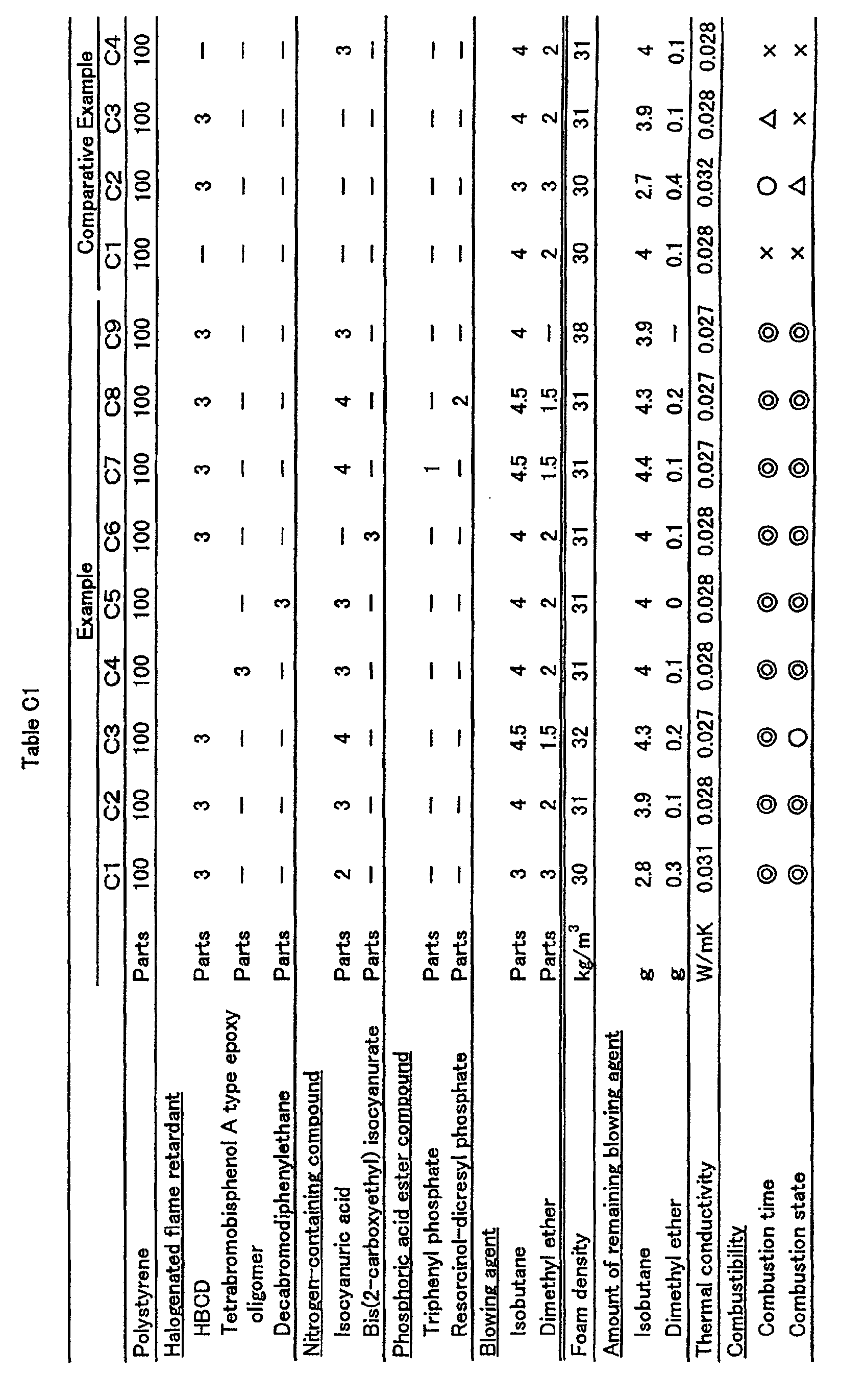
To 100 parts of the polystyrene, 0.5 part of talc as a
nucleating agent, 3 parts of hexabromocyclododecane (HBCD) as a
halogenated flame retardant and 2 parts of isocyanuric acid, and 0.25
part of barium stearate were dry-blended and then the resultant resin
mixture was supplied at a rate of about 40 kg/hr to a two-stage extruder
composed of a 65 mm diameter extruder and a 90 mm diameter extruder
connected in series. The resin mixture supplied to the foregoing 65 mm
diameter extruder was heated to 200°C to be melted, plasticized and
kneaded, and then the resultant was cooled to 120°C in the 90 mm
diameter extruder connected to the former and extruded to the
atmospheric air through a die with a rectangular cross section of 2 mm
in the thickness direction and 50 mm in the width direction attached to
the tip of the 90 mm diameter extruder to obtain an extruded foam
having a rectangular parallelepiped shape.
In this case, as blowing agents, 3 parts of isobutane and 5
parts of methyl chloride based on 100 parts of the polystyrene resin
(37.5 % of isobutane and 62.5 % of methyl chloride based on 100 % of
the blowing agents) were introduced under pressure into the polystyrene
resin through different lines, respectively, at the tip portion of the
foregoing 65 mm diameter extruder (the end portion to which the 90
diameter as connected at the end opposite to the die of the extruder).
The characteristic properties of the obtained foam are shown in Table C2.
The foam was provided with flame retardant property significantly
improved as compared with those obtained by Comparative Examples
C5 to C8 described below.
An extruded foam was obtained in the same conditions as in
Example C10 except that 4 parts of isobutane and 4 parts of methyl
chloride based on 100 parts of the polystyrene resin (50 % of isobutane
and 50% of methyl chloride based on 100 % of blowing agents) were
introduced and the amount of isocyanuric acid was changed to 3 parts.
The characteristic properties of the obtained foam are shown in Table C2.
The foam was further improved in thermal insulation property as
compared with that obtained by Example C10 and provided with both of
thermal insulation property and flame retardant property as compared
with those obtained by Example C10 or Comparative Examples C5 to
C8.
An extruded foam was obtained in the same conditions as in
Example C10 except that 5 parts of isobutane and 3 parts of methyl
chloride based on 100 parts of the polystyrene resin (62.5 % of isobutane
and 37.5 % of methyl chloride based on 100% of blowing agents) were
introduced and the amount of isocyanuric acid was changed to 4 parts.
The characteristic properties of the obtained foam are shown in Table C2.
The foam was further improved in thermal insulation property as
compared with those obtained by Example C10 or Comparative
Examples C5 to C8 and provided with both of thermal insulation
property and flame retardant property.
An extruded foam was obtained in the same conditions as in
Example C11 except that tetrabromobisphenol A type epoxy oligomer
was used in place of HBCD. The characteristic properties of the
obtained foam are shown in Table C2. The foam was provided with both
of thermal insulation performance and flame retardant property just as
that of Example C11.
An extruded foam was obtained in the same conditions as in
Example C11 except that decabromodiphenylethane was used in place
of HBCD. The characteristic properties of the obtained foam are shown
in Table C2. The foam was provided with both of thermal insulation
performance and flame retardant property just as that of Example C11.
An extruded foam was obtained in the same conditions as in
Example C11 except that bis(2-caboxyethyl) isocyanurate was used in
place of isocyanuric acid. The characteristic properties of the obtained
foam are shown in Table C2. The foam was provided with both of
thermal insulation performance and flame retardant property just as
that of Example C11.
An extruded foam was obtained in the same conditions as in
Example C12 except that 1 part of triphenyl phosphate as a phosphoric
acid ester compound was further added to 100 parts of the polystyrene
resin. The characteristic properties of the obtained foam are shown in
Table C2. The foam was provided with flame retardant property further
improved as compared with that of Example C12.
An extruded foam was obtained in the same conditions as in
Example C11 except that none of HBCD and isocyanuric acid were
added. The characteristic properties of the obtained foam are shown in
Table C2. The flame retardant property of the foam was deteriorated as
compared with that of Example C11.
An extruded foam was obtained in the same conditions as in
Example C11 except that isocyanuric acid was not added. The
characteristic properties of the obtained foam are shown in Table C2.
The flame retardant property of the foam was deteriorated as compared
with that of Example C11.
An extruded foam was obtained in the same conditions as in
Example C10 except that isocyanuric acid was not added. The
characteristic properties of the obtained foam are shown in Table C2.
The flame retardant property of the foam was deteriorated as compared
with that of Example C10.
An extruded foam was obtained in the same conditions as in
Example C11 except that HBCD was not added. The characteristic
properties of the obtained foam are shown in Table C2. The flame
retardant property of the foam was deteriorated as compared with that of
Example C11.
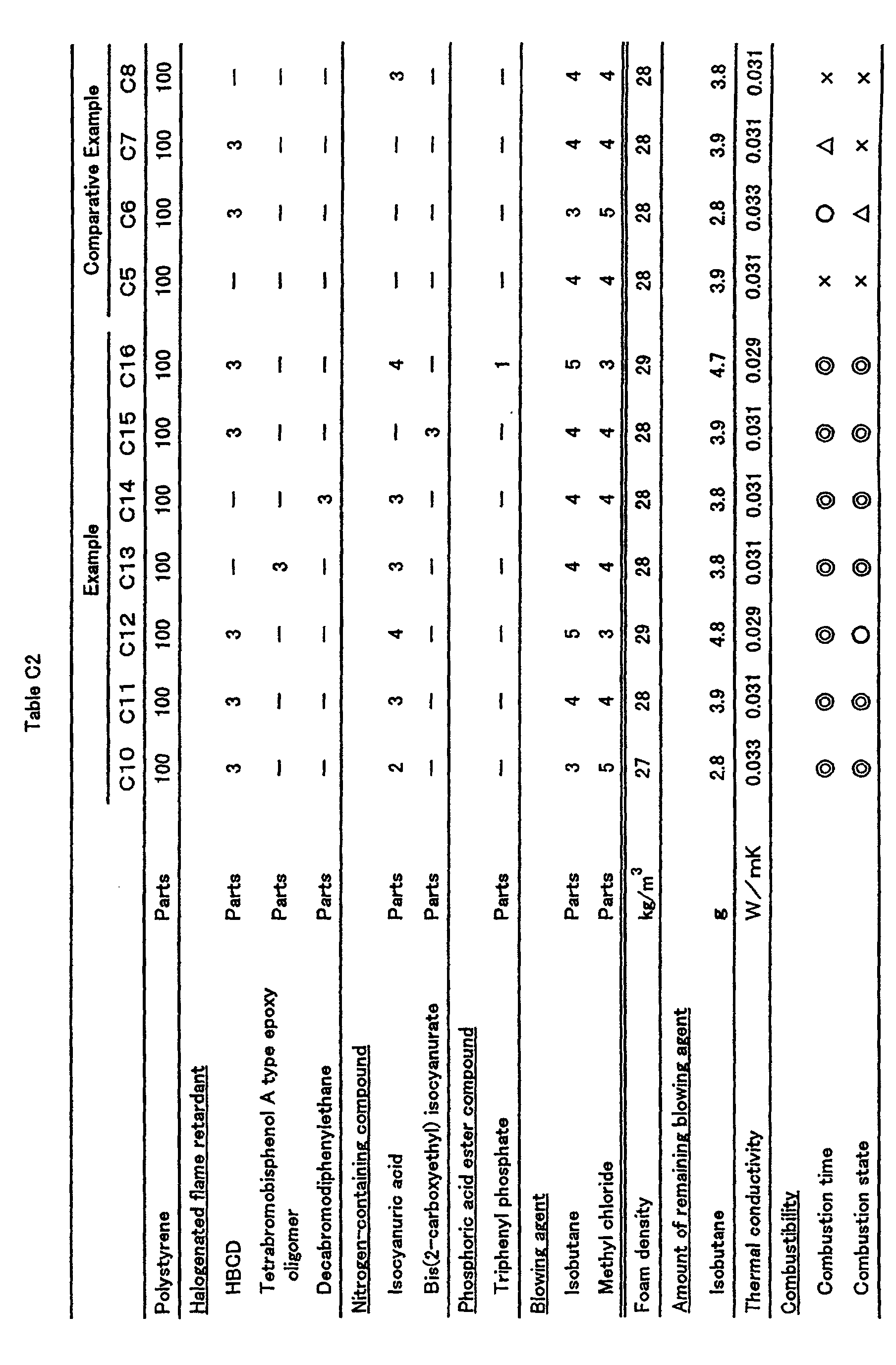
To 100 parts of the polystyrene resin, 1 part of bentonite
(produced by HOJUN KOGYO CO., LTD., trade name: BENGEL 15), 0.1
part of dehydrated silica (produced by Nippon Aerosil Co., Ltd.,trade
name: AEROSIL) as an inorganic powder having a large number of
hydroxyl groups, 0.1 part of talc as a nucleating agent, 3 parts of
hexabromocyclododecane (HBCD) as a halogenated flame retardant, 2
parts of isocyanuric acid, and 0.25 part of barium stearate were dry-blended
and then the resultant resin mixture was supplied at a rate of
about 40 kg/hr to a two-stage extruder composed of a 65 mm diameter
extruder mm and a 90 mm diameter extruder connected in series. The
resin mixture supplied to the foregoing 65 mm diameter extruder was
heated to 200°C to be melted, plasticized and kneaded, and then the
resultant was cooled to 120°C in the 90 mm diameter extruder
connected to the former and extruded to the atmospheric air through a
die with a rectangular cross section of 2 mm in the thickness direction
and 50 mm in the width direction attached to the tip of the 90 mm
diameter extruder to obtain an extruded foam having a rectangular
parallelepiped shape.
In this case, as blowing agents, 3 parts of isobutane, 3 parts
of dimethyl ether and 1 part of water based on 100 parts of the
polystyrene resin (43 % of isobutane, 43 % of dimethyl ether and 14 % of
water based on 100 % of the blowing agents) were introduced under
pressure into the polystyrene resin through different lines, respectively,
at the tip portion of the foregoing 65 mm diameter extruder (the end
portion to which the 90 mm diameter extruder was connected at the end
opposite to the die of the extruder).
In the obtained foam, small cells and large cells were formed
to exit together and the small cell area ratio was 45 %. The
characteristic properties of the obtained foam are shown in Table C3.
The results of Examples C1 and C2 are also shown in Table C3. The
foam was provided with flame retardant property significantly improved
as compared with those obtained by the following Comparative
Examples C9 to C12. Further, the heat insulation property thereof was
also considerably improved as compared with that of Example C1.
An extruded foam was obtained in the same conditions as in
Example C17 except that 4 parts of isobutane, 2 parts of dimethyl ether,
and 1 part of water based on 100 parts of the polystyrene resin (57 % of
isobutane, 29 % of dimethyl ether, and 14 % of water based on 100 % of
the blowing agents) were introduced and the amount of isocyanuric acid
was changed to 3 parts. In the obtained foam, small cells and large
cells were formed to exit together and the small cell area ratio was 45 %.
The characteristic properties of the obtained foam are shown in Table C3.
The foam was provided with flame retardant property significantly
improved as compared with those obtained by the following Comparative
Examples C9 to C12. Further, the heat insulation property thereof was
also considerably improved as compared with that of Example C2 or
Example C17. That is, the extruded styrene resin foam had both of
thermal insulation property and flame retardant property meeting
thermal insulating board No.3 of extruded polystyrene foam prescribed
in JIS A 9511.
An extruded foam was obtained in the same conditions as in
Example C17 except that 4.5 parts of isobutane, 1.5 parts of dimethyl
ether, and 1 part of water based on 100 parts of the polystyrene resin
(64.3 % of isobutane, 21.4 % of dimethyl ether, and 14.3 % of water
based on 100 % of the blowing agents) were introduced and the amount
of isocyanuric acid was changed to 4 parts. In the obtained foam, the
small cell area ratio was 40 %. The characteristic properties of the
obtained foam are shown in Table C3. The foam was provided with
thermal insulation property improved as compared with that of Example
C18 and further excellent flame retardant property.
An extruded foam was obtained in the same conditions as in
Example C18 except that tetrabromobisphenol A type epoxy oligomer
was used in place of HBCD. The characteristic properties of the
obtained foam are shown in Table C3. The obtained foam was provided
with excellent thermal insulation property and flame retardant property
just as those of Example C18. That is, the extruded styrene resin foam
had both of thermal insulation property and flame retardant property
meeting thermal insulating board No.3 of extruded polystyrene foam
prescribed in JIS A 9511.
An extruded foam was obtained in the same conditions as in
Example C18 except that decabromodiphenylethane was used in place
of HBCD. The characteristic properties of the obtained foam are shown
in Table C3. The obtained foam was provided with excellent thermal
insulation property and flame retardant property just as those of
Example C18. That is, the extruded styrene resin foam had both of
thermal insulation property and flame retardant property meeting
thermal insulating board No.3 of extruded polystyrene foam prescribed
inJIS A 9511.
An extruded foam was obtained in the same conditions as in
Example C18 except that bis(2-carboxyethyl) isocyanurate was used in
place of isocyanuric acid. The characteristic properties of the obtained
foam are shown in Table C3. The obtained foam was provided with
excellent thermal insulation property and flame retardant property just
as those of Example C18. That is, the extruded styrene resin foam had
both of thermal insulation property and flame retardant property
meeting thermal insulating board No.3 of extruded polystyrene foam
prescribed in JIS A 9511.
An extruded foam was obtained in the same conditions as in
Example C19 except that 1 part of triphenyl phosphate (produced by
Daihachi Chemical Industry Co., Ltd., trade name: TPP) as a phosphoric
acid ester compound was further added to 100 parts of the polystyrene
resin. The characteristic properties of the obtained foam are shown in
Table C3. The obtained foam was provided with flame retardant
property further improved as compared with that of Example C19. That
is, the extruded styrene resin foam had both of thermal insulation
property and flame retardant property meeting thermal insulating board
No.3 of extruded polystyrene foam prescribed in JIS A 9511.
An extruded foam was obtained in the same conditions as in
Example C18 except that 4 parts of isobutane and 1 part of water based
on 100 parts of the polystyrene resin (80 % of isobutane and 20 % of
water based on 100 % of the blowing agents) was introduced and the
amount of isocyanuric acid was changed to 3 parts. The characteristic
properties of the obtained foam are shown in Table C3. Except an
increased foam density, the obtained foam was provided with both of
excellent thermal insulation property and flame retardant property.
That is, the extruded styrene resin foam had both of thermal insulation
property and flame retardant property meeting thermal insulating board
No.3 of extruded polystyrene foam prescribed in JIS A 9511.
An extruded foam was obtained in the same conditions as in
Example C18 except that none of HBCD and isocyanuric acid were
added. The characteristic properties of the obtained foam are shown in
Table C3. The flame retardant property of the foam was deteriorated as
compared with that of Example C18.
An extruded foam was obtained in the same conditions as in
Example C17 except that isocyanuric acid was not added. The
characteristic properties of the obtained foam are shown in Table C3.
The flame retardant property of the foam was deteriorated as compared
with that of Example C17.
An extruded foam was obtained in the same conditions as in
Example C18 except that isocyanuric acid was not added. The
characteristic properties of the obtained foam are shown in Table C3.
The flame retardant property of the foam was deteriorated as compared
with that of Example C18.
An extruded foam was obtained in the same conditions as in
Example C18 except that HBCD was not added. The characteristic
properties of the obtained foam are shown in Table C3. The flame
retardant property of the foam was deteriorated as compared with that of
Example C18.
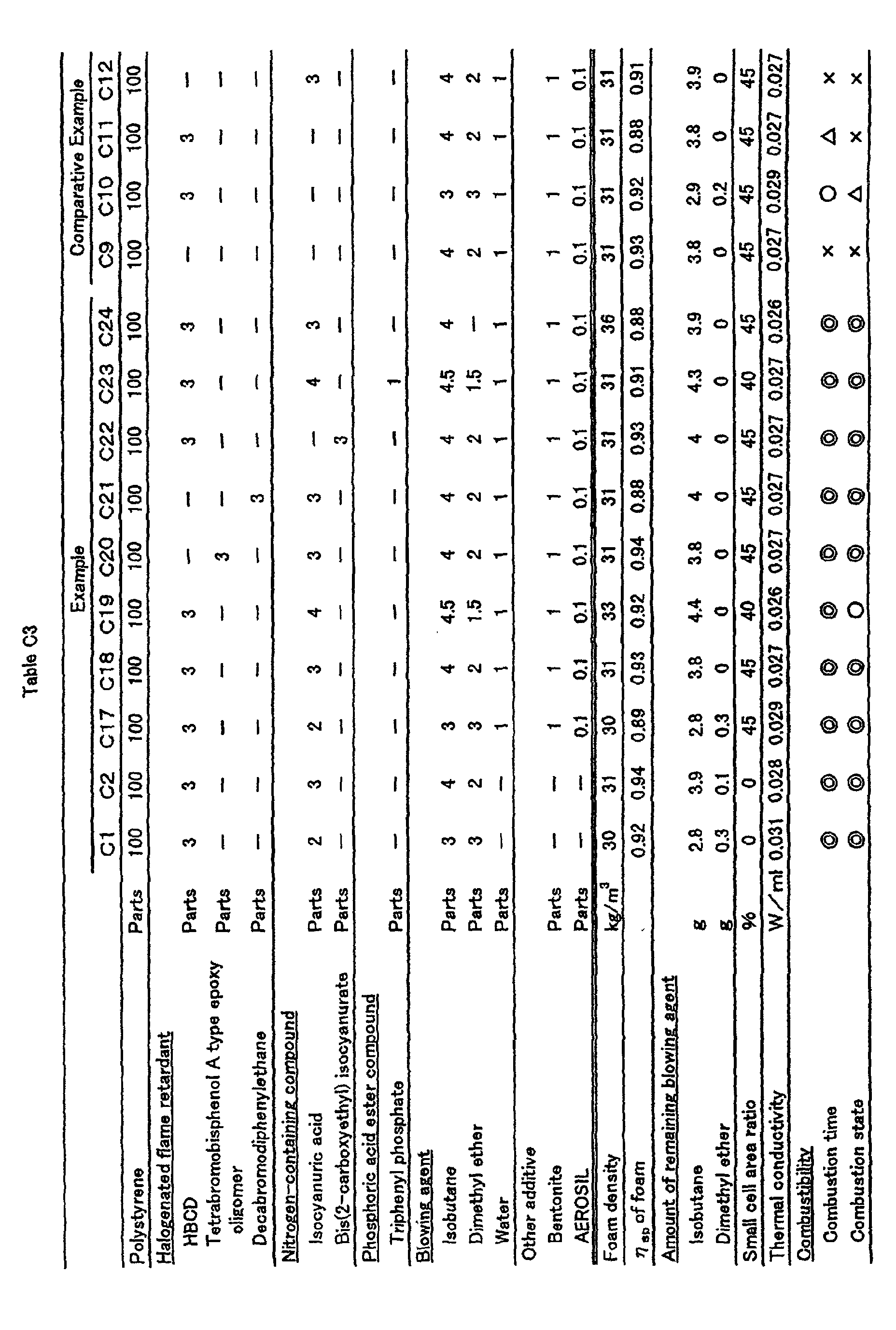
In the description hereinafter, the following abbreviated
symbols denote the following substances, respectively.
As characteristic properties of foams obtained by Examples
D1 to D5 and Comparative Examples D1 to D5 described below, the
expansion ratio, the closed cell ratio, the average cell size, the amount of
remaining blowing agent, the foam appearance, the foam color, the
thermal conductivity and the combustibility were determined according
to the following methods.
An approximate density of styrene resin was assumed to be
1.05 (g/cm3) and the expansion ratio was calculated by the following
equation:
Expansion ratio (times) = 1.05/(foam density) (g/cm3 )
Using a multi-pycnometer (manufactured by Beckman Japan
Co., Ltd.), the closed cell ratio was measured according to ASTM D-2856.
A longitudinal section of each extruded foam was
photographed at X30 magnification with a scanning electron microscope
(manufactured by Hitachi, Ltd., S-450), and the obtained photograph
was copied with a dry type copying machine. The obtained copy was
subjected to a first treatment of filling parts to corresponding to cells
with a black ink, and the image obtained by the first treatment was
subjected to processing with an image processing apparatus
(manufactured by PIAS Co., Ltd., PIAS-II) to determine the average cell
size.
Twenty days after the production, a foam was analyzed using
a gas chromatograph (GC-9A manufactured by Shimadzu Corporation)
to determine the amount of remaining blowing agent (g) based on 100 g
of the foam. In the analysis, isobutane and DME were set to be objects
to be analyzed.
The appearance of a foam was evaluated according to the
following evaluation criteria.
The color of a foam was evaluated by the naked eye.
The thermal conductivity of a foam was measured according
to JIS A 9511 and the evaluation was carried out according to the
following evaluation criteria. The measurement was carried out for
foams 20 days after the production.
Using specimens each having a thickness of 10 mm, a length
of 200 mm and a width of 25 mm, a combustion test was carried out with
n = 10 according to JIS A 9511 and the combustibility was evaluated in
terms of flame extinguishing time according to the following evaluation
criteria. The measurement was carried out for foams 20 days after the
production.
To 100 parts of a polystyrene resin (produced by Nippon Steel
Chemical Co., Ltd., Estyrene G-17, melt index (MI): 3.1), 0.5 part of talc
as a nucleating agent, 3.0 parts of hexabromocyclododecane (produced
by ALBEMARLE CORPORATION, SAYTEX HBCD-LM) and 2.0 parts of
zinc borate (produced by US BORAX Co., Fire Break ZB) as flame
retardants, and further 0.25 part of barium stearate were dry-blended
and then the resultant resin mixture was supplied at a rate of about 40
kg/hr to a two-stage extruder composed of a 65 mm diameter extruder
and a 90 mm diameter extruder connected in series.
The resin mixture supplied to the foregoing extruder with an
inner diameter of 65 mm was heated to 200°C to be melted, plasticized
and kneaded, and then the resultant was cooled to 120°C in the 90 mm
diameter extruder connected to the former and extruded to the
atmospheric air through a die with a rectangular cross section of 2 mm
in the thickness direction and 50 mm in the width direction attached to
the tip of the 90 mm diameter extruder to obtain an extruded foam
having a rectangular parallelepiped shape.
In this case, as blowing agents, isobutane and DME were
introduced under pressure into the polystyrene resin so that the total
amount of isobutane and DME was 8 parts based on 100 parts of the
polystyrene resin and the proportions of isobutane and dimethyl ether
were 50 % by weight and 50 % by weight, respectively, based on 100 %
by weight of the total of the blowing agents, through different lines,
respectively, at the tip portion of the foregoing 65 mm diameter extruder
(the end portion to which the 90 mm diameter extruder was connected at
the end opposite to the die of the extruder). The characteristic
properties of the obtained foam are shown in Table D1.
An extruded foam was obtained in the same conditions as in
Example D1 except that the amounts of the respective blowing agents
were changed to those described in Table D1. The characteristic
properties of the obtained foam are shown in Table D1.
Extruded foams were obtained in the same conditions as in
Example D1 except that the amount of zinc borate was changed to that
described in Table D1. The characteristic properties of the obtained
foams are shown in Table D1.
An extruded foam was obtained in the same conditions as in
Example D1 except that no barium stearate was used. The
characteristic properties of the obtained foam are shown in Table D1.
An extruded foam was obtained in the same conditions as in
Example D1 except that no hexabromocyclododecane was added. The
characteristic properties of the obtained foam are shown in Table D2.
An extruded foam was obtained in the same conditions as in
Example D1 except that no zinc borate was added. The characteristic
properties of the obtained foam are shown in Table D2.
An extruded foam was obtained in the same conditions as in
Example D1 except that none of zinc borate and barium stearate were
added. The characteristic properties of the obtained foam are shown in
Table D2.
An extruded foam was obtained in the same conditions as in
Example D1 except that none of hexabromocyclododecane and barium
stearate were added. The characteristic properties of the obtained foam
are shown in Table D2.
An extruded foam was obtained in the same conditions as in
Example D1 except that none of hexabromocyclododecane and zinc
borate were added. The characteristic properties of the obtained foam
are shown in Table D2.
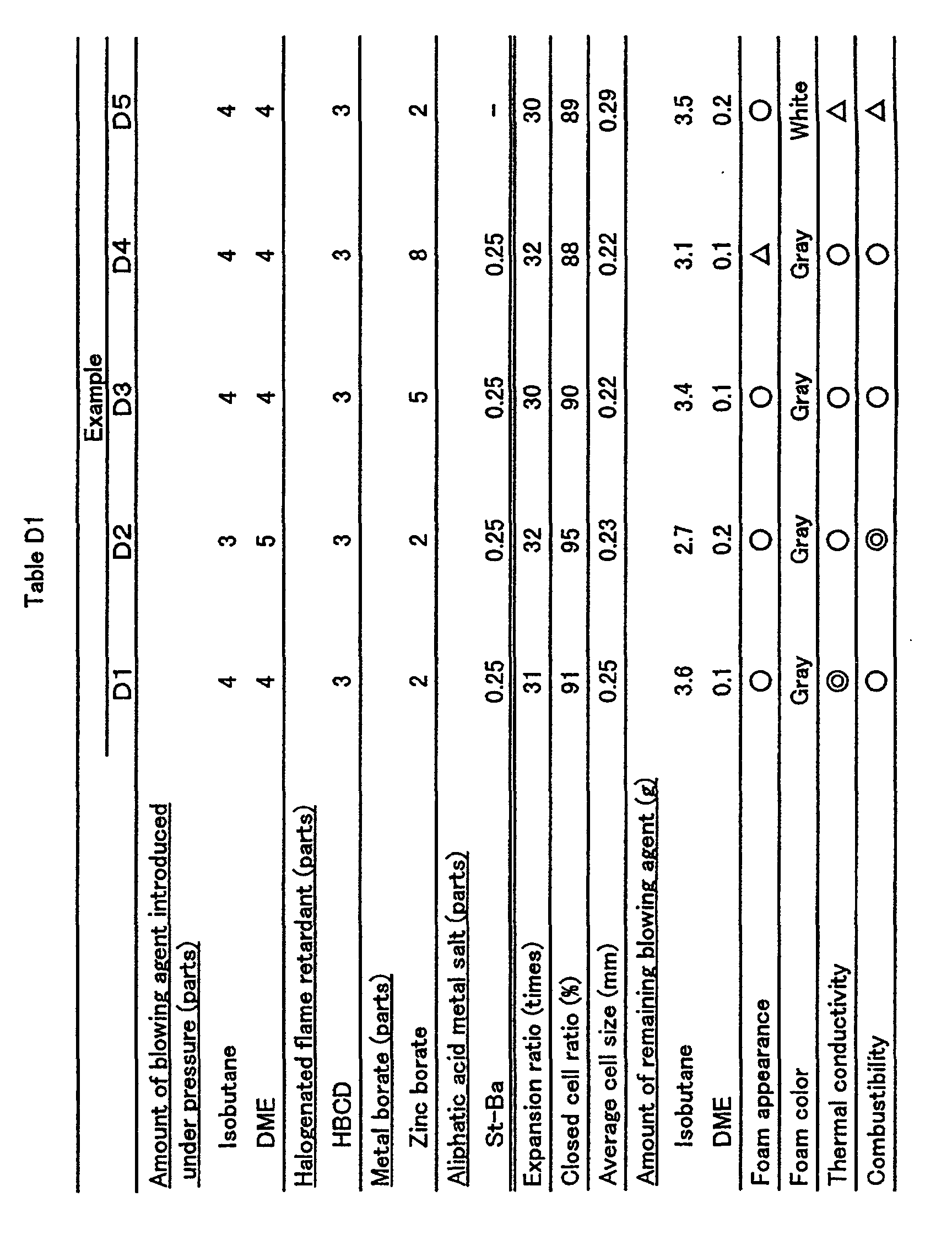

As being made clear by comparison of Examples D1 to D4
with Comparative Examples D1 to D5, the foams of the present
invention obtained by using isobutane as one of saurated hydrocarbons
having 3 to 5 carbon atoms, dimethyl ether as other blowing agent,
HBCD as a halogenated flame retardant, zinc borate as a flame retardant
B, and further barium stearate were found excellent all in the foam
appearance, thermal conductivity, and flame retardant property.
Further, as being made clear by comparison of Example D1
with Example D5, the foam of the present invention obtained by using
barium stearate was found excellent in the thermal conductivity as
compared with that in case of using no barium stearate.
As the characteristic properties of each foam obtained by
Examples E1 to E6 and Comparative Examples E1 to E3 described below,
the expansion ratio, the closed cell ratio, the amount of remaining
blowing agent, the thermal conductivity and the combustibility were
determinated according to the following methods.
An approximate density of styrene resin was assumed to be
1.05 (g/cm3) and the expansion ratio was calculated by the following
equation:
Expansion ratio (times) = 1.05/(foam density) (g/cm3 ).
Using a multi-pycnometer (manufactured by Beckman Japan
Co., Ltd.), the closed cell ratio was measured according to ASTM D-2856.
Fourteen days after the production, a foam was analyzed
using a gas chromatograph (GC-14A manufactured by Shimadzu
Corporation) to determine the amount of remaining blowing agent based
on 100 g of the foam.
The thermal conductivity of a foam was measured according
to JIS A 9511 and the evaluation was carried out according to the
following evaluation criteria. The measurement was carried out for
foams 14 days after the production.
Using specimens each having a thickness of 10 mm, a length
of 200 mm and a width of 25 mm taken from foams 14 days after the
production, a combustion test was carried out with n = 5 according to
JIS A 9511 and the combustibility was evaluated in terms of flame
extinguishing time according to the following evaluation criteria.
To 100 parts of a polystyrene resin (produced by Nippon Steel
Chemical Co., Ltd., Estyrene G-17, melt index (MI): 3.1), 0.5 part of talc
as a nucleating agent, 3.0 parts of hexabromocyclododecane (HBCD) as
a halogenated flame retardant and 2.0 parts of diboron trioxide
(produced by US BORAX Co., Boric Oxide), and further 0.25 part of
barium stearate were dry-blended and then the resultant resin mixture
was supplied at a rate of about 40 kg/hr to a two-stage extruder
composed of a 65 mm diameter extruder and a 90 mm diameter extruder
connected in series. The resin mixture supplied to the foregoing 65 mm
diameter extruder was heated to 200°C to be melted, plasticized and
kneaded, and then the resultant was cooled to 120°C in the 90 mm
diameter extruder connected to the former and extruded to the
atmospheric air through a die with a rectangular cross section of 2 mm
in the thickness direction and 50 mm in the width direction attached to
the tip of the 90 mm diameter extruder to obtain an extruded foam
having a rectangular parallelepiped shape.
In this case, as blowing agents, isobutane and dimethyl ether
were introduced under pressure into the polystyrene resin so that the
total amount of isobutane and dimethyl ether was 8 parts based on 100
parts of the polystyrene resin and the proportions of isobutane and
dimethyl ether were 50 % by weight and 50 % by weight, respectively,
based on 100 % by weight of the total of the blowing agents, through
different lines, respectively, at the tip portion of the foregoing 65 mm
diameter extruder (the end portion to which the 90 mm diameter
extruder was connected at the end opposite to the die of the extruder).
The characteristic properties of the obtained foam are shown in Table
E1.
Extruded foams were obtained in the same conditions as in
Example E1 except that the amount of diboron trioxide and the amounts
of the respective blowing agents were changed to those described in
Table E1. The characteristic properties of the obtained foams are
shown in Table E1.
An extruded foam was obtained in the same conditions as in
Example E1 except that tetrabromobisphenol A type epoxy oligomer was
used in place of HBCD. The characteristic properties of the obtained
foam are shown in Table E1.
An extruded foam was obtained in the same conditions as in
Example E1 except that decabromodiphenylethane was used in place of
HBCD. The characteristic properties of the obtained foam are shown in
Table E1.
An extruded foam was obtained in the same conditions as in
Example E1 except that none of HBCD and diboron trioxide were added.
The characteristic properties of the obtained foam are shown in Table
E2.
An extruded foam was obtained in the same conditions as in
Example E1 except that no diboron trioxide was added. The
characteristic properties of the obtained foam are shown in Table E2.
An extruded foam was obtained in the same conditions as in
Example E1 except that no HBCD was added. The characteristic
properties of the obtained foam are shown in Table E2.
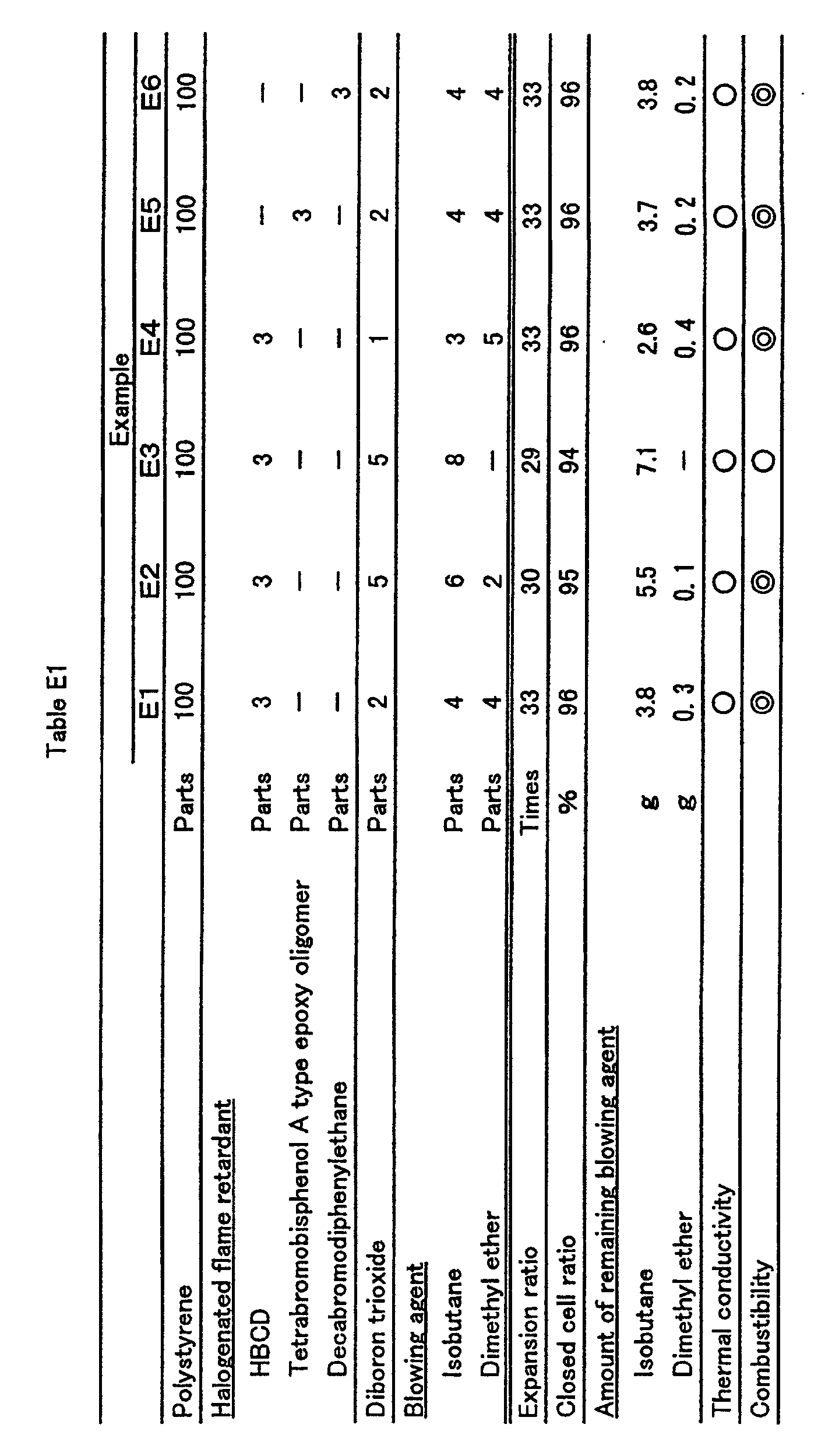
| Comparative Example | ||||
| E1 | E2 | E3 | ||
| Polystyrene | Parts | 100 | 100 | 100 |
| Halogenated flame retardant | ||||
| HBCD | Parts | - | 3 | - |
| Diboron trioxide | Parts | - | - | 2 |
| Blowing agent | ||||
| Isobutane | Parts | 4 | 4 | 4 |
| Dimethyl ether | Parts | 4 | 4 | 4 |
| Expansion ratio | Times | 34 | 33 | 34 |
| Closed cell ratio | % | 98 | 96 | 97 |
| Amount of remaining blowing agent | ||||
| Isobutane | g | 3.8 | 3.7 | 3.8 |
| Dimethyl ether | g | 0.2 | 0.2 | 0.2 |
| Thermal conductivity | ○ | ○ | ○ | |
| Combustibility | × | Δ | × |
As being made clear by comparison of Examples E1 to E6
with Comparative Examples E1 to E3, the foams of the present invention
obtained by using isobutane as one of saturated hydrocarbons having 3
to 5 carbon atoms, dimethyl ether as other blowing agent, HBCD or the
like as a halogenated flame retardant, and boron oxide as a flame
retardant B were found excellent in the thermal conductivity and flame
retardant property.
As the characteristic properties of each foam obtained by
Examples F1 to F6 and Comparative Examples F1 to F3 described below,
the expansion ratio, the closed cell ratio, the amount of remaining
blowing agent, the thermal conductivity, and the combustibility were
determined according to the following methods.
An approximate density of styrene resin was assumed to be
1.05 (g/cm3) and the expansion ratio was calculated by the following
equation:
Expansion ratio (times) = 1.05/(foam density) (g/cm3 )
Using a multi-pycnometer (manufactured by Beckman Japan
Co., Ltd.), the closed cell ratio was measured according to ASTM D-2856.
Fourteen days after the production, a foam was analyzed
using a gas chromatograph (manufactured by Hitachi, Ltd., S-450) to
determine the amount (g) of remaining blowing agent based on 100 g of
the foam.
The thermal conductivity of a foam was measured according
to JIS A 9511 and the evaluation was carried out according to the
following evaluation criteria. The measurement was carried out for
foams 14 days after the production.
Using specimens each having a thickness of 10 mm, a length
of 200 mm and a width of 25 mm taken from foams 14 days after the
production, a combustion test was carried out with n = 5 according to
JIS A 9511 and the combustibility was evaluated according to the
following evaluation criteria.
To 100 parts of a polystyrene resin (produced by Nippon Steel
Chemical Co., Ltd., Estyrene G-17, melt index (MI): 3.1), 0.5 part of talc
as a nucleating agent, 3.0 parts of hexabromocyclododecane (HBCD) as
a halogenated flame retardant and 2.0 parts of diboron trioxide
(produced by US BORAX Co., Boric Oxide), and further 0.25 part of
barium stearate were dry-blended and then the resultant resin mixture
was supplied at a rate of about 40 kg/hr to a two-stage extruder
composed of a 65 mm diameter extruder and a 90 mm diameter extruder
connected in series.
The resin mixture supplied to the foregoing 65 mm diameter
extruder was heated to 200°C to be melted, plasticized and kneaded,
and then the resultant was cooled to 120°C in the 90 mm diameter
extruder connected to the former and extruded to the atmospheric air
through a die with a rectangular cross section of 2 mm in the thickness
direction and 50 mm in the width direction attached to the tip of the 90
mm diameter extruder to obtain an extruded foam having a rectangular
parallelepiped shape.
In this case, as blowing agents, isobutane and methyl
chloride were introduced under pressure into the polystyrene resin so
that the total amount of isobutane and methyl chloride was 8 parts
based on 100 parts of the polystyrene resin and the proportions of
isobutane and methyl chloride were 50 % by weight and 50 % by weight,
respectively, based on 100 % by weight of the total of the blowing agents,
through different lines, respectively, at the tip portion of the foregoing 65
mm diameter extruder (the end portion to which the 90 mm diameter
extruder was connected at the end opposite to the die of the extruder).
The characteristic properties of the obtained foam are shown in Table
F1.
Extruded foams were obtained in the same conditions as in
Example F1 except that the amount of diboron trioxide and the amounts
of the respective blowing agents were changed to those described in
Table F1. The characteristic properties of the obtained foams are
shown in Table F.
An extruded foam was obtained in the same conditions as in
Example F1 except that tetrabromobisphenol A type epoxy oligomer was
used in place of HBCD. The characteristic properties of the obtained
foam are shown in Table F.
An extruded foam was obtained in the same conditions as in
Example F1 except that decabromodiphenylethane was used in place of
HBCD. The characteristic properties of the obtained foam are shown in
Table F.
An extruded foam was obtained in the same conditions as in
Example F1 except that none of HBCD and diboron trioxide were added.
The characteristic properties of the obtained foam are shown in Table F.
An extruded foam was obtained in the same conditions as in
Example F1 except that no diboron trioxide was added. The
characteristic properties of the obtained foam are shown in Table F.
An extruded foam was obtained in the same conditions as in
Example F1 except that no HBCD was added. The characteristic
properties of the obtained foam are shown in Table F.

As being made clear by comparison of Examples F1 to F6
with Comparative Examples F1 to F3, the foams of the present invention
obtained by using isobutane as one of saturated hydrocarbons having 3
to 5 carbon atoms, methyl chloride as other blowing agent, HBCD or the
like as a halogenated flame retardant, and boron oxide as a flame
retardant B were found excellent in the thermal conductivity and flame
retardant property.
As the characteristic properties of each foam obtained by
Examples G1 to G9 and Comparative Examples G1, G2 described below,
1) the expansion ratio, 2) the closed cell ratio, 3) the amount of
remaining blowing agent amount, 4) the thermal conductivity, 5) the
combustibility, and 6) the small cell occupying area ratio [the surface
area of cells with 0.25 mm or smaller cell size (herein, the cell with a cell
size of 0.25 mm or smaller means that the diameter of a circle having the
same area as the sectional area of the cell is 0.25 mm or smaller] were
determined according to the following methods.
An approximate density of styrene resin was assumed to be
1.05 (g/cm3) and the expansion ratio was calculated by the following
equation:
Expansion ratio (times) = 1.05/(foam density) (g/cm3 )
Using a multi-pycnometer (manufactured by Beckman Japan
Co., Ltd.), the closed cell ratio was measured according to ASTM D-2856.
Fourteen days after the production, a foam was analyzed
using a gas chromatograph (GC-14A manufactured by Shimadzu
Corporation) to determine the amount (g) of remaining blowing agent
based on 100 g of the foam.
The thermal conductivity of a foam was measured according
to JIS A 9511. The measurement was carried out for foams 14 days
after the production.
Using specimens each having a thickness of 10 mm, a length
of 200 mm and a width of 25 mm taken from foams 14 days after the
production, a combustion test was carried out with n = 5 according to
JIS A 9511 and the combustibility was evaluated according to the
following evaluation criteria.
A Henshell mixer (Super Mixer SMG-20, manufactured by
Kawada Manufacturing Co., Ltd.) was loaded with 3,000 g of diboron
trioxide (produced by US Borax Co.,Boric Oxide), and while mixing with
stirring 388 g of a melamine resin (Bansemin SM-960, produced by
Harima Chemicals, Inc., grade with a non-volatile content of 61.9%) was
added for 5 minutes and thereafter, mixing with stirring was further
continued for 10 minutes. After mixing, the resultant was taken out
and spread on a butt made of aluminum so that particles do not come
into contact with each other as much as possible and then cured by
heating at 150°C for 30 minutes to obtain diboron trioxide surface-treated
with the melamine resin.
To 100 parts of a polystyrene resin(produced by Nippon Steel
Chemical Co., Ltd., Estyrene G-17, melt index (MI): 3.1), 0.5 part of talc
as a nucleating agent, 3.0 parts of hexabromocyclododecane (HBCD) as
a halogenated flame retardant and 2.0 parts of the diboron trioxide
surface-treated with the melamine resin., 0.25 part of barium stearate,
and 1 part of bentonite were dry-blended and then the resultant resin
mixture was supplied at a rate of about 40 kg/hr to a two-stage extruder
composed of a 65 mm diameter extruder and a 90 mm diameter extruder
connected in series. The resin mixture supplied to the foregoing 65 mm
diameter extruder was heated to 200°C to be melted, plasticized and
kneaded, and then the resultant was cooled to 120°C in the 90 mm
diameter extruder connected to the former and extruded to the
atmospheric air through a die with a rectangular cross section of 2 mm
in the thickness direction and 50 mm in the width direction attached to
the tip of the 90 mm diameter extruder to obtain an extruded foam
having a rectangular parallelepiped shape.
In this case, as blowing agents, 4.5 parts of isobutane and
0.7 part of water based on 100 parts of the polystyrene resin were
introduced under pressure into the resin through different lines,
respectively, at the tip portion of the foregoing 65 mm diameter extruder
(the end portion to which the 90 mm diameter extruder was connected at
the end opposite to the die of the extruder). The characteristic
properties of the obtained foam are shown in Table G1.
An extruded foam was obtained in the same conditions as in
Example G1 except that the amount of the diboron trioxide surface-treated
with the melamine resin was changed to 5.0 parts. The
characteristic properties of the obtained foam are shown in Table G1.
In the surface treatment of boron oxide, a diboron trioxide
surface-treated with phenol resin was produced in the same conditions
as in Example G1 except that 255 g of phenol resin (Phenolite ST-611-LV,
produced by Dainippon Ink and Chemicals, Inc., content of effective
component: 70%) was used in place of the melamine resin, and in the
production of the foam, an extruded foam was obtained in the same
conditions as in Example G1 except that the diboron trioxide surface-treated
with the phenol resin was used. The characteristic properties of
the obtained foam are shown in Table G1.
A Henshell mixer (Super Mixer SMG-20, manufactured by
Kawada Manufacturing Co., Ltd.) was loaded with 3,000 g of diboron
trioxide (Boric Oxide, produced by US Borax Co.), and while mixing with
stirring 120 g of γ-methacryloyloxypropyltrimethoxysilane (TSL8370,
produced by Toshiba Silicone Co., Ltd.) was added for 5 minutes and
thereafter, mixing with was further continued for 10 minutes to conduct
a surface treatment of diboron trioxide.
An extruded foam was obtained in the same conditions as in
the foam production of Example G1 except that the diboron trioxide
surface-treated with γ-methacryloyloxypropyltrimethoxysilane was used
in place of the diboron trioxide surface-treated with the melamine resin.
The characteristic properties of the obtained foam are shown in Table
G1.
An extruded foam was obtained in the same conditions as in
Example G1 except that 4.5 parts of isobutane, 1.5 parts of dimethyl
ether and 0.7 part of water based on 100 parts of the polystyrene resin
were used as the blowing agents. The characteristic properties of the
obtained foam are shown in Table G1.
An extruded foam was obtained in the same conditions as in
Example G1 except that tetrabromobisphenol A type epoxy oligomer was
used in place of HBCD. The characteristic properties of the obtained
foam are shown in Table G1.
An extruded foam was obtained in the same conditions as in
Example G1 except that decabromodiphenylethane was used in place of
HBCD. The characteristic properties of the obtained foam are shown in
Table G1.
An extruded foam was obtained in the same conditions as in
Example G1 except that diboron trioxide was used without surface
treatment. The characteristic properties of the obtained foam are
shown in Table G1.
An extruded foam was obtained in the same conditions as in
Example G1 except that water as a blowing agent was not used. The
characteristic properties of the obtained foam are shown in Table G1.
An extruded foam was obtained in the same conditions as in
Example G1 except that diboron trioxide was not added. The
characteristic properties of the obtained foam are shown in Table G2.
An extruded foam was obtained in the same conditions as in
Example G1 except that HBCD was not added. The characteristic
properties of the obtained foam are shown in Table G2.

| Comparative Example | ||
| G1 | G2 | |
| Polystyrene (parts) | 100 | 100 |
| Halogenated flame retardant | ||
| HBCD (parts) | 3 | - |
| Diboron trioxide (parts) | - | 2 (Melamine treatment) |
| Talc (parts) | 0.5 | 0.5 |
| Barium stearate (parts) | 0.25 | 0.25 |
| Bentonite (parts) | 1 | 1 |
| Blowing agent | ||
| Isobutane (parts) | 4.5 | 4.5 |
| Water (parts) | 0.7 | 0.7 |
| Expansion ratio (times) | 27 | 29 |
| Closed cell ratio (%) | 95 | 96 |
| Amount of remaining blowing agent | ||
| Isobutane (g) | 4.1 | 4.0 |
| Thermal conductivity (W/mK) | 0.028 | 0.028 |
| Combustibility | Δ | × |
| Small cell occupying area ratio (%) | 40 | 38 |
As being made clear by comparison of Examples G1 to G7
with Comparative Examples G1, G2, the foams of the present invention
obtained by using isobutane as one of saturated hydrocarbons having 3
to 5 carbon atoms, water as other blowing agent (in Example G5,
dimethyl ether was further used as other blowing agent), HBCD or the
like as a halogenated flame retardant, and surface-treated boron oxide
as a flame retardant B were found to be foams containing small cells and
large cells together and excellent in the thermal conductivity and flame
retardant property.
According to the present invention, an extruded styrene resin
foam excellent in environmental compatibility and having excellent
flame retardant property and thermal insulation property can be stably
produced.
Claims (41)
- An extruded styrene resin foam obtained by extrusion-foaming of a styrene resin, which contains, as a blowing agent, 100 to 10 % by weight of at least one of saturated hydrocarbons having 3 to 5 carbon atoms and 0 to 90 % by weight of other blowing agent, based on the total amount of the blowing agent, and contains (A) a halogenated flame retardant and (B) at least one compound selected from the group consisting of phosphorus type flame retardants containing nitrogen atom in a molecule, tetrazole compounds, nitrogen-containing compounds having the following general formula 1, nitrogen-containing compounds having the following general formula 2, metal borates, and boron oxides:wherein R1, R2 and R3 are selected from hydrogen atom, an alkyl group having 1 to 8 carbon atoms, an organic group represented by the formula: -Y-X (wherein Y is an alkylene group having 1 to 6 carbon atoms, a phenylene group, or a cycloalkylene group, and X is an epoxy group, a carboxyl group, a hydroxyl group, an amino group, or a phenyl group), and a phenyl group, and may be different from each other.
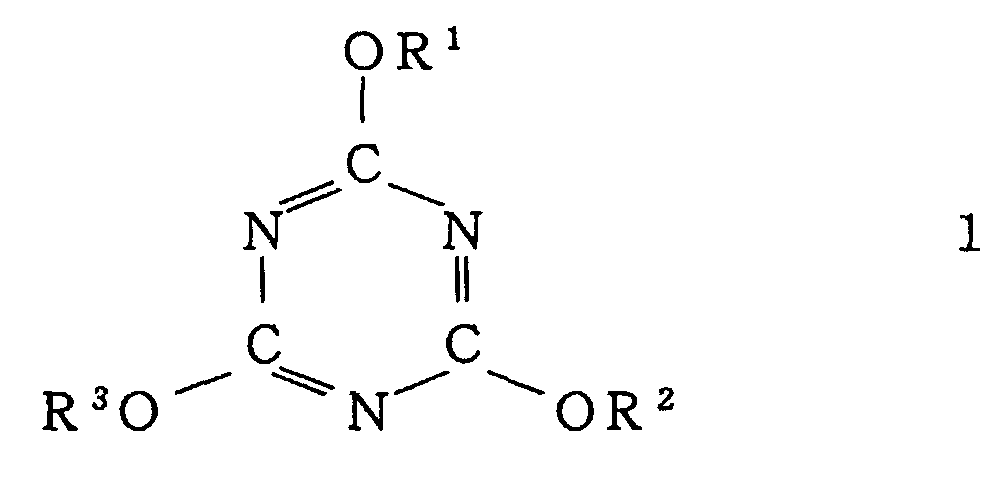 wherein R4, R5 and R6 are selected from hydrogen atom, an alkyl group having 1 to 8 carbon atoms, an organic group represented by the formula: -Y-X (wherein Y is an alkylene group having 1 to 6 carbon atoms, a phenylene group, or a cycloalkylene group, and X is an epoxy group, a carboxyl group, a hydroxyl group, an amino group, or a phenyl group), and a phenyl group, and may be different from each other.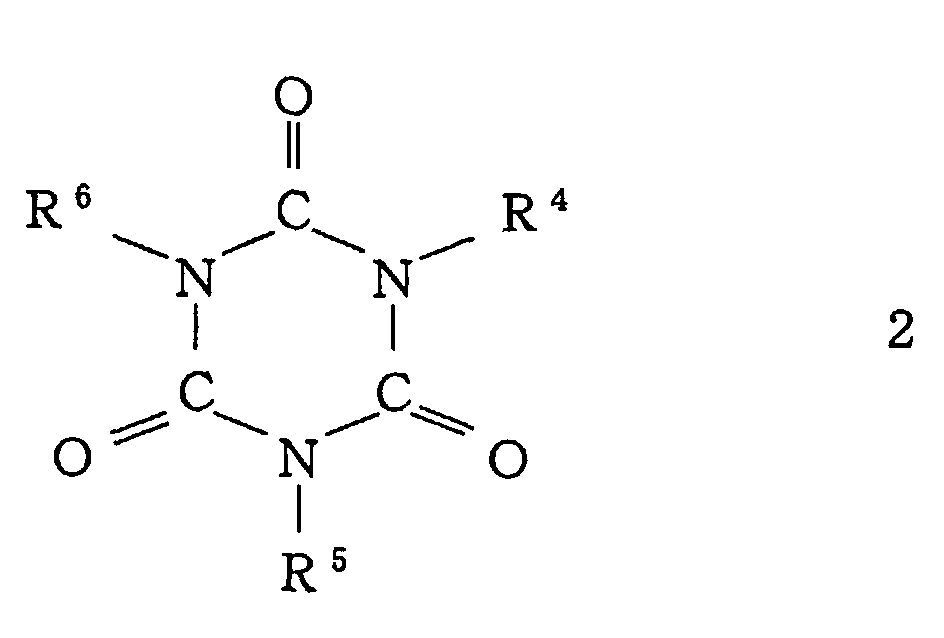
- The extruded styrene resin foam of Claim1, wherein the total content of the saturated hydrocarbon having 3 to 5 carbon atoms in the extruded styrene resin foam is 2 to 10 parts by weight based on 100 parts by weight of the foam.
- The extruded styrene resin foam of Claim 1 or 2, wherein the extruded styrene resin foam contains 0.1 to 10 parts by weight of the halogenated flame retardant (A) and 0.1 to 10 parts by weight in total of the compound (B), based on 100 parts by weight of the styrene resin.
- The extruded styrene resin foam of any one of Claims 1 to 3, wherein the saturated hydrocarbon having 3 to 5 carbon atoms is at least one saturated hydrocarbon selected from the group consisting of propane, n-butane, and isobutane.
- The extruded styrene resin foam of any one of Claims 1 to 4, wherein other blowing agent is at least one compound selected from the group consisting of dimethyl ether, diethyl ether, methyl ethyl ether, methyl chloride, ethyl chloride, water, and carbon dioxide.
- The extruded styrene resin foam of any one of Claims 1 to 5, wherein the halogenated flame retardant (A) is hexabromocyclododecane.
- The extruded styrene resin foam of any one of Claims 1 to 6, wherein the compound (B) is a phosphorus type flame retardant containing nitrogen atom in a molecule.
- The extruded styrene resin foam of Claim 7, wherein the compound (B) is a phosphorus type flame retardant containing nitrogen atom in a molecule and the thickness of the foam is 15 mm or more.
- The extruded styrene resin foam of Claim 7 or 8, wherein the phosphorus type flame retardant containing nitrogen atom in a molecule is ammonium phosphate and/or ammonium polyphosphate.
- The extruded styrene resin foam of any one of Claims 1 to 6, wherein the compound (B) is a tetrazole compound.
- The extruded styrene resin foam of Claim 10, wherein the tetrazole compound is a tetrazole compound having a thermal decomposition temperature of 250°C or higher.
- The extruded styrene resin foam of any one of Claims 1 to 6, wherein the compound (B) is at least one compound selected from the group consisting of nitrogen-containing compounds having the foregoing general formula 1 and nitrogen-containing compounds having the forgoing general formula 2.
- The extruded styrene resin foam of any one of Claims 1 to 6, wherein the compound (B) is a nitrogen-containing compound having the forgoing general formula 2.
- The extruded styrene resin foam of Claim 13, wherein the nitrogen-containing compound having the forgoing general formula 2 is isocyanuric acid and/or bis(2-carboxyethyl) isocyanurate.
- The extruded styrene resin foam of any one of Claims 1 to 6, wherein the compound (B) is a metal borate.
- The extruded styrene resin foam of Claim 15, wherein the compound (B) is a metal borate and a fatty acid metal salt is further contained.
- The extruded styrene resin foam of Claim 15 or 16, wherein the metal borate is zinc borate.
- The extruded styrene resin foam of any one of Claims 1 to 6, wherein the compound (B) is a boron oxide.
- The extruded styrene resin foam of Claim 18, wherein the boron oxide is a boron oxide surface-treated with a surface treating agent.
- The extruded styrene resin foam of Claims 18 or 19, wherein the boron oxide is diboron trioxide.
- The extruded styrene resin foam of Claim 19, wherein the surface treating agent comprises a thermosetting resin as a main component.
- The extruded styrene resin foam of any one of Claims 1 to 21, which further contains 0.1 to 10 parts by weight of a phosphoric acid ester compound based on 100 parts by weight of the styrene resin.
- The extruded styrene resin foam of any one of Claims 1 to 6, wherein the compound (B) is at least one compound selected from the group consisting of tetrazole compounds, nitrogen-containing compounds having the foregoing formula 1, nitrogen-containing compounds having the foregoing formula 2 and boron oxides surface-treated with a surface treating agent, and a montmorillonite type mineral is further contained.
- The extruded styrene resin foam of any one of Claims 1 to 6, wherein the compound (B) is at least one compound selected from the group consisting of tetrazole compounds, nitrogen-containing compounds having the foregoing formula 1, nitrogen-containing compounds having the foregoing formula 2 and boron oxides surface-treated with a surface treating agent, and a montmorillonite type mineral and a phosphoric acid ester compound are further contained.
- The extruded styrene resin foam of Claims 23 or 24, wherein the montmorillonite type mineral is bentonite.
- The extruded styrene resin foam of any one of Claims 23 to 25, wherein the compound (B) is isocyanuric acid and/or bis(2-carboxyethyl) isocyanurate.
- An extruded styrene resin foam containing no flon type blowing agent and having both thermal insulating property and flame retardant property meeting thermal insulating board No.3 of extruded polystyrene foam prescribed in JIS A 9511.
- The extruded styrene resin foam of Claim 27, wherein the thermal insulating property is 0.028 W/mK or lower in terms of thermal conductivity.
- The extruded styrene resin foam of Claim 27 or 28, wherein the flame retardant property meets the requirements that the flame is extinguished within 3 seconds and neither remaining ember nor spreading flame beyond the indicating line of combustion limit exists in the combustion test prescribed in JIS A 9511.
- A method for producing an extruded styrene resin foam comprising the steps of heating and melting a styrene resin, adding a blowing agent to the styrene resin, and extrusion-foaming the resultant through a die, wherein the extrusion-foaming is carried out in a condition where (A) a halogenated flame retardant and (B) at least one compound selected from the group consisting of phosphorus type flame retardants containing nitrogen atom in a molecule, tetrazole compounds, nitrogen-containing compounds having the following general formula 1, nitrogen-containing compounds having the following general formula 2, metal borates, and boron oxides, and further a blowing agent comprising 100 to 10 % by weight of at least one of saturated hydrocarbons having 3 to 5 carbon atoms and 0 to 90 % by weight of other blowing agent, based on the total amount of the blowing agent, are made coexist in the styrene resin:wherein R1, R2 and R3 are selected from hydrogen atom, an alkyl group having 1 to 8 carbon atoms, an organic group represented by the formula: -Y-X (wherein Y is an alkylene group having 1 to 6 carbon atoms, a phenylene group, or a cycloalkylene group, and X is an epoxy group, a carboxyl group, a hydroxyl group, an amino group, or a phenyl group), and a phenyl group, and may be different from each other.
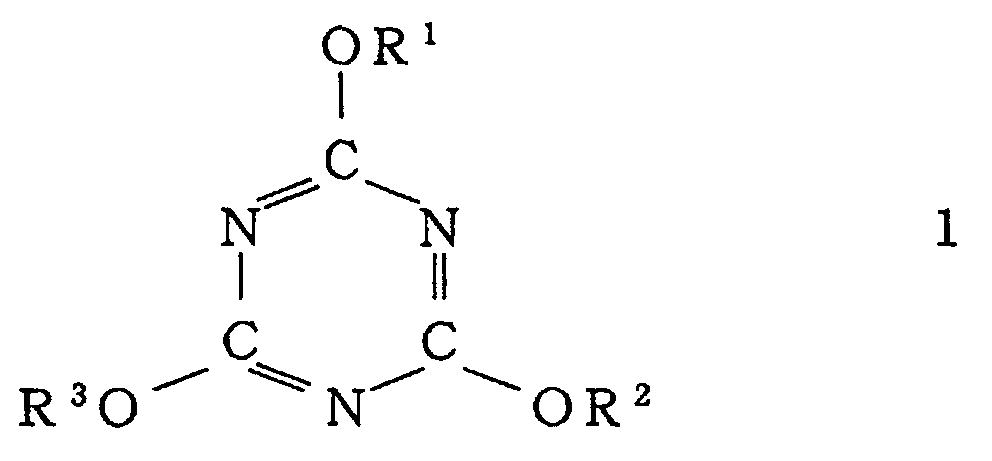 wherein R4, R5 and R6 are selected from hydrogen atom, an alkyl group having 1 to 8 carbon atoms, an organic group represented by the formula: -Y-X (wherein Y is an alkylene group having 1 to 6 carbon atoms, a phenylene group, or a cycloalkylene group, and X is an epoxy group, a carboxyl group, a hydroxyl group, an amino group, or a phenyl group), and a phenyl group, and may be different from each other.
- The method for producing an extruded styrene resin foam of Claim 30, wherein the extrusion foaming is carried out further in the presence of a montmorillonite type mineral and/or a phosphoric acid ester compound.
- The method for producing an extruded styrene resin foam of Claim 30 or 31, wherein the compound (B) is a phosphorus type flame retardant containing nitrogen atom in a molecule and the blowing agent comprises 70 to 30 % by weight of at least one of saturated hydrocarbons having 3 to 5 carbon atoms and 30 to 70 % by weight of at least one ether selected from the group consisting of dimethyl ether, diethyl ether, and methyl ethyl ether, based on the total amount of the blowing agent.
- The method for producing an extruded styrene resin foam of Claim 30 or 31, wherein the compound (B) is a metal borate and the extrusion foaming is carried out further in the presence of a fatty acid metal salt.
- The method for producing an extruded styrene resin foam of Claim 33, wherein the blowing agent comprises 90 to 10 % by weight of at least one of saturated hydrocarbons having 3 to 5 carbon atoms and 10 to 90 % by weight of at least one ether selected from dimethyl ether, diethyl ether, and methyl ethyl ether, based on the total amount of the blowing agent.
- The method for producing an extruded styrene resin foam of Claim 30 or 31, wherein the compound (B) is a tetrazole compound and the blowing agent comprises 90 to 10 % by weight of at least one of saturated hydrocarbons having 3 to 5 carbon atoms and 10 to 90 % by weight of at least one ether selected from the group consisting of dimethyl ether, diethyl ether, and methyl ethyl ether, based on the total amount of the blowing agent.
- The method for producing an extruded styrene resin foam of Claim 30 or 31, wherein the compound (B) is a nitrogen-containing compound having the foregoing general formula 1 and/or a nitrogen-containing compound having the foregoing general formula 2.
- The method for producing an extruded styrene resin foam of Claim 30 or 31, wherein the compound (B) is a nitrogen-containing compound having the foregoing general formula 1 and/or a nitrogen-containing compounds having the foregoing general formula 2 and further a montmorillonite type mineral is made coexist and the blowing agent comprises 99 to 20 % by weight of at least one of saturated hydrocarbons having 3 to 5 carbon atoms, 1 to 80 % by weight of water, and 0 to 79 % by weight of other blowing agent other than water, based on the total amount of the blowing agent.
- The method for producing an extruded styrene resin foam of Claim 30 or 31, wherein the compound (B) is a boron oxide.
- The method for producing an extruded styrene resin foam of Claim 38, wherein the blowing agent comprises 70 to 30 % by weight of at least one of saturated hydrocarbons having 3 to 5 carbon atoms and 30 to 70 % by weight of at least one of methyl chloride and ethyl chloride.
- The method for producing an extruded styrene resin foam of Claim 30 or 31, wherein the compound (B) is a boron oxide treated with a surface treating agent and the blowing agent comprises at least one of saturated hydrocarbons having 3 to 5 carbon atoms and water, and the extrusion foaming is carried out further in the presence of a montmorillonite type mineral.
- The method for producing an extruded styrene resin foam of any one of Claims 31, 37 or 40, wherein the montmorillonite type mineral is bentonite.
Applications Claiming Priority (15)
| Application Number | Priority Date | Filing Date | Title |
|---|---|---|---|
| JP30577199 | 1999-10-27 | ||
| JP30577199A JP3963617B2 (en) | 1999-10-27 | 1999-10-27 | Method for producing styrene resin extruded foam plate |
| JP31426399A JP3963618B2 (en) | 1999-11-04 | 1999-11-04 | Styrenic resin foam and method for producing the same |
| JP31426399 | 1999-11-04 | ||
| JP31741999 | 1999-11-08 | ||
| JP31741999A JP4073129B2 (en) | 1999-11-08 | 1999-11-08 | Styrene resin extruded foam manufacturing method |
| JP31879699A JP4031165B2 (en) | 1999-11-09 | 1999-11-09 | Styrene resin extruded foam manufacturing method |
| JP31879699 | 1999-11-09 | ||
| JP2000135024A JP2001316511A (en) | 2000-05-08 | 2000-05-08 | Method for producing styrenic resin foam |
| JP2000135024 | 2000-05-08 | ||
| JP2000140871A JP2001323098A (en) | 2000-05-12 | 2000-05-12 | Method for producing styrenic resin foam |
| JP2000140872 | 2000-05-12 | ||
| JP2000140872 | 2000-05-12 | ||
| JP2000140871 | 2000-05-12 | ||
| PCT/JP2000/007489 WO2001030896A1 (en) | 1999-10-27 | 2000-10-26 | Extruded styrene resin foam and process for producing the same |
Publications (2)
| Publication Number | Publication Date |
|---|---|
| EP1164158A1 true EP1164158A1 (en) | 2001-12-19 |
| EP1164158A4 EP1164158A4 (en) | 2004-04-07 |
Family
ID=27566870
Family Applications (1)
| Application Number | Title | Priority Date | Filing Date |
|---|---|---|---|
| EP00970087A Withdrawn EP1164158A4 (en) | 1999-10-27 | 2000-10-26 | Extruded styrene resin foam and process for producing the same |
Country Status (6)
| Country | Link |
|---|---|
| US (2) | US6569912B1 (en) |
| EP (1) | EP1164158A4 (en) |
| CN (1) | CN1247674C (en) |
| CA (1) | CA2356917A1 (en) |
| NO (1) | NO20013200L (en) |
| WO (1) | WO2001030896A1 (en) |
Cited By (2)
| Publication number | Priority date | Publication date | Assignee | Title |
|---|---|---|---|---|
| WO2002070595A1 (en) * | 2001-03-05 | 2002-09-12 | Sekisui Chemical Co., Ltd. | Foamable thermoplastic resin composition, thermoplastic resin foam, and layered composite |
| WO2009065880A3 (en) * | 2007-11-21 | 2009-09-24 | Basf Se | Flameproof expandable styrene polymers, and method for the production thereof |
Families Citing this family (34)
| Publication number | Priority date | Publication date | Assignee | Title |
|---|---|---|---|---|
| US6528548B2 (en) | 2000-01-14 | 2003-03-04 | Kaneka Corporation | Synthetic thermoplastic resin extruded foams and methods for producing the same |
| JP4266305B2 (en) * | 2000-12-22 | 2009-05-20 | 株式会社カネカ | Styrenic resin extruded foam and method for producing the same |
| US20030042644A1 (en) * | 2001-06-18 | 2003-03-06 | Jsp Corporation | Extruded, polystyrene-based resin foam plate and method for the production thereof |
| JP2004530785A (en) * | 2001-06-29 | 2004-10-07 | チバ スペシャルティ ケミカルズ ホールディング インコーポレーテッド | Synergistic combination of sterically hindered nanoscale fillers with amine light stabilizers |
| JP4901026B2 (en) * | 2001-06-29 | 2012-03-21 | 株式会社ジェイエスピー | Manufacturing method of polystyrene resin extruded foam plate and polystyrene resin extruded foam plate |
| CN100484988C (en) * | 2003-04-30 | 2009-05-06 | 庆东塞拉泰克有限公司 | Foam plastic body with excellent incombustibility |
| US7202296B2 (en) * | 2003-12-19 | 2007-04-10 | Albemarle Corporation | Flame retardant compositions and their use |
| KR101238054B1 (en) * | 2004-01-16 | 2013-02-28 | 세이렌가부시끼가이샤 | Flame-Retardant Metal-Coated Cloth |
| US20060022366A1 (en) * | 2004-07-29 | 2006-02-02 | Akira Iwamoto | Method of producing polystyrene-based resin foam street |
| US7307105B2 (en) * | 2004-09-03 | 2007-12-11 | Pactiv Corporation | Thermoplastic foams made with methyl formate-based blowing agents |
| US20060052465A1 (en) * | 2004-09-03 | 2006-03-09 | Handa Yash P | Thermoplastic foams made with methyl formate-based blowing agents |
| US8309619B2 (en) | 2004-09-03 | 2012-11-13 | Pactiv LLC | Reduced-VOC and non-VOC blowing agents for making expanded and extruded thermoplastic foams |
| US20060052466A1 (en) * | 2004-09-03 | 2006-03-09 | Handa Yash P | Expanded and extruded thermoplastic foams made with methyl formate-based blowing agents |
| US7312253B2 (en) * | 2004-09-03 | 2007-12-25 | Pactiv Corporation | Insulating thermoplastic foams made with methyl formate-based blowing agents |
| JP4937610B2 (en) * | 2005-04-12 | 2012-05-23 | 第一工業製薬株式会社 | Flame-retardant foamed polystyrene resin and molded article thereof |
| US8026291B2 (en) * | 2006-02-22 | 2011-09-27 | Pactiv Corporation | Expanded and extruded polyolefin foams made with methyl formate-based blowing agents |
| US20080064774A1 (en) * | 2006-09-07 | 2008-03-13 | Stobby William G | Stabilized extruded alkenyl aromatic polymer foams and processes for extruding stabilized alkenyl aromatic polymer foams |
| US20080293839A1 (en) * | 2006-09-07 | 2008-11-27 | Stobby William G | Stabilized extruded alkenyl aromatic polymer foams and processes for extruding stabilized alkenyl aromatic polymer foams |
| US7977397B2 (en) * | 2006-12-14 | 2011-07-12 | Pactiv Corporation | Polymer blends of biodegradable or bio-based and synthetic polymers and foams thereof |
| JP2010513604A (en) * | 2006-12-14 | 2010-04-30 | パクティヴ・コーポレーション | Biodegradable and low discharge expanded and extruded foams obtained with methyl formate-based blowing agents |
| US20110152391A1 (en) * | 2007-09-13 | 2011-06-23 | Wilson David R | Expanded styrenic polymers containing aromatic phosphonate fr additives |
| US8329387B2 (en) * | 2008-07-08 | 2012-12-11 | Az Electronic Materials Usa Corp. | Antireflective coating compositions |
| US8221965B2 (en) * | 2008-07-08 | 2012-07-17 | Az Electronic Materials Usa Corp. | Antireflective coating compositions |
| US20100092894A1 (en) * | 2008-10-14 | 2010-04-15 | Weihong Liu | Bottom Antireflective Coating Compositions |
| US8507192B2 (en) * | 2010-02-18 | 2013-08-13 | Az Electronic Materials Usa Corp. | Antireflective compositions and methods of using same |
| IT1401950B1 (en) * | 2010-09-21 | 2013-08-28 | Polimeri Europa Spa | COMPOSITIONS OF (CO) SELF-EXTINGUISHING VINYLAROMATIC POLYMERS AND PROCEDURE FOR THEIR PREPARATION. |
| US8839661B2 (en) | 2010-10-26 | 2014-09-23 | Dow Global Technologies Llc | Direct quantitative colorimetric measurement of liquid foam |
| US20120121905A1 (en) * | 2010-11-11 | 2012-05-17 | Basf Se | Process for producing expandable thermoplastic beads with improved expandability |
| US9314993B2 (en) | 2013-03-15 | 2016-04-19 | National Nonwovens Inc. | Composites and articles made from nonwoven structures |
| US9314995B2 (en) * | 2013-03-15 | 2016-04-19 | National Nonwovens Inc. | Composites comprising nonwoven structures and foam |
| CN109312108A (en) | 2016-05-11 | 2019-02-05 | 欧文斯科宁知识产权资产有限公司 | Polymeric foams containing low levels of brominated flame retardants and methods of making the same |
| CA3064019A1 (en) * | 2017-05-31 | 2018-12-06 | Armstrong World Industries, Inc. | Flame retardant clear coatings for building panels |
| CN109134912A (en) * | 2018-06-29 | 2019-01-04 | 芜湖市新京桥包装科技有限公司 | A kind of foaming agent promoting polystyrene cushion performance and intensity |
| CN112321891B (en) * | 2020-09-28 | 2022-07-12 | 济南金彩阳新材料科技有限公司 | Master batch capable of reducing foaming temperature and application thereof |
Family Cites Families (23)
| Publication number | Priority date | Publication date | Assignee | Title |
|---|---|---|---|---|
| US3919356A (en) * | 1968-12-09 | 1975-11-11 | Borg Warner | Halogenated norbornene-methanonaphthalene derivatives and their applications |
| US3919365A (en) | 1973-09-12 | 1975-11-11 | Bernard O Labelle | Carburetor |
| JPS50105744A (en) | 1974-01-14 | 1975-08-20 | ||
| NL7414325A (en) | 1973-11-12 | 1975-05-14 | Mitsubishi Chem Ind | PROCESS FOR PREPARING AN AGENT FOR MAKING POLYAMIDE RESINS FLAME RESISTANT, PROCESS FOR PREPARING FLAME RESISTANT POLYAMIDE RESIN AND ARTICLES MADE FROM THIS. |
| US4263409A (en) * | 1974-08-02 | 1981-04-21 | General Electric Company | Process for the production of a foamed thermoplastic composition |
| US4182799A (en) * | 1978-06-09 | 1980-01-08 | John Rodish | Flame-retardant additive for foamed polystyrene |
| DE2940073A1 (en) * | 1979-10-03 | 1981-04-30 | Basf Ag, 6700 Ludwigshafen | FLAME-RETARDED STYRENE POLYMERISATE |
| IL80021A (en) * | 1985-11-13 | 1993-04-04 | Bromine Compounds Ltd | Granular flame retardant agents, process for their preparation and articles obtained thereby |
| US4764539A (en) * | 1987-11-24 | 1988-08-16 | Norton Company | Flame resistant polymers |
| IS1537B (en) | 1988-08-02 | 1994-01-28 | Kanegafuchi Kagaku Kogyo Kabushiki Kaisha | Cut out synthetic resin foam (synthetic foam) and its method of production |
| JPH0618918B2 (en) * | 1989-10-09 | 1994-03-16 | 積水化成品工業株式会社 | Flame retardant composition for expandable styrene resin particles and use thereof |
| JPH04307228A (en) | 1991-04-03 | 1992-10-29 | Kanegafuchi Chem Ind Co Ltd | Polystyrenic resin extrusion foamed body |
| JP3102818B2 (en) * | 1992-04-16 | 2000-10-23 | 日本ジーイープラスチックス株式会社 | Resin composition for laser marking |
| DE4236579A1 (en) | 1992-06-04 | 1993-12-09 | Basf Ag | Process for the production of foam boards with high compressive strength from styrene polymers |
| DE4318743A1 (en) * | 1993-06-05 | 1994-12-08 | Hoechst Ag | Process for foaming flame-retardant polystyrene and molded polystyrene bodies |
| JPH08113671A (en) * | 1994-10-19 | 1996-05-07 | Sekisui Chem Co Ltd | Flame retardant thermoplastic resin composition |
| JPH10237210A (en) * | 1997-02-28 | 1998-09-08 | Sekisui Plastics Co Ltd | Polystyrene resin foam and method for producing the same |
| JP3124744B2 (en) | 1997-09-19 | 2001-01-15 | 川崎重工業株式会社 | Oil tank |
| JP3761310B2 (en) | 1997-11-27 | 2006-03-29 | 株式会社カネカ | Styrene resin extruded foam manufacturing method and foam |
| EP0978363B1 (en) | 1997-12-24 | 2003-09-03 | Kaneka Corporation | Processes for the production of extruded foams of styrene resins |
| CN1266446A (en) | 1998-04-23 | 2000-09-13 | 钟渊化学工业株式会社 | Extruded styrene resin foam and process for producing the same |
| US6579911B1 (en) | 1998-08-28 | 2003-06-17 | The Dow Chemical Company | Fire resistant styrene polymer foams with reduced brominated fire retardant |
| JP4100850B2 (en) | 2000-01-14 | 2008-06-11 | 株式会社カネカ | Polystyrene resin extruded foam and method for producing the same |
-
2000
- 2000-10-26 US US09/868,637 patent/US6569912B1/en not_active Expired - Fee Related
- 2000-10-26 WO PCT/JP2000/007489 patent/WO2001030896A1/en not_active Ceased
- 2000-10-26 CN CNB008024421A patent/CN1247674C/en not_active Expired - Fee Related
- 2000-10-26 CA CA002356917A patent/CA2356917A1/en not_active Abandoned
- 2000-10-26 EP EP00970087A patent/EP1164158A4/en not_active Withdrawn
-
2001
- 2001-06-26 NO NO20013200A patent/NO20013200L/en not_active Application Discontinuation
-
2003
- 2003-02-05 US US10/358,153 patent/US6762212B2/en not_active Expired - Fee Related
Cited By (3)
| Publication number | Priority date | Publication date | Assignee | Title |
|---|---|---|---|---|
| WO2002070595A1 (en) * | 2001-03-05 | 2002-09-12 | Sekisui Chemical Co., Ltd. | Foamable thermoplastic resin composition, thermoplastic resin foam, and layered composite |
| WO2009065880A3 (en) * | 2007-11-21 | 2009-09-24 | Basf Se | Flameproof expandable styrene polymers, and method for the production thereof |
| US8222307B2 (en) | 2007-11-21 | 2012-07-17 | Basf Se | Flameproof expandable styrene polymers, and method for the production thereof |
Also Published As
| Publication number | Publication date |
|---|---|
| EP1164158A4 (en) | 2004-04-07 |
| NO20013200L (en) | 2001-08-24 |
| CA2356917A1 (en) | 2001-05-03 |
| WO2001030896A1 (en) | 2001-05-03 |
| CN1335867A (en) | 2002-02-13 |
| US6569912B1 (en) | 2003-05-27 |
| CN1247674C (en) | 2006-03-29 |
| US20030191203A1 (en) | 2003-10-09 |
| NO20013200D0 (en) | 2001-06-26 |
| US6762212B2 (en) | 2004-07-13 |
Similar Documents
| Publication | Publication Date | Title |
|---|---|---|
| US6762212B2 (en) | Extruded styrene resin foams and methods for producing the same | |
| US6841581B2 (en) | Extruded styrene resin foam and process for producing the same | |
| JP2006137862A (en) | Polystyrene resin extruded foam plate and method for producing the same | |
| JP5134753B2 (en) | Styrenic resin foam and method for producing the same | |
| JP4053338B2 (en) | Styrenic resin foam and process for producing the same | |
| JP2006028292A (en) | Styrene-based resin foam with improved heat resistance and method for producing the same | |
| JP2004123973A (en) | Styrene resin foam and method for producing the same | |
| JP4566549B2 (en) | High thermal insulation styrenic resin foam and method for producing the same | |
| JP3999035B2 (en) | Styrenic resin foam and method for producing the same | |
| JP4933812B2 (en) | Styrenic resin extruded foam and method for producing the same | |
| JP3913460B2 (en) | Styrenic resin foam and method for producing the same | |
| JP2005054004A (en) | Styrenic resin foam and method for producing the same | |
| JP4709480B2 (en) | Styrenic resin foam and method for producing the same | |
| JP4053337B2 (en) | Styrenic resin foam and method for producing the same | |
| JP2004331964A (en) | Styrenic resin foamed product and production process therefor | |
| JP5105700B2 (en) | Styrenic resin foam and method for producing the same | |
| JP2005213440A (en) | Styrenic resin foam and method for producing the same | |
| CA2622370A1 (en) | Extruded styrene resin foams and methods for producing the same | |
| JP2006056998A (en) | Styrene-based resin foam | |
| JP2005023243A (en) | Styrenic resin foam and method for producing the same | |
| JP2006070205A (en) | Styrene-based resin foam and method for producing the same | |
| JP4180350B2 (en) | Styrenic resin foam and method for producing the same | |
| JP4010856B2 (en) | Styrenic resin foam and method for producing the same | |
| JP2006131702A (en) | Styrene resin foam | |
| JP2005330351A (en) | Styrenic resin extrusion foaming product and its production method |
Legal Events
| Date | Code | Title | Description |
|---|---|---|---|
| PUAI | Public reference made under article 153(3) epc to a published international application that has entered the european phase |
Free format text: ORIGINAL CODE: 0009012 |
|
| 17P | Request for examination filed |
Effective date: 20010921 |
|
| AK | Designated contracting states |
Kind code of ref document: A1 Designated state(s): BE DE FI FR GB LU NL SE |
|
| A4 | Supplementary search report drawn up and despatched |
Effective date: 20040219 |
|
| RIC1 | Information provided on ipc code assigned before grant |
Ipc: 7C 08J 9/00 B Ipc: 7C 08J 9/14 A |
|
| STAA | Information on the status of an ep patent application or granted ep patent |
Free format text: STATUS: THE APPLICATION IS DEEMED TO BE WITHDRAWN |
|
| 18D | Application deemed to be withdrawn |
Effective date: 20090501 |