EP1164121A1 - Novel carboxylic acid derivatives and process for producing the same - Google Patents
Novel carboxylic acid derivatives and process for producing the same Download PDFInfo
- Publication number
- EP1164121A1 EP1164121A1 EP00904066A EP00904066A EP1164121A1 EP 1164121 A1 EP1164121 A1 EP 1164121A1 EP 00904066 A EP00904066 A EP 00904066A EP 00904066 A EP00904066 A EP 00904066A EP 1164121 A1 EP1164121 A1 EP 1164121A1
- Authority
- EP
- European Patent Office
- Prior art keywords
- group
- alkyl group
- aryl
- cycloalkyl
- atom
- Prior art date
- Legal status (The legal status is an assumption and is not a legal conclusion. Google has not performed a legal analysis and makes no representation as to the accuracy of the status listed.)
- Granted
Links
- 0 *OC(C1)C(C2C(O*)=O)C2C1=O Chemical compound *OC(C1)C(C2C(O*)=O)C2C1=O 0.000 description 1
Classifications
-
- C—CHEMISTRY; METALLURGY
- C07—ORGANIC CHEMISTRY
- C07D—HETEROCYCLIC COMPOUNDS
- C07D235/00—Heterocyclic compounds containing 1,3-diazole or hydrogenated 1,3-diazole rings, condensed with other rings
- C07D235/02—Heterocyclic compounds containing 1,3-diazole or hydrogenated 1,3-diazole rings, condensed with other rings condensed with carbocyclic rings or ring systems
-
- C—CHEMISTRY; METALLURGY
- C07—ORGANIC CHEMISTRY
- C07C—ACYCLIC OR CARBOCYCLIC COMPOUNDS
- C07C62/00—Compounds having carboxyl groups bound to carbon atoms of rings other than six—membered aromatic rings and containing any of the groups OH, O—metal, —CHO, keto, ether, groups, groups, or groups
- C07C62/18—Saturated compounds containing keto groups
- C07C62/26—Saturated compounds containing keto groups containing singly bound oxygen-containing groups
-
- C—CHEMISTRY; METALLURGY
- C07—ORGANIC CHEMISTRY
- C07C—ACYCLIC OR CARBOCYCLIC COMPOUNDS
- C07C65/00—Compounds having carboxyl groups bound to carbon atoms of six—membered aromatic rings and containing any of the groups OH, O—metal, —CHO, keto, ether, groups, groups, or groups
- C07C65/32—Compounds having carboxyl groups bound to carbon atoms of six—membered aromatic rings and containing any of the groups OH, O—metal, —CHO, keto, ether, groups, groups, or groups containing keto groups
- C07C65/40—Compounds having carboxyl groups bound to carbon atoms of six—membered aromatic rings and containing any of the groups OH, O—metal, —CHO, keto, ether, groups, groups, or groups containing keto groups containing singly bound oxygen-containing groups
-
- C—CHEMISTRY; METALLURGY
- C07—ORGANIC CHEMISTRY
- C07C—ACYCLIC OR CARBOCYCLIC COMPOUNDS
- C07C69/00—Esters of carboxylic acids; Esters of carbonic or haloformic acids
- C07C69/74—Esters of carboxylic acids having an esterified carboxyl group bound to a carbon atom of a ring other than a six-membered aromatic ring
- C07C69/757—Esters of carboxylic acids having an esterified carboxyl group bound to a carbon atom of a ring other than a six-membered aromatic ring having any of the groups OH, O—metal, —CHO, keto, ether, acyloxy, groups, groups, or in the acid moiety
-
- C—CHEMISTRY; METALLURGY
- C07—ORGANIC CHEMISTRY
- C07D—HETEROCYCLIC COMPOUNDS
- C07D339/00—Heterocyclic compounds containing rings having two sulfur atoms as the only ring hetero atoms
- C07D339/02—Five-membered rings
- C07D339/06—Five-membered rings having the hetero atoms in positions 1 and 3, e.g. cyclic dithiocarbonates
-
- C—CHEMISTRY; METALLURGY
- C07—ORGANIC CHEMISTRY
- C07D—HETEROCYCLIC COMPOUNDS
- C07D495/00—Heterocyclic compounds containing in the condensed system at least one hetero ring having sulfur atoms as the only ring hetero atoms
- C07D495/02—Heterocyclic compounds containing in the condensed system at least one hetero ring having sulfur atoms as the only ring hetero atoms in which the condensed system contains two hetero rings
- C07D495/10—Spiro-condensed systems
-
- C—CHEMISTRY; METALLURGY
- C07—ORGANIC CHEMISTRY
- C07C—ACYCLIC OR CARBOCYCLIC COMPOUNDS
- C07C2602/00—Systems containing two condensed rings
- C07C2602/02—Systems containing two condensed rings the rings having only two atoms in common
- C07C2602/14—All rings being cycloaliphatic
- C07C2602/18—All rings being cycloaliphatic the ring system containing six carbon atoms
Definitions
- the present invention relates to 2-oxobicyclo[3.1.0]hexane-6-carboxylic acid derivatives and to a process for producing the same.
- the metabotropic glutamate receptors which correspond to one type of glutamate receptors, are classified pharmacologically into three groups. Of these, those in group 2 (mGluR2/mGluR3) bind with adenylcyclase and inhibit the accumulation of the Forskolin stimulation of cyclic adenosine monophosphate (CAMP) (Trends Pharmacol.
- CAMP cyclic adenosine monophosphate
- the compounds acting on group 2 metabotropic glutamate receptors have treatment effects and prevention effects on psychiatric disorders such as, for example, schizophrenia, anxiety and its associated diseases, depression, bipolar disorder, and epilepsy; and on neurological diseases such as drug dependence, cognitive disorders, Alzheimer's disease, Huntington's chorea, Parkinson's disease, dyskinesia associated with muscular rigidity, cerebral ischemia, cerebral failure, myelopathy, and head trauma.
- psychiatric disorders such as, for example, schizophrenia, anxiety and its associated diseases, depression, bipolar disorder, and epilepsy
- neurological diseases such as drug dependence, cognitive disorders, Alzheimer's disease, Huntington's chorea, Parkinson's disease, dyskinesia associated with muscular rigidity, cerebral ischemia, cerebral failure, myelopathy, and head trauma.
- the present inventors discovered 2-amino-4-oxobicyclo[3.1.0]hexane-2,6-dicarboxylic acid (7) as one of the useful compounds acting on group 2 metabotropic glutamate receptors (Japanese Patent Application No. Hei 10-246344).
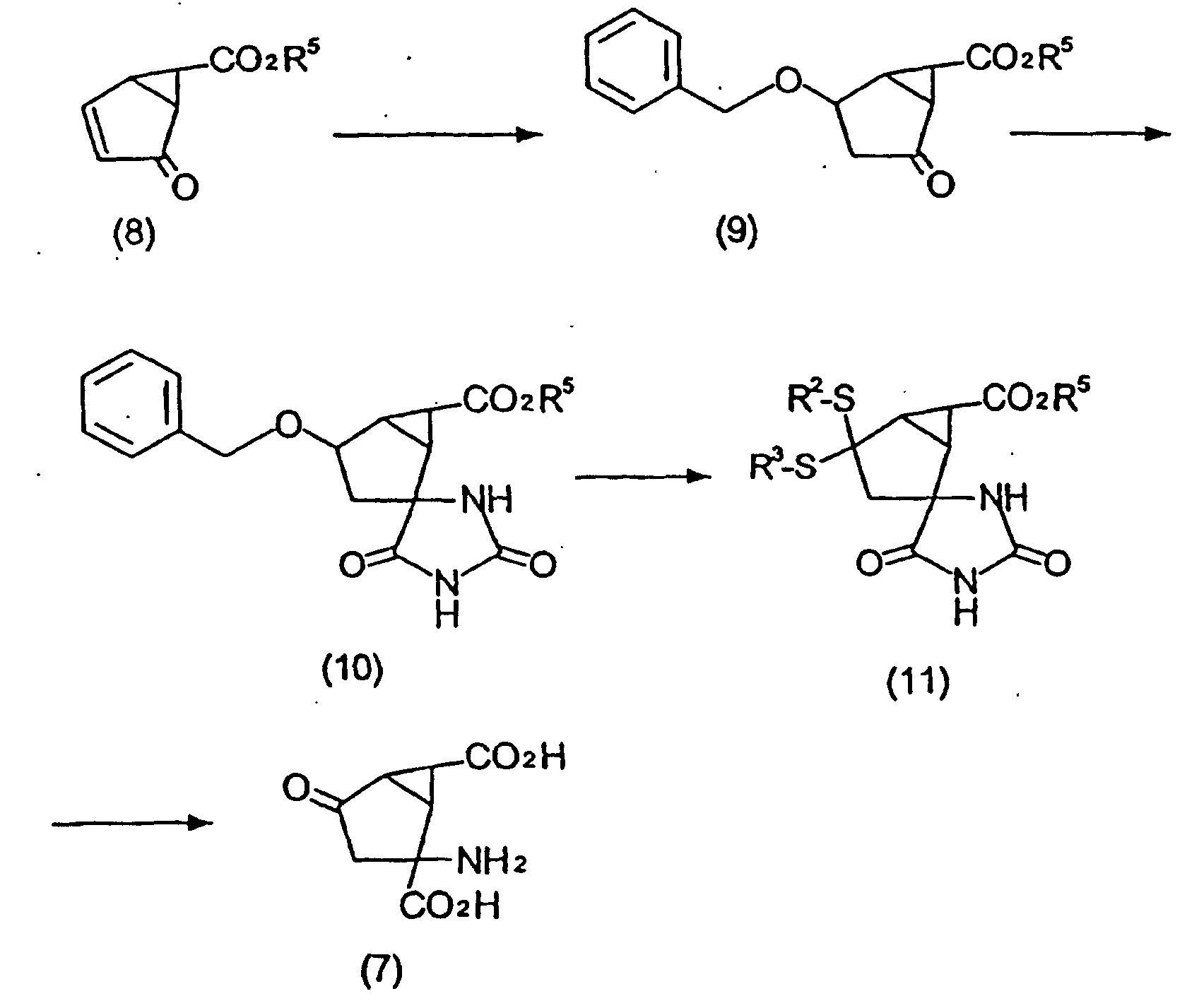
- Japanese Patent Application No. Hei 10-246344 as a preparation method thereof, a synthesis method as described below is proposed.
- the synthesis method comprises the steps of adding benzyl alcohol to an enone derivative (8) to yield a benzyloxy compound (9), subsequently subjecting the compound (9) to hydantoination to yield a hydantoin derivative (10), subsequently subjecting the derivative (10) to debenzylation, oxidation, and thioketalation to yield a thioketal-hydantoin derivative (11), followed by hydrolysis (in the reaction schemes described below, R 2 , R 3 , and R 5 are identical or different, each represents a lower alkyl group having 1 to 10 carbon atoms, with the proviso that R 2 and R 3 together may represent -(CH 2 ) n - (wherein n represents 2 or 3)).
- An objective of the present invention is to provide novel intermediates which are useful for efficient synthesis of 2-amino-4-oxobicyclo[3.1.0]hexane-2,6-dicarboxylic acid acting on group 2 metabotropic glutamate receptors, which has treatment effects and prevention effects on psychiatric disorders such as schizophrenia, anxiety and its associated diseases, depression, bipolar disorder, and epilepsy, and neurological disorders such as drug dependence, cognitive disorders, Alzheimer's disease, Huntington's chorea, Parkinson's disease, dyskinesia associated with muscular rigidity, cerebral ischemia, cerebral failure, myelopathy, and head trauma, and a process for producing the same.
- psychiatric disorders such as schizophrenia, anxiety and its associated diseases, depression, bipolar disorder, and epilepsy
- neurological disorders such as drug dependence, cognitive disorders, Alzheimer's disease, Huntington's chorea, Parkinson's disease, dyskinesia associated with muscular rigidity, cerebral ischemia, cerebral failure, myelopathy, and head trauma, and a process for producing the
- a 2-oxobicyclo[3.1.0]hexane-6-carboxylic acid derivative (1) which may be synthesized using, as a starting material, 4-hydroxy-2-cyclopentenone, or the hydroxy-group-protected compound thereof, which is easily derived from furfuryl alcohol, is useful for an'efficient synthesis of 2-amino-4-oxobicyclo[3.1.0]hexane-2,6-dicarboxylic acid (7), and completed the present invention.
- one mode of the present invention corresponds to a 2-oxobicyclo[3.1.0]hexane-6-carboxylic acid derivative represented by formula (1)
- R 1 represents a hydrogen atom, a C 1 -C 6 alkyl group, a C 3 -C 6 cycloalkyl group, a C 3 -C 6 cycloalkyl C 1 -C 6 alkyl group, an aryl group, an aryl C 1 -C 6 alkyl group, a C 1 -C 6 alkoxy C 1 -C 6 alkyl group, a C 1 -C 6 hydroxyalkyl group, a C 1 -C 6 alkylthio C 1 -C 6 alkyl group, a C 1 -C 6 mercaptoalkyl group, a tetrahydrofuranyl group, or a tetrahydropyranyl group;
- R 2 and R 3 are identical or different, and each represents a C 1 -C 6 alkyl
- Another mode of the present invention corresponds to a process for producing a 2-oxobicyclo[3.1.0]hexane-6-carboxylic acid derivative (1), comprising the steps of:
- another mode of the present invention corresponds to a bicyclo[3.1.0]hexane-6-carboxylic acid derivative, which may be derived from the carboxylic acid derivative (1), represented by formula (5) [wherein, R 1 represents a hydrogen atom, a C 1 -C 6 alkyl group, a C 3 -C 6 cycloalkyl group, a C 3 -C 6 cycloalkyl C 1 -C 6 alkyl group, an aryl group, an aryl C 1 -C 6 alkyl group, a C 1 -C 6 alkoxy C 1 -C 6 alkyl group, a C 1 -C 6 hydroxyalkyl group, a C 1 -C 6 alkylthio C 1 -C 6 alkyl group, a C 1 -C 6 mercaptoalkyl group, a tetrahydrofuranyl group, or a tetrahydropyranyl group; R 2 and R 3 are identical or different,
- C n -C m means that the group following the "C n -C m " has from n to m carbon atoms.
- the C 1 -C 6 alkyl group means a straight-chain or branched-chain alkyl group having 1 to 6 carbon atoms, examples of which include, for example, a methyl group, an ethyl group, a propyl group, an isopropyl group, a butyl group, an isobutyl group, a t-butyl group, a pentyl group, an isopentyl group, a hexyl group, an isohexyl group, and the like.
- the C 3 -C 6 cycloalkyl group means a cyclic alkyl group having 3 to 6 carbon atoms, examples of which include, for example, a cyclopropyl group, a cyclopentyl group, a cyclohexyl group, or the like.
- the C 3 -C 6 cycloalkyl C 1 -C 6 alkyl group means a group having a combined structure of a C 3 -C 6 cycloalkyl group and a C 1 -C 6 alkyl group, examples of which include, for example, a cyclopropylmethyl group, a cyclobutylmethyl group, a cyclopentylmethyl group, a cyclohexylmethyl group, and the like.
- the aryl group means a phenyl group, a naphthyl group, or the like, and is preferably a phenyl group.
- the aryl C 1 -C 6 alkyl means a straight-chain or branched-chain alkyl group having 1 to 6 carbon atoms, substituted with at least one aryl group, and preferably a phenyl group. Examples thereof include, for example, a benzyl group, a diphenylmethyl group, a 1-phenylethyl group, a 2-phenylethyl group, and the like.
- the C 1 -C 6 alkoxy C 1 -C 6 alkyl group means a group having a combined structure of a C 1-6 alkoxy group and a C 1-6 alkyl group.
- the C 1 -C 6 alkoxy group means a straight-chain or branched-chain alkoxy group having 1 to 6 carbon atoms, examples of which include, for example, a methoxy group, an ethoxy group, a propoxy group, an isopropoxy group, a butoxy group, an isobutoxy group, a t-butoxy group, a pentyloxy group, an isopentyloxy group, or the like.
- examples of the C 1 -C 6 alkoxy C 1 -C 6 alkyl groups include a methoxymethyl group, an ethoxymethyl group, a methoxyethyl group, an ethoxyethyl group, a propoxyethyl group, an isopropoxyethyl group, a butoxyethyl group, an isobutoxyethyl group, a pentyloxyethyl group, an isopentyloxyethyl group, and the like.
- the C 1 -C 6 hydroxyalkyl group means a C 1-6 alkyl group substituted with at least one hydroxyl group. Therefore, examples of the C 1 -C 6 hydroxyalkyl group include, for example, a 2-hydroxyethyl group, a 3-hydroxypropyl group, a 2,3-dihydroxypropyl group, and the like.
- the C 1 -C 6 alkylthio C 1 -C 6 alkyl group means a group having a combined structure of a C 1 -C 6 alkylthio group and a C 1 -C 6 alkyl group.
- the C 1 -C 6 alkylthio group means a straight-chain or branched-chain alkylthio group having 1 to 6 carbon atoms, examples of which include, for example, a methylthio group, an ethylthio group, a propylthio group, an isopropylthio group, a butylthio group, an isobutylthio group, a t-butylthio group, a pentylthio group, an isopentylthio group, and the like. Therefore, examples of the C 1 -C 6 alkylthio C 1 -C 6 alkyl group include a methylthiomethyl group, a 2-methylthioethyl group, and the like.
- the C 1 -C 6 mercaptoalkyl group means a C 1 -C 6 alkyl group substituted with at least one mercapto group. Therefore, examples of the C 1 -C 6 mercaptoalkyl group include a 2-mercaptoethyl group, a 3-mercaptopropyl group, a 2,3-dimercaptopropyl group, and the like.
- At least one hydrogen atom on the group may be substituted with an atom or with another group, which is not a hydrogen atom, for example, a halogen atom such as a fluorine atom, a chlorine atom, a bromine atom, or an iodine atom; a nitro group; an amino group; a hydroxyl group; a thiol group; a formyl group; a carboxyl group; a cyano group; a carbamoyl group; an alkyl group such as a methyl group, an ethyl group, a propyl group, an isopropyl group, a butyl group, an isobutyl group, a sec-butyl group, a tert-butyl group, a pentyl group, an isopentyl group, a neopentyl group, or a tert-pentyl group; an aryl group and a hetero
- a 2,2,2-trichloroethyl group, a phenacyl group, a 2,6-dimethylcyclohexyl group, and a 4-methoxybenzyl group, and the like are also included in the scope of R 1 and R 2 .
- the number of the carbon atoms in these substituents is not included in the numbers n or m described above.
- the protecting group of a hydroxyl group includes protecting groups which are commonly used, such as an acyl group or a trisubstituted silyl group, in addition to the C 1 -C 6 alkyl group, the C 3 -C 6 cycloalkyl group, the C 3 -C 6 cycloalkyl C 1 -C 6 alkyl group, the aryl group, the aryl C 1 -C 6 alkyl group, the C 1 -C 6 alkoxy C 1 -C 6 alkyl group, the C 1 -C 6 hydroxyalkyl group, the C 1 -C 6 alkylthio C 1 -C 6 alkyl group, the C 1 -C 6 mercaptoalkyl group, the tetrahydrofuranyl group, and the tetrahydropyranyl group, as described above.
- protecting groups which are commonly used such as an acyl group or a trisubstituted silyl group, in addition to the C 1 -
- the acyl group refers to a straight-chain or branched-chain C 1 -C 6 aliphatic or aromatic acyl group. Examples thereof include, for example, an acetyl group, a pivaloyl group, benzoyl group, and the like.
- the trisubstituted silyl group refers to a silyl group having three arbitrary substituents selected from an alkyl group having 1 to 6 carbon atoms and a phenyl group.
- Examples thereof include, for example, a trimethylsilyl group, a triethylsilyl group, a tert-butyldimethylsilyl group, a tert-butyldiphenylsilyl group, and the like.
- the compounds of the present invention may be present as optically active substances, enantiomer mixtures such as racemic bodies, or diastereomer mixtures. That is, the compounds of the present invention include all of the optically active substances, the enantiomer mixtures such as racemic bodies, and the diastereomer mixtures, of the compounds represented by formula (1).
- the compounds of formula (1) according to the present invention may be produced according to the reactions described below (in the following reaction schemes, R 1 , R 2 , R 3 , R 4 , R 5 , Y 1 , and Y 2 are the same as described above).
- Me 2 S CHCO 2 R 5 [wherein, R 5 is the same as described above] which is previously prepared, in an
- the inert solvent for example, hydrocarbon type solvents such as benzene, toluene, and hexane; halogen type solvents such as dichloromethane and chloroform; ether type solvents such as tetrahydrofuran and diethyl ether; acetonitrile; a mixture of these solvents; and the like may be employed.
- the base for example, organic bases such as triethylamine, diisopropylethylamine, pyridine, and 1,8-diazabicyclo[5.4.0]-7-undecene; or inorganic bases such as potassium carbonate or sodium hydroxide may be employed.
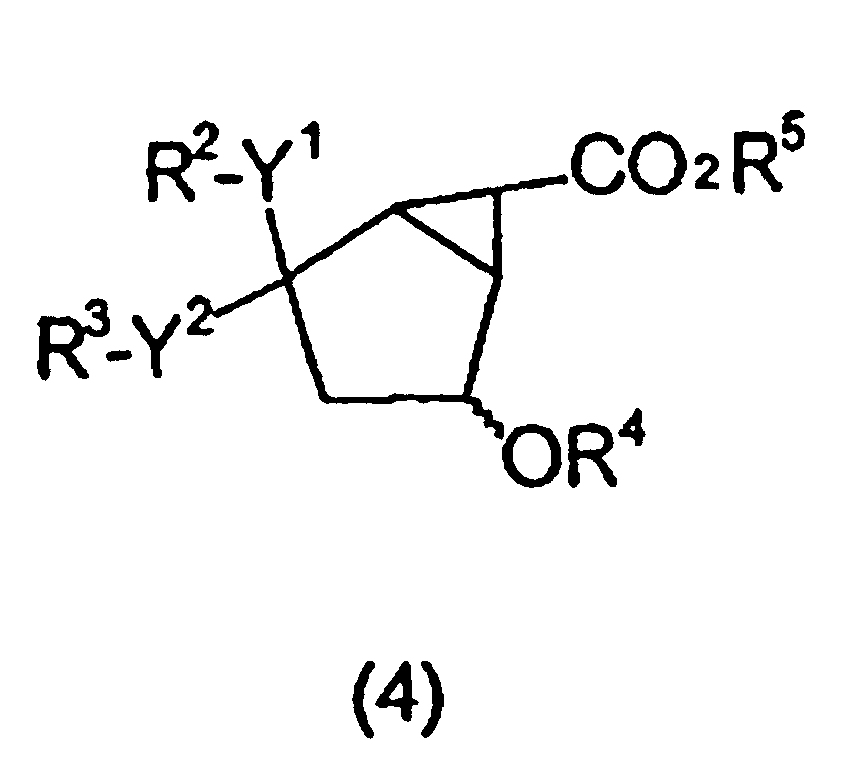
- Step 2 The carbonyl group moiety of the bicyclo compound (3) is protected according to a common method as described in Protecting Groups in Organic Synthesis (written by Theodora W. Greene, John Wilely & Sons Inc.) to yield a derivative (4).
- a common cyclic or acyclic protecting form such as, for example, dimethyl ketal, diethyl ketal, 1,3-dioxane, 1,3-dioxoran, S,S'-dimethyl ketal, 1,3-dithiane, 1,3-dithioran, 1,3-oxathioran, oxazolidine, N-methyloxazolidine, or the like may be employed.
- the deprotection of the protecting group R 4 of the hydroxyl group for example in the case where R 4 is an acyl type protecting group, can be carried out in the presence of an inorganic base such as potassium carbonate or sodium hydroxide in alcohol type solvents such as methanol or ethanol, ketones such as acetone or methyl ethyl ketone, ether type solvents such as tetrahydrofuran, water, or a mixture of these organic solvents and water.
- an inorganic base such as potassium carbonate or sodium hydroxide
- alcohol type solvents such as methanol or ethanol
- ketones such as acetone or methyl ethyl ketone
- ether type solvents such as tetrahydrofuran
- water or a mixture of these organic solvents and water.
- the deprotection thereof can be carried out by, for example, hydrogenation using palladium as a catalyst, Birch reduction, or the like.
- R 4 is a silyl type protecting group
- the deprotection thereof can be carried out using a desilylation agent such as tetra-n-butylammonium fluoride (see Protecting Groups in Organic Synthesis (written by Theodora W. Greene, John Wilely & Sons Inc.)).
- the oxidation refers to reacting oxidants such as chromium type oxidants represented by a Jones oxidation reagent, Collins oxidation reagent, pyridinium chlorochromate (PCC), pyridinium dichromate (PDC), or the like; manganese type oxidants such as potassium permanganate or manganese dioxide; dimethylsulfoxide type oxidants employing, for example, oxalylchloride, acetic anhydride, diphosphorus pentaoxide, sulfur trioxide - pyridine, or the like, as activating agents; oxygen oxidation employing, for example, palladium, platinum, or the like as a catalyst; cerium type oxidants such as cerium diammonium nitrate or cerium sulfate; ruthenium type oxidants such as tetrapropylammonium perruthenate or ruthenium oxide; oxidants such as a Dess-Martin reagent (see Oxid
- R 1 is a lower alkyl group or a benzyl group
- the R 1 can be converted to a hydrogen atom by' hydrolysis of an ester under acidic or basic conditions.
- R 1 is a benzyl group
- the R 1 can be converted to a hydrogen atom by hydrogenation.
- the carboxylic acid derivatives (1) of ( ⁇ ) configurations can be optically resolved into (+) and (-) configurations by the HPLC method employing chiral carriers such as cellulose carbamate derivatives or amylose carbamate derivatives.
- R 1 is a hydrogen atom
- the carboxylic acid derivatives (1) of ( ⁇ ) configurations can be optically resolved into (+) and (-) configurations by using optically active amines such as (+)- or (-)-1-phenylethylamine, (+)- or (-)-phenylglycinol, (+)- or (-)-2-amino-1-butanol, (+)- or (-)-alaninol, brucine, cinchonidine, cinchonine, quinine, quinidine, or dehydroabiethylamine, or alternatively, by deriving the amide derivatives with optically active primary or secondary amines.
- the carboxylic acid derivatives (1) of (-) configuration may be converted into the compounds (12) equivalent to the derivatives (1) of (+) configuration, and the carboxylic acid derivatives (1) of (+) configuration may be converted into the compounds (12) equivalent to the derivatives (1) of (-) configuration.
- R 1 , R 2 , R 3 , Y 1 , and Y 2 are the same as described above; R 6 and R 7 are the same groups as defined in R 2 and R 3 ; and Y 3 and Y 4 are the same groups as defined in Y 1 and Y 2 .
- each of (+) and (-) optically active substances resolved from the ( ⁇ ) configurations can be effectively utilized for synthesis of optically active substances of 2-amino-4-oxobicyclo[3.1.0]hexane-2,6-dicarboxylic acids (7).
- the carboxylic acid derivatives (1) of the present invention are extremely useful for synthesis of the optically active 2-amino-4-oxobicyclo[3.1.0]hexane-2,6-dicarboxylic acids (7).
- Such conversions may be carried out in the following manner. That is, for example, in the case where R 2 -Y 1 - and R 3 -Y 2 -, which protect one carbonyl group, together represent a -SCH 2 CH 2 S- group, while another carbonyl group which is present in a non-protected state is protected by a -OCH 2 CH 2 O- group, the only -SCH 2 CH 2 S- group is selectively deprotected (see Protecting Groups in Organic Synthesis (written by Theodora W. Greene, John Wilely & Sons Inc.)).
- the carbonyl group which is first protected by a -SCH 2 CH 2 S- group enters a non-protected state, and on the other hand, the carbonyl group which is first in a non-protected state is protected by a -OCH 2 CH 2 O- group.
- the carboxylic acid derivatives (1) of the present invention may be converted into the 2-amino-4-oxobicyclo[3.1.0]hexane-2,6-dicarboxylic acids (7), for example, via the following steps.
- Step 4 ( ⁇ )-, (+)-, or (-)-carboxylic acid derivatives (1) yield hydantoin derivatives (5) or aminocyanide derivatives (6) by Strecker Amino Acid Synthesis (Ann., 75 , 27 (1850); and Ann., 91 , 349(1850)), Bucherer-Bergs Reaction (J. Prakt. Chem., 140 , 69 (1934)), or the modified methods thereof.
- Step 5 The hydantoin derivatives (5) or aminocyanide derivatives (6) yield ( ⁇ )-, (+)-, or (-)-2-amino-4-oxobicyclo[3.1.0]hexane-2,6-dicarboxylic acids (7) by deprotection of the carbonyl group moiety protected by the couple of R 2 -Y 1 - and R 3 -Y 2 -, and hydrolysis.
- said hydrolysis may be carried out under acidic conditions employing acids such as hydrochloric acid, hydrobromic acid, or sulfuric acid, or under basic conditions employing bases such as sodium hydroxide, potassium hydroxide, or barium hydroxide.
- acids such as hydrochloric acid, hydrobromic acid, or sulfuric acid
- bases such as sodium hydroxide, potassium hydroxide, or barium hydroxide.
- common deprotecting conditions may be appropriately employed (see Protecting Groups in Organic Synthesis (written by Theodora W. Greene, John Wilely & Sons Inc.)).
- the -SCH 2 CH 2 S- group may be removed at the same time as hydrolysis of the hydantoin or aminocyanide moiety, for example, by employing acid hydrolysis conditions with sulfuric acid.
- the 2-amino-4-oxobicyclo[3.1.0]hexane-2,6-dicarboxylic acids (7) have four asymmetric carbon atoms at the 1-position, 2-position, 5-position, and 6-position, they may exist as optically active substances, two kinds of enantiomer mixtures of racemic bodies, and diastereomer mixtures.
- said diasteromers may be resolved by a common means such as column chromatography using silica gel, recrystallization, or the like.
- Each resolved diastereomer may be resolved into the corresponding enantiomers by common resolving methods such as a resolving method using a basic chiral resolving agent.
- the basic chiral resolving agent refers to optically active amines such as (+)- or (-)-1-phenylethylamine, (+)- or (-)-2-amino-1-butanol, (+)- or (-)-alaninol, brucine, cinchonidine, cinchonine, quinine, quinidine, or dehydroabiethylamine.
- the 2-amino-4-oxobicyclo[3.1.0]hexane-2,6-dicarboxylic acids (7) obtained as described above may be employed as pharmaceutical compositions by combining with, for example, carriers, diluents, excipients, or the like, in the form of pharmaceutically acceptable salts or hydrates.
- salts with inorganic acids such as sulfuric acid, hydrochloric acid, or phosphoric acid
- salts with organic acids such as acetic acid, oxalic acid, lactic acid, tartaric acid, fumaric acid, maleic acid, methanesulfonic acid, or benzenesulfonic acid
- salts with amines such as trimethylamine or methylamine
- salts with metal ions such as sodium ion, potassium ion, or calcium ion; or the like.
- a toluene (60 mL) solution of 18 g of 4-tert-butyldimethylsilyloxy-2-cyclopentenone was added to a toluene (120 mL) solution of 13.6 g of ethyl (dimethylsulfanilidene)acetate with ice-cooling. The reaction mixture was stirred for 6 hours at room temperature. In addition, a toluene (120 mL) solution of 24.0 g of ethyl (dimethylsulfanilidene)acetate was added to the reaction mixture at 0°C. The reaction mixture was stirred for one day at room temperature, and subsequently was poured into 1N hydrochloric acid to separate it into two layers.
- the reaction mixture was stirred for 2 days and was subsequently concentrated under reduced pressure.
- the residue was separated into two layers using a saturated aqueous solution of sodium hydrogencarbonate and chloroform.
- the organic layer was dried over anhydrous sodium sulfate. After the desiccant was filtered off, the filtrate was concentrated under reduced pressure.
- the reaction mixture was stirred for one day at room temperature, and subsequently, the precipitated solids were separated by filtration and were washed with ethyl acetate.
- the filtrate and the ethyl acetate used for washing were combined and poured into water, followed by extraction with chloroform.
- the organic layer was washed with water three times and was subsequently dried over anhydrous sodium sulfate. After the desiccant was filtered off, the filtrate was concentrated under reduced pressure.
- the precipitated crystals were collected by filtration.
- the crystals were subjected to the same procedure as described above in 100 mL of a mixed solvent of chloroform - methanol (9:1) to yield 35.2 g of ethyl (1RS,2SR,5RS,6RS)-2-spiro-5'-hydantoin-4,4-ethylenedithiobicyclo[3.1.0]hexane-6-carboxylate.
- bicyclo[3.1.0]hexane-6-carboxylic acid derivatives are useful as intermediates for synthesis of 4-substituted-2-aminobicyclo[3.1.0]hexane-2,6-dicarboxylic acids acting on group 2 metabotropic glutamate receptors, which have treatment effects and prevention effects on psychiatric disorders such as, for example, schizophrenia, anxiety and its associated diseases, depression, bipolar disorder, and epilepsy; and neurological diseases such as drug dependence, cognitive disorders, Alzheimer's disease, Huntington's chorea, Parkinson's disease, dyskinesia associated with muscular rigidity, cerebral ischemia, cerebral failure, myelopathy, and head trauma.
- psychiatric disorders such as, for example, schizophrenia, anxiety and its associated diseases, depression, bipolar disorder, and epilepsy
- neurological diseases such as drug dependence, cognitive disorders, Alzheimer's disease, Huntington's chorea, Parkinson's disease, dyskinesia associated with muscular rigidity, cerebral ischemia, cerebral failure, myelopathy, and
- 2-oxobicyclo[3.1.0]hexane-6-carboxylic acid derivatives are employed as starting materials
- 2-amino-4-oxobicyclo[3.1.0]hexane-2,6-dicarboxylic acids can be produced efficiently, and in particular, optically active substances can be synthesized in good yield.
Landscapes
- Chemical & Material Sciences (AREA)
- Organic Chemistry (AREA)
- Organic Low-Molecular-Weight Compounds And Preparation Thereof (AREA)
Abstract
Description


with a sulfonium ylide represented by Me2S=CHCO2R5 [wherein, R5 represents a C1-C6 alkyl group, a C3-C6 cycloalkyl group, a C3-C6 cycloalkyl C1-C6 alkyl group, an aryl group, an aryl C1-C6 alkyl group, a C1-C6 alkoxy C1-C6 alkyl group, a C1-C6 hydroxyalkyl group, a C1-C6 alkylthio C1-C6 alkyl group, a C1-C6 mercaptoalkyl group, a tetrahydrofuranyl group, or a tetrahydropyranyl group) or alternatively, with a sulfonium salt represented by Me2S+CH2CO2R5 · X- [wherein, R5 is the same as described above; and X represents a chlorine atom, a bromine atom, or an iodine atom]
to yield a bicyclo compound represented by formula (3)



1H-NMR (CDCl3) δ (ppm); 1.29 (3H, t, J = 7.1 Hz), 2.25 (1H, dd, J = 3.3, 2.8 Hz), 2.53 (1H, dd, J = 5.5, 2.8 Hz), 2.75 (2H, s), 3.01 (1H, dd, J = 5.5, 3.3 Hz), 3.37 - 3.53 (4H, m), 4.18 (2H, dq, J = 2.2, 7.1 Hz).
MS (FAB) (Pos.) m/e; 259 (M++1).
1H-NMR (DMSO-d6) δ (ppm); 1.20 (3H, t, J = 7.0 Hz), 2.00 (1H, t, J = 3.1 Hz), 2.21 (1H, d, J = 16 Hz), 2.25 - 2.29 (1H, m, J = 3.1 Hz), 2.46 (1H, dd, J = 6.2 Hz, 3.1 Hz), 2.60 (1H, d, J = 16Hz), 3.20 - 3.42 (4H, m), 4.07 (2H, q, J = 7.0 Hz), 7.91 (1H, s), 10.70 (1H, s).
MS (Ion Spray) (Nega) m/e; 327 (M+-1).
1H-NMR (pyridine-d5/D2O = 1/1) δ (ppm); 2.86 (1H, dd, J = 3.5 Hz, 2.7 Hz), 2.93 (1H, d, J = 18 Hz), 3.00 (1H, dd, J = 5.7 Hz, 2.7 Hz), 3.05 (1H, d, J = 18 Hz), 3.30 (1H, dd, J = 5.7 Hz, 3.5 Hz).
Claims (3)
- A 2-oxobicyclo[3.1.0]hexane-6-carboxylic acid derivative represented by formula (1)[wherein, R1 represents a hydrogen atom, a C1-C6 alkyl group, a C3-C6 cycloalkyl group, a C3-C6 cycloalkyl C1-C6 alkyl group, an aryl group, an aryl C1-C6 alkyl group, a C1-C6 alkoxy C1-C6 alkyl group, a C1-C6 hydroxyalkyl group, a C1-C6 alkylthio C1-C6 alkyl group, a C1-C6 mercaptoalkyl group, a tetrahydrofuranyl group, or a tetrahydropyranyl group; R2 and R3 are identical or different, and each represents a C1-C6 alkyl group, a C3-C6 cycloalkyl group, a C3-C6 cycloalkyl C1-C6 alkyl group, an aryl group, or an aryl C1-C6 alkyl group, or alternatively, R2 and R3 together represent -(CH2)n- (wherein n represents 2 or 3); and Y1 and Y2 are identical or different, and each represents a sulfur atom, an oxygen atom, or a nitrogen atom].

- A process for producing the carboxylic acid derivative according to Claim 1, comprising the steps of:reacting a cyclopentenone derivative represented by formula (2)[wherein, R4 represents a hydrogen atom or a protecting group of the hydroxyl group]

with a sulfonium ylide represented by Me2S=CHCO2R5 [wherein, R5 represents a C1-C6 alkyl group, a C3-C6 cycloalkyl group, a C3-C6 cycloalkyl C1-C6 alkyl group, an aryl group, an aryl C1-C6 alkyl group, a C1-C6 alkoxy C1-C6 alkyl group, a C1-C6 hydroxyalkyl group, a C1-C6 alkylthio C1-C6 alkyl group, a C1-C6 mercaptoalkyl group, a tetrahydrofuranyl group, or a tetrahydropyranyl group] or alternatively, with a sulfonium salt represented by Me2S+CH2CO2R5 · X- [wherein, R5 is the same as described above; and X represents a chlorine atom, a bromine atom, or an iodine atom]
to yield a bicyclo compound represented by formula (3)[wherein, R4 and R5 are the same as described above]; protecting the carbonyl group of said bicyclo compound to yield a derivative represented by formula (4)[wherein, R2 and R3 are identical or different, and each represents a C1-C6 alkyl group, an aryl group, or an aryl C1-C6 alkyl group, or alternatively, R2 and R3 together represent -(CH2)n- (wherein n represents 2 or 3); Y1 and Y2 are identical or different, and each represents a sulfur atom, an oxygen atom, or a nitrogen atom; and R4 and R5 are the same as described above]; and
 oxidizing said derivative wherein R4 represents a hydrogen atom, with the proviso that in the case of R4 of said derivative representing a group other than a hydrogen atom, the R4 is converted into a hydrogen atom beforehand.
 - A bicyclo[3.1.0]hexane-6-carboxylic acid derivative represented by formula (5)[wherein, R1 represents a hydrogen atom, a C1-C6 alkyl group, a C3-C6 cycloalkyl group, a C3-C6 cycloalkyl C1-C6 alkyl group, an aryl group, an aryl C1-C6 alkyl group, a C1-C6 alkoxy C1-C6 alkyl group, a C1-C6 hydroxyalkyl group, a C1-C6 alkylthio C1-C6 alkyl group, a C1-C6 mercaptoalkyl group, a tetrahydrofuranyl group, or a tetrahydropyranyl group; R2 and R3 are identical or different, and each represents a C1-C6 alkyl group, a C3-C6 cycloalkyl group, a C3-C6 cycloalkyl C1-C6 alkyl group, an aryl group, or an aryl C1-C6 alkyl group, or alternatively, R2 and R3 together represent -(CH2)n- (wherein n represents 2 or 3); and Y1 and Y2 are identical or different, and each represents a sulfur atom, an oxygen atom, or a nitrogen atom].

Applications Claiming Priority (3)
| Application Number | Priority Date | Filing Date | Title |
|---|---|---|---|
| JP8260899 | 1999-03-25 | ||
| JP8260899 | 1999-03-25 | ||
| PCT/JP2000/000969 WO2000058258A1 (en) | 1999-03-25 | 2000-02-21 | Novel carboxylic acid derivatives and process for producing the same |
Publications (3)
| Publication Number | Publication Date |
|---|---|
| EP1164121A1 true EP1164121A1 (en) | 2001-12-19 |
| EP1164121A4 EP1164121A4 (en) | 2005-04-20 |
| EP1164121B1 EP1164121B1 (en) | 2008-10-29 |
Family
ID=13779202
Family Applications (1)
| Application Number | Title | Priority Date | Filing Date |
|---|---|---|---|
| EP00904066A Expired - Lifetime EP1164121B1 (en) | 1999-03-25 | 2000-02-21 | Novel carboxylic acid derivatives and process for producing the same |
Country Status (11)
| Country | Link |
|---|---|
| US (2) | US6479674B1 (en) |
| EP (1) | EP1164121B1 (en) |
| KR (1) | KR100680080B1 (en) |
| CN (1) | CN1134400C (en) |
| AT (1) | ATE412624T1 (en) |
| AU (1) | AU754318B2 (en) |
| CA (2) | CA2368454C (en) |
| DE (1) | DE60040653D1 (en) |
| ES (1) | ES2315224T3 (en) |
| HK (1) | HK1047081B (en) |
| WO (1) | WO2000058258A1 (en) |
Cited By (1)
| Publication number | Priority date | Publication date | Assignee | Title |
|---|---|---|---|---|
| EP1689727A4 (en) * | 2003-11-07 | 2008-12-31 | Taisho Pharmaceutical Co Ltd | Processes for preparing bicyclo [3.1.0] hexane derivatives, and intermediates thereto |
Families Citing this family (2)
| Publication number | Priority date | Publication date | Assignee | Title |
|---|---|---|---|---|
| EP1369408A4 (en) * | 2001-03-14 | 2005-12-28 | Taisho Pharmaceutical Co Ltd | PROCESS FOR PRODUCING A BICYCLOCARBOXYLIC ACID DERIVATIVE |
| WO2005000790A1 (en) * | 2003-06-26 | 2005-01-06 | Taisho Pharmaceutical Co., Ltd. | 2-aminobicyclo[3.1.0]hexane-2,6-dicarboxylic acid derivative |
Family Cites Families (5)
| Publication number | Priority date | Publication date | Assignee | Title |
|---|---|---|---|---|
| US5661184A (en) * | 1994-08-12 | 1997-08-26 | Eli Lilly And Company | Psychiatric agents |
| GB9605429D0 (en) | 1995-11-16 | 1996-05-15 | Lilly Co Eli | Excitatory amino acid receptor antagonists |
| US5912248A (en) | 1995-11-16 | 1999-06-15 | Eli Lilly And Company | Excitatory amino acid receptor antagonists |
| ZA983930B (en) * | 1997-05-14 | 1999-11-08 | Lilly Co Eli | Excitatory amino acid receptor modulators. |
| JP2000072731A (en) * | 1998-08-31 | 2000-03-07 | Taisho Pharmaceut Co Ltd | 4-Substituted-2-aminobicyclo [3.1.0] hexane-2,6-dicarboxylic acid derivative and pharmaceutical composition |
-
2000
- 2000-02-21 WO PCT/JP2000/000969 patent/WO2000058258A1/en not_active Ceased
- 2000-02-21 US US09/937,212 patent/US6479674B1/en not_active Expired - Fee Related
- 2000-02-21 ES ES00904066T patent/ES2315224T3/en not_active Expired - Lifetime
- 2000-02-21 HK HK02108503.1A patent/HK1047081B/en not_active IP Right Cessation
- 2000-02-21 KR KR1020017012141A patent/KR100680080B1/en not_active Expired - Fee Related
- 2000-02-21 AT AT00904066T patent/ATE412624T1/en not_active IP Right Cessation
- 2000-02-21 CA CA002368454A patent/CA2368454C/en not_active Expired - Fee Related
- 2000-02-21 CN CNB008080348A patent/CN1134400C/en not_active Expired - Fee Related
- 2000-02-21 EP EP00904066A patent/EP1164121B1/en not_active Expired - Lifetime
- 2000-02-21 AU AU25753/00A patent/AU754318B2/en not_active Ceased
- 2000-02-21 CA CA2630009A patent/CA2630009C/en not_active Expired - Fee Related
- 2000-02-21 DE DE60040653T patent/DE60040653D1/en not_active Expired - Lifetime
-
2002
- 2002-06-24 US US10/176,528 patent/US6500958B2/en not_active Expired - Fee Related
Non-Patent Citations (3)
| Title |
|---|
| COLLADO I ET AL: "Stereoselective Cyclopropanation of Enones with Ethyl Dimethylsulfonium Acetate Bromide in the Presence of DBU" TETRAHEDRON LETTERS, ELSEVIER SCIENCE PUBLISHERS, AMSTERDAM, NL, vol. 38, no. 12, 24 March 1997 (1997-03-24), pages 2133-2136, XP004055954 ISSN: 0040-4039 * |
| MONN J A ET AL: "Design, synthesis and pharmacological characterization of (+)-2-aminobicyclo[3.1.0]hexane-2,6-dicarb oxylic acid (LY354740): a potent selective and orally active group 2 metabotropic glutamate receptor agonist possessing anticonvulsant and anxiolytic properties" JOURNAL OF MEDICINAL CHEMISTRY, AMERICAN CHEMICAL SOCIETY. WASHINGTON, US, vol. 40, 1997, pages 528-537, XP002216203 ISSN: 0022-2623 * |
| See also references of WO0058258A1 * |
Cited By (4)
| Publication number | Priority date | Publication date | Assignee | Title |
|---|---|---|---|---|
| EP1689727A4 (en) * | 2003-11-07 | 2008-12-31 | Taisho Pharmaceutical Co Ltd | Processes for preparing bicyclo [3.1.0] hexane derivatives, and intermediates thereto |
| US7786314B2 (en) | 2003-11-07 | 2010-08-31 | Taisho Pharmaceutical Co., Ltd | Processes for preparing bicyclo [3.1.0] hexane derivatives, and intermediates thereto |
| AU2004289652B2 (en) * | 2003-11-07 | 2010-09-16 | Taisho Pharmaceutical Co., Ltd. | Processes for preparing bicyclo [3.1.0] hexane derivatives, and intermediates thereto |
| AU2004289652B8 (en) * | 2003-11-07 | 2011-01-20 | Taisho Pharmaceutical Co., Ltd. | Processes for preparing bicyclo [3.1.0] hexane derivatives, and intermediates thereto |
Also Published As
| Publication number | Publication date |
|---|---|
| EP1164121A4 (en) | 2005-04-20 |
| EP1164121B1 (en) | 2008-10-29 |
| KR20010104727A (en) | 2001-11-26 |
| HK1047081A1 (en) | 2003-02-07 |
| ES2315224T3 (en) | 2009-04-01 |
| CA2368454A1 (en) | 2000-10-05 |
| CN1351581A (en) | 2002-05-29 |
| KR100680080B1 (en) | 2007-02-08 |
| CA2368454C (en) | 2009-11-24 |
| US6500958B2 (en) | 2002-12-31 |
| AU2575300A (en) | 2000-10-16 |
| AU754318B2 (en) | 2002-11-14 |
| HK1047081B (en) | 2004-12-03 |
| US6479674B1 (en) | 2002-11-12 |
| ATE412624T1 (en) | 2008-11-15 |
| CA2630009A1 (en) | 2000-10-05 |
| DE60040653D1 (en) | 2008-12-11 |
| WO2000058258A1 (en) | 2000-10-05 |
| CA2630009C (en) | 2010-04-20 |
| CN1134400C (en) | 2004-01-14 |
| US20020156299A1 (en) | 2002-10-24 |
Similar Documents
| Publication | Publication Date | Title |
|---|---|---|
| AU746806B2 (en) | 6-fluorobicyclo(3. 1.0)hexane derivatives | |
| JP4194715B2 (en) | 6-Fluorobicyclo [3.1.0] hexane derivative | |
| US6479674B1 (en) | Carboxylic acid derivatives and process for producing same | |
| JP4505926B2 (en) | NOVEL CARBOXYLIC ACID DERIVATIVE AND METHOD FOR PRODUCING THE SAME | |
| US6825375B2 (en) | Intermediate and process for producing fluorinated carboxylic acid derivative from the same | |
| EP1142860B1 (en) | Intermediates and process for producing fluorine-containing amino acid compound by using the same | |
| JP4124656B2 (en) | Method for producing bicyclocarboxylic acid derivative | |
| AU2004289652A1 (en) | Processes for preparing bicyclo [3.1.0] hexane derivatives, and intermediates thereto | |
| JPWO2002000595A1 (en) | Intermediate and method for producing fluorine-containing carboxylic acid derivative using the same |
Legal Events
| Date | Code | Title | Description |
|---|---|---|---|
| PUAI | Public reference made under article 153(3) epc to a published international application that has entered the european phase |
Free format text: ORIGINAL CODE: 0009012 |
|
| 17P | Request for examination filed |
Effective date: 20010925 |
|
| AK | Designated contracting states |
Kind code of ref document: A1 Designated state(s): AT BE CH CY DE DK ES FI FR GB GR IE IT LI LU MC NL PT SE |
|
| A4 | Supplementary search report drawn up and despatched |
Effective date: 20050309 |
|
| RIC1 | Information provided on ipc code assigned before grant |
Ipc: 7C 07C 69/757 B Ipc: 7C 07F 7/18 B Ipc: 7C 07D 235/02 B Ipc: 7C 07C 62/26 B Ipc: 7C 07C 51/373 A Ipc: 7C 07D 495/10 B Ipc: 7C 07D 495/10 J Ipc: 7C 07D 339/06 B Ipc: 7C 07C 65/40 B Ipc: 7C 07D 235:00 J Ipc: 7C 07D 339:00 J |
|
| RIN1 | Information on inventor provided before grant (corrected) |
Inventor name: NAKAZATO, ATSURO,TAISHO PHARMACEUTICAL CO., LTD Inventor name: KUMAGAI, TOSHIHITO,TAISHO PHARMACEUTICAL CO., LTD Inventor name: SAKAGAMI, KAZUNARI,TAISHO PHARMACEUTICAL CO., LTD Inventor name: TOMISAWA, KAZUYUKI,TAISHO PHARMACEUTICAL CO., LTD |
|
| 17Q | First examination report despatched |
Effective date: 20070427 |
|
| GRAP | Despatch of communication of intention to grant a patent |
Free format text: ORIGINAL CODE: EPIDOSNIGR1 |
|
| RIC1 | Information provided on ipc code assigned before grant |
Ipc: C07D 235/02 20060101ALI20080516BHEP Ipc: C07C 69/757 20060101ALI20080516BHEP Ipc: C07D 495/10 20060101ALI20080516BHEP Ipc: C07C 62/26 20060101ALI20080516BHEP Ipc: C07C 65/40 20060101ALI20080516BHEP Ipc: C07C 51/373 20060101AFI20080516BHEP Ipc: C07D 339/06 20060101ALI20080516BHEP Ipc: C07F 7/18 20060101ALI20080516BHEP |
|
| GRAS | Grant fee paid |
Free format text: ORIGINAL CODE: EPIDOSNIGR3 |
|
| GRAA | (expected) grant |
Free format text: ORIGINAL CODE: 0009210 |
|
| AK | Designated contracting states |
Kind code of ref document: B1 Designated state(s): AT BE CH CY DE DK ES FI FR GB GR IE IT LI LU MC NL PT SE |
|
| REG | Reference to a national code |
Ref country code: GB Ref legal event code: FG4D |
|
| REG | Reference to a national code |
Ref country code: CH Ref legal event code: EP |
|
| REG | Reference to a national code |
Ref country code: CH Ref legal event code: NV Representative=s name: NOVAGRAAF INTERNATIONAL SA |
|
| REG | Reference to a national code |
Ref country code: IE Ref legal event code: FG4D |
|
| REF | Corresponds to: |
Ref document number: 60040653 Country of ref document: DE Date of ref document: 20081211 Kind code of ref document: P |
|
| NLV1 | Nl: lapsed or annulled due to failure to fulfill the requirements of art. 29p and 29m of the patents act | ||
| REG | Reference to a national code |
Ref country code: ES Ref legal event code: FG2A Ref document number: 2315224 Country of ref document: ES Kind code of ref document: T3 |
|
| PG25 | Lapsed in a contracting state [announced via postgrant information from national office to epo] |
Ref country code: AT Free format text: LAPSE BECAUSE OF FAILURE TO SUBMIT A TRANSLATION OF THE DESCRIPTION OR TO PAY THE FEE WITHIN THE PRESCRIBED TIME-LIMIT Effective date: 20081029 |
|
| PG25 | Lapsed in a contracting state [announced via postgrant information from national office to epo] |
Ref country code: PT Free format text: LAPSE BECAUSE OF FAILURE TO SUBMIT A TRANSLATION OF THE DESCRIPTION OR TO PAY THE FEE WITHIN THE PRESCRIBED TIME-LIMIT Effective date: 20090330 Ref country code: FI Free format text: LAPSE BECAUSE OF FAILURE TO SUBMIT A TRANSLATION OF THE DESCRIPTION OR TO PAY THE FEE WITHIN THE PRESCRIBED TIME-LIMIT Effective date: 20081029 Ref country code: NL Free format text: LAPSE BECAUSE OF FAILURE TO SUBMIT A TRANSLATION OF THE DESCRIPTION OR TO PAY THE FEE WITHIN THE PRESCRIBED TIME-LIMIT Effective date: 20081029 |
|
| PG25 | Lapsed in a contracting state [announced via postgrant information from national office to epo] |
Ref country code: BE Free format text: LAPSE BECAUSE OF FAILURE TO SUBMIT A TRANSLATION OF THE DESCRIPTION OR TO PAY THE FEE WITHIN THE PRESCRIBED TIME-LIMIT Effective date: 20081029 Ref country code: DK Free format text: LAPSE BECAUSE OF FAILURE TO SUBMIT A TRANSLATION OF THE DESCRIPTION OR TO PAY THE FEE WITHIN THE PRESCRIBED TIME-LIMIT Effective date: 20081029 |
|
| PG25 | Lapsed in a contracting state [announced via postgrant information from national office to epo] |
Ref country code: SE Free format text: LAPSE BECAUSE OF FAILURE TO SUBMIT A TRANSLATION OF THE DESCRIPTION OR TO PAY THE FEE WITHIN THE PRESCRIBED TIME-LIMIT Effective date: 20090129 |
|
| PLBE | No opposition filed within time limit |
Free format text: ORIGINAL CODE: 0009261 |
|
| STAA | Information on the status of an ep patent application or granted ep patent |
Free format text: STATUS: NO OPPOSITION FILED WITHIN TIME LIMIT |
|
| PG25 | Lapsed in a contracting state [announced via postgrant information from national office to epo] |
Ref country code: MC Free format text: LAPSE BECAUSE OF NON-PAYMENT OF DUE FEES Effective date: 20090228 |
|
| 26N | No opposition filed |
Effective date: 20090730 |
|
| REG | Reference to a national code |
Ref country code: IE Ref legal event code: MM4A |
|
| PG25 | Lapsed in a contracting state [announced via postgrant information from national office to epo] |
Ref country code: IE Free format text: LAPSE BECAUSE OF NON-PAYMENT OF DUE FEES Effective date: 20090221 |
|
| PG25 | Lapsed in a contracting state [announced via postgrant information from national office to epo] |
Ref country code: GR Free format text: LAPSE BECAUSE OF FAILURE TO SUBMIT A TRANSLATION OF THE DESCRIPTION OR TO PAY THE FEE WITHIN THE PRESCRIBED TIME-LIMIT Effective date: 20090130 |
|
| PG25 | Lapsed in a contracting state [announced via postgrant information from national office to epo] |
Ref country code: IT Free format text: LAPSE BECAUSE OF NON-PAYMENT OF DUE FEES Effective date: 20090221 |
|
| PG25 | Lapsed in a contracting state [announced via postgrant information from national office to epo] |
Ref country code: LU Free format text: LAPSE BECAUSE OF NON-PAYMENT OF DUE FEES Effective date: 20090221 |
|
| REG | Reference to a national code |
Ref country code: CH Ref legal event code: PFA Owner name: TAISHO PHARMACEUTICAL CO., LTD Free format text: TAISHO PHARMACEUTICAL CO., LTD#24-1 TAKATA 3-CHOME, TOSHIMA-KU#TOKYO 170-8633 (JP) -TRANSFER TO- TAISHO PHARMACEUTICAL CO., LTD#24-1 TAKATA 3-CHOME, TOSHIMA-KU#TOKYO 170-8633 (JP) |
|
| PGRI | Patent reinstated in contracting state [announced from national office to epo] |
Ref country code: IT Effective date: 20110616 |
|
| PG25 | Lapsed in a contracting state [announced via postgrant information from national office to epo] |
Ref country code: CY Free format text: LAPSE BECAUSE OF FAILURE TO SUBMIT A TRANSLATION OF THE DESCRIPTION OR TO PAY THE FEE WITHIN THE PRESCRIBED TIME-LIMIT Effective date: 20081029 |
|
| PGFP | Annual fee paid to national office [announced via postgrant information from national office to epo] |
Ref country code: IT Payment date: 20120216 Year of fee payment: 13 |
|
| PGFP | Annual fee paid to national office [announced via postgrant information from national office to epo] |
Ref country code: CH Payment date: 20130212 Year of fee payment: 14 Ref country code: ES Payment date: 20130213 Year of fee payment: 14 Ref country code: FR Payment date: 20130301 Year of fee payment: 14 Ref country code: GB Payment date: 20130220 Year of fee payment: 14 Ref country code: DE Payment date: 20130213 Year of fee payment: 14 |
|
| REG | Reference to a national code |
Ref country code: DE Ref legal event code: R119 Ref document number: 60040653 Country of ref document: DE |
|
| REG | Reference to a national code |
Ref country code: CH Ref legal event code: PL |
|
| GBPC | Gb: european patent ceased through non-payment of renewal fee |
Effective date: 20140221 |
|
| PG25 | Lapsed in a contracting state [announced via postgrant information from national office to epo] |
Ref country code: CH Free format text: LAPSE BECAUSE OF NON-PAYMENT OF DUE FEES Effective date: 20140228 Ref country code: LI Free format text: LAPSE BECAUSE OF NON-PAYMENT OF DUE FEES Effective date: 20140228 |
|
| REG | Reference to a national code |
Ref country code: FR Ref legal event code: ST Effective date: 20141031 |
|
| REG | Reference to a national code |
Ref country code: DE Ref legal event code: R119 Ref document number: 60040653 Country of ref document: DE Effective date: 20140902 |
|
| PG25 | Lapsed in a contracting state [announced via postgrant information from national office to epo] |
Ref country code: DE Free format text: LAPSE BECAUSE OF NON-PAYMENT OF DUE FEES Effective date: 20140902 Ref country code: GB Free format text: LAPSE BECAUSE OF NON-PAYMENT OF DUE FEES Effective date: 20140221 Ref country code: FR Free format text: LAPSE BECAUSE OF NON-PAYMENT OF DUE FEES Effective date: 20140228 |
|
| REG | Reference to a national code |
Ref country code: ES Ref legal event code: FD2A Effective date: 20150401 |
|
| PG25 | Lapsed in a contracting state [announced via postgrant information from national office to epo] |
Ref country code: ES Free format text: LAPSE BECAUSE OF NON-PAYMENT OF DUE FEES Effective date: 20140222 |
|
| PG25 | Lapsed in a contracting state [announced via postgrant information from national office to epo] |
Ref country code: IT Free format text: LAPSE BECAUSE OF NON-PAYMENT OF DUE FEES Effective date: 20140221 |