EP1162991B1 - Arginine-rich anti-vascular endothelial growth factor peptides that inhibit growth and metastasis of human tumor cells by blocking angiogenesis - Google Patents
Arginine-rich anti-vascular endothelial growth factor peptides that inhibit growth and metastasis of human tumor cells by blocking angiogenesis Download PDFInfo
- Publication number
- EP1162991B1 EP1162991B1 EP99960007A EP99960007A EP1162991B1 EP 1162991 B1 EP1162991 B1 EP 1162991B1 EP 99960007 A EP99960007 A EP 99960007A EP 99960007 A EP99960007 A EP 99960007A EP 1162991 B1 EP1162991 B1 EP 1162991B1
- Authority
- EP
- European Patent Office
- Prior art keywords
- vegf
- peptides
- peptide
- arg
- cells
- Prior art date
- Legal status (The legal status is an assumption and is not a legal conclusion. Google has not performed a legal analysis and makes no representation as to the accuracy of the status listed.)
- Expired - Lifetime
Links
- 239000004475 Arginine Substances 0.000 title claims description 24
- ODKSFYDXXFIFQN-UHFFFAOYSA-N arginine Natural products OC(=O)C(N)CCCNC(N)=N ODKSFYDXXFIFQN-UHFFFAOYSA-N 0.000 title claims description 24
- 230000033115 angiogenesis Effects 0.000 title description 37
- 230000012010 growth Effects 0.000 title description 28
- 206010027476 Metastases Diseases 0.000 title description 15
- 230000009401 metastasis Effects 0.000 title description 15
- 230000000903 blocking effect Effects 0.000 title description 2
- 108010041308 Endothelial Growth Factors Proteins 0.000 title 1
- 230000002137 anti-vascular effect Effects 0.000 title 1
- 210000004881 tumor cell Anatomy 0.000 title 1
- 108090000765 processed proteins & peptides Proteins 0.000 claims description 190
- 102000005789 Vascular Endothelial Growth Factors Human genes 0.000 claims description 162
- 108010019530 Vascular Endothelial Growth Factors Proteins 0.000 claims description 162
- 206010028980 Neoplasm Diseases 0.000 claims description 61
- 201000011510 cancer Diseases 0.000 claims description 50
- 230000002401 inhibitory effect Effects 0.000 claims description 34
- 125000000539 amino acid group Chemical group 0.000 claims description 20
- 125000003275 alpha amino acid group Chemical group 0.000 claims description 15
- KDXKERNSBIXSRK-UHFFFAOYSA-N Lysine Natural products NCCCCC(N)C(O)=O KDXKERNSBIXSRK-UHFFFAOYSA-N 0.000 claims description 14
- 239000004472 Lysine Substances 0.000 claims description 14
- 230000000694 effects Effects 0.000 claims description 8
- HNDVDQJCIGZPNO-YFKPBYRVSA-N L-histidine Chemical compound OC(=O)[C@@H](N)CC1=CN=CN1 HNDVDQJCIGZPNO-YFKPBYRVSA-N 0.000 claims description 7
- HNDVDQJCIGZPNO-UHFFFAOYSA-N histidine Natural products OC(=O)C(N)CC1=CN=CN1 HNDVDQJCIGZPNO-UHFFFAOYSA-N 0.000 claims description 7
- ODKSFYDXXFIFQN-BYPYZUCNSA-P L-argininium(2+) Chemical compound NC(=[NH2+])NCCC[C@H]([NH3+])C(O)=O ODKSFYDXXFIFQN-BYPYZUCNSA-P 0.000 claims description 6
- KDXKERNSBIXSRK-YFKPBYRVSA-N L-lysine Chemical compound NCCCC[C@H](N)C(O)=O KDXKERNSBIXSRK-YFKPBYRVSA-N 0.000 claims description 5
- 125000002924 primary amino group Chemical group [H]N([H])* 0.000 claims description 5
- 238000011282 treatment Methods 0.000 claims description 5
- 206010012689 Diabetic retinopathy Diseases 0.000 claims description 4
- 206010039073 rheumatoid arthritis Diseases 0.000 claims description 4
- 150000001875 compounds Chemical class 0.000 claims description 3
- 108010073929 Vascular Endothelial Growth Factor A Proteins 0.000 claims description 2
- QVVDVENEPNODSI-BTNSXGMBSA-N (2s)-2-[[(2s)-2-[[(2s)-2-[[(2s)-2-[[(2s)-2-[[(2s)-2-amino-5-(diaminomethylideneamino)pentanoyl]amino]-5-(diaminomethylideneamino)pentanoyl]amino]-5-(diaminomethylideneamino)pentanoyl]amino]-5-(diaminomethylideneamino)pentanoyl]amino]-5-(diaminomethylidene Chemical compound NC(N)=NCCC[C@H](N)C(=O)N[C@@H](CCCN=C(N)N)C(=O)N[C@@H](CCCN=C(N)N)C(=O)N[C@@H](CCCN=C(N)N)C(=O)N[C@@H](CCCN=C(N)N)C(=O)N[C@@H](CCCN=C(N)N)C(O)=O QVVDVENEPNODSI-BTNSXGMBSA-N 0.000 claims 2
- XPSGESXVBSQZPL-SRVKXCTJSA-N Arg-Arg-Arg Chemical compound NC(N)=NCCC[C@H](N)C(=O)N[C@@H](CCCN=C(N)N)C(=O)N[C@@H](CCCN=C(N)N)C(O)=O XPSGESXVBSQZPL-SRVKXCTJSA-N 0.000 claims 2
- HJVGMOYJDDXLMI-AVGNSLFASA-N Arg-Arg-Lys Chemical compound NCCCC[C@@H](C(O)=O)NC(=O)[C@H](CCCNC(N)=N)NC(=O)[C@@H](N)CCCNC(N)=N HJVGMOYJDDXLMI-AVGNSLFASA-N 0.000 claims 2
- FSNVAJOPUDVQAR-AVGNSLFASA-N Arg-Lys-Arg Chemical compound NC(=N)NCCC[C@H](N)C(=O)N[C@@H](CCCCN)C(=O)N[C@@H](CCCNC(N)=N)C(O)=O FSNVAJOPUDVQAR-AVGNSLFASA-N 0.000 claims 2
- BTJVOUQWFXABOI-IHRRRGAJSA-N Arg-Lys-Lys Chemical compound NCCCC[C@@H](C(O)=O)NC(=O)[C@H](CCCCN)NC(=O)[C@@H](N)CCCNC(N)=N BTJVOUQWFXABOI-IHRRRGAJSA-N 0.000 claims 2
- 239000008194 pharmaceutical composition Substances 0.000 claims 1
- 102000004196 processed proteins & peptides Human genes 0.000 description 122
- 210000004027 cell Anatomy 0.000 description 109
- 230000027455 binding Effects 0.000 description 52
- 108020003175 receptors Proteins 0.000 description 51
- 102000005962 receptors Human genes 0.000 description 51
- 235000013601 eggs Nutrition 0.000 description 26
- 210000003556 vascular endothelial cell Anatomy 0.000 description 24
- 238000002474 experimental method Methods 0.000 description 18
- 150000001413 amino acids Chemical class 0.000 description 17
- 239000000203 mixture Substances 0.000 description 17
- 238000012360 testing method Methods 0.000 description 16
- 108010067902 Peptide Library Proteins 0.000 description 13
- 239000002953 phosphate buffered saline Substances 0.000 description 12
- 201000008808 Fibrosarcoma Diseases 0.000 description 11
- 210000003711 chorioallantoic membrane Anatomy 0.000 description 11
- 230000003042 antagnostic effect Effects 0.000 description 10
- 239000002870 angiogenesis inducing agent Substances 0.000 description 9
- 210000002889 endothelial cell Anatomy 0.000 description 9
- 230000005764 inhibitory process Effects 0.000 description 9
- 210000004185 liver Anatomy 0.000 description 9
- 239000002609 medium Substances 0.000 description 9
- 241000699670 Mus sp. Species 0.000 description 8
- 210000004204 blood vessel Anatomy 0.000 description 8
- 230000001772 anti-angiogenic effect Effects 0.000 description 7
- 108010088751 Albumins Proteins 0.000 description 6
- 102000009027 Albumins Human genes 0.000 description 6
- 206010009944 Colon cancer Diseases 0.000 description 6
- 102000003974 Fibroblast growth factor 2 Human genes 0.000 description 6
- 108090000379 Fibroblast growth factor 2 Proteins 0.000 description 6
- 241000283973 Oryctolagus cuniculus Species 0.000 description 6
- 241000700159 Rattus Species 0.000 description 6
- IQFYYKKMVGJFEH-XLPZGREQSA-N Thymidine Chemical compound O=C1NC(=O)C(C)=CN1[C@@H]1O[C@H](CO)[C@@H](O)C1 IQFYYKKMVGJFEH-XLPZGREQSA-N 0.000 description 6
- 230000002491 angiogenic effect Effects 0.000 description 6
- 230000006820 DNA synthesis Effects 0.000 description 5
- HTTJABKRGRZYRN-UHFFFAOYSA-N Heparin Chemical compound OC1C(NC(=O)C)C(O)OC(COS(O)(=O)=O)C1OC1C(OS(O)(=O)=O)C(O)C(OC2C(C(OS(O)(=O)=O)C(OC3C(C(O)C(O)C(O3)C(O)=O)OS(O)(=O)=O)C(CO)O2)NS(O)(=O)=O)C(C(O)=O)O1 HTTJABKRGRZYRN-UHFFFAOYSA-N 0.000 description 5
- 241001465754 Metazoa Species 0.000 description 5
- 238000003556 assay Methods 0.000 description 5
- 125000003178 carboxy group Chemical group [H]OC(*)=O 0.000 description 5
- LOKCTEFSRHRXRJ-UHFFFAOYSA-I dipotassium trisodium dihydrogen phosphate hydrogen phosphate dichloride Chemical compound P(=O)(O)(O)[O-].[K+].P(=O)(O)([O-])[O-].[Na+].[Na+].[Cl-].[K+].[Cl-].[Na+] LOKCTEFSRHRXRJ-UHFFFAOYSA-I 0.000 description 5
- 201000010099 disease Diseases 0.000 description 5
- 208000037265 diseases, disorders, signs and symptoms Diseases 0.000 description 5
- 231100000673 dose–response relationship Toxicity 0.000 description 5
- 229960002897 heparin Drugs 0.000 description 5
- 229920000669 heparin Polymers 0.000 description 5
- 230000007246 mechanism Effects 0.000 description 5
- 206010061289 metastatic neoplasm Diseases 0.000 description 5
- 238000010187 selection method Methods 0.000 description 5
- 239000000243 solution Substances 0.000 description 5
- 210000000952 spleen Anatomy 0.000 description 5
- 102000001708 Protein Isoforms Human genes 0.000 description 4
- 108010029485 Protein Isoforms Proteins 0.000 description 4
- 108091008605 VEGF receptors Proteins 0.000 description 4
- 238000012258 culturing Methods 0.000 description 4
- 238000010494 dissociation reaction Methods 0.000 description 4
- 230000005593 dissociations Effects 0.000 description 4
- 238000001727 in vivo Methods 0.000 description 4
- 238000002347 injection Methods 0.000 description 4
- 239000007924 injection Substances 0.000 description 4
- 230000001394 metastastic effect Effects 0.000 description 4
- 238000000034 method Methods 0.000 description 4
- 230000003389 potentiating effect Effects 0.000 description 4
- 238000010254 subcutaneous injection Methods 0.000 description 4
- 239000007929 subcutaneous injection Substances 0.000 description 4
- QTBSBXVTEAMEQO-UHFFFAOYSA-N Acetic acid Chemical compound CC(O)=O QTBSBXVTEAMEQO-UHFFFAOYSA-N 0.000 description 3
- DWRXFEITVBNRMK-UHFFFAOYSA-N Beta-D-1-Arabinofuranosylthymine Natural products O=C1NC(=O)C(C)=CN1C1C(O)C(O)C(CO)O1 DWRXFEITVBNRMK-UHFFFAOYSA-N 0.000 description 3
- 108020004635 Complementary DNA Proteins 0.000 description 3
- RTZKZFJDLAIYFH-UHFFFAOYSA-N Diethyl ether Chemical compound CCOCC RTZKZFJDLAIYFH-UHFFFAOYSA-N 0.000 description 3
- 238000002965 ELISA Methods 0.000 description 3
- 241000699666 Mus <mouse, genus> Species 0.000 description 3
- HEMHJVSKTPXQMS-UHFFFAOYSA-M Sodium hydroxide Chemical compound [OH-].[Na+] HEMHJVSKTPXQMS-UHFFFAOYSA-M 0.000 description 3
- 108010053099 Vascular Endothelial Growth Factor Receptor-2 Proteins 0.000 description 3
- 102000009484 Vascular Endothelial Growth Factor Receptors Human genes 0.000 description 3
- 102100033177 Vascular endothelial growth factor receptor 2 Human genes 0.000 description 3
- 238000002835 absorbance Methods 0.000 description 3
- 238000004458 analytical method Methods 0.000 description 3
- 238000011122 anti-angiogenic therapy Methods 0.000 description 3
- IQFYYKKMVGJFEH-UHFFFAOYSA-N beta-L-thymidine Natural products O=C1NC(=O)C(C)=CN1C1OC(CO)C(O)C1 IQFYYKKMVGJFEH-UHFFFAOYSA-N 0.000 description 3
- 230000005907 cancer growth Effects 0.000 description 3
- 230000013020 embryo development Effects 0.000 description 3
- 230000014509 gene expression Effects 0.000 description 3
- 239000003102 growth factor Substances 0.000 description 3
- 229910052739 hydrogen Inorganic materials 0.000 description 3
- 238000011534 incubation Methods 0.000 description 3
- 238000005259 measurement Methods 0.000 description 3
- 108090000623 proteins and genes Proteins 0.000 description 3
- 102000004169 proteins and genes Human genes 0.000 description 3
- 238000011002 quantification Methods 0.000 description 3
- 230000019491 signal transduction Effects 0.000 description 3
- 229940104230 thymidine Drugs 0.000 description 3
- 210000001519 tissue Anatomy 0.000 description 3
- 210000003606 umbilical vein Anatomy 0.000 description 3
- NHBKXEKEPDILRR-UHFFFAOYSA-N 2,3-bis(butanoylsulfanyl)propyl butanoate Chemical compound CCCC(=O)OCC(SC(=O)CCC)CSC(=O)CCC NHBKXEKEPDILRR-UHFFFAOYSA-N 0.000 description 2
- JKMHFZQWWAIEOD-UHFFFAOYSA-N 2-[4-(2-hydroxyethyl)piperazin-1-yl]ethanesulfonic acid Chemical compound OCC[NH+]1CCN(CCS([O-])(=O)=O)CC1 JKMHFZQWWAIEOD-UHFFFAOYSA-N 0.000 description 2
- QKNYBSVHEMOAJP-UHFFFAOYSA-N 2-amino-2-(hydroxymethyl)propane-1,3-diol;hydron;chloride Chemical compound Cl.OCC(N)(CO)CO QKNYBSVHEMOAJP-UHFFFAOYSA-N 0.000 description 2
- 108091003079 Bovine Serum Albumin Proteins 0.000 description 2
- 101100381481 Caenorhabditis elegans baz-2 gene Proteins 0.000 description 2
- 239000006144 Dulbecco’s modified Eagle's medium Substances 0.000 description 2
- 108010010803 Gelatin Proteins 0.000 description 2
- 239000007995 HEPES buffer Substances 0.000 description 2
- 101000595923 Homo sapiens Placenta growth factor Proteins 0.000 description 2
- 102100035194 Placenta growth factor Human genes 0.000 description 2
- 108010038512 Platelet-Derived Growth Factor Proteins 0.000 description 2
- 102000010780 Platelet-Derived Growth Factor Human genes 0.000 description 2
- 102000007327 Protamines Human genes 0.000 description 2
- 108010007568 Protamines Proteins 0.000 description 2
- 101100372762 Rattus norvegicus Flt1 gene Proteins 0.000 description 2
- 206010039491 Sarcoma Diseases 0.000 description 2
- 238000000692 Student's t-test Methods 0.000 description 2
- 230000007059 acute toxicity Effects 0.000 description 2
- 231100000403 acute toxicity Toxicity 0.000 description 2
- 239000002246 antineoplastic agent Substances 0.000 description 2
- 238000011717 athymic nude mouse Methods 0.000 description 2
- 230000008901 benefit Effects 0.000 description 2
- 229940098773 bovine serum albumin Drugs 0.000 description 2
- 230000010261 cell growth Effects 0.000 description 2
- 238000001516 cell proliferation assay Methods 0.000 description 2
- 230000003833 cell viability Effects 0.000 description 2
- 238000012512 characterization method Methods 0.000 description 2
- 239000000515 collagen sponge Substances 0.000 description 2
- 238000011443 conventional therapy Methods 0.000 description 2
- XUJNEKJLAYXESH-UHFFFAOYSA-N cysteine Natural products SCC(N)C(O)=O XUJNEKJLAYXESH-UHFFFAOYSA-N 0.000 description 2
- 230000009089 cytolysis Effects 0.000 description 2
- 238000011161 development Methods 0.000 description 2
- 230000018109 developmental process Effects 0.000 description 2
- 239000003814 drug Substances 0.000 description 2
- 229920000159 gelatin Polymers 0.000 description 2
- 239000008273 gelatin Substances 0.000 description 2
- 235000019322 gelatine Nutrition 0.000 description 2
- 235000011852 gelatine desserts Nutrition 0.000 description 2
- 239000001963 growth medium Substances 0.000 description 2
- 230000003054 hormonal effect Effects 0.000 description 2
- 239000003112 inhibitor Substances 0.000 description 2
- 230000003993 interaction Effects 0.000 description 2
- 231100000636 lethal dose Toxicity 0.000 description 2
- 239000006166 lysate Substances 0.000 description 2
- 230000014759 maintenance of location Effects 0.000 description 2
- 239000000463 material Substances 0.000 description 2
- VMGAPWLDMVPYIA-HIDZBRGKSA-N n'-amino-n-iminomethanimidamide Chemical compound N\N=C\N=N VMGAPWLDMVPYIA-HIDZBRGKSA-N 0.000 description 2
- 239000013642 negative control Substances 0.000 description 2
- 230000009871 nonspecific binding Effects 0.000 description 2
- 235000015097 nutrients Nutrition 0.000 description 2
- 229940048914 protamine Drugs 0.000 description 2
- 230000005855 radiation Effects 0.000 description 2
- BOLDJAUMGUJJKM-LSDHHAIUSA-N renifolin D Natural products CC(=C)[C@@H]1Cc2c(O)c(O)ccc2[C@H]1CC(=O)c3ccc(O)cc3O BOLDJAUMGUJJKM-LSDHHAIUSA-N 0.000 description 2
- 230000003248 secreting effect Effects 0.000 description 2
- 238000000926 separation method Methods 0.000 description 2
- 208000024891 symptom Diseases 0.000 description 2
- 125000003831 tetrazolyl group Chemical group 0.000 description 2
- 238000002560 therapeutic procedure Methods 0.000 description 2
- 230000036962 time dependent Effects 0.000 description 2
- 231100000419 toxicity Toxicity 0.000 description 2
- 230000001988 toxicity Effects 0.000 description 2
- 230000004862 vasculogenesis Effects 0.000 description 2
- XLYOFNOQVPJJNP-UHFFFAOYSA-N water Substances O XLYOFNOQVPJJNP-UHFFFAOYSA-N 0.000 description 2
- WBQJTPDOGLYTBE-VIFPVBQESA-N 1-nitroso-L-tryptophan Chemical compound C1=CC=C2C(C[C@H](N)C(O)=O)=CN(N=O)C2=C1 WBQJTPDOGLYTBE-VIFPVBQESA-N 0.000 description 1
- ZCYVEMRRCGMTRW-UHFFFAOYSA-N 7553-56-2 Chemical compound [I] ZCYVEMRRCGMTRW-UHFFFAOYSA-N 0.000 description 1
- 206010002091 Anaesthesia Diseases 0.000 description 1
- 102000012422 Collagen Type I Human genes 0.000 description 1
- 108010022452 Collagen Type I Proteins 0.000 description 1
- 108020004414 DNA Proteins 0.000 description 1
- IAZDPXIOMUYVGZ-UHFFFAOYSA-N Dimethylsulphoxide Chemical compound CS(C)=O IAZDPXIOMUYVGZ-UHFFFAOYSA-N 0.000 description 1
- KCXVZYZYPLLWCC-UHFFFAOYSA-N EDTA Chemical compound OC(=O)CN(CC(O)=O)CCN(CC(O)=O)CC(O)=O KCXVZYZYPLLWCC-UHFFFAOYSA-N 0.000 description 1
- 102000018997 Growth Hormone Human genes 0.000 description 1
- 108010051696 Growth Hormone Proteins 0.000 description 1
- 206010021143 Hypoxia Diseases 0.000 description 1
- 208000007766 Kaposi sarcoma Diseases 0.000 description 1
- YQEZLKZALYSWHR-UHFFFAOYSA-N Ketamine Chemical compound C=1C=CC=C(Cl)C=1C1(NC)CCCCC1=O YQEZLKZALYSWHR-UHFFFAOYSA-N 0.000 description 1
- 206010064912 Malignant transformation Diseases 0.000 description 1
- 201000004681 Psoriasis Diseases 0.000 description 1
- FAPWRFPIFSIZLT-UHFFFAOYSA-M Sodium chloride Chemical compound [Na+].[Cl-] FAPWRFPIFSIZLT-UHFFFAOYSA-M 0.000 description 1
- 206010042434 Sudden death Diseases 0.000 description 1
- 101710137500 T7 RNA polymerase Proteins 0.000 description 1
- 102000004142 Trypsin Human genes 0.000 description 1
- 108090000631 Trypsin Proteins 0.000 description 1
- 102000016549 Vascular Endothelial Growth Factor Receptor-2 Human genes 0.000 description 1
- 230000003187 abdominal effect Effects 0.000 description 1
- 231100000215 acute (single dose) toxicity testing Toxicity 0.000 description 1
- 238000011047 acute toxicity test Methods 0.000 description 1
- 230000037005 anaesthesia Effects 0.000 description 1
- 210000004102 animal cell Anatomy 0.000 description 1
- 230000008485 antagonism Effects 0.000 description 1
- 125000000637 arginyl group Chemical group N[C@@H](CCCNC(N)=N)C(=O)* 0.000 description 1
- QVGXLLKOCUKJST-UHFFFAOYSA-N atomic oxygen Chemical compound [O] QVGXLLKOCUKJST-UHFFFAOYSA-N 0.000 description 1
- 238000011888 autopsy Methods 0.000 description 1
- 239000011324 bead Substances 0.000 description 1
- 230000031018 biological processes and functions Effects 0.000 description 1
- 210000004369 blood Anatomy 0.000 description 1
- 239000008280 blood Substances 0.000 description 1
- 238000004113 cell culture Methods 0.000 description 1
- 239000006143 cell culture medium Substances 0.000 description 1
- 230000006037 cell lysis Effects 0.000 description 1
- 230000001413 cellular effect Effects 0.000 description 1
- 238000005119 centrifugation Methods 0.000 description 1
- 230000008859 change Effects 0.000 description 1
- 239000003153 chemical reaction reagent Substances 0.000 description 1
- 208000029742 colonic neoplasm Diseases 0.000 description 1
- 239000002299 complementary DNA Substances 0.000 description 1
- 238000010276 construction Methods 0.000 description 1
- 210000004087 cornea Anatomy 0.000 description 1
- 231100000135 cytotoxicity Toxicity 0.000 description 1
- 230000003013 cytotoxicity Effects 0.000 description 1
- 231100000263 cytotoxicity test Toxicity 0.000 description 1
- 230000006378 damage Effects 0.000 description 1
- 230000003247 decreasing effect Effects 0.000 description 1
- 230000002950 deficient Effects 0.000 description 1
- -1 e.g. Chemical group 0.000 description 1
- 210000002950 fibroblast Anatomy 0.000 description 1
- 230000006870 function Effects 0.000 description 1
- 238000012224 gene deletion Methods 0.000 description 1
- 239000000122 growth hormone Substances 0.000 description 1
- 230000035876 healing Effects 0.000 description 1
- 229920001519 homopolymer Polymers 0.000 description 1
- 206010020718 hyperplasia Diseases 0.000 description 1
- 230000007954 hypoxia Effects 0.000 description 1
- 238000000338 in vitro Methods 0.000 description 1
- 210000003000 inclusion body Anatomy 0.000 description 1
- 208000014674 injury Diseases 0.000 description 1
- 238000007918 intramuscular administration Methods 0.000 description 1
- 238000010255 intramuscular injection Methods 0.000 description 1
- 239000007927 intramuscular injection Substances 0.000 description 1
- 229910052740 iodine Inorganic materials 0.000 description 1
- 239000011630 iodine Substances 0.000 description 1
- 229960003299 ketamine Drugs 0.000 description 1
- 239000007788 liquid Substances 0.000 description 1
- 230000036212 malign transformation Effects 0.000 description 1
- 230000035772 mutation Effects 0.000 description 1
- 230000017095 negative regulation of cell growth Effects 0.000 description 1
- 230000003472 neutralizing effect Effects 0.000 description 1
- 231100000252 nontoxic Toxicity 0.000 description 1
- 210000000056 organ Anatomy 0.000 description 1
- 230000002018 overexpression Effects 0.000 description 1
- 229910052760 oxygen Inorganic materials 0.000 description 1
- 239000001301 oxygen Substances 0.000 description 1
- 230000035790 physiological processes and functions Effects 0.000 description 1
- 239000013612 plasmid Substances 0.000 description 1
- 239000000047 product Substances 0.000 description 1
- 238000011321 prophylaxis Methods 0.000 description 1
- 238000002731 protein assay Methods 0.000 description 1
- 238000004451 qualitative analysis Methods 0.000 description 1
- 230000002285 radioactive effect Effects 0.000 description 1
- 230000009467 reduction Effects 0.000 description 1
- 230000002829 reductive effect Effects 0.000 description 1
- 238000011160 research Methods 0.000 description 1
- 238000013391 scatchard analysis Methods 0.000 description 1
- 238000009589 serological test Methods 0.000 description 1
- 239000012679 serum free medium Substances 0.000 description 1
- 229940126586 small molecule drug Drugs 0.000 description 1
- 239000000126 substance Substances 0.000 description 1
- 239000000758 substrate Substances 0.000 description 1
- 239000013589 supplement Substances 0.000 description 1
- 239000000725 suspension Substances 0.000 description 1
- 230000001360 synchronised effect Effects 0.000 description 1
- 210000000115 thoracic cavity Anatomy 0.000 description 1
- 231100000331 toxic Toxicity 0.000 description 1
- 230000002588 toxic effect Effects 0.000 description 1
- 230000008733 trauma Effects 0.000 description 1
- 239000012588 trypsin Substances 0.000 description 1
- 230000008728 vascular permeability Effects 0.000 description 1
- 239000013598 vector Substances 0.000 description 1
- 230000035899 viability Effects 0.000 description 1
- 238000005406 washing Methods 0.000 description 1
- 239000002699 waste material Substances 0.000 description 1
- 238000005303 weighing Methods 0.000 description 1
- 230000029663 wound healing Effects 0.000 description 1
Images






Classifications
-
- C—CHEMISTRY; METALLURGY
- C07—ORGANIC CHEMISTRY
- C07K—PEPTIDES
- C07K7/00—Peptides having 5 to 20 amino acids in a fully defined sequence; Derivatives thereof
- C07K7/04—Linear peptides containing only normal peptide links
- C07K7/06—Linear peptides containing only normal peptide links having 5 to 11 amino acids
-
- A—HUMAN NECESSITIES
- A61—MEDICAL OR VETERINARY SCIENCE; HYGIENE
- A61K—PREPARATIONS FOR MEDICAL, DENTAL OR TOILETRY PURPOSES
- A61K38/00—Medicinal preparations containing peptides
- A61K38/04—Peptides having up to 20 amino acids in a fully defined sequence; Derivatives thereof
- A61K38/08—Peptides having 5 to 11 amino acids
-
- A—HUMAN NECESSITIES
- A61—MEDICAL OR VETERINARY SCIENCE; HYGIENE
- A61P—SPECIFIC THERAPEUTIC ACTIVITY OF CHEMICAL COMPOUNDS OR MEDICINAL PREPARATIONS
- A61P19/00—Drugs for skeletal disorders
- A61P19/02—Drugs for skeletal disorders for joint disorders, e.g. arthritis, arthrosis
-
- A—HUMAN NECESSITIES
- A61—MEDICAL OR VETERINARY SCIENCE; HYGIENE
- A61P—SPECIFIC THERAPEUTIC ACTIVITY OF CHEMICAL COMPOUNDS OR MEDICINAL PREPARATIONS
- A61P35/00—Antineoplastic agents
Definitions
- the present invention relates to a novel peptide that shows inhibitory activity of the vascular endothelial growth factor (hereinafter, referred to as "VEGF”), which is an angiogenic factor, and the use thereof for the prophylaxis and treatment of cancers and angiogenesis-related diseases.
- VEGF vascular endothelial growth factor
- angiogenesis is a biological process in which angiogenic factors, substrate molecules and accessory cells are elaborately synchronized in time and space.
- the generation of blood vessels is achieved in complex, collective, multi-step bioreactions, playing a very important role in normal physiological functions, such as wound healing, embryogenesis, etc.
- angiogenesis is conducted at a necessary time in a necessary place for a required period under an elaborate system controlled by the balance between angiogenic factors and antiangiogenic factors (Loitta, L. A. et al., Cell, 64 , 327 (1991)).
- angiogenesis is revealed to be indispensable for the growth and metastasis of cancer cells because it enables nutrients to be provided to cancer cells and makes passageways through which cancer cells are transferred to other sites (Hanahan, D. et al., Cell, 86 , 353 (1996); Skobe, M.
- cancerous cells grow to the size of 2 mm or larger, new blood vessels are formed around the tumor through which the supply of oxygen and nutrients and the removal of waste products are allowed (Fidler, I. J. et al., Cell, 79, 185 (1994)).
- metastasis of cancerous cells can be accelerated through the vast capillary networks newly formed by various angiogenic factors secreted from cancerous cells or normal tissue cells (Blood, C. H. et al., Biochem. Biophys. Acta., 1032 , 89 (1990)).
- a limitation of conventional anticancer agents and chemical therapies is that various types of cancerous cells are present even in a single tumor and they have varying mutation and growth rates that are higher than those of normal cells and consequently they become resistant to the conventional anticancer agents.
- anti-angiogenic therapies for cancer inhibit the growth of host normal cells (vascular endothelial cells), but not cancerous cells themselves, so that they are expected to overcome the problems of conventional therapies for cancer, which are due to the versatility and resistance of cancerous cells.
- Advantages of the antiangiogenic therapies to preexisting therapies for cancer is supported by various animal test results published by many researchers (Burrows, F. J. et al., Pharmac. Ther., 64, 155 (1994)).
- VEGF is known to act as an endothelial cell-specific growth factor in vitro (Gospodarowics, D, et al., Proc. Natl, Acad. Sci., USA, 86, 7311 (1989)), increases vascular permeability (Leung, D. W. et al., Science, 246, 1306 (1989), and induces the angiogenesis related to the progress of cancer in vivo (Plouet, J. et al., EMBO J., 8 , 3801 (1989)).
- VEGF is one of the most potent, angiogenic factors, whose expression is induced by a variety of stimuli, including hypoxia, and is indispensably required for the growth and metastasis of human cancerous cells in vivo (Connolly, D. T. et al., J. Biol. Chem. 264 , - 20017 (1989); Kim, K. J. et al., Nature 362 , 841 (1993)). VEGF binds to heparin and shares homology in amino acid sequence with PLGF (placental growth factor) and PDGF (platelet-derived growth factor) (Conn, G. et al., Proc. Natl. Acad.
- VEGF is expressed as four isoforms consisting of 121, 165, 189, and 206 amino acids, respectively, by alternative splicing (Tischer, E. et al., J. Biol. Chem., 266 , 11947 (1991)), of which the VEGF 121 is not associated with heparin.
- VEGF vascular endothelial growth factor
- WO 00 74701 A being in accordance with Article 54(3) and (4) together with Article 158(1) EPC only relevant for the assessment of novelty, relates to a method for inhibiting trauma-induced intimal hyperplasia in a blood vessel, wherein inter alia an arginine homopolymer consisting of 6 amino acid subunits is employed.
- DE 197 24 793 A relates to peptides having VEGF inhibitory action being useful for treating of several diseases, e.g. psoriasis, Kaposi sarcoma, etc.
- materials which act to inhibit the association between VEGF and its receptors can suppress the angiogenesis driven by VEGF as well as the growth and metastasis of cancer cells, which secrete VEGF (Martiny-Baron, G. et al., Curr. Opin. Biotechnol., 6, 675 (1995)).
- a peptide combinatorial library is constructed.
- a radioactive iodine-labeled VEGF along with the combinatorial peptide library, is added to a culture of vascular endothelial cells and allowed to react with one another. After the removal of unbound VEGF, quantification of the bound VEGF to the receptors present on the endothelial cell surface is performed by measuring the radioactivity of the associated VEGF.
- the peptide sequences are selected which show inhibitory activity against the binding of VEGF to its receptors, at the lowest concentrations.
- the first sub-library is tested for the inhibitory activity against the binding of VEGF to its receptors (see Fig. 3a).
- the peptide sequences which were found to inhibit the binding with the highest efficiency were those with arginine or histidine at their sixth position and arginine or lysine at their fifth position.
- the second sub-library is constructed in such a way that the first, the fourth and the sixth positions are specified by predetermined amino acids while the other three positions are occupied by the amino acid mixtures secured through the above two selection procedures, as shown in Table 3, below.
- Table 3 below.
- the amount of DNA synthesized in vascular endothelial cells in the presence of the screened peptides and VEGF was measured.
- the peptides of the present invention inhibit the DNA synthesis induced by VEGF in vascular endothelial cells in a dose-dependent pattern.
- the peptides of the present invention have inhibitory activity against the VEGF-stimulated growth of vascular endothelial cells (see Figs. 10a and 10b).
- egg CAM chorioallantoic membrane
- VEGF vascular endothelial growth factor
- VEGF-secreting sarcoma was applied, along with the peptides of the present invention, to egg CAM.
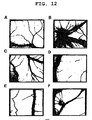
- the inhibitory effect of the peptides of the present invention on the cancer cell-induced angiogenesis was observed (see Fig. 12).
- the peptides of the present invention were also investigated as to the ability to inhibit the growth and metastasis of cancer cells.
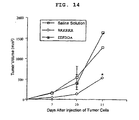
- human colon cancer cells were introduced to mice by subcutaneous injection. After a certain period of time, the tumors formed were measured for size. It was observed that a significant reduction was brought about in the size of the tumor formed in the mice treated with the peptides of the present invention, compared to the control group treated with phosphate buffered saline only (see Fig. 14).
- the peptides of the present invention can be assumed to exert their inhibitory activity against the growth and metastasis of malignant tumors by shielding the signal transduction pathway of VEGF.
- the peptides of the present invention do not directly affect the growth of cancer cells, but specifically suppress the angiogenesis induced by cancer cells as a result of the inhibitory activity of the peptides against the binding of VEGF secreted from cancer cells to receptors present on vascular endothelial cell surface.
- the peptides of the present invention can be used as therapeutics for angiogenesis-related diseases, including cancer, diabetic retinopathy, rheumatoid arthritis, etc.
- HUVEC human umbilical vein endothelial cells
- Clonetics gelatin-coated 100 mm dishes
- a vascular endothelial cell culture medium Medium 199 + 20 % BCS, 5 ⁇ g/ml of heparin, 6 ⁇ g/ml of endothelial cell growth supplement, 5 ng/ml of basic fibroblast growth factor
- the cells were treated with trypsin/EDTA.
- the cells harvested were suspended in a fresh, vascular endothelial cells culture medium and aliquoted at a density of 5x10 4 cell/well to a 24 well plate (Costar Co.). Following one-day culturing, the cells were added in a binding medium (Medium 199/25 mM HEPES, pH 7.4/0.1% bovine serum albumin) containing 0.2 ng of 128 I-labeled VEGF 165 and reacted at 4°C for 3 hours. To remove the labeled VEGF which still remained in the medium, the cells were washed twice with the same medium as used above, and once-with PBS containing 0.1% albumin.
- a binding medium Medium 199/25 mM HEPES, pH 7.4/0.1% bovine serum albumin
- the cells were treated with 0. 5 ml of a lysis solution (20 mM Tris-HCl, pH 7.4/1% TritonX-100) for 20 min, followed by measuring the resulting lysate for radioactivity with the aid of a ⁇ -counter.
- a lysis solution (20 mM Tris-HCl, pH 7.4/1% TritonX-100) for 20 min, followed by measuring the resulting lysate for radioactivity with the aid of a ⁇ -counter.
- the non-specific binding it was determined from a cell group cultured in the presence of a mixture of the labeled VEGF and non-labeled VEGF in a molar ratio of 1:100. This cell group was cultured as a negative control.
- Figs. 1a and 1b The measurement results are shown in Figs. 1a and 1b in which radioactivity is plotted versus time and concentration, respectively.
- the binding of labeled VEGF (1 ng/ml) to VEGF receptors present on the surface of HUVEC (5X10 4 cells/well) behaves in a time-dependent pattern and a VEGF dose-dependent pattern, demonstrating that the interaction between VEGF and its receptors are specific.
- Step 1 Construction of peptide combinatorial library
- a peptide combinatorial library was constructed according to a known method (Pinilla, C. et al., Bio techniques, 13, 901 (1992)).
- Step 2 Primary search for peptide sequences
- HUVEC human umbilical vein endothelial cells
- Clonetics human umbilical vein endothelial cells
- a medium Medium 199/25 mM HEPES, pH 7.4/0.1% bovine serum albumin
- the cells were washed twice with the same medium and once with PBS containing 0.1% albumin to remove the labeled VEGF which still remained uncombined.
- the cells were treated with 0.5 ml of a lysis solution (20 mM Tris-HCl., pH 7.4/1% TritonX-100) for 20 min, followed by measuring the resulting lysate for radioactivity with the aid of a ⁇ -counter.
- a lysis solution (20 mM Tris-HCl., pH 7.4/1% TritonX-100) for 20 min, followed by measuring the resulting lysate for radioactivity with the aid of a ⁇ -counter.
- percent inhibition of combinatorial peptide libraries against the binding of VEGF to its receptors is represented according to amino acid residues on each position of the hexa-peptide when combinatorial peptide libraries are used at a concentration of 0.33 nM/peptide. Based on these results, 3-5 amino acids were selected for each position. As seen, the most potent activity antagonistic to VEGF was observed when lysine or arginine occupied all positions of the peptide.
- Step 3 Secondary search for peptide sequences
- this first secondary pool of peptides was composed of 15 combinatorial peptide libraries according to the combination of the two carboxyl terminal amino acids.
- this first secondary pool of peptides was examined at various concentrations (0.01, 0.05, 0.1, and 1 ⁇ M/sequence) for the antagonistic activity against VEGF binding.
- concentrations 0.01, 0.05, 0.1, and 1 ⁇ M/sequence
- percent inhibition of peptide combinatorial libraries against the binding of VEGF to its receptors is represented according to amino acid residues on the fifth and the sixth positions of the hexa-peptide when the first secondary pool of peptides were used at a concentration of 0.1 ⁇ M/peptide.
- the peptide sequences which inhibited the binding with the highest efficiency were those with arginine or histidine at their sixth position and arginine or lysine at their fifth position.
- the second secondary pools of peptides was constructed by taking advantage of the results obtained through the two selection procedures.
- the first, the fourth, and the sixth positions from the amino end were specified by predetermined amino acids while the amino acid residue data was utilized for the other three positions, as shown in Table 3.
- Combination of the specified amino acid residues resulted in 15 combinatorial libraries, each consisting of 50 sequences.
- the antagonistic activity of the peptides was examined at various concentrations (0.1, 0.25, and 1 ⁇ M/sequence).
- percent inhibition of combinatorial peptide libraries against the binding of VEGF to its receptors is represented according to amino acid residues on the first, the fourth, and the sixth positions of the hexa-peptide when the second secondary pool of peptides were used at a concentration of 0.25 ⁇ M/peptide.
- the most potent antagonistic activity to the binding of VEGF to its receptors was found in the sequences in which arginine occupied the first, the fourth, and the sixth positions all.
- Step 4 Separation of peptide sequences
- a mixture of the most effective peptides selected from the second secondary pool was separated through a C 18 reverse-phase column into six fractions by the retention time in the column. Again, each of the six fractions was examined for the influence on the binding of VEGF to its receptors at various concentrations (0.5, 1, 2, 5, 10, and 25 ⁇ M/peptide). The results are given in Fig. 4, which shows curves plotted by the percent inhibition versus concentration of the peptide fractions.
- the fraction 1 has the highest antagonistic activity. Also, the fraction 1 was identified to contain no tryptophan as no absorbance at UV 290 was detected. Qualitative analysis of its amino acid sequences proved the presence of arginine, lysine, and histidine.
- the six-amino acid sequences with arginine at all of the first, the fourth and the sixth positions are the most antagonistic to the binding of VEGF to its receptors while the most effective candidates for the other positions can be narrowed to two or three amino acid residues, e.g., arginine, lysine, and histidine for the second position, lysine and arginine for the third position, and arginine and lysine for the fifth position.
- Step 5 Tertiary search for peptide sequences
- each peptide was indirectly decided through the analysis of amino acid compositions and its concentration was determined, after which 12 peptides were assayed for antagonism toward VEGF binding at various concentrations (1, 4, 10, and 20 ⁇ M/sequence). The results are given in Fig. 5. As seen in Fig. 5, three peptides, Sequences 1, 2, and 3, were found to inhibit the binding of VEGF to its receptors at highest efficiency with IC 50 values of 2, 3.4, and 3.8 ⁇ M/sequence, respectively.
- FIG. 6 there are shown quantitative results for the binding of I 125 -labeled VEGF and I 125 -labeled bFGF (basic fibroblast growth factor) to their receptors in the presence of various peptides.
- a control peptide consisting of only lysine
- no inhibition was observed between the labeled VEGF and the its receptors, showing that the inhibitory activity of the three peptides determined above does not result from positively charged amino acids, but is attributed to specific amino acid sequences.
- an inhibitor may be combined with either VEGF or one or more of its receptors, thereby inhibiting the interaction between VEGF and the receptor.
- a solution of 125 I-labeled VEGF in the same phosphate buffered saline was added to the plate at a concentration of 0.2 ng/well and incubated at 37°C for 1 hour to associate the labeled VEGF with the peptides.
- the plate was washed four times with the same phosphate buffered saline for 3 min per each time, followed by measuring radioactivity with the aid of a ⁇ -counter.
- the non-specific binding it was determined by incubation in the presence of either a mixture of the labeled VEGF and non-labeled VEGF or a mixture of the fixed peptide and unfixed peptide in a molar ratio of 1:100. This was set as a negative control.
- radioactivity measured from 125 I-labeled VEGF associated with fixed peptides is plotted versus molar ratios of a competitor, such as non-labeled VEGF or free peptides, to its counterpart. As seen in the curves of Fig. 7, the radioactivity is in inverse proportion to the molar ratio, which demonstrates that the peptides directly associate with VEGF.
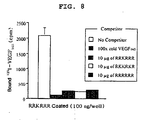
- Fig. 8 there are shown radiation quantities measured from 125 I-labeled VEGF associated with a fixed sequence in the absence of and in the presence of competitors. As seen in the histograms of Fig. 8, the binding of VEGF to a sequence is almost completely prevented in the presence of excess amounts of the free three competitors. These results make it possible to postulate that Sequences 1, 2, and 3 have identical or overlapped binding domains on VEGF.
- Sequence 1 was examined for the common binding domain on VEGF because it inhibited the binding of VEGF to its receptors at the highest efficiency.
- appropriate primers were synthesized and used to.amplify various cDNAs coding for VEGF 165 , VEGF 121 , VEFG 8-121 , VEGF 109 , and VEGF 8-109 while a human liver cDNA library (Clontech) served as a template. After being inserted to plasmid pRSET A (Invitrogen), the cDNAs were sequenced.
- the resulting five pRSET A vectors each having one of the five cDNAs, were introduced into an expression strain (BL21 (DE3) pLysS) containing T7 RNA polymerase. Culturing these transformed cells produced various VEGFs as inclusion bodies which were then separated at a purity of 90% or higher using a method reported previously (Sieffle, G. et al., Biochem. Biophysics. Res. Commun., 222 , 249 (1996)).
- the purified VEGFs were quantified by use of a protein assay reagent (Bio-Rad) and all found to bind to VEGF receptors and exert growth hormone activity on HUVEC.
- Each of the purified VEGFs was labeled with 125 I (0.5 mCi/5 ⁇ g of protein) with the aid of IODO-Bead (Pierce).
- each labeled protein was quantified by ELISA (enzyme-linked immunosorbent assay) using a mouse monoclonal anti-VEGF antibody (R&D systems).
- VEGF 8-121 When it was taken into account that the other VEGF isoforms, VEGF 8-121 , VEGF 109 , and VEGF 8-109 , were not inhibited from binding to their receptors by Sequence 1, the amino and the carboxyl ends of the VEGF 121 were believed to play a key role in binding the peptide to VEGF.
- EXAMPLE 4 Assay for Inhibitory Activity of Peptides Selected through the Tertiary Search Against VEGF-Stimulated Vascular Endothelial Cell Growth
- HUVEC In a gelatin-coated 48-well plate (Nunc) HUVEC were cultured at a density of 10 4 cells/well at 37°C for one day, followed by washing the cells three times with serum-free medium 199. After being added with culture media containing VEGF (10 ng/ml, R&D systems) and various concentrations of the screened peptides, the cells were cultured at 37°C. After 24 hours of culturing, the cells were added with [methyl- 3 H] thymidine (0.5 ⁇ Ci/well) and cultured for an additional one day.
- VEGF 10 ng/ml, R&D systems
- the cells were washed with PBS containing 0.1% albumin, treated with 0.4 N NaOH at room temperature for 20 min for cell lysis, and neutralized with 2 N HCl.
- HUVEC were examined as in above using excess peptide (100 ⁇ M) in the absence of VEGF.
- Fig. 10a percent inhibition against DNA synthesis is plotted versus peptide concentration. As seen in Fig. 10a, all of the screened peptides inhibit VEGF-induced DNA synthesis of HUVEC in dose-dependent patterns with IC 50 values ranging from 10 to 20 ⁇ M.
- the radioactivity of the thymidine inserted into the genome of HUVEC is measured in the absence of no peptides and in the presence of 100 ⁇ M of each of the three peptides.
- the histograms of Fig. 10b show that the peptides have no direct influence on the growth of HUVEC and therefore lead to the conclusion that the peptides do not exert their inhibitory activity directly to cells.
- EXAMPLE 5 Assay for Inhibitory Activity of Selected Peptides against Angiogenesis Induced by VEGF or Human Cancer Cells Secreting VEGF.
- egg CAM chorioallantoic membranes
- Fertilized eggs (Pulmuwon, Korea) were incubated at 37°C under a humidity of 90%. After three days of culturing, the eggs were deprived of about 2 ml of albumin. After four days, eggs were partially deprived of the sheath to make a window with a size of 2 x 2 cm.
- VEGF 10 ng/egg
- peptides or other samples 3 ⁇ l of each mixture was dropped onto 1 ⁇ 4 fraction pieces of thermanox coverslips (Nunc) and dried. The pieces were placed on CAM of 9-day embryonic eggs.
- VEGF was found to induce angiogenesis at a proportion of 33.6% in the italic model test. This angiogenic activity was effectively reduced to about 15.6% when treating egg samples with the peptides (1 ⁇ g/egg) along with VEGF and to about 18.8% when treating egg samples with protamine (50 ⁇ g/egg), known as an anti-angiogenic factor, along with VEGF.
- protamine 50 ⁇ g/egg
- a control peptide which was not selected in spite of its similar properties to those of the screened peptides, did not show anti-angiogenic activity as it induced angiogenesis at a proportion of about 32.6%.
- human fibro-sarcoma cells which secrete VEGF, showed a typical "spokewheel" structure (10 5 cells/egg, 76%). It was observed that when being treated with the screened peptides (100 ng/egg, 36-43%) and the cancer cell, simultaneously, the egg CAM did not undergo angiogenesis. However, the control peptide did not exhibit inhibitory activity with a statistical significance against the cancer cells (100 ng/well, 59%).
- EXAMPLE 6 Assay for Direct influence of Screened Peptides on Human Fibro-Sarcoma Cell Line.
- cell viability of human fibroblast sarcoma cells is plotted versus concentrations of peptides. As seen in Fig. 13, all the screened peptides had no direct influence on the growth of human fibro-sarcoma cells.
- the screened peptides inhibit the angiogenesis induced by the cancer cells by specifically blocking the binding of VEGF secreted from the cancer cells to its receptors present on the surface of vascular endothelial cells.
- cancerous cells were transplanted into the spleen.
- 4-week-old male mice (athymic nude mice, BALB/c/nu/nu, Charles River, Japan) underwent flank incision.
- each test group was composed of 6-7 mice. In a student's t-test, a p value less than 0.05 was regarded as being statistically significant. In the test using tetrazolium dye (cell titer 96 Non-radioactive Proliferation Assay Kit, Promega), each peptide was evaluated to have no influence on the growth of the cancer cells (5x10 3 cells/well), so that the possibility that the toxicity of the peptide themselves might inhibit the growth and metastasis of cancer cells could be excluded.
- tetrazolium dye cell titer 96 Non-radioactive Proliferation Assay Kit, Promega
- peptides of Sequences 1, 2, and 3 are to be clinically used, parental routes are preferred. They are injected at an effective dose of 0.1-100 ⁇ g/kg and preferably at a dose of 0.5-10 ⁇ g/kg once a day for 2-3 weeks.
- EXAMPLE 8 Acute Toxicity Test On Rat Upon Non-Oral Administration
- the peptides of the present invention are associated with VEGF to block its binding to receptors present on the surface of vascular endothelial cells, thereby inhibiting the hormonal activity of VEGF, which is related to angiogenesis.
- VEGF hormonal activity of VEGF
- cancer cells secrete VEGF to generate new blood vessels for their growth and metastasis
- the peptides of the present invention are also useful to inhibit the growth and metastasis of cancer cells. Therefore, the peptides of the present invention can be used as therapeutics for angiogenesis-related diseases, including cancer, diabetic retinopathy, rheumatoid arthritis, thanks to superior ability to inhibit the binding of VEGF to its receptors.
- anti-angiogenic therapies for cancer using the peptides of the present invention inhibit the growth of host normal cells (vascular endothelial cells), but not cancer cells themselves, so that they are expected to overcome the problems of conventional therapies for cancer, which are due to the versatility and resistance of cancer cells.
Landscapes
- Health & Medical Sciences (AREA)
- Chemical & Material Sciences (AREA)
- Life Sciences & Earth Sciences (AREA)
- Organic Chemistry (AREA)
- Medicinal Chemistry (AREA)
- General Health & Medical Sciences (AREA)
- Pharmacology & Pharmacy (AREA)
- Proteomics, Peptides & Aminoacids (AREA)
- Animal Behavior & Ethology (AREA)
- Public Health (AREA)
- Veterinary Medicine (AREA)
- Bioinformatics & Cheminformatics (AREA)
- Engineering & Computer Science (AREA)
- Immunology (AREA)
- Genetics & Genomics (AREA)
- Gastroenterology & Hepatology (AREA)
- Epidemiology (AREA)
- Nuclear Medicine, Radiotherapy & Molecular Imaging (AREA)
- Chemical Kinetics & Catalysis (AREA)
- Biochemistry (AREA)
- Biophysics (AREA)
- General Chemical & Material Sciences (AREA)
- Molecular Biology (AREA)
- Physical Education & Sports Medicine (AREA)
- Rheumatology (AREA)
- Orthopedic Medicine & Surgery (AREA)
- Medicines That Contain Protein Lipid Enzymes And Other Medicines (AREA)
- Peptides Or Proteins (AREA)
Description
- The present invention relates to a novel peptide that shows inhibitory activity of the vascular endothelial growth factor (hereinafter, referred to as "VEGF"), which is an angiogenic factor, and the use thereof for the prophylaxis and treatment of cancers and angiogenesis-related diseases.
- With a definition for the generation of new blood vessels in adult tissues, but not for the vasculogenesis during embryogenesis or development, angiogenesis is a biological process in which angiogenic factors, substrate molecules and accessory cells are elaborately synchronized in time and space. The generation of blood vessels is achieved in complex, collective, multi-step bioreactions, playing a very important role in normal physiological functions, such as wound healing, embryogenesis, etc. In the body, angiogenesis is conducted at a necessary time in a necessary place for a required period under an elaborate system controlled by the balance between angiogenic factors and antiangiogenic factors (Loitta, L. A. et al., Cell, 64 , 327 (1991)).
- A failure in controlling the elaborate mechanism of angiogenesis results in various diseases, including cancers, diabetic retinopathy, rheumatoid arthritis (Kohn, E. C. et al., Proc. Natl. Acad. Sci. USA, 92, 1307 (1995); Folkman, J. et al., Science, 235, 442 (1997) ; Risau, W., Nature, 386, 671 (1997)). Also, angiogenesis is revealed to be indispensable for the growth and metastasis of cancer cells because it enables nutrients to be provided to cancer cells and makes passageways through which cancer cells are transferred to other sites (Hanahan, D. et al., Cell, 86, 353 (1996); Skobe, M. et al., Nature Med. , 3, 1222 (1997)). In detail, cancerous cells grow to the size of 2 mm or larger, new blood vessels are formed around the tumor through which the supply of oxygen and nutrients and the removal of waste products are allowed (Fidler, I. J. et al., Cell, 79, 185 (1994)). In addition, the metastasis of cancerous cells can be accelerated through the vast capillary networks newly formed by various angiogenic factors secreted from cancerous cells or normal tissue cells (Blood, C. H. et al., Biochem. Biophys. Acta., 1032, 89 (1990)).
- A limitation of conventional anticancer agents and chemical therapies is that various types of cancerous cells are present even in a single tumor and they have varying mutation and growth rates that are higher than those of normal cells and consequently they become resistant to the conventional anticancer agents. In contrast, anti-angiogenic therapies for cancer inhibit the growth of host normal cells (vascular endothelial cells), but not cancerous cells themselves, so that they are expected to overcome the problems of conventional therapies for cancer, which are due to the versatility and resistance of cancerous cells. Advantages of the antiangiogenic therapies to preexisting therapies for cancer is supported by various animal test results published by many researchers (Burrows, F. J. et al., Pharmac. Ther., 64, 155 (1994)).
- In the body coexist angiogenic factors and antiangiogenic factors, through the balance of which angiogenesis is elaborately performed. Until now, there have been known dozens of cancer-relevant angiogenic factors, most of which do not act as growth factors for endothelial cells (Bussolino, F. et al., Trends. Biochem. Sci. 22, 251 (1997)). On the other hand, VEGF is known to act as an endothelial cell-specific growth factor in vitro (Gospodarowics, D, et al., Proc. Natl, Acad. Sci., USA, 86, 7311 (1989)), increases vascular permeability (Leung, D. W. et al., Science, 246, 1306 (1989), and induces the angiogenesis related to the progress of cancer in vivo (Plouet, J. et al., EMBO J., 8, 3801 (1989)).
- It is revealed that VEGF is one of the most potent, angiogenic factors, whose expression is induced by a variety of stimuli, including hypoxia, and is indispensably required for the growth and metastasis of human cancerous cells in vivo (Connolly, D. T. et al., J. Biol. Chem. 264, - 20017 (1989); Kim, K. J. et al., Nature 362, 841 (1993)). VEGF binds to heparin and shares homology in amino acid sequence with PLGF (placental growth factor) and PDGF (platelet-derived growth factor) (Conn, G. et al., Proc. Natl. Acad. Sci., USA, 87, 2628 (1990); Keck, P. I. et al., Science, 246, 1309 (1989); Maglione, D. et al., Proc. Natl. Acad. Sci., USA, 88, 9267 (1991)). Also, it is known that VEGF is expressed as four isoforms consisting of 121, 165, 189, and 206 amino acids, respectively, by alternative splicing (Tischer, E. et al., J. Biol. Chem., 266, 11947 (1991)), of which the VEGF121 is not associated with heparin.
- The signal transduction pathway of VEGF by which it exerts its functions as a growth factor starts with the binding of VEGF to cellular receptors (KDR/Flk-1 and Flt-1) which are specifically expressed on vascular endothelial cells (Millauer, B. et al., Cell, 72, 835 (1993), De Vries, C., et al., Science 255, 989 (1992)). The significance of VEGF in vasculogenesis during embryogenesis and in angiogenesis has been demonstrated by gene deletion studies of VEGF and VEGFR, (Fong, G. h. et al., Nature, 376, 66 (1995); Shalaby, F. et al., Nature, 376, 62 (1995); Carmeliet, P. et al., Nature, 380, 435 (1996); Ferrara, N. et al., Nature, 380, 439 (1996)), the malignant transformation of cancerous cells upon over-expression of VEGF in cancer cells (Zang, H. T. et al., J. Natl. Cancer Inst., 87, 213 (1995)), and the inhibition of the growth of cancer cells by neutralizing anti-VEGF monoclonal antibodies and by the expression of soluble Flt-1 and dominant-negative KDR/F1K-1 (Kim, K. J. et al., Nature, 362, 841 (1993); Goldman, C. K. et al., Proc. Natl. Acad. Sci., USA, 95, 8975 (1998)). In addition, there are reported other research results which prove that VEGF plays a key role in angiogenesis.
-
WO 00 74701 A being in accordance with Article 54(3) and (4) together with Article 158(1) EPC only relevant for the assessment of novelty, relates to a method for inhibiting trauma-induced intimal hyperplasia in a blood vessel, wherein inter alia an arginine homopolymer consisting of 6 amino acid subunits is employed. - DE 197 24 793 A relates to peptides having VEGF inhibitory action being useful for treating of several diseases, e.g. psoriasis, Kaposi sarcoma, etc.
- Therefore, materials which act to inhibit the association between VEGF and its receptors can suppress the angiogenesis driven by VEGF as well as the growth and metastasis of cancer cells, which secrete VEGF (Martiny-Baron, G. et al., Curr. Opin. Biotechnol., 6, 675 (1995)).
- It is an object of the present invention to provide a VEGF-antagonistic peptide which is able to inhibit angiogenesis and the growth and metastasis of cancer cells.
-
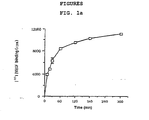
- Fig. 1a is a curve showing that 125I-labeled VEGF binds to its receptors on the surface of HUVEC (human umbilical vein endothelial cells) in a time-dependent manner.
- Fig. 1b is a curve showing that 125I-labeled VEGF binds to its receptors on the surface of HUVEC in a dose-dependent manner.
- Fig. 1c is a Scatchard plot obtained from the results of Fig. 1b, which shows that two kinds of VEGF receptors exist on the surface of vascular endothelial cells.
- Fig. 2 provides histograms showing a primary searching results, in which the inhibitory activity of combinatorial peptide libraries against the binding of VEGF to its receptors is represented according to amino acid residues on each position of the hexa-peptide when combinatorial peptide libraries are used at a concentration of 0.33 nM/peptide.
- Fig. 3a is a histogram in which the inhibitory activity of the first secondary pool of peptides, synthesized on the basis of the primary searching results, against the binding of VEGF to its receptors is represented according to amino acid residues when the pool is used at a concentration of 100 nM/peptide.
- Fig. 3b is a histogram in which the inhibitory activity of the second secondary pool of peptides, synthesized on the basis of the results of Fig. 3a, against the binding of VEGF to its receptors is represented according to amino acid residues when the pool of peptides is used at a concentration of 250 nM/peptide.
- Fig. 4 shows curves in which the inhibition activity of six fractions separated from a mixture of the most effective peptides selected from the second secondary pool through a C18 reverse-phase column according to the retention time. The Inhibitory activity of each fraction against the binding of VEGF to its receptors, is plotted versus concentration of the fractions.
- Fig. 5 shows curves in which the inhibitory activity of 12 peptides against the binding of VEGF to its receptors is plotted versus peptide concentration.
- Fig. 6 is a histogram showing quantitative results for the binding of I125-labeled VEGF and I125-labeled bFGF (basic fibroblast growth factor) to their receptors in the presence of selected three peptides or other control peptides.
- Fig. 7 shows curves in which radioactivity measured from 125I-labeled VEGF associated with fixed peptides (
Sequences - Fig. 8 is a histogram showing radiation quantities measured from 125I-labeled VEGF associated with a fixed sequence (Sequence 1) in the absence of and in the presence of competitors (excess non-labeled VEGF,
free Sequences - Fig. 9 provides histograms in which the radioactivity measured from 125I-labeled VEGF associated with fixed Sequence 1 (RRKRRR) is plotted in the absence of competitors and in the presence of competitors for various VEGF isoforms.
- Fig. 10a provides curves showing that the peptides of
Sequences - Fig. 10b is a histogram in which the radioactivity of the thymidine incorporated into the genome of HUVEC is measured in the absence of peptides and in the presence of 100 µM of each of the three peptides, demonstrating that the inhibition of cell growth is not attributed to the cytotoxicity of the peptides.
- Fig. 11 gives photographs of rabbit corneal domes showing the obvious angiogenesis in the test groups treated with VEGF only (A), the anti-angiogenic effect in the test group treated simultaneously with both
Sequence 1 RRKRRR and VEGF (B), and the obvious angiogenesis in the test group treated with the peptide EEFDDA (C). - Fig. 12 gives photographs showing the inhibitory effect of
Sequences - Fig. 13 shows curves in which viability of human fibro sarcoma cell line is plotted versus concentrations of peptides, demonstrating that the peptides of the invention have no direct influence on human fibro sarcoma cells.
- Fig. 14 shows curves in which changes in tumor size are recorded over the time period of injection, demonstrating that the peptide of
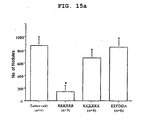
Sequence 1 effectively inhibits the growth of human colon carcinoma cells in mice. - Fig. 15a is a histogram in which the numbers of metastatic nodules from spleen to liver are measured after treatment with saline solution and with various peptides.
- Fig. 15b is a histogram in which the weights of mouse livers to which the human colon carcinoma cells are transferred from the spleen are measured after treatment with various peptides.
- To separate new anti-VEGF peptides in the present invention combinatorial library of small peptides were used, from which the development of small molecule drug candidates has proven remarkably successful (Gho, Y. S. et al., Cancer Res., 57, 3733 (1997); Park, J. Y. et al., Endocrinology, 138, 617 (1997)).
- To begin with, a peptide combinatorial library is constructed. In this regard, there are synthesized hexa-peptides in which 19 kinds of amino acids are specified at each amino acid position. If a specific amino acid residue at a determined position and other amino acid residues at the other positions in the hexa-peptides are represented by O and Xs, respectively, the peptides can be expressed as OX2X3X4X6X6, X1OX3X4X5X6), ... X1X2X3X4X5O, which amounts to 114 (6x19) combinations.
- From the combinatorial peptide library are separated the peptide sequences which inhibit at the highest efficiency the binding of VEGF to its receptors present on vascular endothelial cells. In the present invention, a radioactive iodine-labeled VEGF, along with the combinatorial peptide library, is added to a culture of vascular endothelial cells and allowed to react with one another. After the removal of unbound VEGF, quantification of the bound VEGF to the receptors present on the endothelial cell surface is performed by measuring the radioactivity of the associated VEGF. The peptide sequences are selected which show inhibitory activity against the binding of VEGF to its receptors, at the lowest concentrations.
- The soluble hexa-peptide library were tested through the selection procedure described above(Fig 2). The amino acids at each position of the hexa-peptides that show significant contnbution to the inhibition are listed in Table 1, below.
<TABLE 1> 1(N) 2 3 4 5 6 K K K R K R R R R K R K G H H H W H A T T F H W W L - Based on the results from the above primary selection, as seen in the following Table 2, peptide sequences are synthesized in such a way that the two amino acids from carboxy termini are specified by selected amino acids while the other positions are occupied by the random mixture of the amino acid residues selected through the primary selection procedure in equal ratios.
<TABLE 2> 1 2 3 4 5 6 7 8 9 10 11 12 13 14 15 1-N Mixture of K, R, G, A, H 2 Mixture of K, R, H, T, W 3 Mixture of K, R, W, G, S 4 Mixture of R, K, H 5 K R R K K K H H H F F F L L L 6-C R R W K R W K R R K R W K R W - Again, the first sub-library is tested for the inhibitory activity against the binding of VEGF to its receptors (see Fig. 3a). According to this quantitative data, the peptide sequences which were found to inhibit the binding with the highest efficiency were those with arginine or histidine at their sixth position and arginine or lysine at their fifth position.
- On the basis of the above two selection procedures, the second sub-library is constructed in such a way that the first, the fourth and the sixth positions are specified by predetermined amino acids while the other three positions are occupied by the amino acid mixtures secured through the above two selection procedures, as shown in Table 3, below.
<TABLE 3> 1 2 3 4 5 16 17 8 19 10 11 12 13 14 15 1-N K R G A H K R G A H K R A G H 2 Mixture of K, R, H, T, W 3 Mixture of K, R, W, G, S 4 R R R R R K K K K K H H H H H 5 Combinatorial library K, R 6-C R R R R R R R R R R R R R R R - Analysis for the inhibitory activity against the activity of VEGF reveals that the peptides in which the first, the fourth and the sixth positions are all specified by arginine inhibit the binding of VEGF to its receptors with the most efficiency (see Fig. 3b).
- Thereafter, additional analysis of the peptide mixtures, obtained after separation by use of a C18 reverse-phase column, for inhibitory activity against the binding of VEGF to its receptors led to the conclusion that the most effective inhibitory activity is induced when the first, the fourth and the sixth positions all are occupied by arginine, the second position by arginine, lysine or histidine, and the third and the fifth positions by arginine or lysine (see Fig. 4).
- These preferable combinations for the amino acid sequence are shown in Table 4, below.
<TABLE 4> 1 2 3 4 5 6 7 8 9 10 11 12 1(R)-N R R R R R R R R R R R R 2(K. R. H) K R H K R H K R H K R H 3(K. R) K K K R R R K K K R R R 4(R) R R R R R R R R R R R R 5(K. R) K K K K K K R R R R R R 6(R)-C R R R R R R R R R R R R IC50(µM) 3.4 6.0 >20 8.5 4.5 >20 6.5 2.0 >20 7.8 3.8 >20 - An examination which was made for the inhibitory activity of the 12 peptides against the binding of VEGF to its receptors verified that the peptide of sequence 1 (NH2-Arg-Arg-Lys-Arg-Arg-Arg-CONH2), the peptide of sequence 2 (NH2-Arg-Lys-Lys-Arg-Lys-Arg-CONH2) , and the peptide of sequence 3 (NH2-Arg-Arg-Arg-Arg-Arg-Arg-CONH2) are the most potent inhibitors against VEGF activity.
- There may be various mechanisms through which the peptides can inhibit VEGF from binding to its receptors. In order to elucidate the accurate inhibitory mechanism, an examination was made of the possibility that the identified peptides could directly associate with VEGF to inhibit the binding of VEGF to its receptors present on cell surfaces of vascular endothelial cells. In this connection, labeled VEGF and non-labeled VEGF were allowed to competitively associate with immobilized peptides. From the quantification of radioactivity from the immobilized peptides, the association extent between labeled VEGF and the peptides was -found to decrease with increase of the concentrations of non-labeled VEGF and free peptides added, demonstrating that the identified peptides of the present invention directly associate with VEGF. The finding that the association between a peptide and labeled VEGF is completely inhibited by all of the three peptides makes it possible to postulate that the peptides of
sequence 1,sequence 2, andsequence 3 have identical or overlapped binding domains on VEGF (Figs. 7 and 8). Also, a quantitative measurement was made of the inhibitory activity of the peptide ofsequence 3 against the association between 5 types of VEGF isoforms and their receptors, leading to the conclusion that both the amino and the carboxyl terminals of VEGF121 are important to the binding domain (see Fig. 9). - In order to determine whether the peptides of the present invention inhibit the VEGF-stimulated growth of vascular endothelial cells, the amount of DNA synthesized in vascular endothelial cells in the presence of the screened peptides and VEGF was measured. As a result, it was obtained that the peptides of the present invention inhibit the DNA synthesis induced by VEGF in vascular endothelial cells in a dose-dependent pattern. In consequence, the peptides of the present invention have inhibitory activity against the VEGF-stimulated growth of vascular endothelial cells (see Figs. 10a and 10b).
- In an experiment, egg CAM (chorioallantoic membrane) was treated with VEGF in the presence of the peptide of the present invention to give data which show that VEGF-induced angiogenesis is inhibited by the peptides, thus verifying the anti-angiogenic activity of the peptides of the present invention. Additionally, in an animal test for angiogenesis using rabbit cornea, the angiogenesis which was definitely observed from the control group treated with only VEGF was completely inhibited in the group treated with VEGF and the peptides simultaneously (see Fig. 11). Further, an experiment was conducted to determine whether the peptides of the present invention are able to inhibit the angiogenesis induced by VEGF secreted from cancer cells. To this end, VEGF-secreting sarcoma was applied, along with the peptides of the present invention, to egg CAM. The inhibitory effect of the peptides of the present invention on the cancer cell-induced angiogenesis was observed (see Fig. 12).
- An experiment was conducted to see whether the peptides of the invention, which were proved to have antagonistic activity to VEGF, have direct inhibitory effects on the growth of cancer cells. In the experiment, human fibro sarcoma cells were cultured and treated with the peptides of the present invention, followed by measuring cell viability. From the measurements, it is apparent that the peptides of the present invention have no direct influence on the growth of the fibro sarcoma cells, as seen in Fig. 13.
- The peptides of the present invention were also investigated as to the ability to inhibit the growth and metastasis of cancer cells. Along with the peptides of the present invention, human colon cancer cells were introduced to mice by subcutaneous injection. After a certain period of time, the tumors formed were measured for size. It was observed that a significant reduction was brought about in the size of the tumor formed in the mice treated with the peptides of the present invention, compared to the control group treated with phosphate buffered saline only (see Fig. 14). In addition, when cancer cells implanted into the spleen of mice were treated with the peptides of the present invention, better results were obtained in the number of metastatic tumor nodules in liver and the weight of the liver than when the implanted cells were treated only with phosphate buffered saline (see Figs. 15a and 15b). From the above experimental results, the peptides of the present invention can be assumed to exert their inhibitory activity against the growth and metastasis of malignant tumors by shielding the signal transduction pathway of VEGF.
- In conclusion, through the above various experiments, it was revealed that the peptides of the present invention do not directly affect the growth of cancer cells, but specifically suppress the angiogenesis induced by cancer cells as a result of the inhibitory activity of the peptides against the binding of VEGF secreted from cancer cells to receptors present on vascular endothelial cell surface.
- Thanks to superior ability to inhibit the binding of VEGF to its receptors, the peptides of the present invention can be used as therapeutics for angiogenesis-related diseases, including cancer, diabetic retinopathy, rheumatoid arthritis, etc.
- Practical and presently preferred embodiments of the present invention are illustrative as shown in the following Examples.
- Utilizing 125I-labeled VEGF165 in various experiments, an examination was made as to whether this labeled protein have the same activity as that of natural VEGF protein.
- First, HUVEC (human umbilical vein endothelial cells) (Clonetics) were placed on gelatin-coated 100 mm dishes (Falcon) containing a vascular endothelial cell culture medium (Medium 199 + 20 % BCS, 5 µg/ml of heparin, 6 µg/ml of endothelial cell growth supplement, 5 ng/ml of basic fibroblast growth factor) and cultured at 37°C in a CO2 incubator for animal cell culture. After a certain period of time, the cells were treated with trypsin/EDTA. After centrifugation, the cells harvested were suspended in a fresh, vascular endothelial cells culture medium and aliquoted at a density of 5x10⁴ cell/well to a 24 well plate (Costar Co.). Following one-day culturing, the cells were added in a binding medium (Medium 199/25 mM HEPES, pH 7.4/0.1% bovine serum albumin) containing 0.2 ng of 128I-labeled VEGF165 and reacted at 4°C for 3 hours. To remove the labeled VEGF which still remained in the medium, the cells were washed twice with the same medium as used above, and once-with PBS containing 0.1% albumin. Thereafter, to quantitatively determine the amount of the labeled VEGF which bound to receptors present on the surface of the vascular endothelial cells, the cells were treated with 0. 5 ml of a lysis solution (20 mM Tris-HCl, pH 7.4/1% TritonX-100) for 20 min, followed by measuring the resulting lysate for radioactivity with the aid of a γ-counter. As for the non-specific binding, it was determined from a cell group cultured in the presence of a mixture of the labeled VEGF and non-labeled VEGF in a molar ratio of 1:100. This cell group was cultured as a negative control.
- The measurement results are shown in Figs. 1a and 1b in which radioactivity is plotted versus time and concentration, respectively. As seen in these figures, the binding of labeled VEGF (1 ng/ml) to VEGF receptors present on the surface of HUVEC (5X10⁴ cells/well) behaves in a time-dependent pattern and a VEGF dose-dependent pattern, demonstrating that the interaction between VEGF and its receptors are specific.
- Scatchard analysis of the results obtained in Fig. 1b revealed that two kinds of receptors exist on the surface of vascular endothelial cells, as seen in Fig. 1c. One of two kinds of the receptors has a dissociation constant (KD) of 3 pM and is populated at a density of about 2,000 per cells while the other has a dissociation constant (KD) of 50 pM and is populated at a density of about 6,000 per cell. These results agree with those reported from various studies (Maciag, T. et al., Proc. Natl. Acad. Sci., USA, 76, 5674 (1979); Myoken, Y. et al., Proc. Natl. Acad. Sci., USA, 88, 5819 (1991); Gengrinovitch, S. et al., J. Biol. Chem., 270, 15059 (1996); Bikfalvi, A. et al., J. Cell Physiol. 149, 50 (1991)).
- A peptide combinatorial library was constructed according to a known method (Pinilla, C. et al., Bio techniques, 13, 901 (1992)).
- When a library consisting of hexa-peptides were synthesized, a predetermined amino acid residue was assigned to a specific one of the six positions while the other five positions were occupied by any of 19 kinds of amino acids (exclusive of cystein). Supposing that a specific amino acid residue at a determined position and other amino acid residues at the other positions in the peptides of six amino acid residues were represented by O and Xs, respectively, the peptides were expressed as OX2X3X4X5X6, X1OX3X4X5X6, ... X1X2X3X4X5O. That is to say, in peptides of six amino acid residues, 19 kinds of amino acids are specified at each amino acid position while non-specified positions were occupied by any of amino acids exclusive of cystein to construct libraries of peptides, which amount to 114 (6x19) combinations.
- To select the peptides which can combine with VEGF from the combinatorial peptide libraries, the following experiment was conducted.
- On a 24-well plate (Costar Co), HUVEC (human umbilical vein endothelial cells) (Clonetics) were cultured in a medium at a density of 5x10⁴ cells/well for one day. Then, the cells were transferred to a medium (Medium 199/25 mM HEPES, pH 7.4/0.1% bovine serum albumin) containing 0.2 ng of 125I-labeled VEGF and various concentrations of peptides or combinatorial peptide libraries and reacted at 4°C for 3 hours. The cells were washed twice with the same medium and once with PBS containing 0.1% albumin to remove the labeled VEGF which still remained uncombined. Thereafter, to quantify the labeled VEGF which bound to receptors present on the surface of the vascular endothelial cells, the cells were treated with 0.5 ml of a lysis solution (20 mM Tris-HCl., pH 7.4/1% TritonX-100) for 20 min, followed by measuring the resulting lysate for radioactivity with the aid of a γ-counter.
- With reference to Fig. 2, percent inhibition of combinatorial peptide libraries against the binding of VEGF to its receptors is represented according to amino acid residues on each position of the hexa-peptide when combinatorial peptide libraries are used at a concentration of 0.33 nM/peptide. Based on these results, 3-5 amino acids were selected for each position. As seen, the most potent activity antagonistic to VEGF was observed when lysine or arginine occupied all positions of the peptide.
- Based on the primary search results, two pools of peptides were synthesized as seen in Tables 2 and 3. Again, these two combinatorial peptide libraries were examined for the antagonistic activity against the binding of VEGF to its receptors and the results are given in Figs. 3a and 3b.
- First, in order to make the first secondary pools of peptides, the two carboxyl terminal positions were specified by selected amino acids while the other positions were allowed to be occupied by the amino acid residues selected through the secondary selection in equal ratios. Amounting to 375 sequences in total, this first secondary pool of peptides was composed of 15 combinatorial peptide libraries according to the combination of the two carboxyl terminal amino acids.
- As in the primary search, this first secondary pool of peptides was examined at various concentrations (0.01, 0.05, 0.1, and 1 µM/sequence) for the antagonistic activity against VEGF binding. With reference to Fig. 3a, percent inhibition of peptide combinatorial libraries against the binding of VEGF to its receptors is represented according to amino acid residues on the fifth and the sixth positions of the hexa-peptide when the first secondary pool of peptides were used at a concentration of 0.1 µM/peptide. As seen in Fig. 3a, the peptide sequences which inhibited the binding with the highest efficiency were those with arginine or histidine at their sixth position and arginine or lysine at their fifth position.
- Next, the second secondary pools of peptides was constructed by taking advantage of the results obtained through the two selection procedures. The first, the fourth, and the sixth positions from the amino end were specified by predetermined amino acids while the amino acid residue data was utilized for the other three positions, as shown in Table 3.
- Combination of the specified amino acid residues resulted in 15 combinatorial libraries, each consisting of 50 sequences. The antagonistic activity of the peptides was examined at various concentrations (0.1, 0.25, and 1 µM/sequence). With reference to Fig. 3b, percent inhibition of combinatorial peptide libraries against the binding of VEGF to its receptors is represented according to amino acid residues on the first, the fourth, and the sixth positions of the hexa-peptide when the second secondary pool of peptides were used at a concentration of 0.25 µM/peptide. As seen in Fig. 3b, the most potent antagonistic activity to the binding of VEGF to its receptors was found in the sequences in which arginine occupied the first, the fourth, and the sixth positions all.
- A mixture of the most effective peptides selected from the second secondary pool was separated through a C18 reverse-phase column into six fractions by the retention time in the column. Again, each of the six fractions was examined for the influence on the binding of VEGF to its receptors at various concentrations (0.5, 1, 2, 5, 10, and 25 µM/peptide). The results are given in Fig. 4, which shows curves plotted by the percent inhibition versus concentration of the peptide fractions.
- In the curves, the
fraction 1 has the highest antagonistic activity. Also, thefraction 1 was identified to contain no tryptophan as no absorbance at UV290 was detected. Qualitative analysis of its amino acid sequences proved the presence of arginine, lysine, and histidine. - Therefore, the data obtained thus far demonstrated that the six-amino acid sequences with arginine at all of the first, the fourth and the sixth positions are the most antagonistic to the binding of VEGF to its receptors while the most effective candidates for the other positions can be narrowed to two or three amino acid residues, e.g., arginine, lysine, and histidine for the second position, lysine and arginine for the third position, and arginine and lysine for the fifth position.
- Resulting from the combination of the candidates, 12 peptides which were specified at the three positions by arginine were synthesized as shown in Table 4, followed by separating each peptide through a C19 reverse-phase column.
- The sequence of each peptide was indirectly decided through the analysis of amino acid compositions and its concentration was determined, after which 12 peptides were assayed for antagonism toward VEGF binding at various concentrations (1, 4, 10, and 20 µM/sequence). The results are given in Fig. 5. As seen in Fig. 5, three peptides,
Sequences - With reference to Fig. 6, there are shown quantitative results for the binding of I125-labeled VEGF and I125-labeled bFGF (basic fibroblast growth factor) to their receptors in the presence of various peptides. Despite a high concentration (10 µM) of a control peptide consisting of only lysine, no inhibition was observed between the labeled VEGF and the its receptors, showing that the inhibitory activity of the three peptides determined above does not result from positively charged amino acids, but is attributed to specific amino acid sequences. When it is taken into account that none of the three peptides inhibit the binding of bFGF, an angiogenic factor similar to VEGF, to its receptors, it is proven that they are specific for VEGF only.
- There are various possible mechanisms to inhibit the binding of VEGF to its receptors. For instance, an inhibitor may be combined with either VEGF or one or more of its receptors, thereby inhibiting the interaction between VEGF and the receptor.
- To verify the postulated mechanism in which the screened peptides might be associated directly with VEGF so as to inhibit VEGF from binding to its receptors present on the surface of vascular endothelial cells, the following experiments were conducted. Each of the hexa-peptides was fixed on a 96-well ELISA plate at a concentration of 100 ng/well in such a manner that a 20% acetic acid solution containing each peptide was dried in air. The plate was treated three times with a phosphate buffered saline containing 0.1% albumin for 3 min each time. A solution of 125I-labeled VEGF in the same phosphate buffered saline was added to the plate at a concentration of 0.2 ng/well and incubated at 37°C for 1 hour to associate the labeled VEGF with the peptides. To remove the peptides remaining unassociated, the plate was washed four times with the same phosphate buffered saline for 3 min per each time, followed by measuring radioactivity with the aid of a γ-counter. As for the non-specific binding, it was determined by incubation in the presence of either a mixture of the labeled VEGF and non-labeled VEGF or a mixture of the fixed peptide and unfixed peptide in a molar ratio of 1:100. This was set as a negative control.
- With reference to Fig. 7, radioactivity measured from 125I-labeled VEGF associated with fixed peptides is plotted versus molar ratios of a competitor, such as non-labeled VEGF or free peptides, to its counterpart. As seen in the curves of Fig. 7, the radioactivity is in inverse proportion to the molar ratio, which demonstrates that the peptides directly associate with VEGF. The dissociation constant (KD) between VEGF and each peptide was determined using the IC50 value according to the following formula (De Blasi, A. et al., Trends Pharmacol. Sci., 10, 227 (1989)).

- The dissociation constants determined using the formula were 5 µM for
Sequence Sequence Sequence 3. From these results, it is apparent that all of the three peptides screened from the peptide combinatorial libraries associate with VEGF directly and specifically. - Turning to Fig. 8, there are shown radiation quantities measured from 125I-labeled VEGF associated with a fixed sequence in the absence of and in the presence of competitors. As seen in the histograms of Fig. 8, the binding of VEGF to a sequence is almost completely prevented in the presence of excess amounts of the free three competitors. These results make it possible to postulate that
Sequences - In order to verify this postulation, Sequence 1 (RRKRRR) was examined for the common binding domain on VEGF because it inhibited the binding of VEGF to its receptors at the highest efficiency. First, appropriate primers were synthesized and used to.amplify various cDNAs coding for VEGF165, VEGF121, VEFG8-121, VEGF109, and VEGF8-109 while a human liver cDNA library (Clontech) served as a template. After being inserted to plasmid pRSET A (Invitrogen), the cDNAs were sequenced. The resulting five pRSET A vectors, each having one of the five cDNAs, were introduced into an expression strain (BL21 (DE3) pLysS) containing T7 RNA polymerase. Culturing these transformed cells produced various VEGFs as inclusion bodies which were then separated at a purity of 90% or higher using a method reported previously (Siemeister, G. et al., Biochem. Biophysics. Res. Commun., 222, 249 (1996)). The purified VEGFs were quantified by use of a protein assay reagent (Bio-Rad) and all found to bind to VEGF receptors and exert growth hormone activity on HUVEC. Each of the purified VEGFs was labeled with 125I (0.5 mCi/5 µg of protein) with the aid of IODO-Bead (Pierce). For use, each labeled protein was quantified by ELISA (enzyme-linked immunosorbent assay) using a mouse monoclonal anti-VEGF antibody (R&D systems).
- Each peptide was examined for antagonistic activity against VEGF in the same manner as in Example 2. Referring to Fig. 9, the radioactivity measured from 125I-labeled VEGF associated with fixed Sequence 1 (RRKRRR) is plotted in the absence of competitors and in the presence of competitors for various VEGF isomers. From the fact that Sequence 1 (RRKRRR) inhibited not only the binding of labeled VEGF165 to its receptors, but the binding of the heparin-binding domain-deficient, labeled VEGF121 to its receptors, it can be concluded that the heparin-binding domain of VEGF is independent of the association between the peptides and VEGF. When it was taken into account that the other VEGF isoforms, VEGF8-121, VEGF109, and VEGF8-109, were not inhibited from binding to their receptors by
Sequence 1, the amino and the carboxyl ends of the VEGF121 were believed to play a key role in binding the peptide to VEGF. - An examination was made in order to determine whether the peptides screened from the peptide combinatorial libraries,
Sequence 1,Sequence 2, andSequence 3, inhibit the VEGF-induced DNA synthesis of HUVEC. - In a gelatin-coated 48-well plate (Nunc) HUVEC were cultured at a density of 104 cells/well at 37°C for one day, followed by washing the cells three times with serum-free medium 199. After being added with culture media containing VEGF (10 ng/ml, R&D systems) and various concentrations of the screened peptides, the cells were cultured at 37°C. After 24 hours of culturing, the cells were added with [methyl-3H] thymidine (0.5 µCi/well) and cultured for an additional one day. Before quantification of the radioactivity used for the DNA synthesis with the aid of a liquid scintillation counter, the cells were washed with PBS containing 0.1% albumin, treated with 0.4 N NaOH at room temperature for 20 min for cell lysis, and neutralized with 2 N HCl. In order to determine the toxicity of the peptides, HUVEC were examined as in above using excess peptide (100 µM) in the absence of VEGF.
- With reference to Fig. 10a, percent inhibition against DNA synthesis is plotted versus peptide concentration. As seen in Fig. 10a, all of the screened peptides inhibit VEGF-induced DNA synthesis of HUVEC in dose-dependent patterns with IC50 values ranging from 10 to 20 µM.
- With reference to Fig. 10b, the radioactivity of the thymidine inserted into the genome of HUVEC is measured in the absence of no peptides and in the presence of 100 µM of each of the three peptides. The histograms of Fig. 10b show that the peptides have no direct influence on the growth of HUVEC and therefore lead to the conclusion that the peptides do not exert their inhibitory activity directly to cells.
- Based on the results of the above experiments, it was concluded that the three peptides block the binding of VEGF to its receptors to specifically inhibit the growth of endothelial cells induced by VEGF.
- To assay the peptides for anti-angiogenic activity, egg CAM (chorioallantoic membranes) were examined as to whether the peptides inhibit the angiogenesis induced by VEGF.
- Fertilized eggs (Pulmuwon, Korea) were incubated at 37°C under a humidity of 90%. After three days of culturing, the eggs were deprived of about 2 ml of albumin. After four days, eggs were partially deprived of the sheath to make a window with a size of 2 x 2 cm.
- After VEGF (10 ng/egg) was mixed with various amounts of peptides or other samples, 3 µl of each mixture was dropped onto ¼ fraction pieces of thermanox coverslips (Nunc) and dried. The pieces were placed on CAM of 9-day embryonic eggs.
- Two days later, the samples were independently observed under anatomical microscopes by two different persons to determine whether new blood vessels are induced by the dropped samples or not. In this regard, the experiment was repeated at least three times using 10 or more eggs per sample and the results are given in Table 5, below.
<TABLE 5> SAMPLE Angiogenic activity eggs/total eggs Angiogenic activity (%) Pa WATER 3/28 10.(1.4)° VEGF(10ng) 9/27 33.6 (3.8) 0.004 VEGF+RRFCRRR (1µg) 4/26 15.6 (5.1) 0.245 VEGF+RKKRKR (1µg) 4/26 15.6 (4.5) 0.271 VEGF+RRRRRR(1µg) 4/26 15.6(5.1) 0.245 VEGF+KKKKKK (1µg) 8/25 32.6(12.2) 0.038 VEGF+protamine (1µg) 5/26 18.8(4.1) 0.128 a determined by comparing the values between water sample and other samples by use of student's t-test, statistically significant in the case of p<0.05. b standard deviation - As seen in Table 5, VEGF was found to induce angiogenesis at a proportion of 33.6% in the italic model test. This angiogenic activity was effectively reduced to about 15.6% when treating egg samples with the peptides (1 µg/egg) along with VEGF and to about 18.8% when treating egg samples with protamine (50 µg/egg), known as an anti-angiogenic factor, along with VEGF. However, a control peptide (KKKKKK), which was not selected in spite of its similar properties to those of the screened peptides, did not show anti-angiogenic activity as it induced angiogenesis at a proportion of about 32.6%.
- To confirm the test results obtained from egg CAM, an experiment was performed using rabbit corneal domes for in vivo angiogenesis testing. New Zealand male rabbits weighing 3 kg (SLC, Japan) were subjected to intramuscular ketamine anesthesia (44 mg/kg), followed by dissecting the corneal domes to a length of 3 mm by use of an operating knife (Bard-Parker #11). VEGF (10 ng, R&D systems) was dropped, alone or in combination with 1 µg of a peptide of an amino acid sequence EEFDDA or Sequence 1 (RRKRRR), onto a Thermanox coverslip (Nunc) and dried under germ-free conditions, after which the coverslips were placed on the dissected areas which were then observed for natural healing. 6 rabbits were used per test group within which all animals were observed to show similar results. 16 days after the operation, angiogenesis was obviously observed and photographs were taken of blood vessels newly formed in the corneal dome (Nikon, FS-2, Japan). As seen in photographs of Fig. 11, the control peptide EEFDDA had no influence on the VEGF-induced angiogenesis in the rabbit corneal dome (Fig. 11C) while the angiogenesis which was obviously observed in the test group treated with VEGF only (Fig. 11A) was completely inhibited in the test group treated simultaneously with both
Sequence 1 RRKRRR and VEGF (Fig. 11B). - The results from the above two experiments and Fig. 10b, taken together, demonstrate that the screened peptides have no direct influence on the growth of vascular endothelial cells, but block the binding of VEGF to its receptors present on the surface of vascular endothelial cells, thereby inhibiting the VEGF-induced angiogenesis in vi vo.
- An experiment using egg CAM was carried out to confirm the inhibitory activity of the screened peptides against the angiogenesis induced by cancer cells, which secrete VEGF. Fertilized eggs were deprived of albumin and windows were formed on the eggs as in above. 105 cells of HT1080 (human fibrosarcoma) were mixed with 7.5 µg of Type I collagen (rat tail, Beckton Dickinson, USA) within a volume of 5 µl and dropped onto ¼ fraction pieces of Thermanox coverslips to give collagen sponges. After being covered with the collagen sponges, 10-day embryonic egg CAM was incubated at 37°C for 3 days. Blood vessels induced by the cancer cells were observed and photographed as in above (see Table 6 and Fig. 12).
<TABLE 6> SAMPLE Angiogenic activity eggs/total eggs Angiogenic activity(%) Pa No treatment 5/27 18.5(2.1) Cancer cell 18/24 76.0(8.5) 0.011 Cancer cell+RRKRRR (0.1µg) 8/22 36.0(8.5) 0.160 Cancer cell+RKKRKR(0.1µg) 10/23 43.0(9.9) 0.141 Cancer cell+RRRRRR(0.1µg) 10/24 41.0(7.1) 0.098 Cancer cell+KKKKKK(0.1µg) 14/22 59.0(1.4) 0.002 - When having been cultured in egg CAM, human fibro-sarcoma cells, which secrete VEGF, showed a typical "spokewheel" structure (105 cells/egg, 76%). It was observed that when being treated with the screened peptides (100 ng/egg, 36-43%) and the cancer cell, simultaneously, the egg CAM did not undergo angiogenesis. However, the control peptide did not exhibit inhibitory activity with a statistical significance against the cancer cells (100 ng/well, 59%).
- The following experiment was carried out to determine whether peptides antagonistic to VEGF have direct influence on the growth of human fibro-sarcoma cells. After being cultured for one day in a 96-well plate (Nunc), the cancer cells were added with DMEM containing various concentrations of the screened peptides and incubated. To the cells remaining alive after 3 days of incubation, 20 µl of tetrazolium dye (Cell Titer 96 Non-Radioactive Proliferation assay kit, Promega) was added, followed by incubation at 37°C for 4 hours. The formazan produced by the viable cells was dissolved in 0.2 ml of dimethyl sulfoxide(DMSO) quantified by the absorbance at 570 nm. The absorbance attributed to formazan is proportional to living cells.
- With reference to Fig. 13, cell viability of human fibroblast sarcoma cells is plotted versus concentrations of peptides. As seen in Fig. 13, all the screened peptides had no direct influence on the growth of human fibro-sarcoma cells.
- According to the results obtained from this experiment and Example 5, it is apparent that, without direct influence on the growth of human fibro-sarcoma cells, the screened peptides inhibit the angiogenesis induced by the cancer cells by specifically blocking the binding of VEGF secreted from the cancer cells to its receptors present on the surface of vascular endothelial cells.
- It was reported that the acquirement of angiogenic ability is crucial to the progression of cancer and indispensable for the continuous growth of cancerous tissues (Hanahan, D. et al., Cell, 86, 353 (1996); Skobe, M., et al., Nature Med., 3, 1222 (1997) . Also, the screened peptides were found to effectively inhibit angiogenesis in vivo. With this information, the following experiment was made to determine whether the screened peptides effectively inhibit the growth and metastasis of cancer cells. 5x10⁶ cells of HM7 were added, together with 0.5 µg/µl of an amino acid sequence EEFDDA or Sequence 1 (RRKRRR), to a serum-free DMEM and then introduced into male mice which were 4 weeks old (athymic nude mice, BALB/c/nu/nu, Charles River, Japan) by subcutaneous injection. From the next day, a solution of each peptide in PBS (0.5 µg/100 µl/day) was subcutaneously injected to the mice for 15 days. Sizes of the tumors thus formed were periodically measured while tumor volumes were calculated according to the following formula:

- In order to conduct an experiment concerning the metastasis of cancer cells to the liver, cancerous cells were transplanted into the spleen. In this regard, after being anesthetized with diethyl ether, 4-week-old male mice (athymic nude mice, BALB/c/nu/nu, Charles River, Japan) underwent flank incision. To the spleen, 100 µl of a mixture containing 106 cells of HM7 (human colon carcinoma cell line) and 0.5 µg/µl of amino acid sequence EEFDDA, KKKKKK, or Sequence 1 (RRKRRR) was slowly injected, followed by the subcutaneous injection of each peptide for three weeks as in above. Four weeks after the injection, the liver was excised from each mouse and measured for weight and the size and number of metastatic nodules formed. Each test group was composed of 6-7 mice. In a student's t-test, a p value less than 0.05 was regarded as being statistically significant. In the test using tetrazolium dye (cell titer 96 Non-radioactive Proliferation Assay Kit, Promega), each peptide was evaluated to have no influence on the growth of the cancer cells (5x10³ cells/well), so that the possibility that the toxicity of the peptide themselves might inhibit the growth and metastasis of cancer cells could be excluded.
- With reference to Fig. 14, changes in tumor size are recorded over the time period of injection. After 15 days of subcutaneous injection, the sequence EEFDDA exhibited no effects whereas the peptide RRKRRR of
Sequence 1 decreased the tumor size by about 28% compared to the control (PBS). Turning to Fig. 15, the numbers of metastatic nodules and liver weights after 14 days of injection are shown according to injected materials. No difference in metastasis of cancer cells could be found between the groups to which tumor was injected alone and together with the sequence EEFDDA. A weak inhibitory activity was observed in the group to which the sequence KKKKKK was injected (about 80% of the control group to which only PBS was injected). In contrast, high inhibitory effects were found from the test group to which the peptide RRKRRR ofSequence 1 was injected as the test group was only 16% and 33% of the control group in the number of metastatic nodules and the weight of the liver, respectively. Therefore, it is apparent that the screened peptides shield the signal transduction of VEGF to inhibit the growth and metastasis of malignant tumors. - When the peptides of
Sequences - The peptides of
Sequences - Using specific pathogen-free (SPF) SD rats which were six weeks old, the peptides of
Sequences Sequences Sequences - As described hereinafter, the peptides of the present invention are associated with VEGF to block its binding to receptors present on the surface of vascular endothelial cells, thereby inhibiting the hormonal activity of VEGF, which is related to angiogenesis. Because cancer cells secrete VEGF to generate new blood vessels for their growth and metastasis, the peptides of the present invention are also useful to inhibit the growth and metastasis of cancer cells. Therefore, the peptides of the present invention can be used as therapeutics for angiogenesis-related diseases, including cancer, diabetic retinopathy, rheumatoid arthritis, thanks to superior ability to inhibit the binding of VEGF to its receptors. Additionally, anti-angiogenic therapies for cancer using the peptides of the present invention inhibit the growth of host normal cells (vascular endothelial cells), but not cancer cells themselves, so that they are expected to overcome the problems of conventional therapies for cancer, which are due to the versatility and resistance of cancer cells.
Claims (8)
- A peptide consisting of six amino acid residues which comprises arginine at the first, the fourth and the sixth positions from the amino end, one selected from arginine, lysine, and histidine at the second position, and one selected from arginine and lysine at the third and the fifth positions, except the peptide comprising the amino acid sequence of Arg Arg Arg Arg Arg Arg as a pharmaceutical compound.
- The peptide as set forth in claim 1, comprising the amino acid sequence of Arg Arg Lys Arg Arg Arg.
- The peptide as set forth in claim 1, comprising the amino acid sequence of Arg Lys Lys Arg Lys Arg.
- The peptide as set forth in any one of claims 1 to 3 as a pharmaceutical compound for inhibiting the activity of the vascular endothelial growth factor.
- Use of a peptide, consisting of six amino acid residues which comprises arginine at the first, the fourth and the sixth positions from the amino end, one selected from arginine, lysine, and histidine at the second position, and one selected from arginine and lysine at the third and the fifth positions, in the preparation of a pharmaceutical composition for the treatment of cancer, diabetic retinopathy, and rheumatoid arthritis.
- Use according to claim 5, wherein the peptide comprises the amino acid sequence of Arg Arg Lys Arg Arg Arg.
- Use according to claim 5, wherein the peptide comprises the amino acid sequence of Arg Lys Lys Arg Lys Arg.
- Use according to claim 5, wherein the peptide comprises the amino acid sequence of Arg Arg Arg Arg Arg Arg.
Priority Applications (1)
| Application Number | Priority Date | Filing Date | Title |
|---|---|---|---|
| AT99960007T ATE318839T1 (en) | 1999-12-21 | 1999-12-21 | ARGININE-RICH ANTI-VASCULAR ENDOTHELIAL GROWTH FACTOR PEPTIDES WHICH INHIBIT GROWTH AND METASTASIS OF HUMAN TUMOR CELLS BY BLOCKING ANGIOGENESIS |
Applications Claiming Priority (1)
| Application Number | Priority Date | Filing Date | Title |
|---|---|---|---|
| PCT/KR1999/000796 WO2001066127A1 (en) | 1999-12-21 | 1999-12-21 | Arginine-rich anti-vascular endothelial growth factor peptides that inhibit growth and metastasis of human tumor cells by blocking angiogenesis |
Publications (3)
| Publication Number | Publication Date |
|---|---|
| EP1162991A1 EP1162991A1 (en) | 2001-12-19 |
| EP1162991A4 EP1162991A4 (en) | 2004-03-24 |
| EP1162991B1 true EP1162991B1 (en) | 2006-03-01 |
Family
ID=19571245
Family Applications (1)
| Application Number | Title | Priority Date | Filing Date |
|---|---|---|---|
| EP99960007A Expired - Lifetime EP1162991B1 (en) | 1999-12-21 | 1999-12-21 | Arginine-rich anti-vascular endothelial growth factor peptides that inhibit growth and metastasis of human tumor cells by blocking angiogenesis |
Country Status (4)
| Country | Link |
|---|---|
| US (1) | US7291601B1 (en) |
| EP (1) | EP1162991B1 (en) |
| DE (1) | DE69930150T2 (en) |
| WO (1) | WO2001066127A1 (en) |
Families Citing this family (9)
| Publication number | Priority date | Publication date | Assignee | Title |
|---|---|---|---|---|
| US7033991B2 (en) * | 2001-07-16 | 2006-04-25 | Board Of Supervisors Of Louisiana State University And Agriculture And Mechanical College | Inhibiting furin with polybasic peptides |
| JP2005525998A (en) * | 2001-08-30 | 2005-09-02 | プラエシス ファーマシューティカルズ インコーポレーテッド | Methods and compositions for the treatment of inflammatory diseases |
| DE10355559A1 (en) * | 2003-11-21 | 2005-06-23 | Orthogen Ag | Transskin |
| EP2113257A1 (en) * | 2008-04-30 | 2009-11-04 | Consorzio per il Centro di Biomedica Moleculare Scrl | Polyelectrolyte with positive net charge for use as medicament and diagnostic for cancer |
| KR20110036101A (en) | 2008-06-30 | 2011-04-06 | 안지오블라스트 시스템스 인코퍼레이티드 | Treatment of Ocular Diseases and Excessive Angiogenesis with Combination Therapy |
| US20100234283A1 (en) * | 2009-02-04 | 2010-09-16 | The Ohio State University Research Foundation | Immunogenic epitopes, peptidomimetics, and anti-peptide antibodies, and methods of their use |
| CA3012718A1 (en) | 2016-02-08 | 2017-08-17 | Vitrisa Therapeutics, Inc. | Compositions with improved intravitreal half-life and uses thereof |
| US11162083B2 (en) | 2018-06-14 | 2021-11-02 | University Of South Carolina | Peptide based inhibitors of Raf kinase protein dimerization and kinase activity |
| US12559733B2 (en) | 2020-10-22 | 2026-02-24 | University Of South Carolina | Optimization of type IV BRAF inhibitors for the treatment of melanoma |
Family Cites Families (3)
| Publication number | Priority date | Publication date | Assignee | Title |
|---|---|---|---|---|
| DE19724793A1 (en) * | 1997-06-06 | 1998-12-10 | Schering Ag | New peptides inhibit vascular endothelial cell growth factor |
| HUP9702554A3 (en) * | 1997-12-30 | 1999-12-28 | Timar Jozsef | Hexapeptides of antitumoral and antimethastatic activity |
| JP2003501393A (en) | 1999-06-05 | 2003-01-14 | ザ・ボード・オブ・トラスティーズ・オブ・ザ・レランド・スタンフォード・ジュニア・ユニバーシティ | Methods and compositions for inhibiting cardiovascular cell proliferation |
-
1999
- 1999-12-21 US US09/913,956 patent/US7291601B1/en not_active Expired - Fee Related
- 1999-12-21 DE DE69930150T patent/DE69930150T2/en not_active Expired - Fee Related
- 1999-12-21 EP EP99960007A patent/EP1162991B1/en not_active Expired - Lifetime
- 1999-12-21 WO PCT/KR1999/000796 patent/WO2001066127A1/en not_active Ceased
Also Published As
| Publication number | Publication date |
|---|---|
| DE69930150D1 (en) | 2006-04-27 |
| EP1162991A1 (en) | 2001-12-19 |
| EP1162991A4 (en) | 2004-03-24 |
| WO2001066127A1 (en) | 2001-09-13 |
| DE69930150T2 (en) | 2006-11-30 |
| US7291601B1 (en) | 2007-11-06 |
Similar Documents
| Publication | Publication Date | Title |
|---|---|---|
| Jia et al. | Characterization of a bicyclic peptide neuropilin-1 (NP-1) antagonist (EG3287) reveals importance of vascular endothelial growth factor exon 8 for NP-1 binding and role of NP-1 in KDR signaling | |
| US8962556B2 (en) | FGF-2 variants having N-terminal deletions and increased receptor selectivity and uses thereof | |
| Starzec et al. | Antiangiogenic and antitumor activities of peptide inhibiting the vascular endothelial growth factor binding to neuropilin-1 | |
| EP1572080B1 (en) | Fgf variants and methods for use thereof | |
| Andrews et al. | Structure, function, and evolution of ferritins | |
| Manetti et al. | Fibroblast growth factors and their inhibitors | |
| Dixelius et al. | Minimal active domain and mechanism of action of the angiogenesis inhibitor histidine-rich glycoprotein | |
| WO2002054940A9 (en) | Bone morphogenetic protein-2 in the treatment and diagnosis of cancer | |
| CA2404528A1 (en) | Peptides blocking vascular endothelial growth factor (vegf)-mediated angiogenesis, polynucleotides encoding said peptides and methods of use thereof | |
| US7291601B1 (en) | Arginine-rich anti-vascular endothelial growth factor peptides that inhibit growth and metastasis of human tumor cells by blocking angiogenesis | |
| Fahs et al. | Foldamers as anticancer therapeutics: targeting protein–protein interactions and the cell membrane | |
| Basile et al. | Characterization of a designed vascular endothelial growth factor receptor antagonist helical peptide with antiangiogenic activity in vivo | |
| Kuznetsova et al. | TSG-6 binds via its CUB_C domain to the cell-binding domain of fibronectin and increases fibronectin matrix assembly | |
| Nawaz et al. | D-Peptide analogues of Boc-Phe-Leu-Phe-Leu-Phe-COOH induce neovascularization via endothelial N-formyl peptide receptor 3 | |
| Tan et al. | A small peptide derived from Flt-1 (VEGFR-1) functions as an angiogenic inhibitor | |
| Zanella et al. | Rational design of antiangiogenic helical oligopeptides targeting the vascular endothelial growth factor receptors | |
| EP1677813A1 (en) | Angiogenic peptides and uses thereof | |
| HUP0300935A2 (en) | Receptor in the edb fibronectin domain | |
| CN112028982B (en) | PD-L1-targeted covalent polypeptide inhibitor and preparation method and application thereof | |
| Li et al. | Discovery of drug target for vascular normalization through multifunctional photoaffinity probes | |
| JP5734856B2 (en) | Pharmaceuticals and compositions used for the treatment of cancer and fibrotic diseases and uses thereof | |
| KR100607448B1 (en) | Specific inhibitory peptides for receptor-1 of endothelial growth hormone and therapeutic agents prepared therefrom | |
| TW202313100A (en) | Pharmaceutical composition for treating or preventing disorder associated with administration of anticancer agent | |
| Fan et al. | Selection of peptide ligands that bind to acid fibroblast growth factor | |
| Pennington et al. | Dog mastocytoma cells secrete a growth factor for fibroblasts |
Legal Events
| Date | Code | Title | Description |
|---|---|---|---|
| PUAI | Public reference made under article 153(3) epc to a published international application that has entered the european phase |
Free format text: ORIGINAL CODE: 0009012 |
|
| 17P | Request for examination filed |
Effective date: 20010820 |
|
| AK | Designated contracting states |
Kind code of ref document: A1 Designated state(s): AT BE CH CY DE DK ES FI FR GB GR IE IT LI LU MC NL PT SE |
|
| RIN1 | Information on inventor provided before grant (corrected) |
Inventor name: YOON, WAN HEE Inventor name: BAE, DONG GOO, POHANG UNIV. OF SCIE.& TECHN. Inventor name: CHAE, CHI BOM |
|
| RIC1 | Information provided on ipc code assigned before grant |
Ipc: 7A 61P 19/02 B Ipc: 7A 61P 35/00 B Ipc: 7A 61K 38/08 B Ipc: 7C 07K 7/06 A |
|
| A4 | Supplementary search report drawn up and despatched |
Effective date: 20040206 |
|
| 17Q | First examination report despatched |
Effective date: 20040430 |
|
| GRAP | Despatch of communication of intention to grant a patent |
Free format text: ORIGINAL CODE: EPIDOSNIGR1 |
|
| GRAS | Grant fee paid |
Free format text: ORIGINAL CODE: EPIDOSNIGR3 |
|
| GRAA | (expected) grant |
Free format text: ORIGINAL CODE: 0009210 |
|
| AK | Designated contracting states |
Kind code of ref document: B1 Designated state(s): AT BE CH CY DE DK ES FI FR GB GR IE IT LI LU MC NL PT SE |
|
| PG25 | Lapsed in a contracting state [announced via postgrant information from national office to epo] |
Ref country code: NL Free format text: LAPSE BECAUSE OF FAILURE TO SUBMIT A TRANSLATION OF THE DESCRIPTION OR TO PAY THE FEE WITHIN THE PRESCRIBED TIME-LIMIT Effective date: 20060301 Ref country code: IT Free format text: LAPSE BECAUSE OF FAILURE TO SUBMIT A TRANSLATION OF THE DESCRIPTION OR TO PAY THE FEE WITHIN THE PRE;WARNING: LAPSES OF ITALIAN PATENTS WITH EFFECTIVE DATE BEFORE 2007 MAY HAVE OCCURRED AT ANY TIME BEFORE 2007. THE CORRECT EFFECTIVE DATE MAY BE DIFFERENT FROM THE ONE RECORDED.SCRIBED TIME-LIMIT Effective date: 20060301 Ref country code: FI Free format text: LAPSE BECAUSE OF FAILURE TO SUBMIT A TRANSLATION OF THE DESCRIPTION OR TO PAY THE FEE WITHIN THE PRESCRIBED TIME-LIMIT Effective date: 20060301 Ref country code: BE Free format text: LAPSE BECAUSE OF FAILURE TO SUBMIT A TRANSLATION OF THE DESCRIPTION OR TO PAY THE FEE WITHIN THE PRESCRIBED TIME-LIMIT Effective date: 20060301 Ref country code: AT Free format text: LAPSE BECAUSE OF FAILURE TO SUBMIT A TRANSLATION OF THE DESCRIPTION OR TO PAY THE FEE WITHIN THE PRESCRIBED TIME-LIMIT Effective date: 20060301 |
|
| REG | Reference to a national code |
Ref country code: GB Ref legal event code: FG4D |
|
| REG | Reference to a national code |
Ref country code: CH Ref legal event code: EP |
|
| REG | Reference to a national code |
Ref country code: IE Ref legal event code: FG4D |
|
| REF | Corresponds to: |
Ref document number: 69930150 Country of ref document: DE Date of ref document: 20060427 Kind code of ref document: P |
|
| PG25 | Lapsed in a contracting state [announced via postgrant information from national office to epo] |
Ref country code: SE Free format text: LAPSE BECAUSE OF FAILURE TO SUBMIT A TRANSLATION OF THE DESCRIPTION OR TO PAY THE FEE WITHIN THE PRESCRIBED TIME-LIMIT Effective date: 20060601 Ref country code: DK Free format text: LAPSE BECAUSE OF FAILURE TO SUBMIT A TRANSLATION OF THE DESCRIPTION OR TO PAY THE FEE WITHIN THE PRESCRIBED TIME-LIMIT Effective date: 20060601 |
|
| PG25 | Lapsed in a contracting state [announced via postgrant information from national office to epo] |
Ref country code: ES Free format text: LAPSE BECAUSE OF FAILURE TO SUBMIT A TRANSLATION OF THE DESCRIPTION OR TO PAY THE FEE WITHIN THE PRESCRIBED TIME-LIMIT Effective date: 20060612 |
|
| REG | Reference to a national code |
Ref country code: CH Ref legal event code: NV Representative=s name: A. BRAUN, BRAUN, HERITIER, ESCHMANN AG PATENTANWAE |
|
| PG25 | Lapsed in a contracting state [announced via postgrant information from national office to epo] |
Ref country code: PT Free format text: LAPSE BECAUSE OF FAILURE TO SUBMIT A TRANSLATION OF THE DESCRIPTION OR TO PAY THE FEE WITHIN THE PRESCRIBED TIME-LIMIT Effective date: 20060801 |
|
| NLV1 | Nl: lapsed or annulled due to failure to fulfill the requirements of art. 29p and 29m of the patents act | ||
| PG25 | Lapsed in a contracting state [announced via postgrant information from national office to epo] |
Ref country code: IE Free format text: LAPSE BECAUSE OF NON-PAYMENT OF DUE FEES Effective date: 20061221 |
|
| PG25 | Lapsed in a contracting state [announced via postgrant information from national office to epo] |
Ref country code: MC Free format text: LAPSE BECAUSE OF NON-PAYMENT OF DUE FEES Effective date: 20061231 |
|
| PLBE | No opposition filed within time limit |
Free format text: ORIGINAL CODE: 0009261 |
|
| STAA | Information on the status of an ep patent application or granted ep patent |
Free format text: STATUS: NO OPPOSITION FILED WITHIN TIME LIMIT |
|
| 26N | No opposition filed |
Effective date: 20061204 |
|
| EN | Fr: translation not filed | ||
| PGFP | Annual fee paid to national office [announced via postgrant information from national office to epo] |
Ref country code: CH Payment date: 20071213 Year of fee payment: 9 |
|
| PG25 | Lapsed in a contracting state [announced via postgrant information from national office to epo] |
Ref country code: GR Free format text: LAPSE BECAUSE OF FAILURE TO SUBMIT A TRANSLATION OF THE DESCRIPTION OR TO PAY THE FEE WITHIN THE PRESCRIBED TIME-LIMIT Effective date: 20060602 |
|
| PGFP | Annual fee paid to national office [announced via postgrant information from national office to epo] |
Ref country code: GB Payment date: 20071219 Year of fee payment: 9 |
|
| PGFP | Annual fee paid to national office [announced via postgrant information from national office to epo] |
Ref country code: DE Payment date: 20071213 Year of fee payment: 9 |
|
| REG | Reference to a national code |
Ref country code: CH Ref legal event code: PFA Owner name: POSTECH FOUNDATION Free format text: POSTECH FOUNDATION#SAN 31, HYOJA-DONG, NAM-KU#POHANG-CITY, KYUNGSANGBUK-DO 790-784 (KR) $ KOREA GREEN CROSS CORPORATION#227 GUGAL-RI, KIHEUNG-UP#YONGIN-CITY, KYUNGKI-DO 449-900 (KR) -TRANSFER TO- POSTECH FOUNDATION#SAN 31, HYOJA-DONG, NAM-KU#POHANG-CITY, KYUNGSANGBUK-DO 790-784 (KR) $ KOREA GREEN CROSS CORPORATION#227 GUGAL-RI, KIHEUNG-UP#YONGIN-CITY, KYUNGKI-DO 449-900 (KR) |
|
| PG25 | Lapsed in a contracting state [announced via postgrant information from national office to epo] |
Ref country code: LU Free format text: LAPSE BECAUSE OF NON-PAYMENT OF DUE FEES Effective date: 20061221 |
|
| PG25 | Lapsed in a contracting state [announced via postgrant information from national office to epo] |
Ref country code: FR Free format text: LAPSE BECAUSE OF FAILURE TO SUBMIT A TRANSLATION OF THE DESCRIPTION OR TO PAY THE FEE WITHIN THE PRESCRIBED TIME-LIMIT Effective date: 20060301 Ref country code: CY Free format text: LAPSE BECAUSE OF FAILURE TO SUBMIT A TRANSLATION OF THE DESCRIPTION OR TO PAY THE FEE WITHIN THE PRESCRIBED TIME-LIMIT Effective date: 20060301 |
|
| REG | Reference to a national code |
Ref country code: CH Ref legal event code: PL |
|
| GBPC | Gb: european patent ceased through non-payment of renewal fee |
Effective date: 20081221 |
|
| PG25 | Lapsed in a contracting state [announced via postgrant information from national office to epo] |
Ref country code: LI Free format text: LAPSE BECAUSE OF NON-PAYMENT OF DUE FEES Effective date: 20081231 Ref country code: DE Free format text: LAPSE BECAUSE OF NON-PAYMENT OF DUE FEES Effective date: 20090701 Ref country code: CH Free format text: LAPSE BECAUSE OF NON-PAYMENT OF DUE FEES Effective date: 20081231 |
|
| PG25 | Lapsed in a contracting state [announced via postgrant information from national office to epo] |
Ref country code: GB Free format text: LAPSE BECAUSE OF NON-PAYMENT OF DUE FEES Effective date: 20081221 |