EP1162815A2 - Method and system for video telephony - Google Patents
Method and system for video telephony Download PDFInfo
- Publication number
- EP1162815A2 EP1162815A2 EP01202171A EP01202171A EP1162815A2 EP 1162815 A2 EP1162815 A2 EP 1162815A2 EP 01202171 A EP01202171 A EP 01202171A EP 01202171 A EP01202171 A EP 01202171A EP 1162815 A2 EP1162815 A2 EP 1162815A2
- Authority
- EP
- European Patent Office
- Prior art keywords
- camera
- target person
- person
- human
- mode
- Prior art date
- Legal status (The legal status is an assumption and is not a legal conclusion. Google has not performed a legal analysis and makes no representation as to the accuracy of the status listed.)
- Withdrawn
Links
Images


Classifications
-
- H—ELECTRICITY
- H04—ELECTRIC COMMUNICATION TECHNIQUE
- H04N—PICTORIAL COMMUNICATION, e.g. TELEVISION
- H04N7/00—Television systems
- H04N7/14—Systems for two-way working
- H04N7/141—Systems for two-way working between two video terminals, e.g. videophone
- H04N7/142—Constructional details of the terminal equipment, e.g. arrangements of the camera and the display
-
- H—ELECTRICITY
- H04—ELECTRIC COMMUNICATION TECHNIQUE
- H04M—TELEPHONIC COMMUNICATION
- H04M3/00—Automatic or semi-automatic exchanges
- H04M3/42—Systems providing special services or facilities to subscribers
- H04M3/56—Arrangements for connecting several subscribers to a common circuit, i.e. affording conference facilities
- H04M3/567—Multimedia conference systems
Definitions
- This invention relates to video telephony and more particularly to method and apparatus for acquisition of participants in a video telephony session.
- Video telephony is becoming increasingly popular and lower in cost such that it's use is no longer limited to use by businesses for conferencing but also use between workstations and has promise for home use between families sitting in a living room.
- a video telephony system would include a station with a monitor such as a television set, a video camera a speaker phone circuit and a set top box or CPU for interfacing these elements with each other and with a communications network to permit the transmission and reception of voice and video.
- a video telephony communication is described for workstations is described for example in U.S. Patent No. 4,893,326 of Duran et al. entitled "Video-Telephone Communications System". This reference is incorporated herein by reference.
- the communications network may be by cable, telephone network, Internet, wireless, and/or satellite.
- the present invention relates to acquisition of participants in a video conferencing session. In other words how to tell the camera on top of the television set or monitor whom to focus on.
- an improved method and system for acquisition of participants in a video telephony session comprises building a list of human participants and operating the camera move and focus by hopping from human to human.
- FIG. 1 there is illustrated an embodiment of the present invention with a pair of stations 11 and 13 connected by a transmission network 15 such as cable, telephone and Internet for sending the video and voice between stations 11 and 13.
- a transmission network 15 such as cable, telephone and Internet for sending the video and voice between stations 11 and 13.
- Each station 11 and 13 is in a space 17 and 19 which may be a living room.
- the station equipment includes a camera 21 on top of a monitor 22 such as a television set, a speaker phone circuit 23 (microphone 23a and speaker 23b), a remote control 25 and a computer processing unit (CPU) such as a set top box 27 for interfacing these elements with each other and with the communications network 15.
- the camera 21 would have a drive motor 21a for and moving the camera and/or camera lens to focus on objects in the room.
- the drive motor 21a would move in both horizontal and vertical directions as well as in and out to focus on the objects.
- the camera may be controlled by the remote control 25 via the computer process unit by a track ball, mouse or clicks by keyboard as part of the remote moving the screen up/down and left/right. This is not in accordance with a preferred embodiment of the present invention.
- the space 17 or 19 may be an enclosed or otherwise defined space such as a living room, conference room workstation room or even open air space with well defined camera view background.
- the space contains properties which include static objects such as furniture, plants and other static and distinct parts of the enclosure such as windows, doors, of that space during video conferencing.
- the camera and processor build a static model of the space and static objects in it. This takes place as an invisible, background process relative to content being displayed on the television or monitor.
- Another program for displaying the static model called for example "DRAW_STATIC_MODEL”renders the full screen with the appliance on it and static object below it.
- Another program in the CPU is a default static object to provide a default background.
- the CPU includes a program called "LOCATE_PERSON(S) that locates the faces of person(s) in the space.
- the program called "DEFAULT_STATIC_OBJECT” sets the camera in a default position when being powered up.
- This may be for example the closest object along the cameras centerline. This can be for the example of the living room the center of the sofa in front of the television set or for a workstation the nominal chair location.
- the viewer can designate any static object.
- the objects further include the remote controller and persons taking part in the video telephony session and located in the space which contains the appliance or station equipment.
- the object may also be a "default person" who is the person located at (for the example sitting on) the default static object.
- the objects are stored in the memory of CPU and called upon by the CPU.
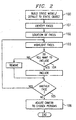
- the system builds a static model by periodically scanning the space and the static objects as indicated by step 100.
- the closest object is usually selected to be an object along the camera's centerline as a start reference point and is also part of step 100.
- the program in the CPU identifies the human faces from the camera's overall bit image as illustrated in step 101 in Fig. 2.
- the users images may be on an object file and compared with the bit map to identify whom is on the screen.
- the system includes the program that identifies the locations of the faces on the screen as illustrated in step 102.
- step 104 The system then prompts in step 104 the user to answer if the face is to be included in the video session by a message on the display or otherwise the query "Include in video session?" and highlighting (step 103) the face of the person the question is address.
- the system can begin by starting with the person closest to the nominal position in the room (orthogonal to the center of the television or monitor screen plane). By clicking a mouse or key on the keyboard "yes" or enter holder of the remote tells the CPU or set top box to include that person highlighted.
- the system then goes to the next object person and highlights the person at step 103 and queries again at step 104 if that person is to be included.
- the highlighting and prompting repeats until all faces are determined if they will be in the video conference.
- a done or escape key is pressed and the selection is finished. This is represented by step 105.
- a next or arrow key skips the current highlighted person and moves to highlight the next one, again with a prompt to the next person.
- the system is driven by the viewer's remote clicks on a TV screen - displayed picture and the software correlates the remote's cursor position on the screen with location of the faces shown on the screen.
- the camera then adjusts (zoom, pan and tilt) to include only those persons to thereby move from human to human. .
- the set of person can be changed or enlarged or cut down in size at any time during the videophone session.
- software in the CPU or set top box identifies persons by name and not just faces. Each person's face is tagged on the screen with the CPU recorded name identified in a training session and is thereby identified by name instead of by just faces. Each person's face is tagged on the screen with the CPU recorded name. This is done in a training session for each family member for example after purchase of the equipment. The names are called out of the people to be included in the session.
- the system provides a private conversation with someone at the other end of the videophone. See Figure 3. This may be done in the "Whisper" mode. From a screen menu on the local end, at living room 11 for example, the user A desiring to go into the "Whisper mode” from the normal mode selects the "Whisper" mode on the remote 25 and designates a desired target person B in the living room 13 as the "Whisper" mode target by hopping from face to face as discussed above. This is done while the user A is viewing the other end of the link at the living room 13 for example. The face of that person A is either highlighted or the others are removed from the screen or otherwise indicated and then selected. The person is then selected as the "Whisper" mode target.
- the video camera 21 in room 13 then focuses on the target person B.
- the system performs an identification search.
- the whisper person's identification and contact address phone number may be preloaded in memory of box 27 and when the person is highlighted or selected a private telephone line number is made available.
- the videophone may be feature equipped with a set-top box 27 having Complete Telephony Integration (CTI) capabilities; i.e. the ability to dial POTS (Plain Old Telephone Service); and hook up videophone mike and speakers into a private telephone line.
- CTI Complete Telephony Integration
- the system when in the "Whisper" mode and having designated the person automatically calls his or her cellphone or private line 31 and from his or her cellphone or private line 33 and diverts (switch) the user's videophone mike and speakers out of shared audio medium into private conversation toward the target's cellphone or private line off the set-top box.
- an escape key on the remote 25 is provided to return to the normal mode. The escape also happens if the remote target hangs up on his or her cellphone or private line.
- a private view at whom I want without notice This may be provided in the voyeurism mode. This may also be selected by the remote 25.
- the capabilities are used to designate target person by hopping from face to face as discussed above such as by highlighting when viewing the other end of the link at the living room 13 in the example.
- the camera 21 at the other end (room 13) zooms and focuses on the designated target person (B in the example). This zooming can be done by "solid state” zooming so the motion of the camera will not be present to both the target person.
- Another alternative may be is the mechanical servo cam, etc. is hidden behind an opaque and static glass screen.
- the remote end may output a freeze frame of the previous (before voyeurism selection) global view of all the others at the remote end.
- An escape from the voyeurism is provided by keying the remote 25.
Landscapes
- Engineering & Computer Science (AREA)
- Multimedia (AREA)
- Signal Processing (AREA)
- Two-Way Televisions, Distribution Of Moving Picture Or The Like (AREA)
- User Interface Of Digital Computer (AREA)
- Telephonic Communication Services (AREA)
Abstract
Description
The system then prompts in
Claims (16)
- A method of acquisition of participants in a video telephony session comprising the steps of:building a visual enumeration list of humans in the video telephony session for the camera to focus on;determining locations of the humans; andcontrolling the camera to hop directly from human to human.
- The method of Claim 1 wherein said building step includes highlighting a human and prompting users to identify if that human is to be included.
- The method of Claim 1 wherein each person's face is tagged in a training session and the humans to be included are called out or otherwise determined by the tag.
- The method of any preceding claim wherein the locations of the human faces are determined and stored.
- The method of any preceding claim wherein the building step includes comparing a stored bit map of the faces of participants with a received bit map from the camera and the locating step determines the locations of the faces in the image.
- The method of any preceding claim wherein the camera includes a drive circuit responsive to the stored locations for driving the camera to focus on the faces.
- The method of any preceding claim including the step of designating a target person in a whisper target mode, and diverting videophone mike and speakers out of shared audio to private conversation.
- The method of Claim 7 including the step of automatically calling designated person's private phone when designating a target person as the whisper target.
- The method of Claim 8 wherein the designated target person's cellphone is called.
- The method of Claim 7 wherein said designating step includes highlighting the target person on the video screen.
- The method of Claim 7 wherein said designating step includes removing all other humans on the screen but the target person.
- The method of Claim 7 including the step of escaping from the whisper mode using a remote.
- The method of any preceding claim including the step of a voyeurism mode designating a target person for viewing without notice.
- The method of Claim 13 wherein said camera on the other end zooms on the target person for viewing.
- The method of Claim 13 wherein the target person's view of user's view only has a freeze frame view of user's view before going into the voyeurism mode.
- The method of Claim 13 including the step of escaping from the voyeurism mode using a remote.
Applications Claiming Priority (4)
| Application Number | Priority Date | Filing Date | Title |
|---|---|---|---|
| US21043300P | 2000-06-08 | 2000-06-08 | |
| US210433P | 2000-06-08 | ||
| US22546400P | 2000-08-15 | 2000-08-15 | |
| US225464P | 2000-08-15 |
Publications (2)
| Publication Number | Publication Date |
|---|---|
| EP1162815A2 true EP1162815A2 (en) | 2001-12-12 |
| EP1162815A3 EP1162815A3 (en) | 2002-04-17 |
Family
ID=26905147
Family Applications (1)
| Application Number | Title | Priority Date | Filing Date |
|---|---|---|---|
| EP01202171A Withdrawn EP1162815A3 (en) | 2000-06-08 | 2001-06-07 | Method and system for video telephony |
Country Status (2)
| Country | Link |
|---|---|
| US (1) | US20010055058A1 (en) |
| EP (1) | EP1162815A3 (en) |
Cited By (4)
| Publication number | Priority date | Publication date | Assignee | Title |
|---|---|---|---|---|
| EP2007141A1 (en) * | 2007-06-20 | 2008-12-24 | Alcatel Lucent | A system and method for providing a video conference |
| US7590941B2 (en) * | 2003-10-09 | 2009-09-15 | Hewlett-Packard Development Company, L.P. | Communication and collaboration system using rich media environments |
| WO2011062339A1 (en) | 2009-11-17 | 2011-05-26 | Lg Electronics Inc. | Method for user authentication, and video communication apparatus and display apparatus thereof |
| WO2016100131A1 (en) * | 2014-12-19 | 2016-06-23 | Microsoft Technology Licensing, Llc | Automatic camera adjustment to follow a target |
Families Citing this family (8)
| Publication number | Priority date | Publication date | Assignee | Title |
|---|---|---|---|---|
| US7362349B2 (en) * | 2002-07-10 | 2008-04-22 | Seiko Epson Corporation | Multi-participant conference system with controllable content delivery using a client monitor back-channel |
| GB2395853A (en) * | 2002-11-29 | 2004-06-02 | Sony Uk Ltd | Association of metadata derived from facial images |
| US20040236830A1 (en) * | 2003-05-15 | 2004-11-25 | Steve Nelson | Annotation management system |
| US20040230655A1 (en) * | 2003-05-16 | 2004-11-18 | Chia-Hsin Li | Method and system for media playback architecture |
| US7500795B2 (en) * | 2004-09-09 | 2009-03-10 | Paul Sandhu | Apparatuses, systems and methods for enhancing telemedicine, video-conferencing, and video-based sales |
| US7524119B2 (en) * | 2005-02-03 | 2009-04-28 | Paul Sandhu | Apparatus and method for viewing radiographs |
| US8125509B2 (en) * | 2006-01-24 | 2012-02-28 | Lifesize Communications, Inc. | Facial recognition for a videoconference |
| JP7800236B2 (en) | 2022-03-18 | 2026-01-16 | セイコーエプソン株式会社 | Display method and display system |
Family Cites Families (9)
| Publication number | Priority date | Publication date | Assignee | Title |
|---|---|---|---|---|
| JPS60208184A (en) * | 1984-03-30 | 1985-10-19 | Nec Corp | Television conference device |
| US5323470A (en) * | 1992-05-08 | 1994-06-21 | Atsushi Kara | Method and apparatus for automatically tracking an object |
| US5742329A (en) * | 1992-10-26 | 1998-04-21 | Canon Kabushiki Kaisha | Image pickup system and communication system for use in video conference system or the like |
| KR100276681B1 (en) * | 1992-11-07 | 2001-01-15 | 이데이 노부유끼 | Video camera system |
| JP3401587B2 (en) * | 1995-11-15 | 2003-04-28 | 富士通株式会社 | Virtual proximity service control system |
| JPH1051755A (en) * | 1996-05-30 | 1998-02-20 | Fujitsu Ltd | Screen display control device for video conference terminal |
| US5916302A (en) * | 1996-12-06 | 1999-06-29 | International Business Machines Corporation | Multimedia conferencing using parallel networks |
| US6061055A (en) * | 1997-03-21 | 2000-05-09 | Autodesk, Inc. | Method of tracking objects with an imaging device |
| FR2782877B1 (en) * | 1998-08-31 | 2000-10-13 | France Telecom | AUTOMATIC SOUND AND IMAGE SYSTEM |
-
2001
- 2001-04-27 US US09/843,674 patent/US20010055058A1/en not_active Abandoned
- 2001-06-07 EP EP01202171A patent/EP1162815A3/en not_active Withdrawn
Cited By (5)
| Publication number | Priority date | Publication date | Assignee | Title |
|---|---|---|---|---|
| US7590941B2 (en) * | 2003-10-09 | 2009-09-15 | Hewlett-Packard Development Company, L.P. | Communication and collaboration system using rich media environments |
| EP2007141A1 (en) * | 2007-06-20 | 2008-12-24 | Alcatel Lucent | A system and method for providing a video conference |
| WO2011062339A1 (en) | 2009-11-17 | 2011-05-26 | Lg Electronics Inc. | Method for user authentication, and video communication apparatus and display apparatus thereof |
| EP2502435A4 (en) * | 2009-11-17 | 2014-05-07 | Lg Electronics Inc | METHOD FOR IDENTIFYING USERS, APPARATUS FOR IDENTIFYING USERS AND DISPLAY APPARATUS THEREFOR |
| WO2016100131A1 (en) * | 2014-12-19 | 2016-06-23 | Microsoft Technology Licensing, Llc | Automatic camera adjustment to follow a target |
Also Published As
| Publication number | Publication date |
|---|---|
| US20010055058A1 (en) | 2001-12-27 |
| EP1162815A3 (en) | 2002-04-17 |
Similar Documents
| Publication | Publication Date | Title |
|---|---|---|
| US6208373B1 (en) | Method and apparatus for enabling a videoconferencing participant to appear focused on camera to corresponding users | |
| US5907604A (en) | Image icon associated with caller ID | |
| US6414707B1 (en) | Apparatus and method for incorporating virtual video conferencing environments | |
| US8154583B2 (en) | Eye gazing imaging for video communications | |
| US6839079B2 (en) | Video-telephony system | |
| US8159519B2 (en) | Personal controls for personal video communications | |
| US8253770B2 (en) | Residential video communication system | |
| US8154578B2 (en) | Multi-camera residential communication system | |
| US8063929B2 (en) | Managing scene transitions for video communication | |
| US20110216153A1 (en) | Digital conferencing for mobile devices | |
| US20050073574A1 (en) | Videophone system and method | |
| US20010055058A1 (en) | Method and system for video telephony | |
| US20060125914A1 (en) | Video input for conversation with sing language, video i/o device for conversation with sign language, and sign language interpretation system | |
| EP2466883A1 (en) | Method and device for realizing videophone | |
| US7508413B2 (en) | Video conference data transmission device and data transmission method adapted for small display of mobile terminals | |
| KR101141478B1 (en) | Graphical user interface apparatus and connection method in two-way communication system | |
| US6219086B1 (en) | Terminal apparatus | |
| JP2004312634A (en) | Videophone terminal, videophone system, and screen display setting method therefor | |
| JPH1056626A (en) | Video conference system | |
| WO2004077829A1 (en) | Video conference system for mobile communication | |
| JP2002058004A (en) | Videophone method and system | |
| JP2003102003A (en) | Monitoring device | |
| KR100873389B1 (en) | Video answering service using video call service method and apparatus therefor | |
| JP4085685B2 (en) | Video conference system, terminal device included therein, and communication method | |
| CN110996037A (en) | A multipoint video conference screen display system and control method thereof |
Legal Events
| Date | Code | Title | Description |
|---|---|---|---|
| PUAI | Public reference made under article 153(3) epc to a published international application that has entered the european phase |
Free format text: ORIGINAL CODE: 0009012 |
|
| AK | Designated contracting states |
Kind code of ref document: A2 Designated state(s): AT BE CH CY DE DK ES FI FR GB GR IE IT LI LU MC NL PT SE TR |
|
| AX | Request for extension of the european patent |
Free format text: AL;LT;LV;MK;RO;SI |
|
| PUAL | Search report despatched |
Free format text: ORIGINAL CODE: 0009013 |
|
| AK | Designated contracting states |
Kind code of ref document: A3 Designated state(s): AT BE CH CY DE DK ES FI FR GB GR IE IT LI LU MC NL PT SE TR |
|
| AX | Request for extension of the european patent |
Free format text: AL;LT;LV;MK;RO;SI |
|
| RIC1 | Information provided on ipc code assigned before grant |
Free format text: 7H 04M 3/56 A, 7H 04N 7/15 B |
|
| 17P | Request for examination filed |
Effective date: 20021017 |
|
| AKX | Designation fees paid |
Free format text: AT BE CH CY DE DK ES FI FR GB GR IE IT LI LU MC NL PT SE TR |
|
| 17Q | First examination report despatched |
Effective date: 20030701 |
|
| STAA | Information on the status of an ep patent application or granted ep patent |
Free format text: STATUS: THE APPLICATION IS DEEMED TO BE WITHDRAWN |
|
| 18D | Application deemed to be withdrawn |
Effective date: 20050607 |