EP1162810A2 - Data distribution device and method - Google Patents
Data distribution device and method Download PDFInfo
- Publication number
- EP1162810A2 EP1162810A2 EP01304889A EP01304889A EP1162810A2 EP 1162810 A2 EP1162810 A2 EP 1162810A2 EP 01304889 A EP01304889 A EP 01304889A EP 01304889 A EP01304889 A EP 01304889A EP 1162810 A2 EP1162810 A2 EP 1162810A2
- Authority
- EP
- European Patent Office
- Prior art keywords
- data
- image data
- terminal
- distribution device
- image
- Prior art date
- Legal status (The legal status is an assumption and is not a legal conclusion. Google has not performed a legal analysis and makes no representation as to the accuracy of the status listed.)
- Withdrawn
Links
Images




Classifications
-
- H—ELECTRICITY
- H04—ELECTRIC COMMUNICATION TECHNIQUE
- H04L—TRANSMISSION OF DIGITAL INFORMATION, e.g. TELEGRAPHIC COMMUNICATION
- H04L67/00—Network arrangements or protocols for supporting network services or applications
- H04L67/01—Protocols
- H04L67/02—Protocols based on web technology, e.g. hypertext transfer protocol [HTTP]
- H04L67/025—Protocols based on web technology, e.g. hypertext transfer protocol [HTTP] for remote control or remote monitoring of applications
-
- G—PHYSICS
- G06—COMPUTING OR CALCULATING; COUNTING
- G06F—ELECTRIC DIGITAL DATA PROCESSING
- G06F16/00—Information retrieval; Database structures therefor; File system structures therefor
- G06F16/90—Details of database functions independent of the retrieved data types
- G06F16/95—Retrieval from the web
- G06F16/957—Browsing optimisation, e.g. caching or content distillation
- G06F16/9577—Optimising the visualization of content, e.g. distillation of HTML documents
-
- H—ELECTRICITY
- H04—ELECTRIC COMMUNICATION TECHNIQUE
- H04L—TRANSMISSION OF DIGITAL INFORMATION, e.g. TELEGRAPHIC COMMUNICATION
- H04L67/00—Network arrangements or protocols for supporting network services or applications
- H04L67/01—Protocols
- H04L67/02—Protocols based on web technology, e.g. hypertext transfer protocol [HTTP]
-
- H—ELECTRICITY
- H04—ELECTRIC COMMUNICATION TECHNIQUE
- H04L—TRANSMISSION OF DIGITAL INFORMATION, e.g. TELEGRAPHIC COMMUNICATION
- H04L67/00—Network arrangements or protocols for supporting network services or applications
- H04L67/50—Network services
- H04L67/56—Provisioning of proxy services
- H04L67/561—Adding application-functional data or data for application control, e.g. adding metadata
-
- H—ELECTRICITY
- H04—ELECTRIC COMMUNICATION TECHNIQUE
- H04L—TRANSMISSION OF DIGITAL INFORMATION, e.g. TELEGRAPHIC COMMUNICATION
- H04L67/00—Network arrangements or protocols for supporting network services or applications
- H04L67/50—Network services
- H04L67/56—Provisioning of proxy services
- H04L67/565—Conversion or adaptation of application format or content
-
- H—ELECTRICITY
- H04—ELECTRIC COMMUNICATION TECHNIQUE
- H04L—TRANSMISSION OF DIGITAL INFORMATION, e.g. TELEGRAPHIC COMMUNICATION
- H04L67/00—Network arrangements or protocols for supporting network services or applications
- H04L67/50—Network services
- H04L67/56—Provisioning of proxy services
- H04L67/565—Conversion or adaptation of application format or content
- H04L67/5651—Reducing the amount or size of exchanged application data
-
- H—ELECTRICITY
- H04—ELECTRIC COMMUNICATION TECHNIQUE
- H04L—TRANSMISSION OF DIGITAL INFORMATION, e.g. TELEGRAPHIC COMMUNICATION
- H04L67/00—Network arrangements or protocols for supporting network services or applications
- H04L67/2866—Architectures; Arrangements
- H04L67/288—Distributed intermediate devices, i.e. intermediate devices for interaction with other intermediate devices on the same level
-
- H—ELECTRICITY
- H04—ELECTRIC COMMUNICATION TECHNIQUE
- H04L—TRANSMISSION OF DIGITAL INFORMATION, e.g. TELEGRAPHIC COMMUNICATION
- H04L67/00—Network arrangements or protocols for supporting network services or applications
- H04L67/50—Network services
- H04L67/56—Provisioning of proxy services
- H04L67/568—Storing data temporarily at an intermediate stage, e.g. caching
-
- H—ELECTRICITY
- H04—ELECTRIC COMMUNICATION TECHNIQUE
- H04L—TRANSMISSION OF DIGITAL INFORMATION, e.g. TELEGRAPHIC COMMUNICATION
- H04L67/00—Network arrangements or protocols for supporting network services or applications
- H04L67/50—Network services
- H04L67/75—Indicating network or usage conditions on the user display
-
- H—ELECTRICITY
- H04—ELECTRIC COMMUNICATION TECHNIQUE
- H04L—TRANSMISSION OF DIGITAL INFORMATION, e.g. TELEGRAPHIC COMMUNICATION
- H04L69/00—Network arrangements, protocols or services independent of the application payload and not provided for in the other groups of this subclass
- H04L69/30—Definitions, standards or architectural aspects of layered protocol stacks
- H04L69/32—Architecture of open systems interconnection [OSI] 7-layer type protocol stacks, e.g. the interfaces between the data link level and the physical level
- H04L69/322—Intralayer communication protocols among peer entities or protocol data unit [PDU] definitions
- H04L69/329—Intralayer communication protocols among peer entities or protocol data unit [PDU] definitions in the application layer [OSI layer 7]
Definitions
- the present invention relates to a data distribution device that is connected to the Internet and that distributes data.
- a WWW server is one of data distribution devices that distribute data in response to data requests from the terminals connected to the Internet.
- the WWW server directly distributes requested data in response to a request from a data display application, called a browser, running on a data terminal.
- a browser For a browser capable of displaying text data only, the WWW server converts all data to text data before distribution.
- a server which converts general web pages for distribution to Internet connectable cellular phones, converts image data to text data before distribution.
- the device according to the present invention When a request for image data incompatible with a data terminal, such as a cellular phone, is received from the data terminal, the device according to the present invention automatically converts the format of the image data to a format compatible with the data terminal. In addition, when the data size or the display size of image data is too large to be displayed on a data terminal, the device according to the present invention automatically reduces the data size or the display size. Also, to solve the problem that a simply reduced image is not clear if displayed on a small-sized display screen, the enlarge buttons or partial-display buttons are provided to allow the user to enlarge the image on the display.
- FIG. 1 is a system configuration diagram of a data distribution system.
- a data distribution device 100 capable of sending or receiving data over a network 120, sends data requested by a data terminal 130 over the network 120.
- Data to be sent may be stored in the data distribution device 100 or in another server such as a data server 110.
- the data server 110 is a device in which data to be sent from the data distribution device 100 is stored.
- the network 120 is a network such as the Internet or a LAN (Local Area Network).
- the data terminal 130 connectable to the network, may acquire data from the data distribution device 100 over the network 120 and display acquired data.
- FIG. 2 is a flowchart of basic data distribution processing (210) performed by the data distribution device 100.
- the data distribution device 100 receives a data acquisition request from the data terminal 130 over the network 120 (step 220).
- the data distribution device 100 checks if it has the requested data in its own server 100 (step 230) and, if not, acquires data from the data server 110 (step 240). Then, the data distribution device 100 sends the acquired data to the data terminal 130 (step 250).
- the data distribution device 100 is a WWW server
- the network is the Internet or a LAN (Local Area Network).
- the data terminal 130 issues a data acquisition request from a display application called a browser.
- the WWW server 100 sends a page at the requested Internet address back to the data terminal 130 to allow the browser running on the data terminal 130 to display the page.
- Data requested by the data terminal includes text data, voice data, and image data.
- FIG. 3 is a flowchart showing data conversion transmission processing (310).
- the data distribution device 100 receives a data distribution request to distribute data including image data (step 320).
- This data distribution request includes the attribute data on the data terminal 130.
- the data distribution device 100 is a WWW server to which a data distribution request is sent from the browser running on the data terminal 130
- the header of the data distribution request message includes information on the browser type, data terminal type, and so on.
- the data distribution device 100 acquires the requested image data from the data server (step 330).
- the data distribution device 100 checks if data acquired from the data server 110 may be displayed on the data terminal 130 based on the attribute information on the data terminal 130 received in step 320 (step 340).
- This checking may also be made based on how data terminal is connected to the data distribution device 100 or how data is specified depending on the type of the data terminal 130. For example, if a URL used by a cellular phone to connect to a web page on the Internet differs from a URL used by a personal computer to connect to a web page, the URL may be used to judge that the connection has been made from a cellular phone. If image data cannot be displayed on the data terminal (NO in step 340), a check is made to see if the image cannot be displayed because of image data format incompatibility (step 350). The image data format, if incompatible, is converted to a format in which the image data may be displayed on the data terminal 130 (step 360).
- step 370 If the image data format is found to be compatible in step 350 or after the image data format is converted in step 360, other conversions are performed for the image data (step 370). Other conversions include changes in image data sizes, in image data display sizes, and in the number of image data colors.
- the image data for which the above conversion has been made is sent to the data terminal 130 (step 380).
- the step (340) for checking if image data may be displayed on the data terminal 130 during the data conversion transmission processing (310) shown in FIG. 3 is not required. Instead, image data may always be converted.
- the data terminal 130 is a cellular phone and the system is built with the data distribution device 100 as a WWW server for cellular phones
- the data terminal 130 that connects to the data distribution device 100 may be determined as a cellular phone.
- image data may always be converted to a format displayable on a cellular phone for transmission to it.
- the format of image data is automatically converted to a format displayable on the data terminal 130 before transmission to the data terminal 130.
- This method allows the user to view the rough image of the image data that cannot be displayed on the data terminal 130. Also, this method automatically converts the format of image data to a format compatible with the data terminal 130, eliminating the need for creating image data in a format specific to each data terminal.
- FIG. 4 is a diagram showing the system configuration of the video data distribution system.
- a camera server 410 is a device capable of storing videos captured by a camera 440 and distributing the captured videos over the network.
- a data distribution device 400 periodically acquires videos from the camera servers 410 and, in response to a request from a data terminal 430, sends the requested video.
- a network 420 is a network such as the Internet or a LAN.
- the data terminal 430 connectable to the network, may acquire data from the data distribution device 400 and display it.
- FIG. 5 is a flowchart showing real-time video data distribution processing (510).
- the data distribution device 400 checks if the terminal is requesting a real-time image (step 530). If the terminal is requesting a real-time image (Yes in step 530), the data distribution device 400 acquires from the camera server 410 a live video being captured by the camera 440 (step 540). For example, with the WWW server function on the camera server 410 for video distribution, the data distribution device 400 with the browser function could acquire video data from the camera server 410. For the camera server 410 compatible with its own protocol only, the data distribution device 400 acquires video data according to the protocol of the camera server 410.
- the data distribution device 400 acquires one to scores of frames of still image data, or several seconds to scores of seconds of moving image data, as video data to be acquired.
- the device converts video data, acquired from the camera server 410 or stored in the data distribution device 400, to data displayable on the data terminal 430 (step 550).
- the device sends the video data to the data terminal 430 (step 560).
- the device stores log data such as the conversion date, size of video data before and after conversion, and the number of transmissions (step 570). If the amount of transmission data is large, text data associated with the video data or reduced-size image data may be sent instead of the video data in step 560. If the data that is sent is selected instead of the video data on the data terminal 430, the data produced by conversion in step 550 is sent. Doing so makes it possible to ask the user if it is necessary to send a large amount of data.
- FIG. 6 is a flowchart showing moving image data distribution processing 610 in which a video captured by the camera 440 is sent to the data terminal 430 as a moving image.
- the data distribution device 400 checks if the terminal is requesting real-time moving image data (step 630). If the terminal is requesting real-time moving image data (Yes in step 630), the device acquires a live video from the camera server 410 (step 640). From video data acquired from the camera server 410 or stored in the data distribution device 400, the device creates moving image data displayable on the data terminal 430 (step 650).
- the device converts the format of the moving image data to a format displayable on the data terminal 430. If the video data acquired from the camera server 410 is moving data and if the data terminal 430 can reproduce moving image data in a continuous still image display format, the device creates a plurality of still image data frames from the moving image data acquired from the camera server 410 and, from the plurality of still image data frames, creates moving image data in the continuous still image display format.
- the device acquires a plurality of still image data frames from the camera server 410 and, from the plurality of still image data frames, creates moving image data in the continuous still image display format. Then, the device sends the converted image data to the data terminal 430 (step 660). Finally, the device stores information on the conversion date, conversion data sizes, and other transmission records into the log (step 670).
- the user may view image data converted by the data distribution device 400.
- the device converts a plurality of still image frames into the continuous still image display format to allow the user to view moving images, captured by the camera 440, even on the data terminal 430.
- the moving image data distribution processing 610 may also be used to split a still image into multiple pieces, to extend each piece to produce a plurality of still images and, from the extended still images, to create data in the continuous still image display format. Continuous display of the pieces created by splitting a still image as described above allows the user to view the entire image on a small-size screen, such as that of a cellular phone, without having to reduce the image.
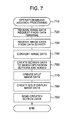
- FIG. 7 is a flowchart showing operation means addition processing 710 in which a user interface is added for enabling the user to perform operation on image data distributed to the data terminal.
- the system configuration will be described with reference to FIG. 1.
- the data distribution device 100 receives a request to send data 810 composed of text and image data shown in FIG. 8 (step 720). If the data 810 is in the data server 110, the data distribution device 100 acquires the data 810 from the data server 110 (step 730). Then, the device converts image data 830 (step 750). In the description below, it is assumed that the system is built such that the data distribution device 100 receives a data request only from the specific data terminal 130.
- the device converts the format of data to an image data format displayable on the data terminal 130 and, at the same time, converts the image display size to fit the data terminal 130 (step 750). Then, from the data 810 requested by the data terminal 130, the device creates screen display data 940 displayed on the data terminal 130 shown in FIG. 9 (step 760). Text data 920 included in the created screen display data is identical to text data 820 included in the requested data 810. Image data 930 is data generated by converting the requested image data 830 in step 750. Arrows (931-939), which are image data operation buttons, are data added by the data distribution device 100.
- the image data operation button 931 when selected, displays screen 1040 in FIG. 10.
- the image data operation buttons (931-939) are assigned numeric keys (950-959) on the data terminal 130, one for each. Selecting the image data operation button 931 is equivalent to pressing the numeric key 1 (951).
- the image data 830 is split into nine to create nine pieces of image data (841-849) (step 770).
- image data operation buttons (1031-1039) are added to each of the split image data (841-849) to create split display screen data (step 780).
- the image data is split into nine in this example, nine pieces of split display screen data are created, one for each split screen. Pressing an arrow in the screen display data created in step 760 calls the corresponding split display screen data created in step 780.
- the created screen display data 940 is sent to the data terminal 130 (step 790).
- the numeric keys (950-959) are allocated to display the split image data (841-849).
- the numeric key 0, indicated by the numeral 950, is used to go back to the previous screen.
- the numeric key 5 (955) is used as an enlarge button.
- the arrow in the corresponding direction is selected to scroll the screen in the arrow direction.
- the allocation of the numeric keys (950-959) in this case corresponds to the layout of the arrows of the image data operation buttons (931-939) in the screen display data 940.
- FIG. 11 is a flowchart showing split image display data distribution processing that is performed when one of the image data operation buttons (931-939) or numeric keys (950-959) shown in FIG. 9 is pressed.
- the data distribution device 100 receives a screen data distribution request (step 1120).
- the data distribution device 100 sends the screen data 1040 created in step 780 in FIG. 7 to the data terminal 130 (step 1130).
- the split display screen data created in step 780 in FIG. 7, which is sent to the data terminal 130 in step 790, may be split in the data terminal 130 for display.
- the system is built such that pressing one of the image data operation buttons (931-939) in FIG. 9 does not send a data transmission request to the data distribution device 100 but calls the split display screen data that has been sent to the data terminal 130.
- the data terminal has operation buttons to allow the user to view an enlarged image when the display screen on which an image is displayed is small. Those operation buttons enable the user to view detail of the image even on a data terminal with a small display screen.
- the data distribution device creates the split display screens, eliminating the need for the data server to prepare split display image data.
- FIG. 12 is a diagram showing the configuration of a data distribution system.
- a cellular phone 1210 connects to a data distribution device 1230 via a cellular phone network 1220 and the Internet 1221 to allow the user to view information stored in the data distribution device 1230.
- the data distribution device 1230 is connected to the Internet 1221 and, via a serial cable, to a dial-up router 1240.
- the dial-up router 1240 connects to a dial-up router 1241 via a telephone line 1222 for data communication. Therefore, via the dial-up router 1240 and the dial-up router 1241, the data distribution device 1230 may acquire video, captured by a camera 1260, via a camera server 1250. This configuration allows the user to acquire video data in the camera server 1250, to which the cellular phone 1210 is not connected via the network, via the data distribution device 1230.
- FIG. 13 is a diagram showing user information 1300 stored in the data distribution device 1230
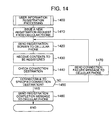
- FIG. 14 is a flowchart showing user information registration processing 1400 in which the user information 1300 received from the cellular phone 1210 is registered with the data distribution device 1230.
- the data distribution device 1230 sends a registration screen to the cellular phone 1210 (step 1420).
- the contents to be registered include a user ID 1320, a password 1330, a destination number 1340, a line type 1350, a connection destination name 1361, a connection destination address 1362, a connection destination camera server 1363, and so on.
- a terminal ID 1310 which is received by the data distribution device 1230 when the cellular phone 1210 connects to the data distribution device 1230, is information which uniquely identifies the cellular phone 1210, such as the telephone number of the cellular phone 1210 and the terminal number of the cellular phone 1210.
- the data distribution device 1230 does not receive the terminal ID 1310, it identifies the user only with the user ID and the password but does not register user information. How this information is used will be described later with reference to FIG. 15.
- the device Upon receiving the contents to be registered (step 1430), the device checks if the specified destination number 1340 and the connection destination address 1362 are correct (step 1440).
- the device makes a telephone call to the specified destination number 1340 via the dial-up router 1240 to establish the data communication route and checks if the device can connect to the connection destination address 1362. To check to see if it is possible to connect, the data distribution device 1230 issues, for example, the PING command to the connection destination address 1362 to check if a response will be returned. If the connection cannot be confirmed (No in step 1450), the device sends the connection failure message to the cellular phone 1210 (step 1470) and sends the registration screen to the cellular phone 1210 again (step 1420). If the connection can be confirmed as a result of checking (Yes in step 1450), the device sends a registration completion message to the cellular phone (step 1460) to finish the user information registration processing 1400.
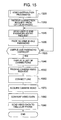
- FIG. 15 is a flowchart showing video distribution processing 1500 performed by the data distribution device 1230.
- the data distribution device 1230 sends the user ID and the password entry screen to the cellular phone 1210 (step 1520).
- the user ID and password entry screen is displayed on the cellular phone 1210.
- the data distribution device 1230 receives the user ID and the password (step 1530).
- the device compares the received user ID and the password with the user ID 1320 and the password 1330 stored as the user information 1300 (step 1535).
- the user of the cellular phone 1210 is identified with the user ID and the password in this example, the user may be identified only with the terminal ID 1310.
- the device sends the user ID and password entry screen to the cellular phone 1210 again (step 1520). If the user ID and the password are valid (Yes in step 1535), the device displays a list of names (1361, 1371, 1381) of registered connection destinations 1-3 (step 1540). The user of the cellular phone 1210 selects a desired connection destination from the list of names (1361, 1371, 1381) of connection destinations 1-3.
- connection destination 1 When connection destination 1 is selected on the cellular phone 1210, the device receives a message (that is, camera video request message) indicating that connection destination 1 has been selected (step 1550).
- the data distribution device 1230 makes a telephone call to the registered destination number 1340 via the dial-up router 1240 to establish a communication line with the dial-up router 1241 (step 1560).
- the data distribution device 1230 sends the camera video acquisition request to the connection destination address 1362 of connection destination 1 to acquire the video of a camera 1260a from a camera server 1250a which is connection destination 1 (step 1570). Because the camera server type 1363 of connection destination 1 (1360) is cam01, the device acquires video using the video acquisition method according to cam01.
- the data distribution device 1230 uses the http protocol to acquire video data from the camera server 1250a. If the video data acquired from the camera server 1250a is in a format not displayable on the cellular phone 1210, the device converts the video data (step 1580). Then, the device sends the video data to the cellular phone 1210 (step 1590).
- the user of a cellular phone connectable to the Internet can view the video of a camera connected to a camera server not connected to the Internet.
- the data distribution device acquires video from a camera server connected to the Internet and converts the image before transmission to a cellular phone.
- connecting a camera server to the Internet involves the 24-hour or dial-up connection charges.
- the device in this embodiment establishes a line connection for data transmission only when an image acquisition request is received from a cellular phone, significantly reducing the connection charge and communication charge.
- the device in this embodiment enables a cellular phone user to view a video captured by an individually owned camera that cannot be connected to the Internet. Also, even if a camera is not connected to the Internet, the device in this embodiment allows the user to view the video of the camera simply by registering required information from a cellular phone.
Landscapes
- Engineering & Computer Science (AREA)
- Computer Networks & Wireless Communication (AREA)
- Signal Processing (AREA)
- Databases & Information Systems (AREA)
- Theoretical Computer Science (AREA)
- Library & Information Science (AREA)
- Data Mining & Analysis (AREA)
- Physics & Mathematics (AREA)
- General Engineering & Computer Science (AREA)
- General Physics & Mathematics (AREA)
- User Interface Of Digital Computer (AREA)
- Information Transfer Between Computers (AREA)
Abstract
Description
Claims (28)
- A data distribution device (100) connected to a communication network (120), comprising:attribute information acquiring means for acquiring attribute information on a data terminal (130), connected to said communication network (120), in response to an image data request from said data terminal (130);image data recognizing means for recognizing image data that may be displayed on said data terminal (130) based on the acquired attribute information on said data terminal (130);image data converting means for converting the requested image data to image data that may be displayed on said data terminal (130) when said image data recognizing means judges that the requested image data cannot be displayed on said data terminal (130); anddata sending means for sending the converted image data to said data terminal (130).
- A data distribution device (100) connected to a communication network (120), comprising:setting means for setting an image data type of image data requested by a data terminal (130), connected to said communication network (120), by associating the image data type with a method for connecting said data terminal (130) to said data distribution device (100), with a data request method, with a data specification method, with a data terminal type, with types of software on said data terminal (130), or with a combination thereof;image data converting means for converting the requested image data to the image data type that has been set; andsending means for sending the converted image data to said data terminal (130).
- The data distribution device (100) according to claim 1 or 2, further comprising:means for replacing the image data, requested by said data terminal (130), with simplified data indicating the image data;means for relating the simplified data to the requested image data;means for adding a command that is automatically sent from said data terminal (130) to said data distribution device (100) when the simplified data is selected on said data terminal (130); andmeans for sending the image data converted by said image data converting means to said data terminal (130) when the command is received.
- The data distribution device (100) according to claim 1 or 2, further comprising:
means for recording log information, such as a date and time, a data conversion amount, a number of conversions, a number of requests, or a conversion processing time, when all or a part of the requested data is converted in response to the data request from said data terminal (130). - The data distribution device (100) according to claim 1 or 2,
wherein said image data converting means has a function that reduces a data size of the requested image data so that said data terminal (130) may receive the image data or a function that converts a display size of the requested image to a display size displayable on said data terminal (130). - The data distribution device (100) according to claim 1 or 2,
wherein said image data converting means has a function that converts an image data format to a format displayable on said data terminal (130). - The data distribution device (100) according to claim 1,
wherein said attribute information acquiring means has a function that acquires a display screen size of said data terminal (130) and wherein said image data converting means has an image display size converting function that enlarges, reduces, or cuts the requested image data to fit the display size of said data terminal (130). - The data distribution device (100) according to claim 1 or 2,
wherein, when the image data requested by said data terminal (130) is still image data and there is other still image data relating to the still image data, said image data converting means has a function that converts the image data to continuous still image display data from which a plurality of still image data pieces may be continuously displayed on said data terminal (130) automatically. - The data distribution device (100) according to claim 1 or 2,
wherein, when the image data requested by said data terminal (130) is still image data, said image data converting means has means for splitting the requested still image data and a function that converts the split images of the requested still image to continuous image display data in such a way that the split images of the requested still image are continuously displayed on said data terminal (130). - The data distribution device (100) according to claim 1 or 2,
wherein, when the image data requested by said data terminal (130) is moving image data, said image data converting means has a function that retrieves one or more still images from the moving image data and converts the retrieved still images to a data format compatible with said data terminal (130). - A data distribution device (100) connected to a communication network (120), comprising:adding means for adding operation commands to data requested by a data terminal (130), said operation commands allowing said data terminal (130) to operate on all or a part of the requested data; andsending means for sending the requested data and the added operation commands to said data terminal (130).
- The data distribution device (100) according to claim 11,
wherein the operation commands have a function that issues an operation request from said data terminal (130) to said data distribution device (100), further comprising means for processing the operation request. - The data distribution device (100) according to claim 11,
wherein the operation commands have a function that executes operation processing in the data terminal (130). - The data distribution device (100) according to claim 12 or 13,
wherein, when image data is included in all or a part of the data requested by said data terminal (130), said operation commands have a function that enlarges or reduces the image data. - The data distribution device (100) according to claim 12 or 13, further comprising:
means for splitting image data when the image data is included in all or a part of the data requested by said data terminal (130), wherein the operation commands have a function that displays each of the split image data pieces on the data terminal (130). - A data distribution device (100) connected to a communication network (120), comprising:acquiring means for acquiring attribute information on a network-connectable cellular phone in response to an image data request from said cellular phone;image judging means for judging, based on the attribute information, whether said cellular phone may display the image data;converting means for converting the image data to image data displayable on the cellular phone if said image judging means judges that the image data cannot be displayed on the cellular phone; andsending means for sending the converted image data to said cellular phone.
- A data distribution device (100) connected to a communication network (120), comprising:acquiring means for acquiring attribute information on a network-connectable cellular phone in response to an image data request from said cellular phone;judging means for judging, based on the attribute information, whether said cellular phone may display the image data;converting means for converting the image data to displayable image data that may be displed on said cellular phone;replacing means for replacing the requested image data with simplified data indicating the image data;relating means for relating the simplified data to the displayable image data;adding means for adding a command that is automatically sent from said cellular phone to said data distribution device (100) when the simplified data is selected on said cellular phone; andsending means for sending the displayable image data to said cellular phone when the command is received.
- A data distribution device (100) connected to a communication network (120), comprising:adding means for adding operation commands to image data in response to an image data request from a network-connectable cellular phone, said operation commands allowing said cellular phone to operate on the image data; andsending means for sending the image data, to which the operation commands are added, to said cellular phone.
- The data distribution device (100) according to claim 18,
wherein the operation commands have a function that issues an operation request from said cellular phone to said data distribution device (100), further comprising means for performing processing for the operation request. - The data distribution device (100) according to claim 18,
wherein the operation commands have a function that executes operation processing in the cellular phone. - The data distribution device (100) according to claim 18 or 20, further comprising:
numeric button allocating means for allocating the operation commands to numeric buttons of said cellular phone wherein, when the operation commands have an image data enlargement function, the numeric button allocating means allocates the image data enlargement function to 5. - The data distribution device (100) according to claim 18 or 20, further comprising:image splitting means for splitting the image data requested by said cellular phone; andnumeric button allocating means for allocating the operation commands to numeric buttons of said cellular phone when the operation commands have a function that displays the split image data,wherein said numeric button allocating means allocates a top image display of the split image being displayed to 2, a bottom image display to 8, a right image display to 6, and a left image display to 4.
- The data distribution device (100) according to claim 22,
wherein said image splitting means has a function that splits the image data into 9 and, for the numeric key buttons allocated by said numeric key allocating means, the images split into 9 are allocated to numbers 1 to 9, respectively. - A data distribution device (100) connected to a communication network (120), comprising:acquiring means, connected to a camera or a camera server capable of capturing a video via the network, for acquiring the video captured by said camera or camera server;means for receiving a camera video acquisition request from a data terminal (130);converting means for converting the video, captured by said camera or camera server, into data displayable on said data terminal (130); andsending means for sending the converted video data to said data terminal (130).
- A data distribution method for use with a data distribution device (100) connected to a communication network (120), comprising the steps of:acquiring attribute information on a data terminal (130), connected to said communication network (120), in response to an image data request from said data terminal (130);recognizing image data that may be displayed on said data terminal (130) based on the acquired attribute information on said data terminal (130);converting the requested image data to image data that may be displayed on said data terminal (130) when said step of recognizing image data judges that the requested image data cannot be displayed on said data terminal (130); andsending the converted image data to said data terminal (130).
- A data distribution method for use with a data distribution device (100) connected to a communication network (120), comprising the steps of:adding operation commands to data requested by a data terminal (130), said operation commands allowing said data terminal (130) to operate on the requested image data; andsending the image data and the added operation commands to said data terminal (130).
- A data distribution method for use with a data distribution device (100) connected to a communication network (120), comprising the steps of:acquiring attribute information on a network-connectable cellular phone in response to an image data request from said cellular phone;judging image data, based on the attribute information, whether said cellular phone may display the image data;converting the image data to image data displayable on the cellular phone if said step of judging image data judges that the image data cannot be displayed on the cellular phone; andsending the converted image data to said cellular phone.
- A data distribution method for use with a data distribution device (100) connected to a communication network (120), said data distribution device (100) being connected to a camera or a camera server capable of capturing a video via the network (120), said method comprising the steps of:acquiring a video captured by said camera or camera server;receiving a camera video acquisition request from a data terminal (130);converting the video, captured by said camera or camera server, into data displayable on said data terminal (130); andsending the converted video data to said data terminal (130).
Applications Claiming Priority (2)
| Application Number | Priority Date | Filing Date | Title |
|---|---|---|---|
| JP2000175549 | 2000-06-07 | ||
| JP2000175549 | 2000-06-07 |
Publications (2)
| Publication Number | Publication Date |
|---|---|
| EP1162810A2 true EP1162810A2 (en) | 2001-12-12 |
| EP1162810A3 EP1162810A3 (en) | 2003-11-05 |
Family
ID=18677411
Family Applications (1)
| Application Number | Title | Priority Date | Filing Date |
|---|---|---|---|
| EP01304889A Withdrawn EP1162810A3 (en) | 2000-06-07 | 2001-06-05 | Data distribution device and method |
Country Status (1)
| Country | Link |
|---|---|
| EP (1) | EP1162810A3 (en) |
Cited By (11)
| Publication number | Priority date | Publication date | Assignee | Title |
|---|---|---|---|---|
| GB2383728A (en) * | 2001-12-27 | 2003-07-02 | Hewlett Packard Co | Reformatting/converting multimedia data in dependence on the display capabilities of an electronic appliance |
| GB2384878A (en) * | 2002-01-31 | 2003-08-06 | Hewlett Packard Co | Authoring media content for dissemination over a network accessible by a variety of device types |
| WO2004059979A1 (en) | 2002-12-31 | 2004-07-15 | British Telecommunications Public Limited Company | Video streaming |
| WO2005001684A1 (en) * | 2003-06-27 | 2005-01-06 | Nokia Corporation | Method and a system for displaying information, and a device |
| WO2005084005A1 (en) * | 2004-02-17 | 2005-09-09 | Koninklijke Philips Electronique N.V. | Method of visualizing a large still picture on a small-size display. |
| EP1480196A3 (en) * | 2003-05-19 | 2008-04-30 | FUJIFILM Corporation | Apparatus and method for moving image conversion, apparatus and method for moving image transmission, and programs therefor |
| EP1829285A4 (en) * | 2004-12-22 | 2008-05-14 | Research In Motion Ltd | System and method for enhancing network browsing speed by setting a proxy server on a handheld device |
| WO2011062689A1 (en) * | 2009-11-20 | 2011-05-26 | Rovi Technologies Corporation | Managing different formats for media files and media playback devices |
| US8631508B2 (en) | 2010-06-22 | 2014-01-14 | Rovi Technologies Corporation | Managing licenses of media files on playback devices |
| US9009794B2 (en) | 2011-12-30 | 2015-04-14 | Rovi Guides, Inc. | Systems and methods for temporary assignment and exchange of digital access rights |
| US9129087B2 (en) | 2011-12-30 | 2015-09-08 | Rovi Guides, Inc. | Systems and methods for managing digital rights based on a union or intersection of individual rights |
Family Cites Families (1)
| Publication number | Priority date | Publication date | Assignee | Title |
|---|---|---|---|---|
| US6049821A (en) * | 1997-01-24 | 2000-04-11 | Motorola, Inc. | Proxy host computer and method for accessing and retrieving information between a browser and a proxy |
-
2001
- 2001-06-05 EP EP01304889A patent/EP1162810A3/en not_active Withdrawn
Cited By (14)
| Publication number | Priority date | Publication date | Assignee | Title |
|---|---|---|---|---|
| GB2383728A (en) * | 2001-12-27 | 2003-07-02 | Hewlett Packard Co | Reformatting/converting multimedia data in dependence on the display capabilities of an electronic appliance |
| GB2384878A (en) * | 2002-01-31 | 2003-08-06 | Hewlett Packard Co | Authoring media content for dissemination over a network accessible by a variety of device types |
| WO2004059979A1 (en) | 2002-12-31 | 2004-07-15 | British Telecommunications Public Limited Company | Video streaming |
| EP1480196A3 (en) * | 2003-05-19 | 2008-04-30 | FUJIFILM Corporation | Apparatus and method for moving image conversion, apparatus and method for moving image transmission, and programs therefor |
| US7565604B2 (en) | 2003-06-27 | 2009-07-21 | Nokia Corporation | Method and a system for displaying information, and a device |
| WO2005001684A1 (en) * | 2003-06-27 | 2005-01-06 | Nokia Corporation | Method and a system for displaying information, and a device |
| US7936936B2 (en) | 2004-02-17 | 2011-05-03 | Nxp B.V. | Method of visualizing a large still picture on a small-size display |
| CN100471220C (en) * | 2004-02-17 | 2009-03-18 | Nxp股份有限公司 | Method for displaying a large still picture on a small-sized display |
| WO2005084005A1 (en) * | 2004-02-17 | 2005-09-09 | Koninklijke Philips Electronique N.V. | Method of visualizing a large still picture on a small-size display. |
| EP1829285A4 (en) * | 2004-12-22 | 2008-05-14 | Research In Motion Ltd | System and method for enhancing network browsing speed by setting a proxy server on a handheld device |
| WO2011062689A1 (en) * | 2009-11-20 | 2011-05-26 | Rovi Technologies Corporation | Managing different formats for media files and media playback devices |
| US8631508B2 (en) | 2010-06-22 | 2014-01-14 | Rovi Technologies Corporation | Managing licenses of media files on playback devices |
| US9009794B2 (en) | 2011-12-30 | 2015-04-14 | Rovi Guides, Inc. | Systems and methods for temporary assignment and exchange of digital access rights |
| US9129087B2 (en) | 2011-12-30 | 2015-09-08 | Rovi Guides, Inc. | Systems and methods for managing digital rights based on a union or intersection of individual rights |
Also Published As
| Publication number | Publication date |
|---|---|
| EP1162810A3 (en) | 2003-11-05 |
Similar Documents
| Publication | Publication Date | Title |
|---|---|---|
| US20020056131A1 (en) | Data distribution device and method | |
| US7710349B2 (en) | Methods and systems for sharing multimedia application data by a plurality of communication devices | |
| US20050114528A1 (en) | System, server, method and program for providing communication service | |
| US20030043272A1 (en) | Control system for digital camera and control method for the same | |
| JP2003052032A (en) | Information distribution system and information distribution method, information supply device and information supply method | |
| EP1467564B1 (en) | Videophone with screen display setting method | |
| EP1162810A2 (en) | Data distribution device and method | |
| JPH10228431A (en) | Interactive communication method using telephone or internet phone and WWW browser, communication device, and recording medium | |
| JP3462145B2 (en) | Image server | |
| CN102770827A (en) | Method for displaying multimedia content on a screen of a terminal | |
| US7203766B2 (en) | Gateway server in which picture contents can be displayed in small terminal, and processing speed is fast, and manufacturing cost is cheap, and method of obtaining contents | |
| EP1746518B1 (en) | Method and system for sharing multimedia data by a plurality of communication devices | |
| JP2017151909A (en) | Program, information processing divice and information processing method | |
| JP3852731B2 (en) | Map display method, map display system, and map information location management server | |
| JP2001045197A (en) | Scanner and method for transferring image data | |
| US20020097263A1 (en) | File delevery system and method for delivering file of style depending on request of each user terminal | |
| KR101318471B1 (en) | Interactive response system for giving a user access to information | |
| JP2006121614A (en) | Video distribution mediation system, video distribution mediation apparatus, video distribution mediation method, and video distribution mediation program | |
| JP2002287952A (en) | How to transmit information | |
| EP1195698A1 (en) | A process for supplying a web site designer or web site host type customer with a tool for transforming an image from a first format into a second format | |
| KR100711193B1 (en) | How to display images in wireless photochat | |
| US20060050859A1 (en) | Telephone system, server apparatus, information display method for use therewith and its program | |
| JP3334666B2 (en) | Facsimile transmission method | |
| JP2001243182A (en) | Server system, and method for interlocking web contents with the server system | |
| JP3800042B2 (en) | Information transfer system, information transfer method, proxy server, and proxy server program |
Legal Events
| Date | Code | Title | Description |
|---|---|---|---|
| PUAI | Public reference made under article 153(3) epc to a published international application that has entered the european phase |
Free format text: ORIGINAL CODE: 0009012 |
|
| 17P | Request for examination filed |
Effective date: 20010625 |
|
| AK | Designated contracting states |
Kind code of ref document: A2 Designated state(s): AT BE CH CY DE DK ES FI FR GB GR IE IT LI LU MC NL PT SE TR |
|
| AX | Request for extension of the european patent |
Free format text: AL;LT;LV;MK;RO;SI |
|
| PUAL | Search report despatched |
Free format text: ORIGINAL CODE: 0009013 |
|
| AK | Designated contracting states |
Kind code of ref document: A3 Designated state(s): AT BE CH CY DE DK ES FI FR GB GR IE IT LI LU MC NL PT SE TR |
|
| AX | Request for extension of the european patent |
Extension state: AL LT LV MK RO SI |
|
| 17Q | First examination report despatched |
Effective date: 20040329 |
|
| AKX | Designation fees paid |
Designated state(s): DE FR GB |
|
| GRAP | Despatch of communication of intention to grant a patent |
Free format text: ORIGINAL CODE: EPIDOSNIGR1 |
|
| STAA | Information on the status of an ep patent application or granted ep patent |
Free format text: STATUS: THE APPLICATION IS DEEMED TO BE WITHDRAWN |
|
| 18D | Application deemed to be withdrawn |
Effective date: 20050723 |