EP1161024A2 - Apparatus and method for the determination of the polarity of a modulation cable - Google Patents
Apparatus and method for the determination of the polarity of a modulation cable Download PDFInfo
- Publication number
- EP1161024A2 EP1161024A2 EP20010106737 EP01106737A EP1161024A2 EP 1161024 A2 EP1161024 A2 EP 1161024A2 EP 20010106737 EP20010106737 EP 20010106737 EP 01106737 A EP01106737 A EP 01106737A EP 1161024 A2 EP1161024 A2 EP 1161024A2
- Authority
- EP
- European Patent Office
- Prior art keywords
- polarity
- test signal
- signal
- transmitter
- modulation
- Prior art date
- Legal status (The legal status is an assumption and is not a legal conclusion. Google has not performed a legal analysis and makes no representation as to the accuracy of the status listed.)
- Withdrawn
Links
- 238000000034 method Methods 0.000 title claims abstract description 29
- 238000012360 testing method Methods 0.000 claims abstract description 66
- 238000011156 evaluation Methods 0.000 claims description 12
- 230000000630 rising effect Effects 0.000 claims description 6
- 230000001419 dependent effect Effects 0.000 abstract description 3
- 230000005540 biological transmission Effects 0.000 description 7
- 238000012545 processing Methods 0.000 description 4
- 230000010363 phase shift Effects 0.000 description 3
- 238000011161 development Methods 0.000 description 2
- 230000004069 differentiation Effects 0.000 description 2
- 238000009434 installation Methods 0.000 description 2
- 238000005259 measurement Methods 0.000 description 2
- 238000012935 Averaging Methods 0.000 description 1
- 230000004913 activation Effects 0.000 description 1
- 238000013459 approach Methods 0.000 description 1
- 230000009286 beneficial effect Effects 0.000 description 1
- 238000001514 detection method Methods 0.000 description 1
- 238000010586 diagram Methods 0.000 description 1
- 238000004870 electrical engineering Methods 0.000 description 1
- 230000009760 functional impairment Effects 0.000 description 1
- 230000000737 periodic effect Effects 0.000 description 1
- 238000001228 spectrum Methods 0.000 description 1
- 230000001360 synchronised effect Effects 0.000 description 1
- 210000003462 vein Anatomy 0.000 description 1
Images

Classifications
-
- H—ELECTRICITY
- H04—ELECTRIC COMMUNICATION TECHNIQUE
- H04L—TRANSMISSION OF DIGITAL INFORMATION, e.g. TELEGRAPHIC COMMUNICATION
- H04L1/00—Arrangements for detecting or preventing errors in the information received
- H04L1/24—Testing correct operation
Definitions
- the invention further relates to a method for adjustment the polarity of a symmetrical, DC free Modulation line, the supply of modulation signals serves to a transmitter on a given polarity.
- the process is characterized in that the Polarity of the modulation line according to a method of the above explained type is determined and that subsequently in the transmitter the polarity is reversed if it is not the specified one Polarity corresponds. So the process is not limited only to determine the type of polarity, but poses in addition, the existing polarity, if necessary, so that it corresponds to a desired polarity. That way you can Mix-ups when installing the modulation line be compensated for, which is especially the case with large radio systems happen again and again.
Landscapes
- Engineering & Computer Science (AREA)
- Computer Networks & Wireless Communication (AREA)
- Signal Processing (AREA)
- Monitoring And Testing Of Transmission In General (AREA)
Abstract
Description
Die Erfindung betrifft ein Verfahren zur Bestimmung der Polung einer symmetrischen gleichspannungsfreien Modulationsleitung für die Zuführung von Modulationssignalen zu einem Sender sowie eine Vorrichtung zur Durchführung dieses Verfahrens. Weiterhin betrifft die Erfindung ein Verfahren zur Einstellung der Polung einer symmetrischen, gleichspannungsfreien Modulationsleitung an einem Sender auf eine vorgegebene Polung.The invention relates to a method for determining the Polarity of a symmetrical DC voltage-free modulation line for feeding modulation signals to one Transmitter and a device for performing this method. The invention further relates to a method for Setting the polarity of a symmetrical, DC voltage free Modulation line on a transmitter to a predetermined Polarity.
Es gibt verschiedene Anwendungen in der Elektrotechnik bzw. Elektronik, bei denen Signale über eine symmetrische, gleichspannungsfreie Modulationsleitung übermittelt werden. Symmetrie und Gleichspannungsfreiheit der Modulationsleitung bedeuten dabei, dass die beiden Enden der Modulationsleitung, an denen das übertragene elektrische Spannungssignal abgegriffen wird, eine reine Wechselspannung zur Verfügung stellen (Mittelwert der Spannung gleich Null), wobei jede Polungsrichtung gleichermaßen gut übertragen wird. Im Folgenden wird beispielhaft für die Anwendung einer solchen Modulationsleitung die Übertragung eines Modulationssignals an einen Funksender betrachtet, wobei die Erfindung jedoch nicht auf diese Anwendung beschränkt ist. There are various applications in electrical engineering and Electronics where signals are sent via a symmetrical, DC-free Modulation line are transmitted. symmetry and mean that the modulation line is free of DC voltage doing that the two ends of the modulation line, from which the transmitted electrical voltage signal is tapped will provide a pure AC voltage (Mean value of voltage equal to zero), each Polarity direction is equally well transmitted. Hereinafter is an example of the use of such a modulation line the transmission of a modulation signal considered a radio transmitter, but the invention is not is limited to this application.
Das einem Sender zugeführte Modulationssignal dient als Trägersignal, welchem im Sender ein Nutzsignal (zum Beispiel Sprache oder Daten) aufmoduliert wird. Wenn mehrere Sender mit teilweise überlappendem Sendebereich vom gleichen Modulationssignal gespeist werden sollen (Gleichwelle), ist es wichtig, dass das analoge Modulationssignal allen Sendern mit der gleichen Phasenlage zugeführt wird. Nicht zuletzt bei großen Funkrufanlagen kann es jedoch in der Praxis durchaus vorkommen, dass bei der Montage die zwei Adern der symmetrischen Modulationsleitung zum Beispiel an einem Verteiler versehentlich vertauscht werden. Hierdurch vertauscht sich die Polung der am Ende der Modulationsleitung beim Sender ankommenden Spannung. Ein Vertauschen der Polung entspricht mathematisch einer Multiplikation der Signalform mit dem Faktor (-1). Wenn das in die Leitung eingespeiste Signal speziell die Form einer geraden oder ungeraden periodischen Funktion wie zum Beispiel einer Kosinus- oder Sinusfunktion hat, dann entspricht das Vertauschen der Polung einer Phasenverschiebung dieser Funktion um 180°. Die Verwendung einer solchen versehentlich phasenverschobenen Modulationsspannung führt im Überlappungsbereich des Sendegebietes des betroffenen Senders mit anderen Sendern, die dasselbe Modulationssignal unverfälscht erhalten, zu massiven Störungen des ausgestrahlten Nutzsignals. In diesem Bereich verwendete Mobilempfänger können daher das Nutzsignal in der Regel nicht mehr auswerten.The modulation signal fed to a transmitter serves as a carrier signal, which a useful signal in the transmitter (for example Voice or data) is modulated. If multiple channels with partially overlapping transmission range from the same modulation signal to be fed (constant wave), it is important that the analog modulation signal with all transmitters the same phase position is supplied. Not least at large paging systems can do so in practice occur that the two wires of the symmetrical Modulation line, for example on a distributor accidentally swapped. This is the wrong way the polarity of those arriving at the end of the modulation line at the transmitter Tension. Swapping the polarity corresponds mathematically a multiplication of the waveform with the Factor (-1). If the signal fed into the line is special the shape of an even or odd periodic Function such as a cosine or sine function then swapping the polarity corresponds to a phase shift this function by 180 °. The use of a such accidentally out of phase modulation voltage leads in the overlap area of the transmission area of the affected Transmitter with other transmitters that have the same modulation signal received unadulterated, causing massive interference to the broadcast Useful signal. Mobile receivers used in this area can therefore usually no longer use the useful signal evaluate.
Aufgabe der vorliegenden Erfindung war es, ein Verfahren und eine Vorrichtung zur Verfügung zu stellen, mit welchen sich Funktionsbeeinträchtigungen durch versehentlich vertauschte Polungen von zum Beispiel Modulationsleitungen vermeiden lassen.The object of the present invention was a method and to provide a device with which Functional impairment due to accidentally exchanged Have the polarity of, for example, modulation lines avoided.
Diese Aufgabe wird durch ein Verfahren nach den Ansprüchen 1 und 6 sowie eine Vorrichtung nach Anspruch 7 gelöst. Vorteilhafte Ausgestaltungen sind in den zugehörigen Unteransprüchen angegeben.This object is achieved by a method according to claims 1 and 6 and a device according to claim 7 solved. Beneficial Refinements are in the associated subclaims specified.
Die Erfindung betrifft demnach zunächst ein Verfahren zur Bestimmung der Polung einer symmetrischen, gleichspannungsfreien Modulationsleitung, welche der Zuführung von Modulationssignalen zu einem Sender dient. Wie bereits eingangs erläutert wurde, ist hierbei der Ausdruck Sender in einem weiten Sinne zu verstehen und umfasst alle Anwendungen, bei denen ein entsprechendes Modulationssignal verwendet wird. Das Verfahren ist dadurch gekennzeichnet, dass ein Testsignal über die Modulationsleitung gesendet wird, dessen Signalform einen von der Phasenlage unabhängigen, gleichzeitig jedoch von der Polung des Testsignals abhängigen Kennwert enthält, und dass im Sender der genannte Kennwert des Testsignals bestimmt wird. Da der Kennwert von der Polung des eingespeisten Modulationssignals abhängt, kann durch seine Bestimmung im Sender überprüft werden, mit welcher Polung das Testsignal ankommt. Sollte bei der Installation der Modulationsleitung versehentlich ein Vertauschen von Adern stattgefunden haben, so kann dieses mit dem genannten Verfahren erkannt werden, so dass sich gegebenenfalls geeignete Korrekturmaßnahmen einleiten lassen.The invention therefore first relates to a method for determination the polarity of a symmetrical, DC free Modulation line, which the supply of modulation signals serves as a transmitter. As already explained at the beginning the term broadcaster is here To understand the senses and includes all applications at which a corresponding modulation signal is used. The method is characterized in that a test signal is sent over the modulation line, its signal form one independent of the phase position, but at the same time contains a characteristic value dependent on the polarity of the test signal, and that the specified characteristic value of the test signal is determined in the transmitter becomes. Because the characteristic of the polarity of the fed Modulation signal depends on its determination in Transmitters are checked with which polarity the test signal arrives. Should when installing the modulation line accidentally swapped wires, this can be recognized using the method mentioned, so that appropriate corrective measures may be taken to let.
Signalformen, die einen von der Phasenlage unabhängigen und von der Polung abhängigen Kennwert aufweisen, gibt es in verschiedenster Ausprägung. Mathematisch lassen sich diese Signale allgemein durch eine von der Zeit t abhängige Funktion s(t) beschreiben, wobei der Kennwert k im allgemeinsten Fall ein Funktional des gesamten Funktionsverlaufes ist:Waveforms that are independent of the phase position and have a characteristic value that depends on the polarity, there are various Expression. These can be mathematically Signals generally by a function dependent on the time t describe s (t), with the characteristic value k in the most general If a functional of the entire course of the function is:
Phasenunabhängigkeit des Kennwertes bedeutet, dass für alle
Phasenverschiebungen ϕ gilt:
Polungsabhängigkeit des Kennwertes bedeutet, dass
Im einfachsten Fall könnte beim Testsignal s(t) zum Beispiel
die maximale Amplitude des Signals in positiver Richtung verschieden
von der maximalen Amplitude in negativer Richtung
sein und der Kennwert der Differenz beider Amplituden entsprechen:
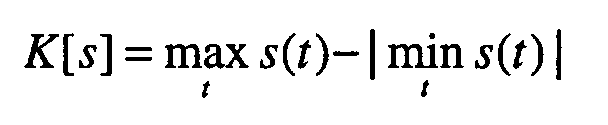
Am Ende der Modulationsleitung ließe sich dann im Sender durch Vergleich der Amplituden bzw. durch das Vorzeichen von K[s] feststellen, ob die Adern der Modulationsleitung auf dem Verlegungsweg vertauscht wurden beziehungsweise wie die ankommenden Adern in Bezug auf die zu bildende Spannungsdifferenz zu definieren sind, damit das Testsignal die gewünschte Polung aufweist.At the end of the modulation line, you could then in the transmitter by comparing the amplitudes or by the sign of K [s] determine whether the wires of the modulation line on the Laying routes were interchanged or how the incoming ones Wires in relation to the voltage difference to be formed are to be defined so that the test signal is the desired one Has polarity.
Bei einer erfindungsgemäß bevorzugten Signalform des Testsignals besteht das Testsignal aus mindestens einem ansteigenden und mindestens einem abfallenden Abschnitt, wobei die Absolutwerte der Steigungen dieser Abschnitte unterschiedlich groß sind. Wenn bei der Einspeisung des Testsignals unter "richtiger" Polung der ansteigende Abschnitt zum Beispiel eine kleinere absolute Steigung hat als der abfallende Abschnitt, so kann am Ausgang der Modulationsleitung beim Sender durch Vergleich der Steigungen des Testsignals festgestellt werden, ob die eingangsseitige "richtige" Polung vorliegt oder die umgekehrte Polung. Die Codierung der Polung des Testsignals in der Steigung von Abschnitten des Testsignals hat den Vorteil, dass diese Steigung verhältnismäßig störungssicher und unabhängig von sonstigen Übertragungseigenschaften der Modulationsleitung übermittelt wird.In a preferred form of the test signal according to the invention the test signal consists of at least one increasing and at least one sloping section, wherein the absolute values of the slopes of these sections differ are great. If when feeding the test signal under "correct" polarity the rising section for example, has a smaller absolute slope than the descending one Section, so at the output of the modulation line at the transmitter by comparing the slopes of the test signal determine whether the input "correct" polarity or the reverse polarity. The polarity coding of the test signal in the slope of sections of the test signal has the advantage that this slope is proportional fail-safe and independent of other transmission properties is transmitted to the modulation line.
Ein Testsignal der zuvor genannten Art kann im einfachsten Falle eine Sägezahnform aufweisen, wobei die Anstiegsflanke und die Abstiegsflanke des Sägezahnsignals jeweils unterschiedliche Dauer haben. Da die Anstiegsflanke und Abstiegsflanke jeweils am selben Amplitudenpunkt sich aneinander anschließen, entspricht eine größere Dauer einem flacheren Verlauf der entsprechenden Flanke und damit einer kleineren Steigung. Sägezahnsignale haben den Vorteil, dass sie sich verhältnismäßig einfach und mit üblichen Mitteln erzeugen lassen.A test signal of the type mentioned above can be done in the simplest Trap have a sawtooth shape, the rising edge and the falling edge of the sawtooth signal each different Have duration. Because the rising edge and falling edge connect to each other at the same amplitude point, a longer duration corresponds to a flatter course the corresponding flank and thus a smaller one Pitch. Sawtooth signals have the advantage that they are produce relatively simple and with conventional means to let.
Wenn die Polung des Testsignals in der Steigung seiner Abschnitte codiert ist, findet am Ausgang der Modulationsleitung im Sender vorzugsweise eine Differenzierung des dort empfangenen Testsignals statt, um hierüber den Wert der jeweiligen Steigung zu bestimmen.If the polarity of the test signal in the slope of its sections is coded, takes place at the output of the modulation line in the transmitter preferably a differentiation of there received test signal instead to determine the value of the respective Determine slope.
Gemäß einer Weiterentwicklung des oben genannten Verfahrens werden im Sender vorzugsweise zunächst der Kennwert des ursprünglichen Testsignals und anschließend der Kennwert des umgepolten Testsignals bestimmt und dann miteinander verglichen. Dieses Vorgehen hat den Vorteil, dass es nicht auf den Absolutwert des Kennwertes ankommt, um die Polung des Testsignals zu bestimmen, sondern dass die Polung über einen Vergleich der beiden ermittelten Kennwerte festgestellt wird. According to a further development of the above-mentioned procedure are preferably in the transmitter first the characteristic value of the original Test signal and then the characteristic value of the polarity-reversed test signal determined and then compared. This procedure has the advantage that it is not based on the absolute value of the characteristic value arrives at the polarity of the Test signal to determine, but that the polarity over a Comparison of the two determined characteristic values is determined.
Ein solches Vorgehen ist zuverlässiger, da der Absolutwert des Kennwertes häufig zahlreichen Einflüssen wie dem Übertragungsverhalten der Modulationsleitung unterliegt. Derartige Einflüsse wirken sich jedoch auf das ursprüngliche und das umgepolte Testsignal gleichermaßen aus, so dass sie das Verhältnis der jeweils ermittelten Kennwerte im wesentlichen unverändert lassen. Die Umpolung des Testsignals kann sowohl am Eingang der Modulationsleitung erfolgen als auch am Ausgang der Modulationsleitung im Sender.Such an approach is more reliable because the absolute value of the characteristic value often numerous influences such as the transmission behavior subject to the modulation line. Such However, influences affect the original and the polarity reversed test signal equally, so that they can Ratio of the characteristic values determined in each case essentially leave unchanged. The polarity reversal of the test signal can both at the input of the modulation line and at the output the modulation line in the transmitter.
Die Erfindung betrifft weiterhin ein Verfahren zur Einstellung der Polung einer symmetrischen, gleichspannungsfreien Modulationsleitung, die der Zuführung von Modulationssignalen zu einem Sender dient, auf eine vorgegebene Polung. Das Verfahren ist dadurch gekennzeichnet, dass zunächst die Polung der Modulationsleitung nach einem Verfahren der oben erläuterten Art bestimmt wird und dass anschließend im Sender die Polung umgekehrt wird, falls sie nicht der vorgegebenen Polung entspricht. Das Verfahren beschränkt sich also nicht nur darauf, die Art der Polung festzustellen, sondern stellt darüber hinaus die vorhandene Polung gegebenenfalls um, damit sie einer gewünschten Polung entspricht. Auf diese Weise können Vertauschungen bei der Installation der Modulationsleitung ausgeglichen werden, welche gerade bei großen Funkanlagen immer wieder vorkommen.The invention further relates to a method for adjustment the polarity of a symmetrical, DC free Modulation line, the supply of modulation signals serves to a transmitter on a given polarity. The process is characterized in that the Polarity of the modulation line according to a method of the above explained type is determined and that subsequently in the transmitter the polarity is reversed if it is not the specified one Polarity corresponds. So the process is not limited only to determine the type of polarity, but poses in addition, the existing polarity, if necessary, so that it corresponds to a desired polarity. That way you can Mix-ups when installing the modulation line be compensated for, which is especially the case with large radio systems happen again and again.
Das Verfahren kann darüber hinaus auch dazu verwendet werden, die Installation von Modulationsleitungen dadurch zu vereinfachen, dass hierbei nicht mehr auf den polungsrichtigen Anschluss der Adern geachtet werden muss. Die Modulationsleitung kann dann unter erheblicher Vereinfachung des Installationsaufwandes ohne Beachtung der Einhaltung der richtigen Polung von der Quelle zum Sender geführt werden. Die dann statistisch gesehen in 50 % der Fälle notwendige Umkehr der Polung beim Sender kann dort anschließend mit dem erfindungsgemäßen Verfahren automatisch durchgeführt werden.The method can also be used to: to simplify the installation of modulation lines, that the connection is no longer correct the veins must be respected. The modulation line can then considerably simplify the installation effort without observing compliance with the correct Polarity from the source to the transmitter. The then Statistically speaking, in 50% of cases the reversal of the Polarity at the transmitter can then there with the invention Procedures are carried out automatically.
Die Erfindung betrifft ferner eine Vorrichtung zur Durchführung des oben erläuterten Verfahrens zur Bestimmung und gegebenenfalls Anpassung der Polung einer symmetrischen, gleichspannungsfreien Modulationsleitung zur Zuführung von Modulationssignalen zu einem Sender. Die Vorrichtung ist dadurch gekennzeichnet, dass sie einen Generator zur Erzeugung des Testsignals am Eingang der Modulationsleitung enthält sowie eine Auswertungsschaltung im Sender zur Bestimmung des Kennwertes des Testsignals. Nach Feststellung des Kennwerts des Testsignals liegt dann die benötigte Information darüber vor, ob die Modulationsleitung in der gewünschten Weise gepolt ist oder ob gegebenenfalls eine Umpolung erforderlich ist.The invention further relates to a device for performing of the method for determining and if necessary, adjusting the polarity of a symmetrical, DC-free modulation line for feeding Modulation signals to a transmitter. The device is characterized in that they have a generator for generation contains the test signal at the input of the modulation line as well as an evaluation circuit in the transmitter for determination the characteristic value of the test signal. After determining the characteristic value the test signal then contains the required information about whether the modulation line in the desired Polarity is reversed or whether a polarity reversal may be necessary is.
Die Auswerteschaltung der Vorrichtung enthält vorzugsweise ein Differenzierglied, welchem das Testsignal zugeführt wird. Mit diesem Differenzierglied lässt sich die Steigung des Testsignals feststellen, die sich besonders zur Codierung der Polung eignet.The evaluation circuit of the device preferably contains a differentiator to which the test signal is fed. With this differentiator, the slope of the Determine test signal, which is particularly useful for coding the Polarity is suitable.
Die genannte Auswerteschaltung enthält weiterhin vorzugsweise einen Gleichrichter, welchem das aus dem Differenzierglied kommende differenzierte Signal zugeführt wird. Ein solcher Gleichrichter kann beispielsweise bewirken, dass das Minimum des differenzierten Signals auf der Nulllinie liegt, so dass durch eine einfache anschließende Auswertung wie zum Beispiel eine Mittelwertbildung festgestellt werden kann, ob die ansteigenden Flanken des empfangenen Testsignals eine größere Steigung hatten als die abfallenden Flanken oder umgekehrt. Sollte sich das so ermittelte Ergebnis (Kennwert) von den Verhältnissen beim ursprünglich eingespeisten Testsignal unterscheiden, so ist dies ein Hinweis darauf, dass auf dem Weg der Modulationsleitung eine Polungsvertauschung stattfindet.The evaluation circuit mentioned further preferably contains a rectifier, which from the differentiator coming differentiated signal is supplied. Such a Rectifier, for example, can cause the minimum of the differentiated signal lies on the zero line, so that through a simple subsequent evaluation such as averaging can be determined whether the increasing Edges of the received test signal a larger one Had slope than the falling flanks or vice versa. Should the result (characteristic value) determined in this way differ from the Differentiate the conditions of the test signal originally fed in, so this is an indication that along the way a polarity reversal takes place in the modulation line.
Die Auswerteschaltung kann weiterhin einen Analog-Digital-Wandler (A/D-Wandler) enthalten, welchem das gegebenenfalls vorverarbeitete Testsignal zugeführt wird, sowie einen digitalen Prozessor, dem das digitale Signal des A/D-Wandlers zwecks Auswertung zugeführt wird. Nach der Umwandlung eines analogen Testsignals in ein digitales Signal kann die Auswertung des Testsignals in einem Mikroprozessor stattfinden, wobei eine entsprechende Programmierung des Mikroprozessors quasi grenzenlose Möglichkeiten für die Berechnung von Kennwerten aus dem Testsignal bietet.The evaluation circuit can also be an analog-digital converter (A / D converter) included, which may be the preprocessed test signal is supplied, as well as a digital Processor that receives the digital signal from the A / D converter is supplied for evaluation. After converting a analog test signal into a digital signal can be evaluated the test signal take place in a microprocessor, corresponding programming of the microprocessor almost limitless possibilities for the calculation of characteristic values offers from the test signal.
Gemäß einer Weiterentwicklung der Vorrichtung kann diese zusätzlich einen Umpoler enthalten, durch welchen im Sender eine Umpolung der Modulationsleitung stattfinden kann. Die Umpolung kann dabei insbesondere durch ein Kommando von der ebenfalls im Sender angeordneten Auswerteschaltung vorgenommen werden. Mit einer derartigen Vorrichtung lässt sich automatisch zunächst die Polung einer im Sender ankommenden Modulationsleitung feststellen und anschließend gegebenenfalls eine gewünschte Polung dauerhaft einstellen.According to a further development of the device, this can additionally contain a polarity reverser, through which in the transmitter the polarity of the modulation line can be reversed. The Polarity reversal can in particular be carried out by a command from the evaluation circuit also arranged in the transmitter become. With such a device can be automatically first the polarity of a modulation line arriving in the transmitter determine and then if necessary set a desired polarity permanently.
Im folgenden wird die Erfindung mit Hilfe der Figuren beispielhaft erläutert. Es zeigen:
- Fig. 1
- das Schaltbild einer Vorrichtung zur Bestimmung und Veränderung der Polung einer in einem Sender ankommenden Modulationsleitung;
- Fig. 2
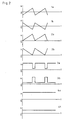
- Signalformen eines Testsignals an verschiedenen Punkten der Schaltung aus Figur 1.
- Fig. 1
- the circuit diagram of a device for determining and changing the polarity of a modulation line arriving in a transmitter;
- Fig. 2
- Waveforms of a test signal at various points in the circuit of FIG. 1.
In Figur 1 sind schematisch die Bauelemente einer erfindungsgemäßen
Vorrichtung zur Bestimmung der Polung einer in einem
Sender ankommenden Modulationsleitung 10 dargestellt. Über
die Modulationsleitung 10 wird im normalen Betrieb dem Sender
von einer räumlich entfernt angeordneten Quelle ein Modulationssignal
zugeführt, welches vom Sender zur Aufmodulation
eines Nutzsignals verwendet wird. Typischerweise handelt es
sich bei einem solchen Modulationssignal um eine Sinusspannung.
Bei einem Mehrsender-System (Gleichwelle) muss das
genannte Modulationssignal allen Sendern mit gleicher Phasenlage
zugeführt werden, damit es nicht zu Störungen im Überlappungsbereich
der Sender kommen kann. Auf dem Weg von der
Quelle (nicht dargestellt) des Modulationssignals zum Sender
kann es jedoch zu einem versehentlichen Vertauschen der beiden
Adern der Modulationsleitung 10 kommen, so dass das Modulationssignal
mit vertauschter Polung beim Sender ankommt.
Bei einem Signal wie zum Beispiel einer Sinusfunktion entspricht
diese Vertauschung der Polung einer Phasenverschiebung
um 180°.The components of a device according to the invention are shown schematically in FIG
Device for determining the polarity of one in one
Transmitter arriving
Mit der in Figur 1 dargestellten Schaltung kann die Polung
eines geeigneten Testsignals auf der Modulationsleitung 10
festgestellt werden, so dass auch eine eventuelle Vertauschung
der Adern der Modulationsleitung erkannt werden
kann.With the circuit shown in Figure 1, the polarity
a suitable test signal on the
Das zu diesem Zweck eingesetzte Testsignal hat vorzugsweise
die in Figur 2 dargestellte Form eines asymmetrischen Sägezahnes
1a. Das Frequenzspektrum des Testsignals ist so gewählt,
dass es in den Übertragungsbereich der Nutzsignale
passt. Typischerweise beträgt die Dauer der ansteigenden
Flanke des Signals 1,4ms (+0/-0,1ms) und die Dauer der abfallenden
steilen Flanke ca. 0,3ms (+0/-0,1ms) bei einer α2-Funkrufanlage.
Da die Modulationsleitung 10 symmetrisch und
gleichspannungsfrei ist, sind die oberhalb und unterhalb der
Nulllinie des Testsignals 1a gelegenen und von der Kurve des
Testsignals eingeschlossenen Flächen gleich groß. Der Mittelwert
des Testsignals über eine Periodendauer beträgt somit
Null. Eine Detektion der Polung der Modulationsleitung 10 ist
demnach nicht in der einfachen Weise möglich, dass eine
Gleichspannung oder ein Gleichspannungsanteil hieran angelegt
wird und überprüft wird, ob die eingespeiste Gleichspannung
beim Sender mit derselben Polung ankommt oder nicht.The test signal used for this purpose preferably has
the shape of an asymmetrical sawtooth shown in Figure 2
1a. The frequency spectrum of the test signal is chosen so
that it is in the transmission range of the useful signals
fits. Typically, the duration is increasing
Edge of the signal 1.4ms (+ 0 / -0.1ms) and the duration of the falling
steep flank approx. 0.3ms (+ 0 / -0.1ms) with an α2 paging system.
Since the
Das in Figur 2 dargestellte Testsignal 1a entspricht im nachfolgenden
Beispiel dem eingespeisten Testsignal. Es kommt in
dieser Form über die Modulationsleitung 10 beim Sender an,
wenn die Adern der Modulationsleitung zwischendurch nicht
vertauscht wurden. Falls dagegen eine solche Vertauschung
versehentlich stattgefunden hat, hat das beim Sender ankommende
Signal die in Figur 2 dargestellte Signalform 1b. Diese
entspricht aufgrund der Umpolung einer Vorzeichenumkehr des
Signals 1a.The
Mit der in Figur 1 dargestellten Schaltung ist es nun möglich,
die beiden Signalformen 1a und 1b voneinander zu unterscheiden
und somit festzustellen, ob eine Vertauschung der
Polung stattgefunden hat oder nicht.With the circuit shown in Figure 1 it is now possible
to distinguish the two
Im Sender wird das Testsignal auf der Modulationsleitung 10
zunächst der primären Seite eines Transformators 11 zugeleitet.
Die im Sender weiter verarbeitete Spannung wird der
Sekundärseite des Transformators entnommen, wobei in der
Schaltung zur Vereinfachung die als Nullpotential definierte
Masseleitung weggelassen wurde. Unmittelbar hinter dem Transformator
11 kann das in Figur 2 dargestellte Signal 2a abgegriffen
werden, bei welchem die Sägezahnform auf den Bereich
oberhalb der Nulllinie verschoben ist. Die dargestellte Form
2a ist dabei zu beobachten, wenn das Testsignal ohne Polungsvertauschung
als Signal 1a beim Sender ankommt.In the transmitter, the test signal is on the
Das den Transformator 11 verlassende Signal 2a kann über
einen Wechselschalter 14 der nachfolgenden Verarbeitungsstufe
zugeführt werden. Weiterhin wird das den Transformator 11
verlassende Signal über einen Umpoler 13 geleitet, welcher
die Polung dieses Signals umkehrt. Am Ausgang des Umpolers 13
hat das Signal dann die in Figur 2 dargestellte Form 2b. Über
den Wechselschalter 14 kann wahlweise auch anstelle des
Signals 2a das in der Polung umgekehrte Signal 2b zur Weiterverarbeitung
ausgewählt werden.The signal 2a leaving the
Vom Ausgang des Wechselschalters 14 ausgehend wird das Signal
2a (beziehungsweise nach Umlegen des Schalters das Signal 2b)
zunächst an einen Verstärker 15 und von diesem an ein
Differenzierglied 16 weitergeleitet. Im Differenzierglied 16
wird die Ableitung des Signals gebildet, welche als Signalform
3a in Figur 2 für das Signal 2a dargestellt ist. Die
Signalform 3b von Figur 2 entspricht der Ableitung des
Signals 2b, das durch Umpolung des empfangenen Signals im Umpoler
13 erhalten wird. Weiterhin sind bei den hinter dem
Differenzierglied 16 vorliegenden Spannungen 3a, 3b die
Minima auf einen vorgegebenen positiven Wert angehoben worden.Starting from the output of the
Hinter dem Differenzierglied 16 ist ein Gleichrichter 17 angeordnet,
in welchem unter anderem der Mittelwert des das
Differenzierglied 16 verlassenden Signals 3a (beziehungsweise
3b) gebildet wird. Dieser Mittelwert ist in Figur 2 als
Signalform 4a für das auf das empfangene Signal 2a zurückgehende
Signal dargestellt. Wenn das empfangene Signal im Umpoler
13 einer Vertauschung der Polung unterzogen wird, wird
dagegen die Kurvenform 4b gemäß Figur 2 beobachtet.A
Der absolute Wert des den Gleichrichter 17 verlassenden
Signals 4a beziehungsweise 4b ist ein Maß dafür, wie lang die
ansteigende Flanke des der Verarbeitung zugeführten Signals
ist. Aus diesem Wert allein lässt sich daher prinzipiell
schon bestimmen, ob vom Sender über die Modulationsleitung 10
ein richtig gepoltes Testsignal 1a oder ein vertauscht gepoltes
Testsignal 1b empfangen wird.The absolute value of the one leaving the
In der Praxis erweist es sich allerdings als sinnvoll, auch
eine Kontrollmessung mit vertauschter Polung auszuführen.
Dabei wird der Wechselschalter 14 umgelegt und der Verarbeitungsstufe
somit das Signal 2b zugeführt. Die Auswertung
dieses Signals führt hinter dem Gleichrichter 17 zu dem in
Figur 2 dargestellten Signal 4b. Durch einen Vergleich der
Werte zu den nicht umgepolten und umgepolten Signalen 4a und
4b kann festgestellt werden, dass das Signal 4b im dargestellten
Falle kleiner ist als das Signal 4a. Ein solches
Größenverhältnis ist aussagekräftiger und robuster als der
absolute Wert eines einzelnen Signals 4a oder 4b allein. Die
Amplitude und Form des Testsignals ist nämlich stark von der
Leitungslänge (bis zu 10km) und der Leitungsqualität abhängig.
Nach Differentiation und Gleichrichtung des sägezahnförmigen
Testsignals in der Auswerteschaltung erhält man in
Abhängigkeit von der Signalform somit unterschiedliche Absolutwerte
der Gleichspannung, die sich durch die gezielte
Phasenumkehr im Wechselschalter 14 ergeben. Da beide den
gleichen oben genannten Einflüssen durch die Leitung unterliegen,
ist das Verhältnis dieser Absolutwerte eine sichere
Kenngröße dafür, ob das ankommende Signal 2a oder das gezielt
umgepolte Signal 2b dem ursprünglich eingespeisten Testsignal
entspricht. In practice, however, it turns out to be useful, too
carry out a control measurement with reversed polarity.
The
Hinter dem Gleichrichter 17 befindet sich ein A/D-Wandler,
welcher das analoge Signal in ein digitales Signal umwandelt.
Dieses digitale Signal kann im nachgeschalteten Mikrocomputer
19 analysiert und ausgewertet werden. Der Mikrocomputer 19
kann ferner die Umschaltung des Wechselschalters 14 veranlassen,
um die Messung zu vervollständigen.An A / D converter is located behind the
Die oben erläuterte Polaritätsbestimmung wird bei Bedarf oder zyklisch (zum Beispiel bei der Inbetriebnahme der Anlage) durch die Zentrale aktiviert. Dabei findet zunächst die Übertragung eines definierten Steuertelegrammes an die Sender zur Aktivierung der Polaritätsbestimmung statt. Anschließend wird die Modulationssignal-Amplitudenregelung im Sender auf den passenden Amplitudenwert des Steuertelegrammes "geklemmt". Das heißt, die nachfolgende Testsignalbewertung muss bei konstanter Testsignalamplitude erfolgen.The polarity determination explained above is used if necessary cyclically (for example when commissioning the system) activated by the control center. The transmission takes place first a defined control telegram to the transmitters Activation of polarity determination instead. Then will the modulation signal amplitude control in the transmitter to the appropriate amplitude value of the control telegram "clamped". This means that the subsequent test signal evaluation must be constant Test signal amplitude take place.
Nach Aussendung des Steuertelegrammes generiert die Zentrale das sägezahnförmige Testsignal und überträgt dieses an die angeschlossenen Sender. Im Sender wird dann das Signal wie oben beschrieben bewertet und der Messwert zwischengespeichert. Anschließend wird das Signal innerhalb des Senders in der Polung umgekehrt und erneut bewertet. Die auf diese Weise ermittelten Messwerte werden miteinander verglichen. Der größere Messwert korrespondiert im dargestellten Beispiel mit der korrekten Polung der Modulationsleitung. Die hierzu passende Phasenlage beziehungsweise Polung des Modulationssignals wird im Sender eingeschaltet. Sollte kein eindeutiger Unterschied zwischen den Messwerten festgestellt werden, was zum Beispiel bei gestörter Modulationsleitung der Fall sein kann, erfolgt eine Störungsmeldung, und der Sender wird deaktiviert. Das heißt, dass er nicht mehr aufgetastet werden kann. After sending the control telegram, the control center generates the sawtooth-shaped test signal and transmits it to the connected transmitter. The signal is then like in the transmitter evaluated above and the measured value temporarily stored. Then the signal is inside the transmitter reversed in polarity and reevaluated. The on this Measured values determined in this way are compared with one another. The larger measured value corresponds in the example shown with the correct polarity of the modulation line. The for this suitable phase position or polarity of the modulation signal is switched on in the transmitter. Shouldn't be clear Difference between the measured values are what for example, if the modulation line is faulty an error message appears and the transmitter is deactivated. That means that he can no longer be touched can.
Nach Beendigung des Testsignals überträgt die Zentrale ein weiteres Steuertelegramm zum Beenden der Polaritätsbestimmung.After the test signal has ended, the control center transmits another control telegram to end the polarity determination.
Die Amplitudenklemmung des Modulationssignals sowie die Polaritätsbestimmung und Polaritätsumschaltung werden im Sender durch einen Mikrocontroller gesteuert.The amplitude clamping of the modulation signal and the polarity determination and polarity switching are in the transmitter controlled by a microcontroller.
Abschließend sei erneut darauf hingewiesen, dass das oben beschriebene Verfahren auch in anderen leitungsgebundenen Systemen als den beispielhaft betrachteten zur Anwendung kommen kann.Finally, it should be pointed out again that the above described Procedures also in other line-bound Systems as the exemplary considered can.
Claims (11)
dadurch gekennzeichnet, dass
ein Testsignal (1a) über die Modulationsleitung gesendet wird, dessen Signalform einen von der Phasenlage unabhängigen und der Polung abhängigen Kennwert enthält, und dass im Sender der Kennwert des Testsignals bestimmt wird.Method for determining the polarity of a symmetrical, DC voltage-free modulation line (10) for supplying modulation signals to a transmitter,
characterized in that
a test signal (1a) is sent via the modulation line, the signal form of which contains a characteristic value that is independent of the phase position and depends on the polarity, and that the characteristic value of the test signal is determined in the transmitter.
dadurch gekennzeichnet, dass
die Polung der Modulationsleitung nach einem Verfahren nach mindestens einem der Ansprüche 1 bis 5 bestimmt und anschließend im Sender umgekehrt wird, falls sie nicht der vorgegebenen Polung entspricht.Method for setting the polarity of a symmetrical, DC voltage-free modulation line (10), which is used to supply modulation signals to a transmitter, to a predetermined polarity,
characterized in that
the polarity of the modulation line is determined by a method according to at least one of claims 1 to 5 and then reversed in the transmitter if it does not correspond to the specified polarity.
dadurch gekennzeichnet, dass
sie am Eingang der Modulationsleitung (10) einen Generator zur Erzeugung des Testsignals (1a) sowie im Sender eine Auswerteschaltung (11 bis 19) zur Bestimmung des Kennwertes des Testsignals (1a) enthält.Device for carrying out the method according to at least one of claims 1 to 6,
characterized in that
it contains at the input of the modulation line (10) a generator for generating the test signal (1a) and in the transmitter an evaluation circuit (11 to 19) for determining the characteristic value of the test signal (1a).
Applications Claiming Priority (2)
| Application Number | Priority Date | Filing Date | Title |
|---|---|---|---|
| DE10027660 | 2000-06-03 | ||
| DE2000127660 DE10027660A1 (en) | 2000-06-03 | 2000-06-03 | Device and method for determining the polarity of a modulation line |
Publications (1)
| Publication Number | Publication Date |
|---|---|
| EP1161024A2 true EP1161024A2 (en) | 2001-12-05 |
Family
ID=7644664
Family Applications (1)
| Application Number | Title | Priority Date | Filing Date |
|---|---|---|---|
| EP20010106737 Withdrawn EP1161024A2 (en) | 2000-06-03 | 2001-03-17 | Apparatus and method for the determination of the polarity of a modulation cable |
Country Status (2)
| Country | Link |
|---|---|
| EP (1) | EP1161024A2 (en) |
| DE (1) | DE10027660A1 (en) |
-
2000
- 2000-06-03 DE DE2000127660 patent/DE10027660A1/en not_active Withdrawn
-
2001
- 2001-03-17 EP EP20010106737 patent/EP1161024A2/en not_active Withdrawn
Also Published As
| Publication number | Publication date |
|---|---|
| DE10027660A1 (en) | 2001-12-06 |
Similar Documents
| Publication | Publication Date | Title |
|---|---|---|
| DE2945331C2 (en) | Device in a signal or data processing system for setting a signal processing circuit | |
| DE2741215A1 (en) | METHOD FOR SIGNAL GENERATION AND TRANSMITTER DEVICE FOR A NETWORK SURVEILLANCE SIGNALING SYSTEM WITH A NETWORK LOAD CONNECTED TO TWO-WIRE AC SUPPLY NETWORK | |
| DE19933333C1 (en) | Method and device for locating a metallic line | |
| DE102010040772A1 (en) | Decoding unit for conversion of differential Manchester signal into binary signal, has logic unit that detects whether flanks are provided in Manchester signal or not, where decoding unit sets level in binary signal during absence of flanks | |
| EP0085161A2 (en) | Digital electric length or angle measuring device | |
| EP2387155B1 (en) | Method for transmitting a binary signal over a transmission path | |
| DE19510795C1 (en) | Method for ultrasonic measurement of flow rates in flowing fluids | |
| EP2622358B1 (en) | Method and arrangement for frequency determination | |
| EP1340988B1 (en) | Method and device for measuring the impedance in an electrical energy supply network | |
| EP0469622A2 (en) | Method and apparatus for demodulating a biphase-coded signal | |
| DE2338882A1 (en) | PROCEDURE AND REMOTE CONTROL SYSTEM FOR SWITCHING ELECTRICAL CONSUMERS ON AND OFF | |
| DE4427885A1 (en) | Noise-reduced data reconstruction method for data transmission system | |
| EP1161024A2 (en) | Apparatus and method for the determination of the polarity of a modulation cable | |
| EP0046317B1 (en) | Process and arrangement for detecting the direction of a short circuit | |
| EP4180300A1 (en) | Sensor device and method for detecting a magnetic field change | |
| EP3617718B1 (en) | Method and device for analog to digital conversion, electrical network | |
| EP0422732A2 (en) | Adaptive apparatus for identification of a periodic signal | |
| DE2428053C3 (en) | Method for monitoring a drive system and monitoring circuit for carrying out the method | |
| DE1065463B (en) | Arrangement for the exact restoration of the working point of a magnetizable core | |
| DE3422805C1 (en) | Circuit arrangement for measuring the time difference between pulses | |
| CH647624A5 (en) | Digital filter for a ripple control receiver, with a micro-computer | |
| DE112007000089B4 (en) | Method and arrangement for the digital transmission of an analog measuring signal | |
| DE2641076C3 (en) | Data transmission system working with length-modulated pulses | |
| DE2014256C (en) | Frequency modulation circuit for binary data | |
| DE2223842C3 (en) | Arrangement for transmitting a signal |
Legal Events
| Date | Code | Title | Description |
|---|---|---|---|
| PUAI | Public reference made under article 153(3) epc to a published international application that has entered the european phase |
Free format text: ORIGINAL CODE: 0009012 |
|
| AK | Designated contracting states |
Kind code of ref document: A2 Designated state(s): AT BE CH CY DE DK ES FI FR GB GR IE IT LI LU MC NL PT SE TR |
|
| AX | Request for extension of the european patent |
Free format text: AL;LT;LV;MK;RO;SI |
|
| STAA | Information on the status of an ep patent application or granted ep patent |
Free format text: STATUS: THE APPLICATION HAS BEEN WITHDRAWN |
|
| 18W | Application withdrawn |
Withdrawal date: 20020830 |