EP1160277A1 - A nanocomposite based on a bridged clay, and a cable comprising said composite - Google Patents
A nanocomposite based on a bridged clay, and a cable comprising said composite Download PDFInfo
- Publication number
- EP1160277A1 EP1160277A1 EP01401232A EP01401232A EP1160277A1 EP 1160277 A1 EP1160277 A1 EP 1160277A1 EP 01401232 A EP01401232 A EP 01401232A EP 01401232 A EP01401232 A EP 01401232A EP 1160277 A1 EP1160277 A1 EP 1160277A1
- Authority
- EP
- European Patent Office
- Prior art keywords
- nanocomposite
- clay
- bridged
- cable
- organic compound
- Prior art date
- Legal status (The legal status is an assumption and is not a legal conclusion. Google has not performed a legal analysis and makes no representation as to the accuracy of the status listed.)
- Granted
Links
- 239000002114 nanocomposite Substances 0.000 title claims abstract description 59
- 239000004927 clay Substances 0.000 title claims abstract description 45
- 239000002131 composite material Substances 0.000 title description 3
- 229920000642 polymer Polymers 0.000 claims abstract description 22
- 150000002894 organic compounds Chemical class 0.000 claims abstract description 19
- 150000002736 metal compounds Chemical class 0.000 claims abstract description 10
- 238000000034 method Methods 0.000 claims abstract description 9
- 239000011248 coating agent Substances 0.000 claims abstract description 4
- 238000000576 coating method Methods 0.000 claims abstract description 4
- -1 stevensite Chemical compound 0.000 claims description 18
- 229940094522 laponite Drugs 0.000 claims description 14
- XCOBTUNSZUJCDH-UHFFFAOYSA-B lithium magnesium sodium silicate Chemical compound [Li+].[Li+].[OH-].[OH-].[OH-].[OH-].[OH-].[OH-].[OH-].[OH-].[OH-].[OH-].[OH-].[OH-].[Na+].[Na+].[Mg+2].[Mg+2].[Mg+2].[Mg+2].[Mg+2].[Mg+2].[Mg+2].[Mg+2].[Mg+2].[Mg+2].[Mg+2].[Mg+2].[Mg+2].[Mg+2].[Mg+2].[Mg+2].O1[Si](O2)([O-])O[Si]3([O-])O[Si]1([O-])O[Si]2([O-])O3.O1[Si](O2)([O-])O[Si]3([O-])O[Si]1([O-])O[Si]2([O-])O3.O1[Si](O2)([O-])O[Si]3([O-])O[Si]1([O-])O[Si]2([O-])O3.O1[Si](O2)([O-])O[Si]3([O-])O[Si]1([O-])O[Si]2([O-])O3.O1[Si](O2)([O-])O[Si]3([O-])O[Si]1([O-])O[Si]2([O-])O3.O1[Si](O2)([O-])O[Si]3([O-])O[Si]1([O-])O[Si]2([O-])O3 XCOBTUNSZUJCDH-UHFFFAOYSA-B 0.000 claims description 14
- 239000000203 mixture Substances 0.000 claims description 14
- 239000004698 Polyethylene Substances 0.000 claims description 12
- 229920000573 polyethylene Polymers 0.000 claims description 12
- GUJOJGAPFQRJSV-UHFFFAOYSA-N dialuminum;dioxosilane;oxygen(2-);hydrate Chemical group O.[O-2].[O-2].[O-2].[Al+3].[Al+3].O=[Si]=O.O=[Si]=O.O=[Si]=O.O=[Si]=O GUJOJGAPFQRJSV-UHFFFAOYSA-N 0.000 claims description 8
- 229910052901 montmorillonite Inorganic materials 0.000 claims description 8
- XEEYBQQBJWHFJM-UHFFFAOYSA-N Iron Chemical compound [Fe] XEEYBQQBJWHFJM-UHFFFAOYSA-N 0.000 claims description 7
- 150000001875 compounds Chemical class 0.000 claims description 6
- 238000002156 mixing Methods 0.000 claims description 6
- 150000003242 quaternary ammonium salts Chemical class 0.000 claims description 6
- 239000000725 suspension Substances 0.000 claims description 5
- 238000010438 heat treatment Methods 0.000 claims description 4
- 239000004952 Polyamide Substances 0.000 claims description 3
- 239000004962 Polyamide-imide Substances 0.000 claims description 3
- 239000004642 Polyimide Substances 0.000 claims description 3
- 239000004113 Sepiolite Substances 0.000 claims description 3
- VNSBYDPZHCQWNB-UHFFFAOYSA-N calcium;aluminum;dioxido(oxo)silane;sodium;hydrate Chemical compound O.[Na].[Al].[Ca+2].[O-][Si]([O-])=O VNSBYDPZHCQWNB-UHFFFAOYSA-N 0.000 claims description 3
- 238000001035 drying Methods 0.000 claims description 3
- 229920001971 elastomer Polymers 0.000 claims description 3
- 239000000806 elastomer Substances 0.000 claims description 3
- 239000003822 epoxy resin Substances 0.000 claims description 3
- LNEPOXFFQSENCJ-UHFFFAOYSA-N haloperidol Chemical compound C1CC(O)(C=2C=CC(Cl)=CC=2)CCN1CCCC(=O)C1=CC=C(F)C=C1 LNEPOXFFQSENCJ-UHFFFAOYSA-N 0.000 claims description 3
- KWLMIXQRALPRBC-UHFFFAOYSA-L hectorite Chemical compound [Li+].[OH-].[OH-].[Na+].[Mg+2].O1[Si]2([O-])O[Si]1([O-])O[Si]([O-])(O1)O[Si]1([O-])O2 KWLMIXQRALPRBC-UHFFFAOYSA-L 0.000 claims description 3
- 229910000271 hectorite Inorganic materials 0.000 claims description 3
- 229910052742 iron Inorganic materials 0.000 claims description 3
- 229910052622 kaolinite Inorganic materials 0.000 claims description 3
- CYPPCCJJKNISFK-UHFFFAOYSA-J kaolinite Chemical compound [OH-].[OH-].[OH-].[OH-].[Al+3].[Al+3].[O-][Si](=O)O[Si]([O-])=O CYPPCCJJKNISFK-UHFFFAOYSA-J 0.000 claims description 3
- 229910052751 metal Inorganic materials 0.000 claims description 3
- 239000002184 metal Substances 0.000 claims description 3
- 229910000273 nontronite Inorganic materials 0.000 claims description 3
- 229920002647 polyamide Polymers 0.000 claims description 3
- 229920002312 polyamide-imide Polymers 0.000 claims description 3
- 229920000647 polyepoxide Polymers 0.000 claims description 3
- 239000004645 polyester resin Substances 0.000 claims description 3
- 229920001225 polyester resin Polymers 0.000 claims description 3
- 229920001601 polyetherimide Polymers 0.000 claims description 3
- 229920001721 polyimide Polymers 0.000 claims description 3
- 229920001296 polysiloxane Polymers 0.000 claims description 3
- 239000004814 polyurethane Substances 0.000 claims description 3
- 229920002635 polyurethane Polymers 0.000 claims description 3
- 229910000275 saponite Inorganic materials 0.000 claims description 3
- 229910052624 sepiolite Inorganic materials 0.000 claims description 3
- 235000019355 sepiolite Nutrition 0.000 claims description 3
- 229920002725 thermoplastic elastomer Polymers 0.000 claims description 3
- 229910052902 vermiculite Inorganic materials 0.000 claims description 3
- 239000010455 vermiculite Substances 0.000 claims description 3
- 235000019354 vermiculite Nutrition 0.000 claims description 3
- 229910052782 aluminium Inorganic materials 0.000 claims description 2
- HPTYUNKZVDYXLP-UHFFFAOYSA-N aluminum;trihydroxy(trihydroxysilyloxy)silane;hydrate Chemical compound O.[Al].[Al].O[Si](O)(O)O[Si](O)(O)O HPTYUNKZVDYXLP-UHFFFAOYSA-N 0.000 claims description 2
- 229910052621 halloysite Inorganic materials 0.000 claims description 2
- 238000002360 preparation method Methods 0.000 claims description 2
- 229910000276 sauconite Inorganic materials 0.000 claims description 2
- 238000005406 washing Methods 0.000 claims description 2
- XAGFODPZIPBFFR-UHFFFAOYSA-N aluminium Chemical compound [Al] XAGFODPZIPBFFR-UHFFFAOYSA-N 0.000 claims 1
- UQSXHKLRYXJYBZ-UHFFFAOYSA-N Iron oxide Chemical compound [Fe]=O UQSXHKLRYXJYBZ-UHFFFAOYSA-N 0.000 abstract 2
- TWNQGVIAIRXVLR-UHFFFAOYSA-N oxo(oxoalumanyloxy)alumane Chemical compound O=[Al]O[Al]=O TWNQGVIAIRXVLR-UHFFFAOYSA-N 0.000 abstract 1
- 239000000463 material Substances 0.000 description 13
- XLYOFNOQVPJJNP-UHFFFAOYSA-N water Substances O XLYOFNOQVPJJNP-UHFFFAOYSA-N 0.000 description 8
- 239000006185 dispersion Substances 0.000 description 4
- 239000000945 filler Substances 0.000 description 4
- 229910010272 inorganic material Inorganic materials 0.000 description 4
- 239000011147 inorganic material Substances 0.000 description 4
- HEMHJVSKTPXQMS-UHFFFAOYSA-M Sodium hydroxide Chemical compound [OH-].[Na+] HEMHJVSKTPXQMS-UHFFFAOYSA-M 0.000 description 3
- 230000015572 biosynthetic process Effects 0.000 description 3
- 239000004020 conductor Substances 0.000 description 3
- 238000009830 intercalation Methods 0.000 description 3
- 239000011159 matrix material Substances 0.000 description 3
- 125000001453 quaternary ammonium group Chemical group 0.000 description 3
- OKTJSMMVPCPJKN-UHFFFAOYSA-N Carbon Chemical compound [C] OKTJSMMVPCPJKN-UHFFFAOYSA-N 0.000 description 2
- CDBYLPFSWZWCQE-UHFFFAOYSA-L Sodium Carbonate Chemical compound [Na+].[Na+].[O-]C([O-])=O CDBYLPFSWZWCQE-UHFFFAOYSA-L 0.000 description 2
- VSCWAEJMTAWNJL-UHFFFAOYSA-K aluminium trichloride Chemical compound Cl[Al](Cl)Cl VSCWAEJMTAWNJL-UHFFFAOYSA-K 0.000 description 2
- 239000002585 base Substances 0.000 description 2
- 230000015556 catabolic process Effects 0.000 description 2
- 238000005341 cation exchange Methods 0.000 description 2
- 229920001577 copolymer Polymers 0.000 description 2
- 238000006731 degradation reaction Methods 0.000 description 2
- 239000012153 distilled water Substances 0.000 description 2
- 230000000694 effects Effects 0.000 description 2
- 230000009970 fire resistant effect Effects 0.000 description 2
- 239000011810 insulating material Substances 0.000 description 2
- 230000002687 intercalation Effects 0.000 description 2
- 229920000092 linear low density polyethylene Polymers 0.000 description 2
- 239000004707 linear low-density polyethylene Substances 0.000 description 2
- 239000007788 liquid Substances 0.000 description 2
- 229910000000 metal hydroxide Inorganic materials 0.000 description 2
- 150000004692 metal hydroxides Chemical class 0.000 description 2
- 239000002245 particle Substances 0.000 description 2
- 239000002904 solvent Substances 0.000 description 2
- 238000003756 stirring Methods 0.000 description 2
- 239000000126 substance Substances 0.000 description 2
- 239000004094 surface-active agent Substances 0.000 description 2
- LZZYPRNAOMGNLH-UHFFFAOYSA-M Cetrimonium bromide Chemical compound [Br-].CCCCCCCCCCCCCCCC[N+](C)(C)C LZZYPRNAOMGNLH-UHFFFAOYSA-M 0.000 description 1
- VGGSQFUCUMXWEO-UHFFFAOYSA-N Ethene Chemical compound C=C VGGSQFUCUMXWEO-UHFFFAOYSA-N 0.000 description 1
- 239000005977 Ethylene Substances 0.000 description 1
- 239000004743 Polypropylene Substances 0.000 description 1
- 239000002253 acid Substances 0.000 description 1
- 150000007513 acids Chemical class 0.000 description 1
- 229920000800 acrylic rubber Polymers 0.000 description 1
- AZDRQVAHHNSJOQ-UHFFFAOYSA-N alumane Chemical class [AlH3] AZDRQVAHHNSJOQ-UHFFFAOYSA-N 0.000 description 1
- 150000003863 ammonium salts Chemical class 0.000 description 1
- 150000001450 anions Chemical class 0.000 description 1
- 125000004429 atom Chemical group 0.000 description 1
- 150000001768 cations Chemical class 0.000 description 1
- 239000003795 chemical substances by application Substances 0.000 description 1
- 150000001805 chlorine compounds Chemical class 0.000 description 1
- 238000002485 combustion reaction Methods 0.000 description 1
- 238000004042 decolorization Methods 0.000 description 1
- 238000000354 decomposition reaction Methods 0.000 description 1
- 238000009792 diffusion process Methods 0.000 description 1
- 238000006073 displacement reaction Methods 0.000 description 1
- 230000005611 electricity Effects 0.000 description 1
- 125000003700 epoxy group Chemical group 0.000 description 1
- 229920006242 ethylene acrylic acid copolymer Polymers 0.000 description 1
- 229920001038 ethylene copolymer Polymers 0.000 description 1
- 239000000835 fiber Substances 0.000 description 1
- 238000001914 filtration Methods 0.000 description 1
- 239000010439 graphite Substances 0.000 description 1
- 229910002804 graphite Inorganic materials 0.000 description 1
- 230000008642 heat stress Effects 0.000 description 1
- 238000011065 in-situ storage Methods 0.000 description 1
- 238000009413 insulation Methods 0.000 description 1
- 239000012774 insulation material Substances 0.000 description 1
- 229910000765 intermetallic Inorganic materials 0.000 description 1
- FBAFATDZDUQKNH-UHFFFAOYSA-M iron chloride Chemical compound [Cl-].[Fe] FBAFATDZDUQKNH-UHFFFAOYSA-M 0.000 description 1
- 238000005259 measurement Methods 0.000 description 1
- 229910044991 metal oxide Inorganic materials 0.000 description 1
- 150000004706 metal oxides Chemical class 0.000 description 1
- 238000012986 modification Methods 0.000 description 1
- 230000004048 modification Effects 0.000 description 1
- 239000000178 monomer Substances 0.000 description 1
- XYFCBTPGUUZFHI-UHFFFAOYSA-O phosphonium Chemical group [PH4+] XYFCBTPGUUZFHI-UHFFFAOYSA-O 0.000 description 1
- 229920001200 poly(ethylene-vinyl acetate) Polymers 0.000 description 1
- 238000012667 polymer degradation Methods 0.000 description 1
- 238000006116 polymerization reaction Methods 0.000 description 1
- 229920001155 polypropylene Polymers 0.000 description 1
- 150000003141 primary amines Chemical class 0.000 description 1
- 239000011253 protective coating Substances 0.000 description 1
- 230000001681 protective effect Effects 0.000 description 1
- 238000009877 rendering Methods 0.000 description 1
- 150000003839 salts Chemical class 0.000 description 1
- 150000003335 secondary amines Chemical class 0.000 description 1
- 150000004760 silicates Chemical class 0.000 description 1
- 229910000029 sodium carbonate Inorganic materials 0.000 description 1
- 239000007787 solid Substances 0.000 description 1
- 230000000153 supplemental effect Effects 0.000 description 1
- 230000008961 swelling Effects 0.000 description 1
- 229920001897 terpolymer Polymers 0.000 description 1
- 231100000331 toxic Toxicity 0.000 description 1
- 230000002588 toxic effect Effects 0.000 description 1
Images
Classifications
-
- C—CHEMISTRY; METALLURGY
- C08—ORGANIC MACROMOLECULAR COMPOUNDS; THEIR PREPARATION OR CHEMICAL WORKING-UP; COMPOSITIONS BASED THEREON
- C08K—Use of inorganic or non-macromolecular organic substances as compounding ingredients
- C08K9/00—Use of pretreated ingredients
- C08K9/02—Ingredients treated with inorganic substances
Definitions
- the present invention relates to novel chemical compositions comprising bridged clay and organic compounds. These compositions form materials known as nanocomposites, which possess improved mechanical and thermal properties.
- Such nanocomposites can advantageously be used, for example, as cable insulation materials.
- PVC used until now to sheath and insulate cables, must be replaced because of the toxic and corrosive products that can be released during combustion.
- the currently available non-halogenated fire-resistant materials are both expensive and have low resistance to heat and oil.
- a material is sought that is compatible with the environment and that does not have the disadvantages cited above, to replace PVC in insulating parts or in cable sheaths.
- a further solution for rendering cable sheaths more fire-resistant is to add a large quantity of metal hydroxides. However, the mechanical and electrical properties of the cables degrade.
- Nanocomposites are composite materials comprising sub-micronic particles dispersed in an organic matrix.
- lamellar inorganic materials such as graphite or silicates have the ability to intercalate organic compounds such as polymers between their lamellae.
- the repulsive forces between the atoms of the organic compound exceed the attractive forces between the lamellae, the lamellar material delaminates, resulting in a hybrid structure in which the lamellae are dispersed through the organic compound matrix.
- the lamellar material In order for the organic compound, in general a polymer, to be able to penetrate between the lamellae, the lamellar material preferably presents an organophilic nature, which it generally does not normally possess. In that case, the surface of the inorganic material has to be pre-treated to endow it with that more organophilic nature.
- the invention thus aims to overcome the problem of providing a nanocomposite in which the structure of the lamellar inorganic material has a higher thermal stability.
- the solution consists of using a clay bridged with a metal compound as the lamellar material. It has been shown that such bridged clays have a particularly stable structure under heat stress.
- the water present between the layers and bound to the cations initially present in the interlamellar spaces is expelled by the bridging that is produced by a cation exchange mechanism by a metal oxyhydroxycation and which prevents the lamellae from closing up, resulting in a higher permanent mesoporosity. This has the effect of facilitating intercalation of the organic compound and facilitating nanocomposite formation.
- the nanocomposite uses a bridged clay with a lamellar structure that, after optional specific prior heat treatment, can intercalate an organic compound between its lamellae.
- the nanocomposite of the invention is obtained from a compound bridged with a metal compound and an organic compound, preferably a polymer.
- the bridged clay acts as a filler and can be obtained by treating a natural or synthetic clay.
- the clay is preferably selected from smectites: montmorillonite, laponite, beidellite, nontronite, saponite, hectorite; and also from other clays such as kaolinite, vermiculite and sepiolite, or one of their synthetic or naturally interstratified mixtures.
- the organic matrix can be a polymer, oligomer, or monomer, preferably a polymer. It may be a particle that can be transformed when molten or in the liquid state.
- the following can be used: polyethylene, polypropylene, and their copolymers, halogenated and non-halogenated elastomers, thermoplastic elastomers, silicones, or a mixture of such polymers, preferably polyethylene.
- Ethylene copolymers that can be selected include ethylene-vinyl acetate copolymers, ethylene-propylene copolymers, ethylene-alkyl acrylate copolymers, ethylene-acrylic acid copolymers, ethylene terpolymers, or said polymers containing specific groups (acids, epoxy groups, ).
- Polymers that can be used in the liquid state include polymers selected from polyester resins, epoxy resins, polyamides, polyimides, polyetherimides, polyamide imides, polyurethanes, or a mixture of said polymers.
- the starting clay is treated with a solution of a salt of a metallic compound, preferably a solution of an iron and/or aluminum salt. After drying and heat treatment, a bridged clay is obtained.
- the bridged clay can then undergo a specific treatment to render it more organophilic. To this end, it is treated with a surfactant solution, for example a quaternary ammonium salt.
- a surfactant solution for example a quaternary ammonium salt.
- the bridged clay is then mixed with the organic compound.
- Mixing is carried out in a flow mixer or batch mixer in the presence of 0.5% to 20% of treated clay and at a temperature in the range 80°C to 250°C, more generally in the range 120°C to 220°C, for a period in the range 2 minutes to 2 hours, more particularly in the range 4 minutes to 30 minutes.
- the nanocomposite can be obtained, for example, by mixing with a molten polymer. This process is also known as melt intercalation. However, it is also possible to carry out in situ polymerization.
- This process can produce nanocomposites with thermal properties that are improved over those of nanocomposites obtained using the conventional process.
- the invention provides a nanocomposite comprising clay and an organic compound, in which the clay is a clay bridged with a metal compound.
- the metal compound is preferably a metal oxide. It may comprise a proportion of another metal compound such as a metal hydroxide.
- the clay is bridged by an iron and/or aluminum compound.
- the nanocomposite preferably comprises a clay selected from montmorillonite, laponite, beidellite, nontronite, saponite, sauconite, hectorite, stevensite, kaolinite, halloysite, vermiculite, and sepiolite, or one of their synthetic or naturally interstratified mixtures.
- Laponite and montmorillonite are particularly preferred.
- the organic compound in the nanocomposite is a polymer.
- the polymer is preferably selected from polyethylene, polypropylene, ethylene copolymers, non-halogenated elastomers, thermoplastic elastomers, silicones, or mixtures thereof.
- the polymer is selected from polyester resins, epoxy resins, polyamides, polyimides, polyetherimides, polyamide imides, polyurethanes, and mixtures thereof.
- an advantageous application of these nanocomposites is cable insulation.
- the term “cable” means bundles of conductive wires or fiber optics protected by insulating sheaths used to supply electricity or in telecommunication networks.
- the nanocomposites are used in insulating telecommunication cables and power cables.
- the invention thus concerns a power cable the sheath of which comprises a nanocomposite of the invention.
- the invention also concerns a telecommunications cable the sheath of which comprises a nanocomposite.
- the sheath is constituted by a nanocomposite.
- the cable is provided with an outer coating comprising a nanocomposite.
- the invention also concerns a process for producing said nanocomposite, comprising the steps of preparing a clay bridged by a metal compound and mixing with an organic compound.
- preparing the bridged clay comprises the steps of adding a mixture of an oligomeric solution of a metal compound to the clay in suspension, eliminating the excess solution by centrifuging, washing the residue, drying, and heat treatment.
- the bridged clay is treated with a compatibilizing compound prior to mixing with the organic compound.
- the compatibilizing compound is a quaternary ammonium salt.
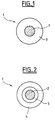
- the invention concerns a power cable 1 comprising a core 2 of conductive material surrounded by a sheath 3.
- power cable means any electrical conductor intended to transport electrical energy and comprising at least one sheath.
- Such a cable comprises a core of conductive material, in general surrounded by different layers including a sheath. This sheath preferably provides fire protection.
- sheath 3 is at least partially composed of a nanocomposite material based on bridged clay with a polymer inserted between the lamellae thereof.
- the fire resistance and resistance to water and solvents of the resulting insulated electrical wire are substantially improved.
- sheath 3 comprises an outer protective coating in addition to the insulating material layer.
- the insulating sheath 3 or insulating coating 4 comprises a nanocomposite material based on the bridged clay of the invention.
- FIG. 2 is typical of low voltage AC cables. Integrating this nanocomposite material into insulating material layer 4 and/or outer sheath 5 substantially improves the mechanical characteristics, strength and fire propagation behavior and substantially improves water and solvent impermeability.
- LLDPE polyethylene (Escorene 1004, supplied by Exxon Chemicals) was milled for 15 minutes at 160°C. Plates were produced using a hot press (5 minutes at 160°C at a pressure of 100 bars). Samples were cut from the plates to study the mechanical and thermal properties and to observe the fire behavior of these materials.
- Examples 3 to 5 were repeated using montmorillonite instead of laponite.
- Examples 1, 2 and 4, also 5, 6 and 8 were examples carried out for comparison purposes to demonstrate the effect of bridging and of the organophilic clay formation treatment.
- Example 8 The montmorillonite that had undergone a double organophilic bridging treatment (Example 8) produced the best results.
- Mechanical properties of nanocomposites Example Ts (MPa) Eb (%) Young's modulus (N/m) 1 23 866 205 2 14 668 232 3 15 689 243 4 14 643 185 5 17 734 303 6 15 687 312 7 15 671 236 8 17 703 296
- the fire behavior test showed that introducing a small quantity of filler could also limit the flow properties of products exposed to fire and also appeared to modify the degradation kinetics of the polymers, encouraging blackening. These results appear to be linked to diffusion of the polyethylene into the clay mesopores and to good dispersion of the clay.
- the cable structure may be that of any known cable, and the disposition of the nanocomposite materials in the cable can be envisaged at any location where an insulating layer or protective sheath is to be found.
Landscapes
- Chemical & Material Sciences (AREA)
- Health & Medical Sciences (AREA)
- Chemical Kinetics & Catalysis (AREA)
- Medicinal Chemistry (AREA)
- Polymers & Plastics (AREA)
- Organic Chemistry (AREA)
- Compositions Of Macromolecular Compounds (AREA)
- Insulated Conductors (AREA)
- Communication Cables (AREA)
- Silicates, Zeolites, And Molecular Sieves (AREA)
- Organic Insulating Materials (AREA)
- Conductive Materials (AREA)
Abstract
Description
- The present invention relates to novel chemical compositions comprising bridged clay and organic compounds. These compositions form materials known as nanocomposites, which possess improved mechanical and thermal properties.
- Such nanocomposites can advantageously be used, for example, as cable insulation materials. PVC, used until now to sheath and insulate cables, must be replaced because of the toxic and corrosive products that can be released during combustion. However, the currently available non-halogenated fire-resistant materials are both expensive and have low resistance to heat and oil. Thus, a material is sought that is compatible with the environment and that does not have the disadvantages cited above, to replace PVC in insulating parts or in cable sheaths.
- A further solution for rendering cable sheaths more fire-resistant is to add a large quantity of metal hydroxides. However, the mechanical and electrical properties of the cables degrade.
- Nanocomposites are composite materials comprising sub-micronic particles dispersed in an organic matrix. In particular, lamellar inorganic materials such as graphite or silicates have the ability to intercalate organic compounds such as polymers between their lamellae. When the repulsive forces between the atoms of the organic compound exceed the attractive forces between the lamellae, the lamellar material delaminates, resulting in a hybrid structure in which the lamellae are dispersed through the organic compound matrix.
- However, preparing nanocomposites generally necessitates pre-treating the lamellar material. In order for the organic compound, in general a polymer, to be able to penetrate between the lamellae, the lamellar material preferably presents an organophilic nature, which it generally does not normally possess. In that case, the surface of the inorganic material has to be pre-treated to endow it with that more organophilic nature.
- International patent application WO-A-93/04117 describes nanocomposites obtained by treating the lamellar inorganic material with swelling/compatibilizing agents such as primary and secondary amines or quaternary phosphonium cation complexes with residues containing a certain number of aliphatic carbon atoms. Such long carbon chain compounds interact favorably with the intercalating compound. However, it has been shown that the thermal stability of clays treated with quaternary ammonium salts is lower. Further, ammonium salt decomposition can cause decolorization, the formation of gaseous products, and it can degrade mechanical properties.
- The invention thus aims to overcome the problem of providing a nanocomposite in which the structure of the lamellar inorganic material has a higher thermal stability.
- In the invention, the solution consists of using a clay bridged with a metal compound as the lamellar material. It has been shown that such bridged clays have a particularly stable structure under heat stress. The water present between the layers and bound to the cations initially present in the interlamellar spaces is expelled by the bridging that is produced by a cation exchange mechanism by a metal oxyhydroxycation and which prevents the lamellae from closing up, resulting in a higher permanent mesoporosity. This has the effect of facilitating intercalation of the organic compound and facilitating nanocomposite formation.
- Finally, the presence of different metallic species can further improve the thermal stability and fire resistance. These thermal and mechanical properties are combined with a reduced weight due to the small proportion of filler compared with normal compositions. This means that nanocomposites are perfectly suited to protecting and thermally insulating articles where their weight has to be limited, such as cables.
- In the invention, the nanocomposite uses a bridged clay with a lamellar structure that, after optional specific prior heat treatment, can intercalate an organic compound between its lamellae.
- The nanocomposite of the invention is obtained from a compound bridged with a metal compound and an organic compound, preferably a polymer. The bridged clay acts as a filler and can be obtained by treating a natural or synthetic clay.
- Certain of the lamellar clays used are also known as smectites. In the invention, the clay is preferably selected from smectites: montmorillonite, laponite, beidellite, nontronite, saponite, hectorite; and also from other clays such as kaolinite, vermiculite and sepiolite, or one of their synthetic or naturally interstratified mixtures.
- The organic matrix can be a polymer, oligomer, or monomer, preferably a polymer. It may be a particle that can be transformed when molten or in the liquid state. As an example, the following can be used: polyethylene, polypropylene, and their copolymers, halogenated and non-halogenated elastomers, thermoplastic elastomers, silicones, or a mixture of such polymers, preferably polyethylene. Ethylene copolymers that can be selected include ethylene-vinyl acetate copolymers, ethylene-propylene copolymers, ethylene-alkyl acrylate copolymers, ethylene-acrylic acid copolymers, ethylene terpolymers, or said polymers containing specific groups (acids, epoxy groups, ...).
- Polymers that can be used in the liquid state include polymers selected from polyester resins, epoxy resins, polyamides, polyimides, polyetherimides, polyamide imides, polyurethanes, or a mixture of said polymers.
- The starting clay is treated with a solution of a salt of a metallic compound, preferably a solution of an iron and/or aluminum salt. After drying and heat treatment, a bridged clay is obtained.
- The bridged clay can then undergo a specific treatment to render it more organophilic. To this end, it is treated with a surfactant solution, for example a quaternary ammonium salt.
- The bridged clay is then mixed with the organic compound. Mixing is carried out in a flow mixer or batch mixer in the presence of 0.5% to 20% of treated clay and at a temperature in the range 80°C to 250°C, more generally in the range 120°C to 220°C, for a period in the
range 2 minutes to 2 hours, more particularly in the range 4 minutes to 30 minutes. In the case of a polymer, the nanocomposite can be obtained, for example, by mixing with a molten polymer. This process is also known as melt intercalation. However, it is also possible to carry out in situ polymerization. - This process can produce nanocomposites with thermal properties that are improved over those of nanocomposites obtained using the conventional process.
- More particularly, the invention provides a nanocomposite comprising clay and an organic compound, in which the clay is a clay bridged with a metal compound. The metal compound is preferably a metal oxide. It may comprise a proportion of another metal compound such as a metal hydroxide. Preferably, the clay is bridged by an iron and/or aluminum compound.
- The nanocomposite preferably comprises a clay selected from montmorillonite, laponite, beidellite, nontronite, saponite, sauconite, hectorite, stevensite, kaolinite, halloysite, vermiculite, and sepiolite, or one of their synthetic or naturally interstratified mixtures. Laponite and montmorillonite are particularly preferred.
- Preferably, the organic compound in the nanocomposite is a polymer. In one embodiment, the polymer is preferably selected from polyethylene, polypropylene, ethylene copolymers, non-halogenated elastomers, thermoplastic elastomers, silicones, or mixtures thereof. In a further embodiment, the polymer is selected from polyester resins, epoxy resins, polyamides, polyimides, polyetherimides, polyamide imides, polyurethanes, and mixtures thereof.
- In one aspect of the invention, an advantageous application of these nanocomposites is cable insulation. The term "cable" means bundles of conductive wires or fiber optics protected by insulating sheaths used to supply electricity or in telecommunication networks. Preferably, the nanocomposites are used in insulating telecommunication cables and power cables.
- The invention thus concerns a power cable the sheath of which comprises a nanocomposite of the invention. The invention also concerns a telecommunications cable the sheath of which comprises a nanocomposite. Preferably, the sheath is constituted by a nanocomposite. In a further embodiment, the cable is provided with an outer coating comprising a nanocomposite.
- The invention also concerns a process for producing said nanocomposite, comprising the steps of preparing a clay bridged by a metal compound and mixing with an organic compound.
- In one embodiment, preparing the bridged clay comprises the steps of adding a mixture of an oligomeric solution of a metal compound to the clay in suspension, eliminating the excess solution by centrifuging, washing the residue, drying, and heat treatment.
- In one embodiment, the bridged clay is treated with a compatibilizing compound prior to mixing with the organic compound. Preferably, the compatibilizing compound is a quaternary ammonium salt.
- Further characteristics and advantages of the invention will become clear on reading the following description of embodiments of the invention, given by way of example only, and made with reference to the accompanying drawing in which:
- Figure 1 is a diagrammatic representation in cross section of a power cable in a first embodiment of the invention; and
- Figure 2 is a diagrammatic representation in cross section of a power cable in a further embodiment of the invention.
- In one embodiment, the invention concerns a
power cable 1 comprising acore 2 of conductive material surrounded by a sheath 3. The term "power cable" means any electrical conductor intended to transport electrical energy and comprising at least one sheath. Such a cable comprises a core of conductive material, in general surrounded by different layers including a sheath. This sheath preferably provides fire protection. - In accordance with the invention, sheath 3 is at least partially composed of a nanocomposite material based on bridged clay with a polymer inserted between the lamellae thereof. The fire resistance and resistance to water and solvents of the resulting insulated electrical wire are substantially improved.
- In the embodiment shown in Figure 2, sheath 3 comprises an outer protective coating in addition to the insulating material layer. The insulating sheath 3 or insulating coating 4 comprises a nanocomposite material based on the bridged clay of the invention.
- The embodiment shown in Figure 2 is typical of low voltage AC cables. Integrating this nanocomposite material into insulating material layer 4 and/or outer sheath 5 substantially improves the mechanical characteristics, strength and fire propagation behavior and substantially improves water and solvent impermeability.
- LLDPE polyethylene (Escorene 1004, supplied by Exxon Chemicals) was milled for 15 minutes at 160°C. Plates were produced using a hot press (5 minutes at 160°C at a pressure of 100 bars). Samples were cut from the plates to study the mechanical and thermal properties and to observe the fire behavior of these materials.
- 100 grams (g) of Escorene 1004 polyethylene was introduced into a kneader at a temperature of 160°C at a shear rate of 15 revolutions per minute (rpm). After 2 minutes, 10 g of untreated laponite (provided by Laporte Ind., Ltd), a synthetic trioctahedral clay, was introduced then mixed at 30 rpm for 15 minutes. Plates were produced using a hot press (5 minutes at 160°C at a pressure of 100 bars). Samples were cut from the plates to study the mechanical and thermal properties and to observe the fire behavior of these materials.
- 100 g of laponite was stirred in 5 liters (ℓ) of water for 30 minutes to produce a good dispersion. A solution of iron chloride and/or aluminum chloride was added dropwise to a base (sodium carbonate and/or a solid sodium hydroxide solution respectively) to obtain a base/metal ratio of 2 to 2.4. The oligomeric solutions obtained were allowed to stand for a period of 1 to 7 days. These aged Al/Fe solutions were added, with stirring, to the previously prepared clay suspension. The excess oligomeric solution was eliminated by centrifuging, then the residue was washed with distilled water until the chlorides had been eliminated. The product obtained was either dried at ambient temperature or at a slightly elevated temperature of 60°C, or freeze-dried. The dry product was then heated for 3 hours at 300°C to produce a bridged clay. The nanocomposite was prepared by introducing 100 g of Escorene 1004 polyethylene into the mixer and 10 g of laponite bridged under the conditions described in Example 2.
- 100 g of laponite was stirred in 5 ℓ of water for 30 minutes to produce a good dispersion. A 0.01 M quaternary ammonium solution (hexadecyl trimethyl ammonium bromide) was slowly added, with stirring, to the previously prepared clay suspension, until a maximum quantity was reached corresponding to the cation exchange capacity of the clay (~ 1 equivalent/g), at ambient temperature. The organic suspension was washed with distilled water and the excess surfactant was eliminated by vacuum filtering until the anions had been eliminated. The product obtained was either dried at ambient temperature or freeze dried, to produce an organophilic clay. The nanocomposite was prepared by introducing 100 g of Escorene 1004 polyethylene into the mixer with 10 g of organophilic laponite under the conditions described in Example 2.
- 100 g of laponite was stirred in 5 ℓ of water for 30 minutes to produce a good dispersion. The bridged laponite obtained under the conditions described in Example 3 was then treated with a 0.01 M quaternary ammonium solution under the conditions described for Example 4. The organophilic bridged product obtained by this double treatment was either dried or freeze dried. 10 g of organophilic bridged laponite was used to prepare the nanocomposite with 100 g of Escorene 1004 polyethylene under the conditions already described for Examples 2 or 3.
- Examples 3 to 5 were repeated using montmorillonite instead of laponite.
- Examples 1, 2 and 4, also 5, 6 and 8 were examples carried out for comparison purposes to demonstrate the effect of bridging and of the organophilic clay formation treatment.
- The mechanical properties of the nanocomposites obtained in Examples 2 to 8 were then tested. By way of comparison, the same measurements were carried out on pure LLDPE 1004 polyethylene (Example 1). The results are shown in Table 1 below.
- It can be seen that the break strength Ts and elongation at break Eb were lower for all of the nanocomposites compared with pure polyethylene. In contrast, the Young's modulus was considerably higher. It should also be noted that the properties of the nanocomposites of Example 5 were improved; this nanocomposite had undergone a supplemental treatment step using quaternary ammonium. Comparison with montmorillonite produced a result of the same order. The nanocomposite of Example 7, treated only with quaternary ammonium salt, had a Young's modulus that was only slightly higher than the pure polymer. In contrast, the nanocomposite with the best values for the Young's modulus was that of Example 6, not treated with a quaternary ammonium salt. The montmorillonite that had undergone a double organophilic bridging treatment (Example 8) produced the best results.
Mechanical properties of nanocomposites Example Ts (MPa) Eb (%) Young's modulus (N/m) 1 23 866 205 2 14 668 232 3 15 689 243 4 14 643 185 5 17 734 303 6 15 687 312 7 15 671 236 8 17 703 296 - It has thus been shown that bridged clays save one step in the nanocomposite preparation process.
- The thermal properties of the nanocomposites of Examples 3 and 5 to 8 and, for comparison, Example 1, were also evaluated. The results are shown in Table 2 below.
- The presence of a small quantity of bridged filler produced a large variation in the polymer degradation temperature. Further, it could be seen that this displacement towards higher temperatures was the same for the composite treated by bridging, whether or not it had been rendered organophilic. The thermal degradation temperature was particularly increased for bridged clays that had undergone organophilic treatment.
Thermal properties of nanocomposites Example T5% (°C) T25% (°C) T50% (°C) T75% (°C) E (µVs/mg) 1 357 426 438 442 -19442 3 332 426 460 478 -16566 5 339 424 439 464 -15379 6 332 434 457 472 - 7 349 414 454 476 - 8 348 439 472 482 -11828 - The fire behavior test showed that introducing a small quantity of filler could also limit the flow properties of products exposed to fire and also appeared to modify the degradation kinetics of the polymers, encouraging blackening. These results appear to be linked to diffusion of the polyethylene into the clay mesopores and to good dispersion of the clay.
- Clearly, the invention is not limited to the embodiments described and shown, but a variety of modifications can be made by the skilled person without departing from the scope of the invention. In particular, the cable structure may be that of any known cable, and the disposition of the nanocomposite materials in the cable can be envisaged at any location where an insulating layer or protective sheath is to be found.
Claims (15)
- A nanocomposite comprising clay and an organic compound, characterized in that the clay is a clay bridged with a metal compound.
- A nanocomposite according to claim 1, in which the metal is iron and/or aluminum.
- A nanocomposite according to claim 1 or claim 2, in which the clay of the nanocomposite is selected from montmorillonite, laponite, beidellite, nontronite, saponite, sauconite, hectorite, stevensite, kaolinite, halloysite, vermiculite, and sepiolite, or one of their synthetic or naturally interstratified mixtures.
- A nanocomposite according to any one of claims 1 to 3, in which the clay of the nanocomposite is laponite or montmorillonite.
- A nanocomposite according to any one of claims 1 to 4, in which the organic compound is a polymer.
- A nanocomposite according to claim 5, in which the polymer is selected from polyethylene, polypropylene, ethylene copolymers, non-halogenated elastomers, thermoplastic elastomers, silicones, or mixtures thereof.
- A nanocomposite according to claim 5, in which the polymer is selected from polyester resins, epoxy resins, polyamides, polyimides, polyetherimides, polyamide imides, polyurethanes, or mixtures thereof.
- A power cable comprising a nanocomposite according to any one of claims 1 to 7 in its sheath.
- A telecommunication cable comprising a nanocomposite according to any one of claims 1 to 7 in its sheath.
- A cable according to claim 8 or claim 9, in which the sheath is constituted by a nanocomposite.
- A cable according to claim 8 or claim 9, provided with an outer coating that comprises a nanocomposite.
- A process for producing a nanocomposite according to any one of claims 1 to 7, comprising the steps of:preparing a bridged clay; andmixing with an organic compound.
- A process according to claim 12, in which preparation of the bridged clay comprises the steps of :adding a mixture of an oligomeric solution of a metal compound to the clay in suspension;eliminating the excess solution by centrifuging;washing the residue;drying; andheat treatment.
- A process according to claim 12 or claim 13, further comprising a step for treating the bridged clay with a compatibilizing compound prior to mixing with the organic compound.
- A process according to claim 14, characterized in that the compatibilizing compound is a quaternary ammonium salt.
Applications Claiming Priority (2)
| Application Number | Priority Date | Filing Date | Title |
|---|---|---|---|
| FR0007017 | 2000-05-31 | ||
| FR0007017A FR2809737B1 (en) | 2000-05-31 | 2000-05-31 | NANOCOMPOSITE BASED ON BRIDGE CLAY AND ORGANIC BRIDGE AND CABLE COMPRISING SUCH A NANOCOMPOSITE |
Publications (2)
| Publication Number | Publication Date |
|---|---|
| EP1160277A1 true EP1160277A1 (en) | 2001-12-05 |
| EP1160277B1 EP1160277B1 (en) | 2005-12-07 |
Family
ID=8850854
Family Applications (1)
| Application Number | Title | Priority Date | Filing Date |
|---|---|---|---|
| EP01401232A Expired - Lifetime EP1160277B1 (en) | 2000-05-31 | 2001-05-14 | A nanocomposite based on a bridged clay, and a cable comprising said composite |
Country Status (9)
| Country | Link |
|---|---|
| US (2) | US6674009B2 (en) |
| EP (1) | EP1160277B1 (en) |
| JP (1) | JP2002053316A (en) |
| AT (1) | ATE312140T1 (en) |
| CA (1) | CA2349141C (en) |
| DE (1) | DE60115535T2 (en) |
| DK (1) | DK1160277T3 (en) |
| ES (1) | ES2251445T3 (en) |
| FR (1) | FR2809737B1 (en) |
Cited By (6)
| Publication number | Priority date | Publication date | Assignee | Title |
|---|---|---|---|---|
| KR20030061174A (en) * | 2002-01-11 | 2003-07-18 | 엘지전선 주식회사 | Inflammable material composition for optical fiber cable |
| WO2004044927A1 (en) * | 2002-11-13 | 2004-05-27 | Draka Uk Limited | Fire-resistant cable |
| FR2870543A1 (en) * | 2004-05-21 | 2005-11-25 | Nexans Sa | FIRE RESISTANT CABLE |
| FR2895397A1 (en) * | 2005-12-23 | 2007-06-29 | Saint Gobain Vetrotex | Glass fibers, and derived structures, coated with a composition comprising a polymer and nanoparticles, and composites prepared from them, have improved resistance to ageing under wet conditions |
| EP2154178A1 (en) * | 2008-08-12 | 2010-02-17 | Borealis AG | Process for the preparation of nanocomposites |
| RU2524232C1 (en) * | 2012-11-29 | 2014-07-27 | Закрытое акционерное общество "Интеллект Альянс" | Metal wire insulating coating |
Families Citing this family (25)
| Publication number | Priority date | Publication date | Assignee | Title |
|---|---|---|---|---|
| FR2793320B1 (en) * | 1999-05-06 | 2002-07-05 | Cit Alcatel | OPTICAL FIBER CABLE WITH IMPROVED PROPERTIES |
| WO2003027017A1 (en) * | 2001-09-27 | 2003-04-03 | Rohm And Haas Company | Modified clays and methods for making and using the same |
| KR100508907B1 (en) * | 2001-12-27 | 2005-08-17 | 주식회사 엘지화학 | Nanocomposite blend composition having super barrier property |
| FR2837494B1 (en) * | 2002-03-21 | 2006-06-23 | Cit Alcatel | NON-HALLOGENOUS INTUMESCENT COMPOSITION FOR TELECOMMUNICATION CABLE SHEATH |
| US6863852B1 (en) | 2002-05-30 | 2005-03-08 | Zeus Industrial Products, Inc. | Fluoropolymer extrusions based on novel combinations of process parameters and clay minerals |
| US20060102871A1 (en) * | 2003-04-08 | 2006-05-18 | Xingwu Wang | Novel composition |
| RU2353633C2 (en) * | 2003-10-10 | 2009-04-27 | Дау Глобал Текнолоджиз Инк. | Composite containing segregated clay in soot and its obtaining |
| JP4476646B2 (en) * | 2004-03-03 | 2010-06-09 | 株式会社東芝 | Insulating resin composition for high voltage equipment, insulating material and method for producing the same, and insulating structure |
| US7491263B2 (en) * | 2004-04-05 | 2009-02-17 | Technology Innovation, Llc | Storage assembly |
| US20080242778A1 (en) * | 2004-07-29 | 2008-10-02 | Stephen Daren | Method For Purification And Modification Of Mineral Clays In Non-Aqueous Solvents |
| CA2578543C (en) * | 2004-08-30 | 2012-08-14 | The University Of Queensland | Polymer composite |
| US20060205856A1 (en) * | 2004-12-22 | 2006-09-14 | Williamson David T | Compositions of polyesters and sepiolite-type clays |
| US7579397B2 (en) * | 2005-01-27 | 2009-08-25 | Rensselaer Polytechnic Institute | Nanostructured dielectric composite materials |
| US7373991B2 (en) * | 2005-07-18 | 2008-05-20 | Schlumberger Technology Corporation | Swellable elastomer-based apparatus, oilfield elements comprising same, and methods of using same in oilfield applications |
| US7604049B2 (en) * | 2005-12-16 | 2009-10-20 | Schlumberger Technology Corporation | Polymeric composites, oilfield elements comprising same, and methods of using same in oilfield applications |
| US8455047B2 (en) * | 2006-04-28 | 2013-06-04 | Applied Nanotech Holdings, Inc. | Method for growing carbon nanotubes on clay platelets |
| DE102009039454B4 (en) * | 2009-08-31 | 2018-06-28 | Siemens Aktiengesellschaft | Insulating |
| US20110288210A1 (en) * | 2010-05-21 | 2011-11-24 | Pinnavaia Thomas J | Mesoporous Silicate Fire Retardant Compositions |
| US8796372B2 (en) | 2011-04-29 | 2014-08-05 | Rensselaer Polytechnic Institute | Self-healing electrical insulation |
| FR2976713B1 (en) * | 2011-06-17 | 2013-06-07 | Silec Cable | MEDIUM OR HIGH VOLTAGE CABLE WITH POLYOLEFIN SHEATH CONTAINING MINERAL LOADS |
| DE102015213603A1 (en) * | 2015-07-20 | 2017-01-26 | Siemens Aktiengesellschaft | Gas-insulated line arrangement |
| KR101807019B1 (en) | 2015-12-15 | 2017-12-08 | 현대자동차 주식회사 | Process for preparing organic-inorganic hybrid porous insulation coating composition for enameled winding wires |
| CN106117782A (en) * | 2016-06-24 | 2016-11-16 | 河南工程学院 | A Method of Improving the Compatibility of PP and PA Composite Materials |
| CN111584144A (en) * | 2020-06-11 | 2020-08-25 | 胡晓霖 | Cable and cable installing support with radiation protection layer |
| CN118594507B (en) * | 2024-08-07 | 2024-10-25 | 湖南工程学院 | A modified sepiolite adsorbent and its preparation method and application |
Citations (3)
| Publication number | Priority date | Publication date | Assignee | Title |
|---|---|---|---|---|
| US4207377A (en) * | 1976-12-09 | 1980-06-10 | The Sherwin-Williams Company | Composite zinc oxide coating on an inert pigment core |
| WO1992016322A2 (en) * | 1991-03-13 | 1992-10-01 | E.I. Du Pont De Nemours And Company | Stable mixtures of colloidal silica and a film-forming polymer |
| EP0558881A2 (en) * | 1992-03-05 | 1993-09-08 | Tayca Corporation | Ultraviolet-screening scale pigment, process for preparing the pigment and cosmetics containing the pigment |
Family Cites Families (6)
| Publication number | Priority date | Publication date | Assignee | Title |
|---|---|---|---|---|
| DE3806548C2 (en) * | 1987-03-04 | 1996-10-02 | Toyoda Chuo Kenkyusho Kk | Composite material and process for its manufacture |
| US5198512A (en) * | 1991-12-16 | 1993-03-30 | Phillips Petroleum Company | Polymerization catalyst and process |
| US5876812A (en) * | 1996-07-09 | 1999-03-02 | Tetra Laval Holdings & Finance, Sa | Nanocomposite polymer container |
| US5866645A (en) * | 1996-11-14 | 1999-02-02 | Board Of Trustees Operating Michigan State University | Homostructured mixed organic and inorganic cation exchanged tapered compositions |
| US6084019A (en) * | 1996-12-31 | 2000-07-04 | Eastman Chemical Corporation | High I.V. polyester compositions containing platelet particles |
| US6238790B1 (en) * | 1999-05-26 | 2001-05-29 | Siemens Westinghouse Power Corporation | Superdielectric high voltage insulation for dynamoelectric machinery |
-
2000
- 2000-05-31 FR FR0007017A patent/FR2809737B1/en not_active Expired - Fee Related
-
2001
- 2001-05-14 AT AT01401232T patent/ATE312140T1/en not_active IP Right Cessation
- 2001-05-14 DE DE60115535T patent/DE60115535T2/en not_active Expired - Lifetime
- 2001-05-14 ES ES01401232T patent/ES2251445T3/en not_active Expired - Lifetime
- 2001-05-14 DK DK01401232T patent/DK1160277T3/en active
- 2001-05-14 EP EP01401232A patent/EP1160277B1/en not_active Expired - Lifetime
- 2001-05-29 CA CA002349141A patent/CA2349141C/en not_active Expired - Fee Related
- 2001-05-29 JP JP2001161109A patent/JP2002053316A/en not_active Withdrawn
- 2001-05-30 US US09/866,836 patent/US6674009B2/en not_active Expired - Fee Related
-
2003
- 2003-10-21 US US10/689,543 patent/US7091263B2/en not_active Expired - Fee Related
Patent Citations (3)
| Publication number | Priority date | Publication date | Assignee | Title |
|---|---|---|---|---|
| US4207377A (en) * | 1976-12-09 | 1980-06-10 | The Sherwin-Williams Company | Composite zinc oxide coating on an inert pigment core |
| WO1992016322A2 (en) * | 1991-03-13 | 1992-10-01 | E.I. Du Pont De Nemours And Company | Stable mixtures of colloidal silica and a film-forming polymer |
| EP0558881A2 (en) * | 1992-03-05 | 1993-09-08 | Tayca Corporation | Ultraviolet-screening scale pigment, process for preparing the pigment and cosmetics containing the pigment |
Cited By (7)
| Publication number | Priority date | Publication date | Assignee | Title |
|---|---|---|---|---|
| KR20030061174A (en) * | 2002-01-11 | 2003-07-18 | 엘지전선 주식회사 | Inflammable material composition for optical fiber cable |
| WO2004044927A1 (en) * | 2002-11-13 | 2004-05-27 | Draka Uk Limited | Fire-resistant cable |
| FR2870543A1 (en) * | 2004-05-21 | 2005-11-25 | Nexans Sa | FIRE RESISTANT CABLE |
| FR2895397A1 (en) * | 2005-12-23 | 2007-06-29 | Saint Gobain Vetrotex | Glass fibers, and derived structures, coated with a composition comprising a polymer and nanoparticles, and composites prepared from them, have improved resistance to ageing under wet conditions |
| WO2007074311A1 (en) * | 2005-12-23 | 2007-07-05 | Saint-Gobain Technical Fabrics Europe | Glass fibres and glass fibre structures provided with a coating containing nanoparticles |
| EP2154178A1 (en) * | 2008-08-12 | 2010-02-17 | Borealis AG | Process for the preparation of nanocomposites |
| RU2524232C1 (en) * | 2012-11-29 | 2014-07-27 | Закрытое акционерное общество "Интеллект Альянс" | Metal wire insulating coating |
Also Published As
| Publication number | Publication date |
|---|---|
| FR2809737A1 (en) | 2001-12-07 |
| EP1160277B1 (en) | 2005-12-07 |
| DE60115535D1 (en) | 2006-01-12 |
| DE60115535T2 (en) | 2006-08-10 |
| CA2349141C (en) | 2007-02-20 |
| FR2809737B1 (en) | 2002-07-19 |
| JP2002053316A (en) | 2002-02-19 |
| CA2349141A1 (en) | 2001-11-30 |
| ES2251445T3 (en) | 2006-05-01 |
| DK1160277T3 (en) | 2006-04-18 |
| US6674009B2 (en) | 2004-01-06 |
| US20020010248A1 (en) | 2002-01-24 |
| US7091263B2 (en) | 2006-08-15 |
| US20040134679A1 (en) | 2004-07-15 |
| ATE312140T1 (en) | 2005-12-15 |
Similar Documents
| Publication | Publication Date | Title |
|---|---|---|
| EP1160277B1 (en) | A nanocomposite based on a bridged clay, and a cable comprising said composite | |
| Lee et al. | Fire retardant polyetherimide nanocomposites | |
| Song et al. | Preparation and properties of halogen-free flame-retarded polyamide 6/organoclay nanocomposite | |
| JP4646352B2 (en) | Layered composition having multi-charged onium ions as exchange ions, and application of the composition to prepare monomer, oligomer and polymer intercalation products, and nano-preparation prepared using the layered composition of the intercalation products Complex | |
| KR20050097502A (en) | Composition based on pre-exfoliated nanoclay and use thereof | |
| US6610770B1 (en) | Organoclay/polymer compositions with flame retardant properties | |
| US6136909A (en) | Preparation of conductive polymeric nanocomposite | |
| EP0747323A1 (en) | Intercalates; exfoliates; process for manufacturing intercalates and exfoliates and composite materials containing same | |
| Ye et al. | Synergistic effects of exfoliated LDH with some halogen‐free flame retardants in LDPE/EVA/HFMH/LDH nanocomposites | |
| WO2004074361A1 (en) | Flame retardant composition | |
| Chuang et al. | Thermal properties and flammability of ethylene-vinyl acetate copolymer/montmorillonite/polyethylene nanocomposites with flame retardants | |
| CN1969004B (en) | fire resistant cable | |
| Zulfiqar et al. | Thermal and mechanical properties of SEBS-g-MA based inorganic composite materials | |
| KR100745144B1 (en) | Polypropylene resin composition with improved mechanical properties and flame retardancy and electric wire using the same | |
| JPH0116794B2 (en) | ||
| CA2528755C (en) | Fire retardant composition | |
| US20080194749A1 (en) | Flame Retardant Polymer Composition Comprising Nanofillers | |
| Song et al. | Study on crystallization, thermal and flame retardant properties of nylon 66/organoclay nanocomposites by in situ polymerization | |
| EP0883647A1 (en) | Composite material and production of the composite material, and composite-material-containing resin composition and production of the resin composition | |
| Passaglia et al. | Effect of functional groups of modified polyolefins on the structure and properties of their composites with lamellar silicates | |
| EP1076077B1 (en) | Polyamide resin composition | |
| KR20100012592A (en) | A nanocomposite based on cross-linked clay and a cable using the same | |
| JP5010448B2 (en) | Polyolefin resin molded body and method for producing the same | |
| Hu et al. | Nanocomposites with halogen and nonintumescent phosphorus flame retardant additives | |
| WO2005003029A2 (en) | Modified layered inorganic materials |
Legal Events
| Date | Code | Title | Description |
|---|---|---|---|
| PUAI | Public reference made under article 153(3) epc to a published international application that has entered the european phase |
Free format text: ORIGINAL CODE: 0009012 |
|
| AK | Designated contracting states |
Kind code of ref document: A1 Designated state(s): AT BE CH CY DE DK ES FI FR GB GR IE IT LI LU MC NL PT SE TR |
|
| AX | Request for extension of the european patent |
Free format text: AL;LT;LV;MK;RO;SI |
|
| 17P | Request for examination filed |
Effective date: 20020605 |
|
| AKX | Designation fees paid |
Free format text: AT BE CH CY DE DK ES FI FR GB GR IE IT LI LU MC NL PT SE TR |
|
| 17Q | First examination report despatched |
Effective date: 20030724 |
|
| GRAP | Despatch of communication of intention to grant a patent |
Free format text: ORIGINAL CODE: EPIDOSNIGR1 |
|
| GRAS | Grant fee paid |
Free format text: ORIGINAL CODE: EPIDOSNIGR3 |
|
| GRAA | (expected) grant |
Free format text: ORIGINAL CODE: 0009210 |
|
| AK | Designated contracting states |
Kind code of ref document: B1 Designated state(s): AT BE CH CY DE DK ES FI FR GB GR IE IT LI LU MC NL PT SE TR |
|
| PG25 | Lapsed in a contracting state [announced via postgrant information from national office to epo] |
Ref country code: AT Free format text: LAPSE BECAUSE OF FAILURE TO SUBMIT A TRANSLATION OF THE DESCRIPTION OR TO PAY THE FEE WITHIN THE PRESCRIBED TIME-LIMIT Effective date: 20051207 |
|
| REG | Reference to a national code |
Ref country code: GB Ref legal event code: FG4D |
|
| REG | Reference to a national code |
Ref country code: CH Ref legal event code: EP |
|
| REG | Reference to a national code |
Ref country code: IE Ref legal event code: FG4D |
|
| REF | Corresponds to: |
Ref document number: 60115535 Country of ref document: DE Date of ref document: 20060112 Kind code of ref document: P |
|
| REG | Reference to a national code |
Ref country code: SE Ref legal event code: TRGR |
|
| PG25 | Lapsed in a contracting state [announced via postgrant information from national office to epo] |
Ref country code: GR Free format text: LAPSE BECAUSE OF FAILURE TO SUBMIT A TRANSLATION OF THE DESCRIPTION OR TO PAY THE FEE WITHIN THE PRESCRIBED TIME-LIMIT Effective date: 20060307 |
|
| REG | Reference to a national code |
Ref country code: DK Ref legal event code: T3 |
|
| PGFP | Annual fee paid to national office [announced via postgrant information from national office to epo] |
Ref country code: MC Payment date: 20060426 Year of fee payment: 6 |
|
| REG | Reference to a national code |
Ref country code: ES Ref legal event code: FG2A Ref document number: 2251445 Country of ref document: ES Kind code of ref document: T3 |
|
| PG25 | Lapsed in a contracting state [announced via postgrant information from national office to epo] |
Ref country code: PT Free format text: LAPSE BECAUSE OF FAILURE TO SUBMIT A TRANSLATION OF THE DESCRIPTION OR TO PAY THE FEE WITHIN THE PRESCRIBED TIME-LIMIT Effective date: 20060508 |
|
| PGFP | Annual fee paid to national office [announced via postgrant information from national office to epo] |
Ref country code: IE Payment date: 20060515 Year of fee payment: 6 |
|
| PGFP | Annual fee paid to national office [announced via postgrant information from national office to epo] |
Ref country code: LU Payment date: 20060607 Year of fee payment: 6 |
|
| ET | Fr: translation filed | ||
| PLBE | No opposition filed within time limit |
Free format text: ORIGINAL CODE: 0009261 |
|
| STAA | Information on the status of an ep patent application or granted ep patent |
Free format text: STATUS: NO OPPOSITION FILED WITHIN TIME LIMIT |
|
| 26N | No opposition filed |
Effective date: 20060908 |
|
| PG25 | Lapsed in a contracting state [announced via postgrant information from national office to epo] |
Ref country code: MC Free format text: LAPSE BECAUSE OF NON-PAYMENT OF DUE FEES Effective date: 20070531 |
|
| REG | Reference to a national code |
Ref country code: IE Ref legal event code: MM4A |
|
| PG25 | Lapsed in a contracting state [announced via postgrant information from national office to epo] |
Ref country code: IE Free format text: LAPSE BECAUSE OF NON-PAYMENT OF DUE FEES Effective date: 20070514 |
|
| PG25 | Lapsed in a contracting state [announced via postgrant information from national office to epo] |
Ref country code: TR Free format text: LAPSE BECAUSE OF FAILURE TO SUBMIT A TRANSLATION OF THE DESCRIPTION OR TO PAY THE FEE WITHIN THE PRESCRIBED TIME-LIMIT Effective date: 20051207 |
|
| PG25 | Lapsed in a contracting state [announced via postgrant information from national office to epo] |
Ref country code: CY Free format text: LAPSE BECAUSE OF FAILURE TO SUBMIT A TRANSLATION OF THE DESCRIPTION OR TO PAY THE FEE WITHIN THE PRESCRIBED TIME-LIMIT Effective date: 20051207 |
|
| PG25 | Lapsed in a contracting state [announced via postgrant information from national office to epo] |
Ref country code: LU Free format text: LAPSE BECAUSE OF NON-PAYMENT OF DUE FEES Effective date: 20070514 |
|
| PGFP | Annual fee paid to national office [announced via postgrant information from national office to epo] |
Ref country code: DK Payment date: 20100512 Year of fee payment: 10 Ref country code: FI Payment date: 20100514 Year of fee payment: 10 |
|
| PGFP | Annual fee paid to national office [announced via postgrant information from national office to epo] |
Ref country code: GB Payment date: 20100519 Year of fee payment: 10 |
|
| PGFP | Annual fee paid to national office [announced via postgrant information from national office to epo] |
Ref country code: NL Payment date: 20110520 Year of fee payment: 11 |
|
| REG | Reference to a national code |
Ref country code: DK Ref legal event code: EBP |
|
| GBPC | Gb: european patent ceased through non-payment of renewal fee |
Effective date: 20110514 |
|
| PG25 | Lapsed in a contracting state [announced via postgrant information from national office to epo] |
Ref country code: FI Free format text: LAPSE BECAUSE OF NON-PAYMENT OF DUE FEES Effective date: 20110514 |
|
| PG25 | Lapsed in a contracting state [announced via postgrant information from national office to epo] |
Ref country code: DK Free format text: LAPSE BECAUSE OF NON-PAYMENT OF DUE FEES Effective date: 20110531 Ref country code: GB Free format text: LAPSE BECAUSE OF NON-PAYMENT OF DUE FEES Effective date: 20110514 |
|
| PGFP | Annual fee paid to national office [announced via postgrant information from national office to epo] |
Ref country code: CH Payment date: 20120523 Year of fee payment: 12 Ref country code: DE Payment date: 20120523 Year of fee payment: 12 |
|
| PGFP | Annual fee paid to national office [announced via postgrant information from national office to epo] |
Ref country code: SE Payment date: 20120522 Year of fee payment: 12 |
|
| PGFP | Annual fee paid to national office [announced via postgrant information from national office to epo] |
Ref country code: IT Payment date: 20120528 Year of fee payment: 12 |
|
| REG | Reference to a national code |
Ref country code: NL Ref legal event code: V1 Effective date: 20121201 |
|
| PGFP | Annual fee paid to national office [announced via postgrant information from national office to epo] |
Ref country code: ES Payment date: 20120525 Year of fee payment: 12 |
|
| PG25 | Lapsed in a contracting state [announced via postgrant information from national office to epo] |
Ref country code: NL Free format text: LAPSE BECAUSE OF NON-PAYMENT OF DUE FEES Effective date: 20121201 |
|
| PGFP | Annual fee paid to national office [announced via postgrant information from national office to epo] |
Ref country code: FR Payment date: 20130603 Year of fee payment: 13 |
|
| REG | Reference to a national code |
Ref country code: CH Ref legal event code: PL |
|
| REG | Reference to a national code |
Ref country code: SE Ref legal event code: EUG |
|
| PG25 | Lapsed in a contracting state [announced via postgrant information from national office to epo] |
Ref country code: CH Free format text: LAPSE BECAUSE OF NON-PAYMENT OF DUE FEES Effective date: 20130531 Ref country code: SE Free format text: LAPSE BECAUSE OF NON-PAYMENT OF DUE FEES Effective date: 20130515 Ref country code: DE Free format text: LAPSE BECAUSE OF NON-PAYMENT OF DUE FEES Effective date: 20131203 Ref country code: LI Free format text: LAPSE BECAUSE OF NON-PAYMENT OF DUE FEES Effective date: 20130531 |
|
| REG | Reference to a national code |
Ref country code: DE Ref legal event code: R119 Ref document number: 60115535 Country of ref document: DE Effective date: 20131203 |
|
| PG25 | Lapsed in a contracting state [announced via postgrant information from national office to epo] |
Ref country code: IT Free format text: LAPSE BECAUSE OF NON-PAYMENT OF DUE FEES Effective date: 20130514 |
|
| REG | Reference to a national code |
Ref country code: ES Ref legal event code: FD2A Effective date: 20140708 |
|
| PG25 | Lapsed in a contracting state [announced via postgrant information from national office to epo] |
Ref country code: ES Free format text: LAPSE BECAUSE OF NON-PAYMENT OF DUE FEES Effective date: 20130515 |
|
| REG | Reference to a national code |
Ref country code: FR Ref legal event code: ST Effective date: 20150130 |
|
| PG25 | Lapsed in a contracting state [announced via postgrant information from national office to epo] |
Ref country code: FR Free format text: LAPSE BECAUSE OF NON-PAYMENT OF DUE FEES Effective date: 20140602 |
|
| PGFP | Annual fee paid to national office [announced via postgrant information from national office to epo] |
Ref country code: BE Payment date: 20150520 Year of fee payment: 15 |
|
| PG25 | Lapsed in a contracting state [announced via postgrant information from national office to epo] |
Ref country code: BE Free format text: LAPSE BECAUSE OF NON-PAYMENT OF DUE FEES Effective date: 20160531 |