This invention relates to novel terphenyl compounds and is more particularly concerned with
novel terphenyl compounds which have useful chiral liquid crystalline properties.
Terphenyls and latterly fluoro-substituted terphenyls are known to be effective smectic C
materials and are therefore useful components in ferroelectric liquid crystal mixtures.
It is an object of the present invention to provide novel terphenyl compounds which preferably
have useful chiral liquid crystalline properties.
According to the present invention there is provided a terphenyl compound having the general
formula [1]:-
where each of R
1 and R
2 is the same or different and is selected from the group consisting of:-alkyl,
alkyloxy, alkenyl, alkenyloxy, alkynyl, alkynyloxy, alkylthio, alkenylthio and alkynylthio
where * indicates an asymmetric carbon atom,
provided that at least one of R
1 and R
2 is
and where each of R
3 and R
4 is the same or different and is an alkyl, alkenyl or alkynyl group;
and Z is independently selected from hydrogen and fluorine at each terphenyl carbon.
The group represented by R1 or R2 may be a C1- to C16-alkyl or alkyloxy group or a C2- to C16-alkenyl,
alkynyl, alkenyloxy or alkynyloxy group, preferably a C1- to C16 n-alkyl group, more
preferably a C7- to C12 n-alkyl group.
The group represented by R3 or R4 may be a C1- to C16-alkyl group or a C2- to C16-alkenyl or
alkynyl group, and is preferably a C1- to C16 n-alkyl group, more preferably a C1- to C5 n-alkyl
group.
Preferably, said compound has the general formula [2] or the general formula [3]:-
wherein R
1, R
3, R
4 and Z are as defined above.
It will be understood that each of the three aromatic rings of the terphenyl moiety may be
independently unsubstituted, mono-, di-, tri- or tetra-fluoro substituted. Preferably, each of the
three aromatic rings is independently mono-fluoro substituted, di-fluoro substituted or
unsubstituted.
Preferably, the compound has the general formula [4] or the general formula [5]:-
wherein R
1, R
3 and R
4 are as defined above, and either
In particularly preferred examples of the compound, R1 is n-octyl and R3 and R4 are
independently selected from methyl and n-pentyl.
According to a second aspect of the present invention, there is provided a liquid crystal
composition containing a compound according to said first aspect of the present invention.
According to a third aspect of the present invention, there is provided an electro-optical liquid
crystal device including a liquid crystal cell have a layer of a liquid crystal composition
according to said second aspect of the present invention, and means for applying an electrical
field across said layer.
Examples
(S)-1,2,4-butanetriol as starting material
Successful manipulation of the triols
1a and
b involves the use of a suitable protection (and
deprotection) step which masks two of the hydroxy groups and thereby allows selective reaction
of the remaining unprotected hydroxy moiety. This may be achieved using the acetonide (or
isopropylidene ketal) protection group, although this leads to the possibility of two isomeric
acetonides being formed, namely the 1,2- (5-membered ring) or 1,3- (6-membered ring), as is
shown in
scheme 1. It is normally the case that the 1,2- acetonide is favoured over the 1,3-acetonide
(kinetic and thermodynamic control). Treatment by a known method (H. Hayashi et.
al.,
J. Am. Chem. Soc., 1973,
95, 8749) of
(S)-1,2,4-butanetriol
(1a) with anhydrous acetone in
the presence of p-toluene sulphonic acid (p-TSA) gave a mixture of the 1,2- (
2b) and 1,3-acetonide
(
2a) in good yield (73%). Analysis by
1H NMR revealed a ratio of 96:4 of
(2b) to
(
2a) by integration of the (CH
3)
2C signals. A similar result was obtained for the racemate (
3a
and
b). The presence of the 1,3-acetonide proved to be no hindrance as it was easily removed
by recrystallisation or column chromatography of later derivatives. Isolation of pure
(S)-1,2-isopropylidene-1,2,4-butanetriol
was not necessary.
A. 1,(S)-2-(4"-Octyloxyterphenyl-4-oxy)dialkoxy-butanes (Examples 1 to 3) The route employed is outlined in
scheme 2. Here 4-bromophenol (
4) was alkylated with
acetonide
2a/b or
3a/b using the Mitsunobu reaction (O. Mitsunobu,
Synthesis, 1981, 1) to give
compound
5a or
b in 74 % yield (purification by flash chromatography removed all trace of the
six membered ring side product). Deprotection of
5a or
b using p-TSA in methanol at room
temperature gave 4-bromo-1-(1,2-dihydroxybutoxy)benzenes
6a or
b in 87 % yield. Compound
6a or
b was then alkylated with methyl iodide or 1-bromopentane and excess sodium hydride
(D.M. Walba et. al.,
J. Am. Chem. Soc., 1986,
108, 5211) to give
compounds 7, 8a, 8b, 9 and
10 in yields of between 62-88%.
Compound 10 was synthesised from the monopentylated side
product
(9) of the reaction of compounds
6a to
8a (showing the greater reactivity of the 1°
alcohol site over the 2° alcohol). The final step involved the Suzuki coupling of
compounds 7,
8a, 8b and
10 with 4-(4-octyloxyphenyl)phenylboronic acid
(11) using palladium(0)
tetrakis(triphenylphosphine) catalyst, 2M sodium carbonate and 1,2-dimethoxyethane (R.B.
Miller et. al.,
Organometallics, 1984,
3, 1261; M. Hird et. al.,
Mol. Cryst. Liq. Cryst., 1991,
206, 187; L.K.M. Chan et. al.,
Mol.Cryst. Liq. Cryst., 1985,
123, 185; L.K.M. Chan et. al.,
Mol. Cryst. Liq. Cryst., 1987,
150B, 335 and
Mol. Cryst. Liq. Cryst., 1988,
158B, 209).
Compounds
12 (Example 1), 13a (Example 2), 13b and
14 (Example 3) were obtained in 20-55
% yields after rigorous flash chromatography and repeated recrystallisation.
The structures and purities of all intermediates and final products were confirmed by a
combination of NMR spectroscopy (1H, 13C, 13C DEPT, 19F NMR, 2D COSY, CHCORR), FT-IR
spectroscopy (ATR or DRIFT sampling), UV-Vis spectroscopy (5-10 mg of sample is
dissolved in 50 cm3 of solvent (e.g. CHCl3), a 1 ml aliquot is then removed and made up to 10
ml), gas chromatography and high performance liquid chromatography. The transition
temperatures and associated enthalpies were determined using a combination of optical
microscopy and differential scanning calorimetry.
(S)-1,2,4-Butanetriol (1a) 1H NMR (300MHz; acetone, TMS) δ: 1.66 (2H,m, CH 2CH2OH),
3.47 (2H,m, diastereotopic protons), 3.72 (2H,m, CH 2OH), 3.80 (1H,m, C*H), 4.12 (3H,m, OH);
13C NMR (75MHz; acetone, TMS) δ: 36.92 (CH2CH2OH, -ve DEPT), 59.95 (CH2OH, -ve
DEPT), 67.34 (CH2C*H, -ve DEPT), 70.96 (C*H, +ve DEPT); GC analysis (det 300°C, inj 280
°C, oven 80 °C 5 min 10 °C/min to 280 °C hold 1 min): 98.94% (RT = 10.90 min).
(S)-1,2-Isopropylidene-1,2,4-butanetriol (2a/b) (S)-1,2,4-Butanetriol (1) (9.02 g, 85.1 mmol)
was stirred in acetone (500 ml) with p-toluenesulfonic acid (400 mg) for 1½ hours at room
temperature. Sodium bicarbonate was added to the mixture and stirred for a further 10 minutes.
Acetone was removed by evaporation under reduced pressure. Ethyl acetate (100 ml) was added
to the residue, and then the mixture was washed with aqueous sodium bicarbonate (50 ml) and
aqueous sodium chloride (50 ml). The mixture was then dried with anhydrous magnesium
sulphate, filtered and the solvent removed by evaporation. Kugelrohr distillation (90 °C, 1
mbar) yielded a colourless liquid. Yield = 6.84 g (55%); 1H NMR (300MHz; CDCl3, TMS) δ:
1.37 (3H,s, CH 3), 1.43 (3H,s, CH 3), 1.83 (2H,q, CH 2CH2OH), 2.68 (1H,br t, OH), 3.60
(1H,pseudo t, diastereotopic proton), 3.80 (2H,q, CH 2OH), 4.09 (1H,dd, diastereotopic proton),
4.27 (1H,quintet, C*H) Analysis of peak heights from 1H NMR showed that the product
contained 96% (S)-1,2-isopropylidene-1,2,4-butanetriol and 4% (S)-2,4-isopropylidene-1,2,4-butanetriol;
13C NMR (75MHz; CDCl3, TMS) δ: 25.69 (CH3, +ve DEPT), 26.89 (CH3, +ve
DEPT), 35.65 (CH2CH2OH, -ve DEPT), 60.48 (CH2C*H, -ve DEPT), 69.46 (CH2OH, -ve
DEPT), 75.03 (C*H, +ve DEPT), 109.08 (C(CH3)2, no DEPT); FT-IR (film; ATR/ZnSe) νmax:
3417, 2992, 2939, 2873, 1381, 1209, 1156, 1050, 871cm-1.
(±)-1,2-Isopropylidene-1,2,4-butanetriol (3a/b) Was obtained in exactly the same way as 2a/b
using (+)-1,2,4-butanetriol 1b as starting material. Yield = 9.08 g (73%); 1H NMR (300MHz;
CDCl3, TMS) δ: 1.36 (3H,s, CH 3), 1.42 (3H,s, CH 3), 1.81 (2H,q, CH 2CH2OH), 2.94 (1H,br t,
OH), 3.59 (1H,pseudo t, diastereotopic proton), 3.76 (2H,q, CH 2OH), 4.09 (1H,dd,
diastereotopic proton), 4.26 (1H,quintet, CH) Analysis of peak heights from 1H NMR showed
that the product contained 96% (±)-1,2-isopropylidene-1,2,4-butanetriol and 4% (+)-2,4-isopropylidene-1,2,4-butanetriol;
FT-IR (film; ATR/ZnSe) νmax: 3423, 2985, 2938, 2878, 1370,
1244, 1214, 1157, 1052, 854 cm-1.
1-{(2,2-Dimethyl)-1,(S)-2-dioxolan-4-yl}ethoxy-4-bromobenzene (5a) Compound 2a/b (9.07 g,
62.1 mmol), triphenylphoshine (10.83 g, 41.3 mmol) and dry tetrahydrofuran (100 ml) was
added to a stirred mixture of 4-bromophenol (4) (7.16 g, 41.3 mmol), diethylazodicarboxylate
(7.20 g, 41.3 mmol) and dry tetrahydrofuran (45 ml) at RT under dry nitrogen, stirred for 18 h,
before being diluted with diethyl ether (150 ml) and then washed with brine (50 ml). The
organic phase was dried (MgSO4), filtered and evaporated to give a colourless oil. Purification
by flash chromatography [fine mesh silica gel: 8% ethyl acetate in hexanes] gave a colourless
oil. Yield = 9.27 g (74%); 1H NMR (300MHz; CDCl3, TMS) δ: 1.36 (3H,s. CH 3CH), 1.42
(3H,s, CH 3CH), 2.03 (2H,m, OCH2CH 2CH), 3.64 (1H,dd, CHCH 2O), 4.05 (2H,m, OCH 2CH2),
4.11 (1H,dd, CHCH 2O), 4.28 (1H,quint, CH2C*HCH2), 6.77 (2H,d, Ar-H 2, 3JHH = 9.05 Hz), 7.36
(2H, d, Ar-H 3, 3JHH = 7.36 Hz); 13C NMR (75MHz; CDCl3, TMS) δ: 25.70, 26.95 (CH3CH, +ve
DEPT), 33.38 (OCH2 CH2CH, -ve DEPT), 64.85 (OCH2CH2CH, -ve DEPT), 69.48 (CHCH2O,-ve
DEPT), 73.27 (C*HCH2O, +ve DEPT), 108.83 ((CH3)2 C, no DEPT), 112.87 (Ar-C 4, no
DEPT), 116.20 (Ar-C 2, +ve DEPT), 132.22 (Ar-C 3, +ve DEPT), 157.83 (Ar-C 1, no DEPT); FT-IR
(film; ATR/ZnSe) νmax: 2986, 2939, 2873, 1488, 1472, 1369, 1240, 1171, 1064, 820 cm-1.
GC Analysis (inj 250 °C; det 300 °C; oven 80 °C hold 1 min, 30 °C/min to 280 °C hold 2 min)
RT = 7.21 (99.75 %) min.
1-{(2,2-Dimethyl)-1,(R,S ) -2-dioxolan-4-yl}ethoxy-4-bromobenzene (5b) A similar procedure to
that used for compound 5a was used. Quantities used: compound 3a/b (9.00 g, 61.6 mmol),
triphenylphosphine (10.78 g, 41.4 mmol), 4-bromophenol (4) (7.11 g, 41.4 mmol),
diethylazodicarboxylate (7.16 g, 41.4 mmol) and tetrahydrofuran (160 ml). Purification by flash
chromatography [fine mesh silica gel: 8% ethyl acetate in hexane] gave a colourless oil which
was dried in vacuo (P2O5, 0.5 mbar, RT, 16 h). Yield = 4.55 g (37%); 1H NMR (300MHz,
CDCl3, TMS) δ: 1.36 (3H, s, O2CCH 3), 1.42 (3H, s, O2CCH 3), 2.03 (2H, dd,
ArOCH2CH 2 (±)CH), 3.63 (1H, t, (±)CHCH 2OC), 4.03 (2H, m, ArOCH 2CH2 (±)CH), 4.11 (1H, dd,
(±)CHCH 2OC), 4.28 (1H, q, ArOCH2CH2 (±)CH), 6.76 (2H, dd, ArH 2/H 6, 3JHH = 6.80 Hz), 7.35
(2H, dd, ArH 3/H 5, 3JHH = 6.76 Hz). 13C NMR (75MHz, CDCl3, TMS) δ: 25.8 (O2CCH3, +ve
DEPT), 27.0 (O2CCH3, +ve DEPT), 33.4 (ArOCH2 CH2 (±)CH, -ve DEPT), 64.9
(ArOCH2CH2 (±)CH, -ve DEPT), 69.5 ((±)CHCH2OC, -ve DEPT), 73.3 (ArOCH2CH2 (±) CH, +ve
DEPT), 108.8 (O2 C(CH3)2, no DEPT), 112.9 (Ar-C 4, no DEPT), 116.3 (Ar-C 2/C 6, no DEPT),
132.3 (Ar-C 3/C 5, no DEPT), 157.8 (Ar-C 1, no DEPT). FT/IR (film/ATR/ZnSe) µmax: 2984,
2933, 2877, 1488, 1472, 1369, 1285, 1240, 1171, 1158, 1059, 1002, 820 cm-1.
4-Bromo-1-(1,(S)-2-dihydroxybutoxy)benzene (6a) p-Toluenesulfonic acid (500 mg) was
added to a stirred solution of compound 5a (9.16 g, 30.4 mmol) in methanol (460 ml) and left to
stir for 18 h at room temperature. The reaction was quenched by addition of sodium bicarbonate
(3.00 g) and stirred for a further 10 mins. The methanol was removed by evaporation under
reduced pressure and the residue redissolved in ethyl acetate (200 ml). The organic solution was
then washed with water (50 ml), dried (MgSO4), filtered and evaporated to give a colourless
solid, recrystallised (ethanol) and dried in vacuo (P2O5, 20 mbar, 50 °C, 18 h). Yield = 6.88 g
(87 %). 1H NMR (300MHz; CDCl3, TMS) δ: 1.92 (2H,m, OCH2CH 2CH), 2.47 (1H,s broad,
CHCH2OH), 2.88 (1H,s broad, CH2CH(OH)CH2), 3.53 (1H,dd, CHCH 2OH, J = 11.15 and 7.10
Hz), 3.71 (1H,dd, CHCH 2OH, J = 11.15 and 2,72 Hz), 3.99 (1H,m CH2C*HCH2), 4.09 (2H,m,
OCH 2CH2CH), 6.78 (2H,d, Ar-H 2, 3JHH = 9.05 Hz), 7.37 (2H,d, Ar-H 3, 3JHH = 8.98 Hz). 13C
NMR (75MHz; CDCl3, TMS) δ: 32.41 (OCH2 CH2CH, -ve DEPT), 65.22 (OCH2CH2CH, -ve
DEPT), 66.69 (CHCH2OH, -ve DEPT), 69.93 (CH2 C*HCH2, +ve DEPT), 113.14 (Ar-C 4, no
DEPT), 116.25 (Ar-C 2, +ve DEPT), 132.31 (Ar-C 3, +ve DEPT), 157.66 (Ar-C 1, no DEPT). FT-IR
(KBr/DRIFT) νmax: 3390, 3304, 2959, 2926, 2873, 1490, 1458, 1289, 1248, 1239, 1121,
1060, 971, 822 cm-1.
4-Bromo-1-(1,(R,S)-2-dihydroxybutoxy)benzene (6b) This compound was prepared in a
manner similar to compound 6a. Quantities used: p-toluenesulfonic acid (500 mg), compound
5b (4.30 g, 14.3 mmol), in methanol (460 ml). Purified by flash chromatography [fine mesh
silica gel: dichloromethane (initially) then 1:1 dichloromethane to ethyl acetate]. Dried in vacuo
(P2O5, 0.5 mbar, RT, 16 h), to give a white crystalline solid. Yield = 2.75 g (74%); 1H NMR
(300MHz, CDCl3, TMS) δ: 1.87 (2H, m, ArOCH2CH 2 (±)CH), 3.01 (1H, broad s, CHOH), 3.31
(1H, broad s, CHCH2OH), 3.5 (1H, t, (±)CHCH 2OH), 3.63 (1H, d, (±)CHCH 2OH), 3.96 (1H, m,
ArOCH2CH2 (±)CH), 4.06 (2H, m, ArOCH 2CH2 (±)CH), 6.76 (2H, dd, ArH 2/H 6, 3JHH = 6.74 Hz),
7.35 (2H, dd, ArH 3/H 5, 3JHH = 6.9 Hz). FT/IR (KBr/Drift) µmax: 3277, 2939, 2880, 1593, 1492,
1471, 1291, 1249, 1102, 1079, 1052, 984, 971, 827, 812, 647cm-1.
4-Bromo-1-(1,(S)-2-dimethoxybutoxy)benzene (7) A solution of methyl iodide (3.21 g, 22.6
mmol) in dry DMF (5 ml) was added dropwise to a stirred mixture of compound 6a (2.03 g, 7.8
mmol), sodium hydride (1.19 g, ca. 29 mmol of a 60% dispersion in mineral oil) and dry DMF
(20 ml) at room temperature under dry nitrogen. After a slight exotherm had subsided, the
reaction was left to stir at RT for a further 18 h, after which TLC showed no starting material to
have remained. The excess sodium hydride was destroyed by the cautious dropwise addition of
water (50 ml). The product was then extracted using diethyl ether (5 x 50 ml). The combined
ether extracts were then washed successively with sat. sodium bicarbonate (50 ml), 10 % v/v
hydrochloric acid (50 ml) and water (50 ml) before being dried (MgSO4), filtered and
evaporated to give a colourless oil. Purification by flash chromatography [fine mesh silica gel:
dichloromethane] gave a colourless oil which was dried in vacuo (P2O5, 10 mbar, RT, 18h),
Yield = 1.97 g (88%). 1H NMR (300MHz; CDCl3, TMS) δ: 1.98 (2H,m, OCH2CH 2CH), 3.39
(3H,s, CH2OCH 3), 3.41 (3H,s, CHOCH 3), 3.47 (2H,m, CHCH 2OCH3), 3.57 (1H,m, C*H), 4.02
(2H,m, OCH 2CH2CH), 6.78 (2H,d, Ar-H 2, 3JHH = 8.96 Hz), 7.36 (2H,d, Ar-H 3, 3JHH = 8.88 Hz).
13C NMR (75MHz; CDCl3, TMS) δ: 31.26 (OCH2 CH2CH, -ve DEPT), 57.79 (CH2OCH3, +ve
DEPT), 59.29 (CHOCH3, +ve DEPT), 64.47 (OCH2CH2CH, -ve DEPT), 74.28 (CH2OCH3, -ve
DEPT), 76.76 (C*H, +ve DEPT), 112.72 (Ar-C 4, no DEPT), 116.28 (Ar-C 2, +ve DEPT), 132.21
(Ar-C 3, +ve DEPT), 158.01 (Ar-C 1, no DEPT). FT-IR (film; ZnSe/ATR) νmax: 2927, 2879,
2833, 1488, 1473, 1240, 1131, 1101, 1071, 1044, 1001, 820 cm-1. GC Analysis (inj 250 °C; det
300 °; oven 80 °C hold 1 min, 30 °C min-1 to 280 °C hold 2 min) RT = 6.85 (100 %) min.
4-Bromo-1-(1,(S)-2-dipentoxybutoxy)benzene (8a) A similar procedure to that employed for
compound 7 was used. Quantities used: compound 6a (2.01 g, 7.7 mmol), 1-bromopentane
(3.42 g, 22.6 mmol), sodium hydride (1.36 g, ca. 34 mmol of 60 % dispersion in oil) and dry
DMF (25 ml). Worked up reaction mixture was purified by flash chromatography [fine mesh
silica gel: dichloromethane] to give two fractions as colourless oils. 8a (Rf CH2Cl2 = 0.64)
Yield = 1.90 g (62%) and 9 (RfCH2Cl2 = 0.19) Yield = 0.50 g. Both dried in vacuo (P2O5, 10
mbar, 20 °C, 12 h). Compound 8a 1H NMR (300MHz; CDCl3, TMS) δ: 0.85-0.89 (6H,t
overlapping, CH 3C4O), 1.29 (8H,m, CH3CH 2CH 2C2O), 1.55 (4H,m, C3CH 2CH2O), 1.96 (2H,m,
OCH2CH 2CH), 3.41 (1H,m, CHCH 2OC5), 3.46 (4H,m, OCH 2C4), 3.64 (2H,m, CH2C*HCH2 &
CHCH 2O), 4.05 (2H,m, ArOCH 2CH2), 6.78 (2H,d, Ar-H 2, 3JHH = 9.07 Hz), 7.36 (2H, d, Ar-H 3,
3JHH = 8.93 Hz). 13C NMR (75MHz; CDCl3, TMS) δ: 14.03 (CH3C4OCH2, +ve DEPT), 14.07
(CH3C4OCH, +ve DEPT), 22.49, 22.53 (CH3 CH2C3O, -ve DEPT), 28.32, 29.37, 29.80 (CH2's,-ve
DEPT), 31.94 (OCH2 CH2CH, -ve DEPT), 64.59 (OCH2CH2CH, -ve DEPT), 70.45,
CHCH2OC5, -ve DEPT), 71.68 (CHCH2OCH2C4, -ve DEPT), 73.12 (CHOCH2C4, -ve DEPT),
75.11 (C*H, +ve DEPT), 112.61 (Ar-C 4, no DEPT), 116.26 (Ar-C 2, +ve DEPT), 132.18 (Ar-C 3,
+ve DEPT), 158.11 (Ar-C 1, no DEPT). FT-IR (film; ZnSe/ATR) νmax: 2954, 2929, 2858, 1489,
1467, 1243, 1109, 1102, 820 cm-1. GC Analysis (inj 250 °C; det 300 °C; oven 80 °C hold 1 min,
30 °C min-1 to 280 °C hold 5 min) RT = 9.60 (99.42 %) min. 4-Bromo-1-(1-pentoxy-(S)-2-hydroxybutoxy)benzene
(9) 1H NMR (300MHz; CDCl3, TMS) δ: 0.90 (3H,t, CH 3C4O), 1.32
(4H,m, CH3CH 2CH 2C2O), 1.59 (2H,m, OCH2CH 2C3), 1.90 (2H,m, OCH2CH 2CH), 2.56 (1H,s
broad, CH2CH(OH)CH2), 3.34 (1H,m, CHCH 2OC5), 3.49 (3H,m, CHCH 2OC5), 4.06 (1H,m,
C*HOH), 4.09 (2H,m, OCH 2CH2CH), 6.79 (2H,d, Ar-H 2, 3JHH = 8.91 Hz), 7.36 (2H,d, Ar-H 3,
3JHH = 8.98 Hz). 13C NMR (75MHz; CDCl3, TMS) δ: 14.05 (CH3C4O, +ve DEPT), 22.52, 28.28
(CH3 CH2 CH2, -ve DEPT), 29.32 (CH3CH2CH2 CH2, -ve DEPT), 32.70 (OCH2 CH2CH, -ve
DEPT), 64.94 (OCH2CH2CH, -ve DEPT), 67.69 (C*HOH, +ve DEPT), 71.57 (CH2OCH2C4,-ve
DEPT), 74.78 (CH2OC5, -ve DEPT), 112.83 (Ar-C 4, no DEPT), 116.27 (Ar-C 2, +ve DEPT),
132.27 (Ar-C 3, +ve DEPT), 157.90 (Ar-C 1, no DEPT). FT-IR (film; ZnSe/ATR) νmax: 3430,
2954, 2930, 2868, 2861, 1488, 1473, 1241, 1112, 1102, 1071, 1003, 820 cm-1. GC Analysis (inj
250 °C; det 300 °C; oven 80 °C hold 1 min, 30 °C min-1 to 280 °C hold 5 min) RT = 8.46,(100
%) min.
4-Bromo-1-(1,(R,S)-2-dipentoxybutoxy)benzene (8b) This compound was prepared in a
manner similar to compound 8a. Quantities used: 1-bromopentane (4.34 g, 9.6 mmol),
compound 7b (2.50 g, 9.6 mmol), sodium hydride (1.92 g, 60% dispersion in oil, ca., 48 mmol)
and dimethylformamide (40 ml). This was purified by flash chromatography [fine mesh silica
gel: dichloromethane] to give a colourless oil. Dried in vacuo (P2O5, 0.6 mbar, RT, 16 h). Yield
= 2.35 g (61%); 1H NMR (300 MHz, CDCl3, TMS) δ: 0.87 (6H, m, OC4CH 3's), 1.30 (8H, m,
OC2CH 2CH 2CH3's), 1.55 (4H, m, OCH2CH 2C3's), 1.90 (1H, m, ArOCH2CH 2 (±)CH), 1.99 (1H,
m, ArOCH2CH 2 (±)CH), 3.44 (4H + 1H, m, OCH 2C4's + (±)CHCH 2O), 3.63 (1H + 1H, m,
ArOCH2CH2 (±)CH + (±)CHCH 2O), 4.05 (2H, m, ArOCH 2CH2 (±)CH), 6.78 (2H, dd, ArH2/H6, 3JHH
= 6.78 Hz), 7.36 (2H, dd, ArH3/H5, 3JHH = 6.8 Hz). FT/IR (film/ATR/ZnSe) µmax: 2954, 2929,
2858, 1591, 1489, 1467, 1285, 1243, 1171, 1105, 1072, 1002, 820 cm-1.
4-Bromo-1-(1-pentoxy-(S)-2-methoxybutoxy)benzene (10) A similar procedure to that
employed in the preparation of compound 7 was used. Quantities used: compound 6a (0.44 g,
1.33 mmol), methyl iodide (1.14 g, 8.1 mmol), sodium hydride (0.24 g, ca. 6 mmol of a 60 %
dispersion in oil) and dry DMF (10 ml). The crude product was purified by flash
chromatography [fine mesh silica gel: dichloromethane] to give a colourless oil which was dried
in vacuo (P2O5, 10 mbar, RT, 18h). Yield = 0.38 g (83%). 1H NMR (300MHz; CDCl3, TMS) δ:
0.89 (3H,t, CH 3C4O), 1.31 (4H,m, CH3CH 2CH 2C2O), 1.58 (2H,m, C3CH 2CH2O), 1.97 (2H,m,
OCH2CH 2CH), 3.41 (3H,s, OCH 3), 3.47 (4H,m, CH 2OCH2C4), 3.56 (1H,m, C*H), 4.02 (2H,m,
OCH 2CH2CH), 6.79 (2H,d, Ar-H 2, 3JHH = 8.96 Hz), 7.36 (2H,d, Ar-H 3, 3JHH = 8.99 Hz). 13C
NMR (75MHz; CDCl3, TMS) δ: 14.06 (CH3C4O, +ve DEPT), 22.53, 28.30, 29.34 (CH2's, -ve
DEPT), 31.50 (OCH2 CH2CH, -ve DEPT), 57.90 (CH3O, +ve DEPT), 64.57 (OCH2CH2CH, -ve
DEPT), 71.74. 72.54 (CH2OCH2C4, -ve DEPT), 76.61 (C*H, +ve DEPT), 112.69 (Ar-C 4, no
DEPT), 116.30 (Ar-C 2, +ve DEPT), 132.21 (Ar-C 3), +ve DEPT), 158.05 (Ar-C 1, no DEPT). FT-IR
(film; ZnSe/ATR) νmax: 2954, 2930, 2861, 1488, 1473, 1466, 1242, 1101, 1072, 820 cm-1.
GC Analysis (inj 250 °C; det 300 °C; oven 80 °C hold 1 min, 30 °C min-1 to 280 °C hold 5 min)
RT = 8.26 (100 %) min.
EXAMPLE 1
1,2-(S)-Dimethoxy-(4"-octyloxyterphenyl-4-oxy)butane (12) 4-(4-Octyloxyphenyl)phenylboronic
acid (11) (1.47 g, 4.5 mmol) was added to a stirred mixture of compound 7 (1.00 g, 3.5
mmol), palladium(0) tetrakis(triphenylphosphine) (0.12 g, 0.1 mmol), 2M sodium carbonate (25
ml) and 1,2-dimethoxyethane (25 ml). The reaction was then heated under gentle reflux for 6 h
under a stream of dry nitrogen gas. The cooled reaction mixture was then poured onto water
(150 ml) and the products extracted using diethyl ether (4 x 70 ml). The combined ether extracts
were then washed with brine (50 ml), dried (MgSO4), filtered and evaporated to give a dark
solid. This was then absorbed on silica gel and passed through a short silica gel column using
4:1 dichloromethane-ethyl acetate to remove front and baseline material. The colourless solid
obtained was then purified rigorously by flash chromatography [fine mesh silica gel:
dichloromethane] and repeated recrystallisation (toluene x 5). The colourless solid was dried in
vacuo (P2O5, 10 mbar, 50 °C, 8 h). Yield = 0.33 g (15%). 1H NMR (300MHz; CDCl3, TMS) δ:
0.89 (3H,t, CH 3C7O), 1.32 (8H,m CH 2's), 1.48 (2H,m, CH 2CH2CH2O), 1.81 (2H,m, CH 2CH2O),
2.03 (2H,m, OCH2CH 2CH), 3.41 (3H,s, CH 3O), 3.44 (3H,s, CH2OCH 3), 3.50 (2H,m,
CH 2OCH3), 3.63 (1H,m, C*H), 4.00 (2H,t, OCH 2C7), 4.11 (2H,m, OCH 2CH2CH), 6.98, 6.99
(4H,d, Ar-H 3 or 3", 3JHH = 8.75 and 8.79 Hz), 7.55, 7.56 (4H,2d, Ar-H 2' or 2", 3JHH = 8.74 Hz and
8.72 Hz), 7.60 (4H,s, Ar-H 2/3). 13C NMR (75MHz; CDCl3, TMS) δ: 14.13 (CH3C7O, +ve
DEPT), 22.68, 26.08, 29.27, 29.30, 29.38, (CH2's, -ve DEPT), 31.36 (OCH2 CH2CH, -ve DEPT),
31.83 (CH2, -ve DEPT), 57.83 (CH3OCH, +ve DEPT), 59.31 (CH3OCH2, +ve DEPT), 64.31
(OCH2CH2CH, -ve DEPT), 68.10 (C7 CH2O, -ve DEPT), 74.40 (CH2OCH3, -ve DEPT), 76.91
(C*H, +ve DEPT), 114.81 (d, Ar-C 3' or 3", +ve DEPT), 126.97 (s, Ar-C 2/3, +ve DEPT), 127.94,
127.98 (Ar-C 2' or 2", +ve DEPT), 133.04, 133.27 (Ar-C 1' or 1", no DEPT), 139.05, 139.17 (Ar-C 1 or
4, no dept), 158.47, 158.72 (Ar-C 4' or 4") no DEPT). FT-IR (KBr/DRIFT) νmax: 2926, 2860, 1605,
1493, 1468, 1288, 1249, 1186, 1139, 1113, 970, 819, 809, 506 cm-1. LTV-Vis (6.43 mg, CHCl3)
λmax: 294.00 (1.1201) nm. HPLC analysis (C18 column; 1 ml min-1 99.5:0.5 acetonitrile-tetrahydrofuran)
RT = 10.05 (99.78%) min.
EXAMPLE 2
1,2-(S)-Dipentoxy(4"-octyloxyterphenyl-4-oxy)butane (13a) A similar method to that
employed for compound 12 was used. Quantities used: compound 11 (1.49 g, 4.6 mmol),
compound 8a (1.40 g, 3.5 mmol), palladium(0) tetrakis(triphenylphosphine) (0.18 g, 0.18
mmol), 2M sodium carbonate (30 ml) and 1,2-dimethoxyethane (30 ml). Crude product was
first passed through a short column [silica gel: 9:1 dichloromethane-ethyl acetate], before being
purified by flash chromatography (twice) [fine mesh silica gel: 1:1 dichloromethane-hexanes] to
give a colourless solid which was recrystallised (toluene x 3). Dried in vacuo (P2O5, 10 mbar,
50 °C, 6 h). Yield = 0.56 g (27%). 1H NMR (300MHz; CDCl3, TMS) δ: 0.88 (9H,m, CH 3's),
1.31 (16H,m, CH 2's), 1.47 (2H,m, C5CH 2CH2CH2O), 1.55 (4H,m, OCH2CH 2C3), 1.81 (2H,m,
OCH2CH 2C6), 2.00 (2H,m, OCH2CH 2CH), 3.43 (1H,m, CHCH 2O), 3.49 (4H,m, OCH 2C4), 3.65
(1H,m, CHCH 2O), 3.71 (1H,m, C*H), 3.99 (2H,t, ArOCH 2C7), 4.12 (2H,m, OCH2CH2CH), 6.98
(2H,d, Ar-H 3'/3", 3JHH = 8.78 Hz), 6.99 (2H,d, Ar-H 3'/3", 3JHH = 8.77 Hz), 7.55 (4H,d, Ar-H 2'/2",
3JHH = 8.75 Hz), 7.60 (4H,s, Ar-H 2/3). 13C NMR (75MHz; CDCl3, TMS) δ: 14.08, 14.06
(CH3C4O, +ve DEPT), 14.13 (CH3C7O, +ve DEPT), 22.52, 22.67 (CH2's, -ve DEPT), 26.07
(ArOCH2CH2 CH2C5, -ve DEPT), 28.34, 29.27, 29.30, 29.39, 29.84, 31.83, 32.05 (CH2's, -ve
DEPT), 64.43 (OCH2CH2CH, -ve DEPT), 68.08 (ArOCH2C7, -ve DEPT), 70.49 (CH2OC5, -ve
DEPT), 71.67, 73.22 (OCH2C4, -ve DEPT), 75.25 (C*H, +ve DEPT), 114.79 (Ar-C 3'/3", +ve
DEPT), 126.96 (Ar-C 2/3, +ve DEPT), 127.93 (Ar-C 2'/2", +ve DEPT), 133.04, 133.13 (Ar-C 1'/1", no
DEPT), 139.10 (Ar-C 1/4, no DEPT), 158.58, 158.70 (Ar-C 4'/4", no DEPT). FT-IR (KBr/DRIFT)
νmax: 2955, 2934, 2856, 1607, 1494, 1475, 1468, 1293, 1261, 1252, 1188, 1117, 1096, 998, 822,
813, 503 cm-1. UV-Vis (7.34 mg, CHCl3) λmax: 290.50 (1.0240) nm. HPLC analysis (C18
column; 1 ml min-1 90:10 acetonitrile-tetrahydrofuran) RT = 19.27 (99.84%) min.
1,2-(R,S)-Dipentoxy(4"-octyloxyterphenyl-4-oxy)butane (13b) A similar method to that
employed for compound 12 was used. Quantities used: compound 11 (2.00 g, 6.1 mmol),
compound 8b (1.64 g, 4.09 mmol), palladium(0) tetrakis(triphenylphosphine) (0.16 g, 0.14
mmol), 2M sodium carbonate (20 ml) and 1,2-dimethoxyethane (30 ml). Yield = 0.56 g (27%).
1H NMR (300MHz; CDCl3, TMS) δ: 0.88 (9H,m, CH 3's), 1.31 (16H,m, CH 2's), 1.46 (2H,m,
C5CH 2CH2CH2O), 1.57 (4H,m, OCH2CH 2C3), 1.80 (2H,m, OCH2CH 2C6), 1.95, 2.03 (2H,m,
OCH2CH 2CH), 3.46 (1H,m, CHCH 2O), 3.46 (4H,m, OCH 2C4), 3.64 (1H,m, CHCH 2O), 3.70
(1H,m, C*H), 3.99 (2H,t, ArOCH 2C7), 4.14 (2H,m, OCH2CH2CH), 6.97 (2H,d, Ar-H 3'/3", 3JHH =
8.79 Hz), 6.98 (2H,d, Ar-H 3'/3", 3JHH = 8.78 Hz), 7.55 (4H,d, Ar-H 2'/2", 3JHH = 8.74 Hz), 7.59
(4H,s, Ar-H 2/3). 13C NMR (75MHz; CDCl3, TMS) δ: 14.05, 14.07 (CH3C4O, +ve DEPT), 14.12
(CH3C7O, +ve DEPT), 22.52, 22.55, 22.68 (CH2's, -ve DEPT), 26.08 (ArOCH2CH2 CH2C5, -ve
DEPT), 28.34, 28.35, 29.27, 29.31, 29.39, 29.85, 31.83, 32.06 (CH2's, -ve DEPT), 64.44
(OCH2CH2CH, -ve DEPT), 68.08 (ArOCH2C7, -ve DEPT), 70.48 (CH2OC5, -ve DEPT), 71.68
(OCH2C4, -ve DEPT), 75.26 (C*H, +ve DEPT), 114.80 (Ar-C 3'/3", +ve DEPT), 126.95 (Ar-C 2/3,
+ve DEPT), 127.93 (Ar-C 2'/2", +ve DEPT), 133.04, 133.14 (Ar-C 1'/1", no DEPT), 139.10 (Ar-C 1/4,
no DEPT), 158.58, 158.71 (Ar-C 4'/4", no DEPT). FT-IR (KBr/DRIFT) νmax: 3039, 2955, 2933,
2858, 1607, 1491, 1473, 1468, 1292, 1252, 1186, 1116, 821, 811, 738, 672, 505 cm-1. UV-Vis
(5.00 mg, CHCl3) λmax: 294.50 (0.7719) nm. HPLC analysis (C18 column; 1 ml min-1 90:10
acetonitrile-tetrahydrofuran) RT = 18.75 (99.86%) min.
EXAMPLE 3
1-Pentoxy-2-(S)-methoxy-(4"-octyloxyterphenyl-4-oxy)butane (14) A similar method to that
employed for compound 12 was used. Quantities used: compound 11 (0.45g, 1.4 mmol),
compound 10 (0.34 g, 1.0 mmol), palladium(0) tetrakis(triphenylphosphine) (0.04 g, 0.03
mmol), 2M sodium carbonate (10 ml) and 1,2-dimethoxyethane (10 ml). The crude product was
passed through a short column [silica gel: dichloromethane] before being purified by flash
chromatography [fine mesh silica gel: 7:3 dichloromethane-hexanes] to give a colourless solid
which was recrystallised (toluene x 2) and dried in vacuo (P2O5, 10 mbar, 50 °C, 6 h). Yield =
0.30 g (55 %). 1H NMR (300MHz; CDCl3, TMS) δ: 0.89 (3H,m, CH 3), 0.90 (3H,m, CH3), 1.33
(12H,m, CH 2's), 1.48 (2H,m, C5CH 2CH2CH2O), 1.60 (2H,m, OCH2CH 2C3), 1.81 (2H,m,
OCH2CH 2C6), 2.02 (2H,m, OCH2CH 2CH), 3.44 (3H,s, CH 3O), 3.53 (4H,m, CH 2OCH 2C4), 3.62
(1H,m, CH2CHCH2O), 4.00 (2H,t, OCH 2C7), 4.12 (2H,m, OCH 2CH2CH), 6.98, 6.99 (4H,dd, ArH 3'/3",
3JHH = 8.77 and 8.85 Hz), 7.55, 7.57 (4H,dd, Ar-H 2'/2", 3JHH = 8.78 and 8.78 Hz), 7.60
(4H,s, Ar-H 2/3). 13C NMR (75MHz; CDCl3, TMS) δ: 14.07 (CH3C4O, +ve DEPT), 14.13
(CH3C7O, +ve DEPT), 22.54, 22.68 (CH2's, -ve DEPT), 26.07 (CH2, -ve DEPT), 28.31, 29.26,
29.30, 29.36, 29.34 (CH2's, -ve DEPT), 31.59 (OCH2 CH2CH, -ve DEPT), 31.83 (CH2, -ve
DEPT), 57.95 (CH3O, +ve DEPT), 64.39 (OCH2CH2CH, -ve DEPT), 68.09 (ArOCH2C7, -ve
DEPT), 71.74 (OCH2C4, -ve DEPT), 72.63 (CH2OC5, -ve DEPT), 77.02 (C*H, +ve DEPT),
114.79, 114.81 (Ar-C 3'/3", +ve DEPT), 126.96 (Ar-C 2/3, +ve DEPT), 127.93, 127.95 (Ar-C 2'/2",
+ve DEPT), 133.03, 133.21 (Ar-C 1/4, no DEPT), 139.05, 139.14 (Ar-C 1'/1", no DEPT), 158.51
(Ar-C 4", no DEPT), 158.71 (Ar-C 4', no DEPT). FT-IR (KBr/DRIFT) νmax: 2966, 2926, 2860,
1613, 1493, 1288, 1250, 1186, 1115, 819, 667, 505 cm-1. UV-Vis (4.89 mg, CHCl3) λmax: 295.50
(0.7500) nm. HPLC analysis (C18 column; 1 ml min-1 90:10 acetonitrile-tetrahydrofuran) RT =
10.02 (100%) min.
B. 1,(S)-2-(4"-Octyloxy-mano-fluoro-terphenyl-4-oxy)dialkoxy-butanes (Examples 4 to 9)
Summary
Data generated from Examples 1 to 3 (see below) showed that the 1,(S)-2-dialkyloxybutane
terminal unit was capable of generating an interesting mixture of novel chiral phases (N*, TGB
A* and TGB C*) as well as ferroelectric phases (SC*), albeit at relatively high melting (65-162
°C) and thermal stabilities (118-180 °C). It was hoped that fluorine substitution on the terphenyl
moiety would lower the thermal stability of the various phases as well as the melting point,
while maintaining the interesting phase behaviour.
The routes employed are shown in schemes 3 to 6. Scheme 3 charts the route used to synthesise
mono-fluoro-4-bromo-1-(1-pentoxy-2-pentoxybutoxy)benzenes (21 and 22) and is essentially
synthetically identical to that described in first three steps of scheme 2. Schemes 4 and 5
describe the routes to various phenyl, biphenylene and mono-fluorobiphenylene units which are
used in the final steps of synthesis (Scheme 6). Scheme 4 shows the routes used for the
synthesis of 4-(2'- or 3'-fluoro-4'-octyloxyphenyl)phenylboronic acids 30 and 31. Here the
appropriately substituted bromophenols 15 or 16 were alkylated using 1-bromooctane and
potassium carbonate in butanone to give compounds 23 and 24 as colourless liquids in
quantitative yields. These were then converted to their respective boronic acids 25 and 26 using
butyllithium and trimethyl borate at -78 °C. Compounds 25 and 26 then underwent Suzuki
cross-coupling with 1-bromo-4-iodobenzene (27) using palladium(0) tetrakis(triphenyl-phosphine)
catalyst to give the biphenyls 28 and 29 in low to moderate yields (26-51%) (R.B.
Miller et. al., supra; M. Hird et. al., supra; L.K.M. Chan et. al., supra; L.K.M. Chan et. al.,
supra). Compounds 28 and 29 were then converted to 4-(2'-fluoro-4'-octyloxyphenyl)phenyl
boronic acid 30 and 4-(3'-fluoro-4'-octyloxyphenyl)phenyl boronic acid 31 respectively in high
yields. Scheme 5 outlines the three step route to 4-(4'-octyloxyphenyl-2-fluorophenylboronic
acid (36) and 4-(4'-Octyloxyphenyl)-3-fluorophenylboronic acid (39) starting from 1-bromo-4-octyloxybenzene
(32) using and identical synthetic approach to scheme 4.
Finally, the relevant fragments drawn from schemes 3, 4 to 5 were brought together in scheme 6
which illustrates the final steps in the synthesis of the target materials 40, 41, 42, 43, and 45. All
compounds were simply formed in one step reaction from the chiral ethers 13a, 21 and 22 with
the appropriate boronic acids 11, 30, 31, 36 and 39 and palladium(0) tetrakis(triphenyl-phosphine)
under Suzuki cross-couplings.
All final materials were purified rigorously by flash chromatography (often repeatedly) and by
repeated recrystallisation until HPLC analysis revealed purities in excess of at least 99.8%. This
route failed for the synthesis of 1,2-(S)-dipentoxy-(3'-fluoro-4"-octyloxyterphenyl-4-oxy)butane,
only starting material
13a and the hydrodeboronated 3-fluorobiphenyl being recovered.
Presumably, the α-fluor substituent of compound (
39) causing activation of the boronic acid
which results in facile hydro-deboronation.
1-{(2,2-dimethyl)-1,(S)-2-dioxolan-4-yl}ethoxy-4-bromo-2-fluorobenzene (17) A similar
procedure to that used for compound 5a was used. Quantities used: compound 2a/b (9.00 g,
61.6 mmol), triphenylphosphine (10.78 g, 41.1 mmol), 2-fluoro-4-bromophenol (16) (7.85 g,
41.1 mmol), diethylazodicarboxylate (7.16 g, 41.1 mmol) and tetrahydrofuran (150 ml).
Purified by flash chromatography [fine mesh silica gel: 10% ethyl acetate in hexane] to give a
colourless oil. Dried in vacuo (P2O5, RT, 5.0 mbar, 36 h). Yield = 8.59 g (66%). 1H NMR
(300MHz, CDCl3, TMS) δ: 1.36 (3H, s, CCH 3), 1.42 (3H, s, CCH 3), 2.06 (2H, dd,
OCH2CH 2CH*), 3.65 (1H, t, *CHCH 2O), 4.01 (2H + 1H, m, OCH 2CH2CH* + *CHCH 2O), 4.30
(1H, q, OCH2CH2CH*), 6.83 (1H, t, Ar-H 5, 3JHH = 8.73 Hz), 7.16 (1H, m, Ar-H 6, 3JHH = 8.65
Hz), 7.21 (1H, m, Ar-H 3, 3JHF = 10.46 Hz). 13C NMR (75MHz, CDCl3, TMS) δ: 26.29 (CCH3,
+ve DEPT), 33.39 (OCH2 CH2CH*, -ve DEPT), 66.24 (OCH2CH2CH*, -ve DEPT), 69.45
(*CHCH2O, -ve DEPT) 73.16 (OCH2CH2 CH*, +ve DEPT), 103.86 (CCH3, no DEPT), 112.11
(Ar-C 4, d, JCF = 8.164 Hz, no DEPT), 115.82 (Ar-C 6, d, JCF = 2.123 Hz, +ve DEPT), 119.67
(ArC 3, d, JCF = 21.35 Hz, +ve DEPT), 127.17 (Ar-C 5, d, JCF = 4.12 Hz, +ve DEPT), 146.25 (Ar-C 1,
d, JCF = 10.41 Hz, no DEPT), 152.4 (Ar-C 2, d, JCF = 250.9 Hz, no DEPT). 19F NMR
(282MHz, CDCl3, TMS) δ: -131.589 (IF, t, ArC2-F, 3JHF = 9.5 Hz, collapses to singlet at-131.59
ppm on decoupling). FT/IR (film/ATR/ZnSe) µmax: - 2988, 2945, 2871, 1498, 1372,
1264, 1204, 1144, 1059, 866, 810 cm-1.
1-{(2,2-dimethyl)-1,(S)-2-dioxolan-4-yl}ethoxy-4-bromo-3-fluorobenzene (18) A similar
procedure to that used for compound 5a was used. Quantities used: compound 2a/b (8.80 g,
60.3 mmol), triphenylphosphine (10.54 g, 40.1 mmol), 3-fluoro-4-bromophenol (15) (7.67 g,
40.1 mmol), diethylazodicarboxylate (7.00 g, 40.1 mmol) and tetrahydrofuran (145 ml).
Purified by flash chromatography [fine mesh silica gel: 10% ethyl acetate in hexane] to give a
colourless oil. Dried in vacuo (P2O5, RT, 0.5 mbar, 18h). Yield = 6.81 g (53%); 1H NMR
(300MHz, CDCl3, TMS) δ: 1.36 (3H, s, O2CCH 3), 1.42 (3H, s, O2CCH 3), 2.04 (2H, q,
OCH2CH 2CH), 3.64 (1H, q, CHCH 2O), 4.04 (1H, t, OCH 2CH2CH), 4.11(1H, m, CHCH 2O),
4.28 (1H, q, OCH2CH2CH), 6.63 (1H, m, Ar-H 6, 3JHH = 8.88 Hz), 6.71 (1H, m, Ar-H 5, 3JHH =
10.41 Hz), 7.39 (1H, m, Ar-H 2, 3JHF = 8.81 Hz). 13C NMR (75MHz, CDCl3, TMS) δ: 25.70
(O2CCH3, +ve DEPT), 26.98 (O2CCH3, +ve DEPT), 33.33 (OCH2 CH2CH, -ve DEPT), 65.32
(OCH2CH2CH, -ve DEPT), 69.45 (CHCH2O, -ve DEPT), 73.11 (OCH2CH2 CH, +ve DEPT),
99.3 (Ar-C 4, d, JCF = 21.2 Hz, no DEPT), 102.37 (Ar-C 2, d, JCF = 25.5 Hz, +ve DEPT), 108.97
(O2-C-(CH3)2, no DEPT), 111.81 (Ar-C 6, d, JCF = 3.00 Hz, +ve DEPT), 133.34 (Ar-C 5, d, JCF =
2.0 Hz, +ve DEPT), 159.37 (Ar-C 1, d, JCF = 10 Hz, no DEPT), 159.48 (Ar-C 3, d, JCF = 246 Hz,
no DEPT). 19F NMR (282MHz, CDCl3, TMS) δ: -105.65 (1F, t, ArC3-F, 3JHF = 9.24 Hz,
collapses to singlet at -105 ppm on decoupling). FT/IR (film/ATR/ZnSe) µmax: 2985, 2933,
2871, 1603, 1583, 1488, 1470, 1379, 1321, 1291, 1259, 1239, 1165, 1059, 982, 833 cm-1.
4-Bromo-2-fluoro-1-(1,(S)-2-dihydroxybutoxy)benzene (19) This compound was prepared in a
manner similar to compound 6a. Quantities used: p-toluenesulfonic acid (500 mg), compound
17 (8.00 g, 25.0 mmol) and methanol (460 ml). Purified by flash chromatography [fine mesh
silica gel: dichloromethane (initially) then 1:1 dichloromethane: ethyl acetate (finally)]. Dried in
vacuo (P2O5, 10 mbar, RT, 60 h). Yield = 5.25g (75%). 1H NMR (300 MHz, CDCl3, TMS) δ :
1.91 (2H, m, OCH2CH 2*CH), 3.13 (1H, broad s, *CHCH2OH), 3.43 (1H, broad s, *CHOH),
3.52 (1H, t, *CHCH 2OH), 3.70 (1H, s, *CHCH 2OH), 3.98 (1H, s, OCH2CH2*CH), 4.15 (2H, m,
OCH 2CH2-*CH), 6.83 (1H, t, Ar-H 6, 3JHH = 9.25 Hz), 7.16 (1H, m, Ar-H 5, 3JHH = 8.12 Hz),
7.21 (1H, dd, Ar-H 3, 3JHF = 13.22 Hz). 13C NMR (75MHz, CDCl3, TMS) δ: 32.33
(OCH2 CH2*CH, -ve DEPT), 66.53 (*CHCH2OH, -ve DEPT), 66.63 (OCH2CH2*CH, -ve
DEPT), 69.60 (OCH2CH2*CH, -ve DEPT), 112.33 (Ar-C 4, d, JCF = 8.818 Hz, no DEPT), 115.88
(Ar-C 6, d, JCF = 2.05 Hz, +ve DEPT), 119.67 (Ar-C 3, d, JCF = 21.19 Hz, +ve DEPT), 127.29 (Ar-C 5,
d, JCF = 4.037 Hz, +ve DEPT), 146.01 (Ar-C 1, d, JCF = 10.69 Hz, no DEPT), 152.38 (Ar-C 2,
d, JCF = 250.41 Hz, no DEPT). 19F NMR (282 MHz, CDCl3, TMS) δ: -131.90 (1F, t, ArC2-F,
JHF = 9.44 Hz, collapses to a singlet at -131.90 ppm on decoupling). FT/IR (KBr/Drift) µmax:
3251, 1508, 1466, 1306, 1269, 1213, 1130, 1079, 968, 869, 804 cm-1.
4-Bromo-3-fluoro-1-(1,(S)-2-dihydroxybutoxy)benzene (20) This compound was prepared in a
manner similar to compound 6a. Quantities used: p-toluene sulphonic acid (500 mg), compound
18 (6.00 g, 18.8 mmol) in methanol (460 ml). Dried in vacuo (P2O5, 0.4 mbar, RT, 18 h). Yield
= 4.94 g (94%). 1H NMR (300MHz, CDCl3, TMS) δ: 1.91(2H, m, OCH2CH 2CH), 2.49 (1H,
Broad, s, CHOH), 2.85 (1H, Broad, s, CHCH2OH), 3.52 (1H, dd, CHCH 2OH), 3.71 (1H, dd,
CHCH 2OH), 3.98 (1H, q, OCH2CH2CH), 4.10 (2H, m, OCH 2CH2CH), 6.60 (1H, m, Ar-H 6, 3JHH
= 8.85 Hz), 6.69 (1H, dd, Ar-H 2, 3JHF = 10.3 Hz), 7.40 (1H, t, Ar-H 5, 3JHH = 8.44 Hz). 13C NMR
(75MHz, CDCl3, TMS) 6: 32.70 (OCH2 CH2CH, -ve DEPT), 65.83 (OCH2CH2CH, -ve DEPT),
69.92 (OCH2CH2 CH, +ve DEPT), 99.94 (Ar-C 4, d, JCF = 21.1 Hz, no DEPT), 103.78 (Ar-C 2, d,
JCF = 25.5 Hz, +ve DEPT), 112.18 (Ar-C 6, d, JCF = 2.882 Hz, +ve DEPT), 133.78 (Ar-C 5, d, JCF
= 2.165 Hz, +ve DEPT), 159.58 (Ar-C 1, d, JCF = 9.45 Hz, no DEPT), 159.85 (Ar-C 3, d, JCF =
247.2 Hz, no DEPT). 19F NMR (282 MHz, CDCl3, TMS) 6: -105.46 (1F, t, ArC3-F, 3JHF = 9.2
Hz, collapses to singlet at -105.46 ppm on decoupling). FT/IR (KBr/Drift) µmax: 3244, 2939,
2906, 2880, 2833, 1613, 1593, 1487, 1463, 1321, 1263, 1237, 1171, 1130, 1075, 985, 961, 919,
824 cm-1.
4-Bromo-2-fluoro-1-(1,(S)-2-dipentoxybutoxy)benzene (21) This compound was prepared in a
manner similar to compound 8a. Quantities used: 1-bromopentane (7.31g, 48.4 mmol),
compound 19 (4.50 g, 16.1 mmol), sodium hydride (2.58 g, 60% dispersion in oil ca., 64 mmol)
and dimethylformamide (50 ml). Purified by flash chromatography [fine mesh silica gel:
dichloromethane] to give a colourless oil. Dried in vacuo (P2O5, 10 mbar, RT, 24 h). Yield =
3.43 g (51%). 1H NMR (300MHz; CDCl3, TMS) δ: 0.87 (6H, m, OC4CH 3's), 1.30 (8H, m,
OCH2CH2CH 2CH 2CH3), 1.55 (4H, m, OCH2CH 2C3), 1.93 (1H, m, ArOCH2CH 2*CH), 2.04 (1H,
m, ArOCH2CH 2*CH), 3.44 (4H + 1H, m, O-CH 2C4 + ArOCH2CH2*CH), 3.65 (2H, m,
*CHCH 2OC5), 4.13 (2H, m, ArOCH 2CH2*CH), 6.85 (1H, t, Ar-H 6, 3JHH = 8.70 Hz), 7.16 (1H,
dd, Ar-H 5, 3JHH = 9.71 Hz), 7.21 (1H, dd, Ar-H 3, 3JHH = 10.47 Hz). 13C NMR (75MHz, CDCl3,
TMS) δ: 14.41 (OC4CH 3's, +ve DEPT), 22.88 (OC3 CH2CH3, -ve DEPT), 28.71
(ArOCH2 CH2*CH, -ve DEPT), 29.75 (OC2 CH2C2, -ve DEPT), 31.19 (OCH2 CH2C3, -ve DEPT),
66.37 (ArOCH2CH2*CH /-ve), 71.38 (OCH2C4, -ve DEPT), 73.39 (*CHCH2OC5, -ve DEPT),
75.31 (ArOCH2CH2*CH, +ve DEPT), 112.17 (Ar-C 4, d, JCF = 8.2 Hz, no DEPT), 116.26 (Ar-C 6,
d, JCF = 2.2 Hz, +ve DEPT), 120.0 (Ar-C 3, d, JCF = 21.2 Hz, +ve DEPT), 127.5 (Ar-C5, d,
JCF = 4.1 Hz, +ve DEPT), 146.9 (Ar-C 1, d, JCF = 10.7 Hz, no DEPT), 152.9 (Ar-C 2, d, JCF =
250.7 Hz, no DEPT). 19F NMR (282 MHz, CDCl3, TMS) δ: -131.69 (1F, t, ArC2-F, JHF = 9.59
Hz, collapses to singlet at -131.69 on decoupling). FT/IR (film/ATR/ZnSe) µmax: - 2955, 2930,
2859, 1501, 1304, 1264, 1206, 1116, 1107, 872, 810 cm-1.
4-Bromo-3-fluoro-1-(1,(S)-2-dipentoxybutoxy)benzene (22) This compound was prepared in a
manner similar to compound 8a. Quantities used: 1-bromopentane (6.49 g, 43 mmol),
compound 20 (4.00 g, 14.3 mmol), sodium hydride (2.29 g, 60% dispersion in oil, ca., 57 mmol)
and dimethylformamide (50 ml). This was purified by flash chromatography [fine mesh silica
gel: 10% ethyl acetate in hexane] to give a colourless oil. Dried in vacuo (P2O5, 0.8 mbar, RT,
16 h). Yield = 3.60 g (60%). 1H NMR (300MHz, CDCl3, TMS) δ : 0.87 (6H, m, OC4CH 3), 1.30
(8H, m, OC2CH 2CH 2CH3), 1.55 (4H, m, OCH2CH 2CH3), 1.96 (2H, m, OCH2CH 2*CH), 3.43
(4H + 1H, m, OCH 2C4 + *CHCH 2OC5), 3.63 (1H + 1H, m, OCH 2CH2*CH + CHCH 2OC5), 4.05
(2H, m, OCH 2CH2*CH), 6.60 (1H, ddd, Ar-H 6, 3JHH = 8.8 Hz), 6.70 (1H, dd, Ar-H 2, 3JHF =
10.49 Hz), 7.38 (1H, t, Ar-H 5, 3JHH = 8.69 Hz). 13C NMR (75MHz, CDCl3, TMS) δ: 14.4
(OC4 CH3, +ve DEPT), 22.9 (OC3 CH2CH3, -ve DEPT), 28.71 (OCH2 CH2*CH, -ve DEPT), 29.96
(OCH2CH2 CH2CH2CH3, -ve DEPT), 32.25 (OCH2 CH2C3, -ve DEPT), 65.22 (OCH2CH2*CH,-ve
DEPT), 71.44 (*CHCH2OC5, -ve DEPT), 73.46 (OCH2C4, -ve DEPT), 75.45
(OCH2CH2*CH, +ve DEPT), 99.4 (Ar-C 4, d, JCF = 21.42 Hz, no DEPT), 103.71 (Ar-C 2, d, JCF =
25.45 Hz, +ve DEPT), 112.21 (Ar-C 6, d, JCF = 3.24 Hz, +ve DEPT), 133.63 (Ar-C 5, d, JCF = 1.90
Hz, +ve DEPT), 159.84 (Ar-C 3, d, JCF = 246.25 Hz, no DEPT), 160.02 (Ar-C 1, d, JCF = 9.927
Hz, no DEPT). 19F NMR (282 MHz, CDCl3, TMS) δ: -105.86 (IF, t, ArC3-F, JHF = 8.65 Hz,
collapses to a singlet at -105.86 ppm on decoupling). FT/IR (Film/ATR/ZnSe) µmax: 2955,
2930, 2859, 1604, 1583, 1489, 1466, 1321, 1291, 1167, 1141, 1120, 1109 cm-1.
1-Bromo-3-fluoro-4-octyloxybenzene (23) Bromooctane (9.93 g, 51.44 mmol) in acetone (50
ml) was added dropwise to a stirred, refluxing solution of compound 15 (6.55 g, 34.29 mmol),
potassium carbonate (9.47 g, 68.58 mmol) and acetone (50 ml). The solution was then allowed
to reflux for 5 h. TLC analysis showed some starting material present, so a small amount of
potassium carbonate and bromooctane were added. The solution was then allowed to reflux for
a further 10 h. TLC analysis showed no starting material left, so the mixture was allowed to
cool to room temperature overnight. The solution was then filtered, and the solid residue
washed with dichloromethane. The filtrate was then evaporated to a colourless oil which was
redissolved in dichloromethane (200 ml). This solution was washed with water (50 ml), 10%
(v/v) sodium hydroxide (50 ml) and finally water (50 ml). This was then dried (MgSO4),
filtered, evaporated to a colourless oil and purified by flash chromatography [coarse silica gel:
dichloromethane]. Dried in vacuo (P2O5, 0.1mbar, RT, 18 h) to give a colourless oil. Yield =
10.73 g (>100%); 1H NMR (300MHz, CDCl3, TMS) δ: 0.88 (3H, t, ArOC7CH 3), 1.35 (10H, m,
ArOC2CH 2CH 2CH 2CH 2CH 2CH 3), 1.81 (2H, m, ArOCH2CH 2C6), 3.91 (2H, t, ArOCH 2C7), 6.59
(1H, ddd, ArH 6, 3JHH = 6.84 Hz), 6.67 (1H, dd, ArH 2, 3JHF = 10.52 Hz), 7.39 (1H, t, ArH 5, 3JHH =
8.44 Hz). FT/IR (film/ATR/ZnSe) µmax: 2955, 2924, 2854, 2869, 1604, 1583, 1488, 1467, 1321,
1291, 1166, 1143 cm-1.
1-Bromo-2-fluoro-4-octyloxybenzene (24) Prepared using a similar procedure to compound 23.
Quantities used: 1-bromooctane (7.58 g, 39.3 mmol), compound 16 (5.00 g, 26.2 mmol),
potassium carbonate (7.24 g, 52.4 mmol) and butanone (160 ml). Purified by flash
chromatography [fine mesh silica gel: dichloromethane] and then dried in vacuo (P2O5, 0.2
mbar, RT, 18 hrs) Yield = 9.18 g (>100%); 1H NMR (300MHz, CDCl3, TMS) δ: 0.88 (3H, t,
CH 3C7O), 1.30 (8H, m, CH3CH 2CH 2CH 2CH 2C3O), 1.42 (2H, m, C5CH 2CH2CH2O), 1.75 (2H, q,
C6CH 2CH2O), 3.89 (2H, t, C7CH 2O), 6.58 (1H, ddd, ArC5-H, 3JHH = 8.86 Hz), 6.67 (1H, dd,
ArC3-H, 3JHF = 10.53 Hz), 7.37 (1H, t, ArC6-H, 3JHH = 8.46 Hz). 13C NMR (300MHz, CDCl3,
TMS) δ: 14.49 (CH3C7O, +ve DEPT), 23.06 (CH3 CH2C6O, -ve DEPT), 29.42 (C3 CH2C4O, -ve
DEPT), 29.62 (C4 CH2C3O, -ve DEPT), 29.71 (C6 CH2CH2O, -ve DEPT), 32.20
(CH3CH2 CH2C5O, -ve DEPT), 68.98 (C7 CH2O, -ve DEPT), 99.28 (Ar-C 1, d, JCF = 21.5 Hz, no
DEPT), 103.64 (Ar-C 3, d, JCF = 25.4 Hz, +ve DEPT), 112.28 (Ar-C 5, d, JCF = 3.00 Hz, +ve
DEPT), 133.60 (Ar-C 6, d, JCF = 1.91 Hz, +ve DEPT), 159.84 (Ar-C 2, d, JCF = 246.14 Hz, no
DEPT), 160.16 (Ar-C 4, d, JCF = 9.92 Hz, no DEPT). 19F NMR (282MHz, CDCl3, TMS) δ:-105.89
(1F, t, ArC2-F, JHF = 9.30 Hz, collapses to a singlet at -105.89 on decoupling). FT/IR
(film/ATR/ZnSe) µmax: - 3383, 3198, 2954, 2856, 1607, 1471, 1397, 1341, 1287, 1267, 1162,
1124 cm-1.
2-Fluoro-4-octyloxyphenylboronic acid (25) Butyllithium (8.0 ml, 2.5 M in hexanes, 20 mmol)
was added dropwise via syringe and septum to a stirred solution of compound 23 (5.00 g, 16.5
mmol) in dry tetrahydrofuran (150 ml) at -78°C under a dry nitrogen atmosphere. Once this
addition had occurred the solution was allowed to stir at this cooled temperature for a further 2
h. To this, trimethylborate (3.58 g, 34.5 mmol) in dry tetrahydrofuran (20ml) was added
dropwise ensuring that the temperature did not exotherm over -70°C. The solution was allowed
to stir at this cooled temperature for a further hour before being allowed to warm to room
temperature overnight. To this now warmed solution 10% (v/v) hydrogen chloride solution (50
ml) was added dropwise and the solution allowed to stir for a further 30 min. The product was
extracted by washing with diethyl ether (3 x 75 ml). These extracts were combined, dried
(MgSO4), filtered and evaporated to give a brown oil. Dried in vacuo (P2O5, 0.1mbar, RT, 60 h)
to form a brown solid. Yield = 3.99 g (90%); FT/IR (KBr/Drift) µmax: 3509, 3344, 3218, 2943,
2866, 1618, 1573, 1431, 1375, 1289, 1135, 1036, 1003, 851, 791, 659 cm-1.
3-Fluoro-4-octyloxyphenylboronic acid (26) Prepared using a similar procedure to compound
25. Quantities used: Butyllithium (2 ml, 10.0 M in hexanes, 20 mmol), compound 24 (5.00 g,
16.5 mmol) and dry tetrahydrofuran (150 ml). Dried in vacuo (P2O5, 0.7mbar, RT, 72 h) to give
a brown oil. Yield = 4.82 g (>100%); FT/IR (film/ATR/ZnSe) µmax: 3204, 2925, 2852, 2359,
2334, 1616, 1456, 1430, 1420, 1352, 1323, 1292, 1230, 1125 cm-1.
4-(2'-Fluoro-4'-octyloxyphenyl)-4-bromobenzene (28) This compound was prepared in a
manner similar to compound 12. Quantities used: compound 25 (3.50 g, 13.1 mmol),
compound 27 (2.95 g, 10.5 mmol), palladium(0) tetrakis(triphenylphosphine) (0.43 g, 0.37
mmol), 2M sodium carbonate (45 ml), and 1,2-dimethoxyethane (70 ml). Purified by flash
chromatography [fine mesh silica gel: 5% dichloromethane in hexane] to give a pale oil. Dried
in vacuo (P2O5, 0.1mbar, RT, 72 h) to give a white crystalline solid. Yield = 2.00 g (51%); 1H
NMR (300MHz, CDCl3, TMS) δ: 0.89 (3H, t, CH 3C7O), 1.33 (8H, m,
CH3CH 2CH 2CH 2CH 2C3O), 1.45 (2H, m, C5CH 2CH2CH2O), 1.78 (2H, q, C6CH 2CH2O), 3.95
(2H, t, C7CH 2O), 6.69 (1H, dd, Ar'C3 H, 3JHF = 12.58 Hz), 6.74 (1H, dd, Ar'C5 H, 3JHH = 8.58
Hz), 7.28 (1H, t, Ar'C6 H, 3JHH = 8.8 Hz), 7.37 (2H, dd, ArH 2/H 6, 3JHH = 8.52 Hz), 7.53 (2H, dd,
ArH 3/H 5, 3JHH = 6.6 Hz). 13C NMR (75MHz, CDCl3, TMS) δ: 14.53 (CH3C7O, +ve DEPT),
23.08 (CH3 CH2C6O, -ve DEPT), 26.41 (C5 CH2CH2CH2O, -ve DEPT), 29.51 (C3 CH2C4O, -ve
DEPT), 29.65 (C4 CH2C3O, -ve DEPT), 29.74 (C6 CH2CH2O, -ve DEPT), 68.86 (C7 CH2O, -ve
DEPT), 102.94 (Ar'C 3, d, JCF = 26.2 Hz, +ve DEPT), 111.36 (Ar'C 5, d, JCF = 3.1 Hz, +ve
DEPT), 120.26(Ar'C 1, d, JCF = 13.4 Hz, no DEPT), 121.61 (ArC 4, no DEPT), 130.72 (ArC 2/C 6,
+ve DEPT) 130.76 (ArC 2/C 6, +ve DEPT), 131.05 (Ar'C 6, d, JCF = 4.3 Hz, +ve DEPT), 131.92
(ArC 3/C 5, +ve DEPT), 135.13 (ArC 1, d, JCF = 1.2 Hz, no DEPT), 160.48 (Ar'C 4, d, JCF = 10.9
Hz, no DEPT), 160.54 (Ar'C 2, d, JCF = 247.9 Hz, no DEPT). 19F NMR (282MHz, CDCl3, TMS)
δ: -116.013 (1F, t, Ar'C2-F, 3JHF = 9.67 Hz, collapses to singlet at -116.013 on decoupling).
FT/IR (KBr/Drift) µmax: 2925, 2860, 1620, 1473, 1460, 1327, 1235, 1129, 1030, 957, 840, 816,
725, 515, 462 cm-1.
4-(3'-Fluoro-4'-octyloxyphenyl)-4-bromobenzene (29) This compound was prepared in a
similar manner to compound 12. Quantities used: compound 26 (4.70 g, 17.5 mmol), compound
27 (3.96 g, 14.0 mmol), palladium(0) tetrakis(triphenylphosphine) (0.48 g, 0.42 mmol), 2M
sodium carbonate (45 ml) and 1,2-dimethoxyethane (70 ml). Purified using flash
chromatography [fine mesh silica gel: hexanes] to give a white solid and recrystallised using
hexane. Dried in vacuo (P2O5, 0.1mbar, RT, 16 h). Yield = 1.39 g (26.2%); 1H NMR (300MHz,
CDCl3, TMS) δ: 0.89 (3H, m, CH 3C7O), 1.34 (8H, m, CH3CH 2CH 2CH 2CH 2C3O), 1.45 (2H, m,
C5CH 2CH2CH2O), 1.79 (2H, q, CH6CH 2CH2O), 3.93 (2H, t, CH7CH 2O), 6.69 (1H, dd, Ar'C3-H,
3JHF = 12.58 Hz), 6.75 (1H, dd, Ar'C5-H, 3JHH = 8.37 Hz), 7.27 (1H, t, Ar'C6-H, 3JHH = 8.82 Hz),
7.37 (2H, dd, ArC2/6-H, 3JHH = 6.77 Hz), 7.53 (2H, dd, ArC3/5-H, 3JHH = 7.53 Hz). 13C NMR
(75MHz, CDCl3, TMS) δ: 14.51 (CH3C7O, +ve DEPT), 23.06 (CH3 CH2C6O, -ve DEPT),
26.39 (C5 CH2CH2CH2O, -ve DEPT), 29.49 (C3 CH2C4O, -ve DEPT), 29.72 (C6 CH2CH2O, -ve
DEPT), 32.20 (CH3CH2 CH2CH5O, -ve DEPT), 68.86 (C7 CH2O, -ve DEPT), 102.93 (Ar'-C 3, d,
JCF = 26.23 Hz, +ve DEPT), 111.36 (Ar'-C 6, d, JCF = 3.01 Hz, +ve DEPT), 120.26 (Ar'-C 4, d,
JCF = 13.55 Hz, no DEPT), 121.59 (Ar-C 4, no DEPT), 130.72 (Ar-C 2, +ve DEPT), 130.76 (Ar-C 6,
+ve DEPT), 131.05 (Ar'-C 5, d, JCF = 5.35 Hz, +ve DEPT), 131.92 (Ar-C 3/5, +ve DEPT),
135.11 (Ar-C 1, no DEPT), 160.48 (Ar'-C 1, d, JCF = 11 Hz, no DEPT), 160.54 (Ar'-C 2, d, JCF =
247.94 Hz, no DEPT). 19F NMR (282MHz, CDCl3, TMS) δ: -116.05 (IF, t, Ar'C2-F, 3JHF = 10.2
Hz, collapses to a singlet at -116.05 on decoupling). FT/IR (KBr/Drift) µmax: 2924, 2856, 1619,
1486, 1467, 1327, 1305, 1269, 1234, 1172, 1028, 999, 957, 841, 833, 816 cm-1. GC Analysis (inj
= 300 °C, det = 300 °C, Oven = 120 °C hold 0.5min, then 40 °C min-1 to 300 °C hold 4min) RT =
7.02 (97.61 %) min.
4-(2'-Fluoro-4-octyloxyphenyl)phenylboronic acid (30) Prepared using a similar procedure to
compound 25. Quantities used: Butyllithium (2 ml, 2.5 M in hexanes, 5 mmol), compound 28
(1.75 g, 4.62 mmol) and tetrahydrofuran (50 ml). Dried in vacuo (P2O5, 0.3mbar, RT, 16h) to
give a viscous oil. Yield = 1.8 g (>100%); FT/IR (film/ATR/ZnSe) µmax: 3205, 2924, 2855,
1607, 1532, 1477, 1398, 1340, 1309, 1286, 1230, 1161, 1123 cm-1.
4-(3'-Fluoro-4'-octyloxyphenyl)phenylboronic acid (31) Prepared using a similar procedure to
compound 25. Quantities used: Butyllithium (0.5 ml, 10.0 M in hexanes, 5 mmol), compound
29 (1.20 g, 3.17 mmol) and dry tetrahydrofuran (40 ml). Dried in vacuo (P2O5, 2.0 mbar, RT, 18
h) to give a viscous oil. Yield = 0.83 g (76%) FT/IR (film/ATR/ZnSe) µmax: 3383, 3198, 2954,
2925, 2856, 1607, 1471, 1397, 1341, 1287, 1267, 1162, 1124 cm-1.
4-Octyloxyphenylboronic acid (33) Prepared using a similar procedure to compound 25.
Quantities used: Butyllithium (14.2 ml, 35.5 mmol), compound 32 (10.0 g, 35.1 mmol) and
tetrahydrofuran (130ml). Dried in vacuo (P2O5, RT, 0.5mbar, 16 h).Yield = 8.89 g (>100%);
FT/IR (KBr/Drift) µmax: 3204, 3039, 2927, 2854, 1602, 1413, 1368, 1363, 1352, 1306, 1292,
1246, 1171, 838, 745, 688 cm-1.
4-(4'-Octyloxyphenyl)-bromo-2-fluorobemene (35) This compound was prepared in a manner
similar to compound 12. Quantities used: compound 32 (4.00 g, 16 mmol), compound 34 (4.51
g, 15 mmol), palladium(0) tetrakis(triphenylphosphine) (0.58 g, 0.50 mmol), 2M sodium
carbonate (50 ml) and 1,2-dimethoxyether (75 ml). Purified by flash chromatography [fine
mesh silica gel: hexane] to give a white solid. GC analysis revealed a slight impurity which was
removed by flash chromatography [fine mesh silica gel: hexane] to give a white crystalline solid.
Dried in vacuo (P2O5, 0.5mbar, RT, 18 h). Yield = 1.52 g (27%); 1H NMR (300MHz, CDCl3,
TMS) δ: 0.90 (3H, t, OC7CH 3), 1.34 (8H, m, OC3CH 2CH 2CH 2CH 2CH3), 1.46 (2H, q,
OC2CH 2C5), 1.80 (2H, q, OCH2CH 2C6), 3.99 (2H, t, OCH 2C7), 6.96 (2H, dd, Ar'H 3/H 5, 3JHH =
6.7 Hz), 7.26 (1H, m, ArH 3), 7.32 (2H, m, ArH 5/H 6), 7.43 (2H, dd, Ar'H 2/H 6, 3JHH = 8.7 Hz). 13C
NMR (75MHz, CDCl3, TMS) δ: 14.12 (OC7 CH3, +ve DEPT), 22.67 (OC6 CH2CH3, -ve DEPT),
26.05 (OC2 CH2C5, -ve DEPT), 29.25 (OC3 CH2 CH2C3, -ve DEPT), 29.37 (OCH2 CH2C6, -ve
DEPT), 31.82 (OC5 CH2C2, -ve DEPT), 68.06 (OCH2C7, -ve DEPT), 114.6 (Ar'-C 3/C 5, +ve
DEPT), 119.6 (Ar-C 3, d, JCF = 26.4 Hz, +ve DEPT), 120.5 (Ar-C 1, d, JCF = 9.48 Hz, no DEPT),
126.8 (Ar'-C 1, d, JCF = 1.4 Hz, no DEPT), 127.6 (Ar-C 5, d, JCF = 3.72 Hz, +ve DEPT), 127.9
(Ar-C 4, d, JCF = 4.17 Hz, no DEPT), 129.92 (Ar'-C 2/C 6, d, indistinguishable, +ve DEPT), 131.41
(Ar-C 6, d, JCF = 4.17 Hz, +ve DEPT), 159.05 (Ar'-C 4, no DEPT), 159.43 (Ar-C 2, d, JCF = 251.6
Hz, no DEPT). 19F NMR (282MHz, CDCl3, TMS) δ: -115.684 (1F, t, ArC2-F, 3JHF = 8.9 Hz,
collapses to singlet at -115.684 on decoupling). FT/IR (KBr/Drift) µmax: 3078, 3045, 2925, 2860,
1558, 1527, 1474, 1391, 1250, 1123, 1036, 1010, 863, 821, 738, 572 cm-1.
4-(4'-Octyloxyphenyl)-2-fluorophenyl boronic acid (36) Prepared using a similar procedure to
compound 25. Quantities used: Butyllithium (1.38 ml, 2.5M in hexanes, ca., 3.45 mmol),
compound 35 (1.30 g, 3.40 mmol) and tetrahydrofuran (100 ml). Dried in vacuo (P2O5, 0.5
mbar, RT, 18 h), to give a red wax. Yield = 1.12g (95%). FT/IR (KBr/Drift) µmax: 3350, 3204,
2924, 2853, 1607, 1522, 1398, 1374, 1363, 1347, 1253, 1182, 1036, 904, 819, 758, 678 cm-1.
4-(4'-Octyloxyphenyl)-3-fluorobenzene (38) This compound was prepared in a manner similar
to compound 12. Quantities used: compound 33 (4.2 g, 16.8 mmol), compound 37 (2.48 g,
11.2 mmol), palladium(0) tetrakis(triphenylphosphine) (0.43 g, 0.37 mmol), 2M sodium
carbonate (50 ml) and 1,2-dimethoxyethane (75 ml). Purified by flash chromatography [fine
mesh silica gel: hexanes] to give a colourless solid. Recrystallised (hexanes), filtered and dried
in vacuo (P2O5, 0.4 mbar, RT, 5 h). Yield = 1.77 g (53%). 1H NMR (300MHz, CDCl3, TMS) δ:
0.89 (3H, t, CH 3C7OAr), 1.30 (8H, m, CH 2's), 1.45 (2H, m, CH 2), 1.80 (2H, q, CH 2), 3.98
(ArOCH 2C7), 6.96 (3H, dd, Ar-H 2/6 and Ar-H 2', 3JHH 6.85 Hz), 7.24 (1H, dd, Ar-H 4', 3JHF 10.20
Hz), 7.33 (2H, m, Ar-H 5'/6'), 7.48 (2H, dd, Ar-H 3/5, 3JHH 6.65 Hz). 13C NMR (75MHz, CDCl3,
TMS) δ: 14.18 (ArOC7 CH3), 22.73 (ArOC6 CH2CH3, -ve DEPT), 26.12, 29.32, 29.43 (CH 2's, -ve
DEPT), 31.89 (ArOCH2 CH2C6, -ve DEPT), 68.14 (ArOCH2C7, -ve DEPT), 113.34, 113.50 (Ar-C 2'
or C 4, d, JCF 21.14 Hz and 21.93 Hz, +ve DEPT), 114.88 (Ar-C 3/5, +ve DEPT), 122.28 (ArC 6',
d, JCF 2.72 Hz, +ve DEPT), 128.12 (Ar-C 2/6, +ve DEPT), 130.16 (Ar-C 5', d, JCF 8.36 Hz, +ve
DEPT), 132.20 (Ar-C 1, d, JCF 2.18 Hz, no DEPT), 143.21 (Ar-C 1', JCF 7.59 Hz, no DEPT),
159.18 (Ar-C 4, no DEPT), 163.26 (Ar-C 3, d, JCF 245.20 Hz, no DEPT). 19F NMR (282MHz,
CDCl3, TMS) δ: -113.66 (1F, dt, 3JHF 9.51 Hz, collapses to a singlet at -113.66 on decoupling).
FT/IR (KBr/Drift) µmax: 3072, 3039, 2954, 2933, 2856, 1590, 1521, 1473, 1291, 1265, 1188,
1123, 1036, 884, 835, 785, 692, 612, 533 cm-1.
4-(4-Octyloxyphenyl)-3-fluorophenylboronic acid (39) Prepared using a similar procedure to
compound 25. Quantities used: Butyllithium 2.02 ml, 2.5 M in hexanes, ca. 5.05 mmol),
compound 38 (1.5 g, 5.00 mmol), trimethyl borate (1.04 g, 10.0 mmol) and dry tetrahydrofuran
(115 ml). Dried in vacuo (P2O5, 0.6 mbar, RT, 18 h) to give a colourless solid. Yield = 1.61 g
(94%). FT/IR (KBr/Drift) µmax: 3211, 2955, 2922, 2857, 1590, 1522, 1488, 1473, 1447, 1394,
1291, 1265, 1191, 1123, 1030, 835, 785 cm-1.
EXAMPLE 4
1,2 - (S ) -Dipentoxy - (4"-octyloxyterphenyl-3-fluoro-4-oxy)butane (40) This compound was
prepared in a manner similar to compound 12. Quantities used: Compound 11 (2.50 g, 7.7
mmol), compound 21 (2.14 g, 5.1 mmol), palladium(0) tetrakis(triphenylphosphine) (0.20 g,
0.17mmol), 2M sodium carbonate (25 ml) and 1,2-dimethoxyethane (35 ml). Purified by flash
chromatography [fine mesh silica gel: 1:1 hexanes-dichloromethane] to give a v pale yellow
solid. This was further purified [fine mesh silica gel: 5% ethyl acetate in hexanes] to give a
white crystalline solid. This was further purified by flash chromatography [fine mesh silica gel:
4% ethyl acetate in hexane], then again [fine mesh silica gel: 4% ethyl acetate in hexanes] to
give a white solid. This was further purified by recrystallisation, (hexanes x 4). Dried in vacuo
(P2O5, RT, 0.1 mbar, 18 h). Yield = 0.25g, (8%). 1H NMR (300MHz, CDCl3, TMS) δ: 0.87
(9H, m, OC4CH 3's + ArOC7CH 3), 1.31 (16H, m, OC2CH 2CH 2CH3's +
ArOC3CH 2CH 2CH 2CH 2CH3), 1.46 (2H, m, ArOC2CH 2C5), 1.58 (4H, m, OCH2CH 2C3's), 1.81
(2H, q, ArOCH2CH 2C6), 1.98 (1H, m, ArOCH2CH 2*CH), 2.08 (1H, m, ArOCH2CH 2*CH), 3.44
(4H, m, OCH 2C4's), 3.50 (1H, m, *CHCH 2OC5), 3.66 (1H, m, *CHCH 2OC5), 3.73 (1H, m,
ArOCH2CH2*CH), 3.99 (2H, t, ArOCH 2C7), 4.21 (2H, m, ArOCH 2CH2*CH), 6.98 (2H, d, Ar'-H 3/H 5,
3JHH = 8.74 Hz), 7.05 (1H, t, Ar"-H 5, 3JHH = 8.5 Hz), 7.35 (2H, dd, Ar"-H 2/H 6, 3JHF =
10.70 Hz), 7.55 (2H, m, Ar'-H2/H6, 3JHH = 8.68 Hz), 7.60 (4H, m, Ar-H 2/H 3/H 5/H 6). 13C NMR
(75MHZ, CDCl3, TMS) δ: 14.09 (OC4 CH3's + ArOC7 CH3, +ve DEPT), 22.59 (OC3 CH2CH3's +
ArOC6 CH2CH3, -ve DEPT), 26.07 (ArOC2 CH2C5, -ve DEPT), 28.32 → 29.38 (CH2's, -ve
DEPT), 29.81 (OCH2 CH2C3's, -ve DEPT), 31.83 (ArOCH2 CH2C6, -ve DEPT), 31.93
(ArOCH2 CH2*CH, -ve DEPT), 65.85 (ArOCH2CH2*CH, -ve DEPT), 68.07 (ArOCH2C7, -ve
DEPT), 70.43 (OCH2C4's, -ve DEPT), 72.38 (*CHCH2OC5, -ve DEPT), 75.04
(ArOCH2CH2*CH, +ve DEPT), 114.57 (Ar"-C 2, d, JCF = 19.16 Hz, +ve DEPT), 114.80 (Ar'-C 2/C 5,
+ve DEPT), 114.94 (Ar"-C 5, d, JCF = 2.03 Hz, +ve DEPT), 122.40 (Ar"-C 6, d, JCF = 3.18
Hz, +ve DEPT), 126.97 (Ar'-C 2/C 6, +ve DEPT), 127.94 (Ar-C 2/C 3/C 5/C 6, +ve DEPT), 132.97
(Ar'-C 1, no DEPT), 133.87 (Ar"-C 1, d, JCF = 6.48 Hz, no DEPT), 137.93 (Ar-C 1, no DEPT),
139.66 (Ar-C 4, no DEPT), 146.4 (Ar"-C 4, d, JCF = 10.86 Hz, no DEPT), 152.80 (Ar"-C 3, d, JCF
= 245.4 Hz, no DEPT), 158.8 (Ar'-C 4, no DEPT). 19F NMR (282MHz, CDCl3, TMS) δ: -134.71
(1F, t, Ar''C3-F, 3JHF = 8.54 Hz, collapses to singlet at -134.71 on decoupling). FT/IR
(KBr/Drift) µmax: 2955, 2928, 2860, 1506, 1497, 1466, 1300, 1273, 1244, 1135, 1118, 831,
806cm-1. UV/Vis (0.005g, CHCl3) λmax: 292 (0.8486) nm. HPLC analysis (C18 column; 1 ml
min-1 95:5 acetonitrile-tetrahydrofuran) RT = 26.93 (98.83%) min.
EXAMPLE 5
1,2-(S)-Dipentoxy-(4''-octyloxyterphenyl-2-fluoro-4-oxy)butane (41) This compound was
prepared in a manner similar to compound 12. Quantities used: compound 11 (2.34 g, 7.2
mmol), compound 22 (2.00 g, 4.7 mmol), palladium(0) tetrakis(triphenylphosphine) (0.17 g,
0.14 mmol), 2M sodium carbonate (20 ml) and 1,2-dimethoxyethane (30 ml). Purified by flash
chromatography [fine mesh silica gel, 1:1 hexanes-chloromethane then to give a pale yellow oil,
which was further purified by flash chromatography [fine mesh silica gel: 5% ethyl acetate in
hexanes] to give a viscous colourless fluid. Purified again [fine mesh silica gel: 1:1 hexanes-chloromethane]
to give a viscous colourless fluid. Dried in vacuo (P2O5, RT, 0.1 mbar, 18 h).
Yield = 1.06g (36%). 1H NMR (300MHz, CDCl3, TMS) δ: 0.88 (9H, m, OC7CH 3 + OC4CH 3),
1.45 (22H, m, OCH2CH 2CH 2CH 2CH3 + OCH2CH2CH 2CH 2CH 2CH 2CH 2CH3), 1.81 (2H, q,
OCH2CH 2C6), 2.03 (2H, m, OCH2CH 2CH*), 3.47 (4H + 1H, m, *CHCH 2OC5 + OCH 2C4), 3.66
(1H + 1H, OCH2CH2CH* + *CHCH 2OC5), 4.00 (2H, t, OCH 2C7), 4.12 (2H, m, OCH 2CH2CH*),
6.75 (2H, m, Ar''H5/H6), 6.98 (2H, m, Ar H3/H5), 7.38 (1H, t, Ar''H3), 7.58 (6H, m, Ar H2/H6 +
Ar'H2/H3/H5/H6). 13C NMR (75MHz, CDCl3, TMS) δ: 14.42, 14.45, 14.50 (OC7 CH3,+ve DEPT
+ OC4 CH3, +ve DEPT) 22.90, 22.92, 23.06 (OC6 CH2CH3, -ve DEPT + OC3 CH2CH3, -ve
DEPT), 26.46→32.33 (CH2's, -ve DEPT), 30.22 (OCH2 CH2CH*, -ve DEPT), 65.21
(OCH2CH2CH*, -ve DEPT), 68.48 (OCH2C7, -ve DEPT), 70.87 (*CHCH2OC5, -ve DEPT),
72.09, 73.52 (OCH2C4, -ve DEPT), 75.51 (OCH2CH2 CH*, +ve DEPT), 102.96 (Ar-C 3'', d, JCF =
25 Hz, +ve DEPT), 111.21 (Ar-C 5'', d, JCF = 3.6 Hz, +ve DEPT), 115.9 (Ar-C 3'/C 5', +ve
DEPT), 121.25 (Ar-C 1'', d, JCF = 13.1 Hz, no DEPT), 127.05 (Ar-C 2/C 3/C 5/C 6, +ve DEPT),
128.40 (Ar-C 2'/C 6', +ve DEPT), 129.45 (Ar-C 6", d, JCF = 3 Hz, +ve DEPT), 131.20 (Ar-C 4, no
DEPT), 134.47 (Ar-C 1', no DEPT), 134.97 (Ar-C 1, no DEPT), 159.17 (Ar-C 4', no DEPT),
160.01 (Ar C4'', d, JCF = 10 Hz, no DEPT), 160.72 (Ar C2'', d, JCF = 245.4 Hz, no DEPT). 19F
NMR (282 MHz, CDCl3, TMS) δ: 115.99 (IF, t, Ar C2''-F, JHF = 10.71 Hz, collapses to singlet
at -115.99 on decoupling). FT/IR (Film/ATR/ZnSe) µmax: -3853, 3744, 3648, 2954, 2929, 2857,
2361, 2336, 1666, 1560, 1491, 1295, 1249, 1123, 831, 818 cm-1. UV/Vis (0.005g, CHCl3) λmax:
291.00 (1.1738) nm. HPLC analysis (C18 column; 1 ml min-1 95:5 acetonitrile-tetrahydrofuran)
RT = 26.09 (99.95%) min.
EXAMPLE 6
1,2-(S)-Dipentoxy-(2"-fluoro-4"-octyloxyterphenyl-4-oxy)butane (42) This compound was
prepared in a manner similar to compound 12. Quantities used: compound 30 (1.60 g, 4.65
mmol), compound 8a (1.49 g, 3.72 mmol), palladium(0) tetrakis(triphenylphosphine) (0.18 g,
0.15 mmol), 2M sodium carbonate (25 ml) and 1,2-dimethoxyethane (30 ml). Purified by flash
chromatography [fine mesh silica gel: 1:1 hexanes:dichloromethane] to give a pale yellow solid.
Further purification [fine mesh silica gel: 10% ethyl acetate in hexanes] (twice) gave a white
crystalline solid which was recrystallised (ethanol x 2) and dried in vacuo (P2O5, 0.3 mbar, 40°C,
16 h) to give a white crystalline solid. Yield = 0.56 g, (24%). 1H NMR (300MHz, CDCl3, TMS)
δ: 0.88 (9H, m, OC4CH 3's + ArOC7CH 3), 1.31 (16H, m, OC2CH 2CH 2CH3's +
ArOC3CH 2CH 2CH 2CH 2CH3), 1.46 (2H, m, ArOC2CH 2C5), 1.59 (4H, m, OCH2CH 2C3's), 1.80
(2H, q, ArOCH2CH 2C6), 1.95 (1H, m, ArOCH2CH 2*CH), 2.04 (1H, m, ArOCH2CH 2*CH), 3.47
(4H + 1H, m, OCH 2C4's + *CHCH 2OC5), 3.64 (1H, m, *CHCH 2OC5), 3.70 (1H, m,
ArOCH2CH2*CH), 3.97 (2H, t, ArOCH 2C7), 4.14 (2H, m, ArOCH 2CH2*CH), 6.72 (1H, dd,
Ar'H3, 3JHF = 12.54 Hz), 6.77 (1H, dd, Ar'H5, 3JHH = 8.47 Hz), 6.99 (2H, dd, Ar"H3/H5, 3JHH =
6.96 Hz), 7.38 (1H, t, Ar'H6, 3JHH = 8.8 Hz), 7.58 (4H + 2H, m, ArH2/H3/H5/H6 + Ar"H2/H6).
13C NMR (75MHz CDCl3, TMS) δ: 14.09(OC4 CH3's + ArOC7 CH3, +ve DEPT), 22.59
(OC3 CH2CH3's + ArOC6 CH2CH3, -ve DEPT), 26.01 (ArOC2 CH2C5, -ve DEPT), 28.34 (CH2's,-ve
DEPT), 29.13 (ArOCH2 CH2C6, -ve DEPT), 29.32 (CH2's, -ve DEPT), 29.84 (OCH2 CH2C3's,
-ve DEPT), 31.82 (CH2's, -ve DEPT), 32.04 (ArOCH2 CH2*CH, -ve DEPT), 64.6
(ArOCH2CH2*CH, -ve DEPT), 68.4 (ArOCH2C7, -ve DEPT), 70.5 (*CHCH2OC5, -ve DEPT),
72.44 (OCH2C4's, -ve DEPT), 75.23 (ArOCH2CH2*CH, +ve DEPT), 102.49 (Ar'-C 3, d, JCF =
26.52 Hz, +ve DEPT), 110.84 (Ar'-C 5, d, JCF = 3.01 Hz, +ve DEPT), 114.78 (Ar"-C 3/C 5, +ve
DEPT), 120.72 (Ar'-C 1, d, JCF = 13.65 Hz, no DEPT), 126.65 (Ar-C 3/C 5, +ve DEPT), 128.01
(Ar"-C 2/C 6, +ve DEPT), 129.06 (Ar-C 2/C 6, d, indistinguishable, +ve DEPT), 130.79 (Ar'-C 6, d,
JCF = 5.44 Hz, +ve DEPT), 133.09 (Ar"-C 1, no DEPT), 134.1 (Ar-C 1, d, JCF = 1.5 Hz, no
DEPT), 139.54 (Ar-C 4, no DEPT), 158.63 (Ar"-C 4, no DEPT), 159.74 (Ar'-C 4, d, JCF = 10.91
Hz, no DEPT), 160.32 (Ar'-C 2, d, JCF = 247.38 Hz, no DEPT). 19F NMR (282MHz, CDCl3,
TMS) δ: -116.00 (1F, t, Ar'C2-F, 3JCF = 10.73 Hz, collapses to a singlet at -116.00 on
decoupling). FT/IR (KBr/Drift) µmax: 2932, 2867, 1625, 1494, 1474, 1329, 1292, 1251, 1181,
1115, 841, 812 cm-1. UV/Vis (0.005g, CHCl3) λmax: 291.5 (0.9197) nm. HPLC analysis (C18
column; 1 ml min-1 95:5 acetonitrile-tetrahydrofuran) RT = 29.77 (99.66%) min.
EXAMPLE 7
1,2-(S)-Dipentoxy-(3"-fluoro-4"-octyloxyterphenyl-4-oxy)butane (43) This compound was
prepared in a manner similar to compound 12. Quantities used: compound 31 (0.75 g, 2.20
mmol), compound 8a (0.70 g, 1.74 mmol), palladium(0) tetrakis(triphenylphosphine) (0.09 g,
0.07 mmol), 2M Sodium Carbonate (15ml) and 1,2-dimethoxyethane (20 ml). Purified by flash
chromatography [Fine mesh silica gel: 6:4 hexane-dichloromethane] to give a pale oil. This was
further purified by flash chromatography [fine mesh silica gel: 5% ethyl acetate in hexane] to
give a white crystalline solid. This was further purified by repeated flash chromatography [fine
mesh silica gel: 5% ethyl acetate in hexane] to give a viscous white liquid, then fine mesh silica
gel: 6:4 hexane-dichloromethane and finally fine mesh silica gel: 12.5% diethyl ether in hexane.
The resultant solid was then purified by repeated recrystallisation (ethanol x 3) to give a white
crystalline solid. Dried in vacuo (P2O5, 0.2mbar, RT, 48 h). Yield = 0.10g (10%). 1H NMR
(300 MHz, CDCl3, TMS) δ: 0.87 (9H, m, OC4CH 3 + OC7CH 3), 1.29 (16H, m, OC2CH 2CH 2CH3
+ OC3CH 2CH 2CH 2CH 2CH3), 1.52 (6H, m, OC2CH 2C5 + OCH2CH 2C3), 1.80 (2H, q,
OCH2CH 2C6), 1.95 (1H, m, ArOCH2CH 2*CH), 2.05 (1H, m, ArOCH2CH 2*CH), 3.46 (4H + 1H,
m, OCH 2C4 + *CHCH 2OC5), 3.67 (1H + 1H, m, ArOCH2CH2*CH + *CHCH 2OC5), 3.98 (2H, t,
OCH 2C7), 4.14 (2H, m, ArOCH 2CH2*CH), 6.72 (1H, dd, Ar'-H 2, 3JHF = 12.56 Hz), 6.77 (1H,
dd, Ar'-H 5, 3JHH = 8.49 Hz), 6.99 (2H, m, Ar"-H 3/H 5, 3JHH = 8.77 Hz), 7.38 (1H, t, Ar'-H 6, 3JHH
= 8.82 Hz), 7.58 (6H, m, Ar-H 2,/H 3/H 5/H 6, + Ar"-H 2/H 6, 3JHH = 8.84 Hz). 13C NMR (75 MHz,
CDCl3, TMS) δ: 14.48 (OC4 CH3 + OC7 CH3, +ve DEPT), 22.98 (CH2's, -ve DEPT), 26.41
(OCH2CH2 CH2C5, -ve DEPT), 28.74 (CH2's, -ve DEPT), 29.53 (OCH2 CH2C5, -ve DEPT),
29.71 (CH2's, -ve DEPT), 30.24 (OCH2 CH2C3, -ve DEPT), 32.21 (ArOCH2 CH2*CH, -ve
DEPT), 64.83 (ArOCH2CH2*CH, -ve DEPT), 68.83 (OCH2C7, -ve DEPT), 70.88 (*CHCH2OC5,
-ve DEPT), 72.85 (OCH2C4, -ve DEPT), 75.65 (ArOCH2CH2*CH, +ve DEPT), 102.91 (Ar'-C 2,
d, JCF = 26.34 Hz, +ve DEPT), 111.25 (Ar'-C 5, d, JCF = 3.00 Hz, +ve DEPT), 115.19 (Ar"-C 5,
+ve DEPT), 121.14 (Ar'-C 1, d, JCF = 13.67 Hz, no DEPT), 127.05 (Ar-C 2/C 5, +ve DEPT),
128.41 (Ar"-C 2/C 6, +ve DEPT), 129.46 (Ar-C 2/C 6, +ve DEPT), 131.19 (Ar'-C 6, d, JCF = 5.16
Hz, +ve DEPT), 134.5 (Ar"-C 1, no DEPT), 139.9 (Ar-C 1, no DEPT), 159.03 (Ar"-C 4, no
DEPT), 160.15 (Ar'-C 3, d, JCF = 247.1 Hz, no DEPT), 160.73 (Ar'-C 4, d, JCF = 10.91 Hz, no
DEPT). 19F NMR (282MHz, CDCl3, TMS) δ: -116.02 (1F, t, Ar'C3-F, 3JHF = 10.8 Hz, collapses
to singlet at -116.02 ppm on decoupling). FT/IR (KBr/Drift) µmax: 2951, 2858, 1633, 1494,
1475, 1466, 1288, 1251, 1116, 838, 812 cm-1. UV/Vis (0.005g, CHCl3) λmax: 291.50 (0.5916)
nm. HPLC analysis (C18 column; 1 ml min-1 95:5 acetonitrile-tetrahydrofuran) RT = 28.29
(100%) min.
EXAMPLE 8
1,2-(S)-Dipentoxy-(2'-fluoro-4"-octyloxyterphenyl-4-oxy)butane (45) This compound was
prepared in a manner similar to compound 12. Quantities used: compound 36 (1.0 g, 3.00
mmol), compound 8a (0.8 g, 2.00 mmol), palladium(0) tetrakis(triphenylphosphine) (0.08 g,
0.07 mmol), 2M sodium carbonate (20 ml) and 1,2-dimethoxyethane (30 ml) under a dry
nitrogen atmosphere. This was purified by flash chromatography [fine mesh silica gel, 1:1
hexane to dichloromethane] to give a pale yellow oil. A further column was then run [fine mesh
silica gel, 1:1 hexane to dichloromethane to give a pale oil. This was further purified [fine mesh
silica gel, 25% hexane in dichloromethane] to give a colourless oil. This was further purified by
[fine mesh silica gel, 5% ethyl acetate in hexane] to give a white liquid crystal. Recrystallised
[ethanol x 2, -78 °C] and then dried in vacuo (P2O5, 0.3 mbar, RT, 16 h). Yield = 0.07 g (6%).
1H NMR (300 MHz, CDCl3, TMS) δ: 0.88 (9H, m, ArOC7CH 3 + OC4CH 3's), 1.30 (16H, m,
ArOC3CH 2CH 2CH 2CH 2CH3 + OC2CH 2CH 2CH3's), 1.47 (2H, m, ArOC2CH 2C5), 1.57 (4H, m,
OCH2CH 2C3's), 1.81 (2H, q, ArOCH2CH 2C6), 1.95 (1H, m, ArOCH2CH 2*CH), 2.05 (1H, m,
ArOCH2CH 2*CH), 3.46 (4H + 1H, m, OCH 2C4's + *CHCH 2OC5), 3.68 (1H + 1H, m,
*CHCH 2OC5 + ArOCH2CH2*CH), 4.00 (2H, t, ArOCH 2C7), 4.14 (2H, m, ArOCH 2CH2*CH),
6.98 (2H, d, ArH 3/H 5 + Ar''H 3/H 5, 3JHH = 8.82 Hz), 6.99 (2H, d, ArH 3/H 5 + Ar''H 3/H 5, 3JHH =
8.78 Hz), 7.33 (1H, dd, Ar'H 3, 3JHF = 12.21 Hz), 7.38 (1H, dd, Ar'H 5, 3JHH = 8.01 Hz), 7.45 (1H,
t, Ar'H 6, 3JHH = 8.05 Hz), 7.52 (2H, dd, Ar"H 2/H 6), 7.54 (2H, dd, ArH 2/H 6). 13C NMR (75
MHz, CDCl3, TMS) δ: 14.05, 14.07, 14.13, (ArOC7 CH3 + OC4 CH3's, +ve DEPT), 22.51, 22.54,
22.67 (ArOC6 CH2CH3 + OC3 CH2CH3, -ve DEPT), 26.07, 28.34, 29.27, 29.38, 29.84, 31.83
(CH2's, -ve DEPT), 32.03 (ArOCH2 CH2*CH, -ve DEPT), 64.46 (ArOCH2CH2*CH, -ve DEPT),
68.04 (ArOCH2C7, -ve DEPT), 70.49, 71.68 (OCH2C4, -ve DEPT), 73.19 (*CHCH2OC5, -ve
DEPT), 75.21 (ArOCH2CH2*CH, +ve DEPT), 113.98 (Ar'C3, d, JCF = 23.86 Hz, +ve DEPT),
114.49, 114.80 (ArC 3/C 5 + Ar''C 3/C 5, indistinguishable doublet), 122.32 (Ar'C5, d, JCF = 2.9 Hz,
+ve DEPT), 126.7 (Ar'C1, d, JCF = 13.26 Hz, no DEPT), 127.69 (Ar''C1, broad singlet, no
DEPT), 127.91 (ArC2/C6, +ve DEPT), 129.99 (Ar''C2/C6, indistinguishable doublet, JCF = 2.96
Hz, +ve DEPT), 130.59 (Ar'C6, d, JCF = 4.21 Hz, +ve DEPT), 131.93 (ArC1, no DEPT), 141.34
(Ar'C4, d, JCF = 8.1 Hz, no DEPT), 158.75, 158.96 (Ar''C4/ArC4, indistinguishable doublet, no
DEPT), 159.99 (Ar'C2, d, JCF = 246.4 Hz, no DEPT). 19F NMR (282 MHz, CDCl3, TMS) δ:-118.62
(1F, dd, Ar'C2-F, 3JHF = 11.83 Hz, collapses to a singlet at -118.62 on decoupling).
FT/IR (film/ATR/ZnSe) µmax: 2954, 2927, 2856, 1609, 1545, 1487, 1468, 1292, 1247, 1180,
1111, 1045, 817 cm-1. UV/Vis (0.005 g, CHCl3) λmax: 294.0 (0.4512) nm. HPLC analysis (C18
column; 1 ml min-1 95:5 acetonitrile-tetrahydrofuran) RT = 29.01 (99.02%) min.
C. 1,(S)-Dipentoxy-(4"-octyloxy-di-fluoro-terphenyl-4-oxy)butanes (Examples 9 to 11)
Summary
The routes employed are outlined in schemes 7, 8 and 9 below and the chemical steps are
essential similar to those previously described with respect to schemes 1 to 6.
All intermediates and final materials (compounds
53, 58 and
63) were rigorously purified by
flash chromatography and repeated recrystallization: Purities and structural assignments were
determined using a combination of HPLC, GC, NMR spectroscopy (
1H,
13C,
13C DEPT, COSY,
CHCORR and
19F-{
1H}), IR spectroscopy and UV-Vis spectroscopy. The liquid crystal
properties were determined using a combination of optical microscopy and DSC analysis.
Compound 47b is made using a route and procedures very similar to that described for scheme
2, the only difference being the use of 4-iodophenol instead of 4-bromophenol (4) as starting
material. The route ultimately affording 4-iodo-1,(1,(S)-2-dihydroxybutoxy)benzene, prior to
alkylation to give the dipentoxy compound 47b. Characterising data is given only for compound
47b
4-Iodo-1-(1,(S)-2-dipentoxybutoxy)benzene (47b) A similar procedure to that used for
compound 8a was used. Quantities used: 1-bromopentane (4.70 g, 31.2 mmol), 4-iodo-1,(1,(S)-2-dihydroxybutoxy)benzene
(3.20 g, 10.4 mmol), sodium hydride (1.66 g, 60% dispersion in oil,
ca., 41.5 mmol) and dimethylformamide (50 ml). Purified by flash chromatography [fine mesh
silica gel, dichloromethane] to give a colourless oil. Dried in vacuo (P2O5, 0.3 mbar, RT, 18 h).
Yield = 2.30 g, (49%); 1H NMR (300 MHz, CDCl3, TMS) δ: 0.87 (6H, m, OC4CH 3's), 1.29 (8H,
m, OC2CH 2CH 2CH3's), 1.55 (4H, m, OCH2CH 2C3's), 1.91 (1H, m, ArOCH2CH 2*CH), 2.00
(1H, m, ArOCH2CH 2*CH), 3.43 (4H + 1H, m, OCH 2C4's + *CHCH 2OC5, 3.64 (1H + 1H, m,
*CHCH 2OC5 + ArOCH2CH2*CH), 4.05 (2H, m, ArOCH 2CH2*CH), 6.68 (2H, dd, ArH 2/H 6, 3JHH
= 6.86 Hz), 7.53 (2H, dd, ArH 3/H 5, 3JHH = 6.71 Hz). 13C NMR (75 MHz, CDCl3, TMS) δ: 14.04,
14.07 (OC4 CH3's, +ve DEPT), 22.48, 22.52 (OC3 CH2CH3's, -ve DEPT), 28.32, 29.36, 29.80
(CH2's, -ve DEPT), 31.90 (ArOCH2 CH2*CH, -ve DEPT), 64.44 (ArOCH2CH2*CH, -ve DEPT),
70.42, 71.56 (OCH2C4's, -ve DEPT), 73.11 (*CHCH2OC5, -ve DEPT), 75.09
(ArOCH2CH2*CH, +ve DEPT), 82.47 (ArC 4, no DEPT), 116.89 (ArC 2/C 6, +ve DEPT), 138.12
(ArC 3/C 5, +ve DEPT), 158.86 (ArC 1, no DEPT). FT/IR (film/ATR/ZnSe) µmax: 2954, 2929,
2858, 1587, 1486, 1467, 1282, 1242, 1174, 1109, 999, 928, 818, 732 cm-1.
2,3-Difluoro -4 -octyloxybenzene (49) A similar procedure to that used for compound 24 was
used. Quantities used: 1-Bromooctane (22.26 g, 115.30 mmol), 2,3-difluorophenol (48) (10 g,
76.86 mmol), potassium carbonate (21.25 g, 153.72 mmol) and butanone (160 ml). Purified by
flash chromatography [fine mesh silica gel, 1:1 dichloromethane to hexanes] to give a colourless
oil. Dried in vacuo (P2O5, 0.7 mbar, RT, 22 h). Yield = 15.83 g (85%); 1H NMR (300MHz,
CDCl3, TMS) δ: 0.88 (3H, t, ArOC7CH 3), 1.33 (8H, m, ArOC3CH 2CH 2CH 2CH 2CH3), 1.84 (2H,
m, ArOCH2CH 2C6), 4.02 (2H, t, ArOCH 2C7), 6.72 (1H, m, Ar-H 4), 6.97 (2H, m, Ar-H 5/6).
FT/IR (ZnSe/film/ATR) µmax: 2954, 2926, 2873, 2866, 1617, 1513, 1418, 1317, 1291, 1253,
1074, 764, 1706 cm-1.
2,3-Difluoro-4-octyloxyphenylboronic acid (50) A similar procedure to that used for compound
25 was used. Quantities used: Butyllithium (16.6 ml, 2.5M in hexanes, 41.5 mmol), compound
49 (10.00 g, 41.3 mmol), trimethylborate (8.58 g, 82.5 mmol) and dry tetrahydrofuran (130 ml).
Dried in vacuo (P2O5, 0.3 mbar, RT, 20 h), to give a brown sludge. Yield = 10.50 g (89%);
FT/IR (KBr/Drift) µmax: 3451, 3321, 3198, 2964, 2925, 2855, 1624, 1520, 1467, 1359, 1290,
1211, 1078 cm-1.
4-(2',3'-Difluoro-4'-octyloxyphenyl)-4-bromobenzene (51) A similar procedure to that used for
compound 28 was used. Quantities used: compound 50 (7.00 g, 24.4 mmol), 4-bromo-1-iodobenzene
(27) (4.61 g, 16.3 mmol), palladium(0) tetrakis(triphenylphosphine) (0.63 g, 0.54
mmol), 2M sodium carbonate (70 ml) and 1,2-dimethoxyethane (100 ml). Purified by flash
chromatography [fine mesh silica gel, hexanes] to give a off white solid. This was then purified
by recrystalisation [hexanes x 2] to give a colourless crystalline solid. Dried in vacuo (P2O5, 0.3
mbar, RT, 84 h). Yield = 2.20 g (34%); 1H NMR (300 MHz, CDCl3, TMS) δ: 0.89 (3H, t,
ArOC7CH 3), 1.31 (8H, m, ArOC3CH 2CH 2CH 2CH 2CH3), 1.47 (2H, m, ArOC2CH 2C5), 1.82 (2H,
q, ArOCH2CH 2C6), 4.06 (2H, t, ArOCH 2C7), 6.78 (1H, dt, Ar'H 5, 3JHH = 9.10 Hz), 7.04 (1H, dt,
Ar'H 6, 3JHH = 9.63 Hz), 7.36 (2H, dd, Ar-H 2/H 6, 3JHH = 8.50 Hz), 7.55 (2H, dd, Ar-H 3/H 5, 3JHH =
6.65 Hz). 13C NMR (75 MHz, CDCl3, TMS) δ: 14.12 (ArOC7 CH3, +ve DEPT), 22.67
(ArOC6 CH2CH3, -ve DEPT), 25.88, 29.11, 29.23, 29.31, 31.81 (CH2's, -ve DEPT), 69.85
(ArOCH2C7, -ve DEPT), 109.53 (Ar'C 5, d, JCF = 3.4 Hz, +ve DEPT), 121.65 (Ar'C 1, d, JCF =
10.9 Hz, no DEPT), 121.83 (ArC 4, no DEPT), 123.35 (Ar'C 6, t, JCF = 4.06 Hz, +ve DEPT),
130.29 (Ar-C 2/C 6, indistinguishable doublet, JCF = 2.95 Hz, +ve DEPT), 131.70 (Ar-C 3/C 5, +ve
DEPT), 133.84 (Ar-C 1, broad doublet, JCF = 2.0 Hz, no DEPT), 141.73 (Ar'C 3, dd, JCF = 247.5
Hz, no DEPT), 148.23 (Ar'C 4, dd, JCF = 8.05 Hz, no DEPT), 148.70 (Ar'C 2, dd, JCF = 249.1 Hz,
no DEPT). 19F NMR (282 MHz, CDCl3, TMS) δ: -142.1 (1F, dd, Ar'F2/F3, 3JFF = 19.5 Hz,
collapses to a doublet at -142.1 on decoupling), -158.9 (1F, dd, Ar'F2/F3, 3JFF = 19.8 Hz,
collapses to a doublet at -158.9 on decoupling). FT/IR (KBr/drift) µmax: 2959, 2921, 2854, 1521,
1494, 1468, 1314, 1300, 1199, 1110, 1073, 892, 833, 800, 746, 717, 500, 411, 405 cm-1.
4-(2',3'-Difluoro-4'-octyloxyphenyl)phenylboronic acid (52) A similar procedure to that used
for compound 25 was used. Quantities used: Butyllithium (1.78 ml, 2.5M in hexanes, 4.45
mmol) compound 51 (1.75 g, 4.40 mmol), trimethylborate (0.92 g, 8.81 mmol) and dry
tetrahydrofuran (115 ml). Dried in vacuo (P2O5, 0.3 mbar, RT, 20 h), to give a pale wax-like
solid. Yield = 1.65 g (>100%); FT/IR (KBr/Drift) µmax: 3337, 3211, 2955, 2924, 2855, 1607,
1521, 1467, 1401, 1315, 1198, 1078, 893, 836, 801, 765, 699 cm-1.
EXAMPLE 9
1,2-(S)-Dipentoxy-(2",3"-difluoro-4"-octyloxyterphenyl-4-oxy)butane (53) A similar
procedure to that used for compound 28 was employed. Quantities used: compound 52 (1.21 g,
3.34 mmol), compound 47b (1.00 g, 2.23 mmol), palladium(0) tetrakis(triphenylphosphine)
(0.08 g, 0.07 mmol), 2M sodium carbonate (20 ml) and 1,2-dimethoxyethane (30 ml). Purified
by flash chromatography [fine mesh silica gel, 1:1 hexanes to dichloromethane] to give a off
white solid. This was further purified by flash chromatography [fine mesh silica gel, 7.5% ethyl
acetate in hexanes to give a colourless solid. This was again purified [7.5% ethyl acetate in
hexanes]. Dried in vacuo (P2O5, 0.5 mbar, RT, 20 h). Yield = 0.40 g (28%); 1H NMR (300 MHz,
CDCl3, TMS) δ: 0.88 (9H, m, ArOC7CH 3 + OC4CH 3's), 1.32 (16H, m,
ArOC3CH 2CH 2CH 2CH 2CH3 + OC2CH 2CH 2CH3's), 1.48 (2H, m, ArOC2CH 2C5), 1.56 (4H, m,
OCH2CH 2C3's), 1.84 (2H, q, ArOCH2CH 2C6), 1.95 (1H, m, ArOCH2CH 2*CH), 2.05 (1H, m,
ArOCH2CH 2*CH), 3.46 (4H + 1H, m, OCH 2C4's + *CHCH 2OC5), 3.67 (1H + 1H, m,
*CHCH 2OC5 + ArOCH2CH2*CH), 4.07 (2H, t, ArOCH 2C7), 4.14 (2H, m, ArOCH 2CH2*CH),
6.80 (1H, ddd, Ar''H 5, 3JHH = 7.63 Hz), 6.99 (2H, dd, Ar-H 3/H 5, 3JHH = 6.79 Hz), 7.13 (1H, ddd,
Ar''H 6, 3JHH = 8.44 Hz), 7.55 (4H, dd, Ar'H2/3/5/6, 3JHH = 6.77 Hz), 7.62 (2H, dd, Ar-H 2/H 6, 3JHH
= 6.52 Hz). 13C NMR (75 MHz, CDCl3, TMS) δ: 14.43, 14.45, 14.50 (ArOC7 CH3 + OC4 CH3's,
+ve DEPT), 22.90, 22.94, 23.05 (ArOC6 CH2CH3 + OC3 CH2CH3's, -ve DEPT), 26.28, 28.73,
28.75, 29.56, 29.61, 29.70, 29.79, 30.24, 32.20 (CH2's, -ve DEPT), 32.46 (ArOCH2 CH2*CH, -ve
DEPT), 64.86 (ArOCH2CH2*CH, -ve DEPT), 70.29 (ArOCH2C7, -ve DEPT), 70.87, 72.08
(OCH2C4's, -ve DEPT), 73.63 (*CHCH2OC5, -ve DEPT), 75.66 (ArOCH2CH2*CH, +ve DEPT),
109.97 (Ar''C 5, d, JCF = 2.53 Hz, +ve DEPT), 115.24 (Ar-C 3/C 5, +ve DEPT), 123.01 (Ar''C1, d,
JCF = 10.89 Hz, no DEPT), 123.83 (Ar"C 6, t, JCF = 4.08 Hz, +ve DEPT), 127.16 (Ar-C 2/C 6, +ve
DEPT), 128.43 (Ar'C 3/C 5, +ve DEPT), 129.43 (Ar'C 2/C 6, indistinguishable doublet, JCF = 3.03
Hz, +ve DEPT), 133.10 (Ar-C 1, no DEPT), 133.59 (Ar'C 1, broad singlet, no DEPT), 140.50
(Ar'C 4, no DEPT), 142.33 (Ar''C 3, dd, JCF = 246.84 Hz, no DEPT), 148.24 (Ar''C 4, t, JCF = 4.07
Hz, no DEPT), 149.31 (Ar''C 2, dd, JCF = 248.76 Hz, no DEPT), 159.16 (Ar-C 4, no DEPT). 19F
NMR (282 MHz, CDCl3, TMS) δ: -142.11 (1F, dd, Ar"C2/C3-F, 3JFF = 19.69 Hz, collapses to a
doublet at -142.11 {3JFF = 19.69 Hz} on decoupling), -159.13 (1F, dd, Ar''C2/C3-F, 3JFF = 19.81
Hz, collapses to a doublet at -159.13 {3JFF = 19.66 Hz} on decoupling). FT/IR (film/ATR/ZnSe)
µmax: 2954, 2928, 2857, 1607, 1533, 1497, 1469, 1290, 1247, 1178, 1108, 1076, 897, 824, 798,
736 cm-1. UV/Vis (0.5 mg, CHCl3) λmax: 290.5 (0.6988) nm. HPLC analysis (C18 column; 1 ml
min-1 95:5 acetonitrile to tetrahydrofuran) RT = 21.49 (100%) min.
1-{(2,2-Dimethyl)-1,(S)-2-dioxolan-4-yl)ethoxy-2,3-difluorobenzene (54) A similar procedure
was used to that for compound 5a was used. Quantities used: Compound 2a/b (9.07 g, 62.1
mmol), triphenylphosphine (10.83 g, 41.3 mmol), 2,3-difluorophenol (48) (5.39 g, 41.3 mmol),
diethyl azodicarboxylate (7.20 g, 41.3 mmol) and tetrahydrofuran (145 ml). Purified by flash
chromatography [fine mesh silica gel, 10% ethyl acetate in hexanes] to give a pale oil. Dried in
vacuo (P2O5, 10 mbar, R.T, 3 h) Yield = 6.74 g (63%); 1H NMR (300 MHz, CDCl3, TMS) δ:
1.36 (3H, s, CH 3CO2), 1.42 (3H, s, CH 3CO2), 2.08 (2H, m, ArOCH2CH 2*CH), 3.66 (1H, t,
*CHCH 2O), 4.18 (2H+1H, m, ArOCH 2CH2*CH + *CHCH 2O), 4.27 (1H, ArOCH2CH2*CH),
6.76 (2H, m, ArH 5/H 6), 6.97 (1H, m, ArH 4). 13C NMR (75 MHz, CDCl3, TMS) δ: 25.68, 26.96
(O2CCH3's, +ve DEPT), 33.47 (ArOCH2 CH2*CH, -ve DEPT), 66.48 (ArOCH2CH2*CH, -ve
DEPT), 69.52 (*CHCH 2O, -ve DEPT), 73.21 (ArOCH2CH2*CH, -ve DEPT), 108.91
(O2 C(CH3)2, no DEPT), 109.27 (ArC4, d, JCF = 17.6 Hz, no DEPT), 109.71 (ArC6, d, JCF = 2.9
Hz, +ve DEPT), 123.17 (ArC5, dd, JCF = 8.6 Hz, +ve DEPT), 141.41 (ArC2, dd, JCF = 247.3 Hz,
no DEPT), 148.53 (ArC1, dd, JCF = 10.93 Hz, no DEPT), 151.45 (ArC3, dd, JCF = 246.7 Hz, no
DEPT). FT/IR(film/ATR/ZnSe) µmax: 2986, 2938, 2882, 1620, 1513, 1481, 1380, 1317, 1292,
1252, 1219, 1159, 1071, 856, 765, 706 cm-1.
2,3-Difluoro-1-(1,(S)-2-dihydroxybutoxy)benzene (55) A similar procedure to that used for
compound 6a was used. Quantities used: p-toluenesulfonic Acid (500 mg), compound 54 (5.25
g, 18.9 mmol) and methanol (460 ml). Dried in vacuo (5 mbar, 30°C, 18 h). Yield = 4.62 g
(86%); 1H NMR (300MHz, CDCl3, TMS) δ: 1.95 (2H, m, OCH2CH 2*CH), 2.74 (1H, broad s,
*CHCH2OH), 3.12 (1H, broad s, *CHOH), 3.57 (1H, m, *CHCH 2OH), 3.70 (1H, m,
*CHCH 2OH), 4.01 (1H, m, ArOCH2CH2*CH), 4.18 (2H, m, ArOCH 2CH2*CH), 6.74 (2H, m,
ArH4/H5), 6.94 (1H, m, ArH3). 13C NMR (75MHz, CDCl3, TMS) δ: 32.44 (ArOCH2 CH2*CH,-ve
DEPT), 66.69 (ArOCH2CH2*CH, -ve DEPT), 66.85 (*CHCH 2OH, -ve DEPT), 69.71
(ArOCH2CH2*CH, +ve DEPT), 109.45 (Ar-C 4, d, JCF = 17.6 Hz, +ve DEPT), 109.56 (Ar-C 6, d,
JCF = 2.90 Hz, +ve DEPT), 123.28 (Ar-C 5, dd, JCF = 8.55 Hz, +ve DEPT), 141.39 (Ar-C 2, dd, JCF
= 246.9 Hz, no DEPT), 148.35 (Ar-C 1, t, JCF = 3.96 Hz, no DEPT), 151.38 (Ar-C 3, dd, JCF =
247.1 Hz, no DEPT). 19F NMR (282 MHz, CDCl3, TMS) δ: -137.38 (1F, ddd, ArC2/3-F, 3JFF =
19.78, collapses to doublet at -137.77 {3JHH = 19.94 Hz} on decoupling), -160.17 (1F, ddd,
ArC2/3-F, 3JFF = 19.75, collapses to doublet at -160.21 {3JHH = 19.95 Hz} on decoupling). FT/IR
(KBr/Drift) µmax:- 3277, 2979, 2952, 2926, 2873, 1627, 1509, 1481, 1318, 1085, 1058, 764, 697
cm-1.
2,3-Difluoro-1-(1,(S)-2-dipentoxybutoxy)benzene (56a) A similar procedure to that used for
compound 8a was used. Quantities used: 1-bromopentane (6.84 g, 22.6 mmol), compound 55
(4.02 g, 18 mmol), sodium hydride (2.72 g, 60% dispersion in oil ca., 68 mmol) and
dimethylformamide (50 ml). Purified by flash chromatography [fine mesh silica gel, 8:2
dichloromethane-hexanes]. Dried in vacuo (P2O5, 0.7 mbar, RT, 16 h) to give 2 compounds;
Compound 56a, Yield = 2.95 g (45%) and compound 56b, yield = 1.15 g. Compound 56a; 1H
NMR (300 MHz, CDCl3, TMS) δ: 0.83 (6H, t, OC4CH 3's), 1.25 (8H, m, OC2CH 2CH 2CH3's),
1.55 (4H, m, OCH2CH 2C3's), 1.94 (2H, m, ArOCH2CH 2*CH), 3.44 (4H + 1H, m, OCH 2C4's +
*CHCH 2OC5), 3.65 (1H + 1H, m, *CHCH 2OC5 + ArOCH2CH2CH) 4.15 (2H, m,
ArOCH 2CH2*CH), 6.74 (2H, m, Ar-H 2/3), 6.93 (1H, m, Ar-H 4). 13C NMR (75 MHz, CDCl3,
TMS) δ: 14.34, 14.39 (OC4 CH3's, +ve DEPT), 22.84, 22.89 (OC3 CH2CH3's, -ve DEPT) 28.70,
29.75, 30.08, 30.16 (CH2's, -ve DEPT), 32.26 (ArOCH2 CH2*CH, -ve DEPT), 66.57
(ArOCH2CH2*CH, -ve DEPT), 70.75 (*CHCH2OC5, -ve DEPT), 72.02, 73.40 (OCH2C4, -ve
DEPT), 75.33 (ArOCH2CH2*CH, +ve DEPT), 109.29 (Ar-C 4, d, JCF = 13.68 Hz, +ve DEPT),
110.10 (Ar-C 6, d, JCF = 2.94 Hz, +ve DEPT), 123.44 (Ar-C 5, dd, JCF = 8.72 Hz, +ve DEPT),
141.81 (Ar-C 2, dd, JCF = 247.1 Hz, no DEPT), 149.12 (Ar-C 1, t, JCF = 5.42 Hz, no DEPT),
151.81 (Ar-C 3, dd, JCF = 246.3 Hz, no DEPT). FT/IR (film/ATR/ZnSe) µmax: 2955, 2927, 2857,
1514, 1481, 1472, 1466, 1253, 1108, 1074 cm-1. 2,3-Difluoro-1-(1-pentoxy-(S)-2-hydroxybutoxy)benzene
(56b) 1H NMR (300 MHz, CDCl3, TMS) δ: 0.87 (3H, t, OC4CH 3),
1.29 (4H, m, OC2CH 2CH 2CH3), 1.56 (2H, m, OCH2CH 2C3) 1.92 (2H, m, OCH2CH 2CH), 2.80
(1H, Broad, s, *CHOH), 3.36 (1H, m, CHCH 2OC5), 3.46 (2H + 1H, m, CHCH 2OC5 + OCH 2C4),
4.04 (1H, m, CHCH2OC5), 4.17 (2H, m, OCH 2CH2CH), 6.73 (2H, m, Ar-H5/H6), 6.91 (1H, m,
ArH4). 13C NMR (75 MHz, CDCl3, TMS) δ: 14.36 (OC4 CH3, +ve DEPT), 22.87 (OC3 CH2CH3,-ve
DEPT), 28.63 (OC2 CH2CH2CH3, -ve DEPT), 29.66 (OCH2 CH2C3, -ve DEPT), 33.12
(OCH2 CH2CH, -ve DEPT), 66.86 (OCH2CH2CH, -ve DEPT), 67.88 (OCH2CH2 CH, +ve DEPT),
71.92 (OCH2C4, -ve DEPT), 75.23 (CHCH2OC5, -ve DEPT), 109.44 (ArC4, +ve DEPT), 110.09
(ArC6, +ve DEPT), 123.52 (ArC5, +ve DEPT), 141.73 (ArC2, no DEPT), 148.96 (ArC1, no
DEPT), 151.51 (ArC3, no DEPT), FT/IR (Film/ATR/ZnSe) µmax:- 3443, 2972, 2933, 2863, 1620,
1513, 1481, 1317, 1292, 1253, 1075, 1068, 765 cm-1.
2,3-Difluoro-1-(1,(S)-2-dipentoxybutoxy)phenyl-4-boronic acid (57) A similar procedure to
that used for compound 25 was used. Quantities used: Butyllithium (2.5 ml, 2.5M in hexanes,
6.25 mmol), compound 56a (2.22 g, 6.20 mmol), trimethylborate (1.29 g, 12.40 mmol) and dry
tetrahydrofuran (115 ml). Dried in vacuo (P2O5, 0.4 mbar, RT, 96 h). Yield = 2.41 g (97%);
FT/IR (film/ATR/ZnSe) µmax: 3203, 2964, 2927, 2858, 1625, 1514, 1481, 1377, 1349, 1294,
1254, 1230, 1076, 761 cm-1.
EXAMPLE 10
1,2-(S)-Dipentoxy-(4"-octyloxyterphenyl-2,3-difluoro-4-oxy)butane (58) A similar procedure
to that used for compound 28 was employed. Quantities used: compound 57 (1.21 g, 3.34
mmol); compound 35 (1.37 g, 3.81mmol), palladium(0) tetrakis(triphenylphosphine) (0.13 g,
0.12 mmol), 2M sodium carbonate (20 ml) and 1,2-dimethoxyethane (30 ml). Purified by flash
chromatography [fine mesh silica gel, 1:1 hexanes to dichloromethane] to give a off white solid.
This was further purified by flash chromatography [fine mesh silica gel, 2.5% ethyl acetate in
hexanes], then again with [fine mesh silica gel, 2.5% ethyl acetate in hexanes]. Dried in vacuo
(P2O5, 0.3 mbar, RT, 22 h). Yield 0.40 g (16 %); 1H NMR (300 MHz, CDCl3, TMS) δ: 0.88 (9H,
m, ArOC7CH 3 + OC4CH 3's), 1.32 (16H, m, ArOC3CH 2CH 2CH 2CH 2CH3 + OC2CH 2CH 2CH3's),
1.47 (2H, m, ArOC2CH 2C5), 1.57 (4H, m, OCH2CH 2C3's), 1.79 (2H, q, ArOCH2CH 2C6), 1.99
(1H, m, ArOCH2CH 2*CH), 2.10 (1H, m, ArOCH2CH 2*CH), 3.46 (4H + 1H, m, OCH 2C4's +
*CHCH 2OC5), 3.68 (1H + 1H, m, *CHCH 2OC5 + ArOCH2CH2*CH), 4.00 (2H, t, ArOCH 2C7),
4.32 (2H, m, ArOCH 2CH2*CH), 6.83 (1H, ddd, Ar-H 5, 3JHH = 7.66 Hz), 6.98 (2H, dd, Ar"H 3/H 5,
3JHH = 6.79 Hz), 7.13 (1H, ddd, Ar-H 6, 3JHH = 8.44 Hz), 7.55 (4H, dd, Ar'H2/3/5/6, 3JHH = 6.67
Hz), 7.62 (2H, dd, Ar"H 2/H 6, 3JHH = 6.57 Hz). 13C NMR (75 MHz, CDCl3, TMS) δ: 14.03,
14.07, 14.12 (ArOC7 CH3 + OC4 CH3's, +ve DEPT), 22.51, 22.54, 22.68 (ArOC6 CH2CH3 +
OC3 CH2CH3's, -ve DEPT), 26.09, 28.35, 28.37, 29.31, 29.39, 29.53, 31.84 (CH2's, -ve DEPT),
31.91 (ArOCH2 CH2*CH, -ve DEPT), 66.27 (ArOCH2CH2*CH, -ve DEPT), 68.10 (ArOCH2C7,-ve
DEPT), 70.44, 71.70 (OCH2C4's, -ve DEPT), 73.04 (*CHCH2OC5, -ve DEPT), 74.97
(ArOCH2CH2*CH, +ve DEPT), 109.53 (Ar-C 5, broad s, +ve DEPT), 114.84 (Ar"C 3/C 5, +ve
DEPT), 122.7 (Ar-C1, d, JCF = 10.96 Hz, no DEPT), 123.49 (Ar-C 6, t, JCF = 4.08 Hz, +ve
DEPT), 126.77 (Ar"C 2/C 6, +ve DEPT), 128.04 (Ar'C 2/C 6, +ve DEPT), 129.04 (Ar'C 3/C 5,
indistinguishable doublet, JCF = 2.98 Hz, +ve DEPT), 132.83 (Ar"C 1, no DEPT), 133.17 (Ar'C 4,
broad singlet, no DEPT), 140.14(Ar'C 1, no DEPT), 141.8(Ar-C 3, dd, JCF = 247.30 Hz, no
DEPT), 147.7(Ar-C 4, t, JCF = 4.12 Hz, no DEPT), 148.9(Ar-C 2, dd, JCF = 248.80 Hz, no
DEPT), 158.9 (Ar" C 4, no DEPT). 19F NMR (282 MHz, CDCl3, TMS) δ: -142.14 (1F, dd, Ar-C2/C3-F,
3JFF = 19.71 Hz, collapses to a doublet at -142.14 {3JFF = 19.68 Hz} on decoupling),-159.15
(1F, dd, Ar-C2/C3-F, 3JFF = 19.81 Hz, collapses to a doublet at -159.15 {3JFF = 19.69 Hz}
on decoupling). FT/IR (film/ATR/ZnSe) µmax: 2954, 2928, 2857, 1653, 1558, 1533, 1506, 1471,
1458, 1289, 1248, 1105, 1075, 824, 799cm-1. UV/Vis (0.5 mg, CHCl3) λmax: 291.50 (0.7201)
nm. HPLC analysis (C18 column; 1 ml min-1 95:5 acetonitrile to tetrahydrofuran) RT = 23.07
(99.84%) min.
2,3-Difluorophenylboronic acid (60) A similar procedure to that used for compound 25 was
used. Quantities used: Butyllithium (10M, 9 ml, 90 mmol), 2,3-difluorobenzene (59) (10.07 g,
88.3 mmol), trimethylborate (18.34 g, 176.5 mmol) and tetrahydrofuran (145 ml). Dried in
vacuo (P2O5, 0.3 mbar, RT, 16 h) to give a waxy solid. Yield = 10.94g (79%); FT/IR (KBr/Drift)
µmax: 3330, 1624, 1474, 1386, 1375, 1363, 1312, 1263, 1064, 927, 907, 826, 792, 740, 696, 677,
557, 552 cm-1.
4-(4'-Octyloxyphenyl)-2,3-difluorobenzene (61) A similar procedure to that used for compound
28 was employed. Quantities used: compound 60 (4.93 g, 31.3 mmol), 1-bromo-4-octyloxybenzene
(32) (7.12 g, 25 mmol), palladium(0) tetrakis(triphenylphosphine) (0.87 g,
0.75 mmol), 2M sodium carbonate (75 ml) and 1,2-dimethoxyethane (105 ml). Purified by flash
chromatography [fine mesh silica gel, hexanes then 10% dichloromethane in hexanes] to give a
colourless oil, dried in vacuo (P2O5, 0.1 mbar, RT, 24 h) to give a waxy solid. Yield = 4.76g
(59%); 1H NMR (300 MHz, CDCl3, TMS) δ: 0.89 (3H, t, ArOC7CH 3), 1.32 (8H, m,
ArOC3CH 2CH 2CH 2CH 2CH3), 1.49 (2H, m, ArOC2CH 2C6), 1.80 (2H, m, ArOCH2CH 2C6), 3.99
(2H, m, ArOCH 2C7), 6.97 (2H, dd, Ar'-H 3/5, 3JHH = 6.71 Hz), 7.11 (3H, m, Ar-H 4/H 5/H 6), 7.46
(2H, dd, Ar'-H 2/6, 3JHH = 8.80 Hz). 13C NMR (75 MHz, CDCl3, TMS) δ: 14.08 (ArOC7 CH3,
+ve DEPT), 22.65, 26.05, 29.24, 39.35, 31.81 (CH2's, -ve DEPT), 68.05 (ArOCH2C7, -ve
DEPT), 114.55 (Ar'C 3/C 5, +ve DEPT), 115.34 (ArC 4, d, JCF = 17.40 Hz, +ve DEPT), 123.89
(ArC 6, dd, JCF = 7.26 Hz, +ve DEPT), 125.00 (ArC 5, t, JCF = 2.68 Hz, +ve DEPT), 126.77
(Ar'C 1, d, JCF = 2.93 Hz, no DEPT), 130.04 (Ar'C 2/C 6, indistinguishable doublet, JCF = 2.95 Hz,
+ve DEPT), 131.00 (ArC 1, d, JCF = 10.23 Hz, no DEPT), 147.80 (ArC 2, dd, JCF = 246.7 Hz, no
DEPT), 151.24 (ArC 3, dd, JCF = 245.4 Hz, no DEPT), 159.14 (Ar'C 4, no DEPT). FT/IR
(KBr/Drift) µmax: 2955, 2934, 2855, 1610, 1519, 1472, 1291, 1258, 1186, 1096, 895, 837, 810,
781, 732, 663, 577 cm-1.
4-(4'-octyloxyphenyl)-2-3-difluorophenylboronic acid (62) A similar procedure to that used for
compound 25 was employed. Quantities used: Butyllithium (1.5 ml, 10M in hexanes, 15 mmol),
compound 61 (4.14 g, 13.0 mmol), trimethylborate (2.70 g, 26 mmol) and tetrahydrofuran (160
ml). Dried in vacuo (P2O5, 0.5 mbar, RT, 24 h). Yield = 4.38g (93%); FT/IR (KBr/Drift) µmax:
3344, 2935, 2853, 1521, 1452, 1407, 1394, 1388, 1362, 1257, 1043, 924, 824 cm-1.
EXAMPLE 11
1,2-(S)-Dipentoxy-(2',3'-difluoro-4"-octyloxyterphenyl-4-oxy)butane (63) A similar procedure
to that used for compound 28 was employed. Quantities used: compound 62 (1.08 g, 3.00
mmol), compound 47b (0.90 g, 2.00 mmol), palladium(0) tetrakis(triphenylphosphine) (0.07 g,
0.06 mmol), 2M sodium carbonate (20 ml) and 1,2-dimethoxyethane (30 ml). Purified by flash
chromatography [fine mesh silica gel, 1:1 hexanes to dichloromethane] to give a yellow solid.
This was further purified by flash chromatography [fine mesh silica gel, 4 % ethyl acetate in
hexanes]. A further purification was then carried out [fine mesh silica gel, 7.5% ethylacetate in
hexanes]. Dried in vacuo (P2O5, 0.5 mbar, RT, 22 h). Yield = 0.74 g (58%); 1H NMR (300 MHz,
CDCl3, TMS) δ: 0.88 (9H, m, ArOC7CH 3 + OC4CH 3's), 1.31 (16H, m,
ArOC3CH 2CH 2CH 2CH 2CH3 + OC2CH 2CH 2CH3's), 1.46 (2H, m, ArOC2CH 2C5), 1.57 (4H, m,
OCH2CH 2C3's), 1.81 (2H, q, ArOCH2CH 2C6), 1.95 (1H, m, ArOCH2CH 2*CH), 2.05 (1H, m,
ArOCH2CH 2*CH), 3.46 (4H + 1H, m, OCH 2C4's + *CHCH 2OC5), 3.67 (1H + 1H, m,
*CHCH 2OC5 + ArOCH2CH2*CH), 4.00 (2H, t, ArOCH 2C7), 4.15 (2H, m, ArOCH 2CH2*CH),
6.98 (2H, dd, Ar"H 3/H 5 + Ar-H 3/H 5, 3JHH = 4.15 Hz), 7.00 (2H, dd, Ar"H 3/H 5 + Ar-H 3/H 5, 3JHH
= 4.15 Hz), 7.20 (2H, dd, Ar'H 5/H 6, 3JHH = 3.47 Hz), 7.51 (4H, d, Ar"H 2/H 6 + Ar-H 2/H 6, 3JHH =
8.68 Hz). 13C NMR (75 MHz, CDCl3, TMS) δ: 14.43, 14.46, 14.50 (ArOC7 CH3 + OC4 CH3's,
+ve DEPT), 22.91, 22.94, 23.07 (ArOC6 CH2CH3 + OC3 CH2CH3's, -ve DEPT), 26.46, 28.75,
29.66, 29.77, 29.79, 30.25, 32.23, (CH2's, -ve DEPT), 32.43 (ArOCH2 CH2*CH, -ve DEPT),
64.85 (ArOCH2CH2*CH, -ve DEPT), 68.48 (ArOCH2C7, -ve DEPT), 70.88, 72.07 (OCH2C4's,-ve
DEPT), 73.61 (*CHCH2OC5, -ve DEPT), 75.63 (ArOCH2CH2*CH, +ve DEPT), 115.01
(Ar"C 3/C 5 + Ar-C 3/C 5, +ve DEPT), 124.69 (Ar'C 5/6, t, JCF = 3.63 Hz, +ve DEPT), 127.28
(Ar"C 1 + Ar-C 1, d, JCF = 7.06 Hz, no DEPT), 129.30 (Ar'C 1/4, t, JCF = 3.63 Hz, no DEPT),
130.35 (Ar"C 2/C 6 + Ar-C 2/C 6, +ve DEPT), 148.84 (Ar'C 2/3, dd, JCF = 250.0 Hz, no DEPT),
159.40, 159.53 (Ar"C 4 + Ar-C 4, indistinguishable doublet, no DEPT). 19F NAIR (282 MHz,
CDCl3, TMS) δ: -143.998 (2F, d, Ar'C2-F + Ar'C3-F, 5JHF = 3.36 Hz, collapses to a singlet at-143.998
on decoupling). FT/IR (film/ATR/ZnSe) µmax: 2954, 2927, 2856, 1610, 1527, 1533,
1486, 1475, 1459, 1290, 1250, 1180, 1102, 1044, 905, 841, 829, 526 cm-1. UV/Vis (0.5 mg,
CHCl3) λmax: 290.0 (0.6467) nm. HPLC analysis (C18 column; 1 ml min-1 95:5 acetonitrile to
tetrahydrofuran) RT = 26.10 (100%) min.
The present invention will now be described in further detail and with reference to the
accompanying drawings in which:-
Liquid Crystal Behaviour
A. 1,(S)-2-(4"-Octyloxyterphenyl-4-oxy)dialkoxybutanes (Examples 1 to 3)
All three of compounds 12, 13a, and 14 showed complicated and unique liquid-crystalline
behaviour and were characterised by optical microscopy and differential scanning calorimetry,
the results are listed in table 1 below. Although all the materials show enantiotropic liquid-crystalline
phase behaviour, the phase behaviour of the three Examples is best described on
cooling from the isotropic liquid:-
Example 1: Cooling compound 12 from the isotropic liquid results in the formation of
shimmering grey focal-conic fans which rapidly give way to homeotropic black texture via a
highly mobile filaments (vermis-like), the appearance of which suggests a transition sequence of
I-TGB A*-SA*. On continued cooling of the homeotropic texture to 176.5 °C, highly mobile,
grey circular domains appear which quickly coalesce to form a conventional schlieren SC*
texture containing 4-brush singularities. The sample crystallises at 161.1 °C. DSC analysis of
this material confirms the presence of these events which are clearly resolved during a cooling
scan rate of 1 °C min-1. This material is believed to show a I-TGB A*-SA-TGB C*-SC*-K phase
sequence, which has been observed previously in a number of other unrelated chiral materials
(A. Bouchta et. al., Liquid Crystals, 1992, 12(4), 575; H.T. Nguyen et al. J. Phys. II France,
1992, 2, 1889; L. Navailles et. al., Liquid Crystals, 1993, 15(4), 479; N. Isaert et. al., J. Phys.
II France, 1994, 4, 1501; and A. Bouchta at al., J. Mater. Chem., 1995, 5(2), 2079). The
presence of the two TGB phases is confirmation of the highly twisting nature of this material.
Example 2: Cooling compound 13a from the isotropic liquid gives way to the formation of
blue-green platelets at 118.4 °C which rapidly give way to a pseudo-focal conic texture. If the
cover slip is mechanically disturbed the material briefly adopts a planar Grandjean type texture
before reverting to the undisturbed form, clearly confirming this as a nematic phase. Further
cooling to around 111.2 °C results in the formation of a highly coloured planar texture of a
smectic C* phase. If the hot stage is held just on the transition then fine filaments (or vermis)
are seen penetrating the SC* texture from the undisturbed N* state. This is believed to be a TGB
C* phase and exists only for a range of approximately 0.4 °C. Further cooling of the SC* phase
results in the formation of a higher order smectic phase (denoted SX*) before crystallisation
occurs. Surprisingly, all of these phase transitions are observed during DSC analysis (Figure 1);
at a cooling scan rate of 1 °C min-1, the BP "event" is resolved in three transitions, presumably
Iso-BPfog-BPII-BP1. Furthermore, the N*-TGB C*-SC* is also clearly resolved (this also shows an
unidentified change in heat capacity (labelled as ? in Figure 2) at ca 109 °C . The SC*-SX*
transition is a weakly first order, its enthalpy change is ca., 0.21 kJ mol-1.
Compound 13a's racemate, compound 13b, as might be expected gave a far simpler phase
sequence. Cooling from the isotropic liquid results in the formation of N droplets, which
coalesce to give areas of schlieren texture (containing 2- and 4-brush singularities) interspersed
with homeotropically aligned material. The homeotropic regions seem to predominate until at
108.9 °C they give way to a bright SC schlieren texture containing 4-brush singularities only.
Further cooling to this achiral SC phase results in the formation of an unidentified higher order
smectic phase (SX*). This transition is somewhat difficult to observe (the texture appears to
become feathery) and is best observed by DSC. Further cooling of compound 13b results only
in crystallisation.
Example 3: Cooling
compound 14 slowly (0.5 °C min
-1) from the isotropic liquid causes the
formation of droplets which develop a grey
Grandjean texture with highly mobile pitch lines
(rotation of the microscope's upper polariser gives a red dispersion in an anticlockwise rotation
i.e., right handed twist sense). Further cooling of this texture results in a blue planar texture
(with slowly moving domains) which slowly sweeps across the field of view. This is believed to
be a S
C* phase (with identical twist sense to the N* phase). Further cooling results only in
recrystallisation of the sample at around 140.6 °C. These events are confirmed by DSC studies,
particularly at low cooling scan rates (0.5 °C min
-1) when the I-N*-S
C* appears slightly better
resolved.
B. The Mono-Fluoro-Substituted 1,(S)-2-(4"-octyloxyterphenyl-4-oxy)dialkoxy-butanes
(Examples 4 to 8)
All five materials synthesised showed enantiotropic liquid crystalline behaviour, showing N* or
SC* phases with relatively low melting and clearing temperatures, which are listed in table 2
below. However, the optical microscopy of the individual compounds revealed a number of
unexpected facts about the phase behaviour that was not at all apparent from the DSC studies.
Example 4: Compound 40 has a moderately low melting point (51 °C). Cooling from the
isotropic liquid resulted in the formation of a SA phase characterised by the presence of regions
of broken focal-conic fan and darker homeotropic regions, the focal-conic regions gradually
becoming homeotropic as the temperature dropped. At around 84 °C, this mixed texture gave
way to a greyish schlieren texture which contained small regions of focal-conics. Analysis of
the schlieren domains revealed the presence of 4-brush singularities, meaning that this phase
could be assigned as SC* (rotation of the microscope's upper polariser resulted in an
anticlockwise colour dispersion). At around 46 °C, the focal-conic regions became 'feathery' in
appearance. DSC confirmed this as another phase transition and is probably a higher order
phase SX*.
Example 5: Compound 41 proved remarkably'different to compound 40. Here the influence of
the 2-fluoro-substituent in the inter annular position drastically reduces the melting point to ca.
28 °C and the clearing point to 73 °C, corresponding to depressions of 36 and 45 °C respectively
over its parent compound 13a. Cooling compound 41 from its isotropic liquid resulted in a N*
phase with of a blue Grandjean texture (rotation of the microscope's upper polariser gives an
anticlockwise colour dispersion). Continued cooling causes the texture to become highly
mobile, rippled and then schlieren-like. At a temperature of 58.3 °C, the texture appears to be
completely schlieren (Brownian motion and shimmering in the texture is clearly visible). If
cooling is continued, this schlieren texture appears to reform into a Grandjean texture at
approximately 56.6 °C. This phenomenon is a twist inversion: the chiral nematic phase is
experiencing a N*-N*∞-N* sequence in which the pitch unwinds to infinite pitch and then
rewinds. The handedness of the helix is opposite above and below the unwound N*∞ state as
shown by rotation of the microscope's upper polariser; it is anticlockwise above and clockwise
below. If cooling is continued the N* phase undergoes a transition to a SC* phase at 48.4 °C.
DSC analysis showed this phase transition to be 1st order in nature (ΔH = 1.13 kJ mol-1). This
material eventually crystallises at 4 °C, indicating potential use in formulating room temperature
mixtures.
Example 6: Compound 42 shows some similarities in both structure and behaviour to
compound 41. Like compound 41, the 2"-fluoro-substituent results in dramatic depression of the
melting point and clearing point when compared to the parent compound 13a. Compound 42
forms a blue Grandjean textured N* phase on cooling from the isotropic liquid, further cooling
results in the steady unwinding of the phases helix until a shimmering, schlieren texture is
observed at 35.1 °C (the N*∞). This never actually rewinds because the phase undergoes a
transition to an SC* phase at 30.5 °C, before crystallising at 14.4 °C.
Example 7: Compound 43, has similar properties to both 41 and 42, having a similar low
melting point of 34 °C. It forms a N* phase on cooling from the isotropic liquid at 70.9 °C. Just
like compound 41, the blue Grandjean texture gradually gives way to an unwound N*∞ state at
ca., 36.3-34.7 °C before the Grandjean texture reforms at 30.7 °C. Once again the handedness
of the helix above and below the twist inversion was checked by rotating the microscope's upper
polariser and observing the colour dispersion; anticlockwise above the N*∞ state and clockwise
below the N*∞ state. The N* eventually gives way to a SC* phase before recrystallising at 14.8
°C.
Example 8: Compound
45, with its interannular fluorosubstituent might be expected to give
both low thermal stability and melting point and this is indeed the case. This material has a
melting point (as determined by DSC) of 2.6 °C some 62 °C lower than its non fluoro-substituted
parent compound
13a. Cooling compound
45 from the isotropic liquid results in the
formation of a
Grandjean texture characteristic of a N* phase. As the temperature is cooled to
around 26.2 °C, the texture shows every indication of unwinding and the texture becomes
schlieren-like in nature. Unlike
compounds 41 and
43 no inversion is observed because at 25.6
°C the texture undergoes a transition to a planar S
C* phase. Crystallisation was not observed by
microscopy or by DSC, but does occur after standing at -30 °C for 5 mins.
C. The di-fluoro-substituted 1,(S)-2-dipentoxy-(4"-octyloxyterphenyl-4-oxy)-butanes
(Examples 9 to 11)
All three of these synthesised compounds showed enantiotropic liquid-crystalline behaviour,
displaying both N* and SC* phases. More useful was the fact that the melting and clearing points
had been drastically reduced from these of their parent non-fluorinated compound. The
transitions and related enthalpies are shown in table 3 below.
Compound 53 (Example 9) was seen to display, at 15.9 °C by far the lowest melting point of
these three difluoro-substituted compounds. Cooling the compound from an isotropic liquid
resulted in the formation of an N* at 69.0 °C. This phase showed a typical Grandjean texture
which gave an anticlockwise dispersion of colour on rotation of the microscopes upper polariser.
Continued cooling results in the formation of a SC* phase at 49.1 °C, eventually crystallising at-2.0
°C.
Compound
63 (Example 11) had a moderately low melting point of 50.7 °C and cooling from an
isotropic liquid resulted in the formation of a N* phase at 62.7 °C (rotation of the microscopes
upper polariser gave an anticlockwise colour dispersion). This texture became a S
C* at 21.0 °C
before crystallising at -14.9 °C.
Of these 3 compounds, the derivative 58 proved to be the most interesting because of its
enormous SC* range (approximately 68 °C). With a melting point of 30.6 °C, this compound, on
cooling formed a N* phase at 82.6 °C. This phase showed a mobile Grandjean texture which, on
rotation of the microscopes upper polariser had an anticlockwise dispersion of colour. This
phase appeared to briefly form a TGB C* phase before becoming SC* (difficult to observe on
cooling). This manifests itself in the formation of TGB-like filaments just prior to fully forming
the smectic C* phase at the N*-SC* transition. Unfortunately DSC analysis of this transition at a
variety of scan rates (10, 5, 2 and 1 °C min-1) failed to resolve any event other than the N*-SC*
transition. At below 69.8 °C the texture became schlieren in nature and closer analysis revealed
4-brush singularities meaning that the phase could be unambiguously assigned as SC*.
Continued cooling resulted only in the crystallisation of the material at 0.89 °C.
Helical Pitch Measurements of Chiral Nematic Phases
These were performed using the Cano wedge method (M.F. Grandjean, C.R. Acad. Sci., 1921,
172, 71; and R.R. Cano, Bull. Soc. Miner. Cryst., 1968, 91, 20) using prefabricated EHC
wedge cells (average wedge angle of 0.47 degrees), the distance between the disclination lines
being measured using a calibrated graticule and eyepiece. The results are plotted in Figures 2
and 3 as a function of temperature.
Referring to Figure 2, all the monofluoro-substituted materials (compounds 41, 42, 43, and 45)
show pitch lengths which vary between 1.06 to 6.48 microns (the plotted curves do not
necessarily show the pitch over the full chiral nematic range, as the disclination lines could not
always be observed). Of the two twist inverting materials 41 and 43, only compound 41 shows
the inversion phenomenon clearly. Here the pitch tends to infinity at ca 58 °C before dropping
to pitch length of between 4 and 5 microns before entering the underlying SC* phase. Materials
42, 43 and 45 all show similarly shaped curves which tend to infinity (an unwound state) before
reaching their underlying SC* phases. Interestingly, the parent compound 13a, shows a much
shorter pitch, ca 0.49 - 0.62 microns which probably explains why the material shows both Blue
Phases and the TGB C* phases only observed in highly chiral compounds.
Referring to Figure 3, the three synthesised difluoro compounds (53, 58 and 63) showed a pitch
length ranging from 0.3 to 3.3 microns. However the plotted curves may not show the pitch
over the complete N* range as disclination lines could not always be easily observed. All three
compounds show an increase in pitch as the temperature decreases before transforming into the
underlying SC* phase. Compound 58 showed a relatively small pitch length, a factor that is
often associated with highly chiral compounds; which suggests that the 'suspected' TGB C*
phase noted earlier might be a genuine observation. It is also noticeable that compound 53
shows a much higher pitch length than either 58 or 63.
Optical Purity
Although twist inversion phenomena in liquid crystals are now relatively well known, examples
of materials which show this behaviour with one chiral centre are rare (A.J. Slaney et. al.,
J.
Mater. Chem., 1992,
2, 805 and C. Loubser et. al.,
J. Mater. Chem., 1994,
4, 71). As the
materials 41 and
43 fall into both these categories, it became imperative that their optical purity
be determined or in some way estimated so that the possibility of an opposite enantiomer present
as an undetectable 'impurity' causing a compensation of helical twist can be discounted. The
starting butanetriol (purchased from Fluka) is claimed to have an
ee of >96%, so in order to
determine this, and to discount racemisation of the chiral centre during the synthetic route
(schemes 2 and 3) a series of Mosher's esters were prepared from various intermediates
(2a/b,
3a/b and
6a) using
(R)-(-)-α-methoxy-(trifluoromethyl)phenylacetylchloride (MTPACl), as
outlined in table 4 below. The resulting diastereoisomeric Mosher's esters were then analysed
by
19F-{
1H} NMR (J.A. Dale et. al.,
J. Org. Chem., 1969,
34, 2543).
The method was first tested using the racemic acetonide 3a/b, here four signals were observed
corresponding to the (R)(R)- and (R)(S)-diastereoisomeric pairs of both the 1,2-acetonide (5-membered
ring) and 1,3-acetonide (6-membered ring) at -71.97, -71.97 ppm and -72.15, -72.17
ppm. Integration of the signals revealed a ratio of 92:8 1,2- to 1,3- which corresponds well with
the result determined by 1H NMR. This was repeated for the optically active variant 2a/b and
two signals at -71.98 and -72.17 ppm observed, again corresponding to a 93:7 ratio of (R)(S)-1,2-acetonide
and (R)(S)-1,3-acetonide. The lack of any other signals indicates that no
racemization takes place during the formation of the acetonide, which is in accordance with the
published literature.
However, it was a concern that racemization might occur during the deprotection step using p-toluenesulfonic
acid in methanol, so the Mosher's ester of compound 6a was prepared. Here the
position was clouded by the observation of two peaks at -71.89 and -72.04 ppm. The former
peak was undoubtedly the (R)(S)-diastereoisomer but the second peak could be the (R)(R)-diastereoisomer
indicating a lower optical purity of 6a or an impurity peak such as the Mosher's
acid anhydride (unlikely) or a reaction product of MTPACl and methanol or ethanol impurity in
the triethylamine. To test this, the methyl and ethyl esters of MTPACl were prepared; the 19F-{1H}
NMR spectra of these show peaks at -72.14 and -72.04 ppm respectively. A sample of the
ethyl Mosher's ester was 'spiked' into an NMR sample of the Mosher's ester of 6a. The 19H-{1H}
NMR spectrum showed the 'impurity' peak to increase in height over the (R)(S)-diastereoisomer
peak at -72.04 ppm. This conclusively proves that the 'impurity' in the 6a
Mosher's ester is the ethyl Mosher's ester, meaning that compound 6a is essentially optically
pure and that no racemization occurs during the deprotection reaction using p-toluenesulfonic
acid in methanol.
This result was finally checked by preparing the Mosher's ester 2,3-difluoro-1-(1-pentoxy-(S)-2-hydroxybutoxy)benzene
(synthesised from 2,3-difluorophenol in three steps using similar
methods to those used in the preparation of compound 5a in scheme 2), the extraction being
performed with freshly distilled and dried triethylamine. The 19F-{1H} NMR spectra showed
one peak at -72.04 ppm corresponding to the (R)(S)-diastereoisomer only, indicating that the
product is essentially optically pure (ee >99%). From this it can reasonably be assumed that the
final targets are all enantiopure (possibly enriched due to the further purification in later
synthetic steps) and that the twist inversion phenomenon that occurs in compound 41 and 43 is
not due to a compensation due to the opposite enantiomer.
Referring now to Figure 4, the device illustrated therein comprises first and second spaced glass
substrates 10 and 12 between which is defined a liquid crystal cell. The mutually facing
surfaces of the substrates 10 and 12 are provided with respective rubbed alignment layers 14 and
16 between and in contact with which is disposed a layer 18 of a liquid crystal composition
including compound 13a.
Linear polarisers 20 and 22 are provided on the outer surfaces of the substrate 10 and the
substrate 12, respectively. The polariser 20 has its polarisation axis aligned with the rubbing
directions of the alignment layers 14 and 16 which are mutually parallel, whilst the linear
polariser 22 has its polarisation axis perpendicular to that of the polariser 20 and the rubbing
directions of the alignment layers 14 and 16. The liquid crystal molecules in the chiral smectic
phase within the liquid crystal composition in the layer 18 are sensitive to changes in electrical
field applied across the layer 18 via the electrodes 24 and 26. Thus, in a manner known per se,
the layer 18 can be switched such that light transmission through the device is enabled at one
voltage and prevented at another voltage so that the device can act as a fast-operating optical
shutter.
The following are given as some representative examples of possible industrial applications for
the compounds of the present invention:-
High twist dopants (low melting point).


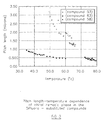



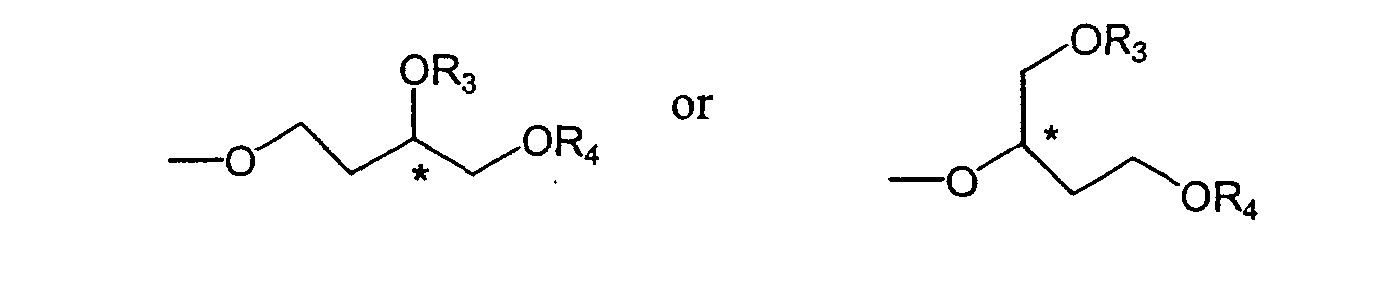



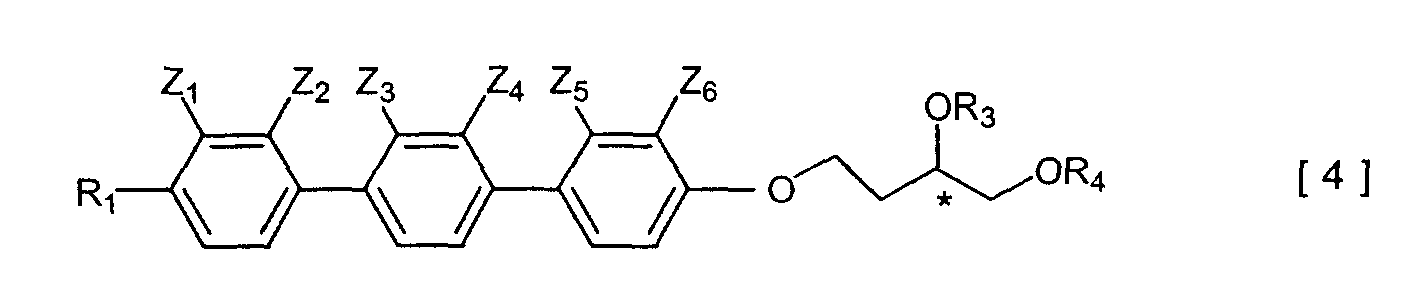


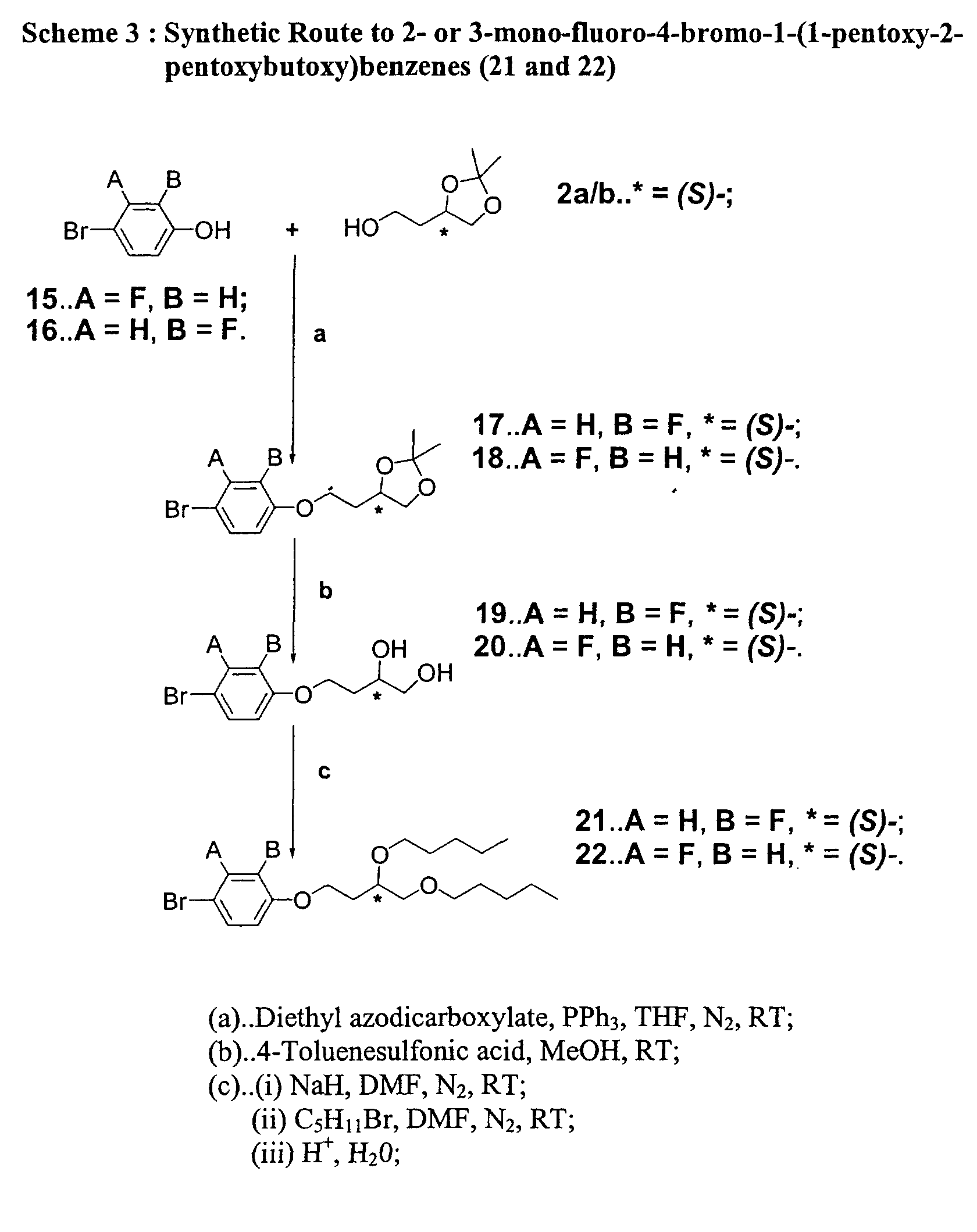


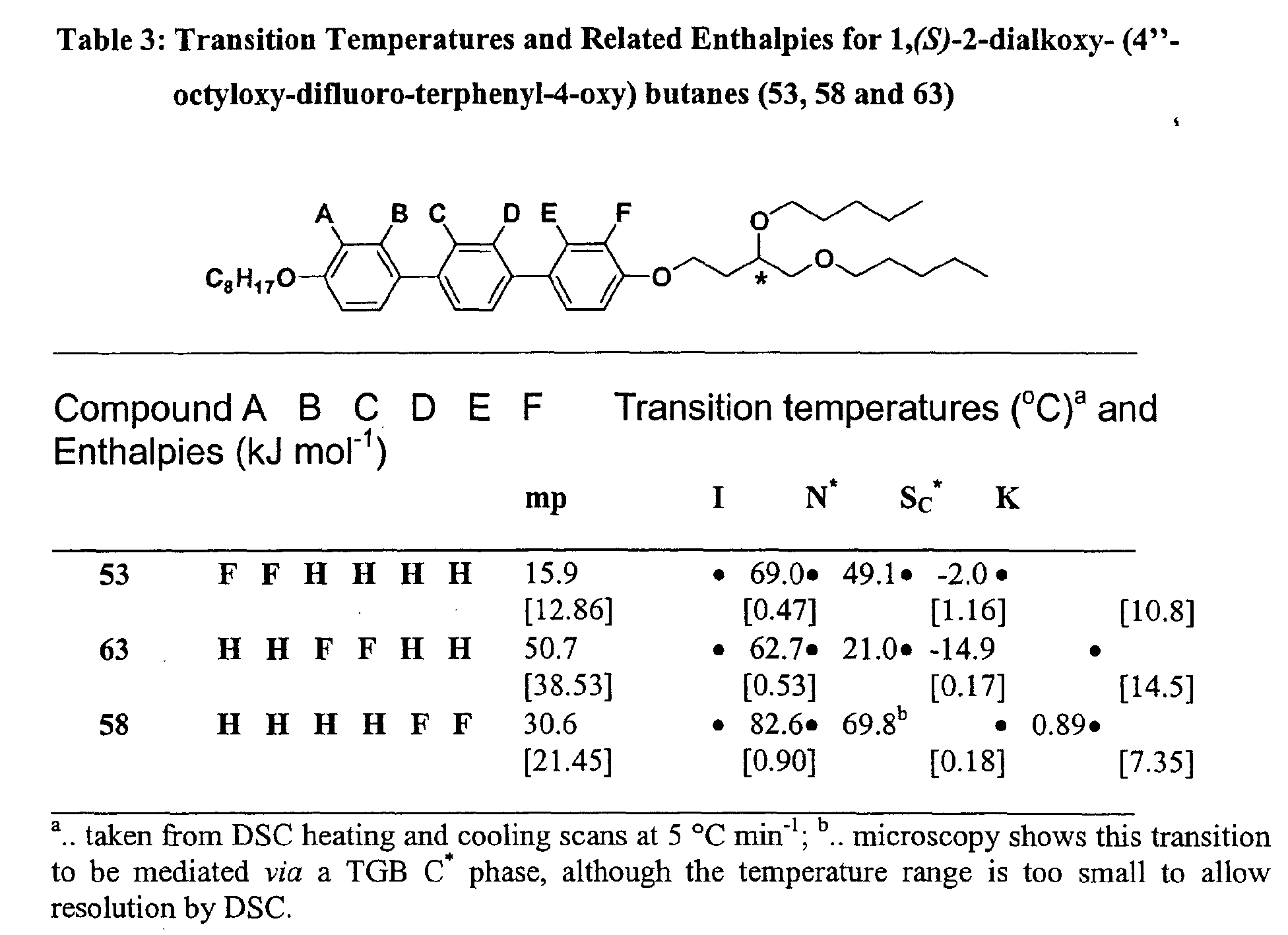

 where * indicates an asymmetric carbon atom,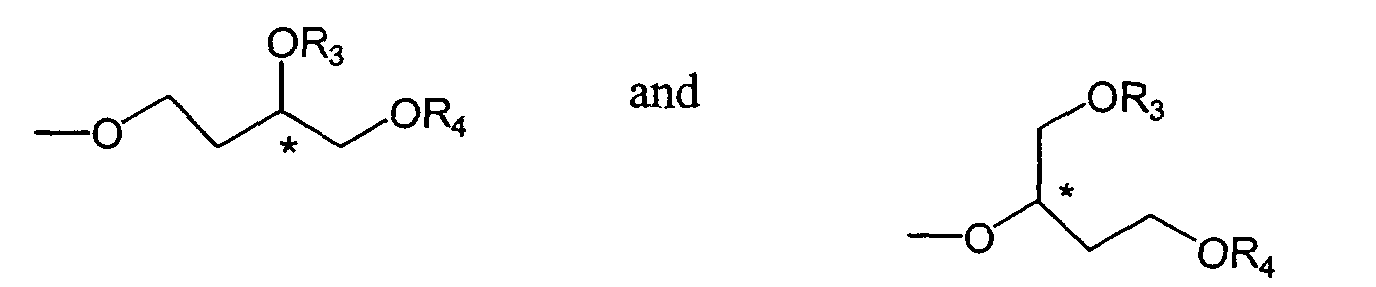
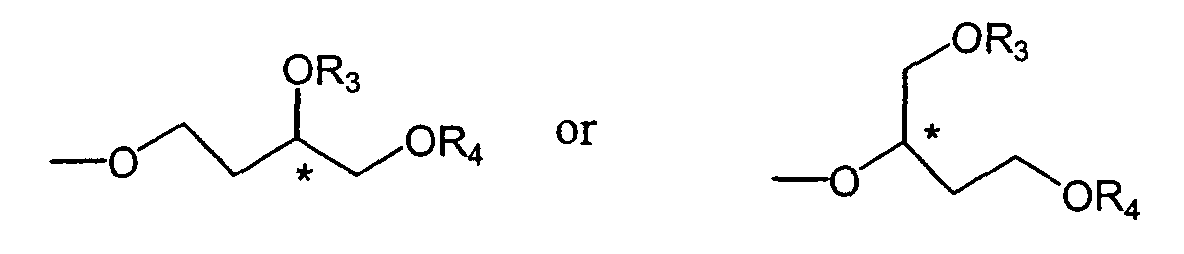
 wherein R1, R3, R4 and Z are as defined above.
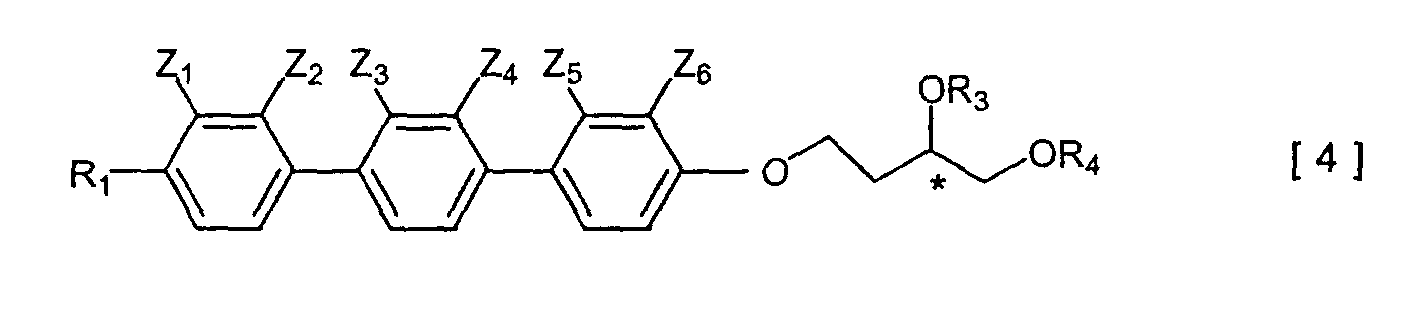 wherein R1, R3 and R4 are as defined above, and either
 (i) one of Z1 to Z6 is F, the remaining Z1 to Z6 being H, or(ii) Z1 and Z2, or Z3 and Z4, or Z5 and Z6 are F, the remaining Z1 to Z6 being H.