EP1157504B1 - System and method for improved data transfer in packet-switched communication networks - Google Patents
System and method for improved data transfer in packet-switched communication networks Download PDFInfo
- Publication number
- EP1157504B1 EP1157504B1 EP00905060A EP00905060A EP1157504B1 EP 1157504 B1 EP1157504 B1 EP 1157504B1 EP 00905060 A EP00905060 A EP 00905060A EP 00905060 A EP00905060 A EP 00905060A EP 1157504 B1 EP1157504 B1 EP 1157504B1
- Authority
- EP
- European Patent Office
- Prior art keywords
- sender
- receiver
- node
- retransmission timer
- retransmission
- Prior art date
- Legal status (The legal status is an assumption and is not a legal conclusion. Google has not performed a legal analysis and makes no representation as to the accuracy of the status listed.)
- Expired - Lifetime
Links
Images

Classifications
-
- H—ELECTRICITY
- H04—ELECTRIC COMMUNICATION TECHNIQUE
- H04L—TRANSMISSION OF DIGITAL INFORMATION, e.g. TELEGRAPHIC COMMUNICATION
- H04L47/00—Traffic control in data switching networks
- H04L47/10—Flow control; Congestion control
- H04L47/27—Evaluation or update of window size, e.g. using information derived from acknowledged [ACK] packets
-
- H—ELECTRICITY
- H04—ELECTRIC COMMUNICATION TECHNIQUE
- H04L—TRANSMISSION OF DIGITAL INFORMATION, e.g. TELEGRAPHIC COMMUNICATION
- H04L1/00—Arrangements for detecting or preventing errors in the information received
- H04L1/12—Arrangements for detecting or preventing errors in the information received by using return channel
- H04L1/16—Arrangements for detecting or preventing errors in the information received by using return channel in which the return channel carries supervisory signals, e.g. repetition request signals
- H04L1/18—Automatic repetition systems, e.g. Van Duuren systems
- H04L1/1809—Selective-repeat protocols
-
- H—ELECTRICITY
- H04—ELECTRIC COMMUNICATION TECHNIQUE
- H04L—TRANSMISSION OF DIGITAL INFORMATION, e.g. TELEGRAPHIC COMMUNICATION
- H04L1/00—Arrangements for detecting or preventing errors in the information received
- H04L1/12—Arrangements for detecting or preventing errors in the information received by using return channel
- H04L1/16—Arrangements for detecting or preventing errors in the information received by using return channel in which the return channel carries supervisory signals, e.g. repetition request signals
- H04L1/18—Automatic repetition systems, e.g. Van Duuren systems
- H04L1/1867—Arrangements specially adapted for the transmitter end
- H04L1/188—Time-out mechanisms
-
- H—ELECTRICITY
- H04—ELECTRIC COMMUNICATION TECHNIQUE
- H04L—TRANSMISSION OF DIGITAL INFORMATION, e.g. TELEGRAPHIC COMMUNICATION
- H04L47/00—Traffic control in data switching networks
- H04L47/10—Flow control; Congestion control
-
- H—ELECTRICITY
- H04—ELECTRIC COMMUNICATION TECHNIQUE
- H04L—TRANSMISSION OF DIGITAL INFORMATION, e.g. TELEGRAPHIC COMMUNICATION
- H04L47/00—Traffic control in data switching networks
- H04L47/10—Flow control; Congestion control
- H04L47/19—Flow control; Congestion control at layers above the network layer
- H04L47/193—Flow control; Congestion control at layers above the network layer at the transport layer, e.g. TCP related
-
- H—ELECTRICITY
- H04—ELECTRIC COMMUNICATION TECHNIQUE
- H04L—TRANSMISSION OF DIGITAL INFORMATION, e.g. TELEGRAPHIC COMMUNICATION
- H04L47/00—Traffic control in data switching networks
- H04L47/10—Flow control; Congestion control
- H04L47/22—Traffic shaping
- H04L47/225—Determination of shaping rate, e.g. using a moving window
-
- H—ELECTRICITY
- H04—ELECTRIC COMMUNICATION TECHNIQUE
- H04L—TRANSMISSION OF DIGITAL INFORMATION, e.g. TELEGRAPHIC COMMUNICATION
- H04L47/00—Traffic control in data switching networks
- H04L47/10—Flow control; Congestion control
- H04L47/28—Flow control; Congestion control in relation to timing considerations
- H04L47/283—Flow control; Congestion control in relation to timing considerations in response to processing delays, e.g. caused by jitter or round trip time [RTT]
-
- H—ELECTRICITY
- H04—ELECTRIC COMMUNICATION TECHNIQUE
- H04L—TRANSMISSION OF DIGITAL INFORMATION, e.g. TELEGRAPHIC COMMUNICATION
- H04L69/00—Network arrangements, protocols or services independent of the application payload and not provided for in the other groups of this subclass
- H04L69/16—Implementation or adaptation of Internet protocol [IP], of transmission control protocol [TCP] or of user datagram protocol [UDP]
- H04L69/161—Implementation details of TCP/IP or UDP/IP stack architecture; Specification of modified or new header fields
-
- H—ELECTRICITY
- H04—ELECTRIC COMMUNICATION TECHNIQUE
- H04L—TRANSMISSION OF DIGITAL INFORMATION, e.g. TELEGRAPHIC COMMUNICATION
- H04L69/00—Network arrangements, protocols or services independent of the application payload and not provided for in the other groups of this subclass
- H04L69/16—Implementation or adaptation of Internet protocol [IP], of transmission control protocol [TCP] or of user datagram protocol [UDP]
- H04L69/163—In-band adaptation of TCP data exchange; In-band control procedures
-
- H—ELECTRICITY
- H04—ELECTRIC COMMUNICATION TECHNIQUE
- H04L—TRANSMISSION OF DIGITAL INFORMATION, e.g. TELEGRAPHIC COMMUNICATION
- H04L69/00—Network arrangements, protocols or services independent of the application payload and not provided for in the other groups of this subclass
- H04L69/16—Implementation or adaptation of Internet protocol [IP], of transmission control protocol [TCP] or of user datagram protocol [UDP]
-
- H—ELECTRICITY
- H04—ELECTRIC COMMUNICATION TECHNIQUE
- H04L—TRANSMISSION OF DIGITAL INFORMATION, e.g. TELEGRAPHIC COMMUNICATION
- H04L69/00—Network arrangements, protocols or services independent of the application payload and not provided for in the other groups of this subclass
- H04L69/28—Timers or timing mechanisms used in protocols
Definitions
- the present invention relates to systems and methods for data transfer in packet-switched communication networks. More particularly, the present invention relates to systems and methods for improving the data transfer rate in packet-switched communication networks.
- Circuit-switched networks traditionally used in voice communication networks such as telephone networks, operate by establishing a logical connection between two points on the network. Typically the connection is of a fixed bandwidth or capacity regardless of the desired data transfer rate of the sender. Circuit-switched networks are widely regarded as being inflexible in their operation and inefficient in their allocation of bandwidth, or capacity, throughout the network.
- packet-switched networks traditionally used in data communications, operate by carving information into packets, which are then sent across the network to a desired recipient node.
- Packet-switched networks may be connection-oriented, such that a logical connection is maintained between the sender and the receiver, or connection-less, such that no logical connection is maintained between a sender and a receiver on the network. Packet-switched networks are widely regarded as being more flexible and substantially more efficient in allocating bandwidth than circuit-switched networks. Due in part to these factors, demand for packet-switched network services has grown dramatically over the past two decades. It is anticipated that demand for packet-switched networks will continue its dramatic growth.
- Packet-switched data networks are designed and based on industry-wide data standards such as the open system interface (OSI) model or an implementation of the Transmission Control Protocol/Internet Protocol (TCP/IP) stack.
- OSI open system interface
- TCP/IP Transmission Control Protocol/Internet Protocol
- Layer 1 referred to as the link, data link, or network interface layer, manages the interfaces and device drivers for interfacing with the physical elements of the network.
- Layer 2 referred to as the network layer or the internet layer, is responsible for routing data packets on the network.
- IP Internet Protocol
- Layer 3 referred to as the transport layer, is responsible for carving the data to be transmitted into appropriately sized packets for transmission across the network.
- the transport layer also manages error recovery and congestion control processes, acknowledging received packets and setting timeouts to ensure that transmitted data is received by the intended receiver.
- the Transmission Control Protocol (TCP) is a transport layer protocol.
- Layer 4 referred to as the application layer, is responsible for managing particular TCP/IP applications. Exemplary TCP/IP applications include SMTP for e-mail, FTP for file transfers, Telnet for remote login, etc.
- the TCP/IP protocol suite is the primary communications protocol suite applicable to the transfer of digital information across multiple, connected computer networks like the internet.
- TCP applications pass data for transmission to processes at the transport layer.
- the transport layer receives data for transmission from an application such as, for example, e-mail, and carves the data into appropriately sized packets, referred to as segments.
- the transport layer then passes the data segments to a network layer protocol utility, which compiles data packets according to network layer protocols like IP, referred to as datagrams, and routes the datagrams across one or more networks to the intended receiver.
- the network layer requests the services of link-layer protocol utilities to manage a particular physical medium such as, for example, an ethernet connection.
- the IP enables a connectionless, unreliable delivery service that may be used by numerous transport-layer protocols, including TCP.
- the IP layer is connectionless in that the IP maintains no logical relationship between successive datagrams transmitted across the network. Each datagram is treated by the network as an individual piece of information. Thus, even though a large file transfer may require sending hundreds, even thousands of datagrams, the IP layer of the network is unaware during the transfer that the packets are related. Individual packets may be routed across different paths through the network and/or may arrive at the destination in any sequence.
- the IP is unreliable in that robust error recovery procedures are not implemented at the IP layer.
- TCP is a connection-oriented protocol.
- TCP transport
- a logical connection is established between a TCP sender and a TCP receiver.
- the TCP layer is responsible for dividing data into appropriately-sized segments for transmission.
- the TCP layer is responsible for acknowledging received segments and for reassembling related segments.
- Additional functions implemented at the TCP layer include error recovery and congestion control.
- error recovery refers to the process of ensuring that packets transmitted by a sender were, at a minimum, received by the intended recipient. Error recovery may include additional algorithms to ensure that the recipient received the correct data.
- TCP uses a retransmission function as one error recovery procedure.
- a TCP sender retransmits data packets for which an acknowledgment packet is not received within a predetermined time period.
- TCP maintains a retransmission timer (REXMT) to implement the error recovery procedure.
- REXMT retransmission timer
- the sender reinitializes the REXMT with a retransmission timer value (RTO) that is a function of the round trip time (RTT).
- RTT retransmission timer value
- the RTT is continuously measured by the TCP sender.
- the RTT may be updated based upon actual RTT measurements.
- Radio Link Protocol RLP
- RLP Radio Link Protocol
- the estimation of the retransmission timer in TCP as described above is presented in "Computer Networks" 1996, by A. S. Tanenbaum, PRENTICE HALL PTR, New Jersey.
- the retransmission timer is started with RTO value, when an acknowledgment for the sent segment is received.
- the estimation of RTO is based on the continuous measurements of the round trip time (RTT).
- the present invention uses new techniques for managing a REXMT that enhance the data transfer rate of a network.
- the present invention addresses these and other problems by providing improved systems and methods for implementing packet-switched data transport services. More particularly, the present invention provides a retransmission-based error recovery procedure that facilitates improved data transfer rates in comparison to known retransmission timer error recovery procedures.
- the data transfer rate may be improved by reinitializing the retransmission timer with a value that compensates for the elapsed time since the transmission time of a previously transmitted packet from the sender to the receiver.
- the system allows error correction to be managed on a per-packet basis, yet requires only a single timer to be implemented, thereby saving computational expense.
- the present invention further provides improvements in data transfer rates by reducing the probability of unnecessary timeouts at a sender node. More particularly, the present invention provides a method for recalculating a retransmission timer value that determines whether a TCP sender has enough transmitted, but unacknowledged, segments outstanding to trigger a fast retransmit routine. If so, the RTO is calculated to include a factor that is a function of the time required for the sender to receive a predetermined number of ACK segments from the receiver. Including this factor increases the probability that the REXMT includes sufficient time to enable the TCP sender to implement a fast retransmit routine, rather than a congestion control routine.
- a method according to one aspect of the invention is implemented in a communication network that implements TCP connections between at least one sender node and at least one receiver node utilizing sliding-window flow control.
- the invention provides a method of performing retransmission timer based error recovery at a sender node comprising the steps of receiving an ACK segment from the receiver node and reinitializing the REXMT with a value that compensates for the elapsed time since the transmission time of a previously transmitted segment from the sender to the receiver.
- the REXMT is reinitialized with a time value compensating for the time elapsed since the transmission of the oldest data packet buffered for retransmission by the sender.
- the present invention is not protocol-specific. Accordingly, another aspect of the invention provides a method of operating a packet-switched communication network that implements logical connections between sender nodes and receiver nodes on the network.
- the sender nodes are configured to utilize sliding-window flow control and retransmission timer based error recovery.
- the network operates by establishing logical connections between sender nodes and respective receiver nodes on the network and initializing, for each logical connection, a retransmission timer with a retransmission timer value that is a function of network traffic parameters. Data packets are transmitted from the sender nodes to their respective receiver nodes on the network and acknowledgement packets are received from the respective receiver nodes.
- the retransmission timer associated with the connection between the sender and the receiver is reinitialized with a value corresponding to the retransmission timer value minus the elapsed time since the transmission time of a previously transmitted packet buffered in a memory associated with the sender for retransmission to the receiver, provided the sender has unacknowledged data buffered for retransmission.
- the invention provides a communications network element that implements TCP connections between at least one sender node and at least one receiver node utilizing sliding-window flow control and retransmission timer based error recovery.
- the network element includes an output module for transmitting data segments to a receiver node, an input module for receiving ACK segments from the receiver node, and logic, operating on a processor associated with the network element, for reinitializing the REXMT with a value that compensates for the elapsed time since the transmission time of a previously transmitted segment from the sender to the receiver.
- the logic may be implemented in software running on a general purpose processor associated with the network element or may be embedded in an application specific integrated circuit (ASIC).
- ASIC application specific integrated circuit
- TCP/IP protocol suite can be developed from the following documents: W. R. Stevens, TCP/IP Illustrated, Vol. 1, Addison-Welsley, 1994 ; W. R. Stevens, TCP/IP Illustrated, Vol. 2, 1995 ; Jacobson, V. et. al, TCP Extensions for High Performance , Jacobson V., et al., 1997, Internet Draft-Network Working Group, 1997 . Additionally, this document assumes a working knowledge of the Radio Link Protocol.
- Radio Link Protocol for data and telemetric services on the mobile station-base station switching system interface and the Base Station System-Mobile Switching Center (BSS-MSC) interface, GSM Specification 04.22, Version 3.7.0, February, 1992.
- BSS-MSC Base Station System-Mobile Switching Center
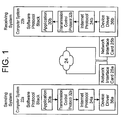
- the packet communication system 20 includes a sending computer system 22a and a receiving computer system 22b, each connected to a packet communication network or internet 24 by respective network interface cards 25a, 25b.
- the sending and receiving computer systems, 22a, 22b include an operating system software protocol stack including application modules 30a, 30b, TCP modules 32a, 32b, IP modules 34a, 34b and device drivers 36a, 36b.
- An application 30a accesses the TCP module or utility 32a in the sending computer system 22a.
- TCP modules 32a, 32b call on the IP modules 34a, 34b which in turn call on device drivers 36a, 36b.
- TCP modules 32a, 32b may call on other operating system functions, for example, to manage data structures.
- the interface to the network 24 is controlled by device driver modules 36a, 36b.
- the IP module 34b receives and reassembles a fragmented IP datagram from the device driver 36b and passes the IP datagram up to the TCP module 32b.
- the present invention arises, in one aspect, from the recognition that error recovery procedures specified in the TCP may introduce unnecessary transmission delays that reduce the data transfer rate of a TCP sender node.
- error recovery procedures specified in the TCP may introduce unnecessary transmission delays that reduce the data transfer rate of a TCP sender node.
- a TCP connection is typically requested by a higher level application in the protocol stack.
- a TCP module initiates a TCP session using the TCP's connection establishment protocol, frequently referred to as a "three-way handshake".
- the TCP sender begins transmitting data segments to the TCP receiver.
- the TCP protocol provides for sliding window flow control, pursuant to which a TCP sender may transmit more than one segment without receiving an acknowledgment. At least a portion of the segments transmitted without an acknowledgment are buffered in a memory location associated with the sender for retransmission in the event of an error.
- a TCP receiver responds to the sender with cumulative, sequential ACK segments.
- the TCP receiver responds to the receipt of segment N with an ACK segment indicating that it is ready to receive segment N+1.
- the TCP receiver acknowledges the receipt of segment number 1 with an ACK segment that indicates the receiver anticipates segment number 2 will arrive next.
- the TCP receiver acknowledges the receipt of segment number 50 with an ACK segment that indicates the receiver anticipates segment number 51 will arrive next.
- the TCP specifies a retransmission error recovery procedure.
- logic operational at the sender's TCP layer maintains a REXMT for each connection between a TCP sender and a TCP receiver.
- the REXMT is keyed to the "oldest" data segment buffered for retransmission by the sender.
- the REXMT is reinitialized with a RTO that is a function of the RTT each time an acknowledgment segment for new data is received by the sender, provided that the sender has unacknowledged data buffered for retransmission.
- the sender reduces its, congestion window and after the expiration of the REXMT, retransmits the buffered data to the sender, beginning with the oldest outstanding segment buffered for retransmission.
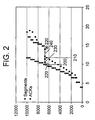
- Fig. 2 is a graph illustrating a TCP session from the perspective of a sender node on a network. Time (in seconds) is plotted on the horizontal or "X" axis and TCP sequence numbers are plotted on the vertical or "Y" axis. The transfer by the sender of TCP segments is plotted with diamonds and the receipt of ACK segments from the intended recipient is plotted with squares. Referring to Fig. 2 it is seen that a TCP session is initiated by the sender and two segments are transmitted approximately three seconds into the session. At approximately five seconds, the sender receives an ACK segment from the receiver acknowledging receipt of the second segment and transmits two more segments to the receiver node.
- the sender receives an ACK segment from the receiver and transmits three segments to the receiver, and the session continues normally.
- the sender begins sending three segments each time data is transmitted.
- the TCP session depicted in Fig. 2 proceeds normally for the next few seconds.
- the sender is transmitting three segments per transmission to the receiver and receiving ACK segments from the receiver.
- a time lag develops between the event of the sender transmitting information and the receipt by the sender of a corresponding ACK segment from the receiver. This time lag is evidenced by the divergence between the plots of segment transfers by the sender and the plots of ACK receipts by the sender. As the session approaches a steady state, and assuming a stable network, this time lag converges to approximate the RTT between the sender and the receiver. In one aspect, the present invention is based upon the recognition that this time lag introduces an error into the TCP REXMT, causing the REXMT to be too conservative.
- the TCP sender implements sliding window flow control. Accordingly, the sender is allowed to transmit a predetermined number of segments that are unacknowledged.
- the sender reinitializes its REXMT with a RTO upon receipt of each ACK segment for new data (e.g., excluding duplicate acknowledgment segments (DUPACKS), repeat ACK segments, and invalid ACK segments) provided the sender has unacknowledged data buffered for retransmission.
- the RTO timer value is typically calculated as a function of the RTT by logic instructions operating on a processor associated with the sender. In many TCP implementations the RTO converges to approximate the RTT in a steady state network.
- a network error occurs which triggers a retransmission error routine.
- An ACK segment 210 is received at approximately twelve seconds. Accordingly, the REXMT is reinitialized with the RTO 240 at approximately twelve seconds. It will be noted that approximately three seconds has lapsed since the transmission of the data that triggered the ACK segment 210. It will also be noted that, pursuant to sliding window flow control procedures, the sender has transmitted approximately fifteen segments that are unacknowledged. These segments are buffered in a memory associated with the sender for retransmission in the event of an error.
- the sender does not receive an ACK segment from the receiver prior to the expiration of the REXMT, which occurs approximately fifteen seconds into the session.
- the particular network error that causes the REXMT to expire prior to receiving an ACK segment from the receiver is not critical to the present invention.
- the network error could be the result of network congestion that introduces excessive delay or a result of a failure in one or more nodes or links in the network between the sender and the receiver.
- the REXMT expires at approximately fifteen seconds, whereupon the sender initiates a retransmission error recovery procedure.
- the sender reduces its transmission rate and begins retransmitting the unacknowledged segments, starting with "oldest" segment buffered for retransmission, indicated in the drawing by circles (e.g., segment 220).
- the sender retransmits the segments buffered for retransmission and the session is then able to continue normally.
- the series of events presented in Fig. 2 illustrates a flaw inherent in the TCP retransmission error recovery procedure. Namely, initializing the REXMT with the RTO upon receipt of each acknowledgment segment fails to compensate for the time lag that develops between the event of the sender transmitting a segment and the receipt by the sender of a corresponding ACK segment from the receiver.
- a time lag 230 of approximately three seconds exists between the transmission of data segment 220 and the receipt of a corresponding ACK segment 210.
- Time lag 230 introduces an unnecessary time delay into the retransmit error correction procedure. This time delay has a negative influence on the data transfer rate of the sender.
- the present invention provides novel methods of reinitializing a TCP sender's REXMT to improve the data transfer rate of the TCP sender.
- the REXMT is reinitialized with a value that compensates for the time that has elapsed since the sender transmitted a previous data segment to the receiver.
- the REXMT upon receipt of each ACK segment (excluding DUPACK segments, repeat acknowledgments, and invalid acknowledgments) is reinitialized with the RTO value minus the time that has elapsed since the "oldest" data segment the sender has buffered for retransmission.
- Reducing the REXMT by the time that has elapsed since the "oldest" data segment the sender has buffered for retransmission compensates for the time delay inherent in TCP's retransmission error recovery procedure, thereby increasing the data transfer rate of the TCP sender.
- the RTO value could be reduced by an amount different from the elapsed time since the "oldest” segment the sender has buffered for retransmission to the receiver.
- This value represents an aggressive adjustment to the RTO.
- a less aggressive adjustment could be made by selecting a time less than the elapsed time since the "oldest” segment the sender has buffered for retransmission to the receiver.
- the RTO could be reduced by the elapsed time since the transmission of a data segment transmitted more recently than the "oldest" buffered data segment.
- Fig. 3 is a flow chart that illustrates a sequence of steps in managing a communication session between a TCP sender and a TCP receiver according to the present invention.
- the sender opens a TCP session between the sender and the receiver. This step may be performed in a manner that is consistent with existing TCP implementations.
- the sender initializes the REXMT with the RTO minus the time elapsed since the "oldest" byte buffered for retransmission from the sender to the receiver. When the connection is first opened there are no segments buffered for retransmission so the REXMT is set to the RTO.
- TCP provides for initializing the REXMT at the beginning of a TCP session, and the REXMT may be initialized pursuant to existing protocols.
- the sender transmits one or more data segments to the sender, depending upon the parameters of the start up procedure and the flow control procedures. This step also may be performed in a manner that is consistent with existing TCP implementations.
- the sender receives an ACK segment from the receiver.
- a test is performed to determine whether the ACK segment is valid and, if so, the REXMT is reinitialized with the RTO minus the time that has elapsed since the "oldest" segment buffered for retransmission.
- the REXMT is not reinitialized if the ACK segment is a DUPACK segment or an invalid ACK segment. Data transfer then proceeds pursuant to existing TCP implementations. If, during step 340, the ACK segment is determined to be in error, the ACK is discarded.
- a network supporting TCP sessions pursuant to the procedures illustrated in Fig. 3 enables TCP sender nodes to compensate for the delay inherent in the TCP retransmission error recovery procedure.
- the procedures illustrated in Fig. 3 do not impose extensive additional computation burdens on the network or require the collection and tracking of additional network statistics. Instead, the procedures illustrated in Fig. 3 utilize the RTO value, a statistic which is specified by TCP.
- the procedures illustrated in Fig. 3 enable the network to key the REXMT to an individual segment without incurring the computational expense of maintaining timers associated with each segment transmitted by a sender node.
- the present invention provides novel procedures for calculating the RTO for a TCP connection to improve the data transfer rate of a TCP sender.
- the RTO is calculated to increase the probability that a transmission error will trigger a fast retransmit/congestion avoidance routine, rather than a timeout routine.
- logic for calculating the RTO includes procedures for determining the amount of time required for the sender to receive a predetermined number of duplicate acknowledgment segments.
- the logic may be implemented in the TCP layer.
- One embodiment of suitable logic is presented in the following C-like pseudocode:
- the RTO calculation includes a factor (e.g., Delta_3) that is a function of the amount of time required to receive a predetermined number of DUPACKS required to trigger the fast retransmit procedure. This factor enables the TCP sender to adjust the RTO to increase the probability of triggering a fast retransmit error recovery procedure, rather than a timeout error recovery procedure. Suitable functions for Delta_3 are presented below.
- the TCP sender can measure the number of segments (M) that were acknowledged during the most recent calculation of the round trip time.
- M the number of segments that were acknowledged during the most recent calculation of the round trip time.
- M the number of segments that were acknowledged during the most recent calculation of the round trip time.
- K the number of duplicate acknowledgment segments required for the TCP sender to trigger a fast retransmit congestion avoidance mechanism
- A the latest round trip time measurement
- B is a function of a time interval between the arrival of ACKs.
- B may be any suitable function including a suitable smoothing function. Suitable smoothing functions are disclosed in TCP/IP Illustrated, Vol. 1 .
- the present invention is not limited to the TCP/IP suite. Principles of the present invention are applicable to any packet-switched network protocol that utilizes sliding window flow control and retransmission timer based error recovery procedures.
- the present invention is fully applicable to the Radio Link Protocol specified in ETSI, Radio Link Protocol for Data and Telemetric Services on the Mobile Station - Base Station System (MS-BSS) Interface and the Base Station System -Mobile Switching Center (BSS-MSC) Interface, G.M. Specification 04.22, Version 3.7.0, February, 1992.
Landscapes
- Engineering & Computer Science (AREA)
- Computer Networks & Wireless Communication (AREA)
- Signal Processing (AREA)
- Computer Security & Cryptography (AREA)
- Data Exchanges In Wide-Area Networks (AREA)
- Communication Control (AREA)
- Mobile Radio Communication Systems (AREA)
Abstract
Description
- The present invention relates to systems and methods for data transfer in packet-switched communication networks. More particularly, the present invention relates to systems and methods for improving the data transfer rate in packet-switched communication networks.
- Communication networks can be classified as either circuit-switched or packet-switched networks. Circuit-switched networks, traditionally used in voice communication networks such as telephone networks, operate by establishing a logical connection between two points on the network. Typically the connection is of a fixed bandwidth or capacity regardless of the desired data transfer rate of the sender. Circuit-switched networks are widely regarded as being inflexible in their operation and inefficient in their allocation of bandwidth, or capacity, throughout the network. By contrast, packet-switched networks, traditionally used in data communications, operate by carving information into packets, which are then sent across the network to a desired recipient node. Packet-switched networks may be connection-oriented, such that a logical connection is maintained between the sender and the receiver, or connection-less, such that no logical connection is maintained between a sender and a receiver on the network. Packet-switched networks are widely regarded as being more flexible and substantially more efficient in allocating bandwidth than circuit-switched networks. Due in part to these factors, demand for packet-switched network services has grown dramatically over the past two decades. It is anticipated that demand for packet-switched networks will continue its dramatic growth.
- Packet-switched data networks are designed and based on industry-wide data standards such as the open system interface (OSI) model or an implementation of the Transmission Control Protocol/Internet Protocol (TCP/IP) stack. According to the OSI model, a network system is typically represented by a multi-layered protocol stack. The TCP/IP protocols are commonly modeled as a four-layer protocol stack. Layer 1, referred to as the link, data link, or network interface layer, manages the interfaces and device drivers for interfacing with the physical elements of the network. Layer 2, referred to as the network layer or the internet layer, is responsible for routing data packets on the network. The Internet Protocol (IP) is a network layer protocol. Layer 3, referred to as the transport layer, is responsible for carving the data to be transmitted into appropriately sized packets for transmission across the network. The transport layer also manages error recovery and congestion control processes, acknowledging received packets and setting timeouts to ensure that transmitted data is received by the intended receiver. The Transmission Control Protocol (TCP) is a transport layer protocol. Layer 4, referred to as the application layer, is responsible for managing particular TCP/IP applications. Exemplary TCP/IP applications include SMTP for e-mail, FTP for file transfers, Telnet for remote login, etc. The TCP/IP protocol suite is the primary communications protocol suite applicable to the transfer of digital information across multiple, connected computer networks like the internet. The operation of a network according to TCP/IP protocols may be explained, at a conceptual level, as follows: TCP applications pass data for transmission to processes at the transport layer. The transport layer receives data for transmission from an application such as, for example, e-mail, and carves the data into appropriately sized packets, referred to as segments. The transport layer then passes the data segments to a network layer protocol utility, which compiles data packets according to network layer protocols like IP, referred to as datagrams, and routes the datagrams across one or more networks to the intended receiver. The network layer, in turn, requests the services of link-layer protocol utilities to manage a particular physical medium such as, for example, an ethernet connection.
- The IP enables a connectionless, unreliable delivery service that may be used by numerous transport-layer protocols, including TCP. The IP layer is connectionless in that the IP maintains no logical relationship between successive datagrams transmitted across the network. Each datagram is treated by the network as an individual piece of information. Thus, even though a large file transfer may require sending hundreds, even thousands of datagrams, the IP layer of the network is unaware during the transfer that the packets are related. Individual packets may be routed across different paths through the network and/or may arrive at the destination in any sequence. The IP is unreliable in that robust error recovery procedures are not implemented at the IP layer.
- TCP is a connection-oriented protocol. At the TCP (transport) layer, a logical connection is established between a TCP sender and a TCP receiver. As discussed above, at the sender node the TCP layer is responsible for dividing data into appropriately-sized segments for transmission. At the receiver node the TCP layer is responsible for acknowledging received segments and for reassembling related segments. Additional functions implemented at the TCP layer include error recovery and congestion control. In broad terms, error recovery refers to the process of ensuring that packets transmitted by a sender were, at a minimum, received by the intended recipient. Error recovery may include additional algorithms to ensure that the recipient received the correct data.
- TCP uses a retransmission function as one error recovery procedure. Pursuant to TCP, a TCP sender retransmits data packets for which an acknowledgment packet is not received within a predetermined time period. TCP maintains a retransmission timer (REXMT) to implement the error recovery procedure. For each acknowledgment (ACK) segment returned by the receiver, the sender reinitializes the REXMT with a retransmission timer value (RTO) that is a function of the round trip time (RTT). In many implementations of TCP, the RTT is continuously measured by the TCP sender. In alternate embodiments, the RTT may be updated based upon actual RTT measurements. Radio Link Protocol (RLP), a link-layer protocol for wireless communications also implements a retransmission timer-based error recovery procedure, similar to the routine implemented by TCP.
- The estimation of the retransmission timer in TCP as described above is presented in "Computer Networks" 1996, by A. S. Tanenbaum, PRENTICE HALL PTR, New Jersey. The retransmission timer is started with RTO value, when an acknowledgment for the sent segment is received. The estimation of RTO is based on the continuous measurements of the round trip time (RTT).
- An algorithm presented in "Explicit loss indication and accurate RTO estimation for TCP error recovery using satellite links" Samaraweera N ET AL, IEE Proceedings: Communications, vol. 144, no.1, 1 February 1997, pages 47-53, XP 000687134 considers also continuous measurements of the round trip time (RTT). The RTO estimation is improved by using the transmission time of each segment for which an acknowledgment is received. This algorithm allows the RTT to be sampled many times per transmission window. In the conventional technique the RTT is measured between sending a data octet with a particular sequence number and receiving acknowledgment that covers the same sequence number. The subsequent packets belonging to the same window will not be included in the measurements. This problem is solved in this document. A disadvantage is the number of timer, which have to be started.
- Although various implementations of the retransmission routine have been effective, they may unnecessarily reduce data transfer rates in the network. Thus, there is a need for improved systems and methods for data transfer in packet-switched networks, including TCP networks. The present invention uses new techniques for managing a REXMT that enhance the data transfer rate of a network.
- The present invention addresses these and other problems by providing improved systems and methods for implementing packet-switched data transport services. More particularly, the present invention provides a retransmission-based error recovery procedure that facilitates improved data transfer rates in comparison to known retransmission timer error recovery procedures. According to one aspect of the invention, the data transfer rate may be improved by reinitializing the retransmission timer with a value that compensates for the elapsed time since the transmission time of a previously transmitted packet from the sender to the receiver. Advantageously, the system allows error correction to be managed on a per-packet basis, yet requires only a single timer to be implemented, thereby saving computational expense.
- The present invention further provides improvements in data transfer rates by reducing the probability of unnecessary timeouts at a sender node. More particularly, the present invention provides a method for recalculating a retransmission timer value that determines whether a TCP sender has enough transmitted, but unacknowledged, segments outstanding to trigger a fast retransmit routine. If so, the RTO is calculated to include a factor that is a function of the time required for the sender to receive a predetermined number of ACK segments from the receiver. Including this factor increases the probability that the REXMT includes sufficient time to enable the TCP sender to implement a fast retransmit routine, rather than a congestion control routine.
- A method according to one aspect of the invention is implemented in a communication network that implements TCP connections between at least one sender node and at least one receiver node utilizing sliding-window flow control. The invention provides a method of performing retransmission timer based error recovery at a sender node comprising the steps of receiving an ACK segment from the receiver node and reinitializing the REXMT with a value that compensates for the elapsed time since the transmission time of a previously transmitted segment from the sender to the receiver. Preferably, the REXMT is reinitialized with a time value compensating for the time elapsed since the transmission of the oldest data packet buffered for retransmission by the sender.
- Advantageously, the present invention is not protocol-specific. Accordingly, another aspect of the invention provides a method of operating a packet-switched communication network that implements logical connections between sender nodes and receiver nodes on the network. The sender nodes are configured to utilize sliding-window flow control and retransmission timer based error recovery. According to the invention, the network operates by establishing logical connections between sender nodes and respective receiver nodes on the network and initializing, for each logical connection, a retransmission timer with a retransmission timer value that is a function of network traffic parameters. Data packets are transmitted from the sender nodes to their respective receiver nodes on the network and acknowledgement packets are received from the respective receiver nodes. Upon receipt of each acknowledgement packet for new data, the retransmission timer associated with the connection between the sender and the receiver is reinitialized with a value corresponding to the retransmission timer value minus the elapsed time since the transmission time of a previously transmitted packet buffered in a memory associated with the sender for retransmission to the receiver, provided the sender has unacknowledged data buffered for retransmission.
- In a further aspect, the invention provides a communications network element that implements TCP connections between at least one sender node and at least one receiver node utilizing sliding-window flow control and retransmission timer based error recovery. The network element includes an output module for transmitting data segments to a receiver node, an input module for receiving ACK segments from the receiver node, and logic, operating on a processor associated with the network element, for reinitializing the REXMT with a value that compensates for the elapsed time since the transmission time of a previously transmitted segment from the sender to the receiver. The logic may be implemented in software running on a general purpose processor associated with the network element or may be embedded in an application specific integrated circuit (ASIC).
- These and other aspects of the invention provide for improved data transfer rates in packet-switched networks, particularly in nodes functioning as 'sender' nodes. Improved data transfer rates in sender nodes contribute to improved network performance.
-
-
Fig. 1 is a schematic illustration of a TCP/IP network connection. -
Fig. 2 is a graph illustrating aspects of a TCP/IP session. -
Fig. 3 is a flowchart illustrating one embodiment of an improved data transfer method according to the present invention. -
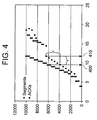
Fig. 4 is a graph illustrating aspects of a TCP/IP session. - The present invention will be explained with reference to the exemplary embodiments and examples depicted in the following text and the accompanying drawings. In particular, the present invention will be explained in the context of the TCP transport layer protocol, but it will be appreciated that the particular embodiments depicted herein are presented for purposes of demonstration and are not intended to be limiting. It will be appreciated that the present invention is applicable to any packet-exchange link layer protocol or transport layer protocol that uses sliding window flow-control in combination with REXMT based error recovery.
- This disclosure was prepared for one of ordinary skill in the art of designing and developing packet-switched communication networks such as, for example, a telecommunication network engineer. A working knowledge of the TCP/IP protocol suite can be developed from the following documents: W. R. Stevens, TCP/IP Illustrated, Vol. 1, Addison-Welsley, 1994; W. R. Stevens, TCP/IP Illustrated, Vol. 2, 1995; Jacobson, V. et. al, TCP Extensions for High Performance, Jacobson V., et al., 1997, Internet Draft-Network Working Group, 1997. Additionally, this document assumes a working knowledge of the Radio Link Protocol. A working knowledge of the Radio Link Protocol can be developed from the following document, which is incorporated herein by reference: ETSI, Radio Link Protocol for data and telemetric services on the mobile station-base station switching system interface and the Base Station System-Mobile Switching Center (BSS-MSC) interface, GSM Specification 04.22, Version 3.7.0, February, 1992.
- Referring to
Fig. 1 there is shown a block diagram representation illustrating a packet communication network system generally designated by thereference character 20 which may be employed to implement the present invention. As shown, thepacket communication system 20 includes a sendingcomputer system 22a and a receivingcomputer system 22b, each connected to a packet communication network orinternet 24 by respectivenetwork interface cards TCP modules IP modules device drivers utility 32a in the sendingcomputer system 22a.TCP modules IP modules device drivers TCP modules network 24 is controlled bydevice driver modules computer system 22b, theIP module 34b receives and reassembles a fragmented IP datagram from thedevice driver 36b and passes the IP datagram up to theTCP module 32b. - The present invention arises, in one aspect, from the recognition that error recovery procedures specified in the TCP may introduce unnecessary transmission delays that reduce the data transfer rate of a TCP sender node. A short background discussion of aspects of a communication session between a TCP sender and a TCP receiver, including error correction procedures, is in order.
- As discussed above, a TCP connection is typically requested by a higher level application in the protocol stack. When the TCP layer receives a TCP connection request, a TCP module initiates a TCP session using the TCP's connection establishment protocol, frequently referred to as a "three-way handshake". After the TCP connection is established, the TCP sender begins transmitting data segments to the TCP receiver. The TCP protocol provides for sliding window flow control, pursuant to which a TCP sender may transmit more than one segment without receiving an acknowledgment. At least a portion of the segments transmitted without an acknowledgment are buffered in a memory location associated with the sender for retransmission in the event of an error.
- A TCP receiver responds to the sender with cumulative, sequential ACK segments. The TCP receiver responds to the receipt of segment N with an ACK segment indicating that it is ready to receive segment N+1. By way of example, the TCP receiver acknowledges the receipt of segment number 1 with an ACK segment that indicates the receiver anticipates segment number 2 will arrive next. Similarly, the TCP receiver acknowledges the receipt of segment number 50 with an ACK segment that indicates the receiver anticipates segment number 51 will arrive next.
- As discussed above, the TCP specifies a retransmission error recovery procedure. To implement this routine, logic operational at the sender's TCP layer maintains a REXMT for each connection between a TCP sender and a TCP receiver. In sliding window flow control implementations of TCP protocols, the REXMT is keyed to the "oldest" data segment buffered for retransmission by the sender. Pursuant to TCP, the REXMT is reinitialized with a RTO that is a function of the RTT each time an acknowledgment segment for new data is received by the sender, provided that the sender has unacknowledged data buffered for retransmission. In the event an error triggers a retransmission error recovery procedure, the sender reduces its, congestion window and after the expiration of the REXMT, retransmits the buffered data to the sender, beginning with the oldest outstanding segment buffered for retransmission.
-
Fig. 2 is a graph illustrating a TCP session from the perspective of a sender node on a network. Time (in seconds) is plotted on the horizontal or "X" axis and TCP sequence numbers are plotted on the vertical or "Y" axis. The transfer by the sender of TCP segments is plotted with diamonds and the receipt of ACK segments from the intended recipient is plotted with squares. Referring toFig. 2 it is seen that a TCP session is initiated by the sender and two segments are transmitted approximately three seconds into the session. At approximately five seconds, the sender receives an ACK segment from the receiver acknowledging receipt of the second segment and transmits two more segments to the receiver node. At approximately six seconds the sender receives an ACK segment from the receiver and transmits three segments to the receiver, and the session continues normally. At approximately seven seconds the sender begins sending three segments each time data is transmitted. The TCP session depicted inFig. 2 proceeds normally for the next few seconds. The sender is transmitting three segments per transmission to the receiver and receiving ACK segments from the receiver. - Several items should be noted in connection with
Fig. 2 . First, as the session progresses a time lag develops between the event of the sender transmitting information and the receipt by the sender of a corresponding ACK segment from the receiver. This time lag is evidenced by the divergence between the plots of segment transfers by the sender and the plots of ACK receipts by the sender. As the session approaches a steady state, and assuming a stable network, this time lag converges to approximate the RTT between the sender and the receiver. In one aspect, the present invention is based upon the recognition that this time lag introduces an error into the TCP REXMT, causing the REXMT to be too conservative. Second, it should be noted that the TCP sender implements sliding window flow control. Accordingly, the sender is allowed to transmit a predetermined number of segments that are unacknowledged. Third, it should be noted that, pursuant to TCP error-recovery procedures, the sender reinitializes its REXMT with a RTO upon receipt of each ACK segment for new data (e.g., excluding duplicate acknowledgment segments (DUPACKS), repeat ACK segments, and invalid ACK segments) provided the sender has unacknowledged data buffered for retransmission. The RTO timer value is typically calculated as a function of the RTT by logic instructions operating on a processor associated with the sender. In many TCP implementations the RTO converges to approximate the RTT in a steady state network. - Approximately twelve seconds into the session a network error occurs which triggers a retransmission error routine. An
ACK segment 210 is received at approximately twelve seconds. Accordingly, the REXMT is reinitialized with theRTO 240 at approximately twelve seconds. It will be noted that approximately three seconds has lapsed since the transmission of the data that triggered theACK segment 210. It will also be noted that, pursuant to sliding window flow control procedures, the sender has transmitted approximately fifteen segments that are unacknowledged. These segments are buffered in a memory associated with the sender for retransmission in the event of an error. - Due to a network error the sender does not receive an ACK segment from the receiver prior to the expiration of the REXMT, which occurs approximately fifteen seconds into the session. The particular network error that causes the REXMT to expire prior to receiving an ACK segment from the receiver is not critical to the present invention. The network error could be the result of network congestion that introduces excessive delay or a result of a failure in one or more nodes or links in the network between the sender and the receiver. The REXMT expires at approximately fifteen seconds, whereupon the sender initiates a retransmission error recovery procedure. Accordingly, pursuant to TCP, the sender reduces its transmission rate and begins retransmitting the unacknowledged segments, starting with "oldest" segment buffered for retransmission, indicated in the drawing by circles (e.g., segment 220). The sender retransmits the segments buffered for retransmission and the session is then able to continue normally.
- The series of events presented in
Fig. 2 illustrates a flaw inherent in the TCP retransmission error recovery procedure. Namely, initializing the REXMT with the RTO upon receipt of each acknowledgment segment fails to compensate for the time lag that develops between the event of the sender transmitting a segment and the receipt by the sender of a corresponding ACK segment from the receiver. At the time of the network error in the session depicted inFig. 2 , atime lag 230 of approximately three seconds exists between the transmission ofdata segment 220 and the receipt of acorresponding ACK segment 210.Time lag 230 introduces an unnecessary time delay into the retransmit error correction procedure. This time delay has a negative influence on the data transfer rate of the sender. In short, the REXMT is too conservative. In one aspect, the present invention provides novel methods of reinitializing a TCP sender's REXMT to improve the data transfer rate of the TCP sender. According to the present invention, the REXMT is reinitialized with a value that compensates for the time that has elapsed since the sender transmitted a previous data segment to the receiver. In one embodiment of the invention, the REXMT, upon receipt of each ACK segment (excluding DUPACK segments, repeat acknowledgments, and invalid acknowledgments) is reinitialized with the RTO value minus the time that has elapsed since the "oldest" data segment the sender has buffered for retransmission. Reducing the REXMT by the time that has elapsed since the "oldest" data segment the sender has buffered for retransmission compensates for the time delay inherent in TCP's retransmission error recovery procedure, thereby increasing the data transfer rate of the TCP sender. - It will be appreciated that the RTO value could be reduced by an amount different from the elapsed time since the "oldest" segment the sender has buffered for retransmission to the receiver. This value represents an aggressive adjustment to the RTO. A less aggressive adjustment could be made by selecting a time less than the elapsed time since the "oldest" segment the sender has buffered for retransmission to the receiver. By way of example, the RTO could be reduced by the elapsed time since the transmission of a data segment transmitted more recently than the "oldest" buffered data segment.
-
Fig. 3 is a flow chart that illustrates a sequence of steps in managing a communication session between a TCP sender and a TCP receiver according to the present invention. Referring toFig. 3 , instep 300 the sender opens a TCP session between the sender and the receiver. This step may be performed in a manner that is consistent with existing TCP implementations. Instep 310 the sender initializes the REXMT with the RTO minus the time elapsed since the "oldest" byte buffered for retransmission from the sender to the receiver. When the connection is first opened there are no segments buffered for retransmission so the REXMT is set to the RTO. TCP provides for initializing the REXMT at the beginning of a TCP session, and the REXMT may be initialized pursuant to existing protocols. Atstep 320 the sender transmits one or more data segments to the sender, depending upon the parameters of the start up procedure and the flow control procedures. This step also may be performed in a manner that is consistent with existing TCP implementations. Instep 330 the sender receives an ACK segment from the receiver. In step 340 a test is performed to determine whether the ACK segment is valid and, if so, the REXMT is reinitialized with the RTO minus the time that has elapsed since the "oldest" segment buffered for retransmission. The REXMT is not reinitialized if the ACK segment is a DUPACK segment or an invalid ACK segment. Data transfer then proceeds pursuant to existing TCP implementations. If, duringstep 340, the ACK segment is determined to be in error, the ACK is discarded. - Operating a network supporting TCP sessions pursuant to the procedures illustrated in
Fig. 3 enables TCP sender nodes to compensate for the delay inherent in the TCP retransmission error recovery procedure. Advantageously, the procedures illustrated inFig. 3 do not impose extensive additional computation burdens on the network or require the collection and tracking of additional network statistics. Instead, the procedures illustrated inFig. 3 utilize the RTO value, a statistic which is specified by TCP. Furthermore, the procedures illustrated inFig. 3 enable the network to key the REXMT to an individual segment without incurring the computational expense of maintaining timers associated with each segment transmitted by a sender node. - In another aspect, the present invention provides novel procedures for calculating the RTO for a TCP connection to improve the data transfer rate of a TCP sender. According to the present invention, the RTO is calculated to increase the probability that a transmission error will trigger a fast retransmit/congestion avoidance routine, rather than a timeout routine. To implement this procedure, logic for calculating the RTO includes procedures for determining the amount of time required for the sender to receive a predetermined number of duplicate acknowledgment segments. According to the present invention, the logic may be implemented in the TCP layer. One embodiment of suitable logic is presented in the following C-like pseudocode:
- if (U>N) then

- else

where:- U is the number of segments the sender has sent, but which are unacknowledged.
- N is a number greater than or equal to K, which is the number of DUPACKS required for the TCP sender to trigger the fast retransmit/congestion avoidance mechanism. In most TCP implementations, K = 3.
- Delta_1 is a function of the RTT. A suitable function for Delta_1 is the Smoothed-RTT function as set forth in TCP/IP illustrated, Volume 1, incorporated by reference above. However, the Delta_1 function chosen is not critical to the present invention.
- Delta_2 is a function of the variation in the round trip time. A suitable function for Delta_2 is the Smoothed-Mean-Variation function as set forth in TCP/IP illustrated, Volume 1, incorporated by reference above. However, the precise Delta_1 function chosen is not critical to the present invention;
- Delta_3 is a function that compensates for the time required to receive the predetermined number of DUPACKS required to trigger a fast retransmit algorithm at the TCP sender; and
- P >= 0. A suitable choice for P is to set P = K, the predetermined number of DUPACKS required for the TCP sender to trigger the fast retransmit/congestion avoidance mechanism.
- Thus, according to the invention, logic for calculating the RTO tests to determine whether the sender has enough transmitted, but unacknowledged, segments outstanding to trigger a fast retransmission procedure. If this is the case, the RTO calculation includes a factor (e.g., Delta_3) that is a function of the amount of time required to receive a predetermined number of DUPACKS required to trigger the fast retransmit procedure. This factor enables the TCP sender to adjust the RTO to increase the probability of triggering a fast retransmit error recovery procedure, rather than a timeout error recovery procedure. Suitable functions for Delta_3 are presented below.
- In a TCP network, the TCP sender can measure the number of segments (M) that were acknowledged during the most recent calculation of the round trip time. Referring to the TCP session illustrated in
Fig. 4 , the most recent round trip time is indicated as the time period elapsed betweenarrows 
- Assume that B is a function of a time interval between the arrival of ACKs. B may be any suitable function including a suitable smoothing function. Suitable smoothing functions are disclosed in TCP/IP Illustrated, Vol. 1. Delta_3 may be determined as follows:

- Details of the present invention have been explained in the context of a TCP/IP network. However, the present invention is not limited to the TCP/IP suite. Principles of the present invention are applicable to any packet-switched network protocol that utilizes sliding window flow control and retransmission timer based error recovery procedures. By way of example, the present invention is fully applicable to the Radio Link Protocol specified in ETSI, Radio Link Protocol for Data and Telemetric Services on the Mobile Station - Base Station System (MS-BSS) Interface and the Base Station System -Mobile Switching Center (BSS-MSC) Interface, G.M. Specification 04.22, Version 3.7.0, February, 1992.
- The above-described exemplary embodiments are intended to be illustrative in all respects, rather than restrictive, of the present invention. Thus the present invention is capable of many variations in detailed implementation that can be derived from the description contained herein by a person skilled in the art. All such variations and modifications are considered to be within the scope of the present invention as defined by the following claims.
Claims (18)
- A method of performing retransmission timer based error recovery at a sender node of a communication network that implements transmission control protocol TCP connections between at least one sender node and at least one receiver node utilizing sliding-window flow control, comprising the steps of:(a) receiving an acknowledgment ACK segment from the receiver node (330); and(b) reinitializing a retransmission timer REXMT associated with a session between the sender node and the receiver node with a value that compensates for the elapsed time since the transmission time of a previously transmitted segment from the sender to the receiver (310).
- A method according to claim 1, wherein step (b) comprises:determining a retransmission timer value RTO; andreinitializing the retransmission timer REXMT with a value that corresponds to the retransmission timer value RTO minus the elapsed time between the transmission time of a previously transmitted segment from the sender node to the receiver node.
- A method according to claim 2, wherein
the step of determining the retransmission timer value RTO includes referencing a memory location associated with the sender node. - A method according to claim 2, wherein:the step of determining the retransmission timer value RTO is performed by separate logic operating on a processor associated with the sender node.
- A method according to claim 2, wherein:the retransmission timer value RTO is determined as a function of the round trip time RTT between the sender node and the receiver node.
- A method according to claim 2, wherein:the retransmission timer value RTO is determined as a function of the variation in the round trip time RTT between the sender node and the receiver node.
- A method according to claim 2, wherein:the retransmission timer value RTO is determined as a function of the time required for the sender node to receive a predetermined number of duplicate acknowledgment segments DUPACKS from the receiver node.
- A method according to claim 2, wherein
the retransmission timer value RTO includes a component that is determined as a function of the round trip time RTT between the sender node and the receiver node and the variation in the round trip time RTT between the sender node and the receiver node; and
if the number of unacknowledged segments transmitted by the sender node to the receiver node exceeds a predetermined number, then the retransmission timer value RTO includes a component that is determined as a function of the time required to receive a predetermined number of duplicate acknowledgment segments DUPACKS from the receiver node. - A method according to claim 1, further comprising the step of:repeating step (b) for each acknowledgment segment received from the receiver node.
- A method according to claim 1, wherein:the previously transmitted segment corresponds to the oldest segment buffered for retransmission from the sender node to the receiver node.
- A method according to one of the preceding claims comprising the steps of:(a) opening a transmission control protocol TCP connection between the sender node and a receiver node (300);(b) initializing a retransmission timer REXMT with a predetermined retransmission timer value RTO (310);(b) transmitting data segments from the sender node to the receiver node (320);(d) receiving acknowledgment ACK segments from the receiver node (330); and(e) upon receipt of each acknowledgment ACK segment from the receiver node, reinitializing the retransmission timer REXMT with a value corresponding to the retransmission timer value RTO minus the elapsed time since the transmission time of a previously transmitted segment buffered in a memory associated with the sender for retransmission to the receiver (310).
- A method of operating a packet-switched communications network that implements logical connections between sender nodes and receiver nodes on the network, wherein sender nodes are configured to utilize sliding-window flow control and retransmission timer based error recovery, comprising the steps of:(a) establishing logical connections between sender nodes and respective receiver nodes on the network;(b) initializing, for a logical connection, a retransmission timer with a retransmission timer value that is a function of network traffic parameters;(c) transmitting data packets from sender nodes to respective receiver nodes on the network;(d) receiving, at the sender nodes, acknowledgement packets from their respective receiver nodes; and(e) upon receipt of an acknowledgement packet, reinitializing the retransmission timer associated with the connection between the sender and the receiver with a value corresponding to the retransmission timer value minus the elapsed time since the transmission time of a previously transmitted packet buffered in a memory associated with the sender for retransmission to the receiver.
- A method according to claim 12, wherein:the previously transmitted packet corresponds to the oldest packet buffered for retransmission from a sender node to a receiver node.
- A method according to claim 12, wherein:the step of determining the retransmission timer value RTO is performed by separate logic operating on a processor associated with a sender node.
- A method according to claim 12, wherein
the retransmission timer value includes a component that is determined as a function of the round trip time between the sender node and the receiver node and the variation in the round trip time between the sender node and the receiver node; and
if the number of unacknowledged packets transmitted by the sender node to the receiver node exceeds a predetermined number, then the retransmission timer value includes a component that is determined as a function of the time required to receive a predetermined number of duplicate acknowledgement packets from the receiver node. - A communications network element that implements transmission control protocol TCP connections between at least one sender node and at least one receiver node utilizing sliding-window flow control and retransmission timer REXMT based error recovery, comprising:(a) an output module for transmitting data segments to a receiver node (320);(b) an input module for receiving acknowledgment ACK segments from the receiver node (330); and(c) logic, operating on a processor associated with the network element, for reinitializing the retransmission timer REXMT with a value that compensates for the elapsed time since the transmission time of a previously transmitted segment from the sender to the receiver (310).
- A communications network that implements transmission control protocol TCP connections between at least one sender node and at least one receiver node utilizing sliding-window flow control and retransmission timer based error recovery, comprising:(a) means for opening a transmission control protocol TCP connection between the sender node and a receiver node;(b) means for initializing a retransmission timer REXMT with a predetermined retransmission timer value RTO;(c) means for transmitting data segments from the sender node to the receiver node;(d) means for receiving acknowledgment ACK segments from the receiver node; and(e) means for reinitializing the retransmission timer REXMT with a value corresponding to the retransmission timer value RTO minus the elapsed time since the transmission time of a previously transmitted segment buffered in a memory associated with the sender for retransmission to the receiver.
- A packet-switched communications network that implements logical connections between sender nodes and receiver nodes on the network, wherein sender nodes are configured to utilize sliding-window flow control and retransmission timer based error recovery, comprising:(a) means for establishing logical connections between sender nodes and respective receiver nodes on the network;(b) means for initializing, for a logical connection, a retransmission timer with a retransmission timer value that is a function of network traffic parameters;(c) means for transmitting data packets from sender nodes to respective receiver nodes on the network;(d) means for receiving, at the sender nodes, acknowledgment packets from their respective receiver nodes; and(e) means for reinitializing the retransmission timer associated with the connection between the sender and the receiver with a value corresponding to the retransmission timer value minus the elapsed time since the transmission time of a previously transmitted segment buffered in a memory associated with the sender for retransmission to the receiver.
Applications Claiming Priority (5)
| Application Number | Priority Date | Filing Date | Title |
|---|---|---|---|
| US12108699P | 1999-02-22 | 1999-02-22 | |
| US09/326,952 US6611495B1 (en) | 1999-02-22 | 1999-06-07 | System and method for improved data transfer in packet-switched communication networks |
| US326952 | 1999-06-07 | ||
| PCT/EP2000/001165 WO2000051296A1 (en) | 1999-02-22 | 2000-02-12 | System and method for improved data transfer in packet-switched communication networks |
| US121086P | 2008-12-09 |
Publications (2)
| Publication Number | Publication Date |
|---|---|
| EP1157504A1 EP1157504A1 (en) | 2001-11-28 |
| EP1157504B1 true EP1157504B1 (en) | 2010-07-21 |
Family
ID=26819066
Family Applications (1)
| Application Number | Title | Priority Date | Filing Date |
|---|---|---|---|
| EP00905060A Expired - Lifetime EP1157504B1 (en) | 1999-02-22 | 2000-02-12 | System and method for improved data transfer in packet-switched communication networks |
Country Status (7)
| Country | Link |
|---|---|
| US (1) | US6611495B1 (en) |
| EP (1) | EP1157504B1 (en) |
| JP (1) | JP4574014B2 (en) |
| AT (1) | ATE475240T1 (en) |
| AU (1) | AU2672200A (en) |
| DE (1) | DE60044714D1 (en) |
| WO (1) | WO2000051296A1 (en) |
Families Citing this family (33)
| Publication number | Priority date | Publication date | Assignee | Title |
|---|---|---|---|---|
| FI109252B (en) * | 1999-04-13 | 2002-06-14 | Nokia Corp | Transmission process with soft combination in a telecommunication system |
| US7061877B1 (en) * | 1999-09-10 | 2006-06-13 | Georgia Tech Reseach Corporation | System and method for providing high speed wireless media access |
| US7539134B1 (en) * | 1999-11-16 | 2009-05-26 | Broadcom Corporation | High speed flow control methodology |
| AU2001290082A1 (en) * | 2000-09-23 | 2002-04-02 | Internet-Extra Ltd. | Information exchange system |
| US7013346B1 (en) * | 2000-10-06 | 2006-03-14 | Apple Computer, Inc. | Connectionless protocol |
| US6934766B1 (en) * | 2000-11-02 | 2005-08-23 | Cisco Technology, Inc. | Method and apparatus for exchanging event information between computer systems that reduce perceived lag times by subtracting actual lag times from event playback time |
| US7099273B2 (en) | 2001-04-12 | 2006-08-29 | Bytemobile, Inc. | Data transport acceleration and management within a network communication system |
| US7136353B2 (en) | 2001-05-18 | 2006-11-14 | Bytemobile, Inc. | Quality of service management for multiple connections within a network communication system |
| FR2830397B1 (en) * | 2001-09-28 | 2004-12-03 | Evolium Sas | METHOD FOR IMPROVING THE PERFORMANCE OF A TRANSMISSION PROTOCOL USING A RETRANSMISSION TIMER |
| US6910080B2 (en) * | 2001-11-06 | 2005-06-21 | International Business Machines Corporation | Communication efficiency and performance in an unreliable communication environment |
| JP3637389B2 (en) * | 2001-11-21 | 2005-04-13 | 独立行政法人情報通信研究機構 | Packet communication method and proposed node |
| US7024635B1 (en) * | 2001-11-21 | 2006-04-04 | Bellsouth Intellectual Property Corp. | Modeling a computing architecture |
| KR100460967B1 (en) * | 2001-12-18 | 2004-12-09 | 삼성전자주식회사 | Wireless communication apparatus capable of improving connection rate |
| US7028094B2 (en) * | 2002-08-07 | 2006-04-11 | Nokia Corporation | Data communication method, system, and transmitter and receiver constituting the system |
| WO2004028098A1 (en) * | 2002-09-06 | 2004-04-01 | Fujitsu Limited | Radio network control apparatus |
| US7957409B2 (en) * | 2003-01-23 | 2011-06-07 | Cisco Technology, Inc. | Methods and devices for transmitting data between storage area networks |
| US7738493B2 (en) * | 2003-01-23 | 2010-06-15 | Cisco Technology, Inc. | Methods and devices for transmitting data between storage area networks |
| JP4214793B2 (en) * | 2003-02-19 | 2009-01-28 | 日本電気株式会社 | Wireless communication system, server, base station, mobile terminal, and retransmission timeout time determination method used for them |
| JP4283589B2 (en) * | 2003-03-25 | 2009-06-24 | 株式会社エヌ・ティ・ティ・ドコモ | COMMUNICATION DEVICE, COMMUNICATION CONTROL METHOD, AND PROGRAM |
| US7502322B2 (en) * | 2003-09-30 | 2009-03-10 | Nokia Corporation | System, method and computer program product for increasing throughput in bi-directional communications |
| JP2005167353A (en) * | 2003-11-28 | 2005-06-23 | Ntt Docomo Inc | Transmitting apparatus and program |
| GB2417392B (en) | 2004-08-18 | 2007-05-09 | Wecomm Ltd | Transmitting packets of data |
| US20060168287A1 (en) * | 2004-12-07 | 2006-07-27 | Glauert Timothy H | Rotating event buffer |
| US7835760B2 (en) * | 2005-08-05 | 2010-11-16 | Mobile Satellite Ventures, Lp | Systems and methods for facilitating communications over a shared channel |
| US8094557B2 (en) * | 2008-07-09 | 2012-01-10 | International Business Machines Corporation | Adaptive fast retransmit threshold to make TCP robust to non-congestion events |
| WO2012146292A1 (en) * | 2011-04-28 | 2012-11-01 | Telefonaktiebolaget L M Ericsson (Publ) | Method and device for modifying a retransmission timer in a communication network |
| US9363304B2 (en) | 2012-06-06 | 2016-06-07 | Google Inc. | Synchronizing action execution across networked nodes using relative time |
| KR101533870B1 (en) * | 2012-10-25 | 2015-07-06 | 삼성에스디에스 주식회사 | Apparatus and method for retransmitting message in message transmission system |
| JP2016019156A (en) * | 2014-07-08 | 2016-02-01 | キヤノン株式会社 | Communication apparatus and control method therefor |
| US9660719B2 (en) | 2014-11-17 | 2017-05-23 | Honeywell International Inc. | Minimizing propagation times of queued-up datalink TPDUs |
| US9998360B2 (en) | 2014-11-17 | 2018-06-12 | Honeywell International Inc. | Minimizining message propagation times when brief datalink interruptions occur |
| GB2554638B (en) * | 2016-09-28 | 2019-12-04 | Advanced Risc Mach Ltd | Error detection in communication networks |
| CN108631949A (en) | 2017-03-23 | 2018-10-09 | 株式会社Ntt都科摩 | Data transmission method for uplink, data receiver method, user equipment and base station |
Family Cites Families (14)
| Publication number | Priority date | Publication date | Assignee | Title |
|---|---|---|---|---|
| JPH06121002A (en) * | 1992-10-09 | 1994-04-28 | Fujitsu Ltd | Dynamic timeout control method |
| US5442637A (en) * | 1992-10-15 | 1995-08-15 | At&T Corp. | Reducing the complexities of the transmission control protocol for a high-speed networking environment |
| WO1996018256A2 (en) * | 1994-12-09 | 1996-06-13 | British Telecommunications Public Limited Company | Multi-processor environments |
| JP3476985B2 (en) * | 1995-12-28 | 2003-12-10 | 株式会社東芝 | Packet communication system and packet communication control method |
| US5815516A (en) | 1996-04-05 | 1998-09-29 | International Business Machines Corporation | Method and apparatus for producing transmission control protocol checksums using internet protocol fragmentation |
| US5748901A (en) | 1996-05-21 | 1998-05-05 | Ramot University Authority Ltd. | Flow control algorithm for high speed networks |
| US5793768A (en) | 1996-08-13 | 1998-08-11 | At&T Corp | Method and apparatus for collapsing TCP ACKs on asymmetrical connections |
| US6038216A (en) * | 1996-11-01 | 2000-03-14 | Packeteer, Inc. | Method for explicit data rate control in a packet communication environment without data rate supervision |
| US5802106A (en) | 1996-12-06 | 1998-09-01 | Packeteer, Inc. | Method for rapid data rate detection in a packet communication environment without data rate supervision |
| US6076114A (en) * | 1997-04-18 | 2000-06-13 | International Business Machines Corporation | Methods, systems and computer program products for reliable data transmission over communications networks |
| US6201791B1 (en) * | 1997-10-29 | 2001-03-13 | International Business Machines Corp. | Method and apparatus for measuring flow capacity of and determining the optimal window size of a communications network |
| DE59800626D1 (en) * | 1998-01-09 | 2001-05-17 | Hilf Gmbh | PROCESS FOR DATA TRANSPORT AND COMPUTER NETWORK FOR IMPLEMENTING THE PROCESS |
| US6118765A (en) * | 1998-01-13 | 2000-09-12 | Qualcomm Inc. | System method and computer program product for eliminating unnecessary retransmissions |
| JP2000022774A (en) * | 1998-06-29 | 2000-01-21 | Ntt Data Corp | Information communication method |
-
1999
- 1999-06-07 US US09/326,952 patent/US6611495B1/en not_active Expired - Lifetime
-
2000
- 2000-02-12 EP EP00905060A patent/EP1157504B1/en not_active Expired - Lifetime
- 2000-02-12 JP JP2000601794A patent/JP4574014B2/en not_active Expired - Lifetime
- 2000-02-12 WO PCT/EP2000/001165 patent/WO2000051296A1/en not_active Ceased
- 2000-02-12 AU AU26722/00A patent/AU2672200A/en not_active Abandoned
- 2000-02-12 DE DE60044714T patent/DE60044714D1/en not_active Expired - Lifetime
- 2000-02-12 AT AT00905060T patent/ATE475240T1/en active
Also Published As
| Publication number | Publication date |
|---|---|
| AU2672200A (en) | 2000-09-14 |
| EP1157504A1 (en) | 2001-11-28 |
| JP4574014B2 (en) | 2010-11-04 |
| DE60044714D1 (en) | 2010-09-02 |
| WO2000051296A1 (en) | 2000-08-31 |
| US6611495B1 (en) | 2003-08-26 |
| ATE475240T1 (en) | 2010-08-15 |
| JP2003521835A (en) | 2003-07-15 |
Similar Documents
| Publication | Publication Date | Title |
|---|---|---|
| US6611495B1 (en) | System and method for improved data transfer in packet-switched communication networks | |
| EP1230757B1 (en) | Link layer acknowledgement and retransmission for cellular telecommunications | |
| EP1841118B1 (en) | Communication terminal and retransmission control method | |
| EP1376956B1 (en) | Method and device for determining a time-parameter | |
| EP1793557B1 (en) | Adaptive delayed ACK switching for TCP applications | |
| US7061856B2 (en) | Data throughput over lossy communication links | |
| US7965698B2 (en) | Method for preventing unnecessary retransmission due to delayed transmission in wireless network and communication device using the same | |
| US8010861B2 (en) | System for fast recovery from losses for reliable data communication protocols | |
| US6907460B2 (en) | Method for efficient retransmission timeout estimation in NACK-based protocols | |
| EP1376944B1 (en) | Receiver-initiated transmission rate increment | |
| US7808910B2 (en) | Communication terminal, congestion control method, and congestion control program | |
| US20030023746A1 (en) | Method for reliable and efficient support of congestion control in nack-based protocols | |
| US7593338B2 (en) | Congestion control method and system for reducing a retransmission timeout count in a transmission control protocol | |
| WO2003015337A1 (en) | Uplink session extension | |
| US20060209838A1 (en) | Method and system for estimating average bandwidth in a communication network based on transmission control protocol | |
| EP1278348A1 (en) | Long-lived TCP connection using ICMP messages in wireless mobile communications | |
| US20060059256A1 (en) | Signaling a state of a transmission link via a transport control protocol | |
| EP1238496B1 (en) | Improvements in or relating to internet access | |
| JP4485684B2 (en) | Method and apparatus for transmitting data packet in communication system | |
| ES2349189T3 (en) | SYSTEM AND METHOD FOR IMPROVED DATA TRANSFER IN COMMUNICATION NETWORKS BY PACKAGE SWITCHING. | |
| KR100913897B1 (en) | Transmission Control Protocol Congestion Control Method to Reduce the Number of Retransmission Timeouts | |
| KR101231793B1 (en) | Methods and apparatus for optimizing a tcp session for a wireless network |
Legal Events
| Date | Code | Title | Description |
|---|---|---|---|
| PUAI | Public reference made under article 153(3) epc to a published international application that has entered the european phase |
Free format text: ORIGINAL CODE: 0009012 |
|
| 17P | Request for examination filed |
Effective date: 20010813 |
|
| AK | Designated contracting states |
Kind code of ref document: A1 Designated state(s): AT BE CH CY DE DK ES FI FR GB GR IE IT LI LU MC NL PT SE |
|
| AX | Request for extension of the european patent |
Free format text: AL;LT;LV;MK;RO;SI |
|
| RAP1 | Party data changed (applicant data changed or rights of an application transferred) |
Owner name: TELEFONAKTIEBOLAGET LM ERICSSON (PUBL) |
|
| 17Q | First examination report despatched |
Effective date: 20061124 |
|
| GRAP | Despatch of communication of intention to grant a patent |
Free format text: ORIGINAL CODE: EPIDOSNIGR1 |
|
| GRAS | Grant fee paid |
Free format text: ORIGINAL CODE: EPIDOSNIGR3 |
|
| GRAA | (expected) grant |
Free format text: ORIGINAL CODE: 0009210 |
|
| AK | Designated contracting states |
Kind code of ref document: B1 Designated state(s): AT BE CH CY DE DK ES FI FR GB GR IE IT LI LU MC NL PT SE |
|
| REG | Reference to a national code |
Ref country code: GB Ref legal event code: FG4D |
|
| REG | Reference to a national code |
Ref country code: CH Ref legal event code: EP |
|
| REG | Reference to a national code |
Ref country code: IE Ref legal event code: FG4D |
|
| REF | Corresponds to: |
Ref document number: 60044714 Country of ref document: DE Date of ref document: 20100902 Kind code of ref document: P |
|
| REG | Reference to a national code |
Ref country code: CH Ref legal event code: NV Representative=s name: SERVOPATENT GMBH |
|
| REG | Reference to a national code |
Ref country code: NL Ref legal event code: VDEP Effective date: 20100721 |
|
| REG | Reference to a national code |
Ref country code: ES Ref legal event code: FG2A Effective date: 20101215 |
|
| PG25 | Lapsed in a contracting state [announced via postgrant information from national office to epo] |
Ref country code: NL Free format text: LAPSE BECAUSE OF FAILURE TO SUBMIT A TRANSLATION OF THE DESCRIPTION OR TO PAY THE FEE WITHIN THE PRESCRIBED TIME-LIMIT Effective date: 20100721 Ref country code: FI Free format text: LAPSE BECAUSE OF FAILURE TO SUBMIT A TRANSLATION OF THE DESCRIPTION OR TO PAY THE FEE WITHIN THE PRESCRIBED TIME-LIMIT Effective date: 20100721 |
|
| PG25 | Lapsed in a contracting state [announced via postgrant information from national office to epo] |
Ref country code: CY Free format text: LAPSE BECAUSE OF FAILURE TO SUBMIT A TRANSLATION OF THE DESCRIPTION OR TO PAY THE FEE WITHIN THE PRESCRIBED TIME-LIMIT Effective date: 20100721 Ref country code: PT Free format text: LAPSE BECAUSE OF FAILURE TO SUBMIT A TRANSLATION OF THE DESCRIPTION OR TO PAY THE FEE WITHIN THE PRESCRIBED TIME-LIMIT Effective date: 20101122 |
|
| PG25 | Lapsed in a contracting state [announced via postgrant information from national office to epo] |
Ref country code: SE Free format text: LAPSE BECAUSE OF FAILURE TO SUBMIT A TRANSLATION OF THE DESCRIPTION OR TO PAY THE FEE WITHIN THE PRESCRIBED TIME-LIMIT Effective date: 20100721 Ref country code: BE Free format text: LAPSE BECAUSE OF FAILURE TO SUBMIT A TRANSLATION OF THE DESCRIPTION OR TO PAY THE FEE WITHIN THE PRESCRIBED TIME-LIMIT Effective date: 20100721 Ref country code: GR Free format text: LAPSE BECAUSE OF FAILURE TO SUBMIT A TRANSLATION OF THE DESCRIPTION OR TO PAY THE FEE WITHIN THE PRESCRIBED TIME-LIMIT Effective date: 20101022 |
|
| PG25 | Lapsed in a contracting state [announced via postgrant information from national office to epo] |
Ref country code: DK Free format text: LAPSE BECAUSE OF FAILURE TO SUBMIT A TRANSLATION OF THE DESCRIPTION OR TO PAY THE FEE WITHIN THE PRESCRIBED TIME-LIMIT Effective date: 20100721 |
|
| PLBE | No opposition filed within time limit |
Free format text: ORIGINAL CODE: 0009261 |
|
| STAA | Information on the status of an ep patent application or granted ep patent |
Free format text: STATUS: NO OPPOSITION FILED WITHIN TIME LIMIT |
|
| 26N | No opposition filed |
Effective date: 20110426 |
|
| REG | Reference to a national code |
Ref country code: DE Ref legal event code: R097 Ref document number: 60044714 Country of ref document: DE Effective date: 20110426 |
|
| PG25 | Lapsed in a contracting state [announced via postgrant information from national office to epo] |
Ref country code: MC Free format text: LAPSE BECAUSE OF NON-PAYMENT OF DUE FEES Effective date: 20110228 |
|
| REG | Reference to a national code |
Ref country code: FR Ref legal event code: ST Effective date: 20111102 |
|
| REG | Reference to a national code |
Ref country code: IE Ref legal event code: MM4A |
|
| PG25 | Lapsed in a contracting state [announced via postgrant information from national office to epo] |
Ref country code: FR Free format text: LAPSE BECAUSE OF NON-PAYMENT OF DUE FEES Effective date: 20110228 Ref country code: IE Free format text: LAPSE BECAUSE OF NON-PAYMENT OF DUE FEES Effective date: 20110212 |
|
| PG25 | Lapsed in a contracting state [announced via postgrant information from national office to epo] |
Ref country code: LU Free format text: LAPSE BECAUSE OF NON-PAYMENT OF DUE FEES Effective date: 20110212 |
|
| PGFP | Annual fee paid to national office [announced via postgrant information from national office to epo] |
Ref country code: IT Payment date: 20190222 Year of fee payment: 20 Ref country code: CH Payment date: 20190304 Year of fee payment: 20 Ref country code: DE Payment date: 20190227 Year of fee payment: 20 Ref country code: GB Payment date: 20190227 Year of fee payment: 20 Ref country code: ES Payment date: 20190301 Year of fee payment: 20 |
|
| PGFP | Annual fee paid to national office [announced via postgrant information from national office to epo] |
Ref country code: AT Payment date: 20190122 Year of fee payment: 20 |
|
| REG | Reference to a national code |
Ref country code: DE Ref legal event code: R071 Ref document number: 60044714 Country of ref document: DE |
|
| REG | Reference to a national code |
Ref country code: CH Ref legal event code: PL |
|
| REG | Reference to a national code |
Ref country code: GB Ref legal event code: PE20 Expiry date: 20200211 |
|
| REG | Reference to a national code |
Ref country code: AT Ref legal event code: MK07 Ref document number: 475240 Country of ref document: AT Kind code of ref document: T Effective date: 20200212 |
|
| PG25 | Lapsed in a contracting state [announced via postgrant information from national office to epo] |
Ref country code: GB Free format text: LAPSE BECAUSE OF EXPIRATION OF PROTECTION Effective date: 20200211 |
|
| REG | Reference to a national code |
Ref country code: ES Ref legal event code: FD2A Effective date: 20220127 |
|
| PG25 | Lapsed in a contracting state [announced via postgrant information from national office to epo] |
Ref country code: ES Free format text: LAPSE BECAUSE OF EXPIRATION OF PROTECTION Effective date: 20200213 |