EP1156501A1 - Capacitor powder composition, sintered body made of the composition, and capacitor made of the sintered body - Google Patents
Capacitor powder composition, sintered body made of the composition, and capacitor made of the sintered body Download PDFInfo
- Publication number
- EP1156501A1 EP1156501A1 EP00962979A EP00962979A EP1156501A1 EP 1156501 A1 EP1156501 A1 EP 1156501A1 EP 00962979 A EP00962979 A EP 00962979A EP 00962979 A EP00962979 A EP 00962979A EP 1156501 A1 EP1156501 A1 EP 1156501A1
- Authority
- EP
- European Patent Office
- Prior art keywords
- sintered body
- capacitors
- composition
- silicon
- capacitor
- Prior art date
- Legal status (The legal status is an assumption and is not a legal conclusion. Google has not performed a legal analysis and makes no representation as to the accuracy of the status listed.)
- Granted
Links
Images
Classifications
-
- H—ELECTRICITY
- H01—ELECTRIC ELEMENTS
- H01G—CAPACITORS; CAPACITORS, RECTIFIERS, DETECTORS, SWITCHING DEVICES, LIGHT-SENSITIVE OR TEMPERATURE-SENSITIVE DEVICES OF THE ELECTROLYTIC TYPE
- H01G9/00—Electrolytic capacitors, rectifiers, detectors, switching devices, light-sensitive or temperature-sensitive devices; Processes of their manufacture
- H01G9/004—Details
- H01G9/04—Electrodes or formation of dielectric layers thereon
- H01G9/048—Electrodes or formation of dielectric layers thereon characterised by their structure
- H01G9/052—Sintered electrodes
- H01G9/0525—Powder therefor
-
- C—CHEMISTRY; METALLURGY
- C23—COATING METALLIC MATERIAL; COATING MATERIAL WITH METALLIC MATERIAL; CHEMICAL SURFACE TREATMENT; DIFFUSION TREATMENT OF METALLIC MATERIAL; COATING BY VACUUM EVAPORATION, BY SPUTTERING, BY ION IMPLANTATION OR BY CHEMICAL VAPOUR DEPOSITION, IN GENERAL; INHIBITING CORROSION OF METALLIC MATERIAL OR INCRUSTATION IN GENERAL
- C23C—COATING METALLIC MATERIAL; COATING MATERIAL WITH METALLIC MATERIAL; SURFACE TREATMENT OF METALLIC MATERIAL BY DIFFUSION INTO THE SURFACE, BY CHEMICAL CONVERSION OR SUBSTITUTION; COATING BY VACUUM EVAPORATION, BY SPUTTERING, BY ION IMPLANTATION OR BY CHEMICAL VAPOUR DEPOSITION, IN GENERAL
- C23C8/00—Solid state diffusion of only non-metal elements into metallic material surfaces; Chemical surface treatment of metallic material by reaction of the surface with a reactive gas, leaving reaction products of surface material in the coating, e.g. conversion coatings, passivation of metals
- C23C8/06—Solid state diffusion of only non-metal elements into metallic material surfaces; Chemical surface treatment of metallic material by reaction of the surface with a reactive gas, leaving reaction products of surface material in the coating, e.g. conversion coatings, passivation of metals using gases
- C23C8/08—Solid state diffusion of only non-metal elements into metallic material surfaces; Chemical surface treatment of metallic material by reaction of the surface with a reactive gas, leaving reaction products of surface material in the coating, e.g. conversion coatings, passivation of metals using gases only one element being applied
- C23C8/24—Nitriding
-
- Y—GENERAL TAGGING OF NEW TECHNOLOGICAL DEVELOPMENTS; GENERAL TAGGING OF CROSS-SECTIONAL TECHNOLOGIES SPANNING OVER SEVERAL SECTIONS OF THE IPC; TECHNICAL SUBJECTS COVERED BY FORMER USPC CROSS-REFERENCE ART COLLECTIONS [XRACs] AND DIGESTS
- Y02—TECHNOLOGIES OR APPLICATIONS FOR MITIGATION OR ADAPTATION AGAINST CLIMATE CHANGE
- Y02E—REDUCTION OF GREENHOUSE GAS [GHG] EMISSIONS, RELATED TO ENERGY GENERATION, TRANSMISSION OR DISTRIBUTION
- Y02E60/00—Enabling technologies; Technologies with a potential or indirect contribution to GHG emissions mitigation
- Y02E60/13—Energy storage using capacitors
Definitions
- the present invention relates to a novel powder composition for capacitors, to a sintered body using the composition and to a capacitor using the sintered body.
- tantalum capacitors are preferably used because it has a large capacitance for the apparent size and exhibits good performance.
- a sintered body of powdered tantalum is generally used for the anode body.
- the capacitor size is necessarily enlarged and the requirement for downsizing cannot be satisfied.
- the leakage current value hereinafter referred to as "LC" increases although the capacitor may be increased in the capacitance.
- a capacitor has been studied which uses a sintered body of a powdered material having a dielectric constant larger than the tantalum.
- a material having a larger dielectric constant niobium is known.
- the leakage current value of a sintered body after electrolytic oxidization measured at a voltage of 70% of the electrolytic voltage after a lapse of 3 minutes is defined as an LC value
- the LC value of a sintered body using a high-capacitance powdered tantalum having a product CV of the capacitance and the electrolytic voltage of 40,000 per 1 g is usually around 30 ⁇ A/g.
- the LC value of a sintered body using conventional powdered niobium is 100 times or more larger than that.
- the conventional capacitors using a such a sintered body as this material have another problem in that the reliability is low due to deterioration of the capacitance, and cannot be used in practice.
- the capacitor using a niobium sintered body disadvantageously allows the electric instrument to greatly dissipate the electric power in vain due to the LC failure. Furthermore, not a small number of capacitors deteriorate and decrease in capacitance after the use for a few years, failing in gaining sufficiently high reliability, and therefore, these cannot take the place of conventional tantalum capacitors in practice.
- tantalum capacitors are also demanded to have larger capacitance, lower LC value and smaller deterioration in the capacitance.
- an object of the present invention is to provide a highly reliable novel powder composition for capacitors, a sintered body using the powder composition for capacitors, and a capacitor using the sintered body, which are favored with lower dissipation level of power and smaller deterioration of capacitance than capacitors using conventional tantalum powder.
- the present inventors have made extensive research and have found that the above problems can be solved by a powder composition for capacitors comprising powdered tantalum or niobium and a specified amount of a compound having a silicon-oxygen bond, having an average particle diameter of 0.1 to 5 ⁇ m, a part of which may be nitrided, thus achieving the present invention.
- the present invention is to provide the following powder composition for capacitors, sintered body obtained from the composition and a capacitor using the sintered body.
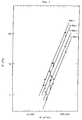
- Fig. 1 is a graph illustrating the relationship between the values of product of capacitance and electrolytic voltage (CV/g) and leakage current (LV/g) of each sintered body in Example 2 for each content of a compound having a silicon-oxygen bond.
- a powder composition comprising a tantalum or a niobium and a compound having a silicon-oxygen bond and a highly reliable capacitor using the sintered body, which is favored with lower dissipation level of power and smaller deterioration of capacitance as compared with a sintered body using conventional powdered tantalum or niobium, can be obtained.
- the particular mechanism of the present invention is not yet elucidated. However, it is presumed as follows.
- the powder composition for capacitors of the present invention is confirmed to assume a composition where a part or most parts of the surface of tantalum or niobium is covered with a compound having a silicon-oxygen bond.
- the effect of the present invention can be obtained as long as when a dielectric material is formed on powdered tantalum or niobium, silicon and oxygen are contained in the dielectric material.
- the compound having a silicon-oxygen bond for use in the present invention may be any as long as it contains a silicon-oxygen bond at least within the molecule.
- the compound may be a low molecular material, an oligomer or a polymer, and the bond order of silicon and oxygen may be either 1 or 2.
- the compound having a silicon-oxygen bond include compounds represented by formulae (1) to (5) and condensation products thereof (which may be chained(linear products), cycled (cyclic products) or at least partly cross-linked products); monomers, oligomers and polymer compounds represented by formula (6); combined products of a residue of the compound represented by formulae (1) to (6) with one polymer selected from acryl polymer, ethylene polymer, styrene polymer and ether polymer; oligomers and copolymers of a residue of the compound represented by formulae (1) to (6) with a monomer capable of giving a polymer such as acryl polymer, ethylene polymer, styrene polymer and ether polymer; and acid nitrides represented by formula (7).
- R 1 to R 8 each represents hydrogen; an alkyl group having 6 or less carbon atoms; an alkyl group having 6 or less carbon atoms substituted with at least one of thiol, cyano, amino, hydroxy, ester, halogen, alkene, alkyne and cycloalkane; a phenyl group; an ethylenyl group; an acyl group; a silyl group represented by SiR 1 R 2 R 3 (wherein R 1 to R 3 (R 1 , R 2 and R 3 ) are the same as defined above); and a metal atom (element) provided that when the valence number is 2, "R 1 R 2 " or “R 3 R 4 ", when the valence number is 3, “R 1 R 2 R 3 ", and when the valence number is 4, “R 1 R 2 R 3 R 4 " each represents one metal element.
- Z represents an alkylene group represented by -(-CR 1 R 2 -) n - (wherein R 1 and R 2 are the same as defined above, and n represents a positive integer of 6 or less) or a residue of hydrocarbon having in the main chain thereof at least one of ether, ester, amine, ketone, imide, benzene ring, double bond, heterocyclic ring and cycloalkane.
- R 5 to R 8 each may represent a halogen, NCO, NCS or CN.
- N represents a nitrogen atom (element)
- m, p, q and r represent each a positive integer.
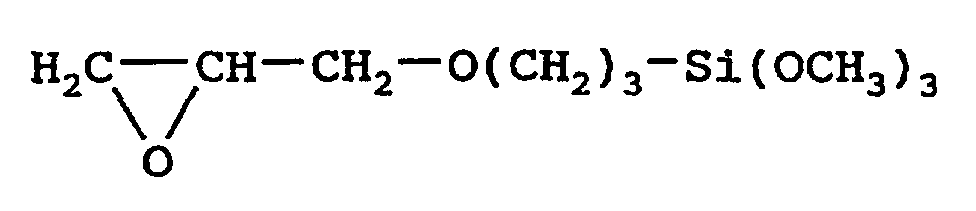
- these compounds include compounds of (CH 3 ) 2 Si(OCH 3 ) 2 , ⁇ 2 Si(OCH 3 ) 2 ( ⁇ represents a phenyl group, hereinafter the same), (CH 3 ) 2 Si(OC 2 H 5 ) 2 , ⁇ 2 Si(OC 2 H 5 ) 2 and (CH 3 ) 2 Si(OAc) 2 , and polymers as a condensate of these individual compounds or co-condensate of two or more thereof, such as silicone resin, compounds of (CH 3 )Si(OCH 3 ) 3 , ⁇ Si(OCH 3 ) 3 , (CH 3 )Si(OC 2 H 5 ) 3 , ⁇ Si(OC 2 H 5 ) 3 , (CH 3 )Si(OAc) 3 , Cl(CH 2 ) 3 Si(OCH 3 ) 3 , HS(CH 2 ) 3 Si(OCH 3 ) 3 , NC(CH 2 ) 2 Si(OCH 3 ) 3 and
- the powder composition or sintered body for capacitors not only a method of adding the above-described compound having a silicon-oxygen bond from the beginning but also a method of causing a chemical reaction such as hydrolysis, condensation reaction or oxidation reaction and/or a thermal reaction at the stage of producing a composition containing a silicon-containing compound and tantalum or niobium or at the stage of manufacturing a sintered body, to produce a powder composition for capacitors comprising a tantalum or niobium and a compound having a silicon-oxygen bond, or a sintered body using the powder composition for capacitors, may be used.
- a chemical reaction such as hydrolysis, condensation reaction or oxidation reaction and/or a thermal reaction at the stage of producing a composition containing a silicon-containing compound and tantalum or niobium or at the stage of manufacturing a sintered body
- the silicon-containing compound the compounds represented by formulae (8) to (10) and metal silicon may be used, and these may be used either individually or in combination of two or more thereof: R 9 (SiR 10 R 11 ) n R 12 Si f (Z) g N h Me s (SiX) t
- R 9 to R 12 represent each hydrogen; an alkyl group having 6 or less carbon atoms substituted with at least one of thiol, cyano, amino, hydroxy, ester, halogen, alkene, alkyne and cycloalkane; an alkyl group having 6 or less carbon atoms; a phenyl group; an ethylenyl group, an ester group, a silyl group represented by R 9 R 10 R 11 Si (wherein R 9 to R 11 are the same as defined above); a metal atom (element); a cyano group; an NCS group; an NCO group; a halogen; and a P(R 9 ) 2 group (wherein R 9 is the same as defined above), Z represents one selected from hydrogen, carbon, nitrogen, sulfur, boron, a metal and NH 4 , n represents a positive integer, R 9 and R 12 may be
- silicon-containing compounds represented by formulae (8) to (10) include silane (e.g., SiH 4 , Si 2 H 4 , Si 3 H 8 , Si 4 H 10 ), polysilane, polydimethylsilicon, polydiphenylsilicon, polydiethylsilicon, polymethylethylsilicon, polymethylphenylsilicon, dimethyltetra(trimethylsilyl)disilane, (CH 3 ) 2 SiCl 2 , (CH 3 )SiCl 3 , ⁇ 2 SiCl 2 , ⁇ SiCl 3 , NaHSiCl 2 , KHSiCl 2 , Na 2 HSiCl, K 2 HSiCl, LiHSiCl 2 , Li 2 HSiCl, Na 2 SiCl 2 , K 2 SiCl 2 , NaSiCl 3 , KSiCl 3 , LiSiCl 3 , Li 2 SiCl 2 ; and SiH 1.2 to
- a method of producing a composition comprising tantalum or niobium and a compound having a silicon-oxygen bond by using both the compound having a silicon-oxygen bond and the silicon-containing compound as starting materials and causing a chemical reaction such as hydrolysis, condensation reaction or oxidation reaction and/or a thermal reaction at the stage of preparing a composition comprising those compounds and tantalum or niobium or at the stage of preparing a sintered body.
- a method of producing a sintered body using the powder composition obtained for capacitors may be used.
- the compounds are each preferably rendered to have an average particle size of 10 ⁇ m or less, preferably 2 ⁇ m or less, so that the compound can readily cover a part or most parts of the surface of tantalum or niobium at the production of the above-described composition.
- the content of the compound having a silicon-oxygen bond in the composition is at least 0.5 % by mass or more, preferably 1 % by mass or more, more preferably from 5 to 30 % by mass. If the content is less than 0.5 % by mass, the effect of increasing the capacitance of the capacitor cannot be attained, whereas if it exceeds 30 % by mass, the sintered body manufactured is increased in the sites allowing only the compound having a silicon-oxygen bond to remain as a mixture with the composition other than the sites where a composition comprising tantalum or niobium and the compound having a silicon-oxygen bond is formed, resulting in that the capacitance rather decreases.
- the method for producing the powder composition of the present invention include, for example, (1) a method of adding the compound having a silicon-oxygen bond to a conventionally known powdered tantalum or niobium and pulverizing the mixture by a dry process or in water or an appropriate organic medium (e.g., alcohol, ester, oil, etc.) to prepare the composition, (2) a method of adding the compound having a silicon-oxygen bond to a lump, small pieces or powder of hydrogen-occluded tantalum or niobium, pulverizing the tantalum or niobium by a dry process or in water or an appropriate organic medium described above and dehydrogenating the resulting composition to obtain the objective composition, and (3) a method of causing a chemical reaction such as oxidation reaction, hydrolysis or condensation reaction and/or a thermal reaction at an appropriate time before or after the process of adding a liquid compound having a silicon-oxygen bond or a silicon-containing compound to powdered tantalum or niobium or to
- the pulverization may be performed by adding balls formed of an appropriate constructive material to increase the pulverization competence.
- a jet mill may be used.
- the pulverization is preferably performed in an inert gas atmosphere because excess oxidation reaction does not occur.
- the tantalum or niobium as an essential component of the composition may be an alloy mainly comprising tantalum or niobium.
- tantalum or niobium whose surface is usually oxidized to contain oxygen in an amount of approximately from 0.3 % by mass to 10 % by mass, may be previously treated with hydrofluoric acid, a mixed acid of hydrofluoric acid and nitric acid, a mixed solution of hydrofluoric acid and aqueous hydrogen peroxide, or the like, to remove or decrease the oxygen on the surface.
- the average particle size of powdered tantalum is from 0.1 ⁇ m to 5 ⁇ m, preferably from 0.2 ⁇ m to 2 ⁇ m, and the average particle size of powdered niobium is from 0.1 ⁇ m to 7 ⁇ m, preferably from 0.1 ⁇ m to 5 ⁇ m. If the average particle size exceeds each maximum value, the product CV/g value of capacitance and electrochemical formation voltage, which is described later, cannot exceed 20,000 and the requirement for higher capacitance cannot be satisfied.
- each average particle size is less than 0.1 ⁇ m, when a capacitor is manufactured using a sintered body of the powder composition of the present invention and a solid material is used for another part electrode, the material cannot be easily impregnated into the inside of the sintered body.
- the powder of secondary particles (a particle resulting from primary particles aggregating while roughly maintaining the shape of primary particle) prepared by granulating the powdered tantalum or niobium as the starting material to increase the average particle size by a number of from 1 to 2 figures.
- the powder composition when the composition is produced using hydrogen-occluded tantalum or niobium, the powder composition may be produced without dehydrogenation and may be dehydrogenated at the sintering, but whether the dehydrogenation is performed at the stage of composition or at the time of sintering, the dehydrogenation is preferably performed, in view of the LC value, such that the final sintered body has a residual hydrogen content of 0.02 % by mass or less.
- the tantalum or niobium as one component of the composition of the present invention may be a partially nitrided tantalum or niobium.
- the nitride amount is from 500 ppm to 50,000 ppm by mass, preferably from 700 ppm to 10,000 ppm by mass, more preferably from 1,000 ppm to 7,000 ppm by mass.
- the sintered body manufactured from the powder for capacitors comprising this composition exhibits a further preferable LC value.
- the components of powder composition for capacitors comprising the composition may also be partly nitrided. Furthermore, it is also possible to nitride, as described above, a part of tantalum or niobium as one component and then further nitride the resulting powder composition formed.
- the nitride amount is from hundreds of ppm to tens of thousands of ppm by mass, preferably from 500 ppm to 7,000 ppm by mass.
- the sintered body manufactured from this powder composition for capacitors exhibits a further preferable LC value.
- the sintered body manufactured is nitrided to have an objective nitride amount, the LC values can be advantageously prevented from dispersing.
- tantalum, niobium or a composition is nitrided as used herein means a state where nitrogen is present in the material by forming a solid solution or by the clathration or chemical reaction, and does not include mere adsorption of nitrogen to the material.
- These materials can be nitrided by a method using any one of liquid nitriding, ion nitriding and gas nitriding or using a combination thereof.
- the gas nitriding treatment in a nitrogen gas atmosphere is preferred because the apparatus used is simple and easy to operate.
- the gas nitriding method in a nitrogen gas atmosphere may be achieved by allowing the material to stand in a nitrogen atmosphere.
- Tantalum, niobium or a composition having an objective nitride amount may be obtained by allowing the material to stand for tens of hours in a nitriding atmosphere at a temperature of 2,000°C or lower, preferably 300 to 1,000°C.
- the treatment time may be reduced.
- the nitride amount can be controlled to fall within the range of from 500 ppm to 7,000 ppm by mass by performing a preliminary test or the like to confirm the nitriding temperature and the nitriding time.
- the average particle size of the powder composition of the present invention is 5 ⁇ m or less, preferably from 0.1 ⁇ m to 5 ⁇ m. If the particle size does not fall within this range, similarly to the case described above for the particle size range of powdered tantalum or niobium, the capacitance decreases or the cathode material is liable to fail in impregnating. In order to facilitate the impregnation of the cathode material, the composition of the present invention may be granulated into secondary particles, similarly to the case of the above-described powdered tantalum or niobium.
- a sintered body using the powder composition for capacitors of the present invention is produced by sintering the thus-obtained powder composition for capacitors.
- the method of producing a sintered body is not particularly limited.
- a sintered body may be obtained, for example, by press-molding the powder for capacitors into a predetermined shape and then heating it at from 500 to 2,000°C and at from 1 to 1 ⁇ 10 -6 Torr (1.33 ⁇ 10 2 to 1.33 ⁇ 10 -4 Pa) for from a few minutes to a few hours.
- a binder for example, a solution of a few % by mass of a binder component such as camphor, acrylic polymer or poly(vinyl alcohol) in an organic solvent such as alcohol or in water
- a binder component such as camphor, acrylic polymer or poly(vinyl alcohol) in an organic solvent such as alcohol or in water
- composition as a composition containing a compound having a silicon-oxygen bond or a silicon-containing compound in a liquid form and tantalum or niobium during the stage of the powder composition for capacitors, and at the time of sintering the composition for manufacturing a sintered body, to perform hydrolysis, condensation reaction, oxidation reaction and/or thermal reaction, whereby a sintered body may be obtained using a powder comprising a composition comprising a compound having a silicon-oxygen bond in a solid-form and tantalum or niobium.
- the silicon-containing compound may be oxidized, for example, by introducing mainly air or oxygen in a relatively low temperature region of the sintering treatment and thereby converted into a compound having a silicon-oxygen bond, which is thereafter treated at a high temperature and at the above-described degree of vacuum to produce a sintered body.
- the temperature and the time for the introduction of air or oxygen are preferably confirmed by a preliminary test such that the oxidation reaction does not proceed too excessively to oxidize even tantalum or niobium as another part component of the composition in excess of 3 % by mass.
- a molded compact of the powder composition of the present invention for capacitors is sintered and the resulting sintered body is allowed to stand in a nitrogen atmosphere, whereby a partially nitrided niobium sintered body can be obtained.
- the capacitor produced can have good LC properties, particularly reduced fluctuation.
- the LC value can be reduced.
- a niobium sintered body having an objective nitrogen amount can be obtained at a nitriding temperature of 2,000°C or lower for a nitriding time of tens of hours.
- a higher nitriding temperature requires shorter time for accomplishing the nitriding.
- Even at room temperature when the niobium sintered body is allowed to stand in a nitrogen atmosphere for tens of hours, a niobium sintered body having a nitrogen amount of hundreds of ppm by mass can be obtained.
- the nitriding time may be reduced. Conversely, if nitrogen is introduced under reduced pressure, the nitriding time is prolonged.
- nitriding scarcely occurs within a time of several tens of hours which is suitable for industrial practice.
- a capacitor is produced by interposing the dielectric material formed on the sintered body between this electrode and another part electrode.
- the dielectric material of this capacitor is presumed to be a composite material of an oxide of tantalum or niobium and a compound having a silicon-oxygen bond or a compound produced resulting from the chemical reaction of the compound having a silicon-oxygen bond during the production process.
- the composite material is obtained by electrochemically forming the sintered body produced from the composition, which is one part electrode, in an electrolytic solution.
- the electrochemical formation of the sintered body in an electrolytic solution is usually performed using an aqueous protic acid solution, for example, an aqueous 0.1% phosphoric acid solution or an aqueous 0.1% sulfuric acid solution.
- an aqueous protic acid solution for example, an aqueous 0.1% phosphoric acid solution or an aqueous 0.1% sulfuric acid solution.
- an electrolytic capacitor is obtained.
- the sintered body side takes charge of the anode.
- the other part electrode of the capacitor of the present invention is not particularly limited and, for example, at least one compound selected from an electrolytic solution, an organic semiconductor and an inorganic semiconductor, which are all known in the art of aluminum electrolytic capacitors, may be used.
- the electrolytic solution examples include a mixed solution of dimethylformamide and ethylene glycol having dissolved therein 5 % by mass of an isobutyltripropylammonium borontetrafluoride electrolyte, and a mixed solution of propylene carbonate and ethylene glycol having dissolved therein 7 % by mass of tetraethylammonium borontetrafluoride.
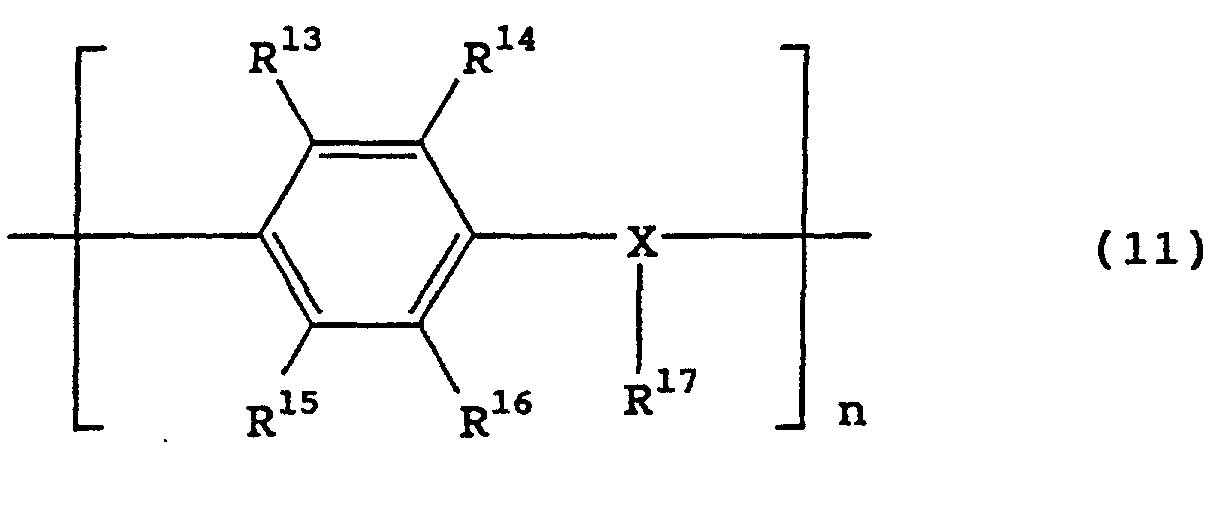
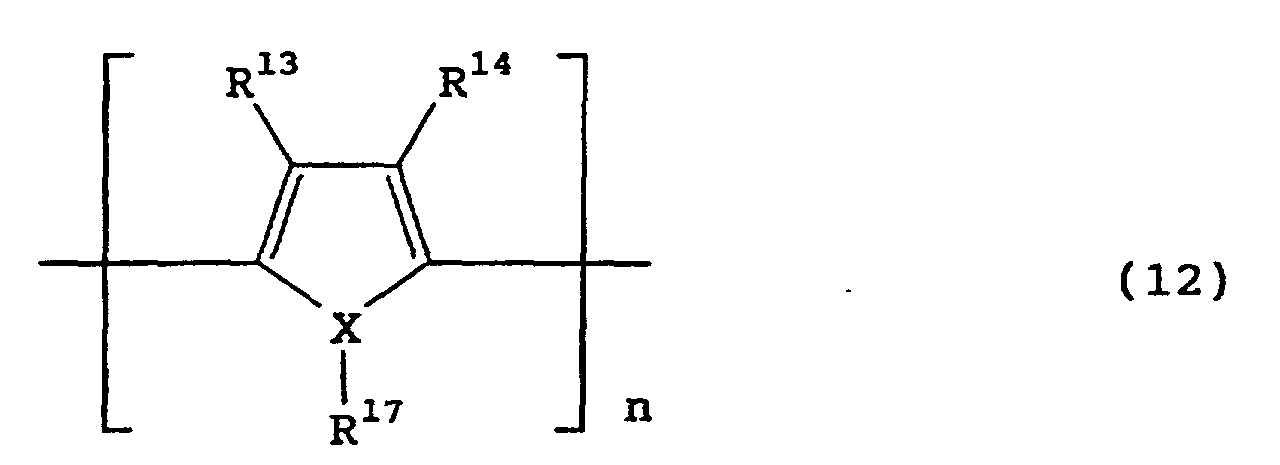
- the organic semiconductor include an organic semiconductor comprising benzopyrroline tetramer and chloranile, an organic semiconductor mainly comprising tetrathiotetracene, an organic semiconductor mainly comprising tetracyanoquinodimethane, and an organic semiconductor mainly comprising an electrically conducting polymer obtained by doping a dopant into a polymer represented by formula (11) or (12) shown below.
- the inorganic semiconductor include an inorganic semiconductor mainly comprising lead dioxide or manganese dioxide, and an inorganic semiconductor comprising triiron tetroxide. These semiconductors may be used either individually or in combination of two or more thereof.
- R 13 to R 16 which may be the same or different, represent each hydrogen, an alkyl ,group having from 1 to 6 carbon atoms or an alkoxy group having from 1 to 6 carbon atoms
- X represents an oxygen atom, a sulfur atom or a nitrogen atom
- R 17 is present only when X is a nitrogen atom
- R 13 and R 14 or R 15 and R 16 may be combined with each other to form a ring
- n represents a polymerization degree.
- Examples of the polymers represented by formulae (11) and (12) include polyaniline, polyoxyphenylene, polyphenylene sulfide, polythiophene, polyfuran, polypyrrole, polymethylpyrrole and derivatives of these polymers.
- the capacitor manufactured can be more reduced in the impedance value and can be more increased in the capacity at a high frequency.
- a capacitor is fabricated, for example, by sequentially laminating carbon paste and silver paste on the another part electrode and sealing the whole with a material such as epoxy resin.
- This capacitor may have a niobium or tantalum lead which may be sintered and formed integrally with the sintered body or may be afterward welded.
- the another part electrode is a liquid
- a capacitor constructed from those two electrodes and the dielectric material is housed, for example, in a can electrically connected to the another part electrode to accomplish the capacitor.
- the sintered body electrode side is guided outside through the niobium or tantalum lead and at the same time, designed to be insulated from the can using an insulating rubber or the like.
- the capacitor obtained can have a small LC value, good reliability and a high capacitance.
- the amount of the compound having a silicon-oxygen bond contained in the powder was calculated based on the amount of silicon determined by the ICP (inductively coupled plasma) emission analysis and the structure of the compound. In the case of a hydrate, the content was determined in terms of a non-hydrous material.
- the amount of nitrogen in the powder was determined using an oxygen/nitrogen analyzer manufactured by LECO Corp. capable of determining the nitrogen amount from the heat conductivity, and the ratio thereof to the mass of the powder separately measured was defined as the nitride amount.
- the capacitance at 120 Hz measured at room temperature by connecting an LCR measuring apparatus manufactured by Hewlett-Packard Company between a sintered body dipped in 30% sulfuric acid and a tantalum electrode placed in a sulfuric acid solution was defined as the capacitance of the sintered body.
- a dc voltage corresponding to 70% (14 V) of the electrochemical formation voltage at the time of manufacturing a dielectric material was continuously applied at room temperature for 3 minutes between a sintered body dipped in an aqueous 20% phosphoric acid solution and an electrode placed in an aqueous phosphoric acid solution and then the current value was measured. The value obtained was defined as the leakage current value.
- a capacitance at 120 Hz was measured at room temperature by connecting an LCR measuring apparatus manufactured by Hewlett-Packard Company between terminals of the chip and the value obtained was defined as the capacitance of the capacitor formed into a chip.
- a dc voltage (6.3 V) close to from about 1/3 to about 1/4 of the electrochemical formation voltage at the time of manufacturing a dielectric material was selected from rated voltage values (e.g., 2.5 V, 4 V, 6.3 V, 10 V, 16 V, 25 V) and continuously applied at room temperature for 1 minute between terminals of the chip manufactured and then the current value was measured. The value obtained was defined as the leakage current value of the capacitor formed into a chip.
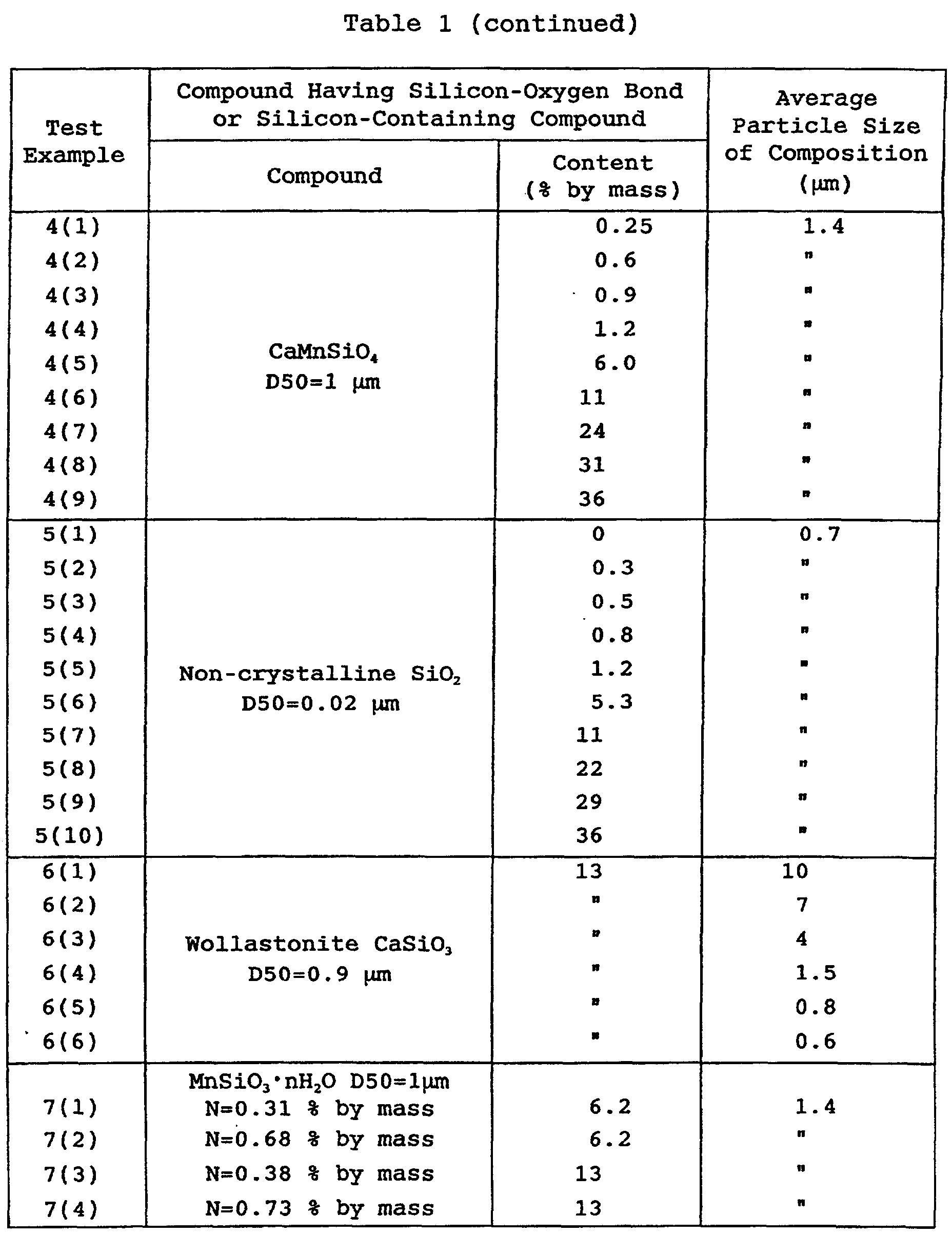
- Test Examples 1 (1 to 11), 2 (1 to 11), 3 (1 to 8), 4 (1 to 9), 5 (1-10), and 6 (1 to 6):
- An about 10-mm ⁇ tantalum bar (purity: 99.9 % by mass) was hydrogenated and crudely crushed into lumps having a size of about a few mm.
- the lumps were mixed with a compound having a silicon-oxygen bond shown in (1) to (6) below and ground in a submarine automatic mortar.
- the ground matter was centrifuged, the supernatant moiety was removed, and the residue was dried to obtain a composition comprising tantalum and a compound having a silicon-oxygen bond.
- the compositional amount of the compound having a silicon-oxygen bond in the composition and the particle size of the composition were controlled. Thereafter, the composition was dehydrogenated by allowing it to stand at 450°C under reduced pressure to obtain a composition having a residual hydrogen amount of 100 ppm by mass or less.
- the numerical values showing content of compound having a silicon-oxygen bond in respective compositions prepared and the average particle size of the composition are shown together in Table 1. Also, a test example where the compound having a silicon-oxygen bond was not added is shown in Table 1.
- Various physical properties data of respective compositions are shown together in Table 1.
- An about 44-mm ⁇ niobium bar (purity: 99.7 % by mass) was hydrogenated and crudely crushed into lumps having a size of a few mm.
- the lumps were mixed with a compound having a silicon-oxygen bond shown in (1) to (4) below and then ground in a submarine automatic mortar.
- the powdered niobium (not dehydrogenated) having a nitride amount of 0.21 % by mass and not containing a compound having a silicon-oxygen bond, used in Test Example 9(1), was mixed with manganese silicate having an average particle of 1 ⁇ m (MnSiO 3 ⁇ nH 2 O, D50 1 ⁇ m) and then ground and after-treated in the same manner as in Test Example 9(8) to obtain a composition containing about 13% by mass of manganese silicon. This composition was dehydrogenated by allowing it to stand at 450°C under reduced pressure to obtain a composition having a residual hydrogen amount of 100 ppm by mass or less. Various physical properties data of the composition produced are shown together in Table 2.
- compositions were produced in the same manner as in Test Example 9(8) except for changing the nitriding time to 250°C, 300°C or 800°C and the nitriding time to 2 hours.
- Various physical properties data of the compositions produced are shown together in Table 2.
- Nitrided and dehydrogenated compositions were obtained in the same manner as in Test Example 8 except for adding a silicon-containing compound of tetrabromosilane (Test Example 14(1)), Si(NCO) 4 (Test Example 14(2)), finely powdered SiS 2 (Test Example 14(3)) or finely powdered Si (Test Example 14(4)) in place of NH 2 (CH 2 ) 3 -Si(OC 2 H 5 ) 3 in Test Example 8. Thereafter, in Test Examples 14(1), 14(2) and 14(3), the compositions were each heated at 300°C in vacuum and in Test Example 14(3), carbon dioxide was passed through the composition at 350°C.
- Test Example a composition containing niobium and a compound having a silicon-oxygen bond, SiO 2 , was obtained.
- Table 2 Various physical properties data in respective Test Examples are shown together in Table 2.
- Test Example Compound Having Silicon-Oxygen Bond or Silicon-Containing Compound Content of Compound in Composition (% by mass) Average Particle Size of Composition ( ⁇ m)
- Example 2 Production of a sintered body
- each powder comprising the composition obtained in Test Examples 1 to 14 was molded together with a tantalum lead (Test Examples 1 to 7) or a niobium lead (Test Examples 8 to 14) to obtain molded compacts having a size of from 3.8 ⁇ 3.5 ⁇ 1.8 mm to 4.5 ⁇ 3.5 ⁇ 1.8 mm. Subsequently, each molded compact was sintered at 1,550°C (Test Examples 1 to 7) or 1,200°C (Test Examples 8 to 14) in vacuum (3 ⁇ 10 -5 Torr (4 ⁇ 10 -3 Pa)) to obtain a sintered body.
- Fig. 1 is a diagram obtained by plotting the relationship between the product of capacitance and electrolytic voltage (CV/g) vs leakage current (LV/g) for each content of the compound having a silicon-oxygen bond based on Tables 1 to 4.
- a sintered body was manufactured using the powder for capacitors comprising each composition and after forming an oxide dielectric film on the surface of the sintered body, the LC value and the CV value were evaluated.
- the content of the compound having a silicon-oxygen bond in the composition is at least 0.5 % by mass or more (cf. the second line from the left), preferably 1 % by mass or more (cf. the third line from the left), and more preferably from 5 % to 30 % by mass (cf. the line at the extreme left)
- the CV value is always several times larger than that of the case where the content is 0% to 0.5 % by mass (cf. the line at the extreme left), with the same LC value.
- V is constantly 20 and hence the capacitance C is always increased.
- the capacitors shown in Table 5 are compared with respect to the performance, it is seen that in the case of a capacitor manufactured using a powder for capacitors comprising tantalum or niobium and a compound having a silicon-oxygen bond, the capacitance is always greatly higher than those not containing the compound, and as compared with those having the same CV value, the LC value is as small as a few fractions.
- the capacitors of the present invention are small in the decrease of the capacitance even after the use for a few years and are highly reliable.
- a capacitor manufactured using the sintered body using the powder composition for capacitors of the present invention has a capacitance larger than that of conventionally used tantalum capacitors.
- a capacitor is fabricated from this sintered body, an excellent capacitor can be obtained, which is small in the deterioration of capacitance and highly reliable and which can realize high CV or low LC as compared with conventional capacitors, more specifically, if the CV value is the same, the LC value is as small as a few fractions, and if the LC value is the same, the CV value is several times larger.
Landscapes
- Chemical & Material Sciences (AREA)
- Engineering & Computer Science (AREA)
- Power Engineering (AREA)
- Microelectronics & Electronic Packaging (AREA)
- Mechanical Engineering (AREA)
- Metallurgy (AREA)
- Organic Chemistry (AREA)
- Materials Engineering (AREA)
- Chemical Kinetics & Catalysis (AREA)
- Powder Metallurgy (AREA)
- Ceramic Capacitors (AREA)
- Compositions Of Oxide Ceramics (AREA)
- Ceramic Products (AREA)
- Fixed Capacitors And Capacitor Manufacturing Machines (AREA)
- Manufacture Of Metal Powder And Suspensions Thereof (AREA)
- Inorganic Insulating Materials (AREA)
Abstract
Description
Si(OCH3)4, Si(OC2H5)4, Si(OAc)4, (CH3)3SiO-CH=CH2 and polymerization products thereof; (CH3)3SiO-CH=CH-CH3 and polymerization products thereof; CH2=CH-(CH3)2SiOSi(CH3)2CH=CH2 and polymerization products thereof; CH=Si(CH3)2-O-Si(CH3)2C=CH and polymerization products thereof; (CH3)3Si-O-Si(CH3)3, H(CH3)2Si-O-Si(CH3)2H, ClCH2(CH3)2Si-O-Si(CH3)2CH2Cl, HOCH2(CH3)2Si-O-Si(CH3)2CH2OH, H2N(CH2)3(CH3)2Si-O-Si(CH3)2(CH2)3NH2, Si(OH)2, (CH3)3SiOH; silicates such as Be2SiO4, Zn2SiO4, LiAlSiO4, Li2BeSiO4, PbZnSiO4, (Ca, Mn)BeSiO4, (Ca, Pb)Zn, Mg2SiO4, Fe2SiO4, (Mg, Fe)2SiO4, (Fe, Mn, Zn)2SiO4, (Mn, Fe)SiO4, Mn2SiO4, (Mg, Ni)2SiO4, CaMgSiO4, CaFeSiO4, CaMnSiO4, Ca3Mg(SiO4)2 and Ca2SiO4;
zeolite compounds such as Li2Al2SiO12·2H2O;
Si2O(NCO)6, Si2O2(NCO)3, Si2O(NCS)6, SiO(OCN)4, Si4Br8O4, Si2OH6, (H2SiO)6; silicon monoxides of which surface is covered with silicon dioxide; compounds having a silicon-oxygen bond represented by the formula SiO2·nH2O (0≦n≦2), having an amorphous form, a non-crystalline-form, a glass form, a colloidal form, a solution form, a crystal form or the like; polysilicates represented by Na6Si2O7 and Na2Si4O9; and solid solutions of silicon with aluminum and/or a metal (e.g., magnesium, manganese, lithium, lanthanum, yttrium, niobium, tantalum, etc.).

| Test Example | Compound Having Silicon-Oxygen Bond or Silicon-Containing Compound | Content of Compound in Composition (% by mass) | Average Particle Size of Composition (µm) | Nitride Nitride amount of Composition (% by mass) |
| 8(1) | NH2-(CH2)3-Si(OEt)3 | 0 | 5 | 0.32 |
| 8(2) | 0.3 | 5 | 0.32 | |
| 8(3) | 0.5 | 5 | 0.33 | |
| 8(4) | 0.8 | 5 | 0.34 | |
| 8(5) | 1.2 | 5 | 0.34 | |
| 8(6) | 3.3 | 5 | 0.30 | |
| 8(7) | 5.2 | 5 | 0.31 | |
| 8(8) | 12 | 5 | 0.28 | |
| 8(9) | 21 | 5 | 0.29 | |
| 8(10) | 28 | 5 | 0.28 | |
| 8(11) | 33 | 5 | 0.31 | |
| 8(12) | 40 | 5 | 0.32 | |
| 9(1) | MnSiO3·nH2O D50=1 | 0 | 2 | 0.21 |
| 9(2) | 0.3 | 2 | 0.21 | |
| 9(3) | 0.6 | 2 | 0.22 | |
| 9(4) | 0.9 | 2 | 0.22 | |
| 9(5) | 1.3 | 2 | 0.19 | |
| 9(6) | 3.2 | 2 | 0.18 | |
| 9(7) | 5.8 | 2 | 0.19 | |
| 9(8) | 12 | 2 | 0.23 | |
| 9(9) | 28 | 2 | 0.23 | |
| 9(10) | 34 | 2 | 0.24 | |
| 10(1) | non-crystalline SiO2 D50=0.02 | 0 | 0.8 | 0.26 |
| 10(2) | 0.3 | 0.8 | 0.25 | |
| 10(3) | 0.6 | 0.8 | 0.25 | |
| 10(4) | 1.2 | 0.8 | 0.26 | |
| 10(5) | 5.2 | 0.8 | 0.26 | |
| 10(6) | 15 | 0.8 | 0.26 | |
| 10(7) | 29 | 0.8 | 0.27 | |
| 10(8) | 34 | 0.8 | 0.27 | |
| 11(1) | Silicic acid D50=2µm | 15 | 15 | 0.28 |
| 11(2) | 15 | 7 | 0.24 | |
| 11(3) | 15 | 5 | 0.23 | |
| 11(4) | 15 | 2 | 0.23 | |
| 11(5) | 15 | 0.8 | 0.26 | |
| 11(6) | 15 | 0.2 | 0.29 | |
| 12(1) | MnSiO3·nH2O D50=1 µm | 13 | 2 | 0.26 |
| 13(1) | MnSiO3·nH2O D50=1 µm | 12 | 2 | 0.04 |
| 13(2) | 12 | 2 | 0 .16 | |
| 13(3) | 12 | 2 | 0.82 | |
| 14(1) | | 10 | 5 | 0.30 |
| 14(2) | Si(NCO)4 | 8.5 | 5 | 0.31 |
| 14(3) | finely powdered SiS2 | 13 | 5 | 0.30 |
| 14(4) | finely powdered Si | 7.2 | 5 | 0.27 |
| Test Example | Nitriding Conditions | LC µA/g | CV µF·V/g |
| 1(1) | not nitrided | 1.9 | 27000 |
| 1(2) | 1.9 | 27000 | |
| 1(3) | 1.5 | 30000 | |
| 1(4) | 1.5 | 30000 | |
| 1(5) | 1.2 | 31000 | |
| 1(6) | 1.2 | 31000 | |
| 1(7) | 0.7 | 32000 | |
| 1(8) | 0.3 | 33000 | |
| 1(9) | 0.5 | 33000 | |
| 1(10) | 1.0 | 31000 | |
| 1(11) | 1.9 | 27000 | |
| 2(1) | not nitrided | 5.5 | 41000 |
| 2(2) | 5.5 | 41000 | |
| 2(3) | 4.9 | 42000 | |
| 2(4) | 4.8 | 42000 | |
| 2(5) | 4.0 | 43000 | |
| 2(6) | 3.5 | 43000 | |
| 2(7) | 1.5 | 43000 | |
| 2(8) | 1.2 | 44000 | |
| 2(9) | 1.6 | 44000 | |
| 2(10) | 2.8 | 43000 | |
| 2(11) | 5.7 | 40000 | |
| 3(1) | not nitrided not nitrided | 5.5 | 41000 |
| 3(2) | 4.9 | 41000 | |
| 3(3) | 4.9 | 42000 | |
| 3(4) | 4.0 | 42000 | |
| 3(5) | 1.6 | 42000 | |
| 3(6) | 1.1 | 44000 | |
| 3(7) | 1.7 | 42000 | |
| 3(8) | 5.8 | 40000 | |
| 4(1) | not nitrided | 5.6 | 40000 |
| 4(2) | 3.9 | 41000 | |
| 4(3) | 3.4 | 41000 | |
| 4(4) | 2.8 | 42000 | |
| 4(5) | 1.9 | 44000 | |
| 4(6) | 1.1 | 45000 | |
| 4(7) | 2.5 | 43000 | |
| 4(8) | 5.6 | 40000 | |
| 4(9) | 5.7 | 40000 | |
| 5(1) | not nitrided | 10 | 52000 |
| 5(2) | 10 | 52000 | |
| 5(3) | 8 | 53000 | |
| 5(4) | 7 | 53000 | |
| 5(5) | 5 | 53000 | |
| 5(6) | 3 | 54000 | |
| 5(7) | 2.3 | 55000 | |
| 5(8) | 2.8 | 54000 | |
| 5(9) | 3.2 | 53000 | |
| 5(10) | 11 | 52000 | |
| 6(1) | not nitrided | 0.02 | 2000 |
| 6(2) | 0.04 | 9000 | |
| 6(3) | 0.1 | 20000 | |
| 6(4) | 1.0 | 40000 | |
| 6(5) | 1.8 | 51000 | |
| 6(6) | 4.2 | 70000 | |
| 7(1) | N2 stream, 400°C × 3 hr | 1.2 | 42000 |
| 7(2) | N2 stream, 400°C × 3 hr | 1.3 | 42000 |
| 7(3) | N2 stream, 800°C × 5 hr | 0.9 | 44000 |
| 7(4) | N2 stream, 800°C × 5 hr | 1.8 | 43000 |
| Test Example | Nitriding Conditions | LC µA/g | CV µF·V/g |
| 8(1) | 800°C × 2-5hr | 3.0 | 30000 |
| 8(2) | 3.0 | 30000 | |
| 8(3) | 2.1 | 31000 | |
| 8(4) | 2.0 | 31000 | |
| 8(5) | 1.6 | 32000 | |
| 8(6) | 1.5 | 33000 | |
| 8(7) | 0.8 | 34000 | |
| 8(8) | 0.5 | 35000 | |
| 8(9) | 0.6 | 35000 | |
| 8(10) | 0.9 | 34000 | |
| 8(11) | 3.1 | 30000 | |
| 8(12) | 5.2 | 24000 | |
| 9(1) | 400°C × 2-5hr | 10 | 50000 |
| 9(2) | 8.6 | 50000 | |
| 9(3) | 8.6 | 51000 | |
| 9(4) | 6.5 | 51000 | |
| 9(5) | 6.4 | 52000 | |
| 9(6) | 5.3 | 52000 | |
| 9(7) | 2.1 | 53000 | |
| 9(8) | 1.2 | 54000 | |
| 9(9) | 2.5 | 53000 | |
| 9(10) | 11 | 50000 | |
| 10(1) | 300°C × 2-5hr | 100 | 120000 |
| 10(2) | 98 | 120000 | |
| 10(3) | 80 | 122000 | |
| 10(4) | 36 | 125000 | |
| 10(5) | 24 | 127000 | |
| 10(6) | 20 | 130000 | |
| 10(7) | 36 | 127000 | |
| 10(8) | 108 | 118000 | |
| 11(1) | 300°C × 2-5hr | 0.1 | 16000 |
| 11(2) | 300°C × 2-5hr | 0.2 | 21000 |
| 11(3) | 37°C × 2-5hr | 0.5 | 35000 |
| 11(4) | 300°C × 2-5hr | 2.1 | 54000 |
| 11(5) | 300°C × 2-5hr | 20 | 130000 |
| 11(6) | 300°C × 2-5hr | 110 | 250000 |
| 12(1) | not nitrided | 2.4 | 52000 |
| 13(1) | Nb 250°C × 2hr | 9.1 | 54000 |
| 13(2) | Nb 300°C × 2hr | 2.2 | 54000 |
| 13(3) | Nb 800°C × 2hr | 5.9 | 54000 |
| 14(1) | 800°C × 2-5hr | 0.6 | 35000 |
| 14(2) | 0.7 | 34000 | |
| 14(3) | 0.5 | 35000 | |
| 14(4) | 0.7 | 33000 |
| Test Example (Test Example Used) | Other Part Electrode | C µF | LC µA | Number of Samples where Decrement of Capacitance is less than 20% (Sample Number n=20) |
| 15(1) (2(1)) | Mixture of lead dioxide and lead sulfate (98 % by mass) | 250 | 1.4 | 15/20 |
| 15(2) (3(6)) | 270 | 0.4 | 20/20 | |
| 15(3) (5(1)) | 320 | 4.0 | 14/20 | |
| 15(4) (5(7)) | 340 | 1.1 | 20/20 | |
| 15(5) (9(1)) | 220 | 3.6 | 16/20 | |
| 15(6) (9(8)) | 240 | 0.9 | 20/20 | |
| 15(7) (10(1)) | 510 | 22 | 15/20 | |
| 15(8) (10(6)) | 550 | 4.2 | 20/20 | |
| 15(9) (2(1)) | Polypyrrole | 220 | 2.1 | 14/20 |
| 15(10) (3(6)) | 240 | 0.9 | 20/20 | |
| 15(11) (5(1)) | 290 | 5.2 | 13/20 | |
| 15(12) (5(7)) | 310 | 1.6 | 20/20 | |
| 15(13) (9(1)) | 200 | 4.1 | 14/20 | |
| 15(14) (9(8)) | 220 | 1.3 | 20/20 | |
| 15(15) (10(1)) | 450 | 31 | 12/20 | |
| 15(16) (10(6)) | 470 | 8.3 | 20/20 |
Claims (12)
- A powder composition for capacitors, comprising a tantalum or a niobium and a compound having a silicon-oxygen bond.
- The powder composition for capacitors as claimed in claim 1, wherein said composition comprises a compound having a silicon-oxygen bond in an amount of at least 0.5% by mass.
- The powder composition for capacitors as claimed in claim 1, wherein said composition comprises a compound having a silicon-oxygen bond in an amount of at least 1% by mass.
- The powder composition for capacitors as claimed in claim 1, wherein said composition comprises a compound having a silicon-oxygen bond in an amount of from 5 to 30% by mass.
- The powder composition for capacitors as claimed in any one of claims 1 to 4, which has an average particle size of from 0.1 to 5 µm.
- The powder composition for capacitors as claimed in any one of claims 1 to 5, wherein at least a part of the components comprised in the powder composition for capacitors is nitrided.
- The powder composition for capacitors as claimed in any one of claims 1 to 6, wherein the tantalum or niobium comprised in the powder composition for capacitor is partially nitrided.
- The powder composition for capacitors as claimed in claim 6 or 7, wherein the nitride amount is from 500 to 50,000 ppm by mass.
- A sintered body obtained by sintering a powder composition for capacitors described in any one of claims 1 to 8.
- A nitrided sintered body for capacitors, obtained by allowing a sintered body using a powder composition for capacitors described in any one of claims 1 to 5 to stand in a nitrogen atmosphere to thereby nitride the sintered body.
- The sintered body as claimed in claim 10, wherein the nitrogen amount is from 10 to 150,000 ppm by mass.
- A capacitor comprising a sintered body described in any one of claims 9 to 11 as one part electrode, a dielectric material formed on the surface of the sintered body, and another part electrode provided on the dielectric material.
Applications Claiming Priority (5)
| Application Number | Priority Date | Filing Date | Title |
|---|---|---|---|
| JP28184799 | 1999-10-01 | ||
| JP28184799 | 1999-10-01 | ||
| US16962699P | 1999-12-08 | 1999-12-08 | |
| US169626P | 1999-12-08 | ||
| PCT/JP2000/006770 WO2001026123A1 (en) | 1999-10-01 | 2000-09-29 | Capacitor powder composition, sintered body made of the composition, and capacitor made of the sintered body |
Publications (3)
| Publication Number | Publication Date |
|---|---|
| EP1156501A1 true EP1156501A1 (en) | 2001-11-21 |
| EP1156501A4 EP1156501A4 (en) | 2002-10-23 |
| EP1156501B1 EP1156501B1 (en) | 2005-12-07 |
Family
ID=26554367
Family Applications (1)
| Application Number | Title | Priority Date | Filing Date |
|---|---|---|---|
| EP00962979A Expired - Lifetime EP1156501B1 (en) | 1999-10-01 | 2000-09-29 | Capacitor powder composition, sintered body made of the composition, and capacitor made of the sintered body |
Country Status (9)
| Country | Link |
|---|---|
| EP (1) | EP1156501B1 (en) |
| JP (2) | JP4476532B2 (en) |
| KR (1) | KR100712452B1 (en) |
| CN (1) | CN1175442C (en) |
| AT (1) | ATE312406T1 (en) |
| AU (1) | AU7448900A (en) |
| DE (1) | DE60024591T2 (en) |
| HK (1) | HK1041743B (en) |
| WO (1) | WO2001026123A1 (en) |
Families Citing this family (7)
| Publication number | Priority date | Publication date | Assignee | Title |
|---|---|---|---|---|
| JP2003003204A (en) * | 2001-06-20 | 2003-01-08 | Showa Denko Kk | Method for producing niobium powder |
| WO2005045860A1 (en) | 2003-11-10 | 2005-05-19 | Showa Denko K.K. | Niobium powder for capacitor, niobium sintered body and capacitor |
| JP5266427B1 (en) * | 2011-10-18 | 2013-08-21 | 昭和電工株式会社 | Capacitor anode body manufacturing method |
| JPWO2014091810A1 (en) * | 2012-12-13 | 2017-01-05 | 昭和電工株式会社 | Method for manufacturing tungsten anode body |
| DE102013206603A1 (en) * | 2013-04-12 | 2014-10-16 | H.C. Starck Gmbh | Process for the preparation of oxygen-poor high surface area valve metal sintered bodies |
| EP3460809A1 (en) * | 2017-09-20 | 2019-03-27 | Siemens Aktiengesellschaft | Electrical insulation material and/or impregnating resin for roll tape insulation of a medium and/or high voltage machine, insulation material and insulation system |
| JP2024094933A (en) * | 2022-12-28 | 2024-07-10 | パナソニックIpマネジメント株式会社 | Dielectric, capacitor including same, and device including capacitor |
Family Cites Families (9)
| Publication number | Priority date | Publication date | Assignee | Title |
|---|---|---|---|---|
| GB1030004A (en) * | 1963-08-22 | 1966-05-18 | Telegraph Condenser Co Ltd | Improvements in and relating to electrolytic capacitors |
| JPS522230U (en) * | 1975-06-24 | 1977-01-08 | ||
| DE2743061A1 (en) * | 1977-09-24 | 1979-03-29 | Licentia Gmbh | Prodn. of dry electrolyte capacitor with tantalum anode - involves pressed and sintered tantalum powder anode dipped in metal ions contg. soln. and thermally treated |
| JPS54135345A (en) * | 1978-04-11 | 1979-10-20 | Nippon Electric Co | Method of producing powder for forming electrolytic capacitor anode body |
| JPS55157227A (en) * | 1979-05-25 | 1980-12-06 | Nichicon Capacitor Ltd | Electrolytic condenser |
| US4544403A (en) * | 1984-11-30 | 1985-10-01 | Fansteel Inc. | High charge, low leakage tantalum powders |
| DE3820960A1 (en) * | 1988-06-22 | 1989-12-28 | Starck Hermann C Fa | FINE-GRAINED HIGH-PURITY EARTH ACID POWDER, METHOD FOR THE PRODUCTION AND USE THEREOF |
| US5825611A (en) * | 1997-01-29 | 1998-10-20 | Vishay Sprague, Inc. | Doped sintered tantalum pellets with nitrogen in a capacitor |
| JP3254163B2 (en) * | 1997-02-28 | 2002-02-04 | 昭和電工株式会社 | Capacitor |
-
2000
- 2000-09-29 AT AT00962979T patent/ATE312406T1/en not_active IP Right Cessation
- 2000-09-29 JP JP2001528996A patent/JP4476532B2/en not_active Expired - Lifetime
- 2000-09-29 AU AU74489/00A patent/AU7448900A/en not_active Abandoned
- 2000-09-29 HK HK02103409.7A patent/HK1041743B/en not_active IP Right Cessation
- 2000-09-29 DE DE60024591T patent/DE60024591T2/en not_active Expired - Lifetime
- 2000-09-29 EP EP00962979A patent/EP1156501B1/en not_active Expired - Lifetime
- 2000-09-29 CN CNB008020973A patent/CN1175442C/en not_active Expired - Lifetime
- 2000-09-29 WO PCT/JP2000/006770 patent/WO2001026123A1/en not_active Ceased
- 2000-09-29 KR KR1020017006637A patent/KR100712452B1/en not_active Expired - Lifetime
-
2010
- 2010-02-09 JP JP2010026608A patent/JP4614374B2/en not_active Expired - Lifetime
Also Published As
| Publication number | Publication date |
|---|---|
| JP2010161387A (en) | 2010-07-22 |
| CN1175442C (en) | 2004-11-10 |
| JP4614374B2 (en) | 2011-01-19 |
| DE60024591D1 (en) | 2006-01-12 |
| EP1156501A4 (en) | 2002-10-23 |
| DE60024591T2 (en) | 2006-08-24 |
| ATE312406T1 (en) | 2005-12-15 |
| EP1156501B1 (en) | 2005-12-07 |
| HK1041743B (en) | 2005-07-29 |
| HK1041743A1 (en) | 2002-07-19 |
| KR100712452B1 (en) | 2007-04-27 |
| KR20010081037A (en) | 2001-08-25 |
| AU7448900A (en) | 2001-05-10 |
| CN1322368A (en) | 2001-11-14 |
| WO2001026123A1 (en) | 2001-04-12 |
| JP4476532B2 (en) | 2010-06-09 |
Similar Documents
| Publication | Publication Date | Title |
|---|---|---|
| JP4614374B2 (en) | Powder composition, sintered body using the composition, and capacitor using the sintered body | |
| US6660057B1 (en) | Powder composition for capacitor, sintered body using the composition and capacitor using the sintered body | |
| US6423110B1 (en) | Powder composition for capacitor and sintered body using the composition, and capacitor using the sintered body | |
| JP4527332B2 (en) | Niobium powder, sintered body thereof and capacitor using the same | |
| JP5283240B2 (en) | Niobium for capacitors and capacitors using the niobium sintered body | |
| US6824586B2 (en) | Powder for capacitor, sintered body thereof and capacitor using the sintered body | |
| JP4453890B2 (en) | Niobium capacitor manufacturing method. | |
| KR100812689B1 (en) | Niobium Powder for Capacitor, Sintered Body and Capacitor Using Sintered Body | |
| EP1501956B1 (en) | Niobium powder, sintered body thereof and capacitor using the same | |
| JP4683512B2 (en) | Capacitor powder, sintered body using the same, and capacitor using the same | |
| JPWO2001026123A1 (en) | Powder composition for capacitors, sintered body using said composition, and capacitor using said sintered body | |
| CN100338702C (en) | Niobium powder for capacitors, its sintered body, and capacitor using the sintered body | |
| KR100812687B1 (en) | Niobium Powder for Capacitor, Sintered Body and Capacitor Using Sintered Body | |
| US7110244B2 (en) | Production process for niobium capacitor | |
| AU2002247999A1 (en) | Production process for niobium capacitor | |
| CN1433346A (en) | Niobium powder, its sintered body and capacitor | |
| AU2002241261A1 (en) | Niobium for capacitor and capacitor using sintered body of the niobium | |
| MXPA03007171A (en) | Tantalum-silicon and niobium-silicon substrates for capacitor anodes. | |
| CN1419701A (en) | Niobium powder for capacitors, its sintered body, and capacitor using the sintered body |
Legal Events
| Date | Code | Title | Description |
|---|---|---|---|
| PUAI | Public reference made under article 153(3) epc to a published international application that has entered the european phase |
Free format text: ORIGINAL CODE: 0009012 |
|
| 17P | Request for examination filed |
Effective date: 20010628 |
|
| AK | Designated contracting states |
Kind code of ref document: A1 Designated state(s): AT BE CH CY DE DK ES FI FR GB GR IE IT LI LU MC NL |
|
| AX | Request for extension of the european patent |
Free format text: AL;LT;LV;MK;RO;SI |
|
| A4 | Supplementary search report drawn up and despatched |
Effective date: 20020909 |
|
| AK | Designated contracting states |
Kind code of ref document: A4 Designated state(s): AT BE CH CY DE DK ES FI FR GB GR IE IT LI LU MC NL |
|
| 17Q | First examination report despatched |
Effective date: 20030311 |
|
| GRAP | Despatch of communication of intention to grant a patent |
Free format text: ORIGINAL CODE: EPIDOSNIGR1 |
|
| RBV | Designated contracting states (corrected) |
Designated state(s): AT BE CH CY DE DK ES FI FR GB GR IE IT LI LU MC NL PT SE |
|
| GRAS | Grant fee paid |
Free format text: ORIGINAL CODE: EPIDOSNIGR3 |
|
| GRAA | (expected) grant |
Free format text: ORIGINAL CODE: 0009210 |
|
| AK | Designated contracting states |
Kind code of ref document: B1 Designated state(s): AT BE CH CY DE DK ES FI FR GB GR IE IT LI LU MC NL PT SE |
|
| PG25 | Lapsed in a contracting state [announced via postgrant information from national office to epo] |
Ref country code: IT Free format text: LAPSE BECAUSE OF FAILURE TO SUBMIT A TRANSLATION OF THE DESCRIPTION OR TO PAY THE FEE WITHIN THE PRESCRIBED TIME-LIMIT;WARNING: LAPSES OF ITALIAN PATENTS WITH EFFECTIVE DATE BEFORE 2007 MAY HAVE OCCURRED AT ANY TIME BEFORE 2007. THE CORRECT EFFECTIVE DATE MAY BE DIFFERENT FROM THE ONE RECORDED. Effective date: 20051207 Ref country code: FI Free format text: LAPSE BECAUSE OF FAILURE TO SUBMIT A TRANSLATION OF THE DESCRIPTION OR TO PAY THE FEE WITHIN THE PRESCRIBED TIME-LIMIT Effective date: 20051207 Ref country code: LI Free format text: LAPSE BECAUSE OF FAILURE TO SUBMIT A TRANSLATION OF THE DESCRIPTION OR TO PAY THE FEE WITHIN THE PRESCRIBED TIME-LIMIT Effective date: 20051207 Ref country code: NL Free format text: LAPSE BECAUSE OF FAILURE TO SUBMIT A TRANSLATION OF THE DESCRIPTION OR TO PAY THE FEE WITHIN THE PRESCRIBED TIME-LIMIT Effective date: 20051207 Ref country code: BE Free format text: LAPSE BECAUSE OF FAILURE TO SUBMIT A TRANSLATION OF THE DESCRIPTION OR TO PAY THE FEE WITHIN THE PRESCRIBED TIME-LIMIT Effective date: 20051207 Ref country code: AT Free format text: LAPSE BECAUSE OF FAILURE TO SUBMIT A TRANSLATION OF THE DESCRIPTION OR TO PAY THE FEE WITHIN THE PRESCRIBED TIME-LIMIT Effective date: 20051207 Ref country code: CH Free format text: LAPSE BECAUSE OF FAILURE TO SUBMIT A TRANSLATION OF THE DESCRIPTION OR TO PAY THE FEE WITHIN THE PRESCRIBED TIME-LIMIT Effective date: 20051207 |
|
| REG | Reference to a national code |
Ref country code: GB Ref legal event code: FG4D |
|
| REG | Reference to a national code |
Ref country code: CH Ref legal event code: EP |
|
| REG | Reference to a national code |
Ref country code: IE Ref legal event code: FG4D |
|
| REF | Corresponds to: |
Ref document number: 60024591 Country of ref document: DE Date of ref document: 20060112 Kind code of ref document: P |
|
| PG25 | Lapsed in a contracting state [announced via postgrant information from national office to epo] |
Ref country code: DK Free format text: LAPSE BECAUSE OF FAILURE TO SUBMIT A TRANSLATION OF THE DESCRIPTION OR TO PAY THE FEE WITHIN THE PRESCRIBED TIME-LIMIT Effective date: 20060307 Ref country code: GR Free format text: LAPSE BECAUSE OF FAILURE TO SUBMIT A TRANSLATION OF THE DESCRIPTION OR TO PAY THE FEE WITHIN THE PRESCRIBED TIME-LIMIT Effective date: 20060307 Ref country code: SE Free format text: LAPSE BECAUSE OF FAILURE TO SUBMIT A TRANSLATION OF THE DESCRIPTION OR TO PAY THE FEE WITHIN THE PRESCRIBED TIME-LIMIT Effective date: 20060307 |
|
| PG25 | Lapsed in a contracting state [announced via postgrant information from national office to epo] |
Ref country code: ES Free format text: LAPSE BECAUSE OF FAILURE TO SUBMIT A TRANSLATION OF THE DESCRIPTION OR TO PAY THE FEE WITHIN THE PRESCRIBED TIME-LIMIT Effective date: 20060318 |
|
| NLV1 | Nl: lapsed or annulled due to failure to fulfill the requirements of art. 29p and 29m of the patents act | ||
| REG | Reference to a national code |
Ref country code: CH Ref legal event code: PL |
|
| ET | Fr: translation filed | ||
| PG25 | Lapsed in a contracting state [announced via postgrant information from national office to epo] |
Ref country code: IE Free format text: LAPSE BECAUSE OF NON-PAYMENT OF DUE FEES Effective date: 20060929 |
|
| PG25 | Lapsed in a contracting state [announced via postgrant information from national office to epo] |
Ref country code: MC Free format text: LAPSE BECAUSE OF NON-PAYMENT OF DUE FEES Effective date: 20060930 |
|
| PLBE | No opposition filed within time limit |
Free format text: ORIGINAL CODE: 0009261 |
|
| STAA | Information on the status of an ep patent application or granted ep patent |
Free format text: STATUS: NO OPPOSITION FILED WITHIN TIME LIMIT |
|
| 26N | No opposition filed |
Effective date: 20060908 |
|
| REG | Reference to a national code |
Ref country code: IE Ref legal event code: MM4A |
|
| PG25 | Lapsed in a contracting state [announced via postgrant information from national office to epo] |
Ref country code: LU Free format text: LAPSE BECAUSE OF NON-PAYMENT OF DUE FEES Effective date: 20060929 |
|
| PG25 | Lapsed in a contracting state [announced via postgrant information from national office to epo] |
Ref country code: CY Free format text: LAPSE BECAUSE OF FAILURE TO SUBMIT A TRANSLATION OF THE DESCRIPTION OR TO PAY THE FEE WITHIN THE PRESCRIBED TIME-LIMIT Effective date: 20051207 |
|
| PG25 | Lapsed in a contracting state [announced via postgrant information from national office to epo] |
Ref country code: PT Free format text: LAPSE BECAUSE OF FAILURE TO SUBMIT A TRANSLATION OF THE DESCRIPTION OR TO PAY THE FEE WITHIN THE PRESCRIBED TIME-LIMIT Effective date: 20051207 |
|
| REG | Reference to a national code |
Ref country code: FR Ref legal event code: PLFP Year of fee payment: 17 |
|
| REG | Reference to a national code |
Ref country code: FR Ref legal event code: PLFP Year of fee payment: 18 |
|
| REG | Reference to a national code |
Ref country code: FR Ref legal event code: PLFP Year of fee payment: 19 |
|
| PGFP | Annual fee paid to national office [announced via postgrant information from national office to epo] |
Ref country code: DE Payment date: 20190917 Year of fee payment: 20 Ref country code: FR Payment date: 20190815 Year of fee payment: 20 |
|
| PGFP | Annual fee paid to national office [announced via postgrant information from national office to epo] |
Ref country code: GB Payment date: 20190926 Year of fee payment: 20 |
|
| REG | Reference to a national code |
Ref country code: DE Ref legal event code: R071 Ref document number: 60024591 Country of ref document: DE |
|
| REG | Reference to a national code |
Ref country code: GB Ref legal event code: PE20 Expiry date: 20200928 |
|
| PG25 | Lapsed in a contracting state [announced via postgrant information from national office to epo] |
Ref country code: GB Free format text: LAPSE BECAUSE OF EXPIRATION OF PROTECTION Effective date: 20200928 |