EP1156076A1 - Porous film and process for producing the same - Google Patents
Porous film and process for producing the same Download PDFInfo
- Publication number
- EP1156076A1 EP1156076A1 EP00981800A EP00981800A EP1156076A1 EP 1156076 A1 EP1156076 A1 EP 1156076A1 EP 00981800 A EP00981800 A EP 00981800A EP 00981800 A EP00981800 A EP 00981800A EP 1156076 A1 EP1156076 A1 EP 1156076A1
- Authority
- EP
- European Patent Office
- Prior art keywords
- weight
- porous film
- film
- density polyethylene
- low density
- Prior art date
- Legal status (The legal status is an assumption and is not a legal conclusion. Google has not performed a legal analysis and makes no representation as to the accuracy of the status listed.)
- Granted
Links
Classifications
-
- C—CHEMISTRY; METALLURGY
- C08—ORGANIC MACROMOLECULAR COMPOUNDS; THEIR PREPARATION OR CHEMICAL WORKING-UP; COMPOSITIONS BASED THEREON
- C08J—WORKING-UP; GENERAL PROCESSES OF COMPOUNDING; AFTER-TREATMENT NOT COVERED BY SUBCLASSES C08B, C08C, C08F, C08G or C08H
- C08J9/00—Working-up of macromolecular substances to porous or cellular articles or materials; After-treatment thereof
-
- C—CHEMISTRY; METALLURGY
- C08—ORGANIC MACROMOLECULAR COMPOUNDS; THEIR PREPARATION OR CHEMICAL WORKING-UP; COMPOSITIONS BASED THEREON
- C08J—WORKING-UP; GENERAL PROCESSES OF COMPOUNDING; AFTER-TREATMENT NOT COVERED BY SUBCLASSES C08B, C08C, C08F, C08G or C08H
- C08J5/00—Manufacture of articles or shaped materials containing macromolecular substances
- C08J5/18—Manufacture of films or sheets
-
- C—CHEMISTRY; METALLURGY
- C08—ORGANIC MACROMOLECULAR COMPOUNDS; THEIR PREPARATION OR CHEMICAL WORKING-UP; COMPOSITIONS BASED THEREON
- C08L—COMPOSITIONS OF MACROMOLECULAR COMPOUNDS
- C08L23/00—Compositions of homopolymers or copolymers of unsaturated aliphatic hydrocarbons having only one carbon-to-carbon double bond; Compositions of derivatives of such polymers
- C08L23/02—Compositions of homopolymers or copolymers of unsaturated aliphatic hydrocarbons having only one carbon-to-carbon double bond; Compositions of derivatives of such polymers not modified by chemical after-treatment
- C08L23/04—Homopolymers or copolymers of ethene
- C08L23/08—Copolymers of ethene
- C08L23/0807—Copolymers of ethene with unsaturated hydrocarbons only containing four or more carbon atoms
- C08L23/0815—Copolymers of ethene with unsaturated hydrocarbons only containing four or more carbon atoms with aliphatic 1-olefins containing one carbon-to-carbon double bond
-
- C—CHEMISTRY; METALLURGY
- C08—ORGANIC MACROMOLECULAR COMPOUNDS; THEIR PREPARATION OR CHEMICAL WORKING-UP; COMPOSITIONS BASED THEREON
- C08J—WORKING-UP; GENERAL PROCESSES OF COMPOUNDING; AFTER-TREATMENT NOT COVERED BY SUBCLASSES C08B, C08C, C08F, C08G or C08H
- C08J2323/00—Characterised by the use of homopolymers or copolymers of unsaturated aliphatic hydrocarbons having only one carbon-to-carbon double bond; Derivatives of such polymers
- C08J2323/02—Characterised by the use of homopolymers or copolymers of unsaturated aliphatic hydrocarbons having only one carbon-to-carbon double bond; Derivatives of such polymers not modified by chemical after treatment
- C08J2323/04—Homopolymers or copolymers of ethene
- C08J2323/08—Copolymers of ethene
-
- C—CHEMISTRY; METALLURGY
- C08—ORGANIC MACROMOLECULAR COMPOUNDS; THEIR PREPARATION OR CHEMICAL WORKING-UP; COMPOSITIONS BASED THEREON
- C08L—COMPOSITIONS OF MACROMOLECULAR COMPOUNDS
- C08L23/00—Compositions of homopolymers or copolymers of unsaturated aliphatic hydrocarbons having only one carbon-to-carbon double bond; Compositions of derivatives of such polymers
- C08L23/02—Compositions of homopolymers or copolymers of unsaturated aliphatic hydrocarbons having only one carbon-to-carbon double bond; Compositions of derivatives of such polymers not modified by chemical after-treatment
- C08L23/04—Homopolymers or copolymers of ethene
- C08L23/06—Polyethylene
-
- Y—GENERAL TAGGING OF NEW TECHNOLOGICAL DEVELOPMENTS; GENERAL TAGGING OF CROSS-SECTIONAL TECHNOLOGIES SPANNING OVER SEVERAL SECTIONS OF THE IPC; TECHNICAL SUBJECTS COVERED BY FORMER USPC CROSS-REFERENCE ART COLLECTIONS [XRACs] AND DIGESTS
- Y02—TECHNOLOGIES OR APPLICATIONS FOR MITIGATION OR ADAPTATION AGAINST CLIMATE CHANGE
- Y02E—REDUCTION OF GREENHOUSE GAS [GHG] EMISSIONS, RELATED TO ENERGY GENERATION, TRANSMISSION OR DISTRIBUTION
- Y02E60/00—Enabling technologies; Technologies with a potential or indirect contribution to GHG emissions mitigation
- Y02E60/10—Energy storage using batteries
-
- Y—GENERAL TAGGING OF NEW TECHNOLOGICAL DEVELOPMENTS; GENERAL TAGGING OF CROSS-SECTIONAL TECHNOLOGIES SPANNING OVER SEVERAL SECTIONS OF THE IPC; TECHNICAL SUBJECTS COVERED BY FORMER USPC CROSS-REFERENCE ART COLLECTIONS [XRACs] AND DIGESTS
- Y10—TECHNICAL SUBJECTS COVERED BY FORMER USPC
- Y10S—TECHNICAL SUBJECTS COVERED BY FORMER USPC CROSS-REFERENCE ART COLLECTIONS [XRACs] AND DIGESTS
- Y10S521/00—Synthetic resins or natural rubbers -- part of the class 520 series
- Y10S521/908—Nucleating agent for cellular product
-
- Y—GENERAL TAGGING OF NEW TECHNOLOGICAL DEVELOPMENTS; GENERAL TAGGING OF CROSS-SECTIONAL TECHNOLOGIES SPANNING OVER SEVERAL SECTIONS OF THE IPC; TECHNICAL SUBJECTS COVERED BY FORMER USPC CROSS-REFERENCE ART COLLECTIONS [XRACs] AND DIGESTS
- Y10—TECHNICAL SUBJECTS COVERED BY FORMER USPC
- Y10T—TECHNICAL SUBJECTS COVERED BY FORMER US CLASSIFICATION
- Y10T428/00—Stock material or miscellaneous articles
- Y10T428/249921—Web or sheet containing structurally defined element or component
- Y10T428/249953—Composite having voids in a component [e.g., porous, cellular, etc.]
- Y10T428/249978—Voids specified as micro
- Y10T428/249979—Specified thickness of void-containing component [absolute or relative] or numerical cell dimension
-
- Y—GENERAL TAGGING OF NEW TECHNOLOGICAL DEVELOPMENTS; GENERAL TAGGING OF CROSS-SECTIONAL TECHNOLOGIES SPANNING OVER SEVERAL SECTIONS OF THE IPC; TECHNICAL SUBJECTS COVERED BY FORMER USPC CROSS-REFERENCE ART COLLECTIONS [XRACs] AND DIGESTS
- Y10—TECHNICAL SUBJECTS COVERED BY FORMER USPC
- Y10T—TECHNICAL SUBJECTS COVERED BY FORMER US CLASSIFICATION
- Y10T428/00—Stock material or miscellaneous articles
- Y10T428/249921—Web or sheet containing structurally defined element or component
- Y10T428/249953—Composite having voids in a component [e.g., porous, cellular, etc.]
- Y10T428/249986—Void-containing component contains also a solid fiber or solid particle
Definitions
- This invention concerns a porous film and a method of manufacturing the same. More specifically, it relates to a porous film having excellent moisture permeability, flexibility and exudation resistance. Further, it relates to a manufacturing method capable of forming and stretching the porous film having the characteristics described above at a high speed.
- porous films by stretching at least in one direction films formed by adding inorganic fillers and various kinds of oils and waxes to polyolefin resins and causing voids due to interface peeling between the inorganic filler and the polyolefin have been proposed so far. Since the porous films obtained by the methods have many minute voids at the inside, they do not allow liquids to permeate therethrough while having high moisture permeability. Utilizing the above-mentioned property, they have been used in a wide range including sanitary materials such as disposable paper diapers, building materials such as water proof sheets, reflection films and electric cell separators.
- Japanese Patent Publication No. 35734/1993 proposes a method of adding castor oil as third ingredient to resin composition comprising polyolefin resin and inorganic filler for improving the uniformness of thickness and stretching/molding property at high speed.
- the uniform thickness and the stretching/moldability at high speed can be improved to some extent according to this method, it still leaves a problem in view of the exudation from the film.
- Japanese Patent Publication No. 99581/1994 proposes a porous film containing a mixture of hydrocarbon polymer and polyester as third ingredient.
- the proposed porous film has favorable uniform thickness and flexibility, it involves a problems in the exudation resistance of the film.
- Japanese Patent Publication No. 15090/1987 proposes a porous film containing liquid or wax hydrocarbon polymer as third ingredient.
- this porous film is improved for the exudation resistance, it still involves a problem in the uniformness of thickness and the flexibility.
- An object of this invention in view of the foregoing problems, is to provide a porous film having excellent moisture permeability, flexibility and exudation resistance, as well as provide a manufacturing method capable of high speed film formation and stretching of the porous film having the characteristics described above.
- the present inventors have found that the foregoing subject can be overcome, upon preparing a porous film by stretching a film molded from composition containing from 25 to 55% by weight of polyolefinic resin and from 75 to 45% by weight of inorganic filler at least in a machine direction, by using resin containing 98 t0 70% by weight of linear low density polyethylene and 2 to 30% by weight of branched low density polyethylene as the polyolefinic resin and adding 0.5 to 5 parts by weight of liquid ethylene- ⁇ -olefin oligomer based on 100 parts by weight of the composition and have achieved the present invention.
- this invention provides a porous film molded from composition containing 25 to 55% by weight of polyolefinic resin and 75 to 45% by weight of inorganic filler, in which the polyolefinic resin comprises 98 to 70% by weight of linear low density polyethylene and 2 to 30% by weight of branched low density polyethylene, and contains 0.5 to 5 parts by weight of liquid ethylene- ⁇ -olefin oligomer based on 100 parts by weight of the composition.
- the kinetic viscosity at 40°C of the ethylene- ⁇ -olefin oligomer is preferably from 50 to 100,000 mm 2 /sec. Further, as preferred characteristics of the porous film according to this invention, there can be mentioned that;
- Another invention relates to a method of manufacturing porous film according to this invention described above, which is a method of manufacturing a porous film of molding a film from composition comprising 25 to 55% by weight of polyolefinic resin and 75 to 45% by weight of inorganic filler and stretching the thus obtained film at least in the machine direction, which comprises using resin containing 98 to 70% by weight of linear low density polyethylene and 2 to 30% by weight of branched low density polyethylene as the polyolefinic resin adding, 0.5 to 5 parts by weight of liquid ethylene- ⁇ -olefin oligomer based on 100 parts by weight of the composition and taking up the film while stretching the same at least at the line speed of 100 m/min upon stretching in the machine direction.
- the stretching factor at least in the machine direction is preferably at least 1.2 times.
- the porous film according to this invention has excellent moisture permeability, flexibility and exudation resistance. Further, according to the method of manufacturing the porous film of this invention, the porous film having the characteristics described above can be manufactured at good productivity by taking up the porous film having the characteristics described above at high speed at least of 100 m/min. Accordingly, the porous film of this invention is extremely useful as the materials such as sanitary materials for disposable paper diapers, building materials for water proof sheets, reflection films and electric cell separators (materials for).
- exudation start time and exudation end time of the porous film in this invention means values measured by the methods described in the below specified examples.
- the porous film according to this invention is manufactured by adding inorganic filler and a liquid ethylene- ⁇ -olefin oligomer each in the specified amount to polyolefinic resin to form resin composition, molding the resin composition into a film and stretching the thus obtained film at least in the machine direction.
- the polyolefinic resin used in this invention is the resin containing 98 to 70% by weight of linear low density polyethylene and 2 to 30% by weight of branched low density polyethylene.
- linear low density polyethylene those having density of from 0.910 to 0.940 g/cm 3 and melt index of from 0.1 to 20.0 g/cm 3 are used.
- branched low density polyethylene those having density of from 0.910 to 0.940 g/cm 3 and melt index of from 0.1 to 20.0 g/cm 3 are used. If the content of the branched low density polyethylene is less than 2% by weight, the uniformness of film thickness is worsened. Further, if the branched low density polyethylene exceed 30% by weight, stable high speed film formation becomes difficult.
- polyolefinic resin used in this invention other polyolefinic resins such as low density polyethylene, high density polyethylene, polypropylene, linear low density polyethylene and branched low density polyethylene out of the scope of the range in view of the density and the melt index may be mixed with the linear low density polyethylene and the branched low density polyethylene within a range not deteriorating the purpose of this invention.
- the mixing ratio of other polyolefinic resin is preferably within 50% by weight based on the entire amount of the linear low density polyethylene and the branched low density polyethylene.
- the polyolefinic resin used in this invention may be the resin prepared by using a multi-side catalyst such as Ziegler catalyst or may be the resin manufactured by using single site catalyst such as metallocene catalyst.
- linear low density polyethylene used in this invention can include, for example, Ultzex UZ2021L, Ultzex UZ2520F, Evolue SP1540 and Evolue SP2040 (trade name of products manufactured by Mitsui Chemical Co.) can be mentioned.
- the commercial products of the branched low density polyethylene can include, Mirason F967, Mirason 102 (trade name of products manufactured by Mitsui Chemical Co.) and J-REX LD-L211 (trade name of products manufactured by Nippon Polyolefin Co.)
- the inorganic filler used in this invention can include, for example, calcium carbonate, barium sulfate, calcium sulfate, barium carbonate, magnesium hydroxide, aluminum hydroxide, zinc oxide, magnesium oxide, titanium oxide, silica and talc. Among them, calcium carbonate and barium sulfate are preferred.
- the average grain size of the inorganic filler is preferably 20 ⁇ m or less. It is further preferably 10 ⁇ m or less, those of 0.5 to 5 ⁇ m size being most preferred.
- the inorganic filler applied with surface treatment for improving the dispersibility with the polyolefinic resin is preferred.
- the surface treatment agent those capable of covering the surface of the inorganic filler to make the surface hydrophobic are preferred. For example, higher fatty acids such as stearic acid or lauric acid or metal salts thereof can be mentioned.
- the compositional ratio between the polyolefinic resin and the inorganic filler is from 25 to 55% by weight of the polyolefinic resin and from 75 to 45% by weight of the inorganic filler.
- the polyolefinic resin is from 30 to 50% by weight and the inorganic filler is from 70 to 50% by weight.
- the content of the inorganic filler is less than 45% by weight, it is difficult to communicate to each other adjacent voids formed by peeling at the interface between the polyolefinic resin and the inorganic filler. Further, if the content of the filler exceeds 75% by weight, the elongation of the film upon stretching is insufficient making the stretching difficult.
- the porous film according to this invention is manufactured by stretching, at lest in machine direction, a film molded from a composition containing 25 to 55% by weight of a polyolefinic resin and 75 to 45% by weight of an inorganic filler. It has a feature in adding 0.5 to 5 parts by weight of liquid ethylene- ⁇ -olefin oligomer based on 100 parts by weight of the composition.
- the liquid ethylene- ⁇ -olefin oligomer is formed by copolymerizing ethylene and ⁇ -olefin.
- a liquid ethylene- ⁇ -olefin oligomer having a kinetic viscosity at 40°C (JIS K-2283) of 50 to 100,000 mm 2 /sec is preferred.
- ethylene- ⁇ -olefin copolymer introduced with polar groups such as a maleic acid group and modified with acid is also used.
- polar groups such as a maleic acid group and modified with acid
- examples of commercial products can include Lucant HC150, HC600 and A5515 (trade name of products manufactured by Mitsui Chemical Co.).
- the addition amount of the liquid ethylene- ⁇ -olefin oligomer gives an effect on the dispersibility between the polyolefin resin and the inorganic filler, the film moldability, stretchability and flexibility. If the addition amount of the ethylene- ⁇ -olefin oligomer is insufficient, no satisfactory dispersibility between the polyolefin resin and the inorganic filler can be obtained to lack in the flexibility in the obtained film and it is difficult to obtain a uniformly stretched film. On the contrary, if the addition amount is excessive, the air permeability is worsened. In view of the foregoings, the above-mentioned range is preferred for the addition amount of the liquid ethylene- ⁇ -olefin oligomer.
- additives employed for usual resin compositions may be blended.
- additives can include, for example, anti-oxidants, heat stabilizers, light stabilizers, UV-ray absorbents, neutralizing agents, lubricants, anti-clouding agents, anti-blocking agents, anti-statics, slipping agents and colorants.
- the porous film according to this invention is manufactured by the following method. After mixing the polyolefinic resin with inorganic fillers and liquid ethylene- ⁇ -olefin oligomer and, optionally, other additives, they are mixed by using a mixer such as a Henschel mixer, super mixer or tumbler type mixer, kneaded by an ordinary single axis or double axis screw extruder into pellets. Then.
- a mixer such as a Henschel mixer, super mixer or tumbler type mixer
- the pellets are melted and formed into films at a temperature of at least the melting point of the polyolefin resin, and preferably a temperature of at least +20°C higher than the melting point of the polyolefin resin but lower than the decomposition temperature thereof, by using known molding machines such as an extrusion molding machine equipped with a T-die and an inflation molding machine equipped with a circular die.
- the composition can be directly formed into a film by a molding machine without by way of pellets.
- the thus formed film is subjected to stretching within a temperature range from the room temperature to the softening point of the resin (value measured by the method according to JIS K-6760) at least in the machine direction by at least 1.2 times. Stretching may be applied in one stage or divisionally in multi-stages. If the stretching factor is less than 1.2 times, the moisture permeability of the porous film is lowered to worsen the moisture permeation. It may be biaxially stretched both in the machine direction (longitudinal direction) and a direction perpendicular thereto (traverse direction). In view of the film breakage upon stretching, the upper limit for the stretching factor is about ten times.
- the moisture permeability, the exudation start time and end time of the aqueous solution of the surfactant, the rigidity and the uniformness of the film thickness are values measured by the following methods.
- Ten sheets of specimens (10 cm x 10 cm) were sampled from the porous film of 40 ⁇ m thickness, measured according to the method specified in ASTM E-96 under the conditions at a temperature of 40°C, a relative humidity of 60% and using a purified water method, and an average value thereof is calculated.
- the measuring time is 24 hours.
- the distance between the specimen and the water surface at the initial stage of measurement is 8 mm.
- a specimen of the porous film of 25 ⁇ m thickness is provided.
- a surfactant solution (an aqueous solution of 0.005% by weight of Rikemal B-207; trade name of products manufactured by Riken Vitamin Co.) is used as an exudation promoting solution.
- the specimen film is placed on a glass plate and a ring of 5 cm diameter and 3 cm height is placed thereon.
- the solution described above was dropped by 10 ml to a specimen into the ring by using a syringe and the state of exudation to the glass plate is observed below the glass plate.
- the exudation start time is defined as the instance when an opaque pin point portion of about 0.5 mm diameter appears within the circle of 5 cm diameter
- the exudation end time is defined as the instance when the opaque portion prevails over the entire surface of the circle of 5 cm diameter.
- the rigidity is measured in accordance with the method specified in JIS L-1096 (cantilever method).
- ⁇ Preparation of Specimen> The film of 200 mm width, 300 mm length and 40 ⁇ m thickness was wound around a carpenter's square of 25 mm width and then the square is drawn away. The thus obtained flat wound product (25 mm width and 300 mm length) is pressed by a roller of 1 kg weight by one reciprocation stroke to prepare a specimen.
- Three sheets of specimens are sampled from the porous film of 40 ⁇ m thickness [101 cm in machine direction, 5 cm in a direction perpendicular to the machine direction] are sampled from the porous film of 40 ⁇ m thickness and the thickness is measured at 300 measuring points in total each at a longitudinal 1 cm distance or interval, by using a thickness measuring gauge (UPRIGHT DIAL GAUGE No. 25, manufactured by PEACOCK Co.) to calculate an average thickness (X), maximum thickness (MAX) and minimum thickness (MIN) are determined to calculate [(MAX) - (MIN)]/(X) which is defined as the uniformness of the film thickness.
- a thickness measuring gauge UPRIGHT DIAL GAUGE No. 25, manufactured by PEACOCK Co.
- a porous film was obtained in the same procedures as those in Example 1 except for replacing Lucant HC600 used in Example 1 with Lucant HC150 (manufactured by Mitsui Chemical Co., kinetic viscosity: 2200 mm 2 /sec).
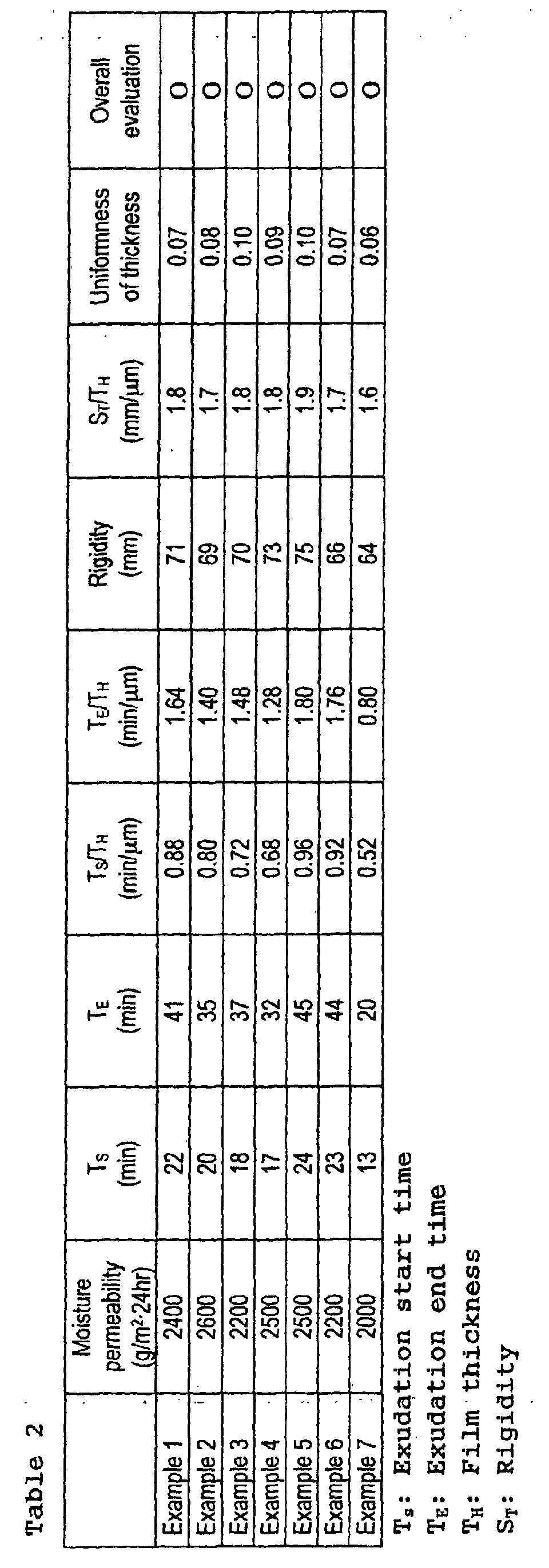
- the blending ratio of the starting material is shown in [Table 1] and the obtained results are shown in [Table 2].
- a porous film was obtained in the same procedures as those in Example 1 except for replacing the polyolefinic resin in Example 1 with 38 parts by weight of linear low density polyethylene (Evolue SP1540, trade name of products manufactured by Mitsui Chemical Co.) (95 wt% in the polyolefinic resin) and 2 parts by weight of a branched low density polyethylene (Mirason F967, trade name of products manufactured by Mitsui Chemical Co.) (5 wt% in the polyolefinic resin).
- Evolue SP1540 linear low density polyethylene
- Mirason F967 trade name of products manufactured by Mitsui Chemical Co.
- a porous film was obtained in the same procedures as those in Example 1 except for replacing Lucant HC600 used in Example 1 with Lucant A5515 (manufactured by Mitsui Chemical Co. Kinetic viscosity; 14600 mm 2 /sec).
- the blending ratio of the starting materials is shown in [Table 1] and the obtained results are shown in [Table 2].
- a porous film was obtained in the same procedures as those in Example 1 except for changing the addition amount of Lucant HC600 in Example 1 to 1 part by weight.
- the blending ratio of the starting materials is shown in [Table 1] and the obtained results are shown in [Table 2].
- a porous film was obtained in the same procedures as those in Example 1 except for changing the addition amount of Lucant HC600 in Example 1 to 4 part by weight.
- the blending ratio of the starting materials is shown in [Table 1] and the obtained results are shown in [Table 2].
- a porous film was obtained in the same procedures as those in Example 1 except for replacing the polyolefinic resin in Example 1 with 32 parts by weight of linear low density polyethylene (Ultzex UZ2021L, trade name of products manufactured by Mitsui Chemical Co.) (80 wt% in the polyolefinic resin), 8 parts by weight of a branched low density polyethylene (J-REX LD L211, trade name of products manufactured by Nippon Polyolefin Co.) (20 wt% in the polyolefinic resin).
- the blending ratio of the starting materials is shown in [Table 1] and the obtained results are shown in [Table 2].
- a porous film was obtained in the same procedures as those in Example 1 except for replacing Lucant HC600 used in Example 1 with castor oil (purified castor oil, trade name of products manufactured by Ito Seiyu Co.).
- castor oil purified castor oil, trade name of products manufactured by Ito Seiyu Co.
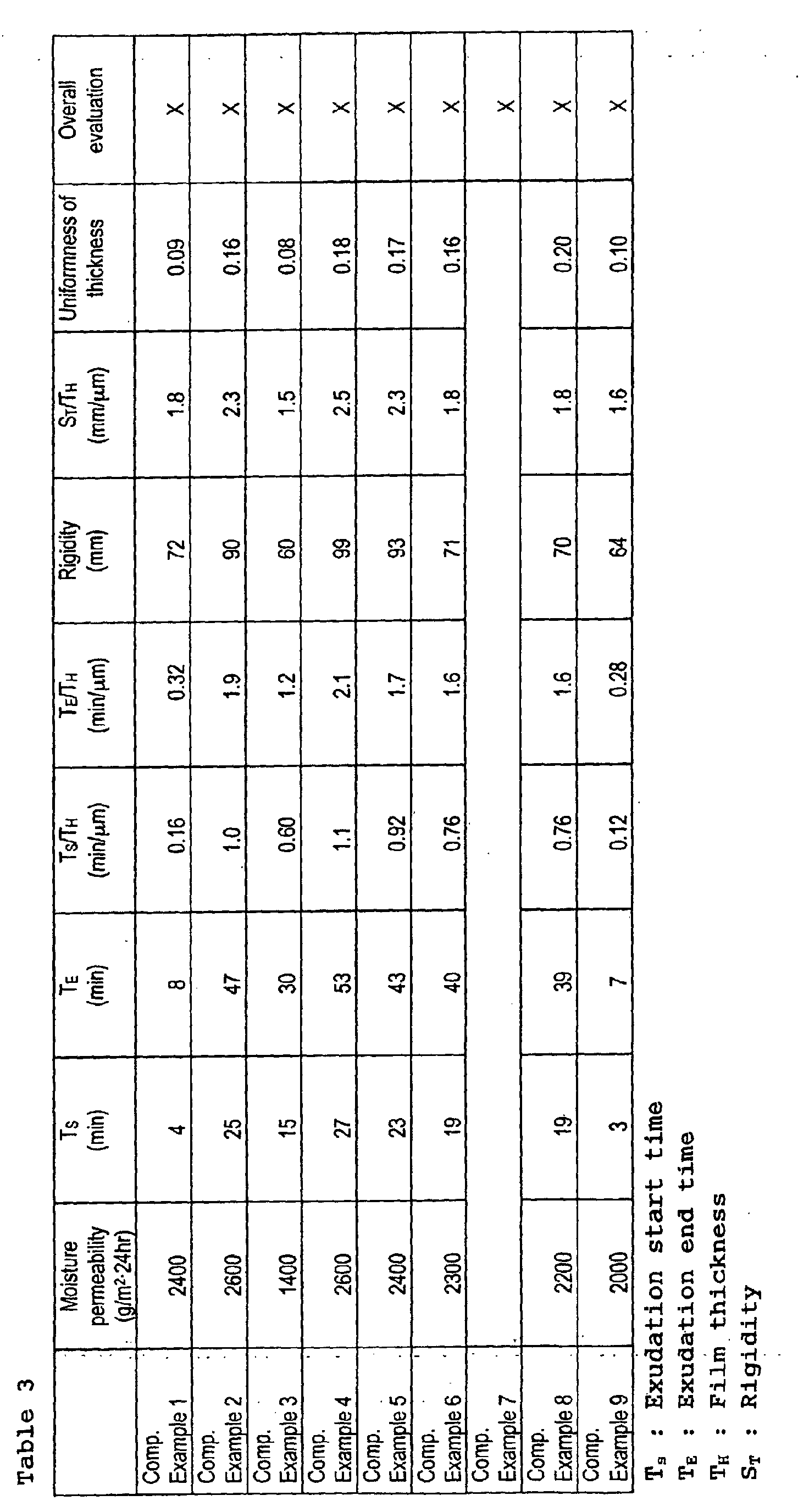
- the blending ratio of the starting materials is shown in [Table 1] and the obtained results are shown in [Table 3].
- a porous film was obtained in the same procedures as those in Example 1 except for changing the addition amount of Lucant HC600 in Example 1 to 0.2 part by weight.
- the blending ratio of the starting materials is shown in [Table 1] and the obtained results are shown in [Table 3].
- a porous film was obtained in the same procedures as those in Example 1 except for changing the addition amount of Lucant HC600 in Example 1 to 8 part by weight.
- the blending ratio of the starting materials is shown in [Table 1] and the obtained results are shown in [Table 3].
- a porous film was obtained in the same procedures as those in Example 1 except for not adding Lucant HC600.
- the blending ratio of the starting materials is shown in [Table 1] and the obtained results are shown in [Table 3].
- a porous film was obtained in the same procedures as those in Example 1 except for replacing Lucant HC600 used in Example 1 with PE wax (High wax 210P, trade name of products manufactured by Mitsui Chemical Co.).
- the blending ratio of the starting materials is shown in [Table 1] and the obtained results are shown in [Table 3].
- a porous film was obtained in the same procedures as those in Example 1 except for replacing Lucant HC600 used in Example 1 with liquid paraffin (manufactured by Katayama Chemical Co.).
- the blending ratio of the starting materials is shown in [Table 1] and the obtained results are shown in [Table 3].
- a porous film was obtained in the same procedures as those in Example 1 except for replacing the polyolefinic resin in Example 1 with 24 parts by weight of linear low density polyethylene (Ultzex UZ2021L, trade name of products manufactured by Mitsui Chemical Co.) (60 wt% in the polyolefinic resin), 16 parts by weight of branched low density polyethylene (J-REX LD L211, trade name of products manufactured by Nippon Polyolefin Co.) (40 wt% in the polyolefinic resin).
- the blending ratio of the starting materials is shown in [Table 1] and the obtained results are shown in [Table 3].
- a porous film was obtained in the same procedures as those in Example 1 except for replacing the polyolefinic resin in Example 1 with 40 parts by weight of linear low density polyethylene (Ultzex UZ2021L, trade name of products manufactured by Mitsui Chemical Co.) (100 wt% in the polyolefinic resin).
- the blending ratio of the starting materials is shown in [Table 1] and the obtained results are shown in [Table 3].
- a porous film was obtained in the same procedures as those in Example 1 except for adding 3 parts by weight of castor oil to the composition in Example 1.
- the blending ratio of the starting materials is shown in [Table 1] and the obtained results are shown in [Table 3].
Landscapes
- Chemical & Material Sciences (AREA)
- Engineering & Computer Science (AREA)
- Health & Medical Sciences (AREA)
- Chemical Kinetics & Catalysis (AREA)
- Medicinal Chemistry (AREA)
- Polymers & Plastics (AREA)
- Organic Chemistry (AREA)
- Manufacturing & Machinery (AREA)
- Materials Engineering (AREA)
- Manufacture Of Porous Articles, And Recovery And Treatment Of Waste Products (AREA)
- Compositions Of Macromolecular Compounds (AREA)
Abstract
Description
| LL (parts by weight) | Branched LD (parts by weight) | CaCO3 (parts by weight) | Oligomer (parts by weight) | |
| Example 1 | A:38 | C:2 | 60 | E:2 |
| Example 2 | A:38 | C:2 | 60 | F:2 |
| Example 3 | B:38 | C:2 | 60 | E:2 |
| Example 4 | A:38 | C:2 | 60 | G:2 |
| Example 5 | A:38 | C:2 | 60 | E:1 |
| Example 6 | A:38 | C:2 | 60 | E:4 |
| Example 7 | A:32 | D:8 | 60 | E:2 |
| Comp. Example 1 | A:38 | C:2 | 60 | H:2 |
| Comp. Example 2 | A:38 | C:2 | 60 | E:0.2 |
| Comp. Example 3 | A:38 | C:2 | 60 | E:8 |
| Comp. Example 4 | A:38 | C:2 | 60 | - |
| Comp. Example 5 | A:38 | C:2 | 60 | I:2 |
| Comp. Example 6 | A:38 | C:2 | 60 | J:2 |
| Comp. Example 7 | A:24 | D:16 | 60 | E:2 |
| Comp. Example 8 | A:40 | - | 60 | E:2 |
| Comp. Example 9 | A:40 | - | 60 | E:2 H:3 |
Claims (9)
- A porous film molded from a composition containing 25 to 55% by weight of polyolefinic resin and 75 to 45% by weight of inorganic filler, in which the polyolefinic resin comprises 98 to 70% by weight of linear low density polyethylene and 2 to 30% by weight of branched low density polyethylene, and contains 0.5 to 5 parts by weight of liquid ethylene-α-olefin oligomer based on 100 parts by weight of the composition.
- A porous film as defined in claim 1, wherein the kinetic viscosity at 40°C of the ethylene-α-olefin oligomer is from 50 to 100000 mm2/sec.
- A porous film as defined in claim 1, wherein the moisture permeability of the porous film is from 1500 to 4000 g/m2 · 24 hr.
- A porous film as defined in claim 1, wherein the uniformness of the thickness of the porous film is 0.15 or less.
- A porous film as defined in claim 1, wherein the ratio (ST/TH) of the rigidity (ST: mm) relative to the thickness of the porous film (TH : µm) is from 1.3 to 2.2.
- A porous film as defined in claim 1, wherein the ratio (TS/TH) of the exudation start time (TS : min) relative to the thickness of the porous film (TH : µm) is at least 0.2 and the ratio (TE/TH) of exudation end time (TE : min) relative to the thickness (TH : µm) is at least 0.4.
- A porous film as defined in claim 1, wherein the thickness of the porous film is from 10 to 300 µm.
- A method of manufacturing a porous film as defined in any one of claims 1 to 7 of molding a film from composition containing 25 to 55% by weight of polyolefinic resin and 75 to 45% by weight of inorganic filler, and stretching the thus obtained film at least in the machine direction, which comprises using resin containing from 98 to 70% by weight of linear low density polyethylene and from 2 to 30% by weight of branched low density polyethylene as the polyolefinic resin, adding from 0.5 to 5 parts by weight of liquid ethylene-α-olefin oligomer based on 100 parts by weight of the composition and taking up the film while stretching at line speed at least of 100 m/min upon stretching in the machine direction.
- A manufacturing method of a porous film as defined in claim 8, wherein the stretching factor at least in the machine direction is at least 1.2 times.
Applications Claiming Priority (3)
| Application Number | Priority Date | Filing Date | Title |
|---|---|---|---|
| JP36379099 | 1999-12-22 | ||
| JP36379099 | 1999-12-22 | ||
| PCT/JP2000/008954 WO2001046302A1 (en) | 1999-12-22 | 2000-12-18 | Porous film and process for producing the same |
Publications (3)
| Publication Number | Publication Date |
|---|---|
| EP1156076A1 true EP1156076A1 (en) | 2001-11-21 |
| EP1156076A4 EP1156076A4 (en) | 2005-03-02 |
| EP1156076B1 EP1156076B1 (en) | 2007-05-30 |
Family
ID=18480205
Family Applications (1)
| Application Number | Title | Priority Date | Filing Date |
|---|---|---|---|
| EP20000981800 Expired - Lifetime EP1156076B1 (en) | 1999-12-22 | 2000-12-18 | Porous film and process for producing the same |
Country Status (6)
| Country | Link |
|---|---|
| US (1) | US7153566B2 (en) |
| EP (1) | EP1156076B1 (en) |
| KR (1) | KR100448422B1 (en) |
| CN (1) | CN1149252C (en) |
| DE (1) | DE60035027T2 (en) |
| WO (1) | WO2001046302A1 (en) |
Families Citing this family (6)
| Publication number | Priority date | Publication date | Assignee | Title |
|---|---|---|---|---|
| US6737158B1 (en) * | 2002-10-30 | 2004-05-18 | Gore Enterprise Holdings, Inc. | Porous polymeric membrane toughened composites |
| CN100436528C (en) * | 2003-10-02 | 2008-11-26 | 株式会社德山 | Ethylene series polymer composition for high-speed stretching making film and method for mfg. porous film |
| KR100800284B1 (en) * | 2006-07-06 | 2008-02-04 | (주)대명화학 | Breathable film with reduced pinholes and long lasting scent |
| WO2008146758A1 (en) * | 2007-05-24 | 2008-12-04 | Nitto Denko Corporation | Method for production of porous film, porous film, separator for non-aqueous electrolyte battery, and non-aqueous electrolyte battery using the separator |
| CN104024326B (en) * | 2011-12-28 | 2016-11-23 | 三井化学株式会社 | Ethylene polymer composition and molded body obtained therefrom |
| EP2960270B1 (en) * | 2013-02-20 | 2017-12-20 | Prime Polymer Co., Ltd. | Biaxially stretched film, and ethylene-type polymer composition |
Family Cites Families (12)
| Publication number | Priority date | Publication date | Assignee | Title |
|---|---|---|---|---|
| JPS6215090A (en) | 1985-07-12 | 1987-01-23 | 川崎重工業株式会社 | Method of washing, etc. by robot |
| JPS62151429A (en) | 1985-12-26 | 1987-07-06 | Nippon Petrochem Co Ltd | Production of porous film or sheet |
| JPH0768393B2 (en) * | 1986-05-28 | 1995-07-26 | 花王株式会社 | Porous film |
| JPH0662795B2 (en) * | 1986-05-28 | 1994-08-17 | 花王株式会社 | Porous film |
| KR0147284B1 (en) * | 1989-01-27 | 1998-08-17 | 스즈끼 세이지 | Porous film and its manufacturing method |
| JPH0535734A (en) | 1991-07-29 | 1993-02-12 | Sharp Corp | Information processing equipment |
| JPH0699581A (en) | 1992-09-21 | 1994-04-12 | Seiko Epson Corp | Nozzle plate manufacturing method |
| GB2283758A (en) * | 1993-11-11 | 1995-05-17 | Nsk Ltd | Rust preventive lubricating oil |
| DE69608420T2 (en) * | 1995-02-16 | 2000-09-14 | Minnesota Mining And Mfg. Co., Saint Paul | OBJECTS WITH ADHESIVE ADHESIVES WITH IMPROVED ADHESION TO SOFTENED POLYVINYL CHLORIDE |
| US5945210A (en) * | 1995-12-13 | 1999-08-31 | Mitsui Chemicals, Inc. | Porous film and preparation process thereof |
| JP3285501B2 (en) * | 1996-10-25 | 2002-05-27 | ポリプラスチックス株式会社 | Polyacetal resin composition |
| JP4054120B2 (en) * | 1997-09-29 | 2008-02-27 | 三井化学株式会社 | Porous film and method for producing the same |
-
2000
- 2000-12-18 US US09/913,725 patent/US7153566B2/en not_active Expired - Fee Related
- 2000-12-18 KR KR10-2001-7010467A patent/KR100448422B1/en not_active Expired - Fee Related
- 2000-12-18 WO PCT/JP2000/008954 patent/WO2001046302A1/en not_active Ceased
- 2000-12-18 DE DE2000635027 patent/DE60035027T2/en not_active Expired - Fee Related
- 2000-12-18 CN CNB008041512A patent/CN1149252C/en not_active Expired - Fee Related
- 2000-12-18 EP EP20000981800 patent/EP1156076B1/en not_active Expired - Lifetime
Also Published As
| Publication number | Publication date |
|---|---|
| CN1149252C (en) | 2004-05-12 |
| EP1156076A4 (en) | 2005-03-02 |
| DE60035027T2 (en) | 2008-01-17 |
| US7153566B2 (en) | 2006-12-26 |
| KR100448422B1 (en) | 2004-09-13 |
| KR20010102226A (en) | 2001-11-15 |
| US20020192455A1 (en) | 2002-12-19 |
| EP1156076B1 (en) | 2007-05-30 |
| CN1341138A (en) | 2002-03-20 |
| DE60035027D1 (en) | 2007-07-12 |
| WO2001046302A1 (en) | 2001-06-28 |
Similar Documents
| Publication | Publication Date | Title |
|---|---|---|
| EP0227037B1 (en) | Process for producing a porous film | |
| CA1327259C (en) | Breathable microporous film and methods for making same | |
| DE69109860T2 (en) | LIGHTWEIGHT POLYPROPYLENE FILM AND METHOD FOR THE PRODUCTION THEREOF. | |
| US4704238A (en) | Process for the production of air-permeable films | |
| US6703439B2 (en) | Polyolefin resin composition and polyolefin film prepared from the same | |
| US5439628A (en) | Method for manufacturing polypropylene film and sheet | |
| DE69706409T2 (en) | FOAMED SEALS MADE OF HOMOGENEOUS OLEFIN POLYMERS | |
| US20020137851A1 (en) | Polypropylene film having good drawability in a wide temperature range and film properties | |
| US5346732A (en) | Performance super high flow ethylene polymer compositions | |
| JPH0416330B2 (en) | ||
| JPH0362738B2 (en) | ||
| US5853638A (en) | Process for producing stretched porous film | |
| EP1456283A1 (en) | Breathable film | |
| US7153566B2 (en) | Porous film and process for producing the same | |
| JP4540858B2 (en) | Porous film and method for producing the same | |
| DE112004001741T5 (en) | Resin composition and stretched film obtained by using the same | |
| DE2222221C2 (en) | Resin mixture based on butene-1 / ethylene copolymers | |
| US4126649A (en) | Polyolefinic compositions containing e/va copolymer | |
| DE2301470C3 (en) | Thermoplastic molding compound and its use | |
| KR100220892B1 (en) | A calenderable polypropylene film, sheet composition, and its preparing method | |
| JPS6218435A (en) | Production of gas-permeable film | |
| JP2001240690A (en) | Porous film and method for producing the same | |
| JP2001294717A (en) | Polyolefin resin composition and polyolefin film obtained from the composition | |
| EP0165075B1 (en) | Process for manufacturing high clarity film containing elastomers | |
| JP2003012842A (en) | Microporous film |
Legal Events
| Date | Code | Title | Description |
|---|---|---|---|
| PUAI | Public reference made under article 153(3) epc to a published international application that has entered the european phase |
Free format text: ORIGINAL CODE: 0009012 |
|
| 17P | Request for examination filed |
Effective date: 20010824 |
|
| AK | Designated contracting states |
Kind code of ref document: A1 Designated state(s): DE FR GB IT NL |
|
| RAP1 | Party data changed (applicant data changed or rights of an application transferred) |
Owner name: MITSUI CHEMICALS, INC. |
|
| A4 | Supplementary search report drawn up and despatched |
Effective date: 20050119 |
|
| RIC1 | Information provided on ipc code assigned before grant |
Ipc: 7C 08J 9/00 A Ipc: 7C 08J 5/18 B |
|
| 17Q | First examination report despatched |
Effective date: 20050610 |
|
| GRAP | Despatch of communication of intention to grant a patent |
Free format text: ORIGINAL CODE: EPIDOSNIGR1 |
|
| GRAS | Grant fee paid |
Free format text: ORIGINAL CODE: EPIDOSNIGR3 |
|
| GRAA | (expected) grant |
Free format text: ORIGINAL CODE: 0009210 |
|
| AK | Designated contracting states |
Kind code of ref document: B1 Designated state(s): DE FR GB IT NL |
|
| REG | Reference to a national code |
Ref country code: GB Ref legal event code: FG4D |
|
| REF | Corresponds to: |
Ref document number: 60035027 Country of ref document: DE Date of ref document: 20070712 Kind code of ref document: P |
|
| ET | Fr: translation filed | ||
| PLBE | No opposition filed within time limit |
Free format text: ORIGINAL CODE: 0009261 |
|
| STAA | Information on the status of an ep patent application or granted ep patent |
Free format text: STATUS: NO OPPOSITION FILED WITHIN TIME LIMIT |
|
| 26N | No opposition filed |
Effective date: 20080303 |
|
| PGFP | Annual fee paid to national office [announced via postgrant information from national office to epo] |
Ref country code: NL Payment date: 20081215 Year of fee payment: 9 |
|
| PGFP | Annual fee paid to national office [announced via postgrant information from national office to epo] |
Ref country code: IT Payment date: 20081224 Year of fee payment: 9 |
|
| PGFP | Annual fee paid to national office [announced via postgrant information from national office to epo] |
Ref country code: FR Payment date: 20081212 Year of fee payment: 9 |
|
| PGFP | Annual fee paid to national office [announced via postgrant information from national office to epo] |
Ref country code: DE Payment date: 20081211 Year of fee payment: 9 |
|
| PGFP | Annual fee paid to national office [announced via postgrant information from national office to epo] |
Ref country code: GB Payment date: 20081217 Year of fee payment: 9 |
|
| REG | Reference to a national code |
Ref country code: NL Ref legal event code: V1 Effective date: 20100701 |
|
| GBPC | Gb: european patent ceased through non-payment of renewal fee |
Effective date: 20091218 |
|
| REG | Reference to a national code |
Ref country code: FR Ref legal event code: ST Effective date: 20100831 |
|
| PG25 | Lapsed in a contracting state [announced via postgrant information from national office to epo] |
Ref country code: NL Free format text: LAPSE BECAUSE OF NON-PAYMENT OF DUE FEES Effective date: 20100701 Ref country code: FR Free format text: LAPSE BECAUSE OF NON-PAYMENT OF DUE FEES Effective date: 20091231 |
|
| PG25 | Lapsed in a contracting state [announced via postgrant information from national office to epo] |
Ref country code: DE Free format text: LAPSE BECAUSE OF NON-PAYMENT OF DUE FEES Effective date: 20100701 |
|
| PG25 | Lapsed in a contracting state [announced via postgrant information from national office to epo] |
Ref country code: GB Free format text: LAPSE BECAUSE OF NON-PAYMENT OF DUE FEES Effective date: 20091218 |
|
| PG25 | Lapsed in a contracting state [announced via postgrant information from national office to epo] |
Ref country code: IT Free format text: LAPSE BECAUSE OF NON-PAYMENT OF DUE FEES Effective date: 20091218 |