EP1156057A1 - Malto-oligosaccharide derivatives and uses thereof - Google Patents
Malto-oligosaccharide derivatives and uses thereof Download PDFInfo
- Publication number
- EP1156057A1 EP1156057A1 EP00902014A EP00902014A EP1156057A1 EP 1156057 A1 EP1156057 A1 EP 1156057A1 EP 00902014 A EP00902014 A EP 00902014A EP 00902014 A EP00902014 A EP 00902014A EP 1156057 A1 EP1156057 A1 EP 1156057A1
- Authority
- EP
- European Patent Office
- Prior art keywords
- hydrogen atom
- hyperglycemia
- formula
- derivatives
- present
- Prior art date
- Legal status (The legal status is an assumption and is not a legal conclusion. Google has not performed a legal analysis and makes no representation as to the accuracy of the status listed.)
- Granted
Links
- 0 CC(C)OC(C(CO)*C1C2OCC1OC(C(C*)*C(C1O)OC(C(CO)*C(C3O)OC(C(CNCC4O)O)C4O)C3O)C1O)C2O Chemical compound CC(C)OC(C(CO)*C1C2OCC1OC(C(C*)*C(C1O)OC(C(CO)*C(C3O)OC(C(CNCC4O)O)C4O)C3O)C1O)C2O 0.000 description 4
Classifications
-
- C—CHEMISTRY; METALLURGY
- C07—ORGANIC CHEMISTRY
- C07H—SUGARS; DERIVATIVES THEREOF; NUCLEOSIDES; NUCLEOTIDES; NUCLEIC ACIDS
- C07H17/00—Compounds containing heterocyclic radicals directly attached to hetero atoms of saccharide radicals
- C07H17/02—Heterocyclic radicals containing only nitrogen as ring hetero atoms
-
- A—HUMAN NECESSITIES
- A61—MEDICAL OR VETERINARY SCIENCE; HYGIENE
- A61P—SPECIFIC THERAPEUTIC ACTIVITY OF CHEMICAL COMPOUNDS OR MEDICINAL PREPARATIONS
- A61P3/00—Drugs for disorders of the metabolism
-
- A—HUMAN NECESSITIES
- A61—MEDICAL OR VETERINARY SCIENCE; HYGIENE
- A61P—SPECIFIC THERAPEUTIC ACTIVITY OF CHEMICAL COMPOUNDS OR MEDICINAL PREPARATIONS
- A61P3/00—Drugs for disorders of the metabolism
- A61P3/08—Drugs for disorders of the metabolism for glucose homeostasis
- A61P3/10—Drugs for disorders of the metabolism for glucose homeostasis for hyperglycaemia, e.g. antidiabetics
-
- A—HUMAN NECESSITIES
- A61—MEDICAL OR VETERINARY SCIENCE; HYGIENE
- A61P—SPECIFIC THERAPEUTIC ACTIVITY OF CHEMICAL COMPOUNDS OR MEDICINAL PREPARATIONS
- A61P43/00—Drugs for specific purposes, not provided for in groups A61P1/00-A61P41/00
-
- C—CHEMISTRY; METALLURGY
- C07—ORGANIC CHEMISTRY
- C07H—SUGARS; DERIVATIVES THEREOF; NUCLEOSIDES; NUCLEOTIDES; NUCLEIC ACIDS
- C07H3/00—Compounds containing only hydrogen atoms and saccharide radicals having only carbon, hydrogen, and oxygen atoms
- C07H3/06—Oligosaccharides, i.e. having three to five saccharide radicals attached to each other by glycosidic linkages
Definitions
- the present invention relates to maltoligosaccharide derivatives having a specific molecular structure and their uses. More particularly, it relates to an ⁇ -amylase inhibitor and the pharmaceuticals useful for the prophylaxis and treatment of hyperglycemia, for example, diabetes and their complications, which contain said derivatives as an active ingredient.
- Carbohydrates ingested by mammals are digested (hydrolyzed) to some extent by salivary ⁇ -amylase in the oral cavity and stomach, and then digested thoroughly by pancreatic ⁇ -amylase in the duodenum and jejunum to become oligosaccharides or disaccharides. Then they are further hydrolyzed by a glucoside-hydrolaze such as glucoamylase and maltase to finally become a monosaccharide such as glucose which is absorbed from the fimbriae on the intestinal membranes.
- a glucoside-hydrolaze such as glucoamylase and maltase
- hyperglycemia a disease in carbohydrate metabolism, such as an abnormal rise of blood glucose level
- he or she is liable to a disease called hyperglycemia, which leads to obesity or diabetes.
- Obesity is caused as the hyperglycemic condition resulting from overeating incites much secretion of insulin to promote fat synthesis and to decrease lipolysis, inducing accumulation of fat in the body.
- diabetes is caused as the promoted secretion of insulin by the hyperglycemic condition resulting from overeating invites a reduction of sensitivity of the insulin receptors or fatigue of the ⁇ cells of the pancreatic Langerhans islet. It is known that obesity and diabetes tend to provoke many serious complications such as hyperlipidemia, hypertension, arteriosclerosis, autonomic imbalance, and cataract.
- certain digestive enzyme inhibitors for example, "Basen” containing Voglibose (produced by Takeda Chemical Industries Co., Ltd.) and "Glucobay” containing Acarbose (produced by Bayer Chemical Corp.), are clinically used. Both of these compounds, however, have the disadvantage of inciting such side effects as causing abdominal distention, meteorism, increase of flatus, loose passage, diarrhea, abdominal pain, etc., because of their strong inhibitory action against glucosidase. Also, the maltoligosaccharide derivatives which the present inventors had previously proposed (JP-A-9-278789) are not necessarily satisfactory in certain respects, such as strength of their amylase inhibitory activity.
- the present invention is intended to provide a chemical substance which is free of said defects of the conventional therapeutic and prophylactic agents for hyperglycemia and capable of strongly inhibiting human ⁇ -amylase to work effectively for the prophylaxis and treatment of hyperglycemia, for example diabetes and the diseases induced thereby, and an ⁇ -amylase inhibitor and prophylactic and therapeutic agents for hyperglycemia containing said substance as an active ingredient.
- the inventors extensively studied for attaining the above object, and found that the maltoligosaccharide derivatives produced by converting the reduced terminal glucose of oligosaccharides into hexahydro-1H-azepine-3R, 4R, 5R, 6S-tetrol and also converting the 6-position of the 3rd glucose residue (as counted from the hexahydro-1H-azepine-3R, 4R, 5R, 6S-tetrol) into a hydrophobic group, and their hydrates or their physiologically acceptable salts strongly inhibit ⁇ -amylase derived from human pancreatic juice (hereinafter referred to as HPA) and ⁇ -amylase derived from human salivary gland (hereinafter referred to as HSA) and also act to suppress or retard digestion and absorption of glucose, and that it is possible to overcome the said defects of the prior art by using these compounds as an active ingredient of the therapeutic and prophylactic agents for hyperglycemia.
- HPA human pancreatic juice
- the maltoligosaccharide derivatives represented by the following general formula (1): (wherein n is an integer of 0 to 3, and X is a hydrogen atom or a hydrophobic group) or their hydrates or physiologically acceptable salts; an ⁇ -amylase inhibitor containing one of said maltoligosaccharide derivatives of the formula (1) or their hydrates or physiologically acceptable salts as an active ingredient; and a prophylactic or therapeutic agent for hyperglycemia containing one of said maltoligosaccharide derivatives of the formula (1) or their hydrates or physiologically acceptable salts as an active ingredient.
- the present invention is explained in detail.
- the maltoligosaccharide derivatives according to the present invention are those which are represented by the general formula (1) as mentioned above wherein n is an integer of 0 to 3 and X is a hydrogen atom or a hydrophoblic group.
- the present derivatives include their hydrates and physiologically acceptable salts.
- the hydrophobic group represented by X can be, for instance, a halogen atom such as fluorine, chlorine, bromine and iodine atom, a substituted or non-substituted alkyloxy group, a substituted or non-substituted alkylthio group, a substituted or non-substituted alkylsulfonyl group, a substituted or non-substituted alkylcarbamoyl, or azido group.
- a halogen atom such as fluorine, chlorine, bromine and iodine atom
- a substituted or non-substituted alkyloxy group such as fluorine, chlorine, bromine and iodine atom
- a substituted or non-substituted alkyloxy group such as fluorine, chlorine, bromine and iodine atom
- a substituted or non-substituted alkyloxy group such as fluorine
- n is 0 to 3, especially 0 or 1
- X is a hydrogen atom or a halogen atom, especially a hydrogen atom.
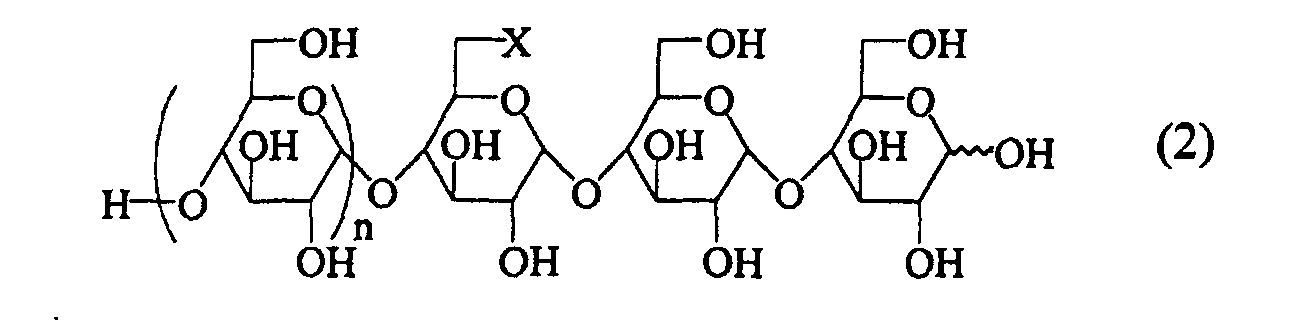
- the present derivatives can be synthesized efficiently from, for instance, 6 3 -modified maltoligosaccharides represented by the general formula (2): (wherein n is an integer of 0 to 3, and X is a hydrogen atom or a hydrophobic group).
- n is an integer of 0 to 3
- X is a hydrogen atom or a hydrophobic group.
- the hydrophobic group can be, for instance, a halogen atom such as fluorine, chlorine, bromine and iodine atom, a substituted or non-substituted alkyloxy group, a substituted or non-substituted alkylthio group, a substituted or non-substituted alkylsulfonyl group, a substituted or non-substituted alkylcarbamoyl, or azido group.
- Said 6 3 -modified maltoligosaccharides can be synthesized, for instance, by a method described in Carbohydrate Research, Vol. 307, pp. 69-76, 1998.
- a 6 3 -modified maltologosaccharide synthesized by the above method is reacted with, for instance, p-toluenesulfonyl chloride in pyridine, and if necessary 6 1 -tosyl - 6 3 -modified maltoligosaccharide are separated by a conventional method and reacted with sodium azide in N,N-dimethylformamide (DMF) to give 6 1 -azido - 6 3 -modified maltoligosaccharides.
- DMF N,N-dimethylformamide
- the thus obtained present derivative can be purified by a conventional method, for example, precipitation using a pertinent organic solvent or column chromatography using an ion exchange resin, aminopropyl silica gel, silica gel, active carbon, etc.
- the present derivatives represented by the formula (1) obtained in the manner described above, have a strong inhibitory acitivity against HPA and HSA as explained below.
- X is a non-modified group (OH group)
- JP-A-9-278789 the present derivatives in which a hydrogen atom or a hydrophobic group has been introduced to the X position are remarkably enhanced in amylase inhibitory activity.
- the above-mentioned prior art maltoligosaccharide derivatives or their hydrates or physiologically acceptable salts although having an action to suppress the blood glucose level after meal, are susceptible to decomposition in the intestinal tracts and may therefore be greatly weakened in their activity.
- the present derivatives since X is modified, are enhanced in their amylase inhibitory activity and not easily decomposed in the intestinal tracts, so that their activity keeps long in the intestinal tracts. Consequently, a high blood glucose level suppressing effect after meal can be obtained by a small dosage of the compound.
- the present derivatives represented by the formula (1) are preferably those in which in the formula (1) n is 0 to 3, especially 0 or 1, and X is a hydrogen atom or a halogen atom, especially a hydrogen atom.
- the present derivatives have a strong inhibitory activity against ⁇ -amylase, so that a potent ⁇ -amylase inhibitor can be obtained by using such derivatives as an active ingredient. Further, the present derivatives having such an inhibitory activity also depress carbohydrate metabolism of animals, so that they can check the increase in blood glucose level and are therefore useful as a prophylactic or therapeutic agent for hyperglycemia, for example, diabetes, adiposity and the diseases caused thereby, such as hyperlipidemia, fatty liver, autonomic imbalance, arteriosclerosis, cataract, etc. The present derivatives are especially useful for the prophylaxis and treatment of diabetes.
- Nontoxic salts obtained by reacting the present derivatives with a pharmacologically acceptable acid or base in the usual method can also be used for the preparation of the ⁇ -amylase inhibitor or prophylactic or therapeutic agents for hyperglycemia according to the present invention.
- the acids usable for the above reaction include inorganic acids such as hydrochloric acid, hydrobromic acid, sulfuric acid, phosphoric acid and nitric acid, and organic acids such as acetic acid, malic acid, citric acid, ascorbic acid, mandelic acid and methanesulfonic acid.
- the bases include sodium hydroxide, potassium hydroxide, ammonium hydroxide, calcium hydroxide, etc.
- the ⁇ -amylase inhibitor and the prophylactic or therapeutic agent for hyperglycemia according to the present invention can be obtained by using the present derivatives either singly or as a combination of two or more of them as an active ingredient.
- the ⁇ -amylase inhibitor and the prophylactic or therapeutic agent for hyperglycemia according to the present invention may comprise the present derivative alone or may further contain other compounding agent(s) such as excipient, lubricant, diluent, stabilizer, pH adjuster, antiseptic, sweetener, aromatic, flavor, colorant, preservative, emulsifier, thickening agent, and base materials to provide the preparations of various dosage forms such as tablet, powder, granule, capsule, syrup, sappository, injection and drops.
- the dosage of the ⁇ -amylase inhibitor, prophylatic or thermapeutic agent for hyperglycemia, and prophylatic or thermapeutic agent for diabetes according to the present invention is variable depending on the route of administration, condition of the disease, patient's age and body weight, and other factors, but usually it is selected from within the range of 10 to 3,000 mg, preferably 100 to 600 mg (as the present derivative) per day for the adult.
- the route of administration may be either oral or parenteral, but oral administration is advantageous.
- the present derivative may be contained, either alone or in combination with other compounding agent(s) such as mentioned above, in foods such as coffee, soft drinks, fruit juice, jam and biscuits to provide health foods having an ⁇ -amylase inhibitory effect.
- the fraction containing the objective compound was concentrated and then lyophilized to obtain colorless powder of O-(a-D-glucopyranosyl)-(1 ⁇ 4)-O-(6-deoxy- ⁇ -D-glucopyranosyl)-(1 ⁇ 4)-O-( ⁇ -D-glucopyranosyl)-(1 ⁇ 4)-6-O-p-toluenesulfonyl-D-glucopyranose (2.9 g, 3.6 mmol, yield: 16%).
- the fraction containing the objective compound was concentrated and then lyophilized to obtain colorless powder of objective O-( ⁇ -D-glucopyranosyl)-(1 ⁇ 4)-O-(6-deoxy- ⁇ -D-glucopyranoxyl)-(1 ⁇ 4)-O-( ⁇ -D-glucopyranosyl)-(1 ⁇ 4)-6-azido-6-deoxy-D-glucopyranose (2.0 g, 3.0 mmol, yield: 83%).
- the catalyst was filtered with Celite and the filtrate was purified by ion exchange resin (Dowex 1 ⁇ 4, OH - form, eluted with H 2 O). The fraction containing the objective compound was concentrated and then lyophilized to obtain the objective colorless powder (124 mg, 0.20 mmol, yield: 89%).
- Example 2 240 g of DOG2Az obtained in the same way as in Example 1 was dissolved in 1,000 ml of a physiological saline. The solution was filtered aseptically by a membrane filter and the filtrate was filled in the sterilized glass containers in an amount of 10 ml for each container. With the containers stoppered, the solution was lyophilized to obtain a powdery ⁇ -amylase inhibitor.
- each capsule containing 100 mg of active ingredient.
- the maltoligosaccharide derivatives represented by the formula (1) according to the present invention have a strong inhibitory activity against ⁇ -amylase and cause no side effects such as diarrhea and loose passage, so that if the present derivatives or their hydrates or physiologically acceptable salts are used as an active ingredient, there can be obtained a potent ⁇ -amylase inhibitor or prophylactic or therapeutic agent for hyperglycemia, e.g. diabetes, adiposity and the diseases caused thereby such as hyperlipidemia, fatty liver, autonomic imbalance, arteriosclerosis, cataract, etc., particularly diabetes.
Landscapes
- Chemical & Material Sciences (AREA)
- Health & Medical Sciences (AREA)
- Organic Chemistry (AREA)
- General Health & Medical Sciences (AREA)
- Engineering & Computer Science (AREA)
- Life Sciences & Earth Sciences (AREA)
- Diabetes (AREA)
- Molecular Biology (AREA)
- Genetics & Genomics (AREA)
- Biotechnology (AREA)
- Biochemistry (AREA)
- Veterinary Medicine (AREA)
- Public Health (AREA)
- Pharmacology & Pharmacy (AREA)
- Nuclear Medicine, Radiotherapy & Molecular Imaging (AREA)
- Medicinal Chemistry (AREA)
- General Chemical & Material Sciences (AREA)
- Chemical Kinetics & Catalysis (AREA)
- Bioinformatics & Cheminformatics (AREA)
- Animal Behavior & Ethology (AREA)
- Hematology (AREA)
- Obesity (AREA)
- Emergency Medicine (AREA)
- Endocrinology (AREA)
- Pharmaceuticals Containing Other Organic And Inorganic Compounds (AREA)
- Saccharide Compounds (AREA)
- Polysaccharides And Polysaccharide Derivatives (AREA)
- Seasonings (AREA)
Abstract
Description
- The present invention relates to maltoligosaccharide derivatives having a specific molecular structure and their uses. More particularly, it relates to an α-amylase inhibitor and the pharmaceuticals useful for the prophylaxis and treatment of hyperglycemia, for example, diabetes and their complications, which contain said derivatives as an active ingredient.
- Carbohydrates ingested by mammals are digested (hydrolyzed) to some extent by salivary α-amylase in the oral cavity and stomach, and then digested thoroughly by pancreatic α-amylase in the duodenum and jejunum to become oligosaccharides or disaccharides. Then they are further hydrolyzed by a glucoside-hydrolaze such as glucoamylase and maltase to finally become a monosaccharide such as glucose which is absorbed from the fimbriae on the intestinal membranes. After ingestion of carbohydrates, there takes place a primary increase in blood glucose level, or so-called hyperglycemic symptom, due to the absorption of glucose, but this abnormal phenomenon is usually remedied in due course as the blood glucose level is brought back to a normal range and controlled to stay therein by the homeostasis maintaining system in the living body.
- However, if a person suffers an alimentary hyperglycemic symptom for a long time or has abnormality in carbohydrate metabolism, such as an abnormal rise of blood glucose level, he or she is liable to a disease called hyperglycemia, which leads to obesity or diabetes. Obesity is caused as the hyperglycemic condition resulting from overeating incites much secretion of insulin to promote fat synthesis and to decrease lipolysis, inducing accumulation of fat in the body. On the other hand, diabetes is caused as the promoted secretion of insulin by the hyperglycemic condition resulting from overeating invites a reduction of sensitivity of the insulin receptors or fatigue of the β cells of the pancreatic Langerhans islet. It is known that obesity and diabetes tend to provoke many serious complications such as hyperlipidemia, hypertension, arteriosclerosis, autonomic imbalance, and cataract.
- As a potent therapeutic agent for such hyperglycemia, certain digestive enzyme inhibitors, for example, "Basen" containing Voglibose (produced by Takeda Chemical Industries Co., Ltd.) and "Glucobay" containing Acarbose (produced by Bayer Chemical Corp.), are clinically used. Both of these compounds, however, have the disadvantage of inciting such side effects as causing abdominal distention, meteorism, increase of flatus, loose passage, diarrhea, abdominal pain, etc., because of their strong inhibitory action against glucosidase. Also, the maltoligosaccharide derivatives which the present inventors had previously proposed (JP-A-9-278789) are not necessarily satisfactory in certain respects, such as strength of their amylase inhibitory activity.
- The present invention is intended to provide a chemical substance which is free of said defects of the conventional therapeutic and prophylactic agents for hyperglycemia and capable of strongly inhibiting human α-amylase to work effectively for the prophylaxis and treatment of hyperglycemia, for example diabetes and the diseases induced thereby, and an α-amylase inhibitor and prophylactic and therapeutic agents for hyperglycemia containing said substance as an active ingredient.
- The inventors extensively studied for attaining the above object, and found that the maltoligosaccharide derivatives produced by converting the reduced terminal glucose of oligosaccharides into hexahydro-1H-azepine-3R, 4R, 5R, 6S-tetrol and also converting the 6-position of the 3rd glucose residue (as counted from the hexahydro-1H-azepine-3R, 4R, 5R, 6S-tetrol) into a hydrophobic group, and their hydrates or their physiologically acceptable salts strongly inhibit α-amylase derived from human pancreatic juice (hereinafter referred to as HPA) and α-amylase derived from human salivary gland (hereinafter referred to as HSA) and also act to suppress or retard digestion and absorption of glucose, and that it is possible to overcome the said defects of the prior art by using these compounds as an active ingredient of the therapeutic and prophylactic agents for hyperglycemia. The present invention has been attained on the basis of the above finding.
- According to the present invention, there are provided the maltoligosaccharide derivatives represented by the following general formula (1):(wherein n is an integer of 0 to 3, and X is a hydrogen atom or a hydrophobic group) or their hydrates or physiologically acceptable salts; an α-amylase inhibitor containing one of said maltoligosaccharide derivatives of the formula (1) or their hydrates or physiologically acceptable salts as an active ingredient; and a prophylactic or therapeutic agent for hyperglycemia containing one of said maltoligosaccharide derivatives of the formula (1) or their hydrates or physiologically acceptable salts as an active ingredient. The present invention is explained in detail.
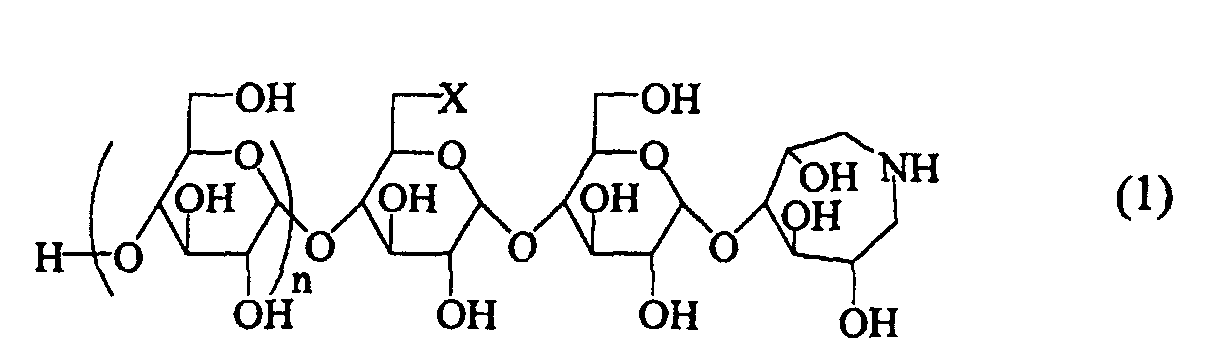
- The maltoligosaccharide derivatives according to the present invention (hereinafter referred to as the present derivatives) are those which are represented by the general formula (1) as mentioned above wherein n is an integer of 0 to 3 and X is a hydrogen atom or a hydrophoblic group. The present derivatives include their hydrates and physiologically acceptable salts. The hydrophobic group represented by X can be, for instance, a halogen atom such as fluorine, chlorine, bromine and iodine atom, a substituted or non-substituted alkyloxy group, a substituted or non-substituted alkylthio group, a substituted or non-substituted alkylsulfonyl group, a substituted or non-substituted alkylcarbamoyl, or azido group.
- In use of the present derivatives for producing an α-amylase inhibitor or a prophylactic or therapeutic agent for hyperglycemia, it is desirable, for the reasons stated below, that in the formula (1) n is 0 to 3, especially 0 or 1, and X is a hydrogen atom or a halogen atom, especially a hydrogen atom.
- The present derivatives can be synthesized efficiently from, for instance, 63-modified maltoligosaccharides represented by the general formula (2):(wherein n is an integer of 0 to 3, and X is a hydrogen atom or a hydrophobic group). In the formula (2), n is an integer of 0 to 3, and X is a hydrogen atom or a hydrophobic group. The hydrophobic group can be, for instance, a halogen atom such as fluorine, chlorine, bromine and iodine atom, a substituted or non-substituted alkyloxy group, a substituted or non-substituted alkylthio group, a substituted or non-substituted alkylsulfonyl group, a substituted or non-substituted alkylcarbamoyl, or azido group. Said 63-modified maltoligosaccharides can be synthesized, for instance, by a method described in Carbohydrate Research, Vol. 307, pp. 69-76, 1998.
- A 63-modified maltologosaccharide synthesized by the above method is reacted with, for instance, p-toluenesulfonyl chloride in pyridine, and if necessary 61-tosyl - 63-modified maltoligosaccharide are separated by a conventional method and reacted with sodium azide in N,N-dimethylformamide (DMF) to give 61-azido - 63-modified maltoligosaccharides. These 61-azido - 63-modified maltoligosaccharides are separated from each other by a known method, and the latter is reduced by introducing hydrogen gas in the presence of palladium carbon to produce the present derivative represented by the formula (1).
- The thus obtained present derivative can be purified by a conventional method, for example, precipitation using a pertinent organic solvent or column chromatography using an ion exchange resin, aminopropyl silica gel, silica gel, active carbon, etc.
- The present derivatives represented by the formula (1), obtained in the manner described above, have a strong inhibitory acitivity against HPA and HSA as explained below. In comparison with the maltoligosaccharide derivatives of the formula (1) wherein X is a non-modified group (OH group), which the present inventors had previously proposed (JP-A-9-278789), the present derivatives in which a hydrogen atom or a hydrophobic group has been introduced to the X position are remarkably enhanced in amylase inhibitory activity. Also, the above-mentioned prior art maltoligosaccharide derivatives or their hydrates or physiologically acceptable salts, although having an action to suppress the blood glucose level after meal, are susceptible to decomposition in the intestinal tracts and may therefore be greatly weakened in their activity. In contrast, the present derivatives, since X is modified, are enhanced in their amylase inhibitory activity and not easily decomposed in the intestinal tracts, so that their activity keeps long in the intestinal tracts. Consequently, a high blood glucose level suppressing effect after meal can be obtained by a small dosage of the compound. In view of affinity with amylase, the present derivatives represented by the formula (1) are preferably those in which in the formula (1) n is 0 to 3, especially 0 or 1, and X is a hydrogen atom or a halogen atom, especially a hydrogen atom.
- As explained above, the present derivatives have a strong inhibitory activity against α-amylase, so that a potent α-amylase inhibitor can be obtained by using such derivatives as an active ingredient. Further, the present derivatives having such an inhibitory activity also depress carbohydrate metabolism of animals, so that they can check the increase in blood glucose level and are therefore useful as a prophylactic or therapeutic agent for hyperglycemia, for example, diabetes, adiposity and the diseases caused thereby, such as hyperlipidemia, fatty liver, autonomic imbalance, arteriosclerosis, cataract, etc. The present derivatives are especially useful for the prophylaxis and treatment of diabetes.
- Nontoxic salts obtained by reacting the present derivatives with a pharmacologically acceptable acid or base in the usual method can also be used for the preparation of the α-amylase inhibitor or prophylactic or therapeutic agents for hyperglycemia according to the present invention. The acids usable for the above reaction include inorganic acids such as hydrochloric acid, hydrobromic acid, sulfuric acid, phosphoric acid and nitric acid, and organic acids such as acetic acid, malic acid, citric acid, ascorbic acid, mandelic acid and methanesulfonic acid. The bases include sodium hydroxide, potassium hydroxide, ammonium hydroxide, calcium hydroxide, etc.
- The α-amylase inhibitor and the prophylactic or therapeutic agent for hyperglycemia according to the present invention can be obtained by using the present derivatives either singly or as a combination of two or more of them as an active ingredient. Also, the α-amylase inhibitor and the prophylactic or therapeutic agent for hyperglycemia according to the present invention may comprise the present derivative alone or may further contain other compounding agent(s) such as excipient, lubricant, diluent, stabilizer, pH adjuster, antiseptic, sweetener, aromatic, flavor, colorant, preservative, emulsifier, thickening agent, and base materials to provide the preparations of various dosage forms such as tablet, powder, granule, capsule, syrup, sappository, injection and drops. Conventional methods can be used for making these preparations. As excipient, ordinarily used potato starch, lactose, crystal cellulose, mannitol and the like may be used. As lubricant, magnesium stearate, talc, hard oil and the like may be used. As sweetener, aromatic and flavor, there may be used common salt, saccharin, orange oil, citric acid, menthol, malic acid, etc.
- The dosage of the α-amylase inhibitor, prophylatic or thermapeutic agent for hyperglycemia, and prophylatic or thermapeutic agent for diabetes according to the present invention is variable depending on the route of administration, condition of the disease, patient's age and body weight, and other factors, but usually it is selected from within the range of 10 to 3,000 mg, preferably 100 to 600 mg (as the present derivative) per day for the adult. The route of administration may be either oral or parenteral, but oral administration is advantageous. The present derivative may be contained, either alone or in combination with other compounding agent(s) such as mentioned above, in foods such as coffee, soft drinks, fruit juice, jam and biscuits to provide health foods having an α-amylase inhibitory effect.
- The present invention is further illustrated by showing examples and referential examples , but the present invention is not limited by these examples in any way.
- 63-deoxymaltotriose (15 g, 31 mmol) was dissolved in pyridine (450 ml), to which tosyl chloride (8.8 g, 46 mmol) was added and the mixture was reacted with stirring under cooling with ice water for 3 hours. After the completion of the reaction, the reaction was stopped by adding distilled water (75 ml) and the solution was evaporated to dryness. The residue was dissolved in a small quantity of distilled water and this solution was purified by ODS column chromatography (H2O → 50% CH3CN, gradient). The fraction containing the objective compound was concentrated and then lyophilized to obtain colorless powder (2.8 g, 4.3 mmol, yield: 14%).
- m.p. 125-127°C (dec.),
- [α]+127° (c0.25, H2O),
- IR(KBr) cm-1: 3330, 2930, 1650, 1600, 1360, and 1050, 1H-NMR (D2O) δ: 1.29 (d, 3H, J=6.4Hz, H-6c), 2.48 (s, 3H, -SO2PhCH3), 3.12-4.06 (m, H-2-6), 4.59 (d, 0.5H, J=7.8Hz, αH-1a), 5.12 (d, 0.5H, J=3.7Hz, βH-1a), 5.25 and 5.34 (d, each 1H, J=3.1 and 3.9Hz, H-1b-c), 7.53 (d, 2H, J=8.8Hz, H-3 and H-5 of -SO2PhCH3), 7.83 (d, 2H, J=8.5Hz, H-2 and H-6 of -SO2PhCH3),
- 13C-NMR (D2O) δ: 19.44 (-CH3), 23.67 (-SO2PhCH3), 94.72 and 98.69 (C-1a), 102.17 and 103.11 (C-1b-c), 130.51 and 133.06 (-SO2PhCH3),
- tR (TSKgel Amide-80, eluent: 8:2 (v/v) CH3CN-H2O): 7.7 min.,
- Anal. Calcd. for C25H38O17S·1.33H2O: C, 45.04; H, 6.15, Found: C, 45.15; H, 5.98.
-
- O-(6-deoxy-α-D-glucopyranosyl)-(1→4)-O-(α-D-glucopyranosyl)-(1→4)-6-O-p-toluenesulfonyl-D-glucopyranose (2.2 g, 3.4 mmol) produced in Referential Example 1 was dissolved in DMF (40 ml), to which NaN3 (10 mol eq.) was added and the mixture was reacted with stirring at 80°C for 2 hours. After the completion of the reaction, the solvent was distilled off under reduced pressure and the residue was purified by ODS chromatography (CH3CN/H2O = 5/95 (v/v)). The fraction containing the objective compound was concentrated and then lyophilized to obtain colorless powder (0.66 g, 1.3 mmol, yield: 38%).
- m.p. 131-133°C (dec.),
- [α]+174° (c0.25, H2O),
- IR(KBr) cm-1: 3340, 2930, 2110, 1650, 1360, and 1050, 1H-NMR (D2O) δ: 1.27 (d, 3H, J=6.1Hz, H-6c), 3.12-4.01 (m, H-2-6), 4.67 (d, 0.5H, J=8.5Hz, αH-1a), 5.23 (d, 0.5H, J=3.9Hz, βH-1a), 5.29 and 5.40 (d, each 1H, J=3.0 and 3.6Hz, H-1b-c),
- 13C-NMR (D2O) δ: 19.34 (-CH3), 53.73 (-CH2N3), 94.75 and 98.66 (C-1a), 102.26 and 102.77 (C-1b-c),
- tR (TSKgel Amide-80, eluent: 8:2 (v/v) CH3CN-H2O): 12.8 and 14.4 min.,
- Theoretical (C18H31N3O14·H2O: C, 40.68; H, 6.26; N, 7.91 Found: C, 40.97; H, 6.00; N, 8.12.
-
- O-(6-deoxy-α-D-glucopyranosyl)-(1→4)-O-(α-D-glucopyranosyl)-(1→4)-6-azido-6-deoxy-D-glucopyranose (0.50 g, 0.97 mmol) was dissolved in distilled water (35 ml), to which 10% Pd-C (0.27 g) was added and the mixture was subjected to catalytic reduction under normal pressure with stirring at room temperature for 16 hours. After the completion of the reaction, the catalyst was filtered with Celite, and the residue was concentrated and lyophilized to obtain colorless powder (0.40 g, 0.85 mmol, yield: 88%).
- m.p. 132-134°C (dec.),
- [α]+133° (c0.25, H2O),
- IR(KBr) cm-1: 3340, 2930, 1650, 1420, and 1050,
- 1H-NMR (D2O) δ: 1.28 (d, 3H, J=6.2Hz, H-6c), 2.85-3.12 (m, 4H, H-2a and H-7a), 3.55-4.18 (m, H-2-6),5.17 and 5.31 (d, each 1H, J=3.9 and 3.0Hz, H-1b-c),
- 13C-NMR (D2O) δ: 19.34 (-CH3), 51.76 and 52.08 (-CH2NHCH2-), 101.78 and 102.65 (C-1b-c),
- tR (TSKgel Amide-80, eluent: 6:4 (v/v) CH3CN-ammonium formate buffer 25mM pH8.5):11.3min.,
- Theoretical (C18H33NO13·0.5H2O: C, 45.00; H, 7.13; N, 2.92 Found: C, 44.95; H, 6.81; N, 3.00.
-
- 63-deoxymaltotetraose (15 g, 23 mmol) was dissolved in pyridine (450 ml), to which tosyl chloride (8.8 g, 46 mmol) was added and the mixture was reacted with stirring under cooling with ice water for 3 hours. After the completion of the reaction, the reaction was stopped by adding distilled water (75 ml) and the solution was evaporated to dryness. The residue was dissolved in a small quantity of distilled water and this solution was purified by ODS chromatography (H2O → 50% CH3CN, gradient). The fraction containing the objective compound was concentrated and then lyophilized to obtain colorless powder of O-(a-D-glucopyranosyl)-(1→4)-O-(6-deoxy-α-D-glucopyranosyl)-(1→4)-O-(α-D-glucopyranosyl)-(1→4)-6-O-p-toluenesulfonyl-D-glucopyranose (2.9 g, 3.6 mmol, yield: 16%).
- This tosyl derivative (2.9 g, 3.6 mmol) was dissolved in DMF (40 ml), to which NaN3 (10 mol eq.) was added and the mixture was reacted with stirring at 80°C for 2 hours. After the completion of the reaction, the solvent was distilled off under reduced pressure, and the residue was purified by ODS chromatography (CH3CN/H2O = 5/95 (v/v)). The fraction containing the objective compound was concentrated and then lyophilized to obtain colorless powder of objective O-(α-D-glucopyranosyl)-(1→4)-O-(6-deoxy-α-D-glucopyranoxyl)-(1→4)-O-(α-D-glucopyranosyl)-(1→4)-6-azido-6-deoxy-D-glucopyranose (2.0 g, 3.0 mmol, yield: 83%).
- m.p. 152-154°C (dec.),
- [α]+179° (c0.25, H2O),
- IR(KBr) cm-1:3320, 2940, 2110, 1650, 1360, and 1050,
- 1H-NMR (D2O) δ: 1.33 (d, 3H, J=5.9Hz, H-6c), 3.25-4.01 (m, H-2-6), 4.66 (d, 0.5H, J=8.1Hz, αH-1a), 5.21-5.40 (m, 3.5H, βH-1a and H-1b-d),
- 13C-NMR (D2O) δ: 19.97 (-CH3), 53.85 (-CH2N3), 94.77 and 98.71 (C-1a), 102.26, 102.31 and 102.65 (C-1b-d),
- tR (TSKgel Amide-80, eluent: 6:4 (v/v) CH3CN-H2O): 5.6 min.,
- Theoretical (C24H41N3O19·1.33H2O: C, 41.20; H, 6.29; N, 6.01,
- Found: C, 41.14; H, 6.11; N, 5.92.
-
- O-(α-D-glucopyranosyl)-(1→4)-O-(6-deoxy-α-D-glucopyranosyl)-(1→4)-O-(α-D-glucopyranosyl)-(1→4)-6-azido-6-deoxy-D-glucopyranose (150 mg, 0.22 mmol) obtained in Referential Example 3 was dissolved in distilled water (25 ml), to which 10% Pd-C (30 mg) was added and the mixture was subjected to catalytic reduction under normal pressure with stirring at room temperature for 16 hours. After the completion of the reaction, the catalyst was filtered with Celite and the filtrate was purified by ion exchange resin (Dowex 1 × 4, OH- form, eluted with H2O). The fraction containing the objective compound was concentrated and then lyophilized to obtain the objective colorless powder (124 mg, 0.20 mmol, yield: 89%).
- m.p. 144-146°C (dec.),
- [α]+154° (c0.25, H2O),
- IR(KBr) cm-1: 3320, 2910, 1560, 1420, and 1040,
- 1H-NMR (D2O) δ: 1.33 (d, 3H, J=6.3Hz, H-6c), 2.90-3.10 (m, 4H, H-2a and H-7a), 3.30-4.18 (m), 5.17, 5.31, and 5.39 (d, each 1H, J=3.9, 4.2, and 3.9Hz, H-1b-d),
- 13C-NMR (D2O) δ: 20.07 (-CH3), 51.64 and 51.89 (-CH2NHCH2-), 101.78, 102.53, and 102.53 (C-1b-d),
- tR (TSKgel Amide-80, eluent: 6:4 (v/v) CH3CN-ammonium formate buffer 25mM pH8.5): 13.9 min.,
- Theoretical (C24H43NO18·2H2O): C, 43.05; H, 7.07; N, 2.09, Found: C, 42.71; H, 6.74; N, 2.00.
-
-
- (1) Preparation of human α-amylase solution Commercial HPA and HSA were dissolved in purified water to a concentration of 350 IU/1 to prepare an α-amylase solution. As commercial HPA and HSA, "Calibzyme AMY" (available from International Reagents Corp. Japan) was used. The α-amylase activity was determined according to the calibration curve of a commercial α-amylase determining reagent "Neo Amylase Test ┌DAIICHI┘ " (available from Daiichi Pure Chemicals Co., Ltd., Japan).
- (2) Preparation of inhibitor solution
DOG2Az obtained in Example 1, GDOG2Az
obtained in Example 2 and comparative G2Az (63-position
non-modified maltoligosaccharide derivative disclosed
in JP-A-9-278789) represented by the following formula
(3) were diluted with distilled water so that the final
concentration would become 5 to 0.0001 mM.

- (3) Determination of human α-amylase inhibitory
activity (IC50) of inhibitor solution
3.0 ml of distilled water, 1.0 ml of the
inhibitor solution, Neo Amylase Test ┌DAIICHI┘
(produced by Daiichi Pure Chemicals Co., Ltd., Japan)
and one tablet of blue starch were added to 100 µl of
HPA or HSA solution, and the mixture was stirred by a
mixer for about 10 seconds and then heated at 37°C for
30 minutes. Thereafter, 1.0 ml of 0.5 N sodium
hydroxide solution was added and the mixture was
further stirred. Then the reaction was stopped, the
solution was centrifuged (1,500 G, 5 minutes) and
absorbance of the supernatant at 620 nm was measured.
In blank, distilled water was used in place of the
inhibitor solution. Results are shown in Table 1.
"IC50" indicates the final concentration (mM) of the
inhibitor material required for inhibiting the activity
of HPA or HSA solution by 50%.
Inhibitor IC50 (mM) HPA IC50 (mM) HSA G2Az (Comparison) 0.043 0.082 DOG2Az (Example) 0.024 0.037 GDOG2Az (Example) 0.026 0.028 -
-
- (1) Test animal Commercially available healthy mice (Crj:CD-1(ICR) with body weight of 20.5 to 26.0 g, bred by Japan Charles Liver Co., Ltd.), were used for the test.
- (2) Test method
The mice were divided into three groups
(n=5). After left fasting for 20 hours, the mice of
the compound-administered groups were forced to take
orally DOG2Az, G2Az and corn starch as saccharide which
was made into a liquid state with sterilized distilled
water. The test groups and the amounts of the
materials given to the respective groups are shown in
Table 2.
Test groups Materials given and amounts Number of mice Group 1 Corn starch (2,000 mg/kg) 5 Group 2 Corn starch (2,000 mg/kg)+ G2Az (60 mg/kg) 5 Group 3 Corn starch (2,000 mg/kg)+ DOG2Az (5 mg/kg) 5 Blood glucose level before intake Blood glucose level 30 minute after intake Significant test Control group 93±9 299±49 G2Az-administered group (60 mg/kg) 102±21 169±8 P<1% DOG2Az-administered group (5 mg/kg) 101±18 136±23 P<0.1% -
- 240 g of DOG2Az obtained in the same way as in Example 1 was dissolved in 1,000 ml of a physiological saline. The solution was filtered aseptically by a membrane filter and the filtrate was filled in the sterilized glass containers in an amount of 10 ml for each container. With the containers stoppered, the solution was lyophilized to obtain a powdery α-amylase inhibitor.
- First, the following components (1) to (4) were prepared:
- (1) DOG2Az, 60 g
- (2) Mannitol, 200 g
- (3) Potato starch, 47 g
- (4) Magnesium stearate, 3g
-
- Then, (1) and (2) were mixed, to which (3) was added as a 10% starch paste. The mixture was passed through a 60-mesh (B.S.) sieve and further screened by passing through a 16-mesh (B.S.) sieve, and the obtained granules were mixed with (4). The mixture was compressed into tablets having a diameter of 10 mm and weighing 500 mg per tablet to provide a prophylactic or therapeutic agent (oral tablet) for hyperglycemia or diabetes of the present invention.
- 50 g of GDOG2Az, 50 g of potato starch, 50 g of lactose and 10 g of crystal cellulose were mixed well and the mixture was encapsulated to obtain the capsules for the prophylaxis or treatment of hyperglycemia or diabetes according to the present invention, each capsule containing 100 mg of active ingredient.
- 1 ml of benzoic acid (45 v/v ethanol) and purified water were added to 10 g of DOG2Az to make the overall amount of the solution 100 ml to obtain an internal liquid medicine for the prophylaxis and treatment of hyperglycemia or diebetes of the present invention.
- 5 g of sterilized DOG2Az was dissolved in distilled water for injection to make the overall amount of the solution 300 ml and the solution was aseptically contained in ampules at a rate of 3.0 ml per ampule to prepare an injection for the prophylaxis and treatment of hyperglycemia or diabetes of the present invention.
- The maltoligosaccharide derivatives represented by the formula (1) according to the present invention have a strong inhibitory activity against α-amylase and cause no side effects such as diarrhea and loose passage, so that if the present derivatives or their hydrates or physiologically acceptable salts are used as an active ingredient, there can be obtained a potent α-amylase inhibitor or prophylactic or therapeutic agent for hyperglycemia, e.g. diabetes, adiposity and the diseases caused thereby such as hyperlipidemia, fatty liver, autonomic imbalance, arteriosclerosis, cataract, etc., particularly diabetes.
Claims (10)
- Maltoligosaccharide derivatives represented by the general formula:(wherein n is an integer of 0 to 3, and X is a hydrogen atom or a hydrophobic group) or their hydrates or physiologically acceptable salts.

- The maltoligosaccharide derivatives or their hydrates or physiologically acceptable salts according to Claim 1, wherein in the formula X is a hydrogen atom or a halogen atom.
- The maltoligosaccharide derivatives or their hydrates or physiologically acceptable salts according to Claim 1, wherein in the formula n is 0 or 1 and X is a hydrogen atom.
- An α-amylase inhibitor containing as an active ingredient a maltoligosaccharide derivative represented by the general formula(wherein n is an integer of 0 to 3, and X is a hydrogen atom or a hydrophobic group) or its hydrate or physiologically acceptable salt.

- An α-amylase inhibitor according to Claim 4, wherein in the formula X is a hydrogen atom or a halogen atom.
- An α-amylase inhibitor according to Claim 4, wherein in the formula n is 0 or 1 and X is a hydrogen atom.
- A prophylactic or therapeutic agent for hyperglycemia containing as an active ingredient a maltoligosaccharide derivative represented by the general formula:(wherein n is an integer of 0 to 3, and X is a hydrogen atom or a hydrophobic group) or its hydrate or physiologically acceptable salt.

- A prophylactic or therapeutic agent for hyperglycemia according to Claim 7, wherein in the formula X is a hydrogen atom or a halogen atom.
- A prophylactic or therapeutic agent for hyperglycemia according to Claim 7, wherein in the formula n is 0 or 1 and X is a hydrogen atom.
- A prophylactic or therapeutic agent for hyperglycemia according to any one of Claims 7 to 9, wherein the hyperglycemia is diabetes.
Applications Claiming Priority (3)
| Application Number | Priority Date | Filing Date | Title |
|---|---|---|---|
| JP04269599A JP3909735B2 (en) | 1999-02-22 | 1999-02-22 | Maltooligosaccharide derivatives and uses thereof |
| JP4269599 | 1999-02-22 | ||
| PCT/JP2000/000512 WO2000050434A1 (en) | 1999-02-22 | 2000-01-31 | Malto-oligosaccharide derivatives and uses thereof |
Publications (3)
| Publication Number | Publication Date |
|---|---|
| EP1156057A1 true EP1156057A1 (en) | 2001-11-21 |
| EP1156057A4 EP1156057A4 (en) | 2002-07-03 |
| EP1156057B1 EP1156057B1 (en) | 2004-09-08 |
Family
ID=12643196
Family Applications (1)
| Application Number | Title | Priority Date | Filing Date |
|---|---|---|---|
| EP00902014A Expired - Lifetime EP1156057B1 (en) | 1999-02-22 | 2000-01-31 | Malto-oligosaccharide derivatives and uses thereof |
Country Status (7)
| Country | Link |
|---|---|
| US (1) | US6596696B1 (en) |
| EP (1) | EP1156057B1 (en) |
| JP (1) | JP3909735B2 (en) |
| AT (1) | ATE275572T1 (en) |
| AU (1) | AU760621B2 (en) |
| DE (1) | DE60013560T2 (en) |
| WO (1) | WO2000050434A1 (en) |
Cited By (1)
| Publication number | Priority date | Publication date | Assignee | Title |
|---|---|---|---|---|
| WO2004024167A3 (en) * | 2002-09-13 | 2004-05-13 | Agronomique Inst Nat Rech | Use of prebiotics, preferably glucooligosaccharide, for the prevention of the onset of type ii diabetes |
Families Citing this family (8)
| Publication number | Priority date | Publication date | Assignee | Title |
|---|---|---|---|---|
| DE19954233A1 (en) * | 1999-11-11 | 2001-05-31 | Nutricia Nv | Diabetic food |
| ATE278701T1 (en) | 2000-06-06 | 2004-10-15 | Kikkoman Corp | MALTO-OLIGOSACCHARIDES AND THEIR USE |
| MXPA05008190A (en) * | 2003-01-30 | 2006-02-17 | Sankyo Co | Oligosaccharide derivative. |
| TW200612968A (en) * | 2004-07-29 | 2006-05-01 | Sankyo Co | Oligosaccharide derivatives containing with heterocycle |
| JP2006063074A (en) * | 2004-07-29 | 2006-03-09 | Sankyo Co Ltd | Medicinal composition containing diabetes therapeutic agent |
| TW200608967A (en) * | 2004-07-29 | 2006-03-16 | Sankyo Co | Pharmaceutical compositions containing with diabetic agent |
| BRPI0911063A2 (en) * | 2008-04-11 | 2016-11-01 | Astellas Pharma Inc | amino sugar compound and process for production thereof |
| EP2709641B1 (en) * | 2011-05-16 | 2017-12-13 | Vital Food Processors Limited | A dietary supplement |
Family Cites Families (1)
| Publication number | Priority date | Publication date | Assignee | Title |
|---|---|---|---|---|
| JPH09278789A (en) | 1996-04-16 | 1997-10-28 | Kikkoman Corp | Malto-oligosaccharide derivative, and production and use of the same |
-
1999
- 1999-02-22 JP JP04269599A patent/JP3909735B2/en not_active Expired - Fee Related
-
2000
- 2000-01-31 DE DE60013560T patent/DE60013560T2/en not_active Expired - Lifetime
- 2000-01-31 AU AU23232/00A patent/AU760621B2/en not_active Ceased
- 2000-01-31 WO PCT/JP2000/000512 patent/WO2000050434A1/en not_active Ceased
- 2000-01-31 US US09/913,880 patent/US6596696B1/en not_active Expired - Fee Related
- 2000-01-31 EP EP00902014A patent/EP1156057B1/en not_active Expired - Lifetime
- 2000-01-31 AT AT00902014T patent/ATE275572T1/en not_active IP Right Cessation
Non-Patent Citations (3)
| Title |
|---|
| See also references of WO0050434A1 * |
| UCHIDA R ET AL: "New enzymatic synthesis of 6-modified maltooligosaccharides and their inhibitory activities for human alpha-amylases" CARBOHYDRATE RESEARCH, ELSEVIER SCIENTIFIC PUBLISHING COMPANY. AMSTERDAM, NL, vol. 307, no. 1-2, February 1998 (1998-02), pages 69-76, XP004204766 ISSN: 0008-6215 * |
| UCHIDA, RIICHIRO ET AL: "Synthesis of new N-containing malto -oligosaccharides,.alpha.- amylase inhibitors, and their biological activities" CHEM. PHARM. BULL. (1999), 47(2), 187-193 , XP002197612 * |
Cited By (2)
| Publication number | Priority date | Publication date | Assignee | Title |
|---|---|---|---|---|
| WO2004024167A3 (en) * | 2002-09-13 | 2004-05-13 | Agronomique Inst Nat Rech | Use of prebiotics, preferably glucooligosaccharide, for the prevention of the onset of type ii diabetes |
| US7618951B2 (en) | 2002-09-13 | 2009-11-17 | Institut National De La Recherche Agronomique | Use of prebiotics, preferably glucooligosaccharide, for the prevention of the onset of type II diabetes |
Also Published As
| Publication number | Publication date |
|---|---|
| US6596696B1 (en) | 2003-07-22 |
| AU2323200A (en) | 2000-09-14 |
| ATE275572T1 (en) | 2004-09-15 |
| WO2000050434A1 (en) | 2000-08-31 |
| JP3909735B2 (en) | 2007-04-25 |
| DE60013560T2 (en) | 2005-10-06 |
| EP1156057B1 (en) | 2004-09-08 |
| EP1156057A4 (en) | 2002-07-03 |
| AU760621B2 (en) | 2003-05-22 |
| DE60013560D1 (en) | 2004-10-14 |
| JP2000239293A (en) | 2000-09-05 |
Similar Documents
| Publication | Publication Date | Title |
|---|---|---|
| US7858595B2 (en) | Anti-infectious carbohydrates | |
| KR20090012205A (en) | 1 '-(1-methylethyl) -4'-[(2-fluoro-4-methoxyphenyl) methyl] -5'-methyl-1H-pyrazole-3'-O-β-D-glucopy Crystalline Forms of Ranosides, Methods for Making the Same, and Uses thereof for the Preparation of Pharmaceuticals | |
| TW201040193A (en) | Pharmaceutical composition, methods for treating and uses thereof | |
| EP1156057B1 (en) | Malto-oligosaccharide derivatives and uses thereof | |
| SK5272002A3 (en) | Novel oligosaccharides, preparation method and pharmaceutical compositions containing same | |
| CS200173B2 (en) | Process for derivatives of aminosugars | |
| US6376682B1 (en) | Compound with α-glucosidase inhibiting action and method for producing the same | |
| US20170304353A1 (en) | Slowly digestible, sustained-type energy supplying agent | |
| EP0359256A2 (en) | The use of inositoltrisphosphate in the treatment of tissue damage | |
| JP2000044589A (en) | Maltooligosaccharide derivative and its use | |
| EP1291349B1 (en) | Malto-oligosaccharide derivatives and use thereof | |
| FI71746B (en) | ANALOGYCLARIFICATION FOR THERAPEUTIC ADMINISTRATION OF THERAPEUTIC MEASURES | |
| WO2013172436A1 (en) | Novel glycosylated compound of crocin, method for producing same, and use for same | |
| JPWO2001094367A1 (en) | Maltooligosaccharide derivatives and uses thereof | |
| KR101500836B1 (en) | Complex extract of Quercus variabilis fractions and composition for treating or preventing diabetes comprising the same | |
| CN111195247A (en) | A kind of α-glucosidase inhibitor and its application in hypoglycemic drug or functional food | |
| JPH06205653A (en) | Mineral sorption promotor containing lactulose oligosaccharide as active ingredient | |
| JP2670742B2 (en) | α-amylase inhibitor | |
| JP7272882B2 (en) | Crystals of phloretin-4-α-glucoside | |
| JPH0672884A (en) | Alpha-amylase inhibitor and medicine using the same | |
| JPH09278789A (en) | Malto-oligosaccharide derivative, and production and use of the same | |
| JPH092963A (en) | Glycolytic enzyme inhibitor obtained from ephedra and diet food containing the same | |
| JP4049278B2 (en) | Intestinal metabolism improving agent | |
| PT85524B (en) | PROCESS FOR THE PREPARATION OF OXYRENE-PSEUDOOLIGOSACARIDOS AND PHARMACEUTICAL COMPOSITIONS THAT CONTAIN THEM | |
| US3428732A (en) | Lincomycin alkylsulfamates |
Legal Events
| Date | Code | Title | Description |
|---|---|---|---|
| PUAI | Public reference made under article 153(3) epc to a published international application that has entered the european phase |
Free format text: ORIGINAL CODE: 0009012 |
|
| 17P | Request for examination filed |
Effective date: 20010917 |
|
| AK | Designated contracting states |
Kind code of ref document: A1 Designated state(s): AT BE CH CY DE DK ES FI FR GB GR IE IT LI LU MC NL PT SE |
|
| RIC1 | Information provided on ipc code assigned before grant |
Free format text: 7C 07H 17/02 A, 7A 61K 31/715 B |
|
| A4 | Supplementary search report drawn up and despatched |
Effective date: 20020521 |
|
| AK | Designated contracting states |
Kind code of ref document: A4 Designated state(s): AT BE CH CY DE DK ES FI FR GB GR IE IT LI LU MC NL PT SE |
|
| GRAP | Despatch of communication of intention to grant a patent |
Free format text: ORIGINAL CODE: EPIDOSNIGR1 |
|
| GRAS | Grant fee paid |
Free format text: ORIGINAL CODE: EPIDOSNIGR3 |
|
| GRAA | (expected) grant |
Free format text: ORIGINAL CODE: 0009210 |
|
| AK | Designated contracting states |
Kind code of ref document: B1 Designated state(s): AT BE CH CY DE DK ES FI FR GB GR IE IT LI LU MC NL PT SE |
|
| PG25 | Lapsed in a contracting state [announced via postgrant information from national office to epo] |
Ref country code: IT Free format text: LAPSE BECAUSE OF FAILURE TO SUBMIT A TRANSLATION OF THE DESCRIPTION OR TO PAY THE FEE WITHIN THE PRESCRIBED TIME-LIMIT;WARNING: LAPSES OF ITALIAN PATENTS WITH EFFECTIVE DATE BEFORE 2007 MAY HAVE OCCURRED AT ANY TIME BEFORE 2007. THE CORRECT EFFECTIVE DATE MAY BE DIFFERENT FROM THE ONE RECORDED. Effective date: 20040908 Ref country code: LI Free format text: LAPSE BECAUSE OF FAILURE TO SUBMIT A TRANSLATION OF THE DESCRIPTION OR TO PAY THE FEE WITHIN THE PRESCRIBED TIME-LIMIT Effective date: 20040908 Ref country code: BE Free format text: LAPSE BECAUSE OF FAILURE TO SUBMIT A TRANSLATION OF THE DESCRIPTION OR TO PAY THE FEE WITHIN THE PRESCRIBED TIME-LIMIT Effective date: 20040908 Ref country code: FI Free format text: LAPSE BECAUSE OF FAILURE TO SUBMIT A TRANSLATION OF THE DESCRIPTION OR TO PAY THE FEE WITHIN THE PRESCRIBED TIME-LIMIT Effective date: 20040908 Ref country code: NL Free format text: LAPSE BECAUSE OF FAILURE TO SUBMIT A TRANSLATION OF THE DESCRIPTION OR TO PAY THE FEE WITHIN THE PRESCRIBED TIME-LIMIT Effective date: 20040908 Ref country code: AT Free format text: LAPSE BECAUSE OF FAILURE TO SUBMIT A TRANSLATION OF THE DESCRIPTION OR TO PAY THE FEE WITHIN THE PRESCRIBED TIME-LIMIT Effective date: 20040908 Ref country code: CH Free format text: LAPSE BECAUSE OF FAILURE TO SUBMIT A TRANSLATION OF THE DESCRIPTION OR TO PAY THE FEE WITHIN THE PRESCRIBED TIME-LIMIT Effective date: 20040908 |
|
| REG | Reference to a national code |
Ref country code: GB Ref legal event code: FG4D |
|
| REG | Reference to a national code |
Ref country code: CH Ref legal event code: EP |
|
| REG | Reference to a national code |
Ref country code: IE Ref legal event code: FG4D |
|
| REF | Corresponds to: |
Ref document number: 60013560 Country of ref document: DE Date of ref document: 20041014 Kind code of ref document: P |
|
| PG25 | Lapsed in a contracting state [announced via postgrant information from national office to epo] |
Ref country code: SE Free format text: LAPSE BECAUSE OF FAILURE TO SUBMIT A TRANSLATION OF THE DESCRIPTION OR TO PAY THE FEE WITHIN THE PRESCRIBED TIME-LIMIT Effective date: 20041208 Ref country code: GR Free format text: LAPSE BECAUSE OF FAILURE TO SUBMIT A TRANSLATION OF THE DESCRIPTION OR TO PAY THE FEE WITHIN THE PRESCRIBED TIME-LIMIT Effective date: 20041208 Ref country code: DK Free format text: LAPSE BECAUSE OF FAILURE TO SUBMIT A TRANSLATION OF THE DESCRIPTION OR TO PAY THE FEE WITHIN THE PRESCRIBED TIME-LIMIT Effective date: 20041208 |
|
| PG25 | Lapsed in a contracting state [announced via postgrant information from national office to epo] |
Ref country code: ES Free format text: LAPSE BECAUSE OF FAILURE TO SUBMIT A TRANSLATION OF THE DESCRIPTION OR TO PAY THE FEE WITHIN THE PRESCRIBED TIME-LIMIT Effective date: 20041219 |
|
| PG25 | Lapsed in a contracting state [announced via postgrant information from national office to epo] |
Ref country code: LU Free format text: LAPSE BECAUSE OF NON-PAYMENT OF DUE FEES Effective date: 20050131 Ref country code: MC Free format text: LAPSE BECAUSE OF NON-PAYMENT OF DUE FEES Effective date: 20050131 Ref country code: CY Free format text: LAPSE BECAUSE OF FAILURE TO SUBMIT A TRANSLATION OF THE DESCRIPTION OR TO PAY THE FEE WITHIN THE PRESCRIBED TIME-LIMIT Effective date: 20050131 Ref country code: IE Free format text: LAPSE BECAUSE OF NON-PAYMENT OF DUE FEES Effective date: 20050131 |
|
| NLV1 | Nl: lapsed or annulled due to failure to fulfill the requirements of art. 29p and 29m of the patents act | ||
| REG | Reference to a national code |
Ref country code: CH Ref legal event code: PL |
|
| PLBE | No opposition filed within time limit |
Free format text: ORIGINAL CODE: 0009261 |
|
| STAA | Information on the status of an ep patent application or granted ep patent |
Free format text: STATUS: NO OPPOSITION FILED WITHIN TIME LIMIT |
|
| ET | Fr: translation filed | ||
| 26N | No opposition filed |
Effective date: 20050609 |
|
| REG | Reference to a national code |
Ref country code: IE Ref legal event code: MM4A |
|
| PG25 | Lapsed in a contracting state [announced via postgrant information from national office to epo] |
Ref country code: PT Free format text: LAPSE BECAUSE OF NON-PAYMENT OF DUE FEES Effective date: 20050208 |
|
| PGFP | Annual fee paid to national office [announced via postgrant information from national office to epo] |
Ref country code: FR Payment date: 20110128 Year of fee payment: 12 Ref country code: DE Payment date: 20110126 Year of fee payment: 12 |
|
| PGFP | Annual fee paid to national office [announced via postgrant information from national office to epo] |
Ref country code: GB Payment date: 20110126 Year of fee payment: 12 |
|
| GBPC | Gb: european patent ceased through non-payment of renewal fee |
Effective date: 20120131 |
|
| REG | Reference to a national code |
Ref country code: FR Ref legal event code: ST Effective date: 20120928 |
|
| PG25 | Lapsed in a contracting state [announced via postgrant information from national office to epo] |
Ref country code: DE Free format text: LAPSE BECAUSE OF NON-PAYMENT OF DUE FEES Effective date: 20120801 Ref country code: GB Free format text: LAPSE BECAUSE OF NON-PAYMENT OF DUE FEES Effective date: 20120131 |
|
| REG | Reference to a national code |
Ref country code: DE Ref legal event code: R119 Ref document number: 60013560 Country of ref document: DE Effective date: 20120801 |
|
| PG25 | Lapsed in a contracting state [announced via postgrant information from national office to epo] |
Ref country code: FR Free format text: LAPSE BECAUSE OF NON-PAYMENT OF DUE FEES Effective date: 20120131 |