TECHNICAL FIELD
The present invention relates to a composition for inhibiting
TGF-β (transforming growth factor-β) production or antagonizing
TGF-β which comprises an amide derivative or a pharmaceutically
acceptable salt thereof as an active ingredient. The present
invention also relates to a novel amide derivative or a
pharmaceutically acceptable salt thereof. The composition for
inhibiting TGF-β production or antagonizing TGF-β is useful for the
prevention or treatment of diseases whose main characteristic is
fibroproliferative disorders, cicatricial lesions or sclerosing lesions
involving TGF-β.
BACKGROUND TECHNOLOGY
TGF-β is an important cytokine which regulates the
proliferation and differentiation of cells, and the repair and
regeneration of damaged tissue. TGF-β facilitates the infiltration
of leukocytes and vascularization, and promotes the production and
deposition of elements of the extracellular matrix such as laminin B1,
fibronectin, collagen, tenascin and proteoglycan.
The production and deposition of the extracellular matrix by
TGF-β involves the following three mechanisms. First, TGF-β
promotes the expression of genes for extracellular-matrix proteins,
and increases their synthesis and secretion. Second, TGF-β inhibits
the synthesis of proteolytic enzymes which degrade synthesized
extracellular- matrix proteins, and at the same time enhances the
synthesis of inhibitors of proteolytic enzymes. Third, TGF-β
increases the levels of integrin, a receptor for extracellular-matrix
proteins, and enhances the deposition of extracellular matrix.
Thus, TGF-β plays an extremely important role in living
organisms. It regulates the proliferation and differentiation of
various cells, particularly fibroblasts, which are the main constituent
cells of fibrous tissues, and regulates the production and deposition of
the extracellular matrix, which is essential for wound healing.
However, excessive production of TGF-β or facilitation of its activity
promotes diseases characterized by fibroproliferative disorders,
cicatricial lesions or sclerosing lesions of tissues, organs or even the
whole body.
Therefore, the composition for inhibiting TGF-β production or
antagonizing TGF-β can be therapeutic drugs for the above diseases
involving TGF-β (Border, W. A. et al., J. Clin. Invest., (90), 1-7, 1992).
At the same time, it is known that indole-3-carboxamide
derivatives have an antagonistic action against serotonin and
calmodulin, as well as herbicidal action, but they are not known to
have inhibitory action against TGF-β production or to be antagonistic
against the action of TGF-β.
DISCLOSURE OF THE INVENTION
The objective of the present invention is to provide a novel
composition for inhibiting TGF-β production or antagonizing TGF-β,
and a novel amide derivative.
As a result of having conducted intensive studies on various
compounds, the present inventors have found that an amide
derivative of the present invention has inhibitory action against
TGF-β production or antagonistic action against TGF-β, and the
present invention has been completed based on these findings.
Thus, the present invention is a composition for inhibiting
TGF-β production or antagonizing TGF-β which comprises an amide
derivative represented by the following formula [1] or a
pharmaceutically acceptable salt thereof as an active ingredient:
In another aspect, the present invention is an amide derivative
represented by the following formula [1a] in either case of (A) or (B),
or a pharmaceutically acceptable salt thereof:
It has not been known that the compound represented by the
above formula [1] has an inhibitory effect on TGF-β production or an
antagonistic action against TGF-β.
In addition, the compound represented by the above formula
[1a] is a novel compound which has not been disclosed in any
references.
The preferred compound among the compounds [1] of the
present invention is (1) the amide derivative wherein R7 is piperazino
which may be substituted by R8 or homopiperazino which may be
substituted by R8, or (2) the amino derivative wherein R7 is 8-azabicyclo[3.2.1]octylamino
which may be substituted by R9.
The preferred compound among the compounds [1a] of the
present invention is the amide derivative wherein R11 is alkyl and R12
is phenyl (the phenyl may be substituted by 1 to 3 same or different
members selected from the group consisting of halogen, alkyl,
haloalkyl, alkoxy, haloalkoxy, hydroxy, cyano, and nitro) in either
case (A) or (B).
The particularly preferred compounds among the compound [1]
of the present invention include, for example the following amide
derivatives from (1) through (17):
In the present invention, "alkyl" includes straight or branched
alkyl groups containing 1 to 7 carbons, for example, methyl, ethyl,
n-propyl, isopropyl, n-butyl, isobutyl, sec-butyl, tert-butyl, n-pentyl,
isopentyl, n-hexyl, isohexyl, n-heptyl, and isoheptyl. Particularly,
straight alkyl groups containing 1 to 3 carbons are preferred, and
include, for example, methyl, ethyl and n-propyl. The alkyl moiety of
"haloalkyl", "arylalkyl", "(cycloalkyl)alkyl", "alkoxy", "haloalkoxy",
"monoalkylamino", "dialkylamino", "dialkylaminosulfonylamino",
"alkylsulfonyl", "hydroxyalkyl" or "carboxyalkyl" includes the above-mentioned
alkyl.
The cycloalkyl moiety of "(cycloalkyl)alkyl" includes
(cycloalkyl)alkyl group containing 3 to 7 carbons, for example,
cyclopropyl, cyclobutyl, cyclopentyl, cyclohexyl, and cycloheptyl.
"Alkenyl" includes straight or branched alkenyl groups
containing with 2 to 7 carbons, for example, allyl, 2-butenyl, 3-butenyl,
2-pentenyl, 3-pentenyl, 4-pentenyl, 4-methyl-3-pentenyl, 2-hexenyl,
3-hexenyl, 4-hexenyl, 5-hexenyl, 2-heptenyl, 3-heptenyl, 4-heptenyl,
5-heptenyl and 6-heptenyl.
"Aryl" includes aryl groups containing 6 to 10 carbons, for
example, phenyl, 1-naphthyl, and 2-naphthyl.
The aryl moiety of "arylalkyl" include the above-mentioned
aryl.
"Azabicycloalkyl" includes azabicycloalkyl groups containing 3
to 8 carbons, for example, 2-azabicyclo[1.1.0] butyl, 1-azabicyclo-[2.2.1]
heptyl, 2-azabicyclo[2.2.1] heptyl, 7-azabicyclo[2.2.1] heptyl,
3-azabicyclo[3.1.1] heptyl, 2-azabicyclo[4.1.0] heptyl, 1-azabicyclo-[3.2.1]
octyl, 8-azabicyclo[3.2.1] octyl, 1-azabicyclo[2.2.2] octyl, 2-azabicyclo[2.2.2]
octyl, 4-azabicyclo[5.2.0] nonyl, and 9-azabicyclo-[3.3.1]
nonyl.
"Aromatic heterocyclic group" includes 5- to 6-membered
aromatic ring group having 1 to 4 heteroatoms selected from nitrogen,
oxygen and sulfur, or benzene-fused ring thereof. When atoms
composing the ring of the aromatic heterocyclic group include
nitrogen or sulfur atom, such nitrogen or sulfur atom may form oxide.
For example, 1-pyrolyl, 2-pyrolyl, 3-pyrolyl, 3-indolyl, 2-furanyl, 3-furanyl,
3-benzofuranyl, 2-thienyl, 3-thienyl, 3-benzothienyl, 2-oxazolyl,
2-thiazolyl, 2-benzothiazolyl, 2-imidazolyl, 4-imidazolyl, 2-benzimidazolyl,
1H-1,2,4-triazol-1-yl, 1H-tertazol-5-yl, 2-pyridyl, 3-pyridyl,
4-pyridyl, pyridine-1-oxid-2-yl, pyridine-1-oxid-3-yl,
pyridine-1-oxid-4-yl, 2-pyrimidinyl, 4-pyrimidinyl, 2-pyradinyl and
1,3,5-triadin-2-yl are included.
"Halogen" includes, for example, fluorine, chlorine, bromine
and iodine.
The halogen moiety of "haloalkyl" and "haloalkoxy" includes
the above-mentioned halogen. "Haloalkyl" includes, for example,
trifluoromethyl and 2,2,2-trifluoroethyl. "Haloalkoxy" includes, for
example, trifluoromethoxy and 2,2,2-trifluoroethoxy.
"Acyl" includes acyl groups containing 1 to 11 carbons, for
example, formyl, acetyl, propionyl, butyryl, isobutyryl, benzoyl, 1-naphthoyl,
and 2-naphthoyl.
The acyl moiety of "acylamino" includes the above-mentioned
acyl. For example, acetylamino, propionylamino, benzoylamino, 1-naphthoylamino
and 2-naphthoylamino are included.
"Cyclic amino" may include 1 or 2 same or different members
selected from the group consisting of nitrogen, oxygen and sulfur
atoms as the atoms composing the ring. Four- to eight-membered
ring groups are included. When the atoms composing the ring of
cyclic amino includes nitrogen or sulfur atom, such nitrogen or sulfur
atom may form oxide. For example, pyrolidino, piperidino,
piperazinyl, 3-methylpiperazin-1-yl, piperazine-4-oxid-1-yl,
homopiperazinyl, morpholino, thiomorphorino, thiomorphorin-1,1-dioxid-4-yl,
imidazol-1-yl, thiazolin-3-yl are included.
The compound of the present invention represented by the
above formula [1] can be produced by the methods described in
WO97/26252, WO98/06715, BE901274A or GB2231265A, or by the
method described below.
The compound of the invention represented by the above
formula [1a] can be produced, for example by the following.
The amide derivative [1a] can be produced by reacting the
indole derivative [4] with amine [5]:
[wherein R
11, R
12, R
13, R
14, R
15, R
16, and R
17 are as defined previously.
M represents a leaving group such as hydroxy, or halogen (chlorine,
bromine, iodine, etc), alkoxy (e.g., methoxy), aryloxy (e.g., p-nitrophenoxy),
alkylsulfoxy (e.g., methanesulfoxy), arylsulfoxy (e.g.,
toluenesulfoxy), imidazolyl, alkylcarboxy or arylcarboxy.]
Specifically, the amide derivative [1a] can be produced by the
method in which the indole derivative [4] (where M is the above-mentioned
leaving group other than hydroxy), for example, acid
halide, alkyl ester, active ester, imidazolide or mixed acid anhydride
is appropriately reacted with amine [5], or by the method in which the
indole derivative [4] (where M is hydroxy) is directly bound to amine
[5] using a condensing agent [for example, 1-ethyl-3-(3-dimethylaminopropyl)carbodiimide,
dicyclohexylcarbodiimide, diisopropyl-carbodiimide,
benzotriazol-1-yl-tris(dimethylamino)phosphonium
hexafluorophosphide salt, diphenylphosphorylazide or propane
phosphate anhydride] in the presence or absence of an additive (N-hydroxysuccinimide,
1-hydroxybenzotriazole, 3-hydroxy-4-oxo-3,4-dihidro-1,2,3-triazine,
and the like).
When acid halide (the indole derivative [4] wherein M is
halogen) is used, the amide derivative [1a] can be produced by
reacting at -20 to 100°C in aprotic solvents (for example, polar
solvents such as acetonitrile and N,N-dimethyl formamide (DMF),
ether solvents such as tetrahydrofuran (THF) and diethyl ether,
halogenated hydrocarbon solvents such as chloroform and methylene
chloride, hydrocarbon solvents such as benzene, toluene and n-hexane,
and the mixtures thereof) in the presence of a base (for example,
potassium carbonate, sodium carbonate, sodium hydrogen carbonate,
potassium hydrogen carbonate, pyridine; 4-dimethylaminopyridine,
triethylamine, sodium hydride and the like). The reaction time is
varied depending on the kinds of acid halide and amine [5] and the
temperature of the reaction, and usually the appropriate reaction
time is 30 min to 24 hours. The molar quantity of amine [5] for use is
preferably 1 to 1.2 molar equivalents based on the acid halide.
Such acid halide can be produced by reacting the indole
derivative [4] (wherein M is hydroxy) and thionyl halide(e.g., thionyl
chloride, thionyl bromide) at -20 to 100°C in the absence of a solvent
or in the same aprotic solvent as the above-mentioned in the presence
or absence of the same base as the above-mentioned. The reaction
time is varied depending on the kind of acid halide and the
temperature of the reaction, and usually the appropriate reaction
time is 30 min to 24 hours. The amount of thionyl halide needed is
equimolar or more equivalents based on the indole derivative [4], and
an extremely excessive amount such as 10 molar equivalents or more
can be used.
The indole derivative [4] (wherein M is hydroxy) and amine [5]
used in this reaction as source materials are known compounds in the
art, or can be produced according to the methods known in the art or
by the methods represented in reference examples.
When a condensing agent is used, the amide derivative [1a] can
be produced by reacting at -20 to 100°C in the same aprotic solvent as
the above-mentioned in the presence or absence of the same base as
the above-mentioned. The reaction time is varied depending on the
kind of condensing agents and the temperature of the reaction, and
usually the appropriate reaction time is 30 min to 24 hours. The
amounts of amine [5] and a condensing agent for use are preferably 1
to 1.2 molar equivalents based on the indole derivative [4] (wherein M
is hydroxy).
Among the compounds [1a] of the present invention, the
compound wherein R
17 is the above-mentioned formula [3] and R
19 is a
substituent other than hydrogen can also be produced by reacting the
indole derivative [1c] with the compound [6]:
[wherein R
11, R
12, R
13, R
14, R
15, and R
16 are as defined previously.
R
190 represents R
19 other than hydrogen. L represents a leaving
group such as halogen (e.g., chlorine, bromine, iodine), alkoxy (e.g.,
methoxy), aryloxy (e.g., p-nitrophenoxy), alkylsulfoxy (e.g.,
methanesulfoxy), arylsulfoxy (e.g., toluenesulfoxy), imidazolyl,
alkylcarboxy or arylcarboxy.]
Specifically, the amide derivative [1b] can be produced by
reaction at -20 to 100°C in protic solvents (alcoholic solvents such as
methanol, ethanol and isopropanol) or in the above-mentioned aprotic
solvents in the presence of the above-mentioned base. The reaction
time is varied depending on the kind of the compound [6] and the
temperature of the reaction, and usually the appropriate reaction
time is 30 min to 24 hours. The amount of the compound [6] for use is
preferably 1 to 1.2 molar equivalents based on the amount of the
indole derivative [1c].
The indole derivative [1c] used in this reaction as a source
material can be produced in accordance with the process for producing
the above amide derivative [1a].
Among the compounds [1a] of the present invention, the
compound [1e] wherein R
17 is the above-mentioned formula [2] and m
is 0 can also be produced by reacting the indole derivative [1f] with
the compound [7]:
[wherein R
11, R
12, R
13, R
14, R
15, R
16, R
18, n and p are as defined
previously. X represents halogen.]
Specifically, the amide derivative [1e] can be produced by
reacting at 0 to 100°C in the absence of a solvent or in the above-mentioned
aprotic solvents in the presence of a base (e.g., sodium
tert-butoxide, potassium tert-butoxide, sodium amide) and in the
presence or absence of palladium catalysts [e.g. palladium acetate
(II), tris(dibenzylidene acetone)dipalladium (0) using triphenyl
phosphine, tri(tert-butyl) phosphine, 1,3-bis(diphenylphosphino)
propane as a ligand]. The reaction time is varied depending on the
presence or absence and the kind of the catalyst and the temperature
of the reaction, and usually the appropriate reaction time is 30 min to
24 hours.
The indole derivative [1f] used in this reaction as a source
material can be produced by the same as the process for producing the
above amide derivative [1a].
Among the compounds [1a] of the present invention, the
compound [1d] wherein R
17 is the above-mentioned formula [2] and m
is 1 can also be produced by reacting the indole derivative [1e] with an
oxidizing agent (organic peracids such as perbenzoic acid, m-chloroperbenzoic
acid and peracetic acid, or hydroperoxides such as tert-butyl
hydroperoxide and tert-pentyl hydroperoxide):
[wherein R
11, R
12, R
13, R
14, R
15, R
16, R
18, n and p are as defined
previously.]
Specifically, the amide derivative [1d] can be produced by
reacting at -50 to 70°C in the above-mentioned protic solvent or
aprotic solvent. The reaction time is varied depending on the kind of
the oxidizing agent and the temperature of the reaction, and usually
the appropriate reaction time is 30 min to 24 hours. The amount of
the oxidizing agent is preferably 1 to 1.2 molar equivalents based on
the indole derivative [1e].
In production of the above compound of the invention, it is
common that the source materials are used for reaction after
protecting with the protecting groups (for example, methoxymethyl,
benzyl, 4-methoxybenzyl, 4,4'-dimethoxytrityl, acetyl, tert-butoxycarbonyl,
benzyloxycarbonyl or phthaloyl) by the methods
known in the art, when the source materials have substituents
intended not to be reacted (for example, hydroxy, amino or carboxy).
After the reaction, the protecting groups can be removed by the
methods known in the art such as catalytic reduction, alkali
treatment and acid treatment.
The compound of the invention can be isolated and purified
from the above reaction mixture using the conventional means for
isolation and purification such as extraction, concentration,
neutralization, filtration, recrystallization, column chromatography
or thin layer chromatography.
The compound of the invention can-be used in the form of a free
base as a medicine, however, it can be also used as a pharmaceutically
acceptable salt made by the methods known in the art. These salts
include salts of mineral acids such as hydrochloric acid, hydrobromic
acid, sulfuric acid and phosphoric acid, and organic acids such as
acetic acid, citric acid, tartaric acid, maleic acid, succinic acid,
fumaric acid, p-toluene sulfonic acid, benzene sulfonic acid and
methane sulfonic acid.
For example, hydrochloride of the amide derivative of the
present invention can be obtained by dissolving the amide derivative
in an alcohol or ether solution of hydrogen chloride.
The compound of the invention has excellent inhibitory action
on TGF-β production or antagonistic action against TGF-β as shown in
the test examples given below, and due to its low toxicity, it is useful
for the prevention and treatment of diseases of the liver, gall bladder,
heart, lung, skin, pancreas, large intestine, prostate gland, uterus,
blood vessels and other organs, and specifically, hepatic fibrosis,
biliary fibrosis, cirrhosis of the liver, pulmonary fibrosis, adult
respiratory distress syndrome, bone marrow fibrosis, scleroderma,
systemic sclerosis, intraocular proliferative disorders, proliferative
vitreous retinopathy, cataract, cardiac fibrosis after infarction,
restenosis after angioplasty, arterial sclerosis, hyperplasia of
connective tissues (abdominal adhesion, scar, keloid) resulting from
wounds such as surgical incisions, injury, or burns, fibrosis after
radiation therapy, chronic pancreatitis, fibrosing tumors, nasal polyp,
periodontal disease, chronic ulcerative colitis, sclerosing Hodgkin's
disease, prostatic hypertrophy, and fibroid uterus.
When the compound of the invention is administered as a
medicine, it can be administered to mammals, including humans,
either by itself or as a pharmaceutical composition in which the
compound is contained in a pharmaceutically acceptable non-toxic and
inert carrier in the proportion of, for example, 0.1 to 99.5%, or
preferably 0.5 to 90%.
One or more auxiliary agents for formulation such as fillers or a
solid, semisolid or liquid diluent are-used. It is desirable to
administer the pharmaceutical composition is in unit dosage form.
The pharmaceutical composition of the present invention can be
administered intravenously, orally, topically (e.g., transdermally),
rectally, or directly to the target tissue. The formulation suitable
for these administration routes is specifically administered. Oral
administration is preferable.
It is desirable to set the dosage of the compound as an inhibitor
of TGF-β production or an antagonist of TGF-β by considering the
condition of the patient, such as age, body weight, and the
characteristics and severity of the disease and other factors such as
the administration route; but usually for adults, an amount in the
range of 0.1 to 1000 mg/person per day, and preferably 1 to 500 mg/
person per day, is generally a dose of the compound of the invention.
In some cases, amounts below this range are sufficient, and
conversely, in other cases larger amounts are required. It can be
administered by dividing the total dosage into two or three doses per
day.
BEST MODE FOR CARRYING OUT THE INVENTION
The present invention is described in more detail by presenting
Reference Examples, Examples, Test Examples and Formulation
Examples of the compound of the invention, to which, however, the
present invention is not limited.
Reference Example 1
N-Methyl-4-methylformanilide
p-Toluidine (51.2 g, 0.48 mol) and methyl orthoformate (76.5 g,
0.72 mol) was stirred with heat at 100°C for an hour in the presence of
concentrated sulfuric acid (1.9g, 0.019mol) with distilling off by-producing
methanol. The mixture was stirred at 175°C for another
hour. Then the reaction mixture was distilled under reduced
pressure to provide colorless oil (21.9 g).
Boiling point; 103-107°C /5 mmHg
Reference Example 2
N-Methyltoluidine
N-Methyl-4-methylformanilide (53.5 g, 0.36 mol) was refluxed
in 163 ml of 10% hydrochloric acid solution for an hour. The reaction
mixture was cooled and alkalized with an aqueous solution of 15%
potassium hydroxide followed by being extracted with ether. The
organic layer was washed with saturated brine, dried and
concentrated. The resultant residue was distilled under reduced
pressure to provide colorless oil (42.6 g).
Boiling point; 100-103°C /25 mmHg
Reference Example 3
N-Nitroso-N-methyltoluidine
N-Methyltoluidine (42.3 g, 0.35 mol) was added to a solution of
concentrated hydrochloric acid (52 ml) and ice (142 g), and then 86 ml
of an aqueous solution of sodium nitrite (24.1 g, 0.35 mol) was slowly
added so that the reaction temperature did not exceed 10°C. The
mixture was stirred for another one hour, then was extracted with
ethyl acetate, washed with water, dried and concentrated. The
resultant crude crystal was recrystallized from n-hexane to provide
yellow crystal (47.9 g).
Reference Example 4
1-Methyl-1-(4-methylphenyl)hydrazine
Zinc powder (85.3 g, 1.3 mol) was suspended in 142 ml of water,
to which 90 ml of a solution of N-nitroso-N-methyltoluidine (47.8 g,
0.32 mol) in acetic acid was added dropwise over a period of 2.5 hours
under ice cooling. The mixture was stirred for another 2.5 hours at
room temperature. The reaction mixture was filtrated and the
impurity was washed with 10% hydrochloric acid. The mother liquor
was alkalized with an aqueous solution of 40% sodium hydroxide, and
then was extracted with ether. The organic layer was washed with
saturated brine, dried and concentrated. The residue was purified
by column chromatography on silica gel (chloroform to chloroform :
methanol = 50:1) to provide brown oil (33.3 g).
Reference Example 5
Another process for producing 1-methyl-1-(4-methylphenyl)hydrazine
Under argon atmospheric current, a solution of p-tolyl-hydrazine
(6.38 g, 52.3 mmol) in dry tetrahydrofuran (20 ml) was
added dropwise to a suspension of sodium amide (2.14 g, 54.9 mmol) in
dry tetrahydrofuran (40 ml) for over 80 min under ice cooling. The
reaction mixture was allowed to reach room temperature, and stirred
for 30 min with bubbling argon gas to distill off ammonia. When the
solution became almost homogenous brown, it was cooled down to 10 -
15°C again, and a solution of methyl iodine (7.79 g, 54.9 mmol) in dry
tetrahydrofuran (20 ml) was added dropwise over a period of 80 min.
The solution was stirred for 30 minutes as such, then ice was added to
the reaction mixture, which was concentrated. The residue added
water was extracted with ethyl acetate, dried and concentrated. The
residue was distilled under reduced pressure to provide the objective
compound (4.1 g).
Boiling point; 61-63°C /2 mmHg
The following compounds were produced as in the case with Reference
Example 5.
Reference Example 6
Ethyl 1,5-dimethyl-2-phenylindole-3-carboxylate
1-Methyl-1-(4-methylphenyl)hydrazine (10.3 g, 76 mmol) and
ethyl benzoylacetate (14.5 g, 76 mmol) were stirred in 40 ml of acetic
acid at room temperature overnight. Ice-cold water and sodium
hydrogen carbonate were added to the reaction mixture, which was
extracted with ethyl acetate. The organic layer was washed with
saturated brine, dried and concentrated. Polyphosphoric acid (100 g)
was added to the residue, which was stirred for 30 min at 50-60°C.
The reaction mixture was poured into ice-cold water and neutralized
with an aqueous solution of 10% sodium hydroxide, then extracted
with ethyl acetate. The organic layer was washed with saturated
brine, dried and concentrated. The residue was purified by column
chromatography on silica gel (chloroform) to provide pale yellow
needles (6.15 g).
Reference Example 7
1,5-dimethyl-2-phenylindole-3-carboxylic acid
Ethyl 1,5-dimethyl-2-phenylindole-3-carboxylate (6.15 g, 21
mmol), sodium hydroxide (8 g) and water (35 ml) were added to 80 ml
of ethanol, and refluxed overnight. The reaction mixture was
concentrated, to which 2N aqueous solution of sodium hydroxide was
added, and was extracted with ethyl acetate. The aqueous phase was
acidified with 6N hydrochloric acid, which was extracted with
chloroform. The organic layer was washed with saturated brine,
dried and concentrated. The residue was purified by column
chromatography on silica gel (chloroform) to provide pale yellow
crystal (5.06 g).
Reference Example 8
1-(2-Fluoroethyl)-2-phenylindole
Sodium hydride (60%, 0.88 g) was suspended in 40 ml of
dimethylsulfoxide, to which 2-phenylindole (3.86 g) was added under
ice cooling. 1-Bromo-2-fluoroethane (2.79 g) was added dropwise to
this mixture, and then stirred for 5 hours at room temperature and for
an hour at 60°C. The reaction mixture was poured into ice-cold water,
extracted with ethyl acetate, washed with water, dried and
concentrated. The residue was purified by column chromatography
on silica gel (n-hexane : ethyl acetate = 20:1) to provide pale yellow oil
(4.33 g).
Reference Example 9
1-(2-Fluoroethyl)-2-phenyl-3-trifluoroacetylindole
Under argon atmospheric current, trifluoroacetic acid
anhydride (4.56 g) was added dropwise to a solution of 1-(2-fluoroethyl)-2-phenylindole
(4.33 g) in 20 ml of dimethylformamide at
0°C and stirred for an hour at the same temperature. Water was
added to the reaction mixture, which was then extracted with ethyl
acetate, then washed with water, dried and concentrated. The
resultant crude crystal was washed with n-hexane and dried to
provide the objective compound as iris powder (5.28 g).
Melting point: 130°C
Reference Example 10
1-(2-Fluoroethyl)-2-phenylindole-3-carboxylic acid
1-(2-Fluoroethyl)-2-phenyl-3-trifluoroacetylindole (5.28 g) and
potassium hydroxide (4.42 g) were added to ethanol (50 ml)/water (17
ml), and refluxed for 2 hours. After cooling down, water was added
to the reaction mixture, which was neutralized with diluted
hydrochloric acid and extracted with ethyl acetate. The organic
layer was washed with water, dried and concentrated. The resultant
crude crystal was washed with ether and dried to provide pale yellow
powder (3.65 g).
Melting point: 230°C
Reference Example 11
Ethyl nicotinoylacetate
Diethyl carbonate (9.76 g) was added to a suspension of sodium
hydride (60%, 4.96 g) in 30 ml of tetrahydrofuran, and refluxed for 10
min. A solution of 3-acetylpyridine (5.00 g) in 10 ml of
tetrahydrofuran was added dropwise to this mixture over 30 min, and
refluxed for 1.5 hours. After cooling down, the reaction mixture was
poured into ice-cold water, which was neutralized with diluted
hydrochloric acid and extracted with ethyl acetate, dried and
concentrated. The residue was purified by column chromatography
on silica gel (n-hexane : ethyl acetate = 2:1) to provide pale brown oil
(4.11 g).
The following compounds were produced as in the case with Reference
Example 11.
The following compounds were produced as in the case with Reference
Examples 6 and 7 using the above ethyl acetate derivatives.
Reference Example 12
endo-8-Methyl-8-azabicyclo[3.2.1]octane-3-amine
Hydroxylamine hydrochloride (6.0 g) and sodium acetate (7.2 g)
were dissolved in 50 ml of methanol, and stirred for an hour.
Tropanone (10.0 g) was added and stirred for 5 hours. The reaction
mixture was concentrated and water was added to the residue, which
was alkalized with potassium carbonate, and then extracted with
chloroform, washed with saturated brine, dried and concentrated.
The resultant crude crystals were washed with n-hexane to provide
endo-8-methyl-8-azabicyclo[3.2.1] octan-3-one oxime (10.0 g).
Lithium aluminium hydride (4.5 g) was suspended in 80 ml of
dry tetrahydrofuran, to which a solution of concentrated sulfuric acid
(5.8 g) in 15 ml of dry tetrahydrofuran was added at -10 to -20°C over
about 30 minutes. The mixture was. further stirred for 3 hours.
Then, a solution of endo-8-methyl-8-azabicyclo[3.2.1] octan-3-one
oxime (5.0 g) in 75 ml of dry tetrahydrofuran was added dropwise over
to this mixture, and stirred at 40°C for 1.5 hours. The reaction
mixture was cooled down, to which wet ether was added. The
precipitated inorganic salts were removed through Celite filtration,
and the ether phase was fractionated, dried and concentrated to
provide the objective compound as brown oil (2.0 g).
Reference Example 13
8-Benzyl-8-azabicyclo[3.2.1] octan-3-one
2,5-Dimethoxy tetrahydrofuran (25 g) was added to 227 ml of
0.1N hydrochloric acid, and stirred with heat at 80°C for an hour.
The mixture was cooled to 10°C, to which acetone dicarboxylic acid
(30.39 g), sodium acetate (18.61 g) and concentrated sulfuric acid
(17.4 ml) were added and stirred. Further, benzylamine (22.28 g)
was added dropwise to the resultant mixture, and stirred overnight at
room temperature. The reaction mixture was alkalized with aqueous
solution of sodium hydroxide, and then was extracted with chloroform.
The organic layer was washed with water, dried and concentrated to
provide the objective compound as brown-oil (41.4g).
Reference Example 14
8-Benzyl-8-azabicyclo[3.2.1] octan-3-one oxime
Hydroxyamine hydrochloride (3.87 g) and sodium acetate (4.57
g) were added to 50 ml of methanol, and stirred for 30 min. Then,
8-benzyl-8-azabicyclo[3.2.1] octan-3-one (10 g) was added and stirred
for 5 hours. The reaction mixture was concentrated, alkalized with
potassium carbonate and water and then extracted with chloroform.
The organic layer was washed with saturated brine, dried and
concentrated. The resultant crude crystals were washed with n-hexane
to provide white crystals (7.8 g).
Reference Example 15
8-Benzyl-8-azabicyclo[3.2.1] octan-3-amine
Under argon atmospheric current, a solution of concentrated
sulfuric acid (22.02 g) in 50 ml of tetrahydrofuran was slowly added
dropwise to a suspension of lithium aluminium hydride (17.04 g) in
250 ml of tetrahydrofuran at -20°C. The mixture was allowed to
reach room temperature, and then stirred for an hour. Then, a
solution of 8-benzyl-8-azabicyclo[3.2.1] octan-3-one oxime (25.85 g) in
200 ml of tetrahydrofuran was added dropwise over a period of an
hour, and stirred at room temperature for another one hour. Wet
ether was added to the reaction mixture to quench, and then filtrated
through Celite. The mother liquor was concentrated to provide
orange oil (20.4 g).
Reference Example 16
8-Benzyl-3-(tert-butoxycarbonylamino)-8-azabicyclo [3.2.1]octane
8-Benzyl-8-azabicyclo[3.2.1] octan-3-amine (20.4 g) was
dissolved in 200 ml of chloroform, to which triethylamine (9.57 g) was
added. A solution of di-tert-butyl dicarbonate (20.58 g) in 50 ml of
chloroform was added dropwise to this mixture, and stirred at room
temperature for 16 hours. The reaction mixture was concentrated.
The residue was purified by column chromatography on silica gel
(chloroform : methanol = 5:1) to provide white crystals (18.14 g).
Reference Example 17
3-(tert-Butoxycarbonylamino)-8-azabicyclo[3.2.1]octane
8-Benzyl-3-(tert-butoxycarbonylamino)-8-azabicyclo
[3.2.1]octane was dissolved in 400 ml of methanol followed by adding
formic acid (25.80 g) and 10% palladium carbon (5 g). The mixture
was stirred at room temperature for 16 hours. Then, the catalyst
was removed by filtration. The mother liquor was alkalized by
adding an aqueous solution of sodium hydroxide, which was extracted
with chloroform. The organic layer was dried and concentrated.
The residue was purified by column chromatography on silica gel
(chloroform : methanol = 5:1) to provide brown oil (12 g).
Reference Example 18
8-Benzyloxycarbonyl-3-(tert-butoxycarbonylamino)-8-azabicyclo
[3.2.1]octane
3-(tert-Butoxycarbonylamino)-8-azabicyclo[3.2.1] octane (12 g)
and triethylamine (5.93 g) were dissolved in 100 ml of methylene
chloride, to which benzylchloroformate (9.99 g) was added dropwise
under ice cooling. After stirring for 16 hours at room temperature,
an aqueous saturated solution of sodium hydrogen carbonate was
added to the reaction mixture, which was extracted with chloroform.
The organic layer was dried and concentrated. The residue was
purified by column chromatography on silica gel (chloroform) to
provide colorless oil (17 g).
Reference Example 19
endo-8-Benzyloxycarbonyl-8-azabicyclo[3.2.1] octan-3-amine
8-Benzyloxycarbonyl-3-(tert-buto-xycarbonylamino)-8-azabicyclo[3.2.1]
octane (17 g) was dissolved in 50 ml of methylene
chloride, to which 50 ml of trifluoroacetic acid was added dropwise
under ice cooling. After stirring at room temperature for 3 hours, an
aqueous solution of sodium hydroxide was added to the reaction
mixture, which was extracted with chloroform. The organic layer
was dried and concentrated. The residue was separated and purified
by column chromatography on silica gel (chloroform : methanol =
15 :1) to provide only endo-substance as faint yellow oil (7.2 g).
Reference Example 20
1-(5-nitro-2-pyridyl)homopiperazine
Homopiperazine (6.01 g, 0.06 mol) was dissolved in 30 ml of
toluene, to which 2-chloro-5-nitropyridine was added in several small
portions under ice cooling. Further, 50 ml of toluene was added and
stirred at room temperature for 15 min. The reaction mixture was
partitioned by adding ethyl acetate and 2N-sodium hydroxide. The
organic layer was washed with saturated brine, dried and
concentrated. The resultant crude crystals were washed with
isopropyl ether to provide yellow crystals (4.03 g).
The following compound was produced by heating at 100°C for 5
hours as in the case with Reference Example 20.
1-(5-carbomethoxy-2-pyridyl)homopiperazine
Reference Example 21
1-Benzyloxycarbonyl-4-(5-nitro-2-pyridyl)homopiperazine
1-(5-Nitro-2-pyridyl)homopiperazine (3.00 g, 13.5 mmol) was
dissolved in 50 ml of methylene chloride, to which triethylamine (4.10
g, 40.6 mmol) was added. Then, benzylchloroformate (30-35%
toluene solution) (9.20 g) was added dropwise under ice cooling, and
stirred at 0°C for an hour and at room temperature for 2 hours.
Water was added to the reaction mixture , which was extracted with
chloroform. The organic layer was dried and concentrated. The
resultant residue was purified by column chromatography on silica
gel (n-hexane : ethyl acetate = 2:3) to provide the objective compound
(3.43 g).
Reference Example 22
1-Benzyloxycarbonyl-4-(5-amino-2-pyridyl)homopiperazine
1-Benzyloxycarbonyl-4-(5-nitro-2-pyridyl)homopiperazine (2.15
g) was dissolved in 20 ml of concentrated hydrochloric acid and 10 ml
of ethanol, to which 10 ml of an aqueous solution of tin chloride (II)
dihydrate (6.81 g) was slowly added dropwise under ice cooling. The
mixture was stirred at 0°C for 30 min and at room temperature for an
hour. The reaction mixture was neutralized with an aqueous
solution of sodium hydroxide, and the resultant precipitate was
filtrated through Celite. The filtrate was extracted with chloroform.
The organic layer was dried and concentrated to provide purple oil
(2.06 g).
Reference Example 23
1-(5-Dimethylamino-2-pyridyl)homopiperazine
1-Benzyloxycarbonyl-4-(5-amino-2-pyridyl)homopiperazine
(1.47 g) was dissolved in 1% acetic acid / methanol (30 ml), to which
37% formalin was added, and stirred at room temperature for an hour.
Then, sodium cyano borohydride (1.70 g) was added, and stirred at
room temperature for 1.5 hours. Under ice cooling, an aqueous
solution of sodium hydrogen carbonate was added to the reaction
mixture, and methanol was distilled off under reduced pressure. The
residue was extracted with chloroform, dried and concentrated. The
residue was purified by column chromatography on silica gel (n-hexane
: ethyl acetate = 1:1) to provide yellow oil (1.45 g). This was
deprotected by hydrogenation with 10% palladium carbon to provide
the objective compound (0.80 g).
Reference Example 24
1-(5-Methanesulfoneamino-2-pyridyl)homopiperazine
1-Benzyloxycarbonyl-4-(5-amino-2-pyridyl)homopiperazine
(500 mg) was dissolved in 15 ml of methylene chloride, to which
triethylamine (209 mg) was added. A solution of methanesulfonyl
chloride (210 mg) in 5 ml of methylene chloride was added dropwise
under ice cooling and stirred for 3 hours. Water was added to the
reaction mixture, which was extracted with chloroform, dried and
concentrated. The resultant residue was purified by column
chromatography on silica gel (chloroform : methanol = 50:1) to provide
oil (469 mg). This was deprotected by hydrogenation with 10%
palladium carbon to provide the objective compound (539 mg).
The following compounds were produced as in the case with
Reference Example 24.
Reference Example 25
1-(2-Pyridyl)homopiperazine
Under argon atmospheric current, 2-bromopyridine (20.0 g,
0.13 mol) was dissolved in 200 ml of toluene, to which homopiperazine
(76.32 g, 0.76 mol), palladium acetate (II) (29 mg, 0.13 mmol), tri(t-butyl)phosphine
(103 mg, 0.51 mmol), and sodium t-butoxide (16.65 g,
0.17 mol) were successively added, and then stirred with heat at
120°C overnight. The reaction mixture was poured into ice-cold
water, which was extracted with chloroform five times. The organic
layer was dried and concentrated. The resultant residue was
distilled under reduced pressure to provide the objective compound as
yellow oil (17.28 g).
Boiling point; 125-130°C/ 8 mmHg
The following compounds were produced as in the case with
Reference Example 25.
Reference Example 26
1-(2-Pyridyl)-4-trifluoroacetyl homopiperazine
1-(2-Pyridyl)homopiperazine (0.50 g) was dissolved in 10 ml of
methanol, to which ethyl trifluoroacetate (0.48 g) and triethylamine
(0.34 g) was added, and stirred at room temperature overnight. Then,
chloroform was added to the reaction mixture, which was washed with
saturated brine. The organic layer was dried and concentrated to
provide colorless oil (0.77 g).
Reference Example 27
2-(4-Trifluoroacetyl homopiperazin-1-yl) pyridin-5-sulfonyl chloride
1-(2-Pyridyl)-4-trifluoroacetyl homopiperazine (0.77 g) was
dissolved in 3 ml of chloroform, to which chlorosulfonic acid (1.32 g)
was added, and refluxed overnight. Saturated aqueous solution of
sodium bicarbonate was added to the reaction mixture, which was
extracted with chloroform. The organic layer was dried and
concentrated to provide brown crystals (0.46 g).
Reference Example 28
N,N-Diethyl 2-(4-trifluoroacetyl homopiperazin-1-yl) pyridin-5-sulfoneamide
2-(4-Trifluoroacetyl homopiperazin-1-yl) pyridin-5-sulfonyl
chloride (0.25 g) was dissolved in 5 ml of methylene chloride, to which
diethylamine (0.10 g) was added, and stirred at room temperature for
2 hours. The reaction mixture was washed with water, dried and
concentrated. The resultant residue was purified by column
chromatography on silica gel (chloroform) to provide brown crystals
(0.21 g).
Reference Example 29
N,N-Diethyl 2-(homopiperazin-1-yl) pyridin-5-sulfonamide
N,N-Diethyl 2-(4-trifluoroacetyl homopiperazin-1-yl) pyridin-5-sulfonamide
(0.21 g) was dissolved in methanol, to which sodium
carbonate (0.27 g) dissolved in 3 ml of water was added, and stirred at
room temperature overnight. Chloroform was added to the reaction
mixture, which was then washed with saturated aqueous solution of
sodium bicarbonate and saturated brine. The organic layer was
dried and concentrated to provide brown oil (0.14 g).
Reference Example 30
2-Chloro-5-benzyloxy pyridine
2-Chloro-5-hydroxy pyridine (300 mg) was dissolved in 20 ml of
dimethylformamide, to which potassium carbonate (476 mg) and
benzyl chloride (472 mg) were added, and stirred with heat at 75°C for
3 hours. Water was added to the reaction mixture, which was
extracted with chloroform. The organic layer was dried and
concentrated. The resultant residue was purified by column
chromatography on silica gel (chloroform) to provide pale yellow oil
(527 mg).
Reference Example 31
1-(5-Hydroxy-2-pyridyl)piperazine
Under argon atmospheric current, piperazine (1.19 g), tris-(dibenzylidene
acetone) dipalladium (0) (37 mg), 1,3-bis
(diphenylphosphino) propane (38 mg), and sodium t-butoxide (313 mg)
were successively added to a solution of 2-chloro-5-benzyloxy pyridine
(520 mg) in 10 ml of toluene, and stirred with heat at 90°C overnight.
Water was added to the reaction mixture, which was extracted with
ethyl acetate, dried and concentrated. The resultant residue was
purified by column chromatography on silica gel (chloroform :
methanol : ammonia = 30:1:0.1) to provide brown oil (498 mg). This
was hydrogenated with 10% palladium carbon at normal pressures
and room temperature to provide the objective compound as colorless
oil (248 mg).
Example 1
1-(1,5-Dimethyl-2-phenylindol-3-ylcarbonyl)-4-(2-pyridyl)piperazine
hydrochloride
1,5-Dimethyl-2-phenylindole-3-carboxylic acid (3.00 g) was
dissolved in 30 ml of dimethylformamide, to which 1-ethyl-3-(3-dimethylaminopropyl)
carbodiimide hydrochloride (hereinafter
referred to as WSCD/HCl) (2.38 g) and 1-hydroxy benzotriazole (1.68
g) were added, and stirred for 30 min. Then, 1-(2-pyridyl)piperazine
(2.00 g) was added, and stirred overnight. The reaction mixture was
poured into water and extracted with ethyl acetate, dried and
concentrated. The residue was purified by column chromatography
on silica gel (n-hexane : ethyl acetate = 2:1) to provide white crystals.
These crystals were dissolved in methanol, and 1M hydrogen
chloride/ether (9 ml) was added to the solution, and then the solution
was concentrated under reduced pressure to be dried.
The objective compound was obtained as amorphous (4.2 g)
| Elemental analysis for C26H26N4O·HCl·H2O |
| Calculated (%) | C:67.16 | H: 6.29 | N:12.05 |
| Found (%) | C:67.19 | H: 6.15 | N:12.05 |
1-(2-Fluoroethyl)-2-phenylindole-3-carboxylic acid (1.13 g) was
dissolved in 30 ml of dimethylformamide, to which WSCD/HCl (0.92 g)
and 1-hydroxy benzotriazole (0.65 g) were added, and stirred for an
hour. Then, 1-(2-pyridyl)piperazine (0.78 g) was added and stirred
overnight. The reaction mixture was concentrated, to which water
was added. Then, it was extracted with ethyl acetate, dried and
concentrated. The residue was purified by column chromatography
on silica gel (n-hexane : ethyl acetate = 3:1) to provide colorless
amorphous. This was dissolved in methanol, and 1M hydrogen
chloride / ether (3 ml) was added to the solution, and then the solution
was concentrated under reduced pressure to be dried. The objective
compound was obtained as pale yellow powder (1.13 g).
Melting point: 131°C
| Elemental analysis for C26H25FN4O·HCl·2H2O |
| Calculated (%) | C:62.33 | H: 6.04 | N:11.18 |
| Found (%) | C:62.73 | H: 6.21 | N:11.91 |
1-Methyl-2-phenylindole-3-carboxylic acid (3.16 g) was
dissolved in 80 ml of dimethylformamide, to which WSCD/HCl (2.65 g)
and 1-hydroxy benzotriazole (1.87 g) were added, and stirred for 30
min. Then, endo-(8-benzyloxycarbonyl-8-azabicyclo[3.2.1]octane-3-amine
(3.6 g) was added, and stirred overnight. The reaction
mixture was poured into water, and was extracted with chloroform,
and dried and concentrated. The resultant crude crystals were
washed with n-hexane to provide white crystals (5.8 g).
Step 2
N-(endo-8-Azabicyclo[3.2.1]octa-3-yl)-1-methyl-2-phenylindole-3-carboxamide
hydrochloride
endo-(8-Benzyloxycarbonyl-8-azabicyclo[3.2.1] octa-3-yl)-1-methyl-2-phenylindole-3-carboxamide
(5.8 g) was dissolved in a mixed
solvent of ethanol (200 ml) and methylene chloride (50 ml), which was
hydrogenated with 10% palladium carbon (5g) at atmospheric
pressures for 10 hours. The reaction mixture was filtrated to
eliminate the catalyst. The mother liquor was concentrated. The
resultant crude crystals were washed with ether to provide white
crystals (3.4 g), of which 200 mg was converted to hydrochloride with
hydrogen chloride/ether to provide the objective compound (150 mg).
Melting point: 298°C
EI-MS m/z: 359[M]+
Example 4
endo-(8-Allyl-8-azabicyclo[3.2.1]octa-3-yl)-1-methyl-2-phenylindole-3-carboxamide
hydrochloride
endo-(8-Azabicyclo[3.2.1]octa-3-yl)-1-methyl-2-phenylindole-3-carboxamide
(200 mg) was dissolved in 5 ml of ethanol, to which
potassium carbonate (384 mg) and allyl bromide (74 mg) was added,
and stirred with heat at 60°C for 2 hours. The reaction mixture was
filtrated. Saturated aqueous solution of sodium hydrogen carbonate
was added to the mother liquor, and extracted with chloroform. The
organic layer was dried and concentrated. The residue was purified
by column chromatography (chloroform : methanol = 10:1). The
resultant colorless oil was converted to hydrochloride with hydrogen
chloride/ether to provide the objective compound (130 mg).
Melting point: 155°C
EI-MS m/z: 399[M]+
Example 5
1-(1-Methyl-2-phenylindol-3-ylcarbonyl)-4-(2-pyridyl)piperazine-4-oxide
1-(1-Methyl-2-phenylindol-3-ylcarbonyl)-4-(2-pyridyl)piperazine
(2.38 g) was dissolved in 12 ml of methylene
chloride. Under ice cooling, m-chloroperbenzoic acid (1.24 g) was
added and stirred for an hour. Then, it was allowed to reach room
temperature and stirred overnight. Water was added to the reaction
mixture, and was extracted with methylene chloride, and washed with
water, dried and concentrated. The residue was purified by column
chromatography on silica gel (chloroform : methanol = 20:1) to provide
pale brown amorphous. It was recrystallized from ethyl acetate to
provide the objective compound as pale yellow powder (1.75 g).
Melting point: 152°C
| Elemental analysis for C25H24N4O2·1.5H2O |
| Calculated (%) | C:68.32 | H: 6.19 | N:12.75 |
| Found (%) | C:67.97 | H: 6.22 | N:12.51 |
The following compounds in Examples 6 through 42, 44 through
53, 55 through 83, 86 through 91, 93, 95 through 102, 107 through 110,
and 115 through 184 were produced as in the case with Example 1.
The following compounds in Examples 92, and 111 through 114
were produced as in the case with Example 3.
The following compounds in Examples 84 and 85, 94, 103 and
104, and 105 and 106 were produced as in the case with Example 4.
The following compounds in Examples 43 and 54 were produced
as in the case with Example 5.
Example 6
1-(1-Methyl-2-phenylindol-3-ylcarbonyl)-4-(2-pyridyl)piperazine
hydrochloride
Melting point: 171-172°C
| Elemental analysis for C25H24N4O·HCl·1.5H2O |
| Calculated (%) | C:65.28 | H: 6.14 | N:12.18 |
| Found (%) | C:65.23 | H: 5.92 | N:12.12 |
Melting point: 236°C
| Elemental analysis for C25H23ClN4O·HCl·0.75H2O |
| Calculated (%) | C:62.44 | H: 5.34 | N:11.65 |
| Found (%) | C:62.43 | H: 5.30 | N:11.52 |
Melting point: 222°C
| Elemental analysis for C25H23FN4O·HCl·H2O |
| Calculated (%) | C:64.03 | H: 5.59 | N:11.95 |
| Found (%) | C:64.40 | H: 5.64 | N:11.83 |
Melting point: 256°C
| Elemental analysis for C26H23FN4O·2HCl·0.5H2O |
| Calculated (%) | C:60.49 | H: 5.28 | N:11.29 |
| Found (%) | C:60.26 | H: 5.38 | N:11.02 |
Melting point: 216°C
| Elemental analysis for C26H26N4O2·HCl·1.2H2O |
| Calculated (%) | C:64.44 | H: 6.12 | N:11.56 |
| Found(%) | C:64.59 | H: 6.93 | N:11.21 |
Melting point: 159°C
| Elemental analysis for C26H25FN4O·2HCl·0.75H2O |
| Calculated (%) | C:60.64 | H: 5.58 | N:10.88 |
| Found (%) | C:60.77 | H: 5.49 | N:10.53 |
Melting point: 272°C
| Elemental analysis for C25H24N4O2·HCl |
| Calculated (%) | C:66.88 | H: 5.61 | N:12.48 |
| Found (%) | C:66.45 | H: 5.60 | N:12.35 |
Melting point: 283°C
| Elemental analysis for C27H28N4O·HCl |
| Calculated (%) | C:70.35 | H: 6.34 | N:12.15 |
| Found (%) | C:70.16 | H: 6.48 | N:12.13 |
Melting point: 277°C
| Elemental analysis for C25H24N4O·HCl·0.9H2O |
| Calculated (%) | C:66.85 | H: 6.01 | N:12.47 |
| Found (%) | C:67.05 | H: 5.92 | N:12.44 |
Melting point: 174°C
| Elemental analysis for C27H28N4O·HCl·2.5H2O |
| Calculated (%) | C:64.08 | H: 6.77 | N:11.07 |
| Found (%) | C:64.20 | H: 6.44 | N:11.06 |
Melting point: 136°C
| Elemental analysis for C26H26N4O2·2HCl·0.8H2O |
| Calculated (%) | C:60.77 | H: 5.81 | N:10.90 |
| Found (%) | C:60.82 | H: 6.11 | N:10.82 |
Melting point: 138°C
| Elemental analysis for C26H26N4O2·2HCl·1.25H2O |
| Calculated (%) | C:59.83 | H: 5.88 | N:10.74 |
| Found (%) | C:59.92 | H: 5.83 | N:10.78 |
Melting point: 168-169°C
| Elemental analysis for C26H26N4O·HCl·2.5H2O |
| Calculated (%) | C:63.47 | H: 6.55 | N:11.39 |
| Found (%) | C:63.38 | H: 6.26 | N:11.33 |
Melting point: 194°C
| Elemental analysis for C24H23N5O·2HCl·5.1H2O |
| Calculated (%) | C:51.27 | H: 6.31 | N:12.36 |
| Found (%) | C:51.29 | H: 6.01 | N:11.90 |
Melting point: 131°C
| Elemental analysis for C25H23FN4O·HCl·1.5H2O |
| Calculated (%) | C:58.37 | H: 5.49 | N:10.89 |
| Found (%) | C:58.51 | H: 5.35 | N:10.87 |
Melting point: 133°C
| Elemental analysis for C26H26N4O2·2HCl·H2O |
| Calculated (%) | C:60.35 | H: 5.84 | N:10.83 |
| Found (%) | C:60.20 | H: 6.03 | N:10.93 |
Melting point: 116°C
| Elemental analysis for C23H22N4OS·2HCl·1.4H2O |
| Calculated (%) | C:55.18 | H: 5.39 | N:11.19 |
| Found (%) | C:55.48 | H: 5.27 | N:10.89 |
Melting point: 113°C
Positive ion FAB-MS m/z: 413[M+H]+
Example 24
1-(1-Methyl-2-phenylindol-3-ylcarbonyl)-4-(6-hydroxy-2-pyridyl)-piperazine
hydrochloride
Melting point: 177°C
| Elemental analysis for C25H24N4O2·HCl·1.9H2O |
| Calculated (%) | C:62.15 | H: 6.01 | N:11.60 |
| Found (%) | C:62.43 | H: 6.30 | N:11.19 |
Melting point: 331°C
| Elemental analysis for C25H24N4O·HCl·0.2H2O |
| Calculated (%) | C:68.78 | H: 5.86 | N:12.83 |
| Found (%) | C:68.77 | H: 5.80 | N:12.85 |
Melting point: 202°C
| Elemental analysis for C26H26N4O·HCl·1.8H2O |
| Calculated (%) | C:65.14 | H: 6.43 | N:11.69 |
| Found (%) | C:65.35 | H: 6.42 | N:11.39 |
Melting point: 74°C
| Elemental analysis for C25H23ClN4O·HCl·H2O |
| Calculated (%) | C:61.86 | H: 5.40 | N:11.54 |
| Found (%) | C:61.46 | H: 5.79 | N:11.48 |
Melting point: 92°C
| Elemental analysis for C25H23ClN4O·HCl·1.2H2O |
| Calculated (%) | C:60.94 | H: 5.36 | N:11.37 |
| Found (%) | C:61.03 | H: 5.47 | N:11.60 |
Melting point: 249°C
| Elemental analysis for C26H26N4O·2HCl·1.5H2O |
| Calculated (%) | C:61.18 | H: 6.12 | N:10.98 |
| Found (%) | C:61.12 | H: 6.17 | N:10.47 |
Melting point: 205°C
| Elemental analysis for C25H23FN4O·HCl·2.5H2O |
| Calculated (%) | C:60.54 | H: 5.89 | N:11.30 |
| Found (%) | C:60.66 | H: 5.73 | N:11.35 |
Melting point: 255°C
| Elemental analysis for C25H23FN4O·HCl·2H2O |
| Calculated (%) | C:61.66 | H: 5.80 | N:11.51 |
| Found (%) | C:61.62 | H: 5.60 | N:11.38 |
Melting point: 233°C
| Elemental analysis for C26H26N4O·HCl·0.5H2O |
| Calculated (%) | C:68.49 | H: 6.19 | N:12.29 |
| Found (%) | C:68.36 | H: 6.19 | N:12.29 |
| Elemental analysis for C26H26N4O·2HCl·3H2O |
| Calculated (%) |
C:58.10 |
H: 6.38 |
N:10.42 |
| Found (%) |
C:58.15 |
H: 6.07 |
N:10.33 |
Example 34
1-(1,5-Dimethyl-2-phenylindol-3-ylcarbonyl)-4-(4-pyridyl)piperazine
hydrochloride
Melting point: 322°C
| Elemental analysis for C26H26N4O·HCl·0.5H2O |
| Calculated (%) | C:68.49 | H: 6.19 | N:12.29 |
| Found (%) | C:68.75 | H: 6.02 | N:12.40 |
Melting point: 151°C
| Elemental analysis for C27H27FN4O·HCl·2H2O |
| Calculated (%) | C:62.97 | H: 6.26 | N:10.88 |
| Found (%) | C:63.09 | H: 6.36 | N:10.75 |
Melting point: 217°C
| Elemental analysis for C26H25FN4O·HCl·2.5H2O |
| Calculated (%) | C:61.23 | H: 6.13 | N:10.99 |
| Found (%) | C:61.29 | H: 5.84 | N:11.00 |
Melting point: 132°C
| Elemental analysis for C27H28N4O·HCl·2.5H2O |
| Calculated (%) | C:64.08 | H: 6.77 | N:11.07 |
| Found (%) | C:64.11 | H: 6.68 | N:11.01 |
Melting point: 260°C
| Elemental analysis for C27H28N4O·HCl·0.7H2O |
| Calculated (%) | C:68.47 | H: 6.47 | N:11.83 |
| Found (%) | C:68.51 | H: 6.40 | N:11.88 |
Melting point: 342°C
| Elemental analysis for C27H28N4O·HCl·0.5H2O |
| Calculated (%) | C:69.00 | H: 6.43 | N:11.92 |
| Found (%) | C:68.72 | H: 6.32 | N:11.84 |
Melting point: 120°C
| Elemental analysis for C25H23ClN4O·HCl |
| Calculated (%) | C:56.61 | H: 5.89 | N:10.56 |
| Found (%) | C:56.44 | H: 5.62 | N:13.15 |
Melting point: 216°C
Example 42
1-[1,5-Dimethyl-2-(3-trifluoromethylphenyl)indol-3-ylcarbonyl]-4-(2-pyridyl)piperazine
hydrochloride
Melting point: 264°C
| Elemental analysis for C27H25F3N4O·HCl·H2O |
| Calculated (%) | C:60.84 | H: 5.30 | N:10.51 |
| Found (%) | C:60.62 | H: 5.48 | N:10.51 |
Melting point: 188°C
| Elemental analysis for C26H26N4O2·2.5H2O |
| Calculated (%) | C:66.22 | H: 6.63 | N:11.88 |
| Found (%) | C:66.23 | H: 6.23 | N:11.51 |
Melting point: 276°C
| Elemental analysis for C25H23FN4O·HCl·H2O |
| Calculated (%) | C:64.03 | H: 5.59 | N:11.95 |
| Found (%) | C:64.37 | H: 5.60 | N:11.94 |
Melting point: 340°C
| Elemental analysis for C25H23FN4O·HCl·H2O |
| Calculated (%) | C:64.03 | H: 5.59 | N:11.95 |
| Found (%) | C:63.99 | H: 5.53 | N:11.89 |
Melting point: 199°C
| Elemental analysis for C26H26N4O·HCl·1.2H2O |
| Calculated (%) | C:66.64 | H: 6.32 | N:11.96 |
| Found (%) | C:66.42 | H: 6.44 | N:11.73 |
Melting point: 333°C
| Elemental analysis for C26H26N4O·HCl |
| Calculated (%) | C:69.87 | H: 6.09 | N:12.53 |
| Found (%) | C:69.62 | H: 6.18 | N:12.47 |
Melting point: 258°C
| Elemental analysis for C25H23N5O3·HCl |
| Calculated (%) | C:62.83 | H: 5.06 | N:14.65 |
| Found (%) | C:62.94 | H: 5.26 | N:14.59 |
Melting point: 207°C
| Elemental analysis for C26H24N4O3·HCl·1.5H2O |
| Calculated (%) | C:61.96 | H: 5.60 | N:11.12 |
| Found (%) | C:62.16 | H: 6.00 | N:11.02 |
Melting point: 233°C
| Elemental analysis for C24H23N5O·HCl·H2O |
| Calculated (%) | C:63.78 | H: 5.80 | N:15.50 |
| Found (%) | C:64.08 | H: 5.58 | N:15.66 |
Melting point: 198°C
| Elemental analysis for C27H28N4O3·HCl·2H2O |
| Calculated (%) | C:61.30 | H: 6.29 | N:10.59 |
| Found (%) | C:61.45 | H: 6.60 | N:10.57 |
Melting point: 210°C
| Elemental analysis for C26H26N4O·HCl·H2O |
| Calculated (%) | C:67.16 | H: 6.29 | N:12.05 |
| Found (%) | C:67.45 | H: 6.11 | N:12.24 |
Melting point: 137°C
| Elemental analysis for C27H28N4O2·HCl·1.5H2O |
| Calculated (%) | C:64.34 | H: 6.40 | N:11.12 |
| Found (%) | C:64.10 | H: 6.79 | N:11.02 |
Melting point: 192°C
| Elemental analysis for C25H24N4O2·2H2O |
| Calculated (%) | C:66.95 | H: 6.29 | N:12.49 |
| Found (%) | C:67.13 | H: 6.20 | N:12.26 |
Melting point: 237°C
| Elemental analysis for C23H22N4OS·HCl·0.5H2O |
| Calculated (%) | C:61.67 | H: 5.40 | N:12.51 |
| Found (%) | C:61.41 | H: 5.34 | N:13.12 |
Melting point: 237°C
Example 57
1-[1,5-Dimethyl-2-(4-nitrophenyl)indol-3-ylcarbonyl]-4-(2-pyridyl)-piperazine
hydrochloride
Melting point: 198°C
| Elemental analysis for C26H25N5O3·HCl·1.5H2O |
| Calculated (%) | C:60.17 | H: 5.63 | N:13.49 |
| Found (%) | C:69.90 | H: 5.66 | N:13.28 |
Melting point: 233°C
| Elemental analysis for C26H25N5O3·HCl·2.3H2O |
| Calculated (%) | C:58.54 | H: 5.78 | N:13.13 |
| Found (%) | C:58.30 | H: 5.33 | N:13.04 |
Melting point: 192°C
| Elemental analysis for C27H29N5O3S·2HCl·2H2O |
| Calculated (%) | C:52.94 | H: 5.76 | N:11.43 |
| Found (%) | C:52.79 | H: 5.36 | N:11.56 |
Melting point: 132-142°C
| Elemental analysis for C24H27N3O·HCl·3.5H2O |
| Calculated (%) | C:60.94 | H: 7.46 | N:8.88 |
| Found (%) | C:60.84 | H: 7.23 | N:8.57 |
Melting point: 210°C
| Elemental analysis for C25H29N3O2·HCl·H2O |
| Calculated (%) | C:65.56 | H: 7.04 | N:9.17 |
| Found (%) | C:65.59 | H: 6.95 | N:9.18 |
Melting point: 261°C
| Elemental analysis for C25E29N3O·HCl·2H2O |
| Calculated (%) | C:63.08 | H: 7.19 | N:8.82 |
| Found (%) | C:62.68 | H: 7.03 | N:8.93 |
Melting point: 142°C
| Elemental analysis for C25H29N3O·HCl·0.7H2O |
| Calculated (%) | C:68.78 | H: 7.25 | N:9.62 |
| Found (%) | C:68.60 | H: 7.26 | N:9.73 |
Melting point: 247°C
| Elemental analysis for C24H26ClN3O·HCl·2H2O |
| Calculated (%) | C:60.00 | H: 6.50 | N:8.75 |
| Found (%) | C:59.99 | H: 6.34 | N:8.74 |
Melting point: 157°C
| Elemental analysis for C23H26N4O |
| Calculated (%) | C:73.77 | H: 7.00 | N:14.96 |
| Found (%) | C:73.46 | H: 7.11 | N:14.84 |
Melting point: 145°C
| Elemental analysis for C23H26N4O·0.2H2O |
| Calculated (%) | C:73.07 | H: 7.04 | N:14.82 |
| Found (%) | C:73.11 | H: 6.97 | N:14.81 |
Melting point: 315°C
| Elemental analysis for C24H26FN3O·HCl·0.5H2O |
| Calculated (%) | C:65.97 | H: 6.46 | N:9.62 |
| Found (%) | C:66.03 | H: 6.43 | N:9.56 |
Melting point: 185°C
| Elemental analysis for C28H29N3O·0.25H2O |
| Calculated (%) | C:78.57 | H: 6.95 | N:9.82 |
| Found (%) | C:78.50 | H: 7.00 | N:9.87 |
Melting point: 156-157°C
| Elemental analysis for C24H26ClN3O·HCl·1.5H2O |
| Calculated (%) | C:61.15 | H: 6.41 | N:8.91 |
| Found (%) | C:61.02 | H: 6.14 | N:8.93 |
Melting point: 192°C
| Elemental analysis for C24H26BrN3O·HCl·2.5H2O |
| Calculated (%) | C:53.99 | H: 6.04 | N:7.87 |
| Found (%) | C:54.23 | H: 5.69 | N:8.05 |
Melting point: 328-329°C
| Elemental analysis for C25H26N4O·HCl·1.25H2O |
| Calculated (%) | C:65.64 | H: 6.50 | N:12.25 |
| Found (%) | C:65.37 | H: 6.10 | N:12.13 |
Melting point: 184°C
| Elemental analysis for C24H26ClN3O·HCl·2H2O |
| Calculated (%) | C:60.00 | H: 6.50 | N:8.75 |
| Found (%) | C:60.27 | H: 6.13 | N:9.12 |
Melting point: 308-309°C
EI-MS m/z: 407[M]+
Example 74
N-(endo-8-Methyl-8-azabicyclo[3.2.1]octa-3-yl)-1-methyl-2-(2-thienyl)indole-3-carboxamide
hydrochloride
Melting point: 330°C
| Elemental analysis for C22H25N3OS·HCl·0.25H2O |
| Calculated (%) | C:62.84 | H: 6.35 | N:9.90 |
| Found (%) | C:62.84 | H: 6.31 | N:9.85 |
Melting point: 202°C
| Elemental analysis for C24H26FN3O·HCl·1.6H2O |
| Calculated (%) | C:63.11 | H: 6.66 | N:9.20 |
| Found (%) | C:62.93 | H: 6.31 | N:9.05 |
Melting point: 234°C
EI-MS m/z: 403[M]+
Example 77
N-(endo-8-Methyl-8-azabicyclo[3.2.1]octa-3-yl)-6-fluoro-1-methyl-2-phenylindole-3-carboxamide
hydrochloride
Melting point: 224°C
EI-MS m/z: 391[M]+
Example 78
N-(endo-8-Methyl-8-azabicyclo[3.2.1]octa-3-yl)-4-fluoro-1-methyl-2-phenylindole-3-carboxamide
hydrochloride
Melting point: 259°C
EI-MS m/z: 391[M]+
Example 79
N-(endo-8-Methyl-8-azabicyclo[3.2.1]octa-3-yl)-6-methoxy-1-methyl-2-phenylindole-3-carboxamide
hydrochloride
Melting point: 176°C
EI-MS m/z: 403[M]+
Example 80
N-(endo-8-Methyl-8-azabicyclo[3.2.1]octa-3-yl)-1-isopropyl-2-phenylindole-3-carboxamide
hydrochloride
Melting point: 301°C
| Elemental analysis for C26H31N3O·HCl·H2O |
| Calculated (%) | C:68.48 | H: 7.51 | N:9.21 |
| Found (%) | C:68.86 | H: 7.33 | N:9.23 |
Melting point: 228°C
EI-MS m/z: 463[M]+
Example 82
N-(endo-8-Methyl-8-azabicyclo[3.2.1]octa-3-yl)-7-bromo-1-methyl-2-phenylindole-3-carboxamide
hydrochloride
Melting point: 182-183°C
| Elemental analysis for C24H26BrN3O·HCl·1.5H2O |
| Calculated (%) | C:55.88 | H: 5.86 | N:8.15 |
| Found (%) | C:55.43 | H: 5.43 | N:8.12 |
Melting point: 183°C
| Elemental analysis for C24H26BrN3O·HCl·1.75H2O |
| Calculated (%) | C:55.39 | H: 5.91 | N:8.07 |
| Found (%) | C:55.12 | H: 5.32 | N:7.99 |
Melting point: 226-231°C
| Elemental analysis for C26H29N3O2·0.4H2O |
| Calculated (%) | C:73.87 | H: 7.11 | N:9.94 |
| Found (%) | C:73.82 | H: 6.97 | N:9.86 |
Melting point: 210-214°C
| Elemental analysis for C25H29N3O3S |
| Calculated (%) | C:66.49 | H: 6.47 | N:9.30 |
| Found (%) | C:66.21 | H: 6.49 | N:9.13 |
Melting point: 252°C
| Elemental analysis for C25H29N3O2·HCl·H2O |
| Calculated (%) | C:65.56 | H: 7.04 | N:9.17 |
| Found (%) | C:65.67 | H: 7.09 | N:9.24 |
Melting point: 263°C
| Elemental analysis for C24H26ClN3O·HCl·H2O |
| Calculated (%) | C:62.34 | H: 6.32 | N:9.09 |
| Found (%) | C:62.14 | H: 6.66 | N:9.10 |
Melting point: 322°C
EI-MS m/z: 451[M]+
Example 89
N-(endo-8-Methyl-8-azabicyclo[3.2.1]octa-3-yl)-1-methyl-2-(4-methylphenyl)indole-3-carboxamide
hydrochloride
Melting point: 268-269°C
Positive ion FAB-MS m/z: 388[M+H]+
Example 90
N-(endo-8-Methyl-8-azabicyclo[3.2.1]octa-3-yl)-1-methyl-2-(4-fluorophenyl)indole-3-carboxamide
hydrochloride
Melting point: 302°C
Positive ion FAB-MS m/z: 392[M+H]+
Example 91
N-(endo-8-Methyl-8-azabicyclo[3.2.1]octa-3-yl)-1-methyl-2-(4-hydroxyphenyl)indole-3-carboxamide
hydrochloride
Melting point: 338°C
Positive ion FAB-MS m/z: 390[M+H]+
Example 92
N-(endo-8-Azabicyclo[3.2.1]octs-3-yl)-1,5-dimethyl-2-phenylindole-3-carboxamide
hydrochloride
Melting point: 323°C
| Elemental analysis for C24H27N3O·HCl·2H2O |
| Calculated (%) | C:64.63 | H: 7.23 | N:9.42 |
| Found (%) | C:64.80 | H: 7.06 | N:9.44 |
Melting point: 273°C
EI-MS m/z: 449[M]+
Example 94
N-(endo-8-Formyl-8-azabicyclo[3.2.1]octa-3-yl)-1-methyl-2-phenylindole-3-carboxamide
Melting point: 256°C
| Elemental analysis for C24H25N3O2 |
| Calculated (%) | C:74.39 | H: 6.50 | N:10.84 |
| Found (%) | C:74.20 | H: 6.53 | N:10.99 |
Melting point: 2.80°C
| Elemental analysis for C26H31N3O·HCl·1.25H2O |
| Calculated (%) | C:67.81 | H: 7.55 | N:9.12 |
| Found (%) | C:67.81 | H: 7.22 | N:9.27 |
Melting point: 264°C
EI-MS m/z: 401[M]+
Example 97
N-(endo-8-Methyl-8-azabicyclo[3.2.1]octa-3-yl)-1-methyl-2-(3-trifluoromethylphenyl)indole-3-carboxamide
hydrochloride
Melting point: 230°C
| Elemental analysis for C25H26F3N3O·HCl·1.5H2O |
| Calculated (%) | C:59.46 | H: 5.99 | N:8.32 |
| Found (%) | C:59.36 | H: 5.78 | N:8.34 |
Melting point: 261°C
| Elemental analysis for C25H26F3N3O2·HCl·1.5H2O |
| Calculated (%) | C:57.64 | H: 5.80 | N:8.07 |
| Found (%) | C:58.04 | H: 5.56 | N:8.36 |
Melting point: 262°C
| Elemental analysis for C25H29N3O2·HCl·H2O |
| Calculated (%) | C:65.56 | H: 7.04 | N:9.17 |
| Found (%) | C:65.85 | H: 6.79 | N:9.24 |
Melting point: 244°C
| Elemental analysis for C24H26N4O3·HCl·2H2O |
| Calculated (%) | C:58.71 | H: 6.36 | N:11.41 |
| Found (%) | C:68.68 | H: 5.94 | N:11.33 |
Melting point: 131°C
EI-MS m/z: 449[M]+
Example 102
N-(endo-8-Methyl-8-azabicyclo[3.2.1]octa-3-yl)-1-ethyl-2-phenylindole-3-carboxamide
hydrochloride
Melting point: 192°C
EI-MS m/z: 387[M]+
Example 103
N-[endo-8-(4-Methyl-3-pentenyl)-8-azabicyclo[3.2.1]octa-3-yl]-1,5-dimethyl-2-phenylindole-3-carboxamide
hydrochloride
Melting point: 254°C
EI-MS m/z: 455[M]+
Example 104
N-(endo-8-Isopropyl-8-azabicyclo[3.2.1]octa-3-yl)-1-methyl-2-phenylindole-3-carboxamide
hydrochloride
Melting point: 303°C
EI-MS m/z: 401[M]+
Example 105
N-(endo-8-Cyclopropylmethyl-8-azabicyclo[3.2.1]octa-3-yl)-1-methyl-2-phenylindole-3-carboxamide
hydrochloride
Melting point: 245°C
EI-MS m/z: 401[M]
+
| Elemental analysis for C27H31N3O·HCl·2H2O |
| Calculated (%) | C:66.72 | H: 7.47 | N:8.64 |
| Found (%) | C:66.84 | H: 7.02 | N:8.58 |
Melting point: 247°C
| Elemental analysis for C25H26F3N3O·HCl·1.5H2O |
| Calculated (%) | C:59.46 | H: 5.99 | N:8.32 |
| Found (%) | C:59.45 | H: 5.94 | N:8.12 |
Melting point: 206°C
| Elemental analysis for C24H26FN3O·HCl·1.5H2O |
| Calculated (%) | C:63.36 | H: 6.65 | N:9.24 |
| Found (%) | C:63.74 | H: 6.57 | N:9.43 |
Melting point: 262°C
| Elemental analysis for C24H26BrN3O·HCl·0.75H2O |
| Calculated (%) | C:57.38 | H: 5.72 | N:8.60 |
| Found (%) | C:57.43 | H: 5.56 | N:8.44 |
Melting point: 191°C
| Elemental analysis for C24H26N4O3·HCl·1.5H2O |
| Calculated (%) | C:59.81 | H: 6.27 | N:11.62 |
| Found (%) | C:59.40 | H: 5.94 | N:12.24 |
Melting point: 295°C
| Elemental analysis for C25H28FN3O·HCl·H2O |
| Calculated (%) | C:66.28 | H: 6.79 | N:9.14 |
| Found (%) | C:65.15 | H: 6.42 | N:9.22 |
Melting point: 365°C
EI-MS m/z: 393[M]+
Example 112
N-(endo-8-Azabicyclo[3.2.1]octa-3-yl)-1-methyl-2-(4
fluorophenyl)indole-3-carboxamide hydrochloride
Melting point: 329°C
EI-MS m/z: 377[M]+
Example 113
N-(endo-8-Azabicyclo[3.2.1]octa-3-yl)-5-methoxy-1-methyl-2-phenylindole-3-carboxamide
hydrochloride
Melting point: 350°C
EI-MS m/z: 389[M]+
Example 114
N-(endo-8-Azabicyclo[3.2.1]octa-3-yl)-1,6-dimethyl-2-phenylindole-3-carboxamide
hydrochloride
Melting point: 324°C
EI-MS m/z: 373[M]+
Example 115
N-(endo-8-Methyl-8-azabicyclo[3.2.1]octa-3-yl)-1,6-dimethyl-2-(4-flworophenyl)indole-3-carboxamide
hydrochloride
Melting point: 304°C
| Elemental analysis for C25H28FN3O·HCl·0.75H2O |
| Calculated (%) | C:65.92 | H: 6.75 | N:9.23 |
| Found (%) | C:65.74 | H: 7.06 | N:8.74 |
Melting point: 343°C
| Elemental analysis for C25H29N3O2·HCl·3.25H2O |
| Calculated (%) | C:60.23 | H: 7.38 | N:8.43 |
| Found (%) | C:60.25 | H: 6.84 | N:8.68 |
Melting point: 252°C
| Elemental analysis for C25H29N3O·HCl·1.5H2O |
| Calculated (%) | C:66.58 | H: 7.38 | N:9.32 |
| Found (%) | C:66.12 | H: 6.89 | N:9.81 |
EI-MS m/z: 387[M]
+
| Elemental analysis for C26H26N4O·2HCl·3H2O |
| Calculated (%) |
C:58.10 |
H: 6.38 |
N:10.42 |
| Found (%) |
C:58.46 |
H: 6.34 |
N:10.16 |
Example 119
1-(1,5-Dimethyl-2-phenylindol-3-ylcarbonyl)-4-(2-pyridyl)-homopiperazine
hydrochloride
Melting point: 191-194°C
| Elemental analysis for C27H28N4O·HCl·0.5H2O |
| Calculated (%) | C:69.00 | H: 6.43 | N:11.92 |
| Found (%) | C:69.17 | H: 6.37 | N:11.97 |
Melting point: 268-271°C
| Elemental analysis for C26H26N4O·HCl |
| Calculated (%) | C:69.87 | H: 6.09 | N:12.53 |
| Found (%) | C:69.60 | H: 6.20 | N:12.68 |
Melting point: 214-217°C
| Elemental analysis for C27H28N4O·HCl |
| Calculated (%) | C:70.35 | H: 6.34 | N:12.15 |
| Found (%) | C:70.30 | H: 6.43 | N:12.26 |
Melting point: 230-231°C
| Elemental analysis for C28H27N5O·0.25H2O |
| Calculated (%) | C:74.07 | H: 6.10 | N:15.42 |
| Found (%) | C:73.85 | H: 6.04 | N:15.59 |
Melting point: 189-192°C
| Elemental analysis for C28H27F3N4O·HCl |
| Calculated (%) | C:63.57 | H: 5.33 | N:10.59 |
| Found (%) | C:63.39 | H: 5.31 | N:10.53 |
Melting point: 167-170°C
| Elemental analysis for C28H30N4O·HCl·0.75H2O |
| Calculated (%) | C:68.84 | H: 6.71 | N:11.47 |
| Found (%) | C:68.64 | H: 6.76 | N:11.28 |
Melting point: 247-249°C
| Elemental analysis for C27H27N5O3·HCl·0.25H2O |
| Calculated (%) | C:63.52 | H: 5.63 | N:13.72 |
| Found (%) | C:63.89 | H: 5.63 | N:13.48 |
Melting point: 155-158°C
| Elemental analysis for C28H27F3N4O2·HCl·0.25H2O |
| Calculated (%) | C:61.20 | H: 5.23 | N:10.20 |
| Found (%) | C:61.27 | H: 5.16 | N:10.21 |
Melting point: 181-184°C
| Elemental analysis for C28H30N4O2·HCl·H2O |
| Calculated (%) | C:66.07 | H: 6.53 | N:11.01 |
| Found (%) | C:66.22 | H: 6.42 | N:10.99 |
Melting point: 149-153°C
| Elemental analysis for C29H32N4O·HCl·0.5H2O |
| Calculated (%) | C:69.93 | H: 6.88 | N:11.25 |
| Found (%) | C:69.98 | H: 6.89 | N:10.91 |
Melting point: 228-229°C
| Elemental analysis for C27H27N5O3·0.25H2O |
| Calculated (%) | C:68.41 | H: 5.84 | N:14.77 |
| Found (%) | C:68.38 | H: 5.92 | N:14.57 |
Melting point: 148-150°C
| Elemental analysis for C28H30N4O |
| Calculated (%). | C:76.68 | H: 6.89 | N:12.77 |
| Found (%) | C:76.73 | H: 6.99 | N:12.79 |
Melting point: 265-266°C
| Elemental analysis for C27H28N4O2 |
| Calculated (%) | C:73.61 | H: 6.41 | N:12.72 |
| Found (%) | C:73.43 | H: 6.57 | N:12.58 |
Melting point: 159-160°C
| Elemental analysis for C28H30N4O2 |
| Calculated (%) | C:73.98 | H: 6.65 | N:12.33 |
| Found (%) | C:74.14 | H: 6.81 | N:12.27 |
Melting point: 256°C
| Elemental analysis for C26H26N4O2 |
| Calculated (%) | C:73.22 | H: 6.14 | N:13.14 |
| Found (%) | C:73.03 | H: 6.20 | N:13.20 |
Melting point: 242°C
| Elemental analysis for C27H28N4O2 |
| Calculated (%) | C:73.61 | H: 6.41 | N:12.72 |
| Found (%) | C:73.53 | H: 6.52 | N:12.54 |
Melting point: 177-179°C
| Elemental analysis for C29H27ClN4OS |
| Calculated (%) | C:67.62 | H: 5.28 | N:10.88 |
| Found (%) | C:67.70 | H: 5.53 | N:10.81 |
Melting point: 148-149°C
| Elemental analysis for C29H33N5O |
| Calculated (%) | C:74.49 | H: 7.11 | N:14.98 |
| Found (%) | C:74.26 | H: 7.25 | N:14.85 |
| Elemental analysis for C27H26F3N5O |
| Calculated (%) |
C:65.71 |
H: 5.31 |
N:14.19 |
| Found (%) |
C:65.89 |
H: 5.47 |
N:14.02 |
Example 138
1-(1-Benzyl-5-methyl-2-phenylindol-3-ylcarbonyl)-4-(2-pyridyl)homopiperazine
Melting point: 163-164°C
| Elemental analysis for C33H32N4O |
| Calculated (%) | C:79.17 | H: 6.44 | N:11.19 |
| Found (%) | C:78.80 | H: 6.56 | N:10.87 |
Melting point: 242-243°C
| Elemental analysis for C26H26N4O |
| Calculated (%) | C:76.07 | H: 6.38 | N:13.65 |
| Found (%) | C:75.88 | H: 6.49 | N:13.46 |
Melting point: 198-204°C
| Elemental analysis for C28H28N4O3·0.25H2O |
| Calculated (%) | C:71.09 | H: 6.07 | N:11.84 |
| Found (%) | C:71.12 | H: 6.14 | N:11.96 |
Melting point: 127-130°C
| Elemental analysis for C28H30N4O2 |
| Calculated (%) | C:73.98 | H: 6.65 | N:12.33 |
| Found (%) | C:74.04 | H: 6.84 | N:12.58 |
Meltine point: 156-160°C
| Elemental analysis for C27H28N4O2·HCl·0.75H2O |
| Calculated (%) | C:66.11 | H: 6.27 | N:11.42 |
| Found (%) | C:66.11 | H: 6.69 | N:11.48 |
Melting point: 124-126°C
| Elemental analysis for C28H30N4O2 |
| Calculated (%) | C:73.98 | H: 6.65 | N:12.33 |
| Found (%) | C:74.15 | H: 6.76 | N:12.39 |
Melting point: 186-188°C
| Elemental analysis for C28H29N5O2 |
| Calculated (%) | C:69.26 | H: 6.43 | N:14.42 |
| Found (%) | C:69.58 | H: 6.29 | N:14.44 |
Melting point: 132-134°C
| Elemental analysis for C25H25N5O |
| Calculated (%) | C:72.97 | H: 6.12 | N:17.02 |
| Found (%) | C:73.00 | H: 6.19 | N:16.88 |
Melting point: 201-202°C
| Elemental analysis for C25H25N5O |
| Calculated (%) | C:72.97 | H: 6.12 | N:17.02 |
| Found (%) | C:72.87 | H: 6.27 | N:16.82 |
Melting point: 112-115°C
| Elemental analysis for C27H28N4O2 |
| Calculated (%) | C:73.61 | H: 6.41 | N:12.72 |
| Found (%) | C:73.12 | H: 6.42 | N:12.43 |
Melting point: 243-245°C
| Elemental analysis for C27H28N4O |
| Calculated (%) | C:76.39 | H: 6.65 | N:13.20 |
| Found (%) | C:76.25 | H: 6.64 | N:12.95 |
Melting point: 237-238°C
| Elemental analysis for C26H25ClN4O |
| Calculated (%) | C:70.18 | H: 5.68 | N:12.59 |
| Found (%) | C:69.81 | H: 5.69 | N:12.40 |
Melting point: 241-244°C
| Elemental analysis for C26H25ClN4O·0.4H2O |
| Calculated (%) | C:69.06 | H: 5.75 | N:12.39 |
| Found (%) | C:69.27 | H: 5.53 | N:12.36 |
Melting point: 90-93°C
| Elemental analysis for C28H30N4O2·0.25H2O |
| Calculated (%) | C:73.26 | H: 6.70 | N:12.20 |
| Found (%) | C:73.16 | H: 6.80 | N:12.00 |
Melting point: 90-96°C
| Elemental analysis for C28H30N4O·0.25H2O |
| Calculated (%) | C:75.90 | H: 6.94 | N:12.64 |
| Found (%) | C:75.86 | H: 7.03 | N:12.43 |
Melting point: 98-105°C
| Elemental analysis for C27H27ClN4O·0.25H2O |
| Calculated (%) | C:69.97 | H: 5.98 | N:12.09 |
| Found (%) | C:70.12 | H: 6.00 | N:11.94 |
Melting point: 101-104°C
| Elemental analysis for C27H27ClN4O·0.25H2O |
| Calculated (%) | C:69.97 | H: 5.98 | N:12.09 |
| Found (%) | C:69.83 | H: 5.97 | N:11.93 |
Melting point: 259°C
| Elemental analysis for C28H28N4O3 |
| Calculated (%) | C:71.78 | H: 6.02 | N:11.96 |
| Found (%) | C:71.69 | H: 6.14 | N:11.95 |
Melting point: 249-251°C
| Elemental analysis for C26H25N5O3·H2O |
| Calculated (%) | C:65.95 | H: 5.57 | N:14.79 |
| Found (%) | C:65.94 | H: 5.42 | N:14.68 |
Melting point: 217-218°C
| Elemental analysis for C28H29N5O3·0.5H2O |
| Calculated (%) | C:68.28 | H: 6.14 | N:14.22 |
| Found (%) | C:68.47 | H: 6.04 | N:13.96 |
Melting point: 184°C
| Elemental analysis for C27H27N5O3 |
| Calculated (%) | C:69.07 | H: 5.80 | N:14.92 |
| Found (%) | C:68.72 | H: 5.89 | N:14.79 |
Melting point: 206°C
| Elemental analysis for C27H27N5O4 |
| Calculated (%) | C:66.79 | H: 5.60 | N:14.42 |
| Found (%) | C:66.48 | H: 5.69 | N:14.17 |
Melting point: 249°C
| Elemental analysis for C26H24FN5O3·H2O |
| Calculated (%) | C:63.53 | H: 5.33 | N:14.25 |
| Found (%) | C:63.66 | H: 5.02 | N:14.15 |
Melting point: 242°C
| Elemental analysis for C26H24BrN5O3·0.5H2O |
| Calculated (%) | C:57.47 | H: 4.64 | N:12.89 |
| Found (%) | C:57.48 | H: 4.45 | N:12.72 |
Melting point: 188°C
| Elemental analysis for C27H27N5O3 |
| Calculated (%) | C:69.07 | H: 5.80 | N:14.92 |
| Found (%) | C:69.01 | H: 5.78 | N:14.82 |
Melting point: 199°C
| Elemental analysis for C26H24ClN5O3 |
| Calculated (%) | C:63.74 | H: 4.94 | N:14.29 |
| Found (%) | C:63.28 | H: 4.84 | N:14.14 |
Melting point: 139°C
| Elemental analysis for C26H24ClN5O3 |
| Calculated (%) | C:63.74 | H: 4.94 | N:14.29 |
| Found (%) | C:63.94 | H: 5.14 | N:13.95 |
Melting point: 160°C
| Elemental analysis for C26H24BrN5O3 |
| Calculated (%) | C:58.44 | H: 4.53 | N:13.10 |
| Found (%) | C:58.76 | H: 4.69 | N:12.72 |
Melting point: 204°C
| Elemental analysis for C26H24BrN5O3·0.5H2O |
| Calculated (%) | C:57.47 | H: 4.64 | N:12.89 |
| Found (%) | C:57.67 | H: 4.57 | N:12.79 |
Melting point: 252°C
| Elemental analysis for C26H24BrN5O3·0.5H2O |
| Calculated (%) | C:57.47 | H: 4.64 | N:12.89 |
| Found (%) | C:57.54 | H :4.57 | N:12.73 |
Melting point: 173°C
| Elemental analysis for C27H27N5O4 |
| Calculated (%) | C:66.79 | H: 5.60 | N:14.42 |
| Found (%) | C:66.31 | H: 5.69 | N:14.16 |
Melting point: 239°C
| Elemental analysis for C27H27N5O3·0.5H2O |
| Calculated (%) | C:67.77 | H: 5.90 | N:14.63 |
| Found (%) | C:67.53 | H: 5.79 | N:14.48 |
Melting point: 264°C
| Elemental analysis for C27H27N5O3·0.9H2O |
| Calculated (%) | C:66.76 | H: 5.98 | N:14.42 |
| Found (%) | C:67.00 | H: 5.79 | N:14.39 |
Melting point: 271°C
| Elemental analysis for C28H29N5O3·0.2H2O |
| Calculated (%) | C:69.03 | H: 6.08 | N:14.38 |
| Found (%) | C:69.11 | H: 6.17 | N:14.51 |
Melting point: 234°C
| Elemental analysis for C26H24FN5O3·0.7H2O |
| Calculated (%) | C:64.24 | H: 5.27 | N:14.41 |
| Found (%) | C:64.06 | H: 5.14 | N:14.27 |
Melting point: 178°C
| Elemental analysis for C27H27N5O4 |
| Calculated (%) | C:66.79 | H: 5.61 | N:14.42 |
| Found (%) | C:66.70 | H: 5.56 | N:14.38 |
Melting point: 215°C
| Elemental analysis for C28H31N5O3S·0.25H2O |
| Calculated (%) | C:64.41 | H: 6.08 | N:13.41 |
| Found (%) | C:64.60 | H: 6.14 | N:13.09 |
Melting point: 281°C
| Elemental analysis for C25H24N6O3·0.5H2O |
| Calculated (%) | C:64.60 | H: 5.41 | N:18.05 |
| Found (%) | C:64.32 | H: 5.25 | N:17.79 |
Melting point: 229°C
| Elemental analysis for C25H24N6O3 |
| Calculated (%) | C:65.78 | H: 5.30 | N:18.41 |
| Found (%) | C:65.47 | H: 5.47 | N:18.54 |
Melting point: 236°C
| Elemental analysis for C25H24N6O3·0.5H2O |
| Calculated (%) | C:64.50 | H: 5.41 | N:18.05 |
| Found (%) | C:64.65 | H: 5.29 | N:18.26 |
Melting point: 202°C
| Elemental analysis for C29H30N4O3·0.2H2O |
| Calculated (%) | C:71.64 | H: 6.30 | N:11.52 |
| Found (%) | C:71.66 | H: 6.24 | N:11.48 |
Melting point: 257°C
| Elemental analysis for C26H24ClN5O3·H2O |
| Calculated (%) | C:61.48 | H: 5.16 | N:13.79 |
| Found (%) | C:61.53 | H: 4.80 | N:13.71 |
Melting point: 277°C
| Elemental analysis for C29H31N5O2·0.25H2O |
| Calculated (%) | C:71.66 | H: 6.53 | N:14.41 |
| Found (%) | C:71.90 | H: 6.62 | N:14.19 |
Melting point: 178°C
Positive ion EI-MS m/z: 467[M]+
Example 182
1-(1,5-Dimethyl-2-phenylindol-3-ylcarbonyl)-4-(4-methyl-5-nitro-2-pyridyl)homopiperazine
Melting point: 222°C
Positive ion EI-MS m/z: 483[M]+
Example 183
1-(1,5-Dimethyl-2-phenylindol-3-ylcarbonyl)-4-(5-diethylamino-sulfonyl-2-pyridyl)homopiperazine
Melting point: 204°C
IR (KBr) : 1587, 1333, 1161 cm-1
Test Example 1
Inhibition of TGF-β production
The test was carried out according to the method described in
Jpn. J. Pharmacol, 60, 91-96 (1992).
That is, human mesangial cells immortalized with SV40 were
cultured in 24-well plates, and then the medium was changed to a
serum-free medium. The test drugs were added at concentrations of
1 µg/ml or 10 µg/ml, and the cells were cultured for 4 days. The
amounts of TGF-β1 (a major type of-TGF-β) released into the medium
during the last 2 days were quantified by ELISA kits. The rate of
inhibition (%) was calculated from the following formula:
Rate of inhibition = (Ta-Tb)/Ta × 100
In this formula, Ta represents the amount of TGF-β1 released
into the medium in the absence of the test drug, and Tb represents the
amount of TGF-β1 released into the medium in the presence of the test
drug.
The results are shown in Table 1.
| Inhibition of TGF-β production |
| Compound | Concentration (µg/ml) | Rate of inhibition (%) |
| Example 5 | 1 | 20.9 |
| Example 6 | 1 | 30.2 |
| Example 58 | 1 | 27.6 |
| Example 61 | 1 | 69.7 |
| Example 63 | 1 | 40.7 |
| Example 117 | 1 | 47.4 |
| Perfenidone | 10 | 1.7 |
It is obvious that the compounds of the present invention have
excellent inhibitory effects on TGF-β production in human mesangial
cells.
Test example 2
Inhibitory effect on TGF-β production (inhibitory effect on expression
of TGF-β mRNA)
The inhibitory effect of the compounds of the present invention
on TGF-β production was evaluated by measuring the inhibition of
TGF-β mRNA expression according to the method described in J. Biol.
Chem., 264, 402-408 (1989). A chimera plasmid was produced in
which the promoter region of the TGF-β1 gene was ligated with a
luciferase gene. This plasmid was then transfected into mink lung
epithelial cells (Mv1Lu) to produce a cell line stably expressing the
luciferase gene under the control of the TGF-β1 promoter. The drug
(1 µg/ml) and TNF-α (10 ng/ml) were added to Mv1Lu cells, which were
then cultured for 24 hours. Then the activity of luciferase in the
cells was measured by a chemiluminescence method. The rate of
inhibition was calculated from the following formula, the rate of
inhibition being defined as 100% when the measured luciferase
activity was equal to that in the absence of stimulation with TNF-α:
Rate of inhibition = (Le-Lf)/(Le-Ld) × 100
In this formula, Ld represents the luciferase activity in the
absence of TNF-α, Le represents the luciferase activity in the
presence of TNF-α, and Lf represents the luciferase activity in the
presence of TNF-α and the test drug.
The results are shown in Table 2.
| Inhibitory effect on the expression of TGF-β mRNA |
| Compound | Rate of inhibition (%) |
| Example 5 | 28.2 |
| Example 6 | 50.1 |
| Example 33 | 43.2 |
| Example 39 | 27.4 |
| Example 48 | 74.7 |
| Example 58 | 30.2 |
| Example 118 | 48.8 |
| Example 119 | 39.2 |
| Example 120 | 27.7 |
| Example 121 | 40.6 |
| Example 174 | 24.8 |
| Example 178 | 43.0 |
| Example 180 | 25.5 |
| Example 183 | 46.9 |
It is obvious that the compounds of the present invention
inhibit the expression of TGF-β mRNA, that is, they have excellent
inhibitory effects on TGF-β production.
Test Example 3
Antagonistic action against TGF-β
The test was carried out according to the method described in J.
Clin. Invest., 86, 1489-1495 (1990) and J. Biol. Chem. 265, 13351-13356
(1990). A chimera plasmid was produced in which the
promoter region of type I procollagen α2 gene was ligated with a
luciferase gene. This plasmid was then transfected into mink lung
epithelial cells (Mv1Lu) to produce a cell line stably expressing the
luciferase gene under the control of the TGF-β1 promoter. The drug
(1 µg/ml) and TGF-β1 (10 ng/ml) were added to Mv1Lu cells, which
were then cultured for 24 hours. Then, the activity of luciferase in
the cells was measured by a chemiluminescence method. The rate of
inhibition was calculated from the following formula, the rate of
inhibition being defined as 100% when the measured luciferase
activity was equal to that in the absence of stimulation with TGF-β1:
Rate of inhibition = (Lb-Lc)/(Lb-La) × 100
In this formula, La represents the luciferase activity in the
absence of stimulation with TGF-β1, Lb represents the luciferase
activity in the presence of stimulation with TGF-β1, and Lc represents
the luciferase activity in the presence of TGF-β1 and the test drug.
The results are shown in Table 3.
| Antagonistic action against TGF-β |
| Compound | Rate of inhibition (%) |
| Example 1 | 31.2 |
| Example 5 | 27.4 |
| Example 6 | 44.6 |
| Example 33 | 50.6 |
| Example 34 | 33.8 |
| Example 39 | 52.4 |
| Example 48 | 63.7 |
| Example 58 | 34.8 |
| Example 118 | 51.8 |
| Example 119 | 53.8 |
| Example 120 | 44.9 |
| Example 121 | 59.0 |
| Example 129 | 64.3 |
| Example 174 | 49.8 |
| Example 178 | 102.2 |
| Example 180 | 48.3 |
| Example 183 | 79.3 |
It is obvious that the compounds of the present invention have
an antagonistic action against TGF-β.
Test Example 4
Acute toxicity
A suspension of the test drug was orally administered to mice
at a dosage of 300 mg/kg, and their general condition was observed for
a week after administration. Each of the compounds in Examples 1,
5, 6, 33, 34, 39, and 48 was administered. No deaths were observed
in any of the administration groups.
Formulation Example 1
| Tablet (oral tablet) |
| Formulation / tablet (in 80 mg) |
| Compound of Example 1 |
5.0 mg |
| Corn Starch |
46.6 mg |
| Crystalline cellulose |
24.0 mg |
| Methyl cellulose |
4.0 mg |
| Magnesium stearate |
0.4 mg |
The mixed powder of this composition is compressed and molded
to make oral tablets.
Formulation Example 2
| Tablet (oral tablet) |
| Formulation /tablet (80 mg) |
| Compound of Example 33 |
5.0 mg |
| Corn Starch |
46.6 mg |
| Crystal cellulose |
24.0 mg |
| Methyl cellulose |
4.0 mg |
| Magnesium stearate |
0.4 mg |
The mixed powder at this ratio is compressed and molded to
make oral tablets.
INDUSTRIAL APPLICABILITY
As shown above, since the compound of the invention has an
excellent inhibitory effect on TGF-β production or an antagonistic
action against TGF-β and is a safe compound with low toxicity, a
pharmaceutical composition containing the compound of the invention
as an active ingredient is effective as an inhibitor of TGF-β production
or an antagonist of TGF-β in mammals, including humans.


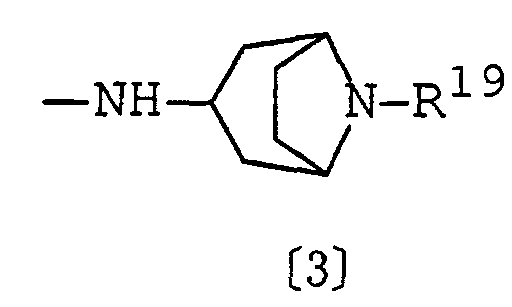
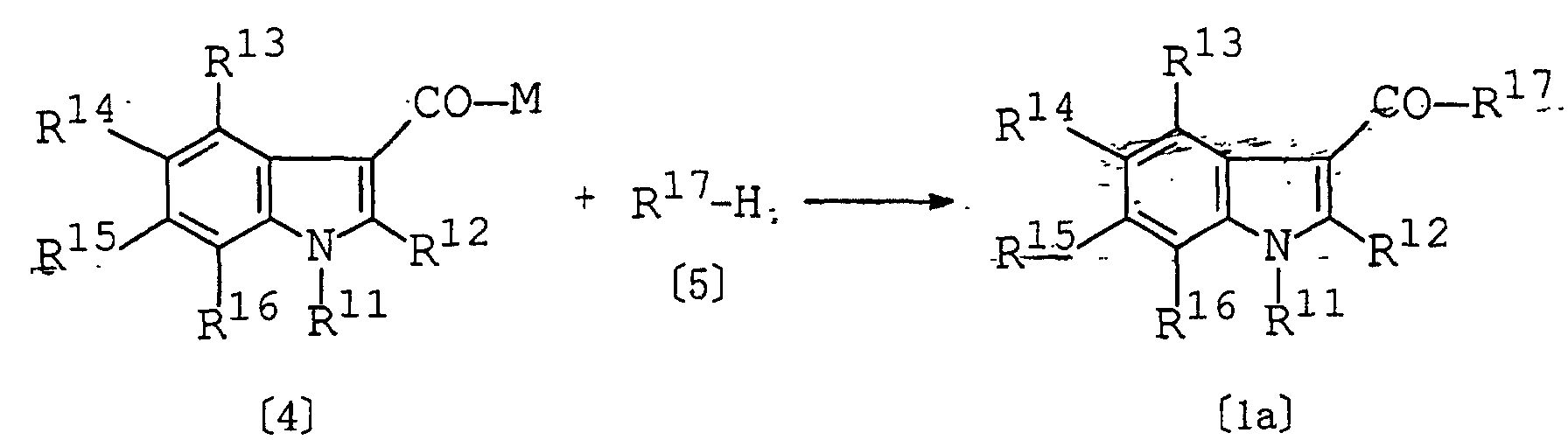

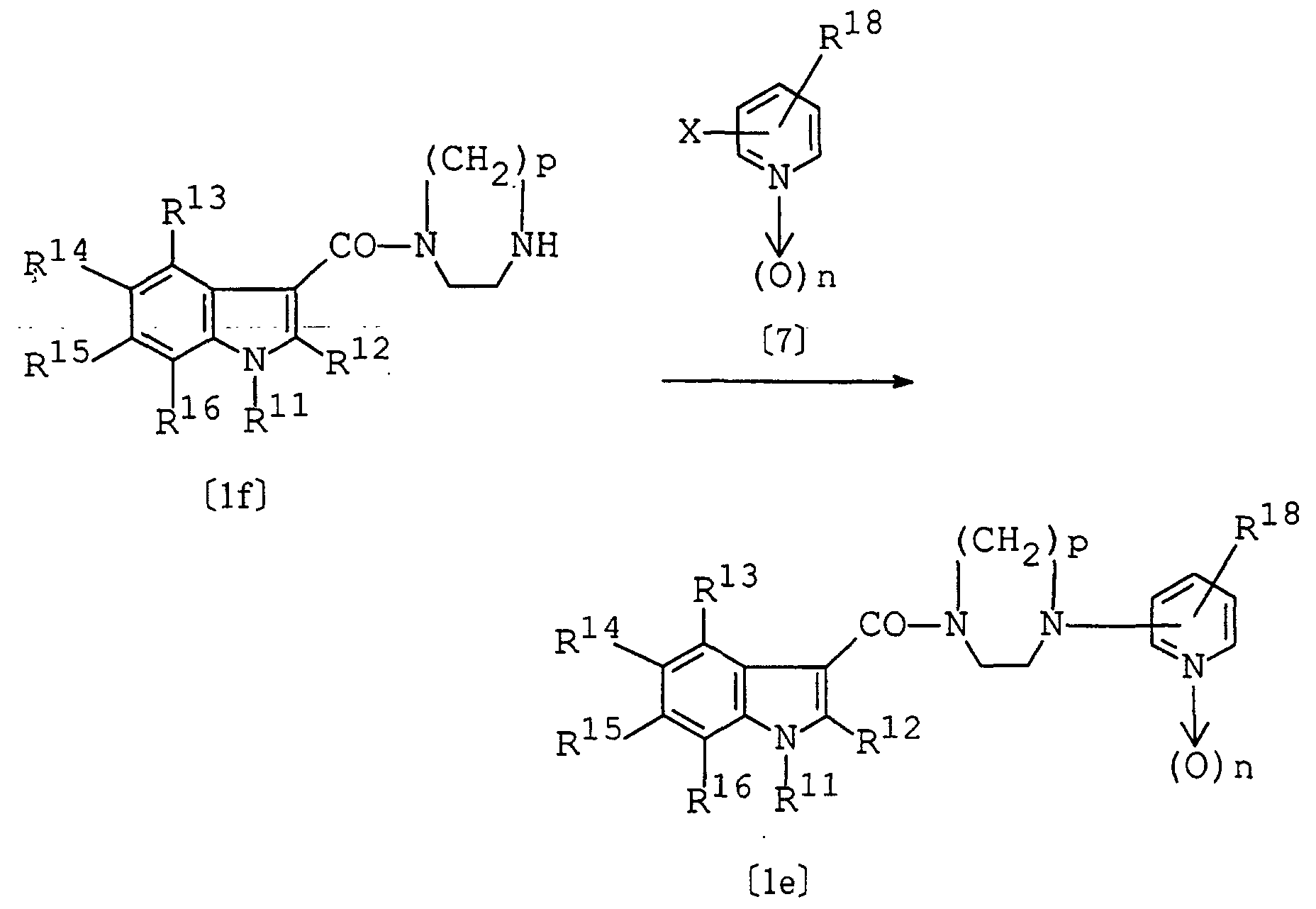

 wherein R1 and R2 may be the same or different and each is hydrogen, alkyl, haloalkyl, hydroxyalkyl, carboxyalkyl, acyl, aryl, aromatic heterocyclic group, or arylalkyl (the aryl, the aromatic heterocyclic group and the aryl moiety of the arylalkyl may be substituted by 1 to 3 same or different members selected from the group consisting of halogen, alkyl, haloalkyl, alkoxy, haloalkoxy, hydroxy, cyano, and nitro.);R3, R4, R5 and R6 may be the same or different and each is hydrogen, halogen, hydroxy, amino, alkyl, haloalkyl, alkoxy, monoalkylamino, dialkylamino, arylalkyl, cyano or nitro. Or the two adjacent groups among R3, R4, R5 and R6 may jointly form methylenedioxy or ethylenedioxy;R7 represents cyclic amino which may be substituted by R8, or azabicycloalkylamino which may be substituted by R9;R8 represents alkyl, haloalkyl, acyl, aryl, aromatic heterocyclic group or arylalkyl (the aryl, the aromatic heterocyclic group and the aryl moiety of the arylalkyl may be substituted by 1 to 3 same or different members selected from the group consisting of halogen, alkyl, arylalkyl, haloalkyl, alkoxy, hydroxy, amino, monoalkylamino, dialkylamino, alkylsulfonylamino, acylamino, dialkylaminosulfonylamino, carbamoyl, monoalkylcarbamoyl, dicarbamoyl, cyano, carboxy, alkoxycarbonyl, alkylsulfonyl, dialkylaminosulfonyl and nitro.);R9 represents alkyl, alkenyl, (cycloalkyl)alkyl, haloalkyl, arylalkyl, acyl, alkylsulfonyl, or arylsulfonyl (the aryl moiety of the arylalkyl and the aryl moiety of the arylsulfonyl may he substituted by halogen or alkyl.).
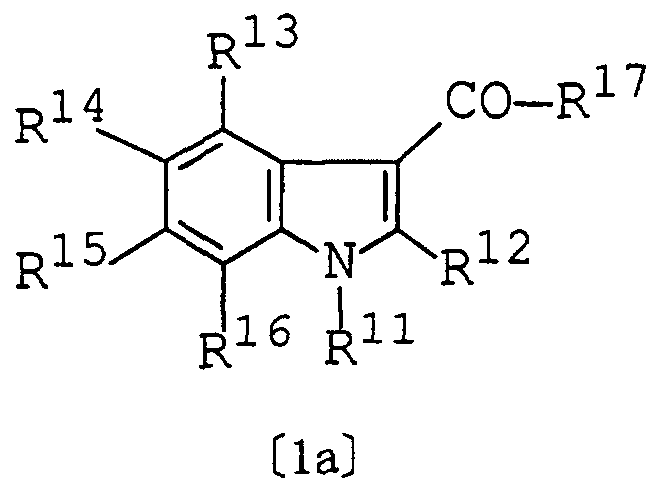 (A) wherein, R11 and R12 may be the same or different and each is alkyl, haloalkyl, hydroxyalkyl, carboxyalkyl, aryl, aromatic heterocyclic group, or arylalkyl (the aryl, the aromatic heterocyclic group and the aryl moiety of the arylalkyl may be substituted by 1 to 3 same or different members selected from the group consisting of halogen, alkyl, haloalkyl, alkoxy, haloalkoxy, hydroxy, cyano, and nitro.);R13, R14, R15 and R16 may be the same or different and each is hydrogen, halogen, hydroxy, amino, alkyl, haloalkyl, alkoxy, monoalkylamino, dialkylamino, arylalkyl, cyano or nitro. Or the two adjacent groups among R13, R14, R15 and R16 may jointly form methylenedioxy or ethylenedioxy;R17 represents a group represented by the following formula [2]:
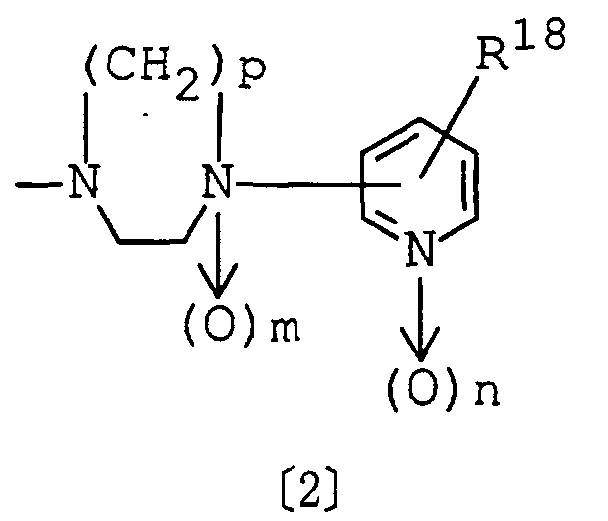 R18 represents hydrogen, halogen, alkyl, arylalkyl, haloalkyl, alkoxy, hydroxy, amino, monoalkylamino, dialkylamino, alkylsulfonylamino, acylamino, dialkylaminosulfonylamino, carbamoyl, monoalkylcarbamoyl, dicarbamoyl, cyano, carboxy, alkoxycarbonyl, alkylsulfonyl, dialkylaminosulfonyl, or nitro; m represents 0 or 1; n represents 0 or 1; and p represents 2 or 3.(B) wherein, R11 represents hydrogen, alkyl, haloalkyl, hydroxyalkyl, carboxyalkyl, acyl, aryl, aromatic heterocyclic group or arylalkyl (the aryl, the aromatic heterocyclic group and the aryl moiety of the arylalkyl may be substituted by 1 to 3 same or different members selected from the group consisting of halogen, alkyl, haloalkyl, alkoxy, haloalkoxy, hydroxy, cyano and nitro.);R12 represents aryl or aromatic heterocyclic group (the aryl and the aromatic heterocyclic group may be substituted by 1 to 3 same or different members selected from the group consisting of halogen, alkyl, haloalkyl, alkoxy, hydroxy, cyano and nitro.);R13, R14, R15 and R16 may be the same or different and each is hydrogen, halogen, hydroxy, amino, alkyl, haloalkyl, alkoxy, monoalkylamino, dialkylamino, arylalkyl, cyano or nitro. Or the two adjacent groups among R13, R14, R15 and R16 may jointly form methylenedioxy or ethylenedioxy;R17 represents a group represented by the following formula [3]:
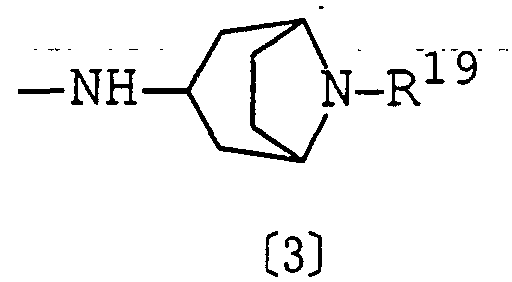 R19 represents hydrogen, alkyl, alkenyl, (cycloalkyl)alkyl, haloalkyl, arylalkyl, acyl, alkylsulfonyl, or arylsulfonyl (the aryl moiety of the arylalkyl and the aryl moiety of the arylsulfonyl may be substituted by halogen or alkyl.).