EP1153973A1 - Rubber vibration isolator and method for producing the same - Google Patents
Rubber vibration isolator and method for producing the same Download PDFInfo
- Publication number
- EP1153973A1 EP1153973A1 EP00970204A EP00970204A EP1153973A1 EP 1153973 A1 EP1153973 A1 EP 1153973A1 EP 00970204 A EP00970204 A EP 00970204A EP 00970204 A EP00970204 A EP 00970204A EP 1153973 A1 EP1153973 A1 EP 1153973A1
- Authority
- EP
- European Patent Office
- Prior art keywords
- rubber material
- rubber
- vibration damping
- unvulcanized
- vulcanized
- Prior art date
- Legal status (The legal status is an assumption and is not a legal conclusion. Google has not performed a legal analysis and makes no representation as to the accuracy of the status listed.)
- Ceased
Links
Images


Classifications
-
- F—MECHANICAL ENGINEERING; LIGHTING; HEATING; WEAPONS; BLASTING
- F16—ENGINEERING ELEMENTS AND UNITS; GENERAL MEASURES FOR PRODUCING AND MAINTAINING EFFECTIVE FUNCTIONING OF MACHINES OR INSTALLATIONS; THERMAL INSULATION IN GENERAL
- F16F—SPRINGS; SHOCK-ABSORBERS; MEANS FOR DAMPING VIBRATION
- F16F1/00—Springs
- F16F1/36—Springs made of rubber or other material having high internal friction, e.g. thermoplastic elastomers
- F16F1/3605—Springs made of rubber or other material having high internal friction, e.g. thermoplastic elastomers characterised by their material
-
- C—CHEMISTRY; METALLURGY
- C08—ORGANIC MACROMOLECULAR COMPOUNDS; THEIR PREPARATION OR CHEMICAL WORKING-UP; COMPOSITIONS BASED THEREON
- C08L—COMPOSITIONS OF MACROMOLECULAR COMPOUNDS
- C08L21/00—Compositions of unspecified rubbers
-
- C—CHEMISTRY; METALLURGY
- C08—ORGANIC MACROMOLECULAR COMPOUNDS; THEIR PREPARATION OR CHEMICAL WORKING-UP; COMPOSITIONS BASED THEREON
- C08L—COMPOSITIONS OF MACROMOLECULAR COMPOUNDS
- C08L23/00—Compositions of homopolymers or copolymers of unsaturated aliphatic hydrocarbons having only one carbon-to-carbon double bond; Compositions of derivatives of such polymers
- C08L23/02—Compositions of homopolymers or copolymers of unsaturated aliphatic hydrocarbons having only one carbon-to-carbon double bond; Compositions of derivatives of such polymers not modified by chemical after-treatment
- C08L23/18—Homopolymers or copolymers of hydrocarbons having four or more carbon atoms
- C08L23/20—Homopolymers or copolymers of hydrocarbons having four or more carbon atoms having four to nine carbon atoms
- C08L23/22—Copolymers of isobutene; Butyl rubber; Homopolymers or copolymers of other iso-olefins
-
- C—CHEMISTRY; METALLURGY
- C08—ORGANIC MACROMOLECULAR COMPOUNDS; THEIR PREPARATION OR CHEMICAL WORKING-UP; COMPOSITIONS BASED THEREON
- C08L—COMPOSITIONS OF MACROMOLECULAR COMPOUNDS
- C08L23/00—Compositions of homopolymers or copolymers of unsaturated aliphatic hydrocarbons having only one carbon-to-carbon double bond; Compositions of derivatives of such polymers
- C08L23/26—Compositions of homopolymers or copolymers of unsaturated aliphatic hydrocarbons having only one carbon-to-carbon double bond; Compositions of derivatives of such polymers modified by chemical after-treatment
- C08L23/28—Compositions of homopolymers or copolymers of unsaturated aliphatic hydrocarbons having only one carbon-to-carbon double bond; Compositions of derivatives of such polymers modified by chemical after-treatment by reaction with halogens or halogen-containing compounds
-
- C—CHEMISTRY; METALLURGY
- C08—ORGANIC MACROMOLECULAR COMPOUNDS; THEIR PREPARATION OR CHEMICAL WORKING-UP; COMPOSITIONS BASED THEREON
- C08L—COMPOSITIONS OF MACROMOLECULAR COMPOUNDS
- C08L23/00—Compositions of homopolymers or copolymers of unsaturated aliphatic hydrocarbons having only one carbon-to-carbon double bond; Compositions of derivatives of such polymers
- C08L23/26—Compositions of homopolymers or copolymers of unsaturated aliphatic hydrocarbons having only one carbon-to-carbon double bond; Compositions of derivatives of such polymers modified by chemical after-treatment
- C08L23/28—Compositions of homopolymers or copolymers of unsaturated aliphatic hydrocarbons having only one carbon-to-carbon double bond; Compositions of derivatives of such polymers modified by chemical after-treatment by reaction with halogens or halogen-containing compounds
- C08L23/283—Iso-olefin halogenated homopolymers or copolymers
-
- F—MECHANICAL ENGINEERING; LIGHTING; HEATING; WEAPONS; BLASTING
- F16—ENGINEERING ELEMENTS AND UNITS; GENERAL MEASURES FOR PRODUCING AND MAINTAINING EFFECTIVE FUNCTIONING OF MACHINES OR INSTALLATIONS; THERMAL INSULATION IN GENERAL
- F16F—SPRINGS; SHOCK-ABSORBERS; MEANS FOR DAMPING VIBRATION
- F16F15/00—Suppression of vibrations in systems; Means or arrangements for avoiding or reducing out-of-balance forces, e.g. due to motion
- F16F15/02—Suppression of vibrations of non-rotating, e.g. reciprocating systems; Suppression of vibrations of rotating systems by use of members not moving with the rotating systems
- F16F15/04—Suppression of vibrations of non-rotating, e.g. reciprocating systems; Suppression of vibrations of rotating systems by use of members not moving with the rotating systems using elastic means
- F16F15/08—Suppression of vibrations of non-rotating, e.g. reciprocating systems; Suppression of vibrations of rotating systems by use of members not moving with the rotating systems using elastic means with rubber springs ; with springs made of rubber and metal
-
- C—CHEMISTRY; METALLURGY
- C08—ORGANIC MACROMOLECULAR COMPOUNDS; THEIR PREPARATION OR CHEMICAL WORKING-UP; COMPOSITIONS BASED THEREON
- C08L—COMPOSITIONS OF MACROMOLECULAR COMPOUNDS
- C08L33/00—Compositions of homopolymers or copolymers of compounds having one or more unsaturated aliphatic radicals, each having only one carbon-to-carbon double bond, and only one being terminated by only one carboxyl radical, or of salts, anhydrides, esters, amides, imides or nitriles thereof; Compositions of derivatives of such polymers
- C08L33/04—Homopolymers or copolymers of esters
- C08L33/06—Homopolymers or copolymers of esters of esters containing only carbon, hydrogen and oxygen, which oxygen atoms are present only as part of the carboxyl radical
- C08L33/08—Homopolymers or copolymers of acrylic acid esters
-
- C—CHEMISTRY; METALLURGY
- C08—ORGANIC MACROMOLECULAR COMPOUNDS; THEIR PREPARATION OR CHEMICAL WORKING-UP; COMPOSITIONS BASED THEREON
- C08L—COMPOSITIONS OF MACROMOLECULAR COMPOUNDS
- C08L7/00—Compositions of natural rubber
-
- F—MECHANICAL ENGINEERING; LIGHTING; HEATING; WEAPONS; BLASTING
- F16—ENGINEERING ELEMENTS AND UNITS; GENERAL MEASURES FOR PRODUCING AND MAINTAINING EFFECTIVE FUNCTIONING OF MACHINES OR INSTALLATIONS; THERMAL INSULATION IN GENERAL
- F16F—SPRINGS; SHOCK-ABSORBERS; MEANS FOR DAMPING VIBRATION
- F16F2224/00—Materials; Material properties
- F16F2224/005—Combined materials of same basic nature but differing characteristics
Definitions
- the present invention relates to a vibration damping rubber member and a process of producing the same, and more particularly to a vibration damping rubber member capable of exhibiting low dynamic stiffness and high vibration damping effect, and a process suitable for producing such a vibration damping rubber member.
- the present invention is also concerned with a process of producing a vibration damping rubber member having an increased vibration damping effect, so as to reduce its dynamic/static ratio of spring constant for thereby reducing the dynamic stiffness.
- a vibration damping rubber member interposed between two members in a vibration transmitting system so as to connect the two members in a vibration damping fashion has been widely used in various fields.
- the vibration damping rubber member is used on automotive vehicles, as engine mounts, body mounts, member mounts, suspension bushings, and so on.
- a vibration damping rubber member used in a vibration transmitting system involving different kinds of vibrations having different frequencies is generally required to exhibit vibration damping characteristics suitable for effectively damp those different kinds of vibrations. Described in detail, the vibration damping rubber member used on the automotive vehicles is generally required to exhibit a relatively low degree of dynamic spring stiffness with respect to input vibrations having comparatively high frequencies of 100Hz or higher, and to exhibit a relatively high damping effect with respect to input vibrations having comparatively low frequencies of about 10-20Hz.
- the dynamic spring stiffness is defined by a dynamic/static ratio (Kd 100 /Ks) of spring constant of the vibration damping rubber member, which is a ratio of a dynamic spring constant Kd 100 to a static spring constant Ks of the vibration damping rubber member.
- Kd 100 /Ks dynamic/static ratio
- the dynamic spring constant Kd100 is obtained when it is subjected to vibration of 100Hz.
- the dynamic spring stiffness decreases with a decrease of the dynamic/static ratio Kd 100 /Ks.
- the damping effect is defined by a loss factor (tan ⁇ ) of the vibration damping rubber member when it is subjected to vibration of 15Hz. The damping effect increases with an increase of the loss factor tan ⁇ .
- vibration damping rubbers structure having improved vibration damping characteristics as represented by a reduced degree of dynamic spring stiffness and an increased damping effect
- various studies have been made to improve the material of the vibration damping rubber member and the process of preparing a composition of the material.
- NR natural rubbers
- NR natural rubbers
- the known vibration damping rubber members according to those studies are by no means sufficiently satisfactory in terms of the required vibration damping characteristics.
- the mechanism by which the dynamic spring stiffness of a vibration damping rubber member is reduced is based on bonding, binding or linking among the molecules of polymers of the rubber composition, or bonding and binding between the polymer molecules and reinforcing additives contained in the rubber composition.
- the mechanism by which the vibration damping effect is increased is based on a friction among the polymer molecules or among the polymer molecules and the reinforcing additives. Therefore, there are problems that increasing the vibration damping effect of the vibration damping rubber member will cause an increase of the dynamic spring stiffness, while reducing the dynamic spring stiffness will cause a decrease of the vibration damping effect.
- fluid-filled vibration damping rubber members as improvements in the construction rather than the material.
- such fluid-filled vibration damping rubber members use an elastic body formed of a rubber composition in which a plurality of fluid chambers are formed in fluid communication with each other through orifice passages (restricted fluid passages).
- These fluid-filled vibration damping rubber members are arranged to exhibit desired vibration damping characteristics depending upon respective frequency bands of the input vibrations, on the basis of resonance of a fluid flowing through the orifice passages. Accordingly, those fluid-filled vibration damping rubber members are inevitably complicated in construction, with a relatively large number of components, and suffer from potential problems of a relatively high cost and considerable difficulty of manufacture.
- the vibration damping rubber members are required to have a relatively high degree of hardness, in view of their applications in which the rubbers should withstand a relatively large load, for instance.
- This requirement is conventionally satisfied by using a rubber composition which contains a diene-based rubber material such as a natural rubber (NR), and additives such as a carbon black.
- NR natural rubber
- additives such as a carbon black.
- the addition of such additives including the carbon black makes it possible to increase the hardness and the vibration damping effect of the vibration damping rubber member, but inevitably results in an undesirable increase in the dynamic spring stiffness.
- Various other approaches for improving the rubber composition have been proposed to obtain a vibration damping rubber member capable of exhibiting the desired characteristics, namely, low dynamic spring stiffness and high damping effect.
- the damping effect is increased by adding a suitable rubber material to the natural rubber (NR).
- NR natural rubber
- the present invention was made in view of the background art described above. It is a first object of this invention to provide a vibration damping rubber member which is capable of exhibiting both a low degree of dynamic spring stiffness and a high vibration damping effect and which can be economically and easily produced, and a process suitable for producing such a vibration damping rubber member.
- the first object indicated above may be achieved according to the present invention, which provides a vibration damping rubber member having an island-sea structure in which fine particles of a vulcanized rubber material B which enables the vibration damping rubber member to have a high vibration damping effect are dispersed as a dispersed phase in a matrix phase of a vulcanized rubber material A that enables the vibration damping rubber member to exhibit a low degree of dynamic spring stiffness, the vibration damping rubber member being characterized in that the vulcanized rubber material B functioning as the dispersed phase is formed by vulcanizing an unvulcanized mass of the rubber material B while the unvulcanized mass of the rubber material B is evenly mixed with and dispersed in an unvulcanized mass of the rubber material A, and the unvulcanized mass of the rubber material A is vulcanized while the vulcanized rubber material B is dispersed in the unvulcanized mass of the rubber material A.
- the vibration damping rubber member constructed according to the present invention has an island-sea structure constituted by the matrix phase consisting of the vulcanized rubber material A which enables the damping rubber member to exhibit a low degree of dynamic spring stiffness, and the dispersed phase consisting of the vulcanized rubber material B which enables the damping rubber member to have a high vibration damping effect.
- the present vibration damping rubber member is primarily characterized by this island-sea structure which is formed as described above.
- the vulcanized rubber material A functioning as the matrix phase permits a significant reduction in the dynamic spring stiffness of the damping rubber member, while the vulcanized rubber material B evenly dispersed as fine particles in the matrix phase of the vulcanized rubber material A assures a high vibration damping effect of the damping rubber member.
- the vulcanized rubber material A and the vulcanized rubber material B in the present vibration damping rubber member can effectively function, independently of each other, to reduce the dynamic spring stiffness and to increase the vibration damping effect, respectively, and at the same time, unlike the conventional rubber composition.
- the present vibration damping rubber member can be suitably used as vibration damping rubber structures for automotive vehicles, and other damping rubber structures in a vibration transmitting system involving different kinds of vibrations having different frequencies, and is capable of effectively damping such vibrations.
- the present vibration damping rubber member does not require such a complicated construction as provided in a fluid-filled vibration damping structure, and can therefore be produced economically and comparatively easily.
- the vulcanized rubber material B consists of fine particles which have an average size of 0.1-100 ⁇ m and which are dispersed in the vulcanized rubber material A.
- the vibration damping characteristics are further improved (the dynamic spring stiffness is further reduced, and the vibration damping effect is further increased), and the vibration damping rubber member is given the desired physical properties.
- the rubber material A consists of NR, or a mixture of NR and BR or SBR
- the rubber material B consists of halogenated IIR, maleicacid-modified EPM, CR, carboxyl-modified NBR, CSM, CPE, FR or acrylic rubber.
- the vibration damping rubber member exhibits further improved vibration damping characteristics.
- the present invention also provides a vibration damping rubber member having an island-sea structure in which fine particles of a vulcanized rubber material B which enables the vibration damping rubber member to have a high vibration damping effect are dispersed as a dispersed phase in a matrix phase of a vulcanized rubber material A that enables the vibration damping rubber member to exhibit a low degree of dynamic spring stiffness, characterized in that the rubber material A is a natural rubber, while the rubber material B is an acrylic rubber, and the rubber materials A and B are mixed together in a proportion of 90/10-60/40 by weight, and that the vulcanized rubber material B functioning as the dispersed phase is formed as fine particles having a size of 0.1-100 ⁇ m, by vulcanizing an unvulcanized mass of the rubber material B while the unvulcanized mass of the rubber material B is evenly mixed with and dispersed in an unvulcanized mass of the rubber material A, and the unvulcanized mass of the rubber material A is vulcanized while the vulcanized rubber material
- a suitable amount of the vulcanized acrylic rubber which enables the damping rubber member to have a high vibration damping effect is dispersed as a disperse phase in the form of fine particles having a size of 0.1-100 ⁇ m, in a matrix phase of the natural rubber which enables the damping rubber member to exhibit a low degree of dynamic spring stiffness.
- the present vibration damping rubber structure is capable of exhibiting excellent vibration damping characteristics (low dynamic spring stiffness and high vibration damping effect).
- the disperse phase consisting of the acrylic rubber effectively functions to distribute or reduce the load which acts on the damping rubber, so that the durability of the damping rubber member is accordingly increased.
- the present invention further provides a process of producing a vibration damping rubber member, characterized by: evenly mixing together an unvulcanized rubber material A which enables the vibration damping rubber member to exhibit a low degree of dynamic spring stiffness, an unvulcanized rubber material B which enables the vibration damping rubber member to have a high vibration damping effect, and a vulcanizing agent capable of vulcanizing only the unvulcanized rubber material B; heating a mixture of the unvulcanized rubber materials A and B and the vulcanizing agent, to vulcanize the unvulcanized rubber material B such that fine particles of the vulcanized rubber material B are dispersed in the unvulcanized rubber material A; adding to the mixture a vulcanizing agent capable of vulcanizing the unvulcanized rubber material A; and forming a thus obtained mixture into a desired shape, and heating the formed mixture to vulcanize the unvulcanized rubber material A, for obtaining the vibration damping rubber member having an island-sea structure in which fine particles of the vulcanized
- This process according to the present invention permits advantageous formation of the island-sea structure in which fine particles of the vulcanized rubber material B which enables the damping rubber member to have a high vibration damping effect are evenly dispersed as a dispersed phase in a matrix phase (sea phase) of the vulcanized rubber material A which enables the damping rubber member to exhibit a low degree of dynamic spring stiffness.
- the vibration damping rubber member capable of exhibiting both low dynamic spring stiffness and high vibration damping effect can be advantageously produced.
- the present method makes it possible to comparatively easily and economically produce the vibration damping rubber member having excellent damping characteristics as described above.
- the unvulcanized rubber material A is evenly mixed with the rubber material B to which the vulcanizing agent capable of vulcanizing only the unvulcanized rubber material has been mixed with the unvulcanized rubber material.
- the time required to mix the rubber material A, the rubber material B and the vulcanizing agent capable of vulcanizing only the rubber material B can be effectively shortened, and the rubber material B and the vulcanizing agent can be more evenly or uniformly dispersed within the rubber material A, so that the vibration damping effect of the damping rubber member can be further effectively increased.
- the unvulcanized rubber material A is vulcanized by a sulfur-based vulcanizing system
- the unvulcanized rubber material B is vulcanized by a resin-based vulcanizing system, a metal-oxide-based vulcanizing system or an amine-based vulcanizing system.
- the rubber materials A and B are vulcanized by the respective different vulcanizing systems, making it possible to permit the produced damping rubber member to have the island-sea structure which exhibits further improved vibration damping characteristics.
- the present inventors considered the application of the above-indicated island-sea structure to a vibration damping rubber member which is formed of a diene-based rubber composition such as an NR-based rubber composition and which has a loss factor tan ⁇ of at least 0.1.
- the loss factor represents the damping effect with respect input vibrations having low frequencies (e.g., 15Hz).
- the inventors found that the use of a rubber material of functional group-vulcanization type as the dispersed phase of the island-sea structure makes it possible to obtain a vibration damping rubber member whose dynamic/static ratio of spring constant is considerably lower than that of the vibration damping rubber member formed solely of the vulcanized diene-based rubber composition.
- the present invention which was made also on the basis of the above-indicating finding has a second object of reducing the dynamic/static ratio of spring constant of a vibration damping rubber member which has a high vibration damping effect as represented by a loss factor tan ⁇ of at least 0.1, in particular, providing a process suitable for producing a vibration damping rubber member capable of exhibiting both a high vibration damping effect and a low degree of dynamic spring stiffness.
- the second object indicated above may also be achieved according to the present invention, which provides a process of producing a vibration damping rubber member having a desired shape, and a low degree of dynamic/static ratio of spring constant and a high vibration damping effect, by vulcanizing and forming a rubber composition which includes a diene-based rubber material as a rubber component and which enables the vulcanized and formed rubber composition to have a loss factor tan ⁇ of at least 0.1, characterized in that a portion of the diene-based rubber material is replaced by not greater than 40% by weight of a rubber material of functional group-vulcanization type per 100% by weight of a total amount of these two rubber materials, and the two rubber materials and a vulcanizing agent capable of vulcanizing only the rubber material of functional group-vulcanization type are evenly mixed together to form a mixture, which is heated to vulcanize the rubber material of functional group-vulcanization type such that fine particles of the vulcanized rubber material of functional group-vulcanization type are dispersed in the die
- a portion of the diene-based rubber material is replaced by not greater than 40% by weight of the rubber material of functional group-vulcanization type per 100% by weight of a total amount of these two rubber materials, so that the vulcanized rubber material of functional group-vulcanization type constitutes the dispersed phase of the island-sea structure.
- this island-sea structure is formed as described above.
- the dynamic/static ratio of spring constant of the vibration damping rubber member produced according to this process is considerably lower than that of a vibration damping rubber member formed solely of the dine-based rubber material, with respect to input vibrations having relatively high frequencies.
- the produced damping rubber member is given the island-sea structure, so that the vibration damping characteristics of the damping rubber member are considerably improved (with reduced dynamic spring stiffness and increased vibration damping effect) than those of a vibration damping rubber structure formed of an intimate mixture of two rubber materials which respectively give desired different characteristics.
- the island-sea structure is further effective to improve the other physical properties required by the vibration damping rubber member.
- the rubber material of functional group-vulcanization type is halogenated IIR.
- the use of the halogenated IIR further improves the vibration damping characteristics of the damping rubber member, that is, further reduced dynamic spring stiffness and further increased vibration damping effect.
- the vulcanized rubber material of functional group-vulcanization type is dispersed in the form of fine particles having an average size of 0.1-100 ⁇ m in the vulcanized diene-based rubber material.
- the vibration damping characteristics and other required physical properties of the damping rubber member are further improved.
- the vibration damping rubber member according to the present invention as described above is formed using a rubber composition consisting of a rubber material A for reducing the dynamic spring stiffness f the damping rubber and a rubber composition B for increasing the damping effect.
- a rubber composition consisting of a rubber material A for reducing the dynamic spring stiffness f the damping rubber and a rubber composition B for increasing the damping effect.
- an unvulcanized mass of the rubber material A and an unvulcanized mass of the rubber material B are initially uniformly kneaded or mixed together, such that the unvulcanized rubber material B is dispersed in the form of fine particles in the unvulcanized rubber material A. Then, the rubber material B is vulcanized, and the rubber material A is subsequently vulcanized, so that the vibration damping rubber member consisting of the vulcanized rubber materials A and B is formed.
- This is a major feature of the present invention.
- the vibration damping rubber member produced by the process of the present invention having the above-described feature is not a structure formed of an intimate mixture of the vulcanized rubber materials A and B, but is a so-called "island-sea" structure in which fine particles of the vulcanized rubber material B are highly uniformly or evenly dispersed as a dispersed or discontinuous phase in a matrix phase of the vulcanized rubber material A.
- the matrix phase of the vulcanized rubber material A assures a sufficiently low degree of dynamic spring stiffness of the damping rubber member, while the dispersed phase of the vulcanized rubber material B assures a sufficiently high vibration damping effect of the damping rubber member.
- the vulcanized rubber material A and the vulcanized rubber material B of the vibration damping rubber member according to this invention have respective distinct functions of improving the dynamic spring stiffness characteristic and the vibration damping characteristic, and are capable of achieving these two functions with high efficiency.
- the use of the vulcanized rubber materials A and B advantageously permits reduction of the dynamic spring stiffness and increase of the vibration damping effect, which have been incompatible with each other.
- the rubber material A used as the matrix phase for the vibration damping rubber member according to the present invention may be selected as needed, depending upon the desired characteristics of the damping rubber member, from among various known kinds of rubber material that permits effective reduction of the dynamic spring stiffness with respect to vibrations of relatively high frequencies in particular, after vulcanization of the rubber material.
- the rubber material A may be selected from diene-based rubber materials such as natural rubber (NR), isoprene rubber (IR), butadiene rubber (BR), stylene butadiene rubber (SBR) and acrylonitrile butadiene rubber (NBR).
- the rubber material A is selected according to the present invention, from among rubber materials (hereinafter referred to as "NR-based materials") which include NR as an essential component, for example, from among NR, mixtures of NR and BR, and mixtures of NR and SBR, in order to assure efficient reduction of the dynamic spring stiffness of the vibration damping rubber member.
- NR-based materials rubber materials which include NR as an essential component, for example, from among NR, mixtures of NR and BR, and mixtures of NR and SBR, in order to assure efficient reduction of the dynamic spring stiffness of the vibration damping rubber member.
- the rubber material B used as the dispersed phase is required to exhibit a high vibration damping effect with respect to vibrations of relatively low frequencies in particular, after vulcanization of the rubber material, and is further required to be vulcanized with a vulcanizing system that is different to that of the rubber material A. Accordingly, the rubber material B is selected as needed, depending upon the desired characteristics of the damping rubber member, from among various rubber materials which are known to be effective to improve the vibration damping characteristic and which satisfies the above-indicated requirement regarding the vulcanizing system.
- the rubber material B are particularly preferably selected from among: chlorinated butyl rubbers such as halogenated butyl rubber (halogenated IIR); maleicacid-modified ethylene propylene rubber (maleicacid-modified EPM); chloroprene rubber (CR); carboxyl-modified nitrile rubber (carboxyl-modified NBR); chlorosulfonated polyethylene (CSM); fluororubber (FR); chlorinated polyethylene (CPE); and acrylic rubber.
- chlorinated butyl rubbers such as halogenated butyl rubber (halogenated IIR); maleicacid-modified ethylene propylene rubber (maleicacid-modified EPM); chloroprene rubber (CR); carboxyl-modified nitrile rubber (carboxyl-modified NBR); chlorosulfonated polyethylene (CSM); fluororubber (FR); chlorinated polyethylene (CPE); and acrylic rubber.
- the rubber materials B indicated above by way of example are all effective to reduce the dynamic spring stiffness after the vulcanization, and can be vulcanized with a vulcanizing system different from that of the NR-based rubber materials, as described below. Further, those rubber materials B permit effective improvements of various characteristics of the vibration damping structure, such as gas permeability resistance, weather resistance, heat resistance, ozone resistance, chemical resistance, and durability, as indicated in the following Table 1. Even where those rubber materials B have a structure in which cross linking of functional groups takes place, such rubber materials B are recognized as rubber materials of functional group-vulcanization type.
- Rubber Material B Given Characteristics Halogenated IIR Gas permeability resistance
- Acrylic rubber used as the rubber material A may be selected as needed, depending upon the desired characteristics of the damping rubber member, from among any known synthetic rubber materials whose major component is acrylic acid alkyl ester.
- acrylic rubber materials which can be vulcanized with an amine-based vulcanizing system which will be described.
- ACM copolymer of acrylic acid alkyl ester and 2-chloroethyl vinyl ether
- ANM copolymer of acrylic acid alkyl ester and acrylonitrile
- a copolymer of acrylic acid alkyl ester and ethylene a copolymer of acrylic acid alkyl ester and ethylene.
- the use of such acrylic rubber materials advantageously permits an increase of the durability of the vibration damping rubber member.
- the process of producing a vibration damping rubber member having a low dynamic/static ratio of spring constant and a high vibration damping effect according to the present invention is applied to a rubber composition whose major component is a diene-based rubber material (rubber material A), which is a rubber composition that gives a vulcanized rubber mass having a loss factor tan ⁇ of at least 0.1.
- rubber material A which is a rubber composition that gives a vulcanized rubber mass having a loss factor tan ⁇ of at least 0.1.
- the use of the rubber material A that gives a vulcanized rubber mass having a loss factor tan ⁇ of less than 0.1 does not reduce the dynamic/static ratio of spring constant of the produced damping rubber member to the desired extent, even if the produced damping rubber member has an "island-sea" structure.
- the vulcanized rubber mass indicated above have a JIS-A hardness value of at least A40, preferably, at least A50. If the hardness of the vulcanized rubber mass obtained from the rubber material A is considerably low, the produced vibration damping rubber member cannot satisfy the requirement of its applicability.
- the vibration damping rubber member having the intended island-sea structure is produced using the unvulcanized rubber materials A and B which have been described above.
- the unvulcanized rubber material A and the unvulcanized rubber material B are uniformly kneaded under heat, together with a vulcanizing agent (hereinafter referred to as "vulcanizing agent B") which does not vulcanize the rubber material A but promotes the vulcanization of only the rubber material B.
- vulcanizing agent B a vulcanizing agent which does not vulcanize the rubber material A but promotes the vulcanization of only the rubber material B.
- the rubber material B can be vulcanized without the vulcanization of the rubber material A, while fine particles of the unvulcanized rubber material B are evenly dispersed in the unvulcanized rubber material A.
- the vulcanizing agent B used for vulcanizing the rubber material B is required to vulcanize only the rubber material B while holding the rubber material A in the unvulcanized state, as described above. Accordingly, the vulcanizing agent B is selected as needed, depending upon the specific rubber materials A and B, from among various known vulcanizing agents that satisfy the above-indicated requirement.
- the vulcanizing agent B is preferably selected, depending upon the specific rubber material B, from among the following materials indicated in the following TABLE 2, which do not vulcanize the NR-based rubber material A: resins such as alkyl phenol resin and modified alkylphenol resin; metal oxides such as zinc oxide and magnesium oxide; and polyamines such as hexamethylenediamine carbamate.
- the rubber material B is preferably vulcanized with a resin-based vulcanizing system, a metal-oxide-based vulcanizing system or an amine-based vulcanizing system, which includes any one of those preferred vulcanizing agents B.
- TABLE 2 lists the preferred vulcanizing agents B suitable for use with halogenated IIR, maleicacid-modified EPM, CR, carboxyl-modified NBR, CSM, FR, CPE and acrylic rubbers, which are preferably used as the rubber material A, as described above.
- Rubber Material B Vulcanizing System Vulcanizing Agent B Vulcanization Promoting Agent/Aid Halogenated IR Resin Alkyl phenol 4,4'-dithiodimorpholine Tellurium diethyldithiocarbamate Resin Modified alkylphenol resin Zinc oxide Metal oxide Zinc oxide Zinc diethyldithiocarbamate Maleicacid-modified EPM Metal oxide Zinc oxide - CR Metal oxide Zinc oxide Magnesium oxide 2-mercaptoimidazoline Carboxyl-modified NBR Metal oxide Zinc oxide - CSM Metal oxide Magnesium oxide Pentaerythritol Dipentamethylene thiuram tetrasulfide FR Metal oxide Magnesium oxide Calcium hydroxide Acrylic rubber Amine Hexamethylene diamine carbamate Diorthotolyl guanidine CPE Metal oxide Magnesium oxide Hexamethylene dicarbamate
- the rubber material B may be vulcanized with a vulcanizing system consisting of the vulcanizing agent B and at least one selected vulcanization promoting agent and/or aid which does not vulcanize the rubber material A.
- the appropriate vulcanization promoting agent(s) and/or aid(s) is/are selected depending upon the specific rubber material B and the specific vulcanizing agent B, as indicated in TABLE 2.
- the unvulcanized rubber materials A and B are kneaded together with the vulcanizing agent B and the selected at least one vulcanization promoting agent and/or aid, so that the rubber material B is vulcanized with an improved result.
- Any other suitable additives known in the art for rubber compositions may be added to the unvulcanized rubber materials A and B to provide a mixture thereof by kneading, provided those additives do not vulcanize the rubber material A.
- the suitable amounts of the unvulcanized rubber materials A and B, the vulcanizing agent B and the selected additive(s) are introduced into a suitable known kneader or mixer such as banbury mixer which permits kneading or mixing of polymer materials under an ordinary heating condition.
- a suitable known kneader or mixer such as banbury mixer which permits kneading or mixing of polymer materials under an ordinary heating condition.
- the amounts of the unvulcanized rubber materials A and B to be introduced into the kneader are determined so that the vibration damping rubber member to be formed as the end product can exhibit the desired operating characteristics or physical properties.
- the ratio of the weight of the unvulcanized rubber material A to that of the unvulcanized rubber material B is selected within a range between 95/5 and 30/70. If the amount of the unvulcanized rubber material B is excessively smaller than that of the unvulcanized rubber material B, the desired vibration damping effect of the produced damping rubber member cannot be obtained owing to the vulcanized rubber material B. If the amount of the unvulcanized rubber material B is excessively larger than that of the unvulcanized rubber material A, on the other hand, the physical properties such as the tensile property and hardness of the vibration damping rubber member may be deteriorated.
- the ratio of the weight of the rubber material A to that of the rubber material B is preferably selected within a range between 95/5 and 50/50.
- the acrylic rubber is used as the rubber material B, however, the above-indicated ratio by weight of the rubber materials A and B is desirable selected within a range between 90/10 and 60/40.
- the acrylic rubber does not permit sufficient improvements in the vibration damping effect and durability of the produced damping rubber member.
- the acrylic rubber may cause deterioration of the other physical properties, such as an increase in the permanent compressive strain.
- the maximum amount of the rubber material B is 40% by weight of the total amount of the rubber materials A and B. If the amount of the rubber material B is more than 40% by weight, the dynamic/static ratio of spring constant of the produced vibration damping rubber member cannot be made sufficiently low, and there is a risk of deterioration of the physical properties of the damping rubber member, such as insufficient hardness and considerable reduction of the tensile property, although the damping rubber member exhibits a sufficiently high vibration damping effect.
- the amounts of the vulcanizing agent B and the vulcanization promoting agent(s) and/or aid(s) which are introduced into the kneader together with the unvulcanized rubber materials A and B are suitably determined depending upon the amount of the unvulcanized rubber material B, in order to permit the desired vulcanizing reaction of the rubber material B.
- the unvulcanized rubber materials A and B, the vulcanizing agent B and the appropriate additive or additives may be simultaneously introduced into the kneader or mixer, without any problem. However, it is desirable to prepare a mixture of the unvulcanized rubber material B, vulcanizing agent B and additive or additives, with a suitable proportion, in the form of a master batch, for example. In this case, the prepared mixture and the rubber material A are introduced into the kneader, so as to establish the desired ratio by weight of the unvulcanized rubber materials A and B.
- This method is effective to shorten the time required for kneading or mixing the materials within the kneader, and permit improved uniformity or evenness of dispersion of the rubber material B, vulcanizing agent B and additive(s) in the rubber material A, thereby assuring a considerable increase in the vibration damping effect of the damping rubber member owing to the vulcanized rubber material B.
- the materials which have been introduced into the kneader as described above are subsequently kneaded so that the rubber material B is divided into fine particles small enough to assure the desired characteristics of the produced damping rubber member, and until the fine particles are dispersed in the rubber material A evenly enough to assure the desired characteristics.
- the kneading time is generally determined as needed, in view of the specific kinds and the amounts of the rubber materials A and B and the operating characteristics of the kneader, in order to establish the desired state of dispersion of the fine particles of the rubber material B.
- the materials are kneaded at a temperature that facilitates the kneading operation and permits a high degree of vulcanizing reaction of the unvulcanized rubber material B.
- the vulcanized rubber material B is evenly dispersed in the form of fine particles in the unvulcanized rubber material A.
- the particle size of the vulcanized rubber material B is determined as needed, depending upon the specific conditions of kneading as described above, in order to assure the desired vibration damping effect.
- the average particle size of the vulcanized rubber material B is selected generally within a range of 0.1-100 ⁇ m, and preferably within a range of 0.1-30 ⁇ m. If the average particle size is excessively small, the produced vibration damping rubber member does not exhibit the desired damping effect. If the average particle size is excessively large, the physical properties of the produced vibration damping rubber member are adversely influenced.
- the particle size of the vulcanized rubber material B may be measured by various known methods.
- the particles of the vulcanized rubber material B are observed by a scanning electron microscope (SEM) or a scanning probe microscope (SPM), to measure the sizes of the particles and determine the average particle size.
- SEM scanning electron microscope
- SPM scanning probe microscope
- a vulcanizing agent capable of vulcanizing the unvulcanized rubber material A within which the vulcanized rubber material B is dispersed is added to the rubber material A, to vulcanize the unvulcanized rubber material A into the desired vibration damping rubber member.
- the vulcanizing agent A to be added to vulcanize the unvulcanized rubber material A may be selected from among various know vulcanizing agents, depending upon the specific rubber material A and the desired characteristics of the produced rubber member, provided the vulcanizing agent A permits effective promotion of the vulcanizing reaction of the rubber material A.
- the amount of the vulcanizing agent A is suitably determined depending upon the amount of the rubber material A used.
- the rubber material A is an NR-based rubber material as described above
- a sulfur-based vulcanizing agent containing sulfur is preferably used as the vulcanizing agent A for vulcanizing the rubber material A.
- suitable vulcanization promoting agents and/or aids may be used with the vulcanizing agent A, to prepare a vulcanizing system for vulcanizing the rubber material A.
- vulcanization promoting agents include: sulfenamides such as N-tert-butyl-2-benzothiazolylsulfenamide (BBS), N-cyclohexyl-2-benzothiazolylsulfenamide (CBS), and N-oxydiethylene-2-benzothiazolylsulfenamide (OBS); dithiocarbamates such as zinc dimethyldithiocarbamate (ZnMDC), and zinc diethyldithiocarbamate (ZnEDC); and thiurams such as tetramethyl thiuram disulfide (TMTD), tetraethyl thiuram disulfide (TETD), and tetrabutyl thiuram disulfide (TBTD).
- BBS N-tert
- additives used for rubber materials may be added to the unvulcanized rubber material A, as needed.
- Those additives may include: reinforcing agents such as carbon black; products of reaction between acetone and diphenylamine; phenylenediamines such as N-phenyl-N'-isopropyl-p -phenylenediamine, anti-aging agents such as wax; and softening agents such as process oil and mineral oil.
- these additives should not prevent the produced damping rubber member from exhibiting the desired property of low dynamic spring stiffness, and the amounts of the additives should be determined so as not to deteriorate this property.
- the use of carbon black in an excessively large amount will have a considerable influence on the dynamic spring stiffness of the rubber material A.
- the carbon black is preferably used in an amount of not larger than 60 parts by weight per 100 parts by weight of the rubber material A.
- the vulcanizing agent A and the various additives indicated above are added to the rubber material A, and these components are evenly kneaded or mixed together by a suitable kneader or mixer, for instance, by a mixer of roll type, so that the unvulcanized rubber material A can be uniformly vulcanized in a desired manner, in a vulcanizing step following the addition of the vulcanizing agent A and additives.
- a suitable kneader or mixer for instance, by a mixer of roll type, so that the unvulcanized rubber material A can be uniformly vulcanized in a desired manner, in a vulcanizing step following the addition of the vulcanizing agent A and additives.
- the kneading or mixing length of time and the temperature condition in which the kneading is effect are suitably selected.
- the obtained rubber composition is formed into the desired vibration damping rubber member, with the unvulcanized rubber material A being vulcanized, as indicated above.
- the rubber composition is formed into a desired shape, by a suitable molding method using a molding die, for instance, at the suitably determined temperature at which the unvulcanized rubber material A is vulcanized. It is preferable to form the damping rubber member, by a press-molding and -vulcanizing process in which the molding and the vulcanization are effected concurrently.
- the vulcanizing conditions such as the temperature, pressure and time may be determined as needed, depending upon the specific kinds of the rubber material A, vulcanizing agent A and additives, so as to vulcanize the rubber material A as desired.
- the vibration damping rubber member to be produced as a result of the molding and vulcanization of the rubber material A as described above may be provided with a metallic structure made of a ferrous or aluminum material, which may be bonded to the rubber member during or after the molding and vulcanizing operation.
- the process of the present invention is applicable to not only a vibration damping rubber member without such a metallic structure, but also a vibration damping rubber member with such a metallic structure bonded thereto.
- the configuration and size of the damping rubber member to be produced by vulcanizing the rubber material A are not particularly limited, but may be determined as needed, depending upon the desired characteristics and application of the damping rubber member.
- the vibration damping rubber member to be produced according to the present invention has an "island-sea" structure in which in which fine particles (generally of a size within a range of 0.1-100 ⁇ m) of the vulcanized rubber material B are evenly dispersed as a dispersed or discontinuous phase in a matrix or continuous phase of the vulcanized rubber material A.
- This island-sea structure permits the damping rubber member to exhibit both of a sufficiently low degree of dynamic spring stiffness and a sufficiently high vibration damping effect.
- the process of the present invention permits easy and economical production of a comparatively simple vibration damping rubber member, using the selected rubber materials A and B, so as to enable the vibration damping rubber member to exhibit improved vibration damping characteristics, that is, low dynamic spring stiffness and high vibration damping effect.
- the process of the present invention can be advantageously used to form the vibration damping rubber member highly capable of dealing with different kinds of input vibrations having different frequency bands, by suitably selecting the rubber composition including the rubber materials A and B, depending upon the frequency bands of the input vibrations, so that the selected rubber composition permits the produced vibration damping rubber member to exhibit low dynamic spring stiffness and high damping effect with respect to the specific kinds of input vibrations to be damped.
- the thus produced vibration damping rubber member can be suitably used so as to exhibit excellent vibration damping characteristics, in a vibration transmitting system as in an automotive vehicle, which involves different kinds of vibrations to be damped.
- an unvulcanized natural rubber (NR) was prepared according to the present invention, as the rubber material A which enables the produced vibration damping rubber member to exhibit a sufficiently low degree of dynamic spring stiffness, and there was prepared also according to the present invention a master batch of a composition indicated in TABLE 3 below, which includes a mixture of unvulcanized chlorinated butyl rubber (Cl-IIR) as the rubber material B which enables the produced vibration damping rubber member to exhibit a sufficiently high vibration damping effect, and zinc oxide as the vulcanizing agent B.
- the master batch further includes zinc diethyldithiocarbamate (ZnEDC) as the vulcanization promoting agent, and stearic acid as the vulcanization promoting aid.
- Precursors of Samples 1-6 according to the present invention were prepared from respective combinations of the NR and master batch composition prepared as described above, which combinations have respective proportions of mixing or blending (by weight) of the NR and Cl-IIR (blending ratios of NR/Cl-IIR) as indicated in TABLE 4 below.
- the individual combinations were introduced into a kneader called "banbury mixer", and were evenly kneaded or mixed together for 5-10 minutes at a temperature of 150-160°C, so that only the rubber material B in the form of Cl-IIR was vulcanized, without vulcanization of the NR.
- N-cyclohexyl-2-benzothiazyl sulfenamide (CBS) was used as the vulcanization promoting agent, while zinc oxide and stearic acid were used as the vulcanization promoting aids.
- CBS N-cyclohexyl-2-benzothiazyl sulfenamide
- zinc oxide and stearic acid were used as the vulcanization promoting aids.
- N-phenyl-N'-isopropyl-p-phenylenediamine was used as the anti-aging agent, and carbon black was used as the reinforcing agent, while mineral oil was used as the softening agent.
- the test pieces to be used for the dynamic characteristics test are cylindrical pieces formed of the vulcanized rubber and having a diameter of 50mm and a height dimension of 25mm. To the upper and lower faces of these cylindrical test pieces, there are bonded with a bonding agent a pair of circular iron plates having a diameter of 60mm and a thickness of 6mm.
- the test pieces to be used for the tensile test are dumb-bell-shaped test pieces (No. 3 type) formed of the vulcanized rubber according to JIS-K-6251-1993, "Tensile Test Method of Vulcanized Rubber".
- test pieces to be used for the hardness test are plates formed of the vulcanized rubber having a thickness of 2mm according to JIS-K-6253-1997, "durometer hardness test” described in "Physical Test Method of Vulcanized Rubber”.
- Samples of the Invention 1 2 3 4 5 6 NR/Cl-IIR Ratio 90/10 85/15 70/30 50/50 40/60 30/70 Vulcanizing Agent A and Additives (parts by weight) ⁇ Sulfur 2 2 2 2 2 2 ⁇ CBS 1 1 1 1 1 1 1 1 ⁇ Zinc oxide 5 5 5 5 5 5 5 ⁇ Stearic acid 2 2 2 2 2 2 ⁇ Anti-aging agent 5 5 5 5 5 5 5 5 ⁇ Carbon black 40 40 40 40 40 40 40 40 40 40 40 40 40 40 40 40 40 40 40 40 40 40 40 40 40 40 40 40 40 40 40 40 40 40 Mineral oil 10 10 10 10 10 10 10 10 10 10 10 10 10 10 10 10 10 10 10 10 10 10 10 10 10 10 10 10 10 10 10 10 10 10 10 10
- test pieces according to Comparative Samples 1 and 2 which are similar to the test pieces according to Samples 1-6 of the present invention, were prepared for the dynamic characteristics test, tensile test and hardness test, by molding and vulcanizing respective rubber compositions indicated in TABLE 5, for 20 minutes at a temperature of 160°C, by a press-molding and -vulcanizing process.
- These rubber compositions include only the unvulcanized NR as the rubber material.
- Comparative Samples 1 2 Components (parts by weight) ⁇ NR 100 100 ⁇ Sulfur 2 2 ⁇ CBS 1 1 ⁇ Zinc oxide 5 5 ⁇ Stearic acid 2 2 ⁇ Anti-aging agent 5 5 ⁇ Carbon black 40 85 ⁇ Mineral oil 10 10
- test pieces according to Samples 1-6 of the present invention and the test pieces according to Comparative Samples 1 and 2, which were prepared as described above, were subjected to the dynamic characteristics test, tensile test and hardness test in the following manners.
- each test piece was compressed by an axial distance of 2.5mm.
- the test piece was subjected at its lower end to harmonic compressive vibration having a frequency of 100Hz such that the amplitude of the vibratile displacement at the middle of the axial length of the 2.5mm-compressed test piece was held constant at ⁇ 0.05mm.
- a dynamic spring constant (storage spring constant) Kd 100 (N/mm) of the test piece subjected to the 100Hz vibration was obtained according to JIS-K-6385-1995, (a) non-resonance method described in "Test Method of Vibration Damping Rubber".
- each test piece was again compressed by an axial distance of 2.5mm.
- the test piece was subjected at its lower end to harmonic compressive vibration having a frequency of 15Hz such that the amplitude of the vibratile displacement at the middle of the axial length of the 2.5mm-compressed test piece was held constant at ⁇ 0.5mm.
- a loss factor tan ⁇ of the test piece subjected to the 15Hz vibration was obtained according to JIS-K-6385-1995, (a) non-resonance method described in "Test Method of Vibration Damping Rubber".
- the obtained values of the loss factor tan ⁇ are also indicated in TABLE 6 and TABLE 7. It is noted that the vibration damping effect of the test piece increases when it is subjected to the 15Hz vibration with an increase of the loss factor.
- test pieces for the tensile test were subjected to a tensile load with a tensile tester, according to JIS-K-6251-1993, until each test piece was broken or fractured.
- a tensile stress (100% modulus) when the test piece had 100% elongation a maximum tensile stress (tensile strength Tb) when the test piece was broken, and an amount of elongation (breaking elongation Eb) when the test piece was broken.
- Tb maximum tensile stress
- breaking elongation Eb breaking elongation
- the tensile strength Tb and the breaking elongation Eb of the test pieces according to Samples 1-6 of this invention are indicated in respective bar and line graphs of Fig. 2, in relation to the ratio of blending of the NR and Cl-IIR indicated in TABLE 4.
- the tensile strength Tb and the breaking elongation Eb of the test piece according to Comparative Sample 1 is indicated in the graphs of Fig. 2, at the position of the blending ratio of 100/0.
- the hardness of each test piece for the hardness test was measured by a type-A durometer, according to JIS-KK-6253-1997, "durometer hardness test" described above. The measurements are indicated in TABLE 6 and TABLE 7, as JIS-A Hardness.
- test piece according to Comparative Sample 1 using only the NR as the rubber material has a low degree of dynamic spring stiffness (low dynamic/static ratio of spring constant), but also has a low vibration damping effect (low loss factor), while the test piece according to Comparative Sample 2 formed of the composition including a larger amount of carbon black mixed with the NR than the test piece according to Comparative Sample 1 has a higher vibration damping effect that the test piece according to Comparative Sample 1, but has a considerably high degree of dynamic spring stiffness, as indicated in the graph of Fig. 1.
- each of the test pieces according to Samples 1-6 of the present invention permits an effective increase in the vibration damping effect (loss factor), while maintaining a low degree of dynamic spring stiffness (dynamic/static ratio of spring constant), unlike the test piece according to Comparative Sample 2. It will therefore be understood that the present invention is significantly effective to realize the desired vibration damping characteristics, namely, both of a low degree of dynamic spring constant and a high vibration damping effect.
- an unvulcanized natural rubber (NR) was prepared as the rubber material A which enables the produced vibration damping rubber member to exhibit a sufficiently low degree of dynamic spring stiffness, and there was prepared a master batch (hereinafter referred to as "master batch AEM) of a composition indicated in TABLE 8 below, which includes a mixture of unvulcanized acrylic rubber (AEM: VAMAC-G available from Mitsui Dupont Polychemical Kabushiki Kaisha) as the rubber material B which enables the produced vibration damping rubber member to exhibit a sufficiently high vibration damping effect, and hexamethylenediamine carbamate as the vulcanizing agent B.
- master batch AEM master batch of a composition indicated in TABLE 8 below, which includes a mixture of unvulcanized acrylic rubber (AEM: VAMAC-G available from Mitsui Dupont Polychemical Kabushiki Kaisha) as the rubber material B which enables the produced vibration damping rubber member to exhibit a sufficiently high vibration damping effect, and hexamethylenediamine carbamate as
- the master batch AEM further includes diorthotolyl guanidine (DT) as the vulcanization promoting agent, and stearic acid as the vulcanization promoting aid.
- Composition Contents (by weight) Acrylic rubber 100 Hexamethylenediamine carbamate 2 DT 5 Stearic acid 2
- Precursors of Samples 7-9 according to the present invention and a precursor of Comparative Sample 4 were prepared from respective combinations of the NR and master batch AEM prepared as described above, which combinations have respective proportions of mixing or blending (by weight) of the NR and AEM (blending ratios of NR/AEM) as indicated in TABLE 9 below.
- the individual combinations were introduced into a kneader called "banbury mixer", and were evenly kneaded or mixed together for 5-10 minutes at a temperature of 150-160°C, so that only the acrylic rubber was vulcanized, without vulcanization of the NR.
- the vulcanization was effected for 20 minutes at a temperature of 160°C for the test pieces to be used for the durability test, and for 30 minutes at 160°C for the test pieces to be used for the permanent compressive strain test.
- the sizes of particles of the acrylic rubber dispersed within the mass of the NR were measured to obtain the average particle size of the acrylic rubber.
- the obtained average particle size of the acrylic rubber in each test piece was confirmed to be about 0.5-3 ⁇ m.
- test pieces to be used for the durability test are dumb-bell-shaped test pieces (No. 5 type) formed according to JIS-K-6251-1993, "Tensile Test Method of Vulcanized Rubber".
- the test pieces to be used for the permanent compressive strain test are large pieces according to JIS-K-6262-1997, "Permanent Strain Test Method of Vulcanized Rubber and Thermoplastic Rubber”.
- Samples of the Invention Comparative Samples 7 8 9 3 4 Components (parts by weight) ⁇ NR 60 80 90 100 50 ⁇ Master Batch AEM 43.6 21.8 10.9 - 54.5 ⁇ Carbon Black 25 25 25 25 25 ⁇ Softening Agent 5 5 5 5 ⁇ Sulfur 1 1 1 1 1 ⁇ CBS 2 2 2 2 ⁇ Zinc oxide + Stearic Acid 5 5 5 5 5 5
- test pieces according to Samples 7-9 of the invention and Comparative Samples 3-4, which were prepared as described above, were subjected to the durability test and the permanent compressive strain test in the following manners:
- test pieces for the durability test were repeatedly subjected to a tensile load by a suitable tensile tester, so as to cause the test piece to undergo a tensile strain of 0-100% 300 times per minute, until the test piece was broken or fractured. The number of times of the tensile strain until the test piece was broken was obtained. The obtained numbers of times are indicated in TABLE 10, as the value indicative of the durability (dumb-bell fatigue) of the test pieces.
- test pieces for the permanent compressive strain test were held compressed at a predetermined compression ratio, and at 100°C for 22 hours, with a suitable compressing device, by a method according to JIS-K-6262-1997, "5. Permanent Compressive Strain Test”. Then, the compressive load was removed from each test piece, and the test piece was held at the room temperature for a predetermined cooling time. Then, the thickness of a central portion of each test piece was measured to obtain the permanent compressive strain percentage. The obtained permanent compressive strain percentage values of the test pieces are indicated in TABLE 10. Samples of the Invention Comparative Samples 7 7 9 3 4 Durability: Dumb-bell Fatigue (x 10K) 10 7.0 6.5 5.0 12 Permanent Compressive Strain (%) 38 34 33 33 48
- each of the test pieces according to Samples 7-9 of the invention which were prepared from the natural rubber as the rubber material A for reducing the dynamic spring stiffness, and the acrylic rubber as the rubber material B for increasing the vibration damping effect, has a significantly higher degree of durability than the test piece according to Comparative Sample 4 prepared from only the NR.
- the test piece according to Comparative Sample 4 was prepared using the acrylic rubber as the rubber material B for increasing the vibration damping effect, but the content of the acrylic rubber is smaller than required by the present invention, so that the permanent compressive strain percentage of this test piece is higher than desired, although the durability of the test piece is improved. While the vibration damping rubber member is required to exhibit a low permanent compressive strain percentage, this physical property is deteriorated according to Comparative Sample 4.
- an unvulcanized natural rubber (NR) or an unvulcanized stylene butadiene rubber (SBR) was prepared as the rubber material A, while various mater batches were prepared as the rubber material B, by using unvulcanized respective masses of fluororubber (FR), chloroprene rubber (CR), chlorosulfonated polyethylene (CSM), maleicacid-modified nitrile rubber (X-NBR), copolymer (AEM) of acrylic acid alkyl ester and ethylene, and chlorinated polyethylene (CPE), in combination of selected additives in respective proportions as indicated in TABLES 11 and 12.
- FR fluororubber
- CR chloroprene rubber
- CSM chlorosulfonated polyethylene
- X-NBR maleicacid-modified nitrile rubber
- AEM acrylic acid alkyl ester and ethylene
- CPE chlorinated polyethylene
- Precursors of Samples 10-17 according to the present invention and Comparative Samples 5-7 were prepared from respective combinations of the rubber material A and the master batch composition including the rubber material B, which combinations have respective proportions of mixing or blending (by weight) of the rubber materials A and B as indicated in TABLES 13 and 14 below.
- the individual combinations were evenly kneaded or mixed together for 5-10 minutes at a temperature of 150-160°C, so that only the rubber material B was vulcanized, without vulcanization of the rubber material A.
- the precursor of each of Samples 10-17 the, sizes of particles of the rubber material B dispersed within the rubber material A were measured to obtain the average particle size of the rubber material B.
- the obtained average particle size of the rubber material B in the precursor of each sample was confirmed to be about 0.5-5 ⁇ m.
- the unvulcanized rubber material A was vulcanized. Described in detail, 100 parts by weight of the unvulcanized rubber material A in each of the Comparative Sample 5 and the Samples 10-14 of the invention was mixed with 2 parts by weight of sulfur as the vulcanizing agent A, 5 parts by weight of processing aid, and 1 part by weight of sulfenamide-based vulcanization promoting agent. These components were evenly kneaded, and the obtained mixtures were subjected to a press-molding and -vulcanizing process for 20 minutes at 160°C, as in Example 1, to prepare test pieces of Comparative Sample 5 and Samples 10-14 of the invention.
- test pieces according to Comparative Samples and Samples of the invention were tested by the same methods as in Example 1, to measure their tensile strength (Tb), breaking elongation (Eb) and JIS-A hardness, and also an amount of change ( ⁇ Tb) of the tensile strength and an amount of change ( ⁇ Eb) of the breaking elongation after a thermal aging test of the test pieces (at 80°C for 250 hours). Further, the test pieces were subjected to the dumb-bell fatigue test, in the same manner as in Example 1. The results of the tests of the test pieces are indicated in TABLES 13 and 14. The test pieces were further measured of their resistances to ozone and gas permeability. The measurements are also indicated in TABLES 13 and 14.
- the resistance to ozone was evaluated by static ozone-deterioration test according to JIS-K-6301-1995. Described in detail, JIS No. 1 test pieces were held elongated by 20% and exposed to an atmosphere having an ozone concentration of 50 ⁇ 5pphm at 40°C, for 168 hours. The ozone resistance was evaluated depending upon whether each test piece was fractured or broken during its elongation and exposure to the atmosphere indicated above. The resistance to gas permeability was evaluated by a method according to ASTM-D-1434-82.
- each test piece in the form of a 2mm-thick sheet was exposed to a pressure difference on its opposite sides at a temperature of 60°C such that a pressure of 100Kpa of N 2 gas on one side (high-pressure side) of the sheet while 1330Pa acts on the other side (low-pressure side).
- the gas permeability resistance was evaluated on the basis of a rate (cc ⁇ cm/cm 2 ⁇ sec ⁇ atm) at which the N 2 gas permeates through the sheet from the high-pressure side to the low-pressure side.
- Precursors of Comparative Sample 11 and Samples 18 and 19 of the present invention were prepared from respective combinations of unvulcanized natural rubber (NR) and/or unvulcanized stylene butadiene rubber (SBR) as the rubber material A, and master batch Cl-IIR prepared in Example 1.
- the individual combinations have respective proportions of mixing or blending (by weight) of the NR, SBR and Cl-IIR as indicated in TABLE 15 below.
- the components of each combination were introduced into a kneader called "banbury mixer", and were evenly kneaded or mixed together for 5-10 minutes at a temperature of 150-160°C, so that only the rubber material B in the form of Cl-IIR was vulcanized, without vulcanization of the rubber material A.
- N-cyclohexyl-2-benzothiazyl sulfenamide (CBS) was used as the vulcanization promoting agent, while zinc oxide and stearic acid were used as the vulcanization promoting aids.
- CBS N-cyclohexyl-2-benzothiazyl sulfenamide
- zinc oxide and stearic acid were used as the vulcanization promoting aids.
- wax was used as the anti-aging agent
- carbon black was used as the rubber characteristic adjusting agent (reinforcing agent)
- an oil was used as the softening agent.
- Test pieces according to Comparative Samples 8, 9 and 10 were prepared by using only the rubber materials A which are respectively used in Samples 18 and 19 of the invention and Comparative Sample 11 and which serve as the matrix phase ("sea" phase). Namely, these test pieces do not include the rubber material B dispersed in the rubber material A according to the present invention.
- the test pieces according to Comparative Samples 8, 9 and 10 include additives as also indicated in TABLE 15. The mixtures of the rubber material A and the additives were subjected to a press-vulcanizing and - molding process at 160°C for 20 minutes, to obtain the test pieces.
- Comparative Sample 8 is similar to a vulcanized rubber member of Sample 18 except that the rubber material B in the form of Cl-IIR is not dispersed in the rubber material A in the form of the NR.
- Comparative Sample 9 corresponds to Sample 19 of the invention, while Comparative Sample 10 corresponds to Comparative Sample 11.
- test pieces according to Samples 18 and 19 of the invention and Comparative Samples 8-11 were subjected to the dynamic characteristics test, hardness test and tensile test, in the same manner as in Example 1. The results of the tests are indicated in TABLE 16.
- test pieces according to Samples 18 and 19 of the present invention has a significantly increased loss factor tan and an effectively reduced dynamic/static ratio of spring constant, as compared with the test pieces according to Comparative Samples 8 and 9 the rubber material of which consists solely of the rubber material A.
- Samples 18 and 19 of the invention permit both a further improvement in the vibration damping effect with respect to low-frequency input vibrations, and a low dynamic/static ratio of spring constant (a low degree of dynamic spring stiffness) with respect to high-frequency input vibrations.
- Samples 18 and 19 of this invention assure the JIS-A hardness of at least A50, and are satisfactory in the other physical properties such as the tensile strength (Tb) and breaking elongation (Eb).
- the vibration damping rubber member according to the present invention is capable of exhibiting both a low degree of dynamic spring stiffness and a high vibration damping effect, and can be suitably used as vibration damping rubber members for automotive vehicles, such as an engine mount, and various other vibration damping structures which are required to different vibration damping characteristics depending upon different kinds of input vibrations having different frequencies.
- the process of producing the vibration damping rubber member according to this invention permits economical and easy manufacture of vibration damping rubber members having excellent damping characteristics.
- the process of the invention permits the produced vibration damping rubber member to exhibit a significantly reduced dynamic/static ratio of spring constant while maintaining a high vibration damping effect, as well as assure various physical properties required by the vibration damping rubber member.
- the present process has made it possible to produce a vibration damping rubber member capable of exhibiting a high vibration damping effect and a low degree of dynamic spring constant.
Landscapes
- Chemical & Material Sciences (AREA)
- Health & Medical Sciences (AREA)
- Chemical Kinetics & Catalysis (AREA)
- Medicinal Chemistry (AREA)
- Polymers & Plastics (AREA)
- Organic Chemistry (AREA)
- Engineering & Computer Science (AREA)
- General Engineering & Computer Science (AREA)
- General Chemical & Material Sciences (AREA)
- Mechanical Engineering (AREA)
- Combustion & Propulsion (AREA)
- Physics & Mathematics (AREA)
- Acoustics & Sound (AREA)
- Aviation & Aerospace Engineering (AREA)
- Compositions Of Macromolecular Compounds (AREA)
- Vibration Prevention Devices (AREA)
- Processes Of Treating Macromolecular Substances (AREA)
Abstract
A vibration damping rubber member having both a low
degree of dynamic spring stiffness and a high vibration damping
effect.
A process of producing a vibration damping rubber
member, wherein a rubber material A which enables the
vibration damping rubber member to have a low degree of
dynamic spring stiffness, a rubber material B which enables the
vibration damping rubber member to have a high vibration
damping effect, and a vulcanizing agent capable of vulcanizing
only an unvulcanized mass of the rubber material B are evenly
mixed together and heated to vulcanize the rubber material B
dispersed as the fine particles in the rubber material A, and
wherein a vulcanizing agent capable of vulcanizing the rubber
material A is added, and a thus obtained mixture is formed into a
desired shape and heated to vulcanize the rubber material A so
that the formed vibration damping rubber member has an
island-sea structure in which fine particles of the vulcanized
rubber material B are dispersed as a dispersed phase in a matrix
phase of the vulcanized rubber material A.
Description
The present invention relates to a vibration
damping rubber member and a process of producing the same,
and more particularly to a vibration damping rubber member
capable of exhibiting low dynamic stiffness and high vibration
damping effect, and a process suitable for producing such a
vibration damping rubber member. The present invention is also
concerned with a process of producing a vibration damping
rubber member having an increased vibration damping effect, so
as to reduce its dynamic/static ratio of spring constant for
thereby reducing the dynamic stiffness.
As well known, a vibration damping rubber member
interposed between two members in a vibration transmitting
system so as to connect the two members in a vibration damping
fashion has been widely used in various fields. For instance, the
vibration damping rubber member is used on automotive vehicles,
as engine mounts, body mounts, member mounts, suspension
bushings, and so on.
A vibration damping rubber member used in a
vibration transmitting system involving different kinds of
vibrations having different frequencies, for instance, typically,
the vibration damping rubber member as used on the automotive
vehicles as described above, is generally required to exhibit
vibration damping characteristics suitable for effectively damp
those different kinds of vibrations. Described in detail, the
vibration damping rubber member used on the automotive
vehicles is generally required to exhibit a relatively low degree of
dynamic spring stiffness with respect to input vibrations having
comparatively high frequencies of 100Hz or higher, and to exhibit
a relatively high damping effect with respect to input vibrations
having comparatively low frequencies of about 10-20Hz. In the
present invention, the dynamic spring stiffness is defined by a
dynamic/static ratio (Kd100/Ks) of spring constant of the vibration
damping rubber member, which is a ratio of a dynamic spring
constant Kd100 to a static spring constant Ks of the vibration
damping rubber member. The dynamic spring constant Kd100 is
obtained when it is subjected to vibration of 100Hz. The dynamic
spring stiffness decreases with a decrease of the dynamic/static
ratio Kd100/Ks. On the other hand, the damping effect is defined
by a loss factor (tan δ) of the vibration damping rubber member
when it is subjected to vibration of 15Hz. The damping effect
increases with an increase of the loss factor tan δ.
For producing vibration damping rubbers structure
having improved vibration damping characteristics as
represented by a reduced degree of dynamic spring stiffness and
an increased damping effect, various studies have been made to
improve the material of the vibration damping rubber member
and the process of preparing a composition of the material. For
example, there has been proposed to use natural rubbers (NR)
which are suitable for reducing the dynamic spring stiffness of
the vibration damping rubber members, and add a carbon black
to the natural rubbers, to increase the damping effect of the
vibration damping rubber members. However, the known
vibration damping rubber members according to those studies
are by no means sufficiently satisfactory in terms of the required
vibration damping characteristics.
Described more specifically, the mechanism by
which the dynamic spring stiffness of a vibration damping rubber
member is reduced is based on bonding, binding or linking among
the molecules of polymers of the rubber composition, or bonding
and binding between the polymer molecules and reinforcing
additives contained in the rubber composition. On the other hand,
the mechanism by which the vibration damping effect is
increased is based on a friction among the polymer molecules or
among the polymer molecules and the reinforcing additives.
Therefore, there are problems that increasing the vibration
damping effect of the vibration damping rubber member will
cause an increase of the dynamic spring stiffness, while reducing
the dynamic spring stiffness will cause a decrease of the
vibration damping effect. There has not been available a rubber
composition which exhibits a sufficiently low degree of dynamic
spring stiffness and a sufficiently high vibration damping effect,
which are two distinct characteristics not compatible with each
other.
In the meantime, there have been proposed
fluid-filled vibration damping rubber members, as improvements
in the construction rather than the material. Generally, such
fluid-filled vibration damping rubber members use an elastic
body formed of a rubber composition in which a plurality of fluid
chambers are formed in fluid communication with each other
through orifice passages (restricted fluid passages). These
fluid-filled vibration damping rubber members are arranged to
exhibit desired vibration damping characteristics depending
upon respective frequency bands of the input vibrations, on the
basis of resonance of a fluid flowing through the orifice passages.
Accordingly, those fluid-filled vibration damping rubber members
are inevitably complicated in construction, with a relatively large
number of components, and suffer from potential problems of a
relatively high cost and considerable difficulty of manufacture.
The vibration damping rubber members are
required to have a relatively high degree of hardness, in view of
their applications in which the rubbers should withstand a
relatively large load, for instance. This requirement is
conventionally satisfied by using a rubber composition which
contains a diene-based rubber material such as a natural rubber
(NR), and additives such as a carbon black. The addition of such
additives including the carbon black makes it possible to increase
the hardness and the vibration damping effect of the vibration
damping rubber member, but inevitably results in an undesirable
increase in the dynamic spring stiffness. Various other
approaches for improving the rubber composition have been
proposed to obtain a vibration damping rubber member capable
of exhibiting the desired characteristics, namely, low dynamic
spring stiffness and high damping effect. For instance, the
damping effect is increased by adding a suitable rubber material
to the natural rubber (NR). However, the reduction of the
dynamic/static ratio of spring constant of the vibration damping
rubber members according to such approaches is not still
satisfactory.
The present invention was made in view of the
background art described above. It is a first object of this
invention to provide a vibration damping rubber member which
is capable of exhibiting both a low degree of dynamic spring
stiffness and a high vibration damping effect and which can be
economically and easily produced, and a process suitable for
producing such a vibration damping rubber member.
The first object indicated above may be achieved
according to the present invention, which provides a vibration
damping rubber member having an island-sea structure in which
fine particles of a vulcanized rubber material B which enables
the vibration damping rubber member to have a high vibration
damping effect are dispersed as a dispersed phase in a matrix
phase of a vulcanized rubber material A that enables the
vibration damping rubber member to exhibit a low degree of
dynamic spring stiffness, the vibration damping rubber member
being characterized in that the vulcanized rubber material B
functioning as the dispersed phase is formed by vulcanizing an
unvulcanized mass of the rubber material B while the
unvulcanized mass of the rubber material B is evenly mixed with
and dispersed in an unvulcanized mass of the rubber material A,
and the unvulcanized mass of the rubber material A is vulcanized
while the vulcanized rubber material B is dispersed in the
unvulcanized mass of the rubber material A.
The vibration damping rubber member constructed
according to the present invention has an island-sea structure
constituted by the matrix phase consisting of the vulcanized
rubber material A which enables the damping rubber member to
exhibit a low degree of dynamic spring stiffness, and the
dispersed phase consisting of the vulcanized rubber material B
which enables the damping rubber member to have a high
vibration damping effect. The present vibration damping rubber
member is primarily characterized by this island-sea structure
which is formed as described above. In the island-sea structure,
the vulcanized rubber material A functioning as the matrix phase
permits a significant reduction in the dynamic spring stiffness of
the damping rubber member, while the vulcanized rubber
material B evenly dispersed as fine particles in the matrix phase
of the vulcanized rubber material A assures a high vibration
damping effect of the damping rubber member.
In essence, the vulcanized rubber material A and
the vulcanized rubber material B in the present vibration
damping rubber member can effectively function, independently
of each other, to reduce the dynamic spring stiffness and to
increase the vibration damping effect, respectively, and at the
same time, unlike the conventional rubber composition.
Accordingly, the present vibration damping rubber
member can be suitably used as vibration damping rubber
structures for automotive vehicles, and other damping rubber
structures in a vibration transmitting system involving different
kinds of vibrations having different frequencies, and is capable of
effectively damping such vibrations..
In addition, the present vibration damping rubber
member does not require such a complicated construction as
provided in a fluid-filled vibration damping structure, and can
therefore be produced economically and comparatively easily.
According to one preferred form of the vibration
damping rubber member of the invention, the vulcanized rubber
material B consists of fine particles which have an average size of
0.1-100µm and which are dispersed in the vulcanized rubber
material A. In this case, the vibration damping characteristics
are further improved (the dynamic spring stiffness is further
reduced, and the vibration damping effect is further increased),
and the vibration damping rubber member is given the desired
physical properties.
According to another preferred form of the vibration
damping rubber member of the invention, the rubber material A
consists of NR, or a mixture of NR and BR or SBR, and the
rubber material B consists of halogenated IIR,
maleicacid-modified EPM, CR, carboxyl-modified NBR, CSM,
CPE, FR or acrylic rubber. In this form of the invention, the
vibration damping rubber member exhibits further improved
vibration damping characteristics.
The present invention also provides a vibration
damping rubber member having an island-sea structure in which
fine particles of a vulcanized rubber material B which enables
the vibration damping rubber member to have a high vibration
damping effect are dispersed as a dispersed phase in a matrix
phase of a vulcanized rubber material A that enables the
vibration damping rubber member to exhibit a low degree of
dynamic spring stiffness, characterized in that the rubber
material A is a natural rubber, while the rubber material B is an
acrylic rubber, and the rubber materials A and B are mixed
together in a proportion of 90/10-60/40 by weight, and that the
vulcanized rubber material B functioning as the dispersed phase
is formed as fine particles having a size of 0.1-100µm, by
vulcanizing an unvulcanized mass of the rubber material B while
the unvulcanized mass of the rubber material B is evenly mixed
with and dispersed in an unvulcanized mass of the rubber
material A, and the unvulcanized mass of the rubber material A
is vulcanized while the vulcanized rubber material B is dispersed
in the unvulcanized mass of the rubber material A.
In this vibration damping rubber member according
to the present invention, a suitable amount of the vulcanized
acrylic rubber which enables the damping rubber member to
have a high vibration damping effect is dispersed as a disperse
phase in the form of fine particles having a size of 0.1-100µm, in
a matrix phase of the natural rubber which enables the damping
rubber member to exhibit a low degree of dynamic spring
stiffness. Accordingly, the present vibration damping rubber
structure is capable of exhibiting excellent vibration damping
characteristics (low dynamic spring stiffness and high vibration
damping effect). Further, the disperse phase consisting of the
acrylic rubber effectively functions to distribute or reduce the
load which acts on the damping rubber, so that the durability of
the damping rubber member is accordingly increased.
The present invention further provides a process of
producing a vibration damping rubber member, characterized by:
evenly mixing together an unvulcanized rubber material A which
enables the vibration damping rubber member to exhibit a low
degree of dynamic spring stiffness, an unvulcanized rubber
material B which enables the vibration damping rubber member
to have a high vibration damping effect, and a vulcanizing agent
capable of vulcanizing only the unvulcanized rubber material B;
heating a mixture of the unvulcanized rubber materials A and B
and the vulcanizing agent, to vulcanize the unvulcanized rubber
material B such that fine particles of the vulcanized rubber
material B are dispersed in the unvulcanized rubber material A;
adding to the mixture a vulcanizing agent capable of vulcanizing
the unvulcanized rubber material A; and forming a thus obtained
mixture into a desired shape, and heating the formed mixture to
vulcanize the unvulcanized rubber material A, for obtaining the
vibration damping rubber member having an island-sea
structure in which fine particles of the vulcanized rubber
material B are dispersed as a dispersed phase in a matrix phase
of the vulcanized rubber material A.
This process according to the present invention
permits advantageous formation of the island-sea structure in
which fine particles of the vulcanized rubber material B which
enables the damping rubber member to have a high vibration
damping effect are evenly dispersed as a dispersed phase in a
matrix phase (sea phase) of the vulcanized rubber material A
which enables the damping rubber member to exhibit a low
degree of dynamic spring stiffness. Thus, the vibration damping
rubber member capable of exhibiting both low dynamic spring
stiffness and high vibration damping effect can be
advantageously produced.
The present method makes it possible to
comparatively easily and economically produce the vibration
damping rubber member having excellent damping
characteristics as described above.
In one preferred form of the process of the present
invention, the unvulcanized rubber material A is evenly mixed
with the rubber material B to which the vulcanizing agent
capable of vulcanizing only the unvulcanized rubber material has
been mixed with the unvulcanized rubber material. In this
instance, the time required to mix the rubber material A, the
rubber material B and the vulcanizing agent capable of
vulcanizing only the rubber material B can be effectively
shortened, and the rubber material B and the vulcanizing agent
can be more evenly or uniformly dispersed within the rubber
material A, so that the vibration damping effect of the damping
rubber member can be further effectively increased.
In another preferred form of the process of the
invention, wherein the unvulcanized rubber material A is
vulcanized by a sulfur-based vulcanizing system, while the
unvulcanized rubber material B is vulcanized by a resin-based
vulcanizing system, a metal-oxide-based vulcanizing system or
an amine-based vulcanizing system. In this process, the rubber
materials A and B are vulcanized by the respective different
vulcanizing systems, making it possible to permit the produced
damping rubber member to have the island-sea structure which
exhibits further improved vibration damping characteristics.
The present inventors considered the application of
the above-indicated island-sea structure to a vibration damping
rubber member which is formed of a diene-based rubber
composition such as an NR-based rubber composition and which
has a loss factor tanδ of at least 0.1. The loss factor represents
the damping effect with respect input vibrations having low
frequencies (e.g., 15Hz). The inventors found that the use of a
rubber material of functional group-vulcanization type as the
dispersed phase of the island-sea structure makes it possible to
obtain a vibration damping rubber member whose dynamic/static
ratio of spring constant is considerably lower than that of the
vibration damping rubber member formed solely of the
vulcanized diene-based rubber composition.
Accordingly, the present invention which was made
also on the basis of the above-indicating finding has a second
object of reducing the dynamic/static ratio of spring constant of a
vibration damping rubber member which has a high vibration
damping effect as represented by a loss factor tanδ of at least 0.1,
in particular, providing a process suitable for producing a
vibration damping rubber member capable of exhibiting both a
high vibration damping effect and a low degree of dynamic spring
stiffness.
The second object indicated above may also be
achieved according to the present invention, which provides a
process of producing a vibration damping rubber member having
a desired shape, and a low degree of dynamic/static ratio of
spring constant and a high vibration damping effect, by
vulcanizing and forming a rubber composition which includes a
diene-based rubber material as a rubber component and which
enables the vulcanized and formed rubber composition to have a
loss factor tanδ of at least 0.1, characterized in that a portion of
the diene-based rubber material is replaced by not greater than
40% by weight of a rubber material of functional
group-vulcanization type per 100% by weight of a total amount of
these two rubber materials, and the two rubber materials and a
vulcanizing agent capable of vulcanizing only the rubber material
of functional group-vulcanization type are evenly mixed together
to form a mixture, which is heated to vulcanize the rubber
material of functional group-vulcanization type such that fine
particles of the vulcanized rubber material of functional
group-vulcanization type are dispersed in the diene-based rubber
material, and wherein a vulcanizing agent capable of vulcanizing
the diene-based rubber material A is added to the mixture, and a
thus obtained mixture is formed into a desired shape and heated
to vulcanize the diene-based rubber material A, for obtaining the
vibration damping rubber member such that the vibration
damping rubber member has an islands-sea structure in which
fine particles of the rubber material of functional
group-vulcanization type are dispersed as a dispersed phase in a
matrix phase of the diene-based rubber material and which has
the low degree of dynamic/static ratio of spring constant.
In the present process of the invention of producing
a vibration damping rubber member using a diene-based rubber
material which has a loss factor tanδ of at least 0.1, a portion of
the diene-based rubber material is replaced by not greater than
40% by weight of the rubber material of functional
group-vulcanization type per 100% by weight of a total amount of
these two rubber materials, so that the vulcanized rubber
material of functional group-vulcanization type constitutes the
dispersed phase of the island-sea structure. In the present
process, this island-sea structure is formed as described above.
The dynamic/static ratio of spring constant of the vibration
damping rubber member produced according to this process is
considerably lower than that of a vibration damping rubber
member formed solely of the dine-based rubber material, with
respect to input vibrations having relatively high frequencies.
According to the present process of the invention of
producing a vibration damping rubber member having low
dynamic/static ratio of spring constant and high damping effect,
the produced damping rubber member is given the island-sea
structure, so that the vibration damping characteristics of the
damping rubber member are considerably improved (with
reduced dynamic spring stiffness and increased vibration
damping effect) than those of a vibration damping rubber
structure formed of an intimate mixture of two rubber materials
which respectively give desired different characteristics. The
island-sea structure is further effective to improve the other
physical properties required by the vibration damping rubber
member. Thus, the present process permits advantageous
manufacture of a vibration damping rubber member capable of
exhibiting a significantly reduced dynamic/static ratio of spring
constant and a high vibration damping effect, as well as assuring
various physical properties required by the vibration damping
rubber member.
According to one preferred form of the present
process, the rubber material of functional group-vulcanization
type is halogenated IIR. The use of the halogenated IIR further
improves the vibration damping characteristics of the damping
rubber member, that is, further reduced dynamic spring stiffness
and further increased vibration damping effect.
According to another preferred form of the present
process, the vulcanized rubber material of functional
group-vulcanization type is dispersed in the form of fine particles
having an average size of 0.1-100µm in the vulcanized
diene-based rubber material. In this case, the vibration damping
characteristics and other required physical properties of the
damping rubber member are further improved.
The vibration damping rubber member according to
the present invention as described above is formed using a
rubber composition consisting of a rubber material A for reducing
the dynamic spring stiffness f the damping rubber and a rubber
composition B for increasing the damping effect. Described in
detail, an unvulcanized mass of the rubber material A and an
unvulcanized mass of the rubber material B are initially
uniformly kneaded or mixed together, such that the unvulcanized
rubber material B is dispersed in the form of fine particles in the
unvulcanized rubber material A. Then, the rubber material B is
vulcanized, and the rubber material A is subsequently vulcanized,
so that the vibration damping rubber member consisting of the
vulcanized rubber materials A and B is formed. This is a major
feature of the present invention.
Namely, the vibration damping rubber member
produced by the process of the present invention having the
above-described feature is not a structure formed of an intimate
mixture of the vulcanized rubber materials A and B, but is a
so-called "island-sea" structure in which fine particles of the
vulcanized rubber material B are highly uniformly or evenly
dispersed as a dispersed or discontinuous phase in a matrix
phase of the vulcanized rubber material A. In this island-sea
structure, the matrix phase of the vulcanized rubber material A
assures a sufficiently low degree of dynamic spring stiffness of
the damping rubber member, while the dispersed phase of the
vulcanized rubber material B assures a sufficiently high
vibration damping effect of the damping rubber member.
In essence, the vulcanized rubber material A and
the vulcanized rubber material B of the vibration damping
rubber member according to this invention have respective
distinct functions of improving the dynamic spring stiffness
characteristic and the vibration damping characteristic, and are
capable of achieving these two functions with high efficiency. In
other words, the use of the vulcanized rubber materials A and B
advantageously permits reduction of the dynamic spring stiffness
and increase of the vibration damping effect, which have been
incompatible with each other.
The rubber material A used as the matrix phase for
the vibration damping rubber member according to the present
invention may be selected as needed, depending upon the desired
characteristics of the damping rubber member, from among
various known kinds of rubber material that permits effective
reduction of the dynamic spring stiffness with respect to
vibrations of relatively high frequencies in particular, after
vulcanization of the rubber material. For instance, the rubber
material A may be selected from diene-based rubber materials
such as natural rubber (NR), isoprene rubber (IR), butadiene
rubber (BR), stylene butadiene rubber (SBR) and acrylonitrile
butadiene rubber (NBR). Preferably, the rubber material A is
selected according to the present invention, from among rubber
materials (hereinafter referred to as "NR-based materials")
which include NR as an essential component, for example, from
among NR, mixtures of NR and BR, and mixtures of NR and SBR,
in order to assure efficient reduction of the dynamic spring
stiffness of the vibration damping rubber member.
On the other hand, the rubber material B used as
the dispersed phase is required to exhibit a high vibration
damping effect with respect to vibrations of relatively low
frequencies in particular, after vulcanization of the rubber
material, and is further required to be vulcanized with a
vulcanizing system that is different to that of the rubber material
A. Accordingly, the rubber material B is selected as needed,
depending upon the desired characteristics of the damping
rubber member, from among various rubber materials which are
known to be effective to improve the vibration damping
characteristic and which satisfies the above-indicated
requirement regarding the vulcanizing system. Where the rubber
material A is selected from among the NR-based rubber materials
as described above, for instance, the rubber material B are
particularly preferably selected from among: chlorinated butyl
rubbers such as halogenated butyl rubber (halogenated IIR);
maleicacid-modified ethylene propylene rubber
(maleicacid-modified EPM); chloroprene rubber (CR);
carboxyl-modified nitrile rubber (carboxyl-modified NBR);
chlorosulfonated polyethylene (CSM); fluororubber (FR);
chlorinated polyethylene (CPE); and acrylic rubber. The rubber
materials B indicated above by way of example are all effective to
reduce the dynamic spring stiffness after the vulcanization, and
can be vulcanized with a vulcanizing system different from that
of the NR-based rubber materials, as described below. Further,
those rubber materials B permit effective improvements of
various characteristics of the vibration damping structure, such
as gas permeability resistance, weather resistance, heat
resistance, ozone resistance, chemical resistance, and durability,
as indicated in the following Table 1. Even where those rubber
materials B have a structure in which cross linking of functional
groups takes place, such rubber materials B are recognized as
rubber materials of functional group-vulcanization type.
| Rubber Material B | Given Characteristics |
| Halogenated IIR | Gas permeability resistance |
| Maleicacid-modified EPM | Resistances to weather, heat and ozone |
| CR | Resistances to heat, oil, ozone and gas permeability |
| Carboxyl-modified NBR | Resistances to oil, gas permeability, heat and ozone |
| CSM | Resistances to weather, ozone, chemicals, heat and gas permeability, and durability |
| FR | Resistances to heat, oil, chemicals, gas permeability, and durability |
| Acrylic rubber | Resistances to weather, heat, oil, ozone and gas permeability, and durability |
| CPE | Durability and ozone resistance |
Acrylic rubber used as the rubber material A may be
selected as needed, depending upon the desired characteristics of
the damping rubber member, from among any known synthetic
rubber materials whose major component is acrylic acid alkyl
ester. In particular, it is preferable to use acrylic rubber
materials which can be vulcanized with an amine-based
vulcanizing system which will be described. For instance, it is
preferable to use a copolymer (ACM) of acrylic acid alkyl ester
and 2-chloroethyl vinyl ether, a copolymer (ANM) of acrylic acid
alkyl ester and acrylonitrile, and a copolymer of acrylic acid alkyl
ester and ethylene. The use of such acrylic rubber materials
advantageously permits an increase of the durability of the
vibration damping rubber member.
The process of producing a vibration damping
rubber member having a low dynamic/static ratio of spring
constant and a high vibration damping effect according to the
present invention is applied to a rubber composition whose major
component is a diene-based rubber material (rubber material A),
which is a rubber composition that gives a vulcanized rubber
mass having a loss factor tan δ of at least 0.1. The use of the
rubber material A that gives a vulcanized rubber mass having a
loss factor tan δ of less than 0.1 does not reduce the
dynamic/static ratio of spring constant of the produced damping
rubber member to the desired extent, even if the produced
damping rubber member has an "island-sea" structure. To assure
the desired characteristics of the produced damping rubber
member, it is desirable that the vulcanized rubber mass indicated
above have a JIS-A hardness value of at least A40, preferably, at
least A50. If the hardness of the vulcanized rubber mass obtained
from the rubber material A is considerably low, the produced
vibration damping rubber member cannot satisfy the
requirement of its applicability.
The contents of appropriate known additives
selected as needed, such as an oil as well as a carbon black
generally added as a reinforcing agent are suitably determined so
as to prepare the desired rubber composition that realizes the
desired characteristics (tan δ ≧ 0.1) of the produced damping
rubber member.
In the present invention, the vibration damping
rubber member having the intended island-sea structure is
produced using the unvulcanized rubber materials A and B which
have been described above. To this end, the unvulcanized rubber
material A and the unvulcanized rubber material B are uniformly
kneaded under heat, together with a vulcanizing agent
(hereinafter referred to as "vulcanizing agent B") which does not
vulcanize the rubber material A but promotes the vulcanization
of only the rubber material B. In this manner, the rubber
material B can be vulcanized without the vulcanization of the
rubber material A, while fine particles of the unvulcanized
rubber material B are evenly dispersed in the unvulcanized
rubber material A.
The vulcanizing agent B used for vulcanizing the
rubber material B is required to vulcanize only the rubber
material B while holding the rubber material A in the
unvulcanized state, as described above. Accordingly, the
vulcanizing agent B is selected as needed, depending upon the
specific rubber materials A and B, from among various known
vulcanizing agents that satisfy the above-indicated requirement.
Described in detail, where the rubber material A is the NR-based
material, the vulcanizing agent B is preferably selected,
depending upon the specific rubber material B, from among the
following materials indicated in the following TABLE 2, which do
not vulcanize the NR-based rubber material A: resins such as
alkyl phenol resin and modified alkylphenol resin; metal oxides
such as zinc oxide and magnesium oxide; and polyamines such as
hexamethylenediamine carbamate. The rubber material B is
preferably vulcanized with a resin-based vulcanizing system, a
metal-oxide-based vulcanizing system or an amine-based
vulcanizing system, which includes any one of those preferred
vulcanizing agents B. It is noted that TABLE 2 lists the preferred
vulcanizing agents B suitable for use with halogenated IIR,
maleicacid-modified EPM, CR, carboxyl-modified NBR, CSM, FR,
CPE and acrylic rubbers, which are preferably used as the rubber
material A, as described above.
| Rubber Material B | Vulcanizing System | Vulcanizing Agent B | Vulcanization Promoting Agent/Aid |
| Halogenated IR | Resin | Alkyl phenol | 4,4'-dithiodimorpholine Tellurium diethyldithiocarbamate |
| Resin | Modified alkylphenol resin | Zinc oxide | |
| Metal oxide | Zinc oxide | Zinc diethyldithiocarbamate | |
| Maleicacid-modified EPM | Metal oxide | Zinc oxide | - |
| CR | Metal oxide | Zinc oxide Magnesium oxide | 2-mercaptoimidazoline |
| Carboxyl-modified NBR | Metal oxide | Zinc oxide | - |
| CSM | Metal oxide | Magnesium oxide | Pentaerythritol Dipentamethylene thiuram tetrasulfide |
| FR | Metal oxide | Magnesium oxide | Calcium hydroxide |
| Acrylic rubber | Amine | Hexamethylene diamine carbamate | Diorthotolyl guanidine |
| CPE | Metal oxide | Magnesium oxide | Hexamethylene dicarbamate |
In the present invention, the rubber material B may
be vulcanized with a vulcanizing system consisting of the
vulcanizing agent B and at least one selected vulcanization
promoting agent and/or aid which does not vulcanize the rubber
material A. The appropriate vulcanization promoting agent(s)
and/or aid(s) is/are selected depending upon the specific rubber
material B and the specific vulcanizing agent B, as indicated in
TABLE 2. The unvulcanized rubber materials A and B are
kneaded together with the vulcanizing agent B and the selected
at least one vulcanization promoting agent and/or aid, so that the
rubber material B is vulcanized with an improved result. Any
other suitable additives known in the art for rubber compositions
may be added to the unvulcanized rubber materials A and B to
provide a mixture thereof by kneading, provided those additives
do not vulcanize the rubber material A.
To promote the vulcanizing reaction of the rubber
material B while the unvulcanized rubber materials A and B are
evenly kneaded under heat, together with the vulcanizing agent
B and other additives, the suitable amounts of the unvulcanized
rubber materials A and B, the vulcanizing agent B and the
selected additive(s) are introduced into a suitable known kneader
or mixer such as banbury mixer which permits kneading or
mixing of polymer materials under an ordinary heating condition.
The amounts of the unvulcanized rubber materials A and B to be
introduced into the kneader are determined so that the vibration
damping rubber member to be formed as the end product can
exhibit the desired operating characteristics or physical
properties. Generally, the ratio of the weight of the unvulcanized
rubber material A to that of the unvulcanized rubber material B
is selected within a range between 95/5 and 30/70. If the amount
of the unvulcanized rubber material B is excessively smaller than
that of the unvulcanized rubber material B, the desired vibration
damping effect of the produced damping rubber member cannot
be obtained owing to the vulcanized rubber material B. If the
amount of the unvulcanized rubber material B is excessively
larger than that of the unvulcanized rubber material A, on the
other hand, the physical properties such as the tensile property
and hardness of the vibration damping rubber member may be
deteriorated. To assure the desired physical properties of the
damping rubber member by preventing a risk of deterioration of
the physical properties where the amount of the rubber material
B is larger than that of the rubber material A, the ratio of the
weight of the rubber material A to that of the rubber material B
is preferably selected within a range between 95/5 and 50/50.
Where the acrylic rubber is used as the rubber material B,
however, the above-indicated ratio by weight of the rubber
materials A and B is desirable selected within a range between
90/10 and 60/40. When the amount of the acrylic rubber used is
smaller than the lower limit determined by the lower limit of this
ratio by weight, the acrylic rubber does not permit sufficient
improvements in the vibration damping effect and durability of
the produced damping rubber member. When the amount of the
acrylic rubber used is larger than the upper limit determined by
the upper limit of the ratio by weight, on the other hand, the
acrylic rubber may cause deterioration of the other physical
properties, such as an increase in the permanent compressive
strain.
In the process of this invention of producing the
vibration damping rubber member having a low dynamic/static
ratio of spring constant and a high vibration damping effect, the
maximum amount of the rubber material B is 40% by weight of
the total amount of the rubber materials A and B. If the amount
of the rubber material B is more than 40% by weight, the
dynamic/static ratio of spring constant of the produced vibration
damping rubber member cannot be made sufficiently low, and
there is a risk of deterioration of the physical properties of the
damping rubber member, such as insufficient hardness and
considerable reduction of the tensile property, although the
damping rubber member exhibits a sufficiently high vibration
damping effect.
The amounts of the vulcanizing agent B and the
vulcanization promoting agent(s) and/or aid(s) which are
introduced into the kneader together with the unvulcanized
rubber materials A and B are suitably determined depending
upon the amount of the unvulcanized rubber material B, in order
to permit the desired vulcanizing reaction of the rubber material
B.
The unvulcanized rubber materials A and B, the
vulcanizing agent B and the appropriate additive or additives
may be simultaneously introduced into the kneader or mixer,
without any problem. However, it is desirable to prepare a
mixture of the unvulcanized rubber material B, vulcanizing
agent B and additive or additives, with a suitable proportion, in
the form of a master batch, for example. In this case, the
prepared mixture and the rubber material A are introduced into
the kneader, so as to establish the desired ratio by weight of the
unvulcanized rubber materials A and B. This method is effective
to shorten the time required for kneading or mixing the
materials within the kneader, and permit improved uniformity or
evenness of dispersion of the rubber material B, vulcanizing
agent B and additive(s) in the rubber material A, thereby
assuring a considerable increase in the vibration damping effect
of the damping rubber member owing to the vulcanized rubber
material B.
The materials which have been introduced into the
kneader as described above are subsequently kneaded so that the
rubber material B is divided into fine particles small enough to
assure the desired characteristics of the produced damping
rubber member, and until the fine particles are dispersed in the
rubber material A evenly enough to assure the desired
characteristics. To this end, the kneading time is generally
determined as needed, in view of the specific kinds and the
amounts of the rubber materials A and B and the operating
characteristics of the kneader, in order to establish the desired
state of dispersion of the fine particles of the rubber material B.
The materials are kneaded at a temperature that facilitates the
kneading operation and permits a high degree of vulcanizing
reaction of the unvulcanized rubber material B.
As a result of the kneading operation under heat,
the vulcanized rubber material B is evenly dispersed in the form
of fine particles in the unvulcanized rubber material A. The
particle size of the vulcanized rubber material B is determined as
needed, depending upon the specific conditions of kneading as
described above, in order to assure the desired vibration damping
effect. The average particle size of the vulcanized rubber material
B is selected generally within a range of 0.1-100µm, and
preferably within a range of 0.1-30µm. If the average particle
size is excessively small, the produced vibration damping rubber
member does not exhibit the desired damping effect. If the
average particle size is excessively large, the physical properties
of the produced vibration damping rubber member are adversely
influenced. The particle size of the vulcanized rubber material B
may be measured by various known methods. Preferably, the
particles of the vulcanized rubber material B are observed by a
scanning electron microscope (SEM) or a scanning probe
microscope (SPM), to measure the sizes of the particles and
determine the average particle size.
After the vulcanization of the unvulcanized rubber
material B as described above, a vulcanizing agent (hereinafter
referred to as "vulcanizing agent A") capable of vulcanizing the
unvulcanized rubber material A within which the vulcanized
rubber material B is dispersed is added to the rubber material A,
to vulcanize the unvulcanized rubber material A into the desired
vibration damping rubber member.
In the production of the vibration damping rubber
member according to the present invention, the vulcanizing
agent A to be added to vulcanize the unvulcanized rubber
material A may be selected from among various know vulcanizing
agents, depending upon the specific rubber material A and the
desired characteristics of the produced rubber member, provided
the vulcanizing agent A permits effective promotion of the
vulcanizing reaction of the rubber material A. The amount of the
vulcanizing agent A is suitably determined depending upon the
amount of the rubber material A used. Where the rubber
material A is an NR-based rubber material as described above, a
sulfur-based vulcanizing agent containing sulfur is preferably
used as the vulcanizing agent A for vulcanizing the rubber
material A.
In the present process, suitable vulcanization
promoting agents and/or aids may be used with the vulcanizing
agent A, to prepare a vulcanizing system for vulcanizing the
rubber material A. Typical examples of the vulcanization
promoting agents include: sulfenamides such as
N-tert-butyl-2-benzothiazolylsulfenamide (BBS), N-cyclohexyl-2-benzothiazolylsulfenamide
(CBS), and N-oxydiethylene-2-benzothiazolylsulfenamide
(OBS); dithiocarbamates such as
zinc dimethyldithiocarbamate (ZnMDC), and zinc
diethyldithiocarbamate (ZnEDC); and thiurams such as
tetramethyl thiuram disulfide (TMTD), tetraethyl thiuram
disulfide (TETD), and tetrabutyl thiuram disulfide (TBTD).
Typical vulcanization promoting aids include zinc oxide and
stearic acid.
Various other suitable additives used for rubber
materials may be added to the unvulcanized rubber material A,
as needed. Those additives may include: reinforcing agents such
as carbon black; products of reaction between acetone and
diphenylamine; phenylenediamines such as
N-phenyl-N'-isopropyl-p -phenylenediamine, anti-aging agents
such as wax; and softening agents such as process oil and
mineral oil. Needless to say, these additives should not prevent
the produced damping rubber member from exhibiting the
desired property of low dynamic spring stiffness, and the
amounts of the additives should be determined so as not to
deteriorate this property. For instance, the use of carbon black in
an excessively large amount will have a considerable influence on
the dynamic spring stiffness of the rubber material A. In this
respect, the carbon black is preferably used in an amount of not
larger than 60 parts by weight per 100 parts by weight of the
rubber material A.
To mix the vulcanizing agent A and the various
additives indicated above with the rubber material A within
which the vulcanized rubber material B is dispersed, the
vulcanizing agent A and the additives are added to the rubber
material A, and these components are evenly kneaded or mixed
together by a suitable kneader or mixer, for instance, by a mixer
of roll type, so that the unvulcanized rubber material A can be
uniformly vulcanized in a desired manner, in a vulcanizing step
following the addition of the vulcanizing agent A and additives.
The kneading or mixing length of time and the temperature
condition in which the kneading is effect are suitably selected.
After the vulcanizing agent A and additives are
added to the rubber material A, the obtained rubber composition
is formed into the desired vibration damping rubber member,
with the unvulcanized rubber material A being vulcanized, as
indicated above. To this end, the rubber composition is formed
into a desired shape, by a suitable molding method using a
molding die, for instance, at the suitably determined temperature
at which the unvulcanized rubber material A is vulcanized. It is
preferable to form the damping rubber member, by a
press-molding and -vulcanizing process in which the molding and
the vulcanization are effected concurrently. The vulcanizing
conditions such as the temperature, pressure and time may be
determined as needed, depending upon the specific kinds of the
rubber material A, vulcanizing agent A and additives, so as to
vulcanize the rubber material A as desired. The vibration
damping rubber member to be produced as a result of the
molding and vulcanization of the rubber material A as described
above may be provided with a metallic structure made of a
ferrous or aluminum material, which may be bonded to the
rubber member during or after the molding and vulcanizing
operation. In this respect, it is to be understood that the process
of the present invention is applicable to not only a vibration
damping rubber member without such a metallic structure, but
also a vibration damping rubber member with such a metallic
structure bonded thereto. It is also to be understood that the
configuration and size of the damping rubber member to be
produced by vulcanizing the rubber material A are not
particularly limited, but may be determined as needed,
depending upon the desired characteristics and application of the
damping rubber member.
In essence, the vibration damping rubber member to
be produced according to the present invention has an
"island-sea" structure in which in which fine particles (generally
of a size within a range of 0.1-100µm) of the vulcanized rubber
material B are evenly dispersed as a dispersed or discontinuous
phase in a matrix or continuous phase of the vulcanized rubber
material A. This island-sea structure permits the damping
rubber member to exhibit both of a sufficiently low degree of
dynamic spring stiffness and a sufficiently high vibration
damping effect. In other words, the process of the present
invention permits easy and economical production of a
comparatively simple vibration damping rubber member, using
the selected rubber materials A and B, so as to enable the
vibration damping rubber member to exhibit improved vibration
damping characteristics, that is, low dynamic spring stiffness
and high vibration damping effect.
Thus, the process of the present invention can be
advantageously used to form the vibration damping rubber
member highly capable of dealing with different kinds of input
vibrations having different frequency bands, by suitably selecting
the rubber composition including the rubber materials A and B,
depending upon the frequency bands of the input vibrations, so
that the selected rubber composition permits the produced
vibration damping rubber member to exhibit low dynamic spring
stiffness and high damping effect with respect to the specific
kinds of input vibrations to be damped. The thus produced
vibration damping rubber member can be suitably used so as to
exhibit excellent vibration damping characteristics, in a vibration
transmitting system as in an automotive vehicle, which involves
different kinds of vibrations to be damped.
Several examples of the present invention will be
described to further clarify the present invention. It is to be
understood that the present invention is by no means limited to
these examples, and that the invention may be embodied with
various changes, modifications and improvements, other than the
following examples and the details of the foregoing descriptions,
which may occur to those skilled in the art, without departing
from the spirit of this invention.
Initially, an unvulcanized natural rubber (NR) was
prepared according to the present invention, as the rubber
material A which enables the produced vibration damping rubber
member to exhibit a sufficiently low degree of dynamic spring
stiffness, and there was prepared also according to the present
invention a master batch of a composition indicated in TABLE 3
below, which includes a mixture of unvulcanized chlorinated
butyl rubber (Cl-IIR) as the rubber material B which enables the
produced vibration damping rubber member to exhibit a
sufficiently high vibration damping effect, and zinc oxide as the
vulcanizing agent B. The master batch further includes zinc
diethyldithiocarbamate (ZnEDC) as the vulcanization promoting
agent, and stearic acid as the vulcanization promoting aid.
| Composition | Contents (by weight) |
| | 100 |
| Zinc oxide | 1.5 |
| ZnEDC | 1.5 |
| | 1 |
Precursors of Samples 1-6 according to the present
invention were prepared from respective combinations of the NR
and master batch composition prepared as described above,
which combinations have respective proportions of mixing or
blending (by weight) of the NR and Cl-IIR (blending ratios of
NR/Cl-IIR) as indicated in TABLE 4 below. The individual
combinations were introduced into a kneader called "banbury
mixer", and were evenly kneaded or mixed together for 5-10
minutes at a temperature of 150-160°C, so that only the rubber
material B in the form of Cl-IIR was vulcanized, without
vulcanization of the NR. For each precursor of Samples 1-7, the
sizes of particles of Cl-IIR dispersed within the mass of the NR
were measured to obtain the average particle size of Cl-IIR. The
obtained average particle size of Cl-IIR in the precursor of each
sample was confirmed to be about 0.5-5µm.
To 100 parts by weight of the unvulcanized NR in
the precursor of each Sample, there were added sulfur as the
vulcanizing agent A and various additives indicated in TABLE 4,
in respective amounts indicated in TABLE 4. These components
were evenly kneaded with a mixer of roll type, and the obtained
mixtures were subjected to a press-molding and -vulcanizing
process for 20 minutes at 160°C, to prepare vulcanized rubber
members as test pieces of Samples 1-6 according to the present
invention, for performing a dynamic characteristics test, a tensile
test and a hardness test.
Of the additives to be added to the NR as indicated
in TABLE 4, N-cyclohexyl-2-benzothiazyl sulfenamide (CBS) was
used as the vulcanization promoting agent, while zinc oxide and
stearic acid were used as the vulcanization promoting aids. In
the present Example 1, N-phenyl-N'-isopropyl-p-phenylenediamine
was used as the anti-aging agent, and carbon
black was used as the reinforcing agent, while mineral oil was
used as the softening agent.
The test pieces to be used for the dynamic
characteristics test are cylindrical pieces formed of the
vulcanized rubber and having a diameter of 50mm and a height
dimension of 25mm. To the upper and lower faces of these
cylindrical test pieces, there are bonded with a bonding agent a
pair of circular iron plates having a diameter of 60mm and a
thickness of 6mm. The test pieces to be used for the tensile test
are dumb-bell-shaped test pieces (No. 3 type) formed of the
vulcanized rubber according to JIS-K-6251-1993, "Tensile Test
Method of Vulcanized Rubber". The test pieces to be used for the
hardness test are plates formed of the vulcanized rubber having
a thickness of 2mm according to JIS-K-6253-1997, "durometer
hardness test" described in "Physical Test Method of Vulcanized
Rubber".
| Samples of the | ||||||
| 1 | 2 | 3 | 4 | 5 | 6 | |
| NR/Cl-IIR Ratio | 90/10 | 85/15 | 70/30 | 50/50 | 40/60 | 30/70 |
| Vulcanizing Agent A and Additives (parts by weight) · | 2 | 2 | 2 | 2 | 2 | 2 |
| · | 1 | 1 | 1 | 1 | 1 | 1 |
| · | 5 | 5 | 5 | 5 | 5 | 5 |
| · | 2 | 2 | 2 | 2 | 2 | 2 |
| · | 5 | 5 | 5 | 5 | 5 | 5 |
| · Carbon black | 40 | 40 | 40 | 40 | 40 | 40 |
| | 10 | 10 | 10 | 10 | 10 | 10 |
On the other hand, test pieces according to
Comparative Samples 1 and 2, which are similar to the test
pieces according to Samples 1-6 of the present invention, were
prepared for the dynamic characteristics test, tensile test and
hardness test, by molding and vulcanizing respective rubber
compositions indicated in TABLE 5, for 20 minutes at a
temperature of 160°C, by a press-molding and -vulcanizing
process. These rubber compositions include only the
unvulcanized NR as the rubber material.
The functions of the additives to be added to the NR
in the Comparative Samples are the same as those in Samples
1-6 of the present invention described above. In Comparative
Sample 2, the carbon black is used in a comparatively large
amount, and therefore also functions to improve the vibration
damping effect, as in the known damping rubber members.
| | ||
| 1 | 2 | |
| Components (parts by weight) · | 100 | 100 |
| · | 2 | 2 |
| · | 1 | 1 |
| · | 5 | 5 |
| · | 2 | 2 |
| · | 5 | 5 |
| · Carbon black | 40 | 85 |
| · | 10 | 10 |
The test pieces according to Samples 1-6 of the
present invention and the test pieces according to Comparative
Samples 1 and 2, which were prepared as described above, were
subjected to the dynamic characteristics test, tensile test and
hardness test in the following manners.
An axial load was applied to each test piece until the
test piece was compressed by an axial distance of 5.5mm. After
the load was once reduced, the load was increased to compress
the test piece again by the axial distance of 5.5mm. During this
second load application, a change of the amount of compressive
strain of each test piece with an increase of the load was
measured, to obtain a load-strain curve. Load values P1 and P2
(unit: N) when the amount of compressive strain was 1.25mm
and 3.75mm were obtained from the obtained load-strain curve. A
static spring constant Ks (N/mm) of each test piece was
calculated according to the following equation:
Ks =(P2 - P1 )/2.5
Further, each test piece was compressed by an axial
distance of 2.5mm. In this compressed state, the test piece was
subjected at its lower end to harmonic compressive vibration
having a frequency of 100Hz such that the amplitude of the
vibratile displacement at the middle of the axial length of the
2.5mm-compressed test piece was held constant at ±0.05mm. A
dynamic spring constant (storage spring constant) Kd100 (N/mm)
of the test piece subjected to the 100Hz vibration was obtained
according to JIS-K-6385-1995, (a) non-resonance method
described in "Test Method of Vibration Damping Rubber". On the
basis of the thus obtained dynamic spring constant Kd100 and the
static spring constant Ks indicated above, a dynamic/static ratio
(Kd100/Ks) of spring constant of each test piece was calculated.
The calculated dynamic/static ratio values of the test pieces are
indicated in TABLE 6 and TABLE 7. It is noted that the dynamic
spring stiffness of the test piece when it is subjected to the 100Hz
vibration decreases with a decrease of the dynamic/static ratio
(Kd100/Ks) of spring constant.
In the dynamic characteristics test in Example 1,
each test piece was again compressed by an axial distance of
2.5mm. In this compressed state, the test piece was subjected at
its lower end to harmonic compressive vibration having a
frequency of 15Hz such that the amplitude of the vibratile
displacement at the middle of the axial length of the
2.5mm-compressed test piece was held constant at ±0.5mm. A
loss factor tan δ of the test piece subjected to the 15Hz vibration
was obtained according to JIS-K-6385-1995, (a) non-resonance
method described in "Test Method of Vibration Damping Rubber".
The obtained values of the loss factor tan δ are also indicated in
TABLE 6 and TABLE 7. It is noted that the vibration damping
effect of the test piece increases when it is subjected to the 15Hz
vibration with an increase of the loss factor.
A relationship between the dynamic/static ratio Kd100/Ks
and the loss factor tanδ[15Hz] of each test piece is indicated in
the graph of Fig. 1. In the graph, "□" represents the test pieces
according to Samples 1-6 of the present invention, while "•"
represents the test pieces according to Comparative Samples 1
and 2.
The test pieces for the tensile test were subjected to
a tensile load with a tensile tester, according to JIS-K-6251-1993,
until each test piece was broken or fractured. In this process of
application of the tensile load to the test piece, there were
measured a tensile stress (100% modulus) when the test piece
had 100% elongation, a maximum tensile stress (tensile strength
Tb) when the test piece was broken, and an amount of elongation
(breaking elongation Eb) when the test piece was broken. The
measurements are indicated in TABLE 6 and TABLE 7. The
tensile strength Tb and the breaking elongation Eb of the test
pieces according to Samples 1-6 of this invention are indicated in
respective bar and line graphs of Fig. 2, in relation to the ratio of
blending of the NR and Cl-IIR indicated in TABLE 4. The tensile
strength Tb and the breaking elongation Eb of the test piece
according to Comparative Sample 1 is indicated in the graphs of
Fig. 2, at the position of the blending ratio of 100/0.
The hardness of each test piece for the hardness test
was measured by a type-A durometer, according to
JIS-KK-6253-1997, "durometer hardness test" described above.
The measurements are indicated in TABLE 6 and TABLE 7, as
JIS-A Hardness.
| Samples of the | ||||||
| 1 | 2 | 3 | 4 | 5 | 6 | |
| Dynamic Characteristics Test ·Dynamic/static ratio (Kd100/Ks) | 1.51 | 1.51 | 1.81 | 2.15 | 2.30 | 2.45 |
| · Loss factor tanδ [15Hz] | 0.094 | 0.120 | 0.217 | 0.260 | 0.310 | 0.362 |
| Tensile Test · 100% modulus (Mpa) | 1.4 | 1.4 | 1.3 | 1.4 | 1.3 | 1.3 |
| · Tensile strength Tb (Mpa) | 22.6 | 19.3 | 18.6 | 14.6 | 10.0 | 5.6 |
| · Breaking elongation Eb (%) | 600 | 580 | 500 | 440 | 390 | 350 |
| JIS-A Hardness | A48 | A47 | A48 | A47 | A47 | |
| Comparative Samples |
| 1 | 2 | |
| Dynamic Characteristics Test · Dynamic/static ratio Kd100/Ks | 1.51 | 1.51 |
| • Loss factor tan δ [15Hz] | 0.094 | 0.120 |
| Tensile Test · 100% modulus (Mpa) | 1.4 | 1.4 |
| · Tensile strength Tb (Mpa) | 22.6 | 19.3 |
| · Breaking elongation Eb (%) | 600 | 580 |
| JIS-A Hardness | A48 | A47 |
It will be understood from TABLES 6 and 7 and
Fig. 1 that the test piece according to Comparative Sample 1
using only the NR as the rubber material has a low degree of
dynamic spring stiffness (low dynamic/static ratio of spring
constant), but also has a low vibration damping effect (low loss
factor), while the test piece according to Comparative Sample 2
formed of the composition including a larger amount of carbon
black mixed with the NR than the test piece according to
Comparative Sample 1 has a higher vibration damping effect
that the test piece according to Comparative Sample 1, but has a
considerably high degree of dynamic spring stiffness, as indicated
in the graph of Fig. 1. Accordingly, it will be easily predicted that
the use of carbon black in a much larger amount than in
Comparative Sample 2 in an attempt to further increase the
vibration damping effect, as in the prior art, does not realize a
sufficiently low degree of dynamic spring stiffness, as is apparent
from broken line in Fig. 1. Therefore, such prior art method
cannot be said to be effective.
To the contrary, it is recognized that each of the test
pieces according to Samples 1-6 of the present invention permits
an effective increase in the vibration damping effect (loss factor),
while maintaining a low degree of dynamic spring stiffness
(dynamic/static ratio of spring constant), unlike the test piece
according to Comparative Sample 2. It will therefore be
understood that the present invention is significantly effective to
realize the desired vibration damping characteristics, namely,
both of a low degree of dynamic spring constant and a high
vibration damping effect.
It will also be understood from the results of the
tensile and hardness tests indicated in TABLES 6 and 7 and in
Fig. 2 that most of the test pieces according to Samples 1-6 of the
present invention exhibit tensile and hardness characteristics
such as the 100% modulus, tensile strength Tb and breaking
elongation Eb, which are comparable with those of the test pieces
according to Comparative Samples 1 and 2. In particular, it will
be understood from the graphs in Fig. 2 that the physical
properties such as the tensile strength Tb and breaking
elongation Eb can be maintained at sufficiently high values,
provided the amount of the Cl-IIR used as the rubber material B
is smaller than that of the NR used as the rubber material A.
As in the tests described above, an unvulcanized
natural rubber (NR) was prepared as the rubber material A
which enables the produced vibration damping rubber member to
exhibit a sufficiently low degree of dynamic spring stiffness, and
there was prepared a master batch (hereinafter referred to as
"master batch AEM) of a composition indicated in TABLE 8 below,
which includes a mixture of unvulcanized acrylic rubber (AEM:
VAMAC-G available from Mitsui Dupont Polychemical Kabushiki
Kaisha) as the rubber material B which enables the produced
vibration damping rubber member to exhibit a sufficiently high
vibration damping effect, and hexamethylenediamine carbamate
as the vulcanizing agent B. The master batch AEM further
includes diorthotolyl guanidine (DT) as the vulcanization
promoting agent, and stearic acid as the vulcanization promoting
aid.
| Composition | Contents (by weight) |
| | 100 |
| | 2 |
| | 5 |
| | 2 |
Precursors of Samples 7-9 according to the present
invention and a precursor of Comparative Sample 4 were
prepared from respective combinations of the NR and master
batch AEM prepared as described above, which combinations
have respective proportions of mixing or blending (by weight) of
the NR and AEM (blending ratios of NR/AEM) as indicated in
TABLE 9 below. The individual combinations were introduced
into a kneader called "banbury mixer", and were evenly kneaded
or mixed together for 5-10 minutes at a temperature of 150-160°C,
so that only the acrylic rubber was vulcanized, without
vulcanization of the NR.
To the precursors of Samples 7-9 of the invention
and the precursors of Comparative Samples 3 and 4
(Comparative Sample 3 prepared from only the unvulcanized
NR), there were added sulfur and various additives indicated in
TABLE 9, in respective amounts indicated in TABLE 9. The
additives consist of zinc oxide plus stearic acid, HAF carbon black
(ASTM-N330), and a softening agent in the form of an aromatic
process oil. All components indicated above were evenly kneaded
with a mixer of roll type, and the obtained mixtures were
subjected to a press-molding and -vulcanizing process, to prepare
vulcanized rubber members as test pieces of Samples 7-9
according to the present invention and Comparative Samples 3
and 4, for performing a durability test and a permanent
compressive strain test. The vulcanization was effected for 20
minutes at a temperature of 160°C for the test pieces to be used
for the durability test, and for 30 minutes at 160°C for the test
pieces to be used for the permanent compressive strain test. For
each of the test pieces according to Samples 7-9 of the invention,
the sizes of particles of the acrylic rubber dispersed within the
mass of the NR were measured to obtain the average particle size
of the acrylic rubber. The obtained average particle size of the
acrylic rubber in each test piece was confirmed to be about
0.5-3µm.
The test pieces to be used for the durability test are
dumb-bell-shaped test pieces (No. 5 type) formed according to
JIS-K-6251-1993, "Tensile Test Method of Vulcanized Rubber".
The test pieces to be used for the permanent compressive strain
test are large pieces according to JIS-K-6262-1997, "Permanent
Strain Test Method of Vulcanized Rubber and Thermoplastic
Rubber".
| Samples of the Invention | Comparative Samples | ||||
| 7 | 8 | 9 | 3 | 4 | |
| Components (parts by weight) · NR | 60 | 80 | 90 | 100 | 50 |
| · Master Batch AEM | 43.6 | 21.8 | 10.9 | - | 54.5 |
| · | 25 | 25 | 25 | 25 | 25 |
| · Softening | 5 | 5 | 5 | 5 | 5 |
| · | 1 | 1 | 1 | 1 | 1 |
| · | 2 | 2 | 2 | 2 | 2 |
| · Zinc oxide + | 5 | 5 | 5 | 5 | 5 |
The test pieces according to Samples 7-9 of the
invention and Comparative Samples 3-4, which were prepared as
described above, were subjected to the durability test and the
permanent compressive strain test in the following manners:
Each of the test pieces for the durability test was
repeatedly subjected to a tensile load by a suitable tensile tester,
so as to cause the test piece to undergo a tensile strain of 0-100%
300 times per minute, until the test piece was broken or
fractured. The number of times of the tensile strain until the test
piece was broken was obtained. The obtained numbers of times
are indicated in TABLE 10, as the value indicative of the
durability (dumb-bell fatigue) of the test pieces.
Each of the test pieces for the permanent
compressive strain test was held compressed at a predetermined
compression ratio, and at 100°C for 22 hours, with a suitable
compressing device, by a method according to JIS-K-6262-1997,
"5. Permanent Compressive Strain Test". Then, the compressive
load was removed from each test piece, and the test piece was
held at the room temperature for a predetermined cooling time.
Then, the thickness of a central portion of each test piece was
measured to obtain the permanent compressive strain percentage.
The obtained permanent compressive strain percentage values of
the test pieces are indicated in TABLE 10.
| Samples of the Invention | Comparative Samples | ||||
| 7 | 7 | 9 | 3 | 4 | |
| Durability: Dumb-bell Fatigue (x 10K) | 10 | 7.0 | 6.5 | 5.0 | 12 |
| Permanent Compressive Strain (%) | 38 | 34 | 33 | 33 | 48 |
It will be apparent from the test result indicated in
TABLE 10 that each of the test pieces according to Samples 7-9 of
the invention, which were prepared from the natural rubber as
the rubber material A for reducing the dynamic spring stiffness,
and the acrylic rubber as the rubber material B for increasing the
vibration damping effect, has a significantly higher degree of
durability than the test piece according to Comparative Sample 4
prepared from only the NR. The test piece according to
Comparative Sample 4 was prepared using the acrylic rubber as
the rubber material B for increasing the vibration damping effect,
but the content of the acrylic rubber is smaller than required by
the present invention, so that the permanent compressive strain
percentage of this test piece is higher than desired, although the
durability of the test piece is improved. While the vibration
damping rubber member is required to exhibit a low permanent
compressive strain percentage, this physical property is
deteriorated according to Comparative Sample 4.
In this Example, an unvulcanized natural rubber
(NR) or an unvulcanized stylene butadiene rubber (SBR) was
prepared as the rubber material A, while various mater batches
were prepared as the rubber material B, by using unvulcanized
respective masses of fluororubber (FR), chloroprene rubber (CR),
chlorosulfonated polyethylene (CSM), maleicacid-modified nitrile
rubber (X-NBR), copolymer (AEM) of acrylic acid alkyl ester and
ethylene, and chlorinated polyethylene (CPE), in combination of
selected additives in respective proportions as indicated in
TABLES 11 and 12.
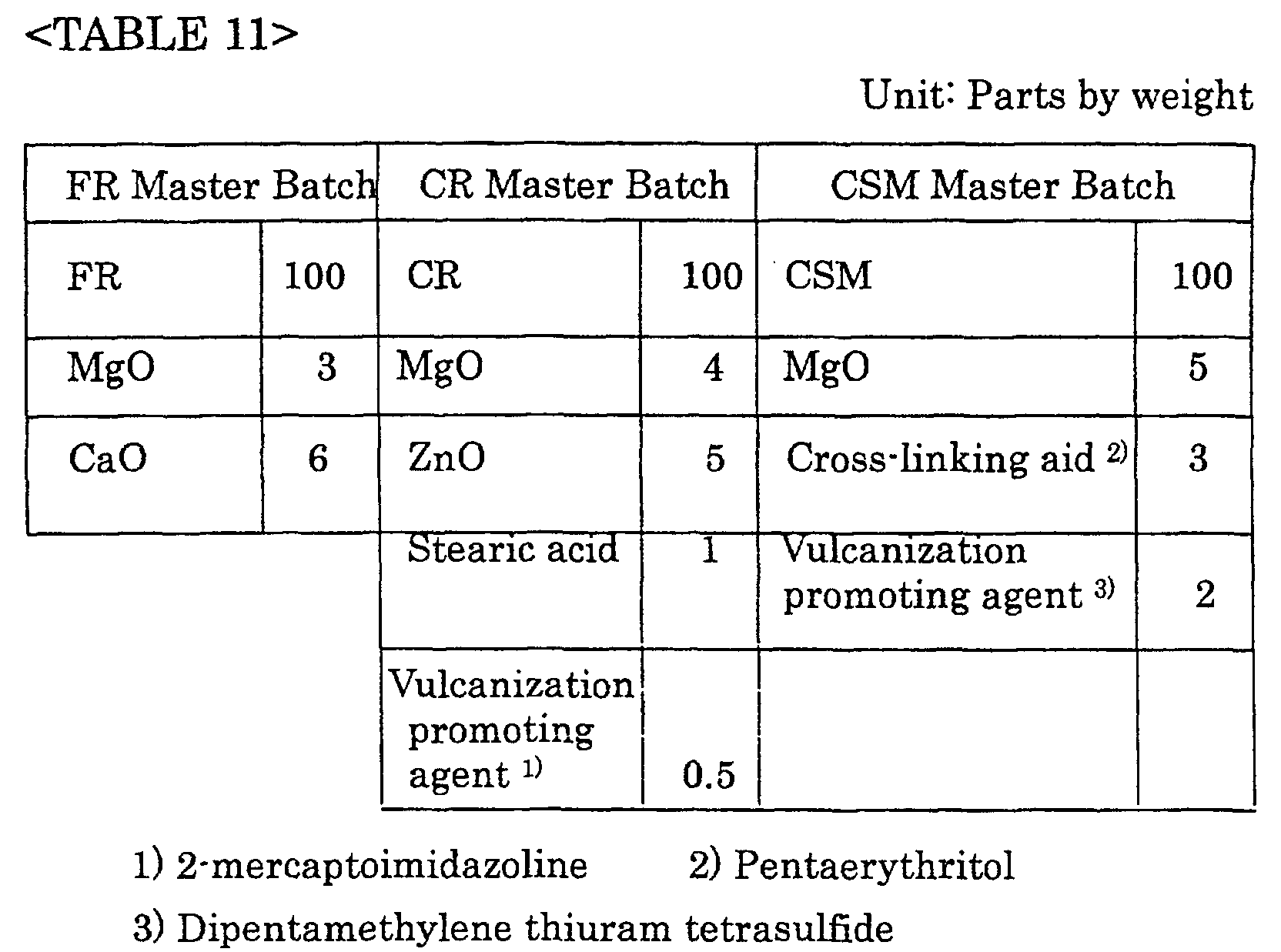
| Unit: Parts by weight | |||||
| X-NBR Master Batch | AEM Master Batch | CPE | |||
| X-NBR | |||||
| 100 | | 100 | | 100 | |
| | 1 | | 2 | | 10 |
| ZnO | 1.5 | | 2 | | 10 |
| Vulcanization promoting agent | 1.5 | | 5 | | 3 |
Precursors of Samples 10-17 according to the
present invention and Comparative Samples 5-7 were prepared
from respective combinations of the rubber material A and the
master batch composition including the rubber material B, which
combinations have respective proportions of mixing or blending
(by weight) of the rubber materials A and B as indicated in
TABLES 13 and 14 below. The individual combinations were
evenly kneaded or mixed together for 5-10 minutes at a
temperature of 150-160°C, so that only the rubber material B was
vulcanized, without vulcanization of the rubber material A. For
the precursor of each of Samples 10-17, the, sizes of particles of
the rubber material B dispersed within the rubber material A
were measured to obtain the average particle size of the rubber
material B. The obtained average particle size of the rubber
material B in the precursor of each sample was confirmed to be
about 0.5-5µm.
In each preliminary sample thus prepared, the
unvulcanized rubber material A was vulcanized. Described in
detail, 100 parts by weight of the unvulcanized rubber material A
in each of the Comparative Sample 5 and the Samples 10-14 of
the invention was mixed with 2 parts by weight of sulfur as the
vulcanizing agent A, 5 parts by weight of processing aid, and 1
part by weight of sulfenamide-based vulcanization promoting
agent. These components were evenly kneaded, and the obtained
mixtures were subjected to a press-molding and -vulcanizing
process for 20 minutes at 160°C, as in Example 1, to prepare test
pieces of Comparative Sample 5 and Samples 10-14 of the
invention. For Comparative Samples 6 and 7 and Samples 15-17
of the invention, 100 parts by weight of the unvulcanized rubber
material A was mixed with 3 parts by weight of sulfur as the
vulcanizing agent A, 5 parts by weight of processing aid, 25 parts
by weight of HAF carbon black (ASTMN330), 10 parts by weight
of softening agent (aromatic process oil), and 1 part by weight of
sulfenamide-based vulcanization promoting agent. These
components were evenly kneaded, and the rubber material A in
each of the obtained mixtures was subjected to a press-molding
and -vulcanizing process for 20 minutes at 160°C, to prepare test
pieces of Comparative Samples 6 and 7 and Samples 15-17 of the
invention.
The thus obtained test pieces according to
Comparative Samples and Samples of the invention were tested
by the same methods as in Example 1, to measure their tensile
strength (Tb), breaking elongation (Eb) and JIS-A hardness, and
also an amount of change (ΔTb) of the tensile strength and an
amount of change (ΔEb) of the breaking elongation after a
thermal aging test of the test pieces (at 80°C for 250 hours).
Further, the test pieces were subjected to the dumb-bell fatigue
test, in the same manner as in Example 1. The results of the
tests of the test pieces are indicated in TABLES 13 and 14. The
test pieces were further measured of their resistances to ozone
and gas permeability. The measurements are also indicated in
TABLES 13 and 14.
The resistance to ozone was evaluated by static
ozone-deterioration test according to JIS-K-6301-1995. Described
in detail, JIS No. 1 test pieces were held elongated by 20% and
exposed to an atmosphere having an ozone concentration of
50±5pphm at 40°C, for 168 hours. The ozone resistance was
evaluated depending upon whether each test piece was fractured
or broken during its elongation and exposure to the atmosphere
indicated above. The resistance to gas permeability was
evaluated by a method according to ASTM-D-1434-82. Namely,
each test piece in the form of a 2mm-thick sheet was exposed to a
pressure difference on its opposite sides at a temperature of 60°C
such that a pressure of 100Kpa of N2 gas on one side
(high-pressure side) of the sheet while 1330Pa acts on the other
side (low-pressure side). The gas permeability resistance was
evaluated on the basis of a rate (cc ·cm/cm2·sec·atm) at which the
N2 gas permeates through the sheet from the high-pressure side
to the low-pressure side.
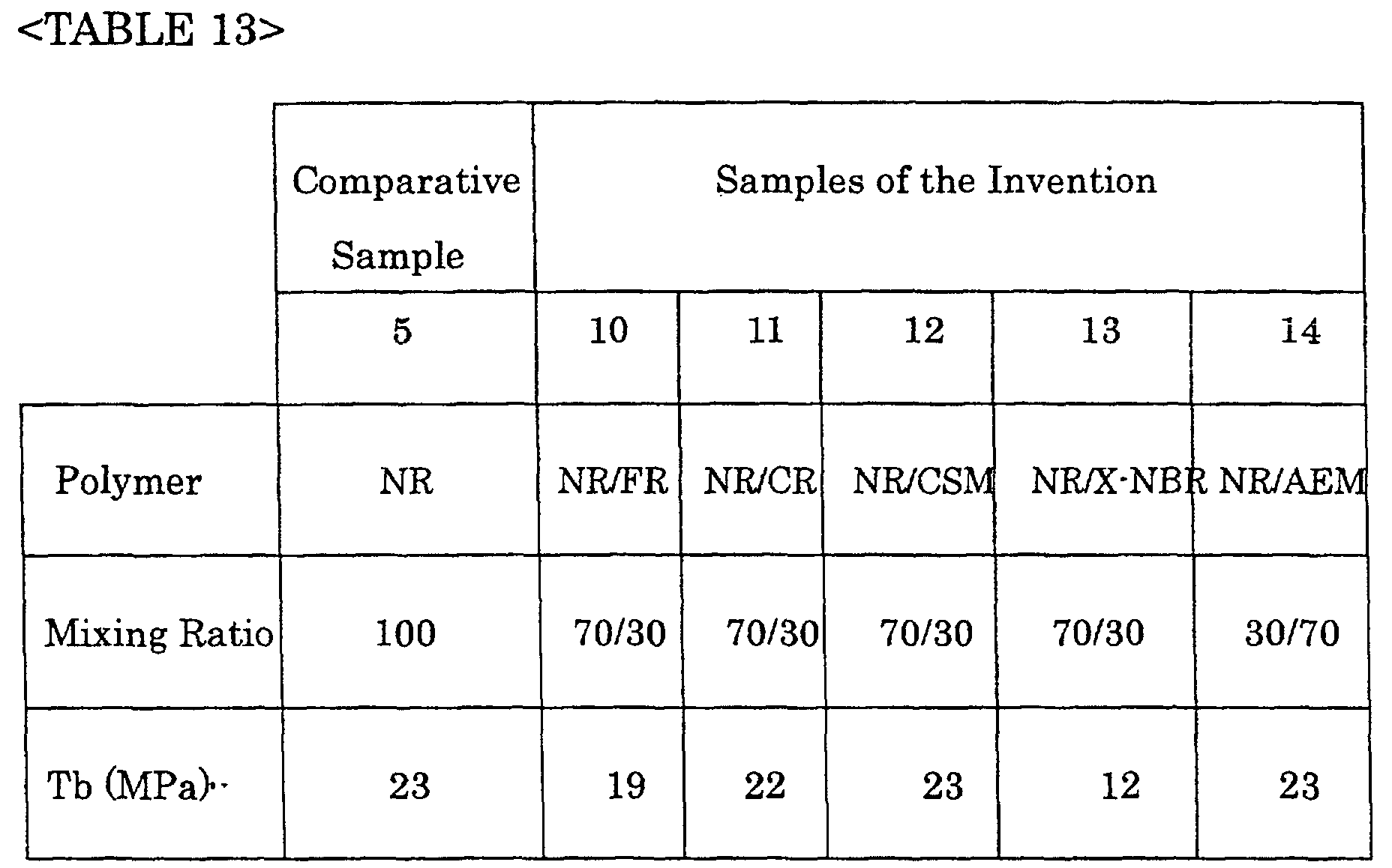


It will be understood from the results of the tests indicated
in TABLES 13 and 14 that the vulcanized rubber members
according to Samples 10-17 of the present invention prepared
from the combinations of the polymers mixed together are
excellent in the following characteristics, respectively:
Precursors of Comparative Sample 11 and Samples
18 and 19 of the present invention were prepared from respective
combinations of unvulcanized natural rubber (NR) and/or
unvulcanized stylene butadiene rubber (SBR) as the rubber
material A, and master batch Cl-IIR prepared in Example 1. The
individual combinations have respective proportions of mixing or
blending (by weight) of the NR, SBR and Cl-IIR as indicated in
TABLE 15 below. The components of each combination were
introduced into a kneader called "banbury mixer", and were
evenly kneaded or mixed together for 5-10 minutes at a
temperature of 150-160°C, so that only the rubber material B in
the form of Cl-IIR was vulcanized, without vulcanization of the
rubber material A. For each precursor of Samples 1-7, the sizes of
particles of Cl-IIR dispersed within the mass of the rubber
material A were measured to obtain the average particle size of
Cl-IIR. The obtained average particle size of Cl-IIR in the
precursor of each sample was confirmed to be about 0.5-5µm.
To 100 parts by weight of the unvulcanized rubber
material A in the precursor of each Sample, there were added
sulfur as the vulcanizing agent A and various additives indicated
in TABLE 15, in respective amounts indicated in TABLE 15.
These components were evenly kneaded with a mixer of roll type,
and the obtained mixtures were subjected to a press-molding and
-vulcanizing process for 20 minutes at 160°C, to prepare test
pieces of Samples 18 and 19 of the present invention and
Comparative Sample 11, for performing a dynamic
characteristics test, a hardness test and a tensile test.
Of the additives to be added to the rubber material
A as indicated in TABLE 15, N-cyclohexyl-2-benzothiazyl
sulfenamide (CBS) was used as the vulcanization promoting
agent, while zinc oxide and stearic acid were used as the
vulcanization promoting aids. In the present Example 3, wax was
used as the anti-aging agent, and carbon black was used as the
rubber characteristic adjusting agent (reinforcing agent), while
an oil was used as the softening agent.

Test pieces according to Comparative Samples 8, 9
and 10 were prepared by using only the rubber materials A
which are respectively used in Samples 18 and 19 of the
invention and Comparative Sample 11 and which serve as the
matrix phase ("sea" phase). Namely, these test pieces do not
include the rubber material B dispersed in the rubber material A
according to the present invention. The test pieces according to
Comparative Samples 8, 9 and 10 include additives as also
indicated in TABLE 15. The mixtures of the rubber material A
and the additives were subjected to a press-vulcanizing and
- molding process at 160°C for 20 minutes, to obtain the test
pieces. It will be understood from TABLE 15 that Comparative
Sample 8 is similar to a vulcanized rubber member of Sample 18
except that the rubber material B in the form of Cl-IIR is not
dispersed in the rubber material A in the form of the NR. In the
same sense, Comparative Sample 9 corresponds to Sample 19 of
the invention, while Comparative Sample 10 corresponds to
Comparative Sample 11.
The test pieces according to Samples 18 and 19 of
the invention and Comparative Samples 8-11 were subjected to
the dynamic characteristics test, hardness test and tensile test,
in the same manner as in Example 1. The results of the tests are
indicated in TABLE 16.
Relationships between the dynamic/static ratio
(Kd100/Ks) of spring constant and the loss factor tanδ [15Hz] of
the test pieces are indicated in the graph of Fig. 3, wherein "□"
represents the test pieces according to Samples 18 and 19 of the
present invention which have the "island-sea" structure, while
"▪" represents the test piece according to Comparative Sample 8
which has the "island-sea" structure but the matrix phase of
which does not permit damping rubber characteristics as
required by the present invention, while "•" represents the test
pieces according to Samples 18 and 19 of the invention and
Comparative Sample 11 which do not include any amount of the
rubber material B that gives the "islands" phase.

It will be apparent from the results of the dynamic
characteristics test indicated in TABLE 16 and Fig. 3 that the
test piece according to Comparative Sample 11 which uses Cl-IIR
as the rubber material of functional group-vulcanization type to
give an "island-sea" structure to the vulcanized rubber member
of Comparative Sample 10 whose rubber characteristics do not
meet the requirements of the present invention (i.e., tanδ = 0.068
< 0.1) has a higher degree of vibration damping effect (i.e., higher
loss factor tanδ) than the test piece according to Comparative
Sample 10, but has a relatively high dynamic/static ratio of
spring constant. Thus, it will be understood that the test piece
spring constant. Thus, it will be understood that the test piece
according to Comparative Sample 11 does not solve the prior art
problem that an increase in the vibration damping effect will
cause an increase in the dynamic/static ratio of spring constant.
It will also be understood that unlike the test piece
according to Comparative Sample 11, the test pieces according to
Samples 18 and 19 of the present invention has a significantly
increased loss factor tan and an effectively reduced
dynamic/static ratio of spring constant, as compared with the test
pieces according to Comparative Samples 8 and 9 the rubber
material of which consists solely of the rubber material A.
Namely, Samples 18 and 19 of the invention permit both a
further improvement in the vibration damping effect with respect
to low-frequency input vibrations, and a low dynamic/static ratio
of spring constant (a low degree of dynamic spring stiffness) with
respect to high-frequency input vibrations.
It will also be understood from the results of the
hardness and tensile tests indicated in TABLE 16 that Samples
18 and 19 of this invention assure the JIS-A hardness of at least
A50, and are satisfactory in the other physical properties such as
the tensile strength (Tb) and breaking elongation (Eb).
It will be understood from the foregoing description
that the vibration damping rubber member according to the
present invention is capable of exhibiting both a low degree of
dynamic spring stiffness and a high vibration damping effect,
and can be suitably used as vibration damping rubber members
for automotive vehicles, such as an engine mount, and various
other vibration damping structures which are required to
different vibration damping characteristics depending upon
different kinds of input vibrations having different frequencies.
The process of producing the vibration damping rubber member
according to this invention permits economical and easy
manufacture of vibration damping rubber members having
excellent damping characteristics.
The process of the invention permits the produced
vibration damping rubber member to exhibit a significantly
reduced dynamic/static ratio of spring constant while
maintaining a high vibration damping effect, as well as assure
various physical properties required by the vibration damping
rubber member. Thus, the present process has made it possible to
produce a vibration damping rubber member capable of
exhibiting a high vibration damping effect and a low degree of
dynamic spring constant.
Claims (10)
- A vibration damping rubber member having an island-sea structure in which fine particles of a vulcanized rubber material B which enables the vibration damping rubber member to have a high vibration damping effect are dispersed as a dispersed phase in a matrix phase of a vulcanized rubber material A that enables the vibration damping rubber member to exhibit a low degree of dynamic spring stiffness, characterized in that:
said vulcanized rubber material B functioning as said dispersed phase is formed by vulcanizing an unvulcanized mass of the rubber material B while said unvulcanized mass of the rubber material B is evenly mixed with and dispersed in an unvulcanized mass of the rubber material A, and said unvulcanized mass of the rubber material A is vulcanized while said vulcanized rubber material B is dispersed in said unvulcanized mass of said rubber material A. - A vibration damping rubber member according to claim 1, wherein said vulcanized rubber material B consists of fine particles which have an average size of 0.1-100µm and which are dispersed in said vulcanized rubber material A.
- A vibration damping rubber member according to claim 1 or 2, wherein said rubber material A consists of NR, or a mixture of NR and BR or SBR, and said rubber material B consists of halogenated IIR, maleicacid-modified EPM, CR, carboxyl-modified NBR, CSM, CPE, FR or acrylic rubber.
- A vibration damping rubber member having an island-sea structure in which fine particles of a vulcanized rubber material B which enables the vibration damping rubber member to have a high vibration damping effect are dispersed as a dispersed phase in a matrix phase of a vulcanized rubber material A that enables the vibration damping rubber member to exhibit a low degree of dynamic spring stiffness, characterized in that:said rubber material A is a natural rubber, while said rubber material B is an acrylic rubber, and said rubber materials A and B are mixed together in a proportion of 90/10-60/40 by weight; andsaid vulcanized rubber material B functioning as said dispersed phase is formed as fine particles having a size of 0.1-100µm, by vulcanizing an unvulcanized mass of the rubber material B while said unvulcanized mass of the rubber material B is evenly mixed with and dispersed in an unvulcanized mass of the rubber material A, and said unvulcanized mass of the rubber material A is vulcanized while said vulcanized rubber material B is dispersed in said unvulcanized mass of said rubber material A.
- A process of producing a vibration damping rubber member, characterized by: evenly mixing together an unvulcanized rubber material A which enables the vibration damping rubber member to exhibit a low degree of dynamic spring stiffness, an unvulcanized rubber material B which enables the vibration damping rubber member to have a high vibration damping effect, and a vulcanizing agent capable of vulcanizing only said unvulcanized rubber material B; heating a mixture of said unvulcanized rubber materials A and B and said vulcanizing agent, to vulcanize said unvulcanized rubber material B such that fine particles of the vulcanized rubber material B are dispersed in said unvulcanized rubber material A; adding to said mixture a vulcanizing agent capable of vulcanizing said unvulcanized rubber material A; and forming a thus obtained mixture into a desired shape, and heating the formed mixture to vulcanize said unvulcanized rubber material A, for obtaining said vibration damping rubber member having an island-sea structure in which fine particles of the vulcanized rubber material B are dispersed as a dispersed phase in a matrix phase of the vulcanized rubber material A.
- A process according to claim 5, wherein said unvulcanized rubber material A is evenly mixed with the rubber material B to which said vulcanizing agent capable of vulcanizing only said unvulcanized rubber material has been mixed with said unvulcanized rubber material.
- A process according to claim 5 or 6, wherein said unvulcanized rubber material A is vulcanized by a sulfur-based vulcanizing system, while said unvulcanized rubber material B is vulcanized by a resin-based vulcanizing system, a metal-oxide-based vulcanizing system or an amine-based vulcanizing system.
- A process of producing a vibration damping rubber member having a desired shape, and a low degree of dynamic/static ratio of spring constant and a high vibration damping effect, by vulcanizing and forming a rubber composition which includes a diene-based rubber material as a rubber component and which enables the vulcanized and formed rubber composition to have a loss factor tanδ of at least 0.1, characterized in that:
a portion of said diene-based rubber material is replaced by not greater than 40% by weight of a rubber material of functional group-vulcanization type per 100% by weight of a total amount of these two rubber materials, and said two rubber materials and a vulcanizing agent capable of vulcanizing only said rubber material of functional group-vulcanization type are evenly mixed together to form a mixture, which is heated to vulcanize said rubber material such that fine particles of the vulcanized rubber material of functional group-vulcanization type are dispersed in said diene-based rubber material, and wherein a vulcanizing agent capable of vulcanizing said diene-based rubber material A is added to said mixture, and a thus obtained mixture is formed into a desired shape and heated to vulcanize said diene-based rubber material A, for obtaining said vibration damping rubber member such that the vibration damping rubber member has an island-sea structure in which fine particles of said rubber material of functional group-vulcanization type are dispersed as a dispersed phase in a matrix phase of said diene-based rubber material and which has said low degree of dynamic/static ratio of spring constant. - A process according to claim 8, wherein said rubber material of functional group-vulcanization type is halogenated IIR.
- A process according to claim 8 or 9, wherein said vulcanized rubber material of functional group-vulcanization type is dispersed in the form of fine particles having an average size of 0.1-100µm in said vulcanized diene-based rubber material.
Applications Claiming Priority (7)
| Application Number | Priority Date | Filing Date | Title |
|---|---|---|---|
| JP31155599 | 1999-11-01 | ||
| JP31155599 | 1999-11-01 | ||
| JP2000121142 | 2000-04-21 | ||
| JP2000121142A JP2001302846A (en) | 2000-04-21 | 2000-04-21 | Manufacturing method of rubber with low dynamic magnification and high attenuation |
| JP2000191147 | 2000-06-26 | ||
| JP2000191147A JP3716713B2 (en) | 1999-11-01 | 2000-06-26 | Anti-vibration rubber and manufacturing method thereof |
| PCT/JP2000/007625 WO2001032769A1 (en) | 1999-11-01 | 2000-10-30 | Rubber vibration isolator and method for producing the same |
Publications (2)
| Publication Number | Publication Date |
|---|---|
| EP1153973A1 true EP1153973A1 (en) | 2001-11-14 |
| EP1153973A4 EP1153973A4 (en) | 2003-03-19 |
Family
ID=27339188
Family Applications (1)
| Application Number | Title | Priority Date | Filing Date |
|---|---|---|---|
| EP00970204A Ceased EP1153973A4 (en) | 1999-11-01 | 2000-10-30 | RUBBER ANTI-VIBRATION DEVICE AND CORRESPONDING PRODUCTION METHOD |
Country Status (6)
| Country | Link |
|---|---|
| US (1) | US6858675B1 (en) |
| EP (1) | EP1153973A4 (en) |
| KR (1) | KR100438400B1 (en) |
| CN (1) | CN1206271C (en) |
| CA (1) | CA2358403A1 (en) |
| WO (1) | WO2001032769A1 (en) |
Cited By (1)
| Publication number | Priority date | Publication date | Assignee | Title |
|---|---|---|---|---|
| EP1610113A1 (en) * | 2004-06-23 | 2005-12-28 | Rieter Technologies A.G. | Device for determining the loss factor of damping materials |
Families Citing this family (24)
| Publication number | Priority date | Publication date | Assignee | Title |
|---|---|---|---|---|
| JP3799968B2 (en) | 2000-06-16 | 2006-07-19 | 東海ゴム工業株式会社 | Manufacturing method of anti-vibration rubber with excellent durability |
| US6656582B2 (en) | 2000-06-16 | 2003-12-02 | Tokai Rubber Industries, Ltd. | Rubber product with metallic structure and method of producing the same |
| SI1373639T1 (en) * | 2001-04-04 | 2009-08-31 | Rockwool Int | A vibration damping system |
| US20030170614A1 (en) * | 2001-08-31 | 2003-09-11 | Megede Jan Zur | Polynucleotides encoding antigenic HIV type B polypeptides, polypeptides and uses thereof |
| US7172800B2 (en) * | 2003-11-03 | 2007-02-06 | Material Sciences Corporation | Sheet molding compound damper component, and methods for making and using the same |
| JP2007039067A (en) * | 2005-08-02 | 2007-02-15 | Kurashiki Kako Co Ltd | Vibrationproof pallet |
| FR2890427B1 (en) * | 2005-09-08 | 2010-09-10 | Valeo Embrayages | DAMPING PIECE FOR DOUBLE FLYWHEEL DAMPER. |
| DE112012002208B4 (en) | 2011-05-24 | 2021-04-29 | Firestone Industrial Products Company, Llc | Elastomeric air spring bellows and air spring having it |
| KR101286513B1 (en) * | 2011-06-23 | 2013-07-16 | 송인규 | Protecrion shock absorber gasket for vehicle and manufacturing method thereof |
| CN103073760B (en) * | 2011-10-26 | 2015-09-16 | 中国石油化工股份有限公司 | A kind of modified rubber component and method for making and a kind of emulsion polymerized styrene butadiene rubber composition and method for making thereof and its cross-linked rubber |
| KR101698947B1 (en) | 2011-10-26 | 2017-01-23 | 차이나 페트로리움 앤드 케미컬 코포레이션 | Modified rubber masterbatch, rubber composition prepared therewith and vulcanized rubber and preparation method thereof |
| CN103073758B (en) * | 2011-10-26 | 2015-09-16 | 中国石油化工股份有限公司 | A kind of rubber combination and preparation method thereof and its cross-linked rubber |
| CN103073759B (en) * | 2011-10-26 | 2016-02-24 | 中国石油化工股份有限公司 | A kind of modified rubber component and method for making and a kind of solution polymerized butadiene styrene rubber composition and method for making thereof and its cross-linked rubber |
| JP6084623B2 (en) | 2011-10-26 | 2017-02-22 | 中国石油化工股▲ふん▼有限公司 | Rubber composition, preparation method thereof and vulcanized rubber |
| CN102675705B (en) * | 2012-05-24 | 2013-11-20 | 武汉臣基工程科技有限公司 | Wide-temperature-range high-damping rubber composition and preparation method thereof |
| CN103289153B (en) * | 2013-06-24 | 2015-03-18 | 苏州新区佳合塑胶有限公司 | Modified damping styrene butadiene rubber and preparation method thereof |
| WO2015005226A1 (en) * | 2013-07-11 | 2015-01-15 | 三井化学株式会社 | Vibration damping material and polymer composition |
| JP2015160903A (en) * | 2014-02-27 | 2015-09-07 | 住友ゴム工業株式会社 | High damping composition, seismic damper and seismic isolation bearing |
| JP6546570B2 (en) | 2016-08-31 | 2019-07-17 | 住友理工株式会社 | Vibration-proof rubber composition and vibration-proof rubber |
| DE102017223107A1 (en) * | 2017-12-18 | 2019-06-19 | Bayerische Motoren Werke Aktiengesellschaft | motor vehicle |
| CN108948449B (en) * | 2018-05-29 | 2021-03-16 | 株洲时代新材料科技股份有限公司 | Ultralow-hardness high-damping rubber composite material and preparation method and application thereof |
| CN112159553A (en) * | 2020-09-25 | 2021-01-01 | 陕西省石油化工研究设计院 | Composite damping rubber with low-dynamic-spring characteristic and preparation method thereof |
| US20230213079A1 (en) * | 2021-12-30 | 2023-07-06 | Volvo Car Corporation | Vibration isolation support device |
| CN117247609B (en) * | 2023-11-17 | 2024-02-23 | 河南恒发科技股份有限公司 | Low-damping high-performance rubber for new energy automobile suspension and preparation method thereof |
Family Cites Families (8)
| Publication number | Priority date | Publication date | Assignee | Title |
|---|---|---|---|---|
| JP2787049B2 (en) * | 1989-05-24 | 1998-08-13 | ジェイエスアール株式会社 | Fluoro rubber composition |
| JPH0544776A (en) | 1991-07-25 | 1993-02-23 | Meiji Rubber & Chem Co Ltd | Composition for rubber vibration isolator |
| JP3201542B2 (en) | 1992-08-24 | 2001-08-20 | 株式会社明治ゴム化成 | Method for producing rubber composition |
| JP3449726B2 (en) | 1995-07-11 | 2003-09-22 | 日本ゼオン株式会社 | Conductive rubber composition and method for producing the same |
| JP3145029B2 (en) | 1996-05-16 | 2001-03-12 | 住友ゴム工業株式会社 | Rubber composition |
| JP3693499B2 (en) | 1998-06-05 | 2005-09-07 | 東海ゴム工業株式会社 | Anti-vibration rubber composition manufacturing method, anti-vibration rubber composition, and anti-vibration rubber member |
| JP2000198974A (en) | 1998-12-28 | 2000-07-18 | Yokohama Rubber Co Ltd:The | Vibration-damping or vibrationproof material |
| JP3799968B2 (en) * | 2000-06-16 | 2006-07-19 | 東海ゴム工業株式会社 | Manufacturing method of anti-vibration rubber with excellent durability |
-
2000
- 2000-10-30 WO PCT/JP2000/007625 patent/WO2001032769A1/en not_active Ceased
- 2000-10-30 KR KR10-2001-7008454A patent/KR100438400B1/en not_active Expired - Fee Related
- 2000-10-30 US US09/868,145 patent/US6858675B1/en not_active Expired - Lifetime
- 2000-10-30 CA CA002358403A patent/CA2358403A1/en not_active Abandoned
- 2000-10-30 EP EP00970204A patent/EP1153973A4/en not_active Ceased
- 2000-10-30 CN CNB008044031A patent/CN1206271C/en not_active Expired - Fee Related
Cited By (2)
| Publication number | Priority date | Publication date | Assignee | Title |
|---|---|---|---|---|
| EP1610113A1 (en) * | 2004-06-23 | 2005-12-28 | Rieter Technologies A.G. | Device for determining the loss factor of damping materials |
| WO2006000365A1 (en) * | 2004-06-23 | 2006-01-05 | Rieter Technologies Ag | Device for determining the loss factor of damping materials |
Also Published As
| Publication number | Publication date |
|---|---|
| CA2358403A1 (en) | 2001-10-05 |
| CN1342183A (en) | 2002-03-27 |
| EP1153973A4 (en) | 2003-03-19 |
| KR100438400B1 (en) | 2004-07-02 |
| CN1206271C (en) | 2005-06-15 |
| WO2001032769A1 (en) | 2001-05-10 |
| KR20010101361A (en) | 2001-11-14 |
| US6858675B1 (en) | 2005-02-22 |
Similar Documents
| Publication | Publication Date | Title |
|---|---|---|
| US6858675B1 (en) | Vibration damping rubber member and process of producing the same | |
| JP2006131871A (en) | Vibration insulating rubber composition and vibration insulating rubber member | |
| Akyüz et al. | Effects of NR/SBR ratio on mechanical properties and artificial mechanical performance of anti-vibration bushings | |
| JP3716713B2 (en) | Anti-vibration rubber and manufacturing method thereof | |
| EP1164165B1 (en) | Vibration damping rubber member having excellent durability and method of producing the same | |
| EP1164308B1 (en) | Rubber product bonded to a metallic structure and method of producing the same | |
| JP2009256580A (en) | Method for producing vibration-proof rubber composition, vibration-proof rubber composition obtained by the same and vibration-proof rubber | |
| JP4296972B2 (en) | Anti-vibration rubber manufacturing method and anti-vibration rubber obtained thereby | |
| JPH08269238A (en) | Anti-vibration rubber composition and polyphenylene ether resin / anti-vibration rubber composite using the composition | |
| CN111479868A (en) | Vibration-isolating rubber composition and vibration-isolating rubber | |
| JP2001302846A (en) | Manufacturing method of rubber with low dynamic magnification and high attenuation | |
| US5231138A (en) | Thermoplastic and elastomeric composition comprising a polyamide and a rubber component | |
| JP3912018B2 (en) | Low dynamic springs-anti-vibration rubber with high damping characteristics | |
| JP2005114141A (en) | Anti-vibration rubber | |
| JP2005113094A (en) | Anti-vibration rubber | |
| JP3424839B2 (en) | Anti-vibration rubber composition | |
| JPH0665423A (en) | Vibration damping material | |
| KR100844741B1 (en) | Automotive damper rubber composition | |
| JP2005113092A (en) | Anti-vibration rubber | |
| JPH11302477A (en) | Vibration-insulating rubber composition | |
| JPH01254747A (en) | Vibration insulating rubber | |
| JP2006316182A (en) | Low repulsion rubber composition and seismic isolation structure using the same | |
| JP2002003646A (en) | Rubber product with metal fittings and method of manufacturing the same | |
| Sivakumar et al. | High Performance Engine Mounts to Suit Various Environment for Automotive Application | |
| JPH11158324A (en) | Rubber composition for laminate and laminated device made of said composition |
Legal Events
| Date | Code | Title | Description |
|---|---|---|---|
| PUAI | Public reference made under article 153(3) epc to a published international application that has entered the european phase |
Free format text: ORIGINAL CODE: 0009012 |
|
| 17P | Request for examination filed |
Effective date: 20010618 |
|
| AK | Designated contracting states |
Kind code of ref document: A1 Designated state(s): AT BE CH CY DE DK ES FI FR GB GR IE IT LI LU MC NL PT SE |
|
| A4 | Supplementary search report drawn up and despatched |
Effective date: 20030130 |
|
| 17Q | First examination report despatched |
Effective date: 20030707 |
|
| RBV | Designated contracting states (corrected) |
Designated state(s): DE FR GB IT |
|
| STAA | Information on the status of an ep patent application or granted ep patent |
Free format text: STATUS: THE APPLICATION HAS BEEN REFUSED |
|
| 18R | Application refused |
Effective date: 20090610 |