EP1153959A2 - Grain aggregate and producing method thereof, and light-diffusing agent - Google Patents
Grain aggregate and producing method thereof, and light-diffusing agent Download PDFInfo
- Publication number
- EP1153959A2 EP1153959A2 EP01401149A EP01401149A EP1153959A2 EP 1153959 A2 EP1153959 A2 EP 1153959A2 EP 01401149 A EP01401149 A EP 01401149A EP 01401149 A EP01401149 A EP 01401149A EP 1153959 A2 EP1153959 A2 EP 1153959A2
- Authority
- EP
- European Patent Office
- Prior art keywords
- grains
- grain
- grain aggregate
- cross
- light
- Prior art date
- Legal status (The legal status is an assumption and is not a legal conclusion. Google has not performed a legal analysis and makes no representation as to the accuracy of the status listed.)
- Withdrawn
Links
- 238000000034 method Methods 0.000 title claims description 83
- 238000004132 cross linking Methods 0.000 claims abstract description 182
- 239000007788 liquid Substances 0.000 claims abstract description 76
- 239000006185 dispersion Substances 0.000 claims abstract description 68
- 239000011230 binding agent Substances 0.000 claims abstract description 66
- 239000000126 substance Substances 0.000 claims abstract description 52
- 239000003795 chemical substances by application Substances 0.000 claims abstract description 48
- 125000000524 functional group Chemical group 0.000 claims abstract description 32
- 238000001694 spray drying Methods 0.000 claims abstract description 29
- 239000000203 mixture Substances 0.000 claims description 69
- 239000002245 particle Substances 0.000 claims description 64
- 238000005979 thermal decomposition reaction Methods 0.000 claims description 29
- 230000000977 initiatory effect Effects 0.000 claims description 28
- 229920005989 resin Polymers 0.000 claims description 25
- 239000011347 resin Substances 0.000 claims description 25
- 238000001035 drying Methods 0.000 claims description 19
- 238000005507 spraying Methods 0.000 claims description 15
- 125000003504 2-oxazolinyl group Chemical group O1C(=NCC1)* 0.000 claims description 13
- 125000004069 aziridinyl group Chemical group 0.000 claims description 4
- 125000003178 carboxy group Chemical group [H]OC(*)=O 0.000 claims description 4
- 125000003700 epoxy group Chemical group 0.000 claims description 4
- 125000002887 hydroxy group Chemical group [H]O* 0.000 claims description 4
- IQPQWNKOIGAROB-UHFFFAOYSA-N isocyanate group Chemical group [N-]=C=O IQPQWNKOIGAROB-UHFFFAOYSA-N 0.000 claims description 4
- 239000002904 solvent Substances 0.000 abstract description 44
- 239000004973 liquid crystal related substance Substances 0.000 abstract description 31
- 239000000843 powder Substances 0.000 description 66
- 239000000178 monomer Substances 0.000 description 45
- 230000000052 comparative effect Effects 0.000 description 37
- 239000000463 material Substances 0.000 description 24
- 229920000642 polymer Polymers 0.000 description 24
- YXFVVABEGXRONW-UHFFFAOYSA-N Toluene Chemical compound CC1=CC=CC=C1 YXFVVABEGXRONW-UHFFFAOYSA-N 0.000 description 21
- 238000002156 mixing Methods 0.000 description 20
- XLYOFNOQVPJJNP-UHFFFAOYSA-N water Substances O XLYOFNOQVPJJNP-UHFFFAOYSA-N 0.000 description 18
- 238000000576 coating method Methods 0.000 description 16
- 239000007787 solid Substances 0.000 description 16
- MYRTYDVEIRVNKP-UHFFFAOYSA-N 1,2-Divinylbenzene Chemical compound C=CC1=CC=CC=C1C=C MYRTYDVEIRVNKP-UHFFFAOYSA-N 0.000 description 15
- 239000011248 coating agent Substances 0.000 description 15
- NIXOWILDQLNWCW-UHFFFAOYSA-M Acrylate Chemical compound [O-]C(=O)C=C NIXOWILDQLNWCW-UHFFFAOYSA-M 0.000 description 14
- 238000005259 measurement Methods 0.000 description 14
- 238000007720 emulsion polymerization reaction Methods 0.000 description 11
- VYPSYNLAJGMNEJ-UHFFFAOYSA-N Silicium dioxide Chemical compound O=[Si]=O VYPSYNLAJGMNEJ-UHFFFAOYSA-N 0.000 description 10
- PPBRXRYQALVLMV-UHFFFAOYSA-N Styrene Chemical compound C=CC1=CC=CC=C1 PPBRXRYQALVLMV-UHFFFAOYSA-N 0.000 description 10
- 238000009826 distribution Methods 0.000 description 10
- ZWEHNKRNPOVVGH-UHFFFAOYSA-N 2-Butanone Chemical compound CCC(C)=O ZWEHNKRNPOVVGH-UHFFFAOYSA-N 0.000 description 9
- -1 aromatic vinyl compound Chemical class 0.000 description 9
- 230000004927 fusion Effects 0.000 description 8
- 239000003960 organic solvent Substances 0.000 description 8
- 229920001225 polyester resin Polymers 0.000 description 8
- 239000004645 polyester resin Substances 0.000 description 8
- XXQBEVHPUKOQEO-UHFFFAOYSA-N potassium superoxide Chemical compound [K+].[K+].[O-][O-] XXQBEVHPUKOQEO-UHFFFAOYSA-N 0.000 description 8
- 239000007921 spray Substances 0.000 description 8
- 230000005540 biological transmission Effects 0.000 description 7
- 239000000839 emulsion Substances 0.000 description 7
- GZVHEAJQGPRDLQ-UHFFFAOYSA-N 6-phenyl-1,3,5-triazine-2,4-diamine Chemical compound NC1=NC(N)=NC(C=2C=CC=CC=2)=N1 GZVHEAJQGPRDLQ-UHFFFAOYSA-N 0.000 description 6
- OKKJLVBELUTLKV-UHFFFAOYSA-N Methanol Chemical compound OC OKKJLVBELUTLKV-UHFFFAOYSA-N 0.000 description 6
- 238000004519 manufacturing process Methods 0.000 description 6
- 238000006116 polymerization reaction Methods 0.000 description 6
- WSFSSNUMVMOOMR-UHFFFAOYSA-N Formaldehyde Chemical compound O=C WSFSSNUMVMOOMR-UHFFFAOYSA-N 0.000 description 5
- 229920000877 Melamine resin Polymers 0.000 description 5
- VVQNEPGJFQJSBK-UHFFFAOYSA-N Methyl methacrylate Chemical compound COC(=O)C(C)=C VVQNEPGJFQJSBK-UHFFFAOYSA-N 0.000 description 5
- ZJCCRDAZUWHFQH-UHFFFAOYSA-N Trimethylolpropane Chemical compound CCC(CO)(CO)CO ZJCCRDAZUWHFQH-UHFFFAOYSA-N 0.000 description 5
- 238000013019 agitation Methods 0.000 description 5
- 239000003822 epoxy resin Substances 0.000 description 5
- 230000006872 improvement Effects 0.000 description 5
- 230000001965 increasing effect Effects 0.000 description 5
- 229910010272 inorganic material Inorganic materials 0.000 description 5
- 239000011147 inorganic material Substances 0.000 description 5
- 238000001000 micrograph Methods 0.000 description 5
- 230000003287 optical effect Effects 0.000 description 5
- 229920000647 polyepoxide Polymers 0.000 description 5
- 239000000377 silicon dioxide Substances 0.000 description 5
- 125000000391 vinyl group Chemical group [H]C([*])=C([H])[H] 0.000 description 5
- IJGRMHOSHXDMSA-UHFFFAOYSA-N Atomic nitrogen Chemical compound N#N IJGRMHOSHXDMSA-UHFFFAOYSA-N 0.000 description 4
- 238000011156 evaluation Methods 0.000 description 4
- 239000007789 gas Substances 0.000 description 4
- 239000004094 surface-active agent Substances 0.000 description 4
- 239000004640 Melamine resin Substances 0.000 description 3
- 239000000654 additive Substances 0.000 description 3
- 230000000996 additive effect Effects 0.000 description 3
- 239000003054 catalyst Substances 0.000 description 3
- 230000008859 change Effects 0.000 description 3
- 239000011521 glass Substances 0.000 description 3
- 239000003999 initiator Substances 0.000 description 3
- 229910052757 nitrogen Inorganic materials 0.000 description 3
- 239000011368 organic material Substances 0.000 description 3
- 230000000704 physical effect Effects 0.000 description 3
- 229920000139 polyethylene terephthalate Polymers 0.000 description 3
- 239000005020 polyethylene terephthalate Substances 0.000 description 3
- 239000012756 surface treatment agent Substances 0.000 description 3
- 238000012360 testing method Methods 0.000 description 3
- KAKZBPTYRLMSJV-UHFFFAOYSA-N Butadiene Chemical compound C=CC=C KAKZBPTYRLMSJV-UHFFFAOYSA-N 0.000 description 2
- VTYYLEPIZMXCLO-UHFFFAOYSA-L Calcium carbonate Chemical compound [Ca+2].[O-]C([O-])=O VTYYLEPIZMXCLO-UHFFFAOYSA-L 0.000 description 2
- CERQOIWHTDAKMF-UHFFFAOYSA-N Methacrylic acid Chemical compound CC(=C)C(O)=O CERQOIWHTDAKMF-UHFFFAOYSA-N 0.000 description 2
- GWEVSGVZZGPLCZ-UHFFFAOYSA-N Titan oxide Chemical compound O=[Ti]=O GWEVSGVZZGPLCZ-UHFFFAOYSA-N 0.000 description 2
- MCMNRKCIXSYSNV-UHFFFAOYSA-N Zirconium dioxide Chemical compound O=[Zr]=O MCMNRKCIXSYSNV-UHFFFAOYSA-N 0.000 description 2
- 239000000853 adhesive Substances 0.000 description 2
- 230000001070 adhesive effect Effects 0.000 description 2
- 230000002411 adverse Effects 0.000 description 2
- 150000001450 anions Chemical class 0.000 description 2
- 230000015572 biosynthetic process Effects 0.000 description 2
- 150000001875 compounds Chemical class 0.000 description 2
- 230000000694 effects Effects 0.000 description 2
- 150000002148 esters Chemical class 0.000 description 2
- 238000007602 hot air drying Methods 0.000 description 2
- 229910052809 inorganic oxide Inorganic materials 0.000 description 2
- 230000035800 maturation Effects 0.000 description 2
- JDSHMPZPIAZGSV-UHFFFAOYSA-N melamine Chemical compound NC1=NC(N)=NC(N)=N1 JDSHMPZPIAZGSV-UHFFFAOYSA-N 0.000 description 2
- 238000000465 moulding Methods 0.000 description 2
- QJGQUHMNIGDVPM-UHFFFAOYSA-N nitrogen group Chemical group [N] QJGQUHMNIGDVPM-UHFFFAOYSA-N 0.000 description 2
- 229920003023 plastic Polymers 0.000 description 2
- 239000004033 plastic Substances 0.000 description 2
- 239000004417 polycarbonate Substances 0.000 description 2
- 229920006267 polyester film Polymers 0.000 description 2
- 239000002994 raw material Substances 0.000 description 2
- 238000010992 reflux Methods 0.000 description 2
- 238000006467 substitution reaction Methods 0.000 description 2
- 229920002554 vinyl polymer Polymers 0.000 description 2
- OEPOKWHJYJXUGD-UHFFFAOYSA-N 2-(3-phenylmethoxyphenyl)-1,3-thiazole-4-carbaldehyde Chemical compound O=CC1=CSC(C=2C=C(OCC=3C=CC=CC=3)C=CC=2)=N1 OEPOKWHJYJXUGD-UHFFFAOYSA-N 0.000 description 1
- LPIQIQPLUVLISR-UHFFFAOYSA-N 2-prop-1-en-2-yl-4,5-dihydro-1,3-oxazole Chemical compound CC(=C)C1=NCCO1 LPIQIQPLUVLISR-UHFFFAOYSA-N 0.000 description 1
- 239000004925 Acrylic resin Substances 0.000 description 1
- 229920000178 Acrylic resin Polymers 0.000 description 1
- NLHHRLWOUZZQLW-UHFFFAOYSA-N Acrylonitrile Chemical compound C=CC#N NLHHRLWOUZZQLW-UHFFFAOYSA-N 0.000 description 1
- GAWIXWVDTYZWAW-UHFFFAOYSA-N C[CH]O Chemical group C[CH]O GAWIXWVDTYZWAW-UHFFFAOYSA-N 0.000 description 1
- XDTMQSROBMDMFD-UHFFFAOYSA-N Cyclohexane Chemical compound C1CCCCC1 XDTMQSROBMDMFD-UHFFFAOYSA-N 0.000 description 1
- 239000004593 Epoxy Substances 0.000 description 1
- LYCAIKOWRPUZTN-UHFFFAOYSA-N Ethylene glycol Chemical class OCCO LYCAIKOWRPUZTN-UHFFFAOYSA-N 0.000 description 1
- CTQNGGLPUBDAKN-UHFFFAOYSA-N O-Xylene Chemical compound CC1=CC=CC=C1C CTQNGGLPUBDAKN-UHFFFAOYSA-N 0.000 description 1
- 239000004962 Polyamide-imide Substances 0.000 description 1
- 239000004698 Polyethylene Substances 0.000 description 1
- 239000004642 Polyimide Substances 0.000 description 1
- 239000004743 Polypropylene Substances 0.000 description 1
- 239000004793 Polystyrene Substances 0.000 description 1
- 239000004372 Polyvinyl alcohol Substances 0.000 description 1
- XTXRWKRVRITETP-UHFFFAOYSA-N Vinyl acetate Chemical compound CC(=O)OC=C XTXRWKRVRITETP-UHFFFAOYSA-N 0.000 description 1
- BZHJMEDXRYGGRV-UHFFFAOYSA-N Vinyl chloride Chemical compound ClC=C BZHJMEDXRYGGRV-UHFFFAOYSA-N 0.000 description 1
- 239000002253 acid Substances 0.000 description 1
- 230000004931 aggregating effect Effects 0.000 description 1
- 125000005907 alkyl ester group Chemical group 0.000 description 1
- XYLMUPLGERFSHI-UHFFFAOYSA-N alpha-Methylstyrene Chemical compound CC(=C)C1=CC=CC=C1 XYLMUPLGERFSHI-UHFFFAOYSA-N 0.000 description 1
- WNROFYMDJYEPJX-UHFFFAOYSA-K aluminium hydroxide Chemical compound [OH-].[OH-].[OH-].[Al+3] WNROFYMDJYEPJX-UHFFFAOYSA-K 0.000 description 1
- PNEYBMLMFCGWSK-UHFFFAOYSA-N aluminium oxide Inorganic materials [O-2].[O-2].[O-2].[Al+3].[Al+3] PNEYBMLMFCGWSK-UHFFFAOYSA-N 0.000 description 1
- 239000012298 atmosphere Substances 0.000 description 1
- 238000009933 burial Methods 0.000 description 1
- 125000000484 butyl group Chemical group [H]C([*])([H])C([H])([H])C([H])([H])C([H])([H])[H] 0.000 description 1
- 229910000019 calcium carbonate Inorganic materials 0.000 description 1
- 150000001720 carbohydrates Chemical class 0.000 description 1
- 238000009833 condensation Methods 0.000 description 1
- 230000005494 condensation Effects 0.000 description 1
- 229920006037 cross link polymer Polymers 0.000 description 1
- 239000003431 cross linking reagent Substances 0.000 description 1
- 230000006735 deficit Effects 0.000 description 1
- 150000001993 dienes Chemical class 0.000 description 1
- 238000004455 differential thermal analysis Methods 0.000 description 1
- 239000003085 diluting agent Substances 0.000 description 1
- 238000007598 dipping method Methods 0.000 description 1
- 239000003995 emulsifying agent Substances 0.000 description 1
- 230000002708 enhancing effect Effects 0.000 description 1
- UIWXSTHGICQLQT-UHFFFAOYSA-N ethenyl propanoate Chemical compound CCC(=O)OC=C UIWXSTHGICQLQT-UHFFFAOYSA-N 0.000 description 1
- 125000001495 ethyl group Chemical group [H]C([H])([H])C([H])([H])* 0.000 description 1
- 238000005189 flocculation Methods 0.000 description 1
- 230000016615 flocculation Effects 0.000 description 1
- 230000009477 glass transition Effects 0.000 description 1
- LNEPOXFFQSENCJ-UHFFFAOYSA-N haloperidol Chemical compound C1CC(O)(C=2C=CC(Cl)=CC=2)CCN1CCCC(=O)C1=CC=C(F)C=C1 LNEPOXFFQSENCJ-UHFFFAOYSA-N 0.000 description 1
- 238000010030 laminating Methods 0.000 description 1
- 239000004816 latex Substances 0.000 description 1
- 229920000126 latex Polymers 0.000 description 1
- 125000002496 methyl group Chemical group [H]C([H])([H])* 0.000 description 1
- 150000002978 peroxides Chemical class 0.000 description 1
- 229920003229 poly(methyl methacrylate) Polymers 0.000 description 1
- 229920002312 polyamide-imide Polymers 0.000 description 1
- 229920000515 polycarbonate Polymers 0.000 description 1
- 229920005668 polycarbonate resin Polymers 0.000 description 1
- 239000004431 polycarbonate resin Substances 0.000 description 1
- 229920000573 polyethylene Polymers 0.000 description 1
- 229920001721 polyimide Polymers 0.000 description 1
- 239000002861 polymer material Substances 0.000 description 1
- 230000000379 polymerizing effect Effects 0.000 description 1
- 239000004926 polymethyl methacrylate Substances 0.000 description 1
- 229920001155 polypropylene Polymers 0.000 description 1
- 229920002223 polystyrene Polymers 0.000 description 1
- 239000004814 polyurethane Substances 0.000 description 1
- 229920002635 polyurethane Polymers 0.000 description 1
- 229920002451 polyvinyl alcohol Polymers 0.000 description 1
- 235000019422 polyvinyl alcohol Nutrition 0.000 description 1
- 239000004800 polyvinyl chloride Substances 0.000 description 1
- 229920000915 polyvinyl chloride Polymers 0.000 description 1
- 230000002265 prevention Effects 0.000 description 1
- 238000012545 processing Methods 0.000 description 1
- 230000001902 propagating effect Effects 0.000 description 1
- 230000009257 reactivity Effects 0.000 description 1
- 230000000630 rising effect Effects 0.000 description 1
- 229920002050 silicone resin Polymers 0.000 description 1
- 238000004528 spin coating Methods 0.000 description 1
- 239000000758 substrate Substances 0.000 description 1
- 150000005846 sugar alcohols Polymers 0.000 description 1
- 238000010345 tape casting Methods 0.000 description 1
- 229920001567 vinyl ester resin Polymers 0.000 description 1
- 239000004846 water-soluble epoxy resin Substances 0.000 description 1
- 239000008096 xylene Substances 0.000 description 1
Images




Classifications
-
- G—PHYSICS
- G02—OPTICS
- G02B—OPTICAL ELEMENTS, SYSTEMS OR APPARATUS
- G02B5/00—Optical elements other than lenses
- G02B5/02—Diffusing elements; Afocal elements
- G02B5/0205—Diffusing elements; Afocal elements characterised by the diffusing properties
- G02B5/021—Diffusing elements; Afocal elements characterised by the diffusing properties the diffusion taking place at the element's surface, e.g. by means of surface roughening or microprismatic structures
- G02B5/0226—Diffusing elements; Afocal elements characterised by the diffusing properties the diffusion taking place at the element's surface, e.g. by means of surface roughening or microprismatic structures having particles on the surface
-
- C—CHEMISTRY; METALLURGY
- C08—ORGANIC MACROMOLECULAR COMPOUNDS; THEIR PREPARATION OR CHEMICAL WORKING-UP; COMPOSITIONS BASED THEREON
- C08F—MACROMOLECULAR COMPOUNDS OBTAINED BY REACTIONS ONLY INVOLVING CARBON-TO-CARBON UNSATURATED BONDS
- C08F6/00—Post-polymerisation treatments
- C08F6/14—Treatment of polymer emulsions
- C08F6/18—Increasing the size of the dispersed particles
-
- C—CHEMISTRY; METALLURGY
- C08—ORGANIC MACROMOLECULAR COMPOUNDS; THEIR PREPARATION OR CHEMICAL WORKING-UP; COMPOSITIONS BASED THEREON
- C08J—WORKING-UP; GENERAL PROCESSES OF COMPOUNDING; AFTER-TREATMENT NOT COVERED BY SUBCLASSES C08B, C08C, C08F, C08G or C08H
- C08J3/00—Processes of treating or compounding macromolecular substances
- C08J3/12—Powdering or granulating
-
- G—PHYSICS
- G02—OPTICS
- G02B—OPTICAL ELEMENTS, SYSTEMS OR APPARATUS
- G02B5/00—Optical elements other than lenses
- G02B5/02—Diffusing elements; Afocal elements
- G02B5/0268—Diffusing elements; Afocal elements characterized by the fabrication or manufacturing method
-
- G—PHYSICS
- G02—OPTICS
- G02B—OPTICAL ELEMENTS, SYSTEMS OR APPARATUS
- G02B5/00—Optical elements other than lenses
- G02B5/02—Diffusing elements; Afocal elements
- G02B5/0273—Diffusing elements; Afocal elements characterized by the use
- G02B5/0278—Diffusing elements; Afocal elements characterized by the use used in transmission
-
- C—CHEMISTRY; METALLURGY
- C08—ORGANIC MACROMOLECULAR COMPOUNDS; THEIR PREPARATION OR CHEMICAL WORKING-UP; COMPOSITIONS BASED THEREON
- C08J—WORKING-UP; GENERAL PROCESSES OF COMPOUNDING; AFTER-TREATMENT NOT COVERED BY SUBCLASSES C08B, C08C, C08F, C08G or C08H
- C08J2333/00—Characterised by the use of homopolymers or copolymers of compounds having one or more unsaturated aliphatic radicals, each having only one carbon-to-carbon double bond, and only one being terminated by only one carboxyl radical, or of salts, anhydrides, esters, amides, imides, or nitriles thereof; Derivatives of such polymers
- C08J2333/04—Characterised by the use of homopolymers or copolymers of compounds having one or more unsaturated aliphatic radicals, each having only one carbon-to-carbon double bond, and only one being terminated by only one carboxyl radical, or of salts, anhydrides, esters, amides, imides, or nitriles thereof; Derivatives of such polymers esters
- C08J2333/06—Characterised by the use of homopolymers or copolymers of compounds having one or more unsaturated aliphatic radicals, each having only one carbon-to-carbon double bond, and only one being terminated by only one carboxyl radical, or of salts, anhydrides, esters, amides, imides, or nitriles thereof; Derivatives of such polymers esters of esters containing only carbon, hydrogen, and oxygen, the oxygen atom being present only as part of the carboxyl radical
- C08J2333/10—Homopolymers or copolymers of methacrylic acid esters
- C08J2333/12—Homopolymers or copolymers of methyl methacrylate
-
- Y—GENERAL TAGGING OF NEW TECHNOLOGICAL DEVELOPMENTS; GENERAL TAGGING OF CROSS-SECTIONAL TECHNOLOGIES SPANNING OVER SEVERAL SECTIONS OF THE IPC; TECHNICAL SUBJECTS COVERED BY FORMER USPC CROSS-REFERENCE ART COLLECTIONS [XRACs] AND DIGESTS
- Y10—TECHNICAL SUBJECTS COVERED BY FORMER USPC
- Y10T—TECHNICAL SUBJECTS COVERED BY FORMER US CLASSIFICATION
- Y10T428/00—Stock material or miscellaneous articles
- Y10T428/25—Web or sheet containing structurally defined element or component and including a second component containing structurally defined particles
- Y10T428/254—Polymeric or resinous material
-
- Y—GENERAL TAGGING OF NEW TECHNOLOGICAL DEVELOPMENTS; GENERAL TAGGING OF CROSS-SECTIONAL TECHNOLOGIES SPANNING OVER SEVERAL SECTIONS OF THE IPC; TECHNICAL SUBJECTS COVERED BY FORMER USPC CROSS-REFERENCE ART COLLECTIONS [XRACs] AND DIGESTS
- Y10—TECHNICAL SUBJECTS COVERED BY FORMER USPC
- Y10T—TECHNICAL SUBJECTS COVERED BY FORMER US CLASSIFICATION
- Y10T428/00—Stock material or miscellaneous articles
- Y10T428/29—Coated or structually defined flake, particle, cell, strand, strand portion, rod, filament, macroscopic fiber or mass thereof
- Y10T428/2982—Particulate matter [e.g., sphere, flake, etc.]
-
- Y—GENERAL TAGGING OF NEW TECHNOLOGICAL DEVELOPMENTS; GENERAL TAGGING OF CROSS-SECTIONAL TECHNOLOGIES SPANNING OVER SEVERAL SECTIONS OF THE IPC; TECHNICAL SUBJECTS COVERED BY FORMER USPC CROSS-REFERENCE ART COLLECTIONS [XRACs] AND DIGESTS
- Y10—TECHNICAL SUBJECTS COVERED BY FORMER USPC
- Y10T—TECHNICAL SUBJECTS COVERED BY FORMER US CLASSIFICATION
- Y10T428/00—Stock material or miscellaneous articles
- Y10T428/29—Coated or structually defined flake, particle, cell, strand, strand portion, rod, filament, macroscopic fiber or mass thereof
- Y10T428/2982—Particulate matter [e.g., sphere, flake, etc.]
- Y10T428/2991—Coated
-
- Y—GENERAL TAGGING OF NEW TECHNOLOGICAL DEVELOPMENTS; GENERAL TAGGING OF CROSS-SECTIONAL TECHNOLOGIES SPANNING OVER SEVERAL SECTIONS OF THE IPC; TECHNICAL SUBJECTS COVERED BY FORMER USPC CROSS-REFERENCE ART COLLECTIONS [XRACs] AND DIGESTS
- Y10—TECHNICAL SUBJECTS COVERED BY FORMER USPC
- Y10T—TECHNICAL SUBJECTS COVERED BY FORMER US CLASSIFICATION
- Y10T428/00—Stock material or miscellaneous articles
- Y10T428/29—Coated or structually defined flake, particle, cell, strand, strand portion, rod, filament, macroscopic fiber or mass thereof
- Y10T428/2982—Particulate matter [e.g., sphere, flake, etc.]
- Y10T428/2991—Coated
- Y10T428/2998—Coated including synthetic resin or polymer
Definitions
- the present invention relates to (i) a light-diffusing agent for use in, for example, a mold article having light-diffusing properties such as a light-diffusing film and a light-diffusing panel for a backlight or illuminating device of a liquid crystal display, (ii) a grain aggregate which can preferably be adopted as various surface treatment agents such as a matte agent and a coating material, a catalyst carrier, an additive of a resin molded material and the like, and (iii) a producing method of the grain aggregate.
- a light-diffusing agent for use in, for example, a mold article having light-diffusing properties such as a light-diffusing film and a light-diffusing panel for a backlight or illuminating device of a liquid crystal display
- a grain aggregate which can preferably be adopted as various surface treatment agents such as a matte agent and a coating material, a catalyst carrier, an additive of a resin molded material and the like
- a grain aggregate is widely used in a coating material, various surface treatment agents, a catalyst carrier, an additive of a resin mold material and others. What has been highly called for in recent years is a grain aggregate of cross-linking polymeric grains having higher heat resistance, higher strength, and higher solvent resistance.
- the grain aggregate can be produced by, for example, a method disclosed in the Publication of Japanese Patent No. 2559833 (Date of Patent: September 5, 1996). According to this publication, grains are fused by adding a solvent after aggregating a polymer latex. However, this method employs an organic solvent, thereby requiring processing of the organic solvent. Further, when producing the grain aggregate of the cross-linking polymeric grains by this method, there arises such a problem that the fusion of the cross-linking polymeric grains can hardly occur by an application of heat, thereby preventing an easy formation of an aggregate.
- the grain aggregate of the cross-linking polymeric grains can be produced by, for example, a method disclosed in Japanese Unexamined Patent Publication No. 70741/1990 (Tokukaihei 2-70741 published on March 9, 1990).
- a polymer including a carboxylic unsaturated acid is neutrally swollen so that it can be used as a seed grain, and as a second step, an emulsion-polymerization of a polymer having a composition different from that of the polymer of the seed grain is carried out so as to obtain a grain aggregate of the cross-linking polymeric grains.
- a cross-linking polymeric grain can efficiently be obtained by adopting a spray drying method to dry cross-linking polymeric grains obtained from polymerization of a mixture of vinyl-family monomers including monomers having cross-linking characteristics such as divinylbenzene and trimethylolpropane tri(meth)acrylate (Japanese Unexamined Patent Publication No. 53720/2000 [Tokukai 2000-53720 published on February 22, 2000]).
- Japanese Unexamined Patent Publication No. 53720/2000 [Tokukai 2000-53720 published on February 22, 2000] Japanese Unexamined Patent Publication No. 53720/2000 [Tokukai 2000-53720 published on February 22, 2000]
- this method can be obtained such a grain aggregate that has high heat resistance and high strength, maintains the shape of a cross-linking polymeric grain, and has a large specific surface area.
- a demand for a further improvement in the heat resistance and the solvent resistance of the grain aggregate has been increasing.
- liquid crystal display devices have been adopting a backlight to project light from a rear side of a liquid crystal.
- devices such as a laptop PC which has been required to further reduce a volume and a size adopts a method for propagating light by means of a sidelit surface light source device so that the light is uniformly diffused by a light-diffusing film and the like.
- the light-diffusing film is commonly produced by a method for coating a surface of a transparent film which is a base material with a mixture of inorganic or organic grains and binders.
- a light-diffusing panel is produced by a method for coating a surface of a transparent panel of glass, plastic or like with a mixture of inorganic or organic grains and binders, or a method for molding the panel by blending a resin such as a polyester resin or epoxy resin with grains.
- the conventional light-diffusing film and light-diffusing panel have a problem such that a distribution of brightness fluctuates in accordance with a difference in angle with respect to a light projecting surface. Therefore, an improvement has been made to propagate the light by uniformly diffusing it while enhancing light transmissivity. More specifically, methods for such an improvement includes, for example, a method adopting a grain made of an organic substance, which is completely spherical in shape, for improving a ratio of grains to binders when blending the grains and the binders so as to coat the surface of the film or panel (Japanese Unexamined Patent Publication No. 35124/1993 [Tokukaihei 5-35124 published on February 12, 1993]; Japanese Unexamined Patent Publication No.
- the grain aggregate according to the present invention is made up of a plurality of cross-linking polymeric grains bonding together via a substance having a reactive functional group.
- the grain aggregate according to the present invention is made up of a plurality of differently composed grains of at least two types bonding together.
- the grain aggregate is effective when used in, for example, various surface treatment agents such as a coating material, a matte agent and a light-diffusing agent, a catalyst carrier, an additive of a resin mold material, and others.
- a producing method of the grain aggregate according to the present invention includes the step of drying by spraying a dispersion liquid containing the cross-linking polymeric grains and a substance having a reactive functional group.
- the spraying is performed under no particularly limited conditions, insofar as the shape and drying condition of the obtained grain aggregate are not adversely affected. More specifically, for example, depending on a shape of a nozzle used in the spraying, the dispersion liquid containing the cross-linking polymeric grains and the substance having a reactive functional group may separately be dried by spraying with different nozzles. Most preferable is the spray drying of a blend liquid of the dispersion liquid containing the cross-linking polymeric grains and the substance having a reactive functional group.
- the producing method of the grain aggregate according to the present invention includes the step of drying by spraying at least two different types of dispersion liquids each containing a plurality of grains. More preferably, in order to attain the foregoing object, the producing method of the grain aggregate according to the present invention includes the step of drying by spraying a dispersion liquid which is containing at least two different types of a plurality of grains.
- the producing method of the grain aggregate according to the present invention also includes the step of drying by spraying a dispersion liquid containing the plurality of grains and a substance having a reactive functional group.
- the plurality of grains may be made of either an organic substance or an inorganic substance. More specifically, by allowing grains made of an organic substance, such as differently composed cross-linking polymeric grains and/or cross-linking resin grains, and/or grains made of an inorganic substance which is silica and the like to bond together via a substance having a reactive functional group, a grain aggregate having a combination of different properties can be attained, thereby easily producing a grain aggregate having the further improved heat resistance, solvent resistance, strength and light-diffusing properties.
- each of the plurality of grains may at least be a grain selected from the group consisting of a cross-linking polymeric grain, a cross-linking resin grain and an inorganic grain. More preferably, the plurality of grains essentially consist of an organic substance. Alternatively, it is more preferable that the plurality of grains essentially consist of an organic substance and an inorganic substance.
- the light-diffusing agent according to the present invention includes a grain aggregate in which a plurality of cross-linking polymeric grains bond together.
- the light-diffusing agent according to the present invention includes at least two different types of grain aggregates respectively made up of a plurality of grains bonding together.
- the light-diffusing agent has superior light-diffusing properties and light transmissivity per grain aggregate while being light in weight, thereby requiring a smaller amount of addition so as to be. highly effective than a conventional light-diffusing agent.
- the light-diffusing mold article according to the present invention includes the light-diffusing agent.
- the grain aggregate having the improved light-diffusing properties it is possible to provide the light-diffusing agent and light-diffusing mold article both having the further improved light-diffusing properties.
- the light-diffusing agent of the present invention is used to produce a light-diffusing mold article which is then applied to a backlight and the like of a liquid crystal display device, high brightness and a wide angle of visibility can be attained.
- a grain aggregate according to the present embodiment has an arrangement in which a plurality of cross-linking polymeric grains are bonded together via a substance having a reactive functional group.
- a producing method of the grain aggregate according to the present embodiment includes the step of drying by spraying a dispersion liquid including the cross-linking polymeric grains and a substance having the reactive functional group. More specifically, it is preferable to dry by spraying a blend liquid of the dispersion liquid containing the cross-linking polymeric grains and the substance having a reactive functional group.
- the cross-linking polymeric grain refers to a grain which is obtained from a cross-linked polymer. Specifically, each of the cross-linking polymeric grains has an average particle size falling within a range of 0.01 ⁇ m to 1 ⁇ m. More specifically, the cross-linking polymeric grains are produced, for example, by emulsion-polymerization of a composition of vinyl-family monomers including a cross-linking monomer whose molecule has two or more polymeric vinyl groups.
- the cross-linking monomer needs to be a monomer having two or more polymeric vinyl groups within a molecule.
- examples of the cross-linking monomer include: a class of divinylbenzene; and multifunctional polymeric monomers including a class of ester (meth)acrylate which is polyhydric alcohol such as trimethylolpropane tri(meth)acrylate and (mono, di, tri, poly)ethyleneglycoldi(meth)acrylate, and the like, though not limited to these.
- composition of vinyl-family monomers may include, in addition to the cross-linking monomer, a non-cross-linking monomer which may possibly be blended, and polymerization-react, with the cross-linking monomer.
- the non-cross-linking monomer needs to be a polymeric monomer having one polymeric vinyl group within a molecule.
- non-cross-linking monomer examples include an aromatic vinyl compound such as styrene and ⁇ -methylstyrene; a class of ester (meth)acrylate such as (meth)acrylic acid, methyl (meth)acrylate, ethyl (meth)acrylate, and butyl (meth)acrylate; a class of vinyl ester such as vinyl acetate and vinyl propionate; a vinyl cyanide compound such as (meth)acrylonitrile; a vinyl halide compound such as vinyl chloride and vinylidene chloride; a class of conjugate diene such as butadiene; and the like, though not limited to these.
- aromatic vinyl compound such as styrene and ⁇ -methylstyrene
- ester (meth)acrylate such as (meth)acrylic acid, methyl (meth)acrylate, ethyl (meth)acrylate, and butyl (meth)acrylate
- vinyl ester such as vinyl a
- a ratio of a cross-linking monomer whose molecule has two or more polymeric vinyl groups, which is included in the composition of the vinyl-family monomer according to the present embodiment is set as high as possible so that the cross-linking polymeric grain obtains higher heat resistance, higher solvent resistance, and higher strength.
- the ratio of the cross-linking monomer is excessively high, there may arise problems as follows: the obtained cross-linking polymeric grain becomes excessively hard, hence fragile; the obtained cross-linking polymeric grain is likely to gel during polymerization; and a flocculation tends to be formed.
- the cross-linking monomer is expensive in common, and from the economic point of view it is not preferable to have a high ratio of the cross-linking monomer content. It should be noted that a high ratio of the cross-linking monomer content does not always offer desirable physical properties, and there exists the proper content range. Consequently, when using 100 % by weight of the composition of the vinyl-family monomers, a ratio of the cross-linking monomer content included in the composition of the vinyl-family monomers more preferably falls in a range of 5 % by weight to 30 % by weight, and much more preferably falls in a range of 5 % by weight to 20 % by weight.
- a producing method of a dispersion liquid including the cross-linking polymeric grains is not particularly limited, but emulsion-polymerization is the most preferable for the following reasons: cross-linking polymeric grains can be obtained most efficiently and stably; grains of a uniform shape can be obtained; and a manufacturing procedure is simple. Further, when adopting a spray-drying method for drying by spraying a dispersion liquid containing cross-linking polymeric grains as a method for obtaining a grain aggregate of cross-linking polymeric grains according to the present embodiment, it is more preferably to adopt a water dispersion liquid as the dispersion liquid. Accordingly, most preferable is the emulsion-polymerization capable of obtaining a water dispersion liquid containing cross-linking polymeric grains. The spray-drying method will be described later.
- the cross-linking polymeric grain can be produced by emulsion-polymerization under the conditions such as a density of a solid component (a mixture of the vinyl-family monomers) being in a range of 5 % by weight to 60 % by weight, and a polymerization temperature being in a range of 20°C to 100°C. It is more preferable that an average particle size 1 ⁇ of the cross-linking polymeric grain obtained by this emulsion-polymerization falls in a range of 0.01 ⁇ m to 1 ⁇ m. Note that, the average particle size of the cross-linking polymeric grain was measured by a light-scattering-type particle-size distribution meter.
- one method is the spray drying method for drying the cross-linking polymeric grains while causing fusion or bonding among the grains.
- This method is preferable because it is easy to control the particle size and shape of the grain aggregate.
- the spray drying method commonly refers to the method for drying grains by spraying a dispersing element (dispersion liquid) together with gas flow by means of a drier such as a spray drier and an airflow drier.
- a dispersing element a water dispersing element is preferable in terms of cost effectiveness and safety.
- the density of a solid component in a dispersion liquid falls in a range of 5 % by weight to 60 % by weight, and much more preferably in a range of 10 % by weight to 50 % by weight.
- a drying temperature it is more preferable that a spray inlet temperature is in a range of 100°C to 200°C, and an outlet temperature of powder (a grain aggregate) is in a range of 30°C to 150°C.
- a water medium is convenient for the reason that a water dispersion liquid of cross-linking polymeric grains is obtained when adopting emulsion-polymerization in the production of a dispersion liquid of cross-linking polymeric grains.
- this is not particularly limited, and a different medium can also be adopted insofar as it does not adversely affect spray drying, the shape of the obtained grain aggregate, and the like.
- a medium other than the water medium as a binder to be used which is a substance having a functional group may be adopted a solvent-soluble substance, for example, an epoxy resin dissolved in a solvent, and the like. Accordingly, the medium of the dispersion liquid is thus changeable as required.
- the major feature of the present embodiment is to add a substance (binder) having a reactive functional group to a dispersion liquid including the cross-linking polymeric grains when performing the spray drying method.
- a substance (binder) having a reactive functional group to a dispersion liquid including the cross-linking polymeric grains when performing the spray drying method.
- adding the binder enables not only fusion among the cross-linking polymeric grains but also bonding of the grains through chemical bonding, thereby obtaining a grain aggregate having higher heat resistance and higher solvent resistance.
- the foregoing spray drying is particularly preferable when obtaining a grain aggregate of a cross-linking polymeric grain which is obtained by polymerization of the composition of vinyl-family monomers adopting a large number of cross-linking monomers by which fusion and/or bonding hardly occurs among the grains and which has a higher glass-transition temperature.
- the binder is of help to the grains in the bonding and may occasionally be the coat over the entire grain aggregate thus obtained. In that case, various properties of the grain aggregate (for example, the grain strength and light-diffusing properties) are further improved.
- the foregoing binder refers to a substance having a reactive functional group which may possibly react with a mixture of the vinyl-family monomers which are the raw material of the cross-linking polymeric grain, or a functional group included in a surface active agent, an initiator, etc. More specifically, examples of the reactive functional group includes a hydroxyl group, a carboxyl group, an oxazoline group, an epoxy group, an aziridine group, an isocyanate group, and the like, though not particularly limited to these.
- the binder preferably has two or more reactive functional groups within a molecule, and a polymer having any of the foregoing reactive functional groups is preferably adopted.
- examples of the binder include: (i) a substance having a hydroxyl group such as polymers or saccharides including polyvinylalcohol or hydroxyethyl(meth)acrylate as a structural unit; (ii) a substance having the carboxyl group such as polymers including (meth)acrylic acid as a structural unit; (iii) a substance having the oxazoline group such as polymers including isopropenyl oxazoline as a structural unit; (iv) various polyatomic epoxy compounds or epoxy resins; (v) compounds or polymers having the aziridine group or isocyanate group, which are polymer materials, though not particularly limited to these.
- a substance having a hydroxyl group such as polymers or saccharides including polyvinylalcohol or hydroxyethyl(meth)acrylate as a structural unit
- a substance having the carboxyl group such as polymers including (meth)acrylic acid as a structural unit
- oxazoline group such
- the binder including the epoxy group or oxazoline group is most preferable because of its high reactivity with a functional group in a cross-linking polymer.
- the dispersing element including the cross-linking polymeric grains according to the present embodiment is a water dispersing element
- the preferable binder therefor is a water soluble or water dispersing binder.
- preferable binders are, for example, a water-dispersing epoxy resin or water-dispersing oxazoline group-containing polymer, and a water-soluble epoxy resin or water-soluble oxazoline group-containing polymer.
- the binder is preferably a curable binder.
- a hardened binder is provided among the grains when performing spray drying, thereby obtaining a more desirable grain aggregate.
- a grain aggregate obtained in accordance with the present invention a grain aggregate which is hardened by the binder is preferable.
- a blend ratio of the binder to a solid component of the dispersion liquid is more preferably in a range of 2 % by weight to 30 % by weight, and-much more preferably in a range of 5 % by weight to 20 % by weight.
- the blend ratio is lower than 2 % by weight, the grains may insufficiently be bonded together.
- the blend ratio is higher than 30 % by weight, there may be an impairment of an effect such that the binder forms a film over a surface of a grain aggregate so as to attain the grain aggregate having a large specific surface area.
- an average particle size 2 ⁇ of the grain aggregate according to the present embodiment more preferably falls in a range of 2 ⁇ m to 200 ⁇ m.
- the grain aggregate which falls off the range tends to reduce its effect depending on a use.
- An average particle size of the grain aggregate can be measured by a multisizer, and the like.
- a cross-linking polymeric grain which forms the grain aggregate according to the present embodiment has the average particle size 1 ⁇ of the cross-linking polymeric grain falling in a range of 0.01 ⁇ m to 1 ⁇ m, and the average particle size 2 ⁇ of the grain aggregate falling in a range of 2 ⁇ m to 200 ⁇ m.
- the grain aggregate according to the present embodiment is an aggregate in which a plurality of cross-linking polymeric grains are bonded together through the binder, where each cross-linking polymeric grain maintains an individual shape. Therefore, the grain aggregate has characteristics that are a large specific surface area and a small bulk density. The grain aggregate has further characteristics that are higher heat resistance, higher solvent resistance, and higher strength than those of a conventional grain aggregate.
- the grain in the case where the grain is a cross-linking polymeric grain made of an organic substance, it is more preferable to adopt as the obtained grain aggregate a cross-linking polymeric grain having low solvent solubility so as to attain desired physical properties, and more preferably adopted is a cross-linking polymeric grain having virtually no solvent solubility.
- a grain which is recited in a Second Embodiment below is made of an inorganic substance and, naturally, has no solvent solubility.
- the solubility with respect to toluene may be an indicator of the solvent solubility of the grain according to the present invention.
- the solubility of the cross-linking polymeric grains with respect to toluene is more preferably not more than 5 %, and much more preferably not more than 3 %, and most preferably not more than 1 %. Since cross-linking monomers are used to form the cross-linking polymeric grains according to the present invention, solvent resistance thereof is desirable.
- the solubility above indicates a quantity of the cross-linking polymeric grains reduced after blending agitation, where a quantity of the cross-linking polymeric grains before blending agitation is 100 % by weight.
- the grain aggregate according to the present embodiment has an arrangement in which a plurality of grains of at least two different types are bonded together.
- a producing method of the grain aggregate according to the present embodiment includes the step of drying by spraying a dispersion liquid including the plurality of grains of at least two different types.
- a light-diffusing agent according to the present embodiment includes the grain aggregate having an arrangement in which the plurality of grains of at least two different types are bonded together. Note that, for ease of explanation, explanation of the same arrangements as with the First Embodiment above will be omitted here.
- Grains made of an organic substance includes, for example, a cross-linking polymeric grain, and specific examples of which include a vinyl-family cross-linking polymer obtained by polymerizing a mixture of a cross-linking monomer such as divinylbenzene, trimethylolpropane tri(meth)acrylate and di(meth)acrylate of an ethyleneglycol class, and a non-cross-linking monomer such as styrene and alkylester (meth)acrylate.
- a cross-linking polymeric grain and specific examples of which include a vinyl-family cross-linking polymer obtained by polymerizing a mixture of a cross-linking monomer such as divinylbenzene, trimethylolpropane tri(meth)acrylate and di(meth)acrylate of an ethyleneglycol class, and a non-cross-linking monomer such as styrene and alkylester (meth)acrylate.
- cross-linking resin grain made of, for example, amino-family formalin cross-linking resin which is a condensation of an amino compound such as melamine and benzoguanamine, and formaldehyde.
- a grain made of an organic substance according to the present invention can also be adopted a grain having a thermal decomposition initiating temperature of not less than 170°C, which is used in high-heat-resistance plastic such as polyamide or polyimide.
- the most preferable as the grain made of an organic substance are the cross-linking polymeric grains and/or cross-linking resin grains.
- examples of the inorganic material include inorganic oxides such as silica, titania, zirconia, and alumina, and calcium carbonate, aluminum hydroxide, and glass grains. Of these examples of the inorganic materials, more preferable is an inorganic oxide, and most preferable is a silica-family oxide.
- a thermal decomposition initiating temperature of all the grains used in the grain aggregate is more preferably in a range of not less than 170°C.
- the thermal decomposition initiating temperature refers to the one measured under a nitric atmosphere in a differential thermal analysis.
- a TG-DTA manufactured by MAC SCIENCE; model No. 2000S
- a thermal decomposition initiating temperature is calculated from a peak at which thermal decomposition occurs.
- the TG-DTA is capable of measuring a thermal decomposition initiating temperature of up to 500°C.
- thermal decomposition initiating temperature of the grain made of an inorganic substance is either not less than 190°C, not less than 200°C, not less than 10°C, or not less than 230°C, and more preferably not less than 250°C, and most preferably not less than 280°C.
- the grain made of an inorganic substance is more preferably a cross-linking polymeric grain.
- the thermal decomposition initiating temperature of the grains is not less than either of the foregoing temperatures, the obtained grain aggregate has the improved heat resistance and solvent resistance.
- a thermal decomposition initiating temperature can be made not less than either of the foregoing temperatures.
- the thermal decomposition initiating temperature of the grains made of an inorganic substance is not less than 1,000°C, that is, not less than the measurement range measured by the measurement equipment of a thermal decomposition initiating temperature according to the present embodiment.
- a grain aggregate is formed of the grains and the binder. Therefore, a thermal decomposition initiating temperature of the obtained grain aggregate basically shows a value which is slightly lower than a thermal decomposition initiating temperature of the grains to be used.
- a thermal decomposition initiating temperature becomes preferably not less than 180°C, and more preferably not less than 200°C, and much more preferably not less than 220°C, and most preferably not less than 260°C.
- the grain aggregate according to the present invention adopts grains to form the grain aggregate which have a thermal decomposition initiating temperature of not less than 250°C, and a grain aggregate to be obtained using the binder has a thermal decomposition initiating temperature of not less than 220°C. It is more preferable to adopt grains having a thermal decomposition initiating temperature of not less than 280°C so that a thermal decomposition initiating temperature of the grain aggregate becomes not less than 260°C.
- a producing method of a grain made of any of the foregoing materials is not particularly limited, and a conventional, known method may be adopted. It is more preferable that an average particle size 1 ⁇ of the grain thus obtained falls in a range of 0.01 ⁇ m to 5 ⁇ m.
- the grain aggregate according to the present embodiment is an aggregate of at least two different types of grains, materials of which are respectively selected from the foregoing materials.
- a difference in refractive index between the different types of grains is more preferably not less than 0.02, and most preferably not less than 0.03.
- the difference in refractive index between the different types of grains is not less than 0.02, a light-diffusing power of the grain aggregate thus obtained is made more superior.
- the grains to be selected may be selected either from the same material group or from different material groups. For example, a combination of vinyl-family cross-linking polymeric grains obtained by polymerization of differently composed polymeric monomers may be selected.
- the combination of the vinyl-family cross-linking polymeric grains may be selected the two different types of grains that are a grain of a vinyl-family cross-linking polymer having styrene as its structural unit, and a grain of a vinyl-family cross-linking polymer having methyl methacrylate as its structural unit.
- a combination of vinyl-family cross-linking polymeric grains respectively using different amounts of cross-linking monomers may be selected.
- Various types of grains as above may be adopted in combination as required in accordance with physical properties desired by the obtained grain aggregate.
- the grains to be selected are set to have an equivalent average particle size 1 ⁇ , or more specifically, an average particle size of each grain to be used is controlled to fall in a certain range, thereby uniforming the particle sizes of the grain aggregates to be obtained.
- the "equivalent" particle size means that an average particle size of the larger of the two grains is adjusted to be more preferably not more than three times the average particle size of the smaller of the two grains, and much more preferably not more than twice the average particle size of the smaller of the two grains.
- the average particle size of the larger of the two grains is larger than three times the average particle size of the smaller of the two grains, a grain aggregate of grains of only a single material may be included, or a blend ratio of two different types of grains may not be reflected by a ratio of materials of the grain aggregates to be obtained. Note that, when adopting grains of three or more different types, the a ratio of the average particle size of the minimum-size grain to the average particle size of the maximum-size grain is required to fall in the foregoing range.
- a blend ratio of two or more different types of grains is not particularly limited. However, in view of the performance of a grain aggregate, the blend ratio of two or more different types of grains with respect to the total weight of grains using a minimum of the ratio of the grains is preferably not less than 3 % by weight, and more preferably not less than 5 % by weight.
- a producing method of the grain aggregate is preferably a spray drying method.
- the same control as that of the spray drying method according to the First Embodiment may be performed, except that two or more different types of grains are supplied to a drier.
- a binder which is a substance having a reactive functional group may be used together in the spray drying, as required.
- the grains are supplied using a solvent as a dispersion liquid.
- the solvent to be adopted is not particularly limited, and a solvent used in producing grains may be adopted as it is, or this may be replaced with a preferable solvent.
- water is more preferably adopted as the solvent for use in the spray drying method.
- the grains are supplied to the drier in a state of a water dispersing element or emulsion.
- the water-dispersing element or emulsion is obtained by emulsion polymerization.
- a cross-linking polymeric grain which is polymerized with a solvent other than water may be adopted as required.
- a blending method of the grains is not particularly limited. More specifically, examples of the method include: a method for providing a drier with a dispersion liquid in which two or more different types of grains have previously been blended; a method for blending the separately provided dispersion liquids which respectively include different grains, either inside the drier or inside a pipe located immediately before the drier; and a method for blending dispersion liquids which respectively include different grains when drying by separately providing the dispersion liquids to different supply ports located inside of either different nozzles or the same nozzle in a drier, though not particularly limited to these methods.
- various methods as above may also be adopted in the blending method of the binder that is a substance having a reactive functional group and the dispersion liquid containing the cross-linking polymeric grains as adopted in the First Embodiment.
- Examples of such methods include: a method for supplying a drier with a binder and a dispersion liquid of cross-linking polymeric grains, which have been blended in advance; a method for blending a binder and a dispersion liquid of cross-linking polymeric grains in either a drier or a pipe located immediately before a drier by separately supplying them; and a method for blending a dispersion liquid of cross-linking polymeric grains and a binder when drying by separately supplying them to different nozzles or different supply ports in a single nozzle, though not particularly limited to these.
- a grain aggregate having a stable shape of a grain can be attained, thereby attaining a uniform grain aggregate having more superior heat resistance and solvent resistance, and particularly superior light-diffusing properties.
- the grain aggregate according to the present embodiment is an aggregate in which two or more different types of grains are bonded together, where each grain maintains an individual shape. Therefore, the grain aggregate has characteristics that are a spherical shape, a sharp grain-size distribution, a large specific surface area, and a small bulk density. In addition, the grain aggregate has further characteristics that are higher heat resistance, higher solvent resistance, higher strength, and higher light-diffusing power than those of a conventional grain aggregate.
- an average particle size 2 ⁇ of the grain aggregate is more preferably in a range of 5 to 50 times the average particle size 1 ⁇ of an adopted grain, and much more preferably in a range of 10 to 40 times the average particle size 1 ⁇ of an adopted grain.
- the size of a specific surface area of the grain aggregate may become small, or the height of irregularities on a surface of the grain aggregate may become low.
- the grain aggregate according to the present embodiment has the average particle size 1 ⁇ of the grain to be used as a raw material falling in a range of 0.01 ⁇ m to 5 ⁇ m, and the average particle size 2 ⁇ of the grain aggregate falling in a range of 5 to 50 times the average particle size 1 ⁇ of the grain.
- the grain aggregate made up of two or more different types of grains which are respectively made of different organic substances is capable of further reducing a weight per grain aggregate, thereby attaining more superior light-diffusing power per unit weight.
- the grain aggregate adopting grains made of inorganic substances has more superior heat resistance and solvent resistance, that is preferably be applicable to any uses requiring the properties described above.
- the grain aggregate adopting a grain made of an inorganic substance and a grain made of an organic substance has characteristics of the both grains. Accordingly, because of its high affinity for an organic material, the grain aggregate is preferably used in combination with the organic material in various uses.
- a binder which is a substance having a reactive functional group may be added to dispersion liquids of at least two different types of grains.
- a grain aggregate having further improved heat resistance, solvent resistance and strength can be obtained.
- an inorganic material such as silica to form grains
- fusion or bonding among the grains may be insufficient, and therefore it is more preferable to add the binder.
- an addition quantity of the binder with respect to the grain is more preferably in a range of 0.1 % by weight to 20 % by weight, provided a solid component of the binder is measured. By thus having the binder in this range, solvent resistance of the obtained grain aggregate cay be greatly improved.
- a nozzle capable of blending a binder and a dispersion liquid of cross-linking polymeric grains in a part of the nozzle may be used as described above, though not particularly limited.
- a light-diffusing agent including the grain aggregate according to the First and Second Embodiments may be used by blending with a molding-use resin, a coating material, an adhesive, a coating-use resin, and the like. Further, there is no problem in using the light-diffusing agent including the foregoing grain aggregate and a conventional, known light-diffusing agent in combination; in that case, a quantity of the grain aggregate is more preferably not less than 10 % by weight of the total quantity of the light-diffusing agents, and most preferably not less than 20 % by weight of the total quantity of the light-diffusing agents.
- the light-diffusing agent according to the present embodiment has superior light-diffusing power per grain aggregate and is light in weight, thereby requiring a smaller amount of the light-diffusing agent in blending than a conventional light-diffusing agent so as to be highly effective, thus attaining a superior distribution of brightness and high light transmissivity. Furthermore, since grains having different refraction indexes are bonded to form a grain aggregate, the grain aggregate of the present embodiment has superior light-diffusing properties compared to a grain aggregate formed of grains of a single type.
- a light-diffusing mold article is a mold article adopting the light-diffusing agent. More specifically, examples of a producing method of the light-diffusing mold article include: (i) a method for coating a surface of a transparent base material such as a film or panel with the light-diffusing agent; (ii) a method for molding a mixture of the light-diffusing agent and a molding-use resin such as an epoxy resin or polyester resin into a shape corresponding to each of various uses; and others, though not particularly limited to these.
- materials of the film used as the transparent base material include polyethylene terephthalate, polycarbonate, polystyrene, polyethylene, polypropylene and the like, though not particularly limited to these.
- polyethylene terephthalate is desirably used because of its low cost and high degree of transparency.
- materials of the transparent panel used as the transparent base material include glass, a polyester resin a polycarbonate resin, a polymethyl methacrylate resin and others, though not particularly limited to these.
- the light-diffusing mold article is not limited to a mold article having a plan structure such as a film and a panel, and a mold article having a three-dimensional structure such as an LCD (liquid crystal) panel, an LED light emitting device, a fluorescent light emitting device and the like may be adopted instead.
- a mold article having a plan structure such as a film and a panel
- a mold article having a three-dimensional structure such as an LCD (liquid crystal) panel, an LED light emitting device, a fluorescent light emitting device and the like may be adopted instead.
- a dispersion-use resin dissolved in a diluent of an organic solvent is blended with the light-diffusing agent.
- the dispersion-use resin include acrylic resin, polyester resin, polyvinyl chloride, polyurethane, silicone resin and others, and those having optical transparent properties are desirably adopted.
- the polyester resin is PET having a modified structure, hence a modified polyester resin having solvent solubility.
- the organic solvent examples include toluene, xylene, methyl ethyl ketone, cyclohexane, a class of ester acetate, and others, though not particularly limited to these.
- a ratio of the light-diffusing agent, the dispersion-use resin, and the organic solvent is not particularly limited; however, for example, it is desirable that the dispersion-use resin falls in a range of 50 parts by weight to 300 parts by weight, and the organic solvent falls in a range of 50 parts by weight to 300 parts by weight, where the light-diffusing agent is 100 parts by weight, thereby obtaining a coating-use composition.
- examples of the method for coating the surface of a transparent substrate with the coating-use composition include: comma direct coating, spin coating, spray coating, roll coating, dipping, knife coating, curtain flow coating, laminating, and others, though not particularly limited to these.
- a layer thickness of the light-diffusing agent when applying the coating-use composition to the surface of a film having transparent properties falls in a range of 5 ⁇ m to 100 ⁇ m.
- a light-diffusing film including the light-diffusing agent according to the present embodiment
- a backlight and the like of a liquid crystal display device high brightness and a wide angle of visibility can be attained.
- a light-diffusing agent according to the present embodiment includes a grain aggregate in which a plurality of cross-linking polymeric grains are bonded together. Further, a light-diffusing mold article according to the present embodiment includes a use of the light-diffusing agent. Note that, for ease of explanation, explanation of the same arrangement as with the First or Second Embodiment above will be omitted.
- the cross-linking polymeric grain is not particularly limited in terms of composition and a producing method, insofar as it is a grain including a cross-linking polymer.
- this can be produced by emulsion-polymerization of a mixture of vinyl-family monomers including a cross-linking monomer by a conventional, known method.
- the cross-linking monomer included in the mixture of the vinyl-family monomers has as higher a ratio as possible because, in that case, the cross-linking polymeric grain thus obtained has higher heat resistance, higher solvent resistance and higher strength.
- an extremely high ratio of the cross-linking monomer almost prevents fusion or bonding among the cross-linking polymeric grains, thereby making it difficult to form a grain aggregate.
- a ratio of divinylbenzene included in the mixture of the vinyl-family monomers is more preferably in a range of 2 % by weight to 10 % by weight, and much more preferably in a range of 3 % by weight to 8 % by weight.
- a ratio of trimethylolpropane tri(meth)acrylate included in the mixture of the vinyl-family monomers is more preferably in a range of 5 % by weight to 30 % by weight, and much more preferably in a range of 8 % by weight to 20 % by weight.
- An example of a method for forming a grain aggregate of the obtained cross-linking polymeric grains is a method for drying the cross-linking polymeric grains while causing fusion or bonding among the grains by a spray drying method, though not particularly limited to this.
- the spray drying method is preferable because of an easy control of the particle size and the shape of the grain aggregate.
- the grain aggregate thus obtained by the spray drying method is an aggregate of the plurality of cross-linking polymeric grains bonding together. Accordingly, the grain aggregate has characteristics that are a spherical shape, a sharp grain-size distribution, a large specific surface area, and a small bulk density.
- an average particle size 2 ⁇ of the grain aggregate thus obtained by the spray drying method is more preferably in a range of 2 ⁇ m to 50 ⁇ m, and much more preferably in a range of 5 ⁇ m to 20 ⁇ m.
- the light-diffusing power may insufficiently be attained when the average particle size 2 ⁇ of the grain aggregate is smaller than 2 ⁇ m.
- light transmissivity may be reduced when the average particle size 2 ⁇ of the grain aggregate is larger than 50 ⁇ m.
- An average particle size of the grain aggregate can be measured by a multisizer and the like.
- a binder when performing spray drying, a binder may be added to a dispersion liquid of the cross-linking polymeric grains as required. By thus adding the binder, a grain aggregate having the improved heat resistance, solvent resistance and strength can be attained.
- An addition quantity of the binder is more preferably in a range of 0.1 % by weight to 10 % by weight with respect to the cross-linking polymeric grains, where a solid component of the binder is measured. By thus adding the binder within this range, solvent resistance of the obtained grain aggregate can be greatly improved.
- the binder can be adopted a binder given as an example in the First Embodiment.
- various methods can be adopted as the method for blending a binder and the cross-linking polymeric grains.
- the spray drying of a dispersion liquid containing cross-linking polymeric grains and a binder it is possible to more firmly cause fusion or bonding among the cross-linking polymeric grains via the binder in-between.
- the light-diffusing agent according to the present embodiment can be used by blending it with a molding-use resin, a coating material, an adhesive, a coating-use resin and the like. Further, there is no problem when using the light-diffusing agent including the grain aggregate and a conventional, known light-diffusing agent in combination. In that case, it is more preferable is to contain the grain aggregate of not less than 10 % by weight in the total amount of the light-diffusing agent, and it is much more preferable to contain the grain aggregate of not less than 20 % by weight in the total amount of the light-diffusing agent.
- the light-diffusing agent according to the present embodiment has superior light-diffusing power per grain aggregate and is light in weight, thereby being highly effective by a smaller amount of blend than a conventional light-diffusing agent, thus attaining a superior distribution of brightness and high light transmissivity.
- the light-diffusing mold article according to the present embodiment is a mold article including the use of the light-diffusing agent.
- a mold article including the use of the light-diffusing agent When, for example, applying the light-diffusing mold article to a backlight and the like of a liquid crystal display, high brightness and a wide angle of visibility can be attained.
- an average particle size of a grain to be used or a cross-linking polymeric grain was measured in a state of a dispersion liquid by a light-diffusing-type particle-size distribution meter (Model_370; manufactured by Nicomp). Further, after performing spray-drying, an average particle diameter (average particle size) of the obtained grain aggregate was measured by a multisizer (Multisizer II; manufactured by Coulter).
- a pre-emulsion (608 g of methylmethacrylate, 35 g of divinylbenzene, 752 g of pure water, and 34 g of Hitenol N08) which had been prepared beforehand was added at 70°C with constant velocity in four hours, starting at 20 minutes after the addition of potassium peroxide. After finishing the addition, a temperature was increased to 75°C, then maturation was carried out for two hours. Thereafter, a temperature was cooled to 40°C, thereby obtaining a dispersion liquid (1) including the cross-linking polymeric grains (PMMA-family cross-linking polymeric grains). An average particle size 1 ⁇ of the cross-linking polymeric grain was measured by a light-scattering-type particle-size distribution meter, and a result of which was 0.2 ⁇ m.
- a thermal decomposition initiating temperature of powder obtained by drying the dispersion liquid was 290°C, and a refractive index was 1.51.
- a temperature was increased to 80°C, then maturation was carried out for two hours. Thereafter, the temperature was cooled to 40°C, thereby obtaining a dispersion liquid (2) including the cross-linking polymeric grains (styrene-family cross-linking polymeric grains).
- An average particle size 1 ⁇ of the cross-linking polymeric grain was measured by a light-scattering-type particle-size distribution meter, and a result of which was 0.3 ⁇ m.
- a thermal decomposition initiating temperature of powder obtained by drying the dispersion liquid was 300°C, and a refractive index was 1.58.
- the solubility of the cross-linking polymeric grains was measured by the method recited in the First Embodiment, and the resultant solubility was 0.5 %.
- a blended dispersion liquid was obtained by blending the dispersion liquid (1) containing the PMMA-family cross-linking polymeric grains and the dispersion liquid (2) containing the styrene-family cross-linking polymeric grains at a ratio of 10:90, where solid-components were measured. Further, 10 % by weight (a solid component only) of oxazoline-group-containing polymer (produced by Nippon Shokubai Co., Ltd., Epocross K2020E) was added to a solid component of the blended dispersion liquid, thereby obtaining a blend liquid.
- the blend liquid is dried by a spray drier manufactured by Yamato Scientific Co., Ltd., under conditions shown below so as to obtain powder (A) which is a grain aggregate having the structure of the present application. The conditions are as follows:
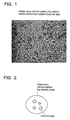
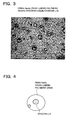
- the powder (A) thus obtained was measured by the multisizer, and the measured average particle size 2 ⁇ was 9 ⁇ m. Further, according to observation through a microscope (SEM), the powder (A) was made up of a grain aggregate in which the cross-linking polymeric grains bonded together while maintaining an individual shape of each of the cross-linking polymeric grains. In addition the powder (A) had the thermal decomposition initiating temperature of 270°C.
- Powder (B) which is a grain aggregate having the structure of the present application was obtained by repeating the same operation as with Example 1, except that in lieu of the dispersion liquid (2) containing the styrene-family cross-linking polymeric grains was adopted a blend liquid in which melamine cross-linking resin grains (produced by Nippon Shokubai Co., Ltd., Epostar S, an average particle size is 0.3 ⁇ m, a refractive index is 1.59) were dispersed in water using anion surface-active agent so that a solid component became 30 % by weight.
- melamine cross-linking resin grains produced by Nippon Shokubai Co., Ltd., Epostar S, an average particle size is 0.3 ⁇ m, a refractive index is 1.59
- the powder (B) thus obtained was measured by the multisizer, and the measured average particle size 2 ⁇ as a grain aggregate was 8 ⁇ m. Further, according to observation through a microscope (SEM), the powder (B) was made up of a grain aggregate in which the cross-linking polymeric grains bonded together while maintaining an individual shape of each of the cross-linking polymeric grains. In addition, the powder (B) had the thermal decomposition initiating temperature of 300°C.
- Powder (C) which is a grain aggregate having the structure of the present application was obtained by repeating the same operation as with Example 1, except that in lieu of the dispersion liquid (2) containing the styrene-family cross-linking polymeric grains was adopted a water dispersion body of silica grains (produced by Nippon Shokubai Co., Ltd., Seahostar KE-W30, an average particle size is 0.3 ⁇ m, a refractive index is 1.60).
- the powder (C) thus obtained was measured by the multisizer, and the measured average particle size 2 ⁇ as a grain aggregate was 8 ⁇ m. Further, according to observation through the SEM, the powder (C) was made up of a grain aggregate in which the cross-linking polymeric grains bonded together while maintaining an individual shape of each of the cross-linking polymeric grains. In addition, the powder (C) had the thermal decomposition initiating temperature of not less than 1,000°C. (EXAMPLE 4)
- Powder (D) which is a grain aggregate having the structure of the present application was obtained by repeating the same operation as with Example 1, except that in lieu of the dispersion liquid (2) containing the styrene-family cross-linking polymeric grains was adopted a blended dispersion liquid in which benzoguanamine-melamine resin grains (produced by Nippon Shokubai Co., Ltd., Epostar M30, an average particle size is 3 ⁇ m, a refractive index is 1.59) were added so that a solid component became 20 % by weight, to which the oxazoline group-containing polymer (same as above) was further added so that a solid component became 25 % by weight.
- benzoguanamine-melamine resin grains produced by Nippon Shokubai Co., Ltd., Epostar M30, an average particle size is 3 ⁇ m, a refractive index is 1.59
- the powder (D) thus obtained was measured by the multisizer, and the measured average particle size 2 ⁇ as a grain aggregate was 11.3 ⁇ m. Further, according to observation through the SEM, the powder(D) was made up of a grain aggregate in which the cross-linking polymeric grains bonded together while maintaining an individual shape of each of the cross-linking polymeric grains. In addition, the powder (D) had the thermal decomposition initiating temperature of not less than 300°C.
- Powder (E) which is a grain aggregate having the structure of the present application was obtained by repeating the same operation as with Example 1, except that in lieu of the dispersion liquid (2) containing the styrene-family cross-linking polymeric grains was adopted a blended dispersion liquid in which benzoguanamine resin grains (produced by Nippon Shokubai Co., Ltd., Epostar L15, an average particle size is 10 ⁇ m, a refractive index is 1.59) were added so that a solid component became 50 % by weight, to which the oxazoline group-containing polymer (same as above) was further added so that a solid component became 25 % by weight.
- benzoguanamine resin grains produced by Nippon Shokubai Co., Ltd., Epostar L15, an average particle size is 10 ⁇ m, a refractive index is 1.59
- the powder (E) thus obtained was measured by the multisizer, and the measured average particle size 2 ⁇ as a grain aggregate was 13.1 ⁇ m. Further, according to observation through the SEM, the powder (E) was made up of a grain aggregate in which the cross-linking polymeric grains bonded together while maintaining an individual shape of each of the cross-linking polymeric grains. In addition, the powder (E) had the thermal decomposition initiating temperature of not less than 300°C.
- the present comparative example corresponds to Examples 1 to 5 and is not a comparative example according to the present invention.
- Comparison-use Powder (F) was obtained by repeating the same operation as with EXAMPLE 1, except that in lieu of the dispersion liquid (1) containing the cross-linking polymeric grains was adopted only the dispersion liquid (2) containing the cross-linking polymeric grains. Accordingly, the comparison-use powder (F) was made up of a grain aggregate of a single type alone.
- the comparison-use powder (F) was measured by the multisizer, and the measured average particle size was 11 ⁇ m.
- polyester resin produced by Toyobo Co., Ltd., Vylon 200
- a dilution-use organic solvent 120 g of toluene and 30 g of methyl ethyl ketone, with which 20 g of the powder (A) obtained in Example 1 was blended, thereby obtaining a coating-use composition.
- a base material film As a base material film was adopted a polyester film (produced by Toray Industries, Inc., Lumirror #100T56) having a film thickness of 100 ⁇ m, and one side of the film was coated with the coating-use composition by roll coating. This was dried for one minute by hot air drying at 120°C so as to form a light-diffusing layer having a film thickness of 30 ⁇ m, thereby obtaining a film (10).
- a film (11) was obtained by repeating the same operation as with Example 6, except that the powder (A) was replaced with the powder (B).
- a film (12) was obtained by repeating the same operation as with Example 6, except that the powder (A) were replaced with the powder (C).
- a film (13) was obtained by repeating the same operation as with Example 6, except that the powder (A) were replaced with the powder (D). Further, according to observation through the SEM, as shown in Fig. 2, the film (13) was made up of a grain aggregate in which the cross-linking polymeric grains bonded together while maintaining an individual shape of the cross-linking polymeric grains.
- Fig. 1 shows a microphotograph of the grain aggregate.
- a film (14) was obtained by repeating the same operation as with Example 6, except that the powder (A) was replaced with the powder (E). Further, according to observation through the SEM, as shown in Fig. 4, the film (14) was made up of a grain aggregate in which the cross-linking polymeric grains bonded together while maintaining an individual shape of each of the cross-linking polymeric grains.
- Fig. 3 shows a microphotograph of the grain aggregate.
- the present comparative example corresponds to Examples 6 to 10 and is not a comparative example according to the present invention.
- a comparison-use film (15) was obtained by repeating the same operation as with Example 6, except that the powder (A) was replaced with the comparison-use powder (F) .
- the present comparative example corresponds to Examples 6 to 10 and is not a comparative example according to the present invention.
- a comparison-use film (16) was obtained by repeating the same operation as with Example 6, except that the powder (A) was replaced with a blend of the powder (D) and benzoguanamine-melamine resin grains (produced by Nippon Shokubai Co., Ltd., Epostar M30, an average particle size is 3 ⁇ m, a refractive index is 1.59) which were blended at a weight ratio of 4:1. Further, according to observation through the SEM, as shown in Fig. 6, the comparison-use film (16) was a blend of grains in which styrene-family cross-linking polymeric grains (powder (D)) and benzoguanamine-melamine resin grains were blended. Fig. 5 shows a microphotograph of the blend of grains.
- the present comparative example corresponds to Examples 6 to 10 and is not a comparative example according to the present invention.
- a comparison-use film (17) was obtained by repeating the same operation as with Example 6, except that the powder (A) were replaced with a blend of the powder (E) and benzoguanamine grains (produced by Nippon Shokubai Co., Ltd., Epostar L15, an average particle size is 10 ⁇ m, a refractive index is 1.59) which were blended at a weight ratio of 4:1. Further, according to observation through the SEM, as shown in Fig. 8, the comparison-use film (17) was a blend of grains in which the styrene-family cross-linking polymeric grains (powder (E)) and the benzoguanamine grains were blended. Fig. 7 shows a microphotograph of the blend of grains.
- the present comparative example corresponds to Examples 6 to 10 and is not a comparative example according to the present invention.
- a comparison-use film (18) was obtained by repeating the same operation as with Example 6, except that the powder (A) was replaced with the benzoguanamine grains (same as above). Further, according to observation through the SEM, as shown in Fig. 10, the comparison-use film (18) was made up of the benzoguanamine grains. Fig. 9 shows a microphotograph of the grains.
- a measurement of light-diffusing power and light transmissivity was performed with respect to the films (10) to (12) respectively obtained from Examples 6 to 10, and the comparison-use film (15) obtained in Comparative Example 2 through a procedure shown below. Namely, using a goniophotometer, horizontal light having a beam diameter of 1 mm was incident onto a light-diffusing layer in a vertical direction, and transmissivity of the emitting light was measured while changing a light-receiving angle.
- Table 1 shows the resultant light transmissivity of the film.
- the films (13) and (14) respectively obtained in Examples 9 and 10, or the comparison-use films (16) to (18) respectively obtained in Comparative Examples 3 to 5 were used to produce a LCD (liquid crystal) panel, thereby measuring light transmissivity of the LCD panel through a procedure shown below. Namely, as a measurement device was adopted an LCD-5200 (produced by Otsuka Electronic Co., Ltd.), and light transmissivity was measured by emitting light to the LCD panel under the condition that a measurement angle was in a range of -60° to 60°.
- a transmission angle was 0° at a point where the LCD panel and the emitting light intersected. Namely, when the transmission angle was 0°, light transmissivity was a maximum.
- Fig. 11 shows a graph of the measurement of light transmissivity in the film 13.
- Figs. 12, 13, 14 and 15 respectively show graphs of the measurements of light transmissivity in the film 14, the comparison-use film 16, the comparison-use film 17 and the comparison-use film 18.
- a blend of grains having the same composition as the films (13) and (14) respectively obtained in Examples 9 and 10 was produced so as to use it to produce a LCD panel by the same method as with Examples 9 and 10. Thereafter, light transmissivity of the LCD panel was measured under the same measurement conditions as with the LCD panels of Examples 9 and 10.
- Table 2 shows results of the measurement of light transmissivity using the LCD panels.
- the foregoing results show that using the grain aggregate made up of grains having different refractive indexes so as to form a LCD panel results in an improvement in light transmissivity at the transmission angle 0°, that is, 1.3 times to 2.1 times the light transmissivity of the LCD panel made up of the blend of grains in which grains were blended at an equal ratio.
- a blend liquid was obtained by blending the dispersion liquid (1) containing the PMMA-family cross-linking polymeric grains with the oxazoline group-containing polymer (produced by Nippon Shokubai Co., Ltd., Epocross K2020E) at a ratio of 100:10, where solid components were measured. Thereafter, the blend liquid was dried by the spray drier manufactured by Yamato Scientific Co., Ltd., under conditions shown below so as to obtain powder (G) which is a grain aggregate having the structure of the present application. The conditions are as follows:
- the powder (G) thus obtained was measured by the multisizer, and the measured average particle size 2 ⁇ was 9 ⁇ m. Further, according to observation through the SEM, the powder (G) was made up of a grain aggregate in which the cross-linking polymeric grains bonded together while maintaining an individual shape of each of the cross-linking polymeric grains.
- polyester resin Toyobo Co., Ltd., Vylon 200
- a dilution-use organic solvent 120 g of toluene and 30 g of methyl ethyl ketone, with which 20 g of the powder (G) obtained in Example 11 was blended, thereby obtaining a coating-use composition.
- a base material film As a base material film was adopted a polyester film (produced by Toray Industries, Inc., Lumirror #100T56) having a film thickness of 100 ⁇ m, and one side of the film was coated with the coating-use composition by roll coating. This was dried for one minute by hot air drying at 120°C so as to form a light-diffusing layer having a film thickness of 30 ⁇ m, thereby obtaining a film (20).
- the present comparative example corresponds to Example 12 and is not a comparative example according to the present invention.
- a comparison-use film (21) was obtained by repeating the same operation as with Example 11, except that in lieu of 20 g of powder (G) was adopted 30 g of spherical grains of a single type (produced by Nippon Shokubai Co., Ltd., Epostar MA1010, an average particle size is 10 ⁇ m).
- Table 3 shows the resultant light transmissivity of the films.
- a light-diffusing film in which a plurality of cross-linking polymeric grains bond together can attain higher transmissivity and a wider angle of visibility than a light-diffusing film made up of grains of a single type.
- a dispersion liquid (3) containing cross-linking polymeric grains, each of which has an average particle size of 0.2 ⁇ m was obtained by repeating the same operation as with Production Example 1, except that the blend of the vinyl-family monomers contained in the pre-emulsion was replaced with 560 g of methyl methacrylate and 140 g of divinyl benzene.
- a blend liquid was obtained by sufficiently blending 16 g of an emulsion of oxazoline group-containing polymer (produced by Nippon Shokubai Co., Ltd., Epocross K2020E, a solid component is 46 % by weight), that is a substance (binder) having a reactive functional group, with 200 g (37 % by weight of a solid component) of the dispersion liquid (1) containing the PMMA-family cross-linking polymeric grains.
- the blend liquid was dried by the spray drier manufactured by Yamato Scientific Co., Ltd., under conditions shown below, so as to obtain powder (H) which is a grain aggregate having the structure of the present application.
- the conditions are as follows:
- the powder (H) thus obtained was measured by the multisizer, and the measured average particle size 2 ⁇ as a grain aggregate was 14 ⁇ m. Further, according to observation through the SEM, the powder (H) was made up of a grain aggregate in which the cross-linking polymeric grains bonded together while maintaining an individual shape of each of the cross-linking polymeric grains.
- Powder (I) which is a grain aggregate having the structure of the present application was obtained by repeating the same operation as with Example 13, except that in lieu of the dispersion liquid (1) containing the PMMA-family cross-linking polymeric grains was adopted the dispersion liquid (3) containing the cross-linking polymeric grains.
- the powder (I) thus obtained was measured by the multisizer, and the measured average particle size 2 ⁇ as a grain aggregate was 14 ⁇ m. Further, according to observation through the SEM, the powder (I) was made up of a grain aggregate in which the cross-linking polymeric grains bonded together while maintaining an individual shape of each of the cross-linking polymeric grains. In addition, the powder (I) had the thermal decomposition initiating temperature of 290°C.
- the present comparative example corresponds to Examples 13 and 14 and is not a comparative example according to the present invention.
- Powder (J) having an average particle size of 14 ⁇ m was obtained by repeating the same operation as with Example 13, except that the binder (oxazoline group-containing polymer) was not added. According to observation through the SEM, the powder (J) was made up of a grain aggregate in which the cross-linking polymeric grains bonded together while maintaining an individual shape of each of the cross-linking polymeric grains.
- the present comparative example corresponds to Examples 13 and 14 and is not a comparative example according to the present invention.
- Comparison-use powder (K) was obtained by repeating the same operation as with Example 14, except that the binder (oxazoline group-containing polymer) was not added. According to observation through the SEM, the comparison-use powder (K) was dried intact, where a grain aggregate was not formed.
Landscapes
- Physics & Mathematics (AREA)
- Chemical & Material Sciences (AREA)
- Optics & Photonics (AREA)
- General Physics & Mathematics (AREA)
- Medicinal Chemistry (AREA)
- Organic Chemistry (AREA)
- Polymers & Plastics (AREA)
- Health & Medical Sciences (AREA)
- Chemical Kinetics & Catalysis (AREA)
- Dispersion Chemistry (AREA)
- Engineering & Computer Science (AREA)
- Manufacturing & Machinery (AREA)
- Optical Elements Other Than Lenses (AREA)
- Compositions Of Macromolecular Compounds (AREA)
- Processes Of Treating Macromolecular Substances (AREA)
Abstract
Description
| FILM | TRANSMISSIVITY IN VERTICAL DIRECTION | ANGLE AT WHICH TRANSMISSIVITY BECOMES A HALF OF THAT IN VERTICAL DIRECTION |
| (10) | 95 % | 32° |
| (11) | 95 % | 28° |
| (12) | 95 % | 30° |
| (15) FOR COMPARISON | 95 % | 23° |
the anti-blend value = light transmissivity of the LCD panel adopting the grain aggregate at the
(provided that the grain aggregate and the blend of grains have the same composition and measured under the same measurement conditions).
| FILM USED | TRANSMISSIVITY | ANTI-BLEND VALUE |
| (13) | 6.55 | 1.3 |
| (14) | 7.77 | 2.1 |
| (16) FOR COMPARISON | 5.14 | |
| (17) FOR COMPARISON | 3.73 | |
| (18) FOR COMPARISON | 3.88 |
| FILM | TRANSMISSIVITY IN VERTICAL DIRECTION | ANGLE AT WHICH TRANSMISSIVITY BECOMES A HALF OF THAT IN VERTICAL DIRECTION |
| (20) | 95 % | 20° |
| (21) FOR | 90 % | 15° |
Claims (13)
- A grain aggregate which includes a plurality of grains bonding together via a binder, characterized in that:
the binder is a substance having a reactive functional group. - The grain aggregate which includes the plurality of grains bonding together as set forth in Claim 1, characterized in that:
each of the plurality of grains has an average particle size falling within a range of 0.01 µm to 1 µm, and the grain aggregate to be obtained has an average particle size falling within a range of 2 µm to 200 µm. - The grain aggregate as set forth in Claim 1 or 2, wherein each of the plurality of grains is made of an organic substance.
- The grain aggregate as set forth in Claim 3, wherein the plurality of grains each made of an organic substance are cross-linking polymeric grains and/or cross-linking resin grains.
- The grain aggregate as set forth in Claim 1 or 2, wherein the plurality of grains include a grain made of an inorganic substance and a grain made of an organic substance.
- The grain aggregate which includes the plurality of grains bonding together as set forth in either one of Claims 1 to 5, wherein a thermal decomposition initiating temperature of the grains being not less than 170°C.
- The grain aggregate which includes the plurality of grains bonding together via the binder as set forth in either one of Claims 1 to 6, wherein a molecule of the binder has at least two functional groups, each of the functional groups being one selected from the group consisting of a hydroxyl group, a carboxyl group, an oxazoline group, an epoxy group, an aziridine group and an isocyanate group.
- The grain aggregate as set forth in either one of Claims 1 to 7, wherein spray drying of a binder which is a substance having a reactive functional group and a grain dispersion liquid containing the plurality of grains is performed.
- The grain aggregate as set forth in Claim 8, wherein the grain dispersion liquid contains the binder which is a substance having a reactive functional group.
- A producing method of a grain aggregate which includes a plurality of grains bonding together, each of the plurality of grains has an average particle size falling within a range of 0.01 µm to 1 µm, and the grain aggregate has an average particle size falling within a range of 2 µ m to 200 µm, characterized by including the step of:
drying by spraying a dispersion liquid containing the plurality of grains. - The producing method of the grain aggregate as set forth in Claim 10, including the step of drying by spraying a blend of a dispersion liquid containing the plurality of grains and a binder which is a substance having a reactive functional group, a molecule of the binder has at least two functional groups, each of the functional groups being one selected from the group consisting of a hydroxyl group, a carboxyl group, an oxazoline group, an epoxy group, an aziridine group and an isocyanate group.
- A light-diffusing agent, characterized by including the grain aggregate as set forth in either one of Claims 1 to 9.
- A light-diffusing mold article containing the light-diffusing agent as set forth in Claim 12.
Applications Claiming Priority (2)
| Application Number | Priority Date | Filing Date | Title |
|---|---|---|---|
| JP2000140450 | 2000-05-12 | ||
| JP2000140450 | 2000-05-12 |
Publications (2)
| Publication Number | Publication Date |
|---|---|
| EP1153959A2 true EP1153959A2 (en) | 2001-11-14 |
| EP1153959A3 EP1153959A3 (en) | 2004-11-24 |
Family
ID=18647740
Family Applications (1)
| Application Number | Title | Priority Date | Filing Date |
|---|---|---|---|
| EP01401149A Withdrawn EP1153959A3 (en) | 2000-05-12 | 2001-05-03 | Grain aggregate and producing method thereof, and light-diffusing agent |
Country Status (5)
| Country | Link |
|---|---|
| US (1) | US6610405B2 (en) |
| EP (1) | EP1153959A3 (en) |
| KR (1) | KR100504601B1 (en) |
| CN (1) | CN1271123C (en) |
| TW (1) | TWI287024B (en) |
Cited By (1)
| Publication number | Priority date | Publication date | Assignee | Title |
|---|---|---|---|---|
| EP1852719A4 (en) * | 2005-02-21 | 2010-11-10 | Fujifilm Corp | Method of designing diffusion film, process for producing the same, and diffusion film obtained thereby |
Families Citing this family (8)
| Publication number | Priority date | Publication date | Assignee | Title |
|---|---|---|---|---|
| US7858148B2 (en) | 2003-04-24 | 2010-12-28 | Usgreentech, L.L.C. | Filler for artificial turf system |
| US6884509B2 (en) * | 2003-04-24 | 2005-04-26 | U.S. Greentech, Llc | Special turf filler comprising silica particles |
| US8263203B2 (en) | 2003-04-24 | 2012-09-11 | Usgreentech, L.L.C. | Filler for artificial turf system |
| KR100737979B1 (en) * | 2005-03-18 | 2007-07-13 | 도레이새한 주식회사 | Pore-formed light-diffusing film |
| JP5952823B2 (en) * | 2010-10-29 | 2016-07-13 | ローム アンド ハース カンパニーRohm And Haas Company | Thermoplastic composition, method for producing the same, and article produced therefrom |
| US9499713B2 (en) * | 2011-08-31 | 2016-11-22 | Sekisui Plastics Co., Ltd. | Resin particle aggregate, method for manufacturing same and application of same |
| EP3153549A1 (en) * | 2015-10-30 | 2017-04-12 | Kronos International, Inc. | The preparation of matt paints and printing inks |
| US10920073B2 (en) * | 2015-12-11 | 2021-02-16 | Kaneka Corporation | Polyurethane curable composition containing polymer fine particles excellent in mechanical strength |
Family Cites Families (25)
| Publication number | Priority date | Publication date | Assignee | Title |
|---|---|---|---|---|
| US3916065A (en) * | 1972-12-18 | 1975-10-28 | Xerox Corp | Electrostatographic carrier particles |
| US4042653A (en) * | 1974-07-31 | 1977-08-16 | Scm Corporation | Process for spray forming of discrete particles |
| SU924059A1 (en) * | 1980-06-09 | 1982-04-30 | Kemerowskij Nii Chim Promy | METHOD OF GRANULATION OF PHENOPLASTS1 |
| US4920090A (en) * | 1987-05-15 | 1990-04-24 | Henkel Kommanditgesellschaft Auf Aktien | Process for the formation of shaped agglomerates from particulate solids |
| WO1989002905A1 (en) | 1987-09-25 | 1989-04-06 | Mitsubishi Rayon Co., Ltd. | Process for continuously producing granular polymer and process for controlling particle size of said polymer |
| JP3154477B2 (en) | 1988-05-16 | 2001-04-09 | 三井化学株式会社 | Fine particle aggregate emulsion and method for producing the same |
| ES2072298T3 (en) | 1988-05-16 | 1995-07-16 | Mitsui Toatsu Chemicals | ADDED EMULSION OF FINE PARTICLES, PROCESS FOR THE ELABORATION OF THE ABOVE EMULSION, THERMAL RECORDING MEANS, COATED PAPER AND PAINTING INCORPORATED BY THE ABOVE EMULSION. |
| JP2728887B2 (en) | 1988-08-10 | 1998-03-18 | 三井東圧化学株式会社 | Thermal recording material |
| JPH0822983B2 (en) * | 1990-02-27 | 1996-03-06 | 日本ペイント株式会社 | Crosslinked fine resin particles and their applications |
| JPH0535124A (en) | 1991-07-29 | 1993-02-12 | Sharp Corp | Electrophotographic copying machine |
| JPH07198910A (en) | 1993-12-30 | 1995-08-01 | Somar Corp | Light diffusion film |
| JPH0816732A (en) | 1994-06-28 | 1996-01-19 | Harris Corp | Hot-pluggable motherboard bus connection method |
| JP3651029B2 (en) | 1994-10-19 | 2005-05-25 | 松下電器産業株式会社 | Water heater wall hanging device |
| JPH08118830A (en) | 1994-10-20 | 1996-05-14 | Fujicopian Co Ltd | Thermal transfer recording medium |
| DE19516253A1 (en) * | 1995-04-26 | 1996-10-31 | Grace Gmbh | Matting agent based on aggregated silicon dioxide with improved efficiency |
| JPH09211207A (en) | 1996-02-01 | 1997-08-15 | Nitto Denko Corp | Light control film |
| JPH09229202A (en) | 1996-02-20 | 1997-09-05 | Nok Corp | Sealing device |
| JP3753785B2 (en) | 1996-05-14 | 2006-03-08 | 日東電工株式会社 | Light diffusion film and surface light source device using the same |
| JPH09304607A (en) | 1996-05-16 | 1997-11-28 | Nitto Denko Corp | Light diffusion film |
| EP0842223B2 (en) * | 1996-06-05 | 2008-11-12 | Arkema France | Multiphase thermoplastic resin compositions. |
| US5807506A (en) * | 1997-04-01 | 1998-09-15 | Xerox Corporation | Conductive polymers |
| JPH1164611A (en) | 1997-08-26 | 1999-03-05 | Nitto Denko Corp | Light diffusion film |
| JP3523075B2 (en) | 1998-08-04 | 2004-04-26 | 株式会社日本触媒 | Fine particle aggregate and its manufacturing method |
| DE19924091A1 (en) * | 1999-05-26 | 2000-11-30 | Bayer Ag | Composite material made of polyurethane and at least one thermoplastic, a process for its manufacture and its use in motor vehicles |
| US6312807B1 (en) * | 1999-08-09 | 2001-11-06 | 3M Innovative Properties Company | UV-absorbing core/shell particles |
-
2001
- 2001-05-03 US US09/847,367 patent/US6610405B2/en not_active Expired - Fee Related
- 2001-05-03 EP EP01401149A patent/EP1153959A3/en not_active Withdrawn
- 2001-05-11 TW TW090111240A patent/TWI287024B/en not_active IP Right Cessation
- 2001-05-11 KR KR10-2001-0025923A patent/KR100504601B1/en not_active Expired - Fee Related
- 2001-05-14 CN CNB011160640A patent/CN1271123C/en not_active Expired - Fee Related
Cited By (1)
| Publication number | Priority date | Publication date | Assignee | Title |
|---|---|---|---|---|
| EP1852719A4 (en) * | 2005-02-21 | 2010-11-10 | Fujifilm Corp | Method of designing diffusion film, process for producing the same, and diffusion film obtained thereby |
Also Published As
| Publication number | Publication date |
|---|---|
| TWI287024B (en) | 2007-09-21 |
| US6610405B2 (en) | 2003-08-26 |
| KR100504601B1 (en) | 2005-08-03 |
| CN1323849A (en) | 2001-11-28 |
| KR20020002198A (en) | 2002-01-09 |
| US20010051268A1 (en) | 2001-12-13 |
| CN1271123C (en) | 2006-08-23 |
| EP1153959A3 (en) | 2004-11-24 |
Similar Documents
| Publication | Publication Date | Title |
|---|---|---|
| JP4002320B2 (en) | Silica composite resin particles and production method thereof | |
| CN101414018B (en) | Light diffusing articles | |
| TWI386448B (en) | Light-scattering compositions | |
| CN100595647C (en) | Light-diffusing layer, light-diffusing film, and light-diffusing adhesive sheet | |
| TW200305597A (en) | Optical diffusion layer, method for preparing same, polarizing plate and liquid crystal device | |
| JPH0516002B2 (en) | ||
| US6610405B2 (en) | Grain aggregate and producing method thereof, and light-diffusing agent | |
| WO2007086483A1 (en) | Irregular-shaped particle, irregular-shaped particle composition, method for producing same, and light diffusion molded article | |
| JP5401891B2 (en) | LIGHT-DIFFUSING PARTICLE, PROCESS FOR PRODUCING THE SAME, LIGHT-DIFFUSING PARTICLE COMPOSITION, AND LIGHT-DIFFUSING FILM | |
| JP4109449B2 (en) | Fine particle aggregate and method for producing the same | |
| JP3478973B2 (en) | Light diffusion sheet | |
| JP4907012B2 (en) | Fine particle aggregate and method for producing the same | |
| JP4410893B2 (en) | Light diffusing agent | |
| KR100837090B1 (en) | Particles for light diffusion, a manufacturing method thereof and a light diffusion plate using the same | |
| CN100565249C (en) | Diffusing film design method and manufacturing method, and diffusing film obtained therefrom | |
| JP2004226604A (en) | Synthetic resin particles, light diffusion plate, backlight unit for liquid crystal display device and liquid crystal display device | |
| JPH04279668A (en) | Light diffusing resin | |
| JP2006084927A (en) | Light diffusing agent and its manufacturing method | |
| JP4634184B2 (en) | Light diffusing agent and light diffusing resin composition using the same | |
| CN1298745C (en) | Method for preparing hollow microspheres self film-formed in latex of low soap system | |
| JP2006312746A (en) | Application of silica composite resin particle | |
| Chen et al. | Preparation of monodisperse polystyrene microspheres and optical performance of its diffusive‐agent application | |
| JP2002249525A (en) | Light diffusion sheet forming resin particles, resin composition and light diffusion sheet | |
| JPH01287161A (en) | Acrylic resin composition for molded body excellent in matte property, molded product and production thereof | |
| KR100411851B1 (en) | Film for back-light unit of LCD |
Legal Events
| Date | Code | Title | Description |
|---|---|---|---|
| PUAI | Public reference made under article 153(3) epc to a published international application that has entered the european phase |
Free format text: ORIGINAL CODE: 0009012 |
|
| AK | Designated contracting states |
Kind code of ref document: A2 Designated state(s): AT BE CH CY DE DK ES FI FR GB GR IE IT LI LU MC NL PT SE TR |
|
| AX | Request for extension of the european patent |
Free format text: AL;LT;LV;MK;RO;SI |
|
| PUAL | Search report despatched |
Free format text: ORIGINAL CODE: 0009013 |
|
| AK | Designated contracting states |
Kind code of ref document: A3 Designated state(s): AT BE CH CY DE DK ES FI FR GB GR IE IT LI LU MC NL PT SE TR |
|
| AX | Request for extension of the european patent |
Extension state: AL LT LV MK RO SI |
|
| 17P | Request for examination filed |
Effective date: 20050430 |
|
| AKX | Designation fees paid |
Designated state(s): BE DE FR GB NL |
|
| GRAP | Despatch of communication of intention to grant a patent |
Free format text: ORIGINAL CODE: EPIDOSNIGR1 |
|
| RIC1 | Information provided on ipc code assigned before grant |
Ipc: G02B 5/02 20060101ALI20080723BHEP Ipc: C08F 6/18 20060101ALI20080723BHEP Ipc: C08J 3/12 20060101AFI20080723BHEP |
|
| STAA | Information on the status of an ep patent application or granted ep patent |
Free format text: STATUS: THE APPLICATION IS DEEMED TO BE WITHDRAWN |
|
| 18D | Application deemed to be withdrawn |
Effective date: 20081219 |