EP1153776A2 - Automotive secondary loop air conditioning system - Google Patents
Automotive secondary loop air conditioning system Download PDFInfo
- Publication number
- EP1153776A2 EP1153776A2 EP01201256A EP01201256A EP1153776A2 EP 1153776 A2 EP1153776 A2 EP 1153776A2 EP 01201256 A EP01201256 A EP 01201256A EP 01201256 A EP01201256 A EP 01201256A EP 1153776 A2 EP1153776 A2 EP 1153776A2
- Authority
- EP
- European Patent Office
- Prior art keywords
- reservoir
- volume
- secondary loop
- air conditioning
- refrigerant
- Prior art date
- Legal status (The legal status is an assumption and is not a legal conclusion. Google has not performed a legal analysis and makes no representation as to the accuracy of the status listed.)
- Withdrawn
Links
Images


Classifications
-
- B—PERFORMING OPERATIONS; TRANSPORTING
- B60—VEHICLES IN GENERAL
- B60H—ARRANGEMENTS OF HEATING, COOLING, VENTILATING OR OTHER AIR-TREATING DEVICES SPECIALLY ADAPTED FOR PASSENGER OR GOODS SPACES OF VEHICLES
- B60H1/00—Heating, cooling or ventilating devices
- B60H1/00321—Heat exchangers for air-conditioning devices
- B60H1/00342—Heat exchangers for air-conditioning devices of the liquid-liquid type
-
- B—PERFORMING OPERATIONS; TRANSPORTING
- B60—VEHICLES IN GENERAL
- B60H—ARRANGEMENTS OF HEATING, COOLING, VENTILATING OR OTHER AIR-TREATING DEVICES SPECIALLY ADAPTED FOR PASSENGER OR GOODS SPACES OF VEHICLES
- B60H1/00—Heating, cooling or ventilating devices
- B60H1/32—Cooling devices
- B60H1/3204—Cooling devices using compression
- B60H1/3228—Cooling devices using compression characterised by refrigerant circuit configurations
- B60H1/32281—Cooling devices using compression characterised by refrigerant circuit configurations comprising a single secondary circuit, e.g. at evaporator or condenser side
-
- B—PERFORMING OPERATIONS; TRANSPORTING
- B60—VEHICLES IN GENERAL
- B60H—ARRANGEMENTS OF HEATING, COOLING, VENTILATING OR OTHER AIR-TREATING DEVICES SPECIALLY ADAPTED FOR PASSENGER OR GOODS SPACES OF VEHICLES
- B60H1/00—Heating, cooling or ventilating devices
- B60H1/32—Cooling devices
- B60H1/3204—Cooling devices using compression
- B60H1/323—Cooling devices using compression characterised by comprising auxiliary or multiple systems, e.g. plurality of evaporators, or by involving auxiliary cooling devices
-
- F—MECHANICAL ENGINEERING; LIGHTING; HEATING; WEAPONS; BLASTING
- F25—REFRIGERATION OR COOLING; COMBINED HEATING AND REFRIGERATION SYSTEMS; HEAT PUMP SYSTEMS; MANUFACTURE OR STORAGE OF ICE; LIQUEFACTION SOLIDIFICATION OF GASES
- F25B—REFRIGERATION MACHINES, PLANTS OR SYSTEMS; COMBINED HEATING AND REFRIGERATION SYSTEMS; HEAT PUMP SYSTEMS
- F25B25/00—Machines, plants or systems, using a combination of modes of operation covered by two or more of the groups F25B1/00 - F25B23/00
- F25B25/005—Machines, plants or systems, using a combination of modes of operation covered by two or more of the groups F25B1/00 - F25B23/00 using primary and secondary systems
-
- F—MECHANICAL ENGINEERING; LIGHTING; HEATING; WEAPONS; BLASTING
- F25—REFRIGERATION OR COOLING; COMBINED HEATING AND REFRIGERATION SYSTEMS; HEAT PUMP SYSTEMS; MANUFACTURE OR STORAGE OF ICE; LIQUEFACTION SOLIDIFICATION OF GASES
- F25B—REFRIGERATION MACHINES, PLANTS OR SYSTEMS; COMBINED HEATING AND REFRIGERATION SYSTEMS; HEAT PUMP SYSTEMS
- F25B2400/00—Component parts or details not otherwise provided for in this subclass
- F25B2400/04—Refrigeration circuit bypassing means
- F25B2400/0415—Refrigeration circuit bypassing means for receivers
-
- F—MECHANICAL ENGINEERING; LIGHTING; HEATING; WEAPONS; BLASTING
- F25—REFRIGERATION OR COOLING; COMBINED HEATING AND REFRIGERATION SYSTEMS; HEAT PUMP SYSTEMS; MANUFACTURE OR STORAGE OF ICE; LIQUEFACTION SOLIDIFICATION OF GASES
- F25B—REFRIGERATION MACHINES, PLANTS OR SYSTEMS; COMBINED HEATING AND REFRIGERATION SYSTEMS; HEAT PUMP SYSTEMS
- F25B2500/00—Problems to be solved
- F25B2500/26—Problems to be solved characterised by the startup of the refrigeration cycle
-
- F—MECHANICAL ENGINEERING; LIGHTING; HEATING; WEAPONS; BLASTING
- F28—HEAT EXCHANGE IN GENERAL
- F28D—HEAT-EXCHANGE APPARATUS, NOT PROVIDED FOR IN ANOTHER SUBCLASS, IN WHICH THE HEAT-EXCHANGE MEDIA DO NOT COME INTO DIRECT CONTACT
- F28D9/00—Heat-exchange apparatus having stationary plate-like or laminated conduit assemblies for both heat-exchange media, the media being in contact with different sides of a conduit wall
- F28D9/0031—Heat-exchange apparatus having stationary plate-like or laminated conduit assemblies for both heat-exchange media, the media being in contact with different sides of a conduit wall the conduits for one heat-exchange medium being formed by paired plates touching each other
- F28D9/0043—Heat-exchange apparatus having stationary plate-like or laminated conduit assemblies for both heat-exchange media, the media being in contact with different sides of a conduit wall the conduits for one heat-exchange medium being formed by paired plates touching each other the plates having openings therein for circulation of at least one heat-exchange medium from one conduit to another
- F28D9/005—Heat-exchange apparatus having stationary plate-like or laminated conduit assemblies for both heat-exchange media, the media being in contact with different sides of a conduit wall the conduits for one heat-exchange medium being formed by paired plates touching each other the plates having openings therein for circulation of at least one heat-exchange medium from one conduit to another the plates having openings therein for both heat-exchange media
Definitions
- This invention relates to automotive air conditioning systems in general, and specifically to a secondary loop system that provides an improved performance.
- Typical automotive air conditioning systems use the familiar refrigerant cycle system of compressor, condenser, expansion valve and evaporator, through which pressurized refrigerant is continually pumped while the compressor is active.
- An inherent drawback of the typical system is that it is either on or off. That is, there is no thermal storage or reservoir capacity in such a system that can take over temporarily to maintain passenger comfort when the compressor is turned off for a short time, or which can be activated initially to provide cooling capacity when the system has been shut down for a relatively longer time.
- a secondary loop system provides the potential for a reservoir of cooling capacity.
- the conventional refrigerant loop is not used to directly cool the air that is blown into the passenger space.
- an intermediate, two fluid heat exchanger typically known as a chiller, cools a secondary, non pressurized liquid by heat exchange with the cold refrigerant.
- the cooled secondary liquid is then pumped in a second circuit to one or more air to liquid heat exchangers, over which cooled air is blown into the passenger space.
- the non pressurized liquid in the secondary loop it is feasible to provide a large volume reservoir of "cold", from which cold liquid can continue to be pumped, even when the primary, refrigerant circuit and its compressor is shut down. Such a reservoir is not possible with just a refrigerant loop.
- a potential drawback of the secondary loop system is the response of the reservoir after a long period of system shut down, or "soak" as it is sometimes called. Then, the large reservoir of "cold” becomes a large reservoir of "hot” instead, feeding the secondary loop with hot liquid until the whole system can be cooled down. Under those circumstances, the reservoir can actually lengthen the response time and delay passenger comfort.
- the invention provides an improved secondary loop system that maintains the ability of the system to bridge temporary, shorter shut downs of the refrigerant loop, but which avoids the lag problem inherent in a long shut down.
- a basically conventional primary refrigerant loop provides expanded and "cold" refrigerant, but not directly to an evaporator within the vehicle interior, but rather to one half of a so called “chiller.”
- an unpressurized, warm secondary liquid is cooled by the cold refrigerant, and pumped through a secondary loop to a liquid to air heat exchanger within the vehicle passenger space.
- the interior, non pressurized heat exchanger provides cooled air to the passenger space.
- a large liquid reservoir is interposed. The reservoir liquid becomes chilled as the system operates and, if the primary, refrigerant loop is temporarily shut down for some reason, can continue to provide cold liquid (and cooled air) to the passenger space.
- the reservoir also has novel features that avoid the lag time problem inherent in long periods of shut downs.
- the reservoir contains a means to temporarily by pass the greatest portion of the reservoir volume when the liquid in the reservoir has become too warm to meet passenger comfort demands.
- the reservoir is provided with either a smaller volume portion, or a complete by pass, which is initially engaged, so that the entire reservoir volume need not be cooled down at the start.
- the secondary loop and secondary, interior heat exchanger will reach comfort temperature more quickly than they would if the entire reservoir volume had to be cooled down as well.
- a suitable cold temperature is achieved in the by passed secondary loop, the larger portion of reservoir volume is brought on line gradually, so as to not impact passenger comfort, until it, too, has been cooled down to the same degree. Now, the entire volume of the reservoir is sufficiently cooled to provide a "cold reserve.”
- a secondary loop system is generally disclosed and illustrated.
- the primary loop includes most of the components found in a conventional system, and operates in similar fashion.
- the prime mover is a compressor 10, which compresses hot refrigerant vapor and pumps it to a condenser 12, where it is condensed ultimately to a liquid form.
- the still pressurized liquid refrigerant from condenser 12 is forced through an expansion valve 14, after which, in its expanded, cooled state it enters, not a conventional evaporator, but a "chiller" 16, described in more detail below.
- the cold refrigerant vapor picks up heat, not directly from hot vehicle passenger space air, but from a non pressurized liquid medium.
- the heated refrigerant vapor continues on to re enter compressor 10 to renew the cycle.
- chiller 16 which is a two fluid heat exchanger, made up of an alternating stack of "plates” or flattened flow tubes. Cold, expanded refrigerant is fed to every other tube, through refrigerant inlet/outlets 18. A suitable liquid medium, such as ethylene glycol or water, or a mixture of the two, is pumped under low pressure to every other tube through liquid inlet/outlets 20.
- a heat exchanger like chiller 16 may be used to keep a toxic refrigerant separate from a non toxic liquid, so that the cooled, non toxic liquid may be used to cool food or the like. That is not the concern here, but the separate loops do provide another advantage.
- the cooled liquid is circulated by a low pressure pump 22 from a reservoir, indicated generally at 24.
- a reservoir indicated generally at 24.
- cold liquid is pumped through an air to liquid heat exchanger 26 inside a ventilation module 28 within the vehicle passenger space.
- hot passenger space air is blown over the interior heat exchanger 26, to be cooled to a suitable passenger comfort level.
- Interior heat exchanger 26 takes the place of a conventional evaporator, and provides the same function.
- From interior heat exchanger 26, now warmed liquid coolant re enters reservoir 24 and chiller 16 to be re cooled by the cold refrigerant.
- the main advantage of the system illustrated is the reservoir 24, which provides a store of cooled liquid that can continue to be pumped to interior heat exchanger 26, even if the compressor 10 in the main loop is shut down.
- a conventional, single loop air conditioning system has no such "cold reservoir".
- the compressor 10 can be a severe drain on vehicle power, especially during acceleration, especially in smaller vehicles with smaller engines. Mileage can be improved if the capability exists for shutting compressor 10 down selectively, without compromising passenger comfort, and the reservoir 24 potentially provides that option.
- a drawback to the reservoir is that it will, during periods of prolonged shut down, reach hot ambient temperatures and become a "hot sink," increasing the lag time before the secondary loop can reach a suitable passenger comfort temperature threshold.
- Reservoir 24 is divided by an interior wall 30 into a larger, main volume 32 and a smaller volume 34.
- a by pass line 36 branches off from the main line 38 through smaller volume 34.
- a proportioning or metering valve 40 interrupts the main line 38 running out of the main reservoir volume 32, upstream of the point where the by pass line 36 re joins the main line 38.
- Valve 40 includes stepper motor, pulse width modulated solenoid, or other means that allows it to be selectively either completely closed, completely opened, or fractionally opened on command. If valve 40 is completely shut, no flow of liquid medium can run through the main volume 32 at all, and if completely open, flow will run through both main volume 32 and the smaller volume at substantially equal rates. At fractional settings of valve 40, flow will run through the larger volume 32 at varying rates.
- both portions of the reservoir 24 are "hot,” that is, at a substantially equal ambient temperature, as indicated by the equivalent shading.
- the vehicle's control system sensing the hot condition of reservoir 24, sends a signal to valve 40 to keep it fully shut, sending all liquid flow preferentially through the by pass line 36 and the smaller reservoir volume 34 only.
- the overall system need only initially cool down this smaller volume of liquid coolant in order for the entire secondary loop (including the interior heat exchanger 26) to reach a suitable passenger comfort temperature.
- the cold temperature in the smaller volume 34 only is indicated by the differential shading. This initial cool down of the smaller volume 34 will occur much more quickly than if the entire volume of both reservoir portions 32 and 34 had to be cooled down to the same extent. Air blown over the interior heat exchanger 26 will be noticeably cooler sooner to the passengers as well.
- the metering valve 40 can be partially opened to start to feed some of the liquid coolant flow into, and through, the larger volume portion 32 and back through the main line 38. This is indicated by the small flow arrows, but the shading indicates that the large volume side of reservoir 24 is still hot. It will, however, begin to gradually cool down as it gradually dumps its accumulated heat into the secondary loop and ultimately through the chiller 16, into the condenser 12, and back to ambient. As the vehicle's control system senses the temperature in the larger volume portion 32 beginning to drop (either through direct sensing, or through passage of some predetermined time), then valve 40 can be opened farther, as indicated by the larger flow arrows in Figure 6. Valve 40 can be opened farther and farther, either continuously or in pre determined, timed increments, as the cool down process of the larger volume reservoir portion 32 proceeds.
- the larger volume reservoir portion 32 will eventually cool down to match the temperature in the smaller portion 34, and valve 40 can be fully opened.
- the two sections of the reservoir 24 effectively act as one large volume, as indicated by the identical shading in the Figure.
- the pump 22 can continue to provide cold liquid medium, from reservoir 24, to the interior heat exchanger 26.
- this gives the potential for the vehicle controller to selectively turn compressor 10 off during peak power usage events without unduly compromising passenger comfort.
- the system could respond equally well to prolonged periods of compressor shut down while the vehicle was operating. That is, if the reservoir 24 became as warm as it would during a prolonged soak period, the same process of by pass and gradual pull down of the larger reservoir volume 32 could be started.
- Figure 8 shows a potential alternate embodiment of the reservoir 24, indicated generally at 42.
- the reservoir 42 is by passed completely by a by pass line 44 that branches off from the main line 46 running through the reservoir 42.
- a similar metering valve 48 selectively blocks the main line 46, and proportionately by passes flow from and around the entire reservoir 42, to achieve the same result.
- the alternate embodiment represents the case where the smaller reservoir volume 34 becomes as small as the volume of the by pass line itself.
Landscapes
- Engineering & Computer Science (AREA)
- Physics & Mathematics (AREA)
- Thermal Sciences (AREA)
- Mechanical Engineering (AREA)
- General Engineering & Computer Science (AREA)
- Air-Conditioning For Vehicles (AREA)
Abstract
Description
- This application claims the benefit of previously filed provisional application Serial No. 60/203,200 filed May 11, 2000.
- This invention relates to automotive air conditioning systems in general, and specifically to a secondary loop system that provides an improved performance.
- Typical automotive air conditioning systems use the familiar refrigerant cycle system of compressor, condenser, expansion valve and evaporator, through which pressurized refrigerant is continually pumped while the compressor is active. An inherent drawback of the typical system is that it is either on or off. That is, there is no thermal storage or reservoir capacity in such a system that can take over temporarily to maintain passenger comfort when the compressor is turned off for a short time, or which can be activated initially to provide cooling capacity when the system has been shut down for a relatively longer time.
- A secondary loop system provides the potential for a reservoir of cooling capacity. In such a system, the conventional refrigerant loop is not used to directly cool the air that is blown into the passenger space. Instead, an intermediate, two fluid heat exchanger, typically known as a chiller, cools a secondary, non pressurized liquid by heat exchange with the cold refrigerant. The cooled secondary liquid is then pumped in a second circuit to one or more air to liquid heat exchangers, over which cooled air is blown into the passenger space. With the non pressurized liquid in the secondary loop, it is feasible to provide a large volume reservoir of "cold", from which cold liquid can continue to be pumped, even when the primary, refrigerant circuit and its compressor is shut down. Such a reservoir is not possible with just a refrigerant loop.
- A potential drawback of the secondary loop system is the response of the reservoir after a long period of system shut down, or "soak" as it is sometimes called. Then, the large reservoir of "cold" becomes a large reservoir of "hot" instead, feeding the secondary loop with hot liquid until the whole system can be cooled down. Under those circumstances, the reservoir can actually lengthen the response time and delay passenger comfort.
- The invention provides an improved secondary loop system that maintains the ability of the system to bridge temporary, shorter shut downs of the refrigerant loop, but which avoids the lag problem inherent in a long shut down.
- In the embodiment disclosed, a basically conventional primary refrigerant loop provides expanded and "cold" refrigerant, but not directly to an evaporator within the vehicle interior, but rather to one half of a so called "chiller." Within the chiller, an unpressurized, warm secondary liquid is cooled by the cold refrigerant, and pumped through a secondary loop to a liquid to air heat exchanger within the vehicle passenger space. The interior, non pressurized heat exchanger provides cooled air to the passenger space. Within the secondary, pumped liquid loop, a large liquid reservoir is interposed. The reservoir liquid becomes chilled as the system operates and, if the primary, refrigerant loop is temporarily shut down for some reason, can continue to provide cold liquid (and cooled air) to the passenger space.
- The reservoir also has novel features that avoid the lag time problem inherent in long periods of shut downs. The reservoir contains a means to temporarily by pass the greatest portion of the reservoir volume when the liquid in the reservoir has become too warm to meet passenger comfort demands. The reservoir is provided with either a smaller volume portion, or a complete by pass, which is initially engaged, so that the entire reservoir volume need not be cooled down at the start. The secondary loop and secondary, interior heat exchanger will reach comfort temperature more quickly than they would if the entire reservoir volume had to be cooled down as well. When a suitable cold temperature is achieved in the by passed secondary loop, the larger portion of reservoir volume is brought on line gradually, so as to not impact passenger comfort, until it, too, has been cooled down to the same degree. Now, the entire volume of the reservoir is sufficiently cooled to provide a "cold reserve."
- These and other features of the invention will appear from the following written description, and from the drawings, in which:
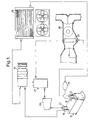
- Figure 1 is a schematic of a secondary loop system in general;
- Figure 2 shows a chiller of the type used in the system;
- Figure 3 shows a modified reservoir according to the invention, in its condition following a prolonged shut down;
- Figure 4 shows the reservoir in operation just after start up, with the main volume of the reservoir by passed;
- Figure 5 shows the reservoir later in its operation, when the main volume of the reservoir is being gradually brought on line;
- Figure 6 shows the reservoir later yet in its operation, when the main portion of the reservoir has begun to cool down, and flow through it has been increased;
- Figure 7 shows the reservoir in operation after it has been fully cooled, and full flow has been re established through the main volume;
- Figure 8 shows an alternate embodiment to the reservoir configuration.
-
- Referring first to Figure 1, a secondary loop system is generally disclosed and illustrated. The primary loop, described first, includes most of the components found in a conventional system, and operates in similar fashion. The prime mover is a
compressor 10, which compresses hot refrigerant vapor and pumps it to acondenser 12, where it is condensed ultimately to a liquid form. The still pressurized liquid refrigerant fromcondenser 12 is forced through anexpansion valve 14, after which, in its expanded, cooled state it enters, not a conventional evaporator, but a "chiller" 16, described in more detail below. In essence, withinchiller 16, the cold refrigerant vapor picks up heat, not directly from hot vehicle passenger space air, but from a non pressurized liquid medium. The heated refrigerant vapor continues on to re entercompressor 10 to renew the cycle. - Referring next to Figures 1 and 2, the secondary loop is described in more detail. The heart of the secondary loop is
chiller 16, which is a two fluid heat exchanger, made up of an alternating stack of "plates" or flattened flow tubes. Cold, expanded refrigerant is fed to every other tube, through refrigerant inlet/outlets 18. A suitable liquid medium, such as ethylene glycol or water, or a mixture of the two, is pumped under low pressure to every other tube through liquid inlet/outlets 20. In other applications, a heat exchanger likechiller 16 may be used to keep a toxic refrigerant separate from a non toxic liquid, so that the cooled, non toxic liquid may be used to cool food or the like. That is not the concern here, but the separate loops do provide another advantage. The cooled liquid is circulated by alow pressure pump 22 from a reservoir, indicated generally at 24. Fromreservoir 24, cold liquid is pumped through an air toliquid heat exchanger 26 inside aventilation module 28 within the vehicle passenger space. Here, hot passenger space air is blown over theinterior heat exchanger 26, to be cooled to a suitable passenger comfort level.Interior heat exchanger 26 takes the place of a conventional evaporator, and provides the same function. Frominterior heat exchanger 26, now warmed liquid coolant re entersreservoir 24 andchiller 16 to be re cooled by the cold refrigerant. The main advantage of the system illustrated is thereservoir 24, which provides a store of cooled liquid that can continue to be pumped tointerior heat exchanger 26, even if thecompressor 10 in the main loop is shut down. A conventional, single loop air conditioning system has no such "cold reservoir". - Referring again to Figure 1, the
compressor 10 can be a severe drain on vehicle power, especially during acceleration, especially in smaller vehicles with smaller engines. Mileage can be improved if the capability exists for shuttingcompressor 10 down selectively, without compromising passenger comfort, and thereservoir 24 potentially provides that option. A drawback to the reservoir is that it will, during periods of prolonged shut down, reach hot ambient temperatures and become a "hot sink," increasing the lag time before the secondary loop can reach a suitable passenger comfort temperature threshold. - Referring next to Figure 3, additional features of the invention that avoid this potential drawback are illustrated.
Reservoir 24 is divided by aninterior wall 30 into a larger,main volume 32 and asmaller volume 34. A bypass line 36 branches off from themain line 38 throughsmaller volume 34. A proportioning ormetering valve 40 interrupts themain line 38 running out of themain reservoir volume 32, upstream of the point where the bypass line 36 re joins themain line 38.Valve 40 includes stepper motor, pulse width modulated solenoid, or other means that allows it to be selectively either completely closed, completely opened, or fractionally opened on command. Ifvalve 40 is completely shut, no flow of liquid medium can run through themain volume 32 at all, and if completely open, flow will run through bothmain volume 32 and the smaller volume at substantially equal rates. At fractional settings ofvalve 40, flow will run through thelarger volume 32 at varying rates. - Referring next to Figures 3 and 4, the operation of
reservoir 24 at and just after a start up that follows a prolonged period of shut down is illustrated. Initially, as seen in Figure 3, both portions of thereservoir 24 are "hot," that is, at a substantially equal ambient temperature, as indicated by the equivalent shading. This is a shut down period generally referred to as a "hot soak," meaning that the system has "soaked up" heat from the environment and essentially reached an equilibrium with it. At start up, the vehicle's control system, sensing the hot condition ofreservoir 24, sends a signal tovalve 40 to keep it fully shut, sending all liquid flow preferentially through the bypass line 36 and thesmaller reservoir volume 34 only. The overall system need only initially cool down this smaller volume of liquid coolant in order for the entire secondary loop (including the interior heat exchanger 26) to reach a suitable passenger comfort temperature. The cold temperature in thesmaller volume 34 only is indicated by the differential shading. This initial cool down of thesmaller volume 34 will occur much more quickly than if the entire volume of bothreservoir portions interior heat exchanger 26 will be noticeably cooler sooner to the passengers as well. - Referring next to Figures 5 and 6, once initial cool down of the
smaller reservoir portion 34 has been achieved, themetering valve 40 can be partially opened to start to feed some of the liquid coolant flow into, and through, thelarger volume portion 32 and back through themain line 38. This is indicated by the small flow arrows, but the shading indicates that the large volume side ofreservoir 24 is still hot. It will, however, begin to gradually cool down as it gradually dumps its accumulated heat into the secondary loop and ultimately through thechiller 16, into thecondenser 12, and back to ambient. As the vehicle's control system senses the temperature in thelarger volume portion 32 beginning to drop (either through direct sensing, or through passage of some predetermined time), thenvalve 40 can be opened farther, as indicated by the larger flow arrows in Figure 6.Valve 40 can be opened farther and farther, either continuously or in pre determined, timed increments, as the cool down process of the largervolume reservoir portion 32 proceeds. - Referring finally to Figure 7, the larger
volume reservoir portion 32 will eventually cool down to match the temperature in thesmaller portion 34, andvalve 40 can be fully opened. At this point, the two sections of thereservoir 24 effectively act as one large volume, as indicated by the identical shading in the Figure. Then, during temporary shut downs ofcompressor 10, when a conventional, single loop system would have no "cold reservoir" to tap, thepump 22 can continue to provide cold liquid medium, fromreservoir 24, to theinterior heat exchanger 26. As noted above, this gives the potential for the vehicle controller to selectively turncompressor 10 off during peak power usage events without unduly compromising passenger comfort. The system could respond equally well to prolonged periods of compressor shut down while the vehicle was operating. That is, if thereservoir 24 became as warm as it would during a prolonged soak period, the same process of by pass and gradual pull down of thelarger reservoir volume 32 could be started. - Figure 8 shows a potential alternate embodiment of the
reservoir 24, indicated generally at 42. Instead of a bifurcated volume per se, the reservoir 42 is by passed completely by a bypass line 44 that branches off from themain line 46 running through the reservoir 42. Asimilar metering valve 48 selectively blocks themain line 46, and proportionately by passes flow from and around the entire reservoir 42, to achieve the same result. In effect, the alternate embodiment represents the case where thesmaller reservoir volume 34 becomes as small as the volume of the by pass line itself. - Variations in the disclosed embodiment could be made. Multiple
interior heat exchangers 26 and reservoirs like 24 could be incorporated, to accommodate discrete, separate sections of a vehicle interior space. More than one discrete section of the reservoir could be defined which would be selectively opened up to the secondary loop as the system progressively cooled down after a long soak. Therefore, it will be understood that it is not intended to limit the invention to just the embodiment disclosed.
Claims (3)
- In an automotive air conditioning system having a primary refrigerant loop (10,12,14) through which pressurized refrigerant is circulated and a secondary loop (22, 26) through which low pressure liquid coolant is circulated to cool a vehicle passenger space to a predetermined passenger comfort level, with heat being transferred from said liquid coolant to said refrigerant across a chiller (16) characterized in that,
said secondary loop (22, 26) also contains a reservoir (24, 42) for liquid coolant, which reservoir (24, 42) includes a means (32, 34, 36, 40 and 44, 48) to temporarily by pass the majority of the volume of said reservoir, whereby, when the coolant in said reservoir is heated substantially above said passenger comfort level, less than the full volume of the coolant in said reservoir can be initially incorporated into the secondary loop, thereby reducing the time for the passenger comfort level to be attained. - An automotive air conditioning system according to claim 1, further characterised in that said temporary by pass means includes a metering valve (40, 48) that is capable of incrementally incorporating the temporarily by passed majority of the volume of said reservoir (24, 42) over time into the secondary loop (22, 26).
- An air conditioning system according to claim 2, further characterised in that said reservoir (24) is divided into a discrete larger volume portion (32) that is initially by pas sed, and a smaller volume portion (34) that is not initially by passed.
Applications Claiming Priority (2)
| Application Number | Priority Date | Filing Date | Title |
|---|---|---|---|
| US20320000P | 2000-05-11 | 2000-05-11 | |
| US203200P | 2000-05-11 |
Publications (2)
| Publication Number | Publication Date |
|---|---|
| EP1153776A2 true EP1153776A2 (en) | 2001-11-14 |
| EP1153776A3 EP1153776A3 (en) | 2003-02-05 |
Family
ID=22752930
Family Applications (1)
| Application Number | Title | Priority Date | Filing Date |
|---|---|---|---|
| EP01201256A Withdrawn EP1153776A3 (en) | 2000-05-11 | 2001-04-05 | Automotive secondary loop air conditioning system |
Country Status (2)
| Country | Link |
|---|---|
| US (1) | US6230508B1 (en) |
| EP (1) | EP1153776A3 (en) |
Cited By (1)
| Publication number | Priority date | Publication date | Assignee | Title |
|---|---|---|---|---|
| WO2009085937A1 (en) * | 2007-12-20 | 2009-07-09 | E. I. Du Pont De Nemours And Company | Secondary loop cooling system having a bypass and a method for bypassing a reservoir in the system |
Families Citing this family (21)
| Publication number | Priority date | Publication date | Assignee | Title |
|---|---|---|---|---|
| US6457324B2 (en) | 1998-05-22 | 2002-10-01 | Bergstrom, Inc. | Modular low-pressure delivery vehicle air conditioning system having an in-cab cool box |
| US7063137B2 (en) * | 2003-07-15 | 2006-06-20 | Delphi Technologies, Inc. | Heat pump with secondary loop air-conditioning system |
| US7007493B2 (en) * | 2003-07-21 | 2006-03-07 | Delphi Technologies, Inc. | Front-end integral air-conditioning unit |
| US20050066679A1 (en) * | 2003-09-30 | 2005-03-31 | Boyer Jack Clyde | Distributed operator cooling system |
| GB2458391B (en) * | 2006-10-23 | 2011-03-23 | Thermo King Corp | Temperature control system having heat exchange modules |
| US20100018674A1 (en) * | 2008-07-22 | 2010-01-28 | Donald John Enzinna | Reservoir with moveable partition for quick recovery |
| DE102008062269A1 (en) | 2008-12-15 | 2010-06-17 | GM Global Technology Operations, Inc., Detroit | Air conditioning system for regulating air conditioning in interior space of motor vehicle, has evaporator and air conditioning unit coupled with each other by heat exchanging unit that is designed for heat exchange by thermal conduction |
| JP5452409B2 (en) * | 2010-07-30 | 2014-03-26 | 株式会社日立製作所 | Thermal cycle system |
| US9239193B2 (en) | 2011-02-17 | 2016-01-19 | Delphi Technologies, Inc. | Unitary heat pump air conditioner having a heat exchanger with an integral receiver and sub-cooler |
| US8899062B2 (en) * | 2011-02-17 | 2014-12-02 | Delphi Technologies, Inc. | Plate-type heat pump air conditioner heat exchanger for a unitary heat pump air conditioner |
| US9109840B2 (en) | 2011-02-17 | 2015-08-18 | Delphi Technologies, Inc. | Unitary heat pump air conditioner having a heat exchanger with an integral accumulator |
| KR101316859B1 (en) * | 2011-12-08 | 2013-10-10 | 현대자동차주식회사 | Condenser for vehicle |
| US10173497B2 (en) | 2015-01-20 | 2019-01-08 | Ford Global Technologies, Llc | Auxiliary vehicle HVAC system for efficient multi-zone spot cooling |
| KR101846923B1 (en) | 2016-11-01 | 2018-04-09 | 현대자동차 주식회사 | Heat pump system for vehicle |
| KR101846915B1 (en) * | 2016-11-01 | 2018-05-28 | 현대자동차 주식회사 | Heat pump system for vehicle |
| KR101846924B1 (en) | 2016-11-01 | 2018-05-24 | 현대자동차 주식회사 | Heat pump system for vehicle |
| KR20190002878A (en) | 2017-06-30 | 2019-01-09 | 현대자동차주식회사 | Centralized energy module for vehicle |
| KR102429009B1 (en) | 2017-08-09 | 2022-08-03 | 현대자동차 주식회사 | Heat pump system for vehicle |
| KR102406126B1 (en) | 2017-08-09 | 2022-06-07 | 현대자동차 주식회사 | Centralized energy module for vehicle |
| KR102429010B1 (en) | 2017-08-09 | 2022-08-03 | 현대자동차 주식회사 | Heat pump system for vehicle |
| US20190143783A1 (en) | 2017-11-16 | 2019-05-16 | Ford Global Technologies, Llc | Multifunction reservoir for a secondary loop, climate control system and a secondary loop climate control system incorporating that multifunction reservoir |
Family Cites Families (8)
| Publication number | Priority date | Publication date | Assignee | Title |
|---|---|---|---|---|
| US3675441A (en) * | 1970-11-19 | 1972-07-11 | Clark Equipment Co | Two stage refrigeration plant having a plurality of first stage refrigeration systems |
| US4227376A (en) * | 1978-11-21 | 1980-10-14 | Yoshihiro Ishizaki | Cooling system |
| US5005386A (en) * | 1990-06-26 | 1991-04-09 | Chang Charlie Y | Padlock with an improved locking structure |
| US5735133A (en) * | 1996-04-12 | 1998-04-07 | Modine Manufacturing Co. | Vehicular cooling system with thermal storage |
| US5904052A (en) | 1996-09-02 | 1999-05-18 | Denso Corporation | Brine type air conditioning apparatus |
| JP3847905B2 (en) | 1997-06-30 | 2006-11-22 | カルソニックカンセイ株式会社 | Heat pump type automotive air conditioner |
| NL1009363C2 (en) * | 1998-06-10 | 1999-12-13 | Willems & Jansen B V | Vehicle loading space cooling system, e.g. for automobiles or aircraft |
| DE19838880C5 (en) * | 1998-08-27 | 2005-05-04 | Behr Gmbh & Co. Kg | Device for cooling an interior of a motor vehicle |
-
2000
- 2000-10-03 US US09/677,634 patent/US6230508B1/en not_active Expired - Lifetime
-
2001
- 2001-04-05 EP EP01201256A patent/EP1153776A3/en not_active Withdrawn
Non-Patent Citations (1)
| Title |
|---|
| None |
Cited By (4)
| Publication number | Priority date | Publication date | Assignee | Title |
|---|---|---|---|---|
| WO2009085937A1 (en) * | 2007-12-20 | 2009-07-09 | E. I. Du Pont De Nemours And Company | Secondary loop cooling system having a bypass and a method for bypassing a reservoir in the system |
| JP2011508176A (en) * | 2007-12-20 | 2011-03-10 | イー・アイ・デュポン・ドウ・ヌムール・アンド・カンパニー | Secondary loop cooling system with bypass and method for bypassing a reservoir in the system |
| US8418481B2 (en) | 2007-12-20 | 2013-04-16 | E I Du Pont De Nemours And Company | Secondary loop cooling system having a bypass and a method for bypassing a reservoir in the system |
| JP2014139078A (en) * | 2007-12-20 | 2014-07-31 | E.I.Du Pont De Nemours And Company | Secondary loop cooling system including bypass and method of bypassing reservoir in this system |
Also Published As
| Publication number | Publication date |
|---|---|
| US6230508B1 (en) | 2001-05-15 |
| EP1153776A3 (en) | 2003-02-05 |
Similar Documents
| Publication | Publication Date | Title |
|---|---|---|
| US6230508B1 (en) | Automotive secondary loop air conditioning system | |
| US7182129B2 (en) | Device for heating and/or air-conditioning the passenger compartment of a motor vehicle | |
| JP7415683B2 (en) | In-vehicle temperature control system | |
| US9506683B2 (en) | Heat exchanger and heat pump cycle provided with the same | |
| CN107020921B (en) | Vehicle cabin air conditioner and battery cooling system | |
| JP5599654B2 (en) | Thermal management system including air conditioning loop and heat medium flow path | |
| US20090314023A1 (en) | Heating, Ventilating and/or Air Conditioning System With Cold Air Storage | |
| US4384608A (en) | Reverse cycle air conditioner system | |
| US20090133415A1 (en) | HVAC Thermal Storage for Hybrid Vehicle | |
| KR20180003985A (en) | Air conditioning system for an automobile | |
| GB2386681A (en) | Heating and air conditioning system for a vehicle having a heat pump mode | |
| CN111619305B (en) | Electric or hybrid vehicle, device for same, and control method | |
| JP2021054278A (en) | Cooling system | |
| KR102644748B1 (en) | Cooling and heating system for vehicle | |
| US11162723B2 (en) | Methods and systems for controlling working fluid in HVACR systems | |
| US12240291B2 (en) | Integrated thermal management system for vehicle | |
| US10919364B2 (en) | Vehicle air conditioning device | |
| KR20040079429A (en) | Air-conditioning system with heating function and method for operating an air-conditioning system with heating function | |
| KR20190006438A (en) | Method for operating an air-conditioning system of a motor vehicle | |
| CN117136144A (en) | Vehicle air conditioning system and vehicle air conditioning method | |
| KR20230125941A (en) | Thermal management system for vehicle | |
| JPH11344263A (en) | Refrigerating cycle with bypass tube | |
| CN116923048A (en) | Cabin and rechargeable energy storage system cooling | |
| US7607313B2 (en) | Vehicle HVAC system | |
| EP1781998B1 (en) | A cooling device |
Legal Events
| Date | Code | Title | Description |
|---|---|---|---|
| PUAI | Public reference made under article 153(3) epc to a published international application that has entered the european phase |
Free format text: ORIGINAL CODE: 0009012 |
|
| AK | Designated contracting states |
Kind code of ref document: A2 Designated state(s): AT BE CH CY DE DK ES FI FR GB GR IE IT LI LU MC NL PT SE TR |
|
| AX | Request for extension of the european patent |
Free format text: AL;LT;LV;MK;RO;SI |
|
| PUAL | Search report despatched |
Free format text: ORIGINAL CODE: 0009013 |
|
| AK | Designated contracting states |
Designated state(s): AT BE CH CY DE DK ES FI FR GB GR IE IT LI LU MC NL PT SE TR |
|
| AX | Request for extension of the european patent |
Extension state: AL LT LV MK RO SI |
|
| 17P | Request for examination filed |
Effective date: 20030805 |
|
| AKX | Designation fees paid |
Designated state(s): DE FR GB |
|
| 17Q | First examination report despatched |
Effective date: 20040127 |
|
| STAA | Information on the status of an ep patent application or granted ep patent |
Free format text: STATUS: THE APPLICATION IS DEEMED TO BE WITHDRAWN |
|
| 18D | Application deemed to be withdrawn |
Effective date: 20040608 |