EP1153023B1 - Process for the production of paroxetine - Google Patents
Process for the production of paroxetine Download PDFInfo
- Publication number
- EP1153023B1 EP1153023B1 EP00909228A EP00909228A EP1153023B1 EP 1153023 B1 EP1153023 B1 EP 1153023B1 EP 00909228 A EP00909228 A EP 00909228A EP 00909228 A EP00909228 A EP 00909228A EP 1153023 B1 EP1153023 B1 EP 1153023B1
- Authority
- EP
- European Patent Office
- Prior art keywords
- group
- compound
- binap
- formula
- hydrogenation
- Prior art date
- Legal status (The legal status is an assumption and is not a legal conclusion. Google has not performed a legal analysis and makes no representation as to the accuracy of the status listed.)
- Expired - Lifetime
Links
- 238000000034 method Methods 0.000 title claims abstract description 41
- AHOUBRCZNHFOSL-UHFFFAOYSA-N Paroxetine hydrochloride Natural products C1=CC(F)=CC=C1C1C(COC=2C=C3OCOC3=CC=2)CNCC1 AHOUBRCZNHFOSL-UHFFFAOYSA-N 0.000 title claims abstract description 23
- AHOUBRCZNHFOSL-YOEHRIQHSA-N (+)-Casbol Chemical compound C1=CC(F)=CC=C1[C@H]1[C@H](COC=2C=C3OCOC3=CC=2)CNCC1 AHOUBRCZNHFOSL-YOEHRIQHSA-N 0.000 title claims abstract description 21
- 229960002296 paroxetine Drugs 0.000 title claims abstract description 19
- 238000004519 manufacturing process Methods 0.000 title abstract description 3
- 238000006243 chemical reaction Methods 0.000 claims abstract description 25
- 230000015572 biosynthetic process Effects 0.000 claims abstract description 24
- LUSZGTFNYDARNI-UHFFFAOYSA-N Sesamol Natural products OC1=CC=C2OCOC2=C1 LUSZGTFNYDARNI-UHFFFAOYSA-N 0.000 claims abstract description 18
- 238000005984 hydrogenation reaction Methods 0.000 claims abstract description 16
- 239000003446 ligand Substances 0.000 claims abstract description 16
- 229910052723 transition metal Inorganic materials 0.000 claims abstract description 13
- 150000003624 transition metals Chemical class 0.000 claims abstract description 13
- UIOFUWFRIANQPC-JKIFEVAISA-N Floxacillin Chemical compound N([C@@H]1C(N2[C@H](C(C)(C)S[C@@H]21)C(O)=O)=O)C(=O)C1=C(C)ON=C1C1=C(F)C=CC=C1Cl UIOFUWFRIANQPC-JKIFEVAISA-N 0.000 claims abstract description 10
- 238000006900 dealkylation reaction Methods 0.000 claims abstract description 5
- 238000010534 nucleophilic substitution reaction Methods 0.000 claims abstract description 3
- 150000001875 compounds Chemical class 0.000 claims description 41
- MUALRAIOVNYAIW-UHFFFAOYSA-N binap Chemical compound C1=CC=CC=C1P(C=1C(=C2C=CC=CC2=CC=1)C=1C2=CC=CC=C2C=CC=1P(C=1C=CC=CC=1)C=1C=CC=CC=1)C1=CC=CC=C1 MUALRAIOVNYAIW-UHFFFAOYSA-N 0.000 claims description 34
- YXFVVABEGXRONW-UHFFFAOYSA-N Toluene Natural products CC1=CC=CC=C1 YXFVVABEGXRONW-UHFFFAOYSA-N 0.000 claims description 32
- KFZMGEQAYNKOFK-UHFFFAOYSA-N Isopropanol Chemical compound CC(C)O KFZMGEQAYNKOFK-UHFFFAOYSA-N 0.000 claims description 28
- 239000000203 mixture Substances 0.000 claims description 28
- YMWUJEATGCHHMB-UHFFFAOYSA-N Dichloromethane Chemical compound ClCCl YMWUJEATGCHHMB-UHFFFAOYSA-N 0.000 claims description 23
- 238000003786 synthesis reaction Methods 0.000 claims description 19
- ZMANZCXQSJIPKH-UHFFFAOYSA-N Triethylamine Chemical compound CCN(CC)CC ZMANZCXQSJIPKH-UHFFFAOYSA-N 0.000 claims description 15
- 239000002904 solvent Substances 0.000 claims description 13
- HFPZCAJZSCWRBC-UHFFFAOYSA-N p-cymene Chemical compound CC(C)C1=CC=C(C)C=C1 HFPZCAJZSCWRBC-UHFFFAOYSA-N 0.000 claims description 12
- 239000003153 chemical reaction reagent Substances 0.000 claims description 8
- ZXEKIIBDNHEJCQ-UHFFFAOYSA-N isobutanol Chemical compound CC(C)CO ZXEKIIBDNHEJCQ-UHFFFAOYSA-N 0.000 claims description 8
- 125000001997 phenyl group Chemical group [H]C1=C([H])C([H])=C(*)C([H])=C1[H] 0.000 claims description 7
- BDERNNFJNOPAEC-UHFFFAOYSA-N propan-1-ol Chemical compound CCCO BDERNNFJNOPAEC-UHFFFAOYSA-N 0.000 claims description 7
- 125000004178 (C1-C4) alkyl group Chemical group 0.000 claims description 6
- YYROPELSRYBVMQ-UHFFFAOYSA-N 4-toluenesulfonyl chloride Chemical compound CC1=CC=C(S(Cl)(=O)=O)C=C1 YYROPELSRYBVMQ-UHFFFAOYSA-N 0.000 claims description 6
- 230000001476 alcoholic effect Effects 0.000 claims description 6
- 125000000217 alkyl group Chemical group 0.000 claims description 6
- HPXRVTGHNJAIIH-UHFFFAOYSA-N cyclohexanol Chemical compound OC1CCCCC1 HPXRVTGHNJAIIH-UHFFFAOYSA-N 0.000 claims description 4
- 125000004435 hydrogen atom Chemical group [H]* 0.000 claims description 4
- QARBMVPHQWIHKH-UHFFFAOYSA-N methanesulfonyl chloride Chemical compound CS(Cl)(=O)=O QARBMVPHQWIHKH-UHFFFAOYSA-N 0.000 claims description 4
- 230000001131 transforming effect Effects 0.000 claims description 4
- WNHLGYRPKARUHY-UHFFFAOYSA-L [1-(2-diphenylphosphanylnaphthalen-1-yl)naphthalen-2-yl]-diphenylphosphane;1-methyl-4-propan-2-ylbenzene;ruthenium(2+);dichloride Chemical compound [Cl-].[Ru+]Cl.CC(C)C1=CC=C(C)C=C1.C1=CC=CC=C1P(C=1C(=C2C=CC=CC2=CC=1)C=1C2=CC=CC=C2C=CC=1P(C=1C=CC=CC=1)C=1C=CC=CC=1)C1=CC=CC=C1 WNHLGYRPKARUHY-UHFFFAOYSA-L 0.000 claims description 3
- 150000007514 bases Chemical class 0.000 claims description 3
- CSKNSYBAZOQPLR-UHFFFAOYSA-N benzenesulfonyl chloride Chemical compound ClS(=O)(=O)C1=CC=CC=C1 CSKNSYBAZOQPLR-UHFFFAOYSA-N 0.000 claims description 3
- 125000001797 benzyl group Chemical group [H]C1=C([H])C([H])=C(C([H])=C1[H])C([H])([H])* 0.000 claims description 3
- 239000012442 inert solvent Substances 0.000 claims description 3
- 125000006545 (C1-C9) alkyl group Chemical group 0.000 claims description 2
- KJTLSVCANCCWHF-UHFFFAOYSA-N Ruthenium Chemical compound [Ru] KJTLSVCANCCWHF-UHFFFAOYSA-N 0.000 claims description 2
- 125000000738 acetamido group Chemical group [H]C([H])([H])C(=O)N([H])[*] 0.000 claims description 2
- 125000002947 alkylene group Chemical group 0.000 claims description 2
- 125000003277 amino group Chemical group 0.000 claims description 2
- 125000004181 carboxyalkyl group Chemical group 0.000 claims description 2
- 125000001495 ethyl group Chemical group [H]C([H])([H])C([H])([H])* 0.000 claims description 2
- 125000005843 halogen group Chemical group 0.000 claims description 2
- 229910052741 iridium Inorganic materials 0.000 claims description 2
- GKOZUEZYRPOHIO-UHFFFAOYSA-N iridium atom Chemical compound [Ir] GKOZUEZYRPOHIO-UHFFFAOYSA-N 0.000 claims description 2
- 229910052703 rhodium Inorganic materials 0.000 claims description 2
- 239000010948 rhodium Substances 0.000 claims description 2
- MHOVAHRLVXNVSD-UHFFFAOYSA-N rhodium atom Chemical compound [Rh] MHOVAHRLVXNVSD-UHFFFAOYSA-N 0.000 claims description 2
- 229910052707 ruthenium Inorganic materials 0.000 claims description 2
- 125000000020 sulfo group Chemical group O=S(=O)([*])O[H] 0.000 claims description 2
- 239000012327 Ruthenium complex Substances 0.000 claims 2
- 238000011065 in-situ storage Methods 0.000 claims 1
- 125000003944 tolyl group Chemical group 0.000 claims 1
- 230000000707 stereoselective effect Effects 0.000 abstract description 4
- ZSYVGBLSRONTAI-UHFFFAOYSA-N [4-(4-fluorophenyl)-1,2,3,6-tetrahydropyridin-3-yl]methanol Chemical class OCC1CNCC=C1C1=CC=C(F)C=C1 ZSYVGBLSRONTAI-UHFFFAOYSA-N 0.000 abstract 1
- 238000001212 derivatisation Methods 0.000 abstract 1
- 239000000543 intermediate Substances 0.000 abstract 1
- 239000000047 product Substances 0.000 description 27
- OKKJLVBELUTLKV-UHFFFAOYSA-N Methanol Chemical compound OC OKKJLVBELUTLKV-UHFFFAOYSA-N 0.000 description 24
- HEMHJVSKTPXQMS-UHFFFAOYSA-M Sodium hydroxide Chemical compound [OH-].[Na+] HEMHJVSKTPXQMS-UHFFFAOYSA-M 0.000 description 15
- 239000000243 solution Substances 0.000 description 13
- HEDRZPFGACZZDS-MICDWDOJSA-N Trichloro(2H)methane Chemical compound [2H]C(Cl)(Cl)Cl HEDRZPFGACZZDS-MICDWDOJSA-N 0.000 description 10
- 238000004128 high performance liquid chromatography Methods 0.000 description 10
- WEVYAHXRMPXWCK-UHFFFAOYSA-N Acetonitrile Chemical compound CC#N WEVYAHXRMPXWCK-UHFFFAOYSA-N 0.000 description 9
- 239000003480 eluent Substances 0.000 description 9
- 239000012074 organic phase Substances 0.000 description 9
- XLYOFNOQVPJJNP-UHFFFAOYSA-N water Substances O XLYOFNOQVPJJNP-UHFFFAOYSA-N 0.000 description 9
- 125000003118 aryl group Chemical group 0.000 description 8
- WSFSSNUMVMOOMR-UHFFFAOYSA-N Formaldehyde Chemical compound O=C WSFSSNUMVMOOMR-UHFFFAOYSA-N 0.000 description 7
- 229920000858 Cyclodextrin Polymers 0.000 description 6
- 239000001116 FEMA 4028 Substances 0.000 description 6
- VYPSYNLAJGMNEJ-UHFFFAOYSA-N Silicium dioxide Chemical compound O=[Si]=O VYPSYNLAJGMNEJ-UHFFFAOYSA-N 0.000 description 6
- WHGYBXFWUBPSRW-FOUAGVGXSA-N beta-cyclodextrin Chemical compound OC[C@H]([C@H]([C@@H]([C@H]1O)O)O[C@H]2O[C@@H]([C@@H](O[C@H]3O[C@H](CO)[C@H]([C@@H]([C@H]3O)O)O[C@H]3O[C@H](CO)[C@H]([C@@H]([C@H]3O)O)O[C@H]3O[C@H](CO)[C@H]([C@@H]([C@H]3O)O)O[C@H]3O[C@H](CO)[C@H]([C@@H]([C@H]3O)O)O3)[C@H](O)[C@H]2O)CO)O[C@@H]1O[C@H]1[C@H](O)[C@@H](O)[C@@H]3O[C@@H]1CO WHGYBXFWUBPSRW-FOUAGVGXSA-N 0.000 description 6
- 235000011175 beta-cyclodextrine Nutrition 0.000 description 6
- 229960004853 betadex Drugs 0.000 description 6
- 238000001704 evaporation Methods 0.000 description 6
- 238000005160 1H NMR spectroscopy Methods 0.000 description 5
- VSWICNJIUPRZIK-UHFFFAOYSA-N 2-piperideine Chemical compound C1CNC=CC1 VSWICNJIUPRZIK-UHFFFAOYSA-N 0.000 description 5
- LFQSCWFLJHTTHZ-UHFFFAOYSA-N Ethanol Chemical compound CCO LFQSCWFLJHTTHZ-UHFFFAOYSA-N 0.000 description 5
- BNIILDVGGAEEIG-UHFFFAOYSA-L disodium hydrogen phosphate Chemical compound [Na+].[Na+].OP([O-])([O-])=O BNIILDVGGAEEIG-UHFFFAOYSA-L 0.000 description 5
- 229910000397 disodium phosphate Inorganic materials 0.000 description 5
- 238000001914 filtration Methods 0.000 description 5
- 125000002496 methyl group Chemical group [H]C([H])([H])* 0.000 description 5
- AJPJDKMHJJGVTQ-UHFFFAOYSA-M sodium dihydrogen phosphate Chemical compound [Na+].OP(O)([O-])=O AJPJDKMHJJGVTQ-UHFFFAOYSA-M 0.000 description 5
- 229910000162 sodium phosphate Inorganic materials 0.000 description 5
- NLCUZLPGOUANMQ-UHFFFAOYSA-N 1-ethyl-4-(4-fluorophenyl)piperidin-4-ol Chemical compound C1CN(CC)CCC1(O)C1=CC=C(F)C=C1 NLCUZLPGOUANMQ-UHFFFAOYSA-N 0.000 description 4
- VEXZGXHMUGYJMC-UHFFFAOYSA-N Hydrochloric acid Chemical compound Cl VEXZGXHMUGYJMC-UHFFFAOYSA-N 0.000 description 4
- 239000008346 aqueous phase Substances 0.000 description 4
- 239000003054 catalyst Substances 0.000 description 4
- 238000002425 crystallisation Methods 0.000 description 4
- 230000008020 evaporation Effects 0.000 description 4
- 238000010992 reflux Methods 0.000 description 4
- 238000011282 treatment Methods 0.000 description 4
- HBAQYPYDRFILMT-UHFFFAOYSA-N 8-[3-(1-cyclopropylpyrazol-4-yl)-1H-pyrazolo[4,3-d]pyrimidin-5-yl]-3-methyl-3,8-diazabicyclo[3.2.1]octan-2-one Chemical class C1(CC1)N1N=CC(=C1)C1=NNC2=C1N=C(N=C2)N1C2C(N(CC1CC2)C)=O HBAQYPYDRFILMT-UHFFFAOYSA-N 0.000 description 3
- 239000007836 KH2PO4 Substances 0.000 description 3
- NBIIXXVUZAFLBC-UHFFFAOYSA-N Phosphoric acid Chemical compound OP(O)(O)=O NBIIXXVUZAFLBC-UHFFFAOYSA-N 0.000 description 3
- QAOWNCQODCNURD-UHFFFAOYSA-N Sulfuric acid Chemical compound OS(O)(=O)=O QAOWNCQODCNURD-UHFFFAOYSA-N 0.000 description 3
- 238000004458 analytical method Methods 0.000 description 3
- DHCWLIOIJZJFJE-UHFFFAOYSA-L dichlororuthenium Chemical compound Cl[Ru]Cl DHCWLIOIJZJFJE-UHFFFAOYSA-L 0.000 description 3
- 239000012458 free base Substances 0.000 description 3
- 229910000402 monopotassium phosphate Inorganic materials 0.000 description 3
- VLKZOEOYAKHREP-UHFFFAOYSA-N n-Hexane Chemical compound CCCCCC VLKZOEOYAKHREP-UHFFFAOYSA-N 0.000 description 3
- GNSKLFRGEWLPPA-UHFFFAOYSA-M potassium dihydrogen phosphate Chemical compound [K+].OP(O)([O-])=O GNSKLFRGEWLPPA-UHFFFAOYSA-M 0.000 description 3
- 0 *CC(CNCC1)C1c(cc1)ccc1F Chemical compound *CC(CNCC1)C1c(cc1)ccc1F 0.000 description 2
- AITNMTXHTIIIBB-UHFFFAOYSA-N 1-bromo-4-fluorobenzene Chemical compound FC1=CC=C(Br)C=C1 AITNMTXHTIIIBB-UHFFFAOYSA-N 0.000 description 2
- WVYWICLMDOOCFB-UHFFFAOYSA-N 4-methyl-2-pentanol Chemical compound CC(C)CC(C)O WVYWICLMDOOCFB-UHFFFAOYSA-N 0.000 description 2
- QTBSBXVTEAMEQO-UHFFFAOYSA-N Acetic acid Chemical compound CC(O)=O QTBSBXVTEAMEQO-UHFFFAOYSA-N 0.000 description 2
- NLXLAEXVIDQMFP-UHFFFAOYSA-N Ammonia chloride Chemical compound [NH4+].[Cl-] NLXLAEXVIDQMFP-UHFFFAOYSA-N 0.000 description 2
- IJGRMHOSHXDMSA-UHFFFAOYSA-N Atomic nitrogen Chemical compound N#N IJGRMHOSHXDMSA-UHFFFAOYSA-N 0.000 description 2
- 102000004190 Enzymes Human genes 0.000 description 2
- 108090000790 Enzymes Proteins 0.000 description 2
- FYYHWMGAXLPEAU-UHFFFAOYSA-N Magnesium Chemical compound [Mg] FYYHWMGAXLPEAU-UHFFFAOYSA-N 0.000 description 2
- LRHPLDYGYMQRHN-UHFFFAOYSA-N N-Butanol Chemical compound CCCCO LRHPLDYGYMQRHN-UHFFFAOYSA-N 0.000 description 2
- 238000005481 NMR spectroscopy Methods 0.000 description 2
- DTQVDTLACAAQTR-UHFFFAOYSA-N Trifluoroacetic acid Chemical compound OC(=O)C(F)(F)F DTQVDTLACAAQTR-UHFFFAOYSA-N 0.000 description 2
- ZVQOOHYFBIDMTQ-UHFFFAOYSA-N [methyl(oxido){1-[6-(trifluoromethyl)pyridin-3-yl]ethyl}-lambda(6)-sulfanylidene]cyanamide Chemical compound N#CN=S(C)(=O)C(C)C1=CC=C(C(F)(F)F)N=C1 ZVQOOHYFBIDMTQ-UHFFFAOYSA-N 0.000 description 2
- 230000029936 alkylation Effects 0.000 description 2
- 238000005804 alkylation reaction Methods 0.000 description 2
- 239000007864 aqueous solution Substances 0.000 description 2
- 238000003556 assay Methods 0.000 description 2
- 125000001207 fluorophenyl group Chemical group 0.000 description 2
- 229910052749 magnesium Inorganic materials 0.000 description 2
- 239000011777 magnesium Substances 0.000 description 2
- BRKADVNLTRCLOW-UHFFFAOYSA-M magnesium;fluorobenzene;bromide Chemical compound [Mg+2].[Br-].FC1=CC=[C-]C=C1 BRKADVNLTRCLOW-UHFFFAOYSA-M 0.000 description 2
- 229910052757 nitrogen Inorganic materials 0.000 description 2
- 230000003287 optical effect Effects 0.000 description 2
- 229960005183 paroxetine hydrochloride Drugs 0.000 description 2
- 239000012071 phase Substances 0.000 description 2
- 239000011541 reaction mixture Substances 0.000 description 2
- 238000000926 separation method Methods 0.000 description 2
- 239000007787 solid Substances 0.000 description 2
- 238000003756 stirring Methods 0.000 description 2
- 239000000725 suspension Substances 0.000 description 2
- VZGDMQKNWNREIO-UHFFFAOYSA-N tetrachloromethane Chemical compound ClC(Cl)(Cl)Cl VZGDMQKNWNREIO-UHFFFAOYSA-N 0.000 description 2
- LAXRNWSASWOFOT-UHFFFAOYSA-J (cymene)ruthenium dichloride dimer Chemical compound [Cl-].[Cl-].[Cl-].[Cl-].[Ru+2].[Ru+2].CC(C)C1=CC=C(C)C=C1.CC(C)C1=CC=C(C)C=C1 LAXRNWSASWOFOT-UHFFFAOYSA-J 0.000 description 1
- UOCLXMDMGBRAIB-UHFFFAOYSA-N 1,1,1-trichloroethane Chemical compound CC(Cl)(Cl)Cl UOCLXMDMGBRAIB-UHFFFAOYSA-N 0.000 description 1
- BDVKAMAALQXGLM-UHFFFAOYSA-N 1-ethylpiperidin-4-one Chemical compound CCN1CCC(=O)CC1 BDVKAMAALQXGLM-UHFFFAOYSA-N 0.000 description 1
- 238000001026 1H--1H correlation spectroscopy Methods 0.000 description 1
- LOAVXQCKIPZBNC-UHFFFAOYSA-N 5-ethenyl-2-fluoro-5-methylcyclohexa-1,3-diene Chemical compound C=CC1(C)CC=C(F)C=C1 LOAVXQCKIPZBNC-UHFFFAOYSA-N 0.000 description 1
- MXIFCNZZUPFATE-UHFFFAOYSA-N CN(CC1CO)CC=C1c(cc1)ccc1F Chemical compound CN(CC1CO)CC=C1c(cc1)ccc1F MXIFCNZZUPFATE-UHFFFAOYSA-N 0.000 description 1
- OJZOOMDJRWTVFU-GYWOKEBLSA-N COC(/C(/c(c(P(c1ccccc1)c1ccccc1)ccc1Cl)c1OC)=C(\C=C/CCl)/P(c1ccccc1)c1ccccc1)=C Chemical compound COC(/C(/c(c(P(c1ccccc1)c1ccccc1)ccc1Cl)c1OC)=C(\C=C/CCl)/P(c1ccccc1)c1ccccc1)=C OJZOOMDJRWTVFU-GYWOKEBLSA-N 0.000 description 1
- 208000020401 Depressive disease Diseases 0.000 description 1
- FEWJPZIEWOKRBE-JCYAYHJZSA-N Dextrotartaric acid Chemical compound OC(=O)[C@H](O)[C@@H](O)C(O)=O FEWJPZIEWOKRBE-JCYAYHJZSA-N 0.000 description 1
- 239000001358 L(+)-tartaric acid Substances 0.000 description 1
- 235000011002 L(+)-tartaric acid Nutrition 0.000 description 1
- FEWJPZIEWOKRBE-LWMBPPNESA-N L-(+)-Tartaric acid Natural products OC(=O)[C@@H](O)[C@H](O)C(O)=O FEWJPZIEWOKRBE-LWMBPPNESA-N 0.000 description 1
- 238000003820 Medium-pressure liquid chromatography Methods 0.000 description 1
- FEWJPZIEWOKRBE-UHFFFAOYSA-N Tartaric acid Natural products [H+].[H+].[O-]C(=O)C(O)C(O)C([O-])=O FEWJPZIEWOKRBE-UHFFFAOYSA-N 0.000 description 1
- XPULMVDJJYGRIL-JSGCOSHPSA-N [(3s,4r)-1-ethyl-4-(4-fluorophenyl)piperidin-3-yl]methanol Chemical compound OC[C@@H]1CN(CC)CC[C@H]1C1=CC=C(F)C=C1 XPULMVDJJYGRIL-JSGCOSHPSA-N 0.000 description 1
- YCDRWGYVEXVMQX-UHFFFAOYSA-N [1-ethyl-4-(4-fluorophenyl)-3,6-dihydro-2h-pyridin-3-yl]methanol Chemical compound OCC1CN(CC)CC=C1C1=CC=C(F)C=C1 YCDRWGYVEXVMQX-UHFFFAOYSA-N 0.000 description 1
- WHLQQRGHOPIIMQ-UHFFFAOYSA-N [2-(2-diphenylphosphanyl-6-methylphenyl)-3-methylphenyl]-diphenylphosphane Chemical compound CC=1C=CC=C(P(C=2C=CC=CC=2)C=2C=CC=CC=2)C=1C=1C(C)=CC=CC=1P(C=1C=CC=CC=1)C1=CC=CC=C1 WHLQQRGHOPIIMQ-UHFFFAOYSA-N 0.000 description 1
- 238000002835 absorbance Methods 0.000 description 1
- 150000001338 aliphatic hydrocarbons Chemical class 0.000 description 1
- 150000001447 alkali salts Chemical class 0.000 description 1
- 150000004945 aromatic hydrocarbons Chemical class 0.000 description 1
- QVGXLLKOCUKJST-UHFFFAOYSA-N atomic oxygen Chemical compound [O] QVGXLLKOCUKJST-UHFFFAOYSA-N 0.000 description 1
- 229910052799 carbon Inorganic materials 0.000 description 1
- 125000004432 carbon atom Chemical group C* 0.000 description 1
- 238000009903 catalytic hydrogenation reaction Methods 0.000 description 1
- 238000006555 catalytic reaction Methods 0.000 description 1
- 239000007795 chemical reaction product Substances 0.000 description 1
- 238000004587 chromatography analysis Methods 0.000 description 1
- 238000007796 conventional method Methods 0.000 description 1
- 239000012043 crude product Substances 0.000 description 1
- 230000008025 crystallization Effects 0.000 description 1
- -1 dichloreoethane Chemical compound 0.000 description 1
- GPAYUJZHTULNBE-UHFFFAOYSA-N diphenylphosphine Chemical compound C=1C=CC=CC=1PC1=CC=CC=C1 GPAYUJZHTULNBE-UHFFFAOYSA-N 0.000 description 1
- 235000019800 disodium phosphate Nutrition 0.000 description 1
- 238000004090 dissolution Methods 0.000 description 1
- 230000000694 effects Effects 0.000 description 1
- 230000008030 elimination Effects 0.000 description 1
- 238000003379 elimination reaction Methods 0.000 description 1
- 230000002708 enhancing effect Effects 0.000 description 1
- XWBDWHCCBGMXKG-UHFFFAOYSA-N ethanamine;hydron;chloride Chemical compound Cl.CCN XWBDWHCCBGMXKG-UHFFFAOYSA-N 0.000 description 1
- 239000000284 extract Substances 0.000 description 1
- 238000000605 extraction Methods 0.000 description 1
- 230000002349 favourable effect Effects 0.000 description 1
- 239000008098 formaldehyde solution Substances 0.000 description 1
- 239000008241 heterogeneous mixture Substances 0.000 description 1
- 125000004029 hydroxymethyl group Chemical group [H]OC([H])([H])* 0.000 description 1
- 150000007529 inorganic bases Chemical class 0.000 description 1
- 238000002955 isolation Methods 0.000 description 1
- 239000007788 liquid Substances 0.000 description 1
- 239000007791 liquid phase Substances 0.000 description 1
- 238000003760 magnetic stirring Methods 0.000 description 1
- 239000011159 matrix material Substances 0.000 description 1
- 229910052751 metal Inorganic materials 0.000 description 1
- 239000002184 metal Substances 0.000 description 1
- 238000002156 mixing Methods 0.000 description 1
- 235000019799 monosodium phosphate Nutrition 0.000 description 1
- SYSQUGFVNFXIIT-UHFFFAOYSA-N n-[4-(1,3-benzoxazol-2-yl)phenyl]-4-nitrobenzenesulfonamide Chemical class C1=CC([N+](=O)[O-])=CC=C1S(=O)(=O)NC1=CC=C(C=2OC3=CC=CC=C3N=2)C=C1 SYSQUGFVNFXIIT-UHFFFAOYSA-N 0.000 description 1
- 125000004433 nitrogen atom Chemical group N* 0.000 description 1
- 150000007530 organic bases Chemical class 0.000 description 1
- 229910052760 oxygen Inorganic materials 0.000 description 1
- 239000001301 oxygen Substances 0.000 description 1
- 239000002244 precipitate Substances 0.000 description 1
- 239000002243 precursor Substances 0.000 description 1
- SSOLNOMRVKKSON-UHFFFAOYSA-N proguanil Chemical compound CC(C)\N=C(/N)N=C(N)NC1=CC=C(Cl)C=C1 SSOLNOMRVKKSON-UHFFFAOYSA-N 0.000 description 1
- 238000000746 purification Methods 0.000 description 1
- 239000012429 reaction media Substances 0.000 description 1
- 230000035484 reaction time Effects 0.000 description 1
- 150000003839 salts Chemical class 0.000 description 1
- 238000012216 screening Methods 0.000 description 1
- 239000000741 silica gel Substances 0.000 description 1
- 229910002027 silica gel Inorganic materials 0.000 description 1
- 239000012265 solid product Substances 0.000 description 1
- 238000004611 spectroscopical analysis Methods 0.000 description 1
- 238000001228 spectrum Methods 0.000 description 1
- 125000001424 substituent group Chemical group 0.000 description 1
- 239000000758 substrate Substances 0.000 description 1
- 239000006188 syrup Substances 0.000 description 1
- 235000020357 syrup Nutrition 0.000 description 1
Images


Classifications
-
- C—CHEMISTRY; METALLURGY
- C07—ORGANIC CHEMISTRY
- C07D—HETEROCYCLIC COMPOUNDS
- C07D405/00—Heterocyclic compounds containing both one or more hetero rings having oxygen atoms as the only ring hetero atoms, and one or more rings having nitrogen as the only ring hetero atom
- C07D405/02—Heterocyclic compounds containing both one or more hetero rings having oxygen atoms as the only ring hetero atoms, and one or more rings having nitrogen as the only ring hetero atom containing two hetero rings
- C07D405/12—Heterocyclic compounds containing both one or more hetero rings having oxygen atoms as the only ring hetero atoms, and one or more rings having nitrogen as the only ring hetero atom containing two hetero rings linked by a chain containing hetero atoms as chain links
-
- A—HUMAN NECESSITIES
- A61—MEDICAL OR VETERINARY SCIENCE; HYGIENE
- A61P—SPECIFIC THERAPEUTIC ACTIVITY OF CHEMICAL COMPOUNDS OR MEDICINAL PREPARATIONS
- A61P25/00—Drugs for disorders of the nervous system
- A61P25/24—Antidepressants
Definitions
- the field of the present invention is the synthesis of optically active compounds.
- a highly stereospecific process for synthesis of paroxetine is described herein.
- Paroxetine is a compound widely used for the treatment of depression.
- the molecule of formula (I) contains two chiral centres on the piperidinic ring, in position 3 and 4, respectively.
- the isomer having absolute configuration 3S, 4R known as 4R- trans -4-( p -fluorophenyl-3- ⁇ [3,4-(methylenedioxy)phenoxy]methyl ⁇ piperidine, is pharmacologically active.
- Some processes for synthesis of paroxetine known to the art are based on the formation of an intermediate of formula (II) where R represents an alkyl group.
- the product of formula (I) is obtained by: (i) reduction of the piperidinic double bond, (ii) alkylation of the oxygen of the hydroxymethyl group, and (iii) removal of the alkyl group R bound to the nitrogen.
- the process requires the isolation of specific isomers from the corresponding racemic mixtures and the treatment of the same until obtaining derivative (I) with the desired conformation.
- patent application WO-A-9636636 discloses the synthesis of 4-arylpiperidine, wherein a derivative of formula (II) is separated into the two optical isomers by crystallisation with optically active salts. The two optical isomers are then separately converted into paroxetine. Therefore, the process requires separate and independent synthesis routes for isomers treatment and, consequently, can hardly be scaled up to commercial size.
- the separation processes known to the art cause a considerable loss of product in the form of isomers with undesired configuration or require separate process cycles for the conversion of said isomers.
- the processes known to the art entail the resolution of racemic mixtures in which the dextro- and levorotatory components are present in substantially similar proportions, with the result that approx. half of the resolved product is to be discarded or independently converted into the desired form.
- the process comprises the following steps:
- R preferably represents an ethyl group. Should R represent an optionally substituted phenyl or benzyl, the substituent is preferably a (C 1 -C 5 ) alkyl.
- the compound of formula (III) obtained in step a) contains two asymmetry centres on the piperidinic ring, in position 3 and 4, respectively.
- Said product is obtained as a mixture of 4R-enantiomerically enriched cis (IIIa) and trans (IIIb) isomers, where each of the two isomers ( cis and trans ) is mainly present in the form having absolute configuration R on the carbon atom in position 4 of the piperidinic ring.
- the catalysts to be used in hydrogenation are compounds belonging to the class of transition metal complexes with chiral diphosphinic ligands. Said catalysts are responsible for the reaction stereospecificity and allow the obtainment of 4R-enantiomerically enriched derivative of formula (III). Members of this class are all the transition metal complexes with chiral diphosphinic ligands. In said complexes, the metal coordinates to the chiral ligand to give a chiral complex capable of catalysing a highly stereospecific hydrogenation of the double bond.
- Preferred transition metals are ruthenium, rhodium and iridium.
- Examples of chiral diphosphinic ligands are the compounds belonging to the formulas indicated in Figure 1.
- transition metal complexes with chiral diphosphinic ligands are the compounds of formula RuX l (L) m [BINAP] n , described in the patent application EP-A-366390, or the compounds of formula (I) described in EP-A-245959, wherein X represents a hydrogen atom, an amino group, an acetylamino group, or a sulfo group; R represents a hydrogen atom or a C1-4 alkyl group R 1 and R 2 each represents a C1-9 alkyl group, a halogenated C1-4 alkyl group, a phenyl group, a phenyl group substituted with a C1-4 alkyl group, a C1-4 ⁇ -aminoalkyl group, or a C7-10 ⁇ -aminophenylalkyl group, or R 1 and R 2 together form a C1-4 alkylene group; and n represents 1 or 2.
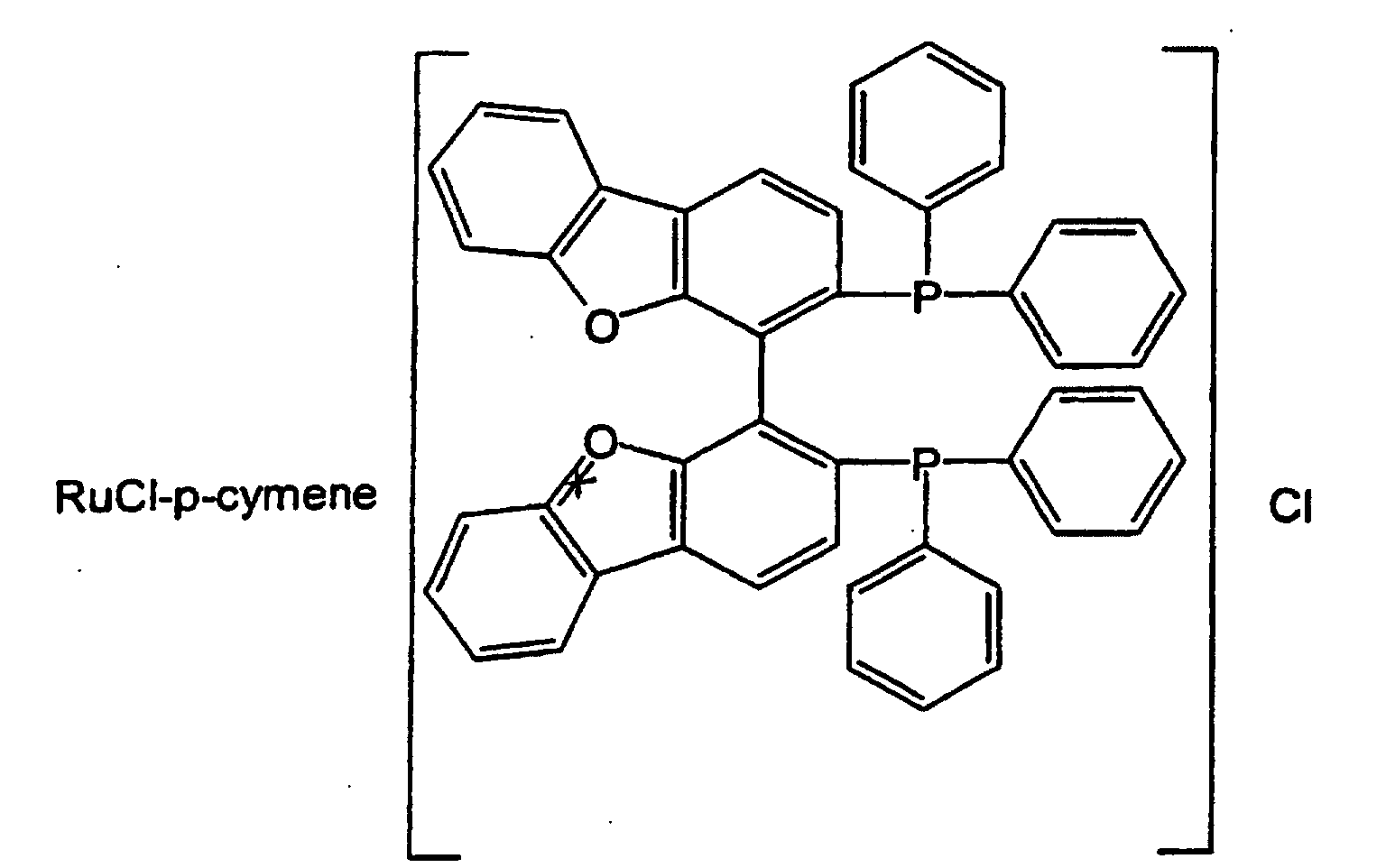
- Preferred complexes are the compounds: ⁇ RuCl(p-cymene)[BINAP] ⁇ Cl; RuHCl[BINAP] 2 ; Ru 2 Cl 4 [(BINAP] 2 NEt 3 ; Ru[BINAP](OAc) 2 ; Ru[BINAP](CF 3 CO 2 ) 2 , and the compounds of formulas and the compounds of formula ⁇ Ru( p -cymene)X [ BINAP ] ⁇ + X - , where X represents a halogen atom, such as the compound ⁇ Ru( p -cymene)Cl [ BINAP ] ⁇ + Cl - .
- transition metal complexes with chiral diphosphinic ligands can be used as such or in a supported form e.g. onto a polymeric matrix.
- Hydrogenation is typically carried out in alcoholic and/or halogenated solvents at 1 to 150 atm and 60°C to 150°C, more preferably at 5 to 15 atm and 100°C to 130°C, and most preferably at 10 atm and 120°C.
- Non limitative examples of the above solvents are ethanol, methanol, n-propanol, isopropanol, n-butanol, isobutanol, cyclohexanol, dichloromethane, dichloreoethane, trichloroethane, carbon tetrachloride.
- the hydrogenated product (III), substantially free from the 4S-form by this expression it is meant that each of the (IIIa) and (IIIb) isomers is present with an own enantiomeric eccess of the 4R form of at least 95%; the overall enantiomeric excess (IIIa)+(IIIb) is also ⁇ 95%.
- This realization is most preferred since it minimizes or substantially avoids any product loss in the form of undesired enantiomer, thus enhancing the simplicity, selectivity and economic profitability of the process.
- the reaction conditions are substantially those described above, i.e.
- the solvent is to be chosen among: dichloromethane, n-propanol, isopropanol, isobutanol, cyclohexanol, and their mixtures, and the complex is to be selected from ⁇ RuCl(p-cymene)[(S)-BINAP] ⁇ Cl, RuHCl[(S)-BINAP] 2 , Ru 2 Cl 4 [(S)-BINAP] 2 (NEt 3 ).
- step b. requires firstly to transform the -OH group of compound (III) into a leaving group by reaction with an appropriate reagent.
- Preferred reagents for this operation are tosyl chloride, methanesulphonyl chloride, benzenesulphonyl chloride. Said reagents are added to compound (III), at a temperature comprised between -20°C and +25°C (preferably 0°C-5°C) in the presence of an inert solvent (e.g. a aromatic or aliphatic hydrocarbon, such as toluene), and of a basic compound (e.g. an organic base like triethylamine or an inorganic base or basic salt).
- an inert solvent e.g. a aromatic or aliphatic hydrocarbon, such as toluene
- a basic compound e.g. an organic base like triethylamine or an inorganic base or basic salt
- This product by addition of sesamol (3,4-methylenedioxyphenol) in a basic medium, is transformed into a 4R-enantiomerically enriched compound of formula (IV), mainly in the trans form.
- Sesamol as a liquid mixture with an alcoholic solvent, preferably 4-methylpentan-2-ol, is added in a 1:1 equiv. ratio referred to benzenesulphonyl chloride or methanesulphonyl chloride or tosyl chloride.
- the mixture is conveniently heat-refluxed preferably for a period of 2 to 4 hrs to give 4R-enantiomerically enriched trans -diastereoisomer (IV) and a minor quantity of cis diastereoisomer, which is eliminated by crystallisation.
- the product (IV) is obtained mainly in the trans form, while the 4R enantiomeric enrichment previously produced is almost completely maintained, as shown by the HPLC analysis data presented in the experimental part.
- Step c) consists in the elimination of the alkyl group R bound to the nitrogen atom.
- the reaction is performed by techniques known to the art.
- the product (IV) is mixed with phenylchloroformiate in CH 2 Cl 2 and allowed to react for 1 to 6 hours at room temperature.
- the carbamic derivative of the following formula is obtained: which is then hydrolysed with KOH.
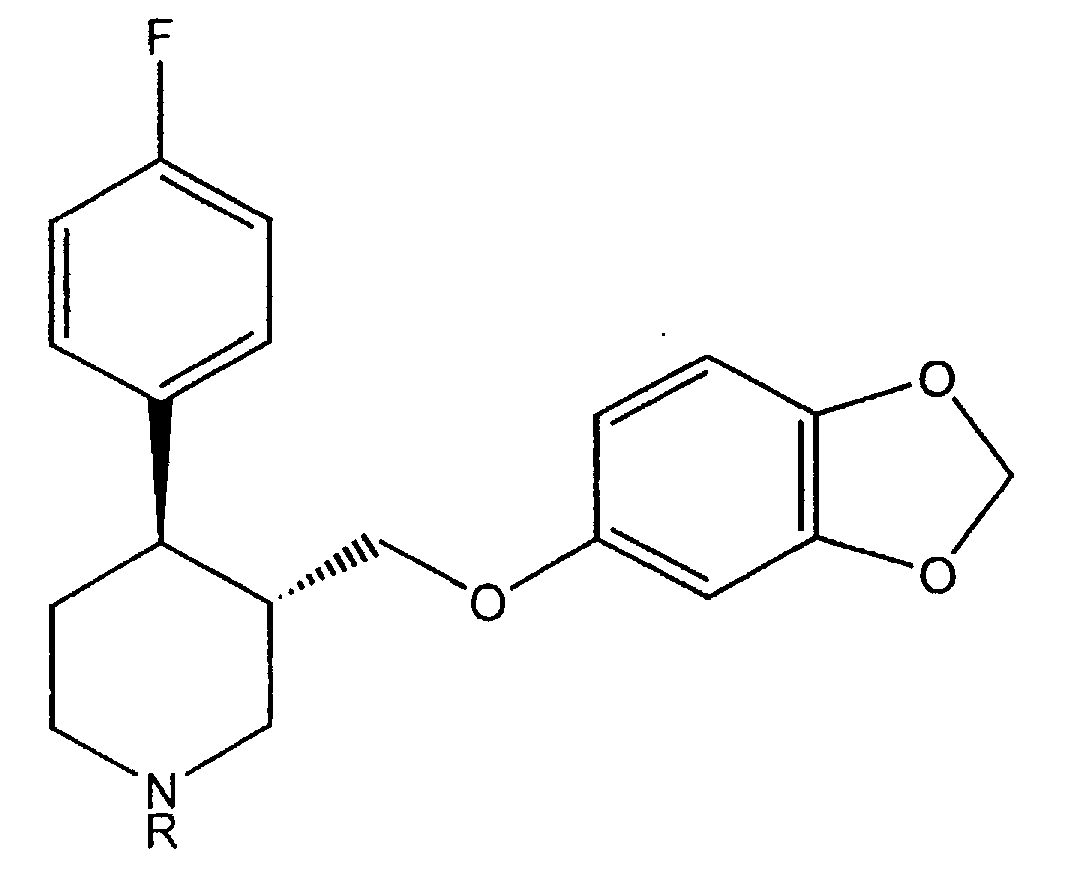
- step c a compound of formula (V) is obtained, which is enantiomerically enriched in its 4R form (paroxetine). If present, the minor isomeric portion having 4S configuration is eliminated by crystallization. Pure paroxetine (I) is thus obtained.
- the compounds of formula (II) used as reagents in step a) of the process described herein may be easily obtained by various techniques known to the art, e.g. by allowing 1-methyl-4-fluorostyrene to react with formaldehyde and ethylamine hydrochloride, as disclosed in WO-A-9636636.
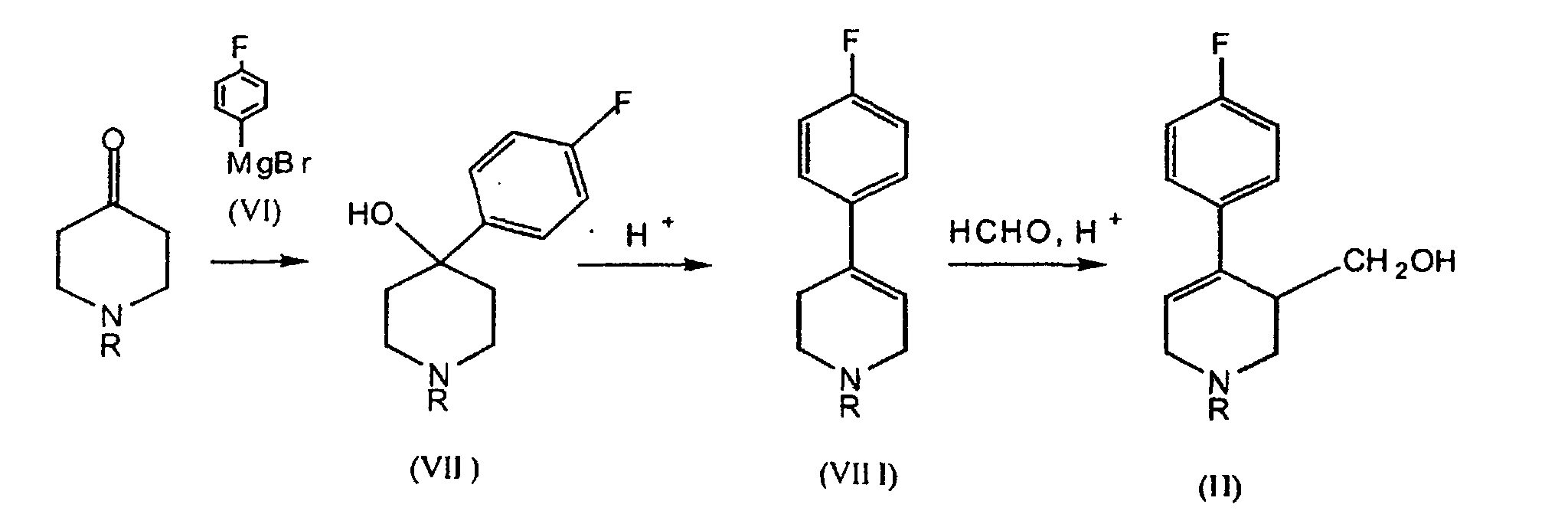
- compounds of formula (II) may be obtained as shown in the following scheme: 4-Fluorobromobenzene and magnesium are allowed to react to give 4-fluorophenylmagnesium bromide (VI), to which 1-alkyl-4-piperidone is added.
- the resultig product is 1-alkyl-4-( p -fluorophenyl)-4-hydroxypiperidine (VII), which is dehydrated in position 3-4 of the piperidinic ring by heat-reflux with aqueous H 2 SO 4 , to obtain 1-alkyl-4-( p -fluorophenyl)-1,2,5,6-tetrahydropyridine (VIII).
- This product is finally converted into the product of formula (II) by addition, in the same reaction medium, of aqueous formaldehyde (Prins's reaction).
- catalytic hydrogenation a) largely increases the percentage amount of enantiomers useful for paroxetine (4R) formation, and reaction b) allows the use of compound (III) in both cis and trans forms. It follows that the quantity of product to be discarded as isomerically undesired is very low and, consequently, the yield to paroxetine is high.
- an advantage of the present invention is that it avoids following independent synthetic routes for cis and trans isomers, as is instead required by the aforementioned processes known to the art.
- Another advantage of the present invention is that the aforesaid enantiomeric excesses may be obtained at moderate pressure (5 to 15 atm): under these conditions the process may be easily scaled up to commercial size.
- a still further advantage of the present invention is that high enantiomeric excesses may be obtained also with low catalyst/substrate ratios, i.e. ranging from 1/200 to 1/1000.
- the use of low quantities of catalyst favours low process investment.
- the reaction mixture was cooled to 5°C and added with 360 ml of a 20% NH 4 Cl solution. At the end of the addition, the phases were separated and the organic phase was evaporated to dryness. The aqueous phase was extracted with two portions of 250 ml of toluene. The residue was evaporated and the toluenic phases were joined and washed with 420 ml of a 20% NH 4 Cl solution.
- the raw product of reaction was used as such in the next reaction.
- the mixture was then cooled to room temperature, basified with 60.9 ml of a 30% aqueous solution of NaOH, and extracted repeatedly. The combined organic extracts were then washed once with water and concentrated.
- Tetrahydropyridine (II) [R Et] (35.5 g; 150.9 mmol) was hydrogenated in 300 ml isopropanol at a working pressure of 10 atm, at 120°C in the presence of ⁇ RuCl( p -cymene)[(S)-BINAP] ⁇ Cl - , previously generated by mixing a solution of (S)-BINAP (0.378 mmol, 0.235 g) in 21 ml of CH 2 Cl 2 :MeOH 1:1, with [RuCl 2 ( p -cymene)] 2 (0.188 mmol, 0.115 g), and heat-refluxing the mixture for 2 hrs.
- Tetrahydropyridine (II) [R Et] (5.0 g; 21.4 mmol) was hydrogenated in 40 ml isopropanol at a working pressure of 10 atm, at 120°C in the presence of Ru 2 Cl 4 [(S)-BINAP] 2 (NEt 3 ), previously generated by adding (S)-BINAP and Et 3 N (0.032 ml) to a suspension of [RuCl 2 (COD)] n (14.9 mg, 0.0531 mmol) in 2 ml toluene, heat-refluxing for 12 hrs, and evaporating the mixture to dryness. The reaction was discontinued after 5 hrs at 120°C, and the mixture was cooled to room temperature. After filtration on Celite, and evaporation under reduced pressure, 4.3 g of product (yield 84%) were obtained.
- Tetrahydropyridine (II) [R Et] (5.0 g; 21.4 mmol) was hydrogenated in 40 ml isopropanol at a working pressure of 10 atm, at 120°C in the presence of Ru[(S)-BINAP](CF 3 CO 2 ) 2 (50.0 mg, 0.031 mmol), previously generated from Ru[(S)-BINAP](oAc 2 ) 2 dissolved in CH 2 Cl 2 ,added with trifluoroacetic acid, kept under stirring for 12 hrs, evaporated, re-dissolved in toluene and hexane and allowed to crystallise. The reaction was discontinued after 20 hrs, and the mixture was cooled to room temperature. After filtration on Celite, and evaporation under reduced pressure, 3.7 g of product (yield 73%) were obtained.
- Example C was repeated with different alcoholic or halogenated solvents, in order to check the solvent effect on the enantioselectivity.
- the hydrogenation temperature was 120°C and the reaction was discontinued after 5 hrs.
- the results are summarised in the following table.
- the hydrochloride was then re-converted into a free base by dissolution in water, basification with 30% NaOH, and extraction of the aqueous phase with toluene.
- the organic phase was evaporated to dryness and re-dissolved with toluene (190 ml). The resulting mixture was then filtered and added with 19.2 g (343 mmol) of solid KOH and heat-refluxed for 2 hrs. The mixture was then cooled to room temperature and added with 150 ml water. The organic phase was separated and the aqueous phase was re-extracted with two portions of 100 ml water and evaporated to dryness.
- Paroxetine hydrochloride was thus precipitated, filtered , washed and dried. 21.9 g (59.3 mmol) of paroxetin hydrochloride were thus isolated.
- This product analysed by HPLC (Symmetry Shield RP8, eluent: acetonitrile:buffer 70:30 (KH 2 PO 4 0.025 M at pH 2.5 with H 3 PO 4 ), flow 1 ml/min, Detector UV 290 nm) was found to have assay 99% and purity 99.9%, with yield 80%. Spectroscopic data were in accordance with literature data.
Landscapes
- Chemical & Material Sciences (AREA)
- Organic Chemistry (AREA)
- Health & Medical Sciences (AREA)
- Medicinal Chemistry (AREA)
- Pharmacology & Pharmacy (AREA)
- Engineering & Computer Science (AREA)
- Bioinformatics & Cheminformatics (AREA)
- Biomedical Technology (AREA)
- Neurology (AREA)
- Neurosurgery (AREA)
- Chemical Kinetics & Catalysis (AREA)
- General Chemical & Material Sciences (AREA)
- Pain & Pain Management (AREA)
- Nuclear Medicine, Radiotherapy & Molecular Imaging (AREA)
- Psychiatry (AREA)
- Life Sciences & Earth Sciences (AREA)
- Animal Behavior & Ethology (AREA)
- General Health & Medical Sciences (AREA)
- Public Health (AREA)
- Veterinary Medicine (AREA)
- Plural Heterocyclic Compounds (AREA)
- Hydrogenated Pyridines (AREA)
- Pharmaceuticals Containing Other Organic And Inorganic Compounds (AREA)
- Low-Molecular Organic Synthesis Reactions Using Catalysts (AREA)
- Organic Low-Molecular-Weight Compounds And Preparation Thereof (AREA)
Abstract
Description
- The field of the present invention is the synthesis of optically active compounds. A highly stereospecific process for synthesis of paroxetine is described herein.
- Paroxetine is a compound widely used for the treatment of depression.
- The structural formula of this compound is as follows (I):
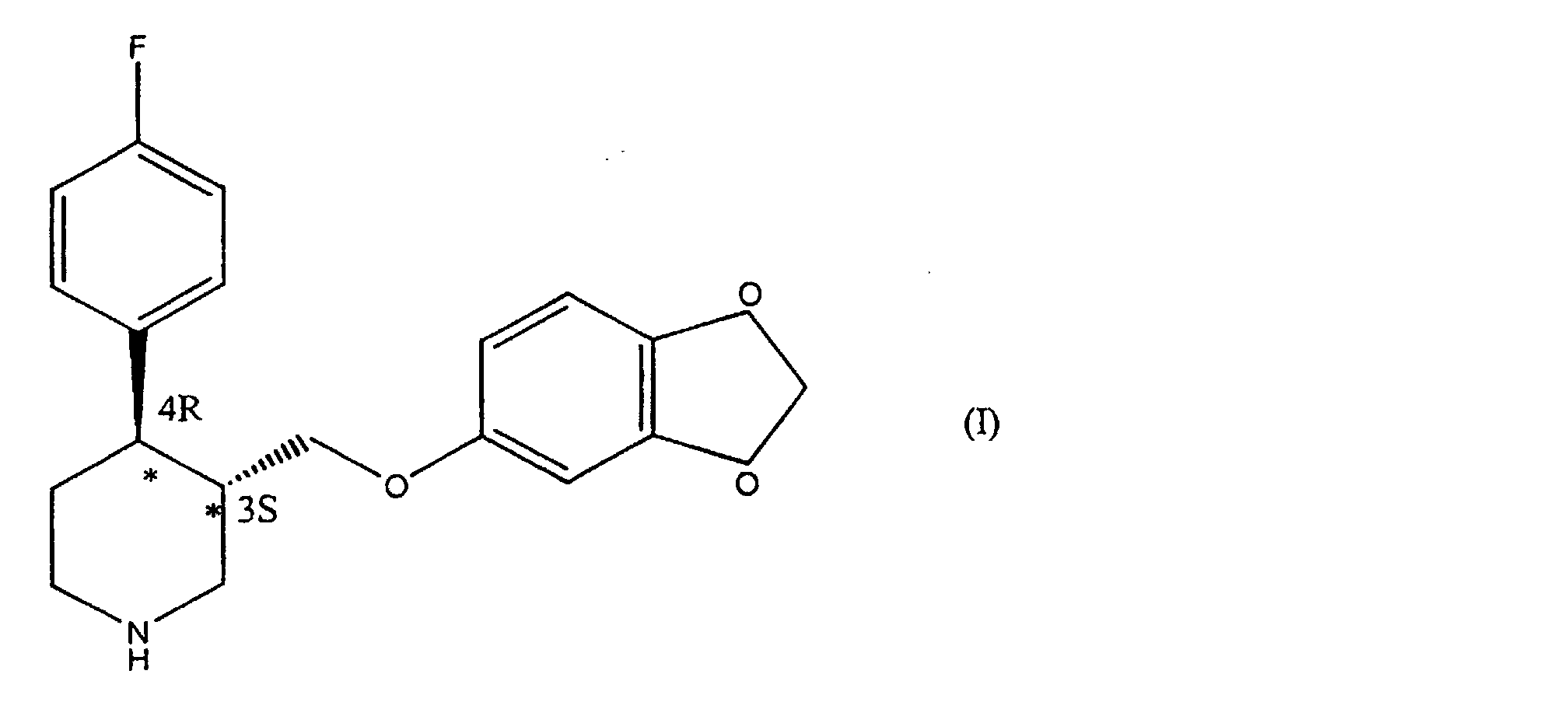
- The molecule of formula (I) contains two chiral centres on the piperidinic ring, in position 3 and 4, respectively. Of the four possible isomers, only the isomer having absolute configuration 3S, 4R, known as 4R- trans -4-(p-fluorophenyl-3-{[3,4-(methylenedioxy)phenoxy]methyl}piperidine, is pharmacologically active.
- Therefore, the processes for synthesis of paroxetine must result in the formation of the 4-(p-fluorophenyl-3-{[3,4-(methylenedioxy)phenoxy]methyl}piperidinic structure, exclusively in the aforesaid conformation, 3S, 4R (or 4R-trans).
- Some processes for synthesis of paroxetine known to the art are based on the formation of an intermediate of formula (II)where R represents an alkyl group. Starting from this intermediate, the product of formula (I) is obtained by: (i) reduction of the piperidinic double bond, (ii) alkylation of the oxygen of the hydroxymethyl group, and (iii) removal of the alkyl group R bound to the nitrogen. In order to obtain the product (I) with the pharmacologically active conformation, the process requires the isolation of specific isomers from the corresponding racemic mixtures and the treatment of the same until obtaining derivative (I) with the desired conformation.

- For example, patent application WO-A-9636636 discloses the synthesis of 4-arylpiperidine, wherein a derivative of formula (II) is separated into the two optical isomers by crystallisation with optically active salts. The two optical isomers are then separately converted into paroxetine. Therefore, the process requires separate and independent synthesis routes for isomers treatment and, consequently, can hardly be scaled up to commercial size.
- According to another process (J. Labelled Compounds Radiopharm., 1993, 8, 785), the derivative of formula (II) is hydrogenated and alkylated as per the above scheme; subsequently the diastereoisomers are isolated by chromatography while the enantiomers are separated by crystallisation with L-(+)-tartaric acid. The (-)-trans isomer is finally converted into paroxetine by N-dealkylation. In this case, two distinct isomers separation cycles are required, resulting in a considerable loss of product in the form of undesired isomer. Consequently, this process too can hardly be applied to commercial-scale production.
- The process disclosed in patent application WO-A-9322284 is based on the stereospecificity of esterase-catalysed reactions. In this case, the enzyme brings about the formation of a trans carboxylic precursor, wherefrom the (+)-trans and (-)-trans forms are separated by conventional methods. The latter form further undergoes reduction and alkylation to give paroxetine. The advantage of this process is a high stereospecificity; its disadvantages are the enzyme cost and instability. The aforesaid reactions are usually slow and must be carried out under precise pH and temperature conditions.
- In brief, the separation processes known to the art cause a considerable loss of product in the form of isomers with undesired configuration or require separate process cycles for the conversion of said isomers. In particular, the processes known to the art entail the resolution of racemic mixtures in which the dextro- and levorotatory components are present in substantially similar proportions, with the result that approx. half of the resolved product is to be discarded or independently converted into the desired form.
- Therefore, the need for developing highly stereospecific processes for the synthesis of paroxetine, whereby the desired isomers are obtained in high yields, is felt. Particularly urgent is the need for processes not involving isomer resolution cycles and not requiring separate ad hoc treatments of the single isomers.
-
- Figures 1.1, 1.2, 1.3, 1.4, 1.5, 1.6, 1.7, 1.8: Examples of chiral diphosphinic
ligands:
- 1.1: BINAP
- 1.2: BIPHEMP
- 1.3: (5,5'-dichloro-6,6'-dimethoxy-diphenyl-2,2'-diyl)-bis-(diphenylphosphine)
- 1.4: (bis-4,4'-dibenzofuran-3,3'-yl)-bis diphenylphosphine
- 1.5: 4,4'-bisdiphenylphosphine-2,2',5,5'-tetramethyl-3,3'-dithiophene
- 1.6: PYRPHOS
- 1.7: DIOP
- 1.8: BDPP
-
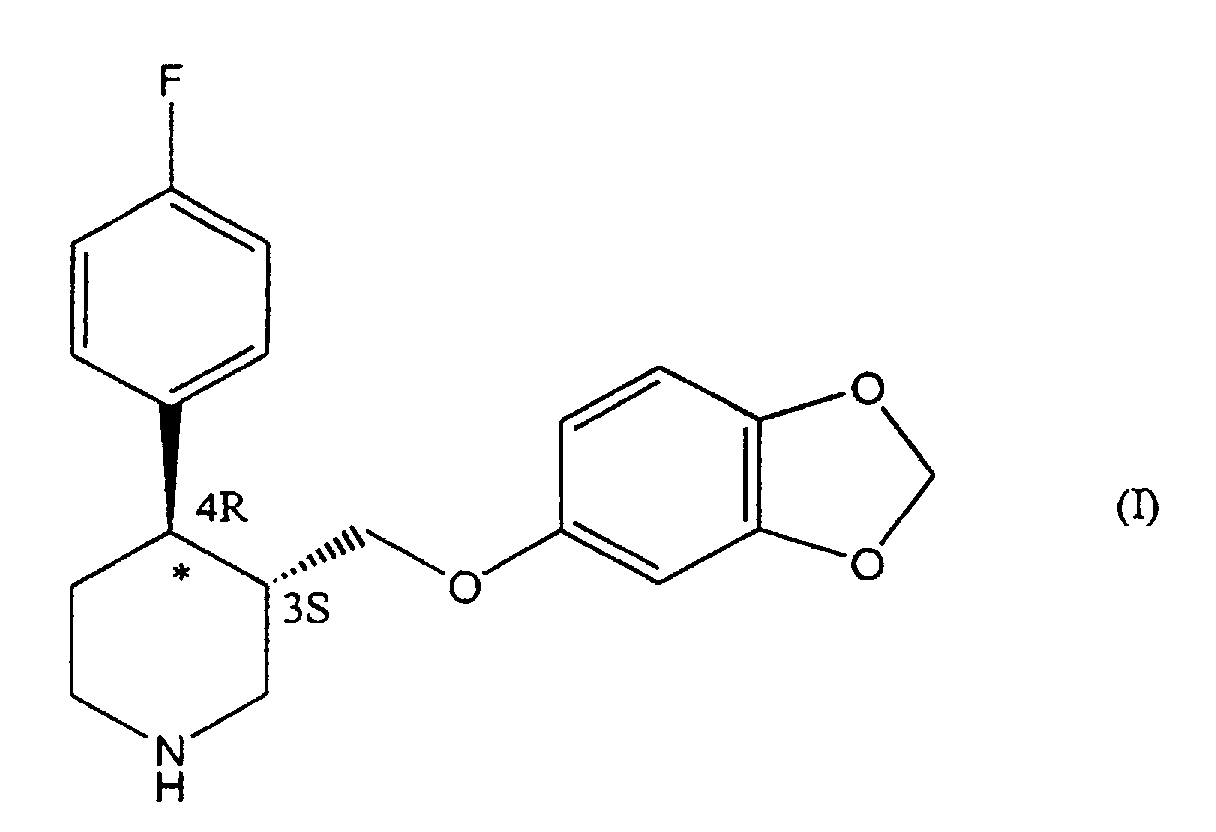
- It is an object of the present invention to provide a process for the synthesis of paroxetine. The process comprises the following steps:
- a) hydrogenation of a compound of formula (II), where R is a group selected from
(C1-C5)alkyl, (C1-C 5)carboxyalkyl, an optionally substituted phenyl, an optionally
substituted benzyl, said hydrogenation being catalysed by a complex of a
transition metal with chiral diphosphinic ligands, resulting in a 4R-enantiomerically
enriched compound of formula (III):
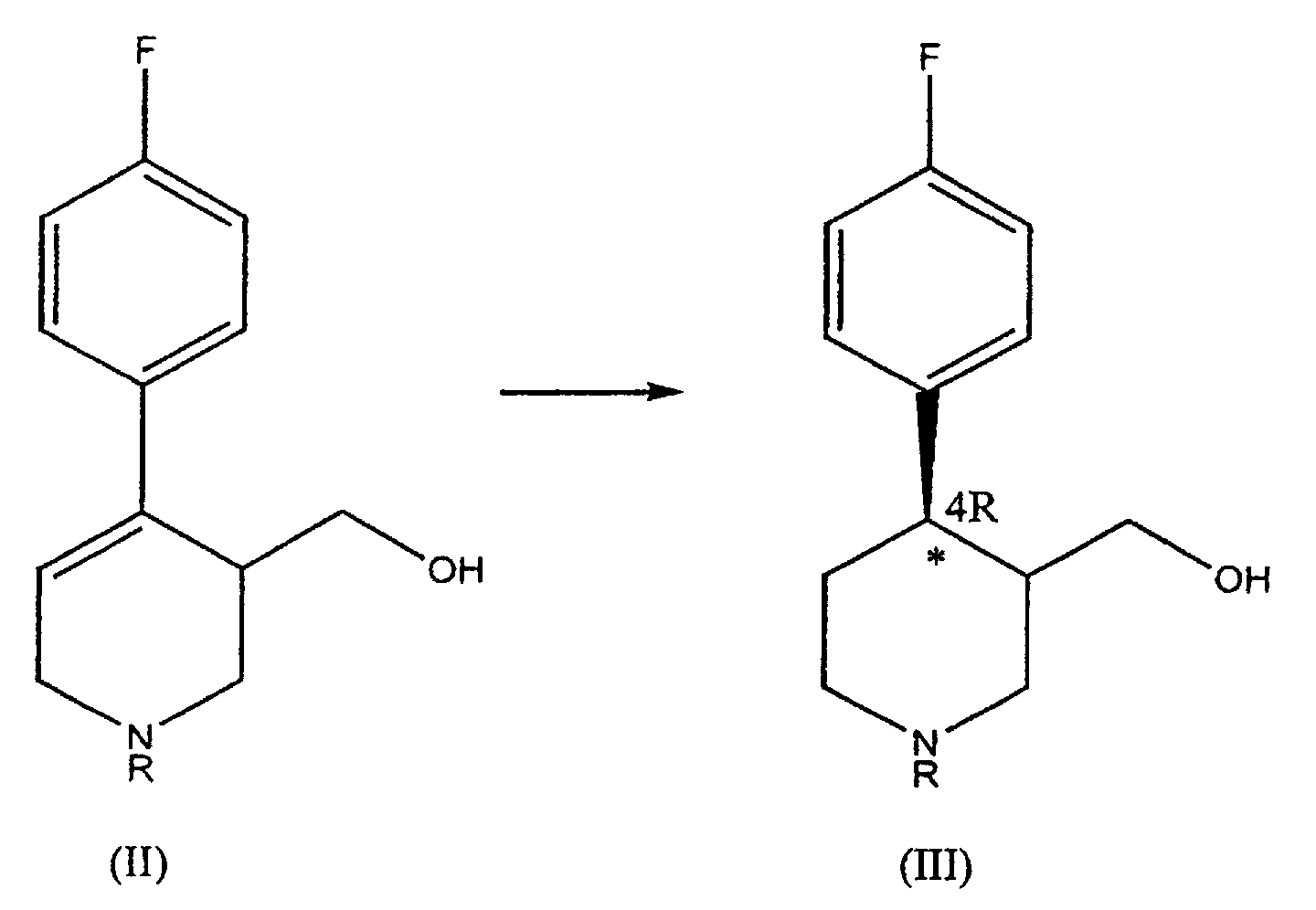
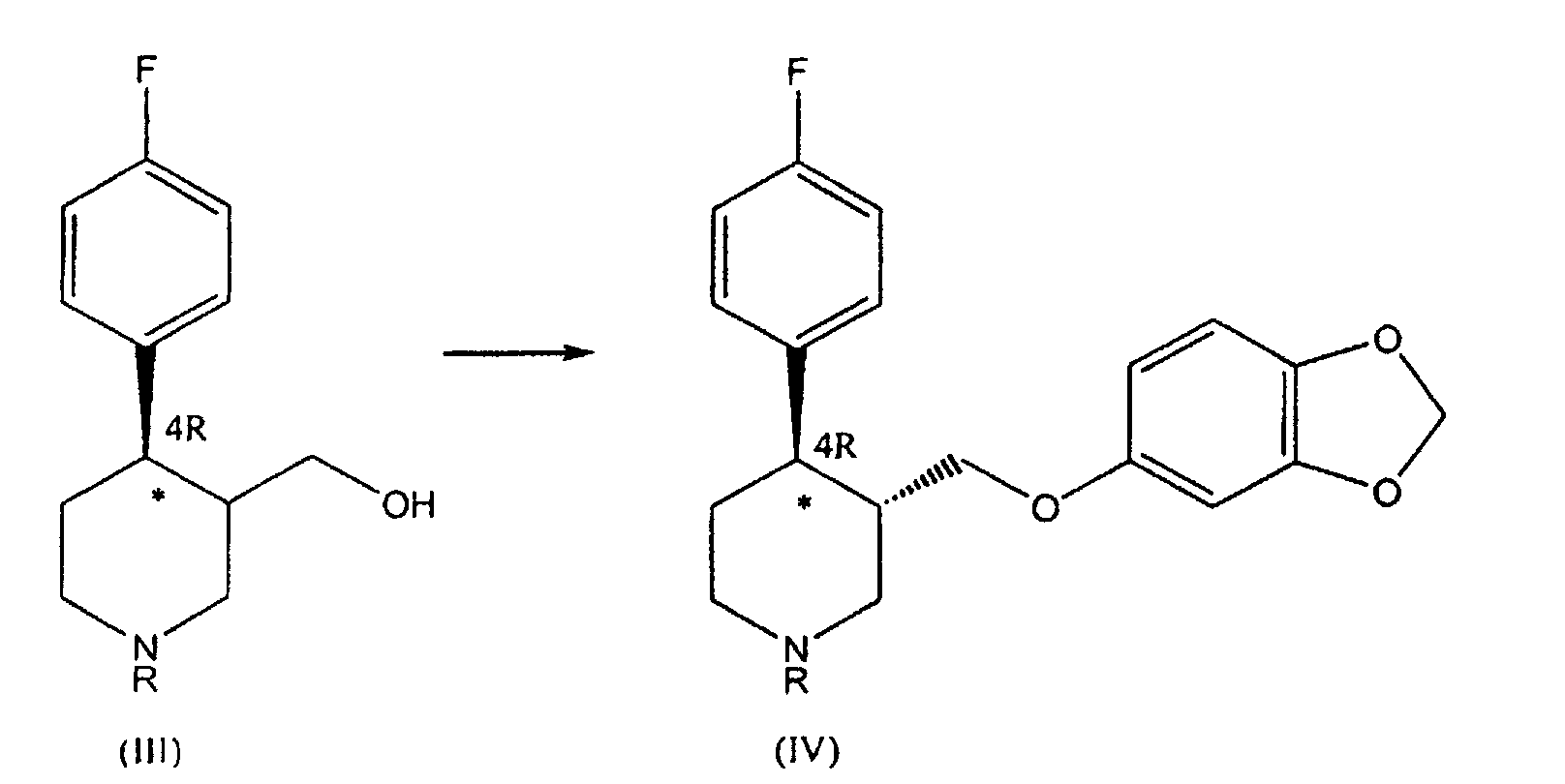
- b) reaction of the compound of formula (III) with a reagent capable of transforming
the -OH group into a leaving group, followed by nucleophilic substitution with
sesamol (3,4-methylenedioxyphenol), resulting in a 4R-enantiomerically enriched
derivative of formula (IV);
- c) N-dealkylation of compound (IV), resulting in paroxetine (I):
-
- In formula (II), R preferably represents an ethyl group. Should R represent an optionally substituted phenyl or benzyl, the substituent is preferably a (C1-C 5) alkyl.
- The compound of formula (III) obtained in step a) contains two asymmetry centres on the piperidinic ring, in position 3 and 4, respectively. Said product is obtained as a mixture of 4R-enantiomerically enriched cis (IIIa) and trans (IIIb) isomers, where each of the two isomers (cis and trans) is mainly present in the form having absolute configuration R on the carbon atom in position 4 of the piperidinic ring.
- By the term "4R-enantiomerically enriched" it is meant an overall enantiomeric excess (also called overall "ee") of at least 80%. The enantiomeric excesses are calculated as described in J. March, "Advanced Organic Chemistry", 3rd Ed., Chapter 4, p. 107 (John Wiley & Sons) (1985).
- The catalysts to be used in hydrogenation (step a) are compounds belonging to the class of transition metal complexes with chiral diphosphinic ligands. Said catalysts are responsible for the reaction stereospecificity and allow the obtainment of 4R-enantiomerically enriched derivative of formula (III). Members of this class are all the transition metal complexes with chiral diphosphinic ligands. In said complexes, the metal coordinates to the chiral ligand to give a chiral complex capable of catalysing a highly stereospecific hydrogenation of the double bond.
- Preferred transition metals are ruthenium, rhodium and iridium.
- Examples of chiral diphosphinic ligands are the compounds belonging to the formulas indicated in Figure 1.
- Examples of transition metal complexes with chiral diphosphinic ligands are the compounds of formula RuXl(L)m[BINAP]n, described in the patent application EP-A-366390, or the compounds of formula (I)described in EP-A-245959,

wherein X represents a hydrogen atom, an amino group, an acetylamino group, or a sulfo group; R represents a hydrogen atom or a C1-4 alkyl group R1 and R2 each represents a C1-9 alkyl group, a halogenated C1-4 alkyl group, a phenyl group, a phenyl group substituted with a C1-4 alkyl group, a C1-4 α-aminoalkyl group, or a C7-10 α-aminophenylalkyl group, or R1 and R2 together form a C1-4 alkylene group; and n represents 1 or 2. - Preferred complexes are the compounds: {RuCl(p-cymene)[BINAP]}Cl; RuHCl[BINAP]2; Ru2Cl4[(BINAP]2NEt3; Ru[BINAP](OAc)2; Ru[BINAP](CF3CO2)2, and the compounds of formulas

 and the compounds of formula {Ru(p-cymene)X[BINAP] }+X-, where X represents a halogen atom, such as the compound {Ru(p-cymene)Cl[BINAP] }+Cl-.
- As mentioned above, all these complexes are chiral; depending on each complex, only one of the chiral forms, e.g. (S)BINAP or (R)BINAP generates in the 4R-enriched product: this form is not determinable a priori, but can be easily selected by performing a screening hydrogenation test of compound (II), with the ligand in one enantiomeric form (e.g. (S)-BINAP) and checking whether the hydrogenated product is enantiomerically enriched in the 4R or 4S form: in the synthesis of paroxetin the enantiomeric ligand resulting in the 4R-enriched form will have to be used.
- The transition metal complexes with chiral diphosphinic ligands can be used as such or in a supported form e.g. onto a polymeric matrix.
- Hydrogenation is typically carried out in alcoholic and/or halogenated solvents at 1 to 150 atm and 60°C to 150°C, more preferably at 5 to 15 atm and 100°C to 130°C, and most preferably at 10 atm and 120°C. Non limitative examples of the above solvents are ethanol, methanol, n-propanol, isopropanol, n-butanol, isobutanol, cyclohexanol, dichloromethane, dichloreoethane, trichloroethane, carbon tetrachloride.
- According to a more specific embodiment of the present invention, it is possible to obtain the hydrogenated product (III), substantially free from the 4S-form: by this expression it is meant that each of the (IIIa) and (IIIb) isomers is present with an own enantiomeric eccess of the 4R form of at least 95%; the overall enantiomeric excess (IIIa)+(IIIb) is also ≥ 95%. This realization is most preferred since it minimizes or substantially avoids any product loss in the form of undesired enantiomer, thus enhancing the simplicity, selectivity and economic profitability of the process. The reaction conditions are substantially those described above, i.e. from 1 to 150 atm and 60°C to 150°C, more preferably at 5 to 15 atm and 100°C to 130°C, and most preferably at 10 atm and 120°C; however in order to obtain the above mentioned enantiomeric eccess of at least 95%, the solvent is to be chosen among: dichloromethane, n-propanol, isopropanol, isobutanol, cyclohexanol, and their mixtures, and the complex is to be selected from {RuCl(p-cymene)[(S)-BINAP]}Cl, RuHCl[(S)-BINAP]2, Ru2Cl4[(S)-BINAP]2(NEt3). As a further advantage, when the hydrogenation reaction is catalysed, by {RuCl(p-cymene)[(S)-BINAP]}Cl, in the presence of isopropanol as a solvent, the aforementioned substantial enantiomeric purity is associated with an extremely favourable conversion rate of product (II) to (III), [100% in 5 hrs reaction time], which element further adds significantly to the above discussed advantages.
- The compound (III) resulting from step a. is used as a cis-trans mixture (IIIa + IIIb) in the next reaction (step b). Step b. requires firstly to transform the -OH group of compound (III) into a leaving group by reaction with an appropriate reagent.
- Preferred reagents for this operation are tosyl chloride, methanesulphonyl chloride, benzenesulphonyl chloride. Said reagents are added to compound (III), at a temperature comprised between -20°C and +25°C (preferably 0°C-5°C) in the presence of an inert solvent (e.g. a aromatic or aliphatic hydrocarbon, such as toluene), and of a basic compound (e.g. an organic base like triethylamine or an inorganic base or basic salt). This reaction results in an activated intermediate of formula:

- This product, by addition of sesamol (3,4-methylenedioxyphenol) in a basic medium, is transformed into a 4R-enantiomerically enriched compound of formula (IV), mainly in the trans form. Sesamol, as a liquid mixture with an alcoholic solvent, preferably 4-methylpentan-2-ol, is added in a 1:1 equiv. ratio referred to benzenesulphonyl chloride or methanesulphonyl chloride or tosyl chloride. The mixture is conveniently heat-refluxed preferably for a period of 2 to 4 hrs to give 4R-enantiomerically enriched trans-diastereoisomer (IV) and a minor quantity of cis diastereoisomer, which is eliminated by crystallisation.
- The product (IV) is obtained mainly in the trans form, while the 4R enantiomeric enrichment previously produced is almost completely maintained, as shown by the HPLC analysis data presented in the experimental part.
- Step c) consists in the elimination of the alkyl group R bound to the nitrogen atom.
- The reaction is performed by techniques known to the art. According to a preferred embodiment, the product (IV) is mixed with phenylchloroformiate in CH2Cl2 and allowed to react for 1 to 6 hours at room temperature. At the end, the carbamic derivative of the following formula is obtained:which is then hydrolysed with KOH.
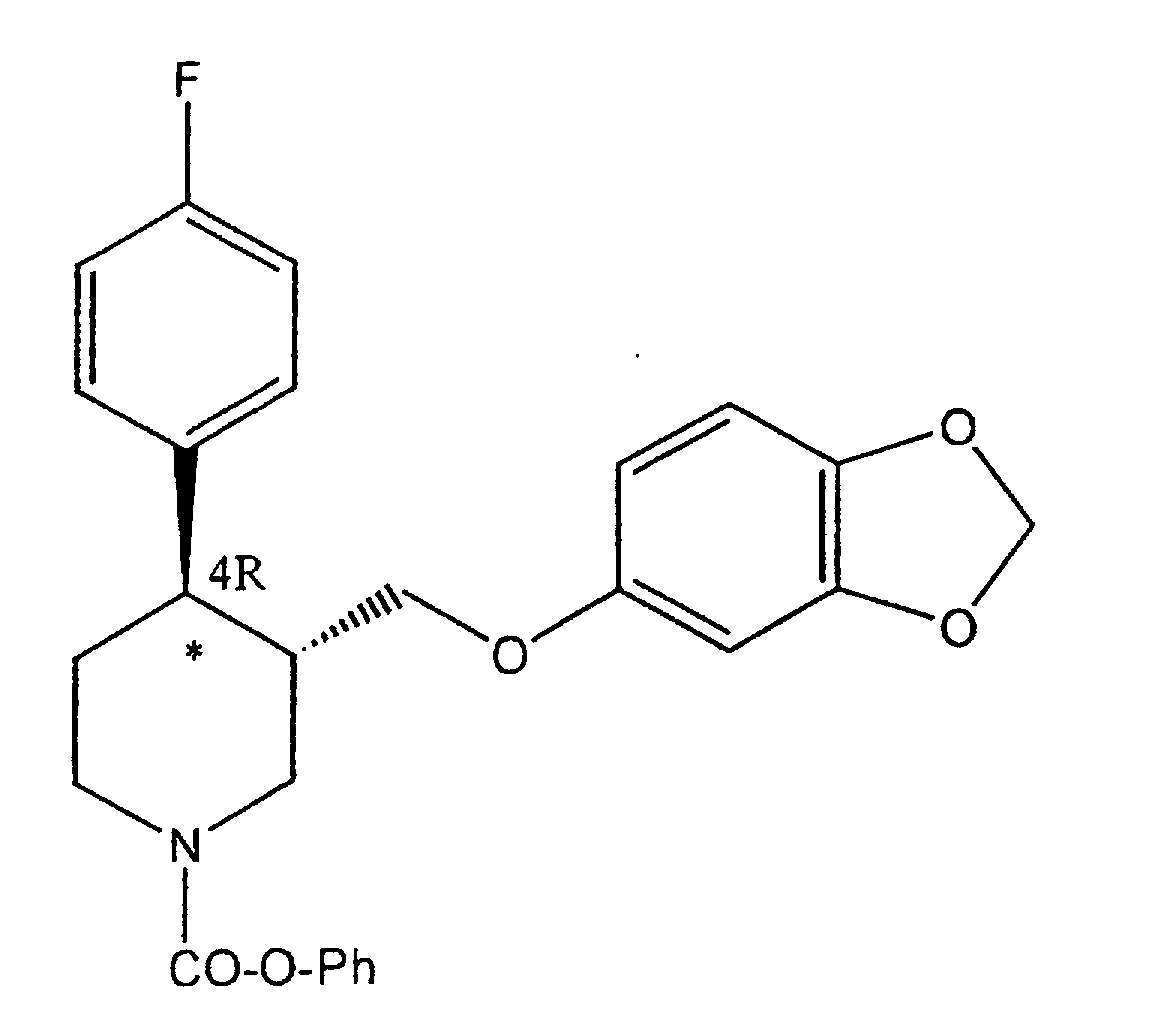
- At the end of step c), a compound of formula (V)is obtained, which is enantiomerically enriched in its 4R form (paroxetine). If present, the minor isomeric portion having 4S configuration is eliminated by crystallization. Pure paroxetine (I) is thus obtained.
- The compounds of formula (II) used as reagents in step a) of the process described herein may be easily obtained by various techniques known to the art, e.g. by allowing 1-methyl-4-fluorostyrene to react with formaldehyde and ethylamine hydrochloride, as disclosed in WO-A-9636636.
- Alternatively, compounds of formula (II) may be obtained as shown in the following scheme:4-Fluorobromobenzene and magnesium are allowed to react to give 4-fluorophenylmagnesium bromide (VI), to which 1-alkyl-4-piperidone is added. The resultig product is 1-alkyl-4-(p-fluorophenyl)-4-hydroxypiperidine (VII), which is dehydrated in position 3-4 of the piperidinic ring by heat-reflux with aqueous H2SO4, to obtain 1-alkyl-4-(p-fluorophenyl)-1,2,5,6-tetrahydropyridine (VIII). This product is finally converted into the product of formula (II) by addition, in the same reaction medium, of aqueous formaldehyde (Prins's reaction).
- In the process of the invention, catalytic hydrogenation a) largely increases the percentage amount of enantiomers useful for paroxetine (4R) formation, and reaction b) allows the use of compound (III) in both cis and trans forms. It follows that the quantity of product to be discarded as isomerically undesired is very low and, consequently, the yield to paroxetine is high.
- Furthermore, an advantage of the present invention is that it avoids following independent synthetic routes for cis and trans isomers, as is instead required by the aforementioned processes known to the art.
- Another advantage of the present invention is that the aforesaid enantiomeric excesses may be obtained at moderate pressure (5 to 15 atm): under these conditions the process may be easily scaled up to commercial size.
- A still further advantage of the present invention is that high enantiomeric excesses may be obtained also with low catalyst/substrate ratios, i.e. ranging from 1/200 to 1/1000. The use of low quantities of catalyst favours low process investment.
- The following examples are shown by way of indication, not of limitation, of the present invention.
- A ca. 0.9 M solution of 4-fluorophenylmagnesium bromide (1.0 equiv., 0.31 moles) prepared as usual from magnesium and 4-fluorobromobenzene in THF was titrated, cooled to 0°C, and added dropwise over approx. 45 min. with a clear solution of commercial 1-ethyl-4-piperidone (1 equiv., 0.31 moles) in THF (60 ml).
- Once the addition had been completed, the reaction was maintained at room temperature for 1 hr.
- The reaction mixture was cooled to 5°C and added with 360 ml of a 20% NH4Cl solution. At the end of the addition, the phases were separated and the organic phase was evaporated to dryness. The aqueous phase was extracted with two portions of 250 ml of toluene. The residue was evaporated and the toluenic phases were joined and washed with 420 ml of a 20% NH4Cl solution.
- The organic phase was concentrated and cooled. After filtration of the precipitate thus obtained, 40.9 g of a pale yellow solid product were isolated. Its HPLC analysis (Column Symmetry Shield RP8, Eluent acetonitrile:buffer = 90:10 (KH2PO4 0.025 M at pH 2.5 with H3PO4), flow 1/ml/min, Detector UV 215 nm) showed assay of 98%, and purity > 98%, with a yield of 58%.
- The raw product of reaction was used as such in the next reaction.
- On the raw product the following GLC/MS and H1-NMR analysis were performed, allowing to assign the following parameters to the compound (VII)
1H-NMR (CDCl3), δ (ppm): 7.55-7.44 (2H, m, aromatic H) 7.01 (2H, m, aromatic H); 4.4-3.6 (1H, br s, -OH); 3-1.75 (8H, br m, H piperidinic ring); 2.59 (2H, q, J = 7.3 Hz, ethylic -CH2); 1.18 (3H, t, J = 7.3 Hz, ethylic -CH3). MS, m/z (%): 223 (M+, 19), 208 (85), 190 (43), 122 (34), 109 (26), 95 (35), 94 (20), 84 (100), 71 (16), 57 (26), 56 (26). - A solution of compound (VII) [R=Et] (10.0 g; 44.8 mmol) in aqueous H2SO4 (40 ml water and 29.7 g H2SO4) was added with 4.0 g (49.3 mmoles) of a formaldehyde solution (37% in water), and was heat-refluxed under magnetic stirring for 6 hrs.
- The mixture was then cooled to room temperature, basified with 60.9 ml of a 30% aqueous solution of NaOH, and extracted repeatedly. The combined organic extracts were then washed once with water and concentrated.
- The residue, in the form of a yellow-orange viscous oil, was diluted with 75 ml isopropanol and added with gaseous HCl in order to precipitate the hydrochloride of compound (II). The suspension thus obtained was filtered, washed with isopropanol, and the resulting solid was dissolved in water and added with NaOH 30% until pH 12 was reached. The resulting mixture was then extracted with toluene and the organic phase was evaporated. The compound (II) was thus obtained again 6.32 g), having HPLC purity > 96% (Column Symmetry Shield RP8, eluent acetonitrile:buffer = 90:10 (KH2PO4 0.025 M at pH 2.5 with H3PO4), flow 1 ml/min, detector UV 215 nm). The yield of compound (II) was 60%.
- Compound (II) was characterised as follows:
- m.p. 58-60°C; 1H NMR (CDCl3), δ (ppm): 7.37-7.29 (2H, m, aromatic H); 7.01 (2H, t, J = 8.6 Hz, aromatic H); 6.07 (1H, d, J = 3 Hz, olephinic H); 5.2 (1H, br s, -OH); 3.89 and 2.60 (7H, m); 2.53 (2H, q J = 7 Hz, ethylic CH2); 1.16 (3H, t, J = 7 Hz, CH3). MS, m/z (%): 235 (M+, 29), 204 (100), 202 (36), 176 (21), 160 (21), 149 (25), 135 (37), 133 (39), 109 (85), 84 (17), 56 (68).
-
- Tetrahydropyridine (II) [R=Et] (35.5 g; 150.9 mmol) was hydrogenated in 300 ml isopropanol at a working pressure of 10 atm, at 120°C in the presence of {RuCl(p-cymene)[(S)-BINAP]}Cl-, previously generated by mixing a solution of (S)-BINAP (0.378 mmol, 0.235 g) in 21 ml of CH2Cl2:MeOH 1:1, with [RuCl2(p-cymene)]2 (0.188 mmol, 0.115 g), and heat-refluxing the mixture for 2 hrs. The reaction, controlled by GLC analysis of successive samples (capillary column AT-35), was discontinued after 2 hrs at 120°C. The resulting mixture was cooled to room temperature, filtered on Celite, and concentrated at reduced pressure to give 33.2. g of product (yield: 88%).
- The crude product obtained was analysed by HPLC (Chiradex β-cyclodextrin Merck, eluent: methanol:buffer 15:85 (NaH2PO4 1.38 g/l, added with Na2HPO4 up to pH 6), flow 1 ml/min, Detector UV 215 nm) and the enantiomeric excesses were determined for both cis and trans diastereoisomers. The following results were obtained:
- trans, ee ≥ 99%; cis, ee ≥ 99%.
- Cis/trans ratio: 55:45; overall ee ≥ 99%.
-
- The cis and trans diastereoisomers were separated and characterised by MPLC purification on silica gel for analytical purposes.
- 4R-cis diastereoisomer had: m.p. 50-53°C and 1H NMR (CDCl3), δ (ppm): 7.44-7.20 (2H, m, aromatic H); 7.15-6.90 (2H, m, aromatic H); 5.8-4.5 (1H, br s, -OH); 3.9-1.6 (10H, m, piperidinic ring + hexocyclic CH2); 2.25 (2H, q, J = 7.2 Hz, ethylic CH2); 1.13 (3H, t, J = 7.2 Hz, ethylic CH3). MS, m/z (%): 237 (M+, 23), 222 (43), 206 (17), 133 (11), 114 (29), 109 (20), 84 (16), 72 (17), 58 (100).
- 4R- trans diastereoisomer had: m.p. 90-92°C and 1H NMR (CDCl3), δ (ppm): 7.3-7.1 (2H, m, aromatic H); 7.1-6.85 (2H, m, aromatic H); 3.5-3.0 (4H, m, piperidinic ring); 2.7-2.2 (4H, m, piperidinic ring + hexocyclic CH2); 2.15-1.65 (5H, m, piperidinic ring + ethylic CH2); 1.14 (3H, t, J = 7.2 Hz, ethylic CH3). MS, m/z (%): 237 (M+ 34), 222 (76), 206 (16), 133 (14), 114 (34), 109 (27), 84 (21), 72 (22), 58 (100).
- Tetrahydropyridine (II) [R=Et] (5.0 g; 21.4 mmol) was hydrogenated in 40 ml isopropanol at a working pressure of 10 atm, at 120°C in the presence of Ru2Cl4[(S)-BINAP]2(NEt3), previously generated by adding (S)-BINAP and Et3N (0.032 ml) to a suspension of [RuCl2(COD)]n (14.9 mg, 0.0531 mmol) in 2 ml toluene, heat-refluxing for 12 hrs, and evaporating the mixture to dryness. The reaction was discontinued after 5 hrs at 120°C, and the mixture was cooled to room temperature. After filtration on Celite, and evaporation under reduced pressure, 4.3 g of product (yield 84%) were obtained.
- The enantiomeric excesses of both (IIIa) and (IIIb) diastereoisomers was determined by HPLC analysis (Chiradex β-cyclodextrin Merck, eluent:
- methanol:buffer 15:85 (NaH2PO4 1.38 g/l, added with Na2HPO4 up to pH 6), flow 1 ml/min, Detector UV 215 nm). The following results were obtained:
- trans, ee ≥ 99%; cis, ee ≥ 98%.
- Cis/trans ratio: 50:50; overall ee ≥ 99%.
-
- Tetrahydropyridine (II) [R=Et] (5.0 g; 21.4 mmol) was hydrogenated in 40 ml isopropanol at a working pressure of 10 atm, at 120°C in the presence of RuHCl[(S)-BINAP]2, previously generated by adding (S)-BINAP (74.0 mg, 0.120 mmol) and Et3N (0.017 ml) to a solution of [RuCl2(COD)]n (14.9 mg, 0.0531 mmol) in 3 ml EtOH, heat-refluxing for 6 hrs, and evaporating the mixture to dryness. The reaction was discontinued after 5 hrs at 120°C, and the mixture was cooled to room temperature. After filtration on Celite, and evaporation under reduced pressure, 4.2 g of product (yield 83%) were obtained.
- The enantiomeric excesses of both (IIIa) and (IIIb) diastereoisomers was determined by HPLC analysis (Chiradex β-cyclodextrin Merck, eluent:
- methanol:buffer 15:85 (NaH2PO4 1.38 g/l, added with Na2HPO4 up to pH 6), flow 1 ml/min, Detector UV 215 nm). The following results were obtained:
- trans, ee ≥ 99%; cis, ee ≥ 99%.
- Cis/trans ratio: 50:50; overall ee ≥ 99%.
-
- Tetrahydropyridine (II) [R=Et] (5.0 g; 21.4 mmol) was hydrogenated in 40 ml isopropanol at a working pressure of 10 atm, at 120°C in the presence of Ru[(S)-BINAP](OAc)2 (48.0 mg, 0.057 mmol), previously generated, according to the method described in lnorg.Chem.27, 1988, 566-569, from [RuCl2(COD)]n and (S)-BINAP. The reaction was discontinued after 18 hrs at 120°C, and the mixture was cooled to room temperature. After filtration on Celite, and evaporation under reduced pressure, 3.6 g of product (yield 71%) were obtained.
- The enantiomeric excesses of both (IIIa) and (IIIb) diastereoisomers was determined by HPLC analysis (Chiradex β-cyclodextrin Merck, eluent:
- methanol:buffer 15:85 (NaH2PO4 1.38 g/l, added with Na2HPO4 up to pH 6), flow 1 ml/min, Detector UV 215 nm). The following results were obtained:
- trans, ee ≥ 43%; cis, ee ≥ 94%.
- Cis/trans ratio: 10:90; overall ee ≥ 89%.
-
- Tetrahydropyridine (II) [R=Et] (5.0 g; 21.4 mmol) was hydrogenated in 40 ml isopropanol at a working pressure of 10 atm, at 120°C in the presence of Ru[(S)-BINAP](CF3CO2)2 (50.0 mg, 0.031 mmol), previously generated from Ru[(S)-BINAP](oAc2)2 dissolved in CH2Cl2 ,added with trifluoroacetic acid, kept under stirring for 12 hrs, evaporated, re-dissolved in toluene and hexane and allowed to crystallise. The reaction was discontinued after 20 hrs, and the mixture was cooled to room temperature. After filtration on Celite, and evaporation under reduced pressure, 3.7 g of product (yield 73%) were obtained.
- The enantiomeric excesses of both (IIIa) and (IIIb) diastereoisomers was determined by HPLC analysis (Chiradex β-cyclodextrin Merck, eluent:
- methanol:buffer 15:85 (NaH2PO4 1.38 g/l, added with Na2HPO4 up to pH 6), flow 1 ml/min, Detector UV 215 nm). The following results were obtained:
- trans, ee ≥ 69%; cis, ee ≥ 93%.
- Cis/trans ratio: 34:66; overall ee ≥ 85%.
-
- The results obtained by enantioselective hydrogenation are summarised in the following table:
Complex Yield (%) ee (IIIa) (%) ee (IIIb) (%) Overall ee (%) Example C 88 99 99 99 Example D 84 99 98 99 Example E 83 99 99 99 Example F 71 43 94 89 Example G 73 69 93 85 - It can be seen that the overall ee obtained was never below 85% in all tests; in particular, for the examples C, D, E, performed with preferred ligands and solvents, both the overall ee. and the specific (IIIa)- and (IIIb)-ee's were of 98-99%.
- Example C was repeated with different alcoholic or halogenated solvents, in order to check the solvent effect on the enantioselectivity. The hydrogenation temperature was 120°C and the reaction was discontinued after 5 hrs. The results are summarised in the following table.
Solvent Conversion (%) ee (IIIa) (%) ee (IIIb) (%) CH2Cl2 62 98 99 i-PrOH 100 99 99 n-PrOH 59 95 98 i-BuOH 80 96 98 Cyclohexanol 93 98 96 - As can be seen, all solvents afforded an ee of at least 95%. In the case of i-PrOH, in addition to an ee of 99%, a very high conversion rate (100% in 5 hrs) was observed.
- A 240 ml toluenic solution of the mixture of enantiomers (IIIa) and (IIIb) (40.0g 169 mmol) obtained according to the preceding examples was mixed, at room temperature and under stirring, with triethylammine (1.7 equiv., 286 mmol, 21.0 ml), and subsequently with a solution of methansulphonyl chloride (1.2 equiv., 202 mmol, 15.6 ml) in toluene (40 ml) added dropwise over 1 hr.
- The mixture was stirred at 25°C for 3 hrs and filtered. The liquid phase was washed with water and the resulting organic phase was concentrated under reduced pressure. The residue (47.2 g) was dissolved in toluene (240 ml) and treated sequentially with a sesamol solution (1.0 equiv. in respect to the mixture of (IIIa) and (IIIb), 169 mmol, 23.3 g) in 4-methylpentan-2-ol (100 ml) and with an aqueous solution of NaOH 10 M (1.2 equiv. in respect to the mixture of (IIIa) and (IIIb), 201 mmol, 20.3 ml). The resulting heterogeneous mixture was heat-refluxed for 3 hrs. The reaction mixture was then washed three times with water until neutrality and the organic phase was separated. The aqueous phase was extracted again with toluene. The organic phases were combined and concentrated at reduced pressure. GLC analysis (SE-30 capillary column) of the viscous oil residue (55.0 g) revealed the presence of cis and trans diastereoisomers (IV) in a 10:90 ratio.
- The residue was dissolved in isopropanol and added with gaseous HCI. Only the 4R-trans diastereoisomer (hydrochloride) precipitated in 74% yield (125 mmol; 49.1 g).
- The hydrochloride was then re-converted into a free base by dissolution in water, basification with 30% NaOH, and extraction of the aqueous phase with toluene.
- The organic phase was evaporated to give the 4R-trans diastereoisomer free base (44.1 g). Yield: 99%.
- The enantiomeric purity of said diastereoisomer determined by HPLC (Chiradex β-cyclodextrin Merck, eluent: methanol:buffer 40:60 (1% triethylammine with pH brought to 4.1 with AcOH), flow 1 ml/min, Detector UV 290 nm) was > 99%.
- NMR analyses carried out on AMX-600 BRUKER spectrometer including the recording of 1H and 13C spectra, 1H-1H COSY, Heteronuclear Shift Correlation, Heteronuclear Shift Correlation Long Range, and NOESY tests, allowed to assign the correct stereochemistry to the two reaction products. The product 4R-trans free base, a pale yellow syrup, has the following absorbances: 1H NMR (CDCl3), δ (ppm): 7.16 (2H, m, H fluorophenyl); 6.96 (2H, m, H fluorophenyl); 6.62 (1H, d, J = 8.8 Hz, H sesamol); 6.34 (1H, d, J = 2.4 Hz, H sesamol); 6.13 (1H, dd, J = 8.8 and 2.4 Hz, H sesamol); 5.87 (2H, s, O-CH2-O); 3.58 (1H, dd, J = 9.5 and 2.8 Hz, CH2-O); 3.45 (1H, dd, J = 9.5 and 6.8 Hz, CH2-O); 3.31 (1H, m, CH-N); 2.45 (3H, m, ethylic CH2 + piperidinic CH); 2.20 (1H, m, piperidinic CH); 2.1-1.7 (4H, m, piperidinic CH); 1.17 (3H, t, J = 7.2 Hz, CH3). MS, m/z (%): 357 (M+, 2), 220 (13), 205 (16), 137 (7), 109 (14), 98 (10), 82 (12), 72 (100), 58 (23).
- A solution of 4R-trans-4-(p-fluorophenyl-3-hydroxymethyl-1-ethyl-3-(3,4-methylenedioxyphenoxymethyl)piperidine (IV) [R=Et] (26.5 g; 74.1 mmol) in dichloromethane (135 ml) was cooled to 0°C and added dropwise over 15 min with a solution of phenylchloroformiate (22.6 g; 144 mmol) dichloromethane (22 ml). The clear yellow solution was maintained at room temperature for 3 hrs, and then washed with 150 ml of NaOH 1M and two portions of 150 ml HCI 6M. The organic phase was evaporated to dryness and re-dissolved with toluene (190 ml). The resulting mixture was then filtered and added with 19.2 g (343 mmol) of solid KOH and heat-refluxed for 2 hrs. The mixture was then cooled to room temperature and added with 150 ml water. The organic phase was separated and the aqueous phase was re-extracted with two portions of 100 ml water and evaporated to dryness.
- The residue was dissolved in isopropanol (85 ml), and added with HCI 37%.
- Paroxetine hydrochloride was thus precipitated, filtered , washed and dried. 21.9 g (59.3 mmol) of paroxetin hydrochloride were thus isolated. This product, analysed by HPLC (Symmetry Shield RP8, eluent: acetonitrile:buffer 70:30 (KH2PO4 0.025 M at pH 2.5 with H3PO4), flow 1 ml/min, Detector UV 290 nm) was found to have assay 99% and purity 99.9%, with yield 80%. Spectroscopic data were in accordance with literature data.
Claims (14)
- Process for the synthesis of paroxetine, comprising the following steps:a) hydrogenation of a compound of formula (II), where R is a group selected from (C1-C5)alkyl, (C1-C 5)carboxyalkyl, an optionally substituted phenyl, an optionally substituted benzyl, said hydrogenation being catalysed by a complex of a transition metal with chiral diphosphinic ligands, resulting in a 4R-enantiomerically enriched compound of formula (III):
 b) reaction of the compound of formula (III) with a reagent capable of transforming the -OH group into a leaving group, followed by nucleophilic substitution with sesamol (3,4-methylenedioxyphenol), resulting in a 4R-enantiomerically enriched derivative of formula (IV):
 c) N-dealkylation of compound (IV), resulting in paroxetine (I):
- A process as claimed in claim 1, wherein R represents an ethyl.
- A process as claimed in any of claims 1 and 2, wherein in said complex of a transition metal with chiral diphosphinic ligands, the transition metal is selected from the group consisting of ruthenium, iridium and rhodium.
- A process as claimed in any of claims 1 to 3, wherein said complex of a transition metal with chiral diphosphinic liqands is a ruthenium complex selected from a compound of formula (I)wherein X represents a hydrogen atom, an amino group, an acetylamino group, or a sulfo group; R represents a hydrogen atom or a C1-4 alkyl group R1 and R2 each represents a C1-9 alkyl group, a halogenated C1-4 alkyl group, a phenyl group, a phenyl group substituted with a C1-4 alkyl group, a C1-4 α-aminoalkyl group, or a C7-10 α-aminophenylalkyl group, or R1 and R2 together form a C1-4 alkylene group; and n represents 1 or 2. or a compound of formula {RuX(p-cymene)[BINAP]} X-, where X is a halogen atom; or a compound selected from RuHCl[BINAP]2; Ru2Cl4[(BINAP]2(NEt3); Ru[BINAP](OAc)2; Ru[BINAP](CF3CO2)2, or a compound corresponding to one of the following formulas



- A process as claimed in any of claims 1 to 4, wherein said complex of a transition metal with chiral diphosphinic ligands is prepared in situ in the hydrogenation mixture of step a.
- A process as claimed in any of claims 1 to 5, wherein said hydrogenation is carried out at a pressure of 1 to 150 atm, in an alcoholic or halogenated solvent or mixtures thereof, at a temperature of 60°C to 150°C.
- A process as claimed in claim 6, wherein said hydrogenation is carried out at a pressure of 5 to 15 atm and at a temperature of 100°C to 130°C.
- A process as claimed in claim 7, wherein said hydrogenation is carried out at a pressure of 10 atm and at a temperature of 120°C.
- A process as claimed in claims 1-8, where said alcoholic or halogenated solvent used in step a. is selected from dichloromethane, n-propanol, isopropanol, isobutanol, cyclohexanol, and their mixtures, and said complex of a transition metal with chiral diphosphinic ligands is a ruthenium complex selected from {RuCl(p-cymene)[(S)-BINAP]}-Cl, RuHCl[(S)-BINAP]2, Ru2Cl4[(S)-BINAP]2(NEt3).
- A process as claimed in any of claims 1 to 9, wherein said reagent used in step b., capable of transforming the -OH group into a leaving group, is added to compound (III) at a temperature comprised between -20°C and + 25°C in the presence of an inert solvent and of a basic compound.
- A process as claimed in claim 10, wherein said inert solvent is toluene and said basic compound is triethylamine.
- A process as claimed in any of claims 1 to 11, wherein said reagent used in step b., capable of transforming the -OH group into a leaving group, is selected from tosyl chloride, benzenesulphonyl chloride, methanesulphonyl chloride.
- A process as claimed in any of claims 1 to 12, wherein said sesamol (3,4-methylenedioxyphenol) is added ad as a mixture with an alcoholic solvent in the presence of a base and the resulting mixture is heated for 2 to 4 hrs.
- A process as claimed in any of claims 1 to 13, wherein said N-dealkylation in step c. is effected by reacting the product (IV) with phenylchloroformiate, and treating the resulting product with a base.
Priority Applications (1)
| Application Number | Priority Date | Filing Date | Title |
|---|---|---|---|
| SI200030133T SI1153023T1 (en) | 1999-02-23 | 2000-02-22 | Process for the production of paroxetine |
Applications Claiming Priority (3)
| Application Number | Priority Date | Filing Date | Title |
|---|---|---|---|
| ITMI990364 | 1999-02-23 | ||
| IT1999MI000364A IT1308629B1 (en) | 1999-02-23 | 1999-02-23 | PROCESS FOR THE PRODUCTION OF PAROXETIN. |
| PCT/EP2000/001430 WO2000050422A1 (en) | 1999-02-23 | 2000-02-22 | Process for the production of paroxetine |
Publications (2)
| Publication Number | Publication Date |
|---|---|
| EP1153023A1 EP1153023A1 (en) | 2001-11-14 |
| EP1153023B1 true EP1153023B1 (en) | 2003-04-23 |
Family
ID=11382007
Family Applications (1)
| Application Number | Title | Priority Date | Filing Date |
|---|---|---|---|
| EP00909228A Expired - Lifetime EP1153023B1 (en) | 1999-02-23 | 2000-02-22 | Process for the production of paroxetine |
Country Status (28)
| Country | Link |
|---|---|
| US (1) | US6583287B1 (en) |
| EP (1) | EP1153023B1 (en) |
| JP (1) | JP2002537394A (en) |
| KR (1) | KR20010102366A (en) |
| CN (1) | CN1161353C (en) |
| AT (1) | ATE238295T1 (en) |
| AU (1) | AU759441B2 (en) |
| BR (1) | BR0008220A (en) |
| CA (1) | CA2361758A1 (en) |
| CZ (1) | CZ20012997A3 (en) |
| DE (1) | DE60002303T2 (en) |
| DK (1) | DK1153023T3 (en) |
| ES (1) | ES2195876T3 (en) |
| HK (1) | HK1040516B (en) |
| HR (1) | HRP20010608A2 (en) |
| HU (1) | HUP0105482A3 (en) |
| IL (1) | IL144883A (en) |
| IT (1) | IT1308629B1 (en) |
| MX (1) | MXPA01008502A (en) |
| NO (1) | NO319724B1 (en) |
| PL (1) | PL349358A1 (en) |
| PT (1) | PT1153023E (en) |
| RU (1) | RU2242473C2 (en) |
| SK (1) | SK12042001A3 (en) |
| TR (1) | TR200102441T2 (en) |
| TW (1) | TWI221473B (en) |
| WO (1) | WO2000050422A1 (en) |
| YU (1) | YU60801A (en) |
Families Citing this family (6)
| Publication number | Priority date | Publication date | Assignee | Title |
|---|---|---|---|---|
| ES2289650T3 (en) * | 2004-03-03 | 2008-02-01 | Chemi S.P.A. | MONOSODIC ACID SALT 3-PIRIDIL-1-HYDROXIETILIDEN-1,1-BIFOSFONICO AMORFA AND PROCEDURE FOR THE PREPARATION OF THE SAME. |
| US9138430B2 (en) * | 2007-12-27 | 2015-09-22 | Mylan Specialty L.P. | Formulation and method for the release of paroxetine in the large intestine |
| BR112014016197A8 (en) * | 2012-01-31 | 2017-07-04 | Eisai R&D Man Co Ltd | paroxetine derivative |
| CN106831736A (en) * | 2017-02-15 | 2017-06-13 | 浙江华海药业股份有限公司 | A kind of method for preparing Paxil impurity |
| CN112521377A (en) * | 2020-11-26 | 2021-03-19 | 北京福元医药股份有限公司 | Continuous preparation method of paroxetine hydrochloride |
| CN115260153B (en) * | 2022-07-21 | 2023-10-27 | 威尚(上海)生物医药有限公司 | A 6-substituted chiral pure difluoropiperidine quinazoline derivative and its preparation method |
Family Cites Families (11)
| Publication number | Priority date | Publication date | Assignee | Title |
|---|---|---|---|---|
| JPH0757758B2 (en) | 1988-10-24 | 1995-06-21 | 高砂香料工業株式会社 | Ruthenium-phosphine complex |
| DK715988D0 (en) * | 1988-12-22 | 1988-12-22 | Ferrosan As | ETHERIFICATION AND DEALKYLING OF PIPERIDINE DERIVATIVES AND INTERMEDIATES |
| US5233084A (en) | 1989-06-22 | 1993-08-03 | Monsanto Company | Method for preparing α-arylpropionic acids |
| FR2651152B1 (en) * | 1989-08-23 | 1991-11-29 | Elf Aquitaine | IMPROVEMENT IN THE PREPARATION OF CHIRAL CATALYSTS BASED ON RUTHENIUM AND PHOSPHORUS COMPLEXES. |
| GB9209687D0 (en) | 1992-05-06 | 1992-06-17 | Smithkline Beecham Plc | Novel process |
| DE4422672A1 (en) * | 1994-06-30 | 1996-01-04 | Hoechst Ag | Halogenated biphenyl-2,2'-diyl-bis-diphenylphosphines, their preparation and their use |
| AR001982A1 (en) * | 1995-02-06 | 1998-01-07 | Smithkline Beecham Plc | PAROXETINE CHLORHYDRATE ANHYDRATED, AND PROCEDURE FOR ITS PREPARATION |
| BR9608471A (en) | 1995-05-17 | 1998-12-29 | Novo Nordisk As | Process for the preparation of a compound |
| HU221921B1 (en) * | 1996-07-08 | 2003-02-28 | Richter Gedeon Vegyészeti Gyár Rt. | N-benzyl-piperidine or tetrahydro-pyridine derivatives and processes for producing them |
| WO1998050359A1 (en) * | 1997-05-06 | 1998-11-12 | Novo Nordisk A/S | Novel heterocyclic compounds |
| WO1998052687A1 (en) * | 1997-05-20 | 1998-11-26 | Firmenich S.A. | Ruthenium catalysts and their use in the asymmetric hydrogenation of weakly coordinating substrates |
-
1999
- 1999-02-23 IT IT1999MI000364A patent/IT1308629B1/en active
-
2000
- 2000-02-18 TW TW089102997A patent/TWI221473B/en not_active IP Right Cessation
- 2000-02-22 WO PCT/EP2000/001430 patent/WO2000050422A1/en not_active Ceased
- 2000-02-22 KR KR1020017010760A patent/KR20010102366A/en not_active Ceased
- 2000-02-22 MX MXPA01008502A patent/MXPA01008502A/en active IP Right Grant
- 2000-02-22 CN CNB008041873A patent/CN1161353C/en not_active Expired - Fee Related
- 2000-02-22 AT AT00909228T patent/ATE238295T1/en not_active IP Right Cessation
- 2000-02-22 RU RU2001125933/04A patent/RU2242473C2/en not_active IP Right Cessation
- 2000-02-22 DE DE60002303T patent/DE60002303T2/en not_active Expired - Fee Related
- 2000-02-22 JP JP2000601002A patent/JP2002537394A/en active Pending
- 2000-02-22 YU YU60801A patent/YU60801A/en unknown
- 2000-02-22 ES ES00909228T patent/ES2195876T3/en not_active Expired - Lifetime
- 2000-02-22 PT PT00909228T patent/PT1153023E/en unknown
- 2000-02-22 DK DK00909228T patent/DK1153023T3/en active
- 2000-02-22 HR HR20010608A patent/HRP20010608A2/en not_active Application Discontinuation
- 2000-02-22 IL IL14488300A patent/IL144883A/en not_active IP Right Cessation
- 2000-02-22 AU AU31583/00A patent/AU759441B2/en not_active Ceased
- 2000-02-22 EP EP00909228A patent/EP1153023B1/en not_active Expired - Lifetime
- 2000-02-22 BR BR0008220-1A patent/BR0008220A/en not_active IP Right Cessation
- 2000-02-22 CZ CZ20012997A patent/CZ20012997A3/en unknown
- 2000-02-22 CA CA002361758A patent/CA2361758A1/en not_active Abandoned
- 2000-02-22 PL PL00349358A patent/PL349358A1/en not_active IP Right Cessation
- 2000-02-22 US US09/890,414 patent/US6583287B1/en not_active Expired - Fee Related
- 2000-02-22 TR TR2001/02441T patent/TR200102441T2/en unknown
- 2000-02-22 HU HU0105482A patent/HUP0105482A3/en unknown
- 2000-02-22 SK SK1204-2001A patent/SK12042001A3/en unknown
- 2000-02-22 HK HK02101971.9A patent/HK1040516B/en not_active IP Right Cessation
-
2001
- 2001-08-22 NO NO20014078A patent/NO319724B1/en unknown
Also Published As
Similar Documents
| Publication | Publication Date | Title |
|---|---|---|
| RS60801B1 (en) | Liquid pharmaceutical composition | |
| CN103080072A (en) | New method for preparing intermediates useful in the production of NEP inhibitors | |
| AU760501B2 (en) | Chroman derivatives | |
| US6583287B1 (en) | Process for the production of paroxetine | |
| Busscher et al. | Efficient preparation of an N-aryl β-amino acid via asymmetric hydrogenation and direct asymmetric reductive amination en route to Ezetimibe | |
| WO2007144780A2 (en) | Processes for preparing ezetimibe and intermediate compounds useful for the preparation thereof | |
| SK3332003A3 (en) | Chromanone derivative, process for its preparation and its use | |
| KR100378331B1 (en) | Process for the manufacture of ethanesulfonyl-piperidine derivatives | |
| CN113072486B (en) | Amino alcohol-boron-binaphthol complex and preparation method of optically active amino alcohol derivative using same | |
| JP2002537394A5 (en) | ||
| US5686616A (en) | Process for preparing an optically active amine | |
| JP3088328B2 (en) | Method for producing optically active 2-phenyl-2- (2'-piperidinyl) acetic acid ester derivative | |
| CZ84996A3 (en) | Process for preparing intermediates for preparing spiro-substituted derivatives of glutaramide | |
| JPS63503384A (en) | Effective stereoconservative synthesis of 1-substituted (S)- and (R)-2-aminomethylpyrrolidines and their intermediates | |
| KR20040050942A (en) | Method of Preparing Paroxetine | |
| JP2020131172A (en) | Organocatalysis and its use to achieve highly stereoselective asymmetric aldol reaction |
Legal Events
| Date | Code | Title | Description |
|---|---|---|---|
| PUAI | Public reference made under article 153(3) epc to a published international application that has entered the european phase |
Free format text: ORIGINAL CODE: 0009012 |
|
| 17P | Request for examination filed |
Effective date: 20010920 |
|
| AK | Designated contracting states |
Kind code of ref document: A1 Designated state(s): AT BE CH CY DE DK ES FI FR GB GR IE IT LI LU MC NL PT SE |
|
| AX | Request for extension of the european patent |
Free format text: AL;LT;LV;MK;RO PAYMENT 20010920;SI PAYMENT 20010920 |
|
| 17Q | First examination report despatched |
Effective date: 20020308 |
|
| GRAH | Despatch of communication of intention to grant a patent |
Free format text: ORIGINAL CODE: EPIDOS IGRA |
|
| GRAH | Despatch of communication of intention to grant a patent |
Free format text: ORIGINAL CODE: EPIDOS IGRA |
|
| GRAA | (expected) grant |
Free format text: ORIGINAL CODE: 0009210 |
|
| AK | Designated contracting states |
Designated state(s): AT BE CH CY DE DK ES FI FR GB GR IE IT LI LU MC NL PT SE |
|
| AX | Request for extension of the european patent |
Extension state: RO SI |
|
| REG | Reference to a national code |
Ref country code: GB Ref legal event code: FG4D |
|
| REG | Reference to a national code |
Ref country code: CH Ref legal event code: EP |
|
| REF | Corresponds to: |
Ref document number: 60002303 Country of ref document: DE Date of ref document: 20030528 Kind code of ref document: P |
|
| REG | Reference to a national code |
Ref country code: IE Ref legal event code: FG4D |
|
| REG | Reference to a national code |
Ref country code: CH Ref legal event code: NV Representative=s name: N&G PATENT SERVICES SA |
|
| REG | Reference to a national code |
Ref country code: SE Ref legal event code: TRGR |
|
| REG | Reference to a national code |
Ref country code: DK Ref legal event code: T3 |
|
| REG | Reference to a national code |
Ref country code: GR Ref legal event code: EP Ref document number: 20030402860 Country of ref document: GR |
|
| LTIE | Lt: invalidation of european patent or patent extension |
Effective date: 20030423 |
|
| REG | Reference to a national code |
Ref country code: PT Ref legal event code: SC4A Free format text: AVAILABILITY OF NATIONAL TRANSLATION Effective date: 20030723 |
|
| REG | Reference to a national code |
Ref country code: ES Ref legal event code: FG2A Ref document number: 2195876 Country of ref document: ES Kind code of ref document: T3 |
|
| ET | Fr: translation filed | ||
| PLBE | No opposition filed within time limit |
Free format text: ORIGINAL CODE: 0009261 |
|
| STAA | Information on the status of an ep patent application or granted ep patent |
Free format text: STATUS: NO OPPOSITION FILED WITHIN TIME LIMIT |
|
| 26N | No opposition filed |
Effective date: 20040126 |
|
| REG | Reference to a national code |
Ref country code: SI Ref legal event code: IF |
|
| PGFP | Annual fee paid to national office [announced via postgrant information from national office to epo] |
Ref country code: CY Payment date: 20050121 Year of fee payment: 6 |
|
| PGFP | Annual fee paid to national office [announced via postgrant information from national office to epo] |
Ref country code: PT Payment date: 20050215 Year of fee payment: 6 |
|
| PGFP | Annual fee paid to national office [announced via postgrant information from national office to epo] |
Ref country code: CH Payment date: 20050218 Year of fee payment: 6 |
|
| PG25 | Lapsed in a contracting state [announced via postgrant information from national office to epo] |
Ref country code: IT Free format text: LAPSE BECAUSE OF NON-PAYMENT OF DUE FEES Effective date: 20050222 |
|
| PGFP | Annual fee paid to national office [announced via postgrant information from national office to epo] |
Ref country code: FI Payment date: 20050223 Year of fee payment: 6 Ref country code: SE Payment date: 20050223 Year of fee payment: 6 |
|
| PGFP | Annual fee paid to national office [announced via postgrant information from national office to epo] |
Ref country code: GR Payment date: 20050224 Year of fee payment: 6 Ref country code: LU Payment date: 20050224 Year of fee payment: 6 Ref country code: BE Payment date: 20050224 Year of fee payment: 6 |
|
| PGFP | Annual fee paid to national office [announced via postgrant information from national office to epo] |
Ref country code: AT Payment date: 20050225 Year of fee payment: 6 |
|
| PGFP | Annual fee paid to national office [announced via postgrant information from national office to epo] |
Ref country code: DK Payment date: 20050228 Year of fee payment: 6 Ref country code: MC Payment date: 20050228 Year of fee payment: 6 Ref country code: NL Payment date: 20050228 Year of fee payment: 6 |
|
| PG25 | Lapsed in a contracting state [announced via postgrant information from national office to epo] |
Ref country code: CY Free format text: LAPSE BECAUSE OF NON-PAYMENT OF DUE FEES Effective date: 20060222 Ref country code: FI Free format text: LAPSE BECAUSE OF NON-PAYMENT OF DUE FEES Effective date: 20060222 Ref country code: AT Free format text: LAPSE BECAUSE OF NON-PAYMENT OF DUE FEES Effective date: 20060222 |
|
| PG25 | Lapsed in a contracting state [announced via postgrant information from national office to epo] |
Ref country code: SE Free format text: LAPSE BECAUSE OF NON-PAYMENT OF DUE FEES Effective date: 20060223 |
|
| PG25 | Lapsed in a contracting state [announced via postgrant information from national office to epo] |
Ref country code: DK Free format text: LAPSE BECAUSE OF NON-PAYMENT OF DUE FEES Effective date: 20060228 Ref country code: BE Free format text: LAPSE BECAUSE OF NON-PAYMENT OF DUE FEES Effective date: 20060228 Ref country code: LI Free format text: LAPSE BECAUSE OF NON-PAYMENT OF DUE FEES Effective date: 20060228 Ref country code: LU Free format text: LAPSE BECAUSE OF NON-PAYMENT OF DUE FEES Effective date: 20060228 Ref country code: MC Free format text: LAPSE BECAUSE OF NON-PAYMENT OF DUE FEES Effective date: 20060228 Ref country code: CH Free format text: LAPSE BECAUSE OF NON-PAYMENT OF DUE FEES Effective date: 20060228 |
|
| PG25 | Lapsed in a contracting state [announced via postgrant information from national office to epo] |
Ref country code: PT Free format text: LAPSE BECAUSE OF NON-PAYMENT OF DUE FEES Effective date: 20060822 |
|
| PG25 | Lapsed in a contracting state [announced via postgrant information from national office to epo] |
Ref country code: NL Free format text: LAPSE BECAUSE OF NON-PAYMENT OF DUE FEES Effective date: 20060901 |
|
| REG | Reference to a national code |
Ref country code: DK Ref legal event code: EBP |
|
| REG | Reference to a national code |
Ref country code: CH Ref legal event code: PL |
|
| REG | Reference to a national code |
Ref country code: GB Ref legal event code: 732E |
|
| EUG | Se: european patent has lapsed | ||
| REG | Reference to a national code |
Ref country code: PT Ref legal event code: MM4A Effective date: 20060822 |
|
| NLV4 | Nl: lapsed or anulled due to non-payment of the annual fee |
Effective date: 20060901 |
|
| REG | Reference to a national code |
Ref country code: SI Ref legal event code: KO00 Effective date: 20061017 |
|
| REG | Reference to a national code |
Ref country code: FR Ref legal event code: TP |
|
| REG | Reference to a national code |
Ref country code: ES Ref legal event code: PC2A |
|
| BERE | Be: lapsed |
Owner name: S.A. *RECORDATI CHEMICAL AND PHARMACEUTICAL CY Effective date: 20060228 |
|
| PGFP | Annual fee paid to national office [announced via postgrant information from national office to epo] |
Ref country code: ES Payment date: 20080129 Year of fee payment: 9 |
|
| PGFP | Annual fee paid to national office [announced via postgrant information from national office to epo] |
Ref country code: DE Payment date: 20080213 Year of fee payment: 9 Ref country code: GB Payment date: 20080215 Year of fee payment: 9 Ref country code: IE Payment date: 20080225 Year of fee payment: 9 |
|
| PGFP | Annual fee paid to national office [announced via postgrant information from national office to epo] |
Ref country code: FR Payment date: 20080131 Year of fee payment: 9 |
|
| PG25 | Lapsed in a contracting state [announced via postgrant information from national office to epo] |
Ref country code: GR Free format text: LAPSE BECAUSE OF NON-PAYMENT OF DUE FEES Effective date: 20060904 |
|
| GBPC | Gb: european patent ceased through non-payment of renewal fee |
Effective date: 20090222 |
|
| REG | Reference to a national code |
Ref country code: IE Ref legal event code: MM4A |
|
| REG | Reference to a national code |
Ref country code: FR Ref legal event code: ST Effective date: 20091030 |
|
| PG25 | Lapsed in a contracting state [announced via postgrant information from national office to epo] |
Ref country code: DE Free format text: LAPSE BECAUSE OF NON-PAYMENT OF DUE FEES Effective date: 20090901 Ref country code: IE Free format text: LAPSE BECAUSE OF NON-PAYMENT OF DUE FEES Effective date: 20090223 |
|
| REG | Reference to a national code |
Ref country code: ES Ref legal event code: FD2A Effective date: 20090223 |
|
| PG25 | Lapsed in a contracting state [announced via postgrant information from national office to epo] |
Ref country code: GB Free format text: LAPSE BECAUSE OF NON-PAYMENT OF DUE FEES Effective date: 20090222 Ref country code: FR Free format text: LAPSE BECAUSE OF NON-PAYMENT OF DUE FEES Effective date: 20090302 |
|
| PGFP | Annual fee paid to national office [announced via postgrant information from national office to epo] |
Ref country code: IT Payment date: 20080218 Year of fee payment: 9 |
|
| PGRI | Patent reinstated in contracting state [announced from national office to epo] |
Ref country code: IT Effective date: 20091201 |
|
| PG25 | Lapsed in a contracting state [announced via postgrant information from national office to epo] |
Ref country code: ES Free format text: LAPSE BECAUSE OF NON-PAYMENT OF DUE FEES Effective date: 20090223 |
|
| PGRI | Patent reinstated in contracting state [announced from national office to epo] |
Ref country code: IT Effective date: 20091201 |