EP1153019B1 - Photoactive propane derivatives and orientation layers - Google Patents
Photoactive propane derivatives and orientation layers Download PDFInfo
- Publication number
- EP1153019B1 EP1153019B1 EP99962337A EP99962337A EP1153019B1 EP 1153019 B1 EP1153019 B1 EP 1153019B1 EP 99962337 A EP99962337 A EP 99962337A EP 99962337 A EP99962337 A EP 99962337A EP 1153019 B1 EP1153019 B1 EP 1153019B1
- Authority
- EP
- European Patent Office
- Prior art keywords
- propane
- tris
- phenoxy
- halogen
- alkyl
- Prior art date
- Legal status (The legal status is an assumption and is not a legal conclusion. Google has not performed a legal analysis and makes no representation as to the accuracy of the status listed.)
- Expired - Lifetime
Links
- ATUOYWHBWRKTHZ-UHFFFAOYSA-N Propane Chemical class CCC ATUOYWHBWRKTHZ-UHFFFAOYSA-N 0.000 title description 105
- 239000004973 liquid crystal related substance Substances 0.000 claims abstract description 34
- 150000001875 compounds Chemical class 0.000 claims abstract description 19
- 125000000008 (C1-C10) alkyl group Chemical group 0.000 claims abstract description 9
- 125000006850 spacer group Chemical group 0.000 claims abstract description 9
- 229910052731 fluorine Inorganic materials 0.000 claims abstract description 4
- 125000000843 phenylene group Chemical group C1(=C(C=CC=C1)*)* 0.000 claims abstract description 3
- 125000001570 methylene group Chemical group [H]C([H])([*:1])[*:2] 0.000 claims description 30
- 125000004432 carbon atom Chemical group C* 0.000 claims description 26
- 229910052736 halogen Inorganic materials 0.000 claims description 25
- 150000002367 halogens Chemical class 0.000 claims description 25
- 239000000463 material Substances 0.000 claims description 21
- IJGRMHOSHXDMSA-UHFFFAOYSA-N Atomic nitrogen Chemical compound N#N IJGRMHOSHXDMSA-UHFFFAOYSA-N 0.000 claims description 18
- 125000000217 alkyl group Chemical group 0.000 claims description 16
- 235000019000 fluorine Nutrition 0.000 claims description 14
- 230000005855 radiation Effects 0.000 claims description 13
- 238000000034 method Methods 0.000 claims description 12
- 125000001153 fluoro group Chemical group F* 0.000 claims description 11
- 125000001140 1,4-phenylene group Chemical group [H]C1=C([H])C([*:2])=C([H])C([H])=C1[*:1] 0.000 claims description 10
- 238000006467 substitution reaction Methods 0.000 claims description 10
- QVGXLLKOCUKJST-UHFFFAOYSA-N atomic oxygen Chemical compound [O] QVGXLLKOCUKJST-UHFFFAOYSA-N 0.000 claims description 9
- 229910052757 nitrogen Inorganic materials 0.000 claims description 9
- 239000001301 oxygen Substances 0.000 claims description 9
- 229910052760 oxygen Inorganic materials 0.000 claims description 9
- 125000000816 ethylene group Chemical group [H]C([H])([*:1])C([H])([H])[*:2] 0.000 claims description 6
- 239000011159 matrix material Substances 0.000 claims description 6
- 125000003545 alkoxy group Chemical group 0.000 claims description 5
- 125000002947 alkylene group Chemical group 0.000 claims description 5
- WSFSSNUMVMOOMR-UHFFFAOYSA-N Formaldehyde Chemical compound O=C WSFSSNUMVMOOMR-UHFFFAOYSA-N 0.000 claims description 4
- 210000002421 cell wall Anatomy 0.000 claims description 4
- 238000000151 deposition Methods 0.000 claims description 4
- ZAMOUSCENKQFHK-UHFFFAOYSA-N Chlorine atom Chemical compound [Cl] ZAMOUSCENKQFHK-UHFFFAOYSA-N 0.000 claims description 3
- PXGOKWXKJXAPGV-UHFFFAOYSA-N Fluorine Chemical compound FF PXGOKWXKJXAPGV-UHFFFAOYSA-N 0.000 claims description 3
- 239000000460 chlorine Substances 0.000 claims description 3
- 229910052801 chlorine Inorganic materials 0.000 claims description 3
- 210000002858 crystal cell Anatomy 0.000 claims description 3
- 239000011737 fluorine Substances 0.000 claims description 3
- 125000000027 (C1-C10) alkoxy group Chemical group 0.000 claims description 2
- BVKZGUZCCUSVTD-UHFFFAOYSA-L Carbonate Chemical compound [O-]C([O-])=O BVKZGUZCCUSVTD-UHFFFAOYSA-L 0.000 claims description 2
- JCXJVPUVTGWSNB-UHFFFAOYSA-N Nitrogen dioxide Chemical compound O=[N]=O JCXJVPUVTGWSNB-UHFFFAOYSA-N 0.000 claims description 2
- ZVQOOHYFBIDMTQ-UHFFFAOYSA-N [methyl(oxido){1-[6-(trifluoromethyl)pyridin-3-yl]ethyl}-lambda(6)-sulfanylidene]cyanamide Chemical compound N#CN=S(C)(=O)C(C)C1=CC=C(C(F)(F)F)N=C1 ZVQOOHYFBIDMTQ-UHFFFAOYSA-N 0.000 claims description 2
- 150000001408 amides Chemical group 0.000 claims description 2
- 125000004093 cyano group Chemical group *C#N 0.000 claims description 2
- 125000002993 cycloalkylene group Chemical group 0.000 claims description 2
- 125000005824 oxyalkoxy group Chemical group 0.000 claims description 2
- 125000001997 phenyl group Chemical group [H]C1=C([H])C([H])=C(*)C([H])=C1[H] 0.000 claims description 2
- 238000004381 surface treatment Methods 0.000 claims description 2
- 125000002023 trifluoromethyl group Chemical group FC(F)(F)* 0.000 claims description 2
- XEKOWRVHYACXOJ-UHFFFAOYSA-N Ethyl acetate Chemical compound CCOC(C)=O XEKOWRVHYACXOJ-UHFFFAOYSA-N 0.000 description 60
- 239000007983 Tris buffer Substances 0.000 description 50
- 239000001294 propane Substances 0.000 description 50
- WEVYAHXRMPXWCK-UHFFFAOYSA-N Acetonitrile Chemical compound CC#N WEVYAHXRMPXWCK-UHFFFAOYSA-N 0.000 description 48
- VLKZOEOYAKHREP-UHFFFAOYSA-N n-Hexane Chemical compound CCCCCC VLKZOEOYAKHREP-UHFFFAOYSA-N 0.000 description 42
- 239000010410 layer Substances 0.000 description 30
- -1 2,5-thiophenediyl Chemical group 0.000 description 29
- YMWUJEATGCHHMB-UHFFFAOYSA-N Dichloromethane Chemical compound ClCCl YMWUJEATGCHHMB-UHFFFAOYSA-N 0.000 description 27
- 239000000243 solution Substances 0.000 description 23
- VYPSYNLAJGMNEJ-UHFFFAOYSA-N Silicium dioxide Chemical compound O=[Si]=O VYPSYNLAJGMNEJ-UHFFFAOYSA-N 0.000 description 21
- 239000011541 reaction mixture Substances 0.000 description 19
- 238000001953 recrystallisation Methods 0.000 description 18
- 229910002027 silica gel Inorganic materials 0.000 description 17
- 239000000741 silica gel Substances 0.000 description 17
- 238000004440 column chromatography Methods 0.000 description 15
- 239000003480 eluent Substances 0.000 description 15
- WYURNTSHIVDZCO-UHFFFAOYSA-N Tetrahydrofuran Chemical compound C1CCOC1 WYURNTSHIVDZCO-UHFFFAOYSA-N 0.000 description 14
- 239000000758 substrate Substances 0.000 description 14
- VHYFNPMBLIVWCW-UHFFFAOYSA-N 4-Dimethylaminopyridine Chemical compound CN(C)C1=CC=NC=C1 VHYFNPMBLIVWCW-UHFFFAOYSA-N 0.000 description 12
- 239000000706 filtrate Substances 0.000 description 12
- 210000004027 cell Anatomy 0.000 description 11
- 239000000203 mixture Substances 0.000 description 11
- XLYOFNOQVPJJNP-UHFFFAOYSA-N water Substances O XLYOFNOQVPJJNP-UHFFFAOYSA-N 0.000 description 11
- PEDCQBHIVMGVHV-UHFFFAOYSA-N Glycerine Chemical compound OCC(O)CO PEDCQBHIVMGVHV-UHFFFAOYSA-N 0.000 description 10
- 125000000951 phenoxy group Chemical group [H]C1=C([H])C([H])=C(O*)C([H])=C1[H] 0.000 description 10
- 239000007858 starting material Substances 0.000 description 10
- CJIJXIFQYOPWTF-UHFFFAOYSA-N 6-hydroxychromen-2-one Chemical compound O1C(=O)C=CC2=CC(O)=CC=C21 CJIJXIFQYOPWTF-UHFFFAOYSA-N 0.000 description 9
- ZMXDDKWLCZADIW-UHFFFAOYSA-N N,N-Dimethylformamide Chemical compound CN(C)C=O ZMXDDKWLCZADIW-UHFFFAOYSA-N 0.000 description 9
- 229910010272 inorganic material Inorganic materials 0.000 description 9
- 239000011147 inorganic material Substances 0.000 description 9
- 229920000642 polymer Polymers 0.000 description 9
- 238000002360 preparation method Methods 0.000 description 9
- QOSSAOTZNIDXMA-UHFFFAOYSA-N Dicylcohexylcarbodiimide Chemical compound C1CCCCC1N=C=NC1CCCCC1 QOSSAOTZNIDXMA-UHFFFAOYSA-N 0.000 description 8
- CSNNHWWHGAXBCP-UHFFFAOYSA-L Magnesium sulfate Chemical compound [Mg+2].[O-][S+2]([O-])([O-])[O-] CSNNHWWHGAXBCP-UHFFFAOYSA-L 0.000 description 8
- 125000006612 decyloxy group Chemical group 0.000 description 7
- YLQBMQCUIZJEEH-UHFFFAOYSA-N tetrahydrofuran Natural products C=1C=COC=1 YLQBMQCUIZJEEH-UHFFFAOYSA-N 0.000 description 7
- GQHTUMJGOHRCHB-UHFFFAOYSA-N 2,3,4,6,7,8,9,10-octahydropyrimido[1,2-a]azepine Chemical compound C1CCCCN2CCCN=C21 GQHTUMJGOHRCHB-UHFFFAOYSA-N 0.000 description 6
- ZWEHNKRNPOVVGH-UHFFFAOYSA-N 2-Butanone Chemical compound CCC(C)=O ZWEHNKRNPOVVGH-UHFFFAOYSA-N 0.000 description 6
- XTHFKEDIFFGKHM-UHFFFAOYSA-N Dimethoxyethane Chemical compound COCCOC XTHFKEDIFFGKHM-UHFFFAOYSA-N 0.000 description 6
- YXFVVABEGXRONW-UHFFFAOYSA-N Toluene Chemical compound CC1=CC=CC=C1 YXFVVABEGXRONW-UHFFFAOYSA-N 0.000 description 6
- 239000007788 liquid Substances 0.000 description 6
- BWHMMNNQKKPAPP-UHFFFAOYSA-L potassium carbonate Chemical compound [K+].[K+].[O-]C([O-])=O BWHMMNNQKKPAPP-UHFFFAOYSA-L 0.000 description 6
- RIOQSEWOXXDEQQ-UHFFFAOYSA-N triphenylphosphine Chemical compound C1=CC=CC=C1P(C=1C=CC=CC=1)C1=CC=CC=C1 RIOQSEWOXXDEQQ-UHFFFAOYSA-N 0.000 description 6
- FFIZLMJKGHMNHQ-UHFFFAOYSA-N 10-[2,3-bis(10-hydroxydecoxy)propoxy]decan-1-ol Chemical compound OCCCCCCCCCCOCC(OCCCCCCCCCCO)COCCCCCCCCCCO FFIZLMJKGHMNHQ-UHFFFAOYSA-N 0.000 description 5
- 239000002178 crystalline material Substances 0.000 description 5
- 230000000694 effects Effects 0.000 description 5
- 230000003287 optical effect Effects 0.000 description 5
- 239000002798 polar solvent Substances 0.000 description 5
- ORHBXUUXSCNDEV-UHFFFAOYSA-N umbelliferone Chemical compound C1=CC(=O)OC2=CC(O)=CC=C21 ORHBXUUXSCNDEV-UHFFFAOYSA-N 0.000 description 5
- RGHHSNMVTDWUBI-UHFFFAOYSA-N 4-hydroxybenzaldehyde Chemical compound OC1=CC=C(C=O)C=C1 RGHHSNMVTDWUBI-UHFFFAOYSA-N 0.000 description 4
- CSCPPACGZOOCGX-UHFFFAOYSA-N Acetone Chemical compound CC(C)=O CSCPPACGZOOCGX-UHFFFAOYSA-N 0.000 description 4
- VEXZGXHMUGYJMC-UHFFFAOYSA-N Hydrochloric acid Chemical compound Cl VEXZGXHMUGYJMC-UHFFFAOYSA-N 0.000 description 4
- MZRVEZGGRBJDDB-UHFFFAOYSA-N N-Butyllithium Chemical compound [Li]CCCC MZRVEZGGRBJDDB-UHFFFAOYSA-N 0.000 description 4
- 230000005540 biological transmission Effects 0.000 description 4
- 230000015572 biosynthetic process Effects 0.000 description 4
- ZYGHJZDHTFUPRJ-UHFFFAOYSA-N coumarin Chemical compound C1=CC=C2OC(=O)C=CC2=C1 ZYGHJZDHTFUPRJ-UHFFFAOYSA-N 0.000 description 4
- 238000004132 cross linking Methods 0.000 description 4
- 235000011187 glycerol Nutrition 0.000 description 4
- 238000005286 illumination Methods 0.000 description 4
- 229910052943 magnesium sulfate Inorganic materials 0.000 description 4
- 235000019341 magnesium sulphate Nutrition 0.000 description 4
- 238000010992 reflux Methods 0.000 description 4
- ZDHQMLUNVZHMHR-UHFFFAOYSA-N 2,3-bis[10-(4-formylphenoxy)decanoyloxy]propyl 10-(4-formylphenoxy)decanoate Chemical compound C1=CC(C=O)=CC=C1OCCCCCCCCCC(=O)OCC(OC(=O)CCCCCCCCCOC=1C=CC(C=O)=CC=1)COC(=O)CCCCCCCCCOC1=CC=C(C=O)C=C1 ZDHQMLUNVZHMHR-UHFFFAOYSA-N 0.000 description 3
- BINXREUFGRWLOV-UHFFFAOYSA-N 3-[4-[10-[2,3-bis[10-[4-(2-carboxyethenyl)phenoxy]decanoyloxy]propoxy]-10-oxodecoxy]phenyl]prop-2-enoic acid Chemical compound C1=CC(C=CC(=O)O)=CC=C1OCCCCCCCCCC(=O)OCC(OC(=O)CCCCCCCCCOC=1C=CC(C=CC(O)=O)=CC=1)COC(=O)CCCCCCCCCOC1=CC=C(C=CC(O)=O)C=C1 BINXREUFGRWLOV-UHFFFAOYSA-N 0.000 description 3
- YZVJXWFQJAIUAP-UHFFFAOYSA-N 3-[4-[10-[2,3-bis[10-[4-(2-carboxyethenyl)phenoxy]decoxy]propoxy]decoxy]phenyl]prop-2-enoic acid Chemical compound C1=CC(C=CC(=O)O)=CC=C1OCCCCCCCCCCOCC(OCCCCCCCCCCOC=1C=CC(C=CC(O)=O)=CC=1)COCCCCCCCCCCOC1=CC=C(C=CC(O)=O)C=C1 YZVJXWFQJAIUAP-UHFFFAOYSA-N 0.000 description 3
- VLITULYASTUHTM-UHFFFAOYSA-N 4-[10-[2,3-bis[10-(4-carboxyphenoxy)decanoyloxy]propoxy]-10-oxodecoxy]benzoic acid Chemical compound C1=CC(C(=O)O)=CC=C1OCCCCCCCCCC(=O)OCC(OC(=O)CCCCCCCCCOC=1C=CC(=CC=1)C(O)=O)COC(=O)CCCCCCCCCOC1=CC=C(C(O)=O)C=C1 VLITULYASTUHTM-UHFFFAOYSA-N 0.000 description 3
- RLXXHPWEHVMOSF-UHFFFAOYSA-N 4-[10-[2,3-bis[10-(4-carboxyphenoxy)decoxy]propoxy]decoxy]benzoic acid Chemical compound C1=CC(C(=O)O)=CC=C1OCCCCCCCCCCOCC(OCCCCCCCCCCOC=1C=CC(=CC=1)C(O)=O)COCCCCCCCCCCOC1=CC=C(C(O)=O)C=C1 RLXXHPWEHVMOSF-UHFFFAOYSA-N 0.000 description 3
- UGXILQSRWDFCSQ-UHFFFAOYSA-N 4-[10-[2,3-bis[10-(4-formylphenoxy)decoxy]propoxy]decoxy]benzaldehyde Chemical compound C1=CC(C=O)=CC=C1OCCCCCCCCCCOCC(OCCCCCCCCCCOC=1C=CC(C=O)=CC=1)COCCCCCCCCCCOC1=CC=C(C=O)C=C1 UGXILQSRWDFCSQ-UHFFFAOYSA-N 0.000 description 3
- UHOVQNZJYSORNB-UHFFFAOYSA-N Benzene Chemical compound C1=CC=CC=C1 UHOVQNZJYSORNB-UHFFFAOYSA-N 0.000 description 3
- ZOQCEVXVQCPESC-VMPITWQZSA-N Ethyl p-coumarate Chemical compound CCOC(=O)\C=C\C1=CC=C(O)C=C1 ZOQCEVXVQCPESC-VMPITWQZSA-N 0.000 description 3
- OKKJLVBELUTLKV-UHFFFAOYSA-N Methanol Chemical compound OC OKKJLVBELUTLKV-UHFFFAOYSA-N 0.000 description 3
- 239000004642 Polyimide Substances 0.000 description 3
- 230000003098 cholesteric effect Effects 0.000 description 3
- 235000013985 cinnamic acid Nutrition 0.000 description 3
- WBYWAXJHAXSJNI-UHFFFAOYSA-N cinnamic acid group Chemical class C(C=CC1=CC=CC=C1)(=O)O WBYWAXJHAXSJNI-UHFFFAOYSA-N 0.000 description 3
- 230000007547 defect Effects 0.000 description 3
- FAMRKDQNMBBFBR-BQYQJAHWSA-N diethyl azodicarboxylate Substances CCOC(=O)\N=N\C(=O)OCC FAMRKDQNMBBFBR-BQYQJAHWSA-N 0.000 description 3
- FAMRKDQNMBBFBR-UHFFFAOYSA-N ethyl n-ethoxycarbonyliminocarbamate Chemical compound CCOC(=O)N=NC(=O)OCC FAMRKDQNMBBFBR-UHFFFAOYSA-N 0.000 description 3
- AMGQUBHHOARCQH-UHFFFAOYSA-N indium;oxotin Chemical compound [In].[Sn]=O AMGQUBHHOARCQH-UHFFFAOYSA-N 0.000 description 3
- 239000012044 organic layer Substances 0.000 description 3
- 229920001721 polyimide Polymers 0.000 description 3
- 229910000027 potassium carbonate Inorganic materials 0.000 description 3
- 239000002244 precipitate Substances 0.000 description 3
- 239000000126 substance Substances 0.000 description 3
- 238000003786 synthesis reaction Methods 0.000 description 3
- 239000010409 thin film Substances 0.000 description 3
- WBYWAXJHAXSJNI-VOTSOKGWSA-M trans-cinnamate Chemical compound [O-]C(=O)\C=C\C1=CC=CC=C1 WBYWAXJHAXSJNI-VOTSOKGWSA-M 0.000 description 3
- IHNYWDSQJUJRBB-UHFFFAOYSA-N (2-oxochromen-7-yl) 4-[10-[2,3-bis[10-[4-(2-oxochromen-7-yl)oxycarbonylphenoxy]decanoyloxy]propoxy]-10-oxodecoxy]benzoate Chemical compound C1=CC(=O)OC2=CC(OC(=O)C3=CC=C(C=C3)OCCCCCCCCCC(=O)OC(COC(=O)CCCCCCCCCOC=3C=CC(=CC=3)C(=O)OC=3C=C4OC(=O)C=CC4=CC=3)COC(CCCCCCCCCOC=3C=CC(=CC=3)C(=O)OC=3C=C4OC(=O)C=CC4=CC=3)=O)=CC=C21 IHNYWDSQJUJRBB-UHFFFAOYSA-N 0.000 description 2
- XKCPGYZJLGOSHA-UHFFFAOYSA-N (2-oxochromen-7-yl) 4-[10-[2,3-bis[10-[4-(2-oxochromen-7-yl)oxycarbonylphenoxy]decoxy]propoxy]decoxy]benzoate Chemical compound C1=CC(=O)OC2=CC(OC(=O)C3=CC=C(C=C3)OCCCCCCCCCCOC(COCCCCCCCCCCOC=3C=CC(=CC=3)C(=O)OC=3C=C4OC(=O)C=CC4=CC=3)COCCCCCCCCCCOC3=CC=C(C=C3)C(OC=3C=C4OC(=O)C=CC4=CC=3)=O)=CC=C21 XKCPGYZJLGOSHA-UHFFFAOYSA-N 0.000 description 2
- VCIALRIJNLBNPB-UHFFFAOYSA-N 10-[2,3-bis[10-[3-(4-fluorophenyl)prop-2-enoyloxy]decoxy]propoxy]decyl 3-(4-fluorophenyl)prop-2-enoate Chemical compound C1=CC(F)=CC=C1C=CC(=O)OCCCCCCCCCCOCC(OCCCCCCCCCCOC(=O)C=CC=1C=CC(F)=CC=1)COCCCCCCCCCCOC(=O)C=CC1=CC=C(F)C=C1 VCIALRIJNLBNPB-UHFFFAOYSA-N 0.000 description 2
- TYMCEFVCLYIGTN-UHFFFAOYSA-N 2,3-bis(10-bromodecanoyloxy)propyl 10-bromodecanoate Chemical compound BrCCCCCCCCCC(=O)OCC(OC(=O)CCCCCCCCCBr)COC(=O)CCCCCCCCCBr TYMCEFVCLYIGTN-UHFFFAOYSA-N 0.000 description 2
- MDGHEUVBXXHSBT-UHFFFAOYSA-N 2,3-bis(11-bromoundecanoyloxy)propyl 11-bromoundecanoate Chemical compound BrCCCCCCCCCCC(=O)OCC(OC(=O)CCCCCCCCCCBr)COC(=O)CCCCCCCCCCBr MDGHEUVBXXHSBT-UHFFFAOYSA-N 0.000 description 2
- UMMSASSFCLQBQY-UHFFFAOYSA-N 2,3-bis[10-[3-(4-fluorophenyl)prop-2-enoyloxy]decanoyloxy]propyl 10-[3-(4-fluorophenyl)prop-2-enoyloxy]decanoate Chemical compound C1=CC(F)=CC=C1C=CC(=O)OCCCCCCCCCC(=O)OCC(OC(=O)CCCCCCCCCOC(=O)C=CC=1C=CC(F)=CC=1)COC(=O)CCCCCCCCCOC(=O)C=CC1=CC=C(F)C=C1 UMMSASSFCLQBQY-UHFFFAOYSA-N 0.000 description 2
- NLYNBJDMLFSVAQ-UHFFFAOYSA-N 2,3-bis[10-[4-[3-[4-(4-cyanophenyl)phenoxy]-3-oxoprop-1-enyl]phenoxy]decanoyloxy]propyl 10-[4-[3-[4-(4-cyanophenyl)phenoxy]-3-oxoprop-1-enyl]phenoxy]decanoate Chemical compound C=1C=C(C=CC(=O)OC=2C=CC(=CC=2)C=2C=CC(=CC=2)C#N)C=CC=1OCCCCCCCCCC(=O)OCC(OC(=O)CCCCCCCCCOC=1C=CC(C=CC(=O)OC=2C=CC(=CC=2)C=2C=CC(=CC=2)C#N)=CC=1)COC(=O)CCCCCCCCCOC(C=C1)=CC=C1C=CC(=O)OC(C=C1)=CC=C1C1=CC=C(C#N)C=C1 NLYNBJDMLFSVAQ-UHFFFAOYSA-N 0.000 description 2
- NTLIOEBMFZHRGB-IEXCYXTISA-N 2,3-bis[11-[4-[(e)-3-ethoxy-3-oxoprop-1-enyl]phenoxy]undecanoyloxy]propyl 11-[4-[(e)-3-ethoxy-3-oxoprop-1-enyl]phenoxy]undecanoate Chemical compound C1=CC(/C=C/C(=O)OCC)=CC=C1OCCCCCCCCCCC(=O)OCC(OC(=O)CCCCCCCCCCOC=1C=CC(\C=C\C(=O)OCC)=CC=1)COC(=O)CCCCCCCCCCOC1=CC=C(\C=C\C(=O)OCC)C=C1 NTLIOEBMFZHRGB-IEXCYXTISA-N 0.000 description 2
- CRFTXRBAGSTOLW-UHFFFAOYSA-N 2-(10-bromodecoxy)oxane Chemical compound BrCCCCCCCCCCOC1CCCCO1 CRFTXRBAGSTOLW-UHFFFAOYSA-N 0.000 description 2
- RXEZVSQVXZVTKN-UHFFFAOYSA-N 2-[10-[1,3-bis[10-(oxan-2-yloxy)decoxy]propan-2-yloxy]decoxy]oxane Chemical compound C1CCCOC1OCCCCCCCCCCOCC(OCCCCCCCCCCOC1OCCCC1)COCCCCCCCCCCOC1CCCCO1 RXEZVSQVXZVTKN-UHFFFAOYSA-N 0.000 description 2
- VFQOFJQVKVEXIY-UHFFFAOYSA-N 3-(phenylmethoxycarbonylamino)-3-piperidin-3-ylpropanoic acid Chemical compound C1CCNCC1C(CC(=O)O)NC(=O)OCC1=CC=CC=C1 VFQOFJQVKVEXIY-UHFFFAOYSA-N 0.000 description 2
- ZRMIETZFPZGBEB-UHFFFAOYSA-N 4-(4-hydroxyphenyl)benzonitrile Chemical group C1=CC(O)=CC=C1C1=CC=C(C#N)C=C1 ZRMIETZFPZGBEB-UHFFFAOYSA-N 0.000 description 2
- NGSWKAQJJWESNS-UHFFFAOYSA-N 4-coumaric acid Chemical compound OC(=O)C=CC1=CC=C(O)C=C1 NGSWKAQJJWESNS-UHFFFAOYSA-N 0.000 description 2
- KWOLFJPFCHCOCG-UHFFFAOYSA-N Acetophenone Chemical compound CC(=O)C1=CC=CC=C1 KWOLFJPFCHCOCG-UHFFFAOYSA-N 0.000 description 2
- 0 CC(C)(*)C=CC(C(*)=C1[U])=C(C=*=C)NC1=O Chemical compound CC(C)(*)C=CC(C(*)=C1[U])=C(C=*=C)NC1=O 0.000 description 2
- RTZKZFJDLAIYFH-UHFFFAOYSA-N Diethyl ether Chemical compound CCOCC RTZKZFJDLAIYFH-UHFFFAOYSA-N 0.000 description 2
- LFQSCWFLJHTTHZ-UHFFFAOYSA-N Ethanol Chemical compound CCO LFQSCWFLJHTTHZ-UHFFFAOYSA-N 0.000 description 2
- 238000006546 Horner-Wadsworth-Emmons reaction Methods 0.000 description 2
- 238000006000 Knoevenagel condensation reaction Methods 0.000 description 2
- JUJWROOIHBZHMG-UHFFFAOYSA-N Pyridine Chemical compound C1=CC=NC=C1 JUJWROOIHBZHMG-UHFFFAOYSA-N 0.000 description 2
- 239000004990 Smectic liquid crystal Substances 0.000 description 2
- UMZQZQYJBPGVAD-UHFFFAOYSA-N [4-(4-cyanophenyl)phenyl] 3-[4-[10-[2,3-bis[10-[4-[3-[4-(4-cyanophenyl)phenoxy]-3-oxoprop-1-enyl]phenoxy]decoxy]propoxy]decoxy]phenyl]prop-2-enoate Chemical compound C=1C=C(OCCCCCCCCCCOCC(COCCCCCCCCCCOC=2C=CC(C=CC(=O)OC=3C=CC(=CC=3)C=3C=CC(=CC=3)C#N)=CC=2)OCCCCCCCCCCOC=2C=CC(C=CC(=O)OC=3C=CC(=CC=3)C=3C=CC(=CC=3)C#N)=CC=2)C=CC=1C=CC(=O)OC(C=C1)=CC=C1C1=CC=C(C#N)C=C1 UMZQZQYJBPGVAD-UHFFFAOYSA-N 0.000 description 2
- 150000001298 alcohols Chemical class 0.000 description 2
- XKRFYHLGVUSROY-UHFFFAOYSA-N argon Substances [Ar] XKRFYHLGVUSROY-UHFFFAOYSA-N 0.000 description 2
- 229910052786 argon Inorganic materials 0.000 description 2
- 239000012298 atmosphere Substances 0.000 description 2
- KRUQDZRWZXUUAD-UHFFFAOYSA-N bis(trimethylsilyl) sulfate Chemical compound C[Si](C)(C)OS(=O)(=O)O[Si](C)(C)C KRUQDZRWZXUUAD-UHFFFAOYSA-N 0.000 description 2
- 239000012267 brine Substances 0.000 description 2
- 150000001649 bromium compounds Chemical class 0.000 description 2
- 230000015556 catabolic process Effects 0.000 description 2
- 238000006243 chemical reaction Methods 0.000 description 2
- 239000003153 chemical reaction reagent Substances 0.000 description 2
- 235000001671 coumarin Nutrition 0.000 description 2
- 150000004775 coumarins Chemical class 0.000 description 2
- JHIVVAPYMSGYDF-UHFFFAOYSA-N cyclohexanone Chemical compound O=C1CCCCC1 JHIVVAPYMSGYDF-UHFFFAOYSA-N 0.000 description 2
- BGTOWKSIORTVQH-UHFFFAOYSA-N cyclopentanone Chemical compound O=C1CCCC1 BGTOWKSIORTVQH-UHFFFAOYSA-N 0.000 description 2
- 239000000975 dye Substances 0.000 description 2
- 239000010408 film Substances 0.000 description 2
- 239000005350 fused silica glass Substances 0.000 description 2
- 238000006317 isomerization reaction Methods 0.000 description 2
- 238000004519 manufacturing process Methods 0.000 description 2
- NJTGANWAUPEOAX-UHFFFAOYSA-N molport-023-220-454 Chemical compound OCC(O)CO.OCC(O)CO NJTGANWAUPEOAX-UHFFFAOYSA-N 0.000 description 2
- 238000006053 organic reaction Methods 0.000 description 2
- 239000000843 powder Substances 0.000 description 2
- HPALAKNZSZLMCH-UHFFFAOYSA-M sodium;chloride;hydrate Chemical compound O.[Na+].[Cl-] HPALAKNZSZLMCH-UHFFFAOYSA-M 0.000 description 2
- 239000012265 solid product Substances 0.000 description 2
- 238000004528 spin coating Methods 0.000 description 2
- 239000004094 surface-active agent Substances 0.000 description 2
- VHIDZGBMGSRVHR-UHFFFAOYSA-N trimethylsilyl 2-diethoxyphosphorylacetate Chemical compound CCOP(=O)(OCC)CC(=O)O[Si](C)(C)C VHIDZGBMGSRVHR-UHFFFAOYSA-N 0.000 description 2
- 239000003643 water by type Substances 0.000 description 2
- JAOKFCTYBNYZDY-UHFFFAOYSA-N (2-oxochromen-6-yl) 4-[7-[2,3-bis[7-[4-(2-oxochromen-6-yl)oxycarbonylphenoxy]heptanoyloxy]propoxy]-7-oxoheptoxy]benzoate Chemical compound O1C(=O)C=CC2=CC(OC(=O)C3=CC=C(C=C3)OCCCCCCC(=O)OC(COC(=O)CCCCCCOC=3C=CC(=CC=3)C(=O)OC=3C=C4C=CC(=O)OC4=CC=3)COC(CCCCCCOC=3C=CC(=CC=3)C(=O)OC=3C=C4C=CC(=O)OC4=CC=3)=O)=CC=C21 JAOKFCTYBNYZDY-UHFFFAOYSA-N 0.000 description 1
- HMHAMOFVXPXXOI-UHFFFAOYSA-N (2-oxochromen-7-yl) 11-[2,3-bis[11-oxo-11-(2-oxochromen-7-yl)oxyundecoxy]propoxy]undecanoate Chemical compound C1=CC(=O)OC2=CC(OC(CCCCCCCCCCOCC(COCCCCCCCCCCC(=O)OC=3C=C4OC(=O)C=CC4=CC=3)OCCCCCCCCCCC(=O)OC=3C=C4OC(=O)C=CC4=CC=3)=O)=CC=C21 HMHAMOFVXPXXOI-UHFFFAOYSA-N 0.000 description 1
- STSPHELPPLGGGS-UHFFFAOYSA-N (2-oxochromen-7-yl) 4-[10-[2,3-bis[10-[2,3-difluoro-4-(2-oxochromen-7-yl)oxycarbonylphenoxy]decanoyloxy]propoxy]-10-oxodecoxy]-2,3-difluorobenzoate Chemical compound C1=CC(=O)OC2=CC(OC(=O)C=3C(F)=C(C(=CC=3)OCCCCCCCCCC(=O)OCC(COC(=O)CCCCCCCCCOC=3C(=C(F)C(C(=O)OC=4C=C5OC(=O)C=CC5=CC=4)=CC=3)F)OC(=O)CCCCCCCCCOC=3C(=C(F)C(C(=O)OC=4C=C5OC(=O)C=CC5=CC=4)=CC=3)F)F)=CC=C21 STSPHELPPLGGGS-UHFFFAOYSA-N 0.000 description 1
- DVWGKZZHBGHNLC-UHFFFAOYSA-N (2-oxochromen-7-yl) 4-[10-[2,3-bis[10-[2,3-difluoro-4-(2-oxochromen-7-yl)oxycarbonylphenoxy]decoxy]propoxy]decoxy]-2,3-difluorobenzoate Chemical compound C1=CC(=O)OC2=CC(OC(=O)C=3C(F)=C(C(=CC=3)OCCCCCCCCCCOCC(COCCCCCCCCCCOC=3C(=C(F)C(C(=O)OC=4C=C5OC(=O)C=CC5=CC=4)=CC=3)F)OCCCCCCCCCCOC=3C(=C(F)C(C(=O)OC=4C=C5OC(=O)C=CC5=CC=4)=CC=3)F)F)=CC=C21 DVWGKZZHBGHNLC-UHFFFAOYSA-N 0.000 description 1
- IPDGRDBKKLFJKX-UHFFFAOYSA-N (2-oxochromen-7-yl) 4-[10-[2,3-bis[10-[2-bromo-4-(2-oxochromen-7-yl)oxycarbonylphenoxy]decanoyloxy]propoxy]-10-oxodecoxy]-3-bromobenzoate Chemical compound C1=CC(=O)OC2=CC(OC(=O)C=3C=C(C(=CC=3)OCCCCCCCCCC(=O)OCC(COC(=O)CCCCCCCCCOC=3C(=CC(=CC=3)C(=O)OC=3C=C4OC(=O)C=CC4=CC=3)Br)OC(=O)CCCCCCCCCOC=3C(=CC(=CC=3)C(=O)OC=3C=C4OC(=O)C=CC4=CC=3)Br)Br)=CC=C21 IPDGRDBKKLFJKX-UHFFFAOYSA-N 0.000 description 1
- SUKXGXFYPHRQSW-UHFFFAOYSA-N (2-oxochromen-7-yl) 4-[10-[2,3-bis[10-[2-cyano-4-(2-oxochromen-7-yl)oxycarbonylphenoxy]decanoyloxy]propoxy]-10-oxodecoxy]-3-cyanobenzoate Chemical compound C1=CC(=O)OC2=CC(OC(=O)C3=CC=C(C(=C3)C#N)OCCCCCCCCCC(=O)OC(COC(=O)CCCCCCCCCOC=3C(=CC(=CC=3)C(=O)OC=3C=C4OC(=O)C=CC4=CC=3)C#N)COC(CCCCCCCCCOC=3C(=CC(=CC=3)C(=O)OC=3C=C4OC(=O)C=CC4=CC=3)C#N)=O)=CC=C21 SUKXGXFYPHRQSW-UHFFFAOYSA-N 0.000 description 1
- WQNNFLUHMGJHEG-UHFFFAOYSA-N (2-oxochromen-7-yl) 4-[10-[2,3-bis[10-[2-cyano-4-(2-oxochromen-7-yl)oxycarbonylphenoxy]decoxy]propoxy]decoxy]-3-cyanobenzoate Chemical compound C1=CC(=O)OC2=CC(OC(=O)C3=CC=C(C(=C3)C#N)OCCCCCCCCCCOC(COCCCCCCCCCCOC=3C(=CC(=CC=3)C(=O)OC=3C=C4OC(=O)C=CC4=CC=3)C#N)COCCCCCCCCCCOC3=CC=C(C=C3C#N)C(OC=3C=C4OC(=O)C=CC4=CC=3)=O)=CC=C21 WQNNFLUHMGJHEG-UHFFFAOYSA-N 0.000 description 1
- FLQNOIWIXXXHRQ-UHFFFAOYSA-N (2-oxochromen-7-yl) 4-[10-[2,3-bis[10-[2-fluoro-4-(2-oxochromen-7-yl)oxycarbonylphenoxy]decanoyloxy]propoxy]-10-oxodecoxy]-3-fluorobenzoate Chemical compound C1=CC(=O)OC2=CC(OC(=O)C=3C=C(C(=CC=3)OCCCCCCCCCC(=O)OCC(COC(=O)CCCCCCCCCOC=3C(=CC(=CC=3)C(=O)OC=3C=C4OC(=O)C=CC4=CC=3)F)OC(=O)CCCCCCCCCOC=3C(=CC(=CC=3)C(=O)OC=3C=C4OC(=O)C=CC4=CC=3)F)F)=CC=C21 FLQNOIWIXXXHRQ-UHFFFAOYSA-N 0.000 description 1
- FLMWSSYFIQATTI-UHFFFAOYSA-N (2-oxochromen-7-yl) 4-[10-[2,3-bis[10-[2-fluoro-4-(2-oxochromen-7-yl)oxycarbonylphenoxy]decoxy]propoxy]decoxy]-3-fluorobenzoate Chemical compound C1=CC(=O)OC2=CC(OC(=O)C=3C=C(C(=CC=3)OCCCCCCCCCCOCC(COCCCCCCCCCCOC=3C(=CC(=CC=3)C(=O)OC=3C=C4OC(=O)C=CC4=CC=3)F)OCCCCCCCCCCOC=3C(=CC(=CC=3)C(=O)OC=3C=C4OC(=O)C=CC4=CC=3)F)F)=CC=C21 FLMWSSYFIQATTI-UHFFFAOYSA-N 0.000 description 1
- ZHMYBJQZUMQTAX-UHFFFAOYSA-N (2-oxochromen-7-yl) 4-[10-[2,3-bis[10-[2-methoxy-4-(2-oxochromen-7-yl)oxycarbonylphenoxy]decanoyloxy]propoxy]-10-oxodecoxy]-3-methoxybenzoate Chemical compound C1=CC(=O)OC2=CC(OC(=O)C=3C=C(C(=CC=3)OCCCCCCCCCC(=O)OCC(COC(=O)CCCCCCCCCOC=3C(=CC(=CC=3)C(=O)OC=3C=C4OC(=O)C=CC4=CC=3)OC)OC(=O)CCCCCCCCCOC=3C(=CC(=CC=3)C(=O)OC=3C=C4OC(=O)C=CC4=CC=3)OC)OC)=CC=C21 ZHMYBJQZUMQTAX-UHFFFAOYSA-N 0.000 description 1
- ZTQZXQXHHPESBZ-UHFFFAOYSA-N (2-oxochromen-7-yl) 4-[10-[2,3-bis[10-[2-methoxy-4-(2-oxochromen-7-yl)oxycarbonylphenoxy]decoxy]propoxy]decoxy]-3-methoxybenzoate Chemical compound C1=CC(=O)OC2=CC(OC(=O)C=3C=C(C(=CC=3)OCCCCCCCCCCOCC(COCCCCCCCCCCOC=3C(=CC(=CC=3)C(=O)OC=3C=C4OC(=O)C=CC4=CC=3)OC)OCCCCCCCCCCOC=3C(=CC(=CC=3)C(=O)OC=3C=C4OC(=O)C=CC4=CC=3)OC)OC)=CC=C21 ZTQZXQXHHPESBZ-UHFFFAOYSA-N 0.000 description 1
- BJUXTDORKSCDIL-UHFFFAOYSA-N (2-oxochromen-7-yl) 4-[10-[2,3-bis[10-[3-bromo-4-(2-oxochromen-7-yl)oxycarbonylphenoxy]decanoyloxy]propoxy]-10-oxodecoxy]-2-bromobenzoate Chemical compound C1=CC(=O)OC2=CC(OC(=O)C3=CC=C(OCCCCCCCCCC(=O)OCC(COC(=O)CCCCCCCCCOC=4C=C(Br)C(C(=O)OC=5C=C6OC(=O)C=CC6=CC=5)=CC=4)OC(=O)CCCCCCCCCOC=4C=C(Br)C(C(=O)OC=5C=C6OC(=O)C=CC6=CC=5)=CC=4)C=C3Br)=CC=C21 BJUXTDORKSCDIL-UHFFFAOYSA-N 0.000 description 1
- PYFNUIRFZMUTRI-UHFFFAOYSA-N (2-oxochromen-7-yl) 4-[10-[2,3-bis[10-[3-bromo-4-(2-oxochromen-7-yl)oxycarbonylphenoxy]decoxy]propoxy]decoxy]-2-bromobenzoate Chemical compound C1=CC(=O)OC2=CC(OC(=O)C3=CC=C(OCCCCCCCCCCOCC(COCCCCCCCCCCOC=4C=C(Br)C(C(=O)OC=5C=C6OC(=O)C=CC6=CC=5)=CC=4)OCCCCCCCCCCOC=4C=C(Br)C(C(=O)OC=5C=C6OC(=O)C=CC6=CC=5)=CC=4)C=C3Br)=CC=C21 PYFNUIRFZMUTRI-UHFFFAOYSA-N 0.000 description 1
- JXKUQAYWSCCOCL-UHFFFAOYSA-N (2-oxochromen-7-yl) 4-[10-[2,3-bis[10-[3-chloro-4-(2-oxochromen-7-yl)oxycarbonylphenoxy]decanoyloxy]propoxy]-10-oxodecoxy]-2-chlorobenzoate Chemical compound C1=CC(=O)OC2=CC(OC(=O)C3=CC=C(OCCCCCCCCCC(=O)OCC(COC(=O)CCCCCCCCCOC=4C=C(Cl)C(C(=O)OC=5C=C6OC(=O)C=CC6=CC=5)=CC=4)OC(=O)CCCCCCCCCOC=4C=C(Cl)C(C(=O)OC=5C=C6OC(=O)C=CC6=CC=5)=CC=4)C=C3Cl)=CC=C21 JXKUQAYWSCCOCL-UHFFFAOYSA-N 0.000 description 1
- RZRMMHPETZIXCR-UHFFFAOYSA-N (2-oxochromen-7-yl) 4-[10-[2,3-bis[10-[3-chloro-4-(2-oxochromen-7-yl)oxycarbonylphenoxy]decoxy]propoxy]decoxy]-2-chlorobenzoate Chemical compound C1=CC(=O)OC2=CC(OC(=O)C3=CC=C(OCCCCCCCCCCOCC(COCCCCCCCCCCOC=4C=C(Cl)C(C(=O)OC=5C=C6OC(=O)C=CC6=CC=5)=CC=4)OCCCCCCCCCCOC=4C=C(Cl)C(C(=O)OC=5C=C6OC(=O)C=CC6=CC=5)=CC=4)C=C3Cl)=CC=C21 RZRMMHPETZIXCR-UHFFFAOYSA-N 0.000 description 1
- UGYICNIGFVRKBI-UHFFFAOYSA-N (2-oxochromen-7-yl) 4-[10-[2,3-bis[10-[3-cyano-4-(2-oxochromen-7-yl)oxycarbonylphenoxy]decoxy]propoxy]decoxy]-2-cyanobenzoate Chemical compound C1=CC(=O)OC2=CC(OC(=O)C3=CC=C(C=C3C#N)OCCCCCCCCCCOC(COCCCCCCCCCCOC=3C=C(C(C(=O)OC=4C=C5OC(=O)C=CC5=CC=4)=CC=3)C#N)COCCCCCCCCCCOC3=CC=C(C(=C3)C#N)C(OC=3C=C4OC(=O)C=CC4=CC=3)=O)=CC=C21 UGYICNIGFVRKBI-UHFFFAOYSA-N 0.000 description 1
- UAJLPHKXIFOKGT-UHFFFAOYSA-N (2-oxochromen-7-yl) 4-[10-[2,3-bis[10-[3-fluoro-4-(2-oxochromen-7-yl)oxycarbonylphenoxy]decanoyloxy]propoxy]-10-oxodecoxy]-2-fluorobenzoate Chemical compound C1=CC(=O)OC2=CC(OC(=O)C3=CC=C(OCCCCCCCCCC(=O)OCC(COC(=O)CCCCCCCCCOC=4C=C(F)C(C(=O)OC=5C=C6OC(=O)C=CC6=CC=5)=CC=4)OC(=O)CCCCCCCCCOC=4C=C(F)C(C(=O)OC=5C=C6OC(=O)C=CC6=CC=5)=CC=4)C=C3F)=CC=C21 UAJLPHKXIFOKGT-UHFFFAOYSA-N 0.000 description 1
- NEEQSKZJNWWFLC-UHFFFAOYSA-N (2-oxochromen-7-yl) 4-[10-[2,3-bis[10-[3-fluoro-4-(2-oxochromen-7-yl)oxycarbonylphenoxy]decoxy]propoxy]decoxy]-2-fluorobenzoate Chemical compound C1=CC(=O)OC2=CC(OC(=O)C3=CC=C(OCCCCCCCCCCOCC(COCCCCCCCCCCOC=4C=C(F)C(C(=O)OC=5C=C6OC(=O)C=CC6=CC=5)=CC=4)OCCCCCCCCCCOC=4C=C(F)C(C(=O)OC=5C=C6OC(=O)C=CC6=CC=5)=CC=4)C=C3F)=CC=C21 NEEQSKZJNWWFLC-UHFFFAOYSA-N 0.000 description 1
- LRQAUINGDOJHFO-UHFFFAOYSA-N (2-oxochromen-7-yl) 4-[10-[2,3-bis[10-[3-methoxy-4-(2-oxochromen-7-yl)oxycarbonylphenoxy]decoxy]propoxy]decoxy]-2-methoxybenzoate Chemical compound C1=CC(=O)OC2=CC(OC(=O)C3=CC=C(OCCCCCCCCCCOCC(COCCCCCCCCCCOC=4C=C(OC)C(C(=O)OC=5C=C6OC(=O)C=CC6=CC=5)=CC=4)OCCCCCCCCCCOC=4C=C(OC)C(C(=O)OC=5C=C6OC(=O)C=CC6=CC=5)=CC=4)C=C3OC)=CC=C21 LRQAUINGDOJHFO-UHFFFAOYSA-N 0.000 description 1
- HRSLYMUIAPIKQN-UHFFFAOYSA-N (2-oxochromen-7-yl) 4-[11-[2,3-bis[11-[4-(2-oxochromen-7-yl)oxycarbonylphenoxy]undecanoyloxy]propoxy]-11-oxoundecoxy]benzoate Chemical compound C1=CC(=O)OC2=CC(OC(=O)C3=CC=C(C=C3)OCCCCCCCCCCC(=O)OC(COC(=O)CCCCCCCCCCOC=3C=CC(=CC=3)C(=O)OC=3C=C4OC(=O)C=CC4=CC=3)COC(CCCCCCCCCCOC=3C=CC(=CC=3)C(=O)OC=3C=C4OC(=O)C=CC4=CC=3)=O)=CC=C21 HRSLYMUIAPIKQN-UHFFFAOYSA-N 0.000 description 1
- IRSMCUFRLBHWKK-UHFFFAOYSA-N (2-oxochromen-7-yl) 4-[11-[2,3-bis[11-[4-(2-oxochromen-7-yl)oxycarbonylphenoxy]undecoxy]propoxy]undecoxy]benzoate Chemical compound C1=CC(=O)OC2=CC(OC(=O)C3=CC=C(C=C3)OCCCCCCCCCCCOC(COCCCCCCCCCCCOC=3C=CC(=CC=3)C(=O)OC=3C=C4OC(=O)C=CC4=CC=3)COCCCCCCCCCCCOC3=CC=C(C=C3)C(OC=3C=C4OC(=O)C=CC4=CC=3)=O)=CC=C21 IRSMCUFRLBHWKK-UHFFFAOYSA-N 0.000 description 1
- BRHXIACEFKEZGC-UHFFFAOYSA-N (2-oxochromen-7-yl) 4-[12-[2,3-bis[12-[4-(2-oxochromen-7-yl)oxycarbonylphenoxy]dodecoxy]propoxy]dodecoxy]benzoate Chemical compound C1=CC(=O)OC2=CC(OC(=O)C3=CC=C(C=C3)OCCCCCCCCCCCCOC(COCCCCCCCCCCCCOC=3C=CC(=CC=3)C(=O)OC=3C=C4OC(=O)C=CC4=CC=3)COCCCCCCCCCCCCOC3=CC=C(C=C3)C(OC=3C=C4OC(=O)C=CC4=CC=3)=O)=CC=C21 BRHXIACEFKEZGC-UHFFFAOYSA-N 0.000 description 1
- KUHPDULVBKBFBB-UHFFFAOYSA-N (2-oxochromen-7-yl) 4-[3-[2,3-bis[3-[4-(2-oxochromen-7-yl)oxycarbonylphenoxy]propanoyloxy]propoxy]-3-oxopropoxy]benzoate Chemical compound C1=CC(=O)OC2=CC(OC(=O)C3=CC=C(C=C3)OCCC(=O)OC(COC(=O)CCOC=3C=CC(=CC=3)C(=O)OC=3C=C4OC(=O)C=CC4=CC=3)COC(CCOC=3C=CC(=CC=3)C(=O)OC=3C=C4OC(=O)C=CC4=CC=3)=O)=CC=C21 KUHPDULVBKBFBB-UHFFFAOYSA-N 0.000 description 1
- XMXBOCXELQFBHH-UHFFFAOYSA-N (2-oxochromen-7-yl) 4-[3-[2,3-bis[3-[4-(2-oxochromen-7-yl)oxycarbonylphenoxy]propoxy]propoxy]propoxy]benzoate Chemical compound C1=CC(=O)OC2=CC(OC(=O)C3=CC=C(C=C3)OCCCOC(COCCCOC=3C=CC(=CC=3)C(=O)OC=3C=C4OC(=O)C=CC4=CC=3)COCCCOC3=CC=C(C=C3)C(OC=3C=C4OC(=O)C=CC4=CC=3)=O)=CC=C21 XMXBOCXELQFBHH-UHFFFAOYSA-N 0.000 description 1
- WICRLONOJQVDRE-UHFFFAOYSA-N (2-oxochromen-7-yl) 4-[4-[2,3-bis[4-[4-(2-oxochromen-7-yl)oxycarbonylphenoxy]butanoyloxy]propoxy]-4-oxobutoxy]benzoate Chemical compound C1=CC(=O)OC2=CC(OC(=O)C3=CC=C(C=C3)OCCCC(=O)OC(COC(=O)CCCOC=3C=CC(=CC=3)C(=O)OC=3C=C4OC(=O)C=CC4=CC=3)COC(CCCOC=3C=CC(=CC=3)C(=O)OC=3C=C4OC(=O)C=CC4=CC=3)=O)=CC=C21 WICRLONOJQVDRE-UHFFFAOYSA-N 0.000 description 1
- ATCLKFYMFJSQOT-UHFFFAOYSA-N (2-oxochromen-7-yl) 4-[4-[2,3-bis[4-[4-(2-oxochromen-7-yl)oxycarbonylphenoxy]butoxy]propoxy]butoxy]benzoate Chemical compound C1=CC(=O)OC2=CC(OC(=O)C3=CC=C(C=C3)OCCCCOC(COCCCCOC=3C=CC(=CC=3)C(=O)OC=3C=C4OC(=O)C=CC4=CC=3)COCCCCOC3=CC=C(C=C3)C(OC=3C=C4OC(=O)C=CC4=CC=3)=O)=CC=C21 ATCLKFYMFJSQOT-UHFFFAOYSA-N 0.000 description 1
- XFTCUVLSBBWNNG-UHFFFAOYSA-N (2-oxochromen-7-yl) 4-[5-[2,3-bis[5-[4-(2-oxochromen-7-yl)oxycarbonylphenoxy]pentanoyloxy]propoxy]-5-oxopentoxy]benzoate Chemical compound C1=CC(=O)OC2=CC(OC(=O)C3=CC=C(C=C3)OCCCCC(=O)OC(COC(=O)CCCCOC=3C=CC(=CC=3)C(=O)OC=3C=C4OC(=O)C=CC4=CC=3)COC(CCCCOC=3C=CC(=CC=3)C(=O)OC=3C=C4OC(=O)C=CC4=CC=3)=O)=CC=C21 XFTCUVLSBBWNNG-UHFFFAOYSA-N 0.000 description 1
- HSTKTDTUIMKRTD-UHFFFAOYSA-N (2-oxochromen-7-yl) 4-[5-[2,3-bis[5-[4-(2-oxochromen-7-yl)oxycarbonylphenoxy]pentoxy]propoxy]pentoxy]benzoate Chemical compound C1=CC(=O)OC2=CC(OC(=O)C3=CC=C(C=C3)OCCCCCOC(COCCCCCOC=3C=CC(=CC=3)C(=O)OC=3C=C4OC(=O)C=CC4=CC=3)COCCCCCOC3=CC=C(C=C3)C(OC=3C=C4OC(=O)C=CC4=CC=3)=O)=CC=C21 HSTKTDTUIMKRTD-UHFFFAOYSA-N 0.000 description 1
- BUCOEEYPUZCNHA-UHFFFAOYSA-N (2-oxochromen-7-yl) 4-[6-[2,3-bis[6-[4-(2-oxochromen-7-yl)oxycarbonylphenoxy]hexanoyloxy]propoxy]-6-oxohexoxy]benzoate Chemical compound C1=CC(=O)OC2=CC(OC(=O)C3=CC=C(C=C3)OCCCCCC(=O)OC(COC(=O)CCCCCOC=3C=CC(=CC=3)C(=O)OC=3C=C4OC(=O)C=CC4=CC=3)COC(CCCCCOC=3C=CC(=CC=3)C(=O)OC=3C=C4OC(=O)C=CC4=CC=3)=O)=CC=C21 BUCOEEYPUZCNHA-UHFFFAOYSA-N 0.000 description 1
- VNNMYVWBGFFVOH-UHFFFAOYSA-N (2-oxochromen-7-yl) 4-[6-[2,3-bis[6-[4-(2-oxochromen-7-yl)oxycarbonylphenoxy]hexoxy]propoxy]hexoxy]benzoate Chemical compound C1=CC(=O)OC2=CC(OC(=O)C3=CC=C(C=C3)OCCCCCCOC(COCCCCCCOC=3C=CC(=CC=3)C(=O)OC=3C=C4OC(=O)C=CC4=CC=3)COCCCCCCOC3=CC=C(C=C3)C(OC=3C=C4OC(=O)C=CC4=CC=3)=O)=CC=C21 VNNMYVWBGFFVOH-UHFFFAOYSA-N 0.000 description 1
- QAXBBOJYYWPVEP-UHFFFAOYSA-N (2-oxochromen-7-yl) 4-[7-[2,3-bis[7-[4-(2-oxochromen-7-yl)oxycarbonylphenoxy]heptanoyloxy]propoxy]-7-oxoheptoxy]benzoate Chemical compound C1=CC(=O)OC2=CC(OC(=O)C3=CC=C(C=C3)OCCCCCCC(=O)OC(COC(=O)CCCCCCOC=3C=CC(=CC=3)C(=O)OC=3C=C4OC(=O)C=CC4=CC=3)COC(CCCCCCOC=3C=CC(=CC=3)C(=O)OC=3C=C4OC(=O)C=CC4=CC=3)=O)=CC=C21 QAXBBOJYYWPVEP-UHFFFAOYSA-N 0.000 description 1
- DPNQNMDORIWZJW-UHFFFAOYSA-N (2-oxochromen-7-yl) 4-[7-[2,3-bis[7-[4-(2-oxochromen-7-yl)oxycarbonylphenoxy]heptoxy]propoxy]heptoxy]benzoate Chemical compound C1=CC(=O)OC2=CC(OC(=O)C3=CC=C(C=C3)OCCCCCCCOC(COCCCCCCCOC=3C=CC(=CC=3)C(=O)OC=3C=C4OC(=O)C=CC4=CC=3)COCCCCCCCOC3=CC=C(C=C3)C(OC=3C=C4OC(=O)C=CC4=CC=3)=O)=CC=C21 DPNQNMDORIWZJW-UHFFFAOYSA-N 0.000 description 1
- GARDJWHEJSJIQZ-UHFFFAOYSA-N (2-oxochromen-7-yl) 4-[8-[2,3-bis[8-[4-(2-oxochromen-7-yl)oxycarbonylphenoxy]octanoyloxy]propoxy]-8-oxooctoxy]benzoate Chemical compound C1=CC(=O)OC2=CC(OC(=O)C3=CC=C(C=C3)OCCCCCCCC(=O)OC(COC(=O)CCCCCCCOC=3C=CC(=CC=3)C(=O)OC=3C=C4OC(=O)C=CC4=CC=3)COC(CCCCCCCOC=3C=CC(=CC=3)C(=O)OC=3C=C4OC(=O)C=CC4=CC=3)=O)=CC=C21 GARDJWHEJSJIQZ-UHFFFAOYSA-N 0.000 description 1
- RFYDRTFAMGXMNH-UHFFFAOYSA-N (2-oxochromen-7-yl) 4-[8-[2,3-bis[8-[4-(2-oxochromen-7-yl)oxycarbonylphenoxy]octoxy]propoxy]octoxy]benzoate Chemical compound C1=CC(=O)OC2=CC(OC(=O)C3=CC=C(C=C3)OCCCCCCCCOC(COCCCCCCCCOC=3C=CC(=CC=3)C(=O)OC=3C=C4OC(=O)C=CC4=CC=3)COCCCCCCCCOC3=CC=C(C=C3)C(OC=3C=C4OC(=O)C=CC4=CC=3)=O)=CC=C21 RFYDRTFAMGXMNH-UHFFFAOYSA-N 0.000 description 1
- WKYFSGWUZPTRSC-UHFFFAOYSA-N (2-oxochromen-7-yl) 4-[9-[2,3-bis[9-[4-(2-oxochromen-7-yl)oxycarbonylphenoxy]nonanoyloxy]propoxy]-9-oxononoxy]benzoate Chemical compound C1=CC(=O)OC2=CC(OC(=O)C3=CC=C(C=C3)OCCCCCCCCC(=O)OC(COC(=O)CCCCCCCCOC=3C=CC(=CC=3)C(=O)OC=3C=C4OC(=O)C=CC4=CC=3)COC(CCCCCCCCOC=3C=CC(=CC=3)C(=O)OC=3C=C4OC(=O)C=CC4=CC=3)=O)=CC=C21 WKYFSGWUZPTRSC-UHFFFAOYSA-N 0.000 description 1
- BKZXUMRWWAOBNH-UHFFFAOYSA-N (2-oxochromen-7-yl) 4-[9-[2,3-bis[9-[4-(2-oxochromen-7-yl)oxycarbonylphenoxy]nonoxy]propoxy]nonoxy]benzoate Chemical compound C1=CC(=O)OC2=CC(OC(=O)C3=CC=C(C=C3)OCCCCCCCCCOC(COCCCCCCCCCOC=3C=CC(=CC=3)C(=O)OC=3C=C4OC(=O)C=CC4=CC=3)COCCCCCCCCCOC3=CC=C(C=C3)C(OC=3C=C4OC(=O)C=CC4=CC=3)=O)=CC=C21 BKZXUMRWWAOBNH-UHFFFAOYSA-N 0.000 description 1
- CCFAKBRKTKVJPO-UHFFFAOYSA-N 1-anthroic acid Chemical class C1=CC=C2C=C3C(C(=O)O)=CC=CC3=CC2=C1 CCFAKBRKTKVJPO-UHFFFAOYSA-N 0.000 description 1
- HNEGJTWNOOWEMH-UHFFFAOYSA-N 1-fluoropropane Chemical group [CH2]CCF HNEGJTWNOOWEMH-UHFFFAOYSA-N 0.000 description 1
- LGZMUUBPTDRQQM-UHFFFAOYSA-N 10-Bromo-1-decanol Chemical compound OCCCCCCCCCCBr LGZMUUBPTDRQQM-UHFFFAOYSA-N 0.000 description 1
- CWIQOADAUAKXEC-UHFFFAOYSA-N 10-[2,3-bis[10-(anthracene-2-carbonyloxy)decoxy]propoxy]decyl anthracene-2-carboxylate Chemical compound C1=CC=CC2=CC3=CC(C(OCCCCCCCCCCOCC(COCCCCCCCCCCOC(=O)C=4C=C5C=C6C=CC=CC6=CC5=CC=4)OCCCCCCCCCCOC(=O)C=4C=C5C=C6C=CC=CC6=CC5=CC=4)=O)=CC=C3C=C21 CWIQOADAUAKXEC-UHFFFAOYSA-N 0.000 description 1
- BEEMLSZQDXRFKF-UHFFFAOYSA-N 10-[2,3-bis[10-(anthracene-9-carbonyloxy)decoxy]propoxy]decyl anthracene-9-carboxylate Chemical compound C1=CC=C2C(C(OCCCCCCCCCCOCC(COCCCCCCCCCCOC(=O)C=3C4=CC=CC=C4C=C4C=CC=CC4=3)OCCCCCCCCCCOC(=O)C=3C4=CC=CC=C4C=C4C=CC=CC4=3)=O)=C(C=CC=C3)C3=CC2=C1 BEEMLSZQDXRFKF-UHFFFAOYSA-N 0.000 description 1
- LMNZPZNOGBCNBG-UHFFFAOYSA-N 10-[2,3-bis[10-[3-(4-bromophenyl)prop-2-enoyloxy]decoxy]propoxy]decyl 3-(4-bromophenyl)prop-2-enoate Chemical compound C1=CC(Br)=CC=C1C=CC(=O)OCCCCCCCCCCOCC(OCCCCCCCCCCOC(=O)C=CC=1C=CC(Br)=CC=1)COCCCCCCCCCCOC(=O)C=CC1=CC=C(Br)C=C1 LMNZPZNOGBCNBG-UHFFFAOYSA-N 0.000 description 1
- RYSMYQNXRGCTAV-UHFFFAOYSA-N 10-[2,3-bis[10-[3-(4-chlorophenyl)prop-2-enoyloxy]decoxy]propoxy]decyl 3-(4-chlorophenyl)prop-2-enoate Chemical compound C1=CC(Cl)=CC=C1C=CC(=O)OCCCCCCCCCCOCC(OCCCCCCCCCCOC(=O)C=CC=1C=CC(Cl)=CC=1)COCCCCCCCCCCOC(=O)C=CC1=CC=C(Cl)C=C1 RYSMYQNXRGCTAV-UHFFFAOYSA-N 0.000 description 1
- FGDNVQUAHGGOJB-UHFFFAOYSA-N 10-[2,3-bis[10-[3-(4-cyanophenyl)prop-2-enoyloxy]decoxy]propoxy]decyl 3-(4-cyanophenyl)prop-2-enoate Chemical compound C=1C=C(C#N)C=CC=1C=CC(=O)OCCCCCCCCCCOCC(OCCCCCCCCCCOC(=O)C=CC=1C=CC(=CC=1)C#N)COCCCCCCCCCCOC(=O)C=CC1=CC=C(C#N)C=C1 FGDNVQUAHGGOJB-UHFFFAOYSA-N 0.000 description 1
- FLPSYIGACWROHL-UHFFFAOYSA-N 10-[2,3-bis[10-[3-[4-(4-butoxyphenyl)phenyl]prop-2-enoyloxy]decoxy]propoxy]decyl 3-[4-(4-butoxyphenyl)phenyl]prop-2-enoate Chemical compound C1=CC(OCCCC)=CC=C1C(C=C1)=CC=C1C=CC(=O)OCCCCCCCCCCOCC(OCCCCCCCCCCOC(=O)C=CC=1C=CC(=CC=1)C=1C=CC(OCCCC)=CC=1)COCCCCCCCCCCOC(=O)C=CC1=CC=C(C=2C=CC(OCCCC)=CC=2)C=C1 FLPSYIGACWROHL-UHFFFAOYSA-N 0.000 description 1
- CKJBCXOJVREZAZ-UHFFFAOYSA-N 10-[2,3-bis[10-[3-[4-(4-cyanophenyl)phenyl]prop-2-enoyloxy]decoxy]propoxy]decyl 3-[4-(4-cyanophenyl)phenyl]prop-2-enoate Chemical compound C=1C=C(C=2C=CC(=CC=2)C#N)C=CC=1C=CC(=O)OCCCCCCCCCCOCC(OCCCCCCCCCCOC(=O)C=CC=1C=CC(=CC=1)C=1C=CC(=CC=1)C#N)COCCCCCCCCCCOC(=O)C=CC(C=C1)=CC=C1C1=CC=C(C#N)C=C1 CKJBCXOJVREZAZ-UHFFFAOYSA-N 0.000 description 1
- IKDKHMCFSSHCOA-UHFFFAOYSA-N 10-[2,3-bis[10-[3-[4-(4-ethoxyphenyl)phenyl]prop-2-enoyloxy]decoxy]propoxy]decyl 3-[4-(4-ethoxyphenyl)phenyl]prop-2-enoate Chemical compound C1=CC(OCC)=CC=C1C(C=C1)=CC=C1C=CC(=O)OCCCCCCCCCCOCC(OCCCCCCCCCCOC(=O)C=CC=1C=CC(=CC=1)C=1C=CC(OCC)=CC=1)COCCCCCCCCCCOC(=O)C=CC1=CC=C(C=2C=CC(OCC)=CC=2)C=C1 IKDKHMCFSSHCOA-UHFFFAOYSA-N 0.000 description 1
- JGTPTJYPSJPPAB-UHFFFAOYSA-N 10-[2,3-bis[10-[3-[4-(4-methoxyphenyl)phenyl]prop-2-enoyloxy]decoxy]propoxy]decyl 3-[4-(4-methoxyphenyl)phenyl]prop-2-enoate Chemical compound C1=CC(OC)=CC=C1C(C=C1)=CC=C1C=CC(=O)OCCCCCCCCCCOCC(OCCCCCCCCCCOC(=O)C=CC=1C=CC(=CC=1)C=1C=CC(OC)=CC=1)COCCCCCCCCCCOC(=O)C=CC1=CC=C(C=2C=CC(OC)=CC=2)C=C1 JGTPTJYPSJPPAB-UHFFFAOYSA-N 0.000 description 1
- GZEVHEKZKYQXMX-UHFFFAOYSA-N 10-[2,3-bis[10-[3-[4-(4-octoxyphenyl)phenyl]prop-2-enoyloxy]decoxy]propoxy]decyl 3-[4-(4-octoxyphenyl)phenyl]prop-2-enoate Chemical compound C1=CC(OCCCCCCCC)=CC=C1C(C=C1)=CC=C1C=CC(=O)OCCCCCCCCCCOCC(OCCCCCCCCCCOC(=O)C=CC=1C=CC(=CC=1)C=1C=CC(OCCCCCCCC)=CC=1)COCCCCCCCCCCOC(=O)C=CC1=CC=C(C=2C=CC(OCCCCCCCC)=CC=2)C=C1 GZEVHEKZKYQXMX-UHFFFAOYSA-N 0.000 description 1
- GLFAWLGUFKDOQI-UHFFFAOYSA-N 10-[2,3-bis[10-[3-[4-(4-pentoxyphenyl)phenyl]prop-2-enoyloxy]decoxy]propoxy]decyl 3-[4-(4-pentoxyphenyl)phenyl]prop-2-enoate Chemical compound C1=CC(OCCCCC)=CC=C1C(C=C1)=CC=C1C=CC(=O)OCCCCCCCCCCOCC(OCCCCCCCCCCOC(=O)C=CC=1C=CC(=CC=1)C=1C=CC(OCCCCC)=CC=1)COCCCCCCCCCCOC(=O)C=CC1=CC=C(C=2C=CC(OCCCCC)=CC=2)C=C1 GLFAWLGUFKDOQI-UHFFFAOYSA-N 0.000 description 1
- SCVKZGLVYQLQHS-UHFFFAOYSA-N 10-[2,3-bis[10-[3-[4-(4-propoxyphenyl)phenyl]prop-2-enoyloxy]decoxy]propoxy]decyl 3-[4-(4-propoxyphenyl)phenyl]prop-2-enoate Chemical compound C1=CC(OCCC)=CC=C1C(C=C1)=CC=C1C=CC(=O)OCCCCCCCCCCOCC(OCCCCCCCCCCOC(=O)C=CC=1C=CC(=CC=1)C=1C=CC(OCCC)=CC=1)COCCCCCCCCCCOC(=O)C=CC1=CC=C(C=2C=CC(OCCC)=CC=2)C=C1 SCVKZGLVYQLQHS-UHFFFAOYSA-N 0.000 description 1
- IUDGNRWYNOEIKF-UHFFFAOYSA-N 11-bromo-undecanoic acid Chemical compound OC(=O)CCCCCCCCCCBr IUDGNRWYNOEIKF-UHFFFAOYSA-N 0.000 description 1
- LAHAPSDXLLGXGR-UHFFFAOYSA-N 2,3-bis(4-bromoundecanoyloxy)propyl 4-bromoundecanoate Chemical compound CCCCCCCC(Br)CCC(=O)OCC(OC(=O)CCC(Br)CCCCCCC)COC(=O)CCC(Br)CCCCCCC LAHAPSDXLLGXGR-UHFFFAOYSA-N 0.000 description 1
- YRUXLIQBQINQMU-UHFFFAOYSA-N 2,3-bis[10-(2-oxochromen-7-yl)oxydecanoyloxy]propyl 10-(2-oxochromen-7-yl)oxydecanoate Chemical compound C1=CC(=O)OC2=CC(OCCCCCCCCCC(=O)OC(COC(=O)CCCCCCCCCOC=3C=C4OC(=O)C=CC4=CC=3)COC(CCCCCCCCCOC=3C=C4OC(=O)C=CC4=CC=3)=O)=CC=C21 YRUXLIQBQINQMU-UHFFFAOYSA-N 0.000 description 1
- KSXASHQDOFFEQJ-UHFFFAOYSA-N 2,3-bis[10-[3-(4-bromophenyl)prop-2-enoyloxy]decanoyloxy]propyl 10-[3-(4-bromophenyl)prop-2-enoyloxy]decanoate Chemical compound C1=CC(Br)=CC=C1C=CC(=O)OCCCCCCCCCC(=O)OCC(OC(=O)CCCCCCCCCOC(=O)C=CC=1C=CC(Br)=CC=1)COC(=O)CCCCCCCCCOC(=O)C=CC1=CC=C(Br)C=C1 KSXASHQDOFFEQJ-UHFFFAOYSA-N 0.000 description 1
- DGUXSUWPKURTEE-UHFFFAOYSA-N 2,3-bis[10-[3-(4-chlorophenyl)prop-2-enoyloxy]decanoyloxy]propyl 10-[3-(4-chlorophenyl)prop-2-enoyloxy]decanoate Chemical compound C1=CC(Cl)=CC=C1C=CC(=O)OCCCCCCCCCC(=O)OCC(OC(=O)CCCCCCCCCOC(=O)C=CC=1C=CC(Cl)=CC=1)COC(=O)CCCCCCCCCOC(=O)C=CC1=CC=C(Cl)C=C1 DGUXSUWPKURTEE-UHFFFAOYSA-N 0.000 description 1
- LQVSXNQHLFTMSS-UHFFFAOYSA-N 2,3-bis[10-[3-(4-cyanophenyl)prop-2-enoyloxy]decanoyloxy]propyl 10-[3-(4-cyanophenyl)prop-2-enoyloxy]decanoate Chemical compound C=1C=C(C#N)C=CC=1C=CC(=O)OCCCCCCCCCC(=O)OCC(OC(=O)CCCCCCCCCOC(=O)C=CC=1C=CC(=CC=1)C#N)COC(=O)CCCCCCCCCOC(=O)C=CC1=CC=C(C#N)C=C1 LQVSXNQHLFTMSS-UHFFFAOYSA-N 0.000 description 1
- YQTSZKQRSBNKSW-UHFFFAOYSA-N 2,3-bis[10-[3-[4-(4-butoxyphenyl)phenyl]prop-2-enoyloxy]decanoyloxy]propyl 10-[3-[4-(4-butoxyphenyl)phenyl]prop-2-enoyloxy]decanoate Chemical compound C1=CC(OCCCC)=CC=C1C(C=C1)=CC=C1C=CC(=O)OCCCCCCCCCC(=O)OCC(OC(=O)CCCCCCCCCOC(=O)C=CC=1C=CC(=CC=1)C=1C=CC(OCCCC)=CC=1)COC(=O)CCCCCCCCCOC(=O)C=CC1=CC=C(C=2C=CC(OCCCC)=CC=2)C=C1 YQTSZKQRSBNKSW-UHFFFAOYSA-N 0.000 description 1
- POTGOKSYWGDHGE-UHFFFAOYSA-N 2,3-bis[10-[3-[4-(4-cyanophenyl)phenyl]prop-2-enoyloxy]decanoyloxy]propyl 10-[3-[4-(4-cyanophenyl)phenyl]prop-2-enoyloxy]decanoate Chemical compound C=1C=C(C=2C=CC(=CC=2)C#N)C=CC=1C=CC(=O)OCCCCCCCCCC(=O)OCC(OC(=O)CCCCCCCCCOC(=O)C=CC=1C=CC(=CC=1)C=1C=CC(=CC=1)C#N)COC(=O)CCCCCCCCCOC(=O)C=CC(C=C1)=CC=C1C1=CC=C(C#N)C=C1 POTGOKSYWGDHGE-UHFFFAOYSA-N 0.000 description 1
- WDADQSWFJAOLNL-UHFFFAOYSA-N 2,3-bis[10-[3-[4-(4-ethoxyphenyl)phenyl]prop-2-enoyloxy]decanoyloxy]propyl 10-[3-[4-(4-ethoxyphenyl)phenyl]prop-2-enoyloxy]decanoate Chemical compound C1=CC(OCC)=CC=C1C(C=C1)=CC=C1C=CC(=O)OCCCCCCCCCC(=O)OCC(OC(=O)CCCCCCCCCOC(=O)C=CC=1C=CC(=CC=1)C=1C=CC(OCC)=CC=1)COC(=O)CCCCCCCCCOC(=O)C=CC1=CC=C(C=2C=CC(OCC)=CC=2)C=C1 WDADQSWFJAOLNL-UHFFFAOYSA-N 0.000 description 1
- JUXCEZIYRSGLHQ-UHFFFAOYSA-N 2,3-bis[10-[3-[4-(4-methoxyphenyl)phenyl]prop-2-enoyloxy]decanoyloxy]propyl 10-[3-[4-(4-methoxyphenyl)phenyl]prop-2-enoyloxy]decanoate Chemical compound C1=CC(OC)=CC=C1C(C=C1)=CC=C1C=CC(=O)OCCCCCCCCCC(=O)OCC(OC(=O)CCCCCCCCCOC(=O)C=CC=1C=CC(=CC=1)C=1C=CC(OC)=CC=1)COC(=O)CCCCCCCCCOC(=O)C=CC1=CC=C(C=2C=CC(OC)=CC=2)C=C1 JUXCEZIYRSGLHQ-UHFFFAOYSA-N 0.000 description 1
- OUDPNPAVBHSXNI-UHFFFAOYSA-N 2,3-bis[10-[3-[4-(4-octoxyphenyl)phenyl]prop-2-enoyloxy]decanoyloxy]propyl 10-[3-[4-(4-octoxyphenyl)phenyl]prop-2-enoyloxy]decanoate Chemical compound C1=CC(OCCCCCCCC)=CC=C1C(C=C1)=CC=C1C=CC(=O)OCCCCCCCCCC(=O)OCC(OC(=O)CCCCCCCCCOC(=O)C=CC=1C=CC(=CC=1)C=1C=CC(OCCCCCCCC)=CC=1)COC(=O)CCCCCCCCCOC(=O)C=CC1=CC=C(C=2C=CC(OCCCCCCCC)=CC=2)C=C1 OUDPNPAVBHSXNI-UHFFFAOYSA-N 0.000 description 1
- QJNVLNRZRJMTPD-UHFFFAOYSA-N 2,3-bis[10-[3-[4-(4-pentoxyphenyl)phenyl]prop-2-enoyloxy]decanoyloxy]propyl 10-[3-[4-(4-pentoxyphenyl)phenyl]prop-2-enoyloxy]decanoate Chemical compound C1=CC(OCCCCC)=CC=C1C(C=C1)=CC=C1C=CC(=O)OCCCCCCCCCC(=O)OCC(OC(=O)CCCCCCCCCOC(=O)C=CC=1C=CC(=CC=1)C=1C=CC(OCCCCC)=CC=1)COC(=O)CCCCCCCCCOC(=O)C=CC1=CC=C(C=2C=CC(OCCCCC)=CC=2)C=C1 QJNVLNRZRJMTPD-UHFFFAOYSA-N 0.000 description 1
- PSFCFDAEBBWLCE-UHFFFAOYSA-N 2,3-bis[10-[3-[4-(4-propoxyphenyl)phenyl]prop-2-enoyloxy]decanoyloxy]propyl 10-[3-[4-(4-propoxyphenyl)phenyl]prop-2-enoyloxy]decanoate Chemical compound C1=CC(OCCC)=CC=C1C(C=C1)=CC=C1C=CC(=O)OCCCCCCCCCC(=O)OCC(OC(=O)CCCCCCCCCOC(=O)C=CC=1C=CC(=CC=1)C=1C=CC(OCCC)=CC=1)COC(=O)CCCCCCCCCOC(=O)C=CC1=CC=C(C=2C=CC(OCCC)=CC=2)C=C1 PSFCFDAEBBWLCE-UHFFFAOYSA-N 0.000 description 1
- ISDPNIIMFDVVKH-YKPUUXLPSA-N 2,3-bis[10-[4-[(e)-3-ethoxy-3-oxoprop-1-enyl]phenoxy]decanoyloxy]propyl 10-[4-[(e)-3-ethoxy-3-oxoprop-1-enyl]phenoxy]decanoate Chemical compound C1=CC(/C=C/C(=O)OCC)=CC=C1OCCCCCCCCCC(=O)OCC(OC(=O)CCCCCCCCCOC=1C=CC(\C=C\C(=O)OCC)=CC=1)COC(=O)CCCCCCCCCOC1=CC=C(\C=C\C(=O)OCC)C=C1 ISDPNIIMFDVVKH-YKPUUXLPSA-N 0.000 description 1
- OFVZITOSXSAXFI-ZCRZHHRBSA-N 2,3-bis[10-[4-[(e)-3-methoxy-3-oxoprop-1-enyl]phenoxy]decanoyloxy]propyl 10-[4-[(e)-3-methoxy-3-oxoprop-1-enyl]phenoxy]decanoate Chemical compound C1=CC(/C=C/C(=O)OC)=CC=C1OCCCCCCCCCC(=O)OCC(OC(=O)CCCCCCCCCOC=1C=CC(\C=C\C(=O)OC)=CC=1)COC(=O)CCCCCCCCCOC1=CC=C(\C=C\C(=O)OC)C=C1 OFVZITOSXSAXFI-ZCRZHHRBSA-N 0.000 description 1
- IDKIWUYXIAZTNJ-UHFFFAOYSA-N 2,3-bis[11-(2-oxochromen-7-yl)oxyundecanoyloxy]propyl 11-(2-oxochromen-7-yl)oxyundecanoate Chemical compound C1=CC(=O)OC2=CC(OCCCCCCCCCCC(=O)OC(COC(=O)CCCCCCCCCCOC=3C=C4OC(=O)C=CC4=CC=3)COC(CCCCCCCCCCOC=3C=C4OC(=O)C=CC4=CC=3)=O)=CC=C21 IDKIWUYXIAZTNJ-UHFFFAOYSA-N 0.000 description 1
- CNQHIFZXEHNYRR-YKPUUXLPSA-N 2,3-bis[11-[4-[(e)-3-methoxy-3-oxoprop-1-enyl]phenoxy]undecanoyloxy]propyl 11-[4-[(e)-3-methoxy-3-oxoprop-1-enyl]phenoxy]undecanoate Chemical compound C1=CC(/C=C/C(=O)OC)=CC=C1OCCCCCCCCCCC(=O)OCC(OC(=O)CCCCCCCCCCOC=1C=CC(\C=C\C(=O)OC)=CC=1)COC(=O)CCCCCCCCCCOC1=CC=C(\C=C\C(=O)OC)C=C1 CNQHIFZXEHNYRR-YKPUUXLPSA-N 0.000 description 1
- CLTWARBSSWEJOW-XLTJDAOHSA-N 2,3-bis[12-[4-[(e)-3-ethoxy-3-oxoprop-1-enyl]phenoxy]dodecanoyloxy]propyl 12-[4-[(e)-3-ethoxy-3-oxoprop-1-enyl]phenoxy]dodecanoate Chemical compound C1=CC(/C=C/C(=O)OCC)=CC=C1OCCCCCCCCCCCC(=O)OCC(OC(=O)CCCCCCCCCCCOC=1C=CC(\C=C\C(=O)OCC)=CC=1)COC(=O)CCCCCCCCCCCOC1=CC=C(\C=C\C(=O)OCC)C=C1 CLTWARBSSWEJOW-XLTJDAOHSA-N 0.000 description 1
- NKIDBLOEZJYMHT-IEXCYXTISA-N 2,3-bis[12-[4-[(e)-3-methoxy-3-oxoprop-1-enyl]phenoxy]dodecanoyloxy]propyl 12-[4-[(e)-3-methoxy-3-oxoprop-1-enyl]phenoxy]dodecanoate Chemical compound C1=CC(/C=C/C(=O)OC)=CC=C1OCCCCCCCCCCCC(=O)OCC(OC(=O)CCCCCCCCCCCOC=1C=CC(\C=C\C(=O)OC)=CC=1)COC(=O)CCCCCCCCCCCOC1=CC=C(\C=C\C(=O)OC)C=C1 NKIDBLOEZJYMHT-IEXCYXTISA-N 0.000 description 1
- CBZUTEJHHZNWSZ-UHFFFAOYSA-N 2,3-bis[3-(2-oxochromen-7-yl)oxypropanoyloxy]propyl 3-(2-oxochromen-7-yl)oxypropanoate Chemical compound C1=CC(=O)OC2=CC(OCCC(=O)OC(COC(=O)CCOC=3C=C4OC(=O)C=CC4=CC=3)COC(CCOC=3C=C4OC(=O)C=CC4=CC=3)=O)=CC=C21 CBZUTEJHHZNWSZ-UHFFFAOYSA-N 0.000 description 1
- HKUFZAQBWBAFGN-ALOUCKEBSA-N 2,3-bis[3-[4-[(e)-3-ethoxy-3-oxoprop-1-enyl]phenoxy]propanoyloxy]propyl 3-[4-[(e)-3-ethoxy-3-oxoprop-1-enyl]phenoxy]propanoate Chemical compound C1=CC(/C=C/C(=O)OCC)=CC=C1OCCC(=O)OCC(OC(=O)CCOC=1C=CC(\C=C\C(=O)OCC)=CC=1)COC(=O)CCOC1=CC=C(\C=C\C(=O)OCC)C=C1 HKUFZAQBWBAFGN-ALOUCKEBSA-N 0.000 description 1
- AUMFMBUCAGOBOF-AUCPOXKISA-N 2,3-bis[3-[4-[(e)-3-methoxy-3-oxoprop-1-enyl]phenoxy]propanoyloxy]propyl 3-[4-[(e)-3-methoxy-3-oxoprop-1-enyl]phenoxy]propanoate Chemical compound C1=CC(/C=C/C(=O)OC)=CC=C1OCCC(=O)OCC(OC(=O)CCOC=1C=CC(\C=C\C(=O)OC)=CC=1)COC(=O)CCOC1=CC=C(\C=C\C(=O)OC)C=C1 AUMFMBUCAGOBOF-AUCPOXKISA-N 0.000 description 1
- KBDIMXYDTJVINS-UHFFFAOYSA-N 2,3-bis[4-(2-oxochromen-7-yl)oxybutanoyloxy]propyl 4-(2-oxochromen-7-yl)oxybutanoate Chemical compound C1=CC(=O)OC2=CC(OCCCC(=O)OC(COC(=O)CCCOC=3C=C4OC(=O)C=CC4=CC=3)COC(CCCOC=3C=C4OC(=O)C=CC4=CC=3)=O)=CC=C21 KBDIMXYDTJVINS-UHFFFAOYSA-N 0.000 description 1
- OFRIPKZHHMPKFC-YILJOUTGSA-N 2,3-bis[4-[4-[(e)-3-ethoxy-3-oxoprop-1-enyl]phenoxy]butanoyloxy]propyl 4-[4-[(e)-3-ethoxy-3-oxoprop-1-enyl]phenoxy]butanoate Chemical compound C1=CC(/C=C/C(=O)OCC)=CC=C1OCCCC(=O)OCC(OC(=O)CCCOC=1C=CC(\C=C\C(=O)OCC)=CC=1)COC(=O)CCCOC1=CC=C(\C=C\C(=O)OCC)C=C1 OFRIPKZHHMPKFC-YILJOUTGSA-N 0.000 description 1
- IFFAWEPAIHFLQN-IBYJIUFVSA-N 2,3-bis[4-[4-[(e)-3-methoxy-3-oxoprop-1-enyl]phenoxy]butanoyloxy]propyl 4-[4-[(e)-3-methoxy-3-oxoprop-1-enyl]phenoxy]butanoate Chemical compound C1=CC(/C=C/C(=O)OC)=CC=C1OCCCC(=O)OCC(OC(=O)CCCOC=1C=CC(\C=C\C(=O)OC)=CC=1)COC(=O)CCCOC1=CC=C(\C=C\C(=O)OC)C=C1 IFFAWEPAIHFLQN-IBYJIUFVSA-N 0.000 description 1
- AJPLZKAGVKOAPG-UHFFFAOYSA-N 2,3-bis[5-(2-oxochromen-7-yl)oxypentanoyloxy]propyl 5-(2-oxochromen-7-yl)oxypentanoate Chemical compound C1=CC(=O)OC2=CC(OCCCCC(=O)OC(COC(=O)CCCCOC=3C=C4OC(=O)C=CC4=CC=3)COC(CCCCOC=3C=C4OC(=O)C=CC4=CC=3)=O)=CC=C21 AJPLZKAGVKOAPG-UHFFFAOYSA-N 0.000 description 1
- YLCWABQZUMLZNY-UHFFFAOYSA-N 2,3-bis[5-[3-(4-fluorophenyl)prop-2-enoyloxy]pentanoyloxy]propyl 5-[3-(4-fluorophenyl)prop-2-enoyloxy]pentanoate Chemical compound C1=CC(F)=CC=C1C=CC(=O)OCCCCC(=O)OCC(OC(=O)CCCCOC(=O)C=CC=1C=CC(F)=CC=1)COC(=O)CCCCOC(=O)C=CC1=CC=C(F)C=C1 YLCWABQZUMLZNY-UHFFFAOYSA-N 0.000 description 1
- BZQPRTBZAYCHOC-IJIICWQTSA-N 2,3-bis[5-[4-[(e)-3-ethoxy-3-oxoprop-1-enyl]phenoxy]pentanoyloxy]propyl 5-[4-[(e)-3-ethoxy-3-oxoprop-1-enyl]phenoxy]pentanoate Chemical compound C1=CC(/C=C/C(=O)OCC)=CC=C1OCCCCC(=O)OCC(OC(=O)CCCCOC=1C=CC(\C=C\C(=O)OCC)=CC=1)COC(=O)CCCCOC1=CC=C(\C=C\C(=O)OCC)C=C1 BZQPRTBZAYCHOC-IJIICWQTSA-N 0.000 description 1
- WVUIJNLVUFXSFW-YILJOUTGSA-N 2,3-bis[5-[4-[(e)-3-methoxy-3-oxoprop-1-enyl]phenoxy]pentanoyloxy]propyl 5-[4-[(e)-3-methoxy-3-oxoprop-1-enyl]phenoxy]pentanoate Chemical compound C1=CC(/C=C/C(=O)OC)=CC=C1OCCCCC(=O)OCC(OC(=O)CCCCOC=1C=CC(\C=C\C(=O)OC)=CC=1)COC(=O)CCCCOC1=CC=C(\C=C\C(=O)OC)C=C1 WVUIJNLVUFXSFW-YILJOUTGSA-N 0.000 description 1
- ZHPKQLUSABAYFM-UHFFFAOYSA-N 2,3-bis[6-(2-oxochromen-7-yl)oxyhexanoyloxy]propyl 6-(2-oxochromen-7-yl)oxyhexanoate Chemical compound C1=CC(=O)OC2=CC(OCCCCCC(=O)OC(COC(=O)CCCCCOC=3C=C4OC(=O)C=CC4=CC=3)COC(CCCCCOC=3C=C4OC(=O)C=CC4=CC=3)=O)=CC=C21 ZHPKQLUSABAYFM-UHFFFAOYSA-N 0.000 description 1
- JMJIRXDVUTVTAG-UHFFFAOYSA-N 2,3-bis[6-[3-(4-fluorophenyl)prop-2-enoyloxy]hexanoyloxy]propyl 6-[3-(4-fluorophenyl)prop-2-enoyloxy]hexanoate Chemical compound C1=CC(F)=CC=C1C=CC(=O)OCCCCCC(=O)OCC(OC(=O)CCCCCOC(=O)C=CC=1C=CC(F)=CC=1)COC(=O)CCCCCOC(=O)C=CC1=CC=C(F)C=C1 JMJIRXDVUTVTAG-UHFFFAOYSA-N 0.000 description 1
- KQWJNJHINVJYQD-GXCCKLQBSA-N 2,3-bis[6-[4-[(e)-3-ethoxy-3-oxoprop-1-enyl]phenoxy]hexanoyloxy]propyl 6-[4-[(e)-3-ethoxy-3-oxoprop-1-enyl]phenoxy]hexanoate Chemical compound C1=CC(/C=C/C(=O)OCC)=CC=C1OCCCCCC(=O)OCC(OC(=O)CCCCCOC=1C=CC(\C=C\C(=O)OCC)=CC=1)COC(=O)CCCCCOC1=CC=C(\C=C\C(=O)OCC)C=C1 KQWJNJHINVJYQD-GXCCKLQBSA-N 0.000 description 1
- OKOHHTVUJPEREU-IJIICWQTSA-N 2,3-bis[6-[4-[(e)-3-methoxy-3-oxoprop-1-enyl]phenoxy]hexanoyloxy]propyl 6-[4-[(e)-3-methoxy-3-oxoprop-1-enyl]phenoxy]hexanoate Chemical compound C1=CC(/C=C/C(=O)OC)=CC=C1OCCCCCC(=O)OCC(OC(=O)CCCCCOC=1C=CC(\C=C\C(=O)OC)=CC=1)COC(=O)CCCCCOC1=CC=C(\C=C\C(=O)OC)C=C1 OKOHHTVUJPEREU-IJIICWQTSA-N 0.000 description 1
- NCWBPUZACKFNOP-UHFFFAOYSA-N 2,3-bis[7-(2-oxochromen-7-yl)oxyheptanoyloxy]propyl 7-(2-oxochromen-7-yl)oxyheptanoate Chemical compound C1=CC(=O)OC2=CC(OCCCCCCC(=O)OC(COC(=O)CCCCCCOC=3C=C4OC(=O)C=CC4=CC=3)COC(CCCCCCOC=3C=C4OC(=O)C=CC4=CC=3)=O)=CC=C21 NCWBPUZACKFNOP-UHFFFAOYSA-N 0.000 description 1
- RVRHTWMZHHAHLQ-UHFFFAOYSA-N 2,3-bis[7-[3-(4-fluorophenyl)prop-2-enoyloxy]heptanoyloxy]propyl 7-[3-(4-fluorophenyl)prop-2-enoyloxy]heptanoate Chemical compound C1=CC(F)=CC=C1C=CC(=O)OCCCCCCC(=O)OCC(OC(=O)CCCCCCOC(=O)C=CC=1C=CC(F)=CC=1)COC(=O)CCCCCCOC(=O)C=CC1=CC=C(F)C=C1 RVRHTWMZHHAHLQ-UHFFFAOYSA-N 0.000 description 1
- PYDJPSHOJJCBOP-OTDRRXFESA-N 2,3-bis[7-[4-[(e)-3-ethoxy-3-oxoprop-1-enyl]phenoxy]heptanoyloxy]propyl 7-[4-[(e)-3-ethoxy-3-oxoprop-1-enyl]phenoxy]heptanoate Chemical compound C1=CC(/C=C/C(=O)OCC)=CC=C1OCCCCCCC(=O)OCC(OC(=O)CCCCCCOC=1C=CC(\C=C\C(=O)OCC)=CC=1)COC(=O)CCCCCCOC1=CC=C(\C=C\C(=O)OCC)C=C1 PYDJPSHOJJCBOP-OTDRRXFESA-N 0.000 description 1
- WTSGNFIQDKELKO-GXCCKLQBSA-N 2,3-bis[7-[4-[(e)-3-methoxy-3-oxoprop-1-enyl]phenoxy]heptanoyloxy]propyl 7-[4-[(e)-3-methoxy-3-oxoprop-1-enyl]phenoxy]heptanoate Chemical compound C1=CC(/C=C/C(=O)OC)=CC=C1OCCCCCCC(=O)OCC(OC(=O)CCCCCCOC=1C=CC(\C=C\C(=O)OC)=CC=1)COC(=O)CCCCCCOC1=CC=C(\C=C\C(=O)OC)C=C1 WTSGNFIQDKELKO-GXCCKLQBSA-N 0.000 description 1
- MYBPJFMJWYMYOY-UHFFFAOYSA-N 2,3-bis[8-(2-oxochromen-7-yl)oxyoctanoyloxy]propyl 8-(2-oxochromen-7-yl)oxyoctanoate Chemical compound C1=CC(=O)OC2=CC(OCCCCCCCC(=O)OC(COC(=O)CCCCCCCOC=3C=C4OC(=O)C=CC4=CC=3)COC(CCCCCCCOC=3C=C4OC(=O)C=CC4=CC=3)=O)=CC=C21 MYBPJFMJWYMYOY-UHFFFAOYSA-N 0.000 description 1
- FGLXNIHBHZDLCN-UHFFFAOYSA-N 2,3-bis[8-[3-(4-fluorophenyl)prop-2-enoyloxy]octanoyloxy]propyl 8-[3-(4-fluorophenyl)prop-2-enoyloxy]octanoate Chemical compound C1=CC(F)=CC=C1C=CC(=O)OCCCCCCCC(=O)OCC(OC(=O)CCCCCCCOC(=O)C=CC=1C=CC(F)=CC=1)COC(=O)CCCCCCCOC(=O)C=CC1=CC=C(F)C=C1 FGLXNIHBHZDLCN-UHFFFAOYSA-N 0.000 description 1
- DMEGEVWMLSEYBI-LWBMHTORSA-N 2,3-bis[8-[4-[(e)-3-ethoxy-3-oxoprop-1-enyl]phenoxy]octanoyloxy]propyl 8-[4-[(e)-3-ethoxy-3-oxoprop-1-enyl]phenoxy]octanoate Chemical compound C1=CC(/C=C/C(=O)OCC)=CC=C1OCCCCCCCC(=O)OCC(OC(=O)CCCCCCCOC=1C=CC(\C=C\C(=O)OCC)=CC=1)COC(=O)CCCCCCCOC1=CC=C(\C=C\C(=O)OCC)C=C1 DMEGEVWMLSEYBI-LWBMHTORSA-N 0.000 description 1
- NLTYTURBDYYQEV-OTDRRXFESA-N 2,3-bis[8-[4-[(e)-3-methoxy-3-oxoprop-1-enyl]phenoxy]octanoyloxy]propyl 8-[4-[(e)-3-methoxy-3-oxoprop-1-enyl]phenoxy]octanoate Chemical compound C1=CC(/C=C/C(=O)OC)=CC=C1OCCCCCCCC(=O)OCC(OC(=O)CCCCCCCOC=1C=CC(\C=C\C(=O)OC)=CC=1)COC(=O)CCCCCCCOC1=CC=C(\C=C\C(=O)OC)C=C1 NLTYTURBDYYQEV-OTDRRXFESA-N 0.000 description 1
- IMDCAELKPCZBOR-UHFFFAOYSA-N 2,3-bis[9-(2-oxochromen-7-yl)oxynonanoyloxy]propyl 9-(2-oxochromen-7-yl)oxynonanoate Chemical compound C1=CC(=O)OC2=CC(OCCCCCCCCC(=O)OC(COC(=O)CCCCCCCCOC=3C=C4OC(=O)C=CC4=CC=3)COC(CCCCCCCCOC=3C=C4OC(=O)C=CC4=CC=3)=O)=CC=C21 IMDCAELKPCZBOR-UHFFFAOYSA-N 0.000 description 1
- BRRKJIRITWCOII-UHFFFAOYSA-N 2,3-bis[9-[3-(4-fluorophenyl)prop-2-enoyloxy]nonanoyloxy]propyl 9-[3-(4-fluorophenyl)prop-2-enoyloxy]nonanoate Chemical compound C1=CC(F)=CC=C1C=CC(=O)OCCCCCCCCC(=O)OCC(OC(=O)CCCCCCCCOC(=O)C=CC=1C=CC(F)=CC=1)COC(=O)CCCCCCCCOC(=O)C=CC1=CC=C(F)C=C1 BRRKJIRITWCOII-UHFFFAOYSA-N 0.000 description 1
- WDNGWLCLRWNSCF-ZCRZHHRBSA-N 2,3-bis[9-[4-[(e)-3-ethoxy-3-oxoprop-1-enyl]phenoxy]nonanoyloxy]propyl 9-[4-[(e)-3-ethoxy-3-oxoprop-1-enyl]phenoxy]nonanoate Chemical compound C1=CC(/C=C/C(=O)OCC)=CC=C1OCCCCCCCCC(=O)OCC(OC(=O)CCCCCCCCOC=1C=CC(\C=C\C(=O)OCC)=CC=1)COC(=O)CCCCCCCCOC1=CC=C(\C=C\C(=O)OCC)C=C1 WDNGWLCLRWNSCF-ZCRZHHRBSA-N 0.000 description 1
- FRYDZASWXVQRBO-LWBMHTORSA-N 2,3-bis[9-[4-[(e)-3-methoxy-3-oxoprop-1-enyl]phenoxy]nonanoyloxy]propyl 9-[4-[(e)-3-methoxy-3-oxoprop-1-enyl]phenoxy]nonanoate Chemical compound C1=CC(/C=C/C(=O)OC)=CC=C1OCCCCCCCCC(=O)OCC(OC(=O)CCCCCCCCOC=1C=CC(\C=C\C(=O)OC)=CC=1)COC(=O)CCCCCCCCOC1=CC=C(\C=C\C(=O)OC)C=C1 FRYDZASWXVQRBO-LWBMHTORSA-N 0.000 description 1
- 150000003923 2,5-pyrrolediones Chemical class 0.000 description 1
- 125000004493 2-methylbut-1-yl group Chemical group CC(C*)CC 0.000 description 1
- KGIGUEBEKRSTEW-UHFFFAOYSA-N 2-vinylpyridine Chemical class C=CC1=CC=CC=N1 KGIGUEBEKRSTEW-UHFFFAOYSA-N 0.000 description 1
- 125000004975 3-butenyl group Chemical group C(CC=C)* 0.000 description 1
- 125000005917 3-methylpentyl group Chemical group 0.000 description 1
- MGJJEBUEOXCFSZ-UHFFFAOYSA-N 5-[2,3-bis[5-[3-(4-fluorophenyl)prop-2-enoyloxy]pentoxy]propoxy]pentyl 3-(4-fluorophenyl)prop-2-enoate Chemical compound C1=CC(F)=CC=C1C=CC(=O)OCCCCCOCC(OCCCCCOC(=O)C=CC=1C=CC(F)=CC=1)COCCCCCOC(=O)C=CC1=CC=C(F)C=C1 MGJJEBUEOXCFSZ-UHFFFAOYSA-N 0.000 description 1
- 125000006043 5-hexenyl group Chemical group 0.000 description 1
- UMLAGYJLSSASOB-UHFFFAOYSA-N 6-[2,3-bis[6-[3-(4-fluorophenyl)prop-2-enoyloxy]hexoxy]propoxy]hexyl 3-(4-fluorophenyl)prop-2-enoate Chemical compound C1=CC(F)=CC=C1C=CC(=O)OCCCCCCOCC(OCCCCCCOC(=O)C=CC=1C=CC(F)=CC=1)COCCCCCCOC(=O)C=CC1=CC=C(F)C=C1 UMLAGYJLSSASOB-UHFFFAOYSA-N 0.000 description 1
- NYSZZLGMDGBINL-UHFFFAOYSA-N 7-[10-[2,3-bis[10-(2-oxochromen-7-yl)oxydecoxy]propoxy]decoxy]chromen-2-one Chemical compound C1=CC(=O)OC2=CC(OCCCCCCCCCCOC(COCCCCCCCCCCOC=3C=C4OC(=O)C=CC4=CC=3)COCCCCCCCCCCOC3=CC=C4C=CC(OC4=C3)=O)=CC=C21 NYSZZLGMDGBINL-UHFFFAOYSA-N 0.000 description 1
- FNLBGMQJTLIBRF-UHFFFAOYSA-N 7-[11-[2,3-bis[11-(2-oxochromen-7-yl)oxyundecoxy]propoxy]undecoxy]chromen-2-one Chemical compound C1=CC(=O)OC2=CC(OCCCCCCCCCCCOC(COCCCCCCCCCCCOC=3C=C4OC(=O)C=CC4=CC=3)COCCCCCCCCCCCOC3=CC=C4C=CC(OC4=C3)=O)=CC=C21 FNLBGMQJTLIBRF-UHFFFAOYSA-N 0.000 description 1
- BZSNNNHMRKBFHK-UHFFFAOYSA-N 7-[12-[2,3-bis[12-(2-oxochromen-7-yl)oxydodecoxy]propoxy]dodecoxy]chromen-2-one Chemical compound C1=CC(=O)OC2=CC(OCCCCCCCCCCCCOC(COCCCCCCCCCCCCOC=3C=C4OC(=O)C=CC4=CC=3)COCCCCCCCCCCCCOC3=CC=C4C=CC(OC4=C3)=O)=CC=C21 BZSNNNHMRKBFHK-UHFFFAOYSA-N 0.000 description 1
- FIAPSEAYDYHHQH-UHFFFAOYSA-N 7-[2,3-bis[7-[3-(4-fluorophenyl)prop-2-enoyloxy]heptoxy]propoxy]heptyl 3-(4-fluorophenyl)prop-2-enoate Chemical compound C1=CC(F)=CC=C1C=CC(=O)OCCCCCCCOCC(OCCCCCCCOC(=O)C=CC=1C=CC(F)=CC=1)COCCCCCCCOC(=O)C=CC1=CC=C(F)C=C1 FIAPSEAYDYHHQH-UHFFFAOYSA-N 0.000 description 1
- YFPWANUJKRZOKD-UHFFFAOYSA-N 7-[3-[2,3-bis[3-(2-oxochromen-7-yl)oxypropoxy]propoxy]propoxy]chromen-2-one Chemical compound C1=CC(=O)OC2=CC(OCCCOC(COCCCOC=3C=C4OC(=O)C=CC4=CC=3)COCCCOC3=CC=C4C=CC(OC4=C3)=O)=CC=C21 YFPWANUJKRZOKD-UHFFFAOYSA-N 0.000 description 1
- HBGKLSKUOSRZSS-UHFFFAOYSA-N 7-[5-[2,3-bis[5-(2-oxochromen-7-yl)oxypentoxy]propoxy]pentoxy]chromen-2-one Chemical compound C1=CC(=O)OC2=CC(OCCCCCOC(COCCCCCOC=3C=C4OC(=O)C=CC4=CC=3)COCCCCCOC3=CC=C4C=CC(OC4=C3)=O)=CC=C21 HBGKLSKUOSRZSS-UHFFFAOYSA-N 0.000 description 1
- HOJOTXYPKLQJNL-UHFFFAOYSA-N 7-[6-[2,3-bis[6-(2-oxochromen-7-yl)oxyhexoxy]propoxy]hexoxy]chromen-2-one Chemical compound C1=CC(=O)OC2=CC(OCCCCCCOC(COCCCCCCOC=3C=C4OC(=O)C=CC4=CC=3)COCCCCCCOC3=CC=C4C=CC(OC4=C3)=O)=CC=C21 HOJOTXYPKLQJNL-UHFFFAOYSA-N 0.000 description 1
- FYADTCVTSXSAKZ-UHFFFAOYSA-N 7-[7-[2,3-bis[7-(2-oxochromen-7-yl)oxyheptoxy]propoxy]heptoxy]chromen-2-one Chemical compound C1=CC(=O)OC2=CC(OCCCCCCCOC(COCCCCCCCOC=3C=C4OC(=O)C=CC4=CC=3)COCCCCCCCOC3=CC=C4C=CC(OC4=C3)=O)=CC=C21 FYADTCVTSXSAKZ-UHFFFAOYSA-N 0.000 description 1
- AHNZBYKPOZSCNS-UHFFFAOYSA-N 7-[8-[2,3-bis[8-(2-oxochromen-7-yl)oxyoctoxy]propoxy]octoxy]chromen-2-one Chemical compound C1=CC(=O)OC2=CC(OCCCCCCCCOC(COCCCCCCCCOC=3C=C4OC(=O)C=CC4=CC=3)COCCCCCCCCOC3=CC=C4C=CC(OC4=C3)=O)=CC=C21 AHNZBYKPOZSCNS-UHFFFAOYSA-N 0.000 description 1
- PAVIRSGHRPXXGO-UHFFFAOYSA-N 7-[9-[2,3-bis[9-(2-oxochromen-7-yl)oxynonoxy]propoxy]nonoxy]chromen-2-one Chemical compound C1=CC(=O)OC2=CC(OCCCCCCCCCOC(COCCCCCCCCCOC=3C=C4OC(=O)C=CC4=CC=3)COCCCCCCCCCOC3=CC=C4C=CC(OC4=C3)=O)=CC=C21 PAVIRSGHRPXXGO-UHFFFAOYSA-N 0.000 description 1
- IFKMAJDQLUBNLN-UHFFFAOYSA-N 8-[2,3-bis[8-[3-(4-fluorophenyl)prop-2-enoyloxy]octoxy]propoxy]octyl 3-(4-fluorophenyl)prop-2-enoate Chemical compound C1=CC(F)=CC=C1C=CC(=O)OCCCCCCCCOCC(OCCCCCCCCOC(=O)C=CC=1C=CC(F)=CC=1)COCCCCCCCCOC(=O)C=CC1=CC=C(F)C=C1 IFKMAJDQLUBNLN-UHFFFAOYSA-N 0.000 description 1
- NVGFVELAWVYHCW-UHFFFAOYSA-N 9-[2,3-bis[9-[3-(4-fluorophenyl)prop-2-enoyloxy]nonoxy]propoxy]nonyl 3-(4-fluorophenyl)prop-2-enoate Chemical compound C1=CC(F)=CC=C1C=CC(=O)OCCCCCCCCCOCC(OCCCCCCCCCOC(=O)C=CC=1C=CC(F)=CC=1)COCCCCCCCCCOC(=O)C=CC1=CC=C(F)C=C1 NVGFVELAWVYHCW-UHFFFAOYSA-N 0.000 description 1
- 229920002799 BoPET Polymers 0.000 description 1
- WKBOTKDWSSQWDR-UHFFFAOYSA-N Bromine atom Chemical compound [Br] WKBOTKDWSSQWDR-UHFFFAOYSA-N 0.000 description 1
- FFDWFPFVIGBZKE-UHFFFAOYSA-N C(CCCCCC)OC1=CC=C(C=C1)C1=CC=C(C=C1)C=CC(=O)OCCCCCCCCCC(=O)OCC(COC(CCCCCCCCCOC(C=CC1=CC=C(C=C1)C1=CC=C(C=C1)OCCCCCCC)=O)=O)OC(CCCCCCCCCOC(C=CC1=CC=C(C=C1)C1=CC=C(C=C1)OCCCCCCC)=O)=O Chemical compound C(CCCCCC)OC1=CC=C(C=C1)C1=CC=C(C=C1)C=CC(=O)OCCCCCCCCCC(=O)OCC(COC(CCCCCCCCCOC(C=CC1=CC=C(C=C1)C1=CC=C(C=C1)OCCCCCCC)=O)=O)OC(CCCCCCCCCOC(C=CC1=CC=C(C=C1)C1=CC=C(C=C1)OCCCCCCC)=O)=O FFDWFPFVIGBZKE-UHFFFAOYSA-N 0.000 description 1
- HHHYBJTWFZLZCS-UHFFFAOYSA-N C(CCCCCC)OC1=CC=C(C=C1)C1=CC=C(C=C1)C=CC(=O)OCCCCCCCCCCOCC(COCCCCCCCCCCOC(C=CC1=CC=C(C=C1)C1=CC=C(C=C1)OCCCCCCC)=O)OCCCCCCCCCCOC(C=CC1=CC=C(C=C1)C1=CC=C(C=C1)OCCCCCCC)=O Chemical compound C(CCCCCC)OC1=CC=C(C=C1)C1=CC=C(C=C1)C=CC(=O)OCCCCCCCCCCOCC(COCCCCCCCCCCOC(C=CC1=CC=C(C=C1)C1=CC=C(C=C1)OCCCCCCC)=O)OCCCCCCCCCCOC(C=CC1=CC=C(C=C1)C1=CC=C(C=C1)OCCCCCCC)=O HHHYBJTWFZLZCS-UHFFFAOYSA-N 0.000 description 1
- YWYDYJKACXULSC-PGOPHLPJSA-N CCCCC[C@H]1CC[C@@H](CC1)c1ccc(C=CC(=O)OCCCCCCCCCC(=O)OCC(COC(=O)CCCCCCCCCOC(=O)C=Cc2ccc(cc2)[C@H]2CC[C@H](CCCCC)CC2)OC(=O)CCCCCCCCCOC(=O)C=Cc2ccc(cc2)[C@H]2CC[C@H](CCCCC)CC2)cc1 Chemical compound CCCCC[C@H]1CC[C@@H](CC1)c1ccc(C=CC(=O)OCCCCCCCCCC(=O)OCC(COC(=O)CCCCCCCCCOC(=O)C=Cc2ccc(cc2)[C@H]2CC[C@H](CCCCC)CC2)OC(=O)CCCCCCCCCOC(=O)C=Cc2ccc(cc2)[C@H]2CC[C@H](CCCCC)CC2)cc1 YWYDYJKACXULSC-PGOPHLPJSA-N 0.000 description 1
- CYKGADHXMYXWOY-VQOBRMAUSA-N CCCCC[C@H]1CC[C@@H](CC1)c1ccc(C=CC(=O)OCCCCCCCCCCOCC(COCCCCCCCCCCOC(=O)C=Cc2ccc(cc2)[C@H]2CC[C@H](CCCCC)CC2)OCCCCCCCCCCOC(=O)C=Cc2ccc(cc2)[C@H]2CC[C@H](CCCCC)CC2)cc1 Chemical compound CCCCC[C@H]1CC[C@@H](CC1)c1ccc(C=CC(=O)OCCCCCCCCCCOCC(COCCCCCCCCCCOC(=O)C=Cc2ccc(cc2)[C@H]2CC[C@H](CCCCC)CC2)OCCCCCCCCCCOC(=O)C=Cc2ccc(cc2)[C@H]2CC[C@H](CCCCC)CC2)cc1 CYKGADHXMYXWOY-VQOBRMAUSA-N 0.000 description 1
- 239000004986 Cholesteric liquid crystals (ChLC) Substances 0.000 description 1
- PQMOXTJVIYEOQL-UHFFFAOYSA-N Cumarin Natural products CC(C)=CCC1=C(O)C(C(=O)C(C)CC)=C(O)C2=C1OC(=O)C=C2CCC PQMOXTJVIYEOQL-UHFFFAOYSA-N 0.000 description 1
- BUDQDWGNQVEFAC-UHFFFAOYSA-N Dihydropyran Chemical compound C1COC=CC1 BUDQDWGNQVEFAC-UHFFFAOYSA-N 0.000 description 1
- FSOGIJPGPZWNGO-UHFFFAOYSA-N Meomammein Natural products CCC(C)C(=O)C1=C(O)C(CC=C(C)C)=C(O)C2=C1OC(=O)C=C2CCC FSOGIJPGPZWNGO-UHFFFAOYSA-N 0.000 description 1
- 238000006751 Mitsunobu reaction Methods 0.000 description 1
- 239000005041 Mylar™ Substances 0.000 description 1
- 239000004988 Nematic liquid crystal Substances 0.000 description 1
- 238000003684 Perkin reaction Methods 0.000 description 1
- 239000004952 Polyamide Substances 0.000 description 1
- ZLMJMSJWJFRBEC-UHFFFAOYSA-N Potassium Chemical compound [K] ZLMJMSJWJFRBEC-UHFFFAOYSA-N 0.000 description 1
- QAOWNCQODCNURD-UHFFFAOYSA-N Sulfuric acid Chemical compound OS(O)(=O)=O QAOWNCQODCNURD-UHFFFAOYSA-N 0.000 description 1
- XJVZGCPSSWULHA-UHFFFAOYSA-N [10-[2,3-bis[10-(anthracene-2-carbonyloxy)decanoyloxy]propoxy]-10-oxodecyl] anthracene-2-carboxylate Chemical compound C1=CC=CC2=CC3=CC(C(=O)OCCCCCCCCCC(=O)OC(COC(=O)CCCCCCCCCOC(=O)C=4C=C5C=C6C=CC=CC6=CC5=CC=4)COC(CCCCCCCCCOC(=O)C=4C=C5C=C6C=CC=CC6=CC5=CC=4)=O)=CC=C3C=C21 XJVZGCPSSWULHA-UHFFFAOYSA-N 0.000 description 1
- WTBBGFRNZMTADG-UHFFFAOYSA-N [10-[2,3-bis[10-(anthracene-9-carbonyloxy)decanoyloxy]propoxy]-10-oxodecyl] anthracene-9-carboxylate Chemical compound C1=CC=C2C(C(=O)OCCCCCCCCCC(=O)OC(COC(=O)CCCCCCCCCOC(=O)C=3C4=CC=CC=C4C=C4C=CC=CC4=3)COC(CCCCCCCCCOC(=O)C=3C4=CC=CC=C4C=C4C=CC=CC4=3)=O)=C(C=CC=C3)C3=CC2=C1 WTBBGFRNZMTADG-UHFFFAOYSA-N 0.000 description 1
- 238000010521 absorption reaction Methods 0.000 description 1
- 239000002253 acid Substances 0.000 description 1
- 150000007513 acids Chemical class 0.000 description 1
- 230000009471 action Effects 0.000 description 1
- 125000003342 alkenyl group Chemical group 0.000 description 1
- 125000003302 alkenyloxy group Chemical group 0.000 description 1
- 125000004183 alkoxy alkyl group Chemical group 0.000 description 1
- 125000005082 alkoxyalkenyl group Chemical group 0.000 description 1
- 125000003368 amide group Chemical group 0.000 description 1
- 150000001454 anthracenes Chemical class 0.000 description 1
- 238000000149 argon plasma sintering Methods 0.000 description 1
- 230000008901 benefit Effects 0.000 description 1
- RWCCWEUUXYIKHB-UHFFFAOYSA-N benzophenone Chemical compound C=1C=CC=CC=1C(=O)C1=CC=CC=C1 RWCCWEUUXYIKHB-UHFFFAOYSA-N 0.000 description 1
- 239000012965 benzophenone Substances 0.000 description 1
- GDTBXPJZTBHREO-UHFFFAOYSA-N bromine Substances BrBr GDTBXPJZTBHREO-UHFFFAOYSA-N 0.000 description 1
- 229910052794 bromium Inorganic materials 0.000 description 1
- 125000000484 butyl group Chemical group [H]C([*])([H])C([H])([H])C([H])([H])C([H])([H])[H] 0.000 description 1
- 230000008859 change Effects 0.000 description 1
- 239000003795 chemical substances by application Substances 0.000 description 1
- 229940114081 cinnamate Drugs 0.000 description 1
- 239000004020 conductor Substances 0.000 description 1
- 239000000356 contaminant Substances 0.000 description 1
- 238000001816 cooling Methods 0.000 description 1
- 229960000956 coumarin Drugs 0.000 description 1
- 239000011243 crosslinked material Substances 0.000 description 1
- 239000013078 crystal Substances 0.000 description 1
- 238000006352 cycloaddition reaction Methods 0.000 description 1
- 239000012024 dehydrating agents Substances 0.000 description 1
- 230000008021 deposition Effects 0.000 description 1
- 238000010511 deprotection reaction Methods 0.000 description 1
- 238000010586 diagram Methods 0.000 description 1
- 239000000428 dust Substances 0.000 description 1
- 230000005684 electric field Effects 0.000 description 1
- 230000005611 electricity Effects 0.000 description 1
- 125000004185 ester group Chemical group 0.000 description 1
- 125000001033 ether group Chemical group 0.000 description 1
- SQPHHLXTBSGBFL-IEXCYXTISA-N ethyl (e)-3-[4-[11-[2,3-bis[11-[4-[(e)-3-ethoxy-3-oxoprop-1-enyl]phenoxy]undecoxy]propoxy]undecoxy]phenyl]prop-2-enoate Chemical compound C1=CC(/C=C/C(=O)OCC)=CC=C1OCCCCCCCCCCCOCC(OCCCCCCCCCCCOC=1C=CC(\C=C\C(=O)OCC)=CC=1)COCCCCCCCCCCCOC1=CC=C(\C=C\C(=O)OCC)C=C1 SQPHHLXTBSGBFL-IEXCYXTISA-N 0.000 description 1
- DMXSVSBSNRUHMX-XLTJDAOHSA-N ethyl (e)-3-[4-[12-[2,3-bis[12-[4-[(e)-3-ethoxy-3-oxoprop-1-enyl]phenoxy]dodecoxy]propoxy]dodecoxy]phenyl]prop-2-enoate Chemical compound C1=CC(/C=C/C(=O)OCC)=CC=C1OCCCCCCCCCCCCOCC(OCCCCCCCCCCCCOC=1C=CC(\C=C\C(=O)OCC)=CC=1)COCCCCCCCCCCCCOC1=CC=C(\C=C\C(=O)OCC)C=C1 DMXSVSBSNRUHMX-XLTJDAOHSA-N 0.000 description 1
- CMTBBSZYZIPWQQ-YILJOUTGSA-N ethyl (e)-3-[4-[4-[2,3-bis[4-[4-[(e)-3-ethoxy-3-oxoprop-1-enyl]phenoxy]butoxy]propoxy]butoxy]phenyl]prop-2-enoate Chemical compound C1=CC(/C=C/C(=O)OCC)=CC=C1OCCCCOCC(OCCCCOC=1C=CC(\C=C\C(=O)OCC)=CC=1)COCCCCOC1=CC=C(\C=C\C(=O)OCC)C=C1 CMTBBSZYZIPWQQ-YILJOUTGSA-N 0.000 description 1
- WLVDBBAVULKPEM-IBLHGWQZSA-N ethyl (e)-3-[4-[4-[6-[2,3-bis[6-[4-[4-[(e)-3-ethoxy-3-oxoprop-1-enyl]phenyl]phenoxy]hexoxy]propoxy]hexoxy]phenyl]phenyl]prop-2-enoate Chemical compound C1=CC(/C=C/C(=O)OCC)=CC=C1C(C=C1)=CC=C1OCCCCCCOCC(OCCCCCCOC=1C=CC(=CC=1)C=1C=CC(\C=C\C(=O)OCC)=CC=1)COCCCCCCOC1=CC=C(C=2C=CC(\C=C\C(=O)OCC)=CC=2)C=C1 WLVDBBAVULKPEM-IBLHGWQZSA-N 0.000 description 1
- AQYIDUBWRHSENN-IJIICWQTSA-N ethyl (e)-3-[4-[5-[2,3-bis[5-[4-[(e)-3-ethoxy-3-oxoprop-1-enyl]phenoxy]pentoxy]propoxy]pentoxy]phenyl]prop-2-enoate Chemical compound C1=CC(/C=C/C(=O)OCC)=CC=C1OCCCCCOCC(OCCCCCOC=1C=CC(\C=C\C(=O)OCC)=CC=1)COCCCCCOC1=CC=C(\C=C\C(=O)OCC)C=C1 AQYIDUBWRHSENN-IJIICWQTSA-N 0.000 description 1
- MUUXZIXUXKDMAQ-GXCCKLQBSA-N ethyl (e)-3-[4-[6-[2,3-bis[6-[4-[(e)-3-ethoxy-3-oxoprop-1-enyl]phenoxy]hexoxy]propoxy]hexoxy]phenyl]prop-2-enoate Chemical compound C1=CC(/C=C/C(=O)OCC)=CC=C1OCCCCCCOCC(OCCCCCCOC=1C=CC(\C=C\C(=O)OCC)=CC=1)COCCCCCCOC1=CC=C(\C=C\C(=O)OCC)C=C1 MUUXZIXUXKDMAQ-GXCCKLQBSA-N 0.000 description 1
- NJEAATPNFFEISF-OTDRRXFESA-N ethyl (e)-3-[4-[7-[2,3-bis[7-[4-[(e)-3-ethoxy-3-oxoprop-1-enyl]phenoxy]heptoxy]propoxy]heptoxy]phenyl]prop-2-enoate Chemical compound C1=CC(/C=C/C(=O)OCC)=CC=C1OCCCCCCCOCC(OCCCCCCCOC=1C=CC(\C=C\C(=O)OCC)=CC=1)COCCCCCCCOC1=CC=C(\C=C\C(=O)OCC)C=C1 NJEAATPNFFEISF-OTDRRXFESA-N 0.000 description 1
- PWZVAEXMSNMWCZ-LWBMHTORSA-N ethyl (e)-3-[4-[8-[2,3-bis[8-[4-[(e)-3-ethoxy-3-oxoprop-1-enyl]phenoxy]octoxy]propoxy]octoxy]phenyl]prop-2-enoate Chemical compound C1=CC(/C=C/C(=O)OCC)=CC=C1OCCCCCCCCOCC(OCCCCCCCCOC=1C=CC(\C=C\C(=O)OCC)=CC=1)COCCCCCCCCOC1=CC=C(\C=C\C(=O)OCC)C=C1 PWZVAEXMSNMWCZ-LWBMHTORSA-N 0.000 description 1
- MFHMLEHCJXOHOM-ZCRZHHRBSA-N ethyl (e)-3-[4-[9-[2,3-bis[9-[4-[(e)-3-ethoxy-3-oxoprop-1-enyl]phenoxy]nonoxy]propoxy]nonoxy]phenyl]prop-2-enoate Chemical compound C1=CC(/C=C/C(=O)OCC)=CC=C1OCCCCCCCCCOCC(OCCCCCCCCCOC=1C=CC(\C=C\C(=O)OCC)=CC=1)COCCCCCCCCCOC1=CC=C(\C=C\C(=O)OCC)C=C1 MFHMLEHCJXOHOM-ZCRZHHRBSA-N 0.000 description 1
- 125000001495 ethyl group Chemical group [H]C([H])([H])C([H])([H])* 0.000 description 1
- 238000001704 evaporation Methods 0.000 description 1
- 239000011521 glass Substances 0.000 description 1
- 230000009477 glass transition Effects 0.000 description 1
- 125000003187 heptyl group Chemical group [H]C([*])([H])C([H])([H])C([H])([H])C([H])([H])C([H])([H])C([H])([H])C([H])([H])[H] 0.000 description 1
- 125000004051 hexyl group Chemical group [H]C([H])([H])C([H])([H])C([H])([H])C([H])([H])C([H])([H])C([H])([H])* 0.000 description 1
- 230000006872 improvement Effects 0.000 description 1
- APFVFJFRJDLVQX-UHFFFAOYSA-N indium atom Chemical compound [In] APFVFJFRJDLVQX-UHFFFAOYSA-N 0.000 description 1
- 229910003437 indium oxide Inorganic materials 0.000 description 1
- 230000001939 inductive effect Effects 0.000 description 1
- PNDPGZBMCMUPRI-UHFFFAOYSA-N iodine Chemical compound II PNDPGZBMCMUPRI-UHFFFAOYSA-N 0.000 description 1
- 230000001678 irradiating effect Effects 0.000 description 1
- QSHDDOUJBYECFT-UHFFFAOYSA-N mercury Chemical compound [Hg] QSHDDOUJBYECFT-UHFFFAOYSA-N 0.000 description 1
- 229910052753 mercury Inorganic materials 0.000 description 1
- QFLUPQPBCXMRJD-YKPUUXLPSA-N methyl (e)-3-[4-[11-[2,3-bis[11-[4-[(e)-3-methoxy-3-oxoprop-1-enyl]phenoxy]undecoxy]propoxy]undecoxy]phenyl]prop-2-enoate Chemical compound C1=CC(/C=C/C(=O)OC)=CC=C1OCCCCCCCCCCCOCC(OCCCCCCCCCCCOC=1C=CC(\C=C\C(=O)OC)=CC=1)COCCCCCCCCCCCOC1=CC=C(\C=C\C(=O)OC)C=C1 QFLUPQPBCXMRJD-YKPUUXLPSA-N 0.000 description 1
- KKXLRWUEZWHPPN-IEXCYXTISA-N methyl (e)-3-[4-[12-[2,3-bis[12-[4-[(e)-3-methoxy-3-oxoprop-1-enyl]phenoxy]dodecoxy]propoxy]dodecoxy]phenyl]prop-2-enoate Chemical compound C1=CC(/C=C/C(=O)OC)=CC=C1OCCCCCCCCCCCCOCC(OCCCCCCCCCCCCOC=1C=CC(\C=C\C(=O)OC)=CC=1)COCCCCCCCCCCCCOC1=CC=C(\C=C\C(=O)OC)C=C1 KKXLRWUEZWHPPN-IEXCYXTISA-N 0.000 description 1
- LKMZRRVXHFQKPR-ALOUCKEBSA-N methyl (e)-3-[4-[3-[2,3-bis[3-[4-[(e)-3-methoxy-3-oxoprop-1-enyl]phenoxy]propoxy]propoxy]propoxy]phenyl]prop-2-enoate Chemical compound C1=CC(/C=C/C(=O)OC)=CC=C1OCCCOCC(OCCCOC=1C=CC(\C=C\C(=O)OC)=CC=1)COCCCOC1=CC=C(\C=C\C(=O)OC)C=C1 LKMZRRVXHFQKPR-ALOUCKEBSA-N 0.000 description 1
- DXSSZAROSDPHAD-IBYJIUFVSA-N methyl (e)-3-[4-[4-[2,3-bis[4-[4-[(e)-3-methoxy-3-oxoprop-1-enyl]phenoxy]butoxy]propoxy]butoxy]phenyl]prop-2-enoate Chemical compound C1=CC(/C=C/C(=O)OC)=CC=C1OCCCCOCC(OCCCCOC=1C=CC(\C=C\C(=O)OC)=CC=1)COCCCCOC1=CC=C(\C=C\C(=O)OC)C=C1 DXSSZAROSDPHAD-IBYJIUFVSA-N 0.000 description 1
- PSUYQRLIGJXAQU-YILJOUTGSA-N methyl (e)-3-[4-[5-[2,3-bis[5-[4-[(e)-3-methoxy-3-oxoprop-1-enyl]phenoxy]pentoxy]propoxy]pentoxy]phenyl]prop-2-enoate Chemical compound C1=CC(/C=C/C(=O)OC)=CC=C1OCCCCCOCC(OCCCCCOC=1C=CC(\C=C\C(=O)OC)=CC=1)COCCCCCOC1=CC=C(\C=C\C(=O)OC)C=C1 PSUYQRLIGJXAQU-YILJOUTGSA-N 0.000 description 1
- NABPQRZHIZVMFB-IJIICWQTSA-N methyl (e)-3-[4-[6-[2,3-bis[6-[4-[(e)-3-methoxy-3-oxoprop-1-enyl]phenoxy]hexoxy]propoxy]hexoxy]phenyl]prop-2-enoate Chemical compound C1=CC(/C=C/C(=O)OC)=CC=C1OCCCCCCOCC(OCCCCCCOC=1C=CC(\C=C\C(=O)OC)=CC=1)COCCCCCCOC1=CC=C(\C=C\C(=O)OC)C=C1 NABPQRZHIZVMFB-IJIICWQTSA-N 0.000 description 1
- NQAPTDAIFMVZBV-GXCCKLQBSA-N methyl (e)-3-[4-[7-[2,3-bis[7-[4-[(e)-3-methoxy-3-oxoprop-1-enyl]phenoxy]heptoxy]propoxy]heptoxy]phenyl]prop-2-enoate Chemical compound C1=CC(/C=C/C(=O)OC)=CC=C1OCCCCCCCOCC(OCCCCCCCOC=1C=CC(\C=C\C(=O)OC)=CC=1)COCCCCCCCOC1=CC=C(\C=C\C(=O)OC)C=C1 NQAPTDAIFMVZBV-GXCCKLQBSA-N 0.000 description 1
- FXRRKMRBJGNCRJ-OTDRRXFESA-N methyl (e)-3-[4-[8-[2,3-bis[8-[4-[(e)-3-methoxy-3-oxoprop-1-enyl]phenoxy]octoxy]propoxy]octoxy]phenyl]prop-2-enoate Chemical compound C1=CC(/C=C/C(=O)OC)=CC=C1OCCCCCCCCOCC(OCCCCCCCCOC=1C=CC(\C=C\C(=O)OC)=CC=1)COCCCCCCCCOC1=CC=C(\C=C\C(=O)OC)C=C1 FXRRKMRBJGNCRJ-OTDRRXFESA-N 0.000 description 1
- GQNJDVDWTLKSQP-LWBMHTORSA-N methyl (e)-3-[4-[9-[2,3-bis[9-[4-[(e)-3-methoxy-3-oxoprop-1-enyl]phenoxy]nonoxy]propoxy]nonoxy]phenyl]prop-2-enoate Chemical compound C1=CC(/C=C/C(=O)OC)=CC=C1OCCCCCCCCCOCC(OCCCCCCCCCOC=1C=CC(\C=C\C(=O)OC)=CC=1)COCCCCCCCCCOC1=CC=C(\C=C\C(=O)OC)C=C1 GQNJDVDWTLKSQP-LWBMHTORSA-N 0.000 description 1
- 125000002496 methyl group Chemical group [H]C([H])([H])* 0.000 description 1
- 239000000178 monomer Substances 0.000 description 1
- 239000012454 non-polar solvent Substances 0.000 description 1
- 125000002347 octyl group Chemical group [H]C([*])([H])C([H])([H])C([H])([H])C([H])([H])C([H])([H])C([H])([H])C([H])([H])C([H])([H])[H] 0.000 description 1
- 239000000075 oxide glass Substances 0.000 description 1
- 125000001147 pentyl group Chemical group C(CCCC)* 0.000 description 1
- 229920002647 polyamide Polymers 0.000 description 1
- 239000011591 potassium Substances 0.000 description 1
- 229910052700 potassium Inorganic materials 0.000 description 1
- 239000004302 potassium sorbate Substances 0.000 description 1
- LPNYRYFBWFDTMA-UHFFFAOYSA-N potassium tert-butoxide Chemical compound [K+].CC(C)(C)[O-] LPNYRYFBWFDTMA-UHFFFAOYSA-N 0.000 description 1
- 230000008569 process Effects 0.000 description 1
- 239000000047 product Substances 0.000 description 1
- 125000002572 propoxy group Chemical group [*]OC([H])([H])C(C([H])([H])[H])([H])[H] 0.000 description 1
- 125000001436 propyl group Chemical group [H]C([*])([H])C([H])([H])C([H])([H])[H] 0.000 description 1
- 238000000746 purification Methods 0.000 description 1
- UMJSCPRVCHMLSP-UHFFFAOYSA-N pyridine Natural products COC1=CC=CN=C1 UMJSCPRVCHMLSP-UHFFFAOYSA-N 0.000 description 1
- 239000010453 quartz Substances 0.000 description 1
- 150000003242 quaternary ammonium salts Chemical class 0.000 description 1
- LISFMEBWQUVKPJ-UHFFFAOYSA-N quinolin-2-ol Chemical class C1=CC=C2NC(=O)C=CC2=C1 LISFMEBWQUVKPJ-UHFFFAOYSA-N 0.000 description 1
- 125000002914 sec-butyl group Chemical group [H]C([H])([H])C([H])([H])C([H])(*)C([H])([H])[H] 0.000 description 1
- 229910052814 silicon oxide Inorganic materials 0.000 description 1
- 239000007787 solid Substances 0.000 description 1
- 239000002904 solvent Substances 0.000 description 1
- 238000001228 spectrum Methods 0.000 description 1
- 230000003068 static effect Effects 0.000 description 1
- 150000001629 stilbenes Chemical class 0.000 description 1
- 235000021286 stilbenes Nutrition 0.000 description 1
- 150000003440 styrenes Chemical class 0.000 description 1
- 239000001117 sulphuric acid Substances 0.000 description 1
- 235000011149 sulphuric acid Nutrition 0.000 description 1
- RWQNBRDOKXIBIV-UHFFFAOYSA-N thymine Chemical class CC1=CNC(=O)NC1=O RWQNBRDOKXIBIV-UHFFFAOYSA-N 0.000 description 1
- XOLBLPGZBRYERU-UHFFFAOYSA-N tin dioxide Chemical compound O=[Sn]=O XOLBLPGZBRYERU-UHFFFAOYSA-N 0.000 description 1
- 229910001887 tin oxide Inorganic materials 0.000 description 1
- 125000000391 vinyl group Chemical group [H]C([*])=C([H])[H] 0.000 description 1
- 229920002554 vinyl polymer Polymers 0.000 description 1
- 229910052724 xenon Inorganic materials 0.000 description 1
- FHNFHKCVQCLJFQ-UHFFFAOYSA-N xenon atom Chemical compound [Xe] FHNFHKCVQCLJFQ-UHFFFAOYSA-N 0.000 description 1
Images

Classifications
-
- C—CHEMISTRY; METALLURGY
- C07—ORGANIC CHEMISTRY
- C07C—ACYCLIC OR CARBOCYCLIC COMPOUNDS
- C07C255/00—Carboxylic acid nitriles
- C07C255/49—Carboxylic acid nitriles having cyano groups bound to carbon atoms of six-membered aromatic rings of a carbon skeleton
- C07C255/55—Carboxylic acid nitriles having cyano groups bound to carbon atoms of six-membered aromatic rings of a carbon skeleton containing cyano groups and esterified hydroxy groups bound to the carbon skeleton
-
- C—CHEMISTRY; METALLURGY
- C07—ORGANIC CHEMISTRY
- C07C—ACYCLIC OR CARBOCYCLIC COMPOUNDS
- C07C69/00—Esters of carboxylic acids; Esters of carbonic or haloformic acids
- C07C69/66—Esters of carboxylic acids having esterified carboxylic groups bound to acyclic carbon atoms and having any of the groups OH, O—metal, —CHO, keto, ether, acyloxy, groups, groups, or in the acid moiety
- C07C69/73—Esters of carboxylic acids having esterified carboxylic groups bound to acyclic carbon atoms and having any of the groups OH, O—metal, —CHO, keto, ether, acyloxy, groups, groups, or in the acid moiety of unsaturated acids
- C07C69/734—Ethers
-
- C—CHEMISTRY; METALLURGY
- C07—ORGANIC CHEMISTRY
- C07D—HETEROCYCLIC COMPOUNDS
- C07D311/00—Heterocyclic compounds containing six-membered rings having one oxygen atom as the only hetero atom, condensed with other rings
- C07D311/02—Heterocyclic compounds containing six-membered rings having one oxygen atom as the only hetero atom, condensed with other rings ortho- or peri-condensed with carbocyclic rings or ring systems
- C07D311/04—Benzo[b]pyrans, not hydrogenated in the carbocyclic ring
- C07D311/06—Benzo[b]pyrans, not hydrogenated in the carbocyclic ring with oxygen or sulfur atoms directly attached in position 2
- C07D311/08—Benzo[b]pyrans, not hydrogenated in the carbocyclic ring with oxygen or sulfur atoms directly attached in position 2 not hydrogenated in the hetero ring
- C07D311/16—Benzo[b]pyrans, not hydrogenated in the carbocyclic ring with oxygen or sulfur atoms directly attached in position 2 not hydrogenated in the hetero ring substituted in position 7
-
- C—CHEMISTRY; METALLURGY
- C09—DYES; PAINTS; POLISHES; NATURAL RESINS; ADHESIVES; COMPOSITIONS NOT OTHERWISE PROVIDED FOR; APPLICATIONS OF MATERIALS NOT OTHERWISE PROVIDED FOR
- C09K—MATERIALS FOR MISCELLANEOUS APPLICATIONS, NOT PROVIDED FOR ELSEWHERE
- C09K2323/00—Functional layers of liquid crystal optical display excluding electroactive liquid crystal layer characterised by chemical composition
- C09K2323/02—Alignment layer characterised by chemical composition
- C09K2323/027—Polyimide
-
- G—PHYSICS
- G02—OPTICS
- G02F—OPTICAL DEVICES OR ARRANGEMENTS FOR THE CONTROL OF LIGHT BY MODIFICATION OF THE OPTICAL PROPERTIES OF THE MEDIA OF THE ELEMENTS INVOLVED THEREIN; NON-LINEAR OPTICS; FREQUENCY-CHANGING OF LIGHT; OPTICAL LOGIC ELEMENTS; OPTICAL ANALOGUE/DIGITAL CONVERTERS
- G02F1/00—Devices or arrangements for the control of the intensity, colour, phase, polarisation or direction of light arriving from an independent light source, e.g. switching, gating or modulating; Non-linear optics
- G02F1/01—Devices or arrangements for the control of the intensity, colour, phase, polarisation or direction of light arriving from an independent light source, e.g. switching, gating or modulating; Non-linear optics for the control of the intensity, phase, polarisation or colour
- G02F1/13—Devices or arrangements for the control of the intensity, colour, phase, polarisation or direction of light arriving from an independent light source, e.g. switching, gating or modulating; Non-linear optics for the control of the intensity, phase, polarisation or colour based on liquid crystals, e.g. single liquid crystal display cells
- G02F1/133—Constructional arrangements; Operation of liquid crystal cells; Circuit arrangements
- G02F1/1333—Constructional arrangements; Manufacturing methods
- G02F1/1337—Surface-induced orientation of the liquid crystal molecules, e.g. by alignment layers
- G02F1/133711—Surface-induced orientation of the liquid crystal molecules, e.g. by alignment layers by organic films, e.g. polymeric films
Definitions
- the present invention describes materials and methods for achieving alignment of liquid crystal materials on a substrate surface and devices fabricated using these methods and materials.
- Liquid crystal display devices or light shutters generally comprise a layer of liquid crystalline material between two solid substrates to form a cell. These substrates are generally coated with a conducting material, such as Indium/Tin Oxide (ITO) to form electrodes or electrode patterns. An electric field applied across the cell or between the electrodes switches the liquid crystal between different molecular arrangements or states. Thus the light transmission through the cell can be modulated depending on the cell configuration, the type of liquid crystalline material, the presence of polarisers, etc. A preferred molecular alignment direction and pretilt angle ( ⁇ ) is imparted by an alignment layer on top of the electrodes and in contact with the liquid crystalline material.
- ITO Indium/Tin Oxide
- Planar alignment sometimes referred to as homogeneous alignment, refers to alignment in which the unique optic axis of the liquid crystal phase lies parallel to the adjacent surface. Planar alignment may also impose a direction in which the optic axis of the liquid crystal lies in the plane of the adjacent surface.
- Tilted planar alignment or tilted homogeneous alignment refer to alignment in which the liquid crystal unique optic axis lies at an angle, termed the pretilt angle ( ⁇ ) from the plane of the adjacent surface.
- the pretilt angle may be as small as a fraction of one degree or as large as several tens of degrees.
- Tilted homeotropic alignment refers to an alignment in which the optic axis of the liquid crystal lies tilted away from the normal to the adjacent surface. This deviation is again termed a pretilt angle.
- said alignment geometries are chosen and used in combination to achieve specific optical and electro-optic properties from the device and may be combined in new ways or with new liquid crystalline mixtures to provide new types of devices.
- liquid crystal alignment may be achieved.
- a polymer layer for example a polyimide layer
- a planar alignment or tilted planar alignment may also be achieved by evaporating a variety of inorganic substances, for example SiO x , onto the surface from an oblique angle of incidence.
- SiO x a variety of inorganic substances
- a disadvantage of this method is that it requires slow and costly vacuum processing.
- a further disadvantage is that the resulting evaporated layer may show a high capacity to absorb contaminants onto itself from the environment or from other materials used in fabrication of the device.
- a homeotropic alignment can be obtained by depositing a surfactant, for example a quaternary ammonium salt, onto the surface from solution in a suitable solvent.
- a surfactant for example a quaternary ammonium salt
- a disadvantage of this treatment is that the resistivity of the liquid crystal device may be lowered by the surfactant and the resulting alignment may also show poor stability.
- Structured alignment patterns of subpixel size and above can be achieved by illumination of a polymer layer containing photochemically orientable dyes or photochemically dimerisable and/or isomerisable molecules, as described, for example, in EP-A-0445629.
- a disadvantage of this method is that the solubility of the dye molecules in the polymer matrix is limited and the chemical and photochemical stability over time is insufficient.
- Another method for achieving structured non-contact orientation is the photodimerisation of polymers incorporating photodimerisable groups, such as cinnamate or coumarin derivatives, as described, for example, in Jpn. J. Appl. Phys., Vol., 31, 2155 (1995) and EP-A-611 786.
- a disadvantage of these materials is the polydispersity of the materials produced by polymerisation. This requires, for example, different solution concentrations for spin coating depending on the average molecular weights of the polymers which can not be determined with any great accuracy and which are often not reproducible from one batch to another. This can give rise to unreproducible alignment as well as also requiring repeated purification cycles of the polymer product in order to remove unreacted monomer and oligomers.
- the attachment of low molar mass photoreactive units to monodispersed polymer backbones can lead to polymers with unreacted sites, which can give rise to dielectric breakdown of cells containing such materials. This is especially important for active matrix devices.
- WO 96 10049 discloses cumarin and quinolinone derivatives for preparing liquid crystal orientation layers.
- An object of this invention is to provide means of achieving a defined surface alignment of a liquid crystalline material on a substrate surface, which does not require mechanical rubbing or other methods of physical contact which may damage the surface or structures on the surface. This is especially important for active matrix displays based on the use of surface mounted thin film transistors. Static electricity or dust caused by mechanical rubbing or buffing polymer layers, such as polyimide or polyamide, in order to induce a unidirectional alignment due to microgrooves can cause defects in thin film transistors and lead to dielectric breakdown. Such alignment layers also suffer from the disadvantage that the microgrooves possess inherent defects themselves, which can result in random phase distortion and light scattering. This impacts detrimentally on the optical appearance of the displays or the efficiency of the light shutters. Additionally, mechanical buffing does not allow locally oriented regions of the surface to be aligned with different azimuthal angles. This is a substantial drawback since sub-pixelisation can lead to higher contrast and an improved optical efficiency.
- spacer units S 1-3 refers to an alkylene unit with 1 to 16, preferably 1 to 10, carbon atoms wherein the alkylene unit may have one or more non-adjacent CH 2 groups substituted with COO, OOC, O.
- Particularly preferred spacer groups for S 1-3 include oxycarbonylalkanoyloxy, oxyalkoxy, oxycarbonylalkoxy, oxyalkanoyloxy, oxycarbonylphenokyalkanoyloxy, oxyalkoxyalkyl containing from 1-16 carbon atoms.
- the isomerisable/dimerisable units PG 1-3 are molecular units which can undergo either photochemical cis/trans isomerisation and/or photochemical cycloaddition and thus lead to a cross-linking of the molecule.
- the isomerisation/dimerisation units PG 1-3 are linked via the spacer units S 1-3 to the propane backbone and can either have the general formula III wherein A 4,5 may each independently be selected from 1,2-, 1,3- or 1,4-phenylene, which is unsubstituted or substituted from one and up to and including all available substitution positions with one or more of the groups selected from halogen, CN, NO 2 and in which 1 or 2 CH groups can be replaced by nitrogen; or A 4,5 may be independently selected from 2,5-thiophenediyl, 2,5-furanylene, 1,4- or 2,6-naphthalene in which 1 or 2 CH groups can be replaced by nitrogen; Z 3,4 may each independently be selected from a direct bond, CH 2 CH 2 , CO
- 1,2-, 1,3- or 1,4-phenylene which is unsubstituted or substituted with one or more of the groups selected from halogen, CN and/or NO 2 and in which 1 or 2 CH groups can be replaced by nitrogen
- Particular examples that are preferred include1,4-phenylene, 2-fluoro-1,4-phenylene, 2,3-difluoro-1,4-phenylene, 2,6-difluoro-1,4-phenylene, pyridine-2,5-diyl, pyrimidine-2,5-diyl.
- 1,4- or 2,6-naphthalene, in which 1 or 2 CH groups can be replaced by nitrogen includes, and is not limited to, in the present application 1,4- or 2,6-naphthalene, 1-benzazine-2,6-diyl and 2-benzazine-1,4-diyl.
- alkyl with 1 to 12 carbon atoms which is optionally substituted with one or more fluorines and in which optionally 1 or 2 non-adjacent methylene units (CH 2 ) can be replaced
- Examples of preferred residues are methyl, ethyl, propyl, butyl, pentyl, hexyl, heptyl, octyl, 1-methylpropyl, 1-methylheptyl; 2-methylbutyl, 3-methyl pentyl, vinyl, 1 E-propenyl, 1E-butenyl, 1E-pentenyl, 3-butenyl, 3E-pentenyl, 3E-hexenyl, 3E-hexenyl, 4-pentenyl, 4Z-hexenyl, 5-hexenyl, 6-heptenyl, 7-octenyl, methoxy, ethoxy, propyloxy, butyloxy, pentyloxy, hexyloxy, octyloxy, 1-methylpropyloxy, 1-methylheptyloxy, 2-methylbutyloxy, 1-fluoropropyl, 2-fluoroptopyl, 2,2-difluoroprop
- halogen may represent in the present application fluorine, chlorine, bromine and iodine, but especially fluorine and chlorine.
- the PG 1-3 groups have the general formula IIA wherein S 1 indicates the position of the spacer group
- a 1 may be 1,4-phenylene, which is unsubstituted or substituted with one or more of the groups selected from halogen, CN, NO 2
- a 2 may be 1,4-phenylene, which is unsubstituted or substituted from one and up to and including all available substitution positions with one or more of the groups selected from halogen, CN, NO 2
- Z 1 may be a direct bond, CH 2 CH 2 , COO, OOC, O(CH 2 ) 3 , OCH 2 , CH 2 O, (CH 2 ) 3 O, or (CH 2 ) 4
- n 1 may be 0 or 1
- W, Y may each independently be H, halogen, CN, alkyl with 1 to 12 carbon atoms which is optionally substituted with one or more fluorines
- R 1 may be H, halogen, CN, alkyl with 1 to 12 carbon atom
- a method of providing an alignment layer on a surface of a liquid crystal cell wall includes the step of depositing a layer of a material comprising at least one compound of Formula I on the surface, followed by exposure to actinic radiation, and controlling the exposure time and/or intensity of radiation used to provide a selected value of pretilt in a liquid crystal placed in contact with the exposed layer.
- the radiation includes light, with a wavelength of 250-450nm.
- the radiation is light with a wavelength of 300-400nm.
- a liquid crystal device comprises a layer of a liquid crystal material contained between two cell walls both carrying electrode structures and surface treated to provide an alignment layer for liquid crystal molecules; characterised in that:
- the radiation includes light, with a wavelength of 250-450nm.
- the radiation is light with a wavelength of 300-400nm.
- Compounds of Formula I can be prepared by various routes from commercially available starting materials. Typically 1,2,3-trihydroxypropane (glycerol) can be esterified with ⁇ -halogenoalkanoic acids in the presence of N, N-dicyclohexylcarbodiimide and 4-(dimethylamino)pyridine and a polar solvent, such as N,N-dimethylformamide or dichloromethane.
- glycerol 1,2,3-trihydroxypropane
- ⁇ -halogenoalkanoic acids in the presence of N, N-dicyclohexylcarbodiimide and 4-(dimethylamino)pyridine and a polar solvent, such as N,N-dimethylformamide or dichloromethane.
- the resultant bromides can then be alkylated in a Williams ether synthesis with a photoisomerisable/dimerisable group, such as 6-hydroxycoumarin, 7-hydroxycoumarin or alkyl 4-hydroxycinnamates, in the presence of a base, such as potassium carbonate, and a polar solvent, such as cyclohexanone or ethyl-methylketone.
- a photoisomerisable/dimerisable group such as 6-hydroxycoumarin, 7-hydroxycoumarin or alkyl 4-hydroxycinnamates
- a base such as potassium carbonate
- a polar solvent such as cyclohexanone or ethyl-methylketone.
- the bromides can also be esterified with a photoisomerisable/dimerisable group, such as cinnamic acids, in the presence of DBU and a non polar solvent, such as toluene or benzene.
- 1,2,3-trihydroxypropane can be alkylated with ⁇ -halogenoalkanols protected, for example as the THP derivative, in the presence of base, such as potassium tert.-butylate, and a polar solvent, such as 1,2-dimethoxyethane or ethylene glycol dimethyl ether.
- base such as potassium tert.-butylate
- polar solvent such as 1,2-dimethoxyethane or ethylene glycol dimethyl ether.
- the resultant alcohols can then be esterified with a photoisomerisable/dimerisable group, such as anthracene carboxylic acids or cinnamic acids, in the presence of N, N-dicyclohexylcarbodiimide and 4-(dimethylamino)pyridine and a polar solvent, such as N,N-dimethylformamide or dichloromethane.
- a photoisomerisable/dimerisable group such as anthracene carboxylic acids or cinnamic acids
- the alcohols can also be alkylated in a Mitsunobu reaction, with a photoisomerisable/dimerisable group, such as 6-hydroxycoumarin, 7-hydroxycoumarin or alkyl 4-hydroxycinnamates, in the presence of a dehydrating agent, such as diethyl azodicarboxylate and triphenyl phosphine, and a polar solvent, such as tetrahydrofuran or N,N-dimethylformamide.
- a dehydrating agent such as diethyl azodicarboxylate and triphenyl phosphine
- a polar solvent such as tetrahydrofuran or N,N-dimethylformamide.
- the photocross-linkable groups such as cinnamic acids, cinnamate esters, cinnamonitriles, styrenes, stilbenes, vinytnaphthalenes, vinylpyridines, maleimides, thymines, coumarins, anthracenes, are generally either commercially available or readily accessible, for example coumarin and cinnamate derivatives can be prepared according to literature methods, such as the Perkin, Pechmann, Wittig-Horner or Knoevenagel reactions.
- a solution of the photoactive propane derivative can, for example, firstly be prepared and then spread out using a spin-coating apparatus on a carrier coated with an electrode, e.g., a glass plate coated with indium-tin oxide (ITO) such that homogeneous layers of thickness typically in the range 50-200nm result.
- ITO indium-tin oxide
- the layers are in the range 0.05-50 ⁇ m.
- irradiation can be applied to the region to be isomerised and/or dimerised (cross-linked), e.g., with a mercury high pressure lamp, a xenon lamp or a UV laser utilising a polariser and optionally a mask for the formation of structures.
- the duration and irradiation depends on the capacity of the individual lamps and can vary from a few minutes to several hours.
- the cross-linking can, however, also be effected by irradiating the homogeneous layer using filters which, e.g., let through only radiation suitable for the cross-linking reaction.
- Photosensitisors such as acetophenone or benzophenone may be added to shorten the illumination time required for cross-linking.
- Non-zero tilt angles ( ⁇ ) may be induced by illumination with plane polarised light from a non-perpendicular angle to the plane of the substrate.
- the device of Figures 1, 2 comprises a liquid crystal cell 1 formed by two cell walls 2, 3 spaced typically 1 to 15 ⁇ m apart by a spacer ring 4 to contain a layer 5 of a liquid crystal material.
- the inside faces of both walls 2, 3 are coated with an indium tin oxide layer 6, 7 forming transparent electrodes.
- the electrodes may be of sheet like form covering the complete wall, or formed into for example, strip electrodes to provide an array of addressable electrode intersections.
- the walls are also coated with an aligning layer 8, 9 of material described by the current invention. These layers provide both an alignment direction, indicated by A t and A b as orthogonally arranged.
- the device may be the known twisted nematic device.
- polarisers 10, 11 are used to distinguish between the device voltage ON and OFF states.
- the liquid crystal material may be nematic, cholesteric, or smectic material.
- the device may be used as a display device, e.g., displaying alpha numeric information, or an x, y matrix displaying information.
- the device may operate as a shutter to modulate light transmission, e.g., as a spatial light modulator, or as a privacy window.
- the apparatus of Figure 3 used to generate photoinduced anisotropy in the photoreactive sample 1 using linearly polarised UV light comprises a radiation source e.g. an argon ion laser 2 (Spectra Physics, Model 2045).
- the laser beam operating at 300.5nm has a polarisation direction (E).
- the laser beam was expanded by using a quartz lens beam expander 3.
- the film anisotropy is measured by determining the induced birefringence against UV exposure time using a He-Ne laser 4 (632.8nm) modulated by a rotating chopper 5.
- the probing wavelength does not perturb the anisotropy inducing process since it is far away from any intrinsic absorption band in either the starting material or photoproduct.
- the photoinduced birefringence was monitored using two crossed polarisers, P1 and P2, 6 and 7 arranged at +/- 45° with respect to the vertical polarisation of the UV laser beam.
- the intensity of the beam from the probing He-Ne laser 4, which then passed through the sample, was detected by a photodetector 9.
- the birefringence measuring signal taken from the photodiode 9 was processed by a phase sensitive lock-in amplifier 10 and recorded by a computer 11. Data were plotted as birefringence versus UV exposure time.
- the photocross-linkable propane derivatives and resultant alignment layers may be produced as described, by way of example only, in the following examples; K signifies the crystalline state, SmA signifies the smectic A phase, I signifies the isotropic phase, T g is the glass transition temperature.
- the 1, 2, 3-tris(4-bromoundecanoyloxy)propane required as starting material was prepared as follows:
- the ethyl (E)-4-hydroxycinnamate required as starting material was prepared as follows:
- Dicyclohexylcarbodiimide is added to a solution of 0.56 g 7-hydroxycoumarin, 1.0 g 1, 2, 3-tris(10-[4-carboxyphenoxy]decanoyloxy)propane, 0.1 g 4-(dimethylamino)pyridine and 25 ml dichloromethane at 0°C.
- the reaction mixture is stirred overnight at room temperature, filtered to remove inorganic material and the filtrate evaporated down.
- the 1, 2, 3-tris(10-[4-carboxyphenoxy]decanoyloxy)propane required as starting material is prepared as follows:
- Dicyclohexylcarbodiimide is added to a solution of 0. 6 g 4-cyano-4'-hydroxybiphenyl, 1.0 g 1, 2, 3-tris(10-[4-(carboxyethenyl)phenoxy]decanoyloxy)propane, 0.1 g 4-dimethylaminopyridine and 50 ml dichloromethane at 0°C.
- the reaction mixture is stirred overnight at room temperature, filtered to remove inorganic material and the filtrate evaporated down.
- the aqueous layer is acidified (pH 1) with hydrochloric acid and then extracted into ethyl acetate (3 x 100 ml).
- the combined organic layers are washed with brine (2 x 500 ml), dried over anhydrous magnesium sulphate, filtered, and the filtrate evaporated down.
- the residue is purified by. recrystallisation from acetonitrile to yield 2.3 g of 1, 2, 3-tris(10-[4-(carboxyethenyl)phenoxy]decanoyloxy)propane.
- the resultant powder is purified by column chromatography on silica gel using hexane/ethyl acetate (1/1 v/v) as eluent and recrystallisation from acetonitrile to yield 0.35 g of 1, 2, 3-tris(10-[2-oxo-2H-1-benzopyran-7-yloxycarbonyl]decyloxy)propane.
- the 1, 2, 3-tris(10-hydroxydecyloxy)propane required as starting material is prepared as follows:
- Dicyclohexylcarbodiimide is added to a solution of 0.58 g 7-hydroxycoumarin, 1.0 g 1, 2, 3-tris(10-[4-carboxyphenoxy]decyloxy)propane, 0.1 g 4-dimethylaminopyridine and 50 ml dichloromethane at 0°C.
- the reaction mixture is stirred overnight at room temperature, filtered to remove inorganic material and the filtrate evaporated down.
- the 1, 2, 3-tris(10-[4-carboxyphenoxy]decyloxy)propane required as starting material is prepared as follows:
- Diethyl azodicarboxylate is added to a solution of 3.6 g 4-hydroxybenzaldehyde, 5.0 g 1, 2, 3-tris(10-hydroxydecyloxy)propane, 7.7 g triphenyl phosphine and 100 ml tetrahydrofuran at 0°C.
- the reaction mixture is stirred overnight at room temperature and then evaporated down with silica gel.
- the resultant powder is purified by column chromatography on silica gel using hexane/ethyl acetate (1/1 v/v) as eluent and recrystallisation from acetonitrile to yield 4.7 g of 1, 2, 3-tris(10-[4-formylphenoxy]decyloxy)propane.
- Dicyclohexylcarbodiimide is added to a solution of 0. 6 g 4-cyano-4'-hydroxybiphenyl, 1.0 g 1, 2, 3-tris(10-[4-(carboxyethenyl)phenoxy]decyloxy)propane, 0.1 g 4-dimethylaminopyridine and 50 ml dichloromethane at 0°C.
- the reaction mixture is stirred overnight at room temperature, filtered to remove inorganic material and the filtrate evaporated down.
- the aqueous layer is acidified (pH 1) with hydrochloric acid and then extracted into ethyl acetate (3 x 100 ml).
- the combined organic layers are washed with brine (2 x 500 ml), dried over anhydrous magnesium sulphate, filtered, and the filtrate evaporated down.
- the residue is purified by recrystallisation from acetonitrile to yield 2.5 g of 1, 2, 3-tris(10-[4-(carboxyethenyl)phenoxy]decyloxy)propane.
- Dicyclohexylcarbodiimide is added to a solution of 1.0 g 4-fluorocinnamic acid, 1.0 g 1, 2, 3-tris(10-hydroxydecyloxy)propane, 0.07 g 4-dimethylaminopyridine and 50 ml dichloromethane at 0°C.
- the reaction mixture is stirred overnight at room temperature, filtered to remove inorganic material and the filtrate evaporated down.
- a 10 w/w% solution of 1, 2, 3-tris[5-(4-[(E)-ethoxycarbonylethenyl]phenoxy)pentanoyloxy]propane in cyclopentanone was spin coated at 2000 rpm for 30 seconds onto a fused silica substrate with indium tin oxide glass slides (24 x 25 mm 2 ).
- the coated substrates were dried at 80°C for 30 min and then illuminated with linearly polarised ultra-violet light at 300.5 nm from an argon ion laser using the set-up shown in figure 3.
- the film anisotropy against UV exposure time was measured by determining the induced birefringence using a He-Ne laser at 632.8 nm.
- Twisted and planar nematic cells were prepared by combining the photoaligned substrate with a unidirectionally rubbed polyimide substrate whose orientation direction was either parallel or orthogonal to that of the photoaligned substrate.
- An uniform cell gap was obtained by using mylar spacers (13 ⁇ m).
- the cells were filled with a nematic mixture (Merck E202) at 89°C under vacuum by capillary action. On cooling either a twisted nematic or a planar cell was observed depending on how the substrates were combined.
- a twist angle of ⁇ 90° was found for a twisted nematic cell using this cross-linked material exposed for 8 min at 15 mW.
- Liquid Crystal Devices describing the use of STNs may be found in patent application GB 8218821 and resulting granted patents including US 4596446.
- the alignment layers of the current invention may be included in many of the known devices including STNs.
- Other suitable types of display in which the current invention may be used include those that utilise the Dynamic Scattering Effect, the nematic guest host effect, cholesteric-nematic phase change effect, Electrically Controlled Birefringence, In-plane switching, Bistable nematics, Twisted Nematics.
- STN-LCDs there are a number of different but related configurations of STN-LCDs in which the current invention may be used - these include the bistable 360° cholesteric effect - Berreman and Heffner, Journal of Applied Physics, 1981, 52, 3032, the bistable guest-host effect - Waters, Raynes and Brimmel, Molecular Crystals and Liquid Crystals, 1985, 123, 303, the superbirefringence effect - Scheffer and Nehring, Applied Physics Letters, 1984, 45, 1021, the double layer STN-LCD - Katoh et al, Japanese Journal of Applied Physics, 1987, 26, L1784 and Watanabe et al - Society for Information Displays, 1988, 416.
- the materials of the current invention may also be used in LCDs with an actively addressed matrix e.g. thin film transistors (TFT-LCDs).
- TFT-LCDs thin film transistors
Landscapes
- Chemical & Material Sciences (AREA)
- Organic Chemistry (AREA)
- Liquid Crystal (AREA)
- Plural Heterocyclic Compounds (AREA)
- Organic Low-Molecular-Weight Compounds And Preparation Thereof (AREA)
- Pyrane Compounds (AREA)
Abstract
Description
- The present invention describes materials and methods for achieving alignment of liquid crystal materials on a substrate surface and devices fabricated using these methods and materials.
- Liquid crystal display devices (LCDs) or light shutters generally comprise a layer of liquid crystalline material between two solid substrates to form a cell. These substrates are generally coated with a conducting material, such as Indium/Tin Oxide (ITO) to form electrodes or electrode patterns. An electric field applied across the cell or between the electrodes switches the liquid crystal between different molecular arrangements or states. Thus the light transmission through the cell can be modulated depending on the cell configuration, the type of liquid crystalline material, the presence of polarisers, etc. A preferred molecular alignment direction and pretilt angle () is imparted by an alignment layer on top of the electrodes and in contact with the liquid crystalline material.
- It is well known in the art that fabrication of liquid crystal devices which have advantageous performance and low defect densities requires control of the alignment of the liquid crystalline material at the surfaces of the device. Different types of liquid crystal alignment.have been described. Homeotropic alignment refers to an alignment in which the unique optical axis of a liquid crystal phase is held perpendicular to the adjacent surface.
- Planar alignment, sometimes referred to as homogeneous alignment, refers to alignment in which the unique optic axis of the liquid crystal phase lies parallel to the adjacent surface. Planar alignment may also impose a direction in which the optic axis of the liquid crystal lies in the plane of the adjacent surface.
- Tilted planar alignment or tilted homogeneous alignment refer to alignment in which the liquid crystal unique optic axis lies at an angle, termed the pretilt angle () from the plane of the adjacent surface. The pretilt angle may be as small as a fraction of one degree or as large as several tens of degrees.
- Tilted homeotropic alignment refers to an alignment in which the optic axis of the liquid crystal lies tilted away from the normal to the adjacent surface. This deviation is again termed a pretilt angle.
- In liquid crystal devices, said alignment geometries are chosen and used in combination to achieve specific optical and electro-optic properties from the device and may be combined in new ways or with new liquid crystalline mixtures to provide new types of devices.
- Several methods are known in the art by which defined liquid crystal alignment may be achieved. Deposition of a polymer layer, for example a polyimide layer, on the substrate surface followed by mechanical rubbing provides a pretilted planar alignment. A planar alignment or tilted planar alignment may also be achieved by evaporating a variety of inorganic substances, for example SiOx, onto the surface from an oblique angle of incidence. A disadvantage of this method is that it requires slow and costly vacuum processing. A further disadvantage is that the resulting evaporated layer may show a high capacity to absorb contaminants onto itself from the environment or from other materials used in fabrication of the device.
- A homeotropic alignment can be obtained by depositing a surfactant, for example a quaternary ammonium salt, onto the surface from solution in a suitable solvent. a disadvantage of this treatment is that the resistivity of the liquid crystal device may be lowered by the surfactant and the resulting alignment may also show poor stability.
- Structured alignment patterns of subpixel size and above can be achieved by illumination of a polymer layer containing photochemically orientable dyes or photochemically dimerisable and/or isomerisable molecules, as described, for example, in EP-A-0445629. A disadvantage of this method is that the solubility of the dye molecules in the polymer matrix is limited and the chemical and photochemical stability over time is insufficient.
- Another method for achieving structured non-contact orientation is the photodimerisation of polymers incorporating photodimerisable groups, such as cinnamate or coumarin derivatives, as described, for example, in Jpn. J. Appl. Phys., Vol., 31, 2155 (1995) and EP-A-611 786. A disadvantage of these materials is the polydispersity of the materials produced by polymerisation. This requires, for example, different solution concentrations for spin coating depending on the average molecular weights of the polymers which can not be determined with any great accuracy and which are often not reproducible from one batch to another. This can give rise to unreproducible alignment as well as also requiring repeated purification cycles of the polymer product in order to remove unreacted monomer and oligomers. The attachment of low molar mass photoreactive units to monodispersed polymer backbones can lead to polymers with unreacted sites, which can give rise to dielectric breakdown of cells containing such materials. This is especially important for active matrix devices.
- WO 96 10049 discloses cumarin and quinolinone derivatives for preparing liquid crystal orientation layers.
- An object of this invention is to provide means of achieving a defined surface alignment of a liquid crystalline material on a substrate surface, which does not require mechanical rubbing or other methods of physical contact which may damage the surface or structures on the surface. This is especially important for active matrix displays based on the use of surface mounted thin film transistors. Static electricity or dust caused by mechanical rubbing or buffing polymer layers, such as polyimide or polyamide, in order to induce a unidirectional alignment due to microgrooves can cause defects in thin film transistors and lead to dielectric breakdown. Such alignment layers also suffer from the disadvantage that the microgrooves possess inherent defects themselves, which can result in random phase distortion and light scattering. This impacts detrimentally on the optical appearance of the displays or the efficiency of the light shutters. Additionally, mechanical buffing does not allow locally oriented regions of the surface to be aligned with different azimuthal angles. This is a substantial drawback since sub-pixelisation can lead to higher contrast and an improved optical efficiency.
- According to this invention compounds are provided of Formula I:wherein

X1-5 is H,
S1-3 are spacer units as defined below
PG1-3 are photoisomerisable/dimerisable groups as defined below. - The term "spacer units" S1-3 refers to an alkylene unit with 1 to 16, preferably 1 to 10, carbon atoms wherein the alkylene unit may have one or more non-adjacent CH2 groups substituted with COO, OOC, O.
- Particularly preferred spacer groups for S1-3 include oxycarbonylalkanoyloxy, oxyalkoxy, oxycarbonylalkoxy, oxyalkanoyloxy, oxycarbonylphenokyalkanoyloxy, oxyalkoxyalkyl containing from 1-16 carbon atoms.
- The isomerisable/dimerisable units PG1-3 are molecular units which can undergo either photochemical cis/trans isomerisation and/or photochemical cycloaddition and thus lead to a cross-linking of the molecule. The isomerisation/dimerisation units PG1-3 are linked via the spacer units S1-3 to the propane backbone and can either have the general formula IIIwherein
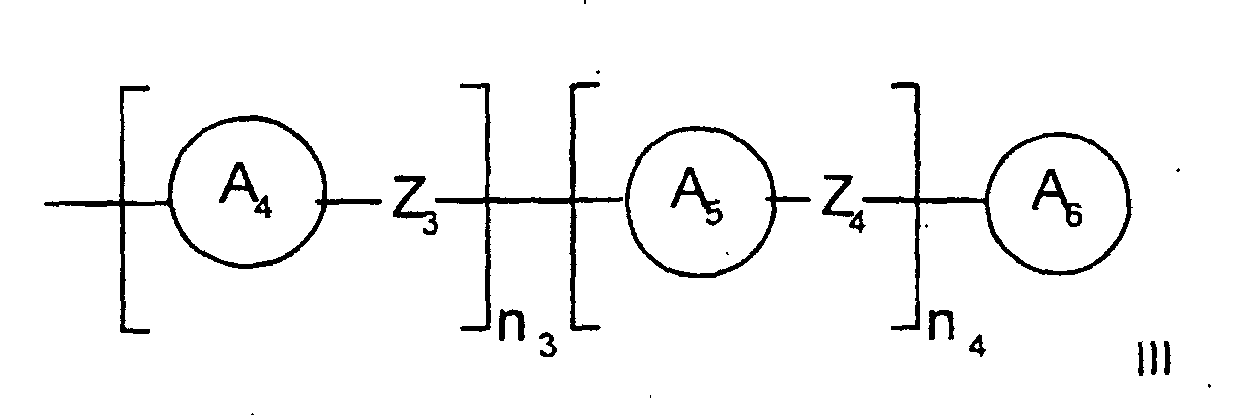
A4,5 may each independently be selected from 1,2-, 1,3- or 1,4-phenylene, which is unsubstituted or substituted from one and up to and including all available substitution positions with one or more of the groups selected from halogen, CN, NO2 and in which 1 or 2 CH groups can be replaced by nitrogen;
or A4,5 may be independently selected from 2,5-thiophenediyl, 2,5-furanylene, 1,4- or 2,6-naphthalene in which 1 or 2 CH groups can be replaced by nitrogen;
Z3,4 may each independently be selected from a direct bond, CH2CH2, COO, OOC, O(CH2)3, OCH2, CH2O, (CH2)3O, (CH2)4, or the trans form of OCH2CH=CH, CH2CH=CHO, CH2CH2CH=CH, CH2CH=CHCH2;
n3,4 may each independently be 0 or 1;
A6 may be A7 may be 1,2-, 1,3- or 1,4-phenylene, which is unsubstituted or substituted from one and up to and including all available substitution positions with one or more of the groups selected from halogen, CN, NO2 and in which 1 or 2 CH groups can be replaced by nitrogen,
Z5 may be an alkylene unit with 1 to 16, preferably 1 to 10, carbon atoms,
a cycloalkylene group with 3 to 8 carbon atoms, preferably with 5 or 6 carbon atoms, in which optionally one or two methylene units can be replaced by NH groups,
or phenylene, which can be substituted from one and up to and including all available substitution positions with one or more of the groups selected from C1-10 alkyl, C1-10 alkoxy, CN, NO2 , halogen, or carbonate,an ester group, that is, COO and OOC;
an amide group, that is, -CONH- and -NHOC-, the H group on the amide may be substituted with C1-10 alkyl groups;
an ether group, that is, COC;
n5 may be 0 or 1;
R2 may be H, halogen, CN, NO2, NCS, SCN, alkyl with 1 to 12 carbon atoms which is optionally substituted with one or more fluorines and in which optionally 1 or 2 non-adjacent methylene units (CH2) can be replaced by oxygen, COO, OOC, CO and/or CH=CH;
R3 may be H, halogen, CN, NO2, NCS, SCN, alkyl with 1 to 12 carbon atoms which is optionally substituted with one or more fluorines and in which optionally 1 or 2 non-adjacent methylene units (CH2) can be replaced by oxygen, COO, OOC, CO and/or CH=CH;
R4 may be H or C1-10 alkyl;
V may be H, alkyl or alkoxy with 1 to 8 carbon atoms, trifluoromethyl, or phenyl which may be substituted from one and up to and including all available substitution positions with one or more of the groups selected from CN, halogen, NO2;
U may be H, alkyl or alkoxy with 1 to 8 carbon atoms, cyano, or COOR5;
R5 may be C1-10 alkyl;
r may be a number from 0 to 3;
X6,7 may be independently selected from H, halogen, CN, NO2, NCS, SCN, alkyl with 1 to 12 carbon atoms which is optionally substituted with one or more fluorines and in which optionally 1 or 2 non-adjacent methylene units (CH2) can be replaced by oxygen, COO, OOC, CO and/or CH=CH. - The term "1,2-, 1,3- or 1,4-phenylene, which is unsubstituted or substituted with one or more of the groups selected from halogen, CN and/or NO2 and in which 1 or 2 CH groups can be replaced by nitrogen" includes, and is not limited to, in the present application 1,2-phenylene, 1,3-phenylene or 1,4-phenylene, 2-ftuoro-1,4-phenylene, 2,3-difluoro-1,4-phenylene, 2,6-difluoro-1,4-phenylene, 2-chloro-1,4-phenylene, 2,3-dichloro-1,4-phenylene, 2,6-dichloro-1,4-phenylene, 2-cyano-1,4-phenylene, 2,3-dicyano-1,4-phenylene, 2-nitro-1,4-phenylene, 2,3-dinitro-1,4-phenylene, 2-bromo-1,4-phenylene, 2-methyl-1,4-phenylene, and pyridine-2,5-diyl, pyrimidine-2,5-diyl, and the like. Particular examples that are preferred include1,4-phenylene, 2-fluoro-1,4-phenylene, 2,3-difluoro-1,4-phenylene, 2,6-difluoro-1,4-phenylene, pyridine-2,5-diyl, pyrimidine-2,5-diyl.
- The term "1,4- or 2,6-naphthalene, in which 1 or 2 CH groups can be replaced by nitrogen" includes, and is not limited to, in the present application 1,4- or 2,6-naphthalene, 1-benzazine-2,6-diyl and 2-benzazine-1,4-diyl.
- Examples of the term "alkyl with 1 to 12 carbon atoms which is optionally substituted with one or more fluorines and in which optionally 1 or 2 non-adjacent methylene units (CH2) can be replaced by oxygen, COO, OOC, CO and/or CH=CH" include in the present application straight-chain and branched (optionally chiral) residues such as alkyl, alkenyl, alkoxy, alkenyloxy, alkoxyalkyl, alkoxyalkenyl, 1-fluoroalkyl, terminal trifluoromethylalkyl, terminal difluoromethylalkyl, terminal trifluoromethylalkoxy, and the like with 1 or, 2 to 16 carbon atoms. Examples of preferred residues are methyl, ethyl, propyl, butyl, pentyl, hexyl, heptyl, octyl, 1-methylpropyl, 1-methylheptyl; 2-methylbutyl, 3-methyl pentyl, vinyl, 1 E-propenyl, 1E-butenyl, 1E-pentenyl, 3-butenyl, 3E-pentenyl, 3E-hexenyl, 3E-hexenyl, 4-pentenyl, 4Z-hexenyl, 5-hexenyl, 6-heptenyl, 7-octenyl, methoxy, ethoxy, propyloxy, butyloxy, pentyloxy, hexyloxy, octyloxy, 1-methylpropyloxy, 1-methylheptyloxy, 2-methylbutyloxy, 1-fluoropropyl, 2-fluoroptopyl, 2,2-difluoropropyl, 3-fluoropropyl, 3,3-difluoropropyl, 3,3,3-trifluoropropyl and the like. Especially preferred residues possess 1 or, respectively, 2 to 6 carbon atoms.
- The term "halogen" may represent in the present application fluorine, chlorine, bromine and iodine, but especially fluorine and chlorine.
- The structural and other preferences are expressed below on the basis of inter alia one or more of the following properties - good processability, thermal, chemical and electrochemical stability, ability to isomerise and/or dimerise, monodispersity and ready synthesis from commercially available starting materials.
- Alternatively, the PG1-3 groups have the general formula IIAwherein

S1 indicates the position of the spacer group
A1 may be 1,4-phenylene, which is unsubstituted or substituted with one or more of the groups selected from halogen, CN, NO2;
A2 may be 1,4-phenylene, which is unsubstituted or substituted from one and up to and including all available substitution positions with one or more of the groups selected from halogen, CN, NO2;
Z1 may be a direct bond, CH2CH2, COO, OOC, O(CH2)3, OCH2, CH2O, (CH2)3O, or (CH2)4;
n1 may be 0 or 1;
W, Y may each independently be H, halogen, CN, alkyl with 1 to 12 carbon atoms which is optionally substituted with one or more fluorines;
R1 may be H, halogen, CN, alkyl with 1 to 12 carbon atoms which is optionally substituted with one or more fluorines and in which optionally 1 or 2 non-adjacent methylene units (CH2) can be replaced by oxygen, COO, OOC and/or a CH2CH2 group may be replaced by CH=CH. - According to an aspect of this invention a method of providing an alignment layer on a surface of a liquid crystal cell wall includes the step of depositing a layer of a material comprising at least one compound of Formula I on the surface, followed by exposure to actinic radiation, and controlling the exposure time and/or intensity of radiation used to provide a selected value of pretilt in a liquid crystal placed in contact with the exposed layer.
- The radiation includes light, with a wavelength of 250-450nm. Preferably the radiation is light with a wavelength of 300-400nm.
- According to a further aspect of this invention a liquid crystal device comprises a layer of a liquid crystal material contained between two cell walls both carrying electrode structures and surface treated to provide an alignment layer for liquid crystal molecules;
characterised in that: - the surface treatment is a layer of material comprising a compound of Formula 1 which has been exposed to actinic radiation.
-
- The radiation includes light, with a wavelength of 250-450nm. Preferably the radiation is light with a wavelength of 300-400nm.
- Compounds of Formula I can be prepared by various routes from commercially available starting materials. Typically 1,2,3-trihydroxypropane (glycerol) can be esterified with ω-halogenoalkanoic acids in the presence of N, N-dicyclohexylcarbodiimide and 4-(dimethylamino)pyridine and a polar solvent, such as N,N-dimethylformamide or dichloromethane. The resultant bromides can then be alkylated in a Williams ether synthesis with a photoisomerisable/dimerisable group, such as 6-hydroxycoumarin, 7-hydroxycoumarin or alkyl 4-hydroxycinnamates, in the presence of a base, such as potassium carbonate, and a polar solvent, such as cyclohexanone or ethyl-methylketone. The bromides can also be esterified with a photoisomerisable/dimerisable group, such as cinnamic acids, in the presence of DBU and a non polar solvent, such as toluene or benzene. Similarly 1,2,3-trihydroxypropane (glycerol) can be alkylated with ω-halogenoalkanols protected, for example as the THP derivative, in the presence of base, such as potassium tert.-butylate, and a polar solvent, such as 1,2-dimethoxyethane or ethylene glycol dimethyl ether. After deprotection the resultant alcohols can then be esterified with a photoisomerisable/dimerisable group, such as anthracene carboxylic acids or cinnamic acids, in the presence of N, N-dicyclohexylcarbodiimide and 4-(dimethylamino)pyridine and a polar solvent, such as N,N-dimethylformamide or dichloromethane. The alcohols can also be alkylated in a Mitsunobu reaction, with a photoisomerisable/dimerisable group, such as 6-hydroxycoumarin, 7-hydroxycoumarin or alkyl 4-hydroxycinnamates, in the presence of a dehydrating agent, such as diethyl azodicarboxylate and triphenyl phosphine, and a polar solvent, such as tetrahydrofuran or N,N-dimethylformamide.
- The photocross-linkable groups, such as cinnamic acids, cinnamate esters, cinnamonitriles, styrenes, stilbenes, vinytnaphthalenes, vinylpyridines, maleimides, thymines, coumarins, anthracenes, are generally either commercially available or readily accessible, for example coumarin and cinnamate derivatives can be prepared according to literature methods, such as the Perkin, Pechmann, Wittig-Horner or Knoevenagel reactions. See JR Johnson, "The Perkin Reaction and Related Reactions", Organic Reactions, 1, 210-65, 1942; Wittig Horner Reaction: L Lombardo and RJK Taylor, Synthesis, 131, 1978; Knoevenagel Reaction: G Jones, Organic Reactions, 15, 204 (1967).
- In order to obtain alignment layers in regions selectively limited by area, a solution of the photoactive propane derivative can, for example, firstly be prepared and then spread out using a spin-coating apparatus on a carrier coated with an electrode, e.g., a glass plate coated with indium-tin oxide (ITO) such that homogeneous layers of thickness typically in the range 50-200nm result. Preferably the layers are in the range 0.05-50µm. Subsequently or simultaneously, irradiation can be applied to the region to be isomerised and/or dimerised (cross-linked), e.g., with a mercury high pressure lamp, a xenon lamp or a UV laser utilising a polariser and optionally a mask for the formation of structures. The duration and irradiation depends on the capacity of the individual lamps and can vary from a few minutes to several hours. The cross-linking can, however, also be effected by irradiating the homogeneous layer using filters which, e.g., let through only radiation suitable for the cross-linking reaction. Photosensitisors, such as acetophenone or benzophenone may be added to shorten the illumination time required for cross-linking. Non-zero tilt angles () may be induced by illumination with plane polarised light from a non-perpendicular angle to the plane of the substrate.
- The materials of the current invention when used in alignment layers are believed to be of particular benefit due to their lack of polydispersity.
- The invention will now be described, by way of example only, with reference to the following examples and diagrams:
- Figure 1 is a plan view of a liquid crystal device.
- Figure 2 is a cross sectional view of figure 1.
- Figure 3 is a schematic representation of the apparatus used to illuminate the photocross-linkable propane derivatives on a suitable substrate to be used as part of a liquid crystal device.
- Figure 4 is a typical plot of the induced optical anisotropy obtained for the object of the
invention, in this
case 1,2,3-tris[5-(4-(2-oxo-2H-1-benzopyran-7-yloxycarbonyl)phenoxy]pentanoyloxy)propane, on a fused silica substrate on illumination with plane polarised light at 300.5 nm. -
- The device of Figures 1, 2 comprises a liquid crystal cell 1 formed by two
cell walls spacer ring 4 to contain alayer 5 of a liquid crystal material. The inside faces of bothwalls tin oxide layer layer - If the
material 5 is nematic then the device may be the known twisted nematic device. In this case polarisers 10, 11 are used to distinguish between the device voltage ON and OFF states. - The liquid crystal material may be nematic, cholesteric, or smectic material. The device may be used as a display device, e.g., displaying alpha numeric information, or an x, y matrix displaying information. Alternatively the device may operate as a shutter to modulate light transmission, e.g., as a spatial light modulator, or as a privacy window.
- The apparatus of Figure 3 used to generate photoinduced anisotropy in the photoreactive sample 1 using linearly polarised UV light comprises a radiation source e.g. an argon ion laser 2 (Spectra Physics, Model 2045). The laser beam operating at 300.5nm has a polarisation direction (E). The laser beam was expanded by using a quartz
lens beam expander 3. The film anisotropy is measured by determining the induced birefringence against UV exposure time using a He-Ne laser 4 (632.8nm) modulated by arotating chopper 5. The probing wavelength does not perturb the anisotropy inducing process since it is far away from any intrinsic absorption band in either the starting material or photoproduct. During the UV exposure of the sample, the photoinduced birefringence was monitored using two crossed polarisers, P1 and P2, 6 and 7 arranged at +/- 45° with respect to the vertical polarisation of the UV laser beam. The intensity of the beam from the probing He-Ne laser 4, which then passed through the sample, was detected by aphotodetector 9. The birefringence measuring signal taken from thephotodiode 9 was processed by a phase sensitive lock-inamplifier 10 and recorded by acomputer 11. Data were plotted as birefringence versus UV exposure time. - The photocross-linkable propane derivatives and resultant alignment layers may be produced as described, by way of example only, in the following examples; K signifies the crystalline state, SmA signifies the smectic A phase, I signifies the isotropic phase, Tg is the glass transition temperature.
- A mixture of 0.4
g 1, 2, 3-tris(11-bromoundecanoyloxy)propane, 2.9 g ethyl (E)-4-hydroxycinnamate, 20.0 g anhydrous potassium carbonate and 25 ml ethyl-methyl ketone was heated under gentle reflux overnight. The reaction mixture was filtered to remove inorganic material and the filtrate evaporated down. The residue was purified by column chromatography on silica gel using hexane/ethyl acetate (1/1 v/v) as eluent and recrystallisation from acetonitrile to yield 5.2 g of 1, 2, 3-tris[11-(4-[(E)-ethoxycarbonylethenyl]phenoxy)undecanoyloxy]propane. - The 1, 2, 3-tris(4-bromoundecanoyloxy)propane required as starting material was prepared as follows:
- 3.1 g Dicyclohexylcarbodiimide was added to a solution of 0.5
g 1, 2, 3-trihydroxypropane (glycerol), 4.0 g 11-bromoundecanoic acid, 0.6 g 4-(dimethylamino)pyridine and 50 ml dichloromethane at 0°C. The reaction mixture was stirred overnight at room temperature, filtered to remove inorganic material and the filtrate evaporated down. The residue was purified by column chromatography on silica gel using hexane/ethyl acetate (1/1 v/v) as eluent and recrystallisation from acetonitrile to yield 0.4 g of 1, 2, 3-tris(11-bromoundecanoyloxy)propane. - The ethyl (E)-4-hydroxycinnamate required as starting material was prepared as follows:
- A mixture of 10 g 4-hydroxycinnamic acid, 100 ml ethanol and 0.5 ml concentrated sulphuric acid was heated under gentle reflux for 96 hours. The reaction mixture was poured onto water, the resultant precipitate filtered off, washed with portions of water and then dried. The residue was purified by column chromatography on silica gel using ethyl acetate as eluent and recrystallisation from acetonitrile to yield 9.2 g of ethyl (E)-4-hydroxycinnamate.
- The following compounds can be prepared in an analogous manner:
- 1, 2, 3-tris[3-(4-[(E)-methoxycarbonylethenyl]phenoxy)propanoyloxy]propane.
- 1, 2, 3-tris[4-(4-[(E)-methoxycarbonylethenyl]phenoxy)butanoyloxy]propane.
- 1, 2, 3-tris[5-(4-[(E)-methoxycarbonylethenyl]phenoxy)pentanoyloxy]propane.
- 1, 2, 3-tris[6-(4-[(E)-methoxycarbonylethenyl]phenoxy)hexanoyloxy]propane.
- 1, 2, 3-tris[7-(4-[(E)-methoxycarbonylethenyl]phenoxy)heptanoyloxy]propane.
- 1, 2, 3-tris[8-(4-[(E)-methoxycarbonylethenyl]phenoxy)octanoyloxy]propane.
- 1, 2, 3-tris[9-(4-[(E)-methoxycarbonylethenyl]phenoxy)nonanoyloxy]propane.
- 1, 2, 3-tris[10-(4-[(E)-methoxycarbonylethenyl]phenoxy)decanoyloxy]propane.
- 1, 2, 3-tris[11-(4-[(E)-methoxycarbonylethenyl]phenoxy)undecanoyloxy]propane.
- 1, 2, 3-tris[12-(4-[(E)-methoxycarbonylethenyl]phenoxy)dodecanoyloxy]propane.
- 1, 2, 3-tris[3-(4-[(E)-ethoxycarbonylethenyl]phenoxy)propanoyloxy]propane.
- 1, 2, 3-tris[4-(4-[(E)-ethoxycarbonylethenyl]phenoxy)butanoyloxy]propane.
- 1, 2, 3-tris[5-(4-[(E)-ethoxycarbonylethenyl]phenaxy)pentanoyloxy]propane.
- 1, 2, 3-tris[6-(4-[(E)-ethoxycarbonylethenyl]phenoxy)hexanoyloxy]propane.
- 1, 2, 3-tris[7-(4-[(E)-ethoxycarbonylethenyl]phenoxy)heptanoyloxy]propane.
- 1, 2, 3-tris[8-(4-[(E)-ethoxycarbonylethenyl]phenoxy)octanoyloxy]propane.
- 1, 2, 3-tris[9-(4-[(E)-ethoxycarbonylethenyl]phenoxy)nonanoyloxy]propane.
- 1,2, 3-tris[10-(4-[(E)-ethoxycarbonylethenyl]phenoxy)decanoyloxy]propane.
- 1, 2, 3-tris[12-(4-[(E)-ethoxycarbonylethenyl]phenoxy)dodecanoyloxy]propane.
- 1, 2, 3-tris[6-(4-[(E)-ethoxycarbonylethenyl]biphenyl-4'-yloxy)hexyloxy]propane, K, 169°C
- 1, 2, 3-tris(3-[2-oxo-2H-1-benzopyran-7-yloxy]propanoyloxy)propane.
- 1, 2, 3-tris(4-[2-oxo-2H-1-benzopyran-7-yloxy]butanoyloxy)propane.
- 1, 2, 3-tris(5-[2-oxo-2H-1-benzopyran-7-yloxy]pentanoyloxy)propane, Tg, -10°C.
- 1, 2, 3-tris(6-[2-oxo-2H-1-benzopyran-7-yloxy]hexanoyloxy)propane.
- 1, 2, 3-tris(7-[2-oxo-2H-1-benzopyran-7-yloxy]heptanoyloxy)propane.
- 1, 2, 3-tris(8-[2-oxo-2H-1-benzopyran-7-yloxy]octanoyloxy)propane.
- 1, 2, 3-tris(9-[2-oxo-2H-1-benzopyran-7-yloxy]nonanoyloxy)propane.
- 1, 2, 3-tris(10-[2-oxo-2H-1-benzopyran-7-yloxy]decanoyloxy)propane.
- 1, 2, 3-tris(11-[2-oxo-2H-1-benzopyran-7-yloxy]undecanoyloxy)propane.
- 1, 2, 3-tris(12-[2-oxo-2H-1-benzopyran-6-yloxy]heptanoyloxy)propane.
-
- 0.77 g Dicyclohexylcarbodiimide is added to a solution of 0.56 g 7-hydroxycoumarin, 1.0
g 1, 2, 3-tris(10-[4-carboxyphenoxy]decanoyloxy)propane, 0.1 g 4-(dimethylamino)pyridine and 25 ml dichloromethane at 0°C. The reaction mixture is stirred overnight at room temperature, filtered to remove inorganic material and the filtrate evaporated down. The residue is purified by column chromatography on silica gel using hexane/ethyl acetate (1/1 v/v) as eluent and recrystallisation from acetonitrile to yield 0.4 g of 1, 2, 3-tris(10-[4-(2-oxo-2H-1-benzopyran-7-yloxycarbonyl)phenoxy]decanoyloxy)propane. - The 1, 2, 3-tris(10-[4-carboxyphenoxy]decanoyloxy)propane required as starting material is prepared as follows:
- A mixture of 10.0
g 1, 2, 3-tris(10-bromodecanoyloxy)propane, 4.6 g 4-hydroxybenzaldehyde, 52.4 g anhydrous potassium carbonate and 250 ml ethyl-methyl ketone is heated under gentle reflux overnight. The reaction mixture is filtered to remove inorganic material and the filtrate evaporated down. The residue is purified by column chromatography on silica gel using hexane/ethyl acetate (1/1 v/v) as eluent and recrystallisation from acetonitrile to yield 8.1 g of 1, 2, 3-tris(10-[4-formylphenoxy]decanoyloxy)propane. - 10 ml of a solution of Jones' reagent is added dropwise at 0°C to a mixture of 8.1
g 1, 2, 3-tris(10-[4-formylphenoxy]decanoyloxy)propane in 25 ml acetone. The reaction mixture is stirred at room temperature for 2 hours, poured onto water and the resultant precipitate filtered off, washed with portions of water and dried. The solid product is purified by recrystallisation from ethyl acetate to yield 3.7 g of 1, 2, 3-tris(10-[4-carboxyphenoxy]decanoyloxy)propane. - The following compounds can be prepared in an analogous manner:
- 1, 2, 3-tris(3-[4-(2-oxo-2H-1-benzopyran-7-yloxy carbonyl)phenoxy]propanoyloxy)propane.
- 1, 2, 3-tris(4-[4-(2-oxo-2H-1-benzopyran-7-yloxy carbonyl)phenoxy]butanoyloxy)propane.
- 1, 2, 3-tris(5-[4-(2-oxo-2H-1-benzopyran-7-yloxy carbonyl)phenoxy]pentanoyloxy)propane.
- 1, 2, 3-tris(6-[4-(2-oxo-2H-1-benzopyran-7-yloxy carbonyl)phenoxy]hexanoyloxy)propane.
- 1, 2, 3-tris(7-[4-(2-oxo-2H-1-benzopyran-7-yloxy carbonyl)phenoxy]heptanoyloxy)propane.
- 1, 2, 3-tris(8-[4-(2-oxo-2H-1-benzopyran-7-yloxy carbonyl)phenoxy]octanoyloxy)propane.
- 1, 2, 3-tris(9-[4-(2-oxo-2H-1-benzopyran-7-yloxy carbonyl)phenoxy]nonanoyloxy)propane.
- 1, 2, 3-tris(11-[4-(2-oxo-2H-1-benzopyran-7-yloxy carbonyl)phenoxy]undecanoyloxy)propane.
- 1, 2, 3-tris(7-[4-(2-oxo-2H-1-benzopyran-6-yloxy carbonyl)phenoxy]heptanoyloxy)propane.
- 1, 2, 3-tris(10-[2-fluoro-4-(2-oxo-2H-1-benzopyran-7-yloxycarbonyl)phenoxy] decanoyloxy)propane.
- 1, 2, 3-tris(10-[2-chioro-4-(2-oxo-2H-1-benzopyran-7-yloxycarbonyl)phenoxy] decanoyloxy)propane.
- 1, 2, 3-tris(10-[2-bromo-4-(2-oxo-2H-1-benzopyran-7-yloxycarbonyl)phenoxy] decanoyloxy)propane.
- 1, 2, 3-tris(10-[2-cyano-4-(2-oxo-2H-1-benzopyran-7-yloxycarbonyl)phenoxy] decanoyloxy)propane.
- 1, 2, 3-tris(10-[2-methoxy-4-(2-oxo-2H-1-benzopyran-7-yloxycarbonyl)phenoxy] decanoyloxy)propane.
- 1, 2, 3-tris(10-[3-fluoro-4-(2-oxo-2H-1-benzopyran-7-yloxycarbonyl)phenoxy] decanoyloxy)propane.
- 1, 2, 3-tris(10-[3-chloro-4-(2-oxo-2H-1-benzopyran-7-yloxycarbonyl)phenoxy] decanoyloxy)propane.
- 1, 2, 3-tris(10-[3-bromo-4-(2-oxo-2H-1-benzopyran-7-yloxycarbonyl)phenoxy] decanoyloxy)propane.
- 1, 2, 3-tris(10-[3-cyano-4-(2-oxo-2H-1-benzopyran-7-yloxycarbonyl)phenoxy] decanoytoxy)propane.
- 1, 2, 3-tris(10-[3-methoxy-4-(2-oxo-2H-1-benzopyran-7-yloxycarbonyl)phenoxyl decanoyloxy)propane.
- 1, 2, 3-tris(10-[2,3-difluoro-4-(2-oxo-2H-1-benzopyran-7-yloxycarbonyl)phenoxy] decanoyloxy)propane.
- 1, 2, 3-tris(10-[2,3-chloro-4-(2-oxo-2H-1-benzopyran-7-yloxycarbonyl)phenoxy] decanoyloxy)propane.
- 1, 2, 3-tris(10-[2,3-bromo-4-(2-oxo-2H-1-benzopyran-7-yloxycarbonyl)phenoxy] decanoyloxy)propane.
-
- 0.7 g Dicyclohexylcarbodiimide is added to a solution of 0. 6 g 4-cyano-4'-hydroxybiphenyl, 1.0
g 1, 2, 3-tris(10-[4-(carboxyethenyl)phenoxy]decanoyloxy)propane, 0.1 g 4-dimethylaminopyridine and 50 ml dichloromethane at 0°C. The reaction mixture is stirred overnight at room temperature, filtered to remove inorganic material and the filtrate evaporated down. The residue is purified by column chromatography on silica gel using hexane/ethyl acetate (1/1 v/v) as eluent and recrystallisation from acetonitrile to yield 0.4 g of 1, 2, 3-tris(10-[4-(4-cyano-4'-biphenyloxycarbonylethenyl)phenoxy]decanoyloxy)propane. - The 1, 2, 3-tris(10-[4-(carboxyethenyl)phenoxy]decanoyloxy)propane required as starting material is prepared as follows:
- 4 ml of a 1.6 mol ml-1 solution of butyllithium is added dropwise at 0°C under an atmosphere of nitrogen to a solution of 1.7 g trimethylsilyl P, P-diethylphosphonoacetate in 100 ml tetrahydrofuran. The reaction mixture is stirred at room temperature for 3 hours and then a solution of 5.0
g 1, 2, 3-tris(10-[4-formylphenoxy]decanoyloxy)propane in 50 ml tetrahydrofuran is added dropwise. The solution is stirred at room temperature overnight, reduced in volume under reduced pressure, then poured onto 500 ml water. The aqueous layer is acidified (pH 1) with hydrochloric acid and then extracted into ethyl acetate (3 x 100 ml). The combined organic layers are washed with brine (2 x 500 ml), dried over anhydrous magnesium sulphate, filtered, and the filtrate evaporated down. The residue is purified by. recrystallisation from acetonitrile to yield 2.3 g of 1, 2, 3-tris(10-[4-(carboxyethenyl)phenoxy]decanoyloxy)propane. - The following compounds can be prepared in an analogous manner:
- 3-tris(3-[4-(4-cyano-4'-biphenyloxycarbonylethenyl)phenoxy]propanoyloxy)propane.
- 3-tris(4-[4-(4-cyano-4'-biphenyloxycarbonylethenyl)phenoxy]butanoyloxy)propane.
- 3-tris(5-[4-(4-cyano-4'-biphenyloxycarbonylethenyl)phenoxy]pentanoyloxy)propane.
- 3-tris(6-[4-(4-cyano-4'-biphenyloxycarbonylethenyl)phenoxy]hexanoyloxy)propane.
- 3-tris(7-[4-(4-cyano-4'-biphenyloxycarbonylethenyl)phenoxy]heptanoyloxy)propane.
- 3-tris(8-[4-(4-cyano-4'-biphenyloxycarbonylethenyl)phenoxy]octanoyloxy)propane.
- 3-tris(9-[4-(4-cyano-4'-biphenyloxycarbonylethenyl)phenoxy]nonanoyloxy)propane.
- 3-tris(11-[4-(4-cyano-4'-biphenyloxycarbonylethenyl)phenoxy]undecanoyloxy)propane.
- 3-tris(12-[4-(4-cyano-4'-biphenyloxycarbonylethenyl)phenoxy]dodecanoyloxy)propane.
- 3-tris(10-[4-(4-cyano-phenoxycarbonylethenyl)phenoxy]decanoyloxy)propane.
- 3-tris(10-[4-(4-cyano-3-fluoro-phenoxycarbonylethenyl)phenoxy]decanoyloxy)propane.
- 3-tris(10-[4-(4-cyano-2-fluoro-phenoxycarbonylethenyl)phenoxy]decanoyloxy)propane.
- 3-tris(10-[4-(4-[5-pentylpyrimidin-2-yl]-phenoxycarbonylethenyl)phenoxy]decanoyloxy)propane.
- 3-tris(10-[4-(4-[5-pentylpyridin-2-yl]-phenoxycarbonylethenyl)phenoxy]decanoyloxy)propane.
- 3-tris(10-[4-(4-[2-pentylpyrimidin-5-yl]-phenoxycarbonylethenyl)phenoxy]decanoyloxy)propane.
- 3-tris( 10-[4-(4-[2-pentylpyridin-5-yl]-phenoxycarbonylethenyl)phenoxy]decanoyloxy)propane.
- 3-tris(10-[4-(4-[trans-4-pentylcyclohexyl]-phenoxycarbonylethenyl)phenoxy]decanoyloxy)propane.
- 3-tris(10-[4-(trans-4-[trans-4-pentylcyclohexyl]-cyclohexyloxycarbonylethenyl)phenoxy]decanoyloxy)propane.
-
- A solution of 0.7 g 4-fluorocinnamic acid, 1.0
g 1, 2, 3-tris(10-bromodecanoyloxy)propane, 0.6 g 1,8-diazabicyclo[5.4.0]undec-7-ene (DBU) and 25 ml toluene is heated under gentle reflux overnight. The reaction mixture is washed with water (2 x 100 ml), dried over magnesium sulphate, filtered to remove inorganic material and the filtrate evaporated down. The residue is purified by column chromatography on silica gel using hexane/ethyl acetate (1/1 v/v) as eluent and recrystallisation from acetonitrile to yield 0.4 g of 1, 2, 3-tris(10-[4-fluorophenylacryloyloxy]decanoyloxy)propane - The following compounds can be prepared in an analogous manner:
- 1, 2, 3-tris(5-[4-fluorophenylacryloyloxy]pentanoyloxy)propane.
- 1, 2, 3-tris(6-[4-fluorophenylacryloyloxy]hexanoyloxy)propane.
- 1, 2, 3-tris(7-[4-fluorophenylacryloyloxy]heptanoyloxy)propane.
- 1, 2, 3-tris(8-[4-fluorophenylacryloyloxy]octanoyloxy)propane.
- 1, 2, 3-tris(9-[4-fluorophenylacryloyloxy]nonanoyloxy)propane.
- 1, 2, 3-tris(10-[4-chlorophenylacryloyloxy]decanoyloxy)propane.
- 1, 2, 3-tris(10-[4-bromophenylacryloyloxy]decanoyloxy)propane.
- 1, 2, 3-tris(10-[4-cyanophenylacryloyloxy]decanoyloxy)propane.
- 1, 2, 3-tris(10-[4-cyano-4'-biphenylacryloyloxy]decanoyloxy)propane.
- 1, 2, 3-tris(10-[4-methoxy-4'-biphenylacryloyloxy]decanoyloxy)propane.
- 1, 2, 3-tris(10-[4-ethoxy-4'-biphenylacryloyloxy]decanoyloxy)propane.
- 1, 2, 3-tris(10-[4-propyloxy-4'-biphenylacryloyloxy]decanoyloxy)propane.
- 1, 2, 3-tris(10-[4-butyloxy-4'-biphenylacryloyloxy]decanoyloxy)propane.
- 1, 2, 3-tris( 10-[4-pentyloxy-4'-biphenylacryloyloxy]decanoyloxy)propane.
- 1, 2, 3-tris(10-[4-hexyoxy-4'-biphenylacryloyloxy]decanoyloxy)propane.
- 1, 2, 3-tris(10-[4-heptoxy-4'-biphenylacryloyloxy]decanoyloxy)propane.
- 1, 2, 3-tris(10-[4-octyloxy-4'-biphenylacryloyloxy]decanoyloxy)propane.
- 1, 2, 3-tris(10-[4-(trans-4-pentylcyclohexyl)phenylacryloyloxy]decanoyloxy)propane.
- 1, 2, 3-tris(10-[anthracene-2-carbonyloxy]decanoyloxy)propane.
- 1, 2, 3-tris(10-[anthracene-9-carbonyloxy]decanoyloxy)propane.
-
- 0.7 g Diethyl azodicarboxylate is added to a solution of 0.7 g 7-hydroxycoumarin, 0.7
g 1, 2, 3-tris(10-hydroxydecyloxy)propane, 1.1 g triphenyl phosphine and 50 ml tetrahydrofuran at 0°C. The reaction mixture is stirred overnight at room temperature and then evaporated down with silica gel. The resultant powder is purified by column chromatography on silica gel using hexane/ethyl acetate (1/1 v/v) as eluent and recrystallisation from acetonitrile to yield 0.35 g of 1, 2, 3-tris(10-[2-oxo-2H-1-benzopyran-7-yloxycarbonyl]decyloxy)propane. - The 1, 2, 3-tris(10-hydroxydecyloxy)propane required as starting material is prepared as follows:
- A mixture of 100 g 1-bromodecan-10-ol, 2.1 g bis(trimethylsilyl)sulphate, 43
g 3,4-dihydro-2H-pyran and 500 ml dichloromethane is stirred for 6 hours at room temperature. Several drops of pyridine are added and the reaction mixture evaporated down. The residue is purified by column chromatography on silica gel using hexane/ethyl acetate (1/1 v/v) as eluent to yield 58 g of 1-bromo-10-[tetrahydropyranyloxy]decane. - A mixture of 58 g 1-bromo-10-[tetrahydropyranyloxy]decane, 5
g 1, 2, 3-trihydroxypropane (glycerol), 74 g potassium tert.-butoxide and 500 ml 1,2-dimethoxyethane is stirred at room temperature overnight. The reaction mixture is added to water and extracted into ethyl acetate (3 x 100 ml). The combined organic layers are washed with water (2 x 500 ml), dried over magnesium sulphate, filtered and the filtrate then evaporated down. The residue is purified by column chromatography on silica gel using hexane/ethyl acetate (1/1 v/v) as eluent and recrystallisation from acetonitrile to yield 13 g of 1, 2, 3-tris(10-[tetrahydropyranyloxy]decyloxy)propane. - A mixture of 13
g 1, 2, 3-tris(10-[tetrahydropyranyloxy]decyloxy)propane, 1 g. bis(trimethylsilyl)sulphate and 250 ml methanol is stirred at room temperature for 2 hours. The reaction mixture is evaporated down. The residue is purified by column chromatography on silica gel using hexane/ethyl acetate (1/1 v/v) as eluent and recrystallisation from acetonitrile to yield 7.1 g of 1, 2, 3-tris(10-hydroxydecyloxy)propane. - The following compounds can be prepared in an analogous manner:
- 1, 2, 3-tris(3-[2-oxo-2H-1-benzopyran-7-yloxy]propyloxy)propane.
- 1, 2, 3-tris(5-[2-oxo-2H-1-benzopyran-7-yloxy]pentyloxy)propane.
- 1, 2, 3-tris(6-[2-oxo-2H-1-benzopyran-7-yloxy]hexyloxy)propane.
- 1, 2, 3-tris(7-[2-oxo-2H-1-benzopyran-7-yloxy]heptyloxy)propane.
- 1, 2, 3-tris(8-[2-oxo-2H-1-benzopyran-7-yloxy]octyloxy)propane.
- 1, 2, 3-tris(9-[2-oxo-2H-1-benzopyran-7-yloxy]nonyloxy)propane.
- 1, 2, 3-tris(11-[2-oxo-2H-1-benzopyran-7-yloxy]undecyloxy)propane.
- 1, 2, 3-tris(12-[2-oxo-2H-1-benzopyran-7-yloxy]dodecyloxy)propane.
- 1, 2, 3-tris[3-(4-[(E)-methoxycarbonylethenyl]phenoxy)propyloxy]propane.
- 1, 2, 3-tris[4-(4-[(E)-methoxycarbonylethenyl]phenoxy)butyloxy]propane.
- 1, 2, 3-tris[5-(4-[(E)-methoxycarbonylethenyl]phenoxy)pentyloxy]propane.
- 1, 2, 3-tris[6-(4-[(E)-methoxycarbonylethenyl]phenoxy)hexyloxy]propane.
- 1, 2, 3-tris[7-(4-[(E)-methoxycarbonylethenyl]phenoxy)heptyloxy]propane.
- 1, 2, 3-tris[8-(4-[(E)-methoxycarbonylethenyl]phenoxy)octyloxy]propane.
- 1, 2, 3-tris[9-(4-[(E)-methoxycarbonylethenyl]phenoxy)nonyloxy]propane.
- 1, 2, 3-tris[11-(4-[(E)-methoxycarbonylethenyl]phenoxy)decyloxy]propane.
- 1, 2, 3-tris[11-(4-[(E)-methoxycarbonylethenyl]phenoxy)undecyloxy]propane.
- 1, 2, 3-tris[12-(4-[(E)-methoxycarbonylethenyl]phenoxy)dodecyloxy]propane.
- 1, 2, 3-tris[3-(4-((E)-ethoxycarbonylethenyl]phenoxy)propyloxy]propane.
- 1, 2, 3-tris[4-(4-[(E)-ethoxycarbonylethenyl]phenoxy)butyloxy]propane.
- 1, 2, 3-tris[5-(4-[(E)-ethoxycarbonylethenyl]phenoxy)pentyloxy]propane.
- 1, 2, 3-tris[6-(4-[(E)-ethoxycarbonylethenyl]phenoxy)hexyloxy]propane.
- 1, 2, 3-tris[7-(4-[(E)-ethoxycarbonylethenyl]phenoxy)heptyloxy]propane.
- 1, 2, 3-tris[8-(4-[(E)-ethoxycarbonylethenyl]phenoxy)octyloxy]propane.
- 1, 2, 3-tris[9-(4-[(E)-ethoxycarbonylethenyl]phenoxy)nonyloxy]propane.
- 1, 2, 3-tris[11-(4-[(E)-ethoxycarbonylethenyl]phenoxy)decyloxy]propane.
- 1, 2, 3-tris[11-(4-[(E)-ethoxycarbonylethenyl]phenoxy)undecyloxy]propane.
- 1, 2, 3-tris[12-(4-[(E)-ethoxycarbonylethenyl]phenoxy)dodecyloxy]propane.
-
- 0.81 g Dicyclohexylcarbodiimide is added to a solution of 0.58 g 7-hydroxycoumarin, 1.0
g 1, 2, 3-tris(10-[4-carboxyphenoxy]decyloxy)propane, 0.1 g 4-dimethylaminopyridine and 50 ml dichloromethane at 0°C. The reaction mixture is stirred overnight at room temperature, filtered to remove inorganic material and the filtrate evaporated down. The residue is purified by column chromatography on silica gel using hexane/ethyl acetate (1/1 v/v) as eluent and recrystallisation from acetonitrile to yield 0.4 g of 1, 2, 3-tris(10-[4-(2-oxo-2H-1-benzopyran-7-yloxycarbonyl)phenoxy]decyloxy)propane. - The 1, 2, 3-tris(10-[4-carboxyphenoxy]decyloxy)propane required as starting material is prepared as follows:
- 5.1 g Diethyl azodicarboxylate is added to a solution of 3.6 g 4-hydroxybenzaldehyde, 5.0
g 1, 2, 3-tris(10-hydroxydecyloxy)propane, 7.7 g triphenyl phosphine and 100 ml tetrahydrofuran at 0°C. The reaction mixture is stirred overnight at room temperature and then evaporated down with silica gel. The resultant powder is purified by column chromatography on silica gel using hexane/ethyl acetate (1/1 v/v) as eluent and recrystallisation from acetonitrile to yield 4.7 g of 1, 2, 3-tris(10-[4-formylphenoxy]decyloxy)propane. - 6 ml of a solution of Jones' reagent is added dropwise at 0°C to a mixture of 4.7
g 1, 2, 3-tris(10-[4-formylphenoxy]decyloxy)propane in 100 ml acetone. The reaction mixture is stirred at room temperature for 2 hours, poured onto water and the resultant precipitate filtered off, washed with portions of water and dried. The solid product is purified by recrystallisation from ethyl acetate to yield 2.2 g of 1, 2, 3-tris(10-[4-carboxyphenoxy]decyloxy)propane. - The following compounds can be prepared in an analogous manner:
- 1, 2, 3-tris(3-[4-(2-oxo-2H-1-benzopyran-7-yloxy carbonyl)phenoxy]propyloxy)propane.
- 1, 2, 3-tris(4-[4-(2-oxo-2H-1-benzopyran-7-yloxy carbonyl)phenoxy]butyloxy)propane.
- 1, 2, 3-tris(5-[4-(2-oxo-2H-1-benzopyran-7-yloxy carbonyl)phenoxy]pentyloxy)propane.
- 1, 2, 3-tris(6-[4-(2-oxo-2H-1-benzopyran-7-yloxy carbonyl)phenoxy]hexyloxy)propane.
- 1, 2, 3-tris(7-[4-(2-oxo-2H-1-benzopyran-7-yloxy carbonyl)phenoxy]heptyloxy)propane.
- 1, 2, 3-tris(8-[4-(2-oxo-2H-1-benzopyran7-yloxy carbonyl)phenoxy]octyloxy)propane.
- 1, 2, 3-tris(9-[4-(2-oxo-2H-1-benzopyran-7-yloxy carbonyl)phenoxy]nonyloxy)propane:
- 1, 2, 3-tris(11-[4-(2-oxo-2H-1-benzopyran-7-yloxycarbonyl)phenoxy]undecyloxy)propane.
- 1, 2, 3-tris(12-[4-(2-oxo-2H-1-benzopyran-7-yloxycarbonyl)phenoxy]dodecyloxy)propane.
- 1, 2, 3-tris(10-[2-fluoro-4-(2-oxo-2H-1-benzopyran-7-yloxycarbonyl)phenoxy] decyloxy)propane.
- 1, 2, 3-tris(10-[2-chioro-4-(2-oxo-2H-1-benzopyran-7-yloxycarbonyl)phenoxy] decyloxy)propane.
- 1, 2, 3-tris(10-[2-bromo-4-(2-oxo-2H-1-benzapyran-7-yloxycarbonyl)phenoxy] decyloxy)propane.
- 1, 2, 3-tris(10-[2-cyano-4-(2-oxo-2H-1-benzopyran-7-yloxycarbonyl)phenoxy] decyloxy)propane.
- 1, 2, 3-tris(10-[2-methoxy-4-(2-oxo-2H-1-benzopyran-7-yloxycarbonyl)phenoxy] decyloxy)propane.
- 1, 2, 3-tris(10-[3-fluoro-4-(2-oxo-2H-1-benzopyran-7-yloxycarbonyl)phenoxy] decyloxy)propane.
- 1, 2, 3-tris(10-[3-chloro-4-(2-oxo-2H-1-benzopyran-7-yloxycarbonyl)phenoxy] decyloxy)propane.
- 1, 2, 3-tris(10-[3-bromo-4-(2-oxo-2H-1-benzopyran-7-yloxycarbonyl)phenoxy] decyloxy)propane.
- 1, 2, 3-tris(10-[3-cyano-4-(2-oxo-2H-1-benzopyran-7-yloxycarbonyl)phenoxy] decyloxy)propane.
- 1, 2, 3-tris(10-[3-methoxy-4-(2-oxo-2H-1-benzopyran-7-yloxycarbonyl)phenoxy] decyloxy)propane.
- 1, 2, 3-tris(10-[2,3-difluoro-4-(2-oxo-2H-1-benzopyran-7-yloxycarbonyl)phenoxy] decyloxy)propane.
- 1, 2, 3-tris(10-[2,3-chloro-4-(2-oxo-2H-1-benzopyran-7-yloxycarbonyl)phenoxy] decyloxy)propane.
- 1, 2, 3-tris(10-[2,3-bromo-4-(2-oxo-2H-1-benzopyran-7-yloxycarbonyl)phenoxy] decyloxy)propane.
-
- 0.7 g Dicyclohexylcarbodiimide is added to a solution of 0. 6 g 4-cyano-4'-hydroxybiphenyl, 1.0
g 1, 2, 3-tris(10-[4-(carboxyethenyl)phenoxy]decyloxy)propane, 0.1 g 4-dimethylaminopyridine and 50 ml dichloromethane at 0°C. The reaction mixture is stirred overnight at room temperature, filtered to remove inorganic material and the filtrate evaporated down. The residue is purified by column chromatography on silica gel using hexane/ethyl acetate (1/1 v/v) as eluent and recrystallisation from acetonitrile to yield 0.4 g of 1, 2, 3-tris(10-[4-(4-cyano-4'-biphenyloxycarbonylethenyl)phenoxy]decyloxy)propane. - The 1, 2, 3-tris(10-[4-(carboxyethenyl)phenoxy]decyloxy)propane required as starting material is prepared as follows:
- 4 ml of a 1.6 mol ml-1 solution of butyllithium is added dropwise at 0°C under an atmosphere of nitrogen to a solution of 1.7 g trimethylsilyl P, P-diethylphosphonoacetate in 100 ml tetrahydrofuran. The reaction mixture is stirred at room temperature for 3 hours and then a solution of 5.0
g 1, 2, 3-tris(10-[4-formylphenoxy]decyloxy)propane in 50 ml tetrahydrofuran is added dropwise. The solution is stirred at room temperature overnight, reduced in volume under reduced pressure, then poured onto 500 ml water. The aqueous layer is acidified (pH 1) with hydrochloric acid and then extracted into ethyl acetate (3 x 100 ml). The combined organic layers are washed with brine (2 x 500 ml), dried over anhydrous magnesium sulphate, filtered, and the filtrate evaporated down. The residue is purified by recrystallisation from acetonitrile to yield 2.5 g of 1, 2, 3-tris(10-[4-(carboxyethenyl)phenoxy]decyloxy)propane. - The following compounds can be prepared in an analogous manner:
- 3-tris(3-[4-(4-cyano-4'-biphenyloxycarbonylethenyl)phenoxy]propyloxy)propane.
- 3-tris(4-[4-(4-cyano-4'-biphenyloxycarbonylethenyl)phenoxy]butyloxy)propane.
- 3-tris(5-[4-(4-cyano-4'-biphenyloxycarbonylethenyl)phenoxy]pentyloxy)propane.
- 3-tris(6-[4-(4-cyano-4'-biphenyloxycarbonylethenyl)phenoxy]hexyloxy)propane.
- 3-tris(7-[4-(4-cyano-4'-biphenyloxycarbonylethenyl)phenoxy]heptyloxy)propane.
- 3-tris(8-[4-(4-cyano-4'-biphenyloxycarbonylethenyl)phenoxy]octyloxy)propane.
- 3-tris(9-[4-(4-cyano-4'-biphenyloxycarbonylethenyl)phenoxy]nonyloxy)propane.
- 3-tris(11-[4-(4-cyano-4'-biphenyloxycarbonylethenyl)phenoxy]undecyloxy)propane.
- 3-tris(12-[4-(4-cyano-4'-biphenyloxycarbonylethenyl)phenoxy]dodecyloxy)propane.
- 3-tris(10-[4-(4-cyano-phenoxycarbonylethenyl)phenoxy]decyloxy)propane.
- 3-tris(10-[4-(4-[5-pentylpyrimidin-2-yl]-phenoxycarbanylethenyl)phenoxy]decyloxy)propane.
- 3-tris(10-[4-(4-[5-pentylpyridin-2-yl]-phenoxycarbonylethenyl)phenoxy]decyloxy)propane.
- 3-tris( 10-[4-(4-[2-pentylpyrimidin-5-yl]-phenoxycarbonylethenyl)phenoxy]decyloxy)propane.
- 3-tris(10-[4-(4-[2-pentylpyridin-5-yl]-phenoxycarbonylethenyl)phenoxy]decyloxy)propane.
- 3-tris(10-[4-(4-[trans-4-pentylcyclohexyl]-phenoxycarbonylethenyl)phenoxy]decyloxy)propane.
-
- 1.3 g Dicyclohexylcarbodiimide is added to a solution of 1.0 g 4-fluorocinnamic acid, 1.0
g 1, 2, 3-tris(10-hydroxydecyloxy)propane, 0.07 g 4-dimethylaminopyridine and 50 ml dichloromethane at 0°C. The reaction mixture is stirred overnight at room temperature, filtered to remove inorganic material and the filtrate evaporated down. The residue is purified by column chromatography on silica gel using hexane/ethyl acetate (1/1 v/v) as eluent and recrystallisation from acetonitrile to yield 0.8 g of 1, 2, 3-tris(10-[4-fluorophenylacryloyloxy]decyloxy)propane. - The following compounds can be prepared in an analogous manner:
- 1, 2, 3-tris(5-[4-fluorophenylacryloyloxy]pentyloxy)propane.
- 1, 2, 3-tris(6-[4-fluorophenylacryloyloxy]hexyloxy)propane.
- 1, 2, 3-tris(7-[4-fluorophenylacryloyloxy]heptyloxy)propane.
- 1, 2, 3-tris(8-[4-fluorophenylacryloyloxy]octyloxy)propane.
- 1, 2, 3-tris(9-[4-fluorophenylacryloyloxy]nonyloxy)propane.
- 1, 2, 3-tris(10-[4-chlorophenylacryloyloxy]decyloxy)propane.
- 1, 2, 3-tris(10-[4-bromophenylacryloyloxy]decyloxy)propane.
- 1, 2, 3-tris(10-[4-cyanophenylacryloyloxy]decyloxy)propane.
- 1, 2, 3-tris(10-[4-cyano-4'-biphenylacryloyloxy]decyloxy)propane.
- 1, 2, 3-tris(10-[4-methoxy-4'-biphenylacryloyloxy]decyloxy)propane.
- 1, 2, 3-tris(10-[4-ethoxy-4'-biphenylacryloyloxy]decyloxy)propane.
- 1, 2, 3-tris(10-[4-propyloxy-4'-biphenylacryloyloxy]decyloxy)propane.
- 1, 2, 3-tris(10-[4-butyloxy-4'-biphenylacryloyloxy]decyloxy)propane.
- 1, 2, 3-tris(10-[4-pentyloxy-4'-biphenylacryloyloxy]decyloxy)propane.
- 1, 2, 3-tris(10-[4-hexyoxy-4'-biphenylacryloyloxy]decyloxy)propane.
- 1, 2, 3-tris(10-[4-heptoxy-4'-biphenylacryloyloxy]decyloxy)propane.
- 1, 2, 3-tris(10-[4-octyloxy-4'-biphenylacryloyloxy]decyloxy)propane.
- 1, 2, 3-tris(10-[4-(trans-4-pentylcyclohexyl)phenylacryloyloxy]decyloxy)propane. 1, 2, 3-tris(10-[anthracene-2-carbonyloxy]decyloxy)propane.
- 1, 2, 3-tris(10-[anthracene-9-carbonyloxy]decyloxy)propane.
-
- A 10 w/w% solution of 1, 2, 3-tris[5-(4-[(E)-ethoxycarbonylethenyl]phenoxy)pentanoyloxy]propane in cyclopentanone was spin coated at 2000 rpm for 30 seconds onto a fused silica substrate with indium tin oxide glass slides (24 x 25 mm2). The coated substrates were dried at 80°C for 30 min and then illuminated with linearly polarised ultra-violet light at 300.5 nm from an argon ion laser using the set-up shown in figure 3. The film anisotropy against UV exposure time was measured by determining the induced birefringence using a He-Ne laser at 632.8 nm. Twisted and planar nematic cells were prepared by combining the photoaligned substrate with a unidirectionally rubbed polyimide substrate whose orientation direction was either parallel or orthogonal to that of the photoaligned substrate. An uniform cell gap was obtained by using mylar spacers (13 µm). The cells were filled with a nematic mixture (Merck E202) at 89°C under vacuum by capillary action. On cooling either a twisted nematic or a planar cell was observed depending on how the substrates were combined. A twist angle of ≈ 90° was found for a twisted nematic cell using this cross-linked material exposed for 8 min at 15 mW.
- An improvement in the performance of large, complex, nematic LCDs occurred in 1982 when it was observed that the voltage dependence of the transmission of nematic LC layers with twist angles in the range 180° to 270° could become infinitely steep, see C.M. Waters, V. Brimmell and E.P. Raynes, Proc. 3rd Int. Display Res. Conf., Kobe, Japan, 1983, 396. The larger twist angles are produced by a combination of surface alignment and making the nematic mixture into a long pitch cholesteric by the addition of a small amount of a chiral twisting agent. The increasing twist angle steepens the transmission/voltage curve, until it becomes bistable for 270° twist; for a specific twist angle between 225° and 270° the curve becomes infinitely steep and well suited to multiplexing. The larger twist angles present have resulted in the name supertwisted nematic (STN) for these LCDs.
- Liquid Crystal Devices describing the use of STNs may be found in patent application GB 8218821 and resulting granted patents including US 4596446. The alignment layers of the current invention may be included in many of the known devices including STNs. Other suitable types of display in which the current invention may be used include those that utilise the Dynamic Scattering Effect, the nematic guest host effect, cholesteric-nematic phase change effect, Electrically Controlled Birefringence, In-plane switching, Bistable nematics, Twisted Nematics. There are a number of different but related configurations of STN-LCDs in which the current invention may be used - these include the bistable 360° cholesteric effect - Berreman and Heffner, Journal of Applied Physics, 1981, 52, 3032, the bistable guest-host effect - Waters, Raynes and Brimmel, Molecular Crystals and Liquid Crystals, 1985, 123, 303, the superbirefringence effect - Scheffer and Nehring, Applied Physics Letters, 1984, 45, 1021, the double layer STN-LCD - Katoh et al, Japanese Journal of Applied Physics, 1987, 26, L1784 and Watanabe et al - Society for Information Displays, 1988, 416. The materials of the current invention may also be used in LCDs with an actively addressed matrix e.g. thin film transistors (TFT-LCDs).
Claims (10)
- A compound of Formula I:wherein

X1-5 is H
S1-3 are independently of one another selected from an alkylene unit with 1 to 16 carbon atoms wherein one or more non-adjacent CH2 groups may be substituted with COO, OOC or O;
PG1-3 are photoisomerisable/dimerisable groups selected from the following general formulaewherein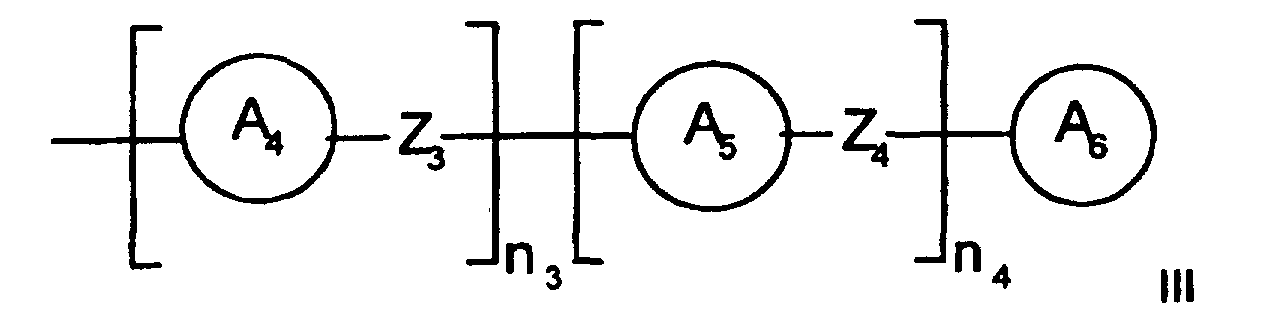
A4,5 may each independently be selected from 1,2-, 1,3- or 1,4-phenylene, which is unsubstituted or substituted from one and up to and including all available substitution positions with one or more of the groups selected from halogen, CN, NO2 and in which 1 or 2 CH groups can be replaced by nitrogen;
Z3,4 may each independently be selected from a direct bond, CH2CH2, COO, OOC, O(CH2)3, OCH2, CH2O, (CH2)3O, (CH2)4, or the trans form of OCH2CH=CH, CH2CH=CHO, CH2CH2CH=CH, CH2CH=CHCH2;
n3,4 may each independently be 0 or 1;
A6 may be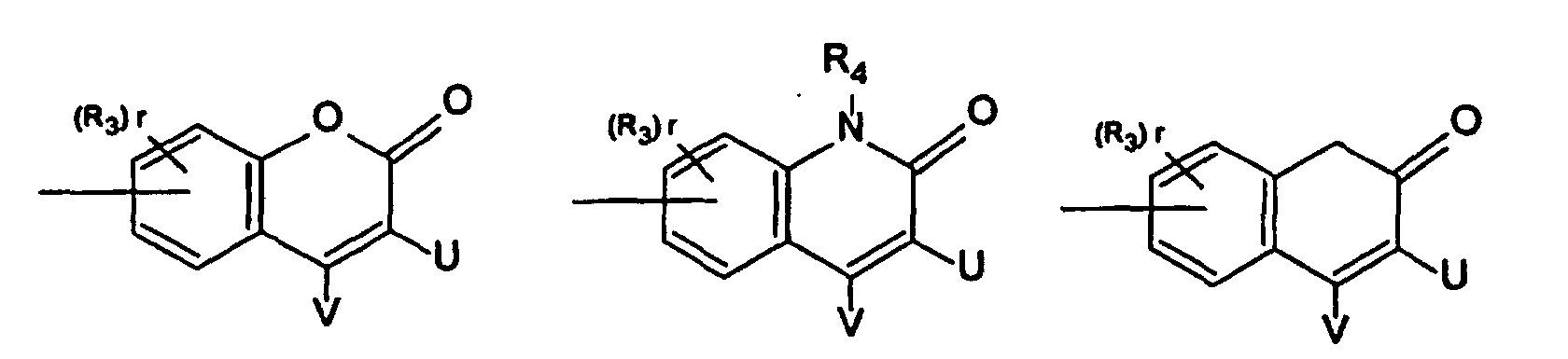 A7 may be 1,2-, 1,3- or 1,4-phenylene, which is unsubstituted or substituted from one and up to and including all available substitution positions with one or more of the groups selected from halogen, CN, NO2 and in which 1 or 2 CH groups can be replaced by nitrogen,
Z5 may be an alkylene unit with 1 to 16 carbon atoms,
a cycloalkylene group with 3 to 8 carbon atoms in which optionally one or two methylene units can be replaced by NH groups,
or phenylene, which can be substituted with C1-10 alkyl, C1-10 alkoxy, CN, NO2 , halogen, or carbonate,COO and OOC;
- CONH- and -NHOC-, the H group on the amide may be substituted with C1-10 alkyl groups; COC;
n5 may be 0 or 1;
R2 may be H, halogen, CN, NO2, NCS, SCN, alkyl with 1 to 12 carbon atoms which is optionally substituted with one or more fluorines and in which optionally 1 or 2 non-adjacent methylene units (CH2) can be replaced by oxygen, COO, OOC, CO and/or CH=CH;
R3 may be H, halogen, CN, NO2, NCS, SCN, alkyl with 1 to 12 carbon atoms which is optionally substituted with one or more fluorines and in which optionally 1 or 2 non-adjacent methylene units (CH2) can be replaced by oxygen, COO, OOC, CO and/or CH=CH;
R4 may be H or C1-10 alkyl;
V may be H, alkyl or alkoxy with 1 to 8 carbon atoms, trifluoromethyl, or phenyl which may be substituted from one and up to and including all available substitution positions with one or more of the groups selected from CN, halogen, NO2;
U may be H, alkyl or alkoxy with 1 to 8 carbon atoms, cyano, or COOR5;
R5 may be C1-10 alkyl;
r may be a number from 0 to 3;
X6,7 may be independently selected from H, halogen, CN, NO2, NCS, SCN, alkyl with 1 to 12 carbon atoms which is optionally substituted with one or more fluorines and in which optionally 1 or 2 non-adjacent methylene units (CH2) can be replaced by oxygen, COO, OOC, CO and/or CH=CH;
orwherein
S, indicates the position of a spacer group
A1 may be 1,4-phenylene, which is unsubstituted or substituted from one and up to and including all available substitution positions with one or more of the groups selected from halogen, CN, NO2;
A2 may be 1,4-phenylene, which is unsubstituted or substituted from one and up to and including all available substitution positions with one or more of the groups selected from halogen, CN, NO2;
Z1 may be a direct bond, CH2CH2, COO, OOC, O(CH2)3, OCH2, CH2O, (CH2)3O, or (CH2)4;
n1 may be 0 or 1;
W, Y may each independently be H, halogen, CN, alkyl with 1 to 12 carbon atoms which is optionally substituted with one or more fluorines;
R1 may be H, halogen, CN, alkyl with 1 to 12 carbon atoms which is optionally substituted with one or more fluorines and in which optionally 1 or 2 non-adjacent methylene units (CH2) can be replaced by oxygen, COO, OOC and/or a CH2CH2 group may be replaced by CH=CH. - A compound according to claim 1 wherein S1-3 are independently selected from oxycarbonylalkanoyloxy, oxyalkoxy, oxycarbonylalkoxy, oxyalkanoyloxy, oxycarbonylphenoxyalkanoyloxy, oxyalkoxyalkyl containing from 1-16 carbon atoms.
- A compound according to claim 1 or claim 2 wherein halogen is chosen from chlorine and fluorine.
- An alignment layer suitable for use in a liquid crystal device comprising a compound according to any of claims 1-3.
- A method of providing an alignment layer on a surface of a liquid crystal cell wall comprising the steps of
depositing a layer of material comprising at least one compound according to any of claims 1-3 on the surface;
exposing the material to actinic radiation. - A liquid crystal device comprising a layer of liquid crystal material between two cell walls, the cell walls both carrying electrode structures and surface treated to provide an alignment layer for liquid crystal molecules;
characterised in that the surface treatment is a layer of material comprising a compound according to any of claims 1-3 which has been exposed to actinic radiation. - A liquid crystal device according to claim 6 wherein the device is an Active Matrix Device.
- A liquid crystal device according to either of claims 6 or 7 wherein the device is an STN device.
- A method according to claim 5 wherein the radiation is in the range 250-450nm.
- A device according to claim 6 wherein the radiation is in the range 250-450nm.
Applications Claiming Priority (3)
| Application Number | Priority Date | Filing Date | Title |
|---|---|---|---|
| GB9828124 | 1998-12-22 | ||
| GBGB9828124.9A GB9828124D0 (en) | 1998-12-22 | 1998-12-22 | Photoactive propane derivatives and orientation layers |
| PCT/GB1999/004287 WO2000037453A1 (en) | 1998-12-22 | 1999-12-16 | Photoactive propane derivatives and orientation layers |
Publications (2)
| Publication Number | Publication Date |
|---|---|
| EP1153019A1 EP1153019A1 (en) | 2001-11-14 |
| EP1153019B1 true EP1153019B1 (en) | 2004-03-03 |
Family
ID=10844644
Family Applications (1)
| Application Number | Title | Priority Date | Filing Date |
|---|---|---|---|
| EP99962337A Expired - Lifetime EP1153019B1 (en) | 1998-12-22 | 1999-12-16 | Photoactive propane derivatives and orientation layers |
Country Status (6)
| Country | Link |
|---|---|
| US (1) | US6653499B1 (en) |
| EP (1) | EP1153019B1 (en) |
| JP (1) | JP2003529533A (en) |
| DE (1) | DE69915375D1 (en) |
| GB (1) | GB9828124D0 (en) |
| WO (1) | WO2000037453A1 (en) |
Cited By (1)
| Publication number | Priority date | Publication date | Assignee | Title |
|---|---|---|---|---|
| DE10229169B4 (en) * | 2002-06-28 | 2011-08-11 | Fraunhofer-Gesellschaft zur Förderung der angewandten Forschung e.V., 80686 | New discotic compounds and methods of making optically anisotropic elements |
Families Citing this family (7)
| Publication number | Priority date | Publication date | Assignee | Title |
|---|---|---|---|---|
| DE602004001650T2 (en) * | 2003-10-17 | 2007-07-19 | Merck Patent Gmbh | Polymerizable cinnamic acid derivatives with a lateral substitution |
| KR102435082B1 (en) * | 2015-01-15 | 2022-08-22 | 닛산 가가쿠 가부시키가이샤 | Liquid crystal alignment agent using photoreactive hydrogen-bonding polymer liquid crystal, and liquid crystal alignment film |
| CN105315177B (en) * | 2015-11-02 | 2017-12-12 | 浙江奇彩环境科技股份有限公司 | A kind of DSD acid synthesis technique |
| FR3045038A1 (en) * | 2015-12-14 | 2017-06-16 | Michelin & Cie | COMPOUND FOR INCREASING THE FLUIDITY OF A RUBBER COMPOSITION COMPRISING A PHENOL-ALDEHYDE RESIN BASED ON THE COMPOUND |
| EP4127097B1 (en) | 2020-03-27 | 2023-12-20 | Transitions Optical, Ltd. | Mesogen compounds |
| WO2023036720A1 (en) * | 2021-09-07 | 2023-03-16 | Merck Patent Gmbh | Selective self-assembled monolayers via spin-coating method for use in dsa |
| TW202503027A (en) * | 2023-03-30 | 2025-01-16 | 日商日東電工股份有限公司 | Liquid crystal composition containing a reversibly photopolymerizable compound or monomer, pattern rewritable polymer dispersed liquid crystal element, and associated selectively dimmable device |
Family Cites Families (4)
| Publication number | Priority date | Publication date | Assignee | Title |
|---|---|---|---|---|
| CN1028373C (en) * | 1988-08-25 | 1995-05-10 | 无锡市化工研究设计院 | Photo-curing corrosion-resistant printing material |
| US5539074A (en) * | 1993-02-17 | 1996-07-23 | Hoffmann-La Roche Inc. | Linear and cyclic polymers or oligomers having a photoreactive ethene group |
| US5593617A (en) * | 1994-09-12 | 1997-01-14 | Hoffmann-Laroche Inc. | Photochemically polymerizable liquid crystals |
| CN1082061C (en) * | 1994-09-29 | 2002-04-03 | 罗列克股份公司 | Cumarin and quinolinone derivatives for preparing liquid crystal orientation layers |
-
1998
- 1998-12-22 GB GBGB9828124.9A patent/GB9828124D0/en not_active Ceased
-
1999
- 1999-12-16 DE DE69915375T patent/DE69915375D1/en not_active Expired - Lifetime
- 1999-12-16 JP JP2000589525A patent/JP2003529533A/en not_active Withdrawn
- 1999-12-16 US US09/857,621 patent/US6653499B1/en not_active Expired - Fee Related
- 1999-12-16 WO PCT/GB1999/004287 patent/WO2000037453A1/en not_active Ceased
- 1999-12-16 EP EP99962337A patent/EP1153019B1/en not_active Expired - Lifetime
Cited By (1)
| Publication number | Priority date | Publication date | Assignee | Title |
|---|---|---|---|---|
| DE10229169B4 (en) * | 2002-06-28 | 2011-08-11 | Fraunhofer-Gesellschaft zur Förderung der angewandten Forschung e.V., 80686 | New discotic compounds and methods of making optically anisotropic elements |
Also Published As
| Publication number | Publication date |
|---|---|
| GB9828124D0 (en) | 1999-02-17 |
| DE69915375D1 (en) | 2004-04-08 |
| JP2003529533A (en) | 2003-10-07 |
| WO2000037453A1 (en) | 2000-06-29 |
| US6653499B1 (en) | 2003-11-25 |
| EP1153019A1 (en) | 2001-11-14 |
Similar Documents
| Publication | Publication Date | Title |
|---|---|---|
| US6692797B1 (en) | Photoactive pentaerythritol derivatives and orientation layers | |
| KR0179115B1 (en) | Liquid crystal alignment photosensitive material and liquid crystal display device using the same | |
| JP5301261B2 (en) | Homeotropic alignment layer | |
| JP4205195B2 (en) | Photocrosslinkable silane derivative | |
| CN108368424B (en) | Polymerizable compounds and their use in liquid crystal displays | |
| KR20130018222A (en) | Polymer for use in a liquid-crystal alignment layer | |
| EP1051454B1 (en) | Liquid-crystalline photocrosslinkable mixture | |
| US6653499B1 (en) | Photoactive propane derivatives and orientation layers | |
| Akiyama et al. | Surface-selective modification of poly (vinyl alcohol) films with azobenzenes for in-plane alignment photocontrol of nematic liquid crystals | |
| US6849203B2 (en) | Photoisomerizable compounds | |
| US5746940A (en) | Liquid crystalline material comprising terpenoids | |
| JP4208058B2 (en) | Liquid crystalline (meth) acrylate compound and liquid crystal composition containing the compound | |
| WO2007075984A2 (en) | Photoalignment of liquid crystals using poly(vinylstilbazolium)polymers | |
| JPH11510264A (en) | Liquid crystal polymer devices and materials | |
| KR100309749B1 (en) | Planar material made from branched group polymers | |
| US6524715B1 (en) | Thin-film forming chemical adsorption material, producing method thereof and applications thereof | |
| EP1957611B1 (en) | Temperature compensating chiral dopants | |
| JP4756296B2 (en) | Maleimide derivative and method for producing photoalignment film using the same | |
| EP1626079A1 (en) | Polymerisable mesogenic cyclohexylphenyl derivatives | |
| KR101559704B1 (en) | Photoalignment polymer, optical film comprising the polymer and method for fabricating the optical film | |
| KR100694936B1 (en) | Polymerizable Mesogenic Tolan | |
| GB2348294A (en) | Alignment layer for a liquid crystal device | |
| KR100425263B1 (en) | Circular polarizer with liquid crystal polymer and photosensitive chiral dopant and the manufacture thereof | |
| KR100214095B1 (en) | Liquid crystal aligning film which has photo-alignment property | |
| Tsutsumi et al. | Charge‐transfer interaction in liquid‐crystalline materials and their application to photonics |
Legal Events
| Date | Code | Title | Description |
|---|---|---|---|
| PUAI | Public reference made under article 153(3) epc to a published international application that has entered the european phase |
Free format text: ORIGINAL CODE: 0009012 |
|
| 17P | Request for examination filed |
Effective date: 20010528 |
|
| AK | Designated contracting states |
Kind code of ref document: A1 Designated state(s): AT BE CH CY DE DK ES FI FR GB GR IE IT LI LU MC NL PT SE |
|
| 17Q | First examination report despatched |
Effective date: 20020304 |
|
| GRAP | Despatch of communication of intention to grant a patent |
Free format text: ORIGINAL CODE: EPIDOSNIGR1 |
|
| GRAS | Grant fee paid |
Free format text: ORIGINAL CODE: EPIDOSNIGR3 |
|
| GRAA | (expected) grant |
Free format text: ORIGINAL CODE: 0009210 |
|
| AK | Designated contracting states |
Kind code of ref document: B1 Designated state(s): DE FR GB |
|
| PG25 | Lapsed in a contracting state [announced via postgrant information from national office to epo] |
Ref country code: FR Free format text: LAPSE BECAUSE OF FAILURE TO SUBMIT A TRANSLATION OF THE DESCRIPTION OR TO PAY THE FEE WITHIN THE PRESCRIBED TIME-LIMIT Effective date: 20040303 |
|
| REG | Reference to a national code |
Ref country code: GB Ref legal event code: FG4D |
|
| REG | Reference to a national code |
Ref country code: IE Ref legal event code: FG4D |
|
| REF | Corresponds to: |
Ref document number: 69915375 Country of ref document: DE Date of ref document: 20040408 Kind code of ref document: P |
|
| PG25 | Lapsed in a contracting state [announced via postgrant information from national office to epo] |
Ref country code: DE Free format text: LAPSE BECAUSE OF FAILURE TO SUBMIT A TRANSLATION OF THE DESCRIPTION OR TO PAY THE FEE WITHIN THE PRESCRIBED TIME-LIMIT Effective date: 20040604 |
|
| PG25 | Lapsed in a contracting state [announced via postgrant information from national office to epo] |
Ref country code: GB Free format text: LAPSE BECAUSE OF NON-PAYMENT OF DUE FEES Effective date: 20041216 |
|
| PLBE | No opposition filed within time limit |
Free format text: ORIGINAL CODE: 0009261 |
|
| STAA | Information on the status of an ep patent application or granted ep patent |
Free format text: STATUS: NO OPPOSITION FILED WITHIN TIME LIMIT |
|
| EN | Fr: translation not filed | ||
| 26N | No opposition filed |
Effective date: 20041206 |
|
| GBPC | Gb: european patent ceased through non-payment of renewal fee |
Effective date: 20041216 |