EP1152298A1 - Color toners and image forming method using the color toners - Google Patents
Color toners and image forming method using the color toners Download PDFInfo
- Publication number
- EP1152298A1 EP1152298A1 EP01110097A EP01110097A EP1152298A1 EP 1152298 A1 EP1152298 A1 EP 1152298A1 EP 01110097 A EP01110097 A EP 01110097A EP 01110097 A EP01110097 A EP 01110097A EP 1152298 A1 EP1152298 A1 EP 1152298A1
- Authority
- EP
- European Patent Office
- Prior art keywords
- toner
- image
- color
- yellow
- magenta
- Prior art date
- Legal status (The legal status is an assumption and is not a legal conclusion. Google has not performed a legal analysis and makes no representation as to the accuracy of the status listed.)
- Granted
Links
- 238000000034 method Methods 0.000 title claims abstract description 48
- 239000000049 pigment Substances 0.000 claims abstract description 73
- 229920005989 resin Polymers 0.000 claims abstract description 52
- 239000011347 resin Substances 0.000 claims abstract description 52
- KJCVRFUGPWSIIH-UHFFFAOYSA-N 1-naphthol Chemical compound C1=CC=C2C(O)=CC=CC2=C1 KJCVRFUGPWSIIH-UHFFFAOYSA-N 0.000 claims abstract description 22
- 239000000463 material Substances 0.000 claims abstract description 22
- 239000011230 binding agent Substances 0.000 claims abstract description 14
- 235000012730 carminic acid Nutrition 0.000 claims abstract description 14
- MYONAGGJKCJOBT-UHFFFAOYSA-N benzimidazol-2-one Chemical compound C1=CC=CC2=NC(=O)N=C21 MYONAGGJKCJOBT-UHFFFAOYSA-N 0.000 claims abstract description 7
- JVTCNOASZYIKTG-UHFFFAOYSA-N stk329495 Chemical compound [Cu].[N-]1C(N=C2C3=CC=CC=C3C(N=C3C4=CC=CC=C4C(=N4)[N-]3)=N2)=C(C=CC=C2)C2=C1N=C1C2=CC=CC=C2C4=N1 JVTCNOASZYIKTG-UHFFFAOYSA-N 0.000 claims abstract description 4
- 229920005862 polyol Polymers 0.000 claims description 31
- 150000003077 polyols Chemical class 0.000 claims description 31
- 239000000155 melt Substances 0.000 claims description 27
- 238000012546 transfer Methods 0.000 claims description 18
- 229910052751 metal Inorganic materials 0.000 claims description 10
- 239000002184 metal Substances 0.000 claims description 10
- ISWSIDIOOBJBQZ-UHFFFAOYSA-N Phenol Chemical compound OC1=CC=CC=C1 ISWSIDIOOBJBQZ-UHFFFAOYSA-N 0.000 claims description 7
- 125000002947 alkylene group Chemical group 0.000 claims description 6
- 125000003118 aryl group Chemical group 0.000 claims description 6
- 239000003822 epoxy resin Substances 0.000 claims description 6
- 229920000647 polyepoxide Polymers 0.000 claims description 6
- HCHKCACWOHOZIP-UHFFFAOYSA-N Zinc Chemical compound [Zn] HCHKCACWOHOZIP-UHFFFAOYSA-N 0.000 claims description 4
- 239000002253 acid Substances 0.000 claims description 4
- 239000007795 chemical reaction product Substances 0.000 claims description 4
- 150000003839 salts Chemical class 0.000 claims description 4
- 239000011701 zinc Substances 0.000 claims description 4
- 229910052725 zinc Inorganic materials 0.000 claims description 4
- 125000000217 alkyl group Chemical group 0.000 claims description 3
- 125000003710 aryl alkyl group Chemical group 0.000 claims description 3
- 150000002500 ions Chemical class 0.000 claims description 3
- BVKZGUZCCUSVTD-UHFFFAOYSA-N carbonic acid Chemical compound OC(O)=O BVKZGUZCCUSVTD-UHFFFAOYSA-N 0.000 claims description 2
- GYZLOYUZLJXAJU-UHFFFAOYSA-N diglycidyl ether Chemical compound C1OC1COCC1CO1 GYZLOYUZLJXAJU-UHFFFAOYSA-N 0.000 claims description 2
- 239000000203 mixture Substances 0.000 description 72
- VYPSYNLAJGMNEJ-UHFFFAOYSA-N Silicium dioxide Chemical compound O=[Si]=O VYPSYNLAJGMNEJ-UHFFFAOYSA-N 0.000 description 43
- 239000004594 Masterbatch (MB) Substances 0.000 description 34
- 239000002245 particle Substances 0.000 description 34
- 238000005096 rolling process Methods 0.000 description 32
- 239000010410 layer Substances 0.000 description 29
- 239000003795 chemical substances by application Substances 0.000 description 26
- 150000001875 compounds Chemical class 0.000 description 23
- 230000002209 hydrophobic effect Effects 0.000 description 23
- 239000000377 silicon dioxide Substances 0.000 description 21
- -1 monoazo Lithol Rubine Chemical compound 0.000 description 20
- 238000004519 manufacturing process Methods 0.000 description 19
- 229920001577 copolymer Polymers 0.000 description 15
- 108091008695 photoreceptors Proteins 0.000 description 10
- GWEVSGVZZGPLCZ-UHFFFAOYSA-N Titan oxide Chemical compound O=[Ti]=O GWEVSGVZZGPLCZ-UHFFFAOYSA-N 0.000 description 9
- 230000000052 comparative effect Effects 0.000 description 9
- CTQNGGLPUBDAKN-UHFFFAOYSA-N O-Xylene Chemical compound CC1=CC=CC=C1C CTQNGGLPUBDAKN-UHFFFAOYSA-N 0.000 description 8
- 239000006229 carbon black Substances 0.000 description 8
- 229920001225 polyester resin Polymers 0.000 description 8
- 239000004645 polyester resin Substances 0.000 description 8
- XLYOFNOQVPJJNP-UHFFFAOYSA-N water Substances O XLYOFNOQVPJJNP-UHFFFAOYSA-N 0.000 description 8
- 239000008096 xylene Substances 0.000 description 8
- IISBACLAFKSPIT-UHFFFAOYSA-N bisphenol A Chemical compound C=1C=C(O)C=CC=1C(C)(C)C1=CC=C(O)C=C1 IISBACLAFKSPIT-UHFFFAOYSA-N 0.000 description 6
- PXKLMJQFEQBVLD-UHFFFAOYSA-N bisphenol F Chemical compound C1=CC(O)=CC=C1CC1=CC=C(O)C=C1 PXKLMJQFEQBVLD-UHFFFAOYSA-N 0.000 description 6
- 239000007787 solid Substances 0.000 description 6
- 235000019646 color tone Nutrition 0.000 description 5
- 238000004898 kneading Methods 0.000 description 5
- XEEYBQQBJWHFJM-UHFFFAOYSA-N Iron Chemical compound [Fe] XEEYBQQBJWHFJM-UHFFFAOYSA-N 0.000 description 4
- PPBRXRYQALVLMV-UHFFFAOYSA-N Styrene Chemical compound C=CC1=CC=CC=C1 PPBRXRYQALVLMV-UHFFFAOYSA-N 0.000 description 4
- RTAQQCXQSZGOHL-UHFFFAOYSA-N Titanium Chemical compound [Ti] RTAQQCXQSZGOHL-UHFFFAOYSA-N 0.000 description 4
- 239000000654 additive Substances 0.000 description 4
- 239000011248 coating agent Substances 0.000 description 4
- 238000000576 coating method Methods 0.000 description 4
- 239000007788 liquid Substances 0.000 description 4
- 239000000126 substance Substances 0.000 description 4
- 239000001052 yellow pigment Substances 0.000 description 4
- 229910002012 Aerosil® Inorganic materials 0.000 description 3
- VYZAMTAEIAYCRO-UHFFFAOYSA-N Chromium Chemical compound [Cr] VYZAMTAEIAYCRO-UHFFFAOYSA-N 0.000 description 3
- WYURNTSHIVDZCO-UHFFFAOYSA-N Tetrahydrofuran Chemical compound C1CCOC1 WYURNTSHIVDZCO-UHFFFAOYSA-N 0.000 description 3
- YXFVVABEGXRONW-UHFFFAOYSA-N Toluene Chemical compound CC1=CC=CC=C1 YXFVVABEGXRONW-UHFFFAOYSA-N 0.000 description 3
- PNEYBMLMFCGWSK-UHFFFAOYSA-N aluminium oxide Inorganic materials [O-2].[O-2].[O-2].[Al+3].[Al+3] PNEYBMLMFCGWSK-UHFFFAOYSA-N 0.000 description 3
- HFACYLZERDEVSX-UHFFFAOYSA-N benzidine Chemical compound C1=CC(N)=CC=C1C1=CC=C(N)C=C1 HFACYLZERDEVSX-UHFFFAOYSA-N 0.000 description 3
- 229910052804 chromium Inorganic materials 0.000 description 3
- 239000011651 chromium Substances 0.000 description 3
- LNEPOXFFQSENCJ-UHFFFAOYSA-N haloperidol Chemical compound C1CC(O)(C=2C=CC(Cl)=CC=2)CCN1CCCC(=O)C1=CC=C(F)C=C1 LNEPOXFFQSENCJ-UHFFFAOYSA-N 0.000 description 3
- 238000002156 mixing Methods 0.000 description 3
- IEQIEDJGQAUEQZ-UHFFFAOYSA-N phthalocyanine Chemical compound N1C(N=C2C3=CC=CC=C3C(N=C3C4=CC=CC=C4C(=N4)N3)=N2)=C(C=CC=C2)C2=C1N=C1C2=CC=CC=C2C4=N1 IEQIEDJGQAUEQZ-UHFFFAOYSA-N 0.000 description 3
- 229920000642 polymer Polymers 0.000 description 3
- 239000000843 powder Substances 0.000 description 3
- 238000002360 preparation method Methods 0.000 description 3
- RSWGJHLUYNHPMX-UHFFFAOYSA-N Abietic-Saeure Natural products C12CCC(C(C)C)=CC2=CCC2C1(C)CCCC2(C)C(O)=O RSWGJHLUYNHPMX-UHFFFAOYSA-N 0.000 description 2
- 229930185605 Bisphenol Natural products 0.000 description 2
- BRLQWZUYTZBJKN-UHFFFAOYSA-N Epichlorohydrin Chemical compound ClCC1CO1 BRLQWZUYTZBJKN-UHFFFAOYSA-N 0.000 description 2
- YCKRFDGAMUMZLT-UHFFFAOYSA-N Fluorine atom Chemical compound [F] YCKRFDGAMUMZLT-UHFFFAOYSA-N 0.000 description 2
- OAICVXFJPJFONN-UHFFFAOYSA-N Phosphorus Chemical compound [P] OAICVXFJPJFONN-UHFFFAOYSA-N 0.000 description 2
- KHPCPRHQVVSZAH-HUOMCSJISA-N Rosin Natural products O(C/C=C/c1ccccc1)[C@H]1[C@H](O)[C@@H](O)[C@@H](O)[C@@H](CO)O1 KHPCPRHQVVSZAH-HUOMCSJISA-N 0.000 description 2
- 235000010724 Wisteria floribunda Nutrition 0.000 description 2
- 239000000969 carrier Substances 0.000 description 2
- 239000003086 colorant Substances 0.000 description 2
- 239000000975 dye Substances 0.000 description 2
- 238000011156 evaluation Methods 0.000 description 2
- 239000011737 fluorine Substances 0.000 description 2
- 229910052731 fluorine Inorganic materials 0.000 description 2
- 230000009477 glass transition Effects 0.000 description 2
- 229910052742 iron Inorganic materials 0.000 description 2
- 229920000915 polyvinyl chloride Polymers 0.000 description 2
- 239000004800 polyvinyl chloride Substances 0.000 description 2
- 150000003242 quaternary ammonium salts Chemical class 0.000 description 2
- 229920002050 silicone resin Polymers 0.000 description 2
- 239000010936 titanium Substances 0.000 description 2
- 229910052719 titanium Inorganic materials 0.000 description 2
- OGIDPMRJRNCKJF-UHFFFAOYSA-N titanium oxide Inorganic materials [Ti]=O OGIDPMRJRNCKJF-UHFFFAOYSA-N 0.000 description 2
- KHPCPRHQVVSZAH-UHFFFAOYSA-N trans-cinnamyl beta-D-glucopyranoside Natural products OC1C(O)C(O)C(CO)OC1OCC=CC1=CC=CC=C1 KHPCPRHQVVSZAH-UHFFFAOYSA-N 0.000 description 2
- WFKWXMTUELFFGS-UHFFFAOYSA-N tungsten Chemical compound [W] WFKWXMTUELFFGS-UHFFFAOYSA-N 0.000 description 2
- 229910052721 tungsten Inorganic materials 0.000 description 2
- 239000010937 tungsten Substances 0.000 description 2
- 229910000859 α-Fe Inorganic materials 0.000 description 2
- KTZVZZJJVJQZHV-UHFFFAOYSA-N 1-chloro-4-ethenylbenzene Chemical compound ClC1=CC=C(C=C)C=C1 KTZVZZJJVJQZHV-UHFFFAOYSA-N 0.000 description 1
- VVHFXJOCUKBZFS-UHFFFAOYSA-N 2-(chloromethyl)-2-methyloxirane Chemical compound ClCC1(C)CO1 VVHFXJOCUKBZFS-UHFFFAOYSA-N 0.000 description 1
- CDAWCLOXVUBKRW-UHFFFAOYSA-N 2-aminophenol Chemical compound NC1=CC=CC=C1O CDAWCLOXVUBKRW-UHFFFAOYSA-N 0.000 description 1
- CYEJMVLDXAUOPN-UHFFFAOYSA-N 2-dodecylphenol Chemical compound CCCCCCCCCCCCC1=CC=CC=C1O CYEJMVLDXAUOPN-UHFFFAOYSA-N 0.000 description 1
- CRBJBYGJVIBWIY-UHFFFAOYSA-N 2-isopropylphenol Chemical compound CC(C)C1=CC=CC=C1O CRBJBYGJVIBWIY-UHFFFAOYSA-N 0.000 description 1
- QTWJRLJHJPIABL-UHFFFAOYSA-N 2-methylphenol;3-methylphenol;4-methylphenol Chemical compound CC1=CC=C(O)C=C1.CC1=CC=CC(O)=C1.CC1=CC=CC=C1O QTWJRLJHJPIABL-UHFFFAOYSA-N 0.000 description 1
- DUIOKRXOKLLURE-UHFFFAOYSA-N 2-octylphenol Chemical compound CCCCCCCCC1=CC=CC=C1O DUIOKRXOKLLURE-UHFFFAOYSA-N 0.000 description 1
- 229920000178 Acrylic resin Polymers 0.000 description 1
- 239000004925 Acrylic resin Substances 0.000 description 1
- 229920002799 BoPET Polymers 0.000 description 1
- 239000004593 Epoxy Substances 0.000 description 1
- IAYPIBMASNFSPL-UHFFFAOYSA-N Ethylene oxide Chemical compound C1CO1 IAYPIBMASNFSPL-UHFFFAOYSA-N 0.000 description 1
- 239000013032 Hydrocarbon resin Substances 0.000 description 1
- IGFHQQFPSIBGKE-UHFFFAOYSA-N Nonylphenol Natural products CCCCCCCCCC1=CC=C(O)C=C1 IGFHQQFPSIBGKE-UHFFFAOYSA-N 0.000 description 1
- 239000004698 Polyethylene Substances 0.000 description 1
- 239000004743 Polypropylene Substances 0.000 description 1
- 239000004793 Polystyrene Substances 0.000 description 1
- 229920001328 Polyvinylidene chloride Polymers 0.000 description 1
- GOOHAUXETOMSMM-UHFFFAOYSA-N Propylene oxide Chemical compound CC1CO1 GOOHAUXETOMSMM-UHFFFAOYSA-N 0.000 description 1
- NRCMAYZCPIVABH-UHFFFAOYSA-N Quinacridone Chemical compound N1C2=CC=CC=C2C(=O)C2=C1C=C1C(=O)C3=CC=CC=C3NC1=C2 NRCMAYZCPIVABH-UHFFFAOYSA-N 0.000 description 1
- 239000006087 Silane Coupling Agent Substances 0.000 description 1
- 229920007962 Styrene Methyl Methacrylate Polymers 0.000 description 1
- QCWXUUIWCKQGHC-UHFFFAOYSA-N Zirconium Chemical compound [Zr] QCWXUUIWCKQGHC-UHFFFAOYSA-N 0.000 description 1
- 239000011354 acetal resin Substances 0.000 description 1
- 239000012190 activator Substances 0.000 description 1
- 125000002723 alicyclic group Chemical group 0.000 description 1
- 125000001931 aliphatic group Chemical group 0.000 description 1
- 125000005262 alkoxyamine group Chemical group 0.000 description 1
- 229910052782 aluminium Inorganic materials 0.000 description 1
- XAGFODPZIPBFFR-UHFFFAOYSA-N aluminium Chemical compound [Al] XAGFODPZIPBFFR-UHFFFAOYSA-N 0.000 description 1
- CEGOLXSVJUTHNZ-UHFFFAOYSA-K aluminium tristearate Chemical compound [Al+3].CCCCCCCCCCCCCCCCCC([O-])=O.CCCCCCCCCCCCCCCCCC([O-])=O.CCCCCCCCCCCCCCCCCC([O-])=O CEGOLXSVJUTHNZ-UHFFFAOYSA-K 0.000 description 1
- 229940063655 aluminum stearate Drugs 0.000 description 1
- 229910000410 antimony oxide Inorganic materials 0.000 description 1
- 239000011324 bead Substances 0.000 description 1
- QHIWVLPBUQWDMQ-UHFFFAOYSA-N butyl prop-2-enoate;methyl 2-methylprop-2-enoate;prop-2-enoic acid Chemical compound OC(=O)C=C.COC(=O)C(C)=C.CCCCOC(=O)C=C QHIWVLPBUQWDMQ-UHFFFAOYSA-N 0.000 description 1
- 239000012876 carrier material Substances 0.000 description 1
- 239000013522 chelant Substances 0.000 description 1
- VYXSBFYARXAAKO-WTKGSRSZSA-N chembl402140 Chemical compound Cl.C1=2C=C(C)C(NCC)=CC=2OC2=C\C(=N/CC)C(C)=CC2=C1C1=CC=CC=C1C(=O)OCC VYXSBFYARXAAKO-WTKGSRSZSA-N 0.000 description 1
- 150000001844 chromium Chemical class 0.000 description 1
- 239000011247 coating layer Substances 0.000 description 1
- 239000010941 cobalt Substances 0.000 description 1
- 229910017052 cobalt Inorganic materials 0.000 description 1
- GUTLYIVDDKVIGB-UHFFFAOYSA-N cobalt atom Chemical compound [Co] GUTLYIVDDKVIGB-UHFFFAOYSA-N 0.000 description 1
- 239000008119 colloidal silica Substances 0.000 description 1
- 229930003836 cresol Natural products 0.000 description 1
- 235000014113 dietary fatty acids Nutrition 0.000 description 1
- 238000007599 discharging Methods 0.000 description 1
- 238000001035 drying Methods 0.000 description 1
- 239000000194 fatty acid Substances 0.000 description 1
- 229930195729 fatty acid Natural products 0.000 description 1
- 150000004665 fatty acids Chemical class 0.000 description 1
- 239000011521 glass Substances 0.000 description 1
- 238000010438 heat treatment Methods 0.000 description 1
- 229920006270 hydrocarbon resin Polymers 0.000 description 1
- 125000004356 hydroxy functional group Chemical group O* 0.000 description 1
- 238000011835 investigation Methods 0.000 description 1
- 235000010187 litholrubine BK Nutrition 0.000 description 1
- 239000000434 metal complex dye Substances 0.000 description 1
- 229910044991 metal oxide Inorganic materials 0.000 description 1
- 150000004706 metal oxides Chemical class 0.000 description 1
- ADFPJHOAARPYLP-UHFFFAOYSA-N methyl 2-methylprop-2-enoate;styrene Chemical compound COC(=O)C(C)=C.C=CC1=CC=CC=C1 ADFPJHOAARPYLP-UHFFFAOYSA-N 0.000 description 1
- BFXIKLCIZHOAAZ-UHFFFAOYSA-N methyltrimethoxysilane Chemical compound CO[Si](C)(OC)OC BFXIKLCIZHOAAZ-UHFFFAOYSA-N 0.000 description 1
- 238000012986 modification Methods 0.000 description 1
- 230000004048 modification Effects 0.000 description 1
- VLAPMBHFAWRUQP-UHFFFAOYSA-L molybdic acid Chemical compound O[Mo](O)(=O)=O VLAPMBHFAWRUQP-UHFFFAOYSA-L 0.000 description 1
- SNQQPOLDUKLAAF-UHFFFAOYSA-N nonylphenol Chemical compound CCCCCCCCCC1=CC=CC=C1O SNQQPOLDUKLAAF-UHFFFAOYSA-N 0.000 description 1
- TWNQGVIAIRXVLR-UHFFFAOYSA-N oxo(oxoalumanyloxy)alumane Chemical compound O=[Al]O[Al]=O TWNQGVIAIRXVLR-UHFFFAOYSA-N 0.000 description 1
- VTRUBDSFZJNXHI-UHFFFAOYSA-N oxoantimony Chemical compound [Sb]=O VTRUBDSFZJNXHI-UHFFFAOYSA-N 0.000 description 1
- SOQBVABWOPYFQZ-UHFFFAOYSA-N oxygen(2-);titanium(4+) Chemical class [O-2].[O-2].[Ti+4] SOQBVABWOPYFQZ-UHFFFAOYSA-N 0.000 description 1
- QBDSZLJBMIMQRS-UHFFFAOYSA-N p-Cumylphenol Chemical compound C=1C=C(O)C=CC=1C(C)(C)C1=CC=CC=C1 QBDSZLJBMIMQRS-UHFFFAOYSA-N 0.000 description 1
- NKTOLZVEWDHZMU-UHFFFAOYSA-N p-cumyl phenol Natural products CC1=CC=C(C)C(O)=C1 NKTOLZVEWDHZMU-UHFFFAOYSA-N 0.000 description 1
- 239000003208 petroleum Substances 0.000 description 1
- 229920001568 phenolic resin Polymers 0.000 description 1
- 239000005011 phenolic resin Substances 0.000 description 1
- 229920001490 poly(butyl methacrylate) polymer Polymers 0.000 description 1
- 229920003229 poly(methyl methacrylate) Polymers 0.000 description 1
- 229920002285 poly(styrene-co-acrylonitrile) Polymers 0.000 description 1
- 229920002037 poly(vinyl butyral) polymer Polymers 0.000 description 1
- 229920006122 polyamide resin Polymers 0.000 description 1
- 229920000728 polyester Polymers 0.000 description 1
- 229920000573 polyethylene Polymers 0.000 description 1
- 239000004926 polymethyl methacrylate Substances 0.000 description 1
- 229920006324 polyoxymethylene Polymers 0.000 description 1
- 229920001155 polypropylene Polymers 0.000 description 1
- 229920002223 polystyrene Polymers 0.000 description 1
- 229920005749 polyurethane resin Polymers 0.000 description 1
- 229920002689 polyvinyl acetate Polymers 0.000 description 1
- 239000011118 polyvinyl acetate Substances 0.000 description 1
- 229920002102 polyvinyl toluene Polymers 0.000 description 1
- 239000005033 polyvinylidene chloride Substances 0.000 description 1
- 230000005855 radiation Effects 0.000 description 1
- 239000001022 rhodamine dye Substances 0.000 description 1
- 229920002545 silicone oil Polymers 0.000 description 1
- 229920003048 styrene butadiene rubber Polymers 0.000 description 1
- 150000003440 styrenes Chemical class 0.000 description 1
- 150000003505 terpenes Chemical class 0.000 description 1
- 235000007586 terpenes Nutrition 0.000 description 1
- 238000012360 testing method Methods 0.000 description 1
- YLQBMQCUIZJEEH-UHFFFAOYSA-N tetrahydrofuran Natural products C=1C=COC=1 YLQBMQCUIZJEEH-UHFFFAOYSA-N 0.000 description 1
- XOLBLPGZBRYERU-UHFFFAOYSA-N tin dioxide Chemical compound O=[Sn]=O XOLBLPGZBRYERU-UHFFFAOYSA-N 0.000 description 1
- 229910001887 tin oxide Inorganic materials 0.000 description 1
- 230000007704 transition Effects 0.000 description 1
- CPUDPFPXCZDNGI-UHFFFAOYSA-N triethoxy(methyl)silane Chemical compound CCO[Si](C)(OCC)OCC CPUDPFPXCZDNGI-UHFFFAOYSA-N 0.000 description 1
- NMEPHPOFYLLFTK-UHFFFAOYSA-N trimethoxy(octyl)silane Chemical compound CCCCCCCC[Si](OC)(OC)OC NMEPHPOFYLLFTK-UHFFFAOYSA-N 0.000 description 1
- AAAQKTZKLRYKHR-UHFFFAOYSA-N triphenylmethane Chemical compound C1=CC=CC=C1C(C=1C=CC=CC=1)C1=CC=CC=C1 AAAQKTZKLRYKHR-UHFFFAOYSA-N 0.000 description 1
- 229920002554 vinyl polymer Polymers 0.000 description 1
- XOOUIPVCVHRTMJ-UHFFFAOYSA-L zinc stearate Chemical compound [Zn+2].CCCCCCCCCCCCCCCCCC([O-])=O.CCCCCCCCCCCCCCCCCC([O-])=O XOOUIPVCVHRTMJ-UHFFFAOYSA-L 0.000 description 1
- 229910052726 zirconium Inorganic materials 0.000 description 1
Images


Classifications
-
- G—PHYSICS
- G03—PHOTOGRAPHY; CINEMATOGRAPHY; ANALOGOUS TECHNIQUES USING WAVES OTHER THAN OPTICAL WAVES; ELECTROGRAPHY; HOLOGRAPHY
- G03G—ELECTROGRAPHY; ELECTROPHOTOGRAPHY; MAGNETOGRAPHY
- G03G9/00—Developers
- G03G9/08—Developers with toner particles
- G03G9/09—Colouring agents for toner particles
- G03G9/0906—Organic dyes
- G03G9/091—Azo dyes
-
- G—PHYSICS
- G03—PHOTOGRAPHY; CINEMATOGRAPHY; ANALOGOUS TECHNIQUES USING WAVES OTHER THAN OPTICAL WAVES; ELECTROGRAPHY; HOLOGRAPHY
- G03G—ELECTROGRAPHY; ELECTROPHOTOGRAPHY; MAGNETOGRAPHY
- G03G9/00—Developers
- G03G9/08—Developers with toner particles
- G03G9/09—Colouring agents for toner particles
- G03G9/0906—Organic dyes
- G03G9/0918—Phthalocyanine dyes
Definitions
- the present invention relates to color toners and an image forming method using the color toners. More particularly, the present invention relates to yellow, magenta, and cyan toners which are used for forming color images using electrophotography, and to an image forming method using the color toners and a non-contact heat fixing method.
- Japanese Laid-Open Patent Publication No. 9-171268 discloses color toners including a cyan toner including ⁇ phthalocyanine, a magenta toner including Rhodamine 6G xanthenesilicomolybdate, a yellow toner including a benzidine type pigment, and a black toner including carbon black.
- Japanese Laid-Open Patent Publication No. 9-171268 discloses color toners including a cyan toner including ⁇ phthalocyanine, a magenta toner including Rhodamine 6G xanthenesilicomolybdate, a yellow toner including a benzidine type pigment, and a black toner including carbon black.
- color toners including a cyan toner including ⁇ phthalocyanine, a magenta toner including monoazo Lithol Rubine, a yellow toner including a benzidine type pigment, and a black toner including carbon black. These color toners can produce red images having good tint, i.e., having good color reproducibility, however, the color tone of a bluish violet color image produced by them is not satisfactory.
- Japanese Laid-Open Patent Publications Nos. 2-66562 and 3-107869 have disclosed quinacridone type pigments as a colorant for a magenta toner.
- the tint of bluish violet color images is good, however the toners have a drawback in that the color tone of a red image is not satisfactory.
- a benzidine type yellow pigment, Pigment Yellow 17 is typically used for yellow toners because of having good tint and transparency, however, the light resistance (in particular the resistance to sunlight) of the pigment is not good. Therefore green color images which are a combination of the yellow pigment with a cyan toner are easily changed to bluish green when the green color images are exposed to light.
- color toner images having good color reproducibility i.e., to form color toner images whose colors are well balanced.
- color toner images whose colors are well balanced.
- These problems concerning color reproducibility are prominent in the color images which are fixed with a non-contact type heat fixing method using an oven and the like rather than a heat roller fixing method.
- the color toner images generally have poor light resistance as mentioned above.
- an object of the present invention is to provide an image forming method in which color images having a good combination of red color reproducibility and blue color reproducibility, and good light resistance can be produced in particular when the toner images are fixed by a non-contact fixing method.
- Another object of the present invention is to provide color toners which can produce color images having a good combination of red color reproducibility and blue color reproducibility.
- Yet another object of the present invention is to provide color toners which can produce color images having good light resistance.
- the present invention contemplates the provision of a method for forming a full color image which includes the steps of forming at least a yellow toner image, a magenta toner image and a cyan toner image on a receiving material to form a full color image thereon, and fixing the full color toner image upon application of heat thereto while not contacting the full color toner image, wherein each of the color toners includes a binder resin and a pigment, wherein the yellow toner includes a benzimidazolone, the cyan toner includes ⁇ phothalocyanine, and the magenta toner includes at least one of Naphthol Carmine F6B and a combination of Naphthol Carmine F6B and Naphthol Carmine FBB, as the pigment, and wherein the yellow toner image has a position closer to the receiving material than any other toner images when two or more of the color toner images including the yellow toner image are overlaid.
- Each of the fixed yellow, magenta or cyan toner images preferably has a haze factor not greater than 20 % when the fixed toner image has a weight of 8 g/m 2 .
- each of the yellow, magenta or cyan toners preferably has a melt viscosity not greater than 120 mPas ⁇ sec at 140 °C.
- each of the color toners preferably includes as the binder resin a polyol resin having a polyoxyalkylene moiety in its main chain.
- the polyol resin is preferably a reaction product of: (a) an epoxy resin; (b) a dihydric phenol; and either (c) an adduct of a dihydric phenol with an alkylene oxide or (c') a glycidyl ether of an adduct of a dihydric phenol with an alkylene oxide.
- Each of the color toners preferably includes a charge controlling agent having the following formula (1): wherein Q and Q' independently represent an aromatic oxycarboxylic acid group which may substituted by an alkyl group or an aralkyl group; X represents a counter ion; and M represents a metal.
- the metal is preferably zinc or chromium.
- a combination of color toners for a non-contact heat fixing method which includes at least a yellow toner, a magenta toner and a cyan toner, wherein the yellow toner includes a benzimidazolone, the cyan toner includes ⁇ phothalocyanine, and the magenta toner includes at least one of Naphthol Carmine F6B and a combination of Naphthol Carmine F6B and Naphthol Carmine FBB, as the pigment.
- the present invention provides a method for forming a full color image which includes the steps of forming at least a yellow toner image, a magenta toner image and a cyan toner image on a receiving material to form a full color image thereon, and fixing the full color toner image upon application of heat thereto while not contacting the full color toner image, wherein each of the color toners includes a binder resin and a pigment, wherein the yellow toner includes a benzimidazolone, the cyan toner includes ⁇ phothalocyanine, and the magenta toner includes at least one of Naphthol Carmine F6B and a combination of Naphthol Carmine F6B and Naphthol Carmine FBB, as the pigment, and wherein the yellow toner image has a lowest position (i.e., the closest position to the receiving material) when two or more color toner images are overlaid.
- such a color toner combination as mentioned above can produce color images having a good combination of red color reproducibility and bluish violet color reproducibility, and good light resistance.
- the combination of color toners can produce color images having better image qualities than conventional color toners, but the image qualities of the color images are inferior to those of the color images fixed by a roller fixing method.
- the yellow toner image has the lowest position in color toner images overlaid on a receiving material (i.e., color toner images are formed such that the yellow toner image contacts the receiving material), the image qualities are as good as those of the color toner images fixed by a roller fixing method.
- Naphthol Carmine F6B and Naphthol Carmine FBB for use in the cyan toner of the present invention have the following formula (4) and formula (5), respectively:
- the mixing ratio of Naphthol Carmine F6B to Naphthol Carmine FBB is preferably from 100/0 to 40/60 to produce images having good bluish violet color reproducibility.
- a black toner may be used together with the color toners.
- the black toner When a black toner is used for forming full color images, the black toner preferably includes a carbon black as the pigment.
- the color toners of the present invention preferably have a relatively low haze factor when the toners are processed so as to be a thin layer because the resultant toner image has good color reproducibility.
- the toner layer preferably has a haze factor not greater than 20 %, and more preferably not greater than 15 %.
- the thin toner layer is formed by coating a liquid, which is prepared by dissolving the toner with tetrahydrofuran, on a PET film, and then drying the coated liquid.
- Haze factor can be measured by a direct-reading type Haze Computer manufactured by Suga Test Instruments Co., Ltd.
- a toner manufacturing method using a master batch in which a pigment is dispersed in a binder resin in a high content is preferably used.
- flashing methods in which an aqueous cake including a pigment is mixed with a resin in a flasher, or kneading methods in which a pigment is kneaded with a resin using a two-roll or three-roll mill can be preferably used.
- the melt viscosity of the toners of the present invention is preferably not greater than 120 mPas ⁇ sec at 140°C.
- the melt viscosity is measured by a constant temperature method using a flow tester model CFT-500 manufactured by Shimazu Corp., under conditions that the diameter of a dice used is 1 mm, and the pressure is 20 Kg/cm 2 .
- binder resins can be used for the binder resin.
- binder resins for use in the toners include styrene polymers and substituted styrene polymers such as polystyrene, poly-p-chlorostyrene, polyvinyltoluene and the like; styrene copolymers such as styrene-vinyltoluene copolymers, styrene-vinylnaphthalene copolymers, styrene-methyl acrylate copolymers, styrene-ethyl acrylate copolymers, styrene-butyl acrylate copolymers, styrene-octyl acrylate copolymers, styrene-methyl methacrylate copolymers, styrene-ethyl methacrylate copolymers, styrene-butyl methacrylate copolymers, styrene-buty
- the toners preferably include as a binder resin a polyol resin which includes a polyoxyalkylene chain as a main chain and which is prepared by reacting at least (a) an epoxy resin, (b) a dihydric phenol compound and (c) an adduct of a dihydric phenol compound with an alkylene oxide or its glycidyl ether compound.
- epoxy resins include epoxy resins which are prepared by reacting a bisphenol compound such as bisphenol A and bisphenol F with epichlorohydrin.
- dihydric phenol compound include bisphenol A, bisphenol F and the like.
- adducts of a dihydric phenol compound with an alkylene oxide include reaction products of ethylene oxide, propylene oxide, butylene oxide or a mixture thereof with a bisphenol compound such as bisphenol A or bisphenol F. The reaction products may be further reacted with epichlorohydrin or ⁇ -methylepichlorohydrin to prepare a glycidyl ether compound thereof.
- a monohydric phenol compound such as phenol, cresol, isopropyl phenol, aminophenol, octyl phenol, nonyl phenol, dodecyl phenol, p-cumyl phenol and the like may be reacted therewith.
- the toners of the present invention may include a charge controlling agent, if desired.
- the charge controlling agent include known charge controlling agents such as Nigrosine dyes, triphenylmethane dyes, metal complex dyes including chromium, chelate compounds of molybdic acid, Rhodamine dyes, alkoxyamines, quaternary ammonium salts (including fluorine-modified quaternary ammonium salts), alkylamides, phosphor and compounds including phosphor, tungsten and compounds including tungsten, activators including fluorine, and the like.
- aromatic hydroxycarboxylic acid derivatives including a metal such as zinc, chromium, cobalt, aluminum, iron, zirconium and the like are preferably used as the charge controlling agent.
- aromatic hydroxycarboxylic acid derivatives compounds having the following formula (1) are more preferable. wherein Q and Q' independently represent an aromatic oxycarboxylic acid group which is optionally substituted with an alkyl and/or an aralkyl group; X represents a counter ion; and M represents a metal.
- aromatic hydroxycarboxylic acid derivatives zinc or chromium salts of aromatic hydroxycarboxylic acid derivatives are most preferable because the resultant toners have good color reproducibility and good charge properties.
- metal salts of aromatic hydroxycarboxylic acid derivatives include the compounds having the following formula (6) or (7).
- the content of the charge controlling agent in the toner is determined depending on species of the binder resin used, whether or not other additives are added thereto, and the method used for manufacturing the toner.
- the content of the charge controlling agent is from 0.1 to 10 parts by weight, and more preferably from 2 to 5 parts by weight, per 100 parts by weight of the binder resin.
- the resultant toner When the content of the charge controlling agent is less than 0.1 parts, the resultant toner has insufficient charge quantity. In contrast, when the content is greater than 10 parts, the resultant toner has too large charge quantity, resulting in decrease of fluidity of the toner and image density of the resultant toner images.
- the charge controlling agents can be used alone or in combination.
- the toners of the present invention may include other additives.
- additives include colloidal silica, hydrophobic silica, metal salts of fatty acids such as zinc stearate, aluminum stearate and the like; metal oxides such as titanium oxide, aluminum oxide, tin oxide, antimony oxide and the like; fluorine containing polymers and the like.
- hydrophobic silica, hydrophobic titania and hydrophobic alumina are preferable.
- hydrophobic silica examples include HDK H 2000, HDK H 2000/4, HDK H 2050EP, and HVK21, which are manufactured by Clariant Japan K.K.; and R972, R974, RX200, RY200, R202, R805, and R812, which are manufactured by Nippon Aerosil Co.
- titania examples include P-25 which is manufactured by Nippon Aerosil Co.; STT-30 and STT-65C-S, which are manufactured by Titan Kogyo K.K.; TAF-140, which is manufactured by Fuji Titanium Industry Co., Ltd.; and MT-150W, MT-500B, and MT-600B, which are manufactured by Tayca Corp.
- titanium oxides which are subjected to a hydrophobic treatment
- T-805 which is manufactured by Nippon Aerosil Co.
- STT-30A and STT-65S-S which are manufactured by Titan Kogyo K.K.
- TAF-500T and TAF-1500T which are manufactured by Fuji Titanium Industry Co., Ltd.
- MT-100S and MT-100T which are manufactured by Tayca Corp.
- IT-S which is manufactured by Ishihara Sangyo Kaisha Ltd.
- Hydrophobic silica, titania and alumina can also be prepared by treating hydrophilic silica, titania and alumina with a silane coupling agent such as methyltrimethoxy silane, methyltriethoxy silane, octyltrimethoxy silane and the like, or a silicone oil.
- a silane coupling agent such as methyltrimethoxy silane, methyltriethoxy silane, octyltrimethoxy silane and the like, or a silicone oil.
- the toner of the present invention can be used for developing method using a one-component developer, in which a toner serving as a one-component developer is used for developing electrostatic latent images, and developing methods using a two-component developer, in which a developer consisting of a toner and a carrier is used for developing electrostatic latent images.
- Carriers for use in combination with the toners of the present invention in two-component developers include known carrier materials such as iron powders, ferrite powder, glass beads and the like. These carriers may be coated with a resin such as polyfluorocarbons, polyvinyl chloride, polyvinylidene chloride, phenolic resins, polyvinyl acetal resins, silicone resins and the like.
- a resin such as polyfluorocarbons, polyvinyl chloride, polyvinylidene chloride, phenolic resins, polyvinyl acetal resins, silicone resins and the like.
- the mixing ratio of the toner to the carrier in two-component developers is 0.5/100 to 10/100 by weight.
- Fig. 4 is a schematic view illustrating an image forming apparatus for use in the image forming method of the present invention.
- a photoreceptor 41 is charge by a charger 42 such that the surface of the photoreceptor 41 is entirely charged.
- the photoreceptor 41 is then exposed to imagewise light 43 to form an electrostatic latent image thereon.
- the electrostatic latent image is then developed by one of developing sections 44-1 to form a color toner image on the photoreceptor 41.
- the color toner image is then transferred on an intermediate transfer medium 45 while the intermediate transfer medium is contacted with the color toner image and rotated.
- the surface of the photoreceptor 41 is cleaned by a cleaner 49 to remove toner particles remaining on the surface of the photoreceptor 41.
- a discharging lamp 50 irradiates the photoreceptor 41 with light to remove the charge remaining on the photoreceptor 41.
- the another color toner image is formed on the photoreceptor 41 by repeating the above-mentioned procedure except that a developing section 44-2 including a different color developer is used.
- the thus prepared color toner image is then transferred on the previously formed color image on the intermediate transfer medium 45.
- other color toner images formed using developing sections 44-3 and 44-4 are formed on the photoreceptor 41 one by one.
- the color toner images are also transferred on the color images on the intermediate transfer medium 45.
- a color image for example, a full color image
- the color image formed on the intermediate transfer medium 45 is then transferred on a receiving material 46 at once by a transfer roller 47.
- the intermediate transfer medium 45 is cleaned by a cleaner 48.
- plural image bearing members may be used to form the respective color toner image thereon.
- the plural color toner images are transferred on an intermediate transfer medium or a receiving material.
- the intermediate transfer medium is not necessarily needed.
- the toner images formed on the image bearing member may be directly transferred one by one onto the receiving material.
- Suitable non-contact fixing methods include oven fixing methods in which hot air is supplied to toner images on a receiving material to melt and fix the toner images, and radiation heat methods in which light such as infrared light is radiated to toner images to melt and fix the toner images.
- Fig. 5 is a schematic view illustrating an embodiment of the non-contact heat fixing device (i.e., an oven fixing method) for use in the image forming method of the present invention.
- a receiving material 1 having toner images 5a and 5b thereon is fed through an oven 4 in a direction indicated by an arrow.
- the toner images 5a and 5b do not contact the fixing device such as heating roller.
- the toner images 5a and 5b may be heated by a heat roller after the toner images 5a and 5b are fixed by the fixing oven 4.
- One thousand and two hundred (1200) parts of a polyester resin having an acid value of 3 mgKOH/g, a hydroxy value of 25 mgKOH/g, a number average molecular weight Mn of 45000, a ratio Mw/Mn of 4.0 and a glass transition temperature of 60 °C were added to the mixture, and the mixture was kneaded at 150 °C for 30 minutes. After kneading, 1000 parts of xylene were added to the kneaded mixture, and the mixture was further kneaded for 1 hour. Water and xylene were then removed therefrom, and the mixture was cooled by rolling and pulverized with a pulverizer. Thus, a master batch pigment was prepared.
- the kneaded mixture was cooled by rolling, and then pulverized and classified.
- mother particles of a black toner having a volume average particle diameter of 7.5 ⁇ m were prepared.
- a hydrophobic silica H2000, manufactured by Clariant Japan K.K.
- H2000 manufactured by Clariant Japan K.K.
- the haze factor of a thin layer of black toner 1 having a weight of 8 g/m 2 was 16 %, and the melt viscosity of the toner was 96 mPas ⁇ sec at 140 °C.
- One thousand and two hundred (1200) parts of the polyester resin for use in black toner 1 were added to the mixture, and the mixture was kneaded at 150 °C for 30 minutes. After kneading, 1000 parts of xylene were added to the kneaded mixture, and the mixture was further kneaded for 1 hour. Water and xylene were then removed therefrom, and the mixture was cooled by rolling and pulverized with a pulverizer. In addition, the mixture was passed through a three-roll mill twice. Thus, a master batch pigment was prepared.
- the polyester resin for use in black toner 1 100 Master batch pigment prepared above 5
- the kneaded mixture was cooled by rolling, and then pulverized and classified. Thus, mother particles of a yellow toner having a volume average particle diameter of 10 ⁇ m were prepared.
- a hydrophobic silica H2000, manufactured by Clariant Japan K.K.
- H2000 manufactured by Clariant Japan K.K.
- the haze factor of a thin layer of yellow toner 1 having a weight of 8 g/m 2 was 17 %, and the melt viscosity of the toner was 98 mPas ⁇ sec at 140 °C.
- One thousand and two hundred (1200) parts of the polyester resin for use in black toner 1 were added to the mixture, and the mixture was kneaded at 150 °C for 30 minutes. After kneading, 1000 parts of xylene were added to the kneaded mixture, and the mixture was further kneaded for 1 hour. Water and xylene were then removed therefrom, and the mixture was cooled by rolling and pulverized with a pulverizer. In addition, the mixture was passed through a three-roll mill twice. Thus, a master batch pigment was prepared.
- the polyester resin for use in black toner 1 100 Master batch pigment prepared above 5
- the kneaded mixture was cooled by rolling, and then pulverized and classified.
- mother particles of a magenta toner having a volume average particle diameter of 10 ⁇ m were prepared.
- a hydrophobic silica H2000, manufactured by Clariant Japan K.K.
- the haze factor of a thin layer of magenta toner 1 having a weight of 8 g/m 2 was 18 %, and the melt viscosity of the toner was 17 mPas ⁇ sec at 140 °C.
- One thousand and two hundred (1200) parts of the polyester resin for use in black toner 1 were added to the mixture, and the mixture was kneaded at 150 °C for 30 minutes. After kneading, 1000 parts of xylene were added to the kneaded mixture, and the mixture was further kneaded for 1 hour. Water and xylene were then removed therefrom, and the mixture was cooled by rolling and pulverized with a pulverizer. In addition, the mixture was passed through a three-roll mill twice. Thus, a master batch pigment was prepared.
- the polyester resin for use in black toner 1 100 Master batch pigment prepared above 3
- the kneaded mixture was cooled by rolling, and then pulverized and classified.
- mother particles of a cyan toner having a volume average particle diameter of 10 ⁇ m were prepared.
- a hydrophobic silica (tradenamed as H2000 and manufactured by Clariant Japan K.K.) was added thereto in an amount of 0.5 % by weight, and then the mixture was mixed with a mixer to prepare a cyan toner 1.
- the haze factor of a thin layer of cyan toner 1 having a weight of 8 g/m 2 was 15 %, and the melt viscosity of the toner was 34 mPas ⁇ sec at 140 °C.
- Carbon black 800 (tradenamed as MA60 and manufactured by Mitsubishi Chemical Corp.)
- Polyol resin (A) 1200 (number average molecular weight of 3800, Mw/Mn of 4.2, and glass transition temperature of 60 °C)
- the mixture was cooled by rolling, and then pulverized with a pulverizer.
- a master batch pigment was prepared.
- the kneaded mixture was cooled by rolling, and then pulverized and classified.
- mother particles of a black toner having a volume average particle diameter of 7.5 ⁇ m were prepared.
- a hydrophobic silica H2000, manufactured by Clariant Japan K.K.
- H2000 manufactured by Clariant Japan K.K.
- the haze factor of a thin layer of black toner 2 having a weight of 8 g/m 2 was 14 %, and the melt viscosity of the toner was 88 mPas ⁇ sec at 140 °C.
- the mixture was cooled by rolling, and then pulverized with a pulverizer.
- a master batch pigment was prepared.
- the kneaded mixture was cooled by rolling, and then pulverized and classified.
- mother particles of a yellow toner having a volume average particle diameter of 10 ⁇ m were prepared.
- a hydrophobic silica H2000, manufactured by Clariant Japan K.K.
- H2000 manufactured by Clariant Japan K.K.
- the haze factor of a thin layer of yellow toner 2 having a weight of 8 g/m 2 was 15 %, and the melt viscosity of the toner was 91 mPas ⁇ sec at 140 °C.
- the mixture was cooled by rolling, and then pulverized with a pulverizer.
- a master batch pigment was prepared.
- the kneaded mixture was cooled by rolling, and then pulverized and classified.
- mother particles of a magenta toner having a volume average particle diameter of 10 ⁇ m were prepared.
- a hydrophobic silica H2000, manufactured by Clariant Japan K.K.
- the haze factor of a thin layer of magenta toner 2 having a weight of 8 g/m 2 was 14 %, and the melt viscosity of the toner was 86 mPas ⁇ sec at 140 °C.
- the mixture was cooled by rolling, and then pulverized with a pulverizer.
- a master batch pigment was prepared.
- the kneaded mixture was cooled by rolling, and then pulverized and classified.
- mother particles of a cyan toner having a volume average particle diameter of 10 ⁇ m were prepared.
- a hydrophobic silica H2000, manufactured by Clariant Japan K.K.
- H2000 manufactured by Clariant Japan K.K.
- the haze factor of a thin layer of cyan toner 2 having a weight of 8 g/m 2 was 12 %, and the melt viscosity of the toner was 87 mPas ⁇ sec at 140 °C.
- Carbon black 800 (tradenamed as MA60 and manufactured by Mitsubishi Chemical Corp.)
- Polyol resin (B) 1200 (number average molecular weight of 5600, Mw/Mn of 5.8, and transition temperature of 63 °C)
- the mixture was cooled by rolling, and then pulverized with a pulverizer.
- a master batch pigment was prepared.
- the kneaded mixture was cooled by rolling, and then pulverized and classified.
- mother particles of a black toner having a volume average particle diameter of 7.5 ⁇ m were prepared.
- a hydrophobic silica (tradenamed as H2000 and manufactured by Clariant Japan K.K.) was added thereto in an amount of 0.5 % by weight, and then the mixture was mixed with a mixer to prepare a black toner 3.
- the haze factor of a thin layer of black toner 2 having a weight of 8 g/m 2 was 19 %, and the melt viscosity of the toner was 125 mPas ⁇ sec at 140 °C.
- the mixture was cooled by rolling, and then pulverized with a pulverizer.
- a master batch pigment was prepared.
- the kneaded mixture was cooled by rolling, and then pulverized and classified.
- mother particles of a yellow toner having a volume average particle diameter of 10 ⁇ m were prepared.
- a hydrophobic silica (tradenamed as H2000 and manufactured by Clariant Japan K.K.) was added thereto in an amount of 0.5 % by weight, and then the mixture was mixed with a mixer to prepare a yellow toner 3.
- the haze factor of a thin layer of yellow toner 3 having a weight of 8 g/m 2 was 19 %, and the melt viscosity of the toner was 121 mPas ⁇ sec at 140 °C.
- the mixture was cooled by rolling, and then pulverized with a pulverizer.
- a master batch pigment was prepared.
- the kneaded mixture was cooled by rolling, and then pulverized and classified.
- mother particles of a magenta toner having a volume average particle diameter of 10 ⁇ m were prepared.
- a hydrophobic silica (tradenamed as H2000 and manufactured by Clariant Japan K.K.) was added thereto in an amount of 0.5 % by weight, and then the mixture was mixed with a mixer to prepare a magenta toner 3.
- the haze factor of a thin layer of magenta toner 3 having a weight of 8 g/m 2 was 18 %, and the melt viscosity of the toner was 123 mPas ⁇ sec at 140 °C.
- the mixture was cooled by rolling, and then pulverized with a pulverizer.
- a master batch pigment was prepared.
- the kneaded mixture was cooled by rolling, and then pulverized and classified.
- mother particles of a cyan toner having a volume average particle diameter of 10 ⁇ m were prepared.
- a hydrophobic silica H2000, manufactured by Clariant Japan K.K.
- H2000 manufactured by Clariant Japan K.K.
- the haze factor of a thin layer of cyan toner 3 having a weight of 8 g/m 2 was 16 %, and the melt viscosity of the toner was 122 mPas ⁇ sec at 140 °C.
- Carbon black 800 (tradenamed as MA60 and manufactured by Mitsubishi Chemical Corp.) Polyol resin (A) for use in black toner 2 1200
- the mixture was cooled by rolling, and then pulverized with a pulverizer.
- a master batch pigment was prepared.
- the kneaded mixture was cooled by rolling, and then pulverized and classified.
- mother particles of a black toner having a volume average particle diameter of 7.5 ⁇ m were prepared.
- a hydrophobic silica (tradenamed as H2000 and manufactured by Clariant Japan.) was added thereto in an amount of 0.5 % by weight, and then the mixture was mixed with a mixer to prepare a black toner 4.
- the haze factor of a thin layer of black toner 4 having a weight of 8 g/m 2 was 21 %, and the melt viscosity of the toner was 88 mPas ⁇ sec at 140 °C.
- the mixture was cooled by rolling, and then pulverized with a pulverizer.
- a master batch pigment was prepared.
- the kneaded mixture was cooled by rolling, and then pulverized and classified.
- mother particles of a yellow toner having a volume average particle diameter of 10 ⁇ m were prepared.
- a hydrophobic silica (tradenamed as H2000 and manufactured by Clariant Japan K.K.) was added thereto in an amount of 0.5 % by weight, and then the mixture was mixed with a mixer to prepare a yellow toner 4.
- the haze factor of a thin layer of yellow toner 4 having a weight of 8 g/m 2 was 23 %, and the melt viscosity of the toner was 91 mPas ⁇ sec at 140 °C.
- the mixture was cooled by rolling, and then pulverized with a pulverizer.
- a master batch pigment was prepared.
- the kneaded mixture was cooled by rolling, and then pulverized and classified.
- mother particles of a magenta toner having a volume average particle diameter of 10 ⁇ m were prepared.
- a hydrophobic silica H2000, manufactured by Clariant Japan K.K.
- the haze factor of a thin layer of magenta toner 4 having a weight of 8 g/m 2 was 22 %, and the melt viscosity of the toner was 89 mPas ⁇ sec at 140 °C.
- the mixture was cooled by rolling, and then pulverized with a pulverizer.
- a master batch pigment was prepared.
- the kneaded mixture was cooled by rolling, and then pulverized and classified.
- mother particles of a cyan toner having a volume average particle diameter of 10 ⁇ m were prepared.
- a hydrophobic silica (tradenamed as H2000 and manufactured by Clariant Japan K.K.) was added thereto in an amount of 0.5 % by weight, and then the mixture was mixed with a mixer to prepare a cyan toner 4.
- the haze factor of a thin layer of cyan toner 4 having a weight of 8 g/m 2 was 19 %, and the melt viscosity of the toner was 87 mPas ⁇ sec at 140 °C.
- Silicone resin solution 100 (tradenamed as KR50 and manufactured by Shin-Etsu Chemical Co., Ltd) Carbon black 3 (tradenamed as BP2000 and manufactured by Cabot Corp.) Toluene 100
- the coating liquid was coated on the surface of 1000 parts of a carrier, a spherical ferrite powder having an average particle diameter of 50 ⁇ m, using a fluidized bed type coating apparatus.
- a carrier A was prepared.
- Yellow, magenta, cyan, red, green and blue color images were formed using a copier IBM 3170, which uses a non-contact heat fixing device as shown in Fig. 5, and the color developers.
- the values a*, and b* of the color images were measured with a spectrodensitometer X-Rite 938 (manufactured by X-Rite) are shown in Table 1.
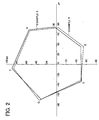
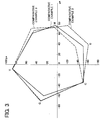
- the values are also plotted in a*, and b* chromaticity coordinates in Figs. 1, 2 and 3.
- the yellow toner layer was located below the magenta or cyan color image (i.e., the yellow color toner layer contacted the receiving material and the magenta or cyan color image was formed on the yellow toner layer).
- Example 1 The procedures for preparation and evaluation of the color toners in Example 1 were repeated except that at the red and green images, the yellow toner layer was formed on the magenta or cyan toner layer.
- the images were exposed to sunlight for 15 days (15 x 24 hours), and the images were visually observed to determine whether the images faded.
- a yellow toner including a benzimidazolone type pigment a magenta toner including Naphthol Carmine F6B or a combination of Naphthol Carmine F6B and Naphthol Carmine FBB, and a cyan toner including ⁇ copper phthalocyanine
- the resultant color images have good color tone (i.e., the resultant color image has good color reproducibility of red and blue images), and good stability (i.e., good resistance to light).
- the resultant toner images have better color reproducibility.
- the color reproducibility can be further improved because the color toner layers can be mixed with each other.
- the toners includes a specified polyol resin as a binder resin, the color reproducibility can be further improved.
- the toner when the toner includes a specified aromatic hydroxycarboxylic acid metal salt as a charge controlling agent, the resultant toners have good charge properties and therefore can produce images having good image qualities such as good color reproducibility.
Landscapes
- Physics & Mathematics (AREA)
- General Physics & Mathematics (AREA)
- Developing Agents For Electrophotography (AREA)
- Color Electrophotography (AREA)
Abstract
Description
- The present invention relates to color toners and an image forming method using the color toners. More particularly, the present invention relates to yellow, magenta, and cyan toners which are used for forming color images using electrophotography, and to an image forming method using the color toners and a non-contact heat fixing method.
- Image forming methods using electrophotography are well known. Various color toners for the image forming methods have been proposed. For example, Japanese Laid-Open Patent Publication No. 9-171268 discloses color toners including a cyan toner including β phthalocyanine, a magenta toner including Rhodamine 6G xanthenesilicomolybdate, a yellow toner including a benzidine type pigment, and a black toner including carbon black. Japanese Laid-Open Patent Publication No. 9-171269 discloses color toners including a cyan toner including β phthalocyanine, a magenta toner including monoazo Lithol Rubine, a yellow toner including a benzidine type pigment, and a black toner including carbon black. These color toners can produce red images having good tint, i.e., having good color reproducibility, however, the color tone of a bluish violet color image produced by them is not satisfactory.
- Japanese Laid-Open Patent Publications Nos. 2-66562 and 3-107869 have disclosed quinacridone type pigments as a colorant for a magenta toner. The tint of bluish violet color images is good, however the toners have a drawback in that the color tone of a red image is not satisfactory.
- In addition, a benzidine type yellow pigment, Pigment Yellow 17, is typically used for yellow toners because of having good tint and transparency, however, the light resistance (in particular the resistance to sunlight) of the pigment is not good. Therefore green color images which are a combination of the yellow pigment with a cyan toner are easily changed to bluish green when the green color images are exposed to light.
- Thus, it is difficult to form color toner images having good color reproducibility (i.e., to form color toner images whose colors are well balanced). In particular, it is difficult to reproduce color images having a good combination of red color reproducibility and blue color reproducibility. These problems concerning color reproducibility are prominent in the color images which are fixed with a non-contact type heat fixing method using an oven and the like rather than a heat roller fixing method. In addition, the color toner images generally have poor light resistance as mentioned above.
- Because of these reasons, a need exists for color toners which can produce color images having good color reproducibility. In particular, a need exists for color toners which can produce color images having a good combination of red color reproducibility and blue color reproducibility, and good light resistance even when used for non-contact heat fixing methods.
- Accordingly, an object of the present invention is to provide an image forming method in which color images having a good combination of red color reproducibility and blue color reproducibility, and good light resistance can be produced in particular when the toner images are fixed by a non-contact fixing method.
- Another object of the present invention is to provide color toners which can produce color images having a good combination of red color reproducibility and blue color reproducibility.
- Yet another object of the present invention is to provide color toners which can produce color images having good light resistance.
- To achieve such objects, the present invention contemplates the provision of a method for forming a full color image which includes the steps of forming at least a yellow toner image, a magenta toner image and a cyan toner image on a receiving material to form a full color image thereon, and fixing the full color toner image upon application of heat thereto while not contacting the full color toner image, wherein each of the color toners includes a binder resin and a pigment, wherein the yellow toner includes a benzimidazolone, the cyan toner includes β phothalocyanine, and the magenta toner includes at least one of Naphthol Carmine F6B and a combination of Naphthol Carmine F6B and Naphthol Carmine FBB, as the pigment, and wherein the yellow toner image has a position closer to the receiving material than any other toner images when two or more of the color toner images including the yellow toner image are overlaid.
- Each of the fixed yellow, magenta or cyan toner images preferably has a haze factor not greater than 20 % when the fixed toner image has a weight of 8 g/m2. In addition, each of the yellow, magenta or cyan toners preferably has a melt viscosity not greater than 120 mPas·sec at 140 °C.
- Further each of the color toners preferably includes as the binder resin a polyol resin having a polyoxyalkylene moiety in its main chain. The polyol resin is preferably a reaction product of: (a) an epoxy resin; (b) a dihydric phenol; and either (c) an adduct of a dihydric phenol with an alkylene oxide or (c') a glycidyl ether of an adduct of a dihydric phenol with an alkylene oxide.
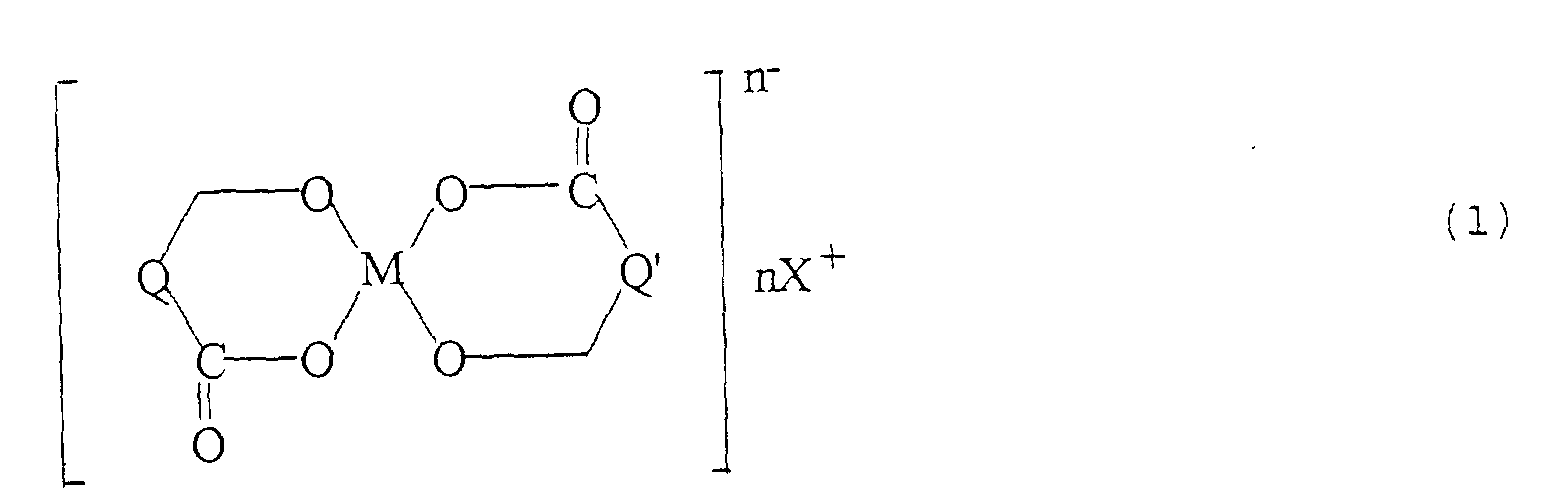
- Each of the color toners preferably includes a charge controlling agent having the following formula (1):wherein Q and Q' independently represent an aromatic oxycarboxylic acid group which may substituted by an alkyl group or an aralkyl group; X represents a counter ion; and M represents a metal. The metal is preferably zinc or chromium.

- In another aspect of the present invention, a combination of color toners for a non-contact heat fixing method is provided which includes at least a yellow toner, a magenta toner and a cyan toner, wherein the yellow toner includes a benzimidazolone, the cyan toner includes β phothalocyanine, and the magenta toner includes at least one of Naphthol Carmine F6B and a combination of Naphthol Carmine F6B and Naphthol Carmine FBB, as the pigment.
- These and other objects, features and advantages of the present invention will become apparent upon consideration of the following description of the preferred embodiments of the present invention taken in conjunction with the accompanying drawings.
-
- Figs. 1-3 are graphs of a* - b* chromaticity coordinates in which hexagons are formed by the respective six points of the color images prepared in Examples 1 to 4 and Comparative Examples 1 to 3;
- Fig. 4 is a schematic view illustrating the main structure of an image forming apparatus useful for the image forming method of the present invention; and
- Fig. 5 is a schematic view illustrating an embodiment of the non-contact heat fixing device for use in the present invention.
-
- The present invention provides a method for forming a full color image which includes the steps of forming at least a yellow toner image, a magenta toner image and a cyan toner image on a receiving material to form a full color image thereon, and fixing the full color toner image upon application of heat thereto while not contacting the full color toner image, wherein each of the color toners includes a binder resin and a pigment, wherein the yellow toner includes a benzimidazolone, the cyan toner includes β phothalocyanine, and the magenta toner includes at least one of Naphthol Carmine F6B and a combination of Naphthol Carmine F6B and Naphthol Carmine FBB, as the pigment, and wherein the yellow toner image has a lowest position (i.e., the closest position to the receiving material) when two or more color toner images are overlaid.
- When used for a roller fixing method, such a color toner combination as mentioned above can produce color images having a good combination of red color reproducibility and bluish violet color reproducibility, and good light resistance.
- When used for a non-contact fixing method, the combination of color toners can produce color images having better image qualities than conventional color toners, but the image qualities of the color images are inferior to those of the color images fixed by a roller fixing method.
- As a result of the present inventor's investigation, it is found that if the yellow toner image has the lowest position in color toner images overlaid on a receiving material (i.e., color toner images are formed such that the yellow toner image contacts the receiving material), the image qualities are as good as those of the color toner images fixed by a roller fixing method.
- Specific examples of the benzimidazolone pigments for use in the yellow toner of the present invention include the compound having the following formula (2):

- Specific examples of the β copper phthalocyanine for use in the cyan toner of the present invention include the compound having the following formula (3):

- Naphthol Carmine F6B and Naphthol Carmine FBB for use in the cyan toner of the present invention have the following formula (4) and formula (5), respectively:
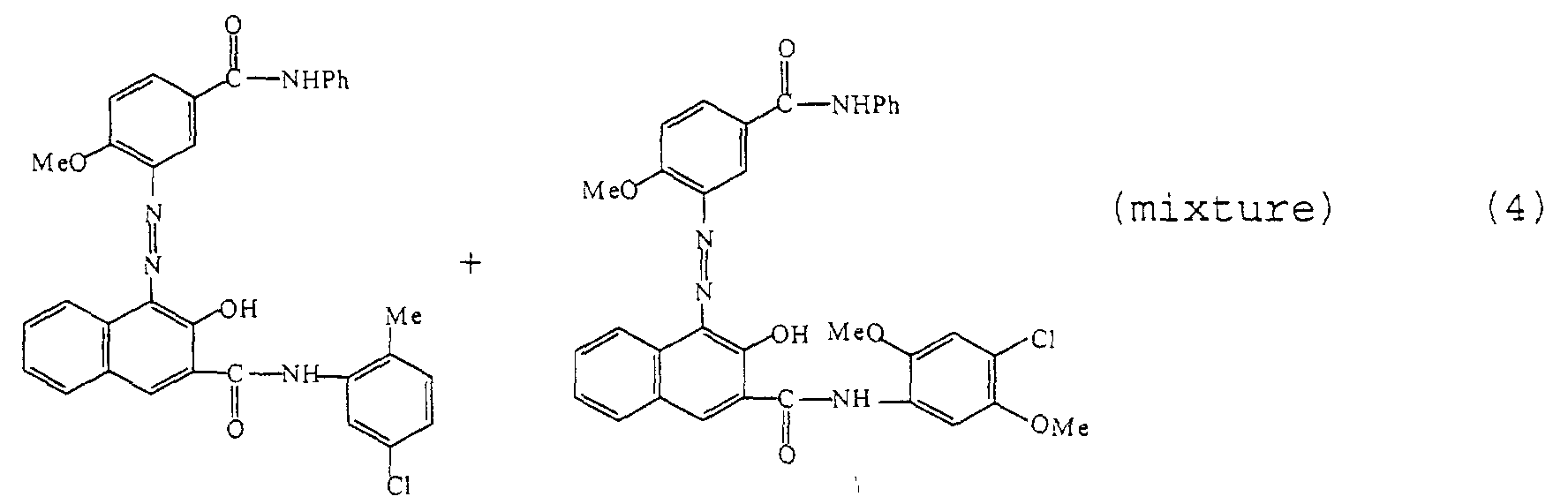

- At this point, the mixing ratio of Naphthol Carmine F6B to Naphthol Carmine FBB (i.e., F6B/FBB) is preferably from 100/0 to 40/60 to produce images having good bluish violet color reproducibility.
- In the present invention, a black toner may be used together with the color toners.
- When a black toner is used for forming full color images, the black toner preferably includes a carbon black as the pigment.
- The color toners of the present invention preferably have a relatively low haze factor when the toners are processed so as to be a thin layer because the resultant toner image has good color reproducibility. Specifically, when a thin toner layer having a weight of 8 g/m2 is formed, the toner layer preferably has a haze factor not greater than 20 %, and more preferably not greater than 15 %. At this point, the thin toner layer is formed by coating a liquid, which is prepared by dissolving the toner with tetrahydrofuran, on a PET film, and then drying the coated liquid. Haze factor can be measured by a direct-reading type Haze Computer manufactured by Suga Test Instruments Co., Ltd.
- In order to prepare a toner which can produce a toner image having a relatively low haze factor, a toner manufacturing method using a master batch in which a pigment is dispersed in a binder resin in a high content is preferably used. In order to prepare a master batch of a toner, flashing methods in which an aqueous cake including a pigment is mixed with a resin in a flasher, or kneading methods in which a pigment is kneaded with a resin using a two-roll or three-roll mill can be preferably used.
- In order to obtain color images having good reproducibility, it is important that each of the color toners melts and uniformly mixes with each other when fixed. This mixing largely depends on the melt viscosity of the toners. The melt viscosity of the toners of the present invention is preferably not greater than 120 mPas·sec at 140°C. In the present invention, the melt viscosity is measured by a constant temperature method using a flow tester model CFT-500 manufactured by Shimazu Corp., under conditions that the diameter of a dice used is 1 mm, and the pressure is 20 Kg/cm2.
- In the color toners of the present invention, known binder resins can be used for the binder resin.
- Specific examples of the binder resins for use in the toners include styrene polymers and substituted styrene polymers such as polystyrene, poly-p-chlorostyrene, polyvinyltoluene and the like; styrene copolymers such as styrene-vinyltoluene copolymers, styrene-vinylnaphthalene copolymers, styrene-methyl acrylate copolymers, styrene-ethyl acrylate copolymers, styrene-butyl acrylate copolymers, styrene-octyl acrylate copolymers, styrene-methyl methacrylate copolymers, styrene-ethyl methacrylate copolymers, styrene-butyl methacrylate copolymers, styrene-methyl α-chloromethacrylate copolymers, styreneacrylonitrile copolymers, styrene-vinylmethylketone copolymers, styrene-butadiene copolymers, styrene-isoprene copolymers, styrene-acrylonitrile-indene copolymers, styrene-maleic acid copolymers, styrene-maleic acid ester copolymers and the like; and other resins such as polymethyl methacrylate, polybutyl methacrylate, polyvinyl chloride, polyvinyl acetate, polyethylene, polypropylene, polyesters, epoxy resins, epoxy polyol resins, polyurethane resins, polyamide resins, polyvinyl butyral resins, acrylic resins, rosin, modified rosin, terpene resins, aliphatic or alicyclic hydrocarbon resins, aromatic petroleum resins and the like. These resins are used alone or in combination.
- In order to prepare toners having good color reproducibility, the toners preferably include as a binder resin a polyol resin which includes a polyoxyalkylene chain as a main chain and which is prepared by reacting at least (a) an epoxy resin, (b) a dihydric phenol compound and (c) an adduct of a dihydric phenol compound with an alkylene oxide or its glycidyl ether compound.
- Specific examples of such epoxy resins include epoxy resins which are prepared by reacting a bisphenol compound such as bisphenol A and bisphenol F with epichlorohydrin. Specific examples of the dihydric phenol compound include bisphenol A, bisphenol F and the like. Specific examples of the adducts of a dihydric phenol compound with an alkylene oxide include reaction products of ethylene oxide, propylene oxide, butylene oxide or a mixture thereof with a bisphenol compound such as bisphenol A or bisphenol F. The reaction products may be further reacted with epichlorohydrin or β-methylepichlorohydrin to prepare a glycidyl ether compound thereof. In addition, a monohydric phenol compound such as phenol, cresol, isopropyl phenol, aminophenol, octyl phenol, nonyl phenol, dodecyl phenol, p-cumyl phenol and the like may be reacted therewith.
- The toners of the present invention may include a charge controlling agent, if desired. Specific examples of the charge controlling agent include known charge controlling agents such as Nigrosine dyes, triphenylmethane dyes, metal complex dyes including chromium, chelate compounds of molybdic acid, Rhodamine dyes, alkoxyamines, quaternary ammonium salts (including fluorine-modified quaternary ammonium salts), alkylamides, phosphor and compounds including phosphor, tungsten and compounds including tungsten, activators including fluorine, and the like.
- In the present invention, aromatic hydroxycarboxylic acid derivatives including a metal such as zinc, chromium, cobalt, aluminum, iron, zirconium and the like are preferably used as the charge controlling agent. Among these aromatic hydroxycarboxylic acid derivatives, compounds having the following formula (1) are more preferable.wherein Q and Q' independently represent an aromatic oxycarboxylic acid group which is optionally substituted with an alkyl and/or an aralkyl group; X represents a counter ion; and M represents a metal.
- Among these aromatic hydroxycarboxylic acid derivatives, zinc or chromium salts of aromatic hydroxycarboxylic acid derivatives are most preferable because the resultant toners have good color reproducibility and good charge properties.
- Specific examples of the metal salts of aromatic hydroxycarboxylic acid derivatives include the compounds having the following formula (6) or (7).

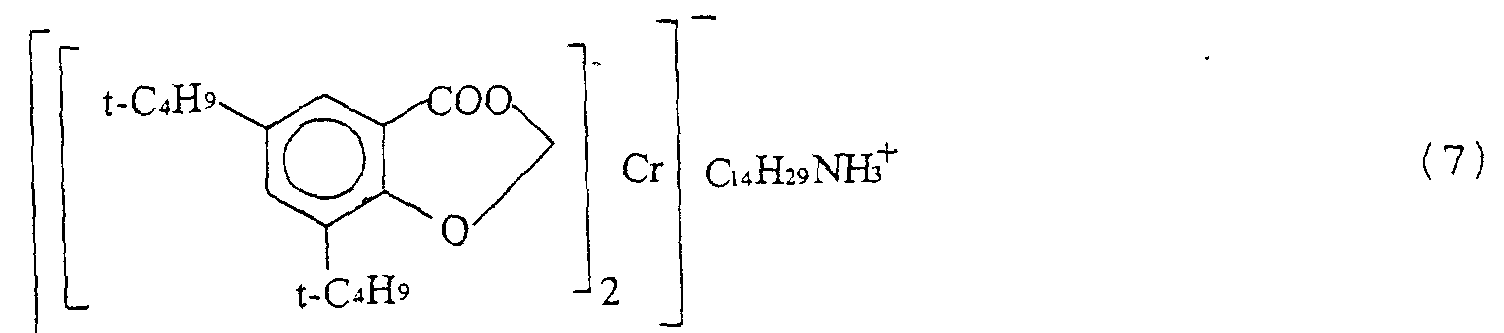
- In the present invention, the content of the charge controlling agent in the toner is determined depending on species of the binder resin used, whether or not other additives are added thereto, and the method used for manufacturing the toner.
- Preferably, the content of the charge controlling agent is from 0.1 to 10 parts by weight, and more preferably from 2 to 5 parts by weight, per 100 parts by weight of the binder resin.
- When the content of the charge controlling agent is less than 0.1 parts, the resultant toner has insufficient charge quantity. In contrast, when the content is greater than 10 parts, the resultant toner has too large charge quantity, resulting in decrease of fluidity of the toner and image density of the resultant toner images.
- In the present invention, the charge controlling agents can be used alone or in combination.
- The toners of the present invention may include other additives. Specific examples of such additives include colloidal silica, hydrophobic silica, metal salts of fatty acids such as zinc stearate, aluminum stearate and the like; metal oxides such as titanium oxide, aluminum oxide, tin oxide, antimony oxide and the like; fluorine containing polymers and the like. Among these additives, hydrophobic silica, hydrophobic titania and hydrophobic alumina are preferable.
- Specific examples of the hydrophobic silica include HDK H 2000, HDK H 2000/4, HDK H 2050EP, and HVK21, which are manufactured by Clariant Japan K.K.; and R972, R974, RX200, RY200, R202, R805, and R812, which are manufactured by Nippon Aerosil Co.
- Specific examples of the titania include P-25 which is manufactured by Nippon Aerosil Co.; STT-30 and STT-65C-S, which are manufactured by Titan Kogyo K.K.; TAF-140, which is manufactured by Fuji Titanium Industry Co., Ltd.; and MT-150W, MT-500B, and MT-600B, which are manufactured by Tayca Corp. Specific examples of the titanium oxides, which are subjected to a hydrophobic treatment, include T-805, which is manufactured by Nippon Aerosil Co.; STT-30A and STT-65S-S, which are manufactured by Titan Kogyo K.K.; TAF-500T and TAF-1500T, which are manufactured by Fuji Titanium Industry Co., Ltd.; MT-100S and MT-100T, which are manufactured by Tayca Corp.; and IT-S, which is manufactured by Ishihara Sangyo Kaisha Ltd.
- Hydrophobic silica, titania and alumina can also be prepared by treating hydrophilic silica, titania and alumina with a silane coupling agent such as methyltrimethoxy silane, methyltriethoxy silane, octyltrimethoxy silane and the like, or a silicone oil.
- The toner of the present invention can be used for developing method using a one-component developer, in which a toner serving as a one-component developer is used for developing electrostatic latent images, and developing methods using a two-component developer, in which a developer consisting of a toner and a carrier is used for developing electrostatic latent images.
- Carriers for use in combination with the toners of the present invention in two-component developers include known carrier materials such as iron powders, ferrite powder, glass beads and the like. These carriers may be coated with a resin such as polyfluorocarbons, polyvinyl chloride, polyvinylidene chloride, phenolic resins, polyvinyl acetal resins, silicone resins and the like.
- In the present invention, the mixing ratio of the toner to the carrier in two-component developers is 0.5/100 to 10/100 by weight.
- Fig. 4 is a schematic view illustrating an image forming apparatus for use in the image forming method of the present invention. A
photoreceptor 41 is charge by acharger 42 such that the surface of thephotoreceptor 41 is entirely charged. Thephotoreceptor 41 is then exposed to imagewise light 43 to form an electrostatic latent image thereon. The electrostatic latent image is then developed by one of developing sections 44-1 to form a color toner image on thephotoreceptor 41. The color toner image is then transferred on anintermediate transfer medium 45 while the intermediate transfer medium is contacted with the color toner image and rotated. The surface of thephotoreceptor 41 is cleaned by a cleaner 49 to remove toner particles remaining on the surface of thephotoreceptor 41. Then a discharginglamp 50 irradiates thephotoreceptor 41 with light to remove the charge remaining on thephotoreceptor 41. - The another color toner image is formed on the
photoreceptor 41 by repeating the above-mentioned procedure except that a developing section 44-2 including a different color developer is used. The thus prepared color toner image is then transferred on the previously formed color image on theintermediate transfer medium 45. Similarly, other color toner images formed using developing sections 44-3 and 44-4 are formed on thephotoreceptor 41 one by one. The color toner images are also transferred on the color images on theintermediate transfer medium 45. Thus a color image (for example, a full color image) is formed on theintermediate transfer medium 45. - The color image formed on the
intermediate transfer medium 45 is then transferred on a receivingmaterial 46 at once by atransfer roller 47. Theintermediate transfer medium 45 is cleaned by a cleaner 48. - In the full color image forming method, plural image bearing members may be used to form the respective color toner image thereon. The plural color toner images are transferred on an intermediate transfer medium or a receiving material.
- The intermediate transfer medium is not necessarily needed. The toner images formed on the image bearing member may be directly transferred one by one onto the receiving material.
- Suitable non-contact fixing methods include oven fixing methods in which hot air is supplied to toner images on a receiving material to melt and fix the toner images, and radiation heat methods in which light such as infrared light is radiated to toner images to melt and fix the toner images.
- Fig. 5 is a schematic view illustrating an embodiment of the non-contact heat fixing device (i.e., an oven fixing method) for use in the image forming method of the present invention. As shown in Fig. 5, a receiving
material 1 havingtoner images oven 4 in a direction indicated by an arrow. Thetoner images toner images toner images oven 4. - Having generally described this invention, further understanding can be obtained by reference to certain specific examples which are provided herein for the purpose of illustration only and are not intended to be limiting. In the descriptions in the following examples, the numbers represent weight ratios in parts, unless otherwise specified.
- The following components were mixed with a flasher.
Water 1200 Phthalocyanine green aqueous cake 200 (solid content of 30 %) Carbon black 540 (tradenamed as MA60 and manufactured by Mitsubishi Chemical Corp.) - One thousand and two hundred (1200) parts of a polyester resin having an acid value of 3 mgKOH/g, a hydroxy value of 25 mgKOH/g, a number average molecular weight Mn of 45000, a ratio Mw/Mn of 4.0 and a glass transition temperature of 60 °C were added to the mixture, and the mixture was kneaded at 150 °C for 30 minutes. After kneading, 1000 parts of xylene were added to the kneaded mixture, and the mixture was further kneaded for 1 hour. Water and xylene were then removed therefrom, and the mixture was cooled by rolling and pulverized with a pulverizer. Thus, a master batch pigment was prepared.
- The following components were mixed, and then melted and kneaded with a two-roll mill.
The polyester resin mentioned above 100 Master batch pigment prepared above 5 Compound having formula (6) 4 (Charge controlling agent) - The kneaded mixture was cooled by rolling, and then pulverized and classified. Thus, mother particles of a black toner having a volume average particle diameter of 7.5 µm were prepared. In addition, a hydrophobic silica (H2000, manufactured by Clariant Japan K.K.) was added thereto in an amount of 0.5 % by weight, and then the mixture was mixed with a mixer to prepare a
black toner 1. The haze factor of a thin layer ofblack toner 1 having a weight of 8 g/m2 was 16 %, and the melt viscosity of the toner was 96 mPas·sec at 140 °C. - The following components were mixed with a flasher.
Water 600 Aqueous cake of pigment having formula (2) 1200 (solid content of 50 %) - One thousand and two hundred (1200) parts of the polyester resin for use in
black toner 1 were added to the mixture, and the mixture was kneaded at 150 °C for 30 minutes. After kneading, 1000 parts of xylene were added to the kneaded mixture, and the mixture was further kneaded for 1 hour. Water and xylene were then removed therefrom, and the mixture was cooled by rolling and pulverized with a pulverizer. In addition, the mixture was passed through a three-roll mill twice. Thus, a master batch pigment was prepared. - The following components were mixed, and then melted and kneaded with a two-roll mill.
The polyester resin for use in black toner 1100 Master batch pigment prepared above 5 Compound having formula (6) 4 (Charge controlling agent) - The kneaded mixture was cooled by rolling, and then pulverized and classified. Thus, mother particles of a yellow toner having a volume average particle diameter of 10 µm were prepared. In addition, a hydrophobic silica (H2000, manufactured by Clariant Japan K.K.) was added thereto in an amount of 0.5 % by weight, and then the mixture was mixed with a mixer to prepare a
yellow toner 1. The haze factor of a thin layer ofyellow toner 1 having a weight of 8 g/m2 was 17 %, and the melt viscosity of the toner was 98 mPas·sec at 140 °C. - The following components were mixed with a flasher.
Water 600 Aqueous cake of pigment having formula (4) 1200 (solid content of 50 %) - One thousand and two hundred (1200) parts of the polyester resin for use in
black toner 1 were added to the mixture, and the mixture was kneaded at 150 °C for 30 minutes. After kneading, 1000 parts of xylene were added to the kneaded mixture, and the mixture was further kneaded for 1 hour. Water and xylene were then removed therefrom, and the mixture was cooled by rolling and pulverized with a pulverizer. In addition, the mixture was passed through a three-roll mill twice. Thus, a master batch pigment was prepared. - The following components were mixed, and then melted and kneaded with a two-roll mill.
The polyester resin for use in black toner 1100 Master batch pigment prepared above 5 Compound having formula (6) 4 (Charge controlling agent) - The kneaded mixture was cooled by rolling, and then pulverized and classified. Thus, mother particles of a magenta toner having a volume average particle diameter of 10 µm were prepared. In addition, a hydrophobic silica (H2000, manufactured by Clariant Japan K.K.) was added thereto in an amount of 0.5 % by weight, and then the mixture was mixed with a mixer to prepare a
magenta toner 1. The haze factor of a thin layer ofmagenta toner 1 having a weight of 8 g/m2 was 18 %, and the melt viscosity of the toner was 17 mPas·sec at 140 °C. - The following components were mixed with a flasher.
Water 600 Aqueous cake of pigment having formula (3) 1200 (solid content of 50 %) - One thousand and two hundred (1200) parts of the polyester resin for use in
black toner 1 were added to the mixture, and the mixture was kneaded at 150 °C for 30 minutes. After kneading, 1000 parts of xylene were added to the kneaded mixture, and the mixture was further kneaded for 1 hour. Water and xylene were then removed therefrom, and the mixture was cooled by rolling and pulverized with a pulverizer. In addition, the mixture was passed through a three-roll mill twice. Thus, a master batch pigment was prepared. - The following components were mixed, and then melted and kneaded with a two-roll mill.
The polyester resin for use in black toner 1100 Master batch pigment prepared above 3 Compound having formula (6) 4 (Charge controlling agent) - The kneaded mixture was cooled by rolling, and then pulverized and classified. Thus, mother particles of a cyan toner having a volume average particle diameter of 10 µm were prepared. In addition, a hydrophobic silica (tradenamed as H2000 and manufactured by Clariant Japan K.K.) was added thereto in an amount of 0.5 % by weight, and then the mixture was mixed with a mixer to prepare a
cyan toner 1. The haze factor of a thin layer ofcyan toner 1 having a weight of 8 g/m2 was 15 %, and the melt viscosity of the toner was 34 mPas·sec at 140 °C. - The following components were mixed with a mixer, and then kneaded 5 times with a three-roll mill.
Carbon black 800 (tradenamed as MA60 and manufactured by Mitsubishi Chemical Corp.) Polyol resin (A) 1200 (number average molecular weight of 3800, Mw/Mn of 4.2, and glass transition temperature of 60 °C) - The mixture was cooled by rolling, and then pulverized with a pulverizer. Thus, a master batch pigment was prepared.
- The following components were mixed, and then melted and kneaded with a two-roll mill.
Polyol resin (A) 100 Master batch pigment prepared above 6 Compound having formula (7) 3 (Charge controlling agent) - The kneaded mixture was cooled by rolling, and then pulverized and classified. Thus, mother particles of a black toner having a volume average particle diameter of 7.5 µm were prepared. In addition, a hydrophobic silica (H2000, manufactured by Clariant Japan K.K.) was added thereto in an amount of 0.5 % by weight, and then the mixture was mixed with a mixer to prepare a
black toner 2. The haze factor of a thin layer ofblack toner 2 having a weight of 8 g/m2 was 14 %, and the melt viscosity of the toner was 88 mPas·sec at 140 °C. - The following components were mixed with a mixer, and then kneaded 5 times with a three-roll mill.
Pigment having formula (2) 800 Polyol resin (A) 1200 - The mixture was cooled by rolling, and then pulverized with a pulverizer. Thus, a master batch pigment was prepared.
- The following components were mixed, and then melted and kneaded with a two-roll mill.
Polyol resin (A) 100 Master batch pigment prepared above 6 Compound having formula (7) 3 (Charge controlling agent) - The kneaded mixture was cooled by rolling, and then pulverized and classified. Thus, mother particles of a yellow toner having a volume average particle diameter of 10 µm were prepared. In addition, a hydrophobic silica (H2000, manufactured by Clariant Japan K.K.) was added thereto in an amount of 0.5 % by weight, and then the mixture was mixed with a mixer to prepare a
yellow toner 2. The haze factor of a thin layer ofyellow toner 2 having a weight of 8 g/m2 was 15 %, and the melt viscosity of the toner was 91 mPas·sec at 140 °C. - The following components were mixed with a mixer, and then kneaded 5 times with a three-roll mill.
Pigment having formula (4) 400 Pigment having formula (5) 400 Polyol resin (A) 1200 - The mixture was cooled by rolling, and then pulverized with a pulverizer. Thus, a master batch pigment was prepared.
- The following components were mixed, and then melted and kneaded with a two-roll mill.
Polyol resin (A) 100 Master batch pigment prepared above 6 Compound having formula (7) 3 (Charge controlling agent) - The kneaded mixture was cooled by rolling, and then pulverized and classified. Thus, mother particles of a magenta toner having a volume average particle diameter of 10 µm were prepared. In addition, a hydrophobic silica (H2000, manufactured by Clariant Japan K.K.) was added thereto in an amount of 0.5 % by weight, and then the mixture was mixed with a mixer to prepare a
magenta toner 2. The haze factor of a thin layer ofmagenta toner 2 having a weight of 8 g/m2 was 14 %, and the melt viscosity of the toner was 86 mPas·sec at 140 °C. - The following components were mixed with a mixer, and then kneaded 5 times with a three-roll mill.
Pigment having formula (3) 800 Polyol resin (A) 1200 - The mixture was cooled by rolling, and then pulverized with a pulverizer. Thus, a master batch pigment was prepared.
- The following components were mixed, and then melted and kneaded with a two-roll mill.
Polyol resin (A) 100 Master batch pigment prepared above 5 Compound having formula (7) 4 (Charge controlling agent) - The kneaded mixture was cooled by rolling, and then pulverized and classified. Thus, mother particles of a cyan toner having a volume average particle diameter of 10 µm were prepared. In addition, a hydrophobic silica (H2000, manufactured by Clariant Japan K.K.) was added thereto in an amount of 0.5 % by weight, and then the mixture was mixed with a mixer to prepare a
cyan toner 2. The haze factor of a thin layer ofcyan toner 2 having a weight of 8 g/m2 was 12 %, and the melt viscosity of the toner was 87 mPas·sec at 140 °C. - The following components were mixed with a mixer, and then kneaded 5 times with a three-roll mill.
Carbon black 800 (tradenamed as MA60 and manufactured by Mitsubishi Chemical Corp.) Polyol resin (B) 1200 (number average molecular weight of 5600, Mw/Mn of 5.8, and transition temperature of 63 °C) - The mixture was cooled by rolling, and then pulverized with a pulverizer. Thus, a master batch pigment was prepared.
- The following components were mixed, and then melted and kneaded with a two-roll mill.
Polyol resin (B) 100 Master batch pigment prepared above 6 Compound having formula 1-20 3 (Charge controlling agent) - The kneaded mixture was cooled by rolling, and then pulverized and classified. Thus, mother particles of a black toner having a volume average particle diameter of 7.5 µm were prepared. In addition, a hydrophobic silica (tradenamed as H2000 and manufactured by Clariant Japan K.K.) was added thereto in an amount of 0.5 % by weight, and then the mixture was mixed with a mixer to prepare a
black toner 3. The haze factor of a thin layer ofblack toner 2 having a weight of 8 g/m2 was 19 %, and the melt viscosity of the toner was 125 mPas·sec at 140 °C. - The following components were mixed with a mixer, and then kneaded 5 times with a three-roll mill.
Pigment having formula (2) 800 Polyol resin (B) 1200 - The mixture was cooled by rolling, and then pulverized with a pulverizer. Thus, a master batch pigment was prepared.
- The following components were mixed, and then melted and kneaded with a two-roll mill.
Polyol resin (B) 100 Master batch pigment prepared above 6 Compound having formula (7) 3 (Charge controlling agent) - The kneaded mixture was cooled by rolling, and then pulverized and classified. Thus, mother particles of a yellow toner having a volume average particle diameter of 10 µm were prepared. In addition, a hydrophobic silica (tradenamed as H2000 and manufactured by Clariant Japan K.K.) was added thereto in an amount of 0.5 % by weight, and then the mixture was mixed with a mixer to prepare a
yellow toner 3. The haze factor of a thin layer ofyellow toner 3 having a weight of 8 g/m2 was 19 %, and the melt viscosity of the toner was 121 mPas·sec at 140 °C. - The following components were mixed with a mixer, and then kneaded 5 times with a three-roll mill.
Pigment having formula (4) 400 Pigment having formula (5) 400 Polyol resin (B) 1200 - The mixture was cooled by rolling, and then pulverized with a pulverizer. Thus, a master batch pigment was prepared.
- The following components were mixed, and then melted and kneaded with a two-roll mill.
Polyol resin (B) 100 Master batch pigment prepared above 6 Compound having formula (7) 3 (Charge controlling agent) - The kneaded mixture was cooled by rolling, and then pulverized and classified. Thus, mother particles of a magenta toner having a volume average particle diameter of 10 µm were prepared. In addition, a hydrophobic silica (tradenamed as H2000 and manufactured by Clariant Japan K.K.) was added thereto in an amount of 0.5 % by weight, and then the mixture was mixed with a mixer to prepare a
magenta toner 3. The haze factor of a thin layer ofmagenta toner 3 having a weight of 8 g/m2 was 18 %, and the melt viscosity of the toner was 123 mPas·sec at 140 °C. - The following components were mixed with a mixer, and then kneaded 5 times with a three-roll mill.
Pigment having formula (3) 800 Polyol resin (B) 1200 - The mixture was cooled by rolling, and then pulverized with a pulverizer. Thus, a master batch pigment was prepared.
- The following components were mixed, and then melted and kneaded with a two-roll mill.
Polyol resin (B) 100 Master batch pigment prepared above 5 Compound having formula (7) 4 (Charge controlling agent) - The kneaded mixture was cooled by rolling, and then pulverized and classified. Thus, mother particles of a cyan toner having a volume average particle diameter of 10 µm were prepared. In addition, a hydrophobic silica (H2000, manufactured by Clariant Japan K.K.) was added thereto in an amount of 0.5 % by weight, and then the mixture was mixed with a mixer to prepare a
cyan toner 3. The haze factor of a thin layer ofcyan toner 3 having a weight of 8 g/m2 was 16 %, and the melt viscosity of the toner was 122 mPas·sec at 140 °C. - The following components were mixed with a mixer, and then kneaded with a three-roll mill such that the mixture was passed through the three-roll mill twice.
Carbon black 800 (tradenamed as MA60 and manufactured by Mitsubishi Chemical Corp.) Polyol resin (A) for use in black toner 21200 - The mixture was cooled by rolling, and then pulverized with a pulverizer. Thus, a master batch pigment was prepared.
- The following components were mixed, and then melted and kneaded with a two-roll mill.
Polyol resin (A) 100 Master batch pigment prepared above 6 Compound having formula 1-20 3 (Charge controlling agent) - The kneaded mixture was cooled by rolling, and then pulverized and classified. Thus, mother particles of a black toner having a volume average particle diameter of 7.5 µm were prepared. In addition, a hydrophobic silica (tradenamed as H2000 and manufactured by Clariant Japan.) was added thereto in an amount of 0.5 % by weight, and then the mixture was mixed with a mixer to prepare a
black toner 4. The haze factor of a thin layer ofblack toner 4 having a weight of 8 g/m2 was 21 %, and the melt viscosity of the toner was 88 mPas·sec at 140 °C. - The following components were mixed with a mixer, and then kneaded with a three-roll mill such that the mixture was passed through the three-roll mill twice.
Pigment having formula (2) 800 Polyol resin (A) 1200 - The mixture was cooled by rolling, and then pulverized with a pulverizer. Thus, a master batch pigment was prepared.
- The following components were mixed, and then melted and kneaded with a two-roll mill.
Polyol resin (A) 100 Master batch pigment prepared above 6 Compound having formula (7) 3 (Charge controlling agent) - The kneaded mixture was cooled by rolling, and then pulverized and classified. Thus, mother particles of a yellow toner having a volume average particle diameter of 10 µm were prepared. In addition, a hydrophobic silica (tradenamed as H2000 and manufactured by Clariant Japan K.K.) was added thereto in an amount of 0.5 % by weight, and then the mixture was mixed with a mixer to prepare a
yellow toner 4. The haze factor of a thin layer ofyellow toner 4 having a weight of 8 g/m2 was 23 %, and the melt viscosity of the toner was 91 mPas·sec at 140 °C. - The following components were mixed with a mixer, and then kneaded with a three-roll mill such that the mixture was passed through the three-roll mill twice.
Pigment having formula (4) 400 Pigment having formula (5) 400 Polyol resin (A) 1200 - The mixture was cooled by rolling, and then pulverized with a pulverizer. Thus, a master batch pigment was prepared.
- The following components were mixed, and then melted and kneaded with a two-roll mill.
Polyol resin (A) 100 Master batch pigment prepared above 6 Compound having formula (7) 3 (Charge controlling agent) - The kneaded mixture was cooled by rolling, and then pulverized and classified. Thus, mother particles of a magenta toner having a volume average particle diameter of 10 µm were prepared. In addition, a hydrophobic silica (H2000, manufactured by Clariant Japan K.K.) was added thereto in an amount of 0.5 % by weight, and then the mixture was mixed with a mixer to prepare a
magenta toner 4. The haze factor of a thin layer ofmagenta toner 4 having a weight of 8 g/m2 was 22 %, and the melt viscosity of the toner was 89 mPas·sec at 140 °C. - The following components were mixed with a mixer, and then kneaded with a three-roll mill such that the mixture was passed through the three-roll mill twice.
Pigment having formula (3) 800 Polyol resin (A) 1200 - The mixture was cooled by rolling, and then pulverized with a pulverizer. Thus, a master batch pigment was prepared.
- The following components were mixed, and then melted and kneaded with a two-roll mill.
Polyol resin (A) 100 Master batch pigment prepared above 5 Compound having formula 1-20 4 (Charge controlling agent) - The kneaded mixture was cooled by rolling, and then pulverized and classified. Thus, mother particles of a cyan toner having a volume average particle diameter of 10 µm were prepared. In addition, a hydrophobic silica (tradenamed as H2000 and manufactured by Clariant Japan K.K.) was added thereto in an amount of 0.5 % by weight, and then the mixture was mixed with a mixer to prepare a
cyan toner 4. The haze factor of a thin layer ofcyan toner 4 having a weight of 8 g/m2 was 19 %, and the melt viscosity of the toner was 87 mPas·sec at 140 °C. - The procedures for preparation of the black, yellow, magenta and cyan toner in Toner Manufacturing Example 1 were repeated except that the yellow pigment was replaced with 1200 parts of an aqueous cake of Pigment Yellow 17 (solid content of 50 %), and the magenta pigment was replaced with 1200 parts of an aqueous cake of Pigment Red 57 aqueous cake (solid content of 50 %). Thus, a black toner 5, a yellow toner 5, a magenta toner 5 and a cyan toner 5 were prepared. The haze factor of yellow toner 5 was 13 %, and the melt viscosity thereof was 96 mPas·sec at 140 °C. The haze factor of magenta toner 5 was 16 %, and the melt viscosity thereof was 96 mPas·sec at 140 °C.
- The procedures for preparation of the black, yellow, magenta and cyan toner in Toner Manufacturing Example 2 were repeated except that the yellow pigment was replaced with 600 parts of Pigment Yellow 17, and the magenta pigment was replaced with 600 parts of Pigment Red 122. Thus, a black toner 6, a yellow toner 6, a magenta toner 6 and a cyan toner 6 were prepared. The haze factor of yellow toner 6 was 12 %, and the melt viscosity thereof was 84 mPas·sec at 140 °C. The haze factor of magenta toner 6 was 16 %, and the melt viscosity thereof was 89 mPas·sec at 140 °C.
- The following components were mixed with a homomixer for 30 minutes to prepare a coating liquid for forming a coating layer on the surface of a carrier.
Silicone resin solution 100 (tradenamed as KR50 and manufactured by Shin-Etsu Chemical Co., Ltd) Carbon black 3 (tradenamed as BP2000 and manufactured by Cabot Corp.) Toluene 100 - The coating liquid was coated on the surface of 1000 parts of a carrier, a spherical ferrite powder having an average particle diameter of 50 µm, using a fluidized bed type coating apparatus. Thus, a carrier A was prepared.
- Five (5) parts of each of the color toners prepared in Toner Manufacturing Example 1 were mixed with 95 parts of carrier A to prepare four color developers.
- Yellow, magenta, cyan, red, green and blue color images were formed using a copier IBM 3170, which uses a non-contact heat fixing device as shown in Fig. 5, and the color developers. The values a*, and b* of the color images were measured with a spectrodensitometer X-Rite 938 (manufactured by X-Rite) are shown in Table 1. The values are also plotted in a*, and b* chromaticity coordinates in Figs. 1, 2 and 3. At the red and green color images, the yellow toner layer was located below the magenta or cyan color image (i.e., the yellow color toner layer contacted the receiving material and the magenta or cyan color image was formed on the yellow toner layer).
- Five (5) parts of each of the color toners prepared in Toner Manufacturing Example 2 were mixed with 95 parts of carrier A to prepare four color developers.
- Color images were produced and evaluated in the same way as performed in Example 1. The result is shown in Table 1 and Figs. 1-3.
- Five (5) parts of each of the color toners prepared in Toner Manufacturing Example 3 were mixed with 95 parts of carrier A to prepare four color developers.
- Color images were produced and evaluated in the same way as performed in Example 1. The result is shown in Table 1 and Figs. 1-3.
- Five (5) parts of each of the color toners prepared in Toner Manufacturing Example 4 were mixed with 95 parts of carrier A to prepare four color developers.
- Color images were produced and evaluated in the same way as performed in Example 1. The result is shown in Table 1 and Figs. 1-3.
- The procedures for preparation and evaluation of the color toners in Example 1 were repeated except that at the red and green images, the yellow toner layer was formed on the magenta or cyan toner layer.
- The result is shown in Table 1 and Figs. 1-3.
- Five (5) parts of each of the yellow, magenta, and cyan color toners prepared in Toner Manufacturing Example 5 and the black toner prepared in Toner Manufacturing Example 1 were mixed with 95 parts of carrier A to prepare four color developers.
- Color images were produced and evaluated in the same way as performed in Example 1. The result is shown in Fig. 1.
- Five (5) parts of each of the yellow, magenta, and cyan color toners prepared in Toner Manufacturing Example 6 and the black toner prepared in Toner Manufacturing Example 2 were mixed with 95 parts of carrier A to prepare four color developers.
- Color images were produced and evaluated in the same way as performed in Example 1. The result is shown in Table 1 and Figs. 1-3.
- The values a*, and b* of the color images were measured with a spectrodensitometer X-Rite 938 (manufactured by X-Rite). The results are shown in Table 1. In addition, the values are plotted in a*, and b* chromaticity coordinates in Figs. 1-3.
- The images were exposed to sunlight for 15 days (15 x 24 hours), and the images were visually observed to determine whether the images faded.
- As a result, the yellow and magenta images prepared in Comparative Example 2, and the yellow image prepared in Comparative Example 3 were faded. In addition, the color tones of the green and blue images prepared in Comparative Example 2 and the green image prepared in Comparative Example 3 changed.
The color reproducibility of the red and green images in Example 1 was better than that of the images in Comparative -
Color of image a* b* Color of image a* b* Ex. 1 Red 71 57 Comp. Ex. 1 Red 60.4 48.5 Magenta 76 4 Magenta 76.0 4.0 Blue 36.0 -50.0 Blue 36.0 -50.0 Cyan -34.3 -51.1 Cyan -34.3 -51.1 Green -71 31.8 Green -60.4 27.0 Yellow -8.0 92.0 Yellow -6.8 78.2 Ex. 2 Red 69.0 54.0 Comp. Ex. 2 Red 66.0 45.0 Magenta 75.0 -3.6 Magenta 75.4 -20.0 Blue 36.0 -53.0 Blue 38.7 -60.5 Cyan -34.6 -50.6 Cyan -34.3 -50.1 Green -71.3 33.0 Green -70.7 32.6 Yellow -7.9 93.4 Yellow -7.9 92.5 Ex. 3 Red 68.2 54.7 Comp. Ex. 3 Red 70.0 56.0 Magenta 73.0 3.9 Magenta 72.0 6.0 Blue 34.6 -48.0 Blue 35.0 -35.0 Cyan -32.9 -49.1 Cyan -34.3 -50.1 Green -68.2 30.5 Green -70.7 32.6 Yellow -7.7 88.3 Yellow -7.9 92.5 Ex. 4 Red 67.0 53.0 Magenta 72.0 -3.6 Blue 35.0 -53.0 Cyan -32.0 -48.0 Green -70.7 33.0 Yellow -7.9 85.0 - As explained above, by preparing a yellow toner including a benzimidazolone type pigment, a magenta toner including Naphthol Carmine F6B or a combination of Naphthol Carmine F6B and Naphthol Carmine FBB, and a cyan toner including β copper phthalocyanine, and producing color toner images in which the yellow toner layer is located below the magenta and cyan toner layer when the color toner layers are overlaid, the resultant color images have good color tone (i.e., the resultant color image has good color reproducibility of red and blue images), and good stability (i.e., good resistance to light).
- In addition, when the toners having a haze factor not greater than 20 %, the resultant toner images have better color reproducibility.
- Further, when the color toners having a melt viscosity not greater than 120 mPas·sec at 140 °C, the color reproducibility can be further improved because the color toner layers can be mixed with each other.
- In addition, when the toners includes a specified polyol resin as a binder resin, the color reproducibility can be further improved.
- Further, when the toner includes a specified aromatic hydroxycarboxylic acid metal salt as a charge controlling agent, the resultant toners have good charge properties and therefore can produce images having good image qualities such as good color reproducibility.
- This document claims priority and contains subject matter related to Japanese Patent Application No. 2000-133980, filed on May 2, 2000, incorporated herein by reference.
- Having now fully described the invention, it will be apparent to one of ordinary skill in the art that many changes and modifications can be made thereto without departing from the spirit and scope of the invention as set forth therein.
Claims (17)
- A method for forming a full color image, comprising:forming at least a yellow toner image, a magenta toner image and a cyan image on a receiving material to form a full color image thereon; andfixing the full color image upon application of heat thereto while not contacting the full color image,wherein each of the yellow, magenta and cyan toner images comprises a binder resin and a pigment, wherein the yellow toner image comprises a benzimidazolone pigment, the magenta toner image comprises at least one of Naphthol Carmine F6B and a combination of Naphthol Carmine F6B and Naphthol Carmine FBB, and the cyan toner image comprises β copper phthalocyanine, and wherein the yellow toner has a position closer to the receiving material than any other toner image when two or more of the color toner images including the yellow toner image are overlaid.
- The method according to Claim 1, wherein each of the color toner images has a haze factor not greater than 20 % when the color toner images have a weight of 8 g/m2 and are fixed.
- The method according to Claim 1 or 2, wherein each of the color toners has a melt viscosity not greater than about 120 mPas·sec at 140 °C.
- The method according to any one of Claims 1 to 3, wherein the binder resin comprises a polyol resin having a polyoxyalkylene moiety in a main chain thereof.
- The method according to Claim 4, wherein the polyol resin comprises a reaction product of: (a) an epoxy resin; (b) a dihydric phenol; and either (c) an adduct of a dihydric phenol with an alkylene oxide or (c') a glycidyl ether of an adduct of a dihydric phenol with an alkylene oxide.
- The method according to any one of Claims 1 to 5, wherein the toner further comprises an aromatic hydroxycarboxylic acid metal salt having the following formula (1) :wherein Q and Q' independently represent an aromatic oxycarboxylic acid group which is optionally substituted by an alkyl group or an aralkyl group; X represents a counter ion; and M represents a metal.

- The method according to Claim 6, wherein the metal is zinc.
- The method according to any one of Claims 1 to 7, wherein the image forming step further comprises:developing an electrostatic latent image on an image bearing member with one of the yellow toner, the magenta toner and the cyan toner to form a color toner image thereon;transferring the color toner image onto the receiving material; andrepeating the color developing step and the transferring step using the other toners of the yellow, magenta and cyan toners to form the full color toner image on the receiving material.
- The method according to any one of Claims 1 to 7, wherein the image forming step further comprises:developing an electrostatic latent image on an image bearing member with one of the yellow toner, the magenta toner and the cyan toner to form a color toner image thereon;first transferring the color toner images onto an intermediate transfer medium; andrepeating the color developing step and the first transferring step using the other toners of the yellow, magenta and cyan toners to form the full color image on the intermediate transfer medium; andsecond transferring the full color image onto the receiving material.
- The method according to any one of Claims 1 to 7, wherein the image forming step further comprises:developing electrostatic latent images formed on at least three image bearing members with at least the yellow toner, the magenta toner and the cyan toner, respectively, to form color toner images thereon; andtransferring the color toner images onto the receiving material to form the full color image thereon.
- The method according to any one of Claims 1 to 7, wherein the image forming step further comprises:developing electrostatic latent images formed on at least three image bearing members with at least the yellow toner, the magenta toner and the cyan toner, respectively, to form color toner images thereon;transferring the color toner images onto an intermediate transfer medium to form the full color image thereon.
- A color toner combination of a yellow toner, a magenta toner and a cyan toner used for the image forming method according to Claims 1 to 11.
- A toner container containing a toner selected from the group consisting of the color toner combination according to Claim 12.
- A color developer comprising:a toner selected from the group consisting of the color toner combination according to Claim 12; anda carrier.
- A developer container containing the color developer according to Claim 14.
- An image forming apparatus comprising:an image forming device containing at least yellow, magenta, and cyan toners and configured to form at least yellow, magenta and cyan toner images with the color toner combination according to Claim 12;an image transfer device configured to transfer the yellow, magenta and cyan toner images on a receiving material to form a full color image thereon; anda non-contact fixing device configured to heat the full color image while not contacting the full color image.
- The image forming apparatus according to Claim 16, wherein the image transfer device comprises:an intermediate transfer medium, andwherein the yellow, magenta and cyan toner images are first transferred on the intermediate transfer medium and then transferred onto the receiving material to form the full color image thereon.
Applications Claiming Priority (2)
| Application Number | Priority Date | Filing Date | Title |
|---|---|---|---|
| JP2000133980 | 2000-05-02 | ||
| JP2000133980A JP3874330B2 (en) | 2000-05-02 | 2000-05-02 | Multicolor image forming method and toner used therefor |
Publications (2)
| Publication Number | Publication Date |
|---|---|
| EP1152298A1 true EP1152298A1 (en) | 2001-11-07 |
| EP1152298B1 EP1152298B1 (en) | 2008-03-19 |
Family
ID=18642344
Family Applications (1)
| Application Number | Title | Priority Date | Filing Date |
|---|---|---|---|
| EP01110097A Expired - Lifetime EP1152298B1 (en) | 2000-05-02 | 2001-05-02 | Image forming method using the color toners and image forming apparatus |
Country Status (4)
| Country | Link |
|---|---|
| US (1) | US7232632B2 (en) |
| EP (1) | EP1152298B1 (en) |
| JP (1) | JP3874330B2 (en) |
| DE (1) | DE60133238T2 (en) |
Cited By (1)
| Publication number | Priority date | Publication date | Assignee | Title |
|---|---|---|---|---|
| EP1923746A1 (en) * | 2006-11-14 | 2008-05-21 | Konica Minolta Business Corporation, Inc. | Electrophotographic image forming method and yellow toner used in the method |
Families Citing this family (14)
| Publication number | Priority date | Publication date | Assignee | Title |
|---|---|---|---|---|
| US20020192580A1 (en) * | 1998-11-05 | 2002-12-19 | Shinichi Kuramoto | Color toners and image forming method using the color toners |
| JP4387613B2 (en) * | 2000-07-10 | 2009-12-16 | キヤノン株式会社 | Magenta toner |
| JP2003228192A (en) | 2001-01-31 | 2003-08-15 | Ricoh Co Ltd | Electrostatic image developing toner, image forming method and apparatus using the same |
| JP4003877B2 (en) * | 2002-08-22 | 2007-11-07 | 株式会社リコー | Toner for developing electrostatic image, developer, image forming method and image forming apparatus |
| JP4037329B2 (en) * | 2003-06-25 | 2008-01-23 | 株式会社リコー | Toner for developing electrostatic image, developer, image forming method, image forming apparatus, and process cartridge |
| US7642032B2 (en) * | 2003-10-22 | 2010-01-05 | Ricoh Company, Limited | Toner, developer, image forming apparatus and image forming method |
| JP2008102394A (en) * | 2006-10-20 | 2008-05-01 | Ricoh Co Ltd | Carrier, replenishment developer, developer in developer, developer replenisher, image forming apparatus, process cartridge |
| JP4658032B2 (en) | 2006-12-27 | 2011-03-23 | 株式会社リコー | Full color toner kit, process cartridge and image forming method |
| JP4817389B2 (en) * | 2007-01-15 | 2011-11-16 | 株式会社リコー | Image forming apparatus, process cartridge, image forming method, and electrophotographic developer |
| JP4907385B2 (en) * | 2007-02-26 | 2012-03-28 | 株式会社リコー | Toner for electrostatic latent image development |
| US20080213682A1 (en) * | 2007-03-02 | 2008-09-04 | Akinori Saitoh | Toner for developing electrostatic image, method for producing the toner, image forming method, image forming apparatus and process cartridge using the toner |
| KR20090126543A (en) | 2008-06-04 | 2009-12-09 | 삼성정밀화학 주식회사 | Image forming method and electrophotographic image forming apparatus that can realize a wide color gamut |
| US8864267B2 (en) | 2013-01-08 | 2014-10-21 | Hewlett-Packard Development Company, L.P. | Lightfastness control for printers |
| JP5884754B2 (en) | 2013-03-15 | 2016-03-15 | 株式会社リコー | Toner, image forming apparatus, process cartridge, and developer |
Citations (7)
| Publication number | Priority date | Publication date | Assignee | Title |
|---|---|---|---|---|
| JPH0519536A (en) * | 1991-07-11 | 1993-01-29 | Dainippon Ink & Chem Inc | Combination of color toner for electrostatic image development |
| US5188929A (en) * | 1990-03-27 | 1993-02-23 | Fuji Xerox Co., Ltd. | Electrostatic image developing toner comprising complex compounds containing silicon |
| US5262264A (en) * | 1990-02-27 | 1993-11-16 | Dainippon Ink And Chemical, Inc. | Combination of color toners for developing electrostatic latent image |
| DE19534384A1 (en) * | 1994-09-16 | 1996-04-11 | Ricoh Kk | Coloured dry electrophotographic toner giving clear OHP projected image |
| EP0862090A1 (en) * | 1997-02-28 | 1998-09-02 | Canon Kabushiki Kaisha | Yellow toner for developing electrostatic images |
| JPH1173025A (en) * | 1997-06-16 | 1999-03-16 | Ricoh Co Ltd | Image forming method, and electrophotographic developer |
| JP2000199982A (en) * | 1998-11-05 | 2000-07-18 | Ricoh Co Ltd | Color toner and image forming method using the same |
Family Cites Families (11)
| Publication number | Priority date | Publication date | Assignee | Title |
|---|---|---|---|---|
| US3874892A (en) * | 1971-01-06 | 1975-04-01 | Xerox Corp | Electrostatographic fusing process employing replaceable liner |
| JPS60254063A (en) * | 1984-05-30 | 1985-12-14 | Canon Inc | Color image forming device |
| JP3268061B2 (en) * | 1993-05-20 | 2002-03-25 | 株式会社リコー | Image recording device |
| JP3313895B2 (en) | 1993-07-12 | 2002-08-12 | 株式会社リコー | Dry type electrophotographic toner |
| US5521688A (en) * | 1995-03-27 | 1996-05-28 | Xerox Corporation | Hybrid color fuser |
| US5805969A (en) * | 1995-08-10 | 1998-09-08 | Xeikon N.V. | Electrostatographic printer for imparting a modified finish to a toner image |
| US5556727A (en) | 1995-10-12 | 1996-09-17 | Xerox Corporation | Color toner, method and apparatus for use |
| JPH09171269A (en) | 1995-10-12 | 1997-06-30 | Xerox Corp | Combination of color toner |
| US6020100A (en) * | 1997-03-21 | 2000-02-01 | Minolta Co., Ltd. | Color toner manufacturing method, color toner master batch, and color toner |
| US20020192580A1 (en) * | 1998-11-05 | 2002-12-19 | Shinichi Kuramoto | Color toners and image forming method using the color toners |
| JP3409727B2 (en) * | 1999-03-01 | 2003-05-26 | 松下電器産業株式会社 | Color image forming equipment |
-
2000
- 2000-05-02 JP JP2000133980A patent/JP3874330B2/en not_active Expired - Fee Related
-
2001
- 2001-04-30 US US09/845,449 patent/US7232632B2/en not_active Expired - Fee Related
- 2001-05-02 EP EP01110097A patent/EP1152298B1/en not_active Expired - Lifetime
- 2001-05-02 DE DE60133238T patent/DE60133238T2/en not_active Expired - Lifetime
Patent Citations (7)
| Publication number | Priority date | Publication date | Assignee | Title |
|---|---|---|---|---|
| US5262264A (en) * | 1990-02-27 | 1993-11-16 | Dainippon Ink And Chemical, Inc. | Combination of color toners for developing electrostatic latent image |
| US5188929A (en) * | 1990-03-27 | 1993-02-23 | Fuji Xerox Co., Ltd. | Electrostatic image developing toner comprising complex compounds containing silicon |
| JPH0519536A (en) * | 1991-07-11 | 1993-01-29 | Dainippon Ink & Chem Inc | Combination of color toner for electrostatic image development |
| DE19534384A1 (en) * | 1994-09-16 | 1996-04-11 | Ricoh Kk | Coloured dry electrophotographic toner giving clear OHP projected image |
| EP0862090A1 (en) * | 1997-02-28 | 1998-09-02 | Canon Kabushiki Kaisha | Yellow toner for developing electrostatic images |
| JPH1173025A (en) * | 1997-06-16 | 1999-03-16 | Ricoh Co Ltd | Image forming method, and electrophotographic developer |
| JP2000199982A (en) * | 1998-11-05 | 2000-07-18 | Ricoh Co Ltd | Color toner and image forming method using the same |
Non-Patent Citations (3)
| Title |
|---|
| DATABASE WPI Section Ch Week 199921, Derwent World Patents Index; Class A89, AN 1999-249741, XP002173830 * |
| DATABASE WPI Section Ch Week 200065, Derwent World Patents Index; Class E24, AN 2000-667025, XP002173831 * |
| PATENT ABSTRACTS OF JAPAN vol. 017, no. 293 (P - 1550) 4 June 1993 (1993-06-04) * |
Cited By (1)
| Publication number | Priority date | Publication date | Assignee | Title |
|---|---|---|---|---|
| EP1923746A1 (en) * | 2006-11-14 | 2008-05-21 | Konica Minolta Business Corporation, Inc. | Electrophotographic image forming method and yellow toner used in the method |
Also Published As
| Publication number | Publication date |
|---|---|
| US7232632B2 (en) | 2007-06-19 |
| JP3874330B2 (en) | 2007-01-31 |
| EP1152298B1 (en) | 2008-03-19 |
| DE60133238D1 (en) | 2008-04-30 |
| US20020006564A1 (en) | 2002-01-17 |
| DE60133238T2 (en) | 2009-04-30 |
| JP2001312102A (en) | 2001-11-09 |
Similar Documents
| Publication | Publication Date | Title |
|---|---|---|
| US6074795A (en) | Toner for developing electrostatic latent image | |
| US7232632B2 (en) | Color toners and image forming method using the color toners | |
| CN101981514B (en) | Toner and image forming method | |
| US5851716A (en) | Electrophotographic image forming method and toner composition used therefor | |
| JP2004102154A (en) | Toner for electrophotography and image forming apparatus | |
| US5660959A (en) | Toner for color electrophotography and fixing method using the same | |
| JP4191401B2 (en) | Electrophotographic toner, image forming method, storage container, and image forming apparatus | |
| US6824943B2 (en) | Toner for electrostatic image development | |
| US20020192580A1 (en) | Color toners and image forming method using the color toners | |
| JP2001166535A (en) | Method for producing non-magnetic one-component toner | |
| JP7427965B2 (en) | Toner, toner storage container, developer, developer storage container, process cartridge, image forming apparatus, and toner manufacturing method | |
| JP2004354811A (en) | Two-component developer | |
| JP2002351133A (en) | Electrostatic image developing toner, image forming method and image forming apparatus | |
| JP2000199982A (en) | Color toner and image forming method using the same | |
| US20250298330A1 (en) | Toner and two-component developer containing same | |
| JP3666323B2 (en) | Full color image forming method | |
| EP4303661A1 (en) | Toner, developing agent, toner accommodating unit, image forming apparatus, and image forming method | |
| JP3636004B2 (en) | Full color image forming method | |
| JP4010530B2 (en) | Image forming method and toner used therefor | |
| JP2001005213A (en) | Toner for electrostatic image development and two-component developer | |
| JP4017255B2 (en) | Non-contact toner image fixing method and toner used therefor | |
| JPH08500913A (en) | Toner powder that can be attracted electrostatically and / or magnetically | |
| JP2024008823A (en) | Toner, developer, toner storage unit, image forming device, and image forming method | |
| JPH04110861A (en) | Production of electrostatic charge developer and electrostatic charge developer obtained by this method | |
| JP2003295495A (en) | Developer toner, two-component developer, and image forming method |
Legal Events
| Date | Code | Title | Description |
|---|---|---|---|
| PUAI | Public reference made under article 153(3) epc to a published international application that has entered the european phase |
Free format text: ORIGINAL CODE: 0009012 |
|
| AK | Designated contracting states |
Kind code of ref document: A1 Designated state(s): BE DE FR GB NL Kind code of ref document: A1 Designated state(s): AT BE CH CY DE DK ES FI FR GB GR IE IT LI LU MC NL PT SE TR |
|
| AX | Request for extension of the european patent |
Free format text: AL;LT;LV;MK;RO;SI |
|
| 17P | Request for examination filed |
Effective date: 20020412 |
|
| AKX | Designation fees paid |
Free format text: BE DE FR GB NL |
|
| 17Q | First examination report despatched |
Effective date: 20041125 |
|
| GRAP | Despatch of communication of intention to grant a patent |
Free format text: ORIGINAL CODE: EPIDOSNIGR1 |
|
| RTI1 | Title (correction) |
Free format text: IMAGE FORMING METHOD USING THE COLOR TONERS AND IMAGE FORMING APPARATUS |
|
| GRAS | Grant fee paid |
Free format text: ORIGINAL CODE: EPIDOSNIGR3 |
|
| GRAA | (expected) grant |
Free format text: ORIGINAL CODE: 0009210 |
|
| AK | Designated contracting states |
Kind code of ref document: B1 Designated state(s): BE DE FR GB NL |
|
| REG | Reference to a national code |
Ref country code: GB Ref legal event code: FG4D |
|
| REF | Corresponds to: |
Ref document number: 60133238 Country of ref document: DE Date of ref document: 20080430 Kind code of ref document: P |
|
| ET | Fr: translation filed | ||
| PLBE | No opposition filed within time limit |
Free format text: ORIGINAL CODE: 0009261 |
|
| STAA | Information on the status of an ep patent application or granted ep patent |
Free format text: STATUS: NO OPPOSITION FILED WITHIN TIME LIMIT |
|
| 26N | No opposition filed |
Effective date: 20081222 |
|
| REG | Reference to a national code |
Ref country code: FR Ref legal event code: PLFP Year of fee payment: 16 |
|
| REG | Reference to a national code |
Ref country code: FR Ref legal event code: PLFP Year of fee payment: 17 |
|
| PGFP | Annual fee paid to national office [announced via postgrant information from national office to epo] |
Ref country code: NL Payment date: 20170519 Year of fee payment: 17 |
|
| PGFP | Annual fee paid to national office [announced via postgrant information from national office to epo] |
Ref country code: DE Payment date: 20170523 Year of fee payment: 17 Ref country code: FR Payment date: 20170523 Year of fee payment: 17 Ref country code: GB Payment date: 20170519 Year of fee payment: 17 |
|
| PGFP | Annual fee paid to national office [announced via postgrant information from national office to epo] |
Ref country code: BE Payment date: 20170519 Year of fee payment: 17 |
|
| REG | Reference to a national code |
Ref country code: DE Ref legal event code: R119 Ref document number: 60133238 Country of ref document: DE |
|
| REG | Reference to a national code |
Ref country code: NL Ref legal event code: MM Effective date: 20180601 |
|
| GBPC | Gb: european patent ceased through non-payment of renewal fee |
Effective date: 20180502 |
|
| REG | Reference to a national code |
Ref country code: BE Ref legal event code: MM Effective date: 20180531 |
|
| PG25 | Lapsed in a contracting state [announced via postgrant information from national office to epo] |
Ref country code: NL Free format text: LAPSE BECAUSE OF NON-PAYMENT OF DUE FEES Effective date: 20180601 Ref country code: DE Free format text: LAPSE BECAUSE OF NON-PAYMENT OF DUE FEES Effective date: 20181201 Ref country code: FR Free format text: LAPSE BECAUSE OF NON-PAYMENT OF DUE FEES Effective date: 20180531 Ref country code: GB Free format text: LAPSE BECAUSE OF NON-PAYMENT OF DUE FEES Effective date: 20180502 |
|
| PG25 | Lapsed in a contracting state [announced via postgrant information from national office to epo] |
Ref country code: BE Free format text: LAPSE BECAUSE OF NON-PAYMENT OF DUE FEES Effective date: 20180531 |