EP1149891A1 - Low cost fabric softeners for rinse cycle using triglyceride-based ester quats - Google Patents
Low cost fabric softeners for rinse cycle using triglyceride-based ester quats Download PDFInfo
- Publication number
- EP1149891A1 EP1149891A1 EP01110249A EP01110249A EP1149891A1 EP 1149891 A1 EP1149891 A1 EP 1149891A1 EP 01110249 A EP01110249 A EP 01110249A EP 01110249 A EP01110249 A EP 01110249A EP 1149891 A1 EP1149891 A1 EP 1149891A1
- Authority
- EP
- European Patent Office
- Prior art keywords
- rinse cycle
- fabric softener
- cycle fabric
- alkyl
- triglyceride
- Prior art date
- Legal status (The legal status is an assumption and is not a legal conclusion. Google has not performed a legal analysis and makes no representation as to the accuracy of the status listed.)
- Withdrawn
Links
- 239000002979 fabric softener Substances 0.000 title claims abstract description 116
- 150000002148 esters Chemical class 0.000 title claims abstract description 50
- UFTFJSFQGQCHQW-UHFFFAOYSA-N triformin Chemical compound O=COCC(OC=O)COC=O UFTFJSFQGQCHQW-UHFFFAOYSA-N 0.000 title claims abstract description 50
- 239000012141 concentrate Substances 0.000 claims abstract description 73
- 239000000203 mixture Substances 0.000 claims abstract description 61
- -1 ester amine Chemical class 0.000 claims abstract description 45
- PUAQLLVFLMYYJJ-UHFFFAOYSA-N 2-aminopropiophenone Chemical compound CC(N)C(=O)C1=CC=CC=C1 PUAQLLVFLMYYJJ-UHFFFAOYSA-N 0.000 claims abstract description 43
- 125000000129 anionic group Chemical group 0.000 claims abstract description 43
- 238000009472 formulation Methods 0.000 claims abstract description 37
- 239000002516 radical scavenger Substances 0.000 claims abstract description 29
- 150000001412 amines Chemical class 0.000 claims abstract description 21
- 239000002168 alkylating agent Substances 0.000 claims abstract description 6
- 229940100198 alkylating agent Drugs 0.000 claims abstract description 6
- 125000000217 alkyl group Chemical group 0.000 claims description 52
- 239000003760 tallow Substances 0.000 claims description 34
- 239000003599 detergent Substances 0.000 claims description 27
- 150000001875 compounds Chemical class 0.000 claims description 24
- 239000007788 liquid Substances 0.000 claims description 23
- 239000005630 Diquat Substances 0.000 claims description 22
- 235000014113 dietary fatty acids Nutrition 0.000 claims description 22
- SYJFEGQWDCRVNX-UHFFFAOYSA-N diquat Chemical compound C1=CC=[N+]2CC[N+]3=CC=CC=C3C2=C1 SYJFEGQWDCRVNX-UHFFFAOYSA-N 0.000 claims description 22
- 239000000194 fatty acid Substances 0.000 claims description 22
- 229930195729 fatty acid Natural products 0.000 claims description 22
- 150000004665 fatty acids Chemical class 0.000 claims description 21
- RTZKZFJDLAIYFH-UHFFFAOYSA-N Diethyl ether Chemical compound CCOCC RTZKZFJDLAIYFH-UHFFFAOYSA-N 0.000 claims description 16
- 239000003945 anionic surfactant Substances 0.000 claims description 16
- 125000004432 carbon atom Chemical group C* 0.000 claims description 16
- 239000004744 fabric Substances 0.000 claims description 16
- 238000000034 method Methods 0.000 claims description 16
- XLYOFNOQVPJJNP-UHFFFAOYSA-N water Substances O XLYOFNOQVPJJNP-UHFFFAOYSA-N 0.000 claims description 14
- 150000001450 anions Chemical group 0.000 claims description 13
- 238000004900 laundering Methods 0.000 claims description 12
- GSEJCLTVZPLZKY-UHFFFAOYSA-N Triethanolamine Chemical group OCCN(CCO)CCO GSEJCLTVZPLZKY-UHFFFAOYSA-N 0.000 claims description 10
- 125000003342 alkenyl group Chemical group 0.000 claims description 10
- 150000003839 salts Chemical class 0.000 claims description 9
- 238000005406 washing Methods 0.000 claims description 9
- 125000004178 (C1-C4) alkyl group Chemical group 0.000 claims description 7
- 230000005764 inhibitory process Effects 0.000 claims description 7
- 229920006395 saturated elastomer Polymers 0.000 claims description 6
- 125000003368 amide group Chemical group 0.000 claims description 5
- 125000001183 hydrocarbyl group Chemical group 0.000 claims description 5
- 239000001257 hydrogen Chemical group 0.000 claims description 5
- 229910052739 hydrogen Inorganic materials 0.000 claims description 5
- 239000003921 oil Substances 0.000 claims description 5
- 235000014698 Brassica juncea var multisecta Nutrition 0.000 claims description 4
- 235000006008 Brassica napus var napus Nutrition 0.000 claims description 4
- 240000000385 Brassica napus var. napus Species 0.000 claims description 4
- 235000006618 Brassica rapa subsp oleifera Nutrition 0.000 claims description 4
- 235000004977 Brassica sinapistrum Nutrition 0.000 claims description 4
- 125000001931 aliphatic group Chemical group 0.000 claims description 4
- 229960001231 choline Drugs 0.000 claims description 4
- CKQVRZJOMJRTOY-UHFFFAOYSA-N octadecanoic acid;propane-1,2,3-triol Chemical compound OCC(O)CO.CCCCCCCCCCCCCCCCCC(O)=O CKQVRZJOMJRTOY-UHFFFAOYSA-N 0.000 claims description 4
- 229960004418 trolamine Drugs 0.000 claims description 4
- 125000004169 (C1-C6) alkyl group Chemical group 0.000 claims description 3
- UFHFLCQGNIYNRP-UHFFFAOYSA-N Hydrogen Chemical group [H][H] UFHFLCQGNIYNRP-UHFFFAOYSA-N 0.000 claims description 3
- 150000001408 amides Chemical group 0.000 claims description 3
- 125000001797 benzyl group Chemical group [H]C1=C([H])C([H])=C(C([H])=C1[H])C([H])([H])* 0.000 claims description 3
- 150000002009 diols Chemical class 0.000 claims description 3
- 125000006353 oxyethylene group Chemical group 0.000 claims description 3
- 229920002859 polyalkenylene Polymers 0.000 claims description 3
- 125000004079 stearyl group Chemical group [H]C([*])([H])C([H])([H])C([H])([H])C([H])([H])C([H])([H])C([H])([H])C([H])([H])C([H])([H])C([H])([H])C([H])([H])C([H])([H])C([H])([H])C([H])([H])C([H])([H])C([H])([H])C([H])([H])C([H])([H])C([H])([H])[H] 0.000 claims description 3
- 235000021122 unsaturated fatty acids Nutrition 0.000 claims description 3
- 150000004670 unsaturated fatty acids Chemical class 0.000 claims description 3
- MPNXSZJPSVBLHP-UHFFFAOYSA-N 2-chloro-n-phenylpyridine-3-carboxamide Chemical compound ClC1=NC=CC=C1C(=O)NC1=CC=CC=C1 MPNXSZJPSVBLHP-UHFFFAOYSA-N 0.000 claims description 2
- ZCYVEMRRCGMTRW-UHFFFAOYSA-N 7553-56-2 Chemical compound [I] ZCYVEMRRCGMTRW-UHFFFAOYSA-N 0.000 claims description 2
- 235000010469 Glycine max Nutrition 0.000 claims description 2
- 244000068988 Glycine max Species 0.000 claims description 2
- 125000002947 alkylene group Chemical group 0.000 claims description 2
- 125000002915 carbonyl group Chemical group [*:2]C([*:1])=O 0.000 claims description 2
- DDXLVDQZPFLQMZ-UHFFFAOYSA-M dodecyl(trimethyl)azanium;chloride Chemical group [Cl-].CCCCCCCCCCCC[N+](C)(C)C DDXLVDQZPFLQMZ-UHFFFAOYSA-M 0.000 claims description 2
- 229910052740 iodine Inorganic materials 0.000 claims description 2
- 239000011630 iodine Substances 0.000 claims description 2
- CRVGTESFCCXCTH-UHFFFAOYSA-N methyl diethanolamine Chemical compound OCCN(C)CCO CRVGTESFCCXCTH-UHFFFAOYSA-N 0.000 claims description 2
- 239000004094 surface-active agent Substances 0.000 claims description 2
- 150000003626 triacylglycerols Chemical class 0.000 claims description 2
- HVLUSYMLLVVXGI-USGGBSEESA-M trimethyl-[(z)-octadec-9-enyl]azanium;chloride Chemical compound [Cl-].CCCCCCCC\C=C/CCCCCCCC[N+](C)(C)C HVLUSYMLLVVXGI-USGGBSEESA-M 0.000 claims description 2
- 125000004417 unsaturated alkyl group Chemical group 0.000 claims description 2
- LYCAIKOWRPUZTN-UHFFFAOYSA-N Ethylene glycol Chemical compound OCCO LYCAIKOWRPUZTN-UHFFFAOYSA-N 0.000 claims 4
- WGCNASOHLSPBMP-UHFFFAOYSA-N hydroxyacetaldehyde Natural products OCC=O WGCNASOHLSPBMP-UHFFFAOYSA-N 0.000 claims 2
- LFQSCWFLJHTTHZ-UHFFFAOYSA-N Ethanol Chemical compound CCO LFQSCWFLJHTTHZ-UHFFFAOYSA-N 0.000 claims 1
- XSTXAVWGXDQKEL-UHFFFAOYSA-N Trichloroethylene Chemical compound ClC=C(Cl)Cl XSTXAVWGXDQKEL-UHFFFAOYSA-N 0.000 claims 1
- 125000001436 propyl group Chemical group [H]C([*])([H])C([H])([H])C([H])([H])[H] 0.000 claims 1
- 150000003856 quaternary ammonium compounds Chemical class 0.000 abstract description 8
- 239000010685 fatty oil Substances 0.000 abstract description 3
- 235000013311 vegetables Nutrition 0.000 abstract description 3
- KFZMGEQAYNKOFK-UHFFFAOYSA-N Isopropanol Chemical compound CC(C)O KFZMGEQAYNKOFK-UHFFFAOYSA-N 0.000 description 12
- 239000003795 chemical substances by application Substances 0.000 description 12
- 239000000975 dye Substances 0.000 description 11
- 238000005886 esterification reaction Methods 0.000 description 7
- QAOWNCQODCNURD-UHFFFAOYSA-L Sulfate Chemical compound [O-]S([O-])(=O)=O QAOWNCQODCNURD-UHFFFAOYSA-L 0.000 description 6
- 229910052708 sodium Inorganic materials 0.000 description 6
- 239000011734 sodium Substances 0.000 description 6
- DGAQECJNVWCQMB-PUAWFVPOSA-M Ilexoside XXIX Chemical compound C[C@@H]1CC[C@@]2(CC[C@@]3(C(=CC[C@H]4[C@]3(CC[C@@H]5[C@@]4(CC[C@@H](C5(C)C)OS(=O)(=O)[O-])C)C)[C@@H]2[C@]1(C)O)C)C(=O)O[C@H]6[C@@H]([C@H]([C@@H]([C@H](O6)CO)O)O)O.[Na+] DGAQECJNVWCQMB-PUAWFVPOSA-M 0.000 description 5
- 239000004902 Softening Agent Substances 0.000 description 5
- 238000006243 chemical reaction Methods 0.000 description 5
- XOFYZVNMUHMLCC-ZPOLXVRWSA-N prednisone Chemical compound O=C1C=C[C@]2(C)[C@H]3C(=O)C[C@](C)([C@@](CC4)(O)C(=O)CO)[C@@H]4[C@@H]3CCC2=C1 XOFYZVNMUHMLCC-ZPOLXVRWSA-N 0.000 description 5
- 150000001298 alcohols Chemical class 0.000 description 4
- 125000002091 cationic group Chemical group 0.000 description 4
- 239000003240 coconut oil Substances 0.000 description 4
- 235000019864 coconut oil Nutrition 0.000 description 4
- 150000002334 glycols Chemical class 0.000 description 4
- 239000004615 ingredient Substances 0.000 description 4
- 239000002736 nonionic surfactant Substances 0.000 description 4
- 229910052700 potassium Inorganic materials 0.000 description 4
- 239000011591 potassium Substances 0.000 description 4
- VEXZGXHMUGYJMC-UHFFFAOYSA-M Chloride anion Chemical compound [Cl-] VEXZGXHMUGYJMC-UHFFFAOYSA-M 0.000 description 3
- 229920000742 Cotton Polymers 0.000 description 3
- DNIAPMSPPWPWGF-UHFFFAOYSA-N Propylene glycol Chemical compound CC(O)CO DNIAPMSPPWPWGF-UHFFFAOYSA-N 0.000 description 3
- QAOWNCQODCNURD-UHFFFAOYSA-N Sulfuric acid Chemical compound OS(O)(=O)=O QAOWNCQODCNURD-UHFFFAOYSA-N 0.000 description 3
- 239000007844 bleaching agent Substances 0.000 description 3
- 239000004665 cationic fabric softener Substances 0.000 description 3
- 150000001768 cations Chemical class 0.000 description 3
- 230000000536 complexating effect Effects 0.000 description 3
- 239000007859 condensation product Substances 0.000 description 3
- VAYGXNSJCAHWJZ-UHFFFAOYSA-N dimethyl sulfate Chemical compound COS(=O)(=O)OC VAYGXNSJCAHWJZ-UHFFFAOYSA-N 0.000 description 3
- 125000002768 hydroxyalkyl group Chemical group 0.000 description 3
- JZMJDSHXVKJFKW-UHFFFAOYSA-M methyl sulfate(1-) Chemical compound COS([O-])(=O)=O JZMJDSHXVKJFKW-UHFFFAOYSA-M 0.000 description 3
- 235000019198 oils Nutrition 0.000 description 3
- 238000005956 quaternization reaction Methods 0.000 description 3
- 239000002689 soil Substances 0.000 description 3
- 150000003467 sulfuric acid derivatives Chemical class 0.000 description 3
- XDOFQFKRPWOURC-UHFFFAOYSA-N 16-methylheptadecanoic acid Chemical compound CC(C)CCCCCCCCCCCCCCC(O)=O XDOFQFKRPWOURC-UHFFFAOYSA-N 0.000 description 2
- LQJBNNIYVWPHFW-UHFFFAOYSA-N 20:1omega9c fatty acid Natural products CCCCCCCCCCC=CCCCCCCCC(O)=O LQJBNNIYVWPHFW-UHFFFAOYSA-N 0.000 description 2
- QTBSBXVTEAMEQO-UHFFFAOYSA-M Acetate Chemical compound CC([O-])=O QTBSBXVTEAMEQO-UHFFFAOYSA-M 0.000 description 2
- QGZKDVFQNNGYKY-UHFFFAOYSA-O Ammonium Chemical compound [NH4+] QGZKDVFQNNGYKY-UHFFFAOYSA-O 0.000 description 2
- CPELXLSAUQHCOX-UHFFFAOYSA-M Bromide Chemical compound [Br-] CPELXLSAUQHCOX-UHFFFAOYSA-M 0.000 description 2
- BVKZGUZCCUSVTD-UHFFFAOYSA-L Carbonate Chemical compound [O-]C([O-])=O BVKZGUZCCUSVTD-UHFFFAOYSA-L 0.000 description 2
- KIWBPDUYBMNFTB-UHFFFAOYSA-N Ethyl hydrogen sulfate Chemical compound CCOS(O)(=O)=O KIWBPDUYBMNFTB-UHFFFAOYSA-N 0.000 description 2
- IAYPIBMASNFSPL-UHFFFAOYSA-N Ethylene oxide Chemical compound C1CO1 IAYPIBMASNFSPL-UHFFFAOYSA-N 0.000 description 2
- BDAGIHXWWSANSR-UHFFFAOYSA-M Formate Chemical compound [O-]C=O BDAGIHXWWSANSR-UHFFFAOYSA-M 0.000 description 2
- 229910002651 NO3 Inorganic materials 0.000 description 2
- NHNBFGGVMKEFGY-UHFFFAOYSA-N Nitrate Chemical compound [O-][N+]([O-])=O NHNBFGGVMKEFGY-UHFFFAOYSA-N 0.000 description 2
- ZQPPMHVWECSIRJ-UHFFFAOYSA-N Oleic acid Natural products CCCCCCCCC=CCCCCCCCC(O)=O ZQPPMHVWECSIRJ-UHFFFAOYSA-N 0.000 description 2
- ZLMJMSJWJFRBEC-UHFFFAOYSA-N Potassium Chemical compound [K] ZLMJMSJWJFRBEC-UHFFFAOYSA-N 0.000 description 2
- GOOHAUXETOMSMM-UHFFFAOYSA-N Propylene oxide Chemical compound CC1CO1 GOOHAUXETOMSMM-UHFFFAOYSA-N 0.000 description 2
- 125000002252 acyl group Chemical group 0.000 description 2
- 150000001335 aliphatic alkanes Chemical group 0.000 description 2
- 239000002280 amphoteric surfactant Substances 0.000 description 2
- 239000000969 carrier Substances 0.000 description 2
- 239000003054 catalyst Substances 0.000 description 2
- 239000002738 chelating agent Substances 0.000 description 2
- NEHMKBQYUWJMIP-UHFFFAOYSA-N chloromethane Chemical compound ClC NEHMKBQYUWJMIP-UHFFFAOYSA-N 0.000 description 2
- 238000010668 complexation reaction Methods 0.000 description 2
- GHVNFZFCNZKVNT-UHFFFAOYSA-N decanoic acid Chemical compound CCCCCCCCCC(O)=O GHVNFZFCNZKVNT-UHFFFAOYSA-N 0.000 description 2
- 125000000118 dimethyl group Chemical group [H]C([H])([H])* 0.000 description 2
- UKMSUNONTOPOIO-UHFFFAOYSA-N docosanoic acid Chemical compound CCCCCCCCCCCCCCCCCCCCCC(O)=O UKMSUNONTOPOIO-UHFFFAOYSA-N 0.000 description 2
- POULHZVOKOAJMA-UHFFFAOYSA-N dodecanoic acid Chemical compound CCCCCCCCCCCC(O)=O POULHZVOKOAJMA-UHFFFAOYSA-N 0.000 description 2
- ZQPPMHVWECSIRJ-MDZDMXLPSA-N elaidic acid Chemical compound CCCCCCCC\C=C\CCCCCCCC(O)=O ZQPPMHVWECSIRJ-MDZDMXLPSA-N 0.000 description 2
- 230000032050 esterification Effects 0.000 description 2
- IPCSVZSSVZVIGE-UHFFFAOYSA-N hexadecanoic acid Chemical compound CCCCCCCCCCCCCCCC(O)=O IPCSVZSSVZVIGE-UHFFFAOYSA-N 0.000 description 2
- FUZZWVXGSFPDMH-UHFFFAOYSA-N hexanoic acid Chemical compound CCCCCC(O)=O FUZZWVXGSFPDMH-UHFFFAOYSA-N 0.000 description 2
- QXJSBBXBKPUZAA-UHFFFAOYSA-N isooleic acid Natural products CCCCCCCC=CCCCCCCCCC(O)=O QXJSBBXBKPUZAA-UHFFFAOYSA-N 0.000 description 2
- SIOLDWZBFABPJU-UHFFFAOYSA-N isotridecanoic acid Chemical compound CC(C)CCCCCCCCCC(O)=O SIOLDWZBFABPJU-UHFFFAOYSA-N 0.000 description 2
- 125000005647 linker group Chemical group 0.000 description 2
- 238000004519 manufacturing process Methods 0.000 description 2
- 229910052751 metal Inorganic materials 0.000 description 2
- 239000002184 metal Substances 0.000 description 2
- 229910052757 nitrogen Inorganic materials 0.000 description 2
- WWZKQHOCKIZLMA-UHFFFAOYSA-N octanoic acid Chemical compound CCCCCCCC(O)=O WWZKQHOCKIZLMA-UHFFFAOYSA-N 0.000 description 2
- SECPZKHBENQXJG-FPLPWBNLSA-N palmitoleic acid Chemical compound CCCCCC\C=C/CCCCCCCC(O)=O SECPZKHBENQXJG-FPLPWBNLSA-N 0.000 description 2
- 229940055076 parasympathomimetics choline ester Drugs 0.000 description 2
- 239000000047 product Substances 0.000 description 2
- 239000007787 solid Substances 0.000 description 2
- 150000004072 triols Chemical class 0.000 description 2
- 239000002888 zwitterionic surfactant Substances 0.000 description 2
- OBETXYAYXDNJHR-SSDOTTSWSA-M (2r)-2-ethylhexanoate Chemical compound CCCC[C@@H](CC)C([O-])=O OBETXYAYXDNJHR-SSDOTTSWSA-M 0.000 description 1
- CUXYLFPMQMFGPL-WPOADVJFSA-N (9Z,11E,13E)-octadeca-9,11,13-trienoic acid Chemical compound CCCC\C=C\C=C\C=C/CCCCCCCC(O)=O CUXYLFPMQMFGPL-WPOADVJFSA-N 0.000 description 1
- OYHQOLUKZRVURQ-NTGFUMLPSA-N (9Z,12Z)-9,10,12,13-tetratritiooctadeca-9,12-dienoic acid Chemical compound C(CCCCCCC\C(=C(/C\C(=C(/CCCCC)\[3H])\[3H])\[3H])\[3H])(=O)O OYHQOLUKZRVURQ-NTGFUMLPSA-N 0.000 description 1
- WRIDQFICGBMAFQ-UHFFFAOYSA-N (E)-8-Octadecenoic acid Natural products CCCCCCCCCC=CCCCCCCC(O)=O WRIDQFICGBMAFQ-UHFFFAOYSA-N 0.000 description 1
- HZAXFHJVJLSVMW-UHFFFAOYSA-N 2-Aminoethan-1-ol Chemical compound NCCO HZAXFHJVJLSVMW-UHFFFAOYSA-N 0.000 description 1
- KWSLGOVYXMQPPX-UHFFFAOYSA-N 5-[3-(trifluoromethyl)phenyl]-2h-tetrazole Chemical compound FC(F)(F)C1=CC=CC(C2=NNN=N2)=C1 KWSLGOVYXMQPPX-UHFFFAOYSA-N 0.000 description 1
- QSBYPNXLFMSGKH-UHFFFAOYSA-N 9-Heptadecensaeure Natural products CCCCCCCC=CCCCCCCCC(O)=O QSBYPNXLFMSGKH-UHFFFAOYSA-N 0.000 description 1
- 235000021357 Behenic acid Nutrition 0.000 description 1
- LSNNMFCWUKXFEE-UHFFFAOYSA-M Bisulfite Chemical compound OS([O-])=O LSNNMFCWUKXFEE-UHFFFAOYSA-M 0.000 description 1
- DPUOLQHDNGRHBS-UHFFFAOYSA-N Brassidinsaeure Natural products CCCCCCCCC=CCCCCCCCCCCCC(O)=O DPUOLQHDNGRHBS-UHFFFAOYSA-N 0.000 description 1
- GAWIXWVDTYZWAW-UHFFFAOYSA-N C[CH]O Chemical group C[CH]O GAWIXWVDTYZWAW-UHFFFAOYSA-N 0.000 description 1
- OYPRJOBELJOOCE-UHFFFAOYSA-N Calcium Chemical compound [Ca] OYPRJOBELJOOCE-UHFFFAOYSA-N 0.000 description 1
- 239000005632 Capric acid (CAS 334-48-5) Substances 0.000 description 1
- 239000005635 Caprylic acid (CAS 124-07-2) Substances 0.000 description 1
- OIFBSDVPJOWBCH-UHFFFAOYSA-N Diethyl carbonate Chemical compound CCOC(=O)OCC OIFBSDVPJOWBCH-UHFFFAOYSA-N 0.000 description 1
- 102000004190 Enzymes Human genes 0.000 description 1
- 108090000790 Enzymes Proteins 0.000 description 1
- URXZXNYJPAJJOQ-UHFFFAOYSA-N Erucic acid Natural products CCCCCCC=CCCCCCCCCCCCC(O)=O URXZXNYJPAJJOQ-UHFFFAOYSA-N 0.000 description 1
- PIICEJLVQHRZGT-UHFFFAOYSA-N Ethylenediamine Chemical compound NCCN PIICEJLVQHRZGT-UHFFFAOYSA-N 0.000 description 1
- 239000005639 Lauric acid Substances 0.000 description 1
- WHXSMMKQMYFTQS-UHFFFAOYSA-N Lithium Chemical compound [Li] WHXSMMKQMYFTQS-UHFFFAOYSA-N 0.000 description 1
- FYYHWMGAXLPEAU-UHFFFAOYSA-N Magnesium Chemical compound [Mg] FYYHWMGAXLPEAU-UHFFFAOYSA-N 0.000 description 1
- 239000004677 Nylon Substances 0.000 description 1
- 239000005642 Oleic acid Substances 0.000 description 1
- 235000019482 Palm oil Nutrition 0.000 description 1
- 235000021314 Palmitic acid Nutrition 0.000 description 1
- 235000021319 Palmitoleic acid Nutrition 0.000 description 1
- 239000004698 Polyethylene Substances 0.000 description 1
- 239000004743 Polypropylene Substances 0.000 description 1
- 235000021355 Stearic acid Nutrition 0.000 description 1
- 239000002253 acid Substances 0.000 description 1
- 150000007513 acids Chemical class 0.000 description 1
- 239000012190 activator Substances 0.000 description 1
- 239000013543 active substance Substances 0.000 description 1
- 150000001299 aldehydes Chemical class 0.000 description 1
- 229910052783 alkali metal Inorganic materials 0.000 description 1
- 150000001340 alkali metals Chemical class 0.000 description 1
- 150000001447 alkali salts Chemical class 0.000 description 1
- 229910052784 alkaline earth metal Inorganic materials 0.000 description 1
- 150000001342 alkaline earth metals Chemical class 0.000 description 1
- 150000001336 alkenes Chemical class 0.000 description 1
- 125000005210 alkyl ammonium group Chemical group 0.000 description 1
- 125000002877 alkyl aryl group Chemical group 0.000 description 1
- 230000002152 alkylating effect Effects 0.000 description 1
- 125000000304 alkynyl group Chemical group 0.000 description 1
- OBETXYAYXDNJHR-UHFFFAOYSA-N alpha-ethylcaproic acid Natural products CCCCC(CC)C(O)=O OBETXYAYXDNJHR-UHFFFAOYSA-N 0.000 description 1
- DTOSIQBPPRVQHS-PDBXOOCHSA-N alpha-linolenic acid Chemical compound CC\C=C/C\C=C/C\C=C/CCCCCCCC(O)=O DTOSIQBPPRVQHS-PDBXOOCHSA-N 0.000 description 1
- 235000020661 alpha-linolenic acid Nutrition 0.000 description 1
- 230000000844 anti-bacterial effect Effects 0.000 description 1
- 125000003710 aryl alkyl group Chemical group 0.000 description 1
- 125000003118 aryl group Chemical group 0.000 description 1
- 239000003899 bactericide agent Substances 0.000 description 1
- 239000002585 base Substances 0.000 description 1
- 229940116226 behenic acid Drugs 0.000 description 1
- 230000015572 biosynthetic process Effects 0.000 description 1
- 239000006227 byproduct Substances 0.000 description 1
- 229910052791 calcium Inorganic materials 0.000 description 1
- 239000011575 calcium Substances 0.000 description 1
- 230000003197 catalytic effect Effects 0.000 description 1
- BPHHNXJPFPEJOF-UHFFFAOYSA-J chembl296966 Chemical compound [Na+].[Na+].[Na+].[Na+].[O-]S(=O)(=O)C1=CC(S([O-])(=O)=O)=C(N)C2=C(O)C(N=NC3=CC=C(C=C3OC)C=3C=C(C(=CC=3)N=NC=3C(=C4C(N)=C(C=C(C4=CC=3)S([O-])(=O)=O)S([O-])(=O)=O)O)OC)=CC=C21 BPHHNXJPFPEJOF-UHFFFAOYSA-J 0.000 description 1
- 239000007795 chemical reaction product Substances 0.000 description 1
- NEHMKBQYUWJMIP-NJFSPNSNSA-N chloro(114C)methane Chemical compound [14CH3]Cl NEHMKBQYUWJMIP-NJFSPNSNSA-N 0.000 description 1
- SECPZKHBENQXJG-UHFFFAOYSA-N cis-palmitoleic acid Natural products CCCCCCC=CCCCCCCCC(O)=O SECPZKHBENQXJG-UHFFFAOYSA-N 0.000 description 1
- 238000009833 condensation Methods 0.000 description 1
- 230000005494 condensation Effects 0.000 description 1
- ZBCBWPMODOFKDW-UHFFFAOYSA-N diethanolamine Chemical compound OCCNCCO ZBCBWPMODOFKDW-UHFFFAOYSA-N 0.000 description 1
- 229940043237 diethanolamine Drugs 0.000 description 1
- DENRZWYUOJLTMF-UHFFFAOYSA-N diethyl sulfate Chemical compound CCOS(=O)(=O)OCC DENRZWYUOJLTMF-UHFFFAOYSA-N 0.000 description 1
- 229940008406 diethyl sulfate Drugs 0.000 description 1
- 238000006471 dimerization reaction Methods 0.000 description 1
- IEJIGPNLZYLLBP-UHFFFAOYSA-N dimethyl carbonate Chemical compound COC(=O)OC IEJIGPNLZYLLBP-UHFFFAOYSA-N 0.000 description 1
- 239000002270 dispersing agent Substances 0.000 description 1
- DPUOLQHDNGRHBS-KTKRTIGZSA-N erucic acid Chemical compound CCCCCCCC\C=C/CCCCCCCCCCCC(O)=O DPUOLQHDNGRHBS-KTKRTIGZSA-N 0.000 description 1
- 125000004185 ester group Chemical group 0.000 description 1
- 150000002170 ethers Chemical class 0.000 description 1
- 125000001301 ethoxy group Chemical group [H]C([H])([H])C([H])([H])O* 0.000 description 1
- 239000003925 fat Substances 0.000 description 1
- 235000019197 fats Nutrition 0.000 description 1
- LQJBNNIYVWPHFW-QXMHVHEDSA-N gadoleic acid Chemical compound CCCCCCCCCC\C=C/CCCCCCCC(O)=O LQJBNNIYVWPHFW-QXMHVHEDSA-N 0.000 description 1
- 125000005456 glyceride group Chemical group 0.000 description 1
- 239000008240 homogeneous mixture Substances 0.000 description 1
- 150000002431 hydrogen Chemical class 0.000 description 1
- 125000004435 hydrogen atom Chemical group [H]* 0.000 description 1
- 230000007062 hydrolysis Effects 0.000 description 1
- 238000006460 hydrolysis reaction Methods 0.000 description 1
- 230000002209 hydrophobic effect Effects 0.000 description 1
- VKOBVWXKNCXXDE-UHFFFAOYSA-N icosanoic acid Chemical compound CCCCCCCCCCCCCCCCCCCC(O)=O VKOBVWXKNCXXDE-UHFFFAOYSA-N 0.000 description 1
- 230000002401 inhibitory effect Effects 0.000 description 1
- 229960004488 linolenic acid Drugs 0.000 description 1
- KQQKGWQCNNTQJW-UHFFFAOYSA-N linolenic acid Natural products CC=CCCC=CCC=CCCCCCCCC(O)=O KQQKGWQCNNTQJW-UHFFFAOYSA-N 0.000 description 1
- 229910052744 lithium Inorganic materials 0.000 description 1
- 229910052749 magnesium Inorganic materials 0.000 description 1
- 239000011777 magnesium Substances 0.000 description 1
- 239000000463 material Substances 0.000 description 1
- 238000002844 melting Methods 0.000 description 1
- 230000008018 melting Effects 0.000 description 1
- 229940050176 methyl chloride Drugs 0.000 description 1
- WQEPLUUGTLDZJY-UHFFFAOYSA-N n-Pentadecanoic acid Natural products CCCCCCCCCCCCCCC(O)=O WQEPLUUGTLDZJY-UHFFFAOYSA-N 0.000 description 1
- 125000004433 nitrogen atom Chemical group N* 0.000 description 1
- 229920001778 nylon Polymers 0.000 description 1
- QIQXTHQIDYTFRH-UHFFFAOYSA-N octadecanoic acid Chemical compound CCCCCCCCCCCCCCCCCC(O)=O QIQXTHQIDYTFRH-UHFFFAOYSA-N 0.000 description 1
- OQCDKBAXFALNLD-UHFFFAOYSA-N octadecanoic acid Natural products CCCCCCCC(C)CCCCCCCCC(O)=O OQCDKBAXFALNLD-UHFFFAOYSA-N 0.000 description 1
- 229960002446 octanoic acid Drugs 0.000 description 1
- JRZJOMJEPLMPRA-UHFFFAOYSA-N olefin Natural products CCCCCCCC=C JRZJOMJEPLMPRA-UHFFFAOYSA-N 0.000 description 1
- 230000003287 optical effect Effects 0.000 description 1
- 239000003346 palm kernel oil Substances 0.000 description 1
- 235000019865 palm kernel oil Nutrition 0.000 description 1
- 239000002540 palm oil Substances 0.000 description 1
- 239000012188 paraffin wax Chemical class 0.000 description 1
- 239000002304 perfume Substances 0.000 description 1
- CNVZJPUDSLNTQU-SEYXRHQNSA-N petroselinic acid Chemical compound CCCCCCCCCCC\C=C/CCCCC(O)=O CNVZJPUDSLNTQU-SEYXRHQNSA-N 0.000 description 1
- 229920001748 polybutylene Polymers 0.000 description 1
- 229920000573 polyethylene Polymers 0.000 description 1
- 229920001155 polypropylene Polymers 0.000 description 1
- 229920001296 polysiloxane Polymers 0.000 description 1
- 125000002572 propoxy group Chemical group [*]OC([H])([H])C(C([H])([H])[H])([H])[H] 0.000 description 1
- 239000000376 reactant Substances 0.000 description 1
- 229930195734 saturated hydrocarbon Natural products 0.000 description 1
- QERXHBDEEFLTOL-UHFFFAOYSA-M sodium 1-[[4-[(4-sulfophenyl)diazenyl]phenyl]diazenyl]naphthalen-2-olate Chemical compound [Na+].Oc1ccc2ccccc2c1N=Nc1ccc(cc1)N=Nc1ccc(cc1)S([O-])(=O)=O QERXHBDEEFLTOL-UHFFFAOYSA-M 0.000 description 1
- 229910001379 sodium hypophosphite Inorganic materials 0.000 description 1
- 159000000000 sodium salts Chemical class 0.000 description 1
- 239000002904 solvent Substances 0.000 description 1
- 241000894007 species Species 0.000 description 1
- 239000008117 stearic acid Substances 0.000 description 1
- 230000001180 sulfating effect Effects 0.000 description 1
- 150000003871 sulfonates Chemical class 0.000 description 1
- TUNFSRHWOTWDNC-HKGQFRNVSA-N tetradecanoic acid Chemical compound CCCCCCCCCCCCC[14C](O)=O TUNFSRHWOTWDNC-HKGQFRNVSA-N 0.000 description 1
- QEMXHQIAXOOASZ-UHFFFAOYSA-N tetramethylammonium Chemical compound C[N+](C)(C)C QEMXHQIAXOOASZ-UHFFFAOYSA-N 0.000 description 1
- GETQZCLCWQTVFV-UHFFFAOYSA-N trimethylamine Chemical compound CN(C)C GETQZCLCWQTVFV-UHFFFAOYSA-N 0.000 description 1
- 229930195735 unsaturated hydrocarbon Natural products 0.000 description 1
- 235000015112 vegetable and seed oil Nutrition 0.000 description 1
- 239000008158 vegetable oil Substances 0.000 description 1
Classifications
-
- C—CHEMISTRY; METALLURGY
- C11—ANIMAL OR VEGETABLE OILS, FATS, FATTY SUBSTANCES OR WAXES; FATTY ACIDS THEREFROM; DETERGENTS; CANDLES
- C11D—DETERGENT COMPOSITIONS; USE OF SINGLE SUBSTANCES AS DETERGENTS; SOAP OR SOAP-MAKING; RESIN SOAPS; RECOVERY OF GLYCEROL
- C11D3/00—Other compounding ingredients of detergent compositions covered in group C11D1/00
- C11D3/0005—Other compounding ingredients characterised by their effect
- C11D3/001—Softening compositions
- C11D3/0015—Softening compositions liquid
-
- C—CHEMISTRY; METALLURGY
- C11—ANIMAL OR VEGETABLE OILS, FATS, FATTY SUBSTANCES OR WAXES; FATTY ACIDS THEREFROM; DETERGENTS; CANDLES
- C11D—DETERGENT COMPOSITIONS; USE OF SINGLE SUBSTANCES AS DETERGENTS; SOAP OR SOAP-MAKING; RESIN SOAPS; RECOVERY OF GLYCEROL
- C11D1/00—Detergent compositions based essentially on surface-active compounds; Use of these compounds as a detergent
- C11D1/38—Cationic compounds
- C11D1/645—Mixtures of compounds all of which are cationic
-
- C—CHEMISTRY; METALLURGY
- C11—ANIMAL OR VEGETABLE OILS, FATS, FATTY SUBSTANCES OR WAXES; FATTY ACIDS THEREFROM; DETERGENTS; CANDLES
- C11D—DETERGENT COMPOSITIONS; USE OF SINGLE SUBSTANCES AS DETERGENTS; SOAP OR SOAP-MAKING; RESIN SOAPS; RECOVERY OF GLYCEROL
- C11D1/00—Detergent compositions based essentially on surface-active compounds; Use of these compounds as a detergent
- C11D1/38—Cationic compounds
- C11D1/62—Quaternary ammonium compounds
Definitions
- the present invention relates to fabric softeners, and more particularly to fabric softener concentrates and formulations that are added during the rinse cycle of a laundering process.
- the present invention is directed to a rinse cycle fabric softener concentrate that comprises at least one anionic scavenger and at least one triglyceride-based ester quaternary ammonium (quat) compound.
- the rinse cycle fabric softener concentrate of the present invention provides improved performance, i.e., softening, dye transfer inhibition and water dispersibility at a lower manufacturing cost than heretofore possible with prior art fabric softeners that are based on quaternized fatty acid di- or trialkanol amine ester salts.
- a liquid fabric softener containing at least one softening agent such as a cationic quaternary ammonium compound or salt thereof directly into the laundering process.
- An example of a typically prior art fabric softener agent is an ester quat having the following formula: wherein each R 1 is the same or different and is a C 7-21 alkyl; R 2 and R 3 are the same or different and are hydrogen, C 1-6 hydrocarbyl group or a hydroxy alkyl such as hydroxy ethyl or hydroxy propyl; and a is from 1 to 6, preferably 2 to 3.
- hydrocarbyl is used herein to denote aliphatic (i.e., a linear or branched, saturated or unsaturated hydrocarbon group, that is, alkyl, alkenyl and alkynyl groups), cycloaliphatic, aryl, alkaryl and aralkyl groups. Salts of the above illustrated ester quats are also known and have been used in the capacity as a rinse cycle fabric softening agent.
- the prior art ester quats are typically prepared by reacting a trialkanol amine (triethanol amine) with a fatty acid to produce an ester amine and thereafter the ester amine is quaternized in the presence of a quaternization agent such as DMS (dimethyl sulfate) or methyl chloride to produce the ester quat.
- a quaternization agent such as DMS (dimethyl sulfate) or methyl chloride
- liquid fabric softener typically occurs during the rinse cycle itself.
- the overall softening performance of prior art fabric softeners is hindered due to high levels of residual anionics which are typically present in the washing liquor; the high level of residual anionics in the laundry liquor is the result of utilizing detergents that contain a high concentration of anionic surfactants which are not typically removed prior to the rinsing cycle. This is particularly the case in North America wherein high levels of anionic surfactants are employed in the detergent, and little or no rinsing occurs prior to the addition of the fabric softener.
- the hindered softening performance of prior art fabric softeners can be attributed to the high affinity that the cationic softening agents have for negatively charged species and/or surfaces.
- the anionics compete with the negatively charged surfaces of the laundered fabric for the cationic fabric softener agent and complexation of the anionics and the cationic fabric softener agent occurs.
- Complexation of the anionics with the cationic fabric softener agent is undesirable since it significantly reduces the overall amount of fabric softener agent present in the rinse cycle which is needed to obtain a high degree of softening.
- prior art fabric softeners can not achieve a high degree of softness.
- the present invention is related to an improved rinse cycle fabric softener concentrate that comprises a blend of the following quaternary ammonium compounds: (i) about 1 to about 50 weight % of at least one anionic scavenger; and (ii) about 50 to about 99 weight % of at least one triglyceride-based ester quat.
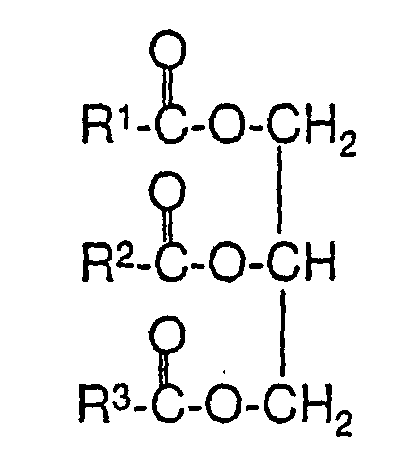
- triglyceride-based ester quat is used herein to denote any ester quat that is produced by reacting an alkanol amine with a vegetable and/or animal based fatty oil, i.e., triglyceride, having the formula: wherein R 1 , R 2 and R 3 are the same or different and are linear or branched, saturated or unsaturated, C 9 -C 21 alkyl or a linear or branched C 1 -C 4 alkyl, with the proviso that at least one of R 1 , R 2 or R 3 is a linear or branched C 9 -C 21 alkyl, to produce an ester amine and thereafter quaternizing the ester amine in the presence of an alkylating agent.
- R 1 , R 2 or R 3 are linear or branched C 9 -C 21 alkyls. In an even more preferable embodiment of the present invention, each of R 1 , R 2 or R 3 is a linear or branched C 9 -C 21 alkyl.
- the triglyceride may be used in conjunction with a fatty acid having the formula: wherein R 4 CO is an aliphatic, linear or branched acyl radical containing from 5 to 21 carbon atoms.
- the mole ratio of triglyceride to alkanol amine employed in producing the triglyceride-based ester quat is from about 0.5:1 to about 1.5:1, preferably from about 0.6:1 to about 1:1, and most preferably from about 0.7:1 to about 1:1.
- the rinse cycle fabric softener concentrate of the present invention may be used with conventional liquid carriers such as water; C 1-4 monohydric alcohols; C 2-10 polyhydric glycols, diols or triols; polyalkenylene glycols; and mixtures thereof to form a liquid rinse cycle fabric softener formulation.
- concentration of the inventive rinse cycle fabric softener concentrate in the liquid fabric softener formulation is from about 2 to about 40 weight %.
- the rinse cycle fabric softener concentrate or liquid fabric softener formulation of the present invention is used in the rinse cycle of any laundering process wherein conventional detergents are employed.
- the inventive concentrate or formulation is used in a laundering liquor wherein the detergent contains a high level of anionic surfactants present therein.
- the term "high level of anionics" refers to a detergent composition that contains at least 10% or more of an anionic surfactant present therein.
- the rinse cycle fabric softener formulation of the present invention is used in an amount of from about 0.05 to about 0.4 weight % of said fabric softener formulation, per 100 grams of fabric to be laundered.
- the inventive rinse cycle fabric softener concentrate or formulation is effective in preventing dye transfer and improving the softness of a laundered fabric. Moreover, the presence of the anionic scavenger in the fabric softener increases the water dispersibility of the active agents present in the fabric softener. The increased water dispersibility results in a higher solids rinse cycle fabric softener formulation that contains up to 25% of softening actives present therein. More preferably, the rinse cycle fabric softener formulation of the present invention contains from about 2 to about 40 % of softening actives present therein.
- a clear concentrate in another embodiment, comprises at least one anionic scavenger and at least one oil-based ester quat selected from triglycerides containing unsaturated fatty acids having 0, 1, 2 or 3, preferably 1; double bond and an iodine value of from 40 to 150.
- oil-based ester quats include, but are not limited to: canol, soybean and other like vegetable oils which are reacted with an alkanol amine and thereafter quaternized.
- the clear concentrate can be used to form a clear formulation containing at least one of the above-mentioned liquid carriers and optionally a conventional surfactant (anionic, nonionic, amphoteric and/or zwitterionic) and/or a conventional detergent salt.
- a conventional surfactant anionic, nonionic, amphoteric and/or zwitterionic
- the formulation When used in a clear formulation, the formulation may include up to 65% of softening actives present therein.
- the present invention is directed to a rinse cycle fabric softener concentrate and formulation which include a blend of quaternary ammonium compounds that comprises at least one anionic scavenger and at least one triglyceride-based ester quat.
- the at least one triglyceride-based ester quat is used in the present invention as a cationic softening agent and is used in place of conventional ester quats that are based on the reaction of alkanol amines and fatty acids.
- the fabric softener concentrate of the present invention contains from about 1 to about 50 weight % of the at least one anionic scavenger and from about 50 to about 99 weight % of the at least one triglyceride-based ester quat. In a preferred embodiment of the present invention, the fabric softener concentrate of the present invention contains from about 2 to about 20 weight % of the at least one anionic scavenger and from about 80 to about 98 weight % of the at least one triglyceride-based ester quat.
- the fabric softener concentrate of the present invention contains from about 5 to about 15 weight % of the at least one anionic scavenger and from about 85 to about 95 weight % of the at least one triglyceride-based ester quat.
- the anionic scavenger employed in the present invention is any compound that is capable of increasing the amount of cationic softening agent present in the laundry liquor by complexing with the anionics therein.
- anionic scavengers that can be employed in the present invention include, but are not limited to: (i) Mono-long chain alkyl-containing quaternary ammonium compounds having the formula: [R 5 N + (R 6 ) 3 ]X - wherein R 5 is a C 8-22 alkyl or alkenyl group, preferably C 10-18 alkyl or alkenyl, and even more preferably a C 16-18 alkyl or alkenyl; each R 6 is a C 1-6 alkyl group, benzyl, hydrogen or a polyethoxylated chain with from 2 to 20 oxyethylene units; and X is an anion such as chloride, bromide, methyl sulfate, ethyl sulfate, formate, acetate, carbonate, sulfate, nitrate and other like anions.
- Examples of the above mono-long chain alkyl-containing quaternary ammonium compounds include, but are not limited to: monolauryltrimethyl ammonium chloride, monotallow trimethylammonium chloride and monooleyl trimethyl ammonium chloride.
- the R 5 group can also be attached to the cationic nitrogen atom through a group containing one or more ester, amide, ether, amine, etc., linking groups. Such linking groups are preferably with 1 to 4 carbon atoms of the nitrogen atom.
- Mono-alkyl cationic C 8-22 alkyl choline esters having the formula: R 5 -C(O)-O-CH 2 CH 2 N + (R 6 ) 3 X - wherein R 5 , R 6 and X are as defined hereinabove.
- alkyl choline esters that can be employed in the present invention include, but are not limited to: C 12-14 coco choline ester and C 16-18 tallow choline ester.
- Poly-quaternary ammonium compounds having the formula: wherein R 7 is substituted or unsubstituted C 2-12 alkylene, substituted or unsubstituted C 2-12 hydroalkylene; each R 8 is independently C 1-4 alkyl, each R 9 is independently C 1-22 alkyl, C 3-22 alkenyl, R 10 -Q-(CH 2 ) m -, where R 10 is C 1-22 alkyl, C 3-22 alkenyl, and mixtures thereof; m is from 1 to 6; Q is a carbonyl unit; and X is an anion.
- Amide quats having the formula: wherein R 17 is a C 7-22 alkyl, each R 18 is the same or different and is a C 1-4 alkyl, 1 is from 2
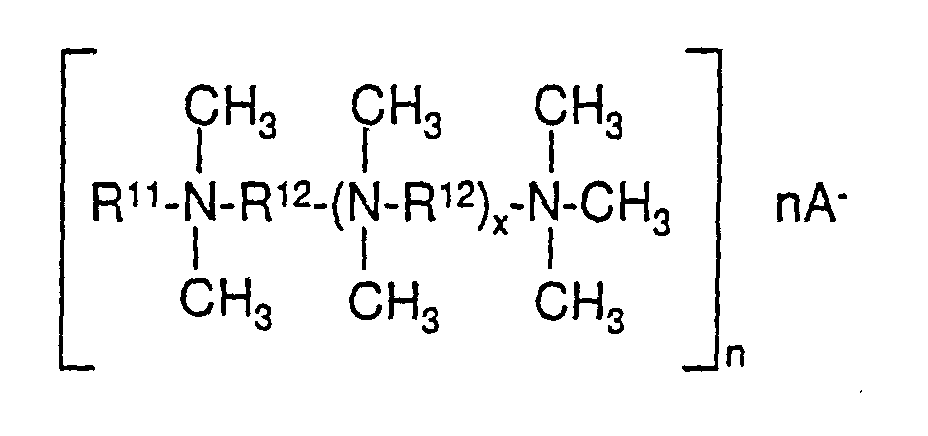
- a highly preferred anionic scavenger employed in the present invention is a polyquat compound having the formula: wherein R 11 is a C 10-24 , preferably C 16-18 , saturated or unsaturated alkyl, an ether having the formula R 11 OR 13 - where R 11 is as defined above and R 13 is a C 1-6 hydrocarbyl group, preferably R 13 is a C 2-4 alkyl, or an amido having the formula R 11 C(O)NR 14 -, where R 11 is as defined above and R 14 is a C 2-6 , preferably a C 2-3 , alkyl; R 12 is a C 2-12 , preferably C 2-3 , alkyl; x is 0-5, preferably 0 to 1; n is the number of moles of monovalent anion A to provide a net zero charge, preferably n is from 2 to 3; and A is a monovalent anion including, but not limited to: chloride, bromide, methyl sulfate, ethyl sul
- suitable polyquats having R 11 equal to a C 10-24 alkyl include, but are not limited to: tallow diquat and tallow triquat. Of these alkyl-containing polyquats, tallow diquat is most highly preferred.
- polyquats having R 11 equal to an ether include, but are not limited to: C 12-18 ether propyl diquats. Of these ether-containing polyquats, C 14-15 ether propyl diquats are highly preferred.
- Illustrative examples of polyquats having R 11 equal to amido (R 11 C(O)NR 14 -) include, but are not limited to: tallow amidopropyl diquat and stearyl amidopropyl diquat. Of these amido-containing polyquats, stearyl amidopropyl diquat is preferred.
- tallow diquat is most highly preferred.
- the diquat is typically used in an amount of from about 5 to about 15 weight % in the rinse cycle fabric softener concentrate.
- the anionic scavenger increases the cationic charge in the laundry liquor by complexing with any anionic detergent species present therein.
- the anionic scavengers described above have a higher charge density as compared to the triglyceride-based ester quat present in the blend; therefore, the anionic scavengers have a higher affinity for complexing with the anionics present in the laundering liquor than the other quaternary ammonium compound present, i.e., triglyceride-based ester quat, in the rinse cycle fabric softener concentrate.
- the triglyceride-based ester quat of the inventive fabric softener concentrate includes any ester quat that is produced by reacting an alkanol amine with a vegetable and/or an animal based fatty oil, i.e., triglyceride, to produce an ester amine and thereafter quaternizing the ester amine in the presence of an alkylating agent.
- the triglyceride employed in the present invention in producing the triglyceride-based ester quat includes compounds having the formula: wherein R 1 , R 2 and R 3 are the same or different and are linear or branched, saturated or unsaturated, C 9 -C 21 alkyl or a linear or branched C 1 -C 4 alkyl, with the proviso that at least one of R 1 , R 2 or R 3 is a linear or branched C 9 -C 21 alkyl. In a preferred embodiment of the present invention, each R 1 , R 2 and R 3 is the same or different and is a C 9 -C 21 alkyl.
- the triglyceride used in producing the triglyceride-based ester quat is a compound wherein R 1 is a C 15 -C 17 alkyl, R 2 is a C 15 -C 17 alkyl, and R 3 is a C 15 -C 17 alkyl.
- Highly preferred triglyceride-based ester quats employed in the present invention are partially hydrogenated canola, partially hydrogenated tallow or partially hydrogenated palm stearine. When one of these highly preferred triglyceride-based ester quats is employed, it is typically used in an amount of from about 85 to about 95 weight %.
- the alkanol amines employed in producing the triglyceride-based ester quat is a compound having the following formula: wherein R 15 is a C 1-18 alkyl or a - (CH 2 ) p OH group, and p is from 1 to 6.
- suitable alkanol amines include, but are not limited to: triethanol amine and methyldiethanol amine.
- the mole ratio of triglyceride to alkanol amine employed in producing the triglyceride-based ester quat is from about 0.5:1 to about 1.5:1, preferably from about 0.6:1 to about 1:1, and most preferably from about 0.7:1 to about 1:1.
- the alkanol amine and triglyceride are reacted togther under conventional esterification reaction conditions that are capable of producing an ester amine.
- the esterification reaction may be carried out at temperature of from about 120°C to about 220°C under pressures from about 0.01 to about 1 bar. Other temperatures and pressures may also be used in the present invention.
- the esterification reaction is carried out in the presence of a conventional esterification catalyst such as sodium hypophosphite.
- the catalyst employed in the esterification reaction is used in a catalytic effective amount of from about 0.01 to about 0.1%, by weight, based on the total weight of starting reactants.
- a conventional cocatalyst such as an alkaline metal and/or alkaline earth metal may be optionally used in the esterification reaction in amounts of from about 50 to about 1000 ppm.
- ester amine is subjected to a conventional quaternization process in the presence of an alkylating agent such as methyl chloride, dimethyl sulfate, diethyl sulfate, dimethyl carbonate, diethyl carbonate and other like compounds that are capable of alkylating the ester amine.
- an alkylating agent such as methyl chloride, dimethyl sulfate, diethyl sulfate, dimethyl carbonate, diethyl carbonate and other like compounds that are capable of alkylating the ester amine.
- the quaternization reaction employed in the present invention typically uses a molar ratio of ester amine to alkylating agent of from about 1:0.95 to about 1:1.05, and the reaction may be carried out in the absence of water or in a small amount of solvent such as isopropyl alcohol (IPA).
- IPA isopropyl alcohol
- the triglyceride may be used in conjunction with a fatty acid having the formula: wherein R 4 CO is an aliphatic, linear or branched acyl radical containing 5 to 21 carbon atoms, preferably 11 to 17 carbon atoms, and 0 and/or 1, 2 or 3 double bonds.
- fatty acids that fit the above formula include, but are not limited to: caproic acid, caprylic acid, 2-ethyl hexanoic acid, capric acid, lauric acid, isotridecanoic acid, myristic acid, palmitic acid, palmitoleic acid, stearic acid, isostearic acid, oleic acid, elaidic acid, petroselic acid, linoleic acid, linolenic acid, elaeostearic acid, arachic acid, gadoleic acid, behenic acid, erucic acid and mixtures thereof obtained, for example, by the high pressure hydrolysis of natural fats and oils, in the reduction of aldehydes from Roelen's oxosynthesis or in the dimerization of unsaturated fatty acids.
- Technical fatty acids or so-called synthetic fatty acids
- containing 12 to 18 carbon atoms such as coconut oil, palm oil, palm kernel oil or tallow
- the mole ratio of fatty acid to alkanol amine is from about 1.5:1 to about 2.7:1, more preferably, from about 1.7:1 to about 2.5:1.
- the mole ratio of fatty acid to alkanol amine is from about 2:1 to about 2.2:1.
- the rinse cycle fabric softener concentrate of the present invention is a blend of the above mentioned quaternary ammonium compounds that is made utilizing conventional processes that are well known to those skilled in the art for making fabric softeners.
- the rinse cycle fabric softener concentrate of the present invention can be made by separately adding each ingredient to a reaction vessel. Mixing by hand, or with a mechanical mixer is typically carried out to ensure that a substantially homogeneous mixture of the components is obtained.
- the blend may be made at room temperature or, if desired, elevated temperatures can be employed.
- the ingredients of the blend may be added in a one shot process, or alternatively the ingredients may be added dropwise or in small incremental amounts.
- the rinse cycle fabric softener concentrate of the present invention may be made by melting and mixing the individual components together utilizing melt mixing techniques that are well known to those skilled in the art.
- the rinse cycle fabric softener concentrate of the present invention may be made into a liquid fabric softener formulation by introducing the same into a liquid carry under high shear mixing conditions.
- the mixing may be conducted at room temperature, or alternatively, temperatures of from 40°C to 90°C can be employed.
- Suitable liquid carries that may be employed in the present invention include, but are not limited to: water; C 1-4 monohydric alcohols; C 2-10 polyhydric glycols, diols, or triols; polyalkenylene glycols; and mixtures and combinations thereof.
- the inventive rinse cycle fabric softener concentrate is used with a liquid carrier
- the inventive rinse cycle fabric softener concentrate is present in a concentration of from about 20 to about 40 weight %.
- inventive rinse cycle fabric softener concentrate may be used with other conventional materials that are typically present in liquid rinse cycle fabric softeners.
- brighteners, soil removers, solvotropes, perfumes, dyes, bactericides, chelating agents, silicones, and the like may be present in the liquid fabric softener formulation of the present invention.
- the only limitation on the liquid fabric softener of the present invention is that it contains at least the inventive rinse cycle fabric softener concentrate therein. Since the rinse cycle fabric softener concentrate of the present invention is capable of efficiently inhibiting dye transfer, there is no need to add a separate dye transfer inhibition agent into the inventive liquid rinse cycle fabric softener formulation.
- the rinse cycle fabric softener concentrate or formulation of the present invention can be added during the rinse cycle of a laundering process wherein any detergent is present in the laundry liquor. That is, the inventive rinse cycle fabric softener concentrate or formulation can be added to a laundering liquor that contains anionic surfactants, non-ionic surfactants, amphoteric surfactants, zwitterionic surfactants or any combinations or mixtures thereof.
- the inventive rinse cycle fabric softener concentrate or formulation may be used with any conventional detergent that includes a high level of anionic surfactants present therein. That is, the rinse cycle fabric softener concentrate or formulation of the present invention is used with a detergent that contains from about 10 to about 80 weight % of at least one anionic surfactant present therein. More preferably, the detergent contains from about 30 to about 70 weight % of at least one anionic surfactant present therein.
- Suitable anionic surfactants that can be employed in the detergent composition include water soluble salts, preferably the alkali metal, ammonium and alkylammonium salts of organic sulfuric acid reaction products having in their molecular structure an alkyl group containing from about 10 to about 20 carbon atoms and a sulfonic acid or sulfuric acid ester group. (Included in the term “alkyl” is the alkyl portions of acyl groups).
- anionic surfactants are the sodium and potassium alkyl sulfates, especially those obtained by sulfating higher C 8-18 alcohols, such as those produced by reducing the glycerides of tallow or coconut oil; and the sodium and potassium alkylbenzene sulfonates in which the alkyl group is straight chained or branched, and the alkyl contains from about 9 to about 15 carbon atoms.
- the alkylbenzene sulfonates of the former type are described, for example, in U.S. Patent Nos. 2,220,099 and 2,477,383, the contents of each reference is incorporated herein by reference.
- alkylbenzene sulfonates are linear straight chain alkylbenzene sulfonates in which the average number of carbon atoms in the alkyl group is from about 10 to 15, abbreviated as C 10-15 LAS.
- the alkali salts, particularly the sodium salts of these anionic surfactants are preferred.
- Alkylbenzene sulfonates and processes for producing the same are disclosed, for example, in U.S. Patent No. 2,220,099 and 2,477,383.
- alkyl alkoxylated sulfates include alkyl alkoxylated sulfates. These compounds are water-soluble salts or acids having the formula R 16 O(Y) q SO 3 M wherein R 16 is an unsubstituted C 10-24 alkyl or hydroxyalkyl group having a C 10-18 alkyl or hydroxyalkyl group, Y is an ethoxy or propoxy unit, q is greater than zero, preferably q is between about 0.5 and about 6, and M is hydrogen or a water soluble cation which can be, for example, a metal cation (e.g., sodium, potassium, lithium, calcium, magnesium, etc.), ammonium or substituted-ammonium cation.
- a metal cation e.g., sodium, potassium, lithium, calcium, magnesium, etc.
- substituted ammonium cations include, but are not limited to: methyl-, ethyl-, dimethyl-, trimethyl-ammonium and quaternary ammonium cations, such as tetramethyl-ammonium, dimethyl piperdinum and cations derived from alkanol amines such as monoethanol amine, diethanol amine and triethanol amine, and mixtures thereof.
- alkyl alkoxylated sulfates include: C 12-18 alkyl polyethoxylate (1.0) sulfate, C 12-18 alkyl polyethoxylate (2.25) sulfate, C 12-18 alkyl polyethoxylate (3.0) sulfate, C 12-18 alkyl polyethoxylate (4.0) sulfate, wherein M is sodium or potassium.
- anionic surfactants useful in the detergent composition include sodium alkyl glyceryl ether sulfonates, particularly those ethers of higher alcohols derived from tallow and coconut oil; sodium coconut oil fatty acid monoglyceride sulfonates and sulfates.
- Still further anionic surfactants include water-soluble salts of esters of alpha-sulfonated fatty acids containing from about 6 to about 20 carbon atoms in the fatty acid portion of the compound and from 1 to about 10 carbon atoms in the ester group; water-soluble salts of 2-acyloxyalkane-1-sulfonic acids containing from about 2 to about 9 carbon atoms in the acyl portion of the compound and from about 9 to about 23 carbon atoms in the alkane moiety; water-soluble salts of olefin and paraffin sulfonates containing from about 12 to about 20 carbon atoms; and beta-alkyloxy alkane sulfonates containing from 1 to about 3 carbon atoms in the alkyl group and from about 8 to about 20 carbon atoms in the alkane moiety.
- the detergent may optionally include one or more nonionic surfactants therein.
- Typical nonionic surfactants that can be present in the detergent composition include polyethylene, polypropylene and polybutylene oxide condensates of alkyl phenols.
- Other examples of nonionic surfactants include: condensation products of primary and secondary aliphatic alcohols, alkylpolysaccharides, condensation products of ethylene oxide with a hydrophobic base formed by the condensation of propylene oxide with propylene glycol, condensation products of ethylene oxide with the product resulting from the reaction of propylene oxide and ethylenediamine, and polyhydroxy fatty acid amides.
- the detergent may also include any conventional amphoteric or zwitterionic surfactant therein. It is noted the use of the inventive rinse cycle fabric softener formulation is not limited to a specific type of detergent, but rather the rinse cycle fabric softener formulation of the present invention can be used with any conventional detergent.
- the detergent composition may also include conventional detergent builders, enzymes, bleaching agents, bleach activators, polymeric soil release agents, chelating agents, soil release and anti-redeposition agents, dispersing agents, optical brighteners, whitening agents, betaines, sultanies and other like components that may be typically used in laundry detergents. Since all these compounds are conventional, a detailed description of the optional components is not provided herein. A detailed description of these detergent components however can be found in WO 98/53034, the contents of which is incorporated herein by reference.
- the rinse cycle fabric softener concentration or formulation of the present invention is typically added to the rinse cycle of a laundry process utilizing conventional washing temperatures of about 20°C to about 60°C and rinsing temperatures of about 10°C to about 50°C.
- the rinse cycle fabric softener concentrate or formulation of the present invention is effective over a wide range of water hardness levels.
- the rinse cycle fabric softener concentrate or formulation of the present invention may be used in laundering operations by adding the formulation to a laundering vessel in amounts that are typically used.
- inventive rinse cycle formulation of the present invention is used in an amount of from about 20 g to about 120 g solids content of fabric softener with a 3 to 8 pound load of clothing to be washed.
- the particular amount of fabric softener used in the rinsing cycle is not however critical to the present invention.
- dye transfer inhibition was determined by measuring the average delta E utilizing ASTM Test No. D-5548-94, "Evaluating Color Transfer or Color Loss of Dyed Fabric in Home Laundry", the content of which is incorporated herein by reference. Specifically, swatches of nylon fabric dyed with Acid Red 151, and cotton fabric dyed with either Direct Blue 90 or Direct Blue 1, were washed under standardized, identical conditions (90 rpm, 40 minutes, about 50°C, water hardness about 110 rpm) together with a swatch of undyed (white) cotton fabric (swatches dyed with different dyes were not washed together). The washed, dyed and undyed, swatches were recovered, rinsed in 20°C rinse water and air dried.
- a lower delta E value represents less dye transfer and thus a better performing product.
Landscapes
- Chemical & Material Sciences (AREA)
- Life Sciences & Earth Sciences (AREA)
- Engineering & Computer Science (AREA)
- Chemical Kinetics & Catalysis (AREA)
- Oil, Petroleum & Natural Gas (AREA)
- Wood Science & Technology (AREA)
- Organic Chemistry (AREA)
- Treatments For Attaching Organic Compounds To Fibrous Goods (AREA)
- Detergent Compositions (AREA)
Abstract
An improved rinse cycle fabric softener
concentrate and formulation that comprises a blend of the
following quaternary ammonium compounds about 1 to about
50 weight % of at least anionic scavenger; and about 50 to
about 99 weight % of at least one triglyceride-based ester
quat. The triglyceride-based ester quat is produced by
reacting a vegetable and/or animal based fatty oil with an
alkanol amine and thereafter quaternizing the ester amine
in the presence of an alkylating agent.
Description
- The present invention relates to fabric softeners, and more particularly to fabric softener concentrates and formulations that are added during the rinse cycle of a laundering process. Specifically, the present invention is directed to a rinse cycle fabric softener concentrate that comprises at least one anionic scavenger and at least one triglyceride-based ester quaternary ammonium (quat) compound. The rinse cycle fabric softener concentrate of the present invention provides improved performance, i.e., softening, dye transfer inhibition and water dispersibility at a lower manufacturing cost than heretofore possible with prior art fabric softeners that are based on quaternized fatty acid di- or trialkanol amine ester salts.
- In the field of laundering, it is well known to add a liquid fabric softener containing at least one softening agent such as a cationic quaternary ammonium compound or salt thereof directly into the laundering process. An example of a typically prior art fabric softener agent is an ester quat having the following formula:wherein each R1 is the same or different and is a C7-21 alkyl; R2 and R3 are the same or different and are hydrogen, C1-6 hydrocarbyl group or a hydroxy alkyl such as hydroxy ethyl or hydroxy propyl; and a is from 1 to 6, preferably 2 to 3. The term "hydrocarbyl" is used herein to denote aliphatic (i.e., a linear or branched, saturated or unsaturated hydrocarbon group, that is, alkyl, alkenyl and alkynyl groups), cycloaliphatic, aryl, alkaryl and aralkyl groups. Salts of the above illustrated ester quats are also known and have been used in the capacity as a rinse cycle fabric softening agent.

- The prior art ester quats are typically prepared by reacting a trialkanol amine (triethanol amine) with a fatty acid to produce an ester amine and thereafter the ester amine is quaternized in the presence of a quaternization agent such as DMS (dimethyl sulfate) or methyl chloride to produce the ester quat. Prior art fabric softener agents produced in the above manner are generally quite unstable since the reaction sequence results in the formation of many unwanted by-products. Moreover, the prior art fabric softener agents produced utilizing fatty acids are expensive and are oftentimes unreliable.
- The addition of the liquid fabric softener typically occurs during the rinse cycle itself. Although some improved softness may arise from the use of prior art fabric softeners, the overall softening performance of prior art fabric softeners is hindered due to high levels of residual anionics which are typically present in the washing liquor; the high level of residual anionics in the laundry liquor is the result of utilizing detergents that contain a high concentration of anionic surfactants which are not typically removed prior to the rinsing cycle. This is particularly the case in North America wherein high levels of anionic surfactants are employed in the detergent, and little or no rinsing occurs prior to the addition of the fabric softener.
- The hindered softening performance of prior art fabric softeners can be attributed to the high affinity that the cationic softening agents have for negatively charged species and/or surfaces. When high levels of anionics are present in the laundering liquor, the anionics compete with the negatively charged surfaces of the laundered fabric for the cationic fabric softener agent and complexation of the anionics and the cationic fabric softener agent occurs. Complexation of the anionics with the cationic fabric softener agent is undesirable since it significantly reduces the overall amount of fabric softener agent present in the rinse cycle which is needed to obtain a high degree of softening. Thus, because of the reduced levels of fabric softener agents in the laundry liquor, prior art fabric softeners can not achieve a high degree of softness.
- In view of the drawbacks mentioned hereinabove with prior art rinse cycle fabric softeners, there is a continued need to develop new and improved rinse cycle fabric softener concentrates and formulations that exhibit improved performance, i.e., softening, dye transfer inhibition and water dispersibility, at a lower manufacturing cost than heretofore possible with prior art fabric softeners that are based on quaternized fatty acid di- or trialkanol amine ester salts.
- The present invention is related to an improved rinse cycle fabric softener concentrate that comprises a blend of the following quaternary ammonium compounds:
(i) about 1 to about 50 weight % of at least one anionic scavenger; and (ii) about 50 to about 99 weight % of at least one triglyceride-based ester quat. - The term "triglyceride-based ester quat" is used herein to denote any ester quat that is produced by reacting an alkanol amine with a vegetable and/or animal based fatty oil, i.e., triglyceride, having the formula:wherein R1, R2 and R3 are the same or different and are linear or branched, saturated or unsaturated, C9-C21 alkyl or a linear or branched C1-C4 alkyl, with the proviso that at least one of R1, R2 or R3 is a linear or branched C9-C21 alkyl, to produce an ester amine and thereafter quaternizing the ester amine in the presence of an alkylating agent. In a preferred embodiment, at least two of R1, R2 or R3 are linear or branched C9-C21 alkyls. In an even more preferable embodiment of the present invention, each of R1, R2 or R3 is a linear or branched C9-C21 alkyl.
- In some embodiments of the present invention, the triglyceride may be used in conjunction with a fatty acid having the formula:wherein R4CO is an aliphatic, linear or branched acyl radical containing from 5 to 21 carbon atoms.

- The mole ratio of triglyceride to alkanol amine employed in producing the triglyceride-based ester quat is from about 0.5:1 to about 1.5:1, preferably from about 0.6:1 to about 1:1, and most preferably from about 0.7:1 to about 1:1.
- The rinse cycle fabric softener concentrate of the present invention may be used with conventional liquid carriers such as water; C1-4 monohydric alcohols; C2-10 polyhydric glycols, diols or triols; polyalkenylene glycols; and mixtures thereof to form a liquid rinse cycle fabric softener formulation. In this embodiment of the present invention, the concentration of the inventive rinse cycle fabric softener concentrate in the liquid fabric softener formulation is from about 2 to about 40 weight %.
- The rinse cycle fabric softener concentrate or liquid fabric softener formulation of the present invention is used in the rinse cycle of any laundering process wherein conventional detergents are employed. In one embodiment of the present invention, the inventive concentrate or formulation is used in a laundering liquor wherein the detergent contains a high level of anionic surfactants present therein. The term "high level of anionics" refers to a detergent composition that contains at least 10% or more of an anionic surfactant present therein. The rinse cycle fabric softener formulation of the present invention is used in an amount of from about 0.05 to about 0.4 weight % of said fabric softener formulation, per 100 grams of fabric to be laundered.
- The inventive rinse cycle fabric softener concentrate or formulation is effective in preventing dye transfer and improving the softness of a laundered fabric. Moreover, the presence of the anionic scavenger in the fabric softener increases the water dispersibility of the active agents present in the fabric softener. The increased water dispersibility results in a higher solids rinse cycle fabric softener formulation that contains up to 25% of softening actives present therein. More preferably, the rinse cycle fabric softener formulation of the present invention contains from about 2 to about 40 % of softening actives present therein.
- In another embodiment of the present invention, a clear concentrate is provided. Specifically, the clear concentrate comprises at least one anionic scavenger and at least one oil-based ester quat selected from triglycerides containing unsaturated fatty acids having 0, 1, 2 or 3, preferably 1; double bond and an iodine value of from 40 to 150. Examples of such oil-based ester quats include, but are not limited to: canol, soybean and other like vegetable oils which are reacted with an alkanol amine and thereafter quaternized.
- The clear concentrate can be used to form a clear formulation containing at least one of the above-mentioned liquid carriers and optionally a conventional surfactant (anionic, nonionic, amphoteric and/or zwitterionic) and/or a conventional detergent salt.
- When used in a clear formulation, the formulation may include up to 65% of softening actives present therein.
- As stated above, the present invention is directed to a rinse cycle fabric softener concentrate and formulation which include a blend of quaternary ammonium compounds that comprises at least one anionic scavenger and at least one triglyceride-based ester quat. The at least one triglyceride-based ester quat is used in the present invention as a cationic softening agent and is used in place of conventional ester quats that are based on the reaction of alkanol amines and fatty acids.
- The fabric softener concentrate of the present invention contains from about 1 to about 50 weight % of the at least one anionic scavenger and from about 50 to about 99 weight % of the at least one triglyceride-based ester quat. In a preferred embodiment of the present invention, the fabric softener concentrate of the present invention contains from about 2 to about 20 weight % of the at least one anionic scavenger and from about 80 to about 98 weight % of the at least one triglyceride-based ester quat. In a more highly preferred embodiment of the present invention, the fabric softener concentrate of the present invention contains from about 5 to about 15 weight % of the at least one anionic scavenger and from about 85 to about 95 weight % of the at least one triglyceride-based ester quat.
- The anionic scavenger employed in the present invention is any compound that is capable of increasing the amount of cationic softening agent present in the laundry liquor by complexing with the anionics therein.
- Examples of anionic scavengers that can be employed in the present invention include, but are not limited to:
(i) Mono-long chain alkyl-containing quaternary ammonium compounds having the formula: - Examples of the above mono-long chain alkyl-containing quaternary ammonium compounds include, but are not limited to: monolauryltrimethyl ammonium chloride, monotallow trimethylammonium chloride and monooleyl trimethyl ammonium chloride.
- The R5 group can also be attached to the cationic nitrogen atom through a group containing one or more ester, amide, ether, amine, etc., linking groups. Such linking groups are preferably with 1 to 4 carbon atoms of the nitrogen atom.
(ii) Mono-alkyl cationic C8-22 alkyl choline esters having the formula: - Illustrative examples of alkyl choline esters that can be employed in the present invention include, but are not limited to: C12-14 coco choline ester and C16-18 tallow choline ester.
(iii) Poly-quaternary ammonium compounds having the formula:wherein R7 is substituted or unsubstituted C2-12 alkylene, substituted or unsubstituted C2-12 hydroalkylene; each R8 is independently C1-4 alkyl, each R9 is independently C1-22 alkyl, C3-22 alkenyl, R10-Q-(CH2)m-, where R10 is C1-22 alkyl, C3-22 alkenyl, and mixtures thereof; m is from 1 to 6; Q is a carbonyl unit; and X is an anion.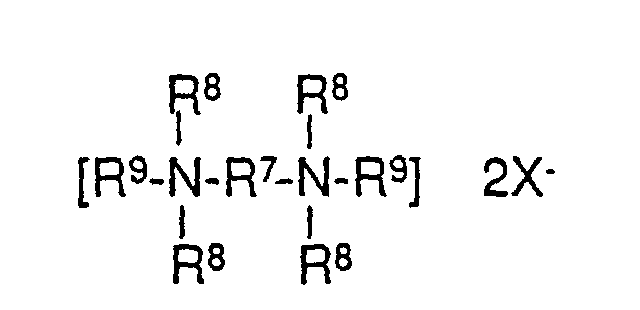
(iv) Amide quats having the formula:wherein R17 is a C7-22 alkyl, each R18 is the same or different and is a C1-4 alkyl, 1 is from 2 to 6, and X is an anion as defined above.
- A highly preferred anionic scavenger employed in the present invention is a polyquat compound having the formula:wherein R11 is a C10-24, preferably C16-18, saturated or unsaturated alkyl, an ether having the formula R11OR13 - where R11 is as defined above and R13 is a C1-6 hydrocarbyl group, preferably R13 is a C2-4 alkyl, or an amido having the formula R11C(O)NR14-, where R11 is as defined above and R14 is a C2-6, preferably a C2-3, alkyl; R12 is a C2-12, preferably C2-3, alkyl; x is 0-5, preferably 0 to 1; n is the number of moles of monovalent anion A to provide a net zero charge, preferably n is from 2 to 3; and A is a monovalent anion including, but not limited to: chloride, bromide, methyl sulfate, ethyl sulfate, formate, acetate, carbonate, sulfate, nitrate and other like anions, preferably A is chloride or methylsulfate.
- Illustrative examples of suitable polyquats having R11 equal to a C10-24 alkyl include, but are not limited to: tallow diquat and tallow triquat. Of these alkyl-containing polyquats, tallow diquat is most highly preferred.
- Preferred examples of polyquats having R11 equal to an ether (R11OR13-) include, but are not limited to: C12-18 ether propyl diquats. Of these ether-containing polyquats, C14-15 ether propyl diquats are highly preferred.
- Illustrative examples of polyquats having R11 equal to amido (R11C(O)NR14-) include, but are not limited to: tallow amidopropyl diquat and stearyl amidopropyl diquat. Of these amido-containing polyquats, stearyl amidopropyl diquat is preferred.
- Of the various polyquats mentioned above, tallow diquat is most highly preferred. When tallow diquat is employed, the diquat is typically used in an amount of from about 5 to about 15 weight % in the rinse cycle fabric softener concentrate.
- As stated above, the anionic scavenger increases the cationic charge in the laundry liquor by complexing with any anionic detergent species present therein. The anionic scavengers described above have a higher charge density as compared to the triglyceride-based ester quat present in the blend; therefore, the anionic scavengers have a higher affinity for complexing with the anionics present in the laundering liquor than the other quaternary ammonium compound present, i.e., triglyceride-based ester quat, in the rinse cycle fabric softener concentrate.
- The triglyceride-based ester quat of the inventive fabric softener concentrate includes any ester quat that is produced by reacting an alkanol amine with a vegetable and/or an animal based fatty oil, i.e., triglyceride, to produce an ester amine and thereafter quaternizing the ester amine in the presence of an alkylating agent.
- The triglyceride employed in the present invention in producing the triglyceride-based ester quat includes compounds having the formula:wherein R1, R2 and R3 are the same or different and are linear or branched, saturated or unsaturated, C9-C21 alkyl or a linear or branched C1-C4 alkyl, with the proviso that at least one of R1, R2 or R3 is a linear or branched C9-C21 alkyl. In a preferred embodiment of the present invention, each R1, R2 and R3 is the same or different and is a C9-C21 alkyl. In an even more preferred embodiment of the present invention, the triglyceride used in producing the triglyceride-based ester quat is a compound wherein R1 is a C15-C17 alkyl, R2 is a C15-C17 alkyl, and R3 is a C15-C17 alkyl.

- Highly preferred triglyceride-based ester quats employed in the present invention are partially hydrogenated canola, partially hydrogenated tallow or partially hydrogenated palm stearine. When one of these highly preferred triglyceride-based ester quats is employed, it is typically used in an amount of from about 85 to about 95 weight %.
- The alkanol amines employed in producing the triglyceride-based ester quat is a compound having the following formula:wherein R15 is a C1-18 alkyl or a - (CH2)pOH group, and p is from 1 to 6. Illustrative examples of suitable alkanol amines that can be employed in the present invention include, but are not limited to: triethanol amine and methyldiethanol amine.

- The mole ratio of triglyceride to alkanol amine employed in producing the triglyceride-based ester quat is from about 0.5:1 to about 1.5:1, preferably from about 0.6:1 to about 1:1, and most preferably from about 0.7:1 to about 1:1.
- The alkanol amine and triglyceride are reacted togther under conventional esterification reaction conditions that are capable of producing an ester amine. For example, the esterification reaction may be carried out at temperature of from about 120°C to about 220°C under pressures from about 0.01 to about 1 bar. Other temperatures and pressures may also be used in the present invention.
- The esterification reaction is carried out in the presence of a conventional esterification catalyst such as sodium hypophosphite. The catalyst employed in the esterification reaction is used in a catalytic effective amount of from about 0.01 to about 0.1%, by weight, based on the total weight of starting reactants. A conventional cocatalyst such as an alkaline metal and/or alkaline earth metal may be optionally used in the esterification reaction in amounts of from about 50 to about 1000 ppm.
- Following esterification, the ester amine is subjected to a conventional quaternization process in the presence of an alkylating agent such as methyl chloride, dimethyl sulfate, diethyl sulfate, dimethyl carbonate, diethyl carbonate and other like compounds that are capable of alkylating the ester amine.
- The quaternization reaction employed in the present invention typically uses a molar ratio of ester amine to alkylating agent of from about 1:0.95 to about 1:1.05, and the reaction may be carried out in the absence of water or in a small amount of solvent such as isopropyl alcohol (IPA).
- In some embodiments of the present invention, the triglyceride may be used in conjunction with a fatty acid having the formula:wherein R4CO is an aliphatic, linear or branched acyl radical containing 5 to 21 carbon atoms, preferably 11 to 17 carbon atoms, and 0 and/or 1, 2 or 3 double bonds. Illustrative examples of fatty acids that fit the above formula include, but are not limited to: caproic acid, caprylic acid, 2-ethyl hexanoic acid, capric acid, lauric acid, isotridecanoic acid, myristic acid, palmitic acid, palmitoleic acid, stearic acid, isostearic acid, oleic acid, elaidic acid, petroselic acid, linoleic acid, linolenic acid, elaeostearic acid, arachic acid, gadoleic acid, behenic acid, erucic acid and mixtures thereof obtained, for example, by the high pressure hydrolysis of natural fats and oils, in the reduction of aldehydes from Roelen's oxosynthesis or in the dimerization of unsaturated fatty acids. Technical fatty acids (or so-called synthetic fatty acids) containing 12 to 18 carbon atoms such as coconut oil, palm oil, palm kernel oil or tallow fatty acids, preferably in hydrogenated or partially hydrogenated form, are especially preferred in the present invention.

- When a fatty acid is employed, it is typically used in an amount so that the mole ratio of fatty acid to alkanol amine is from about 1.5:1 to about 2.7:1, more preferably, from about 1.7:1 to about 2.5:1. In a highly preferred embodiment of the present invention wherein a fatty acid is employed, the mole ratio of fatty acid to alkanol amine is from about 2:1 to about 2.2:1.
- The rinse cycle fabric softener concentrate of the present invention is a blend of the above mentioned quaternary ammonium compounds that is made utilizing conventional processes that are well known to those skilled in the art for making fabric softeners. For example, the rinse cycle fabric softener concentrate of the present invention can be made by separately adding each ingredient to a reaction vessel. Mixing by hand, or with a mechanical mixer is typically carried out to ensure that a substantially homogeneous mixture of the components is obtained. The blend may be made at room temperature or, if desired, elevated temperatures can be employed. The ingredients of the blend may be added in a one shot process, or alternatively the ingredients may be added dropwise or in small incremental amounts.
- Alternatively, the rinse cycle fabric softener concentrate of the present invention may be made by melting and mixing the individual components together utilizing melt mixing techniques that are well known to those skilled in the art.
- The rinse cycle fabric softener concentrate of the present invention may be made into a liquid fabric softener formulation by introducing the same into a liquid carry under high shear mixing conditions. The mixing may be conducted at room temperature, or alternatively, temperatures of from 40°C to 90°C can be employed.
- Suitable liquid carries that may be employed in the present invention include, but are not limited to: water; C1-4 monohydric alcohols; C2-10 polyhydric glycols, diols, or triols; polyalkenylene glycols; and mixtures and combinations thereof.
- In embodiments wherein the inventive rinse cycle fabric softener concentrate is used with a liquid carrier, the inventive rinse cycle fabric softener concentrate is present in a concentration of from about 20 to about 40 weight %.
- In addition to liquid carries, the inventive rinse cycle fabric softener concentrate may be used with other conventional materials that are typically present in liquid rinse cycle fabric softeners. For example, brighteners, soil removers, solvotropes, perfumes, dyes, bactericides, chelating agents, silicones, and the like may be present in the liquid fabric softener formulation of the present invention. The only limitation on the liquid fabric softener of the present invention is that it contains at least the inventive rinse cycle fabric softener concentrate therein. Since the rinse cycle fabric softener concentrate of the present invention is capable of efficiently inhibiting dye transfer, there is no need to add a separate dye transfer inhibition agent into the inventive liquid rinse cycle fabric softener formulation.
- The rinse cycle fabric softener concentrate or formulation of the present invention can be added during the rinse cycle of a laundering process wherein any detergent is present in the laundry liquor. That is, the inventive rinse cycle fabric softener concentrate or formulation can be added to a laundering liquor that contains anionic surfactants, non-ionic surfactants, amphoteric surfactants, zwitterionic surfactants or any combinations or mixtures thereof.
- In a preferred embodiment of the present invention, the inventive rinse cycle fabric softener concentrate or formulation may be used with any conventional detergent that includes a high level of anionic surfactants present therein. That is, the rinse cycle fabric softener concentrate or formulation of the present invention is used with a detergent that contains from about 10 to about 80 weight % of at least one anionic surfactant present therein. More preferably, the detergent contains from about 30 to about 70 weight % of at least one anionic surfactant present therein.
- Suitable anionic surfactants that can be employed in the detergent composition include water soluble salts, preferably the alkali metal, ammonium and alkylammonium salts of organic sulfuric acid reaction products having in their molecular structure an alkyl group containing from about 10 to about 20 carbon atoms and a sulfonic acid or sulfuric acid ester group. (Included in the term "alkyl" is the alkyl portions of acyl groups).
- Some illustrative examples of the above type of anionic surfactants are the sodium and potassium alkyl sulfates, especially those obtained by sulfating higher C8-18 alcohols, such as those produced by reducing the glycerides of tallow or coconut oil; and the sodium and potassium alkylbenzene sulfonates in which the alkyl group is straight chained or branched, and the alkyl contains from about 9 to about 15 carbon atoms. The alkylbenzene sulfonates of the former type are described, for example, in U.S. Patent Nos. 2,220,099 and 2,477,383, the contents of each reference is incorporated herein by reference.
- Especially preferred alkylbenzene sulfonates are linear straight chain alkylbenzene sulfonates in which the average number of carbon atoms in the alkyl group is from about 10 to 15, abbreviated as C10-15 LAS. The alkali salts, particularly the sodium salts of these anionic surfactants are preferred. Alkylbenzene sulfonates and processes for producing the same are disclosed, for example, in U.S. Patent No. 2,220,099 and 2,477,383.
- Other anionic surfactants that can be employed in the detergent composition include alkyl alkoxylated sulfates. These compounds are water-soluble salts or acids having the formula R16O(Y)qSO3M wherein R16 is an unsubstituted C10-24 alkyl or hydroxyalkyl group having a C10-18 alkyl or hydroxyalkyl group, Y is an ethoxy or propoxy unit, q is greater than zero, preferably q is between about 0.5 and about 6, and M is hydrogen or a water soluble cation which can be, for example, a metal cation (e.g., sodium, potassium, lithium, calcium, magnesium, etc.), ammonium or substituted-ammonium cation. Specific examples of substituted ammonium cations include, but are not limited to: methyl-, ethyl-, dimethyl-, trimethyl-ammonium and quaternary ammonium cations, such as tetramethyl-ammonium, dimethyl piperdinum and cations derived from alkanol amines such as monoethanol amine, diethanol amine and triethanol amine, and mixtures thereof.
- Illustrative examples of the foregoing alkyl alkoxylated sulfates include: C12-18 alkyl polyethoxylate (1.0) sulfate, C12-18 alkyl polyethoxylate (2.25) sulfate, C12-18 alkyl polyethoxylate (3.0) sulfate, C12-18 alkyl polyethoxylate (4.0) sulfate, wherein M is sodium or potassium.
- Other anionic surfactants useful in the detergent composition include sodium alkyl glyceryl ether sulfonates, particularly those ethers of higher alcohols derived from tallow and coconut oil; sodium coconut oil fatty acid monoglyceride sulfonates and sulfates.
- Still further anionic surfactants include water-soluble salts of esters of alpha-sulfonated fatty acids containing from about 6 to about 20 carbon atoms in the fatty acid portion of the compound and from 1 to about 10 carbon atoms in the ester group; water-soluble salts of 2-acyloxyalkane-1-sulfonic acids containing from about 2 to about 9 carbon atoms in the acyl portion of the compound and from about 9 to about 23 carbon atoms in the alkane moiety; water-soluble salts of olefin and paraffin sulfonates containing from about 12 to about 20 carbon atoms; and beta-alkyloxy alkane sulfonates containing from 1 to about 3 carbon atoms in the alkyl group and from about 8 to about 20 carbon atoms in the alkane moiety.
- In addition to anionic surfactants, the detergent may optionally include one or more nonionic surfactants therein. Typical nonionic surfactants that can be present in the detergent composition include polyethylene, polypropylene and polybutylene oxide condensates of alkyl phenols. Other examples of nonionic surfactants include: condensation products of primary and secondary aliphatic alcohols, alkylpolysaccharides, condensation products of ethylene oxide with a hydrophobic base formed by the condensation of propylene oxide with propylene glycol, condensation products of ethylene oxide with the product resulting from the reaction of propylene oxide and ethylenediamine, and polyhydroxy fatty acid amides.
- The detergent may also include any conventional amphoteric or zwitterionic surfactant therein. It is noted the use of the inventive rinse cycle fabric softener formulation is not limited to a specific type of detergent, but rather the rinse cycle fabric softener formulation of the present invention can be used with any conventional detergent.
- In addition to the above ingredients, the detergent composition may also include conventional detergent builders, enzymes, bleaching agents, bleach activators, polymeric soil release agents, chelating agents, soil release and anti-redeposition agents, dispersing agents, optical brighteners, whitening agents, betaines, sultanies and other like components that may be typically used in laundry detergents. Since all these compounds are conventional, a detailed description of the optional components is not provided herein. A detailed description of these detergent components however can be found in WO 98/53034, the contents of which is incorporated herein by reference.
- The rinse cycle fabric softener concentration or formulation of the present invention is typically added to the rinse cycle of a laundry process utilizing conventional washing temperatures of about 20°C to about 60°C and rinsing temperatures of about 10°C to about 50°C. The rinse cycle fabric softener concentrate or formulation of the present invention is effective over a wide range of water hardness levels.
- The rinse cycle fabric softener concentrate or formulation of the present invention may be used in laundering operations by adding the formulation to a laundering vessel in amounts that are typically used. Specifically, the inventive rinse cycle formulation of the present invention is used in an amount of from about 20 g to about 120 g solids content of fabric softener with a 3 to 8 pound load of clothing to be washed. The particular amount of fabric softener used in the rinsing cycle is not however critical to the present invention.
- The following examples are given to illustrate the present invention and to demonstrate some advantages that can be obtained from utilizing the same.
- In the examples, dye transfer inhibition was determined by measuring the average delta E utilizing ASTM Test No. D-5548-94, "Evaluating Color Transfer or Color Loss of Dyed Fabric in Home Laundry", the content of which is incorporated herein by reference. Specifically, swatches of nylon fabric dyed with Acid Red 151, and cotton fabric dyed with either Direct Blue 90 or Direct Blue 1, were washed under standardized, identical conditions (90 rpm, 40 minutes, about 50°C, water hardness about 110 rpm) together with a swatch of undyed (white) cotton fabric (swatches dyed with different dyes were not washed together). The washed, dyed and undyed, swatches were recovered, rinsed in 20°C rinse water and air dried.
- The surface reflectance, the redness/greenness, and the yellowness/blueness, of the white swatches were measured by a colorimeter both before and after washing, under conditions identical for each swatch. The total color difference ("delta E") is calculated from the following equation:
- A lower delta E value represents less dye transfer and thus a better performing product.
- Softness was tested by utilizing standard North American washing conditions. Specifically, a Kenmore washing machine and a Kenmore electrical dryer were used. Washing was carried out as follows:
- Warm Wash (33°C)
- Cold Rinse (11°C)
- 45 grams of a commercially available anionic-containing detergent
- 1700 grams of fabric (Cotton terry towels and Sheets)
- Softener Dosage = 0.25 % based on softener actives per weight of fabric
- Softness was ranked from softest to hardest using a panel containing 8 members. In the examples, a ranking of 3 represents the best result.
-
- In this example, the softening performance of various samples were tested utilizing the above procedure. Specifically, the following three samples were tested:
Sample Softening Performance Tallow based TEA ester quat from a fatty acid; Prior art 2.1 TEA ester quat from tallow (triglyceride); Prior art 1.1 55% TEA ester quat from tallow (triglyceride) and 15% Tallow based diquat (Adogen® 477) (50% IPA/H2O) ; Invention 2.9 - The results in the above table demonstrate that the inventive rinse cycle fabric softener has improved softening properties compared to prior art rinse cycle fabric softeners.
- In this example, the dye transfer inhibition property of various samples were tested utilizing the above procedure. Specifically, the following three samples were tested:
Sample Delta E Tallow based TEA ester quat from talow fatty acid; Prior art 6.4 TEA ester quat from tallow (triglyceride); Prior art 7.5 55% TEA ester quat from tallow (triglyceride) and 15% Tallow based diquat (Adogen® 477) (50% IPA/H2O) ; Invention 5.0 - The results in the above table demonstrate that the inventive rinse cycle fabric softener has improved dye transfer inhibition (representative by the lower delta E) compared to prior art rinse cycle fabric softeners.
- While the present invention has been particularly shown and described with respect to preferred embodiments thereof, it will be understood by those skilled in the art that the foregoing and other changes in form and detail may be made without departing from the spirit and scope of the present invention. It is therefore intended that the present invention not be limited to the exact forms described and illustrated, but fall within the scope of the appended claims.
Claims (42)
- A rinse cycle fabric softener concentrate comprising a blend of (i) about 1 to about 50 weight % of at least anionic scavenger; and (ii) about 50 to about 99 weight % of at least one triglyceride-based ester quat.
- The rinse cycle fabric softener concentrate of Claim 1 wherein said blend comprises from about 2 to about 20 weight % of said anionic scavenger and from about 80 to about 98 weight % of said triglyceride-based ester quat.
- The rinse cycle fabric softener concentrate of Claim 2 wherein said blend comprises from about 5 to about 15 weight % of said anionic scavenger and from about 85 to about 95 weight % of said triglyceride-based ester quat.
- The rinse cycle fabric softener concentrate of Claim 1 wherein said anionic scavenger is a compound having the following formula:
- The rinse cycle fabric softener concentrate of Claim 4 wherein said anionic scavenger is monolauryltrimethyl ammonium chloride, monotallow trimethylammonium chloride or monooleyl trimethyl ammonium chloride.
- The rinse cycle fabric softener concentrate of Claim 1 wherein said anionic scavenger is a compound having the following formula:
- The rinse cycle fabric softener concentrate of Claim 6 wherein said anionic scavenger is a C12-14 coco choline ester or a C16-18 tallow choline ester.
- The rinse cycle fabric softener concentrate of Claim 1 wherein said anionic scavenger is a compound having the following formula:wherein R7 is substituted or unsubstituted C2-12 alkylene, substituted or unsubstituted C2-12 hydroalkylene; each R8 is independently C1-4 alkyl, each R9 is independently C1-22 alkyl, C3-22 alkenyl, R10-Q-(CH2)m-, where R10 is C1-22 alkyl, C3-22 alkenyl, and mixtures thereof; m is from 1 to 6; Q is a carbonyl unit; and X is an anion.

- The rinse cycle fabric softener concentrate of Claim 1 wherein said anionic scavenger is a compound having the following formula:wherein R11 is a C10-24 saturated or unsaturated alkyl, an ether having the formula R11OR13 - where R11 is as defined above and R13 is a C1-6 hydrocarbyl group, or an amido having the formula R11C(O)NR14-, where R11 is as defined above and R14 is a C2-6; R12 is a C2-12 alkyl; x is 0-5; n is the number of moles of monovalent anion A to provide a net zero charge; and A is a monovalent anion.
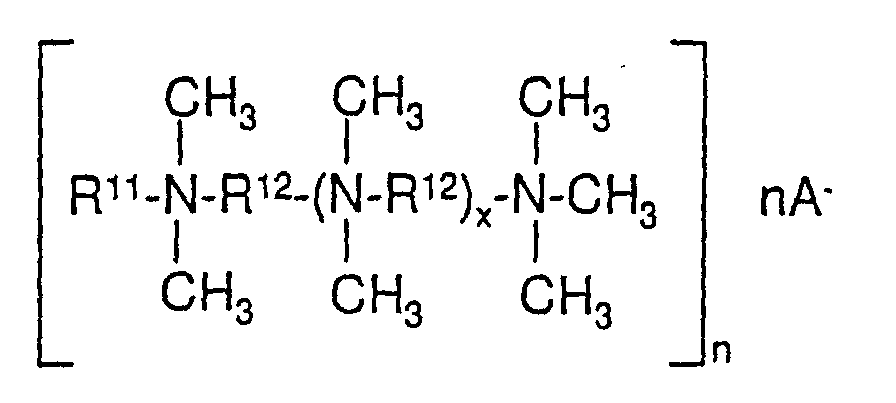
- The rinse cycle fabric softener concentrate of Claim 9 wherein said anionic scavenger is a compound wherein R11 equal to a C10-24 alkyl.
- The rinse cycle fabric softener concentrate of Claim 10 wherein said compound is tallow diquat or tallow triquat.
- The rinse cycle fabric softener concentrate of Claim 11 wherein said compound is tallow diquat.
- The rinse cycle fabric softener concentrate of Claim 9 wherein said anionic scavenger is a compound wherein R11 equal to an ether (R11OR13-).
- The rinse cycle fabric softener concentrate of Claim 13 wherein said compound is a C12-18 ether propyl diquat.
- The rinse cycle fabric softener concentrate of Claim 9 wherein said anionic scavenger is a compound wherein R11 equal to amido (R11C(O)NR14-).
- The rinse cycle fabric softener concentrate of Claim 15 wherein said compound is tallow amidopropyl diquat or stearyl amidopropyl diquat.
- The rinse cycle fabric softener concentrate of Claim 1 wherein said anionic scavenger is a amide quat having the following formula:wherein R17 is a C7-22 alkyl, each R18 is the same or different and is a C1-4 alkyl, 1 is from 2 to 6, and X is an anion.

- The rinse cycle fabric softener concentrate of Claim 1 wherein about 5 to about 15 weight % of tallow diquat is present in the rinse cycle fabric softener concentrate.
- The rinse cycle fabric softener concentrate of Claim 1 wherein said triglyceride-based ester quat is a compound produced by esterifying an alkanol amine and a triglyceride having the formulawherein R1, R2 and R3 are the same or different and are linear or branched, saturated or unsaturated, C9-C21 alkyl or a linear or branched C1-C4 alkyl, with the proviso that at least one of R1, R2 or R3 is a linear or branched C9-C21 alkyl, to produce an ester amine and thereafter quaternizing the ester amine in the presence of an alkylating agent.

- The rinse cycle fabric softener concentrate of Claim 19 wherein R1 is a C15-17 alkyl, R2 is a C15-17 alkyl, and R3 is a C15-17 alkyl.
- The rinse cycle fabric softener concentrate of Claim 19 wherein said alkanol amine is a compound having the following formula:wherein R15 is a C1-18 alkyl or a -(CH2)pOH group, and p is from 1 to 6.
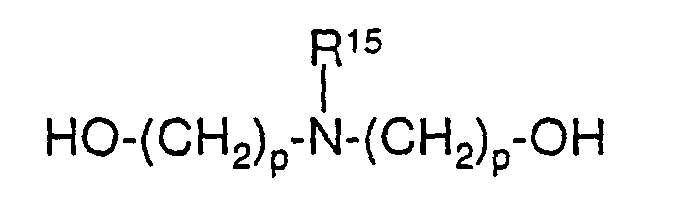
- The rinse cycle fabric softener concentrate of Claim 21 wherein said alkanol amine is triethanol amine or methyldiethanol amine.
- The rinse cycle fabric softener concentrate of Claim 19 wherein said triglyceride-based ester quat is produced using a mole ratio of triglyceride to alkanol amine of from about 0.5:1 to about 1.5:1.
- The rinse cycle fabric softener concentrate of Claim 23 wherein said mole ratio of triglyceride to alkanol amine is from about 0.6:1 to about 1:1.
- The rinse cycle fabric softener concentrate of Claim 24 wherein said mole ratio of triglyceride to alkanol amine is from about 0.7:1 to about 1:1.
- The rinse cycle fabric softener concentrate of Claim 19 wherein said triglyceride includes a fatty acid having the following formula:wherein R4CO is an aliphatic, linear or branched acyl radical containing 5 to 21 carbon atoms and 0 and/or 1, 2 or 3 double bonds.
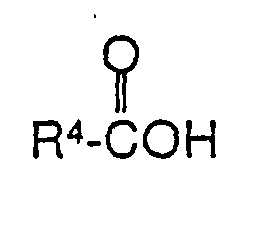
- The rinse cycle fabric softener concentrate of Claim 1 wherein said anionic scavenger is tallow diquat and said triglyceride-based ester quat is from partially hydrogenated canola, partially hydrogenated tallow or partially hydrogenated palm stearine.
- The rinse cycle fabric softener concentrate of Claim 27 wherein said tallow diquat is used in an amount of from about 5 to about 15 weight % and triglyceride-based ester quat is used in an amount of from about 85 to about 95 weight %.
- A liquid rinse cycle fabric softener formulation comprising at least the rinse cycle fabric softener concentrate of Claim 1.
- The liquid rinse cycle fabric softener formulation of Claim 29 further comprising a liquid carrier.
- The liquid rinse cycle fabric softener formulation of Claim 30 wherein said liquid carrier is water; a C1-4 monohydric alcohol; a C2-10 polyhydric glycol, diol or triol; a polyalkenylene glycol; or combinations and mixtures thereof.
- The liquid rinse cycle fabric softener formulation of Claim 30 wherein said rinse cycle fabric softener concentrate is present in an amount of from about 2 to about 40 weight %.
- The rinse cycle fabric softener formulation of Claim 29 wherein said anionic scavenger is tallow diquat and said triglyceride-based ester quat is from partially hydrogenated canola, partially hydrogenated tallow or partially hydrogenated palm stearine.
- The rinse cycle fabric softener concentrate of Claim 33 wherein said tallow diquat is used in an amount of from about 5 to about 15 weight % and said triglyceride-based ester quat is used in an amount of from about 85 to about 95 weight %.
- A method of laundering fabrics comprising the steps of:(a) washing a fabric in water in-the presence of a detergent; and(b) rinsing the washed fabric of step (a) in the presence of at least the rinse cycle fabric softener concentrate of Claim 1, said rinse cycle fabric softener concentrate is effective in providing improved softness and dye inhibition to said fabric.
- The method of Claim 35 wherein said detergent is comprised of at least one anionic surfactant.
- The method of Claim 35 wherein said anionic scavenger is tallow diquat and said triglyceride-based ester quat is partially hydrogenated canola, partially hydrogenated tallow or partially hydrogenated palm stearine.
- The method of Claim 37 wherein said tallow diquat is used in an amount of from about 5 to about 15 weight % and triglyceride-based ester quat is used in an amount of from about 85 to about 95 weight %.
- A clear rinse cycle fabric softener concentrate comprising at least one anionic scavenger and at least one oil-based ester quat selected from triglycerides containing unsaturated fatty acids having 0, 1, 2 or 3 double bonds and an iodine value of from 40 to 150.
- The clear concentrate of Claim 39 wherein said oil-based ester quat is formed from canol or soybean.
- A clear rinse cycle fabric softener formulation comprising at least the clear rinse cycle fabric softener concentrate of Claim 39.
- The clear rinse cycle fabric softener formulation of Claim 41 further comprising a liquid carrier and optionally at least one surfactant and/or a detergent salt.
Applications Claiming Priority (2)
| Application Number | Priority Date | Filing Date | Title |
|---|---|---|---|
| US55867400A | 2000-04-26 | 2000-04-26 | |
| US558674 | 2000-04-26 |
Publications (1)
| Publication Number | Publication Date |
|---|---|
| EP1149891A1 true EP1149891A1 (en) | 2001-10-31 |
Family
ID=24230479
Family Applications (1)
| Application Number | Title | Priority Date | Filing Date |
|---|---|---|---|
| EP01110249A Withdrawn EP1149891A1 (en) | 2000-04-26 | 2001-04-25 | Low cost fabric softeners for rinse cycle using triglyceride-based ester quats |
Country Status (2)
| Country | Link |
|---|---|
| EP (1) | EP1149891A1 (en) |
| CA (1) | CA2344918A1 (en) |
Cited By (5)
| Publication number | Priority date | Publication date | Assignee | Title |
|---|---|---|---|---|
| KR100854099B1 (en) | 2007-02-05 | 2008-08-26 | 오성화학공업주식회사 | Fabrication method of fabric softener using titanium alkoxide catalyst |
| KR100861699B1 (en) | 2007-02-05 | 2008-10-07 | 오성화학공업주식회사 | Method for Producing Improved Fabric Softener Using Alkali Catalyst |
| US12083205B2 (en) | 2018-07-12 | 2024-09-10 | Stepan Corporation | Esterquat compositions |
| WO2024218380A1 (en) | 2023-04-21 | 2024-10-24 | Reckitt Benckiser Llc | Laundry sanitizing compositions |
| US12600925B2 (en) | 2023-04-21 | 2026-04-14 | Reckitt Benckiser Llc | Laundry sanitizing and softening compositions |
Citations (6)
| Publication number | Priority date | Publication date | Assignee | Title |
|---|---|---|---|---|
| EP0284036A2 (en) * | 1987-03-27 | 1988-09-28 | Hoechst Aktiengesellschaft | Process for the preparation of quaternary esteramines and their use |
| EP0798287A1 (en) * | 1996-03-25 | 1997-10-01 | Henkel Kommanditgesellschaft auf Aktien | Process for the preparation of quaternary esters |
| WO1998012292A1 (en) * | 1996-09-19 | 1998-03-26 | The Procter & Gamble Company | Fabric softeners having increased performance |
| WO1999005247A1 (en) * | 1997-07-24 | 1999-02-04 | Akzo Nobel N.V. | Fabric softener composition |
| WO1999045089A1 (en) * | 1998-03-02 | 1999-09-10 | The Procter & Gamble Company | Concentrated, stable, translucent or clear, fabric softening compositions |
| US5961966A (en) * | 1996-12-09 | 1999-10-05 | Croda, Inc. | Quaternary fatty diesters of hydroxypropyl diethanol amine |
-
2001
- 2001-04-24 CA CA002344918A patent/CA2344918A1/en not_active Abandoned
- 2001-04-25 EP EP01110249A patent/EP1149891A1/en not_active Withdrawn
Patent Citations (6)
| Publication number | Priority date | Publication date | Assignee | Title |
|---|---|---|---|---|
| EP0284036A2 (en) * | 1987-03-27 | 1988-09-28 | Hoechst Aktiengesellschaft | Process for the preparation of quaternary esteramines and their use |
| EP0798287A1 (en) * | 1996-03-25 | 1997-10-01 | Henkel Kommanditgesellschaft auf Aktien | Process for the preparation of quaternary esters |
| WO1998012292A1 (en) * | 1996-09-19 | 1998-03-26 | The Procter & Gamble Company | Fabric softeners having increased performance |
| US5961966A (en) * | 1996-12-09 | 1999-10-05 | Croda, Inc. | Quaternary fatty diesters of hydroxypropyl diethanol amine |
| WO1999005247A1 (en) * | 1997-07-24 | 1999-02-04 | Akzo Nobel N.V. | Fabric softener composition |
| WO1999045089A1 (en) * | 1998-03-02 | 1999-09-10 | The Procter & Gamble Company | Concentrated, stable, translucent or clear, fabric softening compositions |
Cited By (5)
| Publication number | Priority date | Publication date | Assignee | Title |
|---|---|---|---|---|
| KR100854099B1 (en) | 2007-02-05 | 2008-08-26 | 오성화학공업주식회사 | Fabrication method of fabric softener using titanium alkoxide catalyst |
| KR100861699B1 (en) | 2007-02-05 | 2008-10-07 | 오성화학공업주식회사 | Method for Producing Improved Fabric Softener Using Alkali Catalyst |
| US12083205B2 (en) | 2018-07-12 | 2024-09-10 | Stepan Corporation | Esterquat compositions |
| WO2024218380A1 (en) | 2023-04-21 | 2024-10-24 | Reckitt Benckiser Llc | Laundry sanitizing compositions |
| US12600925B2 (en) | 2023-04-21 | 2026-04-14 | Reckitt Benckiser Llc | Laundry sanitizing and softening compositions |
Also Published As
| Publication number | Publication date |
|---|---|
| CA2344918A1 (en) | 2001-10-26 |
Similar Documents
| Publication | Publication Date | Title |
|---|---|---|
| EP1136471B1 (en) | Esters derived from alkanolamines, dicarboxylic acids and fatty alcohols and the cationic surfactants obtainable therefrom. | |
| EP1167617B1 (en) | Softening finish composition | |
| US4888119A (en) | Cationic/anionic surfactant complex antistatic and fabric softening emulsion for wash cycle laundry applications | |
| US6737392B1 (en) | MDEA ester quats with high content of monoester in blends with tea ester quats | |
| CN101600785B (en) | No-rinse fabric softener | |
| JPH10508622A (en) | Concentrated biodegradable quaternary ammonium fabric softener composition containing intermediate iodine value fatty acid chains | |
| US6562780B2 (en) | Esters derived from alkanolamines, dicarboxylic acids and fatty alcohols and the cationic surfactants obtainable therefrom | |
| JPH0329908B2 (en) | ||
| US5204010A (en) | Cationic/anionic surfactant complex antistatic and fabric softening emulsion for wash cycle laundry applications | |
| EP0869114A1 (en) | Composition useful for softening applications and processes for the preparation thereof | |
| JPH0215664B2 (en) | ||
| JP4409172B2 (en) | Fiber softener composition containing nonionic surfactant | |
| JP5281257B2 (en) | Washing method | |
| US20250197769A1 (en) | Softener formulations for maintaining or improving moisture wicking | |
| EP0643038A2 (en) | Novel polyfunctional cationic surface active agents, compositions comprised thereof, process for the preparation thereof and uses | |
| CN102791921B (en) | Softener composition | |
| CA2344918A1 (en) | Low cost fabric softeners for rinse cycle using triglyceride based ester quats | |
| US6525016B2 (en) | Blend of imidazolinium quat and amido amine quat for use in fabric softeners with premium softening, high-viscosity at low-solids and non-yellowing properties | |
| EP0644925B1 (en) | Stable biodegradable fabric softening compositions | |
| US20020187911A1 (en) | Viscosity and softening enhancement by low-solids rinse cycle fabric softeners based on quaternary ammonium compounds and amine ethoxylates | |
| CA2372705A1 (en) | Use of alkoxylated sugar esters in liquid aqueous softening compositions | |
| US6784152B2 (en) | Polyquat anionic scavengers for rinse cycle fabric softeners | |
| CA2613711C (en) | Oligomeric amidoamines or amidoquats for fabric or hair treatment compositions | |
| JP3992994B2 (en) | Softener composition | |
| MXPA98007977A (en) | The use of a te softening composition |
Legal Events
| Date | Code | Title | Description |
|---|---|---|---|
| PUAI | Public reference made under article 153(3) epc to a published international application that has entered the european phase |
Free format text: ORIGINAL CODE: 0009012 |
|
| AK | Designated contracting states |
Kind code of ref document: A1 Designated state(s): AT BE CH CY DE DK ES FI FR GB GR IE IT LI LU MC NL PT SE TR |
|
| AX | Request for extension of the european patent |
Free format text: AL;LT;LV;MK;RO;SI |
|
| STAA | Information on the status of an ep patent application or granted ep patent |
Free format text: STATUS: THE APPLICATION HAS BEEN WITHDRAWN |
|
| 17P | Request for examination filed |
Effective date: 20020125 |
|
| 18W | Application withdrawn |
Withdrawal date: 20020313 |