EP1149843A1 - Substituted phenethylamine derivatives - Google Patents
Substituted phenethylamine derivatives Download PDFInfo
- Publication number
- EP1149843A1 EP1149843A1 EP00901956A EP00901956A EP1149843A1 EP 1149843 A1 EP1149843 A1 EP 1149843A1 EP 00901956 A EP00901956 A EP 00901956A EP 00901956 A EP00901956 A EP 00901956A EP 1149843 A1 EP1149843 A1 EP 1149843A1
- Authority
- EP
- European Patent Office
- Prior art keywords
- tbu
- tyr
- phe
- val
- hydrogen
- Prior art date
- Legal status (The legal status is an assumption and is not a legal conclusion. Google has not performed a legal analysis and makes no representation as to the accuracy of the status listed.)
- Withdrawn
Links
- 0 **C(*N*)C(*)* Chemical compound **C(*N*)C(*)* 0.000 description 3
- VYAXYVHPFLPABV-FNORWQNLSA-N CC(C)(C)/C(/C(N)=O)=C/CCO Chemical compound CC(C)(C)/C(/C(N)=O)=C/CCO VYAXYVHPFLPABV-FNORWQNLSA-N 0.000 description 1
- ARTZZGSYRXXPSM-UHFFFAOYSA-O CC(C)C(C([NH3+])O)N Chemical compound CC(C)C(C([NH3+])O)N ARTZZGSYRXXPSM-UHFFFAOYSA-O 0.000 description 1
Classifications
-
- C—CHEMISTRY; METALLURGY
- C07—ORGANIC CHEMISTRY
- C07D—HETEROCYCLIC COMPOUNDS
- C07D295/00—Heterocyclic compounds containing polymethylene-imine rings with at least five ring members, 3-azabicyclo [3.2.2] nonane, piperazine, morpholine or thiomorpholine rings, having only hydrogen atoms directly attached to the ring carbon atoms
- C07D295/16—Heterocyclic compounds containing polymethylene-imine rings with at least five ring members, 3-azabicyclo [3.2.2] nonane, piperazine, morpholine or thiomorpholine rings, having only hydrogen atoms directly attached to the ring carbon atoms acylated on ring nitrogen atoms
- C07D295/18—Heterocyclic compounds containing polymethylene-imine rings with at least five ring members, 3-azabicyclo [3.2.2] nonane, piperazine, morpholine or thiomorpholine rings, having only hydrogen atoms directly attached to the ring carbon atoms acylated on ring nitrogen atoms by radicals derived from carboxylic acids, or sulfur or nitrogen analogues thereof
- C07D295/182—Radicals derived from carboxylic acids
- C07D295/185—Radicals derived from carboxylic acids from aliphatic carboxylic acids
-
- A—HUMAN NECESSITIES
- A61—MEDICAL OR VETERINARY SCIENCE; HYGIENE
- A61P—SPECIFIC THERAPEUTIC ACTIVITY OF CHEMICAL COMPOUNDS OR MEDICINAL PREPARATIONS
- A61P1/00—Drugs for disorders of the alimentary tract or the digestive system
-
- A—HUMAN NECESSITIES
- A61—MEDICAL OR VETERINARY SCIENCE; HYGIENE
- A61P—SPECIFIC THERAPEUTIC ACTIVITY OF CHEMICAL COMPOUNDS OR MEDICINAL PREPARATIONS
- A61P5/00—Drugs for disorders of the endocrine system
-
- C—CHEMISTRY; METALLURGY
- C07—ORGANIC CHEMISTRY
- C07C—ACYCLIC OR CARBOCYCLIC COMPOUNDS
- C07C215/00—Compounds containing amino and hydroxy groups bound to the same carbon skeleton
- C07C215/46—Compounds containing amino and hydroxy groups bound to the same carbon skeleton having hydroxy groups bound to carbon atoms of at least one six-membered aromatic ring and amino groups bound to acyclic carbon atoms or to carbon atoms of rings other than six-membered aromatic rings of the same carbon skeleton
- C07C215/48—Compounds containing amino and hydroxy groups bound to the same carbon skeleton having hydroxy groups bound to carbon atoms of at least one six-membered aromatic ring and amino groups bound to acyclic carbon atoms or to carbon atoms of rings other than six-membered aromatic rings of the same carbon skeleton with amino groups linked to the six-membered aromatic ring, or to the condensed ring system containing that ring, by carbon chains not further substituted by hydroxy groups
- C07C215/52—Compounds containing amino and hydroxy groups bound to the same carbon skeleton having hydroxy groups bound to carbon atoms of at least one six-membered aromatic ring and amino groups bound to acyclic carbon atoms or to carbon atoms of rings other than six-membered aromatic rings of the same carbon skeleton with amino groups linked to the six-membered aromatic ring, or to the condensed ring system containing that ring, by carbon chains not further substituted by hydroxy groups linked by carbon chains having two carbon atoms between the amino groups and the six-membered aromatic ring or the condensed ring system containing that ring
-
- C—CHEMISTRY; METALLURGY
- C07—ORGANIC CHEMISTRY
- C07C—ACYCLIC OR CARBOCYCLIC COMPOUNDS
- C07C229/00—Compounds containing amino and carboxyl groups bound to the same carbon skeleton
- C07C229/02—Compounds containing amino and carboxyl groups bound to the same carbon skeleton having amino and carboxyl groups bound to acyclic carbon atoms of the same carbon skeleton
- C07C229/04—Compounds containing amino and carboxyl groups bound to the same carbon skeleton having amino and carboxyl groups bound to acyclic carbon atoms of the same carbon skeleton the carbon skeleton being acyclic and saturated
- C07C229/06—Compounds containing amino and carboxyl groups bound to the same carbon skeleton having amino and carboxyl groups bound to acyclic carbon atoms of the same carbon skeleton the carbon skeleton being acyclic and saturated having only one amino and one carboxyl group bound to the carbon skeleton
- C07C229/10—Compounds containing amino and carboxyl groups bound to the same carbon skeleton having amino and carboxyl groups bound to acyclic carbon atoms of the same carbon skeleton the carbon skeleton being acyclic and saturated having only one amino and one carboxyl group bound to the carbon skeleton the nitrogen atom of the amino group being further bound to acyclic carbon atoms or to carbon atoms of rings other than six-membered aromatic rings
- C07C229/12—Compounds containing amino and carboxyl groups bound to the same carbon skeleton having amino and carboxyl groups bound to acyclic carbon atoms of the same carbon skeleton the carbon skeleton being acyclic and saturated having only one amino and one carboxyl group bound to the carbon skeleton the nitrogen atom of the amino group being further bound to acyclic carbon atoms or to carbon atoms of rings other than six-membered aromatic rings to carbon atoms of acyclic carbon skeletons
-
- C—CHEMISTRY; METALLURGY
- C07—ORGANIC CHEMISTRY
- C07C—ACYCLIC OR CARBOCYCLIC COMPOUNDS
- C07C229/00—Compounds containing amino and carboxyl groups bound to the same carbon skeleton
- C07C229/02—Compounds containing amino and carboxyl groups bound to the same carbon skeleton having amino and carboxyl groups bound to acyclic carbon atoms of the same carbon skeleton
- C07C229/34—Compounds containing amino and carboxyl groups bound to the same carbon skeleton having amino and carboxyl groups bound to acyclic carbon atoms of the same carbon skeleton the carbon skeleton containing six-membered aromatic rings
- C07C229/36—Compounds containing amino and carboxyl groups bound to the same carbon skeleton having amino and carboxyl groups bound to acyclic carbon atoms of the same carbon skeleton the carbon skeleton containing six-membered aromatic rings with at least one amino group and one carboxyl group bound to the same carbon atom of the carbon skeleton
-
- C—CHEMISTRY; METALLURGY
- C07—ORGANIC CHEMISTRY
- C07C—ACYCLIC OR CARBOCYCLIC COMPOUNDS
- C07C229/00—Compounds containing amino and carboxyl groups bound to the same carbon skeleton
- C07C229/46—Compounds containing amino and carboxyl groups bound to the same carbon skeleton having amino or carboxyl groups bound to carbon atoms of rings other than six-membered aromatic rings of the same carbon skeleton
- C07C229/48—Compounds containing amino and carboxyl groups bound to the same carbon skeleton having amino or carboxyl groups bound to carbon atoms of rings other than six-membered aromatic rings of the same carbon skeleton with amino groups and carboxyl groups bound to carbon atoms of the same non-condensed ring
-
- C—CHEMISTRY; METALLURGY
- C07—ORGANIC CHEMISTRY
- C07C—ACYCLIC OR CARBOCYCLIC COMPOUNDS
- C07C237/00—Carboxylic acid amides, the carbon skeleton of the acid part being further substituted by amino groups
- C07C237/02—Carboxylic acid amides, the carbon skeleton of the acid part being further substituted by amino groups having the carbon atoms of the carboxamide groups bound to acyclic carbon atoms of the carbon skeleton
- C07C237/04—Carboxylic acid amides, the carbon skeleton of the acid part being further substituted by amino groups having the carbon atoms of the carboxamide groups bound to acyclic carbon atoms of the carbon skeleton the carbon skeleton being acyclic and saturated
- C07C237/08—Carboxylic acid amides, the carbon skeleton of the acid part being further substituted by amino groups having the carbon atoms of the carboxamide groups bound to acyclic carbon atoms of the carbon skeleton the carbon skeleton being acyclic and saturated having the nitrogen atom of at least one of the carboxamide groups bound to an acyclic carbon atom of a hydrocarbon radical substituted by singly-bound oxygen atoms
-
- C—CHEMISTRY; METALLURGY
- C07—ORGANIC CHEMISTRY
- C07C—ACYCLIC OR CARBOCYCLIC COMPOUNDS
- C07C237/00—Carboxylic acid amides, the carbon skeleton of the acid part being further substituted by amino groups
- C07C237/02—Carboxylic acid amides, the carbon skeleton of the acid part being further substituted by amino groups having the carbon atoms of the carboxamide groups bound to acyclic carbon atoms of the carbon skeleton
- C07C237/04—Carboxylic acid amides, the carbon skeleton of the acid part being further substituted by amino groups having the carbon atoms of the carboxamide groups bound to acyclic carbon atoms of the carbon skeleton the carbon skeleton being acyclic and saturated
- C07C237/10—Carboxylic acid amides, the carbon skeleton of the acid part being further substituted by amino groups having the carbon atoms of the carboxamide groups bound to acyclic carbon atoms of the carbon skeleton the carbon skeleton being acyclic and saturated having the nitrogen atom of at least one of the carboxamide groups bound to an acyclic carbon atom of a hydrocarbon radical substituted by nitrogen atoms not being part of nitro or nitroso groups
-
- C—CHEMISTRY; METALLURGY
- C07—ORGANIC CHEMISTRY
- C07C—ACYCLIC OR CARBOCYCLIC COMPOUNDS
- C07C237/00—Carboxylic acid amides, the carbon skeleton of the acid part being further substituted by amino groups
- C07C237/02—Carboxylic acid amides, the carbon skeleton of the acid part being further substituted by amino groups having the carbon atoms of the carboxamide groups bound to acyclic carbon atoms of the carbon skeleton
- C07C237/20—Carboxylic acid amides, the carbon skeleton of the acid part being further substituted by amino groups having the carbon atoms of the carboxamide groups bound to acyclic carbon atoms of the carbon skeleton the carbon skeleton containing six-membered aromatic rings
-
- C—CHEMISTRY; METALLURGY
- C07—ORGANIC CHEMISTRY
- C07C—ACYCLIC OR CARBOCYCLIC COMPOUNDS
- C07C271/00—Derivatives of carbamic acids, i.e. compounds containing any of the groups, the nitrogen atom not being part of nitro or nitroso groups
- C07C271/06—Esters of carbamic acids
- C07C271/08—Esters of carbamic acids having oxygen atoms of carbamate groups bound to acyclic carbon atoms
- C07C271/10—Esters of carbamic acids having oxygen atoms of carbamate groups bound to acyclic carbon atoms with the nitrogen atoms of the carbamate groups bound to hydrogen atoms or to acyclic carbon atoms
- C07C271/18—Esters of carbamic acids having oxygen atoms of carbamate groups bound to acyclic carbon atoms with the nitrogen atoms of the carbamate groups bound to hydrogen atoms or to acyclic carbon atoms to carbon atoms of hydrocarbon radicals substituted by doubly-bound oxygen atoms
-
- C—CHEMISTRY; METALLURGY
- C07—ORGANIC CHEMISTRY
- C07C—ACYCLIC OR CARBOCYCLIC COMPOUNDS
- C07C271/00—Derivatives of carbamic acids, i.e. compounds containing any of the groups, the nitrogen atom not being part of nitro or nitroso groups
- C07C271/06—Esters of carbamic acids
- C07C271/08—Esters of carbamic acids having oxygen atoms of carbamate groups bound to acyclic carbon atoms
- C07C271/10—Esters of carbamic acids having oxygen atoms of carbamate groups bound to acyclic carbon atoms with the nitrogen atoms of the carbamate groups bound to hydrogen atoms or to acyclic carbon atoms
- C07C271/20—Esters of carbamic acids having oxygen atoms of carbamate groups bound to acyclic carbon atoms with the nitrogen atoms of the carbamate groups bound to hydrogen atoms or to acyclic carbon atoms to carbon atoms of hydrocarbon radicals substituted by nitrogen atoms not being part of nitro or nitroso groups
-
- C—CHEMISTRY; METALLURGY
- C07—ORGANIC CHEMISTRY
- C07C—ACYCLIC OR CARBOCYCLIC COMPOUNDS
- C07C271/00—Derivatives of carbamic acids, i.e. compounds containing any of the groups, the nitrogen atom not being part of nitro or nitroso groups
- C07C271/06—Esters of carbamic acids
- C07C271/08—Esters of carbamic acids having oxygen atoms of carbamate groups bound to acyclic carbon atoms
- C07C271/10—Esters of carbamic acids having oxygen atoms of carbamate groups bound to acyclic carbon atoms with the nitrogen atoms of the carbamate groups bound to hydrogen atoms or to acyclic carbon atoms
- C07C271/22—Esters of carbamic acids having oxygen atoms of carbamate groups bound to acyclic carbon atoms with the nitrogen atoms of the carbamate groups bound to hydrogen atoms or to acyclic carbon atoms to carbon atoms of hydrocarbon radicals substituted by carboxyl groups
-
- C—CHEMISTRY; METALLURGY
- C07—ORGANIC CHEMISTRY
- C07D—HETEROCYCLIC COMPOUNDS
- C07D295/00—Heterocyclic compounds containing polymethylene-imine rings with at least five ring members, 3-azabicyclo [3.2.2] nonane, piperazine, morpholine or thiomorpholine rings, having only hydrogen atoms directly attached to the ring carbon atoms
- C07D295/22—Heterocyclic compounds containing polymethylene-imine rings with at least five ring members, 3-azabicyclo [3.2.2] nonane, piperazine, morpholine or thiomorpholine rings, having only hydrogen atoms directly attached to the ring carbon atoms with hetero atoms directly attached to ring nitrogen atoms
- C07D295/26—Sulfur atoms
-
- C—CHEMISTRY; METALLURGY
- C07—ORGANIC CHEMISTRY
- C07K—PEPTIDES
- C07K5/00—Peptides containing up to four amino acids in a fully defined sequence; Derivatives thereof
- C07K5/04—Peptides containing up to four amino acids in a fully defined sequence; Derivatives thereof containing only normal peptide links
- C07K5/06—Dipeptides
- C07K5/06191—Dipeptides containing heteroatoms different from O, S, or N
-
- C—CHEMISTRY; METALLURGY
- C07—ORGANIC CHEMISTRY
- C07K—PEPTIDES
- C07K5/00—Peptides containing up to four amino acids in a fully defined sequence; Derivatives thereof
- C07K5/04—Peptides containing up to four amino acids in a fully defined sequence; Derivatives thereof containing only normal peptide links
- C07K5/08—Tripeptides
- C07K5/0802—Tripeptides with the first amino acid being neutral
- C07K5/0812—Tripeptides with the first amino acid being neutral and aromatic or cycloaliphatic
-
- C—CHEMISTRY; METALLURGY
- C07—ORGANIC CHEMISTRY
- C07K—PEPTIDES
- C07K5/00—Peptides containing up to four amino acids in a fully defined sequence; Derivatives thereof
- C07K5/04—Peptides containing up to four amino acids in a fully defined sequence; Derivatives thereof containing only normal peptide links
- C07K5/08—Tripeptides
- C07K5/0821—Tripeptides with the first amino acid being heterocyclic, e.g. His, Pro, Trp
-
- C—CHEMISTRY; METALLURGY
- C07—ORGANIC CHEMISTRY
- C07K—PEPTIDES
- C07K5/00—Peptides containing up to four amino acids in a fully defined sequence; Derivatives thereof
- C07K5/04—Peptides containing up to four amino acids in a fully defined sequence; Derivatives thereof containing only normal peptide links
- C07K5/08—Tripeptides
- C07K5/0827—Tripeptides containing heteroatoms different from O, S, or N
-
- A—HUMAN NECESSITIES
- A61—MEDICAL OR VETERINARY SCIENCE; HYGIENE
- A61K—PREPARATIONS FOR MEDICAL, DENTAL OR TOILETRY PURPOSES
- A61K38/00—Medicinal preparations containing peptides
-
- C—CHEMISTRY; METALLURGY
- C07—ORGANIC CHEMISTRY
- C07B—GENERAL METHODS OF ORGANIC CHEMISTRY; APPARATUS THEREFOR
- C07B2200/00—Indexing scheme relating to specific properties of organic compounds
- C07B2200/07—Optical isomers
-
- C—CHEMISTRY; METALLURGY
- C07—ORGANIC CHEMISTRY
- C07C—ACYCLIC OR CARBOCYCLIC COMPOUNDS
- C07C2601/00—Systems containing only non-condensed rings
- C07C2601/02—Systems containing only non-condensed rings with a three-membered ring
-
- C—CHEMISTRY; METALLURGY
- C07—ORGANIC CHEMISTRY
- C07C—ACYCLIC OR CARBOCYCLIC COMPOUNDS
- C07C2601/00—Systems containing only non-condensed rings
- C07C2601/06—Systems containing only non-condensed rings with a five-membered ring
- C07C2601/08—Systems containing only non-condensed rings with a five-membered ring the ring being saturated
-
- C—CHEMISTRY; METALLURGY
- C07—ORGANIC CHEMISTRY
- C07C—ACYCLIC OR CARBOCYCLIC COMPOUNDS
- C07C2601/00—Systems containing only non-condensed rings
- C07C2601/12—Systems containing only non-condensed rings with a six-membered ring
- C07C2601/14—The ring being saturated
Definitions
- This invention relates to substituted phenethylamine derivatives that function as a motilin receptor antagonist and that are useful as medicines.
- Motilin which is one of the gastrointestinal hormones, is a straight-chained peptide consisting of 22 amino acids and is well known to be responsible for regulating the motility of the gastrointestinal tract in animals including human. It has been reported that exogenously administered motilin causes contractions in humans and dogs that are similar to interdigestive migrating contractions, thus promoting gastric emptying (Itoh et al., Scand. J. Gastroenterol., 11, 93-110 (1976); Peeters et al., Gastroenterology 102, 97-101 (1992)). Hence, erythromycin derivatives which are an agonist of motilin are under development as an gastrointestinal tract motor activity enhancer (Satoh et al., J. Pharmacol. Exp. Therap., 271, 574-579 (1994); Lartey et al., J. Med. Chem., 38, 1793-1798 (1995); Drug of the Future, 19, 910-912 (1994)).
- Motilin receptors had been known to occur principally in the duodenum but recently it has been shown that they also occur in the large intestine, or the lower part of the gastrointestinal tract (William et al., Am. J. Physiol., 262, G50-G55 (1992)), and this indicates the possibility that motilin is involved not only in the motility of the upper part of the gastrointestinal tract but also in the motility of its lower part.
- An object of the present invention is to provide substituted phenethylamine derivatives, that function as an antagonist of motilin receptors and which are useful as medicines.
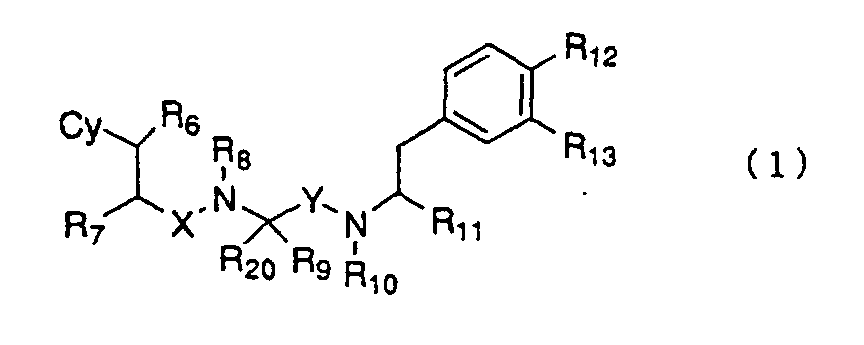
- the present inventors conducted repeated intensive studies in an attempt to develop compounds having an outstanding motilin receptor antagonistic action. As a result, they found that substituted phenethylamine derivatives represented by Formula (1) were an excellent antagonist of motilin receptors. The present invention has been accomplished on the basis of this finding.
- the present invention also provides a medicine containing a compound of Formula (1) as an active ingredient. Further, the present invention provides a motilin receptor antagonist composition containing the compound. The present invention also provides a gastrointestinal motility suppressor agent containing the compound as an active ingredient. Further, the present invention provides a therapeutic of hypermotilinemia containing the compound as an active ingredient.
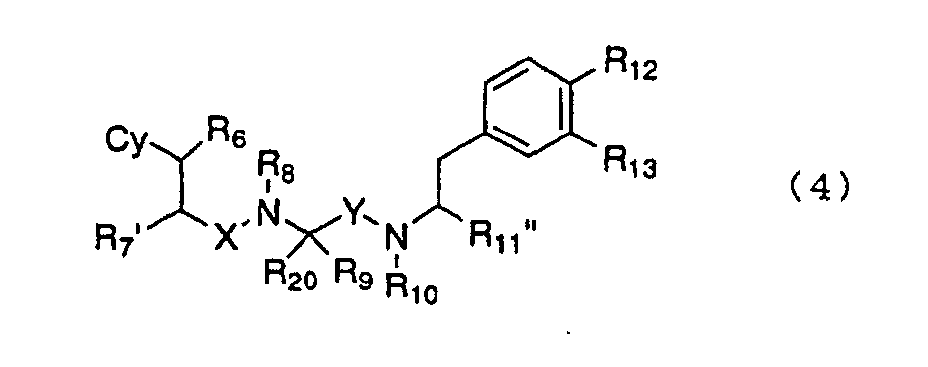
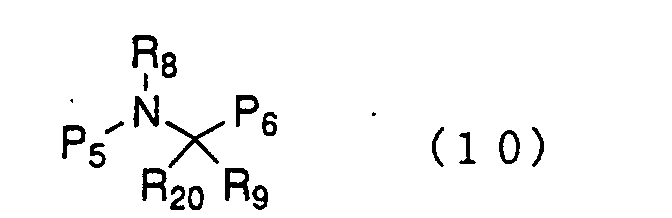
- the present invention also provides compounds of Formula (4): wherein
- the present invention also provides compounds of Formula (5): wherein:
- the present invention also provides compounds of Formula (6): wherein:
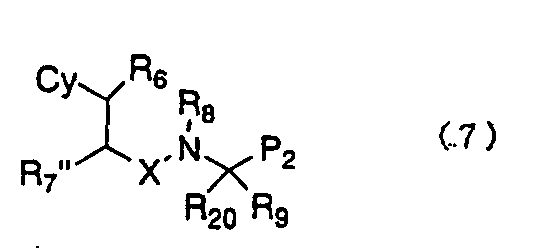
- the present invention also provides compounds of Formula (7): wherein:
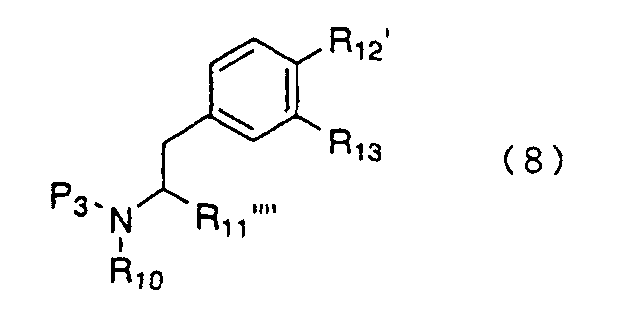
- the present invention also provides compounds of Formula (8) wherein:
- the present invention also provides compounds of Formula (9) wherein:
- the present invention also provides compounds of Formula (10) wherein:
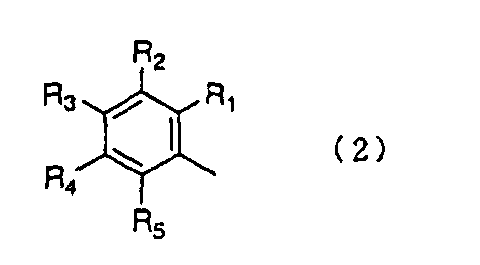
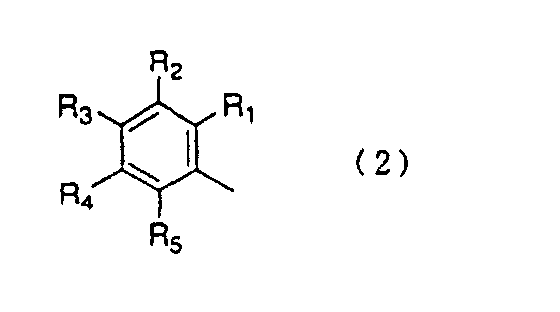
- halogen as R 1 , R 2 , R 3 , R 4 and R 5 of Formula (2) as Cy is preferably fluorine or chlorine, with fluorine being more preferred.
- R 1 to R 5 are halogen, they may be the same or different halogen, however it is preferable that they are the same.
- the number of halogen atoms is preferably 1 to 3 and more preferably 1 or 2.
- At least one of R 1 , R 2 , R 3 , R 4 and R 5 of Formula (2) as Cy is halogen, trifluoromethyl or nitrile and the others are independently hydrogen or hydroxy.
- R 3 is halogen, trifluoromethyl or nitrile or R 2 and R 3 are the same kind of halogen.
- Preferred compounds include those in which R 3 is halogen and R 1 , R 2 , R 4 and R 5 are hydrogen; those in which R 2 and R 3 are the same halogen and R 1 , R 4 and R 5 are hydrogen; and those in which at least one of R 1 , R 2 , R 3 , R 4 and R 5 is trifluoromethyl or nitrile and the others are hydrogen, halogen or hydroxy.
- Preferred examples of the group of Formula (2) as Cy include 4-fluorophenyl, 3-fluorophenyl, 3,4-difluorophenyl, 4-chlorophenyl, 3-chlorophenyl, 3,4-dichlorophenyl, 2-fluoro-4-hydroxyphenyl, 3-fluoro-4-hydroxyphenyl, 4-trifluoromethylphenyl and 4-cyanophenyl, more preferably 4-fluorophenyl and 4-chlorophenyl, with 4-fluorophenyl being most preferred.
- heterocyclic ring of the optionally substituted heterocyclic ring as Cy include aliphatic or aromatic 5- to 7-membered mono- or fused-rings containing at least one hetero atom selected from among N, S and O; specific examples include pyridyl, pyrazinyl, furyl, thienyl, pyrrolyl, imidazolyl, indolyl, quinolinyl, benzoimidazolyl, benzodiazepinyl, benzofuryl, pyrrolidinyl, piperazinyl, piperidinyl and tetrahydroisoquinolinyl, with indolyl being preferred.
- Exemplary substituents of the optionally substituted heterocyclic ring as Cy include hydroxy, methoxy, amino, methyl, ethyl, trifluoromethyl, carboxy, methoxycarbonyl and oxo.
- the heterocyclic ring may have one or more of the above-mentioned substituents, which may be the same or different.
- the optionally substituted heterocyclic ring of Cy is 3-indolyl.
- the C 3-7 cycloalkyl as Cy is cyclopentyl or cyclohexyl.
- Cy has the definitions set forth above, Cy is preferably Formula (2) or an optionally substituted heterocyclic ring, more preferably 4-fluorophenyl, 3-fluorophenyl, 3,4-difluorophenyl, 4-chlorophenyl, 3-chlorophenyl, 3,4-dichlorophenyl, 2-fluoro-4-hydroxyphenyl, 3-fluoro-4-hydroxyphenyl, 4-trifluoromethylphenyl, 4-cyanophenyl and 3-indolyl, with 4-fluorophenyl being particularly preferred.
- the alkyl of the optionally substituted straight-chained or branched C 1-3 alkyl as R 6 is preferably methyl or ethyl.
- Exemplary substituents of the optionally substituted straight-chained or branched C 1-3 alkyl as R 6 include halogen, with fluorine being preferred.
- the alkyl may have one or more of the above-mentioned substituents, which may be the same or different.
- the optionally substituted straight-chained or branched C 1-3 alkyl as R 6 is preferably methyl, ethyl, fluoromethyl or trifluoromethyl, with methyl being particularly preferred.
- R 6 has the definitions set forth above, R 6 is preferably hydrogen or methyl.
- the alkyl of the optionally substituted straight-chained or branched C 1-3 alkyl as R 7 is preferably methyl.
- substituents of the optionally substituted straight-chained or branched C 1-3 alkyl as R 7 include halogen, hydroxy and amino, with hydroxy being preferred.
- the alkyl may have one or more of the above-mentioned substituents, which may be the same or different.
- the optionally substituted straight-chained or branched C 1-3 alkyl as R 7 is preferably methyl or trifluoromethyl, with methyl being particularly preferred.
- Exemplary substituents of the optionally substituted amino as R 7 include straight-chained or branched C 1-3 alkyl, with methyl and ethyl being preferred.
- the amino may have one or more of the above-mentioned substituents, which may be the same or different.
- the optionally substituted amino as R 7 is preferably amino optionally substituted with one or more of the same or different kinds of straight-chained or branched C 1-3 alkyl; specific examples include amino, methylamino, dimethylamino and ethylamino, with amino and methylamino being particularly preferred.
- R 7 has the definitions set forth above, R 7 is preferably hydrogen or optionally substituted amino, with hydrogen, amino and methylamino being particularly preferred.
- R 8 is preferably hydrogen or methyl.
- the alkyl of the optionally substituted straight-chained or branched C 1-6 alkyl as R 9 is preferably straight-chained or branched C 1-5 alkyl, e.g., methyl, ethyl, isopropyl, isobutyl, sec-butyl, tert-butyl, 3-pentyl and neopentyl.
- substituents of the optionally substituted straight-chained or branched C 1-6 alkyl as R 9 include substituted or unsubstituted phenyl (e.g., phenyl, tolyl, para-hydroxyphenyl and para-fluorophenyl), C 3-7 cycloalkyl, heterocyclic rings (e.g., pyrazyl, furyl, thienyl, pyrrolyl, imidazolyl and quinolinyl) and halogen, with phenyl, cyclohexyl and thienyl being preferred.
- phenyl e.g., phenyl, tolyl, para-hydroxyphenyl and para-fluorophenyl
- C 3-7 cycloalkyl e.g., pyrazyl, furyl, thienyl, pyrrolyl, imidazolyl and quinolinyl
- halogen e.g., phenyl,
- the optionally substituted straight-chained or branched C 1-6 alkyl as R 9 is preferably methyl, isopropyl, isobutyl, sec-butyl, tert-butyl, 3-pentyl, neopentyl, para-fluorobenzyl, 2-thienylmethyl, 3-indolylmethyl, benzyl, para-hydroxybenzyl, phenethyl or cyclohexylmethyl.
- the alkenyl of the optionally substituted straight-chained or branched C 2-6 alkenyl as R 9 is preferably vinyl, 2-propenyl, 2-propen-1-yl, 2-buten-1-yl or 2-isobuten-1-yl, with 2-propen-1-yl being more preferred.
- Exemplary substituents of the optionally substituted straight-chained or branched C 2-6 alkenyl as R 9 include phenyl, tolyl, para-hydroxyphenyl and para-fluorophenyl.
- the optionally substituted straight-chained or branched C 2-6 alkenyl as R 9 is preferably 2-propen-1-yl.
- the alkynyl of the optionally substituted straight-chained or branched C 2-6 alkynyl as R 9 is preferably ethynyl, propargyl or 2-butyn-1-yl, with 2-butyn-1-yl being preferred.
- substituents of the optionally substituted straight-chained or branched C 2-6 alkynyl as R 9 include halogen, phenyl, tolyl, para-hydroxyphenyl and para-fluorophenyl.
- the optionally substituted straight-chained or branched C 2-6 alkynyl as R 9 is preferably 2-butyn-1-yl.
- the C 3-7 cycloalkyl as R 9 is preferably cyclopentyl or cyclohexyl.
- Exemplary substituents of the optionally substituted phenyl as R 9 include hydroxy, amino, methyl, ethyl and halogen.
- the phenyl may have one or more of the above-mentioned substituents, which may be the same or different.
- the optionally substituted phenyl as R 9 is preferably phenyl.
- the C 3-7 cycloalkyl formed by R 9 and R 20 is preferably cyclopentyl or cyclohexyl.
- R 9 has the definitions set forth above, R 9 is preferably isopropyl, isobutyl, sec-butyl, tert-butyl, 3-pentyl, neopentyl, cyclohexyl, 2-thienylmethyl, 3-indolylmethyl, phenyl, benzyl, para-hydroxybenzyl, para-fluorobenzyl or cyclohexylmethyl, with isopropyl being particularly preferred.
- the straight-chained or branched C 1-3 alkyl as R 20 is preferably methyl.
- R 20 is preferably hydrogen.
- R 10 is preferably hydrogen or methyl.
- the alkyl of the optionally substituted straight-chained or branched C 1-3 alkyl as R 11 is preferably methyl.
- substituents of the optionally substituted straight-chained or branched C 1-3 alkyl as R 11 include amino optionally substituted with one or more of the same or different kind of straight-chained or branched C 1-3 alkyl (e.g., amino, methylamino, dimethylamino and ethylamino), optionally substituted 3- to 7-membered cyclic amino (exemplary substituents of the cyclic amino include hydroxy, amino, carboxyl, carbamoyl and methyl), hydroxy, methoxy, halogen, carbamoyl, methanesulfonyl, ureide, guanidyl, N'-cyano-N"-methylguanidyl, sulfamoylamino, carbamoylmethylamino and methanesulfonylamino, with amino, hydroxy, carbamoyl, methanesulfonyl, ureide, sulfamoyla
- the optionally substituted straight-chained or branched C 1-3 alkyl as R 11 is preferably methyl, aminomethyl, hydroxymethyl, carbamoylmethyl, methanesulfonylmethyl, ureidemethyl, guanidylmethyl, sulfamoylaminomethyl or methanesulfonylaminomethyl, with methyl, hydroxymethyl and methanesulfonylmethyl being more preferred.
- the alkyl of the optionally substituted straight-chained or branched C 1-4 alkyl as R 14 and R 15 of -CO-N(R 14 )R 15 as R 11 is preferably methyl, ethyl, propyl, isopropyl, isobutyl, sec-butyl or tert-butyl, with methyl and ethyl being more preferred.
- Exemplary substituents of the optionally substituted straight-chained or branched C 1-4 alkyl as R 14 and R 15 in -CO-N(R 14 )R 15 as R 11 include optionally substituted straight-chained or branched C 1-3 alkoxy (exemplary substituents of the optionally substituted straight-chained or branched C 1-3 alkoxy include hydroxy, amino, carboxyl and carbamoyl), hydroxy, amino, methylamino, dimethylamino, carbamoyl and methanesulfonyl, with hydroxy, methoxy and methanesulfonyl being preferred.
- Examples of the optionally substituted straight-chained or branched C 1-4 alkyl as R 14 and R 15 in -CO-N(R 14 )R 15 as R 11 include methyl, ethyl, propyl, isopropyl, tert-butyl, hydroxymethyl, methoxymethyl, 2-hydroxyethyl, 2-aminoethyl, 2-hydroxy-2-methylpropyl, 2-hydroxy-2-methylpropyl, 2-amino-2-methylpropyl and methanesulfonylmethyl, with methyl, ethyl, propyl, isopropyl, tert-butyl, hydroxymethyl, methoxymethyl and methanesulfonylmethyl being preferred.
- the C 3-7 cycloalkyl as R 14 and R 15 in -CO-N(R 14 )R 15 as R 11 is preferably cyclopropyl.
- the straight-chained or branched C 1-4 alkyloxy as R 14 and R 15 in -CO-N(R 14 )R 15 as R 11 is preferably methoxy.
- the straight-chained or branched C 1-4 alkylsulfonyl as R 14 and R 15 in -CO-N(R 14 )R 15 as R 11 is preferably methanesulfonyl.
- heterocyclic ring as R 14 and R 15 in-CQ-N(R 14 )R 15 as R 11 include aliphatic or aromatic 5- or 6-membered rings containing at least one hetero atom selected from among N, S and O; specific examples include 2-pyridyl, 3-pyridyl, 4-pyridyl, pyrazinyl, furyl, thienyl, pyrrolyl, oxazolyl, thiazolyl, oxadiazolyl, thiadiazolyl and triazolyl, with 2-pyridyl being preferred.
- the 3- to 7-membered cyclic amine of the optionally substituted 3- to 7-membered cyclic amine as -N(R 14 )R 15 as R 11 include aziridine, azetidine, pyrrolidine, piperidine, piperazine and morpholine, with piperazine and morpholine being preferred.
- Exemplary substituents of the optionally substituted 3- to 7-membered cyclic amine include hydroxy, amino, carboxyl, alkoxycarbonyl, carbamoyl, methyl, carboxymethyl, alkoxycarbonylmethyl and methylsulfonyl.
- the optionally substituted 3- to 7-membered cyclic amine as -N(R 14 )R 15 of -CO-N(R 14 )R 15 as R 11 is preferably 4-carboxymethylpiperazine, 4-ethoxycarbonylpiperazine, 4-methylsulfonylpiperazine or morpholine.
- the -CO-N(R 14 )R 15 as R 11 is preferably carbamoyl, methylcarbamoyl, ethylcarbamoyl, propylcarbamoyl, isopropylcarbamoyl, cyclopropylcarbamoyl, tert-butylcarbamoyl, 2-pyridylcarbamoyl, methanesulfonylmethylcarbamoyl, 4-ethoxycarbonylmethyl-1-piperazinecarbonyl, methoxymethylcarbamoyl, methoxycarbamoyl, 1-morpholinylcarbonyl, 4-carboxymethyl-1-piperazinecarbonyl and 4-methylsulfonyl-1-piperazinecarbonyl, with carbamoyl and ethylcarbamoyl being more preferred.
- heterocyclic ring of the optionally substituted heterocyclic ring as R 11 examples include aliphatic or aromatic 5- or 6-membered rings containing at least one hetero atom selected from among N, S and O.
- exemplary substituents of the heterocyclic ring include oxo, hydroxy, methyl, ethyl and trifluoromethyl; the heterocyclic ring may have one or more of the above-mentioned substituents, which may be the same or different.
- the optionally substituted heterocyclic ring include furyl, thienyl, pyrrolyl, oxazolyl, 2-thiazolyl, 1,3,4-oxadiazol-2-yl, 1,2,4-oxadiazol-5-yl, 1,3,4-thiadiazol-2-yl, 1,3,4-triazol-2-yl, tetrazolyl, pyridyl, pyrimidinyl, pyridazinyl, pyrazinyl, 4-pyrimidinon-2-yl, 6-methyl-4-pyrimidinon-2-yl and imidazolidine-2,4-dion-5-yl, with 2-thiazolyl, 1,3,4-oxadiazol-2-yl, 1,2,4-oxadiazol-5-yl, 1,3,4-triazol-2-yl and 6-methyl-4-pyrimidino-2-yl being preferred.
- R 11 is preferably methyl, hydroxymethyl, carbamoylmethyl, methanesulfonylmethyl, ureidemethyl, sulfamoylaminomethyl, methanesulfonylaminomethyl, carbamoyl, methylcarbamoyl, ethylcarbamoyl, propylcarbamoyl, isopropylcarbamoyl, cyclopropylcarbamoyl, tert-butylcarbamoyl, 2-pyridylcarbamoyl, methanesulfonylmethylcarbamoyl, 4-ethoxycarbonylmethyl-1-piperazinecarbonyl, methoxymethylcarbamoyl, methoxycarbamoyl, 1-morpholinylcarbonyl, 4-carboxymethyl-1-piperazinecarbonyl, 4-methylsulfonyl-1-piperazinecarbonyl,
- the straight-chained C 1-4 alkyl as R 16 of -OR 16 as R 12 is preferably methyl.
- R 12 is preferably hydroxy.
- the straight-chained or branched C 1-6 alkyl as R 13 is preferably straight-chained or branched C 2-5 alkyl, more preferably branched C 3-5 alkyl, and most preferably tert-butyl.
- the straight-chained or branched C 2-6 alkenyl as R 13 is preferably straight-chained or branched C 3-5 alkenyl and more preferably branched C 3-5 alkenyl.
- the straight-chained or branched C 2-6 alkynyl as R 13 is preferably straight-chained or branched C 3-5 alkynyl and more preferably branched C 3-5 alkynyl.
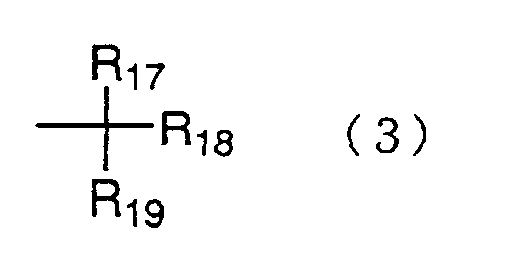
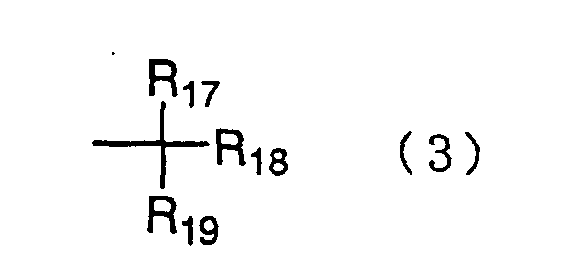
- R 17 in Formula (3) as R 13 is preferably methyl.
- the C 3-7 cycloalkyl formed by R 18 and R 19 in Formula (3) as R 13 is preferably C 3-5 Cycloalkyl.
- the C 3-7 cycloalkenyl formed by R 18 and R 19 in Formula (3) as R 13 is preferably C 3-5 cycloalkenyl.
- R 13 has the definitions set forth above, R 13 is preferably isopropyl, tert-butyl, 1,1-dimethylpropyl and 1,1-dimethyl-2-propenyl, with tert-butyl being more preferred.
- X is preferably carbonyl or methylene.
- Y is preferably carbonyl or methylene.
- Cy, R 6 , R 7 , R 8 , R 9 , R 20 , R 10 , R 11 , R 12 , R 13 , X and Y are as defined as above include those compounds of which Cy is a group of Formula (2) in which at least one of R 1 , R 2 , R 3 , R 4 and R 5 is halogen and the others are hydrogen or hydroxy;
- R 6 is hydrogen or methyl;
- R 7 is hydrogen or optionally substituted amino;
- R 8 is hydrogen or methyl;
- R 9 is methyl, isopropyl, isobutyl, sec-butyl, tert-butyl, 3-pentyl, neopentyl, cyclohexyl, phenyl, benzyl, para-hydroxybenzyl, para-fluorobenzyl or cyclohexylmethyl;
- R 20 is hydrogen;
- R 10 is hydrogen or methyl;
- R 11 is methyl, hydroxymethyl, carbamoy
- More preferred compounds are Phe(4-F)-N-Me-Val-N-Me-Tyr(3-tBu)-NH 2 , Phe(4-Cl)-N-Me-Val-N-Me-Tyr(3-tBu)-NH 2 , Phe(3,4-F 2 )-N-Me-Val-N-Me-Tyr(3-tBu)-NH 2 , Phe(3-F)-N-Me-Val-N-Me-Tyr(3-tBu)-NH 2 , Phe(4-F)-N-Me-Val-N-Me-Tyr(3-tBu)-NHOMe, 2-((2-amino-3-(4-fluorophenyl)propionyl)-N-methylamino)-3-methylbutyric acid 2-(3-tert-butyl-4-hydroxyphenyl)-1-(2-pyridylcarbamoyl)ethyl
- Particularly preferred compounds are Phe(4-F)-N-Me-Val-N-Me-Tyr(3-tBu)-NH 2 , Phe(4-Cl)-N-Me-Val-N-Me-Tyr(3-tBu)-NH 2 , Phe(3,4-F 2 )-N-Me-Val-N-Me-Tyr(3-tBu)-NH 2 , N-Me-Phe(4-F)-N-Me-Val-Tyr(3-tBu)-NHEt, 2-((2-amino-3-(4-fluorophenyl)propionyl)-N-methylamino)-3-methylbutyric acid 2-(3-tert-butyl-4-hydroxyphenyl)-1-(2-pyridylcarbamoyl)ethylamide, 2-((2-amino-3-(4-fluorophenyl)propionyl)-N-methylamino
- Examples of the protecting groups of the protected substituent of the straight-chained or branched C 1-3 alkyl as R 7 ' include those which are known as useful protecting groups of amino or hydroxy; specific examples are benzyloxycarbonyl, t-butoxycarbonyl, 9-fluorenylmethyloxycarbonyl, allyloxycarbonyl, benzoyl, acetyl, trifluoroacetyl, benzenesulfonyl, p-toluenesulfonyl, trimethylsilyl, t-butyldimethylsilyl, benzyl, benzyloxymethyl, t-butyl and tetrahydropyranyl.
- Examples of the protecting groups of the protected substituent of the amino as R 7 ' include those which are known as useful protecting groups of amino; specific examples are benzyloxycarbonyl, t-butoxycarbonyl, 9-fluorenylmethyloxycarbonyl, allyloxycarbonyl, benzoyl, acetyl, trifluoroacetyl, benzenesulfonyl, p-toluenesulfonyl, trimethylsilyl, t-butyldimethylsilyl, benzyl and benzyloxymethyl.
- Examples of the protecting groups of the protected hydroxy include those which are known as useful protecting groups of hydroxy; specific examples are benzyloxycarbonyl, t-butoxycarbonyl, 9-fluorenylmethyloxycarbonyl, allyloxycarbonyl, benzoyl, acetyl, trifluoroacetyl, trimethylsilyl, t-butyldimethylsilyl, benzyl, benzyloxymethyl, t-butyl and tetrahydropyranyl.
- Examples of the protecting groups of the protected amino of the straight-chained or branched C 1-3 alkyl as R 11 " include those which are known as useful protecting groups of amino; specific examples are benzyloxycarbonyl, t-butoxycarbonyl, 9-fluorenylmethyloxycarbonyl, allyloxycarbonyl, benzoyl, acetyl, trifluoroacetyl, benzenesulfonyl, p-toluenesulfonyl, trimethylsilyl, t-butyldimethylsilyl, benzyl and benzyloxymethyl.
- Examples of the protecting groups of the optionally protected substituent of the straight-chained or branched C 1-3 alkyl as R 7 " include those which are known as useful protecting groups of amino or hydroxy; specific examples are benzyloxycarbonyl, t-butoxycarbonyl, 9-fluorenylmethyloxycarbonyl, allyloxycarbonyl, benzoyl, acetyl, trifluoroacetyl, benzenesulfonyl, p-toluenesulfonyl, trimethylsilyl, t-butyldimethylsilyl, benzyl, benzyloxymethyl, t-butyl and tetrahydropyranyl.
- Examples of the protecting groups of the optionally protected substituent of the amino as R 7 " include those which are known as useful protecting groups of amino; specific examples are benzyloxycarbonyl, t-butoxycarbonyl, 9-fluorenylmethyloxycarbonyl, allyloxycarbonyl, benzoyl, acetyl, trifluoroacetyl, benzenesulfonyl, p-toluenesulfonyl, trimethylsilyl, t-butyldimethylsilyl, benzyl and benzyloxymethyl.
- Examples of the protecting groups of the optionally protected hydroxy as R 7 " include those which are known as useful protecting groups of hydroxy; specific examples are benzyloxycarbonyl, t-butoxycarbonyl, 9-fluorenylmethyloxycarbonyl, allyloxycarbonyl, benzoyl, acetyl, trifluoroacetyl, trimethylsilyl, t-butyldimethylsilyl, benzyl, benzyloxymethyl, t-butyl and tetrahydropyranyl.
- Examples of the protecting groups of the protected substituent of the straight-chained or branched C 1-3 alkyl as R 11 ' include those which are known as useful protecting groups of amino or hydroxy; specific examples are benzyloxycarbonyl, t-butoxycarbonyl, 9-fluorenylmethyloxycarbonyl, allyloxycarbonyl, benzoyl, acetyl, trifluoroacetyl, benzenesulfonyl, p-toluenesulfonyl, trimethylsilyl, t-butyldimethylsilyl, benzyl, benzyloxymethyl, t-butyl and tetrahydropyranyl.
- Examples of the protecting groups of amine as P 1 include those which are known as useful protecting groups of amino; specific examples are benzyloxycarbonyl, t-butoxycarbonyl, 9-fluorenylmethyloxycarbonyl, allyloxycarbonyl, benzoyl, acetyl, trifluoroacetyl, benzenesulfonyl, p-toluenesulfonyl, trimethylsilyl, t-butyldimethylsilyl, benzyl and benzyloxymethyl.
- Examples of the protecting groups of the protected amino of the straight-chained or branched C 1-3 alkyl as R 11 ''' include those which are known as useful protecting groups of amino; specific examples are benzyloxycarbonyl, t-butoxycarbonyl, 9-fluorenylmethyloxycarbonyl, allyloxycarbonyl, benzoyl, acetyl, trifluoroacetyl, benzenesulfonyl, p-toluenesulfonyl, trimethylsilyl, t-butyldimethylsilyl, benzyl and benzyloxymethyl.
- Examples of the protecting groups of the optionally protected carboxyl as P 2 include those which are known as useful protecting groups of carboxyl; specific examples are methyl, ethyl, t-butyl, allyl, benzyl, 2,2,2-trichloroethyl, trimethylsilyl and t-butyldimethylsilyl.
- Examples of the protecting groups of amine as P 3 include those which are known as useful protecting groups of amino ; specific examples are benzyloxycarbonyl, t-butoxycarbonyl, 9-f luorenylmethyloxycarbonyl, allyloxycarbonyl, benzoyl, acetyl, trifluoroacetyl, benzenesulfonyl, p-toluenesulfonyl, trimethylsilyl, t-butyldimethylsilyl, benzyl and benzyloxymethyl.
- Examples of the protecting groups of the protected amino of the straight-chained or branched C 1-3 alkyl as R 11 '''' include those which are known as useful protecting groups of amino; specific examples are benzyloxycarbonyl, t-butoxycarbonyl, 9-fluorenylmethyloxycarbonyl, allyloxycarbonyl, benzoyl, acetyl, trifluoroacetyl, benzenesulfonyl, p-toluenesulfonyl, trimethylsilyl, t-butyldimethylsilyl, benzyl and benzyloxymethyl.
- Examples of the protecting groups of the optionally protected carboxyl as P 4 include those which are known as useful protecting groups of carboxyl; specific examples are methyl, ethyl, t-butyl, allyl, benzyl, 2,2,2-trichloroethyl, trimethylsilyl and t-butyldimethylsilyl.
- Examples of the protecting groups of amine as P 5 include those which are known as useful protecting groups of amino; specific examples are benzyloxycarbonyl, t-butoxycarbonyl, 9-fluorenylmethyloxycarbonyl, allyloxycarbonyl, benzoyl, acetyl, trifluoroacetyl, benzenesulfonyl, p-toluenesulfonyl, trimethylsilyl, t-butyldimethylsilyl, benzyl and benzyloxymethyl.
- Examples of the protecting groups of the optionally protected carboxyl as P 6 include those which are known as useful protecting groups of carboxyl; specific examples are methyl, ethyl, t-butyl, allyl, benzyl, 2,2,2-trichloroethyl, trimethylsilyl and t-butyldimethylsilyl.
- Salt-forming acids include inorganic acids such as hydrochloric acid, hydrobromic acid, hydroiodic acid, sulfuric acid and phosphoric acid, as well as organic acids such as acetic acid, oxalic acid, maleic acid, fumaric acid, citric acid, succinic acid, tartaric acid, methanesulfonic acid and trifluoroacetic acid.
- inorganic acids such as hydrochloric acid, hydrobromic acid, hydroiodic acid, sulfuric acid and phosphoric acid
- organic acids such as acetic acid, oxalic acid, maleic acid, fumaric acid, citric acid, succinic acid, tartaric acid, methanesulfonic acid and trifluoroacetic acid.
- the compounds of the present invention can occur as optical isomers and the respective optical isomers and mixtures thereof are all included within the scope of the invention.
- the compounds of the present invention can also be obtained as hydrates.
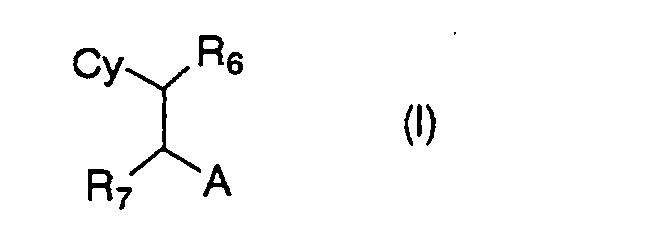
- the compounds of Formula (1) wherein Cy, R 6 , R 7 , R 8 , R 9 , R 20 , R 10 , R 11 , R 12 , R 13 , X and Y are as defined above can basically be produced by binding Compound (I), Compound (II) and Compound (III), which are represented by the following formulae and in which functional groups other than those involved in bond formation are protected as required:
- a and B in Formulae (I) to (III) are functional groups which can form a bond by the reaction with amino; specific examples are carboxyl, formyl, halomethylene of which halogen is chlorine, bromine or iodine, and sulfonyloxymethylene of which sulfonyl is methanesulfonyl, trifluoromethanesulfonyl, paratoluenesulfonyl and the like.
- R 1 to R 10 , R 12 and R 13 are as defined above, provided that when they are reactive groups such as amino, hydroxy or carboxyl, they are protected by normally used appropriate protecting groups, if desired.
- R 11 is as defined above or is a functional group which is convertible to one of the above defined groups.
- the compounds of Formula (1) may be produced by first binding Compound (II) and Compound (III), optionally followed by deprotection, and then binding the resultant compound with Compound (I), optionally followed by deprotection or conversion of the functional group(s).
- the compound of Formula (1) may be produced by first binding Compound (I) and Compound (II), optionally followed by deprotection, and then binding the resultant compound with Compound (III), optionally followed by deprotection or conversion of the functional group(s).
- the compounds of the present invention may be produced by either the solid-phase process or the liquid-phase process.
- an automatic organic synthesizer can be used but it may be replaced by the manual procedure.
- Compound (I) if it has a functional group such as amino and hydroxy, with the functional group being protected, is carboxylic acid (A is -CO 2 H), aldehyde (A is -CHO), alkylhalide (A is -CH 2 -Hal), sulfonate (A is -CH 2 -OSO2R) or the like. In this case, bond can be formed by reacting A of Compound (I) with the amino group of Compound (II).
- Compound (II) can, in almost all cases, be derived from an ⁇ -amino acid and B is carboxyl (-CO 2 H), formyl (-CHO), halomethyl (-CH 2 -Hal), sulfonyloxymethyl (RSO 2 O-CH 2 -) or the like.
- the amino group of Compound (II) is reacted with A of Compound (I) to form bond and B of Compound (II) is reacted with the amino group of Compound (III) to form bond.
- Compound (III) is an ethylamine derivative and can be generally derived from an amino acid. The amino group of Compound (III) is reacted with B of Compound (II) to form bond.
- a or B is carboxyl
- various methods known in peptide synthesis may be used to activate the carboxyl for condensation with the amino group and such methods include the use of benzotriazol-1-yl-oxy-tris(dimethylamino)phosphonium hexafluorophosphate (BOP), the use of PyCIU, the use of bromo tripyrrolidino phosphonium hexafluorophosphate (PyBrop), the use of chlorotripyrrolidino phosphonium hexafluorophosphate (PyClop), the use of O-(7-azabenzotriazol-1-yl)-1,1,3,3-tetramethyluronium hexafluorophosphate (HATU), the use of DIC, the use of N-ethyl-N'-3-dimethylaminopropyl carbodiimide (WSCI), the use of dicyclohexyl carbodiimide (DCC), the use of diphen
- bond can be formed by conventional reductive bond forming reaction with amino group.
- bond can be formed by substitution reaction with amino group.
- the compounds of the present invention can also be produced by applying the specific methods of production to be described in the following Examples.
- Structural formula or chemical name 13 2(2-(2-amino-3-(4-fluorophenylpropanoyl-N-methylamino)-3-methyl)butyrylamino)-3-(3-tertbutyl-4-hydroxyphenyl)propylaminoacetamide 14 N-[2-(3-tertbutyl-4-hydroxyphenyl)-1-(methanesulfonylaminomethyl)ethyl]-2- [N-(4-fluorophenylalaninoyl)methylamino]-3-methylbutanamide 15 2-((2-amino-3-(4-fluorophenyl)propionyl)-N-methylamino)-3-methylbutyric acid 2-(3-t-butyl-4-hydroxyphenyl)-1-carbamidemethylethylamide 16 2-((2-amino-3-(4-fluorophenyl)propionyl)-N-methylamino)-3-methylbuty
- Reaction time means stirring time
- Cold sol means the eluting solvent for silica gel column chromatography
- the retention time (min.) on HPLC is measured under the following conditions:
- N-(2-(benzyloxycarbonylamino)-3-(3-tBu-4-hydroxyphenyl)propyl)urea 0.9 g, 2.26 mmol
- 10% palladium carbon 100 mg was added and stirred in a hydrogen atmosphere at room temperature for 12 hours. After filtration, the filtrate was concentrated under reduced pressure to give N-(2-amino-3-(3-tBu-4-hydroxyphenyl)propyl)urea (0.54 g).
- reaction mixture was mixed with a saturated aqueous NaHCO 3 solution, extracted with ethyl acetate and washed with saturated brine.
- reaction mixture was mixed with water and extracted with ethyl acetate.
- organic layer was dried over magnesium sulfate and evaporated to remove the solvent under reduced pressure.
- N-[3-(4-benzyloxy-3-tert-butylphenyl)-2-benzyloxycarbonylaminopropyl]methanesulfonamide (1.2 g, 2.29 mmol) was dissolved in a mixture of methanol (23 ml) and methylene chloride (5 ml), mixed with palladium hydroxide/carbon (0.60g) and stirred for 12 hours in a hydrogen atmosphere. After filtering off insoluble material using Celite, the filtrate was concentrated to give crude N-[2-amino-3-(4-benzyloxy-3-tert-butylphenyl)propyl]methanesulfonamide (0.68 g).
- Boc-Phe(4-F)-OH 63 mg, 0.222 mmol
- 2-[2-(3-tert-butyl-4-hydroxyphenyl)-1-(3-methyl-2-methylaminobutyrylamino)ethyl]-6-methyl-4-pyrimidinone (B) 77 mg, 0.185 mmol
- CMPI 57 mg, 0.222 mmol
- THF 5 ml
- TEA 0.08 ml, 0.573 mmol
- reaction mixture was filtered and the filtrate was concentrated under reduced pressure; to a solution of the thus obtained residue in THF (13 ml), Z-N-Me-Val-OH (509 mg, 1.92 mmol), CMPI (491 mg, 1.92 mmol) and TEA (0.535 ml, 3.84 mmol) were added under cooling with ice and stirred at room temperature for 3 hours.
- the reaction mixture was mixed with water and extracted with ethyl acetate.
- reaction mixture was mixed with water and extracted with ethyl acetate.
- the reaction mixture was evaporated to remove the solvent under reduced pressure; the thus obtained residue was mixed with methylene chloride, washed with a 2N aqueous sodium hydroxide solution and saturated brine, dried over anhydrous magnesium sulfate and evaporated to remove the solvent under reduced pressure.
- the reaction mixture was evaporated to remove the solvent under reduced pressure; the thus obtained residue was mixed with methylene chloride, washed with a 2N aqueous sodium hydroxide solution and saturated brine, dried over anhydrous magnesium sulfate and evaporated to remove the solvent under reduced pressure.
- Examples 28-64 were conducted according to Scheme 1 and Examples 65-78 were conducted according to Scheme 2.
- the following Reference Examples show the methods of preparing Intermediates of Schemes 1 and 2.
- Table C-1 shows structural formulae of Intermediates of Examples 28-64.
- N-Me-Tyr(3-tBu)-OMe 8.20 g, 31.1 mmol
- methanol 20 ml
- a 30% methylamine methanol solution 200 ml
- Boc-Phe(4-F)-OH 5.0 g, 17.7 mmol
- methylene chloride 89 ml
- BOP reagent 9.39 g, 21.2 mmol
- N,O-dimethylhydroxylamine hydrochloride 2.07 g, 21.2 mmol
- TEA 5.92 ml, 42.5 mmol
- Scheme 1 shows the synthesis scheme of Examples 28-64.
- Scheme 2 shows the synthesis scheme of Examples 65-78.
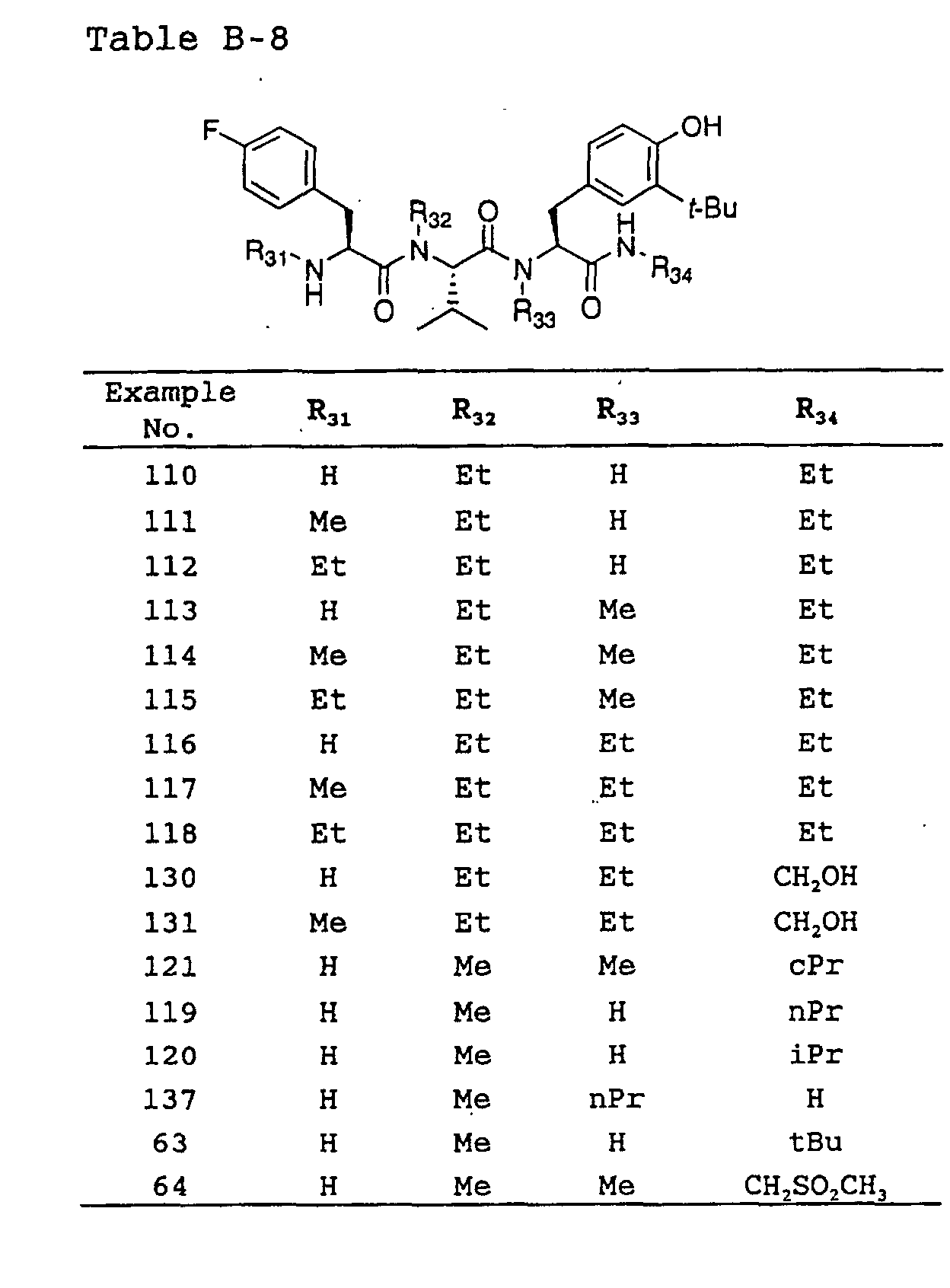
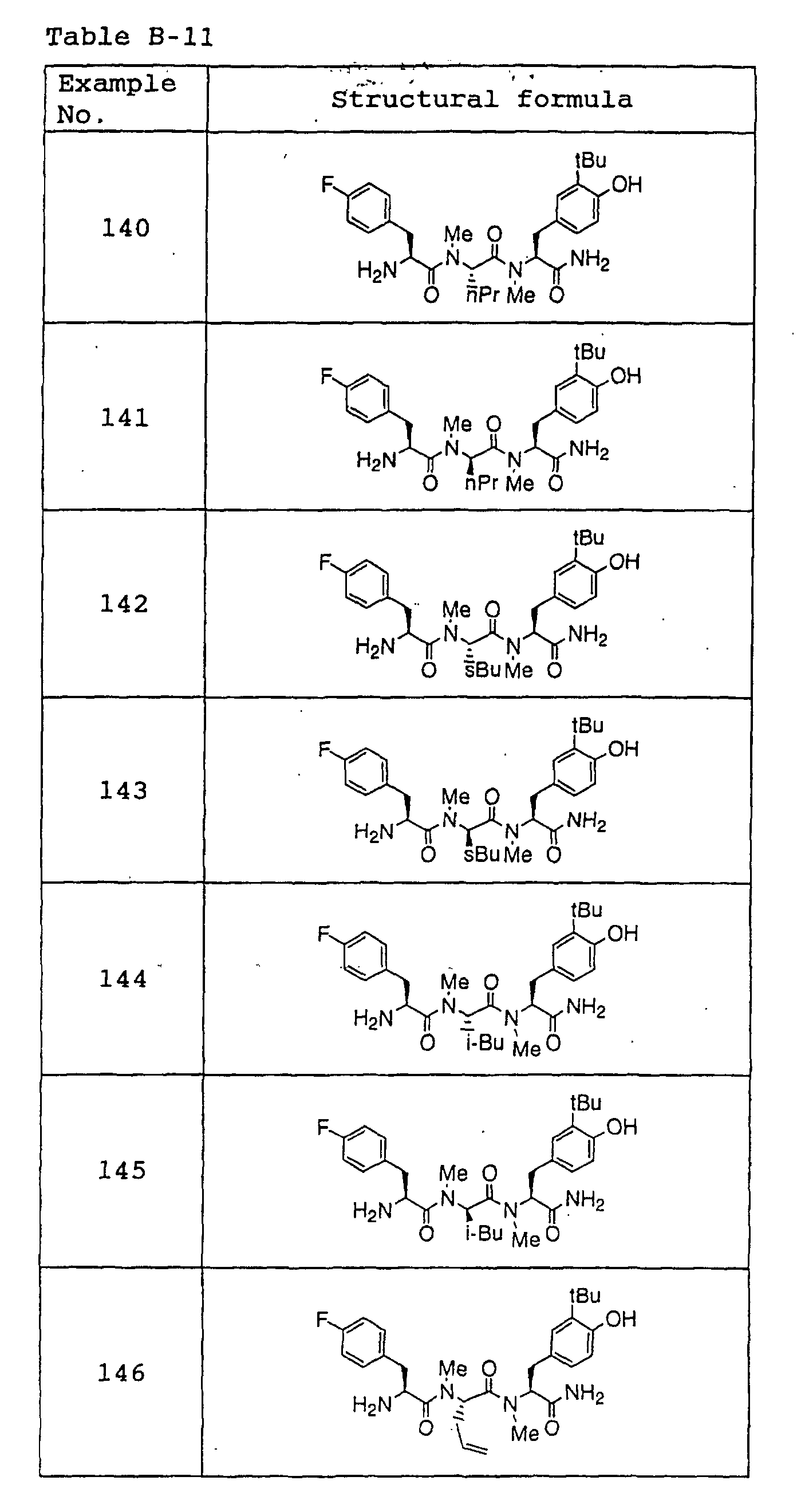
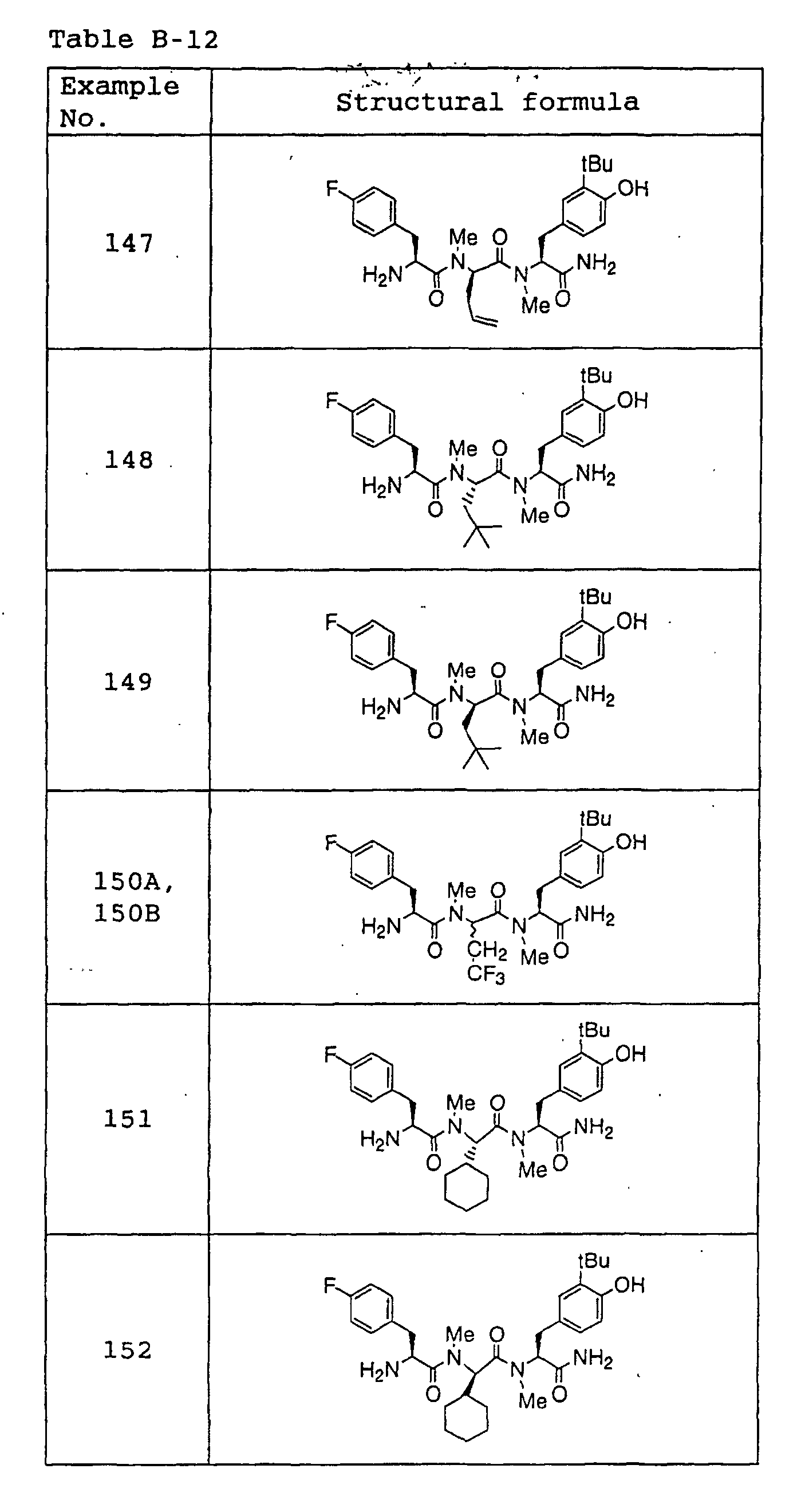
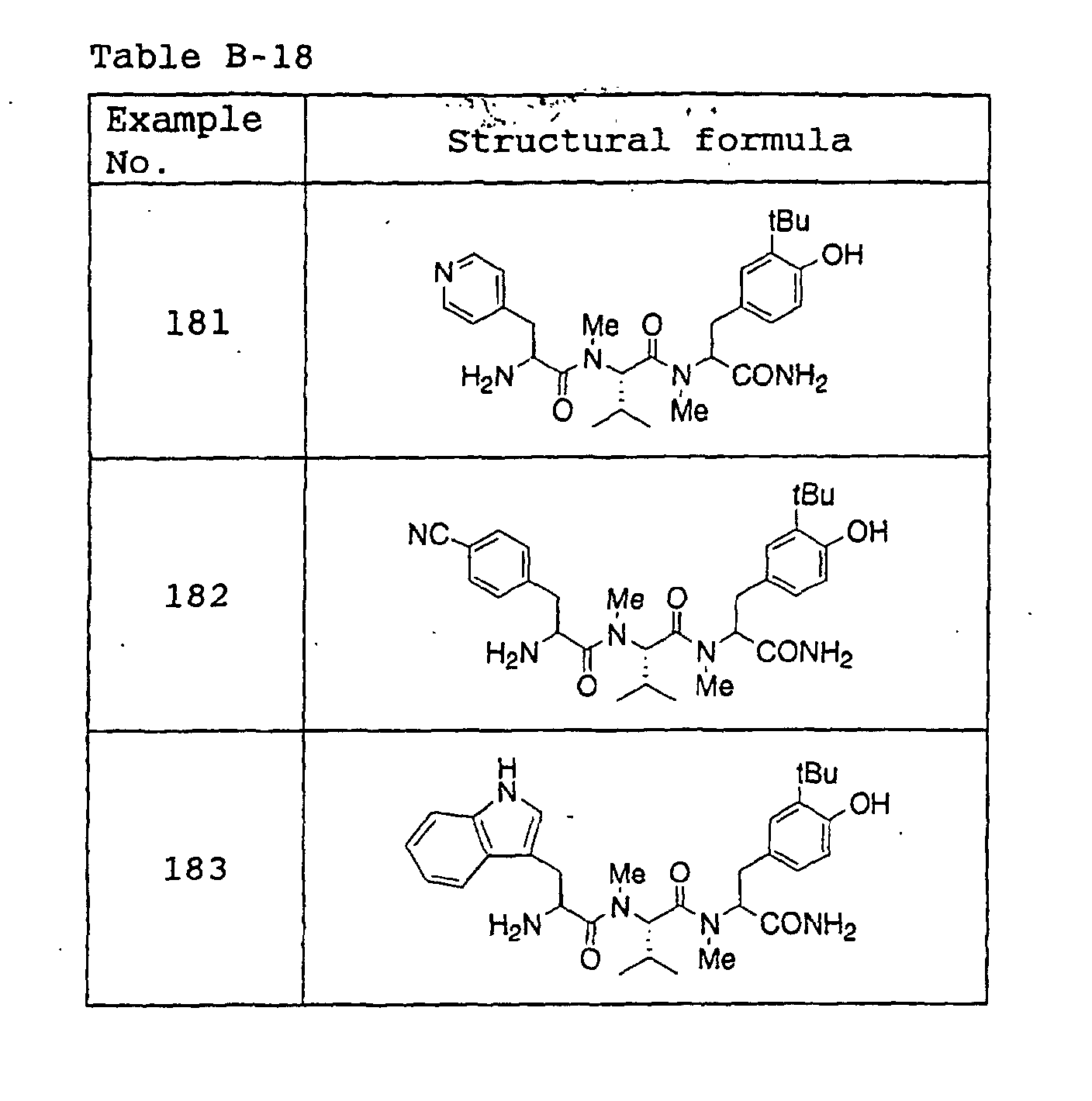
- Examples 101-121 were carried out according to Scheme 3, Examples 121-131 were carried out according to Scheme 4, Example 132 was carried out according to Scheme 5, Examples 133-135 were carried out according to Scheme 6, Example 136 was carried out according to Scheme 7, Example 137 was carried out according to Scheme 8, Examples 138-165 were carried out according to Scheme 9, Examples 166 and 176 were carried out according to Scheme 10, Examples 167-171 were carried out according to Scheme 11, Examples 172 and 173 were carried out according to Scheme 12, Example 174 was carried out according to Scheme 13, Example 175 was carried out according to the scheme 14, Examples 177-179 were carried out according to Scheme 15, Example 180 was carried out according to Scheme 16, Examples 181 and 182 were carried out according to Scheme 17 and Example 183 was carried out according to Scheme 18.
- R 33 and R 34 in the above reaction scheme indicate substituents shown in Tables E-2 to E-6.
- Scheme 3 shows the synthesis process of Examples 101-121.
- R 31 , R 32 , R 33 and R 34 in the above reaction scheme indicate substituents shown in Tables D-101 to D-121.
- R 31 , R 32 , and R 33 in the above reaction scheme indicate substituents shown in Tables D-122 to D-131.
- Scheme 5 shows the synthesis process of Example 132.
- Table D-132 shows Example conducted according to Scheme 5.
- Example 132 Phe(4-F)-N-Me-Val-N-Me-Tyr(3-tBu)-NHCH 2 OH
- R31 R32 R33 H Me Me Reaction1
- Z-N-Me-Val-N-Me-Tyr(3-tBu)-NH 2 (g) HCHO (ml) K 2 CO 3 (g) CH 3 CN (ml) Reaction time (hr)
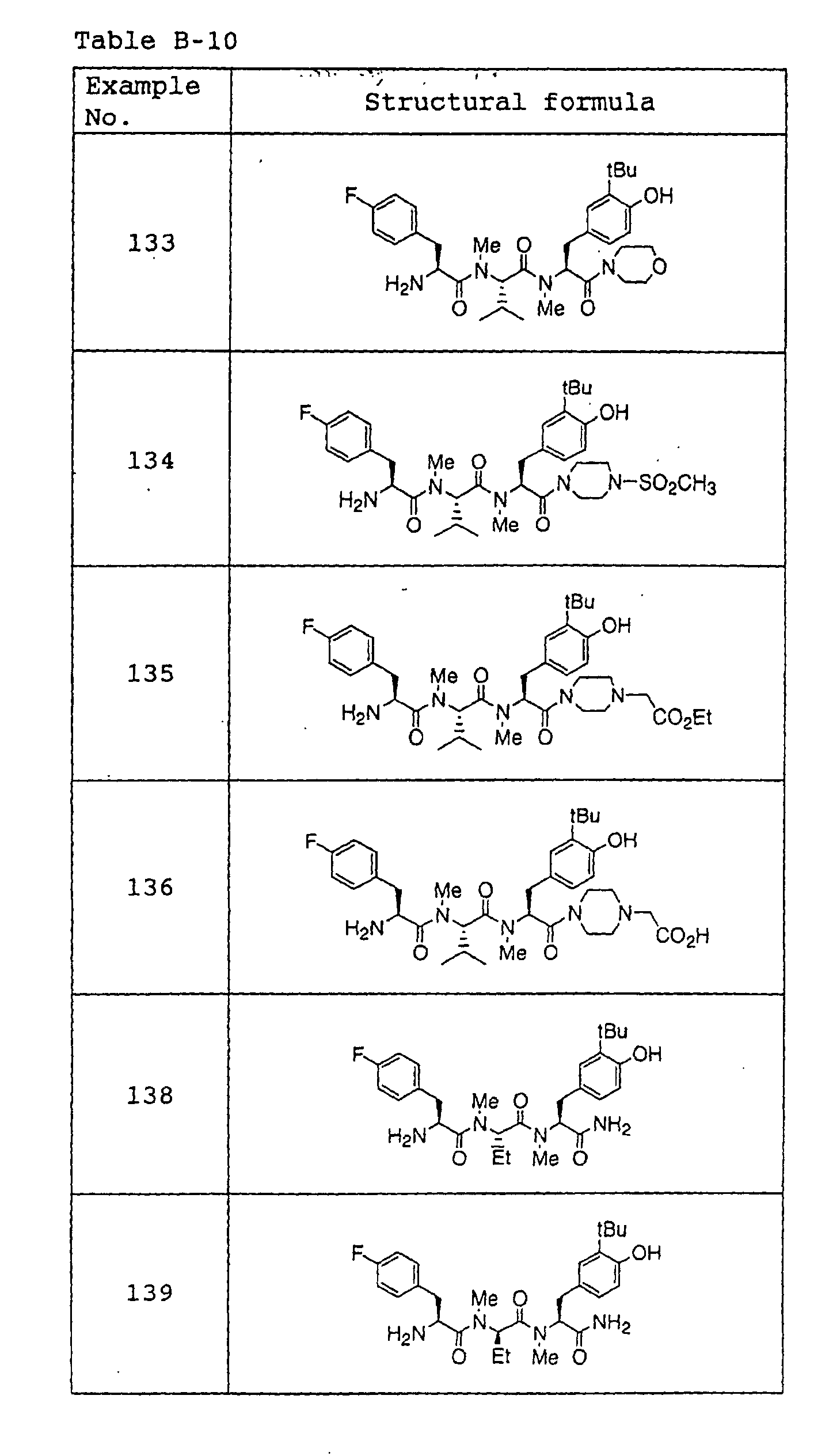
- Scheme 6 shows the synthesis process of Examples 133-135.
- Tables D-133 to D-135 show Examples conducted according to Scheme 6.
- Example 133 (2S)-2-[(2S)-2-amino-3-(4-fluorophenyl)-N-methylpropanoylamino]-N-((1S)-1- ⁇ [3-(tert-butyl)-4-hydroxyphenyl]methyl ⁇ -2-morpholin-4-yl-2-oxoethyl)-3-methyl-N-methylbutanamide
- R 4-morpholine Reaction1 Compound T13(g) Compound V1 (g) CMP1 (g) TEA (ml) THF (ml) Reaction time (hr) Column sol.
- Example 135 The compound obtained in Example 135 was added to a dioxane solution, mixed with a 2N-NaOH solution and stirred at room temperature. The reaction mixture was mixed with water, extracted with ethyl acetate, washed with saturated brine, dried over anhydrous magnesium sulfate and filtered. The filtrate was concentrated under reduced pressure; the thus obtained residue was purified by column chromatography (silica gel) to give the titled compound.
- Table D-136 shows Example conducted according to Scheme 7.
- Example 136 2-[4-((2S)-2- ⁇ (2S)-2-[(2S)-2-amino-3-(4-fluorophenyl)-N-methylpropanoylamino]-3,N-dimethylbutanoylamino ⁇ -3-[3-(tert-butyl)-4-hydroxyphenyl]propanoyl)piperazinyl]acetic acid Reaction Compound of Example 135(g) NaOH (g) H 2 O (ml) Dioxane (ml) Reaction time (hr) Column sol.
- Table D-137 shows Example conducted according to Scheme 8.
- Example 137 Phe(4-F)-N-Me-Val-N-Pr-Tyr(3-tBu)-NH 2 Reaction1
- Compound V3 (g) Compound P4 (g) CMPI (g) TEA (ml) THF (ml) Reaction time (hr) Column sol.
Landscapes
- Chemical & Material Sciences (AREA)
- Organic Chemistry (AREA)
- Health & Medical Sciences (AREA)
- Life Sciences & Earth Sciences (AREA)
- General Health & Medical Sciences (AREA)
- Medicinal Chemistry (AREA)
- Biochemistry (AREA)
- Biophysics (AREA)
- Genetics & Genomics (AREA)
- Molecular Biology (AREA)
- Proteomics, Peptides & Aminoacids (AREA)
- General Chemical & Material Sciences (AREA)
- Bioinformatics & Cheminformatics (AREA)
- Chemical Kinetics & Catalysis (AREA)
- Engineering & Computer Science (AREA)
- Nuclear Medicine, Radiotherapy & Molecular Imaging (AREA)
- Pharmacology & Pharmacy (AREA)
- Animal Behavior & Ethology (AREA)
- Public Health (AREA)
- Veterinary Medicine (AREA)
- Diabetes (AREA)
- Endocrinology (AREA)
- Pharmaceuticals Containing Other Organic And Inorganic Compounds (AREA)
- Peptides Or Proteins (AREA)
- Medicines That Contain Protein Lipid Enzymes And Other Medicines (AREA)
- Organic Low-Molecular-Weight Compounds And Preparation Thereof (AREA)
- Heterocyclic Carbon Compounds Containing A Hetero Ring Having Nitrogen And Oxygen As The Only Ring Hetero Atoms (AREA)
- Acyclic And Carbocyclic Compounds In Medicinal Compositions (AREA)
Abstract

when Cy is 3-indolyl,
- (i) R11 is an optionally substituted heterocyclic ring; or
- (ii) R6 is hydrogen, R7 is amino, R8 is methyl, R9 is isopropyl, R20 is hydrogen, R10 is methyl, R11 is carbamoyl, R12 is hydroxy, R13 is tert-butyl, X is carbonyl and Y is carbonyl, and
or a hydrate or pharmaceutically acceptable salt thereof.
Description
when Cy is 3-indolyl,
- (i) R11 is an optionally substituted heterocyclic ring; or
- (ii) R6 is hydrogen, R7 is amino, R8 is methyl, R9 is isopropyl, R20 is hydrogen, R10 is methyl, R11 is carbamoyl, R12 is hydroxy, R13 is tert-butyl, X is carbonyl and Y is carbonyl, and



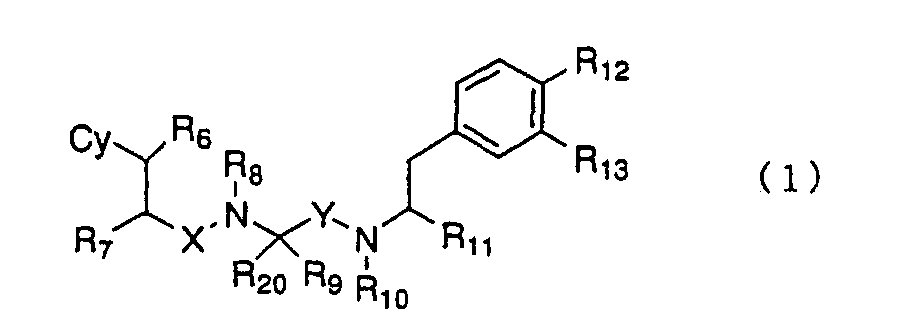
Cy, R6, R7, R8, R9, R20, R10, R11, R12, R13, X and Y are as defined as above
include those compounds of which Cy is a group of Formula (2) in which at least one of R1, R2, R3, R4 and R5 is halogen and the others are hydrogen or hydroxy; R6 is hydrogen or methyl; R7 is hydrogen or optionally substituted amino; R8 is hydrogen or methyl; R9 is methyl, isopropyl, isobutyl, sec-butyl, tert-butyl, 3-pentyl, neopentyl, cyclohexyl, phenyl, benzyl, para-hydroxybenzyl, para-fluorobenzyl or cyclohexylmethyl; R20 is hydrogen; R10 is hydrogen or methyl; R11 is methyl, hydroxymethyl, carbamoylmethyl, methanesulfonylmethyl, ureidemethyl, sulfamoylaminomethyl, methanesulfonylaminomethyl, carbamoyl, methylcarbamoyl, ethylcarbamoyl, n-propylcarbamoyl, isopropylcarbamoyl, cyclopropylcarbamoyl, tert-butylcarbamoyl, 2-pyridylcarbamoyl, methanesulfonylmethylcarbamoyl, methoxymethylcarbamoyl, methoxycarbamoyl, 1-morpholinylcarbonyl, 4-carboxymethyl-1-piperazinecarbonyl, 4-ethoxycarbonylmethyl-1-piperazinecarbonyl, 4-methylsulfonyl-1-piperazinecarbonyl, 2-thiazolyl, 1,3,4-oxadiazol-2-yl, 1,2,4-oxadiazol-5-yl, 1,3,4-triazol-2-yl or 6-methyl-4-pyrimidinon-2-yl; R12 is hydroxy; R13 is isopropyl, tert-butyl (tBu), 1,1-dimethylpropyl or 1,1-dimethyl-2-propenyl. More preferred compounds are Phe(4-F)-N-Me-Val-N-Me-Tyr(3-tBu)-NH2, Phe(4-Cl)-N-Me-Val-N-Me-Tyr(3-tBu)-NH2, Phe(3,4-F2)-N-Me-Val-N-Me-Tyr(3-tBu)-NH2, Phe(3-F)-N-Me-Val-N-Me-Tyr(3-tBu)-NH2, Phe(4-F)-N-Me-Val-N-Me-Tyr(3-tBu)-NHOMe, 2-((2-amino-3-(4-fluorophenyl)propionyl)-N-methylamino)-3-methylbutyric acid 2-(3-tert-butyl-4-hydroxyphenyl)-1-(2-pyridylcarbamoyl)ethylamide, N-(2-(2-((2-amino-3-(4-fluorophenyl)propionyl)-N-methylamino)-3-methyl-butyrylamino)-3-(3-tBu-4-hydroxyphenyl)propyl)urea, N-(2-(2-(2-amino-3-(4-fluorophenylpropanoyl-N-methylamino)-3-methyl)butyrylamino)-3-(3-tert-butyl-4-hydroxyphenyl)propyl)sulfamide, N-[2-(3-tert-butyl-4-hydroxyphenyl)-1-(methanesulfonylaminomethyl)ethyl]-2-[N-(4-fluorophenylalanynoyl)methylamino]-3-methylbutanamide, 2-((2-amino-3-(4-fluorophenyl)propionyl)-N-methylamino)-3-methylbutyric acid 2-(3-t-butyl-4-hydroxyphenyl)-1-carbamidemethylethylamide, 2-((2-amino-3-(4-fluorophenyl)propionyl)-N-methylamino)-3-methylbutyric acid 2-(3-t-butyl-4-hydroxyphenyl)-1-methanesulfonylmethylethylamide, 2-(2-((2-amino-3-(4-fluorophenyl)propionyl)-N-methylamino)-3-methyl-butyrylamino)-3-(3-tBu-4-hydroxyphenyl)propanol, 2-(1-(2-((2-amino-3-(4-fluorophenyl)propionyl)-N-methylamino)-3-methyl-butyrylamino)-2-(3-tert-butyl-4-hydroxyphenyl)ethyl)-6-methyl-4-pyrimidinone, 2-((2-amino-3-(4-fluorophenyl)propionyl)-N-methylamino)-3-methylbutyric acid 2-(3-t-butyl-4-hydroxyphenyl)-1-(1,3,4-oxadiazol-2-yl)ethylamide, 2-((2-amino-3-(4-fluorophenyl)propionyl)-N-methylamino)-3-methylbutyric acid 2-(3-t-butyl-4-hydroxyphenyl)-1-(1,2,4-oxadiazol-5-yl)ethylamide, 2-((2-amino-3-(4-fluorophenyl)propionyl)-N-methylamino)-3-methylbutyric acid 2-(3-tert-butyl-4-hydroxyphenyl)-1-(thiazol-2-yl)ethylamide, 2-((2-amino-3-(4-fluorophenyl)propionyl)-N-methylamino)-3-methylbutyric acid 2-(3-t-butyl-4-hydroxyphenyl)-1-(1,3,4-triazol-2-yl)ethylamide, Tyr(2-F)-N-Me-Val-N-Me-Tyr(3-tBu)-NH2, Tyr(3-F)-N-Me-Val-N-Me-Tyr(3-tBu)-NH2, Phe(4-F)-N-Me-Val-Tyr(3-tBu)-NH2, N-Me-Phe(4-F)-N-Me-Val-Tyr(3-tBu)-NH2, N-Et-Phe(4-F)-N-Me-Val-Tyr(3-tBu)-NH2, Phe(4-F)-N-Me-Val-Tyr(3-tBu)-NHMe, N-Me-Phe(4-F)-N-Me-Val-Tyr(3-tBu)-NHMe, N-Et-Phe(4-F)-N-Me-Val-Tyr(3-tBu)-NHMe, N-Me-Phe(4-F)-N-Me-Val-N-Me-Tyr(3-tBu)-NH2, N-Et-Phe(4-F)-N-Me-Val-N-Me-Tyr(3-tBu)-NH2, Phe(4-F)-N-Me-Val-N-Me-Tyr(3-tBu)-NHMe, N-Me-Phe(4-F)-N-Me-Val-N-Me-Tyr(3-tBu)-NHMe, N-Et-Phe(4-F)-N-Me-Val-N-Me-Tyr(3-tBu)-NHMe, Phe(4-F)-N-Me-Val-N-Et-Tyr(3-tBu)-NH2, N-Me-Phe(4-F)-N-Me-Val- N-Et-Tyr(3-tBu)-NH2, N-Et-Phe(4-F)-N-Me-Val- N-Et-Tyr(3-tBu)- NH2, Phe(4-F)-N-Me-Val-N-Et-Tyr(3-tBu)-NHMe, N-Me-Phe(4-F)-N-Me-Val-N-Et-Tyr(3-tBu)-NHMe, N-Et-Phe(4-F)-N-Me-Val-N-Et-Tyr(3-tBu)-NHMe, Phe(4-F)-N-Me-Val-Tyr(3-tBu)-NHtBu, Phe(4-F)-N-Me-Val-N-Me-Tyr(3-tBu)-NHCH2SO2CH3, Phe(4-F)-N-Me-Val-Tyr(3-tBu)-NHEt, N-Me-Phe(4-F)-N-Me-Val-Tyr(3-tBu)-NHEt, N-Et-Phe(4-F)-N-Me-Val-Tyr(3-tBu)-NHEt, Phe(4-F)-N-Me-Val-Tyr(3-tBu)-NHCH2OH, N-Me-Phe(4-F)-N-Me-Val-Tyr(3-tBu)-NHCH2OH, N-Et-Phe(4-F)-N-Me-Val-Tyr(3-tBu)-NHCH2OH, Phe(4-F)-N-Me-Val-N-Me-Tyr(3-tBu)-NHEt, N-Me-Phe(4-F)-N-Me-Val-N-Me-Tyr(3-tBu)-NHEt, N-Et-Phe(4-F)-N-Me-Val-N-Me-Tyr(3-tBu)-NHEt, Phe(4-F)-N-Me-Val-N-Me-Tyr(3-tBu)-NHCH2OH, N-Me-Phe(4-F)-N-Me-Val-N-Me-Tyr(3-tBu)-NHCH2OH, N-Et-Phe(4-F)-N-Me-Val-N-Me-Tyr(3-tBu)-NHCH2OH, Phe(4-F)-N-Me-Val-N-Et-Tyr(3-tBu)-NHEt, N-Me-Phe(4-F)-N-Me-Val-N-Et-Tyr(3-tBu)-NHEt, N-Et-Phe(4-F)-N-Me-Val-N-Et-Tyr(3-tBu)-NHEt, Phe(4-F)-N-Me-Val-N-Et-Tyr(3-tBu)-NHCH2OH, N-Me-Phe(4-F)-N-Me-Val-N-Et-Tyr(3-tBu)-NHCH2OH, N-Et-Phe(4-F)-N-Me-Val-N-Et-Tyr(3-tBu)-NHCH2OH, Phe(4-F)-N-Me-Val-N-Me-Tyr(3-tBu)-NHcPr and Phe(4-F)-N-Me-Val-Tyr(3-tBu)-NHnPr Phe(4-F)-N-Me-Val-Tyr(3-tBu)-NHiPr.
Particularly preferred compounds are Phe(4-F)-N-Me-Val-N-Me-Tyr(3-tBu)-NH2, Phe(4-Cl)-N-Me-Val-N-Me-Tyr(3-tBu)-NH2, Phe(3,4-F2)-N-Me-Val-N-Me-Tyr(3-tBu)-NH2, N-Me-Phe(4-F)-N-Me-Val-Tyr(3-tBu)-NHEt, 2-((2-amino-3-(4-fluorophenyl)propionyl)-N-methylamino)-3-methylbutyric acid 2-(3-tert-butyl-4-hydroxyphenyl)-1-(2-pyridylcarbamoyl)ethylamide, 2-((2-amino-3-(4-fluorophenyl)propionyl)-N-methylamino)-3-methylbutyric acid 2-(3-t-butyl-4-hydroxyphenyl)-1-methanesulfonylmethylethylamide and 2-(2-((2-amino-3-(4-fluorophenyl)propionyl)-N-methylamino)-3-methyl-butyrylamino)-3-(3-tBu-4-hydroxyphenyl)propanol.

can basically be produced by binding Compound (I), Compound (II) and Compound (III), which are represented by the following formulae and in which functional groups other than those involved in bond formation are protected as required:


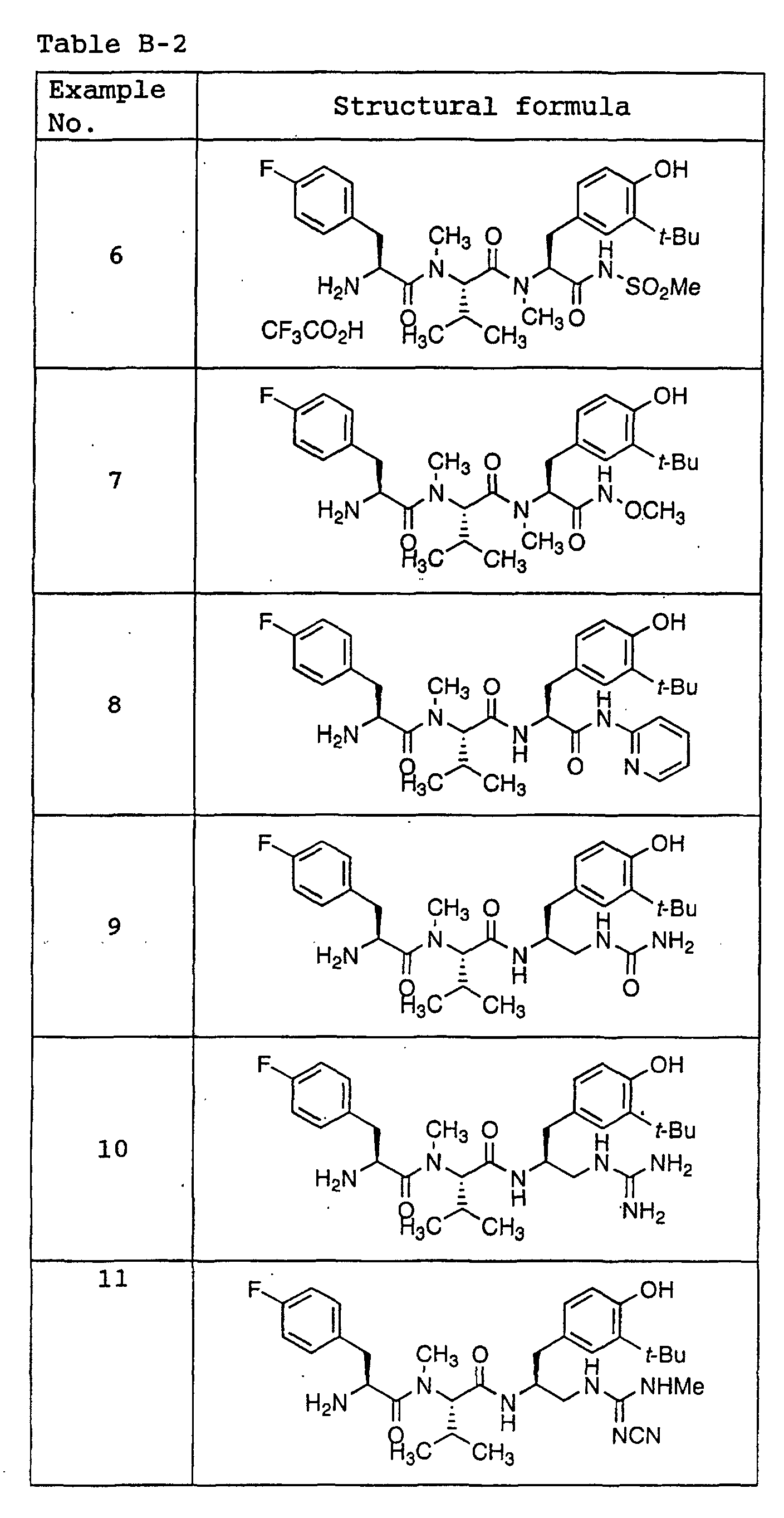
| Example No. | Structural formula or chemical name |
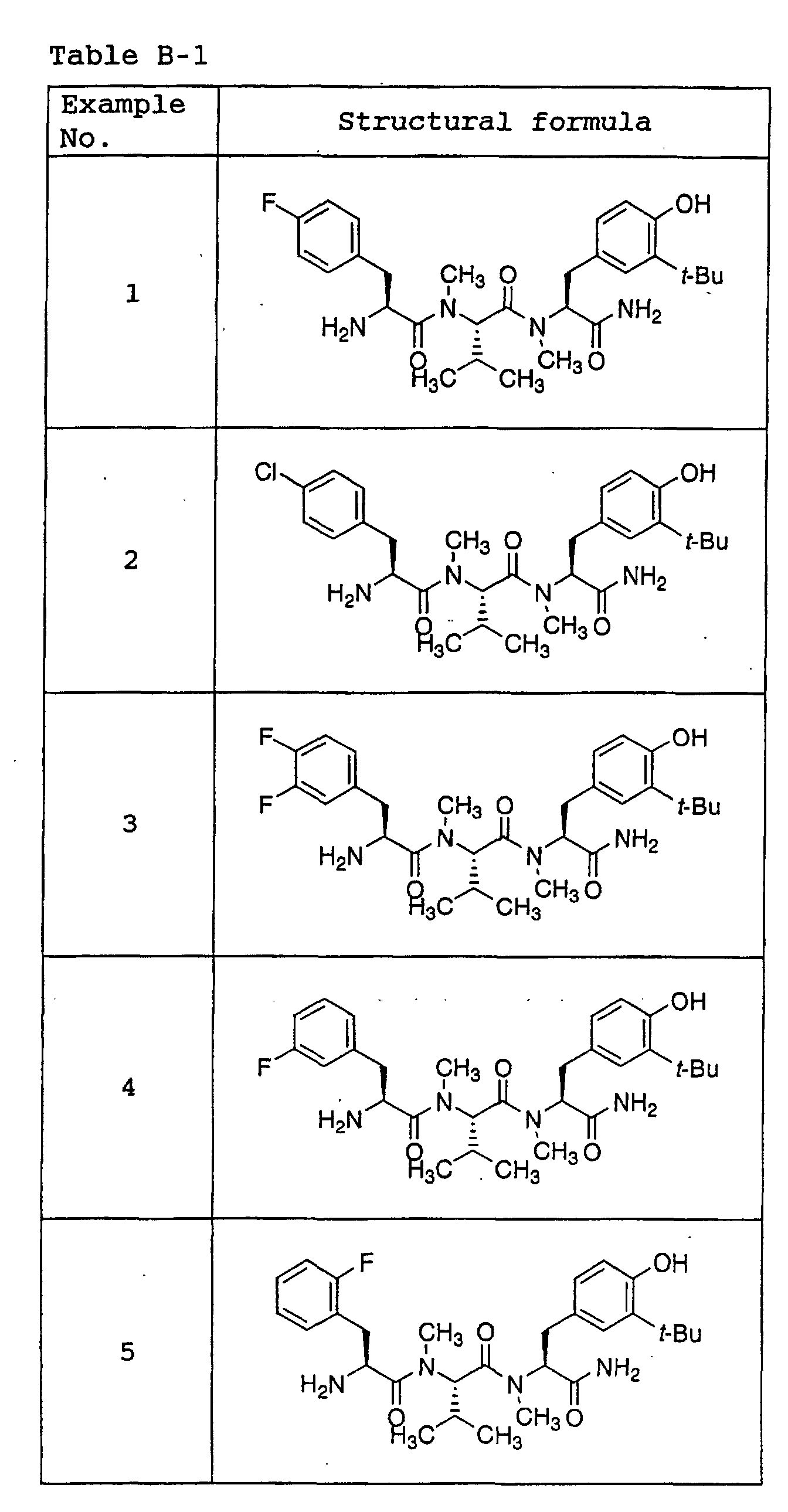
| 1 | Phe(4-F)-N-Me-Val-N-Me-Tyr(3-tBu)-NH2 |
| 2 | Phe(4-Cl)-N-Me-Val-N-Me-Tyr(3-tBu)-NH2 |
| 3 | Phe(3,4-F2)-N-Me-Val-N-Me-Tyr(3-tBu)-NH2 |
| 4 | Phe(3-F)-N-Me-Val-N-Me-Tyr(3-tBu)-NH2 |
| 5 | Phe(2-F)-N-Me-Val-N-Me-Tyr(3-tBu)-NH2 |
| 6 | Phe(4-F)-N-Me-Val-N-Me-Tyr(3-tBu)-NHSO2Me TFAsalt |
| 7 | Phe(4-F)-N-Me-Val-N-Me-Tyr(3-tBu)-NHOMe |
| 8 | 2-((2-amino-3-(4-fluorophenyl)propionyl)-N-methylamino)-3-methylbutyric 2- (3-tertbutyl-4-hydroxyphenyl)-1-(2-pyridylcarbamoyl)ethylamide |
| 9 | N-(2-(2-((2-amino-3-(4-fluorophenyl)propionyl)-N-methylamino)-3-methyl-butyrylamino)-3-(3-tBu-4-hydroxyphenyl)propyl)urea |
| 10 | N-(2-(2-((2-amino-3-(4-fluorophenyl)propionyl)-N-methylamino)-3-methyl-butyrylamino) -3- (3-tBu-4-hydroxyphenyl )propyl )guanidine |
| 11 | N-(2-(2-((2-amino-3-(4-fluorophenyl)propionyl)-N-methylamino)-3-methyl-butyrylamino)-3-(3-tBu-4-hydroxyphenyl)propyl)-N'-cyano-N''-methylguanidine |
| 12 | 2-(2-(2-amino-3-(4-fluorophenylpropanoyl-N-methylamino)-3-methyl)butyrylamino)-3-(3-tertbutyl-4-hydroxyphenyl)propylsulfamide |
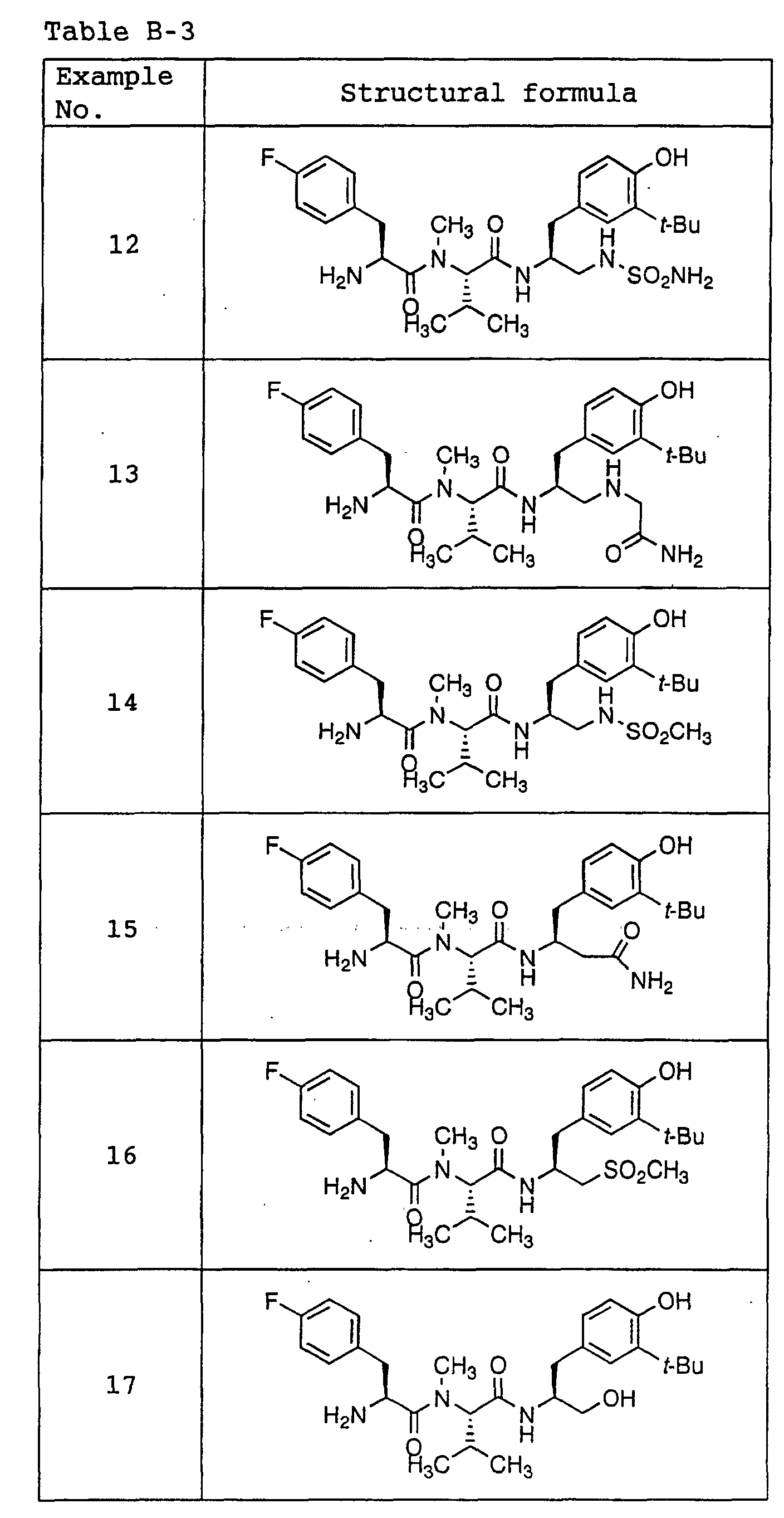
| Example No. | Structural formula or chemical name |
| 13 | 2(2-(2-amino-3-(4-fluorophenylpropanoyl-N-methylamino)-3-methyl)butyrylamino)-3-(3-tertbutyl-4-hydroxyphenyl)propylaminoacetamide |
| 14 | N-[2-(3-tertbutyl-4-hydroxyphenyl)-1-(methanesulfonylaminomethyl)ethyl]-2- [N-(4-fluorophenylalaninoyl)methylamino]-3-methylbutanamide |
| 15 | 2-((2-amino-3-(4-fluorophenyl)propionyl)-N-methylamino)-3-methylbutyric acid 2-(3-t-butyl-4-hydroxyphenyl)-1-carbamidemethylethylamide |
| 16 | 2-((2-amino-3-(4-fluorophenyl)propionyl)-N-methylamino)-3-methylbutyric acid 2-(3-t-butyl-4-hydroxyphenyl)-1-methanesulfonylmethylethylamide |
| 17 | 2-(2-((2-amino-3-(4-fluorophenyl)propionyl)-N-methylamino)-3-methyl-butyrylamino)-3-(3-tBu-4-hydroxyphenyl)propanol |
| 18 | (2-(2-(2-amino-3-(4-fluorophenyl)propylamino)-3-methyl-butyrylamino)-3-(3-tBu-4-hydroxyphenyl)propyl)methylsulfone |
| 19 | 2-(1-(2-((2-amino-3-(4-fluorophenyl)propionyl)-N-methylamino)-3-methyl-butyrylamino)-2-(3-tertbutyl-4-hydroxyphenyl)ethyl)-6-methyl-4-pyrimidinone |
| 20 | 5-(1-(2-((2-amino-3-(4-fluorophenyl)propanoyl)-N-methylamino)-3-methylbutyrylamino)-2-(3-tertbutyl-4-hydroxyphenyl)ethyl)imidazolidine-2,4-dione |
| 21 | 2-((2-amino-3-(4-fluorophenyl)propionyl)-N-methylamino)-3-methylbutyric acid 2-(3-t-butyl-4-hydroxyphenyl)-1-(1,3,4-oxadiazol-2-yl)ethylamide |
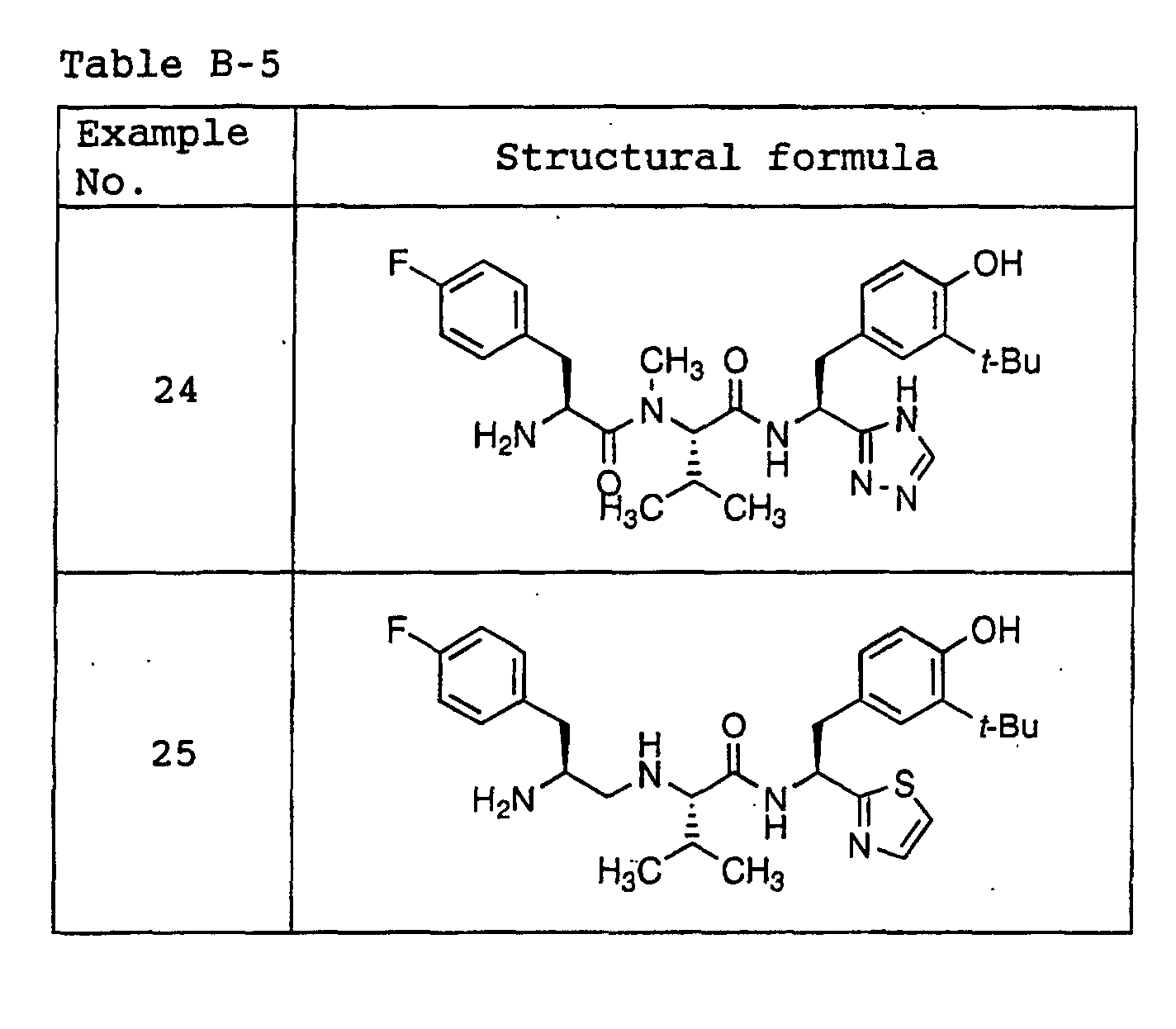
| Example No. | Structural formula or chemical name |
| 22 | 2-((2-amino-3-(4-fluorophenyl)propionyl)-N-methylamino)-3-methylbutyric acid 2-(3-t-butyl-4-hydroxyphenyl)-1-(1,2,4-oxadiazol-5-yl)ethylamide |
| 23 | 2-((2-amino-3-(4-fluorophenyl)propionyl)-N-methylamino)-3-methylbutyric acid 2-(3-tertbutyl-4-hydroxyphenyl)-1-(thiazol-2-yl)ethylamide |
| 24 | 2-((2-amino-3-(4-fluorophenyl)propionyl)-N-methylamino)-3-methylbutyric acid 2-(3-t-butyl-4-hydroxyphenyl)-1-(1,3,4-triazol-2-yl)ethylamide |
| 25 | 2-[2-amino-3-(4-fluorophenyl)propyl]amino-3-methylbutyric acid 2-(3-tertbutyl-4-hydroxyphenyl)-1-(thiazol-2-yl)ethylamide |
| Example No. | Structural formula or chemical name |
| 26 | Tyr(2-F )-N-Me-Val-N-Me-Tyr(3-tBu)-NH2 |
| 27 | Tyr(3-F )-N-Me-Val-N-Me-Tyr(3-tBu)-NH2 |
| 28 | Phe(4-F)-N-Me-Val-Tyr(3-tBu)-NH2 |
| 29 | N-Me-Phe(4-F)-N-Me-Val-Tyr(3-tBu)- NH2 |
| 30 | N-Et-Phe(4-F)-N-Me-Val-Tyr(3-tBu)- NH2 |
| 31 | Phe(4-F)-N-Me-Val-Tyr(3-tBu)-NHMe |
| 32 | N-Me-Phe(4-F)-N-Me-Val-Tyr(3-tBu)- NHMe |
| 33 | N-Et-Phe(4-F)-N-Me-Val-Tyr(3-tBu)- NHMe |
| 34 | N-Me-Phe(4-F)-N-Me-Val-N-Me-Tyr(3-tBu)- NH2 |
| 35 | N-Et-Phe(4-F)-N-Me-Val-N-Me-Tyr(3-tBu)- NH2 |
| 36 | Phe(4-F)-N-Me-Val-N-Me-Tyr(3-tBu)-NHMe |
| 37 | N-Me-Phe(4-F)-N-Me-Val-N-Me-Tyr(3-tBu)- NHMe |
| 38 | N-Et-Phe(4-F)-N-Me-Val-N-Me-Tyr(3-tBu)- NHMe |
| 39 | Phe(4-F)-N-Me-Val-N-Et-Tyr(3-tBu)-NH2 |
| 40 | N-Me-Phe(4-F)-N-Me-Val- N-Et-Tyr(3-tBu)- NH2 |
| 41 | N-Et-Phe(4-F)-N-Me-Val- N-Et-Tyr(3-tBu)- NH2 |
| 42 | Phe(4-F)-N-Me-Val-N-Et-Tyr(3-tBu)-NHMe |
| 43 | N-Me-Phe(4-F)-N-Me-Val- N-Et-Tyr(3-tBu)- NHMe |
| 44 | N-Et-Phe(4-F)-N-Me-Val- N-Et-Tyr(3-tBu)- NHMe |
| 45 | Phe(4-F)-N-Et-Val-Tyr(3-tBu)-NH2 |
| 46 | N-Me-Phe(4-F)-N-Et-Val-Tyr(3-tBu)- NH2 |
| 47 | N-Et-Phe(4-F)-N-Et-Val-Tyr(3-tBu)- NH2 |
| 48 | Phe(4-F)-N-Et-Val-Tyr(3-tBu)-NHMe |
| 49 | N-Me-Phe(4-F)-N-Et-Val-Tyr(3-tBu)- NHMe |
| 50 | N-Et-Phe(4-F)-N-Et-Val-Tyr(3-tBu)- NHMe |
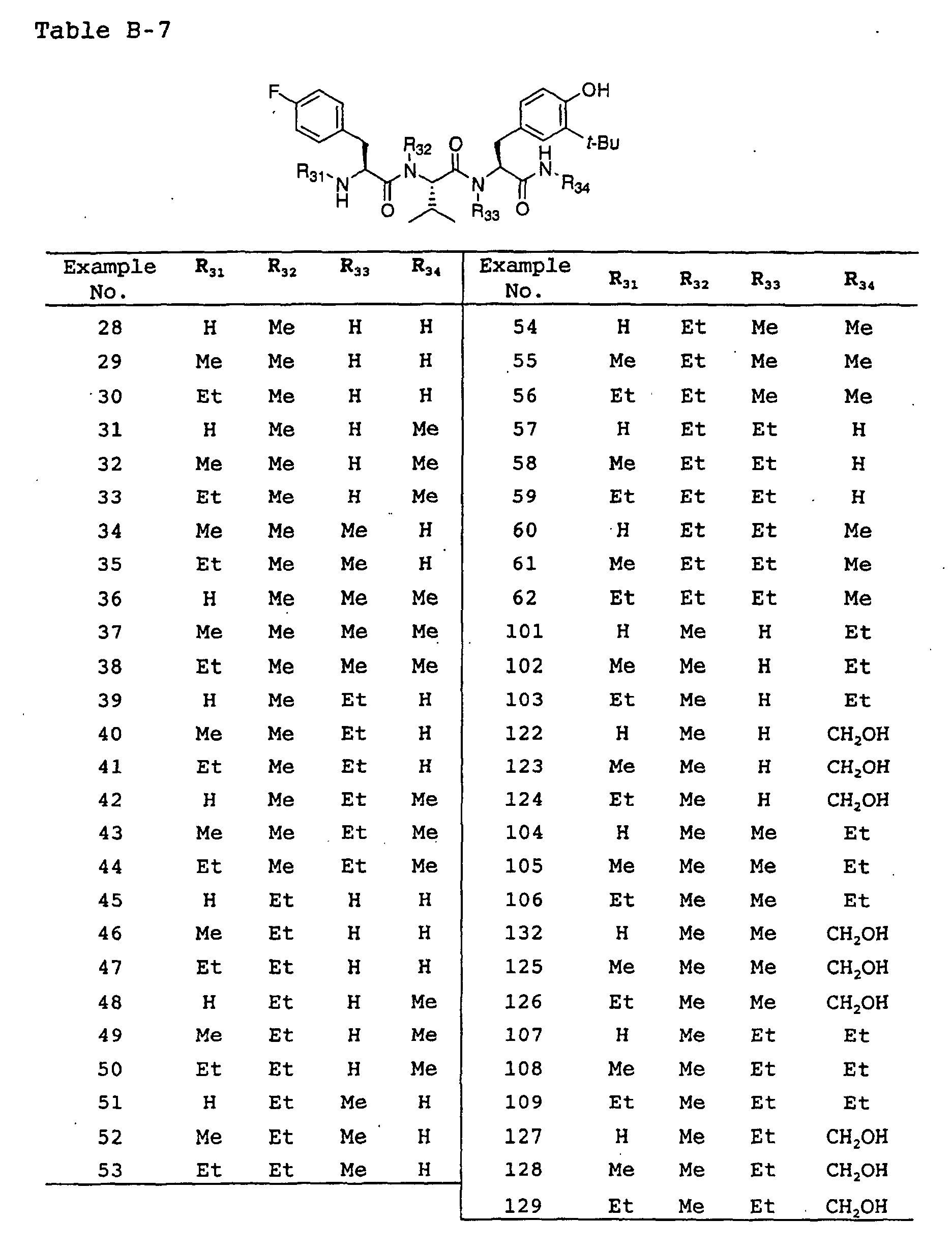
| Example No. | Structural formula or chemical name |
| 51 | Phe(4-F)-N-Et-Val-N-Me-Tyr(3-tBu)-NH2 |
| 52 | N-Me-Phe(4-F)-N-Et-Val- N-Me-Tyr(3-tBu)-NH2 |
| 53 | N-Et-Phe(4-F)-N-Et-Val- N-Me-Tyr(3-tBu)-NH2 |
| 54 | Phe(4-F)-N-Et-Val-N-Me-Tyr(3-tBu)-NHMe |
| 55 | N-Me-Phe(4-F)-N-Et-Val- N-Me-Tyr(3-tBu)-NHMe |
| 56 | N-Et-Phe(4-F)-N-Et-Val- N-Me-Tyr(3-tBu)-NHMe |
| 57 | Phe(4-F)-N-Et-Val-N-Et-Tyr(3-tBu)-NH2 |
| 58 | N-Me-Phe(4-F)-N-Et-Val- N-Et-Tyr(3-tBu)-NH2 |
| 59 | N-Et-Phe(4-F)-N-Et-Val- N-Et-Tyr(3-tBu)-NH2 |
| 60 | Phe(4-F)-N-Et-Val-N-Et-Tyr(3-tBu)-NHMe |
| 61 | N-Me-Phe(4-F)-N-Et-Val- N-Et-Tyr(3-tBu)-NHMe |
| 62 | N-Et-Phe(4-F)-N-Et-Val- N-Et-Tyr(3-tBu)-NHMe |
| 63 | Phe(4-F)-N-Me-Val-Tyr(3-tBu)-NHtBu |
| 64 | Phe(4-F)-N-Me-Val-N-Me-Tyr(3-tBu)-NHCH2SO2CH3 |
| 65 | 2-(2-amino-3-(4-fluorophenyl)propylamino)-N-(2-(3-tert-butyl-4-hydroxyphenyl)-1-carbamoylethyl)-N-methyl-3-methylbutanamide |
| 66 | 2-(2-amino-3-(4-fluorophenyl)-N-methylpropylamino)-N-(2-(3-tert-butyl-4-hydroxyphenyl)-1-carbamoylethyl)-N-methyl-3-methylbutanamide |
| 67 | 2-(N-acetyl-2-amino-3-(4-fluorophenyl)propylamino)-N-(2-(3-tert-butyl-4-hydroxyphenyl)-1-carbamoylethyl)-N-methyl-3-methylbutanamide |
| 68 | 2-(2-amino-3-(4-fluorophenyl)propylamino)-N-(2-(3-tert-butyl-4-hydroxyphenyl)-1-carbamoylethyl)-N-ethyl-3-methylbutanamide |
| 69 | 2-(2-amino-3-(4-fluorophenyl)propylamino)-N-(2-(3-tert-butyl-4-hydroxyphenyl)-1-hydroxymethylethyl)-3-methylbutanamide |
| 70 | 2-(2-amino-3-(4-fluorophenyl)-N-methylpropylamino)-N-(2-(3-tert-butyl-4-hydroxyphenyl)-1-hydroxymethylethyl)-3-methylbutanamide |
| Example No. | Structural formula or chemical name |
| 71 | 2-(2-amino-3-(4-fluorophenyl)propylamino)-N-(2-(3-tert-butyl-4-hydroxyphenyl)-1-methylethyl)-N-methyl-3-methylbutanamide |
| 72 | 2-(2-amino-3-(4-fluorophenyl)-N-methylpropylamino)-N-(2-(3-tert-butyl-4-hydroxyphenyl)-1-methylethyl)-N-methyl-3-methylbutanamide |
| 73 | 2-(N-acetyl-2-amino-3-(4-fluorophenyl)propylamino)-N-(2-(3-tert-butyl-4-hydroxyphenyl)-1-methylethyl)-N-methyl-3-methylbutanamide |
| 74 | 2-(2-amino-3-(4-fluorophenyl)propylamino)-N-(2-(3-tert-butyl-4-hydroxyphenyl)-1-methylethyl)-3-methylbutanamide |
| 75 | 2-((2-amino-3-(4-fluorophenyl)propyl)-N-methylamino)-N-(2-(3-tert-butyl-4-hydroxyphenyl)-1-methylethyl)-3-methylbutanamide |
| 76 | 2-(N-acetyl-2-amino-3-(4-fluorophenyl)propylamino)-N-(2-(3-tert-butyl-4-hydroxyphenyl)-1-methylethyl)-3-methylbutanamide |
| 77 | 2-((2-amino-3-(4-fluorophenyl)propyl)-N-methylamino)-N-(2-(3-tert-butyl-4-hydroxyphenyl)-1-hydroxymethylethyl)-N,3-dimethylbutanamide |
| 78 | 2-(2-amino-3-(4-fluorophenyl)-N-methylpropylamino)-N-(1-aminomethyl-2-(3-tert-butyl-4-hydroxyphenyl)ethyl)-3-methylbutanamide |
| Example No. | Structural formula or chemical name |
| 101 | Phe(4-F)-N-Me-Val -Tyr(3-tBu)-NHEt |
| 102 | N-Me-Phe(4-F)-N-Me-Val -Tyr(3-tBu)-NHEt |
| 103 | N-Et-Phe(4-F)-N-Me-Val -Tyr(3-tBu)-NHEt |
| 104 | Phe(4-F)-N-Me-Val-N-Me-Tyr(3-tBu)-NHEt |
| 105 | N-Me-Phe(4-F)-N-Me-Val-N-Me-Tyr(3-tBu)-NHEt |
| 106 | N-Et-Phe(4-F)-N-Me-Val-N-Me-Tyr(3-tBu)-NHEt |
| 107 | Phe(4-F)-N-Me-Val-N-Et-Tyr(3-tBu)-NHEt |
| 108 | N-Me-Phe(4-F)-N-Me-Val-N-Et-Tyr(3-tBu)-NHEt |
| 109 | N-Et-Phe(4-F)-N-Me-Val-N-Et-Tyr(3-tBu)-NHEt |
| 110 | Phe(4-F)-N-Et-Val -Tyr(3-tBu)-NHEt |
| 111 | N-Me-Phe(4-F)-N-Et-Val -Tyr(3-tBu)-NHEt |
| 112 | N-Et -Phe(4-F)-N-Et-Val -Tyr(3-tBu)-NHEt |
| 113 | Phe(4-F)-N-Et-Val-N-Me-Tyr(3-tBu)-NHEt |
| 114 | N-Me-Phe(4-F)-N-Et-Val-N-Me-Tyr(3-tBu)-NHEt |
| 115 | N-Et-Phe(4-F)-N-Et-Val-Me-Tyr(3-tBu)-NHEt |
| 116 | Phe(4-F)-N-Et-Val-N-Et-Tyr(3-tBu)-NHEt |
| 117 | N-Me-Phe(4-F)-N-Et-Val-N-Et-Tyr(3-tBu)-NHEt |
| 118 | N-Et-Phe(4-F)-N-Et-Val-N-Et-Tyr(3-tBu)-NHEt |
| 119 | Phe(4-F)-N-Me-Val- Tyr(3-t Bu)-NH-n-Pr |
| 120 | Phe(4-F)-N-Me-Val-Tyr(3-tBu)-NH-i-Pr |
| 121 | Phe(4-F)-N-Me-Val-N-Me-Tyr(3-t Bu)-NH-c-Pr |
| 122 | Phe(4-F)-N-Me-Val-Tyr(3-tBu)-NHCH2OH |
| 123 | N-Me-Phe(4-F)-N-Me-Val-Tyr(3-tBu)-NHCH2OH |
| 124 | N-Et-Phe(4-F)-N-Me-Val-Tyr(3-tBu)-NHCH2OH |
| 125 | N-Me-Phe(4-F)-N-Me-Val-N-Me-Tyr(3-tBu)-NHCH2OH |
| Example No. | Structural formula or chemical name |
| 126 | N-Et-Phe(4-F)-N-Me-Val-N-Me-Tyr(3-tBu)-NHCH2OH |
| 127 | Phe(4-F)-N-Me-Val-N-Et-Tyr(3-tBu)-NHCH2OH |
| 128 | N-Me-Phe(4-F)-N-Me-Val-N-Et-Tyr(3-tBu)-NHCH2OH |
| 129 | N-Et-Phe(4-F)-N-Me-Val-N-Et-Tyr(3-tBu)-NHCH2OH |
| 130 | Phe(4-F)-N-Et-Val-N-Et-Tyr(3-tBu)-NHCH2OH |
| 131 | N-Me-Phe(4-F)-N-Et-Val-N-Et-Tyr(3-tBu)-NHCH2OH |
| 132 | Phe(4-F)-N-Me-Val-N-Me-Tyr(3-tBu)-NHCH2OH |
| 133 | (2S)-2-[(2S)-2-amino-3-(4-fluorophenyl)-N-methylpropanolyamino]-N-((1S)-1-{[3-(tert-butyl)-4-hydroxyphenyl]methyl}-2-morpholin-4-yl-2-oxoethyl)-3-methyl-N-methylbutanamide |
| 134 | (2S)-2-[(2S)-2-amino-3-(4-fluorophenyl)-N-methylpropanolyamino]-N-((1S)-1-{[3-(tert-butyl)-4-hydroxyphenyl]methyl}-2-[4-(methylsulfonyl)piperazinyl]-2-oxoethyl)-3-methyl-N-methylbutanamide |
| 135 | ethyl 2-[4-((2S)-2-{(2S)-2-[(2S)-2-amino-3-(4-fluorophenyl)-N-methylpropanolyamino]-3,N-dimethylbutanoylamino}-3-[3-(tert-butyl)-4-hydroxyphenyl] propanoly)piperazinyl]acetate |
| 136 | 2-[4-((2S)-2-{(2S)-2-[(2S)-2-amino-3-(4-fluorophenyl)-N-methylpropanolyamino]-3,N-dimethylbutanoylamino}-3-[3-(tert-butyl)-4-hydroxyphenyl]propanoly)piperazinyl]acetic acid |
| 137 | Phe(4-F)-N-Me-Val-N-Pr-Tyr(3-tBu)-NH2 |
| 138 | Phe(4-F)-N-Me-Abu-N-Me-Tyr(3-tBu)-NH2 |
| 139 | Phe(4-F)-N-Me-D-Abu-N-Me-Tyr(3-tBu)-NH2 |
| 140 | Phe(4-F)-N-Me-Nva-N-Me-Tyr(3-tBu)-NH2 |
| Example No. | Structural formula or chemical name |
| 141 | Phe(4-F)-N-Me-D-Nva-N-Me-Tyr(3-tBu)-NH2 |
| 142 | Phe(4-F)-N-Me-Ile-N-Me-Tyr(3-tBu)-NH2 |
| 143 | Phe(4-F)-N-Me-D-Ile-N-Me-Tyr(3-tBu)-NH2 |
| 144 | Phe(4-F)-N-Me-Leu-N-Me-Tyr(3-tBu)-NH2 |
| 145 | Phe(4-F)-N-Me-D-Leu-N-Me-Tyr(3-tBu)-NH2 |
| 146 | (2S)-2-[(2S)-2-amino-3-(4-fluorophenyl)-N-methylpropanolyamino]-N-{(1S)-2-[3-(tert-butyl)-4-hydroxyphenyl]-1-carbamoylethyl)-N-methylpent-4-enamide |
| 147 | (2R)-2-[(2S)-2-amino-3-(4-fluorophenyl)-N-methylpropanolyamino]-N-{(1S)-2-[3-(tert-butyl)-4-hydroxyphenyl]-1-carbamoylethyl)-N-methylpent-4-enamide |
| 148 | Phe(4-F)-N-Me-Leu(γ-Me)-N-Me-Tyr(3-tBu)-NH2 |
| 149 | Phe(4-F)-N-Me-D-Leu(γ-Me)-N-Me-Tyr(3-tBu)-NH2 |
| 150 | Phe(4-F)-N-Me-Ala(β-CF3)-N-Me-Tyr(3-tBu)-NH2 |
| 151 | Phe(4-F)-N-Me-Chg-N-Me-Tyr(3-tBu)-NH2 |
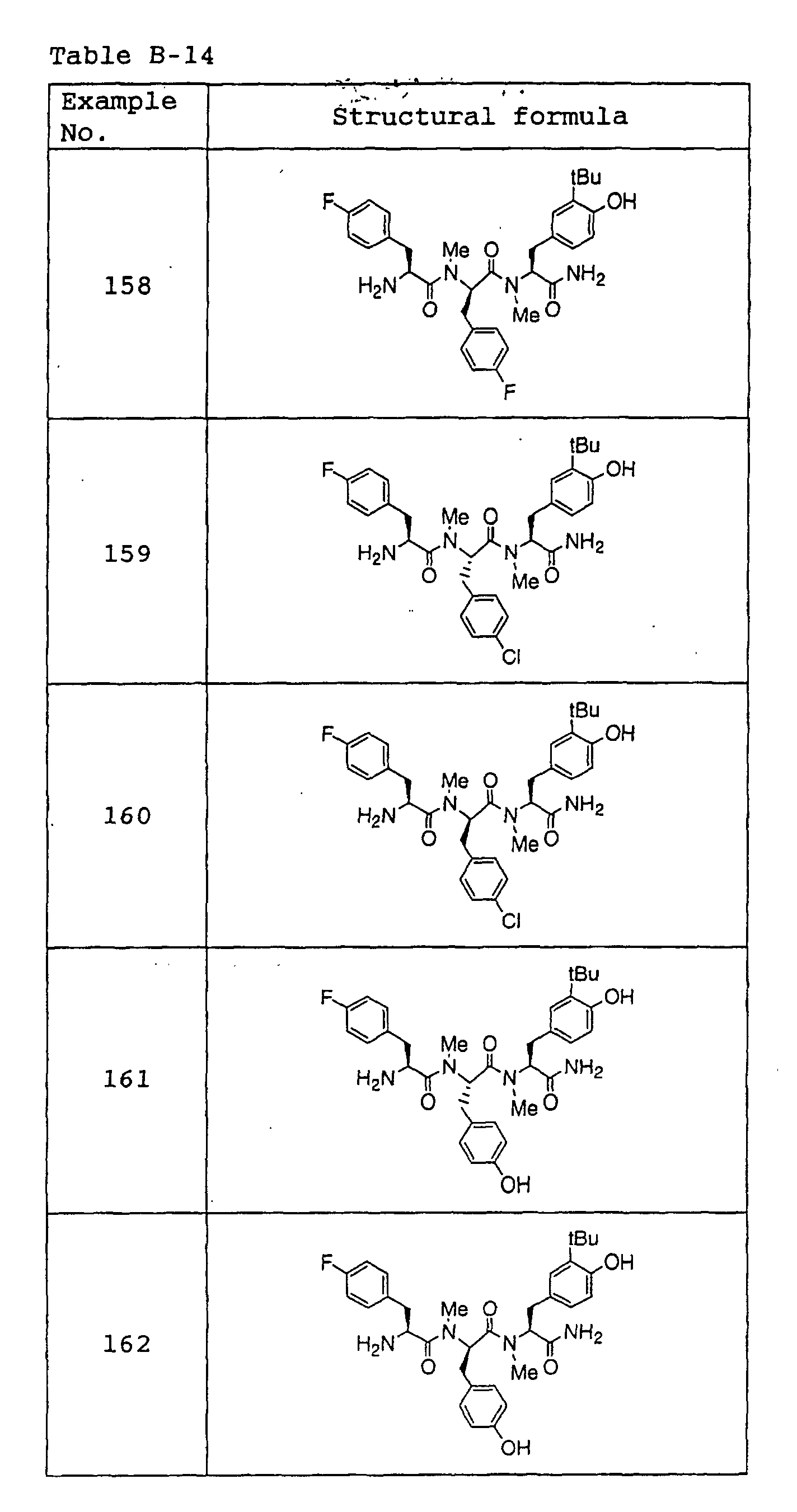
| 152 | Phe(4-F)-N-Me-D-Chg-N-Me-Tyr(3-tBu)-NH2 |
| 153 | Phe(4-F)-N-Me-Cha-N-Me-Tyr(3-tBu)-NH2 |
| 154 | Phe(4-F)-N-Me-D-Cha-N-Me-Tyr(3-tBu)-NH2 |
| 155 | Phe(4-F)-N-Me-Phe-N-Me-Tyr(3-tBu)-NH2 |
| 156 | Phe(4-F)-N-Me-D-Phe-N-Me-Tyr(3-tBu)-NH2 |
| 157 | Phe(4-F)-N-Me-Phe(4-F)-N-Me-Tyr(3-tBu)-NH2 |
| 158 | Phe(4-F)-N-Me-D-Phe(4-F)-N-Me-Tyr(3-tBu)-NH2 |
| 159 | Phe(4-F)-N-Me-Phe(4-Cl)-N-Me-Tyr(3-tBu)-NH2 |
| 160 | Phe(4-F)-N-Me-D-Phe(4-Cl)-N-Me-Tyr(3-tBu)-NH2 |
| 161 | Phe(4-F)-N-Me-Tyr-N-Me-Tyr(3-tBu)-NH2 |
| 162 | Phe(4-F)-N-Me-D-Tyr-N-Me-Tyr(3-tBu)-NH2 |
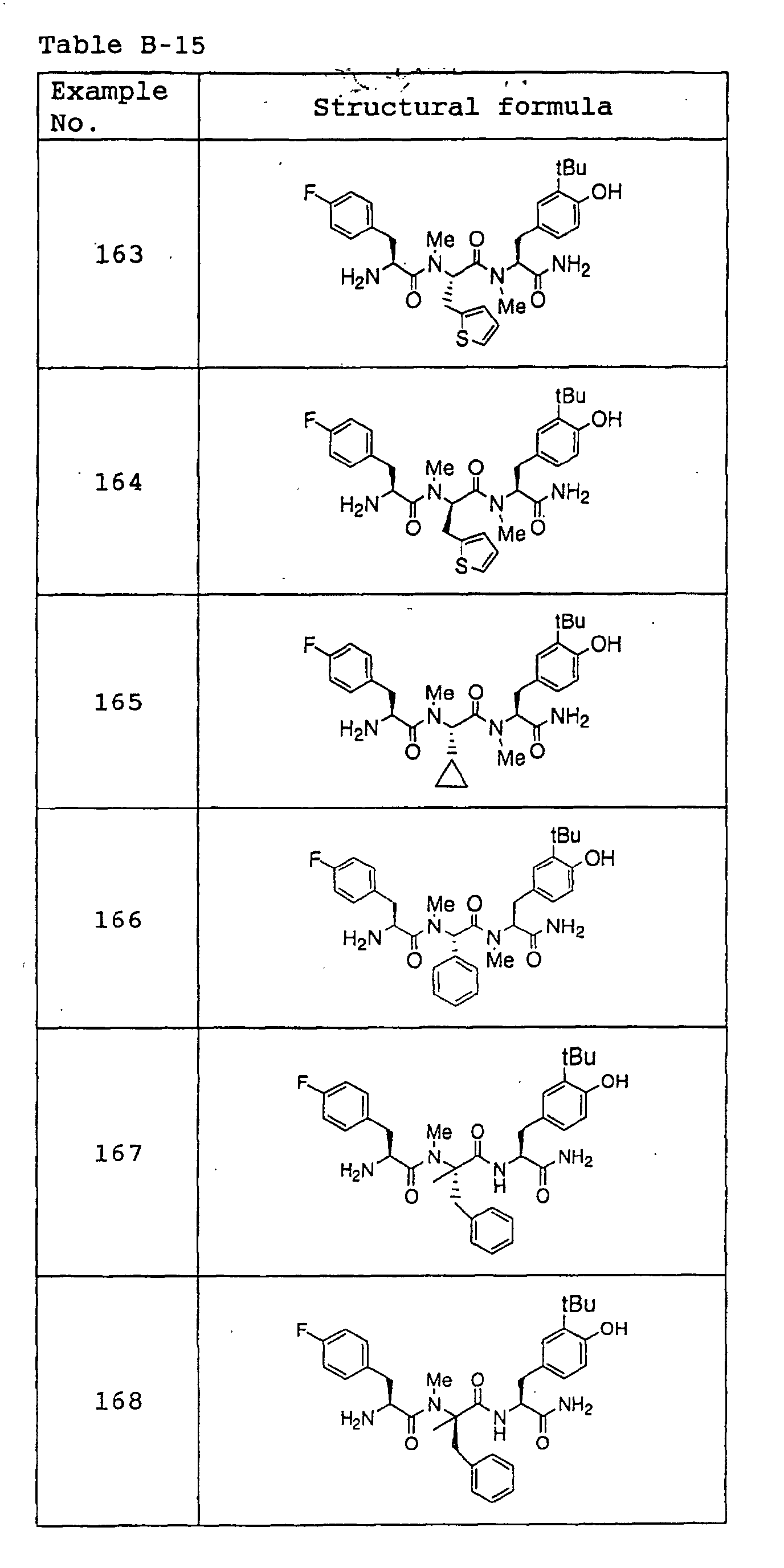
| 163 | Phe(4-F)-N-Me-Ala(β-2-thienyl)-N-Me-Tyr(3-tBu)-NH2 |
| Example No. | Structural formula or chemical name |
| 164 | Phe(4-F)-N-Me-D-Ala(β-2-thienyl)-N-Me-Tyr(3-tBu)-NH2 |
| 165 | Phe(4-F)-N-Me-Ala(β-c-Pr)-N-Me-Tyr(3-tBu)-NH2 |
| 166 | Phe(4-F)-N-Me-Phg-N-Me-Tyr(3-tBu)-NH2 |
| 167 | Phe(4-F)-N-Me-α-Me-Phe-Tyr(3-tBu)-NH2 |
| 168 | Phe(4-F)-N-Me-α-Me-Phe-Tyr(3-tBu)-NH2 |
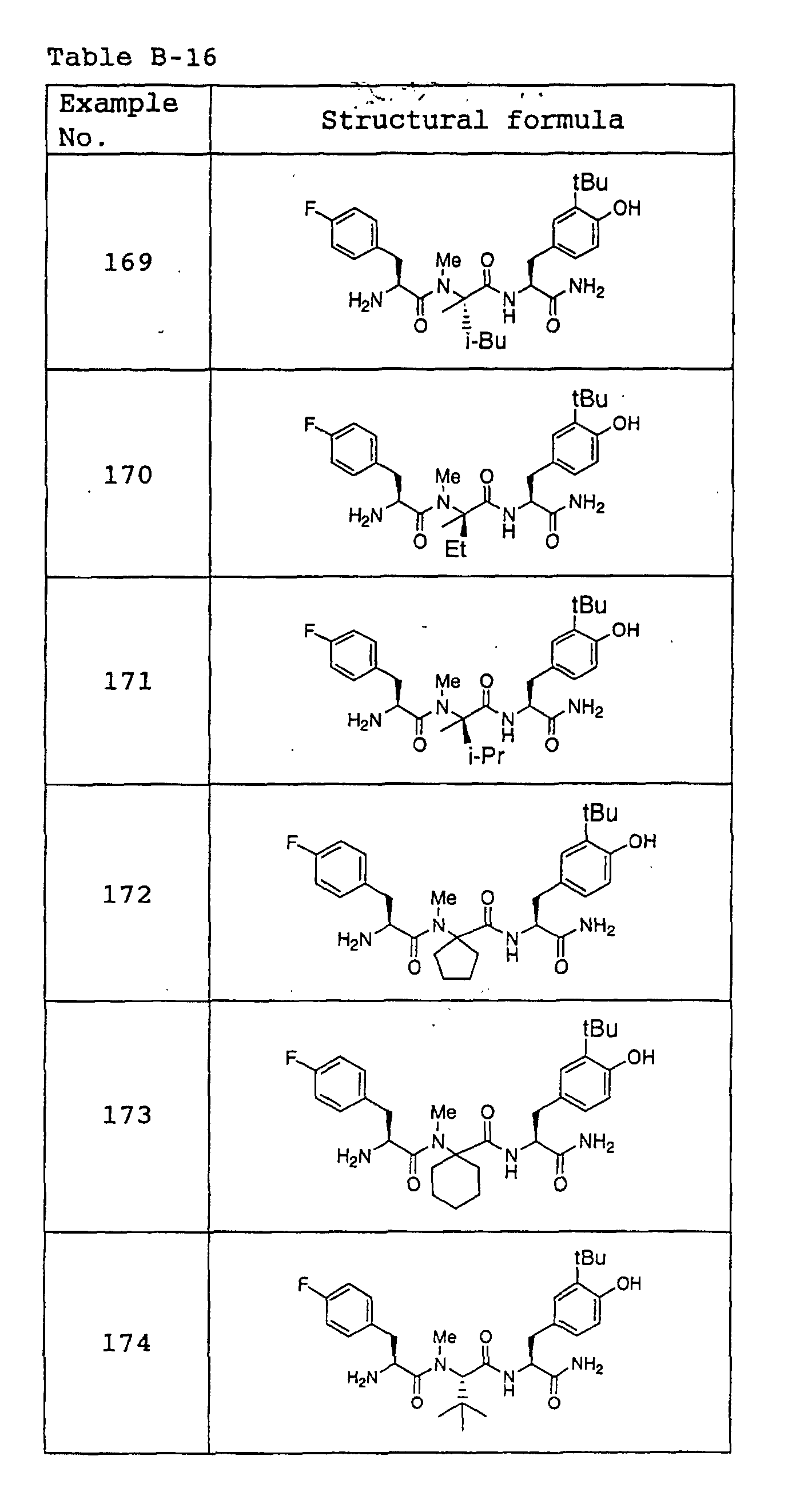
| 169 | Phe(4-F)-N-Me-α-Me-Leu-Tyr(3-tBu)-NH2 |
| 170 | Phe(4-F)-N-Me-α-Me-D-Abu-Tyr(3-tBu)-NH2 |
| 171 | Phe(4-F)-N-Me-α-Me-D-Val-Tyr(3-tBu)-NH2 |
| 172 | (2S)-N-[(N-{(1S)-2-[3-(tert-butyl)-4-hydroxyphenyl]-1-carbamoylethyl}carbamoyl)cyclopentyl]-2-amino-3-(4-fluorophenyl)-N-methylpropanamide |
| 173 | (2S)-N-[(N-{(1S)-2-[3-(tert-butyl)-4-hydroxyphenyl]-1-carbamoylethyl}carbamoyl)cyclohexyl]-2-amino-3-(4-fluorophenyl)-N-methylpropanamide |
| 174 | Phe(4-F)-N-Me-Tle-Tyr(3-tBu)-NH2 |
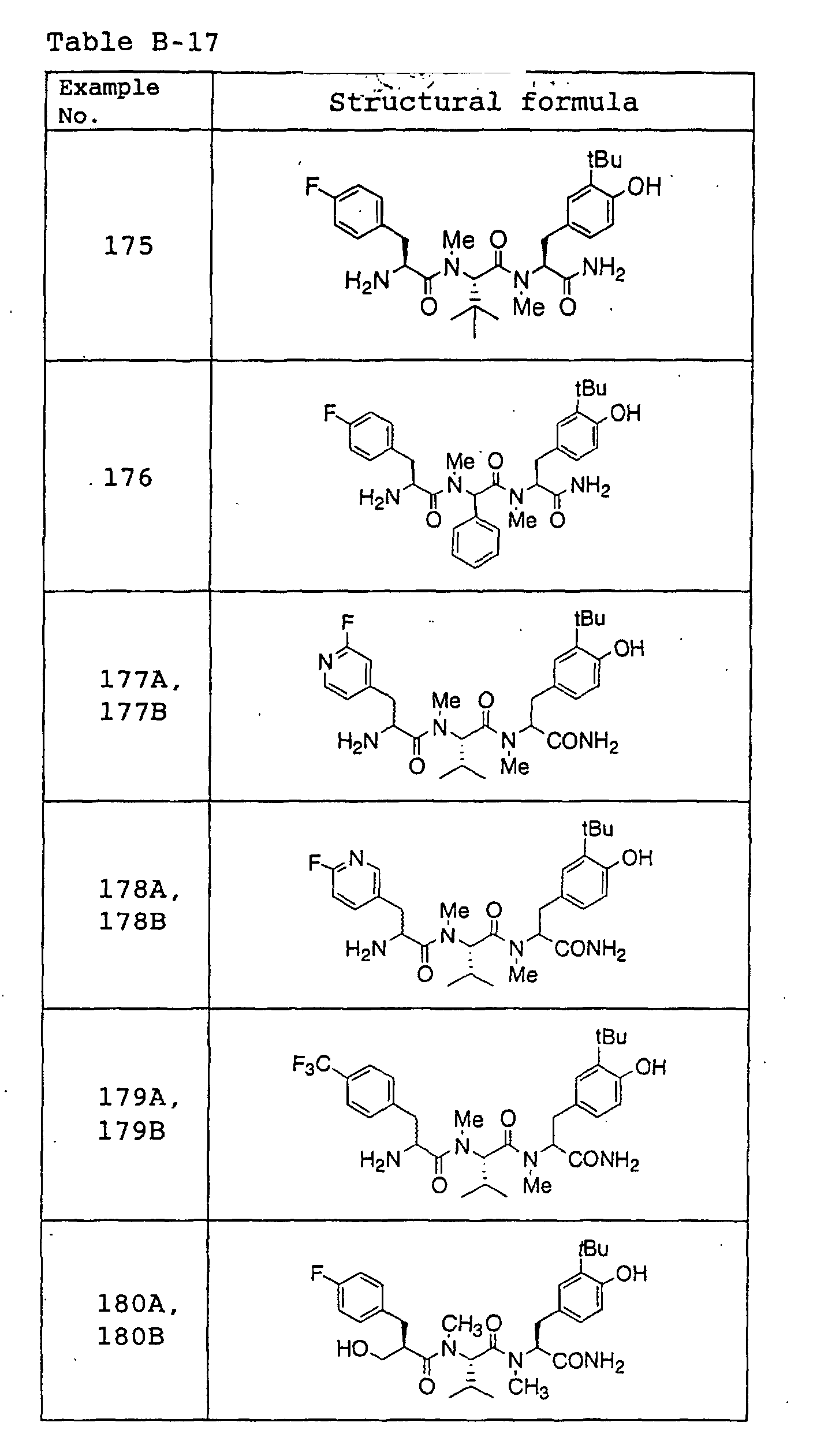
| 175 | Phe(4-F)-N-Me-Tle-N-Me-Tyr(3-tBu)-NH2 |
| 176 | Phe(4-F)-N-Me-D-Phg-N-Me-Tyr(3-tBu)-NH2 |
| 177 | (2S)-N-{(1S)-2-[3-(tert-butyl)-4-hydroxyphenyl]-1-carbamoylethyl}-2-[2-amino-3-(2-fluoro-4-pyridyl)-N-methylpropanoylamino]-3-methyl-N-methylbutanamide |
| 178 | (2S)-N-{(1S)-2-[3-(tert-butyl)-4-hydroxyphenyl]-1-carbamoylethyl}-2-[2-amino-3-(2-fluoro-5-pyridyl)-N-methylpropanoylamino]-3-methyl-N-methylbutanamide |
| 179 | (2S)-N-{(1S)-2-[3-(tert-butyl)-4-hydroxyphenyl]-1-carbamoylethyl}-2-{2-amino-N-methyl-3-[4-(trifluoromethyl)phenyl]propanoylamino}-3-methyl-N-methylbutanamide |
| 180 | (2S)-N-{(1S)-2-[3-(tert-butyl)-4-hydroxyphenyl]-1-carbamoylethyl}-2-{2-[(4-fluorophenyl)methyl]-3-hydroxy-N-methylpropanoylamino}-3-methyl-N-methyl butanamide |
| 181 | Ala(β-4-pyridyl)-N-Me-Val-N-Me-Tyr(3-tBu)-NH2 |
| 182 | Phe(4-CN)-N-Me-Val-N-Me-Tyr(3-tBu)-NH2 |
| 183 | Trp-N-Me-Val-N-Me-Tyr(3-tBu)-NH2 |




1H-NMR(CDCl3): δ 1.38(9H,s), 2.83(1H,dd,J=13.7,7.4Hz), 3.02(1H,dd,J=13.7,5.1Hz), 3.70(1H,dd,J=7.4,5.1Hz), 3.73(3H,s), 6.55(1H,d,J=7.9Hz), 6.85(1H,dd,J=7.9,1.7Hz), 7.04(1H,d,J=1.7Hz)
1H-NMR(CDCl3): δ 1.36(9H,s), 3.04(2H, brd, J=5.6Hz), 3.72(3H,s), 4.57-4.68(1H,m), 4.97(1H,brs), 5.10(2H,s), 5.20(1H,brd,J=7.9Hz), 6.55(1H,d,J=7.9Hz), 6.78(1H,dd,J=7.9,2.0Hz), 6.95(1H,d,J=2.0Hz), 7.26-7.41(5H,m)
1H-NMR(CDCl3): δ 1.36(9H,s), 3.05(2H,d,J=5.6Hz), 3.71(3H,s), 4.60-4.68(1H,m), 5.06(2H,s), 5.09(2H,s), 5.24(1H,brd,J=8.3Hz), 6.82(1H,d,J=8.5Hz), 6.88(1H,dd,J=8.5,1.8Hz), 7.00(1H,d,J=1.8Hz), 7.27-7.50(10H,m)
1H-NMR(CDCl3) : δ 1.40(9H,s), 2.31(3H,s), 2.63(1H,dd,J=14.7,10.'7Hz), 3.10-3.19(2H,m), 5.24(1H,brs), 5.38(1H,brs), 6.63(1H,d,J=7.9Hz), 6.91(1H,dd,J=7.9,1.8Hz), 7.05(1H,brs), 7.10(1H,d,J=1.8Hz)
1H-NMR(CDCl3):(four rotamers) δ 0.07, 0.32, 0.63, 0.74, 0.79, 0.81, 0.84 and 0.89(6H,d,J=6.3-6.6Hz), 1.30, 1.33, 1.37 and 1.39(9H,s), 2.13-2.33(1H,m), 2.34, 2.41, 2.78, 2.87 and 2.98(6H,s), 2.79-3.22(2H,m), 4.40 and 4.32(1H,d,J=10.6Hz), 4.60-5.43(5H,m), 5.96(1H,brs), 6.23-7.12(3H,m), 7.26-7.47(5H,m)
1H-NMR(CDCl3):(two rotamers) δ 0.35,0.71,0.92 and 0.96(6H,d,J=6.9Hz), 1.36 and 1.37(9H,s), 1.73-1.81 and 2.03-2.17(1H,m), 1.74 and 2.23(3H,s), 2.64(1H,d,J=9.2Hz). 2.90-3.04(1H,m), 2.93 and 3.00(3H,s), 3.19 and 4.60(1H,dd,J=14.7,5.8 and 10.7,3.8Hz), 5.29,5.32 and 6.06(2H,brs), 5.59(1H,dd,J=10.4,5.8Hz), 6.54 and 6.60(1H,d,J=7.9Hz), 6.79 and 6.93(1H,dd,J=7.9,2.0 and 1.7Hz), 7.01 and 7.07(1H,d,J=2.0 and 1.7Hz), 8.10(1H,brs)
1H-NMR(CDCl3):(two rotamers) δ 0.57, 0.73, 0.75 and 0.90(6H,d,J=6.3-6.6Hz), 1.33 and 1.39(9H,s), 2.18-3.43(5H,m), 2.40 and 3.03(3H,s), 2.74 and 3.01(3H,s), 4.62-5.49(7H,m), 5.95(1H,brs), 6.44(1H,d,J=7.9Hz), 6.57-7.35(12H,m)
EI-MS:528(M+)
1H-NMR(CDCl3):(two rotamers) δ 0.50,0.76,0.79 and 0.93(6H,d,J=6.3-6.9Hz), 1.34 and 1.39(9H,s), 2.19-2.95(5H,m), 2.50 and 3.03(3H,s), 2.81 and 3.02(3H,s), 3.17 and 3.34(1H,dd,J=15.2,5.9 and 13.9,6.9Hz), 3.66 and 3.84(1H,dd,J=8.9,4.6 and 8.6,4.6Hz), 4.91 and 5.07(1H,d,J=10.6Hz), 5.07,5.19,5.30,5.98 and 6.64(2H,brs), 5.49(1H,dd,J=10.6,5.9Hz), 6.35 and 6.62(1H,d,J=7.9Hz), 6.74(2/3H,dd,J=7.9,1.7Hz), 6.95-7.11(19/3H,m)
EI-MS:544 and 546(M+)
1H-NMR(CDCl3):(two rotamers) δ 0.49,0.75,0.78 and 0.93(6H,d,J=6.3-6.9Hz), 1.34 and 1.38(9H,s), 2.10-2.92(5H,m), 2.50 and 3.04(3H,s), 2.80 and 3.01(3H,s), 3.13 and 3.33(1H,dd,J=15.2,5.9 and 13.9,6.9Hz), 3.67 and 3.85(1H,dd,J=8.9,5.0 and 8.6,5-OHz), 4.90 and 5.06(1H,d,J=10.6Hz), 5.33,5.41, 5.99 and 6.61(2H,brs), 5.49(1H,dd,J=10.6,5.9Hz), 6.37 and 6.63(1H,d,J=7.9Hz), 6.72 and 6.98(1H,dd,J=7.9,1.7Hz), 7.07-7.10(3H,m), 7.25-7.31(2H,m)
EI-MS:546(M+)
1H-NMR(CDCl3) : (two rotamers) δ 0.51,0.74,0.79 and 0.93(6H, d, J=6.3-6.9Hz), 1.33 and 1.38(9H,s), 2.10-2.93(5H,m), 2.51 and 3.03(3H,s), 2.83 and 3.01(3H,s), 3.17 and 3.33(1H,dd,J=14.8,5.9 and 13.9,6.6Hz), 3.66 and 3.84(1H,dd,J=8.4,5.0 and 8.6,4,3Hz), 4.88 and 5.07(1H,d,J=10.6Hz), 5.41, 5.9(1H,brs), 5.41-5.51(1H,m), 6.43 and 6.64(1H,d,J=7.9Hz), 6.75(2/5H,dd,J=7.9,1.7Hz), 6.84-7.16(28/5H,m)
EI-MS:528(M+)
1H-NMR(CDCl3):(two rotamers) δ 0.51,0.73,0.78 and 0.93(6H,d,J=6.3-6.6Hz), 1.33 and 1.38(9H,s), 2.10-2.96(5H,m), 2.46 and 3.03(3H,s), 2.78 and 3.01(3H,s), 3.16 and 3.35(1H,dd,J=14.8,5.9 and 13.9,6.6Hz), 3.70 and 3.90(1H,dd,J=8.3,5.6 and 8.6,5.0Hz), 4.89 and 5.06(1H,d,J=10.6Hz), 5.42, 5.99(1H,brs), 5.43-5.52(1H,m), 6.41 and 6.64(1H,d,J=7.9Hz), 6.72(2/5H,dd,J=7.9,1.7Hz), 6.83-6.99(18/5H,m), 7.10(2/5H,d,J=1.7Hz), 7.22-7.33(1H,m)
EI-MS:528(M+)
1H-NMR(CDCl3) : (two rotamers) δ 0.45,0.71,0.79 and 0.93(6H,d,J=5.9-6.6Hz), 1.31 and 1.38(9H,s), 2.10-2.89(5H,m), 2.47 and 3.06(3H,s), 2.76 and 3.01(3H,s), 3.14 and 3.34(1H,dd,J=14.3,5.9 and 13.9,6.6Hz), 3.79 and 3.95(1H,dd,J=8.4,5.0 and 8.6,4.3Hz), 4.88 and 5.06(1H,d,J=10.6Hz), 5.37, 5.99(1H,brs), 5.41-5.51(1H,m), 6.43(3/5H,d,J=7.9Hz), 6.56(2/5H,brs), 6.60-6.71(1H,m), 6.92-7.29(6H,m)
1H-NMR(CDCl3) : δ 1.36(9H,s), 2.80(s,3H), 2.97-3.30(m,2H), 3.21(s,3H), 4.60-4.74(m,1H), 5.08(s,2H), 5.13(s,2H), 6.81(d,1H,J=8.2Hz), 6.86-7.13(m,2H), 7.20-7.46(m,10H), 9.0(brs,1H)
EI-MS:606(M+).
1H-NMR(DMSO-d6):(three rotamers) δ 0.02(d,3/5H,J=5.9Hz), 0.22(d,3/5H,J=5.9Hz), 0.62(d,3/5H,J=7.6Hz), 0.68(d,3/5H,J=6.6Hz), 0.77(d,9/5H,J=6.6Hz), 0.89(d,9/5H,J=6.3Hz), 1.28(s,27/5H), 1.31(s,9/5H), 1.35(s,9/6H), 1.86-2.03(m,2/7H), 2.15-2.28(m,5/7H), 2.5-3.4(m,10H), 4.35-4.62(m,1H), 4.80-5.02(1H), 5.11-5.42(m.1H). 6.55-7.18(m,7H), 8.0-8.2(m,3H), 8.98-9.06(m,1H), 11.2(brs,1H)
1H-NMR(CDCl3): δ 1.39(9H,s), 2.95(3H,s), 2.99(1H,m), 3.24(1H,m), 3.64(3H,s), 4.7(1H,m), 5.1(4H,d), 6.8-7.5(13H,m), 9.06(1H,s)
1H-NMR(CDCl3) : δ 1.43(9H,s), 2.45(3H,s), 2.92(2H,m), 3.12(1H,m), 3.59(3H,s), 6.77(1H,d,J=9.4Hz),
1H-NMR(CDCl3): δ 0.43(3H,m), 0.80(3H,m), 1.36(9H,s), 3.02(9H,m), 3.65(3H,s), 4.4(1H,m), 5.1(3H,m), 6.4-7.4(8H,m)
EI-MS:558(M+)
1H-NMR(CDCl3) : δ 0.42(3H,d,J=13.5Hz), 0.79(3H,d,J=13.2Hz), 1.33(9H,s), 2.10(1H,m), 2.60(1H,m), 2.90(2H,m), 2.91(3H,s), 3.07(3H,s), 3.28(1H,m), 3.68(3H,s), 3.91(1H,m), 4.82(1H,d,J=10,7Hz), 5.13(1H,m), 6.60(1H,d,J=10.4Hz), 6.89(1H,m), 7.0-7.3(5H,m), 9.1(1H,m)
1H-NMR (CDCl3): δ 1.24(9H,s), 2.95-3.20 (2H,m), 4.45-4.60(1H,m), 5.11(2H, dd, J=17.5,12.2Hz), 6.53(1H,d,J=7.9Hz), 6.85(1H,d,J=7.9Hz), 6.95-7.15(2H,m), 7.32(5H,brs), 7.67-7.73(1H,m), 8.15-8.25(2H,m)
1H-NMR(CDCl3) : δ 1.36(9H,s), 2.72-3.23(2H,m), 3.67-3.72(1H,m), 6.62(1H,d,J=7.9HZ), 6.85-6.88(1H,m), 6.95-7.20(2H,m), 7.70-7.77(1H,m), 8.29-8.39(2H,m)
1H-NMR(CDCl3): δ 0.70-0.95(6H,m), 1.26(9H,s), 2.20-2.35(1H,m), 2.70-3.10(5H,m), 4.00-4.20(1H,m), 4.65-4.80(1H,m), 5.17(2H,brs), 6.44(1H,d,J=7.6Hz), 6.60-6.85(1H, m), 6.95-7.10(2H,m), 7.36(5H,brs), 7.60-7.75(1H,m), 8.10-8.25(2H,m)
1H-NMR(CDCl3): δ 0.69(3H,d,J=6.9Hz), 0.85(3H,d,J=6.9Hz), 1.31(9H,s), 1.95-2.11(1H,m), 2.36(3H,s), 2.81(1H,d,J=4.6Hz), 2.99-3.18(2H,m), 4.73-4.81(1H,m), 6.59(1H,d,J=7.9Hz), 6.94(1H,dd,J=7.9,2.0Hz), 7.00-7.10(2H,m), 7.65-7.72(1H,m), 7.80(1H,d,J=7.9Hz), 8.18(1H,d,J=8.6Hz), 8.25(1H,d,J=4.6Hz),
EI-MS:591(M+)
1H-NMR(CDCl3): δ 0.74(2H,d, J=6.9Hz), 0.77(1H,d,J=6.9Hz), 0.88(1H,d,J=6.3Hz), 0.95(2H,d,J=6.3Hz), 1.25(9H,s), 2.24-2.44(1H,m), 2.50-3.25(4H,m), 2.78(2.4H,s), 2.85(0.6H,s), 3.55-3.65(0.8H,m), 3.80-3.90(0.2H,m), 4.00(0.8H,d,J=10.9Hz), 4.36(0.2H,d,J=10.9Hz), 4.65-4.80(0.2H,m), 4.90-5.00(0.8H,m), 6.55-7.20(8H,m), 7.65-7.75(1H,m), 8.15-8.25(2H,m)
1H-NMR(CDCl3): δ 1.38(9H,s), 2.15(1H,m), 2.78(2H,brd,J=6.9Hz), 3.5-3.8(2H,m), 3.8-4.0(1H,m), 4.86(1H,s), 4.9-5.0(1H,m), 5.09(2H,s), 6.58(1H,d,J=7.9Hz), 6.88(1H,brd,J=7.9Hz), 7.05(1H,brs), 7.34(5H,s)
1H-NMR(CDCl3) : δ 1.37(9H,s), 2.6-2.9(4H,m), 3.7-3.9(4/5H,m), 3.9-4.1(1/5H,m)4.8-4.9(4/5H,m), 5.09(2H,s), 5.4-5.5(1/5H,m), 6.5-6.6(1H,m), 6.84(1H,d,J=7.3Hz), 6.9-7.1(1H,m), 7.33(5H,s)
1H-NMR(CD3OD): δ 1,35(9H,s), 2.5-2.8(2H,m), 3.0-3.2(1H,m), 3.2-3.4(1H,m), 3.7-3.9(1H,m), 5.01(2H,d,J=3.6Hz), 6.63(1H,d,7.9Hz), 6.84(1H,brd,J=7.9Hz), 7.04(1H,brs); 7.2-7.4(5H,m)
1H-NMR(CDCl3) : δ 0.82(3H,d,J=6.3Hz), 0.88(3H,d,J=6.3Hz), 1.35(9H,s), 2.1-2.3(1H,m), 2.6-2.8(2H,m), 2.76(3H,s), 3.0-3.4(2H,m), 3.9-4.1(1H,m), 4.7-5.0(2H,m), 5.0-5.1(2H,m), 5.5-5.6(1H,m), 6.4-7.0(5H,m), 7.34(5H,s)
1H-NMR(DMSO-d6): δ 0.70, 0.75, 0.85, and 0.95(total 6H,d,J=5.9-6.3Hz), 1.2-1.4(18H,m), 2.0-2.1(1H, m), 2.4-2.9(7H,m), 2.9-3.1(2H,m), 3.8-4.0(1H,m), 4.3-4.6(2H,m), 5.39, 5.51(2H,brs), 5.74(1H,d,J=1.3Hz), 5.9-6.0(1H,m), 6.6-6.9(2H,m), 6.9-7.1(2H,m), 7.1-7.3(3H,m), 7.60 and 7.73(total 1H, brd), 9.02(1H,s)
FAB-MS:544(M++1)
1H-NMR(DMSO-d6): δ 0.49, 0.73, and 0.85(total 6H,d,J=6.0-6.6Hz), 1.30 and 1.32(total 9H,s), 2.0-2.2(1H,m), 2.4-3.1(9H,m), 3.7-4.1(3H,m), 4.52 and 5.48(total 2H,m), 5.8-6.0(1H,m), 6.6-6.8(2H,m), 6.9-7.3(5H,m), 7.67 and 8.79(total 1H,d,J=7.6-8.6Hz), 9.01 and 9.06(total 1H,s)
1H-NMR(CDCl3):δ 1.38(9H,s), 1.42(9H,s), 2.6-2.9(2H,m), 3.1-3.3(2H,m), 3.8-4.0(1H,m), 4.7-4.8(1H,m), 5.08(2H,s), 6.58(1H,d,J=8.9Hz), 6.85(1H,brd,J=8.9Hz), 7.03(1H,brs), 7.2-7.5(5H,m)
1H-NMR(CDCl3):δ 0.67,0.76,0.92,and 0.97(total 6H,d,J=6.6-6.9Hz), 1.35 and 1.37(total 9H,s), 2.2-2.5(1H,m), 2.4-3.1(9H,m), 4.0-4.2 and 4.4-4.5(total 2H,m), 4.7-5.1(2H,m), 5.5-5.6 and 5.7-5.9(total 1H,brd,J=7.6-8.1Hz), 6.2-6.4, 6.5-6.7, and 6.8-7.4(total 13H,m)
FAB-MS:543(M++1)
1H-NMR(CD3OD)):δ 0.47, 0.53, 0.80, 0.90(6H,d,J=6.3-6.9Hz), 1.31, 1.37(9H,s), 2.0-2.3(1H,m), 2.41, 2.46, and 2.57(total 3H,s), 2.5-3.4(6H,m), 3.8-4.6(3H,m), 6.6-7.3(7H,m)
FAB-MS:582(M++1)
1H-NMR(CDCl3):δ 0.62, 0.79, 0.87, and 0.91(total 6H,d,J=6.3-6.6Hz), 1.37 and 1.40(total 9H,s), 2.1-2.4(1H,m), 2.5-3.0(10H,m), 3.1-3.4(2H,m), 3.6-4.4(3H,m), 5.8-6.1(1H,m), 6.6-7.2(7H,m), 8.68(1H,d,J=6.6Hz)
1H-NMR(CDCl3):(two rotamers)δ 0.69,0.85 and 0.99(6H,d,J=6.3-6.6Hz), 1.36 and 1.37(9H,s), 1.80-1.90(1H,m), 2.22-2.40(1H,m), 2.43 and 2.81(3H,s), 2.60-3.10(4H,m), 3.26-3.38(1H,m), 3.70-3.80(1H,m), 3.90-4.10(1H,m),4.28-4.44(1H,m), 4.72-5.30(3H,m), 5.03(2H,s), 6.52-6.66(2H,m), 6.80-7.40(10H,m)
FAB-MS:580(M+H+)
1H-NMR(CDCl3):(two rotamers)δ 0.63,0.75,0.81 and 0.93(6H,d,J=6.3-6.6Hz), 1.38 and 1.39(9H,s), 2.20-3.42(6H,m), 2.60 and 3.02(3H,s), 3.49(1H,s), 3.60-3.90(2H,m), 4.30-4.44(1H,m), 5.30-5.40(1H,m), 6.56-7.16(7H,m), 8.34-8.42(1H,m)
1H-NMR(CDCl3):(two rotamers)δ 0.65, 0.75, 0.91 and 0.97(6H,d,J=6.2-6.9Hz), 1.22 and 1.29(3H,t,J=7.2Hz), 1.35 and 1.36(9H,s), 2.22-2.40(1H,m), 2.42 and 2.90(3H,s), 2.60-3.02(5H,m), 3.22-3.46(2H,m), 4.06-4.28(2H,m), 4.47(1H,d,J=12.2Hz), 4.80-5.12(3H,m), 5.29(2H,s), 5.74(1H,d,J=8.9Hz), 6.58-7.42(12H,m)
1H-NMR(CDCl3):(two rotamers)δ 0.65,0.75,0.90 and 0.96(6H,d,J=6.0-6.6Hz), 1.36 and 1.37(9H,s), 2.22-2.40(1H,m), 2.47 and 2.82(3H,s), 2.60-3.02(4H,m), 3.24 and 3.26(2H,s), 4.02-4.38(2H,m), 4.76-5.08(3H,m), 5.40-5.90(3H,m), 6.56-7.38(12H,m)
FAB-MS:558(M+H+)
1H-NMR(CDCl3):(two rotamers)δ 0.66, 0.79 and
0.92(6H,d,J=6.3-6.6Hz), 1.36 and 1.39(9H,s), 2.22-2.38(1H,m), 2.63 and 2.91(3H,s), 2.50-2.82(4H,m), 3.12-3.28(2H,m), 3.58-3.88(2H,m), 4.18-4.40(2H,m), 5.50-5.70(1H,m), 6.58-7.14(8H,m)
1H-NMR(CDCl3):δ 1.39(s,9H), 2.48(dd,1H,J=8.2,13.9Hz), 2.73(dd,1H,J=5.1,13.3Hz), 2.94(dd,1H,J=7.9,11.9Hz), 2.96(s,3H), 3.10-3.22(m,1H), 3.24(dd,1H,J=3.6,12.2Hz), 6.60(d,1H,J=7.9Hz), 6.83(dd,1H,J=2.0,7.9Hz), 7.03(d,1H,J=2.0Hz)
EI-MS:578(M+)
1H-NMR(CDCl3):(two rotamers)δ 0.62(d,21/10H,J=6.9Hz), 0.75(d,9/10H,J=6.6Hz), 0.84(d,9/10H,J=6.6Hz), 0.93(d,21/10H,J=6.3Hz), 1.36(s,27/10H), 1.39(s,63/10H), 2.20-2.45(m,1H), 2.46-2.95(m,8H), 3.02-3.17(m,3H), 3.61-4.05(m,2H), 4.18-4.37(m,1H), 4.87-4.95(m,7/10H), 5.23-5.35(m,3/10H), 5.55-5.70(m,3/10H), 6.20-6.50(m,7/10H), 6.60-7.20(m,7H), 8.01(d,1H,J=7.6Hz)
1H-NMR(CDCl3):δ 1.38(9H,s), 2.11(1H,brs), 2.80(2H,d,J=6.9Hz), 3.54-3.77(2H,m), 3.83-3.97(1H,m), 4.88-4.97(1H,m), 5.09(4H,s), 6.85(1H,d,J=8.3Hz), 6.97(1H,dd,J=8.3,1.8Hz), 7.11(1H,d,J=1.8Hz), 7.27-7.50(10H,m)
1H-NMR(CDCl3):δ 1.38(9H,s), 2.76-2.92(2H,m), 2.96(3H,s), 4.10-4.21(2H,m), 4.21-4.32(1H,m), 4.88-5.00(1H,m), 5.09(4H,s), 6.86(1H,d,J=8.6Hz), 6.98(1H,brd,J=7.9Hz), 7.11(1H,brs), 7.30-7.48(10H,m)
1H-NMR(CDCl3):δ 1.38(9H,s), 2.46(1H,dd,J=16.8,4.0Hz), 2.74(1H,dd,J=16.8,4.6Hz), 2.82(1H,dd,J=13.8,8.4Hz), 2.96(1H,dd,J=13.8,6.5Hz), 4.07-4.18(1H,m), 4.89-4.98(1H,m), 5.09(4H,s), 6.87(1H,d,J=8.3Hz), 6.99(1H,dd,J=8.3,1.5Hz), 7.12(1H,d,J=1.5Hz), 7.36-7.47(10H,m)
1H-NMR(DMSO):δ 1.33(9H,s), 1.96(1H,dd,J=14.5,8.6Hz), 2.12(1H,dd,J=14.5,4.0Hz), 2.37(1H,dd,J=13.4,7.4Hz), 2.46-2.55(1H,m), 3.07-3.20(1H,m), 6.68(1H,d,J=8.2Hz), 6.73(1H,brs), 6.79(1H,brd,J=8.2Hz), 7.40(1H,brs), 9.05(1H,s)
1H-NMR(CDCl3):δ 0.78-0.90(6H,m), 1.37(9H,s), 2.14-2.80(5H,m), 2.72(3H,s), 3.92-4.04(1H,m), 4.32-4.48(1H,m), 5.04,5.15(2H,brs), 5.27-5.37(1H,m), 5.78,6.03(1H,brs), 6.38-6.82(3H,m), 7.04(1H,brs), 7.30-7.41(5H,m).
1H-NMR(CDCl3):δ 0.68(3H,d,J=6.9Hz), 0.83(3H,d,J=6.9Hz), 1.38(9H,s), 1.82-1.97(1H,m), 2.27(3H,s), 2.45(1H,dd,J=15.8,7.3Hz), 2.68(1H,d,J=4.6Hz), 2.78-2.91(2H,m), 4.41-4.56(1H,m), 5.30(1H,brs), 5.58(1H,brs), 6.34(1H,brs), 6.62(1H.d,J=8.0Hz). 6.92(1,H,dd,J=8.0,2.0Hz), 7.04(1H,d,J=2.0Hz). 7.63(1H,brd,J=8.9Hz)
EI-MS:528(M+)
1H-NMR(CDCl3):δ 0.67,0.80,0.90,0.92(6H,d,J=6.3-6.9Hz), 1.37, 1.39(9H,s), 2.21-3.22(6H,m), 2.61,2.89(3H,s), 3.59-3.88,4.34-4.48(3H,m), 5.33,5.42(1H,brs), 5.90,6.07(1H,brs). 6.56-7.18(7H,m), 8.71(1H,brd,J=8.3Hz)
1H-NMR(CDCl3):δ 1.36(9H,s), 2.42(3H,s), 2.72-2.86(2H,m), 3.92-4.09(3H,m), 4.84-4.95(1H,m), 5.04(2H,s), 5.07(2H,s), 6.79(1H,d,J=8.0Hz), 6.87(1H,brd,J=8.0Hz), 7.06(1H,brs), 7.26-7.48(12H,m), 7.76(2H,d,J=8.3Hz)
1H-NMR(CDCl3):δ 1.38(9H,s), 2.12(3H,s), 2.61(2H,d,J=5.6Hz), 2.85(2H,d,J=6.3Hz), 3.99-4,12(1H,m), 4.80-4.91(1H,m), 5.09(4H,s), 6.85(1H,d,J=8.3Hz), 6.96(1H,brd,J=7.6Hz), 7.11(1H,brs), 7.27-7.50(10H,m)
1H-NMR(CDCl3):δ 1.38(9H,s), 2.88(3H,brs), 3.00(2H,brd,J=6.9Hz), 3.17(1H,dd,J=14.8,4.6Hz), 4.19-4.30(1H,m), 4.35-4.47(1H,m), 5.07-5.18(1H,m), 5.09(2H,s), 5.10(2H,s), 6.85(1H,d,J=8.5Hz), 6.97(1H,dd,J=8.5,1.7Hz), 7.10(1H,brs), 7.28-7.49(10H,m)
1H-NMR(CDCl3):δ 1.40(9H,s), 2.64(1H,dd,J=13.7,7.9Hz), 2.73(1H,dd,J=13.7,5.9Hz), 2.93-3.03(1H,m), 2.98(3H,s), 3.13(1H,dd,J=14.2,2.0), 3.61-3.74(1H,m), 6.62(1H,d,J=7.9Hz), 6.88(1H,dd,J=7.9,2.0), 7.05(1H,d,J=2.0Hz)
1H-NMR(CDCl3):δ 0.83(3H,d,J=6.6Hz), 0.89(3H,d,J=6.3Hz), 1.38(9H,s), 2.14-2.33(1H,m), 2.64-2.97(2H,m), 2.74(3H,s), 2.91(3H,s), 3.13(1H,dd,J=14.6,4.6Hz), 3.29(1H,dd,J=14.6,6.9Hz), 3.94(1H,d,J=11.2Hz), 4.43-4.57(1H,m), 4.79(1H,brs), 5.14(2H,s), 6.40-6.84(3H,m), 7.06(1H,brs), 7.37(5H,brs).
EI-MS:563(M+)
1H-NMR(CDCl3):δ 0.65,0.78,0.91,0.93(6H,d,J=6.6-7.3Hz), 1.38, 1.39(9H,s), 2.22-2.40(1H,m), 2.46-3.40(6H,m), 2.66(3H,s), 2.93(3H,s), 3.60-3.83(1H,m), 3.87,4.26(1H,d,J=10.8Hz), 4.38-4.67(1H,m), 6.57-7.17,8.88(8H,m)
1H-NMR(CDCl3):δ 1.40(9H,s), 2.45(1H,dd,J=8.6,13.5Hz), 2.71(1H,dd,5.3,13.5Hz), 3.0-3.2(1H,m), 3.38(1H,dd,J=7.6,10.5Hz), 3.65(1H,dd,J=3.6,10.5Hz), 6.61(1H,d,J=7.9Hz), 6.88(1H,dd,J=2.0,7.9Hz), 7.06(1H,d,J=2.0Hz)
1H-NMR(CDCl3):δ 0.84(3H,d,J=6.6Hz), 0.92(3H,d,J=6.3Hz), 2.1-2.3(1H,m), 2.5-2.8(5H,m), 3.5-3.7(2H,m), 3.9-4.2(2H,m), 5.13(2H,s), 6.2-6.4(1H,m), 6.45(1H,d,J=7.6Hz), 6.80(1H,brd,J=7.6Hz), 7.05(1H,brs), 7.36(5H,s)
1H-NMR(CDCl3):δ 0.77, 0.92, and 1.02(total 6H,d), 1.2-1.5(18H,m), 2.2-3.1(8H,m), 3.5-3.8(2H,m), 4.0-4.3, 4.4-4.5, 4.7-4.9, and 5.2-5.4(total 2H,m), 6.3-7.5(8H,m)
EI-MS:501(M+)
1H-NMR(CDCl3):δ 0.68, 0.79, and 0.93(total 6H,d,J=6.3-6.9Hz), 1.36 and 1.39(total 9H,s), 2.2-2.4(1H,s), 2.5-3.2(4H,m), 2.68 and 2.84(total 3H,s), 3.5-3.9(3H,m), 3.89 and 4.43(total 1H,d,J=10.9Hz), 4.0-4.4(1H,m), 6.5-7.1(7H,m), 6.58 and 8.41(total 1H,d,J=6.9-7.6Hz)
1H-NMR(CDCl3):δ 1.44(9H,s), 3.0-3.2(2H,m), 4.3-4.5(1H,m), 5.02(1H,brs), 7.00(2H,t,J=8.6Hz), 7.13(2H,dd,J=5.4,8.6Hz), 9.63(1H,s)
1H-NMR(CDCl3):δ 0.68(3H,d,J=5.6Hz), 0.85(3H,d,J=6.9Hz), 1.38(9H,s), 1.41(9H,s), 1.9-2.1(1H,m), 2.4-2.9(5H,m), 2.9-3.1(2H,m), 2.99(3H,s), 3.1-3.3(2H,m), 3.8-4.0(1H,m), 4.47(1H,d, J=8.9Hz), 4.5-4.8(1H,m), 5.56(1H,brs), 6.64(1H,d,J=7.9Hz), 6.9-7.2(6H,m), 7.7-7.9(1H,m)
EI-MS:535(M+)
1H-NMR (CDCl3) : δ 0.75(3H,d,J=6.9Hz), 0.89(3H,d,J=6.9Hz), 1.39(9H,s), 2.0-2.1(1H,m), 2.3-2.5(2H,m), 2.53(1H,dd,J=3.6,11.6Hz), 2.72(1H,dd,J=4.6,13.2Hz), 2.80(1H,d,J=4.6Hz), 2.8-3.1(5H,m), 3.19(2H,d,J=5.9Hz), 4.5-4.7(1H,m),6.62(1H,d,=7.9Hz), 6.93(1H,dd,J=2.0,7.9Hz), 6.99(2H,t,J=8.8Hz), 7.0-7.2(3H,m), 7.80(1H,d,J=8.6Hz)
1H-NMR(CDCl3):δ 1.37(9H,s), 3.0(2H,m), 4.85(1H,brd), 5.03(1H,brd), 5.10(2H,s), 5.14(2H,s), 6.69(1H,d,J=8.58Hz), 7.05(1H,d,J=8.58Hz)7.2(1H,s), 7.3-7.5(10H,m)
1H-NMR(CDCl3):δ 1.39(9H,s), 2.25(3H,s), 3.09(2H,brd), 4.89(1H,brd), 5.03(2H,s), 5.07(2H,s), 5.80(1H,brd), 6.14(1H,s), 6.79(1H,d,J=8.24Hz), 6.92(1H,d,J=8.24Hz), 6.96(1H,s), 7.25-7.43(10H,m)
1H-NMR(CDCl3):δ 1.37(9H,s), 2.32(3H,s), 2.74(1H,dd,J=8.90,9.24Hz), 3.15(1H,dd,J=4.28,4.29Hz), 4.09(1H,m), 6.16(1H,s), 6.59(1H,d,J=7.92Hz), 6.83(1H,d,J=7.92Hz), 6.99(1H,s).
1H-NMR(CDCl3):δ 0.79-0.90(6H,m), 1.30(9H,m), 2.2(4H,m), 2.8-3.1(5H,m), 4.3(1H,d,J=7.3), 4.97(1H,m), 5.1-5.25(2H,m), 6.18(1H,d,J=8.58), 6.41(1H,d,J=8.58Hz), 6.5-6.85(2H,m), 7.3(5H,m)
1H-NMR(CDCl3 ):δ 0.72(3H,d,J=6.93Hz), 0.83(3H,d,J=6.93Hz), 1.34(9H,s), 1.94(1H,m), 2.28(3H,s), 2.30(3H,s), 2.77(1H,d,J=4.62Hz), 3.11(2H,m), 5.04(1H,d,J=7.59Hz), 6.14(1H,s), 6.61(1H,d,J=7.92Hz), 6.81(1H,dd,J=7.92Hz), 6.99(1H,s), 7.84(1H,d,J=6.92Hz)
1H-NMR(CDCl3):δ 0.84(3H,d,J=6.93Hz), 0.89(3H,d,J=6.93Hz), 1.33(9H,s), 2.00(1H,m), 2.14(3H,s), 2.18(3H,s), 2.78(1H,d,J=4.95Hz), 3.11(2H,m), 5.10(1H,d,J=6.60Hz), 6.14(1H,s), 6.63(1H,d,J=7.92Hz), 6.75(1H,dd,J=7.92Hz), 6.97(1H,s), 7.81(1H,d,J=7.26Hz)
1H-NMR(CDCl3):(two rotamers)δ 0.75, 0.80 and 0.98(6H,d,J=6.6,6.9Hz), 1.34 and 1.38(9H,s), 1.4 (9H,s), 2.10(1H,m), 2.3 and 2.4(3H,s), 2.7(3H,s), 2.85(2H,m), 3.04(2H,d,J=7.01Hz), 4.12 and 4.58(1H,d,J=9.6Hz), 4.75(1H,m), 5.05(1H,m), 4.83 and 5.2(1H,brd), 5.45 and 5.6(1H,dd,J=7.4Hz), 6.2(1H,s), 6.6(1H,m), 6.77(1H,m), 7.0(5H,m).
1H-NMR(CDCl3):(two rotamers)δ 0.78(6H,brd), 1.3-1.4(18H,s). 1.8(2H,brd), 2.25(3H,brd), 2.8 and 3.20(7H,brd), 4.1(2H,m), 4.4 and 4.5(1H,d,J=9.89Hz), 4.7 and 5.17(1H,brd), 5.3 and 5.58(1H,d,J=9.89Hz), 6.0 and 6.17(1H,s), 6.6(1H,brd), 6.7-7.2(8H,m)
1H-NMR(CDCl3):(two rotamers)δ 0.7 and 0.8(6H,dd,J=6.6 and 6.59Hz), 1.29(9H,s), 2.14 and 2.275(3H,s), 2.1-2.2(1H,m), 2.67 and 2.78(3H,s), 2.6-2.8(2H,m), 3.07(2H,m), 3.7-3.83(1H,m), 4.15 and 4.62(1H,d,J=9.87Hz), 4.98 and 5.18(1H,dd,J=6.5 and 7.6Hz), 6.02 and 6.11(1H,s), 6.55 and 6.8(2H,m), 6.92(1H,d,J=6.92Hz), 6.93-7.15(4H,m)
1H-NMR(CDCl3):(two rotamers)δ 0.68, 0.78 and 0.86(6H,dd,J=6.6 and 6.27Hz), 1.3 and 1.32(9H,s), 2.21 and 2.23(3H,s), 2.2-2.4(1H,brd), 2.6 and 2.8(1H,m), 2.71-2.91(3H,s), 3.00(3H,m), 3.77 and 3.9(1H,m), 3.97 and 4.52(1H,d,J=9.37Hz), 4.97 and 5.18(1H,m), 6.12(1H,d,J=3.3Hz), 6.5-7.2(8H,m)
NMR(CDCl3):δ 1.37(9H,s), 3.00-3.14(2H,m), 4.40-4.52(1H,m), 4.89(1H,brs), 5.12(2H,s), 5.22-5.32(1H,m), 6.57(1H,d,J=8.2Hz), 6.82(1H,d,J=8.2Hz),7.00(1H,s), 7.30-7.42(5H,m), 9.64(1H,s)
1H-NMR(CDCl3):δ 1.37(9H,s), 2.90-3.00(2H,m), 3.10-3.22(1H,m), 4.27(1H,brs), 5.06(2H,s), 5.02-5.12(1H,m), 6.07(1H,brs), 6.57(1H,d,J=8.2Hz), 6.88(1H,dd,J=2.0,8.2Hz), 7.10(1H,d,J=2.0Hz), 7.22-7.40(5H,m)
1H-NMR(CDCl3):δ 0.79 and 0.85(6H,d,J=6.6Hz), 2.14-2.26(1H,m), 2.60(3H,s), 2.70-2.92(2H,m), 3.89(1H,d,J=10.8Hz), 4.27(1H,brs), 4.62-4.74(2H,m), 5.14(2H,s), 6.28(1H,d,J=7.9Hz), 6.56-7.10(3H,m), 7.30-7.42(5H,m)
EI-MS:404(M+)
1H-NMR(DMSO-d6):δ 0.79 and 0.82(6H,d,J=6.3-6.6Hz), 1.31(9H,s), 1.90(3H,s), 2.74-2.84(2H,m), 4.02-4.14(1H,m), 4.17(1H,brs), 4.38-4.48(1H,m), 6.64(1H,d,J=8.2Hz), 6.82(1H,d,J=8.2Hz), 6.99(1H,s), 7.85(1H,brs)
1H-NMR(CDCl3):(two rotamers)δ 0.62,0.71,0.94 and 0.98(6H,d,J=6.0-6.6Hz), 1.34 and 1.37(9H,s), 2.26 and 2.92(3H,s), 2.24-2.42(1H,m), 2.64-3.12(4H,m), 3.84-4.32(2H,m), 4.50-4.82(2H,m), 5.02-5.12(2H,m), 5.20-5.64(1H,m), 6.21(1H,brs), 6.31(1H,brs), 6.50-6.60(2H,m), 6.86-7.14(5H,m), 7.24-7.40(5H,m), 7.50-8.00(1H,m)
FAB-MS:570(M+H+)
1H-NMR(DMSO-d6):(two rotamers)δ 0.48-0.84(6H,m), 1.28, 1.32 and 1.33(9H,s), 2.00-2.12(1H,m), 2.28,2.42 and 2.62(3H,s), 2.40-3.10(4H,m), 3.82-4.08(2H,m), 4.24-4.50(2H,m), 6.58-7.30(7H,m), 7.66-8.30(2H,m), 8.92-9.24(2H,m)
1H-NMR(CDCl3):δ 1.32(9H,s), 3.19(2H,brs), 5.02(1H,brs), 5.05-5.16(2H,m), 5.35(2H,brs), 6.53(1H,d,J=7.9Hz), 6.75(1H,dd,J=7.9,2.0Hz), 6.85(1H,d,J=2.0Hz), 8.34(1H,s)
1H-NMR(CDCl3):δ 1.36(9H,s), 3.02(1H,dd,J=13.8,7.9Hz), 3.18(1H,dd,J=13.8,5.6Hz), 4.47(1H,dd,J=7.9,5.6Hz), 6.57(1H,d,J=7.9Hz), 6.84(1H,dd,J=7.9,2.0Hz), 6.97(1H,d,J=2.0Hz), 8.40(1H,s)
1H-NMR(CDCl3):δ 0.70(3H,d,J=6.9Hz), 0.85(3H,d,J=6.9Hz), 1.35(9H,s), 1.88-2.03(1H,m), 2.34(3H,s), 2.77(1H,d,J=4.6Hz), 3.12(1H,dd,J=14.0,8.4Hz), 3.28(1H,dd,J=14.0,5.9Hz), 5.45(1H,brs), 5.61-5.71(1H,m), 6.58(1H,d,J=8.0Hz), 6.68(1H,dd,J=8.0,2.0Hz), 6.96(1H,d,J=2.0Hz), 7.84(1H,brd,J=8.9Hz), 8.35(1H,s)
EI-MS:539(M+)
1H-NMR(CDCl3):(two rotamer)δ 0.75, 0.78, 0.89, 0.92(6H,d,J=6.3-6.6Hz), 1.29,1.34(9H,s), 2.24-2.45(1H,m), 2.50-2.85(2H,m), 2.82(3H,s), 3.04-3.20(3H,m), 3.52-3.60,3.72-3.85(1H,m), 3.99,4.43(1H,d,J=10.9Hz), 5.42-5.53,5.64-5.73(1H,m), 6.42-7.18(7H,m), 8.33,8.42(1H,s), 9.62(1H,brd,J=9.2Hz)
1H-NMR(CDCl3) : δ 0.67(3H,d,J=6.27Hz), 0.80(3H,d,J=6.6Hz), 1.35(9H,s), 1.91(1H,m), 2.25(3H,s), 2.76(1H,d,J=4.62Hz), 3.00(2H,m), 4.75(1H,q,J=6.6Hz), 6.13(1H,s), 6.55(1H,s), 6.66(1H,d,J=7.92Hz), 6.89(1H,d,J=7.59Hz), 7.02(1H,s), 7.84(1H,d,J=7.91Hz)
1H-NMR(CDCl3):(two rotamers)δ 0.75 and 0.87 (total 6H,d and dd,J=6.59 and 6.92Hz), 1.27(9H,s), 2.17(1H,m), 2.77(2H,m), 2.83(3H,s), 3.1(2H,m), 3.55(1H,m), 3.96(1H,d,J=10.89Hz), 5.7(1H,m), 6.45(1H,s), 6.59(1H,d, J=5.94Hz), 6.9(1H.brd). 8.35(1H,s), 9.5(1H,d,J=8.91Hz), 6.95(2H,t,J=8.25Hz), 7.06(2H,t,J=8.25Hz)
1H-NMR(CDCl3):δ 1.37(9H,s), 3.01-3.14(2H,m), 4.56-4.65(1H,m), 5.08(2H,s), 6.58(1H,d,J=7.9Hz), 6.90(1H,dd,J=7.9,1.7Hz), 7.09(1H,d,J=1.7Hz), 7.20-7.40(5H,m)
1H-NMR(CDCl3):δ 1.29(9H,s), 3.10-3.30(2H,m), 5.10(2H,s), 5.20-5.40(1H,m), 6.51(1H,d,J=8.3Hz), 6.74-6.78(2H,m), 7.22 (1H,d,J=3.3Hz), 7.20-7.40(5H,brs), 7.76(1H,d,J=3.3Hz)
1H-NMR(CDCl3):δ 1.36(9H,s), 2.82-3.27(2H,m), 4.51-4.56(1H,m), 6.57(1H,d,J=7.9Hz), 6.89(1H,dd,J=7.9,2.0Hz), 6.99(1H,d,J=2.0Hz), 7.27(1H,d,J=3.3Hz), 7.76(1H,d,J=3.3Hz)
1H-NMR(CDCl3):δ 0.75-0.97(6H,m), 1.29(6H,s), 1.31(3H,s), 1.41(3H,s), 1.48(6H,s), 2.10-2.35(1H,m), 2.71(1.5H,s), 2.73(1.5H,s), 3.10-3.30(2H,m), 3.90-4.10(1H,m), 5.50-5.70(1H,m), 6.58(1H,d,J=7.9Hz), 6.70-6.90(2H,m), 7.20(1H,d,J=3.0Hz), 7.74-7.76(1H,m)
1H-NMR(CDCl3) : δ 0.65(3H,d,J=6.9Hz), 0.82(3H,d,J=6.9Hz), 1.33(9H,s), 1.85-2.00(1H,m), 2.32(3H,s), 2.75(1H,d,J=4.6Hz), 3.09-3.37(2H,m), 5.63-5.71(1H,m), 6.61(1H,d,J=7.9Hz), 6.87-6.92(2H,m), 7.22(1H,d,J=3.0Hz), 7.77(1H,d,J=3.3Hz)
1H-NMR(CDCl3):δ 0.84(3H,d,J=6.9Hz), 0.92(3H,d,J=6.9Hz), 1.33(9H,s), 1.95-2.15(1H,m), 2.11(3H,s), 2.68(1H.d,J=5.0Hz). 3.12-3.39(2H,m), 5.60-5.69(1H,m), 6.59(1H,d,J=8.2Hz), 6.87(1H,dd,J=7.9,2.0Hz), 6.93(1H,d,J=2.0Hz), 7.22(1H,d,J=3.3Hz), 7.77(1H,d,J=3.3Hz)
1H-NMR(CDCl3):δ 0.76(3H,d,J=6.6Hz), 0.86(2H,d,J=6.6Hz), 0.97(1H,d,J=6.6Hz), 1.26(3H,s), 1.29(6H,s), 1.37(6H,s), 1.40(3H,s), 2.15-2.40(1H,m), 2.70-3.50(4H,m), 2.78(3H,s), 4.17(0.3H,d,J=10.2Hz), 4.49(0.7H,d,J=11.2Hz), 4.70-4.85(1H,m), 5.25-5.80(1H,m), 6.58(1H,d,J=7.9Hz), 6.75-7.30(6H,m), 7.21(0.7H,d,J=3.3Hz), 7.23(0.3H,d,J=3.3Hz), 7.74(0.3H,d,J=3.3Hz), 7.77(0.7H,d,J=3.3Hz)
1H-NMR(CDCl3):δ 0.57(1H,d,J=6.6Hz), 0.62(1H,d,J=6.9Hz), 0.78(4H,d,J=6.3Hz), 1.33(9H,s), 1.36(9H,s), 2.10-2.30(1H,m), 2.60-3.70(4H,m), 2.82(1.8H,s), 2.85(1.2H,s), 3.99(0.3H,d,J=10.6Hz), 4.51(0.7H,d,J=10.9Hz), 4.70-4.90(1H,m), 5.20-5.60(1H,m), 6.59-7.21(7H,m), 7.20(1H,d,J=3.3Hz), 7.71(1H,d,J=3.3Hz)
EI-MS:554(M+)
1H-NMR(CDCl3):δ 0.75(2.3H,d,J=6.9Hz), 0.80(0.7H,d,J=6.6Hz), 0.90-0.92(0.7H,m), 0.93(2.3H,d,J=6.6Hz), 1.24(7H,s), 1.30(2H,s), 2.25-2.65(1H,m), 2.70-3.40(4H,m), 2.79(2.4H,s), 2.85(0.6H,s), 3.50-3.60(0.8H,m), 3.75-3.90(0.2H,m), 3.97(0.8H,d,J=10.9Hz), 4.51(0.2H,d,J=10.6Hz), 5.45-5.60(0.2H,m), 5.65-5.80(0.8H,m), 6.55-7.20(7H,m), 7.23(1H,d,J=3.3Hz), 7.76(1H,d,J=3.3Hz)
EI-MS:554(M+)
1H-NMR(CDCl3):δ 0.72(1.5H,d,J=6.9Hz), 0.786(1.5H,d,J=6.3Hz), 0.793(1.5H,d,J=6.6Hz), 0.88(1.5H,d,J=6.3Hz), 1.24(5.4H,s), 1.33(3.6H,s), 2.15-2.40(1H,m), 2.40-3.35(4H,m), 2.75(1.8H,s), 2.87(1.2H,s), 3.55-3.85(1H,m), 3.86(0.6H,d,J=10.9Hz), 4.56(0.4H,d,J=10.9Hz), 5.50-5.65(1H,m), 6.45-7.15(7H,m), 7.17-7.20(1H,m), 7.23(1H,d,J=3.3Hz), 7.76(1H,d,J=3.0Hz)
EI-MS:538(M+)
1H-NMR(CDCl3):δ 0.72,0.87,0.73-0.80(6H,d,J=6.3-6.6Hz), 1.22, 1.25(9H,s), 2.24-2.41(1H,m), 2.50-3.30(4H,m),. 2.78, 2.87(3H,s), 3.47-3.58, 3.79-3.88(1H,m), 4.00,4.39(1H,brd,J=10.6Hz), 5.29-5.38,5.40-5.50(1H,m), 6.41-7.11(7H,m), 7.52,9.33(1H,brd,J=8.3Hz), 8.02,8.10(1H,s)
1H-NMR(CDCl3):δ 0.79 and 0.89(6H,d,J=6.93Hz), 1.29 and 1.31(9H,s), 1.42 and 1.44(9H,s), 2.15(1H,brd), 3.23(2H,m), 3.89(1H,m), 5.0(1H,brd), 5.4(0.7H, brd), 5.57(1H,q,J=6.93 and 5.92Hz), 6.56(1H,q,J=4.62 and 4.29Hz), 6.8(3H,brd), 7.21(1H,m), 7.75(1H,t,J=2.07 and 3.3Hz)
1H-NMR(CDCl3-CD3OD):δ 0.89(6H,brd), 1.28(9H,s), 2.15(1H,m), 3.18-3.7(3H,m), 5.48(1H,brd), 6.6(1H,brd), 6.8(2H,brd), 7.27(1H,s), 7.7(1H,S)
1H-NMR(CDCl3-CD3OD):δ 0.72(6H,d,J=6.27Hz), 1.31(9H,s), 1.92(1H,brd), 3.04(2H,brd), 3.28(1H,dd,J=5.28 and 5.6Hz), 5.55(1H,m), 6.62(1H,d,J=7.92Hz), 6.86(1H,brd). 6.97(1H,s), 7.28(1H,s), 7.68(1H,d,J=2.64Hz)
1H-NMR(CDCl3):δ 0.75 and 0.83(6H,d,J=6.93 and 6.59Hz), 1.36(9H,s), 1.42(9H,s), 2.46(2H,brd), 2.66(2H,brd), 2.73(1H,d, J=4.61Hz), 2.81(1H,d, J=7.26Hz), 3.20(2H,d,J=6.26Hz), 3.6(2H,m), 3.8(1H,brd), 4.7(1H,brd), 5.6(1H,q,J=6.93 and 5.94Hz), 6.61(1H,d,J=7.92Hz), 6.77(1H,s), 6.85(1H,d,J=7.92Hz), 6.9-7.21(8H,m), 7.66(1H,d,J=2.97Hz)
1H-NMR(CDCl3):δ 0.83 and 0.87(6H,d,J=6.93 and 6.92Hz), 1.34(9H,s), 1.41(9H,s), 2.00 (1H, brd), 2.31 (2H, brd), 2.6-2.81 (3H, brd), 2.81 (1H, d, J=7.26Hz), 3.20(2H,m), 3.6(2H,m), 3.8(1H,brd), 4.58(1H,brd), 4.83(1H,brd), 5.59(2H,q,J=6.93Hz), 6.60(1H,d,J=7.92Hz), 6.81(1H,d,J=7.91Hz), 6.88(1H,s), 6.9-7.21(8H,m), 7.74(1H,d,J=2.29Hz)
1H-NMR(DMSO-d6):δ 0.78 and 0.88(6H,d,J=3.3 and 5.6Hz), 1.28(9H,s), 1.90(1H,brd), 2.6(1H,m), 2.7-3.0(3H,brd), 3.1(2H,m), 3.4(1H,brd), 5.29(1H,q,J=5.93 and 8.58Hz), 6.69(1H,d,J=7.92Hz), 6.86(1H,d,J=7.59Hz), 6.95(1H,s), 7.2(4H,m), 7.62(1H,d,J=2.97Hz), 7.77(1H,d,J=3.3Hz)
1H-NMR(DMSO-d6):δ 0.61(6H,q,J=6.6 and 12.54Hz), 1.3(9H,s), 1.72(1H,s), 2.7-3.0(4H,brd), 3.16(1H,s), 3.28(1H,m), 3.5(1H,brd), 5.37(1H,m), 6.65(1H,d,J=8.25Hz), 6.85(1H,d,J=10.89Hz), 7.0(1H,s), 7.2(4H,m), 7.68(1H,d,J=2.97Hz), 7.81(1H,d,J=3.3Hz)
EI-MS(M+):544
1H-NMR(DMSO-d6-CDCl3):δ 0.21(6/5H,d,J=6.3Hz), 0.59(6/5H,d,J=6.6Hz), 0.71(9/5H,d,J=6.6Hz), 0.84-0.98(9/5H,m), 1.30(27/5H,s), 1.37(18/5H,s), 2.00-2.22(1H,m), 2.10(6/5H,s), 2.3-2.8(2H,m), 2.44(9/5H,s), 2.85(9/5H,d,J=5.9Hz), 3.1-3.8(2H,m), 3.24(6/5H,d,J=5.0Hz), 3.94-4.20(1H,m), 4.51(2/5H,d,J=10.2Hz), 4.78(2/5H,dd,J=3.9,11.2Hz), 4.88(3/5H,d,J=10.2Hz), 5.41(3/5H,dd,J=3.9,10.2Hz), 6.48-7.21(7.7H,m), 7.60-7.75(0.3H,m), 8.88(1H,d,J=7.3Hz), 9.47(1H,brs)
EI-MS(M+):544
1H-NMR (DMSO-d6-CDCl3):δ 0.18(6/5H,d,J=6.3Hz), 0.58(6/5H,d,J=6.6Hz), 0.68(9/5H,d,J=6.6Hz), 0.85(9/5H,d,J=6.3Hz), 1.29(27/5H,s), 1.37(18/5H,s), 1.95-2.21(1H,m), 2.04(6/5H,s), 2.30-3.00(2H,m), 2.41(9/5H,s), 2.81(9/5H,s), 3.10-3.60(16/5H,m), 3.55-6.64(3/5H,m), 4.00-4.10(2/5H,m), 4.45(2/5H,d,J=10.2Hz), 4.70(2/5H,dd,J=3.9,11.2Hz), 4.85(3/5H,d,J=10.2Hz), 5.38(3/5H,dd,J=3.9,10.2Hz), 6.51-7.31(8H,m), 8.98(1H,d,J=2.6Hz), 9.50(1H,brs)
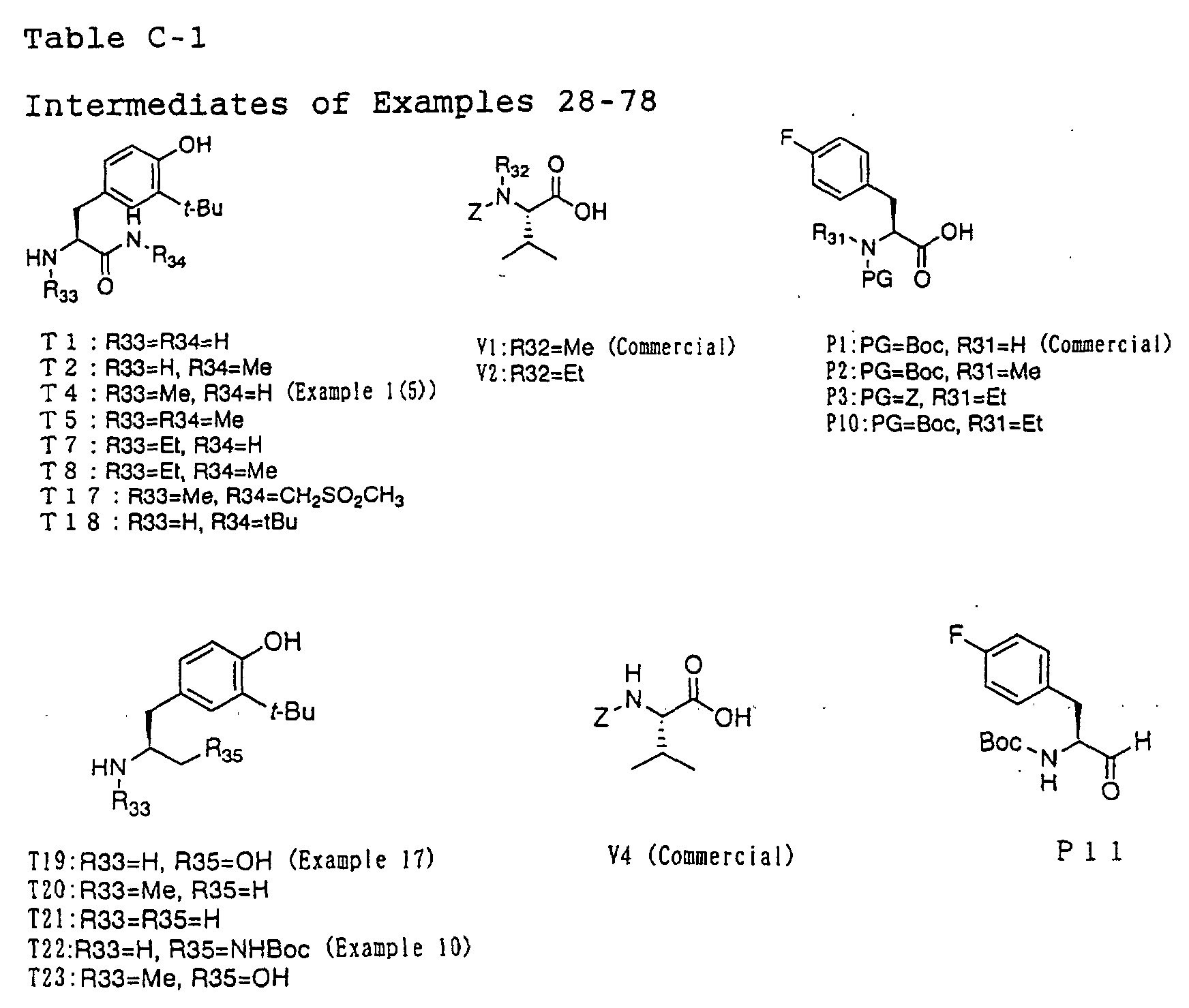
1H-NMR(CDCl3):δ 1.39(9H,s), 2.60(1H,dd,J=9.6,13.9Hz), 2.83(3H,d,J=5.0Hz), 3.18(1H,dd,J=4.0,13.9Hz), 3.57(1H,dd,J=4.0,9.6Hz), 6.67(1H,d,J=7.9Hz), 6.88(1H,dd,J=1.8,7.9Hz), 7.07(1H,d,J=1.8Hz).
1H-NMR (CDCl3) : δ 1.38(9H,s), 3.09(2H,d,J=5.3Hz), 3.76(3H,s), 4.93(1H,dd,J=5.3,13.5Hz), 5.23(1H,s), 6.02(1H,d,J=13.5Hz), 6.55(1H,d,J=7.9Hz), 6.80(1H,dd,J=2.0,7.9Hz), 6.95(1H,d,J=2.0Hz), 8.18(1H,s).
1H-NMR (CDCl3):δ 1.38(9H,s), 2.37(3H,s), 2.89(2H,d,J=6.6Hz), 3.42(1H,t,J=6.6Hz),3.68(3H,s), 6.55(1H,d,J=7.9Hz), 6.86(1H,dd,J=2.0,7.9Hz), 7.02(1H,d,J=2.0Hz)
1H-NMR (CDCl3):δ 1.39(9H,s), 2.26(3H,s), 2.58(1H, dd, J=10.5, 14.8Hz), 2.84(2H,d,J=4.9Hz), 3.06-3.18(2H,m), 5.00 (1H, brs), 6.62 (1H, d, J=7.9Hz), 6.89(1H, dd, J=1.7, 7.9Hz), 7.08(1H, d, J=1.7Hz), 7.15(1H, brs).
1H-NMR (CDCl3) : δ 0.96(3H,t,J=7.3Hz), 1.40(9H,s), 2.4-2.7(3H,m), 3.14(1H,dd,J=4.0,13.9Hz), 3.26(1H,dd,J=4.0,9.6Hz), 5.25(1H, s), 5.38(1H,brs), 6.63(1H,d,J=7.9Hz), 6.91(1H,dd,J=2.0,7.9Hz), 7.10(1H,d,J=2.0Hz), 7.18(1H,brs).
1H-NMR(CDCl3):δ 0.94(3H,t,J=7.3Hz), 1.39(9H,s), 2.4-2.6(2H,m), 2.60(1H,dd,J=9.6,13.8Hz), 2.83(3H,d,J=4.9Hz), 3.13(1H,dd,J=4.0,13.8Hz), 3.25(1H,dd,J=4.0,9.6Hz), 5.44(1H,brs),6.64(1H,d,J=7.9Hz), 6.88(1H,dd,J=2.0,7.9Hz), 7.07(1H,d,J=2.0Hz), 7.27(1H,brs)
1NMR(CDCl3):δ 0.92(3H,d,J=6.3Hz), 1.03(3H,d,J=6.6Hz), 1.16(3H,t,J=6.9Hz), 2.40-2.60(1H,m), 3.15-3.58(2H,m), 3.73(1H,brd,J=10.9Hz), 5.20(2H,brs), 7.36(5H,brs)
1H-NMR(CDCl3):δ 1.32 and 1.39(9H,s), 2.67 and 2.75(3H,s), 2.94-3.11(1H,m), 3.20-3.35(1H,m), 4.53-4.62(1H,brd), 4.97(1H,brs), 6.90-7.20(4H,m)
1H-NMR(CDCl3):δ 1.12(3H,d,J=6.3Hz), 1.38(9H,s), 2.42(3H,s), 2.64(2H,d,J=6.6Hz), 2.75-2.90(1H,m), 6.55(1H,d,J=7.9Hz), 6.84(1H,dd,J=1.6,7.9Hz), 7.04(1H,d,J=1.6Hz).
1H-NMR(CDCl3):δ 1.16(3H,d,J=6.6Hz), 1.39(9H,s), 2.45(1H,dd,J=4.9, 13.3Hz), 2.69(1H,dd,J=4.9,13.3Hz), 3.15(1H,m), 3.52H,brs), 6.58(1H,d,J=7.9Hz), 6.83(1H,dd,J=1.6,7.9Hz), 7.03(1H,d,J=1.6H
1H-NMR (CDCl3): δ 1.39(9H,s), 2.84(1H,dd,J=6.9,13.8Hz), 3.02(1H,dd,J=5.9,13.8Hz), 3.16(3H,s), 3.68(3H,s), 4.86-4.96(1H,m), 5.10-5.24(1H,m), 6.95(1H,d,J=8.9Hz), 6.98(1H,d,J=8.9Hz), 7.11(1H,d,J=8.2Hz), 7.13(1H,d,J=8.2Hz).
1H-NMR(CDCl3): δ 1.44(9H,s), 3.00-3.20(2H,m), 4.34-4.46(1H,m), 4.98-5.06(1H,m), 6.98(1H,d,J=8.6Hz), 7.01(1H,d,J=8.6Hz), 7.12(1H,d,J=8.3Hz), 7.14(1H,d,J=8.3Hz), 9.63(1H,s).
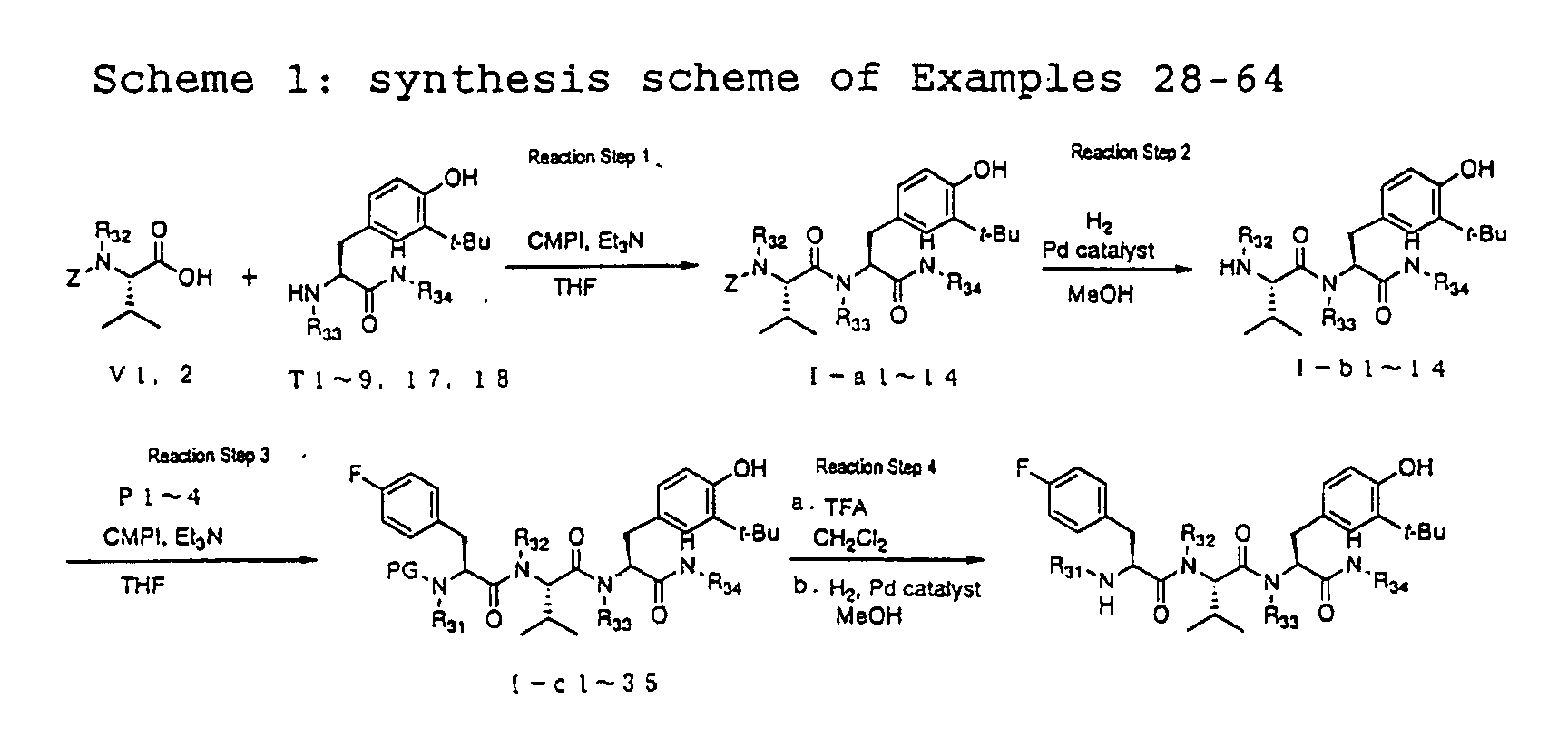
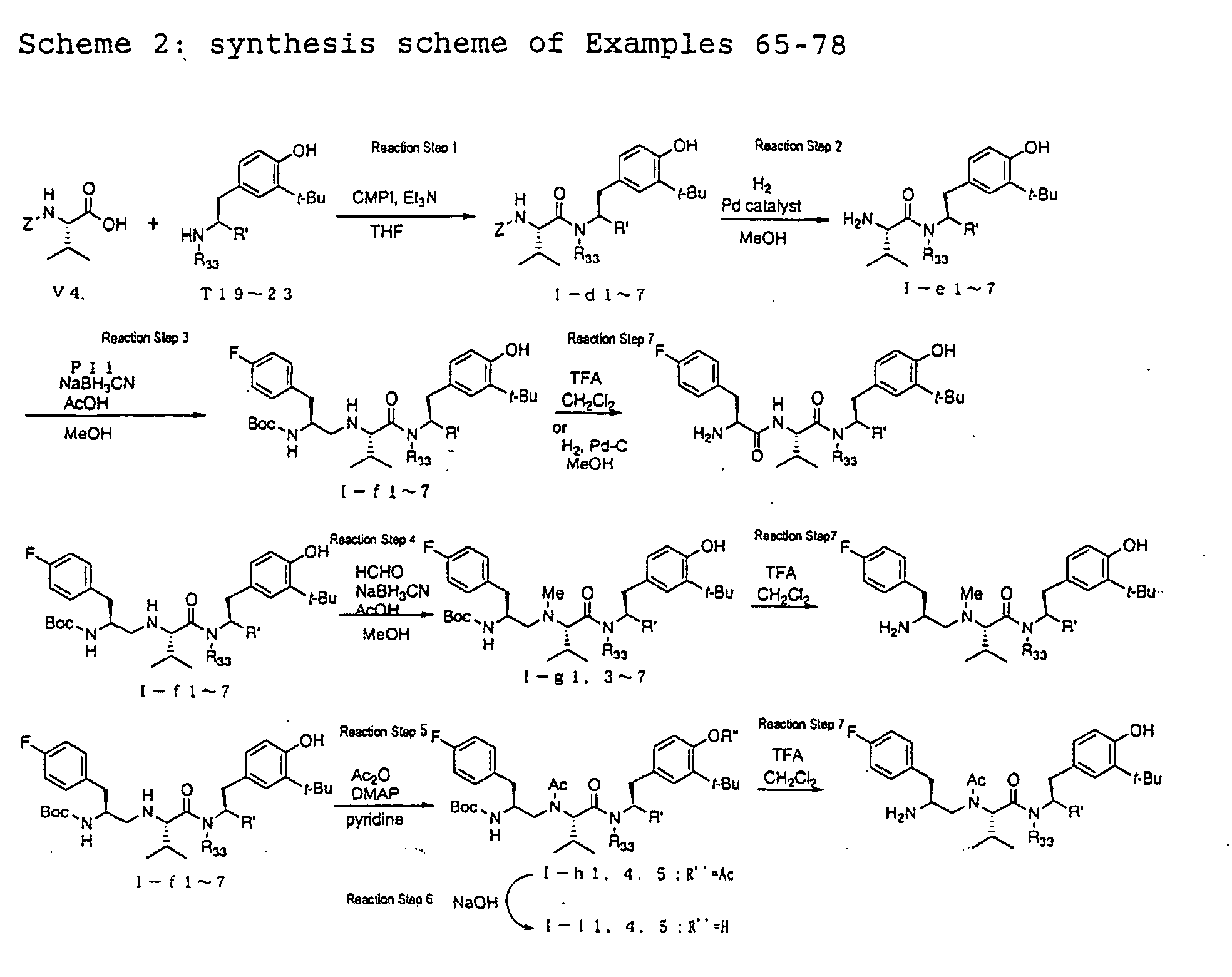
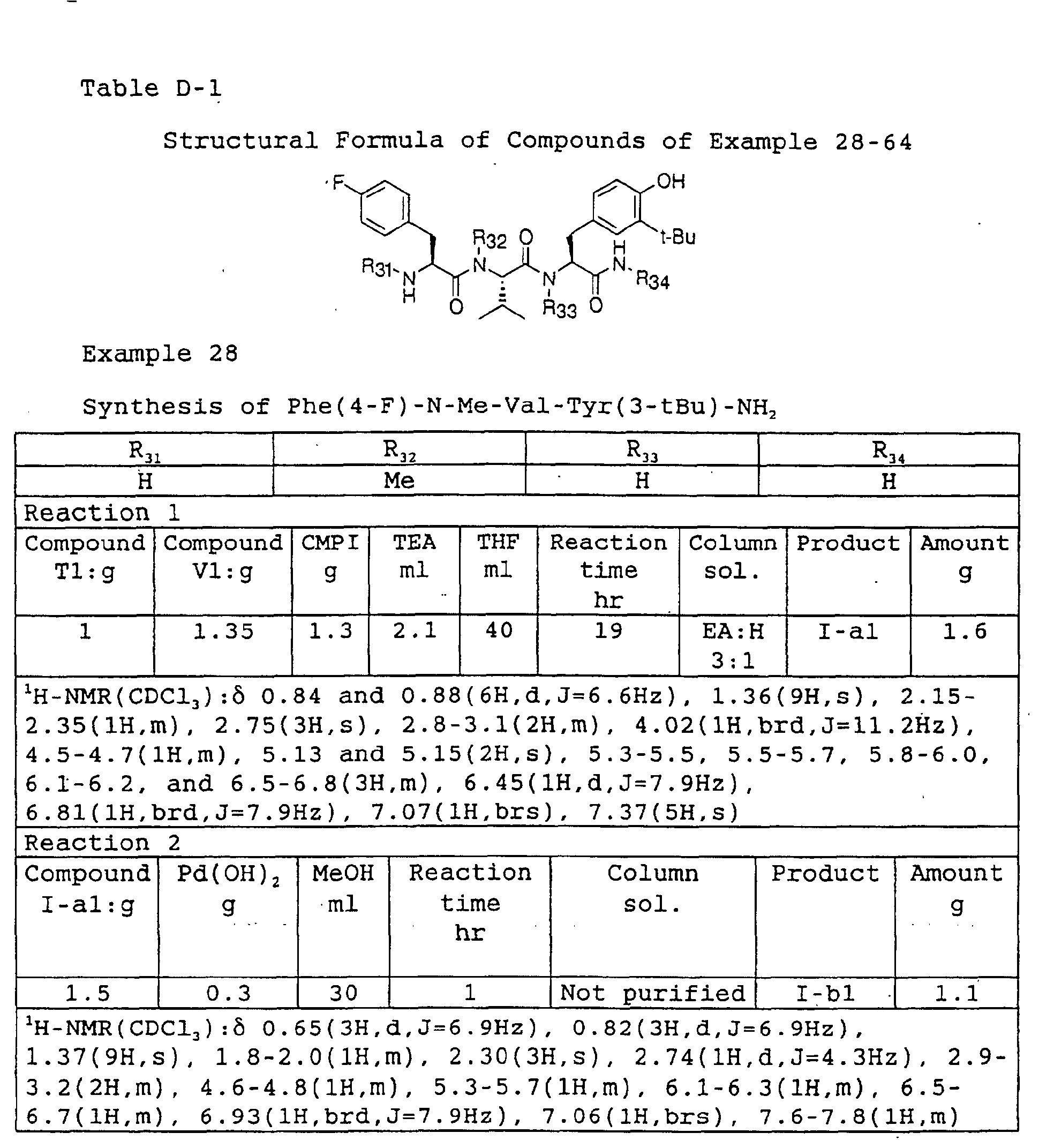
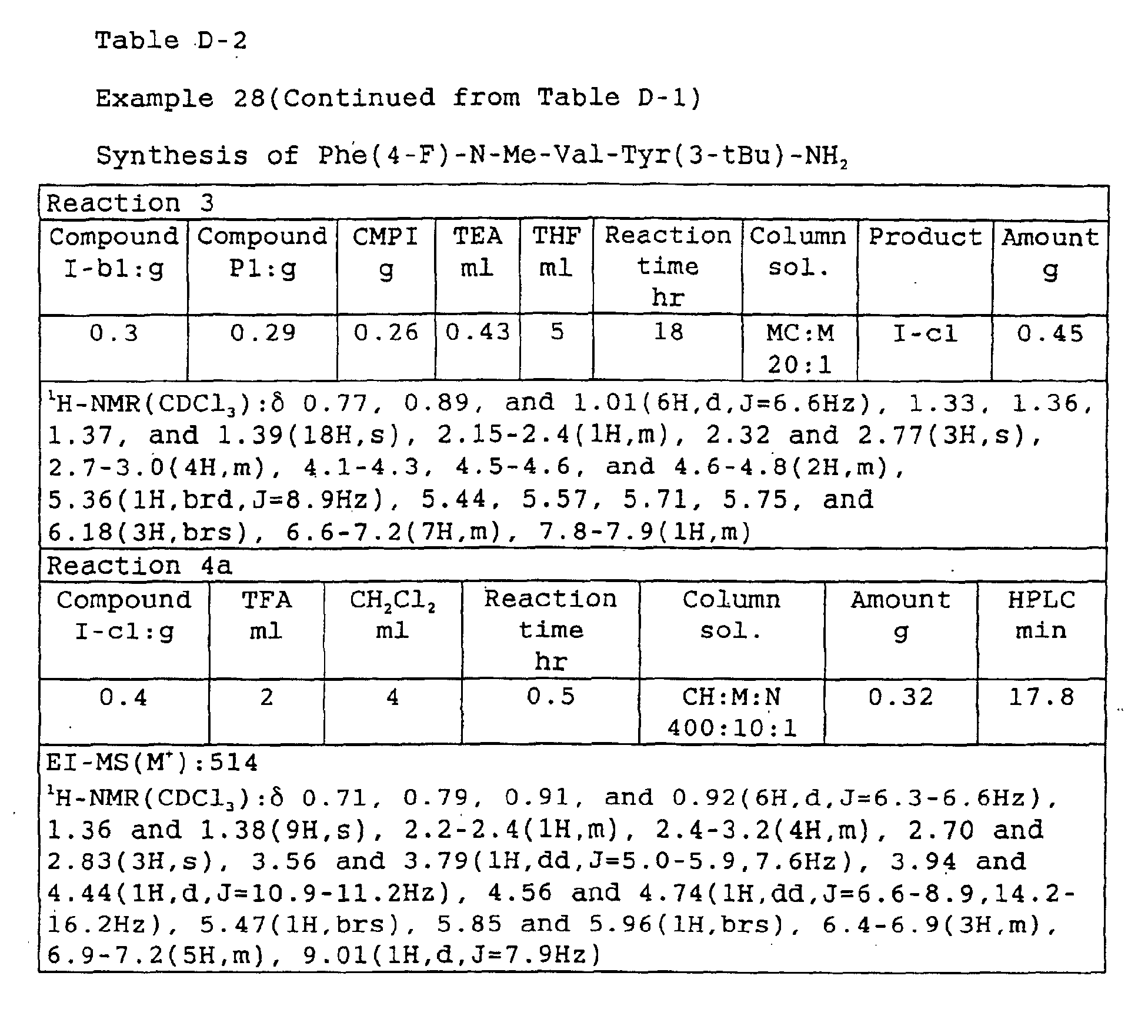
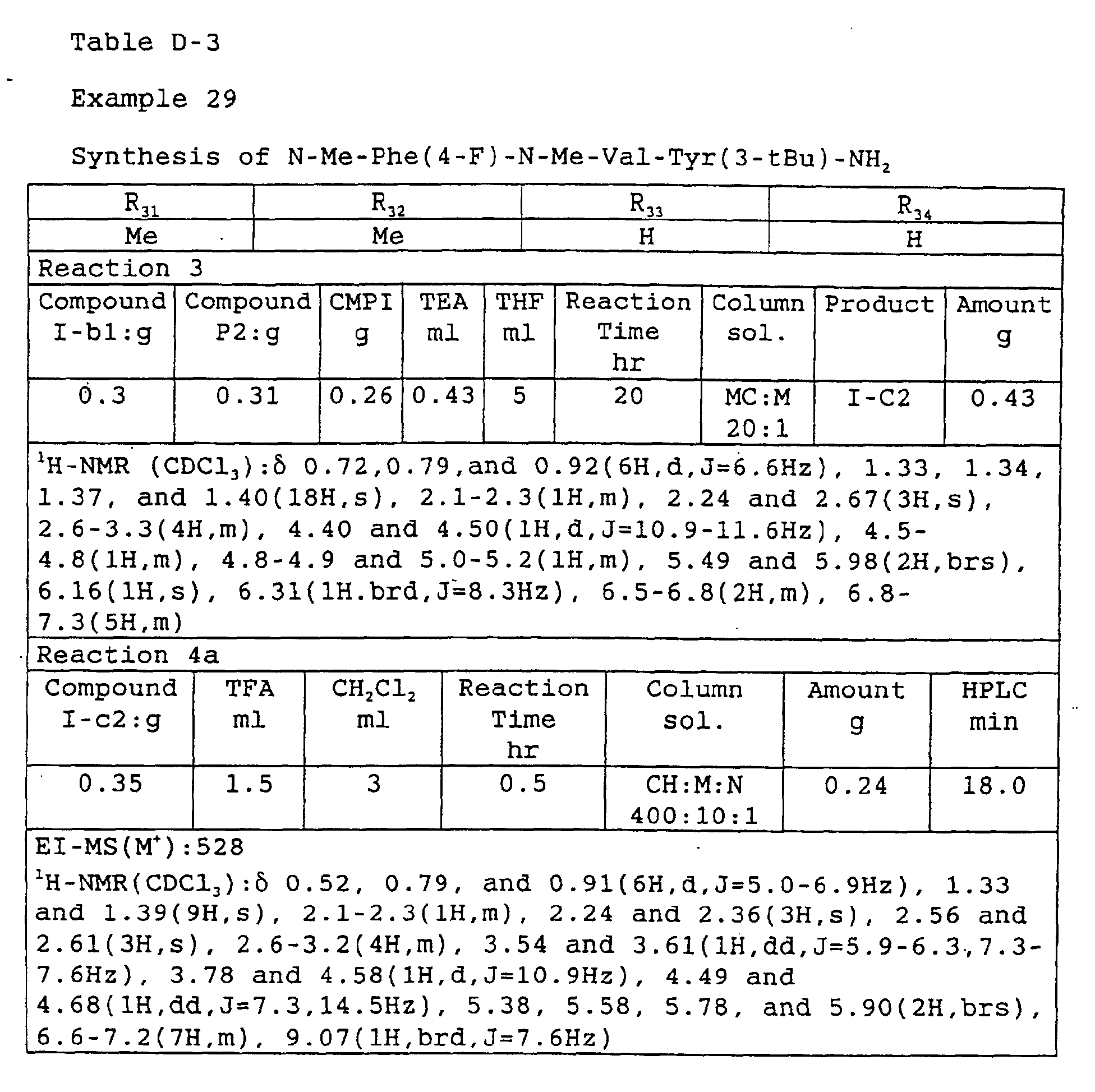
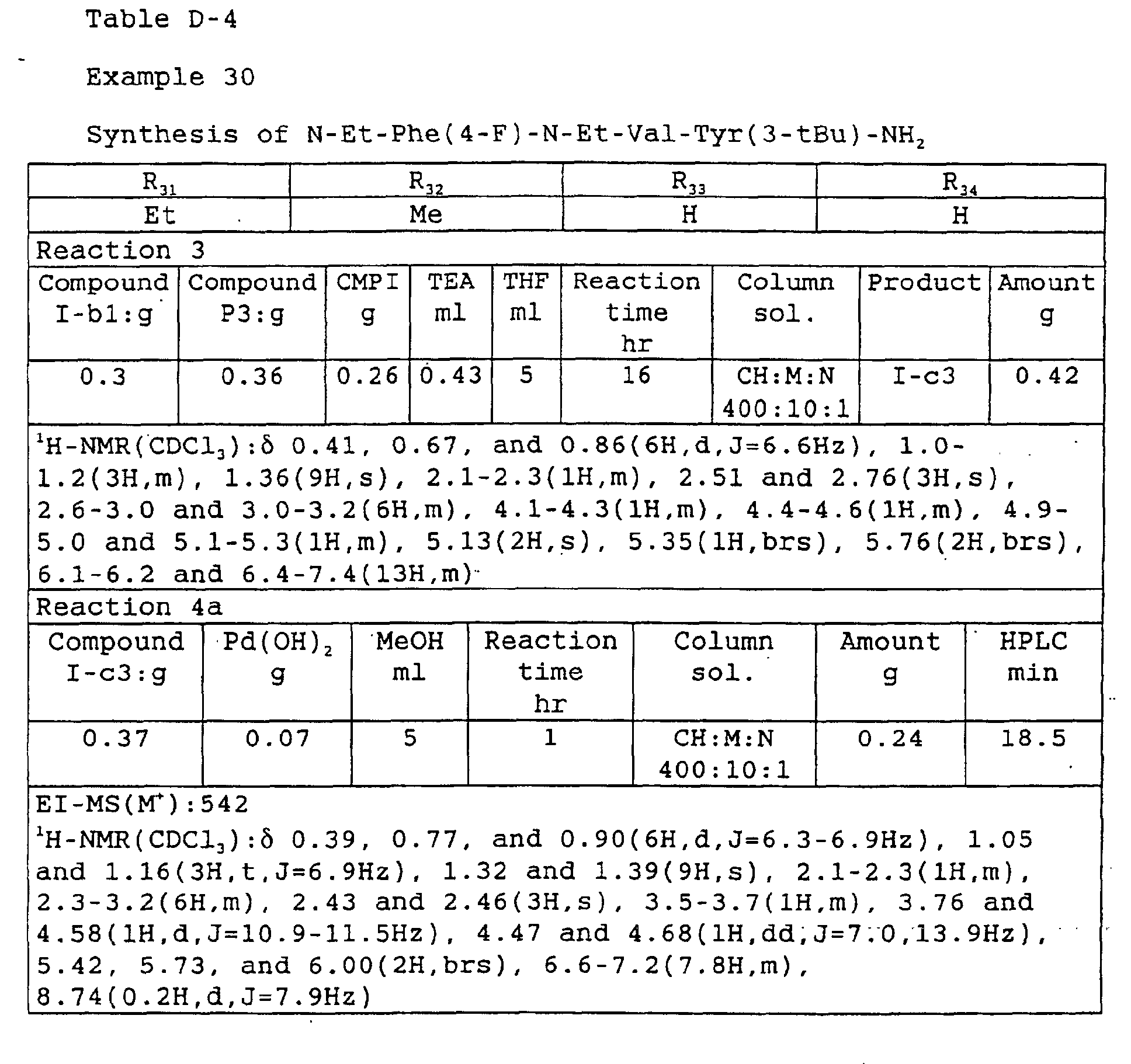

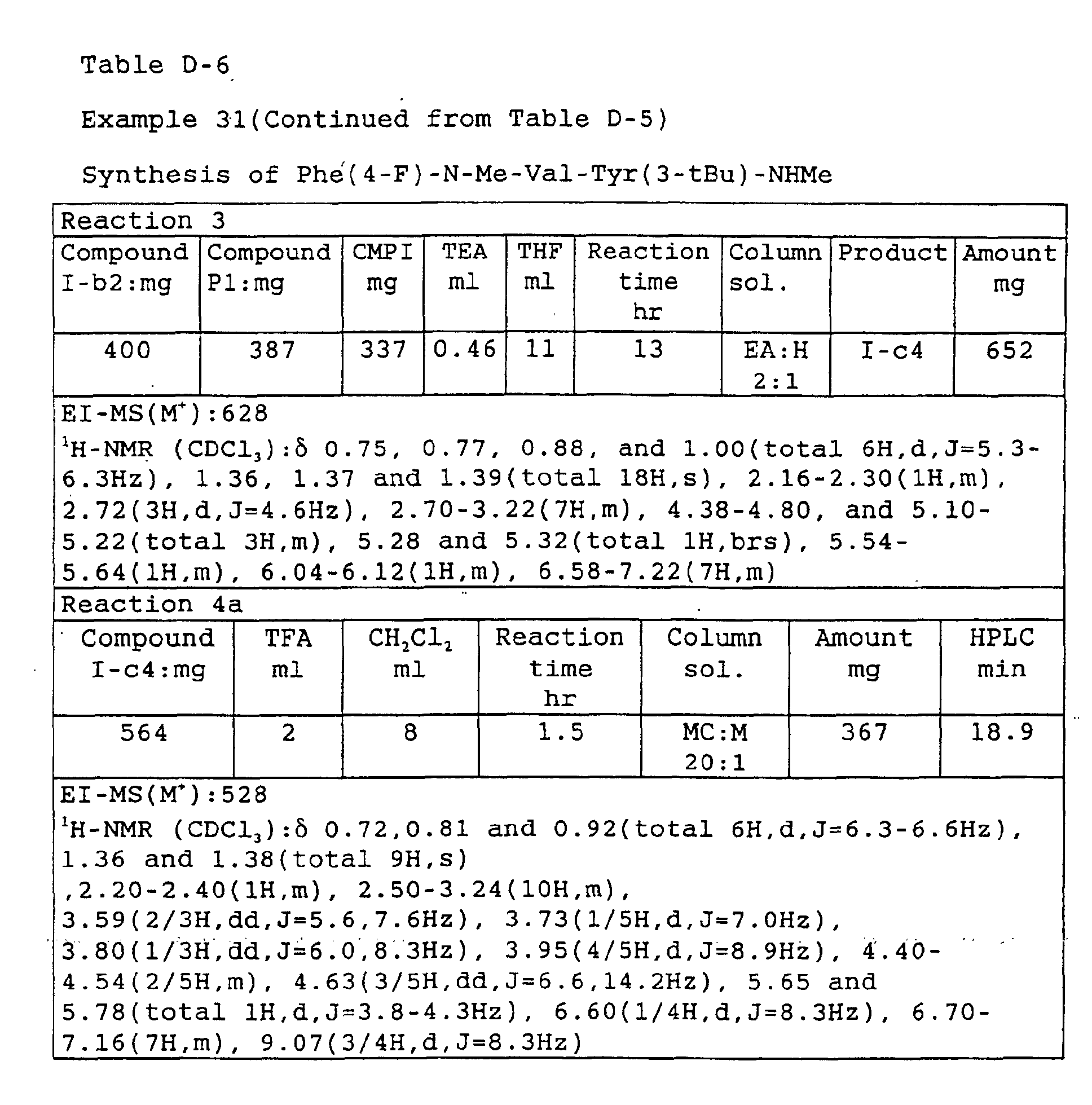

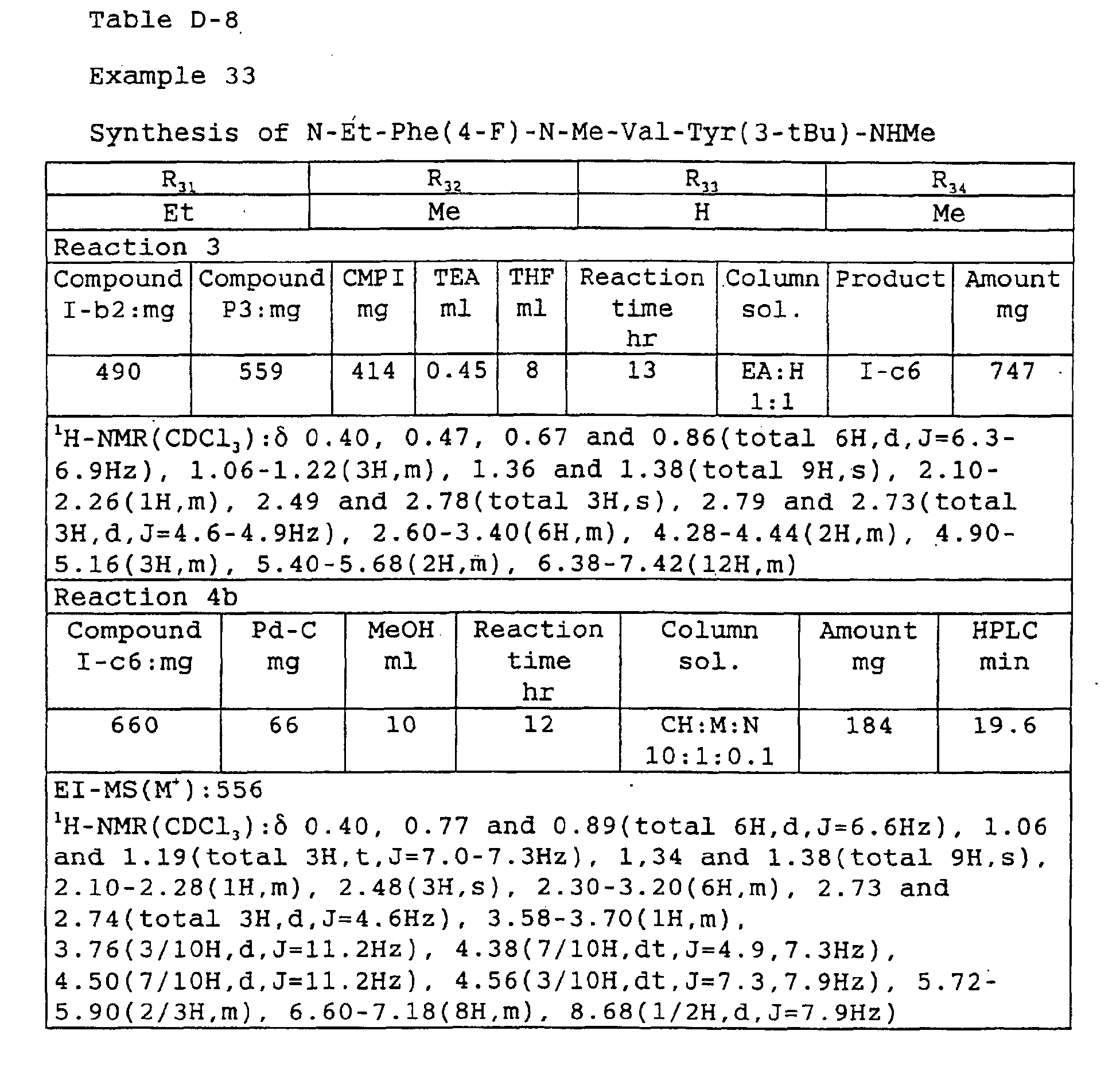
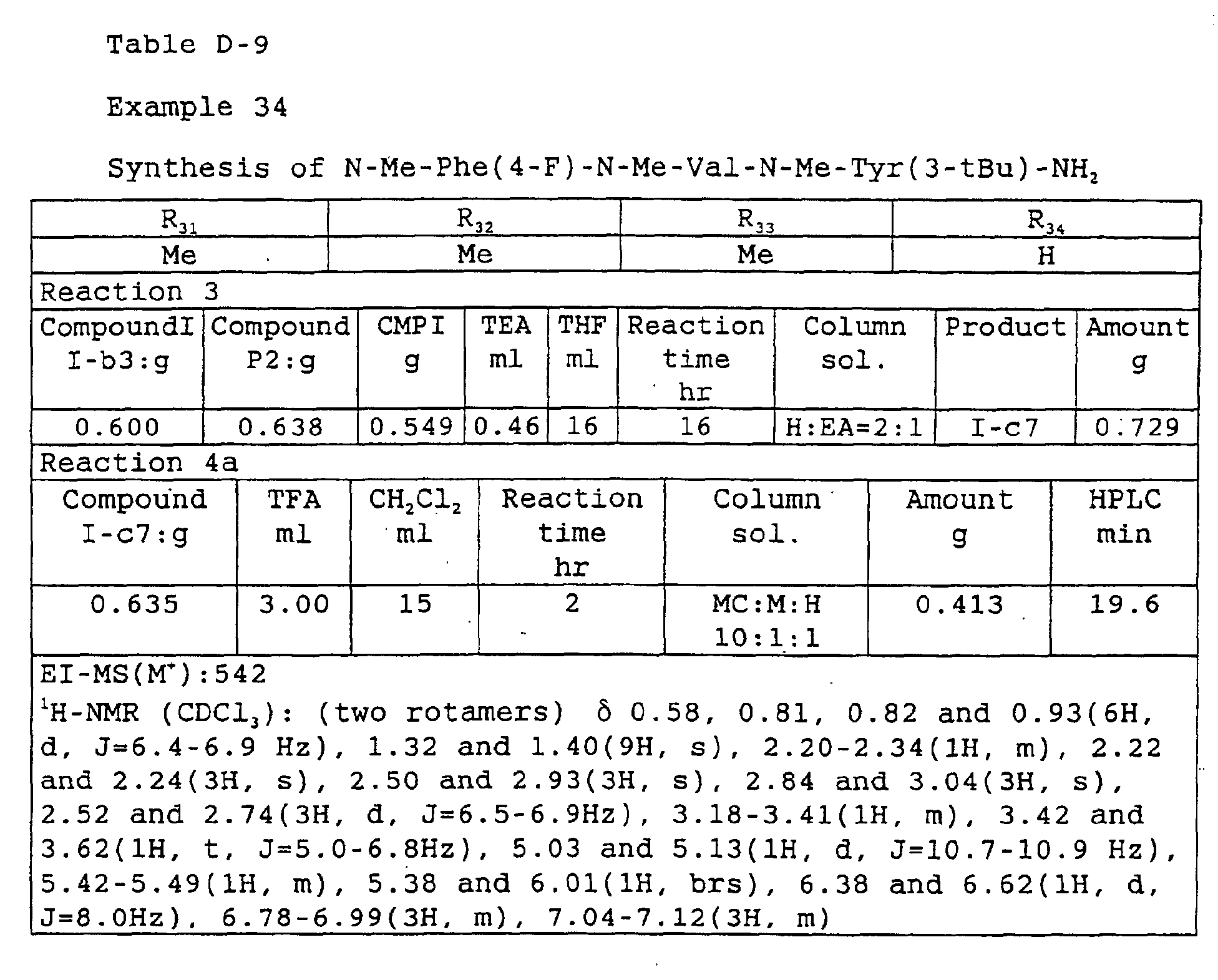


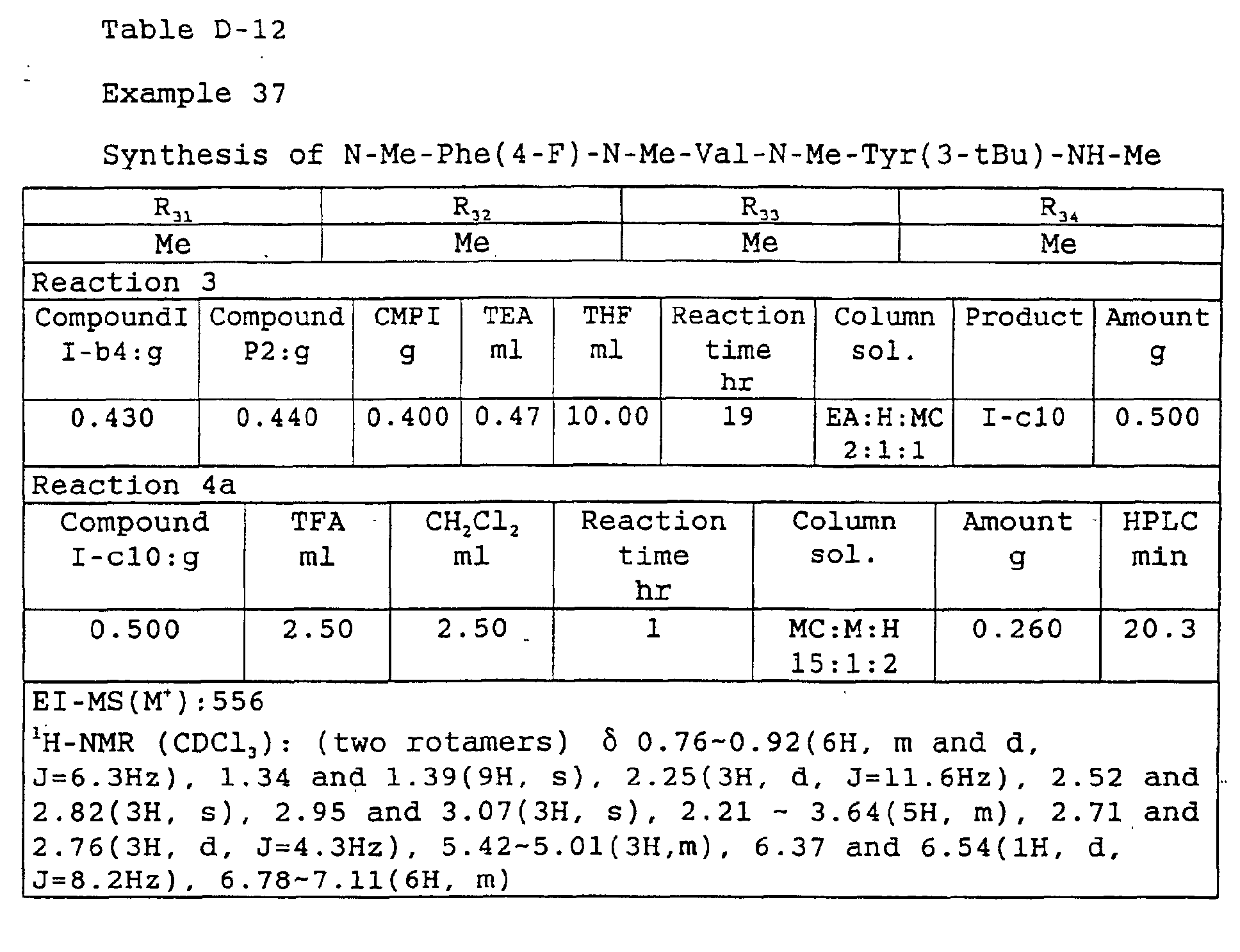
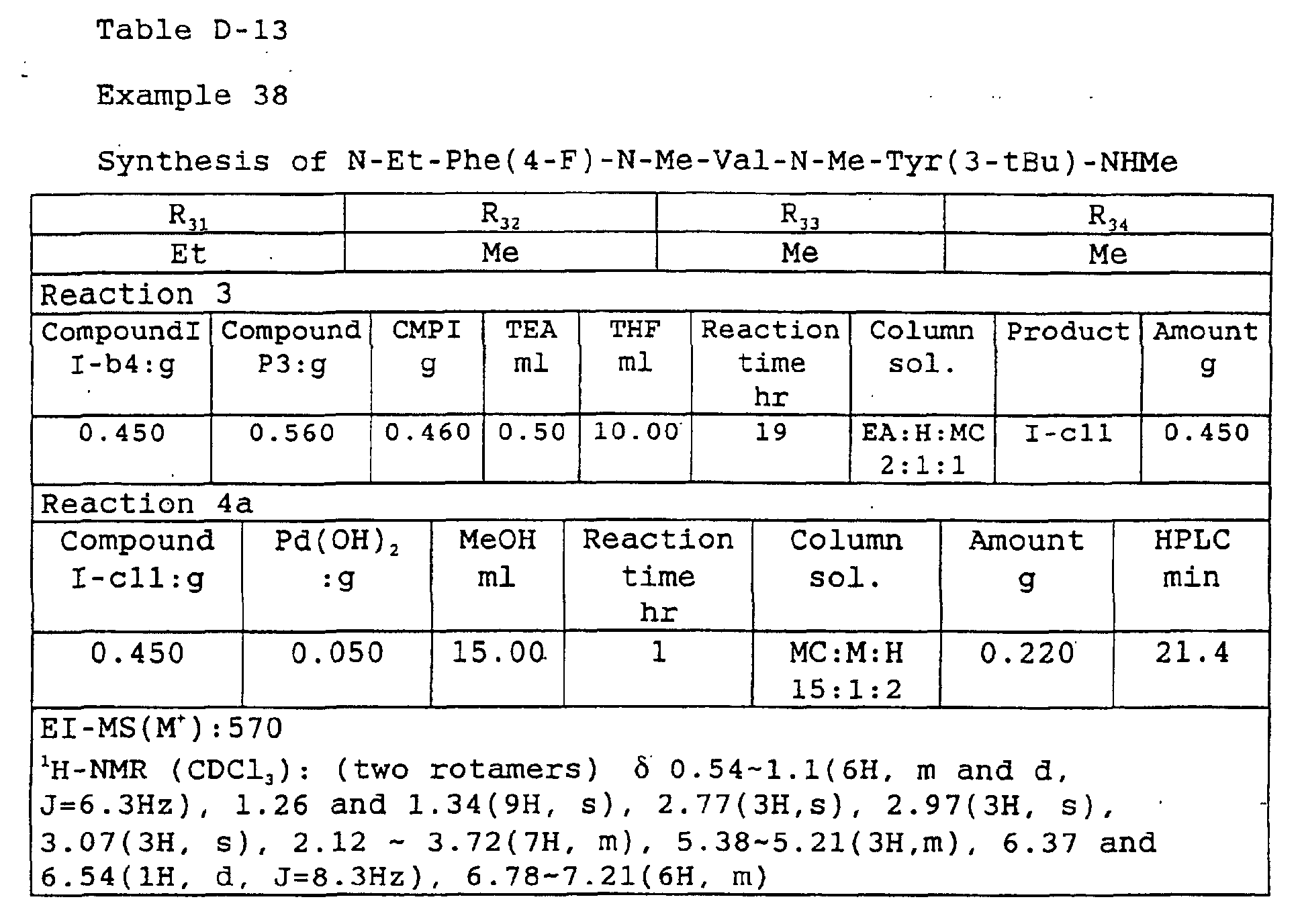
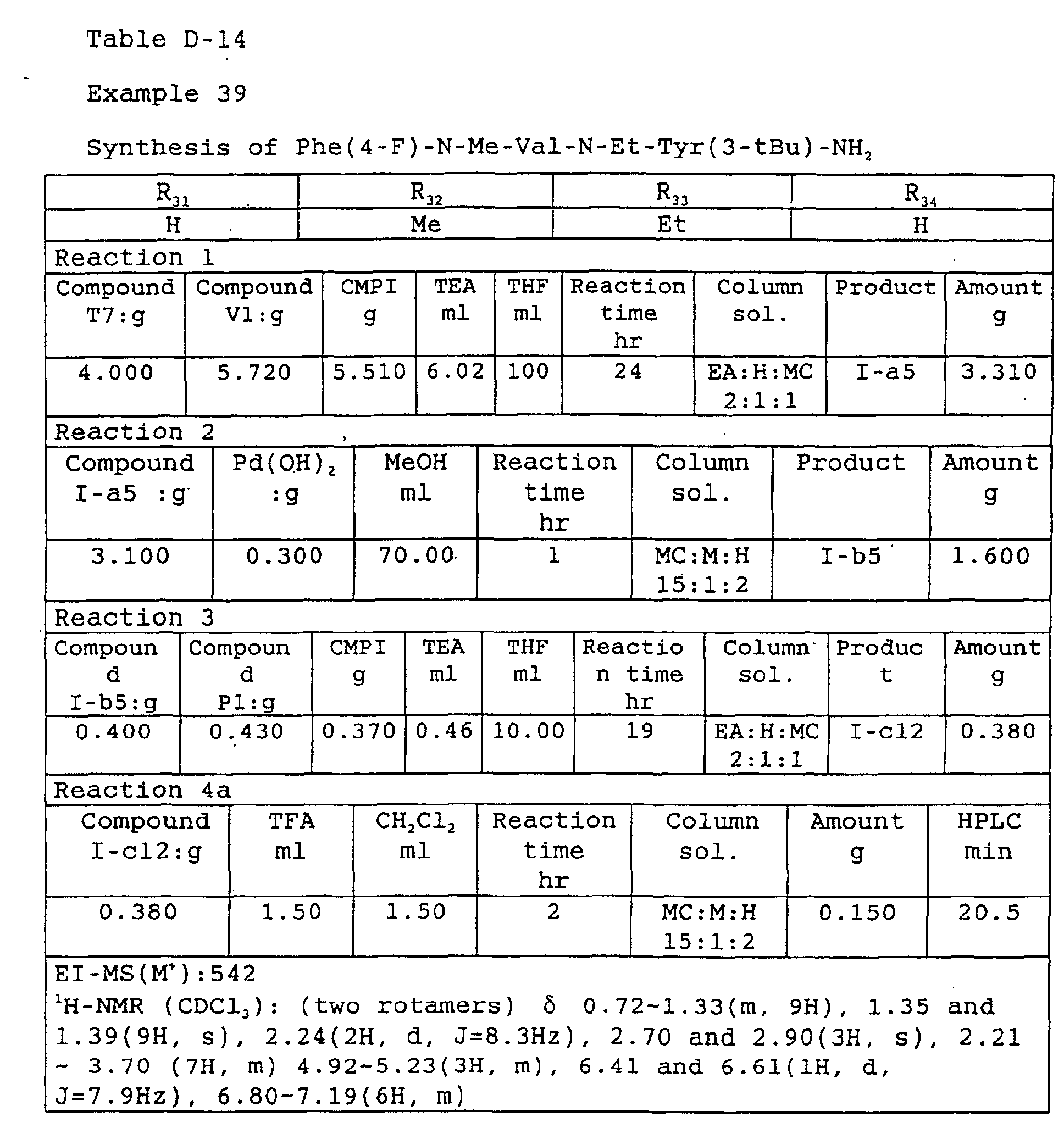
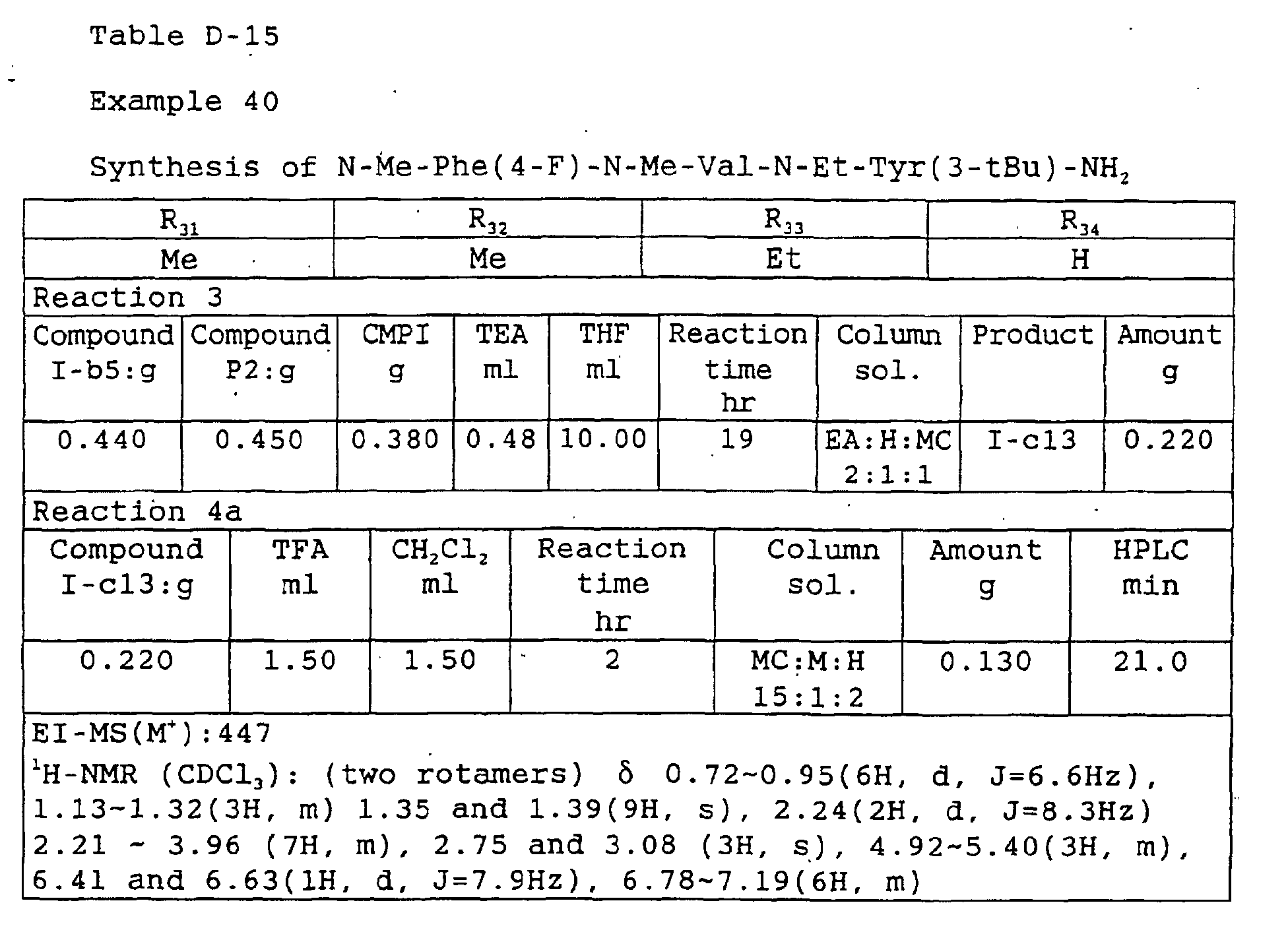
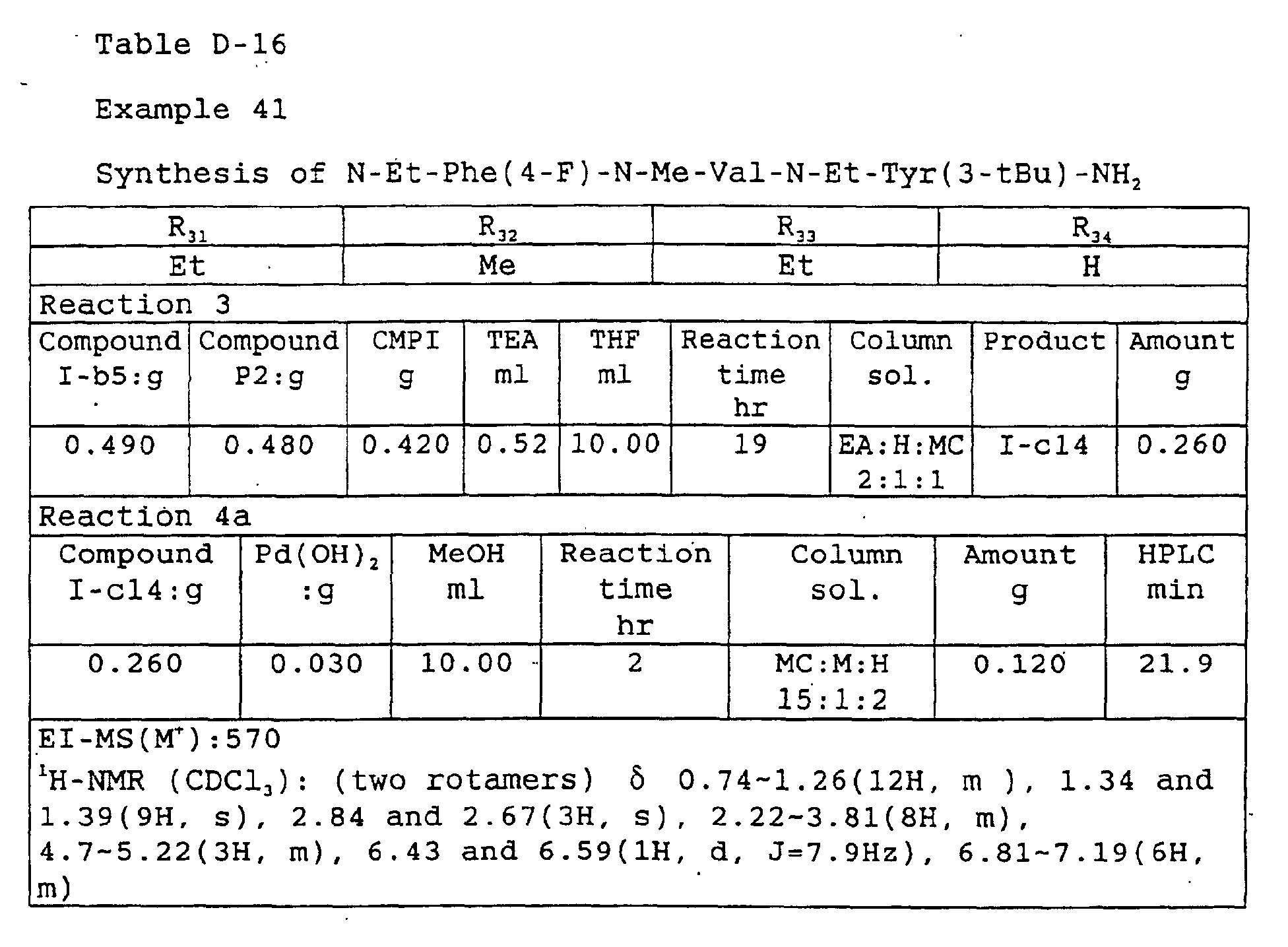
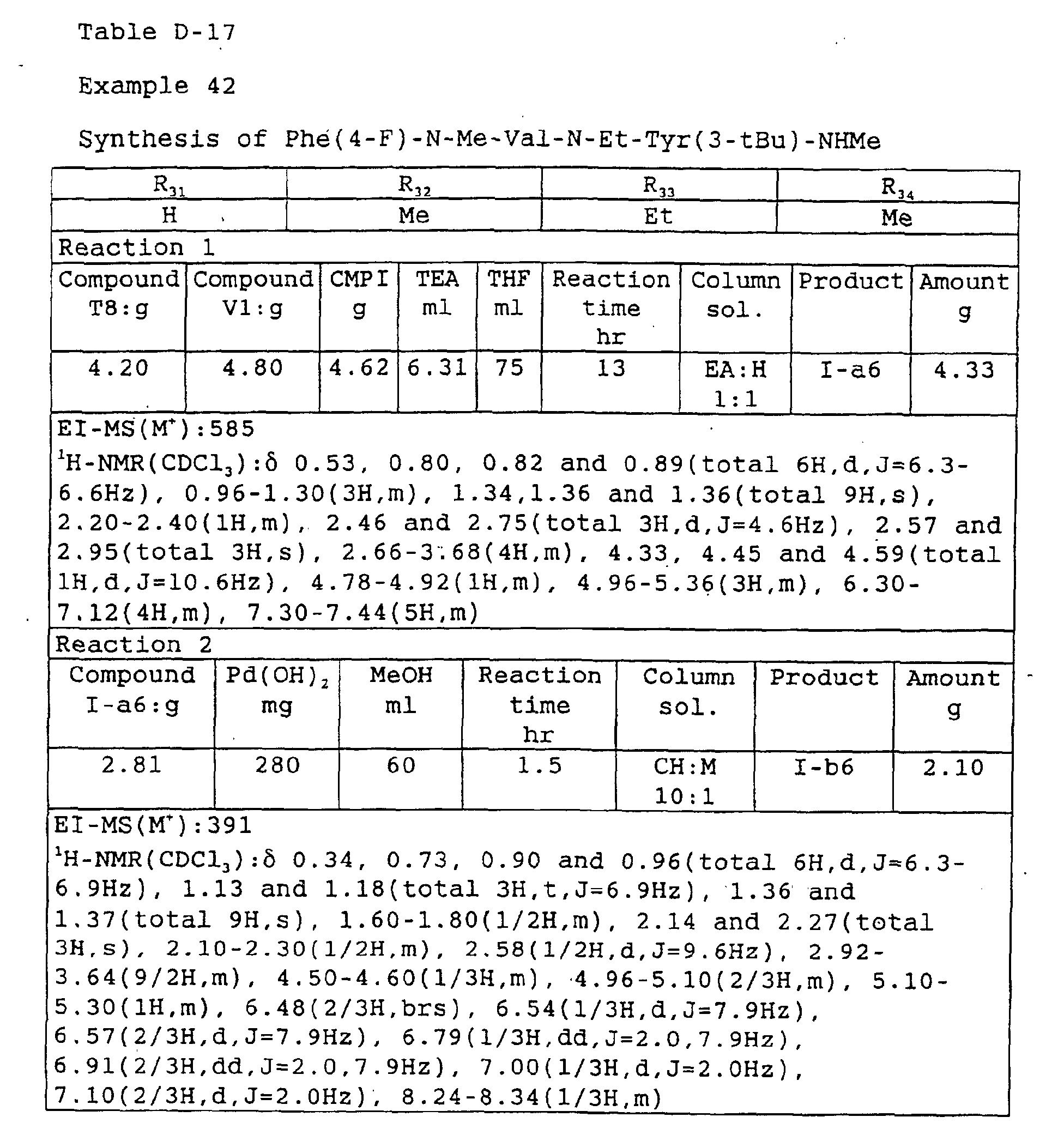
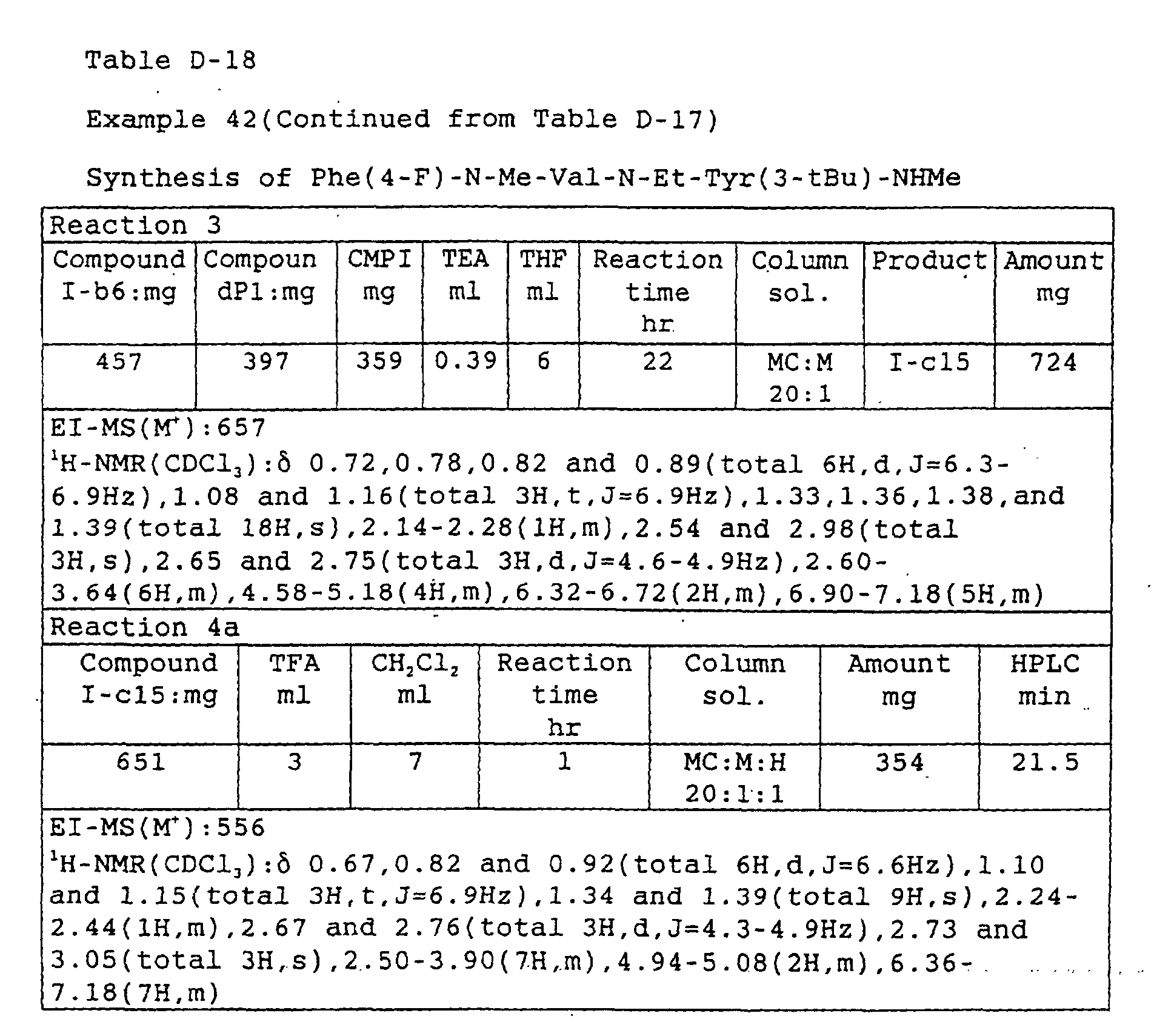
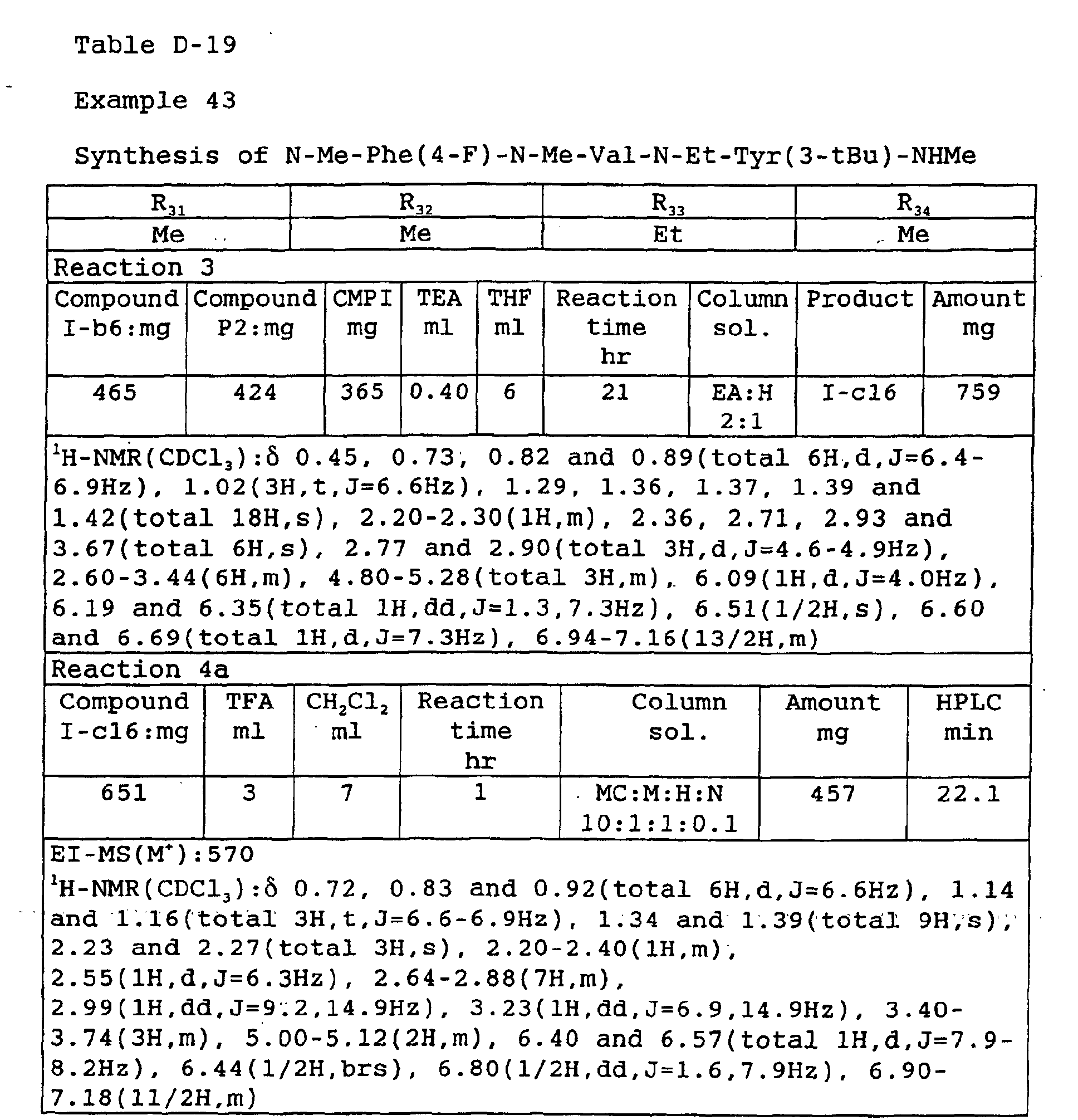
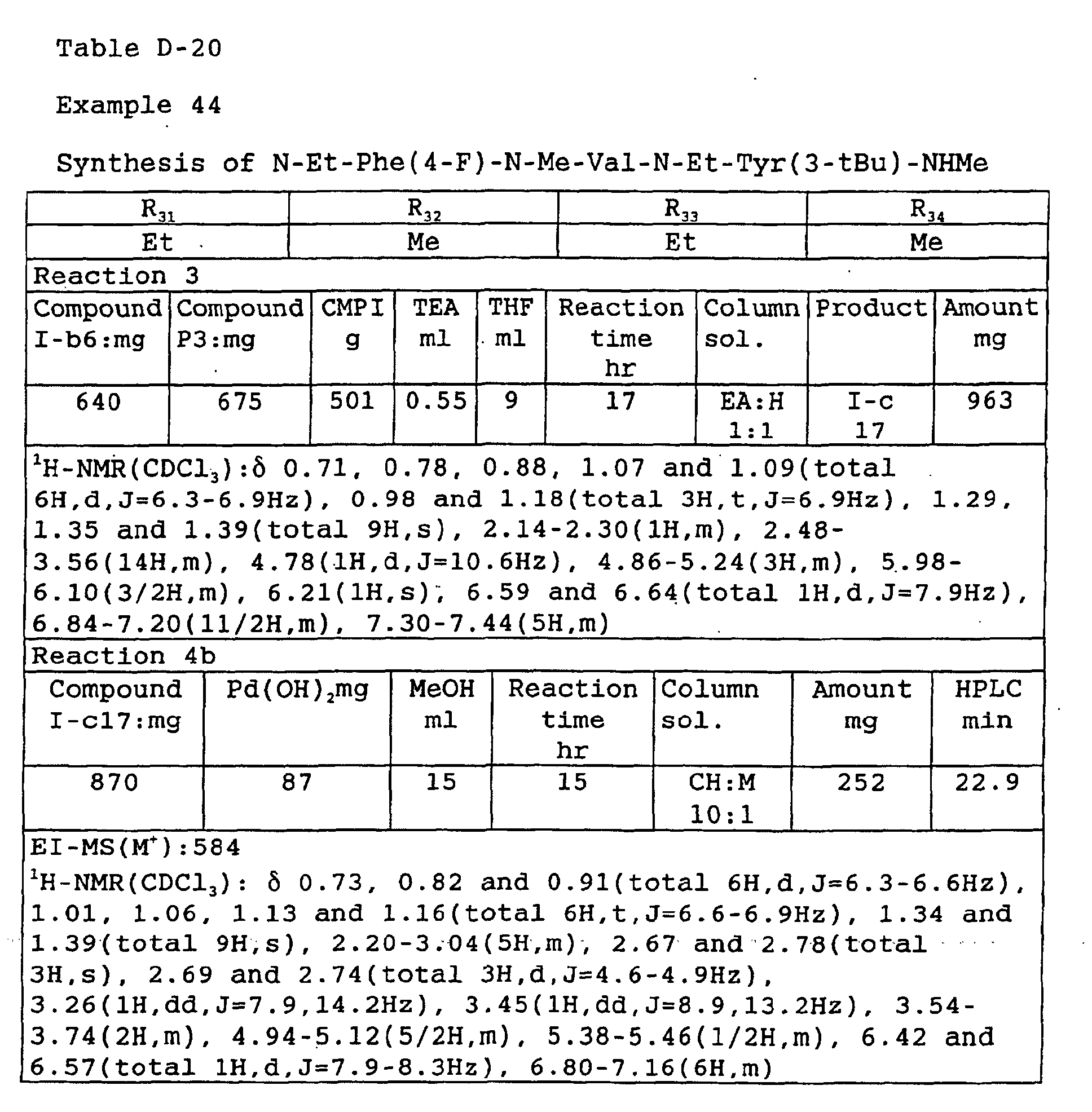
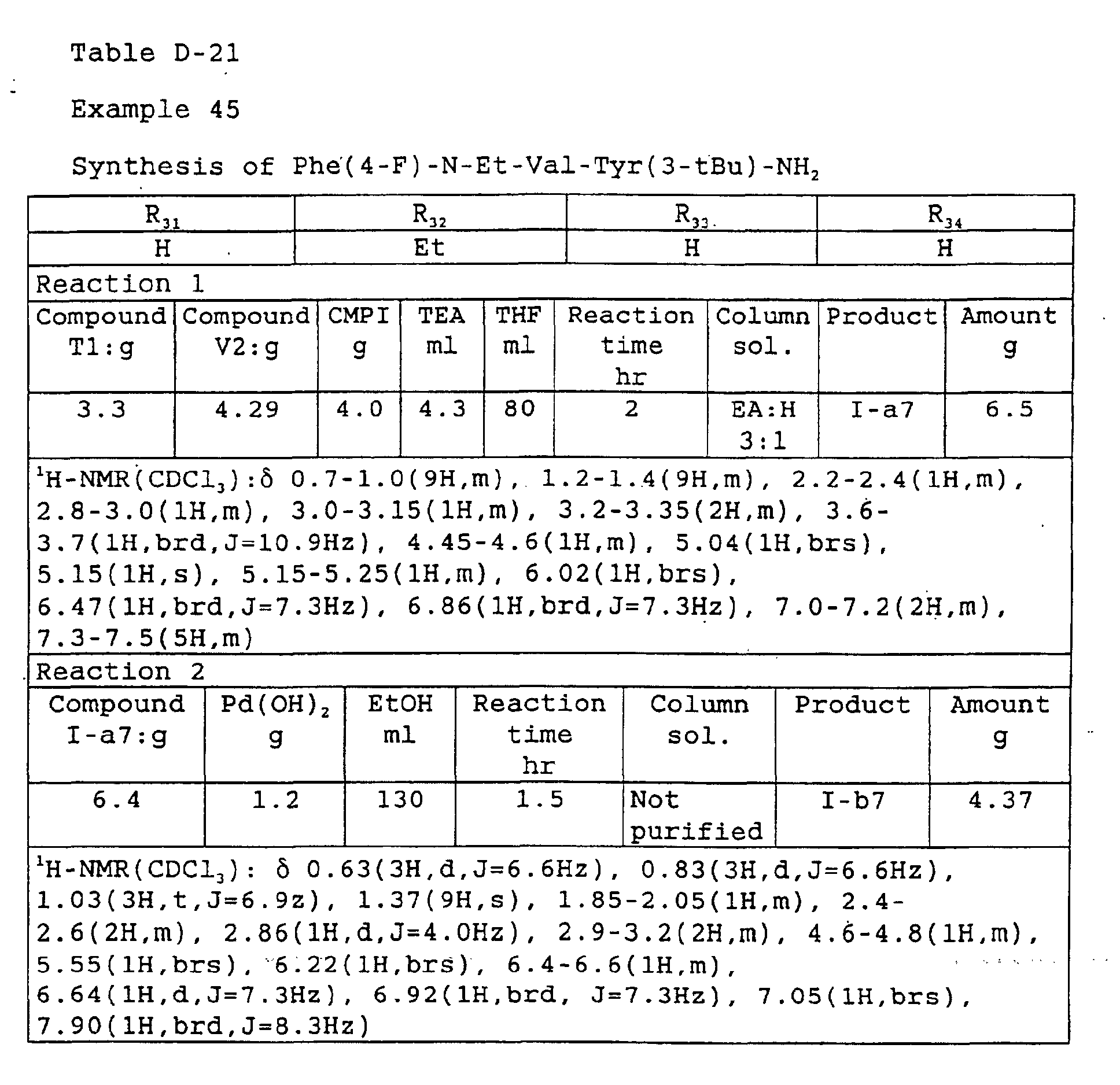
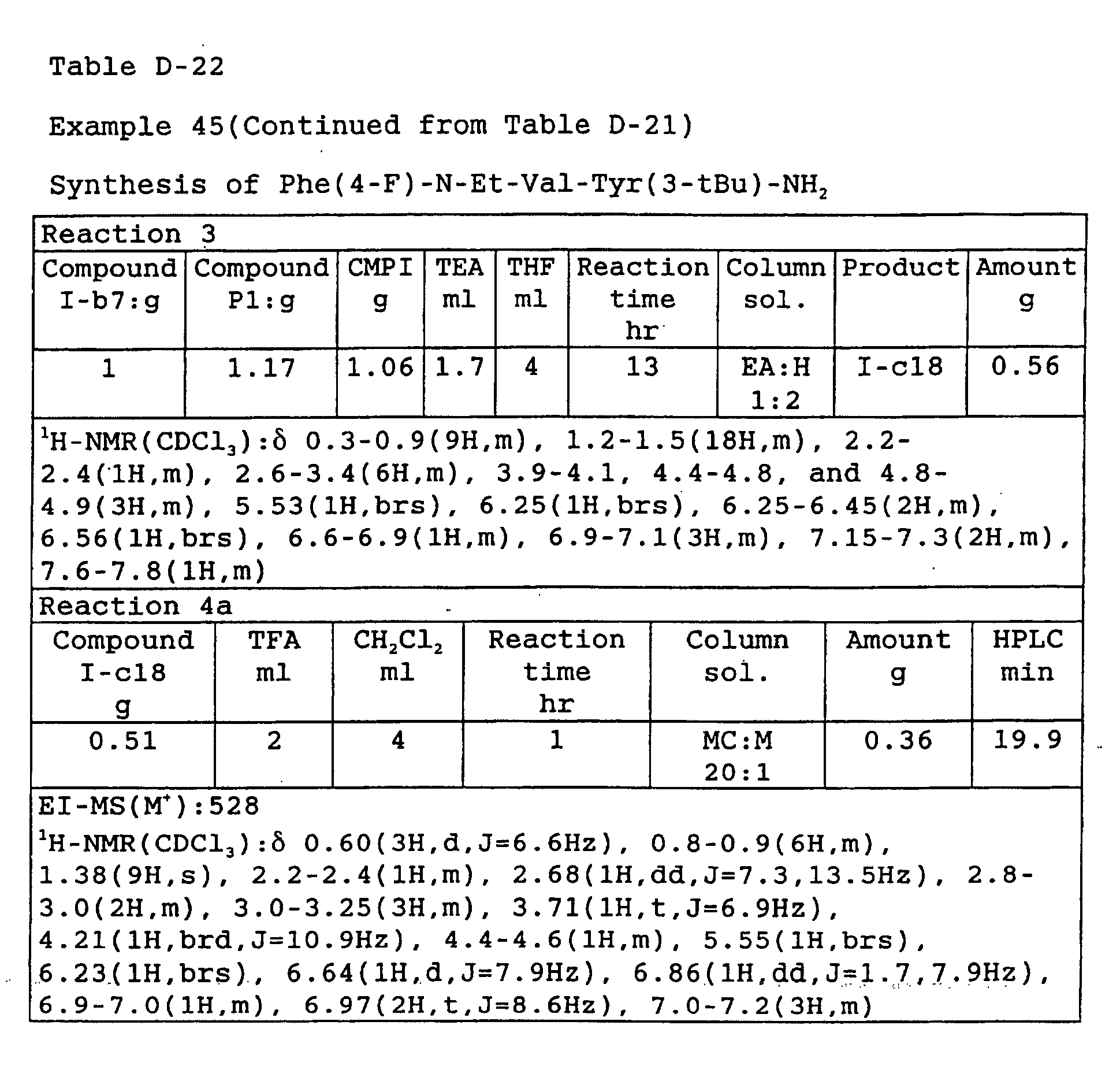
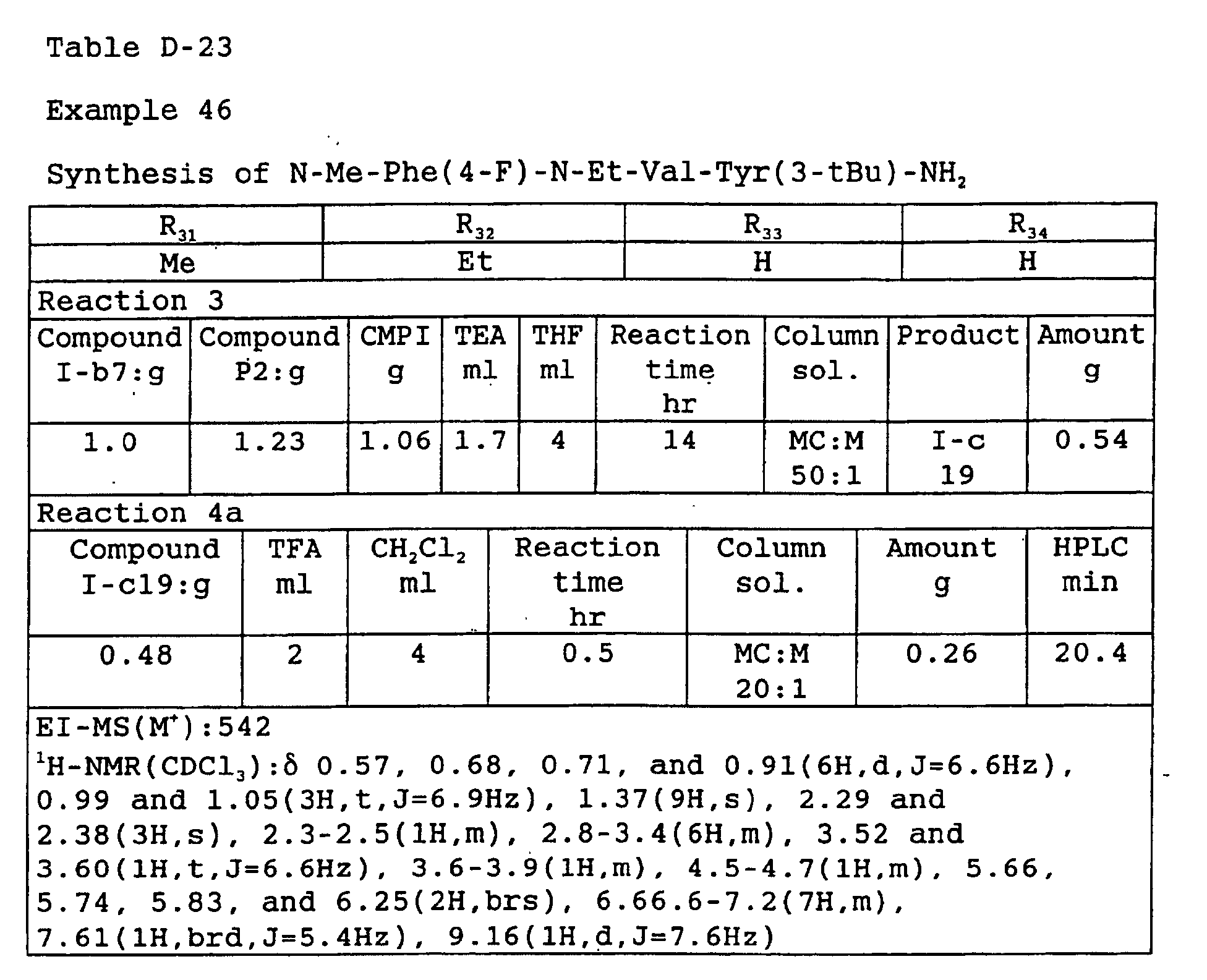
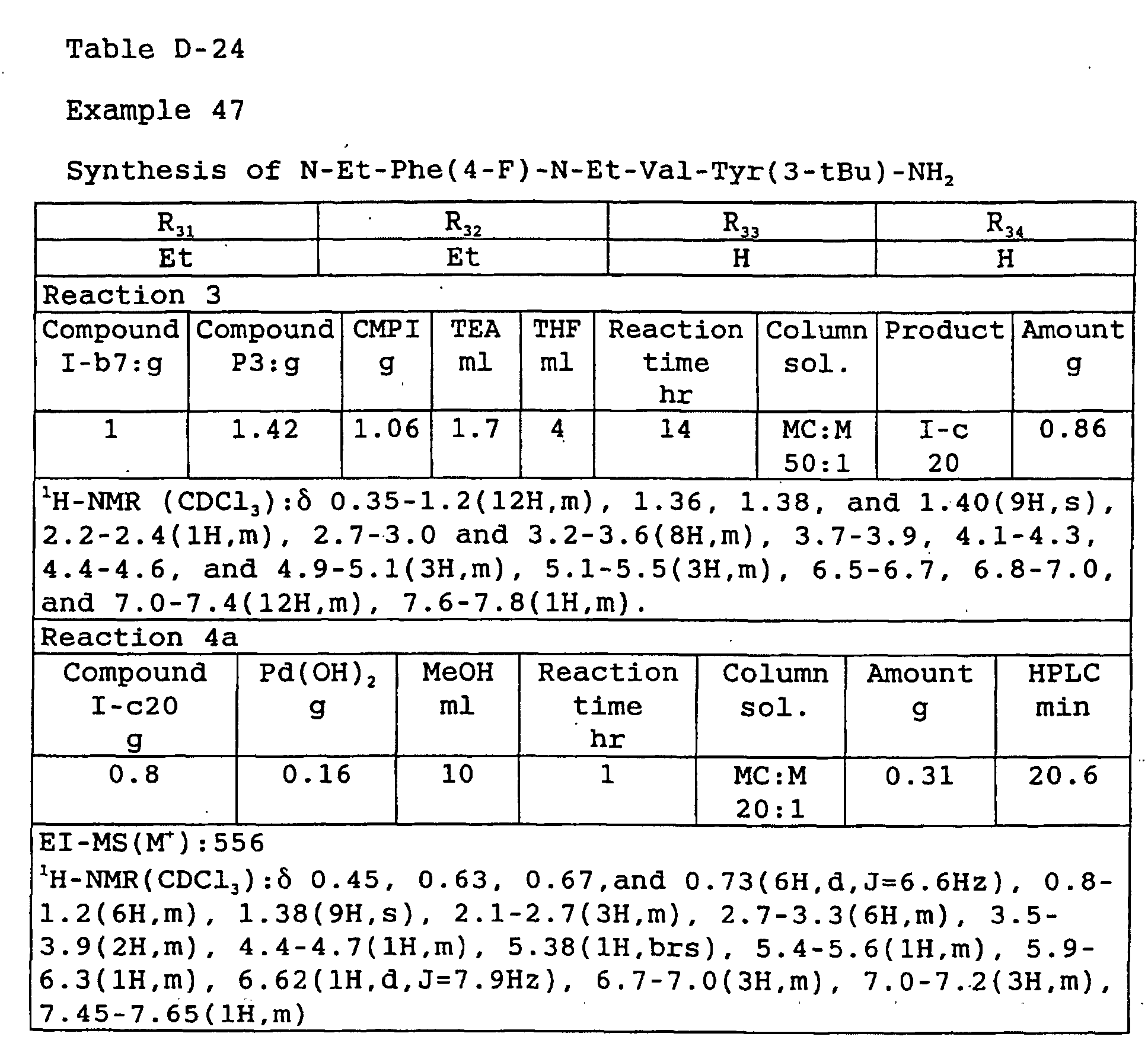

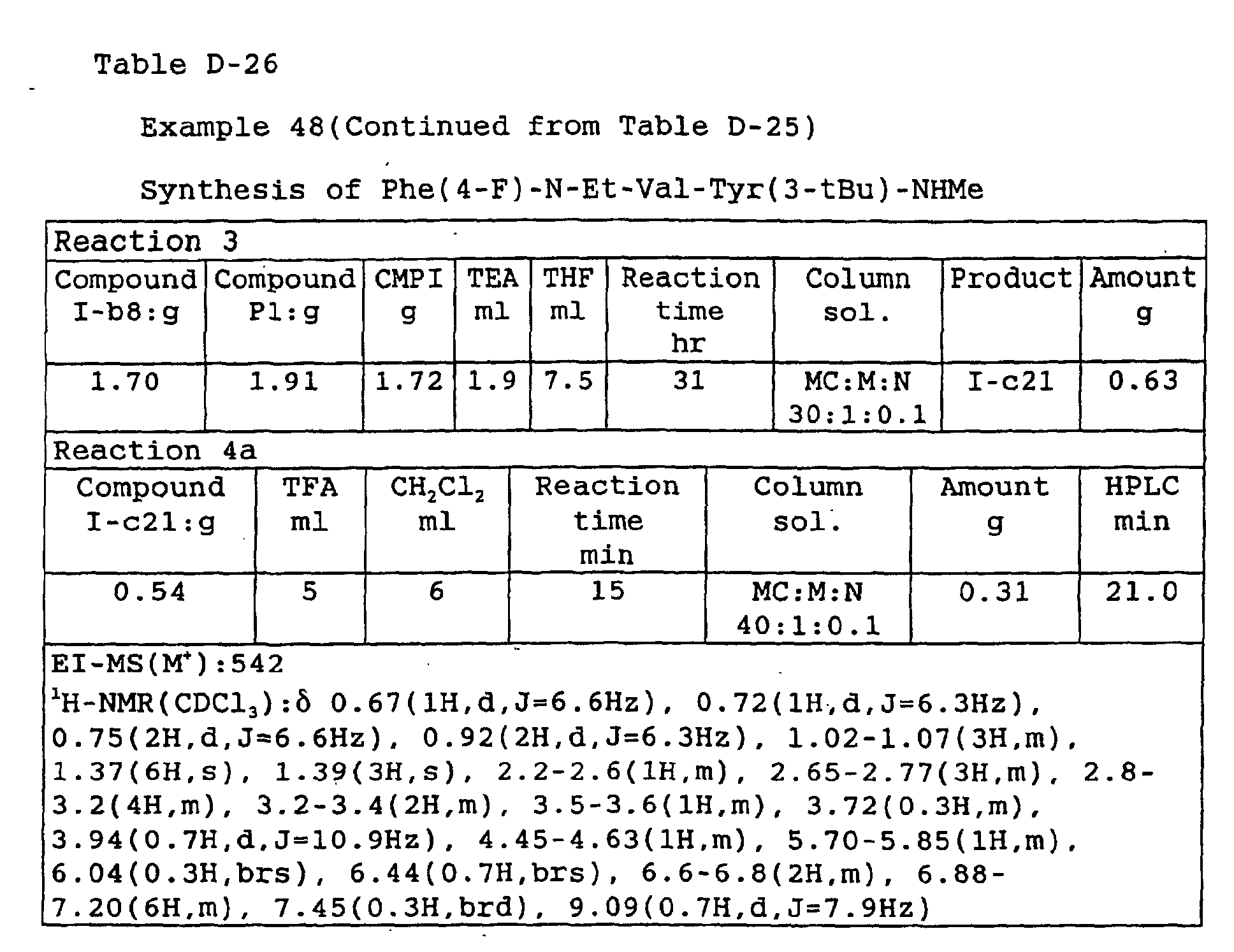
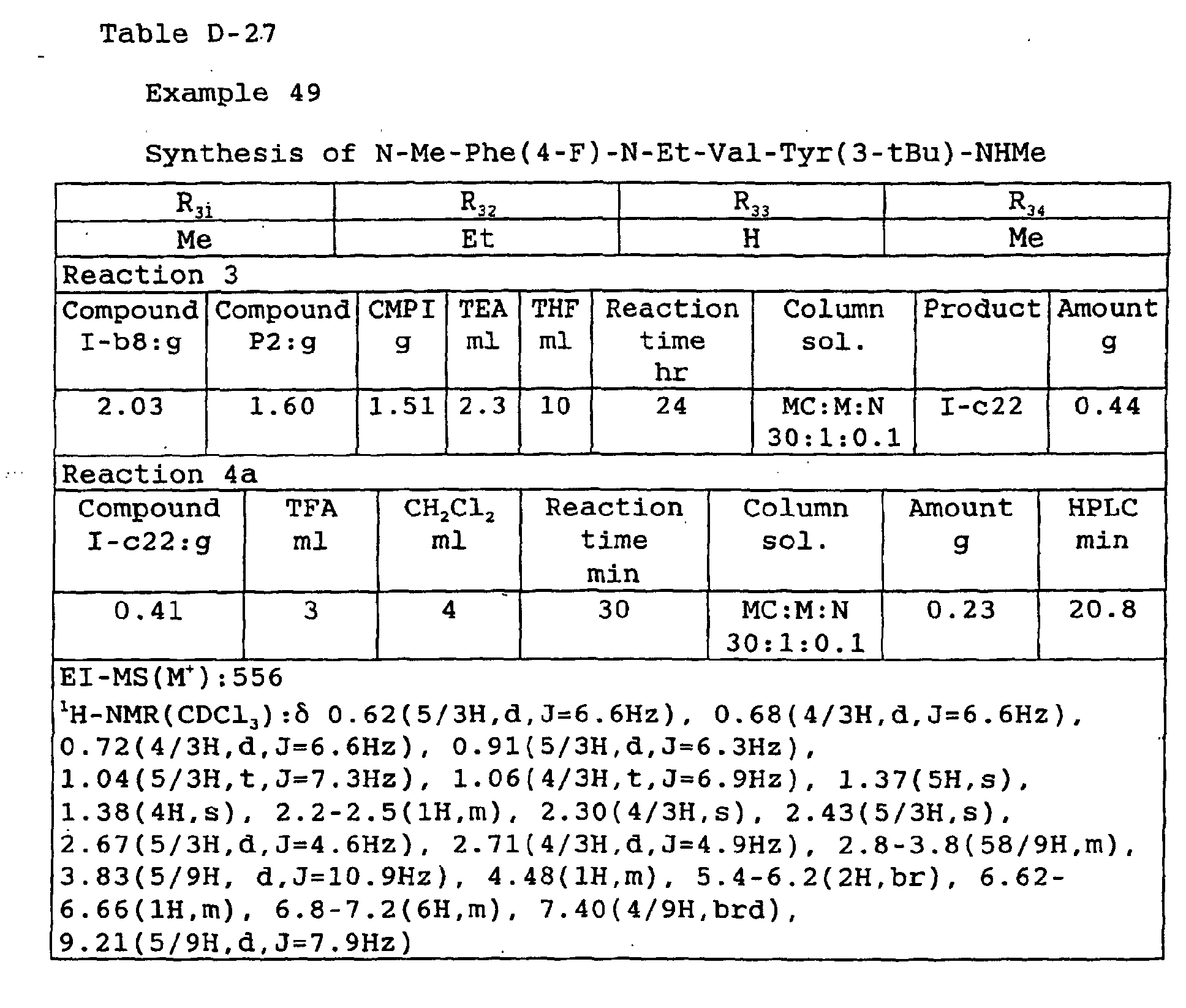

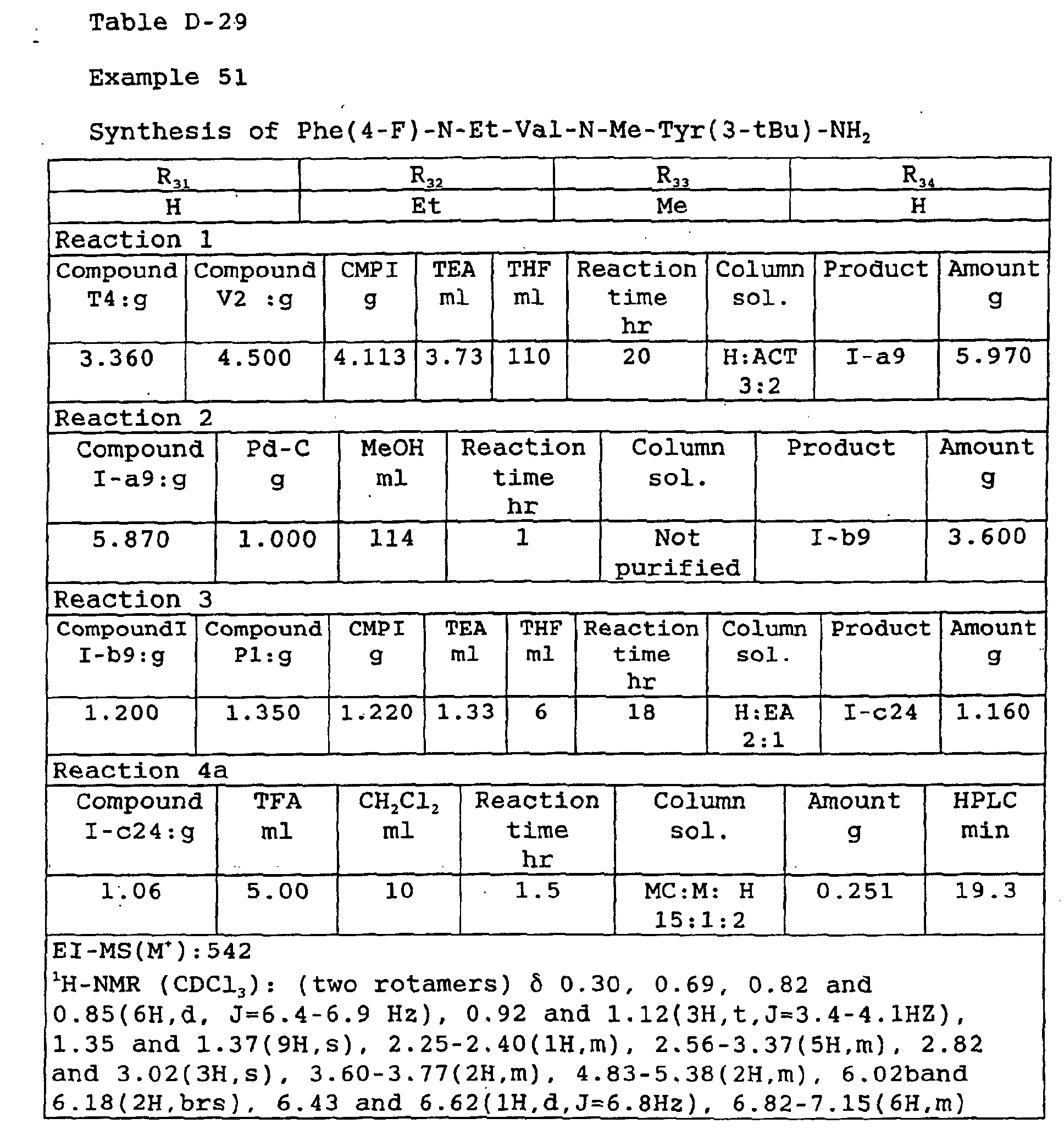


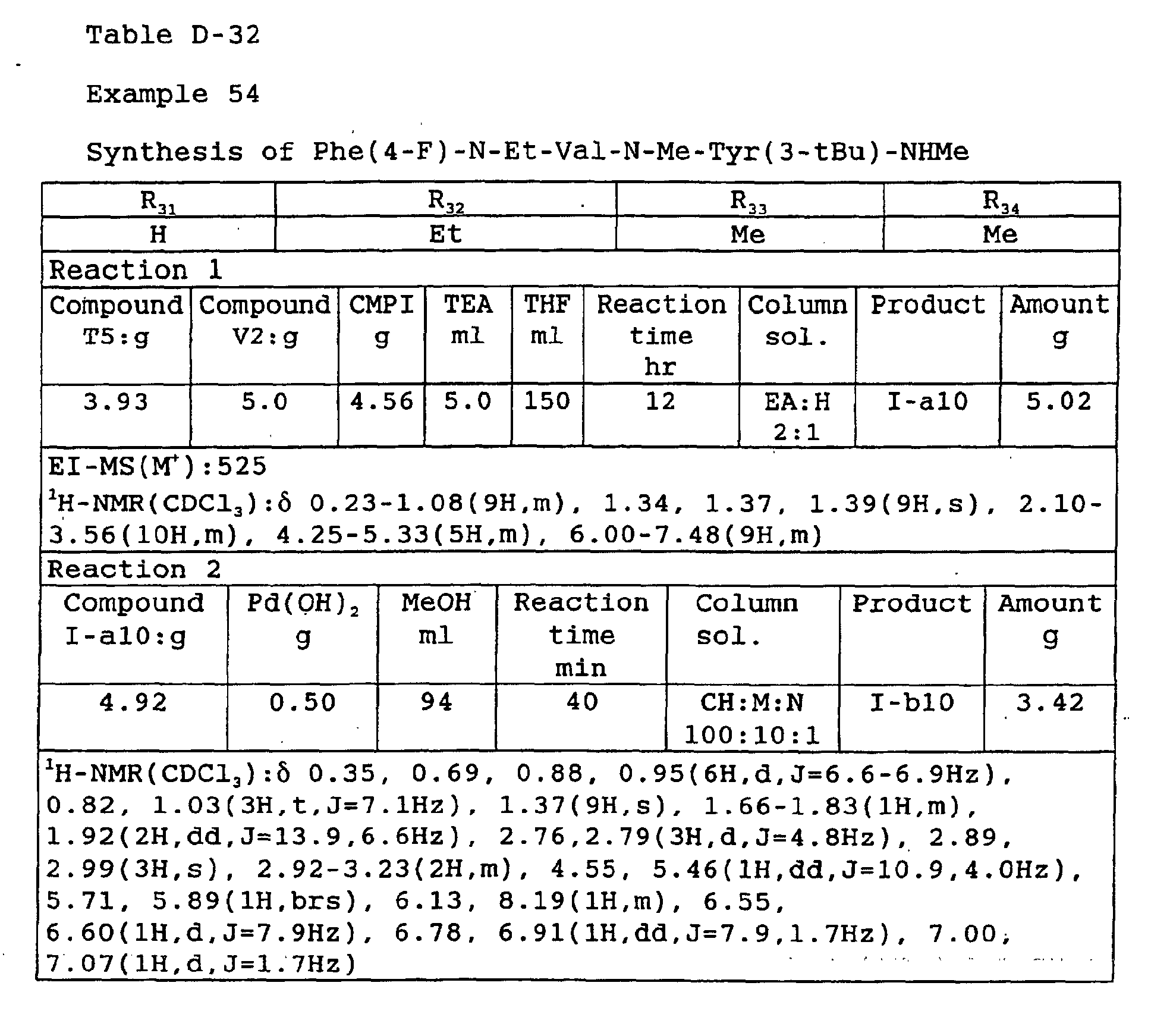
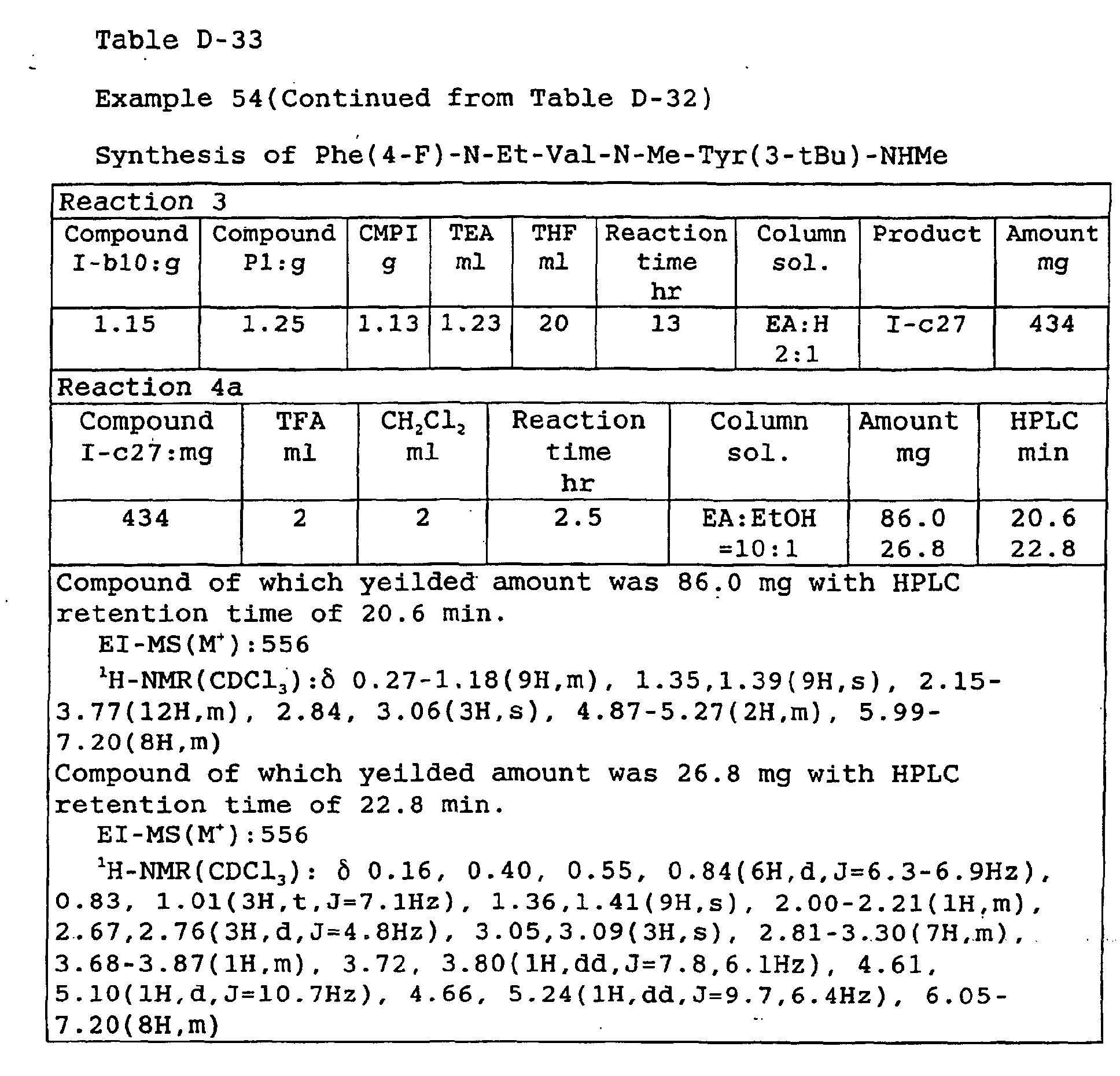
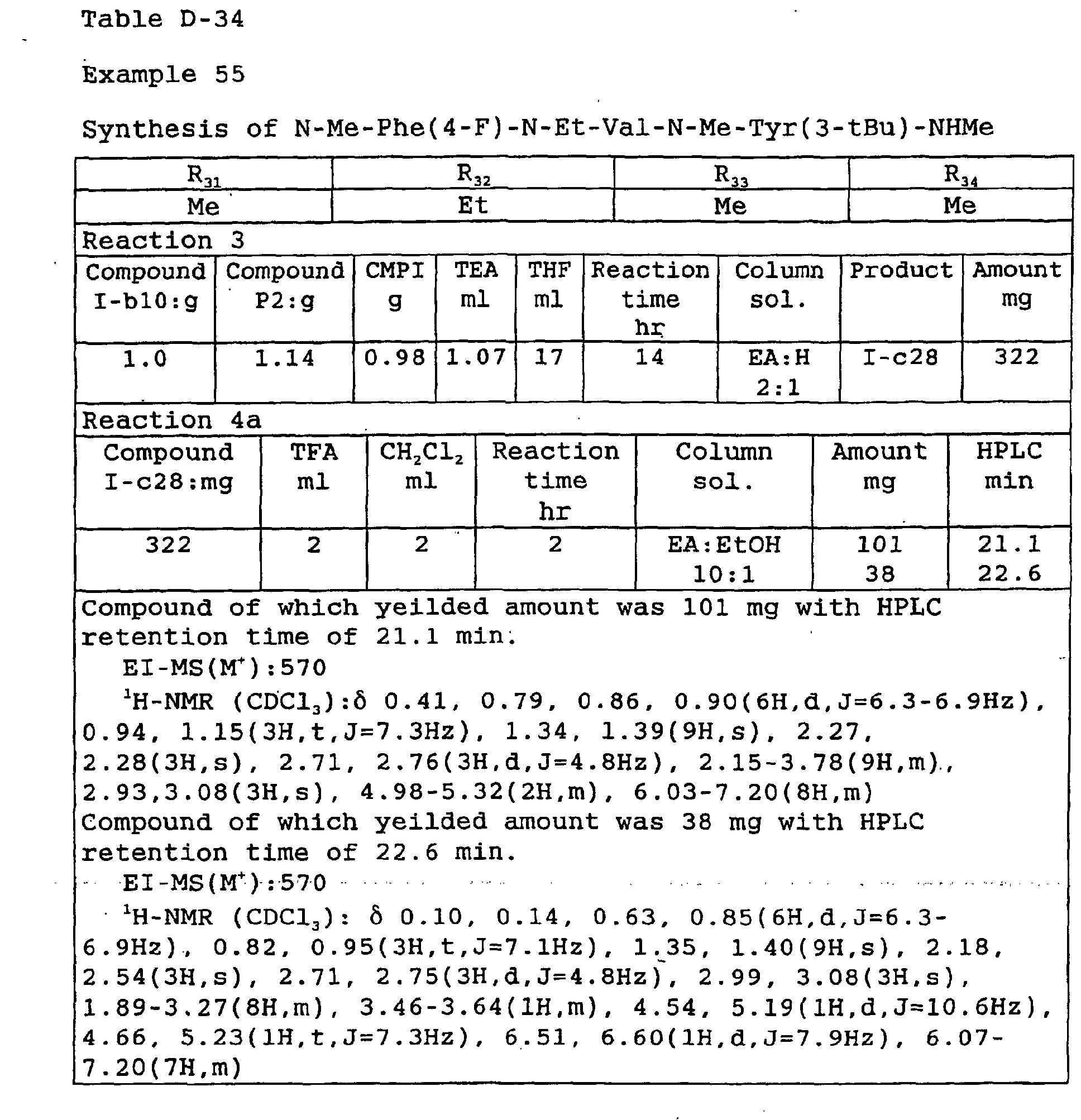
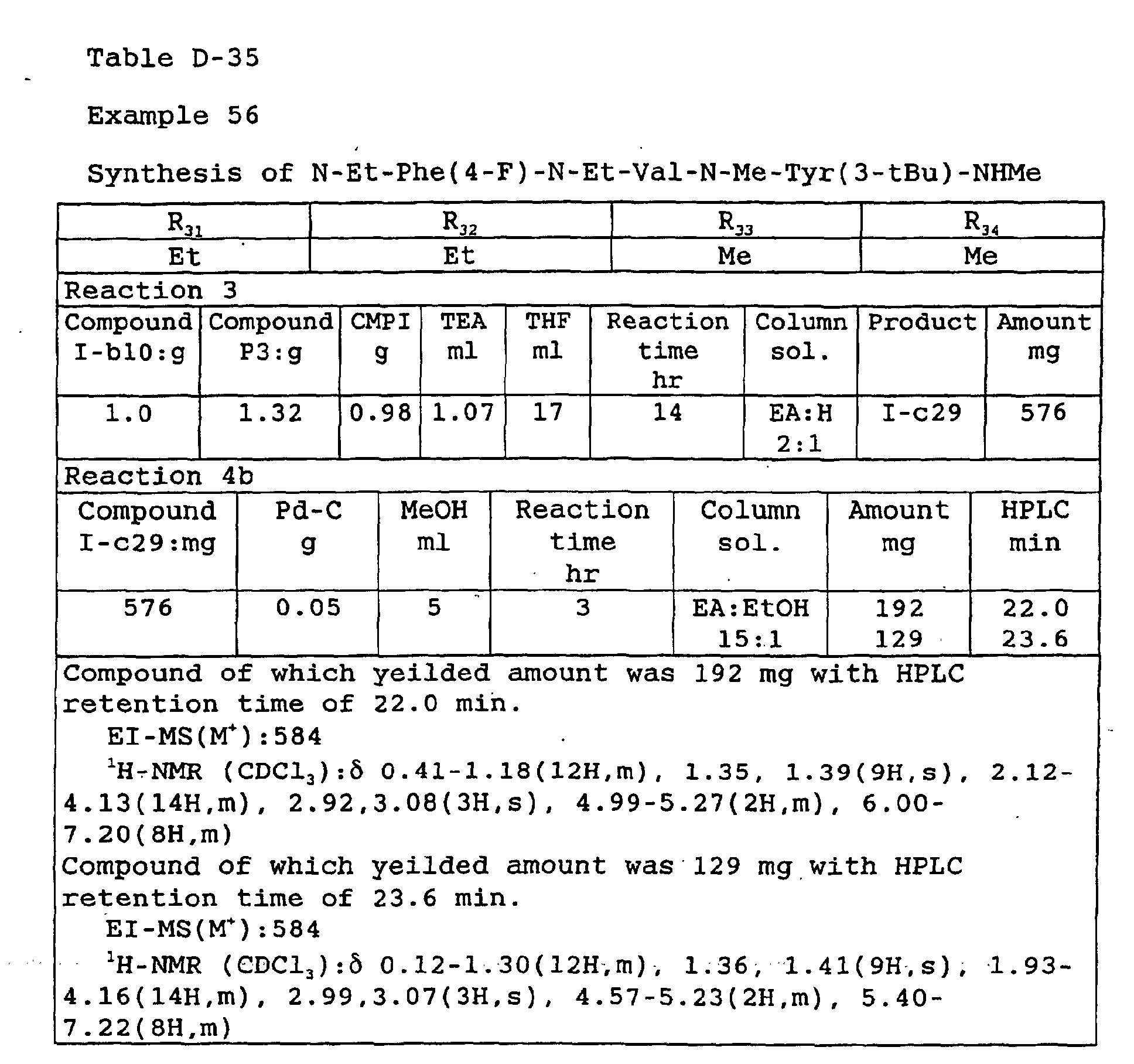
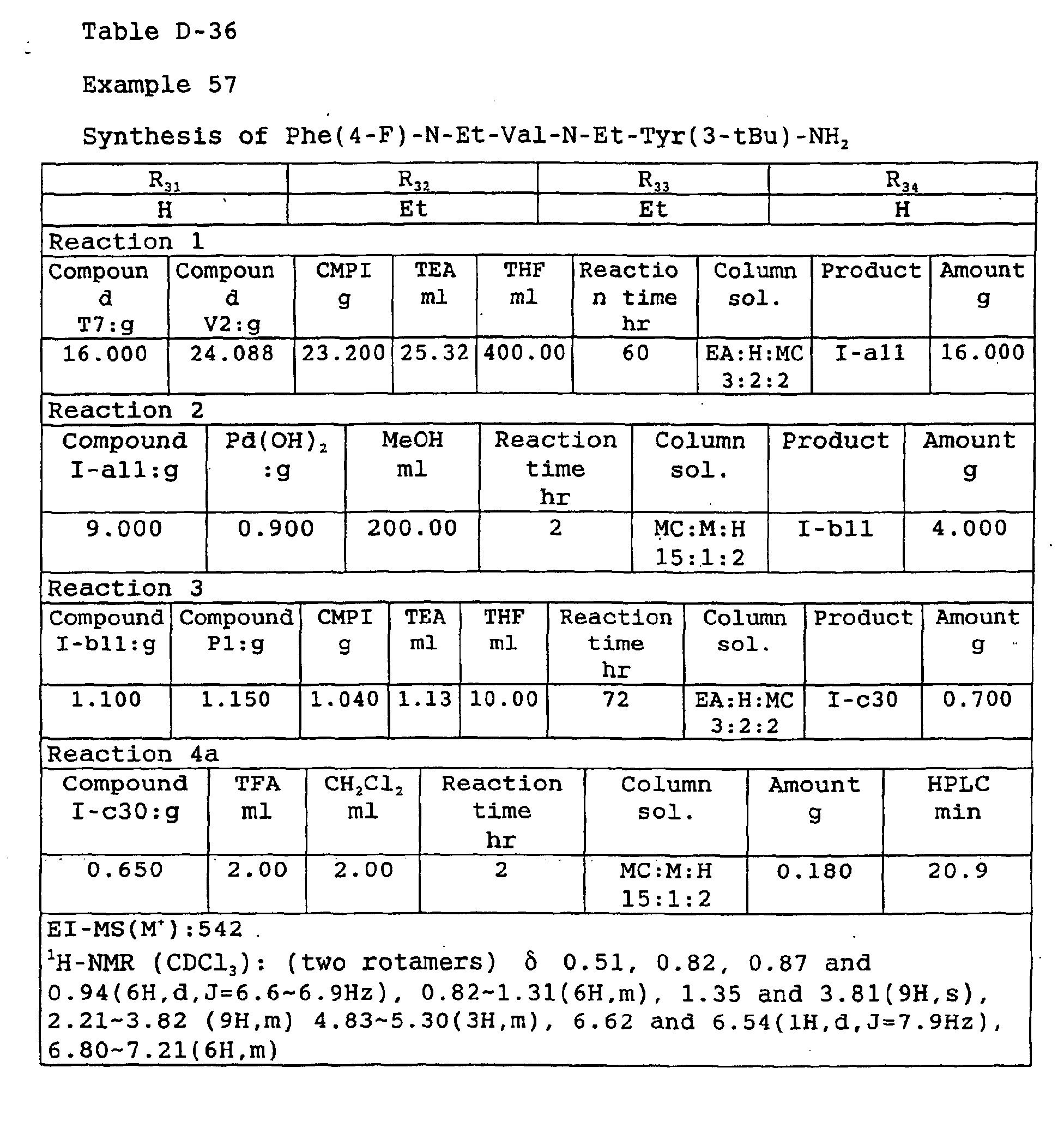
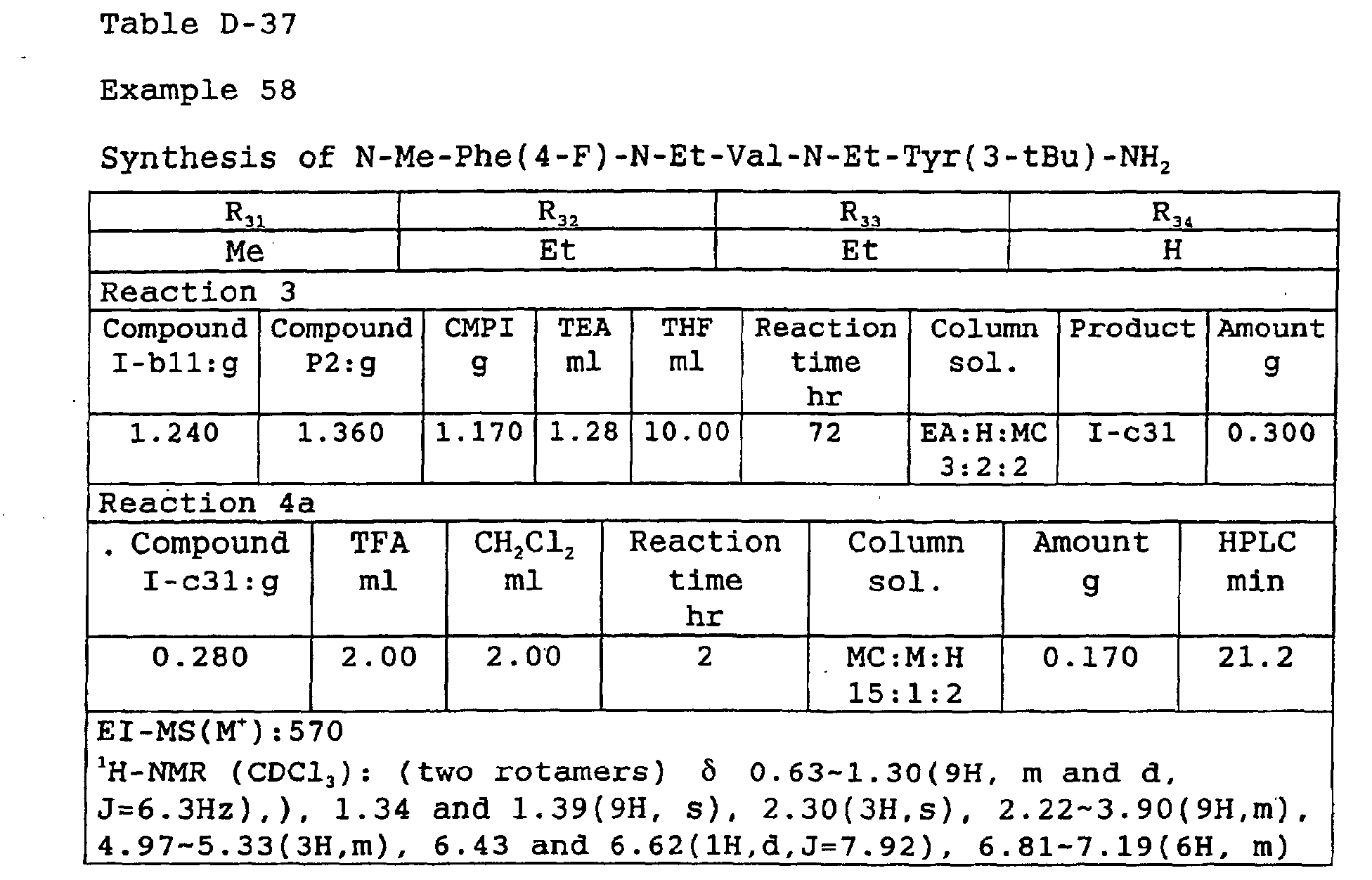
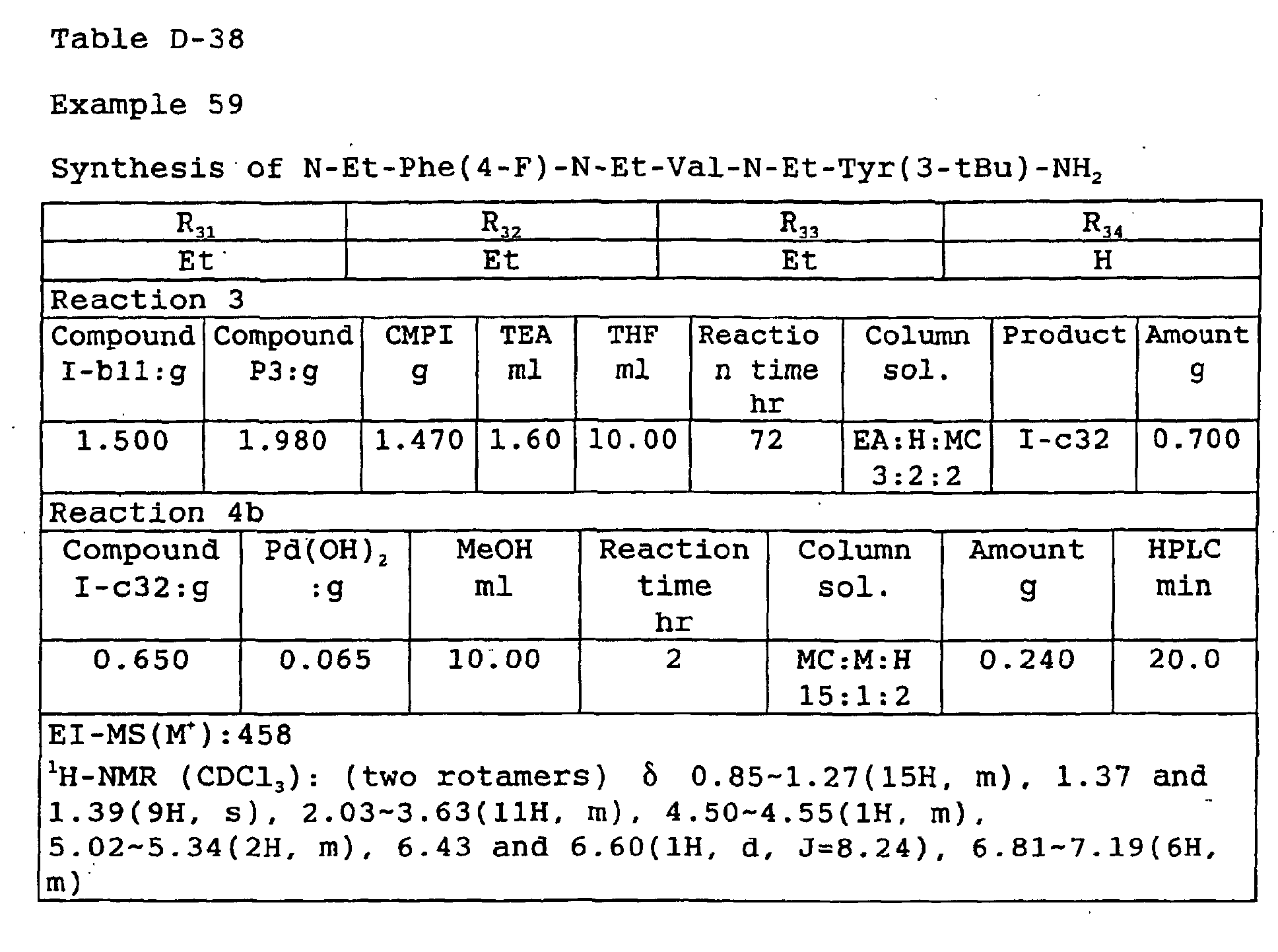


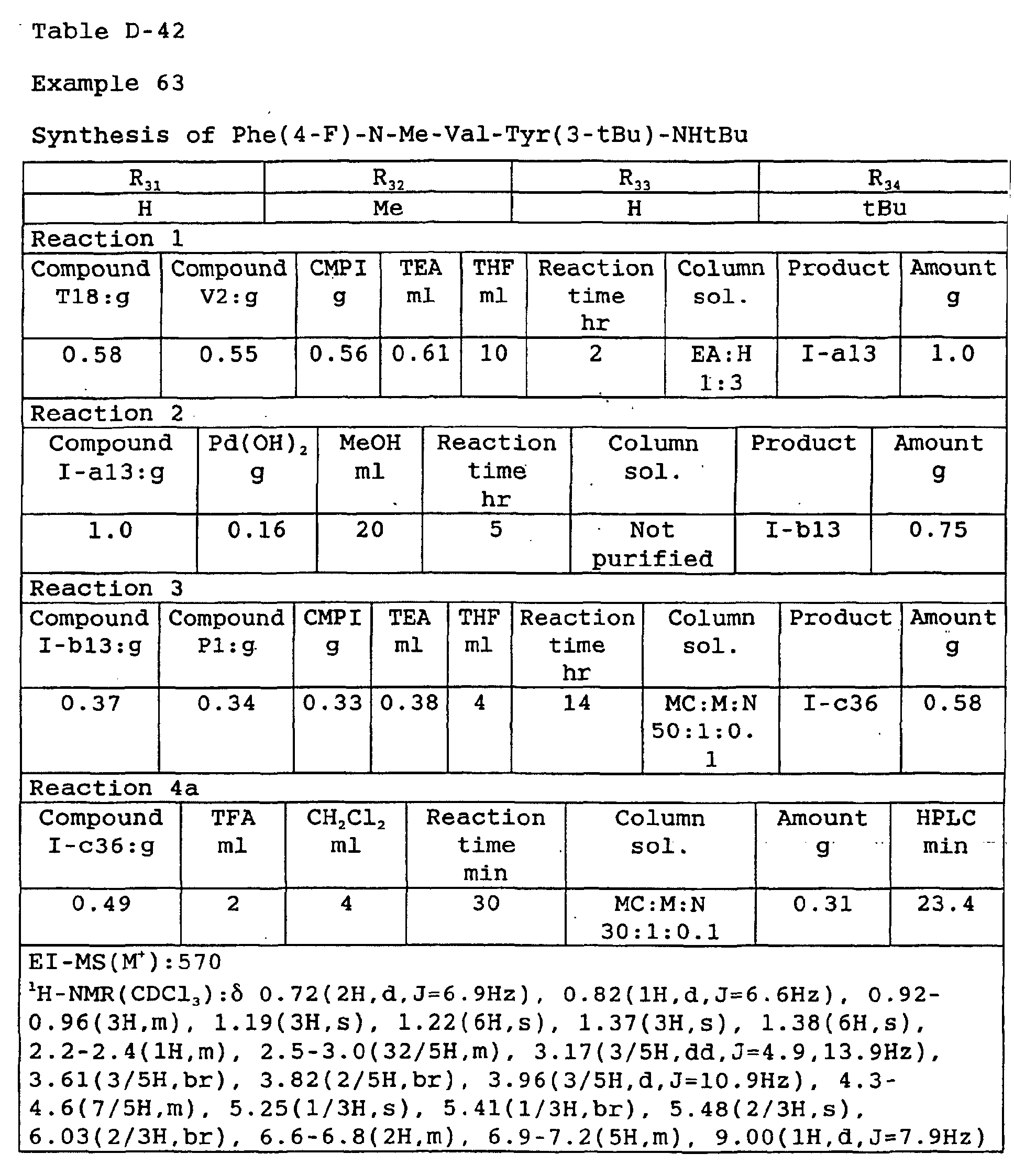
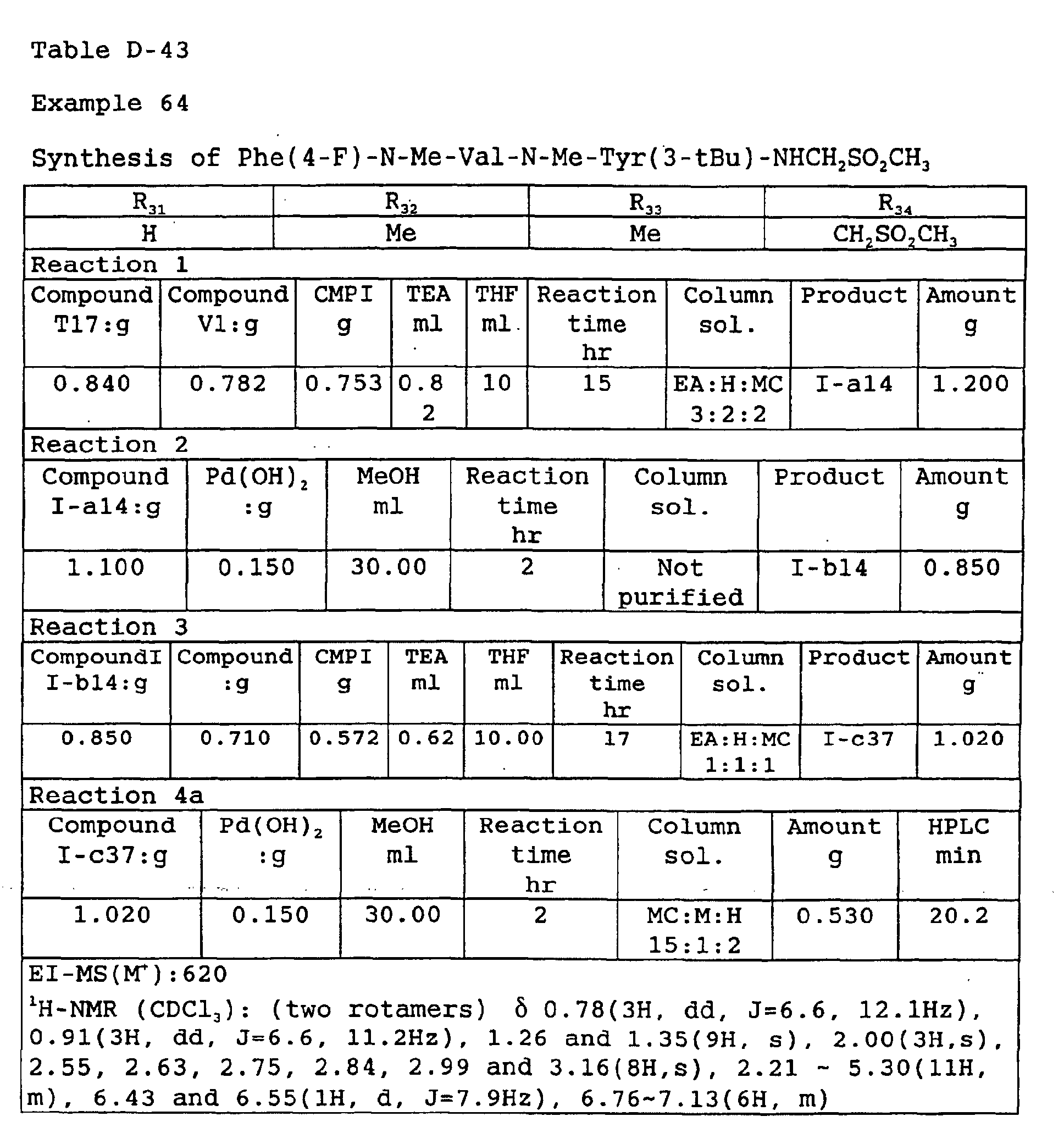
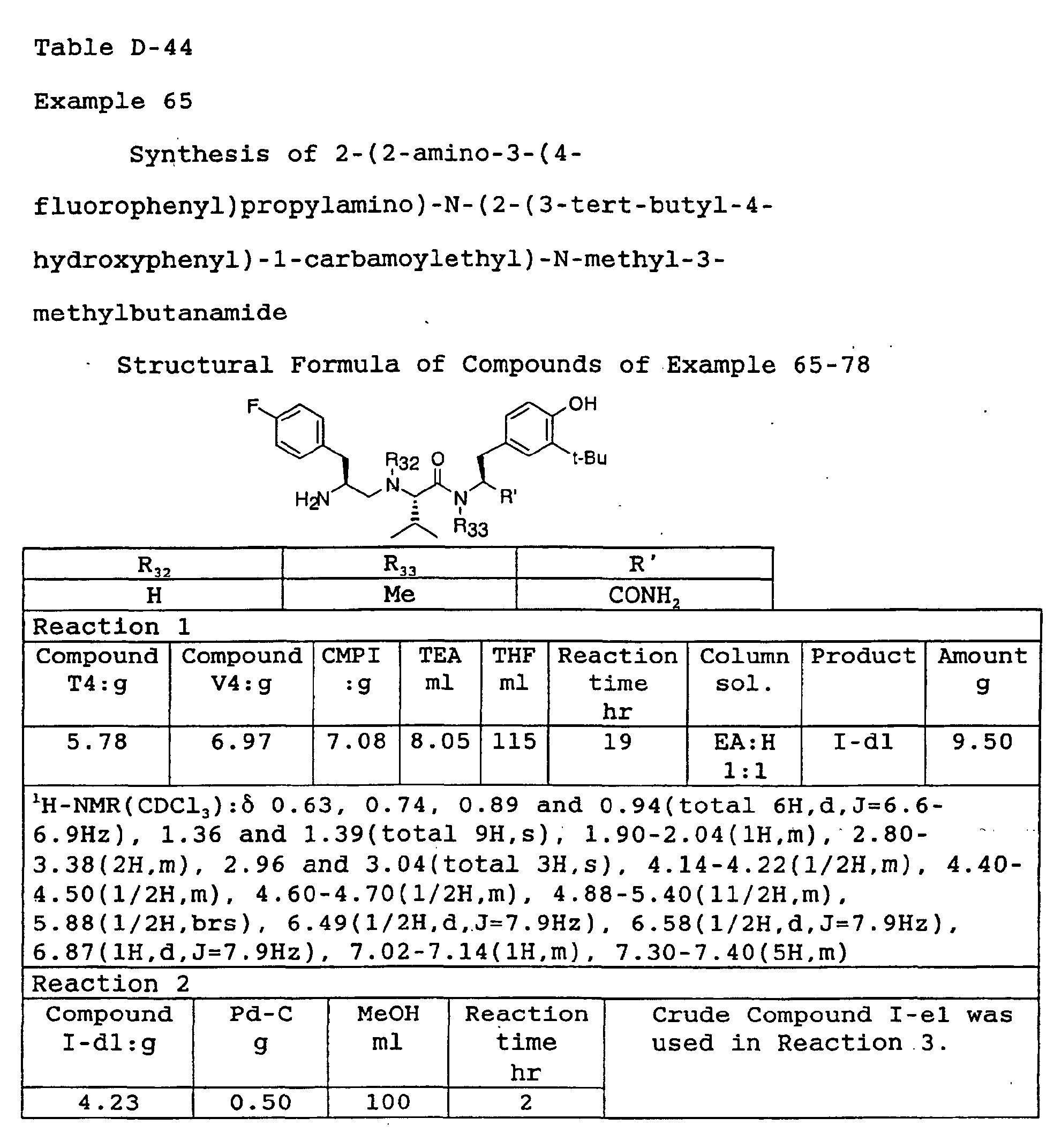

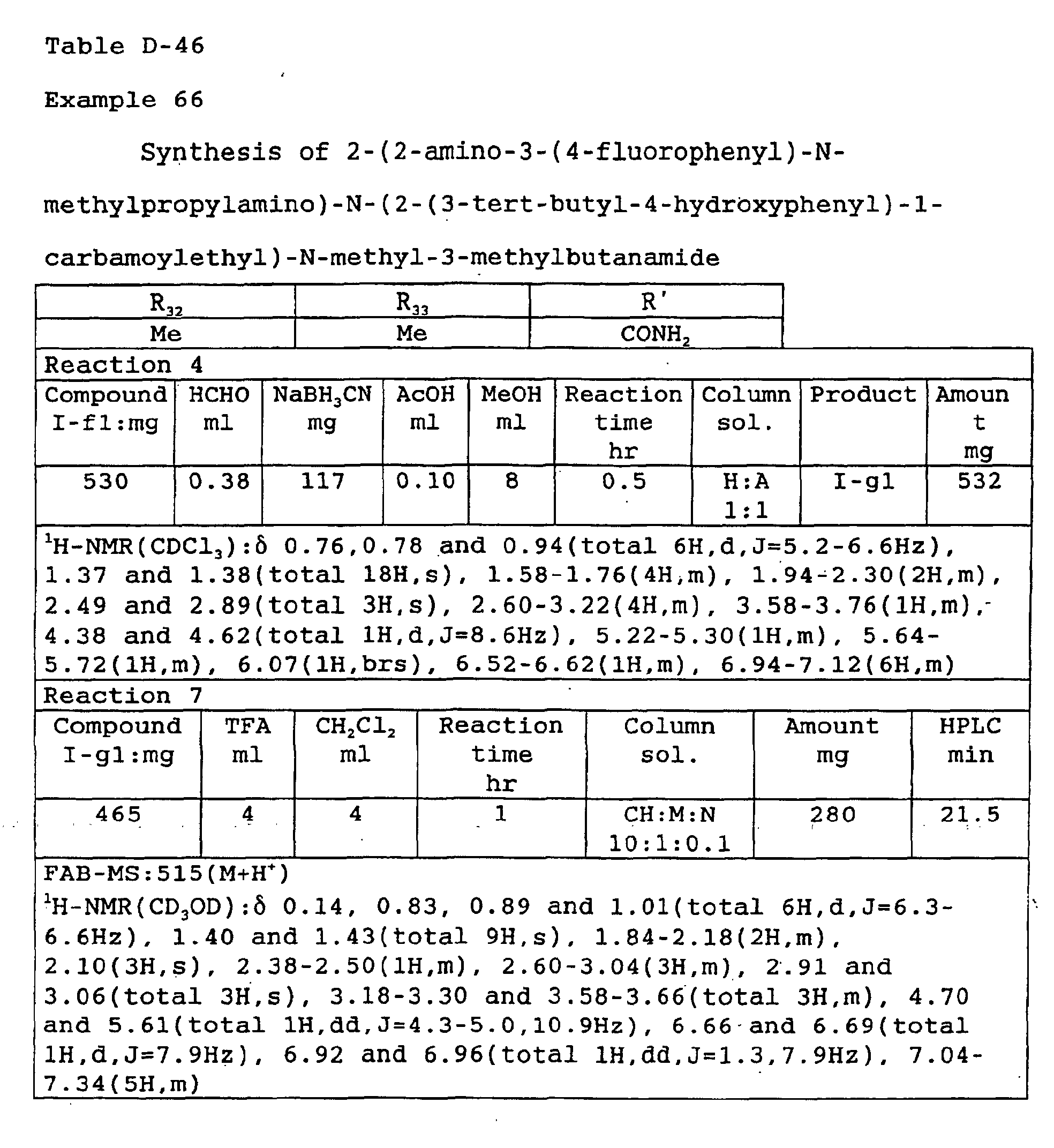
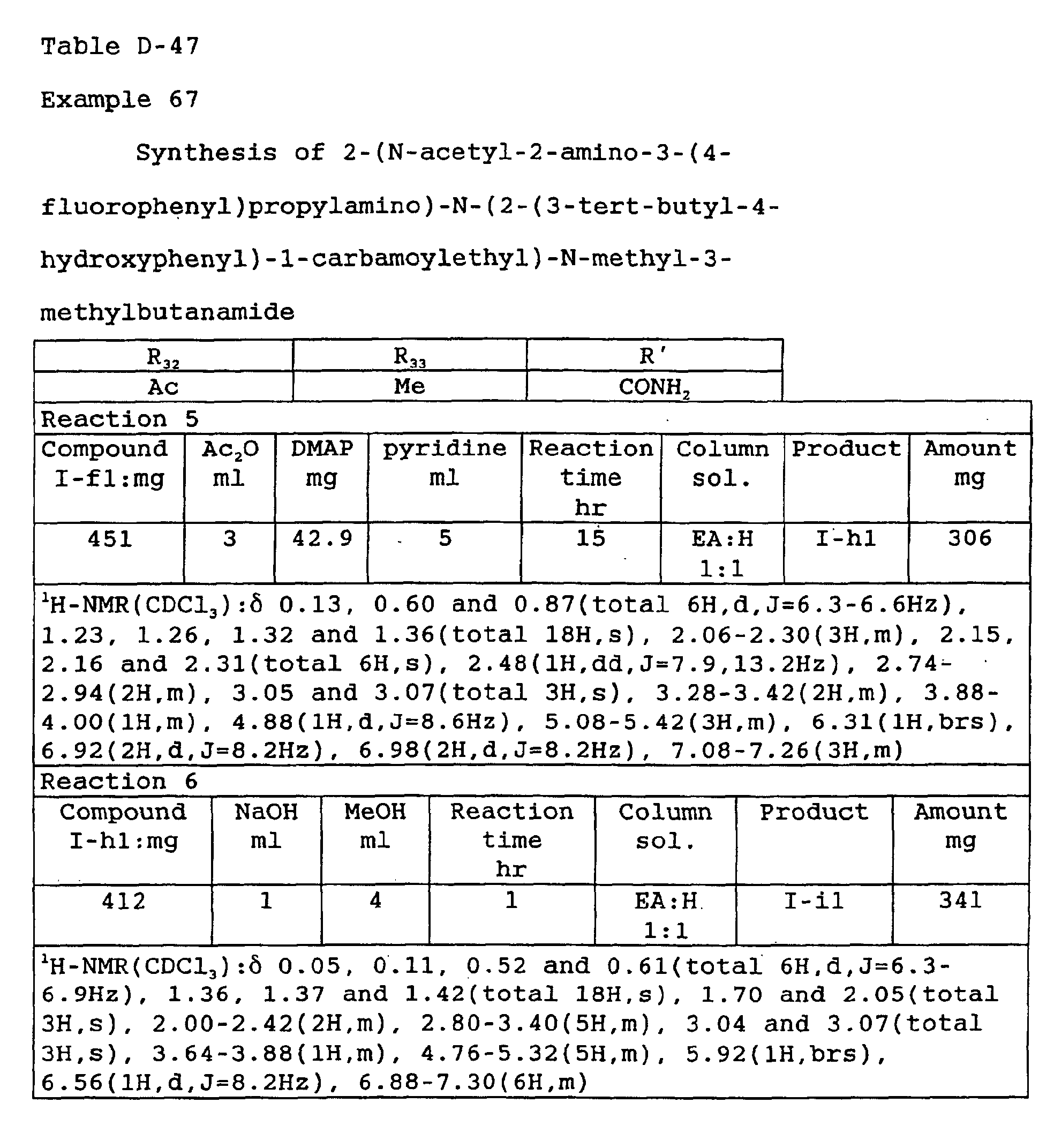
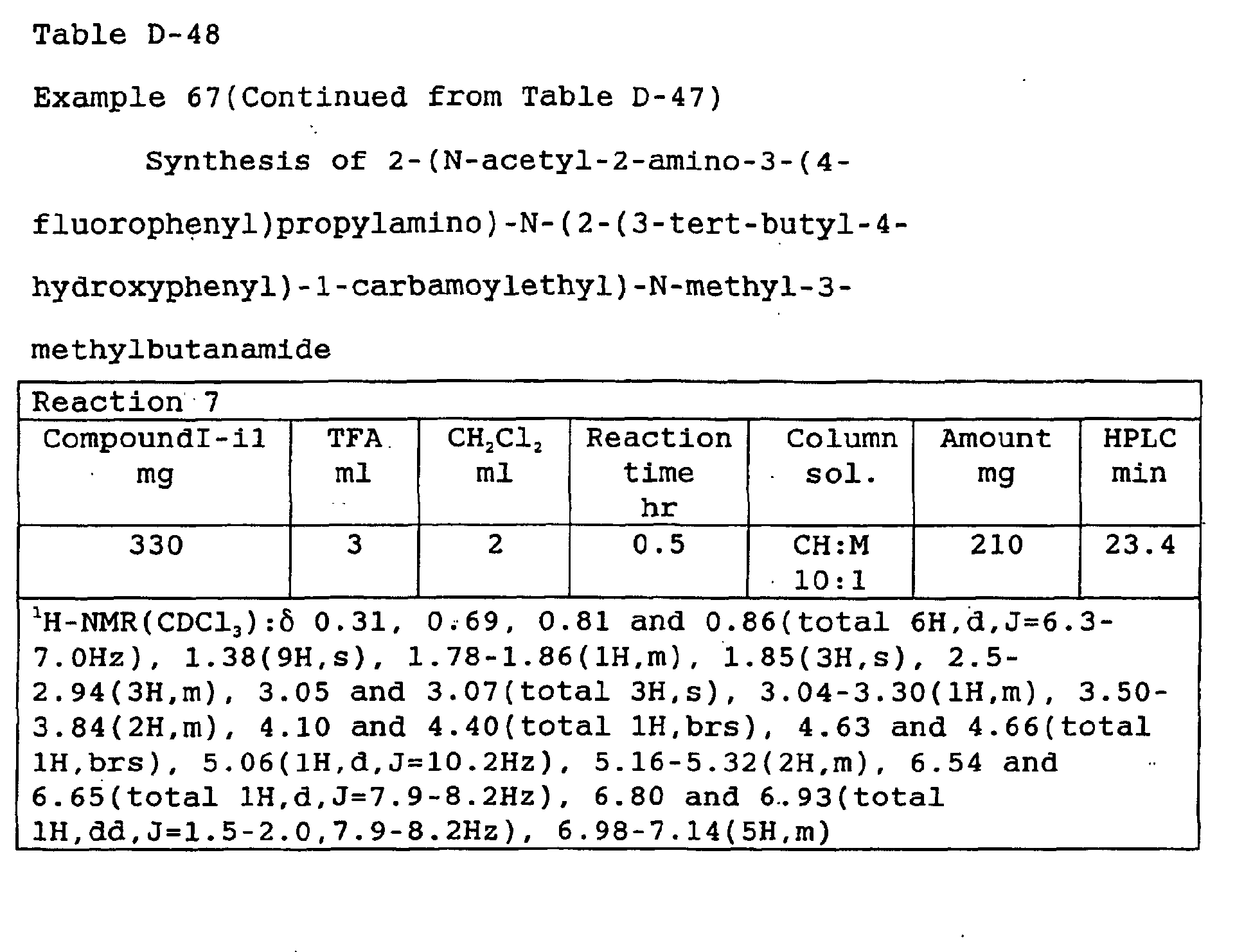
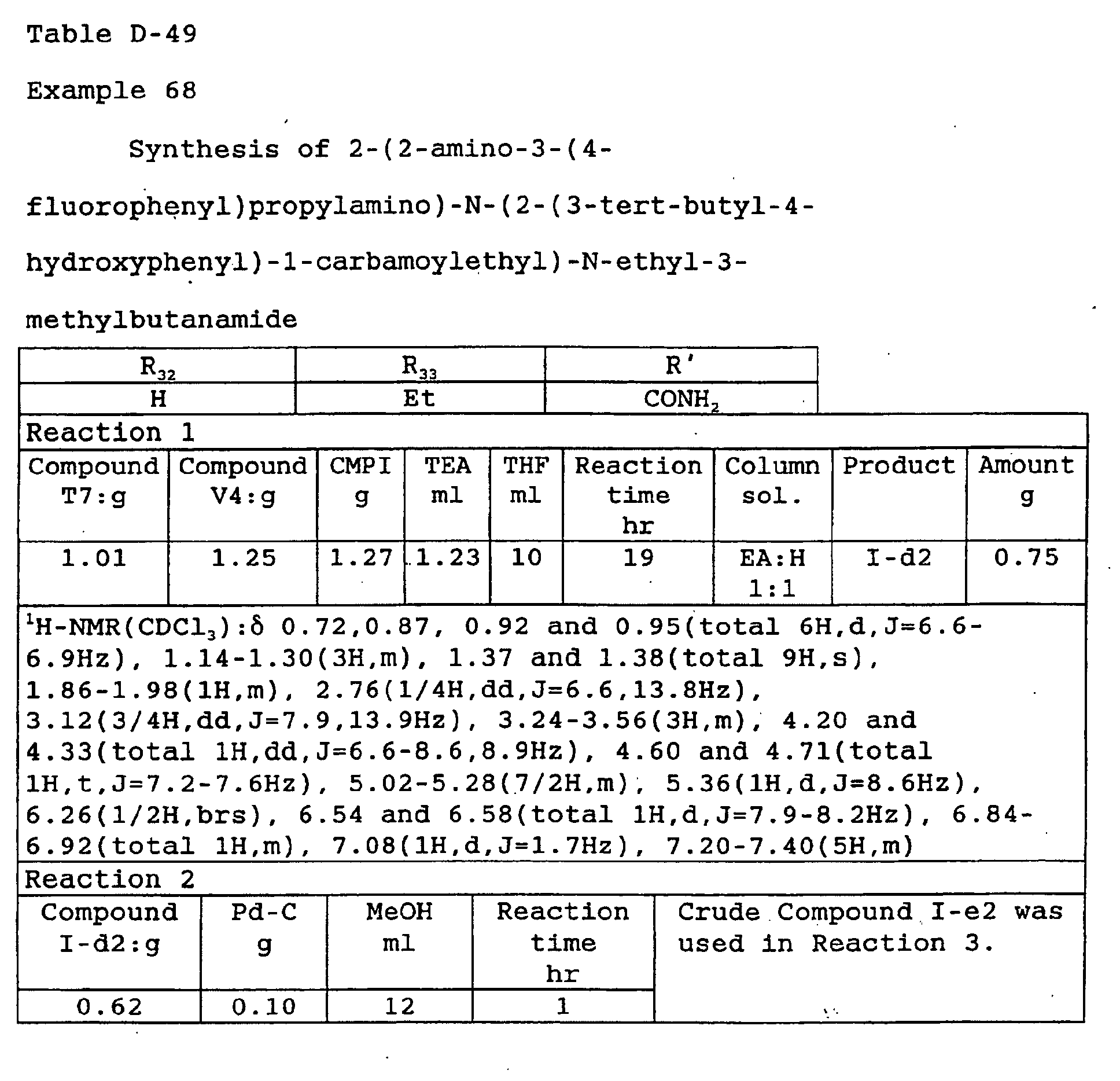

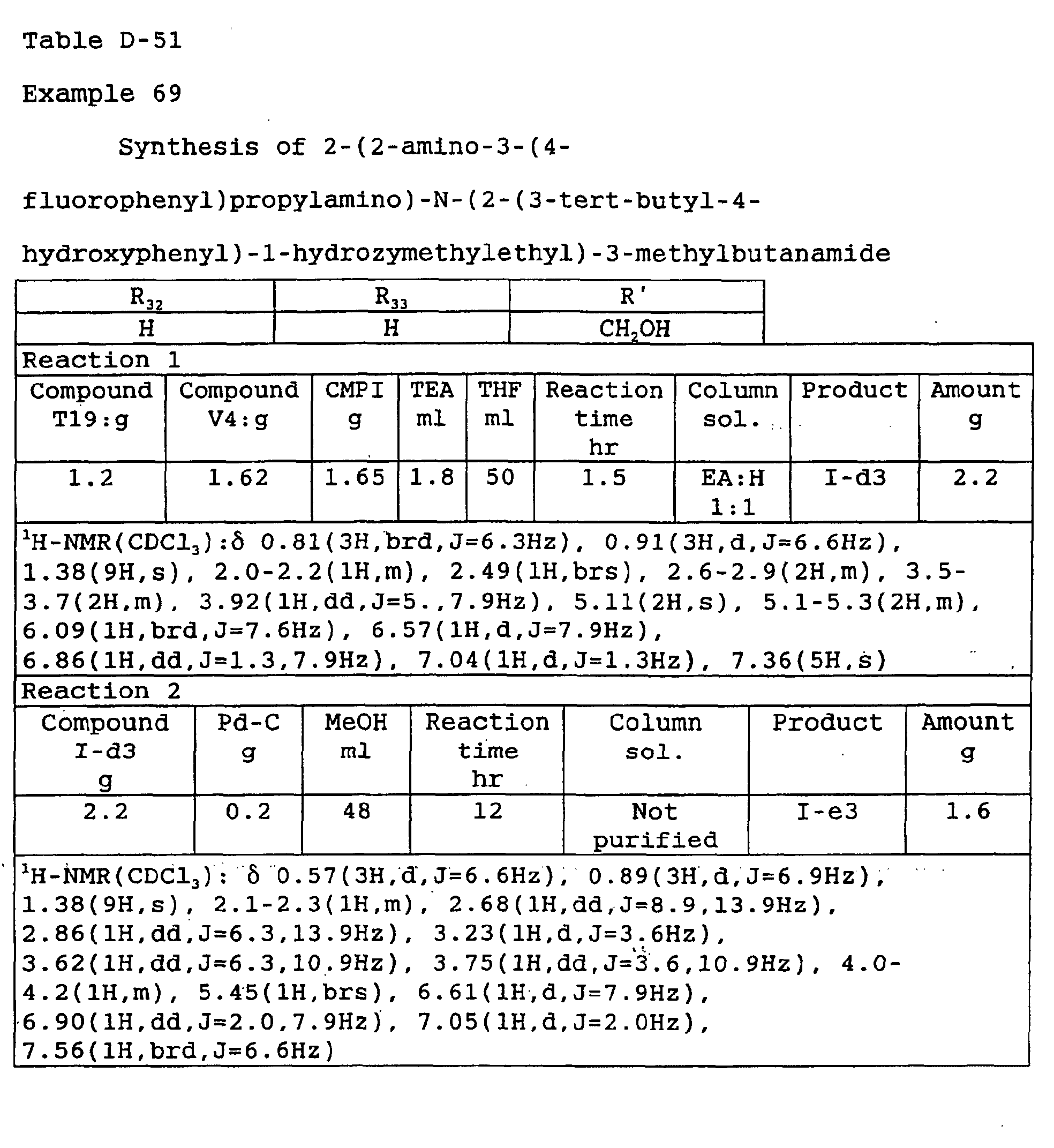
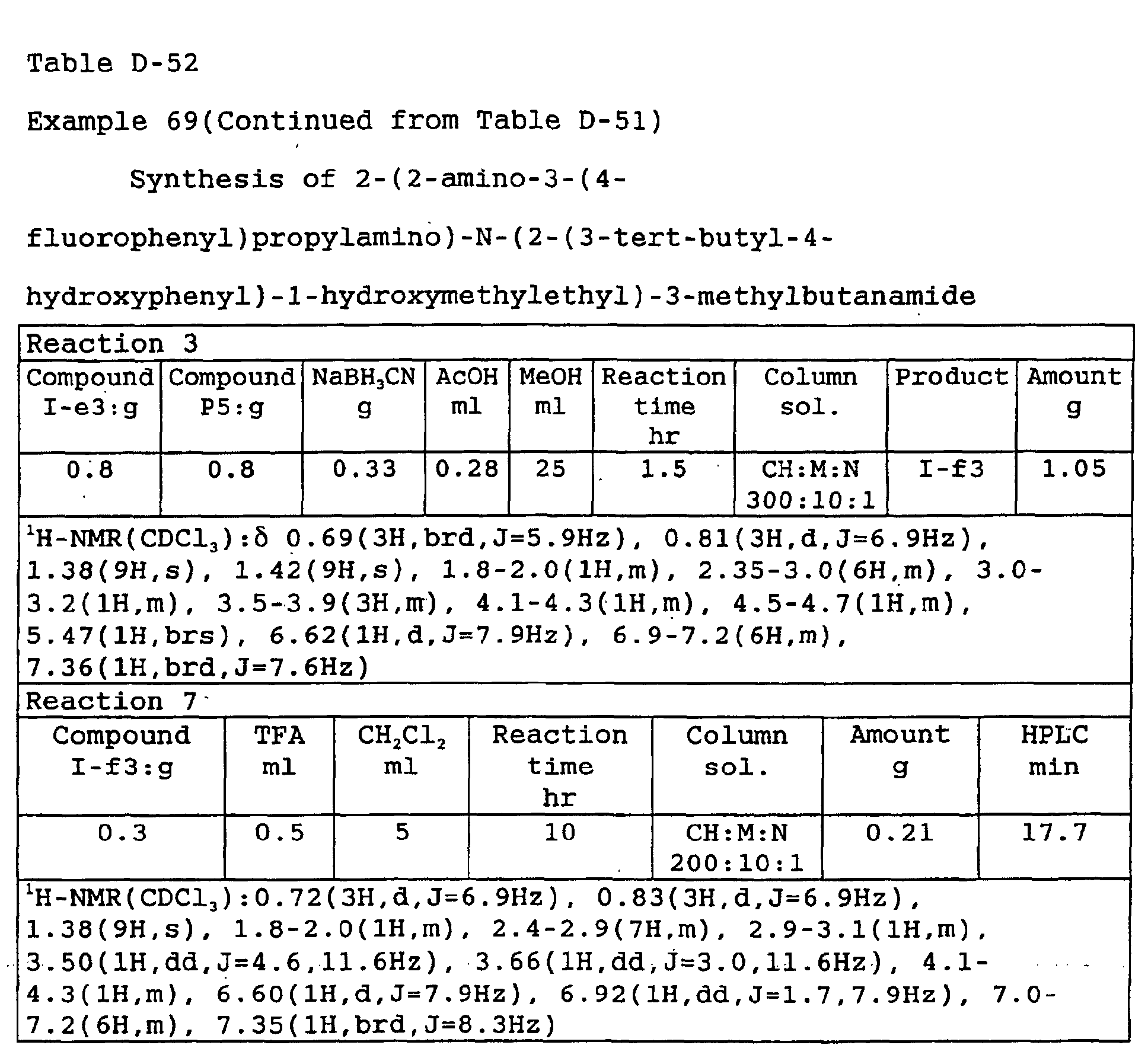

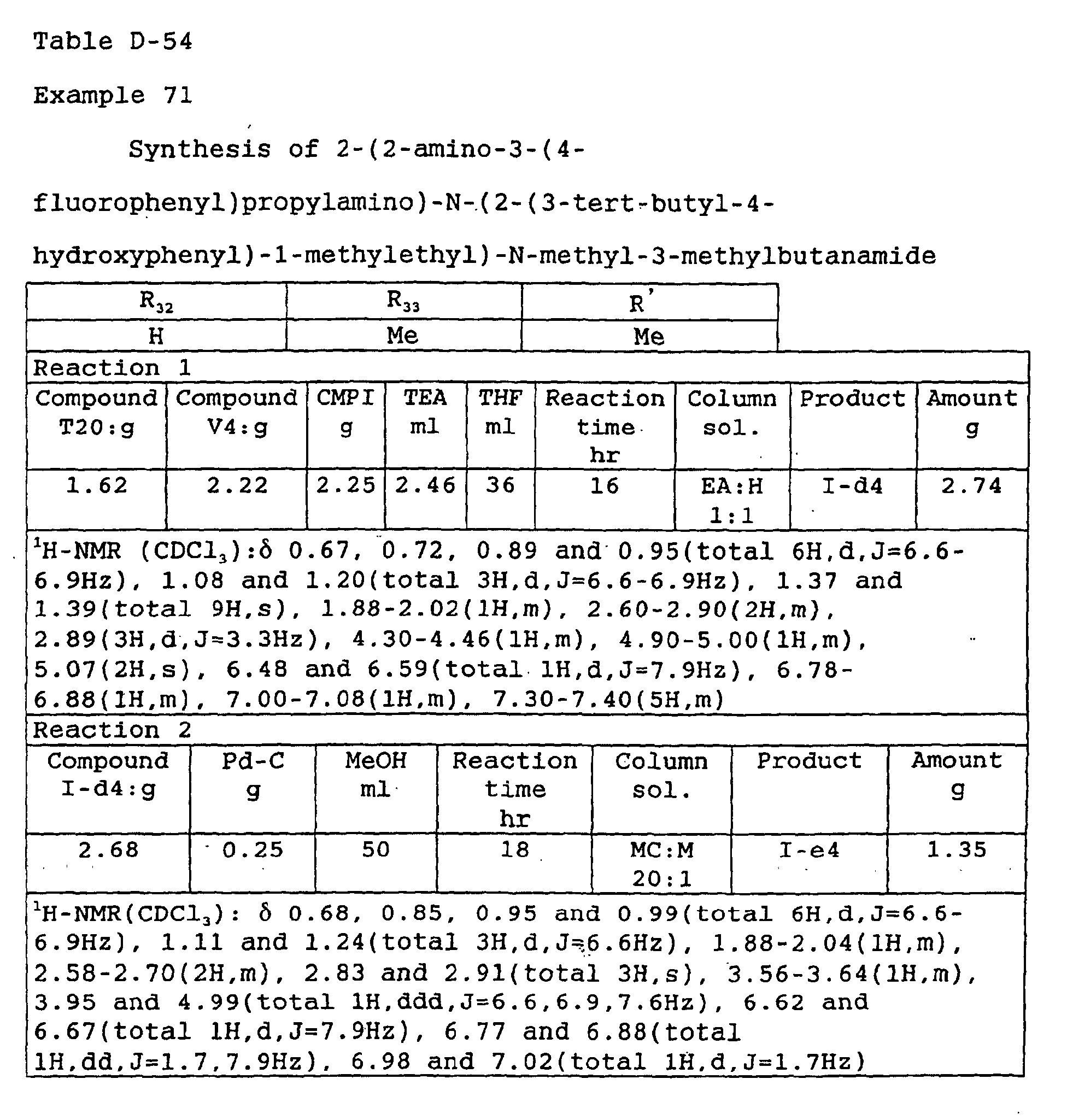

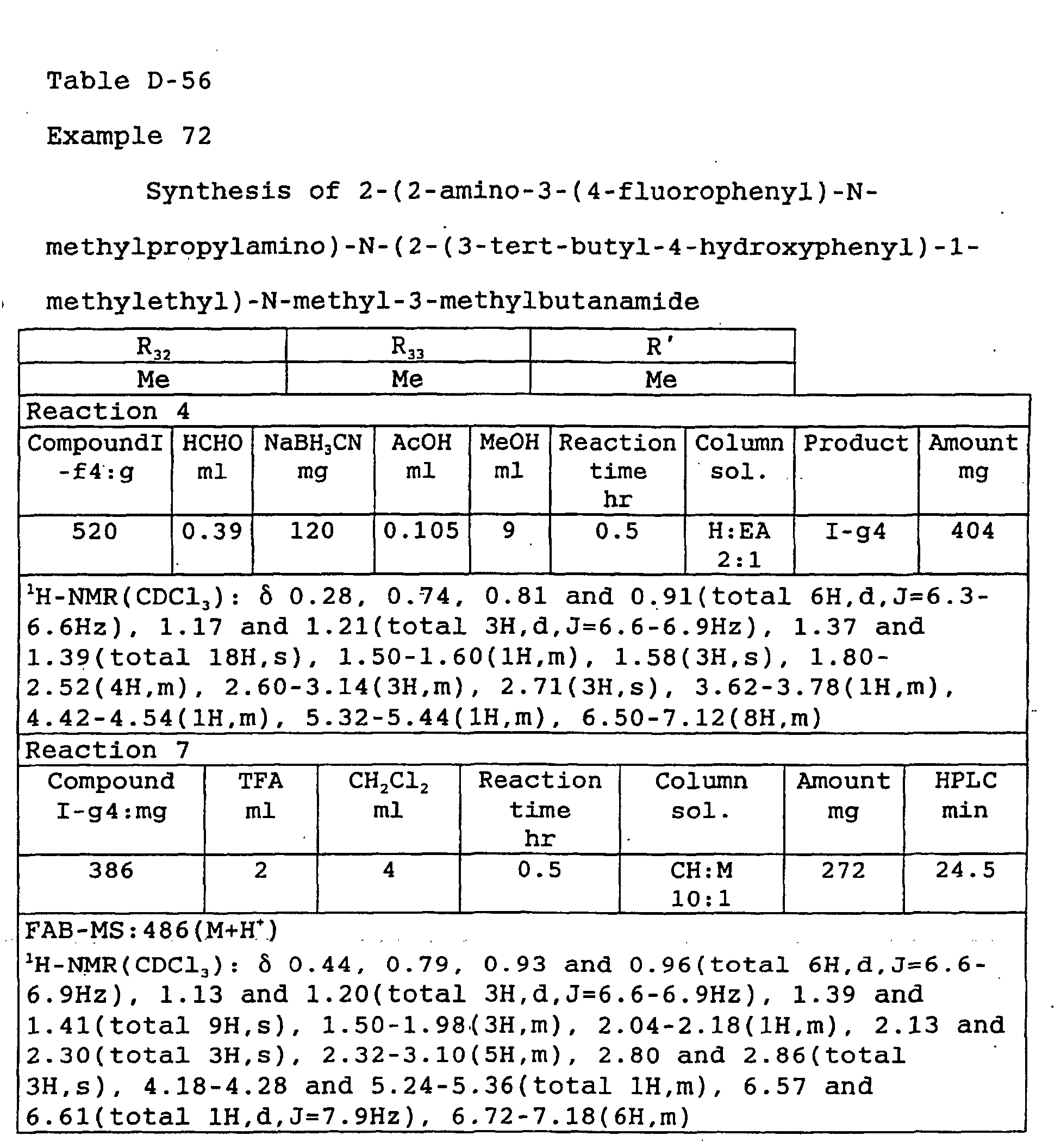

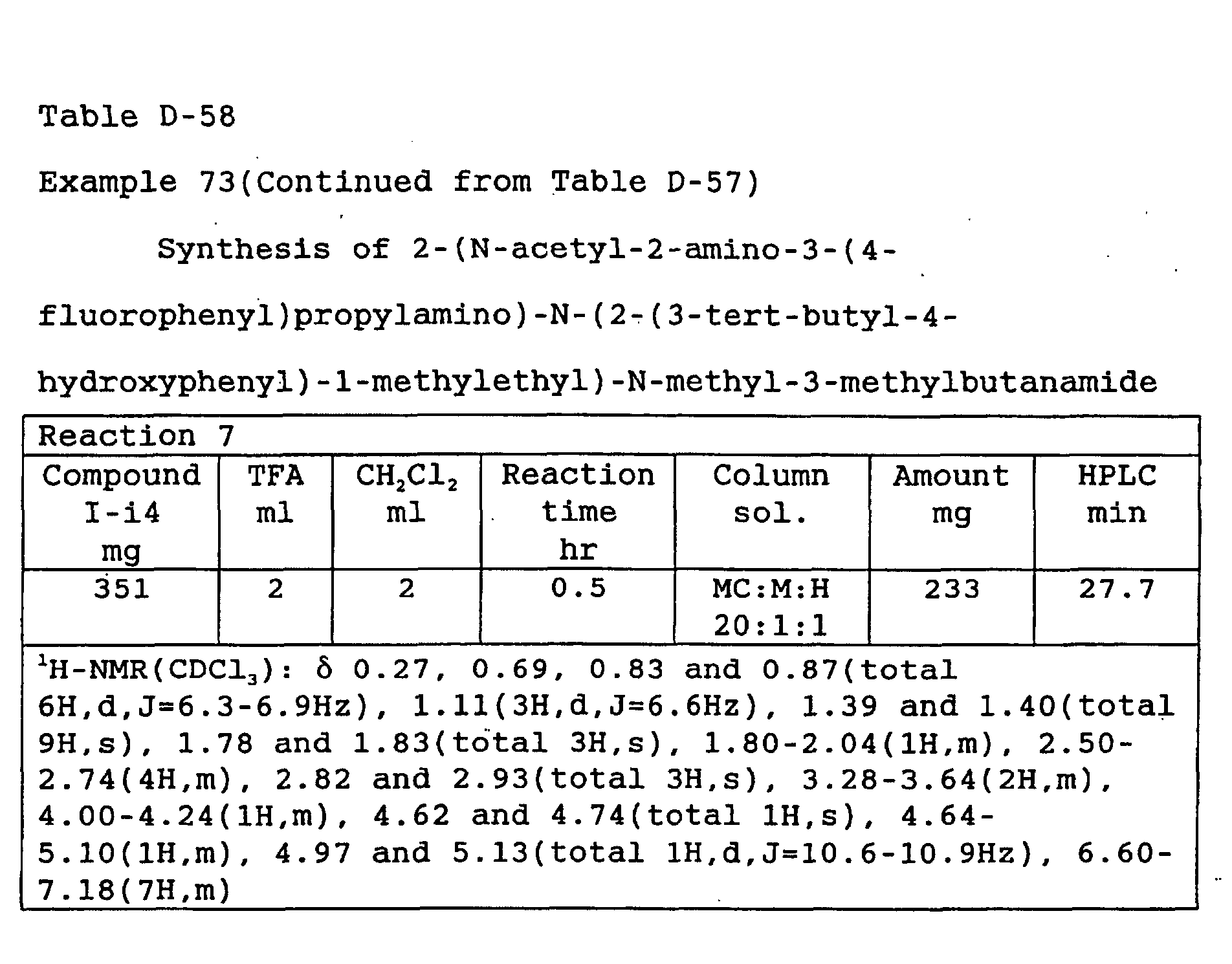

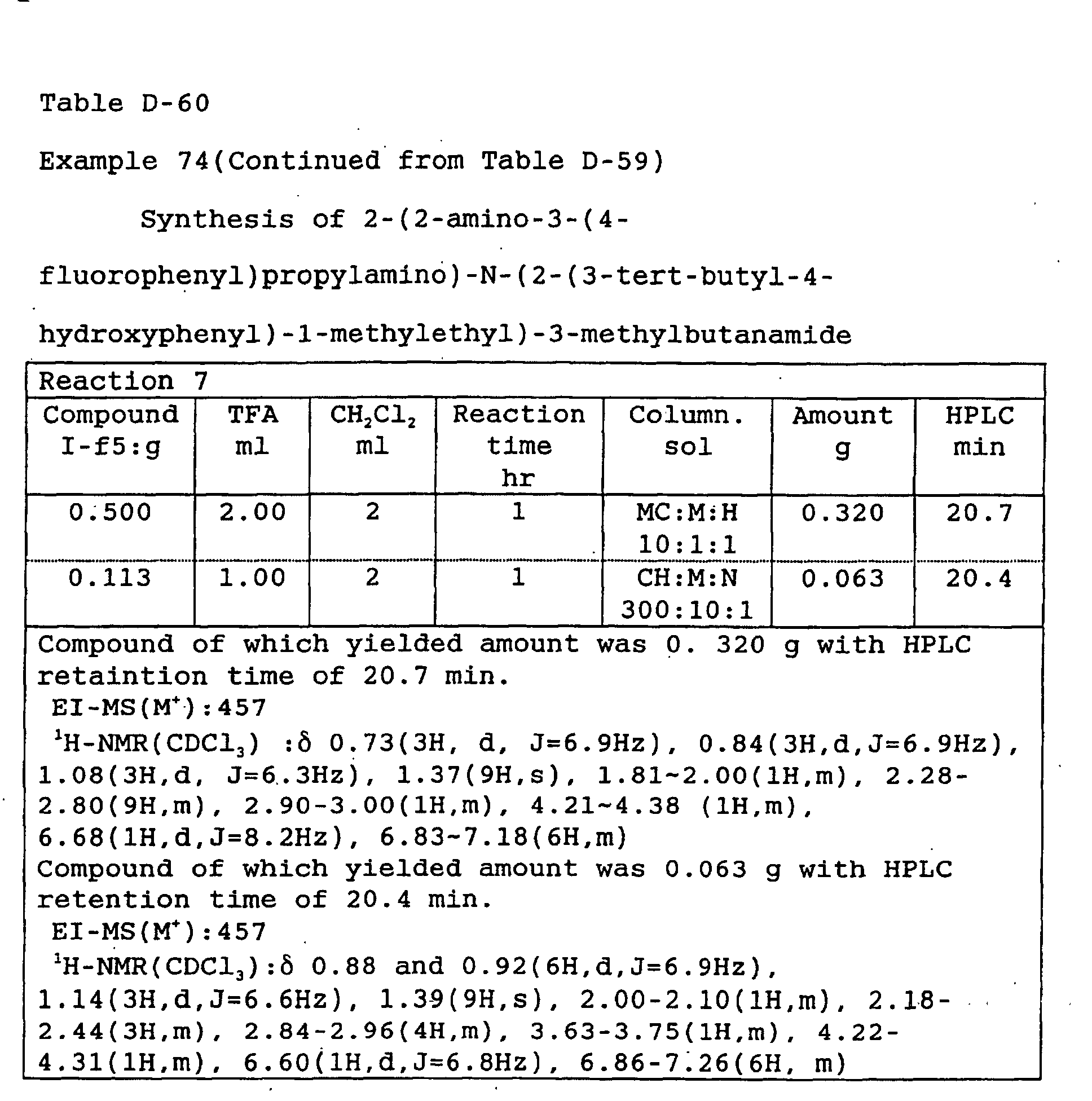
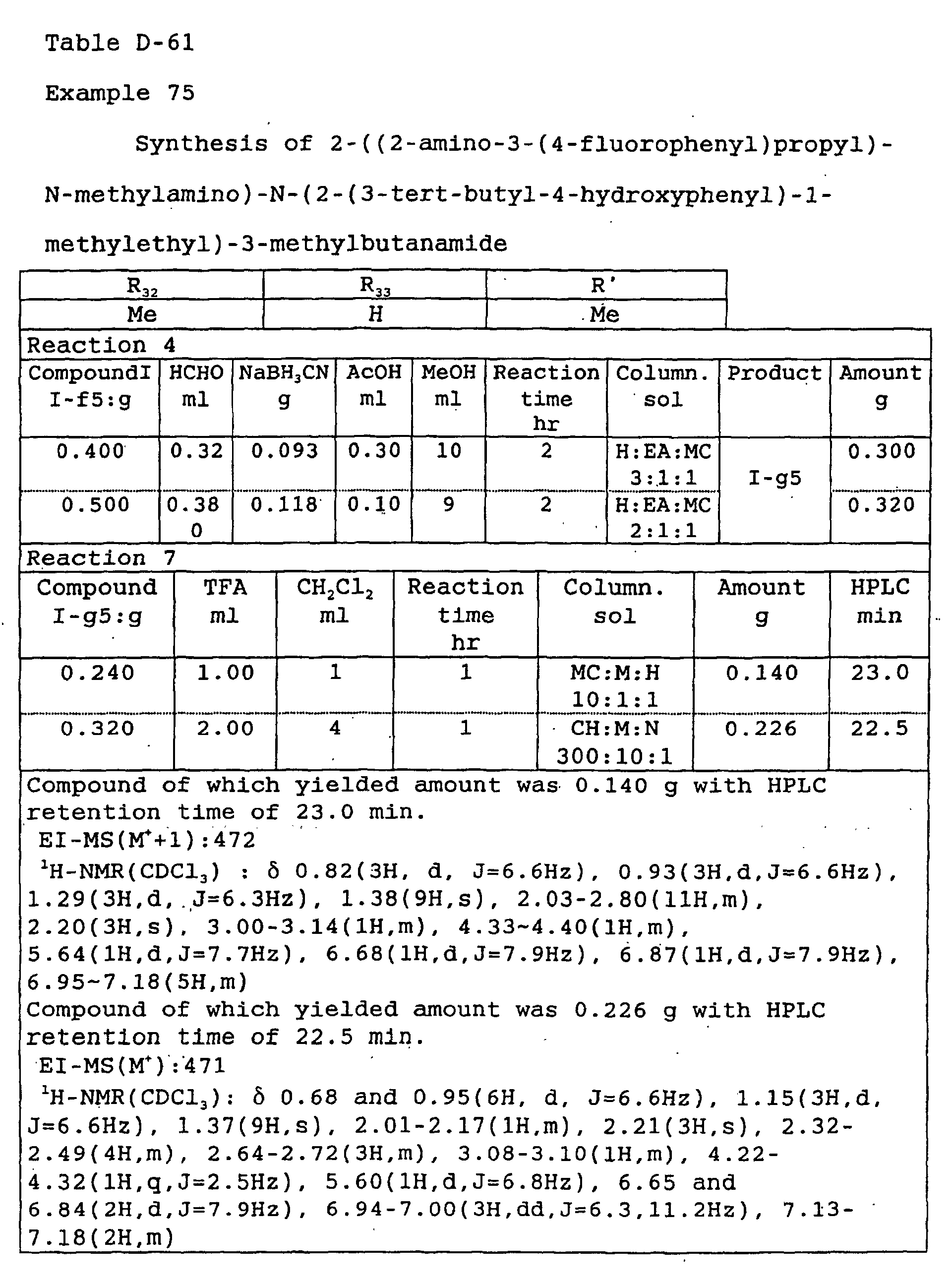
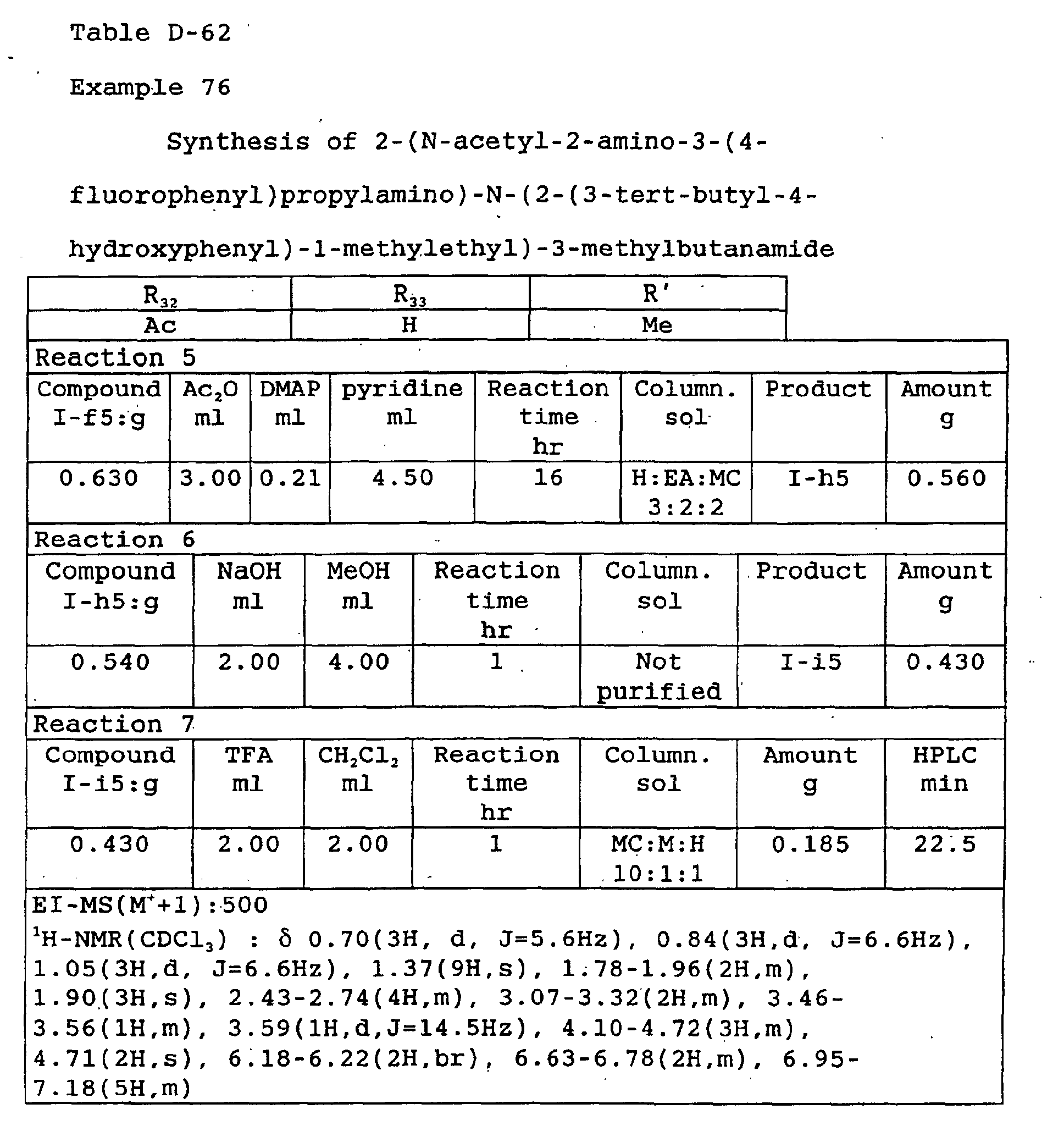
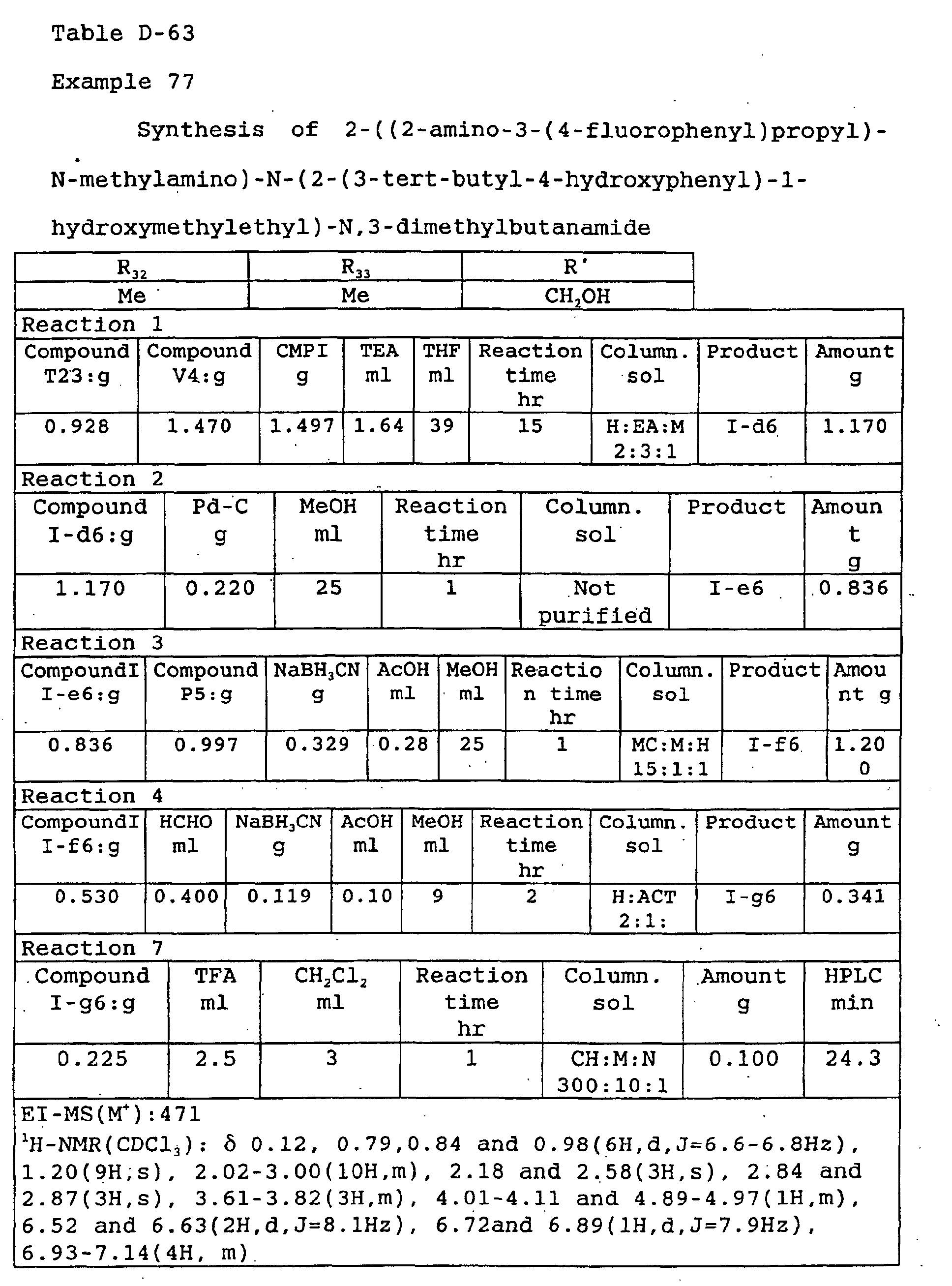


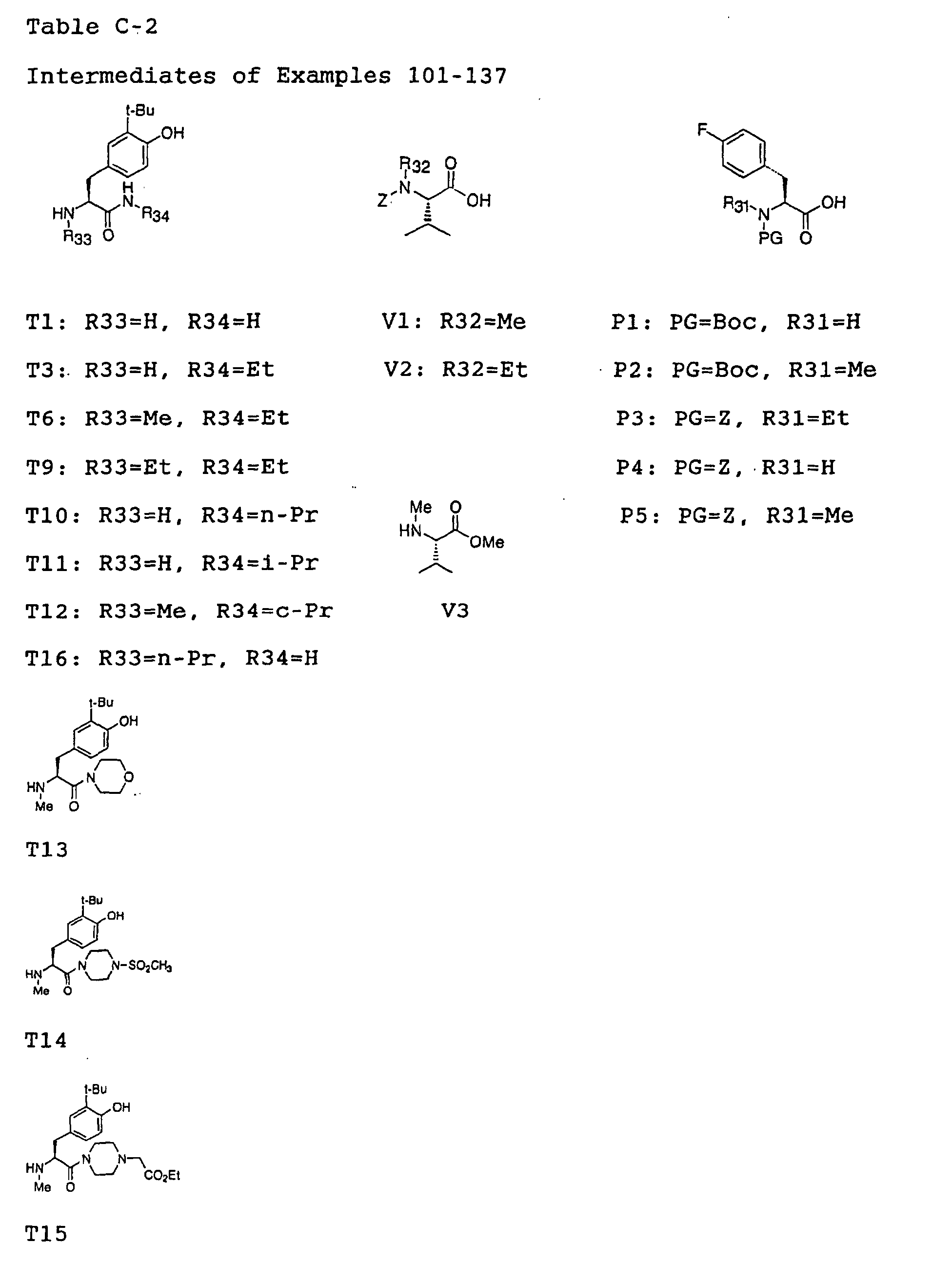
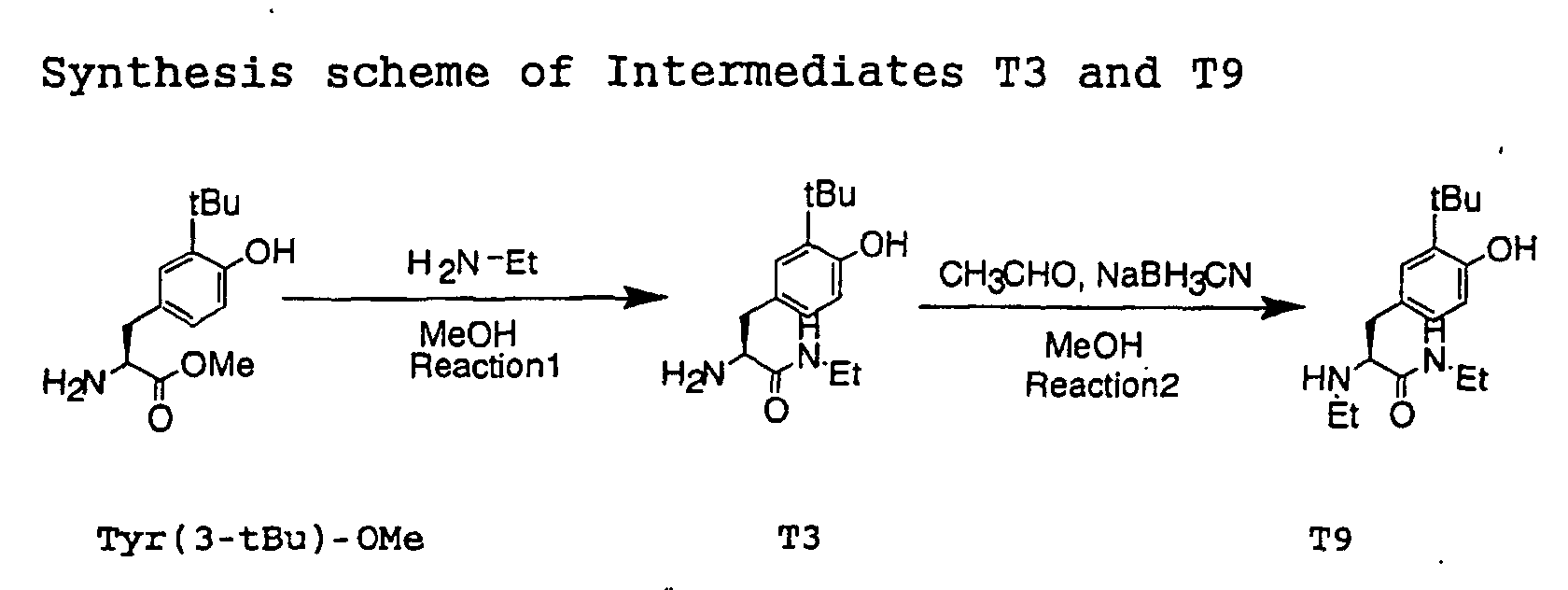
| Intermediates T3 (Tyr(3-tBu)-NHEt) and T9 (N-Et-Tyr(3-tBu)-NHEt) | ||||||
| Reaction1 | ||||||
| Tyr(3-tBu)-OMe (g) | Ethyl amine (ml) | MeOH (ml) | Reaction time (hr) | Column sol. | Product | Amount (g) |
| 14.000 | 168.00 | 56.00 | 18 | nHx:EA=1:1 | T3 | 12.810 |
| Reaction2 | ||||||
| Compound T3(g) | CH3CHO (ml) | NaBH3CN (g) | MeOH (ml) | Reaction time (hr) | Column sol. | Amount (g) |
| 12.810 | 298 | 3.350 =20:1 | 100.00 | 0.5 | MC:MeOH | 8.130 |

| Intermediate T6 | ||||||||
| N-Me-Tyr(3-tBu)-NHEt | ||||||||
| R33 | R34 | |||||||
| Me | Et | |||||||
| Reaction 1 | ||||||||
| Z-N-Me-Tyr(O-Bn, 3-tBu)-OH (g) (hr) | Ethylamine (ml) | ClCO2Et (ml) | NMM (ml) | THF (ml) | Reaction time (hr) | Column sol. | Product | Amount (g) |
| 11.300 | 118.80 | 3.40 | 3.90 | 230.00 | 6 | nHx:EA =2:1 | I-a(2) | 8.400 |
| Reaction 2 | ||||||||
| Compound I-a(2) (g) | Pd(CH)2 (g) | MeCH (ml) | Reaction time (hr) | Column sol. | Amount (g) | |||
| 6.200 | 0.600 | 120.00 | 3 | MC:MeCH =20:1 | 3.600 |
| Intermediate T10 | ||||||||
| Tyr(3-tBu)-NH-n-Pr | ||||||||
| R33 | R34 | |||||||
| H | n-Pr | |||||||
| Reaction 1 | ||||||||
| Z-N-Me-Tyr(O-Bn,3-tBu)-OH (g) | n-Propylamine (ml) | ClCO2Et (ml) | NMM (ml) | THF (ml) | Reaction time (hr) | Column sol. | Product | Amout (g) |
| 1.100 | 1.40 | 0.57 | 0.66 | 30.00 | 2 | nHx:EA:MC =1:3:1 | I-a(3) | 1.150 |
| Reaction 2 | ||||||||
| Compound I-a(3) (g) | Pd(OH)2 (g) | MeOH (ml) | Reaction time (hr) | Colum sol. | Amount (g) | |||
| 1.150 | 0.200 | 30.00 | 2 | MC:MeOH =20:1 | 0.580 |
| Intermediate T11 | ||||||||
| Tyr(3-tBu)-NH-i-Pr | ||||||||
| R33 | R34 | |||||||
| H | i-Pr | |||||||
| Reaction1 | ||||||||
| Z-N-Me-Tyr(O-Bn, 3-tBu)-OH (g) | i-Propylamine(ml) | ClCO2B (ml) | NMM (ml) | THF (ml) | Reaction time (hr) | Column sol. | Product | Amount (g) |
| 1.300 | 0.72 | 0.54 | 0.46 | 15.00 | 0.6 | nHx:EA=2:1 | I-a(4) | 1.200 |
| Reaction2 | ||||||||
| Compound I-a(4)(g) | Pd(OH)2 (g) | MeOH (ml) | Reaction time (hr) | Column sol. | Amount (g) | |||
| 1.200 | 0.500 | 30.00 | 3.5 | EA:MeOH=20:1 | 0.660 |
| Intermediate T12 | ||||||||
| N-Me-Tyr(3-tBu)-NH-c-Pr | ||||||||
| R33 | R34 | |||||||
| Me | c-Pr | |||||||
| Reaction 1 | ||||||||
| Z-N-Me-Tyr(O-Bn,3-tBu)-CH | c-Propylamine (ml) | ClCO2Et (ml) | NMM (ml) | THF (ml) | Reaction time (hr) | Column sol. | Product | Amount (g) |
| 1.000 | 1.20 | 0.46 | 0.40 | 30.00 | 2 | nHx:EA:MC =1:3:1 | I-a(5) | 1.050 |
| Reaction 2 | ||||||||
| Compound I-a(5) (g) | Pd(CH)2 (g) | MeCH (ml) | Reaction time (hr) | Column sol. | Amount (g) | |||
| 1.050 | 0.200 | 30.00 | 2 | MC:MeOH=20:1 | 0.500 |
| Intermediate T13 | ||||||||
| (2S)-3-[3-(tert-butyl)-4-hydroxyphenyl]-2-(methylamino)-1-morpholin-4-ylpropan-1-one | ||||||||
| R33 | R34 | |||||||
| Me | morpholine | |||||||
| Reaction 1 | ||||||||
| Z-N-Me-Tyr(O-Bn,3-tBu)-OH (g) | morpholine (g) | ClCOO2Et (ml) | NMM (ml) | THF (ml) | Reaction time (hr) | Column sol. | Product | Amount (g) |
| 1.200 | 0.660 | 0.27 | 0.42 | 15.00 | 20 | nHx:EA =1:1 | I-a(6) | 1.200 |
| =1:1 Reaction 2 | ||||||||
| Compound I-a(6) (g) | Pd(OH)2 (g) | MeOH (ml) | Reaction time (hr) | Column sol. | Amount (g) | |||
| 1.200 | 0.300 | 20.00 | 20 | MC:MeOH=20:1 | 0.600 |
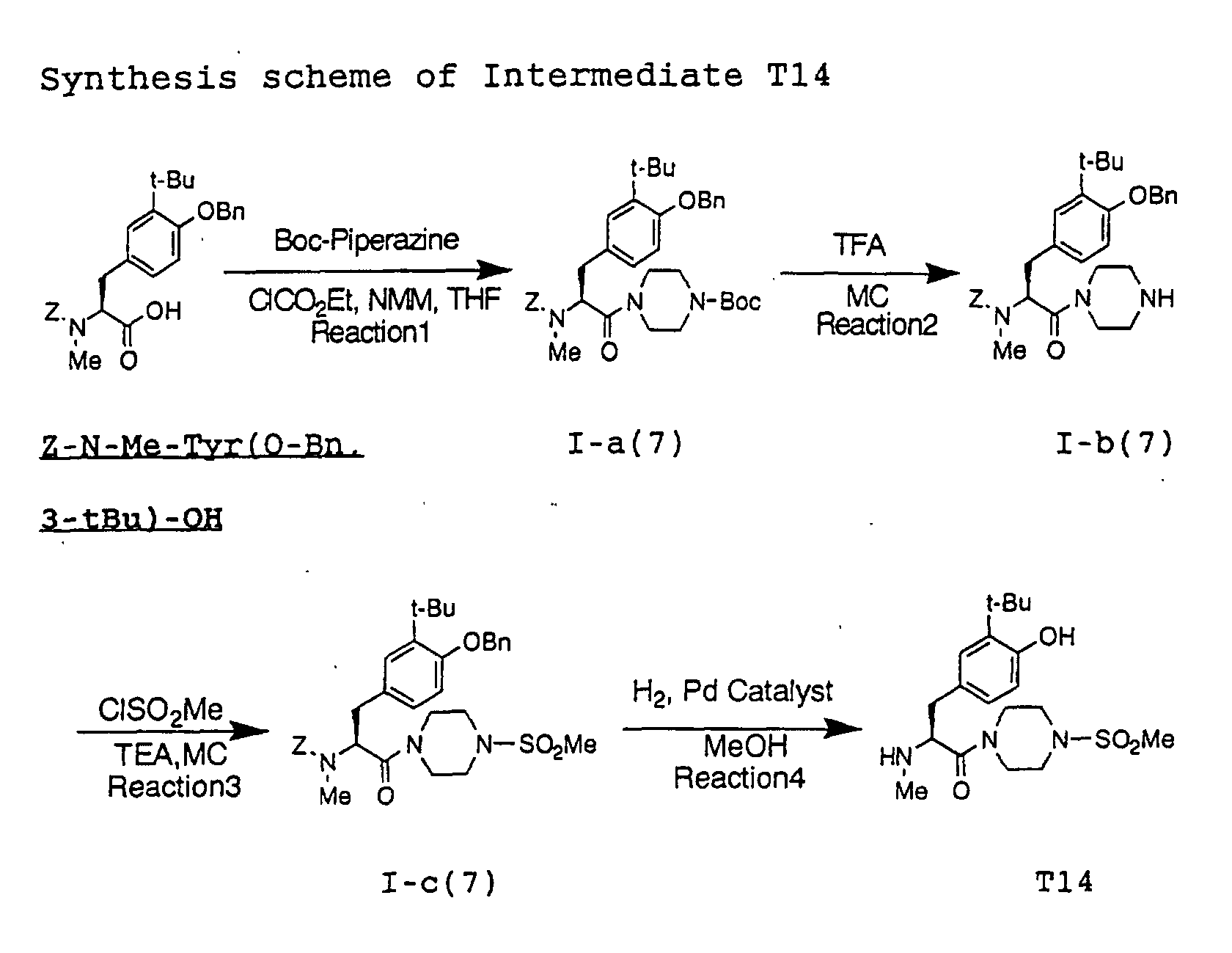
| Intermediate T14 | ||||||||
| (2S)-3-[3-(tert-butyl)-4-hydroxyphenyl]-2-(methylamino)-1-[4-(methylsulfonyl)piperazineyl]propane-1-one | ||||||||
| Reaction 1 | ||||||||
| z-N-Me-Tyr(O-Bn, 3-tBu)-OH (g) | Boc-piperazine (g) | ClCOO2Et (g) | NMM (ml) | THF (ml) | Reaction time (hr) | Column sol. | Product | Amount (g) |
| 1.500 | 0.700 | 0.36 | 0.42 | 15.00 | 20 | nHx:EA=1:1 | I-a(7) | 1,900 |
| Reaction 2 | ||||||||
| Compound I-a(7) (g) | TFA (ml) | MC (ml) | Reaction time (hr) | Column sol. | Product | Amount (g) | ||
| 1.900 | 5.00 | 20.00 | 4 | MC:MeOH-20:1 | I-b(7) | 1.400 | ||
| Reaction 3 | ||||||||
| Compound I-b(7) (g) | ClSO2Me (ml) | TEA (ml) | MC (ml) | Reaction time (hr) | Column sol. | Product | Amount (g) | |
| 1.400 | 0.46 | 0.82 | 20.00 | 2 | MC:MeOH =20:1 | I-c(7) | 1.500 | |
| Reaction 4 | ||||||||
| Compound I-c(7) (g) | Pd(OH)2 (g) | MeOH (ml) | Reaction time (hr) | Column sol. | Amount (g) | |||
| 1.500 | 0.300 | 20.00 | 20 | MC:MeOH =20:1 | 0.900 |
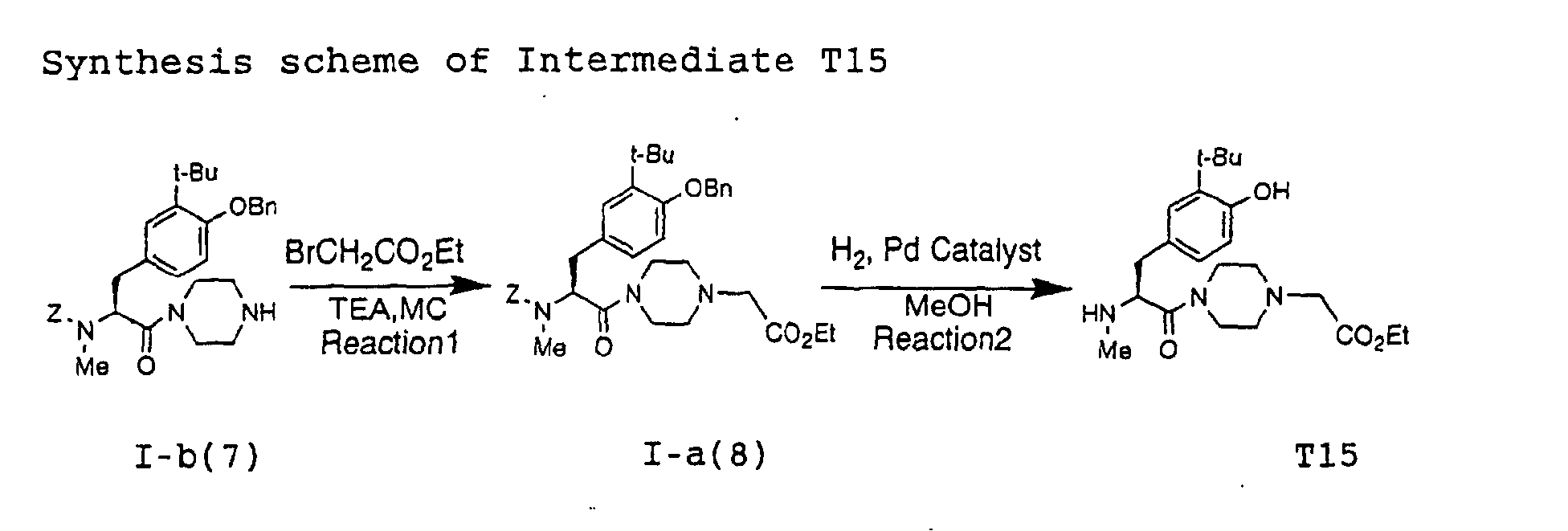
| Intermediate T15 | |||||||
| Ethyl 2-(4-{(2S)-3-[3-(tert-butyl)-4-hydroxyphenyl]-2-(methylamino)propanoyl}piperazinyl)acetate | |||||||
| Reaction1 | |||||||
| Compound I-b(7) (g) | Ethyl bromo acetate(ml) | TEA (ml) | MC (ml) | Reaction time (hr) | Column sol. | Product | Amount (g) |
| 0.970 | 0.30 | 0.40 | 17.00 | 4 | nHx:EA=3:1 | I-a(8) | 1.000 |
| Reaction2 | |||||||
| Compound I-a(8) (g) | Pd(OH)2 (g) | MeOH (ml) | Reaction time (hr) | Amount (g) | |||
| 1.000 | 0.300 | 16.00 | 1 | 0.643 |
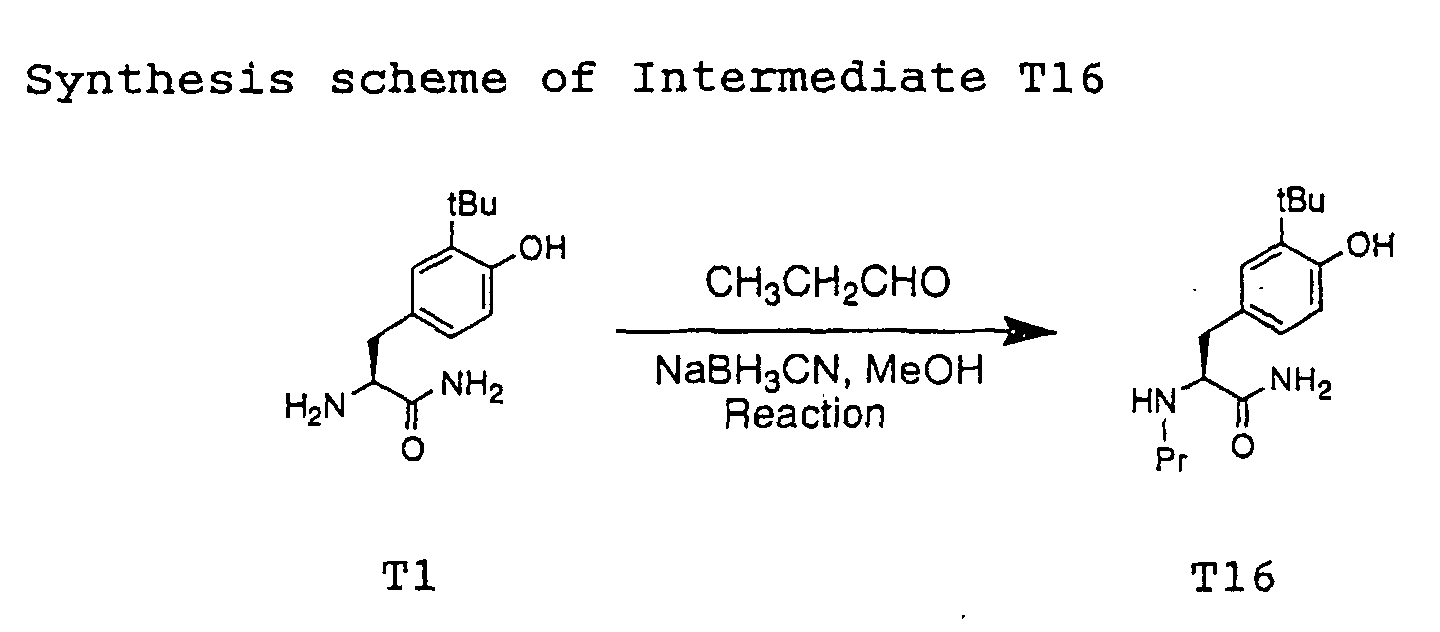
| Intermediate T16 | ||||||
| N-Pr-Tyr(3-tBu)-NH2 | ||||||
| Reaction | ||||||
| Compound T1 (g) | CH3CH2CHO (ml) | NaBH3CN (g) | MeOH (ml) | Reaction time (hr) | Column sol. | Amount (g) |
| 4.000 | 1.34 | 1.170 | 70.00 | 2 | nHx:EA=1:2 | 1.580 |
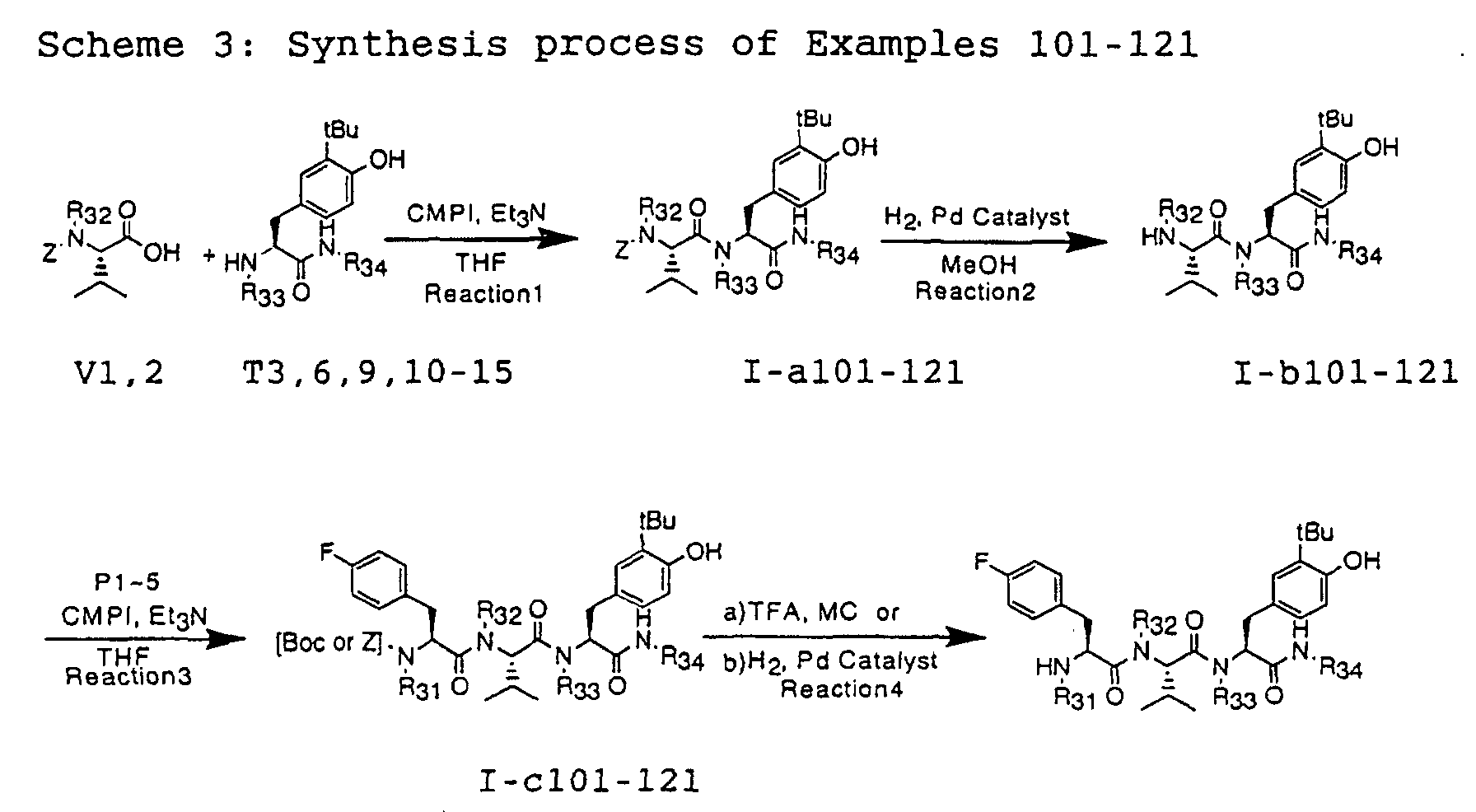
| Example 101 | ||||||||
| Synthesis of Phe(4-F)-N-Me-Val-Tyr(3-tBu)-NHEt | ||||||||
| R31 | R32 | R33 | R34 | |||||
| H | Me | H | Et | |||||
| Reaction | ||||||||
| Compound T3(g) | Compound V1(g) | CMPI (g) | TEA (ml) | THF (ml) | Reaction time (hr) | Column sol. | Product | Amount (g) |
| 3.000 | 3.000 | 4.350 | 3.30 | 60.00 | 20 | nHx:EA =1:1 | I-a101 | 5.220 |
| Reaction2 | ||||||||
| Compound I-a101(g) | Pd(OH)2 (g) | MeOH (ml) | Reaction time (hr) | Column sol. | Product | Amount (g) | ||
| 4.500 | 0.450 | 45.00 | MC:MeOH =20:1 | 20 | I-b101 | 2.200 | ||
| Reaction3 | ||||||||
| Compound I-b101(g) | Compound P4 (g) | CMPI (g) | TEA (ml) | THF (ml) | Reaction time (hr) | Column sol. | Product | Amount (g) |
| 0.600 | 0.500 | 0.600 | 0.50 | 15.00 | 20 | nHx:EA=1:1 | I-c101 | 0.830 |
| Reaction4-b | ||||||||
| Compound I-c101(g) | Pd(OH)2 (g) | MeOH (ml) | Reaction time (hr) | Column sol. | Amount (g) | HPLC min | ||
| 0.830 | 0.100 | 10.00 | 20 | MC:MeOH =10:1 | 0.170 | 18.42 | ||
| ESI-MS(M++1): 557 | ||||||||
| 1H-NMR(CDCl3): δ 0.59-1.05(9H,m), 1.37(9H, s), 2.25-2.39(1H, m), 2.58-3.24(9H, m),3,58-3.97(2H,m), 4.44-4.62(1H,m), 5.59-5.77(1H,m), 6.60-7.72(8H,m), 9.03 and 9.06(1H, d, J=7.9Hz) |
| Example 102 | ||||||||
| N-Me-Phe(4-F)-N-Me-Val -Tyr(3-tBu)-NHEt | ||||||||
| R31 | R32 | R33 | R34 | |||||
| Me | Me | H | Et | |||||
| Reaction1 | ||||||||
| Compound T3(g) | Compound V1(g) | CMPI (g) | TEA (ml) | THF (ml) | Reaction time (hr) | Column sol. | Product | Amount (g) |
| 3.000 | 3.000 | 4.350 | 3.30 | 60.00 | 20 | nHx:EA=1:1 | I-a102 | 5.220 |
| Reaction2 | ||||||||
| Compound I-a102(g) | Pd(OH)2 (g) | MeOH (ml) | Reaction time (hr) | Column sol. | Product | Amount (g) | ||
| 4.500 | 0.450 | 45.00 | 20 | MC:MeOH =20:1 | I-b102 | 2.200 | ||
| Reaction3 | ||||||||
| Compound I-b102(g) | Compound P2(g) | CMPI (g) | TEA (ml) | THF (ml) | Reaction time (hr) | Column sol. | Product | Amount (g) |
| 1.000 | 1.000 | 1.310 | 0.72 | 20.00 | 20 | nHx:EA=1:1 | I-c102 | 1.560 |
| Reaction4-a | ||||||||
| Compound I-c102(g) | TFA (ml) | MC (ml) | Reaction time (hr) | Column sol. | Amount (g) | HPLC min | ||
| 1.500 | 1.70 | 10.00 | 4 | MC:MeOH =10:1 | 0.28 | 18.73 | ||
| ESI-MS(M++1): 557 | ||||||||
| 1H-NMR(CDCl3): (two rotamers) δ 0.57,0.79, 0.92 and 1.00(9H, d and m, J=6.3-6.8Hz), 1.34and 1.38(9H, s), 2.25, 2.40 and 2.58, 2.65(6H, s), 2.05-2.40(1H, m), 2.67-3.25(6H, m), 3.55 nad 3.68(1H,m), 3.84, 4.40 and 4.55(2H, d and m, J=10.9Hz), 5.56 and 5.72(1H,m), 6.65-7.17(8H,m), 9.15 and 9.18 (1H, d, J=8.2Hz) |
| Example 103 | ||||||||
| N-Et-Phe(4-F)-N-Me-Val -Tyr(3-tBu)-NHEt | ||||||||
| R31 | R32 | R33 | R34 | |||||
| Et | Me | H | Et | |||||
| Reaction1 | ||||||||
| Compound T3(g) | Compound V1(g) | CMPI (g) | TEA (ml) | THF (ml) | Reaction time (hr) | Column sol. | Product | Amount (g) |
| 3.000 | 3.000 | 4.350 | 3.30 | 60.00 | 20 | nHx:EA =1:1 | I-a103 | 5.220 |
| Reaction2 | ||||||||
| Compound I-a103(g) | Pd(OH)2 (g) | MeOH (ml) | Reaction time (hr) | Column sol. | Product | Amount (g) | ||
| 4.500 | 0.450 | 45.00 | 20 | MC:MeOH =20:1 | I-b103 | 2.200 | ||
| Reaction3 | ||||||||
| Compound I-b103(g) | Compound P3(g) | CMPI (g) | TEA (ml) | THF (ml) | Reaction time (hr) | Column sol. | Product | Amount (g) |
| 0.800 | 0.670 | 1.050 | 057- | 20.00 | 20 | nHx:EA=1:1 | I-c103 | 0.800 |
| Reaction4-b | ||||||||
| Compound I-c103(g) | Pd(OH)2 (g) | MeOH (ml) | Reaction time (hr) | Column sol. | Amount (g) | HPLC min | ||
| 0.800 | 0.100 | 10.00 | 20 | MC:MeOH =10:1 | 0.220 | 19.27 | ||
| ESI-MS(M++1): 571 | ||||||||
| 1H-NMR(CDCl3): (two rotamers) δ 0.42-1.20(12H,m), 1.35 and 1.39(9H, s), 2.05-2.26(1H, m), 2.31-2.54(1H, m),2.40 and 2.50(3H,s), 2.62-3.26(6H,m), 3.62-3.80(1H,m),4.34-4.58(1H,m), 5.79-5.87(1H, m), 6.60-7.04(7H, m) |
| Example 104 | ||||||||
| Phe(4-F)-N-Me-Val-N-Me-Tyr(3-tBu)-NHEt | ||||||||
| R31 | R32 | R33 | R34 | |||||
| H | Me | Me | Et | |||||
| Reaction1 | ||||||||
| Compound T6 (g) | Compound V1 (g) | CMPI (g) | TEA (ml) | THF (ml) | Reaction time (hr) | Column sol. | Product | Amount (g) |
| 2.500 | 3.570 | 3.440 | 2.50 | 90.00 | 8 | nHx:EA=1:2 | I-a104 | 4.200 |
| Reaction2 | ||||||||
| Compound I-a104 (g) | Pd/C (g) | MeOH (ml) | Reaction time (hr) | Column sol. | Product | Amount (g) | ||
| 4.200 | 0.400 | 75.00 | 5 | MC:MeOH=20:1 | I-b104 | 3.900 | ||
| Reaction3 | ||||||||
| Compound I-b104(g) | Compound P4 (g) | CMPI (g) | TEA (ml) | THF (ml) | Reaction time (hr) | Column sol. | Product | Amount (g) |
| 1.300 | 1.600 | 1.300 | 0.90 | 30.00 | 18 | . nHx:EA=1:2 | I-c104 | 0.920 |
| Reaction4-b | ||||||||
| Compound I-c104(g) | Pd/C (g) | MeOH (ml) | Reaction time (hr) | Column sol. | Amount (g) | HPLC min | ||
| 0.920 | 0.100 | 10.00 | 3 | MC:MeOH=20:1 | 0.210 | 19.57 | ||
| ESI-MS(M++1):557 | ||||||||
| 1H-NMR(CDCl3): (two rotamers) δ 0.56, 0.77, 0.79 and 0.92(6H, d, J=6.4-6.7Hz), 1.01-1.12(3H, m), 1.38 and 1.33(9H, s), 2.19-2.68(2H, m), 252 and 2.83(3H, s), 2.68-3.42(4H, m), 3.00 and 3.02(3H, s),3.65-3.87(1H, m), 4.90-5.11 and 5.35-5.47(2H, m), 5.95-6.08(1H, m), 6.36 and 6.62(1H, d, J=7.8-7.9Hz), 6.68-7.16(6H, m) |
| Example 105 | ||||||||
| N-Me-Phe(4-F)-N-Me-Val-N-Me-Tyr(3-tBu)-NHEt | ||||||||
| R31 | R32 | R33 | R34 | |||||
| Me | Me | Me | Et | |||||
| Reaction1 | ||||||||
| Compound T6(g) | Compound V1 (g) | CMPI (g) | TEA (ml) | THF (ml) | Reaction time (hr) | Column sol. | Product | Amount (g) |
| 2.500 | 3.570 | 3.440 | 2.50 | 90.00 | 8 | nHx:EA =1:2 | I-a105 | 4.200 |
| Reaction2 | ||||||||
| Compound I-a105(g) | Pd/C (g) | MeOH (ml) | Reaction time (hr) | Column sol. | Product | Amount (g) | ||
| 4.200 | 0.400 | 75.00 | 5 | MC:MeOH =20:1 | I-b105 | 3.900 | ||
| Reaction3 | ||||||||
| Compound I-b105 (g) | Compound P2(g) | CMPI (g) | TEA (ml) | THF (ml) | Reaction time (hr) | Column sol. | Product | Amount (g) |
| 1.300 | 1.480 | 1.300 | 0.90 | 30.00 | 18 | nHx:EA =1:2 | I-c105 | 1.020 |
| Reaction4-a | ||||||||
| Compound I-c105 (g) | TFA (ml) | MC (ml) | Reaction time (hr) | Column sol. | Amount (g) | HPLC min | ||
| 1.020 | 2.30 | 23.00 | 6 | MC:MeOH =20:1 | 0.200 | 20.213 | ||
| ESI-MS(M++1): 571 | ||||||||
| 1H-NMR(CDCl3): (two rotamers) δ 0.63, 0.80, 0.81 and 0.92(6H, d, J=6.4-6.9Hz), 1.06(3H, t, J=7.3Hz), 1.34 and 1.39(9H, s), 2.13-2.33(1H, m), 2.22 and 2.25(3H, s), 2.53 and 2.82(3H s), 2.54(1H, s), 2.60-2.70(2H, m), 2.74-2.90(1H, m), 2.95 and 3.06(3H, s),3.45 and 3.59(1H, t, J=5-6.8Hz),5.07 and 5.15(1H, d, J=10.6-10.9Hz), 5.05 and 5.38(1H, dd, J=8.1-9.3, 6.1-6.8Hz), 6.0(1H, t, J=5.0Hz),6.40 and 6.61(1H, d, J=8.0Hz), 6.75(3H, m), 7.02-7.18(3H, m) |
| Example 106 | ||||||||
| N-Et-Phe(4-F)-N-Me-Val-N-Me-Tyr(3-tBu)-NHEt | ||||||||
| R31 | R32 | R33 | R34 | |||||
| Et | Me | Me | Et | |||||
| Reaction1 | ||||||||
| Compound T6 (g) | Compound V1 (g) | CMPI (g) | TEA (ml) | THF (ml) | Reaction time (hr) | Column sol. | Product | Amount (g) |
| 2.500 | 3.570 | 3:440 | 2.50 | 90.00 | 8 | nHx:EA=1:2 | I-a106 | 4.200 |
| Reaction2 | ||||||||
| Compound I-a106(g) | Pd/C (g) | MeOH (ml) | Reaction time (hr) | Column sol | Product | Amount (g) | ||
| 4.200 | 0.400 | 75.00 | 5 | MC:MeOH= 20:1 | I-b106 | 3.900 | ||
| Reaction3 | ||||||||
| Compound I-b106 (g) | Compound P3 (g) | CMPI (g) | TEA (ml) | THF (ml) | Reaction time (hr) | Column sol. | Product | Amount (g) |
| 1.300 | 1.740 | 1.300 | 0.90 | 30.00 | 15 | nHx:EA=1:2 | I-c106 | 1.050 |
| Reaction4-b | ||||||||
| Compound I-c106 (g) | Pd/C (g) | MeOH (ml) | Reaction time (hr) | Column sol. | Amount (g) | HPLC min | ||
| 1.050 | 0.100 | 14.00 | 3 | MC:MeOH= 20:1 | 0.200 | 20.950 | ||
| ESI-MS(M++1): 585 | ||||||||
| 1H-NMR(CDCl3): (two rotamers) δ 0.65, 0.79, 0.8 and 0.91(6H, d, J=6.0Hz), 0.97-1.08(6H,m),1.34 and 1.39(9H, s), 2.21-2.38(2H, m), 2.46-2.59(2H, m), 2.61-2.9(2H, m),25 and 2.75(3H, s),2.96 and 3.06(3H, s), 3.17-3.46(2H, m), 3.55 and 3.68(1H, t, J=7.0Hz), 5.01-5.36(2H, m), 5.97-6.0(1H, m), 6.41 and 6.59(1H, d, J=8.0Hz), 6.79-6.98(3H, m), 7.04-7.17(3H, m) |
| Example 107 | ||||||||
| Phe(4-F)-N-Me-Val-N-Et-Tyr(3-tBu)-NHEt | ||||||||
| R31 | R32 | R33 | R34 | |||||
| H | Me | Et | Et | |||||
| Reaction1 | ||||||||
| Compound T9(g) | Compound V1(g) | CMPI (g) | TEA (ml) | THF (ml) | Reaction time (hr) | Column sol. | Product | Amount (g) |
| 6.000 | 16.300 | 26.200 | 14.30 | 30.00 | 15 | nHx:EA=2:1 | I-a107 | 3.030 |
| Reaction2 | ||||||||
| Compound I-a107(g) | Pd(OH)2 (g) | MeOH (ml) | Reaction time (hr) | Column sol. | Product | Amount (g) | ||
| 8.000 | 1.200 | 50.00 | 15 | MC:MeOH =10:1 | I-b107 | 5.000 | ||
| Reaction3 | ||||||||
| Compound I-b107(g) | Compound P4(g) | CMPI (g) | TEA (ml) | THF (ml) | Reaction time (hr) | Column sol. | Product | Amount (g) |
| 0.800 | 0.815 | 0.606 | 0.40 | 30.00 | 18 | nHx:EA=1:2 | I-c107 | 1.040 |
| Reaction4-b | ||||||||
| Compound I-c107(g) | Pd/C (g) | MeOH (ml) | Reaction time (hr) | Column sol. | Amount (g) | HPLC min | ||
| 1.047 | 0.156 | 20.00 | 3.5 | MC:MeOH =20:1 | 0.252 | 21.09 | ||
| ESI-MS(M++1):571 | ||||||||
| 1H-NMR(CDCl3):(two rotamers) δ 0.74, 0.80 and 0.92(6H, d, J=7.0-7.9Hz), 0.97-1.20(6H, m),1.32 and 1.36(9H, s), 2.20-3.13(5H, m), 2.74 and 3.05(3H, s), 3.15-3.35(3H, m), 3.35-3.95(3H, m), 4.92-5.10(2H, m), 6.44 and 6,73(1H, d, J=8.8Hz), 6.50(3/5H, m), 6.75(3/5H, dd, J=7.9, 1.7Hz), 6.90-7.29(29/5H, m) |
| Example 108 | ||||||||
| N-Me-Phe(4-F)-N-Me-Val-N-Et-Tyr(3-tBu)-NHEt | ||||||||
| R31 | R32 | R33 | R34 | |||||
| Me | Me | Et | Et | |||||
| Reaction1 | ||||||||
| Compound T9(g) | Compound V1(g) | CMPI (g) | TEA (ml) | THF (ml) | Reaction time (hr) | Column sol. | Product | Amount (g) |
| 6.000 | 16.300 | 26.200 | 14.30 | 30.00 | 15 | nHx:EA=2:1 | I-a108 | 3.030 |
| Reaction2 | ||||||||
| Compound I-a108(g) | Pd(OH)2 (g) | MeOH (ml) | Reaction time (hr) | Column sol. | Product | Amount (8) | ||
| 8.000 | 1.200 | 50.00 | 15.00 | MC:MeOH = 10:1 | I-b108 | 5.000 | ||
| Reaction3 | ||||||||
| Compound I-b108(g) | Compound P2(g) | CMPI (8) | TEA (ml) | THF (ml) | Reaction time (hr) | Column sol. | Product | Amount (g) |
| 1.022 | 1.130 | 0.966 | 0.70 | 20.00 | 19 | nHx:EA=1:2 | I-c108 | 1.590 |
| Reaction4-a | ||||||||
| Compound I-c108(g) | TFA (ml) | MC (ml) | Reaction time (hr) | Column sol. | Amount (g) | HPLC min | ||
| 1.590 | 1.80 | 10.00 | 3 | MC:MeOH =20:1 | 0.251 | 21.54 | ||
| ESI-MS(M++1):585 | ||||||||
| 1H-NMR(CDCl3):(two rotamers) δ 0.78-0.90 and 0.95(6H, m and d, J=7.9Hz), 0.97-1.10(3H, m), 1.10 and 1.22(3H, m),1.31 and 1.39(9H, s), 2.21-2.25(3H, s), 2.19-2.40(1H, m),2.55-3.35(7H, m), 2.69 and 2.72(3H, s), 3.42-3.75(3H, m),4.95-5.10(1H, m),5.12(1H, d, J=10.6Hz),6.44 and 6.58(1H, d, J=8.8Hz), 6.50(3/5H,m), 6.79(3/5H, dd, J=8.1, 2.5Hz), 6.88-7.00(12/5H, m), 7.05-7.20(12/5H, m) 7.27(1H, brs) |
| Example 109 | ||||||||
| N-Et-Phe(4-F)-N-Me-Val-N-Et-Tyr(3-tBu)-NHEt | ||||||||
| R31 | R32 | R33 | R34 | |||||
| Et | Me | Et | Et | |||||
| Reaction1 | ||||||||
| Compound T9(g) | Compound V1(g) | CMPI (g) | TEA (ml) | THF (ml) | Reaction time (hr) | Column sol. | Product | Amount (g) |
| 6.000 | 16.300 | 26.200 | 14.30 | 30.00 | 15 | nHx:EA=2:1 | I-a109 | 3.030 |
| Reaction2 | ||||||||
| Compound I-a109(g) | Pd(OH)2 (g) | MeOH (ml) | Reaction time (hr) | Column sol. | Product | Amount (g) | ||
| 8.000 | 1.200 | 50.00 | 15 | MC:MeOH = 10:1 | I-b109 | 5.000 | ||
| Reaction3 | ||||||||
| Compound I-b109(g) | Compound P3(g) | CMPI (g) | TEA (ml) | THF (ml) | Reaction time (hr) | Column sol. | Product | Amount (g) |
| 0.800 | 0.819 | 0.606 | 0.40 | 16.00 | 18 | nHx:EA=1:2 | I-c109 | 1.000 |
| Reaction4-b | ||||||||
| Compound I-c109(g) | Pd/C (g) | MeOH (ml) | Reaction time (hr) | Column sol. | Amount (g) | HPLC min | ||
| 1.000 | 0.150 | 20.00 | 15 | MC:MeOH =20:1 | 0.127 | 21.920 | ||
| ESI-MS(M++1):599 | ||||||||
| 1H-NMR(CDCl3):(two rotamers) δ 0.78-0.88 and 0.92(6H, m and d, J=7.4Hz), 0.98-1.18(6H, m), 1.20(3H, q, J=6.4Hz), 1.34 and 1.38(9H, s), 2.20-2.43(2H, m),2.43-3.35(8H, m),2.68 and 2.80(3H, s), 3.42-3.78(3H, m), 4.90-5.12(1H, m), 5.12(1H, d, J=10.6Hz), 6.42 and 6.58(1H, d, J=15.3Hz), 6.50(1/3H,m), 6.80(2/3H, dd, J=8.8,2.1Hz), 6.85-7.00(3H, m),7.05-7.17(10/3H, m),7.30(2/3H, brs) |
| Example 110 | ||||||||
| Phe(4-F)-N-Et-Val-Tyr(3-tBu)-NHEt | ||||||||
| R31 | R32 | R33 | R34 | |||||
| H | Et | H | Et | |||||
| Reaction1 | ||||||||
| Compound T3 (g) | Compound V2 (g) | CMPI (g) | TEA (ml) | THF (ml) | Reaction time (hr) | Column sol. | Product | Amount (g) |
| 6.000 | 6.240 | 8.700 | 6.60 | 120.00 | 20 | nHx:EA=1:1 | I-a110 | 9.540 |
| Reaction2 | ||||||||
| Compound I-a110(g) | Pd(OH)2 (g) | MeOH (ml) | Reaction time (hr) | Column sol. | Product | Amount (g) | ||
| 6.000 | 0.600 | 60.00 | 20 | MC:MeOH =20:1 | I-bl10 | 3570 | ||
| Reaction3 | ||||||||
| Compound I-b110(g) | Compound P1 (g) | CMPI (g) | TEA (ml) | THF (ml) | Reaction time (hr) | Column sol | Product | Amount (g) |
| 1.200 | 1.500 | 2.000 | 1.00 | 20.00 | 20 | nHx:EA=1:1 | I-c110 | 0.400 |
| Reaction4-a | ||||||||
| Compound I-c110(g) | TFA (ml) | MC (ml) | Reaction time (hr) | Column sol. | Amount (g) | HPLC min | ||
| 0.400 | 0.60 | 3.00 | 4 | MC:MeOH=20:1 | 0.200 | 20.25 | ||
| ESI-MS(M++1): 557 | ||||||||
| 1H-NMR(CDCl3): δ 0.62-1.16(12H,m), 1.38(9H, s), 2.25-2.45(1H, m), 2.62-3.86(9H, m),3.92 and 3.95(1H, d, J=10.0Hz), 4.44-5.56(1H, m), 5.67-5.90(1H, m), 6.60-7.20(7H, m),9.05 and 9.08(1H, d, J=7.8Hz) |
| Example 111 | ||||||||
| N-Me-Phe(4-F)-N-Et-Val-Tyr(3-tBu)-NHEt | ||||||||
| R31 | R32 | R33 | R34 | |||||
| Me | Et | H | Et | |||||
| Reaction1 | ||||||||
| Compound T3 (g) | Compound V2 (g) | CMPI (g) | TEA (ml) | THF (ml) | Reaction time (hr) | Column sol. | Product | Amount (g) |
| 6.000 | 6.240 | 8.700 | 6.60 | 120.00 | 20 | nHx:EA=1:1 | I-a111 | 9.540 |
| Reaction2 | ||||||||
| Compound I-a111 (g) | Pd(OH)2 (g) | MeOH (ml) | Reaction time (hr) | Column sol. | Product | Amount (g) | ||
| 6.000 | 0.600 | 60.00 | 20 | MC:MeOH=20:1 | I-b111 | 3.570 | ||
| Reaction3 | ||||||||
| Compound I-b111(g) | Compound P2 (g) | CMPI (g) | TEA (ml) | THF (ml) | Reaction time (hr) | Column sol. | Product | Amount (g) |
| 1.000 | 1.600 | 2.000 | 1.00 | 20.00 | 20 | nHx:EA=1:1 | I-c111 | 0.400 |
| Reaction4-a | ||||||||
| Compound I-c111(g) | TFA (ml) | MC (ml) | Reaction time (hr) | Column sol. | Amount (g) | HPLC min | ||
| 0.400 | 0.60 | 3.00 | 4 | MC:MeOH=20:1 | 0.300 | 20.77 | ||
| ESI-MS(M++1): 571 | ||||||||
| 1H-NMR(CDCl3): (two rotamers) δ 0.67 and 0.80-1.16(12H, d and m, J=6.8Hz), 1.37(9H, s), 2.30(3H, s), 2.35-2.39(1H, m), 2.79-3.22(8H, m), 3.53-3.59(1H, m), 4.04-4.15(1H, m), 4.39-4.46(1H, m), 5.73-5.77(1H, m), 6.61 and 6.64(1H, d, J=8.2Hz), 6.84-7.19(6H, m) |
| Example 112 | ||||||||
| N-Et -Phe(4-F)-N-Et-Val-Tyr(3-tBu)-NHEt | ||||||||
| R31 | R32 | R33 | R34 | |||||
| Et | Et | H | Et | |||||
| Reaction1 | ||||||||
| Compound T3 (g) | Compound V2 (g) | CMPI (g) | TEA (ml) | THF (ml) | Reaction time (hr) | Column sol. | Product | Amount (g) |
| 6.000 | 6.240 | 8.700 | 6.60 | 120.00 | 20 | nHx:EA=1:1 | I-a112 | 9.540 |
| Reaction2 | ||||||||
| Compound I-a112(g) | Pd(OH)2 (g) | MeOH (ml) | Reaction time (hr) | Column sol. | Product | Amount (g) | ||
| 6.200 | 0.600 | 60.00 | 20 | MC:MeOH=20:1 | I-b112 | 3.570 | ||
| Reaction3 | ||||||||
| Compound I-b112(g) | Compound P3 (g) | CMPI (g) | TEA (ml) | THF (ml) | Reaction time (hr) | Column sol. | Product | Amount (g) |
| 1.000 | 1.585 | 2.000 | 1.00 | 20.00 | 20 | nHx:EA=1:1 | I-c112 | 0.550 |
| Reaction4-b | ||||||||
| Compound I-c112(g) | Pd(OH)2 (g) | MeOH (ml) | Reaction time (hr) | Column sol. | Amount (g) | HPLC min | ||
| 0.400 | 0.050 | 4.00 | 20 | MC:MeOH=30:1 | 0.098 | 21.090 | ||
| ESI-MS(M++1): 585 | ||||||||
| 1H-NMR(CDCl3): (two rotamers) δ 0.48 and 0.71-1.31(15H, d and m, J=7.4Hz), 1.37(9H, s), 2.20-2.61(2H, m), 2.71-3.34(10H, m), 3.60-3.82(2H, m), 4.40-4.56(1H, m), 5.80-5.98(1H, m), 6.67-7.01(3H, m), 7.02-7.16(3H, m), 7.48 and 7.50(1H, d, J=6.8Hz), 8.73 and 8.76(1H,d, J=7.9Hz) |
| Example 113 | ||||||||
| Phe(4-F)-N-Et-Val-N-Me-Tyr(3-tBu)-NHEt | ||||||||
| R31 | R32 | R33 | R34 | |||||
| H | Et | Me | Et | |||||
| Reaction 1 | ||||||||
| Compound T6 (g) | Compound V2 (g) | CMPI (g) | TEA (ml) | THF (ml) | Reaction time (hr) | Column sol. | Product | Amount (g) |
| 4.170 | 8.720 | 5.880 | 4.20 | 150.00 | 20 | nHx:EA =1:2 | I-a113 | 5.500 |
| Reaction2 | ||||||||
| Compound I-a113 (g) | Pd/C (g) | MeOH (ml) | Reaction time (hr) | Column sol. | Product | Amount (g) | ||
| 5.500 | 0.500 | 100.00 | 2 | MC:MeOH =20:1 | I-b113 | 3.200 | ||
| Reaction3 | ||||||||
| Compound I-b113 (g) | Compound P1 (g) | CMPI (g) | TEA (ml) | THF (ml) | Reaction time (hr) | Column sol. | Product | Amount (g) |
| 1.000 | 0.850 | 0.760 | 0.60 | 20.00 | 18 | nHx:EA I-c113 =1:2 | 0.320 | |
| Reaction4-a | ||||||||
| Compound I-c113 (g) | TFA (ml) | MC (ml) | Reaction time (hr) | Column sol. | Amount (g) | HPLC min | ||
| 0.320 | 0.70 | 7.40 | 6 | MC:MeOH =20:1 | 0.020 | 20.260 | ||
| ESI-MS(M++1): 571 | ||||||||
| 1H-NMR(CDCl3): (two rotamers) δ 0.36-0.96(8H,m), 0.98-1.10(4H,m), 1.35 and 1.39(9H,s), 2.28-2.41(1H,m), 2.84 and 3.04(3H,s), 2.55-3.39(8H,m), 3.68-3.78(1H,m), 4.90-5.32(2H,m) 6.45 and 6.65(1H, d, J=6.0Hz),6.77-7.23(6H,m) |
| Example 114 | ||||||||
| N-Me-Phe(4-F)-N-Et-Val-N-Me-Tyr(3-tBu)-NHEt | ||||||||
| R31 | R32 | R33 | R34 | |||||
| Me | Et | Me | Et | |||||
| Reaction1 | ||||||||
| CompoundT6 (g) | Compound V2 (g) | CMPI (g) | TEA (ml) | THF (ml) | Reaction time (hr) | Column sol. | Product | Amount (g) |
| 4.170 | 8.720 | 5.880 | 4.20 | 150.00 | 20 | nHx:EA =1:2 | I-a114 | 5.500 |
| Reaction2 | ||||||||
| Compound I-a114 (g) | Pd/C (g) | MeOH (ml) | Reaction time (hr) | Column sol. | Product | Amount (g) | ||
| 5.500 | 0.500 | 100.00 | 2 | MC:MeOH =20:1 | I-b114 | 3.200 | ||
| Reaction3 | ||||||||
| Compound I-b114 (g) | Compound P2 (g) | CMPI (g) | TEA (ml) | THF (ml) | Reaction time (hr) | Column sol. | Product | Amount (g) |
| 1.000 | 0.850 | 0.760 | 0.60 | 20.00 | 20 | nHx:EA =1:2 | I-c114 | 0.300 |
| Reaction4-a | ||||||||
| Compound I-c114 (g) | TFA (ml) | MC (ml) | Reaction time (hr) | Column sol. | Amount (g) | HPLC min | ||
| 0.300 | 0.70 | 6.80 | 6 | MC:MeOH =20:1 | 0.030 | 20.880 | ||
| ESI-MS(M++1): 585 | ||||||||
| 1H-NMR(CDCl3): (two rotamers) δ 0.51, 0.81, 0.87 and 0.91(6H, d, J=6.3-6.9Hz), 0.94, 1.04 and 1.17(6H, t, J=3.6Hz), 1.34 and 1.39(9H,s), 2.18-2.62(1H, m), 2.38(3H, s), 2.57-2.88 (3H,m), 2.91-3.38(5H,m), 2.94 and 3.06(3H,s), 3.49 and 3.57(1H, t, J=6.4-7.2Hz), 5.49-5.32 (2H,m), 6.02-6.1 and 6.53-6.59(1H, m), 6.45 and 6.64(1H, d, J=8.0Hz),6.76-7.03(3H, m),7.08 -7.19(3H, m) |
| Example 115 | ||||||||
| N-Et-Phe(4-F)-N-Et-Val-Me-Tyr(3-tBu)-NHEt | ||||||||
| R31 | R32 | R33 | R34 | |||||
| Et | Et | Me | Et | |||||
| Reaction1 | ||||||||
| Compound T6 (g) | Compound V2 (g) | CMPI (g) | TEA (ml) | THF (ml) | Reaction time (hr) | Column sol. | Product | Amount (g) |
| 4.170 | 8.720 | 5.880 | 4.20 | 150.00 | 20 | nHx:EA =1:2 | I-a115 | 5.500 |
| Reaction2 | ||||||||
| Compound I-a115 (g) | Pd/C (g) | MeOH (ml) | Reaction time (hr) | Column sol. | Product | Amount (g) | ||
| 5.500 | 0.500 | 100.00 | 2 | MC:MeOH =20:1 | I-b115 | 3.200 | ||
| Reaction3 | ||||||||
| Compound I-b115 (g) | Compound P3 (g) | CMPI (g) | TEA (ml) | THF (ml) | Reaction time (hr) | Column sol. | Product | Amount (g) |
| 1.000 | 0.850 | 0.760 | 0.60 | 20.00 | 18 | nHx:EA =1:2 | I-c115 | 0.300 |
| Reaction4-b | ||||||||
| Compound (g) | Pd/C (g) | MeOH (ml) | Reaction time (hr) | Column sol. | Amount (g) | HPLC min | ||
| 0.300 | 0.030 | 4.00 | 3 | MC:MeOH =20:1 | 0.040 | 21.59 | ||
| ESI-MS(M++1): 599 | ||||||||
| 1H-NMR(CDCl3):(two rotamers) δ 0.38-1.17(15H,m), 1.34, 1.36 and 1.38(9H,s), 3.38-2.12 (1H,m), 3,55(1H, t, J=6.3Hz), 3.47-3.72(1H, m), 4.88-5.37(2H, m), 5.79-6.09 and 6.63-6.7(1H, m), 6.42 and 6.62(1H, dd, J=8.3,7.4Hz), 7.05-7.22(6H,m) |
| Example 116 | ||||||||
| Phe(4-F)-N-Et-Vhl-N-Et-Tyr(3-tBu)-NHEt | ||||||||
| R31 | R32 | R33 | R34 | |||||
| H | Et | Et | Et | |||||
| Reactionl | ||||||||
| Compound T9(g) | Compound V2(g) | CMPI (g) | TEA (ml) | THF (ml) | Reaction time (hr) | Column sol. | Product | Amount (g) |
| 5.020 | 9.110 | 17.550 | 9.50 | 100.00 | 16 | nHx:EA=3:1 | I-a116 | 3.030 |
| Reaction2 | ||||||||
| Compound I-a116(g) | Pd(OH)2 (g) | MeOH (ml) | Reaction time (hr) | Column sol | Product | Amount (g) | ||
| 3.030 | 0.454 | 60.00 | 14 | MC:MeOH = 10:1 | I-b116 | 2.24 | ||
| Reaction3 | ||||||||
| Compound I-b116(g) | Compound P4(g) | CMPI (g) | TEA (ml) | THF (ml) | Reaction time (hr) | Column sol. | Product | Amount (g) |
| 0.600 | 0.680 | 0.549 | 0.40 | 12.00 | 18 | nHx:EA=1:1 | I-c116 | 0.200 |
| Reaction4-b | ||||||||
| Compound I-c116(g) | Pd/C (g) | MeOH (ml) | Reaction time (hr) | Column sol. | Amount (g) | HPLC min | ||
| 0.200 | 0.030 | 4.00 | 3 | MC:MeOH=20:1 | 0.053 | 21.59 | ||
| ESI-MS(M++1):585 | ||||||||
| 1H-NMR(CDCl3):(two rotamers) δ 0.60 and 0.78-1.30(15H, d and m, J=7.9Hz), 1.34 and 1.38(9H, s), 2.22-2.50(1H, m), 2.52-3.00(3H, m), 3.00-3.54(6H, m), 3.54-3.94(2H, m), 4.82-5.05(1H, m), 5.10(1H, m), 6.45-6.70(2H, m), 6.80(3/4H, m), 6.91-7.25(21/4H, m) |
| Example 117 | ||||||||
| N-Me-Phe(4-F)-N-Et-Val-N-Et-Tyr(3-tBu)-NHEt | ||||||||
| R1 | R2 | R3 | R4 | |||||
| Me | Et | Et | Et | |||||
| Reaction1 | ||||||||
| Compound T9(g) | Compound V2(g) | CMPI (g) | TEA (ml) | THF (ml) | Reaction time (hr) | Column sol. | Product | Amount (g) |
| 5.020 | 9.110 | 17.550 | 9.50 | 100.00 | 16 | nHx:EA=3:1 | I-a117 | 3.030 |
| Reaction2 | ||||||||
| Compound I-a117(g) | Pd(OH)2 (g) | MeOH (ml) | Reaction time (hr) | Column sol. | Product | Amount (g) | ||
| 3.030 | 0.454 | 60.00 | 14 | MC:MeOH = 10:1 | I-b117 | 2.240 | ||
| Reaction3 | ||||||||
| Compound I-b117(g) | Compound P2(g) | CMPI (g) | TEA (ml) | THF (ml) | Reaction time (hr) | Column sol. | Product | Amount (g) |
| 0.845 | 0.681 | 0.585 | 0.40 | 16.00 | 48 | nHx:EA=1:1 | I-c117 | 0.378 |
| Reaction4-a | ||||||||
| Compound I-c117(g) | TFA (ml) | MC (ml) | Reaction time(hr) | Column sol. | Amount (g) | HPLC min | ||
| 0.378 | 0.80 | 4.00 | 3 | MC:MeOH =20:1 | 0.056 | 22.20 | ||
| ESI-MS(M++1):599 | ||||||||
| 1H-NMR(CDCl3):(two rotamers) δ 0.75 and 0.83-1.10(10H, d and m, J=7.9Hz), 1.10-1.30(5H, m), 1.35 and 1.39(9H, s), 2.30 and 2.33(3H, s), 2.30-2.48(1H, m), 2.65-3.89(12H, m), 4.90 and 5.07(1H, m), 5.18 and 5.23(1H, d, J=9.7Hz), 6.48 and 6.58(1H, d, J=8.8Hz), 6.63(1/2H, m), 6.80(1H, dd, J=8.1, 1.8Hz), 6.90-7.0(7/2H, m), 7.05(1/2H, d, J=1.7Hz), 7.06-7.20(5/2H, m) |
| Example 118 | ||||||||
| N-Et-Phe(4-F)-N-Et-Val-N-Et-Tyr(3-tBu)-NHEt | ||||||||
| R31 | R32 | R33 | R34 | |||||
| Et | Et | Et | Et | |||||
| Reaction1 | ||||||||
| Compound T9(g) | Compound V2(g) | CMPI (g) | TEA (ml) | THF (ml) | Reaction time (hr) | Column sol. | Product | Amount (g) |
| 5.020 | 9.110 | 17.550 | 950 | 100.0 | 16 | nHx:EA=3:1 | I-a118 | 3.030 |
| Reaction2 | ||||||||
| Compound I-a118(g) | Pd(OH)2 (g) | MeOH (ml) | Reaction time (hr) | Column sol. | Product | Amount (g) | ||
| 3.030 | 0.454 | 60.00 | 14 | MC:MeOH =10:1 | I-b118 | 2.240 | ||
| Reaction3 | ||||||||
| Compound I-b118(g) | Conpound P3(g) | CMPI (g) | TEA (ml) | THF (ml) | Reaction time (hr) | Column sol. | Product | Amount (g) |
| 0.520 | 0.642 | 0.475 | 0.30 | 10.00 | 48 | nHx:EA=1:1 | I-c118 | 0.174 |
| Reaction4-b | ||||||||
| Compound I-c118(g) | Pd/C (g) | MeOH (ml) | Reaction time (hr) | Column sol. | Amount (g) | HPLC min | ||
| 0.174 | 0.026 | 4.00 | 3 | MC:MeOH=20:1 | 0.141 | 22.84 | ||
| ESI-MS(M++1):613 | ||||||||
| 1H-NMR(CDCl3):(two rotamers) δ 0.75 and 0.80-0.98(8H, d and m, J=7.9Hz), 0.98-1.08(6H, m),1.08-1.23(4H, m), 1.34 and1.38(9H, s), 2.23-2.88(6H, m), 2.93-3.88(9H, m), 4.92 and 5.08(1H, m), 5.15 and 5.22(1H, d, J=9.7Hz), 6.49 and 6.57(1H, d, J=8.8Hz), 6.63(1/2H, m), 6.80(1/2H, dd, J=8.1, 1.7Hz), 6.85-7.00(3H, m), 7.05(1/2H, d, J=1.7Hz), 7.08-7.20(5/2H, m) |
| Example 119 | ||||||||
| Phe(4-F)-N-Me-Val-Tyr(3-t Bu)-NH-n-Pr | ||||||||
| R31 | R32 | R33 | R34 | |||||
| H | Me | H | n-Pr | |||||
| Reaction1 | ||||||||
| Compound T10(g) | Compound V1(g) | CMPI (g) | TEA (ml) | THF (ml) | Reaction time (hr) | Column sol. | Product | Amount (g) |
| 0.580 | 0.640 | 0.670 | 0.92 | 10.00 | 18 | nHx:EA=1:1 | I-a119 | 1.030 |
| Reaction2 | ||||||||
| Compound I-a119(g) | Pd(OH)2 (g) | MeOH (ml) | Reaction time (hr) | Column sol. | Product | Amount (g) | ||
| 1.030 | 0.200 | 10.00 | 2 | MC:MeOH=15:1 | I-b119 | 0.76 | ||
| Reaction3 | ||||||||
| Compound I-b119(g) | Compound P1(g) | CMPI (g) | TEA (ml) | THF (ml) | Reaction time (hr) | Column sol. | Product | Amount (g) |
| 0.760 | 0.660 | 0.650 | 1.07 | 10.00 | 19 | nHx:EA=1:2 | I-c119 | 1.100 |
| Reaction4-a | ||||||||
| Compound I-c119(g) | TFA (ml) | MC (ml) | Reaction time (hr) | Column sol. | Amount (g) | HPLC min | ||
| 1.100 | 6.66 | 13.30 | 2 | MC:MeOH =15:1 | 0.210 | 20.10 | ||
| ESI-MS(M++1):557 | ||||||||
| 1H-NMR(CDCl3): (two rotamers) δ 0.68-0.92(9H, m), 1.38 and 1.39(9H, s), 2.69 and 2.85 (3H, s), 1.37-3.20(7H, m), 3.62-3.90(1H, m), 3.93(1H, d, J=10.9Hz), 4.42-4.57(1H, m), 6.62-7.17(7H, m) |
| Example 120 | ||||||||
| Phe(4-F)-N-Me-Val-Tyr(3-tBu)-NH-i-Pr | ||||||||
| R31 | R32 | R33 | R34 | |||||
| H | Me | H | i-Pr | |||||
| Reaction1 | ||||||||
| Compound T11 (g) | Compound V1 (g) | CMPI (g) | TEA (ml) | THF (ml) | Reaction time (hr) | Column sol. | Product | Amount (g) |
| 0.660 | 0.630 | 0.910 | 0.66 | 10.00 | 3 | nHx:EA=1:1 | I-a120 | 1.210 |
| Reaction2 | ||||||||
| Compound I-a120 (g) | Pd/C (g) | MeOH (ml) | Reaction time (hr) | Column sol. | Product | Amount (g) | ||
| 1.210 | 0.500 | 20.00 | 2 | MC:MeOH =20:1 | I-b120 | 0.900 | ||
| Reaction3 | ||||||||
| Compound I-b120 | Compound P1 (g) | CMPI (g) | TEA (ml) | THF (ml) | Reaction time (hr) | Column sol. | Product | Amount (g) |
| 0.900 | 0.650 | 0.880 | 0.64 | 15.00 | 3 | nHx:EA =2:1 | I-c120 | 1.300 |
| Reaction4-a | ||||||||
| Compound I-c120(g) | TFA (ml) | MC (ml) | Reaction time (hr) | Column sol. | Amount (g) | HPLC min | ||
| 1.300 | 5.00 | 20.00 | 2 | MC:MeOH =25:1 | 0.960 | 19.99 | ||
| ESI-MS(M++1):557 | ||||||||
| 1H-NMR(CDCl3) : (two rotamers) δ 0.70-1.07(12H, m), 1.35 and 1.38(9H, s), 1.72(2H, brs), 2.29-2.37(1H, m), 2.72 and 2.83(3H, s), 2.52-2.74(4H, m), 3.60 and 3.81(1H, dd, J=8.2, 3.0Hz), 3.85-3.98(2H, m), 4.42-4.60(1H, m), 5.48 and 5.69(1H, d, J=7.8Hz), 6.62-6.80(2H, m), 6.90-6.98(3H, m), 7.06-7.11(2H, m), 9.07(1H, d, J=8.2Hz) |
| Example 121 | ||||||||
| Phe(4-F)-N-Me-Val-N-Me-Tyr(3-t Bu)-NH-c-Pr | ||||||||
| R31 | R32 | R33 | R34 | |||||
| H | Me | Me | c-Pr | |||||
| Reaction1 | ||||||||
| Compound T12(g) | Compound V1(g) | CMPI (g) | TEA (ml) | THF (ml) | Reaction time (hr) | Column sol. | Product | Amount (g) |
| 0.500 | 0.520 | 0.600 | 0.70 | 10.00 | 18 | nHx:EA:MC =1:1:1 | I-a121 | 0.850 |
| Reaction2 | ||||||||
| Compound I-a121(g) | Pd(OH)2 (g) | MeOH (ml) | Reaction time (hr) | Column sol. | Product | Amount (g) | ||
| 0.850 | 0.200 | 10.00 | 2 | MC:MeOH=15:1 | I-b121 | 0.400 | ||
| Reaction3 | ||||||||
| Compound I-b121(g) | Compound P1(g) | CMPI (g) | TEA (ml) | THF (ml) | Reaction time (hr) | Column sol. | Product | Amount (g) |
| 0.400. | 0.540 | 0.550 | 0.57 | 10.00 | 19 | nHx:EA:MC =1:3:1 | I-c121 | 0.720 |
| Reaction4-a | ||||||||
| Compound I=c121(g) | TFA (ml) | MC (ml) | Reaction time (hr) | Column sol. | Amount (g) | HPLC min | ||
| 0.700 | 3.30 | 6.60 | 2 | MC:MeOH =15:1 | 0.210 | 18.12 | ||
| ESI-MS(M++1):569 | ||||||||
| 1H-NMR(CDCl3): (two rotamers) δ 0.17-0.88(11H, m), 1.31 and 1.34(9H, s), 2.28, 2.63, 2.90 and 3.93(6H, s), 2.11-3.08 (6H, m), 4.43-5.26(3H, m), 6.48 and 6.61(1H, d, J=7.9Hz), 6.62-7.16(6H, m) |
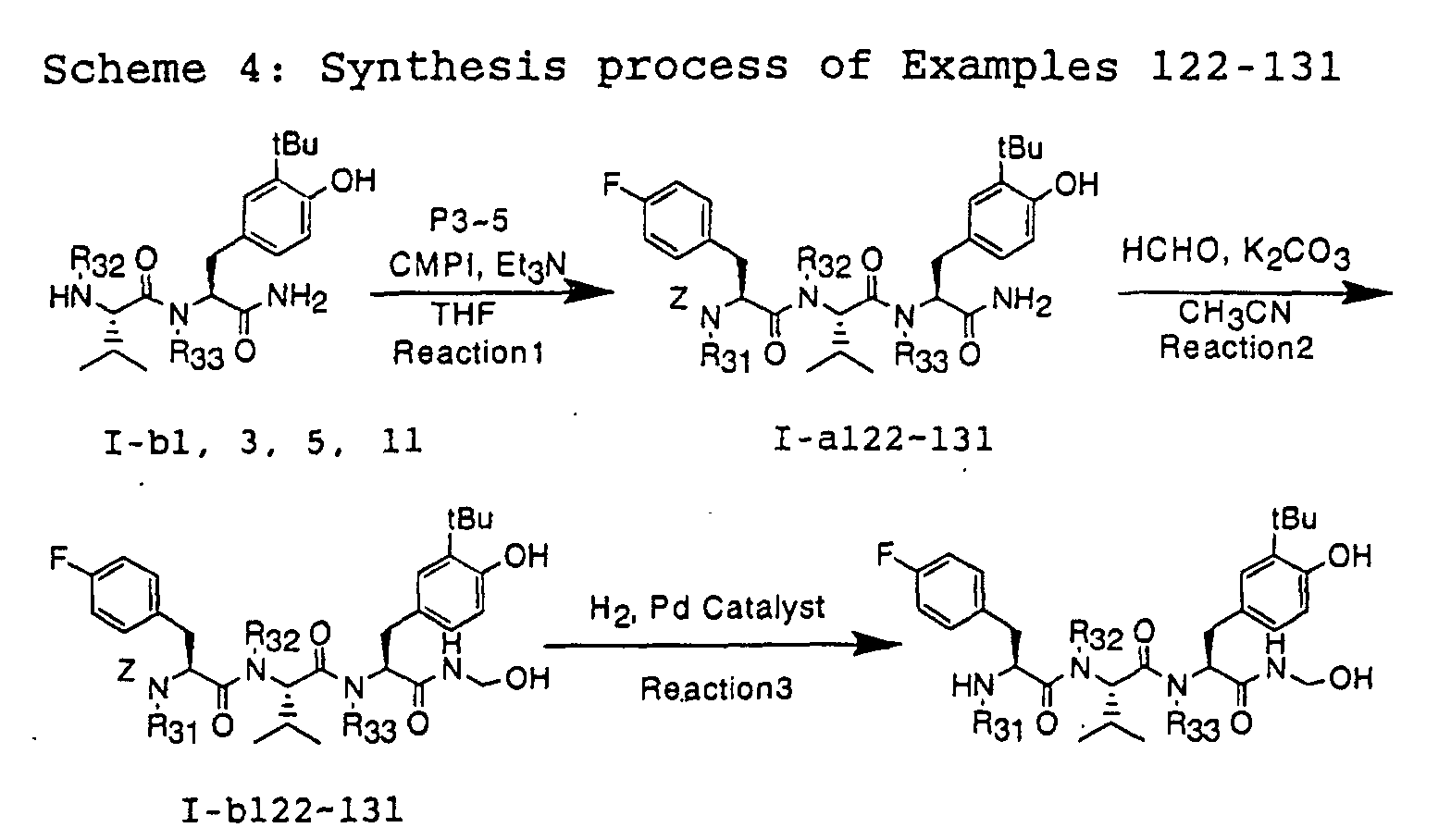
| Example 122 | ||||||||
| Phe(4-F)-N-Me-Val-Tyr(3-tBu)-NHCH2OH | ||||||||
| R31 | R32 | R33 | ||||||
| H | Me | H | ||||||
| Reaction1 | ||||||||
| Compound I-b1 (g) | CompoundP4 (g) | CMPI (g) | TEA (ml) | THF (ml) | Reaction time (hr) | Column sol. | Product | Amount (g) |
| 0.700 | 0.760 | 0.610 | 056 | 40.00 | 4 | nHx:EA=2:1 | I-a122 | 1.000 |
| Reaction2 | ||||||||
| Compound I-a122(g) | HCHO (ml) | K2CO3 (g) | CH3CN (ml) | Reaction time (hr) | Column sol. | Product | Amount (g) | |
| 1.000 | 1.15 | 0.430 | 30.00 | 2 | nHx:EA:MC =1:3:1 | I-b122 | 0.900 | |
| Reaction3 | ||||||||
| Compound I-b122(g) | Pd/C (g) | MeOH (ml) | Reaction time (hr) | Column sol. | Amount (g) | HPLC min | ||
| 0.900 | 0.140 | 13.00 | 2 | EA:MeOH=15:1 | 0.560 | 15.91 | ||
| ESI-MS(M++1):545 | ||||||||
| 1H-NMR(CDCl3):(two rotamers) δ 0.69, 0.75, 0.83 and 0.90(6H, d, J=6.4-6.7Hz), 1.34 and 1.35(9H, s), 2.22-3.17(5H, m) 2.68 and 2.88(3H, s), 3.57 and 3.82(1H, dd, J=8.0-8.5, 5.5-6.0Hz), 4.51-4.74(3H, m), 6.61-9.02(8H, m) |
| Example 123 | ||||||||
| N-Me-Phe(4-F)-N-Me-Val-Tyr(3-tBu)-NHCH2OH | ||||||||
| R31 | R32 | R33 | ||||||
| Me | Me | H | ||||||
| Reaction1 | ||||||||
| Compound I-b1 (g) | Compound P5(g) | CMPI (g) | TEA (ml) | THF (ml) | Reaction time (hr) | Column sol. | Product | Amount (g) |
| 0.500 | 0.569 | 0.439 | 0.60 | 20.00 | 16 | nHx:EA=1:1 | I-a123 | 0.920 |
| Reaction2 | ||||||||
| Compound I-a123(g) | HCHO (ml) | K2CO3 (g) | CH3CN (ml) | Reaction time (hr) | Column sol. | Product (g) | Amount | |
| 0.910 | 1.00 | 0.380 | 25.00 | 2 | nHx:EA=1:1 | I-b123 | 0.927 | |
| Reaction3 | ||||||||
| Compound I-b123(g) | Pd/C (g) | MeOH (ml) | Reaction time (hr) | Column sol. | Amount (g) | HPLC min | ||
| 0.270 | 0.100 | 10.00 | 15 | EA:MeOH=30:1 | 0.228 | 16.04 | ||
| ESI-MS(M++1):559 | ||||||||
| 1H-NMR(CDCl3):(two rotamers) δ 0.52, 0.77 and 0.89(6H, d,J=6.5-6.8Hz), 1.31 and 1.37(9H,s), 2.08-2.17(1H,m), 224 and 2.28(3H, s), 246 and 256(3H,s), 2.58-3.06(4H,m), 3.54-4.35(2H,m), 6.62-7.34(7H,m) |
| Example 124 | ||||||||
| N-Et-Phe(4-F)-N-Me-Val-Tyr(3-tBu)-NHCH2OH | ||||||||
| R31 | R32 | R33 | ||||||
| Et | Me | H | ||||||
| Reaction1 | ||||||||
| Compound I-b1(g) | Compound P3(g) | CMPI (g) | TEA (ml) | THF (ml) | Reaction time (hr) | Column sol. | Product | Amount (g) |
| 0.630 | 0.750 | 0.555 | 0.75 | 20.00 | 26 | nHx:EA=1:1 | I-a124 | 0.987 |
| Reaction2 | ||||||||
| Compound I-a124(g) | HCHO (ml) | K2CO3 (g) | CH3CN (ml) | Reaction time (hr) | Column sol. | Product | Amount (g) | |
| 0.980 | 1.10 | 0.400 | 25.00 | 2 | nHx:EA=1:1 | I-b124 | 0.911 | |
| Reaction3 | ||||||||
| Compound I-b124(g) | Pd/C (g) | MeOH (ml) | Reaction time (hr) | Column sol. | Amount (g) | HPLC min | ||
| 0.910 | 0.200 | 15.00 | 3 | MC:MeOH=15:1 | 0.250 | 16.36 | ||
| ESI-MS(M++1):573 | ||||||||
| 1H-NMR(CDCl3):(two rotamers) δ 0.50, 0.75, 0.82 and 0.85(6H, d, J=6.3-7.0Hz), 0.98 and 1.12(3H, t, J=6.7Hz), 1.40 and 1.45(9H, s), 2.15(1H, m), 2.42 and 2.46(3H, s), 2.40(2H, m), 2.60-3.10(5H, m),3.63(1H, dd, J=10.6, 6.0Hz), 4.50(1H, m), 4.70(2H, m), 6.70(4H, m), 6.90(1H, m), 7.00(1H, s), 7.12(1H, s), 7.20 and 7.40(1H, m), 8.75(1H, d, J=6.6Hz) |
| Example 125 | ||||||||
| N-Me-Phe(4-F)-N-Me-Val-N-Me-Tyr(3-tBu)-NHCH2OH | ||||||||
| R31 | R32 | R33 | ||||||
| Me | Me | Me | ||||||
| Reaction 1 | ||||||||
| Compound I-b3(g) | Compound P5 (g) | CMPI (g) | TFA (ml) | THF (ml) | Reaction time (hr) | Column sol. | Product | Amount (g) |
| 1.200 | 1.420 | 1.100 | 0.92 | 30.00 | 14 | nHx:EA:MC =1:2:1 | I-a125 | 1.800 |
| Reaction 2 | ||||||||
| Compound I-a125(g) | HCHO (ml) | K2CO3 (g) | CH3ON (ml) | Reaction time (hr) | Colum sol. | Product | Amount (g) | |
| 1.790 | 1.970 | 0.730 | 52.00 | 2 | nHx:EA:MC =1:3:1 | I-b125 | 1.500 | |
| Reaction 3 | ||||||||
| Compound I-b125(g) | Pd/C (g) | MeCH (ml) | Reaction time (hr) | Column sol. | Amount (g) | HPLC min | ||
| 1.500 | 0.230 | 20.00 | 2 | FA:MeOH=10:1 | 0.970 | 17.27 | ||
| ESI-MS(M+1):573 | ||||||||
| 1H-NMR(CDCl3):(two rotamers) d 0.57, 0.79 and 0.92(6H, d, J=6.3-6.8Hz), 1.34 and 1.38(9H, s), 2.22 and 2.25(3H, s) 2.29(1H, m), 2.52 and 2.82(3H, s), 2.55-2.89(3H, m), 2.92 and 3.04 (3H, s), 3.20 and 3.39(1H, dd, J=11.1-14.1,6.3-7.3Hz), 3.46 and 3.61(1H, t, J=6.8-6.9Hz), 4.59-4.76(2H, m), 5.03 and 5.14(1H, d, J=10.5Hz), 5.11 and 5.37(1H, dd, J=6.3, 9.73Hz), 6.39 and 6,61(1H,d,J=7,9-8.2 Hz),6.77-7.12(6H,m) |
| Example 126 | ||||||||
| N-Et-Phe(4-F)-N-Me-Val-N-Me-Tyr(3-tBu)-NHCH2OH | ||||||||
| R31 | R32 | R33 | ||||||
| Et | Me | Me | ||||||
| Reaction1 | ||||||||
| Compound I-b3(g) | Compound P3 (g) | CMPI (g) | TEA (ml) | THF (ml) | Reaction time (hr) | Column sol. | Product | Amount (g) |
| 1.400 | 1.720 | 1.270 | 1.07 | 38.00 | 14 | nHx:EA=2:1 | I-a126 | 2110 |
| Reaction2 | ||||||||
| Compound I-a126(g) | HCHO (ml) | K2CO3 (g) | CH3CN (ml) | Reaction time (hr) | Column sol. | Product | Amount (g) | |
| 2050 | 220 | 0.820 | 59.00 | 2 | nHx:EA:MC =1:3:1 | I-b12b | 2000 | |
| Reaction3 | ||||||||
| Compound I-b126(g) | Pd/C (g) | MeOH (ml) | Reaction time (hr) | Column sol. | Amount (g) | HPLC min | ||
| 1.950 | 0.290 | 27.00 | 2 | EA:MeOH=10:1 | 1.350 | 18.09 | ||
| ESI-MS(M++1):587 | ||||||||
| 1H-NMR(CDCl3):(two rotamers) δ 0.60, 0.79 and 0.91(6H, d, J=6.4-6.5Hz), 1.00 and 1.04(t, 3H, J=6.7-7.2Hz), 1.34 and 1.39(9H, s), 2.18-2.89(7H, m) 2.52 and 2.77(3H, s), 2.95 and 3.04(3H, s), 3.22 and 3.39(1H, dd, J=14.0-15.0, 7.9-7.6Hz), 3.57 and 3.70(t, 1H, J=6.8, 6.9Hz), 4.59-4.73(2H, m),5.05 and 5.13(1H, d, J=10.6-10.7Hz), 5.13 and 5.31(1H, dd, J=9.0,73Hz), 6.45 and 6.62(1H, d,J=7.9 and 8.04Hz), 6.78-7.12(6H, m) |
| Example 127 | ||||||||
| Phe(4-F)-N-Me-Val-N-Et-Tyr(3-tBu)-NHCH2OH | ||||||||
| R31 | R32 | R33 | ||||||
| H | Me | Et | ||||||
| Reaction1 | ||||||||
| Compound I-b5(g) | Compound P4(g) | CMPI (g) | TEA (ml) | THF (ml) | Reaction time (hr) | Column sol. | Product | Amount (g) |
| 0.760 | 1.240 | 0.990 | 0.91 | 20.00 | 12 | nHx:EA =1:1 | I-a127 | 0.440 |
| Reaction2 | ||||||||
| Compound I-a127(g) | HCHO (ml) | K2CO3 (g) | CH3CN (ml) | Reaction time (hr) | Column sol. | Product | Amount (g) | |
| 0.420 | 0.76 | 0.035 | 5.00 | 12 | nHx:EA =1:1 | I-b127 | 0.370 | |
| Reaction3 | ||||||||
| Compound I-b127(g) | Pd/C (g) | MeOH (ml) | Reaction time (hr) | Column sol. | Amount (g) | HPLC min | ||
| 0.350 | 0.050 | 15.00 | 3 | MC:MeOH=20:1 | 0.100 | 18.26 | ||
| ESI-MS(M++1):573 | ||||||||
| 1H-NMR(CDCl3): (two rotamers) δ 0.67, 0.81 and 0.91(6H, d, J=5.9-6.9Hz),1.07 and 1.16(3H, t, J=6.8 and 6.1Hz), 1.33 and 1.38(9H, s), 2.24-2.49(2H, m) 2.58-2.75(1H, m), 2.78 and 3.05(3H, s),2.83-3.03(1H, m), 3.15-3.30(1H, m), 3.37-3.44(1H, m), 3.55-3.65(1H, m), 3.75-3.90(1H, m), 4.55-4.76(2H, m),4.85-5.06(2H, m), 6.43 and 6.61(1H, d, J=8.1-8.4Hz), 6.75-7.1(6H, m), 736 and 8.03(1H, brs) |
| Example 128 | ||||||||
| N-Me-Phe(4-F)-N-Me-Val-N-Et-Tyr(3-tBu)-NHCH2OH | ||||||||
| R31 | R32 | R33 | ||||||
| Me | Me | Et | ||||||
| Reaction1 | ||||||||
| Compound I-b5(g) | Compound P5 (g) | CMPI (g) | TEA (ml) | THF (ml) | Reaction time (hr) | Column sol. | Product | Amount (g) |
| 0.700 | 1.230 | 0.950 | 0.91 | 20.00 | 12 | nHx:EA=1:1 | I-a128 | 0.640 |
| Reaction2 | ||||||||
| Compound I-a128(g) | HCHO (ml) | K2CO3 (g) | CH3CN (ml) | Reaction time (hr) | Column sol. | Product | Amount (g) | |
| 0.610 | 1.10 | 0.051 | 3.00 | 12 | nHx:EA=1:1 | I-b128 | 0.560 | |
| Reaction3 | ||||||||
| Compound I-b128(g) | Pd/C (g) | MeOH (ml) | Reaction time (hr) | Column sol. | Amount (g) | HPLC min | ||
| 0.540 | 0.080 | 23.00 | 1 | MC:MeOH=20:1 | 0.200 | 18.85 | ||
| ESI-MS(M++1):587 | ||||||||
| 1H-NMR(CDCl3):(two rotamers) δ 0.77, 0.83, 0.84 and 0.93(6H, d, J=6.4-6.8Hz), 1.12 and 1.18(3H, t, J=7.0-7.1Hz), 1.34 and 1.38(9H, s), 2.25(3H, s), 2.29-2.39(1H, m), 2.64-3.01(3H, m), 2.75 and 2.85(3H, s), 3.21-3.33(1H, m), 3.42-3.69(3H, m), 4.58-4.76(2H, m), 4.88-4.94 and 5.10-5.19(1H, m), 5.12(1H, dd, J=10.5, 26Hz), 6.50 and 6.61(1H, d, J=8.0Hz), 6.80-6.98(3H, m), 7.07-7.15(3H, m), 7.42 and 8.29(1H, t, J=6.0-6.4Hz) |
| Example 129 | ||||||||
| N-Et-Phe(4-F)-N-Me-Val-N-Et-Tyr(3-tBu)-NHCH2OH | ||||||||
| R31 | R32 | R33 | ||||||
| Et | Me | Et | ||||||
| Reaction1 | ||||||||
| Compound I-b5(g) | Compound P3 (g) | CMPI | TEA | THF | Reaction time | Column sol. | Product | Amount |
| 1.000 | 1.370 | 1.010 | 0.92 | 25.00 | 12 | nHx:EA=1:1 | I-a129 | 0.970 |
| Reaction2 | ||||||||
| Compound I-a129(g) | HCHO (ml) | K2CO3 (g) | CH3CN (ml) | Reaction time (hr) | Column sol. | Product | Amount (g) | |
| 0.950 | 1.70 | 0.079 | 6.00 | 12 | nHx:EA =1:1 | I-b129 | 0.790 | |
| Reaction3 | ||||||||
| Compound I-b129(g) | Pd/C (g) | MeOH (ml) | Reaction time (hr) | Column sol. | Amount (g) | HPLC min | ||
| 0.780 | 0.120 | 30.00 | 2 | MC:MeOH =20:1 | 0.300 | 19.68 | ||
| ESI-MS(M++1):601 | ||||||||
| 1H-NMR(CDCl3):(two rotamers) δ 0.76, 0.82, 0.83 and 0.92(6H, d, J=6.4-6.9Hz), 1.00-1.28(6H, m), 134 and 1.38(9H,s), 2.25-2.43(2H, m), 2.49-2.59(1H, m), 2.65-2.97(3H, m), 2.72 and 2.79(3H, s), 3.17-3.33(1H, m), 3.41-3.76(3H, m), 4.52-4.74(2H, m), 4.85-4.90 and 5.12-5.16(1H, m), 5.09(1H, dd J=10.7, 3.5Hz), 6.48 and 6.59(1H, d, J=8.0-8.4Hz), 6.80-6.98(3H, m), 7.08-7.17(3H, m), 738 and 8.32(1H, t, J=5.7Hz) |
| Example 130 | ||||||||
| Phe(4-F)-N-Et-Val-N-Et-Tyr(3-tBu)-NHCH2OH | ||||||||
| R31 | R32 | R33 | ||||||
| H | Et | Et | ||||||
| Reaction1 | ||||||||
| Compound I-b11 (g) | Compound P4 (g) | CMPI (g) | TEA (ml) | THF (ml) | Reaction time (hr) | Column sol. | Product | Amount (g) |
| 0.770 | 1.250 | 1.000 | 0.68 | 25.00 | 30 | nHx:EA =1:1 | I-a130 | 0.200 |
| Reaction2 | ||||||||
| Compound I-a130(g) | HCHO (ml) | K2CO3 (g) | CH3ON (ml) | Reaction time(hr) | Column sol. | Product | Amount (g) | |
| 0.200 | 0.36 | 0.400 | 4.00 | 12 | nHx:EA =1:1 | I-b130 | 0.100 | |
| Reaction3 | ||||||||
| Compound I-b130(g) | Pd/C (g) | MeOH (ml) | Reaction time (hr) | Column sol. | Amount (g) | HPLC min | ||
| 0.100 | 0.015 | 5.00 | 1 | MC:MeCH =25:1 | 0.016 | 18.41 | ||
| ESI-MS(M++1):587 | ||||||||
| 1H-NMR(CDCl3): (two rotamers) d 0.54, 0.81, 0.87 and 0.93(6H, d, J=6.0-6.8Hz), 1.12 and 1.19(6H, t, J=6.8-7.2Hz), 1.36 and 1.39(9H, s), 2.25-2.43(1H, m), 2.60-2.74(1H, m), 2.78-2.99(2H, m), 3.16-3.50(4H,m), 3.56-3.80(2H, m), 4.53-4.74(2H, m), 4.83-4.88 and 4.99-5.11(2H, m), 6.48 and 6.63(1H, d, J=7.9Hz), 6.80-6.85 and 6.96-7.18(6H, m), 7.46-7.49 and 7.58- |
| Example 131 | ||||||||
| N-Me-Phe(4-F)-N-Et-Val-N-Et-Tyr(3-tBu)-NHCH2OH | ||||||||
| R31 | R32 | R33 | ||||||
| Me | Et | Et | ||||||
| Reaction1 | ||||||||
| Compound I-bll (g) | Compound P5 (g) | CMPI (g) | TEA (ml) | THF (ml) | Reaction time (hr) | Column sol. | Product | Amount (g) |
| 0.770 | 1.340 | 1.000 | 0.68 | 25.00 | 30 | nHx:EA=1:1 | I-a131 | 0.170 |
| Reaction2 | ||||||||
| Compound I-a131(g) | HCHO (ml) | K2CO3 (8) | CH3CN (ml) | Reaction time (hr) | Column sol. | Product | Amount (g) | |
| 0.170 | 0.31 | 0.014 | 4.00 | 12 | nHx:EA =1:1 | I-b131 | 0.080 | |
| Reaction3 | ||||||||
| Compound I-b131(g) | Pd/C (g) | MeOH (ml) | Reaction time (hr) | Column sol. | Amount (g) | HPLC min | ||
| 0.080 | 0.012 | 4.00 | 1 | MC:MeOH =25:1 | 0.040 | 18.97 | ||
| ESI-MS(M++1):601 | ||||||||
| 1H-NMR(CDCl3):(two rotamers) δ 0.64(1H, d, J=6.4Hz), 0.85-0.97(7H, m), 1.10-1.19(4H, m), 1.33 and 1.37(9H, s), 2.25-2.43(1H, m), 2.29 and 2.31(3H, s), 2.67-2.86(3H, m), 3.12-3.65 and 3.74-3.81(6H, m), 4.52-4.72(2H, m), 4.87-4.92 and 5.09-5.19(2H, m), 6.45 and 6.59(1H, d, J=8.0 and 8.4Hz), 6.78(2/3H, dd, J=7.9, 1.5Hz), 6.90-6.98(7/3H, m), 7.04(2/3H, d, J=1.5Hz), 7.10-7.16(7/3H, m), 750 and 7.90(1H, t, J=6.3 and 6.0Hz) |

| Example 132 | ||||||||
| Phe(4-F)-N-Me-Val-N-Me-Tyr(3-tBu)-NHCH2OH | ||||||||
| R31 | R32 | R33 | ||||||
| H | Me | Me | ||||||
| Reaction1 | ||||||||
| Z-N-Me-Val-N-Me-Tyr(3-tBu)-NH2 (g) | HCHO (ml) | K2CO3 (g) | CH3CN (ml) | Reaction time (hr) | Column sol. | Product | Amount (g) | |
| 2.000 | 3.00 | 1.100 | 71.00 | 2 | nHx:EA:MC =1:3:1 | I-a132 | 2.000 | |
| Reaction2 | ||||||||
| Compound I-a132(g) | Pd/C (g) | MeOH (ml) | Reaction time (hr) | Column sol. | Product | Amount (g) | ||
| 1.950 | 0.290 | 50.00 | 1 | EA:MeOH =7:1 | I-b132 | 0.730 | ||
| Reaction3 | ||||||||
| Compound I-b132(g) | Compound P4(g) | CMPI (g) | TEA (ml) | THF (ml) | Reaction time (hr) | Column sol. | Product | Amount (g) |
| 0.730 | 0.880 | 0.700 | 0.50 | 35.00 | 4 | nHx:EA =1:4 | I-c132 | 0.700 |
| Reaction4 | ||||||||
| Compound I-c132(g) | Pd/C (g) | MeOH (ml) | Reaction time (hr) | Column sol. | Amount (g) | HPLC min | ||
| 0.700 | 0.110 | 10.00 | 4 | MC:MeOH=20:1 | 0.410 | 16.64 | ||
| ESI-MS(M++1):559 | ||||||||
| 1H-NMB(CDCl3): (two rotamers) δ 0.49, 0.74, 0.78 and 0.91(6H,d,J=5.9-6.6Hz), 1.33 and 1.37(9H, s), 2.20-2.97(4H,m), 2.54,2.81 and 3.00(6H,s), 3.16 and 3.35(1H,dd,J=13,7-15.1,6.2-6.5Hz),3.71 and 3.85(1H dd, J=8.1-9.4,4.5-5.0Hz), 4.64 and 4.69(2H, d, J=6.0-6.4Hz), 4.79 and 5.06(1H d, J=10.2-10.6Hz); 5.00 and 5.36(1H, dd, J=9.2, 5.5Hz), 6.43 and 6.64(1H, d, J=7.8Hz), 6.71-7.12(6H, m) |

| Example 133 | ||||||||
| (2S)-2-[(2S)-2-amino-3-(4-fluorophenyl)-N-methylpropanoylamino]-N-((1S)-1-{[3-(tert-butyl)-4-hydroxyphenyl]methyl}-2-morpholin-4-yl-2-oxoethyl)-3-methyl-N-methylbutanamide | ||||||||
| R | ||||||||
| 4-morpholine | ||||||||
| Reaction1 | ||||||||
| Compound T13(g) | Compound V1 (g) | CMP1 (g) | TEA (ml) | THF (ml) | Reaction time (hr) | Column sol. | Product | Amount (g) |
| 0.600 | 0.490 | 0.720 | 0.50 | 20.00 | 20 | nHx:EA= 1:1 | I-a133 | 0.900 |
| Reaction2 | ||||||||
| Compound I-a133(g) | Pd(OH)2 (g) | MeOH (ml) | Reaction time (hr) | Column sol. | Product | Amount (g) | ||
| 0.900 | 0.100 | 20.00 | 20 | MC:MeOH =20:1 | I-b133 | 0.600 | ||
| Reaction3 | ||||||||
| Compound I-b133(g) | Compound P1 (g) | CMPI (g) | TEA (ml) | THF (ml) | Reaction time (hr) | Column sol. | Product | Amount (g) |
| 0.600 | 0.450 | 0.530 | 0.40 | 20.00 | 20 | nHx:EA= | I-c133 | 0.850 |
| Reaction4 | ||||||||
| Compound I-c133 (g) | TFA (ml) | MC (ml) | Reaction time (hr) | Column sol. | Amount (g) | HPLC min | ||
| 0.850 | 3.00 | 10.00 | 4 | MC:MeOH =20:1 | 0.600 | 19.77 | ||
| ESI-MS(M++1):599 | ||||||||
| 1H-NMR(CDCl3): (two rotamers) δ 0.78 and 0.85(6H, d, J=6.2-6.7Hz), 1.37(9H, s), 2.23-2.28(1H, m), 2.24(3H, s), 2.48-2.56(1H, m), 2.79-2.87(5H, m), 3.02-3.09(1H, m), 3.40-3.74(10H, m), 5.01-5.05(1H, J=10.0 Hz), 5.79-5.84(1H,m), 6.39 and 6.41(1H,d, J=7.9Hz), 6.74-6.77(1H,m), 6.99-7.18(6H,m) |
| Example 134 | ||||||||
| (2S)-2-[(2S)-2-amino-3-(4-fluorophenyl)-N-methylpropanoylamino]-N-((1S)-1-{[3-(tert-butyl)-4-hydroxyphenyl]methyl}-2-[4-(methylsulfonyl)piperazinyl]-2-oxoethyl)-3-methyl-N-methylbutanamide | ||||||||
| R | ||||||||
| 4-(methylsulfonyl) piperazine | ||||||||
| Reaction1 | ||||||||
| Compound T14(g) | Compound V1 (g) | CMPI (g) | TEA (ml) | THF (ml) | Reaction time (hr) | Column sol. | Product | Amount (g) |
| 1.200 | 0.790 | 1.100 | 0.84 | 20.00 | 20 | nHx:EA = 1:1 | 1.0134 | 1.500 |
| Reaction2 | ||||||||
| Compound I-a134 (g) | Pd(OH)2 (g) | MeOH (ml) | Reaction time (hr) | Column sol. | Product | Amount (g) | ||
| 1.500 | 0.300 | 20.00 | 20 | MC:MeOH =20:1 | I-b134 | 0.900 | ||
| Reaction3 | ||||||||
| Compound I-b134 (g) | Compound P1 (g) | CMPI (g) | TEA (ml) | THF (ml) | Reaction time (hr) | Column sol. | Product | Amount (g) |
| 0.700 | 0.520 | 0.430 | 0.38 | 15 | 2 | nHx:EA =1:1 | I-c134 | 0.700 |
| Reaction4 | ||||||||
| Compound I-c134 (g) | TFA (ml) | MC (ml) | Reaction time (hr) | Column sol. | Amount (g) | HPLC min | ||
| 0.700 | 3.00 | 10.00 | 4 | MC:MeOH =20:1 | 0.350 | 19.94 | ||
| ESI-MS(M++1):677 | ||||||||
| 1H-NMR(CDCl3):(two rotamers) δ 0.79 and 0.85(6H, d, J=6.2-6.7Hz), 1.37(9H, s), 2.23-2.28(1H, m), 2.52-2.69(4H, m), 2.73(3H, s), 2.75-2.89(7H, m), 3.01-3.16(4H, m), 3.58-3.78(1H, m), 5.03 and 5.07(1H,d, J=10.6 Hz), 5.75-5.81(1H, m), 6.42 and 6.45(1H, d, J=7.9Hz), 6.76-6.80(1H, m), 6.99-7.18(6H, m) |
| Example 135 | ||||||||
| Ethyl 2-[4-((2S)-2-{(2S)-2-[(2S)-2-amino-3-(4-fluorophenyl)-N-methylpropanoylamino]-3,N-dimethylbutanoylamino)-3-[3-(tert-butyl)-4-hydroxyphenyl] propanoyl)piperazinyl ] acetate | ||||||||
| R | ||||||||
| ethyl-2-piperazinylacetate | ||||||||
| Reaction1 | ||||||||
| Compound T15 (g) | Compound V1 (g) | CMPI (g) | TEA (ml) | THF (ml) | Reaction time (hr) | Column sol. | Product | Amount (g) |
| 0.643 | 0.547 | 0.521 | 0.50 | 16.00 | 16 | nHx:EA= 2:3 | I-a135 | 0.827 |
| Reaction2 | ||||||||
| Compound I-a135 (g) | Pd(OH)2 (g) | MeOH (ml) | Reaction time (hr) | Column sol. | Product | Amount (g) | ||
| 0.827 | 0.250 | 13.00 | 1 | MC:MeOH =20:1 | I-b135 | 0.645 | ||
| Reaction3 | ||||||||
| Compound I-b135 (g) | Compound P1 (g) | CMPI (g) | TEA (ml) | THF (ml) | Reaction time (hr) | Column sol. | Product | Amount (g) |
| 0.645 | 0.458 | 0.413 | 0.40 | 12 | 16 | nHx:EA=2:3 | I-c135 | 0.796 |
| Reaction4 | ||||||||
| Compound I-c135(g) | TFA (ml) | MC (ml) | Reaction time (hr) | Column sol. | Amount (g) | HPLC min | ||
| 0.796 | 2.00 | 5.00 | 1 | MC:MeOH =30:1 | 0.430 | 17.1 | ||
| ESI-MS(M++1):684 | ||||||||
| 1H-NMR(CDCl3):(two rotamers) δ 0.77 and 0.84(6H, d, J=6.4·6.8Hz),1.26(3H, t, J=7.1Hz),1.26(9H, s), 2.22-2.30(1H, m), 2.47. 2.54(1H, m),3.00-3.07(1H, m) 2.40, 2.81 and 3.18(6H,s),3.54-3.73(5H, m), 4.18(2H, q, J=7.1Hz), 5.03(2H, d, J=10.4Mz), 5.85(1H, t, J=2.3Hz), 6.40(1H, d, J=7.9Hz), 6.72-6.75 (1H, dd, J=9.7, 1.9Hz), 7.00-7.26(5H, m) |

| Example 136 | |||||||
| 2-[4-((2S)-2-{(2S)-2-[(2S)-2-amino-3-(4-fluorophenyl)-N-methylpropanoylamino]-3,N-dimethylbutanoylamino}-3-[3-(tert-butyl)-4-hydroxyphenyl]propanoyl)piperazinyl]acetic acid | |||||||
| Reaction | |||||||
| Compound of Example 135(g) | NaOH (g) | H2O (ml) | Dioxane (ml) | Reaction time (hr) | Column sol. | Amount (g) | HPLC min |
| 0.375 | 0.400 | 5.00 | 5.00 | 16 | MC:MeOH=20:1 | 0.200 | 14.97 |
| ESI-MS(M++1):656 | |||||||
| 1H-NMR(CD3OD): (two rotamers) δ 0.78 and 0.82(6H, d, J=6.1Hz),1.27(9H, s), 2.12-2.29(1H, m), 2.74-3.12(8H, m),3.61-3.82(4H, m), 2.48, 2.94, 3.25 and 3.55(6H, s), 4.50-4.56(1H, q, J=10.5Hz), 5.02(1H, d, J=10.5Hz), 5.73(1H, t, J=7.9Hz), 6.74-6.78(1H, dd, J=9.4, 2.2Hz), 7.00-7.27(6H, m) |
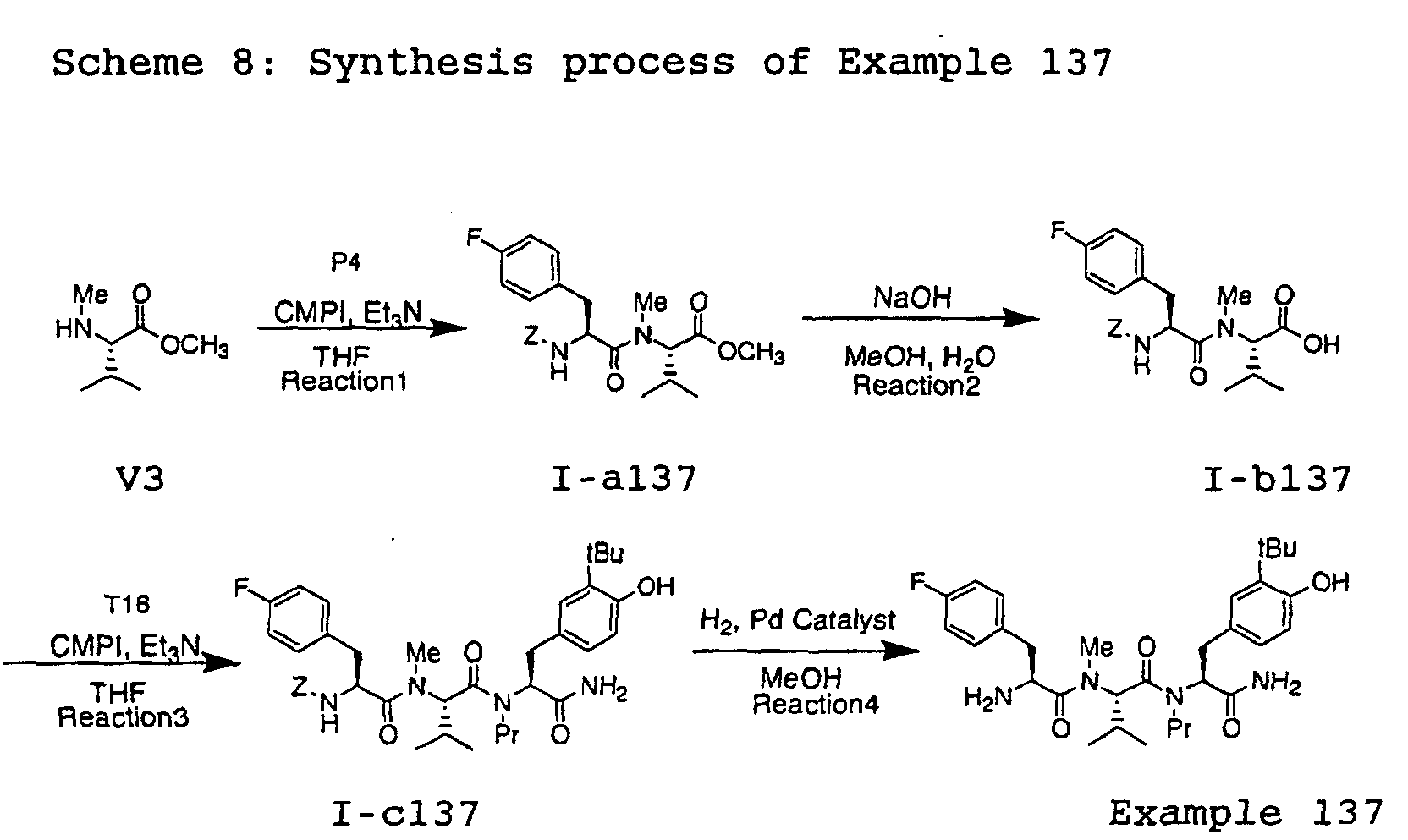
| Example 137 | ||||||||
| Phe(4-F)-N-Me-Val-N-Pr-Tyr(3-tBu)-NH2 | ||||||||
| Reaction1 | ||||||||
| Compound V3 (g) | Compound P4 (g) | CMPI (g) | TEA (ml) | THF (ml) | Reaction time (hr) | Column sol. | Product | Amount (g) |
| 1.146 | 3.000 | 2410 | 220 | 28.00 | 12 | nHx:EA=5:1 | I-a137 | 1.877 |
| Reaction2 | ||||||||
| Compound I-a137(g) | NaOH (g) | H2O (ml) | MeOH (ml) | Reaction time (hr) | Product | Amount (g) | ||
| 1.870 | 0.646 | 8.00 | 40.00 | 8 | I-b137 | 1.710 | ||
| Reaction3 | ||||||||
| Compound I-b137(g) | Compound T10(g) | CMPI (g) | TEA (ml) | THF (ml) | Reaction time (hr) | Column sol. | Product | Amount (g) |
| 1.710 | 0.709 | 0.976 | 0.88 | 14.00 | 12 | nHx:EA=3:2 | I-c137 | 0.610 |
| Reaction4 | ||||||||
| Compound I-c137(g) | Pd/C (g) | MeOH (ml) | Reaction time (hr) | Column sol. | Amount (g) | HPLC min | ||
| 0.400 | 0.080 | 16.00 | 1 | MC:MeOH =25:1 | 0.128 | 22.7 | ||
| ESI-MS(M++1):557 | ||||||||
| 1H-NMR(CDCl3): δ 0.66(3H, d, J=6.6Hz), 0.80(3H, d, J=6.5Hz), 0.84(3H, t, J=7.4Hz), 1.33(9H, s), 1.43-1.59(2H, m), 2.20-2.28(1H, m), 2.53(1H, dd, J=13.5, 9.1Hz), 2.60-2.75(2H, m), 2.95(1H, dd, J=13.8, 4.8Hz), 3.01(3H, s), 3.20(1H, dd, J=14.1, 6.2Hz), 3.32(1H, dd, J=13.6, 10.9Hz), 3.52-3.63(1H, m), 3.89-3.93(1H, m), 4.21-4.28(1H, m), 4.89(1H, d, J=10.6Hz), 5.48(1H, bis), 6.51(1H, d, J=7.9Hz), 6.73(1H, dd, J=7.9, 1.9Hz), 6.82(1H, brs), 6.99-7.10(3H, m), 7.11-7.16(2H, m) |
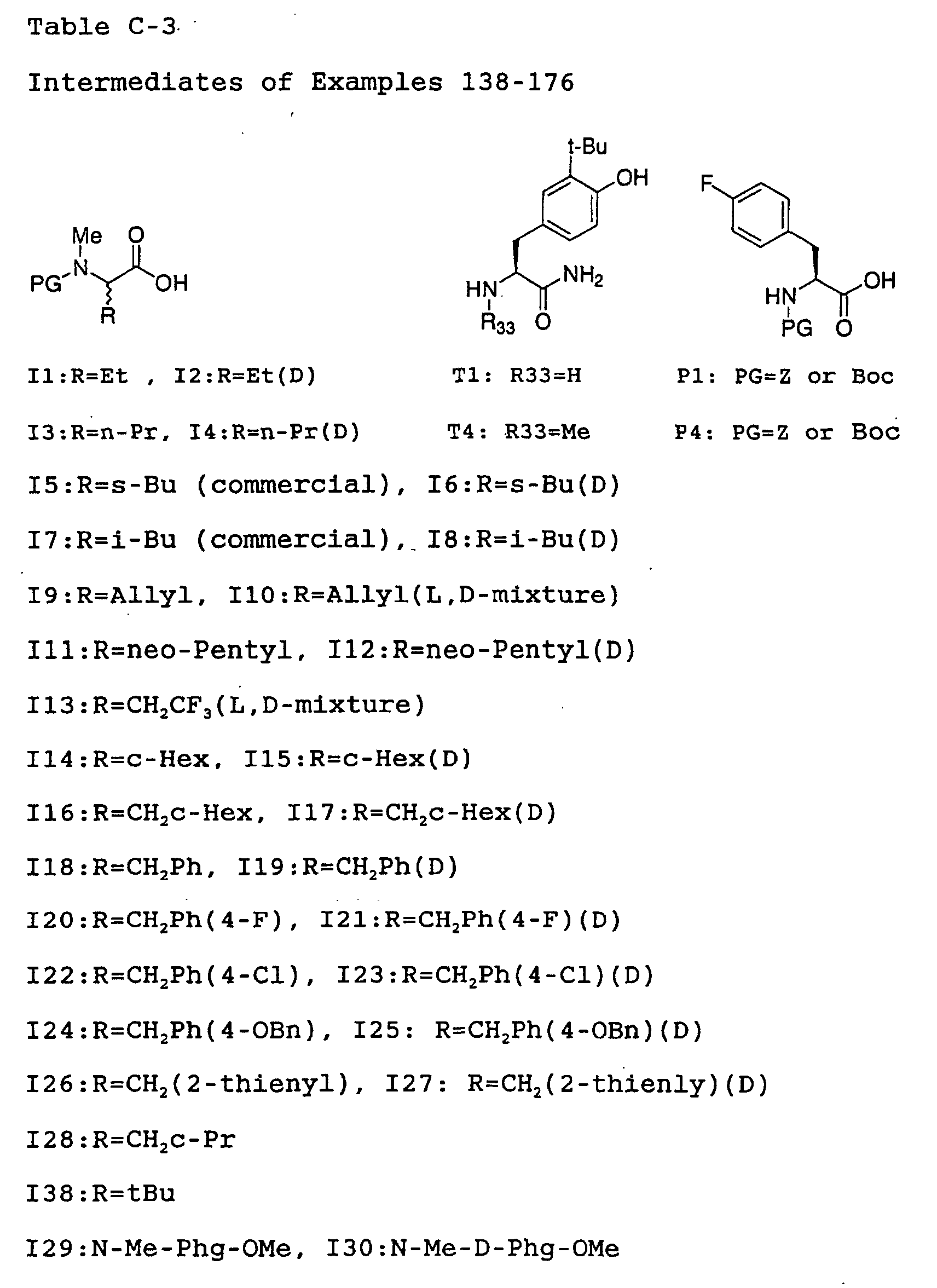
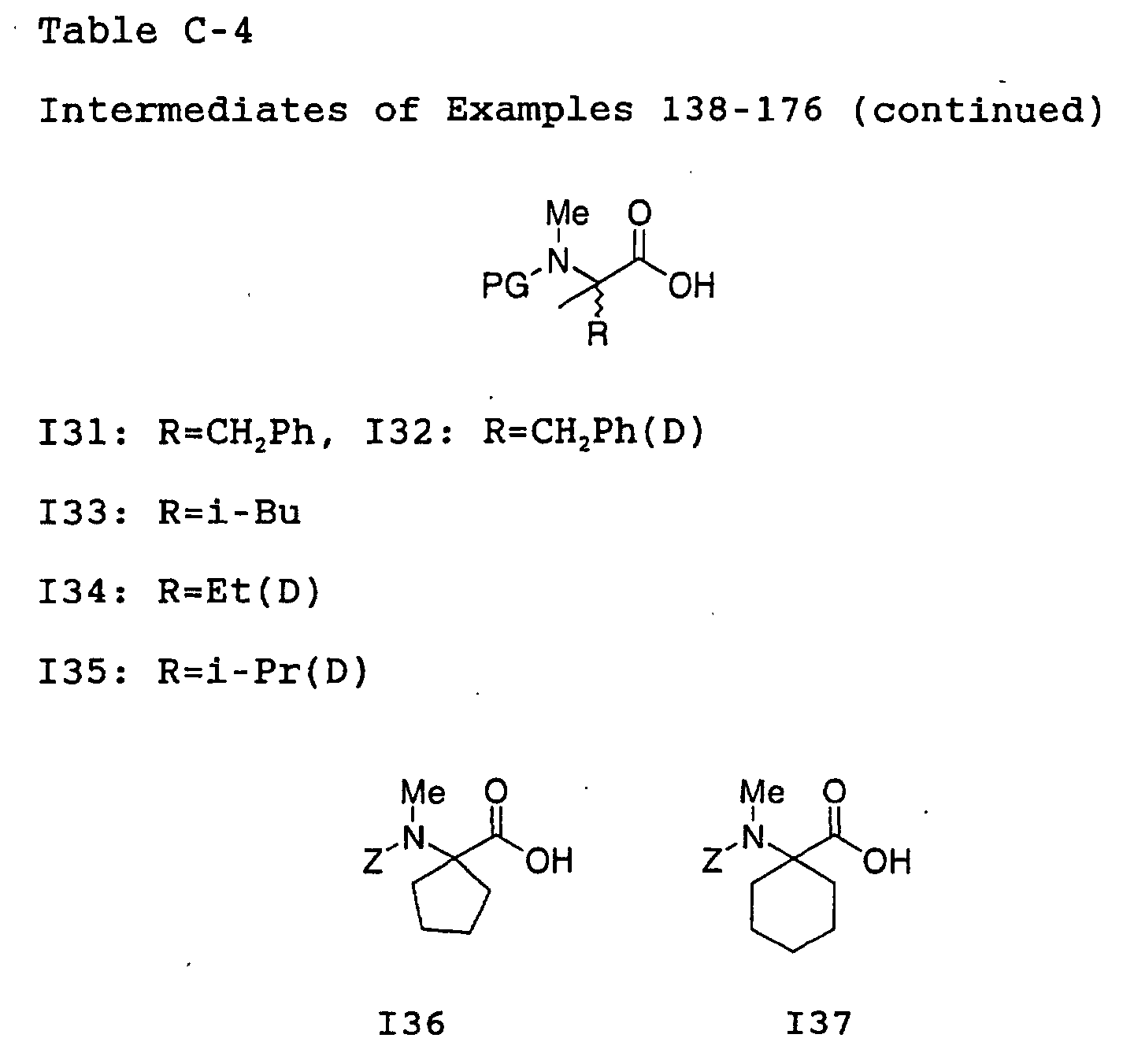

| Intermediates I1: Z-N-Me-Abu-OH | ||||||
| R | ||||||
| Et | ||||||
| Reaction | ||||||
| Z-Abu-OH (g) | Methyl iodide (ml) | NaH (g) | THF (ml) | Reaction time (hr) | Column sol. | Amount (g) |
| 2.000 | 4.20 | 1.340 | 40.00 | 15 | MC:MeOH =10:1 | 1.400 |
| Intermediate I2: Boc-N-Me-D-Abu-OH | ||||||
| R | ||||||
| Et:D | ||||||
| Reaction | ||||||
| Boc-(D)-Abu-OH (g) | Methyl iodide (ml) | NaH (g) | THF (ml) | Reaction time (hr) | Column sol. | Amount (g) |
| 0.750 | 1.83 | 0.738 | 18.00 | 48 | MC:MeOH =8:1 | 0.810 |
| Intermediate I3: Z-N-Me-Nva-OH | ||||||
| R | ||||||
| n-Pr | ||||||
| Reaction | ||||||
| Z-Nva-OH (g) | Methyl iodide (ml) | NaH (g) | THF (ml) | Reaction time (hr) | Column sol. | Amount (g) |
| 2.000 | 5.00 | 0.960 | 30.00 | 24 | MC:MeOH =10:1 | 2.090 |
| Intermediate 14: Boc-N-Me-D-Nva-OH | ||||||
| R | ||||||
| n-Pr:D | ||||||
| Reaction | ||||||
| Boc-(D)-Nva-OH (g) | Methyl iodide (ml) | NaH (g) | THF (ml) | Reaction time (hr) | Column sol. | Amount (g) |
| 1.000 | 2.87 | 0.552 | 25.00 | 40 | MC:MeOH =10:1 | 1.000 =10:1 |
| Intermediate I6: Boc-N-Me-D-Ile-OH | ||||||
| R | ||||||
| s-Bu:D | ||||||
| Reaction | ||||||
| Boc-(D)-Ile-OH (g) | Methyl iodide (ml) | NaH (g) | THF (ml) | Reaction time (hr) | Column sol. | Amount (g) |
| 0.500 | 1.35 | 0.866 | 17.00 | 12 | MC:MeOH =10:1 | 0.490 |
| Intermediate I8: Boc-N-Me-D-Leu-OH | ||||||
| R | ||||||
| i-Bu:D | ||||||
| Reaction | ||||||
| Boc-(D)-Leu-OH (g) | Methyl iodide (ml) | NaH (g) | THF (ml) | Reaction time (hr) | Column sol. | Amount (g) |
| 1.000 | 2.49 | 1.600 | 17.00 | 12 | MC:MeOH =15:1 | 0.960 |
| Intermediate I9: | ||||||
| (2S)-2-[N-(tert-butoxycarbonyl)-methylamino]pent-4-enoic acid | ||||||
| R | ||||||
| Allyl | ||||||
| Reaction | ||||||
| (2S)-2-[(tert-butoxy)carbonylamino]pent-4-enoic acid (g) | Methyl iodide (ml) | NaH (g) | THF (ml) | Reaction time (hr) | Column sol. | Amount (g) |
| 0.660 | 1.79 | 1.150 | 12.00 | 12 | MC:MeOH =10:1 | 0.570 |
| Intermediate I10: | ||||||
| 2-[N-(tert-butoxycarbonyl)-methylamino]pent-4-enoic acid | ||||||
| R | ||||||
| Allyl: D,L-mixture | ||||||
| Reaction | ||||||
| 2-[(tert-butoxy)carbonyl -amino]pent-4-enoic acid (g) | Methyl iodide (ml) | NaH (g) | THF (ml) | Reaction time (hr) | Column sol. | Amount (g) |
| 2.656 | 7.67 | 4.924 | 51.00 | 12 | MC:MeOH =15:1 | 2.360 |
| Intermediate I11:BOC-N-Me-Leu(γ-Me)-OH | ||||||
| R | ||||||
| neo-Pent | ||||||
| Reaction | ||||||
| BOC-Leu(gamma-Me)-OH (g) | Methyl iodide (ml) | NaH (g) | THF (ml) | Reaction time (hr) | Column sol. | Amount (g) |
| 1.930 | 4.86 | 3.120 | 40.00 | 48 | MC:MeOH =10:1 | 1.500 |
| Intermediate I12: BOC-N-Me-D-Leu(γ-Me)-OH | ||||||
| R | ||||||
| neo-Pent:D | ||||||
| Reaction | ||||||
| BOC-(D)-Leu(gamma-Me)-OH (g) | Methyl iodide (ml) | NaH (g) | THF (ml) | Reaction time (hr) | Column sol | Amount (g) |
| 1.000 | 2.50 | 1.630 | 20.00 | 24 | MC:MeOH =10:1 | 1.110 |
| Intermediate I13: 2-[N-(phenylmethoxy)carbonyl-methylamino]-4,4,4-trifluorobutanoic acid | ||||||
| R | ||||||
| CH2CF3:L,D-mixture | ||||||
| Reaction | ||||||
| Z-2-amino-4,4,4-trifluorobutanoic acid (g) | Methyl iodide (ml) | NaH (g) | THF (ml) | Reaction time (hr) | Column sol. | Amount (g) |
| 0.75 | 1.61 | 1.03 | 20.00 | 12 | MC:MeOH =10:1 | 0.567 |
| Intermediate I14: Boc-N-Me-Chg-OH | ||||||
| R | ||||||
| c-Hex | ||||||
| Reaction | ||||||
| Boc-Chg-OH (g) | Methyl iodide (ml) | NaH (g) | THF (ml) | Reaction time (hr) | Column sol. | Amount (g) |
| 2.000 | 3.60 | 2.300 | 40.00 | 20 | MC:MeOH =30:1 | 1.500 |
| Intermediate I15: Boc-N-Me-D-Chg-OH | ||||||
| R | ||||||
| c-Hex:D | ||||||
| Reaction | ||||||
| Boc-(D)-Chg-OH (g) | Methyl iodide (ml) | NaH (g) | THF (ml) | Reaction time (hr) | Column sol. | Amount (g) |
| 1.500 | 2.70 | 1.740 | 30.00 | 20 | MC:MeOH =30:1 | 1.150 |
| Intermediate 116: Boc-N-Me-Cha-OH | ||||||
| R | ||||||
| CH2c-Hex | ||||||
| Reaction | ||||||
| Boc-Cha-OH (g) | Methyl iodide (ml) | NaH (g) | THF (ml) | Reaction time (hr) | Column sol. | Amount (g) |
| 2.000 | 3.40 | 1.100 | 23.00 | 18 | MC:MeOH =10:1 | 1.300 |
| Intermediate I17: Boc-N-Me-D-Cha-OH | ||||||
| R | ||||||
| CH2c-Hex:D | ||||||
| Reaction | ||||||
| Boc-(D)-Cha-OH (g) | Methyl iodide (ml) | NaH (g) | THE (ml) | Reaction time (hr) | Column sol. | Amount (g) |
| 1.000 | 1.72 | 0.552 | 11.50 | 18 | MC:MeOH =10:1 | 1.000 |
| Intermediate I18: Boc-N-Me-Phe-OH | ||||||
| R | ||||||
| CH2Ph | ||||||
| Reaction | ||||||
| Boc-Phe-OH (g) | Methyl iodide (ml) | NaH (g) | THF (ml) | Reaction time (hr) | Column sol. | Amount (g) |
| 1.000 | 1.66 | 0.400 | 20.00 | 20 | MC:MeOH =20:1 | 0.800 |
| Intermediate I19: Boc-N-Me-D-Phe-OH | ||||||
| R | ||||||
| CH2Ph:D | ||||||
| Reaction | ||||||
| Boc-(D)-Phe-OH (g) | Methyl iodide (ml) | NaH (g) | THF (ml) | Reaction time (hr) | Column sol. | Amount (g) |
| 0.890 | 1.66 | 0.400 | 20.00 | 20 | MC:MeOH =20:1 | 0.800 |
| Intermediate I20: Boc-N-Me-Phe(4-F)-OH | ||||||
| R | ||||||
| CH2Phe(4-F) | ||||||
| Reaction | ||||||
| Boc-Phe-(4-F)-OH (g) | Methyl iodide (ml) | NaH (g) | THF (ml) | Reaction time (hr) | Column sol. | Amount (g) |
| 15.000 | 27.00 | 6.360 | 180.00 | 24 | MC:MeOH =10:1 | 15.000 |
| Intermediate 121: Boc-N-Me-D-Phe(4-F)-OH | ||||||
| R | ||||||
| CH2Phe(4-F):D | ||||||
| Reaction | ||||||
| Boc-(D)-Phe(4-F)-OH (g) | Methyl iodide (ml) | NaH (g) | THF (ml) | Reaction time (hr) | Column sol. | Amount (g) |
| 1.000 | 1.76 | 0.424 | 12.00 | 18 | MC:MeOH =10:1 | 1.000 |
| Intermediate I22: Boc-N-Me-Phe(4-Cl)-OH | ||||||
| R | ||||||
| CH2Ph(4-Cl) | ||||||
| Reaction | ||||||
| Boc-Phe(4-Cl)-OH (g) | Methyl iodide (ml) | NaH (g) | THF (ml) | Reaction time (hr) | Column sol. | Amount (g) |
| 2.000 | 3.32 | 0.800 | 40.00 | 18 | MC:MeOH =20:1 | 1.630 |
| Intermediate I23: Boc-N-Me-D-Phe(4-C1)-OH | ||||||
| R | ||||||
| CH2Ph(4-Cl):D | ||||||
| Reaction | ||||||
| Boc-(D)-Phe(4-C1)-OH (g) | Methyl iodide (ml) | NaH (g) | THF (ml) | Reaction time (hr) | Column sol. | Amount (g) |
| 1.000 | 1.66 | 0.401 | 20.00 | 18 | MC:MeOH =20:1 | 0.781 |
| Intermediate I24: Boc-N-Me-Phe(4-OBn)-OH | ||||||
| R | ||||||
| CH2Ph(4-OBn) | ||||||
| Reaction | ||||||
| Boc-Phe(4-OBn)-OH (g) | Methyl iodide (ml) | NaH (g) | THF (ml) | Reaction time (hr) | Column sol. | Amount (g) |
| 2.500 | 3.35 | 0.808 | 50.00 | 36 | MC:MeOH =20:1 | 2.590 |
| Intermediate I25: Z-N-Me-D-Phe(4-OBn)-OH | ||||||
| R | ||||||
| CH2Ph(4-OBn):D | ||||||
| Reaction | ||||||
| Z-(D)-Phe(4-OBn)-OH (g) | Methyl iodide (ml) | NaH (g) | THF (ml) | Reaction time (hr) | Column sol. | Amount (g) |
| 2.000 | 2.51 | 0.592 | 40.00 | 36 | MC:MeOH =20:1 | 2.060 |
| Intermediate I26: Boc-N-Me-Ala(β-2-thienyl)-OH | ||||||
| R | ||||||
| CH2(2-Thienyl) | ||||||
| Reaction | ||||||
| Boc-Ala(beta-2-thienyl)-OH (g) | Methyl iodide (ml) | NaH (g) | THE (ml) | Reaction time (hr) | Column sol. | Amount (g) |
| 1.000 | 1.84 | 0.443 | 20.00 | 18 | MC:MeOH =20:1 | 0.916 |
| Intermediate I27: Boc-N-Me-D-Ala(β-2-thienyl)-OH | ||||||
| R | ||||||
| CH2(2-Thienyl):D | ||||||
| Reaction | ||||||
| Boc-(D)-Ala(beta-2-thienyl)-OH (g) | Methyl iodide (ml) | NaH (g) | THF (ml) | Reaction time (hr) | Column sol. | Amount (g) |
| 1.000 | 1.84 | 0.443 | 20.00 | 18 | MC:MeOH =20:1 | 1.040 |
| Intermediate I28: Z-N-Me-Ala(β-c-Pr)-OH | ||||||
| R | ||||||
| CH2c-Propyl | ||||||
| Reaction | ||||||
| Z-N-Ala(beta-c-Pr)-OH (g) | Methyl iodide (ml) | NaH (g) | THF (ml) | Reaction time (hr) | Column sol. | Amount (g) |
| 1.500 | 2.84 | 0.680 | 15.00 | 15 | MC:MeOH =10:1 | 1.160 |
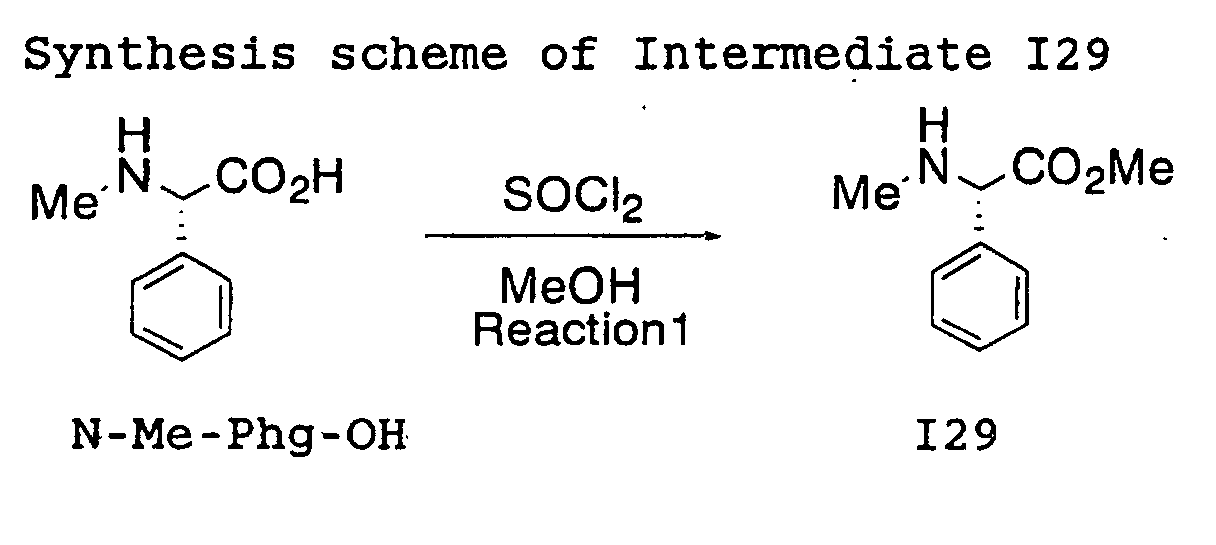
| Intermediate I29: N-Me-Phg-OMe | ||||
| Reaction | ||||
| N-Me-Phg-OH (g) | SOCl2 (ml) | MeOH (ml) | Reaction time (hr) | Amount (g) |
| 2.000 | 1.32 | 20.00 | 3.00 | 2.000 |
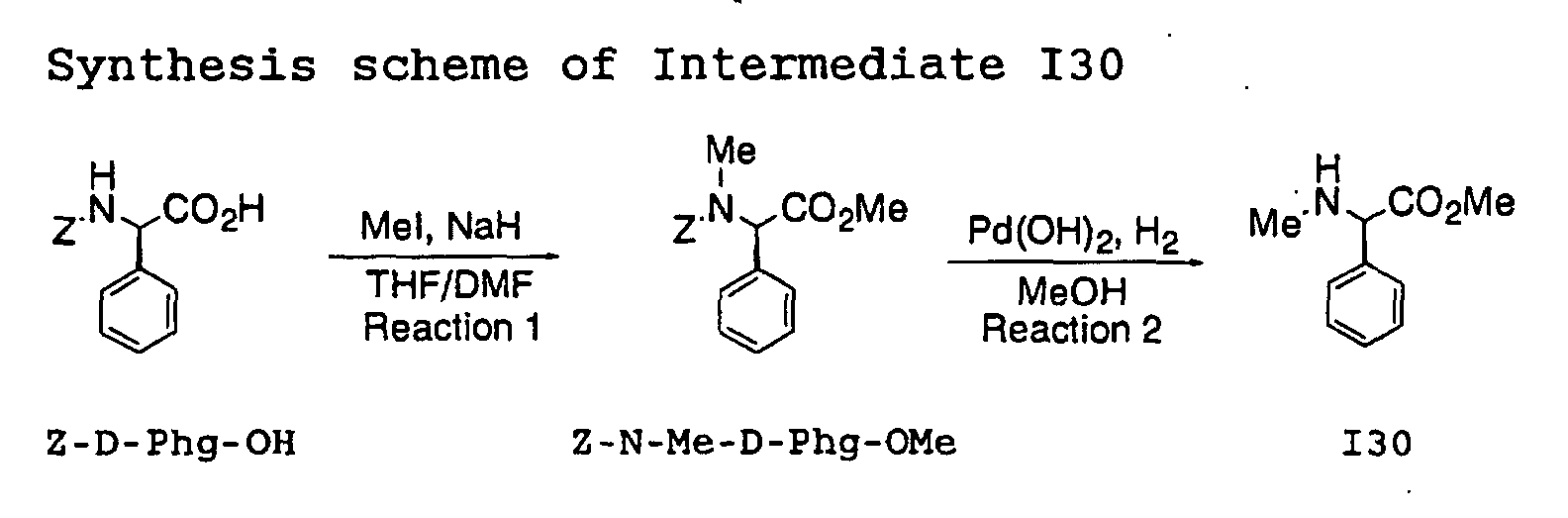
| Intermediate I30: N-Me-D-Phg-OMe | |||||||
| R | |||||||
| Ph:D | |||||||
| Reaction 1 | |||||||
| Z-N-Me-(D)-Phg-OH(g) | Methyl iodide (ml) | NaH (g) | THF/DMF (ml) | Reaction time (hr) | Column sol. | Product | Amount (g) |
| 2.000 | 3.49 | 0.842 | 20.00 (10.00/10.00) 16 | 16 | nHx:EA=5:1 | Z-N-Me-(D)-Phg-OMe | 2.200 |
| Reaction2 | |||||||
| Z-N-Me-(D)-Phg-OMe(g) | Pd(OH)2 (g) | MeOH (ml) | Reaction time (hr) | Column sol. | Amount (g) | ||
| 2.200 | 0.330 | 40.00 | 12 | nHx:EA=5:1 | 1.240 |
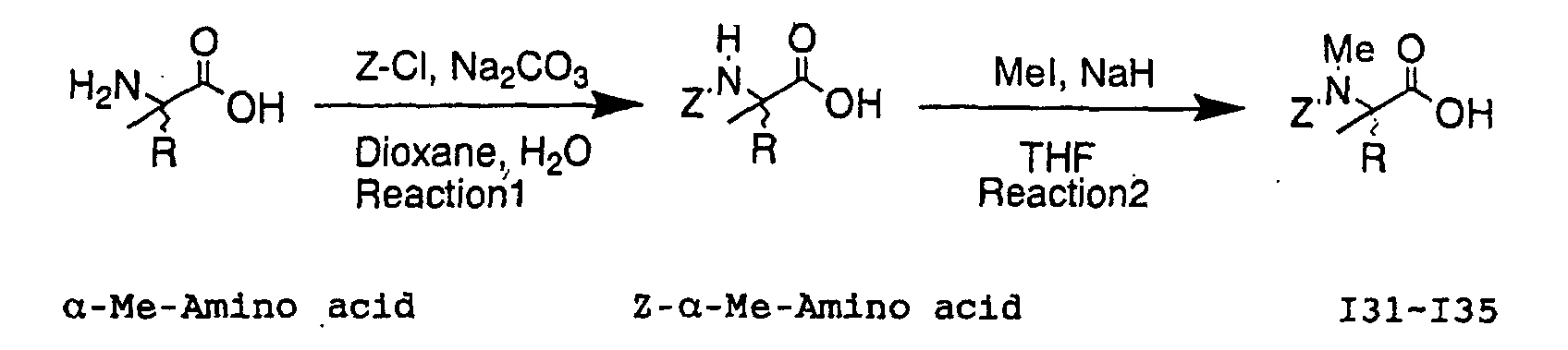
| Intermediate I31: Z-N-Me-α-Me-Phe-OH | ||||||||
| R | ||||||||
| CH2Ph | ||||||||
| Reaction1 | ||||||||
| alpha-Me-Phe-OH(g) | Z-Cl (ml) | Na2CO3 (g) | Dioxane (ml) | H2O (ml) | Reaction time (hr) | Column sol. | Product | Amount (g) |
| 1.000 | 0.90 | 0.900 | 25.00 | 25.00 | 5 | MC:MeOH =10:1 | Z-alpha-Me-Phe-OH | 0.890 |
| Reaction2 | ||||||||
| Z-alpha-Me-Phe-OH(g) | Methyl iodide (ml) | NaH (g) | THF (ml) | Reaction time (hr) | Column sol. | Amount (g) | ||
| 0.890 | 1.40 | 0.340 | 28.00 | 15 | MC:MeOH =10:1 | 1.180 |
| Intermediate I32: Z-N-Me-α-Me-D-Phe-OH | ||||||||
| R | ||||||||
| CH2Ph:D | ||||||||
| Reaction 1 | ||||||||
| alpha-Me-(D)-Phe-OH (g) | Z-Cl (ml) | Na2CO3 (g) | Dioxane (ml) | H2O (ml) | Reaction time (hr) | Column sol. | Product | Amount (g) |
| 1.000 | 0.90 | 0.900 | 25.00 | 25.00 | 5 | MC:MeOH =10:1 | Z-alpha-Me-(D)Phe-OH | 0.810 |
| Reaction2 | ||||||||
| Z-alpha-Me-(D)-Phe-OH (g) | Methyl iodide (ml) | NaH (g) | THF (ml) | Reaction time (hr) | Column sol. | Amount (g) | ||
| 0.810 | 1.40 | 0.340 | 28.00 | 15 | MC:MeOH =10:1 | 1.050 |
| Intermediate I33: Z-N-Me-α-Me-Leu-OH | ||||||||
| R | ||||||||
| i-Bu | ||||||||
| Reaction1 | ||||||||
| alpha-Me-Leu-OH (g) | Z-Cl (ml) | Na2CO3 (g) | Dioxane (ml) | H2O (ml) | Reaction time (hr) | Column sol. | Product | Amount (g) |
| 1.970 | 2.10 | 2.140 | 30.00 | 20.00 | 24 | MC:MeOH =10:1 | Z-alpha-Me-Leu-OH | 2.000 |
| Reaction2 | ||||||||
| Z-alpha-Me-Leu-OH(g) | Methyl iodide (ml) | NaH (g) | THF (ml) | Reaction time (hr) | Column sol. | Amount (g) | ||
| 2.000 | 4.40 | 2.000 | 35.00 | 12 | MC:MeOH =10:1 | 1.780 |
| Intermediate I34: Z-N-Me-α-Me-D-Abu-OH | ||||||||
| R | ||||||||
| CH2CH3:D | ||||||||
| Reaction1 | ||||||||
| alpha-Me-(D)-Abu-OH (g) | Z-Cl (ml) | Na2CO3 (g) | THF (ml) | H2O (ml) | Reaction time (hr) | Column sol. | Product | Amount (g) |
| 0.250 | 0.36 | 0.450 | 10.00 | 2.00 | 3 | MC:MeOH =10:1 | Z-alpha-Me-(D)-Et-OH | 0.177 |
| Reaction2 | ||||||||
| Z-alpha-Me(D)-Abu-OH (g) | Methyl iodide (ml) | NaH (g) | THF (ml) | Reaction time (hr) | Column sol. | Amount (g) | ||
| 0.750 | 0.42 | 0.190 | 10.00 | 12 | MC:MeOH=10:1 | 0.152 |
| Intermediate I35: Z-N-Me-α-Me-D-Val-OH | ||||||||
| R | ||||||||
| i-Pr.D | ||||||||
| Reaction1 | ||||||||
| alpha-Me-(D)-Val-OH (g) | Z-Cl (ml) | Na2CO3 (g) | Dioxane (ml) | H2O (ml) | Reaction time (hr) | Column sol. | Product | Amount (g) |
| 1.000 | 1.31 | 1.454 | 4.00 | 4.00 | 12 | MC:MeOH =15:1 | Z-alpha-Me-(D)-Val-OH | 0.170 |
| Reaction2 | ||||||||
| Z-alpha-Me-(D)-Val-OH(g) | Methyl iodide (ml) | NaH (g) | THF (ml) | Reaction time (hr) | Column sol. | Amount (g) | ||
| 0.170 | 0.40 | 0.128 | 3.00 | 12 | MC:MeOH=10:1 | 0.170 |

| Intermediate I36: | ||||||
| 1-[N-methyl(phenylmethoxy)carbonylamino]cyclopentanecarboxylic acid | ||||||
| Reaction | ||||||
| Z-1-amino-1-cyclo pentanecarboxylic | Methyl iodide (ml) | NaH (g) | THF (ml) | Reaction time (hr) | Column sol. | Amount (g) |
| 2.000 | 3.79 | 0.912 | 26.00 | 18 | MC:MeOH =20:1 | 1.730 |
| Intermediate I37: | ||||||
| 1-[N-methyl(phenylmethoxy)carbonylamino]cyclohexanecarboxylic acid | ||||||
| Reaction | ||||||
| Z-1-amino-1-cyclo hexanecarboxylic acid(g) | Methyl iodide (ml) | NaH (g) | THF (ml) | Reaction time (hr) | Column sol. | Amount (g) |
| 4.000 | 7.19 | 1.730 | 80.00 | 18 | MC:MeOH =20:1 | 4.190 |
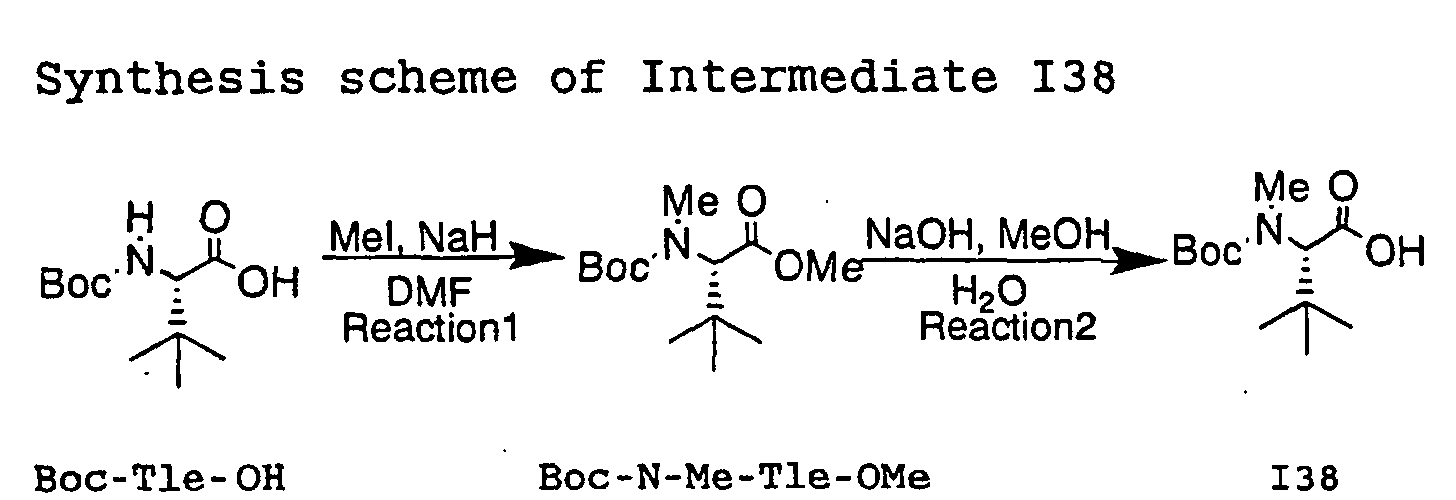
| Intermediate I38: Boc-N-Me-Tle-OH | ||||||
| Reaction1 | ||||||
| Boc-Tle-OH (g) | Methyl iodide (ml) | NaH (g) | DMF (ml) | Reaction time (hr) | Product | Amount (g) |
| 1.000 | 2.70 | 0.865 | 18.00 | 16 | Boc-N-Me-Tle-OMe | 1.180 |
| Reaction2 | ||||||
| Boc-N-Me-Tle-OMe (g) | NaOH (g) | MeOH (ml) | H2O (ml) | Reaction time (hr) | Column sol. | Amount (g) |
| 1.180 | 0.550 | 10.00 | 2.00 | 22 | MC:MeOH=10:1 | 0.900 |
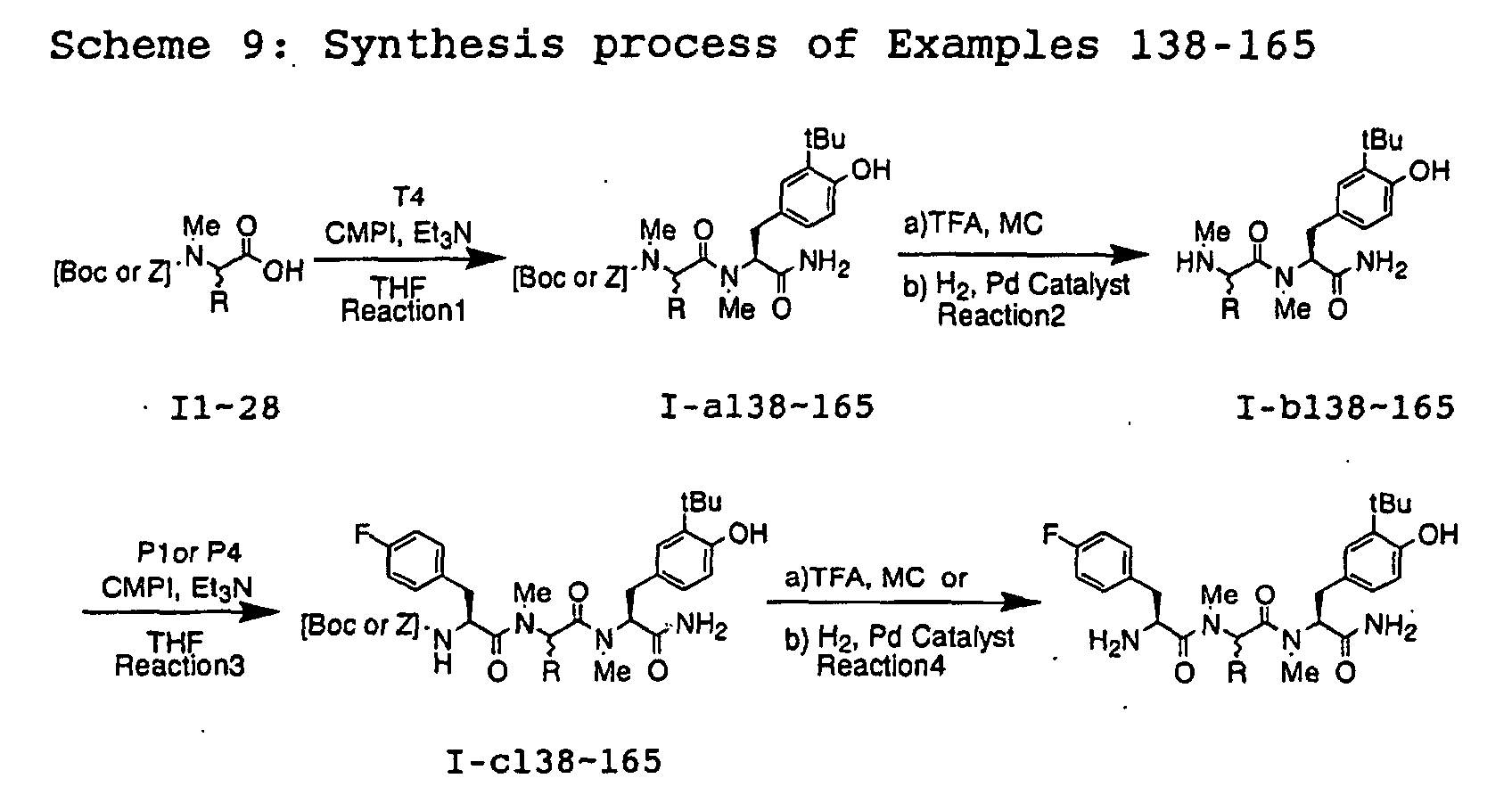
| Example 138 | ||||||||
| Phe(4-F)-N-Me-Abu-N-Me-Tyr(3-tBu)-NH2 | ||||||||
| R | ||||||||
| Et | ||||||||
| Reaction 1 | ||||||||
| Compound T4 (g) | Compound I1 (g) | CMPI (B) | TEA (ml) | THF (ml) | Reaction time (hr) | Column sol. | Product | Amount (g) |
| 0.800 | 0.960 | 0.980 | 0.90 | 30.00 | 12 | nHx:EA=1:2 | I-a138 | 1.420 |
| Reaction2-b | ||||||||
| Compound I-a138(g) | Pd/C (g) | MeOH (ml) | Reaction time (hr) | Column sol. | Product | Amount (g) | ||
| 1.400 | 0.430 | 28.00 | 2 | MC:MeOH =15:1 | I-b138 | 0.950 | ||
| Reaction3 | ||||||||
| Compound I-b138(g) | Compound P1 (g) | CMPI (g) | TEA (ml) | THF (ml) | Reaction time (hr) | Column sol. | Product | Amount (g) |
| 0.890 | 0.860 | 0.780 | 0.70 | 5.00 | 72 | nHx:EA =1:1 | I-c138 | 0.720 |
| Reaction4-a | ||||||||
| Compound I-c138(g) | TFA (ml) | MC (ml) | Reaction time (hr) | Column sol. | Amount (g) | HPLC min | ||
| 0.720 | 1.80 | 9.00 | 3 | MC:MeOH= 15:1 | 0.420 | 17.07 | ||
| ESI-MS(M++1):515 | ||||||||
| 1H-NMR(CD3OD):(two rotamers) δ 0.55 and 0.88(3H, t, J=7.2-7.6Hz), 1,39 and 1.44(9H, s), 1.56-1.85(2H, m), 2.23,2.62, 2.91 and 2.98(6H, s), 2.56-3.01(4H, m), 3.26(1H, dt, )=3.0-4.7, 13.9-15.4Hz), 3.78 and 3.97(1H, dd, J=8.4, 5.1Hz), 5.28 and 5.55(1H, dd, J=7.8-11.6, 4.8-6.0Hz),6.59 and 6.74(1H, d, J=8.0Hz), 6.69-7.30(6H, m) |
| Example 139 | ||||||||
| Phe(4-F)-N-Me-D-Abu-N-Me-Tyr(3-tBu)-NH2 | ||||||||
| R | ||||||||
| Et:D | ||||||||
| Reaction 1 | ||||||||
| Compound T4 (g) | Compound I2(g) | CMPI (g) | TEA (ml) | THF (ml) | Reaction time (hr) | Column sol. | Product | Amount (g) |
| 0.770 | 0.800 | 0.950 | 0.85 | 60.00 | 12 | nHx:EA =1:2 | I-a139 | 1.100 |
| Reaction2-a | ||||||||
| Compound I-a139(g) | TFA (ml) | MC (ml) | Reaction time (hr) | Column sol. | Product | Amount (g) | ||
| 1.100 | 4.90 | 26.00 | 1 | MC:MeOH =8:1 | I-b139 | 0.770 | ||
| Reaction3 | ||||||||
| Compound I-b139(g) | Compound P1(g) | CMPI (g) | TEA (ml) | THF (ml) | Reaction time (hr) | Column sol. | Product | Amount (g) |
| 0.770 | 0.750 | 0.670 | 0.60 | 44.00 | 72 | nHx:EA =1:2 | I-c139 | 1.310 |
| Reaction4-a | ||||||||
| Compound I-c139(g) | TFA (ml) | MC (ml) | Reaction time (hr) | Column sol. | Amount (g) | HPLC min | ||
| 1.300 | 4.20 | 21.00 | 2 | MC:MeOH= 15:1 | 0.620 | 19.96 | ||
| ESI-MS(M++1):515 | ||||||||
| 1H-NMR(CD3OD): δ 0.48(3H, t, J=7.5Hz), 1.36(9H, s), 1.38-1.43(2H, m), 2.59 and 2.87(3H, s), 2.73(1H, dd, J=13.2, 7.5 Hz), 2.81-2.92(2H, m), 3.02 and 3.14(3H, s), 3.37(1H, dd, J=15.0,6.1Hz), 3.93(1H, t, J=6.8-7.1Hz), 4.82(1H, t, J=7.7Hz), 5.34(1H, brs),5.50(1H, dd, J=11.3, 5.9Hz), 6.42(1H, brs),6.57(1H, d, J=7.8Hz), 6.88(1H, dd, J=7.7, 2.0Hz), 6.96(2H, t, J=8.6Hz), 7.08(1H, d, J=2.3Hz), 7.13(2H, m) |
| Example 140 | ||||||||
| Phe(4-F)-N-Me-Nva-N-Me-Tyr(3-tBu)-NH2 | ||||||||
| R | ||||||||
| n-Pr | ||||||||
| Reaction1 | ||||||||
| Compound T4 (g) | Compound I3 (g) | CMPI (g) | TEA (ml) | THF (ml) | Reaction time (hr) | Column sol. | Product | Amount (g) |
| 0.830 | 0.800 | 0.847 | 0.84 | 30.00 | 24 | nHx:EA=1:2 | I-a140 | 1.372 |
| Reaction2-b | ||||||||
| Compound I-a140(g) | Pd/C (g) | MeOH (ml) | Reaction time (hr) | Column sol. | Product | Amount (g) | ||
| 1.372 | 0.200 | 80.00 | 2 | MC:MeOH =10:1 | I-b140 | 0.895 | ||
| Reaction3 | ||||||||
| Compound I-b140(g) | Compound P4 (g) | CMPI (g) | TEA (ml) | THF (ml) | Reaction time (hr) | Column sol. | Product | Amount (g) |
| 0.500 | 0.480 | 0.387 | 0.40 | 20.00 | 16 | nHx:EA =1:2 | I-c140 | 0.744 |
| Reaction4-b | ||||||||
| Compound I-c140(g) | Pd/C (g) | MeOH (ml) | Reaction time (hr) | Column sol. | Amount (g) | HPLC min | ||
| 0.727 | 0.200 | 50.00 | 2 | MC:MeOH =10:1 | 0.450 | 19.05 | ||
| ESI-MS(M++1):529 | ||||||||
| 1H-NMR(CDCl3+CD3OD): (two rotamers) δ 0.20 and 0.70-1.20(3H, m), 0.65 and 0.75(3H, t, J=6.9Hz), 1.50-1.70(1H, m), 1.33 and 1.38(9H, s), 2.30 and 2.69(3H, s), 2.47 and 2.70(2H, m), 2.72(3H,s), 2.80 and 2.92(2H, m), 3.65 and 3.85(1H,m), 4.83(1H, m), 5.84(1H, m), 6.48(1H, d, J=9.69Hz), 6.70-6.82(1H, m), 6.90-7.20(5H, m) |
| Example 141 | ||||||||
| Phe(4-F)-N-Me-D-Nva-N-Me-Tyr(3-tBu)-NH2 | ||||||||
| R | ||||||||
| n-Pr:D | ||||||||
| Reaction1 | ||||||||
| Compound T4 (g) | Compound I4 (g) | CMPI (g) | TEA (ml) | THF (ml) | Reaction time (hr) | Column sol. | Product | Amount (g) |
| 0.650 | 0.547 | 0.665 | 0.70 | 20.00 | 16 | nHx:EA =1:2 | I-a141 | 0.670 |
| Reaction2-a | ||||||||
| Compound I-a141(g) | TFA (ml) | MC (ml) | Reaction time (hr) | Column sol. | Product | Amount (g) | ||
| 0.670 | 1.50 | 10.00 | 2 | MC:MeOH =10:1 | I-b141 | 0.500 | ||
| Reaction3 | ||||||||
| Compound I-b141(g) | Compound P4 (g) | CMPI (g) | TEA (ml) | THF (ml) | Reaction time (hr) | Column sol. | Product | Amount (g) |
| 0.490 | 0.480 | 0.387 | 0.40 | 20.00 | 16 | nHx:EA =1:2 | I-c141 | 0.680 |
| Reaction4-b | ||||||||
| Compound I-c141(g) | Pd/C (g) | MeOH (ml) | Reaction time (hr) | Column sol. | Amount (g) | HPLC min | ||
| 0.680 | 0.100 | 20.00 | 2 | MC:MeOH =10:1 | 0.358 | 22.27 | ||
| ESI-MS(M++1):529 | ||||||||
| 1H-NMR(CDCl3+CD3OD): (two rotamers) δ 0.65-0.90(2H, m), 0.75(3H, t, J=6.9Hz), 1.20-1.50(2H, m), 1.37 and 1.39(9H, s), 2.75(2H, brs), 2.85 and 2.87(3H,s), 2.80(1H, m), 3.00 and 3.02(3H, s), 3.45(1H, m), 3.95(1H, t, J=7.2Hz), 4.91(1H, t, J=7.5Hz), 5.40(2H, m, brs), 6.40(1H, brs), 6.60(1H, d, J=93Hz), 6.37(1H, d, 9.3Hz), 6.90-7.18(5H, m) |
| Example 142 | ||||||||
| Phe(4-F)-N-Me-Ile-N-Me-Tyr(3-tBu)-NH2 | ||||||||
| R | ||||||||
| s-Bu | ||||||||
| Reaction1 | ||||||||
| Compound T4 (g) | Compound I5 (g) | CMPI (g) | TEA (ml) | THF (ml) | Reaction time (hr) | Column sol. | Product | Amount (g) |
| 0.750 | 1.000 | 0.910 | 0.83 | 19.00 | 12 | nHx:EA= 2:3 | I-a142 | 1.350 |
| Reaction2-b | ||||||||
| Compound I-a142 (g) | Pd/C (g) | MeOH (ml) | Reaction time (hr) | Column sol. | Product | Amount (g) | ||
| 1.300 | 0190 | 50.00 | 2 | MC:MeOH =20:1 | I-b142 | 0.920 | ||
| Reaction3 | ||||||||
| Compound I-b142 (g) | Compound P1 (g) | CMPI (g) | TEA (ml) | THF (ml) | Reaction time (hr) | Column sol. | Product | Amount (g) |
| 0.920 | 0.830 | 0.750 | 0.67 | 25.00 | 12 | nHx:EA=2:3 | I-c142 | 1.170 |
| Reaction4-a | ||||||||
| Compound I-c142 (g) | TFA (ml) | MC (ml) | Reaction time (hr) | Column sol. | Amount (g) | HPLC min | ||
| 1.150 | 2.75 | 13.00 | 3 | MC:MeOH =20:1 | 0.710 | 19.710 | ||
| ESI-MS(M++1):543 | ||||||||
| 1H-NMR(CDCl3 + CD3OD):(two rotamers) δ 0.38, 0.81, 0.85 and 0.88(6H, d, J=6.0-6.5Hz), 0.93-1.02(1H, m), 1.18-1.29(1H, m), 1.34 and 1.39(9H, s), 1.97-2.11(1H, m), 2.38-2.93(3H, m), 2.50, 2.86, 2.95 and 3.00(6H, s), 3.11-3.18(1H, m), 3.69 and 3.84(1H, dd, J=8.0-8.9, 4.0-5.5Hz), 4.91-4.96 and 5.02-5.14(4/3H, m), 5.45(2/3H, dd, J=10.2, 5.7Hz), 6.48(2/3H, d, J=7.9Hz), 6.65-6.71(1H, m), 6.91-7.12(16/3H, m) |
| Example 143 | ||||||||
| Phe(4-F)-N-Me-D-Ile-N-Me-Tyr(3-tBu)-NH2 | ||||||||
| R | ||||||||
| s-Bu:D | ||||||||
| Reaction1 | ||||||||
| Compound T4 (g) | Compound I6 (g) | CMPI (g) | TEA (ml) | THF (ml) | Reaction time (hr) | Column sol. | Product | Amount (g) |
| 0.420 | 0.490 | 0.510 | 0.46 | 10.00 | 12 | nHx:EA =2:3 | I-a143 | 0.330 |
| Reaction2-a | ||||||||
| Compound I-a143 (g) | TFA (ml) | MC (ml) | Reaction time (hr) | Column sol. | Product | Amount (g) | ||
| 0.310 | 0.94 | 4.70 | 3 | MC:MoeoH | I-b143 | 0.240 =10:1 | ||
| Reaction3 | ||||||||
| Compound I-b143 (g) | Compound P1 (g) | CMPI (g) | TEA (ml) | THP (ml) | Reaction time (hr) | Column sol. | Product | Amount (g) |
| 0.240 | 0.220 | 0.200 | 0.18 | 6.00 | 12 | nHx:EA =2:3 | I-c143 | 0.340 |
| Reaction4-a | ||||||||
| Compound I-c143 (g) | TFA (ml) | MC (ml) | Reaction time (hr) | Column sol. | Amount (g) | HPLC min | ||
| 0.330 | 1.20 | 6.00 | 4 | MC:MeoH = 10:1 | 0.140 | 23.200 | ||
| ESI-MS(M++1):543 | ||||||||
| 1H-NMR(CDCl3): δ 0.27(3H, d, J=6.8Hz), 0.67-0.80(4H, m), 0.88-0.97(1H, m), 1.36(9H, s), 1.74-1.85(1H, m), 2.71(1H, dd, J=13.9, 7.2Hz), 2.84-3.00(2H, m), 2.96(3H, s), 3.12(3H, s), 3.35(1H, dd, ,1=14.6, 5.2Hz), 3.96(1H, t, J=7.0Hz), 4.79(1H, d, J=11.0Hz), 5.46(1H, dd, J=11.5, 5.4Hz), 5.50(1H, brs), 6.35(1H, brs), 6.58(1H, d, J=8.0Hz), 6.90-7.05(4H, m), 7.12-7.16(2H, m) |
| Example 144 | ||||||||
| Phe(4-F)-N-Me-Leu-N-Me-Tyr(3-tBu)-NH2 | ||||||||
| R | ||||||||
| i-Bu | ||||||||
| Reaction1 | ||||||||
| Compound T4 (g) | Compound I7 (g) | CMPI (g) | TEA (ml) | THF (ml) | Reaction time (hr) | Column sol. | Product | Amount (g) |
| 0.747 | 1.000 | 0.910 | 0.83 | 19.00 | 12 | nHx:EA=2:3 | I-a144 | 1.320 |
| Reaction2-b | ||||||||
| Compound I-a144 (g) | Pd/C (g) | MeOH (ml) | Reaction time (hr) | Column sol. | Product | Amount (g) | ||
| 1.300 | 0.190 | 50.00 | 2 | MC:MeOH =20:1 | I-b144 | 0.940 | ||
| Reaction3 | ||||||||
| Compound I-b144 (g) | Compound P1 (g) | CMPI (g) | TEA (ml) | THF (ml) | Reaction time (hr) | Column sol. | Product | Amount (g) |
| 0.940 | 0.850 | 0.760 | 0.69 | 25.00 | 12 | nHx:EA =2:3 | I-c144 | 1.230 |
| Reaction4-a | ||||||||
| Compound I-c144 (g) | TFA (ml) | MC (ml) | Reaction time (hr) | Column sol. | Amount (g) | HPLC min | ||
| 1.210 | 2.90 | 14.50 | 3 | MC:MeOH =20:1 | 0.750 | 19.380 | ||
| ESI-MS(M++1):543 | ||||||||
| 1H-NMR(CD3OD):(two rotamers) δ 0.66, 0.73, 0.94 and 0.96(6H, d, J=6.0-6.6Hz),1.37 and 1.40(9H, s), 1.40-1.52(2H, m), 1.55-1.68(1H, m), 2.26 and 2.65(3H, s), 2.53-2.69(1H, m), 2.69-3.00(1H, m),2.86 and 3.00(3H, s), 3.09-3.29(1H, m),3.22-3.78 and 3.90-3.94(1H, m), 4.56-4.64(1H, m),4.94-5.06(1H, m), 5.39-5.52(1H, m), 6.55-6.78(2H, m), 6.94-7.30(5H, m) |
| Example 145 | ||||||||
| Phe(4-F)-N-Me-D-Leu-N-Me-Tyr(3-tBu)-NH2 | ||||||||
| R | ||||||||
| i-Bu:D | ||||||||
| Reaction 1 | ||||||||
| Compound T4 (g) | Compound I8 (g) | CMPI (g) | TEA (ml) | THF (ml) | Reaction time (hr) | Column sol. | Product | Amount (g) |
| 0.810 | 0.960 | 1.000 | 0.91 | 25.00 | 12 | nHx:EA=2:3 | I-a145 | 1.450 |
| Reaction2-a | ||||||||
| Compound I-a145 (g) | TFA (ml) | MC (ml) | Reaction time (hr) | Column sol. | Product | Amount (g) | ||
| 1.430 | 4.60 | 23.00 | 3 | MC:MeOH =5:1 | I-b145 | 1.140 | ||
| Reaction3 | ||||||||
| Compound I-b145 (g) | Compound P1 (g) | CMPI (g) | TEA (ml) | THF (ml) | Reaction time (hr) | Column sol. | Product | Amount (g) |
| 1.140 | 1.010 | 0.910 | 0.83 | 25.00 | 12 | nHx:EA=2:3 | I-c145 | 0.940 |
| Reaction4-a | ||||||||
| Compound I-c145 (g) | TFA (ml) | MC (ml) | Reaction time (hr) | Column sol. | Amount (g) | HPLC min | ||
| 0.920 | 2.20 | 11.00 | 3 | MC:MeOH =5:1 | 0.60 | 21.40 | ||
| ESI-MS(M++1):543 | ||||||||
| 1H-NMR(CDCl3); δ 0.72(3H, d, J=4.3Hz), 0.73(3H, d, J=4.1Hz), 0.81-0.92(2H, m), 1.24-1.30(1H, m), 1.36(9H, s), 2.73-2.90(3H, m), 2.84(3H, s), 2.99(3H, s), 3.30(1H, dd, J=14.6, 5.6Hz), 3.96(1H, 1, J=7.2Hz), 5.02(1H, dd, J=9.9, 4.9Hz), 5.44(1H, dd, J=10.9, 5.6Hz), 5.63(1H, brs), 6.38(1H, brs), 6.57(1H, d, J=8.4Hz), 6,85(1H, dd, J=7.8, 1.9Hz), 6.91-7.01(3H, m), 7.09-7.13(2H, m) |
| Example 146 | ||||||||
| (2S)-2-[(2S)-2-amino-3-(4-fluorophenyl)-N-methylpropanoylamino]-N-{(1S)-2-[3-(tert-butyl)-4-hydroxyphenyl]-1-carbamoylethyl}-N-methylpent-4-enamide | ||||||||
| R | ||||||||
| Allyl | ||||||||
| Reaction1 | ||||||||
| Compound T4 (g) | Compound I9 (g) | CMPI (g) | TEA (ml) | THF (ml) | Reaction time (hr) | Column sol. | Product | Amount (g) |
| 0.573 | 0.630 | 0.700 | 0.64 | 14.00 | 12 | nHx:EA=2:3 | I-a146 | 0.900 |
| Reaction2-a | ||||||||
| Compound I-a146 (g) | TFA (ml) | MC (ml) | Reaction time (hr) | Column sol. | Product | Amount (g) | ||
| 0.870 | 2.90 | 14.0 | 3. | MC:MeOH=10:1 | I-b146 | 0.660 | ||
| Reaction3 | ||||||||
| Compound I-b146 (g) | Compound P1 (g) | CMPI (g) | TEA (ml) | THF (ml) | Reaction time (hr) | Column sol. | Product | Amount (g) |
| 0.660 | 0.620 | 0.560 | 0.51 | 17.00 | 12 | nHx:EA =2:3 | I-cI46 | 0.570 |
| Reaction4-a | ||||||||
| Compound I-c146 (g) | TFA (ml) | MC (ml) | Reaction time (hr) | Column sol. | Amount (g) | HPLC min | ||
| 0.550 | 1.35 | 5.40 | 3 | MC:MeOH=10:1 | 0.36 | 17.750 | ||
| ESI-MS(M++1):527 | ||||||||
| 1H-NMR(CDCl3): (two rotamers) δ 0.97-1.04(1/2H, m), 1.34 and 1.36(9H, s),2.12-2.24(1/2H,m), 2.32-2.75(2H, m), 2.34 and 2.66(3H, s), 2.84-2.99(2H, m), 2.97(3H, s), 3.07-3.18(1H, m), 3.62-3.66 and 3.83-3.87(1H, m), 4.80-3.09(3H, m), 5.25-5.33 and 5.63-5.76(1H, m), 5.35.5.46(1H, m), 3.39(1H, brs), 6.06(0.5H, brs), 6.41 and 6.58(1H, d, J=8.2 and 8.0Hz), 6.74 and 6.83(1H, dd, J=7.9, 1.9Hz), 6.92-7.00(2H, m), 7.03-7.14(3H, m), 7.36(1/2H, brs) |
| Example 147 | ||||||||
| (2R)-2-[(2S)-2-amino-3-(4-fluorophenyl)-N-methylpropanoylamino]-N-{(1S)-2-[3-(tert-butyl)-4-hydroxyphenyl]-1-carbamoylethyl}-N-methylpent-4-enamide | ||||||||
| R | ||||||||
| Allyl:D | ||||||||
| Reaction1 | ||||||||
| Compound T4 (g) | Compound I10 (g) | CMPI (g) | TEA (ml) | THF (ml) | Reaction time (hr) | Column sol. | Product | Amount (g) |
| 1.180 | 1.300 | 1.440 | 1.30 | 30.00 | 12 | nHx:EA=1:1 | I-a147 | 0.340 |
| Reaction2-a | ||||||||
| Compound I-a147 (g) | TFA (ml) | MC (ml) | Reaction time (hr) | Column sol. | Product | Amount (g) | ||
| 0.330 | 1.10 | 5.00 | 3 | MC:MeOH=7:1 | I-b147 | 0.270 | ||
| Reaction3 | ||||||||
| Compound I-b147(g) | Compound P1 (g) | CMPI (g) | TEA (ml) | THF (ml) | Reaction time (hr) | Column sol. | Product | Amount (g) |
| 0.270 | 0.240 | 0.220 | 0.30 | 6.00 | 12 | nHx:EA =2:3 | I-c147 | 0.370 |
| Reaction4-a | ||||||||
| Compound I-c147 (g) | TFA (ml) | MC (ml) | Reaction time (hr) | Column sol. | Amount (g) | HPLC min | ||
| 0.350 | 1.30 | 5.00 | 3 | MC:MeOH=7:1 | 0.24 | 20.320 | ||
| ESI-MS(M++1):527 | ||||||||
| 1H-NMR(CDCl3): δ 1.35(9H, s), 1.99-2.16(2H, m), 2.64-2.72(1H, m), 2.79-2.89(2H, m), 2.87(3H, s), 2.97(3H, s), 3,31(1H, d, J=15.3, 5.9HZ), 3.90(1H, t, J=7.0Hz), 4.87-4.93(2H, m), 5.01(1H, dd, J=9.0, 6.7Hz), 5.16-5.29(1H, m), 5.44(1H, dd, J=10.5, 6.0Hz), 5.50(1H, brs), 6.37(1H, brs), 6.57(1H, d, J=7.8Hz), 6.85(1H, dd, J=7.9, 1.9Hz), 6.92-6.98(2H, m), 7.02(1H, d, J=2.2Hz), 7.09-7.13(2H, m) |
| Example 148 | ||||||||
| Phe(4-F)-N-Me-Leu(γ-Me)-N-Me-Tyr(3-tBu)-NH2 | ||||||||
| R | ||||||||
| neo-Pent | ||||||||
| Reaction1 | ||||||||
| Compound T4 (g) | Compound I11(g) | CMPI (g) | TEA (ml) | THF (ml) | Reaction time (hr) | Column sol. | Product | Amount (g) |
| 0.630 | 0.780 | 0.770 | 0.35 | 25.00 | 48 | nHx:EA =1:2 | I-a148 | 0.850 |
| Reaction2-a | ||||||||
| Compound I-a148(g) | TFA (ml) | MC (ml) | Reaction time (hr) | Column sol. | Product | Amount (g) | ||
| 0.800 | 2.50 | 12.50 | 4 | MC:MeOH=9:1 | I-b148 | 0.600 | ||
| Reaction3 | ||||||||
| Compound I-b148(g) | Compound P4 (g) | CMPI (g) | TEA (ml) | THF (ml) | Reaction time (hr) | Column sol. | Product | Amount (g) |
| 0.600 | 0.580 | 0.470 | 0.42 | 30.00 | 12 | nHx:EA:MC =1:2:1 | I-c148 | 0.950 |
| Reaction4-b | ||||||||
| Compound I-c148(g) | Pd/C (g) | McOH (ml) | Reaction time (hr) | Column sol. | Amount (g) | HPLC min | ||
| 0.950 | 0.140 | 13.00 | 3 | MC:MeOH=20:1 | 0.58 | 20.96 | ||
| ESI-MS(M++1):557 | ||||||||
| 1H-NMR(CD3OD):(two rotamers) δ 0.71 and 0.99(9H, s), 1.43 and 1.46(9H, s), 1.28-1.40(2H, m), 2.43, 2.81, 2.97 and 3.07(6H, s), 2.23-3.04(4H, m), 3.25-3.28(1H, m), 3.79(2/3H, m), 3.92(1/3H, dd, J=9.8, 4.6Hz), 5.58 and 5.53(1H, dd, J=6.9-8.2, 4.8-6.9Hz), 6.61 and 6.80(1H, d, J=8.2Hz), 6.74-7.37(6H, m) |
| Example 149 | ||||||||
| Phe(4-F)-N-Me-D-Leu(γ-Me)-N-Me-Tyr(3-tBu)-NH2 | ||||||||
| R | ||||||||
| neoPent:D | ||||||||
| Reaction1 | ||||||||
| Compound T4 (g) | Compound I12 (g) | CMPI (g) | TEA (ml) | THF (ml) | Reaction time (hr) | Column sol. | Product | Amount (g) |
| 0.800 | 0.990 | 0.980 | 0.90 | 30.00 | 12 | nHx:EA=1:2 | 1-a149 | 1.250 |
| Reaction2-a | ||||||||
| Compound I-a149(g) | TFA (ml) | MC (ml) | Reaction time (hr) | Column sol. | Product | Amount (g) | ||
| 1.250 | 3.90 | 19.50 | 3 | MC:MeOH=20:1 | I-b149 | 0.99 | ||
| Reaction3 | ||||||||
| Compound I-b149(g) | Compound P4 (g) | CMPI (g) | TEA (ml) | THF (ml) | Reaction time (hr) | Column sol. | Product | Amount (g) |
| 1.000 | 0.970 | 0.780 | 0.71 | 50.00 | 5 | nHx:EA=1:2 | I-c149 | 1.500 |
| Reaction4-b | ||||||||
| Compound I-c149(g) | Pd/C (g) | MeOH (ml) | Reaction time (hr) | Column sol. | Amount (g) | HPLC min | ||
| 1.500 | 0.230 | 20.00 | 2 | MC:MeOH=20:1 | 0.83 | 22.63 | ||
| ESI-MS(M++1):557 | ||||||||
| 1H-NMR(CD3OD):(two rotamer) δ 0.62 and 0.84(9H, s), 0.88 and 1.35(2H, s), 1.40(9H, s), 2.45 and 2.82(3H, s), 2.84-2.95(3H, m), 3.04 and 3.10(3H, s), 3.23(1H, dd, J=14.7, 4.9Hz), 4.65(1H, dd, J=8.0, 2.3Hz), 5.28(1H, m), 5.45(1H, dd, J=11.8, 5.1Hz), 6.63(1H, d, J=7.9Hz), 6.88(1H, dd, J=8.0, 2.3Hz), 7.01(2H, m), 7.10(1H, d, J=2.3Hz), 7.25(2H, dd, J=85, 5.4Hz) |
| Example 150A(less polar) | ||||||||
| Phe(4-F)-N-Me-Ala(β-CF3)-N-Me-Tyr(3-tBu)-NH2 | ||||||||
| R | ||||||||
| CH2CF3:L,D-mixture | ||||||||
| Reaction1 | ||||||||
| Compound T4(g) | Compound I13(g) | CMPI (g) | TEA (ml) | THF (ml) | Reaction time (hr) | Column sol. | Product | Amount (g) |
| 0.500 | 0.560 | 0.560 | 0.51 | 20.00 | 5.000 | nHx:EA=1:1 | I-a150 | 0.980 |
| Reaction2-b | ||||||||
| Compound I-a150(g) | Pd/C (g) | MeOH (ml) | Reaction time (hr) | Column sol. | Product | Amount (g) | ||
| 0.980 | 0.500 | 20.00 | 2 | MC:MeOH=15:1 | I-b150A | 0.360(less polar) | ||
| I-b150B | 0.280(more polar) | |||||||
| Reaction3 | ||||||||
| Compound I-b150A(g) | Compound P4(g) | CMPI (g) | TEA (ml) | THF (ml) | Reaction time (hr) | Column sol. | Product | Amount (g) |
| 0.360 | 0.310 | 0.270 | 0.27 | 15.00 | 12 | nHx:EA=1:1 | I-c150A | 0.32 |
| Reaction4-b | ||||||||
| Compound I-c150A(g) | Pd/C (g) | MeOH (ml) | Reaction time (hr) | Column sol. | Amount (g) | HPLC min | ||
| 0.310 | 0.150 | 10.00 | 2 | EA:MeOH=15:1 | 0.200 | 18.66 | ||
| ESI-MS(M++1): 569 | ||||||||
| 1H-NMR(CD3OD):(two rotamers) δ 1.38 and 1.41(9H,s), 220, 256, 291, and 299(6H, s), 238-3.03(4H, m), 3.25 and 3.31(1H, d, J=4.8Hz), 3.72(1H, t, J=7.2Hz), 4.73(1H, brs), 5.53 and 5.57(1H, d, J=4.6Hz), 5.80(1H, q, J=4.4Hz), 6.55-6.79(2H,m), 7.00-7.15(3H, m), 7.25-7.30(2H, m) |
| Example 150B(more polar) | ||||||||
| Phe(4-F)-N-Me-Ala(β-CF3)-N-Me-Tyr(3-tBu)-NH2 | ||||||||
| R | ||||||||
| CH2CF3:L,D-mixture | ||||||||
| Reaction3 | ||||||||
| Compound I-b150B(g) | Compound P4(g) | CMPI (g) | TEA (ml) | THF (ml) | Reaction time (hr) | Column sol. | Product | Amount (g) |
| 0.270 | 0.240 | 0.200 | 0.20 | 15.00 | 12.00 | nHx:EA=1:1 | I-c150B | 0.300 |
| Reaction4-b | ||||||||
| Compound I-c150B(g) | Pd/C (g) | MeOH (ml) | Reaction time (hr) | Column sol. | Amount (g) | HPLC min | ||
| 0.300 | 0.150 | 10.00 | 2 | EA:MeOH=20:1 | 0.170 | 21.51 | ||
| ESI-MS(M++1):569 | ||||||||
| 1H-NMR(CD3OD):(two rotamers) δ 1.40(9H,s), 2.19-2.40(2H, m), 273 and 2.76(1H, d,J=7.0Hz), 2.89(3H, s), 2.92-2.96(1H, m), 2.98(3H,s), 3.21 and 3.24(1H, d, J=6.1Hz), 4.03(1H, t, J=7.2Hz), 4.52-4.61(1H,m), 5.36(1H, q, J=5.5Hz), 5.61(1H, t, J=7.0Hz), 6.67(1H, d, J=8.0Hz), 6.89(1H, dd, J=7.9, 2.4Hz), 7.01-7.10(3H, m), 7.24-7.29(2H, m) |
| Example 151 | ||||||||
| Phe(4-F)-N-Me-Chg-N-Me-Tyr(3-tBu)-NH2 | ||||||||
| R | ||||||||
| c-Hex | ||||||||
| Reaction1 | ||||||||
| Compound T4 (g) | Compound I14(g) | CMPI (g) | TEA (ml) | THE (ml) | Reaction time (hr) | Column sol. | Product | Amount (g) |
| 1.290 | 1.500 | 2.650 | 1.45 | 30.00 | 20 | nHx:EA=1:1 | I-a151 | 0.700 |
| Reaction2-a | ||||||||
| Compound I-a151(g) | TFA (ml) | MC (ml) | Reaction time (hr) | Column sol. | Product | Amount (g) | ||
| 0.700 | 4.00 | 20.00 | 4 | MC:MeOH=20:1 | I-b151 | 0.400 | ||
| Reaction3 | ||||||||
| Compound I-b151(g) | Compound P1 (g) | CMPI (g) | TEA (ml) | THF (ml) | Reaction time (hr) | Column sol. | Product | Amount (g) |
| 0.400 | 0.380 | 0.760 | 0.43 | 20.00 | 20 | nHx:EA=1:1 | I-c151 | 0.500 |
| Reaction4-a | ||||||||
| Compound I-c151(g) | TFA (ml) | MC (ml) | Reaction time (hr) | Column sol. | Amount (g) | HPLC min | ||
| 0.500 | 4.00 | 20.00 | 4 | MC:MeOH=20:1 | 0.400 | 20.140 | ||
| ESI-MS(M++1): 569 | ||||||||
| 1H-NMR(CDCl3): (two rotamers) δ 0.72-1.68(10 H, m), 1.35 and 1.40(9H, s), 1.82-2.10(1H, m), 2.30-2.65(1H, m), 2.52(3H,s), 2.70-2.90(1H, m), 2.75(3H, s), 2.75-2.90(1H, m), 3.05-3.40(3H, m), 3.60-3.85(1H, m), 5.05-5.20(2H, m), 6.35-6.75(2H, m), 6.75-7.20(5H, m) |
| Example 152 | ||||||||
| Phe(4-F)-N-Me-D-Chg-N-Me-Tyr(3-tBu)-NH2 | ||||||||
| R | ||||||||
| c-Hex:D | ||||||||
| Reaction1 | ||||||||
| Compound T4 (g) | Compound I15(g) | CMPI (g) | TEA (ml) | THF (ml) | Reaction time (hr) | Column sol. | Product | Amount (g) |
| 0.600 | 0.620 | 1.520 | 0.69 | 20.00 | 20 | nHx:EA=1:1 | I-a152 | 0.540 |
| Reaction2-a | ||||||||
| Compound I-a152(g) | TFA (ml) | MC (ml) | Reaction time (hr) | Column sol. | Product | Amount (g) | ||
| 0.540 | 3.00 | 15.00 | 4 | MC:MeOH =20:1 | I-b152 | 0.250 | ||
| Reaction3 | ||||||||
| Compound I-b152(g) | Compound P1(g) | CMP1 (g) | TEA (ml) | THF (ml) | Reaction time (hr) | Column sol. | Product | Amount (g) |
| 0.250 | 0.240 | 0.470 | 0.26 | 15.00 | 20 | nHx:EA=1:1 | I-C152 | 0.350 |
| Reaction4-a | ||||||||
| Compound I-c152(g) | TFA (ml) | MC (ml) | Reaction time (hr) | Column sol. | Amount (g) | HPLC min | ||
| 0.350 | 3.00 | 10.00 | 4 | MC:MeOH =20:1 | 0.27 | 22.040 | ||
| ESI-MS(M++1): 569 | ||||||||
| 1H-NMR(CDCl3): (two rotamers) δ 0.65-1.70(11H, m), 1.38(9H, s), 2.15-2.35(1H, m), 2.25(3H, s), 2.75-3.05(1H, m), 2.95(3H, s), 3.10-3.25(3H, m), 5.20-5.27(2H, m), 5.55-5.65(1H, m), 6.15-6.25(2H, m), 6.54 and 6.57(2H, d, J=8.4 Hz), 6.75-6.95(1H, m), 7.05-7.15(2H, m) |
| Example 153 | ||||||||
| Phe(4-F)-N-Me-Cha-N-Me-Tyr(3-tBu)-NH2 | ||||||||
| R | ||||||||
| CH2c-Hex | ||||||||
| Reaction1 | ||||||||
| Compound T4 (g) | Compound I16 (g) | CMPI (g) | TEA (ml) | THF (ml) | Reaction time (hr) | Column sol. | Product | Amount (g) |
| 0.950 | 1.300 | 1.150 | 1.10 | 38.00 | 15 | nHx:EA=1:1 | I-a153 | 1.600 |
| Reaction2-a | ||||||||
| Compound I-a153 (g) | TFA (ml) | MC (ml) | Reaction time (hr) | Column sol. | Product | Amount (g) | ||
| 1.600 | 4.80 | 24.00 | 3 | MC:MeOH =20:1 | I-b153 | 0.840 | ||
| Reaction3 | ||||||||
| Compound I-b153 (g) | Compound P1 (g) | CMPI (g) | TEA (ml) | THF (ml) | Reaction time (hr) | Column sol. | Product | Amount (g) |
| 0.840 | 0.680 | 0.620 | 0.60 | 20.00 | 15 | nHx:EA=1:1 | I-c153 | 1.100 |
| Reaction4-a | ||||||||
| Compound I-c153 (g) | TFA (ml) | MC (ml) | Reaction time (hr) | Column sol. | Amount (g) | HPLC min | ||
| 1.100 | 2.40 | 12.00 | 3 | MC:MeOH =30:1 | 0.50 | 21.154 | ||
| ESI-MS(M++1): 583 | ||||||||
| 1H-NMR(CDCl3): (two rotamers) δ 0.09-1.88(13H, m), 1.35 and 1.26(9H, s), 2.32-2.80(2H, m), 2.46 and 2.74(3H, s), 2.83 -3.27(3H, m), 2.99 and 3.03(3H, s), 3.59-3.73 and 3.81-3.95(1H, m), 4.62-4.74 and 5.11-5.25(1H, m), 5.27-5.59(2H, m), 6.08(1/2H, brs), 6.44 and 6.63(1H, d, J=7.9-8.3Hz), 6.77 and 6.87(1H, dd, J=7.2-7.5 1.8-1.9Hz), 6.92-7.20(5H, m), 7.59(1/2H, brs) |
| Example 154 | ||||||||
| Phe(4-F)-N-Me-D-Cha-N-Me-Tyr(3-tBu)-NH2 | ||||||||
| R | ||||||||
| CH2c-Hex:D | ||||||||
| Reaction1 | ||||||||
| Compound T4 (g) | Compound I17 (g) | CMPI (g) | TEA (ml) | THF (ml) | Reaction time (hr) | Column sol. | Product | Amount (g) |
| 0.730 | 1.000 | 0.900 | 0.80 | 29.00 | 15 | nHx:EA=1:1 | I-a154 | 1.200 |
| Reaction2-a | ||||||||
| Compound I-a154(g) | TFA (ml) | MC (ml) | Reaction time (hr) | Column sol. | Product | Amount (g) | ||
| 1.200 | 3.60 | 18.00 | 3 | MC:MeOH=20:1 | I-b154 | 0.740 | ||
| Reaction3 | ||||||||
| Compound I-b154(g) | Compound P1 (g) | CMPI (g) | TEA (ml) | THF (ml) | Reaction time (hr) | Column sol. | Product | Amount (g) |
| 0.740 | 0.600 | 0.540 | 0.50 | 17.00 | 15 | nHx:EA=1:1 | I-c154 | 0.900 |
| Reaction4-a | ||||||||
| Compound I-c154 (g) | TFA (ml) | MC (ml) | Reaction time (hr) | Column sol. | Amount (g) | HPLC min | ||
| 0.900 | 2.00 | 10.00 | 3 | MC:MeOH =30:1 | 0.24 | 25.144 | ||
| ESI-MS(M++1): 583 | ||||||||
| 1H-NMR(CDCl3): δ 0.62-1.37(13H, m), 1.37(9H, m), 2.67-3.10(7H, m), 2.88(3H, s), 2.97(3H, s), 3.30 and 3.35(1H, d, J=3.3-3.4Hz), 3.95(1H, t, J=6.9Hz), 5.04 and 5.08(1H, d, J=4.2-4.5Hz), 5.43 and 5.47(1H, d, J=5.4-5.8Hz), 5.52(1H, brs), 6.37(1H, brs), 6.58(1H, d,J=7.9Hz), 6,79-7,09(4H, m), 7.11(1H, d, J=5.2Hz), 7.14(1H, d, J=5.4Hz) |
| Example 155 | ||||||||
| Phe(4-F)-N-Me-Phe-N-Me-Tyr(3-tBu)-NH2 | ||||||||
| R | ||||||||
| CH2Ph | ||||||||
| Reaction1 | ||||||||
| Compound T4(g) | Compound I18 (g) | CMPI (g) | TEA (ml) | THF (ml) | Reaction time (hr) | Column sol. | Product | Amount (g) |
| 0.800 | 1.000 | 1.230 | 0.89 | 20.00 | 20 | nHx:EA=1:1 | I-a155 | 1.390 |
| Reaction2-b | ||||||||
| Compound I-a155(g) | Pd/C (g) | MeOH (ml) | Reaction time (hr) | Column sol. | Product | Amount (g) | ||
| 1.390 | 0.300 | 20.00 | 20 | MC:MeOH =20:1 | I-b155 | 0.840 | ||
| Reaction3 | ||||||||
| Compound I-b155(g) | Compound P1 (g) | CMPI (g) | TEA (ml) | THF (ml) | Reaction time (hr) | Column sol. | Product | Amount (g) |
| 0.770 | 0.710 | 0.720 | 0.52 | 15.00 | 20 | nHx:EA =1:1 | I-c155 | 0.997 |
| Reaction4-a | ||||||||
| Compound I-c155(g) | TFA (ml) | MC (ml) | Reaction time (hr) | Column sol. | Amount (g) | HPLC min | ||
| 0.997 | 3.00 | 10.00 | 4 | MC:MeOH =20:1 | 0.68 | 19.710 | ||
| ESI-MS(M++1): 577 | ||||||||
| 1H-NMR(CDCl3):(two rotamers) δ 1.40 and 1.42(9H, s), 2.54(3H, s), 2.61-3.04(5H, m), 3.15-3.39(4H, m), 3.67.3.85(1H, m), 5.32-5.72(2H, m), 6.57-6.72(1H, m), 6.98-7.29(10H, m) |
| Example 156 | ||||||||
| Phe(4-F)-N-Me-D-Phe-N-Me-Tyr(3-tBu)-NH2 | ||||||||
| R | ||||||||
| CH2Ph:D | ||||||||
| Reaction1 | ||||||||
| Compound T4(g) | Compound I19 (g) | CMPI (g) | TEA (ml) | THF (ml) | Reaction time (hr) | Column sol. | Product | Amount (g) |
| 0.800 | 0.800 | 1.230 | 0.89 | 20.00 | 20 | nHx:EA=1:1 | I-a156 | 1.140 |
| Reaction2-a | ||||||||
| Compound I-a156(g) | TFA (ml) | MC (ml) | Reaction time (hr) | Column sol. | Product | Amount (g) | ||
| 1.140 | 3.00 | 10.00 | 4 | MC:MeOH =20:1 | I-b156 | 0.990 | ||
| Reaction3 | ||||||||
| Compound 1-b156(g) | Compound P1(g) | CMPI (g) | TEA (ml) | THF (ml) | Reaction time (hr) | Column sol. | Product | Amount (g) |
| 0.770 | 0.710 | 0.720 | 0.52 | 20.00 | 20 | nHx:EA=1:1 | I-c156 | 0.960 |
| Reaction4-a | ||||||||
| Compound I-c156(g) | TFA (ml) | MC (ml) | Reaction time (hr) | Column sol. | Amount (g) | HPLC min | ||
| 0.960 | 3.00 | 10.00 | 4 | MC:MeOH =20:1 | 0.73 | 21.960 | ||
| ESI-MS(M++1): 577 | ||||||||
| 1H-NMR(CDCl3): δ 1.42(9H, s), 2.47-2.65(4H, m), 2.97-3.25(2H, m), 3.04(3H,s), 3.15(3H, s), 3.32-3.51(3H, m), 4.01-4.15(1H, m), 6.75-6.80(1H, m), 6.82-7.45(1H, m) |
| Example 157 | ||||||||
| Phe(4-F)-N-Me-Phe(4-F)-N-Me-Tyr(3-tBu)-NH2 | ||||||||
| R | ||||||||
| CH2Phe(4-F) | ||||||||
| Reaction1 | ||||||||
| Compound T4 (g) | Compound I20 (g) | CMPI (g) | TEA (ml) | THF (ml) | Reaction time (hr) | Column sol. | Product | Amount (g) |
| 0.960 | 1.370 | 1.180 | 1.10 | 38.00 | 15 | nHx:EA=1:2 | I-a157 | 1.880 |
| Reaction2-a | ||||||||
| Compound I-a157 (g) | TFA (ml) | MC (ml) | Reaction time (hr) | Column sol. | Product | Amount (g) | ||
| 1.880 | 5.40 | 27.00 | 3 | MC:MeOH =20:1 | I-b157 | 1.220 | ||
| Reaction3 | ||||||||
| Compound I-b157(g) | Compound P1(g) | CMPI (g) | TEA (ml) | THF (ml) | Reaction time (hr) | Column sol. | Product | Amount (g) |
| 1.220 | 0.780 | 0.710 | 0.60 | 23.00 | 18 | nHx:EA=1:2 | I-c157 | 1.550 |
| Reaction4-a | ||||||||
| Compound I-c157 (g) | TFA (ml) | MC (ml) | Reaction time (hr) | Column sol. | Amount (g) | HPLC min | ||
| 1.550 | 3.30 | 16.00 | 3 | MC:MeOH =20:1 | 0.73 | 21.035 | ||
| ESI-MS(M++1): 595 | ||||||||
| 1H-NMR(CDCl3): (two rotamers) δ 1.28 and 1.35(9H, s), 2.30-3.25(12H, m), 2.38 and 2.56(3H, s), 2.86 and 2.99(3H, s), 3.49-3.72(1H, m), 4.84-5.17(1H, m), 5.18-5.41(2H, m), 5.51-5.78(1H, m), 6.38 and 6.43(1H, d, J=8.3Hz), 6.60-7.23(10H, m) |
| Example 158 | ||||||||
| Phe(4-F)-N-Me-D-Phe(4-F)-N-Me-Tyr(3-tBu)-NH2 | ||||||||
| R | ||||||||
| CH2Phe(4-F):D | ||||||||
| Reaction1 | ||||||||
| Compound T4(g) | Compound I21(g) | CMPI (g) | TEA (ml) | THF (ml) | Reaction time (hr) | Column sol. | Product | Amount (g) |
| 0.700 | 1.000 | 0.850 | 0.80 | 27.00 | 18 | nHx:EA=1:2 | I-a158 | 1.120 |
| Reaction2-a | ||||||||
| Compound I-a158 (g) | TFA (ml) | MC (ml) | Reaction time (hr) | Column sol. | Product | Amount (g) | ||
| 1.120 | 3.30 | 16.50 | 3 | MC:MeOH=20:1 | I-b158 | 0.880 | ||
| Reaction3 | ||||||||
| Compound I-b158 (g) | Compound P1(g) | CMPl (g) | TEA (ml) | THF (ml) | Reaction time (hr) | Column sol. | Product | Amount (g) |
| 0.880 | 0.560 | 0.500 | 0.50 | 16.00 | 15 | nHx:EA=1:2 | I-c158 | 0.900 |
| Reaction4-a | ||||||||
| Compound I-c158 (g) | TFA (ml) | MC (ml) | Reaction time (hr) | Column sol. | Amount (g) | HPLC min | ||
| 0,900 | 2,00 | 10.00 | 3 | MC:MeOH =20:1 | 0.30 | 23.049 | ||
| ESI-MS(M++1): 595 | ||||||||
| 1H-NMR(CDCl3): (two rotamers) d 1.34 and 1.37(9H, s), 2.38-2.51(1H, m), 2.53-2.82(5H, m), 2.86(3H, s), 2.88(3H, s), 3.04-3.15(1H, m), 3.21 and 3.26(1H, d, J=6.4-6.3), 3.78-3.95(1H, m), 5.26-5.38(1H, m), 5.38-5.52(1H, m), 5.62(1H, brs), 6.27(1H, brs), 6.79(1H, d, J=8.1Hz), 6.78(1H, d, J=8.7Hz), 6.83-7.22(9H, m) |
| Example 159 | ||||||||
| Phe(4-F)-N-Me-Phe(4-Cl)-N-He-Tyr(3-tBu)-NH2 | ||||||||
| R | ||||||||
| CH2Ph(4-Cl) | ||||||||
| Reaction1 | ||||||||
| Compound T4 (g) | Compound I22 (g) | CMPI (g) | TEA (ml) | THF (ml) | Reaction time (hr) | Column sol. | Product | Amount (g) |
| 1.080 | 1.630 | 1.330 | 0.91 | 20.00 | 16 | nHx:EA=1:1 | I-a159 | 2.000 |
| Reaction2-a | ||||||||
| Compound I-a159(g) | TFA (ml) | MC (ml) | Reaction time (hr) | Column sol. | Product | Amount (g) | ||
| 2.000 | 5.60 | 25.00 | 1 | MC:MeOH =20:1 | I-b159 | 1.13 | ||
| Reaction3 | ||||||||
| Compound I-b159(g) | Compound P1 (g) | CMPI (g) | TEA (ml) | THF (ml) | Reaction time (hr) | Column sol. | Product | Amount (g) |
| 1.130 | 0.861 | 0.777 | 0.53 | 20.00 | 3 | nHx:EA=1:1 | I-c159 | 0.908 |
| Reaction4-a | ||||||||
| Compound I-c159(g) | TFA (ml) | MC (ml) | Reaction time (hr) | Column sol. | Amount (g) | HPLC min | ||
| 0.908 | 1.96 | 10.00 | 3 | MC:MeOH=20:1 | 0.625 | 21.59 | ||
| ESI-MS(M++1):612 | ||||||||
| 1H-NMR(CDCl3): (two rotamers) d 1.28 and 1.35(9H,s), 238 and 2.55(3H, s), 2.40-3.32(6H, m), 2.85 and 3.0(3H, s), 3.56 and 3.72(1H, t, J = 8.8Hz), 4.92(2/5H, m), 5.20-5.50(5/2H, m), 5.60 and 5.78(3/5H, brs), 6.35-7.40(25/2H, m) |
| Example 160 | ||||||||
| Phe(4-F)-N-He-D-Phe(4-Cl)-N-He-Tyr(3-tBu)-NH2 | ||||||||
| R | ||||||||
| CH2Ph(4-Cl):D | ||||||||
| Reaction1 | ||||||||
| Compound T4 (g) | Compound I22 (g) | CMPI (g) | TEA (ml) | THF (ml) | Reaction time (hr) | Column sol. | Product | Amount (g) |
| 0.519 | 0.781 | 0.639 | 0.44 | 10.00 | 16 | nHx:EA=1:1 | I-a160 | 0.947 |
| Reaction2-a | ||||||||
| Compound I-a160(g) | TFA (ml) | MC (ml) | Reaction time (hr) | Column sol. | Product | Amount (g) | ||
| 0.947 | 5.60 | 15.00 | 1 | MC:MeOH =20:1 | I-b160 | 0.624 | ||
| Reaction3 | ||||||||
| Compound I-b160(g) | Compound P1 (g) | CMPI (g) | TEA (ml) | THF (ml) | Reaction time (hr) | Column sol. | Product | Amount (g) |
| 1.130 | 0.476 | 0.430 | 0.30 | 15.00 | 3 | nHx:EA=1:1 | I-c160 | 0.46 |
| Reaction4-a | ||||||||
| Compound I-c160(g) | TFA (ml) | MC (ml) | Reaction time (hr) | Column sol. | Amount (g) | HPLC min | ||
| 0.460 | 1.00 | 5.00 | 3 | MC:MeOH =20:1 | 0.300 | 19.53 | ||
| ESJ-MS(M++1):612 | ||||||||
| 1H-NMR(CDCl3): d 1.35(9H,s), 1.30-2.96(5H, m), 2.88(3H, s), 2.89(3H, s), 3.03-3.35(1H, m), 3.83(3/4H, m), 5.29(2H, s), 5.43(6/4H, m), 6.20(3/4H, brs), 6.52(1H, d, J=8.8Hz), 6.78(1H, d, J=8.8Hz), 6.90-7.32(10H, m) |
| Example 161 | ||||||||
| Phe(4-F)-N-Me-Tyr-N-Me-Tyr(3-tBu)-NH2 | ||||||||
| R | ||||||||
| CH2Ph(4-OH) | ||||||||
| Reaction1 | ||||||||
| Compound T4 (g) | Compound I24 (g) | CMPI (g) | TEA (ml) | THF (ml) | Reaction time (hr) | Column sol. | Product | Amount (g) |
| 1.300 | 2.600 | 1.730 | 1.09 | 30.00 | 3 | nHx:EA=1:1 | I-a161 | 2.610 |
| Reaction2-a | ||||||||
| Compound I-a161(g) | TFA (ml) | MC (ml) | Reaction time (hr) | Column sol. | Product | Amount (g) | ||
| 2.610 | 6.47 | 33.00 | 3 | MC:MeOH =20:1 | I-b161 | 1.300 | ||
| Reaction3 | ||||||||
| Compound I-b161 (g) | Compound P4 (g) | CMPI (g) | TEA (ml) | THF (ml) | Reaction time (hr) | Column sol. | Product | Amount (g) |
| 1.300 | 1.200 | 0.964 | 0.70 | 30.00 | 3 | nHx:EA=1:1 | I-c161 | 1.880 |
| Reaction4-b | ||||||||
| Compound I-c161(g) | Pd/C (g) | MeOH (ml) | Reaction time (hr) | Column sol. | Amount (g) | HPLC min | ||
| 1.880 | 0.282 | 40.00 | 3 | MC:MeOH =20:1 | 0.500 | 17.94 | ||
| ESI-MS(M++1):593 | ||||||||
| 1H-NMR(CD3OD): (two rotamers) d 1.41 and 1.42(9H,s), 2.32 and 2.39(3H, s), 2.90 and 3.07(3H, s), 2.59-3.50(7H, m), 3.72 and 3.85(1/2H, m), 5.05 and 5.30(1/2H, m), 5.60(1H, m), 6.50-7.43(11H, m) |
| Example 162 | ||||||||
| Phe(4-F)-N-Me-D-Tyr-N-Me-Tyr(3-tBu)-NH2 | ||||||||
| R | ||||||||
| CH2Ph(4-OH):D | ||||||||
| Reaction1 | ||||||||
| Compound T4 (g) | Compound I25 (g) | CMPI (g) | TEA (ml) | THF (ml) | Reaction time (hr) | Column sol. | Product | Amount (g) |
| 0.920 | 2.000 | 1.220 | 0.77 | 30.00 | 3 | nHx:EA=1:1 | I-a162 | 1.550 |
| Reaction2-b | ||||||||
| Compound I-a162(g) | Pd/C (g) | MeOH (ml) | Reaction time (hr) | Column sol. | Product | Amount (g) | ||
| 1.550 | 0.233 | 20.00 | 12 | MC:MeOH =20:1 | I-b162 | 0.977 | ||
| Reaction3 | ||||||||
| Compound I-b162 (g) | Compound P4 (g) | CMPI (g) | TEA (ml) | THF (ml) | Reaction time (hr) | Column sol. | Product | Amount (g) |
| 0.977 | 1.080 | 0.871 | 0.64 | 20.00 | 3 | nHx:EA=1:1 | I-c162 | 1.330 |
| Reaction4-b. | ||||||||
| Compound I-c162(g) | Pd/C (g) | MeOH (ml) | Reaction time (hr) | Column sol. | Amount (g) | HPLC min | ||
| 1.330 | 0.200 | 30.00 | 3 | MC:MeOH =20:1 | 0.500 | 18.54 | ||
| ESI-MS(M++1):593 | ||||||||
| 1H-NMR(CD3OD): δ 1.45(9H,s), 2.42-2.75(4H, m), 3.02(3H, s), 2.34-3.15(2H, m), 3.32(1/5H, dd, J =7.6, 8.8Hz), 4.03(4/5H, t, J=8.8Hz), 5.42-5.65(2H, m), 6.65-7.25(12H, m) |
| Example 163 | ||||||||
| Phe(4-F)-N-Me-Ala(β-2-thienyl)-N-Me-Tyr(3-tBu)-NH2 | ||||||||
| R | ||||||||
| CH2(2-Thienyl) | ||||||||
| Reaction1 | ||||||||
| Compound T4 (g) | Compound I26 (g) | CMPI (g) | TEA (ml) | THF (ml) | Reaction time (hr) | Column sol. | Product | Amount (g) |
| 0.670 | 0.916 | 0.820 | 0.56 | 20.00 | 16 | nHx:EA=1:1 | I-a163 | 1.280 |
| Reaction2-a | ||||||||
| Compound I-a163(g) | TFA (ml) | MC (ml) | Reaction time (hr) | Column sol. | Product | Amount (g) | ||
| 1.280 | 3.80 | 19.00 | 3 | MC:MeOH =20:1 | I-b163 | 0.513 | ||
| Reaction3 | ||||||||
| Compound I-b163 (g) | Compound P1 (g) | CMPI (g) | TEA (ml) | THF (ml) | Reaction time (hr) | Column sol. | Product | Amount (g) |
| 0.513 | 0.418 | 0.379 | 0.30 | 20.00 | 3 | nHx:EA=1:1 | I-c163 | 0.587 |
| Reaction4-a | ||||||||
| Compound I-c163(g) | TFA (ml) | MC (ml) | Reaction time (hr) | Column sol. | Amount (g) | HPLC min | ||
| 0.587 | 1.32 | 10.00 | 3 | MC:MeOH =20:1 | 0.35 | 23.7 | ||
| ESI-MS(M++1):583 | ||||||||
| 1H-NMR(CDCl3+ CD3OD): (two rotamers) δ 1.30 and 1.35(9H,s), 1.80(1/3H, m), 2.25, 2.58 and 2.88, 3.0(6H, s), 2.0-3.25(5H, m), 3.35(2/3H, m), 3,60(1H, m), 4.90(1/3H, m), 5.27(2/3H, m), 5.37-5.64(1H, m), 6.40-6.72(2H, m), 6.72-7,20(8H, m) |
| Example 164 | ||||||||
| Phe(4-F)-N-Me-D-Ala(β-2-thienyl)-N-Me-Tyr(3-tBu)-NH2 | ||||||||
| R | ||||||||
| CH2(2-Thienyl):D | ||||||||
| Reaction 1 | ||||||||
| Compound T4 (g) | Compound I26 (g) | CMPI (g) | TEA (ml) | THF (ml) | Reaction time (hr) | Column sol. | Product | Amount (g) |
| 0.760 | 1.040 | 0.930 | 0.64 | 20.00 | 16 | nHx:EA=1:1 | I-a164 | 1.430 |
| Reaction2-a | ||||||||
| Compound I-a164(g) | TFA (ml) | MC (ml) | Reaction time (hr) | Column sal. | Product | Amount (g) | ||
| 1.430 | 4.43 | 25.00 | 3 | MC:MeOH =20:1 | I-b164 | 0.500 | ||
| Reaction3 | ||||||||
| Compound I-b164(g) | Compound P1 (g) | CMPI (g) | TEA (ml) | THF (ml) | Reaction time (hr) | Column sol. | Product | Amount (g) |
| 0.500 | 0.400 | 0.360 | 0.28 | 20.00 | 3 | nHx:EA=1:1 | I-c164 | 0.857 |
| Reaction4-a | ||||||||
| Compound I-c164(g) | TFA (ml) | MC (ml) | Reaction time (hr) | Column sol. | Amount (g) | HPLC min | ||
| 0.857 | 1.92 | 15.00 | 3 | MC:MeOH =20:1 | 0.33 | 21.7 | ||
| ESI-MS(M++1):583 | ||||||||
| 1H-NMR(CDCl3): δ 1.35(9H,s), 2.17-3.20(7H, m), 2.91(3H, s), 2.95(3H, s), 3.28(1/2H, dd, J=15.8, 7.9Hz), 3.85(1/2H, t, J=7.9Hz), 5.35 and 5.45(2H, m), 5.65(1H, brs), 6.28(2/3H, brs), 6.48-7.30(28/3H, m) |
| Example 165 | ||||||||
| Phe(4-F)-N-Me-Ala(β-c-Pr)-N-Me-Tyr(3-tBu)-NH2 | ||||||||
| R | ||||||||
| CH2c-Pr | ||||||||
| Reaction1 | ||||||||
| Compound T4 (g) | Compound I28 (g) | CMPI (g) | TEA (ml) | THF (ml) | Reaction time (hr) | Column sol. | Product | Amount (g) |
| 0.820 | 1.100 | 1.000 | 0.90 | 33.00 | 17 | nHx:EA=1:1 | 1-a165 | 1.260 |
| Reaction2-b | ||||||||
| Compound I-a165 (g) | Pd/C (g) | MeOH (ml) | Reaction time (hr) | Column sol. | Product | Amount (g) | ||
| 1.260 | 0.120 | 24.00 | 3 | MC:MeOH=30:1 | I-b165 | 0.600 | ||
| Reaction3 | ||||||||
| Compound I-b165 (g) | Compound P1 (g) | CMPI (g) | TEA (ml) | THF (ml) | Reaction time (hr) | Column sol. | Product | Amount (g) |
| 0.600 | 0.540 | 0.490 | 0.50 | 16.00 | 18 | nHx:EA=1:1 | I-c165 | 0.590 |
| Reaction4-a | ||||||||
| Compound I-c165 (g) | TFA (ml) | MC (ml) | Reaction time (hr) | Column sol. | Amount (g) | HPLC min | ||
| 0.590 | 1.40 | 7.00 | 3 | MC:MeOH =30:1 | 0.300 | 18.61 | ||
| ESI-MS(M++1): 541 | ||||||||
| 1H-NMR(CD3OD): (two rotamers) δ 0.85-0.78(5H, m), 1.39-1.91(2H, m), 1.47 and 1.49(9H, s), 2.34 and 2.69(3H, s), 2.49-3.38(4H, m), 2.98 and 3.03(3H, s), 3.75-3.48(1H, m), 5.06-5.15 and 5.49-5.67(2H, m), 6.65-6.88(2H, m), 7.04-7.43(5H, m) |
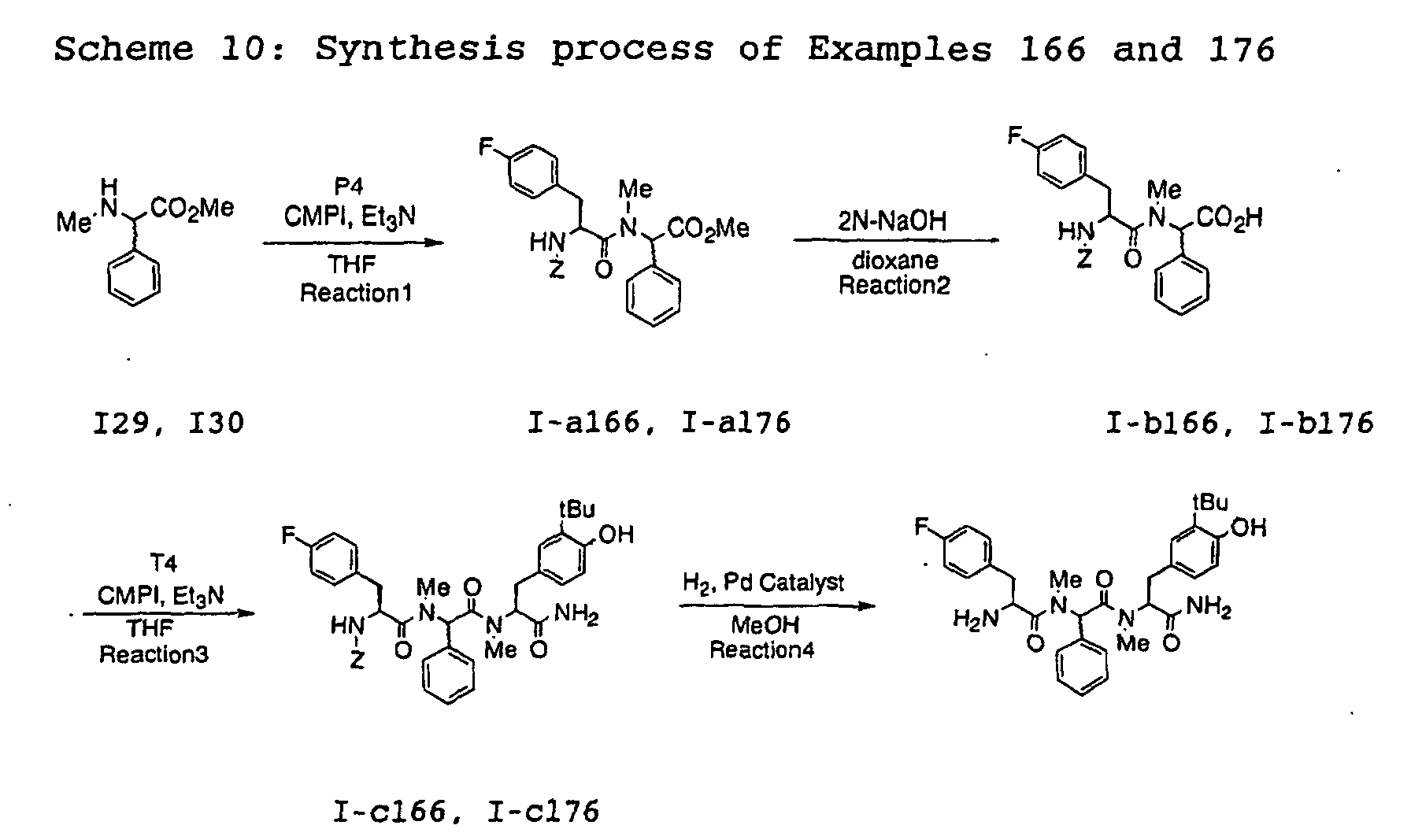
| Example 166 | ||||||||
| Phe(4-F)-N-Me-Phg-N-Me-Tyr(3-tBu)-NH2 | ||||||||
| Reaction1 | ||||||||
| Compound I29 (g) | Compound P4 (g) | CMPI (g) | TEA (ml) | THF (ml) | Reaction time (hr) | Column sol. | Product | Amount (g) |
| 0.630 | 1.000 | 1.170 | 1.22 | 30.00 | 3 | nHx:EA =1:1 | I-a166 | 1.070 |
| Reaction2 | ||||||||
| Compound I-a166(g) | 2N NaOH (ml) | dioxane (ml) | Reaction time (hr) | Column sol. | Product | Amount (g) | ||
| 1.070 | 2.50 | 20.00 | 3 | MC:MeOH =20:1 | I-b166 | 1.030 | ||
| Reaction3 | ||||||||
| Compound I-b166 (g) | Compound T4 (g) | CMPI (g) | TEA (ml) | THF (ml) | Reaction time (hr) | Column sol. | Product | Amount (g) |
| 1.030 | 0.504 | 0.668 | 0.42 | 20.00 | 3 | nHx:EA =1:1 | I-c166 | 0.595 |
| Reaction4 | ||||||||
| Compound I-c166(g) | Pd(OH)2 (g) | MeOH (ml) | Reaction time (hr) | Column sol. | Amount (g) | HPLC min | ||
| 0.595 | 0.100 | 10.00 | 3 | MC:MeOH=20:1 | 0.480 | 20.00 | ||
| ESI-MS(M++1):563 | ||||||||
| 1H-NMR(CD3OD): (two rotamers) δ 1.40 and 1.49(9H,s), 2.75 and 2.90(3H, s), 2.95 and 3.15(3H, s), 2.53-3.50(5H, m) 4.12(1H, m), 4.74 and 5.32(1H, m), 6.40-7.58(15H, m) |
| Example 176 | ||||||||
| Phe(4-F)-N-Me-D-Phg-N-Me-Tyr(3-tBu)-NH2 | ||||||||
| Reaction1 | ||||||||
| Compound I30 (g) | Compound P4 (g) | CMPI (g) | TEA (ml) | THF (ml) | Reaction time (hr) | Column sol. | Product | Amount (g) |
| 0.646 | 2.160 | 2.300 | 1.45 | 20.00 | 3 | nHx:EA =1:1 | 1-a176 | 1.030 |
| Reaction2 | ||||||||
| Compound I-a176(g) | 2N NaOH (ml) | dioxane (ml) | Reaction time (hr) | Column sol. | Product | Amount (g) | ||
| 1.030 | 2.40 | 20.00 | 3 | MC:MeOH =20:1 | I-b176 | 0.540 | ||
| Reaction3 | ||||||||
| Compound I-b176 (g) | Compound T4 (g) | CMPI (g) | TEA (ml) | THF (ml) | Reaction time (hr) | Column sol. | Product | Amount (g) |
| 0.540 | 0.268 | 0.355 | 0.22 | 10.00 | 3 | nHx:EA =1:1 | I-c176 | 0.450 |
| Reaction4 | ||||||||
| Compound I-c176(g) | Pd(OH)2 (g) | MeOH (ml) | Reaction time (hr) | Column sol. | Amount (g) | HPLC min | ||
| 0.450 | 0.070 | 10.00 | 3 | MC:MeOH =20:1 | 0.270 | 20.98 | ||
| ESI-MS(M++1):563 | ||||||||
| 1H-NMR(CD3OD): δ 1.46(9H,s), 2.50(3H, s), 2.82(3H, s), 2.72-3.13(3H, m), 3.402H, m), 4.20(1H, m), 5.48(1H, dd, J=13.2, 6.2Hz), 6.25(1H, brs), 6.35(2H, d, J=8.8Hz), 6,75(1H, d, J=8.8Hz), 6.90(1H, dd, J=8.8, 1.7Hz), 7.05-7.45(8H, m) |
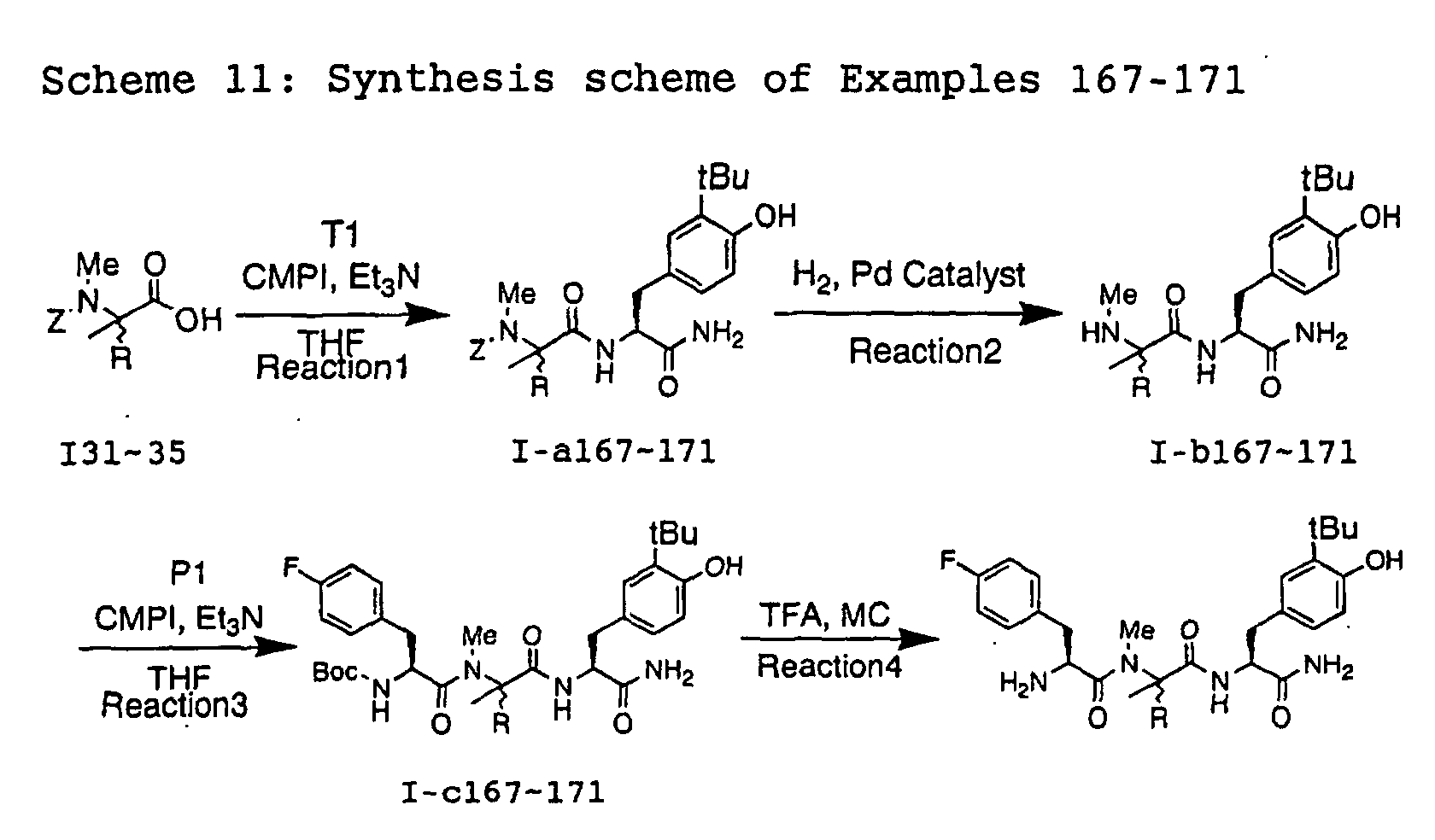
| Example 167 | ||||||||
| Phe(4-F)-N-Me-α-Me-Phe-Tyr(3-tBu)-NH2 | ||||||||
| R | ||||||||
| CH2Phe | ||||||||
| Reaction1 | ||||||||
| Compound T1(g) | Compound I31 (g) | CMPI (g) | TEA (ml) | THF (ml) | Reaction time (hr) | Column sol. | Product | Amount (g) |
| 0.570 | 1.180 | 0.900 | 0.80 | 24.00 | 5 | nHx:EA =1:2 | I-a167 | 0.360 |
| Reaction2 | ||||||||
| Compound I-a167 (g) | Pd/C (g) | MeOH (ml) | Reaction time (hr) | Product | Amount (g) | |||
| 0.360 | 0.040 | 6.00 | 3 | I-b167 | 0.260 | |||
| Reaction3 | ||||||||
| Compound I-b167 (g) | Compound P1 (g) | CMPI (g) | TEA (ml) | THF (ml) | Reaction time (hr) | Column sol. | Product | Amount (g) |
| 0.260 | 0,420 | 0.780 | 0.40 | 630 | 120 | nHe:EA =1:2 | I-c167 | 0.060 |
| Reaction4 | ||||||||
| Compound I-c167(g) | TFA (ml) | MC (ml) | Reaction time (hr) | Column Sol. | Amount (g) | HPLC min | ||
| 0.060 | 0.20 | 0.70 | 3 | MC:MeOH =20:1 | 0.01 | 21.813 | ||
| ESI-MS(M++1): 577 | ||||||||
| 1H-NMR(CDCl3): δ 1.30(3H, s), 1.34(9H, s), 2.37-2.62(3H, m), 2.51(3H, s), 3.07(1H, d, J=14.5Hz), 3.24-3.41(2H, m), 3.73(1H, t, J=8.3Hz), 4.48-4.57(1H, m), 5.37-5.58(2H, m), 6.50(1H, d, J=9.0Hz), 6.75(1H, d, J=9.3Hz), 6.77(1 H, s), 6.97-7.37(9H, m) |
| Example 168 | ||||||||
| Phe(4-F)-N-Me-α-Me-Phe-Tyr(3-tBu)-NH2:Diastereomeric mixture | ||||||||
| R | ||||||||
| CH2Phe:D | ||||||||
| Reaction1 | ||||||||
| Compound T1 (g) | Compound I32 (g) | CMPI (g) | TEA (ml) | THF (ml) | Reaction time (hr) | Column sol. | Product | Amount (g) |
| 0.390 | 0.820 | 0.640 | 0.60 | 16.00 | 5 | nHx:EA =1:2 | I-a168 | 0.670 |
| Reaction2 | ||||||||
| Compound I-a168 (g) | Pd/C (g) | MeOH (ml) | Reaction time (hr) | Product | Amount (g) | |||
| 0.670 | 0.060 | 12.00 | 3 | I-b168 | 0.500 | |||
| Reaction3 | ||||||||
| Compound I-b168 (g) | Compound P1(g) | CMPI (g) | TEA (ml) | THF (ml) | Reaction time (hr) | Column sol. | Product | Amount (g) |
| 0.500 | 0.810 | 1.400 | 1.20 | 12.00 | 120 | nHx:EA =2:1 | I-c168 | 0.210 |
| Reaction4 | ||||||||
| Compound I-c168 (g) | TFA (ml) | MC (ml) | Reaction time (hr) | Column sol. | Amount (g) | HPLC min | ||
| 0.210 | 0.53 | 2.60 | 3 | MC:MeOH =20:1 | 0.070 | 20.15/20.93 | ||
| ESI-MS(M++1): 577 | ||||||||
| 1H-NMR(CDCl3): (two rotamers) δ 1.12-1.41(3H, m), 1.35(9H, s), 1.98 and 2.40(3H, s), 2.36(1H, s), 2.46-2.78(2H, m), 2.82-3.28(4H, m), 3.42-3.83(2H, m), 4.52-4.72(1H, m), 5.38-5.56(1H, m), 5.98-6.22(1H, m), 6.61-6.28(2H, m), 6.35-7.38(10H, m) |
| Example 169 | ||||||||
| Phe(4-F)-N-Me-α-Me-Leu-Tyr(3-tBu)-NH2 | ||||||||
| R | ||||||||
| i-Bu | ||||||||
| Reaction1 | ||||||||
| Compound T1 (g) | Compound I33 (g) | CMPI (g) | TEA (ml) | THF (ml) | Reaction time (hr) | Column sol. | Product | Amount (g) |
| 1.560 | 1.770 | 2.310 | 1.68 | 60.00 | 12 | nHx:EA:MC = 1:1.5:1 | I-a169 | 2.390 |
| Reaction2 | ||||||||
| Compound I-a169(g) | Pd/C (g) | MeOH (ml) | Reaction time (hr) | Product | Amount (g) | |||
| 2.390 | 0.360 | 80.00 | 12 | I-b169 | 1.490 | |||
| Reaction3 | ||||||||
| Compound I-b169(g) | Compound P1 (g) | CMPI (g) | TEA (ml) | THF (ml) | Reaction time (hr) | Column sol. | Product | Amount (g) |
| 1.490 | 1.230 | 1.510 | 1.10 | 78.00 | 12 | nHx:EA=1:2 | I-c169 | 0.910 |
| Reaction4-a | ||||||||
| Compound I-c169(g) | TFA (ml) | MC (ml) | Reaction time (hr) | Column sol. | Amount (g) | HPLC min | ||
| 0.850 | 1.30 | 1.30 | 4 | MC:MeOH =25:1 | 0.130 | 21.50 | ||
| ESI-MS(M++1):543 | ||||||||
| 1H-NMR(CD3OD): δ 0.79(6H, t, 1=7.0Hz), 1.27(3H, s), 1.46(9H, s), 1.51-1.79(3H, m), 2.54-2.67(2H, m), 2.76(3H, s), 3.04(1H, dd, J=14.3,5.6Hz), 3.21(1H, dd, J=14.0, 6.8Hz), 3.81(1H, t,J=6.5-7.1Hz), 4.56(1H, dd, J=14.1,6.4Hz), 539(1H, brs), 5.78(1H, brs), 6.61(1H, d, J=7.8Hz), 6.93-7.14(6H, m), 7.45(1H, brs) |
| Example 170 | ||||||||
| Phe(4-F)-N-Me-α-Me-D-Abu-Tyr(3-tBu)-NH2 | ||||||||
| R | ||||||||
| Et:D | ||||||||
| Reaction1 | ||||||||
| Compound T1(g) | Compound I34(g) | CMPI (g) | TEA (ml) | THF (ml) | Reaction time (hr) | Column sol. | Product | Amount (g) |
| 0.147 | 0.150 | 0.220 | 0.16 | 3.00 | 12 | nHx:EA=1:1 | I-a170 | 0.251 |
| Reaction2 | ||||||||
| Compound I-a170(g) | Pd/C (g) | MeOH (ml) | Reaction time (hr) | Product | Amount (g) | |||
| 0.250 | 0.150 | 5.00 | 3 | I-b170 | 0.151 | |||
| Reaction3 | ||||||||
| Compound I-b170(g) | Compound P1(g) | CMPI (g) | TEA (ml) | THF (ml) | Reaction time (hr) | Column sol. | Product | Amount (g) |
| 0.150 | 0.18 | 0.160 | 0.12 | 3.00 | 16 | nHx:EA=1:1 | I-c170 | 0.145 |
| Reaction4 | ||||||||
| Compound I-c170(g) | TFA (ml) | MC (ml) | Reaction time (hr) | Column sol. | Amount (g) | HPLC min | ||
| 0.140 | 0.60 | 3.00 | 2.5 | EA:MeOH =20:1 | 0.075 | 19.5 | ||
| ESI-MS(M++1):515 | ||||||||
| 1H-NMR(CDCl3): δ 0.57(3H, t, J=7.6Hz), 1.21(3H, s), 1.37(9H, s), 1.63-1.82(2H, m), 1.70-1.92(2H, m), 2.59-2.71(2H, m), 2.72(3H, s), 3.03-3.21(2H, m), 3.84(1H, t, J=7.0Hz), 4.60(1H, q, J=6.0Hz), 5.51(1H, brs), 5.84(1 H, d, J=7.3 Hz), 6.62(1H, d, J=8.0Hz), 6.91-7.03(5H, m), 7.09-7.14(2H, m), 7.54(1H, s) |
| Example 171 | ||||||||
| Phe(4-F)-N-Me-α-Me-D-Val-Tyr(3-tBu)-NH2 | ||||||||
| R | ||||||||
| i-Pr:D | ||||||||
| Reaction1 | ||||||||
| Compound T1 (g) | Compound I35 (g) | CMPI (g) | TEA (ml) | THF (ml) | Reaction time (hr) | Column sol. | Product | Amount (g) |
| 0.144 | 0.170 | 0.150 | 0.17 | 3.6 | 12 | nHx:EA=3:2 | I-a171 | 0.120 |
| Reaction2 | ||||||||
| Compound I-a171(g) | Pd/C (g) | MeOH (ml) | Reaction time (hr) | Product | Amount (g) | |||
| 0.120 | 0.020 | 5.00 | 1.5 | I-b171 | 0.080 | |||
| Reaction3 | ||||||||
| Compound I-b171(g) | Compound P1 (g) | CMPI (g) | TEA (ml) | THF (ml) | Reaction time (hr) | Column sol. | Product | Amount (g) |
| 0.080 | 0.190 | 0.170 | 0.12 | 2.00 | 30 | nHx:EA=2:3 | I-c171 | 0.050 |
| Reaction4 | ||||||||
| Compound I-c171(g) | TFA (ml) | MC (ml) | Reaction time (hr) | Column sol. | Amount (g) | HPLC min | ||
| 0.050 | 0.36 | 1.00 | 3 | MC:MeOH =7:1 | 0.02 | 20.40 | ||
| ESI-MS(M++1):529 | ||||||||
| 1H-NMR(CDCl3): δ 0.69(3H, d, J=6.7Hz), 0.85(3H, d, J=6.7Hz), 1.16(3H, s), 1.36(9H, s), 1.76-1.92(1H, m), 2.27-2.44(1H, m), 2.52-2.70(2H, m), 2.82(3H, s), 3.03-3.24(2H, m), 4.54-4.62(1H, m), 5..47(1H, brs), 5.76(1H, d, J=7.5Hz), 6.60(1H, d, J=8.1 Hz), 6.87-7.06(4H, m), 7.09-7.16(2H, m), 7.37(1H, brs) |

| Example 172 | ||||||||
| (2S)-N-[(N-{(1S)-2-[3-(tert-butyl)-4-hydroxyphenyl]-1-carbamoylethyl}carbamoyl)cyclopentyl]-2-amino-3-(4-fluoropheny 1)-N-methylpropanamide | ||||||||
| Reaction1 | ||||||||
| Compound T1 (g) | Compound I36 (g) | CMPI (g) | TEA (ml) | THF (ml) | Reaction time (hr) | Column sol. | Product | Amount (g) |
| 0.600 | 1.050 | 0.973 | 0.70 | 20.00 | 3 | nHx:EA =1:1 | I-a172 | 1.210 |
| Reaction2 | ||||||||
| Compound I-a172(g) | Pd(OH)2 (g) | MeOH (ml) | Reaction time (hr) | Product | Column sol. | |||
| 1.210 | 0.182 | 30.00 | 3 | I-b172 | MC:McOH =20:1 | |||
| Reaction3 | ||||||||
| Compound I-b172 (g) | Compound P1 (g) | CMPI (g) | TEA (ml) | THF (ml) | Reaction time (hr) | Column sol. | Product | Amount (g) |
| 0.744 | 1.170 | 1.050 | 0.72 | 20.00 | 52 | nHx:EA =1:1 | I-c172 | 0.518 |
| Reaction4 | ||||||||
| Compound I-c172(g) | TFA (ml) | MC (ml) | Reaction time (hr) | Column sol. | Amount (g) | HPLC min | ||
| 0.518 | 1.330 | 10.00 | 3 | MC:MeOH =20:1 | 0.130 | 19.59 | ||
| ESI-MS(M++1):527 | ||||||||
| 1H-NMR(CDCl3): (two rotamers) δ 1.30 and 1.40(9H,s), 1.15-2.42(8H, m), 2.52-2.80(2H, m), 2.86 and 2.92(3H, s), 3.02-3.35(2H, m), 3.58 and 3.85(1H, m),4.30 and 4.61(1H, m), 5.68(1H, brs),608-6.42(1H, m), 6.51-7.39(7H, m) |
| Example 173 | ||||||||
| (2S)-N-[(N-{(1S)-2-[3-(tert-butyl)-4-hydroxyphenyl]-1-carbamoylethyl}carbamoyl)cyclohexyl]-2-amino-3-(4-fluorophenyl)-N-methylpropanamide | ||||||||
| Reaction1 | ||||||||
| Compound T1(g) | Compound I37 (g) | CMPI (g) | TEA (ml) | THF (ml) | Reaction time (hr) | Column sol. | Product | Amount (g) |
| 0.708 | 1.310 | 0.766 | 0.84 | 20.00 | 3 | nHx:EA =1:1 | I-a173 | 1.400 |
| Reaction2 | ||||||||
| Compound I-a173(g) | Pd(OH)2 (g) | MeOH (ml) | Reaction time (hr) | Product | Amount (g) | |||
| 1.400 | 0.210 | 30.00 | 3 | I-b173 | 0.934 | |||
| Reaction3 | ||||||||
| Compound I-b173 (g) | Compound P1 (g) | CMPI (g) | TEA (ml) | THF (ml) | Reaction time (hr) | Column sol. | Product | Amount (g) |
| 0.930 | 1.410 | 1.270 | 0.87 | 30.00 | 120 | nHx:EA =1:1 | I-c173 | 0.271 |
| Reaction4 | ||||||||
| Compound I-c173(g) | TFA (ml) | MC (ml) | Reaction time (hr) | Column sol. | Amount (g) | HPLC min | ||
| 0.271 | 0.700 | 5.00 | 3 | MC:MeOH =20:1 | 0.030 | 24.76 | ||
| ESI-MS(M++1):541 | ||||||||
| 1H-NMR(CDCl3): (two rotamers) δ 1.30 and 1.40(9H,s), 1.15-2.50(10H, m), 2.52-2.80(2H, m), 2.86 and 2.92(3H, s), 3.02-3.35(2H, m), 3.58 and 3.85(1H, m), 4.30 and 4.61(1H, m),5.68(1H, brs),6.08-6.42(1H, m), 6.51-7.39(7H, m) |

| Example 174 | ||||||||
| Phe(4-F)-N-Me-Tle-Tyr(3-tBu)-NH2 | ||||||||
| Reaction1 | ||||||||
| Compound T1 (g) | Compound I38 (g) | CMPI (g) | TEA (ml) | THF (ml) | Reaction time (hr) | Column sol. | Product | Amount (g) |
| 0.633 | 0.660 | 0.756 | 0.37 | 15.00 | 24 | nHx:EA =1:2 | I-a174 | 0.670 |
| Reaction2 | ||||||||
| Compound I-a174(g) | TFA (ml) | MC (ml) | Reaction time (hr) | Column sol. | Product | Amount (g) | ||
| 0.670 | 2.00 | 10.00 | 1 | MC:MeOH=10:1 | I-b174 | 0.518 | ||
| Reaction3 | ||||||||
| Compound I-b174(g) | Compound P1 (g) | CMPI (g) | TEA (ml) | THF (ml) | Reaction time (hr) | Column sol. | Product | Amount (g) |
| 0.518 | 0.809 | 0.730 | 0.40 | 10.00 | 36 | nHx:EA=1:2 | I-c174 | 0.393 |
| Reaction4 | ||||||||
| Compound I-c174(g) | TFA (ml) | MC (ml) | Reaction time (hr) | Column sol. | Amount (g) | HPLC min | ||
| 0.393 | 1.00 | 5.00 | 1 | MC:MeOH =15:1 | 0.162 | 17.54 | ||
| ESI-MS(M++1):529 | ||||||||
| 1H-NMR(CDCl3):(two totamers) δ 1.02 and 1.03 (9H,s), 1.35 and 1.36(9H, s), 2.75(3H, s), 270 and 3.00(4H, m), 3.12(1H, dd, J=10.3, 6.3Hz), 3.60 and 3.82(1H, ml 4.64(1H, m), 5.50(1H, brs), 5.80 and 6.00(1H, brs), 6.70(1H, s), 6.80-7.15(6H, m) |
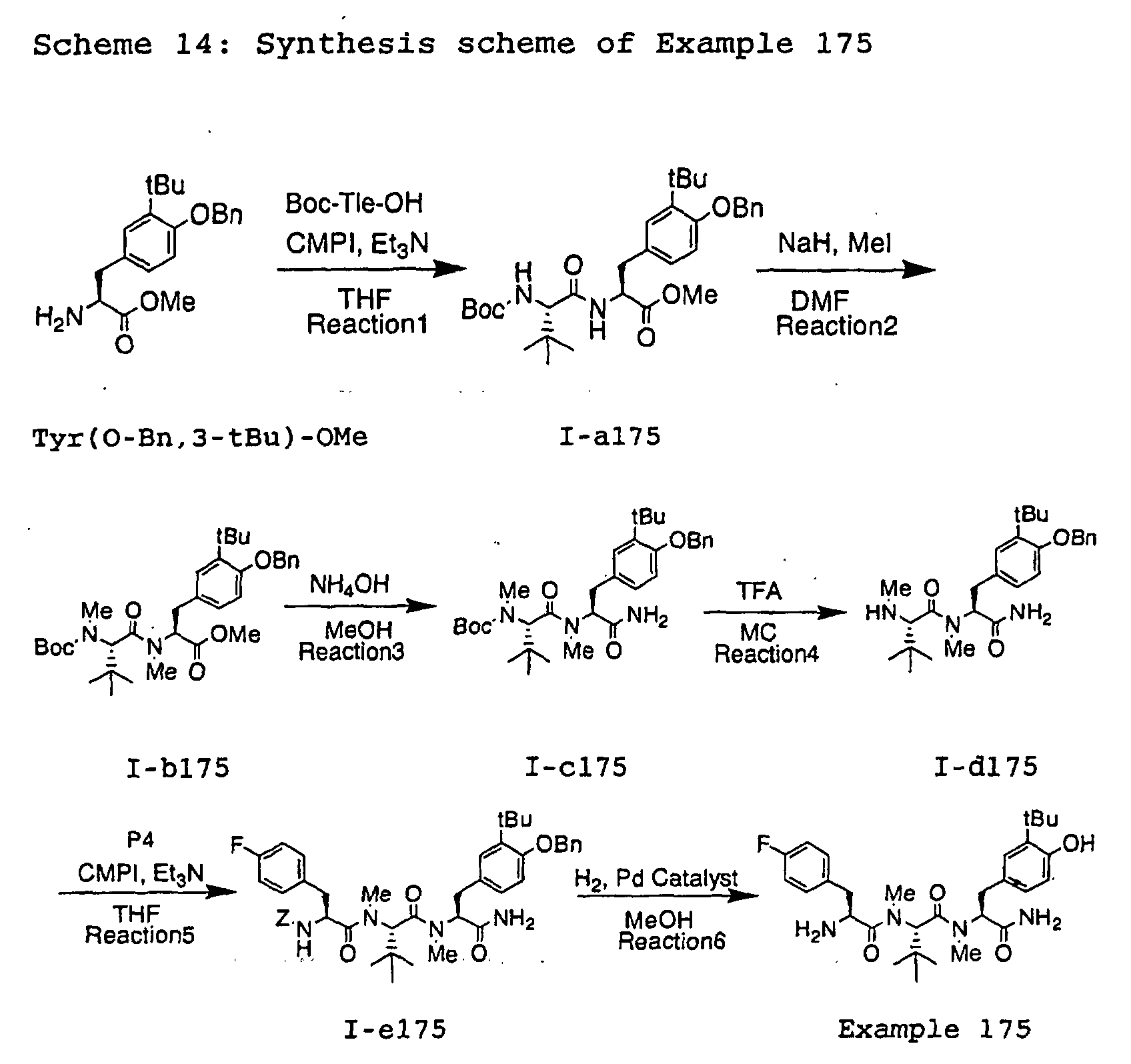
| Example 175 | ||||||||
| Phe(4-F)-N-Me-Tle-N-Me-Tyr(3-tBu)-NH2 | ||||||||
| Reaction1 | ||||||||
| Tyr(O-Bn,3-tBu)-OMe (g) | Boc-Tle-OH (g) | CMPI (g) | TEA (ml) | THF (ml) | Reaction time (hr) | Column sol. | Product | Amount (g) |
| 1.720 | 1.280 | 1.410 | 1.40 | 34.00 | 12 | nHx:EA=5:1 | I-a175 | 2.200 |
| Reaction2 | ||||||||
| Compound I-a175 (g) | NaH (g) | Methyl Iodide(ml) | DMF (ml) | Reaction time (hr) | Column sol. | Product | Amount (g) | |
| 2.200 | 0.480 | 2.22 | 22.00 | 1 | nHx:EA=5:1 | I-b175 | 1.930 | |
| Reaction3 | ||||||||
| Compound I-b175 (g) | NH4OH (ml) | MeOH (ml) | Reaction time (hr) | Column sol. | Product | Amount (g) | ||
| 1.930 | 130.00 | 230.00 | 20 | nHx:EA=2:1 | I-c175 | 0.564 | ||
| Reaction4 | ||||||||
| Compound I-c175(g) | TFA (ml) | MC (ml) | Reaction time (hr) | Column sol. | Product | Amount (g) | ||
| 0.680 | 2.78 | 8.00 | 1.5 | MCMeOH =20:1 | I-d175 | 0.500 | ||
| Reaction5 | ||||||||
| Compound I-d175 (g) | Compound P1(g) (g) | CMPI (g) | TEA (ml) | THF (ml) | Reaction time (hr) | Column sol. | Product | Amount (g) |
| 0.500 | 0.951 | 0.546 | 0.50 | 12.50 | 12 | nHx:EA=2:1 | I-d175 | 0.254 |
| Reaction6 | ||||||||
| Compound I-d175 (g) | Pd(OH)2 (g) | MeOH (ml) | Reaction time (hr) | Column sol. | Amount (g) | HPLC min | ||
| 0.250 | 0.050 | 10.00 | 3 | MCMeOH=15:1 | 0.098 | 19.280 | ||
| ESI-MS(M++1):543 | ||||||||
| 1H-NMR(CDCl3): δ 0.80(9H, s), 1.37(9H, s), 268(1H, dd, J=13.6, 7.3Hz), 2.85-3.01(2H, m), 292(3H, s), 2.98(3H, s), 3.11-3.22(1H, m), 3.94(1H, t, J=7.0Hz), 5.19(1H, s), 5.22(1H, brs), 5.37(1H, dd, J=10.5, 5.6Hz), 5.98(1H, brs), 6.55(1H, d, J=7.9Hz),6.88(1H, dd, J=8.0, 2.2Hz),6.94-7.00(2H, m),7.07-7.14(3H, m) |
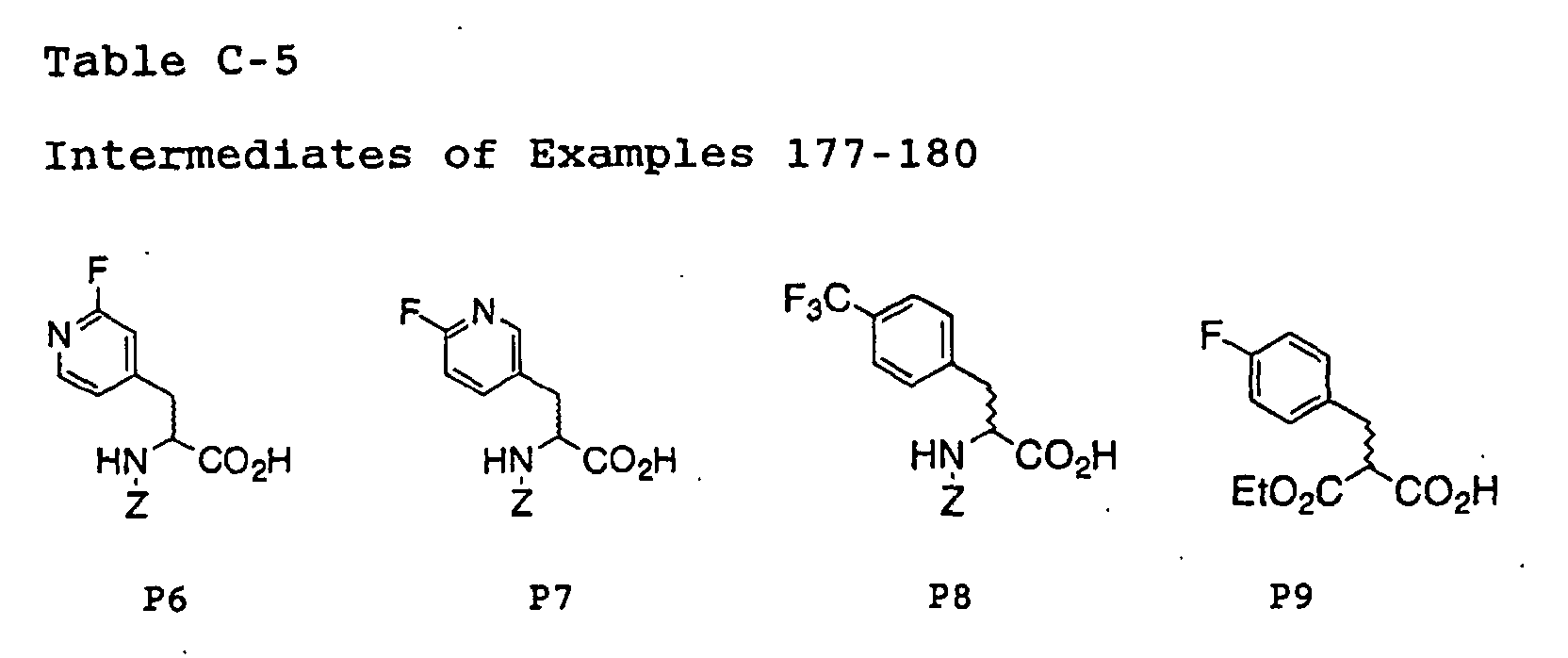

| Intermediate P6 | |||||||
| 3-(2-fluoro-4-pyridyl)-2-[(phenylmethoxy)carbonylamino]propanoic acid | |||||||
| Reaction1-a | |||||||
| Gly-OEtHCl(g) | K2CO3 (g) | Methyl ioide(ml) | CS2 (ml) | THF/H2O (ml) | Reaction time (hr) | Product | Amount (g) |
| 20.000 | 19.890 | 8.96 | 8.66 | 60.00/14.00 | 1 | Crude intermediate | 27.061 |
| Reaction1-b | |||||||
| Crude intermediate (g) | K2CO3 (g) | Methyl iodide (ml) | DMSO/H2O (ml) | Reaction time (hr) | Column sol. | Product | Amount (g) |
| 12.000 | 8.590 | 3.90 | 60.00/ 14.00 | 0.5 | nHx:EA =5:1 | I-a177-I | 11.7000 |
| Reaction2 | |||||||
| I-a177-I (g) | 2-fluoro-4-(iodomethyl) pyridine(ml) | tBuOK (g) | THF (ml) | Reaction time (hr) | Column sol. | Product | Amount (g) |
| 2.000 | 2.520 | 1.190 | 32.00 | 2.50 | nHx:EA =7:1 | I-b177-I | 2.480 |
| Reaction3 | |||||||
| I-b177-I (g) | HCl(sat'd in EtOH) (ml) | EtOH/H2O (ml) | Dioxane (ml) | Reaction time (hr) | Product | Amount (g) | |
| 2.480 | 11.50 | 11.50/ 11.50 | 6 | 16 | I-c177-J | 1.33 | |
| Reaction4 | |||||||
| I-c177-1(g) | ZCl (ml) | Na2CO3 (g) | Dioxane/H2O (ml) | Reaction time (hr) | Product | Amount (g) | |
| 1.330 | 0.99 | 1.000 | 18.00/18.00 | 2 | I-d177-I | 1.36 | |
| Reaction5 | |||||||
| I-d177-1(g) | NaOH (g) | EtOH/H2O (ml) | Reaction time (hr) | Amount (g) | |||
| 1.330 | 0.314 | 30.00/10.00 | 1.500 | 1.200 |
| Intermediate P7 | |||||||
| 3-(2-fluoro-5-pyridyl)-2-[(phenylmethoxy)carbonylamino]propanoic acid | |||||||
| Reaction1-a | |||||||
| Gly-OEt HCl(g) | K2CO3 (g) | Methyl iodide(ml) | CS2 (ml) | THF/H2O (ml) | Reaction time (hr) | Product | Amount (g) |
| 20.000 | 19.890 | 8.96 | 8.66 | 60.00/14.00 | 1 | Crude intermediate | 27.061 |
| Reaction1-b | |||||||
| Crude intermediate(g) | K2CO3 (g) | Methyl iodide(ml) | DMSO/H2O (ml) | Reaction time (hr) | Column sol. | Product | Amount (g) |
| 12.000 | 8.590 | 3.90 | 60.00/14.00 | 0.5 | nHx:EA =5:1 | I-a178-1 | 11.7000 |
| Reaction2 | |||||||
| I-a178-I (g) | 2-fluoro-5-(iodomethyl) pyridine(ml) | IBuOK (g) | THF (ml) | Reaction time (hr) | Column sol. | Product | Amount (g) |
| 3.990 | 8.37 | 2.380 | 60.00 | 3.00 | nHx:EA | I-b178-1 | 4.300 |
| Reaction3 | |||||||
| I-b178-I (g) | HCl (sat'd in EtOH)(ml) | EtOH/H2O (ml) | Dioxane (ml) | Reaction time (hr) | Product | Amount (g) | |
| 4.300 | 20.00 | 12.00/12.00 | 10.00 | 16 | I-c178-I | 1.880 | |
| Reaction4 | |||||||
| I-c178-I (g) | ZCl (ml) | Na2CO3 (g) | Dioxane/ H2O (ml) | Reaction time (hr) | Product | Amount (g) | |
| 1.880 | 1.40 | 1.410 | 25.00/25.00 | 2 | I-d178-I | 2.940 | |
| Reaction5 | |||||||
| I-d178-I (g) | NaOH (g) | EtOH/H2O (ml) | Reaction time (hr) | Amount (g) | |||
| 2.620 | 0.606 | 40.00/10.00 | 1.500 | 2.400 |
| Intermediate P8 | |||||||
| 2-[(Phenylmethoxy)carbonylamino]-3-[4-(trifluoromethyl)phenyl]propanoic acid | |||||||
| Reactionl-a | |||||||
| Gly-OEt-HCl(g) | K2CO3 (g) | Methyl iodide (ml) | CS2 (ml) | THF/H2O (ml) | Reaction time (hr) | Product | Amount (g) |
| 20.000 | 19.890 | 8.96 | 8.66 | 60.00/14.00 | 1 | Crude intermediate | 27.061 |
| Reaction1-b | |||||||
| Crude intermediate(g) | K2CO3 (g) | Methyl iodide(ml) | DMSO/H2O (ml) | Reaction time (hr) | Column sol. | Product | Amount (g) |
| 12.000 | 8.590 | 3.90 | 60.00/ 14.00 | 0.5 | nHx:EA =5:1 | I-a179-1 | 11.700 |
| Reaction2 | |||||||
| I-a179-I(g) | 4-(iodomethyl)-1-(trifluoro methyl)benzene (ml) | tBuOK (g) | THF (ml) | Reaction tine (hr) | Column sol. | Product | Amount (g) |
| 2.120 | 3.220 | 1.270 | 40.00 | 2 | nHx:EA =7:1 | I-b179-I | 3.730 |
| Reaction3 | |||||||
| I-b179-I(g) | HCl (sat'd in EtOH)(ml) | EtOH/H2O (ml) | Dioxane (ml) | Reaction time (hr) | Product | Amount (g) | |
| 1.620 | 6.50 | 6.50/6.50 | 3.00 | 16 | I-c179-I | 0.737 | |
| Reaction4 | |||||||
| I-c179-I (g) | ZCl (ml) | Na2CO3 (g) | Dioxane/ H2O (ml) | Reaction time (hr) | Product | Amount (g) | |
| 0.737 | 0.45 | 0.450 | 9.00/9.00 | 1 | I-d179-I | 1.090 | |
| Reaction5 | |||||||
| I-d177-I (g) | NaOH (g) | EtOH/H2O (ml) | Reaction time (hr) | Amount (g) | |||
| 1.090 | 0.186 | 9.00/9.00 | 1.5 | 1.010 |
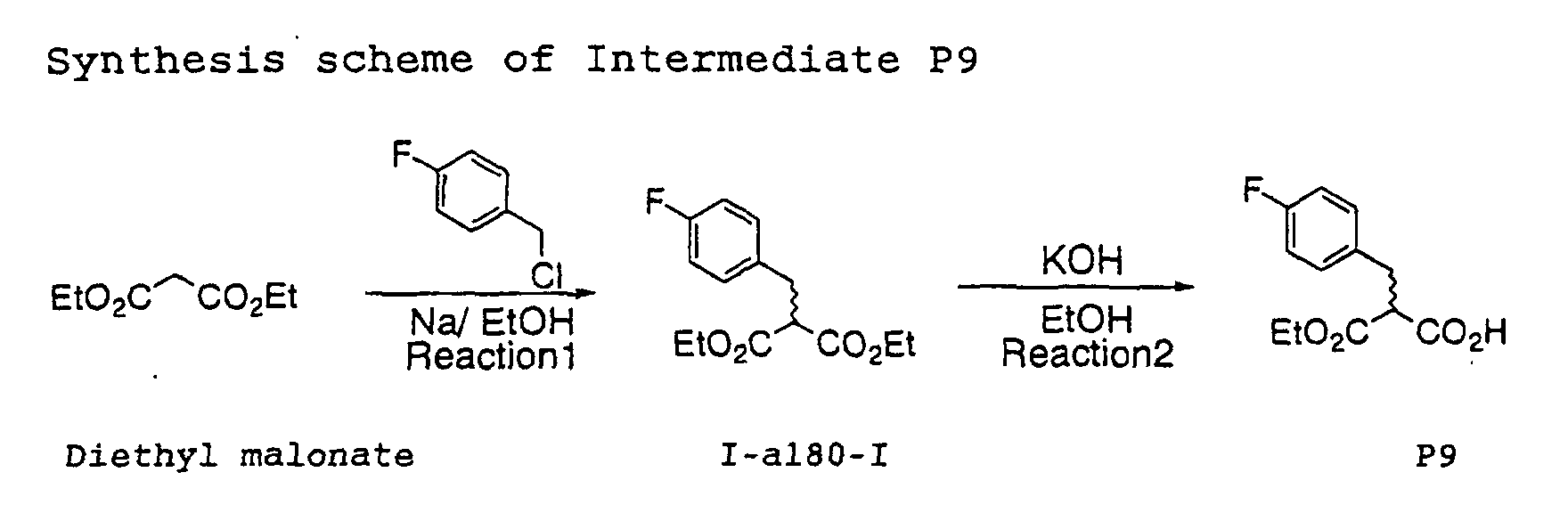
| Intermediate P9 | |||||
| 2-(Ethoxycarbonyl)-3-(4-fluorophenyl)propanoic acid | |||||
| Reaction1 | |||||
| Diethyl malonate (g) | 4-(chloromethyl)-1-fluorobenzene (ml) | Na-metal (g) | EtOH (ml) | Product | Amount (g) |
| 15.000 | 10.90 | 2.180 | 120.00 | I-a180-I | 25.000 |
| Reaction2 | |||||
| I-a180-I (g) | KOH (g) | EtOH (ml) | Amount (g) | ||
| 2.160 | 5.170 | 160.00 | 1.400 |
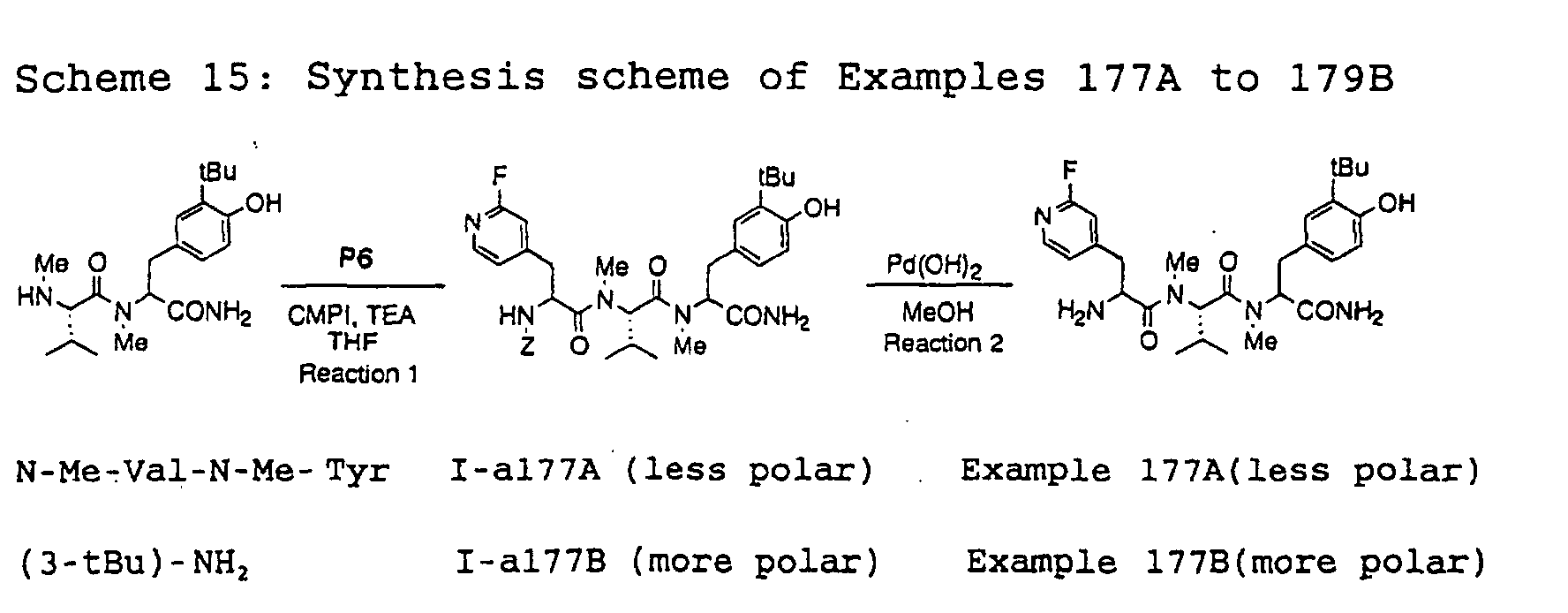
| Example 177A:Less polar | ||||||||
| (2S)-N-{(1S)-2-[3-(tert-butyl)-4-hydroxyphenyl]-1-carbamoyl ethyl}-2-[2-amino-3-(2-fluoro-4-pyridyl)-N-methylpropanoyla mino]-3-methyl-N-methylbutanamide | ||||||||
| Reaction1 | ||||||||
| N-Me-Val-N-Me-Tyr(3-tBu)-NH2 (g) | Compound P6(g) | CMPI (g) | TEA (ml) | THF (ml) | Reaction time (hr) | Column sol. | Product | Amount (g) |
| 0.776 | 0.886 | 0.711 | 0.45 | 30.00 | 16 | nHx:EA=1:1 | I-a177A | 0.275 |
| I-a177B | 0.288 | |||||||
| Reaction2 | ||||||||
| Compound I-a177A(g) | Pd(OH)2 (g) | MeOH (ml) | Reaction time (hr) | Column sol. | Amount (g) | HPLC min | ||
| 0.275 | 0.042 | 20.00 | 3 | MC:MeOH =20:1 | 0.160 | 17.50 | ||
| ESI-MS(M++1):530 | ||||||||
| 1H-NMR(CDCl3): (two rotamers) δ 0.32, 0.42 and 0.60, 0.88(6H, d, J=7.1-7.9Hz), 1.37 and 1.42(9H, s), 2.00-2.20(1H, m), 2.52 and 2.91, 2.95(6H, s), 2.60-3.28(4H, m), 2.95(3H, s), 3.75(1/2H, dd, J=8.8, 6.1Hz), 3.95(1/2H, t, J=8.8Hz), 4.65 and 5.00(1H, d, J=8.8Hz), 4.96 and 5.47(1H, dd, J=8.8, 7.0Hz), 5.60 and 6.05(1H, brs), 6.60 and 6.15(1H, d, J=8.8Hz), 6.70 and 7.04(2H, m), 6.92 and 7.12(2H, m), 8.12(1H, m) |
| Example 177B: more polar | ||||||
| (2S)-N-{(1S)-2-[3-(tert-butyl)-4-hydroxyphenyl]-1-carbamoy lethyl}-2-[2-amino-3-(2-fluoro-4-pyridyl)-N-methylpropanoyl amino]-3-methyl-N-methylbutanamide | ||||||
| Reaction2 | ||||||
| Compound I-a177B(g) | Pd(OH)2 (g) | MeOH (ml) | Reaction time (hr) | Column sol. | Amount (g) | HPLC min |
| 0.288 | 0.043 | 20.00 | 3 | MC:MeOH =20:1 | 0.160 | 15.48 |
| ESI-MS(M++1):530 | ||||||
| 1H-NMR(CDCl3): (two rotamers) δ 0.46, 0.72 and 0.78, 0.91(6H, d, J=7.1-7.9Hz), 1.32 and 1.38(9H, s), 2.15-2.40(1H, m), 2.50, 2.83, and 3.0, 3.08(6H, s), 2.40-3.40(5H, m), 3.70 and 3.90(1H, dd, J=8.8, 3.5-4.4Hz), 4.81 and 5.05(1H, d, J=9.7Hz), 4.99 and 5.52(2H, m), 6.05 and 6.49(1H, brs), 6.48 and 6.64(1H, d, J=7.9Hz), 6.74 and 6.76, 6.82(2H, brs), 6.90-7.18(2H, m), 8.12(1H, d, J=6.2Hz) |
| Example 178A:less polar | ||||||||
| (2S)-N-{(1S)-2-[3-(tert-butyl)-4-hydroxyphenyl]-1-carbamoy lethyl}-2-[2-amino-3-(2-fluoro-5-pyridyl)-N-methylpropanoyl amino]-3-methyl-N-methylbutanamide | ||||||||
| Reaction1 | ||||||||
| N-Me-Val-N-Me-Tyr(3-tBu)-NH2(g) | Compound P7(g) | CMPI (g) | TEA (ml) | THF (ml) | Reaction time (hr) | Column sol. | Product | Amount (g) |
| 1.000 | 1.140 | 0.917 | 0.58 | 20.00 | 3 | mHx:EA=1:1 | I-a178A | 0.380 |
| I-a178B | 0.100 | |||||||
| Reaction2 | ||||||||
| Compound I-a178A(g) | Pd(OH)2 (g) | MeOH (ml) | Reaction time (hr) | Column sol. | Amount (g) | HPLC min | ||
| 0.380 | 0.057 | 10.00 | 3 | MC:MeOH =20:1 | 0.210 | 17.76 | ||
| ESI-MS(M++1):530 | ||||||||
| 1H-NMR(CDCl3): (two rotamers) δ 0.32, 0.42 and 0.60, 0.89(6H, d, J=7.1-7.9Hz), 137 and 1.42(9H, s), 2.00-2.30(1H, m), 2.50,2.90 and 2.94, 2.95(6H, s), 2.58-3.29(4H, m), 3.70(1/2H, dd, J=8.8, 6.1Hz), 3.90(1/2H, t, J=8.8Hz), 4.67 and 5.04(1H, d, J=8.8Hz), 4.95 and 5.47(1H, dd, J=8.8, 7.0Hz), 5.70(1H, brs), 6.05 and 6.55(1H, brs), 6.58 and 6.65(1H, d, J=8.8Hz), 6.75-6.99(2H, m), 7.10 and 7.18(1H, brs), 7.58-7.75(1H, m), 8.12(1H, m) |
| Example 178B: more polar | ||||||
| (2S)-N-{(1S)-2-[3-(tert-butyl)-4-hydroxyphenyl]-1-carbamoy lethyl}-2-[2-amino-3-(2-fluoro-5-pyridyl)-N-methylpropanoyl amino]-3-methyl-N-methylbutanamide | ||||||
| Reaction2 | ||||||
| Compound I-a178B(g) | Pd(OH)2 (g) | MeOH (ml) | Reaction time (hr) | Column sol. | Amount (g) | HPLC min |
| 0.100 | 0.015 | 5.00 | 3 | MC:MeOH =20:1 | 0.040 | 15.65 |
| ESI-MS(M++1):530 | ||||||
| 1H-NMR(CDCl3): (two rotamers) δ 0.50, 0.75 and 0.77, 0.95(6H, d, J=7.1-7.9Hz), 1.32 and 1.39(9H, s), 2.00-2.30(1H, m), 2.47, 2.83 and 3.0, 3.05(6H, s), 2.18-3.42(4H, m), 3.61 and 3.82(1H, dd, J=8.8, 3.5-4.0Hz), 4.85 and 5.07(1H, d, J=9.7Hz), 5.57 and 5.70, 5.79, 6.11(2H, m and brs), 6.55 and 6.65(1H, d, J=7.9-8.8Hz), 6.73, 6.88 and 6.97(2H, m), 7.13(1H, brs), 7.60-7.75(1H, m), 7.97 and 8.05(1H, brs) |
| Example 179A:less polar | ||||||||
| (2S)-N-{(1S)-2-[3-(tert-butyl)-4-hydroxyphenyl]-1-carbamoy lethyl}-2-{2-amino-N-methyl-3-[4-(trifluoromethyl)phenyl]pr opanoylamino)-3-methyl-N-methylbutanamide | ||||||||
| Reaction1 | ||||||||
| N-Me-Val-N-Me-Tyr(3-tBu)-NH2(g) | Compound P8(g) | CMPI (g) | TEA (ml) | THF (ml) | Reaction time (hr) | Column sol. | Product | Amount (g) |
| 0.513 | 0.626 | 0.435 | 0.3 | 30.00 | 3 | nHx:EA= 1:1 | I-a179A | 0.330 |
| I-a179B | 0.332 | |||||||
| Reaction2 | ||||||||
| Compound I-a179A(g) | Pd(OH)2 (g) | MeOH (ml) | Reaction time (hr) | Column sol. | Amount (g) | HPLC min | ||
| 0.330 | 0.049 | 10.00 | 3 | MC:MeOH =20:1 | 0.136 | 19.89 | ||
| ESI-MS(M++1):579 | ||||||||
| 1H-NMR(CDCl3): (two rotamers) δ 0.49, 0.74 and 0.79, 0.93(6H, d, J=6.3-6.8Hz), 1.34 and 1.39(9H, s), 2.25-2.48(1H, m), 2.53, 2.79 and 3.01, 3.05(6H, s), 2.58-3.40(4H, m), 3.74 and 3.90(1H, m), 4.87 and 5.07(1H, d, J=10.5-10.9Hz), 5.38-5.10(2H, m), 6.20(2/3H, brs), 6.40 and 6.65(1H, d, J=7.9Hz), 6.58(1/3H, brs), 6.73 and 6.97(1H, d, J=7.9-8.4Hz), 7.12(1H, m), 7.27-7.30(2H, m), 7.55-7.60(2H,m) |
| Example 179B: more polar | ||||||
| (2S)-N-{(1S)-2-[3-(tert-butyl)-4-hydroxyphenyl]-1-carbamoy lethyl}-2-{2-amino-N-methyl-3-[4-(trifluoromethyl)phenyl]pr opanoylamino}-3-methyl-N-methylbutanamide | ||||||
| Reaction2 | ||||||
| Compound I-a179B(g) | Pd(OH2 (g) | MeOH (ml) | Reaction time (hr) | Column sol. | Amount (g) | HPLC min |
| 0.332 | 0.049 | 10.00 | 3 | MC:MeOH =20:1 | 0.123 | 22.09 |
| ESI-MS(M++1):579 | ||||||
| 1H-NMR(CDCl3): (two rotamers) δ 0.33, 0.36 and 0.55, 0.87(6H, d, J=6.4-6.9Hz), 1.37 and 1.41(9H, s), 2.00-2.20(1H, m), 2.56, 2.92 and 2.98(6H, s), 2.60-3.21(4H, m), 3.77 and 3.96(1H, m), 4.67 and 5.02(1H, d, J=10.6-10.9Hz), 4.96 and 5.45(1H, dd, J=9.0-11.3, 3.4-6.0Hz), 5.67 and 6.04(1H, brs), 6.57 and 6.63(1H, d, J=7.9Hz), 6.74 and 6.94(1H, dd, J=8.0-9.8, 1.8-2.1Hz), 7.08 and 7.16(1H, d, J=1.9Hz), 7.27-7.37(2H, m), 7.52-7.60(2H, m) |
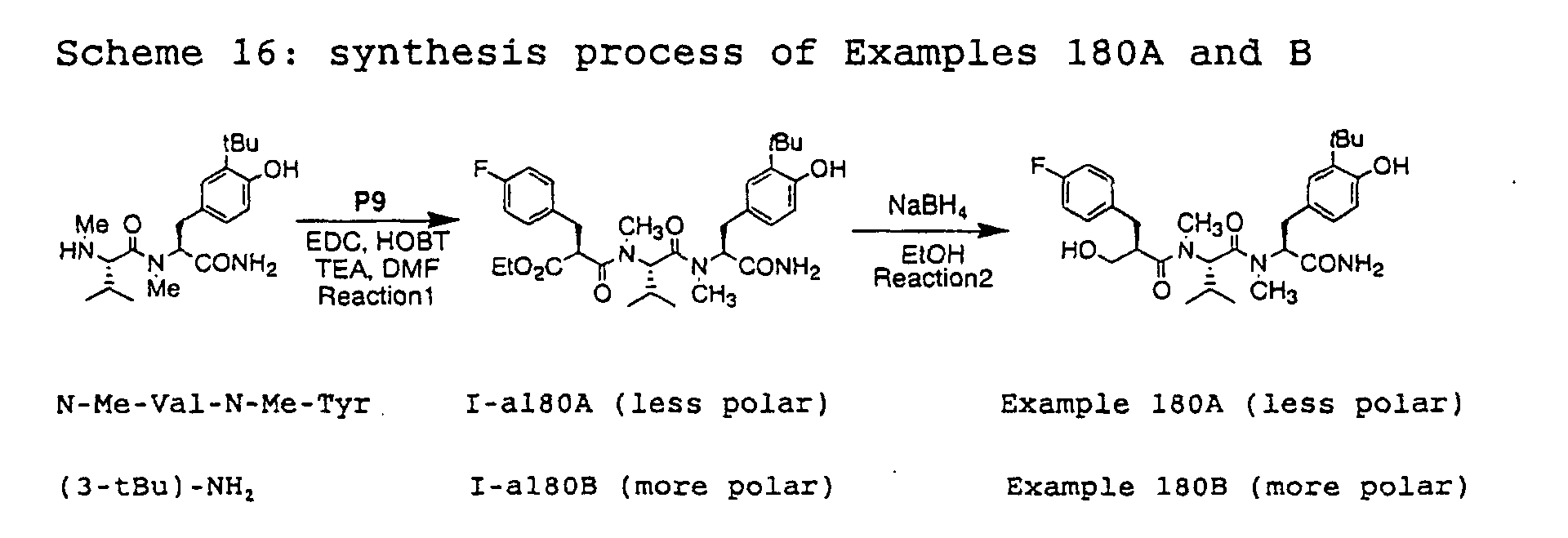
Tables D-180A and B show Examples conducted according to Scheme 16.
| Example 180A: Less polar | |||||||||
| (2S)-N-{(1S)-2-[3-(tert-butyl)-4-hydroxyphenyl]-1-carbamoy lethyl}-2-{2-[(4-fluorophenyl)methyl]-3-hydroxy-N-methylpro panoylamino}-3-methyl-N-methylbutanamide | |||||||||
| Reaction1 | |||||||||
| N-Me-Val-N-Me-Tyr(3-tBu)-NH2 | Compound P9(g) | EDCI (g) | HOBT (g) | TEA (ml) | THF (ml) | Reaction time (hr) | Column sol. | Product (g) | Amount (g) |
| 1.500 | 1.29 | 1.030 | 0.824 | 1.08 | 30.00 | 2.5 | (g) nHx:EA=1:1 | I-a180A | 0.700 |
| I-a180B | 0.820 | ||||||||
| Reaction2 | |||||||||
| Compound I-a180A(g) | NaBH4 (g) | EtOH (ml) | Reaction time (hr) | Column sol. | Amount (g) | HPLC min | |||
| 0.700 | 0.490 | 30.00 | 3 | MC:MeOH=20:1 | 0.17 | 21.83 | |||
| ESI-MS(M++1):544 | |||||||||
| 1H-NMR(CDCl3):(two rotamers) δ 0.48, 0.74 and 0.76, 0.92(6H, d, J=6.0-7.2Hz), 1.35 and 1.39(9H, s), 2.05-2.50(1H, m), 2.50, 2.80 and 2.98, 3.01(6H, s), 2.40-3.36(5H, m), 3.50-3.70(2H, m), 3.50-3.70(2H, m), 4.90 and 5.08(1H, d, J=10.6Hz), 5.45(1H, m), 5.50 and 6.05(1H, brs), 5.70 and 6.20(1H, brs), 6.44 and 6.64(1H, d, J=8.8-8.3Hz), 6.73-7.15(7H, m) |
| Example 180B: more polar | ||||||
| (2S)-N-{(1S)-2-(3-(tert-butyl)-4-hydroxyphenyl]-1-carbamoy lethyl}-2-{2-[(4-fluorophenyl)methyl ] - 3 -hydroxy-N-methylpro panoylamino}-3-methyl-N-methylbutanamide | ||||||
| Reaction2 | ||||||
| Compound I-a180B(g) | NaBH4 (g) | EtOH (ml) | Reaction time (hr) | Column sol. | Amount (g) | HPLC min |
| 0.820 | 0.492 | 30.00 | 3 | MC:MeOH =20:1 | 0.060 | 23.95 |
| ESI-MS(M++1):544 | ||||||
| 1H-NMR(CDCl3): (two rotamers) δ 0.17-0.20 and 0.44, 0.84(6H, m and d, J=6.5-6.7Hz), 1.36 and 1.40(9H, s), 2.00-2.20(1H, m), 2.41 and 2.90, 2.92(6H, s), 2.67-4.00(13H, m),4.73 and 5.00(1H, d, J=10.5Hz), 5.20 and 5.35(1H, m), 5.83 and 6.18(1H, brs), 6.38 and 6.51(1H, brs), 6.62 and 6.65(1H, d, J=7.9Hz), 6.75-7.20(8H, m) |
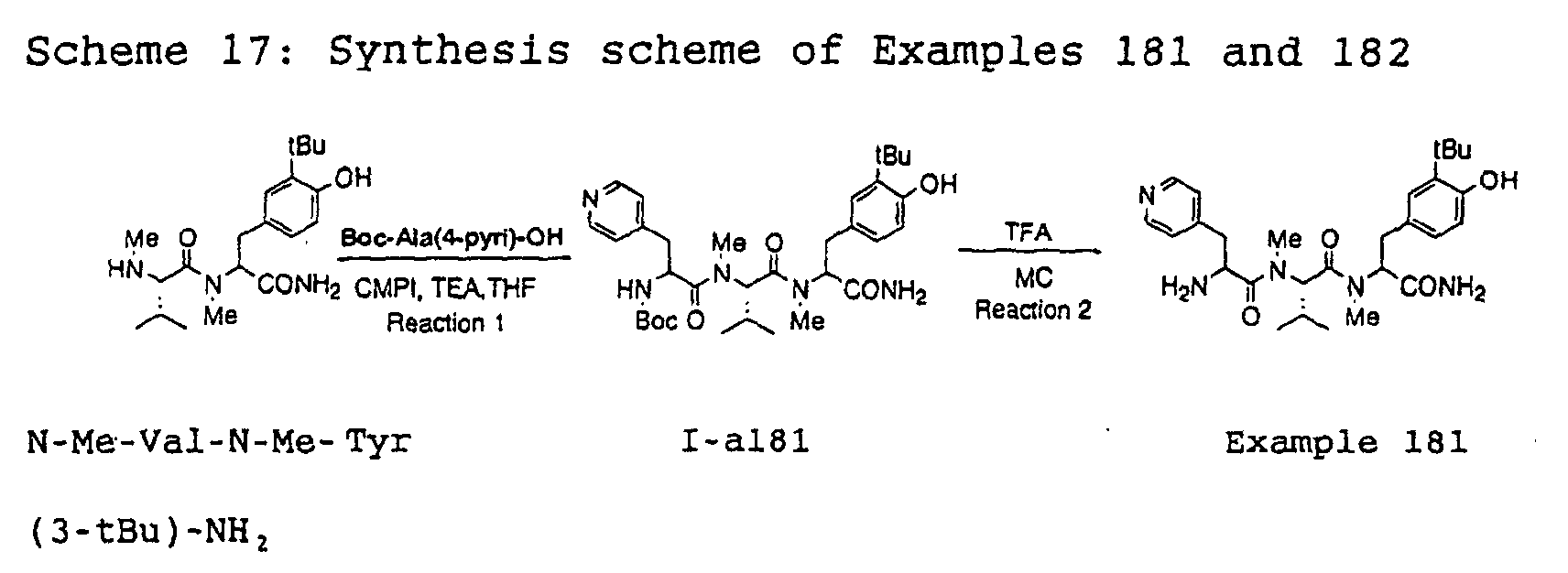
| Example 181 | ||||||||
| Ala(β-4-pyridyl)-N-Me-Val-N-Me-Tyr(3-tBu)-NH2 | ||||||||
| Reaction1 | ||||||||
| N-Me-Val-N-Me-Tyr(3-tBu)-NH2(g) | Boc-Ala(beta-4-pyridyl)-OH(g) | CMPI (g) | TEA (ml) | THF (ml) | Reaction time (hr) | Column sol. | Product | Amount (g) |
| 0.680 | 0.500 | 0.960 | 0.52 | 15.00 | 24 | MC:MeOH =30:1 | I-a181 | 0.800 |
| Reaction2 | ||||||||
| Compound I-a181(g) | TFA | MC (ml) | Reaction time (hr) | Column sol. | Amount (g) | HPLC min | ||
| 0.800 | 4.00 | 20.00 | 3 | MC:MeOH=20:1 | 0.450 | 13.30 | ||
| ESI-MS(M++1):512 | ||||||||
| 1H-NMR(CDCl3): (two rotamers δ 0.40, 0.72 and 0.82, 0.96(6H, d, J=6.3-6.7Hz), 1.37 and 1.42(9H, s), 2.05-2.30(1H, m), 251, 289 and 294,296(6H, s), 2.59-3.30(4H, m), 4.65-5.05(1H, m), 5.30(1H, s), 5.45-5.05(1H, m), 6.30-6.45(1H, m), 6.60-7.05(2H, m), 7.10-7.20(2H, m), 8.20-8.25(2H, m) |
| Example 182 | ||||||||
| Phe(4-CN)-N-Me-Val-N-Me-Tyr(3-tBu)-NH2 | ||||||||
| Reaction1 | ||||||||
| N-Me-Val-N-Me-Tyr(3-tBu)-NH2(g) | Boc-Phe(4-CN)-OH(g) | CMPI (g) | TEA (m) | THF (m) | Reaction time (hr) | Column sol. | Product | Amount (g) |
| 0.620 | 0.500 | 0.660 | 0.48 | 15.00 | 24 | MCMeOH =30:1 | I-a182 | 0.900 |
| Reaction2 | ||||||||
| Compound I-a182(g) | TFA | MC (ml) | Reaction time (hr) | Column sol. | Amount (g) | HPLC min | ||
| 0.900 | 4.00 | 20.00 | 4 | MC:MeOH =20:1 | 0.520 | 16.82. | ||
| ESI-MS(M++1):536 | ||||||||
| 1H-NMR(CDCl3):(two rotamers)δ 0.48, 0.76 and 0.85, 0.94(6H, d, J=6.3-6.8Hz), 1.37 and 1.43(9H, s), 2.20-2.70(1H, m), 2.55, 285 and 2.95, 3.05(6H,s), 3.15-3.40(2H,m), 3.65-3.85(2H,m), 4.75-5.20(2Hm), 5.40-5.50(1H,m), 6.40-6.65(1H,m), 6.75-6.85(1H, m), 6.95-7.15(1H,m), 7.25-7.35(2H,m), 7.58-7.63(2H,m) |
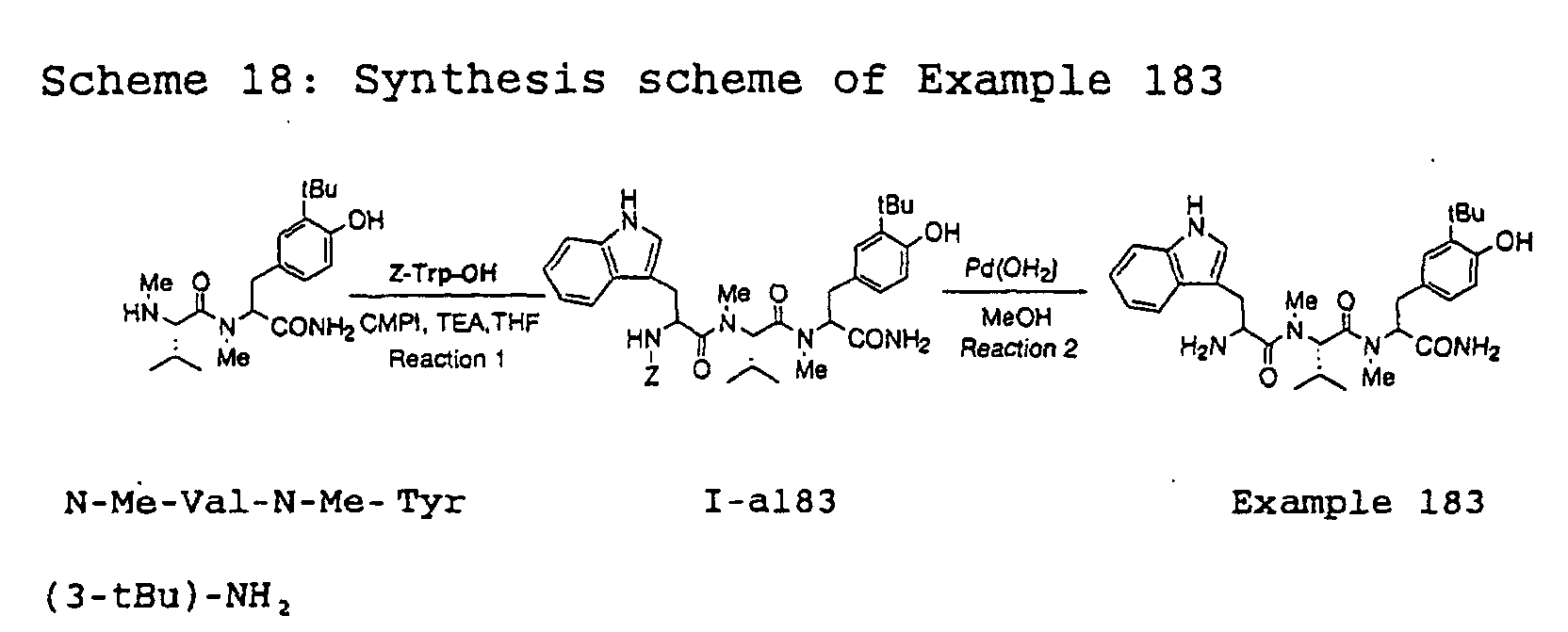
| Example 183 | ||||||||
| Trp-N-Me-Val-N-Me-Tyr(3-tBu)-NH2 | ||||||||
| Reaction1 | ||||||||
| N-Me-Val-N-Me-Tyr(3-tBu)-NH2(g) | Z-Trp-OH(g) | CMPI (g) | TEA (ml) | THF (ml) | Reaction time (hr) | Column sol. | Product | Amount (g) |
| 0.620 | 0.700 | 0.660 | 0.48 | 15.00 | 24 | MC:MeOH =30:1 | I-a183 | 0.700 |
| Reaction2 | ||||||||
| Compound I-a183(g) | Pd(OH)2 | MeOH (ml) | Reaction time (hr) | Column sol. | Amount (g) | HPLC min | ||
| 0.700 | 0.100 | 20.00 | 24 | MC:MeOH =20:1 | 0.380 | 18.14 | ||
| ESI-MS(M++1):550 | ||||||||
| 1H-NMR(CDCl3): (two rotamers) δ 0.39, 0.73 and 0.79, 0.93(6H, d, J=6.3-6.7Hz), 1.33 and 1.39(9H,s), 2.15-2.35(2H, m), 2.37,2.75 and 2.95, 3.05(6H,s), 2.60-3.15(2H, m), 3.25-3.40(2H m), 3.80-4.05(1H, m), 4.70-5,10(1H, m), 6.30-6.55(1H, m), 6.65-7.20(5H, m), 7.40-7.60(2H, m) |
| Example No. | Motilin receptor binding test, IC50 (nM) | Contraction suppressing test, pA2 |
| 1 | 0.89 | 8.8 |
| 2 | 0.71 | 8.7 |
| 3 | 1.5 | 8.7 |
| 4 | 1.6 | 8.3 |
| 8 | 0.35 | 9.5 |
| 9 | 1.0 | 9.0 |
| 12 | 0.52 | 9.3 |
| 14 | 0.70 | 9.3 |
| 15 | 0.82 | 8.5 |
| 16 | 0.41 | 9.4 |
| 17 | 0.70 | 9.1 |
| 19 | 2.2 | 8.7 |
| 21 | 0.27 | 9.8 |
| 22 | 0.52 | 8.3 |
| 23 | 0.67 | 9.3 |
| 24 | 0.94 | 9.1 |
| Example No. | Motilin receptor binding test, IC50 (nM) | Contraction suppressing test, pA2 |
| 26 | 7.3 | 8.0 |
| 27 | 1.2 | 8.6 |
| 28 | 0.52 | 9.0 |
| 29 | 0.45 | 8.7 |
| 30 | 0.81 | 9.1 |
| 31 | 0.79 | 9.5 |
| 32 | 0.76 | 9.1 |
| 33 | 1.7 | 8.4 |
| 34 | 1.5 | 9.4 |
| 35 | 1.7 | 8.8 |
| 36 | 2.3 | 8.8 |
| 37 | 0.60 | 8.8 |
| 38 | 3.0 | 8.2 |
| 39 | 2.0 | 8.7 |
| 40 | 1.6 | 8.6 |
| 41 | 3.1 | 8.4 |
| 42 | 1.2 | 8.3 |
| 43 | 1.9 | 8.5 |
| 44 | 3.6 | 8.5 |
| 63 | 0.62 | 8.4 |
| 64 | 1.0 | 9.0 |
| 101 | 0.24 | 8.9 |
| 102 | 0.31 | 9.0 |
| 103 | 0.86 | 8.9 |
| Example No. | Motilin receptor binding test, IC50 (nM) | Contraction suppressing test, pA2 |
| 104 | 0.32 | 9.1 |
| 105 | 0.31 | 9.8 |
| 106 | 0.62 | 9.8 |
| 107 | 0.39 | 8.7 |
| 108 | 0.43 | 9.0 |
| 109 | 0.17 | 8.7 |
| 119 | 0.40 | 9.4 |
| 120 | 0.27 | 9.0 |
| 121 | 0.41 | 8.9 |
| 122 | 0.47 | 9.0 |
| 123 | 0.70 | 9.1 |
| 124 | 0.98 | 9.1 |
| 125 | 1.0 | 9.0 |
| 126 | 1.9 | 9.2 |
| 127 | 1.7 | 8.7 |
| 128 | 1.5 | 8.7 |
| 129 | 4.0 | 8.5 |
| 132 | 0.86 | 8.9 |
| Example No. | Motilin receptor binding test, IC50 (nM) | Contraction suppressing test, pA2 |
| 133 | 1.1 | 8.2 |
| 134 | 1.5 | 8.3 |
| 135 | 0.70 | 8.5 |
| 136 | 6.8 | 7.6 |
| 140 | 4.0 | 8.2 |
| 142 | 0.62 | 8.6 |
| 144 | 2.0 | 8.5 |
| 148 | 4.1 | 8.4 |
| 151 | 0.36 | 8.2 |
| 155 | 2.5 | 8.1 |
| 157 | 6.1 | 8.1 |
| 163 | 2.4 | 7.8 |
| 165 | 2.8 | 8.2 |
| 166 | 1.8 | 9.8 |
| 182 | 2.3 | 8.5 |
| 183 | 0.57 | 9.5 |
Claims (34)
- A compound of Formula (1):wherein:
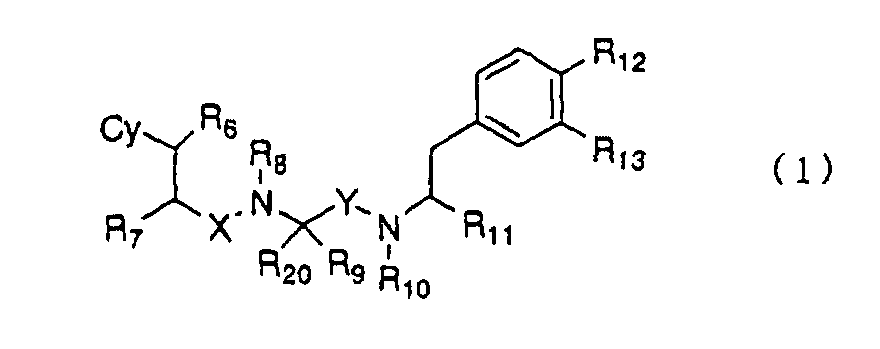 provided thatCy is a group of Formula (2):an optionally substituted heterocyclic ring, C3-7cycloalkyl or phenyl;
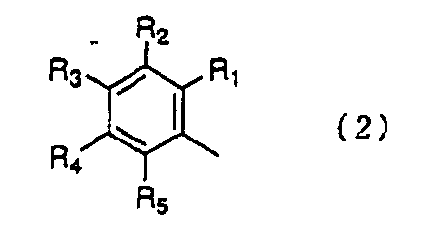 R1, R2, R3, R4 and R5 are hydrogen, halogen, hydroxy, amino, trifluoromethyl or nitrile and at least one of R1, R2, R3, R4 and R5 is halogen, trifluoromethyl or nitrile;R6 is hydrogen, optionally substituted straight-chained or branched C1-3alkyl, amino or hydroxy;R7 is hydrogen, optionally substituted straight-chained or branched C1-3alkyl, optionally substituted amino or hydroxy;R8 is hydrogen, methyl or ethyl;R9 is optionally substituted straight-chained or branched C1-6alkyl, optionally substituted straight-chained or branched C2-6alkenyl, optionally substituted straight-chained or branched C2-6alkynyl, C3-7cycloalkyl or optionally substituted phenyl;R20 is hydrogen or straight-chained or branched C1-3alkyl or R9 and R20 may together form C3-7cycloalkyl;R10 is hydrogen or straight-chained or branched' C1-3alkyl;R11 is hydrogen, optionally substituted straight-chained or branched C1-3alkyl, -CO-N(R14)R15, carboxyl or an optionally substituted heterocyclic ring;R12 is hydroxy or -OR16;R13 is hydrogen, straight-chained or branched, C1-6alkyl, straight-chained or branched C2-6alkenyl, straight-chained or branched C2-6alkynyl or a group of Formula (3):
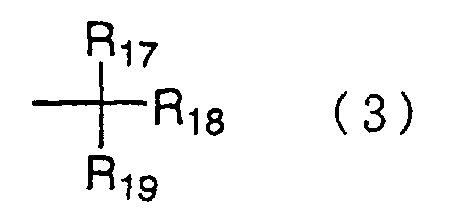 R14 and R15, which may be the same or different, are hydrogen, optionally substituted straight-chained or branched C1-4alkyl, C3-7cycloalkyl, straight-chained or branched C1-4alkyloxy, straight-chained or branched C1-4alkylsulfonyl or a heterocyclic ring, or R14 and R15, as -N(R14)R15, form optionally substituted 3- to 7-membered cyclic amine;R16 is straight-chained C1-4alkyl;R17 is hydrogen or methyl;R18 and R19 together form cycloalkyl or C3-7cycloalkenyl ;X is carbonyl or methylene;Y is carbonyl or methylene;
when Cy is 3-indolyl,when Cy is cyclohexyl or phenyl, R11 is an optionally substituted heterocyclic ring; or a hydrate or pharmaceutically acceptable salt thereof.(i) R11 is an optionally substituted heterocyclic ring; or(ii) R6 is hydrogen, R7 is amino, R8 is methyl, R9 is isopropyl, R20 is hydrogen, R10 is methyl, R11 is carbamoyl, R12 is hydroxy, R13 is tert-butyl, X is carbonyl and Y is carbonyl, and - The compound according to claim 1,
wherein Cy in Formula (1) is a group of Formula (2); or a hydrate or pharmaceutically acceptable salt thereof. - The compound according to claim 1,
wherein Cy in Formula (1) is a group of Formula (2) in which at least one of R1, R2, R3, R4 and R5 is halogen and the others are hydrogen or hydroxy; or a hydrate or pharmaceutically acceptable salt thereof. - The compound according to claim 1,
wherein Cy in Formula (1) is a group of Formula (2) in which R3 is halogen or R2 and R3 are the same kind of halogen; or a hydrate or pharmaceutically acceptable salt thereof. - The compound according to claim 1,
wherein Cy in Formula (1) is a group of Formula (2) in which R3 is halogen and R1, R2, R4 and R5 are hydrogen, or R2 and R3 are the same kind of. halogen and R1, R4 and R5 are hydrogen;
or a hydrate or pharmaceutically acceptable salt thereof. - The compound according to claim 1,
wherein Cy in Formula (1) is a group of Formula (2) in which at least one of R1, R2, R3, R4 and R5 is trifluoromethyl and the others are hydrogen, halogen or hydroxy;
or a hydrate or pharmaceutically acceptable salt thereof. - The compound according to claim 1,
wherein Cy in Formula (1) is a group of Formula (2) in which at least one of R1, R2, R3, R4 and R5 is nitrile and the others are hydrogen, halogen or hydroxy;
or a hydrate or pharmaceutically acceptable salt thereof. - The compound according to claim 1,
wherein Cy in Formula (1) is a group of Formula (2) in which R3 is trifluoromethyl;
or a hydrate or pharmaceutically acceptable salt thereof. - The compound according to claim 1,
wherein Cy in Formula (1) is a group of Formula (2) in which R3 is nitrile;
or a hydrate or pharmaceutically acceptable salt thereof. - The compound according to claim 1,
wherein Cy in Formula (1) is an optionally substituted heterocyclic ring provided that when Cy is 3-indolyl,or a hydrate or pharmaceutically acceptable salt thereof.(i) R11 is an optionally substituted heterocyclic ring; or(ii) R6 is hydrogen, R7 is amino, R8 is methyl, R9 is isopropyl, R20 is hydrogen, R10 is methyl, R11 is carbamoyl, R12 is hydroxy, R13 is tert-butyl, X is carbonyl and Y is carbonyl; - The compound according to claim 1,
wherein in Formula (1), Cy is C3-7cycloalkyl provided that when Cy is cyclohexyl, R11 is an optionally substituted heterocyclic ring;
or a hydrate or pharmaceutically acceptable salt thereof. - The compound according to claim 1,
wherein in Formula (1), Cy is phenyl and R11 is an optionally substituted heterocyclic ring;
or a hydrate or pharmaceutically acceptable salt thereof. - The compound according to any one of claims 1-12,
wherein R6 in Formula (1) is hydrogen or methyl;
or a hydrate or pharmaceutically acceptable salt thereof. - The compound according to any one of claims 1-13,
wherein R7 in Formula (1) is hydrogen or optionally substituted amino;
or a hydrate or pharmaceutically acceptable salt thereof. - The compound according to any one of claims 1-14,
wherein R8 in Formula (1) is hydrogen or methyl;
or a hydrate or pharmaceutically acceptable salt thereof. - The compound according to any one of claims 1-15,
wherein R9 in Formula (1) is methyl, isopropyl, isobutyl, sec-butyl, tert-butyl, 3-pentyl, neopentyl, cyclohexyl, phenyl, benzyl, para-hydroxybenzyl, cyclohexylmethyl or para-fluorobenzyl;
or a hydrate or. pharmaceutically acceptable salt thereof. - The compound according to any one of claims 1-16,
wherein R20 in Formula (1) is hydrogen or methyl;
or a hydrate or pharmaceutically acceptable salt thereof. - The compound according to any one of claims 1-17,
wherein R10 in Formula (1) is hydrogen or methyl;
or a hydrate or pharmaceutically acceptable salt thereof. - The compound according to any one of claims 1-18,
wherein R11 in Formula (1) is methyl, hydroxymethyl, carbamoylmethyl, methanesulfonylmethyl, ureidemethyl, sulfamoylaminomethyl, methanesulfonylaminomethyl, carbamoyl, ethylcarbamoyl, n-propylcarbamoyl, isopropylcarbamoyl, cyclopropylcarbamoyl, tertbutylcarbamoyl, 2-pyridylcarbamoyl, methoxycarbamoyl, 2-thiazolyl, 1,3,4-oxadiazol-2-yl, 1,2,4-oxadiazol-5-yl, 1,3,4-triazol-2-yl, 6-methyl-4-pyrimidinon-2-yl, methylcarbamoyl, methanesulfonylmethylcarbamoyl, methoxymethylcarbamoyl, 1-morpholinylcarbonyl, 4-carboxymethyl-1-piperazinecarbonyl, 4-ethoxycarbonylmethyl-1-piperazinecarbonyl or 4-methylsulfonyl-1-piperazinecarbonyl;
or a hydrate or pharmaceutically acceptable salt thereof. - The compound according to any one of claims 1-19,
wherein R12 in Formula (1) is hydroxy;
or a hydrate or pharmaceutically acceptable salt thereof. - The compound according to any one of claims 1-20,
wherein R13 in Formula (1) is isopropyl, tert-butyl (tBu), 1,1-dimethylpropyl or 1,1-dimethyl-2-propenyl;
or a hydrate or pharmaceutically acceptable salt thereof. - The compound according to claim 1,
wherein in Formula (1)or a hydrate or pharmaceutically acceptable salt thereof.Cy is a group of Formula (2) in which at least one of R1,R2, R3, R4 and R5 is halogen and the others are hydrogen or hydroxy;R6 is hydrogen or methyl;R7 is hydrogen or optionally substituted amino;R8 is hydrogen or methyl;R9 is methyl, isopropyl, isobutyl, sec-butyl, tert-butyl, 3-pentyl, neopentyl, cyclohexyl, phenyl, benzyl, parahydroxybenzyl, para-fluorobenzyl or cyclohexylmethyl;R20 is hydrogen;R10 is hydrogen or methyl;R11 is methyl, hydroxymethyl, carbamoylmethyl, methanesulfonylmethyl, ureidemethyl, sulfamoylaminomethyl, methanesulfonylaminomethyl, carbamoyl, methylcarbamoyl, ethylcarbamoyl, n-propylcarbamoyl, isopropylcarbamoyl, cyclopropylcarbamoyl, tert-butylcarbamoyl, 2-pyridylcarbamoyl, methanesulfonylmethylcarbamoyl, methoxymethylcarbamoyl, methoxycarbamoyl, 1-morpholinylcarbonyl, 4-carboxymethyl-1-piperazinecarbonyl, 4-ethoxycarbonylmethyl-1-piperazinecarbonyl, 4-methylsulfonyl-1-piperazinecarbonyl, 2-thiazolyl, 1,3,4-oxadiazol-2-yl, 1,2,4-oxadiazol-5-yl, 1,3,4-triazol-2-yl or 6-methyl-4-pyrimidinon-2-yl;R12 is hydroxy;R13 is isopropyl, tert-butyl (tBu), 1,1-dimethylpropyl or 1,1-dimethyl-2-propenyl; - The compound according to claim 1 which is selected from the group of compounds consisting of Phe(4-F)-N-Me-Val-N-Me-Tyr(3-tBu)-NH2, Phe(4-Cl)-N-Me-Val-N-Me-Tyr(3-tBu)-NH2, Phe(3,4-F2)-N-Me-Val-N-Me-Tyr(3-tBu)-NH2, Phe(3-F)-N-Me-Val-N-Me-Tyr(3-tBu)-NH2, Phe(4-F)-N-Me-Val-N-Me-Tyr(3-tBu)-NHOMe, 2-((2-amino-3-(4-fluorophenyl)propionyl)-N-methylamino)-3-methylbutyric acid 2-(3-tertbutyl-4-hydroxyphenyl)-1-(2-pyridylcarbamoyl)ethylamide, N-(2-(2-((2-amino-3-(4-fluorophenyl)propionyl)-N-methylamino)-3-methyl-butyrylamino)-3-(3-tBu-4-hydroxyphenyl)propyl)urea, N-(2-(2-(2-amino-3-(4-fluorophenylpropanoyl-N-methylamino)-3-methyl)butyrylamino)-3-(3-tertbutyl-4-hydroxyphenyl)propyl)sulfamide, N-[2-(3-tertbutyl-4-hydroxyphenyl)-1-(methanesulfonylaminomethyl)ethyl]-2-[N-(4-fluorophenylalanyloyl)methylamino]-3-methylbutanamide, 2-((2-amino-3-(4-fluorophenyl)propionyl)-N-methylamino)-3-methylbutyric acid 2-(3-t-butyl-4-hydroxyphenyl)-1-carbamidemethylethylamide, 2-((2-amino-3-(4-fluorophenyl)propionyl)-N-methylamino)-3-methylbutyric acid 2-(3-t-butyl-4-hydroxyphenyl)-1-methanesulfonylmethylethylamide, 2-(2-((2-amino-3-(4-fluorophenyl)propionyl)-N-methylamino)-3-methyl-butyrylamino)-3-(3-tBu-4-hydroxyphenyl)propanol, 2-(1-(2-((2-amino-3-(4-fluorophenyl)propionyl)-N-methylamino)-3-methyl-butyrylamino)-2-(3-tertbutyl-4-hydroxyphenyl)ethyl)-6-methyl-4-pyrimidinone, 2-((2-amino-3-(4-fluorophenyl)propionyl)-N-methylamino)-3-methylbutyric acid 2-(3-t-butyl-4-hydroxyphenyl)-1-(1,3,4-oxadiazol-2-yl)ethylamide, 2-((2-amino-3-(4-fluorophenyl)propionyl)-N-methylamino)-3-methylbutyric acid 2-(3-t-butyl-4-hydroxyphenyl)-1-(1,2,4-oxadiazol-5-yl)ethylamide, 2-((2-amino-3-(4-fluorophenyl)propionyl)-N-methylamino)-3-methylbutyric acid 2-(3-tertbutyl-4-hydroxyphenyl)-1-(thiazol-2-yl)ethylamide, 2-((2-amino-3-(4-fluorophenyl)propionyl)-N-methylamino)-3-methylbutyric acid 2-(3-t-butyl-4-hydroxyphenyl)-1-(1,3,4-triazol-2-yl)ethylamide, Tyr(2-F)-N-Me-Val-N-Me-Tyr(3-tBu)-NH2, Tyr(3-F)-N-Me-Val-N-Me-Tyr(3-tBu)-NH2, Phe(4-F)-N-Me-Val-Tyr(3-tBu)-NH2, N-Me-Phe(4-F)-N-Me-Val-Tyr(3-tBu)-NH2, N-Et-Phe(4-F)-N-Me-Val-Tyr(3-tBu)-NH2, Phe(4-F)-N-Me-Val-Tyr(3-tBu)-NHMe,. N-Me-Phe(4-F)-N-Me-Val-Tyr(3-tBu)-NHMe, N-Et-Phe(4-F)-N-Me-Val-Tyr(3-tBu)-NHMe, N-Me-Phe(4-F)-N-Me-Val-N-Me-Tyr(3-tBu)-NH2, N-Et-Phe(4-F)-N-Me-Val-N-Me-Tyr(3-tBu)-NH2, Phe(4-F)-N-Me-Val-N-Me-Tyr(3-tBu)-NHMe, N-Me-Phe(4-F)-N-Me-Val-N-Me-Tyr(3-tBu)-NHMe, N-Et-Phe(4-F)-N-Me-Val-N-Me-Tyr(3-tBu)-NHMe, Phe(4-F)-N-Me-Val-N-Et-Tyr(3-tBu)-NH2, N-Me-Phe(4-F)-N-Me-Val-N-Et-Tyr(3-tBu)-NH2, N-Et-Phe(4-F)-N-Me-Val-N-Et-Tyr(3-tBu)-NH2, Phe(4-F)-N-Me-Val-N-Et-Tyr(3-tBu)-NHMe, N-Me-Phe(4-F)-N-Me-Val- N-Et-Tyr(3-tBu)-NHMe, N-Et-Phe(4-F)-N-Me-Val-N-Et-Tyr(3-tBu)-NHMe, Phe(4-F)-N-Me-Val-Tyr(3-tBu)-NHtBu, Phe(4-F)-N-Me-Val-N-Me-Tyr(3-tBu)-NHCH2SO2CH3, Phe(4-F)-N-Me-Val-Tyr(3-tBu)-NHEt, N-Me-Phe(4-F)-N-Me-Val-Tyr(3-tBu)-NHEt, N-Et-Phe(4-F)-N-Me-Val-Tyr(3-tBu)-NHEt, Phe(4-F)-N-Me-Val-Tyr(3-tBu)-NHCH2OH, N-Me-Phe(4-F)-N-Me-Val-Tyr(3-tBu)-NHCH2OH, N-Et-Phe(4-F)-N-Me-Val-Tyr(3-tBu)-NHCH2OH, Phe(4-F)-N-Me-Val-N-Me-Tyr(3-tBu)-NHEt, N-Me-Phe(4-F)-N-Me-Val-N-Me-Tyr(3-tBu)-NHEt, N-Et-Phe(4-F)-N-Me-Val-N-Me-Tyr(3-tBu)- NHEt, Phe(4-F)-N-Me-Val-N-Me-Tyr(3-tBu)-NHCH2OH, N-Me-Phe(4-F)-N-Me-Val-N-Me-Tyr(3-tBu)-NHCH2OH, N-Et-Phe(4-F)-N-Me-Val-N-Me-Tyr(3-tBu)-NHCH2OH, Phe(4-F)-N-Me-Val-N-Et-Tyr(3-tBu)-NHEt, N-Me-Phe(4-F)-N-Me-Val-N-Et-Tyr(3-tBu)-NHEt, N-Et-Phe(4-F)-N-Me-Val-N-Et-Tyr(3-tBu)-NHEt, Phe(4-F)-N-Me-Val-N-Et-Tyr(3-tBu)-NHCH2OH, N-Me-Phe(4-F)-N-Me-Val-N-Et-Tyr(3-tBu)-NHCH2OH, N-Et-Phe(4-F)-N-Me-Val-N-Et-Tyr(3-tBu)-NHCH2OH, Phe(4-F)-N-Me-Val-N-Me-Tyr(3-tBu)-NHcPr, and Phe(4-F)-N-Me-Val-Tyr(3-tBu)-NHnPr Phe(4-F)-N-Me-Val-Tyr(3-tBu)-NHiPr;
or a hydrate or pharmaceutically acceptable salt thereof. - A medicine containing the compound according to any one of claims 1-23 as an active ingredient
- A motilin receptor antagonist containing the compound according to any one of claims 1-23.
- A gastrointestinal motility suppressor agent containing the compound according to any one of claims 1-23 as an active ingredient
- A therapeutic of hypermotilinemia containing the compound according to any one of claims 1-23 as an active ingredient.
- A compound of Formula (4):wherein
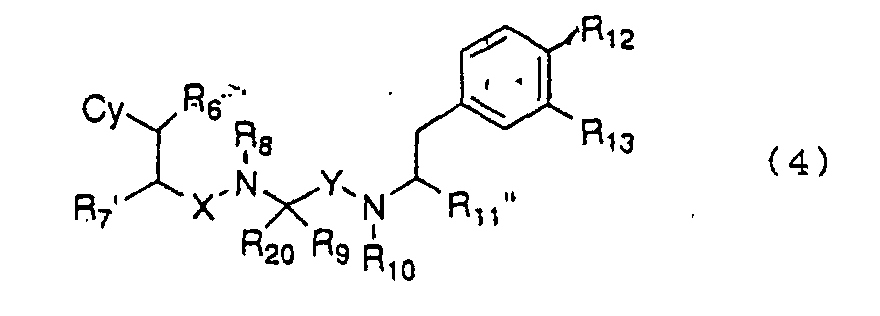 or a hydrate or pharmaceutically acceptable salt thereof.Cy, R6, R8, R9, R20, R10, R12, R13, X and Y are as defined in claim 1;R7' is hydrogen, straight-chained or branched C1- 3alkyl optionally having at least one protected substituent, amino optionally having at least one protected substituent or protected hydroxy; andR11" is hydrogen, optionally substituted straight-chained or branched C1-3alkyl, -CO-N(R14) R15, wherein R14 and R15 are as defined in claim 1, carboxyl, straight-chained or branched C1-3alkyl having a protected amino or an optionally substituted heterocyclic ring;
- A compound of Formula (5):wherein:
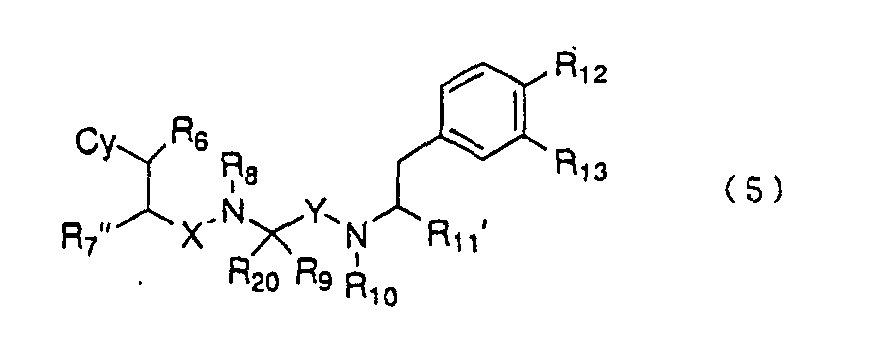 or a hydrate or pharmaceutically acceptable salt thereof.Cy, R6, R8, R9, R20, R10, R12, R13, X and Y are as defined in claim 1;R7" is hydrogen, straight-chained or branched C1-3alkyl optionally having at least one optionally protected substituent, amino optionally having at least one optionally protected substituent or optionally protected hydroxy; andR11' is hydrogen, straight-chained or branched C1- 3alkyl optionally having at least one protected substituent, -CO-N(R14)R15 wherein R14 and R15 are as defined in claim 1, carboxyl or an optionally substituted heterocyclic ring;
- A compound of Formula (6):wherein:
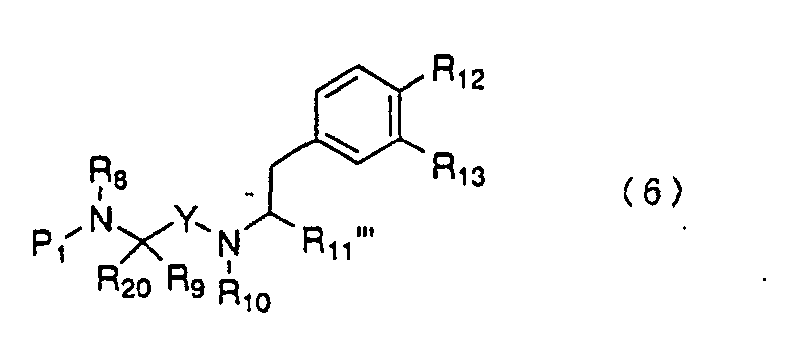 or a hydrate or pharmaceutically acceptable salt thereof.R8, R9, R20, R10, R12, R13 and Y are as defined in claim 1;P1 is hydrogen or a protecting group of amine; andR11''' is hydrogen, optionally substituted straight-chained or branched C1-3alkyl, -CO-N(R14)R15 wherein R14 and R15 are as defined in claim 1, carboxyl, straight-chained or branched C1-3alkyl having protected amino or an optionally substituted heterocyclic ring;
- A compound of Formula (7):wherein:
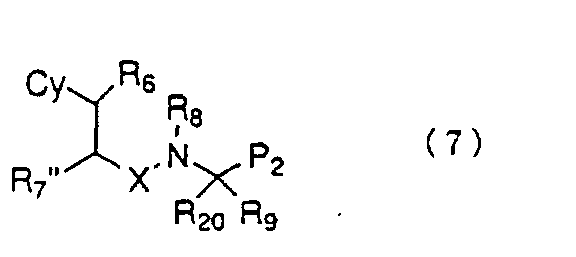 or a hydrate or pharmaceutically acceptable salt thereof.Cy, R6, R8, R9, R20, and X are as defined in claim 1;R7" is hydrogen, straight-chained or branched C1- 3alkyl optionally having at least one optionally protected substituent, amino optionally having at least one optionally protected substituent or optionally protected hydroxy; andP2 is optionally protected carboxyl, formyl or methyl which has a leaving group;
- A compound of Formula (8):wherein:
 or a hydrate or pharmaceutically acceptable salt thereof.R10 and R13 are as defined in claim 1;P3 is hydrogen or a protecting group of amine;R11'''' is hydrogen, optionally substituted straight-chained or branched C1-3alkyl, -CO-N(R14)R15 wherein R14 and R15 are as defined in claim 1, carboxyl, straight-chained or branched C1-3alkyl having protected amino or an optionally substituted heterocyclic ring; andR12' is hydroxy or -OR16 wherein R16 is as defined in claim 1;
- A compound of Formula (9):wherein:
 or a hydrate or pharmaceutically acceptable salt thereof.Cy and R6 are as defined in claim 1;R7" is hydrogen, straight-chained or branched C1-3alkyl optionally having at least one optionally protected substituent, amino optionally having at least one optionally protected substituent or optionally protected hydroxy; andP4 is optionally protected carboxyl, formyl or methyl which has a leaving group;
- A compound of Formula (10):wherein:
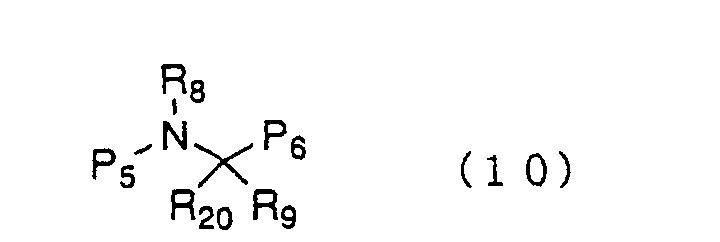 or a hydrate or pharmaceutically acceptable salt thereof.R8, R9 and R20 are as defined in claim 1;P5 is hydrogen or a protecting group of amine; andP6 is optionally protected carboxyl, formyl or methyl which has a leaving group;
Applications Claiming Priority (5)
| Application Number | Priority Date | Filing Date | Title |
|---|---|---|---|
| JP2052399 | 1999-01-28 | ||
| JP2052399 | 1999-01-28 | ||
| JP28316399 | 1999-10-04 | ||
| JP28316399 | 1999-10-04 | ||
| PCT/JP2000/000444 WO2000044770A1 (en) | 1999-01-28 | 2000-01-28 | Substituted phenethylamine derivatives |
Publications (2)
| Publication Number | Publication Date |
|---|---|
| EP1149843A1 true EP1149843A1 (en) | 2001-10-31 |
| EP1149843A4 EP1149843A4 (en) | 2012-06-06 |
Family
ID=26357488
Family Applications (1)
| Application Number | Title | Priority Date | Filing Date |
|---|---|---|---|
| EP00901956A Withdrawn EP1149843A4 (en) | 1999-01-28 | 2000-01-28 | SUBSTITUTED PHENETHYLAMINE DERIVATIVES |
Country Status (13)
| Country | Link |
|---|---|
| US (1) | US7553969B1 (en) |
| EP (1) | EP1149843A4 (en) |
| JP (1) | JP3715202B2 (en) |
| KR (1) | KR100440643B1 (en) |
| CN (1) | CN1343219A (en) |
| AU (1) | AU2320300A (en) |
| CA (1) | CA2359030A1 (en) |
| CZ (1) | CZ20012714A3 (en) |
| HK (1) | HK1039492A1 (en) |
| HU (1) | HUP0105204A3 (en) |
| NO (1) | NO20013684L (en) |
| PL (1) | PL349354A1 (en) |
| WO (1) | WO2000044770A1 (en) |
Cited By (9)
| Publication number | Priority date | Publication date | Assignee | Title |
|---|---|---|---|---|
| EP1006122A4 (en) * | 1997-08-15 | 2004-10-13 | Chugai Pharmaceutical Co Ltd | PHENYLETHYLAMINE DERIVATIVES |
| US7354940B2 (en) | 2002-08-27 | 2008-04-08 | Astrazeneca Ab | 2,5-dioxoimidazolidin-4-yl acetamines and analogues as inhibitors of metalloproteinase mmp12 |
| US7368465B2 (en) | 2001-03-15 | 2008-05-06 | Astrazeneca Ab | Metalloproteinase inhibitors |
| EP1958631A1 (en) * | 2007-02-14 | 2008-08-20 | AEterna Zentaris GmbH | Novel triazole derivatives as ligands of G-protein coupled receptors |
| US7648992B2 (en) | 2004-07-05 | 2010-01-19 | Astrazeneca Ab | Hydantoin derivatives for the treatment of obstructive airway diseases |
| US7655664B2 (en) | 2004-12-17 | 2010-02-02 | Astrazeneca Ab | Hydantoin derivatives as metalloproteinase inhibitors |
| US7700604B2 (en) | 2004-12-17 | 2010-04-20 | Astrazeneca Ab | Hydantoin derivatives as metalloproteinase inhibitors |
| US7989620B2 (en) | 2004-07-05 | 2011-08-02 | Astrazeneca Ab | Hydantoin derivatives for the treatment of obstructive airway diseases |
| US8183251B2 (en) | 2006-11-29 | 2012-05-22 | Astrazeneca Ab | Hydantoin compounds and pharmaceutical compositions thereof |
Families Citing this family (11)
| Publication number | Priority date | Publication date | Assignee | Title |
|---|---|---|---|---|
| AU2001280120A1 (en) | 2000-08-24 | 2002-03-04 | Chugai Seiyaku Kabushiki Kaisha | Cyclic peptide derivative |
| KR20020066476A (en) * | 2001-02-12 | 2002-08-19 | 쥬가이 세이야쿠 가부시키가이샤 | Preparation of peptide derivatives |
| EP1363898A4 (en) | 2001-03-02 | 2004-12-08 | Bristol Myers Squibb Co | Compounds useful as modulators of melanocortin receptors and pharmaceutical compositions comprising same |
| DE602004025569D1 (en) | 2003-06-18 | 2010-04-01 | Tranzyme Pharma Inc | MACROCYCLIC MOTILIN RECEPTOR ANTAGONISTS |
| EP1879567A1 (en) | 2005-04-28 | 2008-01-23 | Pfizer Limited | Amino acid derivatives |
| JP5684474B2 (en) | 2006-09-11 | 2015-03-11 | オセラ セラピューティクス, インコーポレイテッド | Macrocyclic antagonist of motilin receptor for the treatment of gastrointestinal dysmotility disease |
| HK1220626A1 (en) | 2013-03-15 | 2017-05-12 | The Centre For Drug Research And Development | Cytotoxic and anti-mitotic compounds, and methods of using the same |
| KR102384740B1 (en) | 2013-12-27 | 2022-04-07 | 자임워크스 인코포레이티드 | Sulfonamide-containing linkage systems for drug conjugates |
| ES2905569T3 (en) | 2014-09-17 | 2022-04-11 | Zymeworks Inc | Cytotoxic and antimitotic compounds and methods of using them |
| SG11202000817SA (en) * | 2017-07-31 | 2020-02-27 | Jazz Pharmaceuticals Ireland Ltd | Carbamoyl phenylalaninol analogs and uses thereof |
| EP3681900A4 (en) | 2017-09-11 | 2021-09-08 | Protagonist Therapeutics, Inc. | Opioid agonist peptides and uses thereof |
Family Cites Families (24)
| Publication number | Priority date | Publication date | Assignee | Title |
|---|---|---|---|---|
| DK154881A (en) * | 1980-04-07 | 1981-10-08 | Toyo Jozo Kk | Machine for binding objects with adhesive tape |
| US4595677A (en) | 1982-12-03 | 1986-06-17 | Ciba-Geigy Corporation | Substituted tetrapeptides |
| GB8311286D0 (en) * | 1983-04-26 | 1983-06-02 | Searle & Co | Carboxyalkyl peptide derivatives |
| US4455303A (en) * | 1983-05-24 | 1984-06-19 | The General Hospital Corporation | Renin inhibitors |
| US5140009A (en) * | 1988-02-10 | 1992-08-18 | Tap Pharmaceuticals, Inc. | Octapeptide LHRH antagonists |
| US5036052A (en) * | 1988-06-22 | 1991-07-30 | Morishita Pharmaceutical Co., Ltd. | Amino acid nutrient compositions |
| US5068221A (en) * | 1989-05-09 | 1991-11-26 | Mathias John R | Treatment of motility disorders with a gnrh analog |
| ZA905737B (en) | 1989-07-26 | 1991-05-29 | Merrell Dow Pharma | Novel peptidase inhibitors |
| JPH07188282A (en) | 1991-04-19 | 1995-07-25 | Suetsuna Yoko | Novel tripeptide, production method thereof and antihypertensive agent containing the same |
| EP0532466A3 (en) * | 1991-09-12 | 1993-06-16 | Ciba-Geigy Ag | Derivatives of 5-amino-4-hydroxy-hexanoic acid and their therapeutical use |
| US5643878A (en) * | 1991-09-12 | 1997-07-01 | Ciba-Geigy Corporation | 5-amino-4-hydroxyhexanoic acid derivatives |
| WO1994003483A1 (en) | 1992-07-30 | 1994-02-17 | Chiron Corporation | Endothelin receptor-binding compounds |
| JPH06220088A (en) * | 1993-01-22 | 1994-08-09 | Asahi Chem Ind Co Ltd | Tripeptide inhibiting angiotensin i converting enzyme, its production and food containing the tripeptide |
| EP0618222A3 (en) * | 1993-03-11 | 1997-01-02 | Ciba Geigy Ag | Dipeptid derivatives of 5-amino-4-hydroxy-hexanoic acid. |
| US5470830A (en) | 1993-08-06 | 1995-11-28 | Ohmeda Pharmaceutical Products Division Inc. | Motilin-like polypeptides that inhibit gastrointestinal motor activity |
| DE69418050T2 (en) * | 1993-09-09 | 1999-11-25 | Merrell Pharmaceuticals Inc., Cincinnati | ANTIVIRAL ANALOGS OF DIFLUOROSTATON |
| JP3449766B2 (en) | 1993-11-19 | 2003-09-22 | 中外製薬株式会社 | Motilin antagonist |
| ES2180781T3 (en) | 1995-06-07 | 2003-02-16 | Torrey Pines Inst | NEW LEAGUES OF THE OPIACEO MU RECEIVER: AGONISTS AND ANTAGONISTS. |
| WO1997019908A1 (en) * | 1995-11-29 | 1997-06-05 | Nihon Nohyaku Co., Ltd. | Phenylalanine derivatives, optically active substances, salts or coordination compounds thereof, and their use as fungicides |
| US5712253A (en) | 1996-06-18 | 1998-01-27 | Abbott Laboratories | Macrocyclic 13-membered ring derivatives of erythromycins A and B |
| TW460478B (en) * | 1997-08-15 | 2001-10-21 | Chugai Pharmaceutical Co Ltd | Phenethylamine derivatives |
| US5972939A (en) | 1997-10-28 | 1999-10-26 | Ortho-Mcneil Pharmaceutical, Inc. | Cyclopentene derivatives useful as antagonists of the motilin receptor |
| US6225285B1 (en) * | 1998-03-11 | 2001-05-01 | Exelixis Pharmaceuticals, Inc. | Semaphorin K1 |
| TW509699B (en) * | 1998-09-24 | 2002-11-11 | Chugau Pharmaceutical Co Ltd | Ethylamine derivatives |
-
2000
- 2000-01-28 CA CA002359030A patent/CA2359030A1/en not_active Abandoned
- 2000-01-28 HU HU0105204A patent/HUP0105204A3/en unknown
- 2000-01-28 KR KR10-2001-7009475A patent/KR100440643B1/en not_active Expired - Fee Related
- 2000-01-28 AU AU23203/00A patent/AU2320300A/en not_active Abandoned
- 2000-01-28 HK HK02100881.0A patent/HK1039492A1/en unknown
- 2000-01-28 PL PL00349354A patent/PL349354A1/en not_active Application Discontinuation
- 2000-01-28 EP EP00901956A patent/EP1149843A4/en not_active Withdrawn
- 2000-01-28 JP JP2000596026A patent/JP3715202B2/en not_active Expired - Fee Related
- 2000-01-28 CZ CZ20012714A patent/CZ20012714A3/en unknown
- 2000-01-28 US US09/890,219 patent/US7553969B1/en not_active Expired - Fee Related
- 2000-01-28 WO PCT/JP2000/000444 patent/WO2000044770A1/en not_active Ceased
- 2000-01-28 CN CN00804822A patent/CN1343219A/en active Pending
-
2001
- 2001-07-26 NO NO20013684A patent/NO20013684L/en not_active Application Discontinuation
Cited By (15)
| Publication number | Priority date | Publication date | Assignee | Title |
|---|---|---|---|---|
| EP1006122A4 (en) * | 1997-08-15 | 2004-10-13 | Chugai Pharmaceutical Co Ltd | PHENYLETHYLAMINE DERIVATIVES |
| US7368465B2 (en) | 2001-03-15 | 2008-05-06 | Astrazeneca Ab | Metalloproteinase inhibitors |
| US8153673B2 (en) | 2001-03-15 | 2012-04-10 | Astrazeneca Ab | Metalloproteinase inhibitors |
| US7754750B2 (en) | 2001-03-15 | 2010-07-13 | Astrazeneca Ab | Metalloproteinase inhibitors |
| US7427631B2 (en) | 2001-03-15 | 2008-09-23 | Astrazeneca Ab | Metalloproteinase inhibitors |
| US7666892B2 (en) | 2001-03-15 | 2010-02-23 | Astrazeneca Ab | Metalloproteinase inhibitors |
| US7662845B2 (en) | 2002-08-27 | 2010-02-16 | Astrazeneca Ab | 2,5-Dioxoimidazolidin-4-yl acetamides and analogues as inhibitors of metalloproteinase MMP12 |
| US7354940B2 (en) | 2002-08-27 | 2008-04-08 | Astrazeneca Ab | 2,5-dioxoimidazolidin-4-yl acetamines and analogues as inhibitors of metalloproteinase mmp12 |
| US7648992B2 (en) | 2004-07-05 | 2010-01-19 | Astrazeneca Ab | Hydantoin derivatives for the treatment of obstructive airway diseases |
| US7989620B2 (en) | 2004-07-05 | 2011-08-02 | Astrazeneca Ab | Hydantoin derivatives for the treatment of obstructive airway diseases |
| US7655664B2 (en) | 2004-12-17 | 2010-02-02 | Astrazeneca Ab | Hydantoin derivatives as metalloproteinase inhibitors |
| US7700604B2 (en) | 2004-12-17 | 2010-04-20 | Astrazeneca Ab | Hydantoin derivatives as metalloproteinase inhibitors |
| US8183251B2 (en) | 2006-11-29 | 2012-05-22 | Astrazeneca Ab | Hydantoin compounds and pharmaceutical compositions thereof |
| WO2008098977A1 (en) * | 2007-02-14 | 2008-08-21 | Æterna Zentaris Gmbh | Novel triazole derivatives as ligands of g-protein coupled receptors |
| EP1958631A1 (en) * | 2007-02-14 | 2008-08-20 | AEterna Zentaris GmbH | Novel triazole derivatives as ligands of G-protein coupled receptors |
Also Published As
| Publication number | Publication date |
|---|---|
| CA2359030A1 (en) | 2000-08-03 |
| NO20013684D0 (en) | 2001-07-26 |
| NO20013684L (en) | 2001-09-28 |
| JP3715202B2 (en) | 2005-11-09 |
| HK1039492A1 (en) | 2002-04-26 |
| EP1149843A4 (en) | 2012-06-06 |
| AU2320300A (en) | 2000-08-18 |
| WO2000044770A1 (en) | 2000-08-03 |
| KR100440643B1 (en) | 2004-07-21 |
| HUP0105204A3 (en) | 2002-05-28 |
| HUP0105204A2 (en) | 2002-04-29 |
| US7553969B1 (en) | 2009-06-30 |
| CZ20012714A3 (en) | 2002-08-14 |
| KR20010101750A (en) | 2001-11-14 |
| CN1343219A (en) | 2002-04-03 |
| PL349354A1 (en) | 2002-07-15 |
Similar Documents
| Publication | Publication Date | Title |
|---|---|---|
| US7553969B1 (en) | Substituted phenethylamine derivatives | |
| US4894437A (en) | Novel renin inhibiting polypeptide analogs containing S-aryl-D- or L- or DL-cysteinyl, 3-(arylthio)lactic acid or 3-(arylthio)alkyl moieties | |
| US5430024A (en) | Peptides bearing N-terminal amidino moieties and their use as inhibitors of platelet aggregation | |
| RU2277535C2 (en) | Ligands of melanocortin receptors and pharmaceutical composition based on thereof | |
| JPWO2000044770A1 (en) | Substituted phenethylamine derivatives | |
| US20030109564A1 (en) | Novel non-imidazole compounds | |
| US6235717B1 (en) | Pharmaceutical compounds | |
| CA2037153A1 (en) | Acetic acid derivatives | |
| EP1189612A1 (en) | Vla-4 inhibitor compounds | |
| HU211978A9 (en) | N-acyl-alfa-amino acid derivatives | |
| CZ20024191A3 (en) | Meloxicam aqueous solution | |
| EP1431290A1 (en) | Novel nitrogenous compound and use thereof | |
| US6586630B1 (en) | Ethylamine derivatives | |
| JPH01502021A (en) | Renin inhibitor with lactam pseudodipeptide | |
| WO1987002986A1 (en) | Novel renin inhibiting polypeptide analogs containing s-aryl-d- or l- or dl-cysteinyl, 3-(arylthio)lactic acid or 3-(arylthio)alkyl moieties | |
| JPWO2000017231A1 (en) | Ethylamine Derivatives | |
| KR19990028753A (en) | Peptide Derivatives and Angiotensin IV Receptor Agonists | |
| US20240262805A1 (en) | Method for producing compound or pharmaceutically acceptable salt thereof | |
| CA3072668A1 (en) | Novel potassium channel inhibitors | |
| JP2025504750A (en) | Apelinergic macrocycle and uses thereof | |
| US7018981B2 (en) | Cyclic motilin receptor antagonists | |
| JP2000044595A (en) | Phenethylamine derivative | |
| JPWO2002016404A1 (en) | Cyclic Peptide Derivatives | |
| SI9210295A (en) | N-ACYL-ALFA-AMINO ACID DERIVATIVES | |
| WO1994019368A1 (en) | Novel endothelin antagonist |
Legal Events
| Date | Code | Title | Description |
|---|---|---|---|
| PUAI | Public reference made under article 153(3) epc to a published international application that has entered the european phase |
Free format text: ORIGINAL CODE: 0009012 |
|
| 17P | Request for examination filed |
Effective date: 20010823 |
|
| AK | Designated contracting states |
Kind code of ref document: A1 Designated state(s): AT BE CH CY DE DK ES FI FR GB GR IE IT LI LU MC NL PT SE |
|
| AX | Request for extension of the european patent |
Free format text: AL PAYMENT 20010823;LT PAYMENT 20010823;LV PAYMENT 20010823;MK PAYMENT 20010823;RO PAYMENT 20010823;SI PAYMENT 20010823 |
|
| REG | Reference to a national code |
Ref country code: HK Ref legal event code: WD Ref document number: 1039492 Country of ref document: HK |
|
| RIC1 | Information provided on ipc code assigned before grant |
Ipc: C07C 237/08 20060101ALI20120405BHEP Ipc: C07C 229/48 20060101ALI20120405BHEP Ipc: C07C 237/10 20060101ALI20120405BHEP Ipc: A61P 1/00 20060101ALI20120405BHEP Ipc: C07D 295/26 20060101ALI20120405BHEP Ipc: C07C 229/12 20060101ALI20120405BHEP Ipc: C07C 229/06 20060101ALI20120405BHEP Ipc: A61K 38/06 20060101ALI20120405BHEP Ipc: C07C 215/52 20060101AFI20120405BHEP Ipc: C07C 237/20 20060101ALI20120405BHEP Ipc: C07C 229/36 20060101ALI20120405BHEP Ipc: C07D 295/185 20060101ALI20120405BHEP Ipc: C07K 5/06 20060101ALI20120405BHEP Ipc: C07C 271/22 20060101ALI20120405BHEP Ipc: C07K 5/08 20060101ALI20120405BHEP Ipc: A61P 5/00 20060101ALI20120405BHEP Ipc: C07C 271/18 20060101ALI20120405BHEP Ipc: C07C 271/20 20060101ALI20120405BHEP |
|
| A4 | Supplementary search report drawn up and despatched |
Effective date: 20120508 |
|
| STAA | Information on the status of an ep patent application or granted ep patent |
Free format text: STATUS: THE APPLICATION IS DEEMED TO BE WITHDRAWN |
|
| 18D | Application deemed to be withdrawn |
Effective date: 20120807 |