EP1149816A1 - High-quality bisphenol a and process for producing the same - Google Patents
High-quality bisphenol a and process for producing the same Download PDFInfo
- Publication number
- EP1149816A1 EP1149816A1 EP00978064A EP00978064A EP1149816A1 EP 1149816 A1 EP1149816 A1 EP 1149816A1 EP 00978064 A EP00978064 A EP 00978064A EP 00978064 A EP00978064 A EP 00978064A EP 1149816 A1 EP1149816 A1 EP 1149816A1
- Authority
- EP
- European Patent Office
- Prior art keywords
- bisphenol
- eluent
- content
- quality
- ppb
- Prior art date
- Legal status (The legal status is an assumption and is not a legal conclusion. Google has not performed a legal analysis and makes no representation as to the accuracy of the status listed.)
- Withdrawn
Links
- 0 CC(c(c(C1)ccc2)c2O)=*C1=* Chemical compound CC(c(c(C1)ccc2)c2O)=*C1=* 0.000 description 1
Classifications
-
- C—CHEMISTRY; METALLURGY
- C07—ORGANIC CHEMISTRY
- C07C—ACYCLIC OR CARBOCYCLIC COMPOUNDS
- C07C39/00—Compounds having at least one hydroxy or O-metal group bound to a carbon atom of a six-membered aromatic ring
- C07C39/12—Compounds having at least one hydroxy or O-metal group bound to a carbon atom of a six-membered aromatic ring polycyclic with no unsaturation outside the aromatic rings
- C07C39/15—Compounds having at least one hydroxy or O-metal group bound to a carbon atom of a six-membered aromatic ring polycyclic with no unsaturation outside the aromatic rings with all hydroxy groups on non-condensed rings, e.g. phenylphenol
- C07C39/16—Bis-(hydroxyphenyl) alkanes; Tris-(hydroxyphenyl)alkanes
-
- C—CHEMISTRY; METALLURGY
- C07—ORGANIC CHEMISTRY
- C07C—ACYCLIC OR CARBOCYCLIC COMPOUNDS
- C07C37/00—Preparation of compounds having hydroxy or O-metal groups bound to a carbon atom of a six-membered aromatic ring
- C07C37/68—Purification; separation; Use of additives, e.g. for stabilisation
- C07C37/70—Purification; separation; Use of additives, e.g. for stabilisation by physical treatment
- C07C37/82—Purification; separation; Use of additives, e.g. for stabilisation by physical treatment by solid-liquid treatment; by chemisorption
-
- C—CHEMISTRY; METALLURGY
- C07—ORGANIC CHEMISTRY
- C07C—ACYCLIC OR CARBOCYCLIC COMPOUNDS
- C07C37/00—Preparation of compounds having hydroxy or O-metal groups bound to a carbon atom of a six-membered aromatic ring
- C07C37/11—Preparation of compounds having hydroxy or O-metal groups bound to a carbon atom of a six-membered aromatic ring by reactions increasing the number of carbon atoms
- C07C37/20—Preparation of compounds having hydroxy or O-metal groups bound to a carbon atom of a six-membered aromatic ring by reactions increasing the number of carbon atoms using aldehydes or ketones
Definitions
- the present invention relates to high-quality bisphenol A and to a preparation process thereof, and more specifically to a bisphenol A which is a raw material for producing an aromatic polycarbonate having a good hue and also to a preparation process thereof.
- Bisphenol A 2,2-bis(A-hydroxyphenyl)propane
- Bisphenol A is usually prepared by reacting an excessive amount of phenol and acetone in the existence of a homogeneous acid or a solid acid catalyst, cooling the reaction mixture obtained, and after separating equimolar adducts of bisphenol A and phenol from the reaction mixture, further removing therefrom phenol.
- the bisphenol A is used as a raw material for producing various polymers, and recently, particularly, the demand for an aromatic polycarbonate excellent in the shock resistance and the transparency has been increased, and bisphenol A giving an aromatic polycarbonate having less coloring has been demanded.
- an aromatic polycarbonate is excellent in the shock resistance and the transparency, the polymer is frequently used as optical uses, and particularly for optical disk bases or substrates.
- optical disks by increasing the recording density and increasing the capacity, the demand for the reliability for recording and reproducing has been increased and the demand for the hue and the transparency giving influences on the reliability has been more and more increased.
- a phosgene process and a transesterification process are mainly known. Because the transesterification process does not have problems of not using a toxic substance such as phosgene, not by-producing a corrosive substance as compared with the phosgene process, the ester exchange process has recently been given attention.
- the aromatic polycarbonate obtained by the transesterification process has a problem that the product obtained is generally liable to be colored because the polymerization is carried out at a high temperature, the improvement of the preparation process of an aromatic polycarbonate and also further improvement of the quality of bisphenol A have been required.
- bisphenol A as a raw material for polymers
- bisphenols for polymer raw materials wherein 4,4'-bisphenols each containing at least one kind of the phenolic compound selected from 2,4'-bisphenols, trisphenols, and alkyl-substituted 4,4'-bisphenols in the range of from 500 to 10,000 ppm by weight as the sum total (Japanese Patent Laid-Open No. 245465/1996).
- 4,4'-bisphenols each containing at least one kind of the phenolic compound selected from 2,4'-bisphenols, trisphenols, and alkyl-substituted 4,4'-bisphenols in the range of from 500 to 10,000 ppm by weight as the sum total
- the present invention provides a bisphenol A which does not coloring at preparing an aromatic polycarbonate and in the case of molding the aromatic polycarbonate obtained.
- the present inventors have found that when specific metals or organic substances exist in bisphenol A in the amounts of more than definite amounts, coloring occurs at the preparation of an aromatic polycarbonate from the bisphenol A and also coloring is liable to occur in the case of molding the aromatic polycarbonate obtained, and have accomplished the present invention.
- an aspect of the present invention is a high-quality bisphenol A selected from the following groups (a) to (g);
- Bisphenol A can be generally obtained by a dehydration condensation reaction of acetone and excessive phenol in the existence of an acid catalyst.
- an acid catalyst There is no particular restriction on the catalyst of preparing the bisphenol A of the present invention, and each one of a homogeneous acid and a solid acid may be used.
- the catalyst In the process of using a homogeneous acid, as the catalyst, hydrogen chloride, sulfuric acid, etc., is generally used but hydrogen chloride is preferably used because in this case, the hydrogen chloride can be easily separated from the reaction mixture.
- the chloride ion concentration after the catalyst separation step is not more than 10 ppm, and particularly not more than 1 ppm. When the chloride ion concentration is not more than 10 ppm, the corrosion of the apparatus after catalyst separation step is less and the amount of each metal component entering the bisphenol A becomes less.
- a method of separating the catalyst there are a method of removing the catalyst by distillation, a method of removing the catalyst by adsorption using a anion-exchange resin, a method of removing the catalyst by adsorption using a anion-exchange resin after applying a distillation, etc., and any method may be used but the method of removing the catalyst by adsorption using a anion-exchange resin after applying a distillation is preferably used.
- each of a strong basic ion-exchange resin and a weak basic ion-exchange resin can be used, but the weak basic ion-exchange resin is preferably used because of the easiness of the regeneration of the ion-exchange resin. More preferably, a pyridyl group type weak basic ion-exchange resin having a high heat resistance is used.
- a sulfonic acid-base cation-exchange resin is generally used as the catalyst. Furthermore, for improving the catalytic activity of the sulfonic acid-base cation-exchange resin, a process of existing a mercapto group-containing compound in the reaction system together with the cation-exchange resin.
- a method of coexisting the cation-exchange resin and the mercapto group-containing compound there are a method of bonding a part of the sulfonic acid group of the cation-exchange resin and the mercapto group-containing compound by an ionic bond or by a covalent bond and a method of continuously supplying a mercapto group-containing compound, which does not form a chemical bond with the cation-change resin, to a reactor packed with the sulfonic acid-base cation-exchange resin together with reaction raw materials, and each of these methods may be used.
- the solid acid catalyst there is an organic high molecule siloxane having a sulfonic acid-containing hydrocarbon group and a mercapto group-containing hydrocarbon group together.
- the catalyst are organic high molecular siloxanes each having a structure wherein, in a silica matrix made of a siloxane bond, a hydrocarbon group partially having a sulfonic acid group and a hydrocarbon group having a mercapto group are directly bonded to the silicon atoms in the silica matrix by a carbon-silicon bond as described in Japanese Patent Laid-Open Nos. 208545/1996, 110989/1997, and 225638/1998.
- the catalyst is separated therefrom, after, if necessary, removing a part of water formed by the reaction, unreacted acetone, and unreacted phenol, the reaction product is cooled and bisphenol A is separated as the form of adducts. Furthermore, from the equimolar addition product of bisphenol A and phenol, which are the adducts, phenol is removed and bisphenol A is isolated.
- the bisphenol A thus obtained contains various inorganic elements and organic compounds as impurities.
- coloring occurs at the preparation of the aromatic polycarbonate and also at molding the aromatic polycarbonate obtained, coloring is liable to occur. Accordingly, to obtain an aromatic polycarbonate which is not colored at the preparation of the aromatic polycarbonate and does not cause coloring in the case of molding the aromatic polycarbonate, it is necessary to reduce the contents of specific inorganic elements and organic compounds contained, as impurities, in the bisphenol A used as the raw material to lower than definite amounts.
- the high-quality bisphenol A of the invention is selected from the following groups (a) to (g).
- the content of sodium is preferably not more than 50 ppb and the content of each element of the group A consisting of iron, nickel, chromium, manganese, lead, and molybdenum is preferably not more than 20 ppb, and more preferably not more than 10 ppb.
- the content of sodium contained in bisphenol A is not more than 80 ppb and the content of each element of the group A is not more than 50 ppb, in the case of preparing an aromatic polycarbonate using the bisphenol A, coloring of the aromatic polycarbonate obtained is improved and further coloring at molding the aromatic polycarbonate obtained is also improved.
- the high-quality bisphenol A of the invention is (a) described above, in addition to each element of above-described group A, when the content of each element of group B consisting of copper, zinc, aluminum, and indium or the content of silicon contained in the bisphenol A is not more than 20 ppb, preferably not more than 10 ppb, and more preferably not more than 5 ppb, and when the content of titanium contained in the bisphenol A is not more than 1 ppb, coloring of the aromatic polycarbonate obtained from the bisphenol A can be more effectively improved.
- each metal in the invention is measured by a flameless atomic absorption spectrometry (electric heating atomic absorption spectrometry). It is preferred that as a vessel for sampling from the preparation equipment of bisphenol A for measuring the content of each metal, a vessel sufficiently washed so that each metal is not intermixed from the vessel is used and after sampling, the vessel is tightly sealed and is not opened before carrying out the analysis. By carrying out the operation from the pretreatment to the measurement in a clean environment, contamination by each meal in the atmosphere can be prevented.
- a flameless atomic absorption spectrometry electric heating atomic absorption spectrometry
- the sum total of the absorption peak areas of the compounds eluted between the time of from 15.5 minutes to 24 minutes is not more than 2 ⁇ 10 -3 , and preferably not more than 1 ⁇ 10 -3 to the absorption peak area of the bisphenol A.
- the sum total of the absorption peak areas of the compound group A is not more than 2 ⁇ 10 -3 to the absorption peak area of the bisphenol A, coloring at the preparation of the aromatic polycarbonate is improved and further coloring at molding the aromatic polycarbonate obtained is also improved.
- the sum total of the absorption peak areas of the compounds eluted between the time of from 22 minutes to 24 minutes (hereinafter, the compounds are referred to as compound group B) is not more than 50 ppm, and preferably not more than 30 ppm to the absorption peak area of the bisphenol A.
- the sum total of the absorption peak areas of the compound group B is not more than 50 ppm of the absorption peak area of the bisphenol A, coloring at the preparation of the aromatic polycarbonate is improved and further coloring at molding the aromatic polycarbonate obtained is also improved.
- the sum total of the absorption peak areas of the compounds having molecular weights of from 307 to 309 is not more than 20 ppm, and more preferably not more than 10 ppm of the absorption peak area of the bisphenol A.
- the compounds having molecular weights of from 307 to 309 give particularly large influences on the hue of the aromatic polycarbonate and when these compounds are not more than 20 ppm, coloring at the preparation of the aromatic polycarbonate is improved and further coloring at molding the aromatic polycarbonate obtained is also improved.
- the high performance liquid chromatographic apparatus there is no particular restriction on the high performance liquid chromatographic apparatus and a generally commercially available apparatus may be used but the apparatus equipped with a degassing unit capable of sufficiently carrying out degassing of the eluent is used, and as a liquid sending pump, a double plunger type low pulsating pump capable of carrying out the gradient operation is used. Also, for heat retaining the analytical column at a constant temperature, the analytical column is installed in a column oven capable of temperature control in the range of within ⁇ 0.1°C.
- the ultraviolet detector a ultraviolet detector capable of measuring at the accuracy of the wavelength reproducibility ⁇ 0.1 nm is used, when the high-quality bisphenol A is (b), (c), or (d) described above, the measurement is carried out at a wavelength of 254 nm, when the high-quality bisphenol A is (e) or (g), the measurement is carried out at a wavelength of 200 nm, and when the high-quality bisphenol A is (f), the measurement is carried out at a wavelength of 280 nm.
- a high performance liquid chromatographic apparatus an LC-10A type high performance liquid chromatographic apparatus manufactured by SHIMADZU CORPORATION can be suitably used.
- a stainless steel-made column having an inner diameter of 4.6 mm and a length of 250 mm packed with a high-pure spherical silica gel having a fine pore of 100 angstroms bonded with an octadecyl group in an amount of 15% by weight of the silica gel, such as, for example, Inertsil ODS-3 type adsorbent manufactured by GL Science Corporation as the absorbent is used.
- the analytical column is retained at a temperature range of 40°C ⁇ 0.1°C and then used for the analysis.
- an aqueous 0.1% phosphoric acid solution is used as an eluent A
- acetonitrile is used as an eluent B
- a measurement is carried out such that from the initiation of the measurement to 5 minutes after the initiation of the measurement, the ratio of the eluent A : the eluent B is 1 : 1 and the flow rate of the sum total of the eluent A and the eluent B becomes 0.9 ml/minute, while keeping the flow rate of the sum total at constant, a gradient operation of increasing the rate of the eluent B from 5 minutes after the initiation of the measurement and then continuously increasing the rate of the eluent B such that the ratio of the eluent A : the eluent B becomes 0 : 1 until 55 minutes after the initiation of the measurement is carried out.
- aqueous 0.1% phosphoric acid solution As the aqueous 0.1% phosphoric acid solution as the eluent A, phosphoric acid of higher than the JIS guaranteed reagent is diluted to 0.1 ⁇ 0.0001 (%) with commercially available distilled water for a high performance liquid chromatography and is used.
- acetonitrile as the eluent B commercially available acetonitrile for high performance liquid chromatography is used.
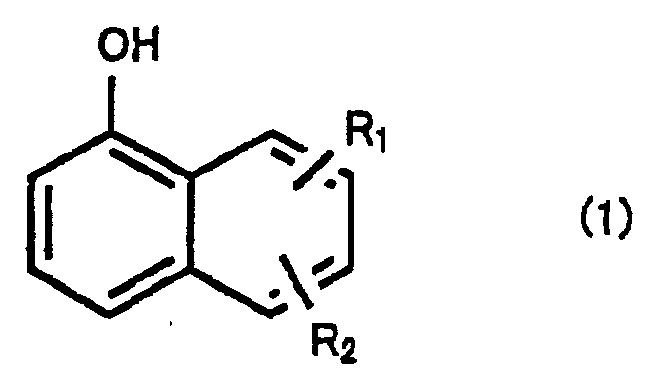
- the sum total of the contents of the 1-naphthol derivatives shown by the above-described formula (1) contained in the bisphenol A is not more than 200 ppm, and more preferably not more than 100 ppm.
- the contents of the 1-naphthol derivatives contained in the bisphenol A are not more than 200 ppm, coloring at the preparation of the aromatic polycarbonate is improved and further coloring at molding the aromatic polycarbonate obtained is also improved.
- 1-naphthol derivative shown by the formula (1) include 5,7-dimethyl-l-naphthol, 6,7-dimethyl-1-naphthol, 5,8-dimethyl-1-naphthol, 6,8-dimethyl-1-naphthol, 5-ethyl-7-methyl-1-naphthol, 5-methyl-7-ethyl-1-naphthol, 6-ethyl-7-methyl-1-naphthol, 6-methyl-7-ethyl-1-naphthol, 5,7-diethyl-1-naphthol, 6,7-diethyl-1-naphthol, 5-n-propyl-7-methyl-1-naphthol, 6-n-propyl-7-methyl-1-naphthol, 5-isopropyl-7-methyl-1-naphthol, 6-isopropyl-7-methyl-1-naphthol, 5-isopropyl-7
- the sum total of the contents of the 1-naphthol derivatives shown in the formula (1) contained in the bisphenol A is not more than 200 ppm, and also when the bisphenol is analyzed by the above-described high performance liquid chromatographic analysis, the sum total of the absorption peak areas of the compounds (Compound group B) eluted between the time of from 22 minutes to 24 minutes is not more than 50 ppm, and more preferably not more than 30 ppm to the area of the absorption peak of the bisphenol A, because in this case, coloring of the aromatic polycarbonate obtained from the bisphenol A becomes less.
- the content of 9,9'-dimethylxanthene contained in the bisphenol A is not more than 2 ppm, and preferably not more than 1 ppm.
- the content of 9,9'-dimethylxanthene contained in the bisphenol A is not more than 2 ppm, coloring at the preparation of the aromatic polycarbonate is improved and further coloring at molding the aromatic polycarbonate obtained is also improved.
- the content of 2-(4-hydroxyphenyl)-2,4,4-trimethylchroman contained in the bisphenol A is not more than 50 ppm, preferably not more than 30 ppm, and more preferably not more than 20 ppm.
- the content of 2-(4-hydroxyphenyl)-2,4,4-trimethylchroman contained in the bisphenol A is not more than 50 ppm, coloring at the preparation of the aromatic polycarbonate is improved and further coloring at molding the aromatic polycarbonate obtained is also improved.
- the content of 2-(4-hydroxyphenyl)-2,4,4-trimethylchroman contained in the bisphenol A is not more than 50 ppm as well as the content of sodium is not more than 80 ppb, and the content of each element of group A consisting of iron, nickel, chromium, manganese, lead, and molybdenum is not more than 50 ppb, preferably not more than 20 ppb, and more preferably not more than 10 ppb because in this case, coloring of the aromatic polycarbonate prepared from the bisphenol A becomes more less.
- the content of 2,2,4-trimethylchromene contained in the bisphenol A is not more than 5 ppm, and preferably not more than 2 ppm.
- the content of 2,2,4-trimethylchromene contained in the bisphenol A is not more than 5 ppm, coloring at the preparation of the aromatic polycarbonate is improved and further coloring at molding the aromatic polycarbonate obtained is also improved.
- the high-quality bisphenol A of the invention is (b), (c), (d), (e), or (g)
- the content of iron contained in the bisphenol A is not more than 50 ppb, preferably not more than 30 ppb, and more preferably not more than 10 ppb, the deterioration of the hue of the aromatic polycarbonate obtained from the bisphenol A can be prevented.
- the process for preparing the high-quality bisphenol A of the invention as (a) described above there is a process for removing the catalyst from the reaction mixture and after, if necessary, removing unreacted acetone and water formed in the reaction, contacting the reaction mixture with an absorbent.
- the absorbent used include active clay, diatomaceous earth, montmorillonite, molecular sieve, clay minerals, active carbon, graphite, hydrotalcite, chelate resins, and cation-exchange resins.
- the reaction mixture is cooled, and by contacting at least a part of the mother liquor after separating the adducts therefrom with the above-described absorbent, the contents of sodium and each element of group A can be reduced.
- the crystallization operation for obtaining the adducts by cooling the reaction mixture is usually once or twice in the preparation process of the bisphenol A but by increasing the number of times of the crystallization operation, the contents of sodium and each element of group A in the bisphenol A finally obtained can be more reduced. Also, the plural operations described above may be combined at use.
- the contents of copper, zinc, aluminum, and indium as the group B elements, and silicon and titanium can be simultaneously reduced.
- an aromatic polycarbonate is excellent in the impact resistance and the transparency
- the polycarbonate is largely used for optical uses, particularly, as optical disk substrates, and recently, by the increase of the recording density and the recording capacity of the optical disks, the demand for the reliability of recording and regeneration of optical disks has been increased.
- the influence of the hue of the aromatic polycarbonate as the raw material of optical disks on the reliability of recording and regeneration of optical disks is large and it is desirable that the aromatic polycarbonate is as colorless and transparent as possible.
- the aromatic polycarbonate for optical use is not larger than 1.0, more preferably not larger than 0.5, and far more preferably not larger than 0.3.
- the high-quality polycarbonate of the invention gives less coloring at the preparation or molding of the aromatic polycarbonate and is particularly excellent as the raw material of the aromatic polycarbonate required to be colorless and transparent, in the case of optical uses, etc.
- the preparation process of an aromatic polycarbonate there are a phosgene process, a transesterification process, etc., and the bisphenol A of the invention can be used for any one of these processes.
- the occurrence of coloring is restrained and thus the bisphenol of the invention can be suitable used.
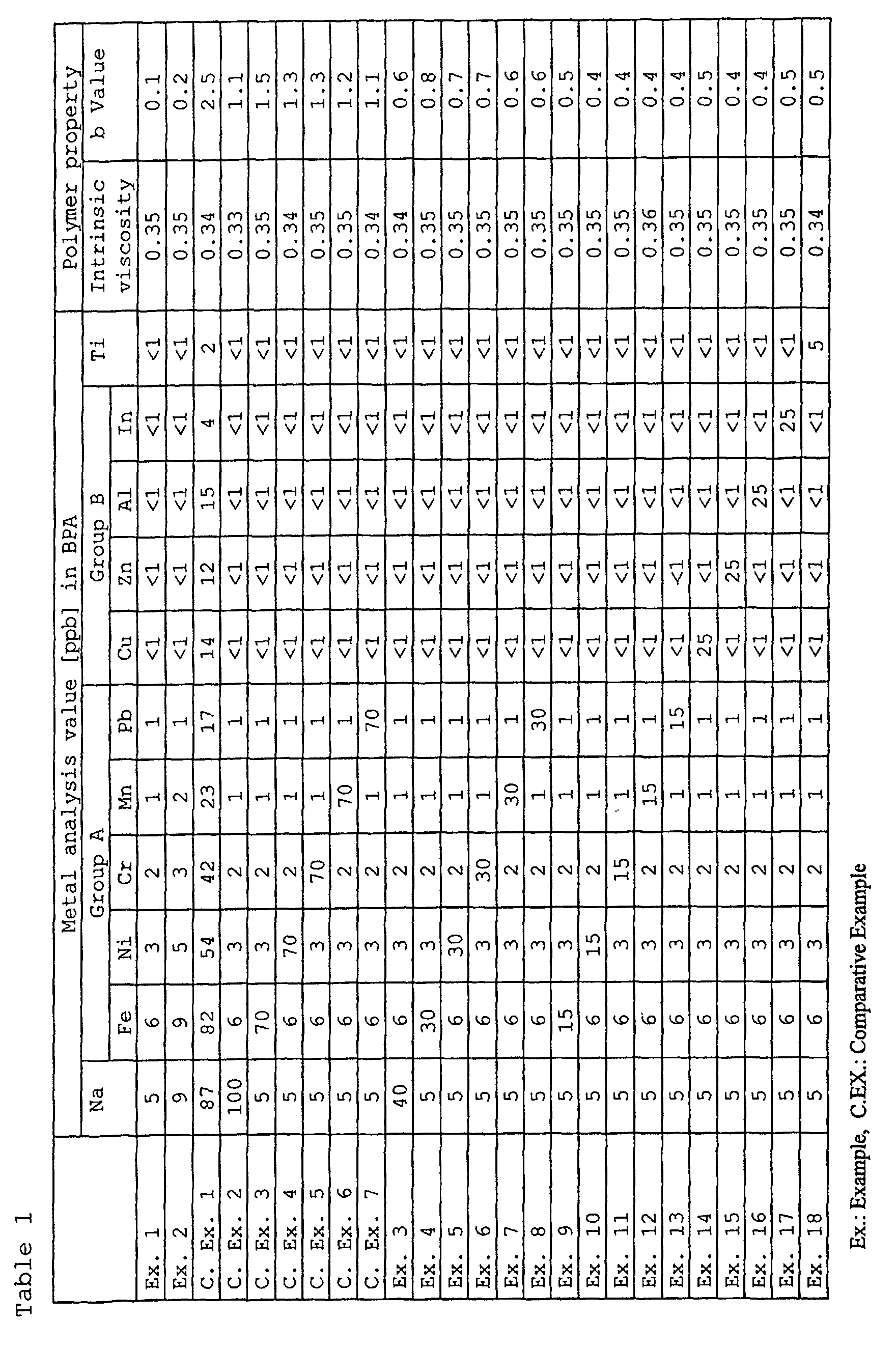
- Example 1 By following the same procedure as Example 1 except that the cation-exchange resin treatment of the reaction mixture after removing hydrogen chloride was not carried out, a bisphenol A was obtained.
- the content of each element in the bisphenol is shown in Table 1.
- a polycarbonate was obtained.
- the intrinsic viscosity of the polycarbonate obtained was 0.34 and the b value thereof was 2.5.
- Example 1 To the bisphenol A obtained in Example 1 was added an aqueous 0.01% sodium hydroxide solution such that the content of sodium to the bisphenol A became 100 ppb. After melting the bisphenol A and sufficiently mixing, diphenyl carbonate and tetramethylammonium hydroxide were added to the mixture and the polymerization was carried out as in Example 1. The intrinsic viscosity of the polycarbonate obtained was 0.33 and the b value thereof was 1.1.
- a reaction mixture was obtained.
- the reaction mixture was distilled to remove hydrogen chloride and further the reaction mixture was brought into contact with a sulfonic acid-base cation-exchange resin.
- the reaction mixture was cooled to 45°C to precipitate adducts and the adducts obtained were separated from the mother liquor.
- the adducts were heated to 180°C at a pressure of 40 Torr to remove phenol until the phenol concentration in bisphenol A became 3% and further phenol was removed by steam stripping to obtain a bisphenol A.
- the content of each element in the bisphenol A is shown in Table 2.
- 102.6 g of the bisphenol A was reacted with 105.9 g of diphenyl carbonate with stirring by reducing the pressure to 15 mmHg and increasing the temperature to 240°C.
- the reaction of the reaction product obtained was carried out in a thin-film type reactor at a pressure of 4 mmHg and a temperature of 260°C to obtain a prepolymer.
- the prepolymer was further polymerized at 280°C and a pressure of 0.5 mmHg to obtain a polycarbonate.
- the intrinsic viscosity of the polycarbonate obtained was 0.35 and the b value thereof was 0.1.
- acetone was reacted with phenol at a mol ratio of 1 : 6 at a reaction temperature of 60°C, a reaction mixture was obtained. After distilling the reaction mixture to remove hydrogen chloride, the reaction mixture was cooled to 45°C to precipitate adducts and the adducts obtained were separated from the mother liquor. After purging 10% of the total amount of the mother liquor thus separated from the system, the mother liquor was brought into contact with a sulfonic acid type cation-exchange resin and recycled to the reactor.
- Example 19 By following the same procedure as Example 19 except that the cation-exchange resin treatment of the reaction mixture after removing hydrogen chloride was not carried out, a bisphenol A was obtained.
- the content of each element in the bisphenol A is shown in Table 2.
- a polycarbonate was obtained.
- the intrinsic viscosity of the polycarbonate obtained was 0.34 and the b value thereof was 2.5.
- Example 19 An aqueous 0.01% sodium hydroxide solution was added to the bisphenol A obtained in Example 19 such that the content of sodium in the bisphenol A became 100 ppb. After melting the bisphenol A and sufficiently mixing, diphenyl carbonate and tetramethylammonium hydroxide were added thereto and the polymerization was carried out as in Example 19. The intrinsic viscosity of the polycarbonate obtained was 0.33 and the b value thereof was 1.1.
- a sulfonic acid-base ion-exchange resin of a crosslinking degree of 4% of which 15% of the whole sulfonic acid groups was modified by cysteamine as a catalyst
- acetone was reacted with phenol at mol ratio of 1 : 11 at a reaction temperature of 75°C to obtain a reaction mixture.
- the reaction mixture was cooled to 45°C to precipitate adducts (the 1st crystallization) and the adducts obtained were separated from the mother liquor. After purging 10% of the total amount of the mother liquor separated from the system, water was removed from the mother liquor and the mother liquor was recycled to the reactor.
- the adducts obtained were further dissolved in phenol to carry out the 3rd crystallization, the adducts obtained were heated to 180°C at a pressure of 40 Torr to remove phenol until the phenol concentration in the bisphenol A became 3% and further phenol was removed by steam stripping to obtain a bisphenol A.
- the bisphenol A obtained was analyzed by a liquid chromatography. Also, iron in the bisphenol A obtained was analyzed.
- the reaction of 102.6 g of the bisphenol A and 105.9 g of diphenyl carbonate was carried out with stirring using tetramethylammonium as the catalyst by reducing the pressure to 15 mmHg and increasing the temperature to 240°C.
- the reaction of the reaction product obtained was carried out in a thin-film type reactor at a pressure of 4 mmHg and a temperature of 260°C to obtain a prepolymer.
- the prepolymer was further polymerized at 280°C and a pressure of 0.5 mmHg to obtain an aromatic polycarbonate.
- the intrinsic viscosity [ ⁇ ] of the aromatic polycarbonate obtained was 0.35 and the b value showing the hue of the polymer was 0.
- Table 3 The results are shown in Table 3.
- Example 33 By following the same procedure as Example 33 except that the number of the crystallization was changed to twice, a bisphenol A was obtained.
- the bisphenol A obtained was analyzed by the liquid chromatography. Also, the content of iron analyzed was 25 ppb. Furthermore, when an aromatic polycarbonate was obtained by polymerization using the bisphenol A by the same manner as in Example 33, the intrinsic viscosity of the aromatic polycarbonate obtained was 0.34 and the b value showing the hue of polymer was 1.5. The results are shown in Table 3.
- a sulfonic acid-base ion-exchange resin of a crosslinking degree of 4%, of which 17% of the whole sulfonic acid groups was modified by cysteamine as a catalyst acetone was reacted with phenol at mol ratio of 1 : 11 at a reaction temperature of 80°C to obtain a reaction mixture.
- the reaction mixture was cooled to 45°C to precipitate adducts (the 1st crystallization) and the adducts obtained were separated from the mother liquor. After purging 10% of the total amount of the mother liquor separated from the system, water was removed from the mother liquor and the mother liquor was recycled to the reactor.
- the sum total the absorption peak areas of the compound group B was 15 ppm to the absorption peak area of the bisphenol A.
- the absorption peak area of the compound having a molecular weight of 308 detected was 9 ppm to the absorption peak area of bisphenol A.
- the iron in the bisphenol A obtained was analyzed.
- the reaction of 102.6 g of the bisphenol A and 105.9 g of diphenyl carbonate was carried out with stirring using tetramethylammonium as the catalyst by reducing the pressure to 15 mmHg and increasing the temperature to 240°C.
- the reaction of the reaction product obtained was carried out in a thin-film type reactor at a pressure of 4 mmHg and a temperature of 260°C to obtain a prepolymer.
- the prepolymer was further polymerized at 280°C and a pressure of 0.5 mmHg to obtain an aromatic polycarbonate.
- the intrinsic viscosity [ ⁇ ] of the aromatic polycarbonate obtained was 0.35 and the b value showing the hue of the polymer was 0.1.
- Table 4 The results are shown in Table 4.
- Example 36 By following the same procedure as Example 36 except that the number of the crystallization was changed to twice, a bisphenol A was obtained.
- the bisphenol A obtained was analyzed by the liquid chromatography, the sum total of the absorption peak areas of the compound group B was 88 ppm to the absorption peak area of the bisphenol A.
- the absorption peak area of the compound having a molecular weight of 308 detected was 53 ppm to the absorption peak area of bisphenol A.
- Example 37 By following the same procedure as Example 37 except that the compounds of the compound group B were added to the bisphenol A such that the sum total of the compound group B became 70 ppm to the bisphenol A, an aromatic polycarbonate was obtained by polymerization, the intrinsic viscosity of the polycarbonate obtained was 0.34 and the b value thereof was 1.2.4
- acetone was reacted with phenol at mol ratio of 1 : 12 at a reaction temperature of 75°C to obtain a reaction mixture.
- the reaction mixture was cooled to 45°C to precipitate adducts (the 1st crystallization) and the adducts obtained were separated from the mother liquor. After purging 10% of the total amount of the mother liquor separated from the system, water was removed from the mother liquor and the mother liquor was recycled to the reactor.
- the reaction of 102.6 g of the bisphenol A and 105.9 g of diphenyl carbonate was carried out with stirring using tetramethylammonium as the catalyst by reducing the pressure to 15 mmHg and increasing the temperature to 240°C.
- the reaction of the reaction product obtained was carried out in a thin-film type reactor at a pressure of 4 mmHg and a temperature of 260°C to obtain a prepolymer.
- the prepolymer was further polymerized at 280°C and a pressure of 0.5 mmHg to obtain a polycarbonate.
- the intrinsic viscosity [ ⁇ ] of the polycarbonate obtained was 0.35 and the b value showing the hue of the polymer was 0.
- the results are shown in Table 5.
- the sum total of the 1-naphthol derivatives was 294 ppm. Also, when the analysis of the compound group B and iron was carried out, they were 72 ppm and 22 ppb respectively. Furthermore, when using the bisphenol A, a polycarbonate was obtained by the polymerization as in Example 39, the intrinsic viscosity of the polycarbonate obtained was 0.36 and the b value showing the hue of the polymer was 1.5. The results are shown in Table 5.
- Example 40 By following the same procedure as Example 40 except that the addition amount of 5,7-dimethyl-1-naphthol was changed such that the sun total amount of the 1-naphthol derivative became 250 ppm to the bisphenol A, an aromatic polycarbonate was obtained by the polymerization.
- the intrinsic viscosity of the polycarbonate obtained was 0.35 and the b value thereof was 1.1.
- Example 40 By following the same procedure as Example 40 except that 6,7-dimethyl-1-naphthol was added in place of 5,7-dimethyl-1-naphthol such that the sum total amount of the 1-naphthol derivative became 80 ppm to the bisphenol A, an aromatic polycarbonate was obtained by the polymerization.
- the intrinsic viscosity of the polycarbonate obtained was 0.35 and the b value thereof was 0.3.
- a mixture of 3% water and acetone and phenol at a mol ratio of 1 : 5 was placed in a glass-made reactor and maintained at 50°C. In the state, a hydrogen chloride gas was blown in the mixture to initiate the reaction. After almost all of acetone was consumed by the reaction, the reaction mixture was distilled to remove the hydrogen chloride gas, after adding water such that the concentration became 3%, the reaction mixture was cooled to 45°C to precipitate adducts (the 1st crystallization), and the adducts obtained were separated from the mother liquor.
- the adducts obtained were dissolved in phenol, recrystallized at 45°C (the 2nd crystallization), the adducts obtained were heated to 180°C at a pressure of 40 Torr to remove phenol such that the phenol concentration in the bisphenol A became 3%, and further phenol was removed by steam stripping to obtain a bisphenol A.
- the contents of 9,9'-dimethylxanthene and iron in the bisphenol obtained are shown in Table 6.
- the reaction of 510.8 g of the bisphenol A and 530.0 g of diphenyl carbonate was carried out with stirring using tetramethylammonium as the catalyst by reducing the pressure to 15 mmHg and increasing the temperature to 240°C.
- the reaction of the reaction product obtained was carried out in a thin-film type reactor at a pressure of 4 mmHg and a temperature of 260°C to obtain a prepolymer.
- the prepolymer was further polymerized at 280°C and a pressure of 0.5 mmHg to obtain a polycarbonate.
- the intrinsic viscosity [ ⁇ ] of the polycarbonate obtained was 0.35 and the b value showing the hue of the polymer was 0.1.
- Table 6 The results are shown in Table 6.
- Example 43 By following the same procedure as Example 43 except that 9, 9'-dimethylxanthene obtained from the mother liquor of the 1st crystallization obtained in Example 43 by the preparative chromatography was added to the bisphenol A obtained in Example 43 such that the content of 9,9'-dimethylxanthene in the bisphenol A became 1.6 ppm, an aromatic polycarbonate was obtained by the polymerization.
- Table 6 The results are shown in Table 6.
- Example 43 To the bisphenol A obtained in Example 43 was added an aqueous 0.01% iron(III) chloride solution such that the content of iron in the bisphenol became 70 ppb. After melting the bisphenol A and sufficiently stirring, diphenyl carbonate and tetramethylammonium hydroxide were added and the reaction was carried out as in Example 43. The results are shown in Table 6.
- Bisphenol A Polycarbonate property DMX (ppm) Fe (ppb) Intrinsic viscosity b Value Example 43 0.3 10 0.35 0.1 Comparative Example 22 4 60 0.35 2.5
- Example 44 1.6 10 0.36 0.8 Comparative Example 23 3 10 0.35 1.5
- Example 45 0.3 60 0.36 1 DMX: 9,9'-Dimethylxanthene
- acetone was reacted with phenol at mol ratio of 1 : 12 at a reaction temperature of 80°C to obtain a reaction mixture.
- the reaction mixture was cooled to 45°C to precipitate adducts (the 1st crystallization) and the adducts obtained were separated from the mother liquor. After purging 10% of the total amount of the mother liquor separated from the system, water was removed from the mother liquor and the mother liquor was recycled to the reactor.
- the reaction of 102.8 g of the bisphenol A and 106.0 g of diphenyl carbonate was carried out with stirring using tetramethylammonium as the catalyst by reducing the pressure to 15 mmHg and increasing the temperature to 240°C.
- the reaction of the reaction product obtained was carried out in a thin-film type reactor at a pressure of 4 mmHg and a temperature of 260°C to obtain a prepolymer.
- the prepolymer was further polymerized at 280°C and a pressure of 0.5 mmHg to obtain a polycarbonate.
- the intrinsic viscosity [ ⁇ ] of the polycarbonate obtained was 0.38 and the b value showing the hue of the polymer was 0.1.
- Table 7 The results are shown in Table 7.
- Example 46 By following the same procedure as Example 46 except that 2-(4-hydroxyphenyl)-2,4,4-trimethylchroman dispensed by dispense chromatography from the mother liquor of the 1st crystallization obtained in Example 46 was added to the bisphenol A obtained in Example 46 such that the content of 2-(4-hydroxyphenyl)-2,4,4-trimethylchroman in the bisphenol A became 25 ppm and 40 ppm respectively, aromatic polycarbonates were obtained by the polymerization. The results thereof are shown in Table 7.
- Example 46 To the bisphenol A obtained in Example 46 was added an aqueous 0.01% sodium hydroxide solution such that the content of sodium in the bisphenol A became 90 ppb. After melting the bisphenol and sufficiently mixing, diphenyl carbonate and tetramethylammonium hydroxide were added thereto and the polymerization was carried out as in Example 46. The results thereof are shown in Table 7.
- Example 49 By following the same procedure as Example 49 except that, in place of the aqueous 0.01% sodium hydroxide solution, an aqueous 0.01% iron (III) chloride solution, an aqueous 0.01% nickel (II) chloride solution, an aqueous 0.01% chromium (III) chloride solution, an aqueous manganese (II) chloride solution, or an aqueous lead (II) nitrate solution was added to the bisphenol A respectively such that the content of the element of the group A in the bisphenol A became 60 ppb, each polycarbonate was obtained. The results thereof are shown in Table 7.
- a mixture of 3% water and acetone and phenol at a mol ratio of 1 : 5 was placed in a glass-made reactor and maintained at 55°C. In the state, a hydrogen chloride gas was blown in the mixture to initiate the reaction. After almost all of acetone was consumed by the reaction, the reaction mixture was distilled to remove the hydrogen chloride gas, after adding water such that the concentration became 3%, the reaction mixture was cooled to 45°C to precipitate adducts (the 1st crystallization), and the adducts obtained were separated from the mother liquor.
- the adducts obtained were dissolved in phenol, recrystallized at 45°C (the 2nd crystallization), the adducts obtained were heated to 180°C at a pressure of 40 Torr to remove phenol such that the phenol concentration in the bisphenol A became 3%, and further phenol was removed by steam stripping to obtain a bisphenol A.
- the contents of 2,2,4-trimethylchromene and iron in the bisphenol A obtained are shown in Table 8.
- the reaction of 510 g of the bisphenol A and 530 g of diphenyl carbonate was carried out with stirring using tetramethylammonium as the catalyst by reducing the pressure to 15 mmHg and increasing the temperature to 240°C.
- the reaction of the reaction product obtained was carried out in a thin-film type reactor at a pressure of 4 mmHg and a temperature of 260°C to obtain a prepolymer.
- the prepolymer was further polymerized at 280°C and a pressure of 0.5 mmHg to obtain a polycarbonate.
- the intrinsic viscosity [ ⁇ ] of the polycarbonate obtained was 0.35 and the b value showing the hue of the polymer was 0.1.
- Table 8 The results are shown in Table 8.
- Example 66 By following the same procedure as Example 66 except that to the bisphenol A obtained in Example 66 was added 2,2,4-trimethylchromene dispensed by dispense chromatography from the mother liquor of the 1st crystallization obtained in Example 66 such that the content of 2,2,4-trimethylchromene in the bisphenol A became 3 ppm, an aromatic polycarbonate was obtained by the polymerization. The results thereof are shown in Table 8.
- Example 66 An aqueous 0.01% iron (III) chloride solution was added to the bisphenol A obtained in Example 66 such that the content of iron in the bisphenol A became 20 ppb and 70 ppb respectively. After melting each bisphenol A and sufficiently mixing, diphenyl carbonate and tetramethylammonium hydroxide were added to each bisphenol A and the polymerization was carried out as in Example 66. The results thereof are shown in Table 8 below.
- Example 66 1 10 0.35 0.1 Comparative Example 26 7 60 0.35 2.5
- Example 67 3 10 0.35 0.7 Comparative Example 27 7 10 0.36 1.5
- Example 68 1 20 0.35 0.4
- Example 69 1 70 0.36 1 Chromene: 2,2,4-trimethylchromene
- the high-quality bisphenol A gives less coloring of the aromatic polycarbonate prepared using the bisphenol A as the raw material and molded, and particularly, is useful as raw materials of optical uses such as optical disks, etc., severely required for the transparency and the hue.
Landscapes
- Chemical & Material Sciences (AREA)
- Organic Chemistry (AREA)
- Chemical Kinetics & Catalysis (AREA)
- Organic Low-Molecular-Weight Compounds And Preparation Thereof (AREA)
- Polyesters Or Polycarbonates (AREA)
Abstract
Description


In a clean room of class 1,000, 5 g of bisphenol A accurately weighed was placed on a platinum plate, after sublimating organic substances by heating using an electric heater, the rest was cooled, 0.5 ml of sulfuric acid was added thereto, and after carbonizing the rest by heating again, the carbonized rest was incinerated by a gas burner. After allowing to cool, 2 ml of 17% hydrochloric acid was added, followed by heating to dissolve the residue, and after adding water thereto and heating, a test liquid of a constant volume of 10 ml was prepared. In addition, as the reagents used for the pre-treatments, commercially available reagents for electronic industry were used, and the instruments were subjected to an immersion treatment in diluted nitric acid, etc., for a sufficient time and thereafter were washed with ultrahigh purity water before use.
The test liquid obtained in (1) described above was analyzed by a SIMAA 6000 type flameless atomic absorption spectrometric analytical apparatus manufactured by PERKIN ELMER CORPORATION.
In 3 ml of acetonitrile was dissolved 2 g of bisphenol A, using an LC-10A type liquid chromatography manufactured by SHIMADZU CORPORATION, according to the above-described method, 2,2,4-trimethylchromene and 9,9'-dimethylxanthene were determined by a ultraviolet detector of a wavelength of 200 nm, 2-(4-hydroxyphenyl)-2,4,4-trimethylchroman was determined by a ultraviolet detector of a wavelength of 280 nm, and other organic compounds were determined by a ultraviolet detector of a wavelength of 254 nm.
The b value of the press sheet of 2 mm in thickness was measured by a transmission method using an HSC-5N type color meter manufactured by Suga Shikenki K.K.

| Organic Impurities (weight ppm) | Ratio of of peak areas of compound group A to peak of | Fe (ppb) | Polymer b value | |||
| Phenol | OP'-BPA | Chromans | ||||
| Ex.1 | 25 | 57 | 28 | 0.4 × 10⁻³ | 4 | 0 |
| C.Ex.15 | 23 | 326 | 135 | 2.6 × 10⁻³ | 25 | 1.5 |
| OP'-BPA: 2-(2-Hydroxyphenyl)-2-(4-hydroxyphenyl)propane Ex.: Example C.Ex.: Comparative Example |
| Organic Impurity (weight ppm) | Ratio of area to peak area of BPA | ||||||
| Phenol | OP'-BPA | Chromans | Sum total of compound group B | Compound of molecula r weight 308 | Fe (ppb) | Polymer b value | |
| 32 | 57 | 31 | 15 ppm | 9 ppm | 4 | 0.1 | |
| C.Ex. 17 | 28 | 342 | 143 | 88 ppm | 53 ppm | 25 | 1.7 |
| OP'-BPA: 2-(2-Hydroxyphenyl)-2-(4-hydroxyphenyl)propane Ex.: Example C.Ex.: Comparative Example |
| Organic Impurity (weight ppm) | Ratio of sum total of 1-naphtho 1 to BPA | Ratio of peak areas of compound group B to peak area of BPA | Fe (ppb) | Polymer b value | |||
| Phenol | OP'-BPA | Chromans | |||||
| Ex 39 | 25 | 48 | 25 | 46 ppm | 11 ppm | 2 | 0 |
| C. Ex 19 | 23 | 275 | 128 | 294 ppm | 72 ppm | 22 | 1.5 |
| OP'-BPA: 2-(2-Hydroxyphenyl)-2-(4-hydroxyphenyl)propane Ex: Example C. Ex: Comparative Example |
| Bisphenol A | Polycarbonate property | |||
| DMX (ppm) | Fe (ppb) | Intrinsic viscosity | b Value | |
| Example 43 | 0.3 | 10 | 0.35 | 0.1 |
| Comparative Example 22 | 4 | 60 | 0.35 | 2.5 |
| Example 44 | 1.6 | 10 | 0.36 | 0.8 |
| Comparative Example 23 | 3 | 10 | 0.35 | 1.5 |
| Example 45 | 0.3 | 60 | 0.36 | 1 |
| DMX: 9,9'-Dimethylxanthene |

| Bisphenol A | Polycarbonate property | |||
| Chromene (ppm) | Fe (ppb) | Intrinsic viscosity | b Value | |
| Example 66 | 1 | 10 | 0.35 | 0.1 |
| Comparative Example 26 | 7 | 60 | 0.35 | 2.5 |
| Example 67 | 3 | 10 | 0.35 | 0.7 |
| Comparative Example 27 | 7 | 10 | 0.36 | 1.5 |
| Example 68 | 1 | 20 | 0.35 | 0.4 |
| Example 69 | 1 | 70 | 0.36 | 1 |
| Chromene: 2,2,4-trimethylchromene |
Claims (18)
- A high-quality bisphenol A selected from the following groups (a) to (g);(a) A high-quality bisphenol A wherein content of sodium is not more than 80 ppb and the content of each element of group A consisting of iron, nickel, chromium, manganese, lead, and molybdenum is not more than 50 ppb.(b) A high-quality bisphenol A wherein a measurement is carried out by a high performance liquid chromatography in which a stainless steel-made column having an inner diameter of 4.6 mm and a length of 250 mm packed with an adsorbent obtained by bonding an octadecyl group to a high-pure spherical silica gel having a pore diameter of 100 angstroms in an amount of 15% of the silica gel is maintained at 40°C, using an aqueous 0.1% phosphoric acid solution and acetonitrile as an eluent A and an eluent B respectively such that from the initiation of the measurement to 5 minutes after the initiation of the measurement, the ratio of the eluent A : the eluent B is 1 : 1 and the flow rate of the sum total of the eluent A and the eluent B becomes 0.9 ml/minute, while keeping the flow rate of the sum total at constant, a gradient operation of increasing the rate of the eluent B from 5 minutes after the initiation of the measurement and then increasing the rate of the eluent B such that the ratio of the eluent A : the eluent B becomes 0 : 1 until 55 minutes after the initiation of the measurement is carried out, and then when the bisphenol A is analyzed by a ultraviolet detector of a wavelength of 254 nm, the sum total of the absorption peak areas of compounds eluted between the time of from 15.5 minutes to 24 minutes is not more than 2.0 × 10⁻³ as the rate to the absorption peak area of the bisphenol A.(c) A high-quality bisphenol A wherein a measurement is carried out by a high performance liquid chromatography in which a stainless steel-made column having an inner diameter of 4.6 mm and a length of 250 mm packed with an adsorbent obtained by bonding an octadecyl group to a high-pure spherical silica gel having a pore diameter of 100 angstroms in an amount of 15% of the silica gel is maintained at 40°C, using an aqueous 0.1% phosphoric acid solution and acetonitrile as an eluent A and an eluent B respectively such that from the initiation of the measurement to 5 minutes after the initiation of the measurement, the ratio of the eluent A : the eluent B is 1 : 1 and the flow rate of the sum total of the eluent A and the eluent B becomes 0.9 ml/minute, while keeping the flow rate of the sum total at constant, a gradient operation of increasing the rate of the eluent B from 5 minutes after the initiation of the measurement and then increasing the rate of the eluent B such that the ratio of the eluent A : the eluent B becomes 0 : 1 until 55 minutes after the initiation of the measurement is carried out, and then when the bisphenol A is analyzed by a ultraviolet detector of a wavelength of 254 nm, the sum total of the absorption peak areas of compounds eluted between the time of from 22 minutes to 24 minutes is not more than 50 ppm to the area of the absorption peak of the bisphenol A.(d) A high-quality bisphenol A wherein the sum total of the contents of the 1-naphthol derivatives represented by following formula (1) is not more than 200 ppm to the bisphenol A;wherein R1 and R2 each represents a methyl group, an ethyl group, an n-propyl group, an isopropyl group, or an isopropenyl group each bonded to the 2 to 8 position of the 1-naphthol.
 (e) A high-quality bisphenol A wherein the content of 9,9'-dimethylxanthene is not more than 2 ppm.(f) A high-quality bisphenol A wherein the content of 2-(4-hydroxyphenyl)-2,4,4-trimethylchroman is not more than 50 ppm.(g) A high-quality bisphenol A wherein the content of 2,2,4-trimethylchromene is not more than 5 ppm.
 - The high-quality bisphenol A according to claim 1 wherein the high-quality bisphenol A is (a) and the content of each element of group B consisting of copper, zinc, aluminum, and indium is not more than 20 ppb.
- The high-quality bisphenol A according to claim 1 wherein the high-quality bisphenol A is (a) and the content of titanium is not more than 1 ppb.
- The high-quality bisphenol A according to claim 1 wherein the high-quality bisphenol A is (a) and the content of each element of the group A is not more than 20 ppb.
- The high-quality bisphenol A according to claim 1 wherein the high-quality bisphenol A is (a) and the content of each element of the group A is not more than 10 ppb.
- The high-quality bisphenol A according to claim 1 wherein the high-quality bisphenol A is (a) and the content of silicon is not more than 20 ppb, with the proviso that lead is excluded from the elements of the group A.
- The high-quality bisphenol A according to claim 1 wherein the high-quality bisphenol A is (b) and when the bisphenol A is analyzed by a ultraviolet detector of a wavelength of 254 nm, the sum total of the absorption peak areas of the compounds eluted between the time of from 15.5 minutes to 24 minutes is not more than 1.0 × 10⁻³ to the area of the absorption peak of the bisphenol A.
- The high-quality bisphenol A according to claim 1 wherein the high-quality bisphenol A is (b), (c), (d), (e) or (g), and the content of iron is not more than 50 ppb.
- The high-quality bisphenol A according to claim 1 wherein the high-quality bisphenol A is (c), and when the bisphenol is analyzed by a ultraviolet detector of a wavelength of 254 nm, the sum total of the absorption peak areas of the compounds having molecule weights of from 307 to 309 eluted between the time of from 22 minutes to 24 minutes is not more than 20 ppm to the area of the absorption peak of the bisphenol A.
- The high-quality bisphenol A according to claim 1 wherein the high-quality bisphenol A is (d) and the sum total of the contents of 1-naphthol derivatives is not more than 100 ppm.
- The high-quality bisphenol A according to claim 1 wherein the high-quality bisphenol A is (d) and a measurement is carried out by a high performance liquid chromatography in which a stainless steel-made column having an inner diameter of 4.6 mm and a length of 250 mm packed with an adsorbent obtained by bonding an octadecyl group to a high-pure spherical silica gel having a pore diameter of 100 angstroms in an amount of 15% of the silica gel is maintained at 40°C, using an aqueous 0.1% phosphoric acid solution and acetonitrile as an eluent A and an eluent B respectively such that from the initiation of the measurement to 5 minutes after the initiation of the measurement, the ratio of the eluent A : the eluent B is 1 : 1 and the flow rate of the sum total of the eluent A and the eluent B becomes 0.9 ml/minute, while keeping the flow rate of the sum total at constant, a gradient operation of increasing the rate of the eluent B from 5 minutes after the initiation of the measurement and then increasing the rate of the eluent B such that the ratio of the eluent A : the eluent B becomes 0 : 1 until 55 minutes after the initiation of the measurement is carried out, and then when the bisphenol A is analyzed by a ultraviolet detector of a wavelength of 254 nm, the sum total of the absorption peak areas of compounds eluted between the time of from 22 minutes to 24 minutes is not more than 50 ppm to the area of the absorption peak of the bisphenol A.
- The high-quality bisphenol A according to claim 1 wherein the high-quality bisphenol A is (f), the content of sodium is not more than 80 ppb, and the content of each element of the group A consisting of iron, nickel, chromium, manganese, lead, and molybdenum is not more than 50 ppb.
- The high-quality bisphenol A according to claim 1 wherein the high-quality bisphenol A is (f) and the content of 2-(4-hydroxyphenyl-2,4,4-trimethylchroman is not more than 30 ppm.
- The high-quality bisphenol A according to claim 12 wherein the content of each element of the group A is not more than 20 ppb.
- The high-quality bisphenol A according to claim 12 wherein the content of each element of the group A is not more than 10 ppb.
- The high-quality bisphenol A according to any one of claims 1 to 15 wherein the bisphenol A is a raw material of an aromatic polycarbonate for optical uses.
- In a process of preparing a bisphenol A by reacting phenol and acetone,
the improved process of preparing a high-quality bisphenol A wherein the content of sodium is not more than 80 ppb and the content of each element of the group A consisting of iron, nickel, chromium, manganese, lead, and molybdenum is not more than 50 ppb, which comprises contacting the reaction mixture obtained from the reaction of phenol and acetone with an absorbent. - In a process of forming a bisphenol A by reacting phenol and acetone in a reactor, and separating equimolar adducts of the bisphenol A and phenol and a mother liquor containing phenol from the reaction mixture obtained,
the improved process for preparing a high-quality bisphenol A wherein the content of sodium is not more than 80 ppb and the content of each element of the group A consisting of iron, nickel, chromium, manganese, lead, and molybdenum is not more than 50 ppb, which comprises after contacting the mother liquor with an absorbent, recycling the mother liquor to the reactor.
Applications Claiming Priority (17)
| Application Number | Priority Date | Filing Date | Title |
|---|---|---|---|
| JP34409899 | 1999-12-03 | ||
| JP34409499 | 1999-12-03 | ||
| JP34409499 | 1999-12-03 | ||
| JP34409699 | 1999-12-03 | ||
| JP34409899 | 1999-12-03 | ||
| JP34409599 | 1999-12-03 | ||
| JP34409699 | 1999-12-03 | ||
| JP34409799 | 1999-12-03 | ||
| JP34409599 | 1999-12-03 | ||
| JP34409799 | 1999-12-03 | ||
| JP2000161484 | 2000-05-31 | ||
| JP2000161483 | 2000-05-31 | ||
| JP2000161483 | 2000-05-31 | ||
| JP2000161485 | 2000-05-31 | ||
| JP2000161484 | 2000-05-31 | ||
| JP2000161485 | 2000-05-31 | ||
| PCT/JP2000/008534 WO2001040156A1 (en) | 1999-12-03 | 2000-12-01 | High-quality bisphenol a and process for producing the same |
Publications (2)
| Publication Number | Publication Date |
|---|---|
| EP1149816A1 true EP1149816A1 (en) | 2001-10-31 |
| EP1149816A4 EP1149816A4 (en) | 2004-04-07 |
Family
ID=27573666
Family Applications (1)
| Application Number | Title | Priority Date | Filing Date |
|---|---|---|---|
| EP00978064A Withdrawn EP1149816A4 (en) | 1999-12-03 | 2000-12-01 | High-quality bisphenol a and process for producing the same |
Country Status (5)
| Country | Link |
|---|---|
| US (1) | US20030028055A1 (en) |
| EP (1) | EP1149816A4 (en) |
| KR (1) | KR20010101957A (en) |
| CN (1) | CN1211336C (en) |
| WO (1) | WO2001040156A1 (en) |
Cited By (3)
| Publication number | Priority date | Publication date | Assignee | Title |
|---|---|---|---|---|
| WO2002060976A3 (en) * | 2001-01-29 | 2003-01-16 | Gen Electric | Optimization of polycarbonate preparation by transesterification |
| US6703530B2 (en) | 2002-02-28 | 2004-03-09 | General Electric Company | Chemical reactor system and process |
| WO2010004371A1 (en) * | 2008-07-09 | 2010-01-14 | Sabic Innovative Plastics Ip B.V. | Process for producing bisphenol-a |
Families Citing this family (3)
| Publication number | Priority date | Publication date | Assignee | Title |
|---|---|---|---|---|
| CN113260883A (en) * | 2018-12-28 | 2021-08-13 | 三菱瓦斯化学株式会社 | Thermoplastic resin, method for producing same, and optical lens comprising same |
| WO2020184183A1 (en) * | 2019-03-14 | 2020-09-17 | 三菱ケミカル株式会社 | Bisphenol composition and polycarbonate resin |
| EP4400531A4 (en) * | 2022-11-14 | 2025-07-30 | Lg Chemical Ltd | Monomer composition for the synthesis of recycled plastic, process for the production thereof and recycled plastic and molded articles therewith |
Family Cites Families (13)
| Publication number | Priority date | Publication date | Assignee | Title |
|---|---|---|---|---|
| JPS5242861A (en) * | 1975-09-23 | 1977-04-04 | Union Carbide Corp | Method of decoloring recirculated bisphenolla with cation exchange resin |
| EP0300485A3 (en) * | 1987-07-21 | 1990-04-25 | Mitsubishi Gas Chemical Company, Inc. | Process for producing polycarbonate resin molding material with low particle content |
| JPH01211543A (en) * | 1988-02-17 | 1989-08-24 | Mitsui Toatsu Chem Inc | Production of bisphenol a |
| US5059721A (en) * | 1990-07-31 | 1991-10-22 | Shell Oil Company | Process for preparing a bisphenol |
| JP2956174B2 (en) * | 1990-09-05 | 1999-10-04 | 三菱化学株式会社 | Method for producing bisphenol A |
| JP3553092B2 (en) * | 1992-01-29 | 2004-08-11 | ゼネラル・エレクトリック・カンパニイ | Method for recovering bisphenol-A from production process effluent |
| JPH08245465A (en) * | 1995-03-16 | 1996-09-24 | Nippon Steel Chem Co Ltd | Bisphenols for polymer raw materials and method for producing the same |
| JPH08333290A (en) * | 1995-06-12 | 1996-12-17 | Mitsubishi Chem Corp | Method for producing bisphenol A |
| JPH09255607A (en) * | 1996-03-19 | 1997-09-30 | Nippon Steel Chem Co Ltd | Method for producing bisphenol A |
| EP0814072A3 (en) * | 1996-06-21 | 1998-03-25 | Bayer Ag | Process for the thermal stabilisation of bisphenols |
| JPH10279511A (en) * | 1997-04-07 | 1998-10-20 | Mitsui Chem Inc | Production of bisphenol a |
| JPH11279095A (en) * | 1998-03-24 | 1999-10-12 | Nippon Steel Chem Co Ltd | Method for producing bisphenol A |
| JP2001011001A (en) * | 1999-06-25 | 2001-01-16 | Jsr Corp | Metal removal method for phenolic compounds |
-
2000
- 2000-12-01 EP EP00978064A patent/EP1149816A4/en not_active Withdrawn
- 2000-12-01 US US09/890,565 patent/US20030028055A1/en not_active Abandoned
- 2000-12-01 WO PCT/JP2000/008534 patent/WO2001040156A1/en not_active Ceased
- 2000-12-01 CN CNB008055408A patent/CN1211336C/en not_active Expired - Fee Related
- 2000-12-01 KR KR1020017009789A patent/KR20010101957A/en not_active Ceased
Cited By (5)
| Publication number | Priority date | Publication date | Assignee | Title |
|---|---|---|---|---|
| WO2002060976A3 (en) * | 2001-01-29 | 2003-01-16 | Gen Electric | Optimization of polycarbonate preparation by transesterification |
| US6703530B2 (en) | 2002-02-28 | 2004-03-09 | General Electric Company | Chemical reactor system and process |
| US6891073B2 (en) | 2002-02-28 | 2005-05-10 | General Electric Company | Chemical reactor system and process |
| WO2010004371A1 (en) * | 2008-07-09 | 2010-01-14 | Sabic Innovative Plastics Ip B.V. | Process for producing bisphenol-a |
| US7696388B2 (en) | 2008-07-09 | 2010-04-13 | Sabic Innovative Plastics Ip B.V. | Process for producing bisphenol-A |
Also Published As
| Publication number | Publication date |
|---|---|
| EP1149816A4 (en) | 2004-04-07 |
| KR20010101957A (en) | 2001-11-15 |
| US20030028055A1 (en) | 2003-02-06 |
| CN1345297A (en) | 2002-04-17 |
| WO2001040156A1 (en) | 2001-06-07 |
| CN1211336C (en) | 2005-07-20 |
Similar Documents
| Publication | Publication Date | Title |
|---|---|---|
| KR100641517B1 (en) | Manufacturing method for polycarbonate | |
| CA2090655A1 (en) | Process for preparing a bisphenol | |
| CN1113839C (en) | Method for the preparation of ultra-pure bisphenol a and the use thereof | |
| JPH10114695A (en) | Catalyst for synthesis of bisphenol | |
| CN1116195A (en) | Method for making bisphenol | |
| JPWO1999055764A1 (en) | Carbonic acid diester, aromatic polycarbonate, manufacturing apparatus and manufacturing method | |
| USRE34626E (en) | Isomerization of bisphenols | |
| US20030028055A1 (en) | High quality bisphenol a and preparation process thereof | |
| US5059721A (en) | Process for preparing a bisphenol | |
| GB1565667A (en) | Deculouration of bipshenol-a recycle stream with cation exchange resin | |
| CA1318331C (en) | Ion exchangers modified with mercapto amines | |
| JP2002053512A (en) | High-quality bisphenol a and method for producing the same | |
| KR100554772B1 (en) | Method for manufacturing bisphenol | |
| EP0846713B1 (en) | Process for producing a polycarbonate resin with a reduced volatile chlorine content | |
| CN101111463B (en) | Methods for preparing 1,1,1-tris(4-hydroxyphenyl)alkanes | |
| KR20030029967A (en) | Method for recovering material values from bisphenol tars | |
| EP0650951B1 (en) | A process for inhibiting dihydric phenol degradation and color formation | |
| KR100707332B1 (en) | Method of producing polycarbonate | |
| CN117430789A (en) | Preparation method and application of a high-purity colorless and transparent biphenyl phenolic resin | |
| JPH10226724A (en) | Polycarbonate resin with low volatile chlorine and method for producing the same | |
| US4604210A (en) | Method for removing cyclic phosphorus contaminants from organic substrates | |
| EP2004585A2 (en) | Method of purification of dihydric phenols | |
| EP0484040A2 (en) | Process of preparing a phenolic polymer | |
| KR20230149816A (en) | Method for preparing bisphenol A (BPA) in the presence of 2-methyl benzofuran | |
| JP2006316071A (en) | Method for producing bisphenol-phenol compound adduct |
Legal Events
| Date | Code | Title | Description |
|---|---|---|---|
| PUAI | Public reference made under article 153(3) epc to a published international application that has entered the european phase |
Free format text: ORIGINAL CODE: 0009012 |
|
| 17P | Request for examination filed |
Effective date: 20010824 |
|
| AK | Designated contracting states |
Kind code of ref document: A1 Designated state(s): BE DE ES FR GB IT NL |
|
| A4 | Supplementary search report drawn up and despatched |
Effective date: 20040223 |
|
| RIC1 | Information provided on ipc code assigned before grant |
Ipc: 7C 07C 37/82 B Ipc: 7C 07C 39/16 A |
|
| RAP1 | Party data changed (applicant data changed or rights of an application transferred) |
Owner name: MITSUI CHEMICALS, INC. |
|
| 17Q | First examination report despatched |
Effective date: 20070702 |
|
| STAA | Information on the status of an ep patent application or granted ep patent |
Free format text: STATUS: THE APPLICATION IS DEEMED TO BE WITHDRAWN |
|
| 18D | Application deemed to be withdrawn |
Effective date: 20071113 |