EP1148613A2 - A method of updating the charging characteristics of a charging device and a battery - Google Patents
A method of updating the charging characteristics of a charging device and a battery Download PDFInfo
- Publication number
- EP1148613A2 EP1148613A2 EP01109071A EP01109071A EP1148613A2 EP 1148613 A2 EP1148613 A2 EP 1148613A2 EP 01109071 A EP01109071 A EP 01109071A EP 01109071 A EP01109071 A EP 01109071A EP 1148613 A2 EP1148613 A2 EP 1148613A2
- Authority
- EP
- European Patent Office
- Prior art keywords
- battery
- charging
- charging device
- temperature
- internet
- Prior art date
- Legal status (The legal status is an assumption and is not a legal conclusion. Google has not performed a legal analysis and makes no representation as to the accuracy of the status listed.)
- Ceased
Links
Images





Classifications
-
- H—ELECTRICITY
- H02—GENERATION; CONVERSION OR DISTRIBUTION OF ELECTRIC POWER
- H02J—ELECTRIC POWER NETWORKS; CIRCUIT ARRANGEMENTS OR SYSTEMS FOR SUPPLYING OR DISTRIBUTING ELECTRIC POWER; SYSTEMS FOR STORING ELECTRIC ENERGY
- H02J7/00—Circuit arrangements for charging or discharging batteries or for supplying loads from batteries
- H02J7/90—Regulation of charging or discharging current or voltage
- H02J7/92—Regulation of charging or discharging current or voltage with prioritisation of loads or sources
-
- H—ELECTRICITY
- H02—GENERATION; CONVERSION OR DISTRIBUTION OF ELECTRIC POWER
- H02J—ELECTRIC POWER NETWORKS; CIRCUIT ARRANGEMENTS OR SYSTEMS FOR SUPPLYING OR DISTRIBUTING ELECTRIC POWER; SYSTEMS FOR STORING ELECTRIC ENERGY
- H02J7/00—Circuit arrangements for charging or discharging batteries or for supplying loads from batteries
-
- H—ELECTRICITY
- H01—ELECTRIC ELEMENTS
- H01M—PROCESSES OR MEANS, e.g. BATTERIES, FOR THE DIRECT CONVERSION OF CHEMICAL ENERGY INTO ELECTRICAL ENERGY
- H01M10/00—Secondary cells; Manufacture thereof
- H01M10/42—Methods or arrangements for servicing or maintenance of secondary cells or secondary half-cells
- H01M10/425—Structural combination with electronic components, e.g. electronic circuits integrated to the outside of the casing
- H01M10/4257—Smart batteries, e.g. electronic circuits inside the housing of the cells or batteries
-
- Y—GENERAL TAGGING OF NEW TECHNOLOGICAL DEVELOPMENTS; GENERAL TAGGING OF CROSS-SECTIONAL TECHNOLOGIES SPANNING OVER SEVERAL SECTIONS OF THE IPC; TECHNICAL SUBJECTS COVERED BY FORMER USPC CROSS-REFERENCE ART COLLECTIONS [XRACs] AND DIGESTS
- Y02—TECHNOLOGIES OR APPLICATIONS FOR MITIGATION OR ADAPTATION AGAINST CLIMATE CHANGE
- Y02B—CLIMATE CHANGE MITIGATION TECHNOLOGIES RELATED TO BUILDINGS, e.g. HOUSING, HOUSE APPLIANCES OR RELATED END-USER APPLICATIONS
- Y02B40/00—Technologies aiming at improving the efficiency of home appliances, e.g. induction cooking or efficient technologies for refrigerators, freezers or dish washers
-
- Y—GENERAL TAGGING OF NEW TECHNOLOGICAL DEVELOPMENTS; GENERAL TAGGING OF CROSS-SECTIONAL TECHNOLOGIES SPANNING OVER SEVERAL SECTIONS OF THE IPC; TECHNICAL SUBJECTS COVERED BY FORMER USPC CROSS-REFERENCE ART COLLECTIONS [XRACs] AND DIGESTS
- Y02—TECHNOLOGIES OR APPLICATIONS FOR MITIGATION OR ADAPTATION AGAINST CLIMATE CHANGE
- Y02E—REDUCTION OF GREENHOUSE GAS [GHG] EMISSIONS, RELATED TO ENERGY GENERATION, TRANSMISSION OR DISTRIBUTION
- Y02E60/00—Enabling technologies; Technologies with a potential or indirect contribution to GHG emissions mitigation
- Y02E60/10—Energy storage using batteries
Definitions
- the present invention relates to a method of updating the charging characteristics of a charging device and a battery via the Internet.
- Batteries which can be repeatedly recharged have recently come into use as a power source for power tools and the like.
- Nickel metal hydride batteries have begun to be used in these types of power tools, together with a charging device which rapidly recharges the battery by means of a large electric current. That is, because these batteries are rapidly charged in about 20 minutes, it is possible for one to continue to use a power tool by replacing a depleted battery with one which has been recharged.
- the capacity of a nickel metal hydride battery can be larger than that of a nickel-cadmium battery, a large amount of heat is generated during charging. If the temperature of the battery reaches a high level due to this generated heat, the cell electrodes and the separator inside the battery deteriorate and shorten the life of the battery. Because of this, the present inventor employed a map to properly perform the charging, and proposed a method of controlling the charging current in Japanese published patent application Heisei 11-252814.
- a method of updating the charging characteristics stored on a storage medium of a charging device and a battery via the Internet comprises:
- An information provider is connected to via the Internet, the mode of use that the user desires is selected, and the charging characteristics matching the mode of use selected is downloaded via the Internet and read into the storage medium of the charging device and battery. Because of this, the optimal charging characteristics can be matched with the desires of the user and can be written into the storage medium of the charging device and the battery.
- a method of updating the charging characteristics stored on a storage medium of a charging device and a battery via the Internet comprises:
- An information provider is connected to via the Internet, the mode of use that the user desires is selected, and the charging characteristics matching the mode of use selected is downloaded via the Internet and read into the storage medium of the charging device and battery. Because of this, the optimal charging characteristics can be matched with the desires of the user and can be written into the storage medium of the charging device and the battery.
- said mode of use of said battery desired by said user is either preservation of battery life or shortening the time of charging.
- charging characteristics can be written into the storage medium of the charging device and battery which meet the desire of the user to either preserve the life of the battery or to shorten the charging time.
- a method of updating the charging characteristics stored on a storage medium of a charging device and a battery via a computer communication line comprises:
- History of use is written into the storage medium of the charging device and battery. Then, the charging device and the battery is connected to a computer, the history of use is written into the storage medium of the charging device and battery is read out via a communication line, charging characteristics that match the history of use are downloaded via the communication line, and are written into the storage medium of the charging device and battery. Because of this, the actual mode of use can be matched with the optimal charging characteristics and be written into the storage medium of the charging device and the battery.
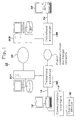
- Figure 1 shows the organization of a first embodiment of a charging device and a method of updating the charging characteristics of a battery via the Internet 10.
- the user's computer 12 is connected to telephone exchange 18A via a telephone line 16.
- Telephone exchange 18A is connected to server 20A.
- Server 20A is connected via a dedicated high speed line 25 to server 20B, which houses a home page for updating the charging characteristics of a charging device and battery.
- the home page on server 20B is connected via line 24 and telephone exchange 18B to the computer 22 belonging to the charging device and battery's manufacturer. The contents of the home page are updated by means of computer 22.
- the user connects charging device 30 to computer 12 to a communication interface 14 interposed therebetween, and accesses the home page via the Internet in order to update the charging characteristics of the charging device 30.
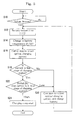
- FIG. 2 (A) is a block diagram which shows the configuration of charging device 10 and battery pack 50.
- Charging device 30 is comprised of a temperature detector 38 for detecting the temperature of a battery by means of an output value from a temperature sensor (thermistor) 56 in battery pack 50, an EEPROM 39 comprised of a recording medium for storing a map to control current levels (discussed below) and the identity of the model of the charging device, a control unit 34 which searches for a rise in temperature by differentiating the temperature output from the temperature detection section 38, searches the map based on the temperature and the rise in temperature and searches for an allowable current level with which the battery can be charged while suppressing a rise in the temperature of the battery, and outputs the allowable current level to a charging control unit 34, and the charging current control unit 34 for controlling a power supply circuit 32 based on the current level requested from the control unit 36 and adjusting the charging current for the battery.
- a temperature detector 38 for detecting the temperature of a battery by means of an output value from
- Battery pack 50 includes a nickel hydride battery B, a temperature sensor (thermistor) 56 for detecting the temperature of the nickel hydride battery, and an identifier stored on EEPROM 54 for identifying the model of battery pack 50.
- the nickel metal hydride battery in particular possesses characteristics in which the temperature gradient (rise in temperature) varies greatly in accordance with the charging current used or its capacity in the fully charged state. Because of this, in this embodiment of the charging device, the condition of the battery is distinguished based on its absolute temperature and the rise in temperature, and the battery is charged with as high a current as possible while preventing the temperature of the battery from rising. That is, charging occurs by changing the level of current in accordance with the condition of the battery.
- the map provides the optimal current level for charging while suppressing a rise in temperature.
- the horizontal axis of the map indicates the absolute temperature T of a battery, and its vertical axis indicates a temperature difference dT/dt. That is, if the temperature of the battery is high and the rise in temperature rise is high (lower right side of the map), then a relatively low charging current is applied. If the temperature of the battery is high and the rise in temperature rise is low (upper right side of the map), a moderate level of charging current is applied. And, if the temperature of the battery is low and the rise in temperature is high (lower left side of the map), a moderate level of charging current is applied.
- the optimum current levels are set on the map in order to achieve the desired charging time (approximately 20 minutes) and desired final temperature.
- the charging time is determined from the region in which the absolute temperature T and the change in temperature dT/dt converge, and the charging current is controlled based on the charging level provided in this region. For example, when the battery temperature is between T3 and T4 and the change in battery temperature (charging temperature) is between X1 and X2, then the current level provided in region I24 is output.
- the current level apparently moves within the regions at random based on the temperature and the change in the rise in temperature.
- the temperature of the battery rises, or, the rise in temperature is high. If a relatively small charging current region is selected, that is, after a region on the lower right side on the map shown in Fig. 4 is selected, the rise in temperature becomes smaller by decreasing the current, which corresponds to the upper portion of the region in the map.
- the battery charger in this embodiment continuously (for example, three times) takes measurements at predetermined intervals (for example, at intervals of several hundred seconds) .
- the rise in temperature is large as shown in the hatched regions of the map I31, I32, I33, I34 and I35, and when the temperature is high and the rise in temperature is moderate as in region I25, it is determined that the battery charging is complete and the charging is then stopped.
- control unit 36 of charging device 30 adjusts the charging current and determines whether battery charging is completed in a predetermined cycle (less than 10 second intervals).
- a predetermined cycle less than 10 second intervals.
- control unit 36 of charging device 30 adjusts the charging current and determines whether battery charging is completed in a predetermined cycle (less than 10 second intervals).
- battery pack 50 is installed by detecting a battery voltage (S10). That is, if battery pack 50 is installed (S10 : Yes), the absolute temperature T of the nickel metal hydride battery is input (Step S12).
- the absolute temperature T input is differentiated and the change in battery temperature dT/dt is calculated (Step S14).
- an optimum charging current is selected from the aforementioned map shown in Fig. 4 (Step S16).
- control unit 36 determines whether it is in the final stage of charging region, i.e., hatched regions I31, I32, I33, I34 and I35 shown in the map of Fig. 4, in which the rise in temperature is high, and in region I25 in which the rise in temperature is moderate (Step S18).
- the process returns to Step 12, and control of the charging current continues.
- Step 18 is determined to be "Yes" (regions I31, I32, I33, I34, I35 and I25), and it is then determined whether there is a high probability of current being in the final stage of charging regions (Step S22). That is, it is determined that there is a high probability that it is in the final stage of charging regions if it enters the final stage of charging regions in three consecutive cycles.
- the level of current is decreased on the next cycle, but at an absolute temperature T between T2 and T3, the change in temperature dT/dt is decreased to X1 to X2 in the next cycle.
- the decision in Step 22 is "Low" and the process goes on to Step 20 in which charging continues with a variable charging current.
- charging device 30 is connected to the serial port of the user's computer 12 via a communication interface 14.
- the communication interface 14 is directly connected to EEPROM 39, and as shown in Figure 3 (A), is connected by means of control unit 36. The user then accesses the home page of the manufacturer of the charging device 30 with his computer via the Internet 10.
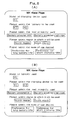
- Fig. 6 (A) an image is shown which serves to obtain the user's mode of use and his preferences.
- the section reading "Model of charging device used” serves to confirm the model from the identifier read out from EEPROM 39 of charging device 30 (as discussed below), the section reading "Please select the battery to be used” serves to have the user select the battery pack to be used in the charging device, the section reading "Please select the tool primarily used” serves to have the user select the tool that he will primarily use, the section reading "Please select region in which it will be used” serves to have the user select the region in which the battery powered tool will be used, the section reading "Please select the mode of use desired” serves to have the user select the mode of use desired.
- server 20B shown in Fig. 1 via the Internet. That is, the user is asked to specify the power tool to be used because the optimal charge pattern differs according to whether there is a light load on the battery (battery powered drill) or a heavy load on the battery (battery powered chain saw) . Further, the user is asked to specify the region in which the tool will be used because the optimal charge pattern differs according to whether the tool will be used in cold climates (north regions) or climates that are not cold (south regions) .
- the charging pattern is set so as to lengthen the life of the battery as long as possible and avoid applying large currents, even if this lengthens the charging period.
- the charging patter is set so as to apply a large current and shorten the charging period, even if this shortens the life of the battery.
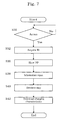
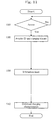
- a determination is made whether access has occurred (S30). That is, if there was access (S30 : Yes), the identifier stored in EEPROM 39 in charging device 30 is read out (S32). Then, the model of the charging device that corresponds to the identifier is displayed on the home page as shown in Fig. 6 (A) (S36).
- the information selected on the screen is input (S38), and based on this input information, the optimal map is retrieved. That is, the optimal map is retrieved from amongst the plurality of maps stored on the hard disk on server 20B. Then, this map is downloaded to the user's computer 12 via the Internet (S42). By this means, computer 12 writes the map into the EEPROM 39 of charging device 30.
- the map is stored in the charging device.
- the modification is that the map is stored in EEPROM 54 that comprises the storage medium of battery pack 50.
- the EEPROM 54 of battery pack 50 is connected to computer 12 via communication interface 14.
- the section reading "Model of battery used” serves to confirm the model from the identifier read out from EEPROM 54 of battery pack 50
- the section reading "Please select the charging device to be used” serves to have the user select the charging device to be used to charge the battery
- the section reading "Please select the tool primarily used” serves to have the user select the tool that he will primarily use
- the section reading "Please select region in which it will be used” serves to have the user select the region in which the battery powered tool will be used
- the section reading "Please select the mode of use desired” serves to have the user select the mode of use desired.
- the process of updating the map by means of this modification is the same as that described above with respect to the first embodiment.
- the information provider home page
- the mode of use of the battery desired by the user is selected
- the charging characteristics that match the mode of use selected is downloaded via the Internet and write into the EEPROM of the battery. Because of this, the desires of the user can be matched with the charging characteristics of the charging device and battery, and can be write into the EEPROM of the battery.
- the mode of use of the battery desired by the user is downloaded via the Internet and written into the EEPROM of the battery.
- a determination is made whether access has occurred (S30). That is, if there was access (S30 : Yes), the identifier stored in EEPROM 39 in charging device 30 and the identifier of the new battery are read out (S32). Then, the charging control information of the battery is input (S38). This control information is downloaded to the user's computer 12 via the Internet (S42). By this means, computer 12 writes the control information into the EEPROM 39 of charging device 30.
- the mode of use is selected from the home page.
- the charging history is stored in the EEPROM of the battery pack, the charging history is read out via the Internet, the optimal map (charging pattern) corresponding to the charging history is retrieved, and is written into the EEPROM. Further, because the configuration of the second charging device and battery pack is the same as that of the first embodiment described above in Fig. 2 (A), the second embodiment will be explained with reference to the same figure.
- the charging history includes the temperature classification (low temperature (below 10 degrees Celsius) , normal temperature (from 10 degrees Celsius up to 30 degrees Celsius), and high temperature (above 30 degrees Celsius)), and the battery capacity classification (over discharged - neglected for a long period of time (capacity below 0%), capacity 0% (capacity 0% to below 70%), capacity 100% (capacity above 70%)) taken from the beginning of the last 10 charges.
- the charging history also includes the number of times the battery has been charged. This stored history serves to determine whether a mode of use which shortened the life of the battery has been used.
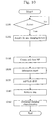
- the control unit 36 of the charging device 30 determines the adjustment of the charging current and the completion of charging according to a fixed cycle. First, it determines whether a battery voltage is detected and whether the battery pack 50 has been installed (S100). That is, if battery pack 50 has been installed (S100 : Yes), the absolute temperature T of the nickel hydride battery is detected (S102), and the classification of the temperature detected is updated in the data of EEPROM 54 (S104). Next, the capacity of the battery is detected (S106), and the classification of the capacity detected is updated in the data of EEPROM 54 (S108). After this, the number of times the battery has been charged is updated (S110), and hereinafter a charging process occurs (S110 - S124) that is the same as Step 10 - Step 24 of Figure 5.
- a determination is made whether access has occurred (S130). That is, if there was access (S130 : Yes), the identifier stored in EEPROM 39 in battery pack 50 is read out (S132). Then, the model of the battery pack that corresponds to the identifier is displayed on the home page as shown in Fig. 8 (A) (S136).
- the information selected on the screen shown in Figure 8 (A) is input (S38), and based on this input information, the optimal map is retrieved.
- a map will be selected which extends battery life by reducing charging current.
- a map will be selected in which charging current is increased and charging is completed in the shortest amount of time.
- the charging pattern (map) of EEPROM 54 of battery pack 50 is updated entirely according to the charging history
- the charging pattern (map) is updated entirely over the Internet
- the charging pattern (map) can be updated through the use of a variety of computer communications.
- the history of use is written into EEPROM 54 of battery pack 50 .
- the computer is connected to battery pack 50, the history of use read into EEPROM 54 of battery pack 50 is read out via the Internet, the charging characteristics (map) which match the history of use are downloaded via the Internet, and written into EEPROM 54 of battery pack 50. Because of this, the optimal charging characteristics can be matched with the actual mode of use and written into EEPROM 54.
- the history of use is input into the host computer. It is impossible, to input the information such as the charging history, the use of the charging device and a breakdown of the charging device into the computer under the device manufacture, to analyze input information and to search the mode of actual use of charging device and battery. Based on the result of the search, it is possible to search the market to obtain an index for developing a new product, and to supply various service.
- computer 22 analyzes the information (S146). Based on the result of the analysis, it is possible to supply various service. For example, when a charging device is breakdown, a serviceman can be sent to repair the device.
Landscapes
- Engineering & Computer Science (AREA)
- Power Engineering (AREA)
- Charge And Discharge Circuits For Batteries Or The Like (AREA)
- Secondary Cells (AREA)
Abstract
Description
Claims (5)
- A method of updating the charging characteristics stored on a storage medium of a charging device and a battery via the Internet, comprising:connecting the charging device and battery to a computer;connecting to an information provider via the Internet, and selecting the mode of use of the battery that a user desires;downloading via the Internet charging characteristics which match the selected mode of use, and writing the charging characteristics into the storage medium of the charging device and battery.
- A method of updating the charging characteristics stored on a storage medium of a charging device and a battery via the Internet, comprising:connecting the charging device and battery to a computer;connecting to an information provider via the Internet, and reading out an identifier of the charging device and battery connected to the computer;selecting the mode of use of the battery desired by the user;adapting to the specific charging device and battery by means of said identifier, downloading the charging characteristics which match the selected mode of use via the Internet, and writing the charging characteristics into the storage medium of the battery pack.
- The method of updating the charging characteristics of the charging device and the battery according to Claim 1, wherein said mode of use of said battery desired by said user is either preservation of battery life or shortening the time of charging.
- The method of updating the charging characteristics of the charging device and the battery according to Claim 2, wherein said mode of use of said battery desired by said user is either preservation of battery life or shortening the time of charging.
- A method of updating the charging characteristics stored on a storage medium of a charging device and a battery via a computer communication line, comprising:writing the history of use into the storage medium of the charging device and battery;connecting said charging device and battery to a computer;reading out the identifier of the charging device and battery connected to the computer via a communication line;reading out the history of use read into the storage medium of the charging device and battery via the communication line, adapting to the specific charging device and battery by means of the identifier, downloading the charging characteristics which match the history of use via the communication line, and writing the charging characteristics into the storage medium of the charging device and the battery.
Applications Claiming Priority (2)
| Application Number | Priority Date | Filing Date | Title |
|---|---|---|---|
| JP2000112432A JP3727508B2 (en) | 2000-04-13 | 2000-04-13 | Charging device and battery charging characteristics update method |
| JP2000112432 | 2000-04-13 |
Publications (2)
| Publication Number | Publication Date |
|---|---|
| EP1148613A2 true EP1148613A2 (en) | 2001-10-24 |
| EP1148613A3 EP1148613A3 (en) | 2005-04-27 |
Family
ID=18624604
Family Applications (1)
| Application Number | Title | Priority Date | Filing Date |
|---|---|---|---|
| EP20010109071 Ceased EP1148613A3 (en) | 2000-04-13 | 2001-04-11 | A method of updating the charging characteristics of a charging device and a battery |
Country Status (3)
| Country | Link |
|---|---|
| US (1) | US6433515B2 (en) |
| EP (1) | EP1148613A3 (en) |
| JP (2) | JP3727508B2 (en) |
Cited By (7)
| Publication number | Priority date | Publication date | Assignee | Title |
|---|---|---|---|---|
| EP2224575A1 (en) * | 2009-02-26 | 2010-09-01 | Research In Motion Limited | Method and apparatus for dynamic battery management control in a mobile communication device |
| US8200292B2 (en) | 2009-02-26 | 2012-06-12 | Research In Motion Limited | Method and apparatus for dynamic battery management control in a mobile communication device |
| US8970180B2 (en) | 2009-04-07 | 2015-03-03 | Qualcomm Incorporated | Wireless power transmission scheduling |
| EP2636208A4 (en) * | 2010-11-05 | 2016-05-18 | Alelion Batteries Ab | Battery module system and method for initialising battery modules |
| WO2018063721A1 (en) * | 2016-09-30 | 2018-04-05 | Intel Corporation | Methods, apparatus, systems and articles of manufacture to charge a battery based on an electronic device skin temperature |
| US12107444B2 (en) | 2011-04-28 | 2024-10-01 | Zoll Circulation, Inc. | Viral distribution of battery management parameters |
| US12549019B2 (en) | 2011-04-28 | 2026-02-10 | Zoll Circulation, Inc. | System and method for tracking and archiving battery performance data |
Families Citing this family (35)
| Publication number | Priority date | Publication date | Assignee | Title |
|---|---|---|---|---|
| JP3805664B2 (en) | 2001-11-01 | 2006-08-02 | 株式会社マキタ | Battery pack |
| US20030197512A1 (en) * | 2002-04-22 | 2003-10-23 | Michael Miller | Battery analyzer |
| JP2004094607A (en) * | 2002-08-30 | 2004-03-25 | Matsushita Electric Ind Co Ltd | Portable information device, method and program for optimizing state of charge of battery, battery management server, and method and program for optimizing state of charge of battery-powered electric device |
| US7768234B2 (en) * | 2004-02-28 | 2010-08-03 | Janik Craig M | System and method for automatically synchronizing and acquiring content for battery powered devices |
| US9274576B2 (en) * | 2003-03-17 | 2016-03-01 | Callahan Cellular L.L.C. | System and method for activation of portable and mobile media player devices for wireless LAN services |
| US8013611B2 (en) | 2006-07-14 | 2011-09-06 | Reserve Power Cell, Llc | Vehicle battery product and battery monitoring system |
| US7191077B2 (en) * | 2003-12-23 | 2007-03-13 | Lenovo Singapore Pte Ltd | Smart battery charging system, method, and computer program product |
| US7598700B2 (en) * | 2005-03-30 | 2009-10-06 | Reserve Power Cell, Llc | Tamper resistant battery and battery warranty and performance tracking system |
| JP2008067425A (en) * | 2006-09-04 | 2008-03-21 | Yamaha Motor Electronics Co Ltd | Electrical charge controller for vehicle |
| JP2008228389A (en) * | 2007-03-09 | 2008-09-25 | Yamaha Motor Electronics Co Ltd | Battery charging method of electric golf car |
| US8674662B2 (en) * | 2008-02-17 | 2014-03-18 | Dell Products L.P. | User selectable charging modes for dynamically charging batteries for an information handling system |
| JP5254655B2 (en) * | 2008-04-30 | 2013-08-07 | 株式会社エヌ・ティ・ティ・ドコモ | Charging device, electronic device, secondary battery pack, secondary battery pack security management system, and secondary battery pack security management method |
| JP2010033168A (en) * | 2008-07-25 | 2010-02-12 | Makita Corp | Charging system, battery, battery charger, and program |
| US20100123436A1 (en) * | 2008-11-14 | 2010-05-20 | Symbol Technologies, Inc. | Optimized lithium-ion battery charging |
| JP2010200530A (en) * | 2009-02-26 | 2010-09-09 | Omron Corp | Charging controller and method, charger and method, and program |
| JP5085626B2 (en) * | 2009-10-08 | 2012-11-28 | レノボ・シンガポール・プライベート・リミテッド | Battery pack, firmware update method thereof, and battery pack system |
| JP5524019B2 (en) * | 2010-10-13 | 2014-06-18 | 本田技研工業株式会社 | Charging apparatus and charging method |
| US9825475B2 (en) | 2011-04-28 | 2017-11-21 | Zoll Circulation, Inc. | System and method for automated detection of battery insert |
| CN103797609B (en) | 2011-04-28 | 2016-12-14 | 佐尔循环公司 | Latch mechanism for battery retention |
| EP2702664B1 (en) | 2011-04-28 | 2018-01-17 | Zoll Circulation, Inc. | Battery management system with mosfet boost system |
| AU2012249306B2 (en) | 2011-04-28 | 2017-07-20 | Zoll Circulation, Inc. | Battery management system for control of lithium power cells |
| US10862323B2 (en) | 2011-04-28 | 2020-12-08 | Zoll Circulation, Inc. | Battery management system for control of lithium power cells |
| US20130164567A1 (en) | 2011-06-24 | 2013-06-27 | Seektech, Inc. | Modular battery pack apparatus, systems, and methods |
| JP2013126325A (en) | 2011-12-15 | 2013-06-24 | Panasonic Eco Solutions Power Tools Co Ltd | Charging circuit |
| US10090498B2 (en) | 2012-06-24 | 2018-10-02 | SeeScan, Inc. | Modular battery pack apparatus, systems, and methods including viral data and/or code transfer |
| US9431839B2 (en) * | 2012-10-26 | 2016-08-30 | Nokia Technologies Oy | Method, apparatus, and computer program product for optimized device-to-device charging |
| US20150188324A1 (en) * | 2013-12-30 | 2015-07-02 | Lenovo (Singapore) Pte. Ltd. | Systems and methods to increase and decrease charging current to battery |
| US11038361B2 (en) | 2015-03-16 | 2021-06-15 | Lenovo (Singapore) Pte. Ltd. | Battery with cathode materials for charging at different rates |
| US10283985B2 (en) | 2016-05-25 | 2019-05-07 | Lenovo (Singapore) Pte. Ltd. | Systems and methods to determine time at which battery is to be charged |
| US10439418B2 (en) | 2016-07-29 | 2019-10-08 | Lenovo (Singapore) Pte. Ltd. | Systems and methods to charge a battery at different charge rates and indicate when charging at a faster rate is available |
| JP2019080406A (en) * | 2017-10-23 | 2019-05-23 | 株式会社マキタ | Charge control device, battery pack, and charger |
| WO2019235645A1 (en) | 2018-06-08 | 2019-12-12 | パナソニックIpマネジメント株式会社 | Battery management system and battery management method |
| WO2019235646A1 (en) | 2018-06-08 | 2019-12-12 | パナソニックIpマネジメント株式会社 | Electronic device comprising battery |
| JP2020205667A (en) * | 2019-06-14 | 2020-12-24 | 工機ホールディングス株式会社 | Charger |
| JP7659998B2 (en) * | 2021-02-10 | 2025-04-10 | 株式会社Subaru | Charging equipment |
Family Cites Families (11)
| Publication number | Priority date | Publication date | Assignee | Title |
|---|---|---|---|---|
| US5889386A (en) * | 1982-06-07 | 1999-03-30 | Intermec Technology Corporation | Battery conditioning system having communication with battery parameter memory means in conjunction with battery conditioning |
| US5592069A (en) | 1992-10-07 | 1997-01-07 | Dallas Semiconductor Corporation | Battery charger |
| US5349535A (en) * | 1992-10-20 | 1994-09-20 | Digicomp Research Corporation | Battery condition monitoring and recording system for electric vehicles |
| US5927938A (en) * | 1994-01-06 | 1999-07-27 | Unlimited Range Electric Car Systems Company | Battery charging and transfer system for electrically powered vehicles |
| FI102124B (en) * | 1996-03-07 | 1998-10-15 | Nokia Telecommunications Oy | Remote Testing of a Subscriber Connection in a System Realizing a Cordless Subscriber Connection |
| US6331762B1 (en) * | 1997-11-03 | 2001-12-18 | Midtronics, Inc. | Energy management system for automotive vehicle |
| CA2225585A1 (en) * | 1997-12-12 | 1999-06-12 | Hydro-Quebec | Battery control system |
| JP3390667B2 (en) * | 1998-06-09 | 2003-03-24 | 株式会社マキタ | Charging device |
| JP3563965B2 (en) * | 1998-06-29 | 2004-09-08 | 本田技研工業株式会社 | Battery charger |
| JP2000060015A (en) * | 1998-08-13 | 2000-02-25 | Sony Corp | Charge control device and method, charge control system, and provided medium |
| US6119179A (en) * | 1998-08-28 | 2000-09-12 | Pda Peripherals Inc. | Telecommunications adapter providing non-repudiable communications log and supplemental power for a portable programmable device |
-
2000
- 2000-04-13 JP JP2000112432A patent/JP3727508B2/en not_active Expired - Lifetime
-
2001
- 2001-04-06 US US09/828,314 patent/US6433515B2/en not_active Expired - Lifetime
- 2001-04-11 EP EP20010109071 patent/EP1148613A3/en not_active Ceased
-
2005
- 2005-08-24 JP JP2005242481A patent/JP2005348598A/en active Pending
Cited By (9)
| Publication number | Priority date | Publication date | Assignee | Title |
|---|---|---|---|---|
| EP2224575A1 (en) * | 2009-02-26 | 2010-09-01 | Research In Motion Limited | Method and apparatus for dynamic battery management control in a mobile communication device |
| US8200292B2 (en) | 2009-02-26 | 2012-06-12 | Research In Motion Limited | Method and apparatus for dynamic battery management control in a mobile communication device |
| US9160833B2 (en) | 2009-02-26 | 2015-10-13 | Blackberry Limited | Method and apparatus for dynamic battery management control in a mobile communication device |
| US8970180B2 (en) | 2009-04-07 | 2015-03-03 | Qualcomm Incorporated | Wireless power transmission scheduling |
| EP2636208A4 (en) * | 2010-11-05 | 2016-05-18 | Alelion Batteries Ab | Battery module system and method for initialising battery modules |
| US12107444B2 (en) | 2011-04-28 | 2024-10-01 | Zoll Circulation, Inc. | Viral distribution of battery management parameters |
| US12549019B2 (en) | 2011-04-28 | 2026-02-10 | Zoll Circulation, Inc. | System and method for tracking and archiving battery performance data |
| WO2018063721A1 (en) * | 2016-09-30 | 2018-04-05 | Intel Corporation | Methods, apparatus, systems and articles of manufacture to charge a battery based on an electronic device skin temperature |
| US10305292B2 (en) | 2016-09-30 | 2019-05-28 | Intel Corporation | Methods, apparatus, systems and articles of manufacture to charge a battery based on an electronic device skin temperature |
Also Published As
| Publication number | Publication date |
|---|---|
| JP2001298870A (en) | 2001-10-26 |
| EP1148613A3 (en) | 2005-04-27 |
| US20010035732A1 (en) | 2001-11-01 |
| JP3727508B2 (en) | 2005-12-14 |
| JP2005348598A (en) | 2005-12-15 |
| US6433515B2 (en) | 2002-08-13 |
Similar Documents
| Publication | Publication Date | Title |
|---|---|---|
| US6433515B2 (en) | Method of updating the charging characteristics of a charging device and a battery | |
| US6204640B1 (en) | Battery charger and battery charging method | |
| US7045989B2 (en) | Methods and apparatus for managing a plurality of charging devices via a network | |
| KR101441127B1 (en) | How to charge electronic devices and electronic devices | |
| US6476584B2 (en) | Battery charger and battery charging method | |
| US6337560B1 (en) | Life cycle charging for batteries | |
| CN107200011B (en) | Adaptive system and method for optimizing battery life in plug-in vehicles | |
| US6218806B1 (en) | Method and apparatus for obtaining product use information | |
| US6204641B1 (en) | Battery charger and charging method | |
| US6191560B1 (en) | Battery charger | |
| EP1217710A1 (en) | Charging system and battery pack | |
| EP1434328B1 (en) | Battery charger | |
| US20020060554A1 (en) | Battery charging system and charge control apparatus | |
| EP1100169B1 (en) | Battery charging device and charging method thereof | |
| CN103222147A (en) | Context aware battery charging | |
| EP0965906A2 (en) | Calibrating rechargeable battery | |
| JP3612460B2 (en) | Charger | |
| KR102850041B1 (en) | How to implement algorithms for battery management including machine learning models | |
| KR20250000136A (en) | Battery charging control device and method | |
| JP3842076B2 (en) | Charger | |
| JP2026500392A (en) | Server and mileage estimation method | |
| JP2002112467A (en) | Battery charger | |
| KR20210136420A (en) | Server and control method for the same | |
| JP2020191756A (en) | Electronic device, control method, and program | |
| JPH0993825A (en) | Method for detecting full charge of battery charger, and battery charger using the same |
Legal Events
| Date | Code | Title | Description |
|---|---|---|---|
| PUAI | Public reference made under article 153(3) epc to a published international application that has entered the european phase |
Free format text: ORIGINAL CODE: 0009012 |
|
| AK | Designated contracting states |
Kind code of ref document: A2 Designated state(s): AT BE CH CY DE DK ES FI FR GB GR IE IT LI LU MC NL PT SE TR |
|
| AX | Request for extension of the european patent |
Free format text: AL;LT;LV;MK;RO;SI |
|
| PUAL | Search report despatched |
Free format text: ORIGINAL CODE: 0009013 |
|
| AK | Designated contracting states |
Kind code of ref document: A3 Designated state(s): AT BE CH CY DE DK ES FI FR GB GR IE IT LI LU MC NL PT SE TR |
|
| AX | Request for extension of the european patent |
Extension state: AL LT LV MK RO SI |
|
| AKX | Designation fees paid |
Designated state(s): DE FR GB |
|
| 17P | Request for examination filed |
Effective date: 20050630 |
|
| RBV | Designated contracting states (corrected) |
Designated state(s): DE ES FR GB IT NL |
|
| R17P | Request for examination filed (corrected) |
Effective date: 20050630 |
|
| RBV | Designated contracting states (corrected) |
Designated state(s): DE ES FR GB IT NL |
|
| 17Q | First examination report despatched |
Effective date: 20070105 |
|
| STAA | Information on the status of an ep patent application or granted ep patent |
Free format text: STATUS: THE APPLICATION HAS BEEN REFUSED |
|
| 18R | Application refused |
Effective date: 20150719 |