EP1148232A2 - A device for suppressing black smoke emission - Google Patents
A device for suppressing black smoke emission Download PDFInfo
- Publication number
- EP1148232A2 EP1148232A2 EP01109524A EP01109524A EP1148232A2 EP 1148232 A2 EP1148232 A2 EP 1148232A2 EP 01109524 A EP01109524 A EP 01109524A EP 01109524 A EP01109524 A EP 01109524A EP 1148232 A2 EP1148232 A2 EP 1148232A2
- Authority
- EP
- European Patent Office
- Prior art keywords
- supply cylinder
- fuel
- cylinder member
- liquid fuel
- cylindrical casing
- Prior art date
- Legal status (The legal status is an assumption and is not a legal conclusion. Google has not performed a legal analysis and makes no representation as to the accuracy of the status listed.)
- Withdrawn
Links
- 239000000779 smoke Substances 0.000 title abstract description 36
- 239000000446 fuel Substances 0.000 abstract description 120
- 239000007788 liquid Substances 0.000 abstract description 67
- 238000002485 combustion reaction Methods 0.000 abstract description 27
- 238000007600 charging Methods 0.000 abstract description 11
- 230000000052 comparative effect Effects 0.000 description 15
- 239000003921 oil Substances 0.000 description 15
- 239000002245 particle Substances 0.000 description 14
- 230000010349 pulsation Effects 0.000 description 13
- 239000006096 absorbing agent Substances 0.000 description 11
- 239000000295 fuel oil Substances 0.000 description 10
- 210000002445 nipple Anatomy 0.000 description 9
- 230000009467 reduction Effects 0.000 description 9
- 239000010802 sludge Substances 0.000 description 7
- 239000010419 fine particle Substances 0.000 description 5
- 239000000463 material Substances 0.000 description 5
- 230000005611 electricity Effects 0.000 description 4
- 238000002474 experimental method Methods 0.000 description 4
- 238000000034 method Methods 0.000 description 4
- 230000008569 process Effects 0.000 description 4
- 230000001629 suppression Effects 0.000 description 4
- 238000011144 upstream manufacturing Methods 0.000 description 4
- 239000003054 catalyst Substances 0.000 description 3
- 238000007786 electrostatic charging Methods 0.000 description 3
- 238000001914 filtration Methods 0.000 description 3
- 239000007789 gas Substances 0.000 description 3
- 239000003502 gasoline Substances 0.000 description 3
- 150000001336 alkenes Chemical class 0.000 description 2
- QVGXLLKOCUKJST-UHFFFAOYSA-N atomic oxygen Chemical compound [O] QVGXLLKOCUKJST-UHFFFAOYSA-N 0.000 description 2
- 238000010276 construction Methods 0.000 description 2
- 238000010586 diagram Methods 0.000 description 2
- 238000007599 discharging Methods 0.000 description 2
- 230000000694 effects Effects 0.000 description 2
- 239000002360 explosive Substances 0.000 description 2
- 239000012530 fluid Substances 0.000 description 2
- 239000002828 fuel tank Substances 0.000 description 2
- 230000006872 improvement Effects 0.000 description 2
- 238000005259 measurement Methods 0.000 description 2
- 239000001301 oxygen Substances 0.000 description 2
- 229910052760 oxygen Inorganic materials 0.000 description 2
- -1 polyethylene Polymers 0.000 description 2
- 229920003002 synthetic resin Polymers 0.000 description 2
- 239000000057 synthetic resin Substances 0.000 description 2
- JOYRKODLDBILNP-UHFFFAOYSA-N Ethyl urethane Chemical compound CCOC(N)=O JOYRKODLDBILNP-UHFFFAOYSA-N 0.000 description 1
- CWYNVVGOOAEACU-UHFFFAOYSA-N Fe2+ Chemical compound [Fe+2] CWYNVVGOOAEACU-UHFFFAOYSA-N 0.000 description 1
- 239000004698 Polyethylene Substances 0.000 description 1
- 239000004743 Polypropylene Substances 0.000 description 1
- 230000009471 action Effects 0.000 description 1
- 230000008859 change Effects 0.000 description 1
- 239000006185 dispersion Substances 0.000 description 1
- 230000002708 enhancing effect Effects 0.000 description 1
- 230000003203 everyday effect Effects 0.000 description 1
- 239000006260 foam Substances 0.000 description 1
- 238000013467 fragmentation Methods 0.000 description 1
- 238000006062 fragmentation reaction Methods 0.000 description 1
- JRZJOMJEPLMPRA-UHFFFAOYSA-N olefin Natural products CCCCCCCC=C JRZJOMJEPLMPRA-UHFFFAOYSA-N 0.000 description 1
- 229920000573 polyethylene Polymers 0.000 description 1
- 229920001155 polypropylene Polymers 0.000 description 1
- 239000012858 resilient material Substances 0.000 description 1
- 230000003068 static effect Effects 0.000 description 1
Images



Classifications
-
- F—MECHANICAL ENGINEERING; LIGHTING; HEATING; WEAPONS; BLASTING
- F02—COMBUSTION ENGINES; HOT-GAS OR COMBUSTION-PRODUCT ENGINE PLANTS
- F02M—SUPPLYING COMBUSTION ENGINES IN GENERAL WITH COMBUSTIBLE MIXTURES OR CONSTITUENTS THEREOF
- F02M27/00—Apparatus for treating combustion-air, fuel, or fuel-air mixture, by catalysts, electric means, magnetism, rays, sound waves, or the like
- F02M27/04—Apparatus for treating combustion-air, fuel, or fuel-air mixture, by catalysts, electric means, magnetism, rays, sound waves, or the like by electric means, ionisation, polarisation or magnetism
Definitions
- This invention relates to a black smoke emission suppressing device for reducing the amount of black smoke which is caused by burning liquid fuel such as gasoline and light oil used as a power source for an internal combustion engine or the like.
- the aforementioned sludge removing device contributes to improvement of fuel cost performance and black smoke emission reduction to some extent.
- a device which ensures further improved combustion efficiency and cost performance.
- a black smoke emission suppressing device is adapted for suppressing black smoke in burning of a liquid fuel.
- the device comprises a vessel for allowing a liquid fuel to flow therethrough and an electrostatic charger for electrostatically charging the liquid fuel.
- the black smoke emission suppressing device considerably reduces the amount of black smoke which accompanies burning of such liquid fuel as gasoline and light oil used in an internal combustion engine or the like, and thus contributes to fuel cost reduction.
- a black smoke emission suppressing device 1 includes a metallic cylindrical casing 2, a metallic supply cylinder member 3 which is disposed inside the cylindrical casing 2, an electrostatic charger 4 which is brought into fit contact over the supply cylinder member 3, a piston member 5 which is slidably movable in the supply cylinder member 3, and a pulsation absorber 6 which is disposed inside the cylindrical casing 2.
- the cylindrical casing 2 has a hollow tubular main body 21, a bottom member 22 which closes a bottom space of the main body 21, and a top member 23 which closes a top space of the main body 21.
- the cylindrical casing 2 is formed with an internal threaded portion 21a in an inner surface of a bottom part thereof.
- the bottom member 22 is formed with an external threaded portion 22a at a part corresponding to the internal threaded portion 21a of the cylindrical casing 2. Screwing the external threaded portion 22a of the bottom member 22 in the internal threaded portion 21a of the cylindrical casing 2 fixes the bottom member 22 to the main body 21 of the cylindrical casing 2.
- the bottom member 22 is formed with a through discharge hole 22b with an internal thread formed in an inner surface thereof.
- a screw plug 22c which detachably plugs in the hole 22b is provided.
- the drainage hole 22b is adapted to discharge residue of fuel which stays at the bottom part of the main body 21, and is closed by the plug 22c when the device 1 is in use.
- the top member 23 is formed with a screw hole 23a at a center thereof.
- a first nipple 24 is provided at the bottom side of the top member 23 at the position corresponding to the screw hole 23a.
- the first nipple 24 has a head 24a which has a larger diameter than the screw hole 23a, and a stem 24b which concentrically extends from the head 24a.
- the stem 24b has a smaller diameter than the head 24a and has the same diameter as the screw hole 23a.
- An external thread corresponding to an internal thread of the screw hole 23a is formed in a base end of the stem 24b. Screwing the external thread of the stem 24b into the internal thread of the screw hole 23a fixes the first nipple 24 to the top member 23.
- a hole 25 formed in the center of the first nipple 24 constitutes a fuel inflow opening for introducing liquid fuel inside the device 1.
- An air inlet hole 23b is formed at an appropriate position in the top member 23.
- the air inlet hole 23b is formed with an internal thread in an inner surface thereof.
- the air inlet hole 23b is closed by a screw plug 23c when the device 1 is in use, and is opened when the drainage hole 22b of the bottom member 22 is opened.
- the top member 23 is formed with an external thread along an outer periphery thereof.
- the cylindrical casing 2 is formed with an internal thread along an upper end inner surface thereof at a position corresponding to the external thread of the top member 23. Screwing the external thread of the top member 23 in the internal thread of the cylindrical casing 2 fixedly mounts the top member 23 on the cylindrical casing 2.
- a hole 21b for discharging liquid fuel outside is formed at an appropriate position in the tubular main body 21.
- a second nipple 26 is fixed to the tubular main body 21 in such a manner that the second nipple 26 encloses the hole 21b.
- the second nipple 26 is formed with an external thread in an outer surface thereof, and is formed with a center outlet hole 27 for discharging the liquid fuel outside.
- the supply cylinder member 3 has an inner diameter which is generally identical to or slightly larger than the outer diameter of the head 24a of the first nipple 24.
- the supply cylinder member 3 is concentrically fitted in the cylindrical casing 2 in a state that an upper end of the supply cylinder member 3 is covered by the head 24a of the first nipple 24.
- a lower end of the supply cylinder member 3 comes into fit contact with the upper surface of the bottom member 22.
- an annular projection 22d having an inner diameter generally identical to or slightly larger than the outer diameter of the supply cylinder member 3 is formed on the upper surface of the bottom member 22. Fitting the lower end of the supply cylinder member 3 along an inner wall of the annular projection 22d fixedly mounts the supply cylinder member 3 in the cylindrical casing 2.
- a set of four through holes (fuel passing holes) 32 are circumferentially equidistantly formed along an outer periphery of the supply cylinder member 3 at an interval of 90° .
- a plurality of sets of these through holes 32 are formed at a certain interval in an axial direction of the supply cylinder member 3 in a region from a height level of about 1/3 from the bottom of the supply cylinder member 3 up to a certain position on the upper part thereof.
- the plurality of sets of through holes 32 constitute a hole group 31. Liquid fuel which has been introduced into the supply cylinder member 3 through the inlet hole 25 flows through the fuel passing holes 32, and is discharged out of the device 1 through the outlet hole 27 via the electrostatic charger 4 and inside the tubular main body 21 of the cylindrical casing 2.
- the electrostatic charger 4 in the first embodiment comprises a charging cylinder including a number of disc members 40, which are stacked in the axial direction of the supply cylinder member 3 one over another.
- Each of the disc members 40 is formed with a center hole 41.
- Each of the disc members 40 has an inner diameter (namely, the diameter of the center hole 41) slightly larger than the outer diameter of the supply cylinder member 3 and has an outer diameter slightly smaller than the inner diameter of the main body 21 of the cylindrical casing 2.
- the disc members 40 of the electrostatic charger 4 are fitted over the inner cylinder member 3, and the inner cylinder member 3 which has been mounted with the stacked disc members 40 is fitted inside the cylindrical casing 3.
- the outer surface of the disc members 40 and the inner surface of the main body 21 of the cylindrical casing 2 define an annular channel 49 as shown in FIGS. 3 and 4 when the supply cylinder member 3 mounted with the vertically stacked disc members 40 is fitted inside the main body 21 of the cylindrical casing 2.
- the annular channel 49 facilitates flow of the liquid fuel inside the cylindrical casing 2.
- FIG. 4 is a sectional plan view of the black smoke emission suppressing device 1.
- each of the disc members 40 is formed with four spiral grooves or channels 42 on the top surface thereof.
- the spiral grooves 42 in the disc member 40 are formed radially apart from each other equidistantly.
- Each of the spiral grooves 42 extend radially outwardly from the center hole 41 toward a radial distal end.
- the thickness of the disc member 40 is so set as to oppose an opening, i.e., an inlet port 43, of each of the spiral grooves 42 which is opened radially inwardly toward the center hole 41 to the corresponding fuel passing hole 32 of the supply cylinder member 3 when the disc members 40 are stacked one over another around the supply cylinder member 3.
- the liquid fuel which flows out of the supply cylinder member 3 through the fuel passing holes 32 is temporarily guided to the annular channel 49 via openings, i.e., outlet ports 44, which are formed in a radially outward distal end of each of the disc members 40 after flowing along the corresponding spiral grooves 42.
- the liquid fuel is then discharged out of the device 1 via the outlet hole 27 of the cylindrical casing 2.
- the disc members 40 constituting the electrostatic charger 4 are made of a material which causes the liquid fuel to be positively charged while flowing in friction contact with the spiral channels 42.
- the material may be a synthetic resin made of olefins such as polyethylene and polypropylene.
- the material is not limited to a synthetic resin of olefin, and various materials may be applicable as far as the material makes liquid fuel electrostatically charged due to frictional contact.
- an upper ring fitting groove 34 is formed in the supply cylinder member 3 at a position slightly below the bottommost set of fuel passing holes 32 to fit an upper C-shaped ring 33. Fitting the upper C-shaped ring 33 in the upper ring fitting groove 34 and mounting the electrostatic charger 4 on the supply cylinder member 3 keeps the generator 4 from slipping out of the supply cylinder member 3.
- the piston member 5 is mounted inside the inner cylinder member 3.
- the piston member 5 includes a lower piston member 5a, a middle piston member 5b, and an upper piston member 5c.
- the piston member 5a (5b or 5c) includes a piston 51 which is slidably fitted inside the inner surface of the supply cylinder member 3, and a helical spring 52 which is attached to a bottom part of the piston 51.
- the helical spring 52 has a gradually reduced radial size as oriented upward.
- the piston member 5 is constructed in such a manner that the upper piston member 5c is mounted over the middle piston member 5b, and the middle piston member 5b is mounted over the lower piston member 5a inside the inner cylinder member 3.
- the three piston members are stacked one over another inside the supply cylinder member 3.
- the piston 51 of the upper piston member 5c closes the fourth from the uppermost set of fuel passing holes 32 and the sets lower than the fourth set when liquid fuel is not introduced into the supply cylinder member 3.
- a liquid pressure is exerted to the piston 51 of the upper piston member 5c, which resultantly lowers the upper piston member 5c against the biasing force of the helical spring 52.
- the number of fuel passing holes 32 which are located above the piston 51 of the upper piston member 5c increases compared to the state when the liquid fuel has not been supplied into the supply cylinder member 3.
- Pressing force against the piston increases in proportion to the flowing rate of liquid fuel. Accordingly, as the flowing rate increases, the lowering amount of the piston 51 of the uppermost piston member increases. As the lowering amount increases, the number of the fuel passing holes 32 above the piston 51 of the uppermost piston member increases to allow a larger amount of fuel to pass through these upper located fuel passing holes 32.
- the height level of the piston 51 of the uppermost piston member is set in such a manner that the pressure of the liquid fuel exerted to the piston 51 is balanced with the biasing forces of the helical springs 52 of the three piston members 5a, 5b, 5c.
- the number of piston members may be other than three. Namely, two or less, or four or more piston members may be provided.
- the pulsation absorber 6 is adapted to eliminate a fluctuation in fluid pressure of the liquid fuel which may likely to occur when the liquid fuel is kept being supplied into the device 1 during an extended time period.
- the pulsation absorber 6 in this embodiment is made of a resilient urethane foam.
- the pulsation absorber 6 has an outer diameter slightly smaller than the inner diameter of the main body 21 of the cylindrical casing 2, and is formed with a fitting hole 61 having a diameter identical to the outer diameter of the supply cylinder member 3. Inserting the lower part of the inner cylinder member 3 in the fitting hole 61 fixedly supports the supply cylinder member 3 in the pulsation absorber 6.
- An annular lower ring fitting groove 36 is formed in a lower part of the outer periphery of the supply cylinder member 3, as shown in FIG. 1. Fitting a lower C-shaped ring 35 in the lower ring fitting groove 36 and mounting the supply cylinder member 3 in the fitting hole 61 of the pulsation absorber 6 keeps the pulsation absorber 6 from slipping out of the inner cylinder member 3.
- the liquid fuel is first drawn inside the supply cylinder member 3, and is drawn out of the supply cylinder member 3 through the fuel passing holes 32.
- the flowing fuel presses against the piston 51 of the upper piston member 5c.
- the liquid fuel is then guided along the spiral grooves 42 of the corresponding disc members 40 which opposes the corresponding fuel passing holes 32. While the liquid fuel flows along the spiral grooves 42, the liquid fuel is charged with positive electricity due to friction contact with the spiral grooves 42 of the electrostatic charger 4.
- the positively-charged liquid fuel is collected to the annular channel 49 which is defined by the tubular main body 21 of the cylindrical casing 2 and the supply cylinder member 3.
- the fuel is then supplied to a combustion unit such as an internal combustion engine by way of the outlet hole 27.
- the liquid fuel to be supplied to the combustion unit is positively charged. Accordingly, the diameter of fuel particles becomes extremely small when ejected through a combustion nozzle into a combustion chamber of the combustion unit because charged fine particles repulse against each other. As a result of repulsion, the distance between particles is widened.
- the total surface area of liquid fuel particles remarkably increases compared to the case where the fuel is supplied in a normal liquid state without passing through the electrostatic charger 4 because the fuel is supplied in fine particulate state owing to the electrostatically charge. Further, the widened distance between fine particles contributes to active contact of fuel particles with oxygen in the air. These factors in combination allows the electrostatically charged liquid fuel to perform complete combustion. As a result, compared to the conventional device, this device raises combustion efficiency and reduces the amount of black smoke which is emitted as exhaust gas during combustion.
- FIG. 5 is a diagram illustrating an example as to how the black smoke emission suppressing device 1 is used.
- This example shows a case that the device 1 is used in association with a diesel engine 7.
- the device 1 is attached to a frame 71 of an engine room by a bracket 72.
- a fuel tank 73, a fuel supply pump 74, a filter 75, the device 1, a fuel sparger pump 76, and the diesel engine 7 are connected by a fuel pipe 77 in this order from upstream toward downstream in a fuel supply direction.
- the device 1 is disposed on the fuel pipe 77 between the filter 75 and the fuel sparger pump 76.
- the fuel supply pipe system 77 has an upstream section 77A provided upstream in the fuel supply direction with respect to the device 1, and a downstream section 77B provided downstream with respect to the device 1.
- a lead end of the upstream section 77A is connected to the inlet hole 25 of the device 1, and a tail end of the downstream section 77B is connected to the outlet hole 27 of the device 1.
- the liquid fuel in the fuel tank 73 is supplied downstream by driving of the fuel supply pump 74 to the filter 75 where the fuel is subjected to filtration.
- the filtrated fuel is charged with a static electricity while being supplied through the device 1, and supplied to the diesel engine 7 by the fuel sparger pump 76.
- the liquid fuel is atomized into particles by the fuel sparger pump 76 and the particles are positively charged. Accordingly, the particles are further brought into finer particles by repulsion and dispersion of the particles. As a result, the finer particles are uniformly diffused in the diesel engine 7, which contributes to complete combustion in the diesel engine 7 and realizes black smoke emission suppression and fuel cost reduction.
- FIGS. 6 and 7 A second embodiment according to this invention is described with reference to FIGS. 6 and 7.
- a black smoke emission suppressing device 1a has the same construction as the device 1 in the first embodiment in the point that the device 1a has an cylindrical casing 2, an supply cylinder member 3, a piston member 5, and a pulsation absorber 6.
- elements in the second embodiment which are identical to those in the first embodiment are denoted at the same reference numerals as the first embodiment.
- the device 1a is different from the device 1 in that an electrostatic charger 4a in the device 1a has a plurality of disc members 40 (shown by hatched portions in FIG. 7) and annular magnets 45 (shown by hatched and dotted portions in FIG. 7).
- the electrostatic charger 4a is constructed in such a manner that the disc members 40 and the annular magnets 45 are stacked alternately. Since the disc members 40 in the second embodiment are the same as those in the first embodiment, the description thereof is omitted herein.
- the annular magnet 45 has the outer diameter and the thickness identical to those of the disc member 40.
- the annular magnet 45 is formed with a center hole 46, and has an inner diameter identical to the inner diameter of the disc member 40.
- the disc members 40 and the magnets 45 are alternately stacked on the supply cylinder member 3 to constitute the electrostatic charger 4a.
- the annular magnets 45 are stacked in such a manner that the upper magnet and the lower magnet with respect to the interposed disc member 40 have the opposite polarities, i.e., north pole and south pole, on their opposite surfaces.
- liquid fuel supplied inside the supply cylinder member 3 through the inlet hole 25 is drawn out of the supply cylinder member 3 through the fuel passing holes 32 and guided along the spiral grooves 42 of the disc members 40. While passing along the spiral grooves 42, the fuel is electrostatically charged. Simultaneously, the respective sets of upper and lower magnets 45 which sandwich the corresponding disc members 40 give magnetic force to the flowing charged liquid fuel, which is further effective in suppressing black smoke emission in exhaust gas.
- the experiments used a truck loadable with 4 tons of goods or commodity to transport the same for a long distance every day.
- the truck ran in a fully loaded state in the experiments.
- the replenish amount of light oil and travel distance of the truck were recorded per day, and the data was collected per month.
- the travel distance per litter was calculated per month by dividing the total travel distance in a month by the total amount of replenished oil in the month.
- FIG. 9 is a graph showing the measurement results of the respective examples.
- an inventive black smoke emission suppressing device is used to suppress generation of black smoke in combustion of a liquid fuel.
- the device is provided with a vessel for allowing a liquid fuel to flow therethrough, and an electrostatic charger for electrostatically charging the liquid fuel.
- liquid fuel having been passed through the electrostatic charger carries an electrostatic electricity.
- Supplying thus electrostatically charged liquid fuel through a sparger or the like to burn the fuel in a combustion chamber enables to bring the liquid fuel into fine particles having a smaller diameter owing to electric repulsion force of fine particles charged with the same electricity (namely, negative or positive).
- a total surface area of liquid fuel particles remarkably increases, and fuel particles are widely and uniformly diffused by the electric repulsion force between fine particles.
- the liquid fuel particles are actively brought into contact with oxygen in the air, and more idealistic combustion is realized. As a result, the amount of black smoke in exhaust gas after burning the fuel is reduced, and combustion efficiency is improved.
- the vessel may be constructed by a cylindrical casing formed with a fuel inflow opening in a center of an end thereof and a fuel outflow opening in a periphery thereof, and a supply cylinder member arranged in the cylindrical casing.
- the supply cylinder member has one end being opened, the other end being closed, and a plurality of through holes in a periphery thereof. The opened end is connected with the fuel inflow opening of the cylindrical casing to thereby allow the liquid fuel to flow in the supply cylinder member.
- the electrostatic charger may be provided with a charging cylinder coaxially placed on an outer periphery of the supply cylinder member.
- the charging cylinder is formed with a plurality of spiral channels extending in radial directions, inner openings of the plurality of spiral channels being respectively connected with the plurality of through holes of the supply cylinder member to thereby allow the liquid fuel to flow in the plurality of spiral channels and then flow out from outer openings of the plurality of spiral channels.
- the liquid fuel is supplied into the supply cylinder member, and flowed from the supply cylinder member into the plurality of spiral channels of the charging cylinder through the plurality of through holes of the supply cylinder member.
- the liquid fuel is flowed out of the outer openings of the charging cylinder.
- the liquid fuel is electrostatically charged due to frictional contact with the inner surface of each spiral channel of the charging cylinder.
- the charged liquid fuel is discharged through the fuel outflow opening of the cylindrical casing.
- the spiral channels in the charging cylinder allow the liquid fuel to flow in an extended passage, thereby enhancing electrostatic charging of the liquid fuel.
- the spiral channels may be formed by stacking a plurality of disc members each formed with a spiral groove one over another.
- the electrostatic charger may be further provided with a plurality of annular magnets placed between one disk member and another disk member.
- the disc members and the annular magnets are stacked alternately on the periphery of the supply cylinder member.
- the electrostatically charged liquid fuel cuts magnetic force lines of the magnets as the liquid fuel downwardly moves the stacked magnets. Accordingly, the liquid fuel is subjected to reformation due to action of magnetic force, thereby leading to complete combustion and suppression of black smoke emission during combustion.
- the device may be further provided with a piston member in the supply cylinder member and a biasing member for urging the piston member toward the fuel inflow opening of the cylindrical casing.
- the piston member is movable in sliding contact with an inner surface of the supply cylinder member.
- the number of through holes of the supply cylinder member is adjusted in accordance with the flow rate of the liquid fuel by the positional change of the piston member in the supply cylinder member. Accordingly, the electrostatic charging owing to friction of the liquid fuel with the inner surface of the spiral channel can be secured under stabilized flow conditions. Thus, electrostatic charging can be performed to the liquid fuel in a stabilized manner.
- the device may be further provided with a pulsation absorber made of a resilient material at a bottom of the cylindrical casing for absorbing fluctuation in fluid pressure of the liquid fuel.
- the pulsation absorber resiliently deforms in conformance with the varying pressure or pulsation of the fuel. Consequently, the pulsation of the liquid fuel can be eliminated by the resilient pulsation absorber.
Landscapes
- Engineering & Computer Science (AREA)
- Chemical & Material Sciences (AREA)
- Chemical Kinetics & Catalysis (AREA)
- Combustion & Propulsion (AREA)
- Mechanical Engineering (AREA)
- General Engineering & Computer Science (AREA)
- Fuel-Injection Apparatus (AREA)
- Feeding And Controlling Fuel (AREA)
- Liquid Carbonaceous Fuels (AREA)
Abstract
Description
- This invention relates to a black smoke emission suppressing device for reducing the amount of black smoke which is caused by burning liquid fuel such as gasoline and light oil used as a power source for an internal combustion engine or the like.
- There has been known, as disclosed in Japanese Unexamined Utility Model Publication No. 58-40244, a device for removing sludge in fuel oil. In the device, sludge in fuel oil such as gasoline and light oil is removed by flowing the fuel oil through magnets disposed in a fuel flowing channel of the device and removing the sludge together with ferrous objects in the fuel oil by using magnetic attraction force of the magnets. The publication recites that combustion efficiency is improved when fuel oil which has undergone the aforementioned process is used as fuel for an internal combustion engine. The publication also recites that reduction of black smoke emission due to reduction of sludge is expected.
- The aforementioned sludge removing device contributes to improvement of fuel cost performance and black smoke emission reduction to some extent. However, there has been a demand for a device which ensures further improved combustion efficiency and cost performance.
- In addition to the above conventional device, there have been developed various devices including a device of removing sludge by subjecting fuel oil to filtration prior to supplying the fuel oil to a combustion chamber, and a device of reformating fuel oil into reformated oil having high combustion performance by using a variety of catalysts. The ones using filtration system cannot provide improved combustion efficiency although they suppress the amount of black smoke emission due to sludge removal. On the other hand, the ones using catalysts have not been widely used because the catalysts are expensive.
- It is an object of the present invention to provide a black smoke emission suppressing device which is free from the aforementioned problems residing in the prior art.
- According to an aspect of the invention, a black smoke emission suppressing device is adapted for suppressing black smoke in burning of a liquid fuel. The device comprises a vessel for allowing a liquid fuel to flow therethrough and an electrostatic charger for electrostatically charging the liquid fuel.
- The black smoke emission suppressing device considerably reduces the amount of black smoke which accompanies burning of such liquid fuel as gasoline and light oil used in an internal combustion engine or the like, and thus contributes to fuel cost reduction.
- These and other objects, features and advantages of the present invention will become more apparent upon a reading of the following detailed description and accompanying drawings.
-
- FIG. 1 is an explosive perspective view of a black smoke emission suppressing device as a first embodiment according to this invention.
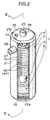
- FIG. 2 is a partially cut away perspective view of the device in an assembled state.
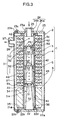
- FIG. 3 is a sectional view of the device taken along the line III-III in FIG. 2.
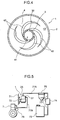
- FIG. 4 is a sectional plan view of the device.
- FIG. 5 is a diagram illustrating an example as to how the device is used.
- FIG. 6 is an explosive perspective view of a black smoke emission suppressing device as a second embodiment according to this invention.
- FIG. 7 is a vertical sectional view of the device shown in FIG. 6 in an assembled state.
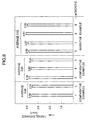
- FIG. 8 is a graph showing results of combustion efficiency of comparative examples and an example of this invention.
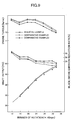
- FIG. 9 is a graph showing measurement results of engine torque, black smoke emission reduction rate, and shaft output relative to the number of rotations of a diesel engine when light oil is used as fuel in comparative examples and an example of this invention.
-
- A first embodiment of this invention is described with reference to FIGS. 1 to 4. As shown in FIGS. 1 to 3, a black smoke
emission suppressing device 1 includes a metalliccylindrical casing 2, a metallicsupply cylinder member 3 which is disposed inside thecylindrical casing 2, anelectrostatic charger 4 which is brought into fit contact over thesupply cylinder member 3, apiston member 5 which is slidably movable in thesupply cylinder member 3, and a pulsation absorber 6 which is disposed inside thecylindrical casing 2. - As shown in FIG. 1, the
cylindrical casing 2 has a hollow tubularmain body 21, abottom member 22 which closes a bottom space of themain body 21, and atop member 23 which closes a top space of themain body 21. Thecylindrical casing 2 is formed with an internal threadedportion 21a in an inner surface of a bottom part thereof. Thebottom member 22 is formed with an external threadedportion 22a at a part corresponding to the internal threadedportion 21a of thecylindrical casing 2. Screwing the external threadedportion 22a of thebottom member 22 in the internal threadedportion 21a of thecylindrical casing 2 fixes thebottom member 22 to themain body 21 of thecylindrical casing 2. - As shown in FIG. 1, the
bottom member 22 is formed with athrough discharge hole 22b with an internal thread formed in an inner surface thereof. Ascrew plug 22c which detachably plugs in thehole 22b is provided. Thedrainage hole 22b is adapted to discharge residue of fuel which stays at the bottom part of themain body 21, and is closed by theplug 22c when thedevice 1 is in use. - The
top member 23 is formed with ascrew hole 23a at a center thereof. Afirst nipple 24 is provided at the bottom side of thetop member 23 at the position corresponding to thescrew hole 23a. Thefirst nipple 24 has ahead 24a which has a larger diameter than thescrew hole 23a, and astem 24b which concentrically extends from thehead 24a. Thestem 24b has a smaller diameter than thehead 24a and has the same diameter as thescrew hole 23a. An external thread corresponding to an internal thread of thescrew hole 23a is formed in a base end of thestem 24b. Screwing the external thread of thestem 24b into the internal thread of thescrew hole 23a fixes thefirst nipple 24 to thetop member 23. As shown in FIG. 2, ahole 25 formed in the center of thefirst nipple 24 constitutes a fuel inflow opening for introducing liquid fuel inside thedevice 1. - An
air inlet hole 23b is formed at an appropriate position in thetop member 23. Theair inlet hole 23b is formed with an internal thread in an inner surface thereof. Theair inlet hole 23b is closed by ascrew plug 23c when thedevice 1 is in use, and is opened when thedrainage hole 22b of thebottom member 22 is opened. - The
top member 23 is formed with an external thread along an outer periphery thereof. Thecylindrical casing 2 is formed with an internal thread along an upper end inner surface thereof at a position corresponding to the external thread of thetop member 23. Screwing the external thread of thetop member 23 in the internal thread of thecylindrical casing 2 fixedly mounts thetop member 23 on thecylindrical casing 2. - A
hole 21b for discharging liquid fuel outside is formed at an appropriate position in the tubularmain body 21. Asecond nipple 26 is fixed to the tubularmain body 21 in such a manner that thesecond nipple 26 encloses thehole 21b. Thesecond nipple 26 is formed with an external thread in an outer surface thereof, and is formed with acenter outlet hole 27 for discharging the liquid fuel outside. - The
supply cylinder member 3 has an inner diameter which is generally identical to or slightly larger than the outer diameter of thehead 24a of thefirst nipple 24. Thesupply cylinder member 3 is concentrically fitted in thecylindrical casing 2 in a state that an upper end of thesupply cylinder member 3 is covered by thehead 24a of thefirst nipple 24. - A lower end of the
supply cylinder member 3 comes into fit contact with the upper surface of thebottom member 22. Specifically, anannular projection 22d having an inner diameter generally identical to or slightly larger than the outer diameter of thesupply cylinder member 3 is formed on the upper surface of thebottom member 22. Fitting the lower end of thesupply cylinder member 3 along an inner wall of theannular projection 22d fixedly mounts thesupply cylinder member 3 in thecylindrical casing 2. - As shown in FIG. 1, a set of four through holes (fuel passing holes) 32 are circumferentially equidistantly formed along an outer periphery of the
supply cylinder member 3 at an interval of 90° . A plurality of sets of these throughholes 32 are formed at a certain interval in an axial direction of thesupply cylinder member 3 in a region from a height level of about 1/3 from the bottom of thesupply cylinder member 3 up to a certain position on the upper part thereof. The plurality of sets of throughholes 32 constitute ahole group 31. Liquid fuel which has been introduced into thesupply cylinder member 3 through theinlet hole 25 flows through thefuel passing holes 32, and is discharged out of thedevice 1 through theoutlet hole 27 via theelectrostatic charger 4 and inside the tubularmain body 21 of thecylindrical casing 2. - The
electrostatic charger 4 in the first embodiment comprises a charging cylinder including a number ofdisc members 40, which are stacked in the axial direction of thesupply cylinder member 3 one over another. Each of thedisc members 40 is formed with acenter hole 41. Each of thedisc members 40 has an inner diameter (namely, the diameter of the center hole 41) slightly larger than the outer diameter of thesupply cylinder member 3 and has an outer diameter slightly smaller than the inner diameter of themain body 21 of thecylindrical casing 2. Thedisc members 40 of theelectrostatic charger 4 are fitted over theinner cylinder member 3, and theinner cylinder member 3 which has been mounted with thestacked disc members 40 is fitted inside thecylindrical casing 3. - The outer surface of the
disc members 40 and the inner surface of themain body 21 of thecylindrical casing 2 define anannular channel 49 as shown in FIGS. 3 and 4 when thesupply cylinder member 3 mounted with the vertically stackeddisc members 40 is fitted inside themain body 21 of thecylindrical casing 2. Theannular channel 49 facilitates flow of the liquid fuel inside thecylindrical casing 2. - FIG. 4 is a sectional plan view of the black smoke
emission suppressing device 1. As shown in FIG. 4, each of thedisc members 40 is formed with four spiral grooves orchannels 42 on the top surface thereof. Thespiral grooves 42 in thedisc member 40 are formed radially apart from each other equidistantly. Each of thespiral grooves 42 extend radially outwardly from thecenter hole 41 toward a radial distal end. The thickness of thedisc member 40 is so set as to oppose an opening, i.e., aninlet port 43, of each of thespiral grooves 42 which is opened radially inwardly toward thecenter hole 41 to the correspondingfuel passing hole 32 of thesupply cylinder member 3 when thedisc members 40 are stacked one over another around thesupply cylinder member 3. The liquid fuel which flows out of thesupply cylinder member 3 through the fuel passing holes 32 is temporarily guided to theannular channel 49 via openings, i.e.,outlet ports 44, which are formed in a radially outward distal end of each of thedisc members 40 after flowing along thecorresponding spiral grooves 42. The liquid fuel is then discharged out of thedevice 1 via theoutlet hole 27 of thecylindrical casing 2. - The
disc members 40 constituting theelectrostatic charger 4 are made of a material which causes the liquid fuel to be positively charged while flowing in friction contact with thespiral channels 42. Preferably, the material may be a synthetic resin made of olefins such as polyethylene and polypropylene. The material is not limited to a synthetic resin of olefin, and various materials may be applicable as far as the material makes liquid fuel electrostatically charged due to frictional contact. - As shown in FIG. 1, an upper
ring fitting groove 34 is formed in thesupply cylinder member 3 at a position slightly below the bottommost set offuel passing holes 32 to fit an upper C-shapedring 33. Fitting the upper C-shapedring 33 in the upperring fitting groove 34 and mounting theelectrostatic charger 4 on thesupply cylinder member 3 keeps thegenerator 4 from slipping out of thesupply cylinder member 3. - The
piston member 5 is mounted inside theinner cylinder member 3. In this embodiment, thepiston member 5 includes alower piston member 5a, amiddle piston member 5b, and anupper piston member 5c. Thepiston member 5a (5b or 5c) includes apiston 51 which is slidably fitted inside the inner surface of thesupply cylinder member 3, and ahelical spring 52 which is attached to a bottom part of thepiston 51. Thehelical spring 52 has a gradually reduced radial size as oriented upward. - The
piston member 5 is constructed in such a manner that theupper piston member 5c is mounted over themiddle piston member 5b, and themiddle piston member 5b is mounted over thelower piston member 5a inside theinner cylinder member 3. Thus, the three piston members are stacked one over another inside thesupply cylinder member 3. As shown in FIG. 3, thepiston 51 of theupper piston member 5c closes the fourth from the uppermost set offuel passing holes 32 and the sets lower than the fourth set when liquid fuel is not introduced into thesupply cylinder member 3. As the liquid fuel is supplied inside thesupply cylinder member 3 through theinlet hole 25, a liquid pressure is exerted to thepiston 51 of theupper piston member 5c, which resultantly lowers theupper piston member 5c against the biasing force of thehelical spring 52. As a result of lowering, the number offuel passing holes 32 which are located above thepiston 51 of theupper piston member 5c increases compared to the state when the liquid fuel has not been supplied into thesupply cylinder member 3. - Pressing force against the piston increases in proportion to the flowing rate of liquid fuel. Accordingly, as the flowing rate increases, the lowering amount of the
piston 51 of the uppermost piston member increases. As the lowering amount increases, the number of thefuel passing holes 32 above thepiston 51 of the uppermost piston member increases to allow a larger amount of fuel to pass through these upper located fuel passing holes 32. The height level of thepiston 51 of the uppermost piston member is set in such a manner that the pressure of the liquid fuel exerted to thepiston 51 is balanced with the biasing forces of thehelical springs 52 of the threepiston members - The number of piston members may be other than three. Namely, two or less, or four or more piston members may be provided.
- The
pulsation absorber 6 is adapted to eliminate a fluctuation in fluid pressure of the liquid fuel which may likely to occur when the liquid fuel is kept being supplied into thedevice 1 during an extended time period. Thepulsation absorber 6 in this embodiment is made of a resilient urethane foam. - The
pulsation absorber 6 has an outer diameter slightly smaller than the inner diameter of themain body 21 of thecylindrical casing 2, and is formed with afitting hole 61 having a diameter identical to the outer diameter of thesupply cylinder member 3. Inserting the lower part of theinner cylinder member 3 in thefitting hole 61 fixedly supports thesupply cylinder member 3 in thepulsation absorber 6. - An annular lower
ring fitting groove 36 is formed in a lower part of the outer periphery of thesupply cylinder member 3, as shown in FIG. 1. Fitting a lower C-shapedring 35 in the lowerring fitting groove 36 and mounting thesupply cylinder member 3 in thefitting hole 61 of thepulsation absorber 6 keeps thepulsation absorber 6 from slipping out of theinner cylinder member 3. - In the following section, an operation of the
device 1 is described primarily with reference to FIG. 3 and along with the other drawings according to needs. As shown in FIG. 3, when the liquid fuel is supplied into the black smokeemission suppressing device 1 through theinlet hole 25, the liquid fuel is first drawn inside thesupply cylinder member 3, and is drawn out of thesupply cylinder member 3 through the fuel passing holes 32. As the fuel is drawn out of thesupply cylinder member 3, the flowing fuel presses against thepiston 51 of theupper piston member 5c. The liquid fuel is then guided along thespiral grooves 42 of thecorresponding disc members 40 which opposes the corresponding fuel passing holes 32. While the liquid fuel flows along thespiral grooves 42, the liquid fuel is charged with positive electricity due to friction contact with thespiral grooves 42 of theelectrostatic charger 4. - The positively-charged liquid fuel is collected to the
annular channel 49 which is defined by the tubularmain body 21 of thecylindrical casing 2 and thesupply cylinder member 3. The fuel is then supplied to a combustion unit such as an internal combustion engine by way of theoutlet hole 27. - As mentioned above, the liquid fuel to be supplied to the combustion unit is positively charged. Accordingly, the diameter of fuel particles becomes extremely small when ejected through a combustion nozzle into a combustion chamber of the combustion unit because charged fine particles repulse against each other. As a result of repulsion, the distance between particles is widened.
- To summarize the above, the total surface area of liquid fuel particles remarkably increases compared to the case where the fuel is supplied in a normal liquid state without passing through the
electrostatic charger 4 because the fuel is supplied in fine particulate state owing to the electrostatically charge. Further, the widened distance between fine particles contributes to active contact of fuel particles with oxygen in the air. These factors in combination allows the electrostatically charged liquid fuel to perform complete combustion. As a result, compared to the conventional device, this device raises combustion efficiency and reduces the amount of black smoke which is emitted as exhaust gas during combustion. - FIG. 5 is a diagram illustrating an example as to how the black smoke
emission suppressing device 1 is used. This example shows a case that thedevice 1 is used in association with adiesel engine 7. As shown in FIG. 5, thedevice 1 is attached to aframe 71 of an engine room by abracket 72. Afuel tank 73, afuel supply pump 74, a filter 75, thedevice 1, afuel sparger pump 76, and thediesel engine 7 are connected by afuel pipe 77 in this order from upstream toward downstream in a fuel supply direction. Thedevice 1 is disposed on thefuel pipe 77 between the filter 75 and thefuel sparger pump 76. - The fuel
supply pipe system 77 has anupstream section 77A provided upstream in the fuel supply direction with respect to thedevice 1, and adownstream section 77B provided downstream with respect to thedevice 1. - A lead end of the
upstream section 77A is connected to theinlet hole 25 of thedevice 1, and a tail end of thedownstream section 77B is connected to theoutlet hole 27 of thedevice 1. With this arrangement, the liquid fuel in thefuel tank 73 is supplied downstream by driving of thefuel supply pump 74 to the filter 75 where the fuel is subjected to filtration. The filtrated fuel is charged with a static electricity while being supplied through thedevice 1, and supplied to thediesel engine 7 by thefuel sparger pump 76. - The liquid fuel is atomized into particles by the
fuel sparger pump 76 and the particles are positively charged. Accordingly, the particles are further brought into finer particles by repulsion and dispersion of the particles. As a result, the finer particles are uniformly diffused in thediesel engine 7, which contributes to complete combustion in thediesel engine 7 and realizes black smoke emission suppression and fuel cost reduction. - A second embodiment according to this invention is described with reference to FIGS. 6 and 7. As shown in FIGS. 6 and 7, a black smoke
emission suppressing device 1a has the same construction as thedevice 1 in the first embodiment in the point that thedevice 1a has ancylindrical casing 2, ansupply cylinder member 3, apiston member 5, and apulsation absorber 6. It should be appreciated that elements in the second embodiment which are identical to those in the first embodiment are denoted at the same reference numerals as the first embodiment. Thedevice 1a is different from thedevice 1 in that an electrostatic charger 4a in thedevice 1a has a plurality of disc members 40 (shown by hatched portions in FIG. 7) and annular magnets 45 (shown by hatched and dotted portions in FIG. 7). - More specifically, in the second embodiment, the electrostatic charger 4a is constructed in such a manner that the
disc members 40 and theannular magnets 45 are stacked alternately. Since thedisc members 40 in the second embodiment are the same as those in the first embodiment, the description thereof is omitted herein. Theannular magnet 45 has the outer diameter and the thickness identical to those of thedisc member 40. Theannular magnet 45 is formed with acenter hole 46, and has an inner diameter identical to the inner diameter of thedisc member 40. - The
disc members 40 and themagnets 45 are alternately stacked on thesupply cylinder member 3 to constitute the electrostatic charger 4a. Theannular magnets 45 are stacked in such a manner that the upper magnet and the lower magnet with respect to the interposeddisc member 40 have the opposite polarities, i.e., north pole and south pole, on their opposite surfaces. - With this arrangement, liquid fuel supplied inside the
supply cylinder member 3 through theinlet hole 25 is drawn out of thesupply cylinder member 3 through thefuel passing holes 32 and guided along thespiral grooves 42 of thedisc members 40. While passing along thespiral grooves 42, the fuel is electrostatically charged. Simultaneously, the respective sets of upper andlower magnets 45 which sandwich thecorresponding disc members 40 give magnetic force to the flowing charged liquid fuel, which is further effective in suppressing black smoke emission in exhaust gas. - The advantageous effect of magnetic force for suppression of black smoke emission is conceivably described as follows. Liquid fuel is electrostatically charged while passing through the
spiral grooves 42 of thedisc members 40. The magnetic force applied to the flowing charged liquid fuel causes fragmentation of molecules in the liquid fuel into finer particles, thereby contributing to improvement of combustion efficiency and suppression of black smoke emission. - To verify the effects of these inventive devices, the following experiments were carried out. In Inventive Example, measured was travel distance of a truck loaded with a diesel engine per litter of light oil which has undergone the process by the
inventive device 1. As comparative examples, measured were travel distances of the same truck loaded with the diesel engine per litter of light oil which has not undergone the process by the device 1 (Comparative Example 1) and per litter of light oil which has undergone the process by the conventional device employing magnets (Comparative Example 2). It should be noted that in Comparative Example 2, light oil was not passed through the combination of magnets and disc members, but was passed through magnets solely. - The experiments used a truck loadable with 4 tons of goods or commodity to transport the same for a long distance every day. The truck ran in a fully loaded state in the experiments. The replenish amount of light oil and travel distance of the truck were recorded per day, and the data was collected per month. The travel distance per litter (km/l) was calculated per month by dividing the total travel distance in a month by the total amount of replenished oil in the month.
- The result of the experiments is shown in the graph of FIG. 8. As is obvious from the graph, in Comparative Example 1 where no treatment was performed for the fuel oil, the travel distance per litter was 3.56 (km/l) by taking the average of two consecutive months. In Comparative Example 2 where the fuel oil was treated with the conventional device employing magnets, the travel distance per litter was 3.64 (km/l) by taking the average of three consecutive months, which was slightly improved compared to Comparative Example 1.
- On the other hand, in Inventive Example where light oil was treated with the
inventive device 1, the travel distance per litter was 3.92 (km/l) by taking the average of four consecutive months, which has a remarkably good result compared to Comparative Examples 1 and 2. The distance in Inventive Example was increased by 10% compared to Comparative Example 1, and 8% compared to Comparative Example 2. The result shows that thedevice 1 is effective in fuel cost performance. Concerning to black smoke emission, it was confirmed that emission in Inventive Example was visibly lessened compared to Comparative Examples 1 and 2. - Next, engine torque (unit: kg · m), black smoke emission reduction rate (%), and shaft output (unit: PS) relative to the number of rotations of engine (unit: rpm) were measured when a diesel engine was driven with use of the light oil treated with the
inventive device 1. Similarly, performance of the diesel engine was examined with respect to the same parameters when the diesel engine was driven with use of the light oils in Comparative Examples 1 and 2. FIG. 9 is a graph showing the measurement results of the respective examples. - It should be noted that the black smoke emission reduction rate in FIG. 9 is represented in terms of percentage of the emission amount (X) of black smoke when the diesel engine was driven in a normal running state based on the emission amount (Y) of black smoke when the diesel engine was set in an idling state, that is, =X/Y X 100.
- As shown in the graph of FIG. 9, it was verified that the light oil treated with the
inventive device 1 exhibits superior results in terms of engine torque, black smoke emission reduction rate, and shaft output compared to Comparative Examples 1 and 2. - As described above, an inventive black smoke emission suppressing device is used to suppress generation of black smoke in combustion of a liquid fuel. The device is provided with a vessel for allowing a liquid fuel to flow therethrough, and an electrostatic charger for electrostatically charging the liquid fuel.
- With this construction, liquid fuel having been passed through the electrostatic charger carries an electrostatic electricity. Supplying thus electrostatically charged liquid fuel through a sparger or the like to burn the fuel in a combustion chamber enables to bring the liquid fuel into fine particles having a smaller diameter owing to electric repulsion force of fine particles charged with the same electricity (namely, negative or positive). As a result, a total surface area of liquid fuel particles remarkably increases, and fuel particles are widely and uniformly diffused by the electric repulsion force between fine particles. The liquid fuel particles are actively brought into contact with oxygen in the air, and more idealistic combustion is realized. As a result, the amount of black smoke in exhaust gas after burning the fuel is reduced, and combustion efficiency is improved.
- The vessel may be constructed by a cylindrical casing formed with a fuel inflow opening in a center of an end thereof and a fuel outflow opening in a periphery thereof, and a supply cylinder member arranged in the cylindrical casing. The supply cylinder member has one end being opened, the other end being closed, and a plurality of through holes in a periphery thereof. The opened end is connected with the fuel inflow opening of the cylindrical casing to thereby allow the liquid fuel to flow in the supply cylinder member. The electrostatic charger may be provided with a charging cylinder coaxially placed on an outer periphery of the supply cylinder member. The charging cylinder is formed with a plurality of spiral channels extending in radial directions, inner openings of the plurality of spiral channels being respectively connected with the plurality of through holes of the supply cylinder member to thereby allow the liquid fuel to flow in the plurality of spiral channels and then flow out from outer openings of the plurality of spiral channels.
- With this arrangement, the liquid fuel is supplied into the supply cylinder member, and flowed from the supply cylinder member into the plurality of spiral channels of the charging cylinder through the plurality of through holes of the supply cylinder member. The liquid fuel is flowed out of the outer openings of the charging cylinder. The liquid fuel is electrostatically charged due to frictional contact with the inner surface of each spiral channel of the charging cylinder. The charged liquid fuel is discharged through the fuel outflow opening of the cylindrical casing.
- The spiral channels in the charging cylinder allow the liquid fuel to flow in an extended passage, thereby enhancing electrostatic charging of the liquid fuel.
- The spiral channels may be formed by stacking a plurality of disc members each formed with a spiral groove one over another.
- The electrostatic charger may be further provided with a plurality of annular magnets placed between one disk member and another disk member.
- With this arrangement, the disc members and the annular magnets are stacked alternately on the periphery of the supply cylinder member. The electrostatically charged liquid fuel cuts magnetic force lines of the magnets as the liquid fuel downwardly moves the stacked magnets. Accordingly, the liquid fuel is subjected to reformation due to action of magnetic force, thereby leading to complete combustion and suppression of black smoke emission during combustion.
- The device may be further provided with a piston member in the supply cylinder member and a biasing member for urging the piston member toward the fuel inflow opening of the cylindrical casing. The piston member is movable in sliding contact with an inner surface of the supply cylinder member.
- With this arrangement, the number of through holes of the supply cylinder member is adjusted in accordance with the flow rate of the liquid fuel by the positional change of the piston member in the supply cylinder member. Accordingly, the electrostatic charging owing to friction of the liquid fuel with the inner surface of the spiral channel can be secured under stabilized flow conditions. Thus, electrostatic charging can be performed to the liquid fuel in a stabilized manner.
- The device may be further provided with a pulsation absorber made of a resilient material at a bottom of the cylindrical casing for absorbing fluctuation in fluid pressure of the liquid fuel.
- With this arrangement, even if the pressure of the liquid fuel supplied into the cylindrical casing fluctuates in an extended period of time, the pulsation absorber resiliently deforms in conformance with the varying pressure or pulsation of the fuel. Consequently, the pulsation of the liquid fuel can be eliminated by the resilient pulsation absorber.
- This application is based on patent application No. 2000-117392 filed in Japan on April 19, 2000, the contents of which are hereby incorporated by references.
- As this invention may be embodied in several forms without departing from the spirit of essential characteristics thereof, the present embodiment is therefore illustrative an not restrictive, since the scope of the invention is defined by the appended claims rather than by the description preceding them, and all changes that fall within metes and bounds of the claims, or equivalence of such metes and bounds are therefore intended to embraced by the claims.
Claims (9)
- A black smoke emission suppressing device for suppressing generation of black smoke in combustion of a liquid fuel, comprising:a vessel for allowing a liquid fuel to flow therethrough; andan electrostatic charger for electrostatically charging the liquid fuel.
- The device according to claim 1, wherein:the vessel includes:a cylindrical casing formed with a fuel inflow opening in a center of an end thereof and a fuel outflow opening in a periphery thereof; anda supply cylinder member arranged in the cylindrical casing, the supply cylinder member having one end being opened, the other end being closed, and a plurality of through holes in a periphery thereof, the opened end being connected with the fuel inflow opening of the cylindrical casing to thereby allowing the liquid fuel to flow in the supply cylinder member;the electrostatic charger including a charging cylinder coaxially placed on an outer periphery of the supply cylinder member, the charging cylinder being formed with a plurality of spiral channels extending in radial directions, inner openings of the plurality of spiral channels being respectively connected with the plurality of through holes of the supply cylinder member to thereby allow the liquid fuel to flow in the plurality of spiral channels and then flow out from outer openings of the plurality of spiral channels.
- The device according to claim 2, wherein the charging cylinder includes a plurality of hollow disc members axially stacked on the outer periphery of the supply cylinder member, each disk member being formed a spiral groove for defining the spiral channel.
- The device according to claim 3, wherein the electrostatic charger further includes a plurality of annular magnets placed between one disk member and another disk member.
- The device according to claim 4, further comprising a piston member provided in the supply cylinder member, the piston member being movable in sliding contact with an inner surface of the supply cylinder member, and a biasing member for urging the piston member toward the fuel inflow opening of the cylindrical casing.
- The device according to claim 3, wherein the disk member is made of a synthetic resin.
- The device according to claim 2, further comprising a piston member provided in the supply cylinder member, the piston member being movable in sliding contact with an inner surface of the supply cylinder member, and a biasing member for urging the piston member toward the fuel inflow opening of the cylindrical casing.
- The device according to claim 2, further comprising a pulsation absorber made of a resilient material at a bottom of the cylindrical casing for absorbing fluctuation in fluid pressure of the liquid fuel.
- The device according to claim 2, wherein the charging cylinder is made of a synthetic resin.
Applications Claiming Priority (2)
| Application Number | Priority Date | Filing Date | Title |
|---|---|---|---|
| JP2000117392A JP2001304056A (en) | 2000-04-19 | 2000-04-19 | Black smoke reducing device |
| JP2000117392 | 2000-04-19 |
Publications (2)
| Publication Number | Publication Date |
|---|---|
| EP1148232A2 true EP1148232A2 (en) | 2001-10-24 |
| EP1148232A3 EP1148232A3 (en) | 2002-09-11 |
Family
ID=18628712
Family Applications (1)
| Application Number | Title | Priority Date | Filing Date |
|---|---|---|---|
| EP01109524A Withdrawn EP1148232A3 (en) | 2000-04-19 | 2001-04-17 | A device for suppressing black smoke emission |
Country Status (5)
| Country | Link |
|---|---|
| US (1) | US6405719B2 (en) |
| EP (1) | EP1148232A3 (en) |
| JP (1) | JP2001304056A (en) |
| CA (1) | CA2344798A1 (en) |
| TW (1) | TW487782B (en) |
Cited By (5)
| Publication number | Priority date | Publication date | Assignee | Title |
|---|---|---|---|---|
| RU2270355C1 (en) * | 2004-05-17 | 2006-02-20 | Федеральное государственное образовательное учреждение высшего профессионального образования Ульяновская государственная сельскохозяйственная академия | Internal combustion engine fuel processing and cleaning device |
| FR2913068A1 (en) * | 2007-02-27 | 2008-08-29 | Francky Achin | Cartridge i.e. overhead shield booster, for being positioned in upstream of spark ignition engine, has helix shaped internal structure for hampering flow of fuel in zone defined between cylinder and cylindrical wall of cartridge |
| ITMO20100171A1 (en) * | 2010-06-08 | 2011-12-09 | Daniele Brazzi | TREATMENT SYSTEM OF A HYDROCARBON |
| WO2013050882A3 (en) * | 2012-09-12 | 2013-10-24 | Kuregyan Kamo | Equipment for structurization and polarization of fuel, combustion mixture or water |
| WO2016178170A1 (en) * | 2015-05-05 | 2016-11-10 | Vincenzo Ruggero | Magnetic polarizer |
Families Citing this family (13)
| Publication number | Priority date | Publication date | Assignee | Title |
|---|---|---|---|---|
| AU4466801A (en) * | 2000-04-03 | 2001-10-15 | Hinomaru Shokai Co., Ltd. | Fuel reforming device |
| US7383828B2 (en) * | 2004-06-24 | 2008-06-10 | Emission & Power Solutions, Inc. | Method and apparatus for use in enhancing fuels |
| WO2006033690A2 (en) * | 2004-06-24 | 2006-03-30 | Fuel Fx International, Inc. | Method and apparatus for use in enhancing fuels |
| US7428896B2 (en) * | 2004-06-24 | 2008-09-30 | Emission & Power Solutions, Inc. | Method and apparatus for use in enhancing fuels |
| KR100641674B1 (en) | 2004-11-05 | 2006-11-03 | 김교훈 | Fuel activator improves fuel efficiency and cleanness of exhaust gas |
| US7377268B2 (en) * | 2006-03-09 | 2008-05-27 | Min Lu | Compact inline magnetic fuel conditioner for improving fuel efficiency |
| TW200742797A (en) * | 2006-05-04 | 2007-11-16 | Jin-Lang Wang | Fuel economizer |
| RU2429280C2 (en) * | 2007-04-13 | 2011-09-20 | Яширо Когио Кабушики Каиша | Method and device for fuel treatment |
| US20130011316A1 (en) * | 2010-03-24 | 2013-01-10 | Mella Ramon A | Strontium chloride expansive disks and compression welded cartridge and method |
| FR2962122B1 (en) * | 2010-07-01 | 2012-08-10 | Faurecia Sys Echappement | METHOD FOR MANUFACTURING AN AMMONIA STORAGE CARTRIDGE, IN PARTICULAR FOR A GAS EXHAUST SYSTEM OF A MOTOR VEHICLE |
| US9273644B2 (en) | 2012-06-07 | 2016-03-01 | Roman Kulesza | Ionization by magnetic induction for diesel fueled engines |
| US9305692B2 (en) | 2012-08-24 | 2016-04-05 | Roman Kulesza | Ionization by magnetic induction for natural gas |
| JP6284267B2 (en) * | 2014-03-03 | 2018-02-28 | 株式会社ミヤデン | Power system |
Citations (2)
| Publication number | Priority date | Publication date | Assignee | Title |
|---|---|---|---|---|
| JPS5840244A (en) | 1981-09-02 | 1983-03-09 | Takegawa Tekko Kk | Work angle transformation device |
| JP2000117392A (en) | 1998-10-08 | 2000-04-25 | Matsushita Electric Ind Co Ltd | Casting mold |
Family Cites Families (13)
| Publication number | Priority date | Publication date | Assignee | Title |
|---|---|---|---|---|
| US3597668A (en) * | 1968-10-17 | 1971-08-03 | Goro Fujii | Electrostatic charger for liquid fuel by friction |
| US3805492A (en) * | 1972-04-28 | 1974-04-23 | A King | Method and apparatus for treating carbureted mixtures |
| DE3062180D1 (en) * | 1979-05-22 | 1983-04-07 | Secretary Industry Brit | Apparatus and method for the electrostatic dispersion of liquids |
| US4414951A (en) * | 1981-02-02 | 1983-11-15 | Frank Saneto | Vehicle fuel conditioning apparatus |
| CH644934A5 (en) * | 1981-08-20 | 1984-08-31 | Sbh Trading Sa | DEVICE FOR SUBJECTING A LIQUID FUEL TO A MAGNETIC FIELD. |
| US4798191A (en) * | 1988-01-15 | 1989-01-17 | Robert A. Brown, Jr. | Method and apparatus for handling fuel |
| US5197446A (en) * | 1990-03-29 | 1993-03-30 | Daywalt Clark L | Vapor pressure enhancer and method |
| FR2663865A1 (en) * | 1990-06-28 | 1992-01-03 | Bacot Dominique | Devices for the electrostatic treatment of fluids and circuits for supplying fuel to internal combustion engines using such devices |
| BR9501304A (en) * | 1995-03-30 | 1996-12-24 | J M V Engenharia E Consultoria | Fuel saver |
| US5882514A (en) * | 1996-08-22 | 1999-03-16 | Fletcher; Charles J. | Apparatus for magnetically treating fluids |
| JPH11153319A (en) * | 1997-11-20 | 1999-06-08 | Nobuyuki Kumagai | Fuel catalyst device for emission gas purification |
| US6183700B1 (en) * | 1998-04-14 | 2001-02-06 | Tae Young Jeong | Fuel activation apparatus using magnetic body |
| JP2000227055A (en) * | 1998-11-30 | 2000-08-15 | Yasuro Kuratomi | Fuel activating device |
-
2000
- 2000-04-19 JP JP2000117392A patent/JP2001304056A/en not_active Withdrawn
-
2001
- 2001-04-17 EP EP01109524A patent/EP1148232A3/en not_active Withdrawn
- 2001-04-17 TW TW090109134A patent/TW487782B/en not_active IP Right Cessation
- 2001-04-18 US US09/837,025 patent/US6405719B2/en not_active Expired - Fee Related
- 2001-04-19 CA CA002344798A patent/CA2344798A1/en not_active Abandoned
Patent Citations (2)
| Publication number | Priority date | Publication date | Assignee | Title |
|---|---|---|---|---|
| JPS5840244A (en) | 1981-09-02 | 1983-03-09 | Takegawa Tekko Kk | Work angle transformation device |
| JP2000117392A (en) | 1998-10-08 | 2000-04-25 | Matsushita Electric Ind Co Ltd | Casting mold |
Cited By (7)
| Publication number | Priority date | Publication date | Assignee | Title |
|---|---|---|---|---|
| RU2270355C1 (en) * | 2004-05-17 | 2006-02-20 | Федеральное государственное образовательное учреждение высшего профессионального образования Ульяновская государственная сельскохозяйственная академия | Internal combustion engine fuel processing and cleaning device |
| FR2913068A1 (en) * | 2007-02-27 | 2008-08-29 | Francky Achin | Cartridge i.e. overhead shield booster, for being positioned in upstream of spark ignition engine, has helix shaped internal structure for hampering flow of fuel in zone defined between cylinder and cylindrical wall of cartridge |
| ITMO20100171A1 (en) * | 2010-06-08 | 2011-12-09 | Daniele Brazzi | TREATMENT SYSTEM OF A HYDROCARBON |
| WO2013050882A3 (en) * | 2012-09-12 | 2013-10-24 | Kuregyan Kamo | Equipment for structurization and polarization of fuel, combustion mixture or water |
| CN104619978A (en) * | 2012-09-12 | 2015-05-13 | K·库勒吉扬 | Equipment for structuring and polarizing fuels, combustion mixtures or water |
| EA025655B1 (en) * | 2012-09-12 | 2017-01-30 | Камо Володяевич Курегян | Equipment for structurization and polarization of fuel, combustion mixture or water |
| WO2016178170A1 (en) * | 2015-05-05 | 2016-11-10 | Vincenzo Ruggero | Magnetic polarizer |
Also Published As
| Publication number | Publication date |
|---|---|
| US6405719B2 (en) | 2002-06-18 |
| JP2001304056A (en) | 2001-10-31 |
| CA2344798A1 (en) | 2001-10-19 |
| US20010032629A1 (en) | 2001-10-25 |
| EP1148232A3 (en) | 2002-09-11 |
| TW487782B (en) | 2002-05-21 |
Similar Documents
| Publication | Publication Date | Title |
|---|---|---|
| US6405719B2 (en) | Device for suppressing black smoke emission | |
| US6787033B2 (en) | Apparatus for filtering impurities out of fluid | |
| US8245851B2 (en) | Noncircular replaceable fuel filter elements and systems including the same | |
| AU2006259823B9 (en) | Pressure gradient dosing system for fluid supply | |
| JP5709300B2 (en) | Filter system for fluid filtration | |
| CN106195267B (en) | Annular filter element, oil separator and method for opening a filter housing | |
| US20240058734A1 (en) | Filter assemblies with combined axial and radial sealing | |
| CN104971624A (en) | Separator for fluid separation and SCR urea solution infusion system using the same | |
| US7246612B2 (en) | Oil separator | |
| US7232035B1 (en) | Liquid filter with directional fluid insert | |
| US20130105379A1 (en) | Magnetic Fluid Filter | |
| EP3274065B1 (en) | Fuel-air separator and improved fuel delivery system | |
| JP3719730B2 (en) | Fuel filter assembly | |
| US6423225B2 (en) | Liquid filter with centrifugal separator | |
| US11484892B2 (en) | Systems and methods for reducing particulate emissions | |
| JPH07259682A (en) | Fuel filter cartridge and fuel filter assembly | |
| CN111005786A (en) | Device for separating particles from a gas flow, particle separator and crankcase ventilation system | |
| US11655739B2 (en) | Device for separating particles from a gas flow, particle separator and crankcase ventilation system | |
| EP1285163B1 (en) | Air guided filter for internal combustion engine | |
| JP7135924B2 (en) | Cooling system | |
| WO2019112560A1 (en) | Filter element with barrier | |
| CN105121925B (en) | Constant-tension is clasped component | |
| JP4229949B2 (en) | Oil separator for blow-by gas | |
| CN105386900A (en) | Precise internal combustion engine air filter | |
| CN105464853A (en) | Internal combustion engine air filter with metal filter element |
Legal Events
| Date | Code | Title | Description |
|---|---|---|---|
| PUAI | Public reference made under article 153(3) epc to a published international application that has entered the european phase |
Free format text: ORIGINAL CODE: 0009012 |
|
| AK | Designated contracting states |
Kind code of ref document: A2 Designated state(s): AT BE CH CY DE DK ES FI FR GB GR IE IT LI LU MC NL PT SE TR |
|
| AX | Request for extension of the european patent |
Free format text: AL;LT;LV;MK;RO;SI |
|
| PUAL | Search report despatched |
Free format text: ORIGINAL CODE: 0009013 |
|
| AK | Designated contracting states |
Kind code of ref document: A3 Designated state(s): AT BE CH CY DE DK ES FI FR GB GR IE IT LI LU MC NL PT SE TR |
|
| AX | Request for extension of the european patent |
Free format text: AL;LT;LV;MK;RO;SI |
|
| AKX | Designation fees paid | ||
| REG | Reference to a national code |
Ref country code: DE Ref legal event code: 8566 |
|
| STAA | Information on the status of an ep patent application or granted ep patent |
Free format text: STATUS: THE APPLICATION IS DEEMED TO BE WITHDRAWN |
|
| 18D | Application deemed to be withdrawn |
Effective date: 20030312 |