EP1148041A2 - Fluorovinylethers and polymers obtainable therefrom - Google Patents
Fluorovinylethers and polymers obtainable therefrom Download PDFInfo
- Publication number
- EP1148041A2 EP1148041A2 EP01108596A EP01108596A EP1148041A2 EP 1148041 A2 EP1148041 A2 EP 1148041A2 EP 01108596 A EP01108596 A EP 01108596A EP 01108596 A EP01108596 A EP 01108596A EP 1148041 A2 EP1148041 A2 EP 1148041A2
- Authority
- EP
- European Patent Office
- Prior art keywords
- ocf
- reaction
- per
- formula
- polymer
- Prior art date
- Legal status (The legal status is an assumption and is not a legal conclusion. Google has not performed a legal analysis and makes no representation as to the accuracy of the status listed.)
- Granted
Links
Classifications
-
- C—CHEMISTRY; METALLURGY
- C08—ORGANIC MACROMOLECULAR COMPOUNDS; THEIR PREPARATION OR CHEMICAL WORKING-UP; COMPOSITIONS BASED THEREON
- C08F—MACROMOLECULAR COMPOUNDS OBTAINED BY REACTIONS ONLY INVOLVING CARBON-TO-CARBON UNSATURATED BONDS
- C08F16/00—Homopolymers and copolymers of compounds having one or more unsaturated aliphatic radicals, each having only one carbon-to-carbon double bond, and at least one being terminated by an alcohol, ether, aldehydo, ketonic, acetal or ketal radical
- C08F16/12—Homopolymers and copolymers of compounds having one or more unsaturated aliphatic radicals, each having only one carbon-to-carbon double bond, and at least one being terminated by an alcohol, ether, aldehydo, ketonic, acetal or ketal radical by an ether radical
- C08F16/14—Monomers containing only one unsaturated aliphatic radical
- C08F16/24—Monomers containing halogen
-
- C—CHEMISTRY; METALLURGY
- C07—ORGANIC CHEMISTRY
- C07C—ACYCLIC OR CARBOCYCLIC COMPOUNDS
- C07C43/00—Ethers; Compounds having groups, groups or groups
- C07C43/30—Compounds having groups
- C07C43/313—Compounds having groups containing halogen
-
- C—CHEMISTRY; METALLURGY
- C07—ORGANIC CHEMISTRY
- C07C—ACYCLIC OR CARBOCYCLIC COMPOUNDS
- C07C43/00—Ethers; Compounds having groups, groups or groups
- C07C43/30—Compounds having groups
- C07C43/315—Compounds having groups containing oxygen atoms singly bound to carbon atoms not being acetal carbon atoms
-
- C—CHEMISTRY; METALLURGY
- C08—ORGANIC MACROMOLECULAR COMPOUNDS; THEIR PREPARATION OR CHEMICAL WORKING-UP; COMPOSITIONS BASED THEREON
- C08F—MACROMOLECULAR COMPOUNDS OBTAINED BY REACTIONS ONLY INVOLVING CARBON-TO-CARBON UNSATURATED BONDS
- C08F214/00—Copolymers of compounds having one or more unsaturated aliphatic radicals, each having only one carbon-to-carbon double bond, and at least one being terminated by a halogen
- C08F214/18—Monomers containing fluorine
- C08F214/26—Tetrafluoroethene
- C08F214/262—Tetrafluoroethene with fluorinated vinyl ethers
Definitions
- the present invention relates to fluorovinylethers, the process for preparing them and the polymers obtainable therefrom.
- perfluoroalkylvinylethers are used as monomers for the olefin copolymerization, specifically tetrafluoroethylene, vinylidene fluoride, chlorotrifluoroethylene (CTFE), hexafluoropropene.
- CTFE chlorotrifluoroethylene
- the introduction of high amounts of perfluorovinylethers in crosslinkable fluoropolymers implies elastomeric oroperties at low temperature of fluorinated rubbers.
- Such properties at low temperatures can generally be expressed by the glass transition temperature Tg.
- fluorovinylethers must have a high unitary capability to modify the backbone properties, as well as high reactivity to be used as comonomers both in plastomeric and in elastomeric fluoropolymers. It was desirable to have available vinylethers obtainable by simple processes having a limited number of steps. Preferably it would be desirable to have available a continuous process for preparing said vinylethers.
- USP 3,132,123 describes the preparation of perfluoroalkylvinylethers, of the corresponding homopolymers and copolymers with TFE. Homopolymers are obtained under extreme experimental conditions, by using polymerization pressures 1from 4,000 to 18,000 atm.
- the perfluoromethylvinylether (PMVE) homopolymer is an elastomer: the Tg is not reported.
- USP 3,635,926 relates to the emulsion copolymerization of perfluorovinylethers with TFE, showing that the presence of -COF acylfluoride end groups makes the polymers unstable. The same phenomenon was already reported in USP 3,085,083 in the perfluorovinylether polymerization systems in solvent.
- the compound synthesis is complex, it requires three steps.
- the preparation of the starting compound CF 3 O(CF 2 O) n" CF 2 C(O)F is carried out by oxidation at low temperature in the presence of U.V. radiations; besides the condensation with HFPO (hexafluoropropenoxide) and the subsequent alkaline pyrolisis is necessary. No data on the above indicated properties are reported. With regard to this see USP 5,910,552.
- the latter are undesired products as regards both the polymer preparation and the poor properties of the obtained polymers.
- the polymer has a content of fluorovinylether units ranging from 15 to 50% by moles.
- EP 130,052 describes the perfluorovinylpolyether (PVPE) polymerization which leads to amorphous perfluoropolymers with a T g ranging from -15 to -100°C.
- the described polymers have T g values reaching up to -76°C; the further T g decrease is obtained by using perfluoropolyethers as plasticizers.
- PVPE perfluorovinylpolyether
- the used vinylethers are vinylether mixtures with different n"' values. According to said patent the most evident effect on the T g decrease is shown when n"' is equal to or higher than 3, preferably higher than 4. According to the polymerization examples described in said patent the final mass of the polymer, besides the hot and under vacuum treatment, must then be washed with freon® TF in order to remove all the unreacted monomer (PVPE). From the Examples it results that the reactivity of all the described monomers (PVPE) is poor.
- USP 4,766,190 relates to the polymerization of perfluorovinylpolyethers (PVPE) similar to those of USP 4,487,903 with TFE and low perfluoropropene percentages, in order to increase the mechanical properties of the obtained polymers.
- PVPE perfluorovinylpolyethers
- EP 338,755 relates to the preparation of perfluorinated copolymers by using direct fluorination of partially fluorinated copolymers. More reactive partially fluorinated monomers are used, the obtained polymers are fluorinated with elemental fluorine.
- the fluorination step requires a supplementary process unit, besides in this step elemental fluorine is used, which is a highly oxidizing gas, with the consequent precautions connected to its use.
- elemental fluorine is used, which is a highly oxidizing gas, with the consequent precautions connected to its use.
- the percentage of the comonomer in the polymer cannot exceed 50% by moles.
- USP 5,268,405 reports the preparation of perfluorinated rubbers having a low Tg, by the use of high viscosity perfluoropolyethers as plasticizers of perfluorinated rubbers (TFE/MVE copolymers).
- TFE/MVE copolymers plasticizers of perfluorinated rubbers
- perfluoropolyether bleeds take place. This is true especially for the PFPE having a low molecular weight (low viscosity) : in said patent, therefore, the high viscosity PFPE use is suggested, and therefore the low viscosity PFPEs must previously be removed.
- USP 5,350,497 relates to the preparation of perfluoroalkylvinylethers by fluorination with elemental fluorine of hydrofluorochloroethers and subsequent dechlorination.
- the preparation of said perfluorovinylethers is carried out by 7 steps, some of them have very low yields, and comprise also a fluorination with elemental F 2 .
- the reactivity of said perfluorovinylethers is anyhow low.
- the perfluorovinylether synthesis generally involves a multistep process with low yields (USP 3,132,123, USP 3,450,684), with additional purifications to remove undesired isomers (USP 3,896,179) and the need to control the undesired hydrogenated by-products (USP 3,291,843).
- synthesis substances acting as intermediates which are suitably prepared, and which allow to eliminate said drawbacks (USP 4,340,750, USP 4,515,989), are used.
- the vinylether preparation requires the fluorination with elemental fluorine of partially fluorinated intermediates (USP 5,350,497); or, to avoid synthesis and low reactivity problems of the perfluorovinylethers, fluorination of partially fluorinated polymers (EP 338,755) is suggested.
- Perfluorooxyalkylvinylethers are used to confer to the fluorinated rubbers good properties at low temperatures, and specifically to lower the copolymer glass transition temperature.
- MVE perfluoromethylvinylether
- plastomeric fluoropolymers and, at higher concentrations, also in elastomeric fluoropolymers.
- MVE perfluoromethylvinylether
- EP 633,257 and EP 633,274 MVE is polymerized with TFE in the presence of small amounts of PVE or dioxoles to obtain polymers with improved flex life.
- the amorphous copolymers of TFE with perfluoromethylvinylether have a T g around 0°C or slightly lower (Maskornik, M. et al. "ECD-006 Fluoroelastomer - A high performance engineering material”. Soc. Plast Eng. Tech. Pao. (1974), 20, 675-7).
- the T g extrapolated value of the MVE homopolymer is of about -5°C (J. Macromol. Sci.-Phys., B1(4), 815-830, Dec. 1967).
- the Applicant has surprisingly and unexpectedly found that it is possible to solve the above technical problem as described hereinafter, by using special fluorovinylethers, which are furthermore easily synthetizable and obtainable by a continuous process.
- the vinylethers according to the invention show the advantages reported hereinafter with respect to the known vinylethers.
- the Tg lowering obtained with the vinylethers of the invention is connected to the presence of the (-OCF 2 O-) unit directly bound to the unsaturation.
- the Tg lowering is surprisingly so evident to be defined a primary effect.
- Polymers, homopolymers, copolymers are obtainable by polymerizing the fluorovinylethers of general formula (I) - (IV) with at least another monomer.
- copolymer a polymer containing the vinylether of the invention and one or more comonomers, is meant.
- Optional comonomers which can be copolymerized are non fluorinated C 2 -C 8 olefins, such as ethylene, propylene, isobutylene.
- the process for preparing fluorinated polymers according to the present invention can be carried out by polymerization in organic solvent as described in USP 4,864,006 and 5,182,342, herein incorporated by reference.
- the organic solvent is selected from the group comprising chlorofluorocarbons, perfluoropolyethers, hydrofluorocarbons and hydrofluoroethers.
- the process for preparing the polymers of the present invention can be carried out also by polymerization in aqueous emulsion according to well known methods in the prior art, in the presence of a radical initiator.
- a radical initiator for example from: inorganic peroxides (for example alkaline metal or ammonium persulphates, perphosphates, perborates or percarbonates), optionally in combination with ferrous, cuprous or silver salts, or of other easily oxidizable metals; organic peroxides (for example, disuccinylperoxide, terbutylhydroperoxide, diterbutylperoxide); azocompounds (see USP 2,5-15,628 and USP 2,520,338, herein incorporated by reference). It is also possible to use organic or inorganic redox systems, such as ammonium persulphate/sodium sulphite, hydrogen peroxide/aminoiminomethansulphinic acid.
- surfactants of various type are usually present, among which the fluorinated surfactants of formula: R 3 f -X - M + are particularly preferred, wherein R 3 f is a C 5 -C 16 (per)fluoroalkyl chain or a (per)fluoropolyoxyalkyl chain, X - is -COO - or -SO 3 - , M + is selected from: H + , NH 4 + , an alkaline metal ion. Among the most commonly used, ammonium perfluorooctanoate, (per)fluoropolyoxyalkylenes ended with one or more carboxylic groups, etc. can be mentioned.
- chain transfer agents can be added to the reaction medium. It is also possible to use as chain transfer agents alkaline or earth-alkaline metal iodides and/or bromides, according to USP 5,173,553, herein incorporated by reference.
- the crosslinking process of the amorphous polymers of the present invention can be carried out according to well known methods in the prior art.
- one of the comonomers is vinylidene fluoride or vinyl fluoride
- curing can be carried out with polyamines or aromatic polyols in the presence of suitable catalysts (accelerants) as described in USP 3,876,654, USP 4,259,463; when the monomer is perfluorinated, one generally uses the addition in amounts lower than or equal to 3% of a comonomer having a reactive site formed, for example, by Br, I, CN, OC 6 F 5 , COOR a wherein R a is an alkyl from 1 to 5 carbon atoms, or by double bonds as described in USP 5,268,405; when the polymer contains Br or I, it is cured in the presence of a peroxide or of a polyunsaturated compound as described in USP 4,948,852, USP 4,948,853, USP 4,98
- the reactants must be introduced into the reactor in an approximately unitary molar ratio, or with an excess of CF 2 (OF) 2 .
- the residence time of the mixture in the reactor can range from few hundredths of second up to about 120 seconds depending on the olefin reactivity, the reaction temperature and the presence of optional reaction solvents.
- the reaction temperature can range from -40° to -150°C, preferably from -80° to -130°C.
- the compound (VI) usually is not separated from the reaction product and it is transferred in a continuous way to the subsequent reaction described in step b).
- the mixture of the products coming out from the first reactor can be heated at room temperature before being fed into the second reactor.
- the olefin can be fed in a continuous way, so as to maintain its concentration constant in the reactor.
- the temperature of the reaction b) can range from -20° to - 130°C, preferably from -50° to -100°C.
- the olefin concentration is higher than or equal to 0.01M, preferably the concentration is higher than 3M, more preferably also the pure compound can be used.
- the solvents used in steps a) and b) are perfluorinated or chlorohydrofluorinated solvents or hydrofluorocarbons. Examples of said solvents are: CF 2 Cl 2 , CFCl 3 , CF 3 CFH 2 , CF 3 CF 2 CF 3 , CF 3 CCl 2 H, CF 3 CF 2 Cl.
- the compound (VII) dependently on the olefins used in steps a) and b), after distillation from the reaction product, is subjected to dechlorination or to dehydrochlorination to obtain the vinylethers of formula (I).
- This last step can be carried out by using reactions widely described in the prior art.
- the suitable selection of the substituents R 1 to R 8 in the two olefins used in the synthesis allows to obtain the vinylethers of the present invention.
- thermogravimetric analysis TGA is carried out by using a 10°C/min rate.
- the used reactor is of cylindrical type, with a total volume of 300 ml and is equipped with magnetic dragging mechanical stirrer, turbine with recycle of the reacting gas placed at 20 cm from the reactor top, internal thermocouple, two internal copper pipes for the reactant feeding which end at about 1 mm from the turbine, and product outlet from the bottom.
- the residence time of the transport gas in the reaction zone comprised between the outlet of the two feeding pipes in the reactor and the inlet of the discharge pipe is of about 4 sec.
- reaction products are brought to room temperature and the gaseous mixture flow, monitored by gaschromatography, is fed in a continuous way, under mechanical stirring, into a second reactor having a 250 ml volume maintained at the temperature of -70°C, equipped with mechanical stirrer, thermocouple, dipping inlet for the reacting mixture, outlet with head of inert gas.
- reaction raw material is distilled by a plate column at atmospheric pressure, collecting 41.5 g of the desired product (boiling point 91°C).
- Mass spectrum (E.I. electronic impact), main peaks and respective intensities: 69 (48.6%) ; 119 (84.3%); 151 (76.8%); 153 (69.8%); 185 (100%).
- the residence time of the transport gas in the reaction zone comprised between the reactor outlet and the end of the two feeding pipes is of about 3 sec.
- the reaction raw material is distilled by a plate column at the reduced pressure of 250 mmHg. 50 g of a mixture formed by two isomers, respectively, isomer A) perfluoro-1,2-dichloro-3,5,8-trioxanonane and isomer B) perfluoro-1,2-dichloro-3,5,7-trioxa-6-methyloctane are collected.
- the mixture composition is determined by gaschromatography and is the following: isomer A 79%, isomer B 21%.
- the molar yield of A+B with respect to the used CF 2 (OF) 2 is 38%.
- the molar yield of A+B with respect to the used perfluoromethylvinylether is 42%.
- the isomers have been separated by preparative gaschromatography.
- the residence time of the transport gas in the reaction zone comprised between the reactor outlet and the end of the two feeding pipes is of about 3 sec.
- reaction products are brought to room temperature and the gaseous mixture flow, monitored by gaschromatography, is fed in a continuous way, under mechanical stirring, into a second reactor identical to the one used for the same step in Example 1.
- reaction raw material is distilled by a plate column at the reduced pressure of 100 mmHg. 43.5 g of the mixture of the desired products (isomer C 78%, isomer D 22%, determined by gaschromaography) are collected. The molar yield of C+D with respect to the used CF 2 (OF) 2 is 33%.
- the isomers have been separated by preparative gaschromatography.
- Mass spectrum (electronic impact), main peaks and respective intensities %: 69 (84); 119 (100); 185 (51.1); 251 (84); 281 (15.8); 283 (4.8); 347 (5.7); 349 (1.7).
- the dehalogenation yield is 85%.
- Mass spectrum (electronic impact), main peaks and respective intensities: 69 (66.5%); 119 (100%); 147 (83.4%); 185 (89.4%); 216 (67.3%); 282 (8.2%).
- Boiling range of the isomer mixture at atmospheric pressure 72.5°-74.5°C.
- Example 3 The temperature is brought to 100°C and 56.9 g of the isomer mixture obtained in Example 3 are added drop by drop.
- the dehaloagenation reaction yield is 76%.
- Mass spectrum (electronic impact), main peaks and respective intensities %: 69 (82); 119 (100); 185 (29); 246 (25); 251 (20); 312 (43).
- a glass reactor for polymerizations having a 20 ml volume, equipped with magnetic stirring and with an inlet for the reactant feeding and discharge, 60 ⁇ l of perfluoropropionylperoxide at 3% by weight in CFCl 2 CF 2 Cl and 3 g of MOVE 1 are in sequence introduced.
- the so charged reactor is brought to the temperature of -196°C, evacuated, brought to room temperature, the all twice.
- the reactor is thermostated at the temperature of 30°C and the mixture is allowed to react under these conditions for two days under magnetic stirring.
- reaction raw material which is finally recovered appears as a slightly viscous, transparent, colourless and homogeneous solution.
- the IR analysis of the obtained polymer shows that, in the spectrum, absorption bands in the zone of the fluorinated double bonds are absent.
- the 19 F-NMR analysis carried out on the polymer dissolved in C 6 F 6 is in accordance with the homopolymer structure having a molecular weight of 50,000. The analysis does not show the presence of unreacted monomer.
- the DSC graph does not show any melting endothermic curve, wherefore the polymer is amorphous.
- the polymer T g determined by DSC, is -35.4°C.
- the thermogravimetric analysis (TGA) shows a weight loss of 2% at 332°C and of 10% at 383°C.
- Example 7 In a reactor having the same characteristics as that described in Example 7, 150 ⁇ l of perfluoropropionylperoxide at 3% by weight in CFCl 2 CF 2 Cl and 3.2 g of a mixture prepared according to the process of Example 5 and containing 83% MOVE 2 and 17% MOVE 2a, are introduced. The reactor is then evacuated, cooled, and the subsequent reaction carried out as described in the previous Example 7.
- reaction raw material appears as a slightly viscous, transparent, colourless and homogeneous solution.
- the monomers which have not reacted are distilled and a stripping under vacuum at 150°C for 3 hours is in sequence carried out. Finally 350 mg of the polymer are separated.
- the IR analysis shows that, in the polymer spectrum, absorption bands in the zone of the fluorinated double bonds are absent.
- the 19 F-NMR analysis is in accordance with the copolymer structure having an average molecular weight of 35,000 and a MOVE 2/MOVE 2a content equal to the percentages of the reacting mixture; unreacted monomers are not evident.
- the DSC graph does not show any melting endothermic curve, wherefore the polymer is amorphous.
- the polymer T g determined by DSC, is -52.6°C.
- the thermogravimetric analysis (TGA) shows a weight loss of 2% at 280°C and of 10% at 327°C.
- a 5 l steel AISI 316 autoclave with stirrer working at 650 rpm has been used. After the vacuum has been effected, 3 1 of demineralized water, 15.70 g of MOVE 1 and the microemulsion prepared according to the procedure described in USP 4,864,006 are in sequence introduced, so as to have a concentration of 2 g of surfactant/l of water.
- the autoclave is heated up to 75°C and then 0.32 bar of ethane are introduced.
- a gaseous mixture in a molar ratio of 54.55 TFE/MOVE 1 is pumped by a compressor until having inside the autoclave a pressure of 21 absolute bar.
- composition of the gaseous mixture present in the autoclave top is analyzed by gaschromatography.
- the gaseous phase results to be formed by the following molar percentages of the reactants: 93.1% TFE, 5.5% MOVE 1 and 1.4% Ethane.
- the reaction is triggered by feeding in a continuous way by a metering pump a potassium persulphate 0.0031 molar solution at a flow rate of 88 ml/h.
- the pressure is maintained constant by feeding the monomer mixture.
- the polymer synthesis is stopped after 742 g of mixture have been fed in total.
- the reactor is cooled at room temperature, the emulsion is discharged and the coagulation is induced by HNO 3 (65%) addition.
- the polymer is separated, washed with water and dried at 220°C.
- the IR analysis shows the presence of very small absorption bands in the carboxyl zone, whose intensity results to be half of the one obtained from a TFE/PVE copolymer film having the same thickness, prepared according to the comparative Example 3.
- MFI according to ASTMD 1238-52T was 4.4. The polymer therefore results thermally more stable (see the comparative Example hereunder).
- the reactor is cooled to the temperature of -196°C, evacuated, then brought to room temperature and cooled again, the all twice.
- the reactor At the end of the degassing operations the reactor is thermostated at the temperature of 30°C and the reaction mixture maintained under magnetic stirring. The internal pressure decreases from 6.4 atm to 4.7 atm in about 8 hours (reaction time).
- the IR analysis does not show, in the polymer spectrum, absorption bands in the zone of the fluorinated double bonds, and shows the presence of very small absorption bands in the zone of the carboxyl signals.
- the intensity of these signals compared with the similar ones obtained from a film having the same thickness obtained with the polymer of the comparative Example 1, is equal to about 1/10 of these latter.
- the DSC graph does not show any melting endothermic curve, wherefore the polymer is amorphous.
- the T g determined by DSC is -21.4°C.
- the TGA shows a weight loss of 2% at 450°C and of 10% at 477°C.
- the polymer therefore results thermally more stable (see the comparative Example hereunder) with respect to the comparative Example (see afterwards).
- the polymer intrinsic viscosity measured at 30°C in Fluorinert® FC-75, is 35.5 ml/g.
- the IR analysis shows that, in the polymer spectrum, absorption bands in the zone of the fluorinated double bonds are absent.
- the DSC graph does not show any melting endothermic curve, wherefore the polymer is amorphous.
- the T g determined by DSC is -29.8°C.
- the TGA shows a weight loss of 10% at 435°C.
- Amorphous copolymer between MOVE 1 and CF 2 CH 2
- the DSC graph does not show any melting endothermic curve, wherefore the polymer is amorphous.
- the T g determined by DSC, is -47°C.
- the TGA shows a weight loss of 2% at 428°C and of 10% at 455°C.
- Amorphous terpolymer MOVE 2/MOVE 2a/TFE Amorphous terpolymer MOVE 2/MOVE 2a/TFE.
- the IR analysis does not show, in the polymer spectrum, absorption bands in the zone of the fluorinated double bonds, and it shows the presence of very small absorption bands in the zone of the carboxyl signals.
- the intensity of these signals compared with the similar ones obtained from a film having the same thickness obtained with the polymer of the comparative Example 1, is equal to about 1/10 of the latter.
- the DSC graph does not show any melting endothermic curve, wherefore the polymer is amorphous.
- the T g determined by DSC, is -37.5°C.
- the TGA shows a weight loss of 10% at 473°C.
- the polymer intrinsic viscosity measured at 30°C in Fluorinert® FC-75, is 40.0 ml/g.
- Amorphous terpolymer MOVE 2/MOVE 2a/TFE Amorphous terpolymer MOVE 2/MOVE 2a/TFE.
- the IR analysis does not show, in the polymer spectrum, absorption bands in the zone of the fluorinated double bonds.
- the DSC graph does not show any melting endothermic curve, wherefore the polymer is amorphous.
- the T g determined by DSC, is -44.5°C.
- the TGA shows a weight loss of 10% at 451°C.
- the polymer intrinsic viscosity measured at 30°C in Fluorinert® FC-75, is 16.7 ml/g.
- the recovered reaction raw material appears as a slightly viscous, transparent, colourless and homogeneous solution.
- the IR analysis of the obtained polymer shows that, in the polymer spectrum, absorption bands in the zone of the fluorinated double bonds are absent.
- the 19 F-NMR analysis is in accordance with the copolymer structure having a content of monomers H-MOVE 2 and H-MOVE 2a equal to the H-MOVE 2 and H-MOVE 2a percentages in the reacting mixture. The analysis does not show the presence of unreacted monomers.
- the DSC graph does not show any melting endothermic curve, wherefore the polymer is amorphous.
- the polymer T g determined by DSC, is -58.0°C.
- the thermogravimetric analysis (TGA) shows a weight loss of 10% at 307°C.
- the reactor At the end of the degassing, the reactor is thermostated at the temperature of 30°C under magnetic stirring.
- the internal pressure decreases from 6.8 atm to 6.5 atm in about 6 hours (reaction time).
- the IR analysis does not show, in the polymer spectrum, absorption bands in the zone of the fluorinated double bonds.
- the DSC graph does not show any melting endothermic curve wherefore the polymer is amorphous.
- the T g determined by DSC, is -44.5°C.
- the TGA shows a weight loss of 10% at 450°C.
- the IR analysis shows that, in the polymer spectrum, there are absorption bands in the carboxyl zone, whose intensity is 10 times higher than that obtained from a MOVE 1/TFE copolymer film prepared according to Example 10, and having the same thickness.
- the DSC graph does not show any melting endothermic curve, wherefore the polymer is amorphous.
- the TGA shows a weight loss of 2% at 427°C and of 10% at 463°C.
- the Tg, determined by DSC, is + 15°C.
- the polymer intrinsic viscosity measured at 30°C in Fluorinert® FC-75, is 51 ml/g.
- the DSC graph does not show any melting endothermic curve wherefore the polymer is amorphous.
- the T g determined by DSC, is -4.8°C.
- Example 9 One operates as in Example 9 except that in this case the perfluoropropylvinylether (PVE) is used instead of ⁇ -PDE to obtain a copolymer having MFI equal to that of the Example 9.
- PVE perfluoropropylvinylether
- the IR analysis shows absorption bands in the carboxyl zone, whose intensity is the double of that obtained from a TFE/MOVE 1 copolymer film having an equal thickness prepared according to Example 9.
Landscapes
- Chemical & Material Sciences (AREA)
- Organic Chemistry (AREA)
- Health & Medical Sciences (AREA)
- Chemical Kinetics & Catalysis (AREA)
- Medicinal Chemistry (AREA)
- Polymers & Plastics (AREA)
- Addition Polymer Or Copolymer, Post-Treatments, Or Chemical Modifications (AREA)
- Organic Low-Molecular-Weight Compounds And Preparation Thereof (AREA)
Abstract
Description
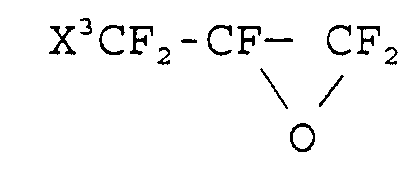
- The reactivity of the new monomers allows to prepare copolymers having a high MW (molecular weight) with a very low content of carboxylic groups or derivatives thereof such as -C(O)F, -COO-. The carboxylic group content in the copolymer with TFE has resulted of about 10 times lower than that of a copolymer prepared under the same conditions but using perfluoropropylvinylether (PVE) instead of fluorovinylethers (see the Examples) . As said, the presence of a lower content of carboxylic groups, or of the corresponding derivatives (amides, esters, etc.) allows to obtain more stable polymers.
- The reactivity of the monomers of the invention is surprisingly high (see the homopolymerization Examples).
- The fluorovinylethers of the invention can be used as
comonomers both in plastomeric (per)fluoropolymers
(containing crystalline domains) and in elastomeric
(per)fluoropolymers. To obtain plastomeric polymers the
amount of the vinylether of the invention must be such
to lead to the formation of crystalline domains,
generally < 10% by moles. To obtain amorphous polymers
the amount of the vinylether of the invention must be
such to lead to the disappearance of the crystalline
domains. The skilled man in the art can easily find the
amount of the vinylether of the invention which is
required for obtaining said results.
Generally the amount of the vinylether for obtaining amorphous polymers is higher than 10% by moles, preferably in the range from about 15 to 20% by moles, or higher. In the case of copolymers having a high content of vinylether monomer, the properties at low temperature (Tg) of the polymers of the invention result clearly better with respect both to copolymers having the same MVE content (see the Examples) and also, surprisingly, with respect to copolymers where the perfluorovinylether, the oxygen atoms being equal, does not show the -OCF2O- group directly bound to the unsaturation, as in the case of the CF2=CFOCF2CF2OCF3 (β-PDE) (see the Examples). - Their use in the polymerization reactions with fluoroolefins allows to substantially and contemporaneously reduce two important disadvantages of the prior art: the recovery of the unreacted vinylether and the polymer instability due to the presence of carboxylic end groups.
- A further advantage of the fluorovinylethers of the
invention, as hereinafter illustrated, consists in that
their preparation is carried out in a continuous plant by
a limited number of steps. Furthermore the used raw
materials are cheap. The following ones can for example
be mentioned:
- CF2(OF)2, CF2=CF2, CF2=CFOCF3, CHCl=CFCl, CFCl=CFCl,
- CF2=CFCl, CF2=CFH, CF2=CH2, CHCl=CHCl and other olefins.
- C2-C8 perfluoroolefins, such as tetrafluoroethylene (TFE), hexafluoropropene (HFP), hexafluoroisobutene;
- C2-C8 hydrogenated fluoroolefins, such as vinyl fluoride (VF), vinylidene fluoride (VDF), trifluoroethylene, CH2=CH-R2 f perfluoroalkylethylenes, wherein R2 f is a C1-C6 perfluoroalkyl;
- C2-C8 chloro- and/or bromo- and/or iodo-fluoroolefins, such as chlorotrifluoroethylene (CTFE) and bromotrifluoroethylene;
- CF2=CFOR2 f (per)fluoroalkylvinylethers (PAVE), wherin R2 f is a C1-C6 (per)fluoroalkyl, for example trifluoromethyl, bromodifluoromethyl or heptafluoropropyl;
- CF2=CFOXa (per)fluoro-oxyalkylvinylethers, wherein Xa is: a C1-C12 alkyl, or a C1-C12 oxyalkyl, or a C1-C12 (per)fluorooxyalkyl having one or more ether groups, for example perfluoro-2-propoxy-propyl. - sulphonic monomers having the structure CF2=CFOXbSO2F, wherein Xb = CF2CF2, CF2CF2CF2, CF2CF(CF2Xc) wherein Xc = F, Cl, Br.
The general scheme of the synthesis is the following:

- with reference to the formula of the compound (VII) :
- R1, R4, equal or different, are H, F; R2, R3, equal or different are H, Cl under the following conditions: (1) when the final reaction is a dehalogenation R2, R3 = Cl, (2) when the final reaction is a dehydrohalogenation one of the two substituents R2, R3 is H and the other is Cl;
- R5, R6, R7, R8 are
- F, or one of them is a C1-C4 linear or branched perfluoroalkyl group, or a C1-C4 linear or branched perfluorooxyalkyl group containing from one to three oxygen atoms, or R5 and R7, or R6 and R8, are linked each other to form with C2 and C1 a C5-C6 cycle perfluoroalkyl group;
- when one of the R5 to R8 radicals is a C2-C4 linear or branched fluoroalkyl, or a C2-C4 linear or branched fluorooxyalkyl group containing from one to three oxygen atoms, one or two of the other R5 to R8 are F and one or two of the remainders, equal to or different from each other, ar selected from H, Cl, Br, Iodine; when the substituents selected from H, Cl, Br, Iodine are two, they are both linked to the same carbon atom; when R5 and R7, or R6 and R8, are linked each other to form with C2 and C1 a C5-C6 cycle fluoroalkyl group, one of the two free substituents R6, R8 or R5, R7 is F and the other is selected from H, Cl, Br, Iodine.
- the fluoroalkene used in the reaction a) is replaceable with that of the subsequent reaction b); in this case the meanings defined for the substituents of the R1-R4 group, and respectively of the R5-R8 group, are interchangeable each other, with the proviso that the position of each radical of each of the two groups R1-R4 and R5-R8 with respect to -OCF2O- on the chain of the intermediate compound (VII), is the same which is occupied if the synthesis takes place according to the above reported scheme and the two olefins each react in the considered steps.
In the reaction c) the compound (VII), dependently on the olefins used in steps a) and b), after distillation from the reaction product, is subjected to dechlorination or to dehydrochlorination to obtain the vinylethers of formula (I). This last step can be carried out by using reactions widely described in the prior art. The suitable selection of the substituents R1 to R8 in the two olefins used in the synthesis allows to obtain the vinylethers of the present invention.
19F-NMR spectrum in p.p.m. (with respect to CFCl3 = O) :
-51.3/-53.0 (2F, O-CF2-O); -70.6/-72.6 (2F, C-CF2Cl) ; -78.0/-78.4 (1F, O-CFCl-C) ; -87.8 (3F, CF3-C) ; -90.2/-91.8 (2F, C-CF2-O).
69 (48.6%) ; 119 (84.3%); 151 (76.8%); 153 (69.8%); 185 (100%).
(s)=strong, (vs)=very strong:
1407.3 (w) ; 1235.8 (vs); 1177.7 (vs);929.3 (w); 847.9 (m). 1032.2 (s);
-50.6/-52.4 (2F, O-CF2-O); -70.0/-71.8 (2F, C-CF2Cl) ; -77.7 (1F, O-CFCl-C); -55.3/-55.6 (3F, CF3-OC); -90.7/-91.1 (2F, C-OCF2-C);- 90.2/-90.6 (2F, C-OC-CF2OCOC).
-50.0/-52.1 (2F, O-CF2-O) ; -70.0/-71.8 (2F, C-CF2Cl); -77.9 (1F, O-CFCl-C) ; -54.6/-54.9 (3F, CF3OC) : -85.7/-86.1 (3F, OC(CF3)O); -100.3/-101.0 (1F, OCF(C)O).
69 (50); 119 (100); 151 (50); 185 (42); 251 (38);
69 (96); 97 (50); 135 (42); 151 (92); 185 (100).
(w)=weak, (m)=medium, (s)=strong, (vs)=very strong:
1388 (w) ; 1288 (vs) ; 1233 (vs); 1151 (vs); 1104 (vs) ;846 (m) ; 1032 (s) ; 685 (w).
-56.0/-57.2 (2F, O-CF2-O); -143.2/-146.0 (1F, C-CHFCl); -55.8 (3F, CF3-OC); -91.0/-91.4 (2F, C-OCF2-C); -90.3/-90.5 (2F, C-OC-CF2OCOC).
-56.0/-57.2 (2F, O-CF2-O) ;- 143.2/-146.0 (1F, C-CHFCl) ; -54.9/-55.1 (3F, CF3-OC); -86.2/-86.3 (3F, OC(CF3)O); -100.5/-101.0 (1F, OCF(C)O).
69 (84); 119 (100); 185 (51.1); 251 (84); 281 (15.8); 283 (4.8); 347 (5.7); 349 (1.7).
3001.0 (w) ; 2920.9 (w) ; 2850.9 (w) ; 1286.3 (vs) ; 1233.7 (vs); 1125.5 (vs); 1081.8 (s); 1047.9 (s); 815.9 (m); 766.3 (m).
-56.8 (2F, O-CF2-O); -87.2 (3F, CF3-C) ; -90.6 (2F, C-CF2-O); -114 (1F, O-C=C-F); -121.8 (1F, O-C=CF); -137 (1F, 0-C-F=C);
69 (66.5%); 119 (100%); 147 (83.4%); 185 (89.4%); 216 (67.3%); 282 (8.2%).
1839.5 (m); 1407.6 (w); 1307.4 (vs); 1245.8 (vs); 1117.4 (vs); 907.2 (m); 846.0 (m).
-55.9 (3F, CF3-O) ; -56.9 (2F, O-CF2-O) ; -90.8 (2F, C-CF2-O); -91.2 (2F, O-CF2-C); -114 (1F, O-C=C-F); -121.8 (1F, -O-C=CF); -137 (1F, O-CF=C)
-55.9 (3F, CF3-O) ; -56.2 (2F, O-CF2-O) ; -86.4 (3F, CF3-C) ; -100.9 (1F, CF; -114 (1F, O-C=C-F); -122 (1F, O-C=CF); -137 (1F, O-CF=C).
69 (74); 81 (18); 119 (100); 147 (59); 185 (26); 251 (21);
81 (37); 69 (80); 97 (47); 119 (36); 147 (100); 185 (19).
(s)=strong, (vs)=very strong, 1839 (m); 1343 (s); 1248 (vs); 1145 (vs); 918 (m); 889 (m).
-55.7 (3F, CF3-O); -57.3 (2F, O-CF2-O); -90.9 (2F, C-CF2-O); -91.2 (2F, O-CF2-C); -149.3/-150.0 (1F, O-C=C-F).
-55.0 (3F, CF3-O); -56.9 (2F, O-CF2-O); -86.2 (3F, CF3-C); -101.0 (1F, CF). -149.3/-150,0 (1F, O-C=C-F)
69 (82); 119 (100); 185 (29); 246 (25); 251 (20); 312 (43).
3140 (w) ; 1722 (w) ; 1695 (w) ; 1402 (m) ; 1281 (vs); 1237 (vs); 1147 (vs) ;1106 (vs) ; 1030 (m).
Claims (16)
- Fluorovinylethers having the following formula:
- Fluorovinylethers according to claim 1, having the formula:
- Fluorovinylethers according to claims 1 and 2, having the formula:
- A fluorovinylether according to claims from 1 to 3, having the formula:
- Homopolymers and polymers obtainable by polymerizing the fluorovinylethers of claims 1-4 with at least another polymerizable monomer.
- Copolymers according to claim 5, wherein the comonomers are fluorinated compounds having at least one polymerizable double bond C=C, optionally containing hydrogen and/or chlorine and/or bromine and/or iodine and/or oxygen.
- Copolymers according to claims 5 and 6, wherein optional copolymerizable comonomers are non fluorinated olefins C2-C8.
- Copolymers according to claims from 5 to 7, wherein the comonomers are selected from the following:C2-C8 perfluoroolefins, preferably tetrafluoroethylene (TFE), hexafluoropropene (HFP), hexafluoroisobutene;C2-C8 hydrogenated fluoroolefins, preferably vinyl fluoride (VF), vinylidene fluoride (VDF), trifluoroethylene, CH2=CH-R2 f perfluoroalkylethylenes, wherein R2 f is a C1-C6 perfluoroalkyl;C2-C8 chloro- and/or bromo- and/or iodo-fluoroolefins, preferably chlorotrifluoroethylene (CTFE) and bromotrifluoroethylene;CF2=CFOR2 f (per)fluoroalkylvinylethers (PAVE), wherein R2 f is a C1-C6 (per)fluoroalkyl, preferably trifluoromethyl, bromodifluoromethyl or heptafluoropropyl;CF2=CFOXa (per)fluoro-oxyalkylvinylethers, wherein Xa is: a C1-C12 alkyl, or a C1-C12 oxyalkyl, or a C1-C12 (per) fluorooxyalkyl having one or more ether groups, preferably perfluoro-2-propoxy-propyl;sulphonic monomers having the structure CF2=CFOXbSO2F, wherein Xb = CF2CF2, CF2CF2CF2, CF2CF(CF2Xc) wherein Xc = F, Cl, Br.
- Polymers according to claims from 5 to 8, wherein the (per)fluoro polymers are plastomeric ones since they contain an amount of vinylether of claims 1-4 which lead to the formation of crystalline zones.
- Polymers according to claims from 5 to 8, wherein the (per)fluoro polymers are elastomeric ones since they contain an amount of vinylether of claims 1-4 to obtain amorphous polymers, i.e. such as to lead to the disappearance of the crystalline zones.
- Polymers according to claim 10, wherein the amount of vinylether of claims 1-4 is in the range from about 15 to 20% by moles.
- A synthesis process of the (per)fluorovinylethers of claims 1-4, comprising the initial reaction of hypofluorite with a fluorinated olefin having the formula R1R2C=CR3R4 to give the intermediate hypofluorite F-CR1R2-CR3R4-OCF2OF, the subsequent reaction of this compound with a second fluorinated olefin of formula R5R6C=CR7R8 to give the intermediate F-CR1R2-CR3R4-OCF2O-CR5R6-CR7R8-F, which by subsequent dehalogenation or dehydrohalogenation leads to the obtainment of the new perfluorovinylethers, according to the scheme:wherein:
 in the compound (VII) :R1, R4, equal or different, are H, F; R2, R3, equal or different are H, Cl under the following conditions: (1) when the final reaction is a dehalogenation R2, R3 = Cl, (2) when the final reaction is a dehydrohalogenation one of the two substituents R2, R3 is H and the other is Cl;R5, R6, R7, R8 are :F, or one of them is a C1-C4 linear or branched perfluoroalkyl group, or a C1-C4 linear or branched perfluorooxyalkyl group containing from one to three oxygen atoms, or R5 and R7, or R6 and R8, are linked each other to form with C2 and C1 a C5-C6 cycle perfluoroalkyl group;when one of the R5 to R8 radicals is a C2-C4 linear or branched fluoroalkyl, or a C2-C4 linear or branched fluorooxyalkyl group containing from one to three oxygen atoms, one or two of the other R5 to R8 are F and one or two of the remainders, equal to or different from each other, are selected from H, Cl, Br, Iodine; when the substituents selected from H, Cl, Br, Iodine are two, they are both linked to the same carbon atom; when R5 and R7, or R6 and R8, are linked each other to form with C2 and C1 a C5-C6 cycle fluoroalkyl group, one of the two free substituents R6, R8 or R5, R7 is F and the other is selected from H, Cl, Br, Iodine.the fluoroalkene used in the reaction a) is replaceable with that of the subsequent reaction b); in this case the meanings defined for the substituents of the R1-R4 group, and respectively of the R5-R8 group, are interchangeable each other, with the proviso that the position of each radical of each of the two groups R1-R4 and R5-R8 with respect to -OCF2O- on the chain of the intermediate compound (VII), is the same which is occupied if the synthesis takes place according to the above reported scheme and the two olefins each react in the considered steps.
 - A process according to claim 12, wherein in step a) the reactants are in an approximately unitary molar ratio, or with an excess of CF2(OF)2, the residence time of the mixture in the reactor ranges from few hundredths of second up to about 120 seconds, the reaction temperature from -40 to -150°C and the compound (VI) is not separated and is transferred in a continuous way into the reaction of step b).
- A process according to claims 12 and 13, wherein in the step b) the R5R6C=CR7R8 olefin at a pure state or in solution, reacts with the product obtained in the first reaction with formation of the compound (VII); the olefin is fed in a continuous way, so as to maintain its concentration constant in the reactor; the temperature of the reaction b) can range from -50° to - 130°C, preferably from -20° to -100°C, the olefin concentration is higher than or equal to 0.01M, preferably the concentration is higher than 3M, more preferably also the pure compound can be used.
- A process according to claiams 12 and 14, wherein in the step c) the compound (VII), dependently on the olefins used in steps a) and b), after distillation from the reaction raw material, is subjected to dechlorination or to dehydrochlorination to obtain the vinylethers of formula (I).
- A synthesis process of the (per)fluorovinylethers according to claims 12-15, wherein the compound (VII) is obtainable by reaction of a hypofluorite of formula X1X2C(OF)2 wherein X1 and X2 equal or different are F, CF3, and two fluoroalkenes of formula respectively RA 1RA 2C=CRA 3RA 4 and RA 5RA 6C=CRA 7RA 8, wherein RA 1-RA 8 equal or different, are F, H, Cl, Br, I, -CF2OSO2F, -SO2F, -COF, C1-C5 linear or branched perfluoroalkyl or oxyperfluoroalkyl group.
Priority Applications (1)
| Application Number | Priority Date | Filing Date | Title |
|---|---|---|---|
| EP08105289.6A EP1997795B1 (en) | 2000-04-21 | 2001-04-05 | Fluorovinylethers and polymers obtainable therefrom |
Applications Claiming Priority (2)
| Application Number | Priority Date | Filing Date | Title |
|---|---|---|---|
| IT2000MI000902A IT1318488B1 (en) | 2000-04-21 | 2000-04-21 | FLUOROVINYLETERS AND POLYMERS THAT CAN BE OBTAINED. |
| ITMI000902 | 2000-04-21 |
Related Child Applications (1)
| Application Number | Title | Priority Date | Filing Date |
|---|---|---|---|
| EP08105289.6A Division EP1997795B1 (en) | 2000-04-21 | 2001-04-05 | Fluorovinylethers and polymers obtainable therefrom |
Publications (3)
| Publication Number | Publication Date |
|---|---|
| EP1148041A2 true EP1148041A2 (en) | 2001-10-24 |
| EP1148041A3 EP1148041A3 (en) | 2004-01-14 |
| EP1148041B1 EP1148041B1 (en) | 2008-09-17 |
Family
ID=11444914
Family Applications (2)
| Application Number | Title | Priority Date | Filing Date |
|---|---|---|---|
| EP01108596A Expired - Lifetime EP1148041B1 (en) | 2000-04-21 | 2001-04-05 | Fluorovinylethers and polymers obtainable therefrom |
| EP08105289.6A Expired - Lifetime EP1997795B1 (en) | 2000-04-21 | 2001-04-05 | Fluorovinylethers and polymers obtainable therefrom |
Family Applications After (1)
| Application Number | Title | Priority Date | Filing Date |
|---|---|---|---|
| EP08105289.6A Expired - Lifetime EP1997795B1 (en) | 2000-04-21 | 2001-04-05 | Fluorovinylethers and polymers obtainable therefrom |
Country Status (7)
| Country | Link |
|---|---|
| US (1) | US6963013B2 (en) |
| EP (2) | EP1148041B1 (en) |
| JP (1) | JP4854128B2 (en) |
| KR (1) | KR100791504B1 (en) |
| DE (1) | DE60135800D1 (en) |
| IT (1) | IT1318488B1 (en) |
| RU (1) | RU2269506C2 (en) |
Cited By (4)
| Publication number | Priority date | Publication date | Assignee | Title |
|---|---|---|---|---|
| EP1454940A3 (en) * | 2003-01-30 | 2005-06-08 | Solvay Solexis S.p.A. | Process for preparing fluorohalogenethers |
| EP1621558A3 (en) * | 2004-07-30 | 2006-07-12 | Solvay Solexis S.p.A. | Perfluoroelastomers |
| EP1621557A3 (en) * | 2004-07-30 | 2006-07-12 | Solvay Solexis S.p.A. | Fluoroelastomers |
| US7276624B2 (en) | 2002-05-14 | 2007-10-02 | E. I. Du Pont De Nemours And Company | Fluorosulfates of hexafluoroisobutylene and its higher homologs |
Families Citing this family (29)
| Publication number | Priority date | Publication date | Assignee | Title |
|---|---|---|---|---|
| US7534845B2 (en) * | 2000-04-21 | 2009-05-19 | Solvay Solexis S.P.A. | Fluorovinyl ethers and polymers obtainable therefrom |
| IT1318487B1 (en) * | 2000-04-21 | 2003-08-25 | Ausimont Spa | FLUORO-ELASTOMERS. |
| ITMI20050817A1 (en) * | 2005-05-05 | 2006-11-06 | Solvay Solexis Spa | DEALOGENATION PROCESS |
| ITMI20060083A1 (en) * | 2006-01-19 | 2007-07-20 | Solvay Solexis Spa | FLUORO-ELASTOMERS |
| WO2009042331A1 (en) * | 2007-09-27 | 2009-04-02 | 3M Innovative Properties Company | Fluorinated polyethers and polyether oils and methods of preparation |
| EP2205550B1 (en) * | 2007-09-27 | 2017-08-30 | 3M Innovative Properties Company | A process for preparing fluorinated carboxylic acid fluorides |
| EP3385249A1 (en) * | 2008-06-24 | 2018-10-10 | AGC Inc. | Method for purifying fluorinated compound |
| EP3333229A1 (en) | 2016-12-08 | 2018-06-13 | 3M Innovative Properties Company | Fluoropolymer compositions and coatings |
| WO2018229659A1 (en) | 2017-06-13 | 2018-12-20 | 3M Innovative Properties Company | Modified polytetrafluoroethylene and aqueous dispersion containing the same |
| DE202017003084U1 (en) | 2017-06-13 | 2017-09-19 | 3M Innovative Properties Company | Fluoropolymer dispersion |
| GB201807544D0 (en) | 2018-05-09 | 2018-06-20 | 3M Innovative Properties Co | Fluoropolymers with very low amounts of a fluorinated alkanoic acid or its salts |
| US20210155821A1 (en) | 2018-06-12 | 2021-05-27 | 3M Innovative Properties Company | Fluoropolymer nanoparticle coating composition |
| WO2019241186A1 (en) | 2018-06-12 | 2019-12-19 | 3M Innovative Properties Company | Fluoropolymer coating compositions comprising amine curing agents, coated substrates and related methods |
| WO2019239320A1 (en) | 2018-06-12 | 2019-12-19 | 3M Innovative Properties Company | Fluoropolymer compositions comprising fluorinated additives, coated substrates and methods |
| JP2021527729A (en) | 2018-06-12 | 2021-10-14 | スリーエム イノベイティブ プロパティズ カンパニー | Fluoropolymer coatings for substrates containing elastomeric materials |
| JP7524177B2 (en) * | 2018-11-14 | 2024-07-29 | スリーエム イノベイティブ プロパティズ カンパニー | Copolymer of perfluoroalicyclic methyl vinyl ether |
| EP3689980A1 (en) | 2019-01-31 | 2020-08-05 | 3M Innovative Properties Company | Fluoropolymer compositions |
| KR102826741B1 (en) * | 2019-03-18 | 2025-06-27 | 솔베이 스페셜티 폴리머스 이태리 에스.피.에이. | Heat exchange method using fluorinated compounds having low GWP |
| WO2021088198A1 (en) | 2019-11-04 | 2021-05-14 | 3M Innovative Properties Company | Electronic telecommunications articles comprising crosslinked fluoropolymers and methods |
| CN114630874B (en) | 2019-11-04 | 2023-12-05 | 3M创新有限公司 | Fluoropolymer compositions comprising curing agents having ethylenically unsaturated groups and electron donor groups and substrates coated therewith |
| JP7827703B2 (en) * | 2020-08-28 | 2026-03-10 | サイエンスコ スペシャルティ ポリマーズ イタリー エス.ピー.エー. | Heat exchange process using fluorinated vinyl ethers with low GWP |
| US20220087411A1 (en) * | 2020-09-23 | 2022-03-24 | Nathan Michael Leslie | Height-adjustable workstation and furniture combination |
| EP4019580A1 (en) | 2020-12-28 | 2022-06-29 | 3M Innovative Properties Company | Reduction of fluorinated acid in fluoropolymers |
| WO2022234358A1 (en) | 2021-05-05 | 2022-11-10 | 3M Innovative Properties Company | Electronic telecommunications articles and compositions comprising fluroinated curing agents |
| WO2022234363A1 (en) | 2021-05-05 | 2022-11-10 | 3M Innovative Properties Company | Fluoropolmyer compositions comprising uncrosslinked fluoropolymer suitable for copper and electronic telecommunications articles |
| US20240194371A1 (en) | 2021-05-05 | 2024-06-13 | 3M Innovative Properties Company | Fluoropolymer compositions comprising fluoropolymer with polymerized unsaturated fluorinated alkyl ether suitable for copper and electronic telecommunications articles |
| US20240186031A1 (en) | 2021-05-05 | 2024-06-06 | 3M Innovative Properties Company | Fluoropolymer compositions comprising amorphous fluoropolymer and crystalline fluoropolymer suitable for copper and electronic telecommunications articles |
| US20240343898A1 (en) | 2021-09-16 | 2024-10-17 | 3M Innovative Properties Company | Core shell fluoropolymers with functional groups suitable for copper and electronic telecommunications articles |
| US20240318026A1 (en) | 2021-09-16 | 2024-09-26 | 3M Innovative Properties Company | Coating composition comprising a fluoropolymer and a fluorinated alcohol in a fluorinated solvent suitable for electronic communication articles |
Family Cites Families (94)
| Publication number | Priority date | Publication date | Assignee | Title |
|---|---|---|---|---|
| NL71634C (en) | 1946-03-16 | |||
| US2520338A (en) | 1947-06-27 | 1950-08-29 | Du Pont | Azo compounds containing carboxyl and cyano groups |
| NL121076C (en) | 1959-05-05 | |||
| US3132123A (en) | 1960-11-25 | 1964-05-05 | Du Pont | Polymers of perfluoroalkoxy perfluorovinyl ethers |
| US3450684A (en) | 1963-07-24 | 1969-06-17 | Du Pont | Fluorocarbon polyethers |
| US3291843A (en) | 1963-10-08 | 1966-12-13 | Du Pont | Fluorinated vinyl ethers and their preparation |
| US3810874A (en) * | 1969-03-10 | 1974-05-14 | Minnesota Mining & Mfg | Polymers prepared from poly(perfluoro-alkylene oxide) compounds |
| US3635926A (en) | 1969-10-27 | 1972-01-18 | Du Pont | Aqueous process for making improved tetrafluoroethylene / fluoroalkyl perfluorovinyl ether copolymers |
| US3896179A (en) | 1970-06-08 | 1975-07-22 | Du Pont | Decomposition of unstable isomers |
| US3876654A (en) | 1970-12-23 | 1975-04-08 | Du Pont | Fluoroelastomer composition |
| CA950923A (en) | 1971-03-29 | 1974-07-09 | E. I. Du Pont De Nemours And Company | Polymers of perfluorovinyl ethers |
| US3752787A (en) * | 1972-01-28 | 1973-08-14 | Du Pont | Fluoroelastomer composition containing a triarylphosphorane vulcanization accelerator |
| US4287320A (en) * | 1974-08-01 | 1981-09-01 | Minnesota Mining And Manufacturing Company | Composition of fluoroelastomer and diorganosulfuroxide |
| US4035565A (en) | 1975-03-27 | 1977-07-12 | E. I. Du Pont De Nemours And Company | Fluoropolymer containing a small amount of bromine-containing olefin units |
| US4042634A (en) | 1976-03-15 | 1977-08-16 | E. I. Du Pont De Nemours And Company | Fluorocarbon separation process |
| JPS53125491A (en) * | 1977-04-08 | 1978-11-01 | Daikin Ind Ltd | Fluorine-containing polymer easily curable and its curable composition |
| NL189567C (en) | 1977-12-14 | 1993-05-17 | Montedison Spa | Vulcanizable mixtures based on elastomeric copolymers of vinylidene fluoride, process for vulcanizing them and articles consisting wholly or partly of the vulcanized mixtures thus obtained. |
| FR2414519A1 (en) * | 1978-01-16 | 1979-08-10 | Rhone Poulenc Ind | ORGANOPOLYSILOXANIC COPOLYMERS POLYSEQUENCES CRYSTALLINE AND THEIR PREPARATION METHODS |
| US4275226A (en) | 1978-08-25 | 1981-06-23 | Asahi Glass Company, Ltd. | Process for producing fluorovinyl ether |
| US4515989A (en) | 1980-06-11 | 1985-05-07 | The Dow Chemical Company | Preparation decarboxylation and polymerization of novel acid flourides and resulting monomers |
| JPS57109810A (en) | 1980-12-26 | 1982-07-08 | Asahi Glass Co Ltd | Copolymer giving fluorine-containing elastomer with cold and alcohol resistance |
| JPS5871906A (en) | 1981-10-22 | 1983-04-28 | Daikin Ind Ltd | Manufacture of fluorine-containing elastic copolymer |
| IT1163158B (en) | 1983-03-22 | 1987-04-08 | Montedison Spa | ACCELERANTS FOR THE VULCANIZATION OF ELASTOMERIC COPOLYMERS |
| DE3311285A1 (en) | 1983-03-28 | 1984-10-11 | Cassella Ag, 6000 Frankfurt | METHOD FOR PRODUCING HETEROCYCLIC PHENYL ETHERS |
| US4513128A (en) | 1983-06-23 | 1985-04-23 | E. I. Du Pont De Nemours And Company | Fluorinated vinyl ether copolymers having low glass transition temperatures |
| IT1206517B (en) | 1983-09-07 | 1989-04-27 | Montedison Spa | COMPOSITIONS COVULCANISABLE FROM FLUOROELASTOMERS BASED ON VINYLIDENE FLUORIDE AND TETRAFLUOEOETHYLENE-PROPYLENE COPOLYMERS. |
| IT1174453B (en) * | 1984-01-06 | 1987-07-01 | Montedison Spa | VULCANISABLE COMPOSITIONS OF FLUOROELASTOMERS HAVING IMPROVED SELF-LUBRICATION CHARACTERISTICS AND HIGH VULCANIZATION SPEED |
| US4564662A (en) * | 1984-02-23 | 1986-01-14 | Minnesota Mining And Manufacturing Company | Fluorocarbon elastomer |
| US5086123A (en) * | 1984-02-27 | 1992-02-04 | Minnesota Mining And Manufacturing Company | Fluoroelastomer compositions containing fluoroaliphatic sulfonamides as curing agents |
| US4550132A (en) * | 1984-03-19 | 1985-10-29 | E. I. Du Pont De Nemours And Company | Peroxide-curable bromine-containing fluoroelastomers containing a sulfone |
| US4599386A (en) | 1984-10-18 | 1986-07-08 | E. I. Du Pont De Nemours And Company | Heat stable tetrafluoroethylene-perfluoro(alkyl vinyl ether) copolymers |
| CA1265288A (en) | 1984-11-22 | 1990-01-30 | E. I. Du Pont De Nemours And Company | Curable fluoroelastomer composition |
| DE3662142D1 (en) | 1985-03-28 | 1989-03-30 | Daikin Ind Ltd | Novel fluorovinyl ether and copolymer comprising the same |
| IT1187684B (en) * | 1985-07-08 | 1987-12-23 | Montefluos Spa | PROCEDURE FOR THE PREPARATION OF VULCANIZABLE FLUOROELASTOMERS AND PRODUCTS SO OBTAINED |
| US4694045A (en) * | 1985-12-11 | 1987-09-15 | E. I. Du Pont De Nemours And Company | Base resistant fluoroelastomers |
| US4663395A (en) * | 1985-07-25 | 1987-05-05 | E. I. Du Pont De Nemours And Company | Fluoroelastomer composition containing accelerator |
| JPS6264113A (en) | 1985-09-13 | 1987-03-23 | Clarion Co Ltd | Surface acoustic wave device |
| JPS6289713A (en) | 1985-10-12 | 1987-04-24 | Daikin Ind Ltd | Novel fluoroelastomer and production thereof |
| IT1189092B (en) * | 1986-04-29 | 1988-01-28 | Ausimont Spa | POLYMERIZATION PROCESS IN WATER DISPERSION OF FLUORINATED MONOMERS |
| DE3617187A1 (en) | 1986-05-22 | 1987-11-26 | Huels Chemische Werke Ag | METHOD FOR PRODUCING POLYPHENYLENE ETHERS |
| IT1204903B (en) | 1986-06-26 | 1989-03-10 | Ausimont Spa | POLYMERIZATION PROCESS IN WATER DISPERSION OF FLORATED MONOMERS |
| IL82308A (en) * | 1986-06-26 | 1990-11-29 | Ausimont Spa | Microemulsions containing perfluoropolyethers |
| US4762891A (en) * | 1987-02-13 | 1988-08-09 | Minnesota Mining And Manufacturing Company | Scorch-resistant, curable fluorinated elastomer |
| US5349093A (en) | 1987-04-25 | 1994-09-20 | Daikin Industries, Ltd. | Fluorovinyl ether |
| JPS63304009A (en) * | 1987-06-04 | 1988-12-12 | Nippon Mektron Ltd | Production of peroxide-curable fluorine-containing elastomer |
| IT1223304B (en) * | 1987-09-22 | 1990-09-19 | Ausimont Spa | PERFLOROPOLIETERI WITH TERMINAL MONO AND BIS HYPOFLUORITE AND PROCESS FOR THEIR PREPARATION |
| US5260293A (en) | 1988-01-30 | 1993-11-09 | Merck Sharp & Dohme Limited | Pyrazines, pyrimidines and pyridazines useful in the treatment of senile dementia |
| US4957975A (en) * | 1988-03-14 | 1990-09-18 | E. I. Du Pont De Nemours And Company | Fluoroelastomer composition with low tendency to foul molds |
| FR2629652B1 (en) | 1988-03-31 | 1990-11-30 | Telemecanique Electrique | SECURITY DEVICE FOR ELECTRICAL PIPE BYPASS CONNECTORS |
| US4882390A (en) * | 1988-04-01 | 1989-11-21 | Minnesota Mining And Manufacturing Company | Fluoroelastomer composition with organo-onium compounds |
| US4912171A (en) * | 1988-04-01 | 1990-03-27 | Minnesota Mining And Manufacturing Company | Fluoroelastomer curing process with phosphonium compound |
| US4948844A (en) | 1988-04-16 | 1990-08-14 | Tokuyama Soda Kabushiki Kaisha | Process for preparation of perfluorinated copolymer |
| DE3907454A1 (en) | 1989-03-08 | 1990-09-13 | Bodenseewerk Perkin Elmer Co | DEVICE FOR THE ELECTROTHERMAL ATOMIZATION OF SAMPLES FOR SPECTROSCOPIC PURPOSES |
| IT1229845B (en) * | 1989-04-20 | 1991-09-13 | Ausimont Srl | PROCEDURE FOR THE PREPARATION OF PEROXIDE PERFLUOROPOLYETERS. |
| US4948853A (en) | 1989-05-19 | 1990-08-14 | E. I. Du Pont De Nemours And Company | Bromo-containing perfluoropolymers having iodine curesites |
| US4983697A (en) | 1989-05-19 | 1991-01-08 | E. I. Du Pont De Nemours And Company | Preparation of cyano-containing perfluoropolymers having iodine curesites |
| IT1235545B (en) | 1989-07-10 | 1992-09-09 | Ausimont Srl | FLUOROELASTOMERS EQUIPPED WITH BETTER PROCESSABILITY AND PREPARATION PROCEDURE |
| JP2729838B2 (en) * | 1989-07-21 | 1998-03-18 | 日本メクトロン株式会社 | Low polymerization method of perfluoro (vinyl ether) s |
| IT1231174B (en) | 1989-07-24 | 1991-11-22 | Ausimont Srl | VULCANIZABLE COMPOUNDS OF FLUOROELASTOMERS CONTAINING BROMINE OR IODINE AND ORGANIC PEROXIDES |
| EP0425823A1 (en) * | 1989-09-29 | 1991-05-08 | Antivision Systems Corp. | Electrocstatic imaging apparatus |
| US4948852A (en) | 1989-10-26 | 1990-08-14 | E. I. Du Pont De Nemours And Company | Peroxide-curable fluoroelastomers and chlorofluoroelastomers having bromine and iodine curesites and the preparation thereof |
| IT1241679B (en) * | 1990-03-06 | 1994-01-31 | Ausimont Spa | PERFLUOROPOLYETERS AND PROCESSES FOR THEIR PREPARATION |
| US5235074A (en) | 1990-06-07 | 1993-08-10 | Ausimont S.P.A. | Halogenated 1,3-dioxolanes |
| IT1244709B (en) | 1991-02-07 | 1994-08-08 | Ausimont Spa | 1.3-DIOXIDE PREPARATION PROCESS |
| US5260393A (en) * | 1991-07-24 | 1993-11-09 | Ausimont S.P.A. | Vinylidene fluoride based fluoroelastomeric copolymers modified with perfluoroalkylvinylether |
| US5260392A (en) * | 1991-07-24 | 1993-11-09 | Ausimont S.P.A. | Ionically vulcanizable fluoroelastomeric copolymers |
| US5182342A (en) | 1992-02-28 | 1993-01-26 | E. I. Du Pont De Nemours And Company | Hydrofluorocarbon solvents for fluoromonomer polymerization |
| US5262490A (en) * | 1992-08-24 | 1993-11-16 | Minnesota Mining And Manufacturing Company | Fluoroelastomer composition with organo-onium compounds |
| US5327819A (en) | 1993-03-09 | 1994-07-12 | Seabrook Enterprises, Inc. | Peanut blanching process |
| US5285002A (en) * | 1993-03-23 | 1994-02-08 | Minnesota Mining And Manufacturing Company | Fluorine-containing polymers and preparation and use thereof |
| US5268405A (en) | 1993-03-31 | 1993-12-07 | E. I. Du Pont De Nemours And Company | Low temperature perfluoroelastomers |
| US5350497A (en) | 1993-05-21 | 1994-09-27 | E. I. Du Pont De Nemours And Company | Production of perfluoro(alkyl vinyl ethers) |
| IT1264661B1 (en) | 1993-07-05 | 1996-10-04 | Ausimont Spa | THERMOPROCESSABILIN COPOLYMERS OF TETRAFLUOROETHYLENE |
| IT1264662B1 (en) | 1993-07-05 | 1996-10-04 | Ausimont Spa | PERFLURODIOSSOLS THEIR HOMOPOLYMERS AND COPOLYMERS AND THEIR USE FOR THE COATING OF ELECTRIC CABLES |
| IT1265461B1 (en) * | 1993-12-29 | 1996-11-22 | Ausimont Spa | FLUOROELASTOMERS INCLUDING MONOMERIC UNITS ARISING FROM A BIS-OLEPHINE |
| IT1269514B (en) | 1994-05-18 | 1997-04-01 | Ausimont Spa | VULCANIZABLE FLUOROELASTOMERS PEROXIDE, PARTICULARLY SUITABLE FOR O-RING MANUFACTURE |
| IT1269517B (en) * | 1994-05-19 | 1997-04-01 | Ausimont Spa | FLUORINATED POLYMERS AND COPOLYMERS CONTAINING CYCLIC STRUCTURES |
| IT1269845B (en) * | 1994-05-27 | 1997-04-15 | Ausimont Spa | VULCANIZABLE FLUOROELASTOMERIC COMPOSITIONS |
| IT1269846B (en) * | 1994-05-27 | 1997-04-15 | Ausimont Spa | VULCANIZABLE FLUOROELASTOMERIC COMPOSITIONS |
| WO1997002300A1 (en) | 1995-06-30 | 1997-01-23 | E.I. Du Pont De Nemours And Company | Process for making fluoropolymers |
| US5639837A (en) * | 1996-06-04 | 1997-06-17 | E. I. Du Pont De Nemours And Company | Process for making fluoropolymers |
| DE19542501A1 (en) * | 1995-11-15 | 1997-05-22 | Bayer Ag | Peroxidically crosslinkable fluororubbers, a process for their production and their use |
| US5591804A (en) * | 1995-12-21 | 1997-01-07 | Minnesota Mining And Manufacturing Company | Fluorinated onium salts, curable compositions containing same, and method of curing using same |
| JP3671517B2 (en) * | 1996-04-24 | 2005-07-13 | ユニマテック株式会社 | Fluorine-containing copolymer elastomer, production method and composition thereof |
| US5897974A (en) * | 1996-07-23 | 1999-04-27 | Rohm And Haas Company | Solid polymer electrolyte |
| US6403740B1 (en) | 1997-04-15 | 2002-06-11 | E. I. Du Pont De Nemours And Company | Vinyl fluoride interpolymers |
| US6242547B1 (en) | 1997-04-15 | 2001-06-05 | E. I. Du Pont De Nemours And Company | Vinyl fluoride interpolymers of low crystallinity |
| BR9908975A (en) * | 1998-03-23 | 2000-12-05 | Dyneon Llc | Peroxide-curable perfluoroelastomeric compound, process to improve the processability of perfluoroelastomers, and, molded article |
| IT1301973B1 (en) * | 1998-07-31 | 2000-07-20 | Ausimont Spa | HYDRO-FLUOROALKYLVINYLETERS AND PROCEDURE FOR THEIR OBTAINING |
| US6294627B1 (en) | 1998-08-31 | 2001-09-25 | Dyneon Llc | Low temperature fluorocarbon elastomers |
| AU3224900A (en) | 1999-10-08 | 2001-04-23 | Dyneon Llc | Fluoroelastomer compositions and articles made therefrom |
| EP1108596A3 (en) | 1999-12-18 | 2003-10-15 | Delphi Technologies, Inc. | Permeation barrier fuel tank |
| US6255536B1 (en) * | 1999-12-22 | 2001-07-03 | Dyneon Llc | Fluorine containing vinyl ethers |
| IT1318487B1 (en) * | 2000-04-21 | 2003-08-25 | Ausimont Spa | FLUORO-ELASTOMERS. |
-
2000
- 2000-04-21 IT IT2000MI000902A patent/IT1318488B1/en active
-
2001
- 2001-04-05 DE DE60135800T patent/DE60135800D1/en not_active Expired - Lifetime
- 2001-04-05 EP EP01108596A patent/EP1148041B1/en not_active Expired - Lifetime
- 2001-04-05 EP EP08105289.6A patent/EP1997795B1/en not_active Expired - Lifetime
- 2001-04-19 JP JP2001120969A patent/JP4854128B2/en not_active Expired - Fee Related
- 2001-04-19 KR KR1020010021145A patent/KR100791504B1/en not_active Expired - Fee Related
- 2001-04-19 RU RU2001110918/04A patent/RU2269506C2/en active
- 2001-04-23 US US09/840,527 patent/US6963013B2/en not_active Expired - Lifetime
Cited By (13)
| Publication number | Priority date | Publication date | Assignee | Title |
|---|---|---|---|---|
| US7531689B2 (en) | 2002-05-14 | 2009-05-12 | E.I. Du Pont De Nemours And Company | Fluorosulfates of hexafluoroisobutylene and its higher homologs and their derivatives |
| US7579499B2 (en) | 2002-05-14 | 2009-08-25 | E. I. Du Pont De Nemours And Company | Fluorosulfates of hexafluoroisobutylene and its higher homologs and their derivatives |
| US7276624B2 (en) | 2002-05-14 | 2007-10-02 | E. I. Du Pont De Nemours And Company | Fluorosulfates of hexafluoroisobutylene and its higher homologs |
| US7301059B2 (en) | 2002-05-14 | 2007-11-27 | E.I. Du Pont De Nemours And Company | Fluorosulfates of hexafluoroisobutylene and its higher homologs and their derivatives |
| US7019177B2 (en) | 2003-01-30 | 2006-03-28 | Solvay Solexis, S.P.A. | Process for preparing fluorohalogenethers |
| EP1454940A3 (en) * | 2003-01-30 | 2005-06-08 | Solvay Solexis S.p.A. | Process for preparing fluorohalogenethers |
| EP1621557A3 (en) * | 2004-07-30 | 2006-07-12 | Solvay Solexis S.p.A. | Fluoroelastomers |
| US7514512B2 (en) | 2004-07-30 | 2009-04-07 | Solvay Solexis S.P.A. | Fluoroelastomers |
| US7488787B2 (en) | 2004-07-30 | 2009-02-10 | Solvay Solexis S.P.A. | Perfluoroelastomers |
| EP1621558A3 (en) * | 2004-07-30 | 2006-07-12 | Solvay Solexis S.p.A. | Perfluoroelastomers |
| RU2378294C2 (en) * | 2004-07-30 | 2010-01-10 | Солвей Солексис С.П.А. | Perfluoro-elastomers |
| RU2383555C2 (en) * | 2004-07-30 | 2010-03-10 | Солвей Солексис С.П.А. | Fluoroelastomers |
| US8940944B2 (en) | 2004-07-30 | 2015-01-27 | Solvay Solexis S.P.A. | Fluoroelastomers |
Also Published As
| Publication number | Publication date |
|---|---|
| EP1997795B1 (en) | 2016-03-09 |
| EP1148041A3 (en) | 2004-01-14 |
| US20010051753A1 (en) | 2001-12-13 |
| JP4854128B2 (en) | 2012-01-18 |
| KR100791504B1 (en) | 2008-01-04 |
| DE60135800D1 (en) | 2008-10-30 |
| RU2269506C2 (en) | 2006-02-10 |
| EP1997795A1 (en) | 2008-12-03 |
| KR20010098748A (en) | 2001-11-08 |
| EP1148041B1 (en) | 2008-09-17 |
| ITMI20000902A0 (en) | 2000-04-21 |
| IT1318488B1 (en) | 2003-08-25 |
| US6963013B2 (en) | 2005-11-08 |
| JP2001354720A (en) | 2001-12-25 |
| ITMI20000902A1 (en) | 2001-10-21 |
Similar Documents
| Publication | Publication Date | Title |
|---|---|---|
| EP1997795B1 (en) | Fluorovinylethers and polymers obtainable therefrom | |
| EP1621558B1 (en) | Perfluoroelastomers | |
| JP5432957B2 (en) | Monomer production method for fluoroelastomer | |
| US7160967B2 (en) | Fluorovinyl ethers and polymers obtainable therefrom | |
| US5605971A (en) | Fluorinated thermoplastic elastomers having superior mechanical and elastic properties, and preparation process thereof | |
| JP4801311B2 (en) | Fluoroelastomer | |
| JP2003137930A (en) | Perfluoroelastomer | |
| EP0976706B1 (en) | Hydro-fluoroalkylvinylethers and process for obtaining them | |
| US7534845B2 (en) | Fluorovinyl ethers and polymers obtainable therefrom |
Legal Events
| Date | Code | Title | Description |
|---|---|---|---|
| PUAI | Public reference made under article 153(3) epc to a published international application that has entered the european phase |
Free format text: ORIGINAL CODE: 0009012 |
|
| AK | Designated contracting states |
Kind code of ref document: A2 Designated state(s): AT BE CH CY DE DK ES FI FR GB GR IE IT LI LU MC NL PT SE TR |
|
| AX | Request for extension of the european patent |
Free format text: AL;LT;LV;MK;RO;SI |
|
| RAP1 | Party data changed (applicant data changed or rights of an application transferred) |
Owner name: AGORA' S.P.A. |
|
| RAP1 | Party data changed (applicant data changed or rights of an application transferred) |
Owner name: SOLVAY SOLEXIS S.P.A. |
|
| PUAL | Search report despatched |
Free format text: ORIGINAL CODE: 0009013 |
|
| AK | Designated contracting states |
Kind code of ref document: A3 Designated state(s): AT BE CH CY DE DK ES FI FR GB GR IE IT LI LU MC NL PT SE TR |
|
| AX | Request for extension of the european patent |
Extension state: AL LT LV MK RO SI |
|
| 17P | Request for examination filed |
Effective date: 20040624 |
|
| AKX | Designation fees paid |
Designated state(s): BE DE FR GB IT NL |
|
| 17Q | First examination report despatched |
Effective date: 20050428 |
|
| 17Q | First examination report despatched |
Effective date: 20050428 |
|
| GRAP | Despatch of communication of intention to grant a patent |
Free format text: ORIGINAL CODE: EPIDOSNIGR1 |
|
| GRAS | Grant fee paid |
Free format text: ORIGINAL CODE: EPIDOSNIGR3 |
|
| GRAA | (expected) grant |
Free format text: ORIGINAL CODE: 0009210 |
|
| AK | Designated contracting states |
Kind code of ref document: B1 Designated state(s): BE DE FR GB IT NL |
|
| REG | Reference to a national code |
Ref country code: GB Ref legal event code: FG4D |
|
| REF | Corresponds to: |
Ref document number: 60135800 Country of ref document: DE Date of ref document: 20081030 Kind code of ref document: P |
|
| NLV1 | Nl: lapsed or annulled due to failure to fulfill the requirements of art. 29p and 29m of the patents act | ||
| PG25 | Lapsed in a contracting state [announced via postgrant information from national office to epo] |
Ref country code: NL Free format text: LAPSE BECAUSE OF FAILURE TO SUBMIT A TRANSLATION OF THE DESCRIPTION OR TO PAY THE FEE WITHIN THE PRESCRIBED TIME-LIMIT Effective date: 20080917 |
|
| PLBE | No opposition filed within time limit |
Free format text: ORIGINAL CODE: 0009261 |
|
| STAA | Information on the status of an ep patent application or granted ep patent |
Free format text: STATUS: NO OPPOSITION FILED WITHIN TIME LIMIT |
|
| 26N | No opposition filed |
Effective date: 20090618 |
|
| PG25 | Lapsed in a contracting state [announced via postgrant information from national office to epo] |
Ref country code: IT Free format text: LAPSE BECAUSE OF FAILURE TO SUBMIT A TRANSLATION OF THE DESCRIPTION OR TO PAY THE FEE WITHIN THE PRESCRIBED TIME-LIMIT Effective date: 20080917 |
|
| REG | Reference to a national code |
Ref country code: FR Ref legal event code: PLFP Year of fee payment: 16 |
|
| PGFP | Annual fee paid to national office [announced via postgrant information from national office to epo] |
Ref country code: GB Payment date: 20160330 Year of fee payment: 16 Ref country code: FR Payment date: 20160309 Year of fee payment: 16 |
|
| GBPC | Gb: european patent ceased through non-payment of renewal fee |
Effective date: 20170405 |
|
| REG | Reference to a national code |
Ref country code: FR Ref legal event code: ST Effective date: 20171229 |
|
| PG25 | Lapsed in a contracting state [announced via postgrant information from national office to epo] |
Ref country code: FR Free format text: LAPSE BECAUSE OF NON-PAYMENT OF DUE FEES Effective date: 20170502 |
|
| PG25 | Lapsed in a contracting state [announced via postgrant information from national office to epo] |
Ref country code: GB Free format text: LAPSE BECAUSE OF NON-PAYMENT OF DUE FEES Effective date: 20170405 |
|
| PGFP | Annual fee paid to national office [announced via postgrant information from national office to epo] |
Ref country code: BE Payment date: 20200316 Year of fee payment: 20 |
|
| PGFP | Annual fee paid to national office [announced via postgrant information from national office to epo] |
Ref country code: DE Payment date: 20200325 Year of fee payment: 20 |
|
| REG | Reference to a national code |
Ref country code: DE Ref legal event code: R071 Ref document number: 60135800 Country of ref document: DE |
|
| REG | Reference to a national code |
Ref country code: BE Ref legal event code: MK Effective date: 20210405 |