EP1147718A2 - Disposable gown - Google Patents
Disposable gown Download PDFInfo
- Publication number
- EP1147718A2 EP1147718A2 EP01303509A EP01303509A EP1147718A2 EP 1147718 A2 EP1147718 A2 EP 1147718A2 EP 01303509 A EP01303509 A EP 01303509A EP 01303509 A EP01303509 A EP 01303509A EP 1147718 A2 EP1147718 A2 EP 1147718A2
- Authority
- EP
- European Patent Office
- Prior art keywords
- neckline
- trunk
- trunk region
- region
- armhole
- Prior art date
- Legal status (The legal status is an assumption and is not a legal conclusion. Google has not performed a legal analysis and makes no representation as to the accuracy of the status listed.)
- Withdrawn
Links
- 239000004745 nonwoven fabric Substances 0.000 claims description 14
- 229920001169 thermoplastic Polymers 0.000 claims description 5
- 239000004416 thermosoftening plastic Substances 0.000 claims description 5
- 229920003002 synthetic resin Polymers 0.000 claims description 4
- 239000000057 synthetic resin Substances 0.000 claims description 4
- 210000001015 abdomen Anatomy 0.000 claims description 3
- 210000000481 breast Anatomy 0.000 claims description 3
- 239000000835 fiber Substances 0.000 description 4
- -1 polyethylen Polymers 0.000 description 3
- 239000004743 Polypropylene Substances 0.000 description 2
- 229920000728 polyester Polymers 0.000 description 2
- 229920000573 polyethylene Polymers 0.000 description 2
- 229920001155 polypropylene Polymers 0.000 description 2
- IAYPIBMASNFSPL-UHFFFAOYSA-N Ethylene oxide Chemical compound C1CO1 IAYPIBMASNFSPL-UHFFFAOYSA-N 0.000 description 1
- 239000004831 Hot glue Substances 0.000 description 1
- 239000002131 composite material Substances 0.000 description 1
- 229940117927 ethylene oxide Drugs 0.000 description 1
- 239000004744 fabric Substances 0.000 description 1
- 239000004750 melt-blown nonwoven Substances 0.000 description 1
- 238000000034 method Methods 0.000 description 1
- 239000002985 plastic film Substances 0.000 description 1
- 229920002647 polyamide Polymers 0.000 description 1
- 229920006149 polyester-amide block copolymer Polymers 0.000 description 1
- 230000005855 radiation Effects 0.000 description 1
- 238000007789 sealing Methods 0.000 description 1
- 230000001954 sterilising effect Effects 0.000 description 1
- 239000000126 substance Substances 0.000 description 1
- XLYOFNOQVPJJNP-UHFFFAOYSA-N water Substances O XLYOFNOQVPJJNP-UHFFFAOYSA-N 0.000 description 1
Images

Classifications
-
- A—HUMAN NECESSITIES
- A41—WEARING APPAREL
- A41D—OUTERWEAR; PROTECTIVE GARMENTS; ACCESSORIES
- A41D13/00—Professional, industrial or sporting protective garments, e.g. surgeons' gowns or garments protecting against blows or punches
- A41D13/12—Surgeons' or patients' gowns or dresses
- A41D13/1236—Patients' garments
- A41D13/1245—Patients' garments for the upper part of the body
-
- A—HUMAN NECESSITIES
- A41—WEARING APPAREL
- A41D—OUTERWEAR; PROTECTIVE GARMENTS; ACCESSORIES
- A41D13/00—Professional, industrial or sporting protective garments, e.g. surgeons' gowns or garments protecting against blows or punches
- A41D13/12—Surgeons' or patients' gowns or dresses
- A41D13/1209—Surgeons' gowns or dresses
-
- A—HUMAN NECESSITIES
- A41—WEARING APPAREL
- A41B—SHIRTS; UNDERWEAR; BABY LINEN; HANDKERCHIEFS
- A41B9/00—Undergarments
- A41B9/004—Undergarments characterized by the crotch
-
- A—HUMAN NECESSITIES
- A41—WEARING APPAREL
- A41D—OUTERWEAR; PROTECTIVE GARMENTS; ACCESSORIES
- A41D2300/00—Details of garments
- A41D2300/30—Closures
- A41D2300/33—Closures using straps or ties
-
- A—HUMAN NECESSITIES
- A41—WEARING APPAREL
- A41D—OUTERWEAR; PROTECTIVE GARMENTS; ACCESSORIES
- A41D2400/00—Functions or special features of garments
- A41D2400/52—Disposable
-
- D—TEXTILES; PAPER
- D10—INDEXING SCHEME ASSOCIATED WITH SUBLASSES OF SECTION D, RELATING TO TEXTILES
- D10B—INDEXING SCHEME ASSOCIATED WITH SUBLASSES OF SECTION D, RELATING TO TEXTILES
- D10B2501/00—Wearing apparel
- D10B2501/04—Outerwear; Protective garments
Definitions
- This invention relates to a disposable gown, for example, outerwear for surgical operations, outerwear for patients, sleepwear for patients or the like.
- Japanese Patent Application Publication No. 1994-207301A describes a disposable gown of rear side closable type comprising a basic trunk portion of which a rear trunk region divided into right and left halves and both sleeves attached to the both sides of the upper end of the basic trunk portion and has tying cords for fastening the basic trunk portion to the wearer's body from its outside.
- the basic trunk portion has a neckline extending transversely in the middle of the upper end of the front and rear trunk regions and armholes obliquely extending downward from both lateral ends of the neckline toward respective armpits of the basic trunk portion.
- a proximal end of each sleeve is bonded to the armhole of the basic trunk portion along a periphery of the armhole.
- the respective armhole halves of the front and rear trunk regions extend rectilinearly parallel to and in coincidence with each other.
- the object set forth above is achieved, according to this invention, by an improvement in the disposable gown composed of a basic trunk portion having a front trunk region covering the breast and belly of a wearer and a rear trunk region covering the back of the wearer, and both sleeves attached to the both sides of the upper end of the basic trunk portion.
- the improvement according to this invention is in that the front trunk region has a first neckline extending transversely in the middle of the upper end of the front trunk region and first armhole lines rectilinearly and obliquely extending downward from lateral ends of the first neckline toward respective armpits of the basic trunk portion, the rear trunk region has a second neckline extending transversely in the middle of its upper end and second armhole lines rectilinearly and obliquely extending downward from lateral ends of the second neckline toward the armpits, and a crossing angle ⁇ 1 between both first extensions generated when the first armhole lines are extended upward from lateral ends of the first neckline is larger than a crossing angle ⁇ 2 between the both second extensions generated when the second armhole lines are extended upward from lateral ends of the second neckline; and each of the sleeves has a first sleeve bonding line extending straight parallel to the first armhole line of the front trunk region and a second sleeve bonding line extending straight parallel to the second armhole of the
- the crossing angle ⁇ 1 is in the range of 35° - 160° and the crossing angle ⁇ 2 is in the range of 30° - 155°.
- the rear trunk region has a first rear trunk half contiguous to one side edge of the front trunk region and a second rear trunk half contiguous to the other the edge of the front trunk region.
- the basic trunk portion and each of the sleeves are formed with non-woven fabric or a laminated sheet made of non-woven fabric and a thermoplastic synthetic resin sheet.
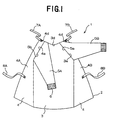
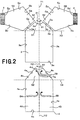
- Fig. 1, 2 are a perspective view showing a disposable gown 1 which can be closed at the rear area as viewed from the front, and a exploded plan view of the gown 1 shown in Fig. 1, respectively.
- Fig. 1 shows a rear trunk region 4 as opened laterally outward and one sleeve 5A as folded onto a front trunk region 3.
- the gown 1 consists of a basic trunk portion 2 and both sleeves 5A, 5B attached to both sides in the upper end region of the basic trunk portion 2.
- a neck opening is formed between the both sleeves 5A, 5B in the upper end region of the basic trunk portion 2, and a hem opening is formed in the lower end region of the basic trunk portion 2 (not shown).
- the basic trunk portion 2 consists of the front trunk region 3 covering wearer's breast and belly and the rear trunk region 4 covering wearer's back, each separately prepared.
- Each of the sleeves 5A, 5B has a trunk facing area 5c, a cuff 5d, and a shoulder covering area 5e, defining, as a whole, a cylindrical form tapered from the shoulder covering area 5e to the cuff 5d.
- Ribbed member 6 is attached to each cuff 5d of the sleeves 5A, 5B. The ribbed member 6 is elastically stretchable in the circumferential direction.
- the front trunk region 3 has both side edges 3a extending parallel each other longitudinally, and upper and lower ends 3b, 3c extending parallel each other transversely.
- a first neckline 3d extends transversely substantially in the middle of the upper edge 3b of the front trunk region 3.
- Each of first armhole lines 3e extends straight transversely between both lateral ends of the first neckline 3d and the both side edges 3a, respectively.
- the first neckline 3d describes a circular arc so that it is convexly curved in the direction of the lower end 3c, and the first armhole lines 3e obliquely extend downward from the both lateral ends of the first neckline 3d to the both side edges 3a.
- the rear trunk region 4 has both side edge 4a extending parallel to each other longitudinally, and upper and lower end edges 4b, 4c extending parallel to each other transversely.
- a second neckline 4d extends transversely substantially in the middle of the upper edge 4b of the rear trunk region 4.
- Each of second armhole lines 4e extends straight transversely between the both lateral ends of the second neckline 4d and the both side edges 4e, respectively.
- the second neckline 4d describes a circular arc so that it is convexly curved in the direction of the lower end 4c, and the second armhole lines 4e obliquely extend downward from the lateral ends of the second neckline 4d to the both side edges 4a.
- the rear trunk region 4 is cut into a first rear trunk half 4A and a second rear trunk half 4B along a longitudinal centerline Y2 bisecting the width between the both side edges 4a and extending longitudinally.
- the rear trunk region 4 has a pair of tying cords 7A, 7B for neck portion and a pair of tying cords 8A, 8B for waist portion by means of which the rear area may be kept closed.
- Each of the tying cords 7A, 7B for the neck portion has its one end attached to the outer surfaces of the first and second rear trunk halves 4A, 4B, respectively, in the vicinity of the longitudinal centerline Y2 as well as of the upper end 4b of the rear trunk region 4.
- Each of the tying cords 8A, 8B for waist portion has its one end attached to the outer surfaces of the first and second rear trunk halves 4A, 4B in the vicinity of the longitudinal centerline Y2 at a level corresponding to the waist line of the rear trunk region 4.
- the first extended lines X1 cross at a crossing angle ⁇ 1 each other on a longitudinal centerline Y1 which bisects the width between the both side edges 3a of the front trunk region 3 and extends longitudinally.
- the second extended lines X2 cross at a crossing angle ⁇ 2 each other on the longitudinal centerline Y2.
- the crossing angles ⁇ 1 and ⁇ 2 define the relationship of ⁇ 1 > ⁇ 2.
- each first armhole line 3e of the front trunk region 3 is placed inside of each second armhole line 4e of the rear trunk region 4. Therefore, in the basic trunk portion 2, the upper part area S2 of the rear trunk region 4 placed above a transversely extending imaginary line X4 which connects crossing points between each second armhole line 4e and the both side edges 4a is larger than the upper part area S1 of the front trunk region 3 placed above a transversely extending chain line X3 which connects crossing points between each first armhole line 3e and the both side edges 3a.
- the crossing angle ⁇ 1 in the front trunk region 3 is in the range of 35° - 160°
- the crossing angle ⁇ 2 in the rear trunk region 4 is in the range of 30° - 155°. If the crossing angle ⁇ 1 is less than 35° or more than 160° and the crossing angle ⁇ 2 is less than 30° or more than 155°, local tension might act on upper ends 3b, 4b of the front trunk region 3 and the rear trunk region 4 as the wearer of the gown 1 moves the arms up- and downward, so that up- and downward movement of the wearer's arms might be restricted by the basic trunk portion 2.
- Each of the sleeves 5A, 5B has a first sleeve bonding line 5a which extends transversely parallel to the first armhole line 3e of the front trunk region 3 and a second sleeve bonding line 5b which extends transversely parallel to the second sleeve line 4e of the rear trunk region 4.
- the first sleeve bonding line 5a rectilinearly and obliquely extends downward from a center of the shoulder covering area 5f to the trunk facing area 5c.
- the second sleeve bonding line 5b also rectilinearly and obliquely extends downward from the center of the shoulder covering area 5f to the trunk facing area 5c.
- Fig. 3 is a plan view showing the gown 1 as the basic trunk portion 2 and the both sleeves 5A, 5B having been bonded together from the state shown in the exploded plan view of Fig. 2.
- each of the sleeves 5A, 5B and the front and rear trunk region 3, 4 are bonded together, wherein each first armhole line 3e of the front trunk region 3 and the first sleeve bonding line 5a of each sleeve 5A, 5B correspond to each other, and each second armhole line 4e of the rear trunk region 4 and the first sleeve bonding line 5b of each sleeve 5A, 5B correspond to each other.
- the both lateral ends of the first neckline 3d of the front trunk region 3 are spaced apart from the both lateral ends of the second neckline 4d of the rear trunk region 4 by a desired dimension.
- sections of the first sleeve bonding line 5a extends which are not bonded to the first and second armhole lines 3e, 4e of the front and rear trunk regions 3, 4.
- each sleeve 5A, 5B to the outer surface of the front and rear trunk regions 3, 4 with the first and second armhole lines 3e, 4e of the front and rear trunk regions 3, 4 being folded a little toward inner surfaces of the trunk regions 3, 4. It is also preferable to bond the outer surfaces of the front and rear trunk regions 3, 4 to each other with the both side edges 3a, 4a of the front and rear trunk regions 3, 4 being folded a little toward inside of the trunk regions 3, 4.
- a wearer puts the both arms through the sleeves 5A, 5B of the gown 1, fastens the tying cords 7A, 7B for neck portion and the tying cords 8A, 8B for waist portion, connects the first and second rear regions 4A, 4B each other, and thereby closes the rear area.
- Nonwoven fabric formed with thermoplastic fiber for example, spunlace-, needlepunch-, meltblown-, thermalbond-, spunbond-, or chemicalbond-nonwovenfabric or a laminated sheet of nonwoven fabric and a thermoplastic synthetic resin sheet can be used for the front and rear trunk regions 3, 4 and the both sleeves 5A, 5B.
- Polyolefine-, polyester- or polyamide-based fiber or conjugate fiber of thick-and-thin type or side-by-side type etc. formed with polyethylen/polypropylene or polyester can be used as component fiber of nonwoven fabric.
- the nonwoven fabric formed with openings to improve moisture-permeability, the nonwoven fabric embossed to improve cushioning property or the nonwoven fabric provided with a stretchability can be also used.
- a plastic sheet for example, polyethylen, polypropylene or polyester can be used as a thermoplastic synthetic resin sheet.
- composite nonwoven fabric SMS nonwoven fabric
- both sheet surfaces of a meltblown nonwoven fabric sheet having high water resistance are sandwiched between sheet surfaces of spunbond nonwoven fabric sheets having high strength and flexibility.
- the gown 1 has been described above, in which the basic trunk portion 2 is formed from the front trunk region 3 and the rear trunk region 4, separately prepared.
- the front trunk region 3 and the rear trunk region 4 can be formed in one-piece, just like the gown 1 disclosed in Japanese Patent Application Publication No. 1994-207301.
- Hot melt adhesive or technique of heat-sealing can be used for bonding of the front and rear trunk regions 3, 4, bonding of the both trunk regions 3, 4 and the both sleeves 5A, 5B, bonding of cords 7A, 7B, 8A, 8B and bonding of sleeve ribbed members 6.
- the gown 1 is used mainly as outerwear for surgeons and patients or sleepwear for patients. Each size, for example, S, M, L, LL can be provided in consideration of the shape of wearer's body.
- the gown 1 is sterilized by organic gasifiable chemicals, for example ethyleneoxide, electronic beam, or radiation, after it has been put into a sterilizing bag.
- the disposable gown according to this invention in uniquely configured so that a crossing angle ⁇ 1 between the both first extensions generated when the first armhole lines are extended upward from the lateral ends of the first neckline is larger than an crossed angle ⁇ 2 between the both second extensions generated when the second armhole lines are extended upward from the lateral ends of the second neckline.
- the upper part area of the rear trunk region extending above a transversely extending chain line which connects crossing points between each second armhole line and the both side edges is larger than the upper part area of the front trunk region extending above a transversely extending chain line which connects crossing points between each first armhole line and the both side edges.
Landscapes
- Engineering & Computer Science (AREA)
- Textile Engineering (AREA)
- Health & Medical Sciences (AREA)
- General Health & Medical Sciences (AREA)
- Physical Education & Sports Medicine (AREA)
- Professional, Industrial, Or Sporting Protective Garments (AREA)
- Outerwear In General, And Traditional Japanese Garments (AREA)
- Details Of Garments (AREA)
- Outer Garments And Coats (AREA)
Abstract
A disposable gown includes front and rear trunk regions
3, 4. The front trunk region 3 has a first neckline 3d extending
transversely and first armhole lines 3e rectilinearly and
obliquely extending downward from lateral ends of the first
neckline 3d toward respective armpits. The rear trunk region
4 has a second neckline 4d extending transversely and second
armhole lines 4e rectilinearly and obliquely extending downward
from lateral ends of the second neckline 4d toward the armpits.
A crossing angle 1 between both first extensions X1 generated
when the first armhole lines 3e are extended upward from lateral
ends of the first neckline 3d is larger than a crossing angle
2 between the both second extensions X2 generated when the
second armhole lines 4e are extended upward from lateral ends
of the second neckline 4d. Each of sleeves 5A, 5B is bonded to
a basic trunk portion 2 so that each of the first armhole lines
3e of the front trunk region 3 may coincide with a first sleeve
bonding line 5a of each of the sleeves 5A, 5B and each of the
second armhole lines 4e of the rear trunk region 4 may coincide
with a second sleeve bonding line 5b of each of the sleeves 5A,
5B.
Description
- This invention relates to a disposable gown, for example, outerwear for surgical operations, outerwear for patients, sleepwear for patients or the like.
- Japanese Patent Application Publication No. 1994-207301A describes a disposable gown of rear side closable type comprising a basic trunk portion of which a rear trunk region divided into right and left halves and both sleeves attached to the both sides of the upper end of the basic trunk portion and has tying cords for fastening the basic trunk portion to the wearer's body from its outside.
- According to the gown of prior art, the basic trunk portion has a neckline extending transversely in the middle of the upper end of the front and rear trunk regions and armholes obliquely extending downward from both lateral ends of the neckline toward respective armpits of the basic trunk portion. A proximal end of each sleeve is bonded to the armhole of the basic trunk portion along a periphery of the armhole. However, in the case of this gown of prior art, the respective armhole halves of the front and rear trunk regions extend rectilinearly parallel to and in coincidence with each other. Such arrangement makes it difficult for the upper part of the trunk portion to follow a roundness of the wearer's shoulder zone, as compared with a gown in which the armhole respective halves extend to describe circular arcs so that a circular opening may be defined. In the gown of prior art, when the wearer thereof intends to stretch his or her arms forward or to bend his or her elbows, local tension acts on the upper part of the rear trunk region and thereby movement of the arms is restrained by the rear trunk region. Consequently, smooth movement of the operating wearer is remarkably restricted.
- In view of the problem as has been described above, it is a principal object of this invention to provide a disposable gown improved so that, even if the armholes on the side of the basic trunk portion as well as the distal ends of the respective sleeves both rectilinearly extending are bonded together, movement of wearer's arms may be free from restriction by the rear trunk region and thereby a desired smooth movement of the operating wearer may be ensured.
- The object set forth above is achieved, according to this invention, by an improvement in the disposable gown composed of a basic trunk portion having a front trunk region covering the breast and belly of a wearer and a rear trunk region covering the back of the wearer, and both sleeves attached to the both sides of the upper end of the basic trunk portion.
- The improvement according to this invention is in that the front trunk region has a first neckline extending transversely in the middle of the upper end of the front trunk region and first armhole lines rectilinearly and obliquely extending downward from lateral ends of the first neckline toward respective armpits of the basic trunk portion, the rear trunk region has a second neckline extending transversely in the middle of its upper end and second armhole lines rectilinearly and obliquely extending downward from lateral ends of the second neckline toward the armpits, and a crossing angle 1 between both first extensions generated when the first armhole lines are extended upward from lateral ends of the first neckline is larger than a crossing angle 2 between the both second extensions generated when the second armhole lines are extended upward from lateral ends of the second neckline; and
each of the sleeves has a first sleeve bonding line extending straight parallel to the first armhole line of the front trunk region and a second sleeve bonding line extending straight parallel to the second armhole of the rear trunk region, each of the sleeves being bonded to the basic trunk portion so that each of the first armhole lines of the front trunk region may coincide with the first sleeve bonding line of each of the sleeves and each of the second armhole lines of the rear trunk region may coincide with the second sleeve bonding line of each of the sleeves. - According to one preferred embodiment of this invention, the crossing angle 1 is in the range of 35° - 160° and the crossing angle 2 is in the range of 30° - 155°.
- According to another preferred embodiment of this invention, the rear trunk region has a first rear trunk half contiguous to one side edge of the front trunk region and a second rear trunk half contiguous to the other the edge of the front trunk region.
- According to still another preferred embodiment of this invention, the basic trunk portion and each of the sleeves are formed with non-woven fabric or a laminated sheet made of non-woven fabric and a thermoplastic synthetic resin sheet.
- Fig. 1 is a perspective view showing the disposable gown constructed according to the principle of this invention as viewed from the front;
- Fig. 2 is a exploded plan view of the gown shown in the Fig. 1; and
- Fig. 3 is a plan view of the gown showing its basic trunk portion and its both sleeves as bonded each other.
-
- Details of the disposable gown according to this invention will be more fully understood from the description given hereunder with reference to the accompanying drawings.
- Fig. 1, 2 are a perspective view showing a
disposable gown 1 which can be closed at the rear area as viewed from the front, and a exploded plan view of thegown 1 shown in Fig. 1, respectively. Fig. 1 shows arear trunk region 4 as opened laterally outward and onesleeve 5A as folded onto afront trunk region 3. Thegown 1 consists of abasic trunk portion 2 and bothsleeves basic trunk portion 2. When thegown 1 is worn, a neck opening is formed between the bothsleeves basic trunk portion 2, and a hem opening is formed in the lower end region of the basic trunk portion 2 (not shown). - The
basic trunk portion 2 consists of thefront trunk region 3 covering wearer's breast and belly and therear trunk region 4 covering wearer's back, each separately prepared. Each of thesleeves trunk facing area 5c, acuff 5d, and ashoulder covering area 5e, defining, as a whole, a cylindrical form tapered from theshoulder covering area 5e to thecuff 5d. Ribbedmember 6 is attached to eachcuff 5d of thesleeves member 6 is elastically stretchable in the circumferential direction. - The
front trunk region 3 has bothside edges 3a extending parallel each other longitudinally, and upper andlower ends first neckline 3d extends transversely substantially in the middle of theupper edge 3b of thefront trunk region 3. Each offirst armhole lines 3e extends straight transversely between both lateral ends of thefirst neckline 3d and the bothside edges 3a, respectively. In thefront trunk region 3, thefirst neckline 3d describes a circular arc so that it is convexly curved in the direction of thelower end 3c, and thefirst armhole lines 3e obliquely extend downward from the both lateral ends of thefirst neckline 3d to the bothside edges 3a. - The
rear trunk region 4 has bothside edge 4a extending parallel to each other longitudinally, and upper andlower end edges second neckline 4d extends transversely substantially in the middle of theupper edge 4b of therear trunk region 4. Each ofsecond armhole lines 4e extends straight transversely between the both lateral ends of thesecond neckline 4d and the bothside edges 4e, respectively. In therear trunk region 4, thesecond neckline 4d describes a circular arc so that it is convexly curved in the direction of thelower end 4c, and thesecond armhole lines 4e obliquely extend downward from the lateral ends of thesecond neckline 4d to the bothside edges 4a. Therear trunk region 4 is cut into a firstrear trunk half 4A and a secondrear trunk half 4B along a longitudinal centerline Y2 bisecting the width between the bothside edges 4a and extending longitudinally. - The
rear trunk region 4 has a pair oftying cords tying cords tying cords rear trunk halves upper end 4b of therear trunk region 4. Each of thetying cords rear trunk halves rear trunk region 4. - In the
front trunk region 3, assumed that thefirst armhole lines 3e are extended upward from the both lateral ends of thefirst neckline 3d, the first extended lines X1 cross at a crossing angle 1 each other on a longitudinal centerline Y1 which bisects the width between the bothside edges 3a of thefront trunk region 3 and extends longitudinally. In therear trunk region 4, assumed that thesecond armhole lines 4e are extended upward from the both lateral ends of thesecond neckline 4d, the second extended lines X2 cross at a crossing angle 2 each other on the longitudinal centerline Y2. The crossing angles 1 and 2 define the relationship of 1 > 2. - When the
front trunk region 3 and therear trunk region 4 are put on each other, eachfirst armhole line 3e of thefront trunk region 3 is placed inside of eachsecond armhole line 4e of therear trunk region 4. Therefore, in thebasic trunk portion 2, the upper part area S2 of therear trunk region 4 placed above a transversely extending imaginary line X4 which connects crossing points between eachsecond armhole line 4e and the bothside edges 4a is larger than the upper part area S1 of thefront trunk region 3 placed above a transversely extending chain line X3 which connects crossing points between eachfirst armhole line 3e and the bothside edges 3a. - It is preferable that the crossing angle 1 in the
front trunk region 3 is in the range of 35° - 160°, and that the crossing angle 2 in therear trunk region 4 is in the range of 30° - 155°. If the crossing angle 1 is less than 35° or more than 160° and the crossing angle 2 is less than 30° or more than 155°, local tension might act onupper ends front trunk region 3 and therear trunk region 4 as the wearer of thegown 1 moves the arms up- and downward, so that up- and downward movement of the wearer's arms might be restricted by thebasic trunk portion 2. - Each of the
sleeves sleeve bonding line 5a which extends transversely parallel to thefirst armhole line 3e of thefront trunk region 3 and a secondsleeve bonding line 5b which extends transversely parallel to thesecond sleeve line 4e of therear trunk region 4. The firstsleeve bonding line 5a rectilinearly and obliquely extends downward from a center of theshoulder covering area 5f to thetrunk facing area 5c. The secondsleeve bonding line 5b also rectilinearly and obliquely extends downward from the center of theshoulder covering area 5f to thetrunk facing area 5c. - Fig. 3 is a plan view showing the
gown 1 as thebasic trunk portion 2 and the bothsleeves sleeves rear trunk region first armhole line 3e of thefront trunk region 3 and the firstsleeve bonding line 5a of eachsleeve second armhole line 4e of therear trunk region 4 and the firstsleeve bonding line 5b of eachsleeve - In the
gown 1, the both lateral ends of thefirst neckline 3d of thefront trunk region 3 are spaced apart from the both lateral ends of thesecond neckline 4d of therear trunk region 4 by a desired dimension. Between associated lateral ends of the first andsecond neckline sleeve bonding line 5a extends which are not bonded to the first andsecond armhole lines rear trunk regions front trunk region 3 and therear trunk region 4 upon each other, bonding thefront trunk region 3 and therear trunk region 4 in the vicinity of theirside edges trunk facing areas 5c of eachsleeve member 6 extending transversely outward from thetrunk facing area 5c. - It is preferable in the
gown 1 to bond the outer surface of eachsleeve rear trunk regions second armhole lines rear trunk regions trunk regions rear trunk regions side edges rear trunk regions trunk regions sleeves gown 1, fastens thetying cords tying cords rear regions - Nonwoven fabric formed with thermoplastic fiber, for example, spunlace-, needlepunch-, meltblown-, thermalbond-, spunbond-, or chemicalbond-nonwovenfabric or a laminated sheet of nonwoven fabric and a thermoplastic synthetic resin sheet can be used for the front and
rear trunk regions sleeves - Polyolefine-, polyester- or polyamide-based fiber or conjugate fiber of thick-and-thin type or side-by-side type etc. formed with polyethylen/polypropylene or polyester can be used as component fiber of nonwoven fabric.
- The nonwoven fabric formed with openings to improve moisture-permeability, the nonwoven fabric embossed to improve cushioning property or the nonwoven fabric provided with a stretchability can be also used. A plastic sheet, for example, polyethylen, polypropylene or polyester can be used as a thermoplastic synthetic resin sheet. It is also possible to use composite nonwoven fabric (SMS nonwoven fabric) in which both sheet surfaces of a meltblown nonwoven fabric sheet having high water resistance are sandwiched between sheet surfaces of spunbond nonwoven fabric sheets having high strength and flexibility.
- The
gown 1 has been described above, in which thebasic trunk portion 2 is formed from thefront trunk region 3 and therear trunk region 4, separately prepared. However, thefront trunk region 3 and therear trunk region 4 can be formed in one-piece, just like thegown 1 disclosed in Japanese Patent Application Publication No. 1994-207301. Hot melt adhesive or technique of heat-sealing can be used for bonding of the front andrear trunk regions trunk regions sleeves cords members 6. - The
gown 1 is used mainly as outerwear for surgeons and patients or sleepwear for patients. Each size, for example, S, M, L, LL can be provided in consideration of the shape of wearer's body. Thegown 1 is sterilized by organic gasifiable chemicals, for example ethyleneoxide, electronic beam, or radiation, after it has been put into a sterilizing bag. - The disposable gown according to this invention in uniquely configured so that a crossing angle 1 between the both first extensions generated when the first armhole lines are extended upward from the lateral ends of the first neckline is larger than an crossed angle 2 between the both second extensions generated when the second armhole lines are extended upward from the lateral ends of the second neckline. In other words, the upper part area of the rear trunk region extending above a transversely extending chain line which connects crossing points between each second armhole line and the both side edges is larger than the upper part area of the front trunk region extending above a transversely extending chain line which connects crossing points between each first armhole line and the both side edges. Therefore, in the gown, an enough area for following the movement of wearer's arms is ensured in the rear region covering the wearer's shoulders. Even if the wearer stretches the arms forward or bends the elbows, no local tension acts on the upper end of the rear trunk region. In this way, movement of the wearer's arms is free from restriction by the rear trunk region and smooth movement of the operating wearer is ensured.
Claims (4)
- A disposable gown composed of a basic trunk portion having a front trunk region covering the breast and belly of a wearer and a rear trunk region covering the back of the wearer, and both sleeves attached to the both sides of the upper end of said basic trunk portion, wherein:the front trunk region has a first neckline extending transversely in the middle of the upper end of the front trunk region and first armhole lines rectilinearly and obliquely extending downward from lateral ends of said first neckline toward respective armpits of said basic trunk portion, said rear trunk region has a second neckline extending transversely in the middle of its upper end and second armhole lines rectilinearly and obliquely extending downward from lateral ends of said second neckline toward said armpits, and a crossing angle 1 between both first extensions generated when said first armhole lines are extended upward from lateral ends of said first neckline is larger than a crossing angle 2 between the both second extensions generated when said second armhole lines are extended upward from lateral ends of said second neckline; andeach of said sleeves has a first sleeve bonding line extending straight parallel to the first armhole line of said front trunk region and a second sleeve bonding line extending straight parallel to the second armhole of said rear trunk region, each of said sleeves being bonded to said basic trunk portion so that each of the first armhole lines of said front trunk region may coincide with the first sleeve bonding line of each of said sleeves and each of the second armhole lines of said rear trunk region may coincide with the second sleeve bonding line of each of said sleeves.
- The gown according to Claim 1, wherein said crossing angle 1 is in the range of 35° - 160° and said crossing angle 2 is in the range of 30° - 155°.
- The gown according to Claim 1, wherein said rear trunk region has a first rear trunk half contiguous to one side edge of said front trunk region and a second rear trunk half contiguous to the other said edge of said front trunk region.
- The gown according to Claim 1, wherein said basic trunk portion and each of said sleeves are formed with a non-woven fabric or a laminated sheet made of a non-woven fabric and a thermoplastic synthetic resin sheet.
Applications Claiming Priority (2)
| Application Number | Priority Date | Filing Date | Title |
|---|---|---|---|
| JP2000120812A JP3597753B2 (en) | 2000-04-21 | 2000-04-21 | Disposable jacket |
| JP2000120812 | 2000-04-21 |
Publications (1)
| Publication Number | Publication Date |
|---|---|
| EP1147718A2 true EP1147718A2 (en) | 2001-10-24 |
Family
ID=18631564
Family Applications (1)
| Application Number | Title | Priority Date | Filing Date |
|---|---|---|---|
| EP01303509A Withdrawn EP1147718A2 (en) | 2000-04-21 | 2001-04-17 | Disposable gown |
Country Status (9)
| Country | Link |
|---|---|
| US (1) | US20010032346A1 (en) |
| EP (1) | EP1147718A2 (en) |
| JP (1) | JP3597753B2 (en) |
| KR (1) | KR20010098768A (en) |
| CN (1) | CN1321448A (en) |
| AU (1) | AU3502801A (en) |
| BR (1) | BR0101877A (en) |
| CA (1) | CA2342757A1 (en) |
| SG (1) | SG88816A1 (en) |
Cited By (1)
| Publication number | Priority date | Publication date | Assignee | Title |
|---|---|---|---|---|
| WO2019191462A1 (en) * | 2018-03-29 | 2019-10-03 | Ascension Health Alliance | Over-the-head disposable contact isolation gown and method for making the same |
Families Citing this family (33)
| Publication number | Priority date | Publication date | Assignee | Title |
|---|---|---|---|---|
| US8621669B2 (en) * | 2004-03-11 | 2014-01-07 | Quest Environmental & Safety Products, Inc. | Disposable safety garment with improved doffing and neck closure |
| US9643033B2 (en) | 2004-03-11 | 2017-05-09 | Quest Environmental & Safety Products, Inc. | Disposable safety garment with improved neck closure |
| US20090173048A1 (en) * | 2004-03-11 | 2009-07-09 | Quest Environmental & Safety Products, Inc. | Packaged non-woven garments |
| US20090126088A1 (en) * | 2007-08-14 | 2009-05-21 | Yadav Sudhansu S | Protective garment for use with radiation monitoring devices |
| USD533982S1 (en) * | 2004-08-23 | 2006-12-26 | Salus Corporation | Disposable medical gown |
| WO2008002860A2 (en) * | 2006-06-26 | 2008-01-03 | Geisinger Clinic | Medical modesty garment |
| US10039610B2 (en) | 2008-08-08 | 2018-08-07 | Medline Industries, Inc. | Zip strip draping system and methods of manufacturing same |
| US7971274B2 (en) * | 2009-06-01 | 2011-07-05 | Salus Corporation | Over the head, full coverage disposable medical gown |
| US20100313326A1 (en) * | 2009-06-11 | 2010-12-16 | Craig Turner | Outer garment |
| USD622934S1 (en) | 2009-09-02 | 2010-09-07 | Salus Corporation | Medical gown |
| USD821704S1 (en) | 2011-10-18 | 2018-07-03 | Medline Industries, Inc. | Medical gown |
| CA144409S (en) * | 2011-10-18 | 2013-06-18 | Medline Ind Inc | Medical gown |
| USD774729S1 (en) | 2011-10-18 | 2016-12-27 | Medline Industries, Inc. | Medical gown |
| USD836297S1 (en) | 2011-10-18 | 2018-12-25 | Medline Industries, Inc. | Medical gown |
| USD863727S1 (en) | 2011-10-18 | 2019-10-22 | Medline Industries, Inc. | Medical gown |
| USD779156S1 (en) | 2011-10-18 | 2017-02-21 | Medline Industries, Inc. | Medical gown |
| US10455872B2 (en) | 2011-10-18 | 2019-10-29 | Medline Industries, Inc. | Disposable medical gown |
| US10441010B2 (en) | 2011-10-18 | 2019-10-15 | Medline Industries, Inc. | Disposable medical gown |
| USD785284S1 (en) * | 2011-10-18 | 2017-05-02 | Medline Industries, Inc. | Medical gown |
| USD791434S1 (en) * | 2011-10-18 | 2017-07-11 | Medline Industries, Inc. | Medical gown |
| USD736493S1 (en) | 2013-03-14 | 2015-08-18 | Medline Industries, Inc. | Medical gown |
| USD741044S1 (en) | 2013-03-14 | 2015-10-20 | Medline Industries, Inc. | Disposable medical gown |
| US11116263B2 (en) | 2013-11-21 | 2021-09-14 | Medline Industries, Inc. | Gown for self-donning while maintaining sterility and methods therefor |
| USD792056S1 (en) * | 2015-05-30 | 2017-07-18 | Prestige Ameritech, Ltd. | Medical gown |
| USD855936S1 (en) * | 2017-06-02 | 2019-08-13 | Medline Industries, Inc. | Disposable gown |
| USD1012429S1 (en) * | 2018-07-06 | 2024-01-30 | Primed Medical Products Inc. | Medical gown |
| WO2021226992A1 (en) * | 2020-05-15 | 2021-11-18 | Honeywell International Inc. | Methods, apparatuses, and systems for providing personal protective equipment |
| WO2022163855A1 (en) * | 2021-02-01 | 2022-08-04 | 東レ株式会社 | Protective clothing |
| EP4346474B1 (en) | 2021-05-27 | 2025-05-07 | Curt G. Joa, Inc. | Apparatus and method of manufacturing multi-piece closed-back isolation garments |
| EP4346476B1 (en) | 2021-05-27 | 2025-05-07 | Curt G. Joa, Inc. | Apparatus and method of manufacturing multi-piece open-back isolation garments |
| MX2023014046A (en) | 2021-06-11 | 2023-12-12 | Joa Curt G Inc | Apparatus and method of manufacturing multi-piece open-back isolation garments. |
| USD1008605S1 (en) | 2022-04-18 | 2023-12-26 | Petoskey Plastics, Inc. | Disposable medical gown |
| KR102566803B1 (en) * | 2022-09-30 | 2023-08-14 | 아얀테 첨단소재(주) | Disposable surgical gown |
Family Cites Families (1)
| Publication number | Priority date | Publication date | Assignee | Title |
|---|---|---|---|---|
| US5062160A (en) * | 1990-06-04 | 1991-11-05 | Johnson & Johnson Medical, Inc. | Raglan sleeve surgical gown |
-
2000
- 2000-04-21 JP JP2000120812A patent/JP3597753B2/en not_active Expired - Fee Related
-
2001
- 2001-04-04 US US09/824,705 patent/US20010032346A1/en not_active Abandoned
- 2001-04-04 CA CA002342757A patent/CA2342757A1/en not_active Abandoned
- 2001-04-06 AU AU35028/01A patent/AU3502801A/en not_active Abandoned
- 2001-04-10 SG SG200102086A patent/SG88816A1/en unknown
- 2001-04-17 EP EP01303509A patent/EP1147718A2/en not_active Withdrawn
- 2001-04-17 BR BR0101877-9A patent/BR0101877A/en not_active IP Right Cessation
- 2001-04-20 KR KR1020010021310A patent/KR20010098768A/en not_active Withdrawn
- 2001-04-20 CN CN01122096A patent/CN1321448A/en active Pending
Cited By (2)
| Publication number | Priority date | Publication date | Assignee | Title |
|---|---|---|---|---|
| WO2019191462A1 (en) * | 2018-03-29 | 2019-10-03 | Ascension Health Alliance | Over-the-head disposable contact isolation gown and method for making the same |
| US11452320B2 (en) | 2018-03-29 | 2022-09-27 | Ascension Health Alliance | Over-the-head disposable contact isolation gown and method for making the same |
Also Published As
| Publication number | Publication date |
|---|---|
| JP2001303317A (en) | 2001-10-31 |
| US20010032346A1 (en) | 2001-10-25 |
| SG88816A1 (en) | 2002-05-21 |
| KR20010098768A (en) | 2001-11-08 |
| CA2342757A1 (en) | 2001-10-21 |
| CN1321448A (en) | 2001-11-14 |
| JP3597753B2 (en) | 2004-12-08 |
| BR0101877A (en) | 2001-12-04 |
| AU3502801A (en) | 2001-10-25 |
Similar Documents
| Publication | Publication Date | Title |
|---|---|---|
| US20010032346A1 (en) | Disposable gown | |
| CA2343482C (en) | Disposable gown | |
| EP1228712B1 (en) | Disposable surgical gown of back-closable type | |
| ES2273968T3 (en) | DISPOSABLE SURGICAL BAT. | |
| KR100653657B1 (en) | Disposable trunk style pants | |
| KR950007737A (en) | Protective clothing near the hip and hip joints | |
| EP1163858A2 (en) | Disposable outer garment for surgical operation | |
| EP0460907A1 (en) | Raglan sleeve surgical gown | |
| JP7793331B2 (en) | surgical gown | |
| EP1157619A2 (en) | Disposable gown | |
| JP2002235223A (en) | Back side disposable outer garment | |
| JP3764038B2 (en) | Closed back disposable outer garment | |
| JP6441553B2 (en) | Jumpsuit | |
| JP2001032107A (en) | Disposable outerwear | |
| JP3971576B2 (en) | Disposable surgical outerwear | |
| EP1092356A1 (en) | Disposable wearing article | |
| JPH0685318U (en) | Clothes that are easy to separate and join | |
| JP2022104097A (en) | Protecting gown |
Legal Events
| Date | Code | Title | Description |
|---|---|---|---|
| PUAI | Public reference made under article 153(3) epc to a published international application that has entered the european phase |
Free format text: ORIGINAL CODE: 0009012 |
|
| AK | Designated contracting states |
Kind code of ref document: A2 Designated state(s): AT BE CH CY DE DK ES FI FR GB GR IE IT LI LU MC NL PT SE TR |
|
| AX | Request for extension of the european patent |
Free format text: AL;LT;LV;MK;RO;SI |
|
| STAA | Information on the status of an ep patent application or granted ep patent |
Free format text: STATUS: THE APPLICATION HAS BEEN WITHDRAWN |
|
| 18W | Application withdrawn |
Withdrawal date: 20011112 |