EP1146033B1 - Fragrance precursors - Google Patents
Fragrance precursors Download PDFInfo
- Publication number
- EP1146033B1 EP1146033B1 EP20010106425 EP01106425A EP1146033B1 EP 1146033 B1 EP1146033 B1 EP 1146033B1 EP 20010106425 EP20010106425 EP 20010106425 EP 01106425 A EP01106425 A EP 01106425A EP 1146033 B1 EP1146033 B1 EP 1146033B1
- Authority
- EP
- European Patent Office
- Prior art keywords
- carbon atoms
- aliphatic
- residue
- fragrant
- alkyl
- Prior art date
- Legal status (The legal status is an assumption and is not a legal conclusion. Google has not performed a legal analysis and makes no representation as to the accuracy of the status listed.)
- Expired - Lifetime
Links
- 239000002243 precursor Substances 0.000 title claims description 62
- 239000003205 fragrance Substances 0.000 title claims description 49
- -1 C1-C6-alkinyl Chemical group 0.000 claims description 72
- 150000001875 compounds Chemical class 0.000 claims description 39
- 150000002148 esters Chemical class 0.000 claims description 39
- LFQSCWFLJHTTHZ-UHFFFAOYSA-N Ethanol Chemical compound CCO LFQSCWFLJHTTHZ-UHFFFAOYSA-N 0.000 claims description 36
- 125000004432 carbon atom Chemical group C* 0.000 claims description 28
- 150000002576 ketones Chemical class 0.000 claims description 21
- 125000001931 aliphatic group Chemical group 0.000 claims description 19
- 239000002253 acid Substances 0.000 claims description 13
- DNIAPMSPPWPWGF-GSVOUGTGSA-N (R)-(-)-Propylene glycol Chemical compound C[C@@H](O)CO DNIAPMSPPWPWGF-GSVOUGTGSA-N 0.000 claims description 9
- 125000004169 (C1-C6) alkyl group Chemical group 0.000 claims description 8
- 125000006727 (C1-C6) alkenyl group Chemical group 0.000 claims description 7
- 125000003118 aryl group Chemical group 0.000 claims description 6
- 125000004178 (C1-C4) alkyl group Chemical group 0.000 claims description 5
- 125000000229 (C1-C4)alkoxy group Chemical group 0.000 claims description 5
- 125000004430 oxygen atom Chemical group O* 0.000 claims description 5
- 125000004399 C1-C4 alkenyl group Chemical group 0.000 claims description 4
- 229910052799 carbon Inorganic materials 0.000 claims description 4
- 125000002837 carbocyclic group Chemical group 0.000 claims description 3
- 125000001495 ethyl group Chemical group [H]C([H])([H])C([H])([H])* 0.000 claims description 3
- 125000002496 methyl group Chemical group [H]C([H])([H])* 0.000 claims description 3
- WUOACPNHFRMFPN-UHFFFAOYSA-N alpha-terpineol Chemical compound CC1=CCC(C(C)(C)O)CC1 WUOACPNHFRMFPN-UHFFFAOYSA-N 0.000 claims description 2
- 229930003658 monoterpene Natural products 0.000 claims description 2
- 150000002773 monoterpene derivatives Chemical class 0.000 claims description 2
- 235000002577 monoterpenes Nutrition 0.000 claims description 2
- 125000003178 carboxy group Chemical group [H]OC(*)=O 0.000 claims 2
- HEDRZPFGACZZDS-MICDWDOJSA-N Trichloro(2H)methane Chemical compound [2H]C(Cl)(Cl)Cl HEDRZPFGACZZDS-MICDWDOJSA-N 0.000 description 54
- 238000000034 method Methods 0.000 description 37
- 239000000047 product Substances 0.000 description 34
- YMWUJEATGCHHMB-UHFFFAOYSA-N Dichloromethane Chemical compound ClCCl YMWUJEATGCHHMB-UHFFFAOYSA-N 0.000 description 30
- 238000005160 1H NMR spectroscopy Methods 0.000 description 27
- NTPLXRHDUXRPNE-UHFFFAOYSA-N 4-methoxyacetophenone Chemical compound COC1=CC=C(C(C)=O)C=C1 NTPLXRHDUXRPNE-UHFFFAOYSA-N 0.000 description 21
- 238000005406 washing Methods 0.000 description 17
- XEKOWRVHYACXOJ-UHFFFAOYSA-N Ethyl acetate Chemical compound CCOC(C)=O XEKOWRVHYACXOJ-UHFFFAOYSA-N 0.000 description 16
- AOGQPLXWSUTHQB-UHFFFAOYSA-N hexyl acetate Chemical compound CCCCCCOC(C)=O AOGQPLXWSUTHQB-UHFFFAOYSA-N 0.000 description 14
- 239000002904 solvent Substances 0.000 description 14
- 235000019645 odor Nutrition 0.000 description 12
- DNRJTBAOUJJKDY-UHFFFAOYSA-N 2-Acetyl-3,5,5,6,8,8-hexamethyl-5,6,7,8- tetrahydronaphthalene Chemical compound CC(=O)C1=C(C)C=C2C(C)(C)C(C)CC(C)(C)C2=C1 DNRJTBAOUJJKDY-UHFFFAOYSA-N 0.000 description 10
- XSAYZAUNJMRRIR-UHFFFAOYSA-N 2-acetylnaphthalene Chemical class C1=CC=CC2=CC(C(=O)C)=CC=C21 XSAYZAUNJMRRIR-UHFFFAOYSA-N 0.000 description 10
- 239000004744 fabric Substances 0.000 description 10
- BZLVMXJERCGZMT-UHFFFAOYSA-N Methyl tert-butyl ether Chemical compound COC(C)(C)C BZLVMXJERCGZMT-UHFFFAOYSA-N 0.000 description 9
- 238000003776 cleavage reaction Methods 0.000 description 9
- 230000007017 scission Effects 0.000 description 9
- 239000000243 solution Substances 0.000 description 9
- NJEPSHAJUHQGMP-UHFFFAOYSA-N 1-(4-methoxyphenyl)-2-[1-(3,5,5-trimethylhexoxy)ethoxy]ethanone Chemical compound COC1=CC=C(C(=O)COC(C)OCCC(C)CC(C)(C)C)C=C1 NJEPSHAJUHQGMP-UHFFFAOYSA-N 0.000 description 8
- TZUQWSWQCTZWDM-UHFFFAOYSA-N 1-(4-methoxyphenyl)-2-[2-(1-phenylethoxy)ethoxy]ethanone Chemical compound C1=CC(OC)=CC=C1C(=O)COCCOC(C)C1=CC=CC=C1 TZUQWSWQCTZWDM-UHFFFAOYSA-N 0.000 description 8
- GUOOBBBAGUEZEH-UHFFFAOYSA-N 2-(1-hexoxyethoxy)-1-(4-methoxyphenyl)ethanone Chemical compound CCCCCCOC(C)OCC(=O)C1=CC=C(OC)C=C1 GUOOBBBAGUEZEH-UHFFFAOYSA-N 0.000 description 8
- JOZKFWLRHCDGJA-UHFFFAOYSA-N citronellol acetate Chemical compound CC(=O)OCCC(C)CCC=C(C)C JOZKFWLRHCDGJA-UHFFFAOYSA-N 0.000 description 8
- 229940098795 (3z)- 3-hexenyl acetate Drugs 0.000 description 7
- BDFAGZAATLESRX-UHFFFAOYSA-N 1-(3,5,5,6,8,8-hexamethyl-6,7-dihydronaphthalen-2-yl)-2-(1-hexoxyethoxy)ethanone Chemical compound CC1(C)C(C)CC(C)(C)C2=C1C=C(C)C(C(=O)COC(C)OCCCCCC)=C2 BDFAGZAATLESRX-UHFFFAOYSA-N 0.000 description 7
- UIHKMFLGQXOMAI-UHFFFAOYSA-N 1-(4-methoxyphenyl)-2-[1-(3-phenylpropoxy)ethoxy]ethanone Chemical compound C1=CC(OC)=CC=C1C(=O)COC(C)OCCCC1=CC=CC=C1 UIHKMFLGQXOMAI-UHFFFAOYSA-N 0.000 description 7
- NPFVOOAXDOBMCE-PLNGDYQASA-N cis-3-Hexenyl acetate Natural products CC\C=C/CCOC(C)=O NPFVOOAXDOBMCE-PLNGDYQASA-N 0.000 description 7
- RRGOKSYVAZDNKR-ARJAWSKDSA-M cis-3-hexenylacetate Chemical compound CC\C=C/CCCC([O-])=O RRGOKSYVAZDNKR-ARJAWSKDSA-M 0.000 description 7
- 239000003599 detergent Substances 0.000 description 7
- 239000000796 flavoring agent Substances 0.000 description 7
- 235000019634 flavors Nutrition 0.000 description 7
- 239000004615 ingredient Substances 0.000 description 7
- NPFVOOAXDOBMCE-UHFFFAOYSA-N trans-3-hexenyl acetate Natural products CCC=CCCOC(C)=O NPFVOOAXDOBMCE-UHFFFAOYSA-N 0.000 description 7
- XLYOFNOQVPJJNP-UHFFFAOYSA-N water Substances O XLYOFNOQVPJJNP-UHFFFAOYSA-N 0.000 description 7
- IIJQILBLZVJDKT-UHFFFAOYSA-N 2-(1-ethoxyethoxy)-1-(4-methoxyphenyl)ethanone Chemical compound CCOC(C)OCC(=O)C1=CC=C(OC)C=C1 IIJQILBLZVJDKT-UHFFFAOYSA-N 0.000 description 6
- QTBSBXVTEAMEQO-UHFFFAOYSA-N Acetic acid Chemical compound CC(O)=O QTBSBXVTEAMEQO-UHFFFAOYSA-N 0.000 description 6
- CSNNHWWHGAXBCP-UHFFFAOYSA-L Magnesium sulfate Chemical compound [Mg+2].[O-][S+2]([O-])([O-])[O-] CSNNHWWHGAXBCP-UHFFFAOYSA-L 0.000 description 6
- UIIMBOGNXHQVGW-UHFFFAOYSA-M Sodium bicarbonate Chemical compound [Na+].OC([O-])=O UIIMBOGNXHQVGW-UHFFFAOYSA-M 0.000 description 6
- YXFVVABEGXRONW-UHFFFAOYSA-N Toluene Chemical compound CC1=CC=CC=C1 YXFVVABEGXRONW-UHFFFAOYSA-N 0.000 description 6
- FJKIXWOMBXYWOQ-UHFFFAOYSA-N ethenoxyethane Chemical compound CCOC=C FJKIXWOMBXYWOQ-UHFFFAOYSA-N 0.000 description 6
- 235000019439 ethyl acetate Nutrition 0.000 description 6
- 239000000203 mixture Substances 0.000 description 6
- VLKZOEOYAKHREP-UHFFFAOYSA-N n-Hexane Chemical compound CCCCCC VLKZOEOYAKHREP-UHFFFAOYSA-N 0.000 description 6
- MDHYEMXUFSJLGV-UHFFFAOYSA-N phenethyl acetate Chemical compound CC(=O)OCCC1=CC=CC=C1 MDHYEMXUFSJLGV-UHFFFAOYSA-N 0.000 description 6
- VYPSYNLAJGMNEJ-UHFFFAOYSA-N Silicium dioxide Chemical compound O=[Si]=O VYPSYNLAJGMNEJ-UHFFFAOYSA-N 0.000 description 5
- DTQVDTLACAAQTR-UHFFFAOYSA-N Trifluoroacetic acid Chemical compound OC(=O)C(F)(F)F DTQVDTLACAAQTR-UHFFFAOYSA-N 0.000 description 5
- DHKHKXVYLBGOIT-UHFFFAOYSA-N acetaldehyde Diethyl Acetal Natural products CCOC(C)OCC DHKHKXVYLBGOIT-UHFFFAOYSA-N 0.000 description 5
- 238000004128 high performance liquid chromatography Methods 0.000 description 5
- 239000003960 organic solvent Substances 0.000 description 5
- 239000002304 perfume Substances 0.000 description 5
- 239000000843 powder Substances 0.000 description 5
- 239000000126 substance Substances 0.000 description 5
- JKJYQOSZULUCNT-UHFFFAOYSA-N 1-(4-methoxyphenyl)-2-(1-methoxy-2-phenylethoxy)ethanone Chemical compound C=1C=C(OC)C=CC=1C(=O)COC(OC)CC1=CC=CC=C1 JKJYQOSZULUCNT-UHFFFAOYSA-N 0.000 description 4
- ZQSUPGJGGJDLFK-UHFFFAOYSA-N 2-(1-ethoxyethoxy)-1-(3,5,5,6,8,8-hexamethyl-6,7-dihydronaphthalen-2-yl)ethanone Chemical compound CC1(C)C(C)CC(C)(C)C2=C1C=C(C)C(C(=O)COC(C)OCC)=C2 ZQSUPGJGGJDLFK-UHFFFAOYSA-N 0.000 description 4
- ZHTLKESCTLEWSS-UHFFFAOYSA-N 2-(1-hexoxyethoxy)-1-naphthalen-2-ylethanone Chemical compound C1=CC=CC2=CC(C(=O)COC(C)OCCCCCC)=CC=C21 ZHTLKESCTLEWSS-UHFFFAOYSA-N 0.000 description 4
- YNPJSNIYNXPIGV-UHFFFAOYSA-N 2-[1-(3,7-dimethyloct-6-enoxy)ethoxy]-1-(4-methoxyphenyl)ethanone Chemical compound COC1=CC=C(C(=O)COC(C)OCCC(C)CCC=C(C)C)C=C1 YNPJSNIYNXPIGV-UHFFFAOYSA-N 0.000 description 4
- YZRLEMKDIZJMLK-UHFFFAOYSA-N 2-[1-(3,7-dimethyloct-6-enoxy)ethoxy]-1-naphthalen-2-ylethanone Chemical compound C1=CC=CC2=CC(C(=O)COC(C)OCCC(C)CCC=C(C)C)=CC=C21 YZRLEMKDIZJMLK-UHFFFAOYSA-N 0.000 description 4
- JOZKFWLRHCDGJA-LLVKDONJSA-N Citronellyl acetate Natural products CC(=O)OCC[C@H](C)CCC=C(C)C JOZKFWLRHCDGJA-LLVKDONJSA-N 0.000 description 4
- CRZQGDNQQAALAY-UHFFFAOYSA-N Methyl benzeneacetate Chemical compound COC(=O)CC1=CC=CC=C1 CRZQGDNQQAALAY-UHFFFAOYSA-N 0.000 description 4
- QYKIQEUNHZKYBP-UHFFFAOYSA-N Vinyl ether Chemical compound C=COC=C QYKIQEUNHZKYBP-UHFFFAOYSA-N 0.000 description 4
- 238000004458 analytical method Methods 0.000 description 4
- QMVPMAAFGQKVCJ-UHFFFAOYSA-N citronellol Chemical compound OCCC(C)CCC=C(C)C QMVPMAAFGQKVCJ-UHFFFAOYSA-N 0.000 description 4
- 238000002360 preparation method Methods 0.000 description 4
- 230000002035 prolonged effect Effects 0.000 description 4
- 238000003860 storage Methods 0.000 description 4
- 238000012360 testing method Methods 0.000 description 4
- KSEZPRJUTHMFGZ-UHFFFAOYSA-N 1-(3-ethyl-5,5,8,8-tetramethyl-6,7-dihydronaphthalen-2-yl)ethanone Chemical compound CC1(C)CCC(C)(C)C2=C1C=C(C(C)=O)C(CC)=C2 KSEZPRJUTHMFGZ-UHFFFAOYSA-N 0.000 description 3
- JNHLHPMTMTYLCP-UHFFFAOYSA-N 1-(4-tert-butyl-2,6-dimethylphenyl)ethanone Chemical compound CC(=O)C1=C(C)C=C(C(C)(C)C)C=C1C JNHLHPMTMTYLCP-UHFFFAOYSA-N 0.000 description 3
- 229920000742 Cotton Polymers 0.000 description 3
- 239000004280 Sodium formate Substances 0.000 description 3
- 150000001298 alcohols Chemical class 0.000 description 3
- 239000012267 brine Substances 0.000 description 3
- 238000006243 chemical reaction Methods 0.000 description 3
- 239000003795 chemical substances by application Substances 0.000 description 3
- 238000004587 chromatography analysis Methods 0.000 description 3
- 239000002979 fabric softener Substances 0.000 description 3
- 229910052943 magnesium sulfate Inorganic materials 0.000 description 3
- 239000000463 material Substances 0.000 description 3
- 230000007935 neutral effect Effects 0.000 description 3
- 230000009965 odorless effect Effects 0.000 description 3
- 238000006303 photolysis reaction Methods 0.000 description 3
- 230000015843 photosynthesis, light reaction Effects 0.000 description 3
- 238000010992 reflux Methods 0.000 description 3
- 229910000030 sodium bicarbonate Inorganic materials 0.000 description 3
- HLBBKKJFGFRGMU-UHFFFAOYSA-M sodium formate Chemical compound [Na+].[O-]C=O HLBBKKJFGFRGMU-UHFFFAOYSA-M 0.000 description 3
- 235000019254 sodium formate Nutrition 0.000 description 3
- HPALAKNZSZLMCH-UHFFFAOYSA-M sodium;chloride;hydrate Chemical compound O.[Na+].[Cl-] HPALAKNZSZLMCH-UHFFFAOYSA-M 0.000 description 3
- 235000007586 terpenes Nutrition 0.000 description 3
- FINOAUDUYKVGDS-UHFFFAOYSA-N (2-tert-butylcyclohexyl) acetate Chemical compound CC(=O)OC1CCCCC1C(C)(C)C FINOAUDUYKVGDS-UHFFFAOYSA-N 0.000 description 2
- QMVPMAAFGQKVCJ-SNVBAGLBSA-N (R)-(+)-citronellol Natural products OCC[C@H](C)CCC=C(C)C QMVPMAAFGQKVCJ-SNVBAGLBSA-N 0.000 description 2
- DALKDFNESXMXHW-UHFFFAOYSA-N 1-(1,1,2,3,3-pentamethyl-2h-inden-5-yl)ethanone Chemical compound C1=C(C(C)=O)C=C2C(C)(C)C(C)C(C)(C)C2=C1 DALKDFNESXMXHW-UHFFFAOYSA-N 0.000 description 2
- QZADYGNSQCABPT-UHFFFAOYSA-N 1-(3,5,5,8,8-pentamethyl-6,7-dihydronaphthalen-2-yl)ethanone Chemical compound CC1(C)CCC(C)(C)C2=C1C=C(C)C(C(=O)C)=C2 QZADYGNSQCABPT-UHFFFAOYSA-N 0.000 description 2
- BAYUSCHCCGXLAY-UHFFFAOYSA-N 1-(3-methoxyphenyl)ethanone Chemical compound COC1=CC=CC(C(C)=O)=C1 BAYUSCHCCGXLAY-UHFFFAOYSA-N 0.000 description 2
- VEPUKHYQNXSSKV-UHFFFAOYSA-N 1-(5,6,7,8-tetrahydronaphthalen-2-yl)ethanone Chemical compound C1CCCC2=CC(C(=O)C)=CC=C21 VEPUKHYQNXSSKV-UHFFFAOYSA-N 0.000 description 2
- KYGSYTRHCDNSGS-UHFFFAOYSA-N 1-phenylpent-4-en-1-one Chemical compound C=CCCC(=O)C1=CC=CC=C1 KYGSYTRHCDNSGS-UHFFFAOYSA-N 0.000 description 2
- ZWVHTXAYIKBMEE-UHFFFAOYSA-N 2-hydroxyacetophenone Chemical class OCC(=O)C1=CC=CC=C1 ZWVHTXAYIKBMEE-UHFFFAOYSA-N 0.000 description 2
- WRMNZCZEMHIOCP-UHFFFAOYSA-N 2-phenylethanol Chemical compound OCCC1=CC=CC=C1 WRMNZCZEMHIOCP-UHFFFAOYSA-N 0.000 description 2
- DGKXDLCVQSQVBC-UHFFFAOYSA-N 3,5,5-trimethylhexyl acetate Chemical compound CC(C)(C)CC(C)CCOC(C)=O DGKXDLCVQSQVBC-UHFFFAOYSA-N 0.000 description 2
- RBKRCARRXLFUGJ-UHFFFAOYSA-N 3,7-dimethyloctan-3-yl acetate Chemical compound CC(=O)OC(C)(CC)CCCC(C)C RBKRCARRXLFUGJ-UHFFFAOYSA-N 0.000 description 2
- VAJVDSVGBWFCLW-UHFFFAOYSA-N 3-Phenyl-1-propanol Chemical compound OCCCC1=CC=CC=C1 VAJVDSVGBWFCLW-UHFFFAOYSA-N 0.000 description 2
- JRJGKUTZNBZHNK-UHFFFAOYSA-N 3-phenylpropyl acetate Chemical compound CC(=O)OCCCC1=CC=CC=C1 JRJGKUTZNBZHNK-UHFFFAOYSA-N 0.000 description 2
- IKTHMQYJOWTSJO-UHFFFAOYSA-N 4-Acetyl-6-tert-butyl-1,1-dimethylindane Chemical compound CC(=O)C1=CC(C(C)(C)C)=CC2=C1CCC2(C)C IKTHMQYJOWTSJO-UHFFFAOYSA-N 0.000 description 2
- MBZRJSQZCBXRGK-UHFFFAOYSA-N 4-tert-Butylcyclohexyl acetate Chemical compound CC(=O)OC1CCC(C(C)(C)C)CC1 MBZRJSQZCBXRGK-UHFFFAOYSA-N 0.000 description 2
- KWOLFJPFCHCOCG-UHFFFAOYSA-N Acetophenone Chemical group CC(=O)C1=CC=CC=C1 KWOLFJPFCHCOCG-UHFFFAOYSA-N 0.000 description 2
- QIMYBFSJCUTEBC-WAYWQWQTSA-N CC/C=C\CCOC(C)OCC(c(cc1)ccc1OC)=O Chemical compound CC/C=C\CCOC(C)OCC(c(cc1)ccc1OC)=O QIMYBFSJCUTEBC-WAYWQWQTSA-N 0.000 description 2
- 229920000858 Cyclodextrin Polymers 0.000 description 2
- GLZPCOQZEFWAFX-UHFFFAOYSA-N Geraniol Chemical compound CC(C)=CCCC(C)=CCO GLZPCOQZEFWAFX-UHFFFAOYSA-N 0.000 description 2
- CYHBDKTZDLSRMY-UHFFFAOYSA-N Hexyl 2-methylpropanoate Chemical compound CCCCCCOC(=O)C(C)C CYHBDKTZDLSRMY-UHFFFAOYSA-N 0.000 description 2
- DIRDKDDFAMNBNY-UHFFFAOYSA-N Isopropyl 2-methylbutanoate Chemical compound CCC(C)C(=O)OC(C)C DIRDKDDFAMNBNY-UHFFFAOYSA-N 0.000 description 2
- 238000010547 Norrish type II reaction Methods 0.000 description 2
- 238000010521 absorption reaction Methods 0.000 description 2
- 239000002671 adjuvant Substances 0.000 description 2
- 150000001299 aldehydes Chemical class 0.000 description 2
- 125000003342 alkenyl group Chemical group 0.000 description 2
- 125000006193 alkinyl group Chemical group 0.000 description 2
- 239000008346 aqueous phase Substances 0.000 description 2
- QUKGYYKBILRGFE-UHFFFAOYSA-N benzyl acetate Chemical compound CC(=O)OCC1=CC=CC=C1 QUKGYYKBILRGFE-UHFFFAOYSA-N 0.000 description 2
- JGQFVRIQXUFPAH-UHFFFAOYSA-N beta-citronellol Natural products OCCC(C)CCCC(C)=C JGQFVRIQXUFPAH-UHFFFAOYSA-N 0.000 description 2
- 230000015572 biosynthetic process Effects 0.000 description 2
- 235000000484 citronellol Nutrition 0.000 description 2
- 229910052681 coesite Inorganic materials 0.000 description 2
- 229910052906 cristobalite Inorganic materials 0.000 description 2
- 229940097362 cyclodextrins Drugs 0.000 description 2
- 235000014113 dietary fatty acids Nutrition 0.000 description 2
- 238000001035 drying Methods 0.000 description 2
- 230000000694 effects Effects 0.000 description 2
- HCRBXQFHJMCTLF-ZCFIWIBFSA-N ethyl (2r)-2-methylbutanoate Chemical compound CCOC(=O)[C@H](C)CC HCRBXQFHJMCTLF-ZCFIWIBFSA-N 0.000 description 2
- 238000011156 evaluation Methods 0.000 description 2
- 239000000284 extract Substances 0.000 description 2
- 229930195729 fatty acid Natural products 0.000 description 2
- 239000000194 fatty acid Substances 0.000 description 2
- 238000009472 formulation Methods 0.000 description 2
- 238000000769 gas chromatography-flame ionisation detection Methods 0.000 description 2
- ZSIAUFGUXNUGDI-UHFFFAOYSA-N hexan-1-ol Chemical compound CCCCCCO ZSIAUFGUXNUGDI-UHFFFAOYSA-N 0.000 description 2
- 230000007062 hydrolysis Effects 0.000 description 2
- 238000006460 hydrolysis reaction Methods 0.000 description 2
- CDOSHBSSFJOMGT-UHFFFAOYSA-N linalool Chemical compound CC(C)=CCCC(C)(O)C=C CDOSHBSSFJOMGT-UHFFFAOYSA-N 0.000 description 2
- 230000005923 long-lasting effect Effects 0.000 description 2
- QSHDDOUJBYECFT-UHFFFAOYSA-N mercury Chemical compound [Hg] QSHDDOUJBYECFT-UHFFFAOYSA-N 0.000 description 2
- 229910052753 mercury Inorganic materials 0.000 description 2
- 239000012044 organic layer Substances 0.000 description 2
- 238000005192 partition Methods 0.000 description 2
- CFNJLPHOBMVMNS-UHFFFAOYSA-N pentyl butyrate Chemical compound CCCCCOC(=O)CCC CFNJLPHOBMVMNS-UHFFFAOYSA-N 0.000 description 2
- 230000008447 perception Effects 0.000 description 2
- 238000000746 purification Methods 0.000 description 2
- 239000000377 silicon dioxide Substances 0.000 description 2
- 239000007787 solid Substances 0.000 description 2
- 229910052682 stishovite Inorganic materials 0.000 description 2
- 239000000725 suspension Substances 0.000 description 2
- 238000003786 synthesis reaction Methods 0.000 description 2
- 229910052905 tridymite Inorganic materials 0.000 description 2
- 238000009281 ultraviolet germicidal irradiation Methods 0.000 description 2
- NOOLISFMXDJSKH-UTLUCORTSA-N (+)-Neomenthol Chemical compound CC(C)[C@@H]1CC[C@@H](C)C[C@@H]1O NOOLISFMXDJSKH-UTLUCORTSA-N 0.000 description 1
- DTGKSKDOIYIVQL-WEDXCCLWSA-N (+)-borneol Chemical compound C1C[C@@]2(C)[C@@H](O)C[C@@H]1C2(C)C DTGKSKDOIYIVQL-WEDXCCLWSA-N 0.000 description 1
- REPVLJRCJUVQFA-UHFFFAOYSA-N (-)-isopinocampheol Natural products C1C(O)C(C)C2C(C)(C)C1C2 REPVLJRCJUVQFA-UHFFFAOYSA-N 0.000 description 1
- GEWDNTWNSAZUDX-WQMVXFAESA-N (-)-methyl jasmonate Chemical compound CC\C=C/C[C@@H]1[C@@H](CC(=O)OC)CCC1=O GEWDNTWNSAZUDX-WQMVXFAESA-N 0.000 description 1
- GDIYABNICDPBCR-UHFFFAOYSA-N (1-tert-butylcyclohexyl) acetate Chemical compound CC(=O)OC1(C(C)(C)C)CCCCC1 GDIYABNICDPBCR-UHFFFAOYSA-N 0.000 description 1
- GYTDJCTUFWFXBE-UHFFFAOYSA-M (2,2,2-trifluoroacetyl)oxymercury Chemical compound [Hg+].[O-]C(=O)C(F)(F)F GYTDJCTUFWFXBE-UHFFFAOYSA-M 0.000 description 1
- SDOFMBGMRVAJNF-KVTDHHQDSA-N (2r,3r,4r,5r)-6-aminohexane-1,2,3,4,5-pentol Chemical compound NC[C@@H](O)[C@@H](O)[C@H](O)[C@H](O)CO SDOFMBGMRVAJNF-KVTDHHQDSA-N 0.000 description 1
- 239000001490 (3R)-3,7-dimethylocta-1,6-dien-3-ol Substances 0.000 description 1
- CDOSHBSSFJOMGT-JTQLQIEISA-N (R)-linalool Natural products CC(C)=CCC[C@@](C)(O)C=C CDOSHBSSFJOMGT-JTQLQIEISA-N 0.000 description 1
- WUOACPNHFRMFPN-SECBINFHSA-N (S)-(-)-alpha-terpineol Chemical compound CC1=CC[C@@H](C(C)(C)O)CC1 WUOACPNHFRMFPN-SECBINFHSA-N 0.000 description 1
- IMRYETFJNLKUHK-SJCJKPOMSA-N (S,S)-traseolide Chemical compound CC1=C(C(C)=O)C=C2[C@@H](C(C)C)[C@H](C)C(C)(C)C2=C1 IMRYETFJNLKUHK-SJCJKPOMSA-N 0.000 description 1
- UFLHIIWVXFIJGU-ARJAWSKDSA-N (Z)-hex-3-en-1-ol Chemical compound CC\C=C/CCO UFLHIIWVXFIJGU-ARJAWSKDSA-N 0.000 description 1
- DYLIWHYUXAJDOJ-OWOJBTEDSA-N (e)-4-(6-aminopurin-9-yl)but-2-en-1-ol Chemical compound NC1=NC=NC2=C1N=CN2C\C=C\CO DYLIWHYUXAJDOJ-OWOJBTEDSA-N 0.000 description 1
- HNSDLXPSAYFUHK-UHFFFAOYSA-N 1,4-bis(2-ethylhexyl) sulfosuccinate Chemical compound CCCCC(CC)COC(=O)CC(S(O)(=O)=O)C(=O)OCC(CC)CCCC HNSDLXPSAYFUHK-UHFFFAOYSA-N 0.000 description 1
- VDBHOHJWUDKDRW-UHFFFAOYSA-N 1-(1,1,2,3,3,6-hexamethyl-2h-inden-5-yl)ethanone Chemical compound CC1=C(C(C)=O)C=C2C(C)(C)C(C)C(C)(C)C2=C1 VDBHOHJWUDKDRW-UHFFFAOYSA-N 0.000 description 1
- IEJXNMXNIYKCAL-UHFFFAOYSA-N 1-(1,2-dimethyl-2,3,3a,4,5,5a-hexahydrocyclopenta[a]naphthalen-1-yl)ethanone Chemical compound C1CC2C=CC=CC2=C2C1CC(C)C2(C)C(C)=O IEJXNMXNIYKCAL-UHFFFAOYSA-N 0.000 description 1
- HSDSKVWQTONQBJ-UHFFFAOYSA-N 1-(2,4-dimethylphenyl)ethanone Chemical compound CC(=O)C1=CC=C(C)C=C1C HSDSKVWQTONQBJ-UHFFFAOYSA-N 0.000 description 1
- UZJQBYZEDOEQGT-UHFFFAOYSA-N 1-(2,4-dimethylphenyl)ethanone 2-methyl-1-phenylpropan-1-one Chemical compound CC(C)C(=O)C1=CC=CC=C1.CC(=O)C1=CC=C(C)C=C1C UZJQBYZEDOEQGT-UHFFFAOYSA-N 0.000 description 1
- QOKUXXPXRRGVQU-UHFFFAOYSA-N 1-(3,5,5,6,8,8-hexamethyl-6,7-dihydronaphthalen-2-yl)-2-hydroxyethanone Chemical compound OCC(=O)C1=C(C)C=C2C(C)(C)C(C)CC(C)(C)C2=C1 QOKUXXPXRRGVQU-UHFFFAOYSA-N 0.000 description 1
- NAKMDRNNFRKBHS-UHFFFAOYSA-N 1-[4-(5-amino-2-chlorophenyl)piperazin-1-yl]ethanone Chemical compound C1CN(C(=O)C)CCN1C1=CC(N)=CC=C1Cl NAKMDRNNFRKBHS-UHFFFAOYSA-N 0.000 description 1
- NCJOWOWWNKPURV-UHFFFAOYSA-N 1-ethenoxy-3,5,5-trimethylhexane Chemical compound CC(C)(C)CC(C)CCOC=C NCJOWOWWNKPURV-UHFFFAOYSA-N 0.000 description 1
- YAOJJEJGPZRYJF-UHFFFAOYSA-N 1-ethenoxyhexane Chemical compound CCCCCCOC=C YAOJJEJGPZRYJF-UHFFFAOYSA-N 0.000 description 1
- UBNPTJSGEYBDCQ-UHFFFAOYSA-N 1-phenylethanone Chemical compound CC(=O)C1=CC=CC=C1.CC(=O)C1=CC=CC=C1 UBNPTJSGEYBDCQ-UHFFFAOYSA-N 0.000 description 1
- TZOHZGVOGIOCMD-UHFFFAOYSA-N 1-phenylpropan-1-one 1-phenylpropan-2-one Chemical compound C1(=CC=CC=C1)CC(C)=O.C(CC)(=O)C1=CC=CC=C1 TZOHZGVOGIOCMD-UHFFFAOYSA-N 0.000 description 1
- ADULDWACMKMIRB-UHFFFAOYSA-N 1-tert-butyl-4-ethenoxycyclohexane Chemical compound CC(C)(C)C1CCC(OC=C)CC1 ADULDWACMKMIRB-UHFFFAOYSA-N 0.000 description 1
- FACFHHMQICTXFZ-UHFFFAOYSA-N 2-(2-phenylimidazo[1,2-a]pyridin-3-yl)ethanamine Chemical compound N1=C2C=CC=CN2C(CCN)=C1C1=CC=CC=C1 FACFHHMQICTXFZ-UHFFFAOYSA-N 0.000 description 1
- FLUWAIIVLCVEKF-UHFFFAOYSA-N 2-Methyl-1-phenyl-2-propanyl acetate Chemical compound CC(=O)OC(C)(C)CC1=CC=CC=C1 FLUWAIIVLCVEKF-UHFFFAOYSA-N 0.000 description 1
- OUELSYYMNDBLHV-UHFFFAOYSA-N 2-ethenoxyethylbenzene Chemical compound C=COCCC1=CC=CC=C1 OUELSYYMNDBLHV-UHFFFAOYSA-N 0.000 description 1
- YTOKFOPFITZGDM-UHFFFAOYSA-N 2-hydroxy-1-(4-methoxyphenyl)ethanone Chemical compound COC1=CC=C(C(=O)CO)C=C1 YTOKFOPFITZGDM-UHFFFAOYSA-N 0.000 description 1
- HMYNGQYVXBPOEN-UHFFFAOYSA-N 2-hydroxy-1-naphthalen-2-ylethanone Chemical compound C1=CC=CC2=CC(C(=O)CO)=CC=C21 HMYNGQYVXBPOEN-UHFFFAOYSA-N 0.000 description 1
- BODRLKRKPXBDBN-UHFFFAOYSA-N 3,5,5-Trimethyl-1-hexanol Chemical compound OCCC(C)CC(C)(C)C BODRLKRKPXBDBN-UHFFFAOYSA-N 0.000 description 1
- DLHQZZUEERVIGQ-UHFFFAOYSA-N 3,7-dimethyl-3-octanol Chemical compound CCC(C)(O)CCCC(C)C DLHQZZUEERVIGQ-UHFFFAOYSA-N 0.000 description 1
- KVLBWFMQNBRDFO-UHFFFAOYSA-N 3-ethenoxypropylbenzene Chemical compound C=COCCCC1=CC=CC=C1 KVLBWFMQNBRDFO-UHFFFAOYSA-N 0.000 description 1
- GHFIGDRPMJLTGJ-UHFFFAOYSA-N 3-methyl-1-(4-methylphenyl)hex-4-en-1-one Chemical compound CC=CC(C)CC(=O)C1=CC=C(C)C=C1 GHFIGDRPMJLTGJ-UHFFFAOYSA-N 0.000 description 1
- WXCMHFPAUCOJIG-UHFFFAOYSA-N 4'-tert-Butyl-2',6'-dimethyl-3',5'-dinitroacetophenone Chemical compound CC(=O)C1=C(C)C([N+]([O-])=O)=C(C(C)(C)C)C([N+]([O-])=O)=C1C WXCMHFPAUCOJIG-UHFFFAOYSA-N 0.000 description 1
- CCOQPGVQAWPUPE-UHFFFAOYSA-N 4-tert-butylcyclohexan-1-ol Chemical compound CC(C)(C)C1CCC(O)CC1 CCOQPGVQAWPUPE-UHFFFAOYSA-N 0.000 description 1
- 229940091886 4-tert-butylcyclohexanol Drugs 0.000 description 1
- LPCIQGCMSCLHKB-UHFFFAOYSA-N 6-ethenoxy-2,6-dimethyloctane Chemical compound C=COC(C)(CC)CCCC(C)C LPCIQGCMSCLHKB-UHFFFAOYSA-N 0.000 description 1
- PWCLCTUZQHYTKS-UHFFFAOYSA-N 8-ethenoxy-2,6-dimethyloct-2-ene Chemical compound C=COCCC(C)CCC=C(C)C PWCLCTUZQHYTKS-UHFFFAOYSA-N 0.000 description 1
- RZVAJINKPMORJF-UHFFFAOYSA-N Acetaminophen Chemical compound CC(=O)NC1=CC=C(O)C=C1 RZVAJINKPMORJF-UHFFFAOYSA-N 0.000 description 1
- 241000208199 Buxus sempervirens Species 0.000 description 1
- PIRRRVGHVZPIBB-UHFFFAOYSA-N C1=CC=C2C(=O)C(C(C)C)CC2=C1.C1=CC=C2C(=O)C(C(C)C)CC2=C1 Chemical compound C1=CC=C2C(=O)C(C(C)C)CC2=C1.C1=CC=C2C(=O)C(C(C)C)CC2=C1 PIRRRVGHVZPIBB-UHFFFAOYSA-N 0.000 description 1
- HZUIVFLJTXUXNQ-WAYWQWQTSA-N CCC\C=C/C1C(CC(=O)OC)CCC1=O Chemical compound CCC\C=C/C1C(CC(=O)OC)CCC1=O HZUIVFLJTXUXNQ-WAYWQWQTSA-N 0.000 description 1
- OKTJSMMVPCPJKN-UHFFFAOYSA-N Carbon Chemical group [C] OKTJSMMVPCPJKN-UHFFFAOYSA-N 0.000 description 1
- NOOLISFMXDJSKH-UHFFFAOYSA-N DL-menthol Natural products CC(C)C1CCC(C)CC1O NOOLISFMXDJSKH-UHFFFAOYSA-N 0.000 description 1
- 239000005792 Geraniol Substances 0.000 description 1
- GLZPCOQZEFWAFX-YFHOEESVSA-N Geraniol Natural products CC(C)=CCC\C(C)=C/CO GLZPCOQZEFWAFX-YFHOEESVSA-N 0.000 description 1
- UFHFLCQGNIYNRP-UHFFFAOYSA-N Hydrogen Chemical compound [H][H] UFHFLCQGNIYNRP-UHFFFAOYSA-N 0.000 description 1
- KVWWIYGFBYDJQC-GHMZBOCLSA-N Methyl dihydrojasmonate Chemical compound CCCCC[C@@H]1[C@@H](CC(=O)OC)CCC1=O KVWWIYGFBYDJQC-GHMZBOCLSA-N 0.000 description 1
- 238000005481 NMR spectroscopy Methods 0.000 description 1
- GBFLZEXEOZUWRN-VKHMYHEASA-N S-carboxymethyl-L-cysteine Chemical compound OC(=O)[C@@H](N)CSCC(O)=O GBFLZEXEOZUWRN-VKHMYHEASA-N 0.000 description 1
- BGRWYDHXPHLNKA-UHFFFAOYSA-N Tetraacetylethylenediamine Chemical compound CC(=O)N(C(C)=O)CCN(C(C)=O)C(C)=O BGRWYDHXPHLNKA-UHFFFAOYSA-N 0.000 description 1
- ZGXVZQZFVYSUDU-UHFFFAOYSA-N Vernodalin Natural products OC1OCC2=CC3OC(=O)C(=C)C3C(OC(=O)C(=C)C)CC31OC3CC2 ZGXVZQZFVYSUDU-UHFFFAOYSA-N 0.000 description 1
- ZGXVZQZFVYSUDU-ULYHCOEVSA-N Vernolide Chemical compound O[C@@H]1OCC/2=C\[C@H]3OC(=O)C(=C)[C@@H]3[C@@H](OC(=O)C(=C)C)C[C@@]31O[C@@H]3CC\2 ZGXVZQZFVYSUDU-ULYHCOEVSA-N 0.000 description 1
- CTHJQRHPNQEPAB-BQYQJAHWSA-N [(e)-2-methoxyethenyl]benzene Chemical compound CO\C=C\C1=CC=CC=C1 CTHJQRHPNQEPAB-BQYQJAHWSA-N 0.000 description 1
- 150000001241 acetals Chemical class 0.000 description 1
- 150000001242 acetic acid derivatives Chemical class 0.000 description 1
- 230000002378 acidificating effect Effects 0.000 description 1
- 230000004913 activation Effects 0.000 description 1
- 230000001476 alcoholic effect Effects 0.000 description 1
- 125000000746 allylic group Chemical group 0.000 description 1
- OVKDFILSBMEKLT-UHFFFAOYSA-N alpha-Terpineol Natural products CC(=C)C1(O)CCC(C)=CC1 OVKDFILSBMEKLT-UHFFFAOYSA-N 0.000 description 1
- 229940088601 alpha-terpineol Drugs 0.000 description 1
- 239000012062 aqueous buffer Substances 0.000 description 1
- 125000005002 aryl methyl group Chemical group 0.000 description 1
- 238000003556 assay Methods 0.000 description 1
- 229940007550 benzyl acetate Drugs 0.000 description 1
- CKDOCTFBFTVPSN-UHFFFAOYSA-N borneol Natural products C1CC2(C)C(C)CC1C2(C)C CKDOCTFBFTVPSN-UHFFFAOYSA-N 0.000 description 1
- 229940116229 borneol Drugs 0.000 description 1
- 239000005388 borosilicate glass Substances 0.000 description 1
- 230000031709 bromination Effects 0.000 description 1
- 238000005893 bromination reaction Methods 0.000 description 1
- FMVUGLMJUHFPSJ-UHFFFAOYSA-N butyl 2-methylpentanoate Chemical compound CCCCOC(=O)C(C)CCC FMVUGLMJUHFPSJ-UHFFFAOYSA-N 0.000 description 1
- 150000001721 carbon Chemical group 0.000 description 1
- 239000012159 carrier gas Substances 0.000 description 1
- 239000003054 catalyst Substances 0.000 description 1
- WJSDHUCWMSHDCR-VMPITWQZSA-N cinnamyl acetate Natural products CC(=O)OC\C=C\C1=CC=CC=C1 WJSDHUCWMSHDCR-VMPITWQZSA-N 0.000 description 1
- 238000004140 cleaning Methods 0.000 description 1
- 239000012230 colorless oil Substances 0.000 description 1
- 239000002537 cosmetic Substances 0.000 description 1
- 230000008878 coupling Effects 0.000 description 1
- 238000010168 coupling process Methods 0.000 description 1
- 238000005859 coupling reaction Methods 0.000 description 1
- 239000010779 crude oil Substances 0.000 description 1
- 239000012043 crude product Substances 0.000 description 1
- 239000002781 deodorant agent Substances 0.000 description 1
- 230000008021 deposition Effects 0.000 description 1
- GUJOJGAPFQRJSV-UHFFFAOYSA-N dialuminum;dioxosilane;oxygen(2-);hydrate Chemical compound O.[O-2].[O-2].[O-2].[Al+3].[Al+3].O=[Si]=O.O=[Si]=O.O=[Si]=O.O=[Si]=O GUJOJGAPFQRJSV-UHFFFAOYSA-N 0.000 description 1
- 238000010790 dilution Methods 0.000 description 1
- 239000012895 dilution Substances 0.000 description 1
- DTGKSKDOIYIVQL-UHFFFAOYSA-N dl-isoborneol Natural products C1CC2(C)C(O)CC1C2(C)C DTGKSKDOIYIVQL-UHFFFAOYSA-N 0.000 description 1
- 235000013399 edible fruits Nutrition 0.000 description 1
- 238000005538 encapsulation Methods 0.000 description 1
- 239000001813 ethyl (2R)-2-methylbutanoate Substances 0.000 description 1
- GUAPMIRFNRZYFI-UHFFFAOYSA-N ethyl 2,3,6,6-tetramethylcyclohex-2-ene-1-carboxylate Chemical compound CCOC(=O)C1C(C)=C(C)CCC1(C)C GUAPMIRFNRZYFI-UHFFFAOYSA-N 0.000 description 1
- CQHUPYQUERYPML-UHFFFAOYSA-N ethyl 2-ethyl-6,6-dimethylcyclohex-2-ene-1-carboxylate Chemical compound CCOC(=O)C1C(CC)=CCCC1(C)C CQHUPYQUERYPML-UHFFFAOYSA-N 0.000 description 1
- 229940090910 ethyl 2-methylbutyrate Drugs 0.000 description 1
- 238000001704 evaporation Methods 0.000 description 1
- 230000008020 evaporation Effects 0.000 description 1
- 230000001747 exhibiting effect Effects 0.000 description 1
- 238000000605 extraction Methods 0.000 description 1
- 239000013505 freshwater Substances 0.000 description 1
- 238000004817 gas chromatography Methods 0.000 description 1
- 239000000499 gel Substances 0.000 description 1
- 229940113087 geraniol Drugs 0.000 description 1
- 239000011521 glass Substances 0.000 description 1
- 235000012209 glucono delta-lactone Nutrition 0.000 description 1
- 229930182470 glycoside Natural products 0.000 description 1
- 239000008266 hair spray Substances 0.000 description 1
- UFLHIIWVXFIJGU-UHFFFAOYSA-N hex-3-en-1-ol Natural products CCC=CCCO UFLHIIWVXFIJGU-UHFFFAOYSA-N 0.000 description 1
- 229910052739 hydrogen Inorganic materials 0.000 description 1
- 239000001257 hydrogen Substances 0.000 description 1
- 238000011065 in-situ storage Methods 0.000 description 1
- 238000002347 injection Methods 0.000 description 1
- 239000007924 injection Substances 0.000 description 1
- 230000031700 light absorption Effects 0.000 description 1
- 229930007744 linalool Natural products 0.000 description 1
- 239000007788 liquid Substances 0.000 description 1
- 230000014759 maintenance of location Effects 0.000 description 1
- 238000004519 manufacturing process Methods 0.000 description 1
- 230000000873 masking effect Effects 0.000 description 1
- 229940041616 menthol Drugs 0.000 description 1
- BQPIGGFYSBELGY-UHFFFAOYSA-N mercury(2+) Chemical compound [Hg+2] BQPIGGFYSBELGY-UHFFFAOYSA-N 0.000 description 1
- GEWDNTWNSAZUDX-UHFFFAOYSA-N methyl 7-epi-jasmonate Natural products CCC=CCC1C(CC(=O)OC)CCC1=O GEWDNTWNSAZUDX-UHFFFAOYSA-N 0.000 description 1
- KVWWIYGFBYDJQC-UHFFFAOYSA-N methyl dihydrojasmonate Chemical compound CCCCCC1C(CC(=O)OC)CCC1=O KVWWIYGFBYDJQC-UHFFFAOYSA-N 0.000 description 1
- 108010020132 microbial serine proteinases Proteins 0.000 description 1
- 229910052901 montmorillonite Inorganic materials 0.000 description 1
- 229940067137 musk ketone Drugs 0.000 description 1
- 229930014626 natural product Natural products 0.000 description 1
- 239000003921 oil Substances 0.000 description 1
- 150000002894 organic compounds Chemical class 0.000 description 1
- 239000012074 organic phase Substances 0.000 description 1
- 230000000149 penetrating effect Effects 0.000 description 1
- LIGACIXOYTUXAW-UHFFFAOYSA-N phenacyl bromide Chemical compound BrCC(=O)C1=CC=CC=C1 LIGACIXOYTUXAW-UHFFFAOYSA-N 0.000 description 1
- 239000005297 pyrex Substances 0.000 description 1
- 239000002994 raw material Substances 0.000 description 1
- 239000002453 shampoo Substances 0.000 description 1
- 239000000344 soap Substances 0.000 description 1
- 238000001228 spectrum Methods 0.000 description 1
- 239000007921 spray Substances 0.000 description 1
- 238000013112 stability test Methods 0.000 description 1
- 239000007858 starting material Substances 0.000 description 1
- 238000003756 stirring Methods 0.000 description 1
- 125000001424 substituent group Chemical group 0.000 description 1
- 239000000758 substrate Substances 0.000 description 1
- 230000037072 sun protection Effects 0.000 description 1
- 238000010998 test method Methods 0.000 description 1
- 238000002211 ultraviolet spectrum Methods 0.000 description 1
- RGVQNSFGUOIKFF-UHFFFAOYSA-N verdyl acetate Chemical compound C12CC=CC2C2CC(OC(=O)C)C1C2 RGVQNSFGUOIKFF-UHFFFAOYSA-N 0.000 description 1
- 229930184808 vernolide Natural products 0.000 description 1
- 239000000341 volatile oil Substances 0.000 description 1
Images

Classifications
-
- C—CHEMISTRY; METALLURGY
- C11—ANIMAL OR VEGETABLE OILS, FATS, FATTY SUBSTANCES OR WAXES; FATTY ACIDS THEREFROM; DETERGENTS; CANDLES
- C11D—DETERGENT COMPOSITIONS; USE OF SINGLE SUBSTANCES AS DETERGENTS; SOAP OR SOAP-MAKING; RESIN SOAPS; RECOVERY OF GLYCEROL
- C11D3/00—Other compounding ingredients of detergent compositions covered in group C11D1/00
- C11D3/50—Perfumes
- C11D3/502—Protected perfumes
- C11D3/507—Compounds releasing perfumes by thermal or chemical activation
-
- C—CHEMISTRY; METALLURGY
- C07—ORGANIC CHEMISTRY
- C07C—ACYCLIC OR CARBOCYCLIC COMPOUNDS
- C07C45/00—Preparation of compounds having >C = O groups bound only to carbon or hydrogen atoms; Preparation of chelates of such compounds
- C07C45/61—Preparation of compounds having >C = O groups bound only to carbon or hydrogen atoms; Preparation of chelates of such compounds by reactions not involving the formation of >C = O groups
- C07C45/64—Preparation of compounds having >C = O groups bound only to carbon or hydrogen atoms; Preparation of chelates of such compounds by reactions not involving the formation of >C = O groups by introduction of functional groups containing oxygen only in singly bound form
-
- C—CHEMISTRY; METALLURGY
- C07—ORGANIC CHEMISTRY
- C07C—ACYCLIC OR CARBOCYCLIC COMPOUNDS
- C07C45/00—Preparation of compounds having >C = O groups bound only to carbon or hydrogen atoms; Preparation of chelates of such compounds
- C07C45/61—Preparation of compounds having >C = O groups bound only to carbon or hydrogen atoms; Preparation of chelates of such compounds by reactions not involving the formation of >C = O groups
- C07C45/67—Preparation of compounds having >C = O groups bound only to carbon or hydrogen atoms; Preparation of chelates of such compounds by reactions not involving the formation of >C = O groups by isomerisation; by change of size of the carbon skeleton
- C07C45/673—Preparation of compounds having >C = O groups bound only to carbon or hydrogen atoms; Preparation of chelates of such compounds by reactions not involving the formation of >C = O groups by isomerisation; by change of size of the carbon skeleton by change of size of the carbon skeleton
-
- C—CHEMISTRY; METALLURGY
- C07—ORGANIC CHEMISTRY
- C07C—ACYCLIC OR CARBOCYCLIC COMPOUNDS
- C07C45/00—Preparation of compounds having >C = O groups bound only to carbon or hydrogen atoms; Preparation of chelates of such compounds
- C07C45/61—Preparation of compounds having >C = O groups bound only to carbon or hydrogen atoms; Preparation of chelates of such compounds by reactions not involving the formation of >C = O groups
- C07C45/67—Preparation of compounds having >C = O groups bound only to carbon or hydrogen atoms; Preparation of chelates of such compounds by reactions not involving the formation of >C = O groups by isomerisation; by change of size of the carbon skeleton
- C07C45/68—Preparation of compounds having >C = O groups bound only to carbon or hydrogen atoms; Preparation of chelates of such compounds by reactions not involving the formation of >C = O groups by isomerisation; by change of size of the carbon skeleton by increase in the number of carbon atoms
- C07C45/70—Preparation of compounds having >C = O groups bound only to carbon or hydrogen atoms; Preparation of chelates of such compounds by reactions not involving the formation of >C = O groups by isomerisation; by change of size of the carbon skeleton by increase in the number of carbon atoms by reaction with functional groups containing oxygen only in singly bound form
- C07C45/71—Preparation of compounds having >C = O groups bound only to carbon or hydrogen atoms; Preparation of chelates of such compounds by reactions not involving the formation of >C = O groups by isomerisation; by change of size of the carbon skeleton by increase in the number of carbon atoms by reaction with functional groups containing oxygen only in singly bound form being hydroxy groups
-
- C—CHEMISTRY; METALLURGY
- C07—ORGANIC CHEMISTRY
- C07C—ACYCLIC OR CARBOCYCLIC COMPOUNDS
- C07C49/00—Ketones; Ketenes; Dimeric ketenes; Ketonic chelates
- C07C49/76—Ketones containing a keto group bound to a six-membered aromatic ring
- C07C49/84—Ketones containing a keto group bound to a six-membered aromatic ring containing ether groups, groups, groups, or groups
Definitions
- the present invention relates to fragrance precursors for a fragrant ketone and a fragrant ester.
- a principal strategy currently employed in imparting odors to consumer products is the admixing of the fragrance directly into the product. There are, however, several drawbacks to this strategy.
- the fragrance material can be too volatile and/or too soluble, resulting in fragrance loss during manufacturing, storage, and use. Many fragrance materials are also unstable over time. This again results in loss during storage.
- fragrance delivery system which is capable of releasing the fragrant compound or compounds in a controlled manner, maintaining a desired smell over a prolonged period of time.
- WO 99/60990 describes fragrance precursors which release fragrant alcohols, aldehydes or ketones upon exposure to light.
- Perfuming compositions comprising these fragrance precursors can be used in various consumer products such as detergents, fabric softeners, household products, hair-care products etc..
- esters of high volatility resulting in a short period of perceivable odor.
- esters are fast hydrolyzed in alkaline environment, thereby loosing the fragrant characteristic. Therefore, they are of limited use for laundry products.
- Object of the present invention is to provide non volatile precursors for volatile fragrant esters.
- a further object of the present invention is to provide fragrance precursors which are stable in alkaline environment, especially in laundry products.
- an object of the present invention is to provide fragrance precursors with high substantivity.
- a further object of the present invention is to provide fragrance precursors which are activated and cleaved by light.
- a further object of the present invention is to provide fragrance precursors which are activated and cleaved by light.
- an object of the present invention is to provide fragrance precursors with slow release properties.
- the present invention relates to the use as a fragrance precursor of a compound of formula I which upon exposure to light, and in particular daylight, release a fragrant ketone of formula II and a fragrant ester of formula III wherein
- fragrance precursors of formula I release upon exposure to light volatile fragrant esters of formula III and fragrant ketones of formula II. Since the precursors of the invention are stable in alkaline environment and show high substantivity, they are excellently adapted for detergent and laundry use.
- the fragrance precursors of the present invention are slowly cleaved when exposed to light, in particular daylight. Upon absorption of energy from said light, the phenacyl acetals undergo a Norrish Type II photoreaction which leads to the release of a fragrant ketone of formula II and a fragrant ester of formula III.
- the release of the above mentioned fragrant compounds occurs for example upon exposure to sunlight penetrating through ordinary windows and being not particularly rich in UV irradiation. It is needless to say that upon exposure to bright sunlight, in particular outdoors, the release of the fragrant compounds of formula II and III will occur faster and to a greater extent than upon exposure to room light inside a building.
- the cleavage of the precursors of the present invention can also be initiated by an appropriate lamp, for example a sun tanning lamp.
- phenacyl glycosides undergo a Norrish Type II photoreaction leading to gluconolactones and the corresponding phenacyl compound ( Crich et al., Tetrahedron, 1995, 51, 11945-11952 ).
- phenacyl acetals as fragrance precursors, which are capable of releasing a fragrant ketone and a fragrant ester over a prolonged period.
- the photoreaction of the fragrance precursors of formula I involves in a first step the absorption of light by the keto-group followed by abstraction of the acetal-H atom and subsequent cleavage of the resulting 1,4-diradical (Scheme A). It has been found that the aromatic residue of the fragrance precursors plays an important role in this photoreaction as it influences the absorption maximum ⁇ max of the keto-group. Therefore, the cleavage properties of the fragrance precursors can be modified by variation of the substituents R 1 to R 5 .
- Fragrant aryl alkyl ketones of formula II are well known to those skilled in the art.
- a fragrant ketone of formula II is a compound known to a person skilled in the art as being a useful ingredient for the formulation of perfumes or perfumed articles.
- Non-limiting examples of said aryl alkyl ketones are acetanisole (1-(4-methoxyphenyl)-ethanone) [Givaudan Roure (International) SA, Vernier, Switzerland], acetophenone (1-phenyl-ethanone) [Haarmann & Reimer GmbH, Germany], Crysolide ® (4-acetyl-6-tert-butyl-1,1-dimethyl-indan) [Givaudan Roure (International) SA, Vernier, Switzerland], dimethyl acetophenone (1-(2,4-dimethylphenyl)-ethanone) [Fluka AG, Buchs, Switzerland], Fixolide ® (1-(5,6,7,8-tetrahydro-3
- Fragrance esters of formula III represent an important class of perfumery raw materials and comprise compounds of a great structural variety. Fragrance esters of formula III contribute to the odor and aroma of nearly all fruits and are known to be useful ingredients for the formulation of perfumes or perfumed articles. In the following a non-limiting list of such esters are given as examples.
- esters of formula III are either acetates or comprise ethanol as the alcohol component.
- esters of formula III include amyl butyrate, butyl 2-methylpentanoate, 3,7-dimethyloctan-3-yl acetate, ethyl 2-methylbutyrate, hexyl acetate, hexyl isobutyrate and isopropyl 2-methylbutyrate.
- the lower fatty acid esters of acyclic terpene alcohols e.g. geraniol, linalool and citronellol
- cyclic terpene alcohols e.g. menthol, ⁇ -terpineol, borneol and guaiyol
- cycloaliphatic esters of formula III are widely used perfumery chemicals, non-limiting examples are Agrumex ® (2-tert-butylcyclohexyl acetate) [Haarmann & Reimer GmbH, Germany], Vertenex ® (4-tert-butylcyclohexyl acetate) [International Flavors & Fragrances, USA], Verdylacetate ® (4,7-Methano-3a,4,5,6,7,7a-hexahydro-5(6)-indenyl acetate) [Givaudan Roure (International) SA, Vernier, Switzerland], Givescone ® (ethyl 2-ethyl-6,6-dimethyl-2-cyclohexenecarboxylate and ethyl 2,3,6,6-tetramethyl-2-cyclohexenecarboxylate) [Givaudan Roure (International) SA, Vernier, Switzerland], Cyclogalbanat ® (allyl cyclohexyloxya
- Methyl jasmonate ® (3-oxo-2-(cis-pentenyl)cyclopentaneacetic acid methyl ester) [Firmenich S.A., Switzerland] and Hedion ® (methyl (3-oxo-2-pentylcyclopentyl)acetate) [Firmenich S.A., Switzerland].
- esters of formula III used in perfumery are those derived from araliphatic alcohols and aliphatic acids. They have characteristic odor properties. Important esters that fall into this category are e.g. benzyl acetate, phenethyl acetate, ⁇ , ⁇ -dimethylphenethyl acetate and cinnamyl acetate.
- esters of formula III described above which are of pleasant odor, have a rather high volatility. This is especially true for aliphatic esters exhibiting typical fruity odors and for lower fatty acid esters of acyclic terpene alcohols having pleasant citrusy, floral odors.
- An example of such a volatile ester is e.g. cis-3-hexenyl acetate. Cis-3-hexenyl acetate applied to a surface of, for example, a fabric using a fabric softener in the rinsing cycle of the washing process, can only be perceived over a short period of time of one or two hours, depending on the concentration of cis-3-hexenyl acetate in the fabric softener.
- the fragrance precursors of the present invention are not, or only slightly, volatile.
- the fragrant ketone of formula II and the fragrant ester of formula III are released only upon exposure to light, and especially daylight.
- the photochemical cleavage provides over days and weeks perceptible amounts of the fragrant compounds. The period depends interalia on the amount or concentration of the precursor applied, the duration of exposure to light, its intensity and its wavelength.
- Fragrance esters of formula III are prone to undergo hydrolysis into an acid of formula R 8 COOH and an alcohol of formula R 9 OH, especially in alkaline products. Therefore many fragrance accords comprising such esters, e.g. fruity accords, cannot be imparted to such products.
- fragrance precursors of the present invention have the advantage that they are not or only slightly volatile and chemically stable in consumer products having alkaline and neutral pH.
- a precursor of formula I added to a powder detergent is stable in the detergent powder throughout storage.
- the washing cycle alkaline pH
- the rinsing cycle neutral pH
- the precursor is deposited on the fabric surface. It is only upon exposure of the fabric to light, for example during line drying in the sun, that the release of the fragrant ketone of formula II and the fragrant ester of formula III is started.
- esters of formula III are rather volatile compounds. Furthermore, they are water soluble and are, therefore, lost to some extent during the washing/rinsing cycle if introduced directly into detergents.
- the fragrance precursors of formula I have the advantage that they have good substantivity on different substrates, especially on fabrics. Furthermore, the precursors are not or only slightly volatile, thus no loss occurs during storage. With the precursors of the present invention highly volatile esters of formula III with low substantivity are successfully applied to achieve a long lasting pleasant odor. The volatile esters are produced in situ after application of the precursors of formula I onto a fabric during the washing cycle.
- the moiety derived from a fragrant ketone of formula II brings three advantages: it introduces stability as well as substantivity to the precursors of formula I and upon activation by light exhibits fragrant properties.
- the fragrance precursors of the present invention are advantageously prepared via two methods. Both methods use an ⁇ -hydroxy-ketone as starting material. The latter is prepared by bromination of the corresponding fragrant ketone followed by sodium formate treatment and subsequent hydrolysis shown in scheme I:
- the ⁇ -hydroxy-ketone is transformed to the corresponding vinyl ether using a Hg catalyst.
- the vinyl ether is then coupled with the alcohol R 9 OH from which the fragrant ester of formula III is derived.
- This method allows for the use of a great variety of alcohols, i.e. residues R 9 especially for allylic residues.
- the synthesis via this route is illustrated in scheme III:
- Preferred precursors of the present invention are compounds releasing an aliphatic ester of formula III wherein R 8 is the residue of an aliphatic acid having 1 to 4 carbon atoms and R 9 is the residue of an aliphatic alcohol having 2 to 20 carbon atoms. Most preferred precursors are those releasing an ester derived from acetic acid, i.e. wherein R 8 is -CH 3 .
- R 8 is the residue of an aliphatic acid having 5 to 20 carbon atoms and R 9 is the residue of an aliphatic alcohol having 1 to 5 carbon atoms.
- Most preferred compounds are those releasing an ester derived from ethanol, i.e. wherein R 9 is -CH 2 CH 3 .
- R 8 is the residue of an aliphatic acid having 1 to 4 carbon atoms and R 9 is the residue of a terpene alcohol having 10 to 20 carbon atoms.
- Most preferred compounds are those wherein the alcohol is a monoterpene alcohol.
- R 8 is the residue of a cycloaliphatic acid having 5 to 20 carbon atoms and R 9 is the residue of an aliphatic alcohol having 1 to 5 carbon atoms.
- Most preferred compounds are those wherein the alcohol is ethanol.
- R 8 is the residue of an aliphatic acid having 1 to 4 carbon atoms and R 9 is the residue of an araliphatic alcohol having more than 5 carbon atoms.
- Most preferred precursors are those releasing an ester derived from acetic acid, wherein R 8 is -CH 3 .
- R 6 and R 7 H and R 1 to R 5 represent independently hydrogen, -NO 2 , linear or branched C 1 -C 6 alkyl, alkenyl, alkinyl, and C 1 -C 4 alkoxy.
- Most preferred compounds are those releasing a fragrant ketone of formula II wherein the fragrant ketone is selected from 1-phenyl-ethanone, 2,4-dimethylphenylethanone, 1-[4-(1,1-dimethylethyl)-2,6-dimethylphenyl]-ethanone, 1-(4-tert-butyl-3,5-dinitro-2,6-dimethyl)-ethanone and 1-(4-methoxyphenyl)-ethanone.
- R 1 and R 2 , R 2 and R 3 , R 3 and R 4 , R 4 and R 5 form together an aliphatic or aromatic ring, wherein this ring may optionally contain substituted or unsubstituted C 1 -C 4 alkyl, alkenyl, alkinyl residues and may comprise one or more oxygen atoms.
- Most preferred compounds are those releasing a fragrant ketone of formula II wherein the fragrant ketone is selected from 1-(2-naphtalenyl)-ethanone, 4-acetyl-6-tert-butyl-1,1-dimethyl-indan, 1-(5,6,7,8-tetrahydro-3,5,5,6,8,8-hexamethyl-2-naphthalenylethanone, 1-(5,6,7,8-tetrahydro-3',5',5',8',8'-pentamethyl-2-naphthalenyl)-ethanone, 1-(5,6,7,8-tetrahydro-3'-ethyl-5',5',8',8'-tetramethyl-2-naphthalenyl)-ethanone,1-(2,3-dihydro-1,1,2,3,3,6-hexamethyl-1H-inden-5-yl-ethanone, 1-[2,3-dihydro-1,1,2,6-tetramethyl
- the present invention also relates to the use of all compounds of formula I as precursors for fragrant compounds.
- fragrance precursors of the present invention can be used in any product in which a prolonged and defined release of the above mentioned fragrant compounds is desired. Therefore, these precursors are especially useful in functional perfumery, in products which are exposed to sunlight, during or after application.
- the compounds of the present invention can act as fragrance precursors in functional and fine perfumery i.e. in fine fragrances, industrial, institutional, home and personal care products.
- Industrial, institutional and home cleaning products to which the fragrance precursors can be added are all kinds of detergents, window cleaners, hard surface cleaners, all purpose cleaners and furniture polishes.
- the products can be liquids or solids, such as powders or tablets. Fabrics and surfaces treated with a product comprising a fragrance precursor of the present invention will diffuse a fresh and clean odor upon exposure to light much longer than when cleaned with a conventional cleaner. Fabrics or cloths washed with such detergents will release the fragrant compounds even after having been stored for weeks in a dark place, e.g. a wardrobe.
- the precursors of the present invention are also useful for application in all kinds of body care products.
- Especially interesting products are hair care products, for example shampoos, conditioners and hairsprays and skin care products such as cosmetic products and especially sun protection products.
- fragrance precursors of the present invention can be used alone or in combination with other fragrance ingredients, solvents or adjuvants known to those skilled in the art.
- Such ingredients are described, for example, in " Perfume and Flavor Chemicals", S. Arctander, Ed., Vol. I & II, Allured Publishing Corporation, Carol Stream, USA, 1994 and include fragrance compounds of natural or synthetic origin and essential oils of natural products.
- the amounts in which the precursors of formula I are incorporated in the various above-mentioned products vary within a wide range. The amounts depend on the nature of the fragrant compounds to be released, the nature of the product to which the precursors are added and the desired olfactory effect. The amounts used also depend on the co-ingredients in a given composition when the precursors of the present invention are used in admixture with perfuming co-ingredients, solvents or adjuvants. Typical concentrations are in the order of 0.01% to 5% by weight of the products.
- trans -isomer 1 H-NMR (400 MHz, CDCl 3 ): 0.82 (s, 9H); 0.9-1.05 (m, 3H); 1.15-1.35 (m, 2H); 1.42 (d, 3H, J 2.1); 1.7-1.8 (m, 2H); 1.95-2.1 (m, 2H); 3.75-3.6 (m, 1H); 4.95 (m, 2H); 5.1 (q, 1H); 7.5-7.65 (m, 2H); 7.85-8.05 (m, 4H); 8.5 (s, 1H).
- Photorelease assays were conducted on solutions (typical concentrations of precursors (I): 0.05% to 0.1% g/v) in organic solvents (preferably ethanol) or on cotton towels after deposition of the phenacyl acetals (I), as described below in the example 3.
- the solutions were irradiated with a mercury lamp (150 W) in a borosilicate glass apparatus (Pyrex ® ) so as to limit the irradiation window to mainly the UVA and UVB spectrum of sun light.
- the alcoholic solution was irradiated for one hour and samples taken every 15 min to analyze the extent of the photolysis.
- the phenacyl acetals (I) were incubated in aqueous buffer solutions of pH 2.5, pH 7 and pH 9.5 for 24h at 37°C and were found to be stable in basic and neutral media, but less so under acidic conditions.
- Table 3 Stability of phenacyl acetals (III) under different pH STRUCTURE (I) pH 2.5 pH 7 pH 9.5 pH 11* 1 unstable stable stable not tested 2 unstable stable stable stable 3 unstable stable stable stable 4 unstable stable stable stable stable 5 unstable stable stable stable 6 unstable stable stable stable 8 stable stable stable stable stable * The results at pH 11 were determined under washing conditions as described in the example 5 below.
- the towels were extracted with an organic solvent (preferably t -butyl methyl ether) using a Dionex ASE200 Accelerated Solvent Extractor and the extracts were analyzed by HPLC (Hewlett Packard Series 1100, column: Zorbax Eclipse XDB-C18, dimensions 15 cm x 4.6 mm x 5 ⁇ m).
- HPLC Hewlett Packard Series 1100, column: Zorbax Eclipse XDB-C18, dimensions 15 cm x 4.6 mm x 5 ⁇ m).
- the washing liquor was extracted with an organic solvent (preferably t-butyl methyl ether, 250 ml) and analyzed by HPLC as above.
- the washing liquor (2.1 g washing powder containing 1% phenacyl acetal (I) in 500 ml water), according to 1 in the above described washing procedure, was stirred during one hour at room temperature. Extraction with an organic solvent (preferably t -butyl methyl ether) to recover organic compounds and analysis with HPLC gave the amounts of recovered phenacyl acetal (I), table 4.
- an organic solvent preferably t -butyl methyl ether
- Table 4 Stability of phenacyl acetals (I) under washing conditions STRUCTURE Amount incorporated (mg) Amount recovered (mg) Recovered (mg) 2 22.3 18.5 83 ( ⁇ 10) 3 21 22.3 100 ( ⁇ 10) 4 21.9 23.5 100 ( ⁇ 10) 5 24.4 25.7 100 ( ⁇ 10) 6 22.2 20.8 94 ( ⁇ 10) 8 22.5 22.2 99 ( ⁇ 10) 9 20.8 20.0 96 ( ⁇ 10)
- the dried towels taken from the described hand washing procedure, were either irradiated with the previously mentioned tanning lamp and olfactively evaluated or analyzed by HPLC.
- the aqueous liquors were extracted with an organic solvent (preferably t -butyl methyl ether) and analytical HPLC gave the results in table 5, which are related to partition between water and fabric.
- Table 5 Partition between water and fabric (substantivity) of phenacyl acetals (I) STRUCTURE (I) Amount incorporated (mg) Amounts recovered Water Towel extract mg % ( ⁇ 10%) mg % ( ⁇ 10%) 2 23.9 15 63 % 10.5 44 % 3 22.6 13.3 59 % 14 62 % 4 23.2 17.5 75 % 8.9 38 % 5 25.2 18.4 73 % 11.7 46 % 6 22.2 14.5 65 % 17 47 % 8 20.6 16.3 69 % 8.7 42 % 9 22.8 15.3 67 % 10.3 45 %
Landscapes
- Chemical & Material Sciences (AREA)
- Organic Chemistry (AREA)
- Chemical Kinetics & Catalysis (AREA)
- Life Sciences & Earth Sciences (AREA)
- Engineering & Computer Science (AREA)
- Oil, Petroleum & Natural Gas (AREA)
- Wood Science & Technology (AREA)
- Fats And Perfumes (AREA)
- Organic Low-Molecular-Weight Compounds And Preparation Thereof (AREA)
Description
- The present invention relates to fragrance precursors for a fragrant ketone and a fragrant ester.
- A principal strategy currently employed in imparting odors to consumer products is the admixing of the fragrance directly into the product. There are, however, several drawbacks to this strategy. The fragrance material can be too volatile and/or too soluble, resulting in fragrance loss during manufacturing, storage, and use. Many fragrance materials are also unstable over time. This again results in loss during storage.
- In many consumer products it is desirable for the fragrance to be released slowly over time. Micro-encapsulation and inclusion complexes with cyclodextrins have been used to help decrease volatility, improve stability and provide slow-release properties. However, these methods are for a number of reasons often not successful. In addition, cyclodextrins can be too expensive.
- It is therefore desirable to have a fragrance delivery system which is capable of releasing the fragrant compound or compounds in a controlled manner, maintaining a desired smell over a prolonged period of time.
- Precursors for the delivery of organoleptic compounds, especially for flavors, fragrances and masking agents, is described in
EP- . This delivery system releases one or more odoriferous compounds upon exposure to light and/or UV irradiation. Using this system in various consumer products leads to a prolonged perception of the fragrant compound(s) to be released.A 0 936 211 -
WO 99/60990 - Many fragrant compounds with odors accepted by the public are esters of high volatility resulting in a short period of perceivable odor. Such esters are fast hydrolyzed in alkaline environment, thereby loosing the fragrant characteristic. Therefore, they are of limited use for laundry products.
- Object of the present invention is to provide non volatile precursors for volatile fragrant esters.
- A further object of the present invention is to provide fragrance precursors which are stable in alkaline environment, especially in laundry products.
- Also an object of the present invention is to provide fragrance precursors with high substantivity.
- A further object of the present invention is to provide fragrance precursors which are activated and cleaved by light. A further object of the present invention is to provide fragrance precursors which are activated and cleaved by light.
- Also an object of the present invention is to provide fragrance precursors with slow release properties.
- The present invention relates to the use as a fragrance precursor of a compound of formula I


- R1 to R5 represent independently H, -NO2, branched or linear C1-C6-alkyl, C1-C6-alkenyl, C1-C6-alkinyl or C1-C4-alkoxy, R1 and R2, R2 and R3, R3 and R4 and R4 and R5 may form together one or two aliphatic or aromatic rings, these rings may optionally contain branched or linear C1-C4-alkyl, C1-C4-alkenyl or C1-C4-alkinyl residues, and the above rings and residues may comprise one or more oxygen atoms,
- R6 and R7 are independently H, branched or linear C1-C6-alkyl, C1-C6-alkenyl, C1-C6-alkinyl, and R6 or R7 may form with either R1 or R5 a carbocyclic ring optionally substituted by an aliphatic residue.
- R8 and R9 are the residues of an acid R8-COOHhaving up to 4 carbon atoms, but not only one carbon atom and an aliphatic alcohol R9OH having 2 to 20 carbon atoms, forming the fragrant ester of formula III.
- The fragrance precursors of formula I release upon exposure to light volatile fragrant esters of formula III and fragrant ketones of formula II. Since the precursors of the invention are stable in alkaline environment and show high substantivity, they are excellently adapted for detergent and laundry use.
- The fragrance precursors of the present invention are slowly cleaved when exposed to light, in particular daylight. Upon absorption of energy from said light, the phenacyl acetals undergo a Norrish Type II photoreaction which leads to the release of a fragrant ketone of formula II and a fragrant ester of formula III.
- The release of the above mentioned fragrant compounds occurs for example upon exposure to sunlight penetrating through ordinary windows and being not particularly rich in UV irradiation. It is needless to say that upon exposure to bright sunlight, in particular outdoors, the release of the fragrant compounds of formula II and III will occur faster and to a greater extent than upon exposure to room light inside a building. The cleavage of the precursors of the present invention can also be initiated by an appropriate lamp, for example a sun tanning lamp.
- It is known that phenacyl glycosides undergo a Norrish Type II photoreaction leading to gluconolactones and the corresponding phenacyl compound (Crich et al., Tetrahedron, 1995, 51, 11945-11952). However, it has not been described or suggested to use such phenacyl acetals as fragrance precursors, which are capable of releasing a fragrant ketone and a fragrant ester over a prolonged period.
- The photoreaction of the fragrance precursors of formula I involves in a first step the absorption of light by the keto-group followed by abstraction of the acetal-H atom and subsequent cleavage of the resulting 1,4-diradical (Scheme A). It has been found that the aromatic residue of the fragrance precursors plays an important role in this photoreaction as it influences the absorption maximum λmax of the keto-group. Therefore, the cleavage properties of the fragrance precursors can be modified by variation of the substituents R1 to R5.

- Fragrant aryl alkyl ketones of formula II are well known to those skilled in the art. A fragrant ketone of formula II is a compound known to a person skilled in the art as being a useful ingredient for the formulation of perfumes or perfumed articles. Non-limiting examples of said aryl alkyl ketones are acetanisole (1-(4-methoxyphenyl)-ethanone) [Givaudan Roure (International) SA, Vernier, Switzerland], acetophenone (1-phenyl-ethanone) [Haarmann & Reimer GmbH, Germany], Crysolide® (4-acetyl-6-tert-butyl-1,1-dimethyl-indan) [Givaudan Roure (International) SA, Vernier, Switzerland], dimethyl acetophenone (1-(2,4-dimethylphenyl)-ethanone) [Fluka AG, Buchs, Switzerland], Fixolide® (1-(5,6,7,8-tetrahydro-3,5,5,6,8,8-hexamethyl-2-naphthalenyl-ethanone) [Givaudan Roure (International) SA, Vernier, Switzerland], Florantone T® (1-(5,6,7,8-tetrahydro-2-naphthalenyl)-ethanone) [Takasago Perfumery Co., Japan], Grassenone 34® (3-methyl-1-(4-methylphenyl)-4-hexen-1-one) [Keemia Institute, Tallin USSR], isopropylindanone (2-(1-methylethyl)-indanone) [Givaudan Roure (International) SA, Vernier, Switzerland], Lavonax® (1-phenyl-4-penten-1-one) [International Flavors & Fragrances, USA], Musk F (5-acetyl-1,1,2,3,3-pentamethyl-indane) [CNNP], Musk ketone® (4-tert-butyl-3,5-dinitro-2,6-dimethyl-acetophenone) [Givaudan Roure (International) SA, Vernier, Switzerland], Novalide® (1,6,7,8-tetrahydro-1,4,6,6,8,8-hexamethyl-indacen-3(2H)-one) [Givaudan Roure (International) SA, Vernier, Switzerland], Oranger Crystals® (1-(2-naphthalenyl)-ethanone) [Givaudan Roure (International) SA, Vernier, Switzerland], Orinox® (1-[4-(1,1-dimethylethyl)-2,6-dimethylphenyl]-ethanone) [Polak's Frutal Works BV, Netherlands], Phantolide® (1-(2,3-dihydro-1,1,2,3,3,6-hexamethyl-1H-inden-5-yl-ethanone) [Polak's Frutal Works BV, Netherlands], propiophenone (1-phenyl-propanone) [Haarmann & Reimer GmbH, Germany], Traseolide 100® (1-[2,3-dihydro-1,1,2,6-tetramethyl-3-(1-methylethyl-1H-inden-5-yl-ethanone) [Quest International, Netherlands], Vernolide® (1-(5,6,7,8-tetrahydro-3',5',5',8',8'-pentamethyl-2-naphthalenyl)-ethanone) [Givaudan Roure (International) SA, Vernier, Switzerland], Versalide® (1-(5,6,7,8-tetrahydro-3'-ethyl,5',5',8',8'-tetramethyl-2-naphthalenyl)-ethanone) [Givaudan Roure (International) SA, Vernier, Switzerland], Vitalide® (1-(hexahydrodimethyl-1H-benzindenyl)-ethanone) [Takasago Perfumery, Japan].
- It is obvious to the person skilled in the art that the above list is illustrative and that the present invention relates to many other fragrant ketones of formula II. Additional fragrant ketones of formula II are e.g. described in "Perfume and Flavor Chemicals", S. Arctander Ed. , Vol. I & II, Allured Publishing Corporation, Carol Stream, USA, 1994 and in K. Bauer, D. Garbe and H. Surburg, Eds., Common Fragrance and Flavor Materials, Wiley-VCH, 3rd Edition, Weinheim, 1997.
- Fragrance esters of formula III, represent an important class of perfumery raw materials and comprise compounds of a great structural variety. Fragrance esters of formula III contribute to the odor and aroma of nearly all fruits and are known to be useful ingredients for the formulation of perfumes or perfumed articles. In the following a non-limiting list of such esters are given as examples.
- Most of the aliphatic esters of formula III are either acetates or comprise ethanol as the alcohol component. Examples for such esters of formula III include amyl butyrate, butyl 2-methylpentanoate, 3,7-dimethyloctan-3-yl acetate, ethyl 2-methylbutyrate, hexyl acetate, hexyl isobutyrate and isopropyl 2-methylbutyrate.
- The lower fatty acid esters of acyclic terpene alcohols, e.g. geraniol, linalool and citronellol, and of cyclic terpene alcohols, e.g. menthol, α-terpineol, borneol and guaiyol, are important both as fragrance and as flavor substances and are envisaged as esters of formula III.
- Various cycloaliphatic esters of formula III are widely used perfumery chemicals, non-limiting examples are Agrumex® (2-tert-butylcyclohexyl acetate) [Haarmann & Reimer GmbH, Germany], Vertenex® (4-tert-butylcyclohexyl acetate) [International Flavors & Fragrances, USA], Verdylacetate® (4,7-Methano-3a,4,5,6,7,7a-hexahydro-5(6)-indenyl acetate) [Givaudan Roure (International) SA, Vernier, Switzerland], Givescone® (ethyl 2-ethyl-6,6-dimethyl-2-cyclohexenecarboxylate and
ethyl 2,3,6,6-tetramethyl-2-cyclohexenecarboxylate) [Givaudan Roure (International) SA, Vernier, Switzerland], Cyclogalbanat® (allyl cyclohexyloxyacetate) [DRAGOCO Gerberding & Co. AG, Germany], Methyl jasmonate® (3-oxo-2-(cis-pentenyl)cyclopentaneacetic acid methyl ester) [Firmenich S.A., Switzerland] and Hedion® (methyl (3-oxo-2-pentylcyclopentyl)acetate) [Firmenich S.A., Switzerland]. - Other important esters of formula III used in perfumery are those derived from araliphatic alcohols and aliphatic acids. They have characteristic odor properties. Important esters that fall into this category are e.g. benzyl acetate, phenethyl acetate, α,α-dimethylphenethyl acetate and cinnamyl acetate.
- Many of the esters of formula III described above, which are of pleasant odor, have a rather high volatility. This is especially true for aliphatic esters exhibiting typical fruity odors and for lower fatty acid esters of acyclic terpene alcohols having pleasant citrusy, floral odors. An example of such a volatile ester is e.g. cis-3-hexenyl acetate. Cis-3-hexenyl acetate applied to a surface of, for example, a fabric using a fabric softener in the rinsing cycle of the washing process, can only be perceived over a short period of time of one or two hours, depending on the concentration of cis-3-hexenyl acetate in the fabric softener.
- The fragrance precursors of the present invention are not, or only slightly, volatile. The fragrant ketone of formula II and the fragrant ester of formula III are released only upon exposure to light, and especially daylight. The photochemical cleavage provides over days and weeks perceptible amounts of the fragrant compounds. The period depends interalia on the amount or concentration of the precursor applied, the duration of exposure to light, its intensity and its wavelength.
- Fragrance esters of formula III are prone to undergo hydrolysis into an acid of formula R8COOH and an alcohol of formula R9OH, especially in alkaline products. Therefore many fragrance accords comprising such esters, e.g. fruity accords, cannot be imparted to such products.
- Today's consumers select a certain product not only based on performance but also based on the odor. From the foregoing it is evident that products for introducing a variety of fragrance accords to products having alkaline pH are desirable. The fragrance precursors of the present invention have the advantage that they are not or only slightly volatile and chemically stable in consumer products having alkaline and neutral pH. A precursor of formula I added to a powder detergent, is stable in the detergent powder throughout storage. During the washing cycle (alkaline pH) and the rinsing cycle (neutral pH) the precursor is deposited on the fabric surface. It is only upon exposure of the fabric to light, for example during line drying in the sun, that the release of the fragrant ketone of formula II and the fragrant ester of formula III is started.
- It has been mentioned above that esters of formula III, and especially the aliphatic ones, are rather volatile compounds. Furthermore, they are water soluble and are, therefore, lost to some extent during the washing/rinsing cycle if introduced directly into detergents.
- The fragrance precursors of formula I have the advantage that they have good substantivity on different substrates, especially on fabrics. Furthermore, the precursors are not or only slightly volatile, thus no loss occurs during storage. With the precursors of the present invention highly volatile esters of formula III with low substantivity are successfully applied to achieve a long lasting pleasant odor. The volatile esters are produced in situ after application of the precursors of formula I onto a fabric during the washing cycle.
- In the precursors of the invention the moiety derived from a fragrant ketone of formula II brings three advantages: it introduces stability as well as substantivity to the precursors of formula I and upon activation by light exhibits fragrant properties.
- The fragrance precursors of the present invention are advantageously prepared via two methods. Both methods use an α-hydroxy-ketone as starting material. The latter is prepared by bromination of the corresponding fragrant ketone followed by sodium formate treatment and subsequent hydrolysis shown in scheme I:

- Then according to the first method the α-hydroxy-ketone intermediate is reacted under acid conditions with a vinyl ether to the desired precursor of formula I. The vinyl ether is obtained via the acetal of an aldehyde R8CHO and an alcohol R9OH. The synthesis is illustrated in scheme II:

- According to the second method the α-hydroxy-ketone is transformed to the corresponding vinyl ether using a Hg catalyst. The vinyl ether is then coupled with the alcohol R9OH from which the fragrant ester of formula III is derived. This method allows for the use of a great variety of alcohols, i.e. residues R9 especially for allylic residues. The synthesis via this route is illustrated in scheme III:

- Preferred precursors of the present invention are compounds releasing an aliphatic ester of formula III wherein R8 is the residue of an aliphatic acid having 1 to 4 carbon atoms and R9 is the residue of an aliphatic alcohol having 2 to 20 carbon atoms. Most preferred precursors are those releasing an ester derived from acetic acid, i.e. wherein R8 is -CH3.
- Other preferred precursors include compounds wherein R8 is the residue of an aliphatic acid having 5 to 20 carbon atoms and R9 is the residue of an aliphatic alcohol having 1 to 5 carbon atoms. Most preferred compounds are those releasing an ester derived from ethanol, i.e. wherein R9 is -CH2CH3.
- Other preferred precursors include compounds wherein R8 is the residue of an aliphatic acid having 1 to 4 carbon atoms and R9 is the residue of a terpene alcohol having 10 to 20 carbon atoms. Most preferred compounds are those wherein the alcohol is a monoterpene alcohol.
- Other preferred precursors include compounds wherein R8 is the residue of a cycloaliphatic acid having 5 to 20 carbon atoms and R9 is the residue of an aliphatic alcohol having 1 to 5 carbon atoms. Most preferred compounds are those wherein the alcohol is ethanol.
- Other preferred precursors include compounds wherein R8 is the residue of an aliphatic acid having 1 to 4 carbon atoms and R9 is the residue of an araliphatic alcohol having more than 5 carbon atoms. Most preferred precursors are those releasing an ester derived from acetic acid, wherein R8 is -CH3.
- Other preferred precursors include compounds wherein at least one of the residues R6 or R7 = H. Most preferred are compounds wherein R6 and R7 = H. Upon cleavage of these precursors a fragrant ketone of formula II is released wherein said ketone is an aryl methyl ketone.
- Other preferred precursors include compounds wherein R6 and R7=H and R1 to R5 represent independently hydrogen, -NO2, linear or branched C1-C6 alkyl, alkenyl, alkinyl, and C1-C4 alkoxy. Most preferred compounds are those releasing a fragrant ketone of formula II wherein the fragrant ketone is selected from 1-phenyl-ethanone, 2,4-dimethylphenylethanone, 1-[4-(1,1-dimethylethyl)-2,6-dimethylphenyl]-ethanone, 1-(4-tert-butyl-3,5-dinitro-2,6-dimethyl)-ethanone and 1-(4-methoxyphenyl)-ethanone. Other preferred precursor include compounds wherein R1 and R2, R2 and R3, R3 and R4, R4 and R5 form together an aliphatic or aromatic ring, wherein this ring may optionally contain substituted or unsubstituted C1-C4 alkyl, alkenyl, alkinyl residues and may comprise one or more oxygen atoms. Most preferred compounds are those releasing a fragrant ketone of formula II wherein the fragrant ketone is selected from 1-(2-naphtalenyl)-ethanone, 4-acetyl-6-tert-butyl-1,1-dimethyl-indan, 1-(5,6,7,8-tetrahydro-3,5,5,6,8,8-hexamethyl-2-naphthalenylethanone, 1-(5,6,7,8-tetrahydro-3',5',5',8',8'-pentamethyl-2-naphthalenyl)-ethanone, 1-(5,6,7,8-tetrahydro-3'-ethyl-5',5',8',8'-tetramethyl-2-naphthalenyl)-ethanone,1-(2,3-dihydro-1,1,2,3,3,6-hexamethyl-1H-inden-5-yl-ethanone, 1-[2,3-dihydro-1,1,2,6-tetramethyl-3-(1-methylethyl-1H-inden-5-yl-ethanone, 5-acetyl-1,1,2,3,3-pentamethyl-indane, 1-(5,6,7,8-tetrahydro-2-naphthalenyl)-ethanone.
- Since the compounds of formula I, upon exposure to light are cleaved and provide a fragrant ketone of formula II and a fragrant ester of formula III, they permit the development of useful consumer products with enhanced fragrant properties, especially having long lasting pleasant odor. Therefore, the present invention also relates to the use of all compounds of formula I as precursors for fragrant compounds.
- The fragrance precursors of the present invention can be used in any product in which a prolonged and defined release of the above mentioned fragrant compounds is desired. Therefore, these precursors are especially useful in functional perfumery, in products which are exposed to sunlight, during or after application.
- The compounds of the present invention can act as fragrance precursors in functional and fine perfumery i.e. in fine fragrances, industrial, institutional, home and personal care products. Industrial, institutional and home cleaning products to which the fragrance precursors can be added are all kinds of detergents, window cleaners, hard surface cleaners, all purpose cleaners and furniture polishes. The products can be liquids or solids, such as powders or tablets. Fabrics and surfaces treated with a product comprising a fragrance precursor of the present invention will diffuse a fresh and clean odor upon exposure to light much longer than when cleaned with a conventional cleaner. Fabrics or cloths washed with such detergents will release the fragrant compounds even after having been stored for weeks in a dark place, e.g. a wardrobe.
- The precursors of the present invention are also useful for application in all kinds of body care products. Especially interesting products are hair care products, for example shampoos, conditioners and hairsprays and skin care products such as cosmetic products and especially sun protection products.
- The above mentioned examples are of course only illustrative and non-limiting. Many other products to which the precursors of the present invention may be added include soaps, bath and shower gels, deodorants and even perfumes and colognes.
- The fragrance precursors of the present invention can be used alone or in combination with other fragrance ingredients, solvents or adjuvants known to those skilled in the art. Such ingredients are described, for example, in "Perfume and Flavor Chemicals", S. Arctander, Ed., Vol. I & II, Allured Publishing Corporation, Carol Stream, USA, 1994 and include fragrance compounds of natural or synthetic origin and essential oils of natural products.
- The amounts in which the precursors of formula I are incorporated in the various above-mentioned products vary within a wide range. The amounts depend on the nature of the fragrant compounds to be released, the nature of the product to which the precursors are added and the desired olfactory effect. The amounts used also depend on the co-ingredients in a given composition when the precursors of the present invention are used in admixture with perfuming co-ingredients, solvents or adjuvants. Typical concentrations are in the order of 0.01% to 5% by weight of the products.
- The following non-limiting examples further illustrate the embodiments of the invention.
- The following chemicals were obtained from commercial sources: bromo-acetonaphtone, bromo-acetanisole, sodium formate, trifluoroacetic acid, ethyl vinyl ether, mercury trifluoroacetate, 2-phenyl-ethanol, cis-3-hexenol, 3,5,5-trimethyl-hexanol, hexanol, 3-phenyl-propanol citronellol, 3,7-dimethyl-3-octanol, 4-tert-butyl-cyclohexanol, β-methoxy-styrene.
α-Bromo-Fixolide was prepared from Fixolide® according to R.M. Cowper, L.H. Davidson, Org. Synth. Coll. Vol. II, 1943, 480-481.
NMR: values of coupling constants J are given in Hertz (Hz). - A suspension of the corresponding bromo-acetophenone (0.05 mmol) and sodium formate (17 g, 0.25 mol, 5 eq.) in aqueous ethanol (85%, 150 ml) was heated at reflux until completion of the reaction (TLC). Most of the ethanol was evaporated and the mixture partitioned between MTBE (80 ml) and water (70 ml). The organic phase was separated and washed with aq. NaHCO3 (sat.) and brine. Removal of the solvent in vacuo, after drying over MgSO4, afforded a crude product as a solid which was recrystallised from ethanol.
- Obtained according to the general procedure.
mp 104-105 °C.
1H-NMR (400 MHz, CDCl3): 3.48 (t, 1H, J 4); 4.82 (d, 2H, J 4); 6.95-7.0 (m, 2H); 7.85-7.95 (m, 2H).
IR (v max, cm-1, neat): 3415m, 2929w, 1672s, 1603s.
MS [m/z (EI)]: 166 (M+, 4), 155 (100), 77 (28). - Obtained according to the general procedure.
mp 81-82 °C.
1H-NMR (400 MHz, CDCl3): 1. 0 (d, 3H, J 6.8) ; 1.08 (s, 3H); 1.26 (s, 3H); 1.31 (s, 3H); 1.33 (s, 3H); 1.41 (dd, 1H, J 13.2, 2.4); 1.63 (dd, 1H, J 13.2, 13.2); 1.8-1.95 (m, 1H); 2.54 (s, 3H); 4.76 (s, 2H); 7.26 (s, 1H); 7.57 (s, 1H).
IR (v max, cm-1, neat): 3447w, 2963m, 2911m, 1675s, 1607w.
MS [m/z (EI)] : 274 (M+, 3), 243 (100). - Obtained according to the general procedure.
mp 114-115 °C.
1H-NMR (400 MHz, CDCl3): 3.59 (t, 1H, J 4.4); 5.02 (d,2H, J 4.4); 7.55-7.7 (m, 2H); 7.85-8.0 (m, 4H); 8.43 (s, 1H). IR (v max, cm-1, neat): 3428m, 3391m, 3051w, 2931w, 1680s, 1627m.
MS [m/z (EI)]: 186 (M+, 12), 155 (75), 127 (100), 40 (26), 28 (41). - A solution of the alcohol (0.1 mol) and mercury(II) trifuoroacetate (4 mmol, 0.04 eq.) in ethyl vinyl ether (50 ml, 1 mol, 5 eq.) was heated at reflux until completion of the reaction (TLC, GC). The ethyl vinyl ether was evaporated and the residue diluted with MTBE and poured into aq. NaHCO3 (sat.). The separated aqueous phase was extracted with MTBE and the combined organic layers were washed with brine and dried over MgSO4. After concentration, the crude oil was distilled under reduced pressure to afford the desired product as a colorless oil.
- Obtained according to the general procedure.
bp170mbar 89°C.
1H-NMR (400 MHz, CDCl3): 0.9 (t, 3H, J 6.8);1.25-1.42 (m, 6H); 1.6-1.7 (m, 2H); 3.67 (t, 2H, J 6.8); 3.96 (dd, 1H, J 6.8, 2); 4.16 (dd, 1H, J 14.4, 2); 6.46 (dd, 1H, J 14.4, 6.8).
IR (v max, cm-1, neat): 3119w, 2957s, 2932s, 2861m, 1740w, 1636m, 1611s.
MS [m/z (EI)]: 128 (M+, 1), 56 (34), 55 (23), 43 (100), 41 (39). - Obtained according to the general procedure.
1H-NMR (400 MHz, CDCl3) : 2.96 (t, 2H, J 7.2); 3.88 (t, 2H, J 7.2); 3.99 (dd, 1H, J 6.8, 2); 4.18 (dd, 1H, J 14.4, 2); 6.46 (dd, 1H, J 14.4, 6.8); 7.19-7.32 (m, 5H).
IR (v max, cm-1, neat): 3028m, 2947m, 2872m, 1636m, 1615s.
MS [m/z (EI)]: 148 (M+, 1), 105 (100), 104 (36), 79 (21), 77 (21). - Obtained according to the general procedure.
bp45mbar 95 °C.
1H-NMR (400 MHz, CDCl3): 0.9 (s, 9H); 0.95 (d, 3H, J 6.4); 1.05-1.27 (m, 2H); 1.42-1.52 (m, 1H); 1.6-1.7 (m, 2H); 3.68 (t, 2H, J 6.4); 3.96 (dd, 1H,J 7, 2); 4.16 (dd, 1H, J 15, 2); 6.46 (dd, 1H, J 15, 7).
IR (v max, cm-1, neat): 2955s,2870m, 1649m, 1635m, 1610m.
MS [m/z (EI)]: 170 (M+, 1), 71 (23),70 (24), 69 (21), 57 (100), 41 (22). - Obtained according to the general procedure.
bp140mbar 86 °C.
1H-NMR (400 MHz, CDCl3): 0.97 (t, 3H, J 7.2); 2.0-2.1 (m, 2H); 2.37-2.45 (m, 2H); 3.68 (t, 2H, J 7.2); 3.98 (dd, 1H, J 6.8, 2); 4.18 (dd, 1H, J 14.4, 2); 5.3-5.4 (m, 1H); 5.47-5.55 (m, 1H); 6.46 (dd, 1H, J 14.4, 6.8).
IR (v max, cm-1, neat): 3011w, 2965m, 2934m, 2874m, 1740w, 1636m, 1613m.
MS [m/z (EI)]: 126 (M+, 1), 83 (21), 70 (45), 67 (34), 55 (100), 41 (45). - Obtained according to the general procedure.
bp15mbar 88-90°C.
1H-NMR (400 MHz, CDCl3): 0.85-0.9 (m, 9H); 1.12-1.6 (m, 9H); 1.18 (s, 3H); 4.01 (d, 1H, J 6.4); 4.40 (dd, 1H, J 13.6, 0.4); 6.41 (dd, 1H, J 13.6, 6.4).
IR (v max, cm-1, neat): 3010w, 2940s, 2860m, 1625s.
MS [m/z (EI)]: 184 (M+, 1), 85 (51), 71 (59), 69 (20), 57 (100), 55 (31), 43 (83), 41 (32), 29 (23). - Obtained according to the general procedure.
bp15mbar 98 °C.
1H-NMR (400 MHz, CDCl3): 0.82 (d, 3H, J 8); 1.05-1.7 (m, 5H); 1.51 (s, 3H); 1.59 (s, 3H); 1.8-2.0 (m, 2H); 3.57-3.65 (s, 2H); 3.87 (dd, 1H, J 8, 4); 4.07 (dd, 1H, J 16, 4); 4.97-5.05 (m, 1H); 6.37 (dd, 1H, J 16, 8).
IR (v max, cm-1, neat): 2960m, 2927w, 1636w, 1610m.
MS [m/z (EI)]: 182 (M+, 1), 181 (1), 123 (22), 95 (36), 82(28), 81(37), 69 (100), 68 (22), 67 (33), 55 (47), 41 (64). - Obtained according to the general procedure, after chromatography (SiO2, EtOAc/Hexane) of the crude.
1H-NMR (400 MHz, CDCl3): 1.9-2.05 (m, 2H); 2.72 (t, 2H, J 7.6); 3.68 (t, 2H, J 6.4); 3.98 (dd, 1H, J 6.8, 2); 4.16 (dd, 1H, J 14.4, 2); 6.48 (dd, 1H, J 14.4, 6.8); 7.15-7.35 (m, 5H).
IR (v max, cm-1, neat): 3027w, 2946w, 2870w, 1636m, 1613s.
MS [m/z (EI)]: 162 (M+, 1), 118 (52), 117 (30), 91 (100). - Obtained according to the general procedure.
bp15mbar 95 °C.
1H-NMR (400 MHz, CDCl3): 0.8-0.9 (m, 9H); 0.95-1.1 (m, 2H); 1.1-1.45 (m, 4H); 1.5-1.6 (m, 1H); 1.75-1.85 (m, 1H); 1.9-2.13 (m, 2H); 3.57-3.67 (m, 0.6H); 3.95-4.05 (m, 1.4H); 4.28 (dd, 1H, J 14, 1.2);6.27-6.37 (m, 1H).
IR (v max, cm-1, neat): 2943s, 2865m, 1633m, 1607w.
MS [m/z (EI)]: 182 (M+, 4), 83 (46), 69 (23), 57 (100), 55 (23), 41 (25). - To a suspension of the α-hydroxy-acetophenone (20 mmol) in toluene (10 ml) was added the alkyl vinyl ether (2 eq.), followed by trifluoroacetic acid (2 or 3 drops, - 0.01 eq.). The mixture was heated at 50°C. When the reaction was finished (TLC), it was diluted with MTBE and poured into aq. NaHCO3 (sat.). The aqueous phase was separated and extracted with MTBE, and the combined organic layers were washed with brine and dried over MgSO4. The crude, obtained after evaporation of the solvents, was purified by chromatography (SiO2, EtOAc/Hexane) to afford the desired product as a colorless to pale yellow oil.
- Obtained according to the general procedure without the use of solvent. No purification was required.
1H-NMR (400 MHz, CDCl3) : 1.19 (t, 3H, J 7.2); 1.4 (d, 3H, J 5.2); 3.5-3.7 (m, 2H); 3.87 (s, 3H); 4.77 (m, 2H); 4.91 (q, 1H, J 5.6); 6.9-7.0 (m, 2H); 7.9-8.0 (m, 2H).
IR (v max, cm-1, neat): 2977w, 1693m, 1601s, 1576m, 1512.
UV [λ(ε), nm, CH2Cl2]: 219 (11796), 273 (17127).
MS [m/z (EI)]: 237 (M+), 135 (100), 77 (26). - Obtained according to the general procedure without the use of solvent.
1H-NMR (200 MHz, CDCl3) : 1.37 (d, 3H, J 5); 2.8-2.9 (m, 2H); 3.65-3.9 (m, 2H); 3.87 (s, 3H); 4.42-4.62 (m, 2H); 4.89 (q, 1H, J 5); 6.87-6.95 (m, 2H); 7.1-7.3 (m, 5H); 7.75-7.85 (m, 2H).
IR (v max, cm-1, neat): 2987m, 2936m, 2840m, 1693s, 1601s, 1575m, 1512m.
UV [λ(ε), nm, CH2Cl2]: 276 (15042).
MS [m/z (EI)]: 314 (M+), 150 (44), 135 (86), 105 (100), 77 (29). - Obtained according to the general procedure without the use of solvent.
1H-NMR (200 MHz, CDCl3): 0.95 (t, 3H, J 7.5); 1.4 (d, 3H, J 6); 1.95-2.15 (m, 2H); 2.25-2.4 (m, 2H); 3.4- 3.7 (m, 2H); 3.87 (s, 3H); 4.8 (m, 2H); 4.92 (q, 1H, J 6); 5.25-5.55 (m, 2H); 6.9-7.0 (m, 2H); 7.9-8.0 (m, 2H).
IR (v max, cm-1, neat): 2963m, 2934m, 2874m, 1695m, 1602s, 1576m, 1512m.
UV [λ(ε), nm, CH2Cl2]: 219 (11211), 273 (16231).
MS [m/z (EI)]: 292 (M+, 1), 150 (27), 135 (100), 83 (75), 55 (57). - Obtained according to the general procedure without the use of solvent.
1H-NMR (200 MHz, CDCl3): 0.8-0.95 (m, 3H); 0.86 (s, 9H); 1.0-1.35 (m, 3H); 1.41 (d, 3H, J 5); 1.45-1.7 (m, 2H); 3.4-3.7 (m, 2H); 3.89 (s, 3H); 4.65-4.7 (m, 2H); 4.9 (q, 1H, J 5); 5.05-5.1 (m, 1H); 6.9-7.0 (m, 2H); 7.9-8.0 (m, 2H).
IR (v max, cm-1, neat): 2954s, 1695m, 1602s, 1576m, 1512m.
UV [λ(ε), nm, CH2Cl2] : 219 (10941), 273 (15481).
MS [m/z (EI)]: 336 (M+), 135 (73), 71 (24), 70 (22), 69 (21), 57 (100), 41 (22). - Obtained according to the general procedure, but using Montmorillonite® in refluxing toluene instead of TFA.
1H-NMR (200 MHz, CDCl3): 0.8-1.0 (m, 3H); 1.1-1.7 (m, 11H); 3.4-3.7 (m, 2H); 3.89 (s, 3H); 4.7-4.8 (m, 2H); 4.91 (q, 1H, J 6.2); 6.9-7.0 (m, 2H); 7.9-8.0 (m, 2H). - IR (v max, cm-1, neat): 2932s, 2859m, 1694m, 1601s, 1576m, 1512s.
UV [λ(ε), nm, CH2Cl2]: 219 (10656), 276 (15203).
MS [m/z (EI)]: 294 (M+), 135 (93), 85 (21), 56 (35), 55 (24), 43 (100), 41 (36). - Obtained according to the general procedure without the use of solvent.
1H-NMR (400 MHz, CDCl3): 1.4 (d, 3H, J 5.2); 1.85-1.9 (m, 2H); 2.65-2.7 (m, 2H); 3.45-3.65 (m, 2H); 3.86 (s, 3H); 4.76 (m, 2H); 4.9 (q, 1H, J 5.2); 6.9-7.0 (m, 2H); 7.1-7.3 (m, 5H); 7.9-8.0 (m, 2H).
IR (v max, cm-1, neat): 2936w, 1693m, 1600s, 1575m, 1511m.
UV [λ(ε), nm, CH2Cl2]: 217 (18180), 273 (18826).
MS [m/z (EI)]: 328 (M+), 135 (51), 118 (45), 117 (29), 92 (20), 91 (100), 77 (22). - Obtained according to the general procedure.
1H-NMR (400 MHz, CDCl3): 0.8-0.95 (m, 3H); 1.1-1.2 (m, 1H); 1.25-1.45 (m, 5H); 1.5-1.7 (m, 8H); 1.9-2.05 (m, 2H); 3.45-3.7 (m, 2H); 3.87 (s, 3H); 4.7-4.82 (m, 2H); 4.9 (q, 1H, J 5.6); 5.05-5.1 (m, 1H); 6.9-7.0 (m, 2H); 7.9-8.0 (m, 2H).
IR (v max, cm-1, neat): 3534w, 2914m, 1694m, 1601s, 1576m, 1511m.
UV [λ(ε), nm, CH2Cl2]: 218 (13546), 273 (18063).
MS [m/z (EI)]: 348 (M+), 193 (42) , 135 (100) , 121 (31) , 83 (29), 81 (24), 69 (60), 41 (22). - Obtained according to the general procedure without the use of solvent.
1H-NMR (400 MHz, CDCl3) : 0.87 (t, 3H, J 7.2); 0.99 (d, 3H, J 6.9); 1.06 (s, 3H); 1.15-1.45 (m, 20H); 1.5-1.7 (m, 2H); 1.8-1.95 (m, 1H); 2.48 (s, 3H); 3.4-3.65 (m, 2H); 4.68 (m, 2H); 4.89 (q, 1H, J 5.2); 7.21 (s, 1H); 7.55 (s, 1H).
IR (v max, cm-1,neat): 2960m, 2929m, 2871m, 1681m, 1607w, 1544w.
UV [λ(ε), nm, CH2Cl2]: 217 (20110), 257 (11478).
MS [m/z (EI) ]: 402 (M+), 243 (100), 85 (22), 43 (24). - Obtained according to the general procedure without the use of solvent. No purification was required.
1H-NMR (400 MHz, CDCl3): 0.95 (t, 3H, J 6.8); 0.99 (d, 3H, J 6.8); 1.07 (s, 3H); 1.15-1.45 (m, 12H); 1.6-1.7 (m, 2H); 1.8-1.95 (m, 1H); 2.0-2.1 (m, 2H); 2.25-2.35 (m, 2H); 2.48 (s, 3H); 3.4-3.7 (m, 2H); 4.69 (m, 2H); 4.91 (q, 1H, J 5.2); 5.3-5.5 (m, 2H); 7.21 (s, 1H); 7.54 (s, 1H).
IR (v max, cm-1, neat): 2963s, 2931m, 1681m, 1608w, 1544w.
UV [λ(ε), nm, CH2Cl2]: 216 (21722), 258 (12495), 295 (2228).
MS [m/z (EI)]: 400 (M+, 1), 243 (100), 83 (28), 55 (24). - Obtained according to the general procedure without the use of solvent.
1H-NMR (400 MHz, CDCl3) : 0.94 (d, 3H, J 6.8); 1.0(s,3H); 1.15-1.45 (m, 15H); 1.55-1.7 (m, 2H); 1.8-1.95 (m, 1H); 2.47 (s, 3H); 3.5-3.75 (m, 2H); 4.68 (m, 2H); 4.89 (q, 1H, J 5.6); 7.21(s, 1H); 7.55 (s, 1H).
IR (v max, cm-1, neat): 2964s, 2929m, 1681m, 1607w,1544w.
UV [λ(ε), nm, CH2Cl2]: 217 (20799), 257 (11635).
MS [m/z (EI)]: 346 (M+), 243 (100). - Obtained according to the general procedure.
1H-NMR (400 MHz, CDCl3): 0.86 (t, 3H); 1.2-1.4 (m, 6H); 1.43 (d, 3H, J 5.2); 1.5-1.6 (m, 2H); 3.45-3.7 (m, 2H); 4.9-5.02 (m, 3H); 7.52-7.65 (m, 2H); 7.85-8.05 (m, 4H); 8.47 (s, 1H).
IR (v max, cm-1, neat): 2930m, 2858w, 1697m, 1628w.
UV [λ(ε), nm, CH2Cl2]:250 (51217), 285 (9882).
MS [m/z (EI)]: 314 (M+), 155 (100), 127 (87), 56 (22), 43 (67), 41 (23). - Obtained according to the general procedure.
1H-NMR (400 MHz, CDCl3): 0.8-0.95 (m, 3H); 1.1-1.2 (m, 1H); 1.25-1.5 (m, 2H); 1.43 (d, 3H, J 5.6); 1.5-1.7 (m, 8H); 1.57 (s, 3H); 1.66 (s, 3H); 1.85-2.05 (m, 2H); 3.45-3.75 (m, 2H); 4.9-5.0 (m, 3H); 5.02-5.1 (m, 1H); 7.52-7.65 (m, 2H); 7.85-8.05 (m, 4H); 8.47 (s, 1H).
IR (vmax, cm-1, neat): 2914m, 1698m, 1623w, 1597w.
UV [λ(ε), nm, CH2Cl2]: 250 (51252), 285 (9760).
MS [m/z (EI)]: 368 (M+), 213 (26), 155 (83), 142 (26), 127 (26), 83 (54), 81 (31), 69 (100), 57 (28), 55 (24), 41 (35). - Obtained according to the general procedure.
1H-NMR (400 MHz, CDCl3):0.8-0.9 (m, 9H); 1.1-1.65 (m, 15H); 4.9-5.02 (m, 2H); 5.27 (m, 1H); 7.55-7.65 (m, 2H); 7.85-8.05 (m, 4H); 8.49 (s, 1H).
IR (v max, cm-1, neat): 3520w, 2951m, 1699s, 1628m, 1597w.
UV [λ(ε), nm, CH2Cl2]: 250 (54132), 284 (10278).
MS [m/z (EI)]: 370 (M+, 2), 213 (32), 156 (21), 155 (100), 141 (55), 127 (65), 85 (53), 71 (60), 69 (23), 57 (74), 55 (32), 43 (74), 41 (34). - Obtained according to the general procedure. The two diastereoisomers could be separated by chromatography. trans-isomer :
1H-NMR (400 MHz, CDCl3): 0.82 (s, 9H); 0.9-1.05 (m, 3H); 1.15-1.35 (m, 2H); 1.42 (d, 3H, J 2.1); 1.7-1.8 (m, 2H); 1.95-2.1 (m, 2H); 3.75-3.6 (m, 1H); 4.95 (m, 2H); 5.1 (q, 1H); 7.5-7.65 (m, 2H); 7.85-8.05 (m, 4H); 8.5 (s, 1H). cis-isomer :
1H-NMR (400 MHz, CDCl3): 0.84 (s, 9H); 0.95-1.05 (m, 2H); 1.25-1.55 (m, 6H); 1.75-2.05 (m, 4H); 3.9-3.95 (m, 1H); 4.95 (m, 2H); 5.02 (q, 1H); 7.5-7.65 (m, 2H); 7.85-8.05 (m,4H); 8.5 (s, 1H).
IR (v max, cm-1, neat): 2939m, 2865m, 1698m, 1628w.
UV [λ(ε), nm, CH2Cl2]: 251 (43232), 287 (8289).
MS [m/z (EI)]: 368 (M+), 170 (28), 155 (39), 139 (38), 127 (31), 83 (53), 57 (100), 41 (27). - Obtained according to the general procedure without the use of solvent.
1H-NMR (400 MHz, CDCl3): 3.0-3.05 (m, 2H); 3.35 (s, 3H); 3.88 (s, 3H); 4.76 (m, 2H); 4.8-4.85 (m, 1H); 6.9-6.95 (m, 2H); 7.15-7.25 (m, 5H); 7.9-7.95 (m, 2H).
IR (vmax, cm-1, neat): 2933 m, 2838m, 1692m, 1600s, 1575m, 1511s.
UV [λ(ε) , nm, CH2Cl2]: 218 (17292), 277 (13404)
MS [m/z (EI)]: 300 (M+), 209 (26), 149 (34), 135 (100), 134 (21), 121 (46), 91 (43), 77 (24). - Photorelease assays were conducted on solutions (typical concentrations of precursors (I): 0.05% to 0.1% g/v) in organic solvents (preferably ethanol) or on cotton towels after deposition of the phenacyl acetals (I), as described below in the example 3.
The solutions were irradiated with a mercury lamp (150 W) in a borosilicate glass apparatus (Pyrex® ) so as to limit the irradiation window to mainly the UVA and UVB spectrum of sun light. The alcoholic solution was irradiated for one hour and samples taken every 15 min to analyze the extent of the photolysis. - The presence of the aryl ketone (II) and ester (III) after photolysis in solutions was determined by using GC retention times. Samples (0.2 µl) were injected (on column injection) without further dilution. Gas chromatography-flame ionisation detection (GC-FID) was carried out with a Fisons-GC 8000series apparatus, using a J&W Scientific DB-5 capillary column (30m, 0.32mm id, 0.25µm film, He carrier gas, 85 kPa). The results are summarized in table 1.
Whereas precursors derived from Oranger Crystals® cleaved fairly slowly (Figure 1 ), those derived from acetanisole cleaved fast and Fixolide® precursors even faster. The estimated half lives under the said conditions were inferred from the curves given inFigure 1 . * The rates are calculated from the GC analysis (corresponding peak area).Representative UV spectra are shown inFigure 2 .
t1/2 (Fixolide®) = 15 min
t1/2 (Acetanisole) = 20-30 min
t1/2 (Oranger Crystals®)= 50-60 minTable 1: Release of aryl ketones (II) and esters (III) from phenacyl acetals (I) in solution upon irradiation with a mercury lamp STRUCTURE (I) Fragrance Target UV-test* aryl ketone (II) ester (III) 1 
acetanisole (ethyl acetate) ++ 2 
acetanisole phenethyl acetate ++ 3 
acetanisole cis-3-hexenyl acetate ++ 4 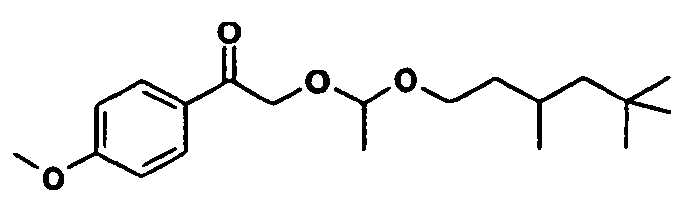
acetanisole nonanyl acetate ++ 5 
acetanisole hexyl acetate ++ 6 
acetanisole phenylpropyl acetate ++ 7 
acetanisole citronellyl acetate ++ 8 
Fixolide ® hexyl acetate +++ 9 
Fixolide® cis-3-hexenyl acetate +++ 10 
Fixolide® (ethyl acetate) +++ 11 
Oranger Crystals® hexyl acetate + 12 
Oranger Crystals® citronellyl acetate + 15 
acetanisole methyl phenyl-acetate ++ *0 : no cleavage, + : slow cleavage, ++ : medium cleavage, +++ : fast cleavage - 1 g of an approximately 0.2% phenacyl acetal (I) solution in ethanol was evenly sprayed on a Terry towel (white cotton towel, 25cm x 25cm, 45 g), corresponding to 45-75 µg/g cotton. The sprayed towels were allowed to dry in a dark and odorless place. When dry, the towels were irradiated for a few seconds up to a few minutes with a tanning lamp (Osram Ultra-Vitalux®, 300 W; at a distance of 50 cm, the light has approximately six to seven times the effect of the natural sunlight at noon on a sea-side midsummer day). The evaluation was done by a trained panel of perfumers before and after irradiation. Before irradiation, the towels were judged to be odorless. The results after irradiation are summarized in table 2.
Table 2 : Release of aryl ketones (II) and esters (III) from phenacyl acetals (I) on fabrics upon irradiation with a tanning lamp STRUCTURE (I) Fragrance Target (perception)* Global appreciation* aryl ketone (II) ester (III) 1 
acetanisole (++) ethyl acetate (0) + 2 
acetanisole (++) phenethyl acetate (+++) +++ 3 
acetanisole (++) cis-3-hexenyl acetate (++) ++ 4 
acetanisole (++) nonanyl acetate (+) + 5 
acetanisole (++) hexyl acetate (++) ++ 6 
acetanisole (++) phenylpropyl acetate (++) ++ 7 
acetanisole (++) citronellyl acetate (+) ++ 8 
Fixolide ® (++) hexyl acetate (+++) +++ 9 
Fixolide® (++) cis-3-hexenyl acetate (+++) +++ 10 
Fixolide® (++) ethyl acetate (0) ++ 11 
Oranger Crystals® (++) hexyl acetate (++) ++ 12 
Oranger Crystals® (++) citronellyl acetate (+) ++ 13 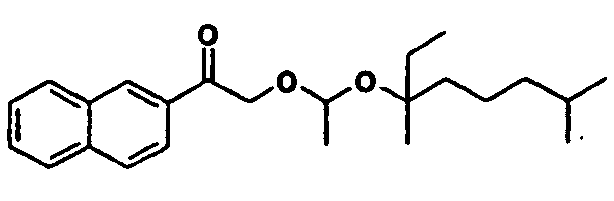
Oranger Crystals ® (++) tetrahydro linalyl acetate (++) +++ 14 
Oranger Crystals® (++) t-butyl-cyclohexyl acetate (+) + 15 
acetanisole (++) methyl phenyl acetate (+) + * 0 : very weak, + : weak, ++ : medium, +++ : strong - The phenacyl acetals (I) were incubated in aqueous buffer solutions of pH 2.5,
pH 7 and pH 9.5 for 24h at 37°C and were found to be stable in basic and neutral media, but less so under acidic conditions. The results are summarized in table 3.Table 3 : Stability of phenacyl acetals (III) under different pH STRUCTURE (I) pH 2.5 pH 7pH 9.5 pH 11*1 
unstable stable stable not tested 2 
unstable stable stable stable 3 
unstable stable stable stable 4 
unstable stable stable stable 5 
unstable stable stable stable 6 
unstable stable stable stable 8 
stable stable stable stable 9 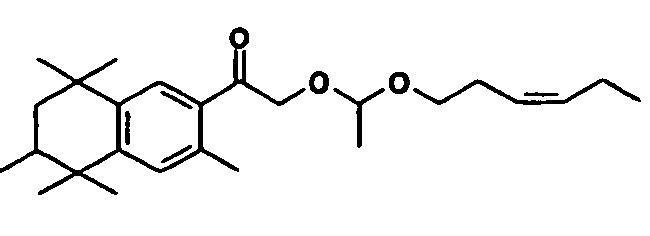
stable stable stable stable * The results at pH 11 were determined under washing conditions as described in the example 5 below. - Washing tests were performed according to the following hand washing test procedure with OMO Progress® base which contains the following ingredients:
LAS 22.0 % STP 13.3 % CP5 (as 100%) 1.5 % SCMC (as 100%) 0.34 % Fluorescer (E1/1) 1.41 Savinase 1.15 % Lipolase 0.15 % Amilase 0.30 % Perborate 8.0 % TAED 2.4 % Alkalinity (pH) 14.4 - 1- The washing powder (2.1 g) comprising the phenacyl acetal (I, about 21 mg, 1%) was dissolved in water (500 ml) at room temperature.
- 2- The towels (35 g) were added to the liquor and mixed with a glass stick.
- 3- Towels were soaked for 45 min with stirring every 15 min.
- 4- The wringed towels were rinsed three times with fresh water (250 ml) with intermediate wringing.
- 5- Towels were allowed to dry in a dark and odorless place before analysis or evaluation.
- The towels were extracted with an organic solvent (preferably t-butyl methyl ether) using a Dionex ASE200 Accelerated Solvent Extractor and the extracts were analyzed by HPLC (Hewlett Packard Series 1100, column: Zorbax Eclipse XDB-C18, dimensions 15 cm x 4.6 mm x 5 µm). The washing liquor was extracted with an organic solvent (preferably t-butyl methyl ether, 250 ml) and analyzed by HPLC as above.
- The washing liquor (2.1 g washing powder containing 1% phenacyl acetal (I) in 500 ml water), according to 1 in the above described washing procedure, was stirred during one hour at room temperature. Extraction with an organic solvent (preferably t-butyl methyl ether) to recover organic compounds and analysis with HPLC gave the amounts of recovered phenacyl acetal (I), table 4.
Table 4: Stability of phenacyl acetals (I) under washing conditions STRUCTURE Amount incorporated (mg) Amount recovered (mg) Recovered (mg) 2 
22.3 18.5 83 (±10) 3 
21 22.3 100 (±10) 4 
21.9 23.5 100 (±10) 5 
24.4 25.7 100 (±10) 6 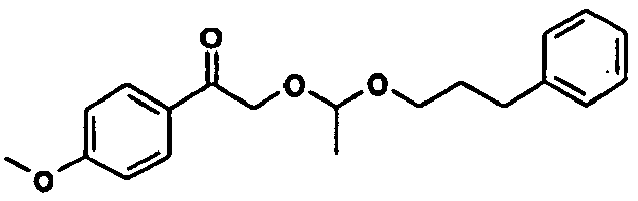
22.2 20.8 94 (±10) 8 
22.5 22.2 99 (±10) 9 
20.8 20.0 96 (±10) - The dried towels, taken from the described hand washing procedure, were either irradiated with the previously mentioned tanning lamp and olfactively evaluated or analyzed by HPLC.
The aqueous liquors were extracted with an organic solvent (preferably t-butyl methyl ether) and analytical HPLC gave the results in table 5, which are related to partition between water and fabric.Table 5 : Partition between water and fabric (substantivity) of phenacyl acetals (I) STRUCTURE (I) Amount incorporated (mg) Amounts recovered Water Towel extract mg % (±10%) mg % (±10%) 2 
23.9 15 63 % 10.5 44 % 3 
22.6 13.3 59 % 14 62 % 4 
23.2 17.5 75 % 8.9 38 % 5 
25.2 18.4 73 % 11.7 46 % 6 
22.2 14.5 65 % 17 47 % 8 
20.6 16.3 69 % 8.7 42 % 9 
22.8 15.3 67 % 10.3 45 %
The present invention also relates to a compound of formula I.
Claims (10)
- Use as a fragrance precursor of a compound of formula I


 R1 to R5 represent independently H, -NO2, linear or branched C1-C6-alkyl, C1-C6-alkenyl, C1-C6-alkinyl or C1-C4-alkoxy,R1 and R2, R2 and R3, R3 and R4 and R4 and R5 may form together one or two aliphatic or aromatic rings, these rings may optionally contain linear or branched C1-C4-alkyl, C1-C4-alkenyl or C1-C4-alkiriyl residues, and the above rings and residues may comprise one or more oxygen atoms,R6 and R7 are independently H, linear or branched C1-C6-alkyl-, C1-C6-alkenyl, C1-C6-alkinyl, and R6 or R7 may form with either R1 or R5 a carbocyclic ring optionally substituted by an aliphatic residueR8 and R9 are respectively the residues of an aliphatic acid R8-COOH having up to 4 carbon atoms, but not only one carbon atom and an aliphatic alcohol R9OH having 2 to 20 carbon atoms, forming the fragrant ester of formula III.
 - Use according to claim 1, wherein R8 is -CH3 and R9 is the residue of an aliphatic alcohol having 2 to 20 carbon atoms or an araliphatic alcohol having more than 5 carbon atoms.
- Use according to claim 1, wherein R8 is the residue of an aliphatic acid having 5 to 20 carbon atoms and R9 is the residue of an aliphatic alcohol having 1 to 5 carbon atoms, R9 being preferably -CH2CH3.
- Use according to claim 1, wherein R8 is the residue of an aliphatic acid having up to 4 carbon atoms, but not only one carbon atom and R9 is the residue selected from a residue of (a) a terpene alcohol having 10 to 20 carbon atoms; (b) a monoterpene alcohol; and (c) an araliphatic alcohol having more than 5 carbon atoms.
- Use according to claim 1, wherein R8 is the residue of a cycloaliphatic acid having 5 to 20 carbon atoms and R9 is the residue of aliphatic alcohol having 1 to 5 carbon atoms, R9 preferably being -CH2CH3.
- Use according to claim 1, wherein at least one of the residues R6 and R7, is H, preferably both residues R6 and R7 being H.
- Use according to claim 1, wherein R6 and R7 are H and R1 to R5 represent independently H, -NO2, linear or branched C1-C6-alkyl, C1-C6-alkenyl, C1-C6-alkinyl or C1-C4 alkoxy.
- Use according to claim 1, wherein R1 and R2, R2 and R3, R3 and R4, R4 and R5, form together an aliphatic or aromatic ring which may optionally contain substituted or unsubstituted C1-C4-alkyl, C1-C4-alkenyl, C1-C4-alkinyl residues and may comprise one or more oxygen atoms.
- A compound of formula I
 R1 to R5 represent independently H, -NO2, linear or branched C1-C6-alkyl, C1-C6-alkenyl, C1-C6-alkinyl, or C1-C4-alkoxy,R1 and R2, R2 and R3, R3 and R4 and R4 and R5 may form together one or two aliphatic or aromatic rings, these rings may optionally contain substituted or unsubstituted C1-C4-alkyl, C1-C4-alkenyl or C1-C4-alkinyl residues, and may comprise one or more oxygen atoms,R6 and R7 are independently H, linear or branched C1-C6-alkyl, C1-C6-alkenyl, C1-C6-alkinyl, and R6 or R7 may form with either R1 or R5 a substituted or unsubstituted carbocyclic ring, and R8 and R9 are respectively the residues of an aliphatic acid R8-COOH having up to 4 carbon atoms, but not only one carbon atom and an aliphatic alcohol R9OH having 2 to 20 carbon atoms, which together form a fragrant ester.
 - A product comprising a fragrance precursor, which is a compound of the type described in claim 1.
Priority Applications (1)
| Application Number | Priority Date | Filing Date | Title |
|---|---|---|---|
| EP20010106425 EP1146033B1 (en) | 2000-04-10 | 2001-03-22 | Fragrance precursors |
Applications Claiming Priority (3)
| Application Number | Priority Date | Filing Date | Title |
|---|---|---|---|
| EP00107680 | 2000-04-10 | ||
| EP00107680 | 2000-04-10 | ||
| EP20010106425 EP1146033B1 (en) | 2000-04-10 | 2001-03-22 | Fragrance precursors |
Publications (3)
| Publication Number | Publication Date |
|---|---|
| EP1146033A2 EP1146033A2 (en) | 2001-10-17 |
| EP1146033A3 EP1146033A3 (en) | 2002-03-06 |
| EP1146033B1 true EP1146033B1 (en) | 2009-12-23 |
Family
ID=26070798
Family Applications (1)
| Application Number | Title | Priority Date | Filing Date |
|---|---|---|---|
| EP20010106425 Expired - Lifetime EP1146033B1 (en) | 2000-04-10 | 2001-03-22 | Fragrance precursors |
Country Status (1)
| Country | Link |
|---|---|
| EP (1) | EP1146033B1 (en) |
Families Citing this family (2)
| Publication number | Priority date | Publication date | Assignee | Title |
|---|---|---|---|---|
| WO2011067707A2 (en) | 2009-12-02 | 2011-06-09 | L'oreal | A cosmetic treatment method |
| ES2867807T3 (en) | 2017-04-24 | 2021-10-20 | Igm Group B V | Process for the preparation of α-functionalized ketones |
Family Cites Families (1)
| Publication number | Priority date | Publication date | Assignee | Title |
|---|---|---|---|---|
| EP0983990A3 (en) * | 1998-09-04 | 2000-08-02 | Givaudan Roure (International) S.A. | Ketones useful as precursors for organoleptic compounds |
-
2001
- 2001-03-22 EP EP20010106425 patent/EP1146033B1/en not_active Expired - Lifetime
Also Published As
| Publication number | Publication date |
|---|---|
| EP1146033A3 (en) | 2002-03-06 |
| EP1146033A2 (en) | 2001-10-17 |
Similar Documents
| Publication | Publication Date | Title |
|---|---|---|
| US6103688A (en) | Aromatic compounds, processes for their preparation and their use in perfumery | |
| EP2994447B1 (en) | Pro-fragrance compounds | |
| RU2667901C2 (en) | Improvements in or relating to organic compounds | |
| CN105916970B (en) | Powdery musk odorant macrocycles | |
| US6492563B2 (en) | Fragrance precursors | |
| US6939845B2 (en) | Fragrance precursors | |
| US7589055B2 (en) | Compounds for a controlled release of active molecules | |
| US7572938B2 (en) | Precursors for ketones and aldehydes | |
| JP2022509417A (en) | Alkoxybenzaldehyde derivatives and their precursors | |
| EP1146033A2 (en) | Fragrance precursors | |
| US6323173B1 (en) | 2-indanmethanol derivatives and their use in perfumery | |
| EP1926698B1 (en) | Alpha-decalones with damascone-woody odor | |
| JP5431350B2 (en) | Patchoulol odor substance | |
| EP1459735B1 (en) | Odorant compounds | |
| JP2014530262A (en) | Incense acetal | |
| EP1784374B1 (en) | Unsaturated ethers as perfuming ingredients | |
| JP2026508427A (en) | Fragrance Precursors | |
| CN102369179B (en) | Carboxylic derivatives as violet and/or woody odorant |
Legal Events
| Date | Code | Title | Description |
|---|---|---|---|
| PUAI | Public reference made under article 153(3) epc to a published international application that has entered the european phase |
Free format text: ORIGINAL CODE: 0009012 |
|
| AK | Designated contracting states |
Kind code of ref document: A2 Designated state(s): AT BE CH CY DE DK ES FI FR GB GR IE IT LI LU MC NL PT SE TR |
|
| AX | Request for extension of the european patent |
Free format text: AL;LT;LV;MK;RO;SI |
|
| PUAL | Search report despatched |
Free format text: ORIGINAL CODE: 0009013 |
|
| AK | Designated contracting states |
Kind code of ref document: A3 Designated state(s): AT BE CH CY DE DK ES FI FR GB GR IE IT LI LU MC NL PT SE TR |
|
| AX | Request for extension of the european patent |
Free format text: AL;LT;LV;MK;RO;SI |
|
| 17P | Request for examination filed |
Effective date: 20020808 |
|
| AKX | Designation fees paid |
Free format text: AT BE CH CY DE DK ES FI FR GB GR IE IT LI LU MC NL PT SE TR |
|
| 17Q | First examination report despatched |
Effective date: 20030220 |
|
| GRAP | Despatch of communication of intention to grant a patent |
Free format text: ORIGINAL CODE: EPIDOSNIGR1 |
|
| GRAS | Grant fee paid |
Free format text: ORIGINAL CODE: EPIDOSNIGR3 |
|
| GRAA | (expected) grant |
Free format text: ORIGINAL CODE: 0009210 |
|
| RIC1 | Information provided on ipc code assigned before grant |
Ipc: C07C 49/84 20060101AFI20091026BHEP Ipc: A61K 8/18 20060101ALI20091026BHEP Ipc: C11D 3/50 20060101ALI20091026BHEP |
|
| AK | Designated contracting states |
Kind code of ref document: B1 Designated state(s): AT BE CH CY DE DK ES FI FR GB GR IE IT LI LU MC NL PT SE TR |
|
| REG | Reference to a national code |
Ref country code: GB Ref legal event code: FG4D |
|
| REG | Reference to a national code |
Ref country code: CH Ref legal event code: EP |
|
| REG | Reference to a national code |
Ref country code: IE Ref legal event code: FG4D |
|
| REF | Corresponds to: |
Ref document number: 60140834 Country of ref document: DE Date of ref document: 20100204 Kind code of ref document: P |
|
| REG | Reference to a national code |
Ref country code: NL Ref legal event code: VDEP Effective date: 20091223 |
|
| PG25 | Lapsed in a contracting state [announced via postgrant information from national office to epo] |
Ref country code: SE Free format text: LAPSE BECAUSE OF FAILURE TO SUBMIT A TRANSLATION OF THE DESCRIPTION OR TO PAY THE FEE WITHIN THE PRESCRIBED TIME-LIMIT Effective date: 20091223 Ref country code: FI Free format text: LAPSE BECAUSE OF FAILURE TO SUBMIT A TRANSLATION OF THE DESCRIPTION OR TO PAY THE FEE WITHIN THE PRESCRIBED TIME-LIMIT Effective date: 20091223 |
|
| REG | Reference to a national code |
Ref country code: ES Ref legal event code: FG2A Ref document number: 2337982 Country of ref document: ES Kind code of ref document: T3 |
|
| PG25 | Lapsed in a contracting state [announced via postgrant information from national office to epo] |
Ref country code: AT Free format text: LAPSE BECAUSE OF FAILURE TO SUBMIT A TRANSLATION OF THE DESCRIPTION OR TO PAY THE FEE WITHIN THE PRESCRIBED TIME-LIMIT Effective date: 20091223 |
|
| PG25 | Lapsed in a contracting state [announced via postgrant information from national office to epo] |
Ref country code: NL Free format text: LAPSE BECAUSE OF FAILURE TO SUBMIT A TRANSLATION OF THE DESCRIPTION OR TO PAY THE FEE WITHIN THE PRESCRIBED TIME-LIMIT Effective date: 20091223 |
|
| PG25 | Lapsed in a contracting state [announced via postgrant information from national office to epo] |
Ref country code: BE Free format text: LAPSE BECAUSE OF FAILURE TO SUBMIT A TRANSLATION OF THE DESCRIPTION OR TO PAY THE FEE WITHIN THE PRESCRIBED TIME-LIMIT Effective date: 20091223 |
|
| PG25 | Lapsed in a contracting state [announced via postgrant information from national office to epo] |
Ref country code: GR Free format text: LAPSE BECAUSE OF FAILURE TO SUBMIT A TRANSLATION OF THE DESCRIPTION OR TO PAY THE FEE WITHIN THE PRESCRIBED TIME-LIMIT Effective date: 20100324 Ref country code: CY Free format text: LAPSE BECAUSE OF FAILURE TO SUBMIT A TRANSLATION OF THE DESCRIPTION OR TO PAY THE FEE WITHIN THE PRESCRIBED TIME-LIMIT Effective date: 20091223 Ref country code: MC Free format text: LAPSE BECAUSE OF NON-PAYMENT OF DUE FEES Effective date: 20100331 |
|
| PLBE | No opposition filed within time limit |
Free format text: ORIGINAL CODE: 0009261 |
|
| STAA | Information on the status of an ep patent application or granted ep patent |
Free format text: STATUS: NO OPPOSITION FILED WITHIN TIME LIMIT |
|
| 26N | No opposition filed |
Effective date: 20100924 |
|
| PG25 | Lapsed in a contracting state [announced via postgrant information from national office to epo] |
Ref country code: IE Free format text: LAPSE BECAUSE OF NON-PAYMENT OF DUE FEES Effective date: 20100322 Ref country code: DK Free format text: LAPSE BECAUSE OF FAILURE TO SUBMIT A TRANSLATION OF THE DESCRIPTION OR TO PAY THE FEE WITHIN THE PRESCRIBED TIME-LIMIT Effective date: 20091223 |
|
| PG25 | Lapsed in a contracting state [announced via postgrant information from national office to epo] |
Ref country code: IT Free format text: LAPSE BECAUSE OF FAILURE TO SUBMIT A TRANSLATION OF THE DESCRIPTION OR TO PAY THE FEE WITHIN THE PRESCRIBED TIME-LIMIT Effective date: 20091223 |
|
| PGFP | Annual fee paid to national office [announced via postgrant information from national office to epo] |
Ref country code: FR Payment date: 20110404 Year of fee payment: 11 Ref country code: CH Payment date: 20110324 Year of fee payment: 11 |
|
| PGFP | Annual fee paid to national office [announced via postgrant information from national office to epo] |
Ref country code: GB Payment date: 20110321 Year of fee payment: 11 Ref country code: DE Payment date: 20110325 Year of fee payment: 11 Ref country code: ES Payment date: 20110322 Year of fee payment: 11 |
|
| REG | Reference to a national code |
Ref country code: CH Ref legal event code: NV Representative=s name: GIVAUDAN SCHWEIZ AG GLOBAL PATENTS |
|
| PG25 | Lapsed in a contracting state [announced via postgrant information from national office to epo] |
Ref country code: PT Free format text: LAPSE BECAUSE OF FAILURE TO SUBMIT A TRANSLATION OF THE DESCRIPTION OR TO PAY THE FEE WITHIN THE PRESCRIBED TIME-LIMIT Effective date: 20100523 Ref country code: LU Free format text: LAPSE BECAUSE OF NON-PAYMENT OF DUE FEES Effective date: 20100322 |
|
| PG25 | Lapsed in a contracting state [announced via postgrant information from national office to epo] |
Ref country code: TR Free format text: LAPSE BECAUSE OF FAILURE TO SUBMIT A TRANSLATION OF THE DESCRIPTION OR TO PAY THE FEE WITHIN THE PRESCRIBED TIME-LIMIT Effective date: 20091223 |
|
| REG | Reference to a national code |
Ref country code: CH Ref legal event code: PL |
|
| GBPC | Gb: european patent ceased through non-payment of renewal fee |
Effective date: 20120322 |
|
| REG | Reference to a national code |
Ref country code: FR Ref legal event code: ST Effective date: 20121130 |
|
| REG | Reference to a national code |
Ref country code: DE Ref legal event code: R119 Ref document number: 60140834 Country of ref document: DE Effective date: 20121002 |
|
| PG25 | Lapsed in a contracting state [announced via postgrant information from national office to epo] |
Ref country code: GB Free format text: LAPSE BECAUSE OF NON-PAYMENT OF DUE FEES Effective date: 20120322 Ref country code: CH Free format text: LAPSE BECAUSE OF NON-PAYMENT OF DUE FEES Effective date: 20120331 Ref country code: LI Free format text: LAPSE BECAUSE OF NON-PAYMENT OF DUE FEES Effective date: 20120331 Ref country code: FR Free format text: LAPSE BECAUSE OF NON-PAYMENT OF DUE FEES Effective date: 20120402 |
|
| REG | Reference to a national code |
Ref country code: ES Ref legal event code: FD2A Effective date: 20130710 |
|
| PG25 | Lapsed in a contracting state [announced via postgrant information from national office to epo] |
Ref country code: ES Free format text: LAPSE BECAUSE OF NON-PAYMENT OF DUE FEES Effective date: 20120323 |
|
| PG25 | Lapsed in a contracting state [announced via postgrant information from national office to epo] |
Ref country code: DE Free format text: LAPSE BECAUSE OF NON-PAYMENT OF DUE FEES Effective date: 20121002 |