EP1146028A1 - A method to prepare cyclopropenes - Google Patents
A method to prepare cyclopropenes Download PDFInfo
- Publication number
- EP1146028A1 EP1146028A1 EP01302930A EP01302930A EP1146028A1 EP 1146028 A1 EP1146028 A1 EP 1146028A1 EP 01302930 A EP01302930 A EP 01302930A EP 01302930 A EP01302930 A EP 01302930A EP 1146028 A1 EP1146028 A1 EP 1146028A1
- Authority
- EP
- European Patent Office
- Prior art keywords
- base
- alkyl
- weaker
- inert solvent
- strong base
- Prior art date
- Legal status (The legal status is an assumption and is not a legal conclusion. Google has not performed a legal analysis and makes no representation as to the accuracy of the status listed.)
- Granted
Links
- 238000000034 method Methods 0.000 title claims abstract description 24
- 150000001943 cyclopropenes Chemical class 0.000 title abstract description 10
- -1 allyl compound Chemical class 0.000 claims abstract description 24
- 239000012442 inert solvent Substances 0.000 claims abstract description 13
- 125000000217 alkyl group Chemical group 0.000 claims abstract description 8
- 230000000269 nucleophilic effect Effects 0.000 claims abstract description 8
- 229910052736 halogen Inorganic materials 0.000 claims abstract description 6
- 125000003342 alkenyl group Chemical group 0.000 claims abstract description 5
- 125000003545 alkoxy group Chemical group 0.000 claims abstract description 5
- 125000000304 alkynyl group Chemical group 0.000 claims abstract description 5
- 150000002367 halogens Chemical class 0.000 claims abstract description 5
- 230000003197 catalytic effect Effects 0.000 claims abstract description 4
- 125000001316 cycloalkyl alkyl group Chemical group 0.000 claims abstract description 4
- 125000004435 hydrogen atom Chemical group [H]* 0.000 claims abstract description 4
- 125000000753 cycloalkyl group Chemical group 0.000 claims abstract description 3
- 239000001257 hydrogen Substances 0.000 claims abstract description 3
- 229910052739 hydrogen Inorganic materials 0.000 claims abstract description 3
- 125000001624 naphthyl group Chemical group 0.000 claims abstract description 3
- 125000000951 phenoxy group Chemical group [H]C1=C([H])C([H])=C(O*)C([H])=C1[H] 0.000 claims abstract description 3
- 125000001997 phenyl group Chemical group [H]C1=C([H])C([H])=C(*)C([H])=C1[H] 0.000 claims abstract description 3
- 125000001424 substituent group Chemical group 0.000 claims abstract description 3
- 239000002585 base Substances 0.000 claims description 43
- OOXWYYGXTJLWHA-UHFFFAOYSA-N cyclopropene Chemical compound C1C=C1 OOXWYYGXTJLWHA-UHFFFAOYSA-N 0.000 claims description 13
- 239000011541 reaction mixture Substances 0.000 claims description 9
- FFUAGWLWBBFQJT-UHFFFAOYSA-N hexamethyldisilazane Chemical group C[Si](C)(C)N[Si](C)(C)C FFUAGWLWBBFQJT-UHFFFAOYSA-N 0.000 claims description 8
- RTZKZFJDLAIYFH-UHFFFAOYSA-N Diethyl ether Chemical compound CCOCC RTZKZFJDLAIYFH-UHFFFAOYSA-N 0.000 claims description 7
- ODZPKZBBUMBTMG-UHFFFAOYSA-N sodium amide Chemical group [NH2-].[Na+] ODZPKZBBUMBTMG-UHFFFAOYSA-N 0.000 claims description 7
- ROSDSFDQCJNGOL-UHFFFAOYSA-N Dimethylamine Chemical compound CNC ROSDSFDQCJNGOL-UHFFFAOYSA-N 0.000 claims description 4
- BAVYZALUXZFZLV-UHFFFAOYSA-N Methylamine Chemical compound NC BAVYZALUXZFZLV-UHFFFAOYSA-N 0.000 claims description 4
- 125000000008 (C1-C10) alkyl group Chemical group 0.000 claims description 3
- 150000001338 aliphatic hydrocarbons Chemical group 0.000 claims description 3
- 150000004945 aromatic hydrocarbons Chemical class 0.000 claims description 3
- 125000001246 bromo group Chemical group Br* 0.000 claims description 3
- 125000001309 chloro group Chemical group Cl* 0.000 claims description 3
- 125000002496 methyl group Chemical group [H]C([H])([H])* 0.000 claims description 3
- 239000002480 mineral oil Substances 0.000 claims description 3
- 235000010446 mineral oil Nutrition 0.000 claims description 3
- FZHAPNGMFPVSLP-UHFFFAOYSA-N silanamine Chemical compound [SiH3]N FZHAPNGMFPVSLP-UHFFFAOYSA-N 0.000 claims description 3
- QGZKDVFQNNGYKY-UHFFFAOYSA-N Ammonia Chemical compound N QGZKDVFQNNGYKY-UHFFFAOYSA-N 0.000 claims description 2
- 229910052783 alkali metal Inorganic materials 0.000 claims description 2
- 150000001412 amines Chemical class 0.000 claims description 2
- 125000005279 aryl sulfonyloxy group Chemical group 0.000 claims description 2
- 150000008282 halocarbons Chemical class 0.000 claims description 2
- 125000005843 halogen group Chemical group 0.000 claims description 2
- 125000002524 organometallic group Chemical group 0.000 claims description 2
- CTYRPMDGLDAWRQ-UHFFFAOYSA-N phenyl hydrogen sulfate Chemical group OS(=O)(=O)OC1=CC=CC=C1 CTYRPMDGLDAWRQ-UHFFFAOYSA-N 0.000 claims description 2
- 238000004821 distillation Methods 0.000 claims 1
- 239000005969 1-Methyl-cyclopropene Substances 0.000 description 9
- SHDPRTQPPWIEJG-UHFFFAOYSA-N 1-methylcyclopropene Chemical compound CC1=CC1 SHDPRTQPPWIEJG-UHFFFAOYSA-N 0.000 description 9
- 238000006243 chemical reaction Methods 0.000 description 6
- 239000000203 mixture Substances 0.000 description 6
- 238000009835 boiling Methods 0.000 description 5
- 239000002904 solvent Substances 0.000 description 5
- OHXAOPZTJOUYKM-UHFFFAOYSA-N 3-Chloro-2-methylpropene Chemical compound CC(=C)CCl OHXAOPZTJOUYKM-UHFFFAOYSA-N 0.000 description 4
- UHOVQNZJYSORNB-UHFFFAOYSA-N Benzene Chemical compound C1=CC=CC=C1 UHOVQNZJYSORNB-UHFFFAOYSA-N 0.000 description 3
- YMWUJEATGCHHMB-UHFFFAOYSA-N Dichloromethane Chemical compound ClCCl YMWUJEATGCHHMB-UHFFFAOYSA-N 0.000 description 3
- YXFVVABEGXRONW-UHFFFAOYSA-N Toluene Chemical compound CC1=CC=CC=C1 YXFVVABEGXRONW-UHFFFAOYSA-N 0.000 description 3
- 125000004122 cyclic group Chemical group 0.000 description 3
- 239000012467 final product Substances 0.000 description 3
- XSGHLZBESSREDT-UHFFFAOYSA-N methylenecyclopropane Chemical compound C=C1CC1 XSGHLZBESSREDT-UHFFFAOYSA-N 0.000 description 3
- IJGRMHOSHXDMSA-UHFFFAOYSA-N Atomic nitrogen Chemical compound N#N IJGRMHOSHXDMSA-UHFFFAOYSA-N 0.000 description 2
- WYURNTSHIVDZCO-UHFFFAOYSA-N Tetrahydrofuran Chemical compound C1CCOC1 WYURNTSHIVDZCO-UHFFFAOYSA-N 0.000 description 2
- 238000000354 decomposition reaction Methods 0.000 description 2
- 239000007789 gas Substances 0.000 description 2
- 239000011261 inert gas Substances 0.000 description 2
- 229940059904 light mineral oil Drugs 0.000 description 2
- 238000002360 preparation method Methods 0.000 description 2
- 239000000047 product Substances 0.000 description 2
- 238000003756 stirring Methods 0.000 description 2
- 238000003786 synthesis reaction Methods 0.000 description 2
- 125000006732 (C1-C15) alkyl group Chemical group 0.000 description 1
- 125000004209 (C1-C8) alkyl group Chemical group 0.000 description 1
- 125000005913 (C3-C6) cycloalkyl group Chemical group 0.000 description 1
- RYHBNJHYFVUHQT-UHFFFAOYSA-N 1,4-Dioxane Chemical compound C1COCCO1 RYHBNJHYFVUHQT-UHFFFAOYSA-N 0.000 description 1
- CNNPULJFGORMOI-UHFFFAOYSA-N 1-[[[dimethyl(octyl)silyl]amino]-dimethylsilyl]octane Chemical compound CCCCCCCC[Si](C)(C)N[Si](C)(C)CCCCCCCC CNNPULJFGORMOI-UHFFFAOYSA-N 0.000 description 1
- CLXKCQAPIYZOJI-UHFFFAOYSA-N 1-[amino(dihexyl)silyl]hexane Chemical compound CCCCCC[Si](N)(CCCCCC)CCCCCC CLXKCQAPIYZOJI-UHFFFAOYSA-N 0.000 description 1
- FIADVASZMLCQIF-UHFFFAOYSA-N 2,2,4,4,6,6,8,8-octamethyl-1,3,5,7,2,4,6,8-tetrazatetrasilocane Chemical compound C[Si]1(C)N[Si](C)(C)N[Si](C)(C)N[Si](C)(C)N1 FIADVASZMLCQIF-UHFFFAOYSA-N 0.000 description 1
- WGGNJZRNHUJNEM-UHFFFAOYSA-N 2,2,4,4,6,6-hexamethyl-1,3,5,2,4,6-triazatrisilinane Chemical compound C[Si]1(C)N[Si](C)(C)N[Si](C)(C)N1 WGGNJZRNHUJNEM-UHFFFAOYSA-N 0.000 description 1
- IPKOJSMGLIKFLO-UHFFFAOYSA-N 2,2,5,5-tetramethyl-1,2,5-azadisilolidine Chemical compound C[Si]1(C)CC[Si](C)(C)N1 IPKOJSMGLIKFLO-UHFFFAOYSA-N 0.000 description 1
- 125000004974 2-butenyl group Chemical group C(C=CC)* 0.000 description 1
- 125000006022 2-methyl-2-propenyl group Chemical group 0.000 description 1
- 125000003903 2-propenyl group Chemical group [H]C([*])([H])C([H])=C([H])[H] 0.000 description 1
- 125000001494 2-propynyl group Chemical group [H]C#CC([H])([H])* 0.000 description 1
- 125000004975 3-butenyl group Chemical group C(CC=C)* 0.000 description 1
- ZCYVEMRRCGMTRW-UHFFFAOYSA-N 7553-56-2 Chemical compound [I] ZCYVEMRRCGMTRW-UHFFFAOYSA-N 0.000 description 1
- WKBOTKDWSSQWDR-UHFFFAOYSA-N Bromine atom Chemical compound [Br] WKBOTKDWSSQWDR-UHFFFAOYSA-N 0.000 description 1
- CURLTUGMZLYLDI-UHFFFAOYSA-N Carbon dioxide Chemical compound O=C=O CURLTUGMZLYLDI-UHFFFAOYSA-N 0.000 description 1
- VEXZGXHMUGYJMC-UHFFFAOYSA-M Chloride anion Chemical compound [Cl-] VEXZGXHMUGYJMC-UHFFFAOYSA-M 0.000 description 1
- ZAMOUSCENKQFHK-UHFFFAOYSA-N Chlorine atom Chemical compound [Cl] ZAMOUSCENKQFHK-UHFFFAOYSA-N 0.000 description 1
- VGGSQFUCUMXWEO-UHFFFAOYSA-N Ethene Chemical compound C=C VGGSQFUCUMXWEO-UHFFFAOYSA-N 0.000 description 1
- 239000005977 Ethylene Substances 0.000 description 1
- PXGOKWXKJXAPGV-UHFFFAOYSA-N Fluorine Chemical compound FF PXGOKWXKJXAPGV-UHFFFAOYSA-N 0.000 description 1
- DGAQECJNVWCQMB-PUAWFVPOSA-M Ilexoside XXIX Chemical group C[C@@H]1CC[C@@]2(CC[C@@]3(C(=CC[C@H]4[C@]3(CC[C@@H]5[C@@]4(CC[C@@H](C5(C)C)OS(=O)(=O)[O-])C)C)[C@@H]2[C@]1(C)O)C)C(=O)O[C@H]6[C@@H]([C@H]([C@@H]([C@H](O6)CO)O)O)O.[Na+] DGAQECJNVWCQMB-PUAWFVPOSA-M 0.000 description 1
- 238000005684 Liebig rearrangement reaction Methods 0.000 description 1
- CTQNGGLPUBDAKN-UHFFFAOYSA-N O-Xylene Chemical compound CC1=CC=CC=C1C CTQNGGLPUBDAKN-UHFFFAOYSA-N 0.000 description 1
- ZLMJMSJWJFRBEC-UHFFFAOYSA-N Potassium Chemical compound [K] ZLMJMSJWJFRBEC-UHFFFAOYSA-N 0.000 description 1
- GJWAPAVRQYYSTK-UHFFFAOYSA-N [(dimethyl-$l^{3}-silanyl)amino]-dimethylsilicon Chemical compound C[Si](C)N[Si](C)C GJWAPAVRQYYSTK-UHFFFAOYSA-N 0.000 description 1
- GLQOALGKMKUSBF-UHFFFAOYSA-N [amino(diphenyl)silyl]benzene Chemical group C=1C=CC=CC=1[Si](C=1C=CC=CC=1)(N)C1=CC=CC=C1 GLQOALGKMKUSBF-UHFFFAOYSA-N 0.000 description 1
- APDDLLVYBXGBRF-UHFFFAOYSA-N [diethyl-(triethylsilylamino)silyl]ethane Chemical compound CC[Si](CC)(CC)N[Si](CC)(CC)CC APDDLLVYBXGBRF-UHFFFAOYSA-N 0.000 description 1
- 239000002253 acid Substances 0.000 description 1
- 238000013019 agitation Methods 0.000 description 1
- 150000003973 alkyl amines Chemical class 0.000 description 1
- 125000002877 alkyl aryl group Chemical group 0.000 description 1
- 125000000746 allylic group Chemical group 0.000 description 1
- 230000015572 biosynthetic process Effects 0.000 description 1
- GDTBXPJZTBHREO-UHFFFAOYSA-N bromine Substances BrBr GDTBXPJZTBHREO-UHFFFAOYSA-N 0.000 description 1
- 229910052794 bromium Inorganic materials 0.000 description 1
- 239000006227 byproduct Substances 0.000 description 1
- 235000011089 carbon dioxide Nutrition 0.000 description 1
- 239000003054 catalyst Substances 0.000 description 1
- 238000006555 catalytic reaction Methods 0.000 description 1
- 239000000460 chlorine Substances 0.000 description 1
- 229910052801 chlorine Inorganic materials 0.000 description 1
- 230000000052 comparative effect Effects 0.000 description 1
- 150000001875 compounds Chemical class 0.000 description 1
- 125000004850 cyclobutylmethyl group Chemical group C1(CCC1)C* 0.000 description 1
- 125000004186 cyclopropylmethyl group Chemical group [H]C([H])(*)C1([H])C([H])([H])C1([H])[H] 0.000 description 1
- 125000002704 decyl group Chemical group [H]C([H])([H])C([H])([H])C([H])([H])C([H])([H])C([H])([H])C([H])([H])C([H])([H])C([H])([H])C([H])([H])C([H])([H])* 0.000 description 1
- 125000005265 dialkylamine group Chemical group 0.000 description 1
- 238000003379 elimination reaction Methods 0.000 description 1
- 150000002170 ethers Chemical class 0.000 description 1
- 125000001495 ethyl group Chemical group [H]C([H])([H])C([H])([H])* 0.000 description 1
- 229910052731 fluorine Inorganic materials 0.000 description 1
- 239000011737 fluorine Substances 0.000 description 1
- 150000004820 halides Chemical class 0.000 description 1
- 125000001188 haloalkyl group Chemical group 0.000 description 1
- 239000011630 iodine Substances 0.000 description 1
- 229910052740 iodine Inorganic materials 0.000 description 1
- 125000000959 isobutyl group Chemical group [H]C([H])([H])C([H])(C([H])([H])[H])C([H])([H])* 0.000 description 1
- 125000001449 isopropyl group Chemical group [H]C([H])([H])C([H])(*)C([H])([H])[H] 0.000 description 1
- AFRJJFRNGGLMDW-UHFFFAOYSA-N lithium amide Chemical compound [Li+].[NH2-] AFRJJFRNGGLMDW-UHFFFAOYSA-N 0.000 description 1
- 238000004519 manufacturing process Methods 0.000 description 1
- 229910052751 metal Chemical class 0.000 description 1
- 239000002184 metal Chemical class 0.000 description 1
- 125000004108 n-butyl group Chemical group [H]C([H])([H])C([H])([H])C([H])([H])C([H])([H])* 0.000 description 1
- 125000004123 n-propyl group Chemical group [H]C([H])([H])C([H])([H])C([H])([H])* 0.000 description 1
- 125000001971 neopentyl group Chemical group [H]C([*])([H])C(C([H])([H])[H])(C([H])([H])[H])C([H])([H])[H] 0.000 description 1
- 229910052757 nitrogen Inorganic materials 0.000 description 1
- 125000002347 octyl group Chemical group [H]C([*])([H])C([H])([H])C([H])([H])C([H])([H])C([H])([H])C([H])([H])C([H])([H])C([H])([H])[H] 0.000 description 1
- 125000003538 pentan-3-yl group Chemical group [H]C([H])([H])C([H])([H])C([H])(*)C([H])([H])C([H])([H])[H] 0.000 description 1
- 125000001147 pentyl group Chemical group C(CCCC)* 0.000 description 1
- NHKJPPKXDNZFBJ-UHFFFAOYSA-N phenyllithium Chemical compound [Li]C1=CC=CC=C1 NHKJPPKXDNZFBJ-UHFFFAOYSA-N 0.000 description 1
- 229910052700 potassium Inorganic materials 0.000 description 1
- 239000011591 potassium Substances 0.000 description 1
- 150000003254 radicals Chemical class 0.000 description 1
- 239000000376 reactant Substances 0.000 description 1
- 150000003839 salts Chemical class 0.000 description 1
- 238000000926 separation method Methods 0.000 description 1
- 238000007086 side reaction Methods 0.000 description 1
- 238000001577 simple distillation Methods 0.000 description 1
- 229910052708 sodium Inorganic materials 0.000 description 1
- 239000011734 sodium Substances 0.000 description 1
- 239000007858 starting material Substances 0.000 description 1
- 239000000126 substance Substances 0.000 description 1
- 238000001308 synthesis method Methods 0.000 description 1
- 125000000999 tert-butyl group Chemical group [H]C([H])([H])C(*)(C([H])([H])[H])C([H])([H])[H] 0.000 description 1
- YLQBMQCUIZJEEH-UHFFFAOYSA-N tetrahydrofuran Natural products C=1C=COC=1 YLQBMQCUIZJEEH-UHFFFAOYSA-N 0.000 description 1
- XLYOFNOQVPJJNP-UHFFFAOYSA-N water Substances O XLYOFNOQVPJJNP-UHFFFAOYSA-N 0.000 description 1
- 239000008096 xylene Substances 0.000 description 1
Classifications
-
- C—CHEMISTRY; METALLURGY
- C07—ORGANIC CHEMISTRY
- C07C—ACYCLIC OR CARBOCYCLIC COMPOUNDS
- C07C1/00—Preparation of hydrocarbons from one or more compounds, none of them being a hydrocarbon
- C07C1/26—Preparation of hydrocarbons from one or more compounds, none of them being a hydrocarbon starting from organic compounds containing only halogen atoms as hetero-atoms
- C07C1/30—Preparation of hydrocarbons from one or more compounds, none of them being a hydrocarbon starting from organic compounds containing only halogen atoms as hetero-atoms by splitting-off the elements of hydrogen halide from a single molecule
-
- C—CHEMISTRY; METALLURGY
- C07—ORGANIC CHEMISTRY
- C07B—GENERAL METHODS OF ORGANIC CHEMISTRY; APPARATUS THEREFOR
- C07B37/00—Reactions without formation or introduction of functional groups containing hetero atoms, involving either the formation of a carbon-to-carbon bond between two carbon atoms not directly linked already or the disconnection of two directly linked carbon atoms
- C07B37/10—Cyclisation
-
- C—CHEMISTRY; METALLURGY
- C07—ORGANIC CHEMISTRY
- C07C—ACYCLIC OR CARBOCYCLIC COMPOUNDS
- C07C1/00—Preparation of hydrocarbons from one or more compounds, none of them being a hydrocarbon
- C07C1/32—Preparation of hydrocarbons from one or more compounds, none of them being a hydrocarbon starting from compounds containing hetero-atoms other than or in addition to oxygen or halogen
- C07C1/321—Preparation of hydrocarbons from one or more compounds, none of them being a hydrocarbon starting from compounds containing hetero-atoms other than or in addition to oxygen or halogen the hetero-atom being a non-metal atom
- C07C1/322—Preparation of hydrocarbons from one or more compounds, none of them being a hydrocarbon starting from compounds containing hetero-atoms other than or in addition to oxygen or halogen the hetero-atom being a non-metal atom the hetero-atom being a sulfur atom
Definitions
- the present invention relates to a method to prepare cyclopropenes.
- Cyclopropenes have a variety of uses in the chemical industry.
- One recent discovery is the ability of 1-methylcyclopropene, and related analogs, to inhibit the action of ethylene on plants (see U. S. Patent No. 5,518,988).
- Several syntheses for cyclopropene and its simple derivatives have been reported. The most widely practiced process is the sodium amide induced ⁇ -elimination of an allylic chloride (see F. Fisher and D. Applequist, J. Org. Chem., 30 , 2089 (1965)). Unfortunately, this method suffers from relatively low yields, difficulty in purifying the final product, and the use of excess sodium amide.
- the present invention is a method to prepare cyclopropenes, comprising combining an allyl compound of formula I: wherein:
- alkyl means both straight and branched chain (C 1 -C 20 ) radicals which include, for example, methyl, ethyl, n-propyl, isopropyl, 1-ethylpropyl, n-butyl, tert-butyl, isobutyl, 2,2-dimethylpropyl, pentyl, octyl, and decyl.
- alkenyl and alkynyl mean (C 3 -C 20 ) alkenyl and alkynyl groups such as, for example, 2-propenyl, 2-butenyl, 3-butenyl, 2-methyl-2-propenyl, and 2-propynyl.
- cycloalkylalkyl means a (C 1 -C 15 ) alkyl group substituted with a (C 3 -C 6 ) cycloalkyl group such as, for example cyclopropylmethyl, cyclopropylethyl, cyclobutylmethyl, and cyclopentylethyl.
- haloalkyl means an alkyl radical wherein one or more of the hydrogen atoms have been replaced by a halogen atom.
- halogen means fluorine, chlorine, bromine, and iodine.
- strong base means a non-nucleophilic base with a pK a greater than 35.
- weaker base means a non-nucleophilic base with a pK a of from 26 to 35, or the conjugate acid thereof.
- inert solvent means a solvent which does not react with the strong base, the weaker base, the allyl halide, or the resulting cyclopropene.
- X is a leaving group selected from halogen, alkyl or aryl sulfonyloxy, alkyl or aryl sulfate, and alkoxy. More preferably, X is chloro, bromo, iodo, benzenesulfonyloxy, p-toluenesulfonyloxy, methanesulfonyloxy, or t -butoxy. Even more preferably, X is chloro, bromo, or benzenesulfonyloxy. Most preferably, X is chloro or bromo.
- R is (C 1 -C 10 ) alkyl. More preferably, R is (C 1 -C 8 ) alkyl. Most preferably, R is methyl.
- the inert solvent is an aliphatic or aromatic hydrocarbon such as, for example, mineral oil, benzene, toluene, or xylene; an ether such as, for example, diethyl ether, tetrahydrofuran, or dioxane, a halogenated hydrocarbon such as, for example perhaloalkanes or methylene chloride, liquid ammonia, or lower alkyl amine or lower dialkyl amine such as, for example, methylamine or dimethylamine. More preferably, the solvent is an aliphatic or aromatic hydrocarbon. Most preferably, the solvent is mineral oil. The solvent may be a mixture of more than one inert solvent.
- the strong base is an alkali metal salt of an amine or an organometallic base. More preferably, the strong base is sodium, potassium, or lithium amide or phenylithium. Most preferably, the strong base is sodium amide.
- the strong base may be a mixture of more than one strong base.
- the amount of strong base used in the method will vary depending upon the weaker base used, the inert solvent, and the temperature at which the reaction is conducted.
- the amount of strong base used is from 0.1 to 20 moles per mole of allyl compound of formula I. More preferably the amount of strong base used is from 0.5 to 2 moles per mole of allyl compound of formula I. Most preferably, the amount of strong base used is from 0.7 to 1.4 moles per mole of allyl compound of formula I.
- the weaker base is soluble in the inert solvent. More preferably, the weaker base is a silyl amine, a disilazane, their cyclic analogs, mixed cyclic silazane/ether analogs, or metal salts thereof. Even more preferably, the weaker base is a silyl amine or a disilazane.
- the weaker base is a dialkyl- or trialkyl, diaryl- or triaryl, or mixed alkyl/aryl silyl amine; a tetraalkyl-, pentaalkyl- or hexaalkyl, tetraaryl-, pentaaryl-, or hexaaryl, or mixed alkyl/aryl disilazane; or their cyclic analogs.
- the weaker base is 1,1,1-triphenylsilylamine, tri-n-hexylsilylamine, 1,1,1,3,3,3-hexamethyldisilazane, 1,1,3,3-tetramethyldisilazane, 2,2,4,4,6,6-hexamethylcyclotrisilazane, octamethylcyclotetrasilazane, hexaethyldisilazane, 1,3-di-n-octyltetramethyldisilazane, or 2,2,5,5-tetramethyl-2,5-disila-1-azacyclopentane.
- the weaker base is hexamethyldisilazane.
- the weaker base can be a mixture of more than one weaker base.
- the amount of weaker based used in the method of this invention will vary depending upon the strong based used, the inert solvent used, and the temperature at which the reaction is conducted.
- the amount of weaker base used is from 0.001 to 0.95 moles per mole of strong base used. More preferably, the amount of weaker base used is from 0.02 to 0.4 moles per mole of strong base. Most preferably, the amount of weaker base used is from 0.02 to 0.2 moles per mole of strong base.
- the order of addition of the reactants to the solvent is not critical. However, it is preferred that the allyl compound of formula I is added last to a mixture of the other components. Most preferably, the allyl compound is added slowly to a mixture of the other components.
- the temperature at which the method of this invention is carried out is not critical. However, because cyclopropenes are reactive compounds, care must be taken to ensure either a) that the temperature is kept below that at which decomposition or side reactions occur, or b) the cyclopropene produced must be removed from the reaction mixture as it is being produced, or a combination of a) and b).
- the cyclopropene produced will be distilled from the reaction mixture and collected in a cooled receiver as it is produced.
- the temperature is preferably greater than or equal to the boiling point of the cyclopropene and the cyclopropene is distilled from the reaction mixture as it is being produced.
- the temperature is preferably less than the decomposition temperature of the cyclopropene.
- the reaction mixture is stirred or otherwise agitated and/or sparged or purged with an inert gas during the reaction.
- the inert gas is nitrogen.
- the agitation rate is sufficiently high to ensure that the cyclopropene distills from the reaction mixture as soon as possible after being formed. Fast removal of the cyclopropene from the reaction mixture reduces production of side products such as alkylidenecyclopropanes and teleomers.
- the pressure at which the reaction is conducted is also not critical. Ambient pressure is preferred. However, pressure or vacuum may be utilized to affect the relative boiling points of the cyclopropene produced and the inert solvent to aid in separation of the cyclopropene from the reaction mixture.
Landscapes
- Chemical & Material Sciences (AREA)
- Organic Chemistry (AREA)
- Chemical Kinetics & Catalysis (AREA)
- Organic Low-Molecular-Weight Compounds And Preparation Thereof (AREA)
- Low-Molecular Organic Synthesis Reactions Using Catalysts (AREA)
Abstract

Description
- The present invention relates to a method to prepare cyclopropenes.
- Cyclopropenes have a variety of uses in the chemical industry. One recent discovery is the ability of 1-methylcyclopropene, and related analogs, to inhibit the action of ethylene on plants (see U. S. Patent No. 5,518,988). Several syntheses for cyclopropene and its simple derivatives have been reported. The most widely practiced process is the sodium amide induced α-elimination of an allylic chloride (see F. Fisher and D. Applequist, J. Org. Chem., 30, 2089 (1965)). Unfortunately, this method suffers from relatively low yields, difficulty in purifying the final product, and the use of excess sodium amide. An improved synthesis of 1-methylcyclopropene incorporates the use of freshly prepared halide free phenyllithium as the base replacing sodium amide. This method provides overall yields in the 60 to 80 percent range (see R. Magid, et. al., J. Org. Chem., 36, 1320 (1971)). Similar synthesis methods are disclosed in U. S. Patent No. 6,017,849.
- Although the reported reactions work reasonably well, a major problem often encountered is the presence of unwanted isomers such as methylenecyclopropane in the final product mixture. Methods which improve the isomer ratio (that is, increased 1-methylcyclopropene compared to the methylenecyclopropane often do so at the expense of overall yield of product (see Koster, et. al., Liebigs Ann. Chem., 1219 (1973)). Because of these problems, there is still a need for a method to prepare 1-methylcyclopropene in high yield and in high isomer purity. I have discovered that when a catalytic amount of certain weaker bases is added to the reaction mixture of a substituted or unsubstituted allyl halide and a strong base in an inert solvent, cyclopropenes, with greatly reduced unwanted isomer content, are produced in high yield.
- The present invention, therefore, is a method to prepare cyclopropenes, comprising combining an allyl compound of formula I:wherein:
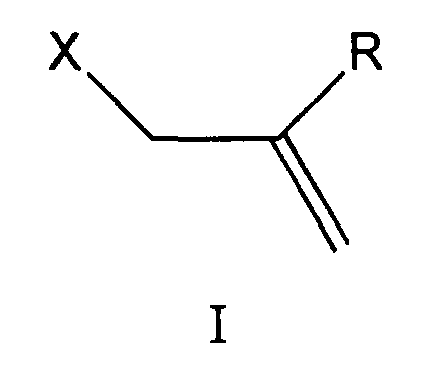
- X
- is a leaving group; and
- R
- is hydrogen or a substituted or unsubstituted alkyl, alkenyl, alkynyl, cycloalkyl, cycloalkylalkyl, phenyl, or naphthyl group; wherein the substituents are independently halogen, alkoxy, or substituted or unsubstituted phenoxy;
- As used herein, the term "alkyl" means both straight and branched chain (C1-C20) radicals which include, for example, methyl, ethyl, n-propyl, isopropyl, 1-ethylpropyl, n-butyl, tert-butyl, isobutyl, 2,2-dimethylpropyl, pentyl, octyl, and decyl. The terms "alkenyl" and "alkynyl" mean (C3-C20) alkenyl and alkynyl groups such as, for example, 2-propenyl, 2-butenyl, 3-butenyl, 2-methyl-2-propenyl, and 2-propynyl. The term "cycloalkylalkyl" means a (C1-C15) alkyl group substituted with a (C3-C6) cycloalkyl group such as, for example cyclopropylmethyl, cyclopropylethyl, cyclobutylmethyl, and cyclopentylethyl. The term "haloalkyl" means an alkyl radical wherein one or more of the hydrogen atoms have been replaced by a halogen atom. The term "halogen" means fluorine, chlorine, bromine, and iodine. The term "strong base" means a non-nucleophilic base with a pKa greater than 35. The term "weaker base" means a non-nucleophilic base with a pKa of from 26 to 35, or the conjugate acid thereof. The term "inert solvent" means a solvent which does not react with the strong base, the weaker base, the allyl halide, or the resulting cyclopropene.
- As used herein, all percentages are percent by weight, unless otherwise specified and are inclusive and combinable. All ratios are by weight and all ratio ranges are inclusive and combinable. All molar ranges are inclusive and combinable.
- Preferably, X is a leaving group selected from halogen, alkyl or aryl sulfonyloxy, alkyl or aryl sulfate, and alkoxy. More preferably, X is chloro, bromo, iodo, benzenesulfonyloxy, p-toluenesulfonyloxy, methanesulfonyloxy, or t-butoxy. Even more preferably, X is chloro, bromo, or benzenesulfonyloxy. Most preferably, X is chloro or bromo.
- Preferably, R is (C1-C10) alkyl. More preferably, R is (C1-C8) alkyl. Most preferably, R is methyl.
- Preferably, the inert solvent is an aliphatic or aromatic hydrocarbon such as, for example, mineral oil, benzene, toluene, or xylene; an ether such as, for example, diethyl ether, tetrahydrofuran, or dioxane, a halogenated hydrocarbon such as, for example perhaloalkanes or methylene chloride, liquid ammonia, or lower alkyl amine or lower dialkyl amine such as, for example, methylamine or dimethylamine. More preferably, the solvent is an aliphatic or aromatic hydrocarbon. Most preferably, the solvent is mineral oil. The solvent may be a mixture of more than one inert solvent.
- Preferably, the strong base is an alkali metal salt of an amine or an organometallic base. More preferably, the strong base is sodium, potassium, or lithium amide or phenylithium. Most preferably, the strong base is sodium amide. The strong base may be a mixture of more than one strong base. The amount of strong base used in the method will vary depending upon the weaker base used, the inert solvent, and the temperature at which the reaction is conducted. Preferably, the amount of strong base used is from 0.1 to 20 moles per mole of allyl compound of formula I. More preferably the amount of strong base used is from 0.5 to 2 moles per mole of allyl compound of formula I. Most preferably, the amount of strong base used is from 0.7 to 1.4 moles per mole of allyl compound of formula I.
- Preferably, the weaker base is soluble in the inert solvent. More preferably, the weaker base is a silyl amine, a disilazane, their cyclic analogs, mixed cyclic silazane/ether analogs, or metal salts thereof. Even more preferably, the weaker base is a silyl amine or a disilazane. Still more preferably, the weaker base is a dialkyl- or trialkyl, diaryl- or triaryl, or mixed alkyl/aryl silyl amine; a tetraalkyl-, pentaalkyl- or hexaalkyl, tetraaryl-, pentaaryl-, or hexaaryl, or mixed alkyl/aryl disilazane; or their cyclic analogs. Still more preferably, the weaker base is 1,1,1-triphenylsilylamine, tri-n-hexylsilylamine, 1,1,1,3,3,3-hexamethyldisilazane, 1,1,3,3-tetramethyldisilazane, 2,2,4,4,6,6-hexamethylcyclotrisilazane, octamethylcyclotetrasilazane, hexaethyldisilazane, 1,3-di-n-octyltetramethyldisilazane, or 2,2,5,5-tetramethyl-2,5-disila-1-azacyclopentane. Most preferably, the weaker base is hexamethyldisilazane. The weaker base can be a mixture of more than one weaker base. The amount of weaker based used in the method of this invention will vary depending upon the strong based used, the inert solvent used, and the temperature at which the reaction is conducted. Preferably, the amount of weaker base used is from 0.001 to 0.95 moles per mole of strong base used. More preferably, the amount of weaker base used is from 0.02 to 0.4 moles per mole of strong base. Most preferably, the amount of weaker base used is from 0.02 to 0.2 moles per mole of strong base.
- The order of addition of the reactants to the solvent is not critical. However, it is preferred that the allyl compound of formula I is added last to a mixture of the other components. Most preferably, the allyl compound is added slowly to a mixture of the other components.
- The temperature at which the method of this invention is carried out is not critical. However, because cyclopropenes are reactive compounds, care must be taken to ensure either a) that the temperature is kept below that at which decomposition or side reactions occur, or b) the cyclopropene produced must be removed from the reaction mixture as it is being produced, or a combination of a) and b). Preferably, the cyclopropene produced will be distilled from the reaction mixture and collected in a cooled receiver as it is produced. For lower boiling cyclopropenes, the temperature is preferably greater than or equal to the boiling point of the cyclopropene and the cyclopropene is distilled from the reaction mixture as it is being produced. For higher boiling cyclopropenes, the temperature is preferably less than the decomposition temperature of the cyclopropene.
- Preferably, the reaction mixture is stirred or otherwise agitated and/or sparged or purged with an inert gas during the reaction. Preferably the inert gas is nitrogen. More preferably, and particularly in the case of lower boiling cyclopropenes, the agitation rate is sufficiently high to ensure that the cyclopropene distills from the reaction mixture as soon as possible after being formed. Fast removal of the cyclopropene from the reaction mixture reduces production of side products such as alkylidenecyclopropanes and teleomers.
- The pressure at which the reaction is conducted is also not critical. Ambient pressure is preferred. However, pressure or vacuum may be utilized to affect the relative boiling points of the cyclopropene produced and the inert solvent to aid in separation of the cyclopropene from the reaction mixture.
- The method of this invention is illustrated by the following examples and comparative examples. In the following examples, all percentages and parts are by weight.
- Into a 1000 ml 4 necked round bottomed flask equipped with an internal thermometer, overhead stirring, a pressure equalizing addition funnel and a condenser was added 109 g (2.79 moles) of commercial sodium amide and 110 ml of light mineral oil. The flask was heated, via an external bath, to 45 °C internal temperature whereupon 4.2 g (0.03 moles) of hexamethyldisilazane was added. Over the course of 50 minutes, 202 g (2.23 moles) of 3-chloro-2-methylpropene was slowly added. The gas that was evolved was ducted through the condenser and then scrubbed with water and finally condensed in a dry ice cooled trap. Yield was 39.3g of 1-methylcyclopropene contaminated with 1.5 percent of methylenecyclopropane and 8 percent of 3-chloro-2-methylpropene starting material. A simple distillation of the product gave a final product containing less than 0.1 percent 3-chloro-2-methylpropene.
- Into a 1000 ml 4 necked round bottomed flask equipped with an internal thermometer, overhead stirring, a pressure equalizing addition funnel and a condenser was added 33.4 g (0.856 moles) of commercial sodium amide and 100 ml of light mineral oil. The flask was heated, via an external bath, to 45 °C internal temperature. Over the course of 90 minutes, 36.7 g (0.405 moles) of 3-chloro-2-methylpropene was slowly added. No gas was evolved indicating either a) no 1-methylcyclopropene was produced or b) any 1-methylcyclopropene which was produced decomposed or engaged in further reaction(s).
Claims (10)
- A method to prepare a cyclopropene, comprising combining an allyl compound of the formula:wherein:

- X
- is a leaving group; and
- R
- is hydrogen or a substituted or unsubstituted alkyl, alkenyl, alkynyl, cycloalkyl, cycloalkylalkyl, phenyl or naphthyl group wherein the substituents are independently halogen, alkoxy, or substituted or unsubstituted phenoxy;
- The method of claim 1, wherein X is halogen, alkyl or aryl sulfonyloxy, alkyl or aryl sulfate, and alkoxy.
- The method of claim 1, wherein X is chloro, bromo, iodo, benzenesulfonyloxy, p-toluenesulfonyloxy, methanesulfonyloxy, or t-butoxy.
- The method of claim 1, wherein R is (C1-C10) alkyl.
- The method of claim 1, wherein the strong base is an alkali metal salt of an amine or an organometallic base.
- The method of claim 1, wherein the weaker,base is a silyl amine or a disilizane.
- The method of claim 1, wherein the inert solvent is an aliphatic or aromatic hydrocarbon; an ether, a halogenated hydrocarbon, liquid ammonia, methylamine, or dimethylamine
- The method of claim 1, wherein the method further comprises removing the cyclopropene from the reaction mixture by distillation.
- The method of claim 1, wherein X is chloro or bromo, R is (C1-C10) alkyl, the strong base is sodium amide, the weaker base is hexamethyldisilazane, and the inert solvent is mineral oil.
- The method of claim 9, wherein R is methyl.
Applications Claiming Priority (2)
| Application Number | Priority Date | Filing Date | Title |
|---|---|---|---|
| US19653600P | 2000-04-11 | 2000-04-11 | |
| US196536 | 2000-04-11 |
Publications (2)
| Publication Number | Publication Date |
|---|---|
| EP1146028A1 true EP1146028A1 (en) | 2001-10-17 |
| EP1146028B1 EP1146028B1 (en) | 2003-02-19 |
Family
ID=22725799
Family Applications (1)
| Application Number | Title | Priority Date | Filing Date |
|---|---|---|---|
| EP01302930A Expired - Lifetime EP1146028B1 (en) | 2000-04-11 | 2001-03-28 | A method to prepare cyclopropenes |
Country Status (17)
| Country | Link |
|---|---|
| EP (1) | EP1146028B1 (en) |
| JP (1) | JP2001354597A (en) |
| KR (1) | KR20010098478A (en) |
| CN (1) | CN1318534A (en) |
| AR (1) | AR027987A1 (en) |
| AT (1) | ATE232845T1 (en) |
| AU (1) | AU3346701A (en) |
| BR (1) | BR0101437A (en) |
| CA (1) | CA2342400A1 (en) |
| DE (1) | DE60100106T2 (en) |
| ES (1) | ES2191650T3 (en) |
| HU (1) | HUP0101453A3 (en) |
| IL (1) | IL142322A0 (en) |
| MX (1) | MXPA01003259A (en) |
| NZ (1) | NZ510856A (en) |
| PL (1) | PL347015A1 (en) |
| ZA (1) | ZA200102533B (en) |
Cited By (2)
| Publication number | Priority date | Publication date | Assignee | Title |
|---|---|---|---|---|
| RU2267477C1 (en) * | 2004-07-01 | 2006-01-10 | Общество с ограниченной ответственностью "Вега-хим" | Method for preparing 1-methylcyclopropene |
| CN102349501A (en) * | 2011-08-19 | 2012-02-15 | 烟台爱德泰克光电材料有限公司 | Preparation method of 1-methylcyclopropene clathrate compound |
Families Citing this family (6)
| Publication number | Priority date | Publication date | Assignee | Title |
|---|---|---|---|---|
| TW200538037A (en) * | 2004-05-19 | 2005-12-01 | Rohm & Haas | Compositions with cyclopropenes and adjuvants |
| KR100972799B1 (en) * | 2008-04-15 | 2010-07-29 | 이수진 | Method for preparing 1-methylcyclopropene |
| CN101990937A (en) * | 2010-10-19 | 2011-03-30 | 西安交通大学 | 1-methyl-3-(2-methylcyclopropane)-1-cyclopropene inclusion complex for keeping fruits, vegetables and flowers fresh and preparation method thereof |
| RU2466120C1 (en) * | 2011-10-07 | 2012-11-10 | Андрей Владимирович Голубев | Method of producing cyclopropene and derivatives thereof |
| CN104341257A (en) * | 2014-09-28 | 2015-02-11 | 滨海维佳化工有限公司 | Preparation method and storage method of 1-methylcyclopropene |
| CN106928015A (en) * | 2017-04-18 | 2017-07-07 | 常州茂尔盛生态农业科技有限公司 | The preparation method of 1 methyl cyclopropene |
Citations (1)
| Publication number | Priority date | Publication date | Assignee | Title |
|---|---|---|---|---|
| DE4333491A1 (en) * | 1993-10-01 | 1995-04-06 | Studiengesellschaft Kohle Mbh | Process for the production of methylene cyclopropane |
-
2001
- 2001-03-28 AT AT01302930T patent/ATE232845T1/en not_active IP Right Cessation
- 2001-03-28 EP EP01302930A patent/EP1146028B1/en not_active Expired - Lifetime
- 2001-03-28 IL IL14232201A patent/IL142322A0/en unknown
- 2001-03-28 ZA ZA200102533A patent/ZA200102533B/en unknown
- 2001-03-28 CA CA002342400A patent/CA2342400A1/en not_active Abandoned
- 2001-03-28 ES ES01302930T patent/ES2191650T3/en not_active Expired - Lifetime
- 2001-03-28 DE DE60100106T patent/DE60100106T2/en not_active Expired - Fee Related
- 2001-03-29 MX MXPA01003259A patent/MXPA01003259A/en unknown
- 2001-03-29 AR ARP010101504A patent/AR027987A1/en not_active Application Discontinuation
- 2001-03-30 NZ NZ510856A patent/NZ510856A/en unknown
- 2001-04-05 AU AU33467/01A patent/AU3346701A/en not_active Abandoned
- 2001-04-09 KR KR1020010018609A patent/KR20010098478A/en not_active Withdrawn
- 2001-04-10 HU HU0101453A patent/HUP0101453A3/en unknown
- 2001-04-10 CN CN01110449A patent/CN1318534A/en active Pending
- 2001-04-10 BR BR0101437-4A patent/BR0101437A/en not_active IP Right Cessation
- 2001-04-11 PL PL01347015A patent/PL347015A1/en unknown
- 2001-04-11 JP JP2001112629A patent/JP2001354597A/en not_active Withdrawn
Patent Citations (1)
| Publication number | Priority date | Publication date | Assignee | Title |
|---|---|---|---|---|
| DE4333491A1 (en) * | 1993-10-01 | 1995-04-06 | Studiengesellschaft Kohle Mbh | Process for the production of methylene cyclopropane |
Cited By (3)
| Publication number | Priority date | Publication date | Assignee | Title |
|---|---|---|---|---|
| RU2267477C1 (en) * | 2004-07-01 | 2006-01-10 | Общество с ограниченной ответственностью "Вега-хим" | Method for preparing 1-methylcyclopropene |
| CN102349501A (en) * | 2011-08-19 | 2012-02-15 | 烟台爱德泰克光电材料有限公司 | Preparation method of 1-methylcyclopropene clathrate compound |
| CN102349501B (en) * | 2011-08-19 | 2013-11-20 | 烟台爱德泰克光电材料有限公司 | Preparation method of 1-methylcyclopropene clathrate compound |
Also Published As
| Publication number | Publication date |
|---|---|
| EP1146028B1 (en) | 2003-02-19 |
| AU3346701A (en) | 2001-12-13 |
| DE60100106D1 (en) | 2003-03-27 |
| HUP0101453A2 (en) | 2001-12-28 |
| IL142322A0 (en) | 2002-03-10 |
| BR0101437A (en) | 2001-11-13 |
| DE60100106T2 (en) | 2003-12-11 |
| HU0101453D0 (en) | 2001-06-28 |
| NZ510856A (en) | 2002-09-27 |
| CN1318534A (en) | 2001-10-24 |
| PL347015A1 (en) | 2001-10-22 |
| ATE232845T1 (en) | 2003-03-15 |
| AR027987A1 (en) | 2003-04-23 |
| MXPA01003259A (en) | 2005-08-26 |
| ZA200102533B (en) | 2001-09-28 |
| ES2191650T3 (en) | 2003-09-16 |
| HUP0101453A3 (en) | 2002-02-28 |
| CA2342400A1 (en) | 2001-10-11 |
| JP2001354597A (en) | 2001-12-25 |
| KR20010098478A (en) | 2001-11-08 |
Similar Documents
| Publication | Publication Date | Title |
|---|---|---|
| US6452060B2 (en) | Method to prepare cyclopropenes | |
| US6953540B2 (en) | Continuous process for the preparation of encapsulated cyclopropenes | |
| CN101184767A (en) | Aqueous phase catalytic method for preparing thiocarboxylate silane | |
| EP1146028B1 (en) | A method to prepare cyclopropenes | |
| KR20190003659A (en) | Aromatic fluorination method | |
| US4408075A (en) | Process for the preparation of tris-(ether-amines) and the tris-(ether-amines) produced | |
| EP1753770B1 (en) | A process for the synthesis of terbinafine and derivatives thereof | |
| EP1458729A1 (en) | (aryl) (amino) borane compounds, method for preparing same | |
| EP2522648B1 (en) | Process for producing difluorocyclopropane compound | |
| KR20160045787A (en) | Method for producing alkyl-indium compounds and the use thereof | |
| KR20220003032A (en) | Method for preparing metal-ligand complexes | |
| EP1062192B1 (en) | Preparation of cycloalkylacetylene compounds | |
| KR100371312B1 (en) | Preparation of alkyl(amino) dialkoxysilanes | |
| KR100521062B1 (en) | Method for producing (3-alkoxyphenyl) magnesium chloride and alcohol using the corresponding chloride | |
| JPH0560817B2 (en) | ||
| MXPA00007076A (en) | Process for the preparation of grignard reagents and novel grignard reagents. | |
| US20100280299A1 (en) | Method for the production of alpha, omega-olefins by using the copper catalyzed coupling reaction of a grignard reagent with an allylic substrate | |
| JP2526421B2 (en) | Process for producing highly pure 1,3,5-tris (N, N-dimethylaminopropyl) hexahydro-s-triazine excellent in storage stability | |
| US20020065425A1 (en) | Method for purifying fluoroaryl metal compound | |
| JPS5929049B2 (en) | Method for producing 1,1,1-trimethoxyethane | |
| MXPA97007345A (en) | Process for ami | |
| CN119790030A (en) | Monoalkylation of cyclopentadiene | |
| GB2128603A (en) | Preparation of N-(dihalobenzyl)-N-alkyl-2,6-dinitro-4-trifluoromethylanilines | |
| JP2000297095A (en) | Purification method of thiophosphoric acid chlorides | |
| JP2001122851A (en) | Method for producing caprolactam |
Legal Events
| Date | Code | Title | Description |
|---|---|---|---|
| PUAI | Public reference made under article 153(3) epc to a published international application that has entered the european phase |
Free format text: ORIGINAL CODE: 0009012 |
|
| 17P | Request for examination filed |
Effective date: 20010410 |
|
| AK | Designated contracting states |
Kind code of ref document: A1 Designated state(s): AT BE CH CY DE DK ES FI FR GB GR IE IT LI LU MC NL PT SE TR |
|
| AX | Request for extension of the european patent |
Free format text: AL;LT;LV;MK;RO;SI |
|
| 17Q | First examination report despatched |
Effective date: 20020220 |
|
| AKX | Designation fees paid |
Free format text: AT BE CH CY DE DK ES FI FR GB GR IE IT LI LU MC NL PT SE TR |
|
| GRAH | Despatch of communication of intention to grant a patent |
Free format text: ORIGINAL CODE: EPIDOS IGRA |
|
| GRAH | Despatch of communication of intention to grant a patent |
Free format text: ORIGINAL CODE: EPIDOS IGRA |
|
| GRAA | (expected) grant |
Free format text: ORIGINAL CODE: 0009210 |
|
| AK | Designated contracting states |
Designated state(s): AT BE CH CY DE DK ES FI FR GB GR IE IT LI LU MC NL PT SE TR |
|
| PG25 | Lapsed in a contracting state [announced via postgrant information from national office to epo] |
Ref country code: GR Free format text: LAPSE BECAUSE OF FAILURE TO SUBMIT A TRANSLATION OF THE DESCRIPTION OR TO PAY THE FEE WITHIN THE PRESCRIBED TIME-LIMIT Effective date: 20030219 Ref country code: TR Free format text: LAPSE BECAUSE OF FAILURE TO SUBMIT A TRANSLATION OF THE DESCRIPTION OR TO PAY THE FEE WITHIN THE PRESCRIBED TIME-LIMIT Effective date: 20030219 Ref country code: LI Free format text: LAPSE BECAUSE OF FAILURE TO SUBMIT A TRANSLATION OF THE DESCRIPTION OR TO PAY THE FEE WITHIN THE PRESCRIBED TIME-LIMIT Effective date: 20030219 Ref country code: CH Free format text: LAPSE BECAUSE OF FAILURE TO SUBMIT A TRANSLATION OF THE DESCRIPTION OR TO PAY THE FEE WITHIN THE PRESCRIBED TIME-LIMIT Effective date: 20030219 Ref country code: FI Free format text: LAPSE BECAUSE OF FAILURE TO SUBMIT A TRANSLATION OF THE DESCRIPTION OR TO PAY THE FEE WITHIN THE PRESCRIBED TIME-LIMIT Effective date: 20030219 Ref country code: BE Free format text: LAPSE BECAUSE OF FAILURE TO SUBMIT A TRANSLATION OF THE DESCRIPTION OR TO PAY THE FEE WITHIN THE PRESCRIBED TIME-LIMIT Effective date: 20030219 Ref country code: AT Free format text: LAPSE BECAUSE OF FAILURE TO SUBMIT A TRANSLATION OF THE DESCRIPTION OR TO PAY THE FEE WITHIN THE PRESCRIBED TIME-LIMIT Effective date: 20030219 |
|
| REG | Reference to a national code |
Ref country code: GB Ref legal event code: FG4D |
|
| REG | Reference to a national code |
Ref country code: CH Ref legal event code: EP |
|
| REG | Reference to a national code |
Ref country code: IE Ref legal event code: FG4D |
|
| REF | Corresponds to: |
Ref document number: 60100106 Country of ref document: DE Date of ref document: 20030327 Kind code of ref document: P |
|
| PG25 | Lapsed in a contracting state [announced via postgrant information from national office to epo] |
Ref country code: IE Free format text: LAPSE BECAUSE OF NON-PAYMENT OF DUE FEES Effective date: 20030328 Ref country code: CY Free format text: LAPSE BECAUSE OF FAILURE TO SUBMIT A TRANSLATION OF THE DESCRIPTION OR TO PAY THE FEE WITHIN THE PRESCRIBED TIME-LIMIT Effective date: 20030328 Ref country code: LU Free format text: LAPSE BECAUSE OF NON-PAYMENT OF DUE FEES Effective date: 20030328 |
|
| PG25 | Lapsed in a contracting state [announced via postgrant information from national office to epo] |
Ref country code: MC Free format text: LAPSE BECAUSE OF NON-PAYMENT OF DUE FEES Effective date: 20030331 |
|
| PGFP | Annual fee paid to national office [announced via postgrant information from national office to epo] |
Ref country code: PT Payment date: 20030407 Year of fee payment: 3 |
|
| PGFP | Annual fee paid to national office [announced via postgrant information from national office to epo] |
Ref country code: ES Payment date: 20030408 Year of fee payment: 3 |
|
| PG25 | Lapsed in a contracting state [announced via postgrant information from national office to epo] |
Ref country code: SE Free format text: LAPSE BECAUSE OF FAILURE TO SUBMIT A TRANSLATION OF THE DESCRIPTION OR TO PAY THE FEE WITHIN THE PRESCRIBED TIME-LIMIT Effective date: 20030519 Ref country code: DK Free format text: LAPSE BECAUSE OF FAILURE TO SUBMIT A TRANSLATION OF THE DESCRIPTION OR TO PAY THE FEE WITHIN THE PRESCRIBED TIME-LIMIT Effective date: 20030519 |
|
| REG | Reference to a national code |
Ref country code: CH Ref legal event code: PL |
|
| REG | Reference to a national code |
Ref country code: ES Ref legal event code: FG2A Ref document number: 2191650 Country of ref document: ES Kind code of ref document: T3 |
|
| ET | Fr: translation filed | ||
| PLBE | No opposition filed within time limit |
Free format text: ORIGINAL CODE: 0009261 |
|
| STAA | Information on the status of an ep patent application or granted ep patent |
Free format text: STATUS: NO OPPOSITION FILED WITHIN TIME LIMIT |
|
| REG | Reference to a national code |
Ref country code: IE Ref legal event code: MM4A |
|
| 26N | No opposition filed |
Effective date: 20031120 |
|
| PG25 | Lapsed in a contracting state [announced via postgrant information from national office to epo] |
Ref country code: ES Free format text: LAPSE BECAUSE OF NON-PAYMENT OF DUE FEES Effective date: 20040329 |
|
| PG25 | Lapsed in a contracting state [announced via postgrant information from national office to epo] |
Ref country code: PT Free format text: LAPSE BECAUSE OF NON-PAYMENT OF DUE FEES Effective date: 20041015 |
|
| REG | Reference to a national code |
Ref country code: PT Ref legal event code: MM4A Free format text: LAPSE DUE TO NON-PAYMENT OF FEES Effective date: 20040930 |
|
| PG25 | Lapsed in a contracting state [announced via postgrant information from national office to epo] |
Ref country code: IT Free format text: LAPSE BECAUSE OF NON-PAYMENT OF DUE FEES Effective date: 20050328 |
|
| REG | Reference to a national code |
Ref country code: ES Ref legal event code: FD2A Effective date: 20040329 |
|
| PG25 | Lapsed in a contracting state [announced via postgrant information from national office to epo] |
Ref country code: NL Free format text: LAPSE BECAUSE OF NON-PAYMENT OF DUE FEES Effective date: 20051001 |
|
| NLV4 | Nl: lapsed or anulled due to non-payment of the annual fee |
Effective date: 20051001 |
|
| PGFP | Annual fee paid to national office [announced via postgrant information from national office to epo] |
Ref country code: GB Payment date: 20070327 Year of fee payment: 7 |
|
| PGFP | Annual fee paid to national office [announced via postgrant information from national office to epo] |
Ref country code: DE Payment date: 20070430 Year of fee payment: 7 |
|
| PGFP | Annual fee paid to national office [announced via postgrant information from national office to epo] |
Ref country code: FR Payment date: 20070319 Year of fee payment: 7 |
|
| GBPC | Gb: european patent ceased through non-payment of renewal fee |
Effective date: 20080328 |
|
| REG | Reference to a national code |
Ref country code: FR Ref legal event code: ST Effective date: 20081125 |
|
| PG25 | Lapsed in a contracting state [announced via postgrant information from national office to epo] |
Ref country code: DE Free format text: LAPSE BECAUSE OF NON-PAYMENT OF DUE FEES Effective date: 20081001 |
|
| PG25 | Lapsed in a contracting state [announced via postgrant information from national office to epo] |
Ref country code: FR Free format text: LAPSE BECAUSE OF NON-PAYMENT OF DUE FEES Effective date: 20080331 |
|
| PG25 | Lapsed in a contracting state [announced via postgrant information from national office to epo] |
Ref country code: GB Free format text: LAPSE BECAUSE OF NON-PAYMENT OF DUE FEES Effective date: 20080328 |