EP1145884A2 - Heater assembly or motor vehicle - Google Patents
Heater assembly or motor vehicle Download PDFInfo
- Publication number
- EP1145884A2 EP1145884A2 EP01890114A EP01890114A EP1145884A2 EP 1145884 A2 EP1145884 A2 EP 1145884A2 EP 01890114 A EP01890114 A EP 01890114A EP 01890114 A EP01890114 A EP 01890114A EP 1145884 A2 EP1145884 A2 EP 1145884A2
- Authority
- EP
- European Patent Office
- Prior art keywords
- heater assembly
- module
- heat exchanger
- fan
- flow
- Prior art date
- Legal status (The legal status is an assumption and is not a legal conclusion. Google has not performed a legal analysis and makes no representation as to the accuracy of the status listed.)
- Granted
Links
Images




Classifications
-
- F—MECHANICAL ENGINEERING; LIGHTING; HEATING; WEAPONS; BLASTING
- F28—HEAT EXCHANGE IN GENERAL
- F28F—DETAILS OF HEAT-EXCHANGE AND HEAT-TRANSFER APPARATUS, OF GENERAL APPLICATION
- F28F13/00—Arrangements for modifying heat-transfer, e.g. increasing, decreasing
- F28F13/06—Arrangements for modifying heat-transfer, e.g. increasing, decreasing by affecting the pattern of flow of the heat-exchange media
-
- B—PERFORMING OPERATIONS; TRANSPORTING
- B60—VEHICLES IN GENERAL
- B60H—ARRANGEMENTS OF HEATING, COOLING, VENTILATING OR OTHER AIR-TREATING DEVICES SPECIALLY ADAPTED FOR PASSENGER OR GOODS SPACES OF VEHICLES
- B60H1/00—Heating, cooling or ventilating devices
- B60H1/00007—Combined heating, ventilating, or cooling devices
- B60H1/00021—Air flow details of HVAC devices
- B60H1/00028—Constructional lay-out of the devices in the vehicle
-
- B—PERFORMING OPERATIONS; TRANSPORTING
- B60—VEHICLES IN GENERAL
- B60H—ARRANGEMENTS OF HEATING, COOLING, VENTILATING OR OTHER AIR-TREATING DEVICES SPECIALLY ADAPTED FOR PASSENGER OR GOODS SPACES OF VEHICLES
- B60H1/00—Heating, cooling or ventilating devices
- B60H1/00321—Heat exchangers for air-conditioning devices
- B60H1/00328—Heat exchangers for air-conditioning devices of the liquid-air type
-
- F—MECHANICAL ENGINEERING; LIGHTING; HEATING; WEAPONS; BLASTING
- F28—HEAT EXCHANGE IN GENERAL
- F28D—HEAT-EXCHANGE APPARATUS, NOT PROVIDED FOR IN ANOTHER SUBCLASS, IN WHICH THE HEAT-EXCHANGE MEDIA DO NOT COME INTO DIRECT CONTACT
- F28D1/00—Heat-exchange apparatus having stationary conduit assemblies for one heat-exchange medium only, the media being in contact with different sides of the conduit wall, in which the other heat-exchange medium is a large body of fluid, e.g. domestic or motor car radiators
- F28D1/02—Heat-exchange apparatus having stationary conduit assemblies for one heat-exchange medium only, the media being in contact with different sides of the conduit wall, in which the other heat-exchange medium is a large body of fluid, e.g. domestic or motor car radiators with heat-exchange conduits immersed in the body of fluid
- F28D1/0233—Heat-exchange apparatus having stationary conduit assemblies for one heat-exchange medium only, the media being in contact with different sides of the conduit wall, in which the other heat-exchange medium is a large body of fluid, e.g. domestic or motor car radiators with heat-exchange conduits immersed in the body of fluid with air flow channels
- F28D1/024—Heat-exchange apparatus having stationary conduit assemblies for one heat-exchange medium only, the media being in contact with different sides of the conduit wall, in which the other heat-exchange medium is a large body of fluid, e.g. domestic or motor car radiators with heat-exchange conduits immersed in the body of fluid with air flow channels with an air driving element
Definitions
- the invention relates to a heater assembly for a motor vehicle.
- Vehicle heaters normally comprise a heat exchanger having heating surfaces over which an air flow generated by a fan is directed.
- a known vehicle heater is disclosed in US-A-4 531 671. This has a centrifugal fan which drives air through a heat exchanger which is heated by the engine coolant, so as to heat the flow of air.
- the fan has to ensure adequate flow capacity to make up for pressure losses as the air flows across the heating surfaces in the heat exchanger and around a cornered duct defining the flow path into and out of the heat exchanger.
- the whole unit is bulky and of an overall shape that makes its assembly and location somewhere in front of the vehicle dashboard difficult. The elaborate shapes of the housing and ducts of the unit make them expensive to manufacture. Units of different types and sizes are required for different motor vehicle models.
- US-A-3 918 637 A more compact shape of vehicle heater is shown in US-A-3 918 637.
- This has an outer cylindrical casing in which is located, in sequence, an axial flow fan, a first heat exchanger for pre-heating the air and itself heated by hot exhaust gas from a burner, and a second heat exchanger for heating the pre-heated air and itself heated by the engine cooling water.
- This document is mainly concerned with the water pump for supplying the engine cooling water to the second heat exchanger.
- One object of the present invention is to provide a vehicle heater assembly smaller than conventional units of the same performance.
- the invention provides a heater assembly for a motor vehicle, comprising a heat exchange having heating surfaces, and a fan for generating an air flow over the heating surfaces so that the air flow is heated by the heating surfaces, wherein the air flow has a rotating component as it progresses downstream along a flow channel, in the form of a vortex flow, and the heating surfaces are swept by the vortex flow.
- the use of a vortex flow which sweeps the heating surfaces allows efficient heat exchange with a relatively low loss of pressure, thereby enabling a less powerful fan to be used as compared to a conventional heater of the same performance.
- the fan may therefore be smaller.
- the fan is preferred for the fan to be an axial flow fan. Such a fan provides less pressure than a centrifugal fan but is less bulky. The lower pressure requirements of the heater assembly of the invention are conducive to the use of an axial flow fan.
- the heater assembly can be relatively small in its dimension transverse to the direction of air flow, it can be arranged in the dashboard with its longitudinal axis transverse to the vehicle. Further, its small bulk facilitates premounting the heater assembly to the dashboard before the entire dashboard and heater assembly is fitted to the vehicle as a unit.
- the heater assembly preferably comprises a set of stationary blades downstream of the fan for creating or promoting the vortex flow.
- the heat exchanger comprises ribs protruding into the flow channel and defining a rotational flow path.
- Such ribs can both guide the air flow and provide, at least partly, the heating surfaces.
- the ribs may comprise right helicoid surfaces.
- the ribs preferably protrude radially inwardly.
- the rotating component of the air flow may have a substantially constant radius of rotation as it progresses downstream.
- the flow channel converges in the downstream direction.
- the flow channel may be in the form of a converging cone.
- a converging flow channel tends to accelerate the flow and can thus compensate for the loss of speed caused by friction of the air with the heating surfaces, such as e.g. ribs.
- the heat exchanger comprises an air deflector arranged substantially centrally in the flow channel.
- an air deflector can avoid a central zone with air speeds which are too low, such as low circumferential speeds because of a small radius, and/or low axial speeds because of the hub of the fan.
- a central air deflector may advantageously diverge the flow towards the heating surfaces of the second heat exchanger, e.g. radially inwardly protruding ribs.
- the fan and the heat exchanger may be provided in a common, unitary housing.
- the fan is provided in a fan module having a housing and the heat exchanger is provided in a heat exchange module having a housing, the housings being connected together in sequence in the direction of air flow.
- an appropriate fan module and heat exchanger module can be selected, according to the requirements of the vehicle, and then connected together.
- different modules such as fan modules with different fan sizes or heat exchanger modules of different length, can be assembled in different combinations to meet a variety of vehicle requirements.
- a plurality of heat exchanger modules may be arranged in series to give a greater heating capacity, or to give both cooling and heating capacity if heating and cooling heat exchanger modules are arranged in series.
- the connectability of separate modules thus provides a versatile modular system.
- the housings have respective upstream and downstream end configurations for connecting purposes, the fan module housing and the heat exchanger module housing having the same upstream end configuration as each other and the same downstream end configuration as each other.
- the provision of a standardised form of upstream end configuration and of downstream end configuration further facilitates the ability to assemble a heat exchanger by choosing appropriate modules for the vehicle requirements and then connecting their downstream and upstream ends together as required.
- an air inlet duct module having the same downstream end configuration is provided, forming the first module in the direction of flow.
- a distributor end-piece having the same upstream end configuration is provided, the distributor end-piece being arranged to divide the air flow and direct it to the required parts of the vehicle.
- the invention provides a vehicle heater assembly comprising first and second modules, one being a fan module and the other being a heat exchanger module, the modules being arranged in sequence in the direction of air flow, each module having a respective housing and the housings being connected together end to end, wherein the housings have respective upstream and downstream end configurations for connecting purposes, the fan module housing and the heat exchanger module housing having the same upstream end configuration as each other and the same downstream end configuration as each other.
- the housings of the modules may have flanged ends which may be bolted together.
- the housings are connected together in an interlocking manner, for example screwed together, but more preferably snap fitted together. They are advantageously removably connected together, to assist servicing or to allow replacement of a module.
- housings Various materials may be used to make the housings, but preferably they are made of plastics. It is particularly preferred to use expanded plastics, e.g. expanded polypropylene, as such materials can provide heat insulation and sound absorption. These materials are not normally used to house vehicle heater assemblies.
- expanded plastics e.g. expanded polypropylene
- the invention provides a vehicle heater assembly for a motor vehicle, comprising a plurality of modules including at least a fan module and a heat exchanger module, the modules being in sequence in the direction of air flow, each module having a respective housing and the housings being connected together to form a common housing of the assembly.
- the heater assembly may include means for filtering air.
- an exchangeable filter cassette is provided, preferably being laterally removable from the assembly.
- the filter cassette fits in an air inlet duct module.
- Such a module may also have an air recirculation flap.
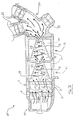
- a vehicle heater assembly 1 is generally shown in Figure 1.
- the heater assembly 1 comprises a plurality of modules connected in line, namely an air inlet module 10, a fan module 13, a heat exchanger module 19, an air distribution manifold 30 and a series of outlet ducts 32.
- the air inlet module 10 has a housing 50 and is provided with a recirculation flap 11 which controls the flow of air into the heater assembly 1.
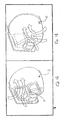
- a first position shown in Fig. 1A
- the recirculation flap 11 allows air to enter the heater assembly 1 from outside of the vehicle's cabin.
- a second position as shown in Fig. 1B, the recirculation flap 11 allows air to be fed back from the vehicle's cabin into the heater assembly 1.
- an air filter cassette 12 which prevents airborne particles from passing through the heater assembly 1 and subsequently entering the vehicle's cabin.
- the air filter cassette 12 is removable from the air inlet module 10 in a radial direction to allow it to be replaced when necessary.
- a circular fan module 13 Downstream of the air inlet module 10 is a circular fan module 13 which is made up of a fan 14 positioned upstream of a set of stator blades 15. Both the fan module 13 and the stator blades 15 are positioned in a fan housing 16.
- the fan 14 is an electrically powered axial flow type, although a booster fan turbine type may equally be used.
- An electric motor for the fan 14 is provided in a centrally located hub 17.
- the central axis 18 of the fan 14 is coincident with the central axis of the cylindrical housing 16.
- the heat exchanger module 19 is positioned directly downstream of the fan module 13 and has a housing 23 defining a conical flow passage 20, of circular cross-section.
- the housing 23 is connected at its upstream end to the downstream end of the fan housing 16.
- An air deflector 29 is positioned at the inlet region of the passage 20 in line with the central axis 18 of the fan 14.
- a drainage outlet 35 is provided at the base of the housing 23 of the heat exchanger module 19, although in this case the drainage outlet 35 is blocked off.
- a number of sets of ribs 21 project radially inwardly from an outer wall 22 of the passage 20 and these define a series of coils.
- An annular chamber 24 is arranged between the housing 23 and the passage 20.
- An inlet valve 25 and an outlet valve 26 are provided through the housing 23 to the annular chamber 24, for allowing engine coolant water to flow into and out of the chamber.
- a distribution chamber 31 of the air distribution manifold 30 is connected to a series of outlet ducts 32 which lead into the vehicle's cabin via window demist vents, instrument panel air vents and a footwell vent.
- Each of the ducts 32 is provided with a valve 33 to control the flow of air through the duct 32.
- the air inlet module 10, fan module 13, heat exchanger module 19 and air distribution manifold 31 are each self contained modular units.
- each of these modular units is made separately and then they are joined at their respective upstream and downstream ends.
- a male connecting portion 34a is provided, and at the downstream end of each module a female connecting portion 34a is provided.
- Each male portion has a radially projecting annular rib arranged to snap fit into a corresponding annular groove in the female portion.
- snap fit connections 34 are provided between the modules. These form a substantially airtight seal between the modules.
- the module housings are made from expanded plastic.
- the air then passes through the air filter cassette 12 and any airborne particles become trapped.
- the air is then accelerated by the fan 14 to generate an airflow 27 which is represented by arrows in the Figures.
- the airflow 27 is directed through the stator blades 15 which introduce a rotational component into the airflow 27 and then travels downstream rotating about the central axis 18. A vortex flow is thus generated.
- the airflow 27 then enters the passage 20 formed in the heat exchanger module 19.
- the ribs 21 formed on the outer wall 22 tend to maintain the vortex flow.
- the air deflector 29 is positioned centrally in the passage 20, downstream of the fan module 13, to prevent the formation of a region of low velocity airflow.
- the speed of the airflow 27 in this central region is reduced because of the presence of the hub 17 of the fan 14 and because of the small radius.
- the reduction in the cross sectional area of the passage 20 tends to increase the speed of the airflow 27.
- the convergence of the passage 20 compensates for the loss of speed of the airflow 27 which is caused by frictional forces between the airflow 27 and the outer wall 22 of the passage 20 and the ribs 21.
- the heat exchanger module 19 is used as a heater for the airflow 27.
- the fluid 28 introduced into the annular chamber 24 through the inlet valve 25 is cooling water which is heated by the vehicle's engine.
- the airflow 27 travels through the passage 20 the heat from the outer wall 22 of the passage 20 and the ribs 21 is transferred to the airflow 27, thus increasing its temperature.
- the airflow 27 Upon exiting the heat exchanger module 19, the airflow 27 enters the distribution chamber 31 of the outlet air distribution manfiold 30 wherein it is directed to the outlet ducts 20 to be introduced into the vehicle's cabin as described above.
- the airflow 27 into the cabin is controlled by the valves 33 located in each duct 32.
- an air conditioning heat exchanger module 41 into a heater assembly 40, as shown in Figures 3 and 4.
- the air conditioning heat exchanger module 41 is arranged in series with the heat exchanger module 19.
- the air conditioning heat exchanger module 41 is connected, via the inlet valve 25 and outlet valve 26, to a source of fluid 43 having a temperature lower than that of the air entering the air inlet module 10 and the downstream heat exchanger module 19 is connected, via the inlet valve 25 and outlet valve 26, to a supply of engine coolant 28 having a temperature above that of the air entering the air inlet module 10.
- the drainage outlet 35 is open to allow condensate to drain from the module.
- Appropriate apertures are provided in the ribs 21 to permit drainage down the slope of the wall 22.
- the air deflector 29 acts as a diffuser in the passage 20, to deflect the air radially outwardly.
- a heat and ventilation system 45 according to a third embodiment of the present invention is shown in Figure 5.
- an adaptor module 46 is provided between an air conditioning heat exchanger module 41 and a heating heat exchanger module 19.
- the adaptor module 46 offsets the central axis of the air conditioning vortex heat exchanger 47 and the heater vortex heat exchanger 48 by ninety degrees.
- the operation of this embodiment of the heater assembly is generally the same as that of the previous embodiment. However, this arrangement offers a different option in positioning the heater assembly in the dashboard of a vehicle.
- the ribs formed in the vortex heat exchanger need not be restricted to a position on the inner surface of the passage but may alternatively, or additionally, be applied to the outer surface of the air deflector located in the passage.
Landscapes
- Engineering & Computer Science (AREA)
- Physics & Mathematics (AREA)
- Thermal Sciences (AREA)
- Mechanical Engineering (AREA)
- General Engineering & Computer Science (AREA)
- Air-Conditioning For Vehicles (AREA)
- Resistance Heating (AREA)
Abstract
Description
Claims (15)
- A heater assembly for a motor vehicle, comprising a heat exchanger having heating surfaces, and a fan for generating an air flow over the heating surfaces so that the air flow is heated by the heating surfaces, wherein in use the air flow has a rotating component as it progresses downstream along a flow channel, in the form of a vortex flow, and the heating surfaces are swept by the vortex flow.
- A heater assembly as claimed in claim 1, wherein the fan is an axial flow fan.
- A heater assembly as claimed in claim 1 or 2, comprising a set of stationary blades downstream of the fan for creating or promoting the vortex flow.
- A heater assembly as claimed in claim 1, 2 or 3, wherein the heat exchanger comprises ribs protruding into the flow channel and defining a rotational flow path.
- A heater assembly as claimed in claim in any preceding claim, wherein the flow channel converges in the downstream direction.
- A heater assembly as claimed in claim in any preceding claim, wherein the heat exchanger comprises an air deflector arranged substantially centrally in the flow channel.
- A heater assembly as claimed in claim in any preceding claim, wherein the fan is provided in a fan module having a housing and the heat exchanger is provided in a heat exchanger module having a housing, the housings being connected together in sequence in the direction of air flow.
- A heater assembly as claimed in claim 7, wherein the housings have respective upstream and downstream end configurations for connecting purposes, the fan module housing and the heat exchanger module housing having the same upstream end configuration as each other and the same downstream end configuration as each other.
- A heater assembly as claimed in claim 7 or 8, wherein the housings are connected together in an interlocking manner.
- A heater assembly as claimed in claim 7, 8 or 9, wherein the housings are made from expanded plastics.
- A heater assembly as claimed in claim in any of claims 7 to 10, wherein the housings are connected together to form a common housing of the assembly.
- A heater assembly as claimed in any of claims 7 to 11, further comprising an air inlet duct module having an exchangeable filter cassette.
- A vehicle heater assembly comprising first and second modules, one being a fan module and the other being a heat exchanger module, the modules being arranged in sequence in the direction of air flow, each module having a respective housing and the housings being connected together end to end, wherein the housings have respective upstream and downstream end configurations for connecting purposes, the fan module housing and the heat exchanger module housing having the same upstream end configuration as each other and the same downstream end configuration as each other.
- A vehicle heater assembly for a motor vehicle, comprising a plurality of modules including at least a fan module and a heat exchanger module, the modules being in sequence in the direction of air flow, each module having a respective housing and the housings being connected together to form a common housing of the assembly.
- A vehicle heater assembly substantially as hereinbefore described with reference to the accompanying drawings.
Applications Claiming Priority (2)
| Application Number | Priority Date | Filing Date | Title |
|---|---|---|---|
| GB0009040A GB2361299A (en) | 2000-04-12 | 2000-04-12 | Heater assembly for motor vehicle |
| GB0009040 | 2000-04-12 |
Publications (3)
| Publication Number | Publication Date |
|---|---|
| EP1145884A2 true EP1145884A2 (en) | 2001-10-17 |
| EP1145884A3 EP1145884A3 (en) | 2003-06-04 |
| EP1145884B1 EP1145884B1 (en) | 2006-06-14 |
Family
ID=9889788
Family Applications (1)
| Application Number | Title | Priority Date | Filing Date |
|---|---|---|---|
| EP01890114A Expired - Lifetime EP1145884B1 (en) | 2000-04-12 | 2001-04-12 | Heater assembly for motor vehicle |
Country Status (4)
| Country | Link |
|---|---|
| EP (1) | EP1145884B1 (en) |
| AT (1) | ATE329773T1 (en) |
| DE (1) | DE60120542T2 (en) |
| GB (1) | GB2361299A (en) |
Cited By (2)
| Publication number | Priority date | Publication date | Assignee | Title |
|---|---|---|---|---|
| WO2004000586A3 (en) * | 2002-06-19 | 2004-03-25 | Valeo Klimasysteme Gmbh | Heating, ventilation and/or air conditioning system |
| WO2009132776A1 (en) * | 2008-04-29 | 2009-11-05 | Gea Air Treatment Gmbh | Heat exchanger and convector unit comprising heat exchangers |
Families Citing this family (2)
| Publication number | Priority date | Publication date | Assignee | Title |
|---|---|---|---|---|
| US20110030929A1 (en) * | 2009-08-10 | 2011-02-10 | Denso International America, Inc. | Self-powered heat exchanger |
| CN109269106B (en) * | 2018-08-30 | 2020-09-29 | 濮阳市科特石油工程技术有限公司 | Heat-conducting medium heater and method thereof |
Citations (2)
| Publication number | Priority date | Publication date | Assignee | Title |
|---|---|---|---|---|
| US3918637A (en) | 1971-11-23 | 1975-11-11 | Eberspaecher J | Heater assembly for motor vehicle with water-cooled combustion engine |
| US4531671A (en) | 1983-06-28 | 1985-07-30 | General Motors Corporation | Heating and ventilating system for the occupant compartment of a motor vehicle |
Family Cites Families (7)
| Publication number | Priority date | Publication date | Assignee | Title |
|---|---|---|---|---|
| DE1204379B (en) * | 1959-01-13 | 1965-11-04 | Firth Cleveland Ltd | Convection heater with cross-flow fan |
| CH385399A (en) * | 1961-07-26 | 1964-12-15 | Sulzer Ag | Air preheater |
| US3339631A (en) * | 1966-07-13 | 1967-09-05 | James A Mcgurty | Heat exchanger utilizing vortex flow |
| GB1231824A (en) * | 1968-07-10 | 1971-05-12 | ||
| US4594084A (en) * | 1985-07-15 | 1986-06-10 | Astrl Corporation | Air conditioning system |
| DE19613345B4 (en) * | 1996-04-03 | 2004-09-30 | Behr Gmbh & Co. Kg | Heating or air conditioning system for a motor vehicle |
| DE19749067C2 (en) * | 1997-11-06 | 2000-09-28 | Behr Kirchberg Gmbh | Auxiliary heater for a motor vehicle |
-
2000
- 2000-04-12 GB GB0009040A patent/GB2361299A/en not_active Withdrawn
-
2001
- 2001-04-12 DE DE60120542T patent/DE60120542T2/en not_active Expired - Lifetime
- 2001-04-12 EP EP01890114A patent/EP1145884B1/en not_active Expired - Lifetime
- 2001-04-12 AT AT01890114T patent/ATE329773T1/en not_active IP Right Cessation
Patent Citations (2)
| Publication number | Priority date | Publication date | Assignee | Title |
|---|---|---|---|---|
| US3918637A (en) | 1971-11-23 | 1975-11-11 | Eberspaecher J | Heater assembly for motor vehicle with water-cooled combustion engine |
| US4531671A (en) | 1983-06-28 | 1985-07-30 | General Motors Corporation | Heating and ventilating system for the occupant compartment of a motor vehicle |
Cited By (2)
| Publication number | Priority date | Publication date | Assignee | Title |
|---|---|---|---|---|
| WO2004000586A3 (en) * | 2002-06-19 | 2004-03-25 | Valeo Klimasysteme Gmbh | Heating, ventilation and/or air conditioning system |
| WO2009132776A1 (en) * | 2008-04-29 | 2009-11-05 | Gea Air Treatment Gmbh | Heat exchanger and convector unit comprising heat exchangers |
Also Published As
| Publication number | Publication date |
|---|---|
| EP1145884B1 (en) | 2006-06-14 |
| GB2361299A (en) | 2001-10-17 |
| DE60120542D1 (en) | 2006-07-27 |
| ATE329773T1 (en) | 2006-07-15 |
| DE60120542T2 (en) | 2006-10-05 |
| GB0009040D0 (en) | 2000-05-31 |
| EP1145884A3 (en) | 2003-06-04 |
Similar Documents
| Publication | Publication Date | Title |
|---|---|---|
| US5813831A (en) | Centrifugal blower having a bell-mouth ring for reducing noise | |
| JP4859674B2 (en) | Centrifugal blower | |
| JPH08506157A (en) | Fan having second air passage for cooling motor | |
| CN202900591U (en) | Fan component | |
| JP2000203235A (en) | Heating, ventilating and/or air conditioning device | |
| US6203420B1 (en) | Motor-vehicle heating and/or air-conditioning device, with compact motor-driven fan unit | |
| US4594084A (en) | Air conditioning system | |
| US3232522A (en) | Fluid flow machine | |
| JP2004504974A (en) | A device for air-conditioning a room, especially a vehicle air-conditioner | |
| EP1145884B1 (en) | Heater assembly for motor vehicle | |
| US5267896A (en) | Heater and/or air conditioner with air-side temperature adjustment for a motor vehicle | |
| AU8216298A (en) | Domestic appliance | |
| US11255335B2 (en) | Blower assembly for use in an air handling system and method for assembling the same | |
| EP1808319B1 (en) | Air inlet assembly | |
| US11255348B2 (en) | Blower assembly and methods of assembling the same | |
| EP3674114B1 (en) | Hvac unit and a method for mixing air for vehicle hvac components | |
| JP3817853B2 (en) | Centrifugal blower | |
| JP4411724B2 (en) | Centrifugal blower | |
| JP2004190535A (en) | Centrifugal blower and blower for air conditioner | |
| US20190351743A1 (en) | Compact rear vehicle hvac structure | |
| EP3718798B1 (en) | Air blowing device for vehicle air-conditioning | |
| US20260063310A1 (en) | Make-up air heating system | |
| KR100208573B1 (en) | Car air conditioner | |
| CN111520807A (en) | Rotating ring shower air warm air outlet structure | |
| KR102855991B1 (en) | Air conditioner for vehicle |
Legal Events
| Date | Code | Title | Description |
|---|---|---|---|
| PUAI | Public reference made under article 153(3) epc to a published international application that has entered the european phase |
Free format text: ORIGINAL CODE: 0009012 |
|
| AK | Designated contracting states |
Kind code of ref document: A2 Designated state(s): AT BE CH CY DE DK ES FI FR GB GR IE IT LI LU MC NL PT SE TR |
|
| AX | Request for extension of the european patent |
Free format text: AL;LT;LV;MK;RO;SI |
|
| 17P | Request for examination filed |
Effective date: 20020417 |
|
| RTI1 | Title (correction) |
Free format text: HEATER ASSEMBLY FOR MOTOR VEHICLE |
|
| PUAL | Search report despatched |
Free format text: ORIGINAL CODE: 0009013 |
|
| AK | Designated contracting states |
Designated state(s): AT BE CH CY DE DK ES FI FR GB GR IE IT LI LU MC NL PT SE TR |
|
| AX | Request for extension of the european patent |
Extension state: AL LT LV MK RO SI |
|
| AKX | Designation fees paid |
Designated state(s): AT BE CH CY DE DK ES FI FR GB GR IE IT LI LU MC NL PT SE TR |
|
| 17Q | First examination report despatched |
Effective date: 20050519 |
|
| GRAP | Despatch of communication of intention to grant a patent |
Free format text: ORIGINAL CODE: EPIDOSNIGR1 |
|
| GRAS | Grant fee paid |
Free format text: ORIGINAL CODE: EPIDOSNIGR3 |
|
| GRAA | (expected) grant |
Free format text: ORIGINAL CODE: 0009210 |
|
| AK | Designated contracting states |
Kind code of ref document: B1 Designated state(s): AT BE CH CY DE DK ES FI FR GB GR IE IT LI LU MC NL PT SE TR |
|
| PG25 | Lapsed in a contracting state [announced via postgrant information from national office to epo] |
Ref country code: IT Free format text: LAPSE BECAUSE OF FAILURE TO SUBMIT A TRANSLATION OF THE DESCRIPTION OR TO PAY THE FEE WITHIN THE PRESCRIBED TIME-LIMIT;WARNING: LAPSES OF ITALIAN PATENTS WITH EFFECTIVE DATE BEFORE 2007 MAY HAVE OCCURRED AT ANY TIME BEFORE 2007. THE CORRECT EFFECTIVE DATE MAY BE DIFFERENT FROM THE ONE RECORDED. Effective date: 20060614 Ref country code: LI Free format text: LAPSE BECAUSE OF FAILURE TO SUBMIT A TRANSLATION OF THE DESCRIPTION OR TO PAY THE FEE WITHIN THE PRESCRIBED TIME-LIMIT Effective date: 20060614 Ref country code: CH Free format text: LAPSE BECAUSE OF FAILURE TO SUBMIT A TRANSLATION OF THE DESCRIPTION OR TO PAY THE FEE WITHIN THE PRESCRIBED TIME-LIMIT Effective date: 20060614 Ref country code: FI Free format text: LAPSE BECAUSE OF FAILURE TO SUBMIT A TRANSLATION OF THE DESCRIPTION OR TO PAY THE FEE WITHIN THE PRESCRIBED TIME-LIMIT Effective date: 20060614 Ref country code: NL Free format text: LAPSE BECAUSE OF FAILURE TO SUBMIT A TRANSLATION OF THE DESCRIPTION OR TO PAY THE FEE WITHIN THE PRESCRIBED TIME-LIMIT Effective date: 20060614 Ref country code: AT Free format text: LAPSE BECAUSE OF FAILURE TO SUBMIT A TRANSLATION OF THE DESCRIPTION OR TO PAY THE FEE WITHIN THE PRESCRIBED TIME-LIMIT Effective date: 20060614 Ref country code: BE Free format text: LAPSE BECAUSE OF FAILURE TO SUBMIT A TRANSLATION OF THE DESCRIPTION OR TO PAY THE FEE WITHIN THE PRESCRIBED TIME-LIMIT Effective date: 20060614 |
|
| REG | Reference to a national code |
Ref country code: GB Ref legal event code: FG4D |
|
| REG | Reference to a national code |
Ref country code: CH Ref legal event code: EP |
|
| REG | Reference to a national code |
Ref country code: IE Ref legal event code: FG4D |
|
| REF | Corresponds to: |
Ref document number: 60120542 Country of ref document: DE Date of ref document: 20060727 Kind code of ref document: P |
|
| PG25 | Lapsed in a contracting state [announced via postgrant information from national office to epo] |
Ref country code: DK Free format text: LAPSE BECAUSE OF FAILURE TO SUBMIT A TRANSLATION OF THE DESCRIPTION OR TO PAY THE FEE WITHIN THE PRESCRIBED TIME-LIMIT Effective date: 20060914 Ref country code: SE Free format text: LAPSE BECAUSE OF FAILURE TO SUBMIT A TRANSLATION OF THE DESCRIPTION OR TO PAY THE FEE WITHIN THE PRESCRIBED TIME-LIMIT Effective date: 20060914 |
|
| PG25 | Lapsed in a contracting state [announced via postgrant information from national office to epo] |
Ref country code: ES Free format text: LAPSE BECAUSE OF FAILURE TO SUBMIT A TRANSLATION OF THE DESCRIPTION OR TO PAY THE FEE WITHIN THE PRESCRIBED TIME-LIMIT Effective date: 20060925 |
|
| NLV1 | Nl: lapsed or annulled due to failure to fulfill the requirements of art. 29p and 29m of the patents act | ||
| REG | Reference to a national code |
Ref country code: CH Ref legal event code: PL |
|
| PLBE | No opposition filed within time limit |
Free format text: ORIGINAL CODE: 0009261 |
|
| STAA | Information on the status of an ep patent application or granted ep patent |
Free format text: STATUS: NO OPPOSITION FILED WITHIN TIME LIMIT |
|
| EN | Fr: translation not filed | ||
| 26N | No opposition filed |
Effective date: 20070315 |
|
| PG25 | Lapsed in a contracting state [announced via postgrant information from national office to epo] |
Ref country code: FR Free format text: LAPSE BECAUSE OF FAILURE TO SUBMIT A TRANSLATION OF THE DESCRIPTION OR TO PAY THE FEE WITHIN THE PRESCRIBED TIME-LIMIT Effective date: 20070309 Ref country code: GR Free format text: LAPSE BECAUSE OF FAILURE TO SUBMIT A TRANSLATION OF THE DESCRIPTION OR TO PAY THE FEE WITHIN THE PRESCRIBED TIME-LIMIT Effective date: 20060915 |
|
| PG25 | Lapsed in a contracting state [announced via postgrant information from national office to epo] |
Ref country code: IE Free format text: LAPSE BECAUSE OF NON-PAYMENT OF DUE FEES Effective date: 20070412 |
|
| PG25 | Lapsed in a contracting state [announced via postgrant information from national office to epo] |
Ref country code: FR Free format text: LAPSE BECAUSE OF FAILURE TO SUBMIT A TRANSLATION OF THE DESCRIPTION OR TO PAY THE FEE WITHIN THE PRESCRIBED TIME-LIMIT Effective date: 20060614 |
|
| PG25 | Lapsed in a contracting state [announced via postgrant information from national office to epo] |
Ref country code: MC Free format text: LAPSE BECAUSE OF NON-PAYMENT OF DUE FEES Effective date: 20070430 |
|
| PG25 | Lapsed in a contracting state [announced via postgrant information from national office to epo] |
Ref country code: LU Free format text: LAPSE BECAUSE OF NON-PAYMENT OF DUE FEES Effective date: 20070412 Ref country code: CY Free format text: LAPSE BECAUSE OF FAILURE TO SUBMIT A TRANSLATION OF THE DESCRIPTION OR TO PAY THE FEE WITHIN THE PRESCRIBED TIME-LIMIT Effective date: 20060614 |
|
| PG25 | Lapsed in a contracting state [announced via postgrant information from national office to epo] |
Ref country code: TR Free format text: LAPSE BECAUSE OF FAILURE TO SUBMIT A TRANSLATION OF THE DESCRIPTION OR TO PAY THE FEE WITHIN THE PRESCRIBED TIME-LIMIT Effective date: 20060614 |
|
| PGFP | Annual fee paid to national office [announced via postgrant information from national office to epo] |
Ref country code: DE Payment date: 20110406 Year of fee payment: 11 |
|
| PGFP | Annual fee paid to national office [announced via postgrant information from national office to epo] |
Ref country code: GB Payment date: 20110406 Year of fee payment: 11 |
|
| PG25 | Lapsed in a contracting state [announced via postgrant information from national office to epo] |
Ref country code: PT Free format text: LAPSE BECAUSE OF FAILURE TO SUBMIT A TRANSLATION OF THE DESCRIPTION OR TO PAY THE FEE WITHIN THE PRESCRIBED TIME-LIMIT Effective date: 20060614 |
|
| GBPC | Gb: european patent ceased through non-payment of renewal fee |
Effective date: 20120412 |
|
| PG25 | Lapsed in a contracting state [announced via postgrant information from national office to epo] |
Ref country code: GB Free format text: LAPSE BECAUSE OF NON-PAYMENT OF DUE FEES Effective date: 20120412 |
|
| REG | Reference to a national code |
Ref country code: DE Ref legal event code: R119 Ref document number: 60120542 Country of ref document: DE Effective date: 20121101 |
|
| PG25 | Lapsed in a contracting state [announced via postgrant information from national office to epo] |
Ref country code: DE Free format text: LAPSE BECAUSE OF NON-PAYMENT OF DUE FEES Effective date: 20121101 |