EP1145763B1 - Hydrotreating catalyst for hydrocarbon oil, carrier for the same and method for hydrotreating of hydrocarbon oil - Google Patents
Hydrotreating catalyst for hydrocarbon oil, carrier for the same and method for hydrotreating of hydrocarbon oil Download PDFInfo
- Publication number
- EP1145763B1 EP1145763B1 EP00969896A EP00969896A EP1145763B1 EP 1145763 B1 EP1145763 B1 EP 1145763B1 EP 00969896 A EP00969896 A EP 00969896A EP 00969896 A EP00969896 A EP 00969896A EP 1145763 B1 EP1145763 B1 EP 1145763B1
- Authority
- EP
- European Patent Office
- Prior art keywords
- carrier
- compound
- titanium
- catalyst
- water
- Prior art date
- Legal status (The legal status is an assumption and is not a legal conclusion. Google has not performed a legal analysis and makes no representation as to the accuracy of the status listed.)
- Expired - Lifetime
Links
Images
Classifications
-
- B—PERFORMING OPERATIONS; TRANSPORTING
- B01—PHYSICAL OR CHEMICAL PROCESSES OR APPARATUS IN GENERAL
- B01J—CHEMICAL OR PHYSICAL PROCESSES, e.g. CATALYSIS OR COLLOID CHEMISTRY; THEIR RELEVANT APPARATUS
- B01J37/00—Processes, in general, for preparing catalysts; Processes, in general, for activation of catalysts
- B01J37/02—Impregnation, coating or precipitation
- B01J37/0201—Impregnation
- B01J37/0203—Impregnation the impregnation liquid containing organic compounds
-
- B—PERFORMING OPERATIONS; TRANSPORTING
- B01—PHYSICAL OR CHEMICAL PROCESSES OR APPARATUS IN GENERAL
- B01J—CHEMICAL OR PHYSICAL PROCESSES, e.g. CATALYSIS OR COLLOID CHEMISTRY; THEIR RELEVANT APPARATUS
- B01J23/00—Catalysts comprising metals or metal oxides or hydroxides, not provided for in group B01J21/00
- B01J23/70—Catalysts comprising metals or metal oxides or hydroxides, not provided for in group B01J21/00 of the iron group metals or copper
- B01J23/76—Catalysts comprising metals or metal oxides or hydroxides, not provided for in group B01J21/00 of the iron group metals or copper combined with metals, oxides or hydroxides provided for in groups B01J23/02 - B01J23/36
- B01J23/84—Catalysts comprising metals or metal oxides or hydroxides, not provided for in group B01J21/00 of the iron group metals or copper combined with metals, oxides or hydroxides provided for in groups B01J23/02 - B01J23/36 with arsenic, antimony, bismuth, vanadium, niobium, tantalum, polonium, chromium, molybdenum, tungsten, manganese, technetium or rhenium
- B01J23/85—Chromium, molybdenum or tungsten
-
- B—PERFORMING OPERATIONS; TRANSPORTING
- B01—PHYSICAL OR CHEMICAL PROCESSES OR APPARATUS IN GENERAL
- B01J—CHEMICAL OR PHYSICAL PROCESSES, e.g. CATALYSIS OR COLLOID CHEMISTRY; THEIR RELEVANT APPARATUS
- B01J37/00—Processes, in general, for preparing catalysts; Processes, in general, for activation of catalysts
- B01J37/02—Impregnation, coating or precipitation
- B01J37/0201—Impregnation
- B01J37/0205—Impregnation in several steps
-
- C—CHEMISTRY; METALLURGY
- C10—PETROLEUM, GAS OR COKE INDUSTRIES; TECHNICAL GASES CONTAINING CARBON MONOXIDE; FUELS; LUBRICANTS; PEAT
- C10G—CRACKING HYDROCARBON OILS; PRODUCTION OF LIQUID HYDROCARBON MIXTURES, e.g. BY DESTRUCTIVE HYDROGENATION, OLIGOMERISATION, POLYMERISATION; RECOVERY OF HYDROCARBON OILS FROM OIL-SHALE, OIL-SAND, OR GASES; REFINING MIXTURES MAINLY CONSISTING OF HYDROCARBONS; REFORMING OF NAPHTHA; MINERAL WAXES
- C10G45/00—Refining of hydrocarbon oils using hydrogen or hydrogen-generating compounds
- C10G45/02—Refining of hydrocarbon oils using hydrogen or hydrogen-generating compounds to eliminate hetero atoms without changing the skeleton of the hydrocarbon involved and without cracking into lower boiling hydrocarbons; Hydrofinishing
- C10G45/04—Refining of hydrocarbon oils using hydrogen or hydrogen-generating compounds to eliminate hetero atoms without changing the skeleton of the hydrocarbon involved and without cracking into lower boiling hydrocarbons; Hydrofinishing characterised by the catalyst used
- C10G45/06—Refining of hydrocarbon oils using hydrogen or hydrogen-generating compounds to eliminate hetero atoms without changing the skeleton of the hydrocarbon involved and without cracking into lower boiling hydrocarbons; Hydrofinishing characterised by the catalyst used containing nickel or cobalt metal, or compounds thereof
- C10G45/08—Refining of hydrocarbon oils using hydrogen or hydrogen-generating compounds to eliminate hetero atoms without changing the skeleton of the hydrocarbon involved and without cracking into lower boiling hydrocarbons; Hydrofinishing characterised by the catalyst used containing nickel or cobalt metal, or compounds thereof in combination with chromium, molybdenum, or tungsten metals, or compounds thereof
-
- C—CHEMISTRY; METALLURGY
- C10—PETROLEUM, GAS OR COKE INDUSTRIES; TECHNICAL GASES CONTAINING CARBON MONOXIDE; FUELS; LUBRICANTS; PEAT
- C10G—CRACKING HYDROCARBON OILS; PRODUCTION OF LIQUID HYDROCARBON MIXTURES, e.g. BY DESTRUCTIVE HYDROGENATION, OLIGOMERISATION, POLYMERISATION; RECOVERY OF HYDROCARBON OILS FROM OIL-SHALE, OIL-SAND, OR GASES; REFINING MIXTURES MAINLY CONSISTING OF HYDROCARBONS; REFORMING OF NAPHTHA; MINERAL WAXES
- C10G45/00—Refining of hydrocarbon oils using hydrogen or hydrogen-generating compounds
- C10G45/44—Hydrogenation of the aromatic hydrocarbons
- C10G45/46—Hydrogenation of the aromatic hydrocarbons characterised by the catalyst used
- C10G45/48—Hydrogenation of the aromatic hydrocarbons characterised by the catalyst used containing nickel or cobalt metal, or compounds thereof
- C10G45/50—Hydrogenation of the aromatic hydrocarbons characterised by the catalyst used containing nickel or cobalt metal, or compounds thereof in combination with chromium, molybdenum or tungsten metal, or compounds thereof
Definitions
- the present invention relates to a hydrogenation catalyst for hydrocarbon oil and a method of hydrogenation of hydrocarbon oil, in particular to a hydrogenation catalyst effective as a hydro-desulfurization catalyst, a hydro-denitrogenation catalyst and a hydro-dearomatization catalyst for hydrocarbon oil that includes gas oil, kerosene and other fractions, and also to a method of hydrogenation of such hydrocarbon oil.
- a catalyst prepared from cobalt and molybdenum supported on a refractory inorganic oxide carrier such as alumina has been used for hydro-desulfurization of gas oil. It is known that the desulfurization activity of the catalyst significantly depends on the condition of the active metal, molybdenum therein. For improving the state of molybdenum on the catalyst, other carriers than alumina and alumina compounded oxide carriers have been investigated for the catalyst. Of these, it is known that a titania component improves the desulfurization activity of the catalyst. A method of applying titanium to an alumina carrier; and a method of co-precipitating alumina and titania are known.
- shaped articles of refractory inorganic oxides heretofore known are extrusion moldings, spherical articles and honeycomb articles.
- these shaped articles are used as carriers specifically for catalysts and adsorbents, generally employed is a method of applying thereto an active ingredient, an ingredient serving as a catalyst promoter to accelerate the activity or an ingredient for promoting adsorption, and a third ingredient for controlling the properties of the shaped article serving as a carrier.
- the problem is as follows: When a metal compound to be carried by a refractory inorganic oxide carrier is applied to the carrier by impregnation method using the metal compound solution, and if the interaction between the metal compound and the carrier is strong, the carrier strongly adsorbs the metal compound or the metal compound is rapidly hydrolyzed on the carrier, and, as a result, the metal compound is held only on the outer surface of the shaped article, carrier and could not uniformly penetrate into the pores existing inside the shaped article.
- Both the method of applying titanium to an alumina carrier and the method of co-precipitating alumina and titania mentioned above include a step of applying an active metal of Group 6 and an active metal of Groups 8 to 10 of the Periodic Table to the carrier followed by calcining the metal-loading catalyst at a high temperature of around 500°C or so, in which the active metals on the titania often agglomerate. This is problematic, as lowering the catalyst activity.
- the method (2) requires the alcohol and is therefore uneconomical as the alcohol used must be recovered therein.
- the method (3) differs from ordinary impregnation methods where a solution is used.
- a vapor of the starting material for the active ingredient is introduced into the reaction system, in which the vapor introduced is decomposed and deposited on the carrier having been controlled at a certain temperature. Therefore, this will require a complicated and troublesome apparatus for temperature control and process control.
- chlorine deposits on the carrier and will produce hydrogen chloride gas when the refractory inorganic oxide carrier is processed at a high temperature in a reducing atmosphere, and the hydrogen chloride is troublesome as it corrodes the apparatus used.
- the preparation which is described in US 5,190,642 A relates to a two step impregnation with a first impregnation with solution of a group 4 metal compound and a group 8 metal compound and a subsequent impregnation with a group 6 metal compound.
- the example 3 of the document describes a first treatment with a solution of a titanium compound and a nickel compound, followed after 10 minutes by the addition of the molybdenum compound.
- EP A 0 239 056 contains a description of the preparation of catalysts through the impregnation of a carrier with a first solution of a titanium compound, followed by a second impregnation with a molybdenum compound.
- the invention is a hydrogenation catalyst for hydrocarbon oil, which is produced by impregnating a refractory inorganic oxide carrier with a solution containing a water-soluble titanium compound so that it carries the titanium compound, then further impregnating with an aqueous solution containing at least one metal compound of Group 6 and at least one metal compound of Groups 8 to 10 of the Periodic Table so that it carries the metal compounds, and thereafter heating it at a temperature of between 80 and 150°C.
- the refractory inorganic oxide carrier for use in the invention includes alumina, silica, silica-alumina, magnesia, zinc oxide, crystalline aluminosilicates, clay minerals and their mixtures. Above all, preferred is alumina, and more preferred is ⁇ -alumina.
- the mean pore size of the carrier falls between 50 and 150 angstroms, more preferably between 60 and 140 angstroms.
- the carrier may be powdery, or may be shaped to have, for example, a columnar, three-leaved or four-leaved pellet.
- a method of preparing a solution of the titanium compound in such a controlled manner that the amount of the solution is enough for the carrier to absorb the solution, and impregnating the carrier with the solution pore-filling method
- a method of dipping the carrier in a large excessive amount of a solution of the titanium compound Dipping the carrier in the solution of the titanium compound may be effected under atmospheric pressure or under reduced pressure.
- the amount of the titanium to be supported by the refractory inorganic oxide carrier preferably falls, in terms of its oxide, between 0.5 and 30 % by weight, more preferably between 1 and 15 % by weight of the carrier. If its amount is too small, the titanium could not satisfactorily exhibit its effect; but if too large, the titanium compound impregnation solution is thick and unstable and the titanium will segregate or agglomerate on the carrier, and therefore it is unfavorable.
- the carrier After having been soaked with a impregnation solution of the titanium compound, the carrier is dried under atmospheric pressure or under reduced pressure, at a temperature falling between 50 and 150°C, preferably between 100 and 120°C, for a period of time falling between 0.5 and 100 hours so as to remove water from it. Further, in order to enhance the bonding force of the compound to the carrier, e.g., alumina carrier, the carrier is optionally calcined.
- the temperature for calcination falls between 400 and 650°C, preferably between 450 and 600°C; and the calcination time generally falls between 0.5 and 100 hours.
- the metal of Group 6 of the Periodic Table is preferably molybdenum or tungsten, more preferably molybdenum.
- the molybdenum compound includes, for example, molybdenum trioxide, and ammonium para-molybdate.
- the tungsten compound includes, for example, tungsten trioxide, and ammonium tungstate.
- the amount of the metal to be loaded on the carrier preferably falls, in terms of its oxide, between 4 and 40 % by weight, more preferably between 8 and 35 % by weight of the catalyst.
- the phosphorus compound for use herein includes, for example, phosphorus pentoxide and ortho-phosphoric acid.
- the amount of the compound to be loaded on the carrier preferably falls, in terms of its oxide, between 0.5 and 8 % by weight, more preferably between 1 and 6 % by weight of the catalyst.
- the metal compounds are dissolved in pure water in such a ratio that the metal of Group 6 of the Periodic Table is from 0.7 to 7.0 mols/liter, the metal of Groups 8 to 10 of the Periodic Table is from 0.3 to 3.6 mols/liter, and the phosphorus compound is from 0 to 2.2 mols/liter, and the amount of the resulting solution is so controlled that it is equivalent to the water absorption of the carrier.
- the carrier is soaked with the impregnation solution.
- the impregnation solution is acidic, its pH generally falls between 1 and 4, preferably between 1.5 and 3.5, in consideration of the stability of the impregnation solution.
- the solution is alkaline, its pH generally falls between 9 and 12, preferably between 10 and 11.
- a water-soluble organic compound is added to the impregnation solution stabilized with a phosphorus compound.
- the resulting catalyst is heated for more stably fixing the active metals to the carrier.
- the temperature for the heat treatment is between 80 and 150°C. If the temperature for the heat treatment is too high, the components held on the carrier will agglomerate and will fail to have high activity; but if too low, the components could not be firmly held on the carrier and will fail to have high activity.
- the heat treatment is effected in air, and generally takes from 3 to 16 hours.
- the mean pore diameter and the total pore volume are measured according to a method of mercury penetration; and the specific surface area is measured according to a method of nitrogen adsorption.
- Another aspect of the invention is a method of using the catalyst for hydrogenation of hydrocarbon oil.
- the catalyst Prior to being used for hydrogenation, the catalyst is pre-sulfurized for stabilizing it.
- the condition for pre-sulfurization is not specifically defined.
- hydrogen sulfide, carbon disulfide, thiophene or dimethyl disulfide is used as a pre-sulfurizing agent.
- the temperature for the treatment falls between 200 and 400°C; and the pressure falls between atmospheric pressure and 30 MPa.
- the condition for hydrogenation varies, depending on the type of the oil to be processed and on the use of the processed oil.
- the reaction temperature falls between 200 and 550°C, preferably between 220 and 500°C; and the hydrogen partial pressure falls between 1 and 30 MPa, preferably between 2 and 25 MPa.
- the reaction mode is not specifically defined. In general, it may be selected from various processes using a fixed bed, a moving bed, an ebullient bed or a suspensoid bed. Preferred is a fixed bed process.
- the mode of passing the feed oil through the bed may be any of down-flow and up-flow.
- the hydrocarbon oil to be processed herein may be any and every petroleum fraction. Concretely, it broadly includes kerosene, light gas oil, heavy gas oil, cracked gas oil, as well as atmospheric residue, vacuum residue, dewaxed vacuum residue, asphaltene oil, and tar sand oil.
- the invention is especially effective for reducing the sulfur content of gas oil to 50 ppm or less.
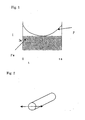
- Fig. 1 is a graph showing the metal content distribution in the metal compound-loading refractory inorganic oxide carrier, and this indicates the data of linear analysis obtained through EPMA of the metal atom in one example of the carrier of the invention.
- the graph shows the relationship between the length, t, of the cross section in the cross direction of the carrier and the X-ray intensity, I.
- Fig. 2 is a perspective view showing one example of the metal compound-loading refractory inorganic oxide carrier used in EPMA. In this, the arrow indicates the direction for linear analysis of the metal atom in the carrier.
- the refractory inorganic oxide carrier for use herein includes alumina, silica, silica-alumina, magnesia, zirconia, titania, zinc oxide, crystalline aluminosilicates, clay minerals and their mixtures. Above all, preferred is ⁇ -alumina. For use for hydrocracking of hydrocarbons, preferred is a mixture of ⁇ -alumina and crystalline aluminosilicate.
- titanium-peroxohydroxycarboxylic acid or its ammonium salt as it facilitates the introduction of titanium into the carrier.
- the hydroxycarboxylic acid includes citric acid, malic acid, lactic acid and tartaric acid.
- the amount of the metal compound to be carried by the refractory inorganic oxide carrier preferably falls, in terms of its oxide, between 1 and 30 % by weight, more preferably between 2 and 15 % by weight of the carrier. If its amount is too small, the metal could not satisfactorily exhibit its effect; but if too large, the excess metal will agglomerate and could not disperse in good condition.
- the carrier (B2) was prepared in the same manner as in Example 2. 50 cc of the impregnation solution (S1) was metered, to which was added 6 g of polyethylene glycol (molecular weight: 400). Then, this was diluted with pure water to be comparable to the water absorption of the carrier (B2). 100 g of the carrier (B2) was soaked with the thus-diluted impregnation solution (S1) under atmospheric pressure, then dried in vacuum at 70°C for 1 hour, and thereafter heated at 120°C for 3 hours and then at 500°C for 3 hours. This is catalyst 3. Its composition and physical properties are shown in Table 1.
Landscapes
- Chemical & Material Sciences (AREA)
- Engineering & Computer Science (AREA)
- Chemical Kinetics & Catalysis (AREA)
- Organic Chemistry (AREA)
- Oil, Petroleum & Natural Gas (AREA)
- Materials Engineering (AREA)
- General Chemical & Material Sciences (AREA)
- Catalysts (AREA)
- Production Of Liquid Hydrocarbon Mixture For Refining Petroleum (AREA)
Abstract
Description
- The present invention relates to a hydrogenation catalyst for hydrocarbon oil and a method of hydrogenation of hydrocarbon oil, in particular to a hydrogenation catalyst effective as a hydro-desulfurization catalyst, a hydro-denitrogenation catalyst and a hydro-dearomatization catalyst for hydrocarbon oil that includes gas oil, kerosene and other fractions, and also to a method of hydrogenation of such hydrocarbon oil.
- The recent global destruction of the environment is a matter of grave concern. In particular, nitrogen oxides (NOx) and sulfur oxides (SOx) released in air from burning fossil fuel such as coal and oil produce acid rain and acid fog which seriously destroy the environment of forests, lakes, marshes, etc. Above all, SOx are serious. SOx could be reduced in some degree by post-treatment, but it is important to efficiently remove sulfur from fuel oil. From the viewpoint of the protection of the environment, the regulation of gas oil in point of its sulfur content is much intensified, for which it is desired to develop a hydrogenation catalyst having a higher desulfurization activity.
- Heretofore, a catalyst prepared from cobalt and molybdenum supported on a refractory inorganic oxide carrier such as alumina has been used for hydro-desulfurization of gas oil. It is known that the desulfurization activity of the catalyst significantly depends on the condition of the active metal, molybdenum therein. For improving the state of molybdenum on the catalyst, other carriers than alumina and alumina compounded oxide carriers have been investigated for the catalyst. Of these, it is known that a titania component improves the desulfurization activity of the catalyst. A method of applying titanium to an alumina carrier; and a method of co-precipitating alumina and titania are known.
- Heretofore used are catalysts having an active metal of, for example, cobalt, nickel, molybdenum or tungsten supported on a refractory inorganic oxide carrier such as alumina. For improving the activity of the catalysts, methods of using an additional metal component, titanium have been proposed (Applied Catalysis, 63 (1990) 305-317; Japanese Patent Laid-Open No.
106061/1994 - For shaped articles of refractory inorganic oxides, heretofore known are extrusion moldings, spherical articles and honeycomb articles. In case where these shaped articles are used as carriers specifically for catalysts and adsorbents, generally employed is a method of applying thereto an active ingredient, an ingredient serving as a catalyst promoter to accelerate the activity or an ingredient for promoting adsorption, and a third ingredient for controlling the properties of the shaped article serving as a carrier.
- In the system of the above where the reaction and adsorption to be occurred not only on the outer surface of the shaped article but also even inside the pores of the shaped article is an extremely important factor, the technique of uniformly introducing the ingredient participating in the reaction and adsorption into the deep inside of the shaped article is a matter of great importance.
- However, to the case where the interaction between the ingredient and the shaped article serving as a carrier is extremely strong, a problem will occur that the ingredient is held only on the outer surface of the shaped article and could not uniformly penetrate into the pores existing inside the shaped article.
- Concretely, the problem is as follows: When a metal compound to be carried by a refractory inorganic oxide carrier is applied to the carrier by impregnation method using the metal compound solution, and if the interaction between the metal compound and the carrier is strong, the carrier strongly adsorbs the metal compound or the metal compound is rapidly hydrolyzed on the carrier, and, as a result, the metal compound is held only on the outer surface of the shaped article, carrier and could not uniformly penetrate into the pores existing inside the shaped article.
- Therefore, in the conventional method, the active ingredient is held only on the outer surface of the refractory inorganic oxide carrier, and could not effectively exhibit its ability expected for the intended reaction. In addition, another problem with the method is that the active ingredient, if segregated only on the outer surface of the shaped article, carrier, interferes with the diffusion of the reaction product into the pores inside the carrier.
- For applying titanium to an alumina .carrier, investigated are (1) a method of impregnation of alumina with an aqueous solution of titanium tetrachloride, (2) a method of impregnation of alumina with an isopropanol solution of titanium isopropoxide (Applied Catalysis, 63 (1990) 305-317), and (3) a method of chemical vapor deposition of a vapor of saturated titanium tetrachloride onto alumina under heat (Japanese Patent Laid-Open No.
106061/1994 - Both the method of applying titanium to an alumina carrier and the method of co-precipitating alumina and titania mentioned above include a step of applying an active metal of Group 6 and an active metal of Groups 8 to 10 of the Periodic Table to the carrier followed by calcining the metal-loading catalyst at a high temperature of around 500°C or so, in which the active metals on the titania often agglomerate. This is problematic, as lowering the catalyst activity.
- The method (2) requires the alcohol and is therefore uneconomical as the alcohol used must be recovered therein. The method (3) differs from ordinary impregnation methods where a solution is used. In this, a vapor of the starting material for the active ingredient is introduced into the reaction system, in which the vapor introduced is decomposed and deposited on the carrier having been controlled at a certain temperature. Therefore, this will require a complicated and troublesome apparatus for temperature control and process control. In addition, in this, chlorine deposits on the carrier and will produce hydrogen chloride gas when the refractory inorganic oxide carrier is processed at a high temperature in a reducing atmosphere, and the hydrogen chloride is troublesome as it corrodes the apparatus used.
- On the other hand, the method of co-precipitating alumina and titania is uneconomical, since the titania could not sufficiently exhibit its effect if its amount is not large, for example, if smaller than 15 % by weight.
- In the methods (1) and (2), the active ingredient could not uniformly penetrate into the pores inside the shaped article of alumina, and therefore could not satisfactorily exhibit its effect. The method (3) differs from ordinary impregnation methods where a solution is used. In this, a vapor of the starting material for the active ingredient is introduced into the reaction system, in which the vapor introduced is decomposed and deposited on the carrier having been controlled at a certain temperature. Therefore, this will require a complicated and troublesome apparatus for temperature control and process control. In addition, in this, chlorine deposits on the carrier and will produce hydrogen chloride gas when the refractory inorganic oxide carrier is processed at a high temperature in a reducing atmosphere, and the hydrogen chloride is troublesome as it corrodes the apparatus used.
- The preparation of hydrogenation catalysts is described in
US 5,891,821 A . The preparation does not involve a double impregnation. A carrier is intended to be impregnated with one single impregnation solution, containing a group 4 metal compound, a group 6 metal compound and a group 8 metal compound in one impregnation solution. A water-soluble amine shall be present which stabilizes the solution and a basic pH makes the addition of titanium possible, this teaching emphasizing the presence of titanium besides the other metal compounds. - The catalysts described by Wei et al (in: Applied catalysis A: General 1998, 167: 39-48) are prepared according to section "Preparation of catalyst" in a double impregnation procedure. A first impregnation with a titanium compound is followed by a second impregnation with nickel and molybdenum compounds. This preparation involves the impregnation in the first step of a titanium compound in either an ethanol or an isopropanol solution. After the second impregnation the catalyst is dried at 120°C overnight and then calcined at 500°C for 4h.
- The preparation which is described in
US 5,190,642 A relates to a two step impregnation with a first impregnation with solution of a group 4 metal compound and a group 8 metal compound and a subsequent impregnation with a group 6 metal compound. The example 3 of the document describes a first treatment with a solution of a titanium compound and a nickel compound, followed after 10 minutes by the addition of the molybdenum compound. -
EP A 0 239 056 contains a description of the preparation of catalysts through the impregnation of a carrier with a first solution of a titanium compound, followed by a second impregnation with a molybdenum compound. - The present invention has been made in consideration of the above-mentioned matters, and its object is to provide a hydrogenation catalyst having higher desulfurization activity, denitrogenation activity and dearomatization activity, to provide a method of using the catalyst for hydrogenation of hydrocarbon oil, and to provide a metal compound-loading refractory inorganic oxide carrier in which the metal exists uniformly everywhere inside it.
- We, the present inventors have assiduously studied, and, as a result, have found that, when a solution containing a water-soluble titanium compound is impregnated on a refractory inorganic oxide carrier it carries the metal compound, and further an aqueous solution containing at least one metal compound of Group 6 and at least one metal compound of Groups 8 to 10 of the Periodic Table is impregnated on the resulting carrier so that it further carries the metal compounds, and thereafter this is heated at a temperature of between so and 150°C, then the object of the invention can be effectively attained. In addition, we have further found that, when an aqueous solution that contains a water-soluble organic compound having a boiling point or a decomposition point of not lower than 150°C is impregnated on a refractory inorganic oxide carrier, and dried, and thereafter a solution of a metal compound further is impregnated, then the metal can uniformly penetrate to the depths of the carrier and the metal compound-loading refractory inorganic oxide carrier can also effectively attain the object of the invention. On the basis of these findings, we have completed the present invention.
- Specifically, the invention is summarized as follows:
- 1. A hydrogenation catalyst for hydrocarbon oil, which is produced by a process consisting of the following steps:
- impregnating a refractory inorganic oxide carrier with an aqueous solution containing a water-soluble titanium compound so that it carries the titanium compound,
- drying the impregnated carrier at a temperature between 50 and 150°C under atmospheric pressure or under reduced pressure for a period of time falling between 0.5 and 100 hours, whereby the carrier is optionally washed with water or with water that contains ammonia or ammonium carbonate before drying,
- optionally calcining the dried carrier at a temperature between 400 and 650°C, wherein water vapor is added to the air atmosphere in which the carrier is calcined and optionally washing the carrier with water or with water containing ammonia or ammonium carbonate after it has been calcined, the washing step followed by drying,
- then further impregnating with an aqueous solution containing at least one metal compound of Group 6 and at least one metal compound of Groups 8 to 10 of the Periodic Table so that it carries the metal compounds,
- heating the impregnated carrier at a temperature of between 80 and 150°C, and
- pre-sulfurizing the heated impregnated carrier at a temperature of between 200 and 400°C under the pressure of from atmospheric pressure to 30MPa.
- 2. The hydrogenation catalyst for hydrocarbon oil of above 1, wherein the titanium compound is a salt of a titanium-peroxohydroxyl-carboxylic acid.
- 3. A method of hydrogenation of hydrocarbon oil, in which is used the hydrogenation catalyst of above 1 or 2.
-
-
Fig. 1 is a graph indicating the data of linear analysis obtained through EPMA of the metal atom in one example of the metal compound-loading refractory inorganic oxide carrier , and this shows the relationship between the length, t, of the cross section in the cross direction of the carrier and the X-ray intensity, I. -
Fig. 2 is a perspective view showing one example of the metal compound-loading refractory inorganic oxide carrier used in EPMA. In this, the arrow indicates the direction for linear analysis of the metal atom in the carrier. - The invention is described in detail hereinunder.
- The invention is a hydrogenation catalyst for hydrocarbon oil, which is produced by impregnating a refractory inorganic oxide carrier with a solution containing a water-soluble titanium compound so that it carries the titanium compound, then further impregnating with an aqueous solution containing at least one metal compound of Group 6 and at least one metal compound of Groups 8 to 10 of the Periodic Table so that it carries the metal compounds, and thereafter heating it at a temperature of between 80 and 150°C.
- The refractory inorganic oxide carrier for use in the invention includes alumina, silica, silica-alumina, magnesia, zinc oxide, crystalline aluminosilicates, clay minerals and their mixtures. Above all, preferred is alumina, and more preferred is γ-alumina. Preferably, the mean pore size of the carrier falls between 50 and 150 angstroms, more preferably between 60 and 140 angstroms. Regarding its morphology, the carrier may be powdery, or may be shaped to have, for example, a columnar, three-leaved or four-leaved pellet.
- Preferred examples of the water-soluble titanium compound are water-soluble titanium compounds , such as titanium sulfate, titanium chloride, titanium peroxide, titanium oxalate, titanium acetate.
- For applying the titanium compound to the carrier, employable is a method of preparing a solution of the titanium compound in such a controlled manner that the amount of the solution is enough for the carrier to absorb the solution, and impregnating the carrier with the solution (pore-filling method); or a method of dipping the carrier in a large excessive amount of a solution of the titanium compound. Dipping the carrier in the solution of the titanium compound may be effected under atmospheric pressure or under reduced pressure.
- To prepare the impregnation solution, the titanium compound is dissolved in water, or in an aqueous hydrochloric acid or sulfuric acid solution, and is stabilized therein. For the water-soluble titanium compound for titanium to be impregnated, especially preferred is a titanium-peroxohydroxycarboxylic acid or its ammonium salt, as it facilitates the introduction of titanium into the carrier. The hydroxycarboxylic acid includes citric acid, malic acid, lactic acid and tartaric acid.
- The amount of the titanium to be supported by the refractory inorganic oxide carrier preferably falls, in terms of its oxide, between 0.5 and 30 % by weight, more preferably between 1 and 15 % by weight of the carrier. If its amount is too small, the titanium could not satisfactorily exhibit its effect; but if too large, the titanium compound impregnation solution is thick and unstable and the titanium will segregate or agglomerate on the carrier, and therefore it is unfavorable.
- After having been soaked with a impregnation solution of the titanium compound, the carrier is dried under atmospheric pressure or under reduced pressure, at a temperature falling between 50 and 150°C, preferably between 100 and 120°C, for a period of time falling between 0.5 and 100 hours so as to remove water from it. Further, in order to enhance the bonding force of the compound to the carrier, e.g., alumina carrier, the carrier is optionally calcined. The temperature for calcination falls between 400 and 650°C, preferably between 450 and 600°C; and the calcination time generally falls between 0.5 and 100 hours.
- In case where the titanium compound solution contains anions of sulfate or chloride, it is desirable that the amount of the anions therein is at most 5 % by weight, in order that the dispersion of the active titanium becomes higher on the carrier in the next step and that the activity of the catalyst is higher. For this, water vapor is added to the air atmosphere in which the carrier is calcined, or the carrier is washed with water or with water that contains ammonia or ammonium carbonate, before it is dried or after it has been calcined. When the carrier is washed after calcined, it must be again dried.
- Finally, at least one of active metal compound of Group 6 and at least one active metal compound of Groups 8 to 10 of the Periodic table, and optionally a phosphorus compound are applied to the carrier.
- The metal of Group 6 of the Periodic Table is preferably molybdenum or tungsten, more preferably molybdenum. The molybdenum compound includes, for example, molybdenum trioxide, and ammonium para-molybdate. The tungsten compound includes, for example, tungsten trioxide, and ammonium tungstate. The amount of the metal to be loaded on the carrier preferably falls, in terms of its oxide, between 4 and 40 % by weight, more preferably between 8 and 35 % by weight of the catalyst.
- The metal of Groups 8 to 10 of the Periodic Table is generally cobalt or nickel. The nickel compound for use herein includes, for example, nickel nitrate and nickel carbonate; and the cobalt compound includes, for example, cobalt nitrate and cobalt carbonate. The amount of the metal to be loaded on the carrier preferably falls, in terms of its oxide, between 1 and 12 % by weight, more preferably between 2 and 10 % by weight of the catalyst.
- The phosphorus compound for use herein includes, for example, phosphorus pentoxide and ortho-phosphoric acid. The amount of the compound to be loaded on the carrier preferably falls, in terms of its oxide, between 0.5 and 8 % by weight, more preferably between 1 and 6 % by weight of the catalyst.
- The active metal compounds are applied to the carrier by impregnating the carrier with their solutions. The carrier may be soaked by sequential impregnation with different solutions of the three groups of the metal compound of Group 6 of the Periodic Table, the metal compound of Groups 8 to 10 of the Periodic Table, and the phosphorus compound, but is preferably soaked by co-impregnation with one solution containing all the compounds. The metal compounds are dissolved in pure water in such a ratio that the metal of Group 6 of the Periodic Table is from 0.7 to 7.0 mols/liter, the metal of Groups 8 to 10 of the Periodic Table is from 0.3 to 3.6 mols/liter, and the phosphorus compound is from 0 to 2.2 mols/liter, and the amount of the resulting solution is so controlled that it is equivalent to the water absorption of the carrier. With that, the carrier is soaked with the impregnation solution. When the impregnation solution is acidic, its pH generally falls between 1 and 4, preferably between 1.5 and 3.5, in consideration of the stability of the impregnation solution. When the solution is alkaline, its pH generally falls between 9 and 12, preferably between 10 and 11. The method of pH control of the solution is not specifically defined. In general, an inorganic acid such as nitric acid, hydrochloric acid or sulfuric acid, or an organic acid such as malic acid, citric acid or - ethylenediamine-tetraacetic acid, or ammonia is added to the solution.
- Preferably, a water-soluble organic compound is added to the impregnation solution stabilized with a phosphorus compound.
- The water-soluble organic compound includes, for example, diols such as 1,3-butanediol, 1,4-butanediol, butanetriol, 1,2-propanediol, 1,2-pentanediol; iso-alcohols having at least 4 carbon atoms, such as 5-methyl-1-hexanol, isoamyl alcohol (3-methyl-1-butanol), s-isoamyl alcohol (3-methyl-2-butanol), isoundecylene alcohol, isooctanol, isopentanol, isogeranol, isohexyl alcohol, 2,4-dimethyl-1-pentanol, 2,4,4-trimethyl-1-pentanol; alcohols having at least 5 carbon atoms and having a hydroxyl group bonded to the carbon except the terminal carbon, such as 2-hexanol, 3-hexanol; ether group-containing water-soluble polymers such as polyethylene glycol, polyoxyethylene phenyl ether, polyoxyethylene octylphenyl ether; water-soluble polymers such as polyvinyl alcohol; saccharides such as saccharose, glucose; water-soluble polysaccharides such as methyl cellulose, water-soluble starch; and their derivatives. One or more of these compounds may be added to the impregnation solution, either singly or as combined.
- The amount of the water-soluble organic compound to be added to the carrier preferably falls between 2 and 20 % by weight, more preferably between 3 and 15 % by weight of the carrier.
- After having been prepared by the impregnation, the resulting catalyst is heated for more stably fixing the active metals to the carrier. The temperature for the heat treatment is between 80 and 150°C. If the temperature for the heat treatment is too high, the components held on the carrier will agglomerate and will fail to have high activity; but if too low, the components could not be firmly held on the carrier and will fail to have high activity. The heat treatment is effected in air, and generally takes from 3 to 16 hours.
- The mean pore diameter of the catalyst obtained in the manner as above generally falls between 40 and 140 angstroms, preferably between 60 and 130 angstroms; and the specific surface area thereof generally falls between 120 and 400 m2/g, preferably between 140 and 350 m2/g. The total pore volume of the catalyst generally falls between 0.2 and 1.0 cc/g, preferably between 0.25 and 0.9 cc/g.
- The mean pore diameter and the total pore volume are measured according to a method of mercury penetration; and the specific surface area is measured according to a method of nitrogen adsorption.
- Another aspect of the invention is a method of using the catalyst for hydrogenation of hydrocarbon oil.
- Prior to being used for hydrogenation, the catalyst is pre-sulfurized for stabilizing it. The condition for pre-sulfurization is not specifically defined. In general, hydrogen sulfide, carbon disulfide, thiophene or dimethyl disulfide is used as a pre-sulfurizing agent. The temperature for the treatment falls between 200 and 400°C; and the pressure falls between atmospheric pressure and 30 MPa.
- The condition for hydrogenation varies, depending on the type of the oil to be processed and on the use of the processed oil. In general, the reaction temperature falls between 200 and 550°C, preferably between 220 and 500°C; and the hydrogen partial pressure falls between 1 and 30 MPa, preferably between 2 and 25 MPa.
- The reaction mode is not specifically defined. In general, it may be selected from various processes using a fixed bed, a moving bed, an ebullient bed or a suspensoid bed. Preferred is a fixed bed process. The mode of passing the feed oil through the bed may be any of down-flow and up-flow.
- Regarding the reaction condition for the fixed bed process, except the temperature and the pressure, the liquid hourly space velocity (LHSV) falls generally between 0.05 and 10 hr-1, preferably between 0.1 and 5 hr-1, and the ratio of hydrogen/crude oil falls generally between 150 and 2,500 Nm3/kl, preferably between 200 and 2,000 Nm3/kl.
- The hydrocarbon oil to be processed herein may be any and every petroleum fraction. Concretely, it broadly includes kerosene, light gas oil, heavy gas oil, cracked gas oil, as well as atmospheric residue, vacuum residue, dewaxed vacuum residue, asphaltene oil, and tar sand oil. The invention is especially effective for reducing the sulfur content of gas oil to 50 ppm or less.
- The titanium compound-loading refractory inorganic oxide carrier (this will be hereinafter referred to as "carrier") is produced by impregnating a refractory inorganic oxide carrier with a titanium compound and therefore carries the titanium of the titanium compound. In the carrier, the titanium exists uniformly everywhere inside it. The specific condition of the carrier can be identified by various methods of analyzing the carrier. In the present case, this is analyzed through EPMA of the carrier.
-
Fig. 1 is a graph showing the metal content distribution in the metal compound-loading refractory inorganic oxide carrier, and this indicates the data of linear analysis obtained through EPMA of the metal atom in one example of the carrier of the invention. The graph shows the relationship between the length, t, of the cross section in the cross direction of the carrier and the X-ray intensity, I.Fig. 2 is a perspective view showing one example of the metal compound-loading refractory inorganic oxide carrier used in EPMA. In this, the arrow indicates the direction for linear analysis of the metal atom in the carrier. - The carrier is described in more detail with reference to
Fig. 1 and Fig. 2 . Herein referred to is one columnar example of the metal compound-loading refractory inorganic oxide carrier, as inFig. 2 . The columnar carrier is subjected to linear analysis through EPMA in the direction of the line on the cross section of the carrier that is parallel to the bottom surface thereof, as illustrated. The graph ofFig. 1 shows the data of the linear analysis, in which the horizontal axis indicates the length, t, of the cross section in the cross direction of the carrier (that is, "t" is the distance from one surface of the carrier), and the vertical axis indicates the X-ray intensity, I (that is, "I" means the metal atom concentration in the carrier), and the graph shows the relationship between "t" and "I". The carrier satisfies the ratio, x = Fm/F, of being at least 0.5, in which "F" indicates the integral value of the X-ray intensity I(t) with t being the distance between one surface of the carrier (t = 0) and the other surface thereof (t = to) , and Fm indicates the integral value of the X-ray intensity Im(t) on the line tangential to the X-ray intensity curve at the minimum and smallest point of the curve, with t being also the same distance as above, between (t = 0) and (t = t0). If the ratio, x, is smaller than 0.5, the condition of the metal compound carried by the carrier is not uniform, and the carrier thus carrying the metal compound in such a non-uniform condition could not exhibit high desulfurization activity. From this viewpoint, the ratio, x, of the carrier must be at least 0.5. The linear analysis herein mentioned can apply to any carrier of any shape, and every carrier having the specifically defined ratio, x, exhibits the specific effect of the invention. - Next described is a method for producing the metal compound-loading refractory inorganic oxide carrier . The carrier is produced by dipping a refractory inorganic oxide carrier in an aqueous solution that contains a water-soluble organic compound having a boiling point or a decomposition point of not lower than 150°C, then drying it, and thereafter further impregnating with a solution of a metal compound.
- The refractory inorganic oxide carrier for use herein includes alumina, silica, silica-alumina, magnesia, zirconia, titania, zinc oxide, crystalline aluminosilicates, clay minerals and their mixtures. Above all, preferred is γ-alumina. For use for hydrocracking of hydrocarbons, preferred is a mixture of γ-alumina and crystalline aluminosilicate.
- Concretely, the metal compound includes titanium sulfate, titanium chloride, titanium peroxide, titanium oxalate, titanium acetate.
- Also preferred are metal alkoxides. Concretely, they include tetra-n-isopropoxy-titanium, ethylacetoacetate-titanium, tetra-n-butoxy-titanium, tetramethoxy-titanium.
- For the titanium compound for titanium to be impregnated, especially preferred is a titanium-peroxohydroxycarboxylic acid or its ammonium salt, as it facilitates the introduction of titanium into the carrier. The hydroxycarboxylic acid includes citric acid, malic acid, lactic acid and tartaric acid. The amount of the metal compound to be carried by the refractory inorganic oxide carrier preferably falls, in terms of its oxide, between 1 and 30 % by weight, more preferably between 2 and 15 % by weight of the carrier. If its amount is too small, the metal could not satisfactorily exhibit its effect; but if too large, the excess metal will agglomerate and could not disperse in good condition.
- The invention is described more concretely with reference to the following Examples, which, however, are not intended to restrict the scope of the invention.
- 100 g of a γ-alumina carrier (A1) having a water absorption of 0.8 cc/g was soaked with 52.9 g of an aqueous 30 wt.% titanium sulfate solution (this was previously diluted with pure water to be comparable to the water absorption of the carrier) under atmospheric pressure, then dried in vacuum at 70°C for 1 hour and thereafter in a drier at 120°C for 3 hours, and calcined at 500°C for 4 hours to prepare a carrier (B1).
- The amount of the sulfate (SO4 2-) remaining in the carrier was measured with LECO (high-frequency combustion IR detector), and it was not smaller than 5 % by weight of the carrier. Therefore, the carrier B1 was put into a 2-liter beaker, to which was added one liter of pure water. This was stirred with a stirring blade to wash it, and poured along with the pure water onto a sieve, of which the mesh size is smaller than the size of the carrier particles. This operation was repeated three times, and the amount of the sulfate remaining in the carrier was reduced to 2 % by weight. Next, this was dried at 120°C for 5 hours to remove water.
- Next, 69.5 g of nickel carbonate (corresponding to 39.7 g of NiO), 220 g of molybdenum trioxide, and 31.5 g of ortho-phosphoric acid (purity: 85 %, corresponding to 19.5 g of P2O5) were added to 250 cc of pure water, and dissolved therein with stirring at 80°C. Then, this was cooled to room temperature, and pure water was added thereto to make 250 cc in total. This is a impregnation solution (S1).
- 50 cc of the impregnation solution (S1) was metered, to which was added 6 g of polyethylene glycol (molecular weight: 400). Then, this was diluted with pure water to be comparable to the water absorption of the carrier (B1). 100 g of the carrier (B1) was soaked with the thus-diluted impregnation solution (S1) under atmospheric pressure, then dried in vacuum at 70°C for 1 hour, and thereafter heated at 120°C for 16 hours. This is catalyst 1. Its composition and physical properties are shown in Table 1.
- 500 g of titanium tetrachloride and one liter of pure water were kept cooled with ice. With the pure water being stirred, the titanium tetrachloride was gradually dropwise added thereto while it was still cooled. This greatly generated heat and produced white smoke, and then gave colorless titania sol. 1.2 times equivalent, to the titania sol, of aqueous ammonia (concentration: 1 mol/liter) was dropwise added to the titania sol, and stirred for 1 hour, and titanium hydroxide gel was thus formed. The gel was taken out through filtration under suction, and again dispersed in about 1 liter of pure water, and washed through filtration. This operation was repeated 4 times until the wash waste became neutral, whereby the chloride was removed from the gel.
- The water content of the thus-obtained titanium hydroxide gel was measured, and 11 g, in terms of titania, of the gel was metered. 50 cc of aqueous 25 wt.% ammonia was added thereto, and stirred for 30 minutes. Then, 38 cc of aqueous 30 wt.% hydrogen peroxide was gradually added thereto to give an yellow titanium-peroxotitanium solution. 29 g of citric acid was gradually added to this, and then gradually heated up to 50°C with stirring to remove the excess hydrogen peroxide. This was further heated up to 80°C, at which a complex was formed and completely dissolved. Next, this was concentrated to be 117 cc of an orange transparent solution. This is ammonium titanium-peroxocitrate (T1).
- 100 g of a γ-alumina carrier (A1) having a water absorption of 0.8 cc/g was soaked with 60 cc of the aqueous solution of T1 (this was previously diluted with pure water to be comparable to the water absorption of the carrier) under atmospheric pressure, then dried in vacuum at 70°C for 1 hour and thereafter in a drier at 120°C for 3 hours, and calcined at 500°C for 4 hours to prepare a carrier (B2).
- Next, 50 cc of the impregnation solution (S1) that had been prepared in Example 1 was metered, to which was added 6 g of polyethylene glycol (molecular weight: 400). Then, this was diluted with pure water to be comparable to the water absorption of the carrier (B2). 100 g of the carrier (B2) was soaked with the thus-diluted impregnation solution (S1) under atmospheric pressure, then dried in vacuum at 70°C for 1 hour, and thereafter heated at 120°C for 16 hours. This is catalyst 2. Its composition and physical properties are shown in Table 1.
- The carrier (B2) was prepared in the same manner as in Example 2. 50 cc of the impregnation solution (S1) was metered, to which was added 6 g of polyethylene glycol (molecular weight: 400). Then, this was diluted with pure water to be comparable to the water absorption of the carrier (B2). 100 g of the carrier (B2) was soaked with the thus-diluted impregnation solution (S1) under atmospheric pressure, then dried in vacuum at 70°C for 1 hour, and thereafter heated at 120°C for 3 hours and then at 500°C for 3 hours. This is catalyst 3. Its composition and physical properties are shown in Table 1.
- 50 cc of the impregnation solution (S1) that had been prepared in Example 1 was metered, to which was added 6 g of polyethylene glycol (molecular weight: 400). Then, this was diluted with pure water to be comparable to the water absorption of a γ-alumina carrier (A1) having a water absorption of 0.8 cc/g. 100 g of the carrier (A1) was soaked with the thus-diluted impregnation solution (S1) under atmospheric pressure, then dried in vacuum at 70°C for 1 hour, and thereafter heated at 120°C for 16 hours. This is catalyst 4. Its composition and physical properties are shown in Table 1.
- The active metals were applied to the carrier in the same manner as in Example 1. Then, this was dried in vacuum at 70°C for 1 hour, and thereafter heated at 120°C for 3 hours and then 500°C for 3 hours. This is catalyst 5. Its composition and physical properties are shown in Table 1.
- 15 liters of pure water at 60°C was put into a hot stirrer, to which were added sodium aluminate and sodium hydroxide to make an Al2O3 concentration of 8.0 % by weight and an NaOH concentration of 3.5 % by weight, respectively. Then, this was heated at 60°C to be a solution A. On the other hand, 15 liters of pure water was put into another hot stirrer, to which were added an aqueous titanium sulfate solution and an aqueous aluminium sulfate solution to make a TiO2 concentration of 0.6 % by weight and an Al2O3 concentration of 3.0 % by weight, respectively. This was heated at 60°C to be a solution B. The solution B was added to the solution A, and its pH was made 7 to produce a gel of titania-alumina co-precipitate hydrate. This was aged at 60°C for 1 hour. Next, this was washed on a filter with 70 times the gel of aqueous 0.3 wt.% ammonia added thereto. Pure water was added to the resulting residue to thereby make the residue have a solid content of 12 % by weight. With aqueous ammonia added thereto, the pH of the residue was made 11, and this was aged in a hot stirrer at 90°C for 13 hours. Next, this was again filtered, then washed with 10 times the residue of pure water, and thereafter dried at 80°C while stirred. This was shaped into 1. 58 mm columnar pellets through an extruder, then dried at 120°C for 15 hours, and thereafter calcined at 500°C for 4 hours. This is titania-alumina carrier (B3).
- Next, 50 cc of the impregnation solution (S1) that had been prepared in Example 1 was metered, to which was added 6 g of polyethylene glycol (molecular weight). Then, this was diluted with pure water to be comparable to the water absorption of the titania-alumina carrier (B3) having a water absorption of 0.7 cc/g. 100 g of the carrier (B3) was soaked with the thus-diluted impregnation solution (S1) under atmospheric pressure, then dried in vacuum at 70°C for 1 hour, and thereafter heated at 120°C for 16 hours. This is catalyst 6. Its composition and physical properties are shown in Table 1.
- 100 cc of any of catalysts 1 to 5 was filled into the reactor tube of a fixed bed flow system. Along with hydrogen gas, feed oil was introduced into the reactor tube from its bottom to thereby make it flow upward in the system in a mode of up-flow, and its reactivity with the catalyst was evaluated. Prior to this, feed oil (straight-run light gas oil (LGO) from the Middle East), of which the properties are shown in Table 2, was pre-treated with dimethyl disulfide added thereto, thereby having a sulfur content of 2.5 % by weight. Along with hydrogen gas, the pre-treated crude oil was introduced into the system at 290°C for 24 hours, to thereby pre-sulfurize the catalyst. After the catalyst was thus pre-sulfurized, crude oil (straight-run light gas oil (LGO) from the Middle East) of the same type as above was, along with hydrogen gas, introduced into the reactor tube, and hydrogenated. The reaction temperature was from 330 to 360°C; the hydrogen partial pressure was 5 MPa; the ratio of hydrogen/crude oil was 250 Nm3/kl; and LHSV was 1.5 hr-1. The data measured at 330 to 360°C were used to obtain the average desulfurization rate constant of each catalyst. Based on this, the relative desulfurization activity of each catalyst was obtained, relative to the desulfurization activity based on the averaged desulfurization rate constant of the catalyst of Comparative Example 2 (catalyst 4) of being 100, and shown in Table 3.
Table 2 Specific Gravity (15/4°C) 0.8544 Sulfur Content wt.% 1.3 Nitrogen Content ppm 90 Total Volume of Aromatics % mono-cyclic aromatics 15.1 2-cyclic and more multi-cyclic aromatics 12.4 Distillation Characteristics °C initial boiling point 200 90 % point 365 end point 390 Table 3 Catalyst Relative Desulfurization Activity Example 1 Catalyst 1 150 Example 2 Catalyst 2 151 Comparative Example 1 Catalyst 3 128 Comparative Example 2 Catalyst 4 100 Comparative Example 3 Catalyst 5 110 Comparative Example 4 Catalyst 6 105 - The hydrogenation catalyst of the invention has improved and higher desulfurization activity, denitrogenation activity and dearomatization activity than conventional catalysts, and are effective for hydrogenation of hydrocarbon oil, especially gas oil. In the metal compound-loading refractory inorganic oxide carrier, the metal exists uniformly everywhere inside it, and the value x of the carrier measured through EPMA is at least 0.5. Therefore, when the carrier carries active metals to be a hydrogenation catalyst, the catalyst has high desulfurization activity.
Claims (3)
- A hydrogenation catalyst for hydrocarbon oil, which is produced by a process consisting of the following steps:- impregnating a refractory inorganic oxide carrier with an aqueous solution containing a water-soluble titanium compound so that it carries the titanium compound,- drying the impregnated carrier at a temperature between 50 and 150°C under atmospheric pressure or under reduced pressure for a period of time falling between 0.5 and 100 hours, whereby the carrier is optionally washed with water or with water that contains ammonia or ammonium carbonate before drying,- optionally calcining the dried carrier at a temperature between 400 and 650°C, wherein water vapor is added to the air atmosphere in which the carrier is calcined and optionally washing the carrier with water or with water containing ammonia or ammonium carbonate after it has been calcined, the washing step followed by drying,- then further impregnating with an aqueous solution containing at least one metal compound of Group 6 and at least one metal compound of Groups 8 to 10 of the Periodic Table so that it carries the metal compounds,- heating the impregnated carrier at a temperature of between 80 and 150°C, and- pre-sulfurizing the heated impregnated carrier at a temperature of between 200 and 400°C under the pressure of from atmospheric pressure to 30MPa.
- The hydrogenation catalyst for hydrocarbon oil as claimed in claim 1, wherein the titanium compound is a salt of a titanium-peroxohydroxyl-carboxylic acid.
- A method of hydrogenation of hydrocarbon oil, in which is used the hydrogenation catalyst of claim 1 or 2.
Applications Claiming Priority (9)
| Application Number | Priority Date | Filing Date | Title |
|---|---|---|---|
| JP30576999 | 1999-10-27 | ||
| JP30576999 | 1999-10-27 | ||
| JP2000100286 | 2000-04-03 | ||
| JP2000100286A JP2001276626A (en) | 2000-04-03 | 2000-04-03 | Hydrotreating catalyst, method for producing the same, and method for hydrotreating hydrocarbon oil |
| JP2000117548 | 2000-04-19 | ||
| JP2000117548 | 2000-04-19 | ||
| JP2000123631A JP4916044B2 (en) | 2000-04-25 | 2000-04-25 | Hydrocarbon hydrotreating catalyst and hydrocarbon oil hydrotreating method |
| JP2000123631 | 2000-04-25 | ||
| PCT/JP2000/007276 WO2001030494A1 (en) | 1999-10-27 | 2000-10-19 | Hydrotreating catalyst for hydrocarbon oil, carrier for the same and method for hydrotreating of hydrocarbon oil |
Publications (3)
| Publication Number | Publication Date |
|---|---|
| EP1145763A1 EP1145763A1 (en) | 2001-10-17 |
| EP1145763A4 EP1145763A4 (en) | 2004-09-15 |
| EP1145763B1 true EP1145763B1 (en) | 2012-07-04 |
Family
ID=27479907
Family Applications (1)
| Application Number | Title | Priority Date | Filing Date |
|---|---|---|---|
| EP00969896A Expired - Lifetime EP1145763B1 (en) | 1999-10-27 | 2000-10-19 | Hydrotreating catalyst for hydrocarbon oil, carrier for the same and method for hydrotreating of hydrocarbon oil |
Country Status (4)
| Country | Link |
|---|---|
| US (1) | US7598203B2 (en) |
| EP (1) | EP1145763B1 (en) |
| DK (1) | DK1145763T3 (en) |
| WO (1) | WO2001030494A1 (en) |
Cited By (1)
| Publication number | Priority date | Publication date | Assignee | Title |
|---|---|---|---|---|
| CN106944099A (en) * | 2016-01-07 | 2017-07-14 | 中国石油化工股份有限公司 | A kind of preparation method of hydrotreating catalyst |
Families Citing this family (28)
| Publication number | Priority date | Publication date | Assignee | Title |
|---|---|---|---|---|
| CN103540333B (en) * | 2005-04-29 | 2016-12-28 | 奥特卡建设对外贸易有限公司 | Method and apparatus for converting organic material |
| AU2012202587B2 (en) * | 2005-04-29 | 2014-10-09 | Altaca Insaat Ve Dis Ticaret A.S. | Method and apparatus for converting organic material |
| US8883669B2 (en) | 2005-04-29 | 2014-11-11 | China Petroleum & Chemical Corporation | Hydrocracking catalyst, a process for producing the same, and the use of the same |
| CN100425676C (en) * | 2005-04-29 | 2008-10-15 | 中国石油化工股份有限公司 | Hydrogenation cracking catalyst composition |
| PL1879981T3 (en) | 2005-04-29 | 2015-01-30 | Altaca Insaat Ve Dis Ticaret A S | Method for converting organic material into hydrocarbon fuels |
| WO2007059783A1 (en) * | 2005-11-24 | 2007-05-31 | Scf Technologies A/S | Method and apparatus for converting organic material using microwave excitation |
| MXPA05012893A (en) * | 2005-11-29 | 2007-11-23 | Mexicano Inst Petrol | Catalyst for the hydrodesulfurization of residues and heavy crudes. |
| WO2009105749A2 (en) | 2008-02-21 | 2009-08-27 | Saudi Arabian Oil Company | Catalyst to attain low sulfur gasoline |
| CA2752017C (en) * | 2009-02-26 | 2016-09-20 | Sasol Technology (Proprietary) Limited | Process for the preparation of fischer-tropsch catalysts and their use |
| CN102639237A (en) | 2009-08-24 | 2012-08-15 | 阿尔比马尔欧洲有限公司 | Solutions and catalysts comprising group VI metals, group VIII metals and phosphorus |
| HUE055859T2 (en) | 2009-09-10 | 2021-12-28 | Albemarle Europe Sprl | Process for making concentrated solutions comprising group vi metal, group viii metal, and phosphorus |
| KR101626541B1 (en) * | 2009-11-19 | 2016-06-01 | 에스케이이노베이션 주식회사 | The Catalysts for Selective Oxidation of NH3 to N2 and Their Preparation Methods |
| CN102166521B (en) * | 2010-02-25 | 2013-03-27 | 中国石油天然气股份有限公司 | Preparation method of hydrofining catalyst |
| WO2011122603A1 (en) | 2010-03-29 | 2011-10-06 | 田中貴金属工業株式会社 | Method for production of catalyst having supporting surface |
| US9101914B2 (en) | 2011-03-31 | 2015-08-11 | Nissan Motor Co., Ltd. | Exhaust gas purifying catalyst, exhaust gas purifying monolith catalyst, and method for manufacturing exhaust gas purifying catalyst |
| EP2794090B1 (en) * | 2011-12-23 | 2016-08-10 | Shell Internationale Research Maatschappij B.V. | Process for preparing hydrocracking catalyst compositions |
| CN102784655A (en) * | 2012-07-31 | 2012-11-21 | 宁波市化工研究设计院有限公司 | Coal tar hydrodemetallization catalyst and preparation method of catalyst |
| EP2893979B1 (en) | 2012-09-10 | 2020-11-25 | Nissan Motor Co., Ltd | Exhaust gas purification catalyst, exhaust gas purification monolith catalyst, and method for producing exhaust gas purification catalyst |
| CN104640632A (en) * | 2012-09-17 | 2015-05-20 | 国际壳牌研究有限公司 | Method for preparing hydrocracking catalyst |
| EP3081299B1 (en) * | 2013-12-11 | 2023-08-09 | Idemitsu Kosan Co., Ltd | Catalyst for hydrocracking and hydrocarbon production method |
| US10465295B2 (en) * | 2014-05-20 | 2019-11-05 | Alpha Assembly Solutions Inc. | Jettable inks for solar cell and semiconductor fabrication |
| RU2710375C2 (en) * | 2014-12-19 | 2019-12-26 | Шелл Интернэшнл Рисерч Маатсхаппий Б.В. | Method of catalyst preparation |
| AU2016202495B2 (en) * | 2015-04-23 | 2020-05-21 | Reliance Industries Limited | Multi-metallic catalyst system and use of the same in preparing upgraded fuel from biomass |
| CN107921413B (en) | 2015-05-29 | 2021-07-20 | 先进炼制技术有限公司 | Hydrotreating catalysts with high hydrodenitrogenation selectivity |
| BR112020000709B1 (en) | 2017-07-21 | 2023-03-21 | Albemarle Europe Srl | HYDROTREATMENT CATALYST WITH A CARRIER CONTAINING TITANIUM AND ORGANIC ADDITIVE CONTAINING SULFUR, ITS PRODUCTION METHODS, AND METHOD FOR HYDROTREATING HYDROCARBON FEEDS |
| KR20200035067A (en) * | 2017-07-21 | 2020-04-01 | 알베마를 유럽 에스알엘 | Hydration catalyst using titanium-containing carrier and organic additives |
| US11438771B2 (en) | 2019-07-11 | 2022-09-06 | Charter Communications Operating, Llc | Apparatus and methods for heterogeneous coverage and use cases in a quasi-licensed wireless system |
| JP7451195B2 (en) * | 2020-01-31 | 2024-03-18 | 三菱重工業株式会社 | Manufacturing method of regenerated denitrification catalyst |
Family Cites Families (38)
| Publication number | Priority date | Publication date | Assignee | Title |
|---|---|---|---|---|
| JPS526711B1 (en) | 1971-02-01 | 1977-02-24 | ||
| US4018714A (en) * | 1975-12-03 | 1977-04-19 | Filtrol Corporation | Hydrodesulfurization catalyst and process for producing the same |
| JPS5325290A (en) * | 1976-08-20 | 1978-03-08 | Mitsubishi Heavy Ind Ltd | Production of denitration catalyst |
| US4080286A (en) * | 1976-10-20 | 1978-03-21 | Gulf Research & Development Company | Hydrodesulfurization process employing a Group IV-B promoted catalyst |
| US4382854A (en) * | 1978-02-03 | 1983-05-10 | Kaiser Aluminum & Chemical Corporation | Ni/Co Mo P on titania-alumina hydrodesulfurizing catalyst and process of hydrodesulfurizing using the same |
| US4260524A (en) | 1979-05-24 | 1981-04-07 | Sumitomo Aluminium Smelting Company, Limited | Hollow catalyst carrier and hollow catalyst made of transition-alumina and process for production thereof |
| US4344867A (en) * | 1979-08-13 | 1982-08-17 | Exxon Research & Engineering Co. | Hydroprocessing catalysts |
| GB2101005B (en) | 1981-06-02 | 1984-09-05 | Asia Oil Co Ltd | Hydrogenation catalyst |
| GB2127320B (en) | 1981-06-09 | 1985-10-23 | Chiyoda Chem Eng Construct Co | Process for hydrogenolysis of hydrocarbons |
| US4743359A (en) * | 1982-08-19 | 1988-05-10 | Union Oil Company Of California | Reforming and related processes |
| EP0199399B1 (en) * | 1985-04-24 | 1990-08-22 | Shell Internationale Researchmaatschappij B.V. | Improved hydroconversion catalyst and process |
| US4720472A (en) | 1985-08-08 | 1988-01-19 | Phillips Petroleum Company | Hydrocracking catalyst for middle distillates |
| US4687757A (en) * | 1986-03-24 | 1987-08-18 | Phillips Petroleum Company | Hydrofining catalyst composition and process for its preparation |
| US4895816A (en) | 1987-02-06 | 1990-01-23 | Gardner Lloyd E | Support material containing catalyst for fixed hydrofining beds |
| US4870044A (en) | 1987-03-12 | 1989-09-26 | Phillips Petroleum Company | Treated alumina material for fixed hydrofining beds |
| US4831004A (en) | 1987-05-20 | 1989-05-16 | Phillips Petroleum Company | Impregnated alumina-containing material |
| JPH0214818A (en) * | 1988-04-28 | 1990-01-18 | Harshaw Chem Co | Alumina-titania composite |
| US5089453A (en) * | 1990-06-25 | 1992-02-18 | Chevron Research And Technology Company | Hydroconversion catalyst and method for making the catalyst |
| US5198100A (en) * | 1990-12-24 | 1993-03-30 | Exxon Research And Engineering Company | Hydrotreating using novel hydrotreating catalyst |
| US5229347A (en) | 1991-05-08 | 1993-07-20 | Intevep, S.A. | Catalyst for mild hydrocracking of cracked feedstocks and method for its preparation |
| JPH0683785B2 (en) * | 1991-06-03 | 1994-10-26 | 出光興産株式会社 | Composite oxide catalyst carrier, method for producing the same, and method for treating heavy oil with catalyst using the carrier |
| CA2079924A1 (en) * | 1991-10-18 | 1993-04-19 | Kazushi Usui | Catalyst composition for hydrotreating of hydrocarbon oils and process for manufacturing the same |
| FR2688149B1 (en) * | 1992-03-06 | 1994-04-29 | Total Raffinage Distribution | NEW AQUEOUS SOLUTION FOR IMPREGNATION OF CATALYST SUPPORTS, CATALYSTS PREPARED FROM THIS SOLUTION AND APPLICATIONS OF THESE CATALYSTS. |
| JPH06106061A (en) * | 1992-09-29 | 1994-04-19 | Chiyoda Corp | Hydrogenation catalyst for deep desulfurization of light oil |
| JP2854484B2 (en) * | 1993-02-03 | 1999-02-03 | 出光興産株式会社 | Hydroprocessing of kerosene oil fraction |
| US5719097A (en) * | 1993-07-22 | 1998-02-17 | Chang; Clarence D. | Catalyst comprising a modified solid oxide |
| DE4339138A1 (en) | 1993-11-16 | 1995-05-18 | Basf Ag | Supported catalysts |
| US6284314B1 (en) | 1993-12-09 | 2001-09-04 | Agency Of Industrial Science & Technology, Ministry Of International Trade & Industry | Porous ceramic thin film and method for production thereof |
| JPH08243407A (en) * | 1995-03-06 | 1996-09-24 | Japan Energy Corp | Method for producing hydrotreating catalyst |
| JP3802106B2 (en) | 1995-06-08 | 2006-07-26 | 日本ケッチェン株式会社 | Hydrocarbon oil hydrotreating catalyst, production method thereof and activation method thereof |
| FR2735488B1 (en) * | 1995-06-16 | 1997-08-22 | Inst Francais Du Petrole | PROCESS FOR THE CATALYTIC CONVERSION OF HYDROCARBONS INTO AROMATIC COMPOUNDS WITH A LANTHANIDE-CONTAINING CATALYST |
| JPH09241037A (en) | 1996-03-07 | 1997-09-16 | Nissan Motor Co Ltd | Anti-fogging film forming substrate and method for producing the same |
| US5733840A (en) * | 1996-06-06 | 1998-03-31 | Norton Chemical Process Products Corporation | Catalyst carrier |
| DE19624923C1 (en) * | 1996-06-21 | 1998-03-12 | Siemens Ag | Process for the preparation of a catalyst and catalyst produced thereafter |
| US6635599B1 (en) | 1997-07-15 | 2003-10-21 | Exxonmobil Research & Engineering Company | Mixed metal catalyst, its preparation by co-precipitation, and its use |
| JPH11319567A (en) * | 1998-05-11 | 1999-11-24 | Idemitsu Kosan Co Ltd | Hydrodesulfurization catalyst |
| US6197991B1 (en) * | 1999-04-29 | 2001-03-06 | General Electric Company | Method and catalyst system for producing |
| US6402989B1 (en) | 1999-07-30 | 2002-06-11 | Conoco Inc. | Catalytic partial oxidation process and promoted nickel based catalysts supported on magnesium oxide |
-
2000
- 2000-10-19 DK DK00969896.0T patent/DK1145763T3/en active
- 2000-10-19 EP EP00969896A patent/EP1145763B1/en not_active Expired - Lifetime
- 2000-10-19 WO PCT/JP2000/007276 patent/WO2001030494A1/en not_active Ceased
-
2007
- 2007-01-17 US US11/623,782 patent/US7598203B2/en not_active Expired - Fee Related
Cited By (2)
| Publication number | Priority date | Publication date | Assignee | Title |
|---|---|---|---|---|
| CN106944099A (en) * | 2016-01-07 | 2017-07-14 | 中国石油化工股份有限公司 | A kind of preparation method of hydrotreating catalyst |
| CN106944099B (en) * | 2016-01-07 | 2019-06-11 | 中国石油化工股份有限公司 | A kind of preparation method of hydrotreating catalyst |
Also Published As
| Publication number | Publication date |
|---|---|
| US7598203B2 (en) | 2009-10-06 |
| EP1145763A4 (en) | 2004-09-15 |
| US20070135300A1 (en) | 2007-06-14 |
| EP1145763A1 (en) | 2001-10-17 |
| DK1145763T3 (en) | 2012-10-08 |
| WO2001030494A1 (en) | 2001-05-03 |
Similar Documents
| Publication | Publication Date | Title |
|---|---|---|
| US7598203B2 (en) | Hydrogenation catalyst for hydrocarbon oil, carrier for it, and method of hydrogenation of hydrocarbon oil | |
| US4455390A (en) | Catalyst and method for impregnating at a pH less than one | |
| EP2864042B1 (en) | Improved resid hydrotreating catalyst containing titania | |
| EP2750792B1 (en) | Catalyst support and catalysts prepared therefrom | |
| US4152250A (en) | Demetallation of hydrocarbons with catalysts supported on sepiolite | |
| KR102133607B1 (en) | Extruded resid demetallation catalyst | |
| US4134856A (en) | Catalyst for hydro-refining hydrocarbon oils | |
| CA2655100C (en) | A sulfur tolerant noble metal containing aromatics hydrogenation catalyst and a method of making and using such catalyst | |
| US4032433A (en) | Hydrorefining asphaltenic petroleum charge stocks | |
| JP2006512430A (en) | Hydrotreating hydrocarbons using a mixture of catalysts | |
| US4568450A (en) | Hydrocarbon conversion process | |
| CA2165648A1 (en) | Process for hydrodearomatization of hydrocarbon oils using carbon supported metal sulfide catalysts promoted by zinc | |
| EP1399386B1 (en) | A new aluminum trihydroxide phase and catalysts made therefrom | |
| JP5060044B2 (en) | Hydrocarbon hydrotreating catalyst, process for producing the same, and hydrotreating process for hydrocarbon oil | |
| US4394302A (en) | Hydrodesulfurization catalyst on lithium-containing support and method for its preparation | |
| JP3692207B2 (en) | Hydrotreating catalyst and hydrocarbon oil hydrotreating method using the same | |
| US4880524A (en) | Process for hydrotreating hydrocarbon feeds | |
| JP4916044B2 (en) | Hydrocarbon hydrotreating catalyst and hydrocarbon oil hydrotreating method | |
| US4820679A (en) | Hydrotreating catalysts prepared from hydrogels | |
| US4716140A (en) | Hydrotreating catalysts prepared from hydrogels | |
| US4880526A (en) | Hydrotreating catalysts prepared from hydrogels | |
| JP4673966B2 (en) | Hydrocarbon oil hydrotreating catalyst production method and hydrocarbon oil hydrotreating method | |
| US4447317A (en) | Hydroprocessing with lithium-containing catalyst | |
| JP2004074148A (en) | Carrier containing titanium, method for producing the same, catalyst for hydrotreating hydrocarbon oil, and hydrotreating method using the same | |
| US4743359A (en) | Reforming and related processes |
Legal Events
| Date | Code | Title | Description |
|---|---|---|---|
| PUAI | Public reference made under article 153(3) epc to a published international application that has entered the european phase |
Free format text: ORIGINAL CODE: 0009012 |
|
| 17P | Request for examination filed |
Effective date: 20010601 |
|
| AK | Designated contracting states |
Kind code of ref document: A1 Designated state(s): AT BE CH CY DE DK ES FI FR GB GR IE IT LI LU MC NL PT SE |
|
| RBV | Designated contracting states (corrected) |
Designated state(s): DE DK FR NL |
|
| RIC1 | Information provided on ipc code assigned before grant |
Ipc: 7B 01J 23/85 A Ipc: 7B 01J 37/02 B Ipc: 7C 10G 45/08 B |
|
| A4 | Supplementary search report drawn up and despatched |
Effective date: 20040728 |
|
| 17Q | First examination report despatched |
Effective date: 20050303 |
|
| 17Q | First examination report despatched |
Effective date: 20050303 |
|
| GRAP | Despatch of communication of intention to grant a patent |
Free format text: ORIGINAL CODE: EPIDOSNIGR1 |
|
| GRAS | Grant fee paid |
Free format text: ORIGINAL CODE: EPIDOSNIGR3 |
|
| GRAA | (expected) grant |
Free format text: ORIGINAL CODE: 0009210 |
|
| AK | Designated contracting states |
Kind code of ref document: B1 Designated state(s): DE DK FR NL |
|
| REG | Reference to a national code |
Ref country code: DE Ref legal event code: R096 Ref document number: 60047316 Country of ref document: DE Effective date: 20120823 |
|
| REG | Reference to a national code |
Ref country code: DK Ref legal event code: T3 |
|
| REG | Reference to a national code |
Ref country code: NL Ref legal event code: T3 |
|
| PGFP | Annual fee paid to national office [announced via postgrant information from national office to epo] |
Ref country code: DK Payment date: 20121005 Year of fee payment: 13 |
|
| PGFP | Annual fee paid to national office [announced via postgrant information from national office to epo] |
Ref country code: FR Payment date: 20121112 Year of fee payment: 13 |
|
| PGFP | Annual fee paid to national office [announced via postgrant information from national office to epo] |
Ref country code: NL Payment date: 20121022 Year of fee payment: 13 |
|
| PLBE | No opposition filed within time limit |
Free format text: ORIGINAL CODE: 0009261 |
|
| STAA | Information on the status of an ep patent application or granted ep patent |
Free format text: STATUS: NO OPPOSITION FILED WITHIN TIME LIMIT |
|
| 26N | No opposition filed |
Effective date: 20130405 |
|
| PG25 | Lapsed in a contracting state [announced via postgrant information from national office to epo] |
Ref country code: DE Free format text: LAPSE BECAUSE OF NON-PAYMENT OF DUE FEES Effective date: 20130501 |
|
| REG | Reference to a national code |
Ref country code: DE Ref legal event code: R097 Ref document number: 60047316 Country of ref document: DE Effective date: 20130405 |
|
| REG | Reference to a national code |
Ref country code: DE Ref legal event code: R119 Ref document number: 60047316 Country of ref document: DE Effective date: 20130501 |
|
| REG | Reference to a national code |
Ref country code: NL Ref legal event code: V1 Effective date: 20140501 |
|
| REG | Reference to a national code |
Ref country code: DK Ref legal event code: EBP Effective date: 20131031 |
|
| REG | Reference to a national code |
Ref country code: FR Ref legal event code: ST Effective date: 20140630 |
|
| PG25 | Lapsed in a contracting state [announced via postgrant information from national office to epo] |
Ref country code: FR Free format text: LAPSE BECAUSE OF NON-PAYMENT OF DUE FEES Effective date: 20131031 Ref country code: NL Free format text: LAPSE BECAUSE OF NON-PAYMENT OF DUE FEES Effective date: 20140501 |
|
| PG25 | Lapsed in a contracting state [announced via postgrant information from national office to epo] |
Ref country code: DK Free format text: LAPSE BECAUSE OF NON-PAYMENT OF DUE FEES Effective date: 20131031 |