EP1145704B1 - Method for producing cosmetics - Google Patents
Method for producing cosmetics Download PDFInfo
- Publication number
- EP1145704B1 EP1145704B1 EP00977942A EP00977942A EP1145704B1 EP 1145704 B1 EP1145704 B1 EP 1145704B1 EP 00977942 A EP00977942 A EP 00977942A EP 00977942 A EP00977942 A EP 00977942A EP 1145704 B1 EP1145704 B1 EP 1145704B1
- Authority
- EP
- European Patent Office
- Prior art keywords
- powder
- oil
- media
- mill
- components
- Prior art date
- Legal status (The legal status is an assumption and is not a legal conclusion. Google has not performed a legal analysis and makes no representation as to the accuracy of the status listed.)
- Expired - Lifetime
Links
- 239000002537 cosmetic Substances 0.000 title claims abstract description 114
- 238000004519 manufacturing process Methods 0.000 title claims abstract description 83
- 239000000843 powder Substances 0.000 claims abstract description 163
- 238000000034 method Methods 0.000 claims abstract description 37
- 230000002209 hydrophobic effect Effects 0.000 claims abstract description 9
- 239000003921 oil Substances 0.000 claims description 73
- 239000002245 particle Substances 0.000 claims description 64
- 229920005989 resin Polymers 0.000 claims description 41
- 239000011347 resin Substances 0.000 claims description 41
- 239000002002 slurry Substances 0.000 claims description 35
- 239000007787 solid Substances 0.000 claims description 34
- 239000002904 solvent Substances 0.000 claims description 30
- 238000002156 mixing Methods 0.000 claims description 22
- 238000000465 moulding Methods 0.000 claims description 22
- XUIMIQQOPSSXEZ-UHFFFAOYSA-N Silicon Chemical compound [Si] XUIMIQQOPSSXEZ-UHFFFAOYSA-N 0.000 claims description 21
- 150000001875 compounds Chemical class 0.000 claims description 21
- 229910052710 silicon Inorganic materials 0.000 claims description 21
- 239000010703 silicon Substances 0.000 claims description 21
- 239000011164 primary particle Substances 0.000 claims description 13
- 239000011230 binding agent Substances 0.000 claims description 11
- 238000000227 grinding Methods 0.000 claims description 9
- 239000011248 coating agent Substances 0.000 claims 1
- 239000006185 dispersion Substances 0.000 abstract description 19
- 239000003086 colorant Substances 0.000 abstract description 14
- 239000002734 clay mineral Substances 0.000 abstract 1
- 239000000839 emulsion Substances 0.000 abstract 1
- 230000001747 exhibiting effect Effects 0.000 abstract 1
- 239000011368 organic material Substances 0.000 abstract 1
- 235000019198 oils Nutrition 0.000 description 69
- 239000000203 mixture Substances 0.000 description 48
- 238000003756 stirring Methods 0.000 description 46
- 229920001296 polysiloxane Polymers 0.000 description 37
- LFQSCWFLJHTTHZ-UHFFFAOYSA-N Ethanol Chemical compound CCO LFQSCWFLJHTTHZ-UHFFFAOYSA-N 0.000 description 35
- 239000011324 bead Substances 0.000 description 32
- GWEVSGVZZGPLCZ-UHFFFAOYSA-N Titan oxide Chemical compound O=[Ti]=O GWEVSGVZZGPLCZ-UHFFFAOYSA-N 0.000 description 30
- OGIDPMRJRNCKJF-UHFFFAOYSA-N titanium oxide Inorganic materials [Ti]=O OGIDPMRJRNCKJF-UHFFFAOYSA-N 0.000 description 26
- UQSXHKLRYXJYBZ-UHFFFAOYSA-N Iron oxide Chemical compound [Fe]=O UQSXHKLRYXJYBZ-UHFFFAOYSA-N 0.000 description 25
- 238000009472 formulation Methods 0.000 description 23
- KFZMGEQAYNKOFK-UHFFFAOYSA-N Isopropanol Chemical compound CC(C)O KFZMGEQAYNKOFK-UHFFFAOYSA-N 0.000 description 21
- 238000002474 experimental method Methods 0.000 description 21
- 238000012360 testing method Methods 0.000 description 21
- VYPSYNLAJGMNEJ-UHFFFAOYSA-N Silicium dioxide Chemical compound O=[Si]=O VYPSYNLAJGMNEJ-UHFFFAOYSA-N 0.000 description 20
- MCMNRKCIXSYSNV-UHFFFAOYSA-N Zirconium dioxide Chemical compound O=[Zr]=O MCMNRKCIXSYSNV-UHFFFAOYSA-N 0.000 description 20
- 230000000052 comparative effect Effects 0.000 description 20
- 230000005923 long-lasting effect Effects 0.000 description 20
- -1 sericite Chemical compound 0.000 description 20
- 235000019441 ethanol Nutrition 0.000 description 19
- YXFVVABEGXRONW-UHFFFAOYSA-N Toluene Chemical compound CC1=CC=CC=C1 YXFVVABEGXRONW-UHFFFAOYSA-N 0.000 description 18
- XLYOFNOQVPJJNP-UHFFFAOYSA-N water Substances O XLYOFNOQVPJJNP-UHFFFAOYSA-N 0.000 description 18
- XLOMVQKBTHCTTD-UHFFFAOYSA-N Zinc monoxide Chemical compound [Zn]=O XLOMVQKBTHCTTD-UHFFFAOYSA-N 0.000 description 16
- 239000004576 sand Substances 0.000 description 16
- 239000010445 mica Substances 0.000 description 15
- 229910052618 mica group Inorganic materials 0.000 description 15
- 239000004166 Lanolin Substances 0.000 description 14
- 235000019388 lanolin Nutrition 0.000 description 14
- 229940039717 lanolin Drugs 0.000 description 14
- 239000000454 talc Substances 0.000 description 14
- 229910052623 talc Inorganic materials 0.000 description 14
- 239000002304 perfume Substances 0.000 description 13
- 239000007962 solid dispersion Substances 0.000 description 12
- 239000003963 antioxidant agent Substances 0.000 description 11
- 235000006708 antioxidants Nutrition 0.000 description 11
- 239000002609 medium Substances 0.000 description 10
- 238000003801 milling Methods 0.000 description 10
- 239000001993 wax Substances 0.000 description 10
- FJKROLUGYXJWQN-UHFFFAOYSA-N 4-hydroxybenzoic acid Chemical compound OC(=O)C1=CC=C(O)C=C1 FJKROLUGYXJWQN-UHFFFAOYSA-N 0.000 description 9
- 230000003078 antioxidant effect Effects 0.000 description 9
- 239000003795 chemical substances by application Substances 0.000 description 9
- 235000014113 dietary fatty acids Nutrition 0.000 description 9
- 230000000694 effects Effects 0.000 description 9
- 239000000194 fatty acid Substances 0.000 description 9
- 229930195729 fatty acid Natural products 0.000 description 9
- 239000012530 fluid Substances 0.000 description 9
- JEIPFZHSYJVQDO-UHFFFAOYSA-N iron(III) oxide Inorganic materials O=[Fe]O[Fe]=O JEIPFZHSYJVQDO-UHFFFAOYSA-N 0.000 description 9
- 229910052751 metal Inorganic materials 0.000 description 9
- 239000002184 metal Substances 0.000 description 9
- 239000000049 pigment Substances 0.000 description 9
- 239000004094 surface-active agent Substances 0.000 description 9
- PEDCQBHIVMGVHV-UHFFFAOYSA-N Glycerine Chemical compound OCC(O)CO PEDCQBHIVMGVHV-UHFFFAOYSA-N 0.000 description 8
- 239000004205 dimethyl polysiloxane Substances 0.000 description 8
- 235000013870 dimethyl polysiloxane Nutrition 0.000 description 8
- PRAKJMSDJKAYCZ-UHFFFAOYSA-N dodecahydrosqualene Natural products CC(C)CCCC(C)CCCC(C)CCCCC(C)CCCC(C)CCCC(C)C PRAKJMSDJKAYCZ-UHFFFAOYSA-N 0.000 description 8
- 230000003020 moisturizing effect Effects 0.000 description 8
- 229920000435 poly(dimethylsiloxane) Polymers 0.000 description 8
- 230000008569 process Effects 0.000 description 8
- 229940099259 vaseline Drugs 0.000 description 8
- 239000011787 zinc oxide Substances 0.000 description 8
- 235000019197 fats Nutrition 0.000 description 7
- WTFXARWRTYJXII-UHFFFAOYSA-N iron(2+);iron(3+);oxygen(2-) Chemical compound [O-2].[O-2].[O-2].[O-2].[Fe+2].[Fe+3].[Fe+3] WTFXARWRTYJXII-UHFFFAOYSA-N 0.000 description 7
- SZVJSHCCFOBDDC-UHFFFAOYSA-N iron(II,III) oxide Inorganic materials O=[Fe]O[Fe]O[Fe]=O SZVJSHCCFOBDDC-UHFFFAOYSA-N 0.000 description 7
- 239000007788 liquid Substances 0.000 description 7
- XDOFQFKRPWOURC-UHFFFAOYSA-N 16-methylheptadecanoic acid Chemical compound CC(C)CCCCCCCCCCCCCCC(O)=O XDOFQFKRPWOURC-UHFFFAOYSA-N 0.000 description 6
- OKKJLVBELUTLKV-UHFFFAOYSA-N Methanol Chemical compound OC OKKJLVBELUTLKV-UHFFFAOYSA-N 0.000 description 6
- 150000004665 fatty acids Chemical class 0.000 description 6
- 229940057995 liquid paraffin Drugs 0.000 description 6
- 239000007858 starting material Substances 0.000 description 6
- JNYAEWCLZODPBN-JGWLITMVSA-N (2r,3r,4s)-2-[(1r)-1,2-dihydroxyethyl]oxolane-3,4-diol Chemical compound OC[C@@H](O)[C@H]1OC[C@H](O)[C@H]1O JNYAEWCLZODPBN-JGWLITMVSA-N 0.000 description 5
- UHOVQNZJYSORNB-UHFFFAOYSA-N Benzene Chemical compound C1=CC=CC=C1 UHOVQNZJYSORNB-UHFFFAOYSA-N 0.000 description 5
- OKTJSMMVPCPJKN-UHFFFAOYSA-N Carbon Chemical compound [C] OKTJSMMVPCPJKN-UHFFFAOYSA-N 0.000 description 5
- 239000002253 acid Substances 0.000 description 5
- 230000015572 biosynthetic process Effects 0.000 description 5
- 229910052799 carbon Inorganic materials 0.000 description 5
- 239000002270 dispersing agent Substances 0.000 description 5
- 238000011156 evaluation Methods 0.000 description 5
- DSEKYWAQQVUQTP-XEWMWGOFSA-N (2r,4r,4as,6as,6as,6br,8ar,12ar,14as,14bs)-2-hydroxy-4,4a,6a,6b,8a,11,11,14a-octamethyl-2,4,5,6,6a,7,8,9,10,12,12a,13,14,14b-tetradecahydro-1h-picen-3-one Chemical compound C([C@H]1[C@]2(C)CC[C@@]34C)C(C)(C)CC[C@]1(C)CC[C@]2(C)[C@H]4CC[C@@]1(C)[C@H]3C[C@@H](O)C(=O)[C@@H]1C DSEKYWAQQVUQTP-XEWMWGOFSA-N 0.000 description 4
- RTZKZFJDLAIYFH-UHFFFAOYSA-N Diethyl ether Chemical compound CCOCC RTZKZFJDLAIYFH-UHFFFAOYSA-N 0.000 description 4
- LYCAIKOWRPUZTN-UHFFFAOYSA-N Ethylene glycol Chemical compound OCCO LYCAIKOWRPUZTN-UHFFFAOYSA-N 0.000 description 4
- YCKRFDGAMUMZLT-UHFFFAOYSA-N Fluorine atom Chemical compound [F] YCKRFDGAMUMZLT-UHFFFAOYSA-N 0.000 description 4
- TZCXTZWJZNENPQ-UHFFFAOYSA-L barium sulfate Chemical compound [Ba+2].[O-]S([O-])(=O)=O TZCXTZWJZNENPQ-UHFFFAOYSA-L 0.000 description 4
- 239000004359 castor oil Substances 0.000 description 4
- 235000019438 castor oil Nutrition 0.000 description 4
- 238000001704 evaporation Methods 0.000 description 4
- 239000011737 fluorine Substances 0.000 description 4
- 229910052731 fluorine Inorganic materials 0.000 description 4
- ZEMPKEQAKRGZGQ-XOQCFJPHSA-N glycerol triricinoleate Natural products CCCCCC[C@@H](O)CC=CCCCCCCCC(=O)OC[C@@H](COC(=O)CCCCCCCC=CC[C@@H](O)CCCCCC)OC(=O)CCCCCCCC=CC[C@H](O)CCCCCC ZEMPKEQAKRGZGQ-XOQCFJPHSA-N 0.000 description 4
- 239000000463 material Substances 0.000 description 4
- 239000011148 porous material Substances 0.000 description 4
- 229920002050 silicone resin Polymers 0.000 description 4
- QTBSBXVTEAMEQO-UHFFFAOYSA-M Acetate Chemical compound CC([O-])=O QTBSBXVTEAMEQO-UHFFFAOYSA-M 0.000 description 3
- QTBSBXVTEAMEQO-UHFFFAOYSA-N Acetic acid Chemical compound CC(O)=O QTBSBXVTEAMEQO-UHFFFAOYSA-N 0.000 description 3
- 244000183685 Citrus aurantium Species 0.000 description 3
- 235000007716 Citrus aurantium Nutrition 0.000 description 3
- XEKOWRVHYACXOJ-UHFFFAOYSA-N Ethyl acetate Chemical compound CCOC(C)=O XEKOWRVHYACXOJ-UHFFFAOYSA-N 0.000 description 3
- 239000005642 Oleic acid Substances 0.000 description 3
- 239000004698 Polyethylene Substances 0.000 description 3
- RJDOZRNNYVAULJ-UHFFFAOYSA-L [O--].[O--].[O--].[O--].[O--].[O--].[O--].[O--].[O--].[O--].[F-].[F-].[Mg++].[Mg++].[Mg++].[Al+3].[Si+4].[Si+4].[Si+4].[K+] Chemical compound [O--].[O--].[O--].[O--].[O--].[O--].[O--].[O--].[O--].[O--].[F-].[F-].[Mg++].[Mg++].[Mg++].[Al+3].[Si+4].[Si+4].[Si+4].[K+] RJDOZRNNYVAULJ-UHFFFAOYSA-L 0.000 description 3
- PNEYBMLMFCGWSK-UHFFFAOYSA-N aluminium oxide Inorganic materials [O-2].[O-2].[O-2].[Al+3].[Al+3] PNEYBMLMFCGWSK-UHFFFAOYSA-N 0.000 description 3
- 229940073609 bismuth oxychloride Drugs 0.000 description 3
- 239000003240 coconut oil Substances 0.000 description 3
- 238000007796 conventional method Methods 0.000 description 3
- 238000000151 deposition Methods 0.000 description 3
- 239000010696 ester oil Substances 0.000 description 3
- 235000011187 glycerol Nutrition 0.000 description 3
- 238000010348 incorporation Methods 0.000 description 3
- 229940119170 jojoba wax Drugs 0.000 description 3
- JXTPJDDICSTXJX-UHFFFAOYSA-N n-Triacontane Natural products CCCCCCCCCCCCCCCCCCCCCCCCCCCCCC JXTPJDDICSTXJX-UHFFFAOYSA-N 0.000 description 3
- BWOROQSFKKODDR-UHFFFAOYSA-N oxobismuth;hydrochloride Chemical compound Cl.[Bi]=O BWOROQSFKKODDR-UHFFFAOYSA-N 0.000 description 3
- 229920000573 polyethylene Polymers 0.000 description 3
- 238000012545 processing Methods 0.000 description 3
- 239000000344 soap Substances 0.000 description 3
- 229940032094 squalane Drugs 0.000 description 3
- 238000010561 standard procedure Methods 0.000 description 3
- 238000003786 synthesis reaction Methods 0.000 description 3
- 239000003760 tallow Substances 0.000 description 3
- YYGNTYWPHWGJRM-UHFFFAOYSA-N (6E,10E,14E,18E)-2,6,10,15,19,23-hexamethyltetracosa-2,6,10,14,18,22-hexaene Chemical compound CC(C)=CCCC(C)=CCCC(C)=CCCC=C(C)CCC=C(C)CCC=C(C)C YYGNTYWPHWGJRM-UHFFFAOYSA-N 0.000 description 2
- WRIDQFICGBMAFQ-UHFFFAOYSA-N (E)-8-Octadecenoic acid Natural products CCCCCCCCCC=CCCCCCCC(O)=O WRIDQFICGBMAFQ-UHFFFAOYSA-N 0.000 description 2
- LQJBNNIYVWPHFW-UHFFFAOYSA-N 20:1omega9c fatty acid Natural products CCCCCCCCCCC=CCCCCCCCC(O)=O LQJBNNIYVWPHFW-UHFFFAOYSA-N 0.000 description 2
- QSBYPNXLFMSGKH-UHFFFAOYSA-N 9-Heptadecensaeure Natural products CCCCCCCC=CCCCCCCCC(O)=O QSBYPNXLFMSGKH-UHFFFAOYSA-N 0.000 description 2
- 239000005995 Aluminium silicate Substances 0.000 description 2
- 229910052582 BN Inorganic materials 0.000 description 2
- KUVIULQEHSCUHY-XYWKZLDCSA-N Beclometasone Chemical compound C1CC2=CC(=O)C=C[C@]2(C)[C@]2(Cl)[C@@H]1[C@@H]1C[C@H](C)[C@@](C(=O)COC(=O)CC)(OC(=O)CC)[C@@]1(C)C[C@@H]2O KUVIULQEHSCUHY-XYWKZLDCSA-N 0.000 description 2
- PZNSFCLAULLKQX-UHFFFAOYSA-N Boron nitride Chemical compound N#B PZNSFCLAULLKQX-UHFFFAOYSA-N 0.000 description 2
- 241000283690 Bos taurus Species 0.000 description 2
- VTYYLEPIZMXCLO-UHFFFAOYSA-L Calcium carbonate Chemical compound [Ca+2].[O-]C([O-])=O VTYYLEPIZMXCLO-UHFFFAOYSA-L 0.000 description 2
- 239000004215 Carbon black (E152) Substances 0.000 description 2
- CMBYOWLFQAFZCP-UHFFFAOYSA-N Hexyl dodecanoate Chemical compound CCCCCCCCCCCC(=O)OCCCCCC CMBYOWLFQAFZCP-UHFFFAOYSA-N 0.000 description 2
- XEEYBQQBJWHFJM-UHFFFAOYSA-N Iron Chemical compound [Fe] XEEYBQQBJWHFJM-UHFFFAOYSA-N 0.000 description 2
- 241000772415 Neovison vison Species 0.000 description 2
- 239000004677 Nylon Substances 0.000 description 2
- ZQPPMHVWECSIRJ-UHFFFAOYSA-N Oleic acid Natural products CCCCCCCCC=CCCCCCCCC(O)=O ZQPPMHVWECSIRJ-UHFFFAOYSA-N 0.000 description 2
- 229910019142 PO4 Inorganic materials 0.000 description 2
- 235000019485 Safflower oil Nutrition 0.000 description 2
- 229910000831 Steel Inorganic materials 0.000 description 2
- WYURNTSHIVDZCO-UHFFFAOYSA-N Tetrahydrofuran Chemical compound C1CCOC1 WYURNTSHIVDZCO-UHFFFAOYSA-N 0.000 description 2
- BHEOSNUKNHRBNM-UHFFFAOYSA-N Tetramethylsqualene Natural products CC(=C)C(C)CCC(=C)C(C)CCC(C)=CCCC=C(C)CCC(C)C(=C)CCC(C)C(C)=C BHEOSNUKNHRBNM-UHFFFAOYSA-N 0.000 description 2
- 239000006096 absorbing agent Substances 0.000 description 2
- WNLRTRBMVRJNCN-UHFFFAOYSA-L adipate(2-) Chemical compound [O-]C(=O)CCCCC([O-])=O WNLRTRBMVRJNCN-UHFFFAOYSA-L 0.000 description 2
- 238000004220 aggregation Methods 0.000 description 2
- 230000002776 aggregation Effects 0.000 description 2
- 235000012211 aluminium silicate Nutrition 0.000 description 2
- CEGOLXSVJUTHNZ-UHFFFAOYSA-K aluminium tristearate Chemical compound [Al+3].CCCCCCCCCCCCCCCCCC([O-])=O.CCCCCCCCCCCCCCCCCC([O-])=O.CCCCCCCCCCCCCCCCCC([O-])=O CEGOLXSVJUTHNZ-UHFFFAOYSA-K 0.000 description 2
- 230000002421 anti-septic effect Effects 0.000 description 2
- 229940064004 antiseptic throat preparations Drugs 0.000 description 2
- 235000021302 avocado oil Nutrition 0.000 description 2
- 239000008163 avocado oil Substances 0.000 description 2
- IRERQBUNZFJFGC-UHFFFAOYSA-L azure blue Chemical compound [Na+].[Na+].[Na+].[Na+].[Na+].[Na+].[Na+].[Na+].[Al+3].[Al+3].[Al+3].[Al+3].[Al+3].[Al+3].[S-]S[S-].[O-][Si]([O-])([O-])[O-].[O-][Si]([O-])([O-])[O-].[O-][Si]([O-])([O-])[O-].[O-][Si]([O-])([O-])[O-].[O-][Si]([O-])([O-])[O-].[O-][Si]([O-])([O-])[O-] IRERQBUNZFJFGC-UHFFFAOYSA-L 0.000 description 2
- OGBUMNBNEWYMNJ-UHFFFAOYSA-N batilol Chemical compound CCCCCCCCCCCCCCCCCCOCC(O)CO OGBUMNBNEWYMNJ-UHFFFAOYSA-N 0.000 description 2
- 235000015278 beef Nutrition 0.000 description 2
- OSGAYBCDTDRGGQ-UHFFFAOYSA-L calcium sulfate Chemical compound [Ca+2].[O-]S([O-])(=O)=O OSGAYBCDTDRGGQ-UHFFFAOYSA-L 0.000 description 2
- 239000010495 camellia oil Substances 0.000 description 2
- 235000019864 coconut oil Nutrition 0.000 description 2
- 238000011161 development Methods 0.000 description 2
- 239000002612 dispersion medium Substances 0.000 description 2
- UKMSUNONTOPOIO-UHFFFAOYSA-N docosanoic acid Chemical compound CCCCCCCCCCCCCCCCCCCCCC(O)=O UKMSUNONTOPOIO-UHFFFAOYSA-N 0.000 description 2
- 150000002194 fatty esters Chemical class 0.000 description 2
- 238000011049 filling Methods 0.000 description 2
- 238000005243 fluidization Methods 0.000 description 2
- 239000011521 glass Substances 0.000 description 2
- 125000005456 glyceride group Chemical group 0.000 description 2
- BXWNKGSJHAJOGX-UHFFFAOYSA-N hexadecan-1-ol Chemical compound CCCCCCCCCCCCCCCCO BXWNKGSJHAJOGX-UHFFFAOYSA-N 0.000 description 2
- IPCSVZSSVZVIGE-UHFFFAOYSA-N hexadecanoic acid Chemical compound CCCCCCCCCCCCCCCC(O)=O IPCSVZSSVZVIGE-UHFFFAOYSA-N 0.000 description 2
- 229940100463 hexyl laurate Drugs 0.000 description 2
- 229930195733 hydrocarbon Natural products 0.000 description 2
- 150000002430 hydrocarbons Chemical class 0.000 description 2
- 230000006872 improvement Effects 0.000 description 2
- QXJSBBXBKPUZAA-UHFFFAOYSA-N isooleic acid Natural products CCCCCCCC=CCCCCCCCCC(O)=O QXJSBBXBKPUZAA-UHFFFAOYSA-N 0.000 description 2
- NLYAJNPCOHFWQQ-UHFFFAOYSA-N kaolin Chemical compound O.O.O=[Al]O[Si](=O)O[Si](=O)O[Al]=O NLYAJNPCOHFWQQ-UHFFFAOYSA-N 0.000 description 2
- 238000011068 loading method Methods 0.000 description 2
- ZLNQQNXFFQJAID-UHFFFAOYSA-L magnesium carbonate Chemical compound [Mg+2].[O-]C([O-])=O ZLNQQNXFFQJAID-UHFFFAOYSA-L 0.000 description 2
- 239000001095 magnesium carbonate Substances 0.000 description 2
- 229910000021 magnesium carbonate Inorganic materials 0.000 description 2
- 235000019488 nut oil Nutrition 0.000 description 2
- 239000010466 nut oil Substances 0.000 description 2
- 229920001778 nylon Polymers 0.000 description 2
- GLDOVTGHNKAZLK-UHFFFAOYSA-N octadecan-1-ol Chemical compound CCCCCCCCCCCCCCCCCCO GLDOVTGHNKAZLK-UHFFFAOYSA-N 0.000 description 2
- 239000004533 oil dispersion Substances 0.000 description 2
- ZQPPMHVWECSIRJ-KTKRTIGZSA-N oleic acid Chemical compound CCCCCCCC\C=C/CCCCCCCC(O)=O ZQPPMHVWECSIRJ-KTKRTIGZSA-N 0.000 description 2
- 235000021313 oleic acid Nutrition 0.000 description 2
- 235000008390 olive oil Nutrition 0.000 description 2
- 239000004006 olive oil Substances 0.000 description 2
- 239000012188 paraffin wax Substances 0.000 description 2
- 229910052628 phlogopite Inorganic materials 0.000 description 2
- 239000010452 phosphate Substances 0.000 description 2
- 229920003229 poly(methyl methacrylate) Polymers 0.000 description 2
- 239000004926 polymethyl methacrylate Substances 0.000 description 2
- 229920002635 polyurethane Polymers 0.000 description 2
- 239000004814 polyurethane Substances 0.000 description 2
- XOJVVFBFDXDTEG-UHFFFAOYSA-N pristane Chemical compound CC(C)CCCC(C)CCCC(C)CCCC(C)C XOJVVFBFDXDTEG-UHFFFAOYSA-N 0.000 description 2
- 235000005713 safflower oil Nutrition 0.000 description 2
- 239000003813 safflower oil Substances 0.000 description 2
- 210000002374 sebum Anatomy 0.000 description 2
- 239000000377 silicon dioxide Substances 0.000 description 2
- 229920002545 silicone oil Polymers 0.000 description 2
- 229940031439 squalene Drugs 0.000 description 2
- TUHBEKDERLKLEC-UHFFFAOYSA-N squalene Natural products CC(=CCCC(=CCCC(=CCCC=C(/C)CCC=C(/C)CC=C(C)C)C)C)C TUHBEKDERLKLEC-UHFFFAOYSA-N 0.000 description 2
- 239000003381 stabilizer Substances 0.000 description 2
- 239000010959 steel Substances 0.000 description 2
- 239000004575 stone Substances 0.000 description 2
- 230000000475 sunscreen effect Effects 0.000 description 2
- 239000000516 sunscreening agent Substances 0.000 description 2
- 125000003944 tolyl group Chemical group 0.000 description 2
- QPQANCNBWQXGTQ-UHFFFAOYSA-N trihydroxy(trimethylsilylperoxy)silane Chemical compound C[Si](C)(C)OO[Si](O)(O)O QPQANCNBWQXGTQ-UHFFFAOYSA-N 0.000 description 2
- DUXYWXYOBMKGIN-UHFFFAOYSA-N trimyristin Chemical compound CCCCCCCCCCCCCC(=O)OCC(OC(=O)CCCCCCCCCCCCC)COC(=O)CCCCCCCCCCCCC DUXYWXYOBMKGIN-UHFFFAOYSA-N 0.000 description 2
- 238000005406 washing Methods 0.000 description 2
- 239000002023 wood Substances 0.000 description 2
- GYDYJUYZBRGMCC-INIZCTEOSA-N (2s)-2-amino-6-(dodecanoylamino)hexanoic acid Chemical compound CCCCCCCCCCCC(=O)NCCCC[C@H](N)C(O)=O GYDYJUYZBRGMCC-INIZCTEOSA-N 0.000 description 1
- QIVUCLWGARAQIO-OLIXTKCUSA-N (3s)-n-[(3s,5s,6r)-6-methyl-2-oxo-1-(2,2,2-trifluoroethyl)-5-(2,3,6-trifluorophenyl)piperidin-3-yl]-2-oxospiro[1h-pyrrolo[2,3-b]pyridine-3,6'-5,7-dihydrocyclopenta[b]pyridine]-3'-carboxamide Chemical compound C1([C@H]2[C@H](N(C(=O)[C@@H](NC(=O)C=3C=C4C[C@]5(CC4=NC=3)C3=CC=CN=C3NC5=O)C2)CC(F)(F)F)C)=C(F)C=CC(F)=C1F QIVUCLWGARAQIO-OLIXTKCUSA-N 0.000 description 1
- RUHCWQAFCGVQJX-RVWHZBQESA-N (3s,8s,9s,10r,13r,14s,17r)-3-hydroxy-10,13-dimethyl-17-[(2r)-6-methylheptan-2-yl]-2,3,4,7,8,9,11,12,14,15,16,17-dodecahydrocyclopenta[a]phenanthren-1-one Chemical compound C1C=C2C[C@H](O)CC(=O)[C@]2(C)[C@@H]2[C@@H]1[C@@H]1CC[C@H]([C@H](C)CCCC(C)C)[C@@]1(C)CC2 RUHCWQAFCGVQJX-RVWHZBQESA-N 0.000 description 1
- QMMJWQMCMRUYTG-UHFFFAOYSA-N 1,2,4,5-tetrachloro-3-(trifluoromethyl)benzene Chemical compound FC(F)(F)C1=C(Cl)C(Cl)=CC(Cl)=C1Cl QMMJWQMCMRUYTG-UHFFFAOYSA-N 0.000 description 1
- XLTMWFMRJZDFFD-UHFFFAOYSA-N 1-[(2-chloro-4-nitrophenyl)diazenyl]naphthalen-2-ol Chemical compound OC1=CC=C2C=CC=CC2=C1N=NC1=CC=C([N+]([O-])=O)C=C1Cl XLTMWFMRJZDFFD-UHFFFAOYSA-N 0.000 description 1
- ULQISTXYYBZJSJ-UHFFFAOYSA-N 12-hydroxyoctadecanoic acid Chemical compound CCCCCCC(O)CCCCCCCCCCC(O)=O ULQISTXYYBZJSJ-UHFFFAOYSA-N 0.000 description 1
- 229940114069 12-hydroxystearate Drugs 0.000 description 1
- DHGBAFGZLVRESL-UHFFFAOYSA-N 14-methylpentadecyl 16-methylheptadecanoate Chemical compound CC(C)CCCCCCCCCCCCCCC(=O)OCCCCCCCCCCCCCC(C)C DHGBAFGZLVRESL-UHFFFAOYSA-N 0.000 description 1
- LGEZTMRIZWCDLW-UHFFFAOYSA-N 14-methylpentadecyl octadecanoate Chemical compound CCCCCCCCCCCCCCCCCC(=O)OCCCCCCCCCCCCCC(C)C LGEZTMRIZWCDLW-UHFFFAOYSA-N 0.000 description 1
- RKJGFHYCZPZJPE-UHFFFAOYSA-N 2,2-bis(16-methylheptadecanoyloxymethyl)butyl 16-methylheptadecanoate Chemical compound CC(C)CCCCCCCCCCCCCCC(=O)OCC(CC)(COC(=O)CCCCCCCCCCCCCCC(C)C)COC(=O)CCCCCCCCCCCCCCC(C)C RKJGFHYCZPZJPE-UHFFFAOYSA-N 0.000 description 1
- XFOQWQKDSMIPHT-UHFFFAOYSA-N 2,3-dichloro-6-(trifluoromethyl)pyridine Chemical compound FC(F)(F)C1=CC=C(Cl)C(Cl)=N1 XFOQWQKDSMIPHT-UHFFFAOYSA-N 0.000 description 1
- KMZHZAAOEWVPSE-UHFFFAOYSA-N 2,3-dihydroxypropyl acetate Chemical compound CC(=O)OCC(O)CO KMZHZAAOEWVPSE-UHFFFAOYSA-N 0.000 description 1
- GNCOVOVCHIHPHP-UHFFFAOYSA-N 2-[[4-[4-[(1-anilino-1,3-dioxobutan-2-yl)diazenyl]-3-chlorophenyl]-2-chlorophenyl]diazenyl]-3-oxo-n-phenylbutanamide Chemical compound C=1C=CC=CC=1NC(=O)C(C(=O)C)N=NC(C(=C1)Cl)=CC=C1C(C=C1Cl)=CC=C1N=NC(C(C)=O)C(=O)NC1=CC=CC=C1 GNCOVOVCHIHPHP-UHFFFAOYSA-N 0.000 description 1
- SFAAOBGYWOUHLU-UHFFFAOYSA-N 2-ethylhexyl hexadecanoate Chemical compound CCCCCCCCCCCCCCCC(=O)OCC(CC)CCCC SFAAOBGYWOUHLU-UHFFFAOYSA-N 0.000 description 1
- KKDLMTFRMQVLMO-UHFFFAOYSA-N 2-heptylundecyl hexadecanoate Chemical compound CCCCCCCCCCCCCCCC(=O)OCC(CCCCCCC)CCCCCCCCC KKDLMTFRMQVLMO-UHFFFAOYSA-N 0.000 description 1
- UBVSIAHUTXHQTD-UHFFFAOYSA-N 2-n-(4-bromophenyl)-1,3,5-triazine-2,4-diamine Chemical compound NC1=NC=NC(NC=2C=CC(Br)=CC=2)=N1 UBVSIAHUTXHQTD-UHFFFAOYSA-N 0.000 description 1
- BGRXBNZMPMGLQI-UHFFFAOYSA-N 2-octyldodecyl tetradecanoate Chemical compound CCCCCCCCCCCCCC(=O)OCC(CCCCCCCC)CCCCCCCCCC BGRXBNZMPMGLQI-UHFFFAOYSA-N 0.000 description 1
- ZQXRINMCMHCYBD-UHFFFAOYSA-N 4-(2-ethylhexoxy)-4-oxobutanoic acid Chemical compound CCCCC(CC)COC(=O)CCC(O)=O ZQXRINMCMHCYBD-UHFFFAOYSA-N 0.000 description 1
- HIQIXEFWDLTDED-UHFFFAOYSA-N 4-hydroxy-1-piperidin-4-ylpyrrolidin-2-one Chemical compound O=C1CC(O)CN1C1CCNCC1 HIQIXEFWDLTDED-UHFFFAOYSA-N 0.000 description 1
- 239000004925 Acrylic resin Substances 0.000 description 1
- 229920000178 Acrylic resin Polymers 0.000 description 1
- 244000266618 Atriplex confertifolia Species 0.000 description 1
- 235000012137 Atriplex confertifolia Nutrition 0.000 description 1
- 235000021357 Behenic acid Nutrition 0.000 description 1
- SGHZXLIDFTYFHQ-UHFFFAOYSA-L Brilliant Blue Chemical compound [Na+].[Na+].C=1C=C(C(=C2C=CC(C=C2)=[N+](CC)CC=2C=C(C=CC=2)S([O-])(=O)=O)C=2C(=CC=CC=2)S([O-])(=O)=O)C=CC=1N(CC)CC1=CC=CC(S([O-])(=O)=O)=C1 SGHZXLIDFTYFHQ-UHFFFAOYSA-L 0.000 description 1
- DKPFZGUDAPQIHT-UHFFFAOYSA-N Butyl acetate Natural products CCCCOC(C)=O DKPFZGUDAPQIHT-UHFFFAOYSA-N 0.000 description 1
- NFKFPOGUGLPJIA-UHFFFAOYSA-N CCC.CC(C)CCCCCCCCCCCCCCC(O)=O.CC(C)CCCCCCCCCCCCCCC(O)=O.CC(C)CCCCCCCCCCCCCCC(O)=O Chemical compound CCC.CC(C)CCCCCCCCCCCCCCC(O)=O.CC(C)CCCCCCCCCCCCCCC(O)=O.CC(C)CCCCCCCCCCCCCCC(O)=O NFKFPOGUGLPJIA-UHFFFAOYSA-N 0.000 description 1
- 244000146553 Ceiba pentandra Species 0.000 description 1
- 235000003301 Ceiba pentandra Nutrition 0.000 description 1
- 241000283153 Cetacea Species 0.000 description 1
- 241001478240 Coccus Species 0.000 description 1
- RYGMFSIKBFXOCR-UHFFFAOYSA-N Copper Chemical compound [Cu] RYGMFSIKBFXOCR-UHFFFAOYSA-N 0.000 description 1
- 229920000742 Cotton Polymers 0.000 description 1
- 239000004375 Dextrin Substances 0.000 description 1
- 229920001353 Dextrin Polymers 0.000 description 1
- RDOFJDLLWVCMRU-UHFFFAOYSA-N Diisobutyl adipate Chemical compound CC(C)COC(=O)CCCCC(=O)OCC(C)C RDOFJDLLWVCMRU-UHFFFAOYSA-N 0.000 description 1
- 241000255925 Diptera Species 0.000 description 1
- 102000002322 Egg Proteins Human genes 0.000 description 1
- 108010000912 Egg Proteins Proteins 0.000 description 1
- 241000196324 Embryophyta Species 0.000 description 1
- 241000360590 Erythrites Species 0.000 description 1
- JOYRKODLDBILNP-UHFFFAOYSA-N Ethyl urethane Chemical compound CCOC(N)=O JOYRKODLDBILNP-UHFFFAOYSA-N 0.000 description 1
- UFHFLCQGNIYNRP-UHFFFAOYSA-N Hydrogen Chemical compound [H][H] UFHFLCQGNIYNRP-UHFFFAOYSA-N 0.000 description 1
- FYYHWMGAXLPEAU-UHFFFAOYSA-N Magnesium Chemical compound [Mg] FYYHWMGAXLPEAU-UHFFFAOYSA-N 0.000 description 1
- 241001465754 Metazoa Species 0.000 description 1
- YBGZDTIWKVFICR-JLHYYAGUSA-N Octyl 4-methoxycinnamic acid Chemical compound CCCCC(CC)COC(=O)\C=C\C1=CC=C(OC)C=C1 YBGZDTIWKVFICR-JLHYYAGUSA-N 0.000 description 1
- 235000019482 Palm oil Nutrition 0.000 description 1
- 235000021314 Palmitic acid Nutrition 0.000 description 1
- 235000019483 Peanut oil Nutrition 0.000 description 1
- 235000004347 Perilla Nutrition 0.000 description 1
- 244000124853 Perilla frutescens Species 0.000 description 1
- 239000002202 Polyethylene glycol Substances 0.000 description 1
- 239000004721 Polyphenylene oxide Substances 0.000 description 1
- 235000019484 Rapeseed oil Nutrition 0.000 description 1
- 235000019774 Rice Bran oil Nutrition 0.000 description 1
- 240000000111 Saccharum officinarum Species 0.000 description 1
- 235000007201 Saccharum officinarum Nutrition 0.000 description 1
- 229920002472 Starch Polymers 0.000 description 1
- 235000021355 Stearic acid Nutrition 0.000 description 1
- 206010051788 Sticky skin Diseases 0.000 description 1
- 235000019486 Sunflower oil Nutrition 0.000 description 1
- 244000297179 Syringa vulgaris Species 0.000 description 1
- 235000004338 Syringa vulgaris Nutrition 0.000 description 1
- 240000002871 Tectona grandis Species 0.000 description 1
- 241000270708 Testudinidae Species 0.000 description 1
- 244000299461 Theobroma cacao Species 0.000 description 1
- 235000009470 Theobroma cacao Nutrition 0.000 description 1
- DOOTYTYQINUNNV-UHFFFAOYSA-N Triethyl citrate Chemical compound CCOC(=O)CC(O)(C(=O)OCC)CC(=O)OCC DOOTYTYQINUNNV-UHFFFAOYSA-N 0.000 description 1
- ZJCCRDAZUWHFQH-UHFFFAOYSA-N Trimethylolpropane Chemical compound CCC(CO)(CO)CO ZJCCRDAZUWHFQH-UHFFFAOYSA-N 0.000 description 1
- WGLPBDUCMAPZCE-UHFFFAOYSA-N Trioxochromium Chemical compound O=[Cr](=O)=O WGLPBDUCMAPZCE-UHFFFAOYSA-N 0.000 description 1
- 235000018936 Vitellaria paradoxa Nutrition 0.000 description 1
- 241001135917 Vitellaria paradoxa Species 0.000 description 1
- 229910021536 Zeolite Inorganic materials 0.000 description 1
- QCWXUUIWCKQGHC-UHFFFAOYSA-N Zirconium Chemical compound [Zr] QCWXUUIWCKQGHC-UHFFFAOYSA-N 0.000 description 1
- NCHJGQKLPRTMAO-XWVZOOPGSA-N [(2R)-2-[(2R,3R,4S)-3,4-dihydroxyoxolan-2-yl]-2-hydroxyethyl] 16-methylheptadecanoate Chemical compound CC(C)CCCCCCCCCCCCCCC(=O)OC[C@@H](O)[C@H]1OC[C@H](O)[C@H]1O NCHJGQKLPRTMAO-XWVZOOPGSA-N 0.000 description 1
- YKTSYUJCYHOUJP-UHFFFAOYSA-N [O--].[Al+3].[Al+3].[O-][Si]([O-])([O-])[O-] Chemical compound [O--].[Al+3].[Al+3].[O-][Si]([O-])([O-])[O-] YKTSYUJCYHOUJP-UHFFFAOYSA-N 0.000 description 1
- 230000002411 adverse Effects 0.000 description 1
- OENHQHLEOONYIE-UKMVMLAPSA-N all-trans beta-carotene Natural products CC=1CCCC(C)(C)C=1/C=C/C(/C)=C/C=C/C(/C)=C/C=C/C=C(C)C=CC=C(C)C=CC1=C(C)CCCC1(C)C OENHQHLEOONYIE-UKMVMLAPSA-N 0.000 description 1
- 239000004411 aluminium Substances 0.000 description 1
- 229910052782 aluminium Inorganic materials 0.000 description 1
- XAGFODPZIPBFFR-UHFFFAOYSA-N aluminium Chemical compound [Al] XAGFODPZIPBFFR-UHFFFAOYSA-N 0.000 description 1
- 229940063655 aluminum stearate Drugs 0.000 description 1
- 150000001413 amino acids Chemical class 0.000 description 1
- 229940072049 amyl acetate Drugs 0.000 description 1
- PGMYKACGEOXYJE-UHFFFAOYSA-N anhydrous amyl acetate Natural products CCCCCOC(C)=O PGMYKACGEOXYJE-UHFFFAOYSA-N 0.000 description 1
- 229910052788 barium Inorganic materials 0.000 description 1
- DSAJWYNOEDNPEQ-UHFFFAOYSA-N barium atom Chemical compound [Ba] DSAJWYNOEDNPEQ-UHFFFAOYSA-N 0.000 description 1
- 229910052916 barium silicate Inorganic materials 0.000 description 1
- POJOORKDYOPQLS-UHFFFAOYSA-L barium(2+) 5-chloro-2-[(2-hydroxynaphthalen-1-yl)diazenyl]-4-methylbenzenesulfonate Chemical compound [Ba+2].C1=C(Cl)C(C)=CC(N=NC=2C3=CC=CC=C3C=CC=2O)=C1S([O-])(=O)=O.C1=C(Cl)C(C)=CC(N=NC=2C3=CC=CC=C3C=CC=2O)=C1S([O-])(=O)=O POJOORKDYOPQLS-UHFFFAOYSA-L 0.000 description 1
- HMOQPOVBDRFNIU-UHFFFAOYSA-N barium(2+);dioxido(oxo)silane Chemical compound [Ba+2].[O-][Si]([O-])=O HMOQPOVBDRFNIU-UHFFFAOYSA-N 0.000 description 1
- IWWCATWBROCMCW-UHFFFAOYSA-N batyl alcohol Natural products CCCCCCCCCCCCCCCCCCOC(O)CO IWWCATWBROCMCW-UHFFFAOYSA-N 0.000 description 1
- 239000012179 bayberry wax Substances 0.000 description 1
- 235000013871 bee wax Nutrition 0.000 description 1
- 239000012166 beeswax Substances 0.000 description 1
- 229940116226 behenic acid Drugs 0.000 description 1
- 235000013734 beta-carotene Nutrition 0.000 description 1
- 239000011648 beta-carotene Substances 0.000 description 1
- TUPZEYHYWIEDIH-WAIFQNFQSA-N beta-carotene Natural products CC(=C/C=C/C=C(C)/C=C/C=C(C)/C=C/C1=C(C)CCCC1(C)C)C=CC=C(/C)C=CC2=CCCCC2(C)C TUPZEYHYWIEDIH-WAIFQNFQSA-N 0.000 description 1
- 229960002747 betacarotene Drugs 0.000 description 1
- 229910052626 biotite Inorganic materials 0.000 description 1
- 239000001055 blue pigment Substances 0.000 description 1
- 210000000988 bone and bone Anatomy 0.000 description 1
- 229910000019 calcium carbonate Inorganic materials 0.000 description 1
- 239000001506 calcium phosphate Substances 0.000 description 1
- 229910000389 calcium phosphate Inorganic materials 0.000 description 1
- 235000011010 calcium phosphates Nutrition 0.000 description 1
- 229910052918 calcium silicate Inorganic materials 0.000 description 1
- 239000000378 calcium silicate Substances 0.000 description 1
- OYACROKNLOSFPA-UHFFFAOYSA-N calcium;dioxido(oxo)silane Chemical compound [Ca+2].[O-][Si]([O-])=O OYACROKNLOSFPA-UHFFFAOYSA-N 0.000 description 1
- HRBZRZSCMANEHQ-UHFFFAOYSA-L calcium;hexadecanoate Chemical compound [Ca+2].CCCCCCCCCCCCCCCC([O-])=O.CCCCCCCCCCCCCCCC([O-])=O HRBZRZSCMANEHQ-UHFFFAOYSA-L 0.000 description 1
- 239000006229 carbon black Substances 0.000 description 1
- 239000004203 carnauba wax Substances 0.000 description 1
- 235000013869 carnauba wax Nutrition 0.000 description 1
- 239000003093 cationic surfactant Substances 0.000 description 1
- 239000000919 ceramic Substances 0.000 description 1
- 229910000420 cerium oxide Inorganic materials 0.000 description 1
- 229960000541 cetyl alcohol Drugs 0.000 description 1
- 229930002875 chlorophyll Natural products 0.000 description 1
- 235000019804 chlorophyll Nutrition 0.000 description 1
- ATNHDLDRLWWWCB-AENOIHSZSA-M chlorophyll a Chemical compound C1([C@@H](C(=O)OC)C(=O)C2=C3C)=C2N2C3=CC(C(CC)=C3C)=[N+]4C3=CC3=C(C=C)C(C)=C5N3[Mg-2]42[N+]2=C1[C@@H](CCC(=O)OC\C=C(/C)CCC[C@H](C)CCC[C@H](C)CCCC(C)C)[C@H](C)C2=C5 ATNHDLDRLWWWCB-AENOIHSZSA-M 0.000 description 1
- 229910000423 chromium oxide Inorganic materials 0.000 description 1
- VQWFNAGFNGABOH-UHFFFAOYSA-K chromium(iii) hydroxide Chemical compound [OH-].[OH-].[OH-].[Cr+3] VQWFNAGFNGABOH-UHFFFAOYSA-K 0.000 description 1
- LFSBSHDDAGNCTM-UHFFFAOYSA-N cobalt(2+);oxygen(2-);titanium(4+) Chemical compound [O-2].[O-2].[O-2].[Ti+4].[Co+2] LFSBSHDDAGNCTM-UHFFFAOYSA-N 0.000 description 1
- 238000004040 coloring Methods 0.000 description 1
- 238000004891 communication Methods 0.000 description 1
- 239000011246 composite particle Substances 0.000 description 1
- 235000009508 confectionery Nutrition 0.000 description 1
- 239000000470 constituent Substances 0.000 description 1
- 235000005687 corn oil Nutrition 0.000 description 1
- 239000002285 corn oil Substances 0.000 description 1
- 235000012343 cottonseed oil Nutrition 0.000 description 1
- 239000002385 cottonseed oil Substances 0.000 description 1
- 125000004122 cyclic group Chemical group 0.000 description 1
- SASYSVUEVMOWPL-NXVVXOECSA-N decyl oleate Chemical compound CCCCCCCCCCOC(=O)CCCCCCC\C=C/CCCCCCCC SASYSVUEVMOWPL-NXVVXOECSA-N 0.000 description 1
- 230000008021 deposition Effects 0.000 description 1
- 235000019425 dextrin Nutrition 0.000 description 1
- VJHINFRRDQUWOJ-UHFFFAOYSA-N dioctyl sebacate Chemical compound CCCCC(CC)COC(=O)CCCCCCCCC(=O)OCC(CC)CCCC VJHINFRRDQUWOJ-UHFFFAOYSA-N 0.000 description 1
- HNPSIPDUKPIQMN-UHFFFAOYSA-N dioxosilane;oxo(oxoalumanyloxy)alumane Chemical compound O=[Si]=O.O=[Al]O[Al]=O HNPSIPDUKPIQMN-UHFFFAOYSA-N 0.000 description 1
- YGANSGVIUGARFR-UHFFFAOYSA-N dipotassium dioxosilane oxo(oxoalumanyloxy)alumane oxygen(2-) Chemical compound [O--].[K+].[K+].O=[Si]=O.O=[Al]O[Al]=O YGANSGVIUGARFR-UHFFFAOYSA-N 0.000 description 1
- XFKBBSZEQRFVSL-UHFFFAOYSA-N dipropan-2-yl decanedioate Chemical compound CC(C)OC(=O)CCCCCCCCC(=O)OC(C)C XFKBBSZEQRFVSL-UHFFFAOYSA-N 0.000 description 1
- LQJVOKWHGUAUHK-UHFFFAOYSA-L disodium 5-amino-4-hydroxy-3-phenyldiazenylnaphthalene-2,7-disulfonate Chemical compound [Na+].[Na+].OC1=C2C(N)=CC(S([O-])(=O)=O)=CC2=CC(S([O-])(=O)=O)=C1N=NC1=CC=CC=C1 LQJVOKWHGUAUHK-UHFFFAOYSA-L 0.000 description 1
- 238000004090 dissolution Methods 0.000 description 1
- 238000004821 distillation Methods 0.000 description 1
- POULHZVOKOAJMA-UHFFFAOYSA-M dodecanoate Chemical compound CCCCCCCCCCCC([O-])=O POULHZVOKOAJMA-UHFFFAOYSA-M 0.000 description 1
- 235000013345 egg yolk Nutrition 0.000 description 1
- 210000002969 egg yolk Anatomy 0.000 description 1
- 238000004945 emulsification Methods 0.000 description 1
- 230000001804 emulsifying effect Effects 0.000 description 1
- 235000012732 erythrosine Nutrition 0.000 description 1
- 150000002148 esters Chemical class 0.000 description 1
- 230000008020 evaporation Effects 0.000 description 1
- 210000003608 fece Anatomy 0.000 description 1
- 239000010419 fine particle Substances 0.000 description 1
- 239000001056 green pigment Substances 0.000 description 1
- 239000010440 gypsum Substances 0.000 description 1
- 229910052602 gypsum Inorganic materials 0.000 description 1
- MNWFXJYAOYHMED-UHFFFAOYSA-M heptanoate Chemical compound CCCCCCC([O-])=O MNWFXJYAOYHMED-UHFFFAOYSA-M 0.000 description 1
- IPCSVZSSVZVIGE-UHFFFAOYSA-M hexadecanoate Chemical compound CCCCCCCCCCCCCCCC([O-])=O IPCSVZSSVZVIGE-UHFFFAOYSA-M 0.000 description 1
- XJNUECKWDBNFJV-UHFFFAOYSA-N hexadecyl 2-ethylhexanoate Chemical compound CCCCCCCCCCCCCCCCOC(=O)C(CC)CCCC XJNUECKWDBNFJV-UHFFFAOYSA-N 0.000 description 1
- DWMMZQMXUWUJME-UHFFFAOYSA-N hexadecyl octanoate Chemical compound CCCCCCCCCCCCCCCCOC(=O)CCCCCCC DWMMZQMXUWUJME-UHFFFAOYSA-N 0.000 description 1
- FUZZWVXGSFPDMH-UHFFFAOYSA-N hexanoic acid Chemical compound CCCCCC(O)=O FUZZWVXGSFPDMH-UHFFFAOYSA-N 0.000 description 1
- 230000005660 hydrophilic surface Effects 0.000 description 1
- WGCNASOHLSPBMP-UHFFFAOYSA-N hydroxyacetaldehyde Natural products OCC=O WGCNASOHLSPBMP-UHFFFAOYSA-N 0.000 description 1
- 229910052588 hydroxylapatite Inorganic materials 0.000 description 1
- 239000010954 inorganic particle Substances 0.000 description 1
- 230000003993 interaction Effects 0.000 description 1
- 229910052742 iron Inorganic materials 0.000 description 1
- DCYOBGZUOMKFPA-UHFFFAOYSA-N iron(2+);iron(3+);octadecacyanide Chemical compound [Fe+2].[Fe+2].[Fe+2].[Fe+3].[Fe+3].[Fe+3].[Fe+3].N#[C-].N#[C-].N#[C-].N#[C-].N#[C-].N#[C-].N#[C-].N#[C-].N#[C-].N#[C-].N#[C-].N#[C-].N#[C-].N#[C-].N#[C-].N#[C-].N#[C-].N#[C-] DCYOBGZUOMKFPA-UHFFFAOYSA-N 0.000 description 1
- LDHBWEYLDHLIBQ-UHFFFAOYSA-M iron(3+);oxygen(2-);hydroxide;hydrate Chemical compound O.[OH-].[O-2].[Fe+3] LDHBWEYLDHLIBQ-UHFFFAOYSA-M 0.000 description 1
- JCDAAXRCMMPNBO-UHFFFAOYSA-N iron(3+);oxygen(2-);titanium(4+) Chemical compound [O-2].[O-2].[O-2].[O-2].[O-2].[O-2].[O-2].[Ti+4].[Ti+4].[Fe+3].[Fe+3] JCDAAXRCMMPNBO-UHFFFAOYSA-N 0.000 description 1
- 229940078545 isocetyl stearate Drugs 0.000 description 1
- 125000001449 isopropyl group Chemical group [H]C([H])([H])C([H])(*)C([H])([H])[H] 0.000 description 1
- XUGNVMKQXJXZCD-UHFFFAOYSA-N isopropyl palmitate Chemical compound CCCCCCCCCCCCCCCC(=O)OC(C)C XUGNVMKQXJXZCD-UHFFFAOYSA-N 0.000 description 1
- RWGFKTVRMDUZSP-UHFFFAOYSA-N isopropyl-benzene Natural products CC(C)C1=CC=CC=C1 RWGFKTVRMDUZSP-UHFFFAOYSA-N 0.000 description 1
- 229940070765 laurate Drugs 0.000 description 1
- 235000021388 linseed oil Nutrition 0.000 description 1
- 239000000944 linseed oil Substances 0.000 description 1
- SXQCTESRRZBPHJ-UHFFFAOYSA-M lissamine rhodamine Chemical compound [Na+].C=12C=CC(=[N+](CC)CC)C=C2OC2=CC(N(CC)CC)=CC=C2C=1C1=CC=C(S([O-])(=O)=O)C=C1S([O-])(=O)=O SXQCTESRRZBPHJ-UHFFFAOYSA-M 0.000 description 1
- 229910001947 lithium oxide Inorganic materials 0.000 description 1
- 229910052749 magnesium Inorganic materials 0.000 description 1
- 239000011777 magnesium Substances 0.000 description 1
- HCWCAKKEBCNQJP-UHFFFAOYSA-N magnesium orthosilicate Chemical compound [Mg+2].[Mg+2].[O-][Si]([O-])([O-])[O-] HCWCAKKEBCNQJP-UHFFFAOYSA-N 0.000 description 1
- 229910052919 magnesium silicate Inorganic materials 0.000 description 1
- 239000000391 magnesium silicate Substances 0.000 description 1
- 235000019792 magnesium silicate Nutrition 0.000 description 1
- 229940049920 malate Drugs 0.000 description 1
- BJEPYKJPYRNKOW-UHFFFAOYSA-N malic acid Chemical compound OC(=O)C(O)CC(O)=O BJEPYKJPYRNKOW-UHFFFAOYSA-N 0.000 description 1
- 125000002496 methyl group Chemical group [H]C([H])([H])* 0.000 description 1
- 239000004200 microcrystalline wax Substances 0.000 description 1
- 229940114937 microcrystalline wax Drugs 0.000 description 1
- 235000019808 microcrystalline wax Nutrition 0.000 description 1
- 239000012170 montan wax Substances 0.000 description 1
- 229910052627 muscovite Inorganic materials 0.000 description 1
- 229940105132 myristate Drugs 0.000 description 1
- 229940078812 myristyl myristate Drugs 0.000 description 1
- WQEPLUUGTLDZJY-UHFFFAOYSA-N n-Pentadecanoic acid Natural products CCCCCCCCCCCCCCC(O)=O WQEPLUUGTLDZJY-UHFFFAOYSA-N 0.000 description 1
- GOQYKNQRPGWPLP-UHFFFAOYSA-N n-heptadecyl alcohol Natural products CCCCCCCCCCCCCCCCCO GOQYKNQRPGWPLP-UHFFFAOYSA-N 0.000 description 1
- SLCVBVWXLSEKPL-UHFFFAOYSA-N neopentyl glycol Chemical compound OCC(C)(C)CO SLCVBVWXLSEKPL-UHFFFAOYSA-N 0.000 description 1
- QIQXTHQIDYTFRH-UHFFFAOYSA-N octadecanoic acid Chemical compound CCCCCCCCCCCCCCCCCC(O)=O QIQXTHQIDYTFRH-UHFFFAOYSA-N 0.000 description 1
- OQCDKBAXFALNLD-UHFFFAOYSA-N octadecanoic acid Natural products CCCCCCCC(C)CCCCCCCCC(O)=O OQCDKBAXFALNLD-UHFFFAOYSA-N 0.000 description 1
- 229960001679 octinoxate Drugs 0.000 description 1
- 229940073665 octyldodecyl myristate Drugs 0.000 description 1
- XULSCZPZVQIMFM-IPZQJPLYSA-N odevixibat Chemical compound C12=CC(SC)=C(OCC(=O)N[C@@H](C(=O)N[C@@H](CC)C(O)=O)C=3C=CC(O)=CC=3)C=C2S(=O)(=O)NC(CCCC)(CCCC)CN1C1=CC=CC=C1 XULSCZPZVQIMFM-IPZQJPLYSA-N 0.000 description 1
- 229940060184 oil ingredients Drugs 0.000 description 1
- 239000012860 organic pigment Substances 0.000 description 1
- TWNQGVIAIRXVLR-UHFFFAOYSA-N oxo(oxoalumanyloxy)alumane Chemical compound O=[Al]O[Al]=O TWNQGVIAIRXVLR-UHFFFAOYSA-N 0.000 description 1
- BMMGVYCKOGBVEV-UHFFFAOYSA-N oxo(oxoceriooxy)cerium Chemical compound [Ce]=O.O=[Ce]=O BMMGVYCKOGBVEV-UHFFFAOYSA-N 0.000 description 1
- 125000001037 p-tolyl group Chemical group [H]C1=C([H])C(=C([H])C([H])=C1*)C([H])([H])[H] 0.000 description 1
- 239000003973 paint Substances 0.000 description 1
- 239000003346 palm kernel oil Substances 0.000 description 1
- 235000019865 palm kernel oil Nutrition 0.000 description 1
- 239000002540 palm oil Substances 0.000 description 1
- 239000000312 peanut oil Substances 0.000 description 1
- XYJRXVWERLGGKC-UHFFFAOYSA-D pentacalcium;hydroxide;triphosphate Chemical group [OH-].[Ca+2].[Ca+2].[Ca+2].[Ca+2].[Ca+2].[O-]P([O-])([O-])=O.[O-]P([O-])([O-])=O.[O-]P([O-])([O-])=O XYJRXVWERLGGKC-UHFFFAOYSA-D 0.000 description 1
- 229940059574 pentaerithrityl Drugs 0.000 description 1
- WXZMFSXDPGVJKK-UHFFFAOYSA-N pentaerythritol Chemical compound OCC(CO)(CO)CO WXZMFSXDPGVJKK-UHFFFAOYSA-N 0.000 description 1
- 239000010702 perfluoropolyether Substances 0.000 description 1
- 239000010773 plant oil Substances 0.000 description 1
- 229920000570 polyether Polymers 0.000 description 1
- 229920001223 polyethylene glycol Polymers 0.000 description 1
- 229960003351 prussian blue Drugs 0.000 description 1
- 239000013225 prussian blue Substances 0.000 description 1
- 239000001057 purple pigment Substances 0.000 description 1
- 239000001054 red pigment Substances 0.000 description 1
- 230000009467 reduction Effects 0.000 description 1
- 239000005871 repellent Substances 0.000 description 1
- 239000008165 rice bran oil Substances 0.000 description 1
- 238000007790 scraping Methods 0.000 description 1
- 238000004062 sedimentation Methods 0.000 description 1
- 235000011803 sesame oil Nutrition 0.000 description 1
- 239000008159 sesame oil Substances 0.000 description 1
- 229940057910 shea butter Drugs 0.000 description 1
- 239000012176 shellac wax Substances 0.000 description 1
- 229920002379 silicone rubber Polymers 0.000 description 1
- 239000004945 silicone rubber Substances 0.000 description 1
- VVNRQZDDMYBBJY-UHFFFAOYSA-M sodium 1-[(1-sulfonaphthalen-2-yl)diazenyl]naphthalen-2-olate Chemical compound [Na+].C1=CC=CC2=C(S([O-])(=O)=O)C(N=NC3=C4C=CC=CC4=CC=C3O)=CC=C21 VVNRQZDDMYBBJY-UHFFFAOYSA-M 0.000 description 1
- 235000012424 soybean oil Nutrition 0.000 description 1
- 239000003549 soybean oil Substances 0.000 description 1
- 239000008107 starch Substances 0.000 description 1
- 235000019698 starch Nutrition 0.000 description 1
- 239000008117 stearic acid Substances 0.000 description 1
- 229910052917 strontium silicate Inorganic materials 0.000 description 1
- QSQXISIULMTHLV-UHFFFAOYSA-N strontium;dioxido(oxo)silane Chemical compound [Sr+2].[O-][Si]([O-])=O QSQXISIULMTHLV-UHFFFAOYSA-N 0.000 description 1
- 239000002600 sunflower oil Substances 0.000 description 1
- TUNFSRHWOTWDNC-UHFFFAOYSA-N tetradecanoic acid Chemical compound CCCCCCCCCCCCCC(O)=O TUNFSRHWOTWDNC-UHFFFAOYSA-N 0.000 description 1
- TUNFSRHWOTWDNC-HKGQFRNVSA-N tetradecanoic acid Chemical compound CCCCCCCCCCCCC[14C](O)=O TUNFSRHWOTWDNC-HKGQFRNVSA-N 0.000 description 1
- BORJONZPSTVSFP-UHFFFAOYSA-N tetradecyl 2-hydroxypropanoate Chemical compound CCCCCCCCCCCCCCOC(=O)C(C)O BORJONZPSTVSFP-UHFFFAOYSA-N 0.000 description 1
- DZKXJUASMGQEMA-UHFFFAOYSA-N tetradecyl tetradecanoate Chemical compound CCCCCCCCCCCCCCOC(=O)CCCCCCCCCCCCC DZKXJUASMGQEMA-UHFFFAOYSA-N 0.000 description 1
- TXEYQDLBPFQVAA-UHFFFAOYSA-N tetrafluoromethane Chemical compound FC(F)(F)F TXEYQDLBPFQVAA-UHFFFAOYSA-N 0.000 description 1
- 125000003698 tetramethyl group Chemical group [H]C([H])([H])* 0.000 description 1
- 239000004408 titanium dioxide Substances 0.000 description 1
- QORWJWZARLRLPR-UHFFFAOYSA-H tricalcium bis(phosphate) Chemical compound [Ca+2].[Ca+2].[Ca+2].[O-]P([O-])([O-])=O.[O-]P([O-])([O-])=O QORWJWZARLRLPR-UHFFFAOYSA-H 0.000 description 1
- 239000001069 triethyl citrate Substances 0.000 description 1
- VMYFZRTXGLUXMZ-UHFFFAOYSA-N triethyl citrate Natural products CCOC(=O)C(O)(C(=O)OCC)C(=O)OCC VMYFZRTXGLUXMZ-UHFFFAOYSA-N 0.000 description 1
- 235000013769 triethyl citrate Nutrition 0.000 description 1
- 229940118594 trimethylolpropane triisostearate Drugs 0.000 description 1
- VLPFTAMPNXLGLX-UHFFFAOYSA-N trioctanoin Chemical compound CCCCCCCC(=O)OCC(OC(=O)CCCCCCC)COC(=O)CCCCCCC VLPFTAMPNXLGLX-UHFFFAOYSA-N 0.000 description 1
- UJMBCXLDXJUMFB-UHFFFAOYSA-K trisodium;5-oxo-1-(4-sulfonatophenyl)-4-[(4-sulfonatophenyl)diazenyl]-4h-pyrazole-3-carboxylate Chemical compound [Na+].[Na+].[Na+].[O-]C(=O)C1=NN(C=2C=CC(=CC=2)S([O-])(=O)=O)C(=O)C1N=NC1=CC=C(S([O-])(=O)=O)C=C1 UJMBCXLDXJUMFB-UHFFFAOYSA-K 0.000 description 1
- 239000002383 tung oil Substances 0.000 description 1
- PBYZMCDFOULPGH-UHFFFAOYSA-N tungstate Chemical compound [O-][W]([O-])(=O)=O PBYZMCDFOULPGH-UHFFFAOYSA-N 0.000 description 1
- 235000013799 ultramarine blue Nutrition 0.000 description 1
- 239000010455 vermiculite Substances 0.000 description 1
- 229910052902 vermiculite Inorganic materials 0.000 description 1
- 235000019354 vermiculite Nutrition 0.000 description 1
- 238000001238 wet grinding Methods 0.000 description 1
- 239000010497 wheat germ oil Substances 0.000 description 1
- 239000012463 white pigment Substances 0.000 description 1
- 210000002268 wool Anatomy 0.000 description 1
- 239000001052 yellow pigment Substances 0.000 description 1
- 239000010457 zeolite Substances 0.000 description 1
- 229940105125 zinc myristate Drugs 0.000 description 1
- XOOUIPVCVHRTMJ-UHFFFAOYSA-L zinc stearate Chemical compound [Zn+2].CCCCCCCCCCCCCCCCCC([O-])=O.CCCCCCCCCCCCCCCCCC([O-])=O XOOUIPVCVHRTMJ-UHFFFAOYSA-L 0.000 description 1
- GBFLQPIIIRJQLU-UHFFFAOYSA-L zinc;tetradecanoate Chemical compound [Zn+2].CCCCCCCCCCCCCC([O-])=O.CCCCCCCCCCCCCC([O-])=O GBFLQPIIIRJQLU-UHFFFAOYSA-L 0.000 description 1
- 229910052726 zirconium Inorganic materials 0.000 description 1
- OENHQHLEOONYIE-JLTXGRSLSA-N β-Carotene Chemical compound CC=1CCCC(C)(C)C=1\C=C\C(\C)=C\C=C\C(\C)=C\C=C\C=C(/C)\C=C\C=C(/C)\C=C\C1=C(C)CCCC1(C)C OENHQHLEOONYIE-JLTXGRSLSA-N 0.000 description 1
Images

Classifications
-
- A—HUMAN NECESSITIES
- A61—MEDICAL OR VETERINARY SCIENCE; HYGIENE
- A61K—PREPARATIONS FOR MEDICAL, DENTAL OR TOILETRY PURPOSES
- A61K8/00—Cosmetics or similar toiletry preparations
- A61K8/18—Cosmetics or similar toiletry preparations characterised by the composition
- A61K8/19—Cosmetics or similar toiletry preparations characterised by the composition containing inorganic ingredients
-
- A—HUMAN NECESSITIES
- A61—MEDICAL OR VETERINARY SCIENCE; HYGIENE
- A61K—PREPARATIONS FOR MEDICAL, DENTAL OR TOILETRY PURPOSES
- A61K8/00—Cosmetics or similar toiletry preparations
- A61K8/02—Cosmetics or similar toiletry preparations characterised by special physical form
- A61K8/04—Dispersions; Emulsions
-
- A—HUMAN NECESSITIES
- A61—MEDICAL OR VETERINARY SCIENCE; HYGIENE
- A61K—PREPARATIONS FOR MEDICAL, DENTAL OR TOILETRY PURPOSES
- A61K8/00—Cosmetics or similar toiletry preparations
- A61K8/02—Cosmetics or similar toiletry preparations characterised by special physical form
- A61K8/04—Dispersions; Emulsions
- A61K8/06—Emulsions
-
- A—HUMAN NECESSITIES
- A61—MEDICAL OR VETERINARY SCIENCE; HYGIENE
- A61K—PREPARATIONS FOR MEDICAL, DENTAL OR TOILETRY PURPOSES
- A61K8/00—Cosmetics or similar toiletry preparations
- A61K8/18—Cosmetics or similar toiletry preparations characterised by the composition
- A61K8/19—Cosmetics or similar toiletry preparations characterised by the composition containing inorganic ingredients
- A61K8/26—Aluminium; Compounds thereof
-
- A—HUMAN NECESSITIES
- A61—MEDICAL OR VETERINARY SCIENCE; HYGIENE
- A61Q—SPECIFIC USE OF COSMETICS OR SIMILAR TOILETRY PREPARATIONS
- A61Q1/00—Make-up preparations; Body powders; Preparations for removing make-up
- A61Q1/02—Preparations containing skin colorants, e.g. pigments
-
- A—HUMAN NECESSITIES
- A61—MEDICAL OR VETERINARY SCIENCE; HYGIENE
- A61Q—SPECIFIC USE OF COSMETICS OR SIMILAR TOILETRY PREPARATIONS
- A61Q1/00—Make-up preparations; Body powders; Preparations for removing make-up
- A61Q1/02—Preparations containing skin colorants, e.g. pigments
- A61Q1/04—Preparations containing skin colorants, e.g. pigments for lips
-
- A—HUMAN NECESSITIES
- A61—MEDICAL OR VETERINARY SCIENCE; HYGIENE
- A61Q—SPECIFIC USE OF COSMETICS OR SIMILAR TOILETRY PREPARATIONS
- A61Q1/00—Make-up preparations; Body powders; Preparations for removing make-up
- A61Q1/02—Preparations containing skin colorants, e.g. pigments
- A61Q1/04—Preparations containing skin colorants, e.g. pigments for lips
- A61Q1/06—Lipsticks
-
- A—HUMAN NECESSITIES
- A61—MEDICAL OR VETERINARY SCIENCE; HYGIENE
- A61Q—SPECIFIC USE OF COSMETICS OR SIMILAR TOILETRY PREPARATIONS
- A61Q1/00—Make-up preparations; Body powders; Preparations for removing make-up
- A61Q1/12—Face or body powders for grooming, adorning or absorbing
-
- A—HUMAN NECESSITIES
- A61—MEDICAL OR VETERINARY SCIENCE; HYGIENE
- A61Q—SPECIFIC USE OF COSMETICS OR SIMILAR TOILETRY PREPARATIONS
- A61Q17/00—Barrier preparations; Preparations brought into direct contact with the skin for affording protection against external influences, e.g. sunlight, X-rays or other harmful rays, corrosive materials, bacteria or insect stings
- A61Q17/04—Topical preparations for affording protection against sunlight or other radiation; Topical sun tanning preparations
-
- B—PERFORMING OPERATIONS; TRANSPORTING
- B01—PHYSICAL OR CHEMICAL PROCESSES OR APPARATUS IN GENERAL
- B01F—MIXING, e.g. DISSOLVING, EMULSIFYING OR DISPERSING
- B01F23/00—Mixing according to the phases to be mixed, e.g. dispersing or emulsifying
- B01F23/50—Mixing liquids with solids
-
- B—PERFORMING OPERATIONS; TRANSPORTING
- B01—PHYSICAL OR CHEMICAL PROCESSES OR APPARATUS IN GENERAL
- B01F—MIXING, e.g. DISSOLVING, EMULSIFYING OR DISPERSING
- B01F23/00—Mixing according to the phases to be mixed, e.g. dispersing or emulsifying
- B01F23/50—Mixing liquids with solids
- B01F23/53—Mixing liquids with solids using driven stirrers
-
- B—PERFORMING OPERATIONS; TRANSPORTING
- B01—PHYSICAL OR CHEMICAL PROCESSES OR APPARATUS IN GENERAL
- B01F—MIXING, e.g. DISSOLVING, EMULSIFYING OR DISPERSING
- B01F33/00—Other mixers; Mixing plants; Combinations of mixers
- B01F33/80—Mixing plants; Combinations of mixers
- B01F33/83—Mixing plants specially adapted for mixing in combination with disintegrating operations
- B01F33/833—Devices with several tools rotating about different axis in the same receptacle
-
- B—PERFORMING OPERATIONS; TRANSPORTING
- B01—PHYSICAL OR CHEMICAL PROCESSES OR APPARATUS IN GENERAL
- B01F—MIXING, e.g. DISSOLVING, EMULSIFYING OR DISPERSING
- B01F2101/00—Mixing characterised by the nature of the mixed materials or by the application field
- B01F2101/21—Mixing of ingredients for cosmetic or perfume compositions
-
- B—PERFORMING OPERATIONS; TRANSPORTING
- B01—PHYSICAL OR CHEMICAL PROCESSES OR APPARATUS IN GENERAL
- B01F—MIXING, e.g. DISSOLVING, EMULSIFYING OR DISPERSING
- B01F23/00—Mixing according to the phases to be mixed, e.g. dispersing or emulsifying
- B01F23/50—Mixing liquids with solids
- B01F23/56—Mixing liquids with solids by introducing solids in liquids, e.g. dispersing or dissolving
-
- B—PERFORMING OPERATIONS; TRANSPORTING
- B01—PHYSICAL OR CHEMICAL PROCESSES OR APPARATUS IN GENERAL
- B01F—MIXING, e.g. DISSOLVING, EMULSIFYING OR DISPERSING
- B01F33/00—Other mixers; Mixing plants; Combinations of mixers
- B01F33/80—Mixing plants; Combinations of mixers
- B01F33/836—Mixing plants; Combinations of mixers combining mixing with other treatments
- B01F33/8361—Mixing plants; Combinations of mixers combining mixing with other treatments with disintegrating
- B01F33/83613—Mixing plants; Combinations of mixers combining mixing with other treatments with disintegrating by grinding or milling
Definitions
- the present invention relates to a method for producing cosmetic products, especially to a method for producing cosmetic products which improves the function and the touch of powder contained in the cosmetic product.
- Cosmetic products containing such powder can be classified, based on the production method, into powdery cosmetic products, oily cosmetic products or emulsified cosmetic products.
- a conventional method for improving the function of powder an incorporation of a hydrophobicity-imparting agent is employed.
- a conventional method for producing cosmetic products involves a difficulty in utilizing the function of powder incorporated sufficiently.
- solid cosmetic products are also disadvantage experienced as a susceptibility to impact and a tendency of being broken easily.
- a conventional powder-containing cosmetic product may exhibit a dusty skin feel, resulting in a poor touch. A technical background of each cosmetic product is discussed below.
- a powdery cosmetic product is a cosmetic product obtained by filling a starting material consisting of powder components as a major constituent admixed with oil components as binders and surfactants into a metal or resin inner canister , and optionally a subsequent press molding step.
- powdery cosmetic products are used with cosmetic tools such as a puff, a sponge and a brush.
- a powdery cosmetic product has conventionally been produced by using an agitating mixer such as Henschel mixer, nautor mixer, ribbon blender, kneader and the like to mix powder components and oil components as binders and surfactants followed by grinding using a grinder such as pulverizer followed by filling into a metal or resin inner canister optionally followed by a dry press molding.
- an agitating mixer such as Henschel mixer, nautor mixer, ribbon blender, kneader and the like to mix powder components and oil components as binders and surfactants
- a grinder such as pulverizer followed by filling into a metal or resin inner canister optionally followed by a dry press molding.
- a powdery cosmetic product is subjected to an extensive development with regard to production and molding methods for the purpose of improving its practical characteristics such as the touch.
- a filling-solidifying method Japanese Patent No. 1556592
- solvent such as alcohol
- a solid powdery makeup product JP-A-7-277924
- Oily cosmetic product and emulsified cosmetic product Oily cosmetic product and emulsified cosmetic product.
- a colorant containing a particle is mixed with oil components using a roll mill or equivalent, and the aggregated particle was dispersed to a level of a primary particle to obtain a paste, which is admixed into a molten mixture of a solidifying agent and other oil components, and the mixture is agitated using a disper or equivalent, filled in a container, and then molded.
- a particle mass is ground preliminarily using a grinder such as a pulverizer and mixed with oil components using a disper or equivalent, and, in a case of a stick-type cosmetic product, admixed into a melted mixture of a solidifying agent and an oily agent and mixed using a disper or equivalent, and then filled and molded.
- a grinder such as a pulverizer
- oil components using a disper or equivalent
- a pulverizer process poses a poor operating environment, and results in an insufficient grinding or dispersing of a particulate titanium oxide or a particulate zinc oxide which is incorporated into an oily foundation for the purpose of imparting a UV-protecting effect.
- a difficulty is also experienced in obtaining a UV-protecting effect expected from the amount incorporated, thus the suitability to a method for producing cosmetic products incorporating particulate powder being absent eventually.
- the incorporation of a particulate iron oxide which is expected to impart a UV-protecting effect is not suitable because of the same reason, it is not performed actually.
- JP-A-9-286713 discloses a process for preparing a cosmetic comprising a step of mixing a first base comprising fine particle powder having ⁇ 5 nm and ⁇ 100 nm average primary particle diameter with a second base comprising inorganic powder having ⁇ 500 nm and ⁇ 100000 nm average primary particle diameter, a surface treating agent and a solvent so that a ratio of the first base to the second base is (1:9) to (9:1), subjecting the mixture to wet grinding treatment with a medium stirring mill in which beads having 0.2-2 mm average particle diameter are packed to afford complex powder and blending 1-80 wt.% of the complex powder.
- a process of manufacturing in which the processes from the formation of a dispersion through the formation of an emulsified cosmetic product is conducted at once.
- a circulatory sand mill described above can disperse powder into an oily agent but does not involve a step for adding an water phase, resulting in an impossibility of emulsifying.
- a media mill of this type requires a preliminary mixer separately in addition to a dispersing device, exerts a similarly strong mechanical force for dispersing which is not suitable to the production of an emulsified cosmetic product to which various types of the particles are incorporated, and also employs a preliminary agitating device and a circulation pipe in addition to a dispersing device which leads to a difficulty in washing, thus presenting problematic characteristics.
- a composition such as cosmetic products usually contains a particle such as a particulate titanium oxide or a particulate zinc oxide. Since, such particle, especially an inorganic particle, usually has a hydrophilic surface, it is difficult to be incorporated as it is into an oily base, and sometimes undergoes an aggregation. As a result, the stability of the composition becomes problematic, and a function associated naturally with a particle such as a UV scattering effect expected from a particulate titanium oxide is not exerted satisfactorily.
- a method for increasing a lipophilicity by means of a hydrophobicity-imparting treatment of the surface of a particle, or a dispersion in which a particle was dispersed preliminarily in an oily dispersion medium together with a certain dispersant has extensively been developed.
- An example of the latter is a particulate titanium oxide silicone dispersion described in JP-A-9-208438 , in which the particulate titanium oxide is dispersed in silicone together with a dispersant.
- a preliminary hydrophobicity-imparting treatment of the surface of a particle allows the treated surface to be peeled off due to the sheer force exerted when incorporating and mixing the particle with a composition such as a cosmetic formulation, resulting in a reduced dispersibility in an oily base.
- a dispersion of a prior art may undergo, over a time period, a sedimentation of a particle in silicone as a dispersion medium, which is undesirable for the purpose of a consistent manufacture of a product.
- a particle such as a particulate titanium oxide or a particulate zinc oxide may undergo, during the production method of an emulsified cosmetic product, an aggregation due to the interaction of the particle with a surfactant and water when adding the surfactant and an water phase to an oil phase containing the particle to effect an emulsification.
- the stability of a composition becomes problematic and a function associated naturally with a particle such as a UV scattering effect expected from a particulate titanium oxide is not exerted satisfactorily.
- a lipstick is produced usually by a method in which a colorant powder is mixed with an oily agent using a roll mill or equivalent and then a paste composition containing a primary particle is added to a melted mixture of a solidifying agent and other oils, and the mixture is agitated using a disper or equivalent, filled and molded.
- a resultant lipstick undergoes a problematically insufficient color development or exhibits a poor color tone, or has an insufficient gloss or extending ability, and, especially in the case of a solid lipstick, tends to be broken readily.
- a media mill came into use recently instead of a roll mill for dispersing a pigment in the field of a paint or ink.
- a media mill is more excellent in grinding or dispersing a particle when compared with a roll mill, and can be used for a mass production.
- an oil dispersion of a titanium oxide or a colorant powder began to be produced recently.
- a media mill came into use as a means for dispersing a colorant powder in the production of a dispersion.
- An ordinary media mill has a structure in which a bead is employed as a solid dispersion medium and a colorant powder and a solvent are mixed preliminarily and then pumped to a tank in which the beads are contained and a stirring disk is rotated, where the colorant powder is ground and dispersed by the sheer force of the stirring disk and the impact of the beads.
- a media- mill is applied to a method for producing a composite particle ( JP-A-9-143030 ) and a method for producing a surface-treated particle ( JP-A-7-108156 ), any of which employs a media-agitating mill called a continuous sand mill and uses only two or less of colorant powders.
- Such a method when applied as it is to the production of a lipstick, requires a preliminary mixer separately in addition to a dispersing device, exerts a similarly strong mechanical force for dispersing which is not suitable to the production of a lipstick to which various types of the colorant particles are incorporated, and also employs a preliminary agitating device and a circulation pipe in addition to a dispersing device which leads to a difficulty in washing, thus presenting problematic characteristics.
- the present invention is established based on the problems discussed above.
- the first objective of the invention is to provide a method for producing cosmetic products capable of improving a touch of the cosmetic product and also capable of fully exerting the function of powder incorporated.
- the second objective of the invention is to provide a method for producing solid powdery cosmetic products which is excellent in terms of the practical performance and the impact resistance.
- the third objective of the invention is to provide a method for producing powdery cosmetic products which is excellent in terms of the skin feel, the long-lasting performance of the makeup and the economical performance, and which can be used with water.
- the inventors discovered that by applying a media-agitating mill to the production of cosmetic products containing powder the function of the powder can be improved and various characteristics of a resulting cosmetic product can be improved.
- the inventors also discovered that, by utilizing a media-agitating mill, an excellent dispersibility can be achieved even with particulate powder and a hydrophobicity-imparted powder.
- the inventors further discovered that an efficient production of cosmetic products involving a process for imparting powder with a hydrophobicity is possible using a media-agitating mill.
- Each cosmetic product is detailed below.
- any conventional method for producing solid powdery cosmetic products the mixing of powder components and oil components as binders or a surfactant is performed using an agitating mixer.
- the inventors considered that such mixing using an agitating mixer is not satisfactory in terms of the dispersing or grinding performance or the agitating or mixing performance and allows the aggregated particle of the powder to be deposited with the oil components only unevenly, and that because of such state a substantial improvement in the practical performance or the impact resistance is prevented partly, and finally discovered that a uniformity of the oil components in the powder components in the mixing process described above leads to the substantial improvement in the practical performance or the impact resistance.
- the inventors also discovered unexpectedly, when the inventors disperse and mix an organic silicon-based resin compound, which is incorporated mainly into a liquid cosmetic product such as a liquid foundation whereby utilizing its film forming ability for the purpose of improving the long-lasting performance of the makeup and preventing a secondary deposition, and powder components in a solvent in which the organic silicon-based resin compound is soluble using a media-agitating mill, that the organic silicon-based resin compound is adsorbed onto the surface of the particle whereby imparting the surface of the powder with hydrophobicity successfully.
- powdery cosmetic products obtained by introducing a process for imparting the surface of a particle with hydropobicity using an organic silicon-based resin compound described above, when subjected to a method for producing powdery cosmetic products comprising at least a step for mixing powder components and oil components as binders in a solvent using a media-agitating mill to form a slurry not only exhibits a long-lasting performance of a makeup against sthe inventorsat or sebum and can be used with water, but also exhibits a unique slippery skin feel and is advantageous economically compared with a conventional two-way powdered cosmetic product employing a particle whose surface has already been imparted with hydrophobicity, thus establishing the present invention.
- the present invention provides a method for producing solid powdery cosmetic products involving at least a step for mixing powder components and oil components as binders in a solvent to form a slurry, wherein said mixing is performed using a media-agitating mill thereby grinding an aggregated particle of the powder components to form a slurry in a state close to a primary particle.
- the slurry is made free from the solvent and filled in a container.
- the slurry is made free from the solvent and filled in a container and then subjected to a dry press molding.
- the slurry is filled in a container and then subjected to a suction press molding.
- the solid powdery cosmetic product comprises 65 to 97 % by weight of the powder components and 3 to 35 % by weight of the oil components.
- the production of powdery cosmetic products involves at least a step for mixing powder components and oil phase components as binders in a solvent using a media-agitating mill to form a slurry and wherein an organic silicon resin compound is incorporated when dispersing the powder components.
- the powdery cosmetic product contains 60 to 97 % by weight of powder components, 1 to 20 % by weight of a particle costing agent and 2 to 30 % by weight of oil components and wherein the powder components are capable to be made hydrophobic.
- the present invention relates to a production method capable of improving a function of powder contained in various cosmetic products by means of using a media-agitating mill.
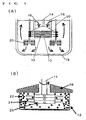
- a media-agitating mill has a solid dispersion medium such as a bead contained in a container in which a stirring device for stirring the content is provided. Accordingly, when a cosmetic starting material containing a particle is placed in the container and stirred, the solid dispersion medium is also stirred together with the particle. Then the stirred solid dispersion medium can further grind and disperse an aggregated particle of the powder components.
- a media-agitating mill is classified to a continuous media-agitating mill and a batch media-agitating mill.
- a method for producing cosmetic products is characterized in that, when powder components and oil components as binders are mixed in a solvent to form a slurry, the mixing in the solvent is performed using a media-agitating mill to grind an aggregated particle of the powder components into an almost primary particle, in the state of which the slurry with the oil components is formed.
- a powder component is not particularly limited and any material employed generally in cosmetic products can be employed.
- such material may for example be, but not limited to, titanium oxide, zinc oxide, red iron oxide, yellow iron oxide, black iron oxide, ultramarineblue, cerium oxide, talc, mica, sericite, kaolin, silica, zinc stearate, fluorine phlogopite, synthesis talc, barium sulfate, boron nitride, bismuth oxychloride, alumina, magnesium carbonate, silicone powder, silicone elastic powder, polyurethane powder, cellulose powder, nylon powder, PMMA powder, starch and polyethylene powder. Powder whose surface is non-treated or treated with silicone, fluorine, tetoron, fatty acids, fatty acid soap lauroyllysine and the like may be employed. Only one, or two or more powders can be employed.
- the amount of powder is preferebly 65 to 97 % by weight, more preferably, 80 to 93 % by weight.
- An oil component as a binder may, for example, be a naturally-occurring plant oil such as avocado oil, camellia oil, tortoise oil, macademian nut oil, corn oil, mink oil, olive oil, rape seed oil, egg yolk oil, sesame oil, par chic oil, wheat germ oil, southern piece oil, castor oil, linseed oil, safflower oil, cotton seed oil, perilla oil, soybean oil, groundnut oil, brown real oil, mosquito net oil, rice bran oil, china wood oil, Japan wood oil, jojoba oil and germ oil; a liquid fat such as triglycerin, glycerin trioctanoate and glycerin triisopalmitate; an animal and plant liquid oil such as cocoa buffer, coconut oil, horse fat, hardened coconut oil, palm oil, beef fat, sheep fat, hardened beef fat, palm kernel oil, pig fat, cattle bone fat, Japan tallow kernel oil, hardened oil, cattle leg fat, Japan tallow and
- the amount of oil components is preferably 3 to 35 % by weight, more preferably, 7 to 20 % by weight.
- An amount of oil components less than 3 % by weight leads to a difficulty in obtaining a product which is satisfactory in terms of the practical characteristics such as the skin adhesion and the moisturizing performance as well as the impact resistance.
- an amount exceeding 35 % by weight leads to a difficulty in obtaining a product which is satisfactory in terms of the ability of extending over a skin and the long-lasting ability of the makeup.
- a solvent is not particularly limited and may, for example, be water, an alcohol such as methanol, ethanol and isopropyl alcohol and other solvents including benzene, toluene, THF, paraffin and silicone, which may be employed alone or in combination appropriately depending on the characteristics of the powdery and oil components employed.
- oil components can be deposited selectively on the surface of powder utilizing a partial dissolution of oil components in a solvent.
- a media-agitating mill employed in the invention may, for example, be a DINO-mill, a sand grinder mill, a ring mill, a pearl mill and a ball mill, it may be any mill provided that it serves as a dispersing machine capable of disintegrating an aggregated particle component into a state close to a primary particle and capable of depositing oil components uniformly over the surface of powder components.
- a sand grinder mill is particularly preferred.
- a bead employed in a media-agitating mill described above may, for example, be a bead made from glass, alumina, zirconia, steel or flint stone, with one made from zirconia being particularly preferred.
- the size of a bead employed in an ink industry is 0.3 to 2 mm in diameter. In the invention, however, a bead whose diameter is 1 to 10 mm is employed preferably, with 3 to 5 mm being more preferable.
- a too small diameter of a bead may allow an loading pigment such as mica and talc to be ground excessively. As a result, solid powdery cosmetic products after molding has a high hardness, exhibits a poor take onto a puff, and tends to undergo an undesirable caking.
- a too small diameter of a bead also leads to a difficulty in exerting a high dispersing force to a polymeric powder such as a silicone elastic powder (for example, torefill E-506C TM : Toray-Dow Coning).
- a polymeric powder such as a silicone elastic powder
- torefill E-506C TM Toray-Dow Coning
- a problematic crack on the surface upon molding is also experienced.
- a too large diameter of a bead is also undesirable since it may lead to a difficulty in grinding powder components sufficiently.
- the dispersion and the mixing in the media is performed usually for 15 to 60 minutes.
- all particle components and oil components are mixed by a media-agitating mill as described above, and an aggregated particle of the powder components is ground into an almost primary particle, in the state of which the slurry is formed.
- powder which is almost a primary particle can evenly be deposited with the oil components, whereby allowing solid powdery cosmetic products which is fully satisfactory in terms of the practical characteristics such as the extension and the adhesion over a skin, the moisturizing performance and the long-lasting ability of the makeup as well as the impact resistance came to be provided.
- a slurry is adjusted preferably at a viscosity of 500 to 10000 mPa ⁇ s, especially 1000 to 8000 mPa ⁇ s.
- the slurry After forming a slurry by mixing particle components and oil components as described above, the slurry is made free from a solvent by a standard method such as distillation and evaporation, and then filled in a container such as a metal or resin canister, whereby obtaining solid powdery cosmetic products.
- the slurry is made free from a solvent and filled in a container such as a metal or resin canister, and then a dry press molding may be performed.
- the dry press molding can be performed by a standard method.
- a grinding step may also be included after removing a solvent from a slurry.
- the slurry is filled in a container such as a metal or resin canister, and then subjected to a suction press molding.
- the suction press molding can be performed by a standard method.
- a solid powdery cosmetic product in the invention may further contain surfactants, dispersants, stabilizers, colorants, antiseptics, antioxidants, UV absorbers, perfumes and the like appropriately as long as the objectives of the invention are accomplished.
- a surfactant is preferred especially as a dispersant.
- Such surfactant is preferably in the state of a liquid at ordinary temperature which exhibits a high dispersing effect.
- Those exemplified preferably are sorbitan sesquiisostearate and sorbitan monoisostearate.
- a method for producing solid powdery cosmetic products of the invention is applied, for example, to a foundations, eye shadow, teak color, body powder, perfume powder, baby powder and face powders.
- a method for producing solid powdery cosmetic products of the invention is further discussed with referring to Examples.
- test formulation was press-molded in a resin canister and housed in a cosmetic compact container to obtain a test formulation.
- the test formulation in a horizontal position was dropped from the level of 30 cm down to an iron plate whose thickness was 20 mm and the number of the droppings until the test formulation was broken was evaluated as an index of the impact resistance.
- Example 1 the powder components and the oil components in the formulation indicated in Table 1 shown below were mixed briefly in isopropyl alcohol using a disper to adjust the slurry viscosity at about 1500 mPa ⁇ s, and then dispersed and mixed using a sand grinder mill containing zirconia beads each of 5 mm in diameter. After evaporating isopropyl alcohol, the mixture was ground once using a pulverizer, filled in a container (resin canister) and subjected to a dry press molding by a known method.
- Comparative example 1 employed an ordinary production method.
- the powder components and the oil components in the formulation identical to that in Example 1 were combined, mixed using a Henschel mixer, ground twice using a pulverizer, filled in a container (resin canister) and subjected to a dry press molding by a known method.
- Example1 Comparative example 1 sericite 17 17 synthetic mica 10 10 talc to 100 to 100 titanium oxide 12 12 red iron oxide 0.8 0.8 yellow iron oxide 2 2 black iron oxide 0.1 0.1 silicone elastic powder(*) 6 6 spheric polyethylene 4 4 dimethylpolysiloxane 3 3 liquid paraffin 5 5 vaseline 5 5 sorbitan sesqui isostearate 1 1 paraben q.s. q.s. antioxidant q.s. q.s. perfume q.s. q.s.
- Example 2 the powder components and the oil components in the formulation indicated in Table 2 shown below were mixed briefly in isopropyl alcohol using a disper to adjust the slurry viscosity at about 150 mPa ⁇ s, and then dispersed and mixed using a sand grinder mill containing zirconia beads each of 1.0 mm in diameter. With evaporating isopropyl alcohol, the slurry viscosity was adjusted, and the mixture was filled in a container (resin canister) and subjected to a dry press molding by a known method.
- Comparative example 2 employed an ordinary production method.
- the powder components and the oil components in the formulation identical to that in Example 2 were combined, mixed using a nautor mixer, ground twice using a pulverizer, filled in a container (resin canister) and subjected to a dry press molding by a known method.
- Example2 Comparative example 2 silicone-treated sericite 18 18 silicone-treated mica to 100 to 100 silicone-treated talc 15 15 silicone-treated titanium oxide 10 10 aluminum stearate-treated particulate titanium oxide 6 6 silicone-treated red iron oxide 1.2 1.2 silicone-treated yellow iron oxide 2.5 2.5 silicone-treated black iron oxide 0.9 0.9 polyurethane powder 6 6 paraben q.s. q.s. dimethylpolysiloxane 4 4 methyl phenyl polysiloxane 3 3 octylmethoxycinnamate 3 3 polyether silicone 2 2 antioxidant q. s. q.s. perfume q. s. q.s. moisturizing performance B C smoothness A B dusty skin feel B D long-lasting ability of makeup A B uniform finish A B impact resistance 7 times 4 times 4 times 4 times
- Example 3 the powder components and the oil components in the formulation indicated in Table 3 shown below were mixed briefly in ethyl alcohol using a disper to adjust the slurry viscosity at about 1500 mPa ⁇ s, and then dispersed and mixed using a sand grinder mill containing zirconia beads each of 1.5 mm in diameter. With evaporating ethyl alcohol, the slurry viscosity was adjusted, and the mixture was filled in a container (resin canister) and subjected to a dry press molding by a known method.
- Comparative example 3 employed an ordinary production method.
- the powder components and the oil components in the formulation identical to that in Example 3 were combined, mixed using a Henschel mixer, ground twice using a pulverizer, filled in a container (resin canister) and subjected to a dry press molding by a known method.
- Example3 Comparative example 3 talc to 100 to 100 mica 25 25 zinc oxide 5 5 particulate titanium oxide 3 3 spheric silicone powder 8 8 vaseline 1 1 squalane 3 3 ester oil 1 1 paraben q.s. q.s. antioxidant q.s. q.s. perfume q.s. q.s. moisturizing performance C E smoothness A B dusty skin feel B C long-lasting ability of makeup B C uniform finish A B impact resistance 8 times 5 times
- Example 4 the powder components and the oil components in the formulation indicated in Table 4 shown below were mixed briefly in toluene using a disper to adjust the slurry viscosity at about 1500 mPa ⁇ s, and then dispersed and mixed using a sand grinder mill containing zirconia beads each of 3.0 mm in size. After evapolating toluene, the mixture was ground twice using a pulverizer, filled in a container (resin canister) as powder.
- Comparative example 4 employed an ordinary production method.
- the powder components and the oil components in the formulation identical to that in Example 4 were combined, mixed using a Henschel mixer, ground twice using a pulverizer, filled in a container (resin canister) as powder.
- Example4 Comparative example 4 talc to 100 to 100 synthetic mica 30 30 lamina zinc oxide 6 6 red iron oxide 0.2 0.2 yellow iron oxide 0.7 0.7 particulate titanium oxide 1 1 silicone elastic powder(*) 10 10 dimethylpolysiloxane 7 7 paraben q.s. q.s. antioxidant q.s. q. s. perfume q.s. q. s. moisturizing performance B D smoothness A B dusty skin feel B C long-lasting ability of makeup A B uniform finish A D impact resistance 7 times 2 times * trefill E-506 CTM : TORAY DOW CORNING SILICONE Co. Ltd.
- Example 5 the powder components and the oil components in the formulation indicated in Table 5 shown below were mixed briefly in toluene using a disper to adjust the slurry viscosity at about 1500 mPa ⁇ s, and then dispersed and mixed using a sand grinder mill containing zirconia beads each of 5.0 mm in size. After evapolating toluene, the mixture was ground twice using a pulverizer, filled in a container (resin canister) and subjected to a suction press molding by a known method.
- a pulverizer filled in a container (resin canister)
- Comparative example 5 employed an ordinary production method.
- the powder components and the oil components in the formulation identical to that in Example 5 were combined, mixed using a Henschel mixer, ground twice using a pulverizer, filled in a container (resin canister) and subjected to a dry press molding by a known method.
- Example5 Comparative example 5 sericite 17 17 mica to 100 to 100 talc 10 10 titanium oxide 12 12 red iron oxide 0.8 0.8 yellow iron oxide 2 2 black iron oxide 0.1 0.1 silicone elastic powder(*) 10 10 spheric polyethylene 4 4 dimethylpolysiloxane 3 3 liquid paraffin 5 5 vaseline 5 5 sorbitan sesqui isostearate 1 1 paraben q.s. q.s. antioxidant q.s. q.s. perfume q.s. q. s. moisturizing performance A C smoothness A B dusty skin feel A C long-lasting ability of makeup B B uniform finish A B impact resistance 8 times 2 times * trefill E-506 CTM : TORAY DOW CORNING SILICONE Co. Ltd.
- the inventors also investigated a method for producing powdery cosmetic products involving a step for imparting powder components with hydrophobicity.
- the invention is characterized in that, in the production of powdery cosmetic products involving at least a step for mixing powder components and oil phase components as binders in a solvent using a media-agitating mill to form a slurry, an organic silicon resin compound is incorporated when dispersing the powder components.
- a powder component is not particularly limited and any material employed generally in cosmetic products can be employed.
- such particles for cosmetic products may, for example, be an inorganic powder such as talc, kaolin, mica, silk mica (sericite), muscovite, phlogopite, synthesis mica, red mica, biotite, lithia mica, vermiculite, magnesium carbonate, calcium carbonate, aluminum silicate, barium silicate, calcium silicate, magnesium silicate, strontium silicate, metal tungstate, magnesium, silica, zeolite, barium sulfate, baked calcium sulfate (calcined gypsum), calcium phosphate, fluorinated apatite, hydroxy apatite, ceramic powder, metal soap (zinc myristate, calcium palmitate, aluminium stearate and the like) and boron nitride; an organic powder such as PMMA, silicone resin powder, silicone rubber powder, nylon powder, silk powder, wool powder and urethan
- an organic lake pigment such as zirconium lake, barium lake and aluminium lake including red No. 3, red No. 104, red No. 106, red No. 227, red No. 230, red No. 401, red No. 505, bitter orange color No. 205, yellow No. 4, yellow No. 5, yellow No. 202, yellow No. 203, green No.
- a water-repellency-imparting treatment may, for example, be a treatment with silicone, a higher fatty acid, a higher alcohol, a fatty ester, a metal soap, an amino acid, an alkyl phosphate, a cationic surfactant, a perfluoroalkyl phosphate, and a dextrin fatty ester.
- the amount of the powder components to be added is preferably 60 to 97 % by weight, more preferably 65 to 90 % by weight.
- An organic silicon-based resin compound employed in the invention may, for example, be trimethylsiloxysilicic acid, a fluorine-denaturated silicone resin and an acryl silicone copolymer, with trimethylsiloxysilicic acid being preferred.
- the amount of an organic silicon-based resin compound incorporated in the invention is preferably 1 to 20 % by weight, more preferably 5 to 15 % by weight, particularly 3 to 10 % by weight.
- An amount of an organic silicon-based resin compound less than 1 % by weight does not allow the surface of powder to be imparted with hydrophobicity sufficiently, resulting in a difficulty in obtaining a product which is satisfactory with regard to the long-lasting ability of the makeup, the use of water and the slippery skin feel.
- an amount exceeding 30 % by weight of an organic silicon-based resin compound does not give a correspondingly improved hydrophobicity, resulting in a economical disadvantage, sometimes accompanied with a sticky skin touch.
- oil component is not particularly limited and any material employed generally in cosmetic products can be employed.
- oil components may, for example, be a silicone oil such as dimethylpolysiloxane, cyclic dimethylpolysiloxane and methylphenyl polysiloxane, various hydrocarbon oils such as squalane, liquid paraffin, light-gravity isoparaffin, vaseline, microcrystan wax, ozokerite and ceresin; a higher fatty acid such as myristic acid, palmitic acid, stearic acid, oleic acid, iso stearic acid and behenic acid; a higher alcohol such as cetyl alcohol, stearyl alcohol, oleil alcohol and batyl alcohol; esters such as cetyl-2-ethylhexanoate, 2-ethylhexylpalmitate, 2-octydodecilmylistate, neopentylglycol-2-ethylhexanoate, tri-o
- the amount of the oil components to be added in the invention is preferably 3 to 30 % by weight, more preferably 7 to 20 % by weight.
- a solvent is not particularly limited as long as it can solubilize an organic silicon-based resin compound employed, and may, for example, be an alcohol such as methanol, ethanol and isopropyl alcohol as well as benzene, toluene and silicone, with ethanol and isopropyl alcohol being preferred practically.
- a media mill employed in the invention may for example be a media-agitating mill such as a sand grinder mill, a ring mill, a pearl mill and a ball mill, and, as a dispersing machine, it may be any mill provided that it is capable of disintegrating an aggregated particle component into a state close to a primary particle and capable of depositing oil components uniformly over the surface of powder components.
- a media-agitating mill such as a sand grinder mill which has a relatively stronger dispersing force is particularly preferred.
- a method for producing powdery cosmetic products of the invention is applied, for example, to foundations, eye shadows, cheek colors, body powders, perfume powders, baby powders and face powders.
- Powder component and organic silicon-based resin compound during the production method of a product were dispersed and mixed in a solvent, and a part of the resultant slurry was taken, filtered, washed with ethanol and dried.
- the resultant powder was mounted on the surface of water contained in a beaker, stirred, and its hydrophobicity was determined based on whether it was dispersed in water or not.
- a sponge for a powdery foundation retaining soaked with a suitable amount of water was used to take a suitable amount of a sample, and the sample was applied to a skin.
- Experiment 2 employed the production method similar to Experiment 1 except for using no organic silicon-based resin compound.
- Experiment 1 sericite 10 10 talc to 100 to 100 mica 15 15 titanium oxide 10.5 10.5 particulate titanium oxide 5 5 red iron oxide 0.8 0.8 yellow iron oxide 2 2 black iron oxide 0.1 0.1 silicone resin spheric powder 6 6 trimethyl siloxysilicic acid 10 10 liquid paraffin 4 4 vaseline 4 4 sorbitan sesqui isostearate 0.8 0.8 paraben q.s. q.s. antioxidant q.s. q.s. perfume q.s. q.s. long-lasting ability of makeup A B slippery skin feel B D hydrophobic test no problem dispersion water use test no problem not usable(caking)
- Experiment 2 contained no organic silicon-based resin compound had a poor slipperiness, and was problematic in the hydrophobicity test and the water use test.
- Experiments 3 to 5 the formulations shown in Table 7 were used in the method similar to Experiment 1 to obtain foundations.
- Experiment 3 Experiment 4 Experiment 5 sericite 20 20 20 talc to 100 to 100 to 100 mica 10 10 10 titanium oxide 10.5 10.5 10.5 red iron oxide 0.8 0.8 0.8 yellow iron oxide 2 2 2 black iron oxide 0.1 0.1 0.1 silicone elastic powder(*) 6 6 6 trimethyl siloxysilicic acid 1 1 1 liquid paraffin 4 4 4 vaseline 4 4 4 sorbitan sesqui isostearate 0.8 0.8 0.8 paraben q.s. q.s. antioxidant q.s. q.s. q.s. perfume q.s. q.s.
- Example 6 the powder components and the organic silicon-based resin compound in the formulation indicated in Table 8 shown below were dispersed and mixed for 15 minutes in ethanol as a solvent using a homomixer at 9000 rpm, and the remainder of the oil components was added and the mixture was further dispersed and mixed for 15 minutes using the sand grinder mill to obtain a slurry, which was evaporated to dryness to obtain powder, which was ground using a pulverizer and filled in a container as powder.
- Table 8 Experiment 6 mica 10 talc to 100 zinc oxide 5 particulate titanium oxide 3 silicone spheric powder 8 trimethyl siloxysilicic acid 10 vaseline 1 squalane 2 ester oil 1 paraben q.s. antioxidant q. s. perfume q.s. long-lasting ability of makeup A slippery skin feel A hydrophobic test no problem
- Example 7 the powder components and the organic silicon-based resin compound in the formulation indicated in Table 9 shown below were dispersed and mixed for 15 minutes in ethanol as a solvent using a homomixer at 9000 rpm, and the remainder of the oil components was added and the mixture was further dispersed and mixed for 15 minutes using the sand grinder mill to obtain a slurry, which was evaporated to dryness to obtain powder, which was ground using a pulverizer and filled in a container as powder.
- Table 9 Experiment 7 talc to 100 synthetic mica 30 red iron oxide 0.2 yellow iron oxide 0.7 particulate titanium oxide 1 silicone resin spheric powder 10 trimethyl siloxysilicic acid 10 dimethylpolysiloxane 7 paraben q.s. antioxidant q.s. perfume q.s. long-lasting ability of makeup A slippery skin feel A hydrophobic test no problem
- a batch media-agitating mill in the invention has a stirring device for a preliminary stirring and a media mill part which are provided separately but in an identical tank.
- the media mill part has solid dispersion media such as beads contained in a container in which a stirring device for stirring the content is provided.
- a fluid containing a particle is allowed to travel. Accordingly, when a cosmetic starting material containing a particle is placed in the tank, it is agitated by the stirring device for the preliminary stirring. Subsequently, when the media mill part is actuated to agitate the content of the media mill part, the solid dispersion media is also agitated together with the particle.
- the stirred solid dispersion media can further grind and disperse an aggregated particle of the powder components.
- the stirring device for the preliminary mixing and the media mill part can repetitively be actuated any times as desired.
- the fluid containing the particle can also be circulated in the media mill part and the tank.
- the batch media-agitating mill allows cosmetic products to be produced in a single tank.
- FIG. 1 (A) An embodiment of a batch media-agitating mill which is a dispersing device employed in a production method of the invention is shown in Figure 1 (A) .
- a batch media-agitating mill employed in a production method of the invention is provided with basket part 10 in tank 18, in association with at least one in-tank stirring device 20 for both of a preliminary mixing and a dispersion fluidization.
- Basket part 10 is provided with jacket 28 as an upper lid, and positioned by rod 16. On the side wall of basket part 10, a large number of small pores each consisting of a slit are provided.
- Basket part 10 is provided also with in-basket stirring device 14 for agitating the content of basket part 10.
- Powder containing particulate powder that is cosmetic starting material and oil component are first mixed preliminarily by in-tank stirring device 20 to form a fluid mixture, which is then introduced into basket part 10 via an opening surrounding the rotation spindle of in-basket stirring device 14 fixed on the machine at the top of basket part 10.
- FIG. 1 (B) The inner view of basket part 10 is shown in FIG. 1 (B) .
- Solid dispersing media (beads) 22 are contained in basket part 10, and in-basket stirring device 14 is provided with stirring pin disk 26 (or stirring disk) mounted vertically to the rotation spindle.
- stirring pin disk 26 is provided with pin 24 for stirring.
- the fluid mixture introduced into basket part 10 is brought into contact with a stirring pin disk 26 which rotates at a high speed and pulverizes and disperses an aggregated particle of the powder components in cooperation with solid dispersing media (beads) 22 and then allowed to flow out via a large number of small pores 12 each consisting of slits provided on the side wall of basket part 10.
- a stirring pin disk 26 which rotates at a high speed and pulverizes and disperses an aggregated particle of the powder components in cooperation with solid dispersing media (beads) 22 and then allowed to flow out via a large number of small pores 12 each consisting of slits provided on the side wall of basket part 10.
- FIG.1 (A) shows an overall fluid route.
- a batch media-agitating mill is a machine having a step capable of keeping a uniform dispersion of powder in tank 18 as described above.
- An example of such dispersing machine employed preferably in the invention is one disclosed in JP-B-8-17930 .
- a basket part filled with solid dispersing media (beads) which is provided in a batch media-agitating mill described above possesses on its side wall a large number of small pores each consisting of slits of a size which does not allow the solid dispersing media (beads) to go out of the basket part, whereby preventing any the solid dispersing media from being contained in the cosmetics products which are obtained.
- a batch media-agitating mill employed preferably in the invention is provided with small pores on the side wall of the basket part filled with the solid dispersing media. Accordingly, the rotation of a spindle exerts a centrifugal force, which localizes the solid dispersing media on the side wall, and powder containig particulate powder passes through a zone where the solid dispersing media exist at a high density, whereby the dispersion efficiency can be raised.
- a solid dispersion medium in the invention may be a bead made from glass, alumina, zirconia, steel or flint stone, with one made from zirconia being particularly preferred.
- the size of a bead is generally 0.3 to 2 mm in diameter, with one whose size is about 1mm being preferred in the invention.
- a stirring device employed ordinarily in the production of a cosmetic may be employed, with a disper having a turbinal blade on the tip of a rotating rod being employed preferably.
- the batch media-agitating mill according to the invention required 1.5 hours and 1.75 hours for milling the powder carbon into the particle sizes of 5 ⁇ m and 2.5 ⁇ m, respectively.
- the continuous media-agitating mill required the times which were as long as 4 hours and 8 hours for milling the powder carbon into the particle sizes of 5 ⁇ m and 2.5 ⁇ m, respectively. Accordingly, the production time can substantially be reduced by employing a batch system.
- the production method employing the batch agitating mill required 2 to 3 hours for milling the powder carbon into the particle size of 5 ⁇ m.
- the continuous media-agitating mill required the time as long as 10 to 40 hours. Accordingly, Table 22 indicates that the batch media-agitating mill is extremely effective in reducing the production time.
- a media-agitating mill processing in order to disperse a particle into a state of a primary particle or close to a primary particle in the essential components described above, and for performing such media-agitating mill processing it is preferable to use a media-agitating mill of batch type, continuous lateral type, vertical type and annular type.
- a batch media-agitating mill which is a dispersing device employed preferably in a production method of the invention was described above. Accordingly, a continuous media-agitating mill employed in the invention is discussed below.
- a continuous media-agitating mill in the invention is provided separately with a media mill part and a preliminary stirring tank.
- the media mill part has a solid dispersion medium such as a bead contained in a container in which a stirring device for stirring the content is provided.
- the preliminary stirring tank is provided with a stirring device.
- the preliminary stirring tank and the media mill part are in communication with each other via a pipe in which a fluid containing a particle travels. Accordingly, when a cosmetic starting material containing a particle is introduced, it is stirred in the preliminary stirring tank and then pumped to the media mill part.
- the solid dispersion medium is also stirred together with the particle.
- the stirred solid dispersion medium can further grind and disperse an aggregated particle of the powder components.
- a circulation between the media mill part and the preliminary stirring tank is possible if necessary.
- the continuous media-agitating mill enables cosmetic production involving a step for imparting a particle with hydrophobicity within a single device.
- FIG. 2 shows an example of a continuous media-agitating mill fitted with a preliminary stirring tank.
- media mill part 30 containing beads 40 capable of being agitated by the rotation of motor 36 is connected through a pipe via pump 34 with preliminary stirring tank 32 capable of stirring by means of disper 42 driven by the rotation of motor 38, whereby allowing a fluid containing a particle to be circulated.
- a starting material containing a particle is mixed preliminary by disper 42 in preliminary stirring device 32 to form a fluid mixture, which is pumped by pump 34 into media mill part 30 connected through a pipe.
- the fluid mixture introduced into media mill part 30 is brought into contact with a rotating stirrer which rotates at a high speed and pulverizes and disperses various aggregated particles of the powder components in cooperation with solid dispersing media (beads) 40 and then pumped by pump 34 back into preliminary stirring tank 32.
- a rotating stirrer which rotates at a high speed and pulverizes and disperses various aggregated particles of the powder components in cooperation with solid dispersing media (beads) 40 and then pumped by pump 34 back into preliminary stirring tank 32.
- a continuous media-agitating mill means a device having a step for making the dispersion of particles uniform as described above.
- the stirring time in the preliminary stirring tank, the stirring time in the media mill part and the number of passes in this device are determined appropriately as desired.
- stirring device of a preliminary stirring tank employed preferably in the invention may be a stirring device suitable in an ordinary cosmetic production, it is especially preferable to use a disper or a homogenizer having a turbinal blade on the tip of a rotating rod.
- a biaxial disper having a disper fin and a scraping fin is also employed preferably.
Landscapes
- Health & Medical Sciences (AREA)
- Life Sciences & Earth Sciences (AREA)
- Chemical & Material Sciences (AREA)
- Veterinary Medicine (AREA)
- General Health & Medical Sciences (AREA)
- Public Health (AREA)
- Animal Behavior & Ethology (AREA)
- Birds (AREA)
- Epidemiology (AREA)
- Dispersion Chemistry (AREA)
- Chemical Kinetics & Catalysis (AREA)
- Inorganic Chemistry (AREA)
- Dermatology (AREA)
- Cosmetics (AREA)
Abstract
Description
- The present invention relates to a method for producing cosmetic products, especially to a method for producing cosmetic products which improves the function and the touch of powder contained in the cosmetic product.
- As representative cosmetic products containing powder, a foundation, a sunscreen or a lipstick may be exemplified. Cosmetic products containing such powder can be classified, based on the production method, into powdery cosmetic products, oily cosmetic products or emulsified cosmetic products. As a conventional method for improving the function of powder, an incorporation of a hydrophobicity-imparting agent is employed. However, a conventional method for producing cosmetic products involves a difficulty in utilizing the function of powder incorporated sufficiently. In addition, solid cosmetic products are also disadvantage experienced as a susceptibility to impact and a tendency of being broken easily. Furthermore, a conventional powder-containing cosmetic product may exhibit a dusty skin feel, resulting in a poor touch. A technical background of each cosmetic product is discussed below.
- A powdery cosmetic product is a cosmetic product obtained by filling a starting material consisting of powder components as a major constituent admixed with oil components as binders and surfactants into a metal or resin inner canister , and optionally a subsequent press molding step. Generally, powdery cosmetic products are used with cosmetic tools such as a puff, a sponge and a brush.
- A powdery cosmetic product has conventionally been produced by using an agitating mixer such as Henschel mixer, nautor mixer, ribbon blender, kneader and the like to mix powder components and oil components as binders and surfactants followed by grinding using a grinder such as pulverizer followed by filling into a metal or resin inner canister optionally followed by a dry press molding.
- Recently, A powdery cosmetic product is subjected to an extensive development with regard to production and molding methods for the purpose of improving its practical characteristics such as the touch. For example, a filling-solidifying method (Japanese Patent No.
1556592 JP-A-7-277924 - Nevertheless, a diverse and sophisticated demand by consumers in these days raises a further need to improve the practical characteristics and the impact resistance.
- On the other hand, for the purpose of improving the long-lasting performance of a makeup against to sthe inventorsat or sebum or enabling the use of water especially in the field of a powdery foundation, an incorporation of a particle whose surface is imparted with a hydrophobicity was attempted to produce a two-way summer foundation.
- However, such two-way foundation which employs a particle whose surface has previously been imparted with hydrophobicity using silicone and the like is problematically time-consuming and economically disadvantageous since it requires such hydrophobicity imparting treatment for the particle in addition to the foundation producing process.
- In an ordinary method for producing an oily cosmetic product, a colorant containing a particle is mixed with oil components using a roll mill or equivalent, and the aggregated particle was dispersed to a level of a primary particle to obtain a paste, which is admixed into a molten mixture of a solidifying agent and other oil components, and the mixture is agitated using a disper or equivalent, filled in a container, and then molded. In another method for producing an oily cosmetic product, a particle mass is ground preliminarily using a grinder such as a pulverizer and mixed with oil components using a disper or equivalent, and, in a case of a stick-type cosmetic product, admixed into a melted mixture of a solidifying agent and an oily agent and mixed using a disper or equivalent, and then filled and molded.
- However, when an oily cosmetic product is produced by a method described above, the production cost and the production time become problematic since a preliminary roll milling process or a pulverizer grinding process is required. A roll milling process requires a well-trained skill and involves a difficulty in being applied to a mass production. In addition, particulate powder having a large specific surface area, when incorporated, requires a substantially reduced powder ratio for effecting a roll milling process. Accordingly, a particulate iron oxide, which is known to be transparent excellently and has a UV-protecting effect, can not practically be incorporated. In addition, a pulverizer process poses a poor operating environment, and results in an insufficient grinding or dispersing of a particulate titanium oxide or a particulate zinc oxide which is incorporated into an oily foundation for the purpose of imparting a UV-protecting effect. Moreover, a difficulty is also experienced in obtaining a UV-protecting effect expected from the amount incorporated, thus the suitability to a method for producing cosmetic products incorporating particulate powder being absent eventually. Also since the incorporation of a particulate iron oxide which is expected to impart a UV-protecting effect is not suitable because of the same reason, it is not performed actually.
- Existing studies on emulsified cosmetic products include a method for producing a dispersion of a particulate titanium oxide (
JP-A-9-208438 6-61457 JP-A-10-167946 -
JP-A-9-286713 - However, such dispersion, when incorporated into a sunscreen or an emulsified foundation, is disadvantageous in terms of the supply and the cost of the dispersion and involves a limitation of time period until the production of the dispersion, resulting in a difficulty in being incorporated readily.
- Accordingly, a process of manufacturing in which the processes from the formation of a dispersion through the formation of an emulsified cosmetic product is conducted at once. However, a circulatory sand mill described above can disperse powder into an oily agent but does not involve a step for adding an water phase, resulting in an impossibility of emulsifying. In addition, a media mill of this type requires a preliminary mixer separately in addition to a dispersing device, exerts a similarly strong mechanical force for dispersing which is not suitable to the production of an emulsified cosmetic product to which various types of the particles are incorporated, and also employs a preliminary agitating device and a circulation pipe in addition to a dispersing device which leads to a difficulty in washing, thus presenting problematic characteristics.
- A composition such as cosmetic products usually contains a particle such as a particulate titanium oxide or a particulate zinc oxide. Since, such particle, especially an inorganic particle, usually has a hydrophilic surface, it is difficult to be incorporated as it is into an oily base, and sometimes undergoes an aggregation. As a result, the stability of the composition becomes problematic, and a function associated naturally with a particle such as a UV scattering effect expected from a particulate titanium oxide is not exerted satisfactorily.
- Accordingly, a method for increasing a lipophilicity by means of a hydrophobicity-imparting treatment of the surface of a particle, or a dispersion in which a particle was dispersed preliminarily in an oily dispersion medium together with a certain dispersant has extensively been developed. An example of the latter is a particulate titanium oxide silicone dispersion described in
JP-A-9-208438 - However, a preliminary hydrophobicity-imparting treatment of the surface of a particle, as described above, allows the treated surface to be peeled off due to the sheer force exerted when incorporating and mixing the particle with a composition such as a cosmetic formulation, resulting in a reduced dispersibility in an oily base.
- A dispersion of a prior art may undergo, over a time period, a sedimentation of a particle in silicone as a dispersion medium, which is undesirable for the purpose of a consistent manufacture of a product.
- On the other hand, a particle such as a particulate titanium oxide or a particulate zinc oxide may undergo, during the production method of an emulsified cosmetic product, an aggregation due to the interaction of the particle with a surfactant and water when adding the surfactant and an water phase to an oil phase containing the particle to effect an emulsification. As a result, the stability of a composition becomes problematic and a function associated naturally with a particle such as a UV scattering effect expected from a particulate titanium oxide is not exerted satisfactorily.
- A lipstick is produced usually by a method in which a colorant powder is mixed with an oily agent using a roll mill or equivalent and then a paste composition containing a primary particle is added to a melted mixture of a solidifying agent and other oils, and the mixture is agitated using a disper or equivalent, filled and molded.
- However, when a lipstick is produced by a method described above, the production cost and the production time become problematic since a preliminary roll milling process is required. A roll milling process requires a well-trained skill and involves a difficulty in being applied to a mass production. In addition, a colorant powder to be incorporated is difficult to be ground or dispersed, resulting in a functional problem, which leads to a demand of a new dispersing device.
- Also because of an insufficiently ground or dispersed colorant powder to be incorporated, a resultant lipstick undergoes a problematically insufficient color development or exhibits a poor color tone, or has an insufficient gloss or extending ability, and, especially in the case of a solid lipstick, tends to be broken readily.
- On the other hand, a media mill came into use recently instead of a roll mill for dispersing a pigment in the field of a paint or ink. A media mill is more excellent in grinding or dispersing a particle when compared with a roll mill, and can be used for a mass production. Also for the purpose of incorporating a particle, an oil dispersion of a titanium oxide or a colorant powder began to be produced recently. A media mill came into use as a means for dispersing a colorant powder in the production of a dispersion. An ordinary media mill has a structure in which a bead is employed as a solid dispersion medium and a colorant powder and a solvent are mixed preliminarily and then pumped to a tank in which the beads are contained and a stirring disk is rotated, where the colorant powder is ground and dispersed by the sheer force of the stirring disk and the impact of the beads. In the field of cosmetic products, a media- mill is applied to a method for producing a composite particle (
JP-A-9-143030 JP-A-7-108156 - The present invention is established based on the problems discussed above. The first objective of the invention is to provide a method for producing cosmetic products capable of improving a touch of the cosmetic product and also capable of fully exerting the function of powder incorporated.
- The second objective of the invention is to provide a method for producing solid powdery cosmetic products which is excellent in terms of the practical performance and the impact resistance.
- The third objective of the invention is to provide a method for producing powdery cosmetic products which is excellent in terms of the skin feel, the long-lasting performance of the makeup and the economical performance, and which can be used with water.
- Now the inventors discovered that by applying a media-agitating mill to the production of cosmetic products containing powder the function of the powder can be improved and various characteristics of a resulting cosmetic product can be improved. The inventors also discovered that, by utilizing a media-agitating mill, an excellent dispersibility can be achieved even with particulate powder and a hydrophobicity-imparted powder. The inventors further discovered that an efficient production of cosmetic products involving a process for imparting powder with a hydrophobicity is possible using a media-agitating mill. Each cosmetic product is detailed below.
- In any conventional method for producing solid powdery cosmetic products, the mixing of powder components and oil components as binders or a surfactant is performed using an agitating mixer. The inventors considered that such mixing using an agitating mixer is not satisfactory in terms of the dispersing or grinding performance or the agitating or mixing performance and allows the aggregated particle of the powder to be deposited with the oil components only unevenly, and that because of such state a substantial improvement in the practical performance or the impact resistance is prevented partly, and finally discovered that a uniformity of the oil components in the powder components in the mixing process described above leads to the substantial improvement in the practical performance or the impact resistance.
- The inventors also discovered unexpectedly, when the inventors disperse and mix an organic silicon-based resin compound, which is incorporated mainly into a liquid cosmetic product such as a liquid foundation whereby utilizing its film forming ability for the purpose of improving the long-lasting performance of the makeup and preventing a secondary deposition, and powder components in a solvent in which the organic silicon-based resin compound is soluble using a media-agitating mill, that the organic silicon-based resin compound is adsorbed onto the surface of the particle whereby imparting the surface of the powder with hydrophobicity successfully.
- Accordingly, the inventors discovered that powdery cosmetic products obtained by introducing a process for imparting the surface of a particle with hydropobicity using an organic silicon-based resin compound described above, when subjected to a method for producing powdery cosmetic products comprising at least a step for mixing powder components and oil components as binders in a solvent using a media-agitating mill to form a slurry, not only exhibits a long-lasting performance of a makeup against sthe inventorsat or sebum and can be used with water, but also exhibits a unique slippery skin feel and is advantageous economically compared with a conventional two-way powdered cosmetic product employing a particle whose surface has already been imparted with hydrophobicity, thus establishing the present invention.
- Based on the findings described above, the inventors established the invention.
- Thus, the present invention provides a method for producing solid powdery cosmetic products involving at least a step for mixing powder components and oil components as binders in a solvent to form a slurry, wherein said mixing is performed using a media-agitating mill thereby grinding an aggregated particle of the powder components to form a slurry in a state close to a primary particle.
- In a method described above, it is preferred that the slurry is made free from the solvent and filled in a container.
- In a method described above, it is preferred that the slurry is made free from the solvent and filled in a container and then subjected to a dry press molding.
- In a method described above, it is preferred that the slurry is filled in a container and then subjected to a suction press molding.
- In a method described above, it is preferred that the solid powdery cosmetic product comprises 65 to 97 % by weight of the powder components and 3 to 35 % by weight of the oil components.
- In another preferred method for producing cosmetic products according to the invention, the production of powdery cosmetic products involves at least a step for mixing powder components and oil phase components as binders in a solvent using a media-agitating mill to form a slurry and wherein an organic silicon resin compound is incorporated when dispersing the powder components.
- In a method described above, it is preferred that the powdery cosmetic product contains 60 to 97 % by weight of powder components, 1 to 20 % by weight of a particle costing agent and 2 to 30 % by weight of oil components and wherein the powder components are capable to be made hydrophobic.
-
-
Figure 1 shows an example of a batch media-agitating mill employed preferably in a method for producing cosmetic products according to the invention. -
Figure 2 shows an example of a continuous media-agitating mill employed preferably in a method for producing cosmetic products according to the invention. - The present invention relates to a production method capable of improving a function of powder contained in various cosmetic products by means of using a media-agitating mill.
- A media-agitating mill according to the invention has a solid dispersion medium such as a bead contained in a container in which a stirring device for stirring the content is provided. Accordingly, when a cosmetic starting material containing a particle is placed in the container and stirred, the solid dispersion medium is also stirred together with the particle. Then the stirred solid dispersion medium can further grind and disperse an aggregated particle of the powder components. A media-agitating mill is classified to a continuous media-agitating mill and a batch media-agitating mill.
- The production methods are described below on the basis of respective cosmetic products.
- An application of a method for producing cosmetic products according to the invention to powdery cosmetic products is detailed below.
- A method for producing cosmetic products is characterized in that, when powder components and oil components as binders are mixed in a solvent to form a slurry, the mixing in the solvent is performed using a media-agitating mill to grind an aggregated particle of the powder components into an almost primary particle, in the state of which the slurry with the oil components is formed.
- A powder component is not particularly limited and any material employed generally in cosmetic products can be employed. Concretely, such material may for example be, but not limited to, titanium oxide, zinc oxide, red iron oxide, yellow iron oxide, black iron oxide, ultramarineblue, cerium oxide, talc, mica, sericite, kaolin, silica, zinc stearate, fluorine phlogopite, synthesis talc, barium sulfate, boron nitride, bismuth oxychloride, alumina, magnesium carbonate, silicone powder, silicone elastic powder, polyurethane powder, cellulose powder, nylon powder, PMMA powder, starch and polyethylene powder. Powder whose surface is non-treated or treated with silicone, fluorine, tetoron, fatty acids, fatty acid soap lauroyllysine and the like may be employed. Only one, or two or more powders can be employed.
- In a method for producing cosmetic products according to the invention, the amount of powder is preferebly 65 to 97 % by weight, more preferably, 80 to 93 % by weight.
- An oil component as a binder may, for example, be a naturally-occurring plant oil such as avocado oil, camellia oil, tortoise oil, macademian nut oil, corn oil, mink oil, olive oil, rape seed oil, egg yolk oil, sesame oil, par chic oil, wheat germ oil, southern piece oil, castor oil, linseed oil, safflower oil, cotton seed oil, perilla oil, soybean oil, groundnut oil, brown real oil, mosquito net oil, rice bran oil, china wood oil, Japan wood oil, jojoba oil and germ oil; a liquid fat such as triglycerin, glycerin trioctanoate and glycerin triisopalmitate; an animal and plant liquid oil such as cocoa buffer, coconut oil, horse fat, hardened coconut oil, palm oil, beef fat, sheep fat, hardened beef fat, palm kernel oil, pig fat, cattle bone fat, Japan tallow kernel oil, hardened oil, cattle leg fat, Japan tallow and hardened castor oil; a wax such as beeswax, candy lilac wax, cotton wax, carnauba wax, bay berry wax, coccus pela West-wood wax, whale wax, montan wax, bran wax, lanolin, kapok wax, acetic acid lanolin, liquid state lanolin, sugar cane wax, lanolin fatty acid isopropyl, hexyl laurate, reduction lanolin, jojoba wax, hard lanolin, shellac wax, POE lanolin alcohol ether, POE lanolin alcohol acetate, POE cholesterol ether, lanolin fatty acid polyethylene glycol and POE hydrogenated lanolin alcohol ether; a hydrocarbon oil such as liquid paraffin, ozokerite, squalene, 2,6,10,14-tetramethylpentadecane, paraffin, ceresin, squalene, vaseline and microcrystalline wax; a synthesis ester oil such as isopropyl myristate, cetyl octanoate, octyldodecyl myristate, isopropyl palmitate, butyl stearate, hexyl laurate, myristyl myristate, decyl oleate, hexyldecyl dimethyl octanoate, cetyl lactate, myristyl lactate, lanolin acetate, isocetyl stearate, isocetyl isostearate, cholesteril 12-hydroxystearate, ethylene glycol di-2-ethylhexanoate, dipenta erythrite fatty acid ester, N-alkyl glycol mono-isostearate, neopentyl glycol di-capriate, di-isostearil malate, glycerol di-2-heptyl undecanate, trimethylol propane tri-2-ethylhexanoate, trimethylol propane tri-isostearate, penta erythritol tetra-2-ethlhexanoate, glycerol tri-2-ethylhexanoate, trimethlol propane tri-isostearate, cety12-ethylhexanoate, 2-ethyhexylpalmitate, glycerol trimyristate, glyceride tri-2-heptyl undecanate, methyl castor oil fatty acid, oleic acid oil, sedostearyl alcohol, aceto glyceride, 2-heptylundecyl palmitate, di-isobutyl adipate, 2-octhyldodecyl N-lauroil-L-glutamate, di-heptyundecil adipate, ethl laurate, di-2-ethylhexyl sebacate, 2-hexyldecil myristate, 2-hexyldecil palmitate, 2-hexyldecil adipate, di-isopropyl sebacate, 2-ethylhexyl succinate, ethyl acetate, butyl acetate, amyl acetate, triethyl citrate ; a silicone oil such as dimethylpolysiloxane, methylphenyl polysiloxane, methylhydrogen polysiloxane, decamethylpolysiloxane, dodecamethy polysiloxane and tetramethyl tetrahydrogen polysiloxane, as well as a fluorine resin and an acrylic resin. Only one, or two or more oil components can be employed.
- In the invention, the amount of oil components is preferably 3 to 35 % by weight, more preferably, 7 to 20 % by weight. An amount of oil components less than 3 % by weight leads to a difficulty in obtaining a product which is satisfactory in terms of the practical characteristics such as the skin adhesion and the moisturizing performance as well as the impact resistance. On the other hand, an amount exceeding 35 % by weight leads to a difficulty in obtaining a product which is satisfactory in terms of the ability of extending over a skin and the long-lasting ability of the makeup.
- A solvent is not particularly limited and may, for example, be water, an alcohol such as methanol, ethanol and isopropyl alcohol and other solvents including benzene, toluene, THF, paraffin and silicone, which may be employed alone or in combination appropriately depending on the characteristics of the powdery and oil components employed. For example, oil components can be deposited selectively on the surface of powder utilizing a partial dissolution of oil components in a solvent.
- While a media-agitating mill employed in the invention may, for example, be a DINO-mill, a sand grinder mill, a ring mill, a pearl mill and a ball mill, it may be any mill provided that it serves as a dispersing machine capable of disintegrating an aggregated particle component into a state close to a primary particle and capable of depositing oil components uniformly over the surface of powder components. Among those listed above, a sand grinder mill is particularly preferred.
- A bead employed in a media-agitating mill described above may, for example, be a bead made from glass, alumina, zirconia, steel or flint stone, with one made from zirconia being particularly preferred. The size of a bead employed in an ink industry is 0.3 to 2 mm in diameter. In the invention, however, a bead whose diameter is 1 to 10 mm is employed preferably, with 3 to 5 mm being more preferable. A too small diameter of a bead may allow an loading pigment such as mica and talc to be ground excessively. As a result, solid powdery cosmetic products after molding has a high hardness, exhibits a poor take onto a puff, and tends to undergo an undesirable caking. A too small diameter of a bead also leads to a difficulty in exerting a high dispersing force to a polymeric powder such as a silicone elastic powder (for example, torefill E-506C™ : Toray-Dow Coning). A problematic crack on the surface upon molding is also experienced. A too large diameter of a bead is also undesirable since it may lead to a difficulty in grinding powder components sufficiently. By using a bead whose diameter is within the range specified above, an appropriate dispersing force is obtained even when all powder components including a loading pigment and a polymeric powder such as a silicone elastic powder are dispersed at once.
- The dispersion and the mixing in the media is performed usually for 15 to 60 minutes.
- In the invention, all particle components and oil components are mixed by a media-agitating mill as described above, and an aggregated particle of the powder components is ground into an almost primary particle, in the state of which the slurry is formed. In this manner, powder which is almost a primary particle can evenly be deposited with the oil components, whereby allowing solid powdery cosmetic products which is fully satisfactory in terms of the practical characteristics such as the extension and the adhesion over a skin, the moisturizing performance and the long-lasting ability of the makeup as well as the impact resistance came to be provided.
- A slurry is adjusted preferably at a viscosity of 500 to 10000 mPa·s, especially 1000 to 8000 mPa·s.
- After forming a slurry by mixing particle components and oil components as described above, the slurry is made free from a solvent by a standard method such as distillation and evaporation, and then filled in a container such as a metal or resin canister, whereby obtaining solid powdery cosmetic products.
- Alternatively, the slurry is made free from a solvent and filled in a container such as a metal or resin canister, and then a dry press molding may be performed. The dry press molding can be performed by a standard method. A grinding step may also be included after removing a solvent from a slurry.
- Alternatively, the slurry is filled in a container such as a metal or resin canister, and then subjected to a suction press molding. The suction press molding can be performed by a standard method.
- A solid powdery cosmetic product in the invention may further contain surfactants, dispersants, stabilizers, colorants, antiseptics, antioxidants, UV absorbers, perfumes and the like appropriately as long as the objectives of the invention are accomplished.
- A surfactant is preferred especially as a dispersant. Such surfactant is preferably in the state of a liquid at ordinary temperature which exhibits a high dispersing effect. Those exemplified preferably are sorbitan sesquiisostearate and sorbitan monoisostearate.
- A method for producing solid powdery cosmetic products of the invention is applied, for example, to a foundations, eye shadow, teak color, body powder, perfume powder, baby powder and face powders.
- A method for producing solid powdery cosmetic products of the invention is further discussed with referring to Examples.
- 20 Female panelists received the application of test formulations and evaluated the test formulations with regard to the moisturizing performance and the smoothness, the dusty skin feel, the long-lasting ability of the makeup and the uniform finish.
-
17 Panelists or more judged as good. A 12 to 16 Panelists judged as good. B 9 to 11 Panelists judged as good. C 5 to 8 Panelists judged as good. D 4 Panelists or less judged as good. E - A test formulation was press-molded in a resin canister and housed in a cosmetic compact container to obtain a test formulation. The test formulation in a horizontal position was dropped from the level of 30 cm down to an iron plate whose thickness was 20 mm and the number of the droppings until the test formulation was broken was evaluated as an index of the impact resistance.
- In Example 1, the powder components and the oil components in the formulation indicated in Table 1 shown below were mixed briefly in isopropyl alcohol using a disper to adjust the slurry viscosity at about 1500 mPa· s, and then dispersed and mixed using a sand grinder mill containing zirconia beads each of 5 mm in diameter. After evaporating isopropyl alcohol, the mixture was ground once using a pulverizer, filled in a container (resin canister) and subjected to a dry press molding by a known method.
- On the other hand, Comparative example 1 employed an ordinary production method. Thus, the powder components and the oil components in the formulation identical to that in Example 1 were combined, mixed using a Henschel mixer, ground twice using a pulverizer, filled in a container (resin canister) and subjected to a dry press molding by a known method.
- The foundations produced by the methods in Example 1 and Comparative example 1 were examined for the practical characteristics and the impact resistance described above. The results are shown in Table 1.
[Table1] Example1 Comparative example 1 sericite 17 17 synthetic mica 10 10 talc to 100 to 100 titanium oxide 12 12 red iron oxide 0.8 0.8 yellow iron oxide 2 2 black iron oxide 0.1 0.1 silicone elastic powder(*) 6 6 spheric polyethylene 4 4 dimethylpolysiloxane 3 3 liquid paraffin 5 5 vaseline 5 5 sorbitan sesqui isostearate 1 1 paraben q.s. q.s. antioxidant q.s. q.s. perfume q.s. q.s. moisturizing performance A C smoothness A B dusty skin feel A C long-lasting ability of makeup B C uniform finish A B impact resistance 10 times 4 times * trefill E-506 C™ : manufactered by TORAY DOW CORNING SILICONE Co. Ltd. - In Example 2, the powder components and the oil components in the formulation indicated in Table 2 shown below were mixed briefly in isopropyl alcohol using a disper to adjust the slurry viscosity at about 150 mPa·s, and then dispersed and mixed using a sand grinder mill containing zirconia beads each of 1.0 mm in diameter. With evaporating isopropyl alcohol, the slurry viscosity was adjusted, and the mixture was filled in a container (resin canister) and subjected to a dry press molding by a known method.
- On the other hand, Comparative example 2 employed an ordinary production method. Thus, the powder components and the oil components in the formulation identical to that in Example 2 were combined, mixed using a nautor mixer, ground twice using a pulverizer, filled in a container (resin canister) and subjected to a dry press molding by a known method.
- The foundations produced by the methods in Example 2 and Comparative example 2 were examined for the practical characteristics and the impact resistance described above. The results are shown in Table 2.
[Table2] Example2 Comparative example 2 silicone-treated sericite 18 18 silicone-treated mica to 100 to 100 silicone-treated talc 15 15 silicone-treated titanium oxide 10 10 aluminum stearate-treated particulate titanium oxide 6 6 silicone-treated red iron oxide 1.2 1.2 silicone-treated yellow iron oxide 2.5 2.5 silicone-treated black iron oxide 0.9 0.9 polyurethane powder 6 6 paraben q.s. q.s. dimethylpolysiloxane 4 4 methyl phenyl polysiloxane 3 3 octylmethoxycinnamate 3 3 polyether silicone 2 2 antioxidant q. s. q.s. perfume q. s. q.s. moisturizing performance B C smoothness A B dusty skin feel B D long-lasting ability of makeup A B uniform finish A B impact resistance 7 times 4 times - In Example 3, the powder components and the oil components in the formulation indicated in Table 3 shown below were mixed briefly in ethyl alcohol using a disper to adjust the slurry viscosity at about 1500 mPa·s, and then dispersed and mixed using a sand grinder mill containing zirconia beads each of 1.5 mm in diameter. With evaporating ethyl alcohol, the slurry viscosity was adjusted, and the mixture was filled in a container (resin canister) and subjected to a dry press molding by a known method.
- On the other hand, Comparative example 3 employed an ordinary production method. Thus, the powder components and the oil components in the formulation identical to that in Example 3 were combined, mixed using a Henschel mixer, ground twice using a pulverizer, filled in a container (resin canister) and subjected to a dry press molding by a known method.
- The white powders produced by the methods in Example 3 and Comparative example 3 were examined for the practical characteristics and the impact resistance described above. The results are shown in Table 3.
[Table3] Example3 Comparative example 3 talc to 100 to 100 mica 25 25 zinc oxide 5 5 particulate titanium oxide 3 3 spheric silicone powder 8 8 vaseline 1 1 squalane 3 3 ester oil 1 1 paraben q.s. q.s. antioxidant q.s. q.s. perfume q.s. q.s. moisturizing performance C E smoothness A B dusty skin feel B C long-lasting ability of makeup B C uniform finish A B impact resistance 8 times 5 times - In Example 4, the powder components and the oil components in the formulation indicated in Table 4 shown below were mixed briefly in toluene using a disper to adjust the slurry viscosity at about 1500 mPa·s, and then dispersed and mixed using a sand grinder mill containing zirconia beads each of 3.0 mm in size. After evapolating toluene, the mixture was ground twice using a pulverizer, filled in a container (resin canister) as powder.
- On the other hand, Comparative example 4 employed an ordinary production method. Thus, the powder components and the oil components in the formulation identical to that in Example 4 were combined, mixed using a Henschel mixer, ground twice using a pulverizer, filled in a container (resin canister) as powder.
- The face powders produced by the methods in Example 4 and Comparative example 4 were examined for the practical characteristics and the impact resistance described above. The results are shown in Table 4.
[Table4] Example4 Comparative example 4 talc to 100 to 100 synthetic mica 30 30 lamina zinc oxide 6 6 red iron oxide 0.2 0.2 yellow iron oxide 0.7 0.7 particulate titanium oxide 1 1 silicone elastic powder(*) 10 10 dimethylpolysiloxane 7 7 paraben q.s. q.s. antioxidant q.s. q. s. perfume q.s. q. s. moisturizing performance B D smoothness A B dusty skin feel B C long-lasting ability of makeup A B uniform finish A D impact resistance 7 times 2 times * trefill E-506 C™ : TORAY DOW CORNING SILICONE Co. Ltd. - In Example 5, the powder components and the oil components in the formulation indicated in Table 5 shown below were mixed briefly in toluene using a disper to adjust the slurry viscosity at about 1500 mPa·s, and then dispersed and mixed using a sand grinder mill containing zirconia beads each of 5.0 mm in size. After evapolating toluene, the mixture was ground twice using a pulverizer, filled in a container (resin canister) and subjected to a suction press molding by a known method.
- On the other hand, Comparative example 5 employed an ordinary production method. Thus, the powder components and the oil components in the formulation identical to that in Example 5 were combined, mixed using a Henschel mixer, ground twice using a pulverizer, filled in a container (resin canister) and subjected to a dry press molding by a known method.
- The foundations produced by the methods in Example 5 and Comparative example 5 were examined for the practical characteristics and the impact resistance described above. The results are shown in Table 5.
[Table5] Example5 Comparative example 5 sericite 17 17 mica to 100 to 100 talc 10 10 titanium oxide 12 12 red iron oxide 0.8 0.8 yellow iron oxide 2 2 black iron oxide 0.1 0.1 silicone elastic powder(*) 10 10 spheric polyethylene 4 4 dimethylpolysiloxane 3 3 liquid paraffin 5 5 vaseline 5 5 sorbitan sesqui isostearate 1 1 paraben q.s. q.s. antioxidant q.s. q.s. perfume q.s. q. s. moisturizing performance A C smoothness A B dusty skin feel A C long-lasting ability of makeup B B uniform finish A B impact resistance 8 times 2 times * trefill E-506 C™ : TORAY DOW CORNING SILICONE Co. Ltd. - Based on the results described above, by using a media-agitating mill in the production of solid powdery cosmetic products, solid powdery cosmetic products which is excellent in the skin touch, the finish and the impact resistance can be obtained.
- The inventors also investigated a method for producing powdery cosmetic products involving a step for imparting powder components with hydrophobicity.
- A method for producing powdery cosmetic products involving a step for imparting powder components with hydrophobicity in the invention is discussed below.
- The invention is characterized in that, in the production of powdery cosmetic products involving at least a step for mixing powder components and oil phase components as binders in a solvent using a media-agitating mill to form a slurry, an organic silicon resin compound is incorporated when dispersing the powder components.
- A powder component is not particularly limited and any material employed generally in cosmetic products can be employed. Concretely, such particles for cosmetic products may, for example, be an inorganic powder such as talc, kaolin, mica, silk mica (sericite), muscovite, phlogopite, synthesis mica, red mica, biotite, lithia mica, vermiculite, magnesium carbonate, calcium carbonate, aluminum silicate, barium silicate, calcium silicate, magnesium silicate, strontium silicate, metal tungstate, magnesium, silica, zeolite, barium sulfate, baked calcium sulfate (calcined gypsum), calcium phosphate, fluorinated apatite, hydroxy apatite, ceramic powder, metal soap (zinc myristate, calcium palmitate, aluminium stearate and the like) and boron nitride; an organic powder such as PMMA, silicone resin powder, silicone rubber powder, nylon powder, silk powder, wool powder and urethane powder; an inorganic white pigment such as titanium dioxide and zinc oxide; an inorganic red pigment such as iron oxide (red iron oxide) and iron titanate; an inorganic tan pigment such as γ-iron oxide; an inorganic yellow pigment such as yellow iron oxide and yellow ocher; an inorganic black pigment such as black iron oxide, carbon black and lower order titanium oxide; an inorganic purple pigment such as manganviolet and baltoviolet; an inorganic green pigment such as chromium oxide, chromium hydroxide and cobalt titanate; an inorganic blue pigment such as ultramarine and prussian blue; an inorganic pearl pigment such as titanium oxide coated mica, titanium oxide coated bismuth oxychloride, titanium oxide coated talc, coloring titanium oxide coated mica, bismuth oxychloride and scale powder; a metal powder pigment such as aluminium powder and copper powder; an organic pigment such as red No. 201, red No. 202, red No. 204, red No. 205, red No. 220, red No. 226, red No. 228, red No. 405, bitter orange color No. 203, bitter orange color No. 204, yellow No. 205, yellow No. 401 and Blue No.404; an organic lake pigment such as zirconium lake, barium lake and aluminium lake including red No. 3, red No. 104, red No. 106, red No. 227, red No. 230, red No. 401, red No. 505, bitter orange color No. 205, yellow No. 4, yellow No. 5, yellow No. 202, yellow No. 203, green No. 3 and blue No.1; and a naturally-occurring pigment such as chlorophyll and β-carotene. While a hydrophobicity-imparting treatment can be performed during the step in the invention, powder whose surface is made water-repellent can also be employed unless the effect of the invention is affected adversely. A water-repellency-imparting treatment may, for example, be a treatment with silicone, a higher fatty acid, a higher alcohol, a fatty ester, a metal soap, an amino acid, an alkyl phosphate, a cationic surfactant, a perfluoroalkyl phosphate, and a dextrin fatty ester.
- In a method for producing powdery cosmetic products of the invention, the amount of the powder components to be added is preferably 60 to 97 % by weight, more preferably 65 to 90 % by weight.
- An organic silicon-based resin compound employed in the invention may, for example, be trimethylsiloxysilicic acid, a fluorine-denaturated silicone resin and an acryl silicone copolymer, with trimethylsiloxysilicic acid being preferred.
- The amount of an organic silicon-based resin compound incorporated in the invention is preferably 1 to 20 % by weight, more preferably 5 to 15 % by weight, particularly 3 to 10 % by weight. An amount of an organic silicon-based resin compound less than 1 % by weight does not allow the surface of powder to be imparted with hydrophobicity sufficiently, resulting in a difficulty in obtaining a product which is satisfactory with regard to the long-lasting ability of the makeup, the use of water and the slippery skin feel. On the other hand, an amount exceeding 30 % by weight of an organic silicon-based resin compound does not give a correspondingly improved hydrophobicity, resulting in a economical disadvantage, sometimes accompanied with a sticky skin touch.
- An oil component is not particularly limited and any material employed generally in cosmetic products can be employed. Concretely, such oil components may, for example, be a silicone oil such as dimethylpolysiloxane, cyclic dimethylpolysiloxane and methylphenyl polysiloxane, various hydrocarbon oils such as squalane, liquid paraffin, light-gravity isoparaffin, vaseline, microcrystan wax, ozokerite and ceresin; a higher fatty acid such as myristic acid, palmitic acid, stearic acid, oleic acid, iso stearic acid and behenic acid; a higher alcohol such as cetyl alcohol, stearyl alcohol, oleil alcohol and batyl alcohol; esters such as cetyl-2-ethylhexanoate, 2-ethylhexylpalmitate, 2-octydodecilmylistate, neopentylglycol-2-ethylhexanoate, tri-octane acid glyceride, 2-octyldodecilolate, isopropyl mylistate, mylistyl mylistate, tri-isostearic acid glyceride, tri-oleic acid glyceride and tri-coconut oil fatty acid glyceride; a oil such as olive oil, avocado oil, jojoba oil, sunflower oil, safflower oil, camellia oil, shea butter, macademian nut oil, mink oil, lanolin, lanolin acetate, liquid lanolin, castor oil; a wax such as Japan tallow; a fluorine-based oil such as perfluoropolyether and perfluorocarbon. Only one, or two or more oil components can be employed.
- The amount of the oil components to be added in the invention is preferably 3 to 30 % by weight, more preferably 7 to 20 % by weight.
- In the invention, other components such as surfactants, dispersants, stabilizers, colorants, antiseptics, antioxidants, UV absorbers and perfumes may be incorporated appropriately as long as the objectives of the invention are accomplished.
- A solvent is not particularly limited as long as it can solubilize an organic silicon-based resin compound employed, and may, for example, be an alcohol such as methanol, ethanol and isopropyl alcohol as well as benzene, toluene and silicone, with ethanol and isopropyl alcohol being preferred practically.
- A media mill employed in the invention may for example be a media-agitating mill such as a sand grinder mill, a ring mill, a pearl mill and a ball mill, and, as a dispersing machine, it may be any mill provided that it is capable of disintegrating an aggregated particle component into a state close to a primary particle and capable of depositing oil components uniformly over the surface of powder components. Among those listed above, a media-agitating mill such as a sand grinder mill which has a relatively stronger dispersing force is particularly preferred.
- A method for producing powdery cosmetic products of the invention is applied, for example, to foundations, eye shadows, cheek colors, body powders, perfume powders, baby powders and face powders.
- The invention is further discussed in Examples, which are not intended to restrict the technical scope of the invention, and in which an blending quantity is shown % by weight unless otherwise specified.
- 20 Female panelists received the application of a test formulation and evaluated the formulation with regard to the long-lasting ability of the makeup and the slippery skin feel.
-
17 Panelists or more judged as good. A 12 to 16 Panelists judged as good. B 9 to 11 Panelists judged as good. C 5 to 8 Panelists judged as good. D 4 Panelists or less judged as good. E - Powder component and organic silicon-based resin compound during the production method of a product were dispersed and mixed in a solvent, and a part of the resultant slurry was taken, filtered, washed with ethanol and dried. The resultant powder was mounted on the surface of water contained in a beaker, stirred, and its hydrophobicity was determined based on whether it was dispersed in water or not.
- To determine whether the use of water is possible or not, a sponge for a powdery foundation retaining soaked with a suitable amount of water was used to take a suitable amount of a sample, and the sample was applied to a skin.
- In
Experiment 1, the powder components and the organic silicon-based resin compound in the formulation indicated in Table 6 shown below were dispersed and mixed for 15 minutes in ethanol as a solvent using a sand grinder mill containing zirconia beads, and the remainder of the oil components was added and the mixture was further dispersed and mixed for 15 minutes using the sand grinder mill to obtain a slurry, which was filled in a container (resin canister) and subjected to a suction press molding by a known method. - On the other hand,
Experiment 2 employed the production method similar toExperiment 1 except for using no organic silicon-based resin compound.[Table 6] Experiment 1Experiment 2sericite 10 10 talc to 100 to 100 mica 15 15 titanium oxide 10.5 10.5 particulate titanium oxide 5 5 red iron oxide 0.8 0.8 yellow iron oxide 2 2 black iron oxide 0.1 0.1 silicone resin spheric powder 6 6 trimethyl siloxysilicic acid 10 10 liquid paraffin 4 4 vaseline 4 4 sorbitan sesqui isostearate 0.8 0.8 paraben q.s. q.s. antioxidant q.s. q.s. perfume q.s. q.s. long-lasting ability of makeup A B slippery skin feel B D hydrophobic test no problem dispersion water use test no problem not usable(caking) - As evident from Table 6,
Experiment 1 in which the organic silicon-based resin compound was incorporated during the dispersion using the media-agitating mill was excellent in the long-lasting ability of the makeup and the slippery skin feel. It was also evident thatExperiment 1 possessd no problems in the hydrophobic test and the water use test. - On the other hand,
Experiment 2 contained no organic silicon-based resin compound had a poor slipperiness, and was problematic in the hydrophobicity test and the water use test. - In Experiments 3 to 5, the formulations shown in Table 7 were used in the method similar to
Experiment 1 to obtain foundations.[Table 7] Experiment 3 Experiment 4 Experiment 5 sericite 20 20 20 talc to 100 to 100 to 100 mica 10 10 10 titanium oxide 10.5 10.5 10.5 red iron oxide 0.8 0.8 0.8 yellow iron oxide 2 2 2 black iron oxide 0.1 0.1 0.1 silicone elastic powder(*) 6 6 6 trimethyl siloxysilicic acid 1 1 1 liquid paraffin 4 4 4 vaseline 4 4 4 sorbitan sesqui isostearate 0.8 0.8 0.8 paraben q.s. q.s. q.s. antioxidant q.s. q.s. q.s. perfume q.s. q.s. q.s. long-lasting ability of makeup B A A slippery skin feel B A A hydrophobic test no problem no problem no problem water use test no problem no problem no problem * trefill 506 C™ : TORAY DOW CORNING SILICONE Co. Ltd. - As evident from Table 7, any of Experiments 3, 4 and 5 possessd no problems with regard to the long-lasting ability of the makeup, the slippery skin feel and the results of the hydrophobicity test and the water use test. When comparing Experiment 4 and Experiment 5, there was no substantial difference in the performance. However, Experiment 5 was considered to be far less cost efficient since it used a relatively expensive organic silicon-based resin compound.
- In Example 6, the powder components and the organic silicon-based resin compound in the formulation indicated in Table 8 shown below were dispersed and mixed for 15 minutes in ethanol as a solvent using a homomixer at 9000 rpm, and the remainder of the oil components was added and the mixture was further dispersed and mixed for 15 minutes using the sand grinder mill to obtain a slurry, which was evaporated to dryness to obtain powder, which was ground using a pulverizer and filled in a container as powder.
[Table 8] Experiment 6 mica 10 talc to 100 zinc oxide 5 particulate titanium oxide 3 silicone spheric powder 8 trimethyl siloxysilicic acid 10 vaseline 1 squalane 2 ester oil 1 paraben q.s. antioxidant q. s. perfume q.s. long-lasting ability of makeup A slippery skin feel A hydrophobic test no problem - In Example 7, the powder components and the organic silicon-based resin compound in the formulation indicated in Table 9 shown below were dispersed and mixed for 15 minutes in ethanol as a solvent using a homomixer at 9000 rpm, and the remainder of the oil components was added and the mixture was further dispersed and mixed for 15 minutes using the sand grinder mill to obtain a slurry, which was evaporated to dryness to obtain powder, which was ground using a pulverizer and filled in a container as powder.
[Table 9] Experiment 7 talc to 100 synthetic mica 30 red iron oxide 0.2 yellow iron oxide 0.7 particulate titanium oxide 1 silicone resin spheric powder 10 trimethyl siloxysilicic acid 10 dimethylpolysiloxane 7 paraben q.s. antioxidant q.s. perfume q.s. long-lasting ability of makeup A slippery skin feel A hydrophobic test no problem - A batch media-agitating mill in the invention has a stirring device for a preliminary stirring and a media mill part which are provided separately but in an identical tank. The media mill part has solid dispersion media such as beads contained in a container in which a stirring device for stirring the content is provided. In the inside of the media mill part and the inside of the tank, a fluid containing a particle is allowed to travel. Accordingly, when a cosmetic starting material containing a particle is placed in the tank, it is agitated by the stirring device for the preliminary stirring. Subsequently, when the media mill part is actuated to agitate the content of the media mill part, the solid dispersion media is also agitated together with the particle. Then the stirred solid dispersion media can further grind and disperse an aggregated particle of the powder components. When using such batch media-agitating mill, the stirring device for the preliminary mixing and the media mill part can repetitively be actuated any times as desired. The fluid containing the particle can also be circulated in the media mill part and the tank. As a result, the batch media-agitating mill allows cosmetic products to be produced in a single tank.
- An embodiment of a batch media-agitating mill which is a dispersing device employed in a production method of the invention is shown in
Figure 1 (A) . - As shown in
Figure 1 (A) , a batch media-agitating mill employed in a production method of the invention is provided withbasket part 10 intank 18, in association with at least one in-tank stirring device 20 for both of a preliminary mixing and a dispersion fluidization.Basket part 10 is provided withjacket 28 as an upper lid, and positioned byrod 16. On the side wall ofbasket part 10, a large number of small pores each consisting of a slit are provided.Basket part 10 is provided also with in-basket stirring device 14 for agitating the content ofbasket part 10. - Powder containing particulate powder that is cosmetic starting material and oil component are first mixed preliminarily by in-
tank stirring device 20 to form a fluid mixture, which is then introduced intobasket part 10 via an opening surrounding the rotation spindle of in-basket stirring device 14 fixed on the machine at the top ofbasket part 10. - The inner view of
basket part 10 is shown inFIG. 1 (B) . Solid dispersing media (beads) 22 are contained inbasket part 10, and in-basket stirring device 14 is provided with stirring pin disk 26 (or stirring disk) mounted vertically to the rotation spindle. Stirringpin disk 26 is provided withpin 24 for stirring. - The fluid mixture introduced into
basket part 10 is brought into contact with a stirringpin disk 26 which rotates at a high speed and pulverizes and disperses an aggregated particle of the powder components in cooperation with solid dispersing media (beads) 22 and then allowed to flow out via a large number ofsmall pores 12 each consisting of slits provided on the side wall ofbasket part 10. - An arrow mark of
FIG.1 (A) shows an overall fluid route. - The dispersion thus allowed to flow out is then dispersed and fluidized by in-
tank stirring device 20 and a part of it returns intobasket part 10 via the opening at the top ofbasket part 10 to circulate throughtank 18. It should be noted that the stirring part of in-tank stirring device 20 is located at a place which does not interfere the route of a flow into and out ofbasket part 10. A batch media-agitating mill is a machine having a step capable of keeping a uniform dispersion of powder intank 18 as described above. An example of such dispersing machine employed preferably in the invention is one disclosed inJP-B-8-17930 - A basket part filled with solid dispersing media (beads) which is provided in a batch media-agitating mill described above possesses on its side wall a large number of small pores each consisting of slits of a size which does not allow the solid dispersing media (beads) to go out of the basket part, whereby preventing any the solid dispersing media from being contained in the cosmetics products which are obtained.
- A batch media-agitating mill employed preferably in the invention is provided with small pores on the side wall of the basket part filled with the solid dispersing media. Accordingly, the rotation of a spindle exerts a centrifugal force, which localizes the solid dispersing media on the side wall, and powder containig particulate powder passes through a zone where the solid dispersing media exist at a high density, whereby the dispersion efficiency can be raised.
- A solid dispersion medium in the invention may be a bead made from glass, alumina, zirconia, steel or flint stone, with one made from zirconia being particularly preferred. The size of a bead is generally 0.3 to 2 mm in diameter, with one whose size is about 1mm being preferred in the invention.
- As an in-tank stirring device for both of a preliminary mixing and a dispersion fluidization, a stirring device employed ordinarily in the production of a cosmetic may be employed, with a disper having a turbinal blade on the tip of a rotating rod being employed preferably.
- Subsequently, the inventors compared a batch media-agitating mill fitted with a disper and a conventional continuous media-agitating mill (Dino-mill).
- The time periods required for milling 350 L in total of powder carbon mixed resin into the particle sizes of 5 µm and 2.5 µm are shown in Table 21. Each of the two media-agitating mills contained as a solid dispersion medium a titania bead whose diameter was 1.6 mm.
[Table 21] Production machine Particle size( µm) Number of passes Time(hr) Continuous media-agitating mill 5 1 4 2.5 2 8 Batch media-agitating mill 5 - 1.5 2.5 - 1.75 -
Continuous Charged bead=80 % media-agitating mill Output=86 (kg/h) Circumferential speed=13 (m/sec) Batch Charged bead = 85 % media-agitating mill Circumferential speed=11 (m/sec) - As evident from the results shown in Table 21, the batch media-agitating mill according to the invention required 1.5 hours and 1.75 hours for milling the powder carbon into the particle sizes of 5 µm and 2.5 µm, respectively. On the contrary, the continuous media-agitating mill required the times which were as long as 4 hours and 8 hours for milling the powder carbon into the particle sizes of 5 µm and 2.5 µm, respectively. Accordingly, the production time can substantially be reduced by employing a batch system.
- The time periods required for milling 300 L in total of powder carbon mixed resin by various media-agitating mills into the particle size of 5 µm are shown in Table 22.
[Table 22] Production machine Time (hr) Continuous Dino-mill (8 passes) 10 Continuous ball mill 40 Continuous roll mill 12~24 Batch media-agitating mill 2~3 - As evident from the results shown in Table 22, the production method employing the batch agitating mill required 2 to 3 hours for milling the powder carbon into the particle size of 5 µm. On the contrary, the continuous media-agitating mill required the time as long as 10 to 40 hours. Accordingly, Table 22 indicates that the batch media-agitating mill is extremely effective in reducing the production time.
- In the invention, it is required to perform a media-agitating mill processing in order to disperse a particle into a state of a primary particle or close to a primary particle in the essential components described above, and for performing such media-agitating mill processing it is preferable to use a media-agitating mill of batch type, continuous lateral type, vertical type and annular type.
- A batch media-agitating mill which is a dispersing device employed preferably in a production method of the invention was described above. Accordingly, a continuous media-agitating mill employed in the invention is discussed below.
- A continuous media-agitating mill in the invention is provided separately with a media mill part and a preliminary stirring tank. The media mill part has a solid dispersion medium such as a bead contained in a container in which a stirring device for stirring the content is provided. The preliminary stirring tank is provided with a stirring device. The preliminary stirring tank and the media mill part are in communication with each other via a pipe in which a fluid containing a particle travels. Accordingly, when a cosmetic starting material containing a particle is introduced, it is stirred in the preliminary stirring tank and then pumped to the media mill part. When the content of the container is stirred in the media mill part, the solid dispersion medium is also stirred together with the particle. Then the stirred solid dispersion medium can further grind and disperse an aggregated particle of the powder components. In a continuous media-agitating mill, a circulation between the media mill part and the preliminary stirring tank is possible if necessary. As a result, the continuous media-agitating mill enables cosmetic production involving a step for imparting a particle with hydrophobicity within a single device.
- A continuous media-agitating mill employed preferably in the invention is detailed below.
Figure 2 shows an example of a continuous media-agitating mill fitted with a preliminary stirring tank. In the continuous media-agitating mill device shown inFigure 2 ,media mill part 30 containingbeads 40 capable of being agitated by the rotation ofmotor 36 is connected through a pipe viapump 34 withpreliminary stirring tank 32 capable of stirring by means ofdisper 42 driven by the rotation ofmotor 38, whereby allowing a fluid containing a particle to be circulated. - First, a starting material containing a particle is mixed preliminary by
disper 42 inpreliminary stirring device 32 to form a fluid mixture, which is pumped bypump 34 intomedia mill part 30 connected through a pipe. - The fluid mixture introduced into
media mill part 30 is brought into contact with a rotating stirrer which rotates at a high speed and pulverizes and disperses various aggregated particles of the powder components in cooperation with solid dispersing media (beads) 40 and then pumped bypump 34 back intopreliminary stirring tank 32. - A continuous media-agitating mill means a device having a step for making the dispersion of particles uniform as described above. The stirring time in the preliminary stirring tank, the stirring time in the media mill part and the number of passes in this device are determined appropriately as desired.
- While the stirring device of a preliminary stirring tank employed preferably in the invention may be a stirring device suitable in an ordinary cosmetic production, it is especially preferable to use a disper or a homogenizer having a turbinal blade on the tip of a rotating rod. A biaxial disper having a disper fin and a scraping fin is also employed preferably.
Claims (7)
- A method for producing solid powdery cosmetic products, involving at least a step for mixing powder components and oil components as binders in a solvent to form a slurry, wherein said mixing is performed using a media-agitating mill thereby grinding an aggregated particle of the powder components to form a slurry in a state close to a primary particle.
- A method for producing solid powdery cosmetic products according to claim 1 further comprising a step wherein the slurry is made free from the solvent and filled in a container.
- A method for producing solid powdery cosmetic products according to claim 1 further comprising a step wherein the slurry is made free from the solvent and filled in a container and then subjected to a dry press molding.
- A method for producing solid powdery cosmetic products according to claim 1 further comprising a step wherein the slurry is filled in a container and then subjected to a suction press molding.
- A method for producing solid powdery cosmetic products according to claim 1 wherein the solid powdery cosmetic product comprises 65 to 97 % by weight of the powder components and 3 to 35 % by weight of the oil components.
- A method for producing solid powdery cosmetic products according to claim 1 wherein the cosmetic products are powdery cosmetic products, said method involving at least a step for mixing powder components and oil phase components as binders in a solvent using a media-agitating mill to form a slurry, wherein an organic silicon resin compound is incorporated when dispersing the powder components.
- A method for producing solid powdery cosmetic products according to claim 6 wherein the powdery cosmetic product contains 60 to 97 % by weight of powder components, 1 to 20 % by weight of a particle coating agent and 2 to 30 % by weight of oil components and wherein the powder components are capable to be made hydrophobic.
Applications Claiming Priority (7)
| Application Number | Priority Date | Filing Date | Title |
|---|---|---|---|
| JP33410199 | 1999-11-25 | ||
| JP33410199 | 1999-11-25 | ||
| JP2000000890 | 2000-01-06 | ||
| JP2000000890A JP4058211B2 (en) | 2000-01-06 | 2000-01-06 | Method for producing cosmetics containing fine particle powder |
| JP2000000891 | 2000-01-06 | ||
| JP2000000891A JP4058212B2 (en) | 2000-01-06 | 2000-01-06 | Lipstick manufacturing method |
| PCT/JP2000/008328 WO2001037795A1 (en) | 1999-11-25 | 2000-11-27 | Method for producing cosmetics |
Publications (3)
| Publication Number | Publication Date |
|---|---|
| EP1145704A1 EP1145704A1 (en) | 2001-10-17 |
| EP1145704A4 EP1145704A4 (en) | 2005-10-12 |
| EP1145704B1 true EP1145704B1 (en) | 2011-10-05 |
Family
ID=27340641
Family Applications (1)
| Application Number | Title | Priority Date | Filing Date |
|---|---|---|---|
| EP00977942A Expired - Lifetime EP1145704B1 (en) | 1999-11-25 | 2000-11-27 | Method for producing cosmetics |
Country Status (6)
| Country | Link |
|---|---|
| US (1) | US6972129B1 (en) |
| EP (1) | EP1145704B1 (en) |
| KR (1) | KR100473262B1 (en) |
| CN (1) | CN100346764C (en) |
| TW (1) | TWI285113B (en) |
| WO (1) | WO2001037795A1 (en) |
Families Citing this family (47)
| Publication number | Priority date | Publication date | Assignee | Title |
|---|---|---|---|---|
| US7122174B2 (en) | 2002-09-30 | 2006-10-17 | L'oreal S.A. | Compositions comprising at least one silicone compound and at least one amine compound, and methods for using the same |
| DE10257388A1 (en) * | 2002-12-06 | 2004-06-24 | Sustech Gmbh & Co. Kg | Nanoparticulate zinc oxide surface-modified with a carboxylic acid, useful as an ultraviolet filter or antimicrobial agent in cosmetic or pharmaceutical compositions |
| US7097348B2 (en) * | 2003-07-24 | 2006-08-29 | Fluid Management, Inc. | Methods and apparatuses for mixing cosmetic preparations at a point of sale |
| KR100649581B1 (en) * | 2003-12-29 | 2006-11-28 | 삼성전기주식회사 | A Method of Deagglomeration of Ceramic Powder, Deagglomeration Mill Used Therefor and A Method for Producing High Dispersed Slurry Using the Deagglomerated Powder |
| JP4191138B2 (en) | 2003-12-29 | 2008-12-03 | 三星電機株式会社 | Method for crushing ceramic powder, crushing mill used therefor, and method for producing highly dispersed slurry using crushed ceramic powder |
| US7888306B2 (en) * | 2007-05-14 | 2011-02-15 | Amcol International Corporation | Compositions containing benefit agent composites pre-emulsified using colloidal cationic particles |
| US7871972B2 (en) * | 2005-01-12 | 2011-01-18 | Amcol International Corporation | Compositions containing benefit agents pre-emulsified using colloidal cationic particles |
| US7915214B2 (en) * | 2006-01-12 | 2011-03-29 | Amcol International Corporation | Compositions containing benefit agent composites pre-emulsified using colloidal cationic particles |
| WO2007035468A2 (en) * | 2005-09-15 | 2007-03-29 | Adiabatics Technologies, Inc. | Composite sliding surfaces for sliding members |
| US8030376B2 (en) | 2006-07-12 | 2011-10-04 | Minusnine Technologies, Inc. | Processes for dispersing substances and preparing composite materials |
| US9050259B2 (en) * | 2007-12-03 | 2015-06-09 | Avon Products, Inc. | Powder cosmetic composition |
| ES2395332T3 (en) | 2007-12-19 | 2013-02-12 | Shiseido Company, Ltd. | Production procedure of a cosmetic powder preparation |
| KR20110008220A (en) * | 2008-04-30 | 2011-01-26 | 다우 코닝 도레이 캄파니 리미티드 | Silicon-containing particles, methods for their preparation, oil compositions, ceramic materials and methods for their preparation |
| EP2420221B1 (en) * | 2009-04-16 | 2016-09-28 | Shiseido Company, Ltd. | Solid powder cosmetic and method for producing the same |
| CN102652911B (en) * | 2012-04-28 | 2015-09-09 | 刘晓文 | Cooker |
| CN104902868A (en) * | 2012-12-28 | 2015-09-09 | 花王株式会社 | Solid powder cosmetic |
| CN103263960B (en) * | 2013-05-14 | 2015-12-16 | 苏州工业园区日高能源科技有限公司 | A kind of slurry apparatus for grinding and dispersing and method thereof |
| JP6034986B2 (en) * | 2015-01-21 | 2016-11-30 | 株式会社 資生堂 | Makeup cosmetics |
| KR102395903B1 (en) * | 2015-11-30 | 2022-05-09 | (주)아모레퍼시픽 | cosmetic composition |
| US9974383B2 (en) * | 2016-04-25 | 2018-05-22 | Robert K. Hughes, Jr. | Cosmetic brush cleaning system and method for cleaning a cosmetic brush using the same |
| CN108066161B (en) * | 2016-11-11 | 2021-08-03 | 韩国科玛株式会社 | Method for producing stick-type cosmetic composition |
| EP3338881A1 (en) * | 2016-12-23 | 2018-06-27 | Bühler AG | Planetary drum mixer, production plant and method |
| CN107185426B (en) * | 2017-07-09 | 2023-06-20 | 贵州大学 | Raw material mixing device for beer production |
| KR101835645B1 (en) * | 2017-08-16 | 2018-03-07 | 동아화학(주) | Manufacturing method of puff foam adjustable mixture ratio of open cell |
| WO2020204189A1 (en) | 2019-04-05 | 2020-10-08 | 株式会社 資生堂 | Oil-in-water type emulsification composition containing uv wavelength conversion substance |
| US12440431B2 (en) | 2019-04-05 | 2025-10-14 | Shiseido Company, Ltd. | Cosmetic comprising ultraviolet wavelength conversion substance |
| WO2020202764A1 (en) | 2019-04-05 | 2020-10-08 | 株式会社 資生堂 | Cell activator |
| TW202229622A (en) | 2019-04-24 | 2022-08-01 | 美商應用材料股份有限公司 | Reactor for coating particles in stationary chamber with rotating paddles |
| WO2021132083A1 (en) * | 2019-12-23 | 2021-07-01 | 株式会社 資生堂 | Method for producing powdered solid cosmetic |
| US12472131B2 (en) | 2020-01-31 | 2025-11-18 | Shiseido Company, Ltd. | Inflammation-suppressing agent |
| KR102211958B1 (en) | 2020-02-10 | 2021-02-04 | 코스맥스 주식회사 | Manufacturing method of powder composition dispersed by particulate process and a powder composition manufactured thereby |
| CN111329773A (en) * | 2020-03-09 | 2020-06-26 | 金华艾丽丝化妆品有限公司 | Lipstick production process |
| US12220678B2 (en) | 2020-07-30 | 2025-02-11 | Applied Materials, Inc. | Paddle configuration for a particle coating reactor |
| CN112263954B (en) * | 2020-09-24 | 2023-01-06 | 苏州市麦点彩印有限公司 | Plate cleaning liquid blending and processing device |
| CN112427096B (en) * | 2020-10-19 | 2022-01-28 | 上海旭军机械有限公司 | Grinding equipment for nano materials |
| CN116744886A (en) * | 2021-01-14 | 2023-09-12 | 花王株式会社 | Manufacturing method of solid powder cosmetics |
| CN112972307B (en) * | 2021-02-24 | 2022-12-16 | 浙江颜雪化妆品有限公司 | Waterproof sweat-proof lasting eyebrow pencil and preparation method thereof |
| KR102488137B1 (en) * | 2021-03-25 | 2023-01-16 | 주식회사 코스메카코리아 | Apparatus and method for dispersing a cosmetic composition, a method for manufacturing a cosmetic composition using the same, and a cosmetic composition prepared through the same |
| CN113413796B (en) * | 2021-07-12 | 2023-09-19 | 吉祥三宝高科纺织有限公司 | A dispersion and mixing device for compound mixing of PTFE particles and additives |
| CN113546006B (en) * | 2021-08-18 | 2023-11-21 | 百特威(上海)化妆品有限公司 | Sun-proof and radiation-proof foundation liquid with high makeup holding power and preparation method thereof |
| CN113996397A (en) * | 2021-08-30 | 2022-02-01 | 陈宪良 | Rod mill applied to mineral processing operation and application method thereof |
| CN114345207B (en) * | 2021-12-11 | 2023-06-20 | 江苏更美科技有限公司 | Vacuum emulsification stirring device for skin care product preparation |
| CN114618668A (en) * | 2022-03-31 | 2022-06-14 | 许鑫 | Preparation method of toner |
| EP4568753A1 (en) * | 2022-08-10 | 2025-06-18 | Doc Martin's of Maui | Sunscreen composition comprising visible light protecting agents and methods of use |
| CN115337844A (en) * | 2022-08-29 | 2022-11-15 | 上海大喂科技发展有限公司 | Foundation cream preparation equipment and method |
| CN115138285B (en) * | 2022-08-31 | 2022-12-13 | 杰维工业设备(长沙)有限公司 | Dispersing mixer and mixing method thereof |
| CN117796542B (en) * | 2023-12-29 | 2024-05-28 | 广东旺大集团股份有限公司 | Clean production device and method for mixed meal feed |
Family Cites Families (11)
| Publication number | Priority date | Publication date | Assignee | Title |
|---|---|---|---|---|
| US5184783A (en) * | 1991-12-03 | 1993-02-09 | Hockmeyer Equipment Corp. | Basket media mill and method |
| JPH0661457A (en) | 1992-08-04 | 1994-03-04 | Fujitsu Ltd | Write method of rom |
| US5497948A (en) * | 1995-05-16 | 1996-03-12 | Hockmeyer Equipment Corp. | Basket media mill with extended impeller |
| JP3705303B2 (en) * | 1995-06-22 | 2005-10-12 | 株式会社コーセー | Modified clay mineral and cosmetics containing the same |
| JP3707030B2 (en) * | 1995-06-22 | 2005-10-19 | 株式会社コーセー | Hydrophilized smectite clay mineral and composition containing the same |
| JP3224750B2 (en) | 1995-11-28 | 2001-11-05 | 石原産業株式会社 | Fine particle titanium dioxide silicone dispersion |
| JPH09286713A (en) * | 1996-04-18 | 1997-11-04 | Sunstar Inc | Cosmetics |
| US5957398A (en) * | 1996-06-07 | 1999-09-28 | Toray Industries, Inc. | Composite ceramic materials as a pulverization medium and for working parts of a pulverizer |
| AU3784097A (en) | 1996-10-11 | 1998-05-11 | Ishihara Sangyo Kaisha Ltd. | Dispersion of particulate titanium dioxide in silicone |
| JPH10167946A (en) | 1996-12-09 | 1998-06-23 | Fuji Shikiso Kk | Composition having good dispersibility and skin protective agent containing the composition |
| JP4013211B2 (en) * | 1998-03-03 | 2007-11-28 | 株式会社井上製作所 | Media distribution device |
-
2000
- 2000-11-24 TW TW089125084A patent/TWI285113B/en not_active IP Right Cessation
- 2000-11-27 EP EP00977942A patent/EP1145704B1/en not_active Expired - Lifetime
- 2000-11-27 US US09/889,826 patent/US6972129B1/en not_active Expired - Fee Related
- 2000-11-27 WO PCT/JP2000/008328 patent/WO2001037795A1/en not_active Ceased
- 2000-11-27 KR KR10-2001-7009302A patent/KR100473262B1/en not_active Expired - Fee Related
- 2000-11-27 CN CNB00805505XA patent/CN100346764C/en not_active Expired - Lifetime
Also Published As
| Publication number | Publication date |
|---|---|
| TWI285113B (en) | 2007-08-11 |
| KR100473262B1 (en) | 2005-03-08 |
| EP1145704A4 (en) | 2005-10-12 |
| WO2001037795A1 (en) | 2001-05-31 |
| CN1345219A (en) | 2002-04-17 |
| EP1145704A1 (en) | 2001-10-17 |
| US6972129B1 (en) | 2005-12-06 |
| KR20010101660A (en) | 2001-11-14 |
| CN100346764C (en) | 2007-11-07 |
Similar Documents
| Publication | Publication Date | Title |
|---|---|---|
| US6972129B1 (en) | Method for producing cosmetics | |
| EP2233126B1 (en) | Process for producing powdery cosmetic preparation | |
| EP2727577A1 (en) | Colour pigment powder, pigment dispersion and method of manufacture | |
| US20040265348A1 (en) | Cosmetic compositions containing organophosphonic acid coated particulates and methods for producing the same | |
| CN1487814A (en) | Preparation method of dry water | |
| US6749838B1 (en) | Cosmetic sunscreen preparation | |
| US6416766B1 (en) | Slurry composition for cosmetic product and method of use | |
| JP3608778B2 (en) | Method for producing powdered solid cosmetic | |
| CN114681342A (en) | Hydrophobic modification method of powder composition and cosmetic containing the same | |
| JPH03115211A (en) | Cosmetic | |
| JP6864898B2 (en) | Aqueous composition, its production method, and aqueous cosmetics and emulsified cosmetics containing it. | |
| JP2009046643A (en) | Cellulose-coated pigment, method for producing the same, and cosmetics containing the same | |
| CN114845690A (en) | Method for producing powdery solid cosmetic | |
| JP2544200B2 (en) | Cosmetics | |
| JP2012131783A (en) | Powdery cosmetic | |
| EP1888039B1 (en) | Dustless powder materials | |
| JPS6366111A (en) | Cosmetic blended with spherical organic complex clay mineral | |
| JP4160273B2 (en) | Powder cosmetic and method for producing the same | |
| JPH01160907A (en) | Make-up cosmetic | |
| JPH0586368B2 (en) | ||
| JP2000344616A (en) | Solid cosmetic | |
| JPH0560801B2 (en) | ||
| JP2003055148A (en) | Cosmetic | |
| JP2024069747A (en) | Powder for cosmetics, its manufacturing method, and cosmetics | |
| JP2000095966A (en) | Pigment surface-treated with abietic ester, and cosmetic containing same |
Legal Events
| Date | Code | Title | Description |
|---|---|---|---|
| PUAI | Public reference made under article 153(3) epc to a published international application that has entered the european phase |
Free format text: ORIGINAL CODE: 0009012 |
|
| 17P | Request for examination filed |
Effective date: 20010816 |
|
| AK | Designated contracting states |
Kind code of ref document: A1 Designated state(s): AT BE CH CY DE DK ES FI FR GB GR IE IT LI LU MC NL PT SE TR |
|
| RBV | Designated contracting states (corrected) |
Designated state(s): DE FR GB IT |
|
| A4 | Supplementary search report drawn up and despatched |
Effective date: 20050829 |
|
| RIC1 | Information provided on ipc code assigned before grant |
Ipc: 7B 01F 13/10 B Ipc: 7B 01F 3/12 B Ipc: 7A 61K 7/02 A Ipc: 7A 61K 7/00 B Ipc: 7B 02C 17/16 B Ipc: 7B 01F 7/00 B |
|
| 17Q | First examination report despatched |
Effective date: 20070112 |
|
| REG | Reference to a national code |
Ref country code: DE Ref legal event code: R079 Ref document number: 60046527 Country of ref document: DE Free format text: PREVIOUS MAIN CLASS: A61K0007020000 Ipc: A61K0008060000 |
|
| GRAP | Despatch of communication of intention to grant a patent |
Free format text: ORIGINAL CODE: EPIDOSNIGR1 |
|
| RIC1 | Information provided on ipc code assigned before grant |
Ipc: B01F 3/12 20060101ALI20110310BHEP Ipc: A61Q 1/06 20060101ALI20110310BHEP Ipc: B01F 13/10 20060101ALI20110310BHEP Ipc: B02C 17/16 20060101ALI20110310BHEP Ipc: A61Q 17/04 20060101ALI20110310BHEP Ipc: A61K 8/06 20060101AFI20110310BHEP Ipc: A61K 8/19 20060101ALI20110310BHEP Ipc: A61Q 1/02 20060101ALI20110310BHEP Ipc: A61Q 1/12 20060101ALI20110310BHEP Ipc: A61K 8/26 20060101ALI20110310BHEP |
|
| GRAS | Grant fee paid |
Free format text: ORIGINAL CODE: EPIDOSNIGR3 |
|
| GRAA | (expected) grant |
Free format text: ORIGINAL CODE: 0009210 |
|
| RAP1 | Party data changed (applicant data changed or rights of an application transferred) |
Owner name: SHISEIDO COMPANY, LTD. |
|
| RIN1 | Information on inventor provided before grant (corrected) |
Inventor name: OGAWA, KATSUKI Inventor name: NASU, AKIO Inventor name: OHNO, KAZUHISA Inventor name: FUKUI, HIROSHI Inventor name: HATA, HIDEO Inventor name: JOICHI, KYOKO |
|
| AK | Designated contracting states |
Kind code of ref document: B1 Designated state(s): DE FR GB IT |
|
| REG | Reference to a national code |
Ref country code: GB Ref legal event code: FG4D |
|
| REG | Reference to a national code |
Ref country code: DE Ref legal event code: R096 Ref document number: 60046527 Country of ref document: DE Effective date: 20111229 |
|
| REG | Reference to a national code |
Ref country code: DE Ref legal event code: R096 Ref document number: 60046527 Country of ref document: DE Effective date: 20111229 |
|
| PLBE | No opposition filed within time limit |
Free format text: ORIGINAL CODE: 0009261 |
|
| STAA | Information on the status of an ep patent application or granted ep patent |
Free format text: STATUS: NO OPPOSITION FILED WITHIN TIME LIMIT |
|
| 26N | No opposition filed |
Effective date: 20120706 |
|
| GBPC | Gb: european patent ceased through non-payment of renewal fee |
Effective date: 20120105 |
|
| PG25 | Lapsed in a contracting state [announced via postgrant information from national office to epo] |
Ref country code: GB Free format text: LAPSE BECAUSE OF NON-PAYMENT OF DUE FEES Effective date: 20120105 |
|
| REG | Reference to a national code |
Ref country code: DE Ref legal event code: R097 Ref document number: 60046527 Country of ref document: DE Effective date: 20120706 |
|
| REG | Reference to a national code |
Ref country code: FR Ref legal event code: PLFP Year of fee payment: 16 |
|
| REG | Reference to a national code |
Ref country code: FR Ref legal event code: PLFP Year of fee payment: 17 |
|
| REG | Reference to a national code |
Ref country code: FR Ref legal event code: PLFP Year of fee payment: 18 |
|
| PGFP | Annual fee paid to national office [announced via postgrant information from national office to epo] |
Ref country code: DE Payment date: 20191121 Year of fee payment: 20 |
|
| PGFP | Annual fee paid to national office [announced via postgrant information from national office to epo] |
Ref country code: FR Payment date: 20191120 Year of fee payment: 20 Ref country code: IT Payment date: 20191128 Year of fee payment: 20 |
|
| REG | Reference to a national code |
Ref country code: DE Ref legal event code: R071 Ref document number: 60046527 Country of ref document: DE |