EP1145484B1 - Schutz von biometrischen daten mittels schlüsselabhängiger abtastung - Google Patents
Schutz von biometrischen daten mittels schlüsselabhängiger abtastung Download PDFInfo
- Publication number
- EP1145484B1 EP1145484B1 EP00901220A EP00901220A EP1145484B1 EP 1145484 B1 EP1145484 B1 EP 1145484B1 EP 00901220 A EP00901220 A EP 00901220A EP 00901220 A EP00901220 A EP 00901220A EP 1145484 B1 EP1145484 B1 EP 1145484B1
- Authority
- EP
- European Patent Office
- Prior art keywords
- key
- biometric
- dependent
- client
- biometric data
- Prior art date
- Legal status (The legal status is an assumption and is not a legal conclusion. Google has not performed a legal analysis and makes no representation as to the accuracy of the status listed.)
- Expired - Lifetime
Links
Images


Classifications
-
- G—PHYSICS
- G06—COMPUTING OR CALCULATING; COUNTING
- G06F—ELECTRIC DIGITAL DATA PROCESSING
- G06F21/00—Security arrangements for protecting computers, components thereof, programs or data against unauthorised activity
- G06F21/30—Authentication, i.e. establishing the identity or authorisation of security principals
- G06F21/31—User authentication
- G06F21/32—User authentication using biometric data, e.g. fingerprints, iris scans or voiceprints
-
- H—ELECTRICITY
- H04—ELECTRIC COMMUNICATION TECHNIQUE
- H04L—TRANSMISSION OF DIGITAL INFORMATION, e.g. TELEGRAPHIC COMMUNICATION
- H04L9/00—Cryptographic mechanisms or cryptographic arrangements for secret or secure communications; Network security protocols
- H04L9/08—Key distribution or management, e.g. generation, sharing or updating, of cryptographic keys or passwords
- H04L9/0861—Generation of secret information including derivation or calculation of cryptographic keys or passwords
- H04L9/0866—Generation of secret information including derivation or calculation of cryptographic keys or passwords involving user or device identifiers, e.g. serial number, physical or biometrical information, DNA, hand-signature or measurable physical characteristics
-
- H—ELECTRICITY
- H04—ELECTRIC COMMUNICATION TECHNIQUE
- H04L—TRANSMISSION OF DIGITAL INFORMATION, e.g. TELEGRAPHIC COMMUNICATION
- H04L9/00—Cryptographic mechanisms or cryptographic arrangements for secret or secure communications; Network security protocols
- H04L9/32—Cryptographic mechanisms or cryptographic arrangements for secret or secure communications; Network security protocols including means for verifying the identity or authority of a user of the system or for message authentication, e.g. authorization, entity authentication, data integrity or data verification, non-repudiation, key authentication or verification of credentials
-
- H—ELECTRICITY
- H04—ELECTRIC COMMUNICATION TECHNIQUE
- H04L—TRANSMISSION OF DIGITAL INFORMATION, e.g. TELEGRAPHIC COMMUNICATION
- H04L9/00—Cryptographic mechanisms or cryptographic arrangements for secret or secure communications; Network security protocols
- H04L9/32—Cryptographic mechanisms or cryptographic arrangements for secret or secure communications; Network security protocols including means for verifying the identity or authority of a user of the system or for message authentication, e.g. authorization, entity authentication, data integrity or data verification, non-repudiation, key authentication or verification of credentials
- H04L9/3226—Cryptographic mechanisms or cryptographic arrangements for secret or secure communications; Network security protocols including means for verifying the identity or authority of a user of the system or for message authentication, e.g. authorization, entity authentication, data integrity or data verification, non-repudiation, key authentication or verification of credentials using a predetermined code, e.g. password, passphrase or PIN
- H04L9/3231—Biological data, e.g. fingerprint, voice or retina
Definitions
- This invention relates to systems, methods and computer program products for identifying and/or verifying an individual, and more specifically to systems, methods and computer program products that use biometric data to identify and/or verify an individual.
- Biometric information is now being used as an identification and/or verification technique for individuals.
- biometric information is one or more behavioral and/or physiological characteristics of an individual.
- Biometric identification and/or verification uses a data processing system to enable automatic identification and/or verification of identity by computer assessment of a biometric characteristic.
- biometric verification biometric information is verified for a known individual.
- biometric identification biometric information for an individual is compared to known biometric information for many individuals in order to identify the individual.
- Biometric identification/verification systems, methods and computer program products can measure one or more of the following behavioral and/or physiological characteristics of an individual: fingerprint, hand geometry, iris pattern, facial features, voice characteristics, handwriting dynamics, earlobe characteristics and keystroke dynamics. Other biometric characteristics may be used.
- Applications using biometric technologies include biometric check cashing machines, payment systems that substitute biometric data for personal identification numbers, access control systems that use biometric data, biometric employee time and attendance recording and biometric passenger control for transportation. Many other applications may utilize biometric information for identification and/or verification. See the publications entitled “Biometrics, Is it a Viable Proposition for Identity Authentication and Access Control", to Kim, Computers & Security, Vol. 14, 1995, pp.
- FIG. 1 is a block diagram of conventional biometric identification and/or verification systems, methods and computer program products.
- biometric identification and/or verification is presented in a "client-server" environment using Internet plug-ins.
- a server is a computer and/or a software program running on a computer and/or special purpose hardware that provides a specific kind of service to a client.
- a client is a computer and/or a software program running on a computer and/or special purpose hardware that is used to contact and obtain data from a server over a communications network.
- the client and server each may comprise one or more mainframe, midrange and/or personal computers and/or one or more applications running on one or more of these computers and/or special purpose hardware.
- the client and server may run on the same computer or on different computers.
- the communications network may be a local area network, a wide area network, the Internet, an application interface and any other communication mechanism that may be used to connect a client and a server.
- a web browser may be used as a client and a web server may be used as a server.
- a client 10 communicates with a server 12 over the Internet 14.
- the client 10 includes a browser 16, and the server 12 includes a web server 18.
- a client biometric plug-in 22 and a server biometric script 24 may be used.
- a biometric plug-in for a Netscape browser such as Netscape Communicator or Netscape Navigator, may be used.
- a Uniform Resource Locator (URL) from the client invokes a script which can include and/or invoke one or more application programs to perform biometric functions.
- URL Uniform Resource Locator
- the client biometric plug-in 22 includes biometric data acquisition 32 that performs sampling of a biometric characteristic at the client to generate samples related to the biometric characteristic.
- an encryption module 34 may use conventional encryption techniques such as the Data Encryption Standard (DES) algorithm to encrypt the samples.
- DES Data Encryption Standard
- Added security may be obtained using a signature module 36, which may use an RSA public key algorithm or other conventional signature algorithm to add a signature to the encrypted samples.
- the client biometric plug-in transmits encrypted and signed samples, denoted ENC(SAMPLES), SIGNED in Figure 1, from the client 10 to the server 12 over the Internet 14 using the browser 16 and the web server 18.
- the server biometric script 24 includes and/or can invoke a signature verification module 46 that verifies the signature, for example using the RSA public key algorithm, and a decryption module 44 that decrypts the encrypted samples, for example using the DES algorithm.
- the samples are then applied to a template compare module 42 which contains therein a plurality of templates T1-Tn. Techniques for comparing templates to verify biometric data are well known to those having skill in the art and need not be described further herein.
- the use of encryption and/or signatures may be disadvantageous in biometric applications.
- the biometric data is 1.2K byte fingerprint data that is encrypted on a smart card, and is transmitted to a finger-scan reader for verification
- the RSA signature may take more power and time, and may run the risk of signal corruption.
- DES encryption also may use complex key management techniques in order to establish a common secret encryption key at the client and at the server.
- high security algorithms such as DES and RSA algorithms may increase the cost and/or complexity of the overall biometric application. As the cost of biometric technology decreases, the cost of security may become a dominant factor in inhibiting the widespread use of biometric technology.
- WO 98/12670 discloses a system for providing secure access, whereby biometric information is encoded and transmitted and at the receiver, the biometric information is decoded.
- EP-A-0 008086 discloses a system for transmitting scrambled information (e.g. Speech information).
- the incoming information items are successively stored, the information is subdivided into time elements and at the transmitting end the time elements are read out again, whereby the time elements are exchanged in time with respect to one another. That is, the time elements are scrambled. At the receiving end, the time elements are unscrambled.
- the present invention provides improved biometric identification and/or verification systems, methods and computer program products.
- the present invention provides biometric identification and/or verification systems, methods and computer program products that need not use encryption and/or signatures to transmit biometric data from a client to a server.
- a method for securely transmitting biometric data samples from a client to a server characterised by the steps of: performing key-dependent sampling of a biometric characteristic at the client, to thereby generate key-dependent biometric data samples.
- the key-dependent biometric data samples are then transmitted from the client to the server.
- the performing step comprises the steps of: performing key-dependent sampling of a biometric characteristic at the client to thereby generate key-dependent biometric data samples; and transmitting the key-dependent biometric data samples from the client to the server; wherein the performing step comprises the steps of: sampling the biometric characteristic at a sampling frequency that is a function of a key to obtain sampled biometric data; and applying the key to the sampled biometric data to thereby generate the key-dependent biometric data samples.
- a client system for securely transmitting biometric data samples characterised by: means for performing key-dependent sampling of a biometric characteristic to thereby generate key-dependent biometric data samples; and means for transmitting the key-dependent biometric data samples to a server; wherein the means for performing comprises: means for sampling the biometric characteristic at a sampling frequency that is a function of a key to obtain sampled biometric data; and means for applying the key to the sampled biometric data to thereby generate the key- dependent biometric data samples.
- the present invention stems from a realization that in order to transmit biometric data from a client to a server, a biometric characteristic is generally sampled at the client. By sampling the biometric characteristic at the client in a key-dependent manner, the key-dependent biometric data samples may be transmitted from the client to the server without the need for additional encryption and/or a signature.
- a key is preferably transmitted from the server to the client.
- the key is then used to perform the key-dependent sampling of the biometric characteristic at the client.
- the key-dependent sampling may be performed by sampling the biometric characteristic at a sampling frequency that is a function of the key.
- the key can be applied to the sampled biometric data, to thereby generate the key-dependent biometric data samples that are a function of the key.
- the key is used to perform nonlinear key-dependent sampling of the biometric characteristic at the client, for example by using the key to determine the sampling frequency and also using the key to apply a nonlinear function to the sampled biometric data.
- Nonlinear function may be a one-way function such as a hash function. Further encryption of the biometric data and/or the use of a signature with the biometric data need not be performed.
- the key is also applied to at least one template, to thereby obtain key-dependent biometric data template samples.
- a comparison is then made between the key-dependent biometric data and the at least one key-dependent biometric data template samples at the server, in order to identify and/or verify the biometric characteristic.
- the key may be transmitted from the server to the client in an unsecured manner (in the clear).
- a new key is preferably transmitted prior to each biometric characteristic sampling.
- the key may be encrypted.
- the key may include more than one value that is used to perform key- dependent sampling of biometric characteristics. For example, if the nonlinear sampling function is a cosine function, the frequency and phase of the cosine function may be transmitted as the key, to govern the sampling rate and the function that is applied to the sampled biometric data.
- the key may be a random value that is transmitted from the server to the client in the clear. The random value may then be used in combination with the secret value, to perform key-dependent sampling.
- biometric data may be securely transmitted from a client to a server without requiring complex encryption and/or signatures. Secure electronic commerce may thereby be provided in an efficient manner. It will be understood that the present invention may take the form of systems, methods and/or computer program products.
- the present invention may be embodied as systems (apparatus), methods and/or computer program products. Accordingly, the present invention may take the form of an entirely hardware embodiment, an entirely software embodiment or an embodiment combining software and hardware aspects. Furthermore, the present invention may take the form of a computer program product on a computer-readable storage medium having computer- readable program code means embodied in the medium. Any suitable computer readable medium may be utilized including hard disks, CD-ROMs, optical storage devices, or magnetic storage devices.
- the client 110 and server 112 may be mainframe, midrange and/or personal computers and/or one or more applications running on one or more of these computers and/or special purpose hardware.
- the client 110 and the server 112 may run on the same computer.
- Figure 2 illustrates an electronic commerce system, method and computer program product using the Internet 114 to transmit biometric data from the client 110 to the server 112 using a web browser 116 at the client 110 and a web server 118 at the server 112.
- the client 110 includes a client biometric plug-in 122 including biometric data acquisition 132 that performs key-dependent sampling of a biometric characteristic at the client, to thereby generate key-dependent biometric data samples.
- the key-dependent samples may be transmitted to the server 112 over the Internet 114 without the need of additional encryption using an encryption algorithm such as the DES algorithm and without the need for a signature using a public-key algorithm such as the RSA algorithm.
- a server biometric script 124 obtains the key-dependent samples from the web server 118. Key-dependent sampling of at least one template T1-Tn is performed to obtain at least one key-dependent template T1(k)-Tn(k) at Blocks 140 and 148 respectively.
- a template compare module 142 compares the at least one key-dependent template T1(k)-Tn(k) with the key-dependent samples that are obtained from the web server 118, in order to verify and/or identify the biometric data.
- the server biometric script can include and/or invoke one or more application programs to obtain templates (Block) 140, generate key-dependent templates (Block 148) and perform a comparison (Block 142). Alternatively, the application program(s) can interface an Application Program Interface (API) that provides hardware and/or software cryptographic services.
- API Application Program Interface
- a key is first transmitted from the server 112 to the client 110.
- the key can be a single random number, a plurality of random numbers or other combinations of values, that can be used to set the sampling frequency and/or other sampling parameters in a nonlinear function that is used to perform nonlinear key-dependent sampling of the biometric characteristic at the client.
- the biometric characteristic is sampled at a key-dependent sample frequency.
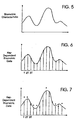
- a biometric characteristic which is shown in Figure 5 as a function of time and/or space, is sampled at a sample frequency T in Figure 6, that is a function of the key.
- the key T may be transmitted from the server 112 to the client 110, to thereby provide a sampling frequency T at which the biometric characteristic is sampled.
- the actual values of the key-dependent biometric data samples are shown by dots in Figure 6.
- the key itself may also be applied to the sampled biometric characteristic so that the actual values that are obtained differ from the actual values of the key-dependent biometric data by a nonlinear function.
- the key is applied to the sampled biometric data of Figure 6, to thereby generate key-dependent biometric data samples, shown in dots in Figure 7.
- the key-dependent biometric data samples are preferably nonlinearly related to the actual biometric data samples of Figure 6. They may also be a one-way nonlinear function of the biometric data samples, such as a hash function.
- the key-dependent samples are transmitted to the server 112.
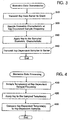
- biometric data processing takes place as shown in Figure 4.
- one or more of the templates Tl-Tn are sampled at the key-dependent sample frequency, and at Block 420, the key is applied to the sample template(s), to thereby generate the key-dependent template(s) T1(k)-Tn(k) of Figure 2.
- the key-dependent template(s) 148 are compared to the key-dependent samples that are obtained from the web server 118, to thereby verify and/or identify the biometric data.
- the biometric characteristic of Figure 5 is a continuous input speech signal v(T), where T is time.
- a sensing device in the biometric data acquisition module 132 converts the input speech signal into a binary code representing a quantized amplitude value closest to the amplitude of the signal every T seconds, where T is the sampling period.
- the sampling operation is made a nonlinear function of the sampling frequency, so that the sampling frequency can be used as the key for the operation.
- the key frequencies F and F0 are used to produce at least one key-dependent template T1(k)-Tn(k) from at least one of the prestored templates Tl-Tn by key-dependent sampling of the template data, as was described above.
- a key-dependent template and the key-dependent samples are compared to determine if both are from the same user. Identification can be performed in a similar manner, but in this case the key may be used to produce many key-dependent templates from the prestored templates. Then, the key-dependent samples are compared to the key-dependent templates, to determine the identity of the user.
- the key prior to performing the biometric sampling operation, the key should be installed or initialized at both the client and server systems 110 and 112 respectively. If cryptography is already present at the client and server for other reasons, then the server can use public-key or symmetric-key cryptography to send the key (for example F and F 0 ) to the server, and thereby provide enhanced security to the key. Alternatively, the key may be transmitted in the clear from the server 112 to the client 110. Clear transmission of the key may still allow secure transmission of biometric data if the key space is large enough to provide that an attacker will be unable to intercept enough transmitted biometric data and keys to forge a biometric sample for a new intercepted key.
- biometric sample is rich in information content, and it contains a large amount of data, then key-dependent sampling need not interfere with the robustness of the user identification or user verification, in which the key-dependent samples and the key-dependent templates are compared or analyzed to determine whether they are biometric data from the same user. Thus, as the amount of information content and biometric samples continue to increase, it may be more feasible to transmit the key in the clear from the server 112 to the client 110.
- the key is not transmitted in the clear. Rather, the client 110 and the server 112 share a secret value S.
- the server 112 sends a random value R to the client 110 in the clear.
- the random value is used in combination with the secret value, to perform key-dependent sampling.
- the common secret value S is first initialized in each device.
- this technique may have advantages because the keys are not transmitted in the clear, so that an attacker may not have a clue about the key value produced from S and R, assuming that R is large enough so that it is unlikely to repeat.
- the attacker generally will not know which key- dependent biometric sample to substitute for his own key-dependent biometric sample in order to impersonate another user.
- the key derivation algorithm may be simple and straightforward. Thus, while the client and server may need to implement the key derivation algorithm, they need not implement an encryption algorithm.
- Identification/verification may assume that each key-dependent biometric sample and each associated key-dependent template are uniquely paired together and that a key-dependent biometric sample obtained for a first key will not succeed in being validated against a key-dependent template for a different second key.
- the key-dependent sample should be constructed so that the obtained biometric samples are different for each key, i.e., different enough so that stated granularity in the identification/validation procedure may be achieved.
- a key-dependent biometric sample obtained for a first key generally will not succeed in being validated against a key-dependent template for a different second key.
- Another biometric system in which the present invention maybe used is a computer program product marketed by Miros Inc., Wellesley, MA, called TrueFace, which can secure Internet website access. See www.miros.com.
- TrueFace uses Microsoft ActiveX technology to download facial capture software to the browser of a surfing computer user. The ActiveX component returns the captured data to the site where the TrueFace server component can verify the surfer against an enrolled image.
- the server software runs on Windows NT, whereas the client is Microsoft's Internet Explorer or Netscape Navigator using a plug-in.
- a possible attack against this biometric system may be for the attacker to first intercept a biometric sample during transmission (client to server) and then to impersonate that other user by performing an active line attack in which the attacker biometric data is replaced by the intercepted biometric data.
- the biometric data can be protected through the use of key-dependent sampling according to the invention.
- the server would generate a key and communicate it to the browser, for example along with the facial capture software downloaded from the server.
- the facial capture software in turn would use the key to perform a key-dependent sampling operation to obtain a corresponding key-dependent biometric facial sample, which would then be sent in the clear to the server.
- the server would use the key to filter a stored biometric template to produce key-dependent biometric template samples, which would then be compared or analyzed against the key-dependent biometric facial sample received from the client to determine whether both pieces of biometric data came from the same user. If the number of keys and key-dependent biometric facial samples is large enough, then an attacker should not be able to forge key-dependent biometric facial data for a key that it had not already seen (or intercepted).
- a smart card manufacturer On Track Innovations has integrated finger biometrics to its "Eyecom” contactless smart card using Identix's "Fingerscan” technology. See www.oti.co.il.
- the exchange of data between the card and the read terminal takes place "on the fly” with only a short contactless power window to exchange the biometric template.
- the 1.2K byte template is encrypted for wireless transmission to the Fingerscan reader for verification, using either DES or RSA public key encryption. The verification process is private and localized, without the use of any network.
- the present invention may be applied as follows:
- the Fingerscan reader may generate a key which may then be communicated in the clear to the smart card.
- the smart card would use the key to filter the stored biometric template to produce a unique key-dependent biometric template, which it then transmits to the Fingerscan reader.
- the Fingerscan reader in turn would use the key to perform a key-dependent sampling operation using the Fingerscan technology to obtain a corresponding key-dependent biometric sample, which would then be compared and analyzed against the key-dependent biometric template received from the smart card.
- An interloper who intercepts a key and key-dependent biometric template, or several such key and key-dependent biometric templates, may not have enough information to forge biometric data since the key selected by the Fingerscan technology would not necessarily match one of the keys intercepted by the interloper. Hence, the interloper would not have the necessary biometric information to forge the biometric data. It will be understood that the security may depend on having a key-space large enough to provide that the interloper will not be able to collect enough of the biometric template to forge biometric data for an arbitrary key selected by the Fingerscan technology.
- biometric sensing systems, methods and computer program products may thereby be provided.
- blocks of the figures support combinations of means for performing the specified functions, combinations of steps for performing the specified functions and program instruction means for performing the specified functions. It will also be understood that individual blocks of the figures, and combinations of blocks in the flowchart illustrations, can be implemented by special purpose hardware-based computer systems which perform the specified functions or steps, or by combinations of special purpose hardware and computer instructions.
Landscapes
- Engineering & Computer Science (AREA)
- Computer Security & Cryptography (AREA)
- Theoretical Computer Science (AREA)
- Signal Processing (AREA)
- Computer Networks & Wireless Communication (AREA)
- General Engineering & Computer Science (AREA)
- Software Systems (AREA)
- General Physics & Mathematics (AREA)
- Physics & Mathematics (AREA)
- Computer Hardware Design (AREA)
- Health & Medical Sciences (AREA)
- Biodiversity & Conservation Biology (AREA)
- General Health & Medical Sciences (AREA)
- Biomedical Technology (AREA)
- Life Sciences & Earth Sciences (AREA)
- Measurement Of The Respiration, Hearing Ability, Form, And Blood Characteristics Of Living Organisms (AREA)
- Collating Specific Patterns (AREA)
- Medicines Containing Antibodies Or Antigens For Use As Internal Diagnostic Agents (AREA)
- Lock And Its Accessories (AREA)
Claims (11)
- Verfahren für die sichere Übertragung biometrischer Datenabtastwerte von einem Client (110) an einen Server (112), gekennzeichnet durch die folgenden Schritte:Durchführen (320, 336) einer schlüsselabhängigen Abtastung eines biometrischen Merkmals auf dem Client, um so schlüsselabhängige biometrische Datenabtastwerte zu erzeugen; undÜbertragen (340) der schlüsselabhängigen biometrischen Datenabtastwerte von dem Client an den Server;wobei der Durchführungsschritt die folgenden Schritte umfasst:Abtasten des biometrischen Merkmals mit einer Abtastfrequenz, die eine Funktion eines Schlüssels ist, um so abgetastete biometrische Daten zu erhalten; undAnwenden des Schlüssels auf die abgetasteten biometrischen Daten, um auf diese Weise die schlüsselabhängigen biometrischen Datenabtastwerte zu erzeugen.
- Verfahren nach Anspruch 1, wobei vor dem Durchführungsschritt der Schritt der Übertragung eines Schlüssels von dem Server an den Client steht und wobei der Durchführungsschritt den Schritt der Verwendung des Schlüssels umfasst, um so die schlüsselabhängige Abtastung des biometrischen Merkmals auf dem Client durchzuführen.
- Verfahren nach Anspruch 1, wobei der Durchführungsschritt den folgenden Schritt umfasst:Durchführen einer nichtlinearen schlüsselabhängigen Abtastung des biometrischen Merkmals auf dem Client, um auf diese Weise die schlüsselabhängigen biometrischen Datenabtastwerte zu erzeugen, indem der Schlüssel verwendet wird, um die Abtastfrequenz zu ermitteln, und indem der Schlüssel außerdem verwendet wird, um eine nichtlineare Funktion auf die abgetasteten biometrischen Daten anzuwenden.
- Verfahren nach Anspruch 1, wobei nach dem Übertragungsschritt der folgende Schritt steht:Vergleichen der schlüsselabhängigen biometrischen Datenabtastwerte mit mindestens einer schlüsselabhängigen biometrischen Datenvorlage auf dem Server.
- Verfahren nach Anspruch 2, wobei der Schritt der Übertragung die folgenden Schritte umfasst:Übertragen einer zufallszahl von dem Server an den Client; undVerknüpfen der Zufallszahl mit einem geheimen Wert auf dem Client; undwobei der Schritt der Durchführung den Schritt der Durchführung einer schlüsselabhängigen Abtastung unter Verwendung der Verknüpfung aus der Zufallszahl und dem geheimen Wert umfasst.
- Verfahren nach Anspruch 5, wobei vor dem Schritt der Übertragung einer Zufallszahl der Schritt der Übertragung des geheimen Werts von dem Server an den Client steht.
- Verfahren nach einem beliebigen der vorangehenden Ansprüche, wobei der Übertragungsschritt den Schritt der Übertragung der schlüsselabhängigen biometrischen Datenabtastwerte von dem Client an den Server über das Internet umfasst.
- Verfahren für die Verarbeitung von biometrischen Daten eines Client (110) auf einem Server (112), gekennzeichnet durch die folgenden Schritte:Durchführen (410, 420) einer schlüsselabhängigen Abtastung von mindestens einer biometrischen Merkmalsvorlage auf dem Server, um so schlüsselabhängige biometrische Vorlagen-Datenabtastwerte zu erzeugen; undVergleichen (430) der schlüsselabhängigen biometrischen Vorlagen-Datenabtastwerte mit den biometrischen Daten des Client;wobei der Durchführungsschritt die folgenden Schritte umfasst:Abtasten der biometrischen Merkmalsvorlage mit einer Abtastfrequenz, die eine Funktion eines Schlüssels ist, um abgetastete biometrische Vorlagendaten zu erhalten; undAnwenden des Schlüssels auf die abgetasteten biometrischen Vorlagendaten, um auf diese Weise die schlüsselabhängigen biometrischen Vorlagen-Datenabtastwerte zu erzeugen.
- Clientsystem für die sichere Übertragung biometrischer Datenabtastwerte, gekennzeichnet durch:Mittel für die Durchführung einer schlüsselabhängigen Abtastung eines biometrischen Merkmals, um auf diese Weise schlüsselabhängige biometrische Datenabtastwerte zu erzeugen; undMittel für die Übertragung der schlüsselabhängigen biometrischen Datenabtastwerte an einen Server;wobei das Mittel für die Durchführung Folgendes umfasst:Mittel für die Abtastung des biometrischen Merkmals mit einer Abtastfrequenz, die eine Funktion eines Schlüssels ist, um die abgetasteten biometrischen Daten zu erhalten; undMittel für die Anwendung des Schlüssels auf die abgetasteten biometrischen Daten, um auf diese Weise die schlüsselabhängigen biometrischen Datenabtastwerte zu erzeugen.
- Serversystem für die Verarbeitung biometrischer Daten, gekennzeichnet durch:Mittel für die Durchführung einer schlüsselabhängigen Abtastung von mindestens einer biometrischen Merkmalsvorlage, um auf diese Weise schlüsselabhängige biometrische Vorlagen-Datenabtastwerte zu erzeugen; undMittel für den Vergleich der schlüsselabhängigen biometrischen Vorlagen-Datenabtastwerte mit biometrischen Daten eines Clients;wobei das Mittel für die Durchführung Folgendes umfasst:Mittel für die Abtastung der biometrischen Merkmalsvorlage mit einer Abtastfrequenz, die eine Funktion eines Schlüssels ist, um so abgetastete biometrische Vorlagendaten zu erhalten; undMittel für die Anwendung des Schlüssels auf die abgetasteten biometrischen Vorlagendaten, um auf diese Weise die schlüsselabhängigen biometrischen Vorlagen-Datenabtastwerte zu erzeugen.
- Computerprogrammprodukt für die sichere Übertragung biometrischer Datenabtastwerte, wobei das Computerprogrammprodukt durch Folgendes gekennzeichnet ist:ein computerlesbares Speichermedium mit einem in dem Medium befindlichen computerlesbaren Programmcodemittel,wobei das computerlesbare Programmcodemittel Folgendes umfasst:computerlesbare Programmcodemittel zur Durchführung des Verfahrens aus einem beliebigen der Ansprüche 1 bis 7.
Applications Claiming Priority (3)
| Application Number | Priority Date | Filing Date | Title |
|---|---|---|---|
| US238700 | 1999-01-27 | ||
| US09/238,700 US6507912B1 (en) | 1999-01-27 | 1999-01-27 | Protection of biometric data via key-dependent sampling |
| PCT/GB2000/000221 WO2000045551A1 (en) | 1999-01-27 | 2000-01-26 | Protection of biometric data via key-dependent sampling |
Publications (2)
| Publication Number | Publication Date |
|---|---|
| EP1145484A1 EP1145484A1 (de) | 2001-10-17 |
| EP1145484B1 true EP1145484B1 (de) | 2006-01-04 |
Family
ID=22898966
Family Applications (1)
| Application Number | Title | Priority Date | Filing Date |
|---|---|---|---|
| EP00901220A Expired - Lifetime EP1145484B1 (de) | 1999-01-27 | 2000-01-26 | Schutz von biometrischen daten mittels schlüsselabhängiger abtastung |
Country Status (14)
| Country | Link |
|---|---|
| US (1) | US6507912B1 (de) |
| EP (1) | EP1145484B1 (de) |
| JP (1) | JP4106188B2 (de) |
| CN (1) | CN100414867C (de) |
| AT (1) | ATE315293T1 (de) |
| AU (1) | AU2118000A (de) |
| CZ (1) | CZ300144B6 (de) |
| DE (1) | DE60025326T2 (de) |
| ES (1) | ES2254131T3 (de) |
| HU (1) | HUP0105304A2 (de) |
| IL (3) | IL144196A0 (de) |
| PL (1) | PL364730A1 (de) |
| TW (1) | TW511362B (de) |
| WO (1) | WO2000045551A1 (de) |
Families Citing this family (101)
| Publication number | Priority date | Publication date | Assignee | Title |
|---|---|---|---|---|
| US9215979B2 (en) * | 1992-11-17 | 2015-12-22 | Robert Bosch Healthcare Systems, Inc. | Multi-user remote health monitoring system |
| US7711152B1 (en) | 1999-04-30 | 2010-05-04 | Davida George I | System and method for authenticated and privacy preserving biometric identification systems |
| US8325994B2 (en) | 1999-04-30 | 2012-12-04 | Davida George I | System and method for authenticated and privacy preserving biometric identification systems |
| US6981016B1 (en) * | 1999-06-11 | 2005-12-27 | Visage Development Limited | Distributed client/server computer network |
| US7058817B1 (en) | 1999-07-02 | 2006-06-06 | The Chase Manhattan Bank | System and method for single sign on process for websites with multiple applications and services |
| WO2001033477A2 (en) * | 1999-11-04 | 2001-05-10 | Jpmorgan Chase Bank | System and method for automated financial project management |
| US7321864B1 (en) * | 1999-11-04 | 2008-01-22 | Jpmorgan Chase Bank, N.A. | System and method for providing funding approval associated with a project based on a document collection |
| US8571975B1 (en) | 1999-11-24 | 2013-10-29 | Jpmorgan Chase Bank, N.A. | System and method for sending money via E-mail over the internet |
| US7761715B1 (en) * | 1999-12-10 | 2010-07-20 | International Business Machines Corporation | Semiotic system and method with privacy protection |
| US7269277B2 (en) * | 1999-12-14 | 2007-09-11 | Davida George I | Perfectly secure authorization and passive identification with an error tolerant biometric system |
| US7698565B1 (en) * | 2000-03-30 | 2010-04-13 | Digitalpersona, Inc. | Crypto-proxy server and method of using the same |
| US7409543B1 (en) | 2000-03-30 | 2008-08-05 | Digitalpersona, Inc. | Method and apparatus for using a third party authentication server |
| US7426530B1 (en) | 2000-06-12 | 2008-09-16 | Jpmorgan Chase Bank, N.A. | System and method for providing customers with seamless entry to a remote server |
| US10185936B2 (en) * | 2000-06-22 | 2019-01-22 | Jpmorgan Chase Bank, N.A. | Method and system for processing internet payments |
| US8335855B2 (en) * | 2001-09-19 | 2012-12-18 | Jpmorgan Chase Bank, N.A. | System and method for portal infrastructure tracking |
| US7254619B2 (en) * | 2000-10-13 | 2007-08-07 | Matsushita Electric Industrial Co., Ltd. | Apparatus for outputting individual authentication information connectable to a plurality of terminals through a network |
| US7103556B2 (en) * | 2000-11-02 | 2006-09-05 | Jpmorgan Chase Bank, N.A. | System and method for aggregate portfolio client support |
| US8015592B2 (en) * | 2002-03-28 | 2011-09-06 | Innovation Connection Corporation | System, method and apparatus for enabling transactions using a biometrically enabled programmable magnetic stripe |
| US8103881B2 (en) * | 2000-11-06 | 2012-01-24 | Innovation Connection Corporation | System, method and apparatus for electronic ticketing |
| US20060149686A1 (en) * | 2000-11-30 | 2006-07-06 | Allison Debonnett | Method of payment and settlement of goods and services via the INTERNET |
| JP3586431B2 (ja) * | 2001-02-28 | 2004-11-10 | 松下電器産業株式会社 | 個人認証方法および装置 |
| US8849716B1 (en) | 2001-04-20 | 2014-09-30 | Jpmorgan Chase Bank, N.A. | System and method for preventing identity theft or misuse by restricting access |
| US6816058B2 (en) * | 2001-04-26 | 2004-11-09 | Mcgregor Christopher M | Bio-metric smart card, bio-metric smart card reader and method of use |
| US6778688B2 (en) * | 2001-05-04 | 2004-08-17 | International Business Machines Corporation | Remote authentication of fingerprints over an insecure network |
| US20040193893A1 (en) * | 2001-05-18 | 2004-09-30 | Michael Braithwaite | Application-specific biometric templates |
| US7689506B2 (en) | 2001-06-07 | 2010-03-30 | Jpmorgan Chase Bank, N.A. | System and method for rapid updating of credit information |
| US20030012415A1 (en) * | 2001-07-10 | 2003-01-16 | Cossel Travis M. | Method and apparatus to biometrically authenticate MFP users |
| US7266839B2 (en) * | 2001-07-12 | 2007-09-04 | J P Morgan Chase Bank | System and method for providing discriminated content to network users |
| FR2829855A1 (fr) | 2001-09-14 | 2003-03-21 | St Microelectronics Sa | Identification securisee par donnees biometriques |
| US20040153421A1 (en) * | 2001-09-21 | 2004-08-05 | Timothy Robinson | System and method for biometric authorization of age-restricted transactions conducted at an unattended device |
| US9189788B1 (en) | 2001-09-21 | 2015-11-17 | Open Invention Network, Llc | System and method for verifying identity |
| US7269737B2 (en) | 2001-09-21 | 2007-09-11 | Pay By Touch Checking Resources, Inc. | System and method for biometric authorization for financial transactions |
| US8200980B1 (en) | 2001-09-21 | 2012-06-12 | Open Invention Network, Llc | System and method for enrolling in a biometric system |
| US20030177102A1 (en) * | 2001-09-21 | 2003-09-18 | Timothy Robinson | System and method for biometric authorization for age verification |
| US7765164B1 (en) | 2001-09-21 | 2010-07-27 | Yt Acquisition Corporation | System and method for offering in-lane periodical subscriptions |
| US7464059B1 (en) * | 2001-09-21 | 2008-12-09 | Yt Acquisition Corporation | System and method for purchase benefits at a point of sale |
| US7437330B1 (en) | 2002-09-20 | 2008-10-14 | Yt Acquisition Corp. | System and method for categorizing transactions |
| US7533809B1 (en) | 2001-09-21 | 2009-05-19 | Yt Acquisition Corporation | System and method for operating a parking facility |
| US7103576B2 (en) * | 2001-09-21 | 2006-09-05 | First Usa Bank, Na | System for providing cardless payment |
| US7624073B1 (en) | 2001-09-21 | 2009-11-24 | Yt Acquisition Corporation | System and method for categorizing transactions |
| AU2002363138A1 (en) * | 2001-11-01 | 2003-05-12 | First Usa Bank, N.A. | System and method for establishing or modifying an account with user selectable terms |
| US7987501B2 (en) * | 2001-12-04 | 2011-07-26 | Jpmorgan Chase Bank, N.A. | System and method for single session sign-on |
| US20030225711A1 (en) * | 2002-02-20 | 2003-12-04 | Martin Paping | Method and apparatus for postal user identification and billing |
| US7353383B2 (en) | 2002-03-18 | 2008-04-01 | Jpmorgan Chase Bank, N.A. | System and method for single session sign-on with cryptography |
| US7899753B1 (en) | 2002-03-25 | 2011-03-01 | Jpmorgan Chase Bank, N.A | Systems and methods for time variable financial authentication |
| US20180165441A1 (en) | 2002-03-25 | 2018-06-14 | Glenn Cobourn Everhart | Systems and methods for multifactor authentication |
| US8082575B2 (en) | 2002-03-28 | 2011-12-20 | Rampart-Id Systems, Inc. | System, method and apparatus for enabling transactions using a user enabled programmable magnetic stripe |
| WO2003084124A1 (en) * | 2002-03-28 | 2003-10-09 | Innovation Connection Corporation | Apparatus and method for transactions security using biometric identity validation and contactless smartcard. |
| AU2003247117B2 (en) * | 2002-04-30 | 2010-01-21 | Robert Eryou | System and apparatus for authenticating to a system or network |
| EP1510032A4 (de) * | 2002-05-15 | 2007-05-30 | Bio Key Int Inc | Vergleichsschablonenschutz in biometrischen sicherheitssystemen |
| US7274807B2 (en) * | 2002-05-30 | 2007-09-25 | Activcard Ireland Limited | Method and apparatus for supporting a biometric registration performed on a card |
| JP2005532736A (ja) * | 2002-07-03 | 2005-10-27 | オーロラ・ワイヤレス・テクノロジーズ・リミテッド | 生物測定学的私設キーインフラストラクチャ |
| EP1418483A1 (de) * | 2002-08-23 | 2004-05-12 | Siemens Aktiengesellschaft | Überprüfung und Einräumung von Nutzungsberechtigungen |
| US7234065B2 (en) * | 2002-09-17 | 2007-06-19 | Jpmorgan Chase Bank | System and method for managing data privacy |
| US7206938B2 (en) * | 2002-09-24 | 2007-04-17 | Imagic Software, Inc. | Key sequence rhythm recognition system and method |
| US20080034218A1 (en) * | 2002-09-24 | 2008-02-07 | Bender Steven L | Key sequence rhythm guidance recognition system and method |
| US7058660B2 (en) | 2002-10-02 | 2006-06-06 | Bank One Corporation | System and method for network-based project management |
| US8301493B2 (en) * | 2002-11-05 | 2012-10-30 | Jpmorgan Chase Bank, N.A. | System and method for providing incentives to consumers to share information |
| US20040153418A1 (en) * | 2003-02-05 | 2004-08-05 | Hanweck Gerald Alfred | System and method for providing access to data from proprietary tools |
| US20050001712A1 (en) * | 2003-07-03 | 2005-01-06 | Yarbrough Craig D. | RF ID tag |
| US7376838B2 (en) | 2003-07-17 | 2008-05-20 | Jp Morgan Chase Bank | Method for controlled and audited access to privileged accounts on computer systems |
| US20050055555A1 (en) * | 2003-09-05 | 2005-03-10 | Rao Srinivasan N. | Single sign-on authentication system |
| US7421696B2 (en) | 2003-12-22 | 2008-09-02 | Jp Morgan Chase Bank | Methods and systems for managing successful completion of a network of processes |
| US7254036B2 (en) * | 2004-04-09 | 2007-08-07 | Netlist, Inc. | High density memory module using stacked printed circuit boards |
| US7474769B1 (en) * | 2004-09-14 | 2009-01-06 | Unisys Corporation | Bioindex mechanism for increasing the relative speed of biometric identification against large population samples |
| TWI249314B (en) * | 2004-10-15 | 2006-02-11 | Ind Tech Res Inst | Biometrics-based cryptographic key generation system and method |
| US7506174B2 (en) * | 2004-11-03 | 2009-03-17 | Lenovo (Singapore) Pte Ltd. | Method and system for establishing a biometrically enabled password |
| US20060190723A1 (en) * | 2005-02-18 | 2006-08-24 | Jp Morgan Chase Bank | Payload layer security for file transfer |
| US20060293891A1 (en) * | 2005-06-22 | 2006-12-28 | Jan Pathuel | Biometric control systems and associated methods of use |
| US7442050B1 (en) | 2005-08-29 | 2008-10-28 | Netlist, Inc. | Circuit card with flexible connection for memory module with heat spreader |
| US8583926B1 (en) | 2005-09-19 | 2013-11-12 | Jpmorgan Chase Bank, N.A. | System and method for anti-phishing authentication |
| EP1932278B1 (de) * | 2005-09-29 | 2017-05-10 | Koninklijke Philips N.V. | Sicherer schutz biometrischer schablonen |
| US7619893B1 (en) | 2006-02-17 | 2009-11-17 | Netlist, Inc. | Heat spreader for electronic modules |
| US8151322B2 (en) | 2006-05-16 | 2012-04-03 | A10 Networks, Inc. | Systems and methods for user access authentication based on network access point |
| US8793490B1 (en) | 2006-07-14 | 2014-07-29 | Jpmorgan Chase Bank, N.A. | Systems and methods for multifactor authentication |
| US7716378B2 (en) | 2006-10-17 | 2010-05-11 | A10 Networks, Inc. | System and method to associate a private user identity with a public user identity |
| US8312507B2 (en) | 2006-10-17 | 2012-11-13 | A10 Networks, Inc. | System and method to apply network traffic policy to an application session |
| WO2008062340A2 (en) * | 2006-11-21 | 2008-05-29 | Koninklijke Philips Electronics N.V. | Fuzzy biometrics based signatures |
| US7474529B2 (en) * | 2006-11-29 | 2009-01-06 | International Business Machines Corporation | Folded-sheet-metal heatsinks for closely packaged heat-producing devices |
| US8473735B1 (en) | 2007-05-17 | 2013-06-25 | Jpmorgan Chase | Systems and methods for managing digital certificates |
| US8326353B1 (en) | 2007-06-27 | 2012-12-04 | ENORCOM Corporation | Customizable mobile device |
| US12245028B1 (en) | 2007-06-27 | 2025-03-04 | ENORCOM Corporation | Intelligent interface mechanism for an electronic system |
| US8311513B1 (en) | 2007-06-27 | 2012-11-13 | ENORCOM Corporation | Automated mobile system |
| US8321682B1 (en) | 2008-01-24 | 2012-11-27 | Jpmorgan Chase Bank, N.A. | System and method for generating and managing administrator passwords |
| US8018723B1 (en) | 2008-04-30 | 2011-09-13 | Netlist, Inc. | Heat dissipation for electronic modules |
| DE102008043953A1 (de) * | 2008-11-21 | 2010-05-27 | Robert Bosch Gmbh | Vorrichtung zur Erzeugung und/oder Verarbeitung einer Objektsignatur, Überwachungsvorrichtung, Verfahren und Computerprogramm |
| US9608826B2 (en) | 2009-06-29 | 2017-03-28 | Jpmorgan Chase Bank, N.A. | System and method for partner key management |
| US9825761B2 (en) * | 2010-04-06 | 2017-11-21 | King Saud University | Systems and methods improving cryptosystems with biometrics |
| US9600443B2 (en) | 2012-01-30 | 2017-03-21 | International Business Machines Corporation | Tracking entities by means of hash values |
| US9419957B1 (en) | 2013-03-15 | 2016-08-16 | Jpmorgan Chase Bank, N.A. | Confidence-based authentication |
| US9122853B2 (en) | 2013-06-24 | 2015-09-01 | A10 Networks, Inc. | Location determination for user authentication |
| CN104346161B (zh) * | 2013-08-09 | 2017-12-29 | 联想(北京)有限公司 | 一种信息处理的方法及电子设备 |
| CA2932623A1 (en) * | 2013-12-02 | 2015-06-11 | Identity Authentication Management | Methods and systems for multi-key veritable biometric identity authentication |
| US11165770B1 (en) | 2013-12-06 | 2021-11-02 | A10 Networks, Inc. | Biometric verification of a human internet user |
| US10148726B1 (en) | 2014-01-24 | 2018-12-04 | Jpmorgan Chase Bank, N.A. | Initiating operating system commands based on browser cookies |
| US9584489B2 (en) * | 2015-01-29 | 2017-02-28 | Google Inc. | Controlling access to resource functions at a control point of the resource via a user device |
| CN107438000B (zh) * | 2016-05-26 | 2020-08-07 | 青岛博文广成信息安全技术有限公司 | Cfl虎符认证方法 |
| SE1750282A1 (sv) * | 2017-03-13 | 2018-09-14 | Fingerprint Cards Ab | Updating biometric data templates |
| CN107491965B (zh) | 2017-07-31 | 2020-07-10 | 阿里巴巴集团控股有限公司 | 一种生物特征库的建立方法和装置 |
| US12363096B2 (en) * | 2018-08-16 | 2025-07-15 | Cyberark Software Ltd. | Authentication credential with embedded authentication information |
| US12255889B2 (en) * | 2018-08-16 | 2025-03-18 | Cyberark Software Ltd. | Detecting and preventing unauthorized credential change |
Family Cites Families (9)
| Publication number | Priority date | Publication date | Assignee | Title |
|---|---|---|---|---|
| DE2834281A1 (de) | 1978-08-04 | 1980-02-21 | Siemens Ag | Anordnung zur durchfuehrung einer verschleierten uebertragung von informationen |
| US5325318A (en) * | 1992-01-31 | 1994-06-28 | Constream Corporation | Variable rate digital filter |
| US5737420A (en) | 1994-09-07 | 1998-04-07 | Mytec Technologies Inc. | Method for secure data transmission between remote stations |
| WO1998012670A1 (en) | 1996-09-18 | 1998-03-26 | Dew Engineering And Development Limited | Biometric identification system for providing secure access |
| US6076167A (en) * | 1996-12-04 | 2000-06-13 | Dew Engineering And Development Limited | Method and system for improving security in network applications |
| AU7484898A (en) * | 1997-05-09 | 1998-11-27 | Gte Government Systems Corporation | Biometric certificates |
| US6202151B1 (en) * | 1997-05-09 | 2001-03-13 | Gte Service Corporation | System and method for authenticating electronic transactions using biometric certificates |
| US6167517A (en) * | 1998-04-09 | 2000-12-26 | Oracle Corporation | Trusted biometric client authentication |
| US6278746B1 (en) * | 1998-05-12 | 2001-08-21 | Montreal Networks Limited | Timing recovery loop circuit in a receiver of a modem |
-
1999
- 1999-01-27 US US09/238,700 patent/US6507912B1/en not_active Expired - Lifetime
- 1999-11-23 TW TW088120472A patent/TW511362B/zh not_active IP Right Cessation
-
2000
- 2000-01-26 ES ES00901220T patent/ES2254131T3/es not_active Expired - Lifetime
- 2000-01-26 IL IL14419600A patent/IL144196A0/xx unknown
- 2000-01-26 IL IL14385500A patent/IL143855A0/xx active IP Right Grant
- 2000-01-26 WO PCT/GB2000/000221 patent/WO2000045551A1/en not_active Ceased
- 2000-01-26 EP EP00901220A patent/EP1145484B1/de not_active Expired - Lifetime
- 2000-01-26 CN CNB008031479A patent/CN100414867C/zh not_active Expired - Lifetime
- 2000-01-26 HU HU0105304A patent/HUP0105304A2/hu unknown
- 2000-01-26 DE DE60025326T patent/DE60025326T2/de not_active Expired - Lifetime
- 2000-01-26 PL PL00364730A patent/PL364730A1/xx not_active Application Discontinuation
- 2000-01-26 CZ CZ20012673A patent/CZ300144B6/cs not_active IP Right Cessation
- 2000-01-26 AU AU21180/00A patent/AU2118000A/en not_active Abandoned
- 2000-01-26 JP JP2000596697A patent/JP4106188B2/ja not_active Expired - Lifetime
- 2000-01-26 AT AT00901220T patent/ATE315293T1/de not_active IP Right Cessation
-
2001
- 2001-06-19 IL IL143855A patent/IL143855A/en not_active IP Right Cessation
Also Published As
| Publication number | Publication date |
|---|---|
| TW511362B (en) | 2002-11-21 |
| CN100414867C (zh) | 2008-08-27 |
| ES2254131T3 (es) | 2006-06-16 |
| IL143855A (en) | 2006-06-11 |
| JP4106188B2 (ja) | 2008-06-25 |
| IL144196A0 (en) | 2002-05-23 |
| PL364730A1 (en) | 2004-12-13 |
| EP1145484A1 (de) | 2001-10-17 |
| ATE315293T1 (de) | 2006-02-15 |
| CZ20012673A3 (cs) | 2002-02-13 |
| DE60025326T2 (de) | 2006-08-31 |
| AU2118000A (en) | 2000-08-18 |
| IL143855A0 (en) | 2002-04-21 |
| HUP0105304A2 (en) | 2002-04-29 |
| US6507912B1 (en) | 2003-01-14 |
| JP2002536876A (ja) | 2002-10-29 |
| CZ300144B6 (cs) | 2009-02-25 |
| WO2000045551A1 (en) | 2000-08-03 |
| DE60025326D1 (de) | 2006-03-30 |
| CN1338167A (zh) | 2002-02-27 |
Similar Documents
| Publication | Publication Date | Title |
|---|---|---|
| EP1145484B1 (de) | Schutz von biometrischen daten mittels schlüsselabhängiger abtastung | |
| US6189098B1 (en) | Client/server protocol for proving authenticity | |
| US8689290B2 (en) | System and method for securing a credential via user and server verification | |
| KR101226651B1 (ko) | 생체 인식 기술의 사용에 기초한 사용자 인증 방법 및 관련구조 | |
| JP4870155B2 (ja) | プライバシーが強化された電子パスポートの認証プロトコル | |
| US7114080B2 (en) | Architecture for secure remote access and transmission using a generalized password scheme with biometric features | |
| KR100353731B1 (ko) | 일회성 지문템플릿을 이용한 사용자 인증시스템 및 방법 | |
| EP1290534A2 (de) | Verfahren zur biometrischen verschlüsselung von email | |
| IL137099A (en) | Method and system for performing a secure digital signature | |
| CN101569132A (zh) | 用于分发数据和保护数据安全的系统和方法 | |
| WO2001084761A1 (en) | Method for securing communications between a terminal and an additional user equipment | |
| EP1076953A1 (de) | Benutzerauthentifizierung mittels eines virtuellen geheimschlüssels | |
| CN101420301A (zh) | 人脸识别身份认证系统 | |
| JP6151627B2 (ja) | 生体認証システム、生体認証方法およびコンピュータプログラム | |
| EP1092182A2 (de) | Vorrichtung und verfahren zur end-zu-end-authentifizierung mittels biometrischer daten | |
| JP2001052182A (ja) | 個人認証方法及び個人認証プログラムを記録した記録媒体 | |
| Fan et al. | NIS03-6: Remote Password Authentication Scheme with Smart Cards and Biometrics | |
| Das et al. | A simple and secure authentication and key establishment protocol | |
| Deswarte et al. | The challenges raised by the privacy-preserving identity card | |
| Bechelli | A protocol for simulating match-on-card authentication through the use of a template-on-card technology | |
| KR20030061558A (ko) | 가상개인키를 이용한 사용자 인증방법 | |
| Akshaya et al. | ROBUST BIOMETRIC BASED AUTHENTICATION SCHEME USING WATERMARKING | |
| Sukumaran et al. | Critical File Access in Wireless Networks Using Multifactor Authentication |
Legal Events
| Date | Code | Title | Description |
|---|---|---|---|
| PUAI | Public reference made under article 153(3) epc to a published international application that has entered the european phase |
Free format text: ORIGINAL CODE: 0009012 |
|
| 17P | Request for examination filed |
Effective date: 20010730 |
|
| AK | Designated contracting states |
Kind code of ref document: A1 Designated state(s): AT BE CH CY DE DK ES FI FR GB GR IE IT LI LU MC NL PT SE |
|
| AX | Request for extension of the european patent |
Free format text: AL;LT;LV;MK;RO;SI |
|
| 17Q | First examination report despatched |
Effective date: 20021017 |
|
| GRAP | Despatch of communication of intention to grant a patent |
Free format text: ORIGINAL CODE: EPIDOSNIGR1 |
|
| GRAS | Grant fee paid |
Free format text: ORIGINAL CODE: EPIDOSNIGR3 |
|
| GRAA | (expected) grant |
Free format text: ORIGINAL CODE: 0009210 |
|
| AK | Designated contracting states |
Kind code of ref document: B1 Designated state(s): AT BE CH CY DE DK ES FI FR GB GR IE IT LI LU MC NL PT SE |
|
| PG25 | Lapsed in a contracting state [announced via postgrant information from national office to epo] |
Ref country code: LI Free format text: LAPSE BECAUSE OF FAILURE TO SUBMIT A TRANSLATION OF THE DESCRIPTION OR TO PAY THE FEE WITHIN THE PRESCRIBED TIME-LIMIT Effective date: 20060104 Ref country code: CH Free format text: LAPSE BECAUSE OF FAILURE TO SUBMIT A TRANSLATION OF THE DESCRIPTION OR TO PAY THE FEE WITHIN THE PRESCRIBED TIME-LIMIT Effective date: 20060104 Ref country code: AT Free format text: LAPSE BECAUSE OF FAILURE TO SUBMIT A TRANSLATION OF THE DESCRIPTION OR TO PAY THE FEE WITHIN THE PRESCRIBED TIME-LIMIT Effective date: 20060104 Ref country code: FI Free format text: LAPSE BECAUSE OF FAILURE TO SUBMIT A TRANSLATION OF THE DESCRIPTION OR TO PAY THE FEE WITHIN THE PRESCRIBED TIME-LIMIT Effective date: 20060104 Ref country code: BE Free format text: LAPSE BECAUSE OF FAILURE TO SUBMIT A TRANSLATION OF THE DESCRIPTION OR TO PAY THE FEE WITHIN THE PRESCRIBED TIME-LIMIT Effective date: 20060104 |
|
| REG | Reference to a national code |
Ref country code: GB Ref legal event code: FG4D |
|
| REG | Reference to a national code |
Ref country code: CH Ref legal event code: EP |
|
| PG25 | Lapsed in a contracting state [announced via postgrant information from national office to epo] |
Ref country code: MC Free format text: LAPSE BECAUSE OF NON-PAYMENT OF DUE FEES Effective date: 20060131 |
|
| REG | Reference to a national code |
Ref country code: IE Ref legal event code: FG4D |
|
| PG25 | Lapsed in a contracting state [announced via postgrant information from national office to epo] |
Ref country code: LU Free format text: LAPSE BECAUSE OF NON-PAYMENT OF DUE FEES Effective date: 20060304 |
|
| REF | Corresponds to: |
Ref document number: 60025326 Country of ref document: DE Date of ref document: 20060330 Kind code of ref document: P |
|
| PG25 | Lapsed in a contracting state [announced via postgrant information from national office to epo] |
Ref country code: SE Free format text: LAPSE BECAUSE OF FAILURE TO SUBMIT A TRANSLATION OF THE DESCRIPTION OR TO PAY THE FEE WITHIN THE PRESCRIBED TIME-LIMIT Effective date: 20060404 Ref country code: DK Free format text: LAPSE BECAUSE OF FAILURE TO SUBMIT A TRANSLATION OF THE DESCRIPTION OR TO PAY THE FEE WITHIN THE PRESCRIBED TIME-LIMIT Effective date: 20060404 |
|
| RAP2 | Party data changed (patent owner data changed or rights of a patent transferred) |
Owner name: INTERNATIONAL BUSINESS MACHINES CORPORATION |
|
| REG | Reference to a national code |
Ref country code: ES Ref legal event code: FG2A Ref document number: 2254131 Country of ref document: ES Kind code of ref document: T3 |
|
| NLT2 | Nl: modifications (of names), taken from the european patent patent bulletin |
Owner name: INTERNATIONAL BUSINESS MACHINES CORPORATION Effective date: 20060510 |
|
| REG | Reference to a national code |
Ref country code: CH Ref legal event code: PL |
|
| ET | Fr: translation filed | ||
| PLBE | No opposition filed within time limit |
Free format text: ORIGINAL CODE: 0009261 |
|
| STAA | Information on the status of an ep patent application or granted ep patent |
Free format text: STATUS: NO OPPOSITION FILED WITHIN TIME LIMIT |
|
| 26N | No opposition filed |
Effective date: 20061005 |
|
| PG25 | Lapsed in a contracting state [announced via postgrant information from national office to epo] |
Ref country code: GR Free format text: LAPSE BECAUSE OF FAILURE TO SUBMIT A TRANSLATION OF THE DESCRIPTION OR TO PAY THE FEE WITHIN THE PRESCRIBED TIME-LIMIT Effective date: 20060405 |
|
| PG25 | Lapsed in a contracting state [announced via postgrant information from national office to epo] |
Ref country code: CY Free format text: LAPSE BECAUSE OF FAILURE TO SUBMIT A TRANSLATION OF THE DESCRIPTION OR TO PAY THE FEE WITHIN THE PRESCRIBED TIME-LIMIT Effective date: 20060104 |
|
| REG | Reference to a national code |
Ref country code: GB Ref legal event code: 746 Effective date: 20081219 |
|
| PGFP | Annual fee paid to national office [announced via postgrant information from national office to epo] |
Ref country code: IE Payment date: 20110112 Year of fee payment: 12 |
|
| PGFP | Annual fee paid to national office [announced via postgrant information from national office to epo] |
Ref country code: NL Payment date: 20110202 Year of fee payment: 12 Ref country code: IT Payment date: 20110112 Year of fee payment: 12 |
|
| PGFP | Annual fee paid to national office [announced via postgrant information from national office to epo] |
Ref country code: ES Payment date: 20110112 Year of fee payment: 12 |
|
| PG25 | Lapsed in a contracting state [announced via postgrant information from national office to epo] |
Ref country code: PT Free format text: LAPSE BECAUSE OF FAILURE TO SUBMIT A TRANSLATION OF THE DESCRIPTION OR TO PAY THE FEE WITHIN THE PRESCRIBED TIME-LIMIT Effective date: 20060104 |
|
| REG | Reference to a national code |
Ref country code: NL Ref legal event code: V1 Effective date: 20120801 |
|
| REG | Reference to a national code |
Ref country code: IE Ref legal event code: MM4A |
|
| PG25 | Lapsed in a contracting state [announced via postgrant information from national office to epo] |
Ref country code: IT Free format text: LAPSE BECAUSE OF NON-PAYMENT OF DUE FEES Effective date: 20120126 |
|
| PG25 | Lapsed in a contracting state [announced via postgrant information from national office to epo] |
Ref country code: IE Free format text: LAPSE BECAUSE OF NON-PAYMENT OF DUE FEES Effective date: 20120126 Ref country code: NL Free format text: LAPSE BECAUSE OF NON-PAYMENT OF DUE FEES Effective date: 20120801 |
|
| REG | Reference to a national code |
Ref country code: ES Ref legal event code: FD2A Effective date: 20130708 |
|
| PG25 | Lapsed in a contracting state [announced via postgrant information from national office to epo] |
Ref country code: ES Free format text: LAPSE BECAUSE OF NON-PAYMENT OF DUE FEES Effective date: 20120127 |
|
| REG | Reference to a national code |
Ref country code: FR Ref legal event code: PLFP Year of fee payment: 17 |
|
| REG | Reference to a national code |
Ref country code: FR Ref legal event code: PLFP Year of fee payment: 18 |
|
| REG | Reference to a national code |
Ref country code: FR Ref legal event code: PLFP Year of fee payment: 19 |
|
| PGFP | Annual fee paid to national office [announced via postgrant information from national office to epo] |
Ref country code: DE Payment date: 20181211 Year of fee payment: 20 Ref country code: GB Payment date: 20190131 Year of fee payment: 20 Ref country code: FR Payment date: 20190122 Year of fee payment: 20 |
|
| REG | Reference to a national code |
Ref country code: DE Ref legal event code: R071 Ref document number: 60025326 Country of ref document: DE |
|
| REG | Reference to a national code |
Ref country code: GB Ref legal event code: PE20 Expiry date: 20200125 |
|
| PG25 | Lapsed in a contracting state [announced via postgrant information from national office to epo] |
Ref country code: GB Free format text: LAPSE BECAUSE OF EXPIRATION OF PROTECTION Effective date: 20200125 |