EP1144543B1 - Electroluminescent quinolates - Google Patents
Electroluminescent quinolates Download PDFInfo
- Publication number
- EP1144543B1 EP1144543B1 EP99973057A EP99973057A EP1144543B1 EP 1144543 B1 EP1144543 B1 EP 1144543B1 EP 99973057 A EP99973057 A EP 99973057A EP 99973057 A EP99973057 A EP 99973057A EP 1144543 B1 EP1144543 B1 EP 1144543B1
- Authority
- EP
- European Patent Office
- Prior art keywords
- lithium
- quinolate
- layer
- hydroxyquinoline
- lithium quinolate
- Prior art date
- Legal status (The legal status is an assumption and is not a legal conclusion. Google has not performed a legal analysis and makes no representation as to the accuracy of the status listed.)
- Expired - Lifetime
Links
Images


Classifications
-
- C—CHEMISTRY; METALLURGY
- C09—DYES; PAINTS; POLISHES; NATURAL RESINS; ADHESIVES; COMPOSITIONS NOT OTHERWISE PROVIDED FOR; APPLICATIONS OF MATERIALS NOT OTHERWISE PROVIDED FOR
- C09K—MATERIALS FOR MISCELLANEOUS APPLICATIONS, NOT PROVIDED FOR ELSEWHERE
- C09K11/00—Luminescent materials, e.g. electroluminescent or chemiluminescent
- C09K11/06—Luminescent materials, e.g. electroluminescent or chemiluminescent containing organic luminescent materials
-
- H—ELECTRICITY
- H10—SEMICONDUCTOR DEVICES; ELECTRIC SOLID-STATE DEVICES NOT OTHERWISE PROVIDED FOR
- H10K—ORGANIC ELECTRIC SOLID-STATE DEVICES
- H10K50/00—Organic light-emitting devices
- H10K50/10—OLEDs or polymer light-emitting diodes [PLED]
- H10K50/11—OLEDs or polymer light-emitting diodes [PLED] characterised by the electroluminescent [EL] layers
-
- H—ELECTRICITY
- H10—SEMICONDUCTOR DEVICES; ELECTRIC SOLID-STATE DEVICES NOT OTHERWISE PROVIDED FOR
- H10K—ORGANIC ELECTRIC SOLID-STATE DEVICES
- H10K85/00—Organic materials used in the body or electrodes of devices covered by this subclass
- H10K85/30—Coordination compounds
-
- H—ELECTRICITY
- H10—SEMICONDUCTOR DEVICES; ELECTRIC SOLID-STATE DEVICES NOT OTHERWISE PROVIDED FOR
- H10K—ORGANIC ELECTRIC SOLID-STATE DEVICES
- H10K85/00—Organic materials used in the body or electrodes of devices covered by this subclass
- H10K85/30—Coordination compounds
- H10K85/321—Metal complexes comprising a group IIIA element, e.g. Tris (8-hydroxyquinoline) gallium [Gaq3]
-
- H—ELECTRICITY
- H10—SEMICONDUCTOR DEVICES; ELECTRIC SOLID-STATE DEVICES NOT OTHERWISE PROVIDED FOR
- H10K—ORGANIC ELECTRIC SOLID-STATE DEVICES
- H10K85/00—Organic materials used in the body or electrodes of devices covered by this subclass
- H10K85/60—Organic compounds having low molecular weight
- H10K85/631—Amine compounds having at least two aryl rest on at least one amine-nitrogen atom, e.g. triphenylamine
-
- C—CHEMISTRY; METALLURGY
- C07—ORGANIC CHEMISTRY
- C07D—HETEROCYCLIC COMPOUNDS
- C07D215/00—Heterocyclic compounds containing quinoline or hydrogenated quinoline ring systems
- C07D215/02—Heterocyclic compounds containing quinoline or hydrogenated quinoline ring systems having no bond between the ring nitrogen atom and a non-ring member or having only hydrogen atoms or carbon atoms directly attached to the ring nitrogen atom
- C07D215/16—Heterocyclic compounds containing quinoline or hydrogenated quinoline ring systems having no bond between the ring nitrogen atom and a non-ring member or having only hydrogen atoms or carbon atoms directly attached to the ring nitrogen atom with hetero atoms or with carbon atoms having three bonds to hetero atoms with at the most one bond to halogen, e.g. ester or nitrile radicals, directly attached to ring carbon atoms
- C07D215/20—Oxygen atoms
- C07D215/24—Oxygen atoms attached in position 8
- C07D215/26—Alcohols; Ethers thereof
- C07D215/30—Metal salts; Chelates
-
- C—CHEMISTRY; METALLURGY
- C09—DYES; PAINTS; POLISHES; NATURAL RESINS; ADHESIVES; COMPOSITIONS NOT OTHERWISE PROVIDED FOR; APPLICATIONS OF MATERIALS NOT OTHERWISE PROVIDED FOR
- C09K—MATERIALS FOR MISCELLANEOUS APPLICATIONS, NOT PROVIDED FOR ELSEWHERE
- C09K2211/00—Chemical nature of organic luminescent or tenebrescent compounds
- C09K2211/10—Non-macromolecular compounds
- C09K2211/1003—Carbocyclic compounds
- C09K2211/1011—Condensed systems
-
- C—CHEMISTRY; METALLURGY
- C09—DYES; PAINTS; POLISHES; NATURAL RESINS; ADHESIVES; COMPOSITIONS NOT OTHERWISE PROVIDED FOR; APPLICATIONS OF MATERIALS NOT OTHERWISE PROVIDED FOR
- C09K—MATERIALS FOR MISCELLANEOUS APPLICATIONS, NOT PROVIDED FOR ELSEWHERE
- C09K2211/00—Chemical nature of organic luminescent or tenebrescent compounds
- C09K2211/10—Non-macromolecular compounds
- C09K2211/1018—Heterocyclic compounds
- C09K2211/1025—Heterocyclic compounds characterised by ligands
- C09K2211/1029—Heterocyclic compounds characterised by ligands containing one nitrogen atom as the heteroatom
-
- C—CHEMISTRY; METALLURGY
- C09—DYES; PAINTS; POLISHES; NATURAL RESINS; ADHESIVES; COMPOSITIONS NOT OTHERWISE PROVIDED FOR; APPLICATIONS OF MATERIALS NOT OTHERWISE PROVIDED FOR
- C09K—MATERIALS FOR MISCELLANEOUS APPLICATIONS, NOT PROVIDED FOR ELSEWHERE
- C09K2211/00—Chemical nature of organic luminescent or tenebrescent compounds
- C09K2211/18—Metal complexes
- C09K2211/181—Metal complexes of the alkali metals and alkaline earth metals
-
- C—CHEMISTRY; METALLURGY
- C09—DYES; PAINTS; POLISHES; NATURAL RESINS; ADHESIVES; COMPOSITIONS NOT OTHERWISE PROVIDED FOR; APPLICATIONS OF MATERIALS NOT OTHERWISE PROVIDED FOR
- C09K—MATERIALS FOR MISCELLANEOUS APPLICATIONS, NOT PROVIDED FOR ELSEWHERE
- C09K2211/00—Chemical nature of organic luminescent or tenebrescent compounds
- C09K2211/18—Metal complexes
- C09K2211/186—Metal complexes of the light metals other than alkali metals and alkaline earth metals, i.e. Be, Al or Mg
-
- C—CHEMISTRY; METALLURGY
- C09—DYES; PAINTS; POLISHES; NATURAL RESINS; ADHESIVES; COMPOSITIONS NOT OTHERWISE PROVIDED FOR; APPLICATIONS OF MATERIALS NOT OTHERWISE PROVIDED FOR
- C09K—MATERIALS FOR MISCELLANEOUS APPLICATIONS, NOT PROVIDED FOR ELSEWHERE
- C09K2211/00—Chemical nature of organic luminescent or tenebrescent compounds
- C09K2211/18—Metal complexes
- C09K2211/188—Metal complexes of other metals not provided for in one of the previous groups
Definitions
- the present invention relates to novel photoluminescent and electroluminescent materials, to processes for their preparation and to electroluminescent devices containing them.
- the obtaining of blue light in an electroluminescent material is required to enable the complete range of colours to be obtained in devices incorporating such materials
- EP-A-0569827 discloses an electroluminescent device in which adhesion between the light-emitting layer and the cathode can be improved by providing an intermediate adhesive layer that includes a metal complex of 8-hydroxyquinoline and at least one organic compound, for example pentacene, tetracene, rubrene, tetrabenzoperylene, benzoperylene, coronene, perylene, benzotetracene, dobenzoanthracene and quinacridone.
- the light emitting layer is required to have an energy gap greater than that of the 8-hydroxyquinoline or metal complex thereof contained in the adhesive layer and is a compound that emits blue or blueish green light in CIE chromacity coordinates.
- such compounds include 4,4'-bis(2,2-diphenylvinyl)biphenyl and 1,1,4,4-tetraphenyl-1,3-butadiene.
- Complexes of 8-hydroxyquinoline mentioned for incorporation into the adhesive layer include tris(8-quinolinol)aluminum, bis(8-quinolinol)magnesium, bis(benzo-8-quinolinol)zinc, bis(2-methyl-8-quinolato)aluminumoxide, tris(8-quinolinol)indium, tris(5-methyl-8-quinolinol)aluminum, 8-quinolinol lithium, tris(5-chloro-8-quinolinol)gallium, bis(5-chloro-8-quinolinol)calcium, tris(5,7-dichloro-8-quinolinol)aluminum, tris(5,7-dibromo-8-hydroxyquinolinol)aluminum
- US-A-5755999 discloses blue-emitting electroluminescent devices based on organometallic complexes having o -(N-aryl-2-benzimidazolyl) phenol ligands.
- Aluminium quinolate is a known photoluminescent and electroluminescent material and emits light in the red area of the spectrum.
- dopants and/or dyes have been added to the aluminium quinolate.
- Structures have also been made with a layer containing dyes in contact with the aluminium quinolate layer but aluminium quinolate and structures based on aluminium quinolate have a relatively low efficiency.
- WO 9802018 discloses an electroluminescent device comprising a substrate, an anode, an electroluminescent element and a cathode, wherein at least one of the two electrodes is transparent in the visible spectral range.
- the electroluminescent electrode can contain, in order a hole-injecting zone, hole-transporting zone, electroluminescent zone, electron-transporting zone and/or an electron-injecting zone. Characterizing features of the invention are that:
- EP-A-0936844 is concerned with organic electroluminescent devices and disclosed in an example a green-emitting electroluminescent device having an electroluminescent layer of tris(8-hydroxyquinolato) aluminium of thickness 700 ⁇ and an electron injection layer of lithium 8-hydroxyquinolate deposited at a pressure of 10 -6 Torr (1.33 x 10- 4 Pa) and having a thickness of about 10 ⁇ .
- JP 6145146 discloses new compounds useful as luminous materials or as electroluminescent elements and having the formula: wherein R 1 to R 6 represent H, F or CN and at least one of them is F or CN, M represents a metal and n is 1-4.
- Compounds represented by the above formula may be made by dissolving, e.g. 5-cyano-8-quinolatolithium in a solvent, e.g. acetic acid, methanol, ethanol or propanol, adding the resultant solution to an aqueous solution containing a desired metal, regulating the pH, depositing a crystal and separating the deposited crystal by filtration.
- the resulting compounds are stated to be useful as components of EL elements and to be capable of emitting light of a high brightness at a low voltage.
- Various luminous colors can be obtained by changing the kind, position or number of the substituent group or the kind of the metal.
- Electroluminescent devices can be made as described in an article by K. Nagayama et al in the Jpn. Journal of Applied Physics vol. 36 pps. 1555-1557.
- a paper by Hensen et al ., J. Organometallic Camenistry , 209 (1981) 17-23 discloses inter alia the synthesis of lithium 8-hydroxyquinolate by reacting 8-hydroxyquinoline in ether with butyl lithium in n -hexane. The lithium 8-hydroxyquinolate is then further reacted with (CH 3 ) n SiCl 4-n to produce 0-chloromethylsilyl derivatives of quinoline.
- lithium quinolate could exhibit photoluminesce and electroluminesce in the blue spectrum.
- the invention further provides a method of making a lithium quinolate having blue electroluminescence, which is as defined in claim 2 of the accompanying claims.
- Alkali metal alkyls are difficult compounds to handle practically as they are highly reactive and can catch fire spontaneously in air. For this reason they would not normally be chosen as reactants.
- the lithium alkyl or alkoxide is preferably reacted in the liquid phase with the 8-hydroxyquinoline.
- the lithium compound can be dissolved in an inert solvent added to the 8-hydroxyquinoline.
- the lithium quinolate can be separated by evaporation or when a film of the lithium quinolate is required, by deposition onto a suitable substrate.
- the preferred alkyls are ethyl, propyl and butyl with n-butyl being particularly preferred. With lithium alkoxides the preferred alkoxides are ethoxide, propoxides and butoxides.
- Lithium quinolate is synthesised by the reaction, in acetonitrile, of 8-hydroxyquinoline with a lithium alkyl e. g. n-butyl lithium.
- the lithium quinolate is an off white or white solid at room temperature.
- a further aspect of the invention is the provision of a structure which incorporates a layer of lithium quinolate and a means to pass an electric current through the lithium quinolate layer.
- the invention may provide an electroluminescent device having the features set out in claim 5 of the accompanying claims.
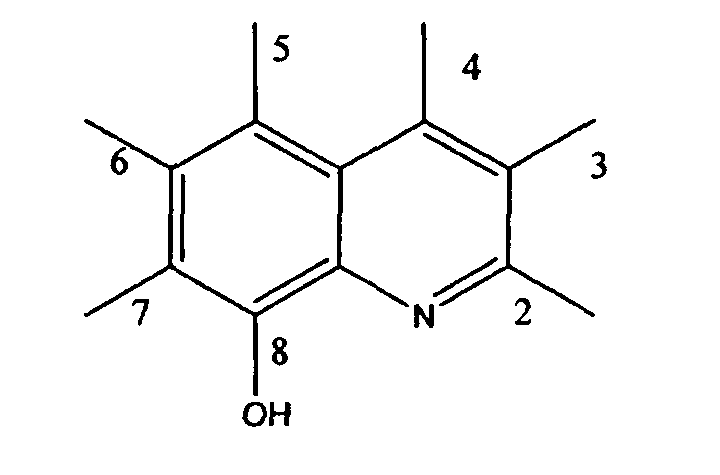
- quinolate in this specification includes salts of substituted 8-hydroxyquinoline where the substituents are the same or different in the 2,3,4,5,6 and 7 positions and are selected from alky, alkoxy, aryl, aryloxy, sulphonic acids, esters, carboxylic acids, amino and amido groups or are aromatic, polycyclic or heterocyclic groups.
- An electroluminescent device comprises a conductive substrate which acts as the anode, a layer of the electroluminescent material and a metal contact connected to the electroluminescent layer which acts as the cathode. When a current is passed through the electroluminescent layer, the layer emits light.
- the electroluminescent devices of the invention comprise a transparent substrate, which is a conductive glass or plastic material which acts as the anode
- preferred substrates are conductive glasses such as indium tin oxide coated glass, but any glass which is conductive or has a conductive layer can be used.
- Conductive polymers and conductive polymer coated glass or plastics materials can also be used as the substrate.
- the lithium quinolate can be deposited on the substrate directly by evaporation from a solution in an organic solvent. Any solvent which dissolves the lithium quinolate can be used e. g. acetonitrile.
- a preferred method of forming a metal quinolate film e. g. useful in electroluminescent devices comprises forming the metal quinolate in situ by sequential dip coating the susbtrate with the film e. g. the substrate is dipped or otherwise coated with a solution of the metal alkyl or alkoxide to form a film on the surface and then dipped or otherwise coated with 8-hydroxyquinoline or substituted 8-hydroxyquinoline and the metal quinolate film is formed on the substrate surface.
- the film or layer of lithium quinolate is deposited by in situ dip coating i. e. the substrate, such as a glass slide, is dipped into or otherwise contacted with a solution of an alkyl lithium e. g. n-butyl lithium and then immersed in or contacted with a solution of hydroxyquinoline, a layer of lithium quinolate is then formed on the substrate.
- the substrate such as a glass slide
- the material can be deposited by spin coating or by vacuum deposition from the solid state e. g. by sputtering or any other conventional method can be used.
- an electroluminescent device incorporating lithium quinolate as the emissive layer there can be a hole transporting layer deposited on the transparent substrate and the lithium quinolate is deposited on the hole transporting layer.
- the hole transporting layer serves to transport; holes and to block the electrons, thus preventing electrons from moving into the electrode without recombining with holes.
- the recombination of carriers therefore mainly takes place in the emitter layer.
- Hole transporting layers are used in polymer electroluminescent devices and any of the known hole transporting materials in film form can be used.
- the hole transporting layer can be made of a film of an aromatic amine complex such as poly (vinylcarbazole), N, N'-diphenyl-N, N'-bis (3-methylphenyl)-I, I'-biphenyl-4,4'diamine (TPD), polyaniline etc.
- dyes such as fluorescent laser dyes, luminescent laser dyes can be included to modify the colour spectrum of the emitted light.
- the lithium quinolate can be mixed with a polymeric material such as a polyolefin e.g. polyethylene, polypropylene etc. and preferably polystyrene.
- a polymeric material such as a polyolefin e.g. polyethylene, polypropylene etc. and preferably polystyrene.
- Preferred amounts of active material in the mixture is from 95% to 5% by weight of active material and more preferably 25 to 20% by weight.
- the hole transporting material can optionally be mixed with the lithium quinolate in a ratio of 5-95% of the lithium quinolate to 95 to 5% of the hole transporting compound.
- This electron injecting layer is preferably a metal complex such as a different metal quinolate e. g. an aluminium quinolate which will transport electrons when an electric current is passed through it.
- the electron injecting material can be mixed with the lithium quinolate and co-deposited with it.
- this electron transporting layer is preferably a metal complex such as a metal quinolate e. g. an aluminium quinolate which will transport electrons when an electric current is passed through it.
- a metal quinolate e. g. an aluminium quinolate which will transport electrons when an electric current is passed through it.
- the electron transporting material can be mixed with the lithium quinolate and co-deposited with it.
- dyes such as fluorescent laser dyes, luminescent laser dyes can be included to modify the colour spectrum of the emitted light and also enhance the photoluminescent and electroluminescent efficiencies.
- a substrate formed of a transparent conductive material which is the anode on which is successively deposited a hole transportation layer, the lithium quinolate layer and an electron transporting layer which is connected to the anode.
- the anode can be any low work function metal e. g. aluminium, calcium, lithium, silver/magnesium alloys etc.
- Example 2 Lithium 8-hydroxyquinolate Li (C 9 H 6 ON)
- a glass slide (Spectrosil UV grade) was dipped into a solution of n-butyl lithium in acetonitrile for four seconds and then in immersed in a solution of 8hydroxyquinoline for four seconds. A thin layer of lithium quinolate was easily seen on the glass.
- Potassium 8-hydroxyquinolate was also made from 8-hydroxyquinoline (2.0 g; 0.0138 mole) in dry tetrahydrofuran (50 ml) and potassium tert-butoxide (2.32 g; 0.021 mole). The solution was heated to become homogeneous and cooled to room temperature to give a yellow solid yield 2.2 g.
- the photoluminescent efficiency and maximum wavelength of the PL emission of the lithium quinolate was measured and compared with other metal quinolates and the results shown in Table 1.
- Photoluminescence was excited using 325mn line of Liconix 4207 NB, He/Cd laser.
- the laser power incident at the sample was measured by a Liconix 55PM laser power meter.
- the radiance calibration was carried out using Bentham radiance standard (Bentham SRS8, Lamp current 4,000A), calibrated by National Physical laboratories, England.
- the PL studies were carried out on samples or films. The Spectra are attached as Figs. 2 to 7.
- An electroluminescent device of structure shown in fig. 1 was fabricated using aluminium quinolate and lithium quinolate as the electroluminescent layer and the electroluminescent properties measured.
- fig. 1 (2) is an ITO layer
- (4) is a TPD layer (hole transporting layer) (60nm)
- (1) is the lithium quinolate layer
- (5) is an aluminium quinolate layer
- (3) is aluminium (900nm).
- An ITO coated glass piece (1 x 1cm 2 cut from large sheets purchased from Balzers, Switzerland) had a portion etched out with concentrated hydrochloric acid to remove the ITO and was cleaned and placed on a spin coater (CPS 10 BM, Semitec, Germany) and spun at 2000 rpm for 30 seconds, during which time the solution of the electroluminescent compound was dropped onto it dropwise by a pipette.
- a spin coater CPS 10 BM, Semitec, Germany
- the electroluminescent compound was vacuum evaporated onto the ITO coated glass piece by placing the substrate in a vacuum coater and evaporating the electroluminescent compound at 10 -5 to 10 -6 torr onto the substrate.
- the coated electrodes were stored in a vacuum desiccator over calcium sulphate until they were loaded into a vacuum coater (Edwards, 10 -6 torr) and aluminium top contacts made.
- the active area of the LED's was 0.08 cm 2 by 0.I cm 2 the devices were then kept in a vacuum desiccator until the electroluminescence studies were performed.
- the ITO electrode was always connected to the positive terminal.
- the current vs. voltage studies were carried out on a computer controlled Keithly 2400 source meter.
- Electroluminescence spectra were recorded by means of a computer controlled charge coupled device on Insta Spec photodiode array system model 77112 (Oriel Co. Surrey, England)
Landscapes
- Chemical & Material Sciences (AREA)
- Engineering & Computer Science (AREA)
- Materials Engineering (AREA)
- Organic Chemistry (AREA)
- Inorganic Chemistry (AREA)
- Physics & Mathematics (AREA)
- Optics & Photonics (AREA)
- Spectroscopy & Molecular Physics (AREA)
- Electroluminescent Light Sources (AREA)
- Luminescent Compositions (AREA)
- Nitrogen Condensed Heterocyclic Rings (AREA)
- Transition And Organic Metals Composition Catalysts For Addition Polymerization (AREA)
- Furan Compounds (AREA)
- Battery Electrode And Active Subsutance (AREA)
- Compounds Of Unknown Constitution (AREA)
- Pharmaceuticals Containing Other Organic And Inorganic Compounds (AREA)
Abstract
Description

| Absolute Photoluminescent Efficiency % | |||
| Complex | CIE x,y | λmax (PL)/nm | ηPL |
| Liq | 0.17, 0.23 | 465 | 48 |
| Naq | 0.19, 0.31 | 484 | 32 |
| Kq | 0.19,0.33 | 485 | 36 |
| Baq2 | 0.16, 0.29 | 479 | 7 |
| Caq2 | 0.21,0.37 | 482 | 24 |
| Mgq2 | 0.22, 0.46 | 500 | 43 |
| Znq2 | 0.26, 0.51 | 518 | |
| Alq3 | 0.32, 0.56 | 522 | 27 |
Claims (17)
- A lithium quinolate or substituted quinolate that provides a blue electroluminescence and is obtainable by the reaction of lithium alkyl or alkoxide in a solvent comprising acetonitrile with 8-hydroxyquinoline which may be unsubstituted or may have substituents selected from alkyl, alkoxy, aryl, aryloxy, sulphonic acid, ester, carboxylic acid, amino or amido groups or aromatic, polycyclic or heterocyclic groups.
- A method of making a lithium quinolate or substituted quinolate that provides a blue electroluminescence, which comprises reacting a lithium alkyl or alkoxide in a solvent comprising acetonitrile with 8-hydroxyquinoline which may be unsubstituted or may have substituents which are selected from alkyl, alkoxy, aryl, aryloxy, sulphonic acid, ester, carboxylic acid, amino or amido groups or aromatic polycyclic or heterocyclic groups.
- The method of claim 2, wherein ethyl, propyl or butyl lithium is reacted with the 8-hydroxyqinoline or substituted 8-hydroxyquinoline.
- The method of claim 2, wherein n-butyl lithium is reacted with the 8-hydroxyquinoline or substituted 8-hydroxyquinoline.
- An electroluminescent device comprising sequentially a first electrode, a layer of a blue-emissive electroluminescent material and a second electrode characterised in that the blue-emissive electroluminescent material is a lithium quinolate or substituted quinolate obtainable by the reaction of lithium alkyl or alkoxidc in a solvent comprising acetonitrile with 8-hydroxyquinoline which may be unsubstituted or may have substituents which are selected from alkyl, alkoxy, aryl, aryloxy, sulphonic acid, ester, carboxylic acid, amino or amido groups or aromatic, polycyclic or heterocyclic groups.
- The device of claim 5 wherein there is a layer of a hole transporting material on the conductive substrate and the lithium quinolate is on the layer of hole transporting material.
- The device of claim 6, wherein the hole transporting material is a polyamine.
- The device of claim 7, wherein the hole transporting layer is poly(vinylcarbazole) or N,N'-diphenyl-N,N'-bis (3-methylphenyl)-1,1'-biphenyl -4,4'- 10 diamine (TPD).
- The device of claim 7, wherein the hole transporting layer is of a polyaniline.
- The device of any of claims 5-9, wherein the hole transporting material is mixed with lithium quinolate in a ratio of 5-95% by weight of the lithium quinolate to 95-5% by weight of the hole transporting material.
- The device of any of claims 5-10, wherein the lithium quinolate is mixed with a polyolefin and the amount of lithium quinolate in the mixture is from 95% to 5% by weight of the mixture.
- The device of any of claims 5-11, wherein there is a layer of an electron injecting material between the cathode and the lithium quinolate layer.
- The device of any of claims 5 to 12, wherein there is an electron injecting material mixed with the lithium quinolate
- 14. The device of claim 12 or 13, wherein the electron injecting material is aluminium quinolate which will transport electrons when an electric current is passed through it.
- The device of any of claims 5 -14 wherein the anode is a conductive glass.
- An electroluminescent device which comprises sequentially a conductive substrate which acts as the anode, a layer of a hole transporting material, a layer of lithium quinolate, a layer of an electron injecting material and a metal which acts as the cathode characterised in that the lithium quinolate is a blue emissive lithium quinolate made by the reaction of a lithium alkyl or alkoxide with 8-hydroxyquinoline or substituted 8-hydroxyquinoline in a solution in a solvent which comprises acetonitrile.
- A method of forming an electroluminescent device comprising sequentially a first electrode, a layer of an electroluminescent material and a second electrode which comprises depositing the electroluminescent material on the first electrode characterised in that the method comprises reacting a lithium alkyl or alkoxide with 8-hydroxyquinoline in a solvent comprising acetonitrile to form a blue emissive lithium quinolate and depositing the lithium quinolate formed on the first electrode.
Applications Claiming Priority (3)
| Application Number | Priority Date | Filing Date | Title |
|---|---|---|---|
| GB9826406 | 1998-12-02 | ||
| GBGB9826406.2A GB9826406D0 (en) | 1998-12-02 | 1998-12-02 | Quinolates |
| PCT/GB1999/004024 WO2000032717A1 (en) | 1998-12-02 | 1999-12-01 | Electroluminescent quinolates |
Publications (2)
| Publication Number | Publication Date |
|---|---|
| EP1144543A1 EP1144543A1 (en) | 2001-10-17 |
| EP1144543B1 true EP1144543B1 (en) | 2004-03-17 |
Family
ID=10843458
Family Applications (1)
| Application Number | Title | Priority Date | Filing Date |
|---|---|---|---|
| EP99973057A Expired - Lifetime EP1144543B1 (en) | 1998-12-02 | 1999-12-01 | Electroluminescent quinolates |
Country Status (17)
| Country | Link |
|---|---|
| US (1) | US7597926B2 (en) |
| EP (1) | EP1144543B1 (en) |
| JP (1) | JP2002531467A (en) |
| KR (1) | KR20010080629A (en) |
| CN (1) | CN1195816C (en) |
| AT (1) | ATE262017T1 (en) |
| AU (1) | AU754353B2 (en) |
| BR (1) | BR9916922A (en) |
| CA (1) | CA2352884A1 (en) |
| DE (1) | DE69915695T2 (en) |
| DK (1) | DK1144543T3 (en) |
| ES (1) | ES2214068T3 (en) |
| GB (1) | GB9826406D0 (en) |
| ID (1) | ID30389A (en) |
| MX (1) | MXPA01005537A (en) |
| PT (1) | PT1144543E (en) |
| WO (1) | WO2000032717A1 (en) |
Cited By (4)
| Publication number | Priority date | Publication date | Assignee | Title |
|---|---|---|---|---|
| US10323180B2 (en) | 2014-12-04 | 2019-06-18 | Guangzhou Chinaray Optoelectronic Materials Ltd. | Deuterated organic compound, mixture and composition containing said compound, and organic electronic device |
| US10510967B2 (en) | 2014-12-11 | 2019-12-17 | Guangzhou Chinaray Optoelectronic Materials Ltd. | Organic compound, and mixture, formulation and organic device comprising the same |
| US10573827B2 (en) | 2014-12-11 | 2020-02-25 | Guangzhou Chinaray Optoelectronics Materials Ltd. | Organic metal complex, and polymer, mixture, composition and organic electronic device containing same and use thereof |
| US11453745B2 (en) | 2016-11-23 | 2022-09-27 | Guangzhou Chinaray Optoelectronic Materials Ltd. | High polymer, mixture containing same, composition, organic electronic component, and monomer for polymerization |
Families Citing this family (57)
| Publication number | Priority date | Publication date | Assignee | Title |
|---|---|---|---|---|
| GB0128074D0 (en) * | 2001-11-23 | 2002-01-16 | Elam T Ltd | Doped lithium quinolate |
| GB9826407D0 (en) | 1998-12-02 | 1999-01-27 | South Bank Univ Entpr Ltd | Novel electroluminescent materials |
| JP4211211B2 (en) * | 2000-09-29 | 2009-01-21 | コニカミノルタホールディングス株式会社 | ORGANIC ELECTROLUMINESCENT DEVICE AND METHOD FOR FORMING METAL COMPLEX FOR ORGANIC ELECTROLUMINESCENT DEVICE |
| GB0028439D0 (en) * | 2000-11-21 | 2001-01-10 | South Bank Univ Entpr Ltd | Elecroluminescent device |
| GB0109755D0 (en) | 2001-04-20 | 2001-06-13 | Elam T Ltd | Devices incorporating mixed metal organic complexes |
| WO2002090465A1 (en) * | 2001-05-04 | 2002-11-14 | Elam-T Limited | Electroluminescent devices |
| TWI303533B (en) * | 2001-06-15 | 2008-11-21 | Oled T Ltd | Electroluminescent devices |
| GB0116644D0 (en) | 2001-07-09 | 2001-08-29 | Elam T Ltd | Electroluminescent materials and devices |
| EP1414927A1 (en) | 2001-08-04 | 2004-05-06 | Elam-T Limited | Electroluminescent device |
| GB0206736D0 (en) * | 2002-03-22 | 2002-05-01 | Elam T Ltd | Electroluminescent device |
| GB0210203D0 (en) * | 2002-05-03 | 2002-06-12 | Elam T Ltd | Electroluminescent devices |
| TWI258515B (en) * | 2002-06-19 | 2006-07-21 | Asahi Glass Co Ltd | Method of cleaning chamber of vacuum evaporation apparatus for production of organic EL element |
| WO2004048395A1 (en) * | 2002-11-26 | 2004-06-10 | Semiconductor Energy Laboratory Co., Ltd. | Phosphorescent compound and electroluminescent element including the same |
| US20050129978A1 (en) * | 2002-12-25 | 2005-06-16 | Semiconductor Energy Laboratory Co., Ltd. | Electroluminescent device and method of manufacturing thereof |
| WO2005108372A1 (en) * | 2004-04-05 | 2005-11-17 | Albemarle Corporation | Process to make metal complexes with volatile liquid metal compounds |
| US8294166B2 (en) | 2006-12-11 | 2012-10-23 | The Regents Of The University Of California | Transparent light emitting diodes |
| US7985492B2 (en) | 2004-08-07 | 2011-07-26 | Merck Patent Gmbh | Electroluminescent materials and devices |
| WO2006086684A1 (en) * | 2005-02-10 | 2006-08-17 | E.I. Dupont De Nemours And Company | Photoactive material comprising a metal hydroxyquinoline complex |
| US20060286405A1 (en) | 2005-06-17 | 2006-12-21 | Eastman Kodak Company | Organic element for low voltage electroluminescent devices |
| US8956738B2 (en) | 2005-10-26 | 2015-02-17 | Global Oled Technology Llc | Organic element for low voltage electroluminescent devices |
| GB2440368A (en) | 2006-07-26 | 2008-01-30 | Oled T Ltd | Cathode coating for an electroluminescent device |
| GB0625540D0 (en) | 2006-12-22 | 2007-01-31 | Oled T Ltd | Electroluminescent devices |
| GB0625541D0 (en) * | 2006-12-22 | 2007-01-31 | Oled T Ltd | Electroluminescent devices |
| GB0625865D0 (en) | 2006-12-29 | 2007-02-07 | Oled T Ltd | Electro-optical or opto-electronic device |
| US8900722B2 (en) | 2007-11-29 | 2014-12-02 | Global Oled Technology Llc | OLED device employing alkali metal cluster compounds |
| KR20090082778A (en) | 2008-01-28 | 2009-07-31 | 삼성모바일디스플레이주식회사 | Organic light emitting diode and manufacturing thereof |
| GB0804469D0 (en) | 2008-03-11 | 2008-04-16 | Oled T Ltd | Compounds having electroluminescent or electron transport properties |
| KR100924144B1 (en) | 2008-06-05 | 2009-10-28 | 삼성모바일디스플레이주식회사 | Organic electroluminescent device and manufacturing method thereof |
| DE102008058230B4 (en) * | 2008-11-19 | 2021-01-07 | Novaled Gmbh | Quinoxaline compound, organic light emitting diode, organic thin film transistor and solar cell |
| DE102008064200A1 (en) | 2008-12-22 | 2010-07-01 | Merck Patent Gmbh | Organic electroluminescent device |
| DE102009023155A1 (en) | 2009-05-29 | 2010-12-02 | Merck Patent Gmbh | Materials for organic electroluminescent devices |
| DE102009031021A1 (en) | 2009-06-30 | 2011-01-05 | Merck Patent Gmbh | Materials for organic electroluminescent devices |
| WO2011021385A1 (en) * | 2009-08-18 | 2011-02-24 | 大電株式会社 | Organic electroluminescent element and novel alcohol-soluble phosphorescent material |
| DE102009053645A1 (en) | 2009-11-17 | 2011-05-19 | Merck Patent Gmbh | Materials for organic electroluminescent device |
| DE102009041289A1 (en) | 2009-09-16 | 2011-03-17 | Merck Patent Gmbh | Organic electroluminescent device |
| DE102009052428A1 (en) | 2009-11-10 | 2011-05-12 | Merck Patent Gmbh | Connection for electronic devices |
| DE102009053382A1 (en) | 2009-11-14 | 2011-05-19 | Merck Patent Gmbh | Materials for electronic devices |
| US9487548B2 (en) | 2009-12-14 | 2016-11-08 | Udc Ireland Limited | Metal complexes comprising diazabenzimidazolocarbene ligands and the use thereof in OLEDs |
| US8617720B2 (en) | 2009-12-21 | 2013-12-31 | E I Du Pont De Nemours And Company | Electroactive composition and electronic device made with the composition |
| DE102010013806B4 (en) | 2010-04-03 | 2021-06-10 | Merck Patent Gmbh | Materials for organic electroluminescent devices |
| CN101857568B (en) * | 2010-06-03 | 2012-01-11 | 安徽大学 | Preparation method of 8-hydroxyquinoline zinc with shape of octahedron |
| CN102947416B (en) | 2010-06-18 | 2016-04-13 | 巴斯夫欧洲公司 | Comprise the organic electronic devices of the layer of diphenylene-oxide compound and oxine root conjunction alkaline-earth metal or alkali metal complex |
| KR101877581B1 (en) | 2010-06-18 | 2018-07-11 | 유디씨 아일랜드 리미티드 | Organic electronic devices comprising a layer of a pyridine compound and a 8-hydroxyquinolinolato earth alkaline metal, or alkali metal complex |
| US9142792B2 (en) | 2010-06-18 | 2015-09-22 | Basf Se | Organic electronic devices comprising a layer comprising at least one metal organic compound and at least one metal oxide |
| DE102010048074A1 (en) | 2010-10-09 | 2012-04-12 | Merck Patent Gmbh | Materials for electronic devices |
| DE102010048607A1 (en) | 2010-10-15 | 2012-04-19 | Merck Patent Gmbh | Connections for electronic devices |
| DE102011102586A1 (en) | 2011-05-27 | 2012-11-29 | Merck Patent Gmbh | Organic electronic device |
| KR102090916B1 (en) | 2011-06-14 | 2020-03-19 | 유디씨 아일랜드 리미티드 | Metal complexes comprising azabenzimidazole carbene ligands and the use thereof in oleds |
| US9315724B2 (en) | 2011-06-14 | 2016-04-19 | Basf Se | Metal complexes comprising azabenzimidazole carbene ligands and the use thereof in OLEDs |
| WO2014012972A1 (en) | 2012-07-19 | 2014-01-23 | Basf Se | Dinuclear metal complexes comprising carbene ligands and the use thereof in oleds |
| GB201306365D0 (en) | 2013-04-09 | 2013-05-22 | Kathirgamanathan Poopathy | Heterocyclic compounds and their use in electro-optical or opto-electronic devices |
| DE102013013876A1 (en) * | 2013-08-20 | 2015-03-12 | Merck Patent Gmbh | metal complexes |
| CN107004777B (en) | 2014-12-04 | 2019-03-26 | 广州华睿光电材料有限公司 | Polymers, mixtures, compositions, organic electronic devices containing the same, and monomers thereof |
| KR102112842B1 (en) | 2018-02-09 | 2020-05-19 | (주) 파마젠 | Preparation Method for Lithium Quinolate Nanorod |
| CN109638167B (en) * | 2019-01-14 | 2022-08-09 | 暨南大学 | 8-hydroxyquinoline metal complex perovskite type solar cell and preparation method thereof |
| US11592166B2 (en) | 2020-05-12 | 2023-02-28 | Feit Electric Company, Inc. | Light emitting device having improved illumination and manufacturing flexibility |
| US11876042B2 (en) | 2020-08-03 | 2024-01-16 | Feit Electric Company, Inc. | Omnidirectional flexible light emitting device |
Family Cites Families (17)
| Publication number | Priority date | Publication date | Assignee | Title |
|---|---|---|---|---|
| US4720432A (en) * | 1987-02-11 | 1988-01-19 | Eastman Kodak Company | Electroluminescent device with organic luminescent medium |
| US5166341A (en) * | 1988-07-29 | 1992-11-24 | Dainippon Pharmaceutical Co., Ltd. | 6-amino-1,4-hexahydro-1H-diazepine derivatives |
| EP0569827A2 (en) * | 1992-05-11 | 1993-11-18 | Idemitsu Kosan Company Limited | Organic electroluminescence device |
| JPH06313168A (en) * | 1992-05-11 | 1994-11-08 | Idemitsu Kosan Co Ltd | Organic electroluminescent device |
| JPH06145146A (en) * | 1992-11-06 | 1994-05-24 | Chisso Corp | Oxinate derivative |
| DE19627070A1 (en) * | 1996-07-05 | 1998-01-08 | Bayer Ag | Electroluminescent devices using glare systems |
| US5755999A (en) * | 1997-05-16 | 1998-05-26 | Eastman Kodak Company | Blue luminescent materials for organic electroluminescent devices |
| TW391620U (en) * | 1997-07-04 | 2000-05-21 | Koninkl Philips Electronics Nv | Circuit arrangement |
| JP4514841B2 (en) * | 1998-02-17 | 2010-07-28 | 淳二 城戸 | Organic electroluminescent device |
| DE19812259A1 (en) * | 1998-03-20 | 1999-10-21 | Bayer Ag | EL arrangement based on tertiary amines, alcohol-soluble Alq3 derivatives or mixtures and polymeric binders |
| JPH11288784A (en) * | 1998-04-03 | 1999-10-19 | Toray Ind Inc | Light emitting element |
| JPH11354280A (en) * | 1998-04-10 | 1999-12-24 | Toray Ind Inc | Light emitting element |
| JP4048645B2 (en) * | 1998-04-10 | 2008-02-20 | 東レ株式会社 | Light emitting element |
| JP3302945B2 (en) * | 1998-06-23 | 2002-07-15 | ネースディスプレイ・カンパニー・リミテッド | Novel organometallic luminescent material and organic electroluminescent device containing the same |
| JP2000012223A (en) * | 1998-06-25 | 2000-01-14 | Toray Ind Inc | Light emitting element |
| US6172459B1 (en) * | 1998-07-28 | 2001-01-09 | Eastman Kodak Company | Electron-injecting layer providing a modified interface between an organic light-emitting structure and a cathode buffer layer |
| JP2000208267A (en) * | 1998-11-09 | 2000-07-28 | Toray Ind Inc | Light emitting element |
-
1998
- 1998-12-02 GB GBGB9826406.2A patent/GB9826406D0/en not_active Ceased
-
1999
- 1999-12-01 AT AT99973057T patent/ATE262017T1/en not_active IP Right Cessation
- 1999-12-01 DK DK99973057T patent/DK1144543T3/en active
- 1999-12-01 WO PCT/GB1999/004024 patent/WO2000032717A1/en not_active Ceased
- 1999-12-01 EP EP99973057A patent/EP1144543B1/en not_active Expired - Lifetime
- 1999-12-01 AU AU14004/00A patent/AU754353B2/en not_active Ceased
- 1999-12-01 PT PT99973057T patent/PT1144543E/en unknown
- 1999-12-01 ID IDW00200101442A patent/ID30389A/en unknown
- 1999-12-01 KR KR1020017006743A patent/KR20010080629A/en not_active Ceased
- 1999-12-01 MX MXPA01005537A patent/MXPA01005537A/en not_active Application Discontinuation
- 1999-12-01 JP JP2000585348A patent/JP2002531467A/en active Pending
- 1999-12-01 BR BR9916922-3A patent/BR9916922A/en not_active Application Discontinuation
- 1999-12-01 DE DE69915695T patent/DE69915695T2/en not_active Expired - Lifetime
- 1999-12-01 CA CA002352884A patent/CA2352884A1/en not_active Abandoned
- 1999-12-01 CN CNB998139815A patent/CN1195816C/en not_active Expired - Fee Related
- 1999-12-01 ES ES99973057T patent/ES2214068T3/en not_active Expired - Lifetime
-
2005
- 2005-05-27 US US11/140,338 patent/US7597926B2/en not_active Expired - Fee Related
Cited By (4)
| Publication number | Priority date | Publication date | Assignee | Title |
|---|---|---|---|---|
| US10323180B2 (en) | 2014-12-04 | 2019-06-18 | Guangzhou Chinaray Optoelectronic Materials Ltd. | Deuterated organic compound, mixture and composition containing said compound, and organic electronic device |
| US10510967B2 (en) | 2014-12-11 | 2019-12-17 | Guangzhou Chinaray Optoelectronic Materials Ltd. | Organic compound, and mixture, formulation and organic device comprising the same |
| US10573827B2 (en) | 2014-12-11 | 2020-02-25 | Guangzhou Chinaray Optoelectronics Materials Ltd. | Organic metal complex, and polymer, mixture, composition and organic electronic device containing same and use thereof |
| US11453745B2 (en) | 2016-11-23 | 2022-09-27 | Guangzhou Chinaray Optoelectronic Materials Ltd. | High polymer, mixture containing same, composition, organic electronic component, and monomer for polymerization |
Also Published As
| Publication number | Publication date |
|---|---|
| US20060003089A1 (en) | 2006-01-05 |
| KR20010080629A (en) | 2001-08-22 |
| BR9916922A (en) | 2001-11-06 |
| ID30389A (en) | 2001-11-29 |
| ES2214068T3 (en) | 2004-09-01 |
| US7597926B2 (en) | 2009-10-06 |
| EP1144543A1 (en) | 2001-10-17 |
| DE69915695D1 (en) | 2004-04-22 |
| GB9826406D0 (en) | 1999-01-27 |
| CN1329653A (en) | 2002-01-02 |
| WO2000032717A1 (en) | 2000-06-08 |
| AU1400400A (en) | 2000-06-19 |
| JP2002531467A (en) | 2002-09-24 |
| ATE262017T1 (en) | 2004-04-15 |
| AU754353B2 (en) | 2002-11-14 |
| MXPA01005537A (en) | 2003-07-14 |
| DE69915695T2 (en) | 2005-04-07 |
| DK1144543T3 (en) | 2004-06-21 |
| CN1195816C (en) | 2005-04-06 |
| CA2352884A1 (en) | 2000-06-08 |
| HK1037005A1 (en) | 2002-01-25 |
| PT1144543E (en) | 2004-08-31 |
Similar Documents
| Publication | Publication Date | Title |
|---|---|---|
| AU754353B2 (en) | Electroluminescent quinolates | |
| JP2003040873A (en) | Novel quinoxaline derivative and organic electroluminescent device using the same | |
| JP2002531467A5 (en) | ||
| JP4224252B2 (en) | Compound for organic EL element, organic EL element | |
| US20040023061A1 (en) | Electroluminescent device | |
| US7718275B2 (en) | Electroluminescent materials and devices | |
| WO2002102924A2 (en) | Electroluminescent devices | |
| JP2008510026A (en) | Electroluminescent materials and devices | |
| HK1037005B (en) | Electroluminescent quinolates | |
| KR100407250B1 (en) | Organic luminescent compound, and organic electroluminescence device using the same | |
| KR100462050B1 (en) | Novel organometallic compound including oxa- or thiadiazole moiety and organic electroluminescence device using the same | |
| KR100406185B1 (en) | Organic luminescent compound, and organic electroluminescence device using the same | |
| KR100446466B1 (en) | Organic luminescent compound, and organic electroluminescence device using the same | |
| KR100700440B1 (en) | Blue light emitting organic compound and organic light emitting diode comprising the same | |
| KR100425361B1 (en) | Novel organic metal complex and organic electroluminescence device using the same | |
| KR100480355B1 (en) | Red organic electroluminescent compound and organic electroluminescent device using the same | |
| KR100462047B1 (en) | Novel organometallic compound and organic electroluminescence device using the same | |
| KR100425360B1 (en) | Organic luminescent compound including pyrazoline group, and organic electroluminescence device using the same | |
| KR100697332B1 (en) | Red organic light emitting compound and organic light emitting diode comprising same | |
| KR100714827B1 (en) | Red organic light emitting compound and organic light emitting diode comprising same | |
| KR100487011B1 (en) | Red organic light-emitting compound and organic light-emitting device comprising the same | |
| KR20000020208A (en) | Organic electricity luminescence device using third class amine salt derivative |
Legal Events
| Date | Code | Title | Description |
|---|---|---|---|
| PUAI | Public reference made under article 153(3) epc to a published international application that has entered the european phase |
Free format text: ORIGINAL CODE: 0009012 |
|
| 17P | Request for examination filed |
Effective date: 20010601 |
|
| AK | Designated contracting states |
Kind code of ref document: A1 Designated state(s): AT BE CH CY DE DK ES FI FR GB GR IE IT LI LU MC NL PT SE |
|
| AX | Request for extension of the european patent |
Free format text: AL;LT;LV;MK;RO;SI |
|
| 17Q | First examination report despatched |
Effective date: 20020125 |
|
| GRAP | Despatch of communication of intention to grant a patent |
Free format text: ORIGINAL CODE: EPIDOSNIGR1 |
|
| GRAS | Grant fee paid |
Free format text: ORIGINAL CODE: EPIDOSNIGR3 |
|
| GRAA | (expected) grant |
Free format text: ORIGINAL CODE: 0009210 |
|
| AK | Designated contracting states |
Kind code of ref document: B1 Designated state(s): AT BE CH CY DE DK ES FI FR GB GR IE IT LI LU MC NL PT SE |
|
| PG25 | Lapsed in a contracting state [announced via postgrant information from national office to epo] |
Ref country code: CY Free format text: LAPSE BECAUSE OF FAILURE TO SUBMIT A TRANSLATION OF THE DESCRIPTION OR TO PAY THE FEE WITHIN THE PRESCRIBED TIME-LIMIT Effective date: 20040317 |
|
| REG | Reference to a national code |
Ref country code: GB Ref legal event code: FG4D |
|
| REG | Reference to a national code |
Ref country code: CH Ref legal event code: NV Representative=s name: BRAUN & PARTNER PATENT-, MARKEN-, RECHTSANWAELTE Ref country code: CH Ref legal event code: EP |
|
| REG | Reference to a national code |
Ref country code: IE Ref legal event code: FG4D |
|
| REF | Corresponds to: |
Ref document number: 69915695 Country of ref document: DE Date of ref document: 20040422 Kind code of ref document: P |
|
| PG25 | Lapsed in a contracting state [announced via postgrant information from national office to epo] |
Ref country code: GR Free format text: LAPSE BECAUSE OF FAILURE TO SUBMIT A TRANSLATION OF THE DESCRIPTION OR TO PAY THE FEE WITHIN THE PRESCRIBED TIME-LIMIT Effective date: 20040617 |
|
| REG | Reference to a national code |
Ref country code: DK Ref legal event code: T3 |
|
| REG | Reference to a national code |
Ref country code: SE Ref legal event code: TRGR |
|
| LTIE | Lt: invalidation of european patent or patent extension |
Effective date: 20040317 |
|
| REG | Reference to a national code |
Ref country code: PT Ref legal event code: SC4A Free format text: AVAILABILITY OF NATIONAL TRANSLATION Effective date: 20040608 |
|
| REG | Reference to a national code |
Ref country code: ES Ref legal event code: FG2A Ref document number: 2214068 Country of ref document: ES Kind code of ref document: T3 |
|
| REG | Reference to a national code |
Ref country code: HK Ref legal event code: GR Ref document number: 1037005 Country of ref document: HK |
|
| PGFP | Annual fee paid to national office [announced via postgrant information from national office to epo] |
Ref country code: PT Payment date: 20040915 Year of fee payment: 6 |
|
| PGFP | Annual fee paid to national office [announced via postgrant information from national office to epo] |
Ref country code: NL Payment date: 20040930 Year of fee payment: 6 |
|
| ET | Fr: translation filed | ||
| PGFP | Annual fee paid to national office [announced via postgrant information from national office to epo] |
Ref country code: IE Payment date: 20041117 Year of fee payment: 6 |
|
| PGFP | Annual fee paid to national office [announced via postgrant information from national office to epo] |
Ref country code: SE Payment date: 20041118 Year of fee payment: 6 |
|
| PG25 | Lapsed in a contracting state [announced via postgrant information from national office to epo] |
Ref country code: LU Free format text: LAPSE BECAUSE OF NON-PAYMENT OF DUE FEES Effective date: 20041201 |
|
| PGFP | Annual fee paid to national office [announced via postgrant information from national office to epo] |
Ref country code: DK Payment date: 20041202 Year of fee payment: 6 |
|
| PGFP | Annual fee paid to national office [announced via postgrant information from national office to epo] |
Ref country code: FI Payment date: 20041210 Year of fee payment: 6 |
|
| PGFP | Annual fee paid to national office [announced via postgrant information from national office to epo] |
Ref country code: AT Payment date: 20041220 Year of fee payment: 6 |
|
| PGFP | Annual fee paid to national office [announced via postgrant information from national office to epo] |
Ref country code: BE Payment date: 20041222 Year of fee payment: 6 |
|
| PGFP | Annual fee paid to national office [announced via postgrant information from national office to epo] |
Ref country code: CH Payment date: 20041228 Year of fee payment: 6 |
|
| PGFP | Annual fee paid to national office [announced via postgrant information from national office to epo] |
Ref country code: ES Payment date: 20041230 Year of fee payment: 6 |
|
| PG25 | Lapsed in a contracting state [announced via postgrant information from national office to epo] |
Ref country code: MC Free format text: LAPSE BECAUSE OF NON-PAYMENT OF DUE FEES Effective date: 20041231 |
|
| PLBE | No opposition filed within time limit |
Free format text: ORIGINAL CODE: 0009261 |
|
| STAA | Information on the status of an ep patent application or granted ep patent |
Free format text: STATUS: NO OPPOSITION FILED WITHIN TIME LIMIT |
|
| 26N | No opposition filed |
Effective date: 20041220 |
|
| PG25 | Lapsed in a contracting state [announced via postgrant information from national office to epo] |
Ref country code: IE Free format text: LAPSE BECAUSE OF NON-PAYMENT OF DUE FEES Effective date: 20051201 Ref country code: FI Free format text: LAPSE BECAUSE OF NON-PAYMENT OF DUE FEES Effective date: 20051201 Ref country code: AT Free format text: LAPSE BECAUSE OF NON-PAYMENT OF DUE FEES Effective date: 20051201 |
|
| PG25 | Lapsed in a contracting state [announced via postgrant information from national office to epo] |
Ref country code: SE Free format text: LAPSE BECAUSE OF NON-PAYMENT OF DUE FEES Effective date: 20051202 Ref country code: ES Free format text: LAPSE BECAUSE OF NON-PAYMENT OF DUE FEES Effective date: 20051202 |
|
| PG25 | Lapsed in a contracting state [announced via postgrant information from national office to epo] |
Ref country code: LI Free format text: LAPSE BECAUSE OF NON-PAYMENT OF DUE FEES Effective date: 20051231 Ref country code: CH Free format text: LAPSE BECAUSE OF NON-PAYMENT OF DUE FEES Effective date: 20051231 Ref country code: BE Free format text: LAPSE BECAUSE OF NON-PAYMENT OF DUE FEES Effective date: 20051231 |
|
| PG25 | Lapsed in a contracting state [announced via postgrant information from national office to epo] |
Ref country code: DK Free format text: LAPSE BECAUSE OF NON-PAYMENT OF DUE FEES Effective date: 20060102 |
|
| PG25 | Lapsed in a contracting state [announced via postgrant information from national office to epo] |
Ref country code: PT Free format text: LAPSE BECAUSE OF NON-PAYMENT OF DUE FEES Effective date: 20060601 |
|
| PG25 | Lapsed in a contracting state [announced via postgrant information from national office to epo] |
Ref country code: NL Free format text: LAPSE BECAUSE OF NON-PAYMENT OF DUE FEES Effective date: 20060701 |
|
| REG | Reference to a national code |
Ref country code: PT Ref legal event code: MM4A Effective date: 20060601 Ref country code: DK Ref legal event code: EBP |
|
| REG | Reference to a national code |
Ref country code: CH Ref legal event code: PL |
|
| EUG | Se: european patent has lapsed | ||
| NLV4 | Nl: lapsed or anulled due to non-payment of the annual fee |
Effective date: 20060701 |
|
| REG | Reference to a national code |
Ref country code: IE Ref legal event code: MM4A |
|
| REG | Reference to a national code |
Ref country code: ES Ref legal event code: FD2A Effective date: 20051202 |
|
| BERE | Be: lapsed |
Owner name: *SOUTH BANK UNIVERSITY ENTERPRISES LTD Effective date: 20051231 |
|
| PGFP | Annual fee paid to national office [announced via postgrant information from national office to epo] |
Ref country code: IT Payment date: 20071206 Year of fee payment: 9 |
|
| REG | Reference to a national code |
Ref country code: GB Ref legal event code: 732E Free format text: REGISTERED BETWEEN 20090305 AND 20090311 |
|
| REG | Reference to a national code |
Ref country code: FR Ref legal event code: TP |
|
| PGFP | Annual fee paid to national office [announced via postgrant information from national office to epo] |
Ref country code: GB Payment date: 20091001 Year of fee payment: 11 Ref country code: FR Payment date: 20091016 Year of fee payment: 11 |
|
| GBPC | Gb: european patent ceased through non-payment of renewal fee |
Effective date: 20101201 |
|
| REG | Reference to a national code |
Ref country code: FR Ref legal event code: ST Effective date: 20110831 |
|
| PG25 | Lapsed in a contracting state [announced via postgrant information from national office to epo] |
Ref country code: FR Free format text: LAPSE BECAUSE OF NON-PAYMENT OF DUE FEES Effective date: 20110103 |
|
| PG25 | Lapsed in a contracting state [announced via postgrant information from national office to epo] |
Ref country code: GB Free format text: LAPSE BECAUSE OF NON-PAYMENT OF DUE FEES Effective date: 20101201 |
|
| PG25 | Lapsed in a contracting state [announced via postgrant information from national office to epo] |
Ref country code: IT Free format text: LAPSE BECAUSE OF NON-PAYMENT OF DUE FEES Effective date: 20081201 |
|
| PGFP | Annual fee paid to national office [announced via postgrant information from national office to epo] |
Ref country code: DE Payment date: 20141125 Year of fee payment: 16 |
|
| REG | Reference to a national code |
Ref country code: DE Ref legal event code: R119 Ref document number: 69915695 Country of ref document: DE |
|
| PG25 | Lapsed in a contracting state [announced via postgrant information from national office to epo] |
Ref country code: DE Free format text: LAPSE BECAUSE OF NON-PAYMENT OF DUE FEES Effective date: 20160701 |