EP1144110B1 - A polyvalent bifunctional catalyst and the process of realisation of such a catalyst - Google Patents
A polyvalent bifunctional catalyst and the process of realisation of such a catalyst Download PDFInfo
- Publication number
- EP1144110B1 EP1144110B1 EP99968642A EP99968642A EP1144110B1 EP 1144110 B1 EP1144110 B1 EP 1144110B1 EP 99968642 A EP99968642 A EP 99968642A EP 99968642 A EP99968642 A EP 99968642A EP 1144110 B1 EP1144110 B1 EP 1144110B1
- Authority
- EP
- European Patent Office
- Prior art keywords
- catalyst
- fact
- tio
- catalyst according
- reduction
- Prior art date
- Legal status (The legal status is an assumption and is not a legal conclusion. Google has not performed a legal analysis and makes no representation as to the accuracy of the status listed.)
- Expired - Lifetime
Links
- 239000003054 catalyst Substances 0.000 title claims description 100
- 230000001588 bifunctional effect Effects 0.000 title claims description 11
- 238000000034 method Methods 0.000 title description 18
- 230000008569 process Effects 0.000 title description 14
- GWEVSGVZZGPLCZ-UHFFFAOYSA-N Titan oxide Chemical compound O=[Ti]=O GWEVSGVZZGPLCZ-UHFFFAOYSA-N 0.000 claims description 91
- 238000006243 chemical reaction Methods 0.000 claims description 41
- 230000009467 reduction Effects 0.000 claims description 29
- JKQOBWVOAYFWKG-UHFFFAOYSA-N molybdenum trioxide Chemical compound O=[Mo](=O)=O JKQOBWVOAYFWKG-UHFFFAOYSA-N 0.000 claims description 24
- 239000001257 hydrogen Substances 0.000 claims description 20
- 229910052739 hydrogen Inorganic materials 0.000 claims description 20
- 238000006317 isomerization reaction Methods 0.000 claims description 19
- QXYJCZRRLLQGCR-UHFFFAOYSA-N dioxomolybdenum Chemical compound O=[Mo]=O QXYJCZRRLLQGCR-UHFFFAOYSA-N 0.000 claims description 18
- 230000000694 effects Effects 0.000 claims description 18
- UFHFLCQGNIYNRP-UHFFFAOYSA-N Hydrogen Chemical compound [H][H] UFHFLCQGNIYNRP-UHFFFAOYSA-N 0.000 claims description 17
- 150000002430 hydrocarbons Chemical class 0.000 claims description 14
- 230000004907 flux Effects 0.000 claims description 11
- 229930195733 hydrocarbon Natural products 0.000 claims description 11
- 239000000203 mixture Substances 0.000 claims description 11
- 229910052750 molybdenum Inorganic materials 0.000 claims description 10
- PNEYBMLMFCGWSK-UHFFFAOYSA-N aluminium oxide Inorganic materials [O-2].[O-2].[O-2].[Al+3].[Al+3] PNEYBMLMFCGWSK-UHFFFAOYSA-N 0.000 claims description 9
- 239000004215 Carbon black (E152) Substances 0.000 claims description 8
- VYPSYNLAJGMNEJ-UHFFFAOYSA-N Silicium dioxide Chemical compound O=[Si]=O VYPSYNLAJGMNEJ-UHFFFAOYSA-N 0.000 claims description 8
- 238000007327 hydrogenolysis reaction Methods 0.000 claims description 8
- 229910044991 metal oxide Inorganic materials 0.000 claims description 7
- 238000006356 dehydrogenation reaction Methods 0.000 claims description 6
- 239000000758 substrate Substances 0.000 claims description 6
- 230000002378 acidificating effect Effects 0.000 claims description 5
- 238000005984 hydrogenation reaction Methods 0.000 claims description 5
- 150000002431 hydrogen Chemical class 0.000 claims description 4
- 238000011946 reduction process Methods 0.000 claims description 4
- 239000000377 silicon dioxide Substances 0.000 claims description 4
- 150000001335 aliphatic alkanes Chemical class 0.000 claims description 3
- 229910052681 coesite Inorganic materials 0.000 claims description 3
- 229910052593 corundum Inorganic materials 0.000 claims description 3
- 229910052906 cristobalite Inorganic materials 0.000 claims description 3
- 229930195734 saturated hydrocarbon Natural products 0.000 claims description 3
- 229910052682 stishovite Inorganic materials 0.000 claims description 3
- 229910052905 tridymite Inorganic materials 0.000 claims description 3
- 229910001845 yogo sapphire Inorganic materials 0.000 claims description 3
- 239000010457 zeolite Substances 0.000 claims description 3
- 229910021536 Zeolite Inorganic materials 0.000 claims description 2
- 150000001336 alkenes Chemical class 0.000 claims description 2
- 150000001345 alkine derivatives Chemical class 0.000 claims description 2
- HNPSIPDUKPIQMN-UHFFFAOYSA-N dioxosilane;oxo(oxoalumanyloxy)alumane Chemical compound O=[Si]=O.O=[Al]O[Al]=O HNPSIPDUKPIQMN-UHFFFAOYSA-N 0.000 claims description 2
- 238000011065 in-situ storage Methods 0.000 claims description 2
- 238000005470 impregnation Methods 0.000 description 26
- 229910052721 tungsten Inorganic materials 0.000 description 24
- WFKWXMTUELFFGS-UHFFFAOYSA-N tungsten Chemical compound [W] WFKWXMTUELFFGS-UHFFFAOYSA-N 0.000 description 22
- 239000000243 solution Substances 0.000 description 21
- 239000010937 tungsten Substances 0.000 description 20
- 230000003197 catalytic effect Effects 0.000 description 16
- 239000010410 layer Substances 0.000 description 16
- 229910052751 metal Inorganic materials 0.000 description 16
- 239000002184 metal Substances 0.000 description 16
- AFABGHUZZDYHJO-UHFFFAOYSA-N 2-Methylpentane Chemical compound CCCC(C)C AFABGHUZZDYHJO-UHFFFAOYSA-N 0.000 description 13
- 238000001354 calcination Methods 0.000 description 12
- 230000006870 function Effects 0.000 description 10
- 238000002360 preparation method Methods 0.000 description 10
- 230000000875 corresponding effect Effects 0.000 description 8
- 239000000376 reactant Substances 0.000 description 7
- 230000015572 biosynthetic process Effects 0.000 description 6
- 150000001875 compounds Chemical class 0.000 description 6
- 239000000463 material Substances 0.000 description 6
- 150000002739 metals Chemical class 0.000 description 6
- VLKZOEOYAKHREP-UHFFFAOYSA-N n-Hexane Chemical compound CCCCCC VLKZOEOYAKHREP-UHFFFAOYSA-N 0.000 description 6
- BASFCYQUMIYNBI-UHFFFAOYSA-N platinum Chemical compound [Pt] BASFCYQUMIYNBI-UHFFFAOYSA-N 0.000 description 6
- PFEOZHBOMNWTJB-UHFFFAOYSA-N 3 MP Natural products CCC(C)CC PFEOZHBOMNWTJB-UHFFFAOYSA-N 0.000 description 5
- 239000002253 acid Substances 0.000 description 5
- XAYGUHUYDMLJJV-UHFFFAOYSA-Z decaazanium;dioxido(dioxo)tungsten;hydron;trioxotungsten Chemical compound [H+].[H+].[NH4+].[NH4+].[NH4+].[NH4+].[NH4+].[NH4+].[NH4+].[NH4+].[NH4+].[NH4+].O=[W](=O)=O.O=[W](=O)=O.O=[W](=O)=O.O=[W](=O)=O.O=[W](=O)=O.O=[W](=O)=O.[O-][W]([O-])(=O)=O.[O-][W]([O-])(=O)=O.[O-][W]([O-])(=O)=O.[O-][W]([O-])(=O)=O.[O-][W]([O-])(=O)=O.[O-][W]([O-])(=O)=O XAYGUHUYDMLJJV-UHFFFAOYSA-Z 0.000 description 5
- 239000011733 molybdenum Substances 0.000 description 5
- 239000007787 solid Substances 0.000 description 5
- 241000894007 species Species 0.000 description 5
- WSSSPWUEQFSQQG-UHFFFAOYSA-N 4-methyl-1-pentene Chemical compound CC(C)CC=C WSSSPWUEQFSQQG-UHFFFAOYSA-N 0.000 description 4
- ZOKXTWBITQBERF-UHFFFAOYSA-N Molybdenum Chemical compound [Mo] ZOKXTWBITQBERF-UHFFFAOYSA-N 0.000 description 4
- 238000010586 diagram Methods 0.000 description 4
- 238000001704 evaporation Methods 0.000 description 4
- 230000008020 evaporation Effects 0.000 description 4
- 239000000320 mechanical mixture Substances 0.000 description 4
- 150000003839 salts Chemical class 0.000 description 4
- 239000002356 single layer Substances 0.000 description 4
- 239000000126 substance Substances 0.000 description 4
- IMNFDUFMRHMDMM-UHFFFAOYSA-N N-Heptane Chemical compound CCCCCCC IMNFDUFMRHMDMM-UHFFFAOYSA-N 0.000 description 3
- 238000006555 catalytic reaction Methods 0.000 description 3
- 238000000151 deposition Methods 0.000 description 3
- 238000004817 gas chromatography Methods 0.000 description 3
- 238000002156 mixing Methods 0.000 description 3
- 229910000510 noble metal Inorganic materials 0.000 description 3
- -1 often mixed Substances 0.000 description 3
- 150000002894 organic compounds Chemical class 0.000 description 3
- 229910052697 platinum Inorganic materials 0.000 description 3
- 239000002243 precursor Substances 0.000 description 3
- 238000012360 testing method Methods 0.000 description 3
- 229910052723 transition metal Inorganic materials 0.000 description 3
- 150000003624 transition metals Chemical class 0.000 description 3
- XLYOFNOQVPJJNP-UHFFFAOYSA-N water Substances O XLYOFNOQVPJJNP-UHFFFAOYSA-N 0.000 description 3
- IJGRMHOSHXDMSA-UHFFFAOYSA-N Atomic nitrogen Chemical compound N#N IJGRMHOSHXDMSA-UHFFFAOYSA-N 0.000 description 2
- KAKZBPTYRLMSJV-UHFFFAOYSA-N Butadiene Chemical compound C=CC=C KAKZBPTYRLMSJV-UHFFFAOYSA-N 0.000 description 2
- 238000004833 X-ray photoelectron spectroscopy Methods 0.000 description 2
- 239000013543 active substance Substances 0.000 description 2
- RDOXTESZEPMUJZ-UHFFFAOYSA-N anisole Chemical compound COC1=CC=CC=C1 RDOXTESZEPMUJZ-UHFFFAOYSA-N 0.000 description 2
- QVGXLLKOCUKJST-UHFFFAOYSA-N atomic oxygen Chemical compound [O] QVGXLLKOCUKJST-UHFFFAOYSA-N 0.000 description 2
- 244000309464 bull Species 0.000 description 2
- 238000005336 cracking Methods 0.000 description 2
- 239000013078 crystal Substances 0.000 description 2
- 238000009826 distribution Methods 0.000 description 2
- 238000001035 drying Methods 0.000 description 2
- 238000001914 filtration Methods 0.000 description 2
- 239000007789 gas Substances 0.000 description 2
- 238000007210 heterogeneous catalysis Methods 0.000 description 2
- 230000003993 interaction Effects 0.000 description 2
- 238000005259 measurement Methods 0.000 description 2
- 239000003863 metallic catalyst Substances 0.000 description 2
- 230000004048 modification Effects 0.000 description 2
- 238000012986 modification Methods 0.000 description 2
- 239000004570 mortar (masonry) Substances 0.000 description 2
- 239000001301 oxygen Substances 0.000 description 2
- 229910052760 oxygen Inorganic materials 0.000 description 2
- 239000002245 particle Substances 0.000 description 2
- 238000004064 recycling Methods 0.000 description 2
- 238000011160 research Methods 0.000 description 2
- 229920006395 saturated elastomer Polymers 0.000 description 2
- 238000006467 substitution reaction Methods 0.000 description 2
- CXOWYJMDMMMMJO-UHFFFAOYSA-N 2,2-dimethylpentane Chemical compound CCCC(C)(C)C CXOWYJMDMMMMJO-UHFFFAOYSA-N 0.000 description 1
- WGECXQBGLLYSFP-UHFFFAOYSA-N 2,3-dimethylpentane Chemical compound CCC(C)C(C)C WGECXQBGLLYSFP-UHFFFAOYSA-N 0.000 description 1
- VHUUQVKOLVNVRT-UHFFFAOYSA-N Ammonium hydroxide Chemical compound [NH4+].[OH-] VHUUQVKOLVNVRT-UHFFFAOYSA-N 0.000 description 1
- 238000006037 Brook Silaketone rearrangement reaction Methods 0.000 description 1
- 101100204059 Caenorhabditis elegans trap-2 gene Proteins 0.000 description 1
- 230000005526 G1 to G0 transition Effects 0.000 description 1
- GRYLNZFGIOXLOG-UHFFFAOYSA-N Nitric acid Chemical compound O[N+]([O-])=O GRYLNZFGIOXLOG-UHFFFAOYSA-N 0.000 description 1
- RTAQQCXQSZGOHL-UHFFFAOYSA-N Titanium Chemical compound [Ti] RTAQQCXQSZGOHL-UHFFFAOYSA-N 0.000 description 1
- 229910003088 Ti−O−Ti Inorganic materials 0.000 description 1
- 238000009825 accumulation Methods 0.000 description 1
- 230000004913 activation Effects 0.000 description 1
- 230000029936 alkylation Effects 0.000 description 1
- 238000005804 alkylation reaction Methods 0.000 description 1
- 230000006399 behavior Effects 0.000 description 1
- 230000008901 benefit Effects 0.000 description 1
- 125000004432 carbon atom Chemical group C* 0.000 description 1
- 239000000919 ceramic Substances 0.000 description 1
- 238000012512 characterization method Methods 0.000 description 1
- 210000001072 colon Anatomy 0.000 description 1
- RKTYLMNFRDHKIL-UHFFFAOYSA-N copper;5,10,15,20-tetraphenylporphyrin-22,24-diide Chemical group [Cu+2].C1=CC(C(=C2C=CC([N-]2)=C(C=2C=CC=CC=2)C=2C=CC(N=2)=C(C=2C=CC=CC=2)C2=CC=C3[N-]2)C=2C=CC=CC=2)=NC1=C3C1=CC=CC=C1 RKTYLMNFRDHKIL-UHFFFAOYSA-N 0.000 description 1
- 230000002596 correlated effect Effects 0.000 description 1
- 230000003247 decreasing effect Effects 0.000 description 1
- 230000008021 deposition Effects 0.000 description 1
- 238000011161 development Methods 0.000 description 1
- 150000001987 diarylethers Chemical class 0.000 description 1
- 238000009792 diffusion process Methods 0.000 description 1
- 239000004205 dimethyl polysiloxane Substances 0.000 description 1
- 235000013870 dimethyl polysiloxane Nutrition 0.000 description 1
- 238000006073 displacement reaction Methods 0.000 description 1
- 238000010494 dissociation reaction Methods 0.000 description 1
- 230000005593 dissociations Effects 0.000 description 1
- 239000012153 distilled water Substances 0.000 description 1
- 238000002474 experimental method Methods 0.000 description 1
- 239000003574 free electron Substances 0.000 description 1
- 239000000446 fuel Substances 0.000 description 1
- 239000001307 helium Substances 0.000 description 1
- 229910052734 helium Inorganic materials 0.000 description 1
- SWQJXJOGLNCZEY-UHFFFAOYSA-N helium atom Chemical compound [He] SWQJXJOGLNCZEY-UHFFFAOYSA-N 0.000 description 1
- 230000036571 hydration Effects 0.000 description 1
- 238000006703 hydration reaction Methods 0.000 description 1
- XLYOFNOQVPJJNP-UHFFFAOYSA-M hydroxide Chemical compound [OH-] XLYOFNOQVPJJNP-UHFFFAOYSA-M 0.000 description 1
- 238000002347 injection Methods 0.000 description 1
- 239000007924 injection Substances 0.000 description 1
- 238000009434 installation Methods 0.000 description 1
- 229910052741 iridium Inorganic materials 0.000 description 1
- GKOZUEZYRPOHIO-UHFFFAOYSA-N iridium atom Chemical compound [Ir] GKOZUEZYRPOHIO-UHFFFAOYSA-N 0.000 description 1
- 239000007788 liquid Substances 0.000 description 1
- 238000004519 manufacturing process Methods 0.000 description 1
- 230000007246 mechanism Effects 0.000 description 1
- UZKWTJUDCOPSNM-UHFFFAOYSA-N methoxybenzene Substances CCCCOC=C UZKWTJUDCOPSNM-UHFFFAOYSA-N 0.000 description 1
- 229910017604 nitric acid Inorganic materials 0.000 description 1
- 229910052757 nitrogen Inorganic materials 0.000 description 1
- 229910052755 nonmetal Inorganic materials 0.000 description 1
- 150000002843 nonmetals Chemical class 0.000 description 1
- TVMXDCGIABBOFY-UHFFFAOYSA-N octane Chemical compound CCCCCCCC TVMXDCGIABBOFY-UHFFFAOYSA-N 0.000 description 1
- 230000003647 oxidation Effects 0.000 description 1
- 238000007254 oxidation reaction Methods 0.000 description 1
- 125000004430 oxygen atom Chemical group O* 0.000 description 1
- 230000000737 periodic effect Effects 0.000 description 1
- 150000002989 phenols Chemical class 0.000 description 1
- 229920000435 poly(dimethylsiloxane) Polymers 0.000 description 1
- 239000000843 powder Substances 0.000 description 1
- 230000005588 protonation Effects 0.000 description 1
- 238000006479 redox reaction Methods 0.000 description 1
- 230000001105 regulatory effect Effects 0.000 description 1
- 239000012266 salt solution Substances 0.000 description 1
- 238000005245 sintering Methods 0.000 description 1
- 238000001179 sorption measurement Methods 0.000 description 1
- 238000001228 spectrum Methods 0.000 description 1
- 230000006641 stabilisation Effects 0.000 description 1
- 239000003930 superacid Substances 0.000 description 1
- 238000003786 synthesis reaction Methods 0.000 description 1
- 108010063955 thrombin receptor peptide (42-47) Proteins 0.000 description 1
- LLZRNZOLAXHGLL-UHFFFAOYSA-J titanic acid Chemical compound O[Ti](O)(O)O LLZRNZOLAXHGLL-UHFFFAOYSA-J 0.000 description 1
- 239000010936 titanium Substances 0.000 description 1
- 229910052719 titanium Inorganic materials 0.000 description 1
- 239000004408 titanium dioxide Substances 0.000 description 1
- 229910000314 transition metal oxide Inorganic materials 0.000 description 1
- FZFRVZDLZISPFJ-UHFFFAOYSA-N tungsten(6+) Chemical compound [W+6] FZFRVZDLZISPFJ-UHFFFAOYSA-N 0.000 description 1
- 229940007392 tylan Drugs 0.000 description 1
- WBPYTXDJUQJLPQ-VMXQISHHSA-N tylosin Chemical compound O([C@@H]1[C@@H](C)O[C@H]([C@@H]([C@H]1N(C)C)O)O[C@@H]1[C@@H](C)[C@H](O)CC(=O)O[C@@H]([C@H](/C=C(\C)/C=C/C(=O)[C@H](C)C[C@@H]1CC=O)CO[C@H]1[C@@H]([C@H](OC)[C@H](O)[C@@H](C)O1)OC)CC)[C@H]1C[C@@](C)(O)[C@@H](O)[C@H](C)O1 WBPYTXDJUQJLPQ-VMXQISHHSA-N 0.000 description 1
- 235000019375 tylosin Nutrition 0.000 description 1
- 238000004402 ultra-violet photoelectron spectroscopy Methods 0.000 description 1
- 238000005406 washing Methods 0.000 description 1
Images

Classifications
-
- C—CHEMISTRY; METALLURGY
- C07—ORGANIC CHEMISTRY
- C07B—GENERAL METHODS OF ORGANIC CHEMISTRY; APPARATUS THEREFOR
- C07B35/00—Reactions without formation or introduction of functional groups containing hetero atoms, involving a change in the type of bonding between two carbon atoms already directly linked
- C07B35/08—Isomerisation
-
- B—PERFORMING OPERATIONS; TRANSPORTING
- B01—PHYSICAL OR CHEMICAL PROCESSES OR APPARATUS IN GENERAL
- B01J—CHEMICAL OR PHYSICAL PROCESSES, e.g. CATALYSIS OR COLLOID CHEMISTRY; THEIR RELEVANT APPARATUS
- B01J23/00—Catalysts comprising metals or metal oxides or hydroxides, not provided for in group B01J21/00
- B01J23/16—Catalysts comprising metals or metal oxides or hydroxides, not provided for in group B01J21/00 of arsenic, antimony, bismuth, vanadium, niobium, tantalum, polonium, chromium, molybdenum, tungsten, manganese, technetium or rhenium
- B01J23/24—Chromium, molybdenum or tungsten
- B01J23/28—Molybdenum
-
- B—PERFORMING OPERATIONS; TRANSPORTING
- B01—PHYSICAL OR CHEMICAL PROCESSES OR APPARATUS IN GENERAL
- B01J—CHEMICAL OR PHYSICAL PROCESSES, e.g. CATALYSIS OR COLLOID CHEMISTRY; THEIR RELEVANT APPARATUS
- B01J23/00—Catalysts comprising metals or metal oxides or hydroxides, not provided for in group B01J21/00
- B01J23/16—Catalysts comprising metals or metal oxides or hydroxides, not provided for in group B01J21/00 of arsenic, antimony, bismuth, vanadium, niobium, tantalum, polonium, chromium, molybdenum, tungsten, manganese, technetium or rhenium
- B01J23/24—Chromium, molybdenum or tungsten
- B01J23/30—Tungsten
-
- B—PERFORMING OPERATIONS; TRANSPORTING
- B01—PHYSICAL OR CHEMICAL PROCESSES OR APPARATUS IN GENERAL
- B01J—CHEMICAL OR PHYSICAL PROCESSES, e.g. CATALYSIS OR COLLOID CHEMISTRY; THEIR RELEVANT APPARATUS
- B01J37/00—Processes, in general, for preparing catalysts; Processes, in general, for activation of catalysts
- B01J37/16—Reducing
- B01J37/18—Reducing with gases containing free hydrogen
Definitions
- the present invention concerns the field of catalysis, particularly the field of heterogeneous catalysis.
- Its object is a catalysis system based on metallic oxides of the MO 2 type.
- acid oxides alumina, silica, often mixed, zeolites
- zeolites alumina, silica, often mixed, zeolites
- Certain oxides can catalyse at the same time redox reactions and acido- basic reactions: these are called bifunctional catalysts (reformation of fuels, synthesis of butadiene).
- supported metallic catalysts well-known for their activity in terms of hydrogenolysis and isomerization, have been the subject of studies on the substitution of noble metals by oxides of transition metals in particular.
- the acid character is brought by the support, which nowadays is usually an acid or chlorated alumina, eventually a zeolithe, whereas the metallic character is brought by a deposited metal.
- the necessary presence of two active substances leads to problems too, which are all the more important as these active substances are different, problems such as manufacturing, high costs, incompatibility between the materials and their treatment.
- EP-A-0 584 415 discloses the preparation of diaryl ethers by dehydrating phenols using partially reduced tungsten (VI) on different supports.
- the disclosed catalyst cannot be considered as bifunctional as the used tungsten is preferably deposited on alumina.
- Hino and Arata (Bull. Chem. soc. Japan 67(1994)1472) have prepared solid superacids, by impregnating titanium hydroxide with WO 3 . It is not really a question of deposition of WO 3 on a support, since the support (TiO 2 ) is obtained by calcining the corresponding hydroxide after impregnation of the tungsten species. The application of these catalysts for the reactions of isomerization has not been considered.
- the problem to be solved by the present invention consists therefore in supplying a bifunctional catalyst, which is cheap and stable in function of time, polyvalent and performing.
- This MO 2 phase is obtained by the reduction of the corresponding MO 3 oxide(s).
- the metal(s) forming the MO 2 oxides are preferably chosen in the group formed by W and Mo.
- the bifunctional polyvalent catalyst is formed by an oxide or a mixture of oxides of MO 2 type, deposited on a support TiO 2 .
- the oxides MO 2 being obtained by the reduction of the corresponding MO 3 oxides.
- the metal(s) forming the MO 2 oxides are preferably chosen in the group formed by W or Mo so that the metallic oxide obtained by reduction on its support is the oxide of tungsten WO 2 or the oxide of molybdenum MoO 2 .
- the oxides of tungsten and molybdenum cited before are possible.
- the isomerizing activity of WO 3 can be interpreted by the bifunctional character of this species, in similar way to the supported metallic catalysts.
- the dioxide behaves like platinum supported on acidic alumina, the W 4+ (WO 2 ) species having two free electrons, in contrary to W 6+ .
- the two free pre-cited electrons lead, from one side, to the formation of ⁇ bonds between the aligned tungsten atoms in WO 2 . On the other hand, they lead to the formation of ⁇ bonds between two tungsten atoms in two neighbouring sites in WO 2 .
- the detocalisation of the ⁇ electrons acquire the metallic properties to the oxide, which enable the functions of hydrogenation and / or dehydrogenation and the dissociation of hydrogen ( hydrogen molecule H 2 ).
- the pre-cited electrons can be observed as a density of state at the Fermi-level in the X-ray and Ultraviolet photoelectron spectroscopy. Therefore it is possible to distinguish between the presence of two W-W bond lengths in WO 2 , depending on the presence or not of the ⁇ bond.
- the protonation of the surface oxygen atoms leads to the formation of Bronsted acidic sites within the material. These acidic sites enable the isomerization functions, i.e. the displacement of the hydrocarbon chains.
- TiO 2 as a support, is essential for the present invention, and it brings numerous important advantages to the catalytic compounds of the present invention.
- titanium dioxide is present in two crystalline varieties (A.D. Wadsley, rev. pure. Appl. chem. 5(1955)165), called rutile and anatase having a tetragonal structure with slightly different lattice parameters.
- TiO 2 rutile structure corresponds to the WO 2 (deformed rutile structure) crystal structure. Therefore, the two oxides, TiO 2 and WO 2 have very close crystal stuctures with neighbouring geometrical parameters.
- the metallic oxide(s) M03 reduced to MO 2 can be deposited on the TiO 2 support alone, or TiO 2 supported on a substrate having a larger surface area than TiO 2 .
- TiO 2 whose surface area is of the order of 57 m 2 /g on the surface of metallic oxides, preferably, SiO 2 , Al 2 O 3 or a zeolite, where all these supports have surface areas of the order of 180 m 2 /g.
- the activation of the catalyst, by means of the reduction of the oxide MO 3 to MO 2 is an essential element of the present invention.
- the metaltungsten for example, is present in the state of trioxide MO 3 (catalytically inactive) in all the prepared catalysts. Those need therefore a reduction under hydrogen from MO 3 to MO 2 in order to activate the catalyst. This reduction process is realized directly in the catalytic reactor as schematically represented on fig.1.
- the gaseous flux circulates first of all through the arrangement of reference of the catharometers 5, 5'. It goes then through a second trap 6, refrigerated by liquid nitrogen for example, at the passage of which an eventual injection of reacting hydrocarbons.
- the mixture which is made this way passes over catalyst 7, placed in an oven 8.
- the passage on the catalyst is monitored by two catharometers 5, 5', respectively placed before and after the oven 8.
- a hydrogenator containing heated platinum Adams 10 enables to hydrogenate the unsaturated to saturated hydrocarbons which are analysed by gas chromatography.
- the physical parameters of the reaction of reduction are measured by the thermocouple T and the manometer P.
- An advantageous realization of the invention is that the reduction takes place under a gaseous flux containing at least hydrogen at a temperature between 380 and 550°C, for at least 6 hours, and a gas flux which ranges between 0,010 l/min and 0,050 l/min, and is preferably 0,030 l/min. and containing a volume ranging betwen 90% and 100% hydrogen, preferably 99% hydrogen. Under these conditions the catalytic activity stabilizes within 6 hours.
- the gaseous hydrocarbon can be present in the mixture under a partial pressure ranging between 666,6 Pa (5 torr) and 1999,8 Pa (15 torr), preferably 799,9 Pa (6 torr).
- the MO 3 oxide(s) are deposited in atomic layers on a support material before being reduced into MO 2 ; that reaction does not affect the number of atomic layers.
- the number of atomic layers of MO 2 present on the support material ranges between 1 and 8 layers, and is preferably 5. This corresponds in practice to catalysts containing from 5,4 % to 27 % of mass of MoO 3 , which is the equivalent of 4,8% to 24% of mass of MoO 2 or between 6 % to 30 % of mass of WO 3 which corresonds to 5,7 % to 28 % of mass of WO 2 .
- a catalyst corresponding to the invention is obtained by a simple mechanical mixture of MO 3 and TiO 2 .
- the step of depositing the MO 3 oxide(s) is realized by mixing mechanically the crushed MO 3 oxide(s) with TiO 2 or (TiO 2 deposited on a substrate presenting larger specific surface area than TiO 2 alone such as SiO 2 .
- the catalyst is obtained by crushing in a mortar a mixture of trioxide of tungsten which was calcined for 16 hours and dioxide of titanium (P25-Degussa).
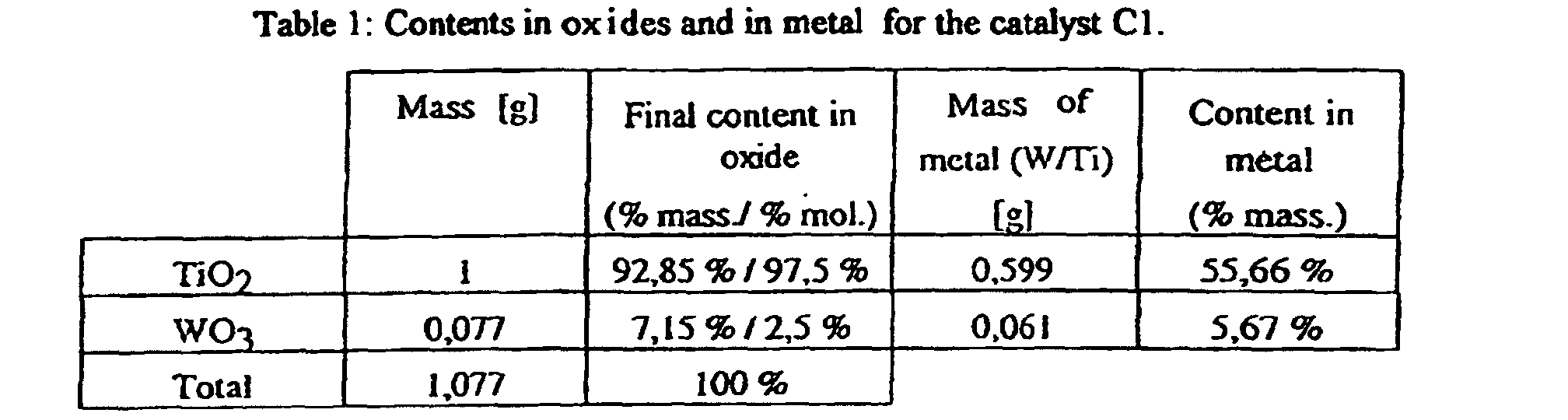
- a first catalyst C1 has been prepared whose content in tungsten corresponds to one atomic layer of WO 3 deposited on TiO 2 .
- the quantity of the WO 3 necessary is determined on the basis of the parameters of the lattice structure of WO 3 according to the values given in table 1 as follows:
- a second catalyst C2 has been prepared by calcining catalyst C1 for 16 hours at 500 °C. This treatment of calcination is similar to the treatment of calcination following the impregnation which will be described later. The study of these catalysts has allowed to understand the modifications which can occur during this step of calcination: sintering or diffusion of species in the solid state (Ceramic way).
- the catalyst according to the invention is a catalyst deposited on a support.
- This process of obtaining a catalyst according to this way of preparation is characterized by the following steps:
- the impregnation of the salt(s) of the metal M takes place between 2 to 4 hours, preferably 3 hours, at a temperature ranging from 50°C to 90°C, preferably 70°C.
- the salt(s) of tungsten or molybdenum which could be used in order to obtain WO 3 then WO 2 or MoO 3 then MoO 2 , is preferably (NH 4 ) 10 W 12 O 41 . 5H 2 O respectively (NH 4 ) 6 Mo 7 O 24 . 4H 2 O.
- the impregnation of the support can be done under a controlled pH or not. Otherwise, according to another feature of the invention, the impregnation of the support occurs under a constant pH ranging between 1 and 4, preferably at a pH equal to 2.
- the salt solution is in excess with respect to the support volume which is evaporated after the impregnation in an oven at a temperature ranging between 80°C and 120°C, preferably at 100°C, for 10 to 14 hours, preferably 12 hours.
- the number of atomic layers of MO 3 oxides deposited on the support ranges between 1 to 8, preferably equals 5 layers, and as for all catalysts, the metal(s) forming the MO 2 oxide(s) in the processes according to the present invention are preferably chosen in the group formed by W and Mo.
- Preparation of the support The raw support is first of all washed. Then it is dried followed by calcination at 500°C. The obtained solid is crushed in a mortar; only the particles of diameters ranging from 80 to 400 mm are conserved.
- Impregnation The precursor of the used tungsten is ammonium paratungstate (NH 4 ) 10 W 12 O 41 . 5H 2 O.
- NH 4 ammonium paratungstate
- the use of this salt allows to lead only to the formation of WO 3 after calcination.
- the molybdenum catalyst is obtained by the same scheme as the one used in the example of tungsten catalyst.
- a hydrocarbon such as 2-methylpentane has been used in order to determine the reduction temperature which is necessary in order to activate and stabilise the catalyst.
- the reaction temperature is always at 350°C, except when the reduction takes place at lower temperature: In this case, the reaction temperature is the same as the reduction temperature.
- the added hydrocarbon to the hydrogen flux is injected in a refrigerated trap by the melted anisole (-37.5°C), which enables to obtain a partial pressure of the hydrocarbon at about 666,6 Pa (5 torrs).
- the used hydrogen flux is 0,03 l/min, in order to ensure a passage time of about 6 minutes for the hydrocarbon over the catalyst.
- the mixture of the hydrogen and the hydrocarbon is analysed by in line gas chromatography.
- a capillary column of 50 m length and a 0,53 mm interior diameter was employed. This is diluted by helium (0,00122 l/min, which corresponds to 0,0927 m/s).
- the stationary phase is dimethylpolysiloxane.
- the temperature program applied to the colon is composed of a first level of 20 min at 35°C, followed by a linear increase in the temperature of 25°C/min, then a third level at 110°C for 30 min.
- the chromatograph used in this work is provided with a flame ionization detector, supplied by a mixture of air/hydrogen, and stabilized at 200°C, meanwhile the injector is maintained at 150°C.
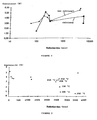
- Figure 2 shows also the influence of the calcination step in the preparation of the catalyst which is responsible for the lowering of the activity for longer periods of reduction.
- both catalysts C1 and C2 present a very high selectivity of about 90%.
- the catalyst has first been treated at levels of one hour at increasing temperatures.
- the catalyst has thus been tested at temperatures ranging between 380°C and 700°C.
- the inventors did not found values of conversion which were comparable to those obtained by the catalyst C4 studied below.
- Example1 Catalyst C4 (5 layers) prepared after reduction under hydrogen at 500 °C for 40 hours using 2-methylpentane .
- the temperatures indicated in table 3 are classified in chronological order from top to bottom, the first temperature (350 °C) corresponding therefore to the first tested temperature of the reaction.
- Example 2 Catalyst C4 (WO 3 , (5 layers)/ TiO 2 ; using 4-methylpentene-1 reactant
- the compounds C1 to C5 do not designate the catalysts of the present invention but the products of the reaction (five carbon atoms C5...) of n-hexane.
- the other abbreviations given in the table are: 22DMP is 2,2-dimethylpentane, 23DMP is 2,3-dimethylpentane, 2MP is 2-methylpentane, 3MP is 3-methylpentane. Products distribution obtained by the reaction of n-hexane on MoO 3 / TiO 2 at different reaction temperatures.
- the catalysts of the present invention are particularly useful in the field of organic chemistry and in particular in petrochemistry.
- the catalysts described in the present invention can intervene in isomerization, dehydrogenation, and /or hydrogenolysis reactions of saturated organic compounds, in particular of alkanes as well as in the isomerization, hydrogenation,dehydrogenation, and /or hydrogenolysis reactions of mono or poly-insaturated organic compounds, in particular alkenes and alkynes.
Landscapes
- Chemical & Material Sciences (AREA)
- Organic Chemistry (AREA)
- Chemical Kinetics & Catalysis (AREA)
- Engineering & Computer Science (AREA)
- Materials Engineering (AREA)
- Catalysts (AREA)
- Organic Low-Molecular-Weight Compounds And Preparation Thereof (AREA)
- Low-Molecular Organic Synthesis Reactions Using Catalysts (AREA)
Description
- The pure metals (4e, 5e, and the 6e periods of transition metals)
- The oxides of transition metals or of some heavy elements showing several stable oxidation states.
- The solid oxides of metals from the two first columns IA and IIA of the periodic table.
- The light metals and non-metals from columns IIIB, IVB, VB (acid oxides)
- preparing a mechanical mixture of one or several MO3 oxides with TiO2 or TiO2 deposited on a substrate presenting larger specific surface area than TiO2 alone, the mixture having a metal M content ranging between 5 % and 25 %, and preferably equal to 22 %.
- crushing the obtained mixture in the first step, and
- reducing, preferably at 460°C, the deposited MO3 oxide(s) to the corresponding MO2 oxide(s) by the introduction of a gaseous flux containing at least hydrogen.
- washing the raw support, drying and calcination,
- crushing the obtained solid followed by sifting,
- depositing the MO3 oxide(s) on a support material made up of TiO2 or TiO2 deposited on a substrate presenting a larger specific surface area than TiO2 alone by impregnation of the support material with a solution of one or several salts of the metal M,
- calcination of the obtained product to form MO3 oxyde(s), and
- reduction, preferably at 510°C of the MO3 oxide(s) by introducing a gaseous flux containing at least hydrogen on the MO3 oxide(s).

| Evolution of the activity and the selectivity in function of the reaction temperature for the catalyst C4 (5 layers). | ||
| T reaction °C | Activity% | Selectivity in isomers% |
| 350 | 8 | 95 |
| 330 | 3,6 | 97 |
| 300 | 1,2 | 100 |
| 315 | 2,3 | 98 |
| 380 | 12 | 81 |
| 350 | 8 | 94 |
| 400 | 15 | 68 |
| 420 | 16 | 49 |
| 460 | 26 | 15 |
| 510 | 75 | 4,5 |
| Evolution of the activity and selectivity in function of the reaction temperature using catalyst C4. | ||
| T reaction °C : | Activity% | Selectivity in isomers% |
| 350 | 58 | 92 |
| 250 | 57 | 90 |
| Conversions and selectivities of MoO2, MoO3, and MoO3 / TiO2 for the n-hexane reactant at different reaction temperatures. 1) = Commercial compounds prior to reduction; 2) = The initial state in order to obtain the catalyst by impregnation | ||||||
| Conversions % | Selectivities % | |||||
| Temp. of reaction °C | MoO2 1) | MoO3 1) | MoO3/TiO2 2) | MoO2 1) | MoO3 1) | MoO3/TiO2 2) |
| 280 | 2,0 | 3,9 | 3,7 | 100 | 97,4 | 100 |
| 300 | 5,5 | 8,2 | 15,2 | 100 | 94,3 | 98,8 |
| 320 | 15,9 | 16,1 | 24,1 | 94,4 | 86,4 | 82,9 |
| 340 | 24,3 | 20,2 | 37,1 | 82,0 | 84,8 | 75,1 |
| 360 | 41,7 | 34,7 | 64,7 | 69,1 | 77,4 | 57,1 |
| 380 | 50,0 | 47,4 | 69,9 | 67,1 | 61,5 | 43,2 |
| 400 | 68,1 | 63,3 | 86,5 | 48,3 | 46,0 | 22,7 |
| Products distribution obtained by the reaction of n-hexane on MoO3 / TiO2 at different reaction temperatures. | |||||||
| Products | Reaction temperatures °C | ||||||
| Cracking | 400 | 380 | 360 | 340 | 320 | 300 | 280 |
| | 26,2 | 18,1 | 13,5 | 8,7 | 6,1 | 0 | 0 |
| | 18,6 | 12,1 | 9,5 | 4 | 2,9 | 0 | 0 |
| C3 | 19 | 14,7 | 10,7 | 6,1 | 3,6 | 1,3 | 0 |
| C4 | 8,8 | 6,7 | 5,1 | 2,8 | 1,5 | 0 | 0 |
| | 4,7 | 5,3 | 4,7 | 3,3 | 3 | 0 | 0 |
| | |||||||
| 22DMP | |||||||
| 1 | 1,4 | 2 | 1,8 | 2,2 | 0 | 0 | |
| | 2,3 | 4,3 | 5,5 | 6,3 | 6,1 | 6,3 | 7,3 |
| | 11,1 | 22,3 | 30,3 | 41,7 | 47,3 | 59,7 | 64,4 |
| | 7,7 | 14,9 | 19,7 | 25,4 | 27,7 | 34,8 | 36,4 |
| 2MP/ | 1,5 | 1,5 | 1,5 | 1,6 | 1,7 | 1,7 | 1,8 |
Claims (10)
- A polyvalent bifunctional catalyst consisting of a metallic oxide or a mixture of metallic oxides MO2 in which M is chosen from the group consisting of Mo and W, said oxide or oxide mixture being deposited on a TiO2 support, characterized by the fact that the metallic and the acidic character of the catalyst are both provided by the same MO2 phase, said MO2 phase being prepared by the in situ reduction of the corresponding MO3 oxide(s) which are deposited in a number of atomic layers comprised between 1 and 8, preferably equal to 5 on said TiO2 support, the reduction process taking place at a temperature between 380 °C and 550 °C in particular at a reduction temperature of approximately 510 °C in case of pure WO2, under a gazeous flux containing at least hydrogen, said reduction process having no effect on said number of layers.
- A catalyst according to claim 1, characterized by the fact that the metallic oxide(s) MO3 which are reduced to MO2 are deposited on a support of TiO2 which itself is deposited on a substrate having larger surface area than TiO2.
- A catalyst according to claim 2, characterized by the fact that the substrate is preferably chosen from the group consisting of SiO2, Al2O3 or a zeolite.
- A catalyst according to any of the claims 1 to 3, characterized by the fact that the reduction takes place during at least 6 hours at a flow rate of hydrogen comprised between 0,010 l/min and 0,050 l/min, preferably 0,030 l/min with a volume between 90 % and 100 % of hydrogen, preferably 99 % hydrogen.
- A catalyst according to any of the claims 1 to 4, characterized by the fact that the reduction takes place under a gazeous flux containing hydrogen and a gazeous hydrocarbon compound which is expected to undergo a chemical reaction which is catalyzed by said catalyst.
- A catalyst according to claim 5, characterized by the fact the gazeous hydrocarbon is present under a partial pressure range between 666,6 Pa and 1999,8 Pa, preferably 799,9 Pa.
- A catalyst according to any of the claims from 1 to 6, characterized by the fact that it contains in weight between 5,4 % and 27 % of MoO3, which corresponds to a range between 4,8 % to 24 % in weight of MoO2.
- A catalyst according to any of the claims from 1 to 7, characterized by the fact that it contains in weight between 6 % and 30 % of WO3, which corresponds to a range between 5,7 % to 28 % in weight of WO2.
- The use of a catalyst according to any of the claims 1 to 8, characterized by the fact that the catalyst is used in the reaction of isomerization, hydrogenation, dehydrogenation and/or hydrogenolysis of saturated hydrocarbons, especially alkanes.
- The use of a catalyst according to any of the claims 1 to 8, characterized by the fact that the catalyst is used in the reaction of isomerization, dehydrogenation, hydrogenation and/or hydrogenolysis of mono or polyunsaturated hydrocarbons, especially alkenes and alkynes.
Applications Claiming Priority (3)
| Application Number | Priority Date | Filing Date | Title |
|---|---|---|---|
| FR9811396 | 1998-09-09 | ||
| FR9811396A FR2782933B1 (en) | 1998-09-09 | 1998-09-09 | VERSATILE BIFUNCTIONAL CATALYST AND METHODS FOR OBTAINING SUCH A CATALYST |
| PCT/EP1999/006581 WO2000013788A2 (en) | 1998-09-09 | 1999-09-07 | A polyvalent bifunctional catalyst and the process of realisation of such a catalyst |
Publications (3)
| Publication Number | Publication Date |
|---|---|
| EP1144110A2 EP1144110A2 (en) | 2001-10-17 |
| EP1144110A3 EP1144110A3 (en) | 2002-11-13 |
| EP1144110B1 true EP1144110B1 (en) | 2004-04-21 |
Family
ID=9530368
Family Applications (1)
| Application Number | Title | Priority Date | Filing Date |
|---|---|---|---|
| EP99968642A Expired - Lifetime EP1144110B1 (en) | 1998-09-09 | 1999-09-07 | A polyvalent bifunctional catalyst and the process of realisation of such a catalyst |
Country Status (16)
| Country | Link |
|---|---|
| US (1) | US6781022B1 (en) |
| EP (1) | EP1144110B1 (en) |
| JP (1) | JP4974409B2 (en) |
| AP (1) | AP1500A (en) |
| AT (1) | ATE264712T1 (en) |
| AU (1) | AU5974299A (en) |
| CA (1) | CA2343053C (en) |
| DE (1) | DE69916657T2 (en) |
| DK (1) | DK1144110T3 (en) |
| EA (1) | EA003859B1 (en) |
| ES (1) | ES2221476T3 (en) |
| FR (1) | FR2782933B1 (en) |
| NO (1) | NO322904B1 (en) |
| PT (1) | PT1144110E (en) |
| SA (1) | SA99200640B1 (en) |
| WO (1) | WO2000013788A2 (en) |
Families Citing this family (6)
| Publication number | Priority date | Publication date | Assignee | Title |
|---|---|---|---|---|
| US8323396B2 (en) * | 2006-11-09 | 2012-12-04 | Sun Chemical Corp. | Orange pearlescent pigments |
| US8349067B2 (en) * | 2006-11-09 | 2013-01-08 | Sun Chemical Corp. | Multi-colored lustrous pearlescent pigments |
| US8211224B2 (en) * | 2006-11-09 | 2012-07-03 | Sun Chemical Corp. | Multi-colored lustrous pearlescent pigments and process for making |
| US8221536B2 (en) * | 2006-11-09 | 2012-07-17 | Sun Chemical Corp. | Cosmetic comprising multi-colored lustrous pearlescent pigments |
| US8906154B2 (en) * | 2006-11-09 | 2014-12-09 | Sun Chemical Corporation | Coating, ink, or article comprising multi-colored lustrous pearlescent pigments |
| US12415175B2 (en) | 2020-05-08 | 2025-09-16 | Sabic Global Technologies B.V. | Supported catalyst for butane hydrogenolyis, method of producing the supported catalyst and method to produce ethane |
Family Cites Families (19)
| Publication number | Priority date | Publication date | Assignee | Title |
|---|---|---|---|---|
| CA934369A (en) * | 1969-07-04 | 1973-09-25 | Badische Anilin- And Soda-Fabrik Aktiengesellschaft | Production of anthraquinone |
| US3893947A (en) * | 1973-09-10 | 1975-07-08 | Union Oil Co | Group VI-B metal catalyst preparation |
| FR2252123B1 (en) * | 1973-11-22 | 1980-08-08 | Rhone Progil | |
| US4052417A (en) * | 1975-11-06 | 1977-10-04 | Celanese Corporation | Vapor phase oxidation of butane producing maleic anhydride and acetic acid |
| US4129592A (en) * | 1976-04-07 | 1978-12-12 | Celanese Corporation | Hydrocarbon oxidation process |
| US4140654A (en) * | 1976-04-16 | 1979-02-20 | Mitsui Petrochemical Industries Ltd. | Catalyst composition with support comprising titanium oxide and clay mineral for vapor phase reduction of nitrogen oxides |
| GB2084042B (en) * | 1980-09-16 | 1984-05-10 | Tioxide Group Ltd | Method for the production of monolayer catalysts |
| US4522936A (en) * | 1983-03-21 | 1985-06-11 | Phillips Petroleum Company | Metathesis catalyst |
| US4547617A (en) * | 1984-02-16 | 1985-10-15 | Phillips Petroleum Company | Olefin conversion |
| JPS6257649A (en) * | 1985-08-13 | 1987-03-13 | ジユ−ト−ヒエミ− アクチエンゲゼルシヤフト | Catalyst for reducing content of nitrogen oxide in combustion exhaust gas |
| DE3531809A1 (en) * | 1985-09-06 | 1987-03-26 | Kraftwerk Union Ag | CATALYST MATERIAL FOR REDUCING NITROGEN OXIDES |
| JPH0687780A (en) * | 1990-09-17 | 1994-03-29 | Uop Inc | Method of producing diaryl ether by dehydration of a phenol by use of catalyst supported on partially reduced tungsten (vi) oxide |
| EP0584415A1 (en) * | 1990-09-17 | 1994-03-02 | Uop | Diaryl ethers by dehydration of phenols using a catalyst comprising supported partially reduced tungsten (VI) oxide |
| FR2680984B1 (en) * | 1991-09-06 | 1993-11-05 | Pechiney Recherche | CATALYST PREPARATION FROM METAL OXIDES BY REDUCTION AND PARTIAL FUEL BY REACTION GASES. |
| JP2814321B2 (en) * | 1991-10-09 | 1998-10-22 | 三菱レイヨン株式会社 | Method for producing methacrylic acid |
| JPH05293375A (en) * | 1992-04-17 | 1993-11-09 | Japan Energy Corp | Solid superacid catalyst and process for producing the same |
| EP0639553B1 (en) * | 1993-08-20 | 1998-01-14 | Nkk Corporation | Catalyst and method for producing phenols |
| FR2712587B1 (en) * | 1993-11-18 | 1995-12-15 | Pechiney Recherche | Process for the isomerization of linear hydrocarbons containing more than six carbon atoms using catalysts based on molybdenum oxycarbide. |
| US6592842B2 (en) * | 1999-10-01 | 2003-07-15 | Battelle Memorial Institute | Nanocrystalline heterojunction materials |
-
1998
- 1998-09-09 FR FR9811396A patent/FR2782933B1/en not_active Expired - Lifetime
-
1999
- 1999-09-07 DK DK99968642T patent/DK1144110T3/en active
- 1999-09-07 AP APAP/P/2001/002118A patent/AP1500A/en active
- 1999-09-07 PT PT99968642T patent/PT1144110E/en unknown
- 1999-09-07 WO PCT/EP1999/006581 patent/WO2000013788A2/en not_active Ceased
- 1999-09-07 EP EP99968642A patent/EP1144110B1/en not_active Expired - Lifetime
- 1999-09-07 EA EA200100324A patent/EA003859B1/en not_active IP Right Cessation
- 1999-09-07 DE DE69916657T patent/DE69916657T2/en not_active Expired - Lifetime
- 1999-09-07 CA CA002343053A patent/CA2343053C/en not_active Expired - Lifetime
- 1999-09-07 US US09/786,791 patent/US6781022B1/en not_active Expired - Lifetime
- 1999-09-07 ES ES99968642T patent/ES2221476T3/en not_active Expired - Lifetime
- 1999-09-07 AU AU59742/99A patent/AU5974299A/en not_active Abandoned
- 1999-09-07 AT AT99968642T patent/ATE264712T1/en active
- 1999-09-07 JP JP2000568585A patent/JP4974409B2/en not_active Expired - Fee Related
- 1999-10-04 SA SA99200640A patent/SA99200640B1/en unknown
-
2001
- 2001-03-08 NO NO20011185A patent/NO322904B1/en not_active IP Right Cessation
Also Published As
| Publication number | Publication date |
|---|---|
| AU5974299A (en) | 2000-03-27 |
| NO20011185D0 (en) | 2001-03-08 |
| EA200100324A1 (en) | 2001-10-22 |
| SA99200640B1 (en) | 2006-10-11 |
| WO2000013788A2 (en) | 2000-03-16 |
| FR2782933B1 (en) | 2000-11-17 |
| JP2003518429A (en) | 2003-06-10 |
| NO20011185L (en) | 2001-05-08 |
| CA2343053A1 (en) | 2000-03-16 |
| EP1144110A3 (en) | 2002-11-13 |
| WO2000013788A3 (en) | 2002-09-26 |
| EP1144110A2 (en) | 2001-10-17 |
| CA2343053C (en) | 2007-11-27 |
| NO322904B1 (en) | 2006-12-18 |
| AP1500A (en) | 2005-11-30 |
| DE69916657D1 (en) | 2004-05-27 |
| JP4974409B2 (en) | 2012-07-11 |
| ES2221476T3 (en) | 2004-12-16 |
| PT1144110E (en) | 2004-09-30 |
| ATE264712T1 (en) | 2004-05-15 |
| US6781022B1 (en) | 2004-08-24 |
| DE69916657T2 (en) | 2005-05-19 |
| FR2782933A1 (en) | 2000-03-10 |
| DK1144110T3 (en) | 2004-08-09 |
| EA003859B1 (en) | 2003-10-30 |
Similar Documents
| Publication | Publication Date | Title |
|---|---|---|
| Hattori et al. | Enhanced catalytic ammonia synthesis with transformed BaO | |
| Di Gregorio et al. | Activation and isomerization of hydrocarbons over WO3/ZrO2 catalysts: I. Preparation, characterization, and X-ray photoelectron spectroscopy studies | |
| Kim et al. | Genesis of methane activation sites in Mo-exchanged H–ZSM-5 catalysts | |
| Boningari et al. | Low-temperature catalytic reduction of NO by NH3 over vanadia-based nanoparticles prepared by flame-assisted spray pyrolysis: Influence of various supports | |
| Yuan et al. | Performance and characterization of a new crystalline SbRe2O6 catalyst for selective oxidation of methanol to methylal | |
| Khodakov et al. | Structure and properties of vanadium oxide-zirconia catalysts for propane oxidative dehydrogenation | |
| Vilé et al. | Stereo‐and Chemoselective Character of Supported CeO2 Catalysts for Continuous‐Flow Three‐Phase Alkyne Hydrogenation | |
| Liu et al. | Methane dehydroaromatization over Mo/HZSM-5 catalysts: the reactivity of MoCx species formed from MoOx associated and non-associated with Brönsted acid sites | |
| Nilsson et al. | An Investigation of the Al–Sb–V–W–Oxide System for Propane Ammoxidation | |
| Yang et al. | Understanding the active-site nature of vanadia-based catalysts for oxidative dehydrogenation of ethylbenzene with CO2 via atomic layer deposited VOx on γ-Al2O3 | |
| Gervasini et al. | Surface characteristics and activity in selective oxidation of o-xylene of supported V2O5 catalysts prepared by standard impregnation and atomic layer deposition | |
| Deniau et al. | Preparation of single M1 phase MoVTe (Sb) NbO catalyst: Study of the effect of M2 phase dissolution on the structure and catalytic properties | |
| US5780383A (en) | Solid superacid catalyst comprising group VII metal and having Ho less than -18 | |
| Sohn et al. | Acidic properties of nickel sulfate supported on TiO2–ZrO2 and catalytic activity for acid catalysis | |
| Barrera et al. | Isomerization of n-hexane over mono-and bimetallic Pd–Pt catalysts supported on ZrO2–Al2O3–WOx prepared by sol–gel | |
| Vannice et al. | Methanol and methane formation over palladium dispersed on the lanthanide rare earth oxides | |
| Guliants et al. | Probe molecule Chemisorption− Low energy ion scattering study of surface active sites present in the orthorhombic Mo− V−(Te− Nb)− O catalysts for propane (amm) oxidation | |
| US6781022B1 (en) | Polyvalent bifunctional catalyst and the process of realization of such a catalyst | |
| Hasan et al. | Semi-industrial studies of Tungsten-based catalyst for hydroisomerization/hydrocracking of n-hexane and n-heptane | |
| Cheng et al. | Zn x Zr/HZSM-5 as efficient catalysts for alkylation of benzene with carbon dioxide | |
| Haber | Catalytic oxidation-State of the art and prospects | |
| Mashkovskii et al. | New high-selectivity hydrogenation catalysts prepared from bimetallic acetate complexes | |
| Kentri et al. | Heterogeneity of the vanadia phase dispersed on titania. Co-existence of distinct mono-oxo VO x sites | |
| Gärtner et al. | Highly selective supported alkali chloride catalysts for the oxidative dehydrogenation of ethane | |
| Yang et al. | Nature, Density, and Catalytic Role of Exposed Species on Dispersed VO x/CrO x/Al2O3 Catalysts |
Legal Events
| Date | Code | Title | Description |
|---|---|---|---|
| PUAI | Public reference made under article 153(3) epc to a published international application that has entered the european phase |
Free format text: ORIGINAL CODE: 0009012 |
|
| 17P | Request for examination filed |
Effective date: 20010403 |
|
| AK | Designated contracting states |
Kind code of ref document: A2 Designated state(s): AT BE CH CY DE DK ES FI FR GB GR IE IT LI LU MC NL PT SE |
|
| XX | Miscellaneous (additional remarks) |
Free format text: DERZEIT SIND DIE WIPO-PUBLIKATIONSDATEN A3 NICHT VERFUEGBAR. |
|
| 17Q | First examination report despatched |
Effective date: 20020130 |
|
| PUAK | Availability of information related to the publication of the international search report |
Free format text: ORIGINAL CODE: 0009015 |
|
| AK | Designated contracting states |
Kind code of ref document: A3 Designated state(s): AT BE CH CY DE DK ES FI FR GB GR IE IT LI LU MC NL PT SE |
|
| GRAP | Despatch of communication of intention to grant a patent |
Free format text: ORIGINAL CODE: EPIDOSNIGR1 |
|
| GRAS | Grant fee paid |
Free format text: ORIGINAL CODE: EPIDOSNIGR3 |
|
| GRAA | (expected) grant |
Free format text: ORIGINAL CODE: 0009210 |
|
| AK | Designated contracting states |
Kind code of ref document: B1 Designated state(s): AT BE CH CY DE DK ES FI FR GB GR IE IT LI LU MC NL PT SE |
|
| REG | Reference to a national code |
Ref country code: GB Ref legal event code: FG4D |
|
| XX | Miscellaneous (additional remarks) |
Free format text: DERZEIT SIND DIE WIPO-PUBLIKATIONSDATEN A3 NICHT VERFUEGBAR. |
|
| REG | Reference to a national code |
Ref country code: CH Ref legal event code: EP |
|
| REG | Reference to a national code |
Ref country code: IE Ref legal event code: FG4D |
|
| REF | Corresponds to: |
Ref document number: 69916657 Country of ref document: DE Date of ref document: 20040527 Kind code of ref document: P |
|
| REG | Reference to a national code |
Ref country code: SE Ref legal event code: TRGR |
|
| REG | Reference to a national code |
Ref country code: DK Ref legal event code: T3 |
|
| REG | Reference to a national code |
Ref country code: GR Ref legal event code: EP Ref document number: 20040402323 Country of ref document: GR |
|
| REG | Reference to a national code |
Ref country code: CH Ref legal event code: NV Representative=s name: WERNER FENNER PATENTANWALT |
|
| REG | Reference to a national code |
Ref country code: PT Ref legal event code: SC4A Free format text: AVAILABILITY OF NATIONAL TRANSLATION Effective date: 20040720 |
|
| REG | Reference to a national code |
Ref country code: ES Ref legal event code: FG2A Ref document number: 2221476 Country of ref document: ES Kind code of ref document: T3 |
|
| ET | Fr: translation filed | ||
| PLBE | No opposition filed within time limit |
Free format text: ORIGINAL CODE: 0009261 |
|
| STAA | Information on the status of an ep patent application or granted ep patent |
Free format text: STATUS: NO OPPOSITION FILED WITHIN TIME LIMIT |
|
| 26N | No opposition filed |
Effective date: 20050124 |
|
| REG | Reference to a national code |
Ref country code: FR Ref legal event code: PLFP Year of fee payment: 18 |
|
| REG | Reference to a national code |
Ref country code: FR Ref legal event code: PLFP Year of fee payment: 19 |
|
| REG | Reference to a national code |
Ref country code: FR Ref legal event code: PLFP Year of fee payment: 20 |
|
| PGFP | Annual fee paid to national office [announced via postgrant information from national office to epo] |
Ref country code: FR Payment date: 20180911 Year of fee payment: 20 Ref country code: MC Payment date: 20180925 Year of fee payment: 20 Ref country code: IE Payment date: 20180917 Year of fee payment: 20 Ref country code: DE Payment date: 20180924 Year of fee payment: 20 Ref country code: LU Payment date: 20180919 Year of fee payment: 20 Ref country code: IT Payment date: 20180912 Year of fee payment: 20 |
|
| PGFP | Annual fee paid to national office [announced via postgrant information from national office to epo] |
Ref country code: NL Payment date: 20180925 Year of fee payment: 20 Ref country code: BE Payment date: 20180913 Year of fee payment: 20 Ref country code: DK Payment date: 20180927 Year of fee payment: 20 Ref country code: FI Payment date: 20180910 Year of fee payment: 20 Ref country code: SE Payment date: 20180912 Year of fee payment: 20 Ref country code: GR Payment date: 20180912 Year of fee payment: 20 Ref country code: AT Payment date: 20180912 Year of fee payment: 20 Ref country code: GB Payment date: 20180912 Year of fee payment: 20 |
|
| PGFP | Annual fee paid to national office [announced via postgrant information from national office to epo] |
Ref country code: PT Payment date: 20180905 Year of fee payment: 20 |
|
| PGFP | Annual fee paid to national office [announced via postgrant information from national office to epo] |
Ref country code: CH Payment date: 20181221 Year of fee payment: 20 Ref country code: ES Payment date: 20181001 Year of fee payment: 20 |
|
| PGFP | Annual fee paid to national office [announced via postgrant information from national office to epo] |
Ref country code: CY Payment date: 20180905 Year of fee payment: 20 |
|
| REG | Reference to a national code |
Ref country code: DE Ref legal event code: R071 Ref document number: 69916657 Country of ref document: DE |
|
| REG | Reference to a national code |
Ref country code: DK Ref legal event code: EUP Effective date: 20190907 |
|
| REG | Reference to a national code |
Ref country code: NL Ref legal event code: MK Effective date: 20190906 |
|
| REG | Reference to a national code |
Ref country code: CH Ref legal event code: PL |
|
| REG | Reference to a national code |
Ref country code: GB Ref legal event code: PE20 Expiry date: 20190906 |
|
| REG | Reference to a national code |
Ref country code: AT Ref legal event code: MK07 Ref document number: 264712 Country of ref document: AT Kind code of ref document: T Effective date: 20190907 |
|
| REG | Reference to a national code |
Ref country code: BE Ref legal event code: MK Effective date: 20190907 |
|
| REG | Reference to a national code |
Ref country code: SE Ref legal event code: EUG |
|
| REG | Reference to a national code |
Ref country code: IE Ref legal event code: MK9A |
|
| PG25 | Lapsed in a contracting state [announced via postgrant information from national office to epo] |
Ref country code: PT Free format text: LAPSE BECAUSE OF EXPIRATION OF PROTECTION Effective date: 20190917 |
|
| PG25 | Lapsed in a contracting state [announced via postgrant information from national office to epo] |
Ref country code: GB Free format text: LAPSE BECAUSE OF EXPIRATION OF PROTECTION Effective date: 20190906 |
|
| PG25 | Lapsed in a contracting state [announced via postgrant information from national office to epo] |
Ref country code: IE Free format text: LAPSE BECAUSE OF EXPIRATION OF PROTECTION Effective date: 20190907 |
|
| REG | Reference to a national code |
Ref country code: ES Ref legal event code: FD2A Effective date: 20220127 |
|
| PG25 | Lapsed in a contracting state [announced via postgrant information from national office to epo] |
Ref country code: ES Free format text: LAPSE BECAUSE OF EXPIRATION OF PROTECTION Effective date: 20190908 |