EP1143751A1 - Base station device and transmission power control method - Google Patents
Base station device and transmission power control method Download PDFInfo
- Publication number
- EP1143751A1 EP1143751A1 EP00970031A EP00970031A EP1143751A1 EP 1143751 A1 EP1143751 A1 EP 1143751A1 EP 00970031 A EP00970031 A EP 00970031A EP 00970031 A EP00970031 A EP 00970031A EP 1143751 A1 EP1143751 A1 EP 1143751A1
- Authority
- EP
- European Patent Office
- Prior art keywords
- transmit power
- power control
- base station
- control information
- tpc
- Prior art date
- Legal status (The legal status is an assumption and is not a legal conclusion. Google has not performed a legal analysis and makes no representation as to the accuracy of the status listed.)
- Withdrawn
Links
Images


Classifications
-
- H—ELECTRICITY
- H04—ELECTRIC COMMUNICATION TECHNIQUE
- H04W—WIRELESS COMMUNICATION NETWORKS
- H04W52/00—Power management, e.g. Transmission Power Control [TPC] or power classes
- H04W52/04—Transmission power control [TPC]
- H04W52/18—TPC being performed according to specific parameters
- H04W52/22—TPC being performed according to specific parameters taking into account previous information or commands
- H04W52/221—TPC being performed according to specific parameters taking into account previous information or commands using past power control commands
-
- H—ELECTRICITY
- H04—ELECTRIC COMMUNICATION TECHNIQUE
- H04W—WIRELESS COMMUNICATION NETWORKS
- H04W52/00—Power management, e.g. Transmission Power Control [TPC] or power classes
- H04W52/04—Transmission power control [TPC]
- H04W52/18—TPC being performed according to specific parameters
- H04W52/24—TPC being performed according to specific parameters using SIR [Signal to Interference Ratio] or other wireless path parameters
-
- H—ELECTRICITY
- H04—ELECTRIC COMMUNICATION TECHNIQUE
- H04W—WIRELESS COMMUNICATION NETWORKS
- H04W52/00—Power management, e.g. Transmission Power Control [TPC] or power classes
- H04W52/02—Power saving arrangements
- H04W52/0203—Power saving arrangements in the radio access network or backbone network of wireless communication networks
- H04W52/0206—Power saving arrangements in the radio access network or backbone network of wireless communication networks in access points, e.g. base stations
-
- H—ELECTRICITY
- H04—ELECTRIC COMMUNICATION TECHNIQUE
- H04W—WIRELESS COMMUNICATION NETWORKS
- H04W52/00—Power management, e.g. Transmission Power Control [TPC] or power classes
- H04W52/04—Transmission power control [TPC]
- H04W52/06—TPC algorithms
- H04W52/14—Separate analysis of uplink or downlink
- H04W52/146—Uplink power control
-
- H—ELECTRICITY
- H04—ELECTRIC COMMUNICATION TECHNIQUE
- H04W—WIRELESS COMMUNICATION NETWORKS
- H04W52/00—Power management, e.g. Transmission Power Control [TPC] or power classes
- H04W52/04—Transmission power control [TPC]
- H04W52/18—TPC being performed according to specific parameters
- H04W52/22—TPC being performed according to specific parameters taking into account previous information or commands
- H04W52/225—Calculation of statistics, e.g. average or variance
-
- H—ELECTRICITY
- H04—ELECTRIC COMMUNICATION TECHNIQUE
- H04W—WIRELESS COMMUNICATION NETWORKS
- H04W52/00—Power management, e.g. Transmission Power Control [TPC] or power classes
- H04W52/04—Transmission power control [TPC]
- H04W52/18—TPC being performed according to specific parameters
- H04W52/24—TPC being performed according to specific parameters using SIR [Signal to Interference Ratio] or other wireless path parameters
- H04W52/241—TPC being performed according to specific parameters using SIR [Signal to Interference Ratio] or other wireless path parameters taking into account channel quality metrics, e.g. SIR, SNR, CIR or Eb/lo
-
- H—ELECTRICITY
- H04—ELECTRIC COMMUNICATION TECHNIQUE
- H04W—WIRELESS COMMUNICATION NETWORKS
- H04W52/00—Power management, e.g. Transmission Power Control [TPC] or power classes
- H04W52/04—Transmission power control [TPC]
- H04W52/18—TPC being performed according to specific parameters
- H04W52/24—TPC being performed according to specific parameters using SIR [Signal to Interference Ratio] or other wireless path parameters
- H04W52/243—TPC being performed according to specific parameters using SIR [Signal to Interference Ratio] or other wireless path parameters taking into account interferences
-
- H—ELECTRICITY
- H04—ELECTRIC COMMUNICATION TECHNIQUE
- H04W—WIRELESS COMMUNICATION NETWORKS
- H04W52/00—Power management, e.g. Transmission Power Control [TPC] or power classes
- H04W52/04—Transmission power control [TPC]
- H04W52/18—TPC being performed according to specific parameters
- H04W52/24—TPC being performed according to specific parameters using SIR [Signal to Interference Ratio] or other wireless path parameters
- H04W52/248—TPC being performed according to specific parameters using SIR [Signal to Interference Ratio] or other wireless path parameters where transmission power control commands are generated based on a path parameter
-
- H—ELECTRICITY
- H04—ELECTRIC COMMUNICATION TECHNIQUE
- H04W—WIRELESS COMMUNICATION NETWORKS
- H04W88/00—Devices specially adapted for wireless communication networks, e.g. terminals, base stations or access point devices
- H04W88/08—Access point devices
-
- H—ELECTRICITY
- H04—ELECTRIC COMMUNICATION TECHNIQUE
- H04W—WIRELESS COMMUNICATION NETWORKS
- H04W52/00—Power management, e.g. Transmission Power Control [TPC] or power classes
- H04W52/04—Transmission power control [TPC]
- H04W52/38—TPC being performed in particular situations
- H04W52/40—TPC being performed in particular situations during macro-diversity or soft handoff
-
- Y—GENERAL TAGGING OF NEW TECHNOLOGICAL DEVELOPMENTS; GENERAL TAGGING OF CROSS-SECTIONAL TECHNOLOGIES SPANNING OVER SEVERAL SECTIONS OF THE IPC; TECHNICAL SUBJECTS COVERED BY FORMER USPC CROSS-REFERENCE ART COLLECTIONS [XRACs] AND DIGESTS
- Y02—TECHNOLOGIES OR APPLICATIONS FOR MITIGATION OR ADAPTATION AGAINST CLIMATE CHANGE
- Y02D—CLIMATE CHANGE MITIGATION TECHNOLOGIES IN INFORMATION AND COMMUNICATION TECHNOLOGIES [ICT], I.E. INFORMATION AND COMMUNICATION TECHNOLOGIES AIMING AT THE REDUCTION OF THEIR OWN ENERGY USE
- Y02D30/00—Reducing energy consumption in communication networks
- Y02D30/70—Reducing energy consumption in communication networks in wireless communication networks
Definitions
- the present invention relates to a base station apparatus and transmit power control method used in a mobile radio communication system such as a cellular telephone and automobile telephone.
- FIG.1 is a drawing to outline handover that takes place in a mobile radio communication cellular system.
- mobile station 11 is currently carrying out radio communication with base station 31 installed in cell 21 and moving toward cell 22 adjacent to cell 21.
- mobile station 11 When mobile station 11 moves from cell 21 to cell 22, mobile station 11 carries out diversity handover between base station 31 and base station 32. During the diversity handover, mobile station 11 measures the reception quality of a common control channel by communicating with both base station 31 and base station 32. Then, when the reception quality of base station 32 becomes better than that of base station 31, mobile station 11 switches its communication counterpart from base station 31 to base station 32.
- control station 41 selects and combines signals with good reception conditions from among signals sent from mobile station 11 and received by base station 31 and base station 32.
- TPC Transmit Power Control
- Transmit power control using the reception SIR by the base stations is carried out by receiving an individual channel sent from the mobile station subject to the transmit power control and calculating the ratio of the power of the desired signal to the other reception power, that is, the power of the interference signal.
- transmit power control is performed simultaneously between mobile station 11 and base stations 31 and 32, and mobile station 11 acquires TPCs sent from base stations 31 and 32 and carries out transmit power control of the own station based on those TPCs.
- the base station that newly enters into communication has no sufficiently observed individual channels, which are to be used for measurement of the SIR of the mobile station and to be averaged, and therefore averaging causes the power of the signal of interference with the mobile station to be measured lower than the actual value.
- the base station that has newly entered into communication determines that the reception SIR of the mobile station is satisfactory and transmits a TPC instructing the mobile station to reduce its transmit power.
- the mobile station Even if the mobile station receives from the base station currently in communication a TPC instructing that the transmit power should be increased, the mobile station receives from the base station that has newly entered into communication the TPC instructing that the transmit power should be reduced, and therefore the mobile station reduces transmit power according to the TPC instructing the minimum transmit signal power even if the reception SIR is actually not satisfactory for the base station currently in communication.
- the reception quality further deteriorates and satisfactory reception quality is not obtained from either of the base stations involved in the diversity handover, which prevents the control station from combining the reception signals.
- it will be necessary to retransmit the transmission unit, causing problems of reducing the communication efficiency and interrupting radio connections.
- This object is achieved, when transmit power control is performed with a mobile station with which a radio connection has been newly established, by not performing control to reduce transmit power on the relevant mobile station until the power of the interference signal against the signal sent from the relevant mobile station can be measured appropriately.
- FIG.2 is a block diagram showing a configuration of a base station according to Embodiment 1 of the present invention.
- a signal sent from a mobile station with which the base station is communicating is received by antenna 101 and input to radio reception section 103 via transmission/reception separation section 102.
- Radio reception section 103 performs radio processing such as amplification and frequency conversion on the reception signal input.
- Despreading section 104 multiplies the output signal from radio reception section 103 by a spreading code specific to each mobile station.
- Maximum ratio combination section 105 combines the output signal from despreading section 104 at a maximum ratio.
- Demodulation section 106 demodulates the output signal of maximum ratio combination section 105 and extracts the reception data.
- Reception SIR calculation section 107 measures the desired signal power and interference signal power from the output signal of despreading section 104, calculates an average value of new interference signal power using the average value of the interference signal power stored so far in power value storage section 108 and calculates a reception SIR from the ratio of the desired signal power to interference signal power. Specific examples of measurements of the desired signal power, interference signal power and averaging thereof will be described later.
- Power value storage section 108 stores the count of interference signal power measured so far by reception SIR calculation section 107 and the average value of the interference signal power calculated by reception SIR calculation section 107.
- Reference value decision section 109 decides whether the reception SIR calculated by reception SIR calculation section 107 is greater than a reference value or not and notifies TPC creation section 110 of the decision result.
- TPC creation section 110 creates a TPC instructing an increase of transmit power irrespective of the decision result notified from reference value decision section 109.
- TPC creation section 110 creates a TPC instructing a decrease of transmit power in the case where the reception SIR is greater than the reference value and creates a TPC instructing an increase of transmit power in the case where the reception SIR is equal to or smaller than the reference value based on the decision result notified from reference value decision section 109.
- Combination section 111 combines the TPCs output from TPC creation section 110 with transmission data and forms a frame according to a transmission data format.
- Modulation section 112 performs primary modulation processing such as PSK and QPSK on the output signal of combination section 111.
- Spreading section 113 multiplies the output signal of modulation section 112 by a specific spreading code.
- Radio transmission section 114 performs radio processing such as amplification and frequency conversion on the output signal of spreading section 113 and transmits the signal from antenna 101 via transmission/reception separation section 102.
- the mobile station that has received the signal carrying TPC from the base station increases the transmit power value by a predetermined quantity (e.g., 1 dB) from the previous transmit power value if the extracted TPC instructs an increase of transmit power and decreases the transmit power value by a predetermined quantity (e.g., 1 dB) from the previous transmit power value if the extracted TPC instructs a decrease of transmit power.
- a predetermined quantity e.g., 1 dB
- reception SIR calculation section 107 detects and extracts the positions of pilot symbols in a reception slot, that is, known symbols and corrects the quadrant of the despread value, that is, removes the modulated components of 0 or 1.
- reception SIR calculation section 107 calculates desired signal power RSSI and interference signal power ISSI in the actual slot as follows.
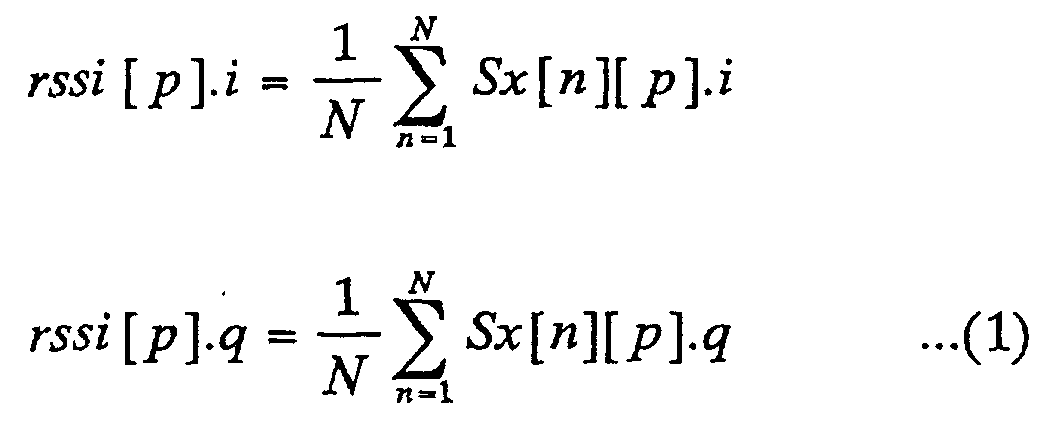
- average value rssi[p] ⁇ i of an in-phase component and average value rssi[p] ⁇ q of a quadrature component for every slot in N pilot symbols after quadrant correction are calculated from following expressions (1).
- rssi[p] rssi [ p ]. i 2 + rssi [ p ]. q 2
- the in-phase component issi[n][p] ⁇ i and quadrature component issi[n][p] ⁇ q of the interference signal are calculated from following expressions (4) from a difference between pilot symbols after a quadrant correction and its average for every slot.
- i Sx [ n ][ p ].
- i issi [ n ][ p ].
- q Sx [ n ][ p ].
- interference signal power issi[p] for every slot and every path is calculated from following expression (5).
- reception SIR calculation section 107 averages interference signal power ISSI over a plurality of slots using an IIR filter as shown in following expression (7).
- ISSI ave ⁇ ⁇ ISSI ave_previous + (1- ⁇ ) ⁇ ISSI
- ISSI ave_previous is the averaging interference signal power calculated in the immediately preceding slot and ⁇ is called a "forgetting factor" and a value such as 0.99 is set.
- weight 1-0.99 that is, 0.01 is assigned to the interference signal power ISSI calculated in the current slot and since it is very small compared to the weight 0.99 related to the averaged interference signal power ISSI ave_previous calculated in the previous slot, it is not until measurement and averaging have been performed approximately 100 times that reliable averaging interference signal power is measured.
- reception SIR calculation section 107 calculates a reception SIR based on the measured desired signal power and interference signal power, and the averaged value of the interference signal power stored in power value storage section 108.
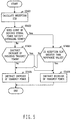
- TPC creation section 110 decides whether the count of interference signal power stored in power value storage section 108 satisfies the averaging count or not.
- reference value decision section 109 compares the level of the reception SIR with a predetermined reference value in ST203.
- TPC creation section 110 creates a TPC to instruct an increase of transmit power in ST204.
- TPC creation section 110 creates a TPC to instruct a decrease of transmit power in ST205.
- the base station instructs a mobile station with which to establish a new radio link to increase transmit power irrespective of the calculated reception SIR until the base station can correctly estimate the interference signal power against a signal sent from the relevant mobile station, thus preventing the base station from instructing a decrease of transmit power by overestimating the reception SIR, and thereby allowing the base station to always receive signals of sufficient quality and perform efficient communications.
- the base station can perform correct transmit power control on the relevant mobile station.
- FIG.4 is a block diagram showing a configuration of a base station according to Embodiment 2 of the present invention.
- the parts having a configuration and operation common to those of the base station according to Embodiment 1 shown in FIG.2 are assigned the same reference numerals as those in FIG.2 and explanations thereof are omitted.
- the base station shown in FIG.4 has a configuration with TPC storage section 301 added to the base station shown in FIG.2.
- TPC storage section 301 stores only one TPC input from TPC creation section 110 and updates the storage content every time a TPC is input. That is, TPC storage section 301 stores only the previous TPC.
- TPC creation section 110 outputs the created TPC to the combination section 111 and TPC storage section 301. Furthermore, when the count of the interference signal power stored in power value storage section 108 is smaller than the averaging count, TPC creation section 110 reads the previous TPC stored in TPC storage section 301 and creates a TPC whose content is opposite to that of the previous TPC.
- reception SIR calculation section 107 calculates a reception SIR based on the measured desired signal power and interference signal power, and the average value of interference signal power stored in power value storage section 108.
- TPC creation section 110 decides whether the count of interference signal power stored in power value storage section 108 satisfies the averaging count or not.
- reference value decision section 109 compares the level of the reception SIR with a preset reference value in ST403.
- TPC creation section 110 decides the content of the previous TPC stored in TPC storage section 301 in ST404.
- TPC creation section 110 creates a TPC instructing an increase of transmit power in ST405.
- TPC creation section 110 creates a TPC instructing a decrease of transmit power in ST406.
- this embodiment creates a TPC taking into account the previously created TPC and the mobile station continues to increase transmit power in addition to the effect of Embodiment 1, and can thereby prevent interference from other mobile stations from increasing.
- Embodiment 2 above describes the case where the measured count of interference signal power does not satisfy the count necessary for averaging or an increase and decrease of transmit power are instructed alternately, but the present invention is not limited to this and can be implemented as far as the rate of instructing an increase of transmit power does not fall below the rate of instructing a decrease of transmit power, for example, instructing a decrease of transmit power after instructing an increase of transmit power two consecutive times.
- the embodiments above can also be configured in such a way that measurement of interference signal power is started for a mobile station with which to establish a new radio connection. In this case, correct transmit power control can be performed on the mobile station when the connection is established.
- the reception SIR calculation system of the present invention is not necessarily limited to a system of averaging over several immediately preceding consecutive slot times. That is, the present invention can produce effects similar to those of the embodiments above by some time averaging over several slots, which may not be several immediately preceding slots or may be several non-consecutive slots, if the reception SIR calculation system is at least a system of calculating a more accurate reception SIR.
- the base station apparatus and transmit power control method of the present invention can perform transmit power control so that the transmit power of the relevant mobile station does not decrease during handover until interference signal power is correctly measured, allowing the base station to constantly receive signals of sufficient quality, and realize efficient communications.
- the present invention is ideally applicable to a mobile radio communication system such as a cellular telephone and automobile telephone.
Landscapes
- Engineering & Computer Science (AREA)
- Computer Networks & Wireless Communication (AREA)
- Signal Processing (AREA)
- Quality & Reliability (AREA)
- Physics & Mathematics (AREA)
- Probability & Statistics with Applications (AREA)
- Mobile Radio Communication Systems (AREA)
- Transmitters (AREA)
Abstract
Description



Claims (11)
- A base station apparatus comprising:reception SIR calculating means for calculating a signal to interference ratio using a value obtained by averaging interference signal power for several slot times;reference value deciding means for deciding whether the calculated signal to interference ratio is greater than a reference value or not; andTPC creating means for creating transmit power control information to instruct either an increase or decrease of transmit power based on the number of slots used to calculate interference signal power by averaging and the decision result of said reference value deciding means.
- The base station apparatus according to claim 1, wherein when the number of slots used to calculate interference signal power by averaging falls short of a predetermined number, the TPC creating means creates transmit power control information instructing an increase of transmit power.
- The base station apparatus according to claim 1, wherein when the number of slots used to calculate interference signal power by averaging falls short of a predetermined number, the TPC creating means creates transmit power control information so that the count of transmit power control information instructing an increase of transmit power created so far does not fall below the count of transmit power control information instructing a decrease of transmit power.
- The base station apparatus according to claim 1, wherein when the number of slots used to calculate interference signal power by averaging falls short of a predetermined number, the TPC creating means creates transmit power control information whose content is opposite to that of the immediately preceding transmit power control information.
- The base station apparatus according to claim 1, wherein when the number of slots used to calculate interference signal power by averaging satisfies a predetermined number, the TPC creating means creates transmit power control information instructing a decrease of transmit power when the signal to interference ratio is greater than a reference value and creates transmit power control information instructing an increase of transmit power when the signal to interference ratio is equal to or smaller than the reference value.
- The base station apparatus according to claim 1, wherein the reception SIR calculating means starts to measure interference signal power for a communication terminal apparatus with which to establish a new radio connection prior to starting control of uplink transmit power of the communication terminal apparatus based on the transmit power control information inserted into the downlink.
- A communication terminal apparatus that carries out radio communication with the base station apparatus according to claim 1 and controls transmit power based on transmit power control information sent from said base station apparatus.
- A transmit power control method for creating transmit power control information instructing an increase of transmit power until a base station apparatus can correctly estimate interference signal power against a signal sent from a communication terminal apparatus with which a new radio connection has been established.
- A transmit power control method for creating transmit power control information so that the count of transmit power control information instructing an increase of transmit power created so far does not fall below the count of transmit power control information instructing a decrease of transmit power until a base station apparatus can correctly estimate interference signal power against a signal sent from a communication terminal apparatus with which a new radio connection has been established.
- A transmit power control method for creating transmit power control information whose content is opposite to that of the immediately preceding transmit power control information until a base station apparatus can correctly estimate interference signal power against a signal sent from a communication terminal apparatus with which a new radio connection has been established.
- The transmit power control method according to claim 8, wherein the base station apparatus starts to measure interference signal power in advance for a communication terminal apparatus with which to establish a new radio connection.
Applications Claiming Priority (3)
| Application Number | Priority Date | Filing Date | Title |
|---|---|---|---|
| JP30807799A JP3276620B2 (en) | 1999-10-29 | 1999-10-29 | Base station apparatus and transmission power control method |
| JP30807799 | 1999-10-29 | ||
| PCT/JP2000/007424 WO2001033877A1 (en) | 1999-10-29 | 2000-10-24 | Base station device and transmission power control method |
Publications (2)
| Publication Number | Publication Date |
|---|---|
| EP1143751A1 true EP1143751A1 (en) | 2001-10-10 |
| EP1143751A4 EP1143751A4 (en) | 2006-07-05 |
Family
ID=17976607
Family Applications (1)
| Application Number | Title | Priority Date | Filing Date |
|---|---|---|---|
| EP00970031A Withdrawn EP1143751A4 (en) | 1999-10-29 | 2000-10-24 | BASIC STATION DEVICE AND METHOD FOR CONTROLLING TRANSMISSION PERFORMANCE |
Country Status (7)
| Country | Link |
|---|---|
| US (1) | US6873857B1 (en) |
| EP (1) | EP1143751A4 (en) |
| JP (1) | JP3276620B2 (en) |
| KR (1) | KR100402565B1 (en) |
| CN (1) | CN1205824C (en) |
| AU (1) | AU7955600A (en) |
| WO (1) | WO2001033877A1 (en) |
Cited By (5)
| Publication number | Priority date | Publication date | Assignee | Title |
|---|---|---|---|---|
| EP2365716A1 (en) * | 2010-03-12 | 2011-09-14 | ST-Ericsson SA | Method of and apparatus of communication between a mobile station and a base station |
| GB2482433A (en) * | 2009-03-27 | 2012-02-01 | Icera Inc | Estimation of signal and interference power |
| WO2012109477A1 (en) * | 2011-02-09 | 2012-08-16 | Qualcomm Incorporated | High data rate aircraft to ground communication antenna system |
| GB2488201A (en) * | 2012-01-27 | 2012-08-22 | Renesas Mobile Corp | Power control |
| US9319172B2 (en) | 2011-10-14 | 2016-04-19 | Qualcomm Incorporated | Interference mitigation techniques for air to ground systems |
Families Citing this family (13)
| Publication number | Priority date | Publication date | Assignee | Title |
|---|---|---|---|---|
| JP3788506B2 (en) | 2001-11-21 | 2006-06-21 | 日本電気株式会社 | Radio base station, mobile station, radio receiver, SIR estimation method, transmission power control method, and program |
| JP4423836B2 (en) | 2002-04-03 | 2010-03-03 | 日本電気株式会社 | Cellular system, communication control method, and mobile station |
| CN101312598B (en) * | 2002-04-03 | 2013-07-24 | 日本电气株式会社 | Cellular system, base station, mobile station, and communication control method |
| JP3938914B2 (en) * | 2003-08-08 | 2007-06-27 | 松下電器産業株式会社 | Mobile station apparatus and channel quality report value control method in mobile station apparatus |
| GB2417167B (en) * | 2004-08-13 | 2007-02-14 | Ipwireless Inc | Apparatus and method for communicating user equipment specific information in cellular communication system |
| JP4642582B2 (en) * | 2005-07-27 | 2011-03-02 | 富士通株式会社 | Mobile communication system, radio base station, mobile station |
| JP2008017325A (en) * | 2006-07-07 | 2008-01-24 | Nec Corp | Radio terminal device, radio communication system, radio communication control method, and radio communication control program |
| KR20080078305A (en) * | 2007-02-23 | 2008-08-27 | 삼성전자주식회사 | Apparatus and method for reverse power control in mobile communication system |
| US20080220803A1 (en) * | 2007-03-06 | 2008-09-11 | Motorola, Inc. | Control of signal transmission power adjustment requests |
| KR101450180B1 (en) * | 2007-12-12 | 2014-10-14 | 삼성전자주식회사 | Apparatus and method for output control of home base station |
| JP5279386B2 (en) * | 2008-07-24 | 2013-09-04 | 株式会社エヌ・ティ・ティ・ドコモ | Closed loop transmission power control method and radio base station apparatus |
| JP5198993B2 (en) * | 2008-09-18 | 2013-05-15 | 京セラ株式会社 | Wireless communication method and wireless base station |
| US9596658B2 (en) * | 2012-05-31 | 2017-03-14 | Mediatek Inc. | Power control methods |
Family Cites Families (8)
| Publication number | Priority date | Publication date | Assignee | Title |
|---|---|---|---|---|
| JPH07235902A (en) | 1994-02-23 | 1995-09-05 | Nippon Telegr & Teleph Corp <Ntt> | Transmission power control method and transmission power control circuit |
| JP3417521B2 (en) | 1996-06-24 | 2003-06-16 | 株式会社エヌ・ティ・ティ・ドコモ | Received SIR measurement method, apparatus and transmission power control apparatus |
| US6034952A (en) * | 1996-04-12 | 2000-03-07 | Ntt Mobile Communications Networks, Inc. | Method and instrument for measuring receiving SIR and transmission power controller |
| JP3125776B2 (en) * | 1998-03-27 | 2001-01-22 | 日本電気株式会社 | Transmission power control method and base station apparatus in cellular system |
| US6404826B1 (en) * | 1998-07-02 | 2002-06-11 | Texas Instruments Incorporated | Iterative signal-to-interference ratio estimation for WCDMA |
| JP2000252918A (en) * | 1999-03-03 | 2000-09-14 | Oki Electric Ind Co Ltd | Method for updating transmission power initial value |
| JP3695571B2 (en) * | 1999-07-21 | 2005-09-14 | 株式会社エヌ・ティ・ティ・ドコモ | CDMA receiver and received signal power measuring method in CDMA mobile communication system |
| KR100396287B1 (en) | 1999-08-30 | 2003-09-02 | 삼성전자주식회사 | APPARATUS AND METHOD FOR Power Control IN CDMA SYATEM |
-
1999
- 1999-10-29 JP JP30807799A patent/JP3276620B2/en not_active Expired - Fee Related
-
2000
- 2000-10-24 CN CNB008022437A patent/CN1205824C/en not_active Expired - Fee Related
- 2000-10-24 WO PCT/JP2000/007424 patent/WO2001033877A1/en not_active Ceased
- 2000-10-24 US US09/868,861 patent/US6873857B1/en not_active Expired - Fee Related
- 2000-10-24 KR KR10-2001-7008265A patent/KR100402565B1/en not_active Expired - Fee Related
- 2000-10-24 AU AU79556/00A patent/AU7955600A/en not_active Abandoned
- 2000-10-24 EP EP00970031A patent/EP1143751A4/en not_active Withdrawn
Cited By (14)
| Publication number | Priority date | Publication date | Assignee | Title |
|---|---|---|---|---|
| GB2482433A (en) * | 2009-03-27 | 2012-02-01 | Icera Inc | Estimation of signal and interference power |
| US9008715B2 (en) | 2010-03-12 | 2015-04-14 | St-Ericsson Sa | Method of and apparatus of communication between a mobile station and a base station |
| WO2011110580A1 (en) * | 2010-03-12 | 2011-09-15 | St-Ericsson Sa | Method of and apparatus of communication between a mobile station and a base station |
| EP2365716A1 (en) * | 2010-03-12 | 2011-09-14 | ST-Ericsson SA | Method of and apparatus of communication between a mobile station and a base station |
| WO2012109477A1 (en) * | 2011-02-09 | 2012-08-16 | Qualcomm Incorporated | High data rate aircraft to ground communication antenna system |
| CN103354979A (en) * | 2011-02-09 | 2013-10-16 | 高通股份有限公司 | High data rate aircraft to ground communication antenna system |
| US8676192B2 (en) | 2011-02-09 | 2014-03-18 | Qualcomm Incorporated | High data rate aircraft to ground communication antenna system |
| US9295006B2 (en) | 2011-02-09 | 2016-03-22 | Qualcomm Incorporated | Real-time calibration of an air to ground communication system |
| CN103354979B (en) * | 2011-02-09 | 2016-09-28 | 高通股份有限公司 | The airborne vehicle of high data rate communications antenna system over the ground |
| US9848391B2 (en) | 2011-02-09 | 2017-12-19 | Qualcomm Incorporated | High data rate aircraft to ground communication antenna system |
| US9319172B2 (en) | 2011-10-14 | 2016-04-19 | Qualcomm Incorporated | Interference mitigation techniques for air to ground systems |
| GB2488201B (en) * | 2012-01-27 | 2013-04-10 | Renesas Mobile Corp | Power control |
| US8611888B2 (en) | 2012-01-27 | 2013-12-17 | Broadcom Corporation | Power restriction control for inter-band multi-carrier capable devices |
| GB2488201A (en) * | 2012-01-27 | 2012-08-22 | Renesas Mobile Corp | Power control |
Also Published As
| Publication number | Publication date |
|---|---|
| KR20010093233A (en) | 2001-10-27 |
| WO2001033877A1 (en) | 2001-05-10 |
| AU7955600A (en) | 2001-05-14 |
| EP1143751A4 (en) | 2006-07-05 |
| CN1205824C (en) | 2005-06-08 |
| US6873857B1 (en) | 2005-03-29 |
| CN1327693A (en) | 2001-12-19 |
| JP3276620B2 (en) | 2002-04-22 |
| JP2001127702A (en) | 2001-05-11 |
| KR100402565B1 (en) | 2003-10-22 |
Similar Documents
| Publication | Publication Date | Title |
|---|---|---|
| EP1143751A1 (en) | Base station device and transmission power control method | |
| EP1209824B1 (en) | Base station unit and method for radio communication | |
| US8116253B2 (en) | Controlling forward and reverse link traffic channel power | |
| US6611676B2 (en) | Radio communication apparatus and transmission rate control method | |
| RU2327289C2 (en) | Method and device for disconnected adaptive power control | |
| EP0883251B1 (en) | Power control of mobile station transmission during handoff in a cellular system | |
| US7869410B2 (en) | Controlling forward link traffic channel power | |
| KR100345977B1 (en) | Method for power control during call acquisition in CDMA mobile communication systems | |
| US20020160802A1 (en) | Mobile station apparatus and transmission power control method | |
| KR20010113744A (en) | Adaptive power control in a radio communications system | |
| KR20070109654A (en) | Device and method for controlling uplink power in broadband wireless communication system | |
| EP1442535B1 (en) | Controlling forward link transmission power | |
| EP1139685A1 (en) | Wireless communication device and transmission power control method | |
| KR20000071302A (en) | Open loop power control for wireless mobile stations | |
| JP4467582B2 (en) | Transmission power control method and mobile terminal apparatus | |
| US6907260B1 (en) | Method for controlling transmit power for communication system | |
| US7529555B2 (en) | Transmission rate determination method, and base station apparatus, terminal apparatus, and communication system using the same | |
| JP4409793B2 (en) | Base station apparatus and radio communication method | |
| US20070218934A1 (en) | Communication Terminal and Transmission Power Control Method | |
| GB2408420A (en) | Determining a power relationship linking the transmit powers of user data and associated control data | |
| EP1065798A1 (en) | Receiver and method of reception | |
| KR100917300B1 (en) | Transmission power control method and mobile terminal device | |
| EP1447932A1 (en) | Wireless receiver |
Legal Events
| Date | Code | Title | Description |
|---|---|---|---|
| PUAI | Public reference made under article 153(3) epc to a published international application that has entered the european phase |
Free format text: ORIGINAL CODE: 0009012 |
|
| AK | Designated contracting states |
Kind code of ref document: A1 Designated state(s): AT BE CH CY DE DK ES FI FR GB GR IE IT LI LU MC NL PT |
|
| AX | Request for extension of the european patent |
Free format text: AL;LT;LV;MK;RO;SI |
|
| 17P | Request for examination filed |
Effective date: 20010823 |
|
| RBV | Designated contracting states (corrected) |
Designated state(s): DE FR GB |
|
| A4 | Supplementary search report drawn up and despatched |
Effective date: 20060602 |
|
| RIC1 | Information provided on ipc code assigned before grant |
Ipc: H04B 7/005 20060101ALI20060529BHEP Ipc: H04Q 7/30 20060101AFI20010515BHEP |
|
| STAA | Information on the status of an ep patent application or granted ep patent |
Free format text: STATUS: THE APPLICATION HAS BEEN WITHDRAWN |
|
| 18W | Application withdrawn |
Effective date: 20071015 |