EP1142951A1 - Impact modifiers for thermoplastic resins - Google Patents
Impact modifiers for thermoplastic resins Download PDFInfo
- Publication number
- EP1142951A1 EP1142951A1 EP00969842A EP00969842A EP1142951A1 EP 1142951 A1 EP1142951 A1 EP 1142951A1 EP 00969842 A EP00969842 A EP 00969842A EP 00969842 A EP00969842 A EP 00969842A EP 1142951 A1 EP1142951 A1 EP 1142951A1
- Authority
- EP
- European Patent Office
- Prior art keywords
- weight
- rubber
- parts
- vinyl chloride
- monomer
- Prior art date
- Legal status (The legal status is an assumption and is not a legal conclusion. Google has not performed a legal analysis and makes no representation as to the accuracy of the status listed.)
- Granted
Links
Classifications
-
- C—CHEMISTRY; METALLURGY
- C08—ORGANIC MACROMOLECULAR COMPOUNDS; THEIR PREPARATION OR CHEMICAL WORKING-UP; COMPOSITIONS BASED THEREON
- C08F—MACROMOLECULAR COMPOUNDS OBTAINED BY REACTIONS ONLY INVOLVING CARBON-TO-CARBON UNSATURATED BONDS
- C08F279/00—Macromolecular compounds obtained by polymerising monomers on to polymers of monomers having two or more carbon-to-carbon double bonds as defined in group C08F36/00
- C08F279/02—Macromolecular compounds obtained by polymerising monomers on to polymers of monomers having two or more carbon-to-carbon double bonds as defined in group C08F36/00 on to polymers of conjugated dienes
-
- C—CHEMISTRY; METALLURGY
- C08—ORGANIC MACROMOLECULAR COMPOUNDS; THEIR PREPARATION OR CHEMICAL WORKING-UP; COMPOSITIONS BASED THEREON
- C08L—COMPOSITIONS OF MACROMOLECULAR COMPOUNDS
- C08L51/00—Compositions of graft polymers in which the grafted component is obtained by reactions only involving carbon-to-carbon unsaturated bonds; Compositions of derivatives of such polymers
- C08L51/04—Compositions of graft polymers in which the grafted component is obtained by reactions only involving carbon-to-carbon unsaturated bonds; Compositions of derivatives of such polymers grafted on to rubbers
-
- C—CHEMISTRY; METALLURGY
- C08—ORGANIC MACROMOLECULAR COMPOUNDS; THEIR PREPARATION OR CHEMICAL WORKING-UP; COMPOSITIONS BASED THEREON
- C08F—MACROMOLECULAR COMPOUNDS OBTAINED BY REACTIONS ONLY INVOLVING CARBON-TO-CARBON UNSATURATED BONDS
- C08F212/00—Copolymers of compounds having one or more unsaturated aliphatic radicals, each having only one carbon-to-carbon double bond, and at least one being terminated by an aromatic carbocyclic ring
- C08F212/02—Monomers containing only one unsaturated aliphatic radical
- C08F212/04—Monomers containing only one unsaturated aliphatic radical containing one ring
- C08F212/06—Hydrocarbons
- C08F212/08—Styrene
-
- C—CHEMISTRY; METALLURGY
- C08—ORGANIC MACROMOLECULAR COMPOUNDS; THEIR PREPARATION OR CHEMICAL WORKING-UP; COMPOSITIONS BASED THEREON
- C08F—MACROMOLECULAR COMPOUNDS OBTAINED BY REACTIONS ONLY INVOLVING CARBON-TO-CARBON UNSATURATED BONDS
- C08F212/00—Copolymers of compounds having one or more unsaturated aliphatic radicals, each having only one carbon-to-carbon double bond, and at least one being terminated by an aromatic carbocyclic ring
- C08F212/02—Monomers containing only one unsaturated aliphatic radical
- C08F212/04—Monomers containing only one unsaturated aliphatic radical containing one ring
- C08F212/06—Hydrocarbons
- C08F212/12—Monomers containing a branched unsaturated aliphatic radical or a ring substituted by an alkyl radical
-
- C—CHEMISTRY; METALLURGY
- C08—ORGANIC MACROMOLECULAR COMPOUNDS; THEIR PREPARATION OR CHEMICAL WORKING-UP; COMPOSITIONS BASED THEREON
- C08F—MACROMOLECULAR COMPOUNDS OBTAINED BY REACTIONS ONLY INVOLVING CARBON-TO-CARBON UNSATURATED BONDS
- C08F220/00—Copolymers of compounds having one or more unsaturated aliphatic radicals, each having only one carbon-to-carbon double bond, and only one being terminated by only one carboxyl radical or a salt, anhydride ester, amide, imide or nitrile thereof
- C08F220/02—Monocarboxylic acids having less than ten carbon atoms; Derivatives thereof
- C08F220/10—Esters
- C08F220/12—Esters of monohydric alcohols or phenols
- C08F220/14—Methyl esters, e.g. methyl (meth)acrylate
-
- C—CHEMISTRY; METALLURGY
- C08—ORGANIC MACROMOLECULAR COMPOUNDS; THEIR PREPARATION OR CHEMICAL WORKING-UP; COMPOSITIONS BASED THEREON
- C08F—MACROMOLECULAR COMPOUNDS OBTAINED BY REACTIONS ONLY INVOLVING CARBON-TO-CARBON UNSATURATED BONDS
- C08F220/00—Copolymers of compounds having one or more unsaturated aliphatic radicals, each having only one carbon-to-carbon double bond, and only one being terminated by only one carboxyl radical or a salt, anhydride ester, amide, imide or nitrile thereof
- C08F220/02—Monocarboxylic acids having less than ten carbon atoms; Derivatives thereof
- C08F220/10—Esters
- C08F220/12—Esters of monohydric alcohols or phenols
- C08F220/16—Esters of monohydric alcohols or phenols of phenols or of alcohols containing two or more carbon atoms
- C08F220/18—Esters of monohydric alcohols or phenols of phenols or of alcohols containing two or more carbon atoms with acrylic or methacrylic acids
-
- C—CHEMISTRY; METALLURGY
- C08—ORGANIC MACROMOLECULAR COMPOUNDS; THEIR PREPARATION OR CHEMICAL WORKING-UP; COMPOSITIONS BASED THEREON
- C08F—MACROMOLECULAR COMPOUNDS OBTAINED BY REACTIONS ONLY INVOLVING CARBON-TO-CARBON UNSATURATED BONDS
- C08F220/00—Copolymers of compounds having one or more unsaturated aliphatic radicals, each having only one carbon-to-carbon double bond, and only one being terminated by only one carboxyl radical or a salt, anhydride ester, amide, imide or nitrile thereof
- C08F220/02—Monocarboxylic acids having less than ten carbon atoms; Derivatives thereof
- C08F220/10—Esters
- C08F220/26—Esters containing oxygen in addition to the carboxy oxygen
- C08F220/32—Esters containing oxygen in addition to the carboxy oxygen containing epoxy radicals
- C08F220/325—Esters containing oxygen in addition to the carboxy oxygen containing epoxy radicals containing glycidyl radical, e.g. glycidyl (meth)acrylate
-
- C—CHEMISTRY; METALLURGY
- C08—ORGANIC MACROMOLECULAR COMPOUNDS; THEIR PREPARATION OR CHEMICAL WORKING-UP; COMPOSITIONS BASED THEREON
- C08F—MACROMOLECULAR COMPOUNDS OBTAINED BY REACTIONS ONLY INVOLVING CARBON-TO-CARBON UNSATURATED BONDS
- C08F222/00—Copolymers of compounds having one or more unsaturated aliphatic radicals, each having only one carbon-to-carbon double bond, and at least one being terminated by a carboxyl radical and containing at least one other carboxyl radical in the molecule; Salts, anhydrides, esters, amides, imides, or nitriles thereof
- C08F222/36—Amides or imides
- C08F222/40—Imides, e.g. cyclic imides
- C08F222/402—Alkyl substituted imides
-
- C—CHEMISTRY; METALLURGY
- C08—ORGANIC MACROMOLECULAR COMPOUNDS; THEIR PREPARATION OR CHEMICAL WORKING-UP; COMPOSITIONS BASED THEREON
- C08F—MACROMOLECULAR COMPOUNDS OBTAINED BY REACTIONS ONLY INVOLVING CARBON-TO-CARBON UNSATURATED BONDS
- C08F255/00—Macromolecular compounds obtained by polymerising monomers on to polymers of hydrocarbons as defined in group C08F10/00
- C08F255/02—Macromolecular compounds obtained by polymerising monomers on to polymers of hydrocarbons as defined in group C08F10/00 on to polymers of olefins having two or three carbon atoms
- C08F255/04—Macromolecular compounds obtained by polymerising monomers on to polymers of hydrocarbons as defined in group C08F10/00 on to polymers of olefins having two or three carbon atoms on to ethylene-propylene copolymers
-
- C—CHEMISTRY; METALLURGY
- C08—ORGANIC MACROMOLECULAR COMPOUNDS; THEIR PREPARATION OR CHEMICAL WORKING-UP; COMPOSITIONS BASED THEREON
- C08F—MACROMOLECULAR COMPOUNDS OBTAINED BY REACTIONS ONLY INVOLVING CARBON-TO-CARBON UNSATURATED BONDS
- C08F255/00—Macromolecular compounds obtained by polymerising monomers on to polymers of hydrocarbons as defined in group C08F10/00
- C08F255/02—Macromolecular compounds obtained by polymerising monomers on to polymers of hydrocarbons as defined in group C08F10/00 on to polymers of olefins having two or three carbon atoms
- C08F255/06—Macromolecular compounds obtained by polymerising monomers on to polymers of hydrocarbons as defined in group C08F10/00 on to polymers of olefins having two or three carbon atoms on to ethylene-propylene-diene terpolymers
-
- C—CHEMISTRY; METALLURGY
- C08—ORGANIC MACROMOLECULAR COMPOUNDS; THEIR PREPARATION OR CHEMICAL WORKING-UP; COMPOSITIONS BASED THEREON
- C08F—MACROMOLECULAR COMPOUNDS OBTAINED BY REACTIONS ONLY INVOLVING CARBON-TO-CARBON UNSATURATED BONDS
- C08F265/00—Macromolecular compounds obtained by polymerising monomers on to polymers of unsaturated monocarboxylic acids or derivatives thereof as defined in group C08F20/00
- C08F265/04—Macromolecular compounds obtained by polymerising monomers on to polymers of unsaturated monocarboxylic acids or derivatives thereof as defined in group C08F20/00 on to polymers of esters
-
- C—CHEMISTRY; METALLURGY
- C08—ORGANIC MACROMOLECULAR COMPOUNDS; THEIR PREPARATION OR CHEMICAL WORKING-UP; COMPOSITIONS BASED THEREON
- C08F—MACROMOLECULAR COMPOUNDS OBTAINED BY REACTIONS ONLY INVOLVING CARBON-TO-CARBON UNSATURATED BONDS
- C08F265/00—Macromolecular compounds obtained by polymerising monomers on to polymers of unsaturated monocarboxylic acids or derivatives thereof as defined in group C08F20/00
- C08F265/04—Macromolecular compounds obtained by polymerising monomers on to polymers of unsaturated monocarboxylic acids or derivatives thereof as defined in group C08F20/00 on to polymers of esters
- C08F265/06—Polymerisation of acrylate or methacrylate esters on to polymers thereof
-
- C—CHEMISTRY; METALLURGY
- C08—ORGANIC MACROMOLECULAR COMPOUNDS; THEIR PREPARATION OR CHEMICAL WORKING-UP; COMPOSITIONS BASED THEREON
- C08F—MACROMOLECULAR COMPOUNDS OBTAINED BY REACTIONS ONLY INVOLVING CARBON-TO-CARBON UNSATURATED BONDS
- C08F283/00—Macromolecular compounds obtained by polymerising monomers on to polymers provided for in subclass C08G
- C08F283/12—Macromolecular compounds obtained by polymerising monomers on to polymers provided for in subclass C08G on to polysiloxanes
-
- C—CHEMISTRY; METALLURGY
- C08—ORGANIC MACROMOLECULAR COMPOUNDS; THEIR PREPARATION OR CHEMICAL WORKING-UP; COMPOSITIONS BASED THEREON
- C08F—MACROMOLECULAR COMPOUNDS OBTAINED BY REACTIONS ONLY INVOLVING CARBON-TO-CARBON UNSATURATED BONDS
- C08F285/00—Macromolecular compounds obtained by polymerising monomers on to preformed graft polymers
-
- C—CHEMISTRY; METALLURGY
- C08—ORGANIC MACROMOLECULAR COMPOUNDS; THEIR PREPARATION OR CHEMICAL WORKING-UP; COMPOSITIONS BASED THEREON
- C08F—MACROMOLECULAR COMPOUNDS OBTAINED BY REACTIONS ONLY INVOLVING CARBON-TO-CARBON UNSATURATED BONDS
- C08F291/00—Macromolecular compounds obtained by polymerising monomers on to macromolecular compounds according to more than one of the groups C08F251/00 - C08F289/00
-
- C—CHEMISTRY; METALLURGY
- C08—ORGANIC MACROMOLECULAR COMPOUNDS; THEIR PREPARATION OR CHEMICAL WORKING-UP; COMPOSITIONS BASED THEREON
- C08F—MACROMOLECULAR COMPOUNDS OBTAINED BY REACTIONS ONLY INVOLVING CARBON-TO-CARBON UNSATURATED BONDS
- C08F291/00—Macromolecular compounds obtained by polymerising monomers on to macromolecular compounds according to more than one of the groups C08F251/00 - C08F289/00
- C08F291/02—Macromolecular compounds obtained by polymerising monomers on to macromolecular compounds according to more than one of the groups C08F251/00 - C08F289/00 on to elastomers
-
- C—CHEMISTRY; METALLURGY
- C08—ORGANIC MACROMOLECULAR COMPOUNDS; THEIR PREPARATION OR CHEMICAL WORKING-UP; COMPOSITIONS BASED THEREON
- C08L—COMPOSITIONS OF MACROMOLECULAR COMPOUNDS
- C08L27/00—Compositions of homopolymers or copolymers of compounds having one or more unsaturated aliphatic radicals, each having only one carbon-to-carbon double bond, and at least one being terminated by a halogen; Compositions of derivatives of such polymers
- C08L27/02—Compositions of homopolymers or copolymers of compounds having one or more unsaturated aliphatic radicals, each having only one carbon-to-carbon double bond, and at least one being terminated by a halogen; Compositions of derivatives of such polymers not modified by chemical after-treatment
- C08L27/04—Compositions of homopolymers or copolymers of compounds having one or more unsaturated aliphatic radicals, each having only one carbon-to-carbon double bond, and at least one being terminated by a halogen; Compositions of derivatives of such polymers not modified by chemical after-treatment containing chlorine atoms
- C08L27/06—Homopolymers or copolymers of vinyl chloride
-
- C—CHEMISTRY; METALLURGY
- C08—ORGANIC MACROMOLECULAR COMPOUNDS; THEIR PREPARATION OR CHEMICAL WORKING-UP; COMPOSITIONS BASED THEREON
- C08L—COMPOSITIONS OF MACROMOLECULAR COMPOUNDS
- C08L51/00—Compositions of graft polymers in which the grafted component is obtained by reactions only involving carbon-to-carbon unsaturated bonds; Compositions of derivatives of such polymers
Definitions
- the present invention relates to an impact modifier for a vinyl chloride resin.
- thermoplastic resin Conventionally, there have been various suggestions for improving impact resistance of a thermoplastic resin.
- vinyl chloride resins it was known that a copolymer of diene-based rubber or acrylate-based rubber is mixed thereto (Japanese Examined Patent Publication No. 39-19035/1964).
- Japanese Examined Patent Publication No. 39-19035/1964 Japanese Examined Patent Publication No. 39-19035/1964
- Japanese Examined Patent Publication No. 42-22541/1967 Japanese Unexamined Patent Publication Nos. 2-1763/1990 and 8-100095/1996) to improve impact resistance.
- Japanese Unexamined Patent Publication Nos. 2-1763/1990 and 8-100095/1996) Japanese Unexamined Patent Publication Nos. 2-1763/1990 and 8-100095/1996)
- thermoplastic resins such as a vinyl chloride resin
- stress concentration of a molded article, and formation and expansion of voids in a rubber play an important role.
- optimization of a size and a shape of the rubber component has been investigated by introducing various rubbers. Formation and expansion of voids in the rubber are expected to contribute intensely to growth of shearing yield particularly having large energy absorption in an impact test, to lead to improvement in impact resistance of a thermoplastic resin which contains a rubber.
- the method to promote formation and expansion of voids in a rubber component at impact (under stress) of a molded article is extremely important, and formation and expansion of voids in the rubber component are considered to be significantly influenced by cross-linking state of the rubber. Also, when a rubber component is previously made hollow, there is possibility that voids are easily propagated under stress.
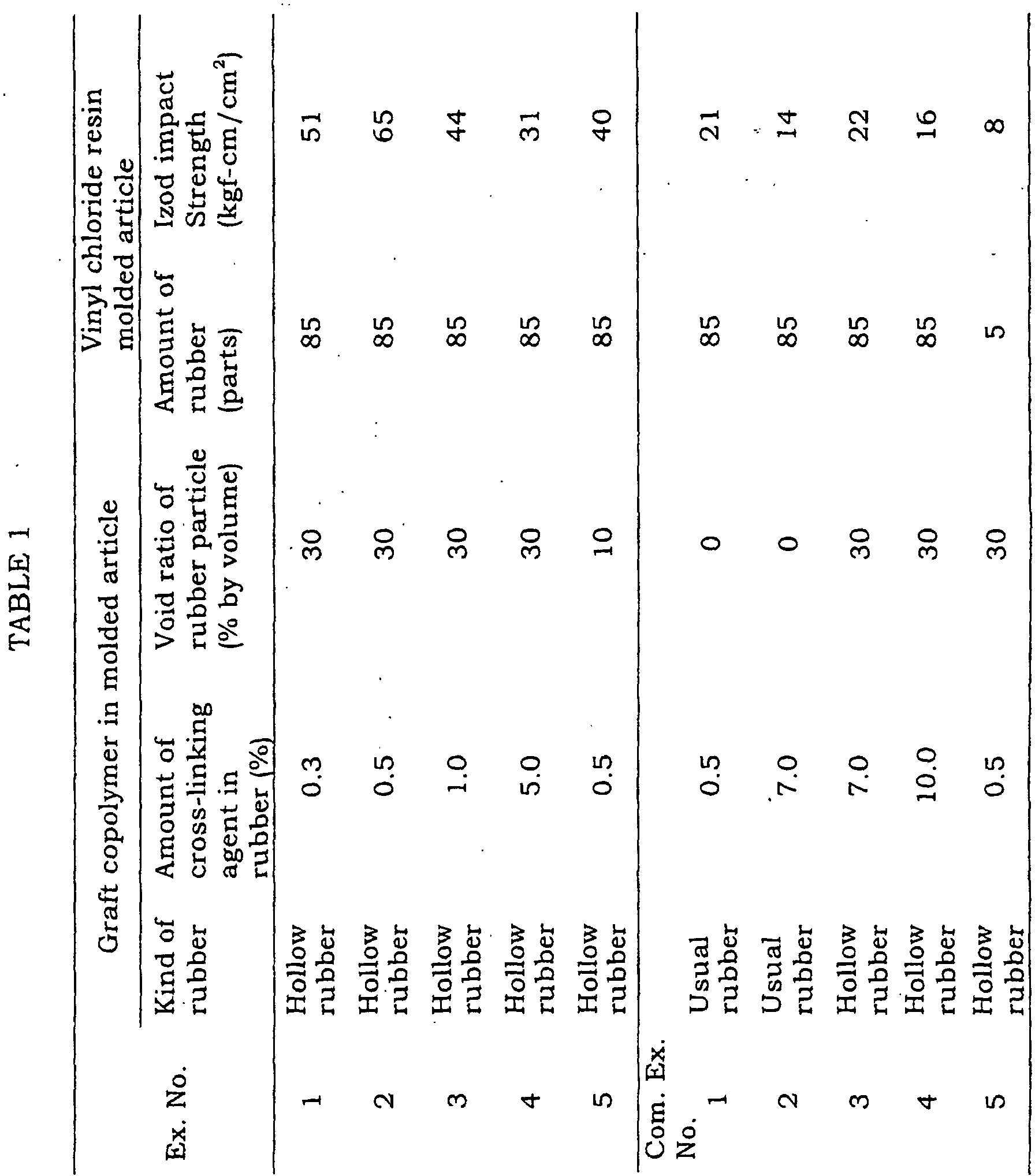
- an impact modifier comprising 30 to 90 % by weight of a hollow rubber of which Tg is at most 0 °C and an amount of a cross linking agent is 0 to 5 % by weight, and which is not hollow after molding and has a void ratio of 3 to 90 % by volume in a latex, and 10 to 70 % by weight of a monomer or monomers comprising 60 to 100 % by weight of at least one vinyl monomer selected from the group consisting of a (meth)acrylate compound, an aromatic vinyl compound and a vinyl cyanide compound, and 0 to 40 % by weight of a monomer copolymerizable therewith, has an extremely large effect on improving impact resistance of a thermoplastic resin.
- voids in the rubber particle are easily formed and expanded at impact (under stress) in an impact modifier containing a hollow rubber having voids in the rubber in a latex to significantly improve in impact strength.
- a larger amount of the cross linking agent used in a rubber is more suitable to keep the rubber particle in a hollow state.
- the largest improving effect is obtained by using an impact modifier containing a rubber which is hollow in a latex and is not hollow at drying and after molding by controlling an amount of a cross linking agent in a rubber to a small amount thereof.
- the present invention relates to an impact modifier for a vinyl chloride resin, which is prepared by polymerizing 10 to 70 % by weight of a monomer containing 60 to 100 % by weight of at least one vinyl monomer selected from the group consisting of a (meth)acrylate compound, an aromatic vinyl compound, a vinyl cyanide compound and vinyl chloride, and 0 to 40 % by weight of the other monomer copolymerizable therewith, in the presence of 30 to 90 % by weight of a hollow rubber particle of which glass transition temperature Tg is at most 0 °C, a void ratio is 3 to 90 % by volume in a latex state and which contains a cross linking agent in an amount of 0.1 to 5 parts by weight based on 100 parts by weight of the total rubber component monomer.
- the amount of the cross linking agent is preferably 0.1 to 1.5 parts by weight.
- the amount of the cross linking agent is more preferably 0.2 to 0.7 part by weight.
- an average particle diameter of the hollow rubber in a latex state is preferably 50 to 300nm.
- the present invention relates to a vinyl chloride resin composition
- a vinyl chloride resin composition comprising a vinyl chloride resin containing at least 50 % by weight of vinyl chloride, and the above-mentioned impact modifier.
- hollow rubber particle There are various methods for preparing hollow rubber particle. For example, the following methods are well known ("Gosei Latex no Oyo (application of synthetic latex)", Takaaki Sugimura et al., p 285).
- the rubber particle of the present invention having voids in a latex may be prepared by any of these methods.
- the hollow rubber component used in the present invention there is no particular limitation for the hollow rubber component used in the present invention, as long. as it is a rubber elastomer of which glass transition temperature is at most 0 °C. But the lower the glass transition temperature is, the better.
- the glass transition temperature is required to be at most 0 °C, and preferably -20 to - 130°C. When the glass transition temperature is more than 0 °C, an improving effect for impact resistance remarkably decreases.
- Examples of the rubber satisfying these conditions are a diene rubber, an acrylic rubber, a silicon rubber and an olefin rubber, but the rubber is not limited thereto.
- Examples of the diene rubber are a butadiene rubber, a styrene-butadiene rubber, an acrylonitrile-butadiene rubber and the like.
- Examples of the acrylic rubber are a butyl acrylate rubber, a butadiene-butyl acrylate rubber, a 2-ethylhexyl acrylate-butyl acrylate rubber and the like.
- Examples of the silicon rubber are a polydimethyl siloxane rubber and the like.
- Examples of the olefin rubber are an ethylene-propylene rubber, an ethylenepropylene-diene rubber and the like.
- the cross-linking agent used for rubber polymerization prevents the rubber particle from collapsing into smaller pieces at molding. When an amount thereof is too high, the collapsing at molding does not rise at all, but voids are not easily expanded at impact (under stress) and the impact strength of the final molded article is small.
- the cross-linkable monomer as the cross-linking agent are allyl methacrylate, divinylbenzene, diallyl phthalate, polyethylene glycol dimethacrylate, 1,3-butylene glycol dimethacrylate, ethylene glycol dimethacrylate and the like. These may be used solely or in a combination use of two or more thereof.
- An amount of the cross-linking agent is 0.1 to 5 parts by weight, preferably 0.1 to 1.5 parts by weight, more preferably 0.2 to 0.7 part by weight based on 100 parts by weight of the rubber component monomer.
- the amount thereof is more than 5 parts by weight, voids can not be easily expanded and then an improving effect for impact resistance of the obtained molded article becomes small.
- the amount is less than 0.1 part by weight, the rubber particles collapse into pieces to decrease the improving effect for impact resistance of the resulted molded article.
- the monomer When a monomer is polymerized in the presence of a hollow rubber particle, the monomer may be polymerized as it is with the hollow rubber particle to obtain a graft polymer, or a larger graft polymer may be obtained by enhancement methods such as acid enhancement and salt enhancement of a rubber particle.
- Voids of a rubber which are hollow in a latex state can be confirmed by TEM observation after embedding a rubber latex in an epoxy resin and the like, dying it with ruthenium tetraoxide and the like. Further, the void ratio can be calculated by exactly measuring the particle size of a rubber latex by Microtrac UPA (Ultrafine Particle Analyzer) and the like, and then measuring light scattering strength of the same rubber latex.
- the void ratio of hollow rubber particle in a latex is 3 to 90 % by volume, preferably 10 to 60 % by volume from the viewpoint of improvement in impact resistance of the final molded article. When the void ratio is more than 90 % by volume, the rubber particle may collapse at molding, and impact strength can not be stably improved. When the void ratio is less than 3 % by volume, formation and expansion of voids in a rubber are not easily propagated at impact in the final molded article, and an improving effect for impact resistance decreases.
- the particle size of the graft copolymer of the present invention is preferably 0.05 to 2.0 ⁇ m, but the suitable value is slightly varied depending on the kind of a thermoplastic resin. Out of this range, the improving effect for impact resistance tends to decreases.
- the method for preparing hollow rubber there is no particular limitation for the method for preparing hollow rubber, and the rubber can be efficiently prepared by using emulsion polymerization.
- the graft copolymer of the present invention is obtained by polymerizing 10 to 70 % by weight, preferably 12 to 40 % by weight of a monomer in the presence of 30 to 90 % by weight, preferably 60 to 88 % by weight of a hollow rubber component.
- the amount of the hollow rubber component is less than 30 % by weight, the improving effect for impact resistance is small.
- it is more than 90 % by weight a particle of the impact modifier collapses at molding the mixed composition, and the improving effect for impact resistance of the molded article becomes small.
- the monomer polymerized in the presence of a hollow rubber particle is a monomer or monomers containing at least one selected from the group consisting of a (meth)acrylate compound, an aromatic vinyl compound, a vinyl cyanide compound and vinyl chloride in an amount of at least 60 % by weight and the other monomer copolymerizable therewith in an amount of at most 40 % by weight.
- Examples of the (meth)acrylate are methacrylates such as methyl methacrylate, ethyl methacrylate, butyl methacrylate and 2-ethylhexyl methacrylate; acrylates such as methyl acrylate, ethyl acrylate, butyl acrylate and 2-ethylhexyl arylate; and the like.
- Examples of the aromatic vinyl compound are styrene, ⁇ -methylstyrene, chlorstyrene and the like.
- Examples of the vinyl cyanide compound are acrylonitrile, methacrylonitrile and the like.
- Examples of the other copolymerizable monomer are (meth)acrylates other than the above-described esters such as glycidyl (meth)acrylate, and maleimide compounds such as maleimide and N-phenylmaleimide.
- vinyl chloride resin used in the present invention are a poly(vinyl chloride), and a copolymer of at least 50 % by weight of vinyl chloride and a monomer copolymerizable with vinyl chloride such as vinyl acetate and ethylene, a chlorinated vinyl chloride resin and the like.
- An amount of the impact modifier used is usually 1 to 30 parts by weight based on 100 parts by weight of the vinyl chloride resin. When the amount is less than 1 part by weight, an improving effect for impact resistance is not recognized. When the amount is more than 30 parts by weight, there is a tendency that a tensile strength of the obtained molded article decreases.
- This hollow graft copolymer latex (G-1) was coagulated with calcium chloride, and subjected to thermal treatment, dehydration and drying, to obtain a hollow graft copolymer (A-1) in the form of powder.
- a vinyl chloride resin available from Kaneka Corp., KANEVINYL S400 having a polymerization degree of 400 were mixed 10 parts of the hollow graft copolymer (A-1), 3.0 parts of octyl tin mercaptide stabilizer, 1.0 part of stearyl alcohol, 0.5 part of stearic amide, 0.5 part of diol montanate, and 1.0 part of a processing aid (available from Kaneka Corp., PA10). And then, and the mixture was extruded by using a 50 mm single screw extruder (type VS50-26) made by Tanabe Plastic Machine K.K.
- a 50 mm single screw extruder type VS50-26
- a mixture comprising 100 parts of butyl acrylate, 0.5 part of allyl methacrylate, 1.2 parts (solid content) of a 5 % sodium laurylsulfate aqueous solution and 450 parts of water was finely dispersed by using a homogenizer, and the mixture was stirred for 1 hour at a room temperature.
- To the mixture was added 0.002 part of ferrous sulfate (FeSO 4 ⁇ 7H 2 O), 0.005 part of ethylenediaminetetraacetic acid ⁇ 2 Na salt, 0.2 part of sodium formaldehyde sulfoxylate and 1.0 part of p-methane hydroperoxide. They were polymerized for 4 hours at 40 °C to obtain a usual rubber latex (R-2) having a void ratio of 0 % by volume and a particle size of 0.15 ⁇ m.
- the impact modifier of the present invention has an excellent improving effect for impact resistance toward a vinyl chloride resin, since it uses a suitable cross linking agent and a rubber particle having a suitable void ratio.
Landscapes
- Chemical & Material Sciences (AREA)
- Health & Medical Sciences (AREA)
- Chemical Kinetics & Catalysis (AREA)
- Medicinal Chemistry (AREA)
- Polymers & Plastics (AREA)
- Organic Chemistry (AREA)
- Graft Or Block Polymers (AREA)
- Compositions Of Macromolecular Compounds (AREA)
Abstract
Description
Claims (5)
- An impact modifier for a vinyl chloride resin, which is prepared by polymerizing 10 to 70 % by weight of a monomer or monomers containing 60 to 100 % by weight of at least one vinyl monomer selected from the group consisting of a (meth)acrylate compound, an aromatic vinyl compound, a vinyl cyanide compound and vinyl chloride, and 0 to 40 % by weight of the other monomer copolymerizable therewith, in the presence of 30 to 90 % by weight of a hollow rubber particle of which glass transition temperature Tg is at most 0 °C and a void ratio is 3 to 90 % by volume in a latex state, and which contains a cross linking agent in an amount of 0.1 to 5 parts by weight based on 100 parts by weight of the total rubber component monomer.
- The impact modifier of Claim 1, wherein the amount of the cross linking agent is 0.1 to 1.5 parts by weight.
- The impact modifier of Claim 1, wherein the amount of the cross linking agent is 0.2 to 0.7 part by weight.
- The impact modifier of Claim 1, wherein an average particle diameter of the hollow rubber in a latex state is 50 to 300nm.
- A vinyl chloride resin composition comprising a vinyl chloride resin containing at least 50 % by weight of vinyl chloride, and the impact modifier of Claim 1.
Applications Claiming Priority (3)
| Application Number | Priority Date | Filing Date | Title |
|---|---|---|---|
| JP30226499 | 1999-10-25 | ||
| JP30226499 | 1999-10-25 | ||
| PCT/JP2000/007220 WO2001030908A1 (en) | 1999-10-25 | 2000-10-18 | Impact modifiers for thermoplastic resins |
Publications (3)
| Publication Number | Publication Date |
|---|---|
| EP1142951A1 true EP1142951A1 (en) | 2001-10-10 |
| EP1142951A4 EP1142951A4 (en) | 2004-05-26 |
| EP1142951B1 EP1142951B1 (en) | 2006-05-24 |
Family
ID=17906928
Family Applications (1)
| Application Number | Title | Priority Date | Filing Date |
|---|---|---|---|
| EP00969842A Expired - Lifetime EP1142951B1 (en) | 1999-10-25 | 2000-10-18 | Impact modifiers for thermoplastic resins |
Country Status (11)
| Country | Link |
|---|---|
| US (1) | US6605672B1 (en) |
| EP (1) | EP1142951B1 (en) |
| KR (1) | KR100614019B1 (en) |
| CN (1) | CN1163535C (en) |
| AU (1) | AU777756B2 (en) |
| CA (1) | CA2355113A1 (en) |
| DE (1) | DE60028183T2 (en) |
| MY (1) | MY120860A (en) |
| TR (1) | TR200101873T1 (en) |
| TW (1) | TW576852B (en) |
| WO (1) | WO2001030908A1 (en) |
Cited By (4)
| Publication number | Priority date | Publication date | Assignee | Title |
|---|---|---|---|---|
| EP1394209A1 (en) * | 2002-08-26 | 2004-03-03 | Rohm And Haas Company | Polymeric compositions useful in plastic resins |
| US7497979B2 (en) | 1999-08-17 | 2009-03-03 | Lucite International Uk Limited | Melt-processable thermoplastic compositions |
| US7615594B2 (en) | 2002-02-15 | 2009-11-10 | Kaneka Corporation | Graft copolymers and impact-resistant flame-retardant resin compositions containing the same |
| EP1834988A4 (en) * | 2004-12-27 | 2009-11-11 | Kaneka Corp | Thermoplastic resin composition |
Families Citing this family (9)
| Publication number | Priority date | Publication date | Assignee | Title |
|---|---|---|---|---|
| US6479559B1 (en) | 2001-01-22 | 2002-11-12 | Kaneka Corporation | Chlorinated vinyl chloride resin composition for siding extrusion molding and siding molded article using the same |
| JP2002317094A (en) * | 2001-04-19 | 2002-10-31 | Kanegafuchi Chem Ind Co Ltd | Thermoplastic resin composition |
| DE10147795A1 (en) * | 2001-09-27 | 2003-04-10 | Basf Ag | PVC impact modifier |
| JP3884661B2 (en) * | 2002-02-15 | 2007-02-21 | 株式会社カネカ | Graft copolymer and flame retardant resin composition containing the same |
| CN101268140B (en) * | 2005-08-11 | 2012-06-06 | Lg化学株式会社 | Highly elastic polyvinyl chloride composition and products prepared using the same |
| EP1997854A4 (en) * | 2006-03-16 | 2010-04-14 | Kaneka Corp | Thermoplastic resin composition |
| KR101497766B1 (en) * | 2012-04-03 | 2015-03-05 | 주식회사 엘지화학 | Composition comprising crosslinked polymer nanoparticle, method for preparing thereof, and form forming property-reinforced PVC obtained from thereof |
| CN104334614B (en) | 2012-04-25 | 2016-05-25 | Lg化学株式会社 | Superabsorbent polymer and method for its preparation |
| DE102017006359A1 (en) | 2017-07-06 | 2019-01-10 | Tesa Se | Self-adhesive tape with a split-resistant PET carrier |
Family Cites Families (9)
| Publication number | Priority date | Publication date | Assignee | Title |
|---|---|---|---|---|
| US4427836A (en) | 1980-06-12 | 1984-01-24 | Rohm And Haas Company | Sequential heteropolymer dispersion and a particulate material obtainable therefrom, useful in coating compositions as a thickening and/or opacifying agent |
| JP2890766B2 (en) * | 1990-09-17 | 1999-05-17 | ジェイエスアール株式会社 | Thermoplastic resin composition |
| JP3104213B2 (en) * | 1991-03-01 | 2000-10-30 | ジェイエスアール株式会社 | Thermoplastic resin composition |
| JP3260486B2 (en) * | 1993-06-18 | 2002-02-25 | 鐘淵化学工業株式会社 | Method for producing synthetic resin powder with improved blocking resistance |
| JPH07309918A (en) * | 1994-03-25 | 1995-11-28 | Takeda Chem Ind Ltd | Agglomerate of multiphase polymer particles and oil absorbent containing the same |
| EP0978539A4 (en) * | 1997-04-24 | 2000-04-12 | Kaneka Corp | Impact-resistant thermoplastic resin composition |
| JP3631361B2 (en) * | 1997-12-04 | 2005-03-23 | 株式会社カネカ | Vinyl chloride resin composition |
| JPH10310714A (en) * | 1998-06-05 | 1998-11-24 | Kanegafuchi Chem Ind Co Ltd | Impact resistant thermoplastic resin composition |
| CA2300081C (en) * | 1998-07-10 | 2008-09-23 | Kaneka Corporation | Thermoplastic resin composition having impact resistance |
-
2000
- 2000-10-17 TW TW089121678A patent/TW576852B/en not_active IP Right Cessation
- 2000-10-18 DE DE60028183T patent/DE60028183T2/en not_active Expired - Lifetime
- 2000-10-18 CN CNB008023654A patent/CN1163535C/en not_active Expired - Lifetime
- 2000-10-18 AU AU79474/00A patent/AU777756B2/en not_active Ceased
- 2000-10-18 US US09/856,459 patent/US6605672B1/en not_active Expired - Lifetime
- 2000-10-18 EP EP00969842A patent/EP1142951B1/en not_active Expired - Lifetime
- 2000-10-18 KR KR1020017008015A patent/KR100614019B1/en not_active Expired - Fee Related
- 2000-10-18 CA CA002355113A patent/CA2355113A1/en not_active Abandoned
- 2000-10-18 WO PCT/JP2000/007220 patent/WO2001030908A1/en not_active Ceased
- 2000-10-18 TR TR2001/01873T patent/TR200101873T1/en unknown
- 2000-10-19 MY MYPI20004919A patent/MY120860A/en unknown
Cited By (5)
| Publication number | Priority date | Publication date | Assignee | Title |
|---|---|---|---|---|
| US7497979B2 (en) | 1999-08-17 | 2009-03-03 | Lucite International Uk Limited | Melt-processable thermoplastic compositions |
| US7651648B2 (en) | 1999-08-17 | 2010-01-26 | Lucile International UK Limited | Methods of forming an article comprising melt-processable thermoplastic compositions |
| US7615594B2 (en) | 2002-02-15 | 2009-11-10 | Kaneka Corporation | Graft copolymers and impact-resistant flame-retardant resin compositions containing the same |
| EP1394209A1 (en) * | 2002-08-26 | 2004-03-03 | Rohm And Haas Company | Polymeric compositions useful in plastic resins |
| EP1834988A4 (en) * | 2004-12-27 | 2009-11-11 | Kaneka Corp | Thermoplastic resin composition |
Also Published As
| Publication number | Publication date |
|---|---|
| CA2355113A1 (en) | 2001-05-03 |
| TW576852B (en) | 2004-02-21 |
| MY120860A (en) | 2005-11-30 |
| EP1142951A4 (en) | 2004-05-26 |
| DE60028183T2 (en) | 2007-03-29 |
| CN1163535C (en) | 2004-08-25 |
| AU777756B2 (en) | 2004-10-28 |
| EP1142951B1 (en) | 2006-05-24 |
| TR200101873T1 (en) | 2002-03-21 |
| US6605672B1 (en) | 2003-08-12 |
| WO2001030908A1 (en) | 2001-05-03 |
| AU7947400A (en) | 2001-05-08 |
| KR100614019B1 (en) | 2006-08-18 |
| CN1327464A (en) | 2001-12-19 |
| KR20010086145A (en) | 2001-09-07 |
| DE60028183D1 (en) | 2006-06-29 |
Similar Documents
| Publication | Publication Date | Title |
|---|---|---|
| AU777756B2 (en) | Impact modifiers for thermoplastic resins | |
| JP3923539B2 (en) | Impact resistant thermoplastic resin composition | |
| JP4071936B2 (en) | Impact resistant thermoplastic resin composition | |
| KR102543169B1 (en) | Method for preparing diene based graft copolymer | |
| JPWO2000002963A1 (en) | Impact-resistant thermoplastic resin composition | |
| CN1177887C (en) | Impact modifiers for improved blocking resistance | |
| JP3358885B2 (en) | Rubber latex, graft copolymer and thermoplastic resin composition | |
| CA2377816C (en) | Process for preparing rubber latex containing water in particles | |
| US7262249B2 (en) | Thermoplastic resin composition having improved impact resistance | |
| JP2000302937A (en) | Soft resin pellet | |
| KR0160334B1 (en) | Manufacturing method of MBS impact modifier for thermoplastic resin | |
| KR102331303B1 (en) | Diene based rubber latex, method for preparing thereof and core-shell structured graft copolymer comprising the same | |
| KR100539373B1 (en) | Thermoplastic resin for impact reinforcing with good powder property and preparing method of the same | |
| JPWO2001030908A1 (en) | Impact modifier for thermoplastic resins | |
| JP2003138094A (en) | Thermoplastic resin composition | |
| KR930002705B1 (en) | Process for preparing a thermoplastic resin having a good impact resistance and mechanical strength | |
| JPWO2003082973A1 (en) | Impact resistant thermoplastic resin composition | |
| JP2001131429A (en) | Impact modifier with improved blocking resistance | |
| JP2002080690A (en) | Thermoplastic resin composition |
Legal Events
| Date | Code | Title | Description |
|---|---|---|---|
| PUAI | Public reference made under article 153(3) epc to a published international application that has entered the european phase |
Free format text: ORIGINAL CODE: 0009012 |
|
| AK | Designated contracting states |
Kind code of ref document: A1 Designated state(s): BE DE ES FR GB IT NL |
|
| 17P | Request for examination filed |
Effective date: 20010920 |
|
| A4 | Supplementary search report drawn up and despatched |
Effective date: 20040413 |
|
| RIC1 | Information provided on ipc code assigned before grant |
Ipc: 7C 08L 51/04 B Ipc: 7C 08F 285/00 B Ipc: 7C 08F 291/02 A Ipc: 7C 08F 265/06 B Ipc: 7C 08L 27/06 B |
|
| 17Q | First examination report despatched |
Effective date: 20040723 |
|
| GRAP | Despatch of communication of intention to grant a patent |
Free format text: ORIGINAL CODE: EPIDOSNIGR1 |
|
| GRAS | Grant fee paid |
Free format text: ORIGINAL CODE: EPIDOSNIGR3 |
|
| GRAA | (expected) grant |
Free format text: ORIGINAL CODE: 0009210 |
|
| AK | Designated contracting states |
Kind code of ref document: B1 Designated state(s): BE DE ES FR GB IT NL |
|
| PG25 | Lapsed in a contracting state [announced via postgrant information from national office to epo] |
Ref country code: IT Free format text: LAPSE BECAUSE OF FAILURE TO SUBMIT A TRANSLATION OF THE DESCRIPTION OR TO PAY THE FEE WITHIN THE PRESCRIBED TIME-LIMIT;WARNING: LAPSES OF ITALIAN PATENTS WITH EFFECTIVE DATE BEFORE 2007 MAY HAVE OCCURRED AT ANY TIME BEFORE 2007. THE CORRECT EFFECTIVE DATE MAY BE DIFFERENT FROM THE ONE RECORDED. Effective date: 20060524 |
|
| REG | Reference to a national code |
Ref country code: GB Ref legal event code: FG4D |
|
| REF | Corresponds to: |
Ref document number: 60028183 Country of ref document: DE Date of ref document: 20060629 Kind code of ref document: P |
|
| PG25 | Lapsed in a contracting state [announced via postgrant information from national office to epo] |
Ref country code: ES Free format text: LAPSE BECAUSE OF FAILURE TO SUBMIT A TRANSLATION OF THE DESCRIPTION OR TO PAY THE FEE WITHIN THE PRESCRIBED TIME-LIMIT Effective date: 20060904 |
|
| PGFP | Annual fee paid to national office [announced via postgrant information from national office to epo] |
Ref country code: IT Payment date: 20061031 Year of fee payment: 7 |
|
| ET | Fr: translation filed | ||
| PLBE | No opposition filed within time limit |
Free format text: ORIGINAL CODE: 0009261 |
|
| STAA | Information on the status of an ep patent application or granted ep patent |
Free format text: STATUS: NO OPPOSITION FILED WITHIN TIME LIMIT |
|
| 26N | No opposition filed |
Effective date: 20070227 |
|
| PG25 | Lapsed in a contracting state [announced via postgrant information from national office to epo] |
Ref country code: IT Free format text: LAPSE BECAUSE OF NON-PAYMENT OF DUE FEES Effective date: 20071018 |
|
| PGFP | Annual fee paid to national office [announced via postgrant information from national office to epo] |
Ref country code: BE Payment date: 20090917 Year of fee payment: 10 |
|
| PGFP | Annual fee paid to national office [announced via postgrant information from national office to epo] |
Ref country code: FR Payment date: 20091029 Year of fee payment: 10 |
|
| BERE | Be: lapsed |
Owner name: *KANEKA CORP. Effective date: 20101031 |
|
| PG25 | Lapsed in a contracting state [announced via postgrant information from national office to epo] |
Ref country code: FR Free format text: LAPSE BECAUSE OF NON-PAYMENT OF DUE FEES Effective date: 20101102 |
|
| REG | Reference to a national code |
Ref country code: FR Ref legal event code: ST Effective date: 20110630 |
|
| PG25 | Lapsed in a contracting state [announced via postgrant information from national office to epo] |
Ref country code: BE Free format text: LAPSE BECAUSE OF NON-PAYMENT OF DUE FEES Effective date: 20101031 |
|
| PGFP | Annual fee paid to national office [announced via postgrant information from national office to epo] |
Ref country code: NL Payment date: 20190912 Year of fee payment: 20 |
|
| PGFP | Annual fee paid to national office [announced via postgrant information from national office to epo] |
Ref country code: DE Payment date: 20191008 Year of fee payment: 20 |
|
| PGFP | Annual fee paid to national office [announced via postgrant information from national office to epo] |
Ref country code: GB Payment date: 20191018 Year of fee payment: 20 |
|
| REG | Reference to a national code |
Ref country code: DE Ref legal event code: R071 Ref document number: 60028183 Country of ref document: DE |
|
| REG | Reference to a national code |
Ref country code: NL Ref legal event code: MK Effective date: 20201017 |
|
| REG | Reference to a national code |
Ref country code: GB Ref legal event code: PE20 Expiry date: 20201017 |
|
| PG25 | Lapsed in a contracting state [announced via postgrant information from national office to epo] |
Ref country code: GB Free format text: LAPSE BECAUSE OF EXPIRATION OF PROTECTION Effective date: 20201017 |