EP1142685A2 - A method for manufacturing plastic articles and a plastic material to be used in performing the method - Google Patents
A method for manufacturing plastic articles and a plastic material to be used in performing the method Download PDFInfo
- Publication number
- EP1142685A2 EP1142685A2 EP01102476A EP01102476A EP1142685A2 EP 1142685 A2 EP1142685 A2 EP 1142685A2 EP 01102476 A EP01102476 A EP 01102476A EP 01102476 A EP01102476 A EP 01102476A EP 1142685 A2 EP1142685 A2 EP 1142685A2
- Authority
- EP
- European Patent Office
- Prior art keywords
- plastic material
- supplied
- gas
- plastic
- fermenting agent
- Prior art date
- Legal status (The legal status is an assumption and is not a legal conclusion. Google has not performed a legal analysis and makes no representation as to the accuracy of the status listed.)
- Withdrawn
Links
- 239000004033 plastic Substances 0.000 title claims abstract description 91
- 239000000463 material Substances 0.000 title claims abstract description 75
- 238000000034 method Methods 0.000 title claims abstract description 41
- 238000004519 manufacturing process Methods 0.000 title claims abstract description 7
- 238000001746 injection moulding Methods 0.000 claims abstract description 28
- 239000011324 bead Substances 0.000 claims abstract description 18
- 239000011521 glass Substances 0.000 claims abstract description 16
- 238000002347 injection Methods 0.000 claims abstract description 14
- 239000007924 injection Substances 0.000 claims abstract description 14
- 239000002991 molded plastic Substances 0.000 claims abstract description 8
- 239000003795 chemical substances by application Substances 0.000 claims description 31
- KRKNYBCHXYNGOX-UHFFFAOYSA-N citric acid Chemical compound OC(=O)CC(O)(C(O)=O)CC(O)=O KRKNYBCHXYNGOX-UHFFFAOYSA-N 0.000 claims description 21
- 239000000654 additive Substances 0.000 claims description 8
- 230000002209 hydrophobic effect Effects 0.000 claims description 7
- UIIMBOGNXHQVGW-UHFFFAOYSA-M Sodium bicarbonate Chemical compound [Na+].OC([O-])=O UIIMBOGNXHQVGW-UHFFFAOYSA-M 0.000 claims description 6
- 239000007788 liquid Substances 0.000 claims description 6
- 238000000465 moulding Methods 0.000 claims description 6
- 239000003963 antioxidant agent Substances 0.000 claims description 4
- 239000003365 glass fiber Substances 0.000 claims description 4
- 239000012760 heat stabilizer Substances 0.000 claims description 4
- 239000000314 lubricant Substances 0.000 claims description 4
- 239000010445 mica Substances 0.000 claims description 4
- 229910052618 mica group Inorganic materials 0.000 claims description 4
- 239000000843 powder Substances 0.000 claims description 4
- 239000000454 talc Substances 0.000 claims description 4
- 229910052623 talc Inorganic materials 0.000 claims description 4
- 229910000030 sodium bicarbonate Inorganic materials 0.000 claims description 3
- 235000017557 sodium bicarbonate Nutrition 0.000 claims description 3
- 238000001816 cooling Methods 0.000 claims description 2
- 238000005728 strengthening Methods 0.000 claims 2
- 239000007789 gas Substances 0.000 description 27
- IJGRMHOSHXDMSA-UHFFFAOYSA-N Atomic nitrogen Chemical compound N#N IJGRMHOSHXDMSA-UHFFFAOYSA-N 0.000 description 3
- 229910001873 dinitrogen Inorganic materials 0.000 description 3
- 229920000642 polymer Polymers 0.000 description 3
- 229920000098 polyolefin Polymers 0.000 description 3
- 150000001875 compounds Chemical class 0.000 description 2
- 230000002787 reinforcement Effects 0.000 description 2
- 238000005452 bending Methods 0.000 description 1
- 230000003247 decreasing effect Effects 0.000 description 1
- 229920001169 thermoplastic Polymers 0.000 description 1
- 239000004416 thermosoftening plastic Substances 0.000 description 1
Images


Classifications
-
- B—PERFORMING OPERATIONS; TRANSPORTING
- B29—WORKING OF PLASTICS; WORKING OF SUBSTANCES IN A PLASTIC STATE IN GENERAL
- B29C—SHAPING OR JOINING OF PLASTICS; SHAPING OF MATERIAL IN A PLASTIC STATE, NOT OTHERWISE PROVIDED FOR; AFTER-TREATMENT OF THE SHAPED PRODUCTS, e.g. REPAIRING
- B29C45/00—Injection moulding, i.e. forcing the required volume of moulding material through a nozzle into a closed mould; Apparatus therefor
- B29C45/17—Component parts, details or accessories; Auxiliary operations
- B29C45/1703—Introducing an auxiliary fluid into the mould
- B29C45/1704—Introducing an auxiliary fluid into the mould the fluid being introduced into the interior of the injected material which is still in a molten state, e.g. for producing hollow articles
-
- B—PERFORMING OPERATIONS; TRANSPORTING
- B29—WORKING OF PLASTICS; WORKING OF SUBSTANCES IN A PLASTIC STATE IN GENERAL
- B29C—SHAPING OR JOINING OF PLASTICS; SHAPING OF MATERIAL IN A PLASTIC STATE, NOT OTHERWISE PROVIDED FOR; AFTER-TREATMENT OF THE SHAPED PRODUCTS, e.g. REPAIRING
- B29C45/00—Injection moulding, i.e. forcing the required volume of moulding material through a nozzle into a closed mould; Apparatus therefor
- B29C45/17—Component parts, details or accessories; Auxiliary operations
- B29C45/1703—Introducing an auxiliary fluid into the mould
- B29C45/1704—Introducing an auxiliary fluid into the mould the fluid being introduced into the interior of the injected material which is still in a molten state, e.g. for producing hollow articles
- B29C45/1706—Introducing an auxiliary fluid into the mould the fluid being introduced into the interior of the injected material which is still in a molten state, e.g. for producing hollow articles using particular fluids or fluid generating substances
Definitions
- the present invention relates to a method for manufacturing injection moulded plastic articles having a low specific weight, in which hollow bodies, for example spherical glass beads, are incorporated with the plastic material, and a plastic material to be used when performing the method.
- the object of the invention is to provide a method and a plastic material for reducing the specific weight of plastic articles when injection moulding the articles by including hollow bodies, for example spherical glass beads, with the plastic material preventing that the hollow bodies are crushed or destroyed in any other way.
- the method according to the invention is characterized in that gas inclusions are provided in the plastic material during the injection moulding so as to reduce the pressure of the plastic material on the hollow bodies.
- a plastic material to be used when performing the method comprises a fermenting agent which during the injection moulding provides the gas inclusions.
- the gas inclusions in the plastic material can be provided in different ways, for example by injecting a gas, for example nitrogen gas into the plastic material, by the fact that the plastic material is supplied with a liquid which is evaporated in the plastic material or by the fact that the plastic material is supplied with a fermenting agent, for example hydrophobic citric acid, forming the gas inclusions in the plastic material.
- a gas for example a nitrogen gas
- the injection of a gas, for example a nitrogen gas can be provided in different ways, for example by supplying the gas to the moulding cavity through the injection moulding nozzle or through channels which are connected with the moulding cavity of the moulding tool or to the injection moulding nozzle for the plastic material.
- the liquid which is evaporated in the plastic material for forming the gas inclusions or the fermenting agent is suitably supplied to the plastic material in connection with the injection thereof in the moulding cavity.
- the fermenting agent can be exothermic or endothermic. It is advantageous if the fermenting is endothermic as an endothermic fermenting agent gives a more regular structure and a more continuous surface of the plastic articles than an exothermic fermenting agent.
- Fig. 1 shows partly in section an injection moulding machine for performing the method according to the invention.
- Fig. 2 illustrates a first step when performing the method according to the invention by means of the injection moulding machine shown in Fig. 1.
- Fig. 3 shows the injection moulding machine subsequently to the performing of the method according to the invention.
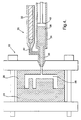
- Fig. 4 shows a second embodiment of an injection moulding machine for performing a modified embodiment of the method according to the invention.
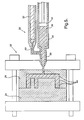
- Fig. 5 shows the injection moulding machine according to Fig. 4 subesequently to performing the modified embodiment of the method according to the invention.
- the injection moulding machine shown in Fig. 1 for performing a first embodiment of the method according to the invention comprises a moulding tool 2 consisting of two mould parts 4 and 6 which together define a mould cavity 8 for providing the plastic article.
- the mould cavity 8 is supplied with a molten plastic material by means of a screw cylinder 10 in a conventional way.
- the injection moulding machine for performing the method according to the invention is different from a conventional injection moulding machine by the fact that it is provided with a device 12 for the supply of a gas or a liquid to the mould cavity 8.
- the device 12 consists of a container 14 and a conduit 16 extending from the container 14 and opening into the mould cavity 8.
- the plastic material 18 is in a molten condition injected into the mould cavity 8 by means of the screw cylinder 10 as appears from Fig. 2.
- the molten plastic material consists for example by a polyolefin polymer containing spherical glass beads in an amount of 2-40 percentage by weight.
- the spherical glass beads have the object of reducing the specific weight of the plastic article which is manufactured in the mould cavity 8.
- the mould cavity 8 is only partially filled with the molten plastic material comprising the spherical glass beads.
- the filling of the mould cavity can be provided to the extent as shown in Fig. 2.
- a gas for example nitrogen gas
- the gas 20 forces the molten plastic material 18 against the surfaces defining the mould cavity 8, as shown in Fig. 3.
- the gas inclusion 20 provides that the spherical beads are not crushed during the injection moulding action by the fact that the gas inclusion 20 lowers the pressure which is exerted on the spherical glass beads.
- the molten plastic material for example the polyolefin polymer, containing the spherical glass beads can contain further additives for improving the properties of the plastic material, such as antioxidants, heat stabilizers, lubricants, impact strength modifying means etc. These additional additives should as a total not exceed 20 percentage by weight of the plastic material.
- the plastic material can also contain one or several inorganic reinforcement materials, such as talc, mica powder, glass fibres and so on.
- plastic articles having a density which is lower than 0,9 g/cm 3 by the fact that the spherical glass beads reducing the specific weight of the plastic material are not crushed or destroyed in any other way because of the gas injection as described above.
- the gas injection forces the molten plastic material against the surfaces of the mould cavity 8 which reduces the requirement for the high pressure which is required at conventional injection moulding of homogeneous plastic articles and which leads to that the spherical glass beads are crushed. If the correct amount of plastic material is injected into the mould cavity 8 prior to the gas supply, the gas will be positioned centrally in the plastic article without being positioned at an outer surface thereof.
- the gas injection can be provided either through the nozzle by means of which the plastic material is supplied or by means of one or several nozzles which are connected directly to the mould cavity 8.
- the gas supply takes place at a pressure of 100-300 bars and subsequently to the supply of the gas the pressure of the gas is reduced so that the gas pressure acts as a post pressure.
- the last step of injection moulding plastic articles according to the method according to the invention consists of cooling the plastic article and evacuation of the gas.
- the injection moulding machine shown in Fig. 4.
- the injection moulding machine comprises an injection moulding tool 22 consisting of two tool parts 24 and 26 which together define a mould cavity 28.
- a device 30 consisting of a screw cylinder 32 and a cylinder 34 for the supply of a fermenting agent.
- the screw cylinder 32 and the cylinder 34 for fermenting agent are connected to a common nozzle 36 which is connected with the mould cavity 28.
- the screw cylinder 32 of the injection moulding machine contains a plastic material, for example a polyolefin polymer in a molten condition containing spherical glass beads in an amount of 2-40 percentage by weight so as to reduce the specific weight of the final plastic article.
- a plastic material for example a polyolefin polymer in a molten condition containing spherical glass beads in an amount of 2-40 percentage by weight so as to reduce the specific weight of the final plastic article.
- the molten plastic material can contain inorganic reinforcement agents, such as talc, mica powder, glass fibres and also other additives such as antioxidation agents, heat stabilizers, lubricants, impact strength modifying agents and so on. These additional additives should not amount to more than about 20 percentage by weight of the weight of the plastic material.
- a fermenting agent 38 is supplied to the molten plastic material through the cylinder 34.
- the fermenting agent is preferably constituted by an endothermic fermenting agent which for example is constituted by a hydrophobic citric acid.
- the hydrophobic citric acid is mixed with sodium bicarbonate.
- the fermenting agent forms gas inclusions 44 in the plastic material so that an expanded product is obtained as appears from Fig. 5. Because of the gas inclusions it is prevented that the spherical glass beads are crushed or destroyed in any other way.
- the plastic material, the compound, which is used in the method according to the invention has preferably a stiffness which is lower than 2500 N/mm 2 and preferably amounts to 500-2500 N/mm 2 (a modulus of bending according to ISO 178).
Landscapes
- Engineering & Computer Science (AREA)
- Manufacturing & Machinery (AREA)
- Mechanical Engineering (AREA)
- Injection Moulding Of Plastics Or The Like (AREA)
- Processing And Handling Of Plastics And Other Materials For Molding In General (AREA)
Abstract
Description
Claims (26)
- A method for manufacturing injection moulded plastic articles in which the plastic material for forming the injection moulded plastic articles is supplied with hollow bodies, for example hollow spherical glass beads, in order to reduce the specific weight of the plastic articles, characterized in that gas inclusions are during the injection moulding provided in the plastic material so as to reduce the pressure established by the plastic material on the hollow bodies.
- A method as claimed in claim 1, characterized in that gas is injected into the plastic material.
- A method as claimed in claim 2, characterized in that nitrogene gas is injected into the plastic material.
- A method as claimed in any of the preceding claims, characterized in that the gas is injected at a pressure of 100-300 bars.
- A method as claimed in any of claims 2-4, characterized in that the gas is supplied through the injection moulding nozzle.
- A method as claimed in any of claims 2-5, characterized in that the gas is supplied through channels which are connected with the mould cavity of the moulding machine or to the injection nozzle for the plastic material.
- A method as claimed in any of the preceding claims, characterized in that the plastic material is supplied with a liquid which is vaporized in the plastic material so as to form gas inclusions therein.
- A method as claimed in any of claims 2-7, characterized in that the gas is evacuated from the plastic product subsequently to the cooling thereof.
- A method as claimed in any of the preceding claims, characterized in that the plastic material is supplied with a fermenting agent forming gas inclusions in the plastic material.
- A method as claimed in claim 9, characterized in that the fermenting agent is an endothermic agent.
- A method as claimed in claim 9 or 10, characterized in that the fermenting agent is constituted by a hydrophobic citric acid.
- A method as claimed in claim 10, characterized in that the hydrophobic citric acid is mixed with sodium bicarbonate.
- A method as claimed in any of the preceding claims, characterized in that the plastic material is supplied with 2-40 percentage by weight of hollow bodies.
- A method as claimed in any of the preceding claims, characterized in that the plastic material is supplied with hollow bodies in such an amount that its specific weight is lower than 0,9 g/cm3.
- A method as claimed in any of the preceding claims, characterized in that the plastic material is supplied with different additives, such as antioxidants, heat stabilizers, lubricants and impact strength modifying agents.
- A method as claimed in any of the preceding claims, characterized in that the plastic material is supplied with inorganic strengthening agents, such as talc, mica powder and glass fibres.
- A method as claimed in claim 15 or 16, characterized in that the additives are supplied to the plastic material in an amount which is lower than 20 percentage by weight.
- A plastic material to be used when performing the method according to any of the preceding claims, the plastic material containing hollow bodies, for exemple hollow spherical glass beads, characterized in that the plastic material contains a fermenting agent forming gas inclusions in the plastic material.
- A plastic material as claimed in claim 18, characterized in that the fermenting agent constitutes 0,5 - 5% of the plastic material.
- A plastic material as claimed in claim 18 or 19, characterized in that the fermenting agent is an endothermic agent.
- A plastic material as claimed in any of claims 18-20, characterized in that the fermenting agent is constituted by a hydrophobic citric acid.
- A plastic material as claimed in claim 21, characterized in that the hydrophobic citric acid is mixed with sodium bicarbonate.
- A plastic material as claimed in any of claims 18-22, characterized in that it contains different additives, such as antioxidants, heat stabilizers, lubricants and impact strengt modifying agents.
- A plastic material as claimed in any of claims 18-23, characterized in that it contains inorganic strengthening agents, such as talc, mica powder and glass fibres.
- A plastic material as claimed in any of claims 18-24, characterized in that it has a stiffness which is lower than 2500 N/mm2.
- A plastic material as claimed in claim 25, characterized in that it has a stiffness which amount to between 500 and 2500 N/mm2.
Applications Claiming Priority (2)
| Application Number | Priority Date | Filing Date | Title |
|---|---|---|---|
| SE0001257 | 2000-04-06 | ||
| SE0001257A SE519104C2 (en) | 2000-04-06 | 2000-04-06 | Methods for making injection molded plastic products and plastic materials for use in carrying out the process |
Publications (2)
| Publication Number | Publication Date |
|---|---|
| EP1142685A2 true EP1142685A2 (en) | 2001-10-10 |
| EP1142685A3 EP1142685A3 (en) | 2003-01-08 |
Family
ID=20279193
Family Applications (1)
| Application Number | Title | Priority Date | Filing Date |
|---|---|---|---|
| EP01102476A Withdrawn EP1142685A3 (en) | 2000-04-06 | 2001-02-05 | A method for manufacturing plastic articles and a plastic material to be used in performing the method |
Country Status (2)
| Country | Link |
|---|---|
| EP (1) | EP1142685A3 (en) |
| SE (1) | SE519104C2 (en) |
Cited By (1)
| Publication number | Priority date | Publication date | Assignee | Title |
|---|---|---|---|---|
| US9006302B2 (en) | 2010-09-08 | 2015-04-14 | 3M Innovative Properties Company | Glass bubbles, composites therefrom, and method of making glass bubbles |
Family Cites Families (3)
| Publication number | Priority date | Publication date | Assignee | Title |
|---|---|---|---|---|
| JPH0615688A (en) * | 1992-07-01 | 1994-01-25 | Nok Corp | Foam core material |
| US5658603A (en) * | 1992-08-11 | 1997-08-19 | E. Khashoggi Industries | Systems for molding articles having an inorganically filled organic polymer matrix |
| CN1060998C (en) * | 1994-09-28 | 2001-01-24 | 松下电器产业株式会社 | Hollow structural member and method for making same |
-
2000
- 2000-04-06 SE SE0001257A patent/SE519104C2/en unknown
-
2001
- 2001-02-05 EP EP01102476A patent/EP1142685A3/en not_active Withdrawn
Cited By (1)
| Publication number | Priority date | Publication date | Assignee | Title |
|---|---|---|---|---|
| US9006302B2 (en) | 2010-09-08 | 2015-04-14 | 3M Innovative Properties Company | Glass bubbles, composites therefrom, and method of making glass bubbles |
Also Published As
| Publication number | Publication date |
|---|---|
| SE0001257D0 (en) | 2000-04-06 |
| EP1142685A3 (en) | 2003-01-08 |
| SE0001257L (en) | 2001-10-07 |
| SE519104C2 (en) | 2003-01-14 |
Similar Documents
| Publication | Publication Date | Title |
|---|---|---|
| EP0799853B2 (en) | Thermoplastic resin product and production thereof | |
| EP0919351B1 (en) | Fiber-Reinforced resin molded article and method of manufacturing the same | |
| US8153235B2 (en) | Molded thermoplastic articles | |
| US20070132131A1 (en) | Resin-molded component and method for manufacturing thereof as well as diaphragm for loudspeaker | |
| JP2001514588A (en) | Product made of plastic material and method of manufacturing the product | |
| JP2008273117A (en) | Polypropylene resin foam molding with skin | |
| JPH1058573A (en) | Fiber-reinforced thermoplastic resin foam molded article and method for producing the same | |
| JP2002500580A (en) | Extruded / blown bottles and methods and materials for producing the bottles | |
| EP1142685A2 (en) | A method for manufacturing plastic articles and a plastic material to be used in performing the method | |
| US6783844B2 (en) | Polypropylene resin foam-molded article | |
| JP3435018B2 (en) | Molding method and molded article of glass fiber reinforced thermoplastic resin | |
| US20020001703A1 (en) | Lightweight fiber-reinforced thermoplastic resin molding | |
| JP3303610B2 (en) | Recycling method of glass fiber reinforced polyamide | |
| EP1013390A1 (en) | Method of injection molding expandable plastic composition | |
| JP4036632B2 (en) | Method for producing bubble soap | |
| JP5055664B2 (en) | Polypropylene resin composition for injection foam molding | |
| EP0925901A1 (en) | Method of injection molding expandable plastic composition | |
| JP2835976B2 (en) | Manufacturing method of hollow molded body | |
| JPH09174596A (en) | Production of thick-walled resin molded product and the product | |
| JPH10129357A5 (en) | ||
| JPH08103919A (en) | Short shot foam molding method | |
| JP2000070070A (en) | Foam molding | |
| JP4438148B2 (en) | Production method of foamed propeller fan | |
| JPH11333876A (en) | Molding method of resin molded article | |
| CN1102491C (en) | Method of injection molding expandable plastic composition |
Legal Events
| Date | Code | Title | Description |
|---|---|---|---|
| PUAI | Public reference made under article 153(3) epc to a published international application that has entered the european phase |
Free format text: ORIGINAL CODE: 0009012 |
|
| AK | Designated contracting states |
Kind code of ref document: A2 Designated state(s): AT BE CH CY DE DK ES FI FR GB GR IE IT LI LU MC NL PT SE TR |
|
| AX | Request for extension of the european patent |
Free format text: AL;LT;LV;MK;RO;SI |
|
| PUAL | Search report despatched |
Free format text: ORIGINAL CODE: 0009013 |
|
| AK | Designated contracting states |
Kind code of ref document: A3 Designated state(s): AT BE CH CY DE DK ES FI FR GB GR IE IT LI LU MC NL PT SE TR |
|
| AX | Request for extension of the european patent |
Free format text: AL;LT;LV;MK;RO;SI |
|
| AKX | Designation fees paid | ||
| REG | Reference to a national code |
Ref country code: DE Ref legal event code: 8566 |
|
| STAA | Information on the status of an ep patent application or granted ep patent |
Free format text: STATUS: THE APPLICATION IS DEEMED TO BE WITHDRAWN |
|
| 18D | Application deemed to be withdrawn |
Effective date: 20030709 |